
 DRUG APPROVALS BY DR ANTHONY MELVIN CRASTO
.....
DRUG APPROVALS BY DR ANTHONY MELVIN CRASTO
.....


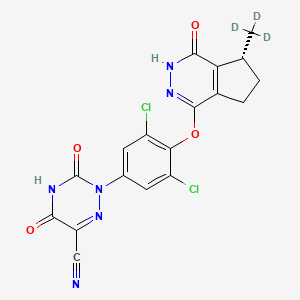
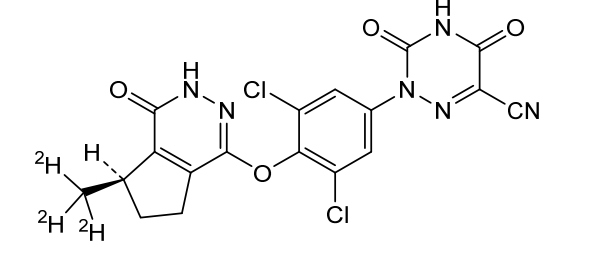
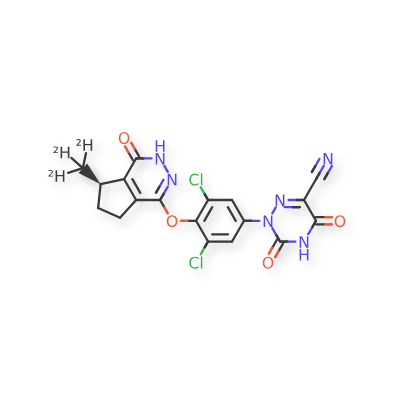
Simedeutirom
CAS 2403721-24-2
MF C18H92H3Cl2N6O4 MW 450.25
2-[3,5-Dichloro-4-[[(7R)-2,5,6,7-tetrahydro-7-(methyl-d3)-1-oxo-1H-cyclopenta[d]pyridazin-4-yl]oxy]phenyl]-2,3,4,5-tetrahydro-3,5-dioxo-1,2,4-triazine-6-carbonitrile
2-[3,5-dichloro-4-[[(7R)-1-oxo-7-(trideuteriomethyl)-2,5,6,7-tetrahydrocyclopenta[d]pyridazin-4-yl]oxy]phenyl]-3,5-dioxo-1,2,4-triazine-6-carbonitrile
2-(3,5-dichloro-4-{[(7R)-7-(2H3)methyl-1-oxo-2,5,6,7-tetrahydro-1Hcyclopenta[d]pyridazin-4-yl]oxy}phenyl)-3,5-dioxo-2,3,4,5-tetrahydro-1,2,4-triazine-6-carbonitrile
thyroid hormone beta receptor agonist, 4G7Z7KQ8GV
Simedeutirom is a selective, synthetic, deuterium-labeled thyroid hormone receptor beta (THR-β) agonist. It features a novel cyclopenta𝑑pyridazine core and is primarily utilized as a specialized tool compound in the biochemical research of metabolic diseases, including obesity, type 2 diabetes mellitus, and related metabolic disorders.
Core Structural & Pharmacological Profile
- Target Selectivity: It functions as a potent agonist specifically targeting the thyroid hormone receptor beta (THR-β), with an half-maximal effective concentration (EC₅₀) ranging between 0.1 to 1 μM. THR-β activation plays a foundational role in modulating hepatic lipid metabolism, lowering cholesterol, and regulating overall energy expenditure without heavily triggering the alpha receptor (THR-α), which is associated with adverse cardiac side effects.
- Deuterium Labeling: The compound incorporates deuterium (a stable isotope of hydrogen) into its chemical architecture, specifically modified as a trideuteriomethyl group. Isotopic modification or “deuteration” is an established medicinal chemistry approach frequently evaluated to slow metabolic clearance and increase structural stability.
- Chemical Identifiers:
- Molecular Formula: C₁₈H₁₂Cl₂N₆O₄
- Molecular Weight: 450.25 g/mol
- CAS Registry Number: 2403721-24-2
- FDA UNII Code: 4G7Z7KQ8GV
Research Context & Status
Simedeutirom is categorized under the International Nonproprietary Name (INN) database. However, it is fundamentally classified for in vitro and in vivo research use only. It has not been approved for clinical therapeutic use or direct distribution to patients.
PAT
WO 2019240938
https://patentscope.wipo.int/search/en/detail.jsf?docId=WO2019240938&_cid=P11-MU978W-22170-1
PAT
US20250179050
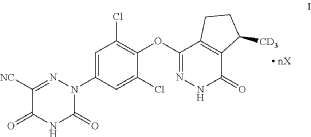
Example 1 Preparation of crude free base of compound I
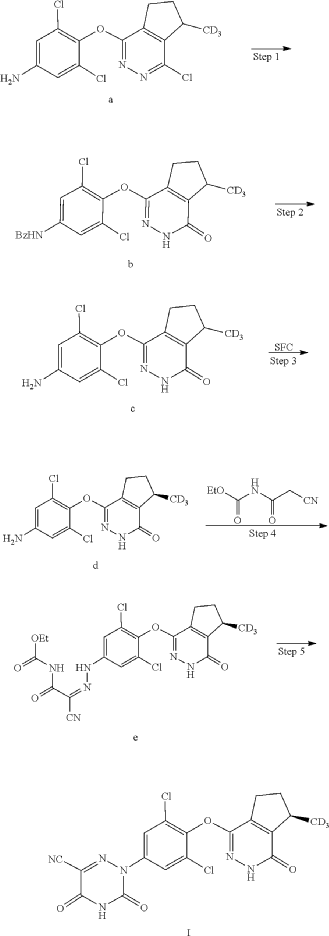
Step 1: preparation of compound b
N-(3,5-dichloro-4-((7-(methyl-d3)-1-oxo-2,5,6,7-tetrahydro-1H-cyclopenta [d]pyridazin-4-yl)oxy)phenyl)benzamid
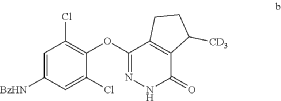
| 1H NMR (400 MHZ, DMSO) δ 12.07 (s, 1H), 10.55 (s, 1H), 8.04 (s, 2H), 7.98-7.95 (m, 2H), 7.63-7.50 (m, 3H), 3.29-3.25 (m, 1H), 3.02-2.90 (m, 2H), 2.39-2.36 (m, 1H), 1.75-1.72 (m, 1H). |
Step 2: preparation of compound c
4-(4-amino-2,6-dichlorophenoxy)-7-(methyl-d3)-2,5,6,7-tetrahydro-1H-cyclopenta [d]pyridazin-1-on
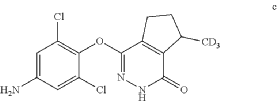
| To a 100 L reaction kettle, 5.76 kg of the crude compound b from the previous step, a potassium hydroxide solution (2606 g KOH dissolved in 19.5 L of purified water) and 6.0 L of anhydrous ethanol were added under stirring. After the complete addition, the mixture was heated to reflux and reacted for about 16 hours, and the raw material was controlled for a complete reaction. |
| 1H NMR (400 MHZ, DMSO) δ 11.98 (s, 1H), 6.67 (m, 2H), 5.60 (s, 2H), 3.30-3.19 (m, 1H), 3.03-2.93 (m, 1H), 2.90-2.70 (m, 1H), 2.35 (m, 1H), 1.69 (m, 1H). |
Step 3: preparation of compound d
(R)-4-(4-amino-2,6-dichlorophenoxy)-7-(methyl-d3)-2,5,6,7-tetrahydro-1H-cyclopenta [d]pyridazin-1-one
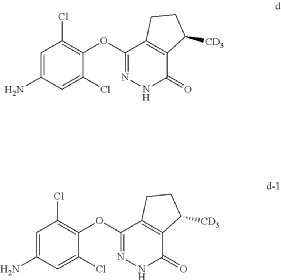
| 3298 g of racemate c was subjected to chiral resolution to give, two optical isomers from separation: |
| Compound d (retention time: 1.583 min, 1230 g, off-white solid, ee %=99.60%, yield 37.3%); and compound d-1 (retention time: 1.926 min, 1255 g, off-white solid, ee %=99.76%, yield 38.1%). |
Resolution conditions:
Compound d
| 1H NMR (400 MHZ, DMSO) δ 11.98 (s, 1H), 6.67 (s, 2H), 5.60 (s, 2H), 3.30-3.19 (m, 1H), 3.03-2.93 (m, 1H), 2.90-2.70 (m, 1H), 2.35 (dtd,1H), 1.69 (ddt, 1H). |
Compound d-1
| 1H NMR (400 MHZ, DMSO) δ 11.98 (s, 1H), 6.68 (d, 2H), 5.60 (s, 2H), 3.29-3.18 (m, 1H), 2.97 (tdd, 1H), 2.90-2.72 (m, 1H), 2.35 (dtd, 1H), 1.69 (ddt, 1H). |
Step 4: preparation of compound e
Ethyl(R,Z)-(2-cyano-2-(2-(3,5-dichloro-4-((7-(methyl-d3)-1-oxo-2,5,6,7-tetrahydro-1H-cyclopenta [d]pyridazin-4-yl)oxy)phenyl) hydrazineylidene) acetyl) carbamate
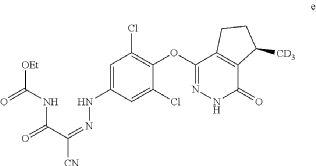
| To a 100 L reaction kettle, 16.0 kg of acetic acid, 4.0 kg of purified water and 2.0 kg of compound d were added with stirring. The temperature was reduced to 0+5° C., then 2.36 kg of hydrochloric acid was added, and after the addition, the temperature was maintained at 0+5° C. with stirring for about 20 minutes. A sodium nitrite solution (0.5 kg of sodium nitrite dissolved in 1.0 kg of purified water) was dropwise added with the temperature being controlled at 0+5° C., and after the addition, the temperature was maintained at 0+5° C. for reaction for 2 hours. The temperature was controlled at 5+5° C. and a sodium acetate solution (1.5 kg of sodium acetate dissolved in 6.0 kg of purified water) was added dropwise, then 0.99 kg of N-cyanoacetourethane was added, and then the temperature was increased to 10+5° C. for a reaction for about 2 hours. Then a sample was taken for HPLC monitoring, after which time samples were taken at each about 2-hour interval, and the reaction was not stopped until the content of compound d was determined by HPLC to be≤1.0%. |
| The filter cake was dried at 55+5° C. with vacuum≤−0.07 MPa for about 17 hours, and compound e was obtained and collected, weighing 2.6327 kg. |
| 1H NMR (400 MHZ, DMSO) δ 12.08 (d, 2H), 10.88 (s, 1H), 7.99 (s, 2H), 4.21 (q, 2H), 3.30-3.17 (m, 1H), 3.08-2.95 (m, 1H), 2.95-2.80 (m, 1H), 2.38 (ddd, 1H), 1.78-1.63 (m, 1H), 1.28 (t, 3H). |
Step 5: preparation of compound of formula I
(R)-2-(3,5-dichloro-4-((7-(methyl-d3)-1-oxo-2,5,6,7-tetrahydro-1H-cyclopenta [d]pyridazin-4-yl)oxy)phenyl)-3,5-dioxo-2,3,4,5-tetrahydro-1,2,4-triazine-6-carbonitrile
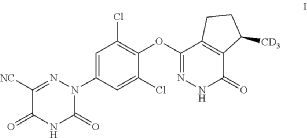
| 1H NMR (400 MHZ, DMSO) δ 13.26 (s, 1H), 12.09 (s, 1H), 7.79 (s, 2H), 3.32-3.24 (m, 1H), 3.10-2.99 (m, 1H), 2.96-2.88 (m, 1H), 2.45-2.31 (m, 1H), 1.77-1.69 (m, 1H). |
ADVERTISEMENT
ANAX LABORATORIES
WEBSITE https://www.anaxlab.com/
Discovery Solutions, Supporting the chemistry needs of clients in the Medical, Analytical and Bio Sciences
Development Solutions, Developing from Lab scale to PR&D, Kilo Scale-ups and Commercial Scales
SEE MORE………Integrated Solutions, Manufacturing Solutions, Products,
Can’t Find? Let’s Connect

Phone : +91 897704 2010 / +91 9177075735, Email : info@anaxlab.com
#MedicinalChemistry, #DrugDiscovery, #OrganicSynthesis, #ChemicalLibrary, #BuildingBlocks, #SARStudies, #ChemistryInnovation, #medchem, #Drugdevelopment, #Biotech, #Biotechnology, #AnaxLaboratories, #Pharma



AS ON FEB2026 4.574 LAKHS VIEWS ON BLOG WORLDREACH AVAILABLEFOR YOUR ADVERTISEMENT

join me on Linkedin
Anthony Melvin Crasto Ph.D – India | LinkedIn
join me on Researchgate
RESEARCHGATE

join me on Facebook
Anthony Melvin Crasto Dr. | Facebook
join me on twitter
Anthony Melvin Crasto Dr. | twitter
+919321316780 call whatsaapp
EMAIL. amcrasto@gmail.com

References
- Method for preparing (r)-1,4-dichloro-5-(methyl-d3)-6,7-dihydro-5h-cyclopenta[d]pyridazinePublication Number:WO-2025055949-A1Priority Date:2023-09-12
- Polymorph as thyroid hormone receptor agonists and use thereofPublication Number:WO-2023147752-A1Priority Date:2022-02-07
- Preparation method of pyridazinone derivative, and intermediate thereofPublication Number:TW-202342457-APriority Date:2022-02-07
- Preparation method of pyridazinone derivative, and intermediate thereofPublication Number:WO-2023147779-A1Priority Date:2022-02-07
- Polymorph as thyroid hormone receptor agonists and use thereofPublication Number:EP-4477652-A1Priority Date:2022-02-07
////////simedeutirom, anax labs, thyroid hormone beta receptor agonist, 4G7Z7KQ8GV
#simedeutirom, #anax labs, #thyroid hormone beta receptor agonist, #4G7Z7KQ8GV


 New Drug Approvals
