
 DRUG APPROVALS BY DR ANTHONY MELVIN CRASTO
.....
DRUG APPROVALS BY DR ANTHONY MELVIN CRASTO
.....



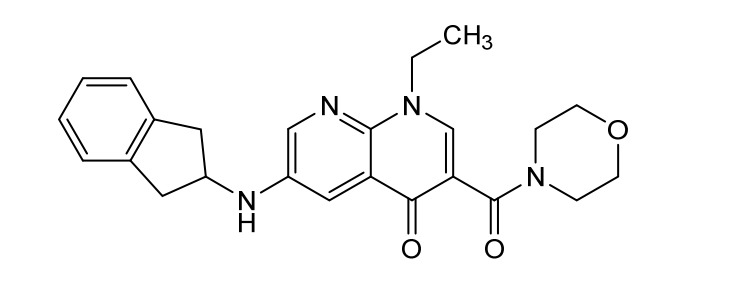
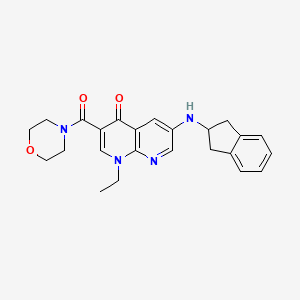
Soclenicant
CAS 1020634-41-6
MFC24H26N4O3 MW418.5 g/mol
6-(2,3-dihydro-1H-inden-2-ylamino)-1-ethyl-3-(morpholine-4-carbonyl)-1,8-naphthyridin-4-one
6-[(2,3-dihydro-1H-inden-2-yl)amino]-1-ethyl-3-(morpholine4-carbonyl)-1,8-naphthyridin-4(1H)-one
nicotinic acetylcholine receptor negative allosteric, modulator, anxiolytic, BNC210, IW-2143, BNC 210, IW 2143, QP49AY37OY
BNC-210 is under investigation in clinical trial NCT04951076 (A Phase 2b Study of BNC210 Tablet Formulation in Adults With Post-traumatic Stress Disorder (PTSD)).
Soclenicant (also known by its developmental code names BNC210 and IW-2143) is an investigational, orally active small-molecule drug developed to treat anxiety and stressor-related disorders. It is chemically classified as a synthetic heterocyclic compound based on a 1,8-naphthyridin-4-one scaffold.
Unlike traditional anxiety medications like benzodiazepines, it is designed to provide targeted relief without causing side effects like sedation, motor impairment, memory issues, or physical dependence.
Mechanism of Action
Soclenicant functions as a highly selective negative allosteric modulator (NAM) of the α7-nicotinic acetylcholine receptor (α₇ nAChR).
- It works by tuning down the electric currents induced by neurotransmitters like acetylcholine and nicotine specifically at this receptor subtype.
- In preclinical rodent models, it demonstrated strong acute anxiolytic (anti-anxiety), anti-stress, and antidepressant-like behaviors.
Clinical Development Status
The drug was originally engineered by Bionomics and saw collaborative development alongside entities like Ironwood Pharmaceuticals. Bionomics was acquired by Neuphoria Therapeutics in late 2024.
However, the drug’s clinical pipeline faced a massive setback:
- Social Anxiety Disorder (SAD) Flop: In late 2025, a Phase 3 clinical trial evaluating a single 225-mg dose of soclenicant for the acute treatment of social anxiety disorder failed to meet its primary endpoint. It showed no statistically significant improvement in patient distress levels during a public speaking challenge compared to a placebo.
- Current Status: Following the Phase 3 failure, Neuphoria Therapeutics discontinued the social anxiety program and triggered a strategic corporate review. While it has historically been granted FDA Fast Track designation for generalized anxiety disorder (GAD) and explored for Post-Traumatic Stress Disorder (PTSD), the future development pipeline remains uncertain
Soclenicant (INNTooltip International Nonproprietary Name),[3] also known by its developmental code names BNC210 and IW-2143, is an antinicotinic agent which is under development for the treatment of anxiety disorders such as social phobia and generalized anxiety disorder, as well as for treatment of agitation, post-traumatic stress disorder (PTSD), and depressive disorders.[1][4][5] It is taken by mouth.[4]
The drug acts as a highly selective negative allosteric modulator (NAM) of the α7-nicotinic acetylcholine receptor (α7-nAChR).[1][6][4][5] It produces anxiolytic-, anti-stress-, and antidepressant-like effects without causing sedation, memory or motor impairment, or physical dependence in rodents.[6] Chemically, soclenicant is a synthetic heterocyclic small-molecule compound based on a 1,8-naphthyridin-4-one scaffold, bearing amide and amine functionalities.[7]
Soclenicant is being developed by Bionomics.[4] It has also been developed by Ironwood Pharmaceuticals and EmpathBio.[4][5] Bionomics was acquired by Neuphoria Therapeutics in December 2024.[4] As of December 2024, soclenicant is in phase 3 clinical trials for anxiety disorders, phase 2 trials for agitation and PTSD, and no recent development has been reported for depressive disorders.[4][5] The drug received Fast Track designation from the United States Food and Drug Administration (FDA) in 2019.[8] It was first described in the literature, in a conference abstract, by 2007.[2]
- Efficacy of BNC210 in Acute, As-needed Treatment of Anxiety in Social Anxiety Disorder – 1CTID:NCT06510504Phase:Phase 3Status:CompletedDate:2026-05-19
- A Phase 2 Study of BNC210 for the Acute Treatment of Social Anxiety DisorderCTID:NCT05193409Phase:Phase 2Status:CompletedDate:2025-03-18
- A Phase 2b Study of BNC210 Tablet Formulation in Adults With Post-Traumatic Stress Disorder (PTSD)CTID:NCT04951076Phase:Phase 2Status:CompletedDate:2025-02-06
- Phase II Study of BNC210 in PTSDCTID:NCT02933606Phase:Phase 2Status:CompletedDate:2023-02-27
- A Study of BNC210 in Elderly Patients With AgitationCTID:NCT03548194Phase:Phase 2Status:CompletedDate:2020-07-09
SYNTHETIC
- The Pathway to Proof‐of‐Concept for BNC210, a Negative Allosteric Modulator of the Alpha‐7 Nicotinic Acetylcholine Receptor (nAChR), for Treatment of Psychiatric DiseasePublication Name:Clinical Pharmacology in Drug DevelopmentPublication Date:2025-09-27PMCID:PMC12856972PMID:41014090DOI:10.1002/cpdd.1609
- BNC210, a negative allosteric modulator of the alpha 7 nicotinic acetylcholine receptor, demonstrates anxiolytic- and antidepressant-like effects in rodentsPublication Name:NeuropharmacologyPublication Date:2024-03-15PMID:38185416DOI:10.1016/j.neuropharm.2024.109836
- BNC210: an investigational α7-nicotinic acetylcholine receptor modulator for the treatment of anxiety disordersPublication Name:Expert Opinion on Investigational DrugsPublication Date:2023-03-20PMID:36927202DOI:10.1080/13543784.2023.2192922
- Cholinergic Modulation of Disorder-Relevant Neural Circuits in Generalized Anxiety DisorderPublication Name:Biological PsychiatryPublication Date:2020-05-15PMCID:PMC7198974PMID:32107005DOI:10.1016/j.biopsych.2019.12.013
INTERMEDIATES
PAT
WO2012151640
https://patentscope.wipo.int/search/en/detail.jsf?docId=WO2012151640&_cid=P11-MUC1WO-96887-1
N-1
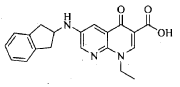
1-Ethyl-6-(indan-2-ylamino)-4-oxo-1,8-naphthyridine-3-cal-boxylic acid:
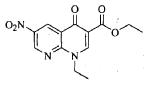
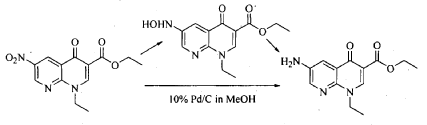
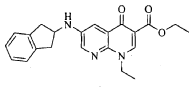
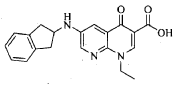
Ethanol (42.0 L) was added to reactor at 25-30 °C, followed by ethyl 1 -ethyl-6-(indan-2-ylamino)-4-oxo- 1 ,8-naphthyridine-3-carboxylate (4.20 kg) with stirring. Aqueous sodium hydroxide solution (prepared by dissolving 3.4 kg of sodium hydroxide into 42.0 L of water) was added to reaction mixture at 25-30 °C and reactor temperature was raised to 50-55 °C. The reaction mixture was stirred at 50-55 °C for 2 h and reaction progress was monitored by TLC. After completion of hydrolysis (~3 h), the reaction mass was cooled to 25-30 °C and pH was adjusted to 5-6 by addition of citric acid solution (prepared by dissolving 5.2 kg of citric acid in 47.0 L of water). The reaction mass was stirred for 20-25 minutes at 25-30 °C and filtered, the solid mass was washed with water (42.0 L) and acetone (21 .0 L). The material was transferred to drying trays and dried with hot-air dryer at 70-75 °C until the water content decreased to 1 .0%, yielding the desired compound (90%) as a solid. Ή NMR (DMSO-d6, 500MHz): 1.40(3H, t, J = 7.0Hz), 2.86-2.90(2H, m), 3.37-3.41 (2H, m), 4.38(1 H, d, J = 5.5 Hz), 4.62(2H? q, J = 7.0Hz), 7.06( 1 H, d, J = 6.0Hz), 7.17-7.18(2H. m), 7.26-7.27(2H, m), 7.60(1 H, d, J = 2.5 Hz), 8.52(1 H, d, J =2.0 Hz), 9.00 (1 H, s), 15.30(1 H, s). 13C NMR (DMSO-d6, 125MHz): 15.19, 46.92, 52.92, 107.12, 109.42, 121.58, 124.63, 126.41 , 140.1 1 , 141.12, 143.33, 143.43, 145.93, 166.12, 177.53.
FINAL
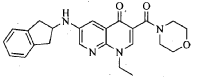
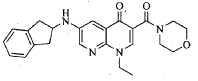
6-(2 ,3-Dihydro-1H-inden-2-ylamino)-1-ethyl-3-(morpholin-4-ylcarbonyl)-1,8-naphthyridin-4(1H)-one
Step 1 : 160.0 L of dichloromethane (water content should be no more than 0.1%), 1 -ethyl-6-(indan-2-ylamino)-4-oxo-l ,8-naphthyridine-3-carboxylic acid (4.0 kg) and triethylamine (3.5 kg) were sequentially added to reactor at 25-30°C under nitrogen atmosphere and the reaction mixture was cooled to 10-15 °C. Pivaloyl chloride (4.1 kg) was slowly added to reaction mixture keeping the reaction temperature at 10-15°C. Then, the reaction temperature was raised to 25-30 °C and stirred. The reaction progress was monitored by TLC for disappearance of starting material. After completion of reaction (3-4 h), the reaction mixture was again cooled to 15-20 °C and morpholine (6.0 kg) was added with stirring, keeping the reaction temperature at 1 5-20 °C. N,N-Dimethyl-4-aminopyridine ( 194 g) and DMF (2.0 L) were added to the reaction mixture at 15-20 °C and heated to reflux. The reaction progress was monitored by TLC for the disappearance of intermediate pivaloyl ester and found to be complete within 12-13 h. The reaction mixture was cooled to 15-20 °C and then quenched by addition of aqueous sodium bicarbonate solution (prepared by dissolving 5.6 kg of sodium bicarbonate in 56.0 L of water) with stirring. The organic layer was separated and washed with aqueous sodium chloride solution (prepared by dissolving 23.0 kg of sodium chloride in 57.0 L of water). The organic layer was separated and dried by stirring with anhydrous sodium sulphate (4.0 kg). The organic layer was filtered through a Nutsche filter and the sodium sulphate was washed with dichloromethane. The filtrate was transferred into a flask and evaporated under vacuum below 40 °C. The resulting material in the flask was cooled to 25-30 °C and suspended in diethyl ether (40.0 L). The solid separated was filtered using a Nutsche filter and washed with diethyl ether (8.0 L) and the isolated wet solid was dissolved in dichloromethane (20.0 L). The solution (10.0 L) was then filtered through a silica gel plug (10.0 kg) with dichloromethane (36.0 L), followed by 10 L of 10% methanol in dichloromethane. The silica gel filter was dried under vacuum. Similarly, the remaining portion of solution ( 10.0 L) was filtered through another silica gel plug (10.0 kg). The combined filtrate was evaporated under vacuum below 40 °C and then residual solid was suspended in ethyl acetate (20.0 L) with stirring at 25-30 °C. The solid separated was filtered through Nutsche filter and washed with ethyl acetate (4.0 L). The filter was dried under vacuum and then material was transferred to drying trays and dried at 40-45 °C. Yield (2.36 Kg). 1H NMR (DMSO-d6, 500MHz): 1.49 (3H, t, J = 7.2Hz), 2.91 (2H, dd, J = 3.5Hz, 16.0 Hz), 3.42-3.47(4H, m), 3.80(6H, s), 4.25-4.26(1H, bd), 4.40-4.48(3H, m), 7.20-7.25(4H, m),
7.82(1H, d, J = 3.0Hz), 8.09 (1H, s), 8.18(1 H, d, J = 3.0Hz). 13C NMR (CDCl3, 150MHz): 15.27, 39.87, 43.05, 46.66, 48.09, 53.93, 66.80, 67.40, 1 13.27, 1 16.71 , 123.22, 124.92, 126.78, 140.87, 141 .46, 141.83, 141.90, 143.84, 166.27, 173.38.
PAT
WO2014138772
https://patentscope.wipo.int/search/en/detail.jsf?docId=WO2014138772&_cid=P11-MUC1WO-96887-2
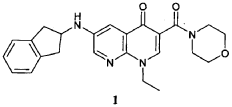
United States Patent Number 8,293,737, the entirety of which is incorporated herein by reference, describes certain 1,8-naphthyridin-4(1H)-one compounds which are useful as anxiolytic agents. Such compounds include 1-ethyl-6-(indan-2-ylamino)-3-(morphoIine-4-carbonyl)-1 ,8-naphthyridin-4-one (compound 1).
PAT
- Novel anxiolytic compoundsPublication Number:EP-2540722-A1Priority Date:2006-10-16
- Novel anxiolytic compoundsPublication Number:WO-2008046135-A1Priority Date:2006-10-16
- Novel anxiolytic compoundsPublication Number:EP-2540722-B1Priority Date:2006-10-16Grant Date:2016-06-08
- Anxiolytic compoundsPublication Number:US-10954231-B2Priority Date:2006-10-16Grant Date:2021-03-23
- Anxiolytic compoundsPublication Number:US-10233181-B2Priority Date:2006-10-16Grant Date:2019-03-19
- Novel anxiolytic compoundsPublication Number:US-2013012509-A1Priority Date:2006-10-16
- Novel anxiolytic compoundsPublication Number:US-2018105524-A1Priority Date:2006-10-16
- Novel anxiolytic compoundsPublication Number:US-2017183347-A1Priority Date:2006-10-16
- Anxiolytic compoundsPublication Number:US-8906912-B2Priority Date:2006-10-16Grant Date:2014-12-09
ADVERTISEMENT
ANAX LABORATORIES
WEBSITE https://www.anaxlab.com/
Discovery Solutions, Supporting the chemistry needs of clients in the Medical, Analytical and Bio Sciences
Development Solutions, Developing from Lab scale to PR&D, Kilo Scale-ups and Commercial Scales
SEE MORE………Integrated Solutions, Manufacturing Solutions, Products,
Can’t Find? Let’s Connect

Phone : +91 897704 2010 / +91 9177075735, Email : info@anaxlab.com
#MedicinalChemistry, #DrugDiscovery, #OrganicSynthesis, #ChemicalLibrary, #BuildingBlocks, #SARStudies, #ChemistryInnovation, #medchem, #Drugdevelopment, #Biotech, #Biotechnology, #AnaxLaboratories, #Pharma


AS ON FEB2026 4.574 LAKHS VIEWS ON BLOG WORLDREACH AVAILABLEFOR YOUR ADVERTISEMENT
join me on Linkedin
Anthony Melvin Crasto Ph.D – India | LinkedIn
join me on Researchgate
RESEARCHGATE

join me on Facebook
Anthony Melvin Crasto Dr. | Facebook
join me on twitter
Anthony Melvin Crasto Dr. | twitter
+919321316780 call whatsaapp
EMAIL. amcrasto@gmail.com

References
- Hampsey E, Perkins A, Young AH (April 2023). “BNC210: an investigational α7-nicotinic acetylcholine receptor modulator for the treatment of anxiety disorders”. Expert Opin Investig Drugs. 32 (4): 277–282. doi:10.1080/13543784.2023.2192922. PMID 36927202.
- Andriambeloson, E., Wagner, S., Huyard, B., Sleebs, B., Quasi, N., Bui, C., … & Street, I. (2007, September). BNC210: A Novel Compound with Potent Anxiolytic Activity. In Behavioral Pharmacology (Vol. 18, pp. S16–S16). https://neurofit.com/im-posters/2008-ebps-bnc210.pdf
- https://cdn.who.int/media/docs/default-source/international-nonproprietary-names-(inn)/pl132.pdf#page=198 soclenicantum soclenicant 6-[(2,3-dihydro-1H-inden-2-yl)amino]-1-ethyl-3-(morpholine4-carbonyl)-1,8-naphthyridin-4(1H)-one nicotinic acetylcholine receptor negative allosteric modulator, anxiolytic
- “BNC 210”. AdisInsight. 30 December 2024. Retrieved 22 February 2025.
- “Delving into the Latest Updates on BNC-210 with Synapse”. Synapse. 23 January 2025. Retrieved 22 February 2025.
- O’Connor SM, Sleebs BE, Street IP, Flynn BL, Baell JB, Coles C, Quazi N, Paul D, Poiraud E, Huyard B, Wagner S, Andriambeloson E, de Souza EB (March 2024). “BNC210, a negative allosteric modulator of the alpha 7 nicotinic acetylcholine receptor, demonstrates anxiolytic- and antidepressant-like effects in rodents”. Neuropharmacology. 246 109836. doi:10.1016/j.neuropharm.2024.109836. hdl:11343/348285. PMID 38185416.
- “CID 24772165”. PubChem. Retrieved 5 January 2026.
- Bionomics Limited Press Release (2019-11-04). “Bionomics Announces Fast Track Designation Granted by U.S. FDA to BNC210 Development Program for the Treatment of PTSD”. BusinessWire. Retrieved 2020-09-09.
 | |
| Clinical data | |
|---|---|
| Other names | BNC210; BNC-210; IW2143; IW-2143 |
| Routes of administration | Oral |
| Drug class | α7-Nicotinic acetylcholine receptor negative allosteric modulator |
| ATC code | None |
| Legal status | |
| Legal status | Investigational |
| Pharmacokinetic data | |
| Bioavailability | 69.4% (rat)[1][2] |
| Protein binding | 70–88%[1][2] |
| Elimination half-life | 6.2 hours (rat)[1][2] |
| Identifiers | |
| IUPAC name | |
| CAS Number | 1020634-41-6  |
| PubChem CID | 24772165 |
| UNII | QP49AY37OY |
| KEGG | D13360 |
| Chemical and physical data | |
| Formula | C24H26N4O3 |
| Molar mass | 418.497 g·mol−1 |
| 3D model (JSmol) | Interactive image |
| SMILES | |
| InChI | |
//////soclenicant, anax labs, nicotinic acetylcholine receptor negative allosteric, modulator, anxiolytic, BNC210, IW-2143, BNC 210, IW 2143, QP49AY37OY
#soclenicant, #anax labs, #nicotinic acetylcholine receptor negative allosteric, #modulator, #anxiolytic, #BNC210, #IW-2143, #BNC 210, #IW 2143, #QP49AY37OY


 New Drug Approvals
