
 DRUG APPROVALS BY DR ANTHONY MELVIN CRASTO
.....
DRUG APPROVALS BY DR ANTHONY MELVIN CRASTO
.....



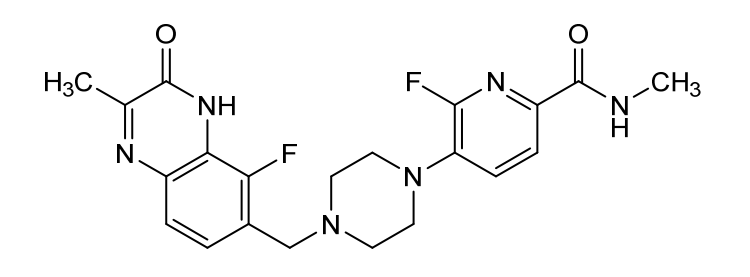
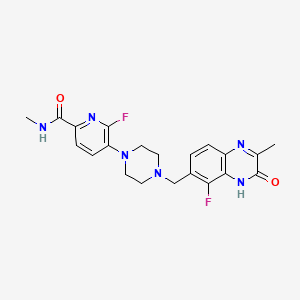
Palacaparib
CAS 2756333-39-6
MFC21H22F2N6O2 MW428.4 g/mol
6-fluoro-5-[4-[(5-fluoro-2-methyl-3-oxo-4H-quinoxalin-6-yl)methyl]piperazin-1-yl]-N-methylpyridine-2-carboxamide
2-Pyridinecarboxamide, 6-fluoro-5-(4-((5-fluoro-3,4-dihydro-2-methyl-3-oxo-6-quinoxalinyl)methyl)-1-piperazinyl)-N-methyl-
6-fluoro-5-{4-[(5-fluoro-2-methyl-3-oxo-3,4-dihydroquinoxalin-6-yl)methyl]piperazin-1-yl}-N-methylpyridine-2-carboxamide
poly (ADP-ribose) polymerase (PARP) inhibitor, antineoplastic, AZD 9574, 9UG32UQW48
Palacaparib is an investigational new drug that is being evaluated by AstraZeneca for the treatment of prostate cancer.[1] It is a selective PARP1 inhibitor.[2][3]
Palacaparib (also known as AZD9574) is an investigational, orally bioavailable cancer drug developed by AstraZeneca. It belongs to a class of medications called PARP inhibitors.
Key Characteristics
- High Selectivity: It selectively targets the PARP1 enzyme. It features an 8,000-fold greater selectivity for PARP1 over other PARP forms like PARP2. This targeted approach aims to lower typical bone marrow toxicities linked with older, non-selective PARP inhibitors.
- Brain Penetrance: Unlike many earlier options, it successfully crosses the blood-brain barrier. This trait makes it a prime candidate for managing primary brain tumors and central nervous system (CNS) metastases.
Mechanism of Action
- Enzyme Binding: Palacaparib tightly binds to the PARP1 enzyme at single-strand DNA break locations.
- DNA Trapping: It traps the enzyme on the damaged DNA, blocking the base excision repair pathway.
- Synthetic Lethality: This stalling stalls replication forks and forces single-strand breaks to progress into double-strand breaks.
- Cell Death: In tumors with homologous recombination deficiency (HRD)—such as BRCA1/2 mutations—cells cannot fix these severe breaks, triggering apoptosis (programmed cell death).
Clinical Research and Targets
According to active registries from the National Cancer Institute (NCI), Palacaparib is undergoing early-phase human trials both as a single agent and alongside other treatments. Researchers are testing its efficacy across several oncological areas:
- Advanced Solid Malignancies: Studies focus heavily on HRD-positive tumors, including specific types of breast, ovarian, and pancreatic cancers.
- Prostate Cancer: Active monotherapy and combination trials target metastatic prostate cancer.
- CNS Malignancies: Preclinical designs show promise in treating gliomas when paired with radiation or alkylating agents like temozolomide.
- OriginatorAstraZeneca
- ClassAntineoplastics; Carbamates; Fluorinated hydrocarbons; Ketones; Piperazines; Pyridines; Quinoxalines; Small molecules
- Mechanism of ActionPoly(ADP-ribose) polymerase-1 inhibitors
- Phase I/IIProstate cancer; Solid tumours
- 03 Jun 2026Phase-I/II clinical trials in Prostate cancer (Combination therapy, Hormone refractory, Second-line therapy or greater, Metastatic disease) in USA (PO) (NCT07590934)
- 14 May 2026AstraZeneca plans a phase I/II trial for Prostate cancer (Metastatic disease, Combination therapy, Second-line therapy or greater, Hormone-refractory) in USA, Australia, Germany, Italy, South Korea, Spain, United Kingdom (PO) in May 2026 (NCT07590934) (EudraCT2025-524920-23)
- 19 Feb 2026Chemical structure information added.
Palacaparib is an orally bioavailable central nervous system (CNS) penetrant and inhibitor of nuclear enzyme poly(ADP-ribose) polymerase (PARP) 1, with potential antineoplastic activity. Upon oral administration, palacaparib selectively binds to PARP1, thereby preventing repair of damaged DNA via the base excision repair (BER) pathway. This agent enhances the accumulation of DNA strand breaks and promotes genomic instability eventually leading to apoptosis. Palacaparib may enhance the cytotoxicity of DNA-damaging agents and reverse tumor cell chemo- and radioresistance. PARP1 catalyzes post-translational ADP-ribosylation of nuclear proteins that signal and recruit other proteins to repair damaged DNA and plays a key role in the repair of single strand DNA (ssDNA) breaks and double-strand break (DSBs). Palacaparib is able to penetrate the blood-brain barrier (BBB).
SYN
https://patentscope.wipo.int/search/en/detail.jsf?docId=WO2021260092&_cid=P22-MS178J-58931-1
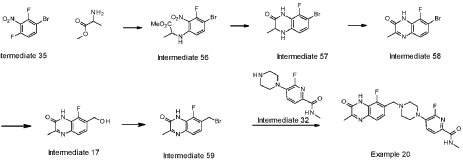
Example 20: 6-fluoro-5-[4-[(5-fluoro-2-methyl-3-oxo-4H-ciuinoxalin-6-yl)methvnDiDerazin-1-vn-N-methyl-pyridine-2-carboxamide
Triethylphosphane (20.90 ml, 145.06 mmol) was added dropwise with an addition funnel to a stirred suspension of 8-fluoro-7-(hydroxymethyl)-3-methyl-1 H-quinoxalin-2-one (intermediate 17) (15.1 g, 72.53 mmol) and 1 ,2-dibromo-1 ,1 ,2,2-tetrachloroethane (52.0 g, 159.56 mmol) in DCM (400 mL) at 0°C under nitrogen. The mixture was stirred at r.t for 3 h gave a light-yellow suspension. Crude LCMS indicated full conversion. DCM was removed under vacuum; the residue was slurry in 300 mL diethyl ether at rt and the light yellow ppt was filtered and washed with 200 ml ether. The solid was taken into 300 ml of water, stirred at rt for 10 min, the solid was collected by filtration, thorough wash (200 ml) with water to remove the salts. The solid was dried under vacuum for overnight (no heat). The solid was washed with hexanes and dried in vacuum in a bushel funnel to give 7-(bromomethyl)-8-fluoro-3-methylquinoxalin-2(1 H)-one (intermediate 59) (22.76 g, 116 %, likely contains some inorganic salts) as an off white solid. Used as such for next reaction. 1 H NMR (500 MHz, DMSO-c/6) 2.42 (3H, s), 4.65 – 4.93 (2H, m), 7.28 – 7.42 (1 H, m), 7.51 (1 H, d), 12.53 (1 H, br s); m/z (ES+) [M+H]+ = 271 , 273.
To a flask charged with 7-(bromomethyl)-8-fluoro-3-methylquinoxalin-2(1 H)-one (intermediate 59) (22.76 g) and 6-fluoro-N-methyl-5-(piperazin-1-yl)picolinamide, 2HCI ( intermediate 32) (24.24 g, 77.9 mmol) in acetonitrile (350 ml), was added DIPEA (38.0 ml, 217.59 mmol) at rt and the resulting mixture was stirred at 70°C for 4 h. Reaction was not complete. To the mixture was added 5 g of Kl and 2 g of Nal and the mixture was stirred at 50°C for 20 h. More 540 mgs (~0.03eq) of 6-fluoro-N-methyl-5-(piperazin-l-yl)picolinamide, 2HCI (intermediate 32) was added to the mixture and the stirring continued at 50°C for 2 h. The solid from the reaction suspension was collected by filtration, washed with acetonitrile and dried. The resulting material was then suspended in water (~400 ml), slurred at rt for 20 min, filtered and dried (97% purity by LCMS). The solid was then dissolved into a mixture of DCM/MeOH (3/1) (about 1.5 L) at reflux, filtered through a pad of silica gel, removed most of the DCM until solid precipitate out and the mixture was kept at rt for 20 min. The solid was collected by filtration and repeated the procedure for the filtrate, and the solids were combined to yield the product 6-fluoro-5-[4-[(5-fluoro-2-methyl-3-oxo-4H-quinoxalin-6-yl)methyl]piperazin-1-yl]-N-methyl-pyridine-2-carboxamide (example 20) (26 g, 84%) as a light yellow solid. 1 H NMR (500 MHz, DMSO-c/6) 2.41 (3H, s), 2.57 – 2.69 (4H, m), 2.76 (3H, d), 3.16 (4H, br s), 3.70 (2H, s), 7.29 (1 H, br t), 7.40 – 7.60 (2H, m), 7.83 (1 H, d), 8.38 (1 H, br d), 12.44 (1 H, br s); m/z (ES+) [M+H]+ = 429.
PAT
- Chemical compoundsPublication Number:US-12421208-B2Priority Date:2020-06-25Grant Date:2025-09-23
- Chemical compoundsPublication Number:US-11795158-B2Priority Date:2020-06-25Grant Date:2023-10-24
- Chemical compoundsPublication Number:US-2022009901-A1Priority Date:2020-06-25
- Combining ATR inhibitors and PARP inhibitors for cancer treatmentPublication Number:IL-309388-APriority Date:2021-06-16
- Use of ATR inhibitors in combination with PARP inhibitors to treat cancerPublication Number:KR-20240021884-APriority Date:2021-06-16
- Quinoxaline derivatives as anticancer drugsPublication Number:CN-115768760-APriority Date:2020-06-25
- Quinoxaline derivatives as anti-cancer drugsPublication Number:WO-2021260092-A1Priority Date:2020-06-25
- Quinoxaline derivatives as anti-cancer drugsPublication Number:EP-4172152-A1Priority Date:2020-06-25
SYN
- Discovery of 6-Fluoro-5-{4-[(5-fluoro-2-methyl-3-oxo-3,4-dihydroquinoxalin-6-yl)methyl]piperazin-1-yl}-N-methylpyridine-2-carboxamide (AZD9574): A CNS-Penetrant, PARP1-Selective InhibitorPublication Name:Journal of Medicinal ChemistryPublication Date:2024-12-10PMID:39655996DOI:10.1021/acs.jmedchem.4c01725
- New Horizons of Synthetic Lethality in Cancer: Current Development and Future PerspectivesPublication Name:Journal of Medicinal ChemistryPublication Date:2024-07-02PMCID:PMC11284803PMID:38955347DOI:10.1021/acs.jmedchem.4c00113
ADVERTISEMENT
ANAX LABORATORIES
WEBSITE https://www.anaxlab.com/
Discovery Solutions, Supporting the chemistry needs of clients in the Medical, Analytical and Bio Sciences
Development Solutions, Developing from Lab scale to PR&D, Kilo Scale-ups and Commercial Scales
SEE MORE………Integrated Solutions, Manufacturing Solutions, Products,
Can’t Find? Let’s Connect

Phone : +91 897704 2010 / +91 9177075735, Email : info@anaxlab.com
#MedicinalChemistry, #DrugDiscovery, #OrganicSynthesis, #ChemicalLibrary, #BuildingBlocks, #SARStudies, #ChemistryInnovation, #medchem, #Drugdevelopment, #Biotech, #Biotechnology, #AnaxLaboratories, #Pharma



AS ON FEB2026 4.574 LAKHS VIEWS ON BLOG WORLDREACH AVAILABLEFOR YOUR ADVERTISEMENT

join me on Linkedin
Anthony Melvin Crasto Ph.D – India | LinkedIn
join me on Researchgate
RESEARCHGATE

join me on Facebook
Anthony Melvin Crasto Dr. | Facebook
join me on twitter
Anthony Melvin Crasto Dr. | twitter
+919321316780 call whatsaapp
EMAIL. amcrasto@gmail.com

References
 | |
| Clinical data | |
|---|---|
| Other names | AZD-9574 |
| Identifiers | |
| IUPAC name | |
| CAS Number | 2756333-39-6 |
| PubChem CID | 162524593 |
| IUPHAR/BPS | 11946 |
| ChemSpider | 115008044 |
| UNII | 9UG32UQW48 |
| ChEMBL | ChEMBL5095223 |
| PDB ligand | A1H64 (PDBe, RCSB PDB) |
| Chemical and physical data | |
| Formula | C21H22F2N6O2 |
| Molar mass | 428.444 g·mol−1 |
| 3D model (JSmol) | Interactive image |
| SMILES | |
| InChI | |
References
- “Palacaparib”. AdisInsight. Springer Nature Switzerland AG. Retrieved 5 July 2026.
- Johannes JW, Balazs AY, Barratt D, Bista M, Chuba MD, Cosulich S, et al. (December 2024). “Discovery of 6-Fluoro-5-{4-[(5-fluoro-2-methyl-3-oxo-3,4-dihydroquinoxalin-6-yl)methyl]piperazin-1-yl}-N-methylpyridine-2-carboxamide (AZD9574): A CNS-Penetrant, PARP1-Selective Inhibitor”. Journal of Medicinal Chemistry. 67 (24): 21717–21728. doi:10.1021/acs.jmedchem.4c01725. PMID 39655996.
- Shkil DO, Chesnokova NA, Ivashchenko AA, Petersen EV, Maximov PY (May 2026). “Structural Determinants of PARP1 Selectivity from Molecular Dynamics Analysis of PARP1 and PARP2 Complexes”. Molecules. 31 (10). Basel, Switzerland: 1592. doi:10.3390/molecules31101592. PMC 13210057. PMID 42197145.
///////////palacaparib, ANAX LABS, poly (ADP-ribose) polymerase (PARP) inhibitor, antineoplastic, AZD 9574, 9UG32UQW48
#palacaparib, #ANAX LABS, #poly (ADP-ribose) polymerase (PARP) inhibitor, #antineoplastic, #AZD 9574, #9UG32UQW48


 New Drug Approvals
