
 DRUG APPROVALS BY DR ANTHONY MELVIN CRASTO
.....
DRUG APPROVALS BY DR ANTHONY MELVIN CRASTO
.....


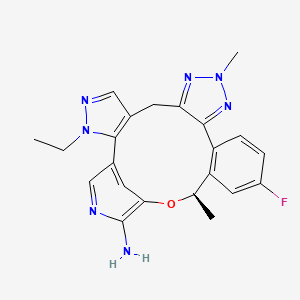

Zidesamtinib
CAS 2739829-00-4
MF C22H22FN7O MW419.5 g/mol
(19R)-3-ethyl-16-fluoro-10,19-dimethyl-20-oxa-3,4,9,10,11,23-hexazapentacyclo[19.3.1.02,6.08,12.013,18]pentacosa-1(25),2(6),4,8,11,13(18),14,16,21,23-decaen-22-amine
- (14R)-7-ethyl-16-fluoro-2,14-dihydro-2,14-dimethyl-7H-8,12-Metheno-4H-pyrazolo[3,4-h]-1,2,3-triazolo[4,5-k][2,5]benzoxaazacyclotetradecin-11-a mine
- (14R)-7-Ethyl-16-fluoro-2,14-dihydro-2,14-dimethyl-7H-8,12-metheno-4H-pyrazolo[3,4-h]-1,2,3-triazolo[4,5-k][2,5]benzoxaazacyclotetradecin-11-amine
- (19R)-3-ethyl-16-fluoro-10,19-dimethyl-20-oxa-3,4,9,10,11,23-hexazapentacyclo[19.3.1.02,6.08,12.013,18]pentacosa-1(25),2(6),4,8,11,13(18),14,16,21,23-decaen-22-amine
- 7H-8,12-Metheno-4H-pyrazolo[3,4-h]-1,2,3-triazolo[4,5-k][2,5]benzoxaazacyclotetradecin-11-amine, 7-ethyl-16-fluoro-2,14-dihydro-2,14-dimethyl-, (14R)-
To treat adults with locally advanced or metastatic ROS1-positive non-small cell lung cancer after receiving a ROS1 kinase inhibitor
FDA 2026, APPROVALS 2026, Jideytro, NVL-520, NUV-520, NU-520, NVL 520, NUV 520, NU 520, MX5KQV5XHC
Zidesamtinib (sold under the brand name Jideytro) is an oral, highly selective, next-generation kinase inhibitor approved by the U.S. Food and Drug Administration (FDA) on July 22, 2026, to treat adults with locally advanced or metastatic ROS1-positive non-small cell lung cancer (NSCLC) who have previously been treated with at least one ROS1 kinase inhibitor. Developed originally by Nuvalent and subsequently acquired by GSK, it represents a major milestone as GSK’s first approved therapeutic targeting lung cancer.
Mechanism of Action
Zidesamtinib functions by targeting and inhibiting the receptor tyrosine kinase c-ros oncogene 1 (ROS1). It is custom-engineered to solve the primary clinical challenges that limit previous therapies:
- Overcoming Resistance Mutations: It binds tightly to wild-type ROS1 and remains robustly active against a broad array of treatment-emergent point mutants. This includes G2032R (the most common solvent-front resistance mutation), as well as S1986Y/F, L2026M, and D2033N mutations.
- Blood-Brain Barrier Penetration: It features high central nervous system (CNS) penetrance to effectively treat and control brain metastases, which are frequent in aggressive ROS1-positive cancers.
- TRK-Sparing Design: Unlike older dual-acting inhibitors, it deliberately avoids inhibiting the structurally similar tropomyosin receptor kinase (TRK) family. This minimizes off-target TRK-related neurological toxicities like severe dizziness and ataxia.
Clinical Trial Outcomes
The FDA approval was heavily supported by data from the ongoing global, single-arm, Phase 1/2 ARROS-1 clinical trial (N=117 heavily pretreated patients):
- Overall Response: Delivered an Objective Response Rate (ORR) of 44% in patients who had exhausted alternative TKI options.
- Subgroup Efficacy: Achieved a 51% ORR in patients who had received only one prior ROS1 inhibitor, a 54% ORR in those harboring the G2032R mutation, and an intracranial ORR of 48% for patients with active brain metastases.
- Durability: Showed prolonged disease control, with a 12-month duration of response (DOR) rate standing at 69%.
Administration and Side Effects
Jideytro is formulated as an oral tablet taken once daily, with or without food. It demonstrates a highly tolerable safety profile, with only a 10% dose reduction rate and a 2% treatment discontinuation rate due to adverse events.
- Common Adverse Reactions (≥ 15%): Edema (swelling), peripheral neuropathy, constipation, fatigue, and dyspnea (shortness of breath).
- Warnings & Precautions: Includes risks of mild CNS reactions (dizziness, cognitive alterations), QTc interval prolongation, skeletal fractures, pancreatic toxicity, and interstitial lung disease (ILD)/pneumonitis.
Zidesamtinib, sold under the brand name Jideytro, is an anti-cancer medication used for the treatment of previously treated locally advanced or metastatic ROS1+ non-small cell lung cancer.[1][2][3] It is taken by mouth once daily.[1][2][3]
Medical uses
Indication
Zidesamtinib is a prescription medicine used to treat adults with non-small cell lung cancer that has spread within the chest or other parts of the body and is caused by an abnormal ROS1 gene, and who have received a ROS1 kinase inhibitor.[1][2][3]
Mechanism of action
Zidesamtinib is a kinase inhibitor that works by blocking ROS1, an abnormal protein that drives some lung cancers to grow, including forms that have become resistant to earlier ROS1 treatments.[4] Jideytro also works on the related proteins ALK and TRK. In laboratory and animal studies, Zidesamtinib stopped cancer cells with ROS1 changes from growing and slowed tumor growth, including tumors in the brain.[2]
PAT
PAT
https://patentscope.wipo.int/search/en/detail.jsf?docId=WO2023056405&_cid=P10-MRYBTX-59205-1
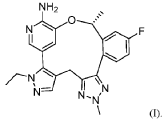
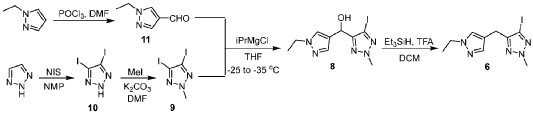
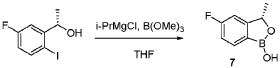
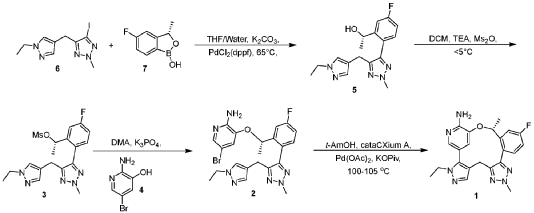
Scheme 3. Synthesis of Compound 1.
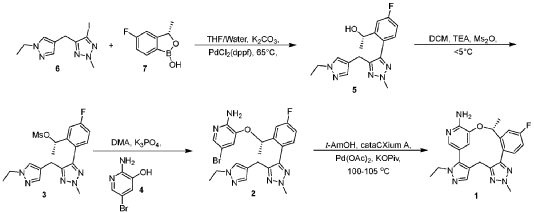
[00548] Synthesis of Compound 5. To a reactor was charged THF (10 vol ), water (1 vol ), followed by Compound 6 (850.0 g, 2.68 mol, 1 equiv.) and Compound 7 (534.0 g, 3.22 mol, 1.2 equiv ) at 20~30°C. The solids were completely dissolved at 20~30°C while stirring for 15 min and K2CO3 (1.11 kg, 3 equiv.) was added in portions over 10-15 min at 20~30°C. The reaction mixture was fully refdled with nitrogen, and was added Pd(dppf)C12 (78.5 g, 0.04 equiv.) in one portion under nitrogen. The reaction mixture was fully refdled with nitrogen again, then heated to 60-65 °C and stirred at 60~65°C for 16 h under nitrogen. The reaction mixture was cooled to 20~30°C, fdtered through a 10 cm celite pad (2X, 2.4 kg celite). The combined fdtrates were washed with EtOAc (10 vol., 21 L) and separated. The organic phase was washed with water (5 vol., 10.5 L) and separated. The organic phase was stirred for 1 h at 40-45°C in 5 w% aqueous L-cysteine (2.0 eq., 1.61 kg in 30.6 kg water) and separated. The organic phase was washed with water (5 vol., 10.5 L) and separated. The resulting organic phase was concentrated at 45-50°C in vacuum to afford crude product as a light brown oil (2.28 kg). To the crude product was charged MTBE (228 mL, 0.1 vol. relative to crude product), heated to 50°C over 15 min, followed by isopropyl ether (2.28 L, 1 vol.) dropwise over 1 h at 45~50°C, then cooled to 10°C over 2 h. A large amount of solids came out and the resulting slurry was stirred for 2 h at 10-15°C. The solids were collected by fdtration, dried in oven at 45°C for 16 h to get crude Compound 5 as a pale-yellow solid (1.67 kg, 96.3% /220 nm, >99.9%/220 nm chiral purity). 1.67 kg of crude Compound 5 was purified by silica gel chromatography (EtOAc/ n-heptane=l: 1, 2.5X silica gel, 100-200 meshes) to get Compound 5 as an off-white solid (1.58 kg, 99.6%/220 nm, >99.9%/220 nm chiral purity, 97.9 w%, 72% yield). H NMR (400 MHz, DMSO) 5 7.44 (dd, J = 10.5, 2.5
Hz, 1H), 7.36 (s, 1H), 7.22 (dd, J = 8.3, 6.0 Hz, 1H), 7.16 – 7.08 (m, 2H), 5.25 (d, J = 4.2 Hz, 1H), 4.86 – 4.68 (m, 1H), 4.14 (s, 3H), 4.00 (q, J = 7.2 Hz, 2H), 3.72 (s, 2H), 1.27 (t, J = 7.3 Hz, 3H), 1.11 (d, J = 6.3 Hz, 3H). MS (ESI, m/z): 330.20 (M + H)+.
[00549] In another example, a similar procedure was run in a 0.5:2 biphasic mixture of toluene and water (2.5 vol.) with a catalystic amount (e.g. 0.002 mol equiv.) Pd(Amphos)C12 (instead of 0.04 mol equiv. of PdidppfhCE) used as the catalyst. Potassium phosphate (K3PO4 3 H2O) substituted potassium carbonate (K2CO3) 3.0 mol equiv. as the base, and the amount of Compound 7 employed was 1.02 mol equiv. The improved process was conducted at 50 °C. At the end of the reaction, the organic layer was fdtered and treated with activated carbon and concentrated, and the final material was crystallized from toluene/heptane/water to give Compound 5 in 92% yield and 99.9% purity.
[00550] Synthesis of Compound 3. To a 50 L reactor was charged dichloromethane (11.25 L), Compound 5 (750 g, >99.9%/220 nm chiral purity) and triethylamine (920.0 g) at r t. (20~30°C). The resulting mixture was refilled with nitrogen and cooled to 0°C. To it was added a solution of MS2O (793.0 g) in dichloromethane (3.75 L) drop-wise over 45 min while keeping the temperature at 0~5°C. The reaction mixture was stirred at 0~5°C for 1 h under nitrogen. The reaction mixture was quenched with cooled water (7.5 L) at 5~15°C and separated. The organic phase was washed with cooled water (3.75 L) and separated. The organic phase was dried over anhydrous Na2SC>4, filtered and concentrated at 25~30°C in vacuum to around 2 vol., then switched to n-heptane (2.25 L) and concentrated at 25~30°C in vacuum to around 2 vol. of Compound 3 in n-heptane. n-heptane /EtOAc (3.0 L, lOv/lv) was added to the above mixture and the mixture was slurried for 1 h at 0~10°C under nitrogen and filtered. The filter cake was washed with n-heptane (1.5 L), dried in vacuum at 25~30°C for 5 h to afford Compound 3 as an off-white solid (845 g, 98.9 w%, 99.98%/220 nm chiral purity, 91% yield). H NMR (400 MHz, CDC13) 5 7.35 (dd, J = 9.6, 2.5 Hz, 1H), 7.24 – 7.18 (m, 2H), 7.12 (s, 1H), 7.08 (td, J = 8.3, 2.6 Hz, 1H), 5.78 (d, J = 6.4 Hz, 1H), 4.21 (s, 3H), 4.05 (q, J = 7.3 Hz, 2H), 3.90 – 3.76 (m, 2H), 2.78 (s, 3H), 1.58 (d, J = 6.5 Hz, 3H), 1.40 (t, J = 7.3 Hz, 3H). MS (ESI, m/z): 408.20 (M + H)+.
[00551] In another example, triethylamine base (1.3 mol equiv.), MS2O (1.2 mol equiv.), and dichloromethane solvent (10 vol) were used. The reaction mixture was quenched with aqueous sodium bicarbonate to remove excess MS2O, and crystallization from dichloromenthane/hexane results in 98% yield with 100% purity of Compound 3.
[00552] Synthesis of Compound 2. A 20 L reactor was refilled with nitrogen, then charged with DMA (12.6 L) at r.t. (20~25°C) To the reactor was charged Compound 4 (390.0 g) and Compound 3 (840.0 g, 99.98%/220 nm chiral purity) in one portion at 20~25°C through a dry nitrogen flow. The reaction mixture was heated to 35°C over 15 min and stirred for 5-10 min at 35~40°C to get a clear solution. To the reaction mixture was charged powder K3PO4 (875.0 g) in one portion at 35~45°C. After complete addition, the resulting mixture was heated to 60°C over 20 min and stirred at 58~63°C for 1.5 h through a dry nitrogen flow. The reaction mixture was cooled to 25~30°C, filtered through a celite pad (5 cm, 1.5 kg) and rinsed the filter cake with EtOAc (2 L, 2-3 vol.). The filtrate was poured into water (16.8 L, 20 vol.) at 0-10°C, extracted with EtOAc (10 L, 12 vol.) and separated. The aqueous phase was extracted with EtOAc (5 L, 6 vol.). The combined organic phases were washed with water (5 L*3, 6 vol. *3), concentrated at 50°C in vacuum to afford crude product as a gray solid (956 g). The crude product was dissolved in EtOAc (950 mL, 1 vol. relative to crude product) at 35~40°C, then was added dropwise n-heptane (950 mL, 1 vol. relative to crude product) at 30~40°C over 20 min. The resulting mixture was cooled to 20~25°C over 30 min and stirred for 1 h at 30-40°C. Some solids came out slowly and n-heptane (1.9 L, 2 vol. relative to crude product) was added dropwise to the slurry mixture at 20~25°C over 30 min. The precipitates were stirred at 15~20°C for 3 h and filtered. The filter cake was washed with n-heptane (1.5 L) and dried in oven at 45-50°C for 16 h to afford Compound 2 as a pale-yellow solid (743 g, 98.6%/220 nm, 96.9 w%, 99.98%/220 nm chiral purity, 0.48%KF, 72% yield). H NMR (400 MHz, DMSO) 5 7.54 (dd, J = 10.2, 2.7 Hz, 1H), 7.51 (d, J = 1.9 Hz, 1H), 7.42 (s, 1H), 7.31 (dd, J = 8.5, 5.8 Hz, 1H), 7.22 (td, J = 8.4, 2.7 Hz, 1H), 7.17 (s, 1H), 6.92 (d, J = 1.8 Hz, 1H), 6.14 (s, 2H), 5.47 (q, J = 6.0 Hz, 1H), 4.22 (s, 3H), 4.02 (q, J = 7.3 Hz, 2H), 3.78 (q, J = 16.1 Hz, 2H), 1.40 (d, J = 6.3 Hz, 3H), 1.29 (t, J = 7.3 Hz, 3H). MS (ESI, m/z): 500.30 (M + H)+.
[00553] In another example, a process was developed where Compound 4 (1.1 mol equiv. to Compound 3) was used. Potassium phosphate base (K2PO4, 4. 1 mol equiv.) and DMA (16 vol.) were substituted with cesium carbonate (CS2CO3, 2.2 mol equiv.) and NMP (5.6 vol.). The reaction was carried out at 20~30°C. Following completion of the reaction, the crude product was precipitated with water. The material was then dissolved in ethyl acetate, washed with water, and treated with activated carbon. The product is subsequently crystallized from toluene/ethyl acetate/heptane to give Compound 2 in 80% yield and 99.9% purity.
[00554] Synthesis of Compound 1. To a reactor was charged t-AmOH (20 vol.), Compound 2 (700.0 g, 99.99% chiral purity) and potassium pivalate (588.0 g). The reaction mixture was fully refilled with nitrogen. To the reaction mixture was added cataCXium A (120.4 g) and Pd(OAc)2 (37.8 g) at r.t. under nitrogen. The resulting mixture was heated to 100°C and stirred for 18 h under nitrogen. The reaction mixture was cooled to 30°C , filtered through a celite pad and washed the filter cake with EtOAc (3 vol.). The filtrate was washed with water (5 vol. *2) and separated. The upper organic phase was concentrated in vacuum to afford a brown oil. The oil was dissolved in EtOAc (27 L) then added 5w% aqueous L-cysteine (0.98 kg in 18.6 kg water), stirred for 1 h at 40~45°C and separated. The organic phase was washed with water (6.75 L) and separated. 5w% aqueous L-cysteine (0.98 kg in 18.6 kg water) was charged to the above organic phase, stirred for 1 h at 40~45°C and separated. The organic phase was washed with water (6.75 L.) and separated. The organic phase was concentrated in vacuum at 45~50°C to afford a brown solid (1.12 kg). The crude solid (1.12 kg) was further purified by silica gel chromatography eluted with EtOAc/DCM (dry loading, 3X, 100-200 meshes, EtOAc:DCM=l : 1) to afford a pale-yellow solid ( 1.02 kg). The solid was dissolved in EtOAc (600 mL, 2 vol.) at 50~60°C, then was added n-heptane (1.8 L, 6 vol.) dropwise over 50 min at 50~60°C. A large of solids came out during addition. The resulting slurry was cooled to 15~20°C over 50 min and stirred for 30 min at 15~20°C. The slurry was concentrated in vacuum at 45~50°C to 2-3 vol. mixture, n-heptane (1.2 L, 4 vol.) was added to the
above mixture (2-3 vol.), concentrated in vacuum at 45~50°C to 2-3 vol. mixture. The mixture was cooled to 10~15°C over 2 h, stirred at 10~15°C for 1 h and filtered. The filtered cake was rinsed with n-heptane (600 mb) and dried in vacuum at 50°C for 20 h to afford Form 1 of Compound 1 as an off-white solid (280 g, 99.0%). H NMR (400 MHz, DMSO) 57.79 (dd, J = 10.3, 2.2 Hz, 1H), 7.58 (s, 1H), 7.43 (d, J = 1.8 Hz, 1H), 7.24 – 7.16 (m, 2H), 6.13 (s, 2H), 6.08 (d, J = 1.7 Hz, 1H), 5.31 – 5.23 (m, 1H), 4.16 (s, 3H), 4.05 – 3.94 (m, 2H), 3.78 (d, J = 15.6 Hz, 1H), 2.98 (d, J = 15.5 Hz, 1H), 1.71 (d, J = 6.2 Hz, 3H), 1.26 (t, J = 7.2 Hz, 3H). MS (ESI, m/z): 420.30 (M + H)+. XRPD (FIG. 1), TG/DTA (FIG. 2), DSC (FIG. 3), DVS (FIG. 4), and FT-IR (FIG. 5) results for a sample of Form 1 were obtained.
ADVERTISEMENT
ANAX LABORATORIES
WEBSITE https://www.anaxlab.com/
Discovery Solutions, Supporting the chemistry needs of clients in the Medical, Analytical and Bio Sciences
Development Solutions, Developing from Lab scale to PR&D, Kilo Scale-ups and Commercial Scales
SEE MORE………Integrated Solutions, Manufacturing Solutions, Products,
Can’t Find? Let’s Connect

Phone : +91 897704 2010 / +91 9177075735, Email : info@anaxlab.com
#MedicinalChemistry, #DrugDiscovery, #OrganicSynthesis, #ChemicalLibrary, #BuildingBlocks, #SARStudies, #ChemistryInnovation, #medchem, #Drugdevelopment, #Biotech, #Biotechnology, #AnaxLaboratories, #Pharma


AS ON FEB2026 4.574 LAKHS VIEWS ON BLOG WORLDREACH AVAILABLEFOR YOUR ADVERTISEMENT

join me on Linkedin
Anthony Melvin Crasto Ph.D – India | LinkedIn
join me on Researchgate
RESEARCHGATE

join me on Facebook
Anthony Melvin Crasto Dr. | Facebook
join me on twitter
Anthony Melvin Crasto Dr. | twitter
+919321316780 call whatsaapp
EMAIL. amcrasto@gmail.com

References
References
- “JIDEYTRO™ (zidesamtinib) for Patients”. Jideytro. 2026-02-05. Retrieved 2026-07-23.
- “Jideytro: Uses, Dosage, Side Effects & Warnings”. Drugs.com. Retrieved 2026-07-23.
- “Nuvalent Announces FDA Acceptance of New Drug Application for Zidesamtinib for the Treatment of TKI Pre-treated Patients with Advanced ROS1-positive NSCLC”. Nuvalent Investors. Retrieved 2026-07-23.
- Wespiser M, Gille R, Pérol M (2026). “ROS1-positive non-small cell lung cancer: from genomics to treatment decisions”. Frontiers in Oncology. 16 1739598. doi:10.3389/fonc.2026.1739598. PMC 12907153. PMID 41704605.
- “New FDA Drug Approvals for 2026”. Drugs.com. Retrieved 2026-07-23.
- Center for Drug Evaluation and Research (2026-07-22). “Novel Drug Approvals for 2026”. FDA.
- Zidesamtinib Selective Targeting of Diverse ROS1 Drug-Resistant MutationsPublication Name:Molecular Cancer TherapeuticsPublication Date:2025-05-09PMCID:PMC12214885PMID:40299789DOI:10.1158/1535-7163.mct-25-0025
- Targeting Solvent-Front Mutations for Kinase Drug Discovery: From Structural Basis to Design StrategiesPublication Name:Journal of Medicinal ChemistryPublication Date:2024-08-15PMID:39143914DOI:10.1021/acs.jmedchem.4c00361
- NVL-520 Is a Selective, TRK-Sparing, and Brain-Penetrant Inhibitor of ROS1 Fusions and Secondary Resistance MutationsPublication Name:Cancer DiscoveryPublication Date:2022-12-13PMCID:PMC9975673PMID:36511802DOI:10.1158/2159-8290.cd-22-0968
- Electron transport by C-type cytochromes. I. The reaction of horse heart cytochrome c with anionic reductantsPublication Name:Biophysics of structure and mechanismPublication Date:1975-02-19PMID:10021DOI:10.1007/bf00539772
PAT
- Solid forms, pharmaceutical compositions and preparation of heteroaromatic macrocyclic ether compoundsPublication Number:WO-2023056405-A1Priority Date:2021-10-01
- Solid forms, pharmaceutical compositions and preparation of heteroaromatic macrocyclic ether compoundsPublication Number:US-12043626-B2Priority Date:2021-10-01Grant Date:2024-07-23
- Methods of treating solid tumor using heteroaromatic macrocyclic ether compoundsPublication Number:US-2024398768-A1Priority Date:2021-10-01
- Heteroaromatic macrocyclic ether chemotherapeutic agentsPublication Number:US-12054498-B2Priority Date:2020-05-05Grant Date:2024-08-06
- Heteroaromatic macrocyclic ether chemotherapeutic agentsPublication Number:US-2023107663-A1Priority Date:2020-05-05
- Heteroaromatic macrocyclic ether chemotherapeutic agentsPublication Number:US-11542278-B1Priority Date:2020-05-05Grant Date:2023-01-03
- Heteroaromatic macrocyclic ether chemotherapeutic agentsPublication Number:WO-2021226208-A2Priority Date:2020-05-05
- Heteroaromatic macrocyclic ether chemotherapeutic agentsPublication Number:US-2024352037-A1Priority Date:2020-05-05
 | |
| Clinical data | |
|---|---|
| Pronunciation | jih-DAY-troh[1][2] |
| Trade names | Jideytro |
| Other names | NUV-520; NVL 520 |
| AHFS/Drugs.com | jideytro |
| Routes of administration | By mouth |
| Drug class | Tyrosine kinase inhibitor |
| Legal status | |
| Legal status | US: ℞-only |
| Identifiers | |
| IUPAC name | |
| CAS Number | 2739829-00-4 |
| PubChem CID | 166560233 |
| IUPHAR/BPS | 12392 |
| DrugBank | DB21623 |
| ChemSpider | 128922073 |
| UNII | MX5KQV5XHC |
| KEGG | D12899 |
| ChEBI | CHEBI:747901 |
| ChEMBL | ChEMBL5314497 |
| Chemical and physical data | |
| Formula | C22H22FN7O |
| Molar mass | 419.464 g·mol−1 |
| 3D model (JSmol) | Interactive image |
| SMILES | |
| InChI | |
////////zidesamtinib, anax labs, CANCER, FDA 2026, APPROVALS 2026, Jideytro, NVL-520, NUV-520, NU-520, NVL 520, NUV 520, NU 520, MX5KQV5XHC
#zidesamtinib, #anax labs, #CANCER, FDA 2026, #APPROVALS 2026, #Jideytro, #NVL-520, #NUV-520, #NU-520, #NVL 520, #NUV 520, #NU 520, #MX5KQV5XHC


