
Home » Posts tagged 'APPROVALS 2026'
Tag Archives: APPROVALS 2026
 DRUG APPROVALS BY DR ANTHONY MELVIN CRASTO
.....FOR BLOG HOME CLICK HERE
DRUG APPROVALS BY DR ANTHONY MELVIN CRASTO
.....FOR BLOG HOME CLICK HEREFlag and hits
ORGANIC SPECTROSCOPY

SUBSCRIBE

 Subscribe in a reader
Enter your email address:
Delivered by FeedBurner
Subscribe to New Drug Approvals by Email


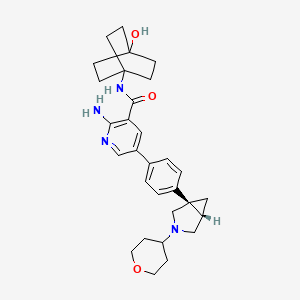
Zilurgisertib

Zilurgisertib
CAS 2173389-57-4
MW 502.6 g/mol MFC30H38N4O3
Atebrioz, FDA 2026, APPROVALS 2026, L5Z9S25HO2, INCB 000928
2-amino-N-(4-hydroxy-1-bicyclo[2.2.2]octanyl)-5-[4-[(1R,5S)-3-(oxan-4-yl)-3-azabicyclo[3.1.0]hexan-1-yl]phenyl]pyridine-3-carboxamide
To reduce the volume of total new heterotopic ossification in adults and pediatric patients 12 years and older with fibrodysplasia ossificans progressiva
Zilurgisertib is an inhibitor of activin A receptor type 1 (activin receptor-like kinase 2; ALK2; ALK-2; ACVR1; ACTR-I), with potential anti-anemic and ossification suppressive activities. Upon administration, zilurgisertib targets, binds to and inhibits the activity of ALK-2. This prevents ALK2-mediated signaling and ALK2-mediated excessive bone morphogenetic protein (BMP) signaling. This may suppress heterotopic ossification (HO). As ALK-2 enhances the secretion of hepcidin, a peptide liver hormone and a key modulator of iron homeostasis, zilurgisertib is able to decrease hepcidin expression in the liver, thereby increasing and restoring plasma iron levels, enhancing erythropoiesis, and correcting anemia of chronic disease (ACD). ALK2, a serine/threonine receptor kinase and type I cell surface receptor for BMPs, is constitutively activated due to activating mutations in inflammatory conditions, various types of cancer, and in fibrodysplasia ossificans progressiva (FOP). Elevated serum hepcidin levels enhance storage of iron, reduce iron availability and causes iron deficiency anemia.
Zilurgisertib, sold under the brand name Atebrioz, is a medication used for the treatment of fibrodysplasia ossificans progressiva.[1] It is an selective activin receptor-like kinase-2 (ALK2) inhibitor.[1][2]
Zilurgisertib was approved for medical use in the United States in September of 2026.[3]
Medical uses
Zilurgisertib is indicated to reduce the volume of total new heterotopic ossification (abrnomal bone formation) in people aged twelve years of age and older with fibrodysplasia ossificans progressiva.[1]
Fibrodysplasia ossificans progressiva is a rare genetic disease caused certain mutations in the ACVR1/ALK2 gene which controls new bone growth.[3] As a result, connective tissues such as muscle, tendons, and ligaments gradually turn into bone, causing limited movement, deformities, severe disability, and early death.[3]
Adverse effects
Zilurgisertib can cause fetal harm based on data from animal studies.[3]
The most common side effects include headache, joint pain, upper respiratory tract infection, nosebleeds, and nausea.[3]
History
The effectiveness of zilurgisertib was evaluated in a randomized, double-blind, placebo‑controlled trial (NCT05090891) in which 63 participants with FOP were randomly assigned to receive zilurgisertib 100 mg or placebo once daily for 24 weeks followed by a 292-week, single-arm, open-label extension period during which participants received oral zilurgisertib 100 mg daily.[3]
Society and culture
Legal status
Zilurgisertib was approved for medical use in the United States in September 2026.[4] The US Food and Drug Administration granted the application for zilurgisertib fast track, priority review, and orphan drug designations for this indication.[3]
Names
Zilurgisertib is the international nonproprietary name.[5]
Zilurgisertib is sold under the brand name Atebrioz.[3]
PAT
https://patentscope.wipo.int/search/en/detail.jsf?docId=US242623881&_cid=P22-MUNHEN-48106-1
Example 34: 2-amino-N-(4-hydroxybicyclo[2.2.2]octan-1-yl)-5-(4-((1R,5S)-3-(tetrahydro-2H-pyran-4-yl)-3-azabicyclo[3.1.0]hexan-1-yl)phenyl)nicotinamide (also named compound A herein)
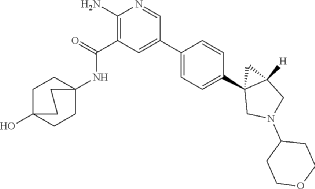
| To a solution of 2-amino-5-(4-((1R,5S)-3-(tetrahydro-2H-pyran-4-yl)-3-azabicyclo[3.1.0]hexan-1-yl)phenyl)nicotinic acid TFA salt (Intermediate 14a, 4.10 g, 8.14 mmol) and 4-aminobicyclo[2.2.2]octan-1-ol hydrochloride (2.17 g, 12.2 mmol) in anhydrous DMF (60 mL) was added N-methylmorpholine (2.24 mL, 20.4 mmol) and HATU (4.64 g, 12.2 mmol) under a nitrogen atmosphere at RT. The reaction mixture was stirred for 2 h and then diluted with a sat. aq. solution of NaHCO 3 and extracted three times with EtOAc. The combined organic extracts were washed with brine, dried over MgSO 4, filtered and concentrated under reduced pressure. The crude product was purified by reversed-phase chromatography (Method 3b). Pure fractions were treated with a sat. aq. NaHCO 3 solution and extracted three times with EtOAc. The combined organic extracts were washed with brine, dried over MgSO 4, filtered and concentrated under reduced pressure to give the title compound as an off-white solid. The absolute configuration as depicted was confirmed by X-ray crystallography of the title compound in a complex with the ALK-2 kinase domain. 1H NMR (400 MHz, DMSO-d6) δ 8.34 (d, 1H), 7.98 (d, 1H), 7.79 (s, 1H), 7.57 (d, 2H), 7.23 (d, 2H), 6.92 (s, 2H), 4.31 (s, 1H), 3.91-3.78 (m, 2H), 3.40 (bs, 1H), 3.33-3.24 (m, 2H), 3.11 (d, 1H), 2.57 (bs, 1H), 2.50-2.34 (m, 1H), 2.34 (bs, 1H), 2.12-1.94 (m, 6H), 1.90-1.72 (m, 3H), 1.71-1.51 (m, 6H), 1.51-1.34 (m, 2H), 1.31 (t, 1H), 0.82-0.68 (m, 1H). (UPLC-MS) t R 0.54 min; ESI-MS 503 [M+H] +. Chiral HPLC (ChiralPak Id, 5 μm, flow rate: 1 mL/min, detection wavelength: 270 nm, mobile phase: heptane:isopropanol 60:40 (+0.1% diethylamine)): t R 18.7 min, 92.3% ee. |
| 13C NMR (DMSO-d6) δ: 167.80, 157.69, 148.28, 141.27, 134.91, 134.79, 126.40, 125.66, 123.53, 111.01, 66.22, 65.59, 59.10, 55.46, 52.04, 33.72, 31.92, 31.77, 30.59, 29.61, 24.14, 17.20. |
| 13C NMR (DMSO-d6) δ: 167.2, 155.8, 144.3, 142.0, 139.6, 133.8, 127.7, 126.3, 124.1, 110.0, 65.8, 62.5, 55.7, 53.2, 29.9, 28.8, 28.7, 23.5, 16.6. |
| The starting material, 2-Amino-5-(4-((1R,5S)-3-(tetrahydro-2H-pyran-4-yl)-3-azabicyclo[3.1.0]hexan-1-yl)phenyl)nicotinate dihydrochloride, was obtained as follows: |
| 13C NMR (DMSO-d6) δ: 165.0, 154.0, 143.5, 142.0, 140.1, 132.8, 127.7, 126.5, 124.2, 110.7, 65.8, 62.5, 55.6, 53.3, 53.3, 29.9, 28.9, 28.8, 23.6, 16.8. |
| The starting material, 1R,5S)-1-(4-bromophenyl)-3-(tetrahydro-2H-pyran-4-yl)-3-azabicyclo[3.1.0]hexan-3-ium chloride, was obtained as follows: |
| 13C NMR (DMSO-d6) δ: 138.3, 131.9, 129.2, 120.4, 65.5, 62.3, 56.2, 53.9, 29.1, 28.9, 24.8, 23.0. MS(ESI-TOF): 322.0761 [M+H]+ |
The complete way of manufacture of Alternative Example 34 A is depicted in the following Reaction Scheme 34A:
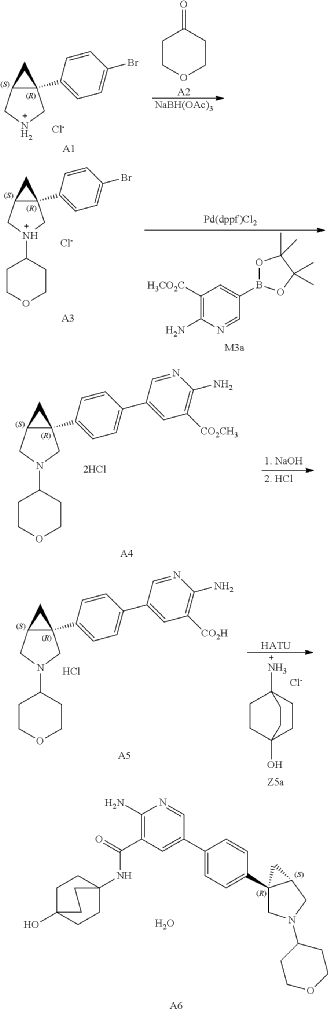
| The first compound in this scheme, A1, can be obtained as follows: |
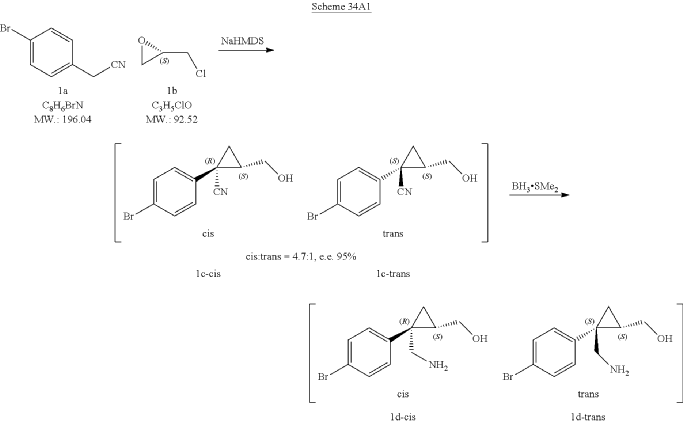
PAT
PAT
PAT
PAPERS
- Discovery and Characterization of Zilurgisertib, a Potent and Selective Inhibitor of Activin Receptor-like Kinase-2 (ALK2) for the Treatment of Fibrodysplasia Ossificans ProgressivaPublication Name:ACS Medicinal Chemistry LettersPublication Date:2025-10-31PMCID:PMC12621050PMID:41256990DOI:10.1021/acsmedchemlett.5c00516
- Pharmacokinetics of Zilurgisertib With and Without Food from Single and Multiple Ascending Dose Phase 1 Studies in Healthy AdultsPublication Name:European Journal of Drug Metabolism and PharmacokineticsPublication Date:2024-12-09PMCID:PMC11802711PMID:39652202DOI:10.1007/s13318-024-00926-z
ADVERTISEMENT
ANAX LABORATORIES
WEBSITE https://www.anaxlab.com/
Discovery Solutions, Supporting the chemistry needs of clients in the Medical, Analytical and Bio Sciences
Development Solutions, Developing from Lab scale to PR&D, Kilo Scale-ups and Commercial Scales
SEE MORE………Integrated Solutions, Manufacturing Solutions, Products,
Can’t Find? Let’s Connect

Phone : +91 897704 2010 / +91 9177075735, Email : info@anaxlab.com
#MedicinalChemistry, #DrugDiscovery, #OrganicSynthesis, #ChemicalLibrary, #BuildingBlocks, #SARStudies, #ChemistryInnovation, #medchem, #Drugdevelopment, #Biotech, #Biotechnology, #AnaxLaboratories, #Pharma


AS ON FEB2026 4.574 LAKHS VIEWS ON BLOG WORLDREACH AVAILABLEFOR YOUR ADVERTISEMENT
join me on Linkedin
Anthony Melvin Crasto Ph.D – India | LinkedIn
join me on Researchgate
RESEARCHGATE

join me on Facebook
Anthony Melvin Crasto Dr. | Facebook
join me on twitter
Anthony Melvin Crasto Dr. | twitter
+919321316780 call whatsaapp
EMAIL. amcrasto@gmail.com

References
- “Atebrioz FDA label” (PDF). files.mirumpharma.com.
- Gangat N, Tefferi A (June 2025). “Emerging Pathogenetic Mechanisms and New Drugs for Anemia in Myelofibrosis and Myelodysplastic Syndromes”. American Journal of Hematology. 100 Suppl 4: 51–65. doi:10.1002/ajh.27659. PMID 40056069.
- Center for Drug Evaluation and Research (25 September 2026). “FDA Approves Third Treatment for Fibrodysplasia Ossificans Progressiva”. U.S. Food and Drug Administration. U.S. Food and Drug Administration (FDA). Retrieved 27 September 2026.
 This article incorporates text from this source, which is in the public domain.
 - “Mirum Pharmaceuticals and Incyte Announce U.S. FDA Approval of Atebrioz (zilurgisertib) for Adult and Pediatric Patients with Fibrodysplasia Ossificans Progressiva” (Press release). Mirum Pharmaceuticals. 25 September 2026. Retrieved 27 September 2026 – via Business Wire.
- World Health Organization (2022). “International nonproprietary names for pharmaceutical substances (INN): recommended INN: list 88”. WHO Drug Information. 36 (3). hdl:10665/363551.
External links
- “Zilurgisertib ( Code – C175551 )”. EVS Explore.
- “Zilurgisertib Fumarate ( Code – C199021 )”. EVS Explore.
- Clinical trial number NCT05090891 for “To Assess the Efficacy, Safety, and Tolerability of INCB000928 in Participants With Fibrodysplasia Ossificans Progressiva (Progress)” at ClinicalTrials.gov
 | |
| Clinical data | |
|---|---|
| Trade names | Atebrioz |
| Other names | INCB-000928, INCB000928 |
| License data | US DailyMed: Zilurgisertib |
| Routes of administration | By mouth |
| Drug class | Kinase inhibitor (ALK2 selective) |
| ATC code | None |
| Legal status | |
| Legal status | US: ℞-only[1] |
| Identifiers | |
| CAS Number | 2173389-57-42173390-29-7 |
| PubChem CID | 138628908162623634 |
| IUPHAR/BPS | 11888 |
| UNII | L5Z9S25HO21R349830SB |
| KEGG | D12547D12548 |
| ChEMBL | ChEMBL5314579 |
| Chemical and physical data | |
| Formula | C30H38N4O3 |
| Molar mass | 502.659 g·mol−1 |
| 3D model (JSmol) | Interactive image |
| SMILES | |
| InChI | |
///////////zilurgisertib, anax labs, Atebrioz, FDA 2026, APPROVALS 2026, L5Z9S25HO2, INCB 000928
#zilurgisertib, #anax labs, #Atebrioz, #FDA 2026, #APPROVALS 2026, #L5Z9S25HO2, #INCB 000928
Tavapadon

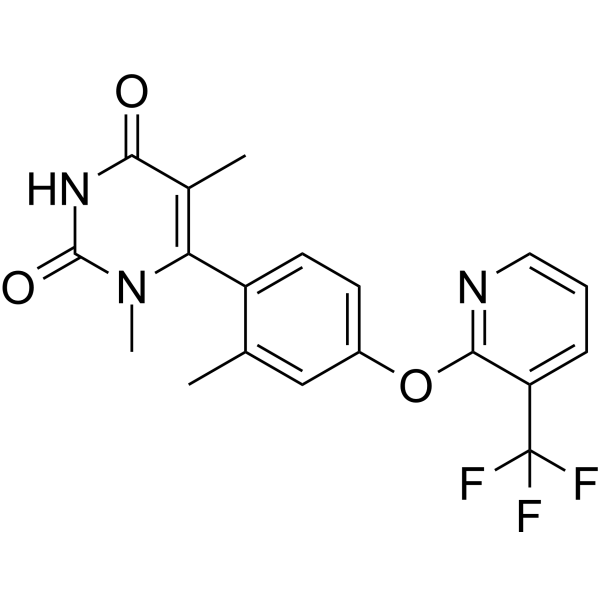
Tavapadon
- CAS No.:1643489-24-0
- Formula:C19H16F3N3O3
- Molecular Weight:391.34
9/25/2026, Juvmo, FDA 2026, APPROVALS 2026, CEREVEL, CVL 751, PF 6649751, PF-06649751,
To treat Parkinson’s disease in adults
Tavapadon (PF-06649751) is an orally active and highly selective dopamine D1/D5 receptor partial agonist. Tavapadon is effective in enabling movement and reducing disability and has the potential for Parkinson’s disease.
Tavapadon (developmental code names CVL-751, PF-06649751) is a dopamine receptor agonist which is under development for the treatment of Parkinson’s disease.[2][3][4] It is under development by Cerevel Therapeutics, which acquired tavapadon from Pfizer in 2018.[2] It is taken by mouth.[1]
Tavapadon acts as a highly selective partial agonist of the dopamine D1 receptor (Ki = 9 nM; IATooltip Intrinsic activity = 65%) and the dopamine D5 receptor (Ki = 13 nM; IA = 81%).[3][4][1] It has no significant affinity or functional activity at the D2-like receptors (D2, D3, D4) (Ki ≥ 4,870 to 6,720 nM).[1] Tavapadon also shows biased agonism for Gs-coupled signaling at the D1-like receptors.[1][3]
As of December 2024, tavapadon has completed phase 3 clinical trials for Parkinson’s disease.[2]
- OriginatorPfizer
- DeveloperCerevel Therapeutics; Pfizer
- ClassAntiparkinsonians; Small molecules
- Mechanism of ActionDopamine D1 receptor agonists; Dopamine D5 receptor agonists
- registrationParkinson’s disease
- 01 Dec 2025Cerevel Therapeutics completes a phase III TEMPO-4 trial in Parkinson Disease (In adults, In elderly in the US, Australia, Bulgaria, Canada, Czechia, France, Germany, Hungary, Israel, Italy, Poland, Serbia, Spain, and Ukraine (PO) (NCT04760769)
- 28 Nov 2025No recent reports of development identified for phase-I development in Parkinson’s-disease(In volunteers) in USA (PO, Tablet)
- 26 Sep 2025Preregistration for Parkinson’s disease (Early-stage disease, In the elderly, In adults) in USA (PO)
The industrial synthesis of tavapadon typically proceeds via a convergent sequence:
- Ether Formation: Coupling of a substituted phenol derivative (such as a 4-hydroxy-2-methylphenyl component) with a 2-halogenated-3-(trifluoromethyl)pyridine (e.g., 2-chloro-3-trifluoromethylpyridine) via nucleophilic aromatic substitution ($S_NAr$) or transition-metal-catalyzed cross-coupling to construct the biaryl ether framework.
- Pyrimidine Ring Construction / Functionalization: Assembly or modification of the 1,5-dimethylpyrimidine-2,4-dione core onto the substituted aryl backbone, often utilizing base-catalyzed cyclizations (e.g., using methylating agents and urea/amide derivatives).
- Chiral Resolution / Final Purification: Final isolation of the target enantiomer or specific crystalline form (as outlined in WO2023102087A1 and WO2023143321) to meet active pharmaceutical ingredient (API) regulatory grades.
PAT
W02014207601
Examples 7 and 8
https://patentscope.wipo.int/search/en/detail.jsf?docId=WO2014207601&_cid=P12-MUKNR1-83868-1
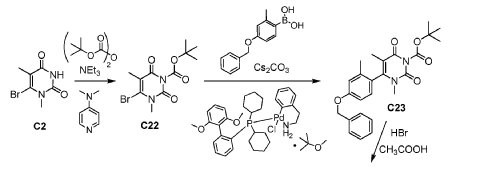
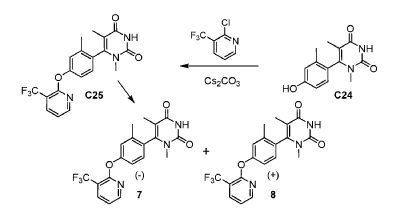
Step 1. Synthesis of tert-butyl 4-bromo-3,5-dimethyl-2,6-dioxo-3,6-dihydropyrimidine-1(2H)-carboxylate (C22).
Compound C2 (800 mg, 3.65 mmol), di-tert-butyl dicarbonate (99%, 966 mg, 4.38 mmol), triethylamine (0.62 mL, 4.4 mmol) and 4-(dimethylamino)pyridine (45 mg, 0.36 mmol) were combined in tetrahydrofuran (15 mL) and heated to 70 °C for 1 hour, then allowed to stir at room temperature for 18 hours. The reaction mixture was concentrated in vacuo, and the residue was purified via chromatography on silica gel (Gradient: 10% to 25% ethyl acetate in heptane) to provide the product as a white solid. Yield: 1.10 g, 3.45 mmol, 94%. 1H NMR (400 MHz, CDCl3) δ 3.64 (s, 3H), 2.12 (s, 3H), 1.61 (s, 9H).
Step 2. Synthesis of ten-butyl 4-[4-(benzyloxy)-2-methylphenyl]-3,5-dimethyl-2,6-dioxo-3,6-dihydropyrimidine-1(2H)-carboxylate ( C23).
A mixture of C22 (1.00 g, 3.13 mmol), [4-(benzyloxy)-2-methylphenyl]boronic acid (98%, 1.16 g, 4.68 mmol), chloro(2-dicyclohexylphosphino-2′,6′-dimethoxy-1,1′-biphenyl)[2-(2-aminoethylphenyl)]palladium(II) – tert-butyl methyl ether adduct (S-Phos precatalyst) (119 mg, 0.156 mmol), and cesium carbonate (3.06 g, 9.39 mmol) in 2-methyltetrahydrofuran (10 mL) and water (3 mL) was heated at 50 °C for 66 hours. The reaction mixture was diluted with water and ethyl acetate, and then filtered to remove suspended solids. The filtrate was extracted several times with ethyl acetate, and the combined organic layers were washed with saturated aqueous sodium chloride solution, dried over magnesium sulfate, filtered, and concentrated in vacuo. The resulting solid was suspended in a 1:3 mixture of ethyl acetate and heptane, stirred for several minutes, and filtered, providing the product as a white solid. Yield: 970 mg, 2.22 mmol, 71%. LCMS m/z 337.2 [(M-Boc)+H]+. 1H NMR (400 MHz, CDCl3) δ 7.34-7.48 (m, 5H), 6.91-7.01 (m, 3H), 5.10 (s, 2H), 3.01 (s, 3H), 2.16 (br s, 3H), 1.66 (s, 9H), 1.64 (s, 3H).
Step 3. Synthesis of 6-(4-hydroxy-2-methylphenyl)-1,5-dimethylpyrimidine-2,4(1H,3H)-dione (C24).
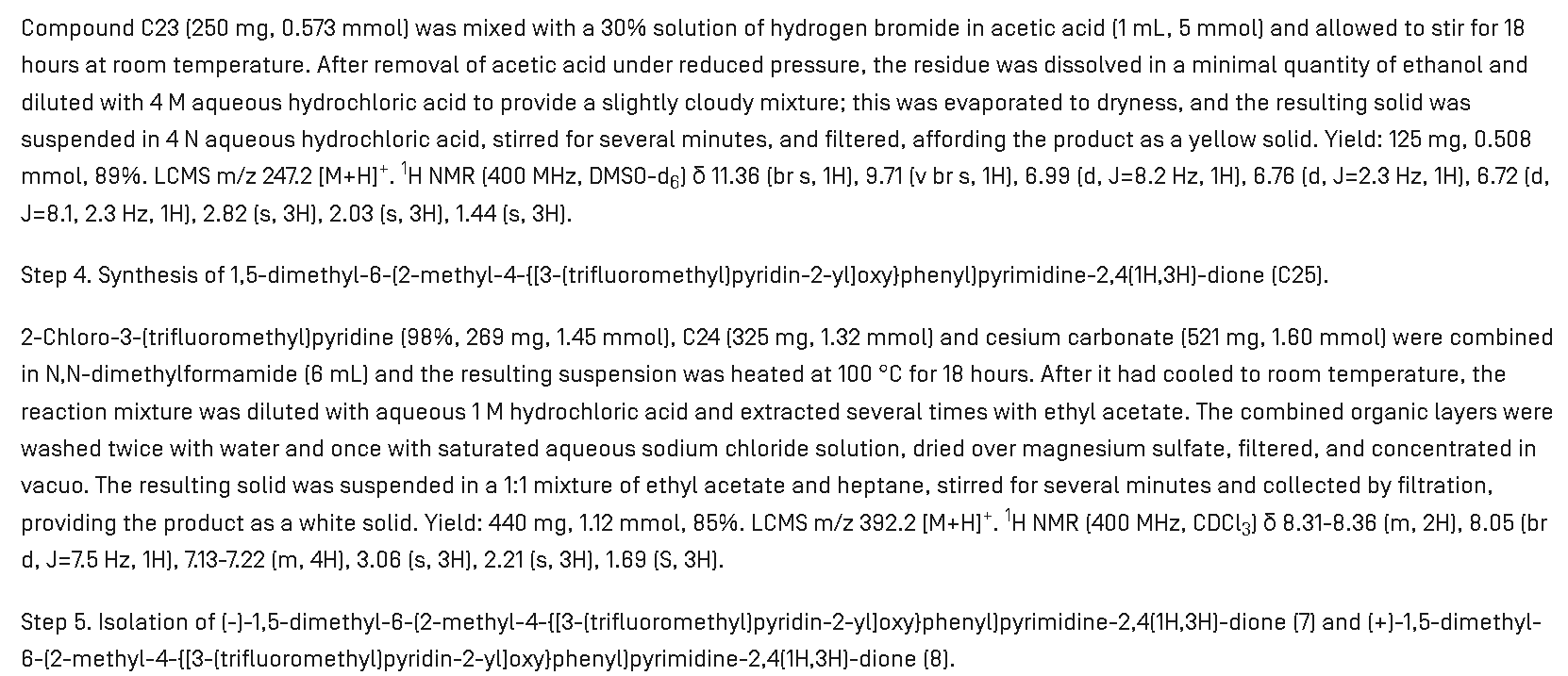
Racemate C25 (1.30 g, 3.32 mmol) was separated into its atropenantiomers via chiral chromatography (Column: Phenomenex Lux Cellulose-2; Gradient: heptane / ethanol). The first-eluting atropenantiomer, obtained as a tan solid that exhibited a negative (-) rotation, was designated as Example 7. Yield: 536 mg, 1.37 mmol, 41%. The second-eluting atropenantiomer, also obtained as a tan solid but with a positive (+) rotation, was designated as Example 8. Yield: 553 mg, 1.41 mmol, 42%. 7: LCMS m/z 392.2 [M+H]+. 1H NMR (400 MHz, CDCl3) δ 8.34 (ddq, J=4.9, 1.9, 0.6 Hz, 1H), 8.30 (br s, 1H), 8.05 (ddq, J=7.6, 1.9, 0.7 Hz, 1H), 7.13-7.21 (m, 4H), 3.06 (s, 3H), 2.21 (br s, 3H), 1.69 (s, 3H). 8: LCMS m/z 392.2 [M+H]+. 1H NMR (400 MHz, CDCl3) δ 8.34 (br d, J=4.9 Hz, 1H), 8.30 (br s, 1H), 8.05 (br d, J=7.5 Hz, 1H), 7.13-7.22 (m, 4H), 3.06 (s, 3H), 2.21 (br s, 3H), 1.69 (s, 3H).
PAT
WO2015162084 SIMILAR
https://patentscope.wipo.int/search/en/detail.jsf?docId=WO2015162084&_cid=P12-MUKNEL-70374-1
PAT
US9334247
PAT
WO2023102087A1
https://patentscope.wipo.int/search/en/detail.jsf?docId=WO2023102087&_cid=P12-MUKNKO-77090-1
Tavapadon, 1 , 5-dimethy I -6-(2-methy 1 -4- { [3 -(tri fluoromethyl)pyri din-2-yl]oxy}phenyl)pyrimidine-2,4(lH,3H)-dione has the following chemical structure:
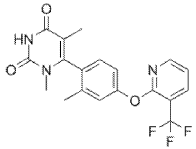
and is described in International Publication No. W02014/207601. As disclosed in International Publication No. W02014/207601, the class of compounds encompassing Tavapadon, may exist as conformational isomers due to hindered rotation about a single bond, i.e., atropisomerism. In the case of Tavapadon, the atropenantiomers or atropisomers may be designated as (-)-Tavapadon or (+)-Tavapadon, depending on the optical rotation, and can include any mixture thereof, including a racemic mixture, wherein the racemic mixture can be designated as (±)-Tavapadon. According to International Publication No.
W02014/207601, the compound Tavapadon may be obtained as a racemate (i.e., (±)-Tavapadon), which may be separated by chiral chromatography into two atropenantiomers. The atropisomer exhibiting an anticlockwise (negative) rotation on a polarimeter is denoted the (-)-atropenantiomer [i.e., (-)-Tavapadon], and the atropisomer exhibiting a clockwise (positive) rotation on a polarimeter is denoted the (+)-atropenantiomer [i.e., (+)-Tavapadon],
PAT
WO2023143321 (or corresponding US20250145588A1 / CN115974803A equivalents)
ADVERTISEMENT
ANAX LABORATORIES
WEBSITE https://www.anaxlab.com/
Discovery Solutions, Supporting the chemistry needs of clients in the Medical, Analytical and Bio Sciences
Development Solutions, Developing from Lab scale to PR&D, Kilo Scale-ups and Commercial Scales
SEE MORE………Integrated Solutions, Manufacturing Solutions, Products,
Can’t Find? Let’s Connect
Phone : +91 897704 2010 / +91 9177075735, Email : info@anaxlab.com
#MedicinalChemistry, #DrugDiscovery, #OrganicSynthesis, #ChemicalLibrary, #BuildingBlocks, #SARStudies, #ChemistryInnovation, #medchem, #Drugdevelopment, #Biotech, #Biotechnology, #AnaxLaboratories, #Pharma
AS ON FEB2026 4.574 LAKHS VIEWS ON BLOG WORLDREACH AVAILABLEFOR YOUR ADVERTISEMENT
join me on Linkedin
Anthony Melvin Crasto Ph.D – India | LinkedIn
join me on Researchgate
RESEARCHGATE
join me on Facebook
Anthony Melvin Crasto Dr. | Facebook
join me on twitter
Anthony Melvin Crasto Dr. | twitter
+919321316780 call whatsaapp
EMAIL. amcrasto@gmail.com
References
 | |
| Clinical data | |
|---|---|
| Other names | CVL-751; PF-6649751; PF-06649751 |
| Routes of administration | By mouth[1] |
| Drug class | Dopamine receptor agonist |
| Identifiers | |
| IUPAC name | |
| CAS Number | 1643489-24-0 |
| PubChem CID | 86764100 |
| ChemSpider | 48062699 |
| UNII | PT4P8MJP8L |
| KEGG | D11431 |
| ChEMBL | ChEMBL3697617 |
| CompTox Dashboard (EPA) | DTXSID301337071  |
| Chemical and physical data | |
| Formula | C19H16F3N3O3 |
| Molar mass | 391.350 g·mol−1 |
| 3D model (JSmol) | Interactive image |
| SMILES | |
| InChI | |
References
- Bezard E, Gray D, Kozak R, Leoni M, Combs C, Duvvuri S (2024). “Rationale and Development of Tavapadon, a D1/D5-Selective Partial Dopamine Agonist for the Treatment of Parkinson’s Disease”. CNS Neurol Disord Drug Targets. 23 (4): 476–487. doi:10.2174/1871527322666230331121028. PMC 10909821. PMID 36999711.
Tavapadon is a highly selective partial agonist at D1 and D5 dopamine receptors, [52] with little to no functional activity at D2, D3, or D4 receptors in vitro (unpublished data). Assays measuring the displacement of radioligand binding in cell lines expressing recombinant human dopamine receptors have shown that tavapadon has a high affinity for both D1 (Ki = 9 nM) and D5 (Ki = 13 nM) (unpublished data). Conversely, tavapadon had a low affinity at D2 (Ki ≥ 6210 nM), D3 (Ki ≥ 6720 nM), and D4 (Ki ≥ 4870 nM) (unpublished data). […] In vitro assays of functional activity have confirmed that tavapadon acts as a partial agonist by binding at D1 and D5 receptors, corresponding to 65% and 81% of dopamine’s intrinsic activity, respectively, and inducing functional receptor activation, with half-maximal effective concentration (EC50) values of 19 nM and 17 nM (unpublished data).
- “Tavapadon – Cerevel Therapeutics”. Adis Insight. Springer Nature Switzerland AG.
- Cerri S, Blandini F (December 2020). “An update on the use of non-ergot dopamine agonists for the treatment of Parkinson’s disease”. Expert Opinion on Pharmacotherapy. 21 (18): 2279–2291. doi:10.1080/14656566.2020.1805432. PMID 32804544. S2CID 221163451.
- Hall A, Provins L, Valade A (January 2019). “Novel Strategies To Activate the Dopamine D1 Receptor: Recent Advances in Orthosteric Agonism and Positive Allosteric Modulation”. Journal of Medicinal Chemistry. 62 (1): 128–140. doi:10.1021/acs.jmedchem.8b01767. PMID 30525590. S2CID 54469910.
////////tavapadon, anax labs, Juvmo, FDA 2026, APPROVALS 2026, CEREVEL, CVL 751, PF 6649751, PF-06649751,
#tavapadon, #anax labs, #Juvmo, #FDA 2026, #APPROVALS 2026, #CEREVEL, #CVL 751, #PF 6649751, #PF-06649751,
Lirafugratinib
Lirafugratinib
- CAS No.:2549174-42-5
- Formula:C28H24FN7O2
- Molecular Weight:509.53
FDA 2026, APPROVALS 2026, Lyrfigtu, RLY-4008, RLY 4008, 23SEPT2026
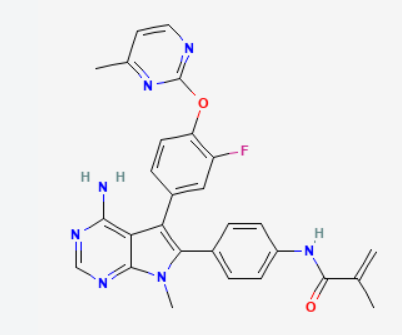
N-(4-(4-amino-5-(3-fluoro-4-((4-methylpyrimidin-2-yl)oxy)phenyl)-7-methyl-7H-pyrrolo[2,3-
d]pyrimidin-6-yl)phenyl)methacrylamide (lirafugratinib)
To adults with previously treated unresectable, locally advanced or metastatic cholangiocarcinoma harboring a fibroblast growth factor receptor 2 gene fusion or other rearrangement
Lirafugratinib (RLY-4008) is an orally active, irreversible and highly selective FGFR2 inhibitor with an IC50 of 3 nM. Lirafugratinib covalently binds to Cys491. Lirafugratinib targets FGFR2 primary alterations and resistance mutations and induces tumor regression while sparing other FGFRs.
Lirafugratinib (Lyrfigtu) received FDA approval on September 23, 2026, for adults with previously treated, unresectable or metastatic cholangiocarcinoma involving FGFR2 gene fusions or rearrangements.
Overview & Mechanism
- Drug Class: An oral, selective, and irreversible FGFR2 small-molecule inhibitor.
- Developer/Marketed By: Developed by Relay Therapeutics and commercialized globally by Elevar Therapeutics.
- How it Works: Covalently targets the FGFR2 kinase domain to inhibit tumor-driving signaling while sparing other FGFR proteins to limit off-target effects.
Efficacy
- Clinical Trial: Assessed in the phase 1/2 REFOCUS trial (NCT04526106) involving 116 previously treated, FGFR-inhibitor-naive patients.
- Key Metrics: Demonstrated an objective response rate of 46%, a median duration of response of 11.8 months, and a median progression-free survival of 11.3 months.
Dosing & Administration
- Recommended Dose: 70 mg orally once daily on a continuous basis until disease progression or unacceptable toxicity.
Safety & Warnings
- Common Adverse Events: Hand-foot syndrome, stomatitis, nail issues, and ocular/retinal toxicities.
- Special Warnings: Includes precautions for ocular toxicity, hyperphosphatemia, soft tissue mineralization, and embryo-fetal risks
PAPER
https://pmc.ncbi.nlm.nih.gov/articles/PMC10861881
SEE https://pmc.ncbi.nlm.nih.gov/articles/instance/10861881/bin/pnas.2317756121.sapp.pdf
N-(4-(4-amino-5-(3-fluoro-4-((4-methylpyrimidin-2-yl)oxy)phenyl)-7-methyl-7Hpyrrolo[2,3-d]pyrimidin-6-yl)phenyl)methacrylamide (lirafugratinib)
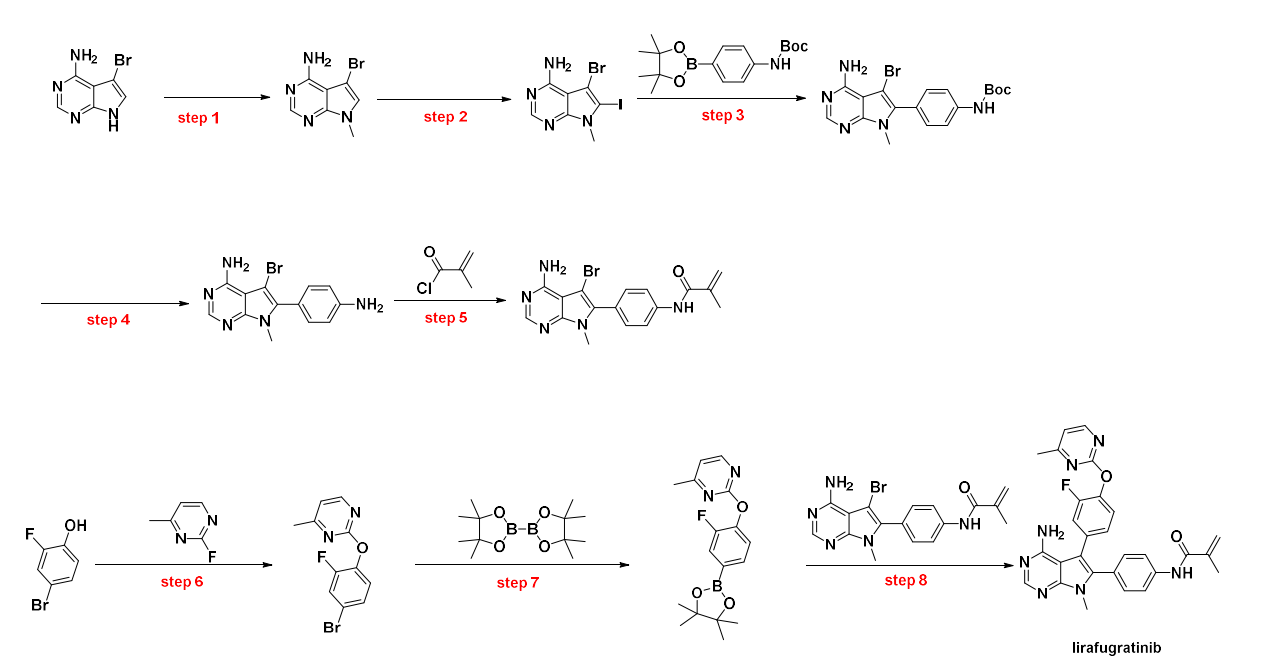
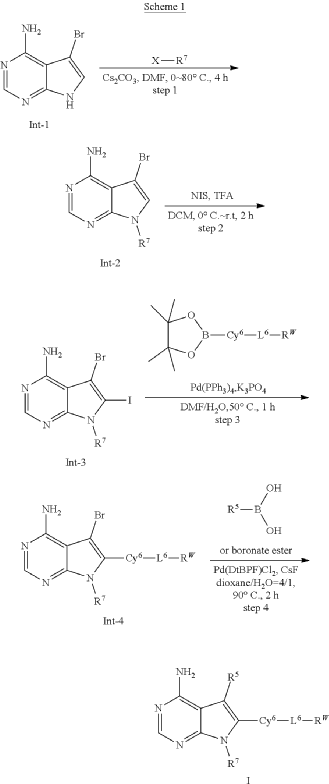
5-bromo-7-methyl-7H-pyrrolo[2,3-d]pyrimidin-4-amine
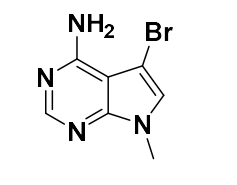
A round bottomed flask was charged with 5-bromo-7H-pyrrolo[2,3-d]pyrimidin-4-amine (10.0 g,
47.16 mmol), Cs2CO3 (22.99 g, 70.75 mmol), DMF (120 mL) and a stirbar. Iodomethane (8.03 g,
56.59 mmol) was added, and the solution was stirred for 1 h at room temperature. The reaction mixture was diluted with H2O (300 mL), and the aqueous phase was extracted with ethyl acetate
(300 mL) three times. The combined organic layers were washed with saturated brines, dried
over sodium sulfate, filtered, and concentrated in vacuo. The resulting crude material was
purified by HPLC. Concentration in vacuo resulted in 5-bromo-7-methyl-7H-pyrrolo[2,3-
d]pyrimidin-4-amine (5 g, 47.1 % ) as an off-white solid.
5-bromo-6-iodo-7-methyl-7H-pyrrolo[2,3-d]pyrimidin-4-amine
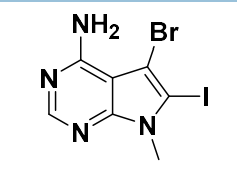
A round bottomed flask was charged with 5-bromo-7-methyl-7H-pyrrolo[2,3-d]pyrimidin-4-
amine (5 g, 22.12 mmol), DCM (50 mL) and TFA (2 mL) and a stirbar. 1-iodopyrrolidine-2,5-
dione (5.97 g, 26.54 mmol) was added, and the solution was stirred for 2 h at room temperature.
The reaction mixture was diluted with Na2SO3 solution (200 mL), and the aqueous phase was
extracted with DCM (200 mL) three times. The combined organic layers were washed with
saturated brines, dried over sodium sulfate, filtered, and concentrated in vacuo. The resulting
crude material was purified by HPLC. Concentration in vacuo resulted in 5-bromo-6-iodo-7-
methyl-7H-pyrrolo[2,3-d]pyrimidin-4-amine (4 g, 51.3 %) as a yellow solid.
tert-butyl (4-(4-amino-5-bromo-7-methyl-7H-pyrrolo[2,3-d]pyrimidin-6-yl)phenyl)carbamate
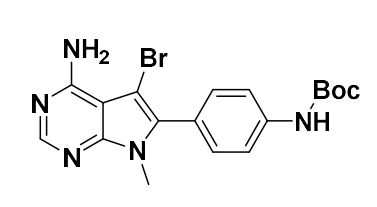
A resealable reaction vial was charged with 5-bromo-6-iodo-7-methyl-7H-pyrrolo[2,3-
d]pyrimidin-4-amine (4 g, 11.36 mmol), tert-butyl (4-(4,4,5,5-tetramethyl-1,3,2-dioxaborolan-2-
yl)phenyl)carbamate (4.35 g, 13.63 mmol), Pd(dppf)Cl2 (994.16 mg, 1.36 mmol), K3PO4 (7.22
g, 34.08 mmol), DMF (50 mL), H2O (6.25 mL) and a stir bar before being evacuated and purged
with nitrogen three times. The mixture was stirred for 2 h at 90 °C. The reaction mixture was
diluted with H2O (300 mL), and the aqueous phase was extracted with ethyl acetate (300 mL)
three times. The combined organic layers were washed with brines, dried over sodium sulfate,
filtered, and concentrated in vacuo. The resulting crude material was purified by silica gel
chromatography (eluting with MeOH/DCM = 1/40). Concentration in vacuo resulted in tert-butyl
(4-(4-amino-5-bromo-7-methyl-7H-pyrrolo[2,3-d]pyrimidin-6-yl)phenyl)carbamate (3 g, 63.4%)
as a yellow solid.
6-(4-aminophenyl)-5-bromo-7-methyl-7H-pyrrolo[2,3-d]pyrimidin-4-amine
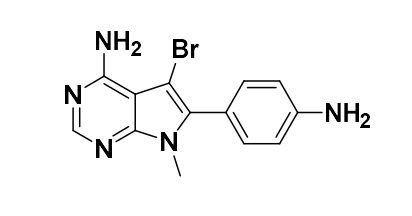
A round bottomed flask was charged with tert-butyl (4-(4-amino-5-bromo-7-methyl-7Hpyrrolo[2,3-d]pyrimidin-6-yl)phenyl)carbamate (3 g, 7.19 mmol), DCM (50 mL) and TFA (12.5mL) and a stirbar. The solution was stirred for 1 h at room temperature. The reaction mixture
was diluted with H2O (100 mL), and the aqueous phase was extracted with DCM (50 mL) three
times. The pH of aqueous phase was adjusted to 7~8, then the aqueous phase was extracted with
DCM (100 mL) three times. The combined organic layers were washed with saturated brines,
dried over sodium sulfate, filtered, and concentrated in vacuo resulted in 6-(4-aminophenyl)-5-
bromo-7-methyl-7H-pyrrolo[2,3-d]pyrimidin-4-amine (2.1 g, 92.1%) as a yellow solid.
N-(4-(4-amino-5-bromo-7-methyl-7H-pyrrolo[2,3-d]pyrimidin-6-yl)phenyl)methacrylamide
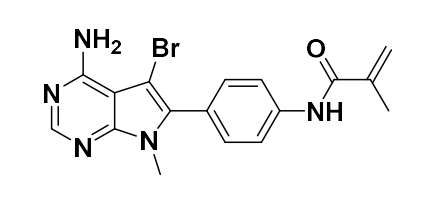
A resealable reaction vial was charged with 6-(4-aminophenyl)-5-bromo-7-methyl-7Hpyrrolo[2,3-d]pyrimidin-4-amine (2.1 g, 6.62 mmol), pyridine (785 mg, 9.93 mmol), DCM (100
mL) and a stir bar before being evacuated and purged with nitrogen three times. Methacryloyl
chloride (757.3 mg, 7.28 mmol) was added slowly at 0 oC. Then the mixture was stirred for 2 h
at room temperature. The reaction mixture was diluted with H2O (100 mL), and the aqueous
phase was extracted with DCM (100 mL) three times. The combined organic layers were washed
with brines, dried over sodium sulfate, filtered, and concentrated in vacuo. The resulting crude
material was purified by silica gel chromatography (eluting with MeOH/DCM=1/40).
Concentration in vacuo resulted in N-(4-(4-amino-5-bromo-7-methyl-7H-pyrrolo[2,3-
d]pyrimidin-6-yl)phenyl)methacrylamide (1.8 g, 70.5%) as an off-white solid.
2-(4-bromo-2-fluorophenoxy)-4-methylpyrimidine
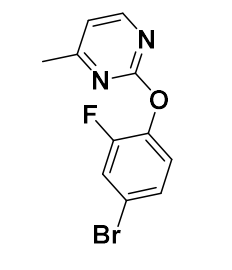
A round bottomed flask was charged with 4-bromo-2-fluorophenol (1.0 g, 5.24 mmol), 2-fluoro4-methylpyrimidine (704 mg, 6.28 mmol), Cs2CO3 (5.12 g, 15.7 mmol) and a stirbar. DMF (20
mL) was added, and the solution was stirred for 1 h at 100 oC. The reaction mixture was diluted
with H2O (100 mL), and the aqueous phase was extracted with ethyl acetate (100 mL) three
times. The combined organic layers were washed with saturated brines, dried over sodium
sulfate, filtered, and concentrated in vacuo. The resulting crude material was purified by HPLC.
Concentration in vacuo resulted in 2-(4-bromo-2-fluorophenoxy)-4-methylpyrimidine (1.48 g,
99.8 %) as an off-white amorphous solid.
2-(2-fluoro-4-(4,4,5,5-tetramethyl-1,3,2-dioxaborolan-2-yl)phenoxy)-4-methylpyrimidine
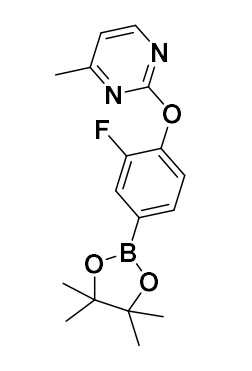
A solution/mixture of 2-(4-bromo-2-fluorophenoxy)-4-methylpyrimidine (500.00 mg, 1.77
mmol), bis(pinacolato)diboron (672.75 mg, 2.65 mmol), KOAc (520 mg, 5.3 mmol) and
Pd(dppf)Cl2 (129.4 mg, 0.177 mmol) in DMF (10 mL) was stirred for 2 h at 80 oC under nitrogen
atmosphere. The resulting mixture was diluted with water and extracted with EA. The combined
organic layers were washed with brines, dried over anhydrous Na2SO4. After filtration, the
filtrate was concentrated under reduced pressure. The residue was purified by HPLC.
Concentration in vacuo resulted in 2-(2-fluoro-4-(4,4,5,5-tetramethyl-1,3,2-dioxaborolan-2-
yl)phenoxy)-4-methylpyrimidine (430 mg, 73.7%) as a yellow solid.
2-(2-fluoro-4-(4,4,5,5-tetramethyl-1,3,2-dioxaborolan-2-yl)phenoxy)-4-methylpyrimidine
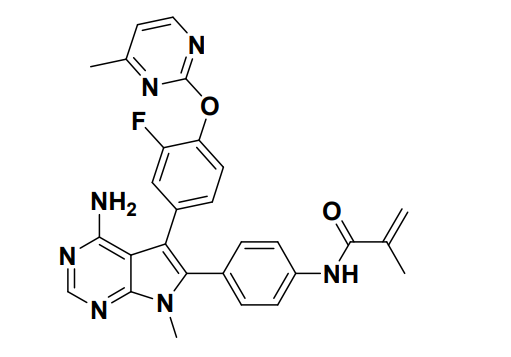
A resealable reaction vial was charged with N-(4-(4-amino-5-bromo-7-methyl-7H-pyrrolo[2,3-
d]pyrimidin-6-yl)phenyl)methacrylamide (100 mg, 0.259 mmol), 2-(2-fluoro-4-(4,4,5,5-
tetramethyl-1,3,2-dioxaborolan-2-yl)phenoxy)-4-methylpyrimidine (102.6 mg, 0.310 mmol),
Pd(DtBPF)Cl2 (16.9 mg, 0.026 mmol), CsF (118 mg, 0.776 mmol), DMF (2 mL), H2O (0.25
mL) and a stir bar before being evacuated and purged with nitrogen three times. The mixture was
stirred for 1 h at 90 °C. The reaction mixture was diluted with H2O (10 mL), and the aqueousphase was extracted with DCM (10 mL) three times. The combined organic layers were washed
with brines, dried over sodium sulfate, filtered, and concentrated in vacuo. The resulting crude
material was purified by Pre-HPLC (Column: XBridge Prep C18 OBD Column, 19*150 mm,
5μm; Mobile Phase A: Water(10 mmol/L NH4HCO3), Mobile Phase B: ACN; Flow rate: 25
mL/min; Gradient: 25% B to 50% B in 7 min, 50% B; Wave Length: 254/220 nm; RT1(min):
6.5). Concentration in vacuo resulted in N-(4-(4-amino-5-(3-fluoro-4-((4-methylpyrimidin-2-
yl)oxy)phenyl)-7-methyl-7H-pyrrolo[2,3-d]pyrimidin-6-yl)phenyl)methacrylamide ( 27.2 mg,
20.6%) as an off-white solid. LC/MS(BAS1): [M+H]+= 510.20; tR =1.405 min. 1H NMR (400
MHz, DMSO-d6) δ 9.92 (s, 1H), 8.47 (d, J = 5.0 Hz, 1H), 8.21 (s, 1H), 7.79 – 7.72 (m, 2H), 7.38
– 7.28 (m, 3H), 7.22 – 7.14 (m, 2H), 7.10 (dd, J = 8.1, 2.1 Hz, 1H), 5.98 (s, 2H), 5.80 (s, 1H),
5.54 (d, J = 1.7 Hz, 1H), 3.59 (s, 3H), 2.42 (s, 3H), 1.95 (d, J = 1.2 Hz, 3H).
PAT
WIPO Patent Publication: WO2020231990A1 (and related family filings)
https://patentscope.wipo.int/search/en/detail.jsf?docId=WO2020231990&_cid=P20-MUHRQT-01820-1
PAT
United States Patents: US11780845
PAT
US20230192709
https://patentscope.wipo.int/search/en/detail.jsf?docId=US399951539&_cid=P20-MUHRKD-96615-1
ADVERTISEMENT
ANAX LABORATORIES
WEBSITE https://www.anaxlab.com/
Discovery Solutions, Supporting the chemistry needs of clients in the Medical, Analytical and Bio Sciences
Development Solutions, Developing from Lab scale to PR&D, Kilo Scale-ups and Commercial Scales
SEE MORE………Integrated Solutions, Manufacturing Solutions, Products,
Can’t Find? Let’s Connect
Phone : +91 897704 2010 / +91 9177075735, Email : info@anaxlab.com
#MedicinalChemistry, #DrugDiscovery, #OrganicSynthesis, #ChemicalLibrary, #BuildingBlocks, #SARStudies, #ChemistryInnovation, #medchem, #Drugdevelopment, #Biotech, #Biotechnology, #AnaxLaboratories, #Pharma
AS ON FEB2026 4.574 LAKHS VIEWS ON BLOG WORLDREACH AVAILABLEFOR YOUR ADVERTISEMENT
join me on Linkedin
Anthony Melvin Crasto Ph.D – India | LinkedIn
join me on Researchgate
RESEARCHGATE
join me on Facebook
Anthony Melvin Crasto Dr. | Facebook
join me on twitter
Anthony Melvin Crasto Dr. | twitter
+919321316780 call whatsaapp
EMAIL. amcrasto@gmail.com
References
[1]. Vivek Subbiah, et al. RLY-4008, the First Highly Selective FGFR2 Inhibitor with Activity across FGFR2 Alterations and Resistance Mutations. Cancer Discov. 2023 Sep 6;13(9):2012-2031. [Content Brief]
/////////lirafugratinib, anax labs, FDA 2026, APPROVALS 2026, Lyrfigtu, RLY-4008, RLY 4008, 23SEPT2026, CANCER
#lirafugratinib, #anax labs, #FDA 2026, #APPROVALS 2026, #Lyrfigtu, #RLY-4008, #RLY 4008, #23SEPT2026, #CANCER
Floretyrosine F 18
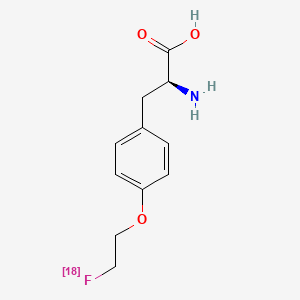

Floretyrosine F 18
CAS 178433-03-9
FormulaC₁₁H₁₄[¹⁸F]NO₃
Molecular Weight226.23 g/mol
FDA UNII1326R5J1IA
FDA 2026, APPROVALS 2026, Pixclara, TELIX PHARMACEUTICALS, GLIOMA, CANCER, TLX101-CDx, TLX101-Px, 1326R5J1IA, L-(18F)FET, O-(2-((18)F)fluoroethyl)-L-tyrosine
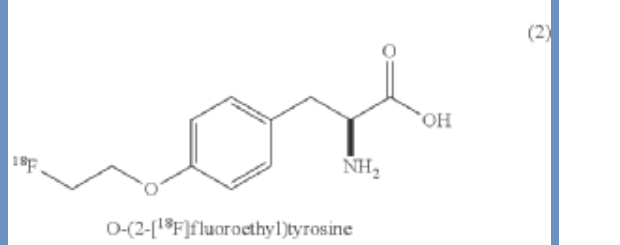
(2S)-2-amino-3-[4-(2-[¹⁸F]fluoroethoxy)phenyl]propanoic acid, (2S)-2-amino-3-[4-(2-(18F)fluoroethoxy)phenyl]propanoic acid
To use with positron emission tomography to differentiate recurrent or progressive glioma from treatment-related change in conjunction with other diagnostic evaluations
Floretyrosine F 18 (brand name Pixclara®, also known as 18F-FET) is a newly FDA-approved radiopharmaceutical imaging drug used in positron emission tomography (PET) scans for patients with glioma (brain cancer). Developed by Telix Pharmaceuticals, it received formal U.S. Food and Drug Administration (FDA) approval on September 14, 2026, making it the first and only approved FET-PET diagnostic tracer for brain tumors in the United States.
Primary Clinical Indication
Pixclara is indicated for use in both adult and pediatric patients (1 month of age and older).
Its primary clinical purpose is to differentiate recurrent or progressive glioma from treatment-related changes (such as radiation necrosis or inflammation). Following chemotherapy or radiation, traditional MRI scans often show areas that “light up,” making it incredibly difficult for neuro-oncologists to tell whether a tumor is growing back or if the brain is simply healing from harsh treatments. Pixclara solves this diagnostic dilemma by providing metabolic clarity.
How It Works (Mechanism of Action)
- Targeted Delivery: Floretyrosine F 18 is a synthetic amino acid analogue labeled with the radioactive isotope fluorine-18. [1, 2]
- Cellular Uptake: Once injected intravenously, it specifically targets and binds to L-type amino acid transporters 1 and 2 (LAT1 and LAT2). These transporters are heavily overexpressed on the membranes of active glioma cells compared to healthy brain tissue.
- PET Detection: The tumor cells rapidly absorb the tracer, and the energy emissions from the fluorine-18 isotope are captured by a PET scanner, creating a highly accurate metabolic map of the tumor.
Strategic & Future Impact
The approval aligns U.S. practice with international clinical guidelines—such as the National Comprehensive Cancer Network (NCCN) Guidelines®—which already recommend FET-PET imaging for brain tumor management. Furthermore, Telix Pharmaceuticals is currently conducting a Phase 3 registrational study to expand Pixclara’s indication to include the diagnosis and characterization of brain metastases (cancers that have spread to the brain from other parts of the body)
Fluoroethyl-l-tyrosine (18F), commonly known as [18F]FET, is a radiopharmaceutical tracer used in positron emission tomography (PET) imaging. This synthetic amino acid, labeled with the radioactive isotope fluorine-18, is a valuable radiopharmaceutical tracer for use in neuro-oncology for diagnosing, planning treatment, and following up on brain tumors such as gliomas. The tracer’s ability to provide detailed metabolic imaging of tumors makes it an essential tool in the clinical management of brain cancer patients. Continued advancements in PET imaging technology and the development of more efficient synthesis methods are expected to further enhance the clinical utility of [18F]FET.[2]
Radiosynthesis
There are two common pathways for the radiosynthesis of [18F]FET. The first one utilizes a nucleophilic 18F-fluorination of ethyleneglycol-1,2-ditosylate with a subsequent 18F-fluoroethylation of a precursor di-sodium salt of L-tyrosine. This sequence requires two purification steps, two different precursors and a dual-reactor synthesis module which is not widely available in research or commercial centers.[3][4][5] The schematic for this pathway is:[6]

The second route of radiosynthesis is a direct nucleophilic 18F-fluorination a TET (O-(2-tosyloxy-ethyl)-N-trityl-L-tyrosine tert-butyl ester) protected precursor followed by acidic hydrolysis of protecting groups.[3][4][7] The schematic for this pathway is:[6]
REF
- Fluorinated phenylalanines: synthesis and pharmaceutical applicationsPublication Name:Beilstein Journal of Organic ChemistryPublication Date:2020-05-15PMCID:PMC7237815PMID:32509033DOI:10.3762/bjoc.16.91
- Solid-Phase Synthesis of O-(2-[18F]-Fluoro-ethyl)-l-tyrosinePublication Name:SynfactsPublication Date:2013-03-15DOI:10.1055/s-0032-1318420
- Investigations into the synthesis, radiofluorination and conjugation of a new [18F]fluorocyclobutyl prosthetic group and its in vitro stability using a tyrosine model systemPublication Name:Bioorganic & Medicinal ChemistryPublication Date:2013-02-01PMID:23290251DOI:10.1016/j.bmc.2012.11.049
- Microfluidic technology: An economical and versatile approach for the synthesis of O-(2-[18F]fluoroethyl)-l-tyrosine ([18F]FET)Publication Name:Bioorganic & Medicinal Chemistry LettersPublication Date:2012-03-15PMID:22342141DOI:10.1016/j.bmcl.2012.01.083
- Synthesis and biological evaluation of novel F-18 labeled pyrazolo[1,5-a]pyrimidine derivatives: Potential PET imaging agents for tumor detectionPublication Name:Bioorganic & Medicinal Chemistry LettersPublication Date:2011-08-15PMID:21752641DOI:10.1016/j.bmcl.2011.06.072
- (18)F Labeled benzimidazole derivatives as potential radiotracer for positron emission tomography (PET) tumor imagingPublication Name:Bioorganic & Medicinal ChemistryPublication Date:2010-04-01PMID:20303769DOI:10.1016/j.bmc.2010.02.060
- No carrier added synthesis of O-(2′-[18F]fluoroethyl)-l-tyrosine via a novel type of chiral enantiomerically pure precursor, NiII complex of a (S)-tyrosine Schiff basePublication Name:Bioorganic & Medicinal ChemistryPublication Date:2008-05-01PMID:18378460DOI:10.1016/j.bmc.2008.03.040
- Solid-Phase Synthesis of O-(2-[18F]-Fluoro-ethyl)-l-tyrosine, DOI:10.1055/s-0032-1318420, Publication Date:2013, Publication Name:Synfacts
SYN
US20190223814/US249082034
PAT
US20120189546
https://patentscope.wipo.int/search/en/detail.jsf?docId=US73636763&_cid=P11-MU3HO5-37901-1
PAT
US20140235861
https://patentscope.wipo.int/search/en/detail.jsf?docId=US107206441&_cid=P11-MU3HO5-37901-1
Another example of an 18F-fluoroalkylation reaction to obtain a PET tracer is the reaction described by Wang et al (2006 J Radioanalyt Nuc Chem; 270(2): 439-43) used to obtain the 18F-labeled amino acid O-(2-[ 18F]fluoroethyl)-L-tyrosine ([ 18F]FET):
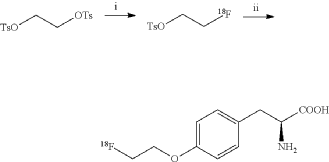
[ 18F]Fluoroethyl tosylate was prepared in step (i) by displacement of a tosyl group from 1,2-bistosyloxyethane by reaction with K 18F/Kryptofix 2.2.2 in acetonitrile at 90° C. for 10 minutes. The purified [ 18F]fluoroethyl tosylate was then reacted in step (ii) with a solution of L-tyrosine and 10% aqueous NaOH in DMSO (or di-Na-salt of L-tyrosine in DMSO) 20 minutes at 90° C. to obtain [ 18F]FET. In contrast to the method for preparation of 18F-labelled S-fluoroalkyl diarylguanidines as reported by Robins et al (supra), this method for preparation of [ 18F]FET uses a soluble base in the alkylation reaction. However, the reaction is still not ideal for carrying out on an automated synthesis device that uses a cassette due to the fact that and additional vial is required for the base used for the subsequent fluoroalkylation step.
PAT
Radiation radiation detector with position tracking system and its use in medical systems and proceduresPublication Number:
JP-2004512502-APriority Date:2000-08-21
- Novel imaging agents and precursors and methods of preparation thereofPublication Number:CN-1234680-CPriority Date:2001-06-04Grant Date:2006-01-04
- Radioactive emission detector equipped with a position tracking system and utilization thereof with medical systems and in medical proceduresPublication Number:US-2005055174-A1Priority Date:2000-08-21
- Radioactive emission detector equipped with a position tracking system and utilization thereof with medical systems and in medical proceduresPublication Number:US-7826889-B2Priority Date:2000-08-21Grant Date:2010-11-02
- Radioactive emission detector equipped with a position tracking system and utilization thereof with medical systems and in medical proceduresPublication Number:US-2004015075-A1Priority Date:2000-08-21
- Radioactive emission detector equipped with a position tracking systemPublication Number:US-2014249402-A1Priority Date:2000-08-21
- Tumor imaging compoundsPublication Number:CA-2479514-CPriority Date:2002-04-30Grant Date:2011-07-26
- Protected tyrosine derivatives, method for the production thereof and use of the same for producing o-(2-[18f]-fluoroethyl)-l-tyrosinePublication Number:WO-02102765-A3Priority Date:2001-06-05
- Protected tyrosine derivatives, method for the production thereof and use of the same for producing o-(2-[18f]-fluoroethyl)-l-tyrosinePublication Number:US-2004192954-A1Priority Date:2001-06-05
- PROTECTED TYROSINE DERIVATIVES, METHOD FOR THE PRODUCTION THEREOF AND THEIR USE FOR THE PRODUCTION OF O-(2-?18 F)-FLUORETHYL)-L-TYROSINEPublication Number:AT-E289992-T1Priority Date:2001-06-05Grant Date:2005-03-15
- Imaging agents, precursors thereof and methods of manufacturePublication Number:US-2003124059-A1Priority Date:2001-06-04
- Radioactively labelled amino acid analogues, their preparation and usePublication Number:US-2006127306-A1Priority Date:2002-08-02
- Radioactively labelled amino acid analogues, their preparation and usePublication Number:EP-1539250-A1Priority Date:2002-08-02
- Tumor imaging compoundsPublication Number:US-7989649-B2Priority Date:2002-04-30Grant Date:2011-08-02
- Tumor imaging compoundsPublication Number:US-2009240041-A1Priority Date:2002-04-30
- Tumor imaging compoundsPublication Number:US-7544715-B2Priority Date:2002-04-30Grant Date:2009-06-09
ADVERTISEMENT
ANAX LABORATORIES
WEBSITE https://www.anaxlab.com/
Discovery Solutions, Supporting the chemistry needs of clients in the Medical, Analytical and Bio Sciences
Development Solutions, Developing from Lab scale to PR&D, Kilo Scale-ups and Commercial Scales
SEE MORE………Integrated Solutions, Manufacturing Solutions, Products,
Can’t Find? Let’s Connect
Phone : +91 897704 2010 / +91 9177075735, Email : info@anaxlab.com
#MedicinalChemistry, #DrugDiscovery, #OrganicSynthesis, #ChemicalLibrary, #BuildingBlocks, #SARStudies, #ChemistryInnovation, #medchem, #Drugdevelopment, #Biotech, #Biotechnology, #AnaxLaboratories, #Pharma
AS ON FEB2026 4.574 LAKHS VIEWS ON BLOG WORLDREACH AVAILABLEFOR YOUR ADVERTISEMENT
join me on Linkedin
Anthony Melvin Crasto Ph.D – India | LinkedIn
join me on Researchgate
RESEARCHGATE
join me on Facebook
Anthony Melvin Crasto Dr. | Facebook
join me on twitter
Anthony Melvin Crasto Dr. | twitter
+919321316780 call whatsaapp
EMAIL. amcrasto@gmail.com
References
- CID 54255856 from PubChem
- Treglia G, Muoio B, Giovanella L (2020). “18F-FET”. In Calabria F, Schillaci O (eds.). Radiopharmaceuticals: A Guide to PET/CT and PET/MRI. Cham: Springer International Publishing. pp. 83–88. doi:10.1007/978-3-030-27779-6_4. ISBN 978-3-030-27778-9.
- Bourdier T, Greguric I, Roselt P, Jackson T, Faragalla J, Katsifis A (July 2011). “Fully automated one-pot radiosynthesis of O-(2-[18F]fluoroethyl)-L-tyrosine on the TracerLab FX(FN) module”. Nuclear Medicine and Biology. 38 (5): 645–651. doi:10.1016/j.nucmedbio.2011.01.001. PMID 21718939.
- Siddiq IS, Atwa ST, Shama SA, Eltaoudy MH, Omar WM (March 2018). “Radiosynthesis and modified quality control of O-(2-[18F]fluoroethyl)-L-tyrosine ([18F]FET) for brain tumor imaging”. Applied Radiation and Isotopes. 133: 38–44. Bibcode:2018AppRI.133…38S. doi:10.1016/j.apradiso.2017.12.011. PMID 29275040.
- Wester HJ, Herz M, Weber W, Heiss P, Senekowitsch-Schmidtke R, Schwaiger M, et al. (January 1999). “Synthesis and radiopharmacology of O-(2-[18F]fluoroethyl)-L-tyrosine for tumor imaging”. Journal of Nuclear Medicine. 40 (1): 205–212. PMID 9935078.
- Wang M, Glick-Wilson BE, Zheng QH (December 2019). “Facile fully automated radiosynthesis and quality control of O-(2-[18F]fluoroethyl)-l-tyrosine ([18F]FET) for human brain tumor imaging”. Applied Radiation and Isotopes. 154 108852. Bibcode:2019AppRI.15408852W. doi:10.1016/j.apradiso.2019.108852. PMID 31442794.
- Mueller D, Klette I, Kalb F, Baum RP (July 2011). “Synthesis of O-(2-[18F]fluoroethyl)-L-tyrosine based on a cartridge purification method”. Nuclear Medicine and Biology. 38 (5): 653–658. doi:10.1016/j.nucmedbio.2011.01.006. PMID 21718940.
- Muoio B, Giovanella L, Treglia G (2018-09-04). “Recent Developments of 18F-FET PET in Neuro-oncology”. Current Medicinal Chemistry. 25 (26): 3061–3073. doi:10.2174/0929867325666171123202644. PMID 29173147.
- Wang L, Lieberman BP, Ploessl K, Kung HF (January 2014). “Synthesis and evaluation of ¹⁸F labeled FET prodrugs for tumor imaging”. Nuclear Medicine and Biology. 41 (1): 58–67. doi:10.1016/j.nucmedbio.2013.09.011. PMC 3895945. PMID 24183614.
- Lee TS, Ahn SH, Moon BS, Chun KS, Kang JH, Cheon GJ, et al. (August 2009). “Comparison of 18F-FDG, 18F-FET and 18F-FLT for differentiation between tumor and inflammation in rats”. Nuclear Medicine and Biology. 36 (6): 681–686. doi:10.1016/j.nucmedbio.2009.03.009. PMID 19647174.
- Leung K (2004), “O-(2-[18F]Fluoroethyl)-L-tyrosine”, Molecular Imaging and Contrast Agent Database (MICAD), Bethesda (MD): National Center for Biotechnology Information (US), PMID 20641653, retrieved 2024-07-10
- Heiss P, Mayer S, Herz M, Wester HJ, Schwaiger M, Senekowitsch-Schmidtke R (August 1999). “Investigation of transport mechanism and uptake kinetics of O-(2-[18F]fluoroethyl)-L-tyrosine in vitro and in vivo”. Journal of Nuclear Medicine. 40 (8): 1367–1373. PMID 10450690.
- Wang HE, Wu SY, Chang CW, Liu RS, Hwang LC, Lee TW, et al. (May 2005). “Evaluation of F-18-labeled amino acid derivatives and [18F]FDG as PET probes in a brain tumor-bearing animal model”. Nuclear Medicine and Biology. 32 (4): 367–375. doi:10.1016/j.nucmedbio.2005.01.005. PMID 15878506.
- Rau FC, Weber WA, Wester HJ, Herz M, Becker I, Krüger A, et al. (August 2002). “O-(2-[(18)F]Fluoroethyl)- L-tyrosine (FET): a tracer for differentiation of tumour from inflammation in murine lymph nodes”. European Journal of Nuclear Medicine and Molecular Imaging. 29 (8): 1039–1046. doi:10.1007/s00259-002-0821-6. PMID 12173018.
- Holzgreve A, Brendel M, Gu S, Carlsen J, Mille E, Böning G, et al. (2016-06-14). “Monitoring of Tumor Growth with [(18)F]-FET PET in a Mouse Model of Glioblastoma: SUV Measurements and Volumetric Approaches”. Frontiers in Neuroscience. 10: 260. doi:10.3389/fnins.2016.00260. PMC 4906232. PMID 27378835.
- “Product Characteristic of IASOglio©” (PDF). synektik.com.pl. 28 June 2024. Retrieved 28 June 2024.
- Pauleit D, Floeth F, Herzog H, Hamacher K, Tellmann L, Müller HW, et al. (April 2003). “Whole-body distribution and dosimetry of O-(2-[18F]fluoroethyl)-L-tyrosine”. European Journal of Nuclear Medicine and Molecular Imaging. 30 (4): 519–524. doi:10.1007/s00259-003-1118-0. PMID 12589478.
- Tang G, Tang X, Wang M, Luo L, Gan M (January 2004). “Radiation dosimetry of O-(3-[18F]fluoropropyl)-L-tyrosine as oncologic PET tracer based on the mice distribution data”. Applied Radiation and Isotopes. 60 (1): 27–32. doi:10.1016/j.apradiso.2003.10.005. PMID 14687633.
- Mattsson S, Johansson L, Leide Svegborn S, Liniecki J, Noßke D, Riklund KÅ, et al. (July 2015). “Radiation Dose to Patients from Radiopharmaceuticals: a Compendium of Current Information Related to Frequently Used Substances” (PDF). Annals of the ICRP. 44 (2 Suppl): 7–321. doi:10.1177/0146645314558019. PMID 26069086.
- “IASOglio”. Curium Pharma. Retrieved 2024-07-10.
 | |
| Clinical data | |
|---|---|
| Other names | 18F-FET; O-(2-(18F)fluoroethyl)-l-tyrosine, O-(2-Fluorethyl)-l-thyrosine, l-(18F)FET[1] |
| Routes of administration | Intravenous |
| ATC code | V09IX10 (WHO) |
| Identifiers | |
| IUPAC name | |
| CAS Number | 178433-03-9  |
| PubChem CID | 9834479 |
| ChemSpider | 8010200 |
| UNII | 1326R5J1IA |
| CompTox Dashboard (EPA) | DTXSID601045942 |
| Chemical and physical data | |
| Formula | C11H14FNO3 |
| Molar mass | 227.235 g·mol−1 |
| 3D model (JSmol) | Interactive image |
| SMILES | |
| InChI | |
///////////floretyrosine F 18, anax labs, FDA 2026, APPROVALS 2026, Pixclara, TELIX PHARMACEUTICALS, GLIOMA, CANCER, TLX101-CDx, TLX101-Px, 1326R5J1IA, L-(18F)FET, O-(2-((18)F)fluoroethyl)-L-tyrosine
#floretyrosine F 18, #anax labs, #FDA 2026, #APPROVALS 2026, #Pixclara, #TELIX PHARMACEUTICALS, #GLIOMA, #CANCER, #TLX101-CDx, #TLX101-Px, #1326R5J1IA, #L-(18F)FET, #O-(2-((18)F)fluoroethyl)-L-tyrosine
Rusfertide
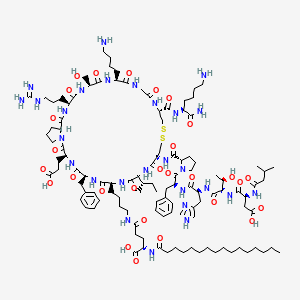
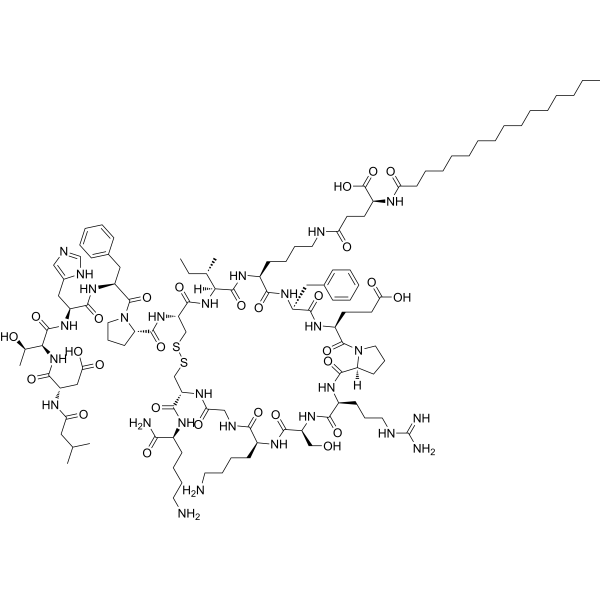

Rusfertide
MF
C114H181N27O28S2 MW 2442.0 g/mol
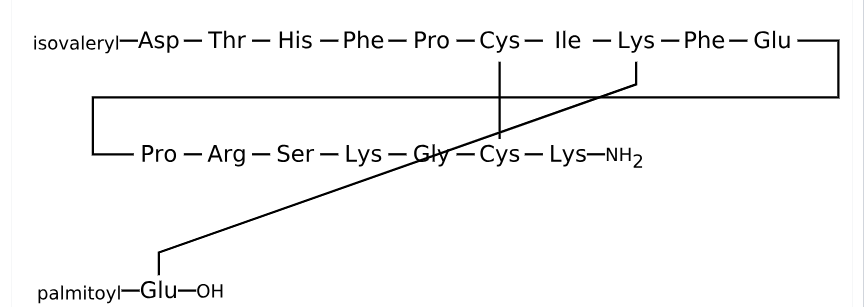
isovaleryl-Asp-Thr-His-Phe-Pro-Cys(1)-Ile-Lys(2)-Phe-Glu-Pro-Arg-Ser-Lys-Gly-Cys(1)-Lys-NH2.palmitoyl-Glu(2)-OH
(2S)-5-[4-[(3S,6S,9S,12S,15R,20R,26S,29S,32S,35S)-26-(4-aminobutyl)-6-benzyl-12-[(2S)-butan-2-yl]-32-(3-carbamimidamidopropyl)-3-(2-carboxyethyl)-15-[[(2S)-1-[(2S)-2-[[(2S)-2-[[(2S,3R)-2-[[(2S)-3-carboxy-2-(3-methylbutanoylamino)propanoyl]amino]-3-hydroxybutanoyl]amino]-3-(1H-imidazol-4-yl)propanoyl]amino]-3-phenylpropanoyl]pyrrolidine-2-carbonyl]amino]-20-[[(2S)-1,6-diamino-1-oxohexan-2-yl]carbamoyl]-29-(hydroxymethyl)-2,5,8,11,14,22,25,28,31,34-decaoxo-17,18-dithia-1,4,7,10,13,21,24,27,30,33-decazabicyclo[33.3.0]octatriacontan-9-yl]butylamino]-2-(hexadecanoylamino)-5-oxopentanoic acid
{Asp(N-(3-methyl-1-oxobutyl))}-Thr-His-Phe-Pro-Cys-Ile-{Lys(γGlu-C16 acid)}-Phe-Glu-Pro-Arg-Ser-Lys-Gly-Cys-Lys-NH2 (disulfide bridge: Cys6-Cys16)
Mimrylo, APPROVALS 2026, FDA 2026, XM71MYX0IQ, PTG-300FB, PTG-300, TAK 121,
To treat erythrocytosis in adults with polycythemia vera
Rusfertide is a peptide mimetic of natural hepcidin, which targets and degrades ferroportin, reduces serum iron and transferrin-saturation, and thus regulates the production of red blood cells. Rusfertide ameliorates the polycythemia vera, β-thalassemia and hereditary hemochromatosis.
Rusfertide is an injectable peptide mimetic of hepcidin (hepcidin antimicrobial peptide; HAMP; putative liver tumor regressor; PLTR; liver-expressed antimicrobial peptide 1; LEAP-1) with potential use in the treatment of iron deficiency anemia and iron overload secondary to hematologic disorders. Upon administration, rusfertide mimics endogenous hepcidin, a protein primarily produced in hepatocytes, and increases hepcidin levels. As hepcidin plays a key role in the homeostasis of systemic iron, rusfertide may serve to normalize iron levels. Low levels of endogenous hepcidin are associated with iron overload secondary to excessive absorption of iron as seen in beta thalassemia and paradoxically with iron deficiency anemia.
Rusfertide, sold under the brand name Mimrylo, is a medication developed by Protagonist Therapeutics in partnership with Takeda for the treatment of polycythemia vera (PV).[1][2][3]
ADVERTISEMENT
ANAX LABORATORIES
WEBSITE https://www.anaxlab.com/
Discovery Solutions, Supporting the chemistry needs of clients in the Medical, Analytical and Bio Sciences
Development Solutions, Developing from Lab scale to PR&D, Kilo Scale-ups and Commercial Scales
SEE MORE………Integrated Solutions, Manufacturing Solutions, Products,
Can’t Find? Let’s Connect
Phone : +91 897704 2010 / +91 9177075735, Email : info@anaxlab.com
#MedicinalChemistry, #DrugDiscovery, #OrganicSynthesis, #ChemicalLibrary, #BuildingBlocks, #SARStudies, #ChemistryInnovation, #medchem, #Drugdevelopment, #Biotech, #Biotechnology, #AnaxLaboratories, #Pharma
AS ON FEB2026 4.574 LAKHS VIEWS ON BLOG WORLDREACH AVAILABLEFOR YOUR ADVERTISEMENT
join me on Linkedin
Anthony Melvin Crasto Ph.D – India | LinkedIn
join me on Researchgate
RESEARCHGATE
join me on Facebook
Anthony Melvin Crasto Dr. | Facebook
join me on twitter
Anthony Melvin Crasto Dr. | twitter
+919321316780 call whatsaapp
EMAIL. amcrasto@gmail.com
References
 | |
| Clinical data | |
|---|---|
| Trade names | Mimrylo |
| Other names | PTG-300; TAK-121 |
| Identifiers | |
| CAS Number | 1628323-80-7 |
| PubChem CID | 155884410 |
| DrugBank | DB17724 |
| ChemSpider | 129955617 |
| UNII | XM71MYX0IQ |
| KEGG | D12064 |
| ChEMBL | ChEMBL4650507 |
| Chemical and physical data | |
| Formula | C114H181N27O28S2 |
| Molar mass | 2441.98 g·mol−1 |
| 3D model (JSmol) | Interactive image |
| SMILES | |
| InChI | |
References
- “Rusfertide – Protagonist Therapeutics”. AdisInsight. Springer Nature Switzerland AG.
- Kremyanskaya M, Ginzburg YZ, Hoffman R (March 2026). “Modulators of the hepcidin pathway in polycythemia vera and myelofibrosis”. Blood. 147 (12): 1278–1288. doi:10.1182/blood.2025028643. PMID 41100735.
- “Protagonist and Takeda Announce ASCO Plenary Presentation Highlighting Full 32-Week Results from Phase 3 VERIFY Study of Rusfertide, Showing Reductions in Phlebotomy, Improved Hematocrit Control in Polycythemia Vera”. Takeda.
//////rusfertide, anax labs, Mimrylo, APPROVALS 2026, FDA 2026, XM71MYX0IQ, PTG-300FB, PTG 300, TAK 121,
#rusfertide, #anax labs, #Mimrylo, #APPROVALS 2026, #FDA 2026, #XM71MYX0IQ, #PTG-300FB, #PTG-300, #TAK 121,
Brepocitinib

Brepocitinib
CAS 1883299-62-4
MF C18H21F2N7O MW389.4 g/mol
8/27/2026, APPROVALS 2026, FDA 2026, Lisraya, PF 06700841, 3X8387Q25N, PF-06700841
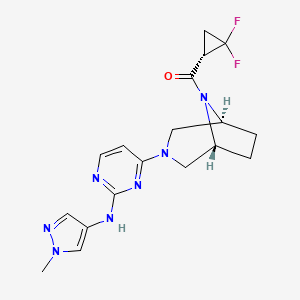
[(1S)-2,2-difluorocyclopropyl]-[(1R,5S)-3-[2-[(1-methylpyrazol-4-yl)amino]pyrimidin-4-yl]-3,8-diazabicyclo[3.2.1]octan-8-yl]methanone
- [(1S)-2,2-difluorocyclopropyl]-[(1S,5R)-3-[2-[(1-methylpyrazol-4-yl)amino]pyrimidin-4-yl]-3,8-diazabicyclo[3.2.1]octan-8-yl]methanone
- Methanone, ((1S)-2,2-difluorocyclopropyl)(3-(2-((1-methyl-1H-pyrazol-4-yl)amino)-4-pyrimidinyl)-3,8-diazabicyclo(3.2.1)oct-8-yl)-
- ((1S)-2,2-difluorocyclopropyl)-((1S,5R)-3-(2-((1-methylpyrazol-4-yl)amino)pyrimidin-4-yl)-3,8-diazabicyclo(3.2.1)octan-8-yl)methanone
To treat dermatomyositis in adults
Brepocitinib (brand name Lisraya) is an oral, once-daily dual TYK2/JAK1 inhibitor approved by the FDA for treating dermatomyositis in adults.
Developed by Roivant (via its subsidiary Priovant), it is the first oral targeted therapy indicated to manage this rare, debilitating autoimmune condition. Brepocitinib, sold under the brand name Lisraya, is a drug which acts as a dual inhibitor of JAK1 and TYK2, and was developed for the treatment of plaque psoriasis.[1][2][3][4] It is used for the treatment of dermatomyositis.
Brepocitinib is an orally available, selective inhibitor of non-receptor tyrosine-protein kinase TYK2 (tyrosine kinase 2) and tyrosine-protein kinase JAK1 (Janus kinase 1; JAK1) with potential immunomodulatory and anti-inflammatory activities. Upon oral administration, brepocitinib selectively binds to and inhibits the activation of TYK2 and JAK1, thereby disrupting TYK2 and JAK-1-dependent cytokine signaling. This may reduce inflammatory responses and prevent inflammation-induced damage caused by certain immunological diseases. TYK2 and JAK-1 are members of the Janus kinase family of non-receptor tyrosine kinases and are involved in signaling pathways affecting hematopoiesis, immunity and inflammation.
SYN
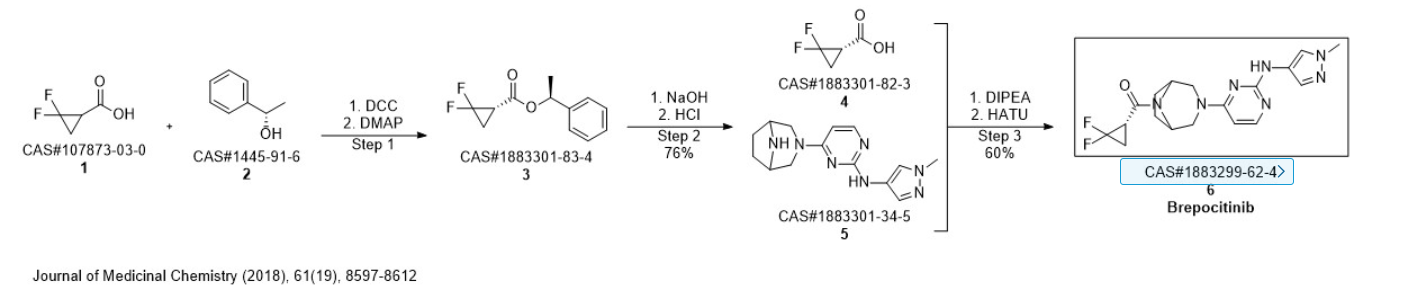
Dual Inhibition of TYK2 and JAK1 for the Treatment of Autoimmune Diseases: Discovery of ((S)-2,2-Difluorocyclopropyl)((1R,5S)-3-(2-((1-methyl-1H-pyrazol-4-yl)amino)pyrimidin-4-yl)-3,8-diazabicyclo[3.2.1]octan-8-yl)methanone (PF-06700841)
By: Fensome, Andrew ; et al
Journal of Medicinal Chemistry (2018), 61(19), 8597-8612
SYN
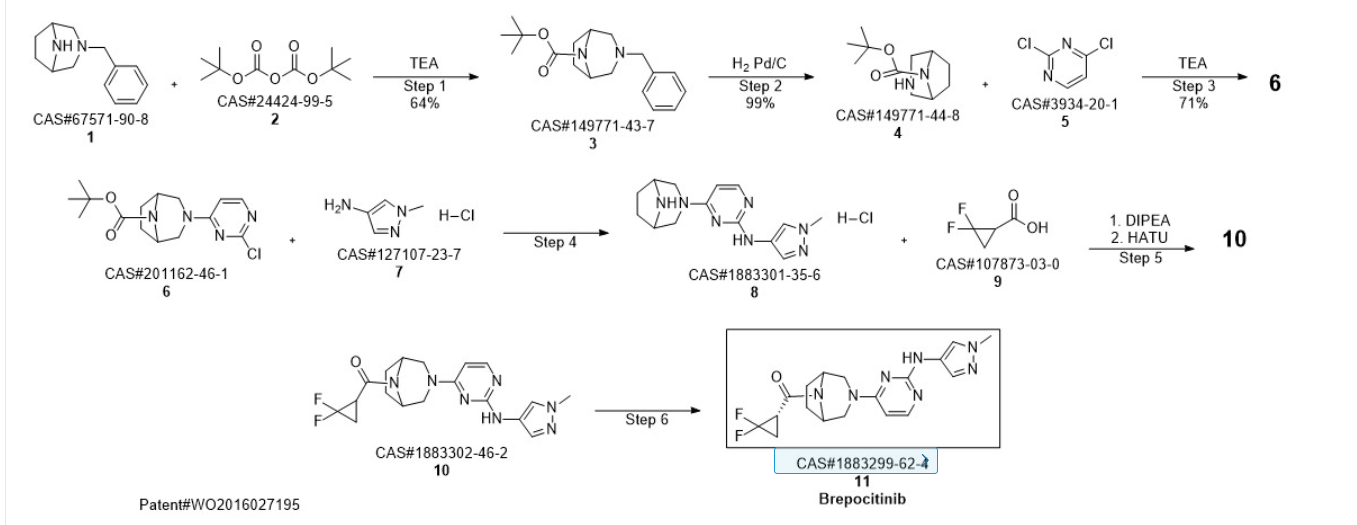
Preparation of aminopyrimidinyl derivatives as inhibitors of JAK kinases useful in therapy of diseases
Assignee: Pfizer Inc.
Inventors: Fensome, Andrew; et al
World Intellectual Property Organization
Patent#WO2016027195 A1
https://patentscope.wipo.int/search/en/detail.jsf?docId=WO2016027195&_cid=P11-MTCC5U-40903-1
SYN
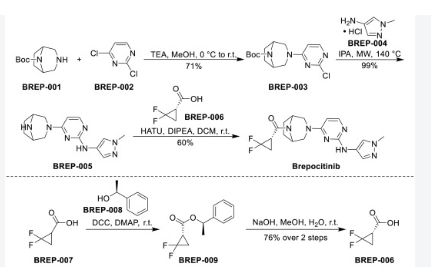
https://www.sciencedirect.com/science/article/abs/pii/S0223523423008152
SYN
PAT
https://patentscope.wipo.int/search/en/detail.jsf?docId=US159751917&_cid=P11-MTCCDC-53135-1
Examples 7 and 8
[(1S)-2,2-difluorocyclopropyl][(1R,5S)-3-{2-[(1-methyl-1H-pyrazol-4-yl)amino]pyrimidin-4-yl}-3,8-diazabicyclo[3.2.1]oct-8-yl]methanone and [(1R)-2,2-difluorocyclopropyl][(1R,5S)-3-{2-[(1-methyl-1H-pyrazol-4-yl)amino]pyrimidin-4-yl}-3,8-diazabicyclo[3.2.1]oct-8-yl]methanone
Peak 1: Example 7
[(1S)-2,2-difluorocyclopropyl][(1R,5S)-3-{2-[(1-methyl-1H-pyrazol-4-yl)amino]pyrimidin-4-yl}-3,8-diazabicyclo[3.2.1]oct-8-yl]methanone
PAT
- New compounds for the inhibition of angiogenesis and use of thereofPublication Number:AU-2005223356-A1Priority Date:2004-03-24
- Compositions and methods of use for modified release minoxidilPublication Number:US-2025325546-A1
- Aminopyrimidinyl compoundsPublication Number:US-10980815-B2Priority Date:2014-08-21Grant Date:2021-04-20
- Aminopyrimidinyl compounds as JAK inhibitorsPublication Number:MD-4800-C1Priority Date:2014-08-21
- Aminopyrimidinyl compoundsPublication Number:US-2020330477-A1Priority Date:2014-08-21
- Aminopyrimidinyl compoundsPublication Number:US-11197867-B2Priority Date:2014-08-21Grant Date:2021-12-14
- Aminopyrimidinyl compoundsPublication Number:TW-201609706-APriority Date:2014-08-21
ADVERTISEMENT
ANAX LABORATORIES
WEBSITE https://www.anaxlab.com/
Discovery Solutions, Supporting the chemistry needs of clients in the Medical, Analytical and Bio Sciences
Development Solutions, Developing from Lab scale to PR&D, Kilo Scale-ups and Commercial Scales
SEE MORE………Integrated Solutions, Manufacturing Solutions, Products,
Can’t Find? Let’s Connect
Phone : +91 897704 2010 / +91 9177075735, Email : info@anaxlab.com
#MedicinalChemistry, #DrugDiscovery, #OrganicSynthesis, #ChemicalLibrary, #BuildingBlocks, #SARStudies, #ChemistryInnovation, #medchem, #Drugdevelopment, #Biotech, #Biotechnology, #AnaxLaboratories, #Pharma
AS ON FEB2026 4.574 LAKHS VIEWS ON BLOG WORLDREACH AVAILABLEFOR YOUR ADVERTISEMENT
join me on Linkedin
Anthony Melvin Crasto Ph.D – India | LinkedIn
join me on Researchgate
RESEARCHGATE
join me on Facebook
Anthony Melvin Crasto Dr. | Facebook
join me on twitter
Anthony Melvin Crasto Dr. | twitter
+919321316780 call whatsaapp
EMAIL. amcrasto@gmail.com
References
References
- Fensome A, Ambler CM, Arnold E, Banker ME, Brown MF, Chrencik J, et al. (October 2018). “Dual Inhibition of TYK2 and JAK1 for the Treatment of Autoimmune Diseases: Discovery of (( S)-2,2-Difluorocyclopropyl)((1 R,5 S)-3-(2-((1-methyl-1 H-pyrazol-4-yl)amino)pyrimidin-4-yl)-3,8-diazabicyclo[3.2.1]octan-8-yl)methanone (PF-06700841)”. Journal of Medicinal Chemistry. 61 (19): 8597–8612. doi:10.1021/acs.jmedchem.8b00917. PMID 30113844.
- Forman SB, Pariser DM, Poulin Y, Vincent MS, Gilbert SA, Kieras EM, et al. (December 2020). “TYK2/JAK1 Inhibitor PF-06700841 in Patients with Plaque Psoriasis: Phase IIa, Randomized, Double-Blind, Placebo-Controlled Trial”. The Journal of Investigative Dermatology. 140 (12): 2359–2370.e5. doi:10.1016/j.jid.2020.03.962. PMID 32311398.
- Martin G (February 2023). “Novel Therapies in Plaque Psoriasis: A Review of Tyrosine Kinase 2 Inhibitors”. Dermatology and Therapy. 13 (2): 417–435. doi:10.1007/s13555-022-00878-9. PMC 9884727. PMID 36592300.
- Caso F, Costa L, Triggianese P, Maione F, Bertolini N, Vastarella M, et al. (May 2023). “Recent developments for new investigational JAK inhibitors in psoriatic arthritis”. Expert Opinion on Investigational Drugs. 32 (5): 361–371. doi:10.1080/13543784.2023.2207737. PMID 37096862.
 | |
| Clinical data | |
|---|---|
| Trade names | Lisraya |
| Other names | PF-06700841 |
| Identifiers | |
| IUPAC name | |
| CAS Number | 1883299-62-4 |
| PubChem CID | 118878093 |
| DrugBank | DB15003 |
| ChemSpider | 72380129 |
| UNII | 3X8387Q25N |
| ChEMBL | ChEMBL4297477 |
| Chemical and physical data | |
| Formula | C18H21F2N7O |
| Molar mass | 389.411 g·mol−1 |
| 3D model (JSmol) | Interactive image |
| SMILES | |
| InChI | |
///////////brepocitinib, anax labs, APPROVALS 2026, FDA 2026, Lisraya, PF 06700841, 3X8387Q25N, PF-06700841, dermatomyositis
#brepocitinib, #anax labs, #APPROVALS 2026, #FDA 2026, #Lisraya, #PF 06700841, #3X8387Q25N, #PF-06700841, #dermatomyositis
Zidesamtinib
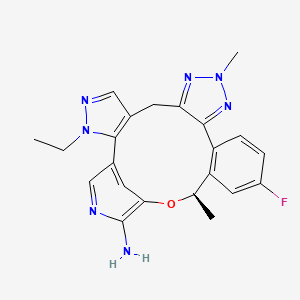

Zidesamtinib
CAS 2739829-00-4
MF C22H22FN7O MW419.5 g/mol
(19R)-3-ethyl-16-fluoro-10,19-dimethyl-20-oxa-3,4,9,10,11,23-hexazapentacyclo[19.3.1.02,6.08,12.013,18]pentacosa-1(25),2(6),4,8,11,13(18),14,16,21,23-decaen-22-amine
- (14R)-7-ethyl-16-fluoro-2,14-dihydro-2,14-dimethyl-7H-8,12-Metheno-4H-pyrazolo[3,4-h]-1,2,3-triazolo[4,5-k][2,5]benzoxaazacyclotetradecin-11-a mine
- (14R)-7-Ethyl-16-fluoro-2,14-dihydro-2,14-dimethyl-7H-8,12-metheno-4H-pyrazolo[3,4-h]-1,2,3-triazolo[4,5-k][2,5]benzoxaazacyclotetradecin-11-amine
- (19R)-3-ethyl-16-fluoro-10,19-dimethyl-20-oxa-3,4,9,10,11,23-hexazapentacyclo[19.3.1.02,6.08,12.013,18]pentacosa-1(25),2(6),4,8,11,13(18),14,16,21,23-decaen-22-amine
- 7H-8,12-Metheno-4H-pyrazolo[3,4-h]-1,2,3-triazolo[4,5-k][2,5]benzoxaazacyclotetradecin-11-amine, 7-ethyl-16-fluoro-2,14-dihydro-2,14-dimethyl-, (14R)-
To treat adults with locally advanced or metastatic ROS1-positive non-small cell lung cancer after receiving a ROS1 kinase inhibitor
FDA 2026, APPROVALS 2026, Jideytro, NVL-520, NUV-520, NU-520, NVL 520, NUV 520, NU 520, MX5KQV5XHC
Zidesamtinib (sold under the brand name Jideytro) is an oral, highly selective, next-generation kinase inhibitor approved by the U.S. Food and Drug Administration (FDA) on July 22, 2026, to treat adults with locally advanced or metastatic ROS1-positive non-small cell lung cancer (NSCLC) who have previously been treated with at least one ROS1 kinase inhibitor. Developed originally by Nuvalent and subsequently acquired by GSK, it represents a major milestone as GSK’s first approved therapeutic targeting lung cancer.
Mechanism of Action
Zidesamtinib functions by targeting and inhibiting the receptor tyrosine kinase c-ros oncogene 1 (ROS1). It is custom-engineered to solve the primary clinical challenges that limit previous therapies:
- Overcoming Resistance Mutations: It binds tightly to wild-type ROS1 and remains robustly active against a broad array of treatment-emergent point mutants. This includes G2032R (the most common solvent-front resistance mutation), as well as S1986Y/F, L2026M, and D2033N mutations.
- Blood-Brain Barrier Penetration: It features high central nervous system (CNS) penetrance to effectively treat and control brain metastases, which are frequent in aggressive ROS1-positive cancers.
- TRK-Sparing Design: Unlike older dual-acting inhibitors, it deliberately avoids inhibiting the structurally similar tropomyosin receptor kinase (TRK) family. This minimizes off-target TRK-related neurological toxicities like severe dizziness and ataxia.
Clinical Trial Outcomes
The FDA approval was heavily supported by data from the ongoing global, single-arm, Phase 1/2 ARROS-1 clinical trial (N=117 heavily pretreated patients):
- Overall Response: Delivered an Objective Response Rate (ORR) of 44% in patients who had exhausted alternative TKI options.
- Subgroup Efficacy: Achieved a 51% ORR in patients who had received only one prior ROS1 inhibitor, a 54% ORR in those harboring the G2032R mutation, and an intracranial ORR of 48% for patients with active brain metastases.
- Durability: Showed prolonged disease control, with a 12-month duration of response (DOR) rate standing at 69%.
Administration and Side Effects
Jideytro is formulated as an oral tablet taken once daily, with or without food. It demonstrates a highly tolerable safety profile, with only a 10% dose reduction rate and a 2% treatment discontinuation rate due to adverse events.
- Common Adverse Reactions (≥ 15%): Edema (swelling), peripheral neuropathy, constipation, fatigue, and dyspnea (shortness of breath).
- Warnings & Precautions: Includes risks of mild CNS reactions (dizziness, cognitive alterations), QTc interval prolongation, skeletal fractures, pancreatic toxicity, and interstitial lung disease (ILD)/pneumonitis.
Zidesamtinib, sold under the brand name Jideytro, is an anti-cancer medication used for the treatment of previously treated locally advanced or metastatic ROS1+ non-small cell lung cancer.[1][2][3] It is taken by mouth once daily.[1][2][3]
Medical uses
Indication
Zidesamtinib is a prescription medicine used to treat adults with non-small cell lung cancer that has spread within the chest or other parts of the body and is caused by an abnormal ROS1 gene, and who have received a ROS1 kinase inhibitor.[1][2][3]
Mechanism of action
Zidesamtinib is a kinase inhibitor that works by blocking ROS1, an abnormal protein that drives some lung cancers to grow, including forms that have become resistant to earlier ROS1 treatments.[4] Jideytro also works on the related proteins ALK and TRK. In laboratory and animal studies, Zidesamtinib stopped cancer cells with ROS1 changes from growing and slowed tumor growth, including tumors in the brain.[2]
PAT
PAT
https://patentscope.wipo.int/search/en/detail.jsf?docId=WO2023056405&_cid=P10-MRYBTX-59205-1
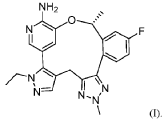
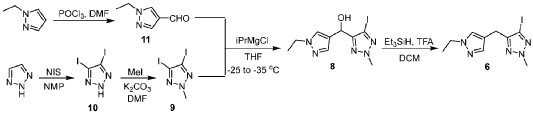
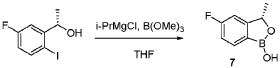
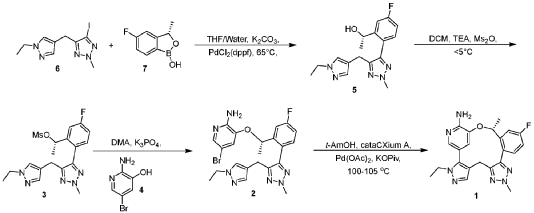
Scheme 3. Synthesis of Compound 1.
[00548] Synthesis of Compound 5. To a reactor was charged THF (10 vol ), water (1 vol ), followed by Compound 6 (850.0 g, 2.68 mol, 1 equiv.) and Compound 7 (534.0 g, 3.22 mol, 1.2 equiv ) at 20~30°C. The solids were completely dissolved at 20~30°C while stirring for 15 min and K2CO3 (1.11 kg, 3 equiv.) was added in portions over 10-15 min at 20~30°C. The reaction mixture was fully refdled with nitrogen, and was added Pd(dppf)C12 (78.5 g, 0.04 equiv.) in one portion under nitrogen. The reaction mixture was fully refdled with nitrogen again, then heated to 60-65 °C and stirred at 60~65°C for 16 h under nitrogen. The reaction mixture was cooled to 20~30°C, fdtered through a 10 cm celite pad (2X, 2.4 kg celite). The combined fdtrates were washed with EtOAc (10 vol., 21 L) and separated. The organic phase was washed with water (5 vol., 10.5 L) and separated. The organic phase was stirred for 1 h at 40-45°C in 5 w% aqueous L-cysteine (2.0 eq., 1.61 kg in 30.6 kg water) and separated. The organic phase was washed with water (5 vol., 10.5 L) and separated. The resulting organic phase was concentrated at 45-50°C in vacuum to afford crude product as a light brown oil (2.28 kg). To the crude product was charged MTBE (228 mL, 0.1 vol. relative to crude product), heated to 50°C over 15 min, followed by isopropyl ether (2.28 L, 1 vol.) dropwise over 1 h at 45~50°C, then cooled to 10°C over 2 h. A large amount of solids came out and the resulting slurry was stirred for 2 h at 10-15°C. The solids were collected by fdtration, dried in oven at 45°C for 16 h to get crude Compound 5 as a pale-yellow solid (1.67 kg, 96.3% /220 nm, >99.9%/220 nm chiral purity). 1.67 kg of crude Compound 5 was purified by silica gel chromatography (EtOAc/ n-heptane=l: 1, 2.5X silica gel, 100-200 meshes) to get Compound 5 as an off-white solid (1.58 kg, 99.6%/220 nm, >99.9%/220 nm chiral purity, 97.9 w%, 72% yield). H NMR (400 MHz, DMSO) 5 7.44 (dd, J = 10.5, 2.5
Hz, 1H), 7.36 (s, 1H), 7.22 (dd, J = 8.3, 6.0 Hz, 1H), 7.16 – 7.08 (m, 2H), 5.25 (d, J = 4.2 Hz, 1H), 4.86 – 4.68 (m, 1H), 4.14 (s, 3H), 4.00 (q, J = 7.2 Hz, 2H), 3.72 (s, 2H), 1.27 (t, J = 7.3 Hz, 3H), 1.11 (d, J = 6.3 Hz, 3H). MS (ESI, m/z): 330.20 (M + H)+.
[00549] In another example, a similar procedure was run in a 0.5:2 biphasic mixture of toluene and water (2.5 vol.) with a catalystic amount (e.g. 0.002 mol equiv.) Pd(Amphos)C12 (instead of 0.04 mol equiv. of PdidppfhCE) used as the catalyst. Potassium phosphate (K3PO4 3 H2O) substituted potassium carbonate (K2CO3) 3.0 mol equiv. as the base, and the amount of Compound 7 employed was 1.02 mol equiv. The improved process was conducted at 50 °C. At the end of the reaction, the organic layer was fdtered and treated with activated carbon and concentrated, and the final material was crystallized from toluene/heptane/water to give Compound 5 in 92% yield and 99.9% purity.
[00550] Synthesis of Compound 3. To a 50 L reactor was charged dichloromethane (11.25 L), Compound 5 (750 g, >99.9%/220 nm chiral purity) and triethylamine (920.0 g) at r t. (20~30°C). The resulting mixture was refilled with nitrogen and cooled to 0°C. To it was added a solution of MS2O (793.0 g) in dichloromethane (3.75 L) drop-wise over 45 min while keeping the temperature at 0~5°C. The reaction mixture was stirred at 0~5°C for 1 h under nitrogen. The reaction mixture was quenched with cooled water (7.5 L) at 5~15°C and separated. The organic phase was washed with cooled water (3.75 L) and separated. The organic phase was dried over anhydrous Na2SC>4, filtered and concentrated at 25~30°C in vacuum to around 2 vol., then switched to n-heptane (2.25 L) and concentrated at 25~30°C in vacuum to around 2 vol. of Compound 3 in n-heptane. n-heptane /EtOAc (3.0 L, lOv/lv) was added to the above mixture and the mixture was slurried for 1 h at 0~10°C under nitrogen and filtered. The filter cake was washed with n-heptane (1.5 L), dried in vacuum at 25~30°C for 5 h to afford Compound 3 as an off-white solid (845 g, 98.9 w%, 99.98%/220 nm chiral purity, 91% yield). H NMR (400 MHz, CDC13) 5 7.35 (dd, J = 9.6, 2.5 Hz, 1H), 7.24 – 7.18 (m, 2H), 7.12 (s, 1H), 7.08 (td, J = 8.3, 2.6 Hz, 1H), 5.78 (d, J = 6.4 Hz, 1H), 4.21 (s, 3H), 4.05 (q, J = 7.3 Hz, 2H), 3.90 – 3.76 (m, 2H), 2.78 (s, 3H), 1.58 (d, J = 6.5 Hz, 3H), 1.40 (t, J = 7.3 Hz, 3H). MS (ESI, m/z): 408.20 (M + H)+.
[00551] In another example, triethylamine base (1.3 mol equiv.), MS2O (1.2 mol equiv.), and dichloromethane solvent (10 vol) were used. The reaction mixture was quenched with aqueous sodium bicarbonate to remove excess MS2O, and crystallization from dichloromenthane/hexane results in 98% yield with 100% purity of Compound 3.
[00552] Synthesis of Compound 2. A 20 L reactor was refilled with nitrogen, then charged with DMA (12.6 L) at r.t. (20~25°C) To the reactor was charged Compound 4 (390.0 g) and Compound 3 (840.0 g, 99.98%/220 nm chiral purity) in one portion at 20~25°C through a dry nitrogen flow. The reaction mixture was heated to 35°C over 15 min and stirred for 5-10 min at 35~40°C to get a clear solution. To the reaction mixture was charged powder K3PO4 (875.0 g) in one portion at 35~45°C. After complete addition, the resulting mixture was heated to 60°C over 20 min and stirred at 58~63°C for 1.5 h through a dry nitrogen flow. The reaction mixture was cooled to 25~30°C, filtered through a celite pad (5 cm, 1.5 kg) and rinsed the filter cake with EtOAc (2 L, 2-3 vol.). The filtrate was poured into water (16.8 L, 20 vol.) at 0-10°C, extracted with EtOAc (10 L, 12 vol.) and separated. The aqueous phase was extracted with EtOAc (5 L, 6 vol.). The combined organic phases were washed with water (5 L*3, 6 vol. *3), concentrated at 50°C in vacuum to afford crude product as a gray solid (956 g). The crude product was dissolved in EtOAc (950 mL, 1 vol. relative to crude product) at 35~40°C, then was added dropwise n-heptane (950 mL, 1 vol. relative to crude product) at 30~40°C over 20 min. The resulting mixture was cooled to 20~25°C over 30 min and stirred for 1 h at 30-40°C. Some solids came out slowly and n-heptane (1.9 L, 2 vol. relative to crude product) was added dropwise to the slurry mixture at 20~25°C over 30 min. The precipitates were stirred at 15~20°C for 3 h and filtered. The filter cake was washed with n-heptane (1.5 L) and dried in oven at 45-50°C for 16 h to afford Compound 2 as a pale-yellow solid (743 g, 98.6%/220 nm, 96.9 w%, 99.98%/220 nm chiral purity, 0.48%KF, 72% yield). H NMR (400 MHz, DMSO) 5 7.54 (dd, J = 10.2, 2.7 Hz, 1H), 7.51 (d, J = 1.9 Hz, 1H), 7.42 (s, 1H), 7.31 (dd, J = 8.5, 5.8 Hz, 1H), 7.22 (td, J = 8.4, 2.7 Hz, 1H), 7.17 (s, 1H), 6.92 (d, J = 1.8 Hz, 1H), 6.14 (s, 2H), 5.47 (q, J = 6.0 Hz, 1H), 4.22 (s, 3H), 4.02 (q, J = 7.3 Hz, 2H), 3.78 (q, J = 16.1 Hz, 2H), 1.40 (d, J = 6.3 Hz, 3H), 1.29 (t, J = 7.3 Hz, 3H). MS (ESI, m/z): 500.30 (M + H)+.
[00553] In another example, a process was developed where Compound 4 (1.1 mol equiv. to Compound 3) was used. Potassium phosphate base (K2PO4, 4. 1 mol equiv.) and DMA (16 vol.) were substituted with cesium carbonate (CS2CO3, 2.2 mol equiv.) and NMP (5.6 vol.). The reaction was carried out at 20~30°C. Following completion of the reaction, the crude product was precipitated with water. The material was then dissolved in ethyl acetate, washed with water, and treated with activated carbon. The product is subsequently crystallized from toluene/ethyl acetate/heptane to give Compound 2 in 80% yield and 99.9% purity.
[00554] Synthesis of Compound 1. To a reactor was charged t-AmOH (20 vol.), Compound 2 (700.0 g, 99.99% chiral purity) and potassium pivalate (588.0 g). The reaction mixture was fully refilled with nitrogen. To the reaction mixture was added cataCXium A (120.4 g) and Pd(OAc)2 (37.8 g) at r.t. under nitrogen. The resulting mixture was heated to 100°C and stirred for 18 h under nitrogen. The reaction mixture was cooled to 30°C , filtered through a celite pad and washed the filter cake with EtOAc (3 vol.). The filtrate was washed with water (5 vol. *2) and separated. The upper organic phase was concentrated in vacuum to afford a brown oil. The oil was dissolved in EtOAc (27 L) then added 5w% aqueous L-cysteine (0.98 kg in 18.6 kg water), stirred for 1 h at 40~45°C and separated. The organic phase was washed with water (6.75 L) and separated. 5w% aqueous L-cysteine (0.98 kg in 18.6 kg water) was charged to the above organic phase, stirred for 1 h at 40~45°C and separated. The organic phase was washed with water (6.75 L.) and separated. The organic phase was concentrated in vacuum at 45~50°C to afford a brown solid (1.12 kg). The crude solid (1.12 kg) was further purified by silica gel chromatography eluted with EtOAc/DCM (dry loading, 3X, 100-200 meshes, EtOAc:DCM=l : 1) to afford a pale-yellow solid ( 1.02 kg). The solid was dissolved in EtOAc (600 mL, 2 vol.) at 50~60°C, then was added n-heptane (1.8 L, 6 vol.) dropwise over 50 min at 50~60°C. A large of solids came out during addition. The resulting slurry was cooled to 15~20°C over 50 min and stirred for 30 min at 15~20°C. The slurry was concentrated in vacuum at 45~50°C to 2-3 vol. mixture, n-heptane (1.2 L, 4 vol.) was added to the
above mixture (2-3 vol.), concentrated in vacuum at 45~50°C to 2-3 vol. mixture. The mixture was cooled to 10~15°C over 2 h, stirred at 10~15°C for 1 h and filtered. The filtered cake was rinsed with n-heptane (600 mb) and dried in vacuum at 50°C for 20 h to afford Form 1 of Compound 1 as an off-white solid (280 g, 99.0%). H NMR (400 MHz, DMSO) 57.79 (dd, J = 10.3, 2.2 Hz, 1H), 7.58 (s, 1H), 7.43 (d, J = 1.8 Hz, 1H), 7.24 – 7.16 (m, 2H), 6.13 (s, 2H), 6.08 (d, J = 1.7 Hz, 1H), 5.31 – 5.23 (m, 1H), 4.16 (s, 3H), 4.05 – 3.94 (m, 2H), 3.78 (d, J = 15.6 Hz, 1H), 2.98 (d, J = 15.5 Hz, 1H), 1.71 (d, J = 6.2 Hz, 3H), 1.26 (t, J = 7.2 Hz, 3H). MS (ESI, m/z): 420.30 (M + H)+. XRPD (FIG. 1), TG/DTA (FIG. 2), DSC (FIG. 3), DVS (FIG. 4), and FT-IR (FIG. 5) results for a sample of Form 1 were obtained.
ADVERTISEMENT
ANAX LABORATORIES
WEBSITE https://www.anaxlab.com/
Discovery Solutions, Supporting the chemistry needs of clients in the Medical, Analytical and Bio Sciences
Development Solutions, Developing from Lab scale to PR&D, Kilo Scale-ups and Commercial Scales
SEE MORE………Integrated Solutions, Manufacturing Solutions, Products,
Can’t Find? Let’s Connect
Phone : +91 897704 2010 / +91 9177075735, Email : info@anaxlab.com
#MedicinalChemistry, #DrugDiscovery, #OrganicSynthesis, #ChemicalLibrary, #BuildingBlocks, #SARStudies, #ChemistryInnovation, #medchem, #Drugdevelopment, #Biotech, #Biotechnology, #AnaxLaboratories, #Pharma
AS ON FEB2026 4.574 LAKHS VIEWS ON BLOG WORLDREACH AVAILABLEFOR YOUR ADVERTISEMENT
join me on Linkedin
Anthony Melvin Crasto Ph.D – India | LinkedIn
join me on Researchgate
RESEARCHGATE
join me on Facebook
Anthony Melvin Crasto Dr. | Facebook
join me on twitter
Anthony Melvin Crasto Dr. | twitter
+919321316780 call whatsaapp
EMAIL. amcrasto@gmail.com
References
References
- “JIDEYTRO™ (zidesamtinib) for Patients”. Jideytro. 2026-02-05. Retrieved 2026-07-23.
- “Jideytro: Uses, Dosage, Side Effects & Warnings”. Drugs.com. Retrieved 2026-07-23.
- “Nuvalent Announces FDA Acceptance of New Drug Application for Zidesamtinib for the Treatment of TKI Pre-treated Patients with Advanced ROS1-positive NSCLC”. Nuvalent Investors. Retrieved 2026-07-23.
- Wespiser M, Gille R, Pérol M (2026). “ROS1-positive non-small cell lung cancer: from genomics to treatment decisions”. Frontiers in Oncology. 16 1739598. doi:10.3389/fonc.2026.1739598. PMC 12907153. PMID 41704605.
- “New FDA Drug Approvals for 2026”. Drugs.com. Retrieved 2026-07-23.
- Center for Drug Evaluation and Research (2026-07-22). “Novel Drug Approvals for 2026”. FDA.
- Zidesamtinib Selective Targeting of Diverse ROS1 Drug-Resistant MutationsPublication Name:Molecular Cancer TherapeuticsPublication Date:2025-05-09PMCID:PMC12214885PMID:40299789DOI:10.1158/1535-7163.mct-25-0025
- Targeting Solvent-Front Mutations for Kinase Drug Discovery: From Structural Basis to Design StrategiesPublication Name:Journal of Medicinal ChemistryPublication Date:2024-08-15PMID:39143914DOI:10.1021/acs.jmedchem.4c00361
- NVL-520 Is a Selective, TRK-Sparing, and Brain-Penetrant Inhibitor of ROS1 Fusions and Secondary Resistance MutationsPublication Name:Cancer DiscoveryPublication Date:2022-12-13PMCID:PMC9975673PMID:36511802DOI:10.1158/2159-8290.cd-22-0968
- Electron transport by C-type cytochromes. I. The reaction of horse heart cytochrome c with anionic reductantsPublication Name:Biophysics of structure and mechanismPublication Date:1975-02-19PMID:10021DOI:10.1007/bf00539772
PAT
- Solid forms, pharmaceutical compositions and preparation of heteroaromatic macrocyclic ether compoundsPublication Number:WO-2023056405-A1Priority Date:2021-10-01
- Solid forms, pharmaceutical compositions and preparation of heteroaromatic macrocyclic ether compoundsPublication Number:US-12043626-B2Priority Date:2021-10-01Grant Date:2024-07-23
- Methods of treating solid tumor using heteroaromatic macrocyclic ether compoundsPublication Number:US-2024398768-A1Priority Date:2021-10-01
- Heteroaromatic macrocyclic ether chemotherapeutic agentsPublication Number:US-12054498-B2Priority Date:2020-05-05Grant Date:2024-08-06
- Heteroaromatic macrocyclic ether chemotherapeutic agentsPublication Number:US-2023107663-A1Priority Date:2020-05-05
- Heteroaromatic macrocyclic ether chemotherapeutic agentsPublication Number:US-11542278-B1Priority Date:2020-05-05Grant Date:2023-01-03
- Heteroaromatic macrocyclic ether chemotherapeutic agentsPublication Number:WO-2021226208-A2Priority Date:2020-05-05
- Heteroaromatic macrocyclic ether chemotherapeutic agentsPublication Number:US-2024352037-A1Priority Date:2020-05-05
 | |
| Clinical data | |
|---|---|
| Pronunciation | jih-DAY-troh[1][2] |
| Trade names | Jideytro |
| Other names | NUV-520; NVL 520 |
| AHFS/Drugs.com | jideytro |
| Routes of administration | By mouth |
| Drug class | Tyrosine kinase inhibitor |
| Legal status | |
| Legal status | US: ℞-only |
| Identifiers | |
| IUPAC name | |
| CAS Number | 2739829-00-4 |
| PubChem CID | 166560233 |
| IUPHAR/BPS | 12392 |
| DrugBank | DB21623 |
| ChemSpider | 128922073 |
| UNII | MX5KQV5XHC |
| KEGG | D12899 |
| ChEBI | CHEBI:747901 |
| ChEMBL | ChEMBL5314497 |
| Chemical and physical data | |
| Formula | C22H22FN7O |
| Molar mass | 419.464 g·mol−1 |
| 3D model (JSmol) | Interactive image |
| SMILES | |
| InChI | |
////////zidesamtinib, anax labs, CANCER, FDA 2026, APPROVALS 2026, Jideytro, NVL-520, NUV-520, NU-520, NVL 520, NUV 520, NU 520, MX5KQV5XHC
#zidesamtinib, #anax labs, #CANCER, FDA 2026, #APPROVALS 2026, #Jideytro, #NVL-520, #NUV-520, #NU-520, #NVL 520, #NUV 520, #NU 520, #MX5KQV5XHC
Gadoquatrane
Gadoquatrane
CAS2048221-65-2MW2579.0 g/mol
FDA 2026, APPROVALS 2026, Ambelvist, OZG7J613HK, BAY-1747846, BAY 1747846
2-[4,10-bis(carboxylatomethyl)-7-[1-oxo-1-[[2-oxo-2-[[3-[[2-[2-[4,7,10-tris(carboxylatomethyl)-1,4,7,10-tetrazacyclododec-1-yl]propanoylamino]acetyl]amino]-2,2-bis[[[2-[2-[4,7,10-tris(carboxylatomethyl)-1,4,7,10-tetrazacyclododec-1-yl]propanoylamino]acetyl]amino]methyl]propyl]amino]ethyl]amino]propan-2-yl]-1,4,7,10-tetrazacyclododec-1-yl]acetate;tetrakis(gadolinium(3+))
To detect and visualize lesions with abnormal vascularity, in conjunction with MRI
Gadoquatrane (marketed as AMBELVIST®) is a low-dose, macrocyclic gadolinium-based contrast agent (GBCA) developed by Bayer for use in magnetic resonance imaging (MRI). It is designed to enhance the visualization of lesions in the central nervous system (CNS) and other body regions in adult and pediatric patients.
Core Highlights:
- Lower Gadolinium Exposure: It requires a dose of 0.04 mmol/kg, which results in 60% less gadolinium exposure compared to standard macrocyclic GBCAs.
- Regulatory Approval: The FDA approved it in June 2026 for use in adults and pediatric patients, including term neonates. It was also approved in Japan in March 2026.
- Efficacy & Safety: Phase III clinical trials (the QUANTI studies) showed it effectively detects lesions with abnormal vascularity while maintaining an efficacy and safety profile comparable to other standard macrocyclic agents.
- Structure: Gadoquatrane features a tetrameric, macrocyclic structure that gives it high relaxivity and stability in the body
SYN
https://patents.google.com/patent/US20250114485A1
ADVERTISEMENT
ANAX LABORATORIES
WEBSITE https://www.anaxlab.com/
Discovery Solutions, Supporting the chemistry needs of clients in the Medical, Analytical and Bio Sciences
Development Solutions, Developing from Lab scale to PR&D, Kilo Scale-ups and Commercial Scales
SEE MORE………Integrated Solutions, Manufacturing Solutions, Products,
Can’t Find? Let’s Connect
Phone : +91 897704 2010 / +91 9177075735, Email : info@anaxlab.com
#MedicinalChemistry, #DrugDiscovery, #OrganicSynthesis, #ChemicalLibrary, #BuildingBlocks, #SARStudies, #ChemistryInnovation, #medchem, #Drugdevelopment, #Biotech, #Biotechnology, #AnaxLaboratories, #Pharma
AS ON FEB2026 4.574 LAKHS VIEWS ON BLOG WORLDREACH AVAILABLEFOR YOUR ADVERTISEMENT
join me on Linkedin
Anthony Melvin Crasto Ph.D – India | LinkedIn
join me on Researchgate
RESEARCHGATE
join me on Facebook
Anthony Melvin Crasto Dr. | Facebook
join me on twitter
Anthony Melvin Crasto Dr. | twitter
+919321316780 call whatsaapp
EMAIL. amcrasto@gmail.com
PAT
- Gadolinium chelate compounds for use in magnetic resonance imagingPublication Number: US-11491245-B2Priority Date: 2015-06-04Grant Date: 2022-11-08
- Gadolinium chelate compounds for use in magnetic resonance imagingPublication Number: US-2025114485-A1Priority Date: 2015-06-04
- Formulation of contrast media and process of preparation thereofPublication Number: US-2024252690-A1Priority Date: 2018-11-23
- Formulation of contrast media and process of preparation thereofPublication Number: US-12303573-B2Priority Date: 2018-11-23Grant Date: 2025-05-20
- New gadolinium chelate compounds for use in magnetic resonance imagingPublication Number: EP-3611169-A1Priority Date: 2015-06-04
- New gadolinium chelate compounds for use in magnetic resonance imagingPublication Number: US-2023113481-A1Priority Date: 2015-06-04
- New gadolinium chelate compounds for use in magnetic resonance imagingPublication Number: EP-3303307-B1Priority Date: 2015-06-04Grant Date: 2019-09-04
- Generation of artificial contrast-enhanced computed tomography imagesPublication Number: US-2024346718-A1Priority Date: 2023-04-13
- Generation of artificial contrast-enhanced radiological imagesPublication Number: WO-2024100233-A1Priority Date: 2022-11-12
- Generation of artificial contrast-enhanced radiological imagesPublication Number: EP-4616420-A1Priority Date: 2022-11-12
- Automated analysis of radiological imagesPublication Number: WO-2024083466-A1Priority Date: 2022-10-17
- Formulation of contrast media and process of preparation thereofPublication Number: US-11944690-B2Priority Date: 2018-11-23Grant Date: 2024-04-02
/////////gadoquatrane, anax labs, FDA 2026, APPROVALS 2026, Ambelvist, OZG7J613HK, BAY-1747846, BAY 1747846
#gadoquatrane, # labs, FDA 2026, #APPROVALS 2026, #Ambelvist, #OZG7J613HK, #BAY-1747846, #BAY 1747846
Zidebactam

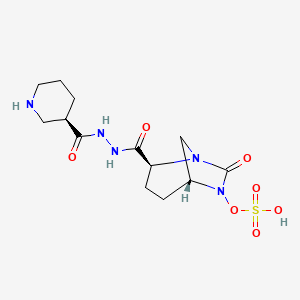
Zidebactam
FDA 2026, APPROVALS 2026
To treat complicated urinary tract infections, including pyelonephritis, caused by designated susceptible microorganisms
CAS 1436861-97-0, UNII: YPM97423DB, Wockhardt Biopharm, WCK-5107, WCK5107
Molecular Formula, C13-H21-N5-O7-S
Molecular Weight, 391.4029
Disclosed in PCT International Patent Application No. PCT/IB2012/054290D
- 01 Aug 2015 Phase-I clinical trials in Bacterial infections (In volunteers, Combination therapy) in USA (IV) (NCT02532140)
trans- sulphuric acid mono-[2-(N’-[(R)-piperidin-3-carbonyl]-hydrazinocarbonyl)-7-oxo-l,6-diaza-bicyclo[3.2.1]oct-6-yl] ester
(2S, 5R)-sulphuric acid mono-[2-(N’-[(R)-piperidin-3-carbonyl]-hydrazinocarbonyl)-7-oxo-l,6-diaza-bicyclo[3.2.1]oct-6-yl] ester
(1R,2S,5R)-l,6-Diazabicyclo [3.2.1] octane-2-carboxylic acid, 7-oxo-6-(sulfooxy)-, 2-[2-[(3R)-3-piperidinylcarbonyl]hydrazide]
trans- sulphuric acid mono-[2-(N’-[(R)-piperidin-3-carbonyl]-hydrazinocarbonyl)-7-oxo-l,6-diaza-bicyclo[3.2.1]oct-6-yl] ester
(2S, 5R)-sulphuric acid mono-[2-(N’-[(R)-piperidin-3-carbonyl]-hydrazinocarbonyl)-7-oxo-l,6-diaza-bicyclo[3.2.1]oct-6-yl] ester
(lR,2S,5R)-l,6-Diazabicyclo [3.2.1] octane-2-carboxylic acid, 7-oxo-6-(sulfooxy)-, 2-[2-[(3R)-3 -piperidinylcarbonyl] hydrazide]
1,6-Diazabicyclo(3.2.1)octane-2-carboxylic acid, 7-oxo-6-(sulfooxy)-, 2-(2-((3R)-3-piperidinylcarbonyl)hydrazide), (1R,2S,5R)-
Zidebactam potassium
cas is 1706777-49-2
Zidebactam (WCK-5107) is an antibiotic adjuvant drug which acts as a beta-lactamase inhibitor, preventing the breakdown of other antibiotic drugs.[1]
PATENT
https://patentscope.wipo.int/search/en/detail.jsf?docId=WO2019016393&_cid=P20-MPYVFE-00532-1
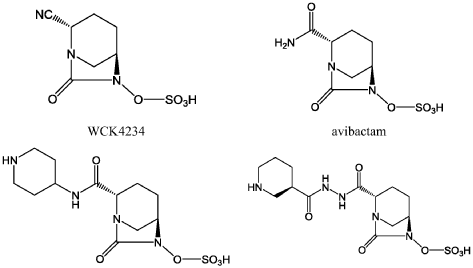
PATENT
http://www.google.com/patents/WO2013030733A1?cl=en

Scheme-1

Example-2
trans-sulfuric acid mono-r2-(N,-r(R)-piperidin-3-carbonyll-hvdrazinocarbonyl)-7-oxo-l,6- diaza-bicyclo Γ3.2.11 oct-6-νΠ ester
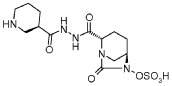
Step-1: Preparation of trans-3-[N’-(6-benzyloxy-7-oxo-l,6-diaza-bicyclo[3.2.1]octane-2-carbonyl)-hydrazinocarbonyl]-(R)-piperidin-l-carboxylic acid tert-butyl ester:
By using the procedure described in Step-1 of Example- 1 above, and by using trans-6-benzyloxy-7-oxo-l,6-diaza-bicyclo[3.2.1]octane-2-carboxylic acid (25 gm, 0.084 mol), N,N-dimethyl formamide (625 ml), EDC hydrochloride (24 gm, 0.126 mol), HOBt (16.96 gm, 0.126 mol), (R)-N-tert-butoxycarbonyl-piperidin-3-carboxylic acid hydrazide (21.40 gm , 0.088 mol) to provide the title compound in 17.0 gm quantity, 41% yield as a white solid.
Analysis: MS (ES+) CzsHasNsOe = 502.1 (M+l);
I^NMR (CDCI3) = 8.40 (br s, IH), 7.34-7.44 (m, 5H), 5.05 (d, IH), 4.90 (d, IH), 4.00 (br d, IH), 3.82 (br s, IH), 3.30 (br s, IH), 3.16-3.21 (m, IH), 3.06 (br d, IH), 2.42 (br s, IH), 2.29-2.34 (m, IH), 1.18-2.02 (m, 4H), 1.60-1.75 (m, 4H), 1.45-1.55 (m, 2H),1.44 (s, 9H).
Step-2: Preparation of trans-3-[N’-(6-hydroxy-7-oxo-l,6-diaza-bicyclo[3.2.1]octane-2-carbonyl)-hydrazinocarbonyl]-(R)-piperidin-l-carboxylic acid tert-butyl ester:
By using the procedure described in Step-2 of Example- 1 above, and by using trans-3-[N ‘ -(6-benzyloxy-7-oxo- 1 ,6-diaza-bicyclo [3.2.1 ]octane-2-carbonyl)-hydrazinocarbonyl] -(R)-piperidin-l-carboxylic acid tert-butyl ester (16.5 gm , 0.033 mol), methanol (170 ml) and 10% palladium on carbon (3.5 gm) to provide the title compound in 13.5 gm quantity as a pale pink solid and it was used for the next reaction immediately.
Analysis: MS (ES+) CiglfeNsOe = 411.1 (M+l);
Step-3: Preparation of tetrabutylammonium salt of trans-3-[N’-(6-sulfooxy-7-oxo-l,6-diaza-bicyclo [3.2.1] octane-2-carbonyl)-hydrazinocarbonyl] -(R)-piperidin- 1 -carboxylic acid tert-butyl ester:
By using the procedure described in Step-3 of Example- 1 above, and by using trans-3-[N’-(6-hydroxy-7-oxo-l,6-diaza-bicyclo[3.2.1]octane-2-carbonyl)-hydrazinocarbonyl]-(R)-piperidin-1 -carboxylic acid tert-butyl ester (13.5 gm , 0.033 mol), pyridine (70 ml) and pyridine sulfur trioxide complex (26.11 gm, 0.164 mol), 0.5 N aqueous potassium dihydrogen
phosphate solution (400 ml) and tetrabutylammonium sulphate (9.74 gm, 0.033 mol) to provide the title compound in 25 gm quantity as a yellowish solid, in quantitative yield.
Analysis: MS (ES-)
as a salt = 490.0 (M-l) as a free sulfonic acid;
Step-4: trans-sulfuric acid mono-[2-(N’-[(R)-piperidin-3-carbonyl]-hydrazinocarbonyl)-7-oxo-l,6-diaza-bicyclo[3.2.1]oct-6-yl]ester:
By using the procedure described in Step-4 of Example- 1 above, and by using tetrabutylammonium salt of trans-3-[N’-(6-sulfooxy-7-oxo-l,6-diaza-bicyclo[3.2.1]octane-2-carbonyl)-hydrazinocarbonyl]-(R)-piperidin-l-carboxylic acid tert-butyl ester (24 gm , 0.032 mmol), dichloromethane (60 ml) and trifluoroacetic acid (60 ml) to provide the title compound in 10 gm quantity as a white solid, in 79% yield.
Analysis: MS (ES-)= C13H21N5O7S = 390.2 (M-l) as a free sulfonic acid;
HXNMR (DMSO-d6) = 9.97 (d, 2H), 8.32 (br s, 2H), 4.00 (br s, IH), 3.81 (d, IH), 3.10-3.22 (m, 3H), 2.97-3.02 (m, 2H), 2.86-2.91 (m, IH), 2.65-2.66 (m, IH), 1.97-2.03 (m, IH), 1.57-1.88 (m, 7H).
-32.6°, (c 0.5, water).
PATENT
https://patentscope.wipo.int/search/en/detail.jsf?docId=WO2015110885
PATENT
https://patentscope.wipo.int/search/en/detail.jsf?docId=WO2014135931
| Clinical data | |
|---|---|
| License data | US DailyMed: Zidebactam |
| Legal status | |
| Legal status | Investigational |
| Identifiers | |
| IUPAC name | |
| CAS Number | 1436861-97-0 |
| PubChem CID | 77846445 |
| DrugBank | DB13090 |
| ChemSpider | 44209501 |
| UNII | YPM97423DB |
| ChEMBL | ChEMBL4533605 |
| Chemical and physical data | |
| Formula | C13H21N5O7S |
| Molar mass | 391.40 g·mol−1 |
| 3D model (JSmol) | Interactive image |
| SMILES | |
| InChI | |
References
- Karvouniaris M, Almyroudi MP, Abdul-Aziz MH, Blot S, Paramythiotou E, Tsigou E, et al. (April 2023). “Novel Antimicrobial Agents for Gram-Negative Pathogens”. Antibiotics. 12 (4). Basel, Switzerland: 761. doi:10.3390/antibiotics12040761. PMC 10135111. PMID 37107124.
ERTISEMENT
ANAX LABORATORIES
WEBSITE https://www.anaxlab.com/
Discovery Solutions, Supporting the chemistry needs of clients in the Medical, Analytical and Bio Sciences
Development Solutions, Developing from Lab scale to PR&D, Kilo Scale-ups and Commercial Scales
SEE MORE………Integrated Solutions, Manufacturing Solutions, Products,
Can’t Find? Let’s Connect
Phone : +91 897704 2010 / +91 9177075735, Email : info@anaxlab.com
#MedicinalChemistry, #DrugDiscovery, #OrganicSynthesis, #ChemicalLibrary, #BuildingBlocks, #SARStudies, #ChemistryInnovation, #medchem, #Drugdevelopment, #Biotech, #Biotechnology, #AnaxLaboratories, #Pharma
AS ON FEB2026 4.574 LAKHS VIEWS ON BLOG WORLDREACH AVAILABLEFOR YOUR ADVERTISEMENT
join me on Linkedin
Anthony Melvin Crasto Ph.D – India | LinkedIn
join me on Researchgate
RESEARCHGATE
join me on Facebook
Anthony Melvin Crasto Dr. | Facebook
join me on twitter
Anthony Melvin Crasto Dr. | twitter
+919321316780 call whatsaapp
EMAIL. amcrasto@gmail.com
References
///////ZIDEBACTAM, ANAX LABS, FDA 2026, APPROVALS 2026, Cypsedo, WCK-5107, WCK 5107, YPM97423DB
#ZIDEBACTAM, #ANAX LABS, #FDA 2026, #APPROVALS 2026, #Cypsedo, #WCK-5107, #WCK 5107, #YPM97423DB
see………http://apisynthesisint.blogspot.in/2015/11/wck-5107-in-phase-1-from-wockhardt.html
SEE BACTAM SERIES…………..http://apisynthesisint.blogspot.in/p/bactam-series.html
C1C[C@H](CNC1)C(=O)NNC(=O)[C@@H]2CC[C@@H]3C[N@]2C(=O)N3OS(=O)(=O)O
or
O=C(NNC(=O)[C@@H]2CC[C@@H]1CN2C(=O)N1OS(=O)(=O)O)[C@@H]3CCCNC3
C1CC(CNC1)C(=O)NNC(=O)C2CCC3CN2C(=O)N3OS(=O)(=O)[O-].[Na+]
Cipepofol

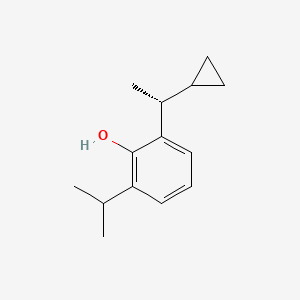
Cipepofol
CAS1637741-58-2
MW 204.31 g/mol MF C14H20O
2-[(1R)-1-cyclopropylethyl]-6-propan-2-ylphenol
FDA 2026, APPROVALS 2026, Cypsedo, HSK 3486, CS-0064163, GTPL 10812, HSK-3486, HY-116152, M3WGS532VY
- OriginatorSichuan Haisco Pharmaceutical
- ClassCyclopropanes; General anaesthetics; Phenols; Small molecules
- Mechanism of ActionGABA A receptor agonists
- RegisteredAnaesthesia; Sedation
- 10 Apr 2026Sichuan Haisco Pharmaceutical plans a phase III trial for Anesthesia (In Children, In adolescents) (IV) in May 2026 (NCT07510945)
- 28 Aug 2024No recent reports of development identified for preclinical development in Sedation in USA (IV, Infusion)
- 01 Aug 2024Zhongda Hospital plans a clinical trial for Sedation (IV) in August 2024 (NCT06538883)
To induce general anesthesia in adults undergoing surgery
Cipepofol (also known as ciprofol or HSK3486) is a novel, short-acting intravenous anesthetic and sedative. As a structural analog of propofol, it targets \(GABA_{A}\) receptors but is 4 to 6 times more potent. It offers faster recovery, improved cardiovascular stability, and significantly less injection pain than propofol.
Key Clinical Advantages
- Superior Efficacy: Requires a lower dose to achieve the same sedative depth as propofol.
- Better Safety Profile: Associated with a lower incidence of injection pain, reduced respiratory depression, and better hemodynamic (blood pressure) stability.
- Fast Acting: Characterized by rapid onset and quick recovery times, making it ideal for procedures like gastrointestinal endoscopy, bronchoscopy, and general anesthesia induction.
Recent Developments
- FDA Approval: Cipepofol (sold under the brand name CYPSEDO) officially received U.S. FDA marketing approval, becoming the first China-originated innovative intravenous anesthetic to enter the global market.
- Ongoing Trials: Clinical trials and post-marketing studies are actively evaluating its safety in specific populations, such as elderly patients and children.
Cipepofol (INNTooltip International Nonproprietary Name, USANTooltip United States Adopted Name), also known as ciprofol or by its developmental code name HSK3486, is a general anesthetic related to propofol which is used for anesthesia and sedation.[1][2][3][4] The drug is used by intravenous infusion.[1] A short-acting and highly selective γ-aminobutyric acid positive allosteric modulator,[5] ciprofol is 4 to 6 times more potent than other phenol derivatives such as propofol or fospropofol.[6]
In May 2026, cipepofol was approved by the US FDA.[7] Manufactured by Haisco Pharmaceutical Group of Chengdu, Sichuan, China, ciprofol underwentphase I and II trials in Australia and China.[8][9][10] In these early studies, ciprofol was comparable in efficacy to propofol and was associated with fewer adverse events.[4][6][11][12][13][14][15][16][17][18]
Physical properties
Ciprofol is an optically active 2,6-disubstituted alkylphenol with a cyclopropylethyl group incorporated at the second carbon atom. This cyclopropyl group increases the steric effects and introduces stereoselective effects over its anesthetic properties. These properties appear to increase the anesthetic potency of ciprofol, when compared with propofol.[9]
Medical use
Ciprofol is used for the intravenous induction of general anesthesia.[3][4] Studies published in 2022 and 2023 found it was efficacious as a general anesthetic in patients undergoing gynecological surgery[6][11] and kidney transplantation,[19] as well as for endoscopic procedures such as bronchoscopy,[15][20] esophagogastroduodenoscopy and colonoscopy.[21][22]
Ciprofol has also been used for sedation of critically ill patients undergoing mechanical ventilation in the intensive care unit,[23] as well as for the treatment of agitation and delirium in that patient population.[24] When combined with mild therapeutic hypothermia, ciprofol may also be useful as a cerebral protective agent in the setting of cerebral ischemia-reperfusion injury.[25]
Experimental use
In experimental models of isoproterenol-induced myocardial infarction (using mice as subjects), ciprofol appears to protect the heart against oxidative damage, inflammation and apoptosis of cardiac muscle cells.[26]
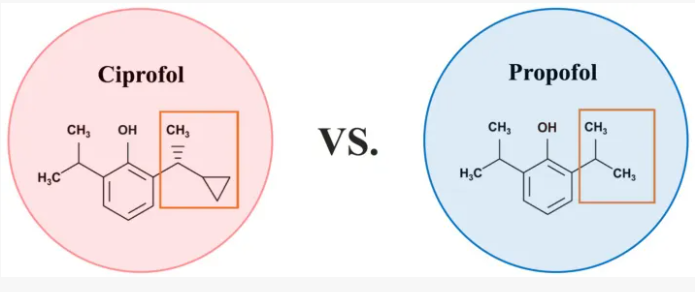
SYN
https://patentscope.wipo.int/search/en/detail.jsf?docId=US428011434&_cid=P12-MPW0XO-91017-1
PAT
https://patentscope.wipo.int/search/en/detail.jsf?docId=WO2014180305&_cid=P12-MPW0R4-87054-1
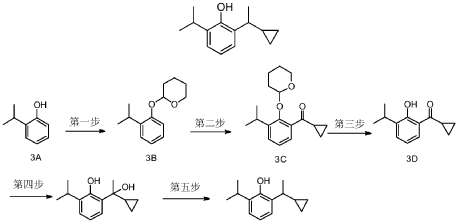
Example 16
[-cyclopropylethyl] -6 -isopropylphenol (compound 16)
2- [(lR)-l-cyclopropylethyl]-6-isopropyl -phenol

Preparation methods of Examples 16-17:
2-(1-Cyclopropylethyl-6-isopropylphenol (compound 3) 600 mg was used for resolution. Preparation conditions: (Instrument: Agilent 1260/CH-Y-J0404; Column: CHIRALPAK OJ-H (4.6 mm < 250 mm, 5 μm) No.: OJ-H-27; Mobile phase: A: isopropanol, B: n-hexane; Flow rate: 1.0 mL/min; Back pressure: 100 bar; Column temperature: 35°C; Wavelength: 210 nm; Period: 10 min)
Two optical isomers were obtained after separation: peak 1 (retention time: 10.72 min, 280 mg, pale yellow liquid, ee%=99%) and peak 2 (retention time: 13.58 min, 280 mg, pale yellow liquid, ee%=99%).
峰 1 : MS m/z(ESI): 203.1(Ml).
toMR (400 MHz,CDCl3 ) : δ 7.14(dd, 1H), δ 7.08(dd, 1H), 6.91 (t, 1H), 4.93 (s, 1H), 3.22-3.14(m, 1H), 2.55-2.48 (m, 1H), 1.33 (d, 6H), 1.28 (d, 3H), 1.10-1.05 (m, 1H), 0.60-0.58 (m, 1H), 0.49-0.46 (m, 1H), 0.25-0.18 (m, 2H).
峰 2: MS m/z(ESI): 203.1(Ml).
iHNMR (400 MHz,CDCl3) : 57.14(dd, 1H), δ 7.08(dd, 1H), 6.93 (t, 1H), 4.93 (s 1H), 3.22-3.15(m, 1H), 2.55-2.48 (m, 1H), 1.32 (d, 6H), 1.28 (d, 3H), 1.10-1.04 (m, 1H), 0.60-0.58 (m, 1H), 0.49-0.46 (m, 1H), 0.25-0.18 (m, 2H).
PAT
- Phenol derivative compound, methods of preparing said compound, pharmaceutical composition comprising said compound and use thereofPublication Number: BR-112015028212-B1Priority Date: 2013-05-09
- Phenol derivative and its preparation method and application in medicinePublication Number: CN-104507899-APriority Date: 2013-05-09
- Phenol derivative and preparation method and use in medicine thereofPublication Number: US-9517988-B2Priority Date: 2013-05-09Grant Date: 2016-12-13
- Phenol derivative and preparation method and use in medicine thereofPublication Number: EP-2995604-B1Priority Date: 2013-05-09Grant Date: 2019-07-10
- Phenol derivative, its production method and medicinal applicationPublication Number: JP-6431155-B2Priority Date: 2013-05-09Grant Date: 2018-11-28
- Phenol derivative, preparation method and medical application thereofPublication Number: CN-104507899-BPriority Date: 2013-05-09Grant Date: 2016-11-30
- Phenol derivative and method of preparation and medical use thereofPublication Number: ES-2746987-T3Priority Date: 2013-05-09Grant Date: 2020-03-09
- Phenol derivative and preparation method and use in medicine thereofPublication Number: US-2016060197-A1Priority Date: 2013-05-09
- Isopropyl phenol derivative and preparation method thereofPublication Number: WO-2016026459-A1Priority Date: 2014-08-22
- Phenol derivative and preparation method and use in medicine thereofPublication Number: AU-2014264103-B2Priority Date: 2013-05-09Grant Date: 2018-03-22
- Phenol derivative and preparation method and use in medicine thereofPublication Number: AU-2014264103-A1Priority Date: 2013-05-09
- Phenol derivative and preparation method and use in medicine thereofPublication Number: AU-2014264103-C1Priority Date: 2013-05-09Grant Date: 2018-08-02
- Phenol derivative and preparation method and use in medicine thereofPublication Number: EP-2995604-A1Priority Date: 2013-05-09
ADVERTISEMENT
ANAX LABORATORIES
WEBSITE https://www.anaxlab.com/
Discovery Solutions, Supporting the chemistry needs of clients in the Medical, Analytical and Bio Sciences
Development Solutions, Developing from Lab scale to PR&D, Kilo Scale-ups and Commercial Scales
SEE MORE………Integrated Solutions, Manufacturing Solutions, Products,
Can’t Find? Let’s Connect
Phone : +91 897704 2010 / +91 9177075735, Email : info@anaxlab.com
#MedicinalChemistry, #DrugDiscovery, #OrganicSynthesis, #ChemicalLibrary, #BuildingBlocks, #SARStudies, #ChemistryInnovation, #medchem, #Drugdevelopment, #Biotech, #Biotechnology, #AnaxLaboratories, #Pharma
AS ON FEB2026 4.574 LAKHS VIEWS ON BLOG WORLDREACH AVAILABLEFOR YOUR ADVERTISEMENT
join me on Linkedin
Anthony Melvin Crasto Ph.D – India | LinkedIn
join me on Researchgate
RESEARCHGATE
join me on Facebook
Anthony Melvin Crasto Dr. | Facebook
join me on twitter
Anthony Melvin Crasto Dr. | twitter
+919321316780 call whatsaapp
EMAIL. amcrasto@gmail.com
References
References
- “Sichuan Haisco Pharmaceutical”. AdisInsight. 28 August 2024. Retrieved 1 October 2025.
- “Ciprofol (Cipepofol): A γ-Aminobutyric Acid Receptor Agonist for Induction of Anesthesia”. Chemistry and Pharmacology of Drug Discovery. Wiley. 2024. pp. 251–274. doi:10.1002/9781394225156.ch12. ISBN 978-1-394-22512-5. Retrieved 1 October 2025.
- Wang X, Wang X, Liu J, Zuo YX, Zhu QM, Wei XC, et al. (March 2022). “Effects of ciprofol for the induction of general anesthesia in patients scheduled for elective surgery compared to propofol: a phase 3, multicenter, randomized, double-blind, comparative study”. European Review for Medical and Pharmacological Sciences. 26 (5): 1607–1617. PMID 35302207.
- Zeng Y, Wang DX, Lin ZM, Liu J, Wei XC, Deng J, et al. (February 2022). “Efficacy and safety of HSK3486 for the induction and maintenance of general anesthesia in elective surgical patients: a multicenter, randomized, open-label, propofol-controlled phase 2 clinical trial”. European Review for Medical and Pharmacological Sciences. 26 (4): 1114–1124. PMID 35253166.
- Liao J, Li M, Huang C, Yu Y, Chen Y, Gan J, et al. (2022). “Pharmacodynamics and Pharmacokinetics of HSK3486, a Novel 2,6-Disubstituted Phenol Derivative as a General Anesthetic”. Frontiers in Pharmacology. 13 830791. doi:10.3389/fphar.2022.830791. PMC 8851058. PMID 35185584.
- Chen BZ, Yin XY, Jiang LH, Liu JH, Shi YY, Yuan BY (August 2022). “The efficacy and safety of ciprofol use for the induction of general anesthesia in patients undergoing gynecological surgery: a prospective randomized controlled study”. BMC Anesthesiology. 22 (1) 245. doi:10.1186/s12871-022-01782-7. PMC 9347095. PMID 35922771.
- “Novel Drug Approvals for 2026”. U.S. Food and Drug Administration. 29 May 2026. Retrieved 31 May 2026.
- Lu M, Liu J, Wu X, Zhang Z (2023). “Ciprofol: A Novel Alternative to Propofol in Clinical Intravenous Anesthesia?”. BioMed Research International. 2023 7443226. doi:10.1155/2023/7443226. PMC 9879693. PMID 36714027.
- Qin L, Ren L, Wan S, Liu G, Luo X, Liu Z, et al. (May 2017). “Design, Synthesis, and Evaluation of Novel 2,6-Disubstituted Phenol Derivatives as General Anesthetics”. Journal of Medicinal Chemistry. 60 (9): 3606–3617. doi:10.1021/acs.jmedchem.7b00254. PMID 28430430.
- Nair A, Seelam S (2022). “Ciprofol- a game changing intravenous anesthetic or another experimental drug!”. Saudi Journal of Anaesthesia. 16 (2): 258–259. doi:10.4103/sja.sja_898_21. PMC 9009555. PMID 35431734.
- Man Y, Xiao H, Zhu T, Ji F (March 2023). “Study on the effectiveness and safety of ciprofol in anesthesia in gynecological day surgery: a randomized double-blind controlled study”. BMC Anesthesiology. 23 (1) 92. doi:10.1186/s12871-023-02051-x. PMC 10039513. PMID 36964501.
- Chen X, Guo P, Yang L, Liu Z, Yu D (2022). “Comparison and Clinical Value of Ciprofol and Propofol in Intraoperative Adverse Reactions, Operation, Resuscitation, and Satisfaction of Patients under Painless Gastroenteroscopy Anesthesia”. Contrast Media & Molecular Imaging. 2022 9541060. doi:10.1155/2022/9541060. PMC 9314164. PMID 35935320.
- Zhong J, Zhang J, Fan Y, Zhu M, Zhao X, Zuo Z, et al. (May 2023). “Efficacy and safety of Ciprofol for procedural sedation and anesthesia in non-operating room settings”. Journal of Clinical Anesthesia. 85 111047. doi:10.1016/j.jclinane.2022.111047. PMID 36599219. S2CID 255468218.
- Liang P, Dai M, Wang X, Wang D, Yang M, Lin X, et al. (June 2023). “Efficacy and safety of ciprofol vs. propofol for the induction and maintenance of general anaesthesia: A multicentre, single-blind, randomised, parallel-group, phase 3 clinical trial”. European Journal of Anaesthesiology. 40 (6): 399–406. doi:10.1097/EJA.0000000000001799. PMC 10155686. PMID 36647565.
- Luo Z, Tu H, Zhang X, Wang X, Ouyang W, Wei X, et al. (March 2022). “Efficacy and Safety of HSK3486 for Anesthesia/Sedation in Patients Undergoing Fiberoptic Bronchoscopy: A Multicenter, Double-Blind, Propofol-Controlled, Randomized, Phase 3 Study”. CNS Drugs. 36 (3): 301–313. doi:10.1007/s40263-021-00890-1. PMC 8927014. PMID 35157236.
- Hu C, Ou X, Teng Y, Shu S, Wang Y, Zhu X, et al. (November 2021). “Sedation Effects Produced by a Ciprofol Initial Infusion or Bolus Dose Followed by Continuous Maintenance Infusion in Healthy Subjects: A Phase 1 Trial”. Advances in Therapy. 38 (11): 5484–5500. doi:10.1007/s12325-021-01914-4. PMC 8523013. PMID 34559359.
- Teng Y, Ou M, Wang X, Zhang W, Liu X, Liang Y, et al. (September 2021). “Efficacy and safety of ciprofol for the sedation/anesthesia in patients undergoing colonoscopy: Phase IIa and IIb multi-center clinical trials”. European Journal of Pharmaceutical Sciences. 164 105904. doi:10.1016/j.ejps.2021.105904. PMID 34116176.
- Zhu Q, Luo Z, Wang X, Wang D, Li J, Wei X, et al. (April 2023). “Efficacy and safety of ciprofol versus propofol for the induction of anesthesia in adult patients: a multicenter phase 2a clinical trial”. International Journal of Clinical Pharmacy. 45 (2): 473–482. doi:10.1007/s11096-022-01529-x. PMC 10147789. PMID 36680620.
- Qin K, Qin WY, Ming SP, Ma XF, Du XK (July 2022). “Effect of ciprofol on induction and maintenance of general anesthesia in patients undergoing kidney transplantation”. European Review for Medical and Pharmacological Sciences. 26 (14): 5063–5071. PMID 35916802.
- Wu B, Zhu W, Wang Q, Ren C, Wang L, Xie G (2022). “Efficacy and safety of ciprofol-remifentanil versus propofol-remifentanil during fiberoptic bronchoscopy: A prospective, randomized, double-blind, non-inferiority trial”. Frontiers in Pharmacology. 13 1091579. doi:10.3389/fphar.2022.1091579. PMC 9812563. PMID 36618929.
- Li J, Wang X, Liu J, Wang X, Li X, Wang Y, et al. (August 2022). “Comparison of ciprofol (HSK3486) versus propofol for the induction of deep sedation during gastroscopy and colonoscopy procedures: A multi-centre, non-inferiority, randomized, controlled phase 3 clinical trial”. Basic & Clinical Pharmacology & Toxicology. 131 (2): 138–148. doi:10.1111/bcpt.13761. PMC 9543620. PMID 35653554.
- Long YQ, Feng CD, Ding YY, Feng XM, Liu H, Ji FH, et al. (2022). “Esketamine as an Adjuvant to Ciprofol or Propofol Sedation for Same-Day Bidirectional Endoscopy: Protocol for a Randomized, Double-Blind, Controlled Trial With Factorial Design”. Frontiers in Pharmacology. 13 821691. doi:10.3389/fphar.2022.821691. PMC 8975265. PMID 35370640.
- Liu Y, Yu X, Zhu D, Zeng J, Lin Q, Zang B, et al. (May 2022). “Safety and efficacy of ciprofol vs. propofol for sedation in intensive care unit patients with mechanical ventilation: a multi-center, open label, randomized, phase 2 trial”. Chinese Medical Journal. 135 (9): 1043–1051. doi:10.1097/CM9.0000000000001912. PMC 9276409. PMID 34924506.
- Liu GL, Wu GZ, Ge D, Zhou HJ, Cui S, Gao K, et al. (2023). “Efficacy and safety of ciprofol for agitation and delirium in the ICU: A multicenter, single-blind, 3-arm parallel randomized controlled trial study protocol”. Frontiers in Medicine. 9 1024762. doi:10.3389/fmed.2022.1024762. PMC 9868613. PMID 36698817.
- Wang YC, Wu MJ, Zhou SL, Li ZH (January 2023). “Protective effects of combined treatment with ciprofol and mild therapeutic hypothermia during cerebral ischemia-reperfusion injury”. World Journal of Clinical Cases. 11 (3): 487–492. doi:10.12998/wjcc.v11.i3.487. PMC 9923870. PMID 36793629.
- Yang Y, Xia Z, Xu C, Zhai C, Yu X, Li S (2022). “Ciprofol attenuates the isoproterenol-induced oxidative damage, inflammatory response and cardiomyocyte apoptosis”. Frontiers in Pharmacology. 13 1037151. doi:10.3389/fphar.2022.1037151. PMC 9723392. PMID 36483733.
- Vittori A, Di Fabio C, Cascella M, Marinangeli F, Francia E, Mascilini I, et al. (January 2026). “Advantages of Ciprofol with Special Consideration of Pediatric Anesthesia”. Children (Basel, Switzerland). 13 (2). doi:10.3390/children13020188. PMC 12939459. PMID 41749542.
- Liu SB, Yao X, Tao J, Yang JJ, Zhao YY, Liu DW, et al. (March 2023). “Population total and unbound pharmacokinetics and pharmacodynamics of ciprofol and M4 in subjects with various renal functions”. British Journal of Clinical Pharmacology. 89 (3): 1139–1151. doi:10.1111/bcp.15561. PMID 36217805. S2CID 252818288.
- Hu Y, Li X, Liu J, Chen H, Zheng W, Zhang H, et al. (December 2022). “Safety, pharmacokinetics and pharmacodynamics of a novel γ-aminobutyric acid (GABA) receptor potentiator, HSK3486, in Chinese patients with hepatic impairment”. Annals of Medicine. 54 (1): 2769–2780. doi:10.1080/07853890.2022.2129433. PMC 9559057. PMID 36217101.
- Li X, Yang D, Li Q, Wang H, Wang M, Yan P, et al. (2021). “Safety, Pharmacokinetics, and Pharmacodynamics of a Single Bolus of the γ-aminobutyric Acid (GABA) Receptor Potentiator HSK3486 in Healthy Chinese Elderly and Non-elderly”. Frontiers in Pharmacology. 12 735700. doi:10.3389/fphar.2021.735700. PMC 8430033. PMID 34512361.
- Ding YY, Long YQ, Yang HT, Zhuang K, Ji FH, Peng K (December 2022). “Efficacy and safety of ciprofol for general anaesthesia induction in elderly patients undergoing major noncardiac surgery: A randomised controlled pilot trial”. European Journal of Anaesthesiology. 39 (12): 960–963. doi:10.1097/EJA.0000000000001759. PMID 36214498. S2CID 252779399.
- Duan G, Lan H, Shan W, Wu Y, Xu Q, Dong X, et al. (April 2023). “Clinical effect of different doses of ciprofol for induction of general anesthesia in elderly patients: A randomized, controlled trial”. Pharmacology Research & Perspectives. 11 (2) e01066. doi:10.1002/prp2.1066. PMC 9944862. PMID 36811327. S2CID 257098376.
- Yang Y, Xia Z, Xu C, Zhai C, Yu X, Li S (2022). “Ciprofol attenuates the isoproterenol-induced oxidative damage, inflammatory response and cardiomyocyte apoptosis”. Frontiers in Pharmacology. 13 1037151: 1037151. doi:10.3389/fphar.2022.1037151. PMC 9723392. PMID 36483733.
- Bian Y, Zhang H, Ma S, Jiao Y, Yan P, Liu X, et al. (January 2021). “Mass balance, pharmacokinetics and pharmacodynamics of intravenous HSK3486, a novel anaesthetic, administered to healthy subjects”. British Journal of Clinical Pharmacology. 87 (1): 93–105. doi:10.1111/bcp.14363. PMID 32415708. S2CID 218658207.
Further reading
- Bajwa SJ, Vinayagam S, Shinde S, Dalal S, Vennel J, Nanda S (January 2023). “Recent advancements in total intravenous anaesthesia and anaesthetic pharmacology”. Indian Journal of Anaesthesia. 67 (1): 56–62. doi:10.4103/ija.ija_1022_22. PMC 10034929. PMID 36970470.
- Skiljic S, Budrovac D, Cicvaric A, Neskovic N, Kvolik S (February 2023). “Advances in Analgosedation and Periprocedural Care for Gastrointestinal Endoscopy”. Life. 13 (2): 473. Bibcode:2023Life…13..473S. doi:10.3390/life13020473. PMC 9962362. PMID 36836830.
- Wei A, Yang L, Ma S, Jin G, Yang M, Zhou J (November 2022). “A case report of ciprofol overdose during anesthesia/analgesia and literature review: clinical presentation, blood pressure, and management”. The Journal of International Medical Research. 50 (11) 3000605221132466. doi:10.1177/03000605221132466. PMC 9659933. PMID 36366740.
| Clinical data | |
|---|---|
| Other names | Ciprofol; CS-0064163; CS0064163; GTPL10812; GTPL-10812; HSK-3486; HSK3486; HY-116152; HY116152; (R)-2-(1-Cyclopropylethyl)-6-isopropylphenol |
| Routes of administration | Intravenous infusion[1] |
| Drug class | GABAA receptor positive allosteric modulator |
| Pharmacokinetic data | |
| Metabolism | Liver glucuronidation |
| Excretion | Kidney |
| Identifiers | |
| IUPAC name | |
| CAS Number | 1637741-58-2 |
| PubChem CID | 86301664 |
| DrugBank | DB16295 |
| ChemSpider | 76794458 |
| UNII | M3WGS532VY |
| KEGG | D12449 |
| ChEMBL | ChEMBL4094894 |
| Chemical and physical data | |
| Formula | C14H20O |
| Molar mass | 204.313 g·mol−1 |
| 3D model (JSmol) | Interactive image |
| SMILES | |
| InChI | |
////////cipepofol, FDA 2026, APPROVALS 2026, Cypsedo, HSK 3486, CS-0064163, GTPL 10812, HSK-3486, HY-116152, M3WGS532VY, ANAESTHETIC
#cipepofol, #FDA 2026, #APPROVALS 2026, #Cypsedo, #HSK 3486, #CS-0064163, #GTPL 10812, #HSK-3486, #HY-116152, #M3WGS532VY, #ANAESTHETIC


