
 DRUG APPROVALS BY DR ANTHONY MELVIN CRASTO
.....
DRUG APPROVALS BY DR ANTHONY MELVIN CRASTO
.....


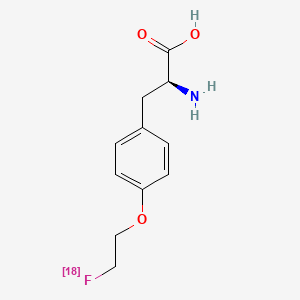

Floretyrosine F 18
CAS 178433-03-9
FormulaC₁₁H₁₄[¹⁸F]NO₃
Molecular Weight226.23 g/mol
FDA UNII1326R5J1IA
FDA 2026, APPROVALS 2026, Pixclara, TELIX PHARMACEUTICALS, GLIOMA, CANCER, TLX101-CDx, TLX101-Px, 1326R5J1IA, L-(18F)FET, O-(2-((18)F)fluoroethyl)-L-tyrosine
(2S)-2-amino-3-[4-(2-[¹⁸F]fluoroethoxy)phenyl]propanoic acid, (2S)-2-amino-3-[4-(2-(18F)fluoroethoxy)phenyl]propanoic acid
To use with positron emission tomography to differentiate recurrent or progressive glioma from treatment-related change in conjunction with other diagnostic evaluations
Floretyrosine F 18 (brand name Pixclara®, also known as 18F-FET) is a newly FDA-approved radiopharmaceutical imaging drug used in positron emission tomography (PET) scans for patients with glioma (brain cancer). Developed by Telix Pharmaceuticals, it received formal U.S. Food and Drug Administration (FDA) approval on September 14, 2026, making it the first and only approved FET-PET diagnostic tracer for brain tumors in the United States.
Primary Clinical Indication
Pixclara is indicated for use in both adult and pediatric patients (1 month of age and older).
Its primary clinical purpose is to differentiate recurrent or progressive glioma from treatment-related changes (such as radiation necrosis or inflammation). Following chemotherapy or radiation, traditional MRI scans often show areas that “light up,” making it incredibly difficult for neuro-oncologists to tell whether a tumor is growing back or if the brain is simply healing from harsh treatments. Pixclara solves this diagnostic dilemma by providing metabolic clarity.
How It Works (Mechanism of Action)
- Targeted Delivery: Floretyrosine F 18 is a synthetic amino acid analogue labeled with the radioactive isotope fluorine-18. [1, 2]
- Cellular Uptake: Once injected intravenously, it specifically targets and binds to L-type amino acid transporters 1 and 2 (LAT1 and LAT2). These transporters are heavily overexpressed on the membranes of active glioma cells compared to healthy brain tissue.
- PET Detection: The tumor cells rapidly absorb the tracer, and the energy emissions from the fluorine-18 isotope are captured by a PET scanner, creating a highly accurate metabolic map of the tumor.
Strategic & Future Impact
The approval aligns U.S. practice with international clinical guidelines—such as the National Comprehensive Cancer Network (NCCN) Guidelines®—which already recommend FET-PET imaging for brain tumor management. Furthermore, Telix Pharmaceuticals is currently conducting a Phase 3 registrational study to expand Pixclara’s indication to include the diagnosis and characterization of brain metastases (cancers that have spread to the brain from other parts of the body)
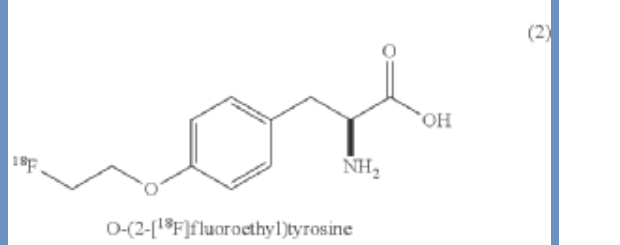
Fluoroethyl-l-tyrosine (18F), commonly known as [18F]FET, is a radiopharmaceutical tracer used in positron emission tomography (PET) imaging. This synthetic amino acid, labeled with the radioactive isotope fluorine-18, is a valuable radiopharmaceutical tracer for use in neuro-oncology for diagnosing, planning treatment, and following up on brain tumors such as gliomas. The tracer’s ability to provide detailed metabolic imaging of tumors makes it an essential tool in the clinical management of brain cancer patients. Continued advancements in PET imaging technology and the development of more efficient synthesis methods are expected to further enhance the clinical utility of [18F]FET.[2]
Radiosynthesis
There are two common pathways for the radiosynthesis of [18F]FET. The first one utilizes a nucleophilic 18F-fluorination of ethyleneglycol-1,2-ditosylate with a subsequent 18F-fluoroethylation of a precursor di-sodium salt of L-tyrosine. This sequence requires two purification steps, two different precursors and a dual-reactor synthesis module which is not widely available in research or commercial centers.[3][4][5] The schematic for this pathway is:[6]

The second route of radiosynthesis is a direct nucleophilic 18F-fluorination a TET (O-(2-tosyloxy-ethyl)-N-trityl-L-tyrosine tert-butyl ester) protected precursor followed by acidic hydrolysis of protecting groups.[3][4][7] The schematic for this pathway is:[6]
REF
- Fluorinated phenylalanines: synthesis and pharmaceutical applicationsPublication Name:Beilstein Journal of Organic ChemistryPublication Date:2020-05-15PMCID:PMC7237815PMID:32509033DOI:10.3762/bjoc.16.91
- Solid-Phase Synthesis of O-(2-[18F]-Fluoro-ethyl)-l-tyrosinePublication Name:SynfactsPublication Date:2013-03-15DOI:10.1055/s-0032-1318420
- Investigations into the synthesis, radiofluorination and conjugation of a new [18F]fluorocyclobutyl prosthetic group and its in vitro stability using a tyrosine model systemPublication Name:Bioorganic & Medicinal ChemistryPublication Date:2013-02-01PMID:23290251DOI:10.1016/j.bmc.2012.11.049
- Microfluidic technology: An economical and versatile approach for the synthesis of O-(2-[18F]fluoroethyl)-l-tyrosine ([18F]FET)Publication Name:Bioorganic & Medicinal Chemistry LettersPublication Date:2012-03-15PMID:22342141DOI:10.1016/j.bmcl.2012.01.083
- Synthesis and biological evaluation of novel F-18 labeled pyrazolo[1,5-a]pyrimidine derivatives: Potential PET imaging agents for tumor detectionPublication Name:Bioorganic & Medicinal Chemistry LettersPublication Date:2011-08-15PMID:21752641DOI:10.1016/j.bmcl.2011.06.072
- (18)F Labeled benzimidazole derivatives as potential radiotracer for positron emission tomography (PET) tumor imagingPublication Name:Bioorganic & Medicinal ChemistryPublication Date:2010-04-01PMID:20303769DOI:10.1016/j.bmc.2010.02.060
- No carrier added synthesis of O-(2′-[18F]fluoroethyl)-l-tyrosine via a novel type of chiral enantiomerically pure precursor, NiII complex of a (S)-tyrosine Schiff basePublication Name:Bioorganic & Medicinal ChemistryPublication Date:2008-05-01PMID:18378460DOI:10.1016/j.bmc.2008.03.040
- Solid-Phase Synthesis of O-(2-[18F]-Fluoro-ethyl)-l-tyrosine, DOI:10.1055/s-0032-1318420, Publication Date:2013, Publication Name:Synfacts
SYN
US20190223814/US249082034
PAT
US20120189546
https://patentscope.wipo.int/search/en/detail.jsf?docId=US73636763&_cid=P11-MU3HO5-37901-1
PAT
US20140235861
https://patentscope.wipo.int/search/en/detail.jsf?docId=US107206441&_cid=P11-MU3HO5-37901-1
Another example of an 18F-fluoroalkylation reaction to obtain a PET tracer is the reaction described by Wang et al (2006 J Radioanalyt Nuc Chem; 270(2): 439-43) used to obtain the 18F-labeled amino acid O-(2-[ 18F]fluoroethyl)-L-tyrosine ([ 18F]FET):
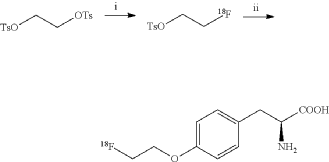
[ 18F]Fluoroethyl tosylate was prepared in step (i) by displacement of a tosyl group from 1,2-bistosyloxyethane by reaction with K 18F/Kryptofix 2.2.2 in acetonitrile at 90° C. for 10 minutes. The purified [ 18F]fluoroethyl tosylate was then reacted in step (ii) with a solution of L-tyrosine and 10% aqueous NaOH in DMSO (or di-Na-salt of L-tyrosine in DMSO) 20 minutes at 90° C. to obtain [ 18F]FET. In contrast to the method for preparation of 18F-labelled S-fluoroalkyl diarylguanidines as reported by Robins et al (supra), this method for preparation of [ 18F]FET uses a soluble base in the alkylation reaction. However, the reaction is still not ideal for carrying out on an automated synthesis device that uses a cassette due to the fact that and additional vial is required for the base used for the subsequent fluoroalkylation step.
PAT
Radiation radiation detector with position tracking system and its use in medical systems and proceduresPublication Number:
JP-2004512502-APriority Date:2000-08-21
- Novel imaging agents and precursors and methods of preparation thereofPublication Number:CN-1234680-CPriority Date:2001-06-04Grant Date:2006-01-04
- Radioactive emission detector equipped with a position tracking system and utilization thereof with medical systems and in medical proceduresPublication Number:US-2005055174-A1Priority Date:2000-08-21
- Radioactive emission detector equipped with a position tracking system and utilization thereof with medical systems and in medical proceduresPublication Number:US-7826889-B2Priority Date:2000-08-21Grant Date:2010-11-02
- Radioactive emission detector equipped with a position tracking system and utilization thereof with medical systems and in medical proceduresPublication Number:US-2004015075-A1Priority Date:2000-08-21
- Radioactive emission detector equipped with a position tracking systemPublication Number:US-2014249402-A1Priority Date:2000-08-21
- Tumor imaging compoundsPublication Number:CA-2479514-CPriority Date:2002-04-30Grant Date:2011-07-26
- Protected tyrosine derivatives, method for the production thereof and use of the same for producing o-(2-[18f]-fluoroethyl)-l-tyrosinePublication Number:WO-02102765-A3Priority Date:2001-06-05
- Protected tyrosine derivatives, method for the production thereof and use of the same for producing o-(2-[18f]-fluoroethyl)-l-tyrosinePublication Number:US-2004192954-A1Priority Date:2001-06-05
- PROTECTED TYROSINE DERIVATIVES, METHOD FOR THE PRODUCTION THEREOF AND THEIR USE FOR THE PRODUCTION OF O-(2-?18 F)-FLUORETHYL)-L-TYROSINEPublication Number:AT-E289992-T1Priority Date:2001-06-05Grant Date:2005-03-15
- Imaging agents, precursors thereof and methods of manufacturePublication Number:US-2003124059-A1Priority Date:2001-06-04
- Radioactively labelled amino acid analogues, their preparation and usePublication Number:US-2006127306-A1Priority Date:2002-08-02
- Radioactively labelled amino acid analogues, their preparation and usePublication Number:EP-1539250-A1Priority Date:2002-08-02
- Tumor imaging compoundsPublication Number:US-7989649-B2Priority Date:2002-04-30Grant Date:2011-08-02
- Tumor imaging compoundsPublication Number:US-2009240041-A1Priority Date:2002-04-30
- Tumor imaging compoundsPublication Number:US-7544715-B2Priority Date:2002-04-30Grant Date:2009-06-09
ADVERTISEMENT
ANAX LABORATORIES
WEBSITE https://www.anaxlab.com/
Discovery Solutions, Supporting the chemistry needs of clients in the Medical, Analytical and Bio Sciences
Development Solutions, Developing from Lab scale to PR&D, Kilo Scale-ups and Commercial Scales
SEE MORE………Integrated Solutions, Manufacturing Solutions, Products,
Can’t Find? Let’s Connect

Phone : +91 897704 2010 / +91 9177075735, Email : info@anaxlab.com
#MedicinalChemistry, #DrugDiscovery, #OrganicSynthesis, #ChemicalLibrary, #BuildingBlocks, #SARStudies, #ChemistryInnovation, #medchem, #Drugdevelopment, #Biotech, #Biotechnology, #AnaxLaboratories, #Pharma


AS ON FEB2026 4.574 LAKHS VIEWS ON BLOG WORLDREACH AVAILABLEFOR YOUR ADVERTISEMENT

join me on Linkedin
Anthony Melvin Crasto Ph.D – India | LinkedIn
join me on Researchgate
RESEARCHGATE

join me on Facebook
Anthony Melvin Crasto Dr. | Facebook
join me on twitter
Anthony Melvin Crasto Dr. | twitter
+919321316780 call whatsaapp
EMAIL. amcrasto@gmail.com

References
- CID 54255856 from PubChem
- Treglia G, Muoio B, Giovanella L (2020). “18F-FET”. In Calabria F, Schillaci O (eds.). Radiopharmaceuticals: A Guide to PET/CT and PET/MRI. Cham: Springer International Publishing. pp. 83–88. doi:10.1007/978-3-030-27779-6_4. ISBN 978-3-030-27778-9.
- Bourdier T, Greguric I, Roselt P, Jackson T, Faragalla J, Katsifis A (July 2011). “Fully automated one-pot radiosynthesis of O-(2-[18F]fluoroethyl)-L-tyrosine on the TracerLab FX(FN) module”. Nuclear Medicine and Biology. 38 (5): 645–651. doi:10.1016/j.nucmedbio.2011.01.001. PMID 21718939.
- Siddiq IS, Atwa ST, Shama SA, Eltaoudy MH, Omar WM (March 2018). “Radiosynthesis and modified quality control of O-(2-[18F]fluoroethyl)-L-tyrosine ([18F]FET) for brain tumor imaging”. Applied Radiation and Isotopes. 133: 38–44. Bibcode:2018AppRI.133…38S. doi:10.1016/j.apradiso.2017.12.011. PMID 29275040.
- Wester HJ, Herz M, Weber W, Heiss P, Senekowitsch-Schmidtke R, Schwaiger M, et al. (January 1999). “Synthesis and radiopharmacology of O-(2-[18F]fluoroethyl)-L-tyrosine for tumor imaging”. Journal of Nuclear Medicine. 40 (1): 205–212. PMID 9935078.
- Wang M, Glick-Wilson BE, Zheng QH (December 2019). “Facile fully automated radiosynthesis and quality control of O-(2-[18F]fluoroethyl)-l-tyrosine ([18F]FET) for human brain tumor imaging”. Applied Radiation and Isotopes. 154 108852. Bibcode:2019AppRI.15408852W. doi:10.1016/j.apradiso.2019.108852. PMID 31442794.
- Mueller D, Klette I, Kalb F, Baum RP (July 2011). “Synthesis of O-(2-[18F]fluoroethyl)-L-tyrosine based on a cartridge purification method”. Nuclear Medicine and Biology. 38 (5): 653–658. doi:10.1016/j.nucmedbio.2011.01.006. PMID 21718940.
- Muoio B, Giovanella L, Treglia G (2018-09-04). “Recent Developments of 18F-FET PET in Neuro-oncology”. Current Medicinal Chemistry. 25 (26): 3061–3073. doi:10.2174/0929867325666171123202644. PMID 29173147.
- Wang L, Lieberman BP, Ploessl K, Kung HF (January 2014). “Synthesis and evaluation of ¹⁸F labeled FET prodrugs for tumor imaging”. Nuclear Medicine and Biology. 41 (1): 58–67. doi:10.1016/j.nucmedbio.2013.09.011. PMC 3895945. PMID 24183614.
- Lee TS, Ahn SH, Moon BS, Chun KS, Kang JH, Cheon GJ, et al. (August 2009). “Comparison of 18F-FDG, 18F-FET and 18F-FLT for differentiation between tumor and inflammation in rats”. Nuclear Medicine and Biology. 36 (6): 681–686. doi:10.1016/j.nucmedbio.2009.03.009. PMID 19647174.
- Leung K (2004), “O-(2-[18F]Fluoroethyl)-L-tyrosine”, Molecular Imaging and Contrast Agent Database (MICAD), Bethesda (MD): National Center for Biotechnology Information (US), PMID 20641653, retrieved 2024-07-10
- Heiss P, Mayer S, Herz M, Wester HJ, Schwaiger M, Senekowitsch-Schmidtke R (August 1999). “Investigation of transport mechanism and uptake kinetics of O-(2-[18F]fluoroethyl)-L-tyrosine in vitro and in vivo”. Journal of Nuclear Medicine. 40 (8): 1367–1373. PMID 10450690.
- Wang HE, Wu SY, Chang CW, Liu RS, Hwang LC, Lee TW, et al. (May 2005). “Evaluation of F-18-labeled amino acid derivatives and [18F]FDG as PET probes in a brain tumor-bearing animal model”. Nuclear Medicine and Biology. 32 (4): 367–375. doi:10.1016/j.nucmedbio.2005.01.005. PMID 15878506.
- Rau FC, Weber WA, Wester HJ, Herz M, Becker I, Krüger A, et al. (August 2002). “O-(2-[(18)F]Fluoroethyl)- L-tyrosine (FET): a tracer for differentiation of tumour from inflammation in murine lymph nodes”. European Journal of Nuclear Medicine and Molecular Imaging. 29 (8): 1039–1046. doi:10.1007/s00259-002-0821-6. PMID 12173018.
- Holzgreve A, Brendel M, Gu S, Carlsen J, Mille E, Böning G, et al. (2016-06-14). “Monitoring of Tumor Growth with [(18)F]-FET PET in a Mouse Model of Glioblastoma: SUV Measurements and Volumetric Approaches”. Frontiers in Neuroscience. 10: 260. doi:10.3389/fnins.2016.00260. PMC 4906232. PMID 27378835.
- “Product Characteristic of IASOglio©” (PDF). synektik.com.pl. 28 June 2024. Retrieved 28 June 2024.
- Pauleit D, Floeth F, Herzog H, Hamacher K, Tellmann L, Müller HW, et al. (April 2003). “Whole-body distribution and dosimetry of O-(2-[18F]fluoroethyl)-L-tyrosine”. European Journal of Nuclear Medicine and Molecular Imaging. 30 (4): 519–524. doi:10.1007/s00259-003-1118-0. PMID 12589478.
- Tang G, Tang X, Wang M, Luo L, Gan M (January 2004). “Radiation dosimetry of O-(3-[18F]fluoropropyl)-L-tyrosine as oncologic PET tracer based on the mice distribution data”. Applied Radiation and Isotopes. 60 (1): 27–32. doi:10.1016/j.apradiso.2003.10.005. PMID 14687633.
- Mattsson S, Johansson L, Leide Svegborn S, Liniecki J, Noßke D, Riklund KÅ, et al. (July 2015). “Radiation Dose to Patients from Radiopharmaceuticals: a Compendium of Current Information Related to Frequently Used Substances” (PDF). Annals of the ICRP. 44 (2 Suppl): 7–321. doi:10.1177/0146645314558019. PMID 26069086.
- “IASOglio”. Curium Pharma. Retrieved 2024-07-10.
 | |
| Clinical data | |
|---|---|
| Other names | 18F-FET; O-(2-(18F)fluoroethyl)-l-tyrosine, O-(2-Fluorethyl)-l-thyrosine, l-(18F)FET[1] |
| Routes of administration | Intravenous |
| ATC code | V09IX10 (WHO) |
| Identifiers | |
| IUPAC name | |
| CAS Number | 178433-03-9  |
| PubChem CID | 9834479 |
| ChemSpider | 8010200 |
| UNII | 1326R5J1IA |
| CompTox Dashboard (EPA) | DTXSID601045942  |
| Chemical and physical data | |
| Formula | C11H14FNO3 |
| Molar mass | 227.235 g·mol−1 |
| 3D model (JSmol) | Interactive image |
| SMILES | |
| InChI | |
///////////floretyrosine F 18, anax labs, FDA 2026, APPROVALS 2026, Pixclara, TELIX PHARMACEUTICALS, GLIOMA, CANCER, TLX101-CDx, TLX101-Px, 1326R5J1IA, L-(18F)FET, O-(2-((18)F)fluoroethyl)-L-tyrosine
#floretyrosine F 18, #anax labs, #FDA 2026, #APPROVALS 2026, #Pixclara, #TELIX PHARMACEUTICALS, #GLIOMA, #CANCER, #TLX101-CDx, #TLX101-Px, #1326R5J1IA, #L-(18F)FET, #O-(2-((18)F)fluoroethyl)-L-tyrosine


 New Drug Approvals
