New Drug Approvals

Home » Antineoplastic » Sosimerasib

Sosimerasib

DRUG APPROVALS BY DR ANTHONY MELVIN CRASTO .....FOR BLOG HOME CLICK HERE

ORGANIC SPECTROSCOPY

Read all about Organic Spectroscopy on ORGANIC SPECTROSCOPY INTERNATIONAL 

Archives

Categories

Recent Posts

Blog Stats

  • 5,063,734 hits

Unknown's avatar

Enter your email address to follow this blog and receive notifications of new posts by email.

Join 37.7K other subscribers

add to any

Share

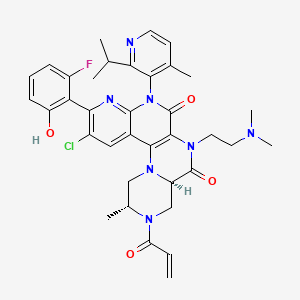
Sosimerasib

Cas 2839563-01-6

MF C36H39ClFN7O4 MW688.2 g/mol

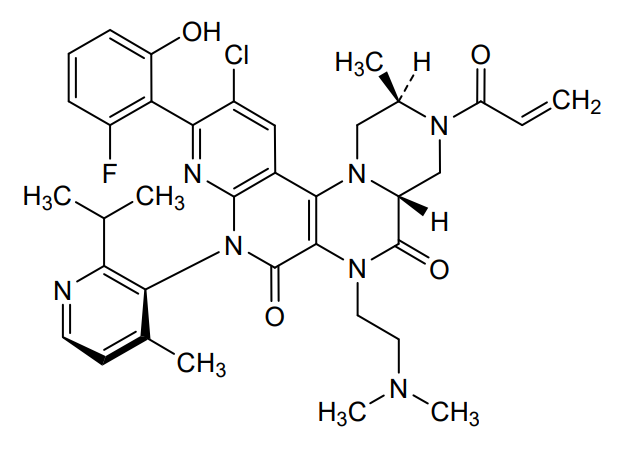
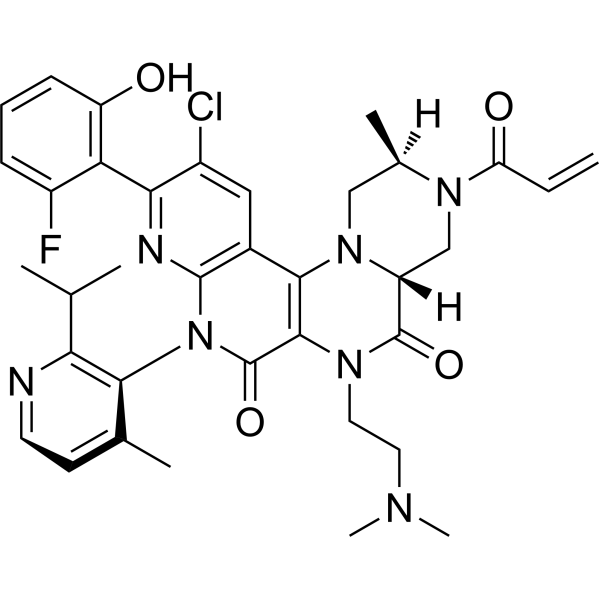
(4R,7R)-16-chloro-9-[2-(dimethylamino)ethyl]-15-(2-fluoro-6-hydroxyphenyl)-4-methyl-12-(4-methyl-2-propan-2-yl-3-pyridinyl)-5-prop-2-enoyl-2,5,9,12,14-pentazatetracyclo[8.8.0.02,7.013,18]octadeca-1(10),13,15,17-tetraene-8,11-dione

(2R,4aR,8M)-11-chloro-6-[2-(dimethylamino)ethyl]-10-(2-fluoro-6-hydroxyphenyl)-2-methyl-8-[4-methyl-2-(propan-2-yl)pyridin-3-yl]-3-(prop-2-enoyl)-2,3,4,4a,6,8-hexahydro-1Hpyrazino[1′,2′:4,5]pyrazino[2,3-c][1,8]naphthyridine-5,7-dione
Kirsten rat sarcoma viral oncogene homolog inhibitor, antineoplastic, HBI-2438, JMKX1899, HBI 2438, JMKX 1899, 2VHH89PP6W

Sosimerasib is an orally active KRASG12C inhibitor. Sosimerasib can be used in research related to non-small cell lung cancer.

Sosimerasib (also known as HBI-2438 or JMKX1899) is an orally active, covalent small molecule inhibitor that targets the KRAS G12C mutation. Developed natively in China, it secured conditional marketing approval from the National Medical Products Administration (NMPA) in February 2026, making it China’s first domestically discovered and registered KRAS G12C inhibitor.

The drug is designed to selectively lock the mutant KRAS protein in its inactive, GDP-bound state, preventing downstream oncogenic signaling pathways that drive tumor growth.

Mechanism and Clinical Indications

Sosimerasib specifically binds to the cysteine residue at position 12 of the mutated KRAS protein. It has shown distinct clinical advantages, including central nervous system (CNS) penetration, which makes it effective against brain metastases. Its primary therapeutic applications include:

  • Non-Small Cell Lung Cancer (NSCLC): It is indicated for patients with locally advanced or metastatic non-squamous NSCLC harboring the KRAS G12C mutation, particularly those who have progressed after receiving standard platinum-based chemotherapy or immune checkpoint inhibitors.
  • Colorectal Cancer (CRC) and Solid Tumors: It is being clinically evaluated as a monotherapy or combination treatment for other advanced solid tumors, showing promising anti-tumor activity in KRAS G12C-mutated colorectal cancer.

Efficacy Data

Data presented across recent oncology conferences highlight substantial therapeutic efficacy:

  • NSCLC Outcomes: In a pivotal Phase II trial involving 145 previously treated patients, a once-daily 500 mg dose of sosimerasib achieved an Objective Response Rate (ORR) of 52.4% and a Disease Control Rate (DCR) of 87.6%. The median progression-free survival (PFS) was documented at 7.2 months.
  • Colorectal Cancer Outcomes: Data from the 2026 ASCO Annual Meeting for advanced CRC patients demonstrated a confirmed ORR of 31.6% and a median PFS of 8.3 months.

Safety and Side Effects

Sosimerasib possesses a manageable safety profile, with rare occurrences of treatment discontinuations (around 1.8% to 2.1%) due to toxicity. The most common treatment-related adverse events (TRAEs) include:

  • Elevated liver enzymes (Alanine aminotransferase/ALT and Aspartate aminotransferase/AST increases)
  • Anaemia
  • Decreased white blood cell count or elevated gamma-glutamyl transferase

Commercial and Development Background

The compound was originally discovered by Shanghai Jiyu Pharmaceutical Technology. It is being co-developed and commercialized through partnerships with HUYA Bioscience International (Huyabio) and Zhejiang Hangyu Pharmaceutical. Within the Chinese market, it joins foreign-developed alternatives like sotorasib (Amgen) and adagrasib (Bristol Myers Squibb), marking a major milestone for independent biomedical innovation in the region. Ongoing Phase III trials are evaluating sosimerasib in combination regimens (such as with the FAK inhibitor IN10018) as a first-line treatment option.

PAT

[US20220389029]

https://patentscope.wipo.int/search/en/detail.jsf?docId=US380594568&_cid=P20-MUT7JP-65582-1

Embodiment 29: Preparation of Compound 29
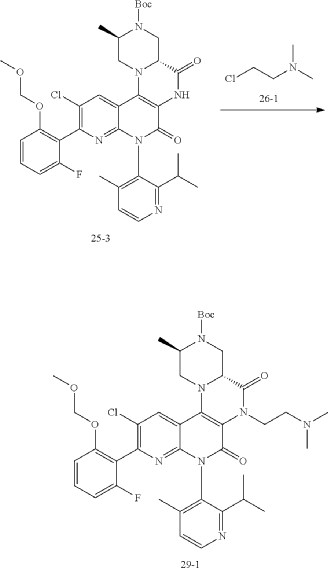
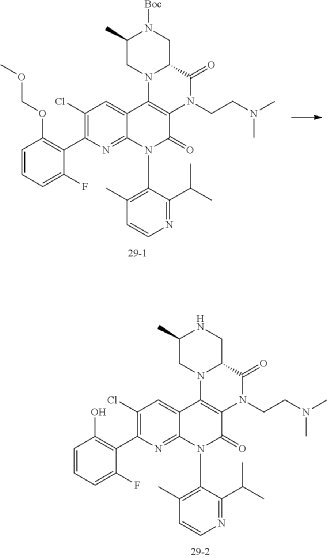
      Step 1: Preparation of Compound 29-1
 Compound 25-3 (700 mg, 1 mmol) and cesium carbonate (977 mg, 3 mmol) were dissolved in N,N-dimethylformamide (20 mL), and compound 26-1 (432 mg, 3 mmol) was added thereto at room temperature (25° C.). After the addition was completed, under nitrogen atmosphere, the system was heated to 120° C. and stirred for 2 hours. The system was filtered and concentrated to obtain a crude product, the crude product was purified by silica gel column chromatography (dichloromethane/methanol (v/v)=1/10) to obtain compound 29-1.
      MS (ESI) m/z (M+H) +=778.2.
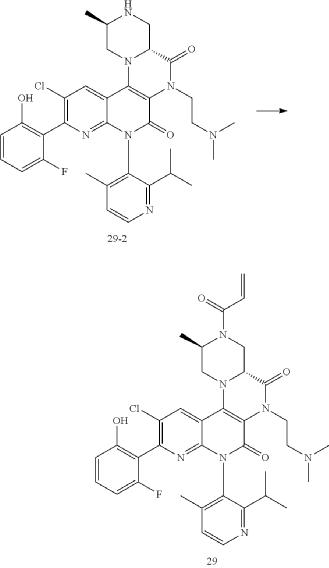
      Step 2: Preparation of Compound 29-2
 Compound 29-1 (150 mg, 0.2 mmol), hydrochloric acid (6N, 7 mL) were added to a mixed solution of methanol (0.6 mL) and tetrahydrofuran (6 mL). The system was heated to 55° C. and stirred for 10 min. The system was concentrated to obtain crude product compound 29-2, which was directly used in the next reaction without further purification.
      MS (ESI) m/z (M+H) +=634.2.
      Step 3: Preparation of Compound 29
 Compound 29-2 (140 mg, 0.2 mmol) was dissolved in dichloromethane (10 mL), and the system was cooled to 0° C., triethylamine (0.3 mL, 2.1 mmol) and acryloyl chloride (27 mg, 0.3 mmol) were added dropwise thereto, the reaction was carried out at 0° C. for 0.5 hours. The system was quenched with methanol and then concentrated to obtain a crude product. The crude product was dissolved in methanol (5 mL), potassium carbonate (140 mg) was added thereto, after the addition was completed, the system was stirred at room temperature (20° C.) for 30 min. The pH of the system was adjusted to 6 with hydrochloric acid, the mixture was extracted with dichloromethane (20 mL) and water (20 mL); and the organic phase was dried over anhydrous sodium sulfate, filtered, and the filtrate was concentrated to obtain a crude product, the crude product was purified by high performance liquid chromatography (separation conditions: chromatographic column Welch Xtimate® C18 21.2×250 mm, 10 μm; column temperature: 25° C., mobile phase: water (10 mM/L NH 4HCO 3)-acetonitrile; acetonitrile 40%-60% 9 min; flow rate 30 mL/min) to obtain compound 29.
      MS (ESI) m/z (M+H) +=688.2.
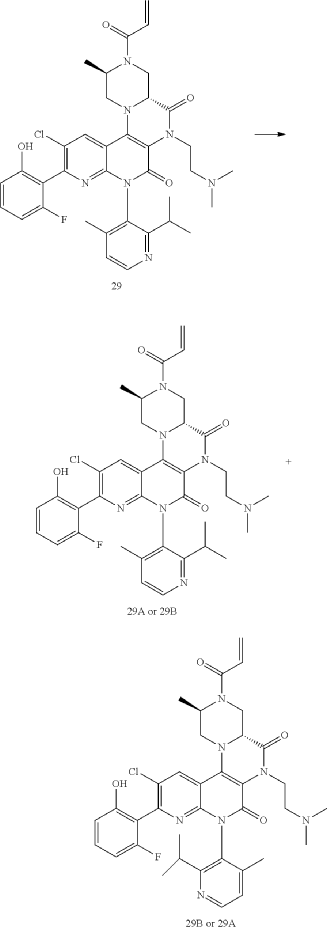
      Step 4: Preparation of Compounds 29A and 29B
  Diastereoisomeric compound 29 was purified by SFC («Column_3»; mobile phase: [CO 2-ethanol (0.1% ammonia)]; ethanol %: 25%; flow rate: 60 mL/min; column temperature: 38° C.). After concentration, compound 29A and compound 29B were obtained.
      Compound 29A:
      1H NMR (400 MHz, DMSO-d 6) δ 10.06 (brs, 1H), 8.37 (d, J=4.9 Hz, 1H), 8.18 (s, 1H), 7.29-7.05 (m, 2H), 6.97 (dd, J=16.8, 10.6 Hz, 0.75H), 6.79 (dd, J=16.7, 10.7 Hz, 0.25H), 6.69-6.46 (m, 2H), 6.07 (dd, J=16.8, 2.5 Hz, 1H), 5.68 (dd, J=10.5, 2.4 Hz, 1H), 4.95 (d, J=13.9 Hz, 0.25H), 4.82-4.66 (m, 0.75H), 4.54 (d, J=14.0 Hz, 1H), 4.40-4.12 (m, 2H), 3.94 (dd, J=20.5, 4.4 Hz, 1H), 3.68 (dd, J=14.2, 4.4 Hz, 1H), 3.14-2.90 (m, 1H), 2.43-2.34 (m, 2H), 2.27-2.08 (m, 2H), 1.97-1.82 (m, 9H), 1.56-1.45 (m, 3H), 0.97 (dd, J=6.6, 2.2 Hz, 3H), 0.78 (t, J=6.0 Hz, 3H).
      MS (ESI) m/z (M+H) +=688.3.
      SFC 100% ee. Retention time was 3.559 min.
      Separation conditions: chromatographic column: «Column_2»; mobile phase: [CO 2-ethanol (0.05% DEA)]; ethanol %: 5%-40% 5 min, 40% 2.5 min, 5% 2.5 min; flow rate: 2.5 mL/min; column temperature: 35° C.
      Compound 29B:
      1H NMR (400 MHz, DMSO-d 6) δ 10.18 (brs, 1H), 8.45 (d, J=4.9 Hz, 1H), 8.26 (s, 1H), 7.29-7.20 (m, 2H), 7.04 (dd, J=16.8, 10.4 Hz, 0.75H), 6.86 (dd, J=17.6, 10.4 Hz, 0.25H), 6.72-6.60 (m, 2H), 6.14 (d, J=16.4 Hz, 1H), 5.75 (d, J=10.7 Hz, 1H), 5.03 (d, J=13.8 Hz, 0.25H), 4.80 (d, J=7.8 Hz, 0.75H), 4.61 (d, J=14.1 Hz, 1H), 4.43-4.30 (m, 1H), 4.28-4.15 (m, 1H), 4.04-3.89 (m, 1H), 3.75 (dd, J=14.5, 4.4 Hz, 1H), 3.28-3.10 (m, 2H), 2.75-2.65 (m, 1H), 2.39-2.28 (m, 1H), 2.28-2.17 (m, 1H), 2.06-1.96 (m, 6H), 1.81 (d, J=9.5 Hz, 3H), 1.53 (d, J=6.8 Hz, 3H), 1.11 (d, J=6.9 Hz, 3H), 0.95 (d, J=6.6 Hz, 3H).
      MS (ESI) m/z (M+H) +=688.3.
      HPLC retention time was 5.269 min.
      Separation conditions: chromatographic column: Waters XBridge 4.6*100 mm, 3.5 μm; column temperature: 40° C.; mobile phase: water (10 mM ammonium bicarbonate)-acetonitrile; acetonitrile: 5%-95% 7 min; flow rate: 1.2 mL/min. SFC 100% ee. Retention time was 4.349 min.
      Separation conditions: chromatographic column: «Column_2»; mobile phase: [CO 2-ethanol (0.05% DEA)]; ethanol %: 5%-40% 5 min, 40% 2.5 min, 5% 2.5 min; flow rate: 2.5 mL/min; column temperature: 35° C.

PAT

US20230227472

https://patentscope.wipo.int/search/en/detail.jsf?docId=US402823590&_cid=P20-MUT7F9-60174-1

Step 3: Preparation of Compound 29
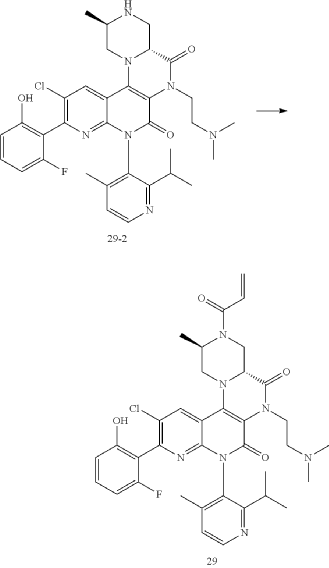
Compound 29-2 (140 mg, 0.2 mmol) was dissolved in dichloromethane (10 mL), and the system was cooled to 0° C., triethylamine (0.3 mL, 2.1 mmol) and acryloyl chloride (27 mg, 0.3 mmol) were added dropwise thereto, the reaction was carried out at 0° C. for 0.5 hours. The system was quenched with methanol and then concentrated to obtain a crude product. The crude product was dissolved in methanol (5 mL), potassium carbonate (140 mg) was added thereto, after the addition was completed, the system was stirred at room temperature (20° C.) for 30 min. The pH of the system was adjusted to 6 with hydrochloric acid, the mixture was extracted with dichloromethane (20 mL) and water (20 mL); and the organic phase was dried over anhydrous sodium sulfate, filtered, and the filtrate was concentrated to obtain a crude product, the crude product was purified by high performance liquid chromatography (separation conditions: chromatographic column Welch Xtimate® C18 21.2×250 mm, 10 μm; column temperature: 25° C., mobile phase: water (10 mM/L NH 4HCO 3)-acetonitrile; acetonitrile 40%-60% 9 min; flow rate 30 mL/min) to obtain compound 29.
      MS (ESI) m/z (M+H) +=688.2.

Step 4: Preparation of Compounds 29A and 29B
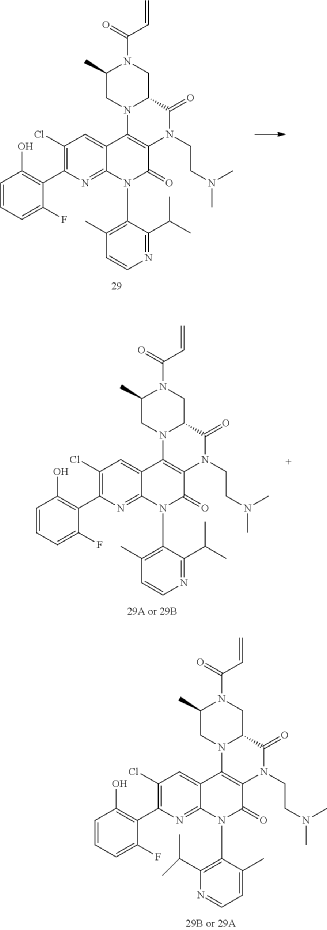
Diastereoisomeric compound 29 was purified by SFC («Column_3»; mobile phase: [CO 2-ethanol (0.1% ammonia)]; ethanol %: 25%; flow rate: 60 mL/min; column temperature: 38° C.). After concentration, compound 29A and compound 29B were obtained.

Compound 29A:

      1H NMR (400 MHz, DMSO-d 6) δ 10.06 (brs, 1H), 8.37 (d, J=4.9 Hz, 1H), 8.18 (s, 1H), 7.29-7.05 (m, 2H), 6.97 (dd, J=16.8, 10.6 Hz, 0.75H), 6.79 (dd, J=16.7, 10.7 Hz, 0.25H), 6.69-6.46 (m, 2H), 6.07 (dd, J=16.8, 2.5 Hz, 1H), 5.68 (dd, J=10.5, 2.4 Hz, 1H), 4.95 (d, J=13.9 Hz, 0.25H), 4.82-4.66 (m, 0.75H), 4.54 (d, J=14.0 Hz, 1H), 4.40-4.12 (m, 2H), 3.94 (dd, J=20.5, 4.4 Hz, 1H), 3.68 (dd, J=14.2, 4.4 Hz, 1H), 3.14-2.90 (m, 1H), 2.43-2.34 (m, 2H), 2.27-2.08 (m, 2H), 1.97-1.82 (m, 9H), 1.56-1.45 (m, 3H), 0.97 (dd, J=6.6, 2.2 Hz, 3H), 0.78 (t, J=6.0 Hz, 3H).
      MS (ESI) m/z (M+H) +=688.3.
      SFC 100% ee. Retention time was 3.559 min.
      Separation conditions: chromatographic column: «Column_2»; mobile phase: [CO 2-ethanol (0.05% DEA)]; ethanol %: 5%-40% 5 min, 40% 2.5 min, 5% 2.5 min; flow rate: 2.5 mL/min; column temperature: 35° C.

Compound 29B:

      1H NMR (400 MHz, DMSO-d 6) δ 10.18 (brs, 1H), 8.45 (d, J=4.9 Hz, 1H), 8.26 (s, 1H), 7.29-7.20 (m, 2H), 7.04 (dd, J=16.8, 10.4 Hz, 0.75H), 6.86 (dd, J=17.6, 10.4 Hz, 0.25H), 6.72-6.60 (m, 2H), 6.14 (d, J=16.4 Hz, 1H), 5.75 (d, J=10.7 Hz, 1H), 5.03 (d, J=13.8 Hz, 0.25H), 4.80 (d, J=7.8 Hz, 0.75H), 4.61 (d, J=14.1 Hz, 1H), 4.43-4.30 (m, 1H), 4.28-4.15 (m, 1H), 4.04-3.89 (m, 1H), 3.75 (dd, J=14.5, 4.4 Hz, 1H), 3.28-3.10 (m, 2H), 2.75-2.65 (m, 1H), 2.39-2.28 (m, 1H), 2.28-2.17 (m, 1H), 2.06-1.96 (m, 6H), 1.81 (d, J=9.5 Hz, 3H), 1.53 (d, J=6.8 Hz, 3H), 1.11 (d, J=6.9 Hz, 3H), 0.95 (d, J=6.6 Hz, 3H).
      MS (ESI) m/z (M+H) +=688.3.
      HPLC retention time was 5.269 min.
      Separation conditions: chromatographic column: Waters XBridge 4.6*100 mm, 3.5 μm; column temperature: 40° C.; mobile phase: water (10 mM ammonium bicarbonate)-acetonitrile; acetonitrile: 5%-95% 7 min; flow rate: 1.2 mL/min. SFC 100% ee. Retention time was 4.349 min.
      Separation conditions: chromatographic column: «Column_2»; mobile phase: [CO 2-ethanol (0.05% DEA)]; ethanol %: 5%-40% 5 min, 40% 2.5 min, 5% 2.5 min; flow rate: 2.5 mL/min; column temperature: 35° C.

ADVERTISEMENT

ANAX LABORATORIES

WEBSITE https://www.anaxlab.com/

Discovery Solutions, Supporting the chemistry needs of clients in the Medical, Analytical and Bio Sciences

Development Solutions, Developing from Lab scale to PR&D, Kilo Scale-ups and Commercial Scales

SEE MORE………Integrated Solutions, Manufacturing Solutions, Products,
Can’t Find? Let’s Connect

Phone : +91 897704 2010 /  +91 9177075735, Email : info@anaxlab.com

#MedicinalChemistry, #DrugDiscovery, #OrganicSynthesis, #ChemicalLibrary, #BuildingBlocks, #SARStudies, #ChemistryInnovation, #medchem, #Drugdevelopment, #Biotech, #Biotechnology, #AnaxLaboratories, #Pharma

str1

AS ON FEB2026 4.574 LAKHS VIEWS ON BLOG WORLDREACH AVAILABLEFOR YOUR ADVERTISEMENT
wdt-16

join me on Linkedin

Anthony Melvin Crasto Ph.D – India | LinkedIn

join me on Researchgate

RESEARCHGATE

This image has an empty alt attribute; its file name is research.jpg

join me on Facebook

Anthony Melvin Crasto Dr. | Facebook

join me on twitter

Anthony Melvin Crasto Dr. | twitter

+919321316780 call whatsaapp

EMAIL. amcrasto@gmail.com

References

[1]. Jia Zhong, et al. Sosimerasib monotherapy in patients with previously treated KRAS G12C–mutated non-small cell lung cancer: Primary results of a phase 2 study. Journal of Clinical Oncology Volume 43, Number 16_suppl June 2025.

///////////sosimerasib, anax labs, Kirsten rat sarcoma viral oncogene homolog inhibitor, antineoplastic, HBI-2438, JMKX1899, HBI 2438, JMKX 1899, 2VHH89PP6W

#sosimerasib, #anax labs, #Kirsten rat sarcoma viral oncogene homolog inhibitor, #antineoplastic, #HBI-2438, #JMKX1899, #HBI 2438, #JMKX 1899, #2VHH89PP6W


Leave a comment

This site uses Akismet to reduce spam. Learn how your comment data is processed.

DR ANTHONY CRASTO

Follow New Drug Approvals on WordPress.com

Enter your email address to follow this blog and receive notifications of new posts by email.

Join 37.7K other subscribers
DR ANTHONY MELVIN CRASTO Ph.D

DR ANTHONY MELVIN CRASTO Ph.D

DR ANTHONY MELVIN CRASTO, Born in Mumbai in 1964 and graduated from Mumbai University, Completed his Ph.D from ICT, 1991,Matunga, Mumbai, India, in Organic Chemistry, The thesis topic was Synthesis of Novel Pyrethroid Analogues, Currently he is working with AFRICURE PHARMA, ROW2TECH, NIPER-G, Department of Pharmaceuticals, Ministry of Chemicals and Fertilizers, Govt. of India as ADVISOR, earlier assignment was with GLENMARK LIFE SCIENCES LTD, as CONSUlTANT, Retired from GLENMARK in Jan2022 Research Centre as Principal Scientist, Process Research (bulk actives) at Mahape, Navi Mumbai, India. Total Industry exp 32 plus yrs, Prior to joining Glenmark, he has worked with major multinationals like Hoechst Marion Roussel, now Sanofi, Searle India Ltd, now RPG lifesciences, etc. He has worked with notable scientists like Dr K Nagarajan, Dr Ralph Stapel, Prof S Seshadri, etc, He did custom synthesis for major multinationals in his career like BASF, Novartis, Sanofi, etc., He has worked in Discovery, Natural products, Bulk drugs, Generics, Intermediates, Fine chemicals, Neutraceuticals, GMP, Scaleups, etc, he is now helping millions, has 9 million plus hits on Google on all Organic chemistry websites. His friends call him Open superstar worlddrugtracker. His New Drug Approvals, Green Chemistry International, All about drugs, Eurekamoments, Organic spectroscopy international, etc in organic chemistry are some most read blogs He has hands on experience in initiation and developing novel routes for drug molecules and implementation them on commercial scale over a 32 PLUS year tenure till date Feb 2023, Around 35 plus products in his career. He has good knowledge of IPM, GMP, Regulatory aspects, he has several International patents published worldwide . He has good proficiency in Technology transfer, Spectroscopy, Stereochemistry, Synthesis, Polymorphism etc., He suffered a paralytic stroke/ Acute Transverse mylitis in Dec 2007 and is 90 %Paralysed, He is bound to a wheelchair, this seems to have injected feul in him to help chemists all around the world, he is more active than before and is pushing boundaries, He has 100 million plus hits on Google, 2.5 lakh plus connections on all networking sites, 100 Lakh plus views on dozen plus blogs, 227 countries, 7 continents, He makes himself available to all, contact him on +91 9323115463, email amcrasto@gmail.com, Twitter, @amcrasto , He lives and will die for his family, 90% paralysis cannot kill his soul., Notably he has 38 lakh plus views on New Drug Approvals Blog in 227 countries......https://newdrugapprovals.wordpress.com/ , He appreciates the help he gets from one and all, Friends, Family, Glenmark, Readers, Wellwishers, Doctors, Drug authorities, His Contacts, Physiotherapist, etc He has total of 32 International and Indian awards

View Full Profile →

bloglovin

Follow my blog with Bloglovin The title of your home page You could put your verification ID in a comment Or, in its own meta tag Or, as one of your keywords Your content is here. The verification ID will NOT be detected if you put it here.