New Drug Approvals

Home » Antineoplastic » Ezobresib

Ezobresib

DRUG APPROVALS BY DR ANTHONY MELVIN CRASTO .....FOR BLOG HOME CLICK HERE

ORGANIC SPECTROSCOPY

Read all about Organic Spectroscopy on ORGANIC SPECTROSCOPY INTERNATIONAL 

Archives

Categories

Recent Posts

Blog Stats

  • 4,822,076 hits

Unknown's avatar

Enter your email address to follow this blog and receive notifications of new posts by email.

Join 37.9K other subscribers

add to any

Share

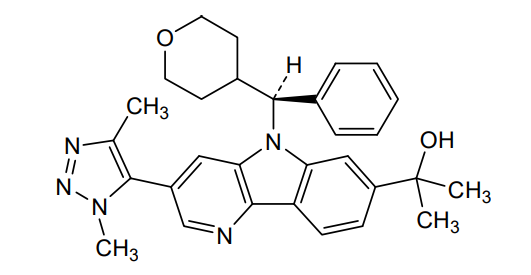
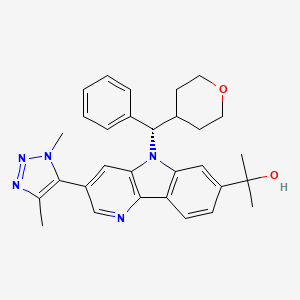
Ezobresib

CAS 1800340-40-2

MF C30H33N5O2 MW 495.6 g/mol

2-{3-(1,4-dimethyl-1H-1,2,3-triazol-5-yl)-5-[(S)-(oxan-4-yl)(phenyl)methyl]-5H-pyrido[3,2-b]indol-7-yl}propan-2-ol
bromodomain and extra-terminal motif (BET) inhibitor,
antineoplastic, BMS-986158, BMS 986158, Bristol Myers Squibb, antineoplastic, UNII-X8BW0MQ5PI

2-[3-(3,5-dimethyltriazol-4-yl)-5-[(S)-oxan-4-yl(phenyl)methyl]pyrido[3,2-b]indol-7-yl]propan-2-ol

Ezobresib is an investigational new drug that has been evaluated for the treatment of cancer. It inhibits Bromodomain and Extra-Terminal domain (BET) proteins, with potential antineoplastic activity.[1] Developed by Bristol Myers Squibb, this therapeutic agent has been studied for its efficacy in treating various cancers, including solid tumors and hematological malignancies.[2] Despite showing promise in early-phase clinical trials, recent developments suggest that Bristol Myers Squibb has decided to discontinue further development of ezobresib.[3]

BMS-986158 is under investigation in clinical trial NCT02419417 (Study of BMS-986158 in Subjects With Select Advanced Cancers).

Ezobresib is an inhibitor of the Bromodomain (BRD) and Extra-Terminal domain (BET) family of proteins, with potential antineoplastic activity. Upon administration, ezobresib binds to the acetyl-lysine binding site in the BRD of BET proteins, thereby preventing the interaction between BET proteins and acetylated histones. This disrupts chromatin remodeling and prevents the expression of certain growth-promoting genes, resulting in an inhibition of tumor cell growth. BET proteins (BRD2, BRD3, BRD4 and BRDT) are transcriptional regulators that bind to acetylated lysines on the tails of histones H3 and H4, and regulate chromatin structure and function; they play an important role in the modulation of gene expression during development and cellular growth

SYN

US10112941,

https://patentscope.wipo.int/search/en/detail.jsf?docId=US206490064&_cid=P21-MGLNPO-16484-1

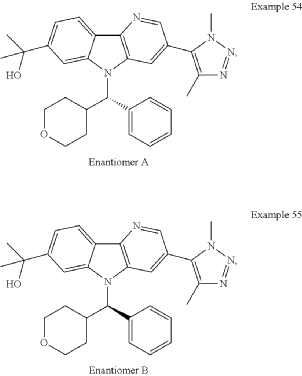
Examples 54 & 55

2-[3-(Dimethyl-1H-1,2,3-triazol-5-yl)-5-[oxan-4-yl(phenyl)methyl]-5H-pyrido[3,2-b]indol-7-yl]propan-2-ol
Step 1: 2-Chloro-5-(1,4-dimethyl-1H-1,2,3-triazol-5-yl)pyridin-3-amine

      To a 100 mL round bottom flask containing 5-bromo-2-chloropyridin-3-amine (2.90 g, 14.0 mmol), 1,4-dimethyl-5-(tributylstannyl)-1H-1,2,3-triazole (2.70 g, 6.99 mmol) [Seefeld, M. A. et al. PCT Int. Appl., 2008, WO2008098104] and Pd(PPh 3(0.61 g, 0.52 mmol) in DMF (20 mL) was added cuprous iodide (0.20 g, 1.05 mmol) and Et 3N (1.9 mL, 14.0 mmol). The reaction mixture was purged with N for 3 min and then heated at 100° C. for 1 h. After cooling to room temperature, the mixture was diluted with 10% LiCl solution and extracted with EtOAc (2×). The combined organics were washed with sat. NaCl, dried over MgSO 4, filtered and concentrated. CH 2Cl was added, and the resulting precipitate was collected by filtration. The mother liquor was concentrated and purified using ISCO silica gel chromatography (40 g column, gradient from 0% to 100% EtOAc/CH 2Cl 2). The resulting solid was combined with the precipitate and triturated with cold EtOAc to give the title compound (740 mg, 47%) as a light tan solid. LCMS (M+H)=224.1; HPLC RT=1.03 min (Column: Chromolith ODS S5 4.6×50 mm; Mobile Phase A: 10:90 MeOH:water with 0.1% TFA; Mobile Phase B: 90:10 MeOH:water with 0.1% TFA; Temperature: 40° C.; Gradient: 0-100% B over 4 min; Flow: 4 mL/min).

Step 2: Methyl 3-((2-chloro-5-(1,4-dimethyl-1H-1,2,3-triazol-5-yl)pyridin-3-yl)amino)benzoate

      Following a procedure analogous to that described in Step 2 of Example 1, 2-chloro-5-(1,4-dimethyl-1H-1,2,3-triazol-5-yl)pyridin-3-amine (740 mg, 3.31 mmol) was converted to the title compound (644 mg, 54%). 1H NMR (400 MHz, CDCl 3) δ 7.94 (t, J=1.9 Hz, 1H), 7.88 (d, J=2.1 Hz, 1H), 7.83 (dt, J=7.8, 1.3 Hz, 1H), 7.49 (t, J=7.9 Hz, 1H), 7.40 (d, J=2.1 Hz, 1H), 7.36 (ddd, J=8.0, 2.3, 0.9 Hz, 1H), 6.38 (s, 1H), 3.99 (s, 3H), 3.93 (s, 3H), 2.34 (s, 3H); LCMS (M+H)=358.2; HPLC RT=2.34 min (Column: Chromolith ODS S5 4.6×50 mm; Mobile Phase A: 10:90 MeOH:water with 0.1% TFA; Mobile Phase B: 90:10 MeOH:water with 0.1% TFA; Temperature: 40° C.; Gradient: 0-100% B over 4 min; Flow: 4 mL/min).

Step 3: Methyl 3-(1,4-dimethyl-1H-1,2,3-triazol-5-yl)-5H-pyrido[3,2-b]indole-7-carboxylate

      Following a procedure analogous to that described in Step 3 of Example 1, methyl 3-((2-chloro-5-(1,4-dimethyl-1H-1,2,3-triazol-5-yl)pyridin-3-yl)amino)benzoate (2.82 g, 7.88 mmol) was converted to the title compound (1.58 g, 62%). 1H NMR (500 MHz, DMSO-d 6) δ 11.93 (s, 1H), 8.62 (d, J=1.8 Hz, 1H), 8.36 (dd, J=8.2, 0.6 Hz, 1H), 8.29-8.22 (m, 1H), 8.16 (d, J=1.8 Hz, 1H), 7.91 (dd, J=8.2, 1.4 Hz, 1H), 4.02 (s, 3H), 3.94 (s, 3H), 2.31 (s, 3H); LCMS (M+H)=322.3; HPLC RT=1.98 min (Column: Chromolith ODS S5 4.6×50 mm; Mobile Phase A: 10:90 MeOH:water with 0.1% TFA; Mobile Phase B: 90:10 MeOH:water with 0.1% TFA; Temperature: 40° C.; Gradient: 0-100% B over 4 min; Flow: 4 mL/min).

Alternate synthesis of Methyl 3-(1,4-dimethyl-1H-1,2,3-triazol-5-yl)-5H-pyrido[3,2-b]indole-7-carboxylate

      A mixture of methyl 3-bromo-5H-pyrido[3,2-b]indole-7-carboxylate (Step 2 of Example 40, 3.000 g, 9.83 mmol), 1,4-dimethyl-5-(tributylstannyl)-1H-1,2,3-triazole (4.18 g, 10.82 mmol), copper (I) iodide (0.281 g, 1.475 mmol), Pd(Ph 3P) (0.738 g, 0.639 mmol) and triethylamine (2.74 mL, 19.66 mmol) in DMF (25 mL) was purged under a nitrogen stream and then heated in a heating block at 95° C. for 2 hours. After cooling to room temperature the reaction mixture was diluted with water and extracted into ethyl acetate. Washed with water, NH 4OH, brine and concentrated. The residue was triturated with 100 mL CHCl 3, filtered off the solid and rinsed with CHCl to give. 1.6 g of product. The filtrate was loaded unto the ISCO column (330 g column, A: DCM; B: 10% MeOH/DCM, 0 to 100% gradient) and chromatographed to give an additional 0.7 g. of methyl 3-(1,4-dimethyl-1H-1,2,3-triazol-5-yl)-5H-pyrido[3,2-b]indole-7-carboxylate (2.30 g total, 7.16 mmol, 72.8% yield).

Step 4: Methyl 3-(1,4-dimethyl-1H-1,2,3-triazol-5-yl)-5-(phenyl(tetrahydro-2H-pyran-4-yl)methyl)-5H-pyrido[3,2-b]indole-7-carboxylate

      Following a procedure analogous to that described in Step 4 of Example 1, methyl 3-(1,4-dimethyl-1H-1,2,3-triazol-5-yl)-5H-pyrido[3,2-b]indole-7-carboxylate (80 mg, 0.25 mmol) was converted to the title compound (65 mg, 53%) after purification by prep HPLC (Column: Phen Luna C18, 30×100 mm, 5 μm particles; Mobile Phase A: 5:95 acetonitrile:water with 0.1% TFA; Mobile Phase B: 95:5 acetonitrile:water with 0.1% TFA; Gradient: 10-100% B over 14 min, then a 2-min hold at 100% B; Flow: 40 mL/min). 1H NMR (400 MHz, CDCl 3) δ 8.51 (d, J=1.8 Hz, 1H), 8.50 (s, 1H), 8.47 (d, J=8.1 Hz, 1H), 8.10 (dd, J=8.1, 1.1 Hz, 1H), 7.63 (d, J=1.8 Hz, 1H), 7.46 (d, J=7.3 Hz, 2H), 7.40-7.30 (m, 3H), 5.62 (d, J=10.6 Hz, 1H), 4.11-4.03 (m, 4H), 3.92-3.83 (m, 4H), 3.56 (td, J=11.9, 1.8 Hz, 1H), 3.35 (td, J=11.9, 1.9 Hz, 1H), 3.18-3.05 (m, 1H), 2.30 (s, 3H), 2.04 (d, J=13.0 Hz, 1H), 1.71-1.58 (m, 1H), 1.50-1.37 (m, 1H), 1.09 (d, J=12.8 Hz, 1H); LCMS (M+H)=496.3; HPLC RT=2.93 min (Column: Chromolith ODS S5 4.6×50 mm; Mobile Phase A: 10:90 MeOH:water with 0.1% TFA; Mobile Phase B: 90:10 MeOH:water with 0.1% TFA; Temperature: 40° C.; Gradient: 0-100% B over 4 min; Flow: 4 mL/min).

Step 5: 2-[3-(Dimethyl-1H-1,2,3-triazol-5-yl)-5-[oxan-4-yl(phenyl)methyl]-5H-pyrido[3,2-b]indol-7-yl]propan-2-ol

      Following a procedure analogous to that described in Step 5 of Example 1, methyl 3-(1,4-dimethyl-1H-1,2,3-triazol-5-yl)-5-(phenyl(tetrahydro-2H-pyran-4-yl)methyl)-5H-pyrido[3,2-b]indole-7-carboxylate (65 mg, 0.13 mmol) was converted to racemic 2-[3-(dimethyl-1H-1,2,3-triazol-5-yl)-5-[oxan-4-yl(phenyl)methyl]-5H-pyrido[3,2-b]indol-7-yl]propan-2-ol, which was separated by chiral prep SFC (Column: Chiralpak IB 25×2 cm, 5 μm; Mobile Phase: 70/30 CO 2/MeOH; Flow: 50 mL/min); to give Enantiomer A (24 mg, 36%) and Enantiomer B (26 mg, 38%). Enantiomer A: 1H NMR (500 MHz, CDCl 3) δ 8.44 (d, J=1.8 Hz, 1H), 8.36 (d, J=8.2 Hz, 1H), 7.98 (s, 1H), 7.56 (d, J=1.7 Hz, 1H), 7.47-7.41 (m, 3H), 7.37-7.32 (m, 2H), 7.31-7.28 (m, 1H), 5.59 (d, J=10.5 Hz, 1H), 4.06 (dd, J=11.8, 2.8 Hz, 1H), 3.90-3.84 (m, 4H), 3.55 (td, J=11.9, 2.0 Hz, 1H), 3.35 (td, J=11.9, 2.0 Hz, 1H), 3.15-3.04 (m, 1H), 2.30 (s, 3H), 2.04 (d, J=13.6 Hz, 1H), 1.92 (s, 1H), 1.75 (s, 6H), 1.69-1.58 (m, 1H), 1.47-1.38 (m, 1H), 1.12 (d, J=13.4 Hz, 1H); LCMS (M+H)=496.4; HPLC RT=2.46 min (Column: Chromolith ODS S5 4.6×50 mm; Mobile Phase A: 10:90 MeOH:water with 0.1% TFA; Mobile Phase B: 90:10 MeOH:water with 0.1% TFA; Temperature: 40° C.; Gradient: 0-100% B over 4 min; Flow: 4 mL/min). SFC RT=5.50 min (Column: Chiralpak IB 250×4.6 mm, 5 μm; Mobile Phase: 70/30 CO 2/MeOH; Flow: 2 mL/min); SFC RT=1.06 min (Column: Chiralcel OD-H 250×4.6 mm, 5 μm; Mobile Phase: 50/50 CO 2/(1:1 MeOH/CH 3CN); Flow: 2 mL/min); [α] D 20=−117.23 (c=0.08, CHCl 3). Enantiomer B: 1H NMR (500 MHz, CDCl 3) δ 8.44 (d, J=1.8 Hz, 1H), 8.36 (d, J=8.2 Hz, 1H), 7.98 (s, 1H), 7.56 (d, J=1.7 Hz, 1H), 7.47-7.41 (m, 3H), 7.37-7.32 (m, 2H), 7.31-7.28 (m, 1H), 5.59 (d, J=10.5 Hz, 1H), 4.06 (dd, J=11.8, 2.8 Hz, 1H), 3.90-3.84 (m, 4H), 3.55 (td, J=11.9, 2.0 Hz, 1H), 3.35 (td, J=11.9, 2.0 Hz, 1H), 3.15-3.04 (m, 1H), 2.30 (s, 3H), 2.04 (d, J=13.6 Hz, 1H), 1.92 (s, 1H), 1.75 (s, 6H), 1.69-1.58 (m, 1H), 1.47-1.38 (m, 1H), 1.12 (d, J=13.4 Hz, 1H); LCMS (M+H)=496.4; HPLC RT=2.46 min (Column: Chromolith ODS S5 4.6×50 mm; Mobile Phase A: 10:90 MeOH:water with 0.1% TFA; Mobile Phase B: 90:10 MeOH:water with 0.1% TFA; Temperature: 40° C.; Gradient: 0-100% B over 4 min; Flow: 4 mL/min). SFC RT=8.30 min (Column: Chiralpak IB 250×4.6 mm, 5 μm; Mobile Phase: 70/30 CO 2/MeOH; Flow: 2 mL/min); SFC RT=2.83 min (Column: Chiralcel OD-H 250×4.6 mm, 5 μm; Mobile Phase: 50/50 CO 2/(1:1 MeOH/CH 3CN); Flow: 2 mL/min); [α] D 20=+88.78 (c=0.10, CHCl 3).

Alternate Synthesis of Examples 54

2-[3-(Dimethyl-1H-1,2,3-triazol-5-yl)-5-[oxan-4-yl(phenyl)methyl]-5H-pyrido[3,2-b]indol-7-yl]propan-2-ol


Step 1: 2-Chloro-5-(1,4-dimethyl-1H-1,2,3-triazol-5-yl)pyridin-3-amine

      To a 100 mL round bottom flask containing 5-bromo-2-chloropyridin-3-amine (2.90 g, 14.0 mmol), 1,4-dimethyl-5-(tributylstannyl)-1H-1,2,3-triazole (2.70 g, 6.99 mmol) [Seefeld, M. A. et al. PCT Int. Appl., 2008, WO2008098104] and Pd(PPh 3(0.61 g, 0.52 mmol) in DMF (20 mL) was added cuprous iodide (0.20 g, 1.05 mmol) and Et 3N (1.9 mL, 14.0 mmol). The reaction mixture was purged with N for 3 min and then heated at 100° C. for 1 h. After cooling to room temperature, the mixture was diluted with 10% LiCl solution and extracted with EtOAc (2×). The combined organics were washed with sat. NaCl, dried over MgSO 4, filtered and concentrated. CH 2Cl was added, and the resulting precipitate was collected by filtration. The mother liquor was concentrated and purified using ISCO silica gel chromatography (40 g column, gradient from 0% to 100% EtOAc/CH 2Cl 2). The resulting solid was combined with the precipitate and triturated with cold EtOAc to give the title compound (740 mg, 47%) as a light tan solid. LCMS (M+H)=224.1; HPLC RT=1.03 min (Column: Chromolith ODS S5 4.6×50 mm; Mobile Phase A: 10:90 MeOH:water with 0.1% TFA; Mobile Phase B: 90:10 MeOH:water with 0.1% TFA; Temperature: 40° C.; Gradient: 0-100% B over 4 min; Flow: 4 mL/min).

Step 2: Methyl 3-((2-chloro-5-(1,4-dimethyl-1H-1,2,3-triazol-5-yl)pyridin-3-yl)amino)benzoate

      Following a procedure analogous to that described in Step 2 of Example 1, 2-chloro-5-(1,4-dimethyl-1H-1,2,3-triazol-5-yl)pyridin-3-amine (740 mg, 3.31 mmol) was converted to the title compound (644 mg, 54%). 1H NMR (400 MHz, CDCl 3) δ 7.94 (t, J=1.9 Hz, 1H), 7.88 (d, J=2.1 Hz, 1H), 7.83 (dt, J=7.8, 1.3 Hz, 1H), 7.49 (t, J=7.9 Hz, 1H), 7.40 (d, J=2.1 Hz, 1H), 7.36 (ddd, J=8.0, 2.3, 0.9 Hz, 1H), 6.38 (s, 1H), 3.99 (s, 3H), 3.93 (s, 3H), 2.34 (s, 3H); LCMS (M+H)=358.2; HPLC RT=2.34 min (Column: Chromolith ODS S5 4.6×50 mm; Mobile Phase A: 10:90 MeOH:water with 0.1% TFA; Mobile Phase B: 90:10 MeOH:water with 0.1% TFA; Temperature: 40° C.; Gradient: 0-100% B over 4 min; Flow: 4 mL/min).

Step 3: Methyl 3-(1,4-dimethyl-1H-1,2,3-triazol-5-yl)-5H-pyrido[3,2-b]indole-7-carboxylate

      Following a procedure analogous to that described in Step 3 of Example 1, methyl 3-((2-chloro-5-(1,4-dimethyl-1H-1,2,3-triazol-5-yl)pyridin-3-yl)amino)benzoate (2.82 g, 7.88 mmol) was converted to the title compound (1.58 g, 62%). 1H NMR (500 MHz, DMSO-d 6) δ 11.93 (s, 1H), 8.62 (d, J=1.8 Hz, 1H), 8.36 (dd, J=8.2, 0.6 Hz, 1H), 8.29-8.22 (m, 1H), 8.16 (d, J=1.8 Hz, 1H), 7.91 (dd, J=8.2, 1.4 Hz, 1H), 4.02 (s, 3H), 3.94 (s, 3H), 2.31 (s, 3H); LCMS (M+H)=322.3; HPLC RT=1.98 min (Column: Chromolith ODS S5 4.6×50 mm; Mobile Phase A: 10:90 MeOH:water with 0.1% TFA; Mobile Phase B: 90:10 MeOH:water with 0.1% TFA; Temperature: 40° C.; Gradient: 0-100% B over 4 min; Flow: 4 mL/min).

Alternate synthesis of Methyl 3-(1,4-dimethyl-1H-1,2,3-triazol-5-yl)-5H-pyrido[3,2-b]indole-7-carboxylate

      A mixture of methyl 3-bromo-5H-pyrido[3,2-b]indole-7-carboxylate (Step 2 of Example 40, 3.000 g, 9.83 mmol), 1,4-dimethyl-5-(tributylstannyl)-1H-1,2,3-triazole (4.18 g, 10.82 mmol), copper (I) iodide (0.281 g, 1.475 mmol), Pd(Ph 3P) (0.738 g, 0.639 mmol) and triethylamine (2.74 mL, 19.66 mmol) in DMF (25 mL) was purged under a nitrogen stream and then heated in a heating block at 95° C. for 2 hours. After cooling to room temperature the reaction mixture was diluted with water and extracted into ethyl acetate. Washed with water, NH 4OH, brine and concentrated. The residue was triturated with 100 mL CHCl 3, filtered off the solid and rinsed with CHCl to give. 1.6 g of product. The filtrate was loaded unto the ISCO column (330 g column, A: DCM; B: 10% MeOH/DCM, 0 to 100% gradient) and chromatographed to give an additional 0.7 g. of methyl 3-(1,4-dimethyl-1H-1,2,3-triazol-5-yl)-5H-pyrido[3,2-b]indole-7-carboxylate (2.30 g total, 7.16 mmol, 72.8% yield).

Step 4: Methyl 3-(1,4-dimethyl-1H-1,2,3-triazol-5-yl)-5-(phenyl(tetrahydro-2H-pyran-4-yl)methyl)-5H-pyrido[3,2-b]indole-7-carboxylate

      Following a procedure analogous to that described in Step 4 of Example 1, methyl 3-(1,4-dimethyl-1H-1,2,3-triazol-5-yl)-5H-pyrido[3,2-b]indole-7-carboxylate (80 mg, 0.25 mmol) was converted to the title compound (65 mg, 53%) after purification by prep HPLC (Column: Phen Luna C18, 30×100 mm, 5 μm particles; Mobile Phase A: 5:95 acetonitrile:water with 0.1% TFA; Mobile Phase B: 95:5 acetonitrile:water with 0.1% TFA; Gradient: 10-100% B over 14 min, then a 2-min hold at 100% B; Flow: 40 mL/min). 1H NMR (400 MHz, CDCl 3) δ 8.51 (d, J=1.8 Hz, 1H), 8.50 (s, 1H), 8.47 (d, J=8.1 Hz, 1H), 8.10 (dd, J=8.1, 1.1 Hz, 1H), 7.63 (d, J=1.8 Hz, 1H), 7.46 (d, J=7.3 Hz, 2H), 7.40-7.30 (m, 3H), 5.62 (d, J=10.6 Hz, 1H), 4.11-4.03 (m, 4H), 3.92-3.83 (m, 4H), 3.56 (td, J=11.9, 1.8 Hz, 1H), 3.35 (td, J=11.9, 1.9 Hz, 1H), 3.18-3.05 (m, 1H), 2.30 (s, 3H), 2.04 (d, J=13.0 Hz, 1H), 1.71-1.58 (m, 1H), 1.50-1.37 (m, 1H), 1.09 (d, J=12.8 Hz, 1H); LCMS (M+H)=496.3; HPLC RT=2.93 min (Column: Chromolith ODS S5 4.6×50 mm; Mobile Phase A: 10:90 MeOH:water with 0.1% TFA; Mobile Phase B: 90:10 MeOH:water with 0.1% TFA; Temperature: 40° C.; Gradient: 0-100% B over 4 min; Flow: 4 mL/min).

Step 5: 2-[3-(Dimethyl-1H-1,2,3-triazol-5-yl)-5-[oxan-4-yl(phenyl)methyl]-5H-pyrido[3,2-b]indol-7-yl]propan-2-ol

      Following a procedure analogous to that described in Step 5 of Example 1, methyl 3-(1,4-dimethyl-1H-1,2,3-triazol-5-yl)-5-(phenyl(tetrahydro-2H-pyran-4-yl)methyl)-5H-pyrido[3,2-b]indole-7-carboxylate (65 mg, 0.13 mmol) was converted to racemic 2-[3-(dimethyl-1H-1,2,3-triazol-5-yl)-5-[oxan-4-yl(phenyl)methyl]-5H-pyrido[3,2-b]indol-7-yl]propan-2-ol, which was separated by chiral prep SFC (Column: Chiralpak IB 25×2 cm, 5 μm; Mobile Phase: 70/30 CO 2/MeOH; Flow: 50 mL/min); to give Enantiomer A (24 mg, 36%) and Enantiomer B (26 mg, 38%). Enantiomer A: 1H NMR (500 MHz, CDCl 3) δ 8.44 (d, J=1.8 Hz, 1H), 8.36 (d, J=8.2 Hz, 1H), 7.98 (s, 1H), 7.56 (d, J=1.7 Hz, 1H), 7.47-7.41 (m, 3H), 7.37-7.32 (m, 2H), 7.31-7.28 (m, 1H), 5.59 (d, J=10.5 Hz, 1H), 4.06 (dd, J=11.8, 2.8 Hz, 1H), 3.90-3.84 (m, 4H), 3.55 (td, J=11.9, 2.0 Hz, 1H), 3.35 (td, J=11.9, 2.0 Hz, 1H), 3.15-3.04 (m, 1H), 2.30 (s, 3H), 2.04 (d, J=13.6 Hz, 1H), 1.92 (s, 1H), 1.75 (s, 6H), 1.69-1.58 (m, 1H), 1.47-1.38 (m, 1H), 1.12 (d, J=13.4 Hz, 1H); LCMS (M+H)=496.4; HPLC RT=2.46 min (Column: Chromolith ODS S5 4.6×50 mm; Mobile Phase A: 10:90 MeOH:water with 0.1% TFA; Mobile Phase B: 90:10 MeOH:water with 0.1% TFA; Temperature: 40° C.; Gradient: 0-100% B over 4 min; Flow: 4 mL/min). SFC RT=5.50 min (Column: Chiralpak IB 250×4.6 mm, 5 μm; Mobile Phase: 70/30 CO 2/MeOH; Flow: 2 mL/min); SFC RT=1.06 min (Column: Chiralcel OD-H 250×4.6 mm, 5 μm; Mobile Phase: 50/50 CO 2/(1:1 MeOH/CH 3CN); Flow: 2 mL/min); [α] D 20=−117.23 (c=0.08, CHCl 3). Enantiomer B: 1H NMR (500 MHz, CDCl 3) δ 8.44 (d, J=1.8 Hz, 1H), 8.36 (d, J=8.2 Hz, 1H), 7.98 (s, 1H), 7.56 (d, J=1.7 Hz, 1H), 7.47-7.41 (m, 3H), 7.37-7.32 (m, 2H), 7.31-7.28 (m, 1H), 5.59 (d, J=10.5 Hz, 1H), 4.06 (dd, J=11.8, 2.8 Hz, 1H), 3.90-3.84 (m, 4H), 3.55 (td, J=11.9, 2.0 Hz, 1H), 3.35 (td, J=11.9, 2.0 Hz, 1H), 3.15-3.04 (m, 1H), 2.30 (s, 3H), 2.04 (d, J=13.6 Hz, 1H), 1.92 (s, 1H), 1.75 (s, 6H), 1.69-1.58 (m, 1H), 1.47-1.38 (m, 1H), 1.12 (d, J=13.4 Hz, 1H); LCMS (M+H)=496.4; HPLC RT=2.46 min (Column: Chromolith ODS S5 4.6×50 mm; Mobile Phase A: 10:90 MeOH:water with 0.1% TFA; Mobile Phase B: 90:10 MeOH:water with 0.1% TFA; Temperature: 40° C.; Gradient: 0-100% B over 4 min; Flow: 4 mL/min). SFC RT=8.30 min (Column: Chiralpak IB 250×4.6 mm, 5 μm; Mobile Phase: 70/30 CO 2/MeOH; Flow: 2 mL/min); SFC RT=2.83 min (Column: Chiralcel OD-H 250×4.6 mm, 5 μm; Mobile Phase: 50/50 CO 2/(1:1 MeOH/CH 3CN); Flow: 2 mL/min); [α] D 20=+88.78 (c=0.10, CHCl 3).

Alternate Synthesis of Examples 54

2-[3-(Dimethyl-1H-1,2,3-triazol-5-yl)-5-[oxan-4-yl(phenyl)methyl]-5H-pyrido[3,2-b]indol-7-yl]propan-2-ol

      
 (MOL) (CDX)

Step 1: (S)-methyl 3-(1,4-dimethyl-1H-1,2,3-triazol-5-yl)-5-(phenyl(tetrahydro-2H-pyran-4-yl)methyl)-5H-pyrido[3,2-b]indole-7-carboxylate

      The enantiomers of phenyl(tetrahydro-2H-pyran-4-yl)methanol (2.0 g, 10.4 mmol) [Orjales, A. et al. J. Med. Chem. 2003, 46, 5512-5532], were separated on preparative SFC. (Column: Chiralpak AD 5×25 cm, 5 μm; Mobile Phase: 74/26 CO 2/MeOH; Flow: 270 mL/min; Temperature 30° C.). The separated peaks were concentrated and dried under vacuum to give white solids. Enantiomer A: (S)-phenyl(tetrahydro-2H-pyran-4-yl)methanol: (0.91 g, 45.5%) SFC RT=2.32 min (Column: Chiralpac AD 250×4.6 mm, 5 μm; Mobile Phase: 70/30 CO 2/MeOH; Flow: 3 mL/min); Temperature 40° C. Enantiomer B: (R)-phenyl(tetrahydro-2H-pyran-4-yl)methanol. (0.92 g, 46%) SFC RT=3.09 min (Column: Chiralpac AD 250×4.6 mm, 5 μm; Mobile Phase: 70/30 CO 2/MeOH; Flow: 3 mL/min); Temperature 40° C.
      Following a procedure analogous to that described in Step 4 of Example 1 except using toluene (120 mL) as the solvent, methyl 3-(1,4-dimethyl-1H-1,2,3-triazol-5-yl)-5H-pyrido[3,2-b]indole-7-carboxylate (4 g, 12.45 mmol) and (R)-phenyl(tetrahydro-2H-pyran-4-yl)methanol (Enantiomer B above, 5.86 g, 30.5 mmol) was converted to the title compound (5.0 g, 81%). HPLC RT=2.91 min (Column: Chromolith ODS S5 4.6×50 mm; Mobile Phase A: 10:90 MeOH:water with 0.1% TFA; Mobile Phase B: 90:10 MeOH:water with 0.1% TFA; Temperature: 40° C.; Gradient: 0-100% B over 4 min; Flow: 4 mL/min).

Step 2. (S)-2-[3-(Dimethyl-1H-1,2,3-triazol-5-yl)-5-[oxan-4-yl(phenyl)methyl]-5H-pyrido[3,2-b]indol-7-yl]propan-2-ol

      A 500 mL round bottom flask containing (S)-methyl 3-(1,4-dimethyl-1H-1,2,3-triazol-5-yl)-5-(phenyl(tetrahydro-2H-pyran-4-yl)methyl)-5H-pyrido[3,2-b]indole-7-carboxylate (5.0 g, 10.09 mmol) in THF (150 mL) was cooled in an ice/MeOH bath. MeMgBr, (3M in Et 2O, 17.0 mL, 51.0 mmol) was added slowly over 4 min. The resulting solution was stirred for 2 h and then quenched carefully with sat. NH 4Cl. The reaction mixture was diluted with 10% LiCl solution extracted with EtOAc. The organic layer was dried over MgSO 4, filtered and concentrated. The crude material was purified using ISCO silica gel chromatography (120 g column, gradient from 0% to 6% MeOH/CH 2Cl 2). The product was collected and concentrated then dissolved in hot MeOH (35 mL). To the mixture was added 15 mL water and the mixture was cooled to room temperature. The resulting white precipitate was collected by filtration with 2:1 MeOH/water rinse then dried under vacuum to give the title compound (3.2 g, 62%). 1H NMR (500 MHz, CDCl 3) δ 8.40 (d, J=1.8 Hz, 1H), 8.33 (d, J=8.2 Hz, 1H), 7.93 (s, 1H), 7.53 (d, J=1.8 Hz, 1H), 7.46 (d, J=7.3 Hz, 2H), 7.42 (dd, J=8.2, 1.4 Hz, 1H), 7.37-7.31 (m, 2H), 7.30-7.28 (m, 1H), 5.56 (d, J=10.5 Hz, 1H), 4.06 (d, J=8.9 Hz, 1H), 3.89-3.83 (m, 1H), 3.55 (td, J=11.9, 2.1 Hz, 1H), 3.35 (td, J=11.9, 2.1 Hz, 1H), 3.10 (q, J=10.8 Hz, 1H), 2.39 (s, 3H), 2.23 (s, 3H), 2.03 (d, J=14.2 Hz, 1H), 1.89 (s, 1H), 1.74 (s, 6H), 1.68-1.59 (m, 1H), 1.46-1.36 (m, 1H), 1.12 (d, J=12.2 Hz, 1H); LCMS (M+H)=496.3; HPLC RT=2.44 min (Column: Chromolith ODS S5 4.6×50 mm; Mobile Phase A: 10:90 MeOH:water with 0.1% TFA; Mobile Phase B: 90:10 MeOH:water with 0.1% TFA; Temperature: 40° C.; Gradient: 0-100% B over 4 min; Flow: 4 mL/min); SFC RT=2.01 min (Column: Chiralcel OD-H 250×4.6 mm, 5 μm; Mobile Phase: 60/40 CO 2/(1:1 MeOH/CH 3CN); Flow: 2 mL/min). SFC RT=1.06 min (Column: Chiralcel OD-H 250×4.6 mm, 5 μm; Mobile Phase: 50/50 CO 2/(1:1 MeOH/CH 3CN); Flow: 2 mL/min).

Step 1: (S)-methyl 3-(1,4-dimethyl-1H-1,2,3-triazol-5-yl)-5-(phenyl(tetrahydro-2H-pyran-4-yl)methyl)-5H-pyrido[3,2-b]indole-7-carboxylate

      The enantiomers of phenyl(tetrahydro-2H-pyran-4-yl)methanol (2.0 g, 10.4 mmol) [Orjales, A. et al. J. Med. Chem. 2003, 46, 5512-5532], were separated on preparative SFC. (Column: Chiralpak AD 5×25 cm, 5 μm; Mobile Phase: 74/26 CO 2/MeOH; Flow: 270 mL/min; Temperature 30° C.). The separated peaks were concentrated and dried under vacuum to give white solids. Enantiomer A: (S)-phenyl(tetrahydro-2H-pyran-4-yl)methanol: (0.91 g, 45.5%) SFC RT=2.32 min (Column: Chiralpac AD 250×4.6 mm, 5 μm; Mobile Phase: 70/30 CO 2/MeOH; Flow: 3 mL/min); Temperature 40° C. Enantiomer B: (R)-phenyl(tetrahydro-2H-pyran-4-yl)methanol. (0.92 g, 46%) SFC RT=3.09 min (Column: Chiralpac AD 250×4.6 mm, 5 μm; Mobile Phase: 70/30 CO 2/MeOH; Flow: 3 mL/min); Temperature 40° C.
      Following a procedure analogous to that described in Step 4 of Example 1 except using toluene (120 mL) as the solvent, methyl 3-(1,4-dimethyl-1H-1,2,3-triazol-5-yl)-5H-pyrido[3,2-b]indole-7-carboxylate (4 g, 12.45 mmol) and (R)-phenyl(tetrahydro-2H-pyran-4-yl)methanol (Enantiomer B above, 5.86 g, 30.5 mmol) was converted to the title compound (5.0 g, 81%). HPLC RT=2.91 min (Column: Chromolith ODS S5 4.6×50 mm; Mobile Phase A: 10:90 MeOH:water with 0.1% TFA; Mobile Phase B: 90:10 MeOH:water with 0.1% TFA; Temperature: 40° C.; Gradient: 0-100% B over 4 min; Flow: 4 mL/min).

Step 2. (S)-2-[3-(Dimethyl-1H-1,2,3-triazol-5-yl)-5-[oxan-4-yl(phenyl)methyl]-5H-pyrido[3,2-b]indol-7-yl]propan-2-ol

      A 500 mL round bottom flask containing (S)-methyl 3-(1,4-dimethyl-1H-1,2,3-triazol-5-yl)-5-(phenyl(tetrahydro-2H-pyran-4-yl)methyl)-5H-pyrido[3,2-b]indole-7-carboxylate (5.0 g, 10.09 mmol) in THF (150 mL) was cooled in an ice/MeOH bath. MeMgBr, (3M in Et 2O, 17.0 mL, 51.0 mmol) was added slowly over 4 min. The resulting solution was stirred for 2 h and then quenched carefully with sat. NH 4Cl. The reaction mixture was diluted with 10% LiCl solution extracted with EtOAc. The organic layer was dried over MgSO 4, filtered and concentrated. The crude material was purified using ISCO silica gel chromatography (120 g column, gradient from 0% to 6% MeOH/CH 2Cl 2). The product was collected and concentrated then dissolved in hot MeOH (35 mL). To the mixture was added 15 mL water and the mixture was cooled to room temperature. The resulting white precipitate was collected by filtration with 2:1 MeOH/water rinse then dried under vacuum to give the title compound (3.2 g, 62%). 1H NMR (500 MHz, CDCl 3) δ 8.40 (d, J=1.8 Hz, 1H), 8.33 (d, J=8.2 Hz, 1H), 7.93 (s, 1H), 7.53 (d, J=1.8 Hz, 1H), 7.46 (d, J=7.3 Hz, 2H), 7.42 (dd, J=8.2, 1.4 Hz, 1H), 7.37-7.31 (m, 2H), 7.30-7.28 (m, 1H), 5.56 (d, J=10.5 Hz, 1H), 4.06 (d, J=8.9 Hz, 1H), 3.89-3.83 (m, 1H), 3.55 (td, J=11.9, 2.1 Hz, 1H), 3.35 (td, J=11.9, 2.1 Hz, 1H), 3.10 (q, J=10.8 Hz, 1H), 2.39 (s, 3H), 2.23 (s, 3H), 2.03 (d, J=14.2 Hz, 1H), 1.89 (s, 1H), 1.74 (s, 6H), 1.68-1.59 (m, 1H), 1.46-1.36 (m, 1H), 1.12 (d, J=12.2 Hz, 1H); LCMS (M+H)=496.3; HPLC RT=2.44 min (Column: Chromolith ODS S5 4.6×50 mm; Mobile Phase A: 10:90 MeOH:water with 0.1% TFA; Mobile Phase B: 90:10 MeOH:water with 0.1% TFA; Temperature: 40° C.; Gradient: 0-100% B over 4 min; Flow: 4 mL/min); SFC RT=2.01 min (Column: Chiralcel OD-H 250×4.6 mm, 5 μm; Mobile Phase: 60/40 CO 2/(1:1 MeOH/CH 3CN); Flow: 2 mL/min). SFC RT=1.06 min (Column: Chiralcel OD-H 250×4.6 mm, 5 μm; Mobile Phase: 50/50 CO 2/(1:1 MeOH/CH 3CN); Flow: 2 mL/min).

PATENT

CN-108558871

WO-2015100282

LIT

PAT

str1

AS ON JUNE2025 4.45 LAKHS VIEWS ON BLOG WORLDREACH AVAILABLEFOR YOUR ADVERTISEMENT
wdt-16

join me on Linkedin

Anthony Melvin Crasto Ph.D – India | LinkedIn

join me on Researchgate

RESEARCHGATE

This image has an empty alt attribute; its file name is research.jpg

join me on Facebook

Anthony Melvin Crasto Dr. | Facebook

join me on twitter

Anthony Melvin Crasto Dr. | twitter

+919321316780 call whatsaapp

EMAIL. amcrasto@gmail.com

……

Clinical data
Other namesBMS-986158
Identifiers
IUPAC name
CAS Number1800340-40-2
PubChem CID118196485
DrugBankDB15435
ChemSpider58828664
UNIIX8BW0MQ5PI
KEGGD12710
ChEMBLChEMBL4297458
Chemical and physical data
FormulaC30H33N5O2
Molar mass495.627 g·mol−1
3D model (JSmol)Interactive image
SMILES
InChI

References

  1.  Ma Z, Zhang C, Bolinger AA, Zhou J (October 2024). “An updated patent review of BRD4 degraders”Expert Opinion on Therapeutic Patents34 (10): 929–951. doi:10.1080/13543776.2024.2400166PMC 11427152PMID 39219068.
  2.  “Clinical Trials Using Ezobresib”National Cancer Institute.
  3.  Brown A. “Bristol backs out of BET inhibition”ApexOnco.

////////////Ezobresib, antineoplastic, BMS-986158, BMS 986158, Bristol Myers Squibb, antineoplastic, UNII-X8BW0MQ5PI


Leave a comment

This site uses Akismet to reduce spam. Learn how your comment data is processed.

DR ANTHONY CRASTO

Follow New Drug Approvals on WordPress.com

Enter your email address to follow this blog and receive notifications of new posts by email.

Join 37.9K other subscribers
DR ANTHONY MELVIN CRASTO Ph.D

DR ANTHONY MELVIN CRASTO Ph.D

DR ANTHONY MELVIN CRASTO, Born in Mumbai in 1964 and graduated from Mumbai University, Completed his Ph.D from ICT, 1991,Matunga, Mumbai, India, in Organic Chemistry, The thesis topic was Synthesis of Novel Pyrethroid Analogues, Currently he is working with AFRICURE PHARMA, ROW2TECH, NIPER-G, Department of Pharmaceuticals, Ministry of Chemicals and Fertilizers, Govt. of India as ADVISOR, earlier assignment was with GLENMARK LIFE SCIENCES LTD, as CONSUlTANT, Retired from GLENMARK in Jan2022 Research Centre as Principal Scientist, Process Research (bulk actives) at Mahape, Navi Mumbai, India. Total Industry exp 32 plus yrs, Prior to joining Glenmark, he has worked with major multinationals like Hoechst Marion Roussel, now Sanofi, Searle India Ltd, now RPG lifesciences, etc. He has worked with notable scientists like Dr K Nagarajan, Dr Ralph Stapel, Prof S Seshadri, etc, He did custom synthesis for major multinationals in his career like BASF, Novartis, Sanofi, etc., He has worked in Discovery, Natural products, Bulk drugs, Generics, Intermediates, Fine chemicals, Neutraceuticals, GMP, Scaleups, etc, he is now helping millions, has 9 million plus hits on Google on all Organic chemistry websites. His friends call him Open superstar worlddrugtracker. His New Drug Approvals, Green Chemistry International, All about drugs, Eurekamoments, Organic spectroscopy international, etc in organic chemistry are some most read blogs He has hands on experience in initiation and developing novel routes for drug molecules and implementation them on commercial scale over a 32 PLUS year tenure till date Feb 2023, Around 35 plus products in his career. He has good knowledge of IPM, GMP, Regulatory aspects, he has several International patents published worldwide . He has good proficiency in Technology transfer, Spectroscopy, Stereochemistry, Synthesis, Polymorphism etc., He suffered a paralytic stroke/ Acute Transverse mylitis in Dec 2007 and is 90 %Paralysed, He is bound to a wheelchair, this seems to have injected feul in him to help chemists all around the world, he is more active than before and is pushing boundaries, He has 100 million plus hits on Google, 2.5 lakh plus connections on all networking sites, 100 Lakh plus views on dozen plus blogs, 227 countries, 7 continents, He makes himself available to all, contact him on +91 9323115463, email amcrasto@gmail.com, Twitter, @amcrasto , He lives and will die for his family, 90% paralysis cannot kill his soul., Notably he has 38 lakh plus views on New Drug Approvals Blog in 227 countries......https://newdrugapprovals.wordpress.com/ , He appreciates the help he gets from one and all, Friends, Family, Glenmark, Readers, Wellwishers, Doctors, Drug authorities, His Contacts, Physiotherapist, etc He has total of 32 International and Indian awards

View Full Profile →

bloglovin

Follow my blog with Bloglovin The title of your home page You could put your verification ID in a comment Or, in its own meta tag Or, as one of your keywords Your content is here. The verification ID will NOT be detected if you put it here.