PROUD Indian WORLD RECORD VIEWS holder on THIS BLOG, ………live, by DR ANTHONY MELVIN CRASTO, Worldpeaceambassador, Worlddrugtracker, Helping millions, 100 million hits on google, pushing boundaries,2.5 lakh plus connections worldwide, 45 lakh plus VIEWS on this blog in 227 countries, 7 CONTINENTS ……A 90 % paralysed man in action for you, I am suffering from transverse mylitis and bound to a wheel chair, [THIS BLOG HOLDS WORLD RECORD VIEWS ] A PROUD INDIAN
Bofutrelvir has an additive antiviral effect when combined with Remdesivir
FB2001
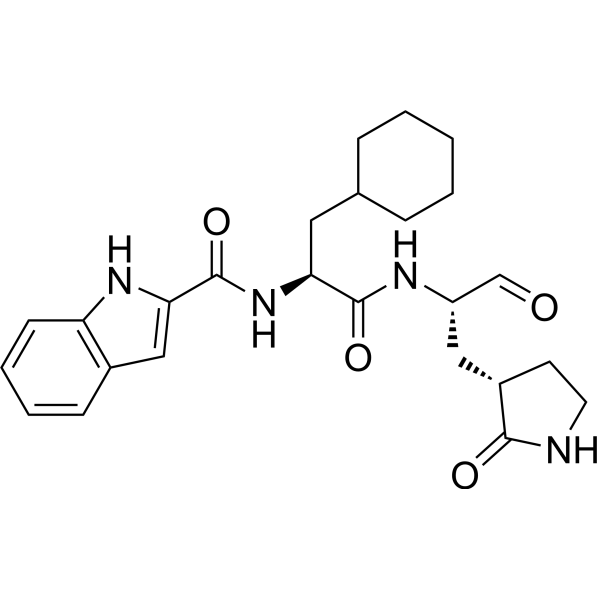
Bofutrelvir (FB2001) is a SARS-CoV-2 main protease Mpro inhibitor with an IC50 value of 53 nM and an EC50 value of 0.53 μM. Bofutrelvir exhibits potent antiviral efficacy against several current SARS-CoV-2 variants with EC50 values of 0.26-0.42 μM. Bofutrelvir has an additive antiviral effect when combined with Remdesivir.
Bofutrelvir is a small molecule inhibitor of the severe acute respiratory syndrome coronavirus-2 (SARS-CoV-2) main protease (Mpro; 3C-like protease; 3CL protease; 3CLpro; nsp5 protease), with potential antiviral activity against SARS-CoV-2. Upon intravenous administration or inhalation into the lungs, bofutrelvir selectively targets, binds to, and inhibits the activity of SARS-CoV-2 Mpro. This inhibits the proteolytic cleavage of viral polyproteins, thereby inhibiting the formation of viral proteins including helicase, single-stranded-RNA-binding protein, RNA-dependent RNA polymerase, 20-O-ribose methyltransferase, endoribonuclease and exoribonuclease. This prevents viral transcription and replication. Bofutrelvir may have antiviral activity in the brain.
Originator Frontier Biotechnologies
Class Amides; Antivirals; Indoles; Pyrrolidinones; Small molecules
Mechanism of Action Coronavirus 3C-like proteinase inhibitors
Highest Development Phases
Phase II/III COVID 2019 infections
Most Recent Events
28 Apr 2024No recent reports of development identified for phase-I development in COVID-2019-infections in USA (IV, Infusion)
04 Jan 2023Phase-II/III clinical trials in COVID-2019 infections in China (Inhalation) (NCT05675072)
30 Dec 2022Frontier Biotechnologies completes a phase I trial in COVID-2019 infections in China (Inhalation) (NCT05583812)
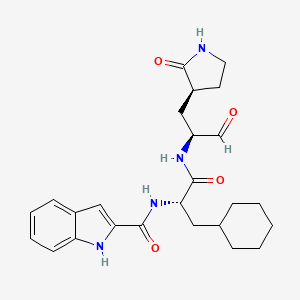
N-[(2S)-3-cyclohexyl-1-oxo-1-({(2S)-1-oxo-3-[(3S)-2-oxopyrrolidin-3-yl]propan-2-yl}amino)propan-2-yl]-1H-indole-2-carboxamide is a secondary carboxamide resulting from the formal condensation of the carboxy group of 1H-indole-2-carboxylic acid with the primary amino group of 3-cyclohexyl-N-{(2S)-1-oxo-3-[(3S)-2-oxopyrrolidin-3-yl]propan-2-yl}-L-alaninamide. It is an inhibitor of SARS coronavirus main proteinase and inhibits SARS-CoV-2 replication in cell culture (EC50 = 0.53 muM). It has a role as an EC 3.4.22.69 (SARS coronavirus main proteinase) inhibitor and an anticoronaviral agent. It is an indolecarboxamide, a member of pyrrolidin-2-ones, an aldehyde, a secondary carboxamide and an oligopeptide.
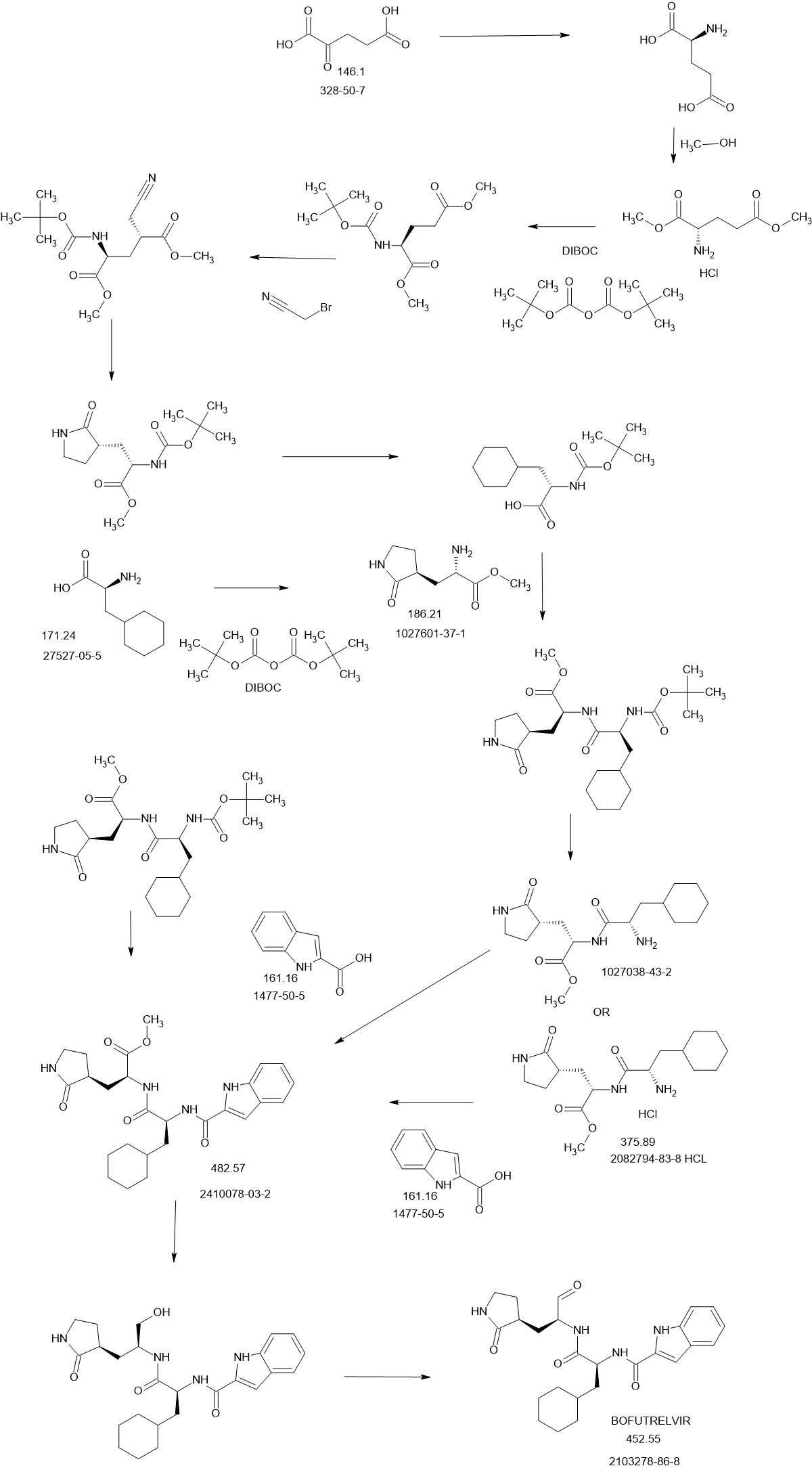
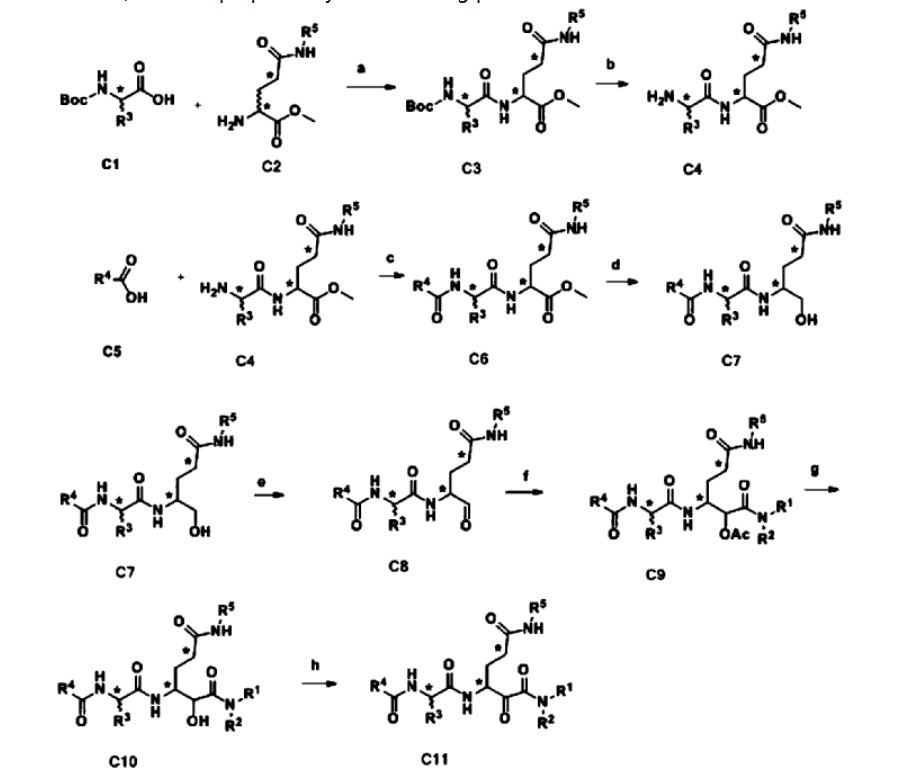
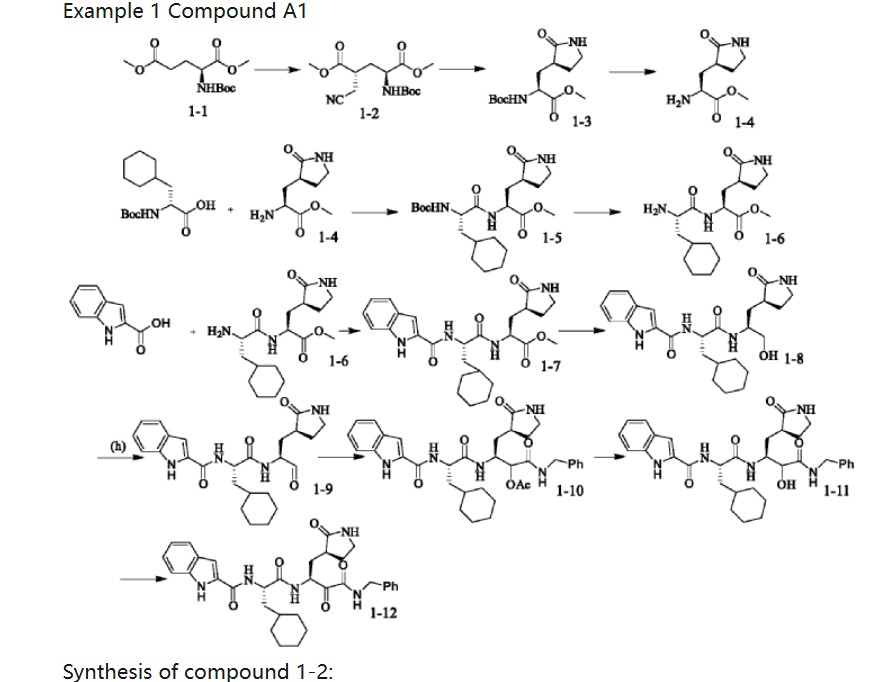
Under argon protection, N-tert-butyloxycarbonyl-L-glutamic acid dimethyl ester (1-1) (6g, 21.8mmol) was dissolved in 60mL of anhydrous tetrahydrofuran, and a tetrahydrofuran solution of LiHMDS (1M in THF) (47mL, 47mmol) was slowly dripped at -78℃, and the temperature was kept stable at -78℃ during the dripping process, which lasted for about 1 hour. After the dripping was completed, it was stirred at -78℃ for 1 hour. Bromoacetonitrile (2.79g, 23.3mmol) was dissolved in 20ml of tetrahydrofuran, and then the solution was slowly dripped into the reaction system, and the dripping process lasted for 1 to 2 hours. The temperature was controlled at -78℃ and the reaction was continued for 3 hours. After the reaction was completed, NH4Cl solution was added to the reaction solution to quench the reaction, and the mixture was stirred for 10min and then warmed to room temperature. 40mL of saturated sodium chloride solution was poured in and stirred thoroughly, and the reaction system was seen to be stratified. The organic layer was separated, and the aqueous phase was extracted with ethyl acetate (EA). The organic layers were combined, dried over anhydrous sodium sulfate, concentrated, and subjected to column chromatography (Flash, PE:EA=1:5) to obtain 3.9 g of a light yellow oil 1-2 with a yield of 58%.
Synthesis of compound 1-3:
Dissolve 1-2 (1 g, 3.15 mmol) in 25 mL of anhydrous methanol, stir to 0°C in an ice bath, and then add cobalt dichloride hexahydrate (450 mg, 1.89 mmol). After 10 min, add sodium borohydride (715 mg, 18.9 mmol) in small portions. The reaction solution continues to react in an ice bath for 1 h and then returns to room temperature. After 15 h, quench with 5 mL of saturated NH4Cl solution and continue stirring for 10 min. After filtering out the solid, evaporate the filtrate to dryness, extract with 20 mL of water and 30×3 mL of ethyl acetate, combine the organic phases, and add anhydrous Na 2 SO 4 After drying for 1 h, the residue was concentrated under reduced pressure and separated by column chromatography [PE:EA=1:2] to obtain 460 mg of a white powdery solid with a yield of 51%.
Synthesis of compound 1-4:
Compound 1-3 (2.6 g) was dissolved in a dichloromethane solution of trifluoroacetic acid (1/1, v/v), stirred at room temperature for 1 hour, concentrated, added with 100 ml of dichloromethane, washed with saturated sodium carbonate solution, and the organic layer was dried over anhydrous sodium sulfate and concentrated to obtain an oily substance 1-4 (2.7 g) with a yield of 99%.
Synthesis of compound 1-5:
Boc-cyclohexylalanine (1.26 g, 5 mmol), EDCI (1.36 g, 6 mmol), and HOBt (0.822 g, 6 mmol) were added to 80 ml of dichloromethane solution and stirred at room temperature for 30 min. Compound 1-4 (0.896 g, 5 mmol) was then added, and 1.2 equivalents of triethylamine were added dropwise, and stirred at room temperature. After TLC monitoring (ultraviolet), dichloromethane was used for extraction after the reaction was complete, and the mixture was washed with dilute hydrochloric acid, saturated sodium bicarbonate solution, and saturated sodium chloride. The organic layers were combined and dried over anhydrous sodium sulfate, and concentrated to obtain 1.2 g of a white viscous solid with a yield of 60%.
Synthesis of compound 1-6:
Compound 1-5 (2.5 g) was dissolved in a dichloromethane solution of trifluoroacetic acid (1/1, v/v), stirred at room temperature for 1 hour, concentrated, added with 100 ml of dichloromethane, washed with saturated sodium carbonate solution, and the organic layer was dried over anhydrous sodium sulfate and concentrated to obtain an oily substance 1-6 (2.61 g) with a yield of 99%.
Synthesis of compound 1-7:
Indole 2-carboxylic acid (0.795 g, 5 mmol), EDCI (1.36 g, 6 mmol), and HOBt (0.822 g, 6 mmol) were added to 80 ml of dichloromethane solution and stirred at room temperature for 30 min. Compound 1-6 (2.2 g, 5 mmol) was then added, and 1.2 equivalents of triethylamine were added dropwise, and stirred at room temperature. After TLC monitoring (ultraviolet), dichloromethane was used for extraction after the reaction was complete, and the mixture was washed with dilute hydrochloric acid, saturated sodium bicarbonate solution, and saturated sodium chloride. The organic layers were combined and dried over anhydrous sodium sulfate, and concentrated to obtain 1.3 g of a white viscous solid with a yield of 60%.
Synthesis of compound 1-8:
Dissolve 1-7 (243 mg, 0.51 mmol) in 20 ml of methanol, slowly add sodium borohydride (107 mg, 2.9 mmol) in batches, and stir at room temperature for about 2 hours to complete the reaction. After the reaction is completed, add about 20 ml of saturated brine to quench the reaction, concentrate the methanol in the reaction system, and add dichloromethane for extraction. The organic phase is washed with saturated brine, dried over anhydrous sodium sulfate, and concentrated to obtain a white solid substance 1-8, which can be directly used in the next step.
Synthesis of compound 1-9:
Dissolve the intermediate 1-8 (129 mg, 0.29 mmol) in 20 ml of dichloromethane, add Dess-Martin oxidant (147 mg, 0.35 mmol) and solid sodium bicarbonate (29 mg, 0.35 mmol), and stir at room temperature. After the reaction is complete by TLC monitoring (ultraviolet), filter the reaction system, extract the filtrate with saturated sodium bicarbonate, and the organic layer is purified by saturated sodium salt.
The product was washed with water, dried over anhydrous sodium sulfate and concentrated. The product was separated and purified by flash column chromatography (CH2Cl2:MeOH=20:1) to obtain 77 mg of compound 1 as a white solid powder with a yield of 60%.
Synthesis of compound 1-10:
Compound 1-9 (129 mg, 0.29 mmol) was dissolved in dichloromethane solvent, acetic acid (19.2 mg, 0.32 mmol) and benzyl isocyanate (37.6 mg, 0.32 mmol) were added to react to obtain compound 1-10. Flash column chromatography (CH 2 Cl 2 :MeOH=20:1) to separate and purify to obtain 126 mg of white solid powder compound 1-10 with a yield of 70%.
Synthesis of compound 1-11:
Compound 1-10 (187 mg, 0.3 mmol) was dissolved in methanol solvent, LiOH (0.6 mmol) was added and stirred to obtain compound 1-11. 2 Cl 2 :MeOH=20:1) to separate and purify to obtain 148 mg of white solid powder compound 1-11 with a yield of 85%.
Synthesis of compound 1-12:
Compound 1-11 (174 mg, 0.3 mmol) was dissolved in dichloromethane solvent, Dess-Martin oxidant (152 mg, 0.36 mmol) was added, sodium bicarbonate (30 mg, 0.36 mmol) was added, and stirred to obtain a white solid powder compound 1-12 of 140 mg in total, with a yield of 80%.
1 H NMR(500MHz,Chloroform)δ9.76(s,1H),7.73(s,1H),7.39(s,1H),7.32–7.26(m,2H),7.22(s,1H),7 .20–7.10(m,3H),7.01(s,1H),6.82(s,1H),6.68(s,1H),6.14(s,1H),5.57(s,1H),5.43(s,1H),4.3 8(s,1H),4.32(d,J=19.2Hz,2H),3.45(s,1H),3.35(s,1H),3.06(s,1H),2.20(dd,J=15.4,2.3Hz,4H ),2.12–2.03(m,2H),1.92(s,1H),1.77(s,1H),1.73–1.67(m,3H),1.66–1.53(m,6H),1.37(s,1H).;
DR ANTHONY MELVIN CRASTO, Born in Mumbai in 1964 and graduated from Mumbai University, Completed his Ph.D from ICT, 1991,Matunga, Mumbai, India, in Organic Chemistry, The thesis topic was Synthesis of Novel Pyrethroid Analogues, Currently he is working with AFRICURE PHARMA, ROW2TECH, NIPER-G, Department of Pharmaceuticals, Ministry of Chemicals and Fertilizers, Govt. of India as ADVISOR, earlier assignment was
with GLENMARK LIFE SCIENCES LTD, as CONSUlTANT, Retired from GLENMARK in Jan2022 Research Centre as Principal Scientist, Process Research (bulk actives) at Mahape, Navi Mumbai, India. Total Industry exp 32 plus yrs, Prior to joining Glenmark, he has worked with major multinationals like Hoechst Marion Roussel, now Sanofi, Searle India Ltd, now RPG lifesciences, etc. He has worked with notable scientists like Dr K Nagarajan, Dr Ralph Stapel, Prof S Seshadri, etc, He did custom synthesis for major multinationals in his career like BASF, Novartis, Sanofi, etc., He has worked in Discovery, Natural products, Bulk drugs, Generics, Intermediates, Fine chemicals, Neutraceuticals, GMP, Scaleups, etc, he is now helping millions, has 9 million plus hits on Google on all Organic chemistry websites. His friends call him Open superstar worlddrugtracker. His New Drug Approvals, Green Chemistry International, All about drugs, Eurekamoments, Organic spectroscopy international,
etc in organic chemistry are some most read blogs He has hands on experience in initiation and developing novel routes for drug molecules
and implementation them on commercial scale over a 32 PLUS year tenure till date Feb 2023, Around 35 plus products in his career. He has good knowledge of IPM, GMP, Regulatory aspects, he has several International patents published worldwide . He has good proficiency in Technology transfer, Spectroscopy, Stereochemistry, Synthesis, Polymorphism etc., He suffered a paralytic stroke/ Acute Transverse mylitis in Dec 2007 and is 90 %Paralysed, He is bound to a wheelchair, this seems to have injected feul in him to help chemists all around the world, he is more active than before and is pushing boundaries, He has 100 million plus hits on Google, 2.5 lakh plus connections on all networking sites, 100 Lakh plus views on dozen plus blogs, 227 countries, 7 continents, He makes himself available to all, contact him on +91 9323115463, email amcrasto@gmail.com, Twitter, @amcrasto , He lives and will die for his family, 90% paralysis cannot kill his soul., Notably he has 38 lakh plus views on New Drug Approvals Blog in 227 countries......https://newdrugapprovals.wordpress.com/ , He appreciates the help he gets from one and all, Friends, Family, Glenmark, Readers, Wellwishers, Doctors, Drug authorities, His Contacts, Physiotherapist, etc
He has total of 32 International and Indian awards
Follow my blog with Bloglovin
The title of your home page
You could put your verification ID in a
comment
Or, in its own meta tag
Or, as one of your keywords
Your content is here. The verification ID will NOT be detected if you put it here.

 DRUG APPROVALS BY DR ANTHONY MELVIN CRASTO
.....
DRUG APPROVALS BY DR ANTHONY MELVIN CRASTO
.....




 New Drug Approvals