
 DRUG APPROVALS BY DR ANTHONY MELVIN CRASTO
.....
DRUG APPROVALS BY DR ANTHONY MELVIN CRASTO
.....


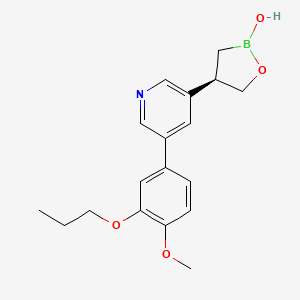
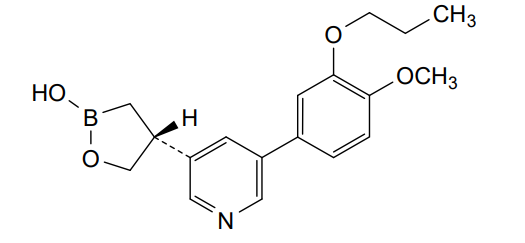
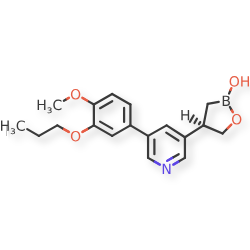
Idrebormilast
CAS 2415085-44-6
MF C18H22BNO4, MW 327.18
Pyridine, 3-[(4R)-2-hydroxy-1,2-oxaborolan-4-yl]-5-(4-methoxy-3-propoxyphenyl)-
(4R)-4-[5-(4-methoxy-3-propoxyphenyl)pyridin-3-yl]-1,2-oxaborolan-2-ol
phosphodiesterase 4 (PDE4) inhibitor, non-steroidal anti-inflammatory, M6ZU548FWD, PF07038124, PF 07038124
PF-07038124 is under investigation in clinical trial NCT05298033 (Study of Efficacy, Safety and Tolerability of Crisaborole and PF-07038124 With and Without NBUVB in Vitiligo).
IDREBORMILAST is a small molecule drug with a maximum clinical trial phase of II (across all indications) and has 2 investigational indications.
- Study of Efficacy, Safety and Tolerability of Crisaborole and PF-07038124 With and Without NBUVB in VitiligoCTID: NCT05298033Phase: Phase 2Status: CompletedDate: 2024-06-12
- PDE4 Inhibition in Seborrheic Dermatitis and Papulopustular RosaceaCTID: NCT06013371Phase: Phase 2Status: TerminatedDate: 2025-04-24
- A Study To Determine The Safety, Tolerability, Skin Irritation Potential, And PK Following Topical Application Of PF-07038124 In Healthy ParticipantsCTID: NCT04135560Phase: Phase 1Status: CompletedDate: 2020-05-14
- Study to Evaluate the Safety, Local and Systemic Tolerability, and Pharmacokinetics of Multiple-Dose Topical Administration of PF-07038124 in Japanese Healthy ParticipantsCTID: NCT04863417Phase: Phase 1Status: CompletedDate: 2024-01-25
- Study To Assess Efficacy, Safety, Tolerability And Pharmacokinetics Of PF-07038124 Ointment In Participants With Atopic Dermatitis Or Plaque PsoriasisCTID: NCT04664153Phase: Phase 2Status: CompletedDate: 2022-08-26
SYN
PAT
Example 4: (R)-4-(5-(4-methoxy-3-propoxyphenyl)pyridin-3-yl)-1 ,2-oxaborolan-2-ol
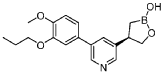
Method A:
To a mixture of (R)-(3-((tert-butyldimethylsilyl)oxy)-2-(5-(4-methoxy-3-propoxyphenyl)pyridin-3-yl)propyl)boronic acid (Preparation 6, 55 g, 120 mmol) in IPA (247 mL) was added 5 M hydrogen chloride in IPA (37 mL, 185 mmol) at about 20 °C. The mixture was stirred for about 3 h and concentrated. The residue was diluted with EtOAc (500 mL) and 1 N
HCI (500 mL) was added. The layers were separated and the EtOAc layer was extracted with 0.5 N HCI (2 x 200 mL). The aqueous extracts were combined with the separated acidic aqueous layer and washed with EtOAc (3 x 250 mL). The combined acidic aqueous layers were treated with K3PO4 to pH 5-6. The mixture was extracted with EtOAc (1 x 500 mL, 2 x 200 mL). The combined EtOAc extracts were washed with brine, dried over Na2S04, filtered and concentrated to afford (R)-4-(5-(4-methoxy-3-propoxyphenyl)pyridin-3-yl)-1 ,2-oxaborolan-2-ol (34.5 g, 88%). This was further purified by preparative SFC (Prep SFC Method C) to afford 29 g as a crude product. The crude product was dissolved in methanol (250 mL) and water (50 mL) and stirred at 20 °C for about 30 min before concentrating. The concentrated solution was partitioned between brine and EtOAc. The aqueous layer was separated and extracted with EtOAc. The EtOAc extracts were combined with the separate EtOAc layer and were washed with brine, dried over Na2S04 and concentrated. The residue was dissolved in degassed EtOAc (200 mL) and degassed heptane (100 mL) was added slowly. Heptane was added until a precipitate was observed and and the resulting mixture was stirred overnight under N2. The solid was filtered to afford 8.08 g of product. The filtrate was concentrated and the residue dissolved in EtOAc (50 mL). Heptane (25 mL) was slowly added and the mixture stirred overnight open to air. The solid was filtered to afford a second batch (6.16 g). This was repeated a second time to afford 3.0 g. The filtrate was stirred overnight to afford additional batches (2.09 g and 3.1 g) respectively. The solid batches were combined to afford (R)-4-(5-(4-methoxy-3-propoxyphenyl)pyridin-3-yl)-1 ,2-oxaborolan-2-ol (22.3 g, 57%) as a crystalline solid. Ή NMR (DMSO-cfe, 400MHz): d 8.70 (d, J = 2.3 Hz, 1 H), 8.68 (s, 1 H), 8.42 (d, J = 2.0 Hz, 1 H), 7.93 (s, 1 H), 7.27 (d, J = 2.0 Hz, 1 H), 7.23-7.26 (m, 1 H), 7.06 (d, J = 8.2 Hz, 1 H), 4.28 (t, J = 8.2 Hz, 1 H), 4.03 (t, J = 6.4 Hz, 2H), 3.86 (t, J = 9.0 Hz, 1 H), 3.81 (s, 3H), 3.46-3.54 (m, 1 H), 1 .71 -1 .80 (m, 2H), 1 .28-1 .35 (m, 1 H), 1 .15 (dd, J = 10.5, 16.4 Hz, 1 H), 1 .00 (t, J = 7.4 Hz, 3H). LCMS m/z = 328 [MH]+; RT [Analytical SFC Method B] = 7.30 min. [a]20D -23.7 (c = 0.9, EtOH).
Elemental analysis calculated (%) for Ci8H22BN04: C 66.08, H 6.78, N 4.28. Found: C 65.86, H 6.59, N 4.18.
Method B:
Step 1 : To THF (18.0 mL) was added 3-(3-((tert-butyldimethylsilyl)oxy)prop-1 -en-2-yl)-5-(4-methoxy-3-propoxyphenyl)pyridine (Preparation 50, 3.0 g, 7.25 mmol), [lr(COD)CI]2 (CAS 121 12-67-3, 36.9 mg, 0.054 mmol) and (S)[(Sp)-2-(diphenylphosphino)ferrocenyl]-4-isopropyloxazoline (CAS 163169-29-7, 52.4 mg, 0.109 mmol). Additional THF (6.0 mL) was added to the mixture which was warmed to about 50 °C for about 5 min. Catecholborane (10.9 mL, 1 0M in THF) was added to the mixture and stirred at about 50 °C for about 1 h. The mixture was cooled to about 20 °C and treated with HCI (12.2 M, 1 .51 mL) over 1 min. The mixture was held at about 20 °C for about 1 h, afterwhich a precipitate had formed. The mixture was cooled to about 10 °C and filtered. The filtered solid was washed with THF (6.0 mL) and
dried overnight at 35°C under vacuum to afford (R)-4-(5-(4-methoxy-3-propoxyphenyl)pyridine-3-yl)-1 ,2-oxaborolan-2-ol hydrochloride monohydrate (3.98 g, 91 %) as a crystalline solid. 1H NMR (CD3OD, 400MHz): d 8.98 (d, J = 1 .5 Hz, 1 H), 8.75 (s, 1 H), 8.67 (d, J = 1 .3 Hz, 1 H), 7.37-7.43 (m, 2H), 7.15 (d, J = 8.3 Hz, 1 H), 4.09 (t, J = 6.5 Hz, 2H), 3.89-3.92 (m, 1 H), 3.86-3.95 (m, 5H), 3.46 (br s, 1 H), 1 .85 (m, 2H), 1 .31 -1 .42 (m, 2H), 1 .08 (t, J = 7.4 Hz, 3H). LCMS m/z = 328 [MH]+.
Step 2: To a solution of (R)-4-(5-(4-methoxy-3-propoxyphenyl)pyridine-3-yl)-1 ,2-oxaborolan-2-ol hydrochloride monohydrate (2.0 g, 5.24 mmol) in water (60 ml_) was added EtOAc (20 ml_). To the stirred mixture was added NaOH (1 N) dropwise to adjust the pH of the aqeous layer to 7-8. The mixture was stirred at about 20 °C for about 5 min. The layers were separated and the aqueous layer was extracted with EtOAc (2 x 10 ml_). The combined EtOAc extracts were concentrated. The residue was dissolved in THF/MTBE (1 :3, 22 ml_) and stirred at about 20 °C overnight. The precipitate was filtered and dried under vacuum to afford (R)-4-(5-(4-methoxy-3-propoxyphenyl)pyridine-3-yl)-1 ,2-oxaborolan-2-ol (1 .17 g, 68%) as a crystalline solid. Ή NMR (DMSO-cfe, 400MHz): d 8.70 (d, J = 2.3 Hz, 1 H), 8.68 (s, 1 H), 8.42 (d, J = 2.0 Hz, 1 H), 7.93 (s, 1 H), 7.27 (d, J = 2.0 Hz, 1 H), 7.23-7.26 (m, 1 H), 7.06 (d, J = 8.2 Hz, 1 H), 4.28 (t, J = 8.2 Hz, 1 H), 4.03 (t, J = 6.4 Hz, 2H), 3.86 (t, J = 9.0 Hz, 1 H), 3.81 (s, 3H), 3.46-3.54 (m, 1 H), 1 .71 -1 .80 (m, 2H), 1 .28-1 .35 (m, 1 H), 1 .15 (dd, J = 10.5, 16.4 Hz, 1 H), 1 .00 (t, J = 7.4 Hz, 3H). LCMS m/z = 328 [MH]+.
Method C:
To a solution of (R)-(3-((tert-butyldimethylsilyl)oxy)-2-(5-(4-methoxy-3-propoxyphenyl)pyridin-3-yl)propyl)boronic acid (Preparation 6, 29.0 g, 63.1 mmol) in THF (66 mL) was added aqueous HCI (84.2 mL, 252 mmol, 3.0 M) and stirred at 20 °C for about 1 .5 h. The mixture was concentrated. The mixture was diluted with 1 M HCI and extracted with EtOAc (3 x 100 mL). The combined EtOAc extracts were washed with 1 M HCI (3 x 50 mL). The combined aqueous extracts were neutralized with K3PO4 to pH 7-8 and extracted with EtOAc (3 x 100 mL). The combined EtOAc extracts were dried over Na2S04, filtered and concentrated to afford (R)-4-(5-(4-methoxy-3-propoxyphenyl)pyridin-3-yl)-1 ,2-oxaborolan-2-ol (19.0 g, 92%).
This was further purified by preparative SFC (Prep SFC Method C) to afford 18 g of the crude product. The crude product was dissolved in MeOH (100 mL) and water (50 mL). The mixture was partitioned between brine and EtOAc. The layers were separated and the aqueous layer was extracted with EtOAc. The combined EtOAc extracts were washed with brine, dried over Na2S04 and concentrated to afford 15 g of product. The residue was dissolved in EtOAc (60 mL) and heptane (30 mL) was slowly added over about 3 h. The mixture was stirred at about 20 °C overnight. The precipitate was filtered and dried to afford (8.08 g). This process was repeated 2 more times to afford additional batches (2.01 g and 1 .03 g), respectively. The three batches were combined in heptane (100 mL), chilled to about -78 °C for about 10 min, filtered
and dried to afford (R)-4-(5-(4-methoxy-3-propoxyphenyl)pyridin-3-yl)-1 ,2-oxaborolan-2-ol (10.4 g, 51 %) as a crystalline solid. Ή NMR (DMSO -d6, 400MHz): d 8.70 (d, J = 2.3 Hz, 1 H), 8.68 (s,
1 H), 8.42 (d, J = 2.0 Hz, 1 H), 7.93 (s, 1 H), 7.27 (d, J = 2.0 Hz, 1 H), 7.23-7.26 (m, 1 H), 7.06 (d, J = 8.2 Hz, 1 H), 4.28 (t, J = 8.2 Hz, 1 H), 4.03 (t, J = 6.4 Hz, 2H), 3.86 (t, J = 9.0 Hz, 1 H), 3.81 (s, 3H), 3.46-3.54 (m, 1 H), 1 .71 -1 .80 (m, 2H), 1 .28-1 .35 (m, 1 H), 1 .15 (dd, J = 10.5, 16.4 Hz, 1 H),
1 .00 (t, J = 7.4 Hz, 3H). LCMS m/z = 328 [MH]+.
PAT
- Substituted 1,2-oxaborolan-2-ols as PDE4 inhibitorsPublication Number: US-11559538-B2Priority Date: 2018-10-05Grant Date: 2023-01-24
- Boron-containing PDE4 inhibitorsPublication Number: CN-113166177-BPriority Date: 2018-10-05Grant Date: 2024-09-03
- Boron Containing PDE4 InhibitorsPublication Number: US-2021069219-A1Priority Date: 2018-10-05
- Boron containing pde4 inhibitorsPublication Number: CA-3114702-CPriority Date: 2018-10-05Grant Date: 2023-08-08
- PDE4 INHIBITORS CONTAINING BORONPublication Number: BR-112021005870-B1Priority Date: 2018-10-05
- Boron containing pde4 inhibitorsPublication Number: WO-2020070651-A1Priority Date: 2018-10-05
- Boron-containing PDE4 inhibitorsPublication Number: CN-113166177-APriority Date: 2018-10-05
- Boron Containing PDE4 InhibitorsPublication Number: US-2023148402-A1Priority Date: 2018-10-05
- Boron containing pde4 inhibitorsPublication Number: EP-3861001-A1Priority Date: 2018-10-05
- Boron-containing PDE4 inhibitorsPublication Number: ES-2974208-T3Priority Date: 2018-10-05Grant Date: 2024-06-26
- PDE4 inhibitor (R)-4-(5-(4-methoxy-3-propoxyphenyl)pyridin-3-yl)-1,2-oxaborolan-2-olPublication Number: US-10946031-B2Priority Date: 2018-10-05Grant Date: 2021-03-16
- Boron-containing PDE4 inhibitorsPublication Number: KR-102576125-B1Priority Date: 2018-10-05Grant Date: 2023-09-08
- Boron-containing PDE4 inhibitorsPublication Number: KR-20210068532-APriority Date: 2018-10-05
- Boron containing pde4 inhibitorsPublication Number: EP-3861001-B1Priority Date: 2018-10-05Grant Date: 2023-12-13
- Boron Containing PDE4 InhibitorsPublication Number: US-2020108083-A1Priority Date: 2018-10-05
- Boron containing pde4 inhibitorsPublication Number: CA-3114702-A1Priority Date: 2018-10-05
- boron containing pde4 inhibitorsPublication Number: BR-112021005870-A2Priority Date: 2018-10-05
- Boron containing pde4 inhibitorsPublication Number: TW-202027755-APriority Date: 2018-10-05
- Stable topical formulations of 1(r)-4-(5-(4-methoxy-3-propoxyphenyl)pyridin-3-yl)-1,2-oxaborolan-2-olPublication Number: CA-3191886-A1Priority Date: 2020-08-20
- STABLE TOPICAL FORMULATIONS OF 1(R)-4-(5-(4-METHOXY-3-PROPOXYPHEN IL)PYRIDIN-3-IL)-1,2-OXABOROLAN-2-OL.Publication Number: MX-2023002086-APriority Date: 2020-08-20
- Stable topical formulations of 1(r)-4-(5-(4-methoxy-3-propoxyphenyl)pyridin-3-yl)-1,2-oxaborolan-2-olPublication Number: WO-2022038485-A1Priority Date: 2020-08-20
- 1(R)-4-(5-(4-methoxy-3-propoxyphenyl)pyridin-3-yl)-1,2-oxaborolan-2-ol is a stable partial preparationPublication Number: CN-115916260-APriority Date: 2020-08-20
- Stable Topical Formulations of 1(R)-4-(5-(4-Methoxy-3-Propoxphenyl)Pyridin-3-YL)-1,2-OX-Aborolan-2-OLPublication Number: US-2023310472-A1Priority Date: 2020-08-20
- Combination therapyPublication Number: WO-2024231312-A2Priority Date: 2023-05-05
- Borate derivative and uses thereofPublication Number: EP-4269418-A1Priority Date: 2020-12-25
- Stable topical formulations of 1(r)-4-(5-(4-methoxy-3-propoxyphenyl)pyridin-3-yl)-1,2-oxaborolan-2-olPublication Number: EP-4199902-A1Priority Date: 2020-08-20
- Stable topical formulation of 1(R)-4-(5-(4-methoxy-3-propoxyphenyl)pyridin-3-yl)-1,2-oxaborolan-2-olPublication Number: JP-2023538362-APriority Date: 2020-08-20
- STABLE TOPICAL FORMULATIONS OF 1(R)-4-(5-(4-METHOXY-3-PROPOXYPHENYL)PYRIDIN-3-IL)-1,2-OXABOROLAN-2-OLPublication Number: BR-112023002533-A2Priority Date: 2020-08-20


AS ON OCT2025 4.511 LAKHS VIEWS ON BLOG WORLDREACH AVAILABLEFOR YOUR ADVERTISEMENT
join me on Linkedin
Anthony Melvin Crasto Ph.D – India | LinkedIn
join me on Researchgate
RESEARCHGATE

join me on Facebook
Anthony Melvin Crasto Dr. | Facebook
join me on twitter
Anthony Melvin Crasto Dr. | twitter
+919321316780 call whatsaapp
EMAIL. amcrasto@gmail.com

……
//////////idrebormilast, phosphodiesterase 4 (PDE4) inhibitor, non-steroidal anti-inflammatory, M6ZU548FWD, PF07038124, PF 07038124


 New Drug Approvals