New Drug Approvals

Home » Posts tagged 'CANCER' (Page 4)

Tag Archives: CANCER

DRUG APPROVALS BY DR ANTHONY MELVIN CRASTO .....FOR BLOG HOME CLICK HERE

Blog Stats

  • 4,810,975 hits

Flag and hits

Flag Counter

Enter your email address to follow this blog and receive notifications of new posts by email.

Join 37.9K other subscribers
Follow New Drug Approvals on WordPress.com

Archives

Categories

Recent Posts

Flag Counter

ORGANIC SPECTROSCOPY

Read all about Organic Spectroscopy on ORGANIC SPECTROSCOPY INTERNATIONAL 

Enter your email address to follow this blog and receive notifications of new posts by email.

Join 37.9K other subscribers
DR ANTHONY MELVIN CRASTO Ph.D

DR ANTHONY MELVIN CRASTO Ph.D

DR ANTHONY MELVIN CRASTO, Born in Mumbai in 1964 and graduated from Mumbai University, Completed his Ph.D from ICT, 1991,Matunga, Mumbai, India, in Organic Chemistry, The thesis topic was Synthesis of Novel Pyrethroid Analogues, Currently he is working with AFRICURE PHARMA, ROW2TECH, NIPER-G, Department of Pharmaceuticals, Ministry of Chemicals and Fertilizers, Govt. of India as ADVISOR, earlier assignment was with GLENMARK LIFE SCIENCES LTD, as CONSUlTANT, Retired from GLENMARK in Jan2022 Research Centre as Principal Scientist, Process Research (bulk actives) at Mahape, Navi Mumbai, India. Total Industry exp 32 plus yrs, Prior to joining Glenmark, he has worked with major multinationals like Hoechst Marion Roussel, now Sanofi, Searle India Ltd, now RPG lifesciences, etc. He has worked with notable scientists like Dr K Nagarajan, Dr Ralph Stapel, Prof S Seshadri, etc, He did custom synthesis for major multinationals in his career like BASF, Novartis, Sanofi, etc., He has worked in Discovery, Natural products, Bulk drugs, Generics, Intermediates, Fine chemicals, Neutraceuticals, GMP, Scaleups, etc, he is now helping millions, has 9 million plus hits on Google on all Organic chemistry websites. His friends call him Open superstar worlddrugtracker. His New Drug Approvals, Green Chemistry International, All about drugs, Eurekamoments, Organic spectroscopy international, etc in organic chemistry are some most read blogs He has hands on experience in initiation and developing novel routes for drug molecules and implementation them on commercial scale over a 32 PLUS year tenure till date Feb 2023, Around 35 plus products in his career. He has good knowledge of IPM, GMP, Regulatory aspects, he has several International patents published worldwide . He has good proficiency in Technology transfer, Spectroscopy, Stereochemistry, Synthesis, Polymorphism etc., He suffered a paralytic stroke/ Acute Transverse mylitis in Dec 2007 and is 90 %Paralysed, He is bound to a wheelchair, this seems to have injected feul in him to help chemists all around the world, he is more active than before and is pushing boundaries, He has 100 million plus hits on Google, 2.5 lakh plus connections on all networking sites, 100 Lakh plus views on dozen plus blogs, 227 countries, 7 continents, He makes himself available to all, contact him on +91 9323115463, email amcrasto@gmail.com, Twitter, @amcrasto , He lives and will die for his family, 90% paralysis cannot kill his soul., Notably he has 38 lakh plus views on New Drug Approvals Blog in 227 countries......https://newdrugapprovals.wordpress.com/ , He appreciates the help he gets from one and all, Friends, Family, Glenmark, Readers, Wellwishers, Doctors, Drug authorities, His Contacts, Physiotherapist, etc He has total of 32 International and Indian awards

Verified Services

View Full Profile →

Archives

Categories

Flag Counter

Talazoparib, MDV3800


Talazoparib.svg

Talazoparib, BMN-673, MDV-3800

(2S,3S)-methyl-7-fluoro-2-(4-fluorophenyl)-3-(1-methyl-1H-1,2,4-triazol-5-yl)-4-oxo-1,2,3,4-tetrahydroquinoline-5-carboxylate

(8S,9R)-5-fluoro-8-(4-fluorophenyl)-9-(1-methyl-1H-1,2,4-triazol-5-yl)-8,9-dihydro-2H-pyrido[4,3,2-de]phthalazin-3(7H)-one

(8S,9R)-5-Fluoro-8-(4-fluorophenyl)-9-(1-methyl-1H-1,2,4-triazol-5-yl)-2,7,8,9-tetrahydro-3H-pyrido[4,3,2-de]phthalazin-3-one

CAS 1207456-01-6
Chemical Formula: C19H14F2N6O
Exact Mass: 380.11972

BMN673, BMN673, BMN-673, LT673, LT 673, LT-673,  Talazoparib

BioMarin Pharmaceutical Inc

phase 3

Poly ADP ribose polymerase 2 inhibitor; Poly ADP ribose polymerase 1 inhibitor

cancer

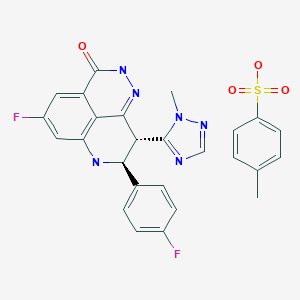
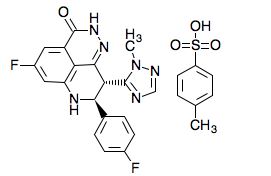
(85,9R)-5-fluoro-8-(4-fluorophenyl)-9-(l-methyl-lH-l,2,4-triazol-5-yl)-8,9-dihydro-2H-pyrido[4,3,2-de]phthalazin-3(7H)-one toluenesulfonate salt

CAS 1373431-65-2(Talazoparib Tosylate)

1H NMR DMSOD6

str1

13C NMR DMSOD6

str1

HMBC NMR

str1

HSQC NMR

str1

Talazoparib (BMN-673) is an investigational drug that acts as a PARP inhibitor. It is in clinical trials for various cancers.
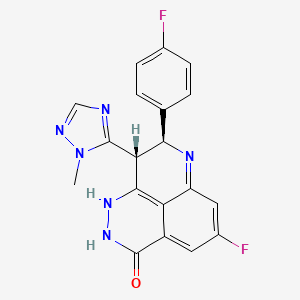
Talazoparib.png

Medivation, under license from BioMarin Pharmaceuticals, following its acquisition of LEAD Therapeutics, is developing a PARP-1/2 inhibitor, talazoparib, for treating cancer, particularly BRCA-mutated breast cancer. In February 2016, talazoparib was reported to be in phase 3 clinical development

Talazoparib, also known as BMN-673, is an orally bioavailable inhibitor of the nuclear enzyme poly(ADP-ribose) polymerase (PARP) with potential antineoplastic activity (PARP1 IC50 = 0.57 nmol/L). BMN-673 selectively binds to PARP and prevents PARP-mediated DNA repair of single strand DNA breaks via the base-excision repair pathway. This enhances the accumulation of DNA strand breaks, promotes genomic instability and eventually leads to apoptosis. PARP catalyzes post-translational ADP-ribosylation of nuclear proteins that signal and recruit other proteins to repair damaged DNA and is activated by single-strand DNA breaks. BMN-673 has been proven to be highly active in mouse models of human cancer and also appears to be more selectively cytotoxic with a longer half-life and better bioavailability as compared to other compounds in development. Check for active clinical trials or closed clinical trials using this agent.

Talazoparib is C19H14F2N6O.

Talazoparib tosylate is C26H22F2N6O4S.[1]

Approvals and indications

None yet.

Mechanism of action

Main article: PARP inhibitor

Clinical trials

After trials for advanced hematological malignancies and for advanced or recurrent solid tumors.[2] it is now in phase 3 for metastatic germline BRCA mutated breast cancer.[3] Trial estimated to complete in June 2016.[4]

As of January 2016 it in 14 active clinical trials.[5]

WO2010017055,  WO2015069851, WO 2012054698, WO 2011130661, WO 2013028495, US 2014323725, WO 2011097602

PAPER

Discovery and Characterization of (8S,9R)-5-Fluoro-8-(4-fluorophenyl)-9-(1-methyl-1H-1,2,4-triazol-5-yl)-2,7,8,9-tetrahydro-3H-pyrido[4,3,2-de]phthalazin-3-one (BMN 673, Talazoparib), a Novel, Highly Potent, and Orally Efficacious Poly(ADP-ribose) Polymerase-1/2 Inhibitor, as an Anticancer Agent

BioMarin Pharmaceutical Inc., 105 Digital Drive, Novato, California 94949, United States
J. Med. Chem.201659 (1), pp 335–357
DOI: 10.1021/acs.jmedchem.5b01498
Publication Date (Web): December 10, 2015
Copyright © 2015 American Chemical Society
*Phone: 1-415-506-3319. E-mail: bwang@bmrn.com.

Abstract

Abstract Image

We discovered and developed a novel series of tetrahydropyridophthlazinones as poly(ADP-ribose) polymerase (PARP) 1 and 2 inhibitors. Lead optimization led to the identification of (8S,9R)-47 (talazoparib; BMN 673; (8S,9R)-5-fluoro-8-(4-fluorophenyl)-9-(1-methyl-1H-1,2,4-triazol-5-yl)-2,7,8,9-tetrahydro-3H-pyrido[4,3,2-de]phthalazin-3-one). The novel stereospecific dual chiral-center-embedded structure of this compound has enabled extensive and unique binding interactions with PARP1/2 proteins. (8S,9R)-47 demonstrates excellent potency, inhibiting PARP1 and PARP2 enzyme activity with Ki = 1.2 and 0.87 nM, respectively. It inhibits PARP-mediated PARylation in a whole-cell assay with an EC50 of 2.51 nM and prevents proliferation of cancer cells carrying mutant BRCA1/2, with EC50 = 0.3 nM (MX-1) and 5 nM (Capan-1), respectively. (8S,9R)-47 is orally available, displaying favorable pharmacokinetic (PK) properties and remarkable antitumor efficacy in the BRCA1 mutant MX-1 breast cancer xenograft model following oral administration as a single-agent or in combination with chemotherapy agents such as temozolomide and cisplatin. (8S,9R)-47 has completed phase 1 clinical trial and is currently being studied in phase 2 and 3 clinical trials for the treatment of locally advanced and/or metastatic breast cancer with germline BRCA1/2 deleterious mutations.

http://pubs.acs.org/doi/abs/10.1021/acs.jmedchem.5b01498

http://pubs.acs.org/doi/suppl/10.1021/acs.jmedchem.5b01498/suppl_file/jm5b01498_si_001.pdf

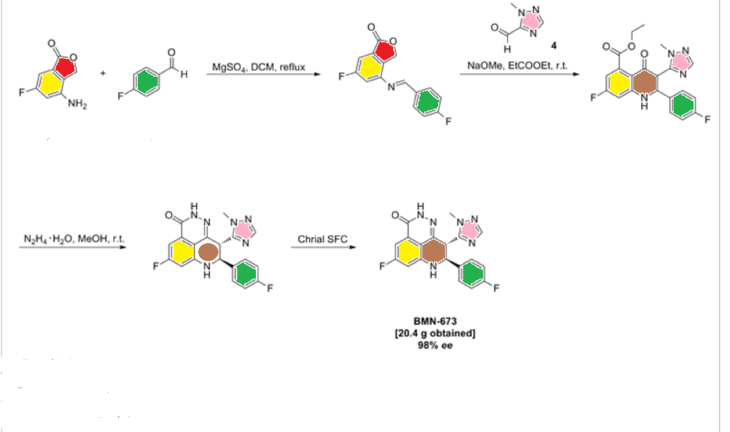
Preparation of (8S,9R)-5-Fluoro-8-(4-fluorophenyl)-9-(1-methyl-1H-1,2,4-triazol-5-yl)-2,7,8,9-tetrahydro-3H-pyrido[4,3,2-de]phthalazin-3-one Tosylate Salt ((8S,9R)-47 Tosylate Salt)

A suspension of (8S,9R)-47 (BMN 673) (400 mg, 1.05 mmol) in a mixture of acetone (27 mL) and THF (13 mL) was heated to reflux until the suspension became clear. TsOH (220 mg, 1.16 mmol) was then added to the solution. White solids started to precipitate out from the solution shortly after the addition of TsOH. After stirring at 25 °C for 30 min, the mixture was filtered to collect the white crystal solids, which were washed with a mixture of acetone (10 mL) and 1,4-dioxane (4 mL) and then dried under vacuum at 45 °C for 3 days. This afforded the product as a white crystalline solid (540 mg, yield 93%). 1H NMR (400 MHz, DMSO-d6) δ (ppm) 2.29 (s, 3H), 3.67 (s, 3H), 4.97–5.06 (m, 2H), 6.91–6.94 (dd, J1 = 2.0 Hz, J2 = 10.8 Hz, 1H), 7.06–7.19 (m, 5H), 7.19–7.51 (m, 4H), 7.74 (s, 1H), 7.87 (s, 1H), 10.32 (brs, 1H), 12.36 (s, 1H). LC-MS (ESI)m/z: 381 (M + H)+. Anal. Calcd for C19H14F2N6O·toluene sulfonic acid: C, 56.52; H, 4.01; N, 15.21. Found: C, 56.49; H, 3.94; N, 15.39.

(8S,9R)-5-Fluoro-8-(4-fluorophenyl)-9-(1-methyl-1H-1,2,4-triazol-5-yl)-2,7,8,9-tetrahydro-3H-pyrido[4,3,2-de]phthalazin-3-one (8S,9R)-47 or BMN 673 and (8R,9S)-5-Fluoro-8-(4-fluorophenyl)-9-(1-methyl-1H-1,2,4-triazol-5-yl)-2,7,8,9-tetrahydro-3H-pyrido[4,3,2-de]phthalazin-3-one (8R,9S)-47

Compound 47 was dissolved in DMF, and chiral resolution was performed using supercritical-fluid chromatography (SFC) with a CHIRALPAK IA chiral column and methanol (20% with 0.1% DEA) and CO2 (80%) as the eluents. Yield 90%. For (8S,9R)-47 (BMN 673): retention time 8.8 min and ee 99.3%. For (8R,9S)-47: retention time 10.2 min and ee 99.2%.
Alternatively, compound (8S,9R)-47 could also be made using (2S,3R)-60a as a starting material and employing the same procedure described for the conversion of 60a to 47.
The optical rotation for both (8S,9R)-47 and (8R,9S)-47 was measured using a RUDOLPH (AUTOPOL V) automatic polarimeter at a concentration of 6.67 mg/mL in MeOH/MeCN/DMF = 0.5:0.5:1 at 20 °C. The specific rotation for (8S,9R)-47 was +92.2°, whereas it was −93.4° for (8R,9S)-47.

PATENT

WO-2016019125

WO2016019125

The compound (85,9R)-5-fluoro-8-(4-fluorophenyl)-9-(l-methyl-lH-l,2,4-triazol-5-yl)-8,9-dihydro-2H-pyrido[4,3,2-de]phthalazin-3(7H)-one toluenesulfonate salt (Compound (A))

Compound (A)

is an inhibitor of poly(ADP-ribose)polymerase (PARP). Methods of making it are described in WO2010017055, WO2011097602, and WO2012054698. However, the disclosed synthetic routes require chiral chromatography of one of the synthetic intermediates in the route to make Compound (A), methyl 7-fluoro-2-(4-fluorophenyl)-3-(l -methyl- lH-1, 2,4-triazol-5-yl)-4-oxo- 1 ,2,3,4-tetrahydroquinoline-5-carboxylate (Intermediate (A)),

Intermediate (A)

to yield the chirally pure (2S,35)-methyl 7-fluoro-2-(4-fluorophenyl)-3-(l-methyl-lH- 1,2,4-triazol-5-yl)-4-oxo-l,2,3,4-tetrahydroquinoline-5-carboxylate (Compound (1))

Compound (1).

Using conventional chiral chromatography is often solvent and time intensive.

Use of more efficient chromatography methods, such as simulated moving bed (SMB) chromatography still requires the use of expensive chiral chromatography resins, and is not practical on a large scale to purify pharmaceutical compounds. Also, maintaining

Compound (1) in solution for an extended time period during chromatography can lead to epimerization at the 9-position and cleavage of the methyl ester group in Compound (1). Replacing the chromatography step with crystallization step(s) to purify Compound (1) is desirable and overcomes these issues. Therefore, it is desirable to find an alternative to the use of chiral chromatography separations to obtain enantiomeric Compound (1).

Scheme 1 below describes use of Ac49 as a coformer acid for the preparation of Compound (la) and for the chiral resolution of Compound (1).

Scheme 1

Compound (1 )

Example 2 – Preparation of Compound (1) Using Scheme 1

Step la

Intermediate (A) (5 g, 12.5 mmol) was dissolved in 9: 1 v/v MIBK/ethanol (70 mL, 14 vol.) at 50 °C with stirring and dissolution was observed in less than about 5 minutes. [(lS)-en<io]-(+)-3-bromo-10-camphor sulfonic acid monohydrate (4.1 g, 12.5 mmol) was added and dissolution was observed in about 10-20 minutes. Seeding was then performed with Compound (la) (95% e.e., 5 mg, 0.1% w.) and the system was allowed to equilibrate for about 1 hour at 50 °C, was cooled to about 20 °C at 0.15 °C/min, and then equilibrated at 20 °C for 2 hours. The solid phase was isolated by filtration, washed with ethanol, and dried at about 50 °C and 3 mbar for about 2 to 3 hours to yield Compound (la) as a 0.6 molar equiv. EtOH solvate and 0.6 molar equiv. hydrate (93.4% e.e.).

Step lb

Compound (la) was then suspended in MIBK/ethanol 95/5% by volume (38 mL, 10 vol.) at 50 °C with stirring. After about 2 hours at 50 °C, the suspension was cooled to about 5 °C for 10 to 15 hours. The solid phase was recovered by filtration and dried at about 50 °C and 3 mbar for about 3 hours. Compound (la) (97.4% e.e.) was recovered. Step 2

000138] Compound (1) was released by suspending Compound (la) (3.9 g, 5.5 mmoi), without performing the optional reslurrying in Step 1, in 20 mL of water at room temperature and treating with 5M sodium hydroxide in water (1.3 mL, 1.2 mol). The mixture was kept at room temperature for about 15 hours and the solid was isolated by filtration and dried at 50 °C and 3 mbar for about 3 hours. Compound (1) was recovered (94.4% e.e.).

Example 3 – Large Scale Preparation of Compound (1) Using Scheme 1

The procedure of Example 1 was followed using 3.3 kg of Intermediate (A) and the respective solvent ratios to provide 95.7% e.e. in Step la; 99.2% e.e. in Step lb; and 99.2% e.e. in Step 2.

Example 4 – Alternative Preparation of Compound (1) Using Scheme 1

Step la

Intermediate (A) (751 mg, 1.86 mmol)) was dissolved in 9: 1 v/v

MIBK/ethanol (7.5 mL, 10 vol.) at 50 °C with stirring. [(15)-eni o]-(+)-3-bromo-10-camphor sulfonic acid monohydrate (620 mg, 1.88 mmol, 1 equiv.) was added. Formation of a precipitate was observed at about 1 hour at 50 °C. The system was then cooled to about 5 °C at 0.1 °C/min, and then equilibrated at 5 °C for about 60 hours. The solid phase was isolated by filtration and dried at about 50 °C and 3 mbar for about 2 hours to yield

Compound (la)(92% e.e.). See Figures 1-4 for XRPD (Figure 1), chiral HPLC (Figure 2), Ή NMR (Figure 3), and TGA/DSC analyses (Figure 4). The XRPD pattern from the material in Example 3 is similar to that in Example 1 with some slight shifts in the positions of specific diffraction peaks (highlighted by black arrows in Figure l). The ‘H NIVIR was consistent with a mono-salt of Compound (la) containing 0.5 molar equivalent of EtOH and 0.6% by weight residual MIBK. The TGA analysis showed a stepwise mass loss of 3.5% between 25 and 90 °C (potentially representing loss of the 0.5 molar equivalent of EtOH) and a gradual mass loss of 1.2% between 90 and 160 °C (potentially representing the loss of adsorbed water). The DSC analysis had a broad endotherm between 25 and 90 °C

representing desolvation and an endotherm at 135 °C representing melt/degradation.

Step lb

Compound (la) (100.3 mg, 0.141 mmol) was re-suspended in 95:5 v/v MIBK EtOH (1 mL, 10 vol.) at 50 °C and stirred for 1 hour before cooling to 5 °C at

0.1 °C/min. The solid (99.4% e.e.) was recovered by filtration after 1 night at 5 °C. Shifts in the XRPD diffraction peaks were no longer detected (Figure 5; compare Figure 1). Figure 6 shows the chiral HPLC for Compound (la).

Step 2

Compound (la) (100.2 mg, 0.141 mmol) from Step la was suspended in water (2 mL, 20 vol.) at 50 °C and 5 M NaOH in water (34 μL·, 1.2 molar equiv) was added. The resulting suspension was kept at 50 °C for one night, cooled to room temperature

(uncontrolled cooling) and filtered to yield Compound (1) (92% e.e.). The chiral purity was not impacted by this step and no [(15)-enJo]-(+)-3-bromo-10-camphor sulfonic acid was detected by NMR. Figure 7 compares the XRPD of Compound (1) in Step 2 with

Intermediate (A), the starting material of Step 1. Figure 8 shows the NMR of Compound (1) in Step 2 with Intermediate (A), the starting material of Step 1.

Example 5 – Alternative Preparation of Compound (1) Using Scheme 1 Step la

000144] Intermediate (A) (1 equiv.) was added with stirring to a solution of MIBK (12-13 vol), ethanol (1-1.5 vol), and water (0.05-0.10 vol) and the reaction was heated within 15 minutes to an internal temperature of about 48 °C to about 52 °C . [(lS)-endo]-(+)-3-bromo- 10-camphor sulfonic acid (1 equiv) was added and the reaction was stirred for about 5-10 mins at an internal temperature of about 48 °C to about 52 °C until dissolution occurred. Seed crystals of Compound (la) were added and the reaction was allowed to proceed for 1 hour at an internal temperature of about 48 °C to about 52 °C. The reaction was cooled at a rate of 0.15 °C /min to about 19-21 °C. The suspension was stirred for 2 hours at an internal temperature of about 19 °C to 21 °C and then was collected by filtration and washed twice with ethanol. The product was characterized by 1H NMR and 13C NMR (Figures 13a and 13b), IR Spectrum (Figure 14), DSC (Figure 15), and chiral HPLC (Figure 16).

Step 2a

To Compound (la) (1 equiv.) was added acetone (1.1 vol), IPA (0.55 vol), and methanol (0.55 vol) and the reaction was heated to an internal temperature of about 38 °C to 42 °C. Aqueous ammonia (25%) (1.3 equiv) was added and the reaction was stirred for about 10 minutes. The pH of the reaction was confirmed and the next step performed if > 7. Water was added (0.55 vol), the reaction was cooled to an internal temperature of about 35 °C, seed crystals of Compound (1) were added, and the reaction was stirred for about 10 mins. Water was added (3.3 vol) dropwise within about 30 minutes, the suspension was cooled within 30 minutes to an internal temperature of about 0 °C to 5 °C, and the reaction was stirred for 15 minutes. The solid was collected by filtration and washed three times with water.

Step 2b

To the product of Step 2a) was added acetone (4 vol), ΓΡΑ (1 vol), and methanol (1 vol) and the reaction was heated to an internal temperature of about 38 °C to 42 °C resulting in a clear solution. Water (2 vol) and seed crystals of Compound (1) were added and the system was stirred for about 15 minutes at an internal temperature of about 35 °C. Water (342 mL) was added dropwise in about 30 minutes. The suspension was then cooled in 30 min to an internal temperature of about 0 °C to 5 °C and was stirred for an additional 15 minutes. The solid was collected by filtration, washed twice with water, and chiral purity was determined. If > 99% e.e., then the solid was dried at an internal temperature of about 60 °C under reduced pressure to yield Compound (1). The product was characterized by Ή NMR (Figure 19), 13C NMR (Figure 20), IR (Figure 21), DSC (Figure 22), chiral HPLC (Figure 23).

Scheme 2 below describes use of Acl 10 as a coformer acid for the preparation of Compound (lb) and the chiral resolution of Compound (1).

Intermediate (A)

Compound (1 b)

Intermediate (A)

Compound (1 b)

Compound (1 )

Example 6 – Preparation of Compound (1) Using Scheme 2

Step la

Intermediate (A) (102 mg, 0.256 mmol) was dissolved in MIBK (1 mL, 10 vol.) at 65 °C with stirring. (lS)-phenylethanesulfonic acid, prepared using procedures known to one of skill in the art, in MIBK (3.8 M, 80 μί, 1 molar equiv.) was added and a suspension was observed after 30 minutes at 65 °C. The system was kept at 65 °C for another 30 minutes before cooling to 5 °C at 0.1 C/min. After one night at 5 °C, the solid was filtered, dried at 50 °C, 3 mbar pressure for about 2 hours to yield Compound (lb). See Figures 9-12 for XRPD (Figure 9), chiral HPLC (Figure 10), Ή NMR (Figure 11), and TGA/DSC analyses (Figures 12a and 12b). The XRPD diffraction pattern of the solid obtained in Example 5 differed from the XRPD pattern obtained with the solid from in the salt screen of Example 1 and was consistent with the production of different solids in Examples 1 and 5. The Ή NMR was consistent with the mono-salt with a 0.3% by weight residue of dioxane. In Figure 12a, the thermal behavior was consistent with a non-solvated form exhibiting a melt/degradation at 201 °C. Figure 12b compares the melt pattern of Compound (lb) in Example 5 with Compound (lb) in Example 1.

Steps lb and 2 can be carried out using procedures similar to those used in Examples 2-5.

Example 7 – Polymorphism of Compound (la)

Compound (1) (92% e.e., 10 mg, mmol) was placed in 1.5 mL vials and the solvents (1 mL or less) of Table 3 were added at 50 °C until dissolution was achieved. [(1S)-eni o]-(+)-3-bromo-10-camphorsulfonic acid was added as a solid at 50 °C. The samples were kept at 50 °C for about 1 hour prior to being cooled to room temperature overnight

(uncontrolled cooling rate). Clear solutions were successively cooled to 4 °C, -20 °C and evaporated at room temperature. Any gum obtained after evaporation was re-suspended in diethyl ether. The solid phases generated were characterized by XRPD and if relevant, by Ή NMR and TGA/DSC.

Table 3. Compound (la) Polymorphism Conditions

C.S. means clear solution and Susp. means suspension. “A” means the XRPD diffraction pattern was new but similar to that for Ac49 in

Example 1. “B” means the XRPD diffraction pattern was the same as that for Ac49 in Example 1. “M.E.” means molar equiv.

Page 38 of 64

NAI- 1500460480V I

Each of the seven solvents in which solvates were observed (heterosolvates not included) were mixed with MIBK (90% vol). Solutions of Intermediate (A) were prepared in the solvent mixtures (10 vol) at 50 C and [(15)-en<io]-(+)-3-bromo-10-camphor sulfonic acid (1 molar equivalent) was added. The resulting clear solutions were cooled to 5 °C at 0.2 C/min. Surprisingly, no crystallization was reported in any sample. Seeding was performed with a few crystals of each solvate at about 25 °C. The solid phases were analyzed by XRPD and the liquid phases were analyzed by chiral HPLC. See Table 4 for a summary of the results (where “Dias 2” is the (2R, 3R) diastereomer of Compound (la)) .

Table 4. Compound (la) Solvate Analysis

As seen in Table 4 above, the ethanol/MIBK system yielded 93% pure Compound (la) which demonstrates that Compound (la) does crystallize in a very pure form as an ethanolate solvate.

Other objects, features and advantages of the compounds, methods and compositions described herein will become apparent from the following description. It should be understood, however, that the description and the specific examples, while indicating specific embodiments, are given by way of illustration only, since various changes and modifications within the spirit and scope of the present description will become apparent from this detailed description.

All publications including patents, patent applications and published patent applications cited herein are hereby incorporated by reference for all purposes.

PATENT

US 2011196153

http://www.google.co.ve/patents/US20110237581

STR1.jpg

Patent

US 2011237581

PATENTSTR1.jpg

PATENT

http://www.google.com/patents/WO2015069851A1?cl=en

SYNTHETIC EXAMPLES

Example 1

\ , 

(1 a) (2) (3) (la) (5)

To a flask was added N-methyl-l,2,4-triazole (la)(249.3 g, 3.0 mol, 1 equiv.),

2-methyl-THF (1020 mL, about 1 :4 m/v), and DMF (2)(230.2 g, 3.15 mol, 1.05 equiv.), in any order. The solution was cooled to an internal temperature of about -5 to 0 °C. To the flask was added LiHMDS (3) as a 20% solution in 2-methyl-THF (3012 g, 3.6 mol, 1.2 equiv.) dropwise within about 60 minutes. During the addition of the LiHMDS (3), the desired Compound (la) was precipitated as the 2-methyl-THF solvate, and the flask was cooled to about -30 °C. The reaction was stirred for about 30 minutes at an internal temperature of about -5 to 0 °C.

The precipitated crystals were removed from the reaction mixture by filtration and washed with 2-methyl-THF. The product, Compound (la) as the 2-methyl-THF solvate, was dried under vacuum at an internal temperature of about 60 °C (about 72.5% as measured by NMR) to yield Compound (la).

Example 2

As shown in Example 2, the Compounds of Formula I are useful in the synthesis of more complex compounds. See General Scheme 1 for a description of how the first step can be accomplished. Compounds of Formula I can be reacted with compound (6) to yield Compounds of Formula II. In Example 2, Compound (la) can be reacted with

Compound (6) to yield Compound (7). The remaining steps are accomplished using procedures known to one of ordinary skill in the art, for example, as disclosed in

WO2010017055 and WO2011097602 to yield Compound (12).

PATENT

US 2014323725/http://www.google.com/patents/WO2011097602A1

5-fluoro-8-(4-fluorophenyl)-9-(l-methyl-lH-l,2,4-triazol-5-yl)-8,9- dihydro-2H-pyrido[4,3,2-Je]phthalazin-3(7H)-one, as shown in formula (1), and its enantiomer compounds, as shown in formulas (la) and (lb):

Figure imgf000003_0001

Example 1

(Z)-6-Fluoro-3-(( 1 -methyl- IH- 1 ,2,4-triazol-5 -yl)methylene)-4-nitroisobenzofuran- 1 (3H)-one (3)

Figure imgf000013_0001

[0053] To a 80 L jacketed glass reactor equipped with a chiller, mechanical stirrer, thermocouple, and nitrogen inlet/outlet, at 15 – 25 °C, anhydrous 2-methyl-tetrahydrofuran (22.7 kg), 6-fluoro-4- nitroisobenzofuran-l(3H)-one (2) (2.4 kg, 12.2 mol, 1.00 eq.), and 2-methyl-2H-l,2,4-triazole-3- carbaldehyde (49.6 – 52.6 % concentration in dichloromethane by GC, 3.59 – 3.38 kg, 16.0 mol, 1.31 eq.) were charged consecutively. Triethylamine (1.50 kg, 14.8 mol, 1.21 eq.) was then charged into the above reaction mixture. The reaction mixture was stirred for another 10 minutes. Acetic anhydride (9.09 – 9.10 kg, 89.0 – 89.1 mol, 7.30 eq.) was charged into the above reaction mixture at room temperature for 20 – 30 minutes. The reaction mixture was heated from ambient to reflux temperatures (85 – 95 °C) for 80 – 90 minutes, and the mixture was refluxed for another 70 – 90 minutes. The reaction mixture was monitored by HPLC, indicating compound (2) was reduced to < 5 %. The resulting slurry was cooled down to 5 – 15 °C for 150 – 250 minutes. The slurry was aged at 5 – 15 °C for another 80 – 90 minutes. The slurry was filtered, and the wet cake was washed with ethyl acetate (2L x 3). The wet cake was dried under vacuum at 40 – 50 °C for 8 hours to give 2.65 – 2.76 kg of (Z)-6-fluoro-3-((l -methyl-lH-l ,2,4-triazol-3- yl)methylene)-4-nitroisobenzofuran-l(3H)-one (3) as a yellow solid (2.66 kg, yield: 75.3 %, purity: 98.6 – 98.8 % by HPLC). LC-MS (ESI) m/z: 291 (M+l)+. Ή-ΝΜΡ (400 MHz, DMSO-d6) δ (ppm): 3.94 (s, 3H), 7.15 (s, 1H), 8.10 (s, 1H), 8.40-8.42 (dd, Jx = 6.4 Hz, J2 = 2.4 Hz, 1H), 8.58-8.61 (dd, Jx = 8.8 Hz, J2 = 2.4 Hz, 1H).

Example 2

Methyl 5- enzoate (4)

Figure imgf000014_0001

Example 2A

[0054] (¾-6-Fluoro-3-((l-methyl-lH-l,2,4-taazol-3-yl)m (3) (177 g, 0.6 mol, 1.0 eq.), and HC1 (2 N in methanol, 3 L, 6 mol, 10 eq.) were charged into a 5 L 3-neck flask equipped with mechanical stirrer, thermometer, and nitrogen inlet/outlet. The reaction mixture was stirred at room temperature for 25 hours. The reaction mixture was monitored by HPLC, indicating 0.8 % compound (3) remained. The reaction mixture was concentrated under vacuum at 40 °C to dryness, and methyl 5-fluoro-2-(2-(l -methyl- lH-l,2,4-triazole-3-yl)acetyl)-3-nitrobenzoate hydrochloride (4) was obtained as a yellow solid (201 g, yield: 93.4 %). It was used for the next step without further purification. LC-MS (ESI) m/z: 323 (M+l)+ ¾-NMR (400 MHz, DMSO-J6) δ (ppm): 3.89 (s, 3H), 3.92 (s, 3H), 4.60 (s, 2H), 7.85 (s, 1H), 8.25-8.28 (dd, Jx = 8.4 Hz, J2 = 2.8 Hz, 2H), 8.52-8.54 (dd, Jx = 8.4 Hz, J2 = 2.8 Hz, 2H).

Example 2B

An alternative workup procedure to that illustrated in Example 2A follows. Instead of evaporating the reaction mixture to dryness, it was condensed to 2 volumes, followed by solvent exchange with 12 volumes of THF, and then 12 volumes of heptane. The slurry mixture was concentrated to 2 volumes and filtered to give the product. As such, 1.8 kilograms of (Z)-6-fluoro-3-((l-methyl-lH-l,2,4-triazol-3- yl)methylene)-4-nitroisobenzofuran-l(3H)-one (3) gave 2.15 kilograms (yield 96.4 %) of the product methyl 5-fluoro-2-(2-(l -methyl- lH-l,2,4-triazole-3-yl)acetyl)-3-nitrobenzoate hydrochloride (4).

Example 3

Methyl 7-fluoro-2-(4-fluorophenyl)-3-(l-methyl-lH-l,2,4-triazol-5-yl)-4-oxo-l,2,3,4- tetrahydroquinoline-5 -carboxylate (5)

Figure imgf000015_0001

Example 3A

To a suspension of methyl 5-fluoro-2-(2-(l-methyl-lH-l,2,4-triazol-5-yl)acetyl)-3-nitrobenzoate (4) (5 g, 15.5 mmol, leq.) and 4-fluorobenzaldehyde (3.6 g, 29 mmol, 1.87 eq.) in a mixture of solvents tetrahydrofuran (30 mL) and MeOH (5 mL) was added titanium(III) chloride (20 % w/w solution in 2N Hydrochloric acid) (80 mL, 6 eq.) dropwise with stirring at room temperature. The reaction mixture was allowed to stir at 30~50°C for 2 hours. The mixture was then diluted with water (160 mL), and the resulting solution was extracted with ethyl acetate (100 mL x 4). The combined organic layers were washed with saturated NaHC03 (50 mL x 3) and aqueous NaHS03 (100 mL x 3), dried by Na2S04, and concentrated to dryness. This afforded a crude solid, which was washed with petroleum ether (120 mL) to obtain the title compound as a yellow solid (5.9 g, yield: 95 %, purity: 97 %). LC-MS (ESI) m/z: 399 (M+l)+. ^-NMR (400 MHz, CDCla) δ (ppm): 3.58 (s, 3H), 3.87 (s, 3H), 4.16-4.19 (d, J2=13.2 Hz, 1H), 4.88 (s, 1H), 5.37-5.40 (d, J2=13.2 Hz, 1H), 6.47-6.53 (m, 2H) , 6.97-7.01 (m, 2H), 7.37-7.41 (m, 2H), 7.80 (s, 1H).

Example 3B

An alternative workup procedure to that illustrated in Example 3A follows. After the completion of the reaction, the mixture was extracted with isopropyl acetate (20 volumes x 4) without water dilution. The product was isolated by solvent exchange of isopropyl acetate with heptanes followed by re-slurry with MTBE and filtration. As such, 3 kilograms of methyl 5-fluoro-2-(2-(l-methyl-lH-l,2,4-triazol-5- yl)acetyl)-3-nitrobenzoate (4) afforded 2.822 kilograms of the title compound (5) (yield 81 %).

Example 3C

To a stirred solution of methyl 5-fluoro-2-(2-(l-methyl-lH-l,2,4-triazol-5-yl)acetyl)-3- nitrobenzoate (4) (580 mg, 2 mmol) and 4-fluorobenzaldehyde (488 mg, 4 mmol) in methanol (0.75 mL) and tetrahydrofuran (4.5 mL) was added concentrated HC1 solution (w/w 37 %, 6 mL), then reductive powdered Fe (672 mg, 12 mmol) was added slowly to the reaction system. After the addition was complete, the resulting mixture was heated to 60 °C and kept at this temperature for 3 hours. After the disappearance of the starting material (4) as monitored by LC-MS, the reaction mixture was partitioned between ethyl acetate (30 mL) and water (30 mL) and the aqueous phase was extracted with ethyl acetate (20 mL x 3). The combined organic phase was dried with Na2S04, concentrated in vacuo and purified by column chromatography (ethyl acetate: petroleum ether = 1 : 1) to give the title compound (5) as a pale yellow solid (300 mg, yield 40 %). LC-MS (ESI) m/z: 399 (M+l)+LH-NMR (400 MHz, CDC13) δ (ppm): 3.58 (s, 3H), 3.87 (s, 3H), 4.17 (d, 1H), 4.87 (s, 1H), 5.38 (d, 1H), 6.50 (dd, 2H), 6.99 (dd, 2H), 7.38 (dd, 2H), 7.80 (s, 1H).

Example 3D

To a stirred solution of methyl 5-fluoro-2-(2-(l-methyl-lH-l,2,4-triazol-5-yl)acetyl)-3- nitrobenzoate (4) (580 mg, 2 mmol) and 4-fluorobenzaldehyde (488 mg, 4 mmol) in methanol (0.75 mL) and tetrahydrofuran (4.5 mL) was added SnCl2 (2.28 g, 12 mmol) and concentrated HC1 (w/w 37 %, 6 mL), the resulting mixture was reacted at 45 °C for 3 hours, until LC-MS indicating the disappearance of the starting material (4) and about 50 % formation of the product. The mixture was then partitioned between ethyl acetate (30 mL) and water (30 mL) and the aqueous phase was extracted with ethyl acetate (20 mL x 3). The combined organic phase was dried with Na2S04, concentrated in vacuo and purified by column chromatography (ethyl acetate: petroleum ether = 1 : 1) to give the title compound (5) as a pale yellow solid (10 mg, yield 1.3 %). LC-MS (ESI) m/z: 399 (M+l)+LH-NMR (400 MHz, CDC13) δ (ppm): 3.58 (s, 3H), 3.87 (s, 3H), 4.17 (d, 1H), 4.87 (s, 1H), 5.38 (d, 1H), 6.50 (dd, 2H), 6.99 (dd, 2H), 7.38 (dd, 2H), 7.80 (s, 1H).

Example 3E

A solution of methyl 5-fluoro-2-(2-(l-methyl-lH-l,2,4-triazol-5-yl)acetyl)-3-nitrobenzoate (4) (580 mg, 2 mmol) and 4-fluorobenzaldehyde (488 mg, 4 mmol) in methanol (20 mL) and acetic acid (1 mL) was stirred at room temperature for 24 hours under hydrogen (1 barr) in the presence of a catalytic amount of 10 % Pd/C (212 mg, 0.2 mmol). After the reaction was complete, the catalyst was removed by filtration through a pad of Celite, the solvent was removed in vacuo, and the residue was purified by column chromatography (ethyl acetate: petroleum ether = 1 : 1) to give the title compound (5) as a pale yellow solid (63 mg, yield 8 %). LC-MS (ESI) m/z: 399 (M+l)+ . 1HNMR (400 MHz, DMSO-d6) δ (ppm): 3.56 (s, 3H), 3.86 (s, 3H), 7.02 (dd, 2H), 7.21 (dd, 2H), 7.90 (s, 1H), 8.08 (s, 1H), 8.26 (dd, 1H), 8.56 (dd, 1H).

Example 4

5-Fluoro-8-(4-fluorophenyl)-9-(l-methyl-lH-l,2,4-triazol-5-yl)-8,9-dihydro-2H-pyrido[4,3,2-

Figure imgf000016_0001

 Methyl 7-fluoro-2-(4-fluorophenyl)-3-(l -methyl-lH-l ,2,4-triazol-5-yl)-4-oxo-l,2,3,4- tetrahydroquinoline-5-carboxylate (5) (150 g, 0.38 mol, 1.0 eq.) and methanol (1.7 L) were charged into a 3 L 3-neck flask equipped with a mechanical stirrer, thermometer, and nitrogen inlet/outlet. The resulted suspension was stirred at room temperature for 15 minutes. Hydrazine hydrate (85 % of purity, 78.1 g, 1.33 mol, 3.5 eq.) was charged dropwise into the above reaction mixture within 30 minutes at ambient temperature. The reaction mixture was stirred at room temperature overnight. The reaction was monitored by HPLC, showing about 2 % of compound (5) left. The obtained slurry was filtered. The wet cake was suspended in methanol (2 L) and stirred at room temperature for 3 hours. The above slurry was filtered, and the wet cake was washed with methanol (0.5 L). The wet cake was then dried in vacuum at 45 – 55 °C for 12 hours. This afforded the title compound as a pale yellow solid (112 g, yield: 78.1 %, purity: 95.98 % by HPLC). LC-MS (ESI) m/z: 381 (M+l)+. ^-NMR (400 MHz, DMSO-J6) δ (ppm): 3.66 (s, 3H), 4.97-5.04 (m, 2H), 6.91-6.94 (dd, Jx = 2.4, J2 = 11.2 Hz, 1H), 7.06-7.09 (dd, Jx = 2.4, J2 = 8.8 Hz, 1H), 7.14-7.18 (m, 3H), 7.47-7.51 (m, 2H), 7.72 (s, 1H), 7.80 (s, 1H), 12.35 (s, 1H).

Example 5

5 -Amino-7-flu in- 1 (2H)-one

Figure imgf000017_0001

To a solution of 6-fluoro-3-((l-methyl-lH-l,2,4-triazol-3-yl)methylene)-4-nitroiso-benzofuran- l(3H)-one (3) (4.0 g, 135 mmol) in THF (100 mL) was added hydrazine monohydrate (85 %) (6 mL) at room temperature under nitrogen atmosphere. The mixture was stirred for 2 hours, then acetic acid (6 mL) was added and the mixture was heated to and kept at 60 °C for 18 hours. The resulting mixture was diluted with water (100 mL) and extracted with ethyl acetate (100 mL x 3). The organic layer was dried over anhydrous Na2S04 and evaporated to dryness to afford the title compound as a yellow solid (1.6 g, yield 42 %). LC-MS (ESI) m/z: 275(M+1)+.

Example 6

(£’)-7-fluoro-5-(4-fluorobenzylideneamino)-4-((l -methyl- IH- 1 ,2,4-triazol-5-yl)methyl)phthalazin- 1 (2H)- one

Figure imgf000018_0001

(7)

To a suspended of 5-amino-7-fluoro-4-((l-methyl-lH-l,2,4-triazol-3-yl)methyl) phthalazin- l(2H)-one (7) (1.6 g, 5.8 mmol) in acetonitrile (50 mL) was added 4-fluorobenzaldehyde (2.2 g, 17.5 mmol). The mixture was stirred under reflux under nitrogen for 48 hours. The precipitate was filtered and washed with a mixture of solvents (ethyl acetate/hexane, 1 :1, 10 mL). After drying in vacuum, it afforded the title compound as a yellow solid (1.2 g, yield 52 %). LC-MS (ESI) m/z: 381(M+1)+.

Example 7

5-Fluoro-8 4-fluorophenyl)-9 l-methyl H-l,2,4-triazol-5-yl)-8,9-dihydro-2H^yrido[4,3,2-

Figure imgf000018_0002

(8) (1 )

To a suspension of (£’)-7-fluoro-5-(4-fluorobenzylideneamino)-4-((l-methyl-lH-l,2,4-triazol-5- yl)methyl)phthalazin-l(2H)-one (8) (2.0 g, 5.3 mmol) in THF (80 mL) was added cesium carbonate (3.4 g, 10.6 mmol). The reaction mixture was stirred at 55 °C for 4 hours and cooled down to room temperature. The mixture was diluted with water (50 ml) and extracted with ethyl acetate (50 mL x 3). The combined organic layers were dried over anhydrous Na2S04 and evaporated to dryness to afford the title compound as a white solid (1.6 g, yield 80 %). LC-MS (ESI) m/z: 381(M+1)+. ^-NMR (400 MHz, DMSO- ) δ (ppm): 3.66 (s, 3H), 4.97-5.04 (m, 2H), 6.91-6.94 (dd, Jx = 2.4, J2 = 11.2 Hz, 1H), 7.06-7.09 (dd, Ji = 2.4, J2 = 8.8 Hz, 1H), 7.14-7.18 (m, 3H), 7.47-7.51 (m, 2H), 7.72 (s, 1H), 7.80 (s, 1H), 12.35 (s, 1H).

Example 8

(£)-Methyl 5-fluoro-2-(3-(4-fluorophenyl)-2-(l-methyl-lH-l,2,4-triazol-5-yl)acryloyl)-3-nitrobenzoate

(9)

Figure imgf000019_0001

To a stirred solution of methyl 5-fluoro-2-(2-(l-methyl-lH-l,2,4-triazol-5-yl)acetyl)-3- nitrobenzoate (4) (580mg, 2 mmol) and 4-fluorobenzaldehyde (488 mg, 4 mmol) in dimethylsulfoxide (2 mL) was added L-proline (230 mg, 2 mmol). The resulting mixture was kept with stirring at 45 °C for 48 hours. The reaction system was then partitioned between ethyl acetate (50 mL) and water (30 mL), and the organic phase was washed with water (20 mL x 3), dried with Na2S04, concentrated in vacuo, and purified by column chromatography (ethyl acetate: petroleum ether = 1 :3) to give the title compound (9) as a pale yellow foam (340 mg, yield 40 %). LC-MS (ESI) m/z: 429 (M+l)+. ^-NMR (400 MHz, DMSO-dg); δ (ppm): 3.56 (s, 3H), 3.86 (s, 3H), 7.02 (dd, 2H), 7.21 (dd, 2H), 7.90 (s, IH), 8.08 (s, IH), 8.26 (dd, IH), 8.56 (dd, IH).

Example 9

Methyl 7-fluoro-2-(4-fluorophenyl)- 1 -hydroxy-3-( 1 -methyl- IH- 1 ,2,4-triazol-5-yl)-4-oxo- 1 ,2,3,4- tetrahydroquinoline-5 -carboxylate (10)

Figure imgf000019_0002

To a solution of (£)-Methyl 5-fluoro-2-(3-(4-fluorophenyl)-2-(l-methyl-lH-l,2,4-triazol-5- yl)acryloyl)-3-nitrobenzoate (9) (200 mg, 0.467 mmol) in methanol (20 mL) was added 10 % Pd/C (24 mg). After the addition, the mixture was stirred under H2 (1 atm) at room temperature for 0.5 h. The reaction system was then filtered and evaporated under reduced pressure. The residue was purified by chromatography (ethyl acetate: petroleum ether = 1 :1) to give the title compound (10) (110 mg, yield 57 %) as an off-white foam. LC-MS (ESI) m/z: 415 (M+H)+. ¾-NMR (400 MHz, DMSO-d6) δ (ppm): 3.53 (s, 3H), 3.73 (s, 3H), 5.08 (d, 2H), 5.27 (d, 2H), 6.95 (dd, IH), 7.08 (dd, 2H), 7.15 (dd, IH), 7.42 (dd, 2H), 7.77 (s, IH), 9.92 (s, IH). Example 10

Methyl 7-fluoro-2-(4-fluorophenyl)-3-(l-methyl-lH-l,2,4-triazol-5-yl)-4-oxo-l,2,3,4-

Figure imgf000020_0001

(10) (5)

To a stirred solution of methyl 7-fluoro-2-(4-fluorophenyl)-l-hydroxy-3-(l-methyl-lH-l,2,4- triazol-5-yl)-4-oxo-l, 2,3, 4-tetrahydroquinoline-5 -carboxylate (10) (41.4 mg, 0.1 mmol) in methanol (5 mL) was added concentrated HCl solution (w/w 37 %, 1 mL) and reductive powdered Fe (56 mg, 1 mmol). The reaction mixture was refluxed for 3 hours. After the disappearance of compound (10) as monitored by LC-MS, the reaction system was partitioned between ethyl acetate (20 mL) and water (20 mL) and then the aqueous phase was extracted with ethyl acetate (10 mL x 3). The combined organic phase was dried with Na2S04, concentrated in vacuo and purified by column chromatography (ethyl acetate: petroleum ether = 1 :1) to give the title compound (5) as a pale yellow solid (12 mg, yield 30 %). LC-MS (ESI) m/z: 399 (M+l)+. ¾-NMR (400 MHz, CDC13) δ (ppm): 3.58 (s, 3H), 3.87 (s, 3H), 4.17 (d, 1H), 4.87 (s, 1H), 5.38 (d, 1H), 6.50 (dd, 2H), 6.99 (dd, 2H), 7.38 (dd, 2H), 7.80 (s, 1H).

Example 11

Methyl 7-fluoro-2-(4-fluorophenyl)-3-(l-methyl-lH-l,2,4-triazol-5-yl)-4-oxo-l,2,3,4-

Figure imgf000020_0002

To a solution of (£)-Methyl 5-fluoro-2-(3-(4-fluorophenyl)-2-(l-methyl-lH-l,2,4-triazol-5- yl)acryloyl)-3-nitrobenzoate (9) (214 mg, 0.5 mmol) in methanol (5 mL) was added concentrated HCl solution (w/w 37 %, 1 mL), then reductive Fe powder (140 mg, 2.5 mmol) was added slowly to the reaction system. After the addition was complete the resulting mixture was refluxed for 24 hours. The reaction mixture was then filtered, concentrated, neutralized with saturated NaHC03 (20 mL), and extracted with ethyl acetate (10 mL x 3). The residue was purified by chromatography (ethyl acetate: petroleum ether = 1 : 1) to give the title compound (5) (30 mg, yield 15 %) as an off-white foam. LC-MS (ESI) m/z: 399 (M+H)+. ^-NMR (400 MHz, DMSO-d6) δ (ppm): 3.56 (s, 3H), 3.86 (s, 3H), 7.02 (dd, 2H), 7.21 (dd, 2H), 7.90 (s, 1H), 8.08 (s, 1H), 8.26 (dd, 1H), 8.56 (dd, 1H).

Example 12

(8R,9S)-5-fluoro-8-(4-fluorophenyl)-9-(l-me

Je]phthalazin-3(7H)-one (la) and (8S,9R)-5-fluoro-8-(4-fluorophenyl)-9-(l-methyl-lH-l,2,4-triazol-5-

Figure imgf000021_0001

(1) (la) (lb)

A chiral resolution of 5-fluoro-8-(4-fluorophenyl)-9-(l-methyl-lH-l,2,4-triazol-5-yl)-8,9- dihydro-2H-pyrido[4,3,2-Je]phthalazin-3(7H)-one (1) (52.5 g) was carried out on a super-fluid chromatography (SFC) unit using a CHIRALPAK IA column and C02/methanol/diethylamine

(80/30/0.1) as a mobile phase. This afforded two enantiomers with retention times of 7.9 minute (23.6 g, recovery 90 %, > 98 % ee) and 9.5 minute (20.4 g, recovery 78 %, > 98 % ee) as analyzed with a CHIRALPAK IA 0.46 cm x 15 cm column and C02/methanol/diethylamine (80/30/0.1) as a mobile phase at a flow rate of 2 g/minute.

Example 13

(2R,3R)-methyl 7-fluoro-2-(4-fluorophenyl)-3-(l-methyl-lH-l,2,4-triazol-5-yl)-4-oxo-l,2,3,4- tetrahydroquinoline-5-carboxylate (6a) and (2S,3S)-methyl 7-fluoro-2-(4-fluorophenyl)-3-(l-methyl-lH-

Figure imgf000021_0002

(5) (6a) (6b)

Example 13A

The chiral resolution of compound (5) was carried out on a SFC unit with a CHIRALPAK®IC 3 cm (I.D.) x 25 cm, 5 μηι column, using C02/MeOH (80/20) as a mobile phase at a flow rate of 65 g/ minute while maintaining the column temperature at 35 °C and with a detection UV wavelength of 254 nm. As such, a racemate of compound (5) (5 g) in methanol solution was resolved, which resulted in two enantiomers with a retention times of 2.35 minute (2.2 g, 88 % recovery, >98 % ee) and 4.25 minute (2.3 g, 92 % recovery, >98 % ee), respectively when analyzed using CHIRALPAK®IC 0.46 cm x 15 cm column and CO2/MeOH(80/20) as a mobile phase at a flow rate of 2 mL/ minute.

Example 13B

The chiral resolution of compound (5) was carried out on a SFC unit with a CHIRALPAK®IC 5cm (I.D.) x 25 cm, 5 μηι column, using C02/MeOH (75/25) as a mobile phase at a flow rate of 200 mL/ minute while maintaining the column temperature at 40 °C and with a detection UV wavelength of 255 nm. As such, a racemate of compound (5) (1.25 kg) in methanol solution was resolved, which resulted in two enantiomers in about 83 % yield and 97.4 % purity.

Example 13C

Alternatively, the separation can also be achieved on a Simulated Moving Bed (SMB) unit with a CHIRALPAK®IC column and acetonitrile as a mobile phase. The retention times for the two enantiomers are 3.3 and 4.1 minutes, respectively. In certain embodiments, the productivity can be greater than 6 kg Feed/day/kg CSP.

Example 14

(8R,9S)-5-fluoro-8 4-fluorophenyl)-9<l-me

Je]phthalazin-3(7H)-one (la) and (8S,9R)-5-fluoro-8-(4-fluorophenyl)-9-(l-methyl-lH-l,2,4-triazol-5- (lb)

Figure imgf000022_0001

Example 14A

To a solution of (2R,3R)-methyl 7-fluoro-2-(4-fluorophenyl)-3-(l-methyl-lH-l,2,4-triazol-5-yl)- 4-oxo-l,2,3,4-tetrahydroquinoline-5-carboxylate (6a) or (2S,3S)-methyl 7-fluoro-2-(4-fluorophenyl)-3-(l- methyl-lH-l,2,4-triazol-5-yl)-4-oxo-l,2,3,4-tetrahydroquinoline-5-carboxylate (6b) (400 mg, 1.0 mmol) in ethanol (8.0 mL) was added hydrazine monohydrate (85 %, 2.0 mL), and the solution stirred at room temperature for 2 hours. The resulting solution was then concentrated to a volume of 2 mL and filtered, and the resultant cake washed with ethanol (1 mL). After drying in vacuum at 50°C, this afforded the title compound as a white solid (209 mg, yield 55 %). LC-MS (ESI) m/z: 381(M+1)+. ^-NMR (400 MHz, DMSO-dg): δ (ppm): 3.681 (s, 3H), 4.99-5.06 (m, 2H), 6.92-6.96 (m, 1H), 7.08-7.11 (m, 1H), 7.16-7.21 (t, J= 8.8 Hz, 2H), 7.49-7.53 (m, 2H), 7.75 (s, 1H), 7.83 (s, 1H), 12.35 (s, 1H).

Example 14B

To a solution of (2R,3R)-methyl 7-fluoro-2-(4-fluorophenyl)-3-(l-methyl-lH-l,2,4-triazol-5-yl)- 4-oxo-l,2,3,4-tetrahydroquinoline-5-carboxylate (6a) or (2S,3S)-methyl 7-fluoro-2-(4-fluorophenyl)-3-(l- methyl-lH-l,2,4-triazol-5-yl)-4-oxo-l,2,3,4-tetrahydroquinoline-5-carboxylate (6b) (446 g) in acetonitrile (10 volume) was added hydrazine monohydrate (2.9 eq.), and the solution stirred at room temperature for 2 hours. The resulting solution was then concentrated to a volume of 2 mL and filtered. The crude product was re-slurried with water (3~5 volumes) at 15-16 °C. After drying in vacuum at 50 °C, this affords the title compound as a white solid (329 g, yield 77%, 99.93% purity). LC-MS (ESI) m/z:

381(M+1)+; ¾-NMR (400 MHz, DMSO-d6) δ (ppm): 3.681 (s, 3H), 4.99-5.06 (m, 2H), 6.92-6.96 (m, 1H), 7.08-7.11 (m, 1H), 7.16-7.21 (t, J= 8.8 Hz, 2H), 7.49-7.53 (m, 2H), 7.75 (s, 1H), 7.83 (s, 1H), 12.35 (s, 1H).

Talazoparib (BMN-673) is an orally available poly ADP ribose polymerase (PARP) inhibitor currently in development by Pfizer for the treatment of advanced breast cancer patients with germline BRCA mutations.[1] Talazoparib is similar to the first in class PARP inhibitor, olaparib.[2][3] However, talazoparib is thought to be more potent than olaparib.[3]

Mechanism of action

Talazoparib acts as an inhibitor of poly ADP ribose polymerase(PARP) which aids in single strand DNA repair. Cells that have BRCA1/2mutations are susceptible to the cytotoxic effects of PARP inhibitors because of an accumulation of DNA damage.[1] Talazoparib is theorized to have a higher potency than olaparib due to the additional mechanism of action called PARP trapping. PARP trapping is the mechanism of action where the PARP molecule is trapped on the DNA, which interferes with the cells ability to replicate. Talazoparib is found to be ~100 fold more efficient in PARP trapping than olaparib.[4] However, this increased potency may not translate directly to clinical effectiveness as many other factors must be considered.[3][4]

Commercialization

Talazoparib was originally developed by BioMarin Pharmaceutical Inc. However, Medivation Inc. acquired all worldwide rights to talazoparib in August 2015 to expand their global oncology franchise.[5] Medivation acquired talazoparib for $410 million with additional payments of up to $160 million in royalties and milestones. Under this agreement, Medivation assumed all financial responsibilities for the continued development, regulatory, and commercialization of talazoparib.[5][6]

Clinical trials

As of January 2016, talazoparib is in 14 active clinical trials [7] including a new arm of I-SPY 2.[8] These trials cover a variety of cancers types and combination therapies. The most notable clinical trials are the ABRAZO and EMBRACA studies.

ABRAZO

ABRAZO is a phase II study for the safety and efficacy of treatment of BRCA breast cancer patients with Talazoparib monotherapy. This study is for patients who have failed at least two prior chemotherapy treatments for metastatic breast cancer or been previously treated with a platinum regimen.[6][9][10] The original target enrollment for the study was 70 patients but Biomarin expanded the trial to 140 patients.[9][10] The estimated completion date is December 2016.[10]

EMBRACA

EMBRACA is a phase III study for the treatment of BRCA breast cancer patients with Talazoparib.[11][12][13] This trial is an open-label, randomized, parallel, 2-arm, multi-center comparison of talazaporib against physician’s preference for the treatment of patients with locally advanced or metastatic breast cancer. Patients must also have received prior chemotherapy regimens for metastatic breast cancer.[12][13] Patients participating in this study are randomly selected for either talazoparib or physician’s choice of chemotherapy at a 2:1 ratio to talazoparib.[6] The target enrollment for the study was 430 patients [12][13] and the estimated completion date is June 2017.[13]

References

  1. Jump up to:a b Medivation Inc. “Talazoparib”.
  2. Jump up^ FDA (19 December 2014). “FDA approves Lynparza to treat advanced ovarian cancer”FDA News Release.
  3. Jump up to:a b c Jessica Brown, Stan Kaye, Timothy Yap (29 March 2016). “PARP inhibitors: the race is on”British Journal of Cancer114: 713–5. doi:10.1038/bjc.2016.67PMC 4984871Freely accessiblePMID 27022824.
  4. Jump up to:a b Yuqiao Shen, Mika Aoyagi-Scharber, Bing Wang (June 2015). “Trapping Poly(ADP-Ribose) Polymerase”Journal of Pharmacology and Experimental Therapeutics.
  5. Jump up to:a b Biomarin (24 August 2015). “Medivation to Expand Global Oncology Franchise With the Acquisition of All Worldwide Rights to Talazoparib (BMN 673), a Potent PARP Inhibitor, From BioMarin”.
  6. Jump up to:a b c Silus Inman (25 August 2015). “Medivation Acquires BioMarin’s PARP Inhibitor Talazoparib”.
  7. Jump up^ BMN 673 trials registered
  8. Jump up^ I-SPY 2 TRIAL: Neoadjuvant and Personalized Adaptive Novel Agents to Treat Breast Cancer (I-SPY 2)
  9. Jump up to:a b “BioMarin Provides Program Update for Talazoparib in Metastatic Breast Cancer”. 20 July 2015.
  10. Jump up to:a b c “A Phase 2, 2-Stage, 2-Cohort Study of Talazoparib (BMN 673), in Locally Advanced and/or Metastatic Breast Cancer Patients With BRCA Mutation (ABRAZO Study)”ClinicalTrials.gov.
  11. Jump up^ “EMBRACA CLINICAL STUDY IS NOW ENROLLING”.
  12. Jump up to:a b c “A Study Evaluating Talazoparib (BMN 673), a PARP Inhibitor, in Advanced and/or Metastatic Breast Cancer Patients With BRCA Mutation (EMBRACA Study)”ClinicalTrials.gov.
  13. Jump up to:a b c d “BioMarin Initiates Phase 3 BMN 673 Trial for Metastatic gBRCA Breast Cancer”Benzinga.

External links

nmr……http://www.medkoo.com/uploads/product/Talazoparib__BMN-673_/qc/BMN673-QC-BBC20130523-Web.pdf

Patent                       Submitted                        Granted

PROCESSES OF SYNTHESIZING DIHYDROPYRIDOPHTHALAZINONE DERIVATIVES [US2014323725]2014-06-022014-10-30

CRYSTALLINE (8S,9R)-5-FLUORO-8-(4-FLUOROPHENYL)-9-(1-METHYL-1H-1,2,4-TRIAZOL-5-YL)-8,9-DIHYDRO-2H-PYRIDO[4,3,2-DE]PHTHALAZIN-3(7H)-ONE TOSYLATE SALT [US2014228369]2014-04-142014-08-14

Crystalline (8S,9R)-5-fluoro-8-(4-fluorophenyl)-9-(1-methyl-1H-1,2,4-triazol-5-yl)-8,9-dihydro-2H-pyrido[4,3,2-de]phthalazin-3(7H)-one tosylate salt [US8735392]2011-10-202014-05-27

DIHYDROPYRIDOPHTHALAZINONE INHIBITORS OF POLY(ADP-RIBOSE)POLYMERASE (PARP) [US8012976]2010-02-112011-09-06

DIHYDROPYRIDOPHTHALAZINONE INHIBITORS OF POLY(ADP-RIBOSE)POLYMERASE (PARP) FOR USE IN TREATMENT OF DISEASES ASSOCIATED WITH A PTEN DEFICIENCY [US2014066429]2013-08-212014-03-06

METHODS AND COMPOSITIONS FOR TREATMENT OF CANCER AND AUTOIMMUNE DISEASE [US2013184342]2013-03-132013-07-18

WO2012054698A1 Oct 20, 2011 Apr 26, 2012 Biomarin Pharmaceutical Inc. Crystalline (8s,9r)-5-fluoro-8-(4-fluorophenyl)-9-(1-methyl-1h-1,2,4-triazol-5-yl)-8,9-dihydro-2h-pyrido[4,3,2-de]phthalazin-3(7h)-one tosylate salt
WO2015069851A1 Nov 6, 2014 May 14, 2015 Biomarin Pharmaceutical Inc. Triazole intermediates useful in the synthesis of protected n-alkyltriazolecarbaldehydes
US8420650 Mar 31, 2011 Apr 16, 2013 Biomarin Pharmaceutical Inc. Dihydropyridophthalazinone inhibitors of poly(ADP-ribose)polymerase (PARP)
US8541403 Feb 3, 2011 Sep 24, 2013 Biomarin Pharmaceutical Inc. Dihydropyridophthalazinone inhibitors of poly(ADP-ribose)polymerase (PARP) for use in treatment of diseases associated with a PTEN deficiency
US8735392 Oct 20, 2011 May 27, 2014 Biomarin Pharmaceutical Inc. Crystalline (8S,9R)-5-fluoro-8-(4-fluorophenyl)-9-(1-methyl-1H-1,2,4-triazol-5-yl)-8,9-dihydro-2H-pyrido[4,3,2-de]phthalazin-3(7H)-one tosylate salt
US8765945 Feb 8, 2011 Jul 1, 2014 Biomarin Pharmaceutical Inc. Processes of synthesizing dihydropyridophthalazinone derivatives
US8999987 Mar 6, 2013 Apr 7, 2015 Biomarin Pharmaceutical Inc. Dihydropyridophthalazinone inhibitors of poly(ADP-ribose)polymerase (PARP)
US9018201 Aug 21, 2013 Apr 28, 2015 Biomarin Pharmaceuticial Inc. Dihydropyridophthalazinone inhibitors of poly(ADP-ribose)polymerase (PARP) for use in treatment of diseases associated with a PTEN deficiency

SEE………..http://orgspectroscopyint.blogspot.in/2016/02/talazoparib.html

http://apisynthesisint.blogspot.in/2016/02/talazoparib.html

Talazoparib
Talazoparib.svg
Systematic (IUPAC) name
(8S,9R)-5-Fluoro-8-(4-fluorophenyl)-9-(1-methyl-1H-1,2,4-triazol-5-yl)-2,7,8,9-tetrahydro-3H-pyrido[4,3,2-de]phthalazin-3-one
Clinical data
Legal status
  • Investigational
Chemical data
Formula C19H14F2N6O
Molar mass 380.35 g/mol
Talazoparib
Talazoparib.svg
Legal status
Legal status
  • Investigational
Identifiers
ChemSpider
UNII
KEGG
ChEMBL
Chemical and physical data
Formula C19H14F2N6O
Molar mass 380.35 g/mol
3D model (JSmol)

/////////////BMN 673, talazoparib, phase 3, BMN673, BMN673, BMN-673, LT673, LT 673, LT-673, Poly ADP ribose polymerase 2 inhibitor, Poly ADP ribose polymerase 1 inhibitor, cancer, MDV-3800 , MDV 3800

Cn1c(ncn1)[C@H]2c3c4c(cc(cc4N[C@@H]2c5ccc(cc5)F)F)c(=O)[nH]n3

O=C1NN=C2C3=C1C=C(F)C=C3N[C@H](C4=CC=C(F)C=C4)[C@H]2C5=NC=NN5C

Talazoparib tosylate タラゾパリブトシル酸塩;

str1

1373431-65-2.png

Talzenna

fda 2018/10/16

CAS: 1373431-65-2

Biocon Launches KRABEVA® in India, A Biosimilar Bevacizumab for Treating Several Types of Cancer


Image result for KRABEVA®

Biocon Launches KRABEVA® in India,  A Biosimilar Bevacizumab for Treating Several Types of Cancer

On November 23, 2017, Biocon India’s premier Biopharmaceuticals Company announced that it has launched KRABEVA®, a biosimilar Bevacizumab for the treatment of patients with metastatic colorectal cancer and other types of lung, kidney, cervical, ovarian and brain cancers, in India 1.
KRABEVA®, a monoclonal antibody (mAb) developed by Biocon, will help expand access to a world-class, high quality biosimilar Bevacizumab for cancer patients in India. It is the world´s first and only Bevacizumab with a unique ´QualCheck ´ mechanism, which ensures that patients get a quality-ascertained product right up to infusion.
Bevacizumab is indicated as a first-line treatment of patients with metastatic colorectal cancer (mCRC), and is accepted as a standard treatment option in combination with chemotherapy for patients with non-small-cell lung cancer (NSLC), metastatic renal cell carcinoma or recurrent ovarian cancer.
KRABEVA® is the second key oncologic biosimilar product, from Biocon´s global biosimilars portfolio to be launched in India. It is being offered to patients at an MRP of Rs 24,000 for 100 mg / 4 ml vials and Rs 39,990 for 400 mg / 16 ml vials, making it a high quality affordable alternative to the innovator brand. In comparison, the Innovator brand for Bevacizumab marketed as Avastin® by Roche India Private Limited costs over Rs 10, 7065 for 400mg / 16ml vial.
Bevacizumab is a monoclonal antibody (mAb) targeting Vascular Endothelial Growth Factor- A (VEGF-A), a cell protein that induces growth of blood vessels that feed tumors. By blocking this protein, Bevacizumab cuts the  supply of food and oxygen to the tumor, thus starving it.

Bevacizumab is prescribed in the treatment of several cancers including metastatic colorectal cancer, ovarian cancer, advanced non-small-cell lung cancer, recurrent glioblastoma, cervical cancer and renal cancer. Bevacizumab was first approved by the United States Food and
Drug Administration (USFDA), in February 2004 2.

It also features in the World Health Organization’s (WHO) list of essential medicines 3. The WHO list of essential medicines contains the medications considered to be most effective and safe to meet the most important needs in a health system. The list is frequently used by countries to help develop their own local lists of essential medicine.

1 https://www.biocon.com/biocon_press_releases_231117.asp
2 https://www.accessdata.fda.gov/scripts/cder/daf/index.cfm?event=overview.process&ApplNo=125085
http://www.who.int/medicines/publications/essentialmedicines/EML_2015_FINAL_amended_NOV2015.pdf?ua=1
Approval and launch of a Bevacizumab biosimilar in India would provide an affordable therapy option for patients of various types of cancer.

//////////Biocon, KRABEVA®, India,  Biosimilar,  Bevacizumab, Cancer

FDA approves first biosimilar Herceptin (trastuzumab) for the treatment of certain breast and stomach cancers


FDA approves first biosimilar for the treatment of certain breast and stomach cancers

Ogivri, a biosimilar to the cancer drug Herceptin, is approved for HER2+ breast cancer and metastatic stomach cancers

The U.S. Food and Drug Administration today approved Ogivri (trastuzumab-dkst) as a biosimilar to Herceptin (trastuzumab) for the treatment of patients with breast or metastatic stomach cancer (gastric or gastroesophageal junction adenocarcinoma) whose tumors overexpress the HER2 gene (HER2+). Ogivri is the first biosimilar approved in the U.S. for the treatment of breast cancer or stomach cancer and the second biosimilar approved in the U.S. for the treatment of cancer. Continue reading.

December 1, 2017

Release

The U.S. Food and Drug Administration today approved Ogivri (trastuzumab-dkst) as a biosimilar to Herceptin (trastuzumab) for the treatment of patients with breast or metastatic stomach cancer (gastric or gastroesophageal junction adenocarcinoma) whose tumors overexpress the HER2 gene (HER2+). Ogivri is the first biosimilar approved in the U.S. for the treatment of breast cancer or stomach cancer and the second biosimilar approved in the U.S. for the treatment of cancer.

As with any treatment, health care professionals should review the prescribing information in the labeling for detailed information about the approved uses.

“The FDA continues to grow the number of biosimilar approvals, helping to promote competition that can lower health care costs. This is especially important when it comes to diseases like cancer, that have a high cost burden for patients,” said FDA Commissioner Scott Gottlieb, M.D. “We’re committed to taking new policy steps to advance our biosimilar pathway and promote more competition for biological drugs.”

Biological products are generally derived from a living organism and can come from many sources, such as humans, animals, microorganisms or yeast. A biosimilar is a biological product that is approved based on data showing that it is highly similar to a biological product already approved by the FDA (reference product) and has no clinically meaningful differences in terms of safety, purity and potency (i.e., safety and effectiveness) from the reference product, in addition to meeting other criteria specified by law.

The FDA’s approval of Ogivri is based on review of evidence that included extensive structural and functional characterization, animal study data, human pharmacokinetic and pharmacodynamic data, clinical immunogenicity data and other clinical safety and effectiveness data that demonstrates Ogivri is biosimilar to Herceptin. Ogivri has been approved as a biosimilar, not as an interchangeable product.

Common expected side effects of Ogivri for the treatment of HER2+ breast cancer include headache, diarrhea, nausea, chills, fever, infection, congestive heart failure, difficulty sleeping (insomnia), cough and rash. Common expected side effects of Ogivri for the treatment of HER2+ metastatic stomach cancer include low levels of certain white blood cells (neutropenia), diarrhea, fatigue, low levels of red blood cells (anemia), inflammation of the mouth (stomatitis), weight loss, upper respiratory tract infections, fever, low levels of blood platelets (thrombocytopenia), swelling of the mucous membranes (mucosal inflammation), common cold (nasopharyngitis) and unusual taste sensation (dysgeusia). Serious expected side effects of Ogivri include worsening of chemotherapy-induced neutropenia.

Like Herceptin, the labeling for Ogivri contains a Boxed Warning to alert health care professionals and patients about increased risks of heart disease (cardiomyopathy), infusions reactions, lung damage (pulmonary toxicity) and harm to a developing fetus (embryo-fetal toxicity). Patients should stop taking Ogivri if cardiomyopathy, life-threatening allergic reactions (anaphylaxis), swelling below the skin (angioedema), inflammation of the lungs (interstitial pneumonitis) or fluid in the lungs (acute respiratory distress syndrome) occur. Patients should be advised of the potential risk to a developing fetus and to use effective contraception.

The FDA granted approval of Ogivri to Mylan GmbH. Herceptin was approved in September 1998 and is manufactured by Genentech, Inc.

/////////////Ogivri, biosimilar , cancer, Herceptin, Trastuzumab, FDA 2017

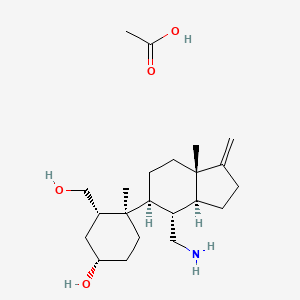
Rosiptor acetate


imgThumbUNII-F6X6NZ9D95.png2D chemical structure of 782487-29-0

Rosiptor acetate

CAS: 782487-29-0 (acetate)  782487-28-9 (free base)
Chemical Formula: C22H39NO4
Molecular Weight: 381.557

AQX-1125; AQX 1125; AQX1125; AQX-1125 acetate; Rosiptor acetate

PHASE 3 …..a SH2-containing inositol 5-phosphatase 1 (SHIP1) modulator for treating cancer, inflammatory disorders and immune disorders.

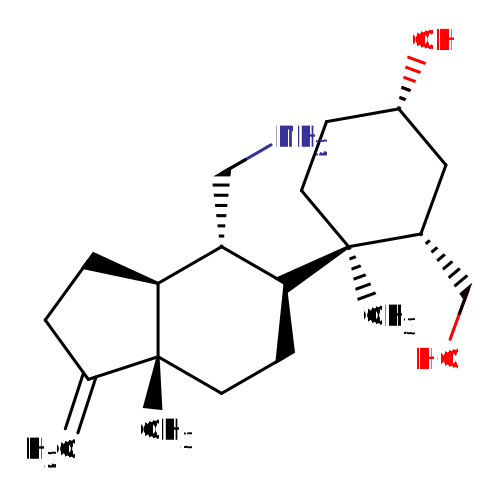
(1S,3S,4R)-4-((3aS,4R,5S,7aS)-4-(Aminomethyl)-7a-methyl-1- methyleneoctahydro -1H – inden-5-yl)-3-(hydroxymethyl)-4-methylcyclohexanol, acetate

IUPAC/Chemical Name: (1S,3S,4R)-4-((3aS,4R,5S,7aS)-4-(aminomethyl)-7a-methyl-1-methyleneoctahydro-1H-inden-5-yl)-3-(hydroxymethyl)-4-methylcyclohexan-1-ol acetate

  • Originator Aquinox Pharmaceuticals
  • Class Anti-inflammatories; Immunotherapies; Small molecules
  • Mechanism of Action Inositol-1,4,5-trisphosphate 5-phosphatase stimulants

Image result

Highest Development Phases

  • Phase III Interstitial cystitis
  • Phase II Allergic asthma
  • Discontinued Atopic dermatitis; Chronic obstructive pulmonary disease; Haematological disorders; Hypersensitivity; Immunological disorders; Inflammation; Irritable bowel syndrome; Pulmonary fibrosis

Most Recent Events

  • 09 Mar 2017 Phase-III clinical trials in Interstitial cystitis in United Kingdom, Poland, Latvia and Canada before March 2017 (PO) (EudraCT2016-000906-12) (NCT02858453)
  • 04 Jan 2017 Aquinox Pharmaceuticals completes a phase I trial in Healthy volunteers in United Kingdom (NCT03185195)
  • 07 Sep 2016 Phase-III clinical trials in Interstitial cystitis in Czech Republic, Hungary, Denmark (PO) (EudraCT2016-000906-12)

Rosiptor, also known as AQX-1125 is a potent and selective SHIP1 activator currently in clinical development.

AQX-1125 inhibited Akt phosphorylation in SHIP1-proficient but not in SHIP1-deficient cells, reduced cytokine production in splenocytes, inhibited the activation of mast cells and inhibited human leukocyte chemotaxis.

AQX-1125 suppresses leukocyte accumulation and inflammatory mediator release in rodent models of pulmonary inflammation and allergy. As shown in the mouse model of LPS-induced lung inflammation, the efficacy of the compound is dependent on the presence of SHIP1. Pharmacological SHIP1 activation may have clinical potential for the treatment of pulmonary inflammatory diseases.

Dysregulated activation of the PI3K pathway contributes to inflammatory/immune disorders and cancer. Efforts have been made to develop modulators of PI3K as well as downstream kinases (Workman et al., Nat. Biotechnol. 24, 794-796, 2006; Simon, Cell 125, 647-649, 2006; Hennessy et al., Nat. Rev. Drug. Discov. 4, 988-1004, 2005; Knight et al., Cell 125, 733-747, 2006; Ong et al., Blood (2007), Vol. 110, No. 6, pp 1942-1949). A number of promising new PI3K isoform specific inhibitors with minimal toxicities have recently been developed and used mouse models of inflammatory disease (Camps et al., Nat. Med. 11, 936-943, 2005; Barber et al., Nat. Med. 11, 933-935, 2005) and glioma (Fan et al., Cancer Cell 9, 341-349, 2006). However, because of the dynamic interplay between phosphatases and kinases in regulating biological processes, inositol phosphatase activators represent a complementary, alternative approach to reduce PIPlevels. Of the phosphoinositol phosphatases that degrade PIP3, SHIP1 is a particularly ideal target for development of therapeutics for treating immune and hemopoietic disorders because of its hematopietic-restricted expression (Hazen et al., Blood 113, 2924-2933, 2009; Rohrschneider et al., Genes Dev. 14, 505-520, 2000).
      Small molecule SHIP1 modulators have been disclosed, including sesquiterpene compounds such as pelorol. Pelorol is a natural product isolated from the tropical marine sponge Dactylospongia elegans (Kwak et al., J. Nat. Prod. 63, 1153-1156, 2000; Goclik et al., J. Nat. Prod. 63, 1150-1152, 2000). Other reported SHIP1 modulators include the compounds set forth in PCT Published Patent Applications Nos. WO 2003/033517, WO 2004/035601, WO 2004/092100, WO 2007/147251, WO 2007/147252, WO 2011/069118, WO 2014/143561 and WO 2014/158654 and in U.S. Pat. Nos. 7,601,874 and 7,999,010.
      One such molecule is AQX-1125, which is the acetate salt of (1S,3S,4R)-4-((3aS,4R,5S,7aS)-4-(aminomethyl)-7a-methyl-1-methyleneoctahydro-1H-inden-5-yl)-3-(hydroxymethyl)-4-methylcyclohexanol (AQX-1125). AQX-1125 is a compound with anti-inflammatory activity and is described in U.S. Pat. Nos. 7,601,874 and 7,999,010, the relevant disclosures of which are incorporated in full by reference in their entirety, particularly with respect to the preparation of AQX-1125, pharmaceutical compositions comprising AQX-1125 and methods of using AQX-1125.
      AQX-1125 has the molecular formula, C20H36NO2+.C2H3O2, a molecular weight of 381.5 g/mole and has the following structural formula:

AQX-1125 is useful in treating disorders and conditions that benefit from SHIP1 modulation, such as cancers, inflammatory disorders and conditions and immune disorders and conditions. AQX-1125 is also useful in the preparation of a medicament for the treatment of such disorders and conditions.

Synthetic methods for preparing AQX-1125 are disclosed in U.S. Pat. Nos. 7,601,874 and 7,999,010. There exists, therefore, a need for improved methods of preparing AQX-1125.

Inventors Jeffery R RaymondKang HanYuanlin ZhouYuehua HeBradley NorenJames Gee Ken Yee
Applicant Inflazyme Pharm LtdJeffery R RaymondKang HanYuanlin ZhouYuehua HeBradley NorenJames Gee Ken Yee

Image result for Inflazyme Pharm Ltd

PATENT

WO-2016210146 

Dysregulated activation of the PI3K pathway contributes to

inflammatory/immune disorders and cancer. Efforts have been made to develop modulators of PI3K as well as downstream kinases (Workman et al., Nat. Biotechnol 24, 794-796, 2006; Simon, Cell 125, 647-649, 2006; Hennessy et al., Nat Rev Drug Discov 4, 988-1004, 2005; Knight et al., Cell 125, 733-747, 2006; Ong et al., Blood (2007), Vol. 110, No. 6, pp 1942-1949). A number of promising new PI3K isoform specific inhibitors with minimal toxicities have recently been developed and used in mouse models of inflammatory disease (Camps et al., Nat Med 1 1 , 936-943, 2005; Barber et ai, Nat Med 1 1 , 933-935, 2005) and glioma (Fan et al., Cancer Cell 9, 341-349, 2006). However, because of the dynamic interplay between phosphatases and kinases in regulating biological processes, inositol phosphatase activators represent a complementary, alternative approach to reduce PIP3 levels. Of the phosphoinositol phosphatases that degrade PIP3i SHIP1 is a particularly ideal target for development of therapeutics for treating immune and hemopoietic disorders because of its

hematopietic-restricted expression (Hazen et al., Blood 1 13, 2924-2933, 2009;

Rohrschneider et ai, Genes Dev. 14, 505-520, 2000).

Small molecule SHIP1 modulators have been disclosed, including

sesquiterpene compounds such as pelorol. Pelorol is a natural product isolated from the tropical marine sponge Dactylospongia elegans (Kwak et al., J Nat Prod 63, 1 153-1 156, 2000; Goclik et al., J Nat Prod 63, 1150-1152, 2000). Other reported SHIP1 modulators include the compounds set forth in PCT Published Patent Applications Nos. WO 2003/033517, WO 2004/035601 , WO 2004/092100, WO 2007/147251 , WO 2007/147252, WO 2011/069118, WO 2014/143561 and WO 2014/158654 and in U.S. Patent Nos. 7,601 ,874 and 7,999,010.

While significant strides have been made in this field, there remains a need for effective small molecule SHIP1 modulators.

One such molecule is the acetate salt of (1 S,3S,4 )-4-((3aS,4 ,5S,7aS)-4-(aminomethyl)-7a-methyl-1-methyleneoctahydro-1 /-/-inden-5-yl)-3-(hydroxymethyl)-4-methylcyclohexanol (referred to herein as Compound 1). Compound 1 is a compound with anti-inflammatory activity and is described in U.S. Patent Nos. 7,601 ,874 and 7,999,010, the relevant disclosures of which are incorporated in full by reference in their entirety, particularly with respect to the preparation of Compound 1 ,

pharmaceutical compositions comprising Compound 1 and methods of using

Compound 1.

Compound 1 has the molecular formula, C2oH36N02+ · C2H302, a molecular weight of 381.5 g/mole

front page image

The application is directed to crystalline forms of the acetate salt of (1S,3S,4R)-4-(3aS,4R,5S,7aS)-4-(aminomethyl)-7a- methyl-1-methyleneoctahydro-1H-inden-5-yl)-3-(hydroxymethyl) -4-methylcyclohexanol and processes for their preparation. The compound acts as a SHIP1 modulator and is thus useful in the treatment of cancer or inflammatory and immune disorders and conditions.

(EN)

PATENT

https://encrypted.google.com/patents/WO1998002450A2?cl=en

Inventors David L. BurgoyneYaping ShenJohn M. LanglandsChristine RogersJoseph H.-L. ChauEdward PiersHassan Salari
Applicant Inflazyme Pharmaceuticals Ltd.University Of British ColumbiaUniversity Of Alberta

SYNTHESIS

WO 199802450

WO 2004092100

PATENT

WO 2004092100

https://patentscope.wipo.int/search/en/detail.jsf?docId=WO2004092100


PATENT

US 20170204048

https://patentscope.wipo.int/search/en/detail.jsf?docId=US200947106&recNum=1&maxRec=&office=&prevFilter=&sortOption=&queryString=&tab=PCTDescription

Process for the synthesis of substituted indene derivative (particularly AQX-1125 ) as a SH2-containing inositol 5-phosphatase 1 (SHIP1) modulator for treating cancer, inflammatory disorders and immune disorders. Aquinox Pharmaceuticals is developing AQX-1125 (phase III clinical trial in July 2017), a SHIP1 agonist, for the treatment of inflammatory diseases. For a prior filing see WO2016210146 , claiming novel crystalline forms of rosiptor acetate. In July 2017, Seenisamy and Chetia were associated with Syngene

Synthetic Method 1

In one aspect of the invention, AQX-1125 was prepared by the method described below in Reaction Scheme 1 where Pgis an oxygen-protecting group, Pgis a carbonyl protecting group, Lgis a leaving group and X is bromo or chloro:


Reaction Scheme 1A:


Synthetic Example 77

Step 11: Preparation of AQX-1125 from Compound 16

A. To a stirred solution of (1S,3S,4R)-4-((3aS,4R,5S,7aS)-4-(aminomethyl)-7a-methyl-1-methyleneoctahydro-1H-inden-5-yl)-3-(hydroxymethyl)-4-methylcyclohexan-1-ol (Compound 16, 58.0 g, 0.180 mol, 1.0 eq, from Synthetic Example 76) in methanol (174 mL, 3 V) was added acetic acid (23.5 mL, 0.4 V) dropwise at 10° C. under a nitrogen atmosphere over 20 min. The reaction mixture was stirred at room temperature for 1 h. The solution was filtered to remove undissolved particles and washed with methanol (58 mL, 1 V). The filtrate was collected and evaporated at 35° C. to half the volume (˜125 mL). MTBE (348 mL, 6 V) was slowly added to the above concentrated mixture and the reaction stirred at 10° C. for 2 h. During the MTBE addition, slow precipitation of the product was observed. The solids were filtered and washed with MTBE (116 mL, 2V) to afford (1S,3S,4R)-4-((3aS,4R,5S,7aS)-4-(aminomethyl)-7a-methyl-1-methyleneoctahydro-1H-inden-5-yl)-3-(hydroxymethyl)-4-methylcyclohexan-1-ol, acetic acid salt, (AQX-1125) as a white solid (50 g, yield 72.6%). 1H NMR (400 MHz, pyridine-d5): δ 5.85 (br s, 5H), 4.70 (s, 2H), 4.08 (dd, J=10.4, 2 Hz, 1H), 3.95-3.85 (m, 1H), 3.60-3.50 (m, 1H), 3.18 (d, J=14 Hz, 1H), 2.92-2.86 (m, 1H), 2.80 (d, J=13.6 Hz, 1H), 2.50-2.40 (m, 1H), 2.25-1.97 (m, 3H), 2.15 (s, 3H), 1.90-1.65 (m, 4H), 1.56-1.40 (m, 4H), 1.39-1.20 (m, 2H), 1.25 (s, 3H), 0.78 (s, 3H). LCMS: (Method A) 322.4 (M+1), Retention time: 1.95 min, HPLC (Method H): 95.5 area %, Retention time: 16.66 min.

Synthetic Example 66

Preparation of Compound 16 and AQX-1125

      A. To a solution of 7a-methyl-5-((1S,2R,5S)-2-methyl-7-oxo-6-oxabicyclo[3.2.1]octan-2-yl)-1-methyleneoctahydro-1H-indene-4-carbaldehyde oxime (Compound 68, 100 mg, 0.30 mmol, from Synthetic Example 65) in 1,4-dioxane (5 mL) in a 25 mL RB flask fitted with reflux condenser was added a solution of lithium aluminum hydride (1 M in THF, 1.51 ml, 1.50 mmol) at RT under nitrogen and the reaction mass was stirred using a magnetic stirrer at 100° C. for 24 hours. Another lot of a solution of lithium aluminum hydride (1 M in THF, 1.51 ml, 1.50 mmol) was added and the reaction was further refluxed for 24 hours. Completion of the reaction was monitored by LCMS analysis.
      B. The reaction mass was quenched by the drop-wise addition of saturated aq. sodium sulfate solution, filtered through a CELITE™ bed on glass frit funnel and concentrated by rotary evaporation to get a crude mass which was further purified by preparative HPLC to afford (1S,3S,4R)-4-((4R,5S,7aS)-4-(aminomethyl)-7a-methyl-1-methyleneoctahydro-1H-inden-5-yl)-3-(hydroxymethyl)-4-methylcyclohexan-1-ol (Compound 16, 35 mg, 36% yield) as an off-white solid. 1H-NMR (400 MHz, CD3OD): δ 4.69 (s, 2H), 3.73 (br d, J=10.0 Hz, 1H), 3.52-3.45 (m, 1H), 3.22-3.15 (m, 1H), 3.05-2.98 (m, 1H), 2.62-2.55 (m, 1H), 2.38-2.25 (m, 1H), 2.20-2.15 (m, 1H), 1.95-1.81 (m, 6H), 1.62-1.25 (m, 10H), 1.10 (s, 3H), 0.86 (s, 3H). LCMS (Method A) m/z: 322.5 (M+1), Retention time: 2.06 min, Purity: 98.9 area % (ELSD). HPLC (Method A): Retention time: 2.70 min, Purity: 99.3 area %.
      C. AQX-1125 was prepared from Compound 16 in the same manner as described above in Synthetic Example 16.

REFERENCES

1: Nickel JC, Egerdie B, Davis E, Evans R, Mackenzie L, Shrewsbury SB. A Phase II Study of the Efficacy and Safety of the Novel Oral SHIP1 Activator AQX-1125 in Subjects with Moderate to Severe Interstitial Cystitis/Bladder Pain Syndrome. J Urol. 2016 Sep;196(3):747-54. doi: 10.1016/j.juro.2016.03.003. PubMed PMID: 26968644.

2: Chuang YC, Chermansky C, Kashyap M, Tyagi P. Investigational drugs for bladder pain syndrome (BPS) / interstitial cystitis (IC). Expert Opin Investig Drugs. 2016;25(5):521-9. doi: 10.1517/13543784.2016.1162290. PubMed PMID: 26940379.

3: Leaker BR, Barnes PJ, O’Connor BJ, Ali FY, Tam P, Neville J, Mackenzie LF, MacRury T. The effects of the novel SHIP1 activator AQX-1125 on allergen-induced responses in mild-to-moderate asthma. Clin Exp Allergy. 2014 Sep;44(9):1146-53. doi: 10.1111/cea.12370. PubMed PMID: 25040039.

4: Stenton GR, Mackenzie LF, Tam P, Cross JL, Harwig C, Raymond J, Toews J, Wu J, Ogden N, MacRury T, Szabo C. Characterization of AQX-1125, a small-molecule SHIP1 activator: Part 1. Effects on inflammatory cell activation and chemotaxis in vitro and pharmacokinetic characterization in vivo. Br J Pharmacol. 2013 Mar;168(6):1506-18. doi: 10.1111/bph.12039. PubMed PMID: 23121445; PubMed Central PMCID: PMC3596654.

5: Stenton GR, Mackenzie LF, Tam P, Cross JL, Harwig C, Raymond J, Toews J, Chernoff D, MacRury T, Szabo C. Characterization of AQX-1125, a small-molecule SHIP1 activator: Part 2. Efficacy studies in allergic and pulmonary inflammation models in vivo. Br J Pharmacol. 2013 Mar;168(6):1519-29. doi: 10.1111/bph.12038. PubMed PMID: 23121409; PubMed Central PMCID: PMC3596655.

6: Croydon L. BioPartnering North America–Spotlight on Canada. IDrugs. 2010 Mar;13(3):159-61. PubMed PMID: 20191430.

Patent ID Patent Title Submitted Date Granted Date
US2016083387 SHIP1 MODULATORS AND METHODS RELATED THERETO 2014-02-27 2016-03-24
US2016031899 SHIP1 MODULATORS AND METHODS RELATED THERETO 2014-02-27 2016-02-04

AQX-1125

In the PI3K pathway, the key messenger molecule is phosphatidylinositiol-3,4,5-trisphosphate, or PIP3, which initiates the signaling pathway. In cells derived from bone marrow tissues (e.g. predominantly immune cells), the key enzymes that control levels of PIP3 are the PI3 kinase (PI3K), and the phosphatases, PTEN and SHIP1 (SH2-containing inositol-5’-phosphatase 1). PI3K generates PIP3, thus initiating the signaling pathway. This signaling is reduced by degradation of PIP3 by PTEN and SHIP1. PTEN is generally considered to be constantly working in the pathway, whereas SHIP1 is dormant until the cell is stimulated. In preclinical models, PTEN has been shown to suppress cancer by controlling cell proliferation, whereas SHIP1, when functioning, has been demonstrated to control inflammation by reducing cell migration and activation.

The SHIP1 Pathway – Highlighting the Role of AQX-1125

AQX-1125 is our lead product candidate and has generated positive clinical data from three completed clinical trials, including two proof-of-concept trials, one in COPD and one in allergic asthma, demonstrating a favorable safety profile and anti-inflammatory activity. Overall, more than 100 subjects have received AQX-1125. Importantly, our clinical trial results were consistent with the drug-like properties and anti-inflammatory activities demonstrated in our preclinical studies. AQX-1125 is a once daily oral capsule with many desirable drug-like properties. We are currently investigating AQX-1125 in two Phase 2 clinical trials, one in COPD and one in BPS/IC.

Based on our three completed clinical trials, we have demonstrated that AQX-1125:

  • has desirable pharmacokinetic, absorption and excretion properties that make it suitable for once daily oral administration;
  • is generally well tolerated, exhibiting mild to moderate adverse events primarily related to gastrointestinal upset that resolve without treatment or long-term effects and are reduced by taking the drug candidate with food; and
  • has anti-inflammatory properties consistent with those exhibited in preclinical studies and exhibited activity in two trials using two distinct inflammatory challenges.

AQX-1125 is an activator of SHIP1, which controls the PI3K cellular signaling pathway. If the PI3K pathway is overactive, immune cells can produce an abundance of pro-inflammatory signaling molecules and migrate to and concentrate in tissues, resulting in excessive or chronic inflammation. SHIP1 is predominantly expressed in cells derived from bone marrow tissues, which are mainly immune cells. Therefore drugs that activate SHIP1 can reduce the function and migration of immune cells and have an anti-inflammatory effect. By controlling the PI3K pathway, AQX-1125 reduces immune cell function and migration by targeting a mechanism that has evolved in nature to maintain homeostasis of the immune system.

AQX-1125 has demonstrated compelling preclinical activity in a broad range of relevant inflammatory studies including preclinical models of COPD, asthma, pulmonary fibrosis, BPS/IC and inflammatory bowel disease (IBD). In these studies we have seen a meaningful reduction in the relevant immune cells that are the cells that cause inflammation, such as neutrophils, eosinophils and macrophages, and a reduction in the symptoms of inflammation, such as pain and swelling. The activity, efficacy and potency seen with AQX-1125 in most preclinical studies compare favorably to published results with corticosteroids. In addition, AQX-1125 demonstrated compelling activity in the smoke airway inflammation and Bleomycin Fibrosis models, which are known to be steroid refractory, or in other words, do not respond to corticosteroids. We believe this broad anti-inflammatory profile is not typical amongst drugs in development and supports the therapeutic potential for AQX-1125.

In addition to demonstrating strong in vitro and in vivo activity, AQX-1125 was also selected as a lead candidate based on its many desirable drug-like properties. The drug candidate is highly water soluble and does not require complex formulation for oral administration. AQX-1125 has low plasma protein binding, is not metabolized and is excreted unmetabolized in both urine and feces. After oral or intravenous dosing, AQX-1125 reaches high concentrations in respiratory, urinary and gastrointestinal tracts, all of which have mucosal surfaces of therapeutic interest. In humans, AQX-1125 has shown pharmacokinetic properties suitable for once-a-day dosing. In addition, the absorption of the drug candidate is equivalent whether taken with or without food.

///////////rosiptor, AQX-1125, AQX 1125, AQX1125; AQX-1125 acetate, Rosiptor acetate, PHASE 3,  SH2-containing inositol 5-phosphatase 1, SHIP1,  cancer, inflammatory disorders, immune disorders, 782487-29-0, 782487-28-9, Aquinox

 CC(=O)O.C[C@@]1(CC[C@@H](C[C@@H]1CO)O)[C@H]2CC[C@]3([C@H]([C@@H]2CN)CCC3=C)C

CC(=O)O.C[C@@]1(CC[C@H](O)C[C@@H]1CO)[C@H]2CC[C@@]3(C)[C@@H](CCC3=C)[C@@H]2CN

FDA grants accelerated approval to new treatment for advanced ovarian cancer , Rubraca(rucaparib)


str0

The U.S. Food and Drug Administration today granted accelerated approval to Rubraca (rucaparib) to treat women with a certain type of ovarian cancer. Rubraca is approved for women with advanced ovarian cancer who have been treated with two or more chemotherapies and whose tumors have a specific gene mutation (deleterious BRCA) as identified by an FDA-approved companion diagnostic test.

Read more.

For Immediate Release

December 19, 2016

The U.S. Food and Drug Administration today granted accelerated approval to Rubraca (rucaparib) to treat women with a certain type of ovarian cancer. Rubraca is approved for women with advanced ovarian cancer who have been treated with two or more chemotherapies and whose tumors have a specific gene mutation (deleterious BRCA) as identified by an FDA-approved companion diagnostic test.

“Today’s approval is another example of the trend we are seeing in developing targeted agents to treat cancers caused by specific mutations in a patient’s genes,” said Richard Pazdur, M.D., director of the Office of Hematology and Oncology Products in the FDA’s Center for Drug Evaluation and Research and acting director of the FDA’s Oncology Center of Excellence. “Women with these gene abnormalities who have tried at least two chemotherapy treatments for their ovarian cancer now have an additional treatment option.”

The National Cancer Institute estimates that 22,280 women will be diagnosed with ovarian cancer in 2016 and an estimated 14,240 will die of this disease. Approximately 15 to 20 percent of patients with ovarian cancer have a BRCA gene mutation.

BRCA genes are involved with repairing damaged DNA and normally work to prevent tumor development. However, mutations of these genes may lead to certain cancers, including ovarian cancers. Rubraca is a poly ADP-ribose polymerase (PARP) inhibitor that blocks an enzyme involved in repairing damaged DNA. By blocking this enzyme, DNA inside the cancerous cells with damaged BRCA genes may be less likely to be repaired, leading to cell death and possibly a slow-down or stoppage of tumor growth.

Today, the FDA also approved the FoundationFocus CDxBRCA companion diagnostic for use with Rubraca, which is the first next-generation-sequencing (NGS)-based companion diagnostic approved by the agency. The NGS test detects the presence of deleterious BRCA gene mutations in the tumor tissue of ovarian cancer patients. If one or more of the mutations are detected, the patient may be eligible for treatment with Rubraca.

The safety and efficacy of Rubraca were studied in two, single-arm clinical trials involving 106 participants with BRCA-mutated advanced ovarian cancer who had been treated with two or more chemotherapy regimens. BRCA gene mutations were confirmed in 96 percent of tested trial participants with available tumor tissue using the FoundationFocus CDxBRCA companion diagnostic. The trials measured the percentage of participants who experienced complete or partial shrinkage of their tumors (overall response rate). Fifty-four percent of the participants who received Rubraca in the trials experienced complete or partial shrinkage of their tumors lasting a median of 9.2 months.

Common side effects of Rubraca include nausea, fatigue, vomiting, low levels of red blood cells (anemia), abdominal pain, unusual taste sensation (dysgeusia), constipation, decreased appetite, diarrhea, low levels of blood platelets (thrombocytopenia) and trouble breathing (dyspnea).  Rubraca is associated with serious risks, such as bone marrow problems (myelodysplastic syndrome), a type of cancer of the blood called acute myeloid leukemia and fetal harm.

The agency approved Rubraca under its accelerated approval program, which allows approval of a drug to treat a serious or life-threatening disease or condition based on clinical data showing the drug has an effect on a surrogate (substitute) endpoint that is reasonably likely to predict clinical benefit. The sponsor is continuing to study this drug in patients with advanced ovarian cancer who have BRCA gene mutations and in patients with other types of ovarian cancer. The FDA also granted the Rubraca application breakthrough therapy designation and priority review status. Rubraca also received orphan drug designation, which provides incentives such as tax credits, user fee waivers and eligibility for exclusivity to assist and encourage the development of drugs intended to treat rare diseases.

Rubraca is marketed by Clovis Oncology, Inc. based in Boulder, Colorado. The FoundationFocus CDxBRCA companion diagnostic is marketed by Foundation Medicine, Inc. of Cambridge, Massachusetts.

////////////Rubraca, rucaparib, Clovis Oncology, Boulder, Colorado, fda 2016, cancer, ovarian

GNE-272


SCHEMBL17794706.png

GNE-272

(S)-1-(3-((2-fluoro-4-(1-methyl-1H-pyrazol-4- yl)phenyl)amino)-1-(tetrahydrofuran-3-yl)-6,7-dihydro-1H-pyrazolo[4,3-c]pyridin- 5(4H)-yl)ethanone

1-[3-[2-fluoro-4-(1-methylpyrazol-4-yl)anilino]-1-[(3S)-oxolan-3-yl]-6,7-dihydro-4H-pyrazolo[4,3-c]pyridin-5-yl]ethanone

CAS 1936428-93-1

Molecular Formula: C22H25FN6O2
Molecular Weight: 424.471303 g/mol

GENENTECH, INC. [US/US]; 1 DNA Way South San Francisco, California 94080-4990 (US).
CONSTELLATION PHARMACEUTICALS, INC. [US/US]; 215 First Street Suite 200 Cambridge, Massachusetts 02142 (US)

ROMERO, F. Anthony; (US).
MAGNUSON, Steven; (US).
PASTOR, Richard; (US).
TSUI, Vickie Hsiao-Wei; (US).
MURRAY, Jeremy; (US).
CRAWFORD, Terry; (US).
ALBRECHT, Brian, K.; (US).
COTE, Alexandre; (US).
TAYLOR, Alexander, M.; (US).
LAI, Kwong Wah; (CN).
CHEN, Kevin, X.; (CN).
BRONNER, Sarah; (US).
ADLER, Marc; (US).
EGEN, Jackson; (US).
LIAO, Jiangpeng; (CN).
WANG, Fei; (CN).
CYR, Patrick; (US).
ZHU, Bing-Yan; (US).
KAUDER, Steven; (US)

Chromatin is a complex combination of DNA and protein that makes up chromosomes. It is found inside the nuclei of eukaryotic cells and is divided between heterochromatin (condensed) and euchromatin (extended) forms. The major components of chromatin are DNA and proteins. Histones are the chief protein components of chromatin, acting as spools around which DNA winds. The functions of chromatin are to package DNA into a smaller volume to fit in the cell, to strengthen the DNA to allow mitosis and meiosis, and to serve as a mechanism to control expression and DNA replication. The chromatin structure is controlled by a series of post-translational modifications to histone proteins, notably histones H3 and H4, and most commonly within the “histone tails” which extend beyond the core nucleosome structure. Histone tails tend to be free for protein-protein interaction and are also the portion of the histone most prone to post-translational modification. These modifications include acetylation, methylation, phosphorylation, ubiquitinylation, and SUMOylation. These epigenetic marks are written and erased by specific enzymes that place the tags on specific residues within the histone tail, thereby forming an epigenetic code, which is then interpreted by the cell to allow gene specific regulation of chromatin structure and thereby transcription.

Of all classes of proteins, histones are amongst the most susceptible to post-translational modification. Histone modifications are dynamic, as they can be added or removed in response to specific stimuli, and these modifications direct both structural changes to chromatin and alterations in gene transcription. Distinct classes of enzymes, namely histone acetyltransferases (HATs) and histone deacetylases (HDACs), acetylate or de-acetylate specific histone lysine residues (Struhl K., Genes Dev., 1989, 12, 5, 599-606).

Bromodomains, which are approximately 1 10 amino acids long, are found in a large number of chromatin-associated proteins and have been identified in approximately 70 human proteins, often adjacent to other protein motifs (Jeanmougin F., et al., Trends Biochem. Sc , 1997, 22, 5, 151-153; and Tamkun J.W., et al., Cell, 1992, 7, 3, 561-572).

Interactions between bromodomains and modified histones may be an important mechanism underlying chromatin structural changes and gene regulation. Bromodomain-containing proteins have been implicated in disease processes including cancer, inflammation and viral replication. See, e.g., Prinjha et al,, Trends Pharm. Sci., 33(3):146-153 (2012) and Muller et al , Expert Rev. , 13 (29): 1 -20 (September 201 1 ).

Cell-type specificity and proper tissue functionality requires the tight control of distinct transcriptional programs that are intimately influenced by their environment.

Alterations to this transcriptional homeostasis are directly associated with numerous disease states, most notably cancer, immuno-inflammation, neurological disorders, and metabolic diseases. Bromodomains reside within key chromatin modifying complexes that serve to control distinctive disease-associated transcriptional pathways. This is highlighted by the observation that mutations in bromodomain-containing proteins are linked to cancer, as well as immune and neurologic dysfunction. Hence, the selective inhibition of bromodomains across a specific family, such as the selective inhibition of a bromodomain of CBP/EP300, creates varied opportunities as novel therapeutic agents in human dysfunction.

There is a need for treatments for cancer, immunological disorders, and other

CBP/EP300 bromodomain related diseases.

PATENT

WO-2016086200

Scheme 1

Scheme 2

Scheme 3

Scheme 4

General procedure for Intermediates A & B

Intermediate A

Intermediate

General procedure for Intermediates F & G

Intermediate F

Intermediate G

Step 1:

(R)-tetrahydrofuran-3-yI methanesulfonate

To a solution of (^)-tetrahydrofuran-3-ol (25 g, 253.7 mmol) in DCM (250 mL) at 0 °C was added triethylamine (86 g, 851.2 mmol) and mesyl chloride (39 g, 340.48 mmol) dropwise. The mixture was stirred at room temperature for 12 h. The reaction was quenched with water (100 mL) and extracted with DCM (100 mL x 2). The combined organic layers were dried over anhydrous Na2S04, filtered and concentrated in vacuo to give the title compound (47 g, 99%) as a brown oil. Ή NMR (400 MHz, CDC13) δ 5.35 – 5.27 (m, 1H), 4.05 – 3.83 (m, 4H), 3.04 (s, 3 H), 2.28 – 2.20 (m, 2 H).

Step 2:

(S)-tert-butyl 3-bromo-l-(tetrahydrofuran-3-yI)-6,7-dihydro-li/-pyrazolo[43- c] pyridine-5(4H)-carboxylate

To a solution of tert-butyl 3-bromo-6,7-dihydro-lH-pyrazolo[4,3-c]pyridine-5(4H)-carboxylate (Intermediate A, 24.8 g, 82 mmol) in DMF (200 mL) was added Cs2C03 (79 g, 246 mmol) and (/?)-tetrahydrofuran-3-yl methanesulfonate (17.4 g, 98 mmol). The mixture was heated to 80 °C for 12 h. After cooling the reaction to room temperature, the mixture was concentrated in vacuo. The crude residue was purified by silica gel chromatography

(petroleum ether / EtOAc = from 10 : 1 to 3 : 1) to give the title compound (Intermediate F, 50 g, 71 %) as a yellow oil. Ή NMR (400 MHz, DMSO-i ) δ 4.97 – 4.78 (m, 1H), 4.13 (s, 2H), 3.98 – 3.86 (m, 2H), 3.81 – 3.67 (m, 2H), 3.56 (t, J= 5.6 Hz, 2H), 2.68 (t, J= 5.6 Hz, 2H), 2.33 – 2.08 (m, 2H), 1.38 (s, 9H).

Step 3:

(5)-l-(3-bromo-l-(tetrahydrofuran-3-yl)-6,7-dihydro-lH-pyrazoIo[4,3-c]pyridin-5(4//)- yl)ethanone

To a solution of (S)-tert-buty\ 3-bromo- 1 -(tetrahydrofuran-3-yl)-6,7-dihydro-lH-pyrazolo [4,3 -c]pyridine-5(4H)-carboxy late (29 g, 78 mmol) in DCM (300 mL) was added trifluroacetic acid (70 mL) dropwise. The mixture was stirred at room temperature for 2 h. The solvent was concentrated in vacuo and the crude residue was re -dissolved in DMF (100 mL). The mixture was cooled to 0 °C before triethylamine (30 g, 156 mmol) and acetic anhydride (8.7 g, 86 mmol) were added dropwise. The mixture was stirred at room temperature for an additional 2 h. The reaction was quenched with water (200 mL) at 0 °C and extracted with EtOAc (150 mL x 3). The combined organic layers were dried over anhydrous Na2S0 , filtered and concentrated in vacuo. The crude residue was purified by silica gel chromatography (DCM / MeOH = 30 : 1) to give the title compound (Intermediate G, 21.3 g, 87%) as a white solid. lH NMR (400 MHz, CDC13) δ 4.78 – 4.67 (m, 1H), 4.45 -4.29 (m, 2H), 4.15 – 4.06 (m, 2H), 3.96 – 3.92 (m, 2H), 3.88 – 3.70 (m, 2H), 2.71 – 2.67 (m, 2H), 2.38 – 2.34 (m, 2H), 2.16 (s, 3H).

PATENT

US-20160158207

Example 300 1-[3-[2-fluoro-4-(1-methylpyrazol-4- yl)anilino]-1-[(3S)-tetrahydrofuran-3- yl]-6,7-dihydro-4H-pyrazolo[4,3- c]pyridin-5-yl]ethanone
1H NMR (400 MHz, DMSO- d6) δ 8.03 (s, 1H), 7.83-7.68 (m, 3H), 7.36-7.33 (m, 1H), 7.32-7.21 (m, 1H), 4.88- 4.84 (m, 1H), 4.40-4.33 (m, 2H), 4.03-3.99 (m, 2H), 3.84- 3.67 (m, 7H), 2.79-2.64 (m, 2H), 2.26-2.21 (m, 2H), 2.08-2.05 (m, 3H) 425

General Procedure for Intermediates F & G


Step 1

(R)-tetrahydrofuran-3-yl methanesulfonate


      To a solution of (R)-tetrahydrofuran-3-ol (25 g, 253.7 mmol) in DCM (250 mL) at 0° C. was added triethylamine (86 g, 851.2 mmol) and mesyl chloride (39 g, 340.48 mmol) dropwise. The mixture was stirred at room temperature for 12 h. The reaction was quenched with water (100 mL) and extracted with DCM (100 mL×2). The combined organic layers were dried over anhydrous Na2SO4, filtered and concentrated in vacuo to give the title compound (47 g, 99%) as a brown oil. 1H NMR (400 MHz, CDCl3) δ 5.35-5.27 (m, 1H), 4.05-3.83 (m, 4H), 3.04 (s, 3H), 2.28-2.20 (m, 2H).

Step 2

(S)-tert-butyl 3-bromo-1-(tetrahydrofuran-3-yl)-6,7-dihydro-1H-pyrazolo[4,3-c]pyridine-5(4H)-carboxylate


      To a solution of tert-butyl 3-bromo-6,7-dihydro-1H-pyrazolo[4,3-c]pyridine-5(4H)-carboxylate (Intermediate A, 24.8 g, 82 mmol) in DMF (200 mL) was added Cs2CO3 (79 g, 246 mmol) and (R)-tetrahydrofuran-3-yl methanesulfonate (17.4 g, 98 mmol). The mixture was heated to 80° C. for 12 h. After cooling the reaction to room temperature, the mixture was concentrated in vacuo. The crude residue was purified by silica gel chromatography (petroleum ether/EtOAc=from 10:1 to 3:1) to give the title compound (Intermediate F, 50 g, 71%) as a yellow oil. 1H NMR (400 MHz, DMSO-d6) δ 4.97-4.78 (m, 1H), 4.13 (s, 2H), 3.98-3.86 (m, 2H), 3.81-3.67 (m, 2H), 3.56 (t, J=5.6 Hz, 2H), 2.68 (t, J=5.6 Hz, 2H), 2.33-2.08 (m, 2H), 1.38 (s, 9H).

Step 3

(S)-1-(3-bromo-1-(tetrahydrofuran-3-yl)-6,7-dihydro-1H-pyrazolo[4,3-c]pyridin-5(4H)-yl)ethanone


      To a solution of (S)-tert-butyl 3-bromo-1-(tetrahydrofuran-3-yl)-6,7-dihydro-1H-pyrazolo[4,3-c]pyridine-5(4H)-carboxylate (29 g, 78 mmol) in DCM (300 mL) was added trifluroacetic acid (70 mL) dropwise. The mixture was stirred at room temperature for 2 h. The solvent was concentrated in vacuo and the crude residue was re-dissolved in DMF (100 mL). The mixture was cooled to 0° C. before triethylamine (30 g, 156 mmol) and acetic anhydride (8.7 g, 86 mmol) were added dropwise. The mixture was stirred at room temperature for an additional 2 h. The reaction was quenched with water (200 mL) at 0° C. and extracted with EtOAc (150 mL×3). The combined organic layers were dried over anhydrous Na2SO4, filtered and concentrated in vacuo. The crude residue was purified by silica gel chromatography (DCM/MeOH=30:1) to give the title compound (Intermediate G, 21.3 g, 87%) as a white solid. 1H NMR (400 MHz, CDCl3) δ 4.78-4.67 (m, 1H), 4.45-4.29 (m, 2H), 4.15-4.06 (m, 2H), 3.96-3.92 (m, 2H), 3.88-3.70 (m, 2H), 2.71-2.67 (m, 2H), 2.38-2.34 (m, 2H), 2.16 (s, 3H).

OTHER ISOMER

Example 299 1-[3-[2-fluoro-4-(1-methylpyrazol-4- yl)anilino]-1-[(3R)-tetrahydrofuran-3- yl]-6,7-dihydro-4H-pyrazolo[4,3- c]pyridin-5-yl]ethanone
1H NMR (400 MHz, DMSO- d6) δ 8.03 (s, 1H), 7.83-7.67 (m, 3H), 7.39-7.34 (m, 1H), 7.26-7.21 (m, 1H), 4.87- 4.77 (m, 1H), 4.41-4.34 (m, 2H), 4.02-3.97 (m, 2H), 3.83 (s, 3H), 3.81-3.67 (m, 4H), 2.77-2.66 (m, 2H), 2.26- 2.22 (m, 2H), 2.08-2.05 (m, 3H) 425

PAPER

Abstract Image

The single bromodomain of the closely related transcriptional regulators CBP/EP300 is a target of much recent interest in cancer and immune system regulation. A co-crystal structure of a ligand-efficient screening hit and the CBP bromodomain guided initial design targeting the LPF shelf, ZA loop, and acetylated lysine binding regions. Structure–activity relationship studies allowed us to identify a more potent analogue. Optimization of permeability and microsomal stability and subsequent improvement of mouse hepatocyte stability afforded 59 (GNE-272, TR-FRET IC50 = 0.02 μM, BRET IC50 = 0.41 μM, BRD4(1) IC50 = 13 μM) that retained the best balance of cell potency, selectivity, and in vivo PK. Compound 59 showed a marked antiproliferative effect in hematologic cancer cell lines and modulates MYC expression in vivo that corresponds with antitumor activity in an AML tumor model.

Discovery of a Potent and Selective in Vivo Probe (GNE-272) for the Bromodomains of CBP/EP300

Genentech, Inc. 1 DNA Way, South San Francisco, California 94080, United States
Wuxi Apptec Co., Ltd., 288 Fute Zhong Road, Waigaoqiao Free Trade Zone, Shanghai 200131, People’s Republic of China
§ Constellation Pharmaceuticals, Inc. 215 First Street, Suite 200, Cambridge, Massachusetts 02142, United States
J. Med. Chem., Article ASAP
*Phone: +1-650-467-6384. E-mail: romero.frank@gene.com.

UNDESIRED R ISOMER

In a similar procedure to59, the title compound was prepared from (S)-tetrahydrofuran-3-yl
methanesulfonate and purified by Prep-TLC (DCM / MeOH = 15 : 1) to give the title
compound as a light yellow solid.

1H NMR (400 MHz, CDCl3) δ 7.76–7. 42 (m,1H), 7.68 (s, 1H), 7.53 (s, 1H), 7.20–7.12 (m, 2H), 5.86–5.77 (m, 1H), 4.79–4.69 (m, 1H),4.47–4.29 (m, 2H), 4.25–4.08 (m, 2H), 4.06–3.72 (m, 4H), 3.99 (s, 3H), 2.76–2.65 (m, 2H),
2.49–2.28 (m, 2H), 2.25–2.12 (m, 3H).

13C NMR (100 MHz, CDCl3) δ 169.81, 169.36,151.71 (d, J = 238.9 Hz), 145.51, 144.64, 137.83, 136.32, 135.89, 126.35, 121.41, 116.44 (d,J = 26.0 Hz), 111.88, 103.09 (d, J = 24.0 Hz), 71.94, 68.10, 57.65, 43.24, 42.24, 39.02, 37.83,32.49, 22.01.

LCMS M/Z (M+H) 425.

[α]27D +8.8 (c 0.78, CHCl3, 99% ee).

DESIRED S ISOMER

(S)-1-(3-((2-fluoro-4-(1-methyl-1H-pyrazol-4- yl)phenyl)amino)-1-(tetrahydrofuran-3-yl)-6,7-dihydro-1H-pyrazolo[4,3-c]pyridin- 5(4H)-yl)ethanone

aReagents and conditions: (a) 4-bromo-2-fluoro-1-isothiocyanato-benzene, KOtBu, THF, rt (b) CH3I, 40 °C, 51%; (c) hydrazine monohydrate, EtOH, 85 °C; 96%; (d) 1-methyl-4-(4,4,5,5- tetramethyl-1,3,2-dioxaborolan-2-yl)pyrazole, dioxane / water, Na2CO3, Pd(dppf)Cl2, 100 °C, 63%; (e) (R)-tetrahydrofuran-3-yl methanesulfonate, Cs2CO3, DMF, 90 oC, 42%.

The crude residue was purified by silica gel chromatography (DCM / MeOH = 100:1) to give (S)-1-(3-((2-fluoro-4-(1- methyl-1H-pyrazol-4-yl)phenyl)amino)-1-(tetrahydrofuran-3-yl)-6,7-dihydro-1Hpyrazolo[4,3-c]pyridin-5(4H)-yl)ethanone as a light yellow solid.

1H NMR (400 MHz, CDCl3) δ 7.76–7.72 (m, 1H), 7.68 (s, 1H), 7.53 (s, 1H), 7.20–7.12 (m, 2H), 5.86–5.77 (m, 1H), 4.79–4.69 (m, 1H), 4.47–4.29 (m, 2H), 4.25–4.08 (m, 2H), 4.06– 3.72 (m, 4H), 3.99 (s, 3H), 2.76–2.65 (m, 2H), 2.49–2.28 (m, 2H), 2.25–2.12 (m, 3H).

13C NMR (100 MHz, CDCl3) δ 169.8, 169.4, 151.7 (d, J = 238.9 Hz), 145.5, 144.64, 137.83, 136.3, 135.9, 126.4, 121.4, 116.4 (d, J = 26.0 Hz), 111.9, 103.1 (d, J = 24.0 Hz), 71.9, 68.1, 57.7, 43.2, 42.2, 39.0, 37.8, 32.5, 22.0.

LCMS m/z (M+H) 425.

[α]27 D -11.0 (c 1.0, CHCl3, 99% ee).

HRMS m/z 425.2093 (M + H+ , C22H25FN6O2, requires 425.2057).

//////////GNE-272, Genentech, CBP, EP300, cancer, immune system regulation,  1936428-93-1

[H][C@@]1(CCOC1)N1N=C(NC2=C(F)C=C(C=C2)C2=CN(C)N=C2)C2=C1CCN(C2)C(C)=O

Consumption of a bioactive compound from Neem plant could significantly suppress development of prostate cancer


(From left to right) Principal Investigator Associate Professor Gautam Sethi and NUS PhD candidate Ms Zhang Jingwen from the Department of Pharmacology at the NUS Yong Loo Lin School of Medicine led a research which found that a bioactive compound from the neem plant could significantly suppress development of prostate cancer.

Credit: National University of Singapore

Image result for SINGAPORE ANIMATED FLAG

Image result for National University of Singapore


Image result for nimbolideImage result for nimbolide

Date:September 29, 2016Source:National University of SingaporeSummary:Oral administration of nimbolide, over 12 weeks shows reduction of prostate tumor size by up to 70 per cent and decrease in tumor metastasis by up to 50 per cent, report investigators.

Nimbolide.png

Nimbolide; NSC309909; NSC 309909; Methyl[8-(furan-3-yl)-2a,5a,6a,7-tetramethyl-2,5-dioxo-2a,5a,6,6a,8,9,9a,10a,10b,10c-decahydro-2h,5h-cyclopenta[d]naphtho[2,3-b:1,8-b’c’]difuran-6-yl]acetate; CCRIS 5723;

CAS 25990-37-8;
Molecular Formula: C27H30O7
Molecular Weight: 466.5229 g/mol

Oral administration of nimbolide, over 12 weeks shows reduction of prostate tumor size by up to 70 per cent and decrease in tumor metastasis by up to 50 per cent

A team of international researchers led by Associate Professor Gautam Sethi from the Department of Pharmacology at the Yong Loo Lin School of Medicine at the National University of Singapore (NUS) has found that nimbolide, a bioactive terpenoid compound derived from Azadirachta indica or more commonly known as the neem plant, could reduce the size of prostate tumor by up to 70 per cent and suppress its spread or metastasis by half.

Prostate cancer is one of the most commonly diagnosed cancers worldwide. However, currently available therapies for metastatic prostate cancer are only marginally effective. Hence, there is a need for more novel treatment alternatives and options.

“Although the diverse anti-cancer effects of nimbolide have been reported in different cancer types, its potential effects on prostate cancer initiation and progression have not been demonstrated in scientific studies. In this research, we have demonstrated that nimbolide can inhibit tumor cell viability — a cellular process that directly affects the ability of a cell to proliferate, grow, divide, or repair damaged cell components — and induce programmed cell death in prostate cancer cells,” said Assoc Prof Sethi.

Image result for National University of Singapore

Nimbolide: promising effects on prostate cancer

Cell invasion and migration are key steps during tumor metastasis. The NUS-led study revealed that nimbolide can significantly suppress cell invasion and migration of prostate cancer cells, suggesting its ability to reduce tumor metastasis.

The researchers observed that upon the 12 weeks of administering nimbolide, the size of prostate cancer tumor was reduced by as much as 70 per cent and its metastasis decreased by about 50 per cent, without exhibiting any significant adverse effects.

“This is possible because a direct target of nimbolide in prostate cancer is glutathione reductase, an enzyme which is responsible for maintaining the antioxidant system that regulates the STAT3 gene in the body. The activation of the STAT3 gene has been reported to contribute to prostate tumor growth and metastasis,” explained Assoc Prof Sethi. “We have found that nimbolide can substantially inhibit STAT3 activation and thereby abrogating the growth and metastasis of prostate tumor,” he added.

The findings of the study were published in the April 2016 issue of the scientific journal Antioxidants & Redox Signaling. This work was carried out in collaboration with Professor Goh Boon Cher of Cancer Science Institute of Singapore at NUS, Professor Hui Kam Man of National Cancer Centre Singapore and Professor Ahn Kwang Seok of Kyung Hee University.

Neem — The medicinal plant

The neem plant belongs to the mahogany tree family that is originally native to India and the Indian sub-continent. It has been part of traditional Asian medicine for centuries and is typically used in Indian Ayurvedic medicine. Today, neem leaves and bark have been incorporated into many personal care products such as soaps, toothpaste, skincare and even dietary supplements.

Image result for National University of Singapore

Future Research

The team is looking to embark on a genome-wide screening or to perform a large-scale study of proteins to analyse the side-effects and determine other potential molecular targets of nimbolide. They are also keen to investigate the efficacy of combinatory regimen of nimbolide and approved drugs such as docetaxel and enzalutamide for future prostate cancer therapy.


Journal Reference:

  1. Jingwen Zhang, Kwang Seok Ahn, Chulwon Kim, Muthu K. Shanmugam, Kodappully Sivaraman Siveen, Frank Arfuso, Ramar Perumal Samym, Amudha Deivasigamanim, Lina Hsiu Kim Lim, Lingzhi Wang, Boon Cher Goh, Alan Prem Kumar, Kam Man Hui, Gautam Sethi. Nimbolide-Induced Oxidative Stress Abrogates STAT3 Signaling Cascade and Inhibits Tumor Growth in Transgenic Adenocarcinoma of Mouse Prostate Model. Antioxidants & Redox Signaling, 2016; 24 (11): 575 DOI:10.1089/ars.2015.6418

Image result for nimbolide

A PAPER

Image result for nimbolide

NIMBOLIDE 1

http://pubs.rsc.org/en/content/articlelanding/2015/ra/c5ra16071e#!divAbstract

Nimbolide (1): Pale yellow crystals; C27H30O7;

FT-IR (KBr, υmax, cm -1): 2978, 1778, 1730, 1672, 1433, 1296, 1238, 1192, 1153, 1069, 951, 827, 750;

1H NMR (500 MHz, CDCl3) δH: 7.32 (t, J = 1.5 Hz, 1H), 7.28 (d, J = 9.5 Hz, 1H), 7.22 (s, 1H), 6.25 (m, 1H), 5.93 (d, J = 10.0 Hz, 1H), 5.53 (m, 1H), 4.62 (dd, J = 3.67 Hz, 12 .5 Hz, 1H), 4.27 (d, J = 3.5 Hz, 1H), 3.67 (d, J = 9.0 Hz, 1H), 3.54 (s, 3H), 3.25 (dd, J = 5.0 Hz, 16.25 Hz, 1H), 3.19 (d, J = 12.5 Hz, 1H), 2.73 (t, J = 5.5 Hz, 1H), 2.38 (dd, J = 5.5 Hz, 16.25 Hz, 1H), 2.22 (dd, J = 6.5 Hz, 12.0 Hz, 1H), 2.10 (m, 1H), 1.70 (s, 3H), 1.47 (s, 3H), 1.37 (s, 3H), 1.22 (s, 3H);

13C NMR (125 MHz, CDCl3) δC: 200.8 (CO), 175.0 (COO), 173.0 (COO), 149.6 (CH), 144.8 (C), 143.2 (CH), 138.9 (CH), 136.4 (C), 131.0 (CH), 126.5 (C), 110.3 (CH), 88.5 (CH), 82.9 (CH), 73.4 (CH), 51.8 (OCH3), 50.3 (C), 49.5 (CH), 47.7 (CH), 45.3 (C), 43.7 (C), 41.2 (CH2), 41.1 (CH), 32.1 (CH2), 18.5 (CH3), 17.2 (CH3), 15.2 (CH3), 12.9 (CH3);

HR-MS (m/z): 467.20795 [(M+H)+ ].

Content Page No 1 1H NMR spectrum of nimbolide S1 2 13C NMR spectrum of nimbolide S2 3 Mass spectrum of nimbolide

Dr Gautam Sethi

phcgs@nus.edu.sg
Tel.: (65)6516 3267
Fax: (65)6873 7690

Academic Qualifications
BSc. Chem. (Hons) 1998 Banaras Hindu University, Varanasi, India.
MSc. Biochemistry 2000 Banaras Hindu University, Varanasi, India.
Ph.D. Biotechnology 2004 Banaras Hindu University, Varanasi, India.
Appointments to Date
Assistant
Professor
2008-date Department of Pharmacology, National University of Singapore, Singapore
Postdoctoral Fellow 2004-2007 Department of Experimental Therapeutics,
The University of Texas.
MD Anderson Cancer Center, Houston TX USA.
Senior Research Fellow 2002-2004 (CSIR-NET) at School of Biotechnology,
Banaras Hindu University, Varanasi, India.
Junior Research Fellow 2000-2002 (CSIR-NET) at School of Biotechnology, Banaras Hindu University, Varanasi, India.
Honours and Awards
2007 Ramalingaswamy fellowship from Department of Biotechnology, Government of India for outstanding research contributions in the field of Cancer Biology.
2002 Senior Research Fellowship award, Council of Scientific and Industrial Research, New Delhi, India.
2000 Junior Research Fellowship award, Council of Scientific and Industrial Research, New Delhi, India.
Research Interests
Selected Publications
Reviews and Book Chapters


Image result for SINGAPORE ANIMATED FLAG

/////////NIMBOLIDE, CANCER, NEEM, PROSTRATE, National University of Singapore, Gautam Sethi

CC1=C2C(CC1C3=COC=C3)OC4C2(C(C5(C6C4OC(=O)C6(C=CC5=O)C)C)CC(=O)OC)C

New Patent, WO 2016110874, Artemisinin , IPCA Laboratories Ltd


New Patent, WO 2016110874, Artemisinin , IPCA Laboratories Ltd

FOR Cancer; Parasitic infection; Plasmodium falciparum infection; Viral infection

WO-2016110874

KUMAR, Ashok; (IN).
SINGH, Dharmendra; (IN).
MAURYA, Ghanshyam; (IN).
WAKCHAURE, Yogesh; (IN)

Dr. Ashok Kumar, President – Research and Development (Chemical) at IPCA LABORATORIES LTD

IPCA LABORATORIES LIMITED [IN/IN]; 48, Kandivli Industrial Estate, Charkop, Kandivali (West), Mumbai 400067 (IN)

Novel process for preparing artemisinin or its derivatives such as dihydroartemisinin, artemether, arteether and artesunate. Also claims novel intermediates of artemesinin such as artemisinic acid or dihydroartemisinic acid. Discloses the use of artemisinin or its derivatives, for treating malaria, cancer, viral and parasitic infections.

In July 2016, Newport Premium™ reported that IPCA was capable of producing commercial quantities of artemether, arteether and artesunate; and holds an inactive US DMF for artemether since February 2009. In July 2016, IPCA’s website lists artemether, arteether and artesunate under its products and also lists artemether and artesunate as having EDMF and WHO certificates. The assignee also has Canada HPFB certificate for artemether.

The Central Drug Research Institute (CDRI) in collaboration with IPCA is developing CDRI-97/78 (1,2,4 trioxane derivative), a synthetic artemisinin substitute for treating drug resistant Plasmodium falciparum infection. In July 2016, CDRI-97/78 was reported to be in phase 1 clinical development. IPCA in collaboration with CDRI was also investigating CDRI-99/411, a synthetic artemisinin substitute for treating malaria; but its development had been presumed to have been discontinued; however, this application’s publication would suggest otherwise.

Writeup

Artemisinin is an active phytoconstituent of Chinese medicinal herb Artemisia annua, useful for the treatment of malaria. Generally, artemisinin/artemisinic acid is obtained by extraction of the plant, Artemisia annua. The plant Artemisia annua was first mentioned in an ancient Chinese medicine book written on silk in the West Han Dynasty at around 200 B.C. The plant’s anti-malarial application was first described in a Chinese pharmacopeia, titled “Chinese Handbook of Prescriptions for Emergency Treatments,” written at around 340 A.D.

Artemisinin being poorly bioavailable limits its effectiveness. Therefore semisynthetic derivatives of artemisinin such as artesunate, dihydroartemisinin, artelinate, artemether, arteether have been developed to improve the bioavailability of Artemisinin.

Artemisinin and its derivatives – dihydroartemisinin, artemether, arteether, and artesunate being a class of antimalarials compounds used for the treatment of uncomplicated, severe complicated/cerebral and multi drug resistant malaria. Additionally, there are research findings that artemisinin and its derivatives show anti-parasite, anti-cancer, and anti-viral activities.

Dihydroartemisinin Artesunate

The content of Artemisinin in the plant Artemisia annua varies significantly according to the climate and region/geographical area where it is cultivated. Further, the extraction methods provide artemisinin or artemisinic acid from the plant in very poor yields and therefore not sufficient to accommodate the ever-growing need for this important drug. Consequently, widespread use of these valuable drugs has been hampered due to the low availability of this natural product. Therefore, research has focused on the syntheses of this valuable drug in a larger scale to meet the increasing global demand and accordingly ample literature is available on the synthesis of artemisinin or its derivatives, but no commercial success being reported / known till date.

Artemisinin can be prepared synthetically from its precursors such as artemisinic acid or dihydroartemisinic acid according to literature methods known to skilled artisans. For example, dihydroartemisinic acid can be converted to artemisinin by a combination of photooxidation and air-oxidation processes as described in U.S. Patent No. 4,992,561.

Amorphadiene is an early starting material for synthesis of Artemisinic acid or dihydroartemisinic acid, which is an important intermediate for producing Artemisinin commercially, and WO2006128126 reported a preparation method as mentioned in scheme- 1.


acid

In accordance with the scheme 1, the amorphadiene is treated with di(cyclohexyl)borane ( δΗι ΒΗ followed by reaction with H2O2 in presence of NaOH to obtain the amorph-4-ene 12-ol which is further oxidized to dihydroartemisinic acid using CrCb/ifcSC^. The formation of amorph-4-ene 12-ol is taking place via epoxidation of the exocyclic double bond. However, the reported yields of this synthesis are very low, making it unviable to produce artemisinic acid at a cheaper cost than natural extraction, for commercial use.

Amorpha -4, 11-diene

A similar method is published in, WO2009088404, for synthesis of dihydroartemisinic acid through preparation of amorph-4-ene-12-ol via epoxide formation, albeit, predominantly at exo position by reacting the amorpha-4,11-diene with H2O2 in presence of porphyrin catalyst (TDCPPMnCl). During reaction, epoxidation also occurred at endo position leading to formation of Amorphadiene- 4,5- epoxide that remain as impurity. The formed exo epoxide (amorphadiene – 11, 12 – epoxide) is further reduced to get amorph- 4-ene 12-ol and then converted to dihydroartemisinic acid and finally converted into artemisinin.

Amorphadiene-11,12-epoxide

This process involves expensive & industry unfriendly reagents. Moreover, desired stereo isomers were obtained only in poor yields, because several purification steps were needed to get desired stereo isomers leading to escalated production/operational costs.

Therefore there remains a need in the art to improve the yield of Dihydroartemisinic acid, which could potentially reduce the cost of production of Artemisinin and/or its derivatives. Consequently it is the need of the hour to provide a synthetic and economically viable process to meet the growing worldwide demand by improving the process for Artemisinin and/or its derivatives to obtain them in substantially higher yields with good purity by plant friendly operations like crystallization/extractions rather than column chromatography/other cost constraint procedures.

Therefore, the object of the invention is to prepare Artemisinic acid of formula-II, Dihydroartemisinic acid of formula-IIa, Artemisinin and its derivatives through Amorphadiene- 4,5- epoxide.

DHAA methyl ester

Scheme 2

Method 4 (From compound of formula IV (R = CI)):

In the 4-neck round bottom flask was charged Diphenyl sulfoxide (23.8 g), NaHC03 (32.96 g) and DMSO (80 ml) at 30°C. Further a solution of compound of formula IV (R = CI) (10 g) in DMSO (20 ml) was charged to the reaction mass at 30°C followed by heating and maintaining the temperature for 40 hours at 80°C till completion. DMSO was distilled out under vacuum. The reaction mass was cooled followed by charging water

(100 ml) and toluene (100 ml) to the reaction mass with stirring for 30 minutes at 28°C. The layers were separated out and aqueous layer was back extracted with toluene (2 X 100 ml). The organic layer was washed with water (100 ml) and saturated brine solution (100 ml). Solvent was distilled out under vacuum at 50°C, and the crude mass degassed under vacuum at 50-55°C. IPA (40 ml) was charged to the mass. Simultaneous addition of hydrazine hydrate (65% in aqueous solution) (3.8 g) and hydrogen peroxide (50% in aqueous solution) (2.5 ml) was done at 30-32°C over a period of 3.25 hours. After completion, reaction mass was cooled up to 5-10°C and water (100ml) was added to the reaction mass. The pH of the reaction mass was adjusted to 3.8 with dilute 8% aqueous HC1 (24 ml) at 10°C. Ethyl acetate (60 ml) was added to the reaction mass at 10°C and stirred for 15 minutes at 15-20°C. The layers were separated. Aqueous layer was back extracted with ethyl acetate (2 X 20 ml). The combined organic layer was washed with 10%) sodium metabisulfite solution (50 ml), water (50 ml) and saturated brine solution (50 ml). The organic layer was distilled out under vacuum at 45°C and the obtained crude mass was degassed at 50-55°C. To this was added DME (40 ml), Biphenyl (0.9 g) and Li-metal (1.63 g) and the reaction mass was maintained for 10 hours at 80-85°C till reaction completion. The reaction mass was cooled up to 0-5°C followed by drop wise addition of water within one hour, and the reaction stirred for two hours at 20-25°C. Toluene (35 ml) was charged with stirring and layers were separated. The aqueous layer was washed with toluene (35 ml) and the combined toluene layer was washed with water (20 ml). The combined aqueous layer was again washed with toluene (20 ml). The aqueous layer was cooled to 10-15°C and pH adjusted to 3.5-4 with dilute 16% aqueous HC1. MDC (50 ml) was charged and stirred 30 minutes at 20-25°C followed by separation of layers. The aqueous layer extracted with MDC (25 ml) and the combined MDC layer was washed with water (50 ml), then with saturated NaCl solution (25 ml). The solvent was distilled out under vacuum at 40-45°C and the crude mass (Purity: 70-80%>) was degassed at 65-70°C. The crude product (10 g) was dissolved in ethyl acetate (200 ml). 10%> aqueous NaOH (100 ml) was charged to the reaction mass and stirred one hour at 20°C followed by layer separation. Again 10%> aqueous NaOH (100ml) was added to the organic layer, stirred for 30 minutes and layers were separated out. The pH of the combined NaOH solution wash was adjusted to 4.0 with dilute 16%> aqueous HC1 at 5-10°C under stirring. Ethyl acetate (850 ml) was charged to aqueous acidic mass, stirred 30 minutes and layers were separated out. The aqueous layer was back extracted with ethyl acetate (2 X 30 ml) and the combined organic layer was washed with water (100 ml) and saturated brine (50 ml). The organic layer was dried over sodium chloride, solvent was distilled out under vacuum and the purified mass was degassed under vacuum at 50-55°C to obtain Dihydroartemisinic acid (Purity: 90-95%).

b) Methyl ester of Dihydroartemisinic acid:

To a clear solution of Dihydroartemisinic acid (40 g) dissolved in MDC (120 ml) was added thionyl chloride (SOCh) (14.85 ml) at 10±2°C and reaction mass was heated to reflux temperature 40±2°C. After the completion of reaction, solvent was distilled out and excess SOCh was removed under reduced pressure. The resulting concentrated mass of acid chloride was dissolved in MDC (200 ml). In another RBF was taken triethylamine (30.6 ml) and methanol (120 ml). To this solution was added above acid chloride solution at 30±2°C and maintained till completion of reaction. To the reaction mass was added water (400 ml) and organic layer was separated. The aqueous layer was washed with MDC and mixed with main organic layer and the combined organic layer was back washed with water till neutral pH. Then organic layer was concentrated to give methyl ester of Dihydroartemisinic acid as a brown color oily mass.

Weight: 41.88 gm

Yield = 98%

c) Artemisinin:

Methyl ester of dihydroartemisinic acid (67.7 g) was dissolved in methanol (338 ml). To this solution was added Sodium molybdate (29.5 g), 50% hydrogen peroxide (147.3 g) was added at 30±2°C and reaction was maintained for 3-4 hours. After completion of reaction was added water (300 ml) and MDC (300 ml) to the reaction mass. The organic layer was separated and aqueous layer washed with MDC (100 ml). The combined organic layer was concentrated to 475 ml containing hydroperoxide intermediate and directly used for next stage reaction. In another RBF containing MDC (475 ml) was added benzene sulfonic acid (1.27 g) and Indion resin (6.7 g). This heterogeneous solution was saturated with oxygen by passing O2 gas for 10 min at 0±2°C. To this was added previous stage hydroperoxide solution at same temperature with continuous 02 gas purging within 30-40 minutes. The oxygen gas was passed at same temp for 4 hours and temperature raised to 15±2°C with continued passing of oxygen for 5 hours. The

mixture was stirred at 25-30°C for 8-10 hours followed by filtration of resin. The filtrate was washed with water (200 ml X 3) and the combined aqueous layer back washed with MDC (50 ml). The combined organic layer was concentrated to give crude Artemisinin. Weight: 54 gm

Yield= 70.7%

Purification of Artemisinin:

Crude Artemisinin (10 g) was dissolved in ethyl acetate (25 ml) at 45-50°C. The solution was cooled to 30-35°C followed by addition of n-Hexane (100 ml). The material was isolated, stirred for 2 hours, filtered and vacuum dried at 45°C.

Weight: 4 gm

Yield: 40%

THE VIEWS EXPRESSED ARE MY PERSONAL AND IN NO-WAY SUGGEST THE VIEWS OF THE PROFESSIONAL BODY OR THE COMPANY THAT I REPRESENT, amcrasto@gmail.com, +91 9323115463 India

////////New Patent, WO 2016110874, Artemisinin , IPCA Laboratories Ltd, malaria, Cancer,  Parasitic infection,  Plasmodium falciparum infection,  Viral infection, artemether artemisinin,  artemotil,  artenimol,  artesunate,

RO-5126766


RO5126766(CH5126766)

CHEBI:78825.png

RO-5126766

946128-88-7
MW 471.46
MF C21H18FN5O5S

Phase I

3- [[2-[(Methylaminosulfonyl)amino]-3- fluoropyridin-4-yl]methyl]-4-methyl-7-[(pyrimidin-2-yl)oxy]- 2H-1-benzopyran-2-one

3-[[3-fluoro-2-(methylsulfamoylamino)pyridin-4-yl]methyl]-4-methyl-7-pyrimidin-2-yloxychromen-2-one
Chugai Seiyaku Kabushiki Kaisha

Chugai Seiyaku Kabushiki Kaisha, Sakai, Toshiyuki

Hoffmann-La Roche
Collaborators:
Institute of Cancer Research, United Kingdom
Chugai Pharmaceutical

A MEK1/Raf inhibitor potentially for the treatment of solid tumors and multiple myeloma.

RO-5126766; RG-7304; CH-5126766; CKI-27; R-7304

CAS No. 946128-88-7

Although melanoma is the most aggressive skin cancer, recent advances in BRAF and/or MEK inhibitors against BRAF-mutated melanoma have improved survival rates. Despite these advances, a treatment strategy targeting NRAS-mutated melanoma has not yet been elucidated. We discovered CH5126766/RO5126766 as a potent and selective dual RAF/MEK inhibitor currently under early clinical trials. We examined the activity of CH5126766/RO5126766 in a panel of malignant tumor cell lines including melanoma with a BRAF or NRAS mutation. Eight cell lines including melanoma were assessed for their sensitivity to the BRAF, MEK, or RAF/MEK inhibitor using in vitro growth assays. CH5126766/RO5126766 induced G1 cell cycle arrest in two melanoma cell lines with the BRAF V600E or NRAS mutation. In these cells, the G1 cell cycle arrest was accompanied by up-regulation of the cyclin-dependent kinase inhibitor p27 and down-regulation of cyclinD1. CH5126766/RO5126766 was more effective at reducing colony formation than a MEK inhibitor in NRAS- or KRAS-mutated cells. In the RAS-mutated cells, CH5126766/RO5126766 suppressed the MEK reactivation caused by a MEK inhibitor. In addition, CH5126766/RO5126766 suppressed the tumor growth in SK-MEL-2 xenograft model

A method for producing a coumarin derivative of general formula (VII) is disclosed in Patent document 1 or 2. Patent document 1 or 2 discloses a method represented by the scheme below [In the scheme, DMF represents N,N-dimethylformamide, TBS represents a tert-butyldimethylsilyl group, dba represents dibenzylideneacetone, and BINAP represents 2,2′-bis(diphenylphosphino)-1,1′-binaphthyl. Also, the numerical values (%) and “quant.” given below some structural formulas indicate the yields of the respective compounds], for example (see the manufacturing example for “compound 1j-2-16-2K” in Patent document 1 or 2).

Figure US20140213786A1-20140731-C00003

Figure US20140213786A1-20140731-C00004

CITATION LIST Patent Literature

Patent document 1: WO 2007/091736

Patent document 2: WO 2009/014100

PATENT

http://www.google.co.in/patents/EP1982982A1?cl=en

      Compound 1j-2-16-2:

3-{2-(Methylaminosulfonyl)amino-3-fluoropyridin-4-ylmethyl}-4-methyl-7-(pyrimidin-2-yloxy)-2-oxo-2H-1-benzopyranFigure imgb0341

Methylamine (158 µL, 317 µmol) and DMAP (38.7 mg, 317 µmol) were added at -78 °C to a solution of sulfuryl chloride (28 µL, 340 µmol) in dichloromethane (2 mL), and the mixture was then stirred at room temperature for 2 hours to yield the corresponding sulfamoyl chloride. 3-(2-Amino-3-fluoropyridin-4-ylmethyl)-7-(pyrimidin-2-yloxy)-4-methyl-2-oxo-2H-1-benzopyran (compound 1h-2-16) (60 mg, 159 µmol), pyridine (65 µL, 795 µmol) and dichloromethane (2 mL) were added to the reaction solution, and the mixture was stirred at room temperature for 4 hours. After addition of water, the organic layer was extracted with dichloromethane. After washing with sodium hydrogen carbonate solution and saturated saline, the organic layer was dried over anhydrous magnesium sulfate, and the solvent was distilled away under reduced pressure. The resultant residue was purified by silica gel column chromatography to yield the title compound (32 mg, 43%).

1H NMR (CD3OD, 270 MHz) δ (ppm): 2.54 (3H, s), 2.62 (3H, s), 4.22 (2H, s), 6.84 (1H, dd, J = 5.4 Hz), 7.20-7.30 (3H, m), 7.80-7.95 (2H, m), 8.63 (2H, d, J = 4.9 Hz)

ESI (LC/MS positive mode) m/z: 472 (M + H).

      Compound 1j-2-16-2Na:

3-(2-(N-Methylsulfamoyl)amino-3-fluoropyridin-4-ylmethyl)-4-methyl-7-(pyrimidin-2-yloxy)-2-oxo-2H-1-benzopyran sodium saltFigure imgb0342

The title compound was synthesized under the same conditions as in the manufacturing example for compound 1j-1-5-1Na, except that compound 1j-2-16-2 was used instead of compound 1j-1-5-1.

1H NMR (DMSO-d6, 270 MHz) δ (ppm): 2.30 (3H, s), 2.46 (3H, s), 3.89 (2H, s), 5.68 (1H, brs), 6.09-6.23 (1H, m), 7.20 (1H, dd, J = 2.4, 8.7 Hz), 7.34 (1H, t, J = 4.8 Hz), 7.38 (1H, d, J = 2.4 Hz), 7.55 (1H, d, J = 5.3 Hz), 7.90 (1H, d, J = 8.7 Hz), 8.69 (1H, d, J = 4.8 Hz).

ESI (LC/MS positive mode) m/z: 472 (M + 2H – Na).

      Compound 1j-2-16-2K:

3-(2-(N-Methylsulfamoyl)amino-3-fluoropyridin-4-ylmethyl)-4-methyl-7-(pyrimidin-2-yloxy)-2-oxo-2H-1-benzopyran potassium saltFigure imgb0343

The title compound was synthesized under the same conditions as in the manufacturing example for compound 1j-1-5-1Na, except that compound 1j-2-16-2 was used instead of compound 1j-1-5-1, and that KOH was used instead of NaOH.

1H NMR (DMSO-d6, 270 MHz) δ (ppm): 2.36 (3H, s), 2.47 (3H, s), 3.93 (2H, s), 6.26-6.40 (1H, m), 7.27 (1H, dd, J = 2.3, 8.6 Hz), 7.34 (1H, t, J = 4.8 Hz), 7.39 (1H, d, J = 2.3 Hz), 7.64 (1H, d, J = 4.8 Hz), 7.91 (1H, d, J = 8.6 Hz), 8.69 (1H, d, J = 4.8 Hz).

ESI (LC/MS positive mode) m/z: 472 (M + 2H – K).

PAPER

ACS Medicinal Chemistry Letters (2014), 5(4), 309-314.

Optimizing the Physicochemical Properties of Raf/MEK Inhibitors by Nitrogen Scanning

Research Division, Chugai Pharmaceutical Co., Ltd., 200 Kajiwara, Kamakura, Kanagawa 247-8530, Japan
Research Division, Chugai Pharmaceutical Co., Ltd., 1-135 Komakado, Gotemba, Shizuoka 412-8513, Japan
ACS Med. Chem. Lett., 2014, 5 (4), pp 309–314
DOI: 10.1021/ml400379x
Publication Date (Web): January 22, 2014
Abstract Image

Substituting a carbon atom with a nitrogen atom (nitrogen substitution) on an aromatic ring in our leads 11a and 13g by applying nitrogen scanning afforded a set of compounds that improved not only the solubility but also the metabolic stability. The impact after nitrogen substitution on interactions between a derivative and its on- and off-target proteins (Raf/MEK, CYPs, and hERG channel) was also detected, most of them contributing to weaker interactions. After identifying the positions that kept inhibitory activity on HCT116 cell growth and Raf/MEK, compound 1(CH5126766/RO5126766) was selected as a clinical compound. A phase I clinical trial is ongoing for solid cancers.

STR1

STR1

PATENT

https://www.google.com/patents/US20140213786

Step 5 Synthesis of 4-methyl-3-(3-fluoro-2-aminopyridin-4-ylmethyl)-7-(pyrimidin-2-yloxy)-2-oxo-2H-1-benzopyranFigure US20140213786A1-20140731-C00047

Under a nitrogen atmosphere, potassium carbonate (2.3 g, 17 mmol) was added to a solution of the solid product of step 4 (3.0 g) and 2-bromopyrimidine (1.6 g, 9.8 mmol) in DMF (48 mL), and the mixture was stirred at 115° C. for 2.5 hours. The reaction mixture was cooled to 28° C., water (48 mL) was added dropwise over a period of 5 minutes at that temperature, and after cooling to 0° C., the mixture was stirred for 2 hours. The precipitated crystals were collected by filtration, washed with water (24 mL) and acetonitrile (24 mL) in that order, and dried under reduced pressure to obtain crude crystals (2.3 g). DMF (65 mL) was added to the crude crystals (2.3 g), and after heating to 60° C. and confirming the dissolution, the mixture was cooled to 25° C. Water (65 mL) was added at 25° C., and the mixture was further cooled to 0° C. and stirred for 4 hours. The precipitated crystals were collected by filtration, washed with water (22 mL) and acetonitrile (22 mL) in that order, and dried under reduced pressure to obtain the title compound (2.1 g). The title compound is a compound disclosed in WO 2007/091736.

Yield (overall yield from the 2-acetylamino-5-chloro-3-fluoropyridine used in step 2): 27%

Patent

https://www.google.com/patents/US20100004233

Compound 1h-2-16:

3-(3-Fluoro-2-aminopyridin-4-ylmethyl)-4-methyl-7-(pyrimidin-2-yloxy)-2-oxo-2H-1-benzopyranFigure US20100004233A1-20100107-C00146

The title compound was synthesized under the same conditions as in the manufacturing example for compound 1h-2-4 (synthesis scheme 2), except that compound 5d-0-16 was used instead of compound 4a-0-4.

1H NMR (DMSO-d6, 270 MHz) δ (ppm): 2.45-2.55 (3H, m), 3.94 (2H, s), 6.12 (2H, brs), 6.28 (1H, dd, J=4.7 Hz), 7.27 (1H, dd, J=8.6 Hz, J=2.1 Hz), 7.34 (1H, dd, J=4.9 Hz), 7.38 (1H, d, J=2.1 Hz), 7.58 (1H, d, J=4.7 Hz), 7.91 (1H, d, J=8.6 Hz), 8.68 (2H, d, J=4.7 Hz).

ESI (LC/MS positive mode) m/z: 479 (M+H).

 Compound 1j-2-4-2:

3-{2-Fluoro-3-(methylaminosulfonyl)aminobenzyl}-4-methyl-7-(pyrimidin-2-yloxy)-2-oxo-2H-1-benzopyranFigure US20100004233A1-20100107-C00274

The title compound was synthesized under the same conditions as in the manufacturing example for compound 1j-1-5-2, except that compound 1h-2-4 was used instead of compound 1h-1-5.

1H NMR (270 MHz, DMSO-d6) δ (ppm): 2.45 (3H, s), 3.99 (2H, s), 6.83-6.92 (1H, m), 6.97-7.06 (1H, m), 7.17 (1H, brs), 7.34-7.40 (4H, m), 7.91 (1H, d, J=8.4 Hz), 8.69 (2H, dd, J=4.8, 1.2 Hz), 9.38 (1H, br.s).

One of the CH3 peaks was overlapped with the DMSO peak.

ESI (LC/MS positive mode) m/z: 471 (M+H).

Compound 1j-2-4-2Na:

3-{2-Fluoro-3-(methylaminosulfonyl)aminobenzyl}-4-methyl-7-(pyrimidin-2-yloxy)-2-oxo-2H-1-benzopyran sodium saltFigure US20100004233A1-20100107-C00275

The title compound was synthesized under the same conditions as in the manufacturing example for compound 1j-1-5-1Na, except that compound 1j-2-4-2 was used instead of compound 1j-1-5-1.

1H NMR (270 MHz, DMSO-d6) δ (ppm): 2.33 (3H, d, J=3.3 Hz), 2.43 (3H, s), 3.89 (2H, s), 6.10-6.19 (1H, m), 6.58-6.66 (1H, m), 7.17 (1H, ddd, J=8.3, 1.5 Hz, JHF=8.3 Hz), 7.25 (1H, dd, J=8.7, 2.3 Hz), 7.33 (1H, t, J=4.8 Hz), 7.37 (1H, d, J=2.3 Hz), 7.88 (1H, d, J=8.7 Hz), 8.69 (2H, d, J=4.8 Hz)

ESI (LC/MS positive mode) m/z: 471 (M+2H—Na).

Compound 1j-2-4-2K:

3-{2-Fluoro-3-(methylaminosulfonyl)aminobenzyl}-4-methyl-7-(pyrimidin-2-yl-oxy)-2-oxo-2H-1-benzopyran potassium saltFigure US20100004233A1-20100107-C00276

The title compound was synthesized under the same conditions as in the manufacturing example for compound 1j-1-5-1Na, except that compound 1j-2-4-2 was used instead of compound 1j-1-5-1, and that KOH was used instead of NaOH.

1H NMR (270 MHz, DMSO-d6) δ (ppm): 8.69 (d, 2H, J=4.8 Hz), 7.88 (d, 1H, J=8.7 Hz), 7.36 (d, 1H, J=2.3 Hz), 7.33 (t, 1H, J=4.8 Hz), 7.25 (dd, 1H, J=8.7, 2.3 Hz), 7.16 (td, 1H, J=8.5, 1.4 Hz), 6.59 (t, 1H, J=7.8 Hz), 6.10 (t, 1H, J=6.3 Hz), 4.76 (q, 1H, J=5.8 Hz), 3.88 (s, 2H), 2.43 (s, 3H), 2.32 (d, 3H, J=5.6 Hz).

ESI (LC-MS positive mode) m/z: 471 (M+2H—K).

PATENT

 WO 2013035754 

Method for producing a coumarin derivative of formula (VII) are described in Patent Documents 1 and 2. Patent Documents 1 and 2, for example, in the following scheme [scheme, DMF is N, represents a N- dimethylformamide, TBS represents a tert- butyldimethylsilyl group, dba represents dibenzylideneacetone, BINAP is 2, I represents a 2′-bis (diphenylphosphino) -1,1′-binaphthyl. Further, numerical values given under the formula (%) or “quant.” Indicates the yield of the compound. Methods have been described that are shown in (see Preparation of “Compound 1j-2-16-2K” in Patent Documents 1 and 2).

Figure JPOXMLDOC01-appb-C000018

WO2007 / 091736 WO2009 / 014100

While coumarin derivatives of the general formula (VII) can be prepared by the methods described in Patent Documents 1 and 2, in the method described in Patent Documents 1 and 2, after the formylation reaction and a reduction reaction, and unintended Reaction To suppress, it is necessary to perform the introduction and removal steps of the protecting group for hydroxy group. Also, during the formylation reaction, from the viewpoint of cryogenic conditions of the reaction control (eg, -95 ℃ ~ -65 ℃) is required. Furthermore, the alkylation reaction (the seventh step in the above scheme), it is preferred that an excess amount of use of ethyl acetoacetate in terms of efficient synthesis, in which case, requires complicated operation of removing residual reagents become.

[Example 1]
Step 1:
Synthesis of 2-acetylamino-5-chloro-3-fluoropyridine:

Figure JPOXMLDOC01-appb-C000050

Under a nitrogen atmosphere, acetamide (94.8g, 1.61mol) in DMF with (200mL) and THF (830mL) was added and heated to 50 ℃. The resulting solution was a THF solution of 40wt% sodium hexamethyldisilazide (629g, 1.37mol) was added dropwise and stirred at the same temperature for 2 hours. 5-chloro-2,3-difluoro pyridine (100.0g, 0.67mol) After adding, THF and (20mL), and the mixture was stirred at the same temperature for 3 hours. After cooling to 0 ℃, it is added to 2.8M HCl (500mL) to the reaction mixture, and the organic layer was separated and the temperature was raised to room temperature.The organic layer was washed with 20wt% sodium chloride solution (500mL), and evaporated under reduced pressure. The residue in THF (500mL) was added, and the residue was dissolved by heating at 70 ℃. After confirming the solid precipitated by cooling to room temperature, n- heptane (1500mL) was added and further cooled to 0 ℃, followed by stirring at the same temperature for 3 hours. The The precipitated crystals were collected by filtration, to give after washing with a mixed solvent of THF (100mL) and n- heptane (500mL), and dried under reduced pressure to give the title compound (91.2g).
Yield: 72%
1 H-NMR (CDCl 3) δ (ppm): 2.36 (3H, s), 7.49 (1H, dd, J = 2.0,9.5Hz), 7.78 (1H, br), 8.17 (1H, d, J = 2.0Hz).
MS (ESI +): 189 [M + 1] +

Step 2:
Synthesis of 2-acetylamino-5-chloro-3-fluoro-4-formyl pyridine:

Figure JPOXMLDOC01-appb-C000051

Under a nitrogen atmosphere, and dissolved at room temperature 2-acetylamino-5-chloro-3-fluoropyridine (70.0g, 0.37mol) and 4-formyl-morpholine (128.2g, 1.11mol) to THF (840mL) It was. The solution was cooled to -20 ℃ and was added dropwise a THF solution of 24wt% of lithium hexamethyldisilazide (595g, 0.85mol), and stirred 5.5 hours at the same temperature. The reaction mixture, citric acid monohydrate (257g) and sodium chloride (70g) in an aqueous solution dissolved in water (420mL), and I was added at stirring at 0 ℃. The organic layer was separated and the resulting organic layer was successively washed with 50wt% phosphoric acid aqueous solution of potassium dihydrogen (350mL) and 20wt% sodium chloride solution (350mL) to (1458g). The portion of the organic layer was taken for analysis (292g), and evaporated remainder (1166g) at reduced pressure. The residue in THF (350mL) was added, and the solvent was distilled off under reduced pressure. Again, the residue in THF (350mL) was added to and evaporated under reduced pressure to give a solid (81.4g) containing the title compound. The product was used in the next step without further purification.
Some of the organic layer which had been collected (292g) to (29g), and evaporated under reduced pressure. The residue was purified by silica gel column chromatography: subjected to [eluent AcOEt / hexane (1 / 4-9 / 1)], I give the title compound (1.05g, 4.85mmol) as a white powdery solid.
Yield: 66%
1 H-NMR (CDCl 3) δ (ppm): 2.40 (3H, s), 7,59 (1H, br), 8.34 (1H, br), 10.42 (1H, s).
MS (ESI +): 217 (M + 1)

Step 3:
2 – [(4-2-acetylamino-3-fluoro-pyridin-yl) methyl] -3-oxobutanoic acid ethyl ester:

Figure JPOXMLDOC01-appb-C000052

Under a nitrogen atmosphere to dissolve the solid product of Step 2 (81.4g) in 2,2,2-trifluoroethanol (448mL), piperidine (4.4g, 51.7mmol), acetic acid (3.1g, 51 .7mmol) and 3-oxobutanoic acid ethyl (37.0g, 0.28mol) was added and stirred for 3 hours after raising the temperature to 50 ℃. After cooling the reaction mixture to room temperature, triethylamine (758mL, 5.5mol) and formic acid (172mL, 4.6mol) of 2-propanol (1248mL) solution and 20% Pd (OH) 2 carbon (21.2g, moisture content 46.2%) were added, followed by stirring for 4 hours the temperature was raised to 50 ℃. The reaction mixture was filtered through Celite, and the residue was washed with 2-propanol (679mL). Combined filtrate and washings (2795g), and evaporated under reduced pressure a part of the (399g) (remaining (2396g) I was saved). Ethyl acetate (24.2mL) was added to the residue obtained by evaporation of the solvent, and evaporated under reduced pressure. Again, the residue ethyl acetate (182mL) was added to the washed successively with an organic layer 20wt% brine (61mL), 10wt% of potassium dihydrogen phosphate solution (61mL) and 20wt% sodium chloride solution (61mL), under a reduced pressure The solvent was evaporated. Furthermore, in addition to the residue of 2,2,2-trifluoroethanol (24mL), and the solvent evaporated under reduced pressure to obtain oil containing the title compound (15.0g). The product was used in the next step without further purification.
1 H-NMR (CDCl 3) δ (ppm): 1.24 (3H, t, J = 7.0Hz), 2.27 (3H, s), 2.37 (3H, s), 3.16- 3.26 (2H, m), 3.86 (1H, t, J = 7.5Hz), 4.15-4.22 (2H, m), 6.98 (1H, t, J = 5.0Hz ), 7.68 (1H, br), 8.05 (1H, d, J = 5.0Hz).
MS (ESI +): 297 (M + 1)

Step 4:
Synthesis of 3- (3-fluoro-2-amino-pyridin-4-ylmethyl) -7-hydroxy-4-methyl-2-oxo -2H-1- benzopyran methanesulphonate:

Figure JPOXMLDOC01-appb-C000053

Under a nitrogen atmosphere, oily product of Step 3 (15.0g) and I were dissolved in 2,2,2-trifluoroethanol (33mL). The solution of resorcinol (5.3g, 47.9mmol) and methane sulfonic acid (11.7mL, 181mmol) was added at 24 ℃, and stirred for 4 hours at 90 ℃. And allowed to stand for 13 hours and cooled to room temperature and ethanol (33mL) and water (11mL), and the mixture was stirred for 4.5 hours at 90 ℃. After adding 2-propanol (105mL) was cooled to 55 ℃, and allowed to stand for 14 hours then cooled to room temperature. The The precipitated crystals were collected by filtration to give 2-propanol was washed twice with (33mL), and dried under reduced pressure to give the title compound (8.2g).
(Total from 2-acetylamino-5-chloro-3-fluoropyridine was used in step 2 Yield) Yield: 49%
MS (ESI +): 301 [M + 1-MsOH] +

Step 5:
4-methyl-3- (3-fluoro-2-amino-pyridin-4-ylmethyl) -7- (pyrimidin-2-yloxy) -2-oxo -2H-1- benzopyran Synthesis:

Figure JPOXMLDOC01-appb-C000054

Under a nitrogen atmosphere, 3- (3-fluoro-2-amino-pyridin-4-ylmethyl) -7-hydroxy-4-methyl-2-oxo -2H-1- benzopyran methanesulphonate (7.6g, 19.2mmol) and 2-bromo-pyrimidine (4.0g, 24.9mmol) was dissolved in DMF (122mL), potassium carbonate (5.8g, 42.2mmol) was added, and the mixture was stirred for 3.5 hours at 115 ℃. After cooling the reaction mixture to 28 ℃, water (122mL) was added dropwise over the same temperature for 0.5 hours, and stirred for 2 minutes. In addition, after cooling to 0 ℃, and the mixture was stirred for 1 hour, and the precipitated crystals were collected by filtration. The obtained crystals were washed successively with water (61mL) and acetonitrile (61mL), to give the title compound was dried under reduced pressure and crystals (6.5g).
The resultant was taken for analysis a portion of the crystals (0.1g), it was suspended remainder (6.4g) in DMF (70mL). The resulting suspension was stirred 60 ℃ and heated for 5 minutes and stirred for 80 minutes by the addition of acetonitrile (185mL) at the same temperature. Then, it was stirred for 0.5 hours and then cooled to 40 ℃, and the mixture was stirred for 0.5 hours and further cooled to 25 ℃. After a further 1.5 hours with stirring and cooled to 0 ℃, the precipitated crystals were collected by filtration. After washing the resulting crystals in acetonitrile (46mL), was obtained by drying under reduced pressure to the title compound (5.5g). Incidentally, the title compound is a compound described in WO2007 / 091736.
Yield: 76%

Step 6:
3- {2- (methyl-aminosulfonyl) amino-3-fluoro-pyridin-4-ylmethyl} -4-methyl-7- (pyridin-2-yloxy) -2-oxo -2H-1- benzopyran Synthesis:

Figure JPOXMLDOC01-appb-C000055

Under a nitrogen atmosphere, 4-methyl-3- (3-fluoro-2-amino-pyridin-4-ylmethyl) -7- (pyrimidin-2-yloxy) -2-oxo -2H-1- benzopyran (1.7g, 4 the .5mmol) it was suspended in DMF (18mL). To this solution pyridine (0.8mL, 9.9mmol) was cooled to In 10 ℃ added, N- methyl-sulfamoyl chloride (1.05g, 8.1mmol) in acetonitrile (18mL) solution of the internal temperature of 15 ℃ it was dropped so as to maintain below. After stirring for 90 minutes at the same temperature, acetonitrile (3.4mL) was added and further water (50mL), was added dropwise the inner temperature so as to maintain the 20 ℃ below. It was cooled to an external temperature of 0 ℃, and the mixture was stirred for an internal temperature of 5 ℃ 2 hours after arrival. The precipitated crystals were collected by filtration, washed with water (8.5mL), and dried to give the title compound (1.9g, 4.0mmol) was obtained.
Yield: 88%
MS (ESI +): 472 [M + 1] +

Step 7:
Synthesis of 3- {2- (methyl-aminosulfonyl) amino-3-fluoro-pyridin-4-ylmethyl} -4-methyl-7- (pyridin-2-yloxy) -2-oxo -2H-1- benzopyran potassium salt:

Figure JPOXMLDOC01-appb-C000056

Under a nitrogen atmosphere, 3- {2- (methyl-aminosulfonyl) amino-3-fluoro-pyridin-4-ylmethyl} -4-methyl-7- (pyridin-2-yloxy) -2-oxo -2H-1- benzopyran ( 1.6g, was suspended 3.4mmol) in THF (10mL), water (3mL) was added. The suspension in 2.0M aqueous potassium hydroxide (1.8mL, 3.6mmol) was added dropwise over 10 min at 25 ℃, after raising the temperature to 60 ℃, and the mixture was stirred for 2 hours at the same temperature. After cooling the reaction mixture to 20 ℃, it was added dropwise over a period of THF (8mL) 30 min. After completion of the dropwise addition, the mixture was cooled to an external temperature of -5 ℃, and the mixture was stirred for an internal temperature of 0 ℃ reached after 160 minutes. The precipitated crystals were collected by filtration, then washed with a mixture of THF (14mL) and water (1.6mL) (pre-cooled to 5 ℃), further washed with THF (8mL), and dried to give the title compound (0 .72g, we got 1.4mmol).
Yield: 42%
MS (ESI +): 472 [M + 2H-K] +

CLIP

RO5126766 (CH5126766) is a first-in-class dual inhibitor of Raf/MEK [1].

The RAS/RAF/MEK/ERK signaling pathway is an important signal transduction system and participates in cell differentiation, movement, division and death. Activated Ras activates RAF kinase, which then phosphorylates and activates MEK (MEK1 and MEK2) [1]. The mutations in BRAF, RAS, and NF1 are associated with many human tumors [2].

RO5126766 (CH5126766) is a first-in-class dual Raf/MEK inhibitor. In cell-free kinase assays, CH5126766 effectively inhibited the phosphorylation of MEK1 protein by RAF and the activation of ERK2 protein by MEK1 with IC50 values of 0.0082-0.056 and 0.16 μM, respectively. In NCI-H460 (KRAS Q61H) human lung large cell carcinoma cell line, RO5126766 induced cell-cycle inhibitor p27Kip1 protein expression and caused G1 arrest. In HCT116 KRAS-mutant colorectal cancer cells, RO5126766 CH5126766 completely inhibited the phosphorylation of MEK and ERK [2].

In Japanese patients with advanced solid tumors, RO5126766 exhibited the maximum tolerable dose (MTD) of 2.25 mg/day once daily [1]. In a HCT116 (G13D KRAS) mouse xenograft model, RO5126766 (1.5 mg/kg) inhibited pERK and ERK signaling and exhibited ED50 value of 0.056 mg/kg [2].

References:
[1].  Honda K, Yamamoto N, Nokihara H, et al. Phase I and pharmacokinetic/pharmacodynamic study of RO5126766, a first-in-class dual Raf/MEK inhibitor, in Japanese patients with advanced solid tumors. Cancer Chemother Pharmacol, 2013, 72(3): 577-584.
[2].  Ishii N, Harada N, Joseph EW, et al. Enhanced inhibition of ERK signaling by a novel allosteric MEK inhibitor, CH5126766, that suppresses feedback reactivation of RAF activity. Cancer Res, 2013, 73(13): 4050-4060.

WO2007091736A1 9 Feb 2007 16 Aug 2007 Chugai Seiyaku Kabushiki Kaisha Novel coumarin derivative having antitumor activity
WO2009014100A1 18 Jul 2008 29 Jan 2009 Chugai Seiyaku Kabushiki Kaisha p27 PROTEIN INDUCER
JPH0236145A * Title not available
Reference
1 BIOORGANIC MEDICINAL CHEMISTRY, vol. 13, 2005, pages 1393 – 1402
2 JOURNAL OF MEDICINAL CHEMISTRY, vol. 47, 2004, pages 6447 – 6450
3 ORGANIC PREPARATIONS AND PROCEDURES INTERNATIONAL, vol. 36, 2004, pages 347 – 351
4 * See also references of EP2754654A1
5 * STANCHO STANCHEV, ET AL.: “Synthesis and Inhibiting Activity of Some 4-Hydroxycoumarin Derivatives on HIV-1 Protease. Art 137637“, ISRN PHARMACEUTICS, vol. 63, no. 10, 2011, pages 1 – 9, XP055145297
6 * STANCHO STANCHEV, ET AL.: “Synthesis, computational study and cytotoxic activity of new 4-hydroxycoumarin derivatives“, EUROPEAN JOURNAL OF MEDICINAL CHEMISTRY, vol. 43, no. 4, 2008, pages 694 – 706, XP022576473
7 SYNTHETIC COMMUNICATIONS, vol. 34, 2004, pages 4301 – 4311
Patent ID Date Patent Title
US7897792 2011-03-01 Coumarin derivative having antitumor activity
US2011009398 2011-01-13 p27 Protein Inducer
Patent ID Date Patent Title
US2016024051 2016-01-28 SALTS AND SOLID FORMS OF ISOQUINOLINONES AND COMPOSITION COMPRISING AND METHODS OF USING THE SAME
US2015290207 2015-10-15 HETEROCYCLIC COMPOUNDS AND USES THEREOF
US2015283142 2015-10-08 TREATMENT OF CANCERS USING PI3 KINASE ISOFORM MODULATORS
US2015225410 2015-08-13 HETEROCYCLIC COMPOUNDS AND USES THEREOF
US2015111874 2015-04-23 HETEROCYCLIC COMPOUNDS AND USES THEREOF
US2014377258 2014-12-25 Treatment Of Cancers Using PI3 Kinase Isoform Modulators
US2014213786 2014-07-31 Method for Producing Coumarin Derivative
US2014038920 2014-02-06 TFEB PHOSPHORYLATION INHIBITORS AND USES THEREOF
US2011092700 2011-04-21 Novel Coumarin Derivative Having Antitumor Activity
US7897792 2011-03-01 Coumarin derivative having antitumor activity

//////////////RO-512676, RG-7304,  CH-5126766,  CKI-27,  R-730, 946128-88-7, PHASE 1, MEK1/Raf inhibitor,  treatment of solid tumors and multiple myeloma, CANCER

CC(C1=C(O2)C=C(OC3=NC=CC=N3)C=C1)=C(C2=O)CC4=C(F)C(NS(NC)(=O)=O)=NC=C4

Galunisertib


Galunisertib

Phase III

A TGF-beta receptor type-1 inhibitor potentially for the treatment of myelodysplastic syndrome (MDS) and solid tumours.

LY-2157299

CAS No.700874-72-2

4-[2-(6-methylpyridin-2-yl)-5,6-dihydro-4H-pyrrolo[1,2-b]pyrazol-3-yl]quinoline-6-carboxamide
6-Quinolinecarboxamide, 4-[5,6-dihydro-2-(6-methyl-2-pyridinyl)-4H-pyrrolo[1,2-b]pyrazol-3-yl]-
700874-72-2
  • Molecular FormulaC22H19N5O
  • Average mass369.419 Da

Eli Lilly and Company

4-(2-(6-methylpyridin-2-yl)-5,6-dihydro-4H-pyrrolo[1,2-b]pyrazol-3-yl)quinoline-6-carboxamide

4-(2-(6-Methylpyridin-2-yl)-5,6-dihydro-4H-pyrrolo[1,2-b]pyrazol-3-yl)quinolin-6-carboxamide monohydrate 

Anal. Calcd for C22H19N5O·H2O: C, 68.20; H, 5.46; N, 18.08. Found: C, 68.18; H, 5.34; N, 17.90.

1H NMR (DMSO-d6: δ) 1.74 (s, 3H), 2.63 (m, 2H), 2.82 (br s, 2H), 4.30 (t, J = 7.2 Hz, 2H), 6.93 (m, 1H), 7.37 (s, 1H), 7.41 (d, J = 4.4 Hz, 1H), 7.56 (m, 1H), 7.58 (m, 1H), 8.04, (s, 1H), 8.04 (d, J = 4.4 Hz, 1H), 8.12 (dd, J = 8.8, 1.6 Hz, 1H), 8.25 (d, J = 2.0 Hz, 1H), 8.87 (d, J = 4.4 Hz, 1H).

13C NMR (DMSO-d6: δ) 22.56, 23.24, 25.58, 48.01, 109.36, 117.74, 121.26, 122.95, 126.73, 127.16 (2C), 129.01, 131.10, 136.68, 142.98, 147.20, 148.99, 151.08, 151.58, 152.13, 156.37, 167.47.

IR (KBr): 3349, 3162, 3067, 2988, 2851, 1679, 1323, 864, 825 cm–1.

HRMS (m/z M + 1): Calcd for C22H19N5O: 370.1653. Found: 370.1662.

GalunisertibAn orally available, small molecule antagonist of the tyrosine kinase transforming growth factor-beta (TGF-b) receptor type 1 (TGFBR1), with potential antineoplastic activity. Upon administration, galunisertib specifically targets and binds to the kinase domain of TGFBR1, thereby preventing the activation of TGF-b-mediated signaling pathways. This may inhibit the proliferation of TGF-b-overexpressing tumor cells. Dysregulation of the TGF-b signaling pathway is seen in a number of cancers and is associated with increased cancer cell proliferation, migration, invasion and tumor progression.

.

  • OriginatorEli Lilly
  • DeveloperEli Lilly; National Cancer Institute (USA); Vanderbilt-Ingram Cancer Center; Weill Cornell Medical College
  • ClassAntineoplastics; Pyrazoles; Pyridines; Pyrroles; Quinolines; Small molecules
  • Mechanism of ActionPhosphotransferase inhibitors; Transforming growth factor beta1 inhibitors
    • Phase II/IIIMyelodysplastic syndromes
    • Phase IIBreast cancer; Glioblastoma; Hepatocellular carcinoma
    • Phase I/IIGlioma; Non-small cell lung cancer; Pancreatic cancer
    • Phase ICancer; Solid tumours

    Most Recent Events

    • 26 Apr 2016Eli Lilly plans a pharmacokinetics phase I trial in Healthy volunteers in United Kingdom (PO) (NCT02752919)
    • 16 Apr 2016Pharmacodynamics data from a preclinical study in Cancer presented at the 107th Annual Meeting of the American Association for Cancer Research (AACR-2016)
    • 06 Apr 2016Eli Lilly and AstraZeneca plan a phase Ib trial for Pancreatic cancer (Second-line therapy or greater, Metastatic disease, Recurrent, Combination therapy) in USA, France, Italy, South Korea and Spain (PO) (NCT02734160)

Transforming growth factor-beta (TGF-β) signaling regulates a wide range of biological processes. TGF-β plays an important role in tumorigenesis and contributes to the hallmarks of cancer, including tumor proliferation, invasion and metastasis, inflammation, angiogenesis, and escape of immune surveillance. There are several pharmacological approaches to block TGF-β signaling, such as monoclonal antibodies, vaccines, antisense oligonucleotides, and small molecule inhibitors. Galunisertib (LY2157299 monohydrate) is an oral small molecule inhibitor of the TGF-β receptor I kinase that specifically downregulates the phosphorylation of SMAD2, abrogating activation of the canonical pathway. Furthermore, galunisertib has antitumor activity in tumor-bearing animal models such as breast, colon, lung cancers, and hepatocellular carcinoma. Continuous long-term exposure to galunisertib caused cardiac toxicities in animals requiring adoption of a pharmacokinetic/pharmacodynamic-based dosing strategy to allow further development. The use of such a pharmacokinetic/pharmacodynamic model defined a therapeutic window with an appropriate safety profile that enabled the clinical investigation of galunisertib. These efforts resulted in an intermittent dosing regimen (14 days on/14 days off, on a 28-day cycle) of galunisertib for all ongoing trials. Galunisertib is being investigated either as monotherapy or in combination with standard antitumor regimens (including nivolumab) in patients with cancer with high unmet medical needs such as glioblastoma, pancreatic cancer, and hepatocellular carcinoma. The present review summarizes the past and current experiences with different pharmacological treatments that enabled galunisertib to be investigated in patients.

Company Eli Lilly and Co.
Description Transforming growth factor (TGF) beta receptor 1 (TGFBR1; ALK5) inhibitor
Molecular Target Transforming growth factor (TGF) beta receptor 1 (TGFBR1) (ALK5)
Mechanism of Action Transforming growth factor (TGF) beta 1 inhibitor
Therapeutic Modality Small molecule

Bristol-Myers Squibb and Lilly Enter Clinical Collaboration Agreement to Evaluate Opdivo (nivolumab) in Combination with Galunisertib in Advanced Solid Tumors

Bristol-Myers Squibb and Lilly

NEW YORK & INDIANAPOLIS–(BUSINESS WIRE)– Bristol-Myers Squibb Company (NYSE:BMY) and Eli Lilly and Company (NYSE:LLY) announced today a clinical trial collaboration to evaluate the safety, tolerability and preliminary efficacy of Bristol-Myers Squibb’s immunotherapy Opdivo (nivolumab) in combination with Lilly’s galunisertib (LY2157299). The Phase 1/2 trial will evaluate the investigational combination of Opdivo and galunisertib as a potential treatment option for patients with advanced (metastatic and/or unresectable) glioblastoma, hepatocellular carcinoma and non-small cell lung cancer.

Opdivo is a human programmed death receptor-1 (PD-1) blocking antibody that binds to the PD-1 receptor expressed on activated T-cells. Galunisertib (pronounced gal ue” ni ser’tib) is a TGF beta R1 kinase inhibitor that in vitro selectively blocks TGF beta signaling. TGF beta promotes tumor growth, suppresses the immune system and increases the ability of tumors to spread in the body. This collaboration will address the hypothesis that co-inhibition of PD-1 and TGF beta negative signals may lead to enhanced anti-tumor immune responses than inhibition of either pathway alone.

“Advanced solid tumors represent a serious unmet medical need among patients with cancer,” said Michael Giordano, senior vice president, Head of Development, Oncology, Bristol-Myers Squibb. “Our clinical collaboration with Lilly underscores Bristol-Myers Squibb’s continued commitment to explore combination regimens from our immuno-oncology portfolio with other mechanisms of action that may accelerate the development of new treatment options for patients.”

“Combination therapies will be key to addressing tumor heterogeneity and the inevitable resistance that is likely to develop to even the most promising new tailored therapies,” said Richard Gaynor, M.D., senior vice president, Product Development and Medical Affairs, Lilly Oncology. “To that end, having multiple cancer pathways and technology platforms will be critical in an era of combinations to ensure sustainability beyond any single asset.”

The study will be conducted by Lilly. Additional details of the collaboration were not disclosed.

About Galunisertib

Galunisertib (pronounced gal ue” ni ser’tib) is Lilly’s TGF beta R1 kinase inhibitor that in vitro selectively blocks TGF beta signaling. TGF beta promotes tumors growth, suppresses the immune system, and increases the ability of tumors to spread in the body.

Immune function is suppressed in cancer patients, and TGF beta worsens immunosuppression by enhancing the activity of immune cells called T regulatory cells. TGF beta also reduces immune proteins, further decreasing immune activity in patients

Galunisertib is currently under investigation as an oral treatment for advanced/metastatic malignancies, including Phase 2 evaluation in hepatocellular carcinoma, myelodysplastic syndromes (MDS), glioblastoma, and pancreatic cancer.


PATENT

http://www.google.co.in/patents/US7872020

Sreenivasa Reddy Mundla
Original Assignee Eli Lilly And Company

EXAMPLE 1 Preparation of 2-(6-methyl-pyridin-2-yl)-3-[6-amido-quinolin-4-yl-5,6-dihydro-4H -pyrrolo[1,2-b]pyrazole monohydrate

Step 1: Preparation of 6-cyano-4-methyl-quinoline hydrochloride

Add 95% ethanol (EtOH) (270 L, 9 vol.), 4-aminobenzonitrile (30.0 kg, 1 equiv) and 2,3,5,6-tetrachloro-2,5-cyclohexadiene-1,4-dione, (66.81 kg 1.07 equiv) to a 200 gallon reaction vessel equipped with nitrogen purge, condenser, thermocouple, and overhead agitation. Stir for 2-5 min, then add concentrated hydrochloric acid (HCl) (62.56 L, 3.0 equiv), then heat to 75° C. Dilute methyl vinylketone (33.06 L, 1.5 equiv) in 95% EtOH (30 L, 1 vol.) then add slowly to reaction mixture over 30 min. Monitor for reaction completion by high performance liquid chromatography (HPLC). Add tetrahydrofuran (THF) (11 vol., 330 L), at 75° C., then stir for 1 hour at 60° C. Cool to room temperature and stir for 1 additional hour. Filter on agitated filter/dryer, then rinse with THF (240 L, 8 volumes). Dry overnight under vacuum at 70° C. to give the title compound (42.9 kg, 82.55%).

1H NMR (DMSO d6): δ=9.047 ppm (d, 4.4 Hz, 1H); 8.865 ppm (d, 1.6 Hz, 1H); 8.262 ppm (d, 8.8 Hz, 1H); 8.170 ppm (dd, 2.2 Hz, 8.8 Hz, 1H); 7.716 ppm (d, 4.4 Hz, 1H); 2.824 ppm (s, 3H). MS ES+: 169.1; Exact: 168.07.

Step 2: Preparation of 2-(6-cyano-quinolin-4-yl)-1-(6-methyl-pyridin-2-yl)-ethanone

Combine the 6-cyano-4-methyl-quinoline (28 kg) and THF (9.5 vol.) and cool to 5° C. Add sodium t-butoxide solid (3.3 equiv.) in portions to the cooled slurry to keep the batch temperature ≦25° C. Stir the resulting mixture at 20° C. for 30 min. To a separate vessel, charge with liquid 6-methyl-2-pyridinecarboxylic acid, methyl ester (1.5 equiv.) and dilute with THF (2.0 vols.). The 6-methyl-2-pyridinecarboxylic acid, methyl ester solution is slowly added (20-40 min) while maintaining a temperature of ≦25° C. Stir the reaction mixture for 2 hours at 20° C. and monitor by HPLC/TLC (thin layer chromatography on silica gel) to confirm reaction completion. In a separate vessel, dilute 1.03 kg conc. HCl per kg of 2-(6-cyano-quinolin-4-yl)-1-(6-methyl-pyridin-2-yl)-ethanone with 7.7 vol water. Cool both the reaction mixture and the HCl solution to 5° C. Perform a pH adjustment on the reaction mixture by the slow addition of the acid solution, keeping the temperature <15° C. Acid solution is added until the pH of the mixture is 8.0-9.0. After the pH endpoint is obtained, extract the mixture with ethyl acetate (7 vol.). Wash the organic layer with an aqueous sodium chloride/sodium bicarbonate solution [0.78 kg sodium chloride per kg of 2-(6-cyano-quinolin-4-yl)-1-(6-methyl-pyridin-2-yl) -ethanone, and 0.20 kg of sodium bicarbonate (NaHCO3) per kg of 2-(6-cyano-quinolin-4-yl)-1-(6-methyl-pyridin-2-yl)-ethanone in 6.6 vol.]. Distill the organic layer at one atmosphere to remove THF and ethylacetate (EA) until 5 vol. of concentrated solution remains. Using methanol (10 vol.) perform a solvent exchange to methanol using a constant add/distill operation while maintaining 5 vol. Add warm methanol (MeOH) (10 vol. @ 60° C.). Cool the solution to 50° C., then add seed crystals obtained by Preparation 2. Cool the mixture gradually to 5° C., stir for 1 hour, and filter. Wash the product cake with chilled methanol (5 vols. @ 5° C.) and dry under vacuum at 40° C. until a loss on drying (LOD) specification of <1% is satisfied. Gives the title compound (31.6 kg, 81%).

1H NMR (CDCl3): δ=8.978 ppm (d, 4.4 Hz, 1H); 8.627 ppm (d, 1.6 Hz, 1H); 8.199 ppm (d, 8.8 Hz, 1H); 7.874 ppm (d, 7.7 Hz, 1H); 7.837 ppm (dd, 2.2 Hz, 8.8 Hz, 1H); 7.759 ppm (t, 7.7 Hz, 1H); 7.546 ppm (d, 4.4 Hz, 1H); 7.416 ppm (d, 7.7 Hz, 1H); 5.036 ppm (s, 2H); 2.720 ppm (s, 3H). MS ES+: 288.1; Exact: 287.11.

Step 3a: Preparation of 1-(amino)-2-pyrrolidinone, p-toluene sulfonate

Combine 1-[(Diphenylmethylene)amino]-2-pyrrolidinone (35.36 g, 134 mmoles) with 15 volumes of toluene (530 mL) in a 1 L reaction flask, add 1 equiv of water (2.43 g, 134.9 mmoles) and heat to 40° C. Add 1 equiv of p-toluensulfonic acid monohydrate (25.978 g, 133.8 mmoles). Monitor reaction by TLC, then cool to 20-25° C. Filter the slurry and rinse the filter cake with 3 volumes of toluene (105 mL). Dry to a constant weight in a vacuum dryer at 50° C. to give the title compound (36.14 g, 99.2%).

1H NMR (DMSO): δ=7.472 ppm (dt, 8.2 Hz, 1.9Hz, 2H); 7.112 ppm (m, 2H); 3.472 ppm (t, 7.0 Hz, 2H); 2.303 ppm (m, 5H); 2.012 ppm (m, 2H). MS: ES+=179; 157. ES−=171. Exact: 272.08.

Step 3b and 3c: Preparation of Intermediates 1-[(6-methyl-pyridin-2-yl)-2-(6-cyano-quinolin-4-yl) -ethylideneamino]-pyrrolidin-2-one and 3-(6-cyano-quinolin-4-yl)-2-(6-methyl-pyridin-2-yl) -5,6-dihydro-4H-pyrrolo[1,2-b]pyrazole

Into a 3-neck, 1 L flask equipped with mechanical stirring, a Dean-Stark condenser, thermocouple and N2 purge charge 2-(6-cyano-quinolin-4-yl)-1-(6-methyl-pyridin-2-yl) -ethanone (25 g, 1 equiv), 1-(amino)-2-pyrrolidinone, p-toluene sulfonate (27.3 g, 1 equiv), dimethylformamide (DMF) (150 mL, 6 vol), toluene (250 mL, 10 vol) and 2,6-lutidine (26 mL, 1 vol). Heat the mixture to reflux and periodically remove water from the trap. Monitor the reaction by HPLC or TLC analysis (5% MeOH/methylene chloride, silica). After 4 hours, most of the ketone is converted into 1-[(6-methyl-pyridin-2-yl)-2-(6-cyano-quinolin-4-yl)-ethylideneamino]-pyrrolidin-2-one as indicated by TLC.

Cool the reaction mixture to 50 to 55° C. and charge potassium carbonate (K2CO3) (20.42 g, 1.66 equiv) into the reaction mixture over a couple of minutes and heat the reaction mixture back up to reflux. Continue to remove the water collected in the trap and monitor the reaction by HPLC for the disappearance of hydrazone. After completion of reaction distill off most of the toluene (total distillate is 350 mL) until the reaction mixture reaches a temperature of 145° C. Cool the reaction mixture to ˜30° C. and dilute with water (450 mL) and stir for 1.5 hours at room temperature (RT). Filter the formed product by filtration and rinse the cake with water 200 mL. After 1 hour under vacuum, and then dried in a vacuum oven at 70° C. to a consistent weight. The dried solid weighed 28.5 g, 93.2% yield and the purity by HPLC is 97%. The product is used as is in the next step.

1H NMR (CDCl3): δ=9.018 ppm (d, 4.5 Hz, 1H); 8.233 ppm (d, 8.7 Hz, 1H); 8.198 ppm (dd, 0.5 Hz, 1.8 Hz, 1H); 7.808 ppm (dd, 1.8 Hz, 8.8 Hz, 1H); 7.483-7.444 ppm (m, 2H); 7.380 ppm (d, 7.9 Hz, 1H); 6.936 ppm (d, 7.6 Hz, 1H); 4.422 ppm (t, 7.2 Hz, 2H); 2.970-2897 ppm (m, 2H); 2.776 ppm (p, 7.2 Hz, 2H); 2.065 ppm (s, 3H). MS ES+: 352.4 Exact: 351.15.

Step 4: Preparation of 2-(6-methyl-pyridin-2-yl)-3-(6-amido-quinolin-4-yl)-5,6-dihydro-4H-pyrrolo[1,2-b]pyrazole, monohydrate

Slurry 3-(6-cyano-quinolin-4-yl)-2-(6-methyl-pyridin-2-yl)-5,6-dihydro-4H-pyrrolo [1,2-b]pyrazole (25.515 kg) and potassium carbonate (0.2 eq.) in 6 volumes of dimethyl sulfoxide (DMSO). Add dilute hydrogen peroxide solution [35% hydrogen peroxide (1.25 eq.) to 0.5 volumes of purified water] to the slurry over 2-3.3 hours while maintaining the temperature between 20-38° C. Monitor the reaction by HPLC (1 hour). Add sodium sulfite (0.6 eq.) to 9.1 volumes of purified water. Add the product slurry to dilute sodium sulfite solution [sodium sulfite (0.6 eq.) in 9.1 volumes of purified water] while maintaining a temperature of 20-39° C., stir this slurry for 1-2 hours to ensure all remaining hydrogen peroxide is completely neutralized. Check for peroxide. Add 1.08 vol. of 32.1% HCl Food Grade to this slurry and stir for 20-30 min. Add activated charcoal (10% by wt.) to the solution and stir for 20-40 minutes. Filter the crude product (mostly monohydrate), rinsing the cake with purified water. Add 1.05 vol. of methanol to the filtrate. Add 5.5 vol. of 2N sodium hydroxide to the filtrate while maintaining a temperature of 20-30° C. Stir the slurry for 20-30 min. Ensure pH is >8.

Filter the slurry, and rinse the cake with purified water. Suspend the wet cake in 28 vol. of a 75%/25% acetone/purified water solution. Heat this slurry to reflux (60° C.) and stir for 30-45 minutes after the product dissolves. Filter the product solution. Start the distillation, and add milled seed when the pot temperature reaches 63° C. Continue distilling until the distillate volume is 50% of the initial volume. Cool the slurry to 20-25° C. over 90 minutes. Then cool the slurry to 0-5° C. over 30-40 minutes. Stir for 2-3 hours at 0-5° C. Filter the slurry and rinse the product cake on the filter with purified water. Dry the product under vacuum at 45° C. to furnish the title compound (25.4 kg, 90%). Water content by Karl Fischer of 4.6% in monohydrate. Theory: 4.65%.

1H NMR (CDCl3): δ=9.0 ppm (d, 4.4 Hz, 1H); 8.23-8.19 ppm (m, 2H); 8.315 ppm (dd, 1.9 Hz, 8.9 Hz, 1H); 7.455 ppm (d, 4.4 Hz, 1H); 7.364 ppm (t, 7.7 Hz, 1H); 7.086 ppm (d, 8.0 Hz, 1H); 6.969 ppm (d, 7.7 Hz, 1H); 6.022 ppm (m, 1H); 5.497 ppm (m, 1H); 4.419 ppm (t, 7.3 Hz, 2H); 2.999 ppm (m, 2H); 2.770 ppm (p, 7.2 Hz, 7.4 Hz, 2H); 2.306 ppm (s, 3H); 1.817 ppm (m, 2H). MS ES+: 370.2; Exact: 369.16.

Alternatively, the monohydrate of the present invention can be prepared by recrystallization of 2-(6-Methyl-pyridin-2-yl)-3-[6-amido-quinolin-4-yl)-5,6-dihydro-4H -pyrrolo[1,2-b]pyrazole.

EXAMPLE 2 2-(6-Methyl-pyridin-2-yl)-3-[6-amido-quinolin-4-yl)-5,6-dihydro-4H-pyrrolo [1,2-b]pyrazole monohydrate

Suspend 2-(6-methyl-pyridin-2-yl)-3-[6-amido-quinolin-4-yl)-5,6-dihydro-4H-pyrrolo [1,2-b]pyrazole in 28 vol. of a 75%/25% acetone/purified water solution. Heat this slurry to reflux (60° C.) and stir for 30-45 minutes after the product dissolves. Filter the product solution. Start the distillation, and add milled seed when the pot temperature reaches 63° C. Continue distilling until the distillate volume is 50% of the initial volume. Cool the slurry to 20-25° C. over 90 minutes. Then cool the slurry to 0-5° C. over 30-40 minutes. Stir for 2-3 hours at 0-5° C. Filter the slurry and rinse the product cake on the filter with purified water. Dry the product under vacuum at 45° C. to furnish the title compound. The reaction yield is >80%. Product purity is >98% with low total related substances.

Alternatively, the monohydrate of the present invention can be prepared by reslurrying of 2-(6-Methyl-pyridin-2-yl)-3-[6-amido-quinolin-4-yl)-5,6-dihydro-4H -pyrrolo[1,2-b]pyrazole.

EXAMPLE 3 2-(6-Methyl-pyridin-2-yl)-3-[6-amido-quinolin-4-yl)-5,6-dihydro-4H-pyrrolo [1,2-b]pyrazole monohydrate

Prepare 2-(6-Methyl-pyridin-2-yl)-3-[6-amido-quinolin-4-yl-5,6-dihydro-4H -pyrrolo[1,2-b]pyrazole monohydrate by stirring the compound or active pharmaceutical ingredient (API) in 10 volumes of water at room temperature for 1-2 hours, filtering, and drying at 45° C. under vacuum.

PATENT

WO 2004048382

The disclosed invention also relates to the select compound of Formula II:

Figure imgf000005_0001

Formula II

2-(6-methyl-pyridin-2-yI)-3-[6-amido-quinolin-4-yl)-5,6-dihydro-4H-pyrrolo[l,2- bjpyrazole and the phannaceutically acceptable salts thereof.

The compound above is genetically disclosed and claimed in PCT patent application PCT/US02/11884, filed 13 May 2002, which claims priority from U.S. patent application U. S . S .N. 60/293 ,464, filed 24 May 2001 , and incorporated herein by reference. The above compound has been selected for having a surprisingly superior toxicology profile over the compounds specifically disclosed in application cited above.

The following scheme illustrates the preparation of the compound of Formula II.

Scheme II

Figure imgf000007_0001

Cs2C03

Figure imgf000007_0002

The following examples further illustrate the preparation of the compounds of this invention as shown schematically in Schemes I and II. Example 1

Preparation of 7-(2-morpholin-4-yI-ethoxy)-4-(2-pyridin-2-yl-5,6-dihydro-4H- pyrroIo[l,2-b]pyrazol-3-yl)-q inoline

A. Preparation of 4-(2-pyridin-2-yl-5,6-dihydro-4H-pyrrolo[l,2-b]pyrazol-3-yl)- 7-[2-(tetrahydropyran-2-yIoxy)ethoxy]quinoIine

Heat 4-(2-pyridm-2-yl-5,6-dihydro-4H-pyrrolo[l,2-b]pyrazol-3-yl)-quinolin-7-ol (376 mg, 1.146 mmol), cesium carbonate (826 mg, 2.54 mmol), and 2-(2- bromoethoxy)tetrahydro-2H-pyran (380 μL, 2.52 mmol) in DMF (5 mL) at 120 °C for 4 hours. Quench the reaction with saturated sodium chloride and then extract with chloroform. Dry the organic layer over sodium sulfate and concentrate in vacuo. Purify the reaction mixture on a silica gel column eluting with dichloromethane to 10% methanol in dichloromethane to give the desired subtitled intermediate as a yellow oil (424 mg, 81%). MS ES+m/e 457.0 (M+l).

EXAMPLE 2

Preparation of 2-(6-methyl-pyridin-2-yl)-3-[6-amido-quinolin-4-yl)-5,6-dihydro-4H-pyrrolo[l,2- b]pyrazole

A. Preparation of 6-bromo-4-methyI-quinoline

Stir a solution of 4-bromo-phenylamine (1 eq), in 1,4-dioxane and cool to approximately 12 °C. Slowly add sulfuric acid (2 eq) and heat at reflux. Add methyl vinyl ketone (1.5 eq) drop wise into the refluxing solution. Heat the solution for 1 hour after addition is complete. Evaporate the reaction solution to dryness and dissolve in methylene chloride. Adjust the solution to pH 8 with 1 M sodium carbonate and extract three times with water. Chromatograph the residue on SiO (70/30 hexane/ethyl acetate) to obtain the desired subtitled inteπnediate. MS ES+ m e = 158.2 (M+l). B. Preparation of 6-methyl-pyridine-2-carboxylic acid methyl ester

Suspend 6-methyl-pyridine-2-carboxylic acid (10 g, 72.9 mmol) in methylene chloride (200 mL). Cool to 0 °C. Add methanol (10 mL), 4-dimethylaminopyridine (11.6 g, 94.8 mmol), and l-(3-dimethylaminopropyl)-3-ethylcarbodiimide hydrochloride (EDC)

(18.2 g, 94.8 mmol). Stir the mixture at room temperature for 6 hours, wash with water and brine, and dry over sodium sulfate. Filter the mixture and concentrate in vacuo.

Chromatograph the residue on SiO2 (50% ethyl acetate/hexanes) to obtain the desired subtitled intermediate, 9.66 g (92%), as a colorless liquid. 1H NMR (CDC13) 6 7.93-7.88 (m, IH), 7.75-7.7 (m, IH), 7.35-7.3 (m, IH), 4.00 (s, 3H), 2.60 (s, 3H).

C. Preparation of 2-(6-bromo-quinoIin-4-yl)-l-(6-methyl-pyridin-2-yl)-ethanone Dissolve 6-bromo-4-methyl-quinoline (38.5 g, 153 mmol) in 600 mL dry THF.

Cool to -70° C and treat with the dropwise addition of 0.5 M potassium hexamethyldisilazane (KN(SiMe )2 (400 mL, 200 mmol) over 2 hours while keeping the temperature below -65 °C. Stir the resultant solution at -70°C for 1 hour and add a solution of 6-methylpyridine-2-carboxylic acid methyl ester (27.2, 180 mmol) in 100 mL dry THF dropwise over 15 minutes. During the addition, the mixture will turn from dark red to pea-green and form a precipitate. Stir the mixture at -70°C over 2 hours then allow it to warm to ambient temperature with stirring for 5 hours. Cool the mixture then quench with 12 N HC1 to pH=l . Raise the pH to 9 with solid potassium carbonate. Decant the solution from the solids and extract twice with 200 mL ethyl acetate. Combine the organic extracts, wash with water and dry over potassium carbonate. Stir the solids in 200 mL water and 200 mL ethyl acetate and treat with additional potassium carbonate. Separate the organic portion and dry with the previous ethyl acetate extracts. Concentrate the solution in vacuo to a dark oil. Pass the oil through a 300 mL silica plug with methylene chloride then ethyl acetate. Combine the appropriate fractions and concentrate in vacuo to yield an amber oil. Rinse the oil down the sides of the flask with methylene chloride then dilute with hexane while swirling the flask to yield 38.5 g (73.8 %) of the desired subtitled intermediate as a yellow solid. MS ES+ = 341 (M+l)v D. Preparation of l-[2-(6-bromo-quinolin-4-yI)-l-(6-methyl-pyridin-2-yl)- ethylideneamino]-pyrrolidin-2-one

Stir a mixture of 2-(6-bromo-quinolin-4-yl)-l-(6-methyl-pyridin-2-yl)-ethanone (38.5 g, 113 mmol) and 1-aminopyrrolidinone hydrochloride (20 g, 147 mmol) in 115 mL pyridine at ambient temperature for 10 hours. Add about 50 g 4 A unactivated sieves. Continue stirring an additional 13 h and add 10-15 g silica and filter the mixture through a 50 g silica plug. Elute the silica plug with 3 L ethyl acetate. Combine the filtrates and concentrate in vacuo. Collect the hydrazone precipitate by filtration and suction dry to yield 33.3 g (69.7%) of the desired subtitled intermediate as an off-white solid. MS ES+ = 423 (M+l).

E. Preparation of 6-bromo-4-[2-(6-methyl-pyridin-2-yι)-5,6-dihydro-4H- pyrrolo[l,2-b]pyrazol-3-yl]-quinoline

To a mixture of (1.2 eq.) cesium carbonate and l-[2-(6-bromo-qumolin-4-yl)-l- (6-methyl-pyridin-2-yl)-ethylideneamino]-pyrrolidin-2-one (33.3 g, 78.7 mmol) add 300 mL dry N,N-dimethylformamide. Stir the mixture 20 hours at 100°C. The mixture may turn dark during the reaction. Remove the N,N-dimethylformamide in vacuo. Partition the residue between water and methylene chloride. Extract the aqueous portion with additional methylene chloride. Filter the organic solutions through a 300 mL silica plug, eluting with 1.5 L methylene chloride, 1.5 L ethyl acetate and 1.5 L acetone. Combine the appropriate fractions and concentrate in vacuo. Collect the resulting precipitate by filtration to yield 22.7 g (71.2%) of the desired subtitled intermediate as an off-white solid. MS ES+ = 405 (M+l).

F. Preparation of 4-[2-(6-methyl-pyridin-2-yl)-5,6-dihydro-4H-pyrrolo[l,2- b]pyrazol-3-yl]-quinoline-6-carboxylic acid methyl ester

Add 6-bromo-4-[2-(6-methyl-pyridin-2-yl)-5,6-dihydro-4H-pyrrolo[l,2- b]pyrazol-3-yl]-quinoline (22.7 g, 45 mmol) to a mixture of sodium acetate (19 g, 230 mmol) and the palladium catalyst [1,1 ‘- bis(diphenylphosphino)ferrocene]dichloropalladium(II), complex with dichloromethane (1:1) (850 mg, 1.04 mmol) in 130 mL methanol. Place the mixture under 50 psi carbon monoxide atmosphere and stir while warming to 90° C over 1 hour and with constant charging with additional carbon monoxide. Allow the mixture to cool over 8 hours, recharge again with carbon monoxide and heat to 90 °C. The pressure may rise to about 75 PSI. The reaction is complete in about an hour when the pressure is stable and tic (1 : 1 toluene/acetone) shows no remaining bromide. Partition the mixture between methylene chloride (600 mL) and water (1 L). Extract the aqueous portion with an additional portion of methylene chloride (400 mL.) Filter the organic solution through a 300 mL silica plug and wash with 500 mL methylene chloride, 1200 mL ethyl acetate and 1500 mL acetone. Discard the acetone portion. Combine appropriate fractions and concentrate to yield 18.8 g (87.4%) of the desired subtitled intermediate as a pink powder. MS ES+ = 385 (M+l).

G. Preparation of 2-(6-methyl-pyridin-2-yl)-3-[6-amido-quinolin-4-yι)-5,6- dihydro-4H-pyrrolo[l,2-b]pyrazole

Figure imgf000012_0001

Warm a mixture of 4-[2-(6-methyl-pyridin-2-yl)-5,6-dihydro-4H-pyrrolo[l,2- b]pyrazol-3-yl]-quinolme-6-carboxylic acid methyl ester in 60 mL 7 N ammonia in methanol to 90 °C in a stainless steel pressure vessel for 66 hours. The pressure will rise to about 80 PSI. Maintain the pressure for the duration of the reaction. Cool the vessel and concentrate the brown mixture in vacuo. Purify the residual solid on two 12 g Redi- Pak cartridges coupled in series eluting with acetone. Combine appropriate fractions and concentrate in vacuo. Suspend the resulting nearly white solid in methylene chloride, dilute with hexane, and filter. The collected off-white solid yields 1.104 g (63.8%) of the desired title product. MS ES+ = 370 (M+l).

PAPER

http://pubs.acs.org/doi/abs/10.1021/op4003054

Application of Kinetic Modeling and Competitive Solvent Hydrolysis in the Development of a Highly Selective Hydrolysis of a Nitrile to an Amide

Lilly Research Laboratories, Eli Lilly and Company, Lilly Corporate Center, Indianapolis, Indiana 46285, United States
Org. Process Res. Dev., 2014, 18 (3), pp 410–416
DOI: 10.1021/op4003054
Publication Date (Web): February 11, 2014
Copyright © 2014 American Chemical Society
*Telephone: (317) 276-2066. E-mail: niemeier_jeffry_k@lilly.com (J.K.N.)., *Telephone: (317) 433-3769. E-mail: rrothhaar@lilly.com(R.R.R.).

Abstract

Abstract Image

A combination of mechanism-guided experimentation and kinetic modeling was used to develop a mild, selective, and robust hydroxide-promoted process for conversion of a nitrile to an amide using a substoichiometric amount of aqueous sodium hydroxide in a mixed water and N-methyl-2-pyrrolidone solvent system. The new process eliminated a major reaction impurity, minimized overhydrolysis of the product amide by selection of a solvent that would be sacrificially hydrolyzed, eliminated genotoxic impurities, and improved the intrinsic safety of the process by eliminating the use of hydrogen peroxide. The process was demonstrated in duplicate on a 90 kg scale, with 89% isolated yield and greater than 99.8% purity.

WO2002094833A1 13 May 2002 28 Nov 2002 Eli Lilly And Company Novel pyrrole derivatives as pharmaceutical agents
WO2004048382A1 10 Nov 2003 10 Jun 2004 Eli Lilly And Company Quinolinyl-pyrrolopyrazoles
WO2004048383A1 12 Nov 2003 10 Jun 2004 Eli Lilly And Company Mixed lineage kinase modulators
Patent ID Date Patent Title
US2015289795 2015-10-15 METHODS AND KITS FOR THE PROGNOSIS OF COLORECTAL CANCER
US2014348889 2014-11-27 Compositions and Methods for Treating and Preventing Neointimal Stenosis
US2014328860 2014-11-06 METHODS FOR STIMULATING HEMATOPOIETIC RECOVERY BY INHIBITING TGF BETA SIGNALING
US2014127228 2014-05-08 INHIBITION OF TGFBETA SIGNALING TO IMPROVE MUSCLE FUNCTION IN CANCER
US2014128349 2014-05-08 ADMINISTERING INHIBITORS OF TGFBETA SIGNALING IN COMBINATION WITH BENZOTHIAZEPINE DERIVATIVES TO IMPROVE MUSCLE FUNCTION IN CANCER PATIENTS
US2013071931 2013-03-21 PROCESS FOR HEPATIC DIFFERENTIATION FROM INDUCED HEPATIC STEM CELLS, AND INDUCED HEPATIC PROGENITOR CELLS DIFFERENTIATED THEREBY
US7872020 2011-01-18 TGF-[beta] inhibitors
US7834029 2010-11-16 QUINOLINYL-PYRROLOPYRAZOLES
US7265225 2007-09-04 Quinolinyl-pyrrolopyrazoles

REFERENCES

1: Rodón J, Carducci M, Sepulveda-Sánchez JM, Azaro A, Calvo E, Seoane J, Braña I, Sicart E, Gueorguieva I, Cleverly A, Pillay NS, Desaiah D, Estrem ST, Paz-Ares L, Holdhoff M, Blakeley J, Lahn MM, Baselga J. Pharmacokinetic, pharmacodynamic and biomarker evaluation of transforming growth factor-β receptor I kinase inhibitor, galunisertib, in phase 1 study in patients with advanced cancer. Invest New Drugs. 2014 Dec 23. [Epub ahead of print] PubMed PMID: 25529192.

2: Kovacs RJ, Maldonado G, Azaro A, Fernández MS, Romero FL, Sepulveda-Sánchez JM, Corretti M, Carducci M, Dolan M, Gueorguieva I, Cleverly AL, Pillay NS, Baselga J, Lahn MM. Cardiac Safety of TGF-β Receptor I Kinase Inhibitor LY2157299 Monohydrate in Cancer Patients in a First-in-Human Dose Study. Cardiovasc Toxicol. 2014 Dec 9. [Epub ahead of print] PubMed PMID: 25488804.

3: Rodon J, Carducci MA, Sepulveda-Sanchez JM, Azaro A, Calvo E, Seoane J, Brana I, Sicart E, Gueorguieva I, Cleverly AL, Sokalingum Pillay N, Desaiah D, Estrem ST, Paz-Ares L, Holdoff M, Blakeley J, Lahn MM, Baselga J. First-in-Human Dose Study of the Novel Transforming Growth Factor-β Receptor I Kinase Inhibitor LY2157299 Monohydrate in Patients with Advanced Cancer and Glioma. Clin Cancer Res. 2014 Nov 25. pii: clincanres.1380.2014. [Epub ahead of print] PubMed PMID: 25424852.

4: Huang C, Wang H, Pan J, Zhou D, Chen W, Li W, Chen Y, Liu Z. Benzalkonium Chloride Induces Subconjunctival Fibrosis Through the COX-2-Modulated Activation of a TGF-β1/Smad3 Signaling Pathway. Invest Ophthalmol Vis Sci. 2014 Nov 18;55(12):8111-22. doi: 10.1167/iovs.14-14504. PubMed PMID: 25406285.

5: Cong L, Xia ZK, Yang RY. Targeting the TGF-β receptor with kinase inhibitors for scleroderma therapy. Arch Pharm (Weinheim). 2014 Sep;347(9):609-15. doi: 10.1002/ardp.201400116. Epub 2014 Jun 11. PubMed PMID: 24917246.

6: Gueorguieva I, Cleverly AL, Stauber A, Sada Pillay N, Rodon JA, Miles CP, Yingling JM, Lahn MM. Defining a therapeutic window for the novel TGF-β inhibitor LY2157299 monohydrate based on a pharmacokinetic/pharmacodynamic model. Br J Clin Pharmacol. 2014 May;77(5):796-807. PubMed PMID: 24868575; PubMed Central PMCID: PMC4004400.

7: Oyanagi J, Kojima N, Sato H, Higashi S, Kikuchi K, Sakai K, Matsumoto K, Miyazaki K. Inhibition of transforming growth factor-β signaling potentiates tumor cell invasion into collagen matrix induced by fibroblast-derived hepatocyte growth factor. Exp Cell Res. 2014 Aug 15;326(2):267-79. doi: 10.1016/j.yexcr.2014.04.009. Epub 2014 Apr 26. PubMed PMID: 24780821.

8: Giannelli G, Villa E, Lahn M. Transforming growth factor-β as a therapeutic target in hepatocellular carcinoma. Cancer Res. 2014 Apr 1;74(7):1890-4. doi: 10.1158/0008-5472.CAN-14-0243. Epub 2014 Mar 17. Review. PubMed PMID: 24638984.

9: Dituri F, Mazzocca A, Peidrò FJ, Papappicco P, Fabregat I, De Santis F, Paradiso A, Sabbà C, Giannelli G. Differential Inhibition of the TGF-β Signaling Pathway in HCC Cells Using the Small Molecule Inhibitor LY2157299 and the D10 Monoclonal Antibody against TGF-β Receptor Type II. PLoS One. 2013 Jun 27;8(6):e67109. Print 2013. PubMed PMID: 23826206; PubMed Central PMCID: PMC3694933.

10: Bhola NE, Balko JM, Dugger TC, Kuba MG, Sánchez V, Sanders M, Stanford J, Cook RS, Arteaga CL. TGF-β inhibition enhances chemotherapy action against triple-negative breast cancer. J Clin Invest. 2013 Mar 1;123(3):1348-58. doi: 10.1172/JCI65416. Epub 2013 Feb 8. PubMed PMID: 23391723; PubMed Central PMCID: PMC3582135.

11: Bhattachar SN, Perkins EJ, Tan JS, Burns LJ. Effect of gastric pH on the pharmacokinetics of a BCS class II compound in dogs: utilization of an artificial stomach and duodenum dissolution model and GastroPlus,™ simulations to predict absorption. J Pharm Sci. 2011 Nov;100(11):4756-65. doi: 10.1002/jps.22669. Epub 2011 Jun 16. PubMed PMID: 21681753.

12: Bueno L, de Alwis DP, Pitou C, Yingling J, Lahn M, Glatt S, Trocóniz IF. Semi-mechanistic modelling of the tumour growth inhibitory effects of LY2157299, a new type I receptor TGF-beta kinase antagonist, in mice. Eur J Cancer. 2008 Jan;44(1):142-50. Epub 2007 Nov 26. PubMed PMID: 18039567.

References

http://www.ncbi.nlm.nih.gov/pmc/articles/PMC4539082/

http://www.ncbi.nlm.nih.gov/pubmed/26057634

https://clinicaltrials.gov/ct2/show/NCT0242334

Bhattachar, Shobha N.; Journal of Pharmaceutical Sciences 2011, 100(11), 4756-4765 

Investigational new drugs (2015), 33(2), 357-70.

//////////TGF-β, TGF-βRI kinase inhibitor, ALK5, galunisertib, LY2157299, cancer, clinical trials, PHASE 3

CC1=CC=CC(=N1)C2=NN3CCCC3=C2C4=C5C=C(C=CC5=NC=C4)C(=O)N