
FLAGS AND HITS
 DRUG APPROVALS BY DR ANTHONY MELVIN CRASTO
 FACEBOOK
...................................................................Join me on twitter
FACEBOOK
...................................................................Join me on twitter
 ..................................................................Join me on google plus
 Googleplus
MYSELF



Newly approved drugs: EMA presents figures
In the EU, the number of approved drugs is rising with a new active ingredient; however, stagnated, the number of newly approved generics.
read at
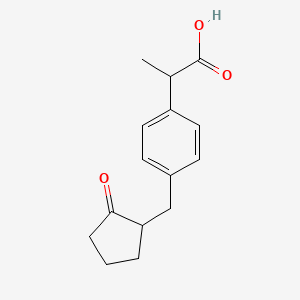
loxoprofen

loxoprofen
(RS)-2-{4-[(2-oxocyclopentyl)methyl]phenyl}propanoic acid
Cyclooxygenase inhibitor; Prostanoid receptor antagonist
Inflammatory disease; Pain
Loxoprofen (INN) is a non-steroidal anti-inflammatory drug in the propionic acid derivatives group, which also includes ibuprofen and naproxen among others. It is marketed in Brazil, Mexico and Japan by Sankyo as its sodium salt, loxoprofen sodium, under the trade name Loxonin, Argentina as Oxeno and in India as Loxomac. It is available in these countries for oral administration, and a transdermal preparation was approved for sale in Japan on January 2006.[1]
Pharmacokinetics
Loxoprofen is a prodrug. It is quickly converted to its active trans-alcohol metabolite following oral administration, and reaches its peak plasma concentration within 30 to 50 minutes.
Mechanism of action
As most NSAIDs, loxoprofen is a non-selective cyclooxygenase inhibitor, and works by reducing the synthesis of prostaglandins from arachidonic acid.
Interactions
Loxoprofen should not be administered at the same time as second-generation quinolone antibiotics such as ciprofloxacin and norfloxacin, as it increases their inhibition of GABA and this may cause seizures.[2] It may also increase the plasma concentration of warfarin, methotrexate, sulfonylurea derivatives and lithium salts, so care should be taken when loxoprofen is administered to patients taking any of these drugs.[2]
synthesis

Ethyl 2-oxocyclopentanecarboxylate (I) reacts with ethyl 2-(4-chloromethylphenyl)propionate (II) in the presence of KOH in hot DMF to afford ethyl 2-[4-(1-ethoxycarbonyl-2-oxocyclopentan-1-ylmethyl)phenyl]propionate (III), which is then hydrolyzed and decarboxylated by treatment with 47% HBr in refluxing dioxane.


http://zhou.nankai.edu.cn/index.php/highlights
Method for the preparation of loxoprofen (2S,1’R,2’S) trans-alcohol. Appears to be the first filing from the assignee. Sankyo (now Daiichi Sankyo) has developed and launched oral loxoprofen (Loxonin), an NSAID, is indicated for the symptom relief of inflammation and pain associated with eg rheumatoid arthritis, osteoarthritis and low back pain. Regional and national filings based on the product patent, WO03059880 start expiring from Jan 2023.
References
- Daiichi Sankyo Co. (January 24, 2006). “Percutaneous Absorption-Type Analgesic and Anti-inflammatory Drug Loxonin Poultice 100mg Receives Approval for Manufacture” (Press release). Doctor’s Guide Global Edition. Retrieved 2007-04-19.
- (Portuguese) “LOXONIN – Bula do Medicamento [Label Information]”. Centralx. 2007. Retrieved 2007-04-19.
|
7-29-1987
|
Leukotriene antagonists
|
|
|
5-20-1987
|
Phenothiazine and derivatives and analogs and use as leukotriene biosynthesis inhibitors
|
|
|
5-20-1987
|
Propylphenoxy pyridine carboxylates as leukotriene antagonists
|
|
|
5-20-1987
|
Phenothiazone derivatives and analogs
|
|
|
5-20-1987
|
Leukotriene antagonists
|
|
|
5-6-1987
|
Benzofuran 2-carboxylic acid esters useful as inhibitors of leukotriene biosynthesis
|
|
|
1-7-1987
|
1,4-diaza-phenothiazines
|
|
|
10-15-1986
|
Leukotriene antagonists
|
|
|
9-10-1986
|
Benzo[A]phenothiazines and hydro-derivatives
|
|
|
9-3-1986
|
4-oxo-benzopyran carboxylic acids
|
|
7-9-1986
|
Ophthalmic anti-inflammatory agents
|
|
|
10-27-1983
|
ANALGESIC AND ANTI-INFLAMMATORY AGENTS
|
|
|
8-24-1983
|
Analgesic and anti-inflammatory agents
|
|
|
7-18-1979
|
Substituted phenylacetic acid derivatives and process for the preparation thereof
|
Fulvestrant… For the treatment of hormone receptor positive metastatic breast cancer in postmenopausal women with disease progression following anti-estrogen therapy.

fulvestrant
| Fibrosis; Breast tumor; Female genital tract tumor; Uterus tumor |
Estrogen receptor antagonist
(7α,17β)-7-{9-[(4,4,5,5,5-pentafluoropentyl)sulfinyl]nonyl}estra-1,3,5(10)-triene-3,17-diol
129453-61-8 CAS
C32H47F5O3S
606.771
Fulvestrant is a drug treatment of hormone receptor-positive metastatic breast cancer in post-menopausal women with disease progression following anti-estrogen therapy. It is an estrogen receptor antagonist with no agonist effects, which works both by down-regulating and by degrading the estrogen receptor.
| Canada | 2351004 | 2003-02-18 | EXPIRY 2021-01-08 |
| United States | 6774122 | 2001-01-09 | EXPIRY 2021-01-09 |
Fulvestrant (Faslodex, AstraZeneca) is a drug treatment of hormone receptor-positive metastatic breast cancer in postmenopausal women with disease progression following anti-estrogen therapy. It is an estrogen receptor antagonist with no agonist effects, which works by down-regulating the estrogen receptor.[1] It is administered as a once-monthly injection.

Clinical uses
Fulvestrant is a selective estrogen receptor down-regulator (SERD). Fulvestrant is indicated for the treatment of hormone receptor positive metastatic breast cancer in postmenopausal women with disease progression following anti-estrogen therapy. The dosing schedule for fulvestrant remains under investigation in an attempt to optimize its effectiveness.[2]
Clinical trials
Metastatic or locally advanced breast cancer
Fulvestrant provided effective second-line therapy in this setting for postmenopausal women who had relapsed or progressed after previous endocrine therapy.[3]
In particular 4 clinical trials in this setting did show similar efficacy to the other hormonal agents (aromatase inhibitors and tamoxifen) with good tolerability profile. Fulvestrant had a lower incidence of joint disorders.[4][5]
NICE evaluation
The U.K. National Institute for Health and Clinical Excellence (NICE) said in 2011 that it found no evidence Faslodex was significantly better than existing treatments, so its widespread use would not be a good use of resources for the country’s National Health Service
The first month’s treatment of Faslodex, which starts with a loading dose, costs £1,044.82 ($1,666), and subsequent treatments cost £522.41 a month.
A month’s supply of anastrozole (Arimidex), which is off patent, costs £5.99, and letrozole (Femara) costs £84.86.[6][7][8]
Patent extension
The original patent for Faslodex expired in October 2004. Drugs subject to pre-marketing regulatory review are eligible for patent extension, and for this reason AstraZeneca got an extension of the patent to December 2011.[9][10]
AstraZeneca has filed later patents. There is no generic Faslodex available.[11] A later patent for Faslodex expires in January 2021.[12]
FASLODEX® (fulvestrant) injection for intramuscular administration is an estrogen receptor antagonist. The chemical name is 7-alpha-[9-(4,4,5,5,5-penta fluoropentylsulphinyl) nonyl]estra-1,3,5-(10)- triene-3,17beta-diol. The molecular formula is C32H47F5O3S and its structural formula is:
 |
Fulvestrant is a white powder with a molecular weight of 606.77. The solution for injection is a clear, colorless to yellow, viscous liquid.
Each injection contains as inactive ingredients: 10% w/v Alcohol, USP, 10% w/v Benzyl Alcohol, NF, and 15% w/v Benzyl Benzoate, USP, as co-solvents, and made up to 100% w/v with Castor Oil, USP as a co-solvent and release rate modifier.
-
Fulvestrant is a pure antiestrogen that represent a significant breakthrough in the treatment of breast cancer. Despite its pure antagonist activity, studies on ovariectomized rats have confirmed that fulvestrant, in contrast to Tamoxifen which acts like estrogen to reduce periosteal bone formation, does not alter estrogen-like or antiestrogenic effects. Fulvestrant also has some distinct advantages on target organs other than breast tissue.
-
Fulvestrant is a steroidal pure antiestrogen with a chemical structure similar to estradiol. Studies of etrogen receptor (ER) function have demonstrated that estradiol binding to the ER initiate a sequence of events. Fulvestrant antagonizes estrogen action by occupying the ER and preventing estrogen-stimulated gene activation, thus interfering with the estrogen related processes essential for cell-cycle competion.
-
Fulvestrant, 7-alpha- [9-(4,4,5,5,5pentafluoropentylsulphinyl) nonyl]-estra-1,3,5 (10)-triene-3,17β-diol, has the following formula:

-
WO Patent application No. 02/32922 describes a process for preparing an intermediate compound useful for preparing, e.g. fulvestrant, which process comprises aromatization of a compoud, and thereafter if necessary or desired, carrying out one or more of the following steps: (i) removing any hydroxy protecting group; (ii) converting a precursor group to a different such group.
-
EP Patent No. 0138504 relates to certain 7α-substituted derivatives of oestradiol and related steroids which possess antioestrogenic activity. US Patent No. 4659516 , EP Patent No. 0138504 and Bowler, Steroids 1989, 54, 71 describe a process for making steroids such as fulvestrant, by which 1,6-conjugate addition of an alkyl group to an estra-4,6-diene-3-one gave a ratio of 7α- to 7β-epimer of 1.2 : 1 (isolated). In WO 02/32922 it is stated that the ratio of epimers obtained using this process on an industrial scale is 1.9: 1.
-
US patent No 6288051 describes 7α-(5 -methylaminopentyl)-estratrienes.
-
There remains a need in the art for improved methods of preparing fluvestrant and other 7α-alkylated 19-norsteroids.

PATENT
http://www.google.com/patents/EP1771462B1?cl=en


Preparative Example 16: Preparation of fulvestrant (Cp 9305) from Cp 9363 – indirect process (depicted in Figure 12)
-
A solution of 40.5 grams of Cp 9363 in 320 grams tetrahydrofuran and 81 grams methanol was cooled to 5°C and treated with a warm solution of 27 grams sodium (meta) periodate in 183 grams water. The mixture was allowed to stand at room temperature overnight, concentrated under vacuum and then dissolved in dichloromethane, extracted with water and evaporated to give 40 grams of Cp 9368 (fulvestrant 17-acetate).
-
The oily residue of Cp 9368 (40 grams) was dissolved in 320 grams of methanol under nitrogen and treated for 3 hours at room temperature with a solution of 20 grams of potassium hydroxide in 128 grams methanol. After neutralisation with 30 grams of acetic acid, the reaction mixture was concentrated under vacuum and then dissolved in dichloromethane, extracted with water and evaporated. The oily residue was crystallised from 400 grams of toluene, then dried under vacuum to constant weight. 26.6 grams of fulvestrant were obtained.
Example 17: Preparation of fulvestrant (Cp 9305) from Cp 9304 – direct process (depicted in Figure 9)
-
A solution of 41 grams of Cp 9304 in 328 grams tetrahydrofuran and 82 grams methanol was cooled to 5°C and treated with a warm solution of 27 grams sodium (meta)periodate in 185 grams water. The mixture was allowed to stand at room temperature overnight, concentrated under vacuum and then dissolved in dichloromethane, extracted with water, evaporated, and crystallised from toluene to give 28 grams of Cp 9305 (fulvestrant). Further purification can be effected by recrystallisation from ethyl acetate.
PAPER
Org. Process Res. Dev., 2010, 14 (3), pp 544–552
http://pubs.acs.org/doi/abs/10.1021/op900315j

7α-[9-(4,4,5,5,5-Pentafluoropentylsulfinyl)nonyl]estra-1,3,5-(10)-triene-3,17β-diol (Fulvestrant) (6)

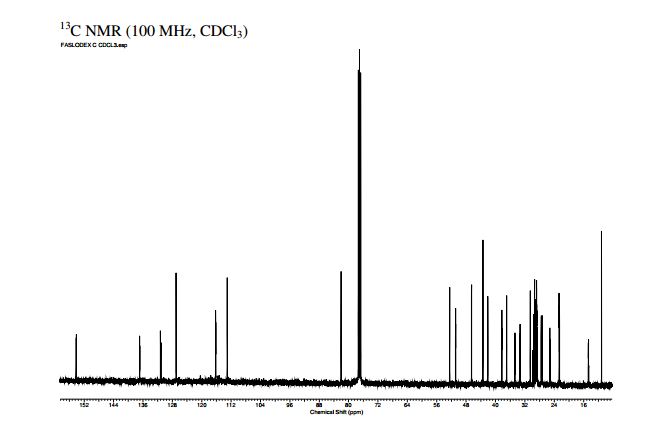

7α-[9-(4,4,5,5,5-Pentafluoropentylsulfinyl)nonyl]estra-1,3,5-(10)-triene-3,17β-diol (Fulvestrant)
References
- S. Kansra, S. Yamagata, L. Sneade, L. Foster & N. Ben-Jonathan (2005). “Differential effects of estrogen receptor antagonists on pituitary lactotroph proliferation and prolactin release”. Mol Cell Endocrinol 239 (1-2): 27–36. doi:10.1016/j.mce.2005.04.008. PMID 15950373.
- Angela Mae Obermiller, PharmD; and Mehmet Sitki Copur, MD (2011). “The Longstanding Quest for a Better Endocrine Therapy Continues High-Dose Fulvestrant: Have We Found Its Effective Dose, Combination, Setting, or Sequence?”. Contemporary Oncology 3 (1).
- Croxtall, J. D.; McKeage, K. (2011). “Fulvestrant”. Drugs 71 (3): 363–380. doi:10.2165/11204810-000000000-00000. PMID 21319872.
- Fulvestrant in the treatment of advanced breast cancer: a systematic review and meta-analysis of randomized controlled trials. Valachis A, Mauri D, Polyzos NP, Mavroudis D, Georgoulias V, Casazza G. Crit Rev Oncol Hematol. 2010 Mar;73(3):220-7. Epub 2009 Apr 14. Review. PMID:19369092
- Fulvestrant for systemic therapy of locally advanced or metastatic breast cancer in postmenopausal women: a systematic review. Flemming J, Madarnas Y, Franek JA. Breast Cancer Res Treat. 2009 May;115(2):255-68. Epub 2008 Aug 6. Review. PMID:18683044
- UK cost body rules against AstraZeneca cancer drug, Reuters, Nov 9, 2011
- UK’s NICE says no to AstraZeneca breast cancer drug Faslodex, The Pharma Letter, 10 November 2011
- National Institute for Health and Clinical Excellence Guidance Breast cancer (metastatic) – fulvestrant
- Patent Term Extensions The United States Patent and Trademark Office.
- Determination of Regulatory Review Period for Purposes of Patent Extension; FASLODEX A Notice by the Food and Drug Administration on 04/17/2003
- Generic Faslodex Availability, Drugs.COM
- Pink Ribbon Blues: How Breast Cancer Culture Undermines Women’s Health By Gayle A. Sulik, Oxford University Press (Oct. 2010)
VERY New patent
WO-2014064712
Process for the preparation of fulvestrant and its intermediates. Appears to be the first filing from Intas Pharmaceuticals on this API. Family members of the product patent, WO0151056 (assigned to AstraZeneca), expire in the EU states and in the US in 2021
 |
|
| Clinical data | |
|---|---|
| Trade names | Faslodex |
| AHFS/Drugs.com | Monograph |
| Pregnancy category |
|
| Routes of administration |
Intramuscular injection |
| ATC code | L02BA03 (WHO) |
| Legal status | |
| Legal status |
|
| Pharmacokinetic data | |
| Protein binding | 99% |
| Biological half-life | 40 days |
| Identifiers | |
| Synonyms | ICI-182,780 |
| CAS Number | 129453-61-8  |
| PubChem (CID) | 104741 |
| IUPHAR/BPS | 1015 |
| DrugBank | DB00947  |
| ChemSpider | 94553 |
| UNII | 22X328QOC4 |
| KEGG | D01161 |
| ChEBI | CHEBI:31638 |
| ChEMBL | CHEMBL1358 |
| ECHA InfoCard | 100.170.955 |
| Chemical and physical data | |
| Formula | C32H47F5O3S |
| Molar mass | 606.772 g/mol |
| 3D model (Jmol) | Interactive image |
//////////

Researchers create protein with potential for weight loss, diabetes treatment

It sounds like a magic bullet: Administer a protein, watch the subject lose weight. But that’s exactly what University of Florida scientists found when they discovered a new way to deliver a protein that helps develop cells that convert fat into energy.
The study builds upon on a discovery by Bruce Spiegelman, a cell biologist at the Boston-based Dana-Farber Cancer Institute, who found that human muscles release a hormone he called irisin during exercise. Spiegelman also found that mice lost a small amount of weight when given the irisin gene using a virus to ferry it into cells.
Now the UF team—including researcher Dr. Li-Jun Yang, Shi-Wu Li, and postdoctoral researcher William Donelan—has for the first time created a stable protein form of irisin, opening the door to human studies that weren’t previously possible because the virus has not been approved for use in people.
“We found that if you…
View original post 422 more words
Cancer: Health Care In India In A Nutshell


Since independence several measures have been undertaken by the National Government to improve the health of the people. Several National Health Programs have been launched by the Government including programs on Non-communicable diseases (NCD) along with the communicable diseases which are prevalent in India. Now India is experiencing a rapid health transition with rising burden of chronic NCDs especially CVD, Diabetes, Cancer, Stroke and lung diseases. In 2005 NCDs accounted for 53 % of deaths and NCDs are surpassing the burden of communicable diseases in India.
In 2010 the Cancer program was integrated with the then existing program and the new program is NPCDCS (National Program for Prevention and Control of Cancer, Diabetes, Cardiovascular Diseases and Stroke). There are two programs under NPCDCS:
- DCS – Diabetes, Cardiovascular Disease and Stroke – under NPCDCS
- Cancer component under NPCDCS
The objectives of the new cancer program under NPCDCS are:
- Primary prevention: Health education
- Secondary…
View original post 549 more words
Pharmaceutical Packaging – New USP Proposal for Optimised Method of Measuring Moisture Vapour Permeation

| Pharmaceutical Packaging – New USP Proposal for Optimised Method of Measuring Moisture Vapour Permeation |
| An improved method of measuring water vapour permeation for solid oral dosage forms like tablets or capsules has been discussed during a USP – PQRI Workshop and presented in the Pharmacopeial Forum. See the detailed information. |
Revision of the USP Chapter on Spectroscopic Methods
| Revision of the USP Chapter on Spectroscopic Methods |
| A new concept for the representation of different analytical and spectroscopic methods (AAS, IR, UV, etc.) has been presented as general chapter in the USP. In the future, there should be two general chapters for each method. The concrete implementation is planned in the USP38/NF33. Read more here in the News. |
GMP News: Revision of the USP Chapter on Spectroscopic Methods
|
View original post 126 more words
Resveratrol remains effective against cancer after the body converts it
A chemical found in red wine remains effective at fighting cancer even after the body’s metabolism has converted it into other compounds. This is an important finding in a new paper published in the journal Science Translational Medicine by Cancer Research UK-funded researchers at the University of Leicester’s Department of Cancer Studies and Molecular Medicine.
The paper reveals that resveratrol – a compound extracted from the skins of red grapes – is not rendered ineffective once it is metabolised by the body.
This is an important development, as resveratrol is metabolised very quickly – and it had previously been thought that levels of the extracted chemical drop too quickly to make it usable in clinical trials.
The new research shows that the chemical can still be taken into cells after it has been metabolised into resveratrol sulfates.
Enzymes within cells are then able to break it down into resveratrol…
View original post 504 more words
Stem cell therapy regenerates heart muscle damaged from heart attacks in primates
Heart cells created from human embryonic stem cells successfully restored damaged heart muscles in monkeys. The results of the experiment appear in the April 30 advanced online edition of the journal Nature in a paper titled, “Human embryonic-stem cell derived cardiomyocytes regenerate non-human primate hearts.”
The findings suggest that the approach should be feasible in humans, the researchers said.
“Before this study, it was not known if it is possible to produce sufficient numbers of these cells and successfully use them to remuscularize damaged hearts in a large animal whose heart size and physiology is similar to that of the human heart,” said Dr. Charles Murry, UW professor of pathology and bioengineering, who led the research team that conducted the experiment.
A physician/scientist, Murry directs the UW Center for Cardiovascular Biology and is a UW Medicine pathologist.
Murry said he expected the approach could be ready for clinical trials in…
View original post 611 more words
Sanfilippo Syndrome: FDA Orphan Designations For Gene Therapy

SF is a genetic metabolism disorder that prohibits the proper breakdown of the body’s sugar molecules. There are 4 types of MPS III (MPS III A, MPS III B, MPS III C, and MPS III D), each with a deficiency in one of four lysosomal enzymes. The disease first affects the central nervous system, causing severe brain damage, and typically results in hearing loss, vision loss…
View original post 226 more words
DR ANTHONY MELVIN CRASTO

ORGANIC SPECTROSCOPY


 New Drug Approvals