New Drug Approvals

Home » Posts tagged 'preclinical' (Page 3)

Tag Archives: preclinical

DRUG APPROVALS BY DR ANTHONY MELVIN CRASTO .....FOR BLOG HOME CLICK HERE

Blog Stats

  • 4,811,378 hits

Flag and hits

Flag Counter

Enter your email address to follow this blog and receive notifications of new posts by email.

Join 37.9K other subscribers
Follow New Drug Approvals on WordPress.com

Archives

Categories

Recent Posts

Flag Counter

ORGANIC SPECTROSCOPY

Read all about Organic Spectroscopy on ORGANIC SPECTROSCOPY INTERNATIONAL 

Enter your email address to follow this blog and receive notifications of new posts by email.

Join 37.9K other subscribers
DR ANTHONY MELVIN CRASTO Ph.D

DR ANTHONY MELVIN CRASTO Ph.D

DR ANTHONY MELVIN CRASTO, Born in Mumbai in 1964 and graduated from Mumbai University, Completed his Ph.D from ICT, 1991,Matunga, Mumbai, India, in Organic Chemistry, The thesis topic was Synthesis of Novel Pyrethroid Analogues, Currently he is working with AFRICURE PHARMA, ROW2TECH, NIPER-G, Department of Pharmaceuticals, Ministry of Chemicals and Fertilizers, Govt. of India as ADVISOR, earlier assignment was with GLENMARK LIFE SCIENCES LTD, as CONSUlTANT, Retired from GLENMARK in Jan2022 Research Centre as Principal Scientist, Process Research (bulk actives) at Mahape, Navi Mumbai, India. Total Industry exp 32 plus yrs, Prior to joining Glenmark, he has worked with major multinationals like Hoechst Marion Roussel, now Sanofi, Searle India Ltd, now RPG lifesciences, etc. He has worked with notable scientists like Dr K Nagarajan, Dr Ralph Stapel, Prof S Seshadri, etc, He did custom synthesis for major multinationals in his career like BASF, Novartis, Sanofi, etc., He has worked in Discovery, Natural products, Bulk drugs, Generics, Intermediates, Fine chemicals, Neutraceuticals, GMP, Scaleups, etc, he is now helping millions, has 9 million plus hits on Google on all Organic chemistry websites. His friends call him Open superstar worlddrugtracker. His New Drug Approvals, Green Chemistry International, All about drugs, Eurekamoments, Organic spectroscopy international, etc in organic chemistry are some most read blogs He has hands on experience in initiation and developing novel routes for drug molecules and implementation them on commercial scale over a 32 PLUS year tenure till date Feb 2023, Around 35 plus products in his career. He has good knowledge of IPM, GMP, Regulatory aspects, he has several International patents published worldwide . He has good proficiency in Technology transfer, Spectroscopy, Stereochemistry, Synthesis, Polymorphism etc., He suffered a paralytic stroke/ Acute Transverse mylitis in Dec 2007 and is 90 %Paralysed, He is bound to a wheelchair, this seems to have injected feul in him to help chemists all around the world, he is more active than before and is pushing boundaries, He has 100 million plus hits on Google, 2.5 lakh plus connections on all networking sites, 100 Lakh plus views on dozen plus blogs, 227 countries, 7 continents, He makes himself available to all, contact him on +91 9323115463, email amcrasto@gmail.com, Twitter, @amcrasto , He lives and will die for his family, 90% paralysis cannot kill his soul., Notably he has 38 lakh plus views on New Drug Approvals Blog in 227 countries......https://newdrugapprovals.wordpress.com/ , He appreciates the help he gets from one and all, Friends, Family, Glenmark, Readers, Wellwishers, Doctors, Drug authorities, His Contacts, Physiotherapist, etc He has total of 32 International and Indian awards

Verified Services

View Full Profile →

Archives

Categories

Flag Counter

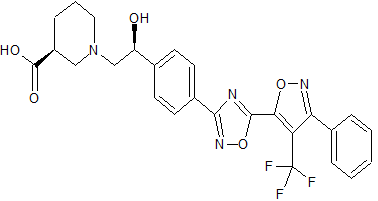
BMS-960


Figure imgf000099_0001

str1

BMS-960

PRECLINICAL

(S)-1-((S)-2-Hydroxy-2-(4-(5-(3-phenyl-4-(trifluoromethyl)isoxazol-5-yl)-1,2,4-oxadiazol-3-yl)phenyl)ethyl)piperidine-3-carboxylic Acid

3-Piperidinecarboxylic acid, 1-[(2S)-2-hydroxy-2-[4-[5-[3-phenyl-4-(trifluoromethyl)-5-isoxazolyl]-1,2,4-oxadiazol-3-yl]phenyl]ethyl]-, (3S)-

(S)-1-((S)-2-Hydroxy-2-(4-(5-(3-phenyl-4-(trifluoromethyl)isoxazol-5-yl)-1,2,4-oxadiazol-3-yl)phenyl)ethyl)piperidine-3-carboxylic Acid

CAS 1265321-86-5 FREE FORM

FREE FORM 528.48, C26 H23 F3 N4 O5

CAS 1265323-40-7 HCL SALT

BASIC PATENT WO201117578, 2011, (US Patent 8399451)

Inventors John L. Gilmore, James E. Sheppeck
Applicant Bristol-Myers Squibb Company

Image result for Bristol-Myers Squibb Company

Sphingosine-1-phosphate (S1P) is the endogenous ligand for the sphingosine-1-phophate receptors (S1P1–5) and triggers a number of cellular responses through their stimulation. S1P and its interaction with the S1P receptors play a significant role in a variety of biological processes including vascular stabilization, heart development, lymphocyte homing, and cancer angiogenesis. Agonism of S1P1, especially, has been shown to play an important role in lymphocyte trafficking from the thymus and secondary lymphoid organs, inducing immunosuppression, which has been established as a novel mechanism of treatment for immune diseases and vascular diseases

Sphingosine-1 -phosphate (SlP) has been demonstrated to induce many cellular effects, including those that result in platelet aggregation, cell proliferation, cell morphology, tumor cell invasion, endothelial cell and leukocyte chemotaxis, endothelial cell in vitro angiogenesis, and lymphocyte trafficking. SlP receptors are therefore good targets for a wide variety of therapeutic applications such as tumor growth inhibition, vascular disease, and autoimmune diseases. SlP signals cells in part via a set of G protein-coupled receptors named SlPi or SlPl, SlP2 or S1P2, SlP3 or S1P3, SlP4 Or S1P4, and SlP5 or S1P5 (formerly called EDG-I, EDG-5, EDG-3, EDG-6, and EDG-8, respectively).

SlP is important in the entire human body as it is also a major regulator of the vascular and immune systems. In the vascular system, SlP regulates angiogenesis, vascular stability, and permeability. In the immune system, SlP is recognized as a major regulator of trafficking of T- and B-cells. SlP interaction with its receptor SlPi is needed for the egress of immune cells from the lymphoid organs (such as thymus and lymph nodes) into the lymphatic vessels. Therefore, modulation of SlP receptors was shown to be critical for immunomodulation, and SlP receptor modulators are novel immunosuppressive agents.

The SlPi receptor is expressed in a number of tissues. It is the predominant family member expressed on lymphocytes and plays an important role in lymphocyte trafficking. Downregulation of the SlPi receptor disrupts lymphocyte migration and homing to various tissues. This results in sequestration of the lymphocytes in lymph organs thereby decreasing the number of circulating lymphocytes that are capable of migration to the affected tissues. Thus, development of an SlPi receptor agent that suppresses lymphocyte migration to the target sites associated with autoimmune and aberrant inflammatory processes could be efficacious in a number of autoimmune

Among the five SlP receptors, SlPi has a widespread distribution and is highly abundant on endothelial cells where it works in concert with SIP3 to regulate cell migration, differentiation, and barrier function. Inhibition of lymphocyte recirculation by non-selective SlP receptor modulation produces clinical immunosuppression preventing transplant rejection, but such modulation also results in transient bradycardia. Studies have shown that SlPi activity is significantly correlated with depletion of circulating lymphocytes. In contrast, Sl P3 receptor agonism is not required for efficacy. Instead, SIP3 activity plays a significant role in the observed acute toxicity of nonselective SlP receptor agonists, resulting in the undesirable cardiovascular effects, such as bradycardia and hypertension. (See, e.g., Hale et al, Bioorg. Med. Chem. Lett., 14:3501 (2004); Sanna et al., J. Biol. Chem., 279: 13839 (2004); Anliker et al., J. Biol. Chem., 279:20555 (2004); Mandala et al., J. Pharmacol. Exp. Ther., 309:758 (2004).)

An example of an SlPi agonist is FTY720. This immunosuppressive compound FTY720 (JPI 1080026-A) has been shown to reduce circulating lymphocytes in animals and humans, and to have disease modulating activity in animal models of organ rejection and immune disorders. The use of FTY720 in humans has been effective in reducing the rate of organ rejection in human renal transplantation and increasing the remission rates in relapsing remitting multiple sclerosis (see Brinkman et al., J. Biol. Chem., 277:21453 (2002); Mandala et al., Science, 296:346 (2002); Fujino et al., J.

Pharmacol. Exp. Ther., 305:45658 (2003); Brinkman et al, Am. J. Transplant., 4: 1019 (2004); Webb et al., J. Neuroimmunol, 153: 108 (2004); Morris et al., Eur. J. Immunol, 35:3570 (2005); Chiba, Pharmacology & Therapeutics, 108:308 (2005); Kahan et al., Transplantation, 76: 1079 (2003); and Kappos et al., N. Engl. J. Med., 335: 1124 (2006)). Subsequent to its discovery, it has been established that FTY720 is a prodrug, which is phosphorylated in vivo by sphingosine kinases to a more biologically active agent that has agonist activity at the SlPi, SIP3, SlP4, and SIP5 receptors. It is this activity on the SlP family of receptors that is largely responsible for the pharmacological effects of FTY720 in animals and humans. [0007] Clinical studies have demonstrated that treatment with FTY720 results in bradycardia in the first 24 hours of treatment (Kappos et al, N. Engl. J. Med., 335: 1124 (2006)). The observed bradycardia is commonly thought to be due to agonism at the SIP3 receptor. This conclusion is based on a number of cell based and animal experiments. These include the use of SIP3 knockout animals which, unlike wild type mice, do not demonstrate bradycardia following FTY720 administration and the use of SlPi selective compounds. (Hale et al., Bioorg. Med. Chem. Lett., 14:3501 (2004); Sanna et al., J. Biol. Chem., 279: 13839 (2004); and Koyrakh et al., Am. J. Transplant, 5:529 (2005)).

The following applications have described compounds as SlPi agonists: WO 03/061567 (U.S. Patent Publication No. 2005/0070506), WO 03/062248 (U.S. Patent No. 7,351,725), WO 03/062252 (U.S. Patent No. 7,479,504), WO 03/073986 (U.S. Patent No. 7,309,721), WO 03/105771, WO 05/058848, WO 05/000833, WO 05/082089 (U.S. Patent Publication No. 2007/0203100), WO 06/047195, WO 06/100633, WO 06/115188, WO 06/131336, WO 2007/024922, WO 07/109330, WO 07/116866, WO 08/023783 (U.S. Patent Publication No. 2008/0200535), WO 08/029370, WO 08/114157, WO 08/074820, WO 09/043889, WO 09/057079, and U.S. Patent No. 6,069,143. Also see Hale et al., J. Med. Chem., 47:6662 (2004).

There still remains a need for compounds useful as SlPi agonists and yet having selectivity over Sl P3.

Applicants have found potent compounds that have activity as SlPi agonists. Further, applicants have found compounds that have activity as SlPi agonists and are selective over SIP3. These compounds are provided to be useful as pharmaceuticals with desirable stability, bioavailability, therapeutic index, and toxicity values that are important to their drugability.

SYNTHESIS

Figure

(S)-1-((S)-2-Hydroxy-2-(4-(5-(3-phenyl-4-(trifluoromethyl)isoxazol-5-yl)-1,2,4-oxadiazol-3-yl)phenyl)ethyl)piperidine-3-carboxylic acid, HCl (BMS-960). CAS 1265323-40-7

(S)-1-((S)-2-hydroxy-2-(4-(5-(3-phenyl-4-(trifluoromethyl)isoxazol-5-yl)-1,2,4-oxadiazol-3-yl)phenyl)ethyl)piperidine-3-carboxylic acid, HCl (BMS-960)

1H NMR (400 MHz, DMSO-d6) δ 12.88 (br. s, 1H), 10.5 (br. s, 1H), 8.14 (d, J = 8.6 Hz, 2H), 7.72 (d, J = 8.4 Hz, 2H), 7.69–7.57 (m, 5H), 6.43 (br. s., 1H), 5.37 (d, J = 10.8 Hz, 1H), 3.89–3.60 (m, 2H), 3.50–2.82 (m, 6H), 2.14–1.99 (m, 1H), 1.97–1.75 (m, 1H), 1.63–1.35 (m, 1H);

13C NMR (101 MHz, CDCl3) δ 172.8, 168.5, 164.0, 161.6, 155.4, 156.2, 131.2, 129.0, 128.9, 127.4, 127.2, 125.5, 124.3, 122.2, 111.6, 66.6. 63.0, 52.9, 52.2, 38.8, 25.0, 21.7;

19F NMR (376 MHz, DMSO-d6) δ −54.16;

Anal. calcd for C26H23F3N4O5·HCl: C, 54.71; H, 4.36; N, 9.80. Found: C, 54.76; H, 3.94; N, 9.76;

HRMS (ESI) m/e 529.17040 [(M + H)+, calcd for C26 H24 N4 O5 F3 529.16933].

PATENT

WO 2011017578

Example 14

(S)-l-((S)-2-Hydroxy-2-(4-(5-(3-phenyl-4-(trifluoromethyl)isoxazol-5-yl)-l,2,4- oxadiazol-3-yl)phenyl)ethyl)piperidine-3-carboxylic acid

Figure imgf000099_0001

Preparation 14A: (3S)-Ethyl l-(2-(4-cyanophenyl)-2-hydroxyethyl)piperidine-3- carboxylate

Figure imgf000099_0002

(14A)-isomer A (14A)-isomer B [00210] To a mixture of (S)-ethyl piperidine-3-carboxylate (1.3 g, 8.27 mmol) in toluene (50 mL) was added 4-(2-bromoacetyl)benzonitrile (2.4 g, 10.71 mmol). The reaction mixture was stirred overnight. LCMS indicated completion of reaction. MeOH (10 mL) was added to the mixture, followed by the portionwise addition of sodium borohydride (0.313 g, 8.27 mmol). After 1 hour, LCMS show complete reduction to the desired alcohol. The reaction was quenched with water. The reaction mixture was diluted with ethyl acetate and washed with saturated NaCl. The organic layer was dried with MgSO4, filtered, concentrated, and purified on a silica gel cartridge using an EtOAc/hexanes gradient to yield 2.0 g of solid product. The product was separated by chiral HPLC (Berger SFC MGIII instrument equipped with a CHIRALCEL® OJ (25 x 3 cm, 5 μM). Temp: 30 0C; Flow rate: 130 mL/min; Mobile phase: C(V(MeOH +

0.1%DEA) in 9: 1 ratio isocratic:

[00211] Peak 1 (Isomer A): RT = 2.9 min. for (S)-ethyl l-((S)-2-(4-cyanophenyl)-2- hydroxyethyl)piperidine-3-carboxylate (>99% d.e.). The absolute and relative stereochemistry of compound 14A-isomer A was assigned (S,S) by X-ray crystal structure (see Alternative Route data). 1H NMR (400 MHz, CDCl3) δ ppm 7.63 (2 H, m, J=8.35 Hz), 7.49 (2 H, m, J=8.35 Hz), 4.77 (1 H, dd, J=10.55, 3.52 Hz), 4.17 (2 H, q, J=7.03 Hz), 3.13 (1 H, d, J=9.23 Hz), 2.53-2.67 (3 H, m), 2.44 (2 H, dd, J=18.68, 9.89 Hz), 2.35 (1 H, dd, J=12.74, 10.55 Hz), 1.87-2.01 (1 H, m), 1.71-1.82 (1 H, m), 1.52-1.70 (2 H, m), 1.28 (3 H, t, J=7.03 Hz).

[00212] Peak 2 (Isomer B): RT = 3.8 min for (S)-ethyl l-((R)-2-(4-cyanophenyl)-2- hydroxyethyl)piperidine-3-carboxylate (>99% d.e.). The absolute and relative stereochemistry of 14A-isomer B was assigned (S,R) based on the crystal structure of 14A-isomer A. 1H NMR (400 MHz, CDCl3) δ ppm 7.63 (2 H, m, J=8.35 Hz), 7.49 (2 H, m, J=8.35 Hz), 4.79 (1 H, dd, J=10.55, 3.52 Hz), 4.16 (2 H, q, J=7.03 Hz), 2.69-2.91 (3 H, m), 2.60-2.68 (1 H, m), 2.56 (1 H, dd, J=12.30, 3.52 Hz), 2.36 (1 H, dd, J=12.52, 10.77 Hz), 2.25 (1 H, t, J=8.79 Hz), 1.65-1.90 (3 H, m), 1.52-1.64 (1 H, m, J=12.69, 8.49, 8.49, 4.17 Hz), 1.27 (3 H, t, J=7.25 Hz).

[00213] (S)-Ethyl l-((S)-2-(4-cyanophenyl)-2-hydroxyethyl)piperidine-3-carboxylate (14A-isomer A) was carried forward to make Example 14 and (S)-ethyl l-((R)-2-(4- cyanophenyl)-2-hydroxyethyl)piperidine-3-carboxylate (14A-isomer B) was carried forward to make Example 15.

Preparation 14B: (S)-Ethyl l-((S)-2-hydroxy-2-(4-((Z)-N’-hydroxycarbamimidoyl) phenyl)ethyl)piperidine-3 -carboxylate

Figure imgf000100_0001

[00214] To a mixture of ((S)-ethyl l-((S)-2-hydroxy-2-(4-((Z)-N’- hydroxycarbamimidoyl) phenyl)ethyl)piperidine-3 -carboxylate (14A-Isomer A) (58 mg, 0.192 mmol) and hydroxylamine hydrochloride (26.7 mg, 0.384 mmol) in 2-propanol (10 mL) was added sodium bicarbonate (64.5 mg, 0.767 mmol). The reaction mixture was heated at 85 0C. The reaction mixture was diluted with ethyl acetate and washed with sat NaCl. The organic layer was dried with MgSO4, filtered, and concentrated to yield 56 mg. MS (M+l) = 464. HPLC Peak RT = 1.50 minutes.

Preparation 14C: (S)-Ethyl l-((S)-2-hydroxy-2-(4-(5-(3-phenyl-4-(trifluoromethyl) isoxazol-5-yl)-l,2,4-oxadiazol-3-yl)phenyl)ethyl)piperidine-3-carboxylate

Figure imgf000101_0001

[00215] 3-Phenyl-4-(trifluoromethyl)isoxazole-5-carbonyl fluoride, InM-G (214 mg, 0.78 mmol) was dissolved in acetonitrile (5.00 mL). DIEA (0.272 mL, 1.555 mmol) and (S)-ethyl- 1 -((S)-2-hydroxy-2-(4-((Z)-N’-hydroxycarbamimidoyl) phenyl)ethyl)- piperidine-3-carboxylate (261 mg, 0.778 mmol) were added. The reaction mixture was stirred for 2 hours, then IM TBAF in THF (0.778 mL, 0.778 mmol) was added. The reaction mixture was stirred overnight at room temperature. The reaction mixture was filtered and purified by HPLC in three batches. HPLC conditions: PHENOMENEX® Luna C18 5 micron column (250 x 30mm); 25-100% CH3CN/water (0.1% TFA); 25 minute gradient; 30 mL/min. Isolated fractions with correct mass were partitioned between EtOAc and saturated NaHCO3 with back extracting aqueous layer once. The organic layer was dried with MgSO4, filtered, and concentrated to give 155mg of (S)- ethyl l-((S)-2-hydroxy-2-(4-(5-(3-phenyl-4-(trifluoromethyl)isoxazol-5-yl)-l,2,4- oxadiazol-3-yl)phenyl)ethyl) piperidine-3-carboxylate. 1H NMR (400 MHz, MeOH-d3) δ ppm 8.04 (2 H, d, J=8.13 Hz), 7.55-7.60 (2 H, m), 7.41-7.54 (5 H, m), 4.81 (1 H, ddd, J=8.35, 4.06, 3.84 Hz), 3.96-4.10 (2 H, m), 2.82-3.08 (1 H, m), 2.67-2.82 (1 H, m), 2.36- 2.61 (3 H, m), 2.08-2.33 (2 H, m), 1.73-1.87 (1 H, m, J=8.54, 8.54, 4.45, 4.17 Hz), 1.32- 1.70 (3 H, m), 1.09-1.19 (3 H, m). MS (m+l) = 557. HPLC Peak RT = 3.36 minutes. Purity = 99%.

Example 14: [00216] (S)-Ethyl l-((S)-2-hydroxy-2-(4-(5-(3-phenyl-4-(trifluoromethyl)isoxazol-5- yl)-l,2,4-oxadiazol-3-yl)phenyl)ethyl)piperidine-3-carboxylate (89 mg, 0.16 mmol) was heated at 50 0C in 6N HCl (5 mL) in acetonitrile (5 mL). The reaction mixture was stirred overnight and then filtered and purified by HPLC. HPLC conditions:

PHENOMENEX® Luna C 18 5 micron column (250 x 30mm); 25-100% CH3CN/water (0.1% TFA); 25 minute gradient; 30 mL/min. Isolated fractions with correct mass were freeze-dried overnight to yield 36 mg of (S)-l-((S)-2-hydroxy-2-(4-(5-(3-phenyl-4- (trifluoromethyl)isoxazol-5-yl)-l,2,4-oxadiazol-3-yl)phenyl)ethyl) piperidine-3- carboxylic acid as a TFA salt. 1H NMR (400 MHz, MeOH-d3) δ ppm 8.23 (2 H, d, J=8.35 Hz), 7.65-7.74 (4 H, m), 7.54-7.65 (3 H, m), 5.29 (1 H, t, J=7.03 Hz), 4.00 (1 H, br. s.), 3.43-3.75 (1 H, m), 3.34-3.41 (2 H, m), 2.82-3.24 (2 H, m), 2.26 (1 H, d, J=I 1.86 Hz), 1.84-2.14 (2 H, m), 1.52-1.75 (1 H, m). MS (m+1) = 529. HPLC Peak RT = 3.24 minutes. Purity = 98%. Example 14-Alternate Synthesis Route 1

Preparation 14D (Alternate Synthesis Route 1): (S)-4-(Oxiran-2-yl)benzonitrile

Figure imgf000102_0001

[00217] To 800 mL of 0.2M, pH 6.0 sodium phosphate buffer in a 2 L flask equipped with an overhead stirrer was added D-glucose (38.6 g, 1.2 eq), β-nicotinamide adenine dinucleotide, free acid (1.6 g, mmol), glucose dehydrogenase (36 mg, 3.2 kU,

CODEXIS® GDH- 102, 90 U/mg), and enzyme KRED-NADH-110 (200 mg,

CODEXIS®, 25 U/mg). The vessels containing the reagents above were rinsed with 200 mL of fresh sodium phosphate buffer and added to the reaction which was stirred to dissolution and then heated to 40 0C. To this mixture was added a solution of 2-bromo- 4′-cyanoacetophenone (40 g, 178.5 mmol) in 100 mL DMSO through an addition funnel in about 30 min. The container was rinsed with 20 mL DMSO and the rinse was added to the reactor. A pH of 5.5-6.0 was maintained by adding 1 M NaOH through a fresh addition funnel (total volume of 200 mL over 6h) after which HPLC showed complete consumption of the starting material. The reaction mixture was extracted with 800 mL MTBE x 2 and the combined extracts were washed with 300 mL of 25% brine. The crude alcohol was transferred to a 3L 3-neck flask and treated with solid NaOtBu (34.3 g, 357 mmol) stirring for 1 h and then additional NaOtBu (6.9 g, 357 mmol) and stirring for 30 min. The reaction mixture was filtered and the solution was washed with 300 mL 0.2 M pH 6.0 sodium phosphate buffer, brine, and then the solvent was removed in vacuo and the resulting white solid was dried in a vacuum oven to give (S)-4-(oxiran-2- yl)benzonitrile (23 g, 90% yield, 100% e.e.). 1H NMR (400 MHz, CDCl3) δ ppm 7.62 (2 H, d), 7.35 (2 H, d), 3.88 (1 H, dd), 3.18 (1 H, app t), 2.73 (1 H, dd) Purity = 99%.

[00218] Chiral HPLC was done on a CHIRALP AK® AD-RH 4.6x150mm (Daicel Chemical Industries Ltd.) column using gradient of solvent A (10 mM NH4OAc in water/acetonitrile, 90: 10) and solvent B (10 mM NH4OAc in water/acetonitrile, 10:90) with 70% to 90% in 40 min at a flow rate of 0.5 ml/min at ambient temperature. The detection employed UV at 235 nm. The retention times are as follows:

[00219] Peak 1 (Isomer A): RT = 16.7 min. for (S)-4-(oxiran-2-yl)benzonitrile

[00220] Peak 2 (Isomer B): RT = 14.0 min. for (R)-4-(oxiran-2-yl)benzonitrile Preparation of 14A-isomer A (Alternate Synthesis Route 1): (S)-Ethyl l-((S)-2-(4- cyanophenyl)-2 -hydroxy ethyl)piperidine-3-carboxylate

Figure imgf000103_0001

(14A)-isomer A

[00221] (S)-4-(Oxiran-2-yl)benzonitrile (10.00 g, 68.9 mmol), (S)-ethyl piperidine-3- carboxylate (10.83 g, 68.9 mmol) and iPrOH (100 mL) was charged into a round bottom flask under N2. After heating at 55 0C for 4 hours, 4-dimethylaminopyridine (1.683 g, 13.78 mmol) was then added. The reaction mixture was then heated to 50 0C for an additional 12 hours. At this time HPLC indicated the starting material was completely converted to the desired product. The reaction mixture was then cooled to room temperature. EtOAc (120 ml) was added, followed by 100 ml of water. The organic layer was separated, extracted with EtOAc (2x 100 mL) and concentrated under vacuo to give a crude product. The crude product was recrystallized from EtOH/EtOAc/H2O (3/2/2) (8ml/lg) to give a crystalline off-white solid 14A-alt (15 g, 72% yield, 99.6% e.e.). The absolute and relative stereochemistry was determined by single X-ray crystallography employing a wavelength of 1.54184 A. The crystalline material had an orthorhombic crystal system and unit cell parameters approximately equal to the following:

a = 5.57 A α = 90.0°

b = 9.7l A β = 90.0°

c = 30.04 A γ = 90.0°

Space group: P212121

Molecules/asymmetric unit: 2

Volume/Number of molecules in the unit cell = 1625 A3

Density (calculated) = 1.236 g/cm3

Temperature 298 K.

Preparation 14E (Alternate Route 1): (S)-Ethyl l-((S)-2-(tert-butyldimethylsilyloxy)-2- (4-cyanophenyl)ethyl)piperidine-3-carboxylate

Figure imgf000104_0001

[00222] To a mixture of (S)-ethyl 1 -((S)-2-(4-cyanophenyl)-2-hydroxy ethyl) piperidine-3-carboxylate (17.0 g, 56.2 mmol) and DIPEA (17.68 ml, 101 mmol) in CH2Cl2 (187 mL) was added tert-butyldimethylsilyl trifluoromethanesulfonate (16 ml, 69.6 mmol) slowly. The reaction was monitored with HPLC. The reaction completed in 2 hours. The reaction mixture (a light brown solution) was quenched with water, the aqueous layer was extracted with DCM. The organic phase was combined and dried with Na2SO4. After concentration, the crude material was further purified on a silica gel cartridge (33Og silica, 10-30% EtOAc/hexanes gradient) to afford a purified product (S)- ethyl 1 -((S)-2-(tert-butyldimethylsilyloxy)-2-(4-cyanophenyl)ethyl) piperidine-3 – carboxylate (22.25 g, 53.4 mmol, 95 % yield). 1H NMR (400 MHz, CDCl3) δ ppm 7.61 (2 H, d), 7.45 (2 H, d), 4.79 (1 H, m), 4.15 (2 H, m), 2.88 (1 H, m), 2.75 (1 H, m), 2.60 (1 H, dd), 2.48 (1 H, m), 2.40 (1 H, dd), 2.33 (1 H, tt), 2.12 (1 H, tt), 1.90 (1 H, m), 1.68 (1 H, dt), 1.52 (1 H, m), 1.48 (1 H, m), 1.27 (3 H, t), 0.89 (9 H, s), 0.08 (3 H, s), -0.07 (3 H, s).

Preparation 14F (Alternate Route 1): (S)-Ethyl l-((S)-2-(tert-butyldimethylsilyloxy)-2- (4-((Z)-N’-hydroxycarbamimidoyl)phenyl)ethyl)piperidine-3-carboxylate

Figure imgf000105_0001

[00223] (S)-Ethyl- 1 -((S)-2-(tert-butyldimethylsilyloxy)-2-(4-cyanophenyl)ethyl) piperidine-3-carboxylate (31.0 g, 74.4 mmol) was dissolved in EtOH (248 mL).

Hydroxylamine (50% aq) (6.84 ml, 112 mmol) was added and stirred at room temperature overnight. Then all volatiles were removed with ROTA VAPOR®. The residue was purified with on a silica gel cartridge (33Og silica, 0-50% EtOAc/hexanes gradient) to give (S)-ethyl l-((S)-2-(tert-butyldimethylsilyloxy)-2-(4-((Z)-N’- hydroxycarbamimidoyl)phenyl)ethyl)piperidine-3-carboxylate (31 g, 68.9 mmol, 93 % yield) as a white foam. 1H NMR (400 MHz, CDCl3) δ ppm 8.38 (1 H, br s), 7.58 (2 H, d), 7.37 (2 H, d), 4.88 (2 H, br s), 4.81 (1 H, m), 4.13 (2 H, m), 2.96 (1 H, m), 2.82 (1 H, m), 2.61 (1 H, dd), 2.51 (1 H, m), 2.42 (1 H, dd), 2.32 (1 H, tt), 2.13 (1 H, dt), 1.91 (1 H, m), 1.66 (1 H, dt), 1.58 (1 H, m), 1.48 (1 H, m), 1.27 (3 H, t), 0.89 (9 H, s), 0.08 (3 H, s), -0.09 (3 H, s). Preparation 14G (Alternate Route 1): (S)-Ethyl l-((S)-2-(tert-butyldimethylsilyloxy)-2- (4-(5-(3-phenyl-4-(trifluoromethyl)isoxazol-5-yl)-l,2,4-oxadiazol-3- yl)phenyl)ethyl)piperidine-3-carboxylate

Figure imgf000105_0002

[00224] (S)-Ethyl- 1 -((S)-2-(tert-butyldimethylsilyloxy)-2-(4-((Z)-N’- hydroxycarbamimidoyl)phenyl)ethyl)piperidine-3-carboxylate (32.6g, 72.5 mmol) was dissolved in acetonitrile (145 ml) (anhydrous) and cooled to ~3 0C with ice-bath. 3- phenyl-4-(trifluoromethyl)isoxazole-5-carbonyl chloride (19.98 g, 72.5 mmol) was dissolved in 5OmL anhydrous acetonitrile and added dropwise. The internal temperature was kept below 10 0C during addition. After addition, the reaction mixture was allowed to warm to room temperature. At 30 minutes, HPLC showed completion of the first reaction step. The reaction mixture was re-cooled to below 10 0C. DIEA (18.99 ml, 109 mmol) was added slowly. After the addition, the reaction mixture was heated up to 55 0C for 17 hr s. HPLC/LCMS showed completion of the reaction. The solvents were removed by ROTA VAPOR®. The residue was stirred in 25OmL 20% EtOAc/hexanes and the DIPEA HCl salt precipitated from solution and was removed via filtration. The filtrate was concentrated and purified using a silica gel cartridge (3X33Og silica, 0-50%

EtOAc/hexanes gradient). (S)-ethyl l-((S)-2-(tert-butyldimethylsilyloxy)-2-(4-(5-(3- phenyl-4-(trifluoromethyl)isoxazol-5-yl)-l,2,4-oxadiazol-3-yl)phenyl)ethyl)piperidine-3- carboxylate (43g, 64.1 mmol, 88 % yield) was obtained a light yellow oil. 1H NMR (400 MHz, CDCl3) δ ppm 8.16 (2 H, d), 7.68 (2 H, d), 7.57 (5 H, m), 4.85 (1 H, m), 4.14 (2 H, m), 2.95 (1 H, m), 2.82 (1 H, m), 2.64 (1 H, dd), 2.51 (1 H, m), 2.49 (1 H, dd), 2.35 (1 H, tt), 2.14 (1 H, dt), 1.91 (1 H, m), 1.66 (1 H, dt), 1.57 (1 H, m), 1.48 (1 H, m), 1.27 (3 H, t), 0.92 (9 H, s), 0.11 (3 H, s), -0.05 (3 H, s).

Example 14 (Alternate Route 1): (S)-l-((S)-2-Hydroxy-2-(4-(5-(3-phenyl-4- (trifluoromethyl)isoxazol-5-yl)-l,2,4-oxadiazol-3-yl)phenyl)ethyl)piperidine-3- carboxylic acid

Figure imgf000106_0001

[00225] (S)-Ethyl l-((S)-2-(tert-butyldimethylsilyloxy)-2-(4-(5-(3-phenyl-4- (trifluoromethyl)isoxazol-5-yl)-l,2,4-oxadiazol-3-yl)phenyl)ethyl)piperidine-3- carboxylate (42g, 62.6 mmol) was dissolved in dioxane (150 ml) and treated with 6M HCl (150 ml). The reaction mixture was heated to 65 0C for 6 hours (the reaction was monitored with HPLC, EtOH was distilled out to push the equilibrium forward). Dioxane was removed and the residue was redissolved in ACN/water and lyophilized separately to give crude (S)-l-((S)-2-hydroxy-2-(4-(5-(3-phenyl-4-(trifluoromethyl) isoxazol-5-yl)- l,2,4-oxadiazol-3-yl)phenyl)ethyl)piperidine-3-carboxylic acid, HCl, (37g crude foamy solid). The crude solid (36 g, 63.7 mmol) was suspended in acetonitrile (720 mL) and heated to 60 0C and water (14.4 mL) was added dropwise. A clear solution was obtained, which was cooled to room temperature and concentrated to a viscous oil, treated with ethyl acetate (1.44 L) with vigorously stirring, heated to 60 0C, and cooled to room temperature. (S)-l-((S)-2-hydroxy-2-(4-(5-(3-phenyl-4-(trifluoromethyl)isoxazol-5-yl)- l,2,4-oxadiazol-3-yl)phenyl)ethyl) piperidine-3-carboxylic acid, HCl (28g, 49.3 mmol, 77 % yield) was collected and vacuum dried. Characterization of product by 1H NMR and chiral HPLC matched Example 14 prepared in previous synthesis.

Preparation of Intermediate (14A)-isomer A-Alternate Route 2; 2-Steps: (S)-Ethyl 1- ((S)-2-(4-cyanophenyl)-2-hydroxyethyl)piperidine-3-carboxylate

Figure imgf000107_0001

(14A)-isomer A

Step 1 : Preparation (14D) (Alternate Route 2): (S)-Ethyl l-(2-(4-cyanophenyl)-2- oxoethyl)piperidine-3-carboxylate hydrobromide

Figure imgf000107_0002

(14D)-isomer A

[00226] To a solution of commercially available (S)-ethyl piperidine-3-carboxylate (10 g, 63.6 mmol) in 200 mL toluene was added 4-(2-bromoacetyl)benzonitrile (17g, 76 mmol). The reaction mixture was stirred overnight. The next day, the precipitated solid was collected by filtration and washed with ethyl acetate (x3) and dried under vacuum to give 15.2g of (S)-ethyl l-(2-(4-cyanophenyl)-2-oxoethyl)piperidine-3-carboxylate hydrobromide. MS (M+ 1) = 301. HPLC Peak RT = 1.51 minutes.

Step 2: Preparation of 14 A-isomer A (Alternate Route 2): (S)-Ethyl l-((S)-2-(4- cyanophenyl)-2-hydroxyethyl)piperidine-3 -carboxylate

[00227] Phosphate buffer (1100 mL, BF045, pH 7.0, 0. IM) was added into two liter jacketed glass reactor. The temperature of the reactor was adjusted to 20 0C with the help of a circulator and the reaction mixture was stirred with a magnetic stirrer. Dithiothretol (185.2 mg, 1 mM), magnesium sulfate (288.9 mg, 2 mM), and D-glucose (11.343 g, 62.95 m moles) were added into the reactor. (5*)-Ethyl l-(2-(4-cyanophenyl)-2-oxoethyl) piperidine-3 -carboxylate HBr salt (12 g, 31.47 m moles dissolved in 60 mL DMSO) was added into the reactor slowly with continuous stirring, β-nicotinamide adenine dinucleotide phosphate sodium salt (NADP), 918.47 mg, glucose dehydrogenase, 240 mg (total 18360 U, 76.5 U/mg, ~ 15U/mL, Amano Lot. GDHY1050601) and KRED-114, 1.2 g (CODEXIS® assay 7.8 U/mg of solid), were dissolved in 2.0 mL, 2.0 mL and 10 ml of the same buffer, respectively. Next, NADP, GDH and KRED-114 were added to the reactor in that order. The remaining 26 mL of same buffer was used to wash the NADP, GDH and KRED-114 containers and buffer was added into the same reactor. The starting pH of the reaction was 7.0 which decreased with the progress of the reaction and was maintained at pH 6.5 during the course of the reaction (used pH stat, maintained with IM NaOH). The reaction was run for 4.5 hours and immediately stopped and extracted with ethyl acetate. The ethyl acetate solution was evaporated under reduced pressure and weight of the dark brown residue was 12.14 g. The product was precipitated with dichloromethane and heptane to give 9 g of crude product which was further purified by dissolving it in minimum amount of dichloromethane and re-precipitating by the addition of excess amount of heptane to give 5.22 g. The process was repeated to give an additional 2.82 g of highly pure product for a total of 8.02 g of de > 99.5%.

[00228] Chiral HPLC was done on a CHIRALP AK® AD-RH 4.6x150mm (Daicel Chemical Industries Ltd.) column using gradient of solvent A (10 mM NH4OAc in water/acetonitrile, 90: 10) and solvent B (IO mM NH4OAc in water/acetonitrile, 10:90) with 70% to 90% in 40 min at a flow rate of 0.5 ml/min at ambient temperature. The detection was done by UV at 235 nm. The retention times are as follows: [00229] Peak 1 (14A-isomer A): RT = 20.7 min. for (S)-ethyl l-((S)-2-(4- cyanophenyl)-2-hydroxyethyl)piperidine-3-carboxylate.

[00230] Peak 2 (14B-isomer B): RT = 30.4 min. for (S)-ethyl l-((R)-2-(4- cyanophenyl)-2-hydroxyethyl)piperidine-3-carboxylate.

[00231] Compound 14A-isomer A prepared using this asymmetric method was unambiguously assigned since it was identical to the 14A-isomer A (by 1H NMR and chiral HPLC retention time) that was prepared above and determined by X-ray crystallography. Synthesis of Example 14 from this material followed the same route as described above.

paper

Regioselective Epoxide Ring Opening for the Stereospecific Scale-Up Synthesis of BMS-960, A Potent and Selective Isoxazole-Containing S1P1Receptor Agonist

Discovery Chemistry, Bristol-Myers Squibb, Princeton, New Jersey 08540, United States
Chemical & Synthetic Development, Bristol-Myers Squibb, New Brunswick, New Jersey 08903, United States
Org. Process Res. Dev., Article ASAP
DOI: 10.1021/acs.oprd.6b00366
Abstract Image

This article presents a stereospecific scale-up synthesis of (S)-1-((S)-2-hydroxy-2-(4-(5-(3-phenyl-4-(trifluoromethyl)isoxazol-5-yl)-1,2,4-oxadiazol-3-yl)phenyl)ethyl)piperidine-3-carboxylic acid (BMS-960), a potent and selective isoxazole-containing S1P1 receptor agonist. The process highlights an enzymatic reduction of α-bromoketone toward the preparation of (S)-bromo alcohol, a key precursor of (S)-4-(oxiran-2-yl)benzonitrile. A regioselective and stereospecific epoxide ring-opening reaction was also optimized along with improvements to 1,2,4-oxadiazole formation, hydrolysis, and crystallization. The improved process was utilized to synthesize batches of BMS-960 for Ames testing and other toxicological studies.

PAPER

Journal of Medicinal Chemistry (2016), 59(13), 6248-6264.

Discovery and Structure–Activity Relationship (SAR) of a Series of Ethanolamine-Based Direct-Acting Agonists of Sphingosine-1-phosphate (S1P1)

Abstract

Abstract Image

Sphingosine-1-phosphate (S1P) is a bioactive sphingolipid metabolite that regulates a multitude of physiological processes such as lymphocyte trafficking, cardiac function, vascular development, and inflammation. Because of the ability of S1P1 receptor agonists to suppress lymphocyte egress, they have great potential as therapeutic agents in a variety of autoimmune diseases. In this article, the discovery of selective, direct acting S1P1 agonists utilizing an ethanolamine scaffold containing a terminal carboxylic acid is described. Potent S1P1 agonists such as compounds 18a and 19a which have greater than 1000-fold selectivity over S1P3 are described. These compounds efficiently reduce blood lymphocyte counts in rats through 24 h after single doses of 1 and 0.3 mpk, respectively. Pharmacodynamic properties of both compounds are discussed. Compound 19a was further studied in two preclinical models of disease, exhibiting good efficacy in both the rat adjuvant arthritis model (AA) and the mouse experimental autoimmune encephalomyelitis model (EAE).

BASE

(S)-1-((S)-2-Hydroxy-2-(4-(5-(3-phenyl-4-(trifluoromethyl) isoxazol-5-yl)-1,2,4-oxadiazol-3-yl)phenyl)ethyl)piperidine-3-carboxylic Acid (18a)

(S)-ethyl 1-((S)-2-hydroxy-2-(4-(5-(3-phenyl-4-(trifluoromethyl)isoxazol-5-yl)-1,2,4-oxadiazol-3-yl)phenyl)ethyl)piperidine-3-carboxylate (36%).

1H NMR (400 MHz, MeOH-d3) δ ppm 8.04 (2 H, d, J = 8.13 Hz), 7.55–7.60 (2 H, m), 7.41–7.54 (5 H, m), 4.81 (1 H, ddd, J = 8.35, 4.06, 3.84 Hz), 3.96–4.10 (2 H, m), 2.82–3.08 (1 H, m), 2.67–2.82 (1 H, m), 2.36–2.61 (3 H, m), 2.08–2.33 (2 H, m), 1.73–1.87 (1 H, m, J = 8.54, 8.54, 4.45, 4.17 Hz), 1.32–1.70 (3 H, m), 1.09–1.19 (3 H, m).

MS (M + H)+ at m/z 557. HPLC purity: 99%, tr = 3.36 min (method B).

TFA salt

(S)-1-((S)-2-hydroxy-2-(4-(5-(3-phenyl-4-(trifluoromethyl)isoxazol-5-yl)-1,2,4-oxadiazol-3-yl)phenyl)ethyl)piperidine-3-carboxylic acid, TFA salt (18a, 61%) as a white solid.

1H NMR (400 MHz, MeOH-d3) δ ppm 8.23 (2 H, d, J = 8.35 Hz), 7.65–7.74 (4 H, m), 7.54–7.65 (3 H, m), 5.29 (1 H, t, J = 7.03 Hz), 4.00 (1 H, br s), 3.43–3.75 (1 H, m), 3.34–3.41 (2 H, m), 2.82–3.24 (2 H, m), 2.26 (1 H, d, J = 11.86 Hz), 1.84–2.14 (2 H, m), 1.52–1.75 (1 H, m).

MS (M + H)+ at m/z 529.

HPLC tr = 3.27 min (method B). HPLC purity: 99.4%, tr = 8.78 min (method E); 99.0%, tr = 7.29 min (method F).

HCL SALT

This material was converted to the HCl salt for the following analyses: mp: 219.2 °C. Anal. Calcd for C26H23N4O5F3·HCl: 0.14% water: C, 55.2; H, 4.31; N, 9.87; Cl, 6.25. Found: C, 55.39; H, 4.10; N, 9.88; Cl, 6.34. [α]D20 + 30.47 (c 0.336, MeOH). HPLC with chiral stationary phase (A linear gradient using CO2 (solvent A) and IPA with 0.1% DEA (solvent B); t = 0 min, 30% B, t = 10 min, 55% B was employed on a Chiralcel AD-H 250 mm × 4.6 mm ID, 5 μm column; flow rate was 2.0 mL/min): tr = 5.38 min with >99% ee.

References

Gilmore, J. L.; Sheppeck, J. E.; Watterson, S. H.; Haque, L.; Mukhopadhyay, P.; Tebben, A. J.; Galella, M. A.; Shen, D. R.; Yarde, M.; Cvijic, M. E.; Borowski, V.; Gillooly, K.; Taylor, T.; McIntyre, K. W.; Warrack, B.; Levesque, P. C.; Li, J. P.; Cornelius, G.; D’Arienzo, C.; Marino, A.; Balimane, P.; Salter-Cid, L.; Barrish, J. C.; Pitts, W. J.; Carter, P. H.; Xie, J.; Dyckman, A. J.Discovery and Structure Activity Relationship (SAR) of a Series of Ethanolamine-Based Direct-Acting Agonists of Sphingosine-1-Phosphate (S1P1) J. Med. Chem. 2016, 59, 62486264, DOI: 10.1021/acs.jmedchem.6b00373
Gilmore, J. L.; Sheppeck, J. E. Preparation of 3-(4-(1-hydroxyethyl)phenyl)-1,2,4-oxadiazole derivatives as sphingosine-1-phosphate receptor agonists for the treatment of autoimmune disease and inflammation. PCT Int. Appl. 2011, WO 2011017578.

//////BMS-960, PRECLINICAL, BMS 960

Cl.O=C(O)[C@H]1CCCN(C1)C[C@@H](O)c2ccc(cc2)c3nc(on3)c5onc(c4ccccc4)c5C(F)(F)F

DNDI-VL-2098


str0

DNDI-VL-2098

CAS 681492-17-1

(R)-2-Methyl-6-nitro-2-(4-trifluoromethoxyphenoxymethyl)-2,3-dihydroimidazo[2,1-b]oxazole

Watch this post, will be updated………..

MF C14 H12 F3 N3 O5,
MW 359.26
Imidazo[2,1-b]oxazole, 2,3-dihydro-2-methyl-6-nitro-2-[[4-(trifluoromethoxy)phenoxy]methyl]-, (2R)-
Image result for OTSUKA
Medicinal Chemistry Research Institute, Otsuka Pharmaceutical Co., Ltd., 463-10 Kagasuno, Kawauchi-cho, Tokushima 771-0192, Japan, and Microbiological Research Institute, Otsuka Pharmaceutical Co., Ltd., 463-10 Kagasuno, Kawauchi-cho, Tokushima 771-0192, Japan
Image result for OTSUKA Hidetsugu Tsubouchi
(left to right) Hidetsugu Tsubouchi, Ph.D., Compliance & Ethics Department, manager; Hirofumi Sasaki, Medicinal Chemistry Research Laboratories, associate head and project OPC; Makoto Matsumoto, Ph.D, Pharmaceutical Business Division, senior director; Hiroyuki Hashizume, Pharmaceutical Marketing Headquarters, Product Planning and Management Group, product management manager; Masanori Kawasaki, TB Projects, associate director
Melting Point: 176-178 °C , Condition: Solvent ethyl acetate; isopropanol

(2R)-2-Methyl-6-nitro-2-(4-trifluoromethoxyphenoxymethyl)-2,3-dihydroimidazo[2,1-b]oxazole

Mp: 169–171 °C; Org. Process Res. Dev., Article ASAP, DOI: 10.1021/acs.oprd.6b00331
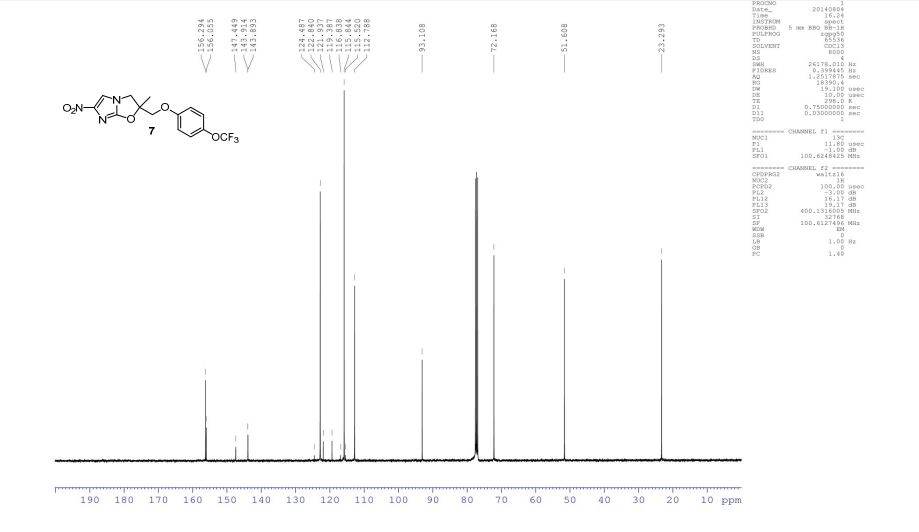
HPLC (area %): 99.52%; HPLC (chiral): 99.8% (a/a);

1H NMR (400 MHz, CDCl3): δ 7.57 (s, 1H), 7.14–7.16 (d, 2H, J = 10.0 Hz), 6.83–6.86 (d, 2H, J = 7.2 Hz), 4.48–4.50 (d, 1H, J = 10.0 Hz), 4.22–4.24 (d, 1H, J = 10.0 Hz), 4.05–4.10 (t, 2H, J = 9.6 and 10.4 Hz), 1.79 (s, 3H);

13C NMR (100 MHz, CDCl3): δ 156.0, 155.8, 147.1, 143.5, 122.6, 115.5, 112.6, 122.6, 121.7, and 119.1 (JC–F = 255.1 Hz), 116.6, 92.9, 71.8, 51.3, 23.0;

19F NMR (CDCl3, 376 MHz): δ −58.4;

IR (KBr, cm–1): 3155, 2996, 1607, 1456, 1281, 1106, 978, 921, 834,783, 708;

mass (m/z): 360.3 (M + 1)+;

[α]25589 = (+)8.445 (c 1.00 g/100 mL, CHCl3).

Visceral leishmaniasis (VL), infamously known as kala-azar (black fever) in the Indian subcontinent, is the most lethal form of leishmaniasis and is caused by protozoan parasites. This deadly disease is the second largest parasitic killer in the world, surpassed only by malaria, with a worldwide distribution in Asia, East Africa, South America, and the Mediterranean region. In the search for effective treatments for visceral leishmaniasis, the Drugs for Neglected Diseases initiative (DNDi) recently evaluated fexinidazole a nitroimidazole being developed as a treatment for Human African Trypanosomiasis. Fexinidazole  showed potential as a safe and effective oral drug for the treatment of visceral leishmaniasis and is now in clinical trials.

Figure

fexinidazole (1) and DNDI-VL-2098 (2).

Earlier, through an agreement with TB Alliance and in association with the ACSRC at the University of Auckland (NZ), DNDi screened about 70 other nitroimidazole analogues belonging to four chemical subclasses and investigated them for antileishmanial activity

Image result for DNDI-VL-2098

Image result for DNDI-VL-2098

Paper

http://pubs.acs.org/doi/abs/10.1021/acs.jmedchem.5b01699

Repositioning Antitubercular 6-Nitro-2,3-dihydroimidazo[2,1-b][1,3]oxazoles for Neglected Tropical Diseases: Structure–Activity Studies on a Preclinical Candidate for Visceral Leishmaniasis

Auckland Cancer Society Research Centre, School of Medical Sciences, The University of Auckland, Private Bag 92019, Auckland 1142, New Zealand
Faculty of Infectious & Tropical Diseases, London School of Hygiene & Tropical Medicine, Keppel Street, London WC1E 7HT, United Kingdom
§ Laboratory for Microbiology, Parasitology and Hygiene, Faculty of Pharmaceutical, Biomedical and Veterinary Sciences, University of Antwerp, Universiteitsplein 1, B-2610 Antwerp, Belgium
Division of Parasitology, CSIR-Central Drug Research Institute, Lucknow 226031, India
Drugs for Neglected Diseases Initiative, 15 Chemin Louis Dunant, 1202 Geneva, Switzerland
# Institute for Tuberculosis Research, College of Pharmacy, University of Illinois at Chicago, 833 South Wood Street, Chicago, Illinois 60612, United States
Global Alliance for TB Drug Development, 40 Wall Street, New York 10005, United States
J. Med. Chem., 2016, 59 (6), pp 2530–2550
DOI: 10.1021/acs.jmedchem.5b01699
*Phone: (+649) 923-6145. Fax: (+649) 373-7502. E-mail: am.thompson@auckland.ac.nz.

Abstract

Abstract Image

6-Nitro-2,3-dihydroimidazo[2,1-b][1,3]oxazole derivatives were initially studied for tuberculosis within a backup program for the clinical trial agent pretomanid (PA-824). Phenotypic screening of representative examples against kinetoplastid diseases unexpectedly led to the identification of DNDI-VL-2098 as a potential first-in-class drug candidate for visceral leishmaniasis (VL). Additional work was then conducted to delineate its essential structural features, aiming to improve solubility and safety without compromising activity against VL. While the 4-nitroimidazole portion was specifically required, several modifications to the aryloxy side chain were well-tolerated e.g., exchange of the linking oxygen for nitrogen (or piperazine), biaryl extension, and replacement of phenyl rings by pyridine. Several less lipophilic analogues displayed improved aqueous solubility, particularly at low pH, although stability toward liver microsomes was highly variable. Upon evaluation in a mouse model of acute Leishmania donovani infection, one phenylpyridine derivative (37) stood out, providing efficacy surpassing that of the original preclinical lead.

Figure

Structures of various antileishmanial or antitubercular agents.

 str1 str0

CLICK ON IMAGE

2-Methyl-6-nitro-2-{[4-(trifluoromethoxy)phenoxy]methyl}-2,3-dihydroimidazo[2,1- b][1,3]oxazole (7).

Method A (Scheme 1B): Reaction of alcohol 88 with NaH, using procedure C, followed by chromatography of the product on silica gel, eluting with CH2Cl2, gave 71 (87%) as a pale yellow solid: mp (CH2Cl2/hexane) 122-124 C (lit.1 mp 126.8-127.9 C); 1 H NMR (CDCl3)  7.56 (s, 1 H), 7.16 (br d, J = 9.1 Hz, 2 H), 6.85 (br d, J = 9.2 Hz, 2 H), 4.48 (d, J = 10.2 Hz, 1 H), 4.23 (d, J = 10.1 Hz, 1 H), 4.09 (d, J = 10.1 Hz, 1 H), 4.05 (d, J = 10.2 Hz, 1 H), 1.79 (s, 3 H); 13C NMR (CDCl3)  156.3 (C-1’), 156.1 (C-7a), 147.4 (C- 6), 143.9 (q, JC-F = 2.1 Hz, C-4’), 122.8 (2 C, C-3’,5’), 120.7 (q, JC-F = 256.5 Hz, 4’-OCF3), 115.8 (2 C, C-2’,6’), 112.8 (C-5), 93.1 (C-2), 72.2 (2-CH2O), 51.6 (C-3), 23.3 (2-CH3). Anal. (C14H12F3N3O5) C, H, N.

Method B (Scheme 2B): Reaction of 2-bromo-1-[(2-methyloxiran-2-yl)methyl]-4-nitro-1Himidazole2 (98) with 4-(trifluoromethoxy)phenol (0.95 equiv) and NaH (1.2 equiv), using procedure I, followed by chromatography of the product on silica gel, eluting with 2:1 and 3:1 CH2Cl2/petroleum ether (foreruns) and then with 3:1 CH2Cl2/petroleum ether and CH2Cl2, S8 gave a crude product, which was crystallized from CH2Cl2/hexane (and the mother liquors further purified by chromatography on silica gel, eluting as before), to give 71 (55%) as a pale yellow solid (see data above). Method C (Scheme 2D): Reaction of 2-chloro-1-[(2-methyloxiran-2-yl)methyl]-4-nitro-1Himidazole1 (109) with 4-(trifluoromethoxy)phenol (1.0 equiv) and NaH, using procedure I, followed by chromatography of the product on silica gel, eluting with 1:1 and 3:2 CH2Cl2/petroleum ether (foreruns) and then with 3:1 CH2Cl2/petroleum ether and CH2Cl2, gave a crude product, which was crystallized from CH2Cl2/hexane (and the mother liquors further purified by chromatography on silica gel, eluting with 1:1 and 3:1 Et2O/petroleum ether and then with Et2O and CH2Cl2), to give 71 (51%) as a pale yellow solid (see data above).

Synthesis of 9 (Scheme 2A): (2R)-2-Methyl-6-nitro-2-{[4-(trifluoromethoxy)phenoxy]methyl}-2,3-dihydroimidazo- [2,1-b][1,3]oxazole (9). Reaction of 2-chloro-1-{[(2R)-2-methyloxiran-2-yl]methyl}-4-nitro- 1H-imidazole3 (96) with 4-(trifluoromethoxy)phenol and NaH, using procedure H, gave 91,3 (36%) as a pale brown solid: mp 170-171 C (lit.1 mp 176.5-178 C); 1 H NMR (CDCl3)  7.56 (s, 1 H), 7.16 (br d, J = 8.8 Hz, 2 H), 6.85 (br d, J = 9.0 Hz, 2 H), 4.48 (d, J = 10.2 Hz, 1 H), 4.23 (d, J = 10.0 Hz, 1 H), 4.09 (d, J = 10.2 Hz, 1 H), 4.05 (d, J = 10.3 Hz, 1 H), 1.79 (s, 3 H); [α] 25 D 9.0 (c 1.002, CHCl3) [lit.1 [α] 28 D 7.67 (c 1.030, CHCl3)]. Anal. (C14H12F3N3O5) C, H, N. HPLC purity: 100%. Chiral HPLC (using a CHIRALPAK AD-H analytical column and eluting with 15% EtOH/hexane at 1 mL/min) determined that the ee of 9 was 98.7%.

Paper

Sasaki, Hirofumi; Journal of Medicinal Chemistry 2006, VOL 49(26), Pg 7854-7860

Synthesis and Antituberculosis Activity of a Novel Series of Optically Active 6-Nitro-2,3-dihydroimidazo[2,1-b]oxazoles

Medicinal Chemistry Research Institute, Otsuka Pharmaceutical Co., Ltd., 463-10 Kagasuno, Kawauchi-cho, Tokushima 771-0192, Japan, and Microbiological Research Institute, Otsuka Pharmaceutical Co., Ltd., 463-10 Kagasuno, Kawauchi-cho, Tokushima 771-0192, Japan
J. Med. Chem., 2006, 49 (26), pp 7854–7860
DOI: 10.1021/jm060957y

Abstract

Abstract Image

In an effort to develop potent new antituberculosis agents that would be effective against both drug-susceptible and drug-resistant strains of Mycobacterium tuberculosis, we prepared a novel series of optically active 6-nitro-2,3-dihydroimidazo[2,1-b]oxazoles substituted at the 2-position with various phenoxymethyl groups and a methyl group and investigated the in vitro and in vivo activity of these compounds. Several of these derivatives showed potent in vitro and in vivo activity, and compound 19 (OPC-67683) in particular displayed excellent in vitro activity against both drug-susceptible and drug-resistant strains of M. tuberculosis H37Rv (MIC = 0.006 μg/mL) and dose-dependent and significant in vivo efficacy at lower oral doses than rifampicin in mouse models infected with M. tuberculosis Kurono. The synthesis and structure−activity relationships of these new compounds are presented.

(R)-2-Methyl-6-nitro-2-(4-trifluoromethoxyphenoxymethyl)-2,3-dihydroimidazo[2,1-b]oxazole (8). Mp 176−178 °C.

1H NMR (CDCl3) δ 1.79 (3H, s), 4.06 (1H, d, J = 6.8 Hz), 4.10 (1H, d, J = 6.8 Hz), 4.23 (1H, d, J = 10.1 Hz), 4.49 (1H, d, J = 10.1 Hz), 6.84 (2H, d, J = 9.0 Hz), 7.13 (2H, d, J = 9.0 Hz), 7.56 (1H, s).

MS (DI) m/z 359 (M+). Anal. (C14H12F3N3O5) C, H, N.

PAPER

Abstract Image

A process suitable for kilogram-scale synthesis of (2R)-2-methyl-6-nitro-2-{[4-(trifluoromethoxy)phenoxy]methyl}-2,3-dihydroimidazo[2,1-b][1,3]oxazole (DNDI-VL-2098, 2), a preclinical drug candidate for the treatment of visceral leishmaniasis, is described. The four-step synthesis of the target compound involves the Sharpless asymmetric epoxidation of 2-methyl-2-propen-1-ol, 8. Identification of a suitable synthetic route using retrosynthetic analysis and development of a scalable process to access several kilograms of 2 are illustrated. The process was simplified by employing in situ synthesis of some intermediates, reducing safety hazards, and eliminating the need for column chromatography. The improved reactions were carried out on the kilogram scale to produce 2 in good yield, high optical purity, and high quality.

http://pubs.acs.org/doi/abs/10.1021/acs.oprd.6b00331

Development of a Scalable Process for the Synthesis of DNDI-VL-2098: A Potential Preclinical Drug Candidate for the Treatment of Visceral Leishmaniasis

Process Chemistry Division, Advinus Therapeutics Ltd., 21 & 22, Phase II, Peenya Industrial Area, Bangalore 560058, Karnataka, India
Auckland Cancer Society Research Centre, School of Medical Sciences, The University of Auckland, Private Bag 92019, Auckland 1142, New Zealand
Drugs for Neglected Diseases initiative (DNDi), 15 Chemin Louis Dunant, 1202 Geneva, Switzerland
Org. Process Res. Dev., Article ASAP
DOI: 10.1021/acs.oprd.6b00331
*Process Chemistry Division, Advinus Therapeutics Ltd., 21 & 22, Phase II, Peenya Industrial Area, Bangalore -560058, Karnataka, India. E-mail: hari.pati@advinus.com. Tel. No.: (+91)9900212096.
 
Hiroyuki Fujiki, Ph.D, New Drug Research Division, Biology and Translational Research Unit, senior research scientist; Yoshitaka Yamamura, Pharmaceutical Business Division, senior director; Youichi Yabuuchi, Ph.D, Otsuka Pharmaceutical Factory, Inc., corporate adviser; Hidenori Ogawa, Ph.D, Medicinal Chemistry Research Laboratories
/////////////preclinical, DNDI-VL-2098, 681492-17-1, Visceral Leishmaniasis

CEP 33779


img

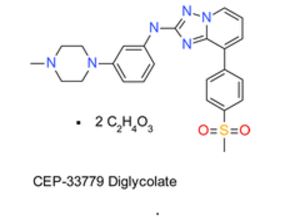
CEP-33779, CEP33779
CAS 1257704-57-6
Chemical Formula: C24H26N6O2S
Molecular Weight: 462.57
Elemental Analysis: C, 62.32; H, 5.67; N, 18.17; O, 6.92; S, 6.93

N-(3-(4-methylpiperazin-1-yl)phenyl)-8-(4-(methylsulfonyl)phenyl)-[1,2,4]triazolo[1,5-a]pyridin-2-amine

PRECLINICAL Treatment of Rheumatoid Arthritis, Agents for Colorectal Cancer Therapy Systemic Lupus Erythematosus,

Jak2 Inhibitors

Image result for teva logo

Matthew A. Curry, Bruce D. Dorsey, Benjamin J. Dugan, Diane E. Gingrich, Eugen F. Mesaros, Karen L. Milkiewicz,
Applicant Cephalon, Inc.

Worldwide Discovery Research, Cephalon, Inc., 145 Brandywine Parkway, West Chester, Pennsylvania 19380, United States

Image result for Cephalon, Inc.

Matt Curry

 Matthew A. Curry

Bruce Dorsey

Bruce Dorsey

Image result for Cephalon, Inc. Benjamin J. Dugan

Benjamin Dugan

Benjamin J. Dugan received a B.S. degree in Chemistry from the University of Delaware in 1993 under the tutelage of the late Dr. Cynthia McClure. He began his career at FMC Corporation in the agricultural products division. In 2006, he moved to Cephalon, Inc., acquired by Teva Pharmaceutical Industries Ltd. in 2011, and engaged in oncology research focused on small molecule, ATP competitive, kinase inhibitors culminating with the discovery of CEP-33779. He is currently a Research Scientist focused on the development of novel, bioactive small molecules for treatment of central nervous system disorders.

Cephalon Inc.
Malvern, United States

Image result for Cephalon, Inc. Diane E. Gingrich

Members of the Cephalon research team that discovered CEP-5214 and CEP-7055 include (from left) Hudkins, Thelma S. Angeles, Bruce A. Ruggeri, and Diane E. Gingrich. CEPHALON PHOTO

Eugen F. Mesaros

Cephalon Inc.
Malvern, United States
Image result for cephalon Karen L. Milkiewicz

Lupus (systemic lupus erythematosus, SLE) is a chronic autoimmune disease characterized by the presence of activated T and B cells, autoantibodies and chronic inflammation that attacks various parts of the body including the joints, skin, kidneys, CNS, cardiac tissue and blood vessels. In severe cases, antibodies are deposited in the cells (glomeruli) of the kidneys, leading to inflammation and possibly kidney failure, a condition known as lupus nephritis.

Although the cause of lupus remains unknown, manifestations of the disease have been linked to genetic polymorphisms, environmental toxins and pathogens (Morel;

Fairhurst, Wandstrat et al. 2006). In addition, gender, hormonal influences and cytokine dysregulation have been tightly linked to the development of lupus (Aringer and Smolen 2004; Smith-Bouvier, Divekar et al. 2008). Lupus affects nine times as many women as men. It may occur at any age, but appears most often in people between the ages of 10 and 50 years. African Americans and Asians are affected more often than people from other races.

There is no cure for lupus. Current treatments for lupus are aimed at controlling symptoms and are limited to toxic and immunosuppressive agents with severe side-effects such as high dose glucocorticoids and/or hydroxchloroquine. Severe disease (e.g., patients that have signs of renal involvement) require more aggressive drugs including

mycophenolate mofetil (MMF), azathioprine (AZA) and/or cyclophosphamide (CTX) (Bertsias and Boumpas 2008). CTX, AZA and MMF are very toxic and

immunosuppressive, and only 50% of treated patients enter complete remission, with relapse rates up to 30% over a 2-year period.

Memory B cells, and more important, long-lived plasma cells (LL-PCs) which differentiate from memory B cells, are key cell types involved in lupus (Neubert, Meister et al. 2008; Sanz and Lee 2010). Long-lived plasma cells synthesize and secrete large quantities of high-affinity isotype switched antibodies (Meister, Schubert et al. 2007;

Muller, Dieker et al. 2008). Circulating antinuclear antibodies (ANAs) increase the chances of antibody depositing onto self tissues, forming immune-complexes and eventually leading to tissue destruction, epitope spreading and involvement of other organ systems. LL-PCs are commonly found to be chemo- and radio-resistant, over expressing various heat shock proteins and drug pumps (Obeng, Carlson et al. 2006; Neubert, Meister et al. 2008). In addition, LL-PCs primarily reside in the bone marrow where they are protected from current lupus therapies such as cyclophosphamide and glucocorticoids.

A need exists for new treatments for lupus, including lupus nephritis. A need particularly exists for lupus treatments that can target and reduce LL-PCs.

str0

CEP-33779 is a highly selective, orally active, small-molecule inhibitor of JAK2. CEP-33779 induced regression of established colorectal tumors, reduced angiogenesis, and reduced proliferation of tumor cells. Tumor regression correlated with inhibition of STAT3 and NF-κB (RelA/p65) activation in a CEP-33779 dose-dependent manner. The ability of CEP-33779 to suppress growth of colorectal tumors by inhibiting the IL-6/JAK2/STAT3 signaling suggests a potential therapeutic utility of JAK2 inhibitors in multiple tumors types, particularly those with a strong inflammatory component.

str0

{[8-(4-Methanesulfonyl-phenyl)-[1,2,4]triazolo[1,5-a]pyridin-2-yl]-[3-(4-methyl-piperazin-1-yl)-phenyl]-amine} (1)

LC/MS: (M+H+)+ = 463.2;
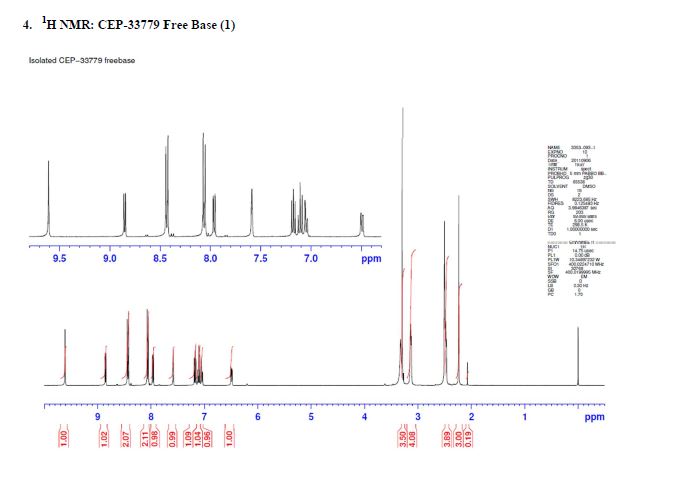
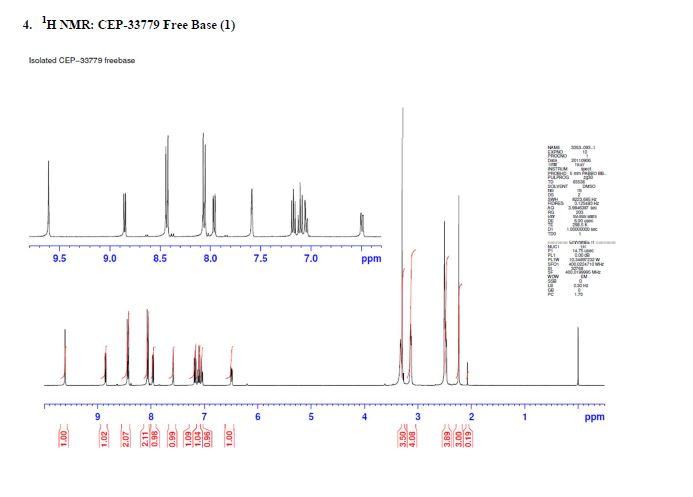
1H NMR (DMSO, 400 MHz) δ 9.61 (s, 1H), 8.85 (d, J = 6.8 Hz, 1H), 8.43 (d, J = 6.8 Hz, 2H), 8.06 (d, J = 6.8 Hz, 2H), 7.96 (d, J = 7.5 Hz, 1H), 7.59 (s, 1H), 7.17 (t, J = 6.8 Hz, 1H), 7.11 (t, J = 8.0 Hz, 1H), 7.05 (d, J = 8.6 Hz 1H), 6.49 (d, J = 8.0 Hz, 1H), 3.30 (s, 3H), 3.13 (m, 4H), 2.48 (m, 4H), 2.24 (s, 3H).
CEP-33779 Diglycolate Salt
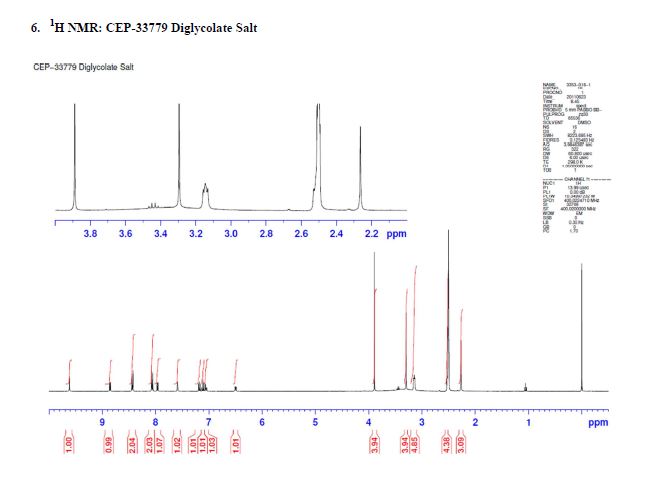
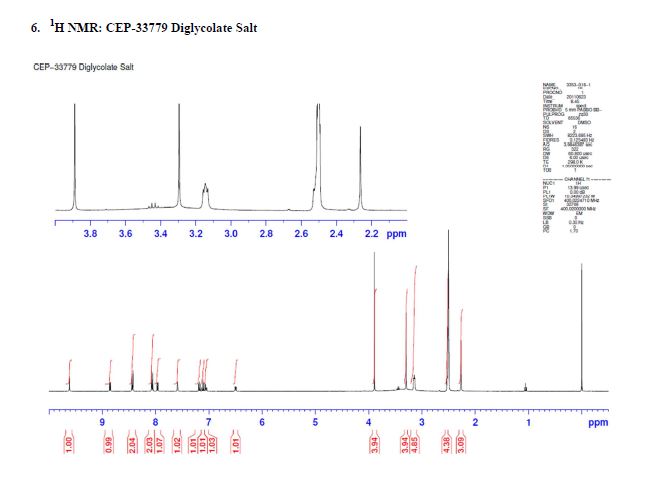
1H NMR (DMSO, 400 MHz) δ 9.61 (s, 1H), 8.85 (d, J = 6.7 Hz, 1H), 8.43 (d, J = 6.7 Hz, 2H), 8.06 (d, J = 6.7 Hz, 2H), 7.97 (d, J = 7.5 Hz, 1H), 7.59 (s, 1H), 7.18 (d, J = 6.7 Hz, 1H), 7.11 (m, 1H), 7.05 (d, J = 8.6 Hz, 1H), 6.50 (d, J = 8.0 Hz, 1H), 3.89 (s, 4H), 3.30 (s, 3H), 3.13 (m, 4H), 2.48 (m, 4H), 2.24 (s, 3H).
DSC: Endotherm onset at 153.0 °C; Peak at 155.8 °C.

PATENT

WO 2010141796

https://www.google.com/patents/WO2010141796A3?cl=en

Example 35 [8-(4-Methanesulfonyl-phenyl)-[ 1 ,2,4]triazolo[ 1 ,5-a]pyridin-2-yl]-[3-(4-methyl-piperazin-

1 -yl)-phenyl]-amine

Figure imgf000156_0001

35 a) l-(3-Bromo-phenyl)-4-methyl-piperazine was prepared from l-(3-bromo-phenyl)- piperazine (1.33 g, 5.52 mmol) in a manner analogous to Step 32a. The reaction product was isolated as a pale yellow oil (1.4 g, 100%). 1H NMR (400 MHz, CDCl3, δ, ppm): 7.10 (dd, J=8.2, 8.2 Hz, IH), 7.04 (dd, J=2.1, 2.1 Hz, IH), 6.95 (ddd, J=I. S, 1.7, 0.7 Hz, IH), 6.83 (ddd, J=8.3, 2.4, 0.6 Hz, IH), 3.23-3.18 (m, 4H), 2.58-2.54 (m, 4H), 2.35 (s, 3H). MS = 255, 257 (MH)+. 35b) [8-(4-Methanesulfonyl-phenyl)-[ 1 ,2,4]triazolo[ 1 ,5-a]pyridin-2-yl]-[3-(4-methyl- piperazin-l-yl)-phenyl]-amine was prepared from 8-(4-methanesulfonyl-phenyl)- [l,2,4]triazolo[l,5-a]pyridin-2-ylamine (75.0 mg, 0.260 mmol) and l-(3-bromo-phenyl)-4- methyl-piperazine (80.0 mg, 0.314 mmol) with 2,2′-bis-dicyclohexylphosphanyl-biphenyl (30.0 mg, 0.0549 mmol) as the ligand in a manner analogous to Step 2d and was isolated as a yellow solid (0.072 g, 60%).

MP = 232-234 0C.

1H NMR (400 MHz, CDCl3, δ, ppm): 8.49 (d, J=I 2 Hz, IH), 8.25 (d, J=I .5 Hz, 2H), 8.08 (d, J=I .9 Hz, 2H), 7.65 (d, J=I .1 Hz, IH), 7.38 (s, IH), 7.27-7.20 (m, IH), 7.04-6.95 (m, 2H), 6.84 (s, IH), 6.60 (d, J=8.0 Hz, IH), 3.30-3.25 (m, 4H), 3.10 (s, 3H), 2.63-2.58 (m, 4H), 2.38 (s, 3H).

MS = 463 (MH)+.

PATENT

WO 2012078504

PATENT

WO 2012078574

https://google.com/patents/WO2012078574A2?cl=da

COMPOUND A is a JAK2 inhibitor with the chemical name [8-(4-methanesulfonyl-phenyl)-[1,2,4]triazolo[1,5-a]pyridin-2-yl]-[3-(4-methyl-piperazin-1-yl)-phenyl]-amine. COMPOUND A has the following structure:

COMPOUND A

COMPOUND A was prepared in a manner analogous to the five-step method described below (see Example 35 of International Application No. PCT/US10/37363):

Step 1 : To a solution of 1-(3-bromo-phenyl)-piperazine (about 1 g) and acetic acid (about 0.4 mL) in methanol (about 25 mL) is added 37% formaldehyde in water/methanol (about 56.7:37:6.3, water:formaldehyde:methanol; about 5 mL). The mixture is stirred at room temperature for about 18 hours. The suspension is cooled to about 5°C in an ice/water bath and sodium cyanoborohydride (about 5 g) is added in small portions. The mixture is stirred and warmed to room temperature for about 18 hours. The mixture is slowly poured into saturated aqueous ammonium chloride (about 200 mL) and stirred for about 1 hour. The mixture is extracted with dichloromethane (3 x about 75 mL). The combined organic layers are dried over magnesium sulfate, filtered and evaporated. The material is placed under high vacuum for about 18 hours to yield 1-(3-bromo-phenyl)-4-methyl-piperazine as a pale yellow oil (about 1 g). 1H NMR (400 MHz, CDCl3, δ, ppm): 7.10 (dd, J=8.2, 8.2 Hz, 1H), 7.04 (dd, J=2.1, 2.1 Hz, 1H), 6.95 (ddd, J=7.8, 1.7, 0.7 Hz, 1H), 6.83 (ddd, J=8.3, 2.4, 0.6 Hz, 1H), 3.23-3.18 (m, 4H), 2.58-2.54 (m, 4H), 2.35 (s, 3H). MS = 255, 257 (MH)+.

Step 2: To a solution of 3-bromo-pyridin-2-ylamine (about 10 g) in 1,4-dioxane (about 100 mL) is added dropwise ethoxycarbonyl isothiocyanate (about 7 mL). The mixture is stirred under an atmosphere of nitrogen for about 18 hours. The volatiles are evaporated to yield a waxy solid. The recovered material is triturated with hexane (about 250 mL). N-(3-bromo-2-pyridinyl)-N’-carboethoxy-thiourea is isolated and used without further purification. 1H NMR (400 MHz, (D3C)2SO, δ, ppm): 11.46 (s, 1H), 11.43 (s, 1H), 8.49 (dd, J=4.6, 1.5 Hz, 1H), 8.18 (dd, J=8.0, 1.5 Hz, 1H), 7.33 (dd, J=8.0, 4.7 Hz, 1H), 4.23 (q, J=7.1 Hz, 2H), 1.27 (t, J=7.2 Hz, 3H). MS = 215 (MH)+.

Step 3: To a stirred suspension of hydroxylamine hydrochloride (about 17 g) and Ν,Ν-diisopropylethylamine (about 26 mL) in a mixture of methanol (about 70 mL) and

ethanol (about 70 mL) is added N-(3-bromo-2-pyridinyl)-N’-carboethoxy-thiourea. The mixture is stirred for about 2 hours at room temperature then heated to about 60°C for about 18 hours. The suspension is cooled to room temperature, filtered and rinsed with methanol, water then methanol. 8-Bromo-[1,2,4]triazolo[1,5-a]pyridin-2-ylamine is isolated as an off-white solid (about 8 g). 1H NMR (400 MHz, (D3C)2SO, δ, ppm): 8.58 (d, J=6.4 Hz, 1H), 7.73 (d, J=7.6 Hz, 1H), 6.80 (t, J=7.0 Hz, 1H), 6.25 (s, 2H). MS = 213, 215 (MH)+.

Step 4: An oven dried tube is charged with palladium acetate (about 0.2 g) and triphenylphosphine (about 0.6 g). The tube is evacuated under high vacuum and backflushed under a stream of nitrogen for about 5 minutes. A suitable solvent such as

1,4-dioxane (about 10 mL) is added and the mixture is stirred under nitrogen for a suitable time (e.g., for about 10 minutes). 8-Bromo-[1,2,4]triazolo[1,5-a]pyridin-2-ylamine (about 0.75 g), (4-methylsulfonylphenyl)boronic acid (about 1 g), a suitable solvent, such as N,N-dimethylformamide (about 10 mL) and a suitable base, such as about 1.5 M of sodium carbonate in water (about 10 mL) are added. The mixture is stirred for about 2 minutes at room temperature under nitrogen then the tube is sealed and heated at about 80°C for about 18 hours. The mixture is transferred to a round bottom flask and the volatiles are evaporated under reduced pressure. The product is isolated in a suitable manner. For example, water (about 100 mL) may be added and the mixture stirred. The solid may then be collected by filtration, and optionally rinsed with water, air dried, triturated with ether/dichloromethane (about 4: 1; about 10 mL), filtered and rinsed with ether. 8-(4-methanesulfonyl-phenyl)-[1,2,4]triazolo[1,5-a]pyridin-2-ylamine is isolated as a tan solid (about 0.6 g). MP = 236-239 °C. 1H NMR (400 MHz, (D3C)2SO, δ, ppm): 8.63 (d, J=6.3 Hz, 1H), 8.38 (d, J=7.9 Hz, 2H), 8.03 (d, J=7.9 Hz, 2H), 7.84 (d, J= 7.3 Hz, 1H), 7.03 (t, J=7.0 Hz, 1H), 6.21 (br s, 2H), 3.28 (s, 3H). MS = 289 (MH)+.

Step 5: To an oven dried tube is added palladium acetate (about 10 mg) and 2,2′-bis-dicyclohexylphosphanyl-biphenyl (about 30 mg), 8-(4-methanesulfonyl-phenyl)-[1,2,4]triazolo[1,5-a]pyridin-2-ylamine (about 75 mg), 1-(3-bromo-phenyl)-4-methyl-piperazine (about 80 mg), a suitable base, such as cesium carbonate (about 270 mg) and a suitable solvent, such as 1,4-dioxane (about 5 mL). The tube is evacuated and backflushed with nitrogen three times. The tube is sealed and heated at about 80°C for about 72 hours. The mixture is cooled to room temperature and the product isolated in a suitable manner.

For example, the cooled mixture may be diluted with dichloromethane (about 10 mL), filtered through a plug of diatomaceous earth, rinsed with dichloromethane and evaporated. The material may then be purified, e.g., via chromatography, e.g., utilizing an ISCO automated purification apparatus (e.g., amine modified silica gel column 5%→100% ethyl acetate in hexanes). [8-(4-Methanesulfonyl-phenyl)-[1,2,4]triazolo[1,5-a]pyridin-2-yl]-[3-(4-methyl-piperazin-1-yl)-phenyl]-amine (i.e., COMPOUND A) is isolated as a yellow solid (about 0.07 g). MP = 232-234 °C. 1H NMR (400 MHz, CDCl3, δ, ppm): 8.49 (d, J=7.2 Hz, 1H), 8.25 (d, J=7.5 Hz, 2H), 8.08 (d, J=7.9 Hz, 2H), 7.65 (d, J=7.7 Hz, 1H), 7.38 (s, 1H), 7.27-7.20 (m, 1H), 7.04-6.95 (m, 2H), 6.84 (s, 1H), 6.60 (d, J=8.0 Hz, 1H), 3.30-3.25 (m, 4H), 3.10 (s, 3H), 2.63-2.58 (m, 4H), 2.38 (s, 3H). MS = 463 (MH)+.

PATENT

WO 2015089153

https://www.google.com/patents/WO2015089153A1?cl=un

This disclosure relates to a l,2,4 riazolo[l,5a]pyridine derivative, [8-(4 methanesulfonyl-phenyl)-[ 1 ,2,4]triazoio[1 ,5-a]pyridin-2-yl]-[3-(4-methyl-piperazin- 1 -yl phenyl] -amine, re g structure:

or a pharmaceutical salt thereof, and its use in the treatment of multiple sclerosis.

Compound A is a potent, orally active, small molecule inhibitor of JA 2. See, e.g..International Application No. PCT/USlO/37363, U.S. Patent Nos. 8,501,936 and ,633,173, and U.S. Published Patent Application Nos. 2013/0267535 and 2014/0024655, each of which is incorporated by reference herein. Compound A can be prepared, for example, using methods analogous to Example 35 of International Application No.PCT/US 10/37363.

PAPER

A Selective, Orally Bioavailable 1,2,4-Triazolo[1,5-a]pyridine-Based Inhibitor of Janus Kinase 2 for Use in Anticancer Therapy: Discovery of CEP-33779

Worldwide Discovery Research, Cephalon, Inc., 145 Brandywine Parkway, West Chester, Pennsylvania 19380, United States
J. Med. Chem., 2012, 55 (11), pp 5243–5254
DOI: 10.1021/jm300248q
Publication Date (Web): May 10, 2012
Copyright © 2012 American Chemical Society
*Phone: 610-738-6733. Fax: 610-738-6643. E-Mail: bdugan@cephalon.com.

Abstract

Abstract Image

Members of the JAK family of nonreceptor tyrosine kinases play a critical role in the growth and progression of many cancers and in inflammatory diseases. JAK2 has emerged as a leading therapeutic target for oncology, providing a rationale for the development of a selective JAK2 inhibitor. A program to optimize selective JAK2 inhibitors to combat cancer while reducing the risk of immune suppression associated with JAK3 inhibition was undertaken. The structure–activity relationships and biological evaluation of a novel series of compounds based on a 1,2,4-triazolo[1,5-a]pyridine scaffold are reported. Para substitution on the aryl at the C8 position of the core was optimum for JAK2 potency (17). Substitution at the C2 nitrogen position was required for cell potency (21). Interestingly, meta substitution of C2-NH-aryl moiety provided exceptional selectivity for JAK2 over JAK3 (23). These efforts led to the discovery of CEP-33779 (29), a novel, selective, and orally bioavailable inhibitor of JAK2.

[8-(4-Methanesulfonyl-phenyl)-[1,2,4]triazolo[1,5-a]pyridin-2-yl]-[3-(4-methyl-piperazin-1-yl)-phenyl]-amine (29)

 1H NMR (CDCl3) δ 8.49 (dd, J = 6.6, 1.0 Hz, 1H), 8.25 (d, J = 8.4 Hz, 2H), 8.08 (d, J = 8.4 Hz, 2H), 7.66 (dd, J = 7.5, 0.9 Hz, 1H), 7.39–7.36 (m, 1H), 7.23 (t, J = 8.2 Hz, 1H), 7.02 (t, J = 7.1 Hz, 1H), 6.97 (dd, J = 7.8, 1.4 Hz, 1H), 6.88 (s, 1H), 6.60 (dd, J = 8.3, 1.8 Hz, 1H), 3.30–3.25 (m, 4H), 3.10 (s, 3H), 2.63–2.58 (m, 4H), 2.38 (s, 3H).
13C NMR (CDCl3) δ 162.65, 152.28, 148.87, 141.00, 140.91, 140.05, 129.64, 129.29, 128.18, 127.85, 127.76, 124.77, 112.03, 109.40, 108.59, 104.80, 55.19, 49.02, 46.19, 44.59;
mp 208–211 °C.
High resolution mass spectrum (ESI+) m/z 463.1925 [(M + H)+calcd for C24H26N6O2S: 463.1916]. HPLC: 95 A%.

PAPER

An Improved Synthesis of the Free Base and Diglycolate Salt of CEP-33779; A Janus Kinase 2 Inhibitor

Chemical Process Research and Development, Teva Branded Pharmaceutical Products R&D Inc., 383 Phoenixville Pike, Malvern, Pennsylvania 19355, United States
Org. Process Res. Dev., Article ASAP
DOI: 10.1021/acs.oprd.6b00311
Publication Date (Web): November 30, 2016
Copyright © 2016 American Chemical Society

Abstract

Abstract Image

CEP-33779 is a triazole that has been reported to show highly selective inhibition of Janus kinase 2 (JAK2). An efficient process to form CEP-33779 will be presented that uses multiple palladium couplings to provide the drug substance in a convergent manner. The existing medicinal chemistry route was modified to avoid chromatographic purification, improve safety, and utilize palladium ligands which are available in quantities amenable to scale-up. Challenges faced during the development of the new process included optimization of conditions for Buchwald–Hartwig and Suzuki couplings, control of homocoupled impurities and removal of residual palladium. In addition, a screen of conditions to form a diglycolate salt of the parent compound are also presented.

REFERENCES

1: Dugan BJ, Gingrich DE, Mesaros EF, Milkiewicz KL, Curry MA, Zulli AL, Dobrzanski P, Serdikoff C, Jan M, Angeles TS, Albom MS, Mason JL, Aimone LD, Meyer SL, Huang Z, Wells-Knecht KJ, Ator MA, Ruggeri BA, Dorsey BD. A selective, orally bioavailable 1,2,4-triazolo[1,5-a]pyridine-based inhibitor of Janus kinase 2 for use in anticancer therapy: discovery of CEP-33779. J Med Chem. 2012 Jun 14;55(11):5243-54. doi: 10.1021/jm300248q. Epub 2012 May 18. PubMed PMID: 22594690.

2: Tagoe C, Putterman C. JAK2 inhibition in murine systemic lupus erythematosus. Immunotherapy. 2012 Apr;4(4):369-72. doi: 10.2217/imt.12.20. PubMed PMID: 22512630.

3: Seavey MM, Lu LD, Stump KL, Wallace NH, Hockeimer W, O’Kane TM, Ruggeri BA, Dobrzanski P. Therapeutic efficacy of CEP-33779, a novel selective JAK2 inhibitor, in a mouse model of colitis-induced colorectal cancer. Mol Cancer Ther. 2012 Apr;11(4):984-93. doi: 10.1158/1535-7163.MCT-11-0951. Epub 2012 Feb 14. PubMed PMID: 22334590.

4: Lu LD, Stump KL, Wallace NH, Dobrzanski P, Serdikoff C, Gingrich DE, Dugan BJ, Angeles TS, Albom MS, Mason JL, Ator MA, Dorsey BD, Ruggeri BA, Seavey MM. Depletion of autoreactive plasma cells and treatment of lupus nephritis in mice using CEP-33779, a novel, orally active, selective inhibitor of JAK2. J Immunol. 2011 Oct 1;187(7):3840-53. doi: 10.4049/jimmunol.1101228. Epub 2011 Aug 31. PubMed PMID: 21880982.

5: Stump KL, Lu LD, Dobrzanski P, Serdikoff C, Gingrich DE, Dugan BJ, Angeles TS, Albom MS, Ator MA, Dorsey BD, Ruggeri BA, Seavey MM. A highly selective, orally active inhibitor of Janus kinase 2, CEP-33779, ablates disease in two mouse models of rheumatoid arthritis. Arthritis Res Ther. 2011 Apr 21;13(2):R68. doi: 10.1186/ar3329. PubMed PMID: 21510883; PubMed Central PMCID: PMC3132063.

/////////////CEP-33779, CEP33779, CEP 33779, 1257704-57-6, PRECLINICAL, TEVA,  Rheumatoid Arthritis, Colorectal Cancer Therapy, Systemic Lupus Erythematosus,

Jak2 Inhibitors

O=S(C1=CC=C(C2=CC=CN3C2=NC(NC4=CC=CC(N5CCN(C)CC5)=C4)=N3)C=C1)(C)=O

str1 str2

str0

Novel Autotaxin Inhibitors for the Treatment of Osteoarthritis Pain from Lilly Research Laboratories


SCHEMBL15875396.png

str1Figure imgf000023_0002

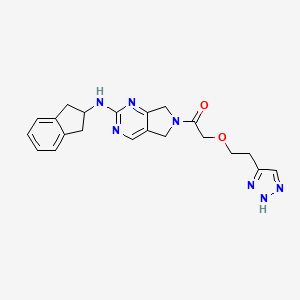
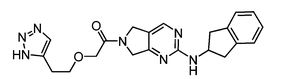
2-(2-(1H-1,2,3-triazol-5-yl)ethoxy)-1-(2-((2,3-dihydro-1H-inden-2-yl)amino)-5,7-dihydro-6Hpyrrolo[3,4-d]pyrimidin-6-yl)ethan-1-one

l-[2-(2,3-dihydro- lH-inden-2-ylamino)-5,7-dihydro-6H-pyrrolo[3,4- d]pyrimidin-6-yl]-2-[2-(lH- l ,2,3-triazol-4-yl)ethoxy]ethanone.

CAS 1619971-30-0

1-[2-(2,3-dihydro-1H-inden-2-ylamino)-5,7-dihydro-6H-pyrrolo[3,4-d]pyrimidin-6-yl]-2-[2-(1H-1,2,3-triazol-4-yl)ethoxy]ethanone;
Molecular Formula: C21H23N7O2
Molecular Weight: 405.45302 g/mol

US2014200231

Scheme A

Scheme B

Scheme C

VI

Scheme E

Autotaxin is an enzyme reported to be the source of lysophosphatidic acid (LPA) which up-regulates pain-related proteins through one if its cognate receptors, LPAi. LPA is an intracellular lipid mediator which influences a multiplicity of biological and biochemical processes. Targeted inhibition of autotaxin-mediated LPA biosynthesis may provide a novel mechanism to prevent nerve injury-induced neuropathic pain.

Compounds that inhibit autotaxin are desired to offer a potential treatment option for patients in need of treatment for pain.

Pain associated with osteoarthritis (OA) is reported to be the primary symptom leading to lower extremity disability in OA patients. Over 20 million Americans have been diagnosed with OA, the most common of the arthropathies. The currently approved treatments for OA pain may be invasive, lose efficacy with long term use, and may not be appropriate for treating all patients. Additional treatment options for patients suffering from pain associated with OA are desired. Compounds that inhibit autotaxin represent another possible treatment option for patients with pain associated with OA.

U.S. Patent 7,524,852 (‘852) discloses substituted bicyclic pyrimidine derivatives as anti-inflammatory agents.

PCT/US2011/048477 discloses indole compounds as autotoxin inhibitors.

There is a need for novel compounds that provide autotaxin inhibition. The present invention provides novel compounds which are autotaxin inhibitors. The present invention provides certain novel compounds that inhibit the production of LPA.

Autotaxin inhibitor compounds are desired to provide treatments for autotaxin mediated conditions, such as pain and pain associated with OA.

PAPER

Abstract Image

In an effort to develop a novel therapeutic agent aimed at addressing the unmet need of patients with osteoarthritis pain, we set out to develop an inhibitor for autotaxin with excellent potency and physical properties to allow for the clinical investigation of autotaxin-induced nociceptive and neuropathic pain. An initial hit identification campaign led to an aminopyrimidine series with an autotaxin IC50 of 500 nM. X-ray crystallography enabled the optimization to a lead compound that demonstrated favorable potency (IC50 = 2 nM), PK properties, and a robust PK/PD relationship.

Image result for Lilly Research Laboratories

Novel Autotaxin Inhibitors for the Treatment of Osteoarthritis Pain: Lead Optimization via Structure-Based Drug Design

Lilly Research Laboratories, A Division of Eli Lilly and Company, Indianapolis, Indiana 46285, United States
ACS Med. Chem. Lett., 2016, 7 (9), pp 857–861
DOI: 10.1021/acsmedchemlett.6b00207
*E-mail: jonessp@lilly.com. Tel: +1-317-277-5543.

http://pubs.acs.org/doi/abs/10.1021/acsmedchemlett.6b00207

Spencer Jones

Spencer Jones

Senior Research Scientist at Eli Lilly and Company

2-(2-(1H-1,2,3-triazol-5-yl)ethoxy)-1-(2-((2,3-dihydro-1H-inden-2-yl)amino)-5,7-dihydro-6Hpyrrolo[3,4-d]pyrimidin-6-yl)ethan-1-one (9)

………… Purified the resulting residue by silica gel chromatography (gradient elution: 0-9% methanol in ethyl acetate ) to give the title compound……..
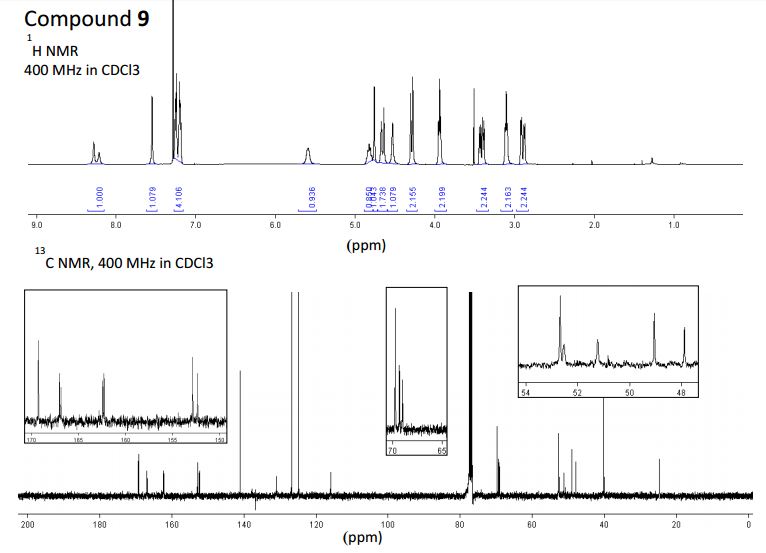
1H NMR (400 MHz, CDCl3): 60:40 mixure of rotamers * indicates minor rotamer δ 8.18 (bs, 0.6H), *8.13 (bs, 0.4H), 7.49 (s, 1H), 7.21-7.09 (m, 4 H), 5.70-5.50 (m, 1H), 4.87-4.78 (m, 1H), 4.75 (s, 1.2H), *4.67 (s, 0.8H), 4.64 (s, 1.2H) *4.53 (s, 0.8H), *4.30 (s, 0.8H), 4.28 (s, 1.2H), 3.93 (t, J = 5.6 Hz, 2H), 3.43 (dd, J = 16.2, 7.1 Hz, 2H), 3.10 (t, J = 5.6 Hz, 2H), 2.89 (dd, J = 16.2, 4.9 Hz, 2H).
13C NMR (400 MHz, CDCl3): * indicates minor δ *169.3, 16 169.2, 167.0, *166.8, *162.4, 162.2, 152.8, *152.3, 141.1, 137.8, 130.9, 126.7, 124.9, 115.9, 69.8, 69.3, *69.0, 52.7, *52.5, 51.2, 49.0, *47.9, 40.1, 24.7.

LC/MS (ESI+ ): (m/z) 406 (C21H24N7O2 = (M+1)+ ).

PATENT

WO-2014110000-A1

Example 2

Synthesis of l-[2-(2,3-dihydro- lH-inden-2-ylamino)-5,7-dihydro-6H-pyrrolo[3,4- d]pyrimidin-6-yl]-2-[2-(lH- l ,2,3-triazol-4-yl)ethoxy]ethanone.

Figure imgf000023_0002

Stir a mixture of 2-[2-(lH-triazol-5-yl)ethoxy]acetic acid 2,2,2-trifluoroacetic acid

(20.22 g; 70.90 mmol), N-(2,3-dihydro- lH-inden-2-yl)-6,7-dihydro-5H-pyrrolo[3,4- d]pyrimidin-2-amine dihydrochloride hydrate (27.99 g; 81.54 mmol) and triethylamine (98.83 mL; 709.03 mmol) in dimethylformamide (404.40 mL) at 0°C. Add a solution of 1-propanephosphonic acid cyclic anhydride (50% solution in DMF; 51.89 mL; 81.54 mmol) over 30 minutes, and stir the mixture at room temperature for 18 hours.

Concentrate the reaction mixture under reduced pressure to give a residue. Add water (200 mL) and extract the mixture with ethyl acetate (4 x 250 mL) and

dichloromethane (4 x 250 mL). Wash the combined organic layers with saturated aqueous sodium bicarbonate (2 x 100 mL) and brine (100 mL), then dry over anhydrous sodium sulfate. Filter the mixture and concentrate the solution under reduced pressure to give a red solid (25.70 g) that is slurried in ethyl acetate/methanol (9: 1 mixture; 200 mL) for 2 hours at room temperature. Filter the resulting solid and wash with cold ethyl acetate (50 mL) to give a solid (ca.18.2 g) that is re-slurried in ethyl acetate (200 mL) at reflux for 1 hour. On cooling to room temperature, stir the mixture for 1 hour and filter the resulting light pink solid.

Slurry the light pink solid in water/methanol (1 : 1 mixture; 200 mL) and heat the mixture at 50°C for 30 minutes. Add ammonium hydroxide solution (32% ; 50 mL) and continue to heat the mixture at 50°C for 30 minutes. Upon cooling to room temperature, add additional ammonium hydroxide solution (32% ; 50 mL) and continue stirring for 1 hour at room temperature. Filter the resulting light gray solid, dry and slurry again in ethyl acetate (200 mL) for 1 hour to afford a light gray solid that is filtered, washed with ethyl acetate (25 mL), and dried to give the title compound (12.42 g; 43%) as a gray solid. MS (m/z): 406 (M+l).

PATENT

US-20140200231-A1

https://www.google.com/patents/US20140200231

Scheme E

Figure imgf000014_0001

Preparation 7

Synthesis of 2-[2-(lH-triazol-5-yl)ethoxy]acetic acid.

Figure imgf000018_0001

Pressurize 1 atmosphere of hydrogen (g) to a flask containing [2-(l-benzyl-lH- l,2,3-triazol-5-yl)ethoxy]acetic acid (10.1 g; 1.00 equiv; 38.66 mmoles) and palladium (II) chloride (3 g; 16.92 mmoles; 3.00 g) in isopropyl alcohol (300 mL) and water (60 mL). Maintain the flask under a hydrogen atmosphere for 3 h, then filter through Celite™ and concentrate. Add toluene (2×50 mL) and concentrate to afford the title compound (7.96 g, 100%). ]H NMR (d6-DMSO): 2.86 (t, / = 7 Hz, 2 H), 3.65 (t, / = 7 Hz, 2 H), 3.98 (s, 2 H), 7,77 (s, 1 H), 13.4 – 13.6 (br s, 2 H).

Example 1

Synthesis of l-[2-(2,3-dihydro-lH-inden-2-ylamino)-7,8-dihydropyrido[4,3-d]pyrimidin- 6(5H)-yl]-2-[2-(lH-l,2,3-triazol-4- l)ethoxy]ethanone.

Figure imgf000018_0002

Add N-indan-2-yl-5,6,7,8-tetrahydropyrido[4,3-d]pyrimidin-2-amine (4.2 g, 15.8 mmol) to a mixture of 2-[2-(lH-triazol-5-yl)ethoxy]acetic acid (2.7 g, 15.8 mmol), 1-hydroxybenzotriazole (3.20 g, 23.7 mmol), and dimethylaminopropyl)-3- ethylcarbodiimide hydrochloride (5.44 g, 28.4 mmol) in dichloromethane (40 mL) at 25 °C. Add triethylamine (4.40 mL, 31.6 mmol) to the reaction mixture and stir for 16 h. Wash with water (2 x 50 mL) and concentrate the organic layer. Purify by silica gel column chromatography, eluting with ethyl acetate/methanol, to give the title compound (4.0 g, 60%) as a solid. MS (m/z): 420 (M + Η). Preparation 8

Synthesis of 2-chloro-l-[2-(2,3-dihydro-lH-inden-2-ylamino)-7,8-dihydropyrido[4,3- d]pyrimidin-6(5H)-yl]ethanone.

Figure imgf000019_0001

To N-indan-2-yl-5,6,7,8-tetrahydropyrido[4,3-d]pyrimidin-2-amine (11.0 g, 41.3 mmol) and triethylamine (7.48 mL, 53.7 mmol) in dichloromethane (200 mL), add 2- chloroacetyl chloride (3.61 mL, 5.13 g, 45.4 mmol) dropwise over five minutes at 23 °C. Stir for 30 minutes and pour the reaction mixture into 1 : 1 50% saturated aqueous sodium bicarbonate: dichloromethane (75 mL). Separate the organic layer from the aqueous layer and further extract the aqueous layer with dichloromethane (2 x 25 mL). Combine the organic extracts and dry over anhydrous sodium sulfate, filter, and concentrate. Dissolve the residue in chloroform (10 mL) and purify via silica gel column chromatography (gradient elution: 25% ethyl acetate in hexanes to 100% ethyl acetate) to give the title compound (9.75 g, 69%). ]H NMR (CDC13, * = minor amide rotamer) δ 2.77* (t, 2H), 2.84 (dd, 2H), 2.87 (t, 2H), 3.35 (dd, 2H), 3.76 (t, 2H), 3.85* (t, 2H), 4.12 (s, 2H), 4.52* (s, 2H), 4.57 (s, 2H), 4.72-4.82 (m, IH), 5.48-5.64 (m, IH), 7.12-7.21 (m, 4H), 8.03-8.10 (m, IH).

Preparation 9

Synthesis of 2-(but-3-yn-l-yloxy)-l-[2-(2,3-dihydro-lH-inden-2-ylamino)-7,8- dihydropyrido[4,3-d]p rimidin-6(5H)-yl]ethanone.

Figure imgf000019_0002

To sodium hydride (60 wt% in mineral oil, 1.58 g, 39.6 mmol) in tetrahydrofuran (50 mL) at 23 °C, add 3-butyn-l-ol (7.93 g, 8.59 mL, 113.2 mmol) dropwise, then stir at 23 °C for 20 minutes. Add this solution to 2-chloro-l-[2-(2,3-dihydro-lH-inden-2- ylamino)-7,8-dihydropyrido[4,3-d]pyrimidin-6(5H)-yl]ethanone (9.70 g, 28.3 mmol) in tetrahydrofuran (150 mL) at 23 °C and stir for one hour. Pour the reaction mixture into 50% saturated aqueous sodium bicarbonate solution. Separate the organic layer and further extract the aqueous layer with ethyl ether (x 2) and ethyl acetate (x 2). Combine the organic extracts and wash with brine, then dry over anhydrous sodium sulfate, filter, and concentrate. Purify the resulting crude product by silica gel column chromatography (gradient elution: 20% ethyl acetate in hexanes to 100% ethyl acetate) to give the title compound (8.16 g, 77%). MS (m/z): 377 (M + 1).

Example la

Alternative synthesis of l-[2-(2,3-dihydro- lH-inden-2-ylamino)-7,8-dihydropyrido[4,3- d]pyrimidin-6(5H)-yl]-2-[2-(lH- l,2,3-triazol-4- l)ethoxy]ethanone.

Figure imgf000020_0001

Sparge a solution of 2-(but-3-yn- l-yloxy)-l-[2-(2,3-dihydro-lH-inden-2- ylamino)-7,8-dihydropyrido[4,3-d]pyrimidin-6(5H)-yl]ethanone (8.15 g, 21.7 mmol) and L-ascorbic acid sodium salt (8.58 g, 43.3 mmol) in dimethylformamide (60 mL) and water (60 mL) with nitrogen for ten minutes, then evacuate and backfill with nitrogen three times. Add copper (II) sulfate pentahydrate (1.08 g, 4.33 mmol) and heat to 90 °C, then add azidotrimethylsilane (23.1 mL, 20.0 g, 173 mmol) dropwise and stir for one hour. Cool reaction mixture to 23 °C and pour into water (50 mL). Extract this mixture with ethyl acetate (4 x 50 mL). Combine the organic extracts and wash with saturated aqueous sodium chloride, dry over anhydrous sodium sulfate, filter, and concentrate.

Purify the resulting crude product by silica gel column chromatography (gradient elution: 0 to 10% methanol in ethyl acetate) to give the title compound (3.60 g, 40%). MS (m/z): 420 (M + 1). Preparation 10

Synthesis of tert-butyl-2-(2,3-dihydro-lH-inden-2-ylamino)-5,7-dihydro-6H-pyrrolo[3,4- d]pyrimidine-6-carboxylate.

Figure imgf000021_0001

Charge 450 rriL (2.58 mol) of N-ethyl-N-isopropylpropan-2-amine into a 15 °C solution of tert-butyl 2-chloro-5,7-dihydro-6H-pyrrolo[3,4-d]pyrimidine-6-carboxylate (220 g, 860.37 mmol) and 2,3-dihydro-lH-inden-2-amine (137.7 g, 1.03 mol) in 1- methylpyrrolidin-2-one (3.6 L). Heat the resulting mixture to 80 °C for 16 h, then cool to 30 °C and transfer the resulting mixture into 5 L of water at 25 °C. Filter the resulting solid and rinse the filter cake with water (2 x 300 rriL). Reslurry the solid in ethyl acetate (350 iriL) for 45 min at 15 °C. Filter the slurry, rinsing with 15 °C ethyl acetate ( 2 x 250 rriL), and dry to give the title compound (226 g, 75%) as an off-white solid. ‘H NMR (d6-DMSO) 1.45 (s, 9 H), 2.87 (dd, /= 7.2, 15.8 Hz, 2 H), 3.24 (dd, /= 7.2, 15.8 Hz, 2 H), 4.36 (d, 10.4 Hz, 2 H), 4.44 (d, /= 12.8 Hz, 2 H), 4.60 (m, 1 H), 7.14 (m, 2 H), 7.20 (m, 2 H), 7.55 (d, /= 6.8 Hz, 1 H), 8.27 (d, /= 7.2 Hz, 1 H).

Preparation 11

Synthesis of N-(2,3-dihydro-lH-inden-2-yl)-6,7-dihydro-5H-pyrrolo[3,4-d]pyrimidin-2- amine dihydrochloride hydrate.

Figure imgf000021_0002

Charge 670 rriL of 5 M hydrochloric acid (3.35 mol) to a solution of tert-butyl 2-

(2,3-dihydro-lH-inden-2-ylamino)-5,7-dihydro-6H pyrrolo[3,4-d]pyrimidine-6- carboxylate (226 g, 641.25 mmol) in tetrahydrofuran (2.0 L) at 17 °C, maintaining the internal temperature below 26 °C during the addition. Heat the resulting solution to 50 °C for 16 h, cool to 25 °C and dilute with 500 rriL of water and 500 mL of tert- butylmethylether. Separate the resulting layers and extract with tert-butylmethylether (3 x 1 L). Concentrate the water phase down to a reaction volume of ca. 200 mL, and filter the resulting slurry. Rinse the cake with tert-butylmethylether (2 x 200 mL) and dry to give the title product (177 g, 80%) as a light brown solid. MS (m/z): 253.2 (M-2HC1- H20+1).

Preparation 12

Syntheis of tert-butyl 2-but-3-ynox acetate.

Figure imgf000022_0001

Stir a mixture of but-3-yn-l-ol (6.00 g; 85.60 mmol), tetrabutylammonium sulfate (2.07 g; 8.54 mmol) and sodium hydroxide (40% wt/wt; 150 mL) in dichloromethane (150 mL) at 0°C. Add tert-butyl bromoacetate (19.34 mL; 128.40 mmol) dropwise and stir the mixture for 2.5 hours at room temperature. Dilute the reaction mixture with dichloromethane (200 mL) and water (100 mL), separate the layers, and further extract the aqueous layer with dichloromethane (2 x 100 mL). Wash the combined organic layers with brine (100 mL), dry over anhydrous sodium sulfate, and concentrate to afford the crude title compound as a brown oil (11.93 g). Purify the oil by silica gel column chromatography, eluting with hexane: ethyl acetate (0% to 10% mixtures) to give the title compound (11.35 g; 72%) as a colorless oil. ]H NMR (CDCI3) δ 1.48 (s, 9H), 2.00 (m, 1H), 2.52 (m, 2H), 3.67 (m, 2H), 4.01 (bs, 2H).

Preparation 13

Synthesis of tert-butyl 2-[2-(lH-triazol-5- l)ethoxy]acetate.

Figure imgf000022_0002

Stir tert-Butyl 2-but-3-ynoxyacetate (11.34 g; 61.55 mmol) and copper(I)iodide (584 mg; 3.07 mmol) in a mixture of dimethylformamide (56.70 mL) and methanol (11.34 mL) at 0°C. Add azido(trimethyl)silane (12.33 mL; 86.47 mmol) dropwise and heat the mixture at 90°C for 18 hours.

In a second batch, stir tert-butyl 2-but-3-ynoxyacetate (4.38 g; 23.77 mmol) and copper(I)iodide (226 mg; 1.19 mmol) in a mixture of dimethylformamide (22 mL) and methanol (6 mL) at 0°C. Add azido(trimethyl)silane (4.8 mL; 33.66 mmol) dropwise and the mixture heated at 90°C for 18 hours.

Upon cooling to room temperature, combine the crude products from both batches and concentrate the mixture to afford a greenish residue. Purify the crude product by filtration through a plug of silica eluting with dichloromethane: ethyl acetate (75% to 100% mixtures) to afford the title compound (14.15 g, 73%) as a colorless oil. MS (m/z): 228.15 (M+l).

Preparation 14

Synthesis of 2-[2-(lH-triazol-5-yl)ethoxy]acetic acid 2,2,2-trifluoroacetic acid.

Figure imgf000023_0001

Stir a mixture of ieri-butyl 2-[2-(lH-triazol-5-yl)ethoxy]acetate (14.15 g; 62.26 mmol) and trifluoroacetic acid (70.75 mL, 935.69 mmol) in dichloromethane (70.75 mL) for 2 hours at room temperature. Concentrate the reaction mixture under reduced pressure to provide the title compound containing additional trifluoroacetic acid (20.22 g, >100%) as a brown solid. MS (m/z): 172.05 (M+l).

Example 2

Synthesis of l-[2-(2,3-dihydro- lH-inden-2-ylamino)-5,7-dihydro-6H-pyrrolo[3,4- d]pyrimidin-6-yl]-2-[2-(lH- l ,2,3-triazol-4-yl)ethoxy]ethanone.

Figure imgf000023_0002

Stir a mixture of 2-[2-(lH-triazol-5-yl)ethoxy]acetic acid 2,2,2-trifluoroacetic acid

(20.22 g; 70.90 mmol), N-(2,3-dihydro- lH-inden-2-yl)-6,7-dihydro-5H-pyrrolo[3,4- d]pyrimidin-2-amine dihydrochloride hydrate (27.99 g; 81.54 mmol) and triethylamine (98.83 mL; 709.03 mmol) in dimethylformamide (404.40 mL) at 0°C. Add a solution of 1-propanephosphonic acid cyclic anhydride (50% solution in DMF; 51.89 mL; 81.54 mmol) over 30 minutes, and stir the mixture at room temperature for 18 hours.

Concentrate the reaction mixture under reduced pressure to give a residue. Add water (200 mL) and extract the mixture with ethyl acetate (4 x 250 mL) and

dichloromethane (4 x 250 mL). Wash the combined organic layers with saturated aqueous sodium bicarbonate (2 x 100 mL) and brine (100 mL), then dry over anhydrous sodium sulfate. Filter the mixture and concentrate the solution under reduced pressure to give a red solid (25.70 g) that is slurried in ethyl acetate/methanol (9: 1 mixture; 200 mL) for 2 hours at room temperature. Filter the resulting solid and wash with cold ethyl acetate (50 mL) to give a solid (ca.18.2 g) that is re-slurried in ethyl acetate (200 mL) at reflux for 1 hour. On cooling to room temperature, stir the mixture for 1 hour and filter the resulting light pink solid.

Slurry the light pink solid in water/methanol (1 : 1 mixture; 200 mL) and heat the mixture at 50°C for 30 minutes. Add ammonium hydroxide solution (32% ; 50 mL) and continue to heat the mixture at 50°C for 30 minutes. Upon cooling to room temperature, add additional ammonium hydroxide solution (32% ; 50 mL) and continue stirring for 1 hour at room temperature. Filter the resulting light gray solid, dry and slurry again in ethyl acetate (200 mL) for 1 hour to afford a light gray solid that is filtered, washed with ethyl acetate (25 mL), and dried to give the title compound (12.42 g; 43%) as a gray solid. MS (m/z): 406 (M+l).

Preparation 15

Synthesis of 2-chloro- l-[2-(2,3-dihydro- lH-inden-2-ylamino)-5,7-dihydro-6H- pyrrolo[3,4-d]pyrimidin-6-yl]ethanone.

Figure imgf000024_0001

Stir a suspension of N-(2,3-dihydro-lH-inden-2-yl)-6,7-dihydro-5H-pyrrolo[3,4- d]pyrimidin-2-amine dihydrochloride hydrate (14.4 g, 41.9 mmol) and triethylamine (14.3 g, 19.7 mL, 141.4 mmol) in dichloromethane (200 mL) at 23 °C for 10 minutes, then cool to -30 °C. Add 2-chloroacetyl chloride (5.49 g, 3.86 mL, 48.6 mmol) over two minutes and warm to 23 °C over 10 minutes. Add methanol (5 mL) and remove the solvent in vacuo. Slurry the crude reaction mixture in methanol (30 mL), add 50 g silica gel and remove solvent in vacuo. Load the resulting residue onto a loading column and purify via silica gel column chromatography (gradient elution: 50% ethyl acetate in hexanes to ethyl acetate to 10% methanol in ethyl acetate) to give the title compound (11.5 g, 84%). MS (m/z): 329(M+1).

Preparation 16

Synthesis of 2-(but-3-yn-l-yloxy)-l-[2-(2,3-dihydro-lH-inden-2-ylamino)-5,7-dihydro- 6H-pyrrolo[3,4-d]pyrimidin-6-yl]ethanone.

Figure imgf000025_0001

To sodium hydride (60 wt% in mineral oil, 2.06 g, 51.4 mmol) in tetrahydrofuran (86 mL) at 0 °C, add 3-butyn-l-ol (4.64 g, 5.03 mL, 64.3 mmol), then stir at 23 °C for 15 minutes. Add this solution to 2-chloro-l-[2-(2,3-dihydro-lH-inden-2-ylamino)-5,7- dihydro-6H-pyrrolo[3,4-d]pyrimidin-6-yl]ethanone (8.45 g, 25.7 mmol) in

tetrahydrofuran (86 mL) at 0 °C and stir for five minutes. Pour reaction mixture into 50% saturated aqueous sodium bicarbonate solution. Separate the organic layer and further extract the aqueous layer with ethyl ether and ethyl acetate (2 x 50 mL each). Combine the organic extracts and wash with brine, then dry over anhydrous sodium sulfate, filter, and concentrate. Combine the crude product with the crude product from a second reaction (run reaction under identical conditions and stoichiometry employing 2-chloro- 1- [2-(indan-2-ylamino)-5,7-dihydropyrrolo[3,4-d]pyrimidin-6-yl]ethanone (3.0 g, 9.1 mmol)) and purify by silica gel column chromatography (gradient elution: 25% ethyl acetate in hexanes to 100% ethyl acetate) to give the title compound (2.90 g, 23%). MS

(m/z): 363(M+1). Example 2a

Alternative synthesis of l-[2-(2,3-dihydro-lH-inden-2-ylamino)-5,7-dihydro- pyrrolo[3,4-d]pyrimidin-6-yl]-2-[2-(lH-l,2,3-triazol-4-yl)ethoxy]ethanone.

Figure imgf000026_0001

Add dimethylformamide (27 mL) and water (27 mL) to a flask containing 2-(but- 3-yn-l-yloxy)-l-[2-(2,3-dihydro-lH-inden-2-ylamino)-5,7-dihydro-6H-pyrrolo[3,4- d]pyrimidin-6-yl]ethanone (2.90 g, 8.00 mmol). Add copper (II) sulfate pentahydrate (400 mg, 1.60 mmol) and L-ascorbic acid sodium salt (3.17 g, 16.0 mmol). Evacuate flask and backfill with nitrogen (x 2), then add azidotrimethylsilane (7.37 g, 8.53 mL, 64.0 mmol) and heat the reaction to 90 °C for 70 minutes. Cool the reaction mixture to 23 °C and remove all solvent in vacuo. Suspend the residue in methanol/dichloromethane and then add silica gel and remove solvent in vacuo. Load this material onto a loading column and purify via silica gel column chromatography (gradient elution: 0-9% methanol in ethyl acetate) to give the title compound (980 mg, 30%). MS (m/z):

406(M+1).

/////////Autotaxin LPA osteoarthritis tool molecule, lily, Spencer Jones, PRECLINICAL

N1(Cc2cnc(nc2C1)NC3Cc4ccccc4C3)C(=O)COCCc5cnnn5

DDD 107498


str1


DDD 107498, DDD 498

PATENT WO 2013153357,  US2015045354

6-Fluoro-2-[4-(morpholinomethyl)phenyl]-N-(2-pyrrolidin-1-ylethyl)quinoline-4-carboxamide

6-Fluoro-2-[4-(4-morpholinylmethyl)phenyl]-N-[2-(1-pyrrolidinyl)ethyl]-4-quinolinecarboxamide

4-Quinolinecarboxamide, 6-fluoro-2-[4-(4-morpholinylmethyl)phenyl]-N-[2-(1-pyrrolidinyl)ethyl]-

CAS 1469439-69-7

CAS 1469439-71-1 SUCCINATE

MF C27H31FN4O2
MW 462.559043 g/mol
      6-fluoro-2-[4-(morpholin-4-ylmethyl)phenyl]-N-(2-pyrrolidin-1-ylethyl)quinoline-4-carboxamide
  • Originator Medicines for Malaria Venture; University of Dundee
  • Class Small molecules
  • Mechanism of Action Protein synthesis inhibitors

Highest Development Phases

  • No development reported Malaria

Most Recent Events

  • 16 Jul 2016 No recent reports of development identified for preclinical development in Malaria in United Kingdom
  • 01 Apr 2015 DDD 498 licensed to Merck Serono worldwide for the treatment of Malaria
Inventors Ian Hugh Gilbert, Neil Norcross, Beatriz Baragana Ruibal, Achim Porzelle
Original Assignee University Of Dundee

str1Image result for School of Life Sciences University of Dundee

Prof Ian Gilbert:

Head of Biological Chemistry and Drug Discovery

BCDD, College of Life Sciences, University of Dundee, DD1 5EH, UK
Tel: +44 (0) 1382-386240


University of Dundee

Image result for School of Life Sciences University of Dundee


Image result for School of Life Sciences University of Dundee

SCHEMBL15322600.pngDDD498
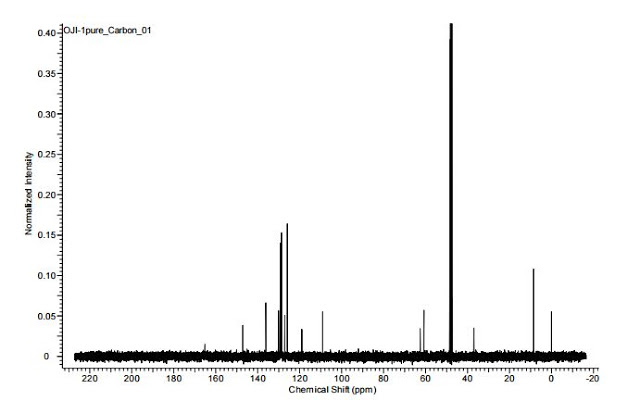
 

str1


Merck Serono and MMV sign agreement to develop potential antimalarial therapy

Agreement further diversifies MMV’s partner base, strengthening our antimalarial research and development portfolio

01 April 2015

Photo © Merck Serono

Merck Serono, the biopharmaceutical business of Merck, and MMV announced today that an agreement has been signed for Merck Serono to obtain the rights to the investigational antimalarial compound DDD107498 from MMV. This agreement underscores the commitment of Merck Serono to provide antimalarials for the most vulnerable populations in need.

“This agreement strengthens our Global Health research program and our ongoing collaboration with Medicines for Malaria Venture,” said Luciano Rossetti, Executive Vice President, Global Head of Research & Development at Merck Serono. “MMV is known worldwide for its major contribution to delivering innovative antimalarial treatments to the most vulnerable populations suffering from this disease, and at Merck Serono we share this goal.”

DDD107498 originated from a collaboration between MMV and the University of Dundee Drug Discovery Unit, led by Prof. Ian Gilbert and Dr. Kevin Read. The objective of the clinical program is to demonstrate whether the investigational compound exerts activity on a number of malaria parasite lifecycle stages, and remains active in the body long enough to offer potential as a single-dose treatment against the most severe strains of malaria.

While development and commercialization of the compound is under Merck Serono’s responsibility, MMV will provide expertise in the field of malaria drug development, including its clinical and delivery expertise, and provide access to its public and private sector networks in malaria-endemic countries.

Merck Serono has a dedicated Global Health R&D group working to address key unmet medical needs related to neglected diseases, such as schistosomiasis and malaria, with a focus on pediatric populations in developing countries. Its approach is based on public-private partnerships and collaborations with leading global health institutions and organizations in both developed and developing countries.

“Working with partners like Merck Serono is critical to the progress of potential antimalarial compounds, like DDD107498, through the malaria drug pipeline,” said Dr. Timothy Wells, Chief Scientific Officer at MMV. “Their Global Health Program is gaining momentum and we need more compounds to tackle malaria, a disease that places a huge burden on the world’s most vulnerable populations. DDD107498 holds great promise and we look forward to working with the Merck Serono team through the development phase.”

According to the World Health Organization, there were an estimated 198 million cases of malaria worldwide in 2013, and an estimated 584,000 deaths, primarily in young children from the developing world. The launch of the not-for-profit research foundation, MMV, in 1999 and a number of collaborations and partnerships, including those with Merck Serono, has contributed to reducing the major gap in malaria R&D investment and subsequent dearth of new medicines.

“It’s hugely encouraging to see the German pharmaceutical industry increasing their engagement in the development of novel antimalarials,” said global malaria expert Prof. Dr. Peter Kremsner, Director of the Institute for Tropical Medicine at the University of Tübingen, Germany. “The Merck Serono and MMV collaboration to develop DDD107498 is a great step. It’s a compound that offers lots of promise so I’m excited to see how it progresses.

str1str2

Scots scientists in ‘single dose’ malaria treatment breakthrough

An antimalarial drug that could treat patients was discovered by Dundee university scientists

Scientists have discovered an antimalarial compound that could treat malaria patients in a single dose and help prevent the spread of the disease from infected people.

The compound DDD107498 also has the potential to treat patients with malaria parasites resistant to current medications, researchers say.

Scientists hope it could lead to treatments and protection against the disease, which claimed almost 600,000 lives amid 200 million reported cases in 2013.

The compound was identified through a collaboration between the University of Dundee’s drug discovery unit (DDU) and the Medicines for Malaria Venture (MMV), a separate organisation.

The compound is now undergoing further safety testing with a view to entering human clinical trials within the next year.

Details of the discovery have been published in the journal Nature.

Professor Ian Gilbert, head of chemistry at the DDU, who led the team that discovered the compound, said: “The publication describes the discovery and profiling of this exciting new compound.

“It reveals that DDD107498 has the potential to treat malaria with a single dose, prevent the spread of malaria from infected people and protect a person from developing the disease in the first place.

“There is still some way to go before the compound can be given to patients. However, we are very excited by the progress that we have made.”

The World Health Organisation reports that there were 200 million clinical cases of malaria in 2013, with 584,000 people dying from the disease. Most of these deaths were children under the age of five and pregnant women.

MMV chief executive officer Dr David Reddy said: “Malaria continues to threaten almost half of the world’s population – the half that can least afford it.

“DDD107498 is an exciting compound since it holds the promise to not only treat but also protect these vulnerable populations.

“The collaboration to identify and progress the compound, led by the drug discovery unit at the University of Dundee, drew on MMV’s network of scientists from Melbourne to San Diego.”The publication of the research is an important step and a clear testament to the power of partnership.”

MMV selected DDD107498 to enter preclinical development in October 2013 following the recommendation of its expert scientific advisory committee.

Since then, with MMV’s leadership, large quantities of the compound have been produced and it is undergoing further safety testing with a view to entering human clinical trials within the next year.

Merck Serono has recently obtained the right to develop and, if successful, commercialise the compound, with the input of MMV’s expertise in the field of malaria drug development and access and delivery in malaria-endemic countries.

Dr Michael Chew from the Wellcome Trust, which provides funding for the DDU and MMV, said: “The need for new antimalarial drugs is more urgent than ever before, with emerging strains of the parasite now showing resistance against the best available drugs.

“These strains are already present at the Myanmar-Indian border and it’s a race against time to stop resistance spreading to the most vulnerable populations in Africa.

“The discovery of this new antimalarial agent, which has shown remarkable potency against multiple stages of the malaria lifecycle, is an exciting prospect in the hunt for viable new treatments.”

PAPER


Abstract Image

Figure

Discovery of a Quinoline-4-carboxamide Derivative with a Novel Mechanism of Action, Multistage Antimalarial Activity, and Potent in Vivo Efficacy

Drug Discovery Unit, Division of Biological Chemistry and Drug Discovery, School of Life Sciences, University of Dundee, Dundee, DD1 5EH, U.K.
Cell and Molecular Biology, Department of Life Sciences, Imperial College, London, SW7 2AZ, U.K.
§ School of Medicine, University of California, San Diego, 9500 Gilman Drive, La Jolla, California 92093, United States
Eskitis Institute, Griffith University, Brisbane Innovation Park, Nathan Campus, Brisbane, QLD 4111, Australia
Swiss Tropical and Public Health Institute, Swiss TPH, Socinstrasse 57, 4051 Basel, Switzerland
#University of Basel, CH-4003 Basel, Switzerland
Medicines for Malaria Venture, International Centre Cointrin, Entrance G, 3rd Floor, Route de Pré-Bois 20, P.O. Box 1826, CH-1215, Geneva 15, Switzerland
J. Med. Chem., Article ASAP
DOI: 10.1021/acs.jmedchem.6b00723
*K.D.R.: phone, +44 1382 388 688; e-mail, k.read@dundee.ac.uk., *I.H.G.: phone, +44 1382 386 240; e-mail,i.h.gilbert@dundee.ac.uk.
Figure
Conditions: (a) morpholine, Et3N, DCM, 16 h, 72% yield; (b) MeMgBr, toluene, reflux, 4 h and then a 10% aqueous HCl, reflux, 1 h, 70% yield; (c) NBS, benzoyl peroxide, dichlorobenzene, 140 °C, 16 h, 70% yield; (d) morpholine, K2CO3, acetonitrile, 40 °C, 16 h, 64% yield; (e) 5-fluoroisatin, KOH, EtOH, 120 °C, microwave, 20 min, 30–76% yield; (f) amine, CDMT, N-methylmorpholine, DCM, 20–61% yield.

// https://tpc.googlesyndication.com/pagead/js/r20160906/r20110914/abg.js//


A single-dose treatment against malaria worked in mice to cure them of the disease. The drug also worked to block infection in healthy mice and to stop transmission, according to a study published in Nature today. The fact that the drug can act against so many stages of malaria is pretty new, but what’s even more exciting is the compound’s mode of action: it kills malaria in a completely new way, researchers say. The feature would make it a welcome addition to our roster of antimalarials — a roster that’s threatened by drug resistance.

RESEARCHERS SIFTED THROUGH A LIBRARY OF ABOUT 4,700 COMPOUNDS TO FIND THIS ONE

Malaria is an infectious disease that’s transmitted through mosquito bites; it’s also a leading cause of death in a number of developing countries. Approximately 3.4 billion people live in areas where malaria poses a real threat. As a result, there were 207 million cases of malaria in 2012 — and 627,000 deaths. There are drugs that can be used to prevent malaria, and even treat it, but drug resistance is halting the use of certain treatments in some areas.

A long search

Searching for a new drug is all about trial and error. To find this particular compound, researchers sifted through a library of about 4,700 compounds, testing them to see if they were capable of killing the malaria parasite in a lab setting. When they found something that worked, they tweaked the drug candidate to see if it could perform more effectively. “We went through a lot of these cycles of testing and designing new compounds,” says Ian Gilbert, a medicinal chemist at the University of Dundee in the UK, and a co-author of the study. “Eventually we optimized to the compound which is the subject of the paper.” For now, that compound’s unwieldy name is DDD107498.

To make sure DDD107498 really had potential, the researchers tested it on mice that had already been infected with malaria. A single dose was enough to provoke a 90 percent reduction in the number of parasites in their blood. The scientists also gave the compound to healthy mice that were subsequently exposed to malaria. DDD107498 helped the mice evade infection with a single dose, but it’s unclear how long that effect would last in humans. Finally, the researchers looked at whether the compound could prevent the transmission from an infected mouse to a mosquito. A day after receiving the treatment, mice were put in contact with mosquitoes. The scientists noted a 91 percent reduction in infected mosquitoes.

“IT HAS THE ABILITY TO BE A ONE-DOSE [DRUG], IN COMBINATION WITH ANOTHER MOLECULE.”

“What’s exciting about this molecule is obviously the fact that it has the ability to be a one-dose [drug], in combination with another molecule to cure blood stage malaria,” says Kevin Read, a drug researcher also at the University of Dundee and a co-author of the study. The fact that the compound has the ability to block transmission and protect against infection is equally thrilling. But the way in which DDD107498 kills malaria might be its most interesting feature. It halts the production of proteins — which are necessary for the parasite’s survival. No other malaria drug does that right now, Read says. “So, in principle, there’s no resistance out there already to this mechanism.”

The drug hasn’t been tested in humans yet, so it may not be nearly as good in the field. But Read says DDD107498 looks promising. “From all the pre-clinical or non-clinical data we’ve generated, it is comparable or better than any of the current marketed anti-malarials in those studies.” And at $1 per treatment, the price of the drug should fall “within the range of what’s acceptable,” he says.

“It looks like an excellent study, and the results look very important,” says Philip Rosenthal, a malaria drug researcher at The University of California-San Francisco who didn’t participate in the study. This is a big shift for Rosenthal’s field. Five years ago, “we had very little going on in anti-malarial drug discovery,” he says. Now, there’s quite a bit going on for malaria researchers, and a number of promising compounds are moving along. DDD107498 “is another player, and it’s got a number of positive features,” he says.

OTHER TREATMENTS HAVE TO BE TAKEN FOR A FEW DAYS

One of the features is the drug’s potency. It’s very active against cultured malaria parasites, Rosenthal says. But what’s perhaps most intriguing about DDD107498 is that the drug works against the mechanism that enables protein synthesis the malaria parasite’s cells. No other malaria drug does that right now, Read says. “Considering challenges of treating malaria, which is often in rural areas and developing countries, a single dose would be a big plus,” he says. “In addition, because of it’s long half life, it may also work to prevent malaria with once a week dosing, which is also a benefit.”

Still, no drug is perfect. The data suggests that DDD107498 doesn’t kill malaria as quickly as some other drugs, Rosenthal says. And when the researchers tested it to see how long it might take for resistance to develop, the results weren’t as promising as he would like. The parasites figured out a way to become resistant to the compound “relatively easily,” he says. That shouldn’t be “deal-killer,” however. “Its slow onset of action probably means it should be combined with a faster-acting drug,” he says.

BUT IT’S SLOW-ACTING

The compound is going through safety testing now. If everything goes well, it should hit human trials within the next year, Read says. Chances are, it will have to be used in combination with other malaria drugs, Gilbert says. “All anti-malarials are given in combination because it slows down resistance.”

“When you’re treating infectious diseases, you know that drug resistance is always a potential problem, so having a number of choices to treat malaria is a good thing,” Rosenthal says. In this case, the drug’s new mode of action may hold lead to an entirely new weapon against malaria. “Obviously it’s got a long way to go,” Read says. But the compound is “very exciting,” nonetheless.

// https://tpc.googlesyndication.com/pagead/js/r20160906/r20110914/abg.js//

//

PATENT
str1 str2 str3 str4
Example 16-Fluoro-2-[4-(morpholinomethyl)phenyl]-N-(2-pyrrolidin-1-ylethyl)quinoline-4-carboxamide, Example compound 1 in Scheme 2
str1
In a sealed microwave tube, a suspension of 2-chloro-6-fluoro-N-(2-pyrrolidin-1-ylethyl)quinoline-4-carboxamide (preparation 4) (2.00 g, 6 mmol), [4-(morpholinomethyl)phenyl]boronic acid, hydrochloride, available from UORSY, (3.20 g, 12 mmol), potassium phosphate (2.63 g, 12 mmol) and tetrakis(triphenylphosphine)palladium (0) (0.21 g, 0.19 mmol) in DMF/Water 3/1 (40 ml) was heated at 130° C. under microwave irradiation for 30 min. The reaction was filtered through Celite™ and solvents were removed under reduced pressure. The resulting residue was taken up in DCM (150 ml) and washed twice with NaHCO3 saturated aqueous solution (2×100 ml). The organic layer was separated, dried over MgSO4 and concentrate to dryness under reduced pressure. The reaction crude was purified by flash column chromatography using an 80 g silica gel cartridge and eluting with DCM (Solvent A) and MeOH (Solvent B) and the following gradient: 1 min hold 100% A, followed by a 30 min ramp to 10% B, and then 15 min hold at 10% B. The fractions containing product were pooled together and concentrated to dryness under vacuum to obtain the desired product as an off-white solid (1 g). The product was dissolved in methanol (100 ml) and 3-mercaptopropyl ethyl sulfide Silica (Phosphonics, SPM-32, 60-200 uM) was added. The suspension was stirred at room temperature over for 2 days and then at 50° C. for 1 h. After cooling to room temperature, the scavenger was filtered off and washed with methanol (30 ml). The solvent was removed under reduced pressure and the product was further purified by preparative HPLC. The fractions containing product were pooled together and freeze dried to obtain the desired product as a white solid (0.6 g, 1.3 mmol, Yield 20%).
1H NMR (500 MHz; CDCl3) δ 1.81-1.84 (m, 4H), 2.50-2.52 (m, 4H), 2.63 (brs, 4H), 2.82 (t, 2H, J=5.9 Hz), 3.61 (s, 2H), 3.71 (dd, 2H, J=5.4 Hz, J=11.4 Hz), 3.74-3.76 (m, 4H), 6.84 (brs, 1H), 7.52-7.57 (m, 3H), 7.97-8.00 (m, 2H), 8.13 (d, 2H, J=8.2 Hz), 8.21 (dd, 1H, J=5.5 Hz, J=9.2 Hz) ppm. 19F NMR (407.5 MHz; CDCl3) δ−111.47 ppm.
Purity by LCMS (UV Chromatogram, 190-450 nm) 99%, rt=5.7 min, m/z 463 (M+H)+ HRMS (ES+) found 463.2501 [M+H]+, C27H32F1N4O2 requires 463.2504.
Example 26-Fluoro-2-[4-(morpholinomethyl)phenyl]-N-(2-pyrrolidin-1-ylethyl)quinoline-4-carboxamide; fumaric acid salt, compound (IB) in Scheme 2
str1
The starting free base (example 1) (0.58 g, 1 mmol) was dissolved in dry ethanol (10 ml) and added dropwise to a stirred solution of fumaric acid (0.15 g, 1 mmol) in dry ethanol (9 ml). The mixture was stirred at room temperature for 1 h. The white precipitate was filtered, washed with ethanol (20 ml) and then dissolved in 10 ml of water and freeze dried to obtain the desired salt as a white solid (0.601 g, 1 mmol, Yield 82%).
1H NMR (500 MHz; d6-DMSO) δ 1.83-1.86 (m, 4H), 2.41 (brs, 4H), 2.94 (brs, 4H), 3.03 (t, 2H, J=6.2 Hz), 3.57 (s, 2H), 3.60-3.65 (m, 6H), 6.47 (s, 2H), 7.51 (d, 2H, J=8.25), 7.74-7.78 (m, 1H), 8.06 (dd, 1H, J=2.9 Hz, J=10.4 Hz), 8.17 (dd, 1H, J=5.7 Hz, J=9.3 Hz), 8.24-8.26 (m, 3H), 9.24 (t, 1H, J=5.5 Hz) ppm. 19F NMR (407.5 MHz; d6-DMSO) δ-112.30 ppm.
Purity by LCMS (UV Chromatogram, 190-450 nm) 99%, rt=5.3 min, m/z 463 (M+H)+
Example 1AAlternative synthesis of 6-fluoro-2-[4-(morpholinomethyl)phenyl]-N-(2-pyrrolidin-1-ylethyl)quinoline-4-carboxamide, Example compound 1A in Scheme 4
str1
To a stirred suspension of 6-fluoro-2-[4-(morpholinomethyl)phenyl]quinoline-4-carboxylic acid (preparation 7) (2.20 g, 6 mmol) in DCM (100 ml) at room temperature, 2-chloro-4,6-dimethoxy-1,3,5-triazine (CDMT) (1.26 g, 7 mmol) and 4-methylmorpholine (NMO) (1.33 ml, 12 mmol) were added. The reaction mixture was stirred at room temperature for 1 h and then 2-pyrrolidin-1-ylethanamine (0.77 ml, 6 mmol) was added and stirred at room temperature for further 3 h. The reaction mixture was washed with NaHCO3 saturated aqueous solution (2×100 ml) and the organic phase was separated, dried over MgSO4 and concentrated under reduced pressure. The resulting residue was absorbed on silica gel and purified by flash column chromatography using an 80 g silica gel cartridge and eluting with DCM (Solvent A) and MeOH (Solvent B) and the following gradient: 2 min hold 100% A followed by a 30 min ramp to 10% B and then 15 min hold at 10% B. The desired fractions were concentrated to dryness under vacuum to obtain the crude product as a yellow solid (95% purity by LCMS). The sample was further purified by a second column chromatography using a 40 g silica gel cartridge, eluting with DCM (Solvent A) and 10% NH3-MeOH in DCM (Solvent B) and the following gradient: 2 min hold 100% A, followed by a 10 min ramp to 23% B and then 15 min hold at 23% B. The desired fractions were concentrated to dryness under vacuum to obtain product as a white solid (1 g). Re-crystallisation form acetonitrile (18 ml) yielded the title compound as a white solid (625 mg, 1.24 mmol, 20%).
1H NMR (500 MHz; CDCl3) δ 1.81-1.84 (m, 4H), 2.50-2.52 (m, 4H), 2.63 (brs, 4H), 2.82 (t, 2H, J=5.9 Hz), 3.61 (s, 2H), 3.71 (dd, 2H, J=5.4 Hz, J=11.4 Hz), 3.74-3.76 (m, 4H), 6.84 (brs, 1H), 7.52-7.57 (m, 3H), 7.97-8.00 (m, 2H), 8.13 (d, 2H, J=8.2 Hz), 8.21 (dd, 1H, J=5.5 Hz, J=9.2 Hz) ppm.
1H NMR (500 MHz; d6-DMSO) δ 1.72-1.75 (m, 4H), 2.41 (brs, 4H), 2.56 (brs, 4H), 2.67 (t, 2H, J=6.6 Hz), 3.49-3.52 (m, 2H), 3.56 (s, 2H), 3.60-3.61 (m, 4H), 7.52 (d, 2H, J=8.3 Hz), 7.73-7.77 (m, 1H), 8.07 (dd, 1H, J=2.9 Hz, J=10.4 Hz), 8.18-8.21 (m, 2H), 8.26 (d, 2H, J=8.3 Hz), 8.85 (t, 1H, J=6.6 Hz) ppm.
13C NMR (125 MHz; d6-DMSO3) δ 23.2, 38.4, 53.2, 53.5, 54.5, 62.1, 66.2, 109.0, 109.1, 117.3, 120.1, 120.3, 124.1, 124.2, 127.1, 129.4, 132.2, 132.3, 136.8, 139.9, 142.8, 145.2, 155.3, 159.0, 161.0, 166.1 ppm.
19F NMR (500 MHz; d6-DMSO) δ-112.47 ppm.
Purity by LCMS (UV Chromatogram, 190-450 nm) 99%, rt=5.0 min, m/z 463 (M+H)+
PATENT
WO 2016033635
Patent
WO 2013153357

SCHEME 1

Figure imgf000018_0001

SCHEME 2

Figure imgf000019_0001

Preparation 4Yield: 54% Preparation 3

Yield: 27%

Figure imgf000019_0002

SCHEME 4 B

Figure imgf000021_0001

Yield: 72% Yield: 70% Preparation 6

Figure imgf000021_0002

Example 1 : 6-Fluoro-2-r4-(morpholinomethyl)phenyll-N-(2-pyrrolidin-1-ylethyl)quinoline- 4-carboxamide, Example compound 1 in Scheme 2

Figure imgf000050_0002

In a sealed microwave tube, a suspension of 2-chloro-6-fluoro-N-(2-pyrrolidin-1- ylethyl)quinoline-4-carboxamide (preparation 4) (2.00 g, 6 mmol), [4- (morpholinomethyl)phenyl]boronic acid, hydrochloride, available from UORSY, (3.20 g, 12 mmol), potassium phosphate (2.63 g, 12 mmol) and tetrakis(triphenylphosphine)palladium (0) (0.21 g, 0.19 mmol) in DMF/Water 3/1 (40 ml) was heated at 130°C under microwave irradiation for 30 min. The reaction was filtered through Celite™ and solvents were removed under reduced pressure. The resulting residue was taken up in DCM (150 ml) and washed twice with NaHC03 saturated aqueous solution (2 x 100 ml). The organic layer was separated, dried over MgS04and concentrate to dryness under reduced pressure. The reaction crude was purified by flash column chromatography using an 80 g silica gel cartridge and eluting with DCM (Solvent A) and MeOH (Solvent B) and the following gradient: 1 min hold 100% A, followed by a 30 min ramp to 10 % B, and then 15 min hold at 10% B. The fractions containing product were pooled together and concentrated to dryness under vacuum to obtain the desired product as an off-white solid (1 g). The product was dissolved in methanol (100 ml) and 3-mercaptopropyl ethyl sulfide Silica (Phosphonics, SPM-32, 60- 200 uM) was added. The suspension was stirred at room temperature over for 2 days and then at 50°C for 1 h. After cooling to room temperature, the scavenger was filtered off and washed with methanol (30 ml). The solvent was removed under reduced pressure and the product was further purified by preparative HPLC. The fractions containing product were pooled together and freeze dried to obtain the desired product as a white solid (0.6 g, 1.3 mmol, Yield 20%).

1 H NMR (500 MHz; CDCI3) δ 1.81-1.84 (m, 4H), 2.50-2.52 (m, 4H), 2.63 (brs, 4H), 2.82 (t, 2H, J = 5.9 Hz), 3.61 (s, 2H), 3.71 (dd, 2H, J = 5.4 Hz, J = 1 1.4 Hz), 3.74-3.76 (m, 4H), 6.84 (brs, 1 H), 7.52-7.57 (m, 3H), 7.97-8.00 (m, 2H), 8.13 (d, 2H, J = 8.2 Hz), 8.21 (dd, 1 H, J = 5.5 Hz, J = 9.2 Hz) ppm . 19 F NMR (407.5 MHz; CDCI3) δ -11 1.47 ppm. Purity by LCMS (UV Chromatogram, 190-450nm) 99 %, rt = 5.7 min, m/z 463 (M+H)+ HRMS (ES+) found 463.2501 [M+H]+, C27H32F1 N402 requires 463.2504.

Example 2: 6-Fluoro-2-[4-(morpholinomethyl)phenyl1-N-(2-pyrrolidin-1-ylethyl)quinoline- 4-carboxamide; fumaric acid salt, compound (IB) in Scheme 2

Figure imgf000051_0001

The starting free base (example 1) (0.58 g, 1 mmol) was dissolved in dry ethanol (10 ml) and added dropwise to a stirred solution of fumaric acid (0.15 g, 1 mmol) in dry ethanol (9 ml). The mixture was stirred at room temperature for 1 h. The white precipitate was filtered, washed with ethanol (20 ml) and then dissolved in 10 ml of water and freeze dried to obtain the desired salt as a white solid (0.601 g, 1 mmol, Yield 82%).

1 H NMR (500 MHz; d6-DMSO) δ 1.83-1.86 (m, 4H), 2.41 (brs, 4H), 2.94 (brs, 4H), 3.03 (t, 2H, J = 6.2 Hz), 3.57 (s, 2H), 3.60-3.65 (m, 6H), 6.47 (s, 2H), 7.51 (d, 2H, J = 8.25), 7.74-7.78 (m, 1 H), 8.06 (dd, 1 H, J = 2.9 Hz, J = 10.4 Hz), 8.17 (dd, 1 H, J = 5.7 Hz, J = 9.3 Hz), 8.24-8.26 (m, 3H), 9.24 (t, 1 H, J = 5.5 Hz) ppm. 19 F NMR (407.5 MHz; d6- DMSO) δ -112.30 ppm.

Purity by LCMS (UV Chromatogram, 190-450nm) 99 %, rt = 5.3 min, m/z 463 (M+H)+

Example 1A: Alternative synthesis of 6-fluoro-2-[4-(morpholinomethyl)phenyl1-N-(2- pyrrolidin-1-ylethyl)quinoline-4-carboxamide, Example compound 1A in Scheme 4

Figure imgf000052_0001

To a stirred suspension of 6-fluoro-2-[4-(morpholinomethyl)phenyl]quinoline-4-carboxylic acid (preparation 7) (2.20 g, 6 mmol) in DCM (100 ml) at room temperature, 2-chloro- 4,6-dimethoxy-1 ,3,5-triazine (CDMT) (1.26 g, 7 mmol) and 4-methylmorpholine (NMO) (1.33 ml, 12 mmol) were added. The reaction mixture was stirred at room temperature for 1 h and then 2-pyrrolidin-1-ylethanamine (0.77 ml, 6 mmol) was added and stirred at room temperature for further 3 h. The reaction mixture was washed with NaHC03 saturated aqueous solution (2x 100 ml) and the organic phase was separated, dried over MgS04 and concentrated under reduced pressure. The resulting residue was absorbed on silica gel and purified by flash column chromatography using an 80 g silica gel cartridge and eluting with DCM (Solvent A) and MeOH (Solvent B) and the following gradient: 2 min hold 100% A followed by a 30 min ramp to 10 %B and then 15 min hold at 10%B. The desired fractions were concentrated to dryness under vacuum to obtain the crude product as a yellow solid (95% purity by LCMS). The sample was further purified by a second column chromatography using a 40 g silica gel cartridge, eluting with DCM (Solvent A) and 10% NH3-MeOH in DCM (Solvent B) and the following gradient: 2 min hold 100% A, followed by a 10 min ramp to 23 % B and then 15 min hold at 23% B. The desired fractions were concentrated to dryness under vacuum to obtain product as a white solid (1 g). Re-crystallisation form acetonitrile (18 ml) yielded the title compound as a white solid (625 mg, 1.24 mmol, 20%).

1 H NMR (500 MHz; CDCI3) δ 1.81-1.84 (m, 4H), 2.50-2.52 (m, 4H), 2.63 (brs, 4H), 2.82 (t, 2H, J = 5.9 Hz), 3.61 (s, 2H), 3.71 (dd, 2H, J = 5.4 Hz, J = 1 1.4 Hz), 3.74-3.76 (m, 4H), 6.84 (brs, 1 H), 7.52-7.57 (m, 3H), 7.97-8.00 (m, 2H), 8.13 (d, 2H, J = 8.2 Hz), 8.21 (dd, 1 H, J = 5.5 Hz, J = 9.2 Hz) ppm .

1 H NMR (500 MHz; d6-DMSO) δ 1.72-1.75 (m, 4H), 2.41 (brs, 4H), 2.56 (brs, 4H), 2.67 (t, 2H, J = 6.6 Hz), 3.49-3.52 (m, 2H), 3.56 (s, 2H), 3.60-3.61 (m, 4H), 7.52 (d, 2H, J = 8.3 Hz), 7.73-7.77 (m, 1 H), 8.07 (dd, 1 H, J = 2.9 Hz, J = 10.4 Hz), 8.18-8.21 (m, 2H), 8.26 (d, 2H , J = 8.3 Hz), 8.85 (t, 1 H, J = 6.6 Hz) ppm.

13C NMR (125 MHz; d6-DMS03) 5 23.2, 38.4, 53.2, 53.5, 54.5, 62.1 , 66.2, 109.0, 109.1 , 1 17.3, 120.1 , 120.3, 124.1 , 124.2, 127.1 , 129.4, 132.2, 132.3, 136.8, 139.9, 142.8, 145.2, 155.3, 159.0, 161 .0, 166.1 ppm.

19 F NM R (500 MHz; d6-DMSO) δ -1 12.47 ppm.

Purity by LCMS (UV Chromatogram, 190-450nm) 99 %, rt = 5.0 min, m/z 463 (M+H)+

PAPER
A Quinoline Carboxamide Antimalarial Drug Candidate Uniquely Targets Plasmodia at Three Stages of the Parasite Life Cycle
Angewandte Chemie, International Edition (2015), 54, (46), 13504-13506
original image

Putting a stop to malaria: Phenotypic screening against malaria parasites, hit identification, and efficient lead optimization have delivered the preclinical candidate antimalarial DDD107498. This molecule is distinctive in that it has potential for use as a single-dose cure for malaria and shows a unique broad spectrum of activity against the liver, blood, and mosquito stages of the parasite life cycle.

 Prof. P. M. O’Neill Department of Chemistry, University of Liverpool Liverpool, L69 7ZD (UK) E-mail: pmoneill@liverpool.ac.uk Prof. S. A. Ward Liverpool School of Tropical Medicine, Pembroke Place Liverpool, L3 5QA (UK)
 str1

Professor Ian Gilbert FRSC

Design and synthesis of potential therapeutic agents
Position:
Professor of Medicinal Chemistry and Head of the Division of Biological Chemistry and Drug Discovery
Address:
College of Life Sciences, University of Dundee, Dundee
Full Telephone:
+44 (0) 1382 386240, int ext 86240

Dr Neil Norcross

Position:
Medicinal Chemist
Address:
College of Life Sciences, University of Dundee, Dundee
Full Telephone:
(0) , int ext
Image result for Beatriz Baragana Ruibal
La investigadora asturiana Beatriz Baragaña, en La Pola. / PABLO NOSTI
Image result for Achim Porzelle

Achim Porzelle

REFERENCES

///////////DDD107498, DDD 107498, PRECLINICAL, DUNDEE, MALARIA, DDD 498, Achim Porzelle, Ian Gilbert, MERCK SERENO, Beatriz Baragaña, Medicines for Malaria Venture,  University of Dundee, Neil Norcross, 1469439-69-7, 1469439-71-1 , SUCCINATE

Fc1ccc2nc(cc(c2c1)C(=O)NCCN1CCCC1)-c1ccc(cc1)CN1CCOCC1

Novel, isoform-selective inhibitor of histone deacetylase 8 (HDAC8)


str1

CAS 1620779-53-4
MF C22H20N4O2, MW 372.4

(S)-2-(5-(cyclopropylethynyl)-4-phenyl-1H-1,2,3-triazol-1-yl)-N-hydroxy-3-phenylpropanamide

1H-1,2,3-Triazole-1-acetamide, 5-(2-cyclopropylethynyl)-N-hydroxy-4-phenyl-α-(phenylmethyl)-, (αS)-

Applicants: TRUSTEES OF BOSTON UNIVERSITY
DANA-FARBER CANCER INSTITUTE, INC.
Inventors: Aaron Beaty BEELER
John A. PORCO, JR.
Oscar J. INGHAM
James E. BRADNER
As histone proteins bind DNA prior to transcription, their biochemical action plays a critical role in the regulation of gene expression and cellular differentiation. Histone deacetylases (HDACs) are an important family of proteins predominantly responsible for specific posttranslational modifications of histone proteins, the chief organizational component of chromatin. HDACs catalyze the removal of acetyl groups from histones and other cellular proteins. HDAC-mediated deacetylation of chromatin-bound histones regulates the expression of a variety of genes throughout the genome. Importantly, HDACs have been linked to cancer, as well as other health conditions. To date, eleven major HDAC isoforms have been described (HDACs 1-11). HDACs are categorized into two classes. Class I HDACs include HDAC1, HDAC2, HDAC3, HDAC8 and HDAC11. Class II HDACs include HDAC4, HDAC5, HDAC6, HDAC7, HDAC9 and HDAC10. HDAC’s are validated targets for a number of disease states, including cancer, neurodegenerative diseases, sickle-cell anemia, muscular dystrophy, and HIV. There are currently two HDAC inhibitors on the market, Vorniostat and Romidepsin. Both are approved for treatment of T-cell lymphoma. However, they are both pan active inhibitors showing very little specificity of binding to HDAC subclasses. Because of this lack of specificity they have a number of side effects.
      Non-selective HDAC inhibitors effect deacetylase activity of most, if not all, of the HDACs. The mechanisms of the anticancer effects of SAHA, a non-selective HDAC inhibitor, are not completely understood, and likely result from both altered gene expression and altered function of proteins regulating cell proliferation and cell death pathways. Non-selective HDAC inhibitors, such as SAHA, induce the accumulation of acetylated histone proteins and non histone proteins.
    Small molecule HDAC inhibitors that are isoform-selective are useful as therapeutic agents with reduced toxicity and as tools for probing the biology of the HDAC isoforms. The present disclosure is related, in part to small molecules that are selective HDAC inhibitors.

1H NMR (500 MHz, d4-MeOD) 0.80 (2H, m), 0.98 (2H, m), 1.47 (1H, m), 3.51 (1H, dd, J = 11.2, 14.2 Hz), 3.71 (1H, dd, J = 3.9, 14.2 Hz), 5.49 (1H, dd, J = 3.9, 11.2 Hz), 6.96 (2H, m), 7.17-7.20 (3H, m), 7.37 (1H, t, J = 7.3 Hz), 7.43 (2H, t, J = 7.3 Hz), 7.99 (2H, d, J = 8.8 Hz);

13C NMR (100 MHz, d4-MeOD) 0.02, 8.55, 37.07, 60.83, 62.59, 109.09, 118.98, 125.9, 127.16, 128.55, 128.65, 128.71, 129.16, 130.07, 136.09, 147.10, 165.20;

HRMS calculated for C22H21N4O2 + (M+H): 373.1659, found: 373.1665.

PATENT

WO2014116962

https://www.google.com/patents/WO2014116962A1?cl=en

SAR. libraries were synthesized to investigate substitution about the triazole core. In some examples, compounds were synthesized using the synthetic routes shown in Fig. 2.

In one study, compound
was synthesized as outline in Scheme I.

Scheme I

PATENT

US153441899

https://patentscope.wipo.int/search/en/detail.jsf?docId=US153441899&recNum=1&office=&queryString=FP%3A%28Aaron+Beeler%29&prevFilter=&sortOption=Pub+Date+Desc&maxRec=8

SAR libraries were synthesized to investigate substitution about the triazole core. In some examples, compounds were synthesized using the synthetic routes shown in FIG. 2. In one study, compound

 was synthesized as outline in Scheme I.

The HDAC assays were carried out as described in Bowers A, West N, Taunton J, Schreiber S L, Bradner J E, Williams R M Total Synthesis and Biological Mode of Action of Largazole: A Potent Class I Histone Deacetylase Inhibitor. J. Am. Chem. Soc. 2008, 130, 11219-11222. Assay results revealed that among the analogues tested a cyclopropane analog was the most active at 0.4 nM (>1000 fold selectivity). These results demonstrated that a small aliphatic group in the 5-position on the triazole can increase potency. Also, compounds with an L-phenylalanine moiety at the 3-position showed significant potency. To expand our understanding of how the molecule interacts with the binding pocket of HDAC 8 and to understand our preliminary SAR, molecular modeling was carried out. The phenyl group from the original amino methyl ester fits snuggly into the Zn binding site and the alkynyl phenyl group sits flat in a hydrophobic groove. In summary, the inventors have developed a potent and highly selective small molecule which inhibits HDAC-8 at approximately 500 pM with over 1000-fold selectivity over HDAC-6 and significantly greater selectivity for all other HDACs. To inventors’ knowledge, to date there are no compounds with this level of potency and selectivity.
All patents and other publications identified in the specification and examples are expressly incorporated herein by reference for all purposes. These publications are provided solely for their disclosure prior to the filing date of the present application. Nothing in this regard should be construed as an admission that the inventors are not entitled to antedate such disclosure by virtue of prior invention or for any other reason. All statements as to the date or representation as to the contents of these documents is based on the information available to the applicants and does not constitute any admission as to the correctness of the dates or contents of these documents.
Although preferred embodiments have been depicted and described in detail herein, it will be apparent to those skilled in the relevant art that various modifications, additions, substitutions, and the like can be made without departing from the spirit of the invention and these are therefore considered to be within the scope of the invention as defined in the claims which follow. Further, to the extent not already indicated, it will be understood by those of ordinary skill in the art that any one of the various embodiments herein described and illustrated can be further modified to incorporate features shown in any of the other embodiments disclosed herein.

Paper

Abstract Image

A novel, isoform-selective inhibitor of histone deacetylase 8 (HDAC8) has been discovered by the repurposing of a diverse compound collection. Medicinal chemistry optimization led to the identification of a highly potent (0.8 nM) and selective inhibitor of HDAC8.

Development of a Potent and Selective HDAC8 Inhibitor

Department of Chemistry and Center for Molecular Discovery (BU-CMD), Boston University, 590 Commonwealth Avenue, Boston, Massachusetts 02215, United States
Department of Medical Oncology, Dana Farber Cancer Institute, Boston, Massachusetts 02215, United States
§ Department of Medicine, Harvard Medical School, Boston, Massachusetts 02115, United States
ACS Med. Chem. Lett., Article ASAP
DOI: 10.1021/acsmedchemlett.6b00239
*Tel: 617-358-3487. E-mail: beelera@bu.edu.

http://pubs.acs.org/doi/abs/10.1021/acsmedchemlett.6b00239

file:///C:/Users/Inspiron/Downloads/ml6b00239_si_001.pdf


Department of Chemistry and Center for Molecular Discovery (BU-CMD), Boston University, 590 Commonwealth Avenue, Boston, Massachusetts 02215, United States

Image result for Department of Chemistry and Center for Molecular Discovery (BY-CMD),


Image result for Department of Chemistry and Center for Molecular Discovery (BY-CMD),Center for Molecular Discovery (CMD) Director John Porco and members of the CMD lab team.



Image result for Aaron B. Beeler

Aaron Beeler

prof-beeler

Aaron Beeler received his Ph.D. in 2002 from Professor John Rimoldi’s laboratory in the Department of Medicinal Chemistry at the University of Mississippi. He then joined the Porco group as a postodoctoral fellow and subsequently the Center for Chemical Methodology and Library Development at Boston University, now the Center for Molecular Discovery. He was promoted to Assistant Director of the CMLD-BU in January 2005. In 2012 Aaron joined the Department of Chemistry as a tenure-track professor in medicinal chemistry.

Degrees and Positions

  • B.S. Belmont University, Biology,
  • Ph.D. University of Mississippi, Medicinal Chemistry

Research

The Beeler Research Group is truly multidisciplinary, combining organic chemistry, engineering, and biology to solve problems in medicinal chemistry. All of these elements are combined and directed toward significant problems in human health. The Beeler Group is addressing focused disease areas (e.g., schizophrenia, Parkinson’s, cystic fibrosis), as well as project areas with broader impact potential (e.g., new methods for discovery of small molecules with anti-cancer properties).

  • Medicinal Chemistry: The goals of medicinal chemistry projects are to optimize small molecules in order to: a) develop a probe that may be utilized as a tool in biological studies; b) develop a lead molecule to facilitate future therapeutics; and c) utilize small molecules to enhance understanding of biological targets that are important for human health. These projects provide students with training in organic chemistry, medicinal chemistry, and focused biology. Projects are selected based on their chemistry and/or biology significance and potential for addressing challenging questions.
  • Technology: One of the core components of the research in the Beeler Group is development of technologies and paradigms that facilitate rapid modification of complex scaffolds. These technologies enable optimization of biologically active lead compounds and identification of small molecule leads in biological systems. The projects focus on utilizing automation, miniaturization, and microfluidics to carry out chemical transformations. These projects are highly interdisciplinary with both chemistry and engineering components.
  • Photochemistry: This area focuses on photochemical transformations toward the synthesis of natural products, natural product scaffolds, and other complex chemotypes of interest to medicinal chemistry and chemical biology. The foundation of these projects is utilizing microfluidics to enable photochemical reaction development.

Techniques & Resources

Students in the Beeler Research Group will have opportunities to learn a number of exciting research disciplines. Organic synthesis will be at the heart of every project. This will include targeted synthesis, methodology development, and medicinal chemistry. Through collaborations with biological researchers and/or research projects carried out within the Beeler Group, students will learn methods for biological assays, pharmacology, and target identification. Many projects will also include aspects of engineering that will provide opportunities for learning techniques such as microfabrication and microfluidics.

Opportunities

It is becoming evident that successful and impactful science is realized in collaborative interdisciplinary environments. The Beeler Research Group’s multidisciplinary nature and collaborative projects provides opportunities to learn areas of research outside of traditional chemistry.

What’s Next for Graduates of the Beeler Group?

Members of the Beeler Research Group will be positioned for a wide range of future endeavors.

  • Undergraduates will be prepared to enter into graduate school for organic chemistry, chemical biology, or chemical engineering or to start careers in industry;
  • Graduate students will have the foundation required for postdoctoral studies in organic synthesis or chemical biology as well as an industrial career in biotech or pharma;
  • Postdoctoral associates will gain training and experience critical for both academic and industrial careers.

Assistant Professor
Office: SCI 484C
Laboratory: SCI 484A
Phone: 617.358.3487
Fax: 617-358-2847
beelera@bu.edu
Office Hours: by Appointment
Beeler Group Homepage
Google Scholar Page

Oscar J. Ingham below

Image result for Oscar J. Ingham

John A. PORCO, JR  below

Image result for John A. PORCO, JRImage result for James E. BRADNER

JAMES E. BRADNER, MD  above

Dana-Farber Cancer Institute

Image result for Dana-Farber Cancer Institute


Image result for Dana-Farber Cancer Institute


Ron ParanalRon Paranal


Image result for Randolph A. EscobarRandolph A. Escobar


Han YuehHan Yueh


US20090181943 * Apr 9, 2008 Jul 16, 2009 Methylgene Inc. Inhibitors of Histone Deacetylase
Reference
1 * GERARD, B ET AL.: ‘Synthesis of 1,4,5-trisubstituted-1,2,3-triazoles by copper-catalyzed cycloaddition-coupling of azides and terminal alkynes‘ TETRAHEDRON vol. 62, 12 May 2006, pages 6405 – 6411
2 * VANNINI, A ET AL.: ‘Crystal structure of a eukaryotic zinc-dependent histone deacetylase, human HDAC8, complexed with a hydroxamic acid inhibitor.‘ PNAS, [Online] vol. 101, no. 42, 19 October 2004, pages 15064 – 15069 Retrieved from the Internet: <URL:http://www.pnas.org/content/101/42/15064&gt;

///////////epigenetic,  HDACHDAC8,  Histone deacetylase,  histone deacetylase 8,  triazole, PRECLINICAL, Department of Chemistry and Center for Molecular Discovery (BU-CMD), Boston University, 590 Commonwealth Avenue, Boston, Massachusetts 02215, United States, Oscar J. InghamAaron Beeler

n1n(c(c(n1)c2ccccc2)C#CC3CC3)C(C(=O)NO)Cc4ccccc4

PF-05387252


str1

PF-05387252

CAS  1604034-71-0

C25H27N5O2
MW 429.51418 g/mol

2-methoxy-3-[3-(4-methylpiperazin-1-yl)propoxy]-11H-indolo[3,2-c]quinoline-9-carbonitrile

IRAK4 inhibitor

Rheumatoid arthritis;
SLE

Preclinical

In the past decade there has been considerable interest in targeting the innate immune system in the treatment of autoimmune diseases and sterile inflammation. Receptors of the innate immune system provide the first line of defense against bacterial and viral insults. These receptors recognize bacterial and viral products as well as pro-inflammatory cytokines and thereby initiate a signaling cascade that ultimately results in the up-regulation of inflammatory cytokines such as TNFα, IL6, and interferons. Recently it has become apparent that self-generated ligands such as nucleic acids and products of inflammation such as HMGB1 and Advanced Glycated End-products (AGE) are ligands for Toll-like receptors (TLRs) which are key receptors of the innate immune system.

This demonstrates the role of TLRs in the initiation and perpetuation of inflammation due to autoimmunity.

Interleukin-1 receptor associated kinase (IRAK4) is a ubiquitously expressed serine/threonine kinase involved in the regulation of innate immunity. IRAK4 is responsible for initiating signaling from TLRs and members of the IL-1/18 receptor family. Kinase-inactive knock-ins and targeted deletions of IRAK4 in mice lead to reductions in TLR and IL-1 induced pro-inflammatory cytokines. and 7 IRAK-4 kinase-dead knock-in mice have been shown to be resistant to induced joint inflammation in the antigen-induced-arthritis (AIA) and serum transfer-induced (K/BxN) arthritis models. Likewise, humans deficient in IRAK4 also display the inability to respond to challenge by TLR ligands and IL-1

 However, the immunodeficient phenotype of IRAK4-null individuals is narrowly restricted to challenge by gram positive bacteria, but not gram negative bacteria, viruses or fungi. This gram positive sensitivity also lessens with age implying redundant or compensatory mechanisms for innate immunity in the absence of IRAK4.These data suggest that inhibitors of IRAK4 kinase activity will have therapeutic value in treating cytokine driven autoimmune diseases while having minimal immunosuppressive side effects. Additional recent studies suggest that targeting IRAK4 may be a viable strategy for the treatment of other inflammatory pathologies such as atherosclerosis.

Indeed, the therapeutic potential of IRAK4 inhibitors has been recognized by others within the drug-discovery community as evidenced by the variety of IRAK4 inhibitors have been reported to-date.12, 13, 14, 15 and 16 However, limited data has been published about these compounds and they appear to suffer from a variety of issues such as poor kinase selectivity and poor whole-blood potency that preclude their advancement into the pre-clinical models. To the best of our knowledge, no in vivo studies of IRAK4 inhibitors have been reported to-date in the literature. Herein we report a new class of IRAK4 inhibitors that are shown to recapitulate the phenotype observed in IRAK4 knockout and kinase-dead mice.

PAPER

Bioorganic & Medicinal Chemistry Letters (2014), 24(9), 2066-2072.

doi:10.1016/j.bmcl.2014.03.056

http://www.sciencedirect.com/science/article/pii/S0960894X14002832

Identification and optimization of indolo[2,3-c]quinoline inhibitors of IRAK4

  • a Pfizer Global R&D, 445 Eastern Point Rd., Groton, CT 06340, USA
  • b Pfizer Global R&D, 200 Cambridge Park Dr., Cambridge, MA 02140, USA
  • c Pfizer Global R&D, 87 Cambridgepark Dr., Cambridge, MA 02140, USA
  • d Pfizer Global R&D, 1 Burtt Rd., Andover, MA 01810, USA

Image for unlabelled figure

Abstract

IRAK4 is responsible for initiating signaling from Toll-like receptors (TLRs) and members of the IL-1/18 receptor family. Kinase-inactive knock-ins and targeted deletions of IRAK4 in mice cause reductions in TLR induced pro-inflammatory cytokines and these mice are resistant to various models of arthritis. Herein we report the identification and optimization of a series of potent IRAK4 inhibitors. Representative examples from this series showed excellent selectivity over a panel of kinases, including the kinases known to play a role in TLR-mediated signaling. The compounds exhibited low nM potency in LPS- and R848-induced cytokine assays indicating that they are blocking the TLR signaling pathway. A key compound (26) from this series was profiled in more detail and found to have an excellent pharmaceutical profile as measured by predictive assays such as microsomal stability, TPSA, solubility, and c log P. However, this compound was found to afford poor exposure in mouse upon IP or IV administration. We found that removal of the ionizable solubilizing group (32) led to increased exposure, presumably due to increased permeability. Compounds 26 and 32, when dosed to plasma levels corresponding to ex vivo whole blood potency, were shown to inhibit LPS-induced TNFα in an in vivo murine model. To our knowledge, this is the first published in vivo demonstration that inhibition of the IRAK4 pathway by a small molecule can recapitulate the phenotype of IRAK4 knockout mice.

CID 50992153.png

SYNTHESIS

STR1

////////PF-05387252,  1604034-71-0, PF 05387252, TLR signaling, Indoloquinoline, IRAK4, Kinase inhibitor, Inflammation, PRECLINICAL

N1(CCN(CC1)CCCOc3c(cc2c4nc5cc(ccc5c4cnc2c3)C#N)OC)C

OR

CN1CCN(CC1)CCCOC2=C(C=C3C(=C2)N=CC4=C3NC5=C4C=CC(=C5)C#N)OC

PF-05388169


str1

PF-05388169

CAS 1604034-78-7,  MF C22 H21 N3 O4

MW 391.42

11H-Indolo[3,2-c]quinoline-9-carbonitrile, 2-methoxy-3-[2-(2-methoxyethoxy)ethoxy]-
IRAK4 inhibitor

Rheumatoid arthritis;
SLE

Preclinical

str1

PAPER

Bioorganic & Medicinal Chemistry Letters (2014), 24(9), 2066-2072.

http://www.sciencedirect.com/science/article/pii/S0960894X14002832

Identification and optimization of indolo[2,3-c]quinoline inhibitors of IRAK4

  • a Pfizer Global R&D, 445 Eastern Point Rd., Groton, CT 06340, USA
  • b Pfizer Global R&D, 200 Cambridge Park Dr., Cambridge, MA 02140, USA
  • c Pfizer Global R&D, 87 Cambridgepark Dr., Cambridge, MA 02140, USA
  • d Pfizer Global R&D, 1 Burtt Rd., Andover, MA 01810, USA

Image for unlabelled figure

IRAK4 is responsible for initiating signaling from Toll-like receptors (TLRs) and members of the IL-1/18 receptor family. Kinase-inactive knock-ins and targeted deletions of IRAK4 in mice cause reductions in TLR induced pro-inflammatory cytokines and these mice are resistant to various models of arthritis. Herein we report the identification and optimization of a series of potent IRAK4 inhibitors. Representative examples from this series showed excellent selectivity over a panel of kinases, including the kinases known to play a role in TLR-mediated signaling. The compounds exhibited low nM potency in LPS- and R848-induced cytokine assays indicating that they are blocking the TLR signaling pathway. A key compound (26) from this series was profiled in more detail and found to have an excellent pharmaceutical profile as measured by predictive assays such as microsomal stability, TPSA, solubility, and c log P. However, this compound was found to afford poor exposure in mouse upon IP or IV administration. We found that removal of the ionizable solubilizing group (32) led to increased exposure, presumably due to increased permeability. Compounds 26 and 32, when dosed to plasma levels corresponding to ex vivo whole blood potency, were shown to inhibit LPS-induced TNFα in an in vivo murine model. To our knowledge, this is the first published in vivo demonstration that inhibition of the IRAK4 pathway by a small molecule can recapitulate the phenotype of IRAK4 knockout mice.

SYNTHESIS

STR1

//////////PF-05388169, TLR signaling, Indoloquinoline, IRAK4, Kinase inhibitor, Inflammation, PRECLINICAL, 1604034-78-7

C(COC)OCCOc4c(cc3\C2=N\c1cc(ccc1/C2=C/Nc3c4)C#N)OC

GSK 6853


STR1

STR1

GSK 6853

CAS  1910124-24-1

C22 H27 N5 O3, 409.48
Benzamide, N-[2,3-dihydro-1,3-dimethyl-6-[(2R)-2-methyl-1-piperazinyl]-2-oxo-1H-benzimidazol-5-yl]-2-methoxy-
(R)-N-(1 ,3- dimethyl-6-(2-methylpiperazin-1 -yl)-2-oxo-2,3-dihydro-1 H-benzo[d]imidazol-5-yl)-2- methoxybenzamide

A white solid.

LCMS (high pH): Rt = 0.90 min, [M+H+]+ 410.5.

δΗ NMR (600 MHz, DMSO-d6) ppm 10.74 (s, 1 H), 8.39 (s, 1 H), 8.05 (dd, J = 7.7, 1.8 Hz, 1 H), 7.57 (ddd, J = 8.3, 7.2, 2.0 Hz, 1 H), 7.29 (d, J = 8.1 Hz, 1 H), 7.23 (s, 1 H), 7.17-7.1 1 (m, 1 H), 4.10 (s, 3H), 3.33 (s, 3H), 3.32 (s, 3H), 3.30 (br s, 1 H), 3.07-3.02 (m, 1 H), 3.02-2.99 (m, 1 H), 2.92-2.87 (m, 1 H), 2.80 (td, J = 1 1.3, 2.7 Hz, 1 H), 2.73 (td, J = 1 1 .0, 2.7 Hz, 1 H), 2.68-2.63 (m, 1 H), 2.55 (dd, J = 12.0, 9.8 Hz, 1 H), 0.71 (d, J = 6.1 Hz, 3H).

δ0 NMR (151 MHz, DMSO-d6) ppm 162.1 , 156.8, 154.1 , 134.4, 133.2, 131.5, 130.1 , 126.6, 125.7, 121.9, 121.0, 1 12.5, 103.0, 99.4, 56.8, 55.4, 55.3, 53.3, 46.3, 26.8, 26.6, 16.7.

[aD]25 °c = -50.1 (c = 0.3, MeOH).

Scheme 1

STR1

The genomes of eukaryotic organisms are highly organised within the nucleus of the cell. The long strands of duplex DNA are wrapped around an octomer of histone proteins (most usually comprising two copies of histones H2A, H2B, H3 and H4) to form a

nucleosome. This basic unit is then further compressed by the aggregation and folding of nucleosomes to form a highly condensed chromatin structure. A range of different states of condensation are possible, and the tightness of this structure varies during the cell cycle, being most compact during the process of cell division. Chromatin structure plays a critical role in regulating gene transcription, which cannot occur efficiently from highly condensed chromatin. The chromatin structure is controlled by a series of post-translational

modifications to histone proteins, notably histones H3 and H4, and most commonly within the histone tails which extend beyond the core nucleosome structure. These modifications include acetylation, methylation, phosphorylation, ubiquitinylation, SUMOylation and numerous others. These epigenetic marks are written and erased by specific enzymes, which place the tags on specific residues within the histone tail, thereby forming an epigenetic code, which is then interpreted by the cell to allow gene specific regulation of chromatin structure and thereby transcription.

Histone acetylation is usually associated with the activation of gene transcription, as the modification loosens the interaction of the DNA and the histone octomer by changing the electrostatics. In addition to this physical change, specific proteins bind to acetylated lysine residues within histones to read the epigenetic code. Bromodomains are small (=1 10 amino acid) distinct domains within proteins that bind to acetylated lysine residues commonly but not exclusively in the context of histones. There is a family of around 50 proteins known to contain bromodomains, and they have a range of functions within the cell.

BRPF1 (also known as peregrin or Protein Br140) is a bromodomain-containing protein that has been shown to bind to acetylated lysine residues in histone tails, including H2AK5ac, H4K12ac and H3K14ac (Poplawski et al, J. Mol. Biol., 2014 426: 1661-1676). BRPF1 also contains several other domains typically found in chromatin-associated factors, including a double plant homeodomain (PHD) and zinc finger (ZnF) assembly (PZP), and a chromo/Tudor-related Pro-Trp-Trp-Pro (PWWP) domain. BRPF1 forms a tetrameric complex with monocytic leukemia zinc-finger protein (MOZ, also known as KAT6A or MYST3) inhibitor of growth 5 (ING5) and homolog of Esa1 -associated factor (hEAF6). In humans, the t(8;16)(p1 1 ;p13) translocation of MOZ (monocytic leukemia zinc-finger protein, also known as KAT6A or MYST3) is associated with a subtype of acute myeloid leukemia and

contributes to the progression of this disease (Borrow et al, Nat. Genet., 1996 14: 33-41 ). The BRPF1 bromodomain contributes to recruiting the MOZ complex to distinct sites of active chromatin and hence is considered to play a role in the function of MOZ in regulating transcription, hematopoiesis, leukemogenesis, and other developmental processes (Ullah et al, Mol. Cell. Biol., 2008 28: 6828-6843; Perez-Campo et al, Blood, 2009 1 13: 4866-4874). Demont et al, ACS Med. Chem. Lett., (2014) (dx.doi.org/10.1021/ml5002932), discloses certain 1 ,3-dimethyl benzimidazolones as potent, selective inhibitors of the BRPF1 bromodomain.

BRPF1 bromodomain inhibitors, and thus are believed to have potential utility in the treatment of diseases or conditions for which a bromodomain inhibitor is indicated. Bromodomain inhibitors are believed to be useful in the treatment of a variety of diseases or conditions related to systemic or tissue inflammation, inflammatory responses to infection or hypoxia, cellular activation and proliferation, lipid metabolism, fibrosis and in the prevention and treatment of viral infections. Bromodomain inhibitors may be useful in the treatment of a wide variety of chronic autoimmune and inflammatory conditions such as rheumatoid arthritis, osteoarthritis, psoriasis, systemic lupus erythematosus, multiple sclerosis, inflammatory bowel disease (Crohn’s disease and ulcerative colitis), asthma, chronic obstructive airways disease, pneumonitis, myocarditis, pericarditis, myositis, eczema, dermatitis (including atopic dermatitis), alopecia, vitiligo, bullous skin diseases, nephritis, vasculitis, atherosclerosis, Alzheimer’s disease, depression, Sjogren’s syndrome, sialoadenitis, central retinal vein occlusion, branched retinal vein occlusion, Irvine-Gass syndrome (post-cataract and post-surgical), retinitis pigmentosa, pars planitis, birdshot retinochoroidopathy, epiretinal membrane, cystic macular edema, parafoveal telengiectasis, tractional maculopathies, vitreomacular traction syndromes, retinal detachment,

neuroretinitis, idiopathic macular edema, retinitis, dry eye (kerartoconjunctivitis Sicca), vernal keratoconjunctivitis, atopic keratoconjunctivitis, uveitis (such as anterior uveitis, pan uveitis, posterior uveits, uveitis-associated macula edema), scleritis, diabetic retinopathy, diabetic macula edema, age-related macula dystrophy, hepatitis, pancreatitis, primary biliary cirrhosis, sclerosing cholangitis, Addison’s disease, hypophysitis, thyroiditis, type I diabetes, type 2 diabetes and acute rejection of transplanted organs. Bromodomain inhibitors may be useful in the treatment of a wide variety of acute inflammatory conditions such as acute gout, nephritis including lupus nephritis, vasculitis with organ involvement such as

glomerulonephritis, vasculitis including giant cell arteritis, Wegener’s granulomatosis, Polyarteritis nodosa, Behcet’s disease, Kawasaki disease, Takayasu’s Arteritis, pyoderma gangrenosum, vasculitis with organ involvement and acute rejection of transplanted organs. Bromodomain inhibitors may be useful in the treatment of diseases or conditions which involve inflammatory responses to infections with bacteria, viruses, fungi, parasites or their toxins, such as sepsis, sepsis syndrome, septic shock, endotoxaemia, systemic inflammatory response syndrome (SIRS), multi-organ dysfunction syndrome, toxic shock syndrome, acute

lung injury, ARDS (adult respiratory distress syndrome), acute renal failure, fulminant hepatitis, burns, acute pancreatitis, post-surgical syndromes, sarcoidosis, Herxheimer reactions, encephalitis, myelitis, meningitis, malaria and SIRS associated with viral infections such as influenza, herpes zoster, herpes simplex and coronavirus. Bromodomain inhibitors may be useful in the treatment of conditions associated with ischaemia-reperfusion injury such as myocardial infarction, cerebro-vascular ischaemia (stroke), acute coronary syndromes, renal reperfusion injury, organ transplantation, coronary artery bypass grafting, cardio-pulmonary bypass procedures, pulmonary, renal, hepatic, gastro-intestinal or peripheral limb embolism. Bromodomain inhibitors may be useful in the treatment of disorders of lipid metabolism via the regulation of APO-A1 such as hypercholesterolemia, atherosclerosis and Alzheimer’s disease. Bromodomain inhibitors may be useful in the treatment of fibrotic conditions such as idiopathic pulmonary fibrosis, renal fibrosis, postoperative stricture, keloid scar formation, scleroderma (including morphea) and cardiac fibrosis. Bromodomain inhibitors may be useful in the treatment of a variety of diseases associated with bone remodelling such as osteoporosis, osteopetrosis, pycnodysostosis, Paget’s disease of bone, familial expanile osteolysis, expansile skeletal hyperphosphatasia, hyperososis corticalis deformans Juvenilis, juvenile Paget’s disease and Camurati

Engelmann disease. Bromodomain inhibitors may be useful in the treatment of viral infections such as herpes virus, human papilloma virus, adenovirus and poxvirus and other DNA viruses. Bromodomain inhibitors may be useful in the treatment of cancer, including hematological (such as leukaemia, lymphoma and multiple myeloma), epithelial including lung, breast and colon carcinomas, midline carcinomas, mesenchymal, hepatic, renal and neurological tumours. Bromodomain inhibitors may be useful in the treatment of one or more cancers selected from brain cancer (gliomas), glioblastomas, Bannayan-Zonana syndrome, Cowden disease, Lhermitte-Duclos disease, breast cancer, inflammatory breast cancer, colorectal cancer, Wilm’s tumor, Ewing’s sarcoma, rhabdomyosarcoma, ependymoma, medulloblastoma, colon cancer, head and neck cancer, kidney cancer, lung cancer, liver cancer, melanoma, squamous cell carcinoma, ovarian cancer, pancreatic cancer, prostate cancer, sarcoma cancer, osteosarcoma, giant cell tumor of bone, thyroid cancer,

lymphoblastic T-cell leukemia, chronic myelogenous leukemia, chronic lymphocytic leukemia, hairy-cell leukemia, acute lymphoblastic leukemia, acute myelogenous leukemia, chronic neutrophilic leukemia, acute lymphoblastic T-cell leukemia, acute myeloid leukemia, plasmacytoma, immunoblastic large cell leukemia, mantle cell leukemia, multiple myeloma, megakaryoblastic leukemia, acute megakaryocytic leukemia, promyelocytic leukemia, mixed lineage leukaemia, erythroleukemia, malignant lymphoma, Hodgkins lymphoma, non-Hodgkins lymphoma, lymphoblastic T-cell lymphoma, Burkitt’s lymphoma, follicular lymphoma, neuroblastoma, bladder cancer, urothelial cancer, vulval cancer, cervical cancer, endometrial cancer, renal cancer, mesothelioma, esophageal cancer, salivary gland cancer, hepatocellular cancer, gastric cancer, nasopharangeal cancer, buccal cancer, cancer of the mouth, GIST (gastrointestinal stromal tumor) and testicular cancer. In one embodiment the cancer is a leukaemia, for example a leukaemia selected from acute monocytic leukemia, acute myelogenous leukemia, chronic myelogenous leukemia, chronic lymphocytic leukemia,

acute myeloid leukemia and mixed lineage leukaemia (MLL). In another embodiment the cancer is multiple myeloma. In another embodiment the cancer is a lung cancer such as small cell lung cancer (SCLC). In another embodiment the cancer is a neuroblastoma. In another embodiment the cancer is Burkitt’s lymphoma. In another embodiment the cancer is cervical cancer. In another embodiment the cancer is esophageal cancer. In another embodiment the cancer is ovarian cancer. In another embodiment the cancer is breast cancer. In another embodiment the cancer is colarectal cancer. In one embodiment the disease or condition for which a bromodomain inhibitor is indicated is selected from diseases associated with systemic inflammatory response syndrome, such as sepsis, burns, pancreatitis, major trauma, haemorrhage and ischaemia. In this embodiment the

bromodomain inhibitor would be administered at the point of diagnosis to reduce the incidence of: SIRS, the onset of shock, multi-organ dysfunction syndrome, which includes the onset of acute lung injury, ARDS, acute renal, hepatic, cardiac or gastro-intestinal injury and mortality. In another embodiment the bromodomain inhibitor would be administered prior to surgical or other procedures associated with a high risk of sepsis, haemorrhage, extensive tissue damage, SIRS or MODS (multiple organ dysfunction syndrome). In a particular embodiment the disease or condition for which a bromodomain inhibitor is indicated is sepsis, sepsis syndrome, septic shock and endotoxaemia. In another embodiment, the bromodomain inhibitor is indicated for the treatment of acute or chronic pancreatitis. In another embodiment the bromodomain is indicated for the treatment of burns. In one embodiment the disease or condition for which a bromodomain inhibitor is indicated is selected from herpes simplex infections and reactivations, cold sores, herpes zoster infections and reactivations, chickenpox, shingles, human papilloma virus, human immunodeficiency virus (HIV), cervical neoplasia, adenovirus infections, including acute respiratory disease, poxvirus infections such as cowpox and smallpox and African swine fever virus. In one particular embodiment a bromodomain inhibitor is indicated for the treatment of Human papilloma virus infections of skin or cervical epithelia. In one embodiment the bromodomain inhibitor is indicated for the treatment of latent HIV infection.

PATENT

WO 2016062737

http://www.google.com/patents/WO2016062737A1?cl=en

Scheme 1

Example 1

Step 1

5-fluoro-1 H-benzordlimidazol-2(3H)-one

A stirred solution of 4-fluorobenzene-1 ,2-diamine (15.1 g, 120 mmol) in THF (120 mL) under nitrogen was cooled using an ice-bath and then was treated with di(1 -/-imidazol-1 -yl)methanone (23.4 g, 144 mmol) portion-wise over 15 min. The resulting mixture was slowly warmed to room temperature then was concentrated in vacuo after 2.5 h. The residue was suspended in a mixture of water and DCM (250 mL each) and filtered off. This residue was then washed with water (50 mL) and DCM (50 mL), before being dried at 40 °C under vacuum for 16 h to give the title compound (16.0 g, 105 mmol, 88%) as a brown solid.

LCMS (high pH): Rt 0.57 min; [M-H+] = 151.1

δΗ NMR (400 MHz, DMSO-d6) ppm 10.73 (br s, 1 H), 10.61 (br s, 1 H), 6.91-6.84 (m, 1 H), 6.78-6.70 (m, 2H).

Step 2

5-fluoro-1 ,3-dimethyl-1 /-/-benzo[dlimidazol-2(3/-/)-one

A solution of 5-fluoro-1 H-benzo[d]imidazol-2(3H)-one (16.0 g, 105 mmol) in DMF (400 mL) under nitrogen was cooled with an ice-bath, using a mechanical stirrer for agitation. It was then treated over 10 min with sodium hydride (60% w/w in mineral oil, 13.1 g, 327 mmol) and the resulting mixture was stirred at this temperature for 30 min before being treated with iodomethane (26.3 mL, 422 mmol) over 30 min. The resulting mixture was then allowed to warm to room temperature and after 1 h was carefully treated with water (500 mL). The aqueous phase was extracted with EtOAc (3 x 800 mL) and the combined organics were washed with brine (1 L), dried over MgS04 and concentrated in vacuo. Purification of the brown residue by flash chromatography on silica gel (SP4, 1.5 kg column, gradient: 0 to 25% (3: 1 EtOAc/EtOH) in cyclohexane) gave the title compound (15.4 g, 86 mmol, 81 %) as a pink solid.

LCMS (high pH): Rt 0.76 min; [M+H+]+ = 181.1

δΗ NMR (400 MHz, CDCI3) ppm 6.86-6.76 (m, 2H), 6.71 (dd, J = 8.3, 2.3 Hz, 1 H), 3.39 (s, 3H), 3.38 (s, 3H).

Step 3

5-fluoro-1 ,3-dimethyl-6-nitro-1 /-/-benzordlimidazol-2(3/-/)-one

A stirred solution of 5-fluoro-1 ,3-dimethyl-1 H-benzo[d]imidazol-2(3/-/)-one (4.55 g, 25.3 mmol) in acetic anhydride (75 mL) under nitrogen was cooled to -30 °C and then was slowly treated with fuming nitric acid (1 .13 mL, 25.3 mmol) making sure that the temperature was kept below -25°C. The solution turned brown once the first drop of acid was added and a thick brown precipitate formed after the addition was complete. The mixture was allowed to slowly warm up to 0 °C then was carefully treated after 1 h with ice-water (100 mL). EtOAc (15 mL) was then added and the resulting mixture was stirred for 20 min. The precipitate formed was filtered off, washed with water (10 mL) and EtOAc (10 mL), and then was dried under vacuum at 40 °C for 16 h to give the title compound (4.82 g, 21 .4mmol, 85%) as a yellow solid.

LCMS (high pH): Rt 0.76 min; [M+H+]+ not detected

δΗ NMR (600 MHz, DMSO-d6) ppm 7.95 (d, J = 6.4 Hz, 1 H, (H-7)), 7.48 (d, J = 1 1.7 Hz, 1 H, (H-4)), 3.38 (s, 3H, (H-10)), 3.37 (s, 3H, (H-12)).

δ0 NMR (151 MHz, DMSO-d6) ppm 154.3 (s, 1 C, (C-2)), 152.3 (d, J = 254.9 Hz, 1 C, (C-5)), 135.5 (d, J = 13.0 Hz, 1 C, (C-9)), 130.1 (d, J = 8.0 Hz, 1 C, (C-6)), 125.7 (s, 1 C, (C-8)), 104.4 (s, 1 C, (C-7)), 97.5 (d, J = 28.5 Hz, 1 C, (C-4)), 27.7 (s, 1 C, (C-12)), 27.4 (s, 1 C, (C-10)).

Step 4

(R)-tert-but \ 4-( 1 ,3-dimethyl-6-nitro-2-oxo-2,3-dihydro-1 H-benzordlimidazol-5-yl)-3-methylpiperazine-1-carboxylate

A stirred suspension of 5-fluoro-1 ,3-dimethyl-6-nitro-1 H-benzo[d]imidazol-2(3/-/)-one (0.924 g, 4.10 mmol), (R)-ie f-butyl 3-methylpiperazine-1 -carboxylate (1.23 g, 6.16 mmol), and DI PEA (1 .43 mL, 8.21 mmol) in DMSO (4 mL) was heated to 120 °C in a Biotage Initiator microwave reactor for 13 h, then to 130 °C for a further 10 h. The reaction mixture was concentrated in vacuo then partitioned between EtOAc and saturated aqueous sodium bicarbonate solution. The aqueous was extracted with EtOAc and the combined organics were dried (Na2S04), filtered, and concentrated in vacuo to give a residue which was purified by silica chromatography (0-100% ethyl acetate in cyclohexane) to give the title compound as an orange/yellow solid (1.542 g, 3.80 mmol, 93%).

LCMS (formate): Rt 1.17 min, [M+H+]+ 406.5.

δΗ NMR (400 MHz, CDCI3) ppm 7.36 (s, 1 H), 6.83 (s, 1 H), 4.04-3.87 (m,1 H), 3.87-3.80 (m, 1 H), 3.43 (s, 6H), 3.35-3.25 (m, 1 H), 3.23-3.08 (m, 2H), 3.00-2.72 (m, 2H), 1.48 (s, 9H), 0.81 (d, J = 6.1 Hz, 3H)

Step 5

(RHerf-butyl 4-(6-amino-1 ,3-dimethyl-2-oxo-2,3-dihydro-1 /-/-benzordlimidazol-5-yl)-3-methylpiperazine-1-carboxylate

To (R)-iert-butyl 4-(1 ,3-dimethyl-6-nitro-2-oxo-2,3-dihydro-1 H-benzo[d]imidazol-5-yl)-3-methylpiperazine-1-carboxylate (1 .542 g) in /so-propanol (40 mL) was added 5% palladium on carbon (50% paste) (1.50 g) and the mixture was hydrogenated at room temperature and pressure. After 4 h the mixture was filtered, the residue washed with ethanol and DCM, and the filtrate concentrated in vacuo to give a residue which was purified by silica chromatography (50-100% ethyl acetate in cyclohexane) to afford the title compound (1.220 g, 3.25 mmol, 85%) as a cream solid.

LCMS (high pH): Rt 1 .01 min, [M+H+]+ 376.4.

δΗ NMR (400 MHz, CDCI3) ppm 6.69 (s, 1 H), 6.44 (s, 1 H), 4.33-3.87 (m, 4H), 3.36 (s, 3H), 3.35 (s, 3H), 3.20-2.53 (m, 5H), 1.52 (s, 9H), 0.86 (d, J = 6.1 Hz, 3H).

Step 6

(flVferf-butyl 4-(6-(2-methoxybenzamidoV 1 ,3-dimethyl-2-oxo-2,3-dihvdro-1 H-benzordlimidazol-5-yl)-3-methylpiperazine-1 -carboxylate

A stirred solution of (R)-iert-butyl 4-(6-amino-1 ,3-dimethyl-2-oxo-2,3-dihydro-1 /-/-benzo[d]imidazol-5-yl)-3-methylpiperazine-1 -carboxylate (0.254 g, 0.675 mmol) and pyridine (0.164 ml_, 2.025 mmol) in DCM (2 mL) at room temperature was treated 2-methoxybenzoyl chloride (0.182 mL, 1.35 mmol). After 1 h at room temperature the reaction mixture was concentrated in vacuo to give a residue which was taken up in DMSO:MeOH (1 :1 ) and purified by HPLC (Method C, high pH) to give the title compound (0.302 g, 0.592 mmol, 88%) as a white solid.

LCMS (high pH): Rt 1 .27 min, [M+H+]+ 510.5.

δΗ NMR (400 MHz, CDCI3) ppm 10.67 (s, 1 H), 8.53 (s, 1 H), 8.24 (dd, J = 7.8, 1.7 Hz, 1 H), 7.54-7.48 (m, 1 H), 7.18-7.12 (m, 1 H), 7.07 (d, J = 8.1 Hz, 1 H), 6.82 (s, 1 H), 4.27-3.94 (m, 2H), 4.08 (s, 3H), 3.45 (s, 3H), 3.40 (s, 3H), 3.18-2.99 (m, 2H), 2.92-2.70 (m, 3H), 1.50 (s, 9H), 0.87 (d, J = 6.1 Hz, 3H).

Step 7

(R)-N-( 1 ,3-dimethyl-6-(2-methylpiperazin-1 -yl)-2-oxo-2,3-dihydro-1 H-benzordlimidazol-5-yl)-2-methoxybenzamide

A stirred solution of (R)-ie f-butyl 4-(6-(2-methoxybenzamido)-1 ,3-dimethyl-2-oxo-2,3-dihydro-1 /-/-benzo[d]imidazol-5-yl)-3-methylpiperazine-1-carboxylate (302 mg, 0.592 mmol) in DCM (4 mL) at room temperature was treated with trifluoroacetic acid (3 ml_). After 15 minutes the mixture was concentrated in vacuo to give a residue which was loaded on a solid-phase cation exchange (SCX) cartridge (5 g), washed with MeOH, and then eluted with methanolic ammonia (2 M). The appropriate fractions were combined and concentrated in vacuo to give a white solid (240 mg). Half of this material was taken up in DMSO:MeOH (1 :1 ) and purified by HPLC (Method B, high pH) to give the title compound (101 mg, 0.245 mmol, 41 %) as a white solid.

LCMS (high pH): Rt = 0.90 min, [M+H+]+ 410.5.

δΗ NMR (600 MHz, DMSO-d6) ppm 10.74 (s, 1 H), 8.39 (s, 1 H), 8.05 (dd, J = 7.7, 1.8 Hz, 1 H), 7.57 (ddd, J = 8.3, 7.2, 2.0 Hz, 1 H), 7.29 (d, J = 8.1 Hz, 1 H), 7.23 (s, 1 H), 7.17-7.1 1 (m, 1 H), 4.10 (s, 3H), 3.33 (s, 3H), 3.32 (s, 3H), 3.30 (br s, 1 H), 3.07-3.02 (m, 1 H), 3.02-2.99 (m, 1 H), 2.92-2.87 (m, 1 H), 2.80 (td, J = 1 1.3, 2.7 Hz, 1 H), 2.73 (td, J = 1 1 .0, 2.7 Hz, 1 H), 2.68-2.63 (m, 1 H), 2.55 (dd, J = 12.0, 9.8 Hz, 1 H), 0.71 (d, J = 6.1 Hz, 3H).

δ0 NMR (151 MHz, DMSO-d6) ppm 162.1 , 156.8, 154.1 , 134.4, 133.2, 131.5, 130.1 , 126.6, 125.7, 121.9, 121.0, 1 12.5, 103.0, 99.4, 56.8, 55.4, 55.3, 53.3, 46.3, 26.8, 26.6, 16.7.

[aD]25 °c = -50.1 (c = 0.3, MeOH).

CLIPS

STR1

STR1

STR1

STR1

PAPER

Abstract Image

The BRPF (Bromodomain and PHD Finger-containing) protein family are important scaffolding proteins for assembly of MYST histone acetyltransferase complexes. A selective benzimidazolone BRPF1 inhibitor showing micromolar activity in a cellular target engagement assay was recently described. Herein, we report the optimization of this series leading to the identification of a superior BRPF1 inhibitor suitable for in vivo studies.

GSK6853, a Chemical Probe for Inhibition of the BRPF1 Bromodomain

Epinova Discovery Performance Unit, Quantitative Pharmacology, Experimental Medicine Unit, §Flexible Discovery Unit, and Platform Technology and Science, GlaxoSmithKline, Gunnels Wood Road, Stevenage, Hertfordshire SG1 2NY, U.K.
Cellzome GmbH, GlaxoSmithKline, Meyerhofstrasse 1, 69117 Heidelberg, Germany
# WestCHEM, Department of Pure and Applied Chemistry, University of Strathclyde, Thomas Graham Building, 295 Cathedral Street, Glasgow G1 1XL, U.K.
ACS Med. Chem. Lett., Article ASAP
DOI: 10.1021/acsmedchemlett.6b00092
SEE

//////////////BRPF1,  BRPF2,   bromodomain, chemical probe,  inhibitor, GSK 6853, PRECLINICAL

  • Supporting Info  SEE NMR COMPD 34,  SMILES       COc1ccccc1C(=O)Nc2cc4c(cc2N3CCNC[C@H]3C)N(C)C(=O)N4C