New Drug Approvals
Follow New Drug Approvals on WordPress.com

FLAGS AND HITS

Flag Counter
DRUG APPROVALS BY DR ANTHONY MELVIN CRASTO

Archives

Categories

Join me on Linkedin

View Anthony Melvin Crasto Ph.D's profile on LinkedIn

Join me on Researchgate

Anthony Melvin Crasto Dr.

  Join me on Facebook FACEBOOK   ...................................................................Join me on twitter Follow amcrasto on Twitter     ..................................................................Join me on google plus Googleplus

MYSELF

DR ANTHONY MELVIN CRASTO Ph.D ( ICT, Mumbai) , INDIA 36Yrs Exp. in the feld of Organic Chemistry,Working for AFRICURE PHARMA as ADVISOR earlier with GLENMARK PHARMA at Navi Mumbai, INDIA. Serving chemists around the world. Helping them with websites on Chemistry.Million hits on google, NO ADVERTISEMENTS , ACADEMIC , NON COMMERCIAL SITE, world acclamation from industry, academia, drug authorities for websites, blogs and educational contribution, ........amcrasto@gmail.com..........+91 9323115463, Skype amcrasto64 View Anthony Melvin Crasto Ph.D's profile on LinkedIn Anthony Melvin Crasto Dr.

Enter your email address to follow this blog and receive notifications of new posts by email.

Join 37.8K other subscribers
DR ANTHONY MELVIN CRASTO Ph.D

DR ANTHONY MELVIN CRASTO Ph.D

DR ANTHONY MELVIN CRASTO, Born in Mumbai in 1964 and graduated from Mumbai University, Completed his Ph.D from ICT, 1991,Matunga, Mumbai, India, in Organic Chemistry, The thesis topic was Synthesis of Novel Pyrethroid Analogues, Currently he is working with AFRICURE PHARMA, ROW2TECH, NIPER-G, Department of Pharmaceuticals, Ministry of Chemicals and Fertilizers, Govt. of India as ADVISOR, earlier assignment was with GLENMARK LIFE SCIENCES LTD, as CONSUlTANT, Retired from GLENMARK in Jan2022 Research Centre as Principal Scientist, Process Research (bulk actives) at Mahape, Navi Mumbai, India. Total Industry exp 32 plus yrs, Prior to joining Glenmark, he has worked with major multinationals like Hoechst Marion Roussel, now Sanofi, Searle India Ltd, now RPG lifesciences, etc. He has worked with notable scientists like Dr K Nagarajan, Dr Ralph Stapel, Prof S Seshadri, etc, He did custom synthesis for major multinationals in his career like BASF, Novartis, Sanofi, etc., He has worked in Discovery, Natural products, Bulk drugs, Generics, Intermediates, Fine chemicals, Neutraceuticals, GMP, Scaleups, etc, he is now helping millions, has 9 million plus hits on Google on all Organic chemistry websites. His friends call him Open superstar worlddrugtracker. His New Drug Approvals, Green Chemistry International, All about drugs, Eurekamoments, Organic spectroscopy international, etc in organic chemistry are some most read blogs He has hands on experience in initiation and developing novel routes for drug molecules and implementation them on commercial scale over a 32 PLUS year tenure till date Feb 2023, Around 35 plus products in his career. He has good knowledge of IPM, GMP, Regulatory aspects, he has several International patents published worldwide . He has good proficiency in Technology transfer, Spectroscopy, Stereochemistry, Synthesis, Polymorphism etc., He suffered a paralytic stroke/ Acute Transverse mylitis in Dec 2007 and is 90 %Paralysed, He is bound to a wheelchair, this seems to have injected feul in him to help chemists all around the world, he is more active than before and is pushing boundaries, He has 100 million plus hits on Google, 2.5 lakh plus connections on all networking sites, 100 Lakh plus views on dozen plus blogs, 227 countries, 7 continents, He makes himself available to all, contact him on +91 9323115463, email amcrasto@gmail.com, Twitter, @amcrasto , He lives and will die for his family, 90% paralysis cannot kill his soul., Notably he has 38 lakh plus views on New Drug Approvals Blog in 227 countries......https://newdrugapprovals.wordpress.com/ , He appreciates the help he gets from one and all, Friends, Family, Glenmark, Readers, Wellwishers, Doctors, Drug authorities, His Contacts, Physiotherapist, etc He has total of 32 International and Indian awards

Verified Services

View Full Profile →

Recent Posts

CARMEN DRAHL….Tribute to a Great Writer


CARMEN DRAHL

Award-winning science communicator and social media power user based in Washington, DC.

Carmen Drahl is a multimedia science journalist and chemistry communicator based in Washington, DC.

A social media evangelist, Carmen started her first chemistry blog in 2006. Today, she regularly leverages Twitter, Facebook, and Google Plus Hangouts in her reporting.

Carmen has written about how life may have originated on Earth, explained how new medications get their names, and covered the ongoing issues plaguing the forensic science community. Her video on the food science behind 3D printed cocktail garnishes won the 2014 Folio Eddie Award for Best Association Video.

Until December 2014, Carmen worked at Chemical & Engineering News magazine. Her work has also been featured at Scientific American’s blog network, SiriusXM’s Doctor Radio, and elsewhere.

Carmen holds a Ph.D. in chemistry from Princeton University.


Specialties:
interviewing, science writing, social media, Twitter, Storify, YouTube,
public speaking, hosting, video production, iPhone videography,
non-linear video editing, blogging (WordPress and Blogger), HTML website
coding

We have been reading her for the past several years and a inspiration for many

Carmen Drahl - Science Communicator

Links

FACEBOOK

https://www.facebook.com/carmenwrites

Carmen Drahl (@carmendrahl) | Twitter

www.linkedin.com/in/carmendrahl/en

http://www.ddn-news.com/

http://cenblog.org/the-safety-zone/

Carmen Drahl – Google+

Carmen Drahl


Education

Princeton University

Ph.D., Chemistry

2002 – 2007

Ph.D. with Erik J. SorensenShe was on a team that completed the first total synthesis of
abyssomicin C, a molecule found in small quantities in nature that
showed hints of promise as a potential antibiotic. I constructed
molecular probes from abyssomicin for proteomics studies of its
biological activity.

M.A. with George L. McLendon

worked
toward developing a drug conjugate as a potential treatment for cancer. I
synthesized a photosensitizer dye-peptide conjugate for targeting the
cell death pathway called apoptosis.

image

At a reception before the Alumni Day luncheon, President Tilghman (third
from left) congratulated the winners of the University’s highest awards
for students: (from left) Pyne Prize winners Lester Mackey and Alisha
Holland; and Jacobus Fellowship recipients Sarah Pourciau, Egemen
Kolemen and Carmen Drahl. Unable to attend the event was Jacobus Fellowship winner William Slauter. (photo: Denise Applewhite

B.A., Chemistry

1998 – 2002

Graduated
summa cum laude with specialized honors in chemistry. Honors thesis
entitled “Structural, kinetic, and mechanistic studies: the protein
tyrosine phosphatases CD45 and PTP1B”
Activities and Societies: Phi Beta Kappa

  Carmen Drahl, Class of 2002,


Experience

Science Journalist

Freelance

January 2014 – Present Washington D.C. Metro Area

Multimedia
science journalist – I deliver clean products on time. Experience in
reporting on chemistry, food science, history of science, drug
development, science education.

Senior Editor, Chemical & Engineering News

American Chemical Society

August 2007 – December 2014 (7 years 5 months)Washington D.C. Metro Area

Reporting:Cover the science of chemistry for C&EN, the American Chemical
Society’s weekly magazine, circulation 160,000. Track new research
findings daily, particularly in forensic science, drug discovery,
organic chemistry, and food science.

Video:

Doubled circulation to C&EN’s YouTube channel in 2013. Scripted, narrated, edited footage.

Managed a core team of 4 and collaborated with other reporters to
produce 30 videos, some reproduced in The Atlantic, Scientific American,
Eater National, The Daily Mail.

Incepted, scripted, and co-hosted
“Speaking of Chemistry”, a monthly web show that summarizes top
chemistry news for the busy scientist.

Social Media:

Developed magazine-wide best practices for YouTube videos and Twitter. Ran staff workshops about Storify, Slashdot, and Reddit.

Hosting/Public Speaking:

Topics include communicating chemistry simply, transitioning from a
Ph.D. to careers in science communication. Moderated discussions on
chemophobia, social media usage in the chemical sciences. On-camera
co-host for web newscasts produced by ACS.

Innovation:

With
C&EN art and web teams, developed first-for-the-magazine features,
including a 90th anniversary commemorative timeline poster, a pullout
guide to top conference speakers, interactive quizzes and database
searches.

Carmen Drahl, senior editor of Chemical and Engineering News,
used her Ph.D. in chemistry as a springboard into the career she
envisioned for herself. Here she shares some advice that helped her make
the decision.

Carmen Drahl made the transition to a writing
career while earning a Ph.D. in chemistry at Princeton University. Born
and raised in New Jersey, she now lives in Washington, D.C., and reports
for Chemical and Engineering News (C&EN). At C&EN
she has written about how new medications get their names, explained
the science behind a controversial hair-straightening product, and
covered the scientific firestorm sparked by an alleged arsenic life
form. Her work has been featured on SiriusXM’s Doctor Radio, Radio New Zealand’s This Way Up, and elsewhere. Her coverage has also been recognized by MIT’s Knight Science Journalism Tracker.

(Open)1 honor or award
Scientific Cocktails: Award-winning video
Speaking of Chemistry: All About Tinsel

Carmen Drahl

Twitter Maven

World Central Kitchen

March 2013 – August 2014 (1 year 6 months)Washington D.C. Metro Area

she was the “voice of Twitter” for World Central Kitchen, the humanitarian
organization founded by renowned Chef José Andrés. Doubled followers to
Twitter account in 2013, developed Twitter strategy for projects and
events. Edited Annual Report, press releases and other communication
materials. Volunteered in person at outreach events.

Contributing Editor, AWIS Magazine

Association of Women in Science

December 2005 – August 2007 (1 year 9 months)

sHE
reported and wrote profiles of prominent women scientists in a range of
fields (molecular biology, physics, geoscience) for the Research
Advances column in AWIS Magazine.

Writer, various publications

Princeton University

April 2005 – May 2007 (2 years 2 months)

She
reported and wrote news for the Princeton University News Office’s
Research Notes, and wrote news and features for the Princeton University
Chemistry Department’s Industrial Affiliates Program Newsletter and
Chemistry Alumni Newsletter.

Honors & Awards

Eddie Digital Award- Best Video (B-to-B)

FOLIO Magazine

December 2014

Porter Ogden Jacobus Fellowship

Princeton University

February 2007

NSF Graduate Research Fellowship

National Science Foundation

2002

Volunteer Experience & Causes

Board Member

Princeton Alumni Weekly Magazine

October 2013

Advisory Committee

American Institute of Physics News and Media Services

October 2013

Member, Graduate Alumni Leadership Council

Princeton University

2009 – 2012 (3 years)

INTERVIEW

Continuing with the tradition from last two years, I will occasionally post interviews with some of the participants of the ScienceOnline2010 conference that was held in the Research Triangle Park, NC back in January. See all the interviews in this series here. You can check out previous years’ interviews as well: 2008 and 2009.Today, I asked Carmen Drahl, Associate Editor for Science/Technology/Education at Chemical & Engineering News (find her as @carmendrahl on Twitter) to answer a few questions.Welcome
to A Blog Around The Clock. Would you, please, tell my readers a little
bit more about yourself? Where are you coming from (both geographically
and philosophically)? What is your (scientific) background?
i-b183f89fe33d3d9f0b308a6cb30d9b5b-Carmen Drahl pic1.JPGIt’s a pleasure and a privilege to be interviewed, Bora.Good
conversations make me happy. School was fun for me (well, maybe not
grad school) and that’s evolved into a desire to always be learning
something new. I enjoy doing nothing as much as I enjoy doing things. On
Mondays, if I’m not too busy, I take hip-hop dance classes.her hometown is Hackettstown, New Jersey. M&M’s are made there. I got a
bachelor’s in chemistry from Drew University and a Ph.D. in chemistry at
Princeton. Scientifically my expertise hovers somewhere around the
interface between organic chemistry and biochemistry. A short while
after defending my dissertation, I moved to Washington DC to write for Chemical & Engineering News, and that’s where I’ve been for almost three years now.When and how did you first discover science blogs?Scandal
led me to science blogs. Seriously. In March 2006 I was still an
organic chemistry grad student. Everyone in my lab was buzzing about a
set of retractions in the Journal of the American Chemical Society
(disclosure: today I work for the American Chemical Society, which
publishes JACS). A rising young organic chemistry star retracted the
papers because work by one of his graduate students couldn’t be
reproduced. It was a big deal and became an even bigger deal as the
inevitable rumors (salacious and otherwise) surfaced. The blogosphere
had the details first. So that’s where Google pointed me and the other
members of my lab when we searched for more information. I learned about
the awesome (but sadly now defunct) blogs Tenderbutton and The Endless
Frontier, by Dylan Stiles and Paul Bracher, both chemistry grad students
like me. I also discovered the solid mix of chemistry and pharma at
Derek Lowe’s In the Pipeline, which is still the first blog I visit every day.Tell us a little more about your career trajectory so far: interesting projects past and present?

i-b7bd4d4568d9689c2daf400303c886c3-Carmen Drahl pic2.JPGBy
the time I discovered science blogs I knew my career goals were
changing. I’d already been lucky enough to audit a science writing
course at Princeton taught by Mike Lemonick from TIME, and thought that
maybe science writing was a good choice for me. After reading chemistry
blogs for a while I realized “Hey, I can do this!” and started my own
blog, She Blinded Me with Science, in July 2006. It was the typical grad student blog, a mix of posts about papers I liked and life in the lab.

At C&E News I’ve contributed to its C&ENtral Science
blog, which premiered in spring 2008. I’ve experimented with a few
different kinds of posts- observations and on-the-street interviews when
I run into something chemistry-related in DC, in-depth posts from
meetings, and video demos of iPod apps. One of my favorite things to do
is toy with new audio/video/etc technology for the blog.

What is taking up the most of your time and passion these days? What are your goals?

In March I just started a new era in my web existence- I’m becoming a pharma blogger. I’m the science voice at The Haystack,
C&E News’s new pharma blog and one of seven new blogs the magazine
launched last month. My co-blogger is the talented Lisa Jarvis, who’s
written about the business side of pharma for ten years and who brings a
solid science background to the table as well. I kicked us off by
liveblogging/livetweeting a popular session at the American Chemical
Society’s meeting in San Francisco where drug companies reveal for the
first time the chemical structures of potential new drugs being tested
in clinical trials. The whole thing synced to FriendFeed as well. Folks
followed the talks from all three venues, which was great. I hope I can
continue doing that sort of thing in the future.

For
this August, I’m co-organizing a mini-symposium at the American
Chemical Society meeting in Boston about the chem/pharma blogosphere and
its impact on research and communication. I’m in the process of
inviting speakers right now. It’s my first time doing anything like this
and part of me is petrified that no one will show up. Tips on
organizing a conference session and how not to stress when doing so are
welcome!

More broadly, I’d love to get more chemistry bloggers to
connect with the community that attends ScienceOnline. I don’t ever want
to become that old (or not-so-old) person who is clueless about
them-thar newfangled whosiwhatsits that the kids are using nowadays.

What aspect of science communication and/or particular use of the Web in science interests you the most?

A
few things come to mind, actually. I’d like to think that the web has
made grad school a helluva lot less isolating for science grad students.
You have the virtual journal clubs like Totally Synthetic, posts like SciCurious’s letter to a grad student, etc.

As
a journalist the web’s capacity to equalize fascinates me. I’m
extremely lucky to have a staff gig as a science writer without having
gone to journalism school or landed a media fellowhip and it’s weird to
think that my old blog might’ve helped my visibility. I didn’t know Ed
Yong’s story until Scio10 but I think he’s a highly talented example of
how the web can open doors.

The web’s equalizing power goes to
readers of science content as well as writers, of course. In the ideal
situation a reader can give a writer instant feedback and you can get a
real conversation going, something that was much harder with the
snail-paced system of letters to the editor and reader surveys. Not that
the conversation is always civil. Most of C&EN’s readers have a
decent amount of scientific training, but the debate that rages whenever
we run an editorial about climate change is as intense as any I’ve
seen.

In cases like that I don’t know that the web gives people a
good representation of what the consensus is. For folks who don’t have
scientific training, how do you ensure that people don’t just go to the
content that already confirms their pre-existing beliefs about autism or
global warming? John Timmer touched on this more eloquently in his interview with you,
and I agree with him that I don’t think we have an answer yet. Though
on a slightly different note, I will mention that I’ve been enjoying the
New York Times’s recent attempts to recapture the spontaneity of
flipping through the newspaper in online browsing, like the Times Skimmer for Google Chrome.

What are some of your favourite science blogs? Have you discovered any cool science blogs by the participants at the Conference?

In addition to the blogs I’ve already mentioned I enjoy Carbon-Based Curiosities, Wired Science, Chemistry Blog, and Terra Sigillata, to name a few of the 50 or so blogs on my feed reader.

I discovered scads of new blogs at Scio10 but I’ll focus on the one that’s become required reading for me these days: Obesity Panacea.
I’d covered obesity drug development for C&EN but I’d never met
Travis Saunders and Peter Janiszewski or heard of their blog until the
conference.

What was the best aspect of ScienceOnline2010 for
you? Is there anything that happened at this Conference – a session,
something someone said or did or wrote – that will change the way you
think about science communication, or something that you will take with
you to your job, blog-reading and blog-writing?

Dave Mungeris
my hero – his blogging 102 session was packed with practical tips that I
brought back to C&EN for incorporating into our blogs, such as the
use of the Disqus plugin for catching conversations on social networks,
getting smart about using stats and surveys, etc. Some of that’s already
happened, and some of the ideas are still in the works.

I came
for the nuts-and-bolts blogging tips but I stayed for the conversations,
especially the ones at the bar after the official program was done for
the night. And the icing on the cake was seeing folks I’d worked with
but never met, like Cameron Neylon and you, Bora, and catching up with
people I hadn’t seen in months, like Jean-Claude Bradley, Aaron Rowe,
Jennifer Ouellette and Nancy Shute.

It was so nice to meet you in person and thank you for the interview. I hope to see you again next January.


Company: GlaxoSmithKline

Meant to treat: tumors with loss-of-function in the tumor suppressor
protein PTEN (phosphatase and tensin homolog)- 2nd most inactivated
tumor suppressor after p53- cancers where this is often the case include
prostate and endometrial

Mode of action: inhibitor of
phosphoinositide 3-kinase-beta (PI3K-beta). Several lines of evidence
suggest that proliferation in certain PTEN-deficient tumor cell lines is
driven primarily by PI3K-beta.

Medicinal chemistry tidbits: The GSK
team seemed boxed in because in 3 out of 4 animals used in preclinical
testing, promising drug candidates had high clearance. It turned out
that a carbonyl group that they thought was critical for interacting
with the back pocket of the PI3K-beta enzyme wasn’t so critical after
all. When they realized they could replace the carbonyl with a variety
of functional groups, GSK2636771 eventually emerged. GSK2636771B (shown)
is the tris salt of GSK2636771.

Status in the pipeline: Phase I clinical trials……….http://cenblog.org/the-haystack/2012/03/liveblogging-first-time-disclosures-from-acssandiego/

CARMEN

Posted By on Mar 24, 2012

Phone: 202-872-4502

Fax: 202-872-8727 or -6381


Company: GlaxoSmithKline

Meant to treat: tumors with loss-of-function in the tumor suppressor
protein PTEN (phosphatase and tensin homolog)- 2nd most inactivated
tumor suppressor after p53- cancers where this is often the case include
prostate and endometrial

Mode of action: inhibitor of
phosphoinositide 3-kinase-beta (PI3K-beta). Several lines of evidence
suggest that proliferation in certain PTEN-deficient tumor cell lines is
driven primarily by PI3K-beta.

Medicinal chemistry tidbits: The GSK
team seemed boxed in because in 3 out of 4 animals used in preclinical
testing, promising drug candidates had high clearance. It turned out
that a carbonyl group that they thought was critical for interacting
with the back pocket of the PI3K-beta enzyme wasn’t so critical after
all. When they realized they could replace the carbonyl with a variety
of functional groups, GSK2636771 eventually emerged. GSK2636771B (shown)
is the tris salt of GSK2636771.

Status in the pipeline: Phase I clinical trials……….http://cenblog.org/the-haystack/2012/03/liveblogging-first-time-disclosures-from-acssandiego/

CARMEN

Posted By on Mar 24, 2012

Phone: 202-872-4502

Fax: 202-872-8727 or -6381

  1. Map of washington dc
Washington, D.C.
.
.

.

.

Motesanib (AMG-706)


Motesanib (AMG-706)

Amgen Inc.


Motesanib.svg

Motesanib (AMG 706) is an experimental drug candidate originally developed by Amgen[1] but is now being investigated by theTakeda Pharmaceutical Company. It is an orally administered small molecule belonging to angiokinase inhibitor class which acts as an antagonist of VEGF receptors, platelet-derived growth factor receptors, and stem cell factor receptors.[2] It is used as thephosphatesalt motesanib diphosphate.

Motesanib, also known as AMG-706, is an orally administered multikinase inhibitor that selectively targets VEGF receptors, platelet-derived growth factor receptors, and Kit receptors.

Clinical trials

Motesanib was originally investigated for effectiveness against advanced nonsquamous non-small-cell lung cancer (NSCLC), withPhase II trials indicating an effectiveness comparable to bevacizumab when they were both used in combination withpaclitaxel/carboplatin.[3] However a later and more detailed Phase III trial failed to show any benefit for the treatment of NSCLC.[2][4]A second Phase III trial was started in 2012,[5] which focused on patients from Asian backgrounds (performed on the bases ofsubgroup analysis)[6] however this also failed to meet its primary endpoint.[7]

The drug has undergone a Phase II evaluation as first-line therapy for breast cancer[2] however this study found no evidence to support further investigation.[8] Phase II testing against persistent or recurrent ovarian, fallopian tube and primary peritoneal carcinomas was also unsuccessful.[9]

There have also been 2 separate Phase II clinical trials for thyroid cancer which have both shown promising results.[10][11][12]

Developed at Amgen, the compound is also being evaluated as both monotherapy and in combination with other agents in the treatment of breast, colorectal, lung, thyroid and ovarian cancers. Clinical trials for the treatment of bladder cancer have been terminated.

The National Cancer Institute had been evaluating the potential of the drug in patients with low-grade neuroendocrine tumors; however, no recent development has been reported for this research. The FDA awarded fast track status to motesanib in 2004. In 2008, the compound was licensed to Takeda in Japan.

AMG-706 is synthesized as follows: 1-Acetyl-3,3-dimethyl-6-nitroindoline (I) is reduced by catalytic hydrogenation over Pd/C, giving the aminoindoline (II), which is then coupled with 2-chloronicotinoyl chloride (III) in the presence of DIEA to yield the corresponding nicotinamide (IV). Subsequent condensation of (IV) with neat 4-(aminomethyl)pyridine (V) at 120 °C affords the 2-aminonicotinamide derivative (VI). The N-acetyl group of (VI) is finally removed by acidic hydrolysis to furnish the title compound (1,2).

,………………………………………

US 2003125339

http://www.google.com/patents/US20030125339

………………………………………………….

US 2003225106

https://www.google.com/patents/US20030225106

EXAMPLE 133

[2295]

Figure US20030225106A1-20031204-C00230

N-(3,3-Dimethylindolin-6-yl){2-[(4-pyridylmethyl)amino](3-pyridyl)}carboxamide

Step A—Preparation of 1-acetyl-6-amino-3,3-dimethylindoline

1-Acetyl-3,3-dimethyl-6-nitroindoline (250 mg) was dissolved in MeOH (20 mL), the mixture was bubbled with H2 for 10 min. 10% Pd/C (50 mg) was added and the mixture was stirred under H2 overnight. The mixture was filtered through Celite® and concentrated in vacuo. The crude material was purified by flash chromatography on silica gel with 1:1 EtOAc:CH2Cl2 to afford the title compound as a white crystalline material. MS: 205 (M+1). Calc’d. for C12H16N2O—204.27.

Step B—Preparation of N-(1-acetyl-3,3-dimethylindolin-6-yl){2-[(4-pyridylmethyl)amino](3-pyridyl)}carboxamide

The titled compound was prepared from 1-acetyl-6-amino-3,3-dimethylindoline (Step A) by the method described in Example 82.

Step C—Preparation of N-(3,3-dimethylindolin-6-yl){2-[(4-pyridylmethyl)amino](3-pyridyl)}carboxamide

The titled compound was prepared from N-(1-acetyl-3,3-dimethylindolin-6-yl){2-[(4-pyridylmethyl)amino](3-pyridyl)}carboxamide (Step B) by the deacylation method described in Example 993. MS: 374 (M+1). Calc’d. for C22H23N5O—373.45.

…………………….

http://www.google.com/patents/WO2012063085A3?cl=en

Example 133

N- (3, 3-Dimethy1indolin-6-yl) {2- [ (4-pyridylmethyl) amino] (3- pyridyl) }carboxamide Step A – Preparation of l-acetyl-6-amino-3 , 3- dimethylindoline l-Acetyl-3 , 3-dimethyl-6-nitroindoline (250 mg) was dissolved in MeOH (20 mL) , the mixture was bubbled with H2 for 10 min. 10% Pd/C (50 mg) was added and the mixture was stirred under H2 overnight. The mixture was filtered through Celite® and concentrated in vacuo. The crude material was purified by flash chromatography on silica gel with 1:1 EtOAc :CH2C12 to afford the title compound as a white crystalline material. MS: 205 (M+1). Calc’d. for C12H16N2O-204.27.

Step B – Preparation of N-(l-acetyl- 3 , 3-dimethylindolin-6- yl) (2-[ (4-pyridylmethyl) amino] (3-pyridyl) } carboxamide The titled compound was prepared from l-acetyl-6- amino-3 , 3-dimethylindoline (Step A) by the method described in Example 82.

Step C – Preparation of N- (3 , 3-dimethylindolin-6-yl) {2- [ (4- pyridylmethyl) amino] (3-pyridyl) }carboxamide

The titled compound was prepared from N-(l-acetyl- 3 , 3-dimethylindolin-6-yl) {2- [ (4-pyridylmethyl) amino] (3- pyridyl) } carboxamide (Step B) by the deacylation method described in Example 993. MS: 374 (M+1). Calc’d. for C22H23N50-373.45.

References

  1. Stafford, edited by Rongshi Li, Jeffrey A. (2009). “Chapter 5. Discovery of Motesanib”. Kinase inhibitor drugs. Hoboken, N.J.: Wiley. pp. 113–130. ISBN 978-0-470-27829-1.
  2. “Amgen and Takeda’s NSCLC Drug Fails in Phase III Study”. 30 Mar 2011.
  3. Blumenschein Jr, G. R.; Kabbinavar, F.; Menon, H.; Mok, T. S. K.; Stephenson, J.; Beck, J. T.; Lakshmaiah, K.; Reckamp, K.; Hei, Y.- J.; Kracht, K.; Sun, Y.- N.; Sikorski, R.; Schwartzberg, L. (14 February 2011). “A phase II, multicenter, open-label randomized study of motesanib or bevacizumab in combination with paclitaxel and carboplatin for advanced nonsquamous non-small-cell lung cancer”. Annals of Oncology 22 (9): 2057–2067. doi:10.1093/annonc/mdq731.
  4. Jump up^ Scagliotti, G. V.; Vynnychenko, I.; Park, K.; Ichinose, Y.; Kubota, K.; Blackhall, F.; Pirker, R.; Galiulin, R.; Ciuleanu, T.-E.; Sydorenko, O.; Dediu, M.; Papai-Szekely, Z.; Banaclocha, N. M.; McCoy, S.; Yao, B.; Hei, Y.-j.; Galimi, F.; Spigel, D. R. (2 July 2012). “International, Randomized, Placebo-Controlled, Double-Blind Phase III Study of Motesanib Plus Carboplatin/Paclitaxel in Patients With Advanced Nonsquamous Non-Small-Cell Lung Cancer: MONET1”. Journal of Clinical Oncology 30 (23): 2829–2836. doi:10.1200/JCO.2011.41.4987. PMID 22753922.
  5. “Takeda Initiates Phase 3 Trial of Motesanib in Japan and Additional Asian Countries”. Takeda Pharmaceutical Company Limited. Retrieved 19 February 2015.
  6. Kubota, K.; Ichinose, Y.; Scagliotti, G.; Spigel, D.; Kim, J. H.; Shinkai, T.; Takeda, K.; Kim, S.- W.; Hsia, T.- C.; Li, R. K.; Tiangco, B. J.; Yau, S.; Lim, W.- T.; Yao, B.; Hei, Y.- J.; Park, K. (13 January 2014). “Phase III study (MONET1) of motesanib plus carboplatin/paclitaxel in patients with advanced nonsquamous nonsmall-cell lung cancer (NSCLC): Asian subgroup analysis”.Annals of Oncology 25 (2): 529–536. doi:10.1093/annonc/mdt552.
  7. Jump up^ “Takeda Announces Phase 3 MONET-A Study Evaluating Motesanib (AMG 706) in Patients with Advanced Non-Squamous Non-Small Cell Lung Cancer Does Not Meet Primary Endpoint”. Takeda Pharmaceutical Company Limited. Retrieved 19 February 2015.
  8.  Martin, Miguel; Roche, Henri; Pinter, Tamas; Crown, John; Kennedy, M John; Provencher, Louise; Priou, Frank; Eiermann, Wolfgang; Adrover, Encarna; Lang, Istvan; Ramos, Manuel; Latreille, Jean; Jagiełło-Gruszfeld, Agnieszka; Pienkowski, Tadeusz; Alba, Emilio; Snyder, Raymond; Almel, Sachin; Rolski, Janusz; Munoz, Montserrat; Moroose, Rebecca; Hurvitz, Sara; Baños, Ana; Adewoye, Henry; Hei, Yong-Jiang; Lindsay, Mary-Ann; Rupin, Matthieu; Cabaribere, David; Lemmerick, Yasmin; Mackey, John R (April 2011). “Motesanib, or open-label bevacizumab, in combination with paclitaxel, as first-line treatment for HER2-negative locally recurrent or metastatic breast cancer: a phase 2, randomised, double-blind, placebo-controlled study”. The Lancet Oncology 12 (4): 369–376. doi:10.1016/S1470-2045(11)70037-7. PMID 21429799.
  9. Schilder, R.J.; Sill, M.W.; Lankes, H.A.; Gold, M.A.; Mannel, R.S.; Modesitt, S.C.; Hanjani, P.; Bonebrake, A.J.; Sood, A.K.; Godwin, A.K.; Hu, W.; Alpaugh, R.K. (April 2013). “A phase II evaluation of motesanib (AMG 706) in the treatment of persistent or recurrent ovarian, fallopian tube and primary peritoneal carcinomas: A Gynecologic Oncology Group study”. Gynecologic Oncology 129 (1): 86–91. doi:10.1016/j.ygyno.2013.01.006. PMID 23321064.
  10. Motesanib Diphosphate Provides Anticancer Activity Among Patients with Progressive Thyroid Cancer, CancerConnect.com
  11. Jump up^ Schlumberger, M. J.; Elisei, R.; Bastholt, L.; Wirth, L. J.; Martins, R. G.; Locati, L. D.; Jarzab, B.; Pacini, F.; Daumerie, C.; Droz, J.-P.; Eschenberg, M. J.; Sun, Y.-N.; Juan, T.; Stepan, D. E.; Sherman, S. I. (29 June 2009). “Phase II Study of Safety and Efficacy of Motesanib in Patients With Progressive or Symptomatic, Advanced or Metastatic Medullary Thyroid Cancer”.Journal of Clinical Oncology 27 (23): 3794–3801. doi:10.1200/JCO.2008.18.7815. PMID 19564535.
  12. Sherman, Steven I.; Wirth, Lori J.; Droz, Jean-Pierre; Hofmann, Michael; Bastholt, Lars; Martins, Renato G.; Licitra, Lisa; Eschenberg, Michael J.; Sun, Yu-Nien; Juan, Todd; Stepan, Daniel E.; Schlumberger, Martin J. (3 July 2008). “Motesanib Diphosphate in Progressive Differentiated Thyroid Cancer”. New England Journal of Medicine 359 (1): 31–42.doi:10.1056/NEJMoa075853. PMID 18596272.

External links


Motesanib Diphosphate (AMG-706)

857876-30-3 diphosphate
453562-69-1 (free base)

N-(2,3-Dihydro-3,3-dimethyl-1H-indol-6-yl)-2-[(4-pyridinylmethyl)amino]-3-pyridinecarboxamide diphosphate

3-​Pyridinecarboxamide, N-​(2,​3-​dihydro-​3,​3-​dimethyl-​1H-​indol-​6-​yl)​-​2-​[(4-​pyridinylmethyl)​amino]​-​, phosphate (1:2)

N-(3,3-Dimethyl-2,3-dihydro-1H-indol-6-yl)-2-(pyridin-4-ylmethylamino)pyridine-3-carboxamide diphosphate

569.4
Formula C22H23N5O.2H3PO4

 Stats today

Flag Counter


6.8 lakh views on this blog


…………………..

TAKEDA, JAPAN


TOKYO HO

Takeda Pharmaceutical CEO Yasuchika Hasegawa

Takeda Pharmaceutical Co. President Christophe Weber is interviewed recently in Tokyo.

Christophe Weber (L), the new president of Takeda Pharmaceutical Co., and CEO Yasuchika Hasegawa pose


Dr. Paul Chapman of Takeda Pharmaceuticals colors in the eye…

Map of osaka japan


OSAKA


Dotonbori, Osaka, Japan

OSAKA


AZD 3264 an IKK2 Inhibitor from Astra Zeneca


Figure

AZD 3264

MW 441.50

CAS 1609281-86-8

MF C21 H23 N5 O4 S
3-​Thiophenecarboxamide​, 2-​[(aminocarbonyl)​amino]​-​5-​[4-​(3,​5-​dimethyl-​4-​isoxazolyl)​-​2-​[(3S)​-​3-​pyrrolidinyloxy]​phenyl]​-
2-(Carbamoylamino)-5-[4-(3,5-dimethyl-1,2-oxazol-4-yl)-2-[(3S)-pyrrolidin-3-yloxy]phenyl]thiophene-3-carboxamide

Inhibition of IkB-kinase IKK2 has been identified as one of the novel pathways to treat inflammatory conditions such as asthma, chronic pulmonary obstructive disorder (COPD) and rheumatoid arthritis

Astrazeneca Ab,

……………………..

PATENT

WO 2003010158

https://www.google.com/patents/WO2003010158A1?cl=en


Figure


The synthesis began with the aromatic nucleophilic substitution reaction of 2-fluorobromobenzene (2) with (S)-N-Boc-3-pyrrolidinol 3 to give the bromo intermediate 4, which was borylated via halogen metal exchange using n-hexLi in THF followed by treatment with triisopropyl borate and acidic work-up to give the boronic acid intermediate 5. Suzuki coupling of the boronic acid 5 with bromothiophene 6(2)afforded the intermediate 7. Intermediate 7 was subjected to regioselective bromination using bromine in acetic acid. This reaction was nonregioselective and yielded 17% of the required isomer 8. The bromo compound 8 was coupled with isoxazole boronate ester 9 by another Suzuki reaction to get the title compound. The overall yield of the synthesis was <6%.


………………………..

PAPER

Org. Process Res. Dev., Article ASAP
DOI: 10.1021/op500105n

http://pubs.acs.org/doi/full/10.1021/op500105n


Abstract Image

An efficient and scalable synthesis of AZD3264 is described in which the differential reactivities of various halogen atoms have been employed. The process involves five linear chemical steps with three isolated stages starting from commercially available fragments.

AZD3264 (1)

A stirred solution of tert-butyl (3S)-3-[2-(4-carbamoyl-5-methyl-2-thienyl)-5-(3,5-dimethylisoxazol-4-yl)phenoxy]pyrrolidine-1-carboxylate (16) (2.65 kg, 4.63 mol) in tetrahydrofuran (25 L) w……………………………………………………title compound in 91% yield.
Purification

To a stirred suspension of crude AZD3264 (1) (1.75 kg, 3.98 mol) in methanol (23.75 L) and water (2.64 L) was added formic acid (0.24 kg, 5.18 mol), and the mixture was heated to 40 °C for 1.5 h, cooled to 25 °C, and basified with aqueous ammonia (12.29 M in water, 1.62 L, 19.92 mol). The product was isolated by filtration.
 1H NMR (DMSO-d6, 400 MHz): δ 1.92–2.10 (m, 2H), 2.28 (s, 3H), 2.46 (s, 3H), 2.75–2.82 (m, 1H), 3.00–3.12 (m, 3H), 5.11–5.12 (m, 1H), 6.90 (br, 2H), 7.00–7.03 (m, 2H), 7.30 (br, 1H), 7.70–7.72 (m, 2H), 7.83 (s, 1H), 10.93 (s, 1H).
 13C NMR (DMSO-d6, 100.6 MHz): δ 10.54, 11.42, 32.94, 45.51, 53.00, 79.37, 111.76, 114.17, 115.66, 120.70, 121.20, 122.77, 125.39, 126.92, 128.84, 150.12, 152.54, 154.50, 158.13, 165.14, 167.06.
DEPT NMR (DMSO-d6, 100.6 MHz): δ 10.54, 11.43, 32.94, 45.51, 53.01, 79.35, 114.17, 120.70, 121.20, 126.92.
HRMS calcd for C21H24N5O4S (M + H)+: 442.1543, found 442.1554.
[α]25D −13.80 (c 0.5, DMSO)
 
Journal of Medicinal Chemistry (2013), 56(18), 7232-7242 reports similar analogues

Elemental impurities – A database to facilitate the risk assessment of active ingredients and excipients


DR ANTHONY MELVIN CRASTO Ph.D's avatarDRUG REGULATORY AFFAIRS INTERNATIONAL

One of the main demands of the Guideline ICH Q3D is to carry out risk assessments on metallic impurities. A database with analytical data provides a valuable support. Learn more about the data sharing using the new elemental impurities database.

http://www.gmp-compliance.org/enews_04843_Elemental-impurities—A-database-to-facilitate-the-risk-assessment-of-active-ingredients-and-excipients_9263,9300,S-QSB_n.html

Released in December 2014, the ICH Q3D Guideline on Elemental Impurities contains extensive specifications for the control of a total of 24 elements (21 metals, 3 metalloids) that can be present as impurities in pharmaceutical products. Main sources can be

  • Active ingredients
  • Excipients (including water)
  • Processing auxiliaries and catalysts
  • Production equipment
  • Container and closure systems

The Guideline ICH Q3D calls for a risk assessment with regard to the presence of metallic impurities in various dosage forms, taking into account the respective limit values. The main factors of influence are to be included (see fishbone diagram on p. 6 of the Guideline). The risks identified in a comprehensive analysis…

View original post 343 more words

ECA and PQG publish Chapter 6 of the interpretation of the ECA and PQG publish Chapter 6 of the interpretation of the EU GDP Guideline


DR ANTHONY MELVIN CRASTO Ph.D's avatarDRUG REGULATORY AFFAIRS INTERNATIONAL

The ECA Foundation and the Pharmaceutical Quality Group (PQG) have been working on the interpretation of different chapters of the EU GDP Guideline. Now the group has finalized the work on chapter 6 – Complaints, Returns, Suspected Falsified Medicinal Products & Medicinal Product Recalls. Read more about the GDP Guidance Chapter 6.

http://www.gmp-compliance.org/enews_04844_ECA-and-PQG-publish-Chapter-6-of-the-interpretation-of-the-EU-GDP-Guideline_9271,S-GDP_n.html

The ECA Foundation and the Pharmaceutical Quality Group (PQG) have been working on the interpretation of different chapters of the EU GDP Guideline. The interpretation of five chapters have been published already. The following 5 Guidance chapters on the EU GDP Guideline are available:

Chapter 1: Quality Management
Chapter 9: Transportation (also contains a template for a Technical Agreement)
Chapter 7: Outsourced Activities
Chapter 2: Personnel
Chapter 5: Operations

Now the group has finalized the work on chapter 6 – Complaints, Returns, Suspected Falsified Medicinal Products & Medicinal Product Recalls. Chapter 6 of the EU GDP…

View original post 124 more words

Allisartan isoproxil


Figure US20100292286A1-20101118-C00007


Allisartan isoproxil

CAS: 947331-05-7

553.01, C27 H29 Cl N6 O5

An angiotensin II receptor antagonist used to treat mild to moderate essential hypertension.

Approved china, cfda July 1 2012

Shanghai Allist Pharmaceutical, Inc.

Allist Shanghai Pharmaceutical Co., Ltd.

2-butyl-4-chloro-1-[2′-(1H-tetrazol-5-yl)-1,1′-biphenyl-methyl]-imidazole-5-carboxylic acid, 1-[(isopropoxy)-carbonyloxy] methyl ester,

2-Butyl-4-chloro-1-[2′-(1H-tetrazol-5-yl)biphenyl-4-ylmethyl]-1H-imidazole-5-carboxylic acid isopropoxycarbonyloxymethyl ester

2-butyl-4-chloro-1-[2′-(1H-tetrazol-5-yl)1,1′-biphenyl-methyl]imidazole-5-carboxylic acid, 1-[(isopropoxycarbonyl)oxy]methyl ester

Allisartan is an orally-available angiotensin AT1 antagonist in phase II clinical trials at Shanghai Allist Pharmaceutical for the treatment of mild to moderate essential hypertension.

Shanghai Allist Pharmaceutical PHASE 2 for Hypertension


The prior art discloses Arleigh medoxomil illiquid, low bulk density, electrostatic phenomena evident. Chinese patent discloses a CN200710094131.0 Alicante medoxomil polymorph and method of preparation. Allie medoxomil based crystal prepared by the method has high stability characteristics, but relatively small bulk density of the crystal clear after the electrostatic phenomenon and poor liquidity dried, crushed and used for easy dispensing generate dust, operating the site clean and labor protection inconvenience, on the other hand also for accurate weighing and packaging products inconvenience.

CN200710094021.4 and CN201110289695.6 disclose the preparation of Alicante medoxomil, the inventor repeated, the proceeds of crystal and Chinese patent CN200710094131.0 consistent disclosed.


Figure US20100292286A1-20101118-C00002

Allisartan isoproxil

Angiotensin II AT-1 receptor antagonist

Essential hypertension

Amorphous form of allisartan isoproxil is claimed in WO 2015062498. Useful for treating hypertension. Shenzhen Salubris Pharmaceuticals, in collaboration with Allist, has developed and launched allisartan isoproxil. In October 2012, Shenzhen Salubris signed a strategic cooperation framework agreement with Allist Pharmaceutical for the production and marketing of allisartan isoproxil. Family members of the product case of allisartanWO2007095789, expire in the EU and in the US in 2026. For a prior filing see WO2009049495 (assigned to Allist Pharmaceuticals), claiming the crystalline form of allisartan and its method of preparation.

The compound of formula (I) is an Ang II receptor antagonist. Its chemical name is 2-butyl-4-chloro-1-[2′-(1H-tetrazol-5-yl)-1,1′-biphenyl-methyl]-imidazole-5-carb-oxylic acid, 1-[(isopropoxy)-carbonyloxy] methyl ester. Chinese Patent CN101024643A describes the structure, and its use as antihypertensive drugs.

Figure US20100292286A1-20101118-C00001

As regards to the solid physical properties of the compound of formula (I), the patent document of CN101024643A discloses that it is a white solid, and its melting point is 134.5-136° C. However, CN101024643A dose not disclose the crystalline structure of the compound of formula (I).

Figure US20100292286A1-20101118-C00003

CHINA


NEW PATENT

WO-2015062498

https://patentscope.wipo.int/search/en/detail.jsf?docId=WO2015062498

2-butyl-4-chloro -1- [2 ‘- (1H- tetrazol-5-yl) -1,1’-biphenyl- – methyl] – imidazole-5-carboxylic acid, 1 – [(isopropoxy) – oxy] -, methyl ester, is a novel angiotensin Ⅱ receptor antagonist. China Patent CN200680000397.8 disclosed structural formula Alicante medoxomil compound. Allie medoxomil toxicity, blood pressure better than the same type of products (such as losartan), which by generating active metabolite (EXP3174) in vivo metabolism, and thus play its antihypertensive effect.


The prior art discloses Arleigh medoxomil illiquid, low bulk density, electrostatic phenomena evident. Chinese patent discloses a CN200710094131.0 Alicante medoxomil polymorph and method of preparation. Allie medoxomil based crystal prepared by the method has high stability characteristics, but relatively small bulk density of the crystal clear after the electrostatic phenomenon and poor liquidity dried, crushed and used for easy dispensing generate dust, operating the site clean and labor protection inconvenience, on the other hand also for accurate weighing and packaging products inconvenience.
CN200710094021.4 and CN201110289695.6 disclose the preparation of Alicante medoxomil, the inventor repeated, the proceeds of crystal and Chinese patent CN200710094131.0 consistent disclosed.

……………………..

PATENT

http://www.google.com/patents/CN103965171A?cl=en

Hypertension is a major disease threat to human health, looking for efficiency, low toxicity anti-hypertensive drugs can help relieve social pressures and family responsibilities, with good social and economic benefits.

 Angiotensin II (Ang II) is the renin – angiotensin – aldosterone system (RAAS) main vasoconstrictor hormone, which plays an important role in the pathobiology of many chronic diseases, particularly its the role of blood pressure regulation is particularly prominent, and therefore Ang II receptor is believed to be a good target for the development of anti-hypertensive drugs.

EP0253310 discloses a series of imidazole derivatives, DuPont declared and obtained by the study of losartan potassium-listed in 1994, was the first non-peptide Ang II receptor antagonist anti-hypertensive drugs. Thereafter, he listed a series of losartan antihypertensive drugs: candesartan cilexetil, valsartan, irbesartan, telmisartan and olmesartan medoxomil, etc. (EP0253310, W02005049587, GB2419592, EP1719766, US5196444) .

The losartan potassium in the body, the active metabolite EXP3174 has a stronger antihypertensive effect than losartan potassium, but EXP3174 polar molecular structure, is difficult to form passive absorption by diffusion through the cell membrane. US5298915 discloses five carboxyl ester group transformation EXP3174 is a series of derivatives, focusing on the compound HN-65021, and discloses hypotensive test results HN-65021 administered by the oral route, its hypotensive activity with chlorine Similar losartan potassium (BritishJouurnal ofClinical Pharmacology, 40,1995,591).

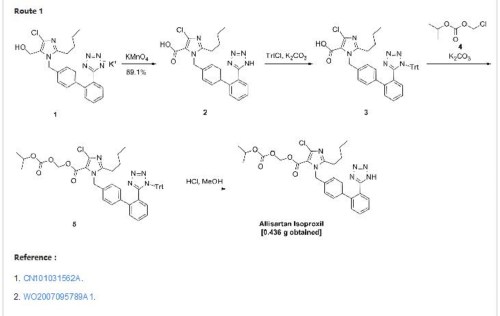
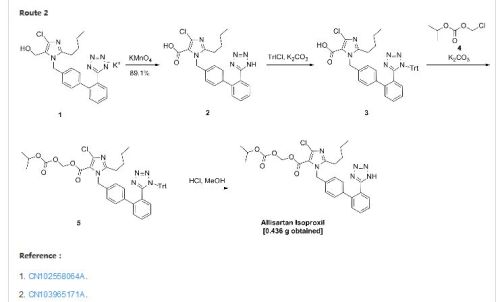
CN200680000397.8 _5_ discloses a class of imidazole carboxylic acid derivatives, namely Alicante medoxomil compound 8 has a good blood pressure lowering effect, the structure of formula I, the preparation method disclosed in this patent document follows the route A, losartan potassium by oxidation, the protecting group into an ester, deprotected to give a compound of formula I, the route step oxidation process of hydroxyl to carboxyl groups, will be reduced to very fine granular potassium permanganate, manganese dioxide, filtration This manganese mud time-consuming, inefficient, polluting; the second step conversion was about 70%, and post-processing cumbersome; byproducts and produced the first two steps more. This makes the high cost of the entire route, not suitable for the production of amplification.


Figure CN103965171AD00061

CN200710094021.4 discloses another method for preparing the compounds of formula I, the following route B, the starting material by nucleophilic substitution, oxidation, an ester, a tetrazole ring to obtain a compound of formula I, the first step of the method nucleophilic substitution easy to generate an imidazole ring -3 para isomer impurities difficult to remove; the last step into the ring to use sodium azide, operating dangerous.


Figure CN103965171AD00071

CN201210020174.5 disclosed a series of anti-hypertensive compound and preparation method, the following line C, the temperature control in the first step of its preparation O ~ 5 ° C, a mixed solution of acetone and water, with a 5% aqueous solution of sodium hypochlorite oxidation, yield 70%, the second step use of potassium permanganate, manganese dioxide will produce the same, and a yield of only 40%, the first two steps total yield of 28%, is very low, and the post-treatment methods are by column separation, the first two steps are used are organic and inorganic mixed solvent is not conducive to recovery, not suitable for scale-up.


Figure CN103965171AD00081


Figure CN103965171AC00021


Figure CN103965171AC00022


Figure CN103965171AC00023


Figure CN103965171AC00031


Figure CN103965171AC00032

Example 8 2-Butyl-4-chloro _1- [2 ‘- (1-tetrazol-5-yl biphenyl – methyl] imidazole

5-carboxylic acid, 1 – [(isopropoxy) carbonyl] -L-methoxy ester (Alicante medoxomil crude)


Figure CN103965171AD00162

To a 20L reactor 9800ml of methanol, stirring was started, the rotational speed is added at 200r / min 1225.3g solid compound of formula II, and heated to reflux. The reaction 8-10h evacuation HPLC detection, the formula II compound residue <1.0% seen as a response endpoint. After reaching the end of the reaction the heating was stopped, continued stirring speed of 180r / min. About 3_4h fell 20_25 ° C, colorless transparent crystalline solid precipitated. The reaction mixture was cooled to continue to 15-20 ° C, to maintain 15-20 ° C with stirring 3h, the reaction mixture was filtered to give a pale yellow clear filtrate. The filtrate was concentrated under reduced pressure to move 20L flask, vacuum degree of 0.075MPa, 40_45 ° C methanol distilled off under until no distillate. 800ml of absolute ethanol was added, a vacuum degree of 0.075MPa, 40-45 ° C under distillation until no distillate.

900ml of absolute ethanol was added, heated to reflux. N-heptane was added slowly 1100ml, reflux 15min, to -10 ° c / h speed cooled to 15 ± 2 ° C, keep stirring 3h. Filtered under reduced pressure, ethanol / n-heptane = 1 mixture of filter cake was washed / 3, the back pressure dry vacuum filtration lh, was Allie medoxomil crude (800.lg, yield 93.8%).Purification was used directly in the next step without drying.

 Example 9 2-butyl-4-chloro-_1- [2 ‘- (1-tetrazol-5-yl biphenyl – methyl] imidazole-5-carboxylic acid, 1 – [(isopropylamino oxy) carbonyl] -L-methoxy ester (Alicante medoxomil)


Figure CN103965171AD00171

850ml of absolute ethanol was added to the 3L reaction vessel was charged with crude Alicante medoxomil (800.lg, 1.45mol), heated to reflux. After completely dissolved clear, slow addition of n-heptane 1300ml, reflux 15min, to -10 ° C / h speed cooled to 10 ± 2 ° C, keep stirring 3h. Filtered under reduced pressure, ethanol / n-heptane = 1 mixture of filter cake was washed / 3, the back pressure dry vacuum filtration, the purified Alicante medoxomil (780.9g, 97.6% yield).

Example 10 2-butyl-4-chloro _1- [2 ‘- (1-tetrazol-5-yl biphenyl – methyl] imidazole

5-carboxylic acid, 1 – [(isopropoxy) carbonyl] -L-methoxy ester (Alicante medoxomil)


Figure CN103965171AD00172

950ml of absolute ethanol was added to the 5L reaction vessel was charged with crude Alicante medoxomil (549.9g, 1.72mol), heated to reflux. After completely dissolved clear, slow addition of n-heptane 1200ml, reflux 15min, to -10 ° C / h speed cooled to 10 ± 2 ° C, keep stirring 3h. Filtered under reduced pressure, ethanol / n-heptane = cake was washed with a mixture of 1/3, and dried under reduced pressure after filtration to obtain a purified Alicante medoxomil (540.0g, 98.2% yield).

……………….
PATENT

Example 122-butyl-4-chloro-1-[2′-(1H-tetrazol-5-yl)1,1′-biphenyl-methyl]imidazole-5-carboxylic acid, 1-[(isopropoxycarbonyl)oxy]methyl ester (compound 8)

Figure US20090036505A1-20090205-C00031

To a 100 ml of one-necked flask, 0.523 g of material, 0.124 g of potassium carbonate, 5 ml of N,N-dimethylacetamide were added in turn. The solution was stirred at room temperature for 20 minutes. Then 0.562 g of 1-chloromethyl isopropyl carbonate was added and the mixture was reacted at 45-50° C. for 16 hours. After the reaction was completed, the mixture solution was filtered, and 30 ml of water was added into the filtrate. The resulting mixture was extracted with 30 ml of ethyl acetate twice. The organic phase was dried and concentrated to give 1.724 g of oil, which was directly used in the next reaction without purification.

10 ml of dioxane and 5 ml of 4 mol/L HCl were added, and the resulting mixture was reacted at room temperature for 16 hours. The reaction was stopped and the solution was adjusted to pH 6-7 using aqueous sodium bicarbonate solution. The solution went turbid, and was extracted with ethyl acetate. The organic phase was washed with saturated brine, dried, concentrated to give 0.436 g of 2-butyl-4-chloro-1-[2′-(1H-tetrazol-5-yl)1,1′-biphenyl-methyl]imidazole-5-carboxylic acid, 1-[(isopropoxycarbonyl)oxy]methyl ester.

In addition, the following reaction condition can be used to deprotect the protecting group. To 1.7 g of oily product, 5 ml absolute methanol was added and the mixture was heated slowly to reflux and stirred for 8 hours. When the insoluble solid disappeared totally, the mixture was discontinued to heating and cooled to 5° C. The white solid precipitated, and was separated by filtration, and the filter cake was washed with a small quantity of methanol. The combined filtrate was concentrated to dryness to give 2-butyl-4-chloro-1-[2′-(1H-tetrazol-5-yl)1,1′-biphenyl-methyl]imidazole-5-carboxylic acid, 1-[(isopropoxycarbonyl)oxy]methyl ester with the yield of 70%.

1H-NMR (CDCl3) δ H (ppm): 0.89 (t, 3H, J=14.6), 1.24 (d, 6H, J=6.3), 0.37 (m, 2H, J=22.1), 1.69 (m, 2H, J=30.5), 2.64 (t, 2H, J=15.5), 4.81 (m, 1H, J=12.4), 5.54 (s, 2H), 5.86 (s, 2H), 6.95-7.64 (8H), 8.08 (d, 1H, J=7.42)

ESI(+) m/z: 552.7

Mp: 134.5-136° C.

 str1
 USE CTRLand + Key, or click on picture
str1
str1
 
WO2005011646A2 * 20 Jul 2004 10 Feb 2005 Nicoletta Almirante Nitrooxy derivatives of losartan, valsatan, candesartan, telmisartan, eprosartan and olmesartan as angiotensin-ii receptor blockers for the treatment of cardiovascular diseases
Citing Patent Filing date Publication date Applicant Title
US8455526 * 6 Jun 2008 4 Jun 2013 Shanghai Allist Pharmaceuticals, Inc. Therapeutic use of imidazole-5-carboxylic acid derivatives
US20100168193 * 6 Jun 2008 1 Jul 2010 Shanghai Allist Pharmaceuticals, Inc. Therapeutic use of imidazole-5-carboxylic acid derivatives
USRE44873 31 Jul 2006 29 Apr 2014 Salubris Asset Management Co., Ltd. Imidazole-5-carboxylic acid derivatives, the preparation method therefor and the uses thereof
CN101024643A 20 Feb 2006 29 Aug 2007 上海艾力斯医药科技有限公司 Imidazo-5-carboxylic-acid derivatives, its preparing method and use
US5298519 * 24 Sep 1992 29 Mar 1994 Chemish Pharmazeutische Forschungsgesellschaft M.B.H. Acylals of imidazole-5-carboxylic acid derivatives, and their use as angiotensin (II) inhibitors

……………….


update……………..

WO 2015192722

Example 1

Weigh 25g 2- butyl-4-chloro-1- [2 ‘- (1-trityl–1H- tetrazol-5-yl) -1,1’-biphenyl – methyl] – imidazole 5-carboxylic acid, 1 – [(isopropoxy) – carbonyloxy] -, methyl ester, was added to a 500ml three-necked flask, methanol was added 200ml, refluxed for 9h, methanol was distilled off under reduced pressure to give crude Alicante medoxomil .


To the residue (i.e., medoxomil crude Alicante) were added 33ml of isopropanol and 66ml of n-heptane, heated to 76 ℃ stirred for 2h. After cooling to 60 ℃ stirring for 1h, and then the system was slowly cooled to 0 ℃, stirring was continued for 3h. Filtered, the filter cake was washed with n-heptane. At 40 ℃ 8 hours and dried in vacuo to give 15.3g Alicante medoxomil (purity 99.3%) as a XRD spectrum as shown in Figure, the main peak of the diffraction peaks as shown in the following table, the DSC spectrum shown in figure II . Compared with the published crystal, the crystal obtained by the absence of significant electrostatic phenomena.


Shanghai , CHINA


RG-1577, EVT 302, Sembragiline, RO-4602522


front page image

RG-1577, EVT 302, Sembragiline, RO-4602522

Hoffmann La Roche

CAS 676479-06-4, MW 342.36

  • C19 H19 F N2 O3
  • Acetamide, N-​[(3S)​-​1-​[4-​[(3-​fluorophenyl)​methoxy]​phenyl]​-​5-​oxo-​3-​pyrrolidinyl]​-

UNII-K3W9672PNJ2D chemical structure of 676479-06-4

RG-1577, a selective and reversible monoamine oxidase B inhibitor, for treating AD (phase 2 clinical, as of May 2015).

Family members of the product case for RG-1577 (WO2004026825) hold protection in EU until 2023 and expire in US in 2024 with US154 extension. Follows on from WO2006097197, claiming a process for preparing RG-1577.

Alzheimers Disease is a brain disease that slowly destroys memory and thinking skills, up to loss of the ability to carry out the simplest tasks. It is the most common cause of dementia among older people. Mild Alzheimers Disease manifests itself in memory loss and small changes in other cognitive abilities, e.g getting lost, trouble handling money and managing daily tasks, having some mood and personality changes, etc.

In the stage of Moderate Alzheimers Disease, the control of language, reasoning, sensory processing, and conscious thought are impacted. Memory loss and con usion grow worse, e.g patients have problems recognizing family and friends and become unable to learn new things, etc. hallucinations, delusions, and paranoia may occur. .Severe Alzheimers Disease is the final stage. Patients cannot communicate anymore and are completely dependent.

N-[(3S)-l-[4-[(3-fluorophenyl)methoxy]phenyl]-5-oxo-pyrrolidin-3-yl]acetamide has previously been described in the art. 1 WO 2006/097197 2 and WO 2006/0972703 relate to methods for preparing enantiomerically pure 4-pyrrolidinophenylbenzyl ether derivatives.

The processes of the prior art hamper from several drawbacks (e.g. long reaction sequence, low overall yield also due to loss of half of the product in the classical resolution step, the need for a chromatographic purification to remove by-products formed in the Mitsunobu reaction) and are therefore less suitable for the preparation of N-[(3S)-l-[4-[(3-fluorophenyl) methoxy]phenyl]-5-oxo-pyrrolidin-3-yl]acetamide on large scale.


Most Recent Events

  • 01 Aug 2014Roche completes a phase I trial in volunteers in USA (NCT02104648)
  • 14 May 2014Roche completes enrolment in the MAyflOwer RoAD trial for Alzheimer’s disease (combination therapy, adjunctive treatment) in Australia, Canada, Czech Republic, France, Germany, Italy, Poland, South Korea, Spain, Sweden the United Kingdom and the USA (NCT01677754)
  • 01 Apr 2014Roche initiates enrolment in a phase I trial in healthy volunteers in USA (NCT02104648)

http://www.evotec.com/uploads/media_library/10/2012-09_Evotec_Company_presentation_September_e.pdf

……………………..

WO2004026825

http://www.google.com/patents/WO2004026825A1?cl=en

………………….

WO2006097197

http://www.google.com/patents/WO2006097197A1?cl=en

……………………………………………..

PATENT

WO 2015063001

https://patentscope.wipo.int/search/ja/detail.jsf;jsessionid=82F2EFFC078602A9E3061C7CF658B36C.wapp2nA?docId=WO2015063001&recNum=37&office=&queryString=&prevFilter=%26fq%3DOF%3AWO%26fq%3DICF_M%3A%22C07D%22&sortOption=%E5%85%AC%E9%96%8B%E6%97%A5%EF%BC%88%E6%96%B0%E3%81%97%E3%81%84%E9%A0%86%EF%BC%89&maxRec=57119

Novel, crystalline polymorphic forms A and B of a pyrrolidone derivative ie RG-1577, useful for treating Alzheimer’s disease (AD). Roche and its Japanese subsidiary Chugai, under license from Evotec, which previously licensed the drug from Roche, are developing RG 1577


formula 1 via the following routes

In a certain embodiment, present invention relates to a synthesis of a compound of formula he following route A

1

In a certain embodiment, present invention relates to a synthesis of a compound of formula he following route B

In a certain embodiment, present invention relates to a crystalline polymorph of a compound of formula 1.


synthesize a compound of formula 1 from a compound of formula 7


compound of formula 6 to a compound of formula 7

In a certain embodiment, present invention relates to a process to synthesize a compound of formula 1 as described herein, further comprising reacting a compound of formula 6 via the intermediate 6a to a compound of formula 7


further comprising reacting a compound of formula 3 with a compound of formula 5 to a compound of formula 6


comprising reacting a compound of formula 2 to a compound of formula 3

2 3


In a certain embodiment, present invention relates to a process to synthesize a compound of formula 1 as described herein, further comprising reacting a compound of formula 10 to a compound of formula 6


eacting a compound of formula 9 with a compound of formula 5 to a compound of formula 10


In a certain embodiment, present invention relates to a process to synthesize a compound of formula 1 as described herein, further comprising reacting a compound of formula 8 to a compound of formula 9


(lS’)-N-[l-[4-(3-fluoro-benzyloxy)-phenyl]-5-oxo-pyrrolidin-3-yl-]acetamide (1)

To a suspension of chloride (7) (37.9 g, 100 mmol) in 2-methyltetrahydrofurane (600 ml) was added under vigorous stirring at 0°C 1.65 M potassium ie/t-butoxide in THF (75.5 ml, 125 mmol, ACROS) over 2.5 h. After additional stirring at 0°C for 1 h, the cold suspension was hydrolyzed with 0.1 M HCl (600 ml) and the reaction mixture was stirred at 30°C for 0.5 h. The organic layer was washed with water (300 ml), dried (Na2S04) and filtered. Removal of the solvent by rotary evaporation (50°C/>10 mbar) afforded 32.1 g crystalline residue, which was dissolved in 2-butanone (400 ml) at ca. 95°C and hot filtered. Crystallization, which was induced by seeding and cooling to room temperature and 0°C (4 h) afforded 25.4 g (74.2%) of the titled compound (1) as an off-white, crystalline powder,

Mp. 162-164°C (polymorph B).

Ee >99.8%, [cc]D20 = – 17.8 (DMF; c = 1).

1H NMR (400 MHz, DMSO- 6) δ ppm 1.82 (s, 3H), 2.34 (dd, J1=n. l, J2=3.9, 1H), 2.84 (dd, J/=17.1, J2=8.2, 1H), 3.55 (dd, J/=10.2, J2=3.2, 1H), 4.07 (dd, J/=10.2, J2=6.7, 1H), 4.32-4.41 (m, 1H), 5.13 (s, 2H), 7.02 & 7.55 (d, J=9.1, each 1H), 7.11-7.19 (m, 1H), 7.24-7.31 (m, 1H), 7.40-7.47 (m, 1H), 8.40 (d, J=6.4, 1H).

ESI-MS (m/z) 343 [M+H]+, 365 [M+Na]\. Anal.Calcd for Ci9H19FN203 (342.37): Calcd. C, 66.66; H, 5.59; N, 8.18; F, 5.02; O, 14.02. Found C, 66.76; H, 5.48; N, 8.13; F, 5.03; O, 13.99.

Crystallized (1) form previous step (9.5 g, 0.028 mol) was dissolved in 2-butanone (290 mL) upon heating. The hot solution was filtered over charcoal. The solution was concentrated by removal of 2-butanone (200 mL) by distillation prior to seeded cooling crystallization. Filtration, washing with chilled 2-butanone and drying at 50°C/25 mbar/16h afforded 9.18 g (93.9% corrected yield) of the title compound (1) as a crystalline powder of polymorphic form B with an assay of 100.4 %(w/w) and a purity of 99.97 %(area) (by HPLC).

Alternatively, to a stirred suspension of hydroxyamide (6) (30.0 g, 0.083 mol) in toluene (500 ml) was added at 50°C within 45 minutes thionyl chloride (10.40 g, 0.087 mol) and the resulting mixture was stirred for 3h at 50°C. The mixture was then heated up to 92°C and subsequently stirred at this temperature for 15 h. The Suspension was then cooled to 50°C and toluene was removed by distillation under reduced pressure. The distillation residue was cooled to ambient temperature and treated with N-methylpyrrolidone (210 ml) to obtain an almost clear solution. This solution was then cooled to -10°C and subsequently treated at this temperature within 2h with a solution of potassium iert-butoxide (12.40 g, 0.111 mol) in THF (60 g). The resulting mixture was stirred for another 60 minutes at -10°C, then warmed up to room temperature within 60 minutes and subsequently stirred at room temperature for 6 h. The reaction mixture was quenched with water (150 g) and the pH was adjusted with acetic acid (approx. 1.8 g) to pH 7-8. The mixture was then heated to 30-45°C and THF and toluene were distilled off under reduced pressure (<200 mbar) to obtain a clear NMP/water mixture (400 ml). This mixture was heated to 45°C and 260 mg of seed crystals were added. Water (320 ml) was then added within 3 h whereby the product crystallized. The resulting suspension was cooled to room temperature within 3 h and subsequently stirred at this temperature for 2 h. Filtration and washing of the filter cake with a mixture of water (100 ml) and N-methylpyrrolidone (20 ml) and subsequently only with water (150 ml) afforded after drying (70°C/10 mbar/20 h) 26.2 g (92%) of the title compound (1) as a crystalline powder with an assay of 99.6 %(w/w) and a purity of 99.7 %(area) (by HPLC).

HPLC

Purity (HPLC): Column: XSelect Phenyl Hexyl x2, 150 x 4.6mm, 3.5um. Starting

Pressure: 226 bar; temp.: 50°C. Inj. vol.: 2.0 μΐ^ + wash. Flow: 1.0 ml/min. Det: 204 nm. A: Water + 5% ACN, 77-2% in 7 min., hold for 1 min.; B: 0.1% HCOOH, 18% isocratic; C: MeOH, 5-80% in 7 min., hold for 1 min. Sample prep.: 2 mg/ml ACN. Retention times: β-acid 5.93 min., diacid 6.18 min., cc-acid 6.89 min., diester 6.96 min.

ee determination(HPLC): Column: Chiralpak IA-3 100 x 4.6mm, 3um; 91 bar, 2ml/min; temp.: 30°C. Inj. vol.: 10.0 μL· Det.: 206 nm. A: n-heptane, 80%; B: EtOH, 20%. Sample prep.: 4 mg/ml EtOH. Retention times: D-enantiomer 2.21 min., L-enantiomer 2.71 min

………………….

US 20050065204

EXAMPLE 11

Preparation of (S)-1-(4-Hydroxyphenyl)-5-oxo-pyrrolidine-3-carboxylic Acid

8.00 g Polyethyleneglycol 6000 was dissolved in 150 mL (100 mM) magnesium acetate buffer pH 6.0 under stirring, and the solution added to a stirred suspension of 10.00 g (42.51 mmol) (RS)-1-(4-hydroxyphenyl)-5-oxo-pyrrolidine-3-carboxylic acid methyl ester (99.7%) in 40 mL methylcyclohexane. The mixture was heated to 28° C. and the pH readjusted to 6.0 with 2 M NaOH. The reaction was started by adding 33.2 mg Candida cylindraceae cholesterase (16.88 kU/g), and the pH was maintained at 6.0 by the controlled addition of 1.0 M NaOH solution under stirring. After a total consumption of 20.35 mL (20.35 mmol) 1.0 M sodium hydroxide solution (after 17.1 h; 47.9% conversion) the reaction mixture was passed through a sintered glass filter. The filtrate spontaneously separated into an aqueous and an organic phase.The aqueous phase was washed with 2×200 mL ethyl acetate to remove uncleaved ester. The aqueous phase was set to pH 4.0 with 25% sulfuric acid and concentrated in vacuo to a volume of ca. 80 mL (bath 60° C.). The solution was cooled to 1° C. (formation of white precipitate/crystals) and the pH set to 1.5 with 25% sulfuric acid. The precipitate/crystals were stirred overnight at 1° C., filtered off on a sintered glass filter (washed with a minimum amount of water) and dried overnight on high vacuum (RT, 6×10⁻² mbar) to give 4.32 g (19.53 mmol; 45.9%) (S)-1-(4-hydroxyphenyl)-5-oxo-pyrrolidine-3-carboxylic acid. Analysis: HPLC (area A226nm): 99.3%, 0.7% ester. 98.9%ee. The product contains 5.3% water (according to Karl Fischer determination) and 2.1% (w/w) PEG (according to NMR).


Company Evotec AG
Description Small molecule monoamine oxidase B (MAO-B) inhibitor
Molecular Target Monoamine oxidase B (MAO-B)
Mechanism of Action Monoamine oxidase B (MAO-B) inhibitor
Therapeutic Modality Small molecule
Latest Stage of Development Phase II
Standard Indication Alzheimer’s disease (AD)
Indication Details Treat Alzheimer’s disease (AD)
Regulatory Designation
Partner

Chugai Pharmaceutical Co. Ltd.; Roche

//////////

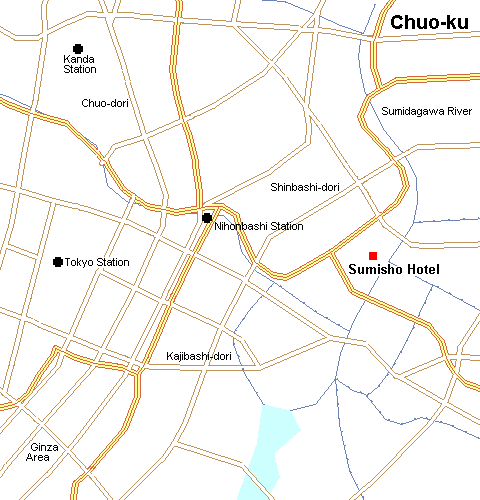
Chūō, japan

Map of chuo-ku tokyo


A Chūō Line (Rapid) E233 series (right) and A Chūō-Sōbu Line E231 series (June 2007)

Chuo Dori street on a weekend afternoon

Recovery of Artemisinin from a Complex Reaction Mixture Using Continuous Chromatography and Crystallization


Figure

Figure

Recovery of Artemisinin from a Complex Reaction Mixture Using Continuous Chromatography and Crystallization

Articles ASAP (As Soon As Publishable)
Publication Date (Web): May 8, 2015 (Article)
DOI: 10.1021/acs.oprd.5b00048
*E-mail: seidel-morgenstern@mpi-magdeburg.mpg.de. Tel.: +49-(0)391-6110 401. Fax: +49-(0)391-6110 521.
Artemisinin, a secondary metabolite of sweet wormwood, is the basis for the production of the most effective antimalarial drugs. Since the amount of artemisinin currently produced from plants is not sufficient to treat the worldwide malaria cases, an effective semisynthetic method was developed recently that is capable of producing artemisinin from dihydroartemisinic acid (DHAA). DHAA is a byproduct obtained during the extraction of artemisinin from plant leaves. The photocatalytic reaction to convert DHAA to artemisinin can be performed continuously in a tubular reactor using toluene as a solvent. The reactor effluent contains besides artemisinin the photocatalyst (dicyanoanthracene) and several compounds that are structurally similar to artemisinin, including unreacted DHAA starting material. To isolate artemisinin from the reaction mixture, two separation techniques were applied, crystallization and chromatography. The solid obtained by seeded cooling crystallization was highly enriched in artemisinin but contained also traces of the photocatalyst. In contrast, using a variant of continuously operated multicolumn simulated moving bed (SMB) chromatography, which splits the feed into three fractions, we were able to recover efficiently the photocatalyst in the raffinate stream. The extract stream provided already almost pure artemisinin, which could be finally further purified in a simple crystallization step.
Magdeburg, Germany
Map of magdeburg germany


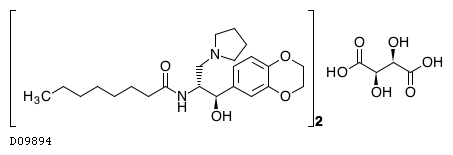
Eliglustat


Eliglustat.svg

ELIGLUSTAT TARTRATE

THERAPEUTIC CLAIM Treatment of lysosomal storage disorders

CHEMICAL NAMES

1. Octanamide, N-[(1R,2R)-2-(2,3-dihydro-1,4-benzodioxin-6-yl)-2-hydroxy-1-(1-
pyrrolidinylmethyl)ethyl]-, (2R,3R)-2,3-dihydroxybutanedioate (2:1)

2. bis{N-[(1R,2R)-2-(2,3-dihydro-1,4-benzodioxin-6-yl)-2-hydroxy-1-(pyrrolidin-1-
ylmethyl)ethyl]octanamide} (2R,3R)-2,3-dihydroxybutanedioate

MOLECULAR FORMULA C23H36N2O4 . ½ C4H6O6

MOLECULAR WEIGHT 479.6

MANUFACTURER Genzyme Corp.

CODE DESIGNATION Genz-112638

CAS REGISTRY NUMBER 928659-70-5

Eliglustat (INN, USAN;[1] trade name Cerdelga) is a treatment for Gaucher’s disease developed by Genzyme Corp that was approved by the FDA August 2014.[2] Commonly used as the tartrate salt, the compound is believed to work by inhibition ofglucosylceramide synthase.[3][4]

In March 2015, eliglustat tartrate was approved in Japan for the treatment of Gaucher disease. Eliglustat tartrate was described specifically within the US FDA’s Orange Booked listed US6916802, which is set to expire in April 2022.

In May 2015, the Orange Book also listed that eliglustat tartrate had Orphan Drug Exclusivity and New Chemical Entity exclusivity until 2019 and 2021, respectively.

it having been developed and launched as eliglustat tartrate by Genzyme (a wholly owned subsidiary of Sanofi), under license from the University of Michigan.

Eliglustat tartrate is known to act as inhibitors of glucosylceramide synthase and glycolipid, useful for the treatment of Gaucher’s disease type I and lysosome storage disease.

Genzyme Announces Positive New Data from Two Phase 3 Studies for Oral Eliglustat Tartrate for Gaucher Disease


Eliglustat tartrate (USAN)

CAS:928659-70-5
February 15, 2013
Genzyme , a Sanofi company (EURONEXT: SAN and NYSE: SNY), today announced positive new data from the Phase 3 ENGAGE and ENCORE studies of eliglustat tartrate, its investigational oral therapy for Gaucher disease type 1. The results from the ENGAGE study were presented today at the 9th Annual Lysosomal Disease Network WORLD Symposium in Orlando, Fla. In conjunction with this meeting, Genzyme also released topline data from its second Phase 3 study, ENCORE. Both studies met their primary efficacy endpoints and together will form the basis of Genzyme’s registration package for eliglustat tartrateThe data presented at this year’s WORLD symposium reinforce our confidence that eliglustat tartrate may become an important oral option for patients with Gaucher disease”The company is developing eliglustat tartrate, a capsule taken orally, to provide a convenient treatment alternative for patients with Gaucher disease type 1 and to provide a broader range of treatment options for patients and physicians. Genzyme’s clinical development program for eliglustat tartrate represents the largest clinical program ever focused on Gaucher disease type 1 with approximately 400 patients treated in 30 countries.“The data presented at this year’s WORLD symposium reinforce our confidence that eliglustat tartrate may become an important oral option for patients with Gaucher disease,” said Genzyme’s Head of Rare Diseases, Rogerio Vivaldi MD. “We are excited about this therapy’s potential and are making excellent progress in our robust development plan for bringing eliglustat tartrate to the market.”ENGAGE Study Results:In ENGAGE, a Phase 3 trial to evaluate the safety and efficacy of eliglustat tartrate in 40 treatment-naïve patients with Gaucher disease type 1, improvements were observed across all primary and secondary efficacy endpoints over the 9-month study period. Results were reported today at the WORLD Symposium by Pramod Mistry, MD, PhD, FRCP, Professor of Pediatrics & Internal Medicine at Yale University School of Medicine, and an investigator in the trial.The randomized, double-blind, placebo-controlled study had a primary efficacy endpoint of improvement in spleen size in patients treated with eliglustat tartrate. Patients were stratified at baseline by spleen volume. In the study, a statistically significant improvement in spleen size was observed at nine months in patients treated with eliglustat tartrate compared with placebo. Spleen volume in patients treated with eliglustat tartrate decreased from baseline by a mean of 28 percent compared with a mean increase of two percent in placebo patients, for an absolute difference of 30 percent (p<0.0001).

Genzyme

Eliglustat tartate (Genz-112638)

What is Eliglustat?

  • Eliglustat is a new investigational phase 3 compound from Genzyme Corporation that is being studied for type 1 Gaucher Disease.
  • Eliglustat works as a substrate reduction therapy by reducing glucocerebroside. formation.
  • This product is an oral agent (i.e. a pill) that is taken once or twice a day in contrast to an IV infusion for enzyme replacement therapy. Enzyme replacement therapy focuses on replenishing the enzyme that is deficient in Gaucher Disease and breaks down glucocerebroside that accumulates.
  • The clinical trials for eliglustat tartate are sponsored by Genzyme Corporation.
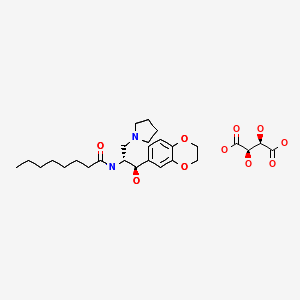
Eliglustat tartrate (Genz-1 12638) is a glucocerebroside (glucosylceramide) synthase inhibitor for the treatment of gaucher disease and other lysosomal storage disorders, which is currently under development.

Eliglustat is chemically known as 1 R, 2R-Octanoic acid [2-(2′, 3′-dihydro-benzo [1 , 4] dioxin-6′-yl)-2-hydroxy-1 -pyrrolidin-1 -ylmethyl]-ethyl]-amide, having a structural formula I depicted here under.

Formula I

Eliglustat hemitartrate (Genz-1 12638) development by Genzyme, is a glucocerebroside (glucosylceramide) synthase inhibitor for the treatment of Gaucher disease and other lysosomal storage disorders. Eliglustat hemitartrate is orally active with potent effects on the primary identified molecular target for type 1 Gaucher disease and other glycosphingolipidoses, appears likely to fulfill high expectations for clinical efficacy.

Gaucher disease belongs to the class of lysosomal diseases known as glycosphingolipidoses, which result directly or indirectly from the accumulation of glycosphingolipids, many hundreds of which are derived from glucocerebroside. The first step in glycosphingolipid biosynthesis is the formation of glucocerebroside, the primary storage molecule in Gaucher disease, via glucocerebroside synthase (uridine diphosphate [UDP] – glucosylceramide glucosyl transferase). Eliglustat hemitartrate is based on improved inhibitors of glucocerebroside synthase.

U.S. patent No. 7,196,205 (herein described as US’205) discloses a process for the preparation of eliglustat or a pharmaceutically acceptable salt thereof. In this patent, eliglustat was synthesized via a seven-step process involving steps in that sequence:

(i) coupling S-(+)-2-phenyl glycinol with phenyl bromoacetate followed by column chromatography for purification of the resulting intermediate,

(ii) reacting the resulting (5S)-5-phenylmorpholin-2-one with 1 , 4-benzodioxan-6-carboxaldehyde to obtain a lactone,

(iii) opening the lactone of the oxazolo-oxazinone cyclo adduct via reaction with pyrrolidine,

(iv) hydrolyzing the oxazolidine ring, (v) reducing the amide to amine to obtain sphingosine like compound, (vi) reacting the resulting amine with octanoic acid and N-hydroxysuccinimide to obtain crude eliglustat, (vii) purifying the crude eliglustat by repeated isolation for four times from a mixture of ethyl acetate and n-heptane.

U.S. patent No. 6855830, 7265228, 7615573, 7763738, 8138353, U.S. patent application publication No. 2012/296088 disclose processes for preparation of eliglustat and intermediates thereof.

U.S. patent application publication No. 2013/137743 discloses (i) a hemitartrate salt of eliglustat, (ii) a hemitartrate salt of eliglustat, wherein at least 70% by weight of the salt is crystalline, (iii) a hemitartrate salt of Eliglustat, wherein at least 99% by weight of the salt is in a single crystalline form.

https://patentscope.wipo.int/search/en/detail.jsf;jsessionid=234E6BE008E68831F6875FB703760826.wapp2nA?docId=WO2015059679&recNum=1&office=&queryString=FP%3A%28dr.+reddy%27s%29&prevFilter=%26fq%3DCTR%3AWO&sortOption=Pub+Date+Desc&maxRec=364

WO 2015059679

Process for the preparation of eliglustat free base – comprising the reaction of S-(+)-phenyl glycinol with phenyl-alpha-bromoacetate to obtain 5-phenylmorpholin-2-one, which is further converted to eliglustat.
Dr Reddy’s Laboratories Ltd
New crystalline eliglustat free base Form R1 and a process for its preparation are claimed. Also claimed is a process for the preparation of eliglustat free base which comprises the reaction of S-(+)-phenyl glycinol with phenyl-alpha-bromoacetate to obtain 5-phenylmorpholin-2-one, which is further converted to eliglustat.Further eliglustat oxalate, its crystalline form, and a process for the preparation of crystalline eliglustat oxalate, are claimed.

Eliglustat tartrate (Genz-1 12638) is a glucocerebroside (glucosylceramide) synthase inhibitor for the treatment of gaucher disease and other lysosomal storage disorders, which is currently under development.

Eliglustat is chemically known as 1 R, 2R-Octanoic acid [2-(2′, 3′-dihydro-benzo [1 , 4] dioxin-6′-yl)-2-hydroxy-1 -pyrrolidin-1 -ylmethyl]-ethyl]-amide, having a structural formula I depicted here under.

Formula I

Eliglustat hemitartrate (Genz-1 12638) development by Genzyme, is a glucocerebroside (glucosylceramide) synthase inhibitor for the treatment of Gaucher disease and other lysosomal storage disorders. Eliglustat hemitartrate is orally active with potent effects on the primary identified molecular target for type 1 Gaucher disease and other glycosphingolipidoses, appears likely to fulfill high expectations for clinical efficacy.

Gaucher disease belongs to the class of lysosomal diseases known as glycosphingolipidoses, which result directly or indirectly from the accumulation of glycosphingolipids, many hundreds of which are derived from glucocerebroside. The first step in glycosphingolipid biosynthesis is the formation of glucocerebroside, the primary storage molecule in Gaucher disease, via glucocerebroside synthase (uridine diphosphate [UDP] – glucosylceramide glucosyl transferase). Eliglustat hemitartrate is based on improved inhibitors of glucocerebroside synthase.

U.S. patent No. 7,196,205 (herein described as US’205) discloses a process for the preparation of eliglustat or a pharmaceutically acceptable salt thereof. In this patent, eliglustat was synthesized via a seven-step process involving steps in that sequence:

(i) coupling S-(+)-2-phenyl glycinol with phenyl bromoacetate followed by column chromatography for purification of the resulting intermediate,

(ii) reacting the resulting (5S)-5-phenylmorpholin-2-one with 1 , 4-benzodioxan-6-carboxaldehyde to obtain a lactone,

(iii) opening the lactone of the oxazolo-oxazinone cyclo adduct via reaction with pyrrolidine,

(iv) hydrolyzing the oxazolidine ring, (v) reducing the amide to amine to obtain sphingosine like compound, (vi) reacting the resulting amine with octanoic acid and N-hydroxysuccinimide to obtain crude eliglustat, (vii) purifying the crude eliglustat by repeated isolation for four times from a mixture of ethyl acetate and n-heptane.

U.S. patent No. 6855830, 7265228, 7615573, 7763738, 8138353, U.S. patent application publication No. 2012/296088 disclose processes for preparation of eliglustat and intermediates thereof.

U.S. patent application publication No. 2013/137743 discloses (i) a hemitartrate salt of eliglustat, (ii) a hemitartrate salt of eliglustat, wherein at least 70% by weight of the salt is crystalline, (iii) a hemitartrate salt of Eliglustat, wherein at least 99% by weight of the salt is in a single crystalline form.

Example 1 : Preparation of 5-phenyl morpholine-2-one hydrochloride

To a (S) + phenyl glycinol (100g) add N, N-diisopropylethylamine (314ml) and acetonitrile (2000ml) under nitrogen atmosphere at room temperature. It was cooled to 10- 15° C. Phenyl bromoacetate (172.4g) dissolved in acetonitrile (500ml) was added to the above solution at 15° C over a period of 30 min. The reaction mixture is allowed to room temperature and stirred for 16-20h. Progress of the reaction was monitored by thin layer chromatography. After completion of the reaction, the reaction mixture was concentrated under reduced pressure at a water bath

temperature less than 25° C to get a residue. The residue was dissolved in ethyl acetate (1000ml) and stirred for 1 h at 15-20°C to obtain a white solid. The solid material obtained was filtered and washed with ethyl acetate (200ml). The filtrate was dried over anhydrous sodium sulphate (20g) and concentrated under reduced pressure at a water bath temperature less than 25° C to give crude compound (1000g) as brown syrup. The Crude brown syrup is converted to HCI salt by using HCI in ethyl acetate to afford 5-phenyl morpholine-2-one hydrochloride (44g) as a white solid. Yield: 50%, Mass: m/z = 177.6; HPLC (% Area Method): 90.5%

Example 2: Preparation of (1 R,3S,5S,8aS)-1 ,3-Bis-(2′,3′-dihydro-benzo[1 ,4] dioxin-6′-yl)-5-phenyl-tetrahydro-oxazolo[4,3-c][1 ,4]oxazin-8-one.

5-phenyl morpholine-2-one hydrochloride (100g) obtained from above stage 1 is dissolved in toluene (2500ml) under nitrogen atmosphere at 25-30°C. 1 ,4-benzodioxane-6-carboxaldehyde (185.3g) and sodium sulphate (400g) was added to the above solution and the reaction mixture was heated at 100-105°C for 72h. Progress of the reaction was monitored by thin layer chromatography. After completion of reaction, the reaction mixture was concentrated under reduced pressure at a water bath temperature less than 25° C to get a residue. The residue was cooled to 10°C, ethyl acetate (2700ml) and 50% sodium bisulphate solution (1351 ml) was added to the residue and stirred for 1 h at 10°C to obtain a white solid. The obtained white solid was filtered and washed with ethyl acetate. The separated ethyl acetate layer was washed with water (1000ml), brine (1000ml) and dried over anhydrous sodium sulphate. The organic layer was concentrated under reduced pressure at a water bath temperature of 45-50°C to get a crude material. The obtained crude material is triturated with diethyl ether (1500ml) to get a solid material which is filtered and dried under vacuum at room temperature for 2-3h to afford (1 R,3S,5S,8aS)-1 ,3-Bis-(2′,3′-dihydro-benzo[1 ,4]dioxin-6′-yl)-5-phenyl-tetrahydro-oxazolo[4,3-c][1 ,4]oxazin-8-one (148g) as a yellow solid. Yield: 54%, Mass: m/z = 487.7; HPLC (% Area Method): 95.4 %

Example 3: Preparation of (2S,3R,1 “S)-3-(2′,3′-(Dihydro-benzo[1 ,4]dioxin-6′-yl)-3-hydroxy-2-(2″-hydroxy-1 ”^henyl-ethy^

(1 R,3S,5S,8aS)-1 !3-Bis-(2′!3′-dihydro-benzo[1 ,4]dioxin-6′-yl)-5-phenyl-tetrahydro-oxazolo[4,3-c][1 ,4]oxazin-8-one (70g) obtained from above stage 2 was dissolved in chloroform (1400ml) at room temperature. It was cooled to 0-5°C and pyrrolidone (59.5ml) was added at 0-5°C over a period of 30 minutes. The reaction mixture was allowed to room temperature and stirred for 16-18h. Progress of the reaction was monitored by thin layer chromatography. After completion of reaction, the reaction mixture was concentrated under reduced pressure at a water bath temperature of 40-45°C to obtain a crude. The obtained crude was dissolved in methanol (1190ml) and 1 N HCI (1 190ml) at 10-15° C, stirred for 10 minutes and heated at 80-85°C for 7h. Progress of the reaction was monitored by thin layer chromatography. After completion of reaction, methanol was concentrated under reduced pressure at a water bath temperature of 50-55°C.The aqueous layer was extracted with ethyl acetate and the organic layer was washed with 1 N HCI (50ml). The aqueous layer was basified with saturated sodium bicarbonate solution up to pH 8-9 and extracted with ethyl acetate (3x70ml). The combined organic layers was washed with brine (100ml), dried over anhydrous sodium sulphate and concentrated under reduced pressure at a water bath temperature of 50-55°C to afford (2S,3R,1″S)-3-(2′,3′-(Dihydro-benzo[1 ,4]dioxin-6′-yl)-3-hydroxy-2-(2″-hydroxy-1 “-phenyl-ethylamino)-1 -pyrrolidin-1 -yl-propan-1 -one (53g) as a yellow foamy solid. Yield: 90%, Mass: m/z = 412.7, HPLC (% Area Method): 85.1 %

Example 4: Preparation of (1 R,2R,1 “S)-1-(2′,3′-(Dihydro-benzo[1 ,4]dioxin-6′-yl)2-hydroxy-2-(2”-hydroxy-1 ‘-phenyl-ethylamino)-3-pyrrolidin-1-yl-propan-1-ol.

(2S,3R,1 “S)-3-(2′,3′-(Dihydro-benzo[1 ,4]dioxin-6’-yl)-3-hydroxy-2-(2”-hydroxy-1 “-phenyl-ethylamino)-1 -pyrrolidin-1 -yl-propan-1 -one (2.5g) obtained from above stage 3 dissolved in Tetrahydrofuran (106ml) was added to a solution of Lithium aluminium hydride (12.2g) in tetrahydrofuran (795ml) at 0°C and the reaction mixture was heated at 60-65°C for 10h. Progress of the reaction was monitored by thin layer chromatography. After completion of reaction, the reaction mixture was cooled to 5- 10°C and quenched in saturated sodium sulphate solution (100ml) at 5-10°C. Ethyl acetate was added to the reaction mass and stirred for 30-45 min. The obtained solid is filtered through celite bed and washed with ethyl acetate. Filtrate was dried over anhydrous sodium sulphate and concentrated under reduced pressure at a water bath temperature of 50°C to afford (1 R,2R, 1″S)-1 -(2′,3′-(Dihydro-benzo[1 ,4]dioxin-6′-yl)2-hydroxy-2-(2″-hydroxy-1 ‘-phenyl-ethylamino)-3-pyrrolidin-1 -yl-propan-1 -ol (43.51 g) as a yellow gummy liquid. The crude is used for the next step without further purification. Yield: 85%, Mass: m/z = 398.7, HPLC (% Area Method): 77 %

Example 5: Preparation of (1 R, 2R)-2-Amino-1-(2′, 3′-dihydro-benzo [1 , 4] dioxin-6′-yl)-3-pyrrolidin-1 -yl-propan-1 -ol.

(1 R,2R,1 “S)-1 -(2′,3′-(Dihydro-benzo[1 ,4]dioxin-6’-yl)2-hydroxy-2-(2”-hydroxy-1 ‘-phenyl-ethylamino)-3-pyrrolidin-1 -yl-propan-1 -ol (40g) obtained from above stage 4 was dissolved in methanol (400ml) at room temperature in a 2L hydrogenation flask. Trifluoroacetic acid (15.5ml) and 20% Pd (OH) 2 (40g) was added to the above solution under nitrogen atmosphere. The reaction mixture was hydrogenated under H2, 10Opsi for 16-18h at room temperature. Progress of the reaction was monitored by thin layer chromatography. After completion of reaction, the reaction mixture was filtered through celite bed and washed with methanol (44ml) and water (44ml). Methanol was concentrated under reduced pressure at a water bath temperature of 50-55°C and the aqueous layer was washed with ethyl acetate. The aqueous layer was basified with 10M NaOH till the PH reaches 12-14 and then extracted with dichloromethane (2x125ml). The organic layer was dried over anhydrous sodium sulphate (3gm) and concentrated under reduced pressure at a water bath temperature of 45°C to obtain a gummy liquid. The gummy liquid was triturated with methyl tertiary butyl ether for 1 h to get a white solid, which is filtered and dried under vacuum at room temperature to afford (1 R, 2R)-2-Amino-1 -(2′, 3′-dihydro-benzo [1 , 4] dioxin-6′-yl)-3-pyrrolidin-1 -yl-propan-1 -ol (23g) as a white solid. Yield: 82.3%, Mass (m/zj: 278.8, HPLC (% Area Method): 99.5%, Chiral HPLC (% Area Method): 97.9%

Example 6: Preparation of Eliglustat {(1 R, 2R)-Octanoic acid[2-(2′,3′-dihydro-benzo [1 , 4] dioxin-6′-yl)-2-hydroxy-1 -pyrrolidin-1-ylmethyl-ethyl]-amide}.

(1 R, 2R)-2-Amino-1 -(2′, 3′-dihydro-benzo [1 , 4] dioxin-6′-yl)-3-pyrrolidin-1 -yl-propan-1 -ol (15g) obtained from above stage 5 was dissolved in dry dichloromethane (150ml) at room temperature under nitrogen atmosphere and cooled to 10-15° C. Octanoic acid N-hydroxy succinimide ester (13.0 g)was added to the above reaction mass at 10-15° C and stirred for 15 min. The reaction mixture was stirred at room temperature for 16h-18h. Progress of the reaction was monitored by thin layer chromatography. After completion of reaction, the reaction mixture was cooled to 15°C and diluted with 2M NaOH solution (100 ml_) and stirred for 20 min at 20 °C. The organic layer was separated and washed with 2M sodium hydroxide (3x90ml).The organic layer was dried over anhydrous sodium sulphate (30g) and concentrated under reduced pressure at a water bath temperature of 45°C to give the crude compound (20g).The crude is again dissolved in methyl tertiary butyl ether (25 ml_) and precipitated with Hexane (60ml). It is stirred for 10 min, filtered and dried under vacuum to afford Eliglustat as a white solid (16g). Yield: 74%, Mass (m/zj: 404.7 HPLC (% Area Method): 97.5 %, ELSD (% Area Method): 99.78%, Chiral HPLC (% Area Method): 99.78 %.

Example 7: Preparation of Eliglustat oxalate.

Eliglustat (5g) obtained from above stage 6 is dissolved in Ethyl acetate (5ml) at room temperature under nitrogen atmosphere. Oxalic acid (2.22g) dissolved in ethyl acetate (5ml) was added to the above solution at room temperature and stirred for 14h. White solid observed in the reaction mixture was filtered and dried under vacuum at room temperature for 1 h to afford Eliglustat oxalate as a white solid (4g). Yield: 65.46%, Mass (m/zj: 404.8 [M+H] +> HPLC (% Area Method): 95.52 %, Chiral HPLC (% Area Method): 99.86 %
……………………………..

Nmr predict

N-[(1R,2R)-1-(2,3-dihydro-1,4-benzodioxin-6-yl)-1-hydroxy-3-pyrrolidin-1-ylpropan-2-yl]octanamide NMR spectra analysis, Chemical CAS NO. 491833-29-5 NMR spectral analysis, N-[(1R,2R)-1-(2,3-dihydro-1,4-benzodioxin-6-yl)-1-hydroxy-3-pyrrolidin-1-ylpropan-2-yl]octanamide H-NMR spectrum

13 C NMR

N-[(1R,2R)-1-(2,3-dihydro-1,4-benzodioxin-6-yl)-1-hydroxy-3-pyrrolidin-1-ylpropan-2-yl]octanamide NMR spectra analysis, Chemical CAS NO. 491833-29-5 NMR spectral analysis, N-[(1R,2R)-1-(2,3-dihydro-1,4-benzodioxin-6-yl)-1-hydroxy-3-pyrrolidin-1-ylpropan-2-yl]octanamide C-NMR spectrum

CAS NO. 491833-29-5, N-[(1R,2R)-1-(2,3-dihydro-1,4-benzodioxin-6-yl)-1-hydroxy-3-pyrrolidin-1-ylpropan-2-yl]octanamide

C-NMR spectral analysis

………………..

http://www.google.com/patents/WO2013059119A1?cl=en

Figure imgf000024_0001

http://www.google.com/patents/US7196205

Compound 7

(1R,2R)-Nonanoic acid[2-(2′,3′-dihydro-benzo[1,4]dioxin-6′-yl)-2-hydroxy-1-pyrrolidin-1-ylmethyl-ethyl]-amide

Figure US07196205-20070327-C00026

This compound was prepared by the method described for Compound 6 using Nonanoic acid N-hydroxysuccinimide ester. Analytical HPLC showed this material to be 98.4% pure. mp 74–75° C.

1H NMR (CDCl3) δ 6.86–6.76 (m, 3H), 5.83 (d, J=7.3 Hz, 1H), 4.90 (d, J=3.3 Hz, 1H), 4.24 (s, 4H), 4.24–4.18 (m, 1H), 2.85–2.75 (m, 2H), 2.69–2.62 (m, 4H), 2.10 (t, J=7.3 Hz, 2H), 1.55–1.45 (m, 2H), 1.70–1.85 (m, 4H), 1.30–1.15 (m, 10H), 0.87 (t, J=6.9 Hz, 3H) ppm.

Intermediate 4(1R,2R)-2-Amino-1-(2′,3′-dihydro-benzo[1,4]dioxin-6′-yl)-3-pyrrolidin-1-yl-propan-1-ol

Figure US07196205-20070327-C00023

Intermediate 3 (5.3 g, 13.3 mmol) was dissolved in methanol (60 mL). Water (6 mL) and trifluoroacetic acid (2.05 m/L, 26.6 mmol, 2 equivalents) were added. After being placed under nitrogen, 20% Palladium hydroxide on carbon (Pearlman’s catalysis, Lancaster or Aldrich, 5.3 g) was added. The mixture was placed in a Parr Pressure Reactor Apparatus with glass insert. The apparatus was placed under nitrogen and then under hydrogen pressure 110–120 psi. The mixture was stirred for 2–3 days at room temperature under hydrogen pressure 100–120 psi. The reaction was placed under nitrogen and filtered through a pad of celite. The celite pad was washed with methanol (100 mL) and water (100 mL). The methanol was removed by rotoevaporation. The aqueous layer was washed with ethyl acetate three times (100, 50, 50 mL). A 10 M NaOH solution (10 mL) was added to the aqueous layer (pH=12–14). The product was extracted from the aqueous layer three times with methylene chloride (100, 100, 50 mL). The combined organic layers were dried with Na2SO4, filtered and rotoevaporated to a colorless oil. The foamy oil was vacuum dried for 2 h. Intermediate 4 was obtained in 90% yield (3.34 g).

Intermediate 3(1R,2R,1″S)-1-(2′,3′-Dihydro-benzo[1,4]dioxin-6′-yl)-2-(2″-hydroxy -1′-phenyl-ethylamino)-3-pyrrolidin-1-yl-propan-1-ol

Figure US07196205-20070327-C00022

To a 3-neck flask equipped with a dropping funnel and condenser was added LiAlH4 (Aldrich, 1.2 g, 31.7 mmol, 2.5 equivalents) and anhydrous THF (20 mL) under nitrogen. A solution of Intermediate 2 (5.23 g, 12.68 mmol) in anhydrous THF (75 mL) was added dropwise to the reaction over 15–30 minutes. The reaction was refluxed under nitrogen for 9 hours. The reaction was cooled in an ice bath and a 1M NaOH solution was carefully added dropwise. After stirring at room temperature for 15 minutes, water (50 mL) and ethyl acetate (75 mL) was added. The layers were separated and the aqueous layer was extracted twice with ethyl acetate (75 mL). The combined organic layers were washed with saturated sodium chloride solution (25 mL). After drying with Na2SO4 the solution was filtered and rotoevaporated to yield a colorless to yellow foamy oil. Intermediate 3 was obtained in 99% yield (5.3 g).

………………..

SWEDEN

A golden medallion with an embossed image of Alfred Nobel facing left in profile. To the left of the man is the text

A black and white photo of a bearded man in his fifties sitting in a chair.

Alfred Nobel had the unpleasant surprise of reading his own obituary, titled The merchant of death is dead, in a French newspaper.


Map of sweden europe

Nyköping (Sweden)-houses.

Fjallbacka, a colorful fishing Village along the west coast of Sweden

Knights Island, Stockholm, Sweden

Stockholm, Sweden

Sweden Stockholm

Europe Örby Änger – Sweden

Despite the cold weather, public came and enjoyed different activities. The famous chef, Paul Svensson who works in one of the fanciest and most famous …


New Drug Approvals read by all Medicinal chemists across the world


Flag CounterAs on 7 may 2015….. 6.7 lakh views

https://newdrugapprovals.org/

NEW DRUG APPROVALS

ALL ABOUT DRUGS, LIVE, BY DR ANTHONY MELVIN CRASTO, WORLDDRUGTRACKER, HELPING MILLIONS, 7 MILLION HITS ON GOOGLE, PUSHING BOUNDARIES, ONE LAKH PLUS CONNECTIONS WORLDWIDE, 6.7 LAKHS PLUS VIEWS ON THIS BLOG IN 206 COUNTRIES

DR ANTHONY MELVIN CRASTO

ANTHONY MELVIN CRASTO
MY BLOGS………

DR ANTHONY MELVIN CRASTO Ph.D

DR ANTHONY CRASTO

https://newdrugapprovals.org/

ORGANIC SPECTROSCOPY

Read all about Organic Spectroscopy on ORGANIC SPECTROSCOPY INTERNATIONAL

DRUG APPROVALS BY DR ANTHONY MELVIN CRASTO …..FOR BLOG HOME CLICK HERE

Join me on Linkedin

View Anthony Melvin Crasto Ph.D's profile on LinkedIn

Join me on Facebook FACEBOOK

Join me on twitterFollow amcrasto on Twitter

Join me on google plus Googleplus

 AMCRASTO@GMAIL.COM

Follow New Drug Approvals on WordPress.com

Enter your email address to follow this blog and receive notifications of new posts by email.

Join 37.8K other subscribers

ORGANIC SPECTROSCOPY

Read all about Organic Spectroscopy on ORGANIC SPECTROSCOPY INTERNATIONAL 

DISCLAIMER

I , Dr A.M.Crasto is writing this blog to share the knowledge/views, after reading Scientific Journals/Articles/News Articles/Wikipedia. My views/comments are based on the results /conclusions by the authors(researchers). I do mention either the link or reference of the article(s) in my blog and hope those interested can read for details. I am briefly summarising the remarks or conclusions of the authors (researchers). If one believe that their intellectual property right /copyright is infringed by any content on this blog, please contact or leave message at below email address amcrasto@gmail.com. It will be removed ASAP