New Drug Approvals

Home » 2017 (Page 6)

Yearly Archives: 2017

DRUG APPROVALS BY DR ANTHONY MELVIN CRASTO .....FOR BLOG HOME CLICK HERE

Blog Stats

  • 4,811,434 hits

Flag and hits

Flag Counter

Enter your email address to follow this blog and receive notifications of new posts by email.

Join 37.9K other subscribers
Follow New Drug Approvals on WordPress.com

Archives

Categories

Recent Posts

Flag Counter

ORGANIC SPECTROSCOPY

Read all about Organic Spectroscopy on ORGANIC SPECTROSCOPY INTERNATIONAL 

Enter your email address to follow this blog and receive notifications of new posts by email.

Join 37.9K other subscribers
DR ANTHONY MELVIN CRASTO Ph.D

DR ANTHONY MELVIN CRASTO Ph.D

DR ANTHONY MELVIN CRASTO, Born in Mumbai in 1964 and graduated from Mumbai University, Completed his Ph.D from ICT, 1991,Matunga, Mumbai, India, in Organic Chemistry, The thesis topic was Synthesis of Novel Pyrethroid Analogues, Currently he is working with AFRICURE PHARMA, ROW2TECH, NIPER-G, Department of Pharmaceuticals, Ministry of Chemicals and Fertilizers, Govt. of India as ADVISOR, earlier assignment was with GLENMARK LIFE SCIENCES LTD, as CONSUlTANT, Retired from GLENMARK in Jan2022 Research Centre as Principal Scientist, Process Research (bulk actives) at Mahape, Navi Mumbai, India. Total Industry exp 32 plus yrs, Prior to joining Glenmark, he has worked with major multinationals like Hoechst Marion Roussel, now Sanofi, Searle India Ltd, now RPG lifesciences, etc. He has worked with notable scientists like Dr K Nagarajan, Dr Ralph Stapel, Prof S Seshadri, etc, He did custom synthesis for major multinationals in his career like BASF, Novartis, Sanofi, etc., He has worked in Discovery, Natural products, Bulk drugs, Generics, Intermediates, Fine chemicals, Neutraceuticals, GMP, Scaleups, etc, he is now helping millions, has 9 million plus hits on Google on all Organic chemistry websites. His friends call him Open superstar worlddrugtracker. His New Drug Approvals, Green Chemistry International, All about drugs, Eurekamoments, Organic spectroscopy international, etc in organic chemistry are some most read blogs He has hands on experience in initiation and developing novel routes for drug molecules and implementation them on commercial scale over a 32 PLUS year tenure till date Feb 2023, Around 35 plus products in his career. He has good knowledge of IPM, GMP, Regulatory aspects, he has several International patents published worldwide . He has good proficiency in Technology transfer, Spectroscopy, Stereochemistry, Synthesis, Polymorphism etc., He suffered a paralytic stroke/ Acute Transverse mylitis in Dec 2007 and is 90 %Paralysed, He is bound to a wheelchair, this seems to have injected feul in him to help chemists all around the world, he is more active than before and is pushing boundaries, He has 100 million plus hits on Google, 2.5 lakh plus connections on all networking sites, 100 Lakh plus views on dozen plus blogs, 227 countries, 7 continents, He makes himself available to all, contact him on +91 9323115463, email amcrasto@gmail.com, Twitter, @amcrasto , He lives and will die for his family, 90% paralysis cannot kill his soul., Notably he has 38 lakh plus views on New Drug Approvals Blog in 227 countries......https://newdrugapprovals.wordpress.com/ , He appreciates the help he gets from one and all, Friends, Family, Glenmark, Readers, Wellwishers, Doctors, Drug authorities, His Contacts, Physiotherapist, etc He has total of 32 International and Indian awards

Verified Services

View Full Profile →

Archives

Categories

Flag Counter

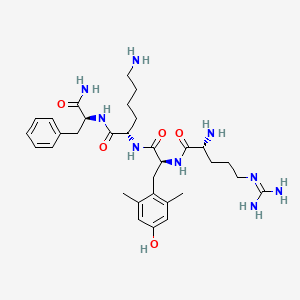
ELAMIPRETIDE


Elamipretide.pngimg

Elamipretide

Elamipretide biologic depiction

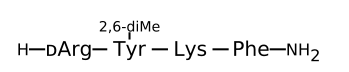
H-D-Arg-Tyr(2,6-diMe)-Lys-Phe-NH2

D-arginyl-2,6-dimethyl-L-tyrosyl-L-lysyl-L-phenylalaninamide

(2S)-6-amino-2-[[(2S)-2-[[(2R)-2-amino-5-(diaminomethylideneamino)pentanoyl]amino]-3-(4-hydroxy-2,6-dimethylphenyl)propanoyl]amino]-N-[(2S)-1-amino-1-oxo-3-phenylpropan-2-yl]hexanamide

CAS 736992-21-5

Chemical Formula: C32H49N9O5

Molecular Weight: 639.8

  • A free radical scavenger and antioxidant that localizes in the inner mitochondrial membrane.
  • Mitochondrial Protective Agent to Improve Cell Viability
  1. Elamipretide
  2. bendavia
  3. UNII-87GWG91S09
  4. 736992-21-5
  5. MTP 131
  6. RX 31
  7. SS 31
  8. 87GWG91S09
  9. L-Phenylalaninamide, D-arginyl-2,6-dimethyl-L-tyrosyl-L-lysyl-
  10. SS-31 peptide
  11. Arg-Dmt-Lys-Phe-NH2
  12. D-Arg-Dmt-Lys-Phe-NH2
  13. SS31 peptide
  14. Elamipretide [USAN:INN]
  15. MTP-131
  16. Elamipretide (USAN/INN)
  17. arginyl-2,’6′-dimethyltyrosyl-lysyl-phenylalaninamide
  18. CHEMBL3833370
  19. SCHEMBL15028020
  20. CTK2H1007

Elamipretide is a cardiolipin peroxidase inhibitor and mitochondria-targeting peptide, Improves Left Ventricular and Mitochondrial Function. In vitro: Elamipretide significantly increases enzymatic activities of both complexes to near normal levels.

Background Information

Elamipretide is a cardiolipin peroxidase inhibitor and mitochondria-targeting peptide, Improves Left Ventricular and Mitochondrial Function. In vitro: Elamipretide significantly increases enzymatic activities of both complexes to near normal levels. long-term therapy with elamipretide reduces ROS formation, attenuated mPTP openings, and significantly decreases the levels of cytosolic cytochrome c and active caspase-3, thus suppressing a major signaling pathway for apoptosis. Elamipretide represents a new class of compounds that can improve the availability of energy to failing heart and reduce the burden of tissue injury caused by excessive ROS production. [1] In vivo: Fourteen dogs with microembolization-induced HF are randomized to 3 months monotherapy with subcutaneous injections of elamipretide (0.5 mg/kg once daily. Elamipretide has been shown to enhance ATP synthesis in multiple organs, including heart, kidney, neurons, and skeletal muscle. [1] ……by MedChemexpress Co., Ltd.

Elamipretide (also known as SS-31 and Bendavia)[1][2] is a small mitochondrially-targeted tetrapeptide (D-Arg-dimethylTyr-Lys-Phe-NH2) that appears to reduce the production of toxic reactive oxygen species and stabilize cardiolipin.[3]

Stealth Peptides, a privately held company, was founded in 2006 to develop intellectual property licensed from several universities including elamipretide; it subsequently changed its name to Stealth BioTherapeutics.[4][5]

Acute coronary syndrome; Age related macular degeneration; Cardiac failure; Corneal dystrophy; Diabetic macular edema; Lebers hereditary optic atrophy

  • Originator Stealth Peptides
  • Developer Stealth BioTherapeutics
  • Class Eye disorder therapies; Ischaemic heart disorder therapies; Oligopeptides; Peptides; Small molecules
  • Mechanism of Action Free radical scavengers; Mitochondrial permeability transition pore inhibitors
  • Phase II/III Barth syndrome
    • Phase II Acute kidney injury; Corneal disorders; Heart failure; Leber’s hereditary optic atrophy; Mitochondrial disorders; Reperfusion injury
    • Phase I/II Diabetic macular oedema; Dry age-related macular degeneration; Mitochondrial myopathies
    • Phase I Age-related macular degeneration
    • No development reported Chronic heart failure; Diabetes mellitus; Eye disorders; Neurodegenerative disorders

    Most Recent Events

    • 29 Jun 2017 Initial efficacy and adverse events data from phase II MMPOWER-2 trial in Mitochondrial-myopathies released by Stealth
    • 02 Jun 2017 Stealth BioTherapeutics completes a phase II trial in Heart failure in Germany and Serbia (SC) (NCT02814097)
    • 01 May 2017 Phase-II/III clinical trials in Barth syndrome (In children, In adolescents, In adults, In the elderly) in USA (SC) (NCT03098797)

Novel crystalline salt (eg hydrochloride, mesylate and tosylate salts) forms of D-Arg-Dmt-Lys-Phe-NH2 (referred to as MTP-131 or elamipretide ) and composition comprising them are claimed. See WO2016190852 , claiming therapeutic compositions including chromanyl compounds, variants and analogues and uses thereof. Stealth BioTherapeutics (formerly known as Stealth Peptides) is developing elamipretide, which targets mitochondria, for the potential iv/sc treatment of cardiac reperfusion injury, acute coronary syndrome, acute kidney injury, mitochondrial myopathy, skeletal muscle disorders and congestive heart failure.

Also, the company is developing an oral formulation of elamipretide , which targets mitochondria and reduces the production of excess reactive oxygen species, for treating chronic heart failure. In January 2015, a phase II trial was ongoing . In July 2016, a phase II trial was initiated in Latvia, Spain and Hungary .

Further, the company is developing an ophthalmic formulation of elamipretide , a mitochondria targeting peptide, for treating ocular diseases including diabetic macular edema, age-related macular degeneration and fuchs’ corneal endothelial dystrophy and Leber’s hereditary optic neuropathy.

In April 2016, a phase II trial was initiated for LHON . Family members of the product case of elamipretide ( WO2007035640 ) hold protection in the EU until 2026 and expires in the US in 2027 with US154 extension.

Acute coronary syndrome; Age related macular degeneration; Cardiac failure; Corneal dystrophy; Diabetic macular edema; Lebers hereditary optic atrophy

SYNTHESIS

NEXT………………………

PATENT 2

ELAMIPRETIDE BY STEALTH

WO-2017156403

https://patentscope.wipo.int/search/en/detail.jsf?docId=WO2017156403&recNum=1&maxRec=&office=&prevFilter=&sortOption=&queryString=&tab=PCTDescription


; MTP-131; D-Arg-Dmt-Lys-Phe-Nth). Compound

1 has been shown to affect the mitochondrial disease process by helping to protect organs from oxidative damage caused by excess ROS production and to restore normal ATP production.

PATENT

US 20110082084

WO 2011091357

WO 2012129427

WO 2013059071

WO 2013126775

US 20140378396

US 20140093897

WO 2015134096

WO 2015100376

WO 2015060462

US 20150010588

PATENNT

WO 2015197723

https://patentscope.wipo.int/search/en/detail.jsf?docId=WO2015197723

PROCESS FOR PREPARING

D-ARGINYL-2,6-DIMETHYL-L-TYROSYL-L-LYSYL-L-PHENYLALANINAMIDE

TECHNICAL FIELD

The invention relates to a process for solution-phase synthesis of D- Arginyl-2,6-dimethyl-L-tyrosyl-L-lysyl-L-phenylalaninamide (abbreviated H-D-Arg-(2,6-Dimethyl)Tyr-L-Lys-L-Phe-NH2, development code SS-31 , MTP-131 , X-31) of Formula (I), an active ingredient developed by Stealth BioTherapeutics under the investigational drug brand names Bendavia® and Ocuvia®, for both common and rare diseases including a mitochondrial targeted therapy for ischemia reperfusion injury.

Formula (I)

BACKGROUND

The product belongs to the class of so-called “Szeto-Schiller peptides”. Szeto-Sciller peptides or “SS peptides” are small, aromatic-cationic, water soluble, highly polar peptides, such as disclosed in US 6703483 and US 7576061 , which can readily penetrate cell membranes. The aromatic-cationic peptides include a minimum of two amino acids, and preferably include a minimum of four amino acids, covalently joined by peptide bonds. The maximum number of amino acids is about twenty amino acids covalently joined by peptide bonds. As described by EP 2012/2436390, optimally, the number of amino acids present in the SS peptides is four.

Bendavia® is being tested for the treatment of ischemia reperfusion injury in patients with acute myocardial infarction (AMI), for the treatment of acute kidney injury (AKI) and renal microvascular dysfunction in hypertension, for the treatment of skeletal muscle dysfunction, for the treatment of mitochondrial myopathy and for the treatment of chronic heart failure. Trials are ongoing to assess the Ocuvia’s potential to treat Leber’s Hereditary Optic Neuropathy (LHON) a devastating inherited disease that causes sudden blindness, often in young adults.

Mitochondria are the cell’s powerhouse, responsible for more than 90% of the energy our bodies need to sustain life and support growth. The energetics from mitochondria maintains healthy physiology and prevents disease. In many common and rare diseases, dysfunctional mitochondria are a key component of disease progression.

D-Arginyl-2,6-dimethyl-L-tyrosyl-L-lysyl-L-phenylalaninamide is a cell-permeable and mitochondria-targeted peptide that showed antioxidant activity and was concentrated in the inner mitochondrial membrane. Compound (< 1 nM) significantly reduced intracellular reactive oxygen species, increased mitochondrial potential and prevented tBHP-induced apoptosis in both N2A and SH-SY5Y neuronal cell lines. In rats, intraperitoneal treatment (1 and 3 mg/kg) 1 day prior to unilateral ureteral obstruction and every day thereafter for 14 days significantly decreased tubular damage, macrophage infiltration and interstitial fibrosis. Compound (3 mg/kg i.p. qd for 2 weeks) also prevented apoptosis and insulin reduction in mouse pancreatic islets caused by streptozotocin.

Further studies performed in a G93A mouse model of amyotrophic lateral sclerosis (ALS) demonstrated that the compound (5 mg/kg/day i.p. starting at 30 days of age) led to a significant delay in disease onset.

Potentially useful for the treatment of ALS and may be beneficial in the treatment of aging and diseases associated with oxidative stress.

In the last few years the peptide H-D-Arg-(2,6-Dimethyl)Tyr-L-Lys-L-Phe-NH2, shown in Fig 1 , and its therapeutic activity have been disclosed and

claimed by in several patent applications.

EP 2436390, US 201 10245182 and US 201 10245183 claim topical anesthetic compositions for application to the skin for pain management or anti-skin aging agents, respectively, comprising Szeto-Schiller peptides; SS-31 is specifically claimed as active ingredient. Sequence of solid-phase synthesis is indicated as the preferred preparation process.

US 7718620 claims a process of treating or preventing ischemia-reperfusion injury of the kidney in a mammal by administrating an effective amount of an aromatic-cationic peptide. SS-31 is specifically claimed as active ingredient.

WO2005/001023 discloses a generical process and carrier complexes for delivering molecules to cells comprising a molecule and an aromatic cationic peptide of type D-Arg-Dmt-Lys-Phe-NH2. The tetrapeptide SS-31 is

specifically claimed as product useful for the process at claim 18.

WO2012/1741 17 and WO2014/210056 claim therapeutic compositions based on SS peptides and the aromatic-cationic peptide D-Arg-Dmt-Lys-Phe-NH2 as active agent.

WO 2013/086020, WO 2004/070054 and WO 2005/072295 provide processes for preventing mithochondrial permeability transition and reducing oxidative damage in a mammal, a removed organ, or a cell in need thereof and specifically claims the process wherein the peptide does not have mu-opioid receptor agonist activity, i.e., D-Arg-Dmt-Lys-Phe-NH2.

WO 2009/108695 discloses a process for protecting a kidney from renal injury which may be associated with decreased or blocked blood flow in the subject’s kidney or exposure to a nephrotoxic agent, such as a radiocontrast dye. The processes include administering to the subject an effective amount of an aromatic-cationic peptide to a subject in need thereof and one of the selected peptide is D-Arg-Dmt-Lys-Phe-NH2.

US 6703483 discloses a detailed procedure for the preparation of novel analogs of DALDA [H-Tyr-D-Arg-Phe-Lys-NH2], namely H-Dmt-D-Arg-Phe-Lys-NH2 using the solid-phase techniques and /?-methylbenzhydrylamine

resin and protocols that have been extensively used by inventor’s laboratory.

Most prior art processes for preparing the compound typically comprise conventionally performed peptide solid-phase synthesis with further purification by chromatography in order to obtain the requested purity for therapeutic use.

It is well known that solid-phase synthesis followed by chromatographic purification is time consuming, very expensive and very difficult to be scaled up on industrial scale, so the need of developing a process for large scale production is obvious. The compound is isolated as organic acid salt, as acetate or trifluoro acetate.

eddy et al., Adv. Exp. Med. Biol, 2009, 61 1 , 473 generally describes the liquid-phase synthesis of antioxidant peptides of Figure 1 and similar others (SS-02, SS-20), involving routinely used side chain protecting groups for amino acid building blocks. The guanidine group was protected with NO2 and the ε-ΝΗ2 of Lys was protected by Cbz or 2-Cl-Cbz. These peptides were

synthesized using Boc/Cbz chemistry and BOP reagent coupling. Starting with the C-terminal Lys residue protected as H-Lys(2-Cl-Cbz)-NH2, (prepared

from the commercially available Boc-Lys(2-Cl-Cbz)-OH in two steps by amidation with NH4HCO3 in the presence of DCC/HOBt following a literature procedure [Ueyama et all, Biopolymers, 1992, 32, 1535, PubMed: 1457730], followed by exposure to TFA). Selective removal of the 2-Cl-Cbz in the

presence of the NO2 group was accomplished using catalytic transfer hydrogenolysis (CTH) [Gowda et al., Lett. Pept. Sci., 2002, 9, 153].

A stepwise procedure by standard solution peptide synthesis for preparation of potent μ agonist [DmtJDALDA and its conversion into a potent δ antagonist H-Dmt-Tic-Phe-Lys(Z)-OH by substitution of D-Arg with Tic to enhance the δ opioid agonist activity is described by Balboni et al., J. Med.

Chem., 2005, 48, 5608. A general synthetic procedure for a similar tetrapeptide ([Dmt-D-Arg-Phe-Lys-NH2 is described by Ballet et al., J. Med.

Chem. 2011, 54, 2467.

Similar DALDA analog tetrapeptides were prepared by the manual solid-phase technique using Boc protection for the a-amino group and DIC/HOBt or HBTU/DIEA as coupling agent [Berezowska et al., J. Med. Chem., 2009, 52, 6941 ; Olma et al., Acta Biochim. Polonica, 2001, 48, 4, 1 121 ; Schiller at al., Eur. J. Med. Chem., 2000, 35, 895].

Despite the high overall yield in the solid-phase approach, it has several drawbacks for the scale-up process such as:

a. the application of the highly toxic and corrosive hydrogen fluoride for cleavage of the peptide from the resin,

b. low loading (0.3-0.35 mmol/g of resin) proved necessary for successful end-step, and

c. use of excess amounts of reagents (3-fold of DIC, 2.4-fold of HOBt, etc.) on each step [ yakhovsky et al., Beilstein J. Org. Chem., 2008, 4(39), 1 , doi: 10.376/bjoc.4.39]

SUMMARY

The invention relates to a more efficient process avoiding either solid-phase synthesis or chromatographic purification, more suitable for large scale production. The process of the invention is described in Scheme A.

The following abbreviations are used:

Dmt = 2,6-dimethyl tyrosine; Z= benzyloxycarbonyl; MeSO3H = methane sulphonic acid; Boc = Tert-butyloxycarbonyl; NMM = N-methyl morpholine; TBTU= N,N,N’,N’-Tetramethyl-O-(benzotriazol- l-yl)uronium tetrafluoroborate; DMF = dimethyl formamide; TFA = trifluoroacetic acid

Scheme A shows the process for the solution phase synthesis of peptide

1 for assembly of the tetrapeptide backbone using O-Benzyl (Bzl) group and benzyloxycarbonyl (Z) group respectively, as the temporary protection for amino acids’ N-termini (Scheme Figure 2), followed by a final catalytic hydrogenolysis. The final product is isolated as organic acid salt, for example, acetic acid salt.

H-Phe-NH 2 + Boc-Lys(Z)-OH

Boc-Lys(Z)-Phe-NH 2

(IV)

(V) I MeS03H/CH2CI2

Boc-DMTyr(Bzl)-OH + MeS03H.H-Lys(Z)-Phe-NH 2

(

Boc-DMTyr(Bzl)-Lys(Z)-Phe-NH 2

(VIII)

I MeS03H/CH2CI2

Z-D-Arg-ONa + H-DMTyr(Bzl)-Lys(Z)-Phe-NH 2.MeS03H

(X) (IX)

TBTU/NMM/DMF

Z-D-Arg-DMTyr(Bzl)-Lys(Z)-Phe-NH

(XI)

I H2, Pd/C

X ACOH

H-D-Arg-DMTyr-Lys-Phe-NH

(I)

Scheme A

This process is a notable improvement with respect to the prior art and its advantages can be summarized as follows:

• The synthesis is performed in liquid phase allowing the scale up on industrial scale without need of special equipment; · The selection of the protecting group in the building blocks allows a straightforward synthesis with very simple deprotection at each step and minimize the formation of undesired by-product;

• Each intermediate can be crystallized allowing removal of impurities which are not transferred to the following step;

· The purity of each intermediate is very high and usually close to

99%.

EXAMPLES

Example 1: Preparation of Boc-Lys(Z)-Phe-NH2

Charge 200 mL of DMF, 44 g of Boc-Lys(Z)-OH and 15.6 g of H-Phe-NH2 in a flask. Stir the mixture at room temperature for 10 min. Add 19.2 g of

N-methylmorpholine and 32.1 g of TBTU successively at room temperature. Stir the mixture at room temperature for 1 h. Add 500 mL of water into the reaction mixture to precipitate the product at room temperature. Filter the mixture to isolate the solid product and wash the filter cake with water.

Transfer the filter cake into a flask containing 360 mL of ethyl acetate and heat the mixture at 50°C till all the solid is dissolved. Separate the organic phase of product and discard the small aqueous phase. Concentrate the organic phase at 40~45°C and under vacuum to remove the solvent till lots of solid is formed. Filter the residue to isolate the solid product. Transfer the filter cake into a flask containing 2000 mL of MTBE and heat the mixture at refluxing for 20 min. Then, cool down the mixture to room temperature. Filter the mixture to isolate the solid product. Dry the filter cake at 30 °C and under vacuum to give 35 g of solid product.

Example 2: Preparation of H-Lys(Z)-Phe-NH2.MeSC>3H

Charge 26.3 g of Boc-Lys(Z)-Phe-NH2, 200 mL of methylene chloride

and 9.6 g of methanesulfonic acid. Stir the mixture at 15-20 °C for 18 h. Add 100 mL of MTBE into the mixture and stir at 15-20 °C for 1 h. Filter the mixture to isolate the solid product. Dry the wet cake in air at room temperature to give 26.4 g of white solid product.

Example 3: Preparation of Boc-DMeTyr(Bzl)-Lys(Z)-Phe-NH2

Charge 8.4 g of Boc-DMeTyr(Bzl)-OH, 1 1 g of H-Lys(Z)-Phe-NH2.MeSO3H, 7.4 g of TBTU and 80 mL of THF in a flask. Stir the mixture

at room temperature for 15 min, and then cool down to 10°C. Add 6.36 g of N-methylmorpholine and stir the mixture at 20-25°C for 3 h. Add the reaction mixture into a flask containing 240 mL of water. Add 32 mL of methylene chloride into the mixture obtained in the previous operation of. Stir the resultant mixture at room temperature for 20 min. Filter the mixture to isolate the solid product and wash the filter cake with acetone (300 mL X 2). Dry the filter cake in air at room temperature to give 14.3 g of white solid product.

Example 4: Preparation of H-DMeTyr(Bzl)-Lys(Z)-Phe-NH2.MeS03H

Charge 14 g of Boc-BMeTyr(Bzl)-Lys(Z)-Phe-NH2, 280 mL of methylene chloride and 3.3 g of methanesulfonic acid in a flask. Stir the mixture at 18 ~ 22 °C for 10 h. Add 560 mL of heptanes into the mixture and stir the mixture at room temperature for 30 min. Filter the mixture to isolate the solid product. Dry the wet cake in air at room temperature to give 14 g of white solid product.

Example 5: Preparation of Z-D-Arg-DMeTyr(Bzl)-Lys(Z)-Phe-NH2

Charge 6.34 g of Z-D-Arg-ONa, 100 mL of DMF and 2.0 g of methanesulfonic acid in a flask. Stir the mixture at room temperature till a clear solution was formed. Add 14 g of H-DMeTyr(Bzl)-Lys(Z)-Phe-NH2.MeSO3H and cool down the mixture to 10°C. Add 6.15 g of TBTU and

9.67 g of N-methylmorpholine successively. Stir the mixture at room temperature for 4 h. Add aqueous solution of LiOH prepared by dissolving 2.9 g of LiOH.L O in 8 mL of water. Stir the mixture for 30 min. Add the resultant mixture slowly into a flask containing 420 mL of water under stirring. Add 56 mL of methylene chloride into the mixture. Filter the mixture to isolate the solid product. Transfer the filter cake into a flask containing 150 mL of acetic acid, and heat the mixture at 35-40 °C till most of the solid was dissolved. Add 450 mL of MTBE into the mixture and cool down the mixture under stirring to room temperature. Filter the mixture to isolate the solid product. Dry the filter cake in air at room temperature to give 17.3 g of the white solid product.

Example 6 Preparation of H-D-Arg-DMeTyr-Lys-Phe-NH2.3AcOH

Charge 2.0 g of Z-D-Arg-DMeTyr(Bzl)-Lys(Z)-Phe-NH2, 20 mL of acetic acid and 5% Pd/C catalyst (which is obtained by washing 5.0 g of 5% Pd/C containing 60% of water with 30 mL of acetic acid) in a flask. Change the atmosphere of the flask with hydrogen. Stir the mixture at room temperature and pressure of 1 atm of hydrogen for 2 h. Filter the mixture to remove the Pd/C catalyst and wash the filter cake with 10 mL of acetic acid. Combine the filtrate and washing solution and concentrate the solution at 20°C and under vacuum to remove most the solvent. Add 100 mL of acetonitrile into the residue and stir the mixture at room temperature for 20 min. Filter the mixture to isolate the solid product. Dry the filter cake at room temperature and under vacuum to give 0.7 g of the white product.

PATENT

WO 2016001042

https://patentscope.wipo.int/search/en/detail.jsf?docId=WO2016001042&recNum=1&maxRec=&office=&prevFilter=&sortOption=&queryString=&tab=PCTDescription

References

  1. Jump up^ “Recommended INN List 75” (PDF). WHO Drug Information30 (1): 111. 2016.
  2. Jump up^ “Elamipretide”. AdisInsight. Retrieved 24 April 2017.
  3. Jump up^ Kloner, RA; Shi, J; Dai, W (February 2015). “New therapies for reducing post-myocardial left ventricular remodeling.”Annals of translational medicine3 (2): 20. PMC 4322169Freely accessiblePMID 25738140.
  4. Jump up^ Valigra, Lori (April 9, 2012). “Stealth Peptides sees positive results from Bendavia”Boston Business Journal.
  5. Jump up^ Dolgin, Elie (11 February 2016). “New drugs offer hope for mitochondrial disease”STAT.
Patent ID

Patent Title

Submitted Date

Granted Date

US2017152289 PROCESS FOR THE PRODUCTION OF D-ARGINYL-2, 6-DIMETHYL-L-TYROSYL-L-LYSYL-L-PHENYLALANINAMIDE 2015-06-24
Patent ID

Patent Title

Submitted Date

Granted Date

US2014294796 AROMATIC-CATIONIC PEPTIDES AND USES OF SAME 2012-12-05 2014-10-02
US2016264623 TETRAPEPTIDE COMPOUND AND METHOD FOR PRODUCING SAME 2014-10-23 2016-09-15
US2017081363 PHARMACEUTICALLY RELEVANT AROMATIC-CATIONIC PEPTIDES 2014-12-23
US2016340389 PHARMACEUTICALLY RELEVANT AROMATIC-CATIONIC PEPTIDES 2014-12-23
US2017129920 Process for Preparing D-Arginyl-2, 6-Dimethyl-L-Tyrosyl-L-Lysyl-L-Phenylalaninamide 2015-06-24

REFERENCES

1: Alam NM, Mills WC 4th, Wong AA, Douglas RM, Szeto HH, Prusky GT. A mitochondrial therapeutic reverses visual decline in mouse models of diabetes. Dis Model Mech. 2015 Jul 1;8(7):701-10. doi: 10.1242/dmm.020248. Epub 2015 Apr 23. PubMed PMID: 26035391; PubMed Central PMCID: PMC4486862.

2: Szeto HH, Birk AV. Serendipity and the discovery of novel compounds that restore mitochondrial plasticity. Clin Pharmacol Ther. 2014 Dec;96(6):672-83. doi: 10.1038/clpt.2014.174. Epub 2014 Sep 4. Review. PubMed PMID: 25188726; PubMed Central PMCID: PMC4267688.

3: Dai W, Shi J, Gupta RC, Sabbah HN, Hale SL, Kloner RA. Bendavia, a mitochondria-targeting peptide, improves postinfarction cardiac function, prevents adverse left ventricular remodeling, and restores mitochondria-related gene expression in rats. J Cardiovasc Pharmacol. 2014 Dec;64(6):543-53. PubMed PMID: 25165999.

4: Eirin A, Ebrahimi B, Zhang X, Zhu XY, Woollard JR, He Q, Textor SC, Lerman A, Lerman LO. Mitochondrial protection restores renal function in swine atherosclerotic renovascular disease. Cardiovasc Res. 2014 Sep 1;103(4):461-72. doi: 10.1093/cvr/cvu157. Epub 2014 Jun 19. PubMed PMID: 24947415; PubMed Central PMCID: PMC4155472.

5: Liu S, Soong Y, Seshan SV, Szeto HH. Novel cardiolipin therapeutic protects endothelial mitochondria during renal ischemia and mitigates microvascular rarefaction, inflammation, and fibrosis. Am J Physiol Renal Physiol. 2014 May 1;306(9):F970-80. doi: 10.1152/ajprenal.00697.2013. Epub 2014 Feb 19. PubMed PMID: 24553434.

6: Brown DA, Hale SL, Baines CP, del Rio CL, Hamlin RL, Yueyama Y, Kijtawornrat A, Yeh ST, Frasier CR, Stewart LM, Moukdar F, Shaikh SR, Fisher-Wellman KH, Neufer PD, Kloner RA. Reduction of early reperfusion injury with the mitochondria-targeting peptide bendavia. J Cardiovasc Pharmacol Ther. 2014 Jan;19(1):121-32. doi: 10.1177/1074248413508003. Epub 2013 Nov 28. PubMed PMID: 24288396; PubMed Central PMCID: PMC4103197.

7: Birk AV, Chao WM, Bracken C, Warren JD, Szeto HH. Targeting mitochondrial cardiolipin and the cytochrome c/cardiolipin complex to promote electron transport and optimize mitochondrial ATP synthesis. Br J Pharmacol. 2014 Apr;171(8):2017-28. doi: 10.1111/bph.12468. PubMed PMID: 24134698; PubMed Central PMCID: PMC3976619.

8: Szeto HH. First-in-class cardiolipin-protective compound as a therapeutic agent to restore mitochondrial bioenergetics. Br J Pharmacol. 2014 Apr;171(8):2029-50. doi: 10.1111/bph.12461. Review. PubMed PMID: 24117165; PubMed Central PMCID: PMC3976620.

9: Zhao WY, Han S, Zhang L, Zhu YH, Wang LM, Zeng L. Mitochondria-targeted antioxidant peptide SS31 prevents hypoxia/reoxygenation-induced apoptosis by down-regulating p66Shc in renal tubular epithelial cells. Cell Physiol Biochem. 2013;32(3):591-600. doi: 10.1159/000354463. Epub 2013 Sep 6. PubMed PMID: 24021885.

10: Dai DF, Hsieh EJ, Chen T, Menendez LG, Basisty NB, Tsai L, Beyer RP, Crispin DA, Shulman NJ, Szeto HH, Tian R, MacCoss MJ, Rabinovitch PS. Global proteomics and pathway analysis of pressure-overload-induced heart failure and its attenuation by mitochondrial-targeted peptides. Circ Heart Fail. 2013 Sep 1;6(5):1067-76. doi: 10.1161/CIRCHEARTFAILURE.113.000406. Epub 2013 Aug 9. PubMed PMID: 23935006; PubMed Central PMCID: PMC3856238.

/////////////////////Elamipretide,  SS-31,  Bendavia, PEPTIDE

CC1=CC(=CC(=C1CC(C(=O)NC(CCCCN)C(=O)NC(CC2=CC=CC=C2)C(=O)N)NC(=O)C(CCCN=C(N)N)N)C)O

FDA approves implantable device to treat moderate to severe central sleep apnea


FDA approves implantable device to treat moderate to severe central sleep apnea

The U.S. Food and Drug Administration today approved a new treatment option for patients who have been diagnosed with moderate to severe central sleep apnea. The Remedē System is an implantable device that stimulates a nerve located in the chest that is responsible for sending signals to the diaphragm to stimulate breathing. Continue reading.

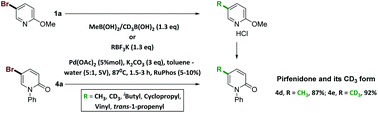
A highly efficient Suzuki-Miyaura methylation of pyridines leading to the drug pirfenidone and its CD3 version (SD-560)


A highly efficient Suzuki-Miyaura methylation of pyridines leading to the drug pirfenidone and its CD3 version (SD-560)

Green Chem., 2017, Advance Article
DOI: 10.1039/C7GC01740E, Communication
Eliezer Falb, Konstantin Ulanenko, Andrey Tor, Ronen Gottesfeld, Michal Weitman, Michal Afri, Hugo Gottlieb, Alfred Hassner
The first methylation/deuteromethylation in green and nearly quantitative Suzuki-Miyaura routes to pirfenidone and its d3 analog SD-560, at 99% isotopic purity.

A highly efficient Suzuki–Miyaura methylation of pyridines leading to the drug pirfenidone and its CD3version (SD-560)

 Author affiliations

Abstract

Efficient introduction of methyl or methyl-d3 into aromatic and heteroaromatic systems still presents a synthetic challenge. In particular, we were in search of a non-cryogenic synthesis of the 5-CD3 version of pirfenidone (4d, also known as Pirespa®, Esbriet® or Pirfenex®), one of the two drugs approved to date for retarding idiopathic pulmonary fibrosis (IPF), a serious, rare and fatal lung disease, with a life expectancy of 3–5 years. The methyl-deuterated version of pirfenidone (4e, also known as SD-560) was designed with the objective of attenuating the rate of drug metabolism, and our goal was to find a green methylation route to avoid the environmental and economic impact of employing alkyllithium at cryogenic temperatures. The examination of several cross-coupling strategies for the introduction of methyl or methyl-d3 into methoxypyridine and pyridone systems culminated in two green and nearly quantitative Suzuki–Miyaura cross-coupling routes in the presence of RuPhos ligand: the first, using commercially available methyl boronic acid or its CD3 analog and the second, employing potassium methyl trifluoroborate or CD3BF3K, the latter obtained by a new route in 88% yield. This led, on a scale of tens of grams, to the synthesis of pirfenidone (4d) and its d3 analog, SD-560 (4e), at 99% isotopic purity.

//////////pirfenidone, CD3 version, SD-560,

WO 2017163257, NEW PATENT, IBRUTINIB, IND-SWIFT LABORATORIES LIMITED


WO 2017163257, NEW PATENT, IBRUTINIB, IND-SWIFT LABORATORIES LIMITED

WO2017163257) PROCESS FOR PREPARING PURE LH-PYRAZOLO[3,4-D] PYRIMIDINE DERIVATIVE

https://patentscope.wipo.int/search/en/detail.jsf?docId=WO2017163257&recNum=1&maxRec=145&office=&prevFilter=&sortOption=Pub+Date+Desc&queryString=FP%3A%28IND+SWIFT%29&tab=PCTDescription

IND-SWIFT LABORATORIES LIMITED

ARUL, Ramakrishnan; (IN).
SARIN, Gurdeep Singh; (IN).
WAS, Sandeep; (IN).
KUMAR, Vishal; (IN)

The present invention relates to an efficient and industrially advantageous process for the preparation of pure lH-pyrazolo[3,4-d] pyrimidine derivative. In particular the present invention provides a process for the preparation of pure 4-amino-3-(4- phenoxyphenyl)-lH-pyrazolo[3,4-d] pyrimidine, a key intermediate of ibrutinib. Particularly, the present invention provides a process for the preparation of 3-amino-4-cyano-5-(4-phenoxy phenyl)pyrazole, wherein none of the intermediates have been isolated, an important precursor for the preparation of 4-amino-3-(4-phenoxyphenyl)- lH-pyrazolo[3,4-d] pyrimidine.

The present invention relates to an efficient and industrially advantageous process for the preparation of pure lH-pyrazolo[3,4-d] pyrimidine derivative. In particular the present invention provides a process for the preparation of pure 4-amino-3-(4-phenoxyphenyl)-lH-pyrazolo[3,4-d] pyrimidine, a key intermediate of ibrutinib, wherein none of the intermediates have been isolated to prepare 3-amino-4-cyano-5-(4-phenoxy phenyl)pyrazole, an important precursor.

Ibrutinib (IMBRUVICA), chemically known as l-[(3R)-3-[4-amino-3-(4-phenoxyphenyl)-lH-pyrazolo[3,4-d]pyrimidin- 1 -yl]piperidin- 1 -yl] prop-2-en- 1 -one is an orally administered drug that targets Bruton’s tyrosine kinase (BTK). Ibrutinib may be used for treating both B cell-related hematological cancers/ B cell chronic lymphocytic leukemia, and autoimmune diseases such as rheumatoid arthritis, Sjogrens syndrome, lupus and asthma and is represented by following chemical formula:

Ibrutinib and its pharmaceutically acceptable salts were first disclosed in US patent US7,514,444. This patent discloses a process for the preparation of Ibrutinib by involving use of 4-amino-3-(4-phenoxyphenyl)- lH-pyrazolo[3,4-d]pyrimidine, as intermediate as shown below:

4-Amino-3-(4-phenoxyphenyl)- l H-pyrazolo[3,4-d]pyrimidine, a key intermediate of ibrutinib, and its preparation from 3-amino-4-cyano-5-(4-phenoxyphenyl) pyrazole was first disclosed in a PCT patent publication WO2001/019829 A2 as shown in below scheme.

Various other publications like US patents US7,514,444; US7.718,662; US8,883,803 and PCT publications WO2012/158843 A2; WO2013/010136A2 follow the same process for the preparation of 4-amino-3-(4-phenoxyphenyl)-lH-pyrazolo[3,4-d]pyrimidine as described above.

The process comprises the conversion of 4-phenoxybenzoic acid to the corresponding acid chloride, which is then taken up in mixture of toluene and tetrahydrofuran and further reacted with malononitrile in the presence of diisopropylethylethylamine in toluene. The reaction mixture is stirred overnight and after completion of reaction, followed by work up 1 , 1 -dicyano-2-hydroxy-2-(4-phenoxyphenyl)ethene is isolated as a residue and which is further purified.

The resulting l, l-dicyano-2-hydroxy-2-(4-phenoxyphenyl)ethene is reacted with trimethylsilyldiazomethane in a mixture of acetonitrile and methanol in the presence of diisopropylethylamine as a base. The resulting reaction mixture is stirred for 2 days to give l, l-dicyano-2-methoxy-2-(4-phenoxyphenyl)ethene (O-methylated product) as an oil, which is purified by flash chromatography.

The O-methylated product is treated with hydrazine hydrate to give 3-amino-4-cyano- 5-(4-phenoxyphenyl)pyrazole, which is further reacted with formamide at a temperature of 180°C to give 4-amino-3-(4-phenoxyphenyl)- lH-pyrazolo[3,4- d]pyrimidine as pale brown-grey solid.

Since, the above process involves the isolation of intermediates and takes long time during reaction completion. Therefore, it is lengthy, not efficient. Further publication is silent about the purity of 4-amino-3-(4-phenoxyphenyl)- lH-pyrazolo[3,4-d]pyrimidine. Acetonitrile solvent has been used in methylation reaction, which is carcinogenic.

The cyclization reaction has been carried out at 180°C and it is observed that the cyclization reaction at high temperature of 180°C, results in grey brown solid colour of 4-amino-3-(4-phenoxyphenyl)- lH-pyrazolo[3,4-d]pyrimidine, may be due to presence of inorganic impurities.

The said process also requires the use of expensive (trimethylsilyl)diazomethane to obtain O-methylated product, which is sensitive to air and water, and hence, the methylation reaction has to be carried out in the absence of water, under anaerobic conditions; silica and flash chromatography are also used for purifying O-methylated product. Since the above process involves complicated operation processes, which leads to high production cost and therefore is not an attractive option at industrially scale.

PCT publication WO2014/173289A1 discloses a process for preparation of 3-amino-4-cyano-5-(4-phenoxyphenyl)pyrazole as shown below and its conversion into 4- amino-3-(4-phenoxy phenyl)- lH-pyrazolo[3,4-d]pyrimidine has not been disclosed.

The process involves conversion of 4-phenoxybenzoic acid to the corresponding acid chloride, followed by reaction with malononitrile in the presence of diisopropylethylethylamine in tetrahydrofuran. The reaction mixture has been stirred for 16 hours and thereafter l, l -dicyano-2-hydroxy-2-(4-phenoxyphenyl) ethene is isolated from reaction mixture. A solution of l, l-dicyano-2-hydroxy-2-(4- phenoxyphenyl)ethene in trimethoxymethane has been heated for 16 hours to give l, l-dicyano-2-methoxy-2-(4-phenoxyphenyl)ethene (O-methylated product), which is then reacted with hydrazine hydrate to give 3-amino-4-cyano-5-(4-phenoxy phenyl)pyrazole.

The above process is inefficient, since it involves isolation of intermediates and takes long time to complete the reactions and purity of 3-amino-4-cyano-5-(4- phenoxypheny pyrazole has not been disclosed.

A similar approach has been described in a PCT publication WO2014/082598 A 1 for preparation of 3-amino-4-cyano-5-(4-phenoxyphenyl)pyrazole and is presented as below:

The process involves conversion of 4-phenoxybenzoic acid to the corresponding acyl chloride by using sulfurous dichloride, followed by reaction with malononitrile in the presence of sodium hydride to obtain l, l-dicyano-2-hydroxy-2-(4-phenoxy phenyl)ethene, which is recrystallized from 1,4-dioxane. The hydroxy moiety is then methylated using dimethyl sulphate to give l, l-dicyano-2-methoxy-2-(4-phenoxy phenyl)ethene (O-methylated product) which is recrystallized from a mixture of hexane and ethylactetate. The solution of resulting O-methylated product in ethanol was treated with hydrazine hydrate at reflux temperature to give 3-amino-4-cyano-5- (4-phenoxy phenyl)pyrazole, followed by its recrystallization in hexane and further, its conversion into 4-amino-3-(4-phenoxyphenyl)- lH-pyrazolo[3,4-d]pyrimidine was not disclosed.

The above process also involves isolation of intermediates; their purification which leads to longer time in reaction completion, and it does not disclose the purity of 3- amino-4-cyano-5-(4-phenoxyphenyl)pyrazole. Further the above process involves use of sodium hydride, which is a hazardous reagent and can ignite in air during scale up. Several alternative methods have been reported in literature, wherein process for the preparation of 4-amino-3-(4-phenoxyphenyl)-lH-pyrazolo[3,4-d]pyrimidine has been disclosed and are discussed herein.

A Chinese patent application CN103121999A discloses a process of preparation of 4- amino-3 -(4-phenoxy phenyl)- 1 H-pyrazolo[3 ,4-d] pyrimidine, as below :

The process involves reaction of 3-bromo-lH-pyrazolo[3,4-d]pyrimidin-4-amine with (4-phenoxyphenyl)boronic acid in the presence of alkali agents and aprotic solvents to give 4-amino-3-(4-phenoxyphenyl)-lH-pyrazolo[3,4-d]pyrimidine.

The said Chinese application is also silent about the purity of target compound and even starts with the advance intermediates, which are expensive and make the process unattractive from industrial point of view.

A similar approach has been described in US patent US8,940,893; PCT publication WO2013/1 13097A1 and WO2015/018333 A 1 for preparing 4-amino-3-(4-phenoxyphenyl)-lH-pyrazolo[3,4-d]pyrimidine .

In US patent US8,940,893 and PCT publication WO2013/1 13097A1, 4-amino-3-(4-phenoxyphenyl)- lH-pyrazolo[3,4-d]pyrimidine is purified by using Combi-flash chromatography on silica gel. In PCT publication WO2015/018333A1, 4-amino-3-(4-phenoxyphenyl)- lH-pyrazolo[3,4-d]pyrimidine is purified by recrystallization in ethyl acetate.

The purity of 4-amino-3-(4-phenoxyphenyl)-lH-pyrazolo[3,4-d]pyrimidine has not been reported in above publications too. Further two of the above processes involve tedious step of chromatographic purification, which is not industrial viable.

Another Chinese patent application CN 103965201 A discloses a process for the preparation of 4-amino-3-(4-phenoxyphenyl)- lH-pyrazolo[3,4-d]pyrimidine, wherein 3-bromo-lH-pyrazolo[3,4-d]pyrimidin-4-amine was reacted with trimethyl tin (4- phenoxy phenyl) to give 4-amino-3-(4-phenoxyphenyl)-lH-pyrazolo[3,4- d]pyrimidine and followed by its recrystallization in isopropanol, as shown below:

The said Chinese application is also silent about the purity of 4-amino-3-(4- phenoxyphenyl)- lH-pyrazolo[3,4-d]pyrimidine and is not cost-effective because it starts with advance intermediates, which are expensive. Therefore, said route of synthesis is not industrially applicable.

Purity of an API as well as intermediates is of great importance in the field of pharmaceutical chemistry. It is well documented in the art that direct product of a chemical reaction is rarely a single compound with sufficient purity to comply with pharmaceutical standards. The impurities that can be present in pharmaceutical compounds are starting materials, by-products of the reaction, products of side reactions, or degradation products.

According to ICH guidelines, process impurities should be maintained below set limits by specifying the quality of raw materials, their stoichiometric ratios, controlling process parameters, such as temperature, pressure, time and including purification steps, such as crystallization, distillation and liquid-liquid extraction etc., in the manufacturing process. Typically, these limits should less than about 0.15 % by weight of each identified impurity. Limits for unidentified and/or uncharacterized impurities are obviously lower, typically less than 0.10 % by weight. The limits for genotoxic impurities could be much lower depending upon the daily dose of the drug and duration of the treatment. Therefore, in the manufacture of a drug substance, the purity of the starting materials is also important, as impurities may carry forward to the active pharmaceutical ingredient such as ibrutinib.

In view of the above, most of the prior art processes involve isolation of intermediates, additional purification steps and silent about the purity or the assay of 4-amino-3-(4-phenoxy phenyl)- lH-pyrazolo[3,4-d]pyrimidine.

Thus, there is an urgent need for the development of a synthetic process which produces pure 4-amino-3-(4-phenoxyphenyl)-lH-pyrazolo[3,4-d]pyrimidine or its acid addition salts.

The present invention fulfills the need in the art and provides an improved, industrially advantageous process for the synthesis of pure 4-amino-3-(4-phenoxyphenyl)-lH-pyrazolo[3,4-d] pyrimidine, a key intermediate in the preparation of ibrutinib, through preparation of 3-amino-4-cyano-5-(4-phenoxyphenyl)pyrazole from 4-phenoxy benzoic acid using same organic solvent and none of the intermediates have been isolated.

Examples:

Example 1: Preparation of 3-amino-4-cyano-5-(4-phenoxyphenyl)pyrazole

4-Phenoxybenzoic acid (200g) was slowly added to thionyl chloride (400ml) at a temperature of 25-30°C and resulting reaction mixture was heated under stirring to a temperature of 60-65°C for 5 hours. Thionyl chloride was distilled off under vacuum at temperature below 60°C. Toluene (2x400ml) was added to the resulting oily residue and thereafter distilled out completely under vacuum below 60°C to remove traces of thionyl chloride to obtain 4-phenoxybenzoyl chloride as a viscous oil. The resulting viscous oil of 4-phenoxybenzoyl chloride was dissolved in toluene (2000ml). Malononitile (80g) and diisopropylethylamine (320ml) were sucessively added to the reuslting solution at a temperature of 25-30°C slowly, maintaining reaction temperature 50-55°C. The reaction mass was further stirred for 30 minutes. After completion of the reaction, the reaction mass was cooled to 25-30°C and a solution of sulfuric acid ( 1.25 M) was added. The reaction mixture was then stirred at a temperature of 25-30°C for 30 minutes, and the layers were separated. The organic layer was washed with a solution of sodium chloride ( 10%) and the resulting organic layer was used directly in next reaction.

Dimethyl sulfate (200ml) and sodium bicarbonate (200g) were added to the resulting organic layer at a temperature of 25-30°C. Thereafter, temperature of reaction mass was raised to 80-90°C and reaction mass was stirred for 1-2 hours. After completion of reaction, the reaction mass was cooled to a temperature of 25-30°C, demineralized water (2000ml) was added and stirred for 10-15 minutes. The layers were separated and the aqueous layer was extracted with toluene (1000ml). All the organic layers were combined and washed with sodium chloride solution ( 10%). Activated carbon (20g) was added and reaction mixture was stirred for 30 minutes. The solution was filtered through hyflo bed and to the resulting organic layer hydrazine hydrate ( 120ml) was added at a temperature of 25-30°C. During the addition exothermicity was observed, and temperature of the reaction mass was rose up to 40-50°C. Thereafter, the reaction mass was stirred at a temperature of 25-30°C for 1 -2 hours. The resulting precipitated solid was filtered, slurry washed with dichloromethane (400ml) and finally, dried to obtain title compound of formula V ( 140g) purity 93.28% measured by HPLC.

Example 2: Preparation of 3-amino-4-cyano-5-(4-phenoxyphenyl)pyrazole

4-Phenoxybenzoic acid (lOOg) was slowly added to thionyl chloride (200ml) at a temperature of 25-30°C and resulting reaction mixture was heated under stirring to a temperature of 50-55°C for 5 hours. Thionyl chloride was distilled off under vacuum at temperature below 50°C. Toluene (250ml) was added to the resulting oily residue and thereafter distilled out completely under vacuum below 50°C to remove traces of thionyl chloride to obtain 4-phenoxybenzoyl chloride as a viscous oil. The resulting viscous oil of 4-phenoxybenzoyl chloride was dissolved in toluene (500ml). Malononitile (35.58ml) and diisopropylethylamine (160ml) were sucessively added to the reuslting solution at a temperature of 25-30°C slowly, maintaining reaction temperature around 50-55°C. The reaction mass was further stirred for 10 minutes. After completion of the reaction, the reaction mass was cooled to 25-30°C and a solution of sulfuric acid (70 ml in 1000 ml water) was added. The reaction mixture was then stirred at a temperature of 25-30°C for 30 minutes, and the layers were separated. The organic layer was washed with a solution of sodium chloride (10%) and the resulting organic layer was used directly in next reaction.

Dimethyl sulfate (95.1 1ml) and sodium bicarbonate (96.16g) were added to the resulting organic layer at a temperature of 25-30°C. Thereafter, temperature of reaction mass was raised to 80-90°C and reaction mass was stirred for 1-2 hours. After completion of reaction, the reaction mass was cooled to a temperature of 55- 60°C, demineralized water ( 1000ml) was added. The reaction mass was cooled to a temperature of 25-30°C and stirred for 10- 15 minutes. The layers were separated and the aqueous layer was extracted with toluene (500ml). All the organic layers were combined and washed with sodium chloride solution ( 10%). To the resulting organic layer hydrazine hydrate (50ml) was added at a temperature of 25-30°C. During the addition exothermicity was observed, and temperature of the reaction mass was rose up to 40-45°C. Thereafter, the reaction mass was stirred at a temperature of 25-30°C for 1-2 hours. The resulting precipitated solid was filtered, suck dried to obtain 3- amino-4-cyano-5-(4-phenoxyphenyl)pyrazole compound of formula V ( 123g) purity 86.96% measured by HPLC.

Example 3: Purification of 3-amino-4-cyano-5-(4-phenoxyphenyl)pyrazole

3-Amino-4-cyano-5-(4-phenoxyphenyl)pyrazole (36g) was suspended in isopropanol (350ml) and temperature of the reaction mixture was raised and allowed to reflux to dissolve the solid completely to provide a clear solution. Then, solvent was distilled off under vacuum to obtain a residue and isopropanol (50ml) was added and after stirring for hours the solid was filtered and dried to afford 3-amino-4-cyano-5-(4-phenoxyphenyl)pyrazole compound of formula V (26g) and having purity of 97.54 % by HPLC .

Example 4: Purification of 3-amino-4-cyano-5-(4-phenoxyphenyl)pyrazole

3-Amino-4-cyano-5-(4-phenoxyphenyl)pyrazole (36g) was suspended in isopropanol (350ml) and temperature of the reaction mixture was raised upto reflux to dissolve the solid completely upto clear solution. Water (1050ml) was added to the solution and the reaction mixture was gradually cooled to crystallize the product. The resulting solid was filtered, washed with two volumes of isopropanol, dried in vacuum oven at a temperature of 40-45 °C to afford 3-amino-4-cyano-5-(4-phenoxyphenyl)pyrazole compound of formula V (20g) and having a HPLC purity of 97.23% .

Example 5: Preparation of pure 4-amino-3-(4-phenoxyphenyl)-lH-pyrazolo[3,4- d] pyrimidine compound of formula I

3-Amino-4-cyano-5-(4-phenoxyphenyl)pyrazole (20g) was suspended in formamide (100 ml) and heated at a temperature of 130°C, after completion of reaction, the reaction mixture was cooled to a temperature of 30-35°C and demineralized water (500ml) was added and the reaction mixture was stirred at a temperature of 25-30°C for 45 minutes. The resulting solid was filtered and acetone (200ml) was added stirred the reaction mixture for 30-45 minutes. The resulting solid was filtered, washed, dried to afford pure 4-amino-3-(4-phenoxyphenyl)-lH-pyrazolo[3,4-d]pyrimidine compound of formula 1 (12g) having purity 99.6% measured by HPLC.

Example 6: Preparation of pure 4-amino-3-(4-phenoxyphenyl)-lH-pyrazolo[3,4- d] pyrimidine compound of formula I

3-Amino-4-cyano-5-(4-phenoxyphenyl)pyrazole (lOOg) was suspended in formamide (500ml) and heated at a temperature of 135-140°C, after completion of reaction, the reaction mixture was cooled to a temperature of 30-35°C and demineralized water (1000ml) was added and the reaction mixture was stirred at a temperature of 20-25°C for 1 hour. The resulting solid was filtered, washed with water (500ml) then successively slurry washed with toluene (2 x 500ml) and dried to afford pure 4- amino-3-(4-phenoxyphenyl)-lH-pyrazolo[3,4-d] pyrimidine compound of formula I

(70g) having purity 99.8% measured by HPLC; assay > 98%; residue on ignition 0.05%; heavy metals < 20ppm.

Example 7: Preparation of (lS)-l-[(3R)-3-piperidyl]-3-(p-phenoxyphenyl)-l,2,5,7-tetraza-lH-inden-4-ylamine

Diisopropyl diazodicarboxylate (DAID, 1.2 ml,) was added to a solution of 1-tert-butyloxycarbonyl-3-(S)-hydroxypiperidine ( l .Og,) and triphenylphosphine (2.59g) in tetrahydrofuran (50.0ml). To the resulting yellow solution, 3-(p-phenoxyphenyl)-l ,2,5,7-tetraza- lH-inden-4-ylamine (l .Og). was added and warmed till dissolution, and stirred overnight at room temperature. The reaction mixture was filtered and the solvent was distilled under vacuum to get an oily residue, which was further purified by flash chromatography (30-50 % ethyl acetate/ hexane) on silicagel to give 0.3 g (0.3 w/w) of tert-butyloxycarbonyl-( l S)- l-[(3R)-3-piperidyl]-3-(p-phenoxyphenyl)- l,2,5,7-tetraza- lH-inden-4-ylamine as a light brown solid. The resulting solid was dissolved in dichloromethane (5 ml) and trifluoroacetic acid (0.6 ml) was added to it. After completion of reaction, water was added to reaction mass, followed by addition of methyl tert-butyl ether (20.0 ml). The layers were separated and the aqueous layer was basified with potassium carbonate and extracted with dichloromethane (15.0 ml x 2). The organic layer dried over sodium sulfate, filtered and evaporated to yield 0.2 g (0.6 w/w) of title compound as light yellow oil.

Example 8: Preparation of l-(3-(4-amino-3-(4-phenoxyphenyl)-lH-pyrazolo [3,4- d]pyrimidin-l-yl)piperidin-l-yI)prop-2-en-l-one (Ibrutinib)

To a solution of acryloyl chloride (0.06g) in tetrahydrofuran (15.0 ml), a mixture of triethylamine (O. lg) and (lS)-l-[(3R)-3-piperidyl]-3-(p-phenoxyphenyl)-l,2,5,7- tetraza- lH-inden-4-ylamine (0.2g) in tetrahydrofuran (7.8 ml) was added. The reaction mixture was stirred at 25-30°C for 18 hous and filtered. The solvent was removed under vacuum to obtain crude ibrutinib, which was further purified by column chromatography on silica gel to obtain pure ibrutinib as crystalline solid.

Formula VI

Formula VII

Formula I

Formula II


Formula III


Formula IV


Formula V

///////WO 2017163257, NEW PATENT, IBRUTINIB, IND-SWIFT LABORATORIES LIMITED

FDA approves new treatment for certain advanced or metastatic breast cancers


FDA approves new treatment for certain advanced or metastatic breast cancers

The U.S. Food and Drug Administration today approved Verzenio (abemaciclib) to treat adult patients who have hormone receptor (HR)-positive, human epidermal growth factor receptor 2 (HER2)-negative advanced or metastatic breast cancer that has progressed after taking therapy that alters a patient’s hormones (endocrine therapy). Verzenio is approved to be given in combination with an endocrine therapy, called fulvestrant, after the cancer had grown on endocrine therapy. It is also approved to be given on its own, if patients were previously treated with endocrine therapy and chemotherapy after the cancer had spread (metastasized). Continue reading

https://www.fda.gov/NewsEvents/Newsroom/PressAnnouncements/ucm578071.htm

Abemaciclib.svg

(abemaciclib)

September 28, 2017

Release

The U.S. Food and Drug Administration today approved Verzenio (abemaciclib) to treat adult patients who have hormone receptor (HR)-positive, human epidermal growth factor receptor 2 (HER2)-negative advanced or metastatic breast cancer that has progressed after taking therapy that alters a patient’s hormones (endocrine therapy). Verzenio is approved to be given in combination with an endocrine therapy, called fulvestrant, after the cancer had grown on endocrine therapy. It is also approved to be given on its own, if patients were previously treated with endocrine therapy and chemotherapy after the cancer had spread (metastasized).

“Verzenio provides a new targeted treatment option for certain patients with breast cancer who are not responding to treatment, and unlike other drugs in the class, it can be given as a stand-alone treatment to patients who were previously treated with endocrine therapy and chemotherapy,” said Richard Pazdur, M.D., director of the FDA’s Oncology Center of Excellence and acting director of the Office of Hematology and Oncology Products in the FDA’s Center for Drug Evaluation and Research.

Verzenio works by blocking certain molecules (known as cyclin-dependent kinases 4 and 6), involved in promoting the growth of cancer cells. There are two other drugs in this class that are approved for certain patients with breast cancer, palbociclib approved in February 2015 and ribociclib approved in March 2017.

Breast cancer is the most common form of cancer in the United States. The National Cancer Institute at the National Institutes of Health estimates approximately 252,710 women will be diagnosed with breast cancer this year, and 40,610 will die of the disease. Approximately 72 percent of patients with breast cancer have tumors that are HR-positive and HER2-negative.

The safety and efficacy of Verzenio in combination with fulvestrant were studied in a randomized trial of 669 patients with HR-positive, HER2-negative breast cancer that had progressed after treatment with endocrine therapy and who had not received chemotherapy once the cancer had metastasized. The study measured the length of time tumors did not grow after treatment (progression-free survival). The median progression-free survival for patients taking Verzenio with fulvestrant was 16.4 months compared to 9.3 months for patients taking a placebo with fulvestrant.

The safety and efficacy of Verzenio as a stand-alone treatment were studied in a single-arm trial of 132 patients with HR-positive, HER2-negative breast cancer that had progressed after treatment with endocrine therapy and chemotherapy after the cancer metastasized. The study measured the percent of patients whose tumors completely or partially shrank after treatment (objective response rate). In the study, 19.7 percent of patients taking Verzenio experienced complete or partial shrinkage of their tumors for a median 8.6 months.

Common side effects of Verzenio include diarrhea, low levels of certain white blood cells (neutropenia and leukopenia), nausea, abdominal pain, infections, fatigue, low levels of red blood cells (anemia), decreased appetite, vomiting and headache.

Serious side effects of Verzenio include diarrhea, neutropenia, elevated liver blood tests and blood clots (deep venous thrombosis/pulmonary embolism). Women who are pregnant should not take Verzenio because it may cause harm to a developing fetus.

The FDA granted this application Priority Review and Breakthrough Therapydesignations.

The FDA granted the approval of Verzenio to Eli Lilly and Company.

//////////Verzenio, abemaciclib, fda 2017, metastatic breast cancers, Eli Lilly ,  Priority Review,  Breakthrough Therapy designations, antibodies

Xanomeline (LY-246,708; Lumeron, Memcor) ксаномелин , كسانوميلين , 诺美林 ,


Xanomeline.png

Xanomeline (LY-246,708LumeronMemcor)

CAS 131986-45-3

  • Molecular FormulaC14H23N3OS
  • Average mass281.417 Da

FDA 2024 APPROVED

ксаномелин كسانوميلين 诺美林 
Hexyloxy-TZTP
5-[4-(Hexyloxy)-1,2,5-thiadiazol-3-yl]-1-méthyl-1,2,3,6-tétrahydropyridine
Xanomeline(LY246708) is a selective M1 muscarinic receptor agonist.
Pyridine, 3-[4-(hexyloxy)-1,2,5-thiadiazol-3-yl]-1,2,5,6-tetrahydro-1-methyl-
Xanomeline(LY246708) is a selective M1 muscarinic receptor agonist. in vitro: Xanomeline had high affinity for muscarinic receptors in brain homogenates, but had substantially less or no affinity for a number of other neurotransmitter receptors and uptake sites. In cells stably expressing genetic m1 receptors, xanomeline increased phospholipid hydrolysis in CHO, BHK and A9 L cells to 100, 72 and 55% of the nonselective agonist carbachol. In isolated tissues, xanomeline had high affinity for M1 receptors in the rabbit vas deferens (IC50 = 0.006 nM), low affinity for M2 receptors in guinea pig atria (EC50 = 3 microM), was a weak partial agonist in guinea pig ileum and was neither an agonist nor antagonist in guinea pig bladder. Xanomeline produced small increases in striatal acetylcholine levels and did not antagonize the large increases in acetylcholine produced by the nonselective muscarinic agonist oxotremorine, indicating that xanomeline did not block M2 autoreceptors. in vivo: Xanomeline increased striatal levels of dopamine metabolites, presumably by acting at M1 heteroreceptors on dopamine neurons to increase dopamine release. In contrast, xanomeline had only a relatively small effect on acetylcholine levels in brain, indicating that it is devoid of actions at muscarinic autoreceptors. The effects of xanomeline on ex vivo binding and DOPAC levels lasted for about 3 hr and were evident after oral administration. An analog of xanomeline with similar in vivo effects did not inhibit acetylcholinesterase or choline acetyltransferase and inhibited choline uptake only at concentrations much higher than those required to inhibit binding. These data indicate xanomeline is selective agonist for M1 over M2 and M3 receptors in vivo in rat.
Xanomeline (LY-246,708LumeronMemcor) is a muscarinic acetylcholine receptor agonist with reasonable selectivity for the M1 and M4 subtypes,[1][2][3][4] though it is also known to act as a M5 receptor antagonist.[5] It has been studied for the treatment of both Alzheimer’s disease and schizophrenia, particularly the cognitive and negative symptoms,[6] although gastrointestinal side effects led to a high drop-out rate in clinical trials.[7][8] Despite this, xanomeline has been shown to have reasonable efficacy for the treatment of schizophrenia symptoms, and one recent human study found robust improvements in verbal learning and short-term memoryassociated with xanomeline treatment.[9]
Image result for Xanomeline

Xanomeline oxalate

CAS No.:141064-23-5,

Molecular Weight, :371.45,

Molecular Formula, :C16H25N3O5S

5‐[4‐(hexyloxy)‐1,2,5‐thiadiazol‐3‐yl]‐1‐methyl‐1,2,3,6‐tetrahydropyridine; oxalic acid

SEE………..

Title: Xanomeline

CAS Registry Number: 131986-45-3

CAS Name: 3-[4-(Hexyloxy)-1,2,5-thiadiazol-3-yl]-1,2,5,6-tetrahydro-1-methylpyridine

Molecular Formula: C14H23N3OS

Molecular Weight: 281.42

Percent Composition: C 59.75%, H 8.24%, N 14.93%, O 5.69%, S 11.39%

Literature References: Selective muscarinic M1-receptor agonist.

Prepn: P. Sauerberg, P. H. Olesen, EP384288 (1990 to Ferrosan); eidem,US5043345 (1991 to Novo Nordisk); eidemet al.,J. Med. Chem.35, 2274 (1992).

Prepn of crystalline tartrate: L. M. Osborne et al.,WO9429303 (1994 to Novo Nordisk).

Muscarinic receptor binding study: H. E. Shannon et al.,J. Pharmacol. Exp. Ther.269, 271 (1994). Pharmacology: F. P. Bymaster et al.,ibid. 282.

HPLC determn in plasma: C. L. Hamilton et al.,J. Chromatogr.613, 365 (1993).

Derivative Type: Oxalate

CAS Registry Number: 141064-23-5

Molecular Formula: C14H23N3OS.C2H2O4

Molecular Weight: 371.45

Percent Composition: C 51.74%, H 6.78%, N 11.31%, O 21.54%, S 8.63%

Properties: Crystals from acetone, mp 148°.

Melting point: mp 148°

Derivative Type: (+)-L-Hydrogen tartrate

CAS Registry Number: 152854-19-8

Additional Names: Xanomeline tartrate

Manufacturers’ Codes: LY-246708; NNC-11-0232

Trademarks: Lomeron (Lilly); Memcor (Lilly)

Molecular Formula: C14H23N3OS.C4H6O6

Molecular Weight: 431.50

Percent Composition: C 50.10%, H 6.77%, N 9.74%, O 25.95%, S 7.43%

Properties: Crystals from 2-propanol, mp 95.5°.

Melting point: mp 95.5°

Therap-Cat: Cholinergic; nootropic.

Keywords: Cholinergic; Nootropic.

SYNTHESIS WILL BE UPDATED

Image result for Xanomeline

Image result for Xanomeline

EP 0384288; US 5260311; US 5264444; US 5328925, US 5834495; WO 9429303, EP 0687265; JP 1996507298; WO 9420495
The reaction of pyridine-3-carbaldehyde (I) with KCN in acetic acid, followed by a treatment with NH4Cl in aqueous NH4OH yields 2-amino-2-(3-pyridyl)acetonitrile (II), which is cyclized to 3-chloro-4-(3-pyridyl)-1,2,5-thiadiazole (III) by a treatment with S2Cl2 in DMF. The reaction of (III) with sodium hexyloxide in hexanol yields 3-(hexyloxy)-4-(3-pyridyl)-1,2,5-thiadiazole (IV), which is treated with methyl iodide in acetone to afford the corresponding N-methylpyridinium salt (V). Finally, this compound is hydrogenated with NaBH4 in ethanol and salified with oxalic or L-tartaric acid in acetone or isopropanol.

Figure

PAPER

Image result for Xanomeline nmr

http://www.mdpi.com/1420-3049/6/3/142/htm

Xanomeline (39) has emerged as one of the most potent unbridged arecoline derivatives. It has higher potency and efficacy for m1 and m4 than for m2, m3 and m5 receptor subtypes [73], binds to the m1receptor subtype uniquely tightly [74,75] and stimulates phosphoinositide hydrolysis in the brain. In cells containing human m1 receptors which are stably expressing amyloid precursor protein (APP), xanomeline (39) stimulates APP release with a potency 1000 greater than carbachol and reduces the secretion of Aβ by 46% [76] (cf 2.6 Central nervous system). In patients with Alzheimer’s disease, it halted cognitive decline and reduced behavioural symptoms such as hallucinations, delusions and vocal outbursts [77,78]. As might be expected there have been numerous attempts to prepare analogues with comparable potency and efficacy. Transplanting the thiadiazole ring of xanomeline to a range of bicyclic amines reduced selectivity [79,80] as did the use of pyrazine analogues (40) [81].

Paper

J Med Chem 1992,35(12),2274-83

see http://pubs.acs.org/doi/pdf/10.1021/jm00090a019

PAPER

Classics in Chemical Neuroscience: Xanomeline

 Vanderbilt Center for Neuroscience Drug Discovery, Vanderbilt University School of Medicine, Nashville, Tennessee 37232, United States
 Department of Pharmacology, Vanderbilt University School of Medicine, Nashville, Tennessee 37232, United States
§ Department of Chemistry, Vanderbilt Institute of Chemical Biology, Vanderbilt University, Nashville, Tennessee 37232, United States
ACS Chem. Neurosci.20178 (3), pp 435–443
DOI: 10.1021/acschemneuro.7b00001
Publication Date (Web): January 31, 2017
Copyright © 2017 American Chemical Society

Abstract

Abstract Image

Xanomeline (1) is an orthosteric muscarinic acetylcholine receptor (mAChR) agonist, often referred to as M1/M4-preferring, that received widespread attention for its clinical efficacy in schizophrenia and Alzheimer’s disease (AD) patients. Despite the compound’s promising initial clinical results, dose-limiting side effects limited further clinical development. While xanomeline, and related orthosteric muscarinic agonists, have yet to receive approval from the FDA for the treatment of these CNS disorders, interest in the compound’s unique M1/M4-preferring mechanism of action is ongoing in the field of chemical neuroscience. Specifically, the promising cognitive and behavioral effects of xanomeline in both schizophrenia and AD have spurred a renewed interest in the development of safer muscarinic ligands with improved subtype selectivity for either M1 or M4. This Review will address xanomeline’s overall importance in the field of neuroscience, with a specific focus on its chemical structure and synthesis, pharmacology, drug metabolism and pharmacokinetics (DMPK), and adverse effects.

PAPER

References

  1. Jump up^ Farde L, Suhara T, Halldin C, et al. (1996). “PET study of the M1-agonists [11C]xanomeline and [11C]butylthio-TZTP in monkey and man”. Dementia (Basel, Switzerland)7 (4): 187–95. PMID 8835881.
  2. Jump up^ Jakubík J, Michal P, Machová E, Dolezal V (2008). “Importance and prospects for design of selective muscarinic agonists” (PDF). Physiological Research / Academia Scientiarum Bohemoslovaca. 57 Suppl 3: S39–47. PMID 18481916.
  3. Jump up^ Woolley ML, Carter HJ, Gartlon JE, Watson JM, Dawson LA (January 2009). “Attenuation of amphetamine-induced activity by the non-selective muscarinic receptor agonist, xanomeline, is absent in muscarinic M4 receptor knockout mice and attenuated in muscarinic M1 receptor knockout mice”European Journal of Pharmacology603 (1-3): 147–9. PMID 19111716doi:10.1016/j.ejphar.2008.12.020.
  4. Jump up^ Heinrich JN, Butera JA, Carrick T, et al. (March 2009). “Pharmacological comparison of muscarinic ligands: historical versus more recent muscarinic M1-preferring receptor agonists”European Journal of Pharmacology605 (1-3): 53–6. PMID 19168056doi:10.1016/j.ejphar.2008.12.044.
  5. Jump up^ Grant MK, El-Fakahany EE (October 2005). “Persistent binding and functional antagonism by xanomeline at the muscarinic M5 receptor”The Journal of Pharmacology and Experimental Therapeutics315 (1): 313–9. PMID 16002459doi:10.1124/jpet.105.090134.
  6. Jump up^ Lieberman JA, Javitch JA, Moore H (August 2008). “Cholinergic agonists as novel treatments for schizophrenia: the promise of rational drug development for psychiatry”The American Journal of Psychiatry165 (8): 931–6. PMID 18676593doi:10.1176/appi.ajp.2008.08050769.
  7. Jump up^ Messer WS (2002). “The utility of muscarinic agonists in the treatment of Alzheimer’s disease”. Journal of Molecular Neuroscience : MN19 (1-2): 187–93. PMID 12212779doi:10.1007/s12031-002-0031-5.
  8. Jump up^ Mirza NR, Peters D, Sparks RG (2003). “Xanomeline and the antipsychotic potential of muscarinic receptor subtype selective agonists”. CNS Drug Reviews9 (2): 159–86. PMID 12847557doi:10.1111/j.1527-3458.2003.tb00247.x.
  9. Jump up^ Shekhar A, Potter WZ, Lightfoot J, et al. (August 2008). “Selective muscarinic receptor agonist xanomeline as a novel treatment approach for schizophrenia”The American Journal of Psychiatry165 (8): 1033–9. PMID 18593778doi:10.1176/appi.ajp.2008.06091591.
Xanomeline
Xanomeline.png
Clinical data
ATC code
  • None
Identifiers
CAS Number
PubChem CID
IUPHAR/BPS
ChemSpider
UNII
KEGG
ChEMBL
ECHA InfoCard 100.208.938
Chemical and physical data
Formula C14H23N3OS
Molar mass 281.42 g/mol
3D model (JSmol)

///////XanomelineLY 246708, LumeronMemcor, ксаномелин كسانوميلين 诺美林 allosteric modulation, Alzheimer’s disease, antipsychotic,  muscarinic acetylcholine receptors, schizophrenia, 

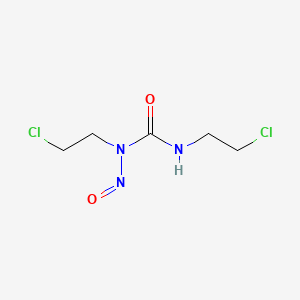
CARMUSTINE


Skeletal formula of carmustinecarmustine.pngChemSpider 2D Image | Carmustine | C5H9Cl2N3O2

CARMUSTINE

Molecular Formula: C5H9Cl2N3O2
Molecular Weight: 214.046 g/mol

CAS 154-93-8

Brain tumor; Hodgkins disease; Multiple myeloma; Non-Hodgkin lymphoma

1,3-bis(2-chloroethyl)-3-nitrosourea

  • Urea, 1,3-bis(2-chloroethyl)-1-nitroso- (8CI)
  • N,N’-Bis(2-chloroethyl)-N-nitrosourea
  • 1,3-Bis(2-chlorethyl)-1-nitrosourea
  • 1,3-Bis(2-chloroethyl)-1-nitrosourea
  • 1,3-Bis(2-chloroethyl)nitrosourea
  • 1,3-Bis(β-chloroethyl)-1-nitrosourea
  • BCNU
  • Becenun
  • BiCNU
  • Carmubris
  • Carmustin
  • Carmustine
  • DTI 015
  • FDA 0345
  • Gliadel
  • Gliadel Wafer
  • NSC 409962
  • Nitrumon
  • SK 27702
  • SRI 1720
  • Title: Carmustine
    CAS Registry Number: 154-93-8
    CAS Name: N,N¢-Bis(2-chloroethyl)-N-nitrosourea
    Additional Names: BCNU
    Manufacturers’ Codes: NSC-409962
    Trademarks: Becenun (BMS); Bicnu (BMS); Carmubris (BMS)
    Molecular Formula: C5H9Cl2N3O2
    Molecular Weight: 214.05
    Percent Composition: C 28.06%, H 4.24%, Cl 33.13%, N 19.63%, O 14.95%
    Literature References: Chloroethylnitrosourea derivative with antitumor activity. Similar to chlorozotocin, lomustine, nimustine, ranimustine, q.q.v. Synthesis: Johnston et al., J. Med. Chem. 6, 669 (1963). Properties: Loo et al., J. Pharm. Sci. 55, 492 (1966). Decompn studies as related to antileukemic activity: Montgomery et al., J. Med. Chem. 10, 668 (1967). Antifungal action: Hunt, Pittilo, Antimicrob. Agents Chemother. 1965, 710. Toxicology studies: Thompson, Larson, Toxicol. Appl. Pharmacol. 21, 405 (1972). Review of pulmonary toxicity: A. C. Smith, Pharmacol. Ther. 41, 443-460 (1989).
    Properties: Light yellow powder that melts to an oily liquid; mp 30-32°. Both powder and liquid are stable. Dec rapidly in acid and in soln above pH 7. Most stable in petroleum ether or aqueous soln at pH 4. Non-ionized at pH 7 with consequent high lipid solubility. Sol in water up to 4 mg/ml and in 50% ethanol up to 150 mg/ml: DeVita et al., Cancer Res. 25, 1876 (1965). LD50 in mice (mg/kg): 19-25 orally, 26 i.p., 24 s.c.; in rats (mg/kg): 30-34 orally (Thompson, Larson).
    Melting point: mp 30-32°
    Toxicity data: LD50 in mice (mg/kg): 19-25 orally, 26 i.p., 24 s.c.; in rats (mg/kg): 30-34 orally (Thompson, Larson)
    CAUTION: This substance is reasonably anticipated to be a human carcinogen: Report on Carcinogens, Eleventh Edition(PB2005-104914, 2004) p III-53.
    Therap-Cat: Antineoplastic.
    Keywords: Antineoplastic; Alkylating Agents; Nitrosoureas.


A cell-cycle phase nonspecific alkylating antineoplastic agent. It is used in the treatment of brain tumors and various other malignant neoplasms. (From Martindale, The Extra Pharmacopoeia, 30th ed, p462) This substance may reasonably be anticipated to be a carcinogen according to the Fourth Annual Report on Carcinogens (NTP 85-002, 1985). (From Merck Index, 11th ed)
It has the appearance of an orange-yellow solid.Carmustine (bis-chloroethylnitrosoureaBCNUBiCNU) is a medication used mainly for chemotherapy and sometimes for immunosuppression before organ transplantation. It is a nitrogen mustard β-chloro-nitrosourea compound used as an alkylating agent. As a dialkylating agent, BCNU is able to form interstrand crosslinks in DNA, which prevents DNA replication and DNA transcription.

Carmustine for injection was earlier marketed under the name BiCNU by Bristol-Myers Squibb[2] and now by Emcure Pharmaceuticals.[3] In India it is sold under various brand names, including Consium.

It is disclosed that carmustine is useful for treating brain tumor, multiple myolema, Hodgkin’s disease and non-Hodgkin’s lymphomas. In September 2017, Newport Premium™ reports that MSN laboratories is potentially interested in carmustine and holds an active US DMF for the drug. Represents new area of patenting to be seen from MSN lab on Carmustine . Supratek was investigating SP-1009C , carmustine formulated in the company’s Biotransport carrier technology, for the potential treatment of glioblastoma. However, no further development has been reported since 2000 , and as of February 2004, SP-1009C was no longer listed on Supratek’s pipeline.

Uses

It is used in the treatment of several types of brain cancer (including gliomaglioblastoma multiformemedulloblastoma and astrocytoma), multiple myeloma and lymphoma (Hodgkin’s and non-Hodgkin). BCNU is sometimes used in conjunction with alkyl guanine transferase (AGT) inhibitors, such as O6-benzylguanine. The AGT-inhibitors increase the efficacy of BCNU by inhibiting the direct reversal pathway of DNA repair, which will prevent formation of the interstrand crosslinkbetween the N1 of guanine and the N3 of cytosine.

It is also used as part of a chemotherapeutic protocol in preparation for hematological stem cell transplantation, a type of bone marrow transplant, in order to reduce the white blood cell count in the recipient (patient). Use under this protocol, usually with Fludarabine and Melphalan, was coined by oncologists at the University of Texas MD Anderson Cancer Center.

Implants

In the treatment of brain tumours, the U.S. Food and Drug Administration (FDA) approved biodegradable discs infused with carmustine (Gliadel).[4] They are implanted under the skull during a surgery called a craniotomy. The disc allows for controlled release of carmustine in the extracellular fluid of the brain, thus eliminating the need for the encapsulated drug to cross the blood-brain barrier.[5]

Image result for synthesis of carmustine

Image result for synthesis of carmustine

Image result for synthesis of carmustine

Image result for synthesis of carmustine

Reference:

Synthesis, , # 11 p. 1027 – 1029

Celaries, Benoit; Parkanyi, Cyril Synthesis, 2006 , # 14 p. 2371 – 2375

PAPER

Pharmaceutical Chemistry Journal, 2001, vol. 35, vol 2, pg. 108 – 111

10.1023/A:1010485224267

PATENT

EP 3214075

EP 902015

CA1082223

US 523334

SYNTHESIS

PATENT

http://www.google.co.in/patents/US4028410

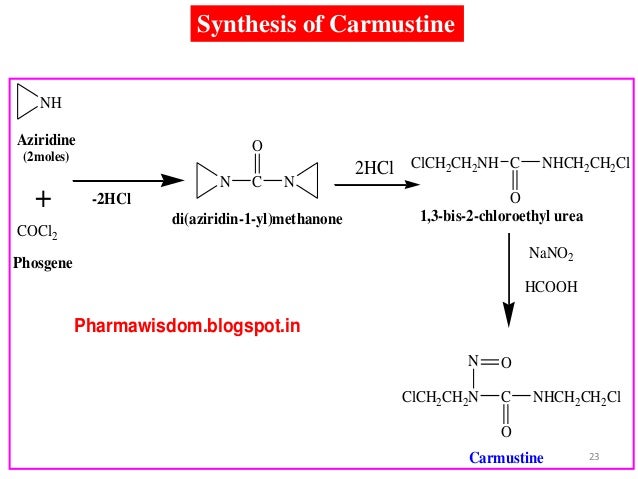
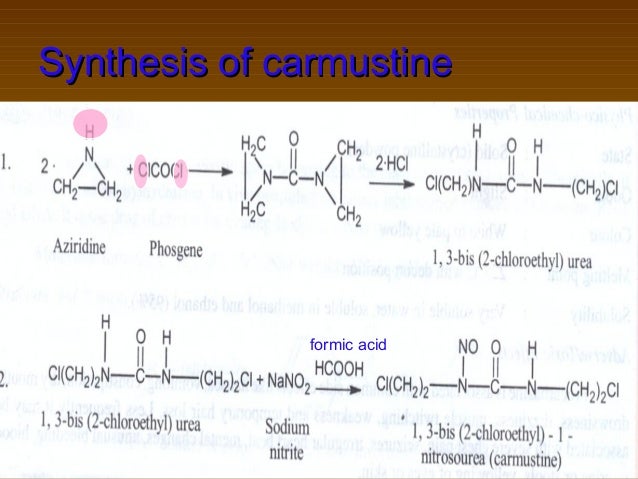
The Urea. This material is used in good grades, preferably CP, and the amount of urea utilized is the base on which the amounts of nitrosating agent are calculated. The starting material 1,3-bis(2-chloroethyl)urea is commercially available and also may be prepared readily from phosgene and ethyleneimine.

Dinitrogen trioxide (N2 O3). Efficacy of reaction has been observed where this nitrosation agent was utilized in preference to the prior use of aqueous NaNO2. It has also been found for stoichiometric reasons that an excess of the nitrosating agent ranging from 10-200% and preferably 10-20% based on urea is necessary to force the reaction to the right and obtain satisfactory completion. Furthermore, it is known from the literature art, Cotton, Advanced Inorganic Chemistry, Interscience, 1972, page 357, that this oxide exists in a pure state only at low temperatures and, therefore, reaction is conducted at nitrosation temperatures of about 0° C. to -20° C.

The Solvent. In contrast to prior art methods, the present reaction is conducted in an organic milieu. The preferred non-aqueous solvent is of the chlorinated variety; i.e., methylene dichloride. Other preferred compounds include related halogenated compounds such as ethylene dichloride, nitro-compounds such as nitromethane, acetonitrile, and simple ethers such as ethyl ether. Other less preferred but operable compounds include esters such as ethyl acetate, simple ketones such as acetone, and chloroform. Solvents to be avoided are olefins, unsaturated ethers and other unsaturated compounds, amines, malonate esters, acid anhydrides, and solvents which would interact with the reactant N2 O3 and the urea as well as the product nitrosourea. In general, the solvent should be low boiling (b.p. less than 120° C. and preferably less than 100° C.).

BCNU 1,3-bis(2-chloroethyl)-1-nitrosourea is one of a group of relatively recent drugs used against cancer and since 1972 has been charted by the National Cancer Institute for utilization against brain tumors, colon cancer, Hodgkins disease, lung cancer, and multiple myeloma. The modus of action of BCNU (NSC 409962) is as an alkylating agent. Such an alkylating agent is injurious to rapidly proliferating cells such as are present in many tumors and this action is known as antineoplastic activity.

EXAMPLE 1 1,3-Bis(2-chloroethyl)-1-nitrosourea

A suspension of 1.11 mmole (0.205 g) of 1,3-bis(2-chloroethyl)urea in 8 ml methylene dichloride at -10° C. was saturated with dinitrogen trioxide in 20% excess of theoretical. The heterogeneous mixture gradually changed to a green homogeneous solution. The methylene dichloride was evaporated, and the residue was extracted with 3× 10 ml hexane. Evaporation of the hexane gave 0.1773 g of oil which was the crude BCNU (NSC 409962). The hexane insoluble portion, 0.0649 g, when treated with benzene, gave 0.020 g of 1,3-bis(2-chloroethyl)urea which was benzene insoluble. The benzene solubles were processed through a silica column (1× 10 cm) and 0.0245 g of crude BCNU was obtained. The combined fractions of crude product amounted to 0.2018 g (85.1%).

In order to evaluate the product, the above crude was recrystallized from hexane to yield a first crop and from this first crop the ir spectrum was identical to that of known BCNU. A tlc (benzene on sillica) gave a single spot Rf 0.35 (blue, 254 mμ).

EXAMPLE 2 Comparative

A cold solution of 0.2346 g (3.4 mmole) sodium nitrite in 2 ml water was slowly added to a stirred solution of 0.2727 g (1.47 mmole) 1,3-bis(2-chloroethyl)urea in 2 ml 88% formic acid at 0°. After 2 hours at 0°, 0.1449 g (46.0%) of an oil solid phase was removed. The ir spectrum of this fraction failed to agree with that of BCNU. After 2 days a small amount of crystalline BCNU slowly formed in this oil phase. A methylene dichloride extract of the aqueous phase yielded 0.0943 g (30.0%) of an amber oil whose ir spectrum agreed with that of a known sample of BCNU. Treatment of this oil with 5 ml hexane and cooling to 0° gave crystalline BCNU which formed an oil on warming to ambient temperature.

EXAMPLE 3

A cold slurry at -15° C. of the 1,3-bis(2-chloroethyl)urea (2.0 mmole) in 8 ml methylene dichloride was treated with a small excess of N2 O3. The 1,3-bis(2-chloroethyl)urea is almost insoluble in the cold methylene dichloride, whereas the BCNU product is quite soluble. Thus, treatment of the urea with the N2 O3 changed the slurry to a homogeneous solution. Evaporation of the methylene dichloride gave a quantitative yield of crude BCNU. Purification by silica column chromatography gave 93.4% yield and recrystallization from benzene-heptane gave 85.2% yield of pure BCNU.

PAPER

Journal of Medicinal Chemistry (1963), 6(6), 669-81.

SPECTROSCOPY

Chloroform-d, Nitrogen-15 NMR Spectrum,  Lown, J. William; Journal of Organic Chemistry 1981, V46(26), P5309-21

1H NMR

Open Babel bond-line chemical structure with annotated hydrogens.<br>Click to toggle size.

<sup>1</sup>H NMR spectrum of C<sub>5</sub>H<sub>9</sub>Cl<sub>2</sub>N<sub>3</sub>O<sub>2</sub> in CDCL3 at 400 MHz.<br>Click to toggle size.

WO-2017154019

https://patentscope.wipo.int/search/en/detail.jsf;jsessionid=103D413664C194D84095110F1084E521.wapp2nA?docId=WO2017154019&recNum=1&maxRec=&office=&prevFilter=&sortOption=&queryString=&tab=PCTDescription

Process for preparing 1,3-bis(2-chloroethyl)-1- nitrosourea (also known as carmustine) and its intermediate 1,3-bis(2-chloroethyl)urea is claimed. Also claimed are composition comprising them and novel crystalline polymorphic form of carmustine.

,3-bis(2-chloroethyl)-l -nitrosourea is known as Carmustine and is approved in USA under the brand names of BICNU for the treatment of chemotherapy of certain neoplastic diseases such as brain tumor, multiple myolema, Hodgkin’s disease and non-Hodgkin’s lymphomas & Gliadel for the treatment of newly-diagnosed high-grade-malignant glioma as an adjunct to surgery and radiation, recurrent glioblastoma multiforme as an adjunct to surgery.

Journal of Medicinal Chemistry 1963, 6, 669-681 firstly disclosed process for the preparation of l,3-bis(2-chloroethyl)-l-nitrosourea.

US2288178 patent disclosed the process for the preparation of the compound of formula-2 from aziridine and phosgene. J. Med. Chem., 1979, 22 (10), pp 1193-1198 disclosed the process for the preparation of the compound of formula-2 using 2-chloroethanamine and 2-chloroisocyanoethane.

Prior disclosed processes for the preparation of the compound of formula-2 are used hazardous reagents which were difficult to handle in the laboratory. The present inventors have developed an improved process for the preparation of the compound of formula-2 by using easily available raw materials and usage of that compound in the preparation of the compound of formula- 1 to get good yield and having high purity.

he present invention is schematically represented in the scheme- 1.

Scheme-1

Examples:

Example-1: Preparation of l,3-bis(2-chloroethyl)urea compound of formula-2

2-chloroethanamine hydrochloride (429.19 gm) was added to the mixture of carbonyldiimidazole (200 gm) and tetrahydrofuran (1000 ml) at 25-30°C and stirred the reaction mixture for 5 minutes. Heated the reaction mixture to 65-70°C and stirred for 14 hours at the same temperature. Cooled the reaction mixture to 25-30°C and water was added to the reaction mixture. Both the organic and aqueous layers were separated and the aqueous layer was extracted with ethyl acetate. Combined the organic layers and washed with aqueous sodium chloride solution. Distilled off the solvent from the organic layer completely under reduced pressure and co-distilled with isopropanol. Isopropanol (100 ml) was added to the obtained compound and stirred the reaction mixture at 25-30°C. Heated the reaction mixture to 80-85°C and stirred the reaction mixture for 10 minutes at the same temperature.

Cooled the reaction mixture to 25-30°C and stirred for 2 hours at the same temperature. Filtered the precipitated solid, washed with isopropanol and dried to get the title compound. Yield: 1 10 gm; M.P: 121-125°C.

Example-2: Preparation of l,3-bis(2-chloroethyl)-l-nitrosourea compound of formula-1 l,3-bis(2-chloroethyl)urea (50 gm) was added to the mixture of dilute hydrochloric acid (16 ml) and acetic acid (205 ml) at 25-30°C. Cooled the reaction mixture to 0-5°C and stirred for 1 hour at the same temperature. Sodium nitrite (46.6 gm) was added to the reaction mixture in lot-wise over the period of 3 hours at 0-5 °C and stirred the reaction mixture for 1 hour at the same temperature. The reaction mixture was quenched into pre-cooled water at 0-5°C and stirred it for 30 minutes at the same temperature. Filtered the precipitated solid and washed with water. Dissolved the obtained compound in dichloromethane (100 ml) at 0-5°C. The reaction mixture was added to pre-cooled n-heptane (250 ml) at 0-5°C and stirred for 1 ½ hour at the same temperature. Filtered the precipitated solid, washed with n-heptane and dried to get the title compound.

Yield: 28 gm.

Example-3: Preparation of l,3-bis(2-chloroethyl)urea compound of formuIa-2

Carbonyldiimidazole (8 kg) was slowly added to the pre-cooled mixture of 2-chloroethanamine hydrochloride (14.31 kg) and tetrahydrofuran (40 lit) at 0-5°C in lot-wise under nitrogen atmosphere and stirred the reaction mixture for 5 minutes. Raised the temperature of the reaction mixture to 25-30°C and stirred the reaction mixture for 36 hours at the same temperature. Distilled off the solvent completely from the reaction mixture under reduced pressure. Water was added to the obtained compound at 25-30°C and stirred it for I hour at the same temperature. Filtered the precipitated solid and washed with water. The obtained compound was slurried in water at 25-30°C, filtered and washed with water. Methanol was added to the obtained compound at 25-30°C and stirred it for 1 hour at the same temperature. Filtered the solid, washed with methanol and dried to get the title compound. Yield: 6 kg; PXRD of the obtained compound is shown in figure-3.

Example-4: Preparation of l,3-bis(2-ch!oroethyl)-l-nitrosourea compound of formula-1 l,3-bis(2-chloroethyl)urea (6 kg) was added to the mixture of dilute hydrochloric acid (1.9 lit) and acetic acid (24.5 lit) at 25-30°C. Cooled the reaction mixture to 0-5°C, sodium nitrite (5.59 kg) was slowly added to the reaction mixture in lot-wise at 0-5°C and stirred the reaction mixture for 1 hour at the same temperature. The reaction mixture was quenched with pre-cooled water at 0-5°C. Cooled the reaction mixture to -15 to -10°C and stirred it for 1 hour at the same temperature. Filtered the precipitated solid and washed with water. Dissolved the obtained compound in dichloromethane (24 lit) at 5-10°C and stirred for 15 minutes at the same temperature. Both the organic and aqueous layers were separated. Silicagel (3 kg) was added to the organic layer at 5-10°C and stirred for 25 minutes at the same temperature. Filtered the reaction mixture through hyflow bed and washed with dichloromethane. Distilled off the solvent completely from the filtrate under reduced pressure and co-distilled with methyl tertiary butyl ether. Pre-cooled Methyl tertiary butyl ether (12 lit) was added to the obtained compound and stirred it for at 0-5°C. This reaction mixture was added to pre-cooled n-heptane (60 lit) at -15 to -10°C and stirred the reaction mixture for 1 hour at the same temperature. Filtered the precipitated solid and washed with chilled n-heptane. Dried the compound at 0-10°C under reduced pressure.

Yield: 4.5 kg; MR: 30-32°C;

Purity by HPLC: 99.97%; Impurity at RRT -0.08: 0.01%, Impurity at RRT -0.13: Not detected; l,3-bis(2-chloroethyl)urea: 0.02%

PXRD of the obtained compound is shown in figure- 1 and IR shown in figure-2.

Example-5: Preparation of l,3-bis(2-chloroethyl)-l-nitrosourea compound of formula-1 l,3-bis(2-chloroethyl)urea (150 gm) was added to the mixture of dilute hydrochloric acid (48 ml) and acetic acid (612 ml) at 25-30°C. Cooled the reaction mixture to 0-5°C, sodium nitrite (139.8 gm) was slowly added to the reaction mixture in lot-wise at 0-5°C and stirred the reaction mixture for 1 hour at the same temperature. The reaction mixture was quenched with pre-cooled water at 0-5°C. Cooled the reaction mixture to -15 to -10°C and stirred it for 1 hour at the same temperature. Filtered the precipitated solid and washed with water.

Purity by HPLC: 95.1 1%, Impurity at RRT -0.08: 4.17%, Impurity at RRT -0.13: 0.63%.

Example 6: Purification of l,3-bis(2-chloroethyl)-l-nitrosourea compound of formula-1

Dissolved the compound of formula 1 obtained in example-5 in dichloromethane (600 ml) at 5-10°C and stirred for 15 minutes at the same temperature. Both the organic and aqueous layers were separated. Silicagel (75 gm) was added to the organic layer at 5-10°C and stirred for 25 minutes at the same temperature. Filtered the reaction mixture through hyflow bed and washed with dichloromethane. Distilled off the solvent completely from the filtrate under reduced pressure and co-distilled with methyl tertiary butyl ether. Pre-cooled Methyl tertiary butyl ether (300 ml) was added to the obtained compound and stirred it for 10-15 min at 0-5°C. This reaction mixture was added to pre-cooled n-heptane (1500 ml) at -15 to -10°C and stirred the reaction mixture for 1 hour at the same temperature. Filtered the precipitated solid and washed with chilled n-heptane. Dried the compound at 0-10°C under reduced pressure. Yield: HO gm; MR: 30-32°C;

Purity by HPLC: 99.96%, Impurity at RRT -0.08: 0.02%, Impurity at RRT -0.13: Not detected; l,3-bis(2-chloroethyl)urea: 0.02%

References

External links

  1.  Lown, J. William; Journal of Organic Chemistry 1981, V46(26), P5309-21 
  2.  Barcelo, Gerard; Synthesis 1987, (11), P1027-9 
  3.  Barcelo, Gerard; FR 2589860 A1 1987 
  4.  “Drugs – Synonyms and Properties” data were obtained from Ashgate Publishing Co. (US) 
  5.  Xu, Longji; International Journal of Pharmaceutics 2008, V355(1-2), P249-258 
  6.  Xu, Xiuling; Journal of Controlled Release 2006, V114(3), P307-316 
  7.  Lown, J. William; Journal of Organic Chemistry 1982, V47(5), P851-6 
  8. “PhysProp” data were obtained from Syracuse Research Corporation of Syracuse, New York (US)
US3465025 * 17 Nov 1966 2 Sep 1969 Allied Chem Process for the preparation of isocyanates
Reference
1 * Johnston et al., J. Med. Chem., vol, 18, No. 1, 1975, pp. 104-106.
2 * Montero et al., C. R. Acad. Sc. Paris, t. 279, Series C, 1974, pp. 809-811.
3 * Ryan et al., CA 17: 1792-1793 (1923).
Citing Patent Filing date Publication date Applicant Title
US4335247 * 23 Feb 1981 15 Jun 1982 Kowa Co., Ltd. Novel nitrosourea derivatives and process for their production
US4452814 * 12 Jan 1982 5 Jun 1984 Suami T Nitrosourea derivatives
US6096923 * 11 Sep 1998 1 Aug 2000 Johnson Matthey Public Limited Company Process for the preparation of nitrosourea compounds
US20040072889 * 16 Apr 2003 15 Apr 2004 Pharmacia Corporation Method of using a COX-2 inhibitor and an alkylating-type antineoplastic agent as a combination therapy in the treatment of neoplasia
US20070196277 * 22 Jan 2007 23 Aug 2007 Levin Victor A Compositions and Methods for the Direct Therapy of Tumors
EP0902015A1 * 13 Aug 1998 17 Mar 1999 Johnson Matthey Public Limited Company Process for the preparation of nitrosourea compounds
Carmustine
Skeletal formula of carmustine
Ball-and-stick model of carmustine molecule
Names
IUPAC name

1,3-Bis(2-chloroethyl)-1-nitrosourea[1]
Other names

N,N’-Bis(2-chloroethyl)-N-nitrosourea
Identifiers
3D model (JSmol)
ChEBI
ChemSpider
DrugBank
ECHA InfoCard 100.005.309
EC Number 205-838-2
KEGG
MeSH Carmustine
PubChem CID
RTECS number YS2625000
UNII
UN number 2811
Properties
C5H9Cl2N3O2
Molar mass 214.05 g·mol−1
Appearance Orange crystals
Odor Odourless
Melting point 30 °C (86 °F; 303 K)
log P 1.375
Acidity (pKa) 10.194
Basicity (pKb) 3.803
Pharmacology
L01AD01 (WHO)
Hazards
GHS pictograms The skull-and-crossbones pictogram in the Globally Harmonized System of Classification and Labelling of Chemicals (GHS) The health hazard pictogram in the Globally Harmonized System of Classification and Labelling of Chemicals (GHS)
GHS signal word DANGER
H300H350H360
P301+310P308+313
Lethal dose or concentration (LDLC):
LD50 (median dose)
20 mg kg−1 (oral, rat)
Related compounds
Related ureas
Dimethylurea
Related compounds
Except where otherwise noted, data are given for materials in their standa

/////////////

ClCCNC(=O)N(CCCl)N=O

Funapide, TV 45070, XEN-402, фунапид فونابيد 呋纳匹特


Image result for TV 450702D chemical structure of 1259933-16-8

ChemSpider 2D Image | Funapide | C22H14F3NO5Funapide.png

Funapide TV 45070,  XEN-402,  Funapide, (+)-

фунапид
فونابيد
呋纳匹特
  • Molecular FormulaC22H14F3NO5
  • Average mass429.345 Da

(S)-1′-[(5-Methyl-2-furyl)methyl]spiro[6H-furo[3,2-f][1,3]benzodioxole-7,3′-indoline]-2′-one

Spiro(furo(2,3-F)-1,3-benzodioxole-7(6H),3′-(3H)indol)-2′(1’H)-one, 1′-((5-(trifluoromethyl)-2-furanyl)methyl)-, (3’S)-

(3’S)-1′-((5-(Trifluoromethyl)furan-2-yl)methyl)-2H,6H-spiro(furo(2,3-F)(1,3)benzodioxole-7,3′-indol)-2′(1’H)-one

Spiro[furo[2,3-f]-1,3-benzodioxole-7(6H),3′-[3H]indol]-2′(1’H)-one, 1′-[[5-(trifluoromethyl)-2-furanyl]methyl]-, (7S)-
TV-45070
UNII-A5595LHJ2L
XEN-401-S
XEN402
(3’S)-1′-{[5-(trifluoromethyl)furan-2-yl]methyl}-2H-6H-spiro[furo[2,3-f]-1,3-benzodioxole-7,3′-indol]-2′(1’H)-one
(7S)-1′-{[5-(Trifluoromethyl)-2-furyl]methyl}spiro[furo[2,3-f][1,3]benzodioxole-7,3′-indol]-2′(1’H)-one
1259933-16-8 CAS
UNII-A5595LHJ2L

Phase II clinical trials for Postherpetic neuralgia (PHN)

Treatment of Neuropathic Pain

  • Originator Xenon Pharmaceuticals
  • Developer Teva Pharmaceutical Industries; Xenon Pharmaceuticals
  • Class Benzodioxoles; Fluorobenzenes; Furans; Indoles; Non-opioid analgesics; Small molecules; Spiro compounds
  • Mechanism of Action Nav1.7-voltage-gated-sodium-channel-inhibitors; Nav1.8 voltage-gated sodium channel inhibitors
  • Orphan Drug Status Yes – Erythromelalgia

Highest Development Phases

  • Phase II Erythromelalgia; Postherpetic neuralgia
  • No development reported Dental pain; Pain
  • Discontinued Musculoskeletal pain

Most Recent Events

  • 09 May 2017 Teva Pharmaceutical Industries completes a phase IIb trial for Postherpetic neuralgia in USA (Topical) (NCT02365636)
  • 26 Sep 2016 Adverse events data from a phase II trial in Musculoskeletal pain presented at the 16th World Congress on Pain (PAN – 2016)
  • 19 Aug 2015 No recent reports of development identified – Phase-I for Pain (In volunteers) in Canada (PO)

MP 100 – 102 DEG CENT EP2538919

S ROT  ALPHA 0.99 g/100ml, dimethyl sulfoxide, 14.04, US 20110087027

Funapide (INN) (former developmental code names TV-45070 and XEN402) is a novel analgesic under development by Xenon Pharmaceuticals in partnership with Teva Pharmaceutical Industries for the treatment of a variety of chronic pain conditions, including osteoarthritisneuropathic painpostherpetic neuralgia, and erythromelalgia, as well as dental pain.[1][2][3][4] It acts as a small-moleculeNav1.7 and Nav1.8 voltage-gated sodium channel blocker.[1][2][4] Funapide is being evaluated in humans in both oral and topicalformulations, and as of July 2014, has reached phase IIb clinical trials.[1][3]

Image result for TV 45070

Sodium channels play a diverse set of roles in maintaining normal and pathological states, including the long recognized role that voltage gated sodium channels play in the generation of abnormal neuronal activity and neuropathic or pathological pain. Damage to peripheral nerves following trauma or disease can result in changes to sodium channel activity and the development of abnormal afferent activity including ectopic discharges from axotomised afferents and spontaneous activity of sensitized intact nociceptors. These changes can produce long-lasting abnormal hypersensitivity to normally innocuous stimuli, or allodynia. Examples of neuropathic pain include, but are not limited to, post-herpetic neuralgia, trigeminal neuralgia, diabetic neuropathy, chronic lower back pain, phantom limb pain, and pain resulting from cancer and chemotherapy, chronic pelvic pain, complex regional pain syndrome and related neuralgias.

There have been some advances in treating neuropathic pain symptoms by using medications, such as gabapentin, and more recently pregabalin, as short-term, first-line treatments. However, pharmacotherapy for neuropathic pain has generally had limited success with little response to commonly used pain reducing drugs, such as NSAIDS and opiates. Consequently, there is still a considerable need to explore novel treatment modalities.

There remain a limited number of potent effective sodium channel blockers with a minimum of adverse events in the clinic. There is also an unmet medical need to treat neuropathic pain and other sodium channel associated pathological states effectively and without adverse side effects. PCT Published Patent Application No. WO 2006/110917, PCT Published Patent Application No. WO 2010/045251 , PCT Published Patent Application No. WO 2010/045197, PCT Published Patent Application No. WO 2011/047174 and PCT Published Patent Application No. WO 2011/002708 discloses certain spiro-oxindole compounds. These compounds are disclosed therein as being useful for the treatment of sodium channel-mediated diseases, preferably diseases related to pain, central nervous conditions such as epilepsy, anxiety, depression and bipolar disease;

cardiovascular conditions such as arrhythmias, atrial fibrillation and ventricular fibrillation; neuromuscular conditions such as restless leg syndrome; neuroprotection against stroke, neural trauma and multiple sclerosis; and channelopathies such as erythromelalgia and familial rectal pain syndrome.

Methods of preparing these compounds and pharmaceutical compositions containing them are also disclosed in PCT Published Patent Application No. WO 2006/110917, PCT Published Patent Application No. WO 2010/045251 , PCT

Published Patent Application No. WO 2010/045197, PCT Published Patent Application No. WO 2011/047174 and PCT Published Patent Application No. WO 2011/002708.

Postherpetic neuralgia (PHN) is a rare disorder that is defined as significant pain or abnormal sensation 120 days or more after the presence of the initial rash caused by shingles. This pain persists after the healing of the associated rash. Generally, this affliction occurs in older individuals and individuals suffering from immunosuppression. There are about one million cases of shingles in the US per year, of which 10–20% will result in PHN.
Topical analgesics such as lidocaine and capsaicin are traditionally used to treat this disorder. Both lidocaine and TV-45070 have a mechanism of action that involves the inhibition of voltage-gated sodium ion channels.
TV-45070 (formerly XEN-402) was in-licensed by Teva from Xenon Pharmaceuticals and is reported to be an antagonist of the Nav1.7 sodium ion channel protein.
It is currently in Phase II clinical trials for PHN. Interestingly, the loss of function of the Nav1.7 sodium ion channel was reported to result in the inability to experience pain as a hereditary trait in certain individuals.
Primary erythromelalgia is another rare disease where alterations in Nav1.7 or mutations in the corresponding encoding gene SCN9A have been reported to result in chronic burning pain that can last for hours or even days. Thus, compounds which regulate this protein have potential therapeutic value as analgesics for chronic pain.
Image result for XENON PHARMA
PATENT
US 20100331386
WO 2011106729
US 20110087027
US 20110086899
US 20130143941
US 20130210884
WO 2013154712
 US 20150216794
WO 2016127068
WO 2016109795
CN 106518886
US 20170239183
SYNTHESIS
WO 2013154712
 CONTD…….
Synthesis
CN 106518886
PATENT
US 20100331386
Preparation of the (S)-Enantiomer of the Invention
The (S)-enantiomer of the invention and the corresponding (R)-enantiomer are prepared by the resolution of the compound of formula (I), as set forth above in the Summary of the Invention, using either chiral high pressure liquid chromatography methods or by simulated moving bed chromatography methods, as described below in the following Reaction Scheme wherein “chiral HPLC” refers to chiral high pressure liquid chromatography and “SMB” refers to simulated moving bed chromatography:
Figure US20100331386A1-20101230-C00006
The compound of formula (I) can be prepared by the methods disclosed in PCT Published Patent Application No. WO 2006/110917, by methods disclosed herein, or by methods known to one skilled in the art.
One of ordinary skill in the art would recognize variations in the above Reaction Scheme which are appropriate for the resolution of the individual enantiomers.
Alternatively, the (S)-enantiomer of formula (I-S) and the (R)-enantiomer of formula (I-R), can be synthesized from starting materials which are known or readily prepared using process analogous to those which are known.
Preferably, the (S)-enantiomer of the invention obtained by the resolution methods disclosed herein is substantially free of the (R)-enantiomer or contains only traces of the (R)-enantiomer.
The following Synthetic Examples serve to illustrate the resolution methods disclosed by the above Reaction Schemes and are not intended to limit the scope of the invention.
Synthetic Example 1Synthesis of 1-{[5-(trifluoromethyl)furan-2-yl]methyl}spiro[furo[2,3-f][1,3]benzodioxole-7,3′-indol]-2′(1′H)-one (Compound of formula (I))
Figure US20100331386A1-20101230-C00007
To a suspension of spiro[furo[2,3-f][1,3]benzodioxole-7,3′-indol]-2′(1′H)-one (1.0 g, 3.6 mmol), which can be prepared according to the methods disclosed in PCT Published Patent Application No. WO 2006/110917, and cesium carbonate (3.52 g, 11 mmol) in acetone (50 mL) was added 2-bromomethyl-5-trifluoromethylfuran (1.13 g, 3.9 mmol) in one portion and the reaction mixture was stirred at 55-60° C. for 16 hours. Upon cooling to ambient temperature, the reaction mixture was filtered and the filtrate was evaporated under reduced pressure. The residue was subjected to column chromatography, eluting with ethyl acetate/hexane (1/9-1/1) to afford 1′-{[5-(trifluoromethyl)furan-2-yl]methyl}spiro[furo[2,3-f][1,3]benzodioxole-7,3′-indol]-2′(1 ′H)-one, i.e., the compound of formula (I), (1.17 g, 76%) as a white solid: mp 139-141° C.;
1H NMR (300 MHz, CDCl3) δ 7.32-6.97 (m, 5H), 6.72 (d, J=3.3 Hz, 1H), 6.66 (s, 1H), 6.07 (s, 1H), 5.90-5.88 (m, 2H), 5.05, 4.86 (ABq, JAB=16.1 Hz, 2H), 4.91 (d, J=9.0 Hz, 1H), 4.66 (d, J=9.0 Hz, 1H); 13C NMR (75 MHz, CDCl3) δ 176.9, 155.7, 153.5, 148.8, 142.2, 141.9, 140.8, 140.2, 139.7, 139.1, 132.1, 129.2, 124.7, 124.1, 123.7, 121.1, 120.1, 117.6, 114.5, 114.4, 110.3, 109.7, 103.0, 101.9, 93.8, 80.0, 57.8, 36.9;
MS (ES+) m/z 430.2 (M+1), 452.2 (M+23); Cal’d for C22H14F3NO5: C, 61.54%; H, 3.29%; N, 3.26%; Found: C, 61.51%; H, 3.29%; N, 3.26%.
Synthetic Example 2Resolution of Compound of Formula (I) by Chiral HPLC
The compound of formula (I) was resolved into the (S)-enantiomer of the invention and the corresponding (R)-enantiomer by chiral HPLC under the following conditions:

Column: Chiralcel® OJ-RH; 20 mm I.D.×250 mm, 5 mic; Lot: OJRH CJ-EH001 (Daicel Chemical Industries, Ltd)

Eluent: Acetonitrile/Water (60/40, v/v, isocratic)

Flow rate: 10 mL/min

Run time: 60 min

Loading: 100 mg of compound of formula (I) in 1 mL of acetonitrileTemperature: Ambient

Under the above chiral HPLC conditions, the (R)-enantiomer of the compound of formula (I), i.e., (R)-1′-{[5-(trifluoromethyl)furan-2-yl]methyl}spiro[furo[2,3-f][1,3]-benzodioxole-7,3′-indol]-2′(1′H)-one, was isolated as the first fraction as a white solid; ee (enantiomeric excess)>99% (analytical OJ-RH, 55% acetonitrile in water); mp 103-105° C.; 1H NMR (300 MHz, DMSO-d6) δ 7.32-6.99 (m, 5H), 6.71 (d, J=3.4 Hz, 1H), 6.67 (s, 1H), 6.05 (s, 1H), 5.89 (d, J=6.2 Hz, 2H), 5.13, 5.02 (ABq, JAB=16.4 Hz, 2H), 4.82, 4.72 (ABq, JAB=9.4 Hz, 2H); 13C NMR (75 MHz, CDCl3) δ 177.2, 155.9, 152.0, 149.0, 142.4, 142.0, 141.3, 132.0, 129.1, 123.9, 120.6, 119.2, 117.0, 112.6, 109.3, 108.9, 103.0, 101.6, 93.5, 80.3, 58.2, 36.9; MS (ES+) m/z 430.2 (M+1), [α]D−17.46° (c 0.99, DMSO).

The (S)-enantiomer of the compound of formula (I), i.e., (S)-1′-{[5-(trifluoromethypfuran-2-yl]methyl}spiro-[furo[2,3-f][1,3]benzodioxole-7,3′-indol]-2′(1′H)-one was isolated as the second fraction as a white solid; ee >99% (analytical OJ-RH, 55% acetonitrile in water); mp 100-102° C.; 1H NMR (300 MHz, DMSO-d6) δ 7.32-6.99 (m, 5H), 6.71 (d, J=3.4 Hz, 1H), 6.67 (s, 1H), 6.05 (s, 1H), 5.89 (d, J=6.3 Hz, 2H), 5.12, 5.02 (ABq, JAB=16.4 Hz, 2H), 4.82, 4.72 (ABq, JAB=9.4 Hz, 2H); 13C NMR (75MHz, CDCl3) δ 177.2, 155.9, 152.0, 149.0, 142.4, 142.0, 141.3, 132.0, 129.1, 123.9, 120.6, 119.2, 117.0, 112.6, 109.3, 108.9, 103.0, 101.6, 93.5, 80.3, 58.2, 36.9; MS (ES+) m/z 430.2 (M+1), [α]D+14.04° (c 0.99, DMSO)

Synthetic Example 3Resolution of Compound of Formula (I) by SMB Chromatography

The compound of formula (I) was resolved into the (S)-enantiomer of the invention and the corresponding (R)-enantiomer by SMB chromatography under the following conditions:

Extract: 147.05 mL/min, Raffinate: 76.13 mL/min Eluent: 183.18 mL/min Feed: 40 mL/min Recycling: 407.88 mL/min Run Time: 0.57 min Temperature: 25° C. Pressure: 46 bar

The feed solution (25 g of compound of formula (I) in 1.0 L of mobile phase (25:75:0.1 (v:v:v) mixture of acetonitrile/methanol/trifluoroacetic acid)) was injected continuously into the SMB system (Novasep Licosep Lab Unit), which was equipped with eight identical columns in 2-2-2-2 configuration containing 110 g (per column, 9.6 cm, 4.8 cm I.D.) of ChiralPAK-AD as stationary phase. The first eluting enantiomer (the (R)-enantiomer of the compound of formula (I)) was contained in the raffinate stream and the second eluting enantiomer (the (S)-enantiomer of the compound of formula (I)) was contained in the extract stream. The characterization data of the (S)-enantiomer and the (R)-enantiomer obtained from the SMB resolution were identical to those obtained above utilizing chiral HPLC.

The compound of formula (I) was resolved into its constituent enantiomers on a Waters preparative LCMS autopurification system. The first-eluting enantiomer from the chiral column was brominated (at a site well-removed from the stereogenic centre) to give the corresponding 5′-bromo derivative, which was subsequently crystallized to generate a single crystal suitable for X-ray crystallography. The crystal structure of this brominated derivative of the first-eluting enantiomer was obtained and its absolute configuration was found to be the same as the (R)-enantiomer of the invention. Hence, the second-eluting enantiomer from the chiral column is the (S)-enantiomer of the invention. Moreover, the material obtained from the extract stream of the SMB resolution had a specific optical rotation of the same sign (positive, i.e. dextrorotatory) as that of the material obtained from the aforementioned LC resolution.

Patent

WO 2013154712

EXAMPLE 8

Synthesis of (7S)-1 ‘-{[5-(trifluoromethyl)furan-2- yllmethylJspirotfurop.S-flll .Sl enzoclioxole-y.S’-indoll-Zil ‘Wi-one

Compound of formula (ia1 )

Figure imgf000095_0001

To a cooled (0 °C) solution of (3S)-3-(6-hydroxy-1 ,3-benzodioxol-5-yl)-3- (hydroxymethyl)-1-{[5-(trifluoromethyl)furan-2-yl]methyl}-1 ,3-dihydro-2H-indol-2-one prepared according to the procedure described in Example 7 (16.4 mmol) and 2- (diphenylphosphino)pyridine (5.2 g, 20 mmol) in anhydrous tetrahydrofuran (170 mL) was added di-ferf-butylazodicarboxylate (4.5 g, 20 mmol). The mixture was stirred for 2 h at 0 °C, then the reaction was diluted with ethyl acetate (170 mL), washed with 3 N hydrochloric acid (7 x 50 mL) and brine (2 x 100 mL), dried over anhydrous sodium sulfate, filtered and concentrated in vacuo. The residue was dissolved in ethanol (80 mL), decolorizing charcoal (15 g) was added and the mixture was heated at reflux for 1 h. The mixture was filtered while hot through a pad of diatomaceous earth. The filtrate was concentrated in vacuo and the residue triturated in a mixture of diethyl ether/hexanes to afford (7S)-1 ‘-{[5-(trifluoromethyl)furan-2-yl]methyl}spiro- [furo[2,3-/][1 ,3]benzodioxole-7,3’-indol]-2′(1 ‘H)-one (1.30 g) as a colorless solid in 18% yield. The mother liquor from the trituration was concentrated in vacuo, trifluoroacetic acid (20 mL) was added and the mixture stirred for 3 h at ambient temperature. The mixture was diluted with ethyl acetate (100 mL), washed with saturated aqueous ammonium chloride (100 mL), 3 N hydrochloric acid (4 x 60 mL) and brine (2 x 100 mL), dried over anhydrous sodium sulfate, filtered and concentrated in vacuo. The residue was purified by column chromatography, eluting with a gradient of ethyl acetate in hexanes to afford further (7S)-1 ‘-{[5-(trifluoromethyl)furan-2-yl]methyl}spiro- [furo[2,3- ][1 ,3]benzodioxole-7,3’-indol]-2′(1 ‘H)-one (2.6 g) as a colorless solid (37% yield, overall yield 55% over 2 steps): H NMR (300 MHz, CDCI3) £7.29-6.96 (m, 4H), 6.73 (s, 1 H), 6.50 (s, 1 H), 6.38 (s, 1 H), 6.09 (s, 1 H), 5.85 (br s, 2H), 5.06 (d, J = 16.0 Hz, 1 H), 4.93-4.84 (m, 2H), 4.68-4.65 (m, 1 H); MS (ES+) m/z 429.8 (M + 1 ); ee (enantiomeric excess) >99.5% (HPLC, Chiralpak IA, 2.5% acetonitrile in methyl tert- butyl ether).

EXAMPLE 9

Synthesis of 1-(diphenylmethyl)-1 H-indole-2,3-dione

Compound of formula (15a)

Figure imgf000096_0001

A. To a suspension of hexanes-washed sodium hydride (34.0 g, 849 mmol) in anhydrous Λ/,/V-dimethylformamide (400 mL) at 0 °C was added a solution of isatin (99.8 g, 678 mmol) in anhydrous Λ/,/V-dimethylformamide (400 mL) dropwise over 30 minutes. The reaction mixture was stirred for 1 h at 0 °C and a solution of benzhydryl bromide (185 g, 745 mmol) in anhydrous N-dimethylformamide (100 mL) was added dropwise over 5 minutes. The reaction mixture was allowed to warm to ambient temperature, stirred for 16 h and heated at 60 °C for 2 h. The mixture was cooled to 0 °C and water (500 mL) was added. The mixture was poured into water (2 L), causing a precipitate to be deposited. The solid was collected by suction filtration and washed with water (2000 mL) to afford 1-(diphenylmethyl)-1H-indole-2,3- dione (164 g) as an orange solid in 77% yield.

B. Alternatively, to a mixture of isatin (40.0 g, 272 mmol), cesium carbonate (177 g, 543 mmol) and A/./V-dimethylformamide (270 mL) at 80 °C was added dropwise a solution of benzhydryl bromide (149 g, 544 mmol) in N,N- dimethyiformamide (200 mL) over 30 minutes. The reaction mixture was heated at 80 °C for 3 h, allowed to cool to ambient temperature and filtered through a pad of diatomaceous earth. The pad was rinsed with ethyl acetate (1000 mL). The filtrate was washed with saturated aqueous ammonium chloride (4 x 200 mL), 1 N

hydrochloric acid (200 mL) and brine (4 x 200 mL), dried over anhydrous sodium sulfate, filtered and concentrated in vacuo. The residue was triturated with diethyl ether to afford 1 -(diphenylmethyl)-1 H-indole-2,3-dione (59.1 g) as an orange solid in 69% yield. The mother liquor from the trituration was concentrated in vacuo and the residue triturated in diethyl ether to afford a further portion of 1-(diphenylmethyl)-1 H- indole-2,3-dione (8.2 g) in 10% yield: 1H NMR (300 MHz, CDCI3) £7.60 (d, J = 7.4 Hz, 1 H), 7.34-7.24 (m, 1 1 H), 7.05-6.97 (m, 2H), 6.48 (d, J = 8.0 Hz, 1 H); MS (ES+) m/z 313.9 (M + 1 ).

C. Alternatively, a mixture of isatin (500 g, 3.4 mol) and anhydrous N,N- dimethylformamide (3.5 L) was stirred at 15-35 °C for 0.5 h. Cesium carbonate (2.2 kg, 6.8 mol) was added and the mixture stirred at 55-60 °C for 1 h. A solution of benzhydryl bromide (1.26 kg, 5.1 mol) in anhydrous N, A/-dimethylformamide (1.5 L) was added and the resultant mixture stirred at 80-85 °C for 1 h, allowed to cool to ambient temperature and filtered. The filter cake was washed with ethyl acetate (12.5 L). To the combined filtrate and washes was added 1 N hydrochloric acid (5 L). The phases were separated and the aqueous phase was extracted with ethyl acetate (2.5 L). The combined organic extracts were washed with 1 N hydrochloric acid (2 * 2.5 L) and brine (3 χ 2.5 L) and concentrated in vacuo to a volume of approximately 750 mL. Methyl ferf-butyl ether (2 L) was added and the mixture was cooled to 5-15 °C, causing a solid to be deposited. The solid was collected by filtration, washed with methyl ferf- butyl ether (250 mL) and dried in vacuo at 50-55 °C for 16 h to afford 1- (diphenylmethyl)-1 H-indole-2,3-dione (715 g) as an orange solid in 67% yield: 1H NMR (300 MHz, CDCI3) 7.60 (d, J = 7.4 Hz, H), 7.34-7.24 (m, 1 H), 7.05-6.97 (m, 2H), 6.48 (d, J = 8.0 Hz, 1 H); MS (ES+) m/z 313.9 (M + 1 ).

EXAMPLE 10

Synthesis of 1-(diphenylmethyl)-3-hydroxy-3-(6-hydroxy-1 ,3-benzodioxol-5-yl)-1 ,3- dihydro-2H-indol-2-one

Compound of formula (16a1 )

Figure imgf000097_0001

A. To a solution of sesamol (33.1 g, 239 mmol) in anhydrous

tetrahydrofuran (500 mL) at 0 °C was added dropwise a 2 M solution of

isopropylmagnesium chloride in tetrahydrofuran (104 mL, 208 mmol), followed by 1 – (diphenylmethyl)-1H-indole-2,3-dione (50.0 g, 160 mmol) and tetrahydrofuran (100 mL). The reaction mixture was stirred at ambient temperature for 5 h, diluted with ethyl acetate (1500 mL), washed with saturated aqueous ammonium chloride (400 mL) and brine (2 x 400 mL), dried over anhydrous sodium sulfate, filtered and concentrated in vacuo. The residue was triturated with a mixture of diethyl ether and hexanes to afford 1- (diphenylmethyl)-3-hydroxy-3-(6-hydroxy-1 ,3-benzodioxol-5-yl)-1 ,3-dihydro-2H-in

2- one (70.7 g) as a colorless solid in 98% yield: 1H NMR (300 MHz, CDCI3) <59.12 (br s, 1 H), 7.45-7.43 (m, 1 H), 7.30-7.22 (m, 10H), 7.09-7.07 (m, 2H), 6.89 (s, 1 H), 6.56- 6.55 (m, 1 H), 6.47-6.46 (m, 1 H), 6.29-6.28 (m, 1 H), 5.86 (s, 2H), 4.52 (br s, 1 H); MS (ES+) m/z 433.7 (M – 17).

B. Alternatviely, a mixture of sesamol (0.99 kg, 7.2 mol) and anhydrous tetrahydrofuran (18 L) was stirred at 15-35 °C for 0.5 h and cooled to -5-0 °C.

Isopropyl magnesium chloride (2.0 M solution in tetrahydrofuran, 3.1 L, 6.2 mol) was added, followed by 1-(diphenylmethyl)-1 H-indole-2,3-dione (1.50 kg, 4.8 mol) and further anhydrous tetrahydrofuran (3 L). The mixture was stirred at 15-25 °C for 5 h. Ethyl acetate (45 L) and saturated aqueous ammonium chloride (15 L) were added. The mixture was stirred at 15-25 °C for 0.5 h and was allowed to settle for 0.5 h. The phases were separated and the organic phase was washed with brine (2.3 L) and concentrated in vacuo to a volume of approximately 4 L. Methyl ferf-butyl ether (9 L) was added and the mixture concentrated in vacuo to a volume of approximately 4 L. Heptane (6 L) was added and the mixture was stirred at 15-25 °C for 2 h, causing a solid to be deposited. The solid was collected by filtration, washed with methyl tert- butyl ether (0.3 L) and dried in vacuo at 50-55 °C for 7 h to afford 1-(diphenylmethyl)-3- hydroxy-3-(6-hydroxy-1 ,3-benzodioxol-5-yl)-1 ,3-dihydro-2H-indol-2-one (2.12 kg) as an off-white solid in 98% yield: 1H NMR (300 MHz, CDCI3) 9.12 (br s, 1 H), 7.45-7.43 (m, 1 H), 7.30-7.22 (m, 10H), 7.09-7.07 (m, 2H), 6.89 (s, 1 H), 6.56-6.55 (m, 1 H), 6.47-6.46 (m, 1 H), 6.29-6.28 (m, 1 H), 5.86 (s, 2H), 4.52 (br s, 1 H); MS (ES+) m/z 433.7 (M – 17).

EXAMPLE 1 1

Synthesis of 3-[6-(benzyloxy)-1 ,3-benzodioxol-5-yl]-1-(diphenylmethyl)-3-hydroxy-1 ,3- dihydro-2H-indol-2-one

Compound of formula (17a1)

Figure imgf000098_0001

A. A mixture of 1-(diphenylmethyl)-3-hydroxy-3-(6-hydroxy-1 ,3- benzodioxol-5-yl)-1 ,3-dihydro-2H-indol-2-one (30.0 g, 66.5 mmol), benzyl bromide (8.3 mL, 70 mmol), and potassium carbonate (18.4 g, 133 mmol) in anhydrous N,N- dimeihylformamide (100 mL) was stirred at ambient temperature for 16 h. The reaction mixture was filtered and the solid was washed with /V,A/-dimethylformamide (100 mL). The filtrate was poured into water (1000 mL) and the resulting precipitate was collected by suction filtration and washed with water to afford 3-[6-(benzyloxy)-1 ,3-benzodioxol- 5-yl]-1-(diphenylmethyl)-3-hydroxy-1 ,3-dihydro-2H-indol-2-one (32.0 g) as a beige solid in 83% yield: 1H NMR (300 MHz, CDCI3) 7.42-7.28 (m, 9H), 7.22-7.14 (m, 6H), 7.10- 6.93 (m, 3H), 6.89-6.87 (m, 2H), 6.53 (d, J = 7.6 Hz, 1 H), 6.29 (br s, 1 H), 5.88 (s, 1 H), 5.85 (s, 1 H), 4.66 (d, J = 14.2 Hz, 1 H), 4.51 (d, J = 14.1 Hz, 1 H), 3.95 (s, 1 H); MS (ES+) m/z 542.0 (M + 1), 523.9 (M – 17).

B. Alternatively, to a solution of 1-(diphenylmethyl)-3-hydroxy-3-(6- hydroxy-1 ,3-benzodioxol-5-yl)-1 ,3-dihydro-2H-indol-2-one (2.1 kg, 4.6 mol) in anhydrous A/,A/-dimethylformamide (8.4 L) at 20-30 °C was added potassium carbonate (1.3 kg, 9.2 mol), followed by benzyl bromide (0.58 L, 4.8 mol). The mixture was stirred at 20-30 °C for 80 h and filtered. The filter cake was washed with

A/,/V-dimethylformamide (0.4 L) and the filtrate was poured into water (75 L), causing a solid to be deposited. The mixture was stirred at 15-25 °C for 7 h. The solid was collected by filtration, washed with water (2 L) and dried in vacuo at 50-60 °C for 48 h to afford 3-[6-(benzyloxy)-1 ,3-benzodioxol-5-yl]-1-(diphenylmethyl)-3-hydroxy-1 ,3- dihydro-2H-indol-2-one (2.1 1 kg) as an off-white solid in 84% yield; 1H NMR (300

MHz, CDCI3) £7.42-7.28 (m, 9H), 7.22-7.14 (m, 6H), 7.10-6.93 (m, 3H), 6.89-6.87 (m, 2H), 6.53 (d, J = 7.6 Hz, 1 H), 6.29 (br s, 1 H), 5.88 (s, 1 H), 5.85 (s, 1 H), 4.66 (d, J = 14.2 Hz, 1 H), 4.51 (d, J = 14.1 Hz, 1 H), 3.95 (s, 1 H); MS (ES+) m/z 542.0 (M + 1 ).

EXAMPLE 12

Synthesis of 3-[6-(benzyloxy)-1 ,3-benzodioxol-5-yl]-1 -(diphenylmethyl)-l ,3-dihydro-2H- indol-2-one

Compound of formula (18a1 )

Figure imgf000099_0001

A. To a solution of 3-[6-(benzyloxy)-1 ,3-benzodioxol-5-yl]-1- (diphenylmethyl)-3-hydroxy-1 ,3-dihydro-2H-indol-2-one (32.0 g, 57.7 mmol) in dichloromethane (100 mL) was added trifluoroacetic acid (50 mL) followed by triethylsilane (50 mL). The reaction mixture was stirred at ambient temperature for 2 h and concentrated in vacuo. The residue was dissolved in ethyi acetate (250 mL), washed with saturated aqueous ammonium chloride (3 x 100 mL) and brine (3 x 100 mL), dried over anhydrous sodium sulfate, filtered and concentrated in vacuo. The residue was triturated with diethyl ether to afford 3-[6-(benzyloxy)-1 ,3-benzodioxol-5- yl]-1-(diphenylmethyl)-1 ,3-dihydro-2H-indol-2-one (19.0 g) as a colorless solid in 61 % yield: 1H NMR (300 MHz, CDCI3) 7.31 -7.23 (m, 15H), 7.10-6.88 (m, 4H), 6.50-6.45 (m, 3H), 5.86 (s, 2H), 4.97-4.86 (m, 3H); MS (ES+) m/z 525.9 (M + 1).

B. Alternatively, to a solution of 3-[6-(benzyloxy)-1 ,3-benzodioxol-5-yl]-1- (diphenylmethyl)-3-hydroxy-1 ,3-dihydro-2H-indol-2-one (2.0 kg, 3.7 mol) in

dichloromethane (7 L) at 20-30 °C was added trifluoracetic acid (2.5 L), followed by triethylsilane (3.1 L). The mixture was stirred at 15-35 °C for 4 h and concentrated in vacuo to dryness. To the residue was added ethyl acetate (16 L) and the mixture was stirred at 15-35 °C for 0.5 h, washed with saturated aqueous ammonium chloride (3 x 7 L) and brine (3 χ 7 L) and concentrated in vacuo to a volume of approximately 7 L. Methyl ferf-butyl ether (9 L) was added and the mixture concentrated in vacuo to a volume of approximately 9 L and stirred at 10-20 °C for 2.5 h, during which time a solid was deposited. The solid was collected by filtration, washed with methyl te/t-butyl ether (0.4 L) and dried in vacuo at 50-55 °C for 7 h to afford 3-[6-(benzyloxy)-1 ,3- benzodioxol-5-yl]-1-(diphenylmethyl)-1 ,3-dihydro-2H-indol-2-one (1 .26 kg) as an off-white solid in 65% yield: 1H NMR (300 MHz, CDCI3) £7.31 -7.23 (m, 15H), 7.10- 6.88 (m, 4H), 6.50-6.45 (m, 3H), 5.86 (s, 2H), 4.97-4.86 (m, 3H); MS (ES+) m/z 525.9 (M + 1).

EXAMPLE 13

Synthesis of (3S)-3-[6-(benzyloxy)-1 ,3-benzodioxol-5-yl]-3-[(benzyloxy)methyl]-1 –

(diphenylmethyl)-1 ,3-dihydro-2H-indol-2-one

Compound of formula (19a1 )

Figure imgf000100_0001

A. To a nitrogen-degassed mixture of 50% w/w aqueous potassium hydroxide (69.6 mL, 619 mmol), toluene (100 mL), and (9S)-1 -(anthracen-9- ylmethyl)cinchonan-1 -ium-9-ol chloride (0.50 g, 0.95 mmol) cooled in an ice/salt bath to an internal temperature of -18 °C was added a nitrogen-degassed solution of 3-[6- (benzyloxy)-l ,3-benzodioxol-5-yl]-1 -(diphenylmethyl)-l ,3-dihydro-2H-indol-2-one (10.0 g, 19.0 mmol) and benzyl chloromethyl ether (2.9 mL, 21 mmol) in

toluene/tetrahydrofuran (1 :1 v/v, 80 mL) dropwise over 1 h. The reaction mixture was stirred for 3.5 h and diluted with ethyl acetate (80 mL). The organic phase was washed with 1 N hydrochloric acid (3 x 150 mL) and brine (2 x 100 mL), dried over anhydrous sodium sulfate, filtered and concentrated in vacuo to afford (3S)-3-[6-(benzyloxy)-1 ,3- benzodioxol-5-yl]-3-[(benzyloxy)methyl]-1-(diphenylmethyl)-1 ,3-dihydro-2/-/-indol-2-one (12.6 g) as a colorless solid in quantitative yield: 1H NMR (300 MHz, CDCI3) 7.42 (d, 2H), 7.24-6.91 (m, 21 H), 6.69-6.67 (m, 2H), 6.46 (d, J = 7.7 Hz, 1 H), 6.15 (s, 1 H), 5.83- 5.81 (m, 2H), 4.53-4.31 (m, 3H), 4.17-4.09 (m, 3H); MS (ES+) m/z 646.0 (M + 1); ee (enantiomeric excess) 90% (HPLC, Chiralpak IA, 2.5% acetonitrile in methyl tert-butyl ether).

B. Alternatively, a mixture of 50% w/v aqueous potassium hydroxide (4.2 kg), toluene (12 L) and (9S)-1 -(anthracen-9-ylmethyl)cinchonan-1 -ium-9-ol chloride (0.06 kg, 0.1 mol) was degassed with dry nitrogen and cooled to -18 to -22 °C. To this mixture was added a cold (-18 to -22 °C), nitrogen-degassed solution of 3-[6-

(benzyloxy)-l ,3-benzodioxol-5-yl]-1 ~(diphenylmethyl)-1 ,3-dihydro-2H-indol-2-one (1.2 kg, 2.3 mol) and benzyl chloromethyl ether (0.43 kg, 2.8 mol) in toluene (10 L) and tetrahydrofuran (10 L) at -18 to 22 °C over 3 h. The mixture was stirred at -18 to -22 °C for 5 h, allowed to warm to ambient temperature and diluted with ethyl acetate (10 L). The phases were separated and the organic layer was washed with 1 N

hydrochloric acid (3 χ 8 L) and brine (2 χ 12 L) and concentrated in vacuo to dryness to afford (3S)-3-[6-(benzyloxy)-1 ,3-benzodioxol-5-yl]-3-[(benzyloxy)methyl]-1- (diphenylmethyl)-1 ,3-dihydro-2H-indol-2-one (1.5 kg) as a colorless solid in quantitative yield: 1H NMR (300 MHz, CDCI3) £7.42 (d, 2H), 7.24-6.91 (m, 21 H), 6.69-6.67 (m, 2H), 6.46 (d, J = 7.7 Hz, 1 H), 6.15 (s, 1 H), 5.83-5.81 (m, 2H), 4.53-4.31 (m, 3H), 4.17- 4.09 (m, 3H); MS (ES+) m/z 646.0 (M + 1); ee (enantiomeric excess) 90% (HPLC, ChiralPak IA). EXAMPLE 14

Synthesis of (3S)-1-(diphenylmethyl)-3-(6-hydroxy-1 ,3-benzodioxol-5-yl)-3- (hydroxymethyl)-1 ,3-dihydro-2/-/-indol-2-one

Compound of formula (20a1)

Figure imgf000102_0001

A. A mixture of (3S)-3-[6-(benzyloxy)-1 ,3-benzodioxol-5-yl]-3- [(benzyloxy)methyl]-1 -(diphenylmethyl)-1 ,3-dihydro-2/-/-indol-2-one (8.8 g, 14 mmol), 10% w/w palladium on carbon (50% wetted powder, 3.5 g, 1.6 mmol), and acetic acid (3.9 ml_, 68 mmol) in a nitrogen-degassed mixture of ethanol/tetrahydrofuran (1 : 1 v/v, 140 mL) was stirred under hydrogen gas (1 atm) at ambient temperature for 4 h. The reaction mixture was filtered through a pad of diatomaceous earth and the pad was rinsed with ethyl acetate (100 mL). The filtrate was concentrated in vacuo to afford (3S)-1-(diphenylmethyl)-3-(6-hydroxy-1 ,3-benzodioxol-5-yl)-3-(hydroxymethyl)-1 ,3- dihydro-2H-indol-2-one as a colorless solid that was carried forward without further purification: H NMR (300 MHz, CDCI3) 9.81 (br s, 1 H), 7.35-7.24 (m, 1 1 H), 7.15- 7.01 (m, 3H), 6.62 (s, 1 H), 6.54-6.47 (m, 2H), 5.86-5.84 (m, 2H), 4.76 (d, J = 1 1.0 Hz, 1 H), 4.13-4.04 (m, 1 H), 2.02 (s, 1 H); MS (ES+) m/z 465.9 (M + 1); ee (enantiomeric excess) 93% (HPLC, Chiralpak IA, 2.5% acetonitrile in methyl ie t-butyl ether).

B. Alternatively, a glass-lined hydrogenation reactor was charged with (3S)-3-[6-(benzyloxy)-1 ,3-benzodioxol-5-yl]-3-[(benzyloxy)methyl]-1 -(diphenylmethyl)- 1 ,3-dihydro-2H-indol-2-one (0.1 kg, 0.15 mol), tetrahydrofuran (0.8 L), ethanol (0.4 L), acetic acid (0.02 L) and 20% w/w palladium (li) hydroxide on carbon (0.04 kg). The reactor was purged three times with nitrogen. The reactor was then purged three times with hydrogen and was then pressurized to 50-55 lb/in2 with hydrogen. The mixture was stirred at 20-30 °C for 5 h under a 50-55 lb/in2 atmosphere of hydrogen. The reactor was purged and the mixture was filtered. The filtrate was concentrated in vacuo to a volume of approximately 0.2 L and methyl te/t-butyl ether (0.4 L) was added. The mixture was concentrated in vacuo to a volume of approximately 0.2 L and methyl ie/t-butyl ether (0.2 L) was added, followed by heptane (0.25 L). The mixture was stirred at ambient temperature for 2 h, during which time a solid was deposited. The solid was collected by filtration, washed with heptane (0.05 L) and dried in vacuo at a temperature below 50 °C for 8 h to afford (3S)-1 -(diphenylmethyl)-3-(6-hydroxy- 1 ,3-benzodioxol-5-yl)-3-(hydroxymethyl)-1 ,3-dihydro-2H-indol-2-one (0.09 kg) as a colorless solid in 95% yield: 1H NMR (300 MHz, CDCI3) 9.81 (br s, 1 H), 7.35-7.24 (m, 1 1 H), 7.15-7.01 (m, 3H), 6.62 (s, 1 H), 6.54-6.47 (m, 2H), 5.86-5.84 (m, 2H), 4.76 (d, J = 1 1.0 Hz, 1 H), 4.13-4.04 (m, 1 H), 2.02 (s, 1 H); MS (ES+) m/z 465.9 (M + 1); ee (enantiomeric excess) 91% (HPLC, ChiralPak IA).

EXAMPLE 15

Synthesis of (7S)-1′-(diphenylmethyl)spiro[furo[2,3-/][1 ,3]benzodioxole-7,3′-indol]-

2′(1 ‘tf)-one

Compound of formula (21 a1 )

Figure imgf000103_0001

A. To a cooled (0 °C) solution of (3S)-1 -(diphenylmethyl)-3-(6-hydroxy-1 ,3- benzodioxol-5-yl)-3-(hydroxymethyl)-1 ,3-dihydro-2H-indol-2-one prepared according to the procedure described in Example 14 (13.6 mmol) and 2-

(diphenylphosphino)pyridine (4.3 g, 16 mmol) in anhydrous tetrahydrofuran (140 mL) was added di-tert-butylazodicarboxylate (3.8 g, 17 mmol). The reaction mixture was stirred at 0 °C for 3 h, diluted with ethyl acetate (140 mL), washed with 3 N

hydrochloric acid (6 * 50 mL) and brine (2 χ 100 mL), dried over anhydrous sodium sulfate, filtered and concentrated in vacuo. The residue was triturated with a mixture of diethyl ether and hexanes to afford (7S)-1 ‘-(diphenylmethyl)spiro[furo[2,3- ][1 ,3]benzodioxole-7,3’-indol]-2′(1 ‘H)-one (4.55 g) as a colorless solid in a 75% yield over 2 steps: 1H NMR (300 MHz, CDCI3) 7.34-7.24 (m, 10H), 7.15-7.13 (m, 1 H), 7.04 (s, 1 H), 6.99-6.95 (m, 2H), 6.50-6.48 (m, 2H), 6.06 (s, 1 H), 5.85-5.83 (m, 2H), 4.96 (d, J = 8.9 Hz, 1 H), 4.69 (d, J = 8.9 Hz, 1 H); MS (ES+) m/z 447.9 (M + 1); ee

(enantiomeric excess) 93% (HPLC, Chiraipak IA, 2.5% acetonitrile in methyl te/f-butyl ether).

B. Alternativel, to a cooled (0-5 °C) solution of (3S)-1-(diphenylmethyl)-3- (6-hydroxy-1 ,3-benzodioxol-5-yl)-3-(hydroxymethyl)-1 ,3-dihydro-2 -/-indol-2-one (1 .0 kg, 2.1 mol) and 2-(diphenylphosphino)pyridine (0.66 kg, 2.5 mol) in anhydrous tetrahydrofuran (20 L) was added over 2 h a solution of di-terf-butylazodicarboxylate (0.62 kg, 2.7 mmol) in anhydrous tetrahydrofuran (5 L). The mixture was stirred for 4 h at 0-5 °C and was allowed to warm to ambient temperature. The mixture was diluted with ethyl acetate (20 L), washed with 3 N hydrochloric acid (6 * 8 L) and brine (2 x 12 L) and concentrated in vacuo to a volume of approximately 1.5 L. Methyl rert-butyl ether (4 L) was added and the mixture concentrated in vacuo to a volume of

approximately 1.5 L. Methyl terf-butyl ether (2 L) and heptane (2 L) were added and the mixture was stirred at ambient temperature for 2 h, during which time a solid was deposited. The solid was collected by filtration, washed with heptane (0.5 L) and dried in vacuo below 50 °C for 8 h to afford (7S)-1′-(diphenylmethyl)spiro[furo[2,3- f][1 ,3]benzodioxole-7,3′-indol]-2′(1’H)-one (0.76 kg) as a colorless solid in 79% yield: 1H NMR (300 MHz, CDCI3) 7.34-7.24 (m, 10H), 7.15-7.13 (m, 1 H), 7.04 (s, 1 H), 6.99- 6.95 (m, 2H), 6.50-6.48 (m, 2H), 6.06 (s, 1 H), 5.85-5.83 (m, 2H), 4.96 (d, J = 8.9 Hz, 1 H), 4.69 (d, J = 8.9 Hz, 1 H); MS (ES+) m/z 447.9 (M + 1 ); ee (enantiomeric excess) 92% (HPLC, ChiralPak IA).

EXAMPLE 16

Synthesis of (7S)-spiro[furo[2,3-f][1 ,3]benzodioxole-7,3′-indol]-2′(1 ‘H)-one

Compound of formula (22a1)

Figure imgf000104_0001

A. To a solution of (7S)-1′-(diphenylmethyl)spiro[furo[2,3- f][1 ,3]benzodioxole-7,3′-indol]-2′(1’H)-one (4.55 g, 10.2 mmol) in trifluoroacetic acid (80 ml_) was added triethylsilane (7 ml_). The reaction mixture was heated at reflux for 2.5 h, allowed to cool to ambient temperature and concentrated in vacuo. The residue was triturated with a mixture of diethyl ether and hexanes to afford

(7S)-spiro[furo[2,3-/][1 ,3]benzodioxole-7,3,-indol]-2′(1’W)-one (2.30 g) as a colorless solid in 80% yield: 1H NMR (300 MHz, CDCI3) £8.27 (br s, 1 H), 7.31-7.26 (m, 1 H), 7.17-7.15 (m, 1 H), 7.07-7.02 (m, 1 H), 6.96-6.94 (m, 1 H), 6.53-6.52 (m, 1 H), 6.24-6.23 (m, 1 H), 5.88-5.87 (m, 2H), 4.95 (d, J = 8.6 Hz, 1 H), 4.68 (d, J = 8.9 Hz, 1 H); MS (ES+) m/z 281.9 (M + 1 ); ee (enantiomeric excess) 99% (HPLC, Chiralpak IA, 2.5% acetonitrile in methyl fert-butyl ether). B. Alternatively, a mixture of (7S)-1 ‘-(diphenylmethyl)spiro[furo[2,3- /Kl^benzodioxole^-indol^ r^-one (0.70 kg, 1.6 mol), trifluoroacetic acid (12 L) and triethylsilane (1.1 L) was heated at reflux under nitrogen atmosphere for 3 h, allowed to cool to ambient temperature and concentrated in vacuo to dryness. To the residue was added ethyl acetate (0.3 L), methyl fert-butyl ether (1 L) and heptane (3.5 L), causing a solid to be deposited. The solid was collected by filtration, taken up in dichloromethane (3 L), stirred at ambient temperature for 1 h and filtered. The filtrate was concentrated in vacuo to dryness. The residue was taken up in ethyl acetate (0.3 L), methyl ferf-butyl ether (1 L) and heptane (3.5 L), causing a solid to be deposited. The solid was collected by filtration and dried in vacuo below 50 °C for 8 h to afford (7S)-spiro[furo[2,3- ][1 ,3]benzodioxole-7,3’-indol]-2′(1 ‘ -/)-one (0.40 kg) as a colorless solid in 91 % yield: 1H NMR (300 MHz, CDCI3) 8.27 (br s, 1 H), 7.31-7.26 (m, 1 H), 7.17-7.15 (m, 1 H), 7.07-7.02 (m, 1 H), 6.96-6.94 (m, 1 H), 6.53-6.52 (m, 1 H), 6.24-6.23 (m, 1 H), 5.88-5.87 (m, 2H), 4.95 (d, J = 8.6 Hz, 1 H), 4.68 (d, J = 8.9 Hz, 1 H); MS (ES+) m/z 281.9 (M + 1); ee (enantiomeric excess) 98.6% (HPLC, ChiralPak IA).

EXAMPLE 17

Synthesis of of (7S)-1 ‘-{[5-(trifluoromethyl)furan-2- yl]methyl}spiro[furo[2,3- ][1 ,3]benzodioxole-7,3’-indol]-2′(rH)-one

Compound of formula (Ia1)

Figure imgf000105_0001

A. To a mixture of (7S)-6H-spiro[[1 ,3]dioxolo[4,5-f]benzofuran-7,3′-indolin]- 2′-one (1.80 g, 6.41 mmol) and 2-(bromomethyl)-5-(trifluoromethyl)furan (1.47 g, 6.41 mmol) in acetone (200 mL) was added cesium carbonate (3.13 g, 9.61 mmol). The reaction mixture was heated at reflux for 2 h and filtered while hot through a pad of diatomaceous earth. The filtrate was concentrated in vacuo to afford (7S)-1′-{[5- (trifluoromethyOfuran^-yllmethy^spiroIfurop.S- ltl .Slbenzodioxole^.S’-indol^ rH)- one (2.71 g) as a colorless solid in quantitative yield (97% purity by HPLC). The product was crystallized from a mixture of methanol and hexanes to afford (7S)-1 ‘-{[5- (trifluoromethy furan^-yllmethylJspirotfuro^.S- lfl .Slbenzodioxole^.S’-indoll^ rH)- one (1.46 g) as colorless needles in 53% yield. The mother liquor was concentrated in vacuo and subjected to a second crystallization in methanol and hexanes to afford further (7S)-1 ‘-{[5-(trifluoromethyl)furan-2-yl]methyl}spiro[furo[2,3-/][1 ,3]benzodioxole- 7,3’-indol]-2′(1 ‘H)-one (0.469 g) as a colorless solid in 17% yield (total yield 70%): 1H NMR (300 MHz, CDCI3) δ 7.29-6.96 (m, 4H), 6.73 (s, 1 H), 6.50 (s, 1 H), 6.38 (s, 1 H), 6.09 (s, 1 H), 5.85 (br s, 2H), 5.06 (d, J = 16.0 Hz, 1 H), 4.93-4.84 (m, 2H), 4.68-4.65 (m, 1 H); MS (ES+) m/z 429.8 (M + 1); ee (enantiomeric excess) >99.5% (HPLC, Chiralpak IA, 2.5% acetonitrile in methyl tert-butyl ether).

B. Alternatively, to a solution of (7S)-spiro[furoI2,3-f][1 ,3]benzodioxole-7,3′- indol]-2′(1’H)-one (0.40 kg, 1.4 mol) in anhydrous N, W-dimethylformamide (5 L) was added cesium carbonate (1.2 kg, 3.4 mol), followed by 2-(bromomethyl)-5- (trifluromethyl)furan (0.24 L, 1.7 mol). The mixture was heated at 80-85 °C for 3 h, allowed to cool to ambient temperature and filtered through a pad of diatomaceous earth. The pad was washed with ethyl acetate (8 L). The combined filtrate and washes were washed with water (4 L), saturated aqueous ammonium chloride (2 * 4 L) and brine (2 * 4 L) and concentrated in vacuo to dryness. The residue was purified by recrystallization from te/t-butyl methyl ether (0.4 L) and heptane (0.8 L), followed by drying of the resultant solid in vacuo at 40-50 °C for 8 h to afford (7S)-1 ‘-{[5- (trifluoromethyl)furan-2-yl]methyl}spiro[furo[2,3-f][1 ,3]benzodioxole-7,3’-indol]-2′(1 ‘H)- one (0.37 kg) as a colorless solid in 61% yield: 1H NMR (300 MHz, CDCI3) δ 7.29-6.96 (m, 4H), 6.73 (s, 1 H), 6.50 (s, 1 H), 6.38 (s, 1 H), 6.09 (s, 1 H), 5.85 (br s, 2H), 5.06 (d, J = 16.0 Hz,1 H), 4.93-4.84 (m, 2H), 4.68-4.65 (m, 1 H); MS (ES+) m/z 429.8 (M + 1 ); ee (enantiomeric excess) > 99% (HPLC, Chiralpak IA).

PATENT
CadieuxJ.-J.ChafeevM.ChowdhuryS.FuJ.JiaQ.AbelS.El-SayedE.HuthmannE.IsarnoT. Synthetic Methods For Spiro-Oxindole Compounds. U.S. Patent 8,445,696, May 21, 2013.
PATENT
SunS.FuJ.ChowdhuryS.HemeonI. W.GrimwoodM. E.MansourT. S. Asymmetric Syntheses of Spiro-Oxindole Compounds Useful As Therapeutic Agents. U.S. Patent 9,487,535, Nov 08, 2016.
PAPER
Abstract Image

TV-45070 is a small-molecule lactam containing a chiral spiro-ether that has been reported as a potential topical therapy for pain associated with the Nav1.7 sodium ion channel encoded by the gene SCN9A. A pilot-scale synthesis is presented that is highlighted by an asymmetric aldol coupling at ambient temperature, used to create a quaternary chiral center. Although only a moderate ee is obtained, the removal of the undesired isomer is achieved through preferential precipitation of a near racemic mixture from the reaction, leaving the enantiopure isomer in solution. Cyclization to form the final API uses an uncommon diphenylphosphine-based leaving group which proved successful on the neopentyl system when other traditional leaving groups failed.

The First Asymmetric Pilot-Scale Synthesis of TV-45070

Chemical Process Research and Development, Analytical Research and Development, Teva Branded Pharmaceutical Products R&D Inc., 383 Phoenixville Pike, Malvern, Pennsylvania 19355, United States
Org. Process Res. Dev., Article ASAP
DOI: 10.1021/acs.oprd.7b00237
Publication Date (Web): September 8, 2017
Copyright © 2017 American Chemical Society

*E-mail: jasclafan@yahoo.com.

(S)-1′-[(5-Methyl-2-furyl)methyl]spiro[6H-furo[3,2-f][1,3]benzodioxole-7,3′-indoline]-2′-one (1)

1H NMR (DMSO, 400 MHz) δ 7.32 (t, J = 7.7 Hz, 1H), 7.20 (m, 3H), 7.07 (t, J = 7.3 Hz, 1H), 6.77 (d, J= 3.3 Hz, 1H), 6.72 (s, 1H), 6.10 (s, 1H), 5.94 (d, J = 9.1 Hz, 1H), 5.94 (d, J = 9.1 Hz, 1H), 5.13 (d, J = 16.5 Hz, 1H), 5.02 (d, J = 16.5 Hz, 1H), 4.82 (d, J = 9.5 Hz, 1H), 4.73 (d, J = 9.5 Hz, 1H).
13C NMR (100 MHz, DMSO-d6): 176.48, 155.28, 153.02, 148.40, 141.80, 141.51, 139.54 (q, JCF = 41.9 Hz), 131.63, 128.79, 123.64, 123.29, 119.69, 118.92 (q, JCF = 266.4 Hz), 114.01 (q, JCF = 2.9 Hz) 109.86, 109.21, 102.55, 101.44, 93.31, 79.52, 57.41, 36.44.

References

  1. Jump up to:a b c Bagal, Sharan K.; Chapman, Mark L.; Marron, Brian E.; Prime, Rebecca; Ian Storer, R.; Swain, Nigel A. (2014). “Recent progress in sodium channel modulators for pain”. Bioorganic & Medicinal Chemistry Letters24 (16): 3690–9. ISSN 0960-894XPMID 25060923doi:10.1016/j.bmcl.2014.06.038.
  2. Jump up to:a b Stephen McMahon; Martin Koltzenburg; Irene Tracey; Dennis C. Turk (1 March 2013). Wall & Melzack’s Textbook of Pain: Expert Consult – Online. Elsevier Health Sciences. p. 508. ISBN 0-7020-5374-0.
  3. Jump up to:a b Xenon Pharma. “TV-45070: A Small Molecule for the Treatment of the Orphan Disease EM and Other Pain Disorders”.
  4. Jump up to:a b Xenon Pharma (2012). “Teva and Xenon Announce Teva’s World Wide License of Xenon’s Pain Drug XEN402”.

External links

Patent ID

Patent Title

Submitted Date

Granted Date

US2016326184 SYNTHETIC METHODS FOR SPIRO-OXINDOLE COMPOUNDS 2016-01-06
US2017095449 PHARMACEUTICAL COMPOSITIONS OF SPIRO-OXINDOLE COMPOUND FOR TOPICAL ADMINISTRATION AND THEIR USE AS THERAPEUTIC AGENTS 2016-10-11
Patent ID

Patent Title

Submitted Date

Granted Date

US2015216794 METHODS OF TREATING PAIN ASSOCIATED WITH OSTEOARTHRITIS OF A JOINT WITH A TOPICAL FORMULATION OF A SPIRO-OXINDOLE COMPOUND 2015-02-05 2015-08-06
US9682033 METHODS OF TREATING POSTHERPETIC NEURALGIA WITH A TOPICAL FORMULATION OF A SPIRO-OXINDOLE COMPOUND 2016-02-05 2016-08-11
US2016166541 Methods For Identifying Analgesic Agents 2016-01-27 2016-06-16
US2017066777 ASYMMETRIC SYNTHESES FOR SPIRO-OXINDOLE COMPOUNDS USEFUL AS THERAPEUTIC AGENTS 2016-09-14
US2017073351 ENANTIOMERS OF SPIRO-OXINDOLE COMPOUNDS AND THEIR USES AS THERAPEUTIC AGENTS 2016-09-28
Patent ID

Patent Title

Submitted Date

Granted Date

US8742109 Synthetic methods for spiro-oxindole compounds 2012-09-14 2014-06-03
US8883840 Enantiomers of spiro-oxindole compounds and their uses as therapeutic agents 2012-09-14 2014-11-11
US9260446 SYNTHETIC METHODS FOR SPIRO-OXINDOLE COMPOUNDS 2014-05-07 2014-11-13
US9278088 Methods for Identifying Analgesic Agents 2013-04-11 2013-08-15
US9480677 ENANTIOMERS OF SPIRO-OXINDOLE COMPOUNDS AND THEIR USES AS THERAPEUTIC AGENTS 2014-10-09 2015-01-22
Patent ID Patent Title Submitted Date Granted Date
US8450358 ENANTIOMERS OF SPIRO-OXINDOLE COMPOUNDS AND THEIR USES AS THERAPEUTIC AGENTS 2010-12-30
US2011086899 PHARMACEUTICAL COMPOSITIONS FOR ORAL ADMINISTRATION 2011-04-14
US8445696 SYNTHETIC METHODS FOR SPIRO-OXINDOLE COMPOUNDS 2011-04-14
US9487535 ASYMMETRIC SYNTHESES FOR SPIRO-OXINDOLE COMPOUNDS USEFUL AS THERAPEUTIC AGENTS 2013-03-11 2013-10-17
US9504671 PHARMACEUTICAL COMPOSITIONS OF SPIRO-OXINDOLE COMPOUND FOR TOPICAL ADMINISTRATION AND THEIR USE AS THERAPEUTIC AGENTS 2011-02-25 2013-06-06
PATENT 
Cited Patent Filing date Publication date Applicant Title
WO2006110917A2 11 Apr 2006 19 Oct 2006 Xenon Pharmaceuticals Inc. Spiro-oxindole compounds and their uses as therapeutic agents
WO2010045197A1 13 Oct 2009 22 Apr 2010 Xenon Pharmaceuticals, Inc. Spiro-oxindole compounds and their use as therapeutic agents
WO2010045251A2 13 Oct 2009 22 Apr 2010 Xenon Pharmaceuticals, Inc. Spiro-oxindole compounds and their use as therapeutic agents
WO2010104525A1 1 Jun 2009 16 Sep 2010 Telcordia Technologies, Inc. Scalable disruptive-resistant communication method
WO2011002708A1 28 Jun 2010 6 Jan 2011 Xenon Pharmaceuticals Inc. Enantiomers of spiro-oxindole compounds and their uses as therapeutic agents
WO2011047173A2 14 Oct 2010 21 Apr 2011 Xenon Pharmaceuticals Inc. Pharmaceutical compositions for oral administration
WO2011047174A1 14 Oct 2010 21 Apr 2011 Xenon Pharmaceuticals Inc. Synthetic methods for spiro-oxindole compounds
WO2011106729A2 25 Feb 2011 1 Sep 2011 Xenon Pharmaceuticals Inc. Pharmaceutical compositions of spiro-oxindole compound for topical administration and their use as therapeutic agents
Reference
1 * DEHMLOW E V ET AL: “Monodeazacinchona alkaloid derivatives: synthesis and preliminary applications as phase-transfer catalysts“, EUROPEAN JOURNAL OF ORGANIC CHEMISTRY, WILEY – V C H VERLAG GMBH & CO. KGAA, DE, vol. 13, 1 January 2002 (2002-01-01), pages 2087 – 2093, XP002399953, ISSN: 1434-193X, DOI: 10.1002/1099-0690(200207)2002:13<2087::AID-EJOC2087>3.0.CO;2-Z
2 E.J. COREY; M.C. NOE, ORG. SYNTH., vol. 80, 2003, pages 38 – 45
3 GARST, J. F.; UNGVARY, F.: “Grignard Reagents”, 2000, JOHN WILEY & SONS, article “Mechanism of Grignard reagent formation“, pages: 185 – 275
4 GREENE, T.W.; P.G.M. WUTS: “Greene’s Protective Groups in Organic Synthesis, 4th Ed.,“, 2006, WILEY
5 GREENE, T.W.; WUTS, P.G.M.: “Greene’s Protective Groups in Organic Synthesis, 4th Ed.“, 2006, WILEY
6 HUGHES, D.L., ORG. PREP., vol. 28, 1996, pages 127 – 164
7 KUMARA SWAMY, K.C. ET AL.: “Mitsunobu and Related Reactions: Advances and Applications“, CHEM. REV., vol. 109, 2009, pages 2551 – 2651, XP055023394, DOI: doi:10.1021/cr800278z
8 MERSMANN, A.: “Crystallization Technology Handbook; 2nd ed.“, 2001, CRC
9 SMITH, M.; BAND J. MARCH: “Advanced Organic Chemistry: Reactions, Mechanisms, and Structure, 5th edition“, December 2000, WILEY
10 SMITH, M.B.; J. MARCH: “Advanced Organic Chemistry: Reactions, Mechanisms, and Structure, 5th edition“, December 2000, WILEY
11 * TAKASHI OOI ET AL: “Recent Advances in Asymmetric Phase-Transfer Catalysis“, ANGEWANDTE CHEMIE INTERNATIONAL EDITION, vol. 46, no. 23, 4 June 2007 (2007-06-04), pages 4222 – 4266, XP055060024, ISSN: 1433-7851, DOI: 10.1002/anie.200601737
Citing Patent Filing date Publication date Applicant Title
WO2016109795A1 31 Dec 2015 7 Jul 2016 Concert Pharmaceuticals, Inc. Deuterated funapide and difluorofunapide
US8742109 14 Sep 2012 3 Jun 2014 Xenon Pharmaceuticals Inc. Synthetic methods for spiro-oxindole compounds
US8883840 14 Sep 2012 11 Nov 2014 Xenon Pharmaceuticals Inc. Enantiomers of spiro-oxindole compounds and their uses as therapeutic agents
US8916580 6 Mar 2013 23 Dec 2014 Xenon Pharmaceuticals Inc. Spiro-oxindole compounds and their use as therapeutic agents
US9260446 7 May 2014 16 Feb 2016 Xenon Pharmaceuticals Inc. Synthetic methods for spiro-oxindole compounds
US9458178 14 Nov 2014 4 Oct 2016 Xenon Pharmaceuticals Inc. Spiro-oxindole compounds and their use as therapeutic agents
US9480677 9 Oct 2014 1 Nov 2016 Xenon Pharmaceuticals Inc. Enantiomers of spiro-oxindole compounds and their uses as therapeutic agents
US9487535 11 Mar 2013 8 Nov 2016 Xenon Pharmaceuticals Inc. Asymmetric syntheses for spiro-oxindole compounds useful as therapeutic agents
US9504671 25 Feb 2011 29 Nov 2016 Xenon Pharmaceuticals Inc. Pharmaceutical compositions of spiro-oxindole compound for topical administration and their use as therapeutic agents
US9682033 5 Feb 2016 20 Jun 2017 Teva Pharmaceuticals International Gmbh Methods of treating postherpetic neuralgia with a topical formulation of a spiro-oxindole compound
US9695185 6 Jan 2016 4 Jul 2017 Xenon Pharmaceuticals Inc. Synthetic methods for spiro-oxindole compounds
Funapide
Funapide.svg
Clinical data
Routes of
administration
By mouthtopical
ATC code
  • None
Identifiers
CAS Number
PubChem CID
ChemSpider
UNII
Chemical and physical data
Formula C22H14F3NO5
Molar mass 429.34547 g/mol
3D model (JSmol)
//////////TV 45070,  XEN 402, TEVA, XENON, Postherpetic neuralgia, PHN, PHASE 2, Funapide, фунапид , فونابيد , 呋纳匹特 , Orphan Drug Status
C1C2(C3=CC=CC=C3N(C2=O)CC4=CC=C(O4)C(F)(F)F)C5=CC6=C(C=C5O1)OCO6

2,5-Bis(ethoxymethyl)furan


DR ANTHONY MELVIN CRASTO Ph.D's avatarORGANIC CHEMISTRY SELECT

2,5-Bis(ethoxymethyl)furan, 6

1H NMR (CDCl3) = 6.20 (s, 2H), 4.36 (s, 4H), 3.47 (q, 4H, J = 7.1 Hz), 1.16 (t, 6H, J = 7.1 Hz);

13C NMR (CDCl3) = 150.9, 109.7, 65.7, 64.7, 15.1 ppm

PREDICTS

Green Chem., 2017, Advance Article

DOI: 10.1039/C7GC02211E, Paper

F. A. Kucherov, K. I. Galkin, E. G. Gordeev, V. P. Ananikov

Efficient one-pot synthesis of tricyclic compounds from biobased 5-hydroxymethylfurfural (HMF) is described using a [4 + 2] cycloaddition reaction.

Efficient route for the construction of polycyclic systems from bioderived HMF

 Author affiliations

//////

View original post 1 more word

Riamilovir, Triazavirin


Image result for riamilovirChemSpider 2D Image | Triazavirin | C5H4N6O3S[1,2,4]Triazolo[5,1-c][1,2,4]triazin-4(1H)-one, 7-(methylthio)-3-nitro-.png

Riamilovir, Triazavirin

Riamilovir sodium dihydrate, CAS 928659-17-0,
Riamilovir CAS: 123606-06-4
Chemical Formula: C5H4N6O3S
Molecular Weight: 228.19

[1,2,4]Triazolo[5,1-c][1,2,4]triazin-4(1H)-one, 7-(methylthio)-3-nitro- (9CI)

7-(Methylthio)-3-nitro[1,2,4]triazolo[5,1-c][1,2,4]triazin-4(6H)-one

1,2,4]Triazolo[5,1-c][1,2,4]triazin-4(6H)-one, 7-(methylthio)-3-nitro-

7-(methylsulfanyl)-3-nitro[1,2,4]triazolo[5,1-c][1,2,4]triazin- 4(1H)-one

7-thio-substituted-3-nitro-1,2,4-triazolo[5,1-c]-1,2,4-triazin-4(1H)-one

Riamilovir sodium CAS 116061-59-7

Riamilovir sodium dihydrate, CAS 928659-17-0, Triazavirin

Flavivirus infection; Zika virus infection

Image result for Zika virus

Zika virus

Image result for Flavivirus

Flavivirus

Anti-viral drug

http://apps.who.int/medicinedocs/documents/s23256en/s23256en.pdf

Image result for Ural Federal University

Triazavirin (TZV) is a broad-spectrum antiviral drug developed in Russia through a joint effort of Ural Federal UniversityRussian Academy of Sciences, Ural Center for Biopharma Technologies and Medsintez Pharmaceutical.

Image result for Medsintez Pharmaceutical

It has an azoloazine base structure, which represents a new structural class of non-nucleoside antiviral drugs.[1]

It was originally developed as a potential treatment for pandemic influenza strains such as H5N1, and most of the testing that has been done has focused on its anti-influenza activity.[2][3][4]

However triazavirin has also been found to have antiviral activity against a number of other viruses including tick-borne encephalitis,[5]and is also being investigated for potential application against Lassa fever and Ebola virus disease.[6][7][8][9][10]

Image result for Ebola virus

Ebola virus

Yunona Holdings, was investigating riamilovir sodium dihydrate (triazavirin), a novel nucleoside inhibitor of human influenza virus A and B replication, for the potential oral treatment of influenza virus infection.

In November 2009, the company was seeking to outlicense the drug for development in the EU, presumed to be for use as a prescription medicine .

The Ural Branch of the Russian Academy of Sciences had previously developed, and Yunona Holdings registered and launched, triazavirinin in Russia as an OTC product .

Negative-sense, single-stranded RNA viruses (ssRNA), such as ssRNA viruses belonging to the Order Mononegavirales such as viruses in the Rhabdoviridae family, in particular the Rabies virus, the Filoviridae family, in particular the Ebolavirus, and the Paramyxoviridae family, in particular the Measles virus, other ssRNA viruses belonging to unassigned families such as notably the

Arenaviridae family, the Bunyaviridae family and the Orthomyxoviridae family and other unassigned ssRNA viruses such as notably the Deltavirus, cause many diseases in wildlife, domestic animals and humans. These ssRNA viruses belonging to different families are genetically and antigenically diverse, exhibiting broad tissue tropisms and a wide pathogenic potential.

For example, the Filoviridae viruses belonging to the Order

Mononegavirales, in particular the Ebolaviruses and Marburgviruses, are among the most lethal and most destructive viruses in the world. Filoviridae viruses are of particular concern as possible biological weapons since they have the potential for aerosol dissemination and weaponization.

The Ebolavirus includes five species: the Zaire, Sudan, Reston, Tai Forest and Bundibugyo Ebolaviruses. In particular the Zaire, Sudan and Bundibugyo Ebolavirus cause severe, often fatal, viral hemorraghic fevers in humans and nonhuman primates.

For more than 30 years, the Ebolavirus has been associated with periodic episodes of hemorrhagic fever in Central Africa that produce severe disease in

infected patients. Mortality rates in outbreaks have ranged from 50% for the Sudan species of the Ebolavirus to up to 90% for the Zaire species of the Ebolavirus ((Sanchez et al., Filoviridae: Marburg and Ebola Viruses, in Fields Virology, pages 1409-1448 (Lippincott Williams & Wilkins, Philadelphia)). In November 2007, during an outbreak in the Bundibugyo district of Uganda, near the border with the Democratic Republic of the Congo the fifth species of the Ebolavirus was discovered, the Bundibugyo species. Said outbreak resulted in a fatality rate of about 25% (Towner et al., PLoS Pathog., 4(11 ) :e1000212 (2008)). The Zaire species of the Ebolavirus has also decimated populations of wild apes in this same region of Africa (Walsh et al., Nature, 422:611-614 (2003)).

When infected with the Ebolavirus, the onset of illness is abrupt and is characterized by high fever, headaches, joint and muscle aches, sore throat, fatigue, diarrhea, vomiting, and stomach pain. A rash, red eyes, hiccups and internal and external bleeding may be seen in some patients. Within one week of becoming infected with the virus, most patients experience chest pains and multiple organ failure, go into shock, and die. Some patients also experience blindness and extensive bleeding before dying.

Another example of a negative sense single-stranded RNA envelope virus is the Morbilllivirus such as the Measles virus which is associated with Measles and the Lyssavirus such as the Rabies virus.

The Lyssavirus, belonging to the family Rhabdoviridae, includes eleven recognized species, in particular the Rabies virus which is known to cause Rabies. Rabies is an ancient disease with the earliest reports possibly dated to the Old World before 2300 B.C and remains a world health threat due to remaining lack of effective control measures in animal reservoir populations and a widespread lack of human access to vaccination. The Rabies virus is distributed worldwide among mammalian reservoirs including carnivores and bats. Each year there are many reported cases of transmission of the Rabies virus from animals to humans (e.g. by an animal bite). More than 50,000 people annually die of Rabies, particularly in Asia and Africa.

Thus, there remains a need for antiviral compounds which are effective for use in the treatment of the ssRNA virus infections different from the Influenza A and Influenza B virus infections

SYNTHESIS CONTRUCTED WITH 3 ARTICLES AS BELOW

RU 2340614 C2 20081210,

e-EROS Encyclopedia of Reagents for Organic Synthesis, 1-7; 2009,

European Journal of Medicinal Chemistry, 113, 11-27; 2016

Khimiya Geterotsiklicheskikh Soedinenii (1989), (2), 253-7.

Khimiya Geterotsiklicheskikh Soedinenii (1992), (11), 1555-9.

Zhurnal Organicheskoi Khimii (1996), 32(5), 770-776

PAPER

Russian Journal of Organic Chemistry (Translation of Zhurnal Organicheskoi Khimii) (2002), 38(2), 272-280.

https://link.springer.com/article/10.1023%2FA%3A1015538322029

Russian Journal of Organic Chemistry

Volume 38, Issue 2pp 272–280

Adamantylation of 3-Nitro- and 3-Ethoxycarbonyl-1,2,4-triazolo[5,1-c]-1,2,4-triazin-4-ones

Abstract

Reaction of 3-nitro- and 3-ethoxycarbonyl-1,2,4-triazolo[5,1-c]-1,2,4-triazin-4-ones with 1-adamantanol (or 1-adamantyl nitrate) in concentrated sulfuric acid or with 1-bromoadamantane in sulfolane affords N-adamantyl derivatives. The adamantylation of 3-nitro-1,4-dihydro-7H-1,2,4-triazolo[5,1-c]-1,2,4-triazin-4-one yields a mixture of N8– and N1-isomers that undergo interconversion in concentrated sulfuric acid along intermolecular mechanism.

PATENT

RU 2340614 C2 20081210,

PAPER

Russian Chemical Bulletin (2010), 59(1), 136-143.

Synthesis and antiviral activity of nucleoside analogs based on 1,2,4-triazolo[3,2-c][1,2,4]triazin-7-ones

Abstract

Nucleoside analogs containing hydroxybutyl, hydroxyethoxymethyl, allyloxymethyl, and propargyloxymethyl fragments were synthesized based on 1,2,4-triazolo[3,2-c][1,2,4]triazin-7-ones isosteric to purine bases. Some of the compounds obtained inhibit in vitro reproduction of influenza and respiratory syncytial virus infection.

PATENT

WO 2015117016

https://patentscope.wipo.int/search/en/detail.jsf?docId=WO2015117016&recNum=1&maxRec=&office=&prevFilter=&sortOption=&queryString=&tab=PCTDescription

PAPER

Chemistry of Heterocyclic Compounds (New York, NY, United States) (2015), 51(3), 275-280.

https://link.springer.com/article/10.1007%2Fs10593-015-1695-4

The nucleophilic susbstitution of nitro group in [1,2,4]triazolo[5,1-c][1,2,4]triazinones upon treatment with cysteine and glutathione was studied as a model for the interaction with thiol groups of virus proteins, which mimics the metabolic transformations of antiviral drug Triazavirin® and its derivatives.

Chemistry of Heterocyclic Compounds

Volume 51, Issue 3pp 275–280

Nucleophilic substitution of nitro group in nitrotriazolotriazines as a model of potential interaction with cysteine-containing proteins

  1. 1.Ural Federal University named after the First President of Russia Boris YeltsinYekaterinburgRussia
  2. 2.Institute of Organic SynthesisUral Branch of the Russian Academy of SciencesYekaterinburgRussia
  3. 3.Research Institute of InfluenzaMinistry of Healthcare of the Russian FederationSaint-PetersburgRussia

PATENT

WO 2017144709

Example 1 : One pot synthesis of the sodium salt of 7-methylthio-3-nitro [1 ,

2, 4] triazolo [5,1 -c] [1, 2, 4] triazin -4 (1H)-one

Step 1 : Diazotization of compound (B): A solution (solution [1], herein after) was prepared of 5.8 g (0.05 ) of 5-amino-3-mercapto-1 ,2,4-triazole in 6.7 ml of nitric acid (15 M) and 12 ml of water. Said solution [1] was refrigerated to -7°C . Then a 40% sodium nitrite solution was added to the solution [1] in portions of 0.5 mL to obtain a total amount of sodium nitrite equal to 3.8 g in the mixture.

Step 2: Condensation of diazonium compound with an a-nitroester:

To the resulting diazonium salt of step 1 , 8.54 ml of diethyl nitromaionate was added. After holding for five minutes, a cooled solution of sodium hydroxide was slowly added dropwise to the reaction mixture until the pH was between pH 9 and pH 10 (solution [2], herein after). The resulting solution [2] was stirred at 0°C for 1 hour and at room temperature for 2 hours.

Step 3: alkylation: To the solution [2] of step 2, 6.23 ml (0.1 moi) of methyl iodide was added. The mixture was stirred for 1 hour at room temperature and filtered. The resulting precipitate was successively crystallized from water and dried in air. The reaction scheme is depicted below in Scheme 1.

SCHEME 1

The yield was 9.87 g (69%).

Physical and chemical characteristics of the sodium salt of 7-methylthio-3-nitro

[1, 2, 4] triazolo [5,1-c] [1, 2, 4] triazin -4 (1H)-one sodium salt: yellow crystalline powder, soluble in water, acetone, dimethylsulfoxide, dimethylformamide. insoluble in chloroform; Tmelt = 300°C, H NMR spectrum, δ, ppm, solvent DMSO-d6: 2.62 (3H, s, SCH3); IR spectrum, n, cm“1: 3535 (OH), 1649 (C=0), 1505 (N02), 1367 (N02); found.. %: C – 20.86, H 2.51 , N 29.28;

C5H;N6Na05S; Calculated, %: C – 20.98, H 2.47, N 29.36.

Example 2: Synthesis of the sodium salt of 7-methylthio-3-nitro [1, 2, 4] triazolo [5,1-c] [1, 2, 4] triazin -4 (1H)-one sodium salt

In this example the synthesis comprises 3 steps: in the first step 5-amino-3-mercapto-1.2,4-triazole (i.e. compound (B)) was prepared by condensation of aminoguanidine with a thio-derivative (thio ester) of formic acid, HC(=0)S-R, wherein -R was: methyl. In the second step 5-amino-3-mercapto-1 , 2,4-triazole was converted to the corresponding diazonium salt. In the third step this diazonium salt was reacted with an a-nitroester, 2-nitroacetoacetic ester, to form the 7-methylthio-3-nitro [1, 2, 4] triazolo [5,1-c] [1, 2, 4] triazin -4 (1H)-one. The different steps are explained in more detail below.
Step 1 : Synthesis of compound (B): In a reaction flask equipped with a stirrer, reflux condenser, under inert gas (nitrogen, argon), 20 g (0.1 mol) of aminoguanidine and 7.6 g (0.1 mol) methylthio-formate was added to 400 ml of absolute pyridine. The reaction mixture was boiled for 4 hours at 115°C.

Subsequently the reaction mixture was transferred into distilled water and washed several times with water. The washed mixture was dried over a Nutsche filter under vacuum. Recrystallization was carried out from ethanol. The reaction scheme is depicted below in Scheme 2.

SCHEME 2

The yield was 19.3 g (70%)

Step 2: Diazotation of compound (B): A solution (solution [3], herein after) was prepared of 26 g (0.1 mol) of 5-amino-3-mercapto-1 ,2,4-triazole (as obtained in step 1) in 32 ml of nitric acid (0.1 mol) and 200 ml of water. The solution was mixed and cooled to -5°C. In a separate recipient, a 0.1 M solution of sodium nitrite was prepared by dissolving 16 g of sodium nitrite in 100 ml of water. The sodium nitrite solution was put in the freezer until there was ice formation and subsequently the ice was crushed. Thereafter, the solution [3] and the sodium nitrite crushed ice were transferred into a 1 L reactor and stirred for 1 hour while the reactor temperature was kept at 0°C. The low temperature and the fact that the two reaction components are in different phases (i.e. liquid and solid) ensured a slow gradual progress of diazotization reaction at the phase interface. The end of the diazotization process was controlled by a iodine starch test (proof of the absence of sodium nitrite in a free state).

The rea

SCHEME 3

Step 3: Condensation of the diazonium compound with an α-nitroester: A solution (solution [4], herein after) was prepared by mixing 17.5 g of methyl 2- nitro-acetoacetate in 300 mL of isopropanoi. The solution [4] was mixed with the diazonium salt of step 2. The mixture was cooled to 0°C. At 0°C, a 10% sodium hydroxide solution was added to the reaction mixture (to neutralize residual nitrite and acetate) until there was a marked alkaline reaction (pH between 8 and 9). The temperature was controlled and was kept below +5°C. The resulting mixture was stirred for 1 hour. The precipitate was filtered off and dried in air. The yield was 78%.

The reaction scheme is depicted in Scheme 4

SCHEME 4

Example 3: Synthesis of the sodium salt of 7-methylthio-3-nitro [1, 2, 4] triazolo [5,1-c] [1, 2, 4] triazin -4 (1H)-one

The synthesis of the sodium salt of 7-methylthio-3-nitro-1 ,2,4-triazolo [5,1-c]-1 ,2,4-triazin-7-one may be carried out as in Example 2, only in step 2 the aqueous alcohol solution is replaced by an alcohol with alkali (such as sodium hydroxide). The yield of the antiviral compound (A) (sodium salt of 7-methylthio-3-nitro [1 2, 4] triazolo [5,1-c] [1 , 2. 4] triazin -4 (1 H)-one) may increase to 83%. The reaction scheme is depicted below in Scheme 5:

SCHEME 5

PATENT

WO2017144708

Process for the preparation of 7-thio-substituted-3-nitro-1,2,4-triazolo[5,1-c]-1,2,4-triazin-4(1H)-one i.e. riamilovir sodium dihydrate is claimed. Also claimed are use of triazolo compounds for the treatment of ssRNA virus infections such as Zika virus and flavivirus, ssRNA viruses different from the Influenza A and Influenza B viruses and compositions comprising them. Along with concurrently published WO2017144709 claiming similar derivatives. Represents new area of interest from Doring International Gmbh and the inventors on this moiety.

Example 1 : One pot synthesis of the sodium salt of 7-methylthio-3-nitro [1, 2, 4] triazolo [5,1 -cj [1, 2, 4] triazin -4 (1H)-one

Step 1: Diazotization of compound (B): A solution (solution [1], herein after) was prepared of 5.8 g (0.05 M) of 5-amino-3-mercapto-1 ,2,4-triazole in 6.7 ml of nitric acid (15 M) and 12 ml of water. Said solution [1] was refrigerated to -7°C . Then a 40% sodium nitrite solution was added to the solution [1] in portions of 0.5 mL to obtain a total amount of sodium nitrite equal to 3.8 g in the mixture.

Step 2: Condensation of diazonium compound with an a-nitroester: To the resulting diazonium salt of step 1 , 8.54 ml of diethyl nitromalonate was added. After holding for five minutes, a cooled solution of sodium hydroxide was slowly added dropwise to the reaction mixture until the pH was between pH 9 and pH 10 (solution [2], herein after). The resulting solution [2] was stirred at 0°C for 1 hour and at room temperature for 2 hours.

Step 3: alkylation: To the solution [2] of step 2, 6.23 ml (0.1 mol) of methyl iodide was added. The mixture was stirred for 1 hour at room temperature and

filtered. The resulting precipitate was successively crystallized from water and dried in air. The reaction scheme is depicted below in Scheme 1.

SCHEME 1

The yield was 9.87 g (69%).

Physical and chemical characteristics of the sodium salt of 7-methylthio-3-nitro

[1, 2, 4] triazolo [5,1-c] [1, 2, 4] triazin -4 (1H)-one sodium salt: yellow crystalline powder, soluble in water, acetone, dimethylsulfoxide, dimethylformamide, insoluble in chloroform; Tmei, = 300°C, 1H NMR spectrum, δ, ppm, solvent DMSO-d6: 2.62 (3H, s, SCH3); IR spectrum, n, cm“1: 3535 (OH), 1649 (CO), 1505 (N02), 1367 (N02); found, %: C – 20.86, H 2.51 , N 29.28; C5H7N6Na05S; Calculated, %: C – 20.98, H 2.47, N 29.36.

Example 2: Synthesis of the sodium salt of 7-methylthio-3-nitro [1, 2,

4] triazolo [5,1-c] [1, 2, 4] triazin -4 (1H)-one sodium salt

In this example the synthesis comprises 3 steps: in the first step 5-amino-3-mercapto-1 ,2,4-triazole (i.e. compound (B)) was prepared by condensation of aminoguanidine with a thio-derivative (thio ester) of formic acid, HC(=0)S-R, wherein -R was: methyl. In the second step 5-amino-3-mercapto-1 ,2,4-triazole was converted to the corresponding diazonium salt. In the third step this diazonium salt was reacted with an a-nitroester, 2-nitroacetoacetic ester, to form the 7-methylthio-3-nitro [1, 2, 4] triazolo [5,1-c] [1, 2, 4] triazin -4 (1H)-one. The different steps are explained in more detail below.

Step 1 : Synthesis of compound (B): In a reaction flask equipped with a stirrer, reflux condenser, under inert gas (nitrogen, argon), 20 g (0.1 mo!) of

aminoguanidine and 7.6 g (0.1 mol) methylthio-formate was added to 400 ml of absolute pyridine. The reaction mixture was boiled for 4 hours at 115°C. Subsequently the reaction mixture was transferred into distilled water and washed several times with water. The washed mixture was dried over a Nutsche filter under vacuum. Recrystallization was carried out from ethanol. The reaction scheme is depicted below in Scheme 2.

SCHEME 2

The yield was 19.3 g (70%)

Step 2: Diazotation of compound (B): A solution (solution [3], herein after) was prepared of 26 g (0.1 mol) of 5-amino-3-mercapto-1 ,2,4-triazole (as obtained in step 1 ) in 32 ml of nitric acid (0.1 mol) and 200 ml of water. The solution was mixed and cooled to -5°C. In a separate recipient, a 0.1 M solution of sodium nitrite was prepared by dissolving 16 g of sodium nitrite in 100 ml of water. The sodium nitrite solution was put in the freezer until there was ice formation and subsequently the ice was crushed. Thereafter, the solution [3] and the sodium nitrite crushed ice were transferred into a 1 L reactor and stirred for 1 hour while the reactor temperature was kept at 0°C. The low temperature and the fact that the two reaction components are in different phases (i.e. liquid and solid) ensured a slow gradual progress of diazotization reaction at the phase interface. The end of the diazotization process was controlled by a iodine starch test (proof of the absence of sodium nitrite in a free state).

The rea

SCHEME 3

Step 3: Condensation of the diazonium compound with an a-nitroester: A solution (solution [4], herein after) was prepared by mixing 17.5 g of methyl 2-nitro-acetoacetate in 300 mL of isopropanol. The solution [4] was mixed with the diazonium salt of step 2. The mixture was cooled to 0°C. At 0°C, a 10% sodium hydroxide solution was added to the reaction mixture (to neutralize residual nitrite and acetate) until there was a marked alkaline reaction (pH between 8 and 9). The temperature was controlled and was kept below +5°C. The resulting mixture was stirred for 1 hour. The precipitate was filtered off and dried in air. The yield was 78%.

The reaction scheme is depicted in Scheme 4

SCHEME 4

Example 3: Synthesis of the sodium salt of 7-methylthio-3-nitro [1, 2, 4] triazolo [5,1-c] [1, 2, 4] triazin -4 (1H)-one

The synthesis of the sodium salt of 7-methy I th io-3-nitro- 1 ,2, 4-triazolo [5,1-c]-1 ,2,4-triazin-7-one may be carried out as in Example 2, only in step 2 the aqueous alcohol solution is replaced by an alcohol with alkali (such as sodium hydroxide). The yield of the antiviral compound (A) (sodium salt of 7-methylthio-3-nitro [1 2, 4] triazolo [5,1-c] [1 , 2, 4] triazin -4 (1 H)-one) may increase to 83%.

The reaction scheme is depicted below in Scheme 5:

SCHEME 5

References

  1. Jump up^ Rusinov VL, Sapozhnikova IM, Ulomskii EN, Medvedeva NR, Egorov VV, Kiselev OI, Deeva EG, Vasin AV, Chupakhin ON. Nucleophilic substitution of nitro group in nitrotriazolotriazines as a model of potential interaction with cysteine-containing proteins. Chemistry of Heterocyclic Compounds 2015;51(3):275-280. doi 10.1007/s10593-015-1695-4
  2. Jump up^ Loginova SIa, Borisevich SV, Maksimov VA, Bondarev VP, Kotovskaia SK, Rusinov VL, Charushin VN. Investigation of triazavirin antiviral activity against influenza A virus (H5N1) in cell culture. (Russian) Antibiotiki i Khimioterapiia. 2007;52(11-12):18-20. PMID 19275052
  3. Jump up^ Karpenko I, Deev S, Kiselev O, Charushin V, Rusinov V, Ulomsky E, Deeva E, Yanvarev D, Ivanov A, Smirnova O, Kochetkov S, Chupakhin O, Kukhanova M. Antiviral properties, metabolism, and pharmacokinetics of a novel azolo-1,2,4-triazine-derived inhibitor of influenza A and B virus replication. Antimicrobial Agents and Chemotherapy. 2010 May;54(5):2017-22. doi: 10.1128/AAC.01186-09 PMID 20194696
  4. Jump up^ Kiselev OI, Deeva EG, Mel’nikova TI, Kozeletskaia KN, Kiselev AS, Rusinov VL, Charushin VN, Chupakhin ON. A new antiviral drug Triazavirin: results of phase II clinical trial. (Russian). Voprosy Virusologii. 2012 Nov-Dec;57(6):9-12. PMID 23477247
  5. Jump up^ Loginova SIa, Borisevich SV, Rusinov VL, Ulomskiĭ UN, Charushin VN, Chupakhin ON. Investigation of Triazavirin antiviral activity against tick-borne encephalitis pathogen in cell culture. (Russian). Antibiotiki i Khimioterapiia. 2014;59(1-2):3-5. PMID 25051708
  6. Jump up^ “Target: Ebola”. Pravda. Retrieved 18 January 2015.
  7. Jump up^ “Yekaterinburg pharmacies to sell domestic antiviral drug”. Retrieved 18 January 2015.
  8. Jump up^ “Ebola crisis: Vaccine ‘too late’ for outbreak. BBC News, 17 October 2014”BBC News.
  9. Jump up^ Kukil Bora. Russia Will Begin Testing Triazavirin, Used For Lassa Fever, And Other Drugs On Ebola: Health Ministry. International Business Times, 12 November 2014
  10. Jump up^ Darya Kezina. New antiviral drug from Urals will help fight Ebola and other viruses. Russia Beyond the Headlines, 12 November 2014
Triazavirin
Triazavirin.svg
Legal status
Legal status
Identifiers
CAS Number
PubChem CID
ChemSpider
ECHA InfoCard 100.217.074
Chemical and physical data
Formula C5H4N6O3S
Molar mass 228.189
3D model (JSmol)

///////////riamilovir sodium dihydrate, Riamilovir , ANTIVIRAL, Triazavirin, Flavivirus infection,  Zika virus infection

O=C1N2C(NN=C1[N+]([O-])=O)=NC(SC)=N2