
Home » Posts tagged 'Tasquinimod'
Tag Archives: Tasquinimod
 DRUG APPROVALS BY DR ANTHONY MELVIN CRASTO
.....FOR BLOG HOME CLICK HERE
DRUG APPROVALS BY DR ANTHONY MELVIN CRASTO
.....FOR BLOG HOME CLICK HEREFlag and hits
ORGANIC SPECTROSCOPY

SUBSCRIBE

 Subscribe in a reader
Enter your email address:
Delivered by FeedBurner
Subscribe to New Drug Approvals by Email


Recent Comments
 | shivkr2 on SPSR Excellence Award 2025 – S… |
 | Bonkasaurus on Infigratinib phosphate |
 | PALOVAROTENE | ORGAN… on Palovarotene |
| Pfizer just purchase… on Temanogrel | |
| Pfizer To Cash In On… on Temanogrel |
Tasquinimod for patients with metastatic castrate-resistant prostate cancer (mCRPC) who have not yet received chemotherapy

Tasquinimod
Tasquinimod (ABR-215050, CID 54682876) is a novel, oral drug currently being investigated for the treatment of solid tumors. Tasquinimod has been mostly studied in prostate cancer, but its mechanism of action suggests that it could be used to treat other cancers. Castration-resistant prostate cancer (CRPC), formerly called hormone-resistant or hormone-refractory prostate cancer, is prostate cancer that grows despite medical or surgical androgen deprivation therapy. Tasquinimod targets the tumor microenvironment and counteracts cancer development by inhibiting angiogenesis and metastasis and by modulating the immune system. It is now in phase III development, following successful phase II trial outcomes.
Collaborative studies by laboratories at The Johns Hopkins University School of Medicine, Baltimore, Maryland, USA, and Active Biotech Research AB, Lund, Sweden, identified tasquinimod as the lead agent for developing a treatment for prostate cancer.Tasquinimod was one of several second-generation quinoline-3-carboxamide variants synthesized using the drug roquinimex as a starting point, and it performed well in pre-clinical studies of cancer models
Tasquinimod is a novel small molecule that targets the tumor microenvironment by binding to S100A9 and modulating regulatory myeloid cell functions, exerting immunomodulatory, anti-angiogenic and anti-metastatic properties. Tasquinimod may also suppress the tumor hypoxic response, contributing to its effect on the tumor microenvironment. Today the development of tasquinimod is principally focused on the treatment of prostate cancer, but clinical studies in other cancer indications are performed. The ongoing 10TASQ10 trial is a randomized, double-blind, placebo-controlled, global Phase III clinical trial evaluating tasquinimod in patients with metastatic castrate-resistant prostate cancer (mCRPC) who have not yet received chemotherapy.
The aim of the 10TASQ10 study is to confirm tasquinimod’s efficacy, with radiological Progression Free Survival (rPFS) as primary endpoint and overall survival (OS) as key secondary endpoint. The Phase III 10TASQ10 trial met its enrollment target in December 2012 with 1,245 randomized patients as planned in the clinical protocol. The study recruited patients in 37 countries covering more than 200 centers. Active Biotech and Ipsen plan to conduct the primary PFS analysis for the 10TASQ10 trial in 2014, at the same time as the first interim overall survival (OS) analysis.
About Active Biotech
Active Biotech AB (nasdaq omx nordic:ACTI) is a biotechnology company with focus on autoimmune/inflammatory diseases and cancer. Projects in pivotal phase are laquinimod, an orally administered small molecule with unique immunomodulatory properties for the treatment of multiple sclerosis, tasquinimod for prostate cancer and ANYARA primarily for the treatment of renal cell cancer. In addition, laquinimod is also in Phase II development for Crohn’s and Lupus. The company also has one additional project in clinical development, the orally administered compound paquinimod (57-57) for systemic sclerosis. Please visit http://www.activebiotech.com for more information.
About Ipsen
Ipsen is a global specialty-driven pharmaceutical company with total sales exceeding EUR1.2 billion in 2012. Ipsen’s ambition is to become a leader in specialty healthcare solutions for targeted debilitating diseases. Its development strategy is supported by 3 franchises: neurology, endocrinology and uro-oncology. Moreover, the Group has an active policy of partnerships. Ipsen’s R&D is focused on its innovative and differentiated technological platforms, peptides and toxins. In 2012, R&D expenditure totaled close to EUR250 million, representing more than 20% of Group sales. The Group has close to 4,900 employees worldwide. Ipsen’s shares are traded on segment A of Euronext Paris (stock code:IPN)(isin code:FR0010259150) and eligible to the “Service de Reglement Differe” (“SRD”). The Group is part of the SBF 120 index. Ipsen has implemented a Sponsored Level I American Depositary Receipt (ADR) program, which trade on the over-the-counter market in the United States under the symbol IPSEY. For more information on Ipsen, visit http://www.ipsen.com.

In 2011, Active Biotech and Ipsen entered into a broad partnership for the co-development and commercialization of tasquinimod. Under the terms of the agreement, Active Biotech has granted Ipsen exclusive rights to commercialize tasquinimod worldwide, except for North and South America and Japan, where Active Biotech has retained all commercial and marketing rights. Both companies co-develop tasquinimod for the treatment of metastatic castrate-resistant prostate cancer (mCRPC) and Ipsen is developing tasquinimod also in other cancer indications. Active Biotech is responsible for conducting and funding the Phase III 10TASQ10 pivotal clinical trial and will receive up to EUR 200M (whereof EUR 25M upfront and EUR 32M in milestones have been received so far) upon achievement of clinical, regulatory and commercial milestones. In addition, Ipsen will pay Active Biotech tiered double-digit royalties on all sales of TASQ in Ipsen’s territories
N-alkyl-N-phenyl-quinoline-3-carboxamides such as paquinimod (herein below also referred to as A), laquinimod (herein below also referred to as B), andtasquinimod (herein below also referred to as C), have been prepared by a method involving distillation of the volatiles from a mixture comprising an ester, aniline and an aliphatic solvent such as n-heptane or n-octane.

Paquinimod (A) Laquinimod (B) Tasquinimod (C)
This method is described in US patent No. 6,875,869.
The prior art synthetic protocol (Org. Process. Res&Dev. 2007, 11, 674-680) for N-alkyl-N- phenyl-quinoline-3-carboxamides such as paquinimod (A), laquinimod (B), and tasquinimod (C) is exemplified with synthesis of paquinimod in Scheme 1. The route starts with an an- thranilic acid 1 which is transformed into an isatoic anhydride 2. The isatoic anhydride is methylated to give 3, which is condensed with dimethylmalonate to give the corresponding methyl ester 4. The methyl ester is subsequently condensed with the appropriate aniline, to give the desired final compound.

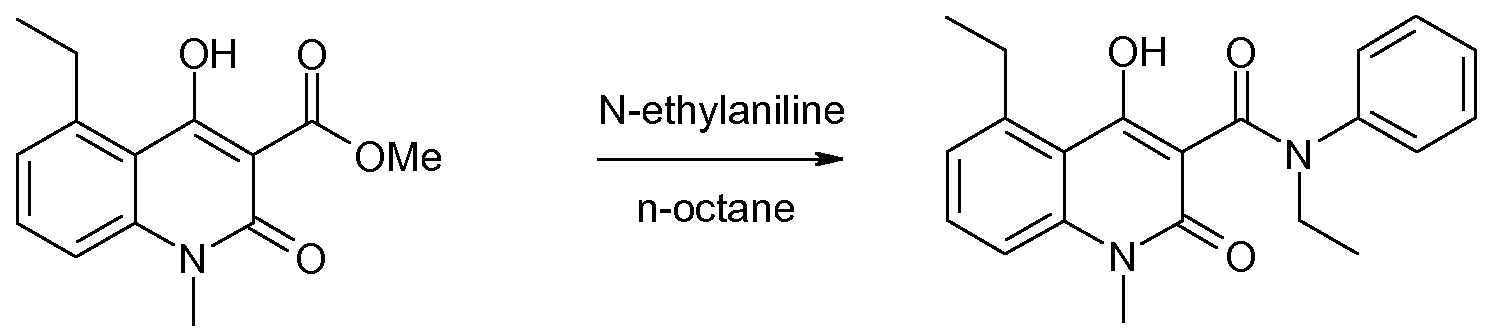
Scheme 1. The synthetic route to N-alkyl-N-phenyl-quinoline-3-carboxamides, exemplified with the synthesis of paquinimod (A) via the corresponding methyl ester 4.
This manufacturing method is short and avoids the use of expensive reagents. All intermediates are stable and easy to isolate in high purity by precipitation and filtration. The main impurity in the final condensation step is remaining alkyl ester. Alternative methods, such as carbodiimide mediated coupling between a carboxylic acid and aniline, or the condensation of N-alkyl-N-phenyl-malonamic acid methyl ester with an isatoic anhydride (US patent No. 5,912,349) are either longer or yield product of lower purity.
The final condensation step is an equilibrium (Scheme 2) that favors the alkyl ester and a action mechanism involving a ketene intermediate 5 has been strongly indicated (J. Org. Chem. 2006, 71, 1658-1667 and J Phys. Chem. A 2008, 112, 4501-4510).
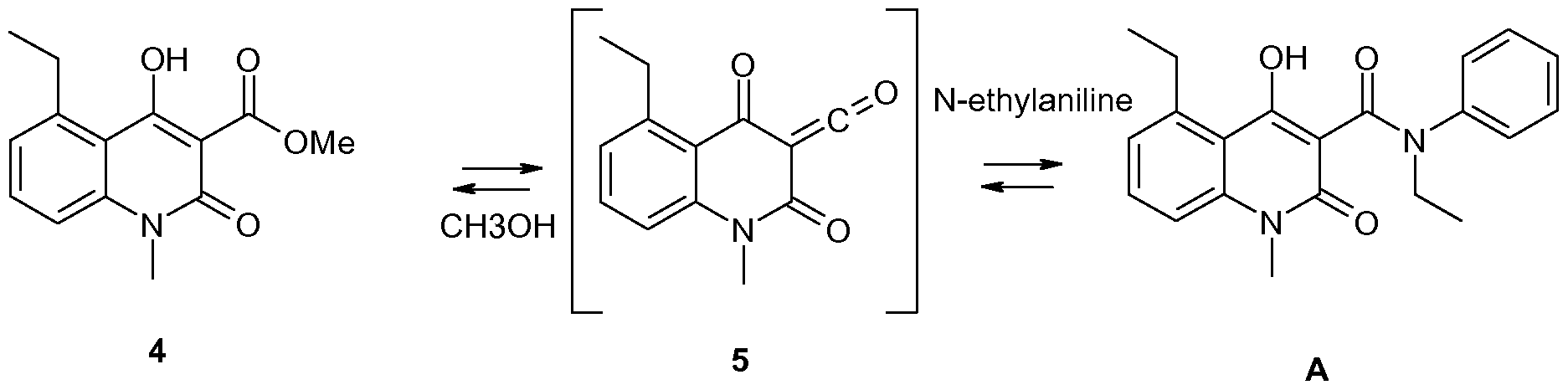
Scheme 2. An intermediate ketene 5 is involved in the equilibrium between 4 and A. Usually formation of amides from esters and anilines requires very high reaction temperatures that also cause extensive byproduct formation. The above-mentioned reaction is enabled at moderate temperatures by the ability of 4 to unimolecularly form the ketene intermediate 5 instead of a tetrahedral intermediate. The method, which is described e.g. in US patent No. 6,875,869, comprises charging the reactor with an appropriate ester and an aniline derivative in an aliphatic solvent such as n-heptane or n-octane.
The equilibrium is driven towards the desired product by distilling off the solvent and any formed alcohol. After complete reaction the mixture is cooled and the precipitated raw product is isolated by filtration. Unlike most other reactions where esters are transformed into thermodynamically more stable amides this particular reaction needs a very efficient removal of formed alcohol in order to give a high yield.


 New Drug Approvals