
Home » Posts tagged 'Orphan Drugs'
Tag Archives: Orphan Drugs
 DRUG APPROVALS BY DR ANTHONY MELVIN CRASTO
.....FOR BLOG HOME CLICK HERE
DRUG APPROVALS BY DR ANTHONY MELVIN CRASTO
.....FOR BLOG HOME CLICK HEREFlag and hits
ORGANIC SPECTROSCOPY

SUBSCRIBE

 Subscribe in a reader
Enter your email address:
Delivered by FeedBurner
Subscribe to New Drug Approvals by Email


Recent Comments
 | shivkr2 on SPSR Excellence Award 2025 – S… |
 | Bonkasaurus on Infigratinib phosphate |
 | PALOVAROTENE | ORGAN… on Palovarotene |
| Pfizer just purchase… on Temanogrel | |
| Pfizer To Cash In On… on Temanogrel |
LUMACAFTOR an Orphan drug in clinical trial for oral the treatment of cystic fibrosis

Lumacaftor
3-[6-[1-(2,2-Difluoro-1,3-benzodioxol-5-yl)cyclopropylcarboxamido]-3-methylpyridin-2-yl]benzoic acid
3-{6-{[1-(2,2-difluoro-1,3-benzodioxol-5-yl)cyclopropanecarbonyl]amino}-3-methylpyridin-2-yl}benzoic acid
VRT-826809
VX-809
US patents: US8124781, US8461342
Indication:Cystic fibrosis
Developmental status:Phase III (US, UK, EU)
Developer:Vertex
| Vertex Pharmaceuticals |
| Company | Vertex Pharmaceuticals Inc. |
| Description | Small molecule cystic fibrosis transmembrane conductance regulator (CFTR) corrector |
| Molecular Target | Cystic fibrosis transmembrane conductance regulator (CFTR) |
| Mechanism of Action | CFTR stabilizer |
| Latest Stage of Development | Phase III |
| Indication | Cystic fibrosis (CF) |
| cas | 936727-05-8 |
http://www.ama-assn.org/resources/doc/usan/lumacaftor.pdf for all data
see……http://orgspectroscopyint.blogspot.in/2015/03/lumacaftor.html
Lumacaftor (USAN, codenamed VX-809) is an experimental drug for the treatment of cystic fibrosis being developed by Vertex Pharmaceuticals. The drug is designed to be effective in patients that have the F508del mutation in the cystic fibrosis transmembrane conductance regulator (CFTR), the defective protein that causes the disease. F508del, meaning that the amino acid phenylalanine in position 508 is missing, is found in about 60% of cystic fibrosis patients in Europe,[1] and in about 90% of persons with some mutation in the CFTR gene.
A corrector molecule, one of two new classes of ion channel modulators. The corrector modulators enhance the number of channels of the CFTR protein at the cell surface. in combination with ivacaftor in homozygous F508del pts
Results from a Phase II clinical trial indicate that patients with the most common form of genetic mutation causing cystic fibrosis—homozygous F508del—had a mean increase of 7.4% in lung function (FEV1) on a combination of lumacaftor and ivacaftor.[2]
VX-809 is an investigational corrector compound in a phase II clinical trial for oral the treatment of cystic fibrosis. The trial will evaluate single and multiple doses of VX-809 in healthy volunteers. This compound has resulted from a collaboration with the Cystic Fibrosis Foundation Therapeutics, Inc. (CFFT) . In 2010, orphan drug designation was assigned in the E.U. and the U.S. for the treatment of CF.
VX-809 may act to restore the function of the cystic fibrosis transmembrane conductance regulator (CFTR) protein, the defective cell membrane protein responsible for the progression of CF. VX-809 and other corrector compounds were designed to increase the amount of DF508-CFTR on the surface of cells lining the airway, which may result in an increase in chloride transport across the cell surface in patients with the DF508-CFTR mutation.
On January 11, 2013, the combination regimen of Lumacaftor (VX-809) and Kalydeco (Ivacaftor) was awarded by U.S. FDA with Breakthrough Therapy Designation as part of the agency’s efforts to accelerate the development and approval of drugs for serious and life-threatening disease.Breakthrough Therapy Designation for the combination regimen of VX-809 with ivacaftor was based on the Phase II combination data announced in 2012. Vertex Pharmaceuticals will report results from two Phase III trials (NCT01807949 (TRANSPORT) and NCT01807923 (TRAFFIC)) of the combination of Kalydeco + VX-809 in the middle of 2014. Positive data from TRAFFIC and TRANSPORT could open up a market with peak sales of approximately $6 billion, estimate analysts.

- 1 Merk; Schubert-Zsilavecz. Pharmazeutische Zeitung (in German) 156 (37): 24–27.
- 2 Wilschanski, M. (2013). “Novel therapeutic approaches for cystic fibrosis”. Discovery medicine 15 (81): 127–133. PMID 23449115

see……http://orgspectroscopyint.blogspot.in/2015/03/lumacaftor.htm
…………………………
PATENT
http://www.google.com/patents/EP2639222A1?cl=en
-
CFTR correctors useful in the treatment of cystic fibrosis. Such compounds include 3-(6-(1-(2,2-difluorobenzo[d][1,3]dioxol-5-yl) cyclopropanecarboxamido)-3-methylpyridin-2-yl)benzoic acid (hereinafter “Compound 1”) which has the structure below:

-
Compound 1 and pharmaceutically acceptable compositions thereof are useful for treating or lessening the severity of a variety of CFTR mediated diseases.

-
Scheme 1. Synthesis of the acid chloride moiety.


Scheme 2. Synthesis of the amine moiety.

Scheme 3. Formation of an acid salt of 3-(6-(1-(2,2-difluorobcnzo[d][1,3]dioxol-5-yl) cyclopropanecarboxamido)-3-methylpyridin-2-yl)benzoic acid.

-
Synthesis of 3-(6-(1-(2,2-difluorobenzord[d][1,3]dioxol-5-yl) cyclopropancearboxamido)-3-methylpyridin-2-yl)benzoic acid • HCl.
-
[0238]Acid Chloride Moiety
-
Synthesis of (2,2-difluoro-1,3-benzodioxol-5-yl)-methanol (Compound 18).

-
Commercially available 2,2-difluoro-1,3-benzodioxole-5-carboxylic acid (1.0 eq) is slurried in toluene (10 vol). Vitride® (2 eq) is added via addition funnel at a rate to maintain the temperature at 15-25 °C. At the end of addition the temperature is increased to 40 °C for 2 h then 10% (w/w) aq. NaOH (4.0 eq) is carefully added via addition funnel maintaining the temperature at 40-50 °C. After stirring for an additional 30 minutes, the layers are allowed to separate at 40 °C. The organic phase is cooled to 20 °C then washed with water (2 x 1.5 vol), dried (Na2SO4), filtered, and concentrated to afford crude Compound 18 that is used directly in the next step.
-
Synthesis of 5-chloromethyl-2,2-difluoro-1,3-benzodioxole (Compound 19).

-
Compound 18 (1.0 eq) is dissolved in MTBE (5 vol). A catalytic amount of DMAP (1 mol %) is added and SOCl2 (1.2 eq) is added via addition funnel. The SOCl2 is added at a rate to maintain the temperature in the reactor at 15-25 °C. The temperature is increased to 30 °C for 1 hour then cooled to 20 °C then water (4 vol) is added via addition funnel maintaining the temperature at less than 30 °C. After stirring for an additional 30 minutes, the layers are allowed to separate. The organic layer is stirred and 10% (w/v) aq. NaOH (4.4 vol) is added. After stirring for 15 to 20 minutes, the layers are allowed to separate. The organic phase is then dried (Na2SO4), filtered, and concentrated to afford crude Compound 19 that is used directly in the next step.
-
Synthesis of (2,2-difluoro-1,3-benzodioxol-5-yl)-acetonitrile (compound 20).

-
A solution of Compound 19 (1 eq) in DMSO (1.25 vol) is added to a slurry of NaCN (1.4 eq) in DMSO (3 vol) maintaining the temperature between 30-40 °C. The mixture is stirred for 1 hour then water (6 vol) is added followed by MTBE (4 vol). After stirring for 30 min, the layers are separated. The aqueous layer is extracted with MTBE (1.8 vol). The combined organic layers are washed with water (1.8 vol), dried (Na2SO4), filtered, and concentrated to afford crude compound 20 (95%) that is used directly in the next step.
-
Synthesis of (2,2-difluoro-1,3-benzodioxol-5-yl)-cyclopropanecarbonitrile (compound 21).

-
A mixture of compound 20 (1.0 eq), 50 wt % aqueous KOH (5.0 eq) 1-bromo-2-chloroethane (1.5 eq), and Oct4NBr (0.02 eq) is heated at 70 °C for 1 h. The reaction mixture is cooled then worked up with MTBE and water. The organic phase is washed with water and brine then the solvent is removed to afford compound 21.
-
Synthesis of 1-(2,2-difluoro-1,3-benzodioxol-5-yl)-cyclopropanecarboxylic acid (compound 22).

-
Compound 21 is hydrolyzed using 6 M NaOH (8 equiv) in ethanol (5 vol) at 80 °C overnight. The mixture is cooled to room temperature and ethanol is evaporated under vacuum. The residue is taken into water and MTBE, 1 M HCl was added and the layers are separated. The MTBE layer was then treated with dicyclohexylamine (0.97 equiv). The slurry is cooled to 0 °C, filtered and washed with heptane to give the corresponding DCHA salt. The salt is taken into MTBE and 10% citric acid and stirred until all solids dissolve. The layers are separated and the MTBE layer was washed with water and brine. Solvent swap to heptane followed by filtration gives compound 22 after drying in a vacuum oven at 50 °C overnight.
-
Synthesis of 1-(2,2-difluoro-1,3-benzodioxol-5-yl)-cyclopropanecarbonyl chloride (compound 7).

-
Compound 22 (1.2 cq) is slurried in toluene (2.5 vol) and the mixture heated to 60 °C. SOCl2 (1.4 eq) is added via addition funnel. The toluene and SOCl2 are distilled from the reaction mixture after 30 minutes. Additional toluene (2.5 vol) is added and distilled again.
-
Synthesis of 14C-(2,2-difluoro-1,3-benzodioxol-5-yl)-acetonitrile (compound 23).

-
A solution of Compound 19 (1 eq) in DMSO (1.25 vol) is added to a slurry of Na14 CN (1.4 eq) in DMSO (3 vol) maintaining the temperature between 30-40 °C. The mixture is stirred for 1 hour then water (6 vol) is added followed by MTBE (4 vol). After stirring for 30 min, the layers are separated. The aqueous layer is extracted with MTBE (1.8 vol). The combined organic layers are washed with water (1.8 vol), dried (Na2SO4), filtered, and concentrated to afford crude compound 23 that is purified by chromatography.
-
Synthesis of 14C-(2,2-difluoro-1,3-benzodioxol-5-yl)-cyclopropanecarbonitrile (compound 24).

-
A mixture of compound 23 (1.0 eq) and 1,2-dibromoethane (1.8 eq) in THF (3 vol) is cooled to -10 °C via external chiller. 1 M LHMDS in THF (2.5 eq) is added via an addition funnel and at a rate to maintain the temperature in the reactor below 10 °C. One hour after addition is complete, 20% w/v aq. citric acid (13 vol) is added via addition funnel maintaining the temperature in the reactor below 20 C. The external chiller is turned off and after stirring for 30 min the layers are separated. The organic layer is filtered and concentrated to afford crude compound 24 that is purified by chromatography.
-
Synthesis of 14C-1-(2,2-difluoro-1,3-benzodioxol-5-yl)-cyclopropanecarboxylic acid (compound 25).

-
Compound 24 is hydrolyzed using 6 M NaOH (8 equiv) in ethanol (5 vol) at 80 °C overnight. The mixture is cooled to room temperature and ethanol is evaporated under vacuum. The residue is taken into water and MTBE. 1 M HCl is added to the mixture and the organic layer is filtered and concentrated to afford compound 25.
-
Synthesis of 14C-1-(2,2-difluoro-1,3-benzodioxol-5-yl)-cyclopropanecarbonyl chloride (compound 26).

-
A mixture of Compound 25, 4-dimethylaminopyridine, and thionyl chloride (SOCl2) in CH2Cl2 is stirred to produce compound 26, which may be further reacted with compound 6 without isolation.
-
Amine Moiety
-
Synthesis of tert-butyl-3-(3-methylpyridin-2-yl)benzoate (compound 4).

-
2-Bromo-3-methylpyridine (1.0 eq) is dissolved in toluene (12 vol). K2CO3 (4.8 eq) is added followed by water (3.5 vol) and the mixture heated to 65 °C under a stream of N2 for 1 hour. 3-(t-Butoxycarbonyl)phenylboronic acid (1.05 eq) and Pd(dppf)Cl2-CH2Cl2 (0.015 eq) are then added and the mixture is heated to 80 °C. After 2 hours, the heat is turned off, water is added (3.5 vol) and the layers are allowed to separate. The organic phase is then washed with water (3.5 vol) and extracted with 10% aqueous methanesulfonic acid (2 eq MsOH, 7.7 vol). The aqueous phase is made basic with 50% aqueous NaOH (2 eq) and extracted with EtOAc (8 vol). The organic layer is concentrated to afford crude compound 4 (82%) that is used directly in the next step.
-
Synthesis of 2-(3-(tert-butoxycarbonyl)phenyl)-3-methylpyridine-1-oxide (compound 5).

-
Compound 4 (1.0 eq) is dissolved in EtOAc (6 vol). Water (0. 3 vol) is added followed by urea-hydrogen peroxide (3 cq). The phthalic anhydride (3 cq) is added portion-wise as a solid to maintain the temperature in the reactor below 45 °C. After completion of phthalic anhydride addition, the mixture is heated to 45 °C. After stirring for an additional 4 hours, the heat is turned off. 10% w/w aqueous Na2SO3 (1.5 eq) is added via addition funnel. After completion of Na2SO3 addition, the mixture is stirred for an additional 30 minutes and the layers separated. The organic layer is stirred and 10% w/w aq. Na2CO3 (2 eq) is added. After stirring for 30 minutes, the layers are allowed to separate. The organic phase is washed 13% w/v aq NaCl. The organic phase is then filtered and concentrated to afford crude compound 5 (95%) that is used directly in the next step.
-
Synthesis of tert-butyl-3-(6-amino-3-methylpyridin-2-yl)benzoate (compound 6).

-
A solution of compound 5 (1 eq) and pyridine (4 eq) in MeCN (8 vol) is heated to 70 °C. A solution of methanesulfonic anhydride (1.5 eq) in MeCN (2 vol) is added over 50 min via addition funnel maintaining the temperature at less than 75 °C. The mixture is stirred for an additional 0.5 hours after complete addition. The mixture is then allowed to cool to ambient. Ethanolamine (10 eq) is added via addition funnel. After stirring for 2 hours, water (6 vol) is added and the mixture is cooled to 10 °C. After stirring for NLT 3 hours, the solid is collected by filtration and washed with water (3 vol), 2:1 MeCN/water (3 vol), and MeCN (2×1.5 vol). The solid is dried to constant weight (<1% difference) in a vacuum oven at 50 °C with a slight N2 bleed to afford compound 6 as a red-yellow solid (53% yield).
-
Synthesis of 3-(6-(1-(2,2-difluorobenzo[d][1,3]dioxol-5-yl) cyclopropanecarboxamido)-3-methylpyridin-2-yl)-t-butylbenzoate (compound 8).

-
Compound 7 is dissolved in toluene (2.5 vol based on acid chloride) and added via addition funnel to a mixture of compound 6 (1 eq), dimethylaminopyridine (DMAP, 0.02 eq), and triethylamine (3.0 cq) in toluene (4 vol based on compound 6). After 2 hours, water (4 vol based on compound 6) is added to the reaction mixture. After stirring for 30 minutes, the layers are separated. The organic phase is then filtered and concentrated to afford a thick oil of compound 8 (quantitative crude yield). MeCN (3 vol based on crude product) is added and distilled until crystallization occurs. Water (2 vol based on crude product) is added and the mixture stirred for 2 h. The solid is collected by filtration, washed with 1:1 (by volume) MeCN/water (2 x 1 vol based on crude product), and partially dried on the filter under vacuum. The solid is dried to constant weight (<1% difference) in a vacuum oven at 60 °C with a slight N2 bleed to afford 3-(6-(1-(2,2-difluorobenzo[d] [1,3]dioxol-5-yl) cyclopropanecarboxamido)-3-methylpyridin-2-yl)-t-butylbenzoate as a brown solid.
-
Syntheisis of Syntheisis of 3-(6-(1-(2,2-difluorobenzo[d] [1,3]dioxol-5-yl) cyclopropanecarboxamido)-3-methylpyridin-2-yl)benzoic acid • HCL salt (compound 9).

-
To a slurry of compound 8 (1.0 eq) in MeCN (3.0 vol) is added water (0.83 vol) followed by concentrated aqueous HCl (0.83 vol). The mixture is heated to 45 ± 5 °C. After stirring for 24 to 48 hours the reaction is complete and the mixture is allowed to cool to ambient. Water (1.33 vol) is added and the mixture stirred. The solid is collected by filtration, washed with water (2 x 0.3 vol), and partially dried on the filter under vacuum. The solid is dried to constant weight (<1% difference) in a vacuum oven at 60 °C with a slight N2 bleed to afford compound 9 as an off-white solid.


-
Synthesis of 3-(6-(1-(2,2-difluorobenzo[d][1,3]dioxol-5-yl) cyclopropanecarboxamido)-3-methylpyridin-2-yl)benzoic acid (Compound 1).

-
A slurry of 3-(6-(1-(2,2-difluorobenzo[d][1,3]dioxol-5-yl) cyclopropanecarboxamido)-3-methylpyridin-2-yl)benzoic acid • HCl (1 eq) in water (10 vol) is stirred at ambient temperature. A sample is taken after stirring for 24 hours. The sample is filtered and the solid washed with water (2 x). The solid sample is submitted for DSC analysis. When DSC analysis indicates complete conversion to Compound 1, the solid is collected by filtration, washed with water (2 x 1.0 vol), and partially dried on the filter under vacuum. The solid is dried to constant weight (<1% difference) in a vacuum oven at 60 °C with a slight N2 bleed to afford Compound 1 as an off-white solid (98% yield).
-
Synthesis of 3-(6-(1-(2,2-difluorobenzo[d][1,3]dioxol-5-yl) cyclopropanecarboxamido)-3-methylpyridin-2-yl)benzoic acid (Compound 1) using water and base.


-
To a slurry of 3-(6-(1-(2,2-difluorobenzo[d][1,3]dioxol-5-yl) cyclopropanecarboxamido)-3-methylpyridin-2-yl)benzoic acid • HCl (1 eq) in water (10 vol) stirred at ambient temperature is added 50% w/w aq. NaOH (2.5 eq). The mixture is stirred for NLT 15 min or until a homogeneous solution. Concentrated HCl (4 eq) is added to crystallize Compound 1. The mixture is heated to 60 °C or 90 °C if needed to reduce the level of the t-butylbenzoate ester. The mixture is heated until HPLC analysis indicates NMT 0.8% (AUC) t-butylbenzoate ester. The mixture is then cooled to ambient and the solid is collected by filtration, washed with water (3 x 3.4 vol), and partially dried on the filter under vacuum. The solid is dried to constant weight (<1% difference) in a vacuum oven at 60 °C with a slight N2 bleed to afford Compound 1 as an off-white solid (97% yield).
-
Synthesis of 3-(6-(1-(2,2-difluorobenzo[d][1,3]dioxol-5-yl) cyclopropanecarboxamido)-3-methylpyridin-2-yl)benzoic acid (Compound 1) directly from benzoate.

-
A solution of 3-(6-(1-(2,2-difluorobenzo[d][1,3]dioxol-5-yl) cyclopropanecarboxamido)-3-methylpyridin-2-yl)-t-butylbenzoate (1.0 eq) in formic acid (3.0 vol) is heated to 70 ± 10 °C. The reaction is continued until the reaction is complete (NMT 1.0% AUC 3-(6-(1-(2,2-difluorobenzo[d][1,3]dioxol-5-yl) cyclopropanecarboxamido)-3-methylpyridin-2-yl)-t-butylbenzoate) or heating for NMT 8 h. The mixture is allowed to cool to ambient. The solution is added to water (6 vol) heated at 50 °C and the mixture stirred. The mixture is then heated to 70 ± 10 °C until the level of 3-(6-(1-(2,2-difluorobenzo[d][1,3]dioxol-5-yl) cyclopropanecarboxamido)-3-methylpyridin-2-yl)-t-butylbenzoate is NMT 0.8% (AUC). The solid is collected by filtration, washed with water (2 x 3 vol), and partially dried on the filter under vacuum. The solid is dried to constant weight (<1% difference) in a vacuum oven at 60 °C with a slight N2 bleed to afford Compound 1 as an off-white solid.


-
1HNMR spectra of Compound 1 are shown in Figures 9-11 (Figures 9 and 10 depict Compound 1 in Form I in a 50 mg/mL, 0.5 methyl cellulose-polysorbate 80 suspension, and Figure 11 depicts Compound 1 as an HCl salt).
-
Table 3 below recites additional analytical data for Compound 1.
-
Table 3.
Cmpd. No. LC/MS M+1 LC/RTmin NMR 1 453.3 1.93 H NMR (400 MHz, DMSO-d6) 9.14 (s, 1H), 7.99-7.93 (m, 3H), 7.80-7.78 (m, 1H), 7.74-7.72 (m, 1H), 7.60-7.55 (m, 2H), 7.41-7.33 (m, 2H), 2.24 (s, 3H), 1.53-1.51 (m, 2H), 1.19-1.17 (m, 2H)


| WO2002096421A1 * | May 22, 2002 | Dec 5, 2002 | Neurogen Corp | 5-substituted-2-arylpyridines as crf1 modulators |
| WO2004072038A1 * | Feb 10, 2004 | Aug 26, 2004 | Vertex Pharma | Processes for the preparation of n-heteroaryl-n-aryl-amines by reacting an n-aryl carbamic acid ester with a halo-heteroaryl and analogous processes |
| WO2007056341A1 | Nov 8, 2006 | May 18, 2007 | Vertex Pharma | Heterocyclic modulators of atp-binding cassette transporters |
| see……http://orgspectroscopyint.blogspot.in/2015/03/lumacaftor.htm |
References
David Andrew Siesel;Processes for producing cycloalkylcarboxamido-pyridine benzoic acids,US patent number US8124781 B2 ;Also published as CA2707494A1, CN101910134A, EP2231606A2, EP2231606B1, EP2639222A1, EP2639223A1, EP2639224A1, US8592602, US20090176989, US20120190856, WO2009076142A2, WO2009076142A3;Filing date:Dec 4, 2008;Original Assignee:Vertex Pharmaceuticals Incorporated
David Andrew Siesel;Processes for producing cycloalkylcarboxamido-pyridine benzoic acids,US patent number US8461342 B2 ;Also published as US20100036130, US20120203006, US20130274477, WO2010138484A2, WO2010138484A3;Original Assignee:Vertex Pharmaceuticals Incorporated
Van Goor, Fredrick F. et al;Pharmaceutical compositions in the treatment of CFTR-mediated diseases such as cystic fibrosis;PCT Int. Appl., WO2011133956
Van Goor, Fredrick F. et al;Pharmaceutical compositions in the treatment of CFTR-mediated diseases such as cystic fibrosis.PCT Int. Appl., WO2011133951
Van Goor, Fredrick F. et al;Pharmaceutical compositions for treatment of CFTR-mediated diseases;PCT Int. Appl., WO2011133953
Verwijs, Marinus Jacobus et al;Preparation and pharmaceutical compositions of Lumacaftor for the treatment of cystic fibrosis and other diseases associated with CFTR mutations;PCT Int. Appl., WO2011127241
Keshavarz-Shokri, Ali et al;Preparation of Lumacaftor for therapeutical use;PCT Int. Appl., WO2011127290
Siesel, David;A process for the preparation of solid forms of (((difluorobenzodioxolyl)cyclopropanecarboxamido)methylpyridinyl)benzoic acid;U.S. Pat. Appl. Publ., US20100036130
Siesel, David;A process for the preparation of solid forms of (((difluorobenzodioxolyl)cyclopropanecarboxamido)methylpyridinyl)benzoic acid;PCT Int. Appl., WO2010138484
Young, Christopher;Dosage units of 3-(6-(1-(2,2-difluorobenzo[d][1,3]dioxol-5-yl) cyclopropanecarboxamido)-3-methylpyridin-2-yl)benzoic acid;PCT Int. Appl., WO2010037066
Hadida-Ruah, Sara et al;paration of N-pyridinyl carboxamide derivatives as modulators of ATP-binding cassette transporters;U.S. Pat. Appl. Publ., 20080019915
Siesel, David;A process for the preparation of solid forms of (((difluorobenzodioxolyl)cyclopropanecarboxamido)methylpyridinyl)benzoic acid;PCT Int. Appl., WO2009076142
Hadida Ruah, Sara et al;Preparation of N-pyridinyl carboxamide derivatives as modulators of ATP-binding cassette transporters;PCT Int. Appl., WO2007056341
video on cystic fibrosis
second video
Update on 26 mar 2015
LUMACAFTOR
VX 809
| 3-[6-[[1-(2,2-difluoro-1,3-benzodioxol-5-yl)cyclopropanecarbonyl]amino]-3-methylpyridin-2-yl]benzoic Acid | |
| CAS No.: | 936727-05-8 |
|---|---|
| Synonyms: |
|
| Formula: | C24H18F2N2O5 |
| Exact Mass: | 452.11800 |
SMILLES…. Cc1ccc(nc1c2cccc(c2)C(=O)O)NC(=O)C3(CC3)c4ccc5c(c4)OC(O5)(F)F
NMR…………….http://file.selleckchem.com/downloads/nmr/S156503-VX-809-HNMR-Selleck.pdf
-
Synthesis of 3-(6-(1-(2,2-difluorobenzo[d][1,3]dioxol-5-yl) cyclopropanecarboxamido)-3-methylpyridin-2-yl)benzoic acid (Compound 1) directly from benzoate.
-
A solution of 3-(6-(1-(2,2-difluorobenzo[d][1,3]dioxol-5-yl) cyclopropanecarboxamido)-3-methylpyridin-2-yl)-t-butylbenzoate (1.0 eq) in formic acid (3.0 vol) is heated to 70 ± 10 °C. The reaction is continued until the reaction is complete (NMT 1.0% AUC 3-(6-(1-(2,2-difluorobenzo[d][1,3]dioxol-5-yl) cyclopropanecarboxamido)-3-methylpyridin-2-yl)-t-butylbenzoate) or heating for NMT 8 h. The mixture is allowed to cool to ambient. The solution is added to water (6 vol) heated at 50 °C and the mixture stirred. The mixture is then heated to 70 ± 10 °C until the level of 3-(6-(1-(2,2-difluorobenzo[d][1,3]dioxol-5-yl) cyclopropanecarboxamido)-3-methylpyridin-2-yl)-t-butylbenzoate is NMT 0.8% (AUC). The solid is collected by filtration, washed with water (2 x 3 vol), and partially dried on the filter under vacuum. The solid is dried to constant weight (<1% difference) in a vacuum oven at 60 °C with a slight N2 bleed to afford Compound 1 as an off-white solid.
-
1HNMR spectra of Compound 1 are shown in Figures 9-11 (Figures 9 and 10 depict Compound 1 in Form I in a 50 mg/mL, 0.5 methyl cellulose-polysorbate 80 suspension, and Figure 11 depicts Compound 1 as an HCl salt).
-
Table 3 below recites additional analytical data for Compound 1.
-
Table 3.
Cmpd. No. LC/MS M+1 LC/RTmin NMR 1 453.3 1.93 H NMR (400 MHz, DMSO-d6) 9.14 (s, 1H), 7.99-7.93 (m, 3H), 7.80-7.78 (m, 1H), 7.74-7.72 (m, 1H), 7.60-7.55 (m, 2H), 7.41-7.33 (m, 2H), 2.24 (s, 3H), 1.53-1.51 (m, 2H), 1.19-1.17 (m, 2H)

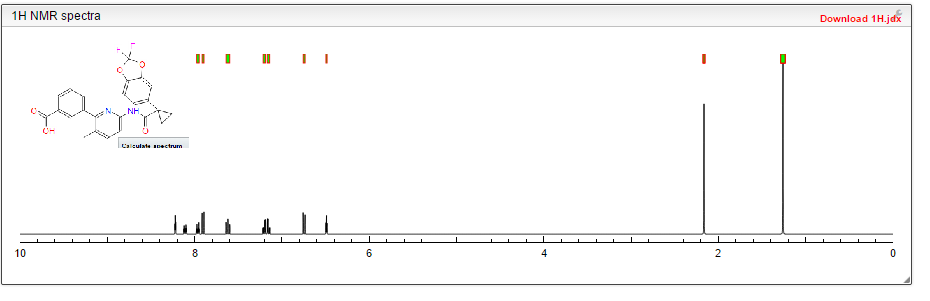
1H NMR PREDICT
![3-[6-[[1-(2,2-difluoro-1,3-benzodioxol-5-yl)cyclopropanecarbonyl]amino]-3-methylpyridin-2-yl]benzoic acid NMR spectra analysis, Chemical CAS NO. 936727-05-8 NMR spectral analysis, 3-[6-[[1-(2,2-difluoro-1,3-benzodioxol-5-yl)cyclopropanecarbonyl]amino]-3-methylpyridin-2-yl]benzoic acid H-NMR spectrum](https://i0.wp.com/pic11.molbase.net/nmr/nmr_image/2014-08-29/001/530/195/936727-05-8-1h.png)
13C NMR PREDICT
![3-[6-[[1-(2,2-difluoro-1,3-benzodioxol-5-yl)cyclopropanecarbonyl]amino]-3-methylpyridin-2-yl]benzoic acid NMR spectra analysis, Chemical CAS NO. 936727-05-8 NMR spectral analysis, 3-[6-[[1-(2,2-difluoro-1,3-benzodioxol-5-yl)cyclopropanecarbonyl]amino]-3-methylpyridin-2-yl]benzoic acid C-NMR spectrum](https://i0.wp.com/pic11.molbase.net/nmr/nmr_image/2014-08-29/001/530/195/936727-05-8-13c.png) CAS NO. 936727-05-8, 3-[6-[[1-(2,2-difluoro-1,3-benzodioxol-5-yl)cyclopropanecarbonyl]amino]-3-methylpyridin-2-yl]benzoic acid C-NMR spectral analysisCOSY PREDICT
CAS NO. 936727-05-8, 3-[6-[[1-(2,2-difluoro-1,3-benzodioxol-5-yl)cyclopropanecarbonyl]amino]-3-methylpyridin-2-yl]benzoic acid C-NMR spectral analysisCOSY PREDICT


13C NMR PREDICT


| WO2002096421A1 * | May 22, 2002 | Dec 5, 2002 | Neurogen Corp | 5-substituted-2-arylpyridines as crf1 modulators |
| WO2004072038A1 * | Feb 10, 2004 | Aug 26, 2004 | Vertex Pharma | Processes for the preparation of n-heteroaryl-n-aryl-amines by reacting an n-aryl carbamic acid ester with a halo-heteroaryl and analogous processes |
| WO2007056341A1 | Nov 8, 2006 | May 18, 2007 | Vertex Pharma | Heterocyclic modulators of atp-binding cassette transporters |

http://www.google.co.in/patents/US8124781


Synthesis of 3-(6-(1-(2,2-difluorobenzo[d][1,3]dioxol-5-yl)cyclopropanecarboxamido)-3-methylpyridin-2-yl)benzoic Acid (Compound 1)

Synthesis of 3-(6-(1-(2,2-difluorobenzo[d][1,3]dioxol-5-yl)cyclopropanecarboxamido)-3-methylpyridin-2-yl)benzoic Acid (Compound 1) Using Water and Base

Synthesis of 3-(6-(1-(2,2-difluorobenzo[d][1,3]dioxol-5-yl)cyclopropanecarboxamido)-3-methylpyridin-2-yl)benzoic Acid (Compound 1) Directly from Benzoate

Compound 1
Compound 1 is used as the starting point for the other solid state forms and can be prepared by coupling an acid chloride moiety with an amine moiety according to Schemes 1-4.
Scheme 1. Synthesis of the acid chloride moiety.

1. NaCN
2. H20

socio

Scheme 1 depicts the preparation of l-(2,2-difluorobenzo[d][l,3]dioxol-5- yl)cyclopropanecarbonyl chloride, which is used in Scheme 3 to make the amide linkage of Compound 1.
The starting material, 2,2-difluorobenzo[d][l,3]dioxole-5-carboxylic acid, is commercially available from Saltigo (an affiliate of the Lanxess Corporation). Reduction of the carboxylc acid moiety in 2,2-difluorobenzo[d][l ,3]dioxole-5-carboxylic acid to the primary alcohol, followed by conversion to the corresponding chloride using thionyl chloride (SOCl2), provides 5-(chloromethyl)-2,2-difluorobenzo[d][l,3]dioxole, which is subsequently converted to 2-(2,2-difluorobenzo[d][l,3]dioxol-5-yl)acetonitrile using sodium cyanide. Treatment of 2-(2,2- difluorobenzo[d][l,3]dioxol-5-yl)acetonitrile with base and l-bromo-2-chloroethane provides 1- (2,2-difluorobenzo[d][l,3]dioxol-5-yl)cyclopropanecarbonitrile. The nitrile moiety in l-(2,2- difluorobenzo[d][l,3]dioxol-5-yl)cyclopropanecarbonitrile is converted to a carboxylic acid using base to give l-(2,2-difluorobenzo[d][l,3]dioxol-5-yl)cyclopropanecarboxylic acid, which is converted to the desired acid chloride using thionyl chloride.
Scheme 2. Alternative synthesis of the acid chloride moiety.

Touene, H20, 70 °C3 N HC1,
DMSO,
75 °C

Scheme 2 depicts an alternative synthesis of the requisite acid chloride. 5- bromomethyl-2,2-difluoro-l,3-benzodioxole is coupled with ethyl cyanoacetate in the presence of a palladium catalyst to form the corresponding alpha cyano ethyl ester. Saponification of the ester moiety to the carboxylic acid gives the cyanoethyl compound. Alkylation of the cyanoethyl compound with l-bromo-2-chloro ethane in the presence of base gives the cyanocyclopropyl compound. Treatment of the cyanocyclopropyl compound with base gives the carboxylate salt, which is converted to the carboxylic acid by treatment with acid. Conversion of the carboxylic acid to the acid chloride is then accomplished using a chlorinating agent such as thionyl chloride or the like.
Scheme 3. Synthesis of the amine moiety.

ptBu urea-hydrogen peroxide hthalic anhydride EtOAc, water

Scheme 3 depicts the preparation of the requisite tert-butyl 3-(6-amino-3- methylpyridin-2-yl)benzoate, which is coupled with l-(2,2-difluorobenzo[d][l,3]dioxol-5- yl)cyclopropanecarbonyl chloride in Scheme 3 to give Compound 1. Palladium-catalyzed coupling of 2-bromo-3-methylpyridine with 3-(tert-butoxycarbonyl)phenylboronic acid gives tert-butyl 3-(3-methylpyridin-2-yl)benzoate, which is subsequently converted to the desired compound. Scheme 4. Formation of an acid salt of 3-(6-(l-(2,2-difluorobenzo[d] [l,3]dioxol-5-yl) cyclopropanecarboxamido)-3-methylpyridin-2-yl)benzoic acid.

Scheme 4 depicts the coupling of l-(2,2-difluorobenzo[d][l,3]dioxol-5- yl)cyclopropanecarbonyl chloride with tert-butyl 3-(6-amino-3-methylpyridin-2-yl)benzoate using triethyl amine and 4-dimethylaminopyridine to initially provide the tert-butyl ester of Compound 1.
……………………..
WO2010037066
http://www.google.im/patents/WO2010037066A2?cl=en
Syntheisis of 3-(6-(l-(2,2-difluorobenzo[d] [l,3]dioxol-5-yl) cyclopropanecarboxamido)-3-methylpyridin-2-yl)benzoic acid • HCL salt.

HCl
To a slurry of 3-(6-(l-(2,2-difluorobenzo[d][l,3]dioxol-5-yl) cyclopropanecarboxamido)-3-methylpyridin-2-yl)-t-butylbenzoate (1.0 eq) in MeCN (3.0 vol) is added water (0.83 vol) followed by concentrated aqueous HCl (0.83 vol). The mixture is heated to 45 ± 5 0C. After stirring for 24 to 48 hours the reaction is complete and the mixture is allowed to cool to ambient. Water (1.33 vol) is added and the mixture stirred. The solid is collected by filtration, washed with water (2 x 0.3 vol), and partially dried on the filter under vacuum. The solid is dried to constant weight (<1% difference) in a vacuum oven at 60 0C with a slight N2 bleed to afford 3-(6-(l-(2,2- difluorobenzo[d][l,3]dioxol-5-yl) cyclopropanecarboxamido)-3-methylpyridin-2- yl)benzoic acid • HCl as an off-white solid.
Synthesis of 3-(6-(l-(2,2-difluorobenzo[d] [l,3]dioxol-5-yl) cyclopropanecarboxamido)-3-methylpyridin-2-yl)benzoic acid (Compound 1 in Form I).

HCl

Compound 1 in Form I
A slurry of 3-(6-(l-(2,2-difluorobenzo[d][l,3]dioxol-5-yl) cyclopropanecarboxamido)-3-methylpyridin-2-yl)benzoic acid • HCl (1 eq) in water (10 vol) is stirred at ambient temperature. A sample is taken after stirring for 24 hours. The sample is filtered and the solid washed with water (2 x). The solid sample is submitted for DSC analysis. When DSC analysis indicates complete conversion to Compound 1, the solid is collected by filtration, washed with water (2 x 1.0 vol), and partially dried on the filter under vacuum. The solid is dried to constant weight (<1% difference) in a vacuum oven at 60 0C with a slight N2 bleed to afford Compound 1 as an off-white solid (98% yield).
Synthesis of 3-(6-(l-(2,2-difluorobenzo[d] [l,3]dioxol-5-yl) cyclopropanecarboxamido)-3-methylpyridin-2-yl)benzoic acid (Compound 1 in Form I) using water and base.


Compound 1 in Form I
To a slurry of 3-(6-(l-(2,2-difluorobenzo[d][l,3]dioxol-5-yl) cyclopropanecarboxamido)-3-methylpyridin-2-yl)benzoic acid • HCl (1 eq) in water (10 vol) stirred at ambient temperature is added 50% w/w aq. NaOH (2.5 eq). The mixture is stirred for NLT 15 min or until a homogeneous solution. Concentrated HCl (4 eq) is added to crystallize Compound 1. The mixture is heated to 60 0C or 90 0C if needed to reduce the level of the t-butylbenzoate ester. The mixture is heated until HPLC analysis indicates NMT 0.8% (AUC) t-butylbenzoate ester. The mixture is then cooled to ambient and the solid is collected by filtration, washed with water (3 x 3.4 vol), and partially dried on the filter under vacuum. The solid is dried to constant weight (<1% difference) in a vacuum oven at 60 0C with a slight N2 bleed to afford Compound 1 as an off-white solid (97% yield).
Synthesis of 3-(6-(l-(2,2-difluorobenzo[d] [l,3]dioxol-5-yl) cyclopropanecarboxamido)-3-methylpyridin-2-yl)benzoic acid (Compound 1 in Form I) directly from benzoate.


Compound 1 in Form I
A solution of 3-(6-(l-(2,2-difluorobenzo[d][l,3]dioxol-5-yl) cyclopropanecarboxamido)-3-methylpyridin-2-yl)-t-butylbenzoate (1.0 eq) in formic acid (3.0 vol) is heated to 70 ± 10 0C. The reaction is continued until the reaction is complete (NMT 1.0% AUC 3-(6-(l-(2,2-difluorobenzo[d][l,3]dioxol-5-yl) cyclopropanecarboxamido)-3-methylpyridin-2-yl)-t-butylbenzoate) or heating for NMT 8 h. The mixture is allowed to cool to ambient. The solution is added to water (6 vol) heated at 50 0C and the mixture stirred. The mixture is then heated to 70 ± 10 0C until the level of 3- (6-(l-(2,2-difluorobenzo[d][l,3]dioxol-5-yl) cyclopropanecarboxamido)-3-methylpyridin- 2-yl)-t-butylbenzoate is NMT 0.8% (AUC). The solid is collected by filtration, washed with water (2 x 3 vol), and partially dried on the filter under vacuum. The solid is dried to constant weight (<1% difference) in a vacuum oven at 60 0C with a slight N2 bleed to afford Compound 1 in Form I as an off-white solid.
Orphan Drugs for Rare Diseases : Top Ten Most Expensive Drugs in USA

Drugs are expensive. Thousands of people take drugs that cost from $50,000 to $100,000 per year, such as the cancer drugs Provenge and Avastin and the medication for multiple sclerosis, Lemtrade. But a much smaller number of people have rare conditions that require lifesaving drugs whose prices are astronomical—up to $400,000 per year, prices that may reflect the cost of developing the medication.
A rare or orphan disease is a condition affecting 200,000 or fewer individuals in the United States. Rare diseases once were the neglected stepchild of drug makers, who wanted medicines they could sell to millions of patients. Today, conditions afflicting far smaller numbers are seeing booming interest from the industry. And more companies are taking advantage of grants, tax credits and other incentives of the Orphan Drug Act passed in 1983. In the preceding decade, only 10 drugs for rare diseases had been approved, but more than 400 were approved from 1984 through 2012.
Thinking you pay way too much for your monthly prescriptions? These amazingly expensive drugs may put things into perspective.

Soliris
Soliris has been made famous by Forbes as the world’s single most expensive drug, coming in at $409,500 a year. Soliris is used to treat paroxysmal nocturnal hemoglobinuria, a rare Marchiafava-Micheli blood disease that affects 8,000 Americans. The med generated $541 million in sales for Alexion Pharmaceuticals in 2010.
Paroxysmal nocturnal hemoglobinuria causes the breakdown of red blood cells and release of hemoglobin into the urine. The sudden, recurring attacks—which are often triggered by stress, exertion or infection—result in anemia. Little is known about the incidence of paroxysmal nocturnal hemoglobinuria, which can affect people of any age, but it’s believed to occur at a rate of about one to five per one million. The drug Soliris, made by Alexion Pharmaceuticals and approved by the Food and Drug Administration in 2007, stops the breakdown of cells. Soliris is a monoclonal antibody—a product engineered in the lab to mimic a natural substance. Studies show it leads to a dramatic improvement of symptoms and reduces the risks of complications.

Elaprase
Patients who suffer from Hunter syndrome, an inherited disease caused by a lack of the enzyme iduronate sulfatase can find relief in the recombinant form of this enzyme, but at an incredibly high price of $375,000 each year. Some estimates put its annual cost as high as $657,000. Each vial of the drug is reported to cost $4,215 each, and in the U.S. alone, the 500 Americans who suffer from Hunter syndrome spent a combined $353 million on Elaprase in 2009.
The incurable condition occurs in about one in 150,000 people, almost always males. The disorder typically appears in childhood and impairs growth and mental development. Afflicted children also have a distinct thickening of facial features. A late-onset version of Hunter syndrome is usually milder but can delay growth and damage joints, vision and hearing. Elaprase is an injected medication that replaces the missing enzyme. Manufactured by Shire, it was approved in 2006 improves patients’ ability to walk.

Naglazyme
Naglazyme is right behind Elaprase’s reported $375,000 price tag, coming in at the bargain price of just $365,000. This medication is for a rare connective tissue disorder called Maroteaux-Lamy syndrome, which is caused by a deficient enzyme that breaks down large sugar molecules called glycosaminoglycans. The condition occurs in about one of every 200,000 to 600,000 people. The deficiency causes growth retardation in early childhood in addition to heart disease. Naglazyme is made by Biomarin and was approved in 2005. The administration of the drug improves growth and joint movement, as well as range of motion and pain management.

Cinryze
Patients with hereditary angioedema (HAE) suffer from severe swelling, often in the face and airways, caused by low levels or improper function of the C1 inhibitor protein. This condition is hereditary, and there’s usually a family history, but often, deaths from hereditary angioedema go undiagnosed and reported as a sudden and premature death of a family member. This makes the condition relatively rare, and the treatment is quite expensive: an estimated $350,000 per year for Cinryze, an injectable man-made protein form of complement C1 esterase inhibitor. Cinryze maker Viropharma has mapped out yearly sales of the drug ranging from $95 million to as much as $350 million.

Folotyn
This medication is used to treat an aggressive type of cancer of the lymph system, peripheral T-cell lymphoma, which has spread throughout the body. The lymph system is comprised of white blood cells and T cells which fight viruses. There are many types of lymphoma, but T-cell lymphoma is rare, affecting about one to two people per 100,000.
Folotyn, made by Allos Therapeutics, was approved in 2009 and helps prolong survival. Typically, patients will take the drug for about six weeks, but even in that short amount of time, the bill for this treatment is staggering — around $30,000 per month. It’s given to people who have exhausted all other options for treatment and whose cancer has recurred. The drug, an injection, is thought to kill cancer cells; however studies so far have not shown that it prolongs survival. Still, Folotyn was approved as part of the FDA’s accelerated drug approval process to address the needs of people who have a poor prognosis.
Myozyme
Developed by Genzyme, Myozyme costs up to $100,000 per year for child treatment, and about $300,000 per year for adults. Myozyme was created to treat a rare and often fatal disease, Pompe, which disables the heart and skeletal muscles. Often affecting infants, most of its sufferers die in the first year, and those who do survive typically need assistance like ventilators and wheelchairs. But thanks to Myozyme, some patients can do fairly well with the disease, able to speak, walk, and feed themselves. The drama behind creating such an expensive, yet lifesaving drug, was depicted in the movie Extraordinary Measures, sharing the race against time and profit motives experienced in the drug’s development.
Acth
If you think $30,000 per month is insane, consider this: it’s a bargain compared to the approximate $115,000 per month families pay for ACTH. This drug is used to treat infantile spasms, seizures that often affect infants 4 to 6 months of age. Daily injections of ACTH are given for a period of weeks up to several months. At $23,000 per vial, patients often use 6 to 7 vials per course, and often go through two courses, which adds up to more than $300,000 in prescription drug bills. Unfortunately, ACTH is not FDA-approved to treat infantile spasms, and that means families may have trouble getting their insurance companies to pay for this mind-boggling bill.
Arcalyst
Rare genetic conditions like Familial Cold Auto-inflammatory Syndrome and Muckle-Wells Syndrome are inflammatory disorders that cause the body to develop symptoms without a known cause, including virus and illnesses, and can affect the bones, joints, and major organs, leading to deafness, kidney impairment, and vision loss. These inherited conditions impair the immune systems of sufferers, but with Arcalyst, the symptoms associated with these syndromes can be treated and even prevented. It’s even been found to help prevent gout flares, but all of this helpful treatment comes at a very high cost: a reported $250,000 per year of treatment.
Ceredase/Cerezyme
Patients with Gaucher disease, a condition that causes lumps of fat to build up in various places in the body, including the heart, brain, and spleen, suffer from the disease due to a missing enzyme. With Ceredase, made from human placentas, that enzyme can be replaced. But placentas don’t come cheap: the price of this drug is $150,000 per year. A new version, Cerezyme, came out in 1994, made with genetically engineered hamster cells, and was expected to be cheaper, but unfortunately for Gaucher disease sufferers, the price has actually gone up to $200,000 per year for the average patient. The drug has annual sales of more than a billion dollars.
Fabrazyme
Like so many other terribly expensive drugs on this list, Fabrazyme replaces a necessary enzyme in the human body. Patients with Fabry disease suffer from the lack of or faulty enzyme that is needed to metabolize lipids. Without it, lipids are not effectively broken down, and can build to harmful levels in the nervous system, cardiovascular system, eyes, and kidneys, leading to cloudiness of the cornea, increased heart attack and stroke risk, as well as an enlarged heart and impaired kidneys. It’s not hard to understand why this condition is just downright harmful, and why it’s so important to treat. Using Fabrazyme, patients can make up for their enzyme deficiency, reducing deposits throughout the body. The treatment is reported to cost $200,000 for a year of treatment, that is, if you can get it: in 2009, Fabrazyme maker Genzyme’s plant was shut down due to contamination, and is just now resolving its manufacturing problems.
Aldurazyme
Aldurazyme is used to treat a genetic enzyme condition, a far too common and expensive issue on this list. The condition in this case is Hurler syndrome, a metabolic disorder in which the lack of an enzyme keeps the body from breaking down certain sugars and proteins properly. Like Fabry disease, sugars and proteins not broken down will build up, leading to enlarged organs, breathing issues, decreased physical abilities, and more. With Aldurazyme, breathing and walking ability can be improved, but it does cost a pretty penny: $200,000 per year. The drug is usually given on a weekly basis in a clinic or hospital setting, which may incur additional costs as well.


 New Drug Approvals