New Drug Approvals

Home » Posts tagged 'Major Depressive Disorder'

Tag Archives: Major Depressive Disorder

DRUG APPROVALS BY DR ANTHONY MELVIN CRASTO .....FOR BLOG HOME CLICK HERE

Blog Stats

  • 4,809,105 hits

Flag and hits

Flag Counter

Enter your email address to follow this blog and receive notifications of new posts by email.

Join 37.9K other subscribers
Follow New Drug Approvals on WordPress.com

Archives

Categories

Recent Posts

Flag Counter

ORGANIC SPECTROSCOPY

Read all about Organic Spectroscopy on ORGANIC SPECTROSCOPY INTERNATIONAL 

Enter your email address to follow this blog and receive notifications of new posts by email.

Join 37.9K other subscribers
DR ANTHONY MELVIN CRASTO Ph.D

DR ANTHONY MELVIN CRASTO Ph.D

DR ANTHONY MELVIN CRASTO, Born in Mumbai in 1964 and graduated from Mumbai University, Completed his Ph.D from ICT, 1991,Matunga, Mumbai, India, in Organic Chemistry, The thesis topic was Synthesis of Novel Pyrethroid Analogues, Currently he is working with AFRICURE PHARMA, ROW2TECH, NIPER-G, Department of Pharmaceuticals, Ministry of Chemicals and Fertilizers, Govt. of India as ADVISOR, earlier assignment was with GLENMARK LIFE SCIENCES LTD, as CONSUlTANT, Retired from GLENMARK in Jan2022 Research Centre as Principal Scientist, Process Research (bulk actives) at Mahape, Navi Mumbai, India. Total Industry exp 32 plus yrs, Prior to joining Glenmark, he has worked with major multinationals like Hoechst Marion Roussel, now Sanofi, Searle India Ltd, now RPG lifesciences, etc. He has worked with notable scientists like Dr K Nagarajan, Dr Ralph Stapel, Prof S Seshadri, etc, He did custom synthesis for major multinationals in his career like BASF, Novartis, Sanofi, etc., He has worked in Discovery, Natural products, Bulk drugs, Generics, Intermediates, Fine chemicals, Neutraceuticals, GMP, Scaleups, etc, he is now helping millions, has 9 million plus hits on Google on all Organic chemistry websites. His friends call him Open superstar worlddrugtracker. His New Drug Approvals, Green Chemistry International, All about drugs, Eurekamoments, Organic spectroscopy international, etc in organic chemistry are some most read blogs He has hands on experience in initiation and developing novel routes for drug molecules and implementation them on commercial scale over a 32 PLUS year tenure till date Feb 2023, Around 35 plus products in his career. He has good knowledge of IPM, GMP, Regulatory aspects, he has several International patents published worldwide . He has good proficiency in Technology transfer, Spectroscopy, Stereochemistry, Synthesis, Polymorphism etc., He suffered a paralytic stroke/ Acute Transverse mylitis in Dec 2007 and is 90 %Paralysed, He is bound to a wheelchair, this seems to have injected feul in him to help chemists all around the world, he is more active than before and is pushing boundaries, He has 100 million plus hits on Google, 2.5 lakh plus connections on all networking sites, 100 Lakh plus views on dozen plus blogs, 227 countries, 7 continents, He makes himself available to all, contact him on +91 9323115463, email amcrasto@gmail.com, Twitter, @amcrasto , He lives and will die for his family, 90% paralysis cannot kill his soul., Notably he has 38 lakh plus views on New Drug Approvals Blog in 227 countries......https://newdrugapprovals.wordpress.com/ , He appreciates the help he gets from one and all, Friends, Family, Glenmark, Readers, Wellwishers, Doctors, Drug authorities, His Contacts, Physiotherapist, etc He has total of 32 International and Indian awards

Verified Services

View Full Profile →

Archives

Categories

Flag Counter

ATICAPRANT


ATICAPRANT

JNJ-67953964, WHO 10582

1174130-61-0

BENZAMIDE, 4-(4-(((2S)-2-(3,5-DIMETHYLPHENYL)-1-PYRROLIDINYL)METHYL)PHENOXY)-3-FLUORO-

C26H27FN2O2,  418.512

  • 4-[4-[[(2S)-2-(3,5-Dimethylphenyl)-1-pyrrolidinyl]methyl]phenoxy]-3-fluorobenzamide (ACI)
  • (S)-4-(4-((2-(3,5-Dimethylphenyl)pyrrolidin-1-yl)methyl)phenoxy)-3-fluorobenzamide
  • 4-(4-{[(2S)-2-(3,5-dimethylphenyl)pyrrolidin-1-yl]methyl}phenoxy)-3-fluorobenzamide
  • Aticaprant
  • CERC 501
  • JNJ 67953964
  • JNJ 67953964AAA
  • LY 2456302
  • S-Aticaprant
  • CERC-501
  • JSPA 0658 JSPA-0658 JSPA0658
  • LY 2456302 LY-2456302 , LY2456302
  • OriginatorEli Lilly and Company
  • DeveloperAvalo Therapeutics; Eli Lilly and Company; Johnson & Johnson Innovative Medicine
  • ClassAntidepressants; Benzamides; Benzene derivatives; Drug withdrawal therapies; Fluorinated hydrocarbons; Pyrrolidines; Smoking cessation therapies
  • Mechanism of ActionOpioid kappa receptor antagonists
  • Phase III Major depressive disorder
  • DiscontinuedAlcoholism; Cocaine-related disorders; Smoking withdrawal
  • 26 Jun 2024Janssen Research & Development initiates a phase III VENTURA-7 trial for Major depressive disorder (Adjunctive treatment) in USA (PO, Tablet) (NCT06514742) (EudraCT2024-511557-21-00)
  • 01 Oct 2023Janssen Pharmaceuticals is now called Johnson & Johnson Innovative Medicine (Janssen Pharmaceuticals website, October 2023)
  • 19 May 2023Chemical structure information added

Aticaprant, also known by its developmental codes JNJ-67953964CERC-501, and LY-2456302, is a κ-opioid receptor (KOR) antagonist which is under development for the treatment of major depressive disorder.[2][3][4] A regulatory application for approval of the medication is expected to be submitted by 2025.[2] Aticaprant is taken by mouth.[1]

Side effects of aticaprant include itching, among others.[4][5] Aticaprant acts as a selective antagonist of the KOR, the biological target of the endogenous opioid peptide dynorphin.[3] The medication has decent selectivity for the KOR over the μ-opioid receptor (MOR) and other targets, a relatively long half-life of 30 to 40 hours, and readily crosses the blood–brain barrier to produce central effects.[4][6]

Aticaprant was originally developed by Eli Lilly, was under development by Cerecor for a time, and is now under development by Janssen Pharmaceuticals.[2] As of July 2022, it is in phase 3 clinical trials for major depressive disorder.[2] Like other kappa opioid antagonists currently under clinical investigation for the treatment of major depression, its efficacy may be compromised by the countervailing activation of pro-inflammatory cytokines in microglia within the CNS.[7]

Aticaprant was also under development for the treatment of alcoholismcocaine use disorder, and smoking withdrawal, but development for these indications was discontinued.[2]

Pharmacology

Pharmacodynamics

Aticaprant is a potentselective, short-acting (i.e., non-“inactivating”) antagonist of the KOR (Ki = 0.81 nM vs. 24.0 nM and 155 nM for the μ-opioid receptor (MOR) and δ-opioid receptor (DOR), respectively; approximately 30-fold selectivity for the KOR).[8][9][10] The drug has been found to dose-dependently block fentanyl-induced miosis at 25 mg and 60 mg in humans (with minimal to no blockade at doses of 4 to 10 mg), suggesting that the drug significantly occupies and antagonizes the MOR at a dose of at least 25 mg but not of 10 mg or less.[10] However, a more recent study assessing neuroendocrine effects of the drug in normal volunteers and subjects with a history of cocaine dependence reported observations consistent with modest MOR antagonism at the 10 mg dose.[11] In animal models of depression, aticaprant has been found to have potent synergistic efficacy in combination with other antidepressants such as citalopram and imipramine.[12]

Positron emission tomography imaging revealed that brain KORs were almost completely saturated by the drug 2.5 hours following a single dose of 10 mg, which supported the 4 mg to 25 mg dosages that aticaprant is being explored at in clinical trials.[13][14] Occupancy was 35% for a 0.5 mg dose and 94% for a 10 mg dose.[15][14] At 24 hours post-dose, receptor occupancy was 19% for 0.5 mg and 82% for 25 mg.[15][14] No serious side effects were observed, and all side effects seen were mild to moderate and were not thought to be due to aticaprant.[14]

Pharmacokinetics

The oral bioavailability of aticaprant is 25%.[1] The drug is rapidly absorbed, with maximal concentrations occurring 1 to 2 hours after administration.[1] It has an elimination half-life of 30 to 40 hours in healthy subjects.[1] The circulating levels of aticaprant increase proportionally with increasing doses.[1] Steady-state concentrations are reached after 6 to 8 days of once-daily dosing.[1] Aticaprant has been shown to reproducibly penetrate the blood–brain barrier.[13][14]

History

Aticaprant was originally developed by Eli Lilly under the code name LY-2456302.[2] It first appeared in the scientific literature in 2010 or 2011.[16][17] The compound was first patented in 2009.[18]

In February 2015, Cerecor Inc. announced that they had acquired the rights from Eli Lilly to develop and commercialize LY-2456302 (under the new developmental code CERC-501).[19]

As of 2016, aticaprant has reached phase II clinical trials as an augmentation to antidepressant therapy for treatment-resistant depression.[20][12] A phase II study of aticaprant in heavy smokers was commenced in early 2016 and results of the study were expected before the end of 2016.[14] Aticaprant failed to meet its main endpoint for nicotine withdrawal in the study.[21]

In August 2017, it was announced that Cerecor had sold its rights to aticaprant to Janssen Pharmaceuticals.[22][21] Janssen was also experimenting with esketamine for the treatment of depression as of 2017.[21]

Research

In addition to major depressive disorder, aticaprant was under development for the treatment of alcoholismcocaine use disorder, and smoking withdrawal.[2] However, development for these indications was discontinued.[2]

See also

κ-Opioid receptor § Antagonists

SCHEME

SYNTHESIS

WO/2024/178082COMPOSITION OF OPIOID RECEPTOR MODULATOR AND MDMA FOR USE THEREOF

WO/2024/173843QUINOLINE DERIVATIVES WHICH ACT AS KAPPA-OPIOID RECEPTOR ANTAGONISTS

20240238245COMPOSITIONS AND METHODS FOR THE TREATMENT OF DEPRESSION

20240189274Compositions And Methods For The Treatment Of Depression

WO/2024/102802ZELATRIAZIN FOR THE TREATMENT OF DEPRESSION

WO/2024/100285TREATMENT OF A COGNITIVE DISORDER WITH AN AGENT THAT INCREASES THE..

117615757Compositions and methods for treating depression

117142999Racemization method of drug intermediate

20230348377PURE FORMS OF CRYSTALLINE ATICAPRANT

WO/2023/170550POLYMORPH FORMS OF ATICAPRANT FOR USE IN TREATING MAJOR DEPRESSIVE DISORDER

WO/2023/170547PURE FORMS OF CRYSTALLINE ATICAPRANT

20230277499Forms of aticaprant

20230277500COMPOSITIONS COMPRISING ATICAPRANT

WO/2023/164385NEUROACTIVE STEROIDS FOR TREATMENT OF GASTROINTESTINAL DISEASES OR CONDITIONS

20090186873Kappa selective opioid receptor antagonist

WO/2009/094260KAPPA SELECTIVE OPIOID RECEPTOR ANTAGONIST

20100197669Kappa selective opioid receptor antagonist

2252581KAPPA SELECTIVE OPIOID RECEPTOR ANTAGONIST

201500053151-substituted 4-arylpiperazine as kappa opioid receptor antagonists

WO/2013/0864961-SUBSTITUTED 4-ARYLPIPERAZINE AS KAPPA OPIOID RECEPTOR ANTAGONISTS

101925576Kappa selective opioid receptor antagonist

PAPERS

ACS Omega (2020), 5(41), 26938-26945 https://pubs.acs.org/doi/full/10.1021/acsomega.0c04329

REF https://pubs.acs.org/doi/suppl/10.1021/acsomega.0c04329/suppl_file/ao0c04329_si_001.pdf

N-Methoxy-N-methyl-4-chlorobutyramide (S1). To a mixture of N,O-dimethylhydroxylamine hydrochloride (95.0 mmol, 9.27 g) in CH2Cl2 (150 mL) was
added 2 M NaOH (300 mmol, 150 mL) and 4-chlorobutyryl chloride (100 mmol,
11.2 mL) at 0 ˚C. The mixture was stirred for 42 h at room temperature. The
organic phase was separated, and the aqueous phase was extracted with CH2Cl2 (2 × 50 mL). The combined organic phase was washed with 2 M NaOH (100 mL), dried over Na2SO4, filtered, and concentrated
to afford the title comlund in 75% yield as a colorless liquid.
1H NMR (400 MHz, CDCl3) : 2.08-2.15
(m, 2H), 2.63 (t, J = 7.0 Hz, 2H), 3.19 (s, 3H), 3.64 (t, J = 6.3 Hz, 2H), 3.71 (s, 3H).
13C{
1H} NMR (100
MHz, CDCl3) : 27.1, 28.6, 32.1, 44.6, 61.1. IR (max/cm-1
): 2965, 2940, 2821, 1656, 14421, 1417, 1387,
1178, 1107, 997. HRMS (ESI+): calculated for [M+Na]+
: 188.0449, found: 188.0450.

4-Chloro-1-(3,5-dimethylphenyl)butan-1-one (S2). To a mixture of N-methoxy-N-methyl-4-chlorobutyramide (S1, 65.0 mmol, 10.8 g) in anhydrous Et2O
(100 mL) was added dropwise 3,5-dimethylphenylmagnesium bromide (ca. 1 M
in Et2O, ca. 130 mmol, prepared from 1-bromo-3,5-dimethylbenzene (130 mmol,
17.7 mL) and Mg turnings (169 mmol, 4.11 g) in anhydrous Et2O (130 mL)) over 1 h at -40 ˚C under Ar.
The reaction mixture was stirred at room temperature for 20 h. After cooling to 0 ˚C, saturated NH4Cl
solution (200 mL) was added. The organic phase was separated, washed with water (100 mL) and brine
(100 mL), dried over Na2SO4, and filtered. After concentration, the residue was purified by column chromatography (silica gel, hexane/EtOAc as eluent) to afford the title compound in 91% yield as a greenish
yellow liquid.
1H NMR (400 MHz, CDCl3) : 2.18-2.25 (m, 2H), 2.38 (s, 6H), 3.15 (t, J = 7.0 Hz, 2H),
3.67 (t, J = 6.3 Hz, 2H), 7.21 (s, 1H), 7.58 (s, 2H). 13C{
1H} NMR (100 MHz, CDCl3) : 21.2, 26.8, 35.4,
44.7, 125.8, 134.8, 136.8, 138.3, 199.4. IR (max/cm-1
): 3047, 3006, 2961, 2920, 2868, 1443, 1411, 1322,
1303, 1181, 1159, 844, 785, 687. HRMS (APCI+): calculated for [M+H]+
: 211.0884, found: 211.0884.

(RS)-N-(4-Chloro-1-(3,5-dimethylphenyl)butylidene)-tertbutanesulfinamide (S3). Ti(OEt)4 (100 mol, 21.0 mL) was added to a mixture
of (RS)-tert-butanesulfinamide (1.0 M in THF, 50 mmol, 50 mL) and 4-chloro1-(3,5-dimethylphenyl)butan-1-one (S2, 50.0 mmol, 10.5 g) under N2. The mixture was refluxed for 48 h. After cooling to room temperature, brine (100 mL)
was added, and the resulting mixture was filtered over Celite using EtOAc (ca.
300 mL). The organic was separated, dried over Na2SO4, and filtered. After concentration under reduced
pressure, the residue was purified by column chromatography (silica gel, hexane/EtOAc as eluent) to
afford the title compound in 57% yield as a brown viscous liquid.
1H NMR (400 MHz, CDCl3) : 1.33
(s, 9H), 2.10-2.22 (m, 2H), 2.36 (s, 6H), 3.27 (s, 1H), 3.43 (s, 1H), 3.64 (t, J = 6.5 Hz, 2H), 7.13 (s, 1H),
7.47 (s, 2H).
13C{
1H} NMR (100 MHz, CDCl3) : 21.3, 22.7, 30.2, 31.6, 44.7, 57.7, 125.2, 133.4, 137.6,
138.2, 178.6. IR (max/cm-1
): 3046, 2958, 2922, 2866, 1599, 1577, 1455, 1361, 1320, 1308, 1069, 856.
HRMS (ESI+): calculated for [M+H]
+
: 314.1340, found: 314.1344. []D
20 +11.0 (c = 1.01, CH2Cl2).

(RS,S)-1-tert-Butylsulfinyl-2-(3,5-dimethylphenyl)pyrrolidine (S4). To a solution of (RS)-N-(4-chloro-1-(3,5-dimethylphenyl)butylidene)-tert-butanesulfinamide
(S3, 25.6 mmol, 8.06 g) in anhydrous THF (100 mL) at -78 °C was added LiBEt3H
(28 mmol, 0.5 M in THF, 28.2 mL) under Ar. The reaction was stirred at -78 °C for
1 h, subsequently allowed to warm up to room temperature and stirred for additional
20 h. Saturated NaHCO3 solution (80 mL) was slowly added. The mixture was filtered and extracted
with EtOAc (3 × 100 mL). The combined organic phase was dried over Na2SO4 and filtered. After
concentration, the residue was purified by column chromatography (silica gel, hexane/EtOAc as eluent)
to afford the title compound in 72% yield as pale yellow solid. mp.: 56 ˚C. 1H NMR (400 MHz, CDCl3)
: 1.12 (s, 9H), 1.74-1.90 (m, 3H), 1.93-2.02 (m, 1H), 2.18-2.27 (m, 1H), 2.30 (s, 6H), 2.94-3.02 (m, 1H),
3.85-3.91 (m, 1H), 4.55-4.59 (m, 1H), 6.88 (s, 1H), 6.90 (s, 2H).
13C{
1H} NMR (100 MHz, CDCl3) :
21.3, 23.8, 26.3, 36.0, 42.1, 57.2, 69.2, 125.0, 128.7, 137.7, 143.2. IR (max/cm-1
): 3023, 2957, 2920,
2866, 1607, 1471, 1360, 1061, 957, 847. HRMS (ESI+): calculated for [M+Na]+
: 302.1549, found:
302.1548. []D
20
-137 (c = 0.49, CH2Cl2)

(S)-2-(3,5-Dimethylphenyl)pyrrolidine hydrochloride (1j•HCl). To a solution
of (RS,S)-1-tert-butylsulfinyl-2-(3,5-dimethylphenyl)pyrrolidine (S4, 14.7 mmol,
4.12 g) in dioxane (250 mL) was added dropwise HCl (ca. 150 mmol, 4 M in dioxane, 38 mL). The mixture was stirred for 1 h at room temperature under N2, and
then the mixture was concentrated under reduced pressure. Then, Et2O (200 mL) was added to the residue
and the mixture was cooled to 0 ˚C. The precipitate was collected by filtration, washed with Et2O (40
mL), and dried under reduced pressure to afford the title compound in 94% yield as white solid. mp.: 198
˚C. 1H NMR (400 MHz, D2O) : 2.00-2.15 (m, 3H), 2.18 (s, 6H), 2.27-2.35 (m, 1H), 3.27-3.36 (m, 2H),
4.45 (t, J = 8.0 Hz, 1H), 6.97 (s, 2H), 7.01 (s, 1H). 13C{
1H} NMR (100 MHz, D2O) : 20.9, 24.19, 30.9,
46.0, 63.8, 119.79, 125.6, 131.4, 135.3, 140.1. IR (max/cm-1
): 3033, 3012, 2970, 2855, 2743, 2571, 2480,
1608, 1590, 1414, 850. HRMS (ESI+): calculated for [M-Cl]
+
: 176.1434, found: 176.1435. []D
20 +7.1
(c = 1.01, MeOH).

(S)-2-(3,5-Dimethylphenyl)pyrrolidine (1j). To a suspension of (S)-2-(3,5-dimethylphenyl)pyrrolidine hydrochloride (1j•HCl, 13.5 mmol, 2.86 g) in anhydrous Et2O
(200 mL) was added a saturated solution of NaHCO3 (200 mL). The resulting mixture
was stirred for 20 min at room temperature. The organic was separated and the aqueous
phase was extracted with Et2O (2 × 100 mL). The combined organic phase was dried over MgSO4 and
filtered. The solvent was removed under reduced pressure to afford the title compound as a pale yellow
liquid in 99% yield.
1H NMR (400 MHz, CDCl3) : 1.60-1.71 (m, 1H), 1.78-1.96 (m, 2H), 1.98 (s, 1H),
2.11-2.19 (m, 1H), 2.30 (s, 6H), 2.95-3.02 (m, 1H), 3.17-3.23 (m, 1H), 4.03 (t, J = 7.7 Hz, 1H), 6.87 (s,
1H), 6.97 (s, 2H). 13C{
1H} NMR (100 MHz, CDCl3) : 21.3, 25.5, 34.2, 46.9, 62.6, 124.2, 128.4, 137.8,
144.7. IR (max/cm-1
): 3332, 3010, 2960, 2915, 2869, 1605, 1458, 1101, 845. HRMS (ESI+): calculated
for [M+H]+
: 176.1434, found: 176.1436. []D
20
-30.5 (c = 1.01, MeOH). Chiral HPLC (ChiralPak ODH,  4.6 mm × L 250 mm, hexane:2-propanol = 90:10, 0.5 mL/min,  = 254 nm): tR/min = 18.7 (1%),
19.8 (99%).

3-Fluoro-4-(4-formylphenoxy)benzonitrile2
(S5). A mixture of 3,4-
difluorobenzonitrile (35.0 mmol, 4.87 g), 4-hydroxybenzaldehyde (35.0
mmol, 4.27 g), and K2CO3 (70.0 mmol, 9.67 g) in N,N-dimethylacetamide
(90 mL) was stirred at 100 ˚C for 2 h under N2. After cooling, the reaction
mixture was poured into ice water. White precipitate was collected by filtration, washed with water, and dried under reduced pressure to afford the title compound as pale yellow
solid in 82% yield. mp.: 101 ˚C. 1H NMR (400 MHz, CDCl3) : 7.11-7.15 (m, 2H), 7.20 (t, J = 8.2 Hz,
1H), 7.49-7.51 (m, 1H), 7.54 (dd, J = 9.7, 1.9 Hz, 1H), 7.91-7.94 (m, 2H), 9.98 (s, 1H).
13C{
1H} NMR
(100 MHz, CDCl3) : 109.1 (d, 3
JC-F = 8.2 Hz), 117.1 (d, 4
JC-F = 2.5 Hz), 117.9, 121.3 (d, 2
JC-F = 21.3 Hz),
122.5 (d, 4
JC-F = 1.6 Hz), 129.6 (d, 3
JC-F = 4.1 Hz), 132.1, 132.7, 147.0 (d, 2
JC-F = 11.5 Hz), 153.6 (d, 1
JCF = 254.8 Hz), 160.7, 190.4. IR (max/cm-1
): 3100, 3060, 2846, 2812, 2761, 2232, 1697, 1687, 1585, 1497,
1277, 1216, 1166, 1114, 836. HRMS (APCI+): calculated for [M+H]+
: 242.0612, found: 242.0616.

3-Fluoro-4-(4-formylphenoxy)benzamide2
(2f). To a mixture of 3-
fluoro-4-(4-formylphenoxy)benzonitrile (S5, 26.0 mmol, 6.27 g) and
K2CO3 (13.0 mmol, 1.80 g) in DMSO (24 mL) was added dropwise 35%
H2O2 (ca. 29 mmol, 3.1 mL) at 10 ˚C over 5 min. The reaction mixture
was stirred at room temperature for 2 h. The reaction mixture was
poured into ice water. White precipitate was collected by filtration, washed with water, and dried under
reduced pressure to afford the title compound as white solid in 92% yield. mp. 129 ˚C. 1H NMR (400
MHz, (D3C)2SO) : 9.96 (s, 1H), 8.12 (s, 1H), 7.96 (d, J = 8.2 Hz, 2H), 7.93 (dd, J = 1.9, 10.0 Hz, 1H),

7.85-7.82 (m, 1H), 7.58 (s, 1H), 7.42 (t, J = 8.2 Hz, 1 H), 7.20 (d, J = 8.2 Hz, 2H).
13C{
1H} NMR (100
MHz, (D3C)2SO) : 116.6 (d, 2
JC-F = 19.7 Hz), 116.9, 122.6, 125.1 (d, 4
JC-F = 3.3 Hz), 131.9 (d, 2
JC-F =
21.3 Hz), 132.1, 132.7 (d, 3
JC-F = 5.7 Hz), 143.7 (d, 3
JC-F = 12.3 Hz), 153.1 (d, 1
JC-F = 248.2 Hz), 161.3,
165.8, 191.5. IR (max/cm-1
): 3356, 3185, 2844, 1668, 1598, 1504, 1433, 1382, 1269, 1218, 1156, 1128,

  1. HRMS (ESI+): calculated for [M+Na]
    +
    : 282.0537, found: 282.0541. HRMS (APCI+): calculated
    for [M+H]+
    : 260.0717, found: 260.0716.

NEXT

Reaction Chemistry & Engineering (2022), 7(8), 1779-1785

Journal of Medicinal Chemistry (2011), 54(23), 8000-8012

Clinical data
Other namesJNJ-67953964; CERC-501; LY-2456302
Routes of
administration
By mouth[1]
Pharmacokinetic data
Bioavailability25%[1]
Elimination half-life30–40 hours[1]
Identifiers
showIUPAC name
CAS Number1174130-61-0
PubChem CID44129648
IUPHAR/BPS9194
DrugBankDB12341
ChemSpider28424203
UNIIDE4G8X55F5
KEGGD11831
ChEMBLChEMBL1921847
CompTox Dashboard (EPA)DTXSID90151777 
Chemical and physical data
FormulaC26H27FN2O2
Molar mass418.512 g·mol−1
3D model (JSmol)Interactive image
showSMILES
showInChI

References

Jump up to:a b c d e f g h i Li W, Sun H, Chen H, Yang X, Xiao L, Liu R, et al. (2016). “Major Depressive Disorder and Kappa Opioid Receptor Antagonists”Translational Perioperative and Pain Medicine1 (2): 4–16. PMC 4871611PMID 27213169.

  1. Jump up to:a b c d e f g h “CERC 501”Adis Insight. 30 January 2018.
  2. Jump up to:a b Browne CA, Wulf H, Lucki I (2022). “Kappa Opioid Receptors in the Pathology and Treatment of Major Depressive Disorder”. In Liu-Chen LY, Inan S (eds.). The Kappa Opioid Receptor. Handbook of Experimental Pharmacology. Vol. 271. pp. 493–524. doi:10.1007/164_2020_432ISBN 978-3-030-89073-5PMID 33580854S2CID 231908782.
  3. Jump up to:a b c Reed B, Butelman ER, Kreek MJ (2022). “Kappa Opioid Receptor Antagonists as Potential Therapeutics for Mood and Substance Use Disorders”. In Liu-Chen LY, Inan S (eds.). The Kappa Opioid Receptor. Handbook of Experimental Pharmacology. Vol. 271. pp. 473–491. doi:10.1007/164_2020_401ISBN 978-3-030-89073-5PMID 33174064S2CID 226305229.
  4. ^ Krystal AD, Pizzagalli DA, Smoski M, Mathew SJ, Nurnberger J, Lisanby SH, et al. (May 2020). “A randomized proof-of-mechanism trial applying the ‘fast-fail’ approach to evaluating κ-opioid antagonism as a treatment for anhedonia”Nature Medicine26 (5): 760–768. doi:10.1038/s41591-020-0806-7PMC 9949770PMID 32231295S2CID 256839849.
  5. ^ Dhir A (January 2017). “Investigational drugs for treating major depressive disorder”. Expert Opinion on Investigational Drugs26 (1): 9–24. doi:10.1080/13543784.2017.1267727PMID 27960559S2CID 45232796.
  6. ^ Missig G, Fritsch EL, Mehta N, Damon ME, Jarrell EM, Bartlett AA, et al. (January 2022). “Blockade of kappa-opioid receptors amplifies microglia-mediated inflammatory responses”Pharmacology, Biochemistry, and Behavior212: 173301. doi:10.1016/j.pbb.2021.173301PMC 8748402PMID 34826432.
  7. ^ Rorick-Kehn LM, Witkin JM, Statnick MA, Eberle EL, McKinzie JH, Kahl SD, et al. (February 2014). “LY2456302 is a novel, potent, orally-bioavailable small molecule kappa-selective antagonist with activity in animal models predictive of efficacy in mood and addictive disorders”. Neuropharmacology77: 131–144. doi:10.1016/j.neuropharm.2013.09.021PMID 24071566S2CID 3230414.
  8. ^ Lowe SL, Wong CJ, Witcher J, Gonzales CR, Dickinson GL, Bell RL, et al. (September 2014). “Safety, tolerability, and pharmacokinetic evaluation of single- and multiple-ascending doses of a novel kappa opioid receptor antagonist LY2456302 and drug interaction with ethanol in healthy subjects”. Journal of Clinical Pharmacology54 (9): 968–978. doi:10.1002/jcph.286PMID 24619932S2CID 14814449.
  9. Jump up to:a b Rorick-Kehn LM, Witcher JW, Lowe SL, Gonzales CR, Weller MA, Bell RL, et al. (October 2014). “Determining pharmacological selectivity of the kappa opioid receptor antagonist LY2456302 using pupillometry as a translational biomarker in rat and human”The International Journal of Neuropsychopharmacology18 (2): pyu036. doi:10.1093/ijnp/pyu036PMC 4368892PMID 25637376.
  10. ^ Reed B, Butelman ER, Fry RS, Kimani R, Kreek MJ (March 2018). “Repeated Administration of Opra Kappa (LY2456302), a Novel, Short-Acting, Selective KOP-r Antagonist, in Persons with and without Cocaine Dependence”Neuropsychopharmacology43 (4): 928. doi:10.1038/npp.2017.245PMC 5809790PMID 29422497.
  11. Jump up to:a b Urbano M, Guerrero M, Rosen H, Roberts E (May 2014). “Antagonists of the kappa opioid receptor”. Bioorganic & Medicinal Chemistry Letters24 (9): 2021–2032. doi:10.1016/j.bmcl.2014.03.040PMID 24690494.
  12. Jump up to:a b “Publication Reports Human Brain Penetration and Target Engagement of Cerecor’s Oral Kappa Opioid Receptor Antagonist, CERC-501”BusinessWire. 11 December 2015.
  13. Jump up to:a b c d e f Naganawa M, Dickinson GL, Zheng MQ, Henry S, Vandenhende F, Witcher J, et al. (February 2016). “Receptor Occupancy of the κ-Opioid Antagonist LY2456302 Measured with Positron Emission Tomography and the Novel Radiotracer 11C-LY2795050”The Journal of Pharmacology and Experimental Therapeutics356 (2): 260–266. doi:10.1124/jpet.115.229278PMC 4727157PMID 26628406.
  14. Jump up to:a b Placzek MS (August 2021). “Imaging Kappa Opioid Receptors in the Living Brain with Positron Emission Tomography”. In Liu-Chen LY, Inan S (eds.). The Kappa Opioid Receptor. Handbook of Experimental Pharmacology. Vol. 271. pp. 547–577. doi:10.1007/164_2021_498ISBN 978-3-030-89073-5PMID 34363128S2CID 236947969.
  15. ^ Zheng MQ, Nabulsi N, Kim SJ, Tomasi G, Lin SF, Mitch C, et al. (March 2013). “Synthesis and evaluation of 11C-LY2795050 as a κ-opioid receptor antagonist radiotracer for PET imaging”Journal of Nuclear Medicine54 (3): 455–463. doi:10.2967/jnumed.112.109512PMC 3775344PMID 23353688.
  16. ^ Mitch CH, Quimby SJ, Diaz N, Pedregal C, de la Torre MG, Jimenez A, et al. (December 2011). “Discovery of aminobenzyloxyarylamides as κ opioid receptor selective antagonists: application to preclinical development of a κ opioid receptor antagonist receptor occupancy tracer”. Journal of Medicinal Chemistry54 (23): 8000–8012. doi:10.1021/jm200789rPMID 21958337.
  17. ^ “WO2009094260A1 – Kappa selective opioid receptor antagonist”Google Patents. 13 January 2009. Retrieved 29 August 2022.
  18. ^ “Cerecor Bolsters Clinical Pipeline with Acquisition of Phase 2-ready Kappa Opioid Receptor Antagonist from Eli Lilly and Company”cerecor.com. February 20, 2015. Archived from the original on 2015-02-23. Retrieved March 18, 2015.
  19. ^ Rankovic Z, Hargreaves R, Bingham M (2012). Drug Discovery for Psychiatric Disorders. Royal Society of Chemistry. pp. 314–317. ISBN 978-1-84973-365-6.
  20. Jump up to:a b c Bushey R (August 2017). “J&J Adds New Depression Drug to Portfolio”Drug Discovery and Development Magazine.
  21. ^ “Cerecor Announces Divestiture of CERC-501 to Janssen Pharmaceuticals, Inc”Marketwired. August 2017. Archived from the original on 2017-09-01. Retrieved 2017-09-01.

Further reading

Aticaprant – Eli Lilly and Company/Janssen Pharmaceuticals – AdisInsight

//////ATICAPRANT, CERC-501, JSPA 0658, JSPA-0658, JSPA0658, LY 2456302, LY-2456302, LY2456302, Phase 3, ELI LILLY, Major depressive disorder, JNJ-67953964, WHO 10582

EDIVOXETINE REVISITED


Edivoxetine structure.png

EDIVOXETINE, LY 2216684

(1R)-2-(5-fluoro-2-methoxyphenyl)-1-[(2S)-morpholin-2-yl]-1-(oxan-4-yl)ethanol

UNII-3W9N3F4JOO, 1194508-25-2, Edivoxetine [USAN], Edivoxetine (USAN/INN), Edivoxetine [USAN:INN], 3W9N3F4JOO
Molecular Formula:C18H26FNO4
Molecular Weight:339.401743 g/mol

Edivoxetine (INN; LY-2216684) is a drug which acts as a selective norepinephrine reuptake inhibitor and is currently under development by Eli Lilly for attention-deficit hyperactivity disorder (ADHD) and as an antidepressant treatment.[1][2] It was in phase IIIclinical trials, in 2012, for major depressive disorder, but failed to get approval.[1][3]


Effectiveness

In a study published in 2010, edivoxetine failed to prove superiority over placebo, as measured by Hamilton Depression Rating Scale. However, effectiveness could be observed using the Self-Rated Quick Inventory of Depressive Symptomatology.[4]

In a study published in 2011, using the Montgomery-Åsberg Depression Rating Scale and the Sheehan Disability Scale, edivoxetine showed superiority over placebo, with higher response and remission rates.[5]

In December 2013, Eli Lilly announced that the clinical development of edivoxetine will be stopped due to lack of efficacy compared to SSRI alone in three separate clinical trials.[6]

Side effects

Side effects significantly associated with edivoxetine are headache, nausea, constipation, dry mouth and insomnia.[4]

The above mention studies report increases of the cardiac rhythm, and one also increases of diastolic and systolic blood pressures.[4][5]

Figure

Org. Process Res. Dev., Article ASAP
DOI: 10.1021/op5003825

There is a growing trend in Ireland toward greater collaboration between academia and the pharmaceutical industry. This is an activity encouraged at a national policy level as a means of providing researchers from academic institutions the opportunity to gain important first-hand experience in a commercial research environment, while also providing industry access to expertise and resources to develop new and improved processes for timely medicines. The participating company benefits in terms of its growth, the evolution of its strategic research and development, and the creation of new knowledge that it can use to generate commercial advantage. The research institute benefits in terms of developing skill sets, intellectual property, and publications, in addition to access to identified current industry challenges. A case study is provided describing the collaborative partnership between a synthetic chemistry research team at University College Cork (UCC) and Eli Lilly and Company.

Department of Chemistry and School of Pharmacy, Analytical and Biological Chemistry Research Facility, Synthesis and Solid State Pharmaceutical Centre,University College Cork, Cork, Ireland

University College Cork

Systematic (IUPAC) name
(1R)-2-(5-fluoro-2-methoxyphenyl)-1-[(2S)-morpholin-2-yl]-1-(tetrahydro-2H-pyran-4-yl)ethanol
Clinical data
Legal status
?
Identifiers
CAS number 1194508-25-2
1194374-05-4 (hydrochloride)
ATC code None
PubChem CID 11186829
ChemSpider 9361913
Chemical data
Formula C18H26FNO4 
Molecular mass 339.402 g/mol

References

  1.  Jun Yan (March 2012). “Pipeline for new antidepressants flowing slowly”. Psychiatric News (American Psychiatric Association) 47 (5): 1b-29. Retrieved 2012-04-27.
  2.  “Statement on a nonproprietary name adopted by the USAN council – Edivoxetine” (Press release). American Medical Association. 2012. Retrieved 2012-04-12.
  3.  Chancellor D (November 2011). “The depression market”. Nature Reviews. Drug Discovery 10 (11): 809–10. doi:10.1038/nrd3585. PMID 22037032.
  4.  Dubé S, Dellva MA, Jones M, Kielbasa W, Padich R, Saha A, Rao P (April 2010). “A study of the effects of LY2216684, a selective norepinephrine reuptake inhibitor, in the treatment of major depression”. Journal of Psychiatric Research 44 (6): 356–363. doi:10.1016/j.jpsychires.2009.09.013. PMID 19909980.
  5.  Pangallo P, Dellva MA, D’Souza DN, Essink B, Russell J, Goldberger C (June 2011). “A randomized, double-blind study comparing LY2216684 and placebo in the treatment of major depressive disorder”. Journal of Psychiatric Research 45 (6): 748–755. doi:10.1016/j.jpsychires.2011.03.014. PMID 21511276.
  6.  https://investor.lilly.com/releasedetail.cfm?ReleaseID=811751
H-NMR spectral analysis
(1R)-2-(5-fluoro-2-methoxyphenyl)-1-[(2S)-morpholin-2-yl]-1-(oxan-4-yl)ethanol NMR spectra analysis, Chemical CAS NO. 1194508-25-2 NMR spectral analysis, (1R)-2-(5-fluoro-2-methoxyphenyl)-1-[(2S)-morpholin-2-yl]-1-(oxan-4-yl)ethanol H-NMR spectrum
CAS NO. 1194508-25-2, (1R)-2-(5-fluoro-2-methoxyphenyl)-1-[(2S)-morpholin-2-yl]-1-(oxan-4-yl)ethanol H-NMR spectral analysis
C-NMR spectral analysis
(1R)-2-(5-fluoro-2-methoxyphenyl)-1-[(2S)-morpholin-2-yl]-1-(oxan-4-yl)ethanol NMR spectra analysis, Chemical CAS NO. 1194508-25-2 NMR spectral analysis, (1R)-2-(5-fluoro-2-methoxyphenyl)-1-[(2S)-morpholin-2-yl]-1-(oxan-4-yl)ethanol C-NMR spectrum
CAS NO. 1194508-25-2, (1R)-2-(5-fluoro-2-methoxyphenyl)-1-[(2S)-morpholin-2-yl]-1-(oxan-4-yl)ethanol C-NMR spectral analysis

/////////////

MAHABALIPURAM, INDIA

Mahabalipuram – Wikipedia, the free encyclopedia

en.wikipedia.org/wiki/Mahabalipuram

Mahabalipuram, also known as Mamallapuram is a town in Kancheepuram district in the Indian state of Tamil Nadu. It is around 60 km south from the city of …Shore Temple – ‎Seven Pagodas – ‎Pancha Rathas – ‎

Map of mahabalipuram.

.

Krishna’s Butter Ball in Mahabalipuram, India. The surface below the rock is …


http://www.weather-forecast.com/locations/Mamallapuram


Come to Mahabalipuram (also known as Mammallapuram), an enchanting beach that is located on the east coast of India.
Moonraikers Restaurant, Mamallapuram
 

Hotel Mamalla Bhavan – Mahabalipuram Chennai – Food, drink and entertainment

.

A carving at the Varaha Temple, Mahabalipuram

/////////////

CARIPRAZINE for major depressive disorder


CARIPRAZINE

CAS 839712-12-8 (free base)

CAS 1083076-69-0…HYDROCLORIDE SALT

trans-N-[4-[2-[4-(2,3-Dichlorophenyl)piperazin-1-yl]ethyl]cyclohexyl]-N’,N’-dimethylurea

Trans-1-{4-[2-[4-(2,3-dichlorophenyl)-piperazin-1-yl]-ethyl]-cyclohexyl}-3,3- dimethyl-urea

trans-4-{2-[4-(2,3-dichlorophenyl)-piperazin-1-yl]-ethyl}-N,N-dimethylcarbamoyl-cyclohexylamine

trans-1{4-[2-[4-(2,3-dichlorophenyl)-piperazin-1-yl]-ethyl]-cyclohexyl}-3,3-dimethyl-urea,

3-(trans-4-(2-(4-(2,3-Dichlorophenyl)piperazin-1-yl)ethyl)cyclohexyl)-1,1-dimethylurea

IN PHASE 3 FOR MAJOR DEPRESSION

Cariprazine (RGH-188) is an antipsychotic drug under development by Gedeon Richter. It acts as a D2 and D3 receptor partial agonist, with high selectivity towards the D3 receptor.[1] Positive Phase III study results were published for schizophrenia and maniaearly 2012, while Phase II studies in bipolar disorder I, and for bipolar depression are in progress.[2] Action on the dopaminergic systems makes it also potentially useful as an add-on therapy in major depressive disorder [3]

Forest Laboratories obtained a license on development (from the Richter – Hungary) and exclusive commercial rights in the US in 2004.

R&D center in Budapest


NEWS………….DUBLIN and BUDAPEST, Hungary, Jan. 6, 2015 /PRNewswire/ — Actavis plcand Gedeon Richter Plc. today announced that the U.S. Food and Drug Administration (FDA) has acknowledged receipt of Actavis’ New Drug Application (NDA) resubmission for its atypical antipsychotic cariprazine, a potent dopamine D3/D2 receptor partial agonist with preferential binding to D3 receptors. The Prescription Drug User Fee Act (PDUFA) date is expected to be in the second quarter of 2015…….

….http://www.marketwatch.com/story/actavis-and-gedeon-richter-announce-fda-receipt-of-nda-resubmission-for-cariprazine-2015-01-06

Production building of the company in Budapest

Medical uses

Cariprazine is currently in clinical trials for schizophrenia and bipolar disorder. It has also been investigated as a potential adjunct in treatment-resistant major depressive disorder.[4]

Illustrated Pill Packaging

Side effects

The most prevalent side effects for cariprazine include akathisia, insomnia, and weight gain. Cariprazine does not appear to impact metabolic variables or prolactin levles, and unlike many other antipsychotics, does not increase the electrocardiogram (ECG) QT interval. In short term clinical trials extrapyramidal effects, sedation, akathisia, nausea, dizziness, vomiting, anxiety, and constipation were observed. One review characterized the frequency of these events as “not greatly different from that seen in patient treated with placebo”[5] but a second called the incidence of movement-related disorders “rather high”[6][7] .

Pharmacodynamics

Cariprazine acts as an antipsychotic that is effective against the positive and negative symptoms of schizophrenia.[8] Unlike many antipsychotics that are D2 and 5-HT2A receptor antagonists, cariprazine is a D2 and D3 partial agonist. It also has a higher affinity for D3 receptors. The D2 and D3 receptors are important targets for the treatment of schizophrenia, because the overstimulation of dopamine receptors has been implicated as a possible cause of schizophrenia.[9] Cariprazine acts to inhibit overstimulated dopamine receptors (acting as an antagonist) and stimulate the same receptors when the endogenous dopamine levels are low. Cariprazine’s high selectivity towards D3 receptors could prove to reduce side effects associated with the other antipsychotic drugs, because D3receptors are mainly located in the ventral striatum and would not incur the same motor side effects (extrapyramidal symptoms) as drugs that act on dorsal striatum dopamine receptors.[8] Cariprazine also acts on 5-HT1A receptors, though the affinity is considerably lower than the affinity to dopamine receptors (seen in monkey and rat brain studies).[8][10] In the same studies, cariprazine has been noted to produce pro-cognitive effects, the mechanisms of which are currently under investigation. An example of pro-cognitive effects occurred in pre-clinical trials with rats: rats with cariprazine performed better in a scopolamine-induced learning impairment paradigm in a water labyrinth test. This may be due to the selective antagonist nature of D3 receptors, though further studies need to be conducted.[8] This result could be very useful for schizophrenia, as one of the symptoms includes cognitive deficits.

Cariprazine has partial agonist as well as antagonist properties depending on the endogenous dopamine levels. When endogenous dopamine levels are high (as is hypothesized in schizophrenic patients), cariprazine acts as an antagonist by blocking dopamine receptors. When endogenous dopamine levels are low, cariprazine acts more as an agonist, increasing dopamine receptor activity.[11] In monkey studies, the administration of increasing does of cariprazine resulted in a dose-dependent and saturable reduction of specific binding. At the highest dose (300 μg/kg), the D2/D3 receptors were 94 % occupied, while at the lowest dose (1 μg/kg), receptors were 5 % occupied.[10]

Receptor Ki (nM)[4] Pharmacodynamic action[4]
5-HT1A 3 Partial agonism
5-HT2A 19 Inverse agonism/antagonism
5-HT2B 0.58 Inverse agonism/Antagonism
5-HT2C 134 Inverse agonism/Antagonism
5-HT7 111 Antagonism
D2S 0.69 Partial agonism
D2L 0.49 Partial agonism
D3 0.085 Partial agonism
H1 23 Inverse agonism/antagonism

Pharmacokinetics

Cariprazine has high oral bioavailability and can cross the blood brain barrier easily in humans because it is lipophilic.[2] In rats, the oral bioavailability was 52 % (with a dose of 1 mg/kg).[7]

………………………

PATENT

http://www.google.com/patents/EP1663996A1?cl=en

Trans-1-{4-[2-[4-(2,3-dichlorophenyl)-piperazin-1-yl]-ethyl]-cyclohexyl}-3,3- dimethyl-urea (compound 1 )

Example 1 1-(2,3-dichlorophenyl)-[1,4]diazepine (starting material)

2.25 g (10 mmol) 1-bromo-2,3-dichloro-benzene was dissolved in dry toluene (50 ml), 2.3 (11 mmol) of [1 ,4]diazepine-1 -carboxylic acid tert-butylester was added followed by 0.2 g BINAP (2,2-bis(diphenylρhosphino)-1 ,1′-binaphtyl), 85 mg tris(dibenzylideneacetone)dipalladium(0) and 1.2 g (12mmol) sodium-tert-butoxyde. The reaction mixture was refluxed for eight hours and filtered. The organic layer was washed with water, dried and evaporated in vacuo. The residue was purified by chromatography and deprotected at 10 °C using 20 ml ethylacetate saturated with gaseous hydrochloric acid, the precipitate was filtered giving 2.1 g (yield: 75 %) hydrochloride salt of the title compound, melting at 182-3 °C. Example 2 Trans-N-{4-[2-[4-(2,3-dichloro-phenyl)-hexahydro-[1 ,4]diazepin-1-yl]-ethyl]- cyclohexyl}-carbamic acid tert-butylester (intermediate) 0.7 g (2.5 mmol) of 1 -(2,3-dichlorophenyl)-[1 ,4]diazepine hydrochloride and

0.6 g (2.5 mmol) of frat?s-2-{1 -[4-(N-tert-butyloxycarbonyl)amino]cyclohexyl}- acetaldehyde were dissolved in dichloroethane (35 ml), 0.35 ml (2.5 mmol) triethylamine was added, then 0.79 g (3.7 mmol) sodium triacetoxyborohydride was added portionswise and the reaction mixture was stirred for 20 hours at ambient temperature, then 20 % potassium carbonate solution in water (20 ml) was added. The organic layer was separated, dried and evaporated to dryness in vacuo. The precipitate was recrystallized from acetonitrile to give the title compound 1 .0 g (yield: 85.8 %), m.p.: 95-8 °C. Example 3

Trans-4-[2-[4-(2,3-dichloro-phenyl)-hexahydro-[1 ,4]diazepin-1-yl]-ethyl]- cyclohexylamine (intermediate)

0.93 g (2.1 mmol) frarjs-N-{4-[2-[4-(2,3-dichloro-phenyl)-hexahydro- [1 ,4]diazepin-1 -yl]-ethyl]-cyclohexyl}-carbamic acid tert-butylester was deprotected at

10 °C using 15 ml ethylacetate saturated with gaseous hydrochloric acid, after 4 hours the precipitate was filtered giving 0.91 g (yield: 98 %) dihydrochloride salt of the title compound, melting at 260-6 °C. Method A

Trans-1-{4-[2-[4-(2,3-dichlorophenyl)-piperazin-1-yi]-ethyl]-cyclohexyl}-3,3- dimethyl-urea (compound 1 ) 1 .39g (3 mmol) trans-4-{2-[4-(2,3-dichlorophenyl)-ρiperazin-1 -yl]-ethyl}- cyclohexyl-amine trihydrochloride was suspended in dichloromethane (100 ml), triethylamine (2.1 ml, 15 mmol) was added followed by 0.30 ml (3.3 mmol) N,N- dimethylcarbamoylchloride. The reaction mixture was stirred for 48 hours at room temperature, filtered. The filtrate was washed with water (2 x 20 ml), dried and evaporated in vacuo. Recrystallizing from methanol gave the title compound (0.83 g, 65 %), melting at 212-4 °C.

Method B

7rans-1-{4-[2-[4-(2,3-dichlorophenyl)-piperazin-1-yl]-ethyl]-cyclohexyl}-3-ethyl- urea (compound 2) 0.56g (1.2 mmol) trans-4-{2-[4-(2,3-dichlorophenyl)-piperazin-1-yl]-ethyl}- cyclohexyl-amine was dissolved in dry dichloromethane (20 ml), ethylisocyanate (0.1 ml, 1.3 mmol) was added and the reaction mixture was stirred at room temperature for 4 hours. The solvent was removed in vacuo. The residue was stirred with water, the precipitate was filtered, giving the title compound (0.33 g, 65 %). Melting point:

235-8 °C.

Method C rrans-1-{4-[2-[4-(2,3-dichlorophenyl)-piperazin-1-yl]-ethyl]-cyclohexyl}-3,3- dimethyl-urea (compound 1 )

0.56g (1.2 mmol) trans-4-{2-[4-(2,3-dichlorophenyl)-piperazin-1-yl]-ethyl}- cyclohexyl-amine trihydrochloride was suspended in dry dichloromethane (50 ml), triethylamine 0.77 ml, 6 mmol) was added and 0.13g (0.44 mmol) triphosgene dissolved in dichloromethane was dropped in. After one hour stirring at room temperature dimetilamine hydrochloride (0.49 g, 6 mmol) followed by triethylamine (0.84 ml, 6 mmol) was added and the stirring was continued for 20 hours. The mixture was filtered, the filtrate washed with water, dried and evaporated in vacuo. Recrystallizing the product from methanol gave the title compound (0.27 g, 52 %). Melting point: 212-4 °C.

……………………

PATENT

http://www.google.com/patents/US20090023750

U.S. Patent Publication No. 2006/0229297 discloses (thio)-carbamoyl-cyclohexane derivatives that are D3 and D2 dopamine receptor subtype preferring ligands, having the formula (I):

Figure US20090023750A1-20090122-C00001

(I)

wherein R1, R2, X, and n are as defined therein. One particular compound disclosed therein is trans-1{4-[2-[4-(2,3-dichlorophenyl)-piperazin-1-yl]-ethyl]-cyclohexyl}-3,3-dimethyl-urea, which is also known as trans-4-{2-[4-(2,3-dichlorophenyl)-piperazin-1-yl]-ethyl}-N,N-dimethylcarbamoyl-cyclohexylamine, the structural formula for which is shown below:

Figure US20090023750A1-20090122-C00002

Compounds of formula (I) act as a dopamine receptor antagonists, particularly D3/D2 receptor antagonists, and are useful in the treatment and prevention of pathological conditions which require modulation of dopamine receptors.

In some cases, an appropriate salt of an active may improve certain properties suitable for pharmaceutical compounds (i.e., stability, handling properties, ease of large scale synthesis, etc.). However, selection of a suitable salt for a particular active agent is not always straightforward, since the properties of salts of different compounds formed with the same salt forming agent may differ greatly. Moreover, formation of particular salts of a compound possessing more than one basic centre may be difficult to achieve in high yield due to formation of multiple products.

…………………..

see

WO 2011073705

http://www.google.com/patents/WO2011073705A1?cl=en

We have surprisingly found that by reacting trans 4-{2-[4-(2,3-dichlorophenyl)- piperazine-l-yl]-ethyl}-cyclohexylamine of formula (III)

Figure imgf000004_0001

with a carbonic acid derivative of general formula (VI)R-O-CO-Z (VI)

then reacting the compound of general formula (IV) obtained

Figure imgf000005_0001


with an amine derivative of general formula (V)

get the compounds of general formula (I)

Figure imgf000006_0001


EXAMPLES

The invention is illustrated by the following non-limiting examples.

Example 1

Trans N-(4-{2-[4-(2,3-dichlorophenyl)-piperazine-l-yl]-ethyl}-cyclohexyl)-carbamic acid methylester 6.45 g (0.015 mol) of dihydrochloride of compound of formula (III) was added to a mixture of 125 ml dichloromethane and 12.25 ml triethylamine and the thick suspension obtained was stirred at a temperature between 20-25°C for one hour. The so obtained suspension was added to a solution of 2.3 ml (0.03 mol) methyl chloroformate in 25 ml of dichloromethane at a temperature between 5-10°C. The reaction mixture obtained was stirred at a temperature between 20-25°C for 3 hours then extracted with 3×150 ml (150 g) of distilled water. The organic phase was evaporated in vacuum and the residue was recrystallized from methanol. In this manner 4.5 g of the title product was obtained.

Yield: 72 %.

Melting point: 143-147 °C

Example 2

Trans N-(4-{2-[4-(2,3-dichlorophenyl)-piperazine-l-yl]-ethyl}-cyclohexyl)-carbamic acid isopropylester

6.45 g (0.015 mol) of dihydrochloride of compound of formula (III) was added to a mixture of 125 ml dichloromethane and 12.25 ml of triethylamine and the thick suspension obtained was stirred at a temperature between 20-25°C-on for one hour. The suspension was added to a solution of 3.7 g (0.03 mol) of isopropyl chloroformate in 30 ml of toluene at a temperature between 5-10°C. The reaction mixture was stirred at a temperature between 20-25°C for 3 hours and then extracted with 3×150 ml (150 g) of distilled water. The organic phase was evaporated in vacuum and the residue obtained was recrystallized from isopropanole.

In this manner 4,4 g of title compound was obtained. Yield: 67 %.

Melting point: 128-131°C

Example 3

Trans 4-{2-[4-(2,3-dichlorophenyl)-piperazine-l-yl]-ethyl}-N,N-dimethylcarbamoyl- cyclohexylamine

6.45 g (0.015 mol) of dihydrochloride of compound of formula (III) was added to a mixture of 125 ml of dichloromethane and 12.25 ml of triethylamine and the thick suspension obtained was stirred at a temperature between 20-25°C for one hour. The suspension was added to a solution of 4.9 g of bis(trichloromethyl)carbonate in 50 ml of dichloromethane at a temperature between -5-(-10)°C for one hour. The reaction mixture obtained was added to a solution of 13 g dimethylamine in 100 ml isopropyl alcohol (IP A) (40 ml, 0.12 mol) cooled at a temperature between 0-(-10)°C during which the temperature of the reaction mixture was kept under 0°C. After stirring at a temperature between 0-(-5)°C for 30 minutes to the reaction mixture 100 ml of distilled water was added under stirring. Then the pH of the aqueous phase was adjusted to 7-8 by adding concentrated hydrochloric acid and volume of the reaction mixture was concentrated to 130 ml under vacuum. To the reaction mixture obtained additional 70 ml of distilled water was added and the mixture was concentrated to 170 ml under vacuum. The suspension was stirred at 20-25°C for one hour and the product obtained was isolated by filtration.

In this manner 6.6 g of title compound was obtained.

Yield: 95 %

Melting point: 208-211 °C Example 4

Trans 4-{2-[4-(2,3-dichlorophenyl)-piperazine-l-yl]-ethyI}-N,N-dimethylcarbamoyl- cyclohexylamine 4.4 g (0.011 mol) of trans N-(4-{2-[4-(2,3-dichlorophenyl)-piperazine-l-yl]-ethyl}- cyclohexyl)-carbamic acid methylester was dissolved in 120 ml of dichloromethane. The solution obtained was added to a solution of 13 g dimethylamine in 100 ml isopropyl alcohol (IP A) (100 ml, 0.3 mol) cooled at a temperature between 0-(-10)°C during which the temperature of the reaction mixture was kept under 0°C. After stirring at a temperature between 0-(-5)°C for 30 minutes to the reaction mixture 100 ml of distilled water was added under stirring. Then the pH of the aqueous phase was adjusted to 7-8 by adding concentrated hydrochloric acid and volume of the reaction mixture was concentrated to 100 ml under vacuum. To the reaction mixture obtained additional 70 ml of distilled water was added and the mixture was concentrated to 120 ml under vacuum. The suspension was stirred at 20-25°C for one hour and the product obtained was isolated by filtration.

In this manner 4.3 g of title compound was obtained.

Yield: 95 %

Melting point: 208-211 °C

Example 5

Trans 4-{2-[4-(2,3-dichlorophenyl)-piperazine-l-yl]-ethyl}-N,N-dimethylcarbamoyl- cyclohexylamine hydrochloride 6.45 g (0.015 mol) dihydrochloride of formula (III) was added to a mixture of 125 ml of dichloromethane and 12.25 ml of triethylamine and the thick suspension obtained was stirred at a temperature between 20-25°C for one hour. The suspension was added to the solution of 4.9 g of bis(trichloromethyl)carbonate in 50 ml of dichloromethane at a temperature between -5-(-10)°C for one hour. The reaction mixture obtained was added to a solution of 13 g dimethylamine in 100 ml isopropyl alcohol (IP A) (40 ml, 0.12 mol) cooled at a temperature between 0-(-10)°C during which the temperature of the reaction mixture was kept under 0°C. After stirring at a temperature between 0-(-5)°C for 30 minutes 100 ml of distilled water was added to the reaction mixture under stirring. Then the pH of the aqueous phase is adjusted to 2-3 by adding concentrated hydrochloric acid and the reaction mixture was concentrated to 130 ml, additional 70 ml of distilled water was added and the mixture was concentrated to 170 ml. The suspension was stirred at 20-25°C for one hour and the product obtained was isolated by filtration.

In this manner 6.7 g of title compound was obtained.

Yield: 96 %

Melting point: 221-224 °C

Example 6

Trans 4-{2-[4-(2,3-dichlorophenyl)-piperazine-l-yl]-ethyl}-N,N-dimethylcarbamoil- cyclohexylamine hydrochloride 6.72 g (0.015 mol) dihydrochloride monohydrate of compound of formula (III) was added to a mixture of 125 ml of dichloromethane and 12.25 ml of triethylamine and the thick suspension obtained was stirred at a temperature between 20-25 °C for one hour. The suspension was added to the solution of 4.9 g of bis(trichloromethyl)carbonate in 50 ml of dichloromethane at a temperature between -5-(-10)°C for one hour. The reaction mixture obtained was added to a solution of 13 g dimethylamine in 100 ml isopropyl alcohol (IP A) (40 ml, 0,12 mol) cooled at a temperature between 0-(-10)°C during which the temperature of the reaction mixture was kept under 0°C. After stirring at a temperature between 0-(-5)°C for 30 minutes to the reaction mixture 100 ml of distilled water was added and the pH of the aqueous phase was adjusted to 2-3 by adding concentrated hydrochloric acid. The reaction mixture was concentrated to 130 ml under vacuum then additional 70 ml of water was added and the mixture was concentrated to 170 ml. The suspension was stirred at a temperature between 20-25°C for one hour and the product obtained was isolated by filtration.

In this manner 6.7 g of title compound was obtained.

Yield: 96 %.

Melting point: 221-224 °C

………………………………………

SEE

http://www.google.com/patents/WO2014031162A1?cl=en

……………………………….

PAPER

Bioorganic & Medicinal Chemistry Letters
Volume 22, Issue 10,  (15 May 2012)

  • Discovery of cariprazine (RGH-188): A novel antipsychotic acting on dopamine D3/D2 receptors

  • Pages 3437-3440
  • Éva Ágai-Csongor, György Domány, Katalin Nógrádi, János Galambos, István Vágó, György Miklós Keserű, István Greiner, István Laszlovszky, Anikó Gere, Éva Schmidt, Béla Kiss, Mónika Vastag, Károly Tihanyi, Katalin Sághy, Judit Laszy, István Gyertyán, Mária Zájer-Balázs, Larisza Gémesi, Margit Kapás, Zsolt Szombathelyi
  • Cariprazine, a potential atypical antipsychotic agent has been identified during the optimization of novel series of 4-aryl-piperazine derivatives. The recently available top line results from pivotal clinical trials demonstrated the safety and efficacy of cariprazine in bipolar mania and schizophrenia indications.

    image

………………………………………….

Journal of Medicinal Chemistry, 2013 ,  vol. 56,  22  pg. 9199 – 9221

http://pubs.acs.org/doi/abs/10.1021/jm401318w

Abstract Image

Biased agonism offers an opportunity for the medicinal chemist to discover pathway-selective ligands for GPCRs. A number of studies have suggested that biased agonism at the dopamine D2 receptor (D2R) may be advantageous for the treatment of neuropsychiatric disorders, including schizophrenia. As such, it is of great importance to gain insight into the SAR of biased agonism at this receptor. We have generated SAR based on a novel D2R partial agonist, tert-butyl (trans-4-(2-(3,4-dihydroisoquinolin-2(1H)-yl)ethyl)cyclohexyl)carbamate (4). This ligand shares structural similarity to cariprazine (2), a drug awaiting FDA approval for the treatment of schizophrenia, yet displays a distinct bias toward two different signaling end points. We synthesized a number of derivatives of 4 with subtle structural modifications, including incorporation of cariprazine fragments. By combining pharmacological profiling with analytical methodology to identify and to quantify bias, we have demonstrated that efficacy and biased agonism can be finely tuned by minor structural modifications to the head group containing the tertiary amine, a tail group that extends away from this moiety, and the orientation and length of a spacer region between these two moieties.

3-(trans-4-(2-(4-(2,3-Dichlorophenyl)piperazin-1-yl)ethyl)cyclohexyl)-1,1-dimethylurea (2).(ref…………Ágai-Csongor, É.; Domány, G.; Nógrádi, K.; Galambos, J.; Vágó, I.; Keserű, G. M.; Greiner, I.; Laszlovszky, I.; Gere, A.; Schmidt, É.; Kiss, B.; Vastag, M.; Tihanyi, K.; Sághy,K.; Laszy, J.; Gyertyán, I.; Zájer-Balázs, M.; Gémesi, L.; Kapás, M.; Szombathelyi,Z.Discovery of cariprazine (RGH-188): A novel antipsychotic acting on dopamine D3/D2receptors Bioorg. Med. Chem. Lett. 2012, 22, 34373440)

Using 50 (40 mg, 112 μmol) as the amine, following general procedure F the product was eluted (CHCl3/CH3OH, 20:1 to 10:1) to give the title compound as a white solid (27 mg, 56%).
mp: 208–209 °C.
1H NMR
δ 7.18–7.10 (m, 2H), 6.99–6.92 (m, 1H), 4.12 (d, J = 7.5 Hz, 1H), 3.64–3.49 (m, 1H), 3.07 (br s, 4H), 2.88 (s, 6H), 2.63 (br s, 4H), 2.50–2.39 (m, 2H), 2.07–1.94 (m, 2H), 1.82–1.72 (m, 2H), 1.52–1.37 (m, 2H), 1.31–1.18 (m, 1H), 1.18–0.99 (m, 4H).
13C NMR
δ 157.8 (C), 151.3 (C), 134.0 (C), 127.5 (C), 127.4 (CH), 124.5 (CH), 118.6 (CH), 56.7 (CH2), 53.4 (CH2), 51.3 (CH2), 49.8 (CH), 36.1 (CH3), 35.7 (CH), 34.0 (CH2), 33.9 (CH2), 32.1 (CH2).
HPLCtR = 8.60 min, >99% purity.
HRMS (m/z): [MH]+ calcd for C21H32Cl2N4O, 427.2026; found, 427.2022.
Intermediate 50
trans-4-(2-(4-(2,3-Dichlorophenyl)piperazin-1-yl)ethyl)cyclohexanamine (50).
Figure imgf000004_0001
Starting with 32, following general procedure D gave the title compound as a pale-yellow wax (99%). 1H NMR δ 7.19–7.09 (m, 2H), 6.99–6.92 (m, 1H), 3.07 (br s, 4H), 2.74–2.55 (m, 5H), 2.48–2.36 (m, 2H), 1.92–1.81 (m, 2H), 1.81–1.72 (m, 2H), 1.50–1.32 (m, 4H), 1.30–1.16 (m, 1H), 1.15–0.92 (m, 4H). 13C NMR δ 151.5 (C), 134.2 (C), 127.6 (C), 127.6 (CH), 124.6 (CH), 118.7 (CH), 56.9 (CH2), 53.6 (CH2), 51.5 (CH2), 50.9 (CH), 36.9 (CH2), 35.7 (CH), 34.2 (CH2), 32.3 (CH2).
INTERMEDIATE 32
Figure
tert-Butyl (trans-4-(2-(4-(2,3-Dichlorophenyl)piperazin-1-yl)ethyl)cyclohexyl)carbamate (32).(Bioorg. Med. Chem. Lett. 2012, 22, 34373440)
Using 16 (200 mg, 829 μmol) as the aldehyde and 28 (230 mg, 995 μmol) as the amine, following general procedure C. Purification by flash column chromatography (petroleum spirits/EtOAc, 5:1) gave the title compound as a white wax (262 mg, 69%). mp: 143–145 °C. 1H NMR δ 7.17–7.10 (m, 2H), 6.99–6.92 (m, 1H), 4.37 (br s, 1H), 3.37 (br s, 1H), 3.07 (br s, 4H), 2.62 (br s, 4H), 2.48–2.38 (m, 2H), 2.04–1.92 (m, 2H), 1.82–1.73 (m, 2H), 1.49–1.37 (m, 11H), 1.30–1.17 (m, 1H), 1.15–0.97 (m, 4H). 13C NMR δ 155.3 (C), 151.5 (C), 134.2 (C), 127.64 (C), 127.56 (CH), 124.7 (CH), 118.7 (CH), 79.2 (C), 56.7 (CH2), 53.5 (CH2), 51.5 (CH2), 50.0 (CH), 35.6 (CH), 34.0 (CH2), 33.6 (CH2), 32.1 (CH2), 28.6 (CH3). HPLC tR = 9.62 min, >99% purity. HRMS (m/z): [MH]+ calcd for C23H35Cl2N3O2, 456.2179; found, 456.2195.
INTERMEDIATE 16
tert-Butyl (trans-4-(2-Oxoethyl)cyclohexyl)carbamate (16).(J. Med. Chem. 2000, 43, 18781885)
TERT-BUTYL (CIS-4-(2-OXOETHYL)CYCLOHEXYL)CARBAMATE
Using 12 (1.25 g, 4.38 mmol) as the starting material, following general procedure B the material was purified by column chromatography (petroleum spirits/EtOAc, gradient 6:1 to 4:1), giving the title compound as a white wax (944 mg, 89%, lit.(15) 53%). 1H NMR δ 9.75 (t, J = 2.0 Hz, 1H), 4.47 (br s, 1H), 3.37 (br s, 1H), 2.32 (dd, J = 6.6, 2.0 Hz, 2H), 2.04–1.97 (m, 2H), 1.89–1.75 (m, 3H), 1.45 (s, 9H), 1.21–1.03 (m, 4H). 13C NMR δ 202.2 (CH), 155.3 (C), 79.2 (C), 50.7 (CH2), 49.5 (CH), 33.2 (CH2), 31.8 (CH2), 31.7 (CH), 28.5 (CH3).
INTERMEDIATE 12
Ethyl 2-(trans-4-((tert-Butoxycarbonyl)amino)cyclohexyl)acetate (12).(Patent WO 2007/093540 A1,)
ChemSpider 2D Image | Ethyl [trans-4-({[(2-methyl-2-propanyl)oxy]carbonyl}amino)cyclohexyl]acetate | C15H27NO4Ethyl [trans-4-({[(2-methyl-2-propanyl)oxy]carbonyl}amino)cyclohexyl]acetate
Using 8 (682 mg, 3.07 mmol) as the starting material, following general procedure A gave the product as white needles (746 mg, 94%). Determination of diastereomeric purity (>95% trans) was achieved by 1H NMR analysis. The trans stereoisomer (12) exhibited a characteristic resonance at δ 2.18 ppm, whereas the cis stereoisomer (15) exhibited the equivalent resonance at δ 2.24 ppm. 1H NMR δ 4.52 (br s, 1H), 4.12 (q, J = 7.1 Hz, 2H), 3.37 (br s, 1H), 2.18 (d, J = 6.9 Hz, 2H), 2.04–1.95 (m, 2H), 1.84–1.66 (m, 3H), 1.43 (s, 9H), 1.25 (t, J = 7.1 Hz, 3H), 1.20–1.01 (m, 4H). 13C NMR δ 172.8 (C), 155.2 (C), 78.9 (C), 60.1 (CH2), 49.4 (CH), 41.4 (CH2), 33.4 (CH), 33.1 (CH2), 31.5 (CH2), 28.4 (CH3), 14.2 (CH3).
INTERMEDIATE 8
ChemSpider 2D Image | Ethyl (trans-4-aminocyclohexyl)acetate hydrochloride (1:1) | C10H20ClNO2Ethyl (trans-4-aminocyclohexyl)acetate hydrochloride (1:1)
Ethyl 2-(Trans-4-aminocyclohexyl)acetate Hydrochloride (8).(Patent WO 2010/070368 A1, )

Following an adapted literature procedure,(38) 10% Pd/C (881 mg, 828 μmol) was carefully added to an orange suspension of 5 (5.00 g, 27.6 mmol) in H2O (150 mL). The reaction mixture was hydrogenated on a Parr shaker at 60 psi at rt for 3 days until the uptake of hydrogen was complete and no starting materials remained by TLC (CHCl3/CH3OH, 1:1). The mixture was filtered through a Celite pad and washed with water (30 mL), and the filtrate evaporated to dryness in vacuo to reveal a white solid. The material was taken up in absolute EtOH (70 mL) to which concentrated HCl (10 mL) was addedm and the mixture was heated at reflux for 2 h. TLC confirmed ethyl ester formation, and the solvents were concentrated in vacuo. The material was basified with a 1 M NaOH solution to pH 14, and a white precipitate emerged. The product was then extracted from the mixture with EtOAc (3 × 30 mL), and the combined organic extracts were washed with brine and then dried over anhydrous Na2SO4. The product was then converted to the HCl salt by the addition of 1 M HCl in Et2O (27.6 mL, 27.6 mmol), and the solvents were concentrated to half volume in vacuo. The solution was then cooled to 0 °C, resulting in fractional crystallization of the trans stereoisomer as a white solid, which was then collected by filtration and washed with cold CH3CN (1.34 g, 22%). mp: 164–166 °C (lit.(J. Med. Chem. 1998, 41, 76077)
162–163 °C).
1H NMR (MeOD) δ 4.11 (q, 2H, J = 7.1 Hz), 3.05 (tt, 1H, J = 11.8, 3.9 Hz), 2.24 (d, 2H,J = 7.0 Hz), 2.11–2.00 (m, 2H), 1.93–1.83 (m, 2H), 1.83–1.68 (m, 1H), 1.43 (qd, 2H, J = 12.8, 3.6 Hz), 1.24 (t, 3H, J = 7.1 Hz), 1.14 (qd, 2H, J = 13.3, 3.3 Hz). 13C NMR (CD3OD) δ 174.2 (C), 61.4 (CH2), 51.2 (CH), 41.8 (CH2), 34.7 (CH), 31.50 (CH2), 31.47 (CH2), 14.6 (CH3).
………………………..
METABOLITES

the metabolite of the present invention is selected from:

Figure US08765765-20140701-C00006
EXAMPLESThe metabolites of the present invention were synthetized according to the following procedures:Example 1Trans-1-{4-[2-[4-(2,3-dichlorophenyl)-1-oxo-piperazin-1-yl]-ethyl]-cyclohexyl}-3,3-dimethyl-urea (compound D)

Figure US08765765-20140701-C00007

0.8 g (1.6 mmol) trans-1-{4-[2-[4-(2,3-dichlorophenyl)-piperazin-1-yl]-ethyl]-cyclohexyl}-3,3-dimethyl-urea was dissolved in dichloromethane (60 ml). A solution of 0.54 g (2.4 mmol) 3-chloro-perbenzoic acid in dichloromethane (10 ml) was dropped in and the reaction mixture stirred for 24 hours at room temperature. The reaction was monitored by TLC. The solution was washed twice with saturated NaHCO3 solution, the organic layer dried and evaporated in vacuo. Flash chromatography gave 0.45 g (63.3%) of the title compound melting at 175-8° C.

Example 2Trans-1-{4-[2-[4-(2,3-dichloro-4-hydroxy-phenyl)-piperazin-1-yl]-ethyl]-cyclohexyl}-3,3-dimethyl-urea (compound C)

Figure US08765765-20140701-C00008

0.92 g (2 mmol) trans-4-{2-[4-(2,3-dichloro-4-methoxy-phenyl)-piperazin-1-yl]-ethyl}-cyclohexyl-amine dihydrochloride was suspended in dichloromethane (60 ml), triethylamine (1.26 ml, 9 mmol) was added followed by 0.21 ml (2.3 mmol) N,N-dimethylcarbamoylchloride. The reaction mixture was stirred for 48 hours at room temperature. The solution was washed with water (2×10 ml), dried and evaporated in vacuo. Purification with flash chromatography gave 0.66 g trans-1-{4-[2-[4-(2,3-dichloro-4-methoxy-phenyl)-piperazin-1-yl]-ethyl]-cyclohexyl}-3,3-dimethyl-urea, melting at 196-8° C. This product was dissolved in dichloromethane (60 ml), then 6.4 ml (6.4 mmol) borontribromid solution (1M in CH2Cl2) was dropped in at 5° C. and the mixture stirred at room temperature for 24 hours. The reaction was monitored by TLC. 4 ml methanol was added, followed by 25 ml saturated NaHCO3 solution. After separation the organic layer was dried and evaporated in vacuo. Purification with flash chromatography gave 0.4 g of the title compound, melting at 278-80° C.

Example 3Trans-1-{4-[2-[4-(2,3-dichloro-4-hydroxy-phenyl)-piperazin-1-yl]-ethyl]-cyclohexyl}-3-methyl-urea (compound B)

Figure US08765765-20140701-C00009

1.38 g (3 mmol) trans-4-{2-[4-(2,3-dichloro-4-methoxy-phenyl)-piperazin-1-yl]-ethyl}-cyclohexyl-amine dihydrochloride was suspended in dry dichloromethane (100 ml), triethylamine (1.72 ml, 12.4 mmol) was added and 0.34 g (1.14 mmol) triphosgene dissolved in dichloromethane was dropped in. After one hour stirring at room temperature methylamine (33% solution in ethanol) was added and the stirring was continued for 20 hours. The mixture was evaporated. 20 ml water was added, the precipitate filtered, washed with water, dried. Recrystallizing the product from methanol gave trans-1-{4-[2-[4-(2,3-dichloro-4-methoxy-phenyl)-piperazin-1-yl]-ethyl]-cyclohexyl}-3-methyl-urea (0.86 g, 65%) melting above 250° C. This product was dissolved in dichloromethane (60 ml), then 10 ml (10 mmol) borontribromid solution (1M in CH2Cl2) was dropped in at 5° C. and the mixture stirred at room temperature for 24 hours. The reaction was monitored by TLC. 4 ml methanol was added and the mixture evaporated. 35 ml saturated NaHCO3 solution was added. The precipitate was filtered, washed with water and dried, recrystallized from methanol giving 0.34 g of title compound, melting at 237-41° C.

Example 4Trans-1-{4-[2-[4-(2,3-dichloro-4-hydroxy-phenyl)-piperazin-1-yl]-ethyl]-cyclohexyl}-urea (compound A)

Figure US08765765-20140701-C00010

1.38 g (3 mmol) trans-4-{2-[4-(2,3-dichloro-4-methoxy-phenyl)-piperazin-1-yl]-ethyl}-cyclohexyl-amine dihydrochloride was suspended in dry dichloromethane (100 ml), triethylamine 1.72 ml, 12.4 mmol) was added and 0.34 g (1.14 mmol) triphosgene dissolved in dichloromethane was dropped in. After one hour stirring at room temperature ammonia (20% solution in methanol) was added and the stirring was continued for 20 hours. The mixture was evaporated. 20 ml water was added, the precipitate filtered, washed with water, dried. Recrystallizing the product from methanol gave 0.86 g trans-1-{4-[2-[4-(2,3-dichloro-4-methoxy-phenyl)-piperazin-1-yl]-ethyl]-cyclohexyl}-urea melting above 250° C. This product was dissolved in dichloromethane (60 ml), then 10 ml (10 mmol) borontribromid solution (1M in CH2Cl2) was dropped in at 5° C. and the mixture stirred at room temperature for 24 hours. The reaction was monitored by TLC. 4 ml methanol was added and the mixture evaporated. 35 ml saturated NaHCO3 solution was added. The precipitate was filtered, washed with water and dried, recrystallized from methanol giving 0.37 g of title compound, melting at 195-8° C.

WO2005012266A1 * May 21, 2004 Feb 10, 2005 Richter Gedeon Vegyeszet (thio) carbamoyl-cyclohexane derivatives as d3/d2 receptor antagonists
WO2008142461A1 * May 15, 2008 Nov 27, 2008 Richter Gedeon Nyrt Metabolites of (thio)carbamoyl-cyclohexane derivatives
WO2010070370A1 * Dec 18, 2009 Jun 24, 2010 Richter Gedeon Nyrt. Process for the preparation of piperazine compounds and hydrochloride salts thereof
WO2010070371A1 * Dec 18, 2009 Jun 24, 2010 Richter Gedeon Nyrt. Process for the preparation of piperazine derivatives
HU0302451A2 Title not available

References

  1.  Kiss B; Horváth A; Némethy Z; Schmidt E; Laszlovszky I; Bugovics G; Fazekas K; Hornok K; Orosz S; Gyertyán I; Agai-Csongor E; Domány G; Tihanyi K; Adham N; Szombathelyi Z (2010). “Cariprazine (RGH-188), a dopamine D(3) receptor-preferring, D(3)/D(2) dopamine receptor antagonist-partial agonist antipsychotic candidate: in vitro and neurochemical profile”. The Journal of Pharmacology and Experimental Therapeutics 333 (1): 328–340. doi:10.1124/jpet.109.160432. PMID 20093397.
  2. Gründer G (2010). “Cariprazine, an orally active D2/D3 receptor antagonist, for the potential treatment of schizophrenia, bipolar mania and depression”. Current Opinion in Investigational Drugs 11 (7): 823–832. PMID 20571978.
  3. Clinical trial : Safety and Efficacy of Caripazine As Adjunctive Therapy In Major Depressive Disorder
  4.  Citrome, L (February 2013). “Cariprazine: chemistry, pharmacodynamics, pharmacokinetics, and metabolism, clinical efficacy, safety, and tolerability”. Expert Opinion on Drug Metabolism and Toxicology 9 (2): 193–206. doi:10.1517/17425255.2013.759211. PMID 23320989.
  5.  Citrome L (February 2013). “Cariprazine in schizophrenia: clinical efficacy, tolerability, and place in therapy”. Adv Ther 30 (2): 114–26. doi:10.1007/s12325-013-0006-7. PMID 23361833.
  6.  Veselinović T, Paulzen M, Gründer G (November 2013). “Cariprazine, a new, orally active dopamine D2/3 receptor partial agonist for the treatment of schizophrenia, bipolar mania and depression”. Expert Rev Neurother 13 (11): 1141–59. doi:10.1586/14737175.2013.853448. PMID 24175719.
  7. Newman-Tancredi, A.; Kleven, MS. (Aug 2011). “Comparative pharmacology of antipsychotics possessing combined dopamine D2 and serotonin 5-HT1A receptor properties”.Psychopharmacology (Berlin) 216 (4): 451–73. doi:10.1007/s00213-011-2247-y. PMID 21394633.
  8.  Gyertyán, I.; Kiss, B.; Sághy, K.; Laszy, J.; Szabó, G.; Szabados, T.; Gémesi, LI.; Pásztor, G. et al. (Nov 2011). “Cariprazine (RGH-188), a potent D3/D2 dopamine receptor partial agonist, binds to dopamine D3 receptors in vivo and shows antipsychotic-like and procognitive effects in rodents”. Neurochemistry International 59 (6): 925–35.doi:10.1016/j.neuint.2011.07.002. PMID 21767587.
  9.  Seeman, P.; Kapur, S. (Jul 2000). “Schizophrenia: more dopamine, more D2 receptors”. Proceedings of the National Academy of the Sciences of the United States of America 97 (14): 7673–5. PMC 33999. PMID 10884398.
  10.  Seneca, N.; Finnema, SJ.; Laszlovszky, I.; Kiss, B.; Horváth, A.; Pásztor, G.; Kapás, M.; Gyertyán, I. et al. (Dec 2011). “Occupancy of dopamine D₂ and D₃ and serotonin 5-HT₁A receptors by the novel antipsychotic drug candidate, cariprazine (RGH-188), in monkey brain measured using positron emission tomography”. Psychopharmacology (Berlin) 218 (3): 579–87.doi:10.1007/s00213-011-2343-z. PMC 3210913. PMID 21625907.
  11.  Citrome, L (February 2013). “Cariprazine in Schizophrenia: Clinical Efficacy, Tolerability, and Place in Therapy”. Advances in Therapy 30 (2): 114–126. doi:10.1007/s12325-013-0006-7.PMID 23361833.
  12. Domany, G.
    Discovery of novel dopamine D3/D2 ligands for the treatment of schizophrenia
    234th ACS Natl Meet (August 19-23, Boston) 2007, Abst MEDI 383
WO1996007331A1 * Sep 8, 1995 Mar 14, 1996 Helena Halttunen Composition comprising co-crystals, method for its manufacture, and its use
US20090023750 * May 9, 2008 Jan 22, 2009 Richter Gedeon Nyrt. Novel salts of piperazine compounds as d3/d2 antagonists
US20090030007 * May 9, 2008 Jan 29, 2009 Forest Laboratories Holdings Limited crystalline form of trans-1 {4-[2-[4-(2,3-dichlorophenyl)-piperazin-1-yl]-ethyl]-cyclohexyl}-3,3-dimethyl-urea hydrochloride (Form III) Cariprazine {RGH-188); Dysfunction of the dopaminergic neurotransmitter system is involved in the pathology of several neuropsychiatric and neurodegenerative disorders
US20090054455 * Feb 2, 2007 Feb 26, 2009 Dr. Reddy’s Laboratories Ltd. Aripiprazole co-crystals
US20100137335 * May 15, 2008 Jun 3, 2010 Eva Againe Csongor Metabolites of (thio) carbamoyl-cyclohexane derivatives

Richter Gedeon Gyógyszergyár


Vortioxetine ボルチオキセチン 臭化水素酸塩 – FDA Approves Brintellix to Treat Major Depressive Disorder


Vortioxetine

ボルチオキセチン  臭化水素酸塩

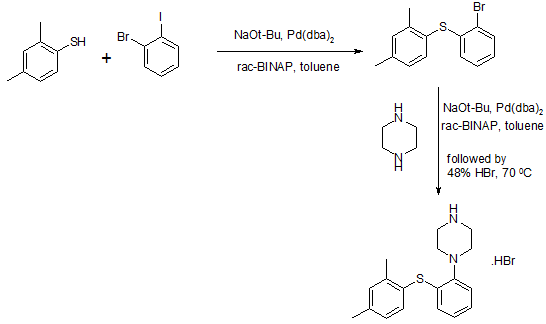
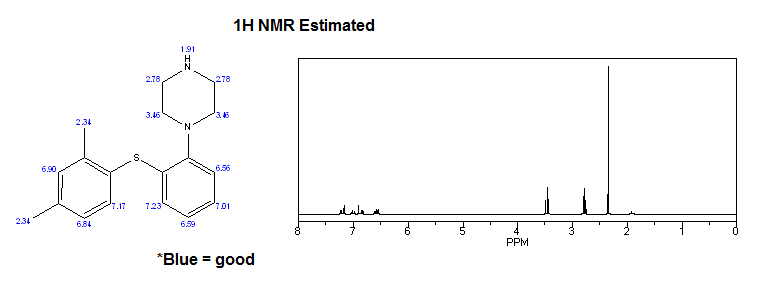
1-[2-(2,4-dimethylphenyl)sulfanylphenyl]piperazine

Lu AA21004

VORTIOXETINE; CAS 508233-74-7;

1-(2-((2,4-Dimethylphenyl)thio)phenyl)piperazine; Lu AA21004; UNII-3O2K1S3WQV; C18H22N2S;

Molecular Formula: C18H22N2S
Molecular Weight: 298.44568 g/mol

Vortioxetine Hydrobromide

C18H22N2S.HBr : 379.36
[960203-27-4] HYDROBROMIDE

Vortioxetine is an atypical antipsychotic and antidepressant indicated for the treatment of major depressive disorder (MDD). It is classified as a serotonin modulator and simulator (SMS) as it has a multimodal mechanism of action towards the serotonin neurotransmitter system whereby it simultaneously modulates one or more serotonin receptors and inhibits the reuptake of serotonin. More specifically, vortioxetine acts via the following biological mechanisms: as a serotonin reuptake inhibitor (SRI) through inhibition of the serotonintransporter, as a partial agonist of the 5-HT1B receptor, an agonist of 5-HT1A, and an antagonist of the 5-HT3, 5-HT1D, and 5-HT7 receptors. SMSs were developed because there are many different subtypes of serotonin receptors, however, not all of these receptors appear to be involved in the antidepressant effects of SRIs. Some serotonin receptors seem to play a relatively neutral or insignificant role in the regulation of mood, but others, such as 5-HT1A autoreceptors and 5-HT7 receptors, appear to play an oppositional role in the efficacy of SRIs in treating depression.

Sept. 30, 2013 — The U.S. Food and Drug Administration today approved Brintellix (vortioxetine) to treat adults with major depressive disorder.

Major depressive disorder (MDD),

Commonly referred to as depression, is a mental disorder characterized by mood changes and other symptoms that interfere with a person’s ability to work, sleep, study, eat and enjoy once-pleasurable activities. Episodes of depression often recur throughout a person’s lifetime, although some may experience a single occurrence.

READ ALL AT

http://www.drugs.com/newdrugs/fda-approves-brintellix-major-depressive-disorder-3918.html

Lu AA21004/vortioxetine
The disease: Major depression
The developers: Lundbeck, Takeda

Vortioxetine (vor-tye-OX-e-teen, code name Lu AA21004) is an experimental drug currently under development by Lundbeck and Takeda for the treatment of major depressive disorder (MDD) and generalized anxiety disorder (GAD).Commercial names chosen are Brintellix and Rexulti.

Regulatory approval for the treatment of MDD for the European market has been filed in September 2012, for the United States in October 2012, and filing for Canada should follow. Filing for the Japanese market is expected in 2013.

Depression

In May 22 2011, Lundbeck presented the results of four phase III trials on vortioxetine at the 2011 Annual Meeting of the American Psychiatric Association. A statistically significant effect was shown in two of the studies (one for active treatment using the Hamilton Depression Rating Scale (HAM-D), the second as a maintenance treatment), vortioxetine failed to prove superiority over placebo in a third (again using the HAM-D) and the fourth was nullified by an exceptionally high placebo response (according to the Montgomery-Åsberg Depression Rating Scale (MADRS)).

In July 2011, Lundbeck published the results of a double-blind, randomized, placebo-controlled clinical trial with venlafaxine as an active reference. It was found to be superior to placebo in treating MDD while having fewer side effects than venlafaxine. Similarly, in May 2012, Lundbeck published the results of a double-blind, randomized, placebo-controlled clinical trial with duloxetine evaluating vortioxetine in elderly depressed patients, and it was found superior to placebo, with fewer side effects than duloxetine.

In May 2012, Lundbeck disclosed the results of three phase III clinical trials, showing vortioxetine’s superiority over placebo according to the MADRS.

In August 2012, a randomized, double-blind trial confirms the superiority of vortioxetine over placebo according to all measures, excepted the Sheehan Disability scale.

In September 2012, a randomised, double-blind trial reveals that a dose of 5mg shows superiority over placebo only in patients that suffer from comorbid anxiety.This is consistent with results from another trial published in December 2012, demonstrating that 2.5 mg and 5 mg doses are ineffective.

Anxiety

August 2012, contradictory results of two randomized, double-blind trial were published. While the first demonstrated vortioxetine’s superiority over the placebo, the second showed that the drug had no efficacy, leading the authors to question the designs of the different trials.

Antidepressant drug Paxil for Waugh (Brintellix, Vortioxetine) preparation methods

United States Patent Number: 7,144,884 ,  8,476,279
related to Chinese patent: CN1319958 C , CN1561336 A; CN1319958C, CN1561336A
patent validity: January 9, 2023 (U.S. Patent Number: 7,144,884), October 2, 2022 (U.S. Patent No.: 8,476,279)
peak annual sales (estimated): $ 2 billion
drug companies: Lundbeck (Lundbeck), Takeda (Takeda)

Wal antidepressant drug Paxil (Brintellix, Vortioxetine) for – 1 – Preparation – [2 – (2,4 methyl) phenyl] piperazine process

Method II:

815g of the NaOBut (8,48 mo1), 844 g of piperazine Qin (9,8 mol), 6,6 g of Pd (dba) 2 (11,48 mmol) and 13,6 g of rac-BINAP (21, 84 mmol) was stirred for 50 minutes with 4L ofbenzene. Then, 840 g 2 – bromo – iodobenzene (2,97 mol) and 1.5L of Yue added to the mixture with benzene, and the stirring was continued for 30 minutes. Finally, 390.8g of 2,4 -thiophenol (2,83 mol) was added together with 1.5L toluene. The resulting suspension was heated to reflux and reflux was continued for 5 hours. The reaction mixture was cooled overnight. 2L of water was added and stirred for l hour and then filtered through a filter aid, the resulting mixture. Then, the filtrate was washed with brine 3xlL. Subsequently, the combined aqueous phase extracted with 600ml of benzene. Then, Yue The combined benzene phase was heated to 70 ° C, then adding 329.2ml 48-wt. / HBr (aq.) and 164.6ml water o’s. The mixture was cooled to room temperature overnight. Final product was collected by filtration (l-[2 – (2,4 – di曱group – phenylsulfanyl) – phenyl] – piperazine hydrobromide Qin), and dried under vacuum (60 0 C), to give 895g of product (84% yield).

Method III:

The benzene is placed 500ml three-necked 1L round bottom flask equipped with a mechanical stirrer and add 809mg Pd2dba3 (0.88mmol; 0.5 mol%) and 952 mg DPEPhos (1.77 mmol; 0.5mol-%). The deep red solution was purged with nitrogen for 5 minutes, then add 100g2-bromo-iodobenzene (353 mmol) and 48.9 g 2,4 – bis thiophenol (353 mmol). Add 43.6g KOBut (389 mmol) caused an exothermic reaction, so that the temperature rise of 20 ° C 42 ° C, while forming a non-uniform mixture, and the color changed from deep red to orange / brown. The force of the suspension under nitrogen was heated to port 100 ° C. After only 20 minutes, HPLC showed complete conversion to have l-(2 – bromo – phenylsulfanyl) -2,4 – Yue group – benzene. The mixture was cooled to 40 ° C, was added to 600ml 15-wt% NaCl, and stirred for 5 minutes. The organic phase was separated, and the aqueous phase was washed 2xl00mwith benzene. The combined organic phase was washed with HCl (aq) NaCl and washed with 100ml 2M 100ml 15-wt%, and then Na 2 S04 dried by activated charcoal (10 g) at reflux for 15 minutes, filtered twice and evaporated to 107.3 g of orange-red oil (103%), the oil was found by HPLC purity of 98%.

To 90 g of the orange-red oil (307 mmol) in 500ml of anhydrous toluene was added 57 g boc-piperazine Qin (307 mmol), degassed with nitrogen for 5 minutes, was added 1.4g Pd2dba3 (1.53 mmol- %; 0.5 mol%) and 2.9g mc-BINAP (4.6 mmol; 1.5 mol-%), degassed and then another 2 minutes, then add 35.4 g of NaOtBu (368 mmol), and heated to 80 ° C for 18 hours. HPLC showed complete conversion to have the reaction mixture was cooled to RT, filtered, and the filter cake was washed with 2 x 100ml of曱benzene. % NaCl, washed twice in Na2S04 dried, added charcoal, refluxed for 30 minutes, filtered twice and evaporated to 140.7 g of a brown oil (4 – – The combined filtrates with 2 x 150ml 15 [2 – (2, 4 – di曱group – phenylsulfanyl) -. phenyl]-BOC-piperazine Qin). The resulting crude oil was dissolved in 300ml MeOH and 200ml 6MHCl (aq.) and refluxed for l hour, after which HPLC showed complete deprotection. After cooling to RT, the vacuum on a rotary evaporator to remove曱alcohol was added 20ml of concentrated NaOH (pH was measured to 13-14), after which the mixture with 1000ml EtOAc – 15 minutes from stirring. The organic phase was collected and dried 300ml 15wtQ /. Saline extraction in Na2S04 dried, and added 46.3 g of fumaric acid in 300mlMeOH (399 mmol) was added. The mixture was heated to reflux, cooled to room temperature and then placed in the tank (-18. C) overnight. The precipitate was collected, washed with 100ml and 100ml of acetone with EtOAc, and dried in vacuo (50 ° C), to give 103.2g of l-[2 – (2,4 – di group – phenylsulfanyl) – phenyl] – piperazine. Qin fumarate (249mmo1), as a white powder, overall yield 81%, determined by LC-MS and the purity was 99% fumarate. Use EtOAc/H20 / concentrated NaOH to the fumarate salt into the free base (l-[2 – (2,4 – dimethyl – phenylsulfanyl) – phenyl] – piperazine Qin), The organic phase was washed with brine, dried over Na 2 S04 sulfate, filtered and to the filtrate was added 34ml48-wto / o of HBr (aq.), to form a white solid precipitated. The solid was collected, and the solid was washed with 1000ml H20 boiling process, the resultant was cooled to room temperature and purified by forming a slurry. The final product was collected by filtration (l-[2 – (2,4 – digroup – phenylsulfanyl) – phenyl] – piperazine hydrobromide Qin Kr), and dried in vacuo (50 ° C), to produce 83g of white powder (total yield 71%).

Source:

1) Bang-Andersen B, Ruhland T, Jørgensen M, Smith G, Frederiksen K, Jensen KG, Zhong H, Nielsen SM, Hogg S, Mørk A, Stensbøl TB “Discovery of 1 -. [2 – (2,4 – dimethylphenylsulfanyl) phenyl] PIPERAZINE (Lu AA21004): a novel multimodal Major Compound for the treatment of depressive disorder. ” Journal of Medicinal Chemistry 54 (9): 3206-21.

2) Thomas Ruhland, Garrick Paul Smith, Benny Bang-Andersen, Ask Puschl, Ejner Knud Moltzen, Kim Andersen,; Phenyl-piperazine derivatives as serotonin reuptake inhibitors; US patent number 7144884 ; also published as CA2462110A1, CA2462110C , CN1319958C, CN1561336A, DE60225162D1, DE60225162T2, DE60233608D1, EP1436271A1, EP1436271B1, EP1749818A2, EP1749818A3, EP1749818B1, US7138407, US7148238, US7683053, US8110567, US8476279, US20050014740, US20060084662, US20060089368, US20070060574, US20110009423, US20120302553, WO2003029232A1; H. Lundbeck A / S;
T · Rouland, G · P · Smith, B · Bang – Anderson, A · Pi Shier, E · K · Moore Cen, K · Anderson; as serotonin reuptake inhibitors phenyl piperazine derivatives matter; CN 1319958 C
T · Rouland, G · P · Smith, B · Bang – Anderson, A · Pi Shier, E · K · Moore Cen, K · Anderson; as serotonin reuptake inhibitors phenyl piperazine derivatives; CN 1561336 A

3) Benny Bang-Andersen; Phenyl-piperazine derivatives as serotonin reuptake inhibitors; US patent number 8476279 B2 ; Also published as CA2462110A1, CA2462110C, CN1319958C, CN1561336A, DE60225162D1, DE60225162T2, DE60233608D1, EP1436271A1, EP1436271B1, EP1749818A2, EP1749818A3, EP1749818B1, US7138407, US7144884, US7148238, US7683053, US8110567, US20050014740, US20060084662, US20060089368, US20070060574, US20110009423, US20120302553, WO2003029232A1; H. Lundbeck A / S;

4) Kim Lasse Christensen; Process for the manufacture of 1 – [2 – (2,4-dimethyl-phenylsulfanyl)-phenyl]-piperazine; PCT application, WO2013102573 A1

5) Benny Bang-Andersen, Joergen Brodersen, Andre Faldt, Rene Holm, Morten Joergensen, De Diego Heidi Lopez, Michael J Mealy, Arne Moerk, Nicholas Moore, Lone Munch Ringgaard, Michael Harold Rock, Tine Bryan Stensboel; 1 – [2 – (2, 4-dimethylphenylsulfanyl)-phenyl] piperazine as a compound with combined serotonin reuptake, 5-ht3 and 5-ht1a activity for the treatment of cognitive impairment; WO2007144005 A1


Updated oct 2015…………….

Vortioxetine (vor-tye-oks-e-teen, trade name Trintellix) is an atypical antidepressant (a serotonin modulator and stimulator) made by Lundbeck and Takeda.[1]

Vortioxetine [1-[2-(2,4-Dimethylphenyl-sulfanyl)-phenyl]-piperazine] is an orally administered small molecule developed as once-daily treatment of major depressive disorder (MDD) and generalized anxiety disorder (GAD). As a drug, Vortioxetine is a bis-aryl-sulphanyl amine compound that combines serotonin (5-HT) reuptake inhibition with other characteristics, including receptor activity modulation.

Vortioxetine binds to the human serotonin (5-HT) transporter (SERT) with high affinity (Ki = 1.6 nM) and is a potent inhibitor of serotonin reuptake (IC50 = 5.4 nM), whereas its affinity for transporters of noradrenaline (Ki = 113 nM) and dopamine (Ki greater than 1000 nM) is much lower or negligible. The drug also has a broad receptor-binding profile, binding to the 5-HT1A receptor (Ki = 15 nM) where it acts as an agonist, the 5-HT1B receptor (Ki = 33 nM) where it acts as a partial agonist, and the 5-HT1D, 5-HT3 and 5-HT7 receptors (Ki = 54, 3.7 and 19 nM, respectively) where it displays antagonistic properties [1, 2].

Animal and in vitro studies indicate that several neurotransmitter systems may be impacted by vortioxetine, with the drug enhancing levels of 5-HT, noradrenaline, dopamine, acetylcholine and histamine in certain areas of the brain, as well as modulating γ-aminobutyric acid and glutamate neurotransmission. Results from additional animal models suggest vortioxetine may also improve measures of cognitive function, such as memory. In healthy volunteers, single or repeated administration of vortioxetine (10 mg) did not impair cognitive function, psychomotor performance or driving ability in a placebo-controlled study.

In September 2013, Vortioxetine was approved as Brintellix for the once-daily treatment of adults with MDD in the USA and one month later, EMA approved it as it first in line treatment for Europeans with MDD. It is marketed as Trintellix in Canada.
Vortioxetine was discovered by scientists at Lundbeck, where it was known as Lu AA21004. Takeda and Lundbeck entered into a strategic alliance to co-develop and co-commercialise vortioxetine and tedatioxetine in Japan and the USA in September 2007. The two companies will jointly complete product development, which will be funded primarily by Takeda, and the companies will share revenue generated in the USA and Japan.
Vortioxetine is administered orally at a starting dosage of 10 mg/day, with the dosage increased to 20 mg/day, as tolerated; 5 mg/ day may be considered if higher dosages are not tolerated. Dosages greater than 20 mg/day have not been assessed for efficacy or safety in controlled trials.

Medical use

Vortioxetine is used as first-line treatment for major depressive disorder.[1][2][3][4][5]

Pharmacokinetics

Vortioxetine reaches peak plasma concentration (Cmax) within 7 to 11 hours post-administration (Tmax), and its mean terminal half-life (t½) is ≈ 66 hours. Steady-state plasma concentrations are typically reached within two weeks.[1] It has no active metabolites (i.e. it is not a prodrug).[1]

Research

Vortioxetine has been studied in several clinical trials as a potential treatment for general anxiety disorder but results were inconsistent.[9][10]

History

Vortioxetine was discovered by scientists at Lundbeck who reported the rationale and synthesis for the drug (then called Lu AA21004) in a 2011 paper.[7][11]

In 2007, the compound was in Phase II clinical trials, and Lundbeck and Takeda entered into a partnership in which Takeda paid Lundbeck $40 million upfront, with promises of up to $345 million in milestone payments, and Takeda agreed to pay most of the remaining cost of developing the drug. The companies agreed to co-promote the drug in the US and Japan, and that Lundbeck would receive a royalty on all such sales. The deal included another drug candidate, tedatioxetine (Lu AA24530), and could be expanded to include two other Lundbeck compounds.[12]

Vortioxetine was approved by the U.S. FDA for the treatment of major depressive disorder (MDD) in adults in September, 2013,[13] and it was approved in Europe later that year.[14]

Vortioxetine was previously trademarked as Brintellix in the United States, but on May 2, 2016, the US FDA approved a name change to Trintellix in order to avoid confusion with the blood-thinning medication ticagrelor (Brilinta).[15]

WO2015155153,  SYNTHESIS OF VORTIOXETINE VIA (2,4-DIMETHYLPHENYL)(2-IODOPHENYL)SULFANE INTERMEDIATE

LEK PHARMACEUTICALS D.D. [SI/SI]; Verovskova 57 1526 Ljubljana (SI)
Inventors:ZUPANCIC, Borut; (SI)

Vortioxetine is disclosed as Example 1 e in WO 2003/029232 A1 and is described as being prepared analogously to Example 1 . The process used to prepare Example 1 involves the preparation of 1 -(2-((2-(trifluoromethyl)phenyl)thio)phenyl)piperazine on a solid polystyrene support, followed by decomplexation using visible light irradiation, and purification by preparative LC-MS and ion-exchange chromatography. The overall yield for the preparation of vortioxetine is described as 17%.

Several alternative palladium catalyzed processes for the preparation of vortioxetine are described in Examples 17 to 25 of WO 2007/144005 A1 . These processes describe the preparation of vortioxetine from 2,4-dimethylthiophenol and 2-bromoiodobenzene (or 1 ,2-dibromobenzene) starting materials via a 1 -(2-bromo-phenylsulfanyl)-2,4-dimethyl-benzene intermediate. Each of these processes involves the use of a palladium catalyst and a phosphine ligand.

The preparation of vortioxetine is also described by Bang-Andersen et al. in J. Med. Chem. (201 1 ), Vol. 54, 3206-3221 . Here, in a first step, te/t-butyl 4-(2-bromophenyl)piperazine-1 -carboxylate intermediate is prepared from Boc-piperazine and 2-bromoiodobenzene in a palladium catalyzed coupling reaction. te/t-Butyl 4-(2-bromophenyl)piperazine-1 -carboxylate is then reacted with 2,4-dimethylthiophenol, again in the presence of palladium catalyst and a phosphine ligand, to provide Boc-protected vortioxetine. In the final step, vortioxetine is deprotected using hydrochloric acid to give vortioxetine hydrochloride.

WO 2013/102573 A1 describes a reaction between 1 -halogen-2,4-dimethyl-phenyl, 2-halogen-thiophenol and an optionally protected piperazine in the presence of a base and a palladium catalyst consisting of a palladium source and a phosphine ligand.

Each of the above processes has disadvantages. The process described in WO 2003/029232 is low yielding and unsuitable for the large scale production of vortioxetine, whereas the processes described in WO 2007/144005 A1 , WO 2013/102573 A1 and by Bang-Andersen et al. require the use of expensive starting materials, palladium catalyst and phosphine ligand. In addition, the toxicity of palladium is well known, Liu et al. Toxicity of Palladium, Toxicology Letters, 4 (1979) 469-473, and the European Medicines Agency’ s Guideline on the Specification for Residues of Metal Catalysts sets clear limits on the permitted daily exposure to palladium arising from palladium residue within drug substances, http://www.ema.europa.eu. Thus it would be desirable to avoid the use of a palladium catalyst in the synthesis of vortioxetine and the subsequent purification steps required to remove palladium residue from the final pharmaceutical product.

The invention is described below in further detail by embodiments, without being limited thereto.

A general concept of the process of the present invention may be represented in Scheme 1 .

Scheme 1 : General representation of the basic synthetic concept of the present invention.

Scheme 2.

X = NH2: lb

Scheme 2: Representation of a particular synthetic embodiment of the present invention.

Compound III can also be prepared from 2,4-dimethylbenzenethiol (II) and 1 -fluoro-2-nitrobenzene (l”‘a) or 1 -chloro-2-nitrobenzene (l'”b). In the first step (2,4-dimethylphenyl)(2- nitrophenyl)sulfane (III’) is formed and in the second reaction step nitro group is reduced to ami

Z = F: l”‘a

Z = CI: l”‘b

Scheme 3: Representation of a particular synthetic embodiment of the present invention.

Example 7: Preparation of 1 -(2-((2,4-dimethylphenyl)thio)phenyl)piperazine vortioxetine, VII)

Mixture of (2,4-dimethylphenyl)(2-iodophenyl)sulfane V (0.34 g, 1 .0 mmol), piperazine VI (0.13 g, 1 .5 mmol), K3P03 (0.42 g, 2.0 mmol), Cul (19 mg, 0.1 mmol), and 2-phenylphenol (68 mg, 0.4 mmol) in dry and degassed DMSO (2 mL) was heated under nitrogen atmosphere at 120°C for 20 h. Water (10 mL) is then added and product is extracted to EtOAc (3 x 10 mL). Combined organic layers were washed with water (3 x 10 mL) and brine (2 x 10 mL) and dried over Na2S04. After evaporation of the solvent crude product is purified by chromatography to afford title compound: H NMR (CDCI3, 500 MHz) δ 1 .63 (br s, 1 H), 2.33 (s, 3H), 2.37 (s, 3H), 3.02-

3.09 (m, 8H), 6.52 (m, 1 H), 6.87 (m, 1 H), 7.04 (m, 1 H), 7.06-7.10 (m, 2H), 7.16 (m, 1 H), 7.39 (d, J= 7.8 Hz, 1 H); MS (ESI) m/z: 299 [MH]+.

Example 8: Preparation of 1 -(2-((2,4-dimethylphenyl)thio)phenyl)piperazine (vortioxetine, VII)

Mixture of (2,4-dimethylphenyl)(2-iodophenyl)sulfane V (0.34 g, 1 .0 mmol), piperazine VI (0.13 g, 1 .5 mmol), K3P03 (0.42 g, 2.0 mmol), Cul (19 mg, 0.1 mmol), and N,N-diethyl-2-hydroxybenzamide (39 mg, 0.2 mmol) in dry and degassed DMSO (2 mL) was heated under nitrogen atmosphere at 120 ^ for 20 h. Water (10 mL) is then added and product is extracted to EtOAc (3 x 10 mL). Combined organic layers were washed with water (3 x 10 mL) and brine (2 x 10 mL) and dried over Na2S04. After evaporation of the solvent crude product is purified by chromatography to afford title compound: H NMR (CDCI3, 500 MHz) δ 1 .63 (br s, 1 H), 2.33 (s, 3H), 2.37 (s, 3H), 3.02-3.09 (m, 8H), 6.52 (m, 1 H), 6.87 (m, 1 H), 7.04 (m, 1 H), 7.06-7.10 (m, 2H), 7.16 (m, 1 H), 7.39 (d, J= 7.8 Hz, 1 H); MS (ESI) m/z: 299 [MH]+.

Example 9: Preparation of 1 -(2-((2,4-dimethylphenyl)thio)phenyl)piperazine hydrobromide

(vortioxetine HBr, VII.HBr)

To a solution of vortioxetine VII (1 .80 g, 6.03 mmol) in iPrOAc (20 mL) at room temperature 48% HBr (0.68 mL, 6.03 mmol) was slowly added. Obtained mixture was stirred at room temperature for 1 h, white precipitate was then filtered off, washed with acetone (2 x 20 mL), and dried to afford title compound VII.HBr as a white powder (2.15 g, 94% yield): H NMR (DMSO-d6, 500 MHz) δ 2.23 (s, 3H), 2.32 (s, 3H), 3.15-3.27 (m, 8H), 6.40 (m, 1 H), 6.96 (m, 1 H), 7.08-7.17 (m, 3H), 7.24 (m, 1 H), 7.32 (d, J= 7.8 Hz, 1 H), 8.85 (br, 2H).

Reference Example 1 : Preparation of 1 -(2-((2,4-dimethylphenyl)thio)phenyl)piperazine

(vortioxetine, VII)

Mixture of piperazine (1 .0 g, 1 1 .6 mmol), NaOtBu (1 .37 g, 13.8 mmol), Pddba2 (40 mg, 0.07 mmol), and 1 ,3-bis(2,6-di-i-propylphenyl)imidazolium chloride (24 mg, 0,07 mmol) in dry and degassed toluene (10 mL) is stirred at room temperature for 1 h. (2,4-Dimethylphenyl)(2-iodophenyl)sulfane V (1 .32 g, 3.86 mmol) is then added, reaction mixture is heated to l OO’C and stirred for 24 h. After cooling to room temperature to the reaction mixture water (5 mL) and Celite (0.4 g) is added. After stirring for 20 min salts are filtered off, organic layer is separated, washed with brine (2 x 10 mL), dried over Na2S04 and solvent is evaporated to afford crude product, which is then purified by chromatography to afford title compound as yellowish crystals: H NMR (CDCI3, 500 MHz) δ 1 .63 (br s, 1 H), 2.33 (s, 3H), 2.37 (s, 3H),

Reference Example 2: Preparation of 1 -(2-((2,4-dimethylphenyl)thio)phenyl)piperazine

(vortioxetine, VII)

Mixture of piperazine (1 .29 g, 15.0 mmol), NaOtBu (1 .77 g, 17.8 mmol), Pddba2 (52 mg, 0.09 mmol), and rac-BINAP (93 mg, 0,15 mmol) in dry and degassed toluene (10 mL) was stirred at room temperature for 1 h. (2,4-Dimethylphenyl)(2-iodophenyl)sulfane V (1 .70 g, 5.0 mmol) was then added, reaction mixture was heated to 100°C and stirred for 24 h. After cooled to room temperature to the reaction mixture water (5 mL) and Celite (0.4 g) were added. After stirring for 20 min salts were filtered off, organic layer was separated, washed with brine (2 x 10 mL), dried over Na2S04 and solvent was evaporated to afford product as an orange oil (1 .41 g, 95% yield): H NMR (CDCI3, 500 MHz) δ 1 .63 (br s, 1 H), 2.33 (s, 3H), 2.37 (s, 3H), 3.02-3.09 (m, 8H), 6.52 (m, 1 H), 6.87 (m, 1 H), 7.04 (m, 1 H), 7.06-7.10 (m, 2H), 7.16 (m, 1 H), 7.39 (d, J = 7.8 Hz, 1 H); MS (ESI) m/z: 299 [MH]+.

Comparative Example 1 : Preparation of 1 -(2-((2,4-dimethylphenyl)thio)phenyl)piperazine

(vortioxetine, VII)

Mixture of (2,4-dimethylphenyl)(2-bromohenyl)sulfane V” (0.29 g, 1 .0 mmol), piperazine VI (0.13 g, 1 .5 mmol), K3P03 (0.42 g, 2.0 mmol), Cul (19 mg, 0.1 mmol), and 2-phenylphenol (68 mg, 0.4 mmol) in dry and degassed DMSO (2 mL) was heated under nitrogen atmosphere at 120°C for 20 h. Vortioxetine VII was not formed.

Comparative Example 2: Preparation of 1 -(2-((2,4-dimethylphenyl)thio)phenyl)piperazine

(vortioxetine, VII)

Mixture of (2,4-dimethylphenyl)(2-bromophenyl)sulfane V (0.29 g, 1 .0 mmol), piperazine VI (0.13 g, 1 .5 mmol), K3P03 (0.42 g, 2.0 mmol), Cul (19 mg, 0.1 mmol), and N,N-diethyl-2-hydroxybenzamide (39 mg, 0.2 mmol) in dry and degassed DMSO (2 mL) was heated under nitrogen atmosphere at 120 ^ for 20 h. Vortioxetine VII was not formed.

Vortioxetine Synthesis
 

WO2007144005A1: Industrial process 

J Med Chem 2011, 54(9), 3206-3221: (also see Ref. 3; it has same details)

Identifications:
 
PAPER

Discovery of 1-[2-(2,4-Dimethylphenylsulfanyl)phenyl]piperazine (Lu AA21004): A Novel Multimodal Compound for the Treatment of Major Depressive Disorder

Neuroscience Drug Discovery Denmark, H. Lundbeck A/S, 9 Ottiliavej, DK-2500 Copenhagen-Valby, Denmark
Lundbeck Research USA, 215 College Road, Paramus, New Jersey 07652-1431, United States
J. Med. Chem., 2011, 54 (9), pp 3206–3221
DOI: 10.1021/jm101459g
Abstract Image

The synthesis and structure−activity relationship of a novel series of compounds with combined effects on 5-HT3A and 5-HT1A receptors and on the serotonin (5-HT) transporter (SERT) are described. Compound 5m (Lu AA21004) was the lead compound, displaying high affinity for recombinant human 5-HT1A (Ki = 15 nM), 5-HT1B (Ki = 33 nM), 5-HT3A (Ki = 3.7 nM), 5-HT7 (Ki = 19 nM), and noradrenergic β1 (Ki = 46 nM) receptors, and SERT (Ki = 1.6 nM). Compound 5mdisplayed antagonistic properties at 5-HT3A and 5-HT7 receptors, partial agonist properties at 5-HT1B receptors, agonistic properties at 5-HT1A receptors, and potent inhibition of SERT. In conscious rats, 5m significantly increased extracellular 5-HT levels in the brain after acute and 3 days of treatment. Following the 3-day treatment (5 or 10 (mg/kg)/day) SERT occupancies were only 43% and 57%, respectively. These characteristics indicate that 5m is a novel multimodal serotonergic compound, and 5m is currently in clinical development for major depressive disorder.

1-[2-(2,4-Dimethylphenylsulfanyl)phenyl]piperazine Hydrochloride (5m)

ALERT     HYDROCHLORIDE DATA

5m was prepared according to general procedure 3 starting from intermediate 12m in a yield of 78%.
1H NMR (500 MHz, DMSO-d6) δ 9.39 (s, 2H), 7.33 (d, J = 7.7, 1H), 7.24 (s, 1H), 7.17−7.07 (m, 3H), 6.96 (dd, J = 7.6, 6.0, 1H), 6.41 (d, J = 7.8, 1H), 3.21 (broad s, 8H), 2.31 (s, 3H), 2.24 (s, 3H).
13C NMR (126 MHz, DMSO-d6) δ 148.22, 142.04, 139.68, 136.11, 133.74, 132.14, 128.46, 127.19, 126.40, 126.13, 125.46, 120.64, 48.47 (2C), 43.67 (2C), 21.10, 20.47.
HRMS calcd for C18H22N2S + H, 299.1576; found, 299.1584.
LC/MS (method 1): tR = 1.02 min, UV purity 97%, ELS purity 100%.
Anal. (C18H22N2S·HCl) C, H, N.

References

  1. US Label Last updated July 2014 after review in September, 2014. Versions of label are available at FDA index page Page accessed January 19, 2016
  2. [No authors listed] Vortioxetine. Aust Prescr. 2015 Jun;38(3):101-2. PMID 26648632Free full text
  3. “Relative efficacy and tolerability of vortioxetine versus selected antidepressants by indirect comparisons of similar clinical studies.”. Curr Med Res Opin 30: 2589–606. Oct 10, 2014. doi:10.1185/03007995.2014.969566. PMID 25249164.
  4.  Köhler S, Cierpinsky K, Kronenberg G, Adli M. The serotonergic system in the neurobiology of depression: Relevance for novel antidepressants. J Psychopharmacol. 2016 Jan;30(1):13-22. PMID 26464458
  5.  Kelliny M, Croarkin PE, Moore KM, Bobo WV. Profile of vortioxetine in the treatment of major depressive disorder: an overview of the primary and secondary literature. Ther Clin Risk Manag. 2015 Aug 12;11:1193-212. PMID 26316764 Free full text
  6.  “Lundbeck’s “Serotonin Modulator and Stimulator” Lu AA21004: How Novel? How Good? – GLG News”.
  7. ^ Jump up to:a b c Bang-Andersen B, Ruhland T, Jørgensen M, et al. (May 2011). “Discovery of 1-[2-(2,4-dimethylphenylsulfanyl)phenyl]piperazine (Lu AA21004): a novel multimodal compound for the treatment of major depressive disorder”. Journal of Medicinal Chemistry 54 (9): 3206–21. doi:10.1021/jm101459g. PMID 21486038.
  8.  N. Moore; B. Bang-Andersen; L. Brennum; K. Fredriksen; S. Hogg; A. Mork; T. Stensbol; H. Zhong; C. Sanchez; D. Smith (August 2008). “Lu AA21004: a novel potential treatment for mood disorders”. European Neuropsychopharmacology 18 (Supplement 4): S321.doi:10.1016/S0924-977X(08)70440-1.
  9.  Pae CU et al. Vortioxetine, a multimodal antidepressant for generalized anxiety disorder: a systematic review and meta-analysis. J Psychiatr Res. 2015 May;64:88-98. PMID 25851751
  10.  Reinhold JA, Rickels K. Pharmacological treatment for generalized anxiety disorder in adults: an update. Expert Opin Pharmacother. 2015;16(11):1669-81. PMID 26159446
  11.  Sanchez C, Asin KE, Artigas F Vortioxetine, a novel antidepressant with multimodal activity: review of preclinical and clinical data. Pharmacol Ther. 2015 Jan;145:43-57. PMID 25016186 Free full text
  12. Daniel Beaulieu for First Word Pharma. September 5th, 2007 Lundbeck, Takeda enter strategic alliance for mood disorder, anxiety drugs
  13. FDA approves new drug to treat major depressive disorder, U.S. Food and Drug Administration Press Announcement.
  14. EMA Brintellix page at EMA site Page accessed January 19, 2016
  15. Commissioner, Office of the. “Safety Alerts for Human Medical Products – Brintellix (vortioxetine): Drug Safety Communication – Brand Name Change to Trintellix, to Avoid Confusion With Antiplatelet Drug Brilinta (ticagrelor)”. http://www.fda.gov. Retrieved2016-05-02.
References:
1. Gibb, A.; et. al. Vortioxetine: first global approval. Drugs 2014, 74(1), 135-145.
2. Bang-Andersen, B.; et. al. Discovery of 1-[2-(2,4-dimethylphenylsulfanyl)phenyl]piperazine (Lu AA21004): a novel multimodal compound for the treatment of major depressive disorder. J Med Chem 2011, 54(9), 3206-3221.
3. Bang-Andersen, B.; et. al. 1-[2-(2,4-dimethylphenylsulfanyl)-phenyl] piperazine as a compound with combined serotonin reuptake, 5-ht3 and 5-ht1a activity for the treatment of cognitive impairmentWO2007144005A1
Patent ID Date Patent Title
US7683053 2010-03-23 PHENYL-PIPERAZINE DERIVATIVES AS SEROTONIN REUPTAKE INHIBITORS
US7148238 2006-12-12 Phenyl-piperazine derivatives as serotonin reuptake inhibitors
US7144884 2006-12-05 Phenyl-piperazine derivatives as serotonin reuptake inhibitors
US7138407 2006-11-21 Phenyl-piperazine derivatives as serotonin reuptake inhibitors
Patent ID Date Patent Title
US2013184291 2013-07-18 THERAPEUTIC USES OF 1-[2-(2,4-DIMETHYL-PHENYLSUFLANYL)PHENYL]PIPERAZINE
US8476279 2013-07-02 Phenyl-piperazine derivatives as serotonin reuptake inhibitors
US2013115292 2013-05-09 ENTERIC TABLET
US2012189697 2012-07-26 COMPOSITIONS OF 1-[2-(2,4-DIMETHYL-PHENYLSULFANYL)-PHENYL]PIPERAZINE
US2012035188 2012-02-09 LIQUID FORMULATIONS OF SALTS OF 1-[2-(2,4-DIMETHYLPHENYLSULFANYL)PHENYL]-PIPERAZINE
US8110567 2012-02-07 PHENYL-PIPERAZINE DERIVATIVES AS SEROTONIN REUPTAKE INHIBITORS
US2012004409 2012-01-05 Purification of 1-[2-(2,4-dimethylphenylsulfanyl)phenyl]piperazine
US2011201617 2011-08-18 Therapeutic Uses Of Compounds Having Combined SERT, 5-HT3 And 5-HT1A Activity
US2011009422 2011-01-13 1- [2-(2,4-DIMETHYLPHENYLSULFANYL)-PHENYL] PIPERAZINE AS A COMPOUND WITH COMBINED SEROTONIN REUPTAKE, 5-HT3 AND 5-HT1A ACTIVITY FOR THE TREATMENT OF PAIN OR RESIDUAL SYMPTOMS IN DEPRESSION RELATING TO SLEEP AND COGNITION
US2010297240 2010-11-25 1- [2- (2,4-DIMETHYLPHENYLSULFANYL)-PHENYL] PIPERAZINE AS A COMPOUND WITH COMBINED SEROTONIN REUPTAKE, 5-HT3 AND 5-HT1A ACTIVITY FOR THE TREATMENT OF COGNITIVE IMPAIRMENT
Patent ID Date Patent Title
US2015094316 2015-04-02 LIQUID FORMULATIONS OF SALTS OF 1-[2-(2,4-DIMETHYLPHENYLSULFANYL)PHENYL]PIPERAZINE
US8969355 2015-03-03 1-[2-(2,4 dimethylphenylsulfanyl)-phenyl]piperazine as a compound with combined serotonin reuptake, 5-HT3 and 5-HT1a activity for the treatment of cognitive impairment
US2015005318 2015-01-01 1-[2-(2,4-Dimethylphenylsulfanyl)-Phenyl]Piperazine As A Compound With Combined Serotonin Reuptake, 5-HT3 And 5-HT1a Activity For The Treatment Of Cognitive Impairment
US2014371453 2014-12-18 1-[2-(2,4-Dimethylphenylsulfanyl)-Phenyl]Piperazine As A Compound With Combined Serotonin Reuptake, 5-HT3 And 5-HT1a Activity For The Treatment Of Cognitive Impairment
US2014343287 2014-11-20 Process for the Manufacture of 1-[2-(2,4-Dimethyl-Phenylsulfanyl)-Phenyl]-Piperazine
US2014315921 2014-10-23 1-[2-(2,4-Dimethylphenylsulfanyl)-Phenyl]Piperazine As A Compound With Combined Serotonin Reuptake, 5-HT3 And 5-HT1a Activity For The Treatment Of Cognitive Impairment
US2014256943 2014-09-11 1-[2-(2,4-Dimethylphenylsulfanyl)-Phenyl]Piperazine As A Compound With Combined Serotonin Reuptake, 5-HT3 And 5-HT1a Activity For The Treatment Of Cognitive Impairment
US2014248355 2014-09-04 1-[2-(2,4-Dimethylphenylsulfanyl)-Phenyl]Piperazine As A Compound With Combined Serotonin Reuptake, 5-HT3 And 5-HT1a Activity For The Treatment Of Cognitive Impairment
US2014248356 2014-09-04 1-[2-(2,4-Dimethylphenylsulfanyl)-Phenyl]Piperazine As A Compound With Combined Serotonin Reuptake, 5-HT3 And 5-HT1a Activity For The Treatment Of Cognitive Impairment
US2014163043 2014-06-12 PHENYL-PIPERAZINE DERIVATIVES AS SEROTONIN REUPTAKE INHIBITORS
Patent ID Date Patent Title
US2016083359 2016-03-24 1-[2-(2,4-DIMETHYLPHENYLSULFANYL)-PHENYL]PIPERAZINE AS A COMPOUND With COMBINED SEROTONIN REUPTAKE, 5-HT3 AND 5-HT1A ACTIVITY FOR THE TREATMENT OF COGNITIVE IMPAIRMENT
US2016060215 2016-03-03 New Process For The Synthesis Of 1-(2-((2,4-Dimethylphenyl)Thio)Phenyl)Piperazine
US2016015706 2016-01-21 CRYSTALLINE FORMS OF AN ANTIDEPRESSANT COMPOUND
US2016009670 2016-01-14 VORTIOXETINE MANUFACTURING PROCESS
US9211288 2015-12-15 Compositions comprising vortioxetine and donepezil
US2015297585 2015-10-22 COMPOSITIONS COMPRISING VORTIOXETINE AND DONEPEZIL
US2015266841 2015-09-24 Novel Crystalline Form Of Vortioxetine Hydrobromide
US2015150867 2015-06-04 COMPOSITIONS OF 1-[2-(2,4-DIMETHYL-PHENYLSULFANYL)-PHENYL]PIPERAZINE
US2015110873 2015-04-23 ENTERIC TABLET
US2015094316 2015-04-02 LIQUID FORMULATIONS OF SALTS OF 1-[2-(2,4-DIMETHYLPHENYLSULFANYL)PHENYL]PIPERAZINE
Vortioxetine
Vortioxetine.svg
Vortioxetine ball-and-stick model.png
Systematic (IUPAC) name
1-[2-(2,4-Dimethyl-phenylsulfanyl)-phenyl]piperazine
Clinical data
Trade names Trintellix, Brintellix
License data
Pregnancy
category
  • US: C (Risk not ruled out)
Routes of
administration
Oral
Legal status
Legal status
  • ℞ (Prescription only)
Pharmacokinetic data
Bioavailability 75% (peak at 7–11 hours)
Protein binding 98%
Metabolism extensive hepatic, primarilyCYP2D6-mediated oxidation
Biological half-life 66 hours
Excretion 59% in urine, 26% in feces
Identifiers
CAS Number 508233-74-7 Yes
ATC code N06AX26 (WHO)
PubChem CID 9966051
IUPHAR/BPS 7351
ChemSpider 8141643 
KEGG D10184 
ChEBI CHEBI:76016 
Synonyms Lu AA21004
Chemical data
Formula C18H22N2S
Molar mass 298.45 g/mol (379.36 as hydrobromide)

/////////////