
Home » Posts tagged 'GMP' (Page 19)
Tag Archives: GMP
 DRUG APPROVALS BY DR ANTHONY MELVIN CRASTO
.....FOR BLOG HOME CLICK HERE
DRUG APPROVALS BY DR ANTHONY MELVIN CRASTO
.....FOR BLOG HOME CLICK HEREFlag and hits
ORGANIC SPECTROSCOPY

SUBSCRIBE

 Subscribe in a reader
Enter your email address:
Delivered by FeedBurner
Subscribe to New Drug Approvals by Email


Recent Comments
 | shivkr2 on SPSR Excellence Award 2025 – S… |
 | Bonkasaurus on Infigratinib phosphate |
 | PALOVAROTENE | ORGAN… on Palovarotene |
| Pfizer just purchase… on Temanogrel | |
| Pfizer To Cash In On… on Temanogrel |
Amneal Pharma the 7th largest generic drug manufacturer in the US drug market has received ANDA approval for generic Skelaxin (metaxalone).

metaxalone
READ ALL AT
Metaxalone (marketed by King Pharmaceuticals under the brand name Skelaxin) is a muscle relaxant used to relax muscles and relieve pain caused by strains, sprains, and other musculoskeletal conditions. Its exact mechanism of action is not known, but it may be due to general central nervous system depression. It is considered to be a moderately strong muscle relaxant, with relatively low incidence of side effects. Skelaxin is available in an 800 mg scored tablet. Possible side effects include nausea, vomiting, drowsiness and CNS side effects, such as dizziness, headache, and irritability.
Metaxalone exhibits increased bioavailability when taken with food.[1] Specifically, in one study, compared to fasted conditions, the presence of food at the time of drug administration increased Cmax by 77.5%, AUC0-t by 23.5%, and AUC0-∞ by 15.4%.[2] Thus, based on the information in the labeling, patients receiving metaxalone therapy are directed to take metaxalone with food, and are informed that taking metaxalone with food results in an increase in the oral bioavailability of metaxalone compared to taking metaxalone without food.[3][4][5]
The metabolism of metaxalone involves the liver cytochrome P450 system. Based on the information in the labeling, patients receiving metaxalone therapy and physicians prescribing metaxalone are directed to take precaution when coadministering it with other medications involving the P450 system.[6][7]
Because of potential for side effects, this drug is on the list for high risk medications in the elderly.
A literature survey reveals very few methods are reported for the determination of metaxalone to date. Nirogi et al.[2] reported a liquid chromatographic method coupled to tandem mass spectrometry for the quantification of metaxalone in human plasma. A stability-indicating HPLC method was introduced by P.K. Sahu et al.[8] Metaxalone has been used as an internal standard for few analytical methods[9][10]

- Skelaxin Package Insert
- Nirogi RV, Kandikere VN, Shukla M, Mudigonda K, Shrivastava W, Datla PV (May 2006). “Quantification of Metaxalone in Human Plasma by Liquid Chromatography Coupled to Tandem Mass Spectrometry”. J Anal Toxicol 30 (4): 245–51. PMID 16803662.
- id.
- United States Patent No. 6,407,128
- United States Patent No. 6,683,102
- United States Patent No. 7,122,566, by Jie Du, et al
- United States Patent No. 7,378,434, by Jie Du, et al
- Prafulla Kumar Sahu, M. Mathrusri Annapurna and Dillip Kumar Sahoo, Development and Validation of Stability Indicating RP-HPLC Method for the Determination of Metaxalone in Bulk and its Pharmaceutical Formulations; E-Journal of Chemistry, 2011, 8(S1), S439-S447.[1]
- Mistri H N, Jangid A G, Pudage A, Gomes N, Sanyal M and Shrivastav P, J Chromatogr B, 2007, 853(1), 320-332.
- Mistri H N, Jangid A G, Pudage A and Shrivastav P, J Chromatogr B, 2008, 864(1-2), 137-148.

Tobramycin

Tobramycin is an aminoglycoside antibiotic derived from Streptomyces tenebrarius and used to treat various types of bacteria infections, particularly Gram-negative infections. It is especially effective against species of Pseudomonas.[1]

Tobramycin works by binding to a site on the bacterial 30S and 50S ribosome, preventing formation of the 70S complex. As a result, mRNA cannot be translated into protein and cell death ensues. Tobramycin is preferred over gentamicin for Pseudomonas aeruginosapneumonia due to better lung penetration.


Like all aminoglycosides, tobramycin does not pass the gastro-intestinal tract, so forsystemic use it can only be given intravenously or intramuscularly. Ophthalmic (tobramycin only, Tobrex, or combined with dexamethasone, sold as TobraDex) and nebulised formulations both have low systemic absorption. The formulation for injection is branded Nebcin. The nebulised formulation (brand name Tobi) is indicated in the treatment of exacerbations of chronic infection with Pseudomonas aeruginosa in patients diagnosed with cystic fibrosis. A proprietary formulation of micronized, nebulized tobramycin has been tested as a treatment for bacterial sinusitis.[2] Tobrex is a 0.3% tobramycin sterile ophthalmic solution is produced by Bausch & Lomb Pharmaceuticals. Benzalkonium chloride 0.01% is added as a preservative. It is available by prescription only in the United States and Canada. In certain countries, such as Italy, it is available over the counter. Tobrex and TobraDex are indicated in the treatment of superficial infections of the eye, such as bacterial conjunctivitis. Tobramycin (injection) is also indicated for various severe or life-threatening gram-negative infections : meningitis in neonates, brucellosis, pelvic inflammatory disease, Yersinia pestis infection (plague).

Like other aminoglycosides, tobramycin is ototoxic: it can cause hearing loss, or a loss ofequilibrioception, or both in genetically susceptible individuals. These individuals carry a normally harmless genetic mutation that allows aminoglycosides such as tobramycin to affect cochlear cells. Aminoglycoside-induced ototoxicity is generally irreversible.

As with all aminoglycosides, tobramycin is also nephrotoxic, meaning it is toxic to thekidneys. This effect can be particularly worrisome when multiple doses accumulate over the course of a treatment or when the kidney concentrates urine by increasing tubular reabsorption during sleep. Adequate hydration may help prevent excess nephrotoxicity and subsequent loss of renal function. For these reasons parenteral tobramycin needs to be carefully dosed by body weight, and its serum concentration monitored. Tobramycin is thus said to be a drug with a narrow therapeutic index.
|
Mass-spectrum of tobramycin |
|
|

- “Tobramycin” (pdf). Toku-E. 2010-01-12. Retrieved 2012-06-11.
- “Nebulized Tobramycin in treating bacterial Sinusitis” (Press release). July 22, 2008. Retrieved 2009-12-06.


Lyxumia approved in Japan for the treatment of type 2 diabetes

READ ALL AT
OLD ARTICLE

FDA Approves Rixubis – First Recombinant Coagulation Factor IX For Use in Preventing Bleeding Episodes

Rixubis [Coagulation Factor IX (Recombinant)]
June 27, 2013 — The U.S. Food and Drug Administration yesterday approved Rixubis [Coagulation Factor IX (Recombinant)] for use in people with hemophilia B who are 16 years of age and older. Rixubis is indicated for the control and prevention of bleeding episodes, perioperative (period extending from the time of hospitalization for surgery to the time of discharge) management, and routine use to prevent or reduce the frequency of bleeding episodes (prophylaxis).
read all at

VIVUS Announces SPEDRA (avanafil) Approval in Europe

AVANAFIL
June 26, 2013
VIVUS, Inc. today announced that the European Commission (EC) has adopted the implementing decision granting marketing authorization for SPEDRA(TM) (avanafil) for the treatment of erectile dysfunction (ED) in the European Union (EU). The approval of the marketing authorization application (MAA) by the EC follows the positive recommendation by the European Medicines Agency’s (EMA) Committee for Medicinal Products for Human Use (CHMP) in April 2013.
SPEDRA, a PDE5 inhibitor, is the first new chemical entity (NCE) approved for ED in over a decade. The global market for ED therapies was approximately $5.5 billion in 2012.
About Avanafil
STENDRA, or avanafil, is approved by the FDA for the treatment of erectile dysfunction, or ED, in the U.S. VIVUS, through collaboration arrangements with third parties, intends to market and sell STENDRA in the U.S. and under the trade name SPEDRA in the EU and other territories outside the U.S. Avanafil is licensed from Mitsubishi Tanabe Pharma Corporation (MTPC). VIVUS owns worldwide development and commercial rights to avanafil for the treatment of sexual dysfunction, with the exception of certain Asian Pacific Rim countries.
VIVUS is currently in discussions with potential partners to commercialize STENDRA in the United States and other territories throughout the world.
It is recommended that STENDRA should be taken approximately 30 minutes before sexual activity. STENDRA should not be taken more than once per day. For more information about STENDRA, please visit www.Stendra.com.
Sanofi’s new insulin U300 superior to Lantus: study

Sanofi’s investigational diabetes drug U300, cas no 160337-95-1, insuline glargine, new formulation is better at controlling dangerous low blood sugar events at night than its blockbuster Lantus, according to data from a phase III clinical programme.

insulin glargine
Lantus, developed in the 1990s, is currently Sanofi’s top-selling product, generating $6.6bn last year. But the drug is expected to lose its patent in 2015.
http://www.medscape.com/viewarticle/805067 says no cancer risk
http://clinicaltrials.gov/ct2/show/NCT01689142 reports clinical trials
To compare the efficacy of a new formulation of insulin glargine and Lantus in terms of change of HbA1c from baseline to endpoint (scheduled at month 6 [week 26]) in patients with type 2 diabetes mellitus.
Secondary Objectives:
- To compare a new formulation of insulin glargine and Lantus in terms of change in fasting plasma glucose, pre-injection plasma glucose, 8-point self-measured plasma glucose profile.
- To compare a new formulation of insulin glargine and Lantus in terms of occurrence of hypoglycemia
Insulin glargine is produced by recombinant DNA technology using a non-pathogenic laboratory strain of Escherichia coli (K12) as the production organism. It is an analogue of human insulin made by replacing the asparagine residue at position A21 of the A-chain with glycine and adding two arginines to the C-terminus (positions B31 and 32) of the B-chain. The resulting protein is soluble at pH 4 and forms microprecipitates at physiological pH 7.4. Small amounts of insulin glargine are slowly released from microprecipitates giving the drug a long duration of action (up to 24 hours) and no pronounced peak concentration.

GRAVIOLA TREE “10000 TIMES STRONGER KILLER OF CANCER THAN CHEMO” – FACTS ANALYSIS

“10000 times stronger killer of Cancer than Chemo”.. do share it.. can save many lives, fill up hopes and build confidence in the patients…
The Sour Sop or the fruit from the graviola tree is a miraculous natural cancer cell killer 10,000 times stronger than Chemo. Why are we not aware of this?
read all at
http://www.hoaxorfact.com/Health/graviola-tree-10000-times-stronger-killer-of-cancer-than-chemo.html
Dulaglutide Shows Superiority in Phase 3 Trials

DULAGLUTIDE
STRUCTURAL FORMULA
Monomer
HGEGTFTSDV SSYLEEQAAK EFIAWLVKGG GGGGGSGGGG SGGGGSAESK 50
YGPPCPPCPA PEAAGGPSVF LFPPKPKDTL MISRTPEVTC VVVDVSQEDP 100
EVQFNWYVDG VEVHNAKTKP REEQFNSTYR VVSVLTVLHQ DWLNGKEYKC 150
KVSNKGLPSS IEKTISKAKG QPREPQVYTL PPSQEEMTKN QVSLTCLVKG 200
FYPSDIAVEW ESNGQPENNY KTTPPVLDSD GSFFLYSRLT VDKSRWQEGN 250
VFSCSVMHEA LHNHYTQKSL SLSLG 275
Disulfide bridges location
55-55′ 58-58′ 90-150 90′-150′ 196-254 196′-254′
http://www.ama-assn.org/resources/doc/usan/dulaglutide.pdf
7-37-Glucagon-like peptide I [8-glycine,22-glutamic acid,36-glycine] (synthetic
human) fusion protein with peptide (synthetic 16-amino acid linker) fusion protein with
immunoglobulin G4 (synthetic human Fc fragment), dimer
Eli Lilly and Co. announced detailed safety and efficacy results from three Phase 3 AWARD trials for dulaglutide, an investigational, long-acting glucagon-like peptide 1 (GLP-1) receptor agonist being studied as a once-weekly treatment for type 2 diabetes
The antibiotic Vibativ (telavancin) has been approved by the U.S. Food and Drug Administration to treat pneumonia caused by Staphylococcus aureus bacteria
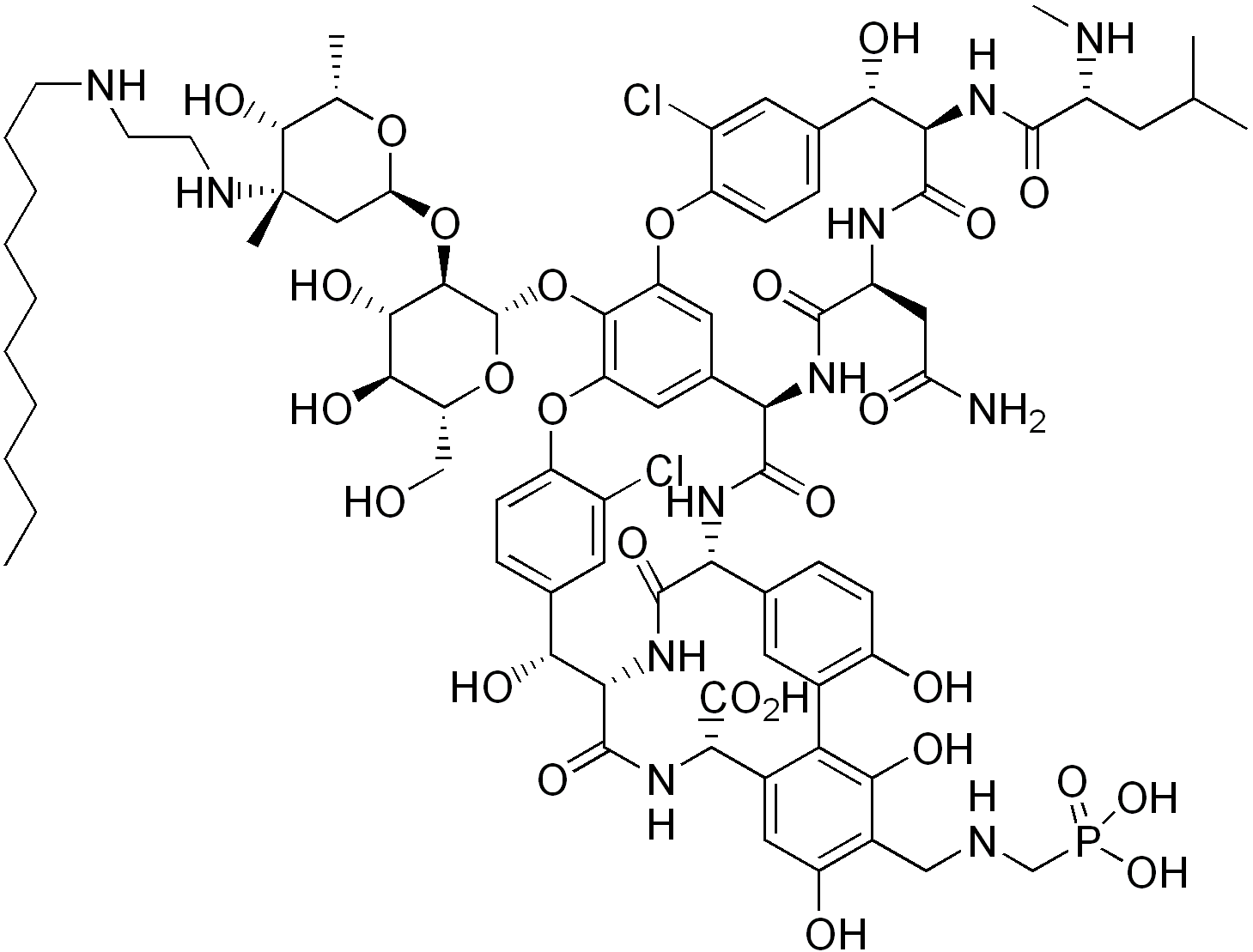
telavancin
The antibiotic Vibativ (telavancin) has been approved by the U.S. Food and Drug Administration to treat pneumonia caused by Staphylococcus aureus bacteria when other treatments aren’t suitable.
Pneumonia, a lung infection, can be caused by different bacteria and viruses. S. aureus infection often affects people in hospitals, notably those on ventilators. Such infections can be serious, since people on a ventilator often have a weakened immune system and are unable to fight an infection, the FDA said in a news release.http://www.drugs.com/news/vibativ-approved-certain-bacterial-pneumonia-45418.html

Telavancin (trade name Vibativ) is a bactericidal lipoglycopeptide for use in MRSA or other Gram-positive infections. Telavancin is a semi-synthetic derivative of vancomycin.
The FDA approved the drug in September 2009 for complicated skin and skin structure infections (cSSSI)
On 19 October 2007, the US Food and Drug Administration (FDA) issued an approvable letter for telavancin. Its developer, Theravance, submitted a complete response to the letter, and the FDA has assigned a Prescription Drug User Fee Act (PDUFA) target date of 21 July 2008.
On 19 November 2008, an FDA antiinfective drug advisory committee concluded that they would recommend telavancin be approved by the FDA.
The FDA approved the drug on 11 September 2009 for complicated skin and skin structure infections (cSSSI).
Theravance has also submitted telavancin to the FDA in a second indication, nosocomial pneumonia, sometimes referred to as hospital-acquired pneumonia, or HAP. On 30 November 2012, an FDA advisory panel endorsed approval of a once-daily formulation of telavancin for nosocomial pneumonia when other alternatives are not suitable. However, telavancin did not win the advisory committee’s recommendation as first-line therapy for this indication. The committe indicated that the trial data did not prove “substantial evidence” of telavancin’s safety and efficacy in hospital-acquired pneumonia, including ventilator-associated pneumonia caused by Gram-positive organisms Staphylococcus aureus and Streptococcus pneumoniae. On 21 June 2013 FDA gave approval for telavancin to treat patients with hospital-acquired pneumonia, but indicated it should be used only when alternative treatments are not suitable. FDA staff had indicated telavancin has a “substantially higher risk for death” for patients with kidney problems or diabetes compared to vancomycin.


FDA Approves Pediatric Indication for Astellas’ Mycamine (micafungin sodium) for Injection

micafungin sodium
-
C56-H70-N9-O23-S.Na1292.265Fujisawa (Originator), Merck & Co. (Codevelopment)
 Antifungal Agents, ANTIINFECTIVE THERAPY, 1,3-beta-Glucan Synthase Inhibitors, EchinocandinsLaunched-2002
{5-[(1S,2S)-2-[(3S,6S,9S,11R,15S,18S,20R,21R,24S,25S,26S)-3-[(1R)-2-carbamoyl-1-hydroxyethyl]-11,20,21,25-tetrahydroxy-15-[(1R)-1-hydroxyethyl]-26-methyl-2,5,8,14,17,23-hexaoxo-18-[(4-{5-[4-(pentyloxy)phenyl]-1,2-oxazol-3-yl}benzene)amido]-1,4,7,13,16,22-hexaazatricyclo[22.3.0.09,13]heptacosan-6-yl]-1,2-dihydroxyethyl]-2-hydroxyphenyl}oxidanesulfonic acid

June 24, 2013 , Astellas Pharma US, Inc. (“Astellas”), a U.S. subsidiary of Tokyo-based Astellas Pharma Inc. (Tokyo: 4503), announced that the U.S. Food and Drug Administration (FDA) has approved its Supplemental New Drug Application (sNDA) for the use of MYCAMINE® (micafungin sodium) for injection by intravenous infusion for the treatment of pediatric patients four months and older with candidemia, acute disseminated candidiasis, Candida peritonitis and abscesses, esophageal candidiasis, and prophylaxis of Candida infections in patients undergoing hematopoietic stem cell transplants (HSCT).
Micafungin (trade name Mycamine) is an echinocandin antifungal drug developed by Astellas Pharma. It inhibits the production of beta-1,3-glucan, an essential component of fungal cell walls. Micafungin is administered intravenously. It received final approval from the U.S. Food and Drug Administration on March 16, 2005, and gained approval in the European Union on April 25, 2008.
Micafungin is indicated for the treatment of candidemia, acute disseminated candidiasis, Candida peritonitis, abscesses and esophageal candidiasis. Since January 23, 2008, micafungin has been approved for the prophylaxis of Candida infections in patients undergoing hematopoietic stem cell transplantation (HSCT).
Micafungin works by way of concentration-dependent inhibition of 1,3-beta-D-glucan synthase resulting in reduced formation of 1,3-beta-D-glucan, which is an essential polysaccharide comprising one-third of the majority of Candida spp. cell walls. This decreased glucan production leads to osmotic instability and thus cellular lysis
- Micafungin sodium, FK-463, Mycamine, Funguard,208538-73-2

-
The synthesis of FK-463 can be performed as follows: The enzymatic deacylation of FR-901379 with Streptomyces anulatas No. 4811, S. anulatas No. 8703, Streptomyces strain No. 6907 or A. utahensis IFO13244 gives the deacylated lipopeptide FR-179642 (1), which is then reacylated with 1-[4-[5-(4-pentyloxyphenyl)isoxazol-3-yl]benzoyl]benzotriazole 3-oxide (VI) by means of dimethylaminopyridine (DMAP) in DMF. The acylating compound (VI) can be obtained as follows: The cyclization of 4-pentyloxyphenylacetylene (I) with 4-(hydroxyiminomethyl)benzoic acid methyl ester (II) by means of triethylamine in hot THF gives 4-[5-(4-pentyloxyphenyl)isoxazol-3-yl]benzoic acid methyl ester (III), which is hydrolyzed with NaOH in hot THF/water yielding the corresponding free acid (IV). Finally, this compound is condensed with 1-hydroxybenzotriazole (V) by means of 1-ethyl-3-[3-(dimethylamino)propyl]carbodiimide (EDMCA) in dichloromethane.Fromtling, R.A.; Castr, Drugs Fut 1998, 23, 12, 1273The synthesis of FK-463 can be performed as follows: The enzymatic deacylation of FR-901379 with Streptomyces anulatas No. 4811, S. anulatas No. 8703, Streptomyces strain No. 6907 or A. utahensis IFO13244 gives the deacylated lipopeptide FR-179642 (1), which is then reacylated with 1-[4-[5-(4-pentyloxyphenyl)isoxazol-3-yl]benzoyl]benzotriazole 3-oxide (VI) by means of dimethylaminopyridine (DMAP) in DMF. The acylating compound (VI) can be obtained as follows: The cyclization of 4-pentyloxyphenylacetylene (I) with 4-(hydroxyiminomethyl)benzoic acid methyl ester (II) by means of triethylamine in hot THF gives 4-[5-(4-pentyloxyphenyl)isoxazol-3-yl]benzoic acid methyl ester (III), which is hydrolyzed with NaOH in hot THF/water yielding the corresponding free acid (IV). Finally, this compound is condensed with 1-hydroxybenzotriazole (V) by means of 1-ethyl-3-[3-(dimethylamino)propyl]carbodiimide (EDMCD) in dichloromethane.
- 38th Intersci Conf Antimicrob Agents Chemother (Sept 24 1998, San Diego)1998,:Abst F-145


 New Drug Approvals