
FLAGS AND HITS
 DRUG APPROVALS BY DR ANTHONY MELVIN CRASTO
 FACEBOOK
...................................................................Join me on twitter
FACEBOOK
...................................................................Join me on twitter
 ..................................................................Join me on google plus
 Googleplus
MYSELF



Vitamin B2- Riboflavin

Next up in our vitamin march is Vitamin B2, also known as riboflavin. Riboflavin in our diet mostly comes from meat, dairy products, eggs, green leafy vegetables, almonds, or mushrooms. Yeast, liver, and kidney are particularly rich in riboflavin. Also, like thiamine riboflavin is found in cereal grains such as wheat and rice but again is mostly in the outer portion or the germ and therefore much of it is lost in processed grains (yet again, it is important to eat whole grains when possible). Riboflavin is easily destroyed by UV light so some recommend buying dairy products in containers that do not allow light to pass through.
This is the vitamin that gives your urine that neon yellow appearance if you take B vitamin supplements or a multivitamin with high doses of riboflavin. Riboflavin is important for energy metabolism and is required in the processing of other vitamins including Vitamin A…
View original post 990 more words

Ramucirumab Trial Shows Improved OS in Gastric Cancer
Eli Lilly and Co. announced that results from the Phase 3 REGARD trial of ramucirumab (IMC-1121B) as a single agent in patients with advanced gastric cancer who have had disease progression after initial chemotherapy were published today in The Lancet. REGARD is the first Phase 3 study with either a single-agent biologic or an anti-angiogenic therapy to show improved overall survival and progression-free survival in advanced gastric cancer patients.
READ ALL AT
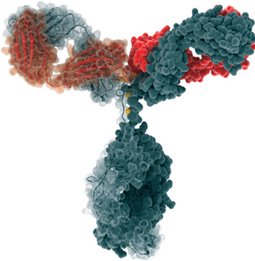
Ramucirumab (IMC-1121B)[1] is a fully human monoclonal antibody (IgG1) being developed for the treatment of solid tumors. It is directed against the vascular endothelial growth factor receptor 2 (VEGFR2). By binding to VEGFR2 it works as a receptor antagonist blocking the binding of vascular endothelial growth factor (VEGF) to VEGFR2. VEGFR2 is known to mediate the majority of the downstream effects of VEGF inangiogenesis.
Ramucirumab is being tested in several phase III clinical trials for the treatment of metastatic gastric adenocarcinoma,[2] non-small cell lung cancer,[3] among other types of cancer. On September 26, 2013 Eli Lilly announced that its Phase III study for ramucirumab failed to hit its primary endpoint on progression-free survival among women with metastatic breast cancer.[4][5]
This drug was developed by ImClone Systems Inc. It was isolated from a native phage display library from Dyax.
- Statement On A Nonproprietary Name Adopted By The USAN Council – Ramucirumab, American Medical Association.
- ClinicalTrials.gov NCT01170663 A Study of Paclitaxel With or Without Ramucirumab in Metastatic Gastric Adenocarcinoma (RAINBOW)
- ClinicalTrials.gov NCT01168973 A Study in Second Line Non Small Cell Lung Cancer
- ClinicalTrials.gov NCT00703326 Phase III Study of Docetaxel + Ramucirumab or Placebo in Breast Cancer
- Fierce Biotech. “In another stinging setback, Eli Lilly’s ramucirumab fails PhIII breast cancer study”. Retrieved 27 September 2013.
Aerial Biopharma announce positive Phase II results for narcolepsy drug
ADX-N05, ARL-N05, SKL-N05
Aerial Biopharma announce positive Phase II results for narcolepsy drug
A new drug to treat excessive daytime sleepiness associated with narcolepsy has shown positive results from a phase 2b clinical trial, US-based Aerial Biopharma has announced this week.
read all at
Tuberculosis y anti-TNF ¿Amistades peligrosas?
Añade tus pensamientos aquí… (opcional)

La tuberculosis es una infección bacteriana causada por Mycobacterium tuberculosis que afecta al menos un tercio de la población mundial. La infección puede permanecer inactiva (latente) durante años aunque es posible que se reactive en cuestión de semanas, aumentando este riesgo en pacientes tratados con fármacos inmunodepresores como los anti-TNF.
View original post 275 more words
Mismo fin, diferentes medios
Añade tus pensamientos aquí… (opcional)
La introducción de la terapia biológica en la pasada década supuso un gran avance en el tratamiento de los pacientes con enfermedades reumáticas. Este nuevo paradigma del tratamiento se enfoca en compuestos con capacidad para inhibir determinados elementos involucrados en la respuesta inmunológica.
Por esta razón, desde biológicos et al. creemos de especial interés revisar los mecanismos de acción de los biológicos más utilizados en reumatología, que se muestran en la siguiente tabla.
View original post 244 more words
Los biosimilares llegan a Europa
Añade tus pensamientos aquí… (opcional)
Desde el 2006 hasta la actualidad se han autorizado un total de 12 medicamentos biosimilares en la Unión Europea, pero la aprobación de biosimilares basados en anticuerpos monoclonales es mucho más reciente. En concreto, a finales de junio la Agencia Europea de Medicamentos (EMA) ha aprobado los dos primeros medicamentos biosimilares de este tipo, Remsina e Inflectra, cuyo producto médico de referencia es Infliximab. Estos medicamentos han sido aprobados para el tratamiento de enfermedades inflamatorias, incluyendo artritis reumatoide, espondilitis anquilosante, enfermedad de Crohn, colitis ulcerosa, artritis psoriásica y psoriasis.
View original post 232 more words
Secukinumab
Secukinumab is an anti-IL17A drug being investigated for a number of inflammatory conditions. For plaque psoriasis, Novartis is planning to evaluate a dose of 150 mg subcutaneously compared with placebo.
The primary outcome measure of the planned Phase III trial named ERASURE is to evaluate the efficacy in patients with moderate to severe chronic plaque-type psoriasis. Novartis is also planning to evaluate secukinumab dosed at either 150 or 300 mg versus Enbrel (enterecept) 50 mg in a Phase III trial entitled FIXTURE.
Final data collection for the primary outcome measures in both ERASURE and FIXTURE are anticipated in March 2013.
Secukinumab is a human monoclonal antibody designed for the treatments of uveitis,rheumatoid arthritis, and psoriasis. It targets member A from the cytokine family ofinterleukin 17.[1][2]
Secukinumab was developed by Novartis Pharma AG and has completed Phase II clinical trials for plaque psoriasis in 2011.[3]
CAS registry numbers
- 875356-43-7 (heavy chain)
- 875356-44-8 (light chain)
- ^ “Statement On A Nonproprietary Name Adopted By The USAN Council: Secukinumab”. American Medical Association.
- ^ Hueber, W.; Patel, D. D.; Dryja, T.; Wright, A. M.; Koroleva, I.; Bruin, G.; Antoni, C.; Draelos, Z.; Gold, M. H.; Psoriasis Study, P.; Durez, P. P.; Tak, J. J.; Gomez-Reino, C. S.; Rheumatoid Arthritis Study, R. Y.; Foster, C. M.; Kim, N. S.; Samson, D. S.; Falk, D.; Chu, Q. D.; Callanan, K.; Nguyen, A.; Uveitis Study, F.; Rose, K.; Haider, A.; Di Padova, F. (2010). “Effects of AIN457, a Fully Human Antibody to Interleukin-17A, on Psoriasis, Rheumatoid Arthritis, and Uveitis”. Science Translational Medicine 2 (52): 52ra72.doi:10.1126/scitranslmed.3001107. PMID 20926833. edit
- ^ Papp K.A. et al. ‘Secukinumab efficacy and safety preliminary results from a phase II subcutaneous dose-ranging study in the treatment of moderate-to-severe plaque psoriasis.’ Presented at: 20th Congress of the European Academy of Dermatology and Venereology; 20-24 October, 2011; Lisbon, Portugal.

Roche releases promising data on MPDL3280A for the treatment of Lung Cancer on Smokers

October 02 ,2013 | By Márcio Barra

Roche has recently released data from an early-stage trial for its experimental drug MPDL3280A, that has been making waves in the scientific community in what the company as called a “potential game changer” in patients with non-small cell lung cancer (NSCLC), especially ones that are smokers.
The results, from a Phase 1a study of MPDL3280A in patients with metastatic NSCLC that had progressed on prior therapy, were presented at the European Cancer Congress (ECC) in Amsterdam. Of the 53 patients (the safety data comprised 85 patients, with clinical activity data available for 53), with NSCLC tumours treated with the drug, 23% saw their tumours shrink. Current and former smokers accounted for 80% of the study population. And it was in this population where the drug shined – the tumour shrinking rate was higher in smokers than in patients that never smoked, 26% to 10%…
View original post 285 more words
Dimeric Thymosin beta-4……..accelerates the rate of wound healing

Structure of a Longitudinal Actin Dimer Assembled by Tandem W Domains
Thymosin beta 4 (Tβ4) is a peptide with 43 amino acids that is critical for repair and remodeling tissues on the skin, eye, heart, and neural system following injury
Thymosin beta-4 is a protein that in humans is encoded by the TMSB4X gene.
The protein consists (in humans) of 43 amino acids (msdkpdmaei ekfdksklkk tetqeknplp sketieqekq ages) molWt 4921

NMR structure of a β-thymosin. Both thymosin α1 and β-thymosins areintrinsically unstructured proteins, i.e. they lack a stable fold when free in aqueous solution. This structure, mostly alpha helix, was artificially stabilised by an organic solvent. The thymosin illustrated, originally named β9 is the cow orthologue of human β10
It has been studied in a number of clinical trials.
The thymosin beta-4 peptide, if used after a heart attack, might reactivate cardiacprogenitor cells to repair damaged heart tissue.
Doping in Sports
Thymosin beta-4 was allegedly used by some players in various Australian football codes and is under investigation by the Australian Sports Anti-Doping Authority for anti-doping violations (Feb/Mar 2013):
https://theconversation.edu.au/cronulla-sharks-and-thymosin-beta-4-is-it-doping-12694
DR ANTHONY MELVIN CRASTO

ORGANIC SPECTROSCOPY


 New Drug Approvals