New Drug Approvals
Follow New Drug Approvals on WordPress.com

FLAGS AND HITS

Flag Counter
DRUG APPROVALS BY DR ANTHONY MELVIN CRASTO

Archives

Categories

Join me on Linkedin

View Anthony Melvin Crasto Ph.D's profile on LinkedIn

Join me on Researchgate

Anthony Melvin Crasto Dr.

  Join me on Facebook FACEBOOK   ...................................................................Join me on twitter Follow amcrasto on Twitter     ..................................................................Join me on google plus Googleplus

MYSELF

DR ANTHONY MELVIN CRASTO Ph.D ( ICT, Mumbai) , INDIA 36Yrs Exp. in the feld of Organic Chemistry,Working for AFRICURE PHARMA as ADVISOR earlier with GLENMARK PHARMA at Navi Mumbai, INDIA. Serving chemists around the world. Helping them with websites on Chemistry.Million hits on google, NO ADVERTISEMENTS , ACADEMIC , NON COMMERCIAL SITE, world acclamation from industry, academia, drug authorities for websites, blogs and educational contribution, ........amcrasto@gmail.com..........+91 9323115463, Skype amcrasto64 View Anthony Melvin Crasto Ph.D's profile on LinkedIn Anthony Melvin Crasto Dr.

Enter your email address to follow this blog and receive notifications of new posts by email.

Join 37.8K other subscribers
DR ANTHONY MELVIN CRASTO Ph.D

DR ANTHONY MELVIN CRASTO Ph.D

DR ANTHONY MELVIN CRASTO, Born in Mumbai in 1964 and graduated from Mumbai University, Completed his Ph.D from ICT, 1991,Matunga, Mumbai, India, in Organic Chemistry, The thesis topic was Synthesis of Novel Pyrethroid Analogues, Currently he is working with AFRICURE PHARMA, ROW2TECH, NIPER-G, Department of Pharmaceuticals, Ministry of Chemicals and Fertilizers, Govt. of India as ADVISOR, earlier assignment was with GLENMARK LIFE SCIENCES LTD, as CONSUlTANT, Retired from GLENMARK in Jan2022 Research Centre as Principal Scientist, Process Research (bulk actives) at Mahape, Navi Mumbai, India. Total Industry exp 32 plus yrs, Prior to joining Glenmark, he has worked with major multinationals like Hoechst Marion Roussel, now Sanofi, Searle India Ltd, now RPG lifesciences, etc. He has worked with notable scientists like Dr K Nagarajan, Dr Ralph Stapel, Prof S Seshadri, etc, He did custom synthesis for major multinationals in his career like BASF, Novartis, Sanofi, etc., He has worked in Discovery, Natural products, Bulk drugs, Generics, Intermediates, Fine chemicals, Neutraceuticals, GMP, Scaleups, etc, he is now helping millions, has 9 million plus hits on Google on all Organic chemistry websites. His friends call him Open superstar worlddrugtracker. His New Drug Approvals, Green Chemistry International, All about drugs, Eurekamoments, Organic spectroscopy international, etc in organic chemistry are some most read blogs He has hands on experience in initiation and developing novel routes for drug molecules and implementation them on commercial scale over a 32 PLUS year tenure till date Feb 2023, Around 35 plus products in his career. He has good knowledge of IPM, GMP, Regulatory aspects, he has several International patents published worldwide . He has good proficiency in Technology transfer, Spectroscopy, Stereochemistry, Synthesis, Polymorphism etc., He suffered a paralytic stroke/ Acute Transverse mylitis in Dec 2007 and is 90 %Paralysed, He is bound to a wheelchair, this seems to have injected feul in him to help chemists all around the world, he is more active than before and is pushing boundaries, He has 100 million plus hits on Google, 2.5 lakh plus connections on all networking sites, 100 Lakh plus views on dozen plus blogs, 227 countries, 7 continents, He makes himself available to all, contact him on +91 9323115463, email amcrasto@gmail.com, Twitter, @amcrasto , He lives and will die for his family, 90% paralysis cannot kill his soul., Notably he has 38 lakh plus views on New Drug Approvals Blog in 227 countries......https://newdrugapprovals.wordpress.com/ , He appreciates the help he gets from one and all, Friends, Family, Glenmark, Readers, Wellwishers, Doctors, Drug authorities, His Contacts, Physiotherapist, etc He has total of 32 International and Indian awards

Verified Services

View Full Profile →

Recent Posts

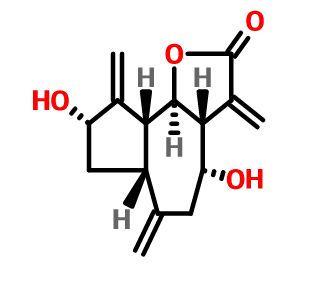
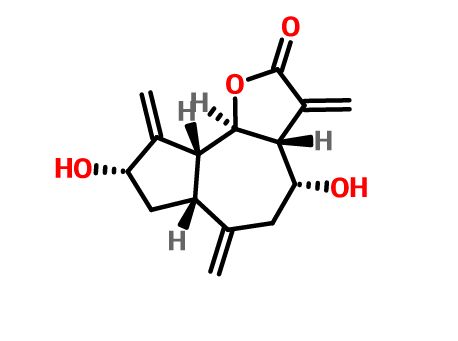
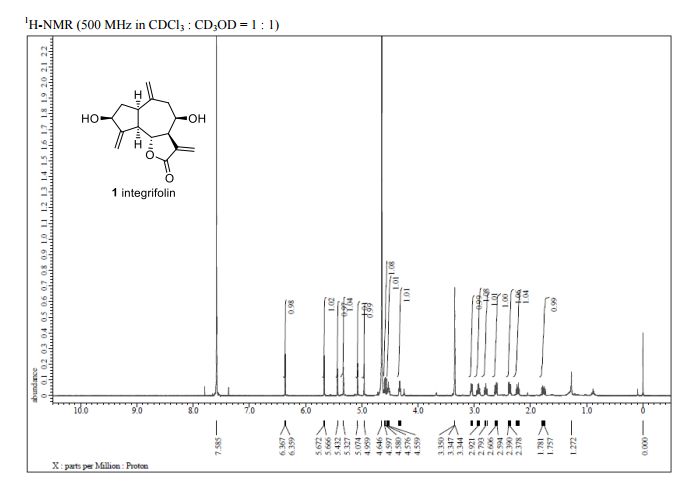
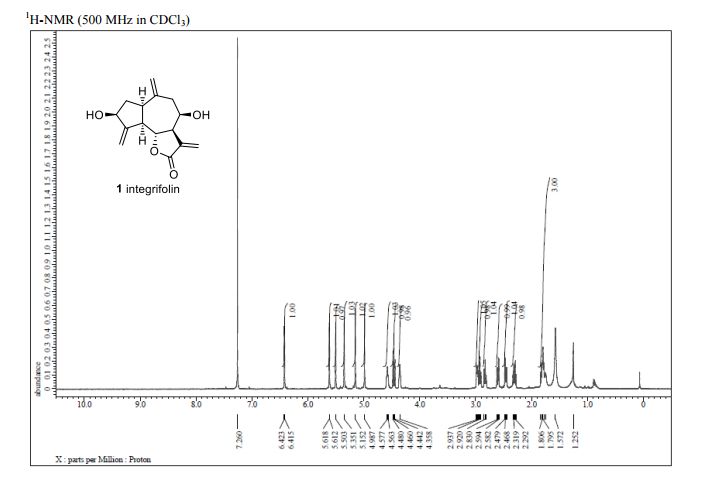
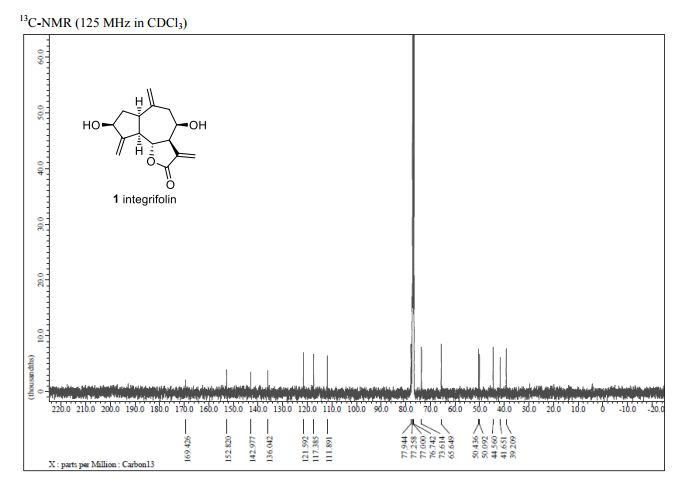
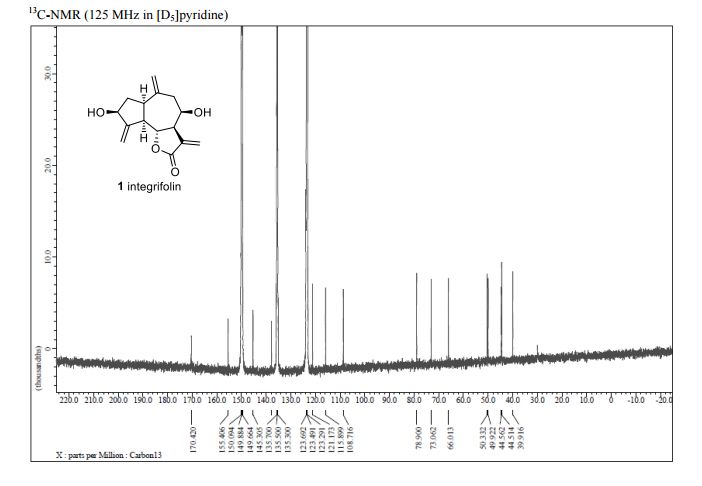
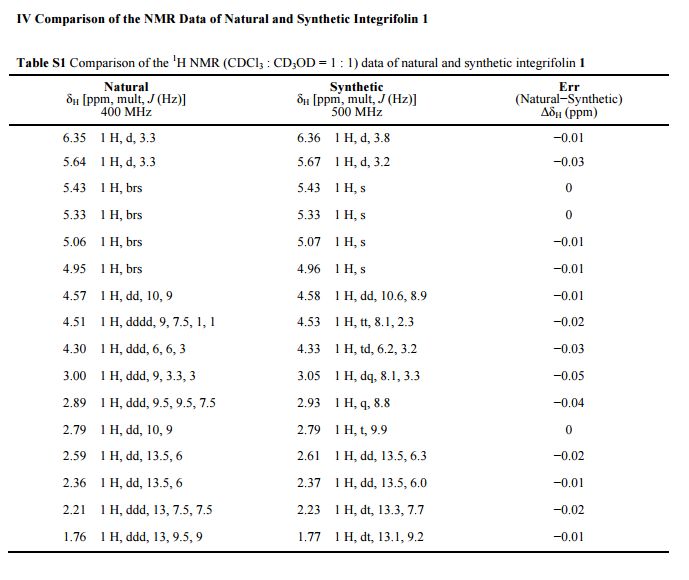
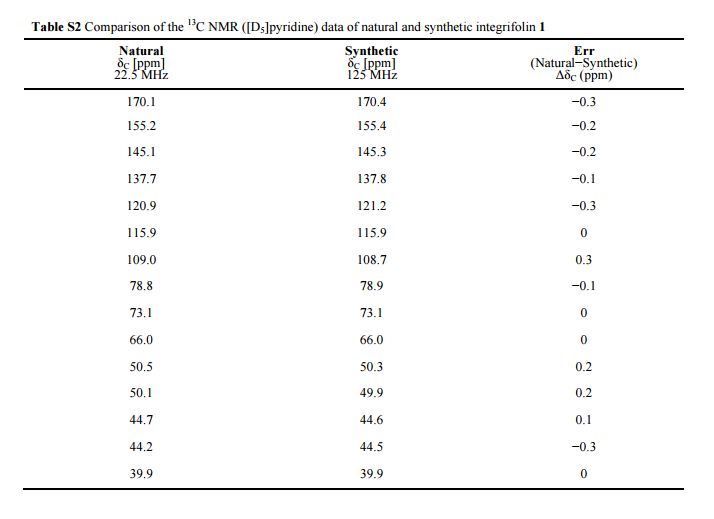
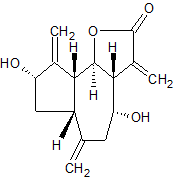
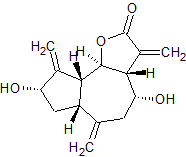
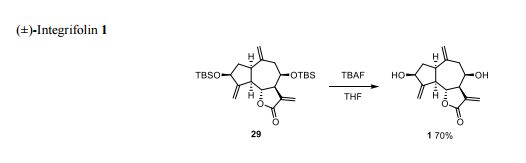
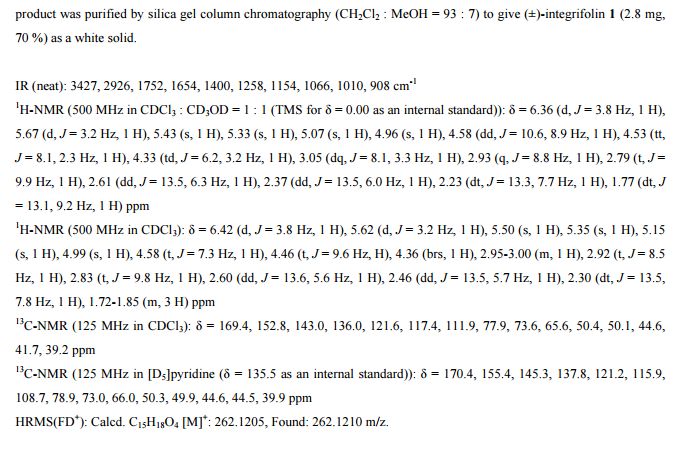
(±)-Integrifolin, Compound from plants keeps human cancer cells from multipying


STR1

CAS 89647-87-0

MFC15 H18 O4, MW 262.30
Azuleno[4,5-b]furan-2(3H)-one, decahydro-4,8-dihydroxy-3,6,9-tris(methylene)-, (3aR,4R,6aR,8S,9aR,9bR)-
  • Azuleno[4,5-b]furan-2(3H)-one, decahydro-4,8-dihydroxy-3,6,9-tris(methylene)-, [3aR-(3aα,4β,6aα,8β,9aα,9bβ)]-
  • (3aR,4R,6aR,8S,9aR,9bR)-Decahydro-4,8-dihydroxy-3,6,9-tris(methylene)azuleno[4,5-b]furan-2(3H)-one
  • 8-epi-Deacylcynaropicrin
  • 8β-Hydroxyzaluzanin C
  • Integrifolin (guaianolide)

STR1Integrifolin

STR1

STR1

STR1

STR1

STR1

STR1

PATENT

WO 2011085979

Paper

Two New Amino Acid-Sesquiterpene Lactone Conjugates from Ixeris dentata

BLOG POST FROM CHEMISTRY VIEWS, WILEY

thumbnail image: Total Synthesis of (±)-IntegrifolinSTR1STR1STR1

(±)-Integrifolin

Wiley-VCH Verlag GmbH & Co. KGaA, Weinheim

Total Synthesis of (±)-Integrifolin

Compound from plants keeps human cancer cells from multipying

Read more at Wiley-VCH Verlag GmbH & Co. KGaA, Weinheim

Weight control is an important concern of human beings, both for medical (pharmaceutical and/or nutraceutical) as well as non-therapeutic, e.g. cosmetic, reasons. More importantly, excessive accumulation of body fat (i.e. obesity (= adiposity), especially with excessive fat in the ventral region and surrounding the viscera) can be dangerous and has been linked to health problems such as type II diabetes, hypertension, heart disease, atherosclerosis (where more than two of the preceding disorders are present, the condition is often called “Metabolic Syndrome” or “syndrome X”), hyperlipidemia, coronary heart disease, stroke, breast and colon cancer, sleep apnoea, gallbladder disease, reproductive disorders such as polycystic ovarian syndrome, gastroesophageal reflux disease, increased incidence of complications of general anesthesia, fatty liver, gout or thromboembolism (see, e.g., Kopelman, Nature 404: 635-43 (2000)). Obesity reduces life-span and carries a serious risk of the co-morbidities listed above, as well disorders such as infections, varicose veins,

acanthosis nigricans, eczema, exercise intolerance, insulin resistance, hypertension hypercholesterolemia, cholelithiasis, orthopedic injury, and thromboembolic disease (Rissanen et al, Br. Med. J. 301 : 835-7 (1990)). Obesity is one of the main factors in the development of cardiovascular diseases. As a side effect the levels of cholesterol, blood pressure, blood sugar and uric acid in obese people are usually higher than those of persons of normal weight. The morbidity from coronary heart disease among the overweight people is increased as well. Among the people aged 40-50, mortality will rise about 1% when body weight increases by 0.5 kg and the death rate will increase 74% when body weight exceeds 25% of the standard. The prevalence of obesity in the United States has more than doubled since the turn of the last century (whole population) and more than tripled within the last 30 years among children aged from 6 to 11. This problem more and more becomes a disease risk also in Europe. In Germany, particularly many people have been found to suffer from overweight recently, already 25% of the young people, children and adolescents there are affected by obesity and related disorders. Furthermore, being overweight is considered by the majority of the Western population as unattractive.

Overweight and obesity result from an imbalance between the calories consumed and the calories used by the body. When the calories consumed exceed the calories burned, the body is in positive energy balance and over time weight gain will occur. The excess calories are stored in the fat cells. When the calories burned exceed the calories consumed, the body is in negative energy balance and over time weight loss will occur.

Determinants of obesity include social factors, psychological factors, genetic factors, developmental factors and decreased physical activity. Some components of a comprehensive weight loss programs include medical assessment, behavioural and dietary modification, nutrition education, mental and cognitive restructuring, increased physical activity, and long term follow-up.

An increasing interest by consumers in the maintenance or reduction of their body weight can be found. This leads to a demand for products useful for these purposes. Preferred are such food products which can conveniently be consumed as part of the daily diet, for example meal replacer products, such as meal replacer bars and beverages. These are usually designed for use as a single-serving food product to replace one or two meals a day.

An issue is that often a saturating effect is missed when such products are consumed, resulting in hunger feelings only a relatively short time after consummation or even in the lack of a saturation feeling already directly after consummation.

Summing up, there remains a need for new safe and effective compositions for promoting weight loss and/or loss of body fat in subjects such as humans. The problem to be solved by the present invention is therefore to find compositions or compounds useful in the treatment of obesity; and/or for improving the total cholesterol HDIJLDL ratio.

Phytochemistry provides a large pool of compounds and compositions to be looked at whether they are able to solve this problem.

The present invention provides methods and compositions useful in the control, treatment and prevention of obesity and obesity-related conditions, disorders, and diseases; and/or and/or for improving the total cholesterol HDL/LDL ratio.

Rosinski, G., et al., Endocrinological Frontiers in Phyiological Insect Ecology, Wroclow Technical University Press, Wroclow 1989, describe that certain tricyclic sequiterpene lactones, such as grossheimin and repin, showed inhibition of larval growth and antifeeding activity in Mealworm (Tenebrio σιοΐϊίοή. Grossheimin shows no anti-feeding but little decrease of absorption of digested food constituents and a little decrease in efficiency in digesting. Repin exhibit low effects at all. Both compounds show no effect on lipid levels in blood.

Shimoda, H., et al, Bioinorganic & Medicinal Chemistry Letters 13 (2003), 223-228, describe that methanolic extracts from Artichoke (Cynara sclolymus L.) with cynaropicrin, aguerin B and grossheimin as components and certain sesquiterpene glycosides suppress serum triglyceride elevation in olive oil-loaded mice. Some of these compounds exhibit a moderate short term (2 hours after olive oil administration) anti-hyperlipidemic activity presented as a lowering of the serum triglyceride (serum TG) concentrations, the long term (6 hours) show in the case of cynaropicrin and aguerine B an increase of the serum TG. Furthermore the authors present data of the gastric emptying (GE) of a methanolic ectract of artichoke. They determine a significantly inhibited GE. However, as shown below, this mechanism is not an explanation for the anti obesity effect shown in the present invention (see Example 1 ).

Fritzsche, J., et al., Eur. Food Res. Technol. 215, 149-157 (2002) describe the effect of certain isolated artichoke leaflet extract components with cholesterol lowering potential. Ahn, E.M-., et al, Arch Pharm. res. 29(1 1 ), 937-941 , 2006, shows ACAT inhibitory activity for two sesquiterpene lactones. KR 20040070985 also shows an effect of certain sesquiterpene lactone derivatives on cholesterol biosynthesis involved enzymes. Gebhard, R., Phytother. Res. 16, 368-372 (2002) and J. Pharmacol. Exp. Ther. 286(3), 1 122-1 128 (1998), shows

enforcement of cholesterol biosynthesis inhibition in HepG2 cells by artichoke extracts. WO 2007/006391 also claims reduction in cholesterol by certain Cynara scolymus variety extracts.

Other reported activities of tricyclic sesquiterpene lactones are antioxidant activity (European Food Research & Technology (2002), 215(2): 149-157), inhibitors of NF kb (Food Style 21 (2007), 1 1 (6): 54-56; JP 2006-206532), serum triglyceride increase-inhibitory effect (Kagaku Kogyo (2006), 57(10): 740-745), hypoglycaemic effect (J. Trad. Med. (2003), 20(2): 57-61), bitter taste (DE 2654184). Any beneficial effects are included in this invention by reference.

None of the documents suggest that a control and treatment of obesity and body fat in warmblooded animals might be possible.

http://www.chemistryviews.org/details/ezine/9412451/Total_Synthesis_of_-Integrifolin.html?elq_mid=10181&elq_cid=1558306

Cynaropicrin, a tricyclic sesquiterpene lactone causes in vivo a strong weight loss. More surprisingly it was found that this effect is not correlated to a decrease in food intake. The weight balance is not affected by reduction of assimilation efficiency; the decrease of body fat and body weight is presumably caused by effects on energy metabolism. Surprisingly, it was found in addition that cynaropicrin also allows for improving the total cholesterol HDL7LDL ratio

Tricyclic sequiterpene lactones or known ingredients of plants of the subclass Asterides, especially from the family of Asteraceae, more specifically from species of the genera of the list consisting of Achilea, Acroptilon, Agranthus, Ainsliaea, Ajania, Amberboa, Andryala, Artemisia, Aster, Bisphopanthus, Brachylaena, Calea, Calycocorsus, Cartolepsis, Centaurea, Cheirolophus, Chrysanthemum, Cousinia, Crepis, Cynara, Eupatorium, Greenmaniella, Grossheimia, Hemistaptia, Ixeris, Jurinea, Lapsana, Lasiolaena, Liatris, Lychnophora, Macroclinidium, Mikania, Otanthus, Pleiotaxis, Prenanthes, Pseudostifftia, Ptilostemon,

Rhaponticum, Santolina, Saussurea, Serratula, Sonchus, Stevia, Taeckholmia, Tanacetum, Tricholepis, Vernonia, Volutarella, Zaluzania; even more specifically from species of the list consisting of Achillea clypeolata, Achillea collina, Acroptilon repens, Agrianthus pungens, Ainsliaea fragrans, Ajania fastigiata, Ajania fruticulosa, Amberboa lippi, Amberboa muricata, Amberboa ramose**, Amberboa tubuliflora and other Amberboa spp.*, Andryala integrifolia, Andryala pinnatifida, Artemisia absinthium, Artemisia cana, Artemisia douglasiana, Artemisia fastigiata, Artemisia franserioides, Artemisia montana, Artemisia sylvatica, Artemisia

tripartita, Aster auriculatus, Bishopanthus soliceps, Brachylaena nereifolia, Brachylaena perrieri, Calea jamaicensis, Calea solidaginea, Calycocorsus stipitatus, Cartolepsis intermedia, Centaurea babylonica, Centaurea bella, Centaurea canariensis*, Centaurea clementei, Centaurea conicum, Centaurea dealbata, Centaurea declinata, Centaurea glastifolia, Centaurea hermanii, Centaurea hyrcanica, Centaurea intermedia, Centaurea janeri, Centaurea kalscyi, Centaurea kandavanensis, Centaurea kotschyi, Centaurea linifolia, Centaurea macrocephala, Centaurea musimomum, Centaurea nicolai, Centaurea pabotii, Centaurea pseudosinaica, Centaurea repens, Centaurea salonitana, Centaurea scoparia, Centaurea sinaica, Centaurea solstitialis, Centaurea tweediei and other Centaurea spp. *, Cheirolophus uliginosus, Chrysanthemum boreale, Cousin ia canescens, Cousinia conifera, Cousinia picheriana, Cousinia piptocephala, Crepis capillaris, Crepis conyzifolia, Crepis crocea, Crepis japonica, Crepis pyrenaica, Crepis tectorum, Crepis virens, Crepis zacintha, Cynara alba, Cynara algarbiensis, Cynara auranitica, Cynara baetica, Cynara cardunculus, Cynara cornigera, Cynara cyrenaica, Cynara humilis, Cynara hystrix, Cynara syriaca, Cynara scolymus**, Cynara sibthorpiana and other Cynara spp.*, Eupatorium anomalum,

Eupatorium chinense, Eupatorium lindleyanum, Eupatorium mohrii, Eupatorium

rotundifolium, Eupatorium semialatum, Greenmaniella resinosa, Grossheimia

macrocephala** and other Grossheimia spp. *, Hemisteptia lyrata, Ixeris chinensis, Ixeris debilis, Ixeris dentata, Ixeris repens, Ixeris stolonifera, Jurinea carduiformis, Jurinea derderioides, Jurinea maxima, Lapsana capillaris, Lapsana communis, Lasiolaena morii, Lasiolaena santosii, Liatris chapmanii, Liatris gracilis, Liatris pycnostachya, Lychnophora blanchetii, Macroclinidium trilobum, Mikania hoehnei, Otanthus maritimus, Pleiotaxis rugosa, Prenanthes acerifolia, Pseudostifftia kingii, Ptilostemon diacanthus, Ptilostemon

gnaphaloides, Rhaponticum serratuloides, Santolina jamaicensis, Saussurea affinis,

Saussurea elegans, Saussurea involucrata, Saussurea laniceps, Saussurea neopulchella** and other Sauusurea spp. *, Serratula strangulata, Sonchus arborea, Stevia sanguinea, Taeckholmia arborea, Taeckholmia pinnata, Tanacetum fruticulosum, Tanacetum

parthenium, Tricholepis glaberrima** and other Tricholepsis spp. *, Vernonia arkansana, Vernonia nitidula, Vernonia noveboracensis, Vernonia profuga, Vernonia sublutea,

Volutarella divaricata, Zaiuzania resinosa; and can potentially be isolated from any part of the plants. Those genera and/or species marked with an asterisk (*) and especially those species marked with two asterisks (**) are especially preferred.

Appropriate plant material can be obtained from various sources, e.g. from:

Alfred Galke GmbH, Gittelde/Harz, Germany; Miiggenburg Pflanzliche Rohstoffe, Bad Bramstedt, Germany; Friedrich Nature Discovery, Euskirchen, Germany; VitaPlant AG, Uttwil, Switzerland; Amoros Nature SL, Hostalric, Spain.

(±)-Integrifolin

Banksia integrifolia

Coast Banksia

Family: Proteaceae

Banksia integrifolia is a tall shrub or small tree 6 – 16m tall. It is common in sandy coastal areas, but also grows in the forests of tablelands. The light grey bark is hard and rough.

Mature leaves 5 -10 cm long, are stiff, entire (untoothed), dull dark green above and hairy-white underneath. They are generally lanceolate. Younger leaves are irregularly toothed and shorter than the mature leaves. The species name ‘integrifolia’ means whole-leaved.

The pale yellow flower spikes of Banksia integrifolia range from 7-14cm long and 7cm wide. The bent styles emerge from individual flowers on the spike, straightening and spreading.

A short time after flowering, the seed pods protrude cleanly from the woody cone and open to shed black, papery, winged seeds.

Banksia integrifolia flowers from January to June.

STR1

STR1

https://www.jstage.jst.go.jp/article/cpb1958/33/8/33_8_3361/_pdf

PAPER

http://onlinelibrary.wiley.com/doi/10.1002/chem.201601275/abstract

Total Synthesis of (±)-Integrifolin

  • DOI: 10.1002/chem.201601275

///////(±)-Integrifolin,  human cancer cells,  multipying

C=C1C(=O)O[C@@H]2[C@H]3C(=C)[C@@H](O)C[C@H]3C(=C)C[C@@H](O)[C@@H]12

Novartis, Torrent drug for diabetes, NVP-LBX192, LBX-192


STR3

Figure US07750020-20100706-C00023


CHEMBL573983.png

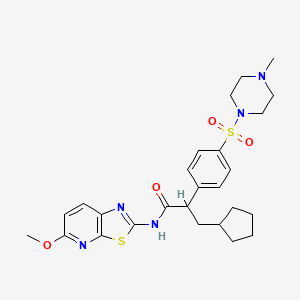
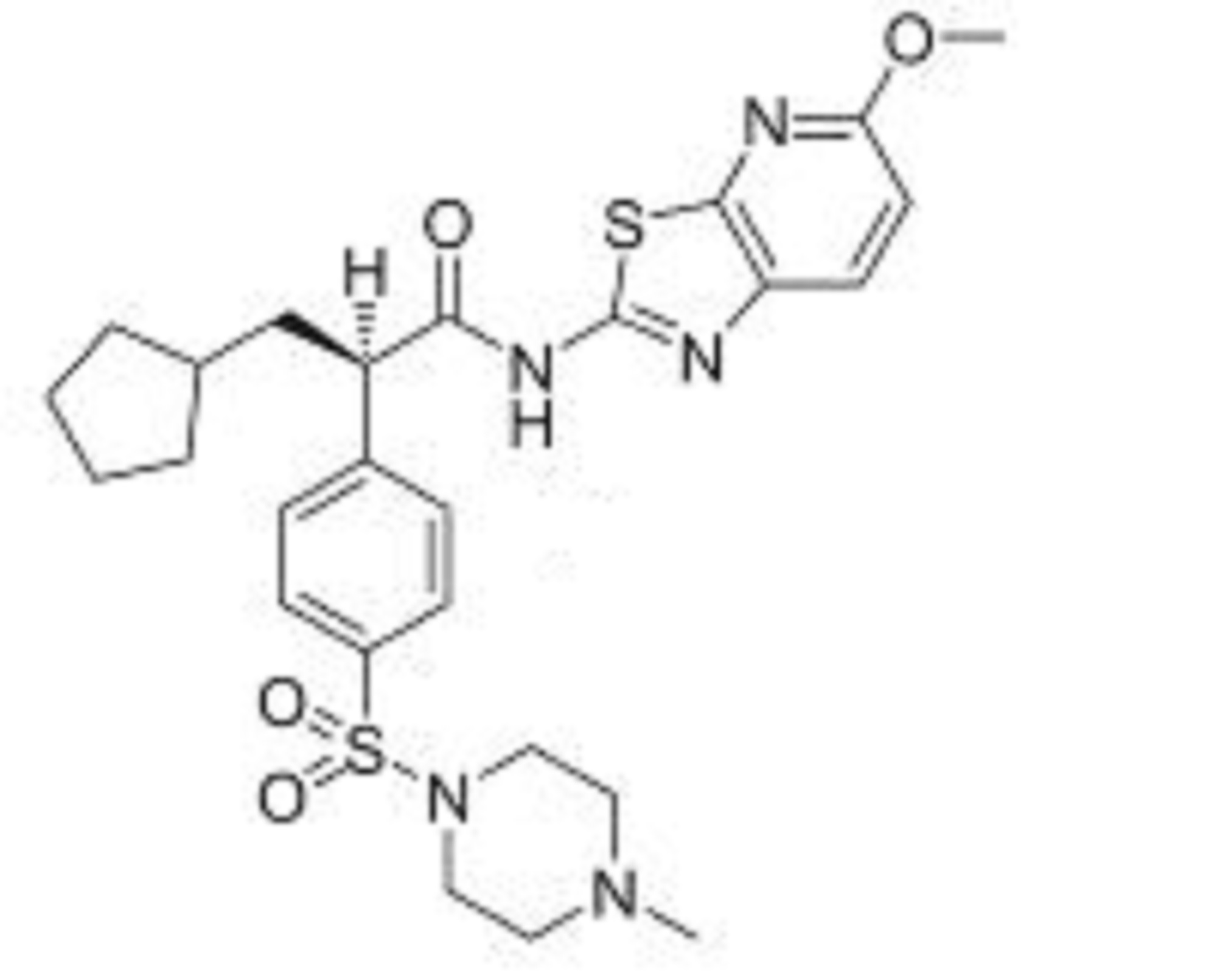
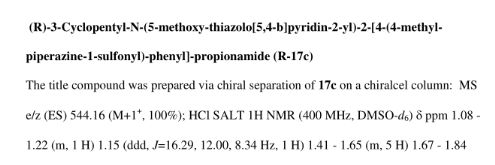
(R)-3-Cyclopentyl-N-(5-methoxy-thiazolo[5,4-b]pyridin-2-yl)-2-[4-(4-methyl-piperazine-1-sulfonyl)-phenyl]-propionamide

3-Cyclopentyl-N-(5-methoxy-thiazolo[5,4-b]pyridin-2-yl)-2-[4-(4-methyl-piperazine-1-sulfonyl)-phenyl]-propionamide

(3-Cyclopentyl-N-(5-methoxy-thiazolo[5,4-b]pyridin-2-yl)-2-[4-(4-methyl-piperazine-1-sulfonyl)-phenyl]-propionamide)

(R)-3-Cyclopentyl-N-(5-methoxy-thiazolo[5,4-b]pyridin-2-yl)-2-[4-(4-methyl-piperazine-1-sulfonyl)-phenyl]-propionamide

cas 866772-52-3

Novartis Ag

NVP-LBX192

LBX-192

str1

R(−) 3-cyclopentyl-N-(5-methoxy-thiazolo[5,4-b]pyridin-2-yl)-2-[4-(4-methyl-piperazine-1-sulfonyl)-phenyl]-propionamide

R(−)17c BELOW

Abstract Image
Inventors Gregory Raymond Bebernitz, Ramesh Chandra Gupta, Vikrant Vijaykumar Jagtap, Appaji Baburao Mandhare, Davinder Tuli,
Original Assignee Novartis Ag


Molecular Formula: C26H33N5O4S2
Molecular Weight: 543.70132 g/mol

str1

str1

LBX192, also known as NVP-LBX192, is a Liver Targeted Glucokinase Activator. LBX192 activated the GK enzyme in vitro at low nM concentrations and significantly reduced glucose levels during an oral glucose tolerance test in normal as well as diabetic mice. A GK activator has the promise of potentially affecting both the beta-cell of the pancreas, by improving glucose sensitive insulin secretion, as well as the liver, by reducing uncontrolled glucose output and restoring post prandial glucose uptake and storage as glycogen.

SYNTHESIS BY WORLDDRUGTRACKER

STR1


STR1

54 Discovery and Evaluation of NVP-LBX192, a Liver Targeted Glucokinase Activator

Thursday, October 8, 2009: 10:30 AM
Nathan Hale North (Hilton Third Floor)
Gregory R. Bebernitz, PhD , Global Discovery Chemistry, Novartis Institute for Biomedical Research, Cambridge, MA
Glucokinase (GK) activators are currently under investigation by a number of pharmaceutical companies with only a few reaching clinical evaluation.  A GK activator has the promise of potentially affecting both the beta-cell of the pancreas, by improving glucose sensitive insulin secretion, as well as the liver, by reducing uncontrolled glucose output and restoring post prandial glucose uptake and storage as glycogen.  We will describe our efforts to generate liver selective GK activators which culminated in the discovery of NVP-LBX192 (3-Cyclopentyl-N-(5-methoxy-thiazolo[5,4-b]pyridin-2-yl)-2-[4-(4-methyl-piperazine-1-sulfonyl)-phenyl]-propionamide).  This compound activated the GK enzyme in vitro at low nM concentrations and significantly reduced glucose levels during an oral glucose tolerance test in normal as well as diabetic mice.

https://acs.confex.com/acs/nerm09/webprogram/Paper75087.html

Sulfonamide-Thiazolpyridine Derivatives,  Glucokinase Activators, Treatment Of Type 2 Diabetes

2009 52 (19) 6142 – 6152
Investigation of functionally liver selective glucokinase activators for the treatment of type 2 diabetes
Journal of Medicinal Chemistry
Bebernitz GR, Beaulieu V, Dale BA, Deacon R, Duttaroy A, Gao JP, Grondine MS, Gupta RC, Kakmak M, Kavana M, Kirman LC, Liang JS, Maniara WM, Munshi S, Nadkarni SS, Schuster HF, Stams T, Denny IS, Taslimi PM, Vash B, Caplan SL

2010 240th (August 22) Medi-198
Glucokinase activators with improved physicochemicalproperties and off target effects
American Chemical Society National Meeting and Exposition
Kirman LC, Schuster HF, Grondine MS et al

2010 240th (August 22) Medi-197
Investigation of functionally liver selective glucokinase activators
American Chemical Society National Meeting and Exposition
Schuster HF, Kirman LC, Bebernitz GC et al

PATENT

http://www.google.com/patents/US7750020

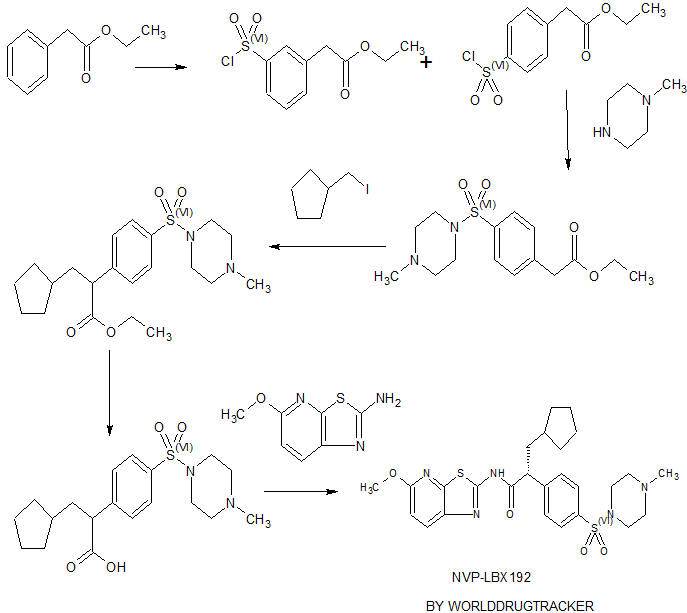
EXAMPLE 1 3-Cyclopentyl-N-(5-methoxy-thiazolo[5,4-b]pyridin-2-yl)-2-[4-(4-methyl-piperazine-1-sulfonyl)-phenyl]-propionamide

A. Phenylacetic Acid Ethyl Ester

A solution of phenylacetic acid (50 g, 0.36 mol) in ethanol (150 mL) is treated with catalytic amount of sulfuric acid (4 mL). The reaction mixture is refluxed for 4 h. The reaction is then concentrated in vacuo. The residue is dissolved in diethyl ether (300 mL) and washed with saturated aqueous sodium bicarbonate solution (2×50 mL) and water (1×100 mL). The organic layer dried over sodium sulfate filtered and concentrated in vacuo to give phenylacetic acid ethyl ester as a colorless oil: 1H NMR (400 MHz, CDCl3) δ 1.2 (t, J=7.2, 3H), 3.6 (s, 2H), 4.1 (q, J=7.2, 2H), 7.3 (m, 5H); MS 165 [M+1]+.

B. (4-Chlorosulfonyl-phenyl)-acetic acid ethyl ester

To a cooled chlorosulfonic acid (83.83 g, 48 mL, 0.71 mol) under nitrogen is added the title A compound, phenylacetic acid ethyl ester (59 g, 0.35 mol) over a period of 1 h. Reaction temperature is brought to RT (28° C.), then heated to 70° C., maintaining it at this temperature for 1 h while stirring. Reaction is cooled to RT and poured over saturated aqueous sodium chloride solution (200 mL) followed by extraction with DCM (2×200 mL). The organic layer is washed with water (5×100 mL), followed by saturated aqueous sodium chloride solution (1×150 mL). The organic layer dried over sodium sulfate, filtered and concentrated in vacuo to give crude (4-chlorosulfonyl-phenyl)acetic acid ethyl ester. Further column chromatography over silica gel (60-120 mesh), using 100% hexane afforded pure (4-chlorosulfonyl-phenyl)-acetic acid ethyl ester as a colorless oil.

C. [4-(4-Methyl-piperazine-1-sulfonyl)-phenyl]-acetic acid ethyl ester

A solution of N-methylpiperazine (9.23 g, 10.21 ml, 0.092 mol), DIEA (13 g, 17.4 mL, 0.10 mol) and DCM 80 mL is cooled to 0° C., and to this is added a solution of the title B compound, (4-chlorosulfonyl-phenyl)-acetic acid ethyl ester (22 g, 0.083 mol) in 50 mL of DCM within 30 min. Reaction mixture stirred at 0° C. for 2 h, and the reaction mixture is washed with water (100 mL), followed by 0.1 N aqueous hydrochloric acid solution (1×200 mL). The organic layer dried over sodium sulfate, filtered and concentrated under vacuo to give crude [4-(4-methyl-piperazine-1-sulfonyl)-phenyl]-acetic acid ethyl ester. Column chromatography over silicagel (60-120 mesh), using ethyl acetate afforded pure [4-(4-methyl-piperazine-1-sulfonyl)-phenyl]-acetic acid ethyl ester as white crystalline solid: 1H NMR (400 MHz, CDCl3) δ 1.3 (t, J=7.4, 3H), 2.3 (s, 3H), 2.5 (m, 4H), 3.0 (br s, 4H), 3.7 (s, 2H), 4.2 (q, J=7.4, 2H), 7.4 (d, J=8.3, 2H), 7.7 (d, J=7.3, 2H); MS 327 [M+1]+.

D. 3-Cyclopentyl-2-[4-(4-methyl-piperazine-1-sulfonyl)-phenyl]-propionic acid ethyl ester

A solution of the title C compound, [4-(4-methyl-piperazine-1-sulfonyl)-phenyl]-acetic acid ethyl ester (15 g, 0.046 mol) in a mixture of THF (60 mL) and DMTP (10 mL) is cooled to −78° C. under nitrogen. The resulting solution is stirred at −78° C. for 45 min and to this is added LDA (25.6 mL, 6.40 g, 0.059 mol, 25% solution in THF/Hexane). A solution of iodomethylcyclopentane (11.60 g, 0.055 mol) in a mixture of DMTP (12 mL) and THF (20 mL) is added over a period of 15 min at −78° C. and reaction mixture stirred at −78° C. for 3 h further, followed by stirring at 25° C. for 12 h. The reaction mixture is then quenched by the dropwise addition of saturated aqueous ammonium chloride solution (50 mL) and is concentrated in vacuo. The residue is diluted with water (50 mL) and extracted with ethyl acetate (3×100 mL). The organic solution is washed with a saturated aqueous sodium chloride (2×150 mL), dried over sodium sulfate, filtered and concentrated in vacuo. Column chromatography over silica gel (60-120 mesh), using 50% ethyl acetate in hexane as an eluent to afford 3-cyclopentyl-2-[4-(4-methyl-piperazine-1-sulfonyl)-phenyl]-propionic acid ethyl ester as a white solid: 1H NMR (400 MHz, CDCl3) δ 0.9-2.1 (m, 11H), 1.2 (t, J=7.1, 3H), 2.3 (s, 3H), 2.5 (br s, 4H), 3.0 (br s, 4H), 3.6 (m, 1H), 4.1 (q, J=7.1, 2H), 7.5 (d, J=8.3, 2H), 7.7 (d, J=8.3, 2H); MS 409 [M+1]+.

E. 3-Cyclopentyl-2-[4-(4-methyl-piperazine-1-sulfonyl)-phenyl]-propionic acid

A solution of the title D compound, 3-cyclopentyl-2-[4-(4-methyl-piperazine-1-sulfonyl)-phenyl]-propionic acid ethyl ester (14 g, 0.034 mol) in methanol:water (30 mL:10 mL) and sodium hydroxide (4.11 g, 0.10 mol) is stirred at 60° C. for 8 h in an oil bath. The methanol is then removed in vacuo at 45-50° C. The residue is diluted with water (25 mL) and extracted with ether (1×40 mL). The aqueous layer is acidified to pH 5 with 3 N aqueous hydrochloric acid solution. The precipitated solid is collected by vacuum filtration, washed with water (20 mL), followed by isopropyl alcohol (20 mL). Finally, solid cake is washed with 100 mL of hexane and dried under vacuum at 40° C. for 6 h to give 3-cyclopentyl-2-[4-(4-methyl-piperazine-1-sulfonyl)-phenyl]-propionic acid as a white solid: 1H NMR (400 MHz, CDCl3) δ 1.1-2.0 (m, 11H), 2.4 (s, 3H), 2.7 (br s, 4H), 3.1 (br s, 4H), 3.6 (m, 1H), 7.5 (d, J=8.3, 2H), 7.6 (d, J=8.3, 2H); MS 381 [M+l]+.

F. 5-Methoxy-thiazolo[5,4-b]pyridin-2-ylamine

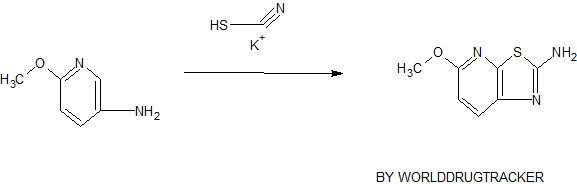
A solution of 6-methoxy-pyridin-3-ylamine (5.0 g, 0.0403 mol) in 10 mL of acetic acid is added slowly to a solution of potassium thiocyanate (20 g, 0.205 mol) in 100 mL of acetic acid at 0° C. followed by a solution of bromine (2.5 mL, 0.0488 mol) in 5 mL of acetic acid. The reaction is stirred for 2 h at 0° C. and then allowed to warm to RT. The resulting solid is collected by filtration and washed with acetic acid, then partitioned between ethyl acetate and saturated aqueous sodium bicarbonate. The insoluble material is removed by filtration and the organic layer is evaporated and dried to afford 5-methoxy-thiazolo[5,4-b]pyridin-2-ylamine as a tan solid.

G. 3-Cyclopentyl-N-(5-methoxy-thiazolo[5,4-b]pyridin-2-yl)-2-[4-(4-methyl-piperazine-1-sulfonyl)-phenyl]-propionamide

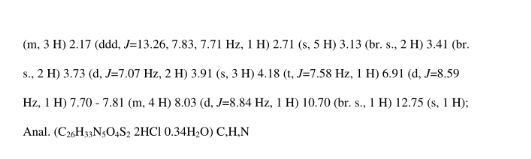
A solution of the title E compound, 3-cyclopentyl-2-[4-(4-methyl-piperazine-1-sulfonyl)-phenyl]-propionic acid (5 g, 0.013 mol) in DCM (250 mL) is cooled to 0° C. and then charged HOBt hydrate (2.66 g, 0.019 mol), followed by EDCI hydrochloride (6 g, 0.031 mol). The reaction mixture is stirred at 0° C. for 5 h. After that the solution of the title F compound, 5-methoxy-thiazolo[5,4-b]pyridin-2-ylamine (2.36 g, 0.013 mol) and D1EA (8 mL, 0.046 mol) in a mixture of DCM (60 mL) and DMF (20 mL) is added dropwise over 30 min. Reaction temperature is maintained at 0° C. for 3 h, then at RT (28° C.) for 3 days. Reaction is diluted with (60 mL) of water and the organic layer is separated and washed with saturated sodium bicarbonate solution (2×50 mL) followed by water washing (2×50 mL) and saturated sodium chloride aqueous solution (1×150 mL). Finally the organic layer is dried over sodium sulfate, filtered, and evaporated under vacuo. The crude product is purified using column chromatography over silica gel (60-120 mesh), using 40% ethyl acetate in hexane as an eluent to afford 3-cyclopentyl-N-(5-methoxy-thiazolo[5,4-b]pyridin-2-yl)-2-[4-(4-methyl-piperazine-1-sulfonyl)-phenyl]-propionamide as a white solid: 1H NMR (400 MHz, CDCl3) δ 0.9-2.1 (m, 11H), 2.2 (s, 3H), 2.5 (br s, 4H), 3.1 (br s, 4H), 3.7 (m, 1H), 4.0 (s, 3H), 6.8 (d, J=8.8, 1H), 7.5 (d, J=8.3, 2H), 7.7 (d, J=8.3, 2H), 7.8 (d, J=8.8, 1H), 8.6 (s, 1H); MS 617 [M+1]+.

H. 3-Cyclopentyl-N-(5-methoxy-thiazolo[5,4-b]pyridin-2-yl)-2-[4-(4-methyl-piperazine-1-sulfonyl)-phenyl]-propionamide dihydrochloride

The title G compound, 3-cyclopentyl-2-(4-methyl piperazinyl sulfonyl)phenyl-N-(5-methoxy-thiazolo[5,4-b]pyridin-2-yl)propionamide (2.8 g, 0.0051 mol) is added to a cooled solution of 10% hydrochloric acid in isopropanol (3.75 mL). The reaction mixture is stirred at 0° C. for 1 h and then at RT for 2 h. The solid is separated, triturated with 10 mL of isopropanol and collected by vacuum filtration and washed with 50 mL of hexane. The solid is dried at 70° C. for 48 h to afford 3-cyclopentyl-N-(5-methoxy-thiazolo[5,4-b]pyridin-2-yl)-2-[4-(4-methyl-piperazine-1-sulfonyl)-phenyl]-propionamide dihydrochloride as an off white solid.

EXAMPLE 2 (R)-3-Cyclopentyl-N-(5-methoxy-thiazolo[5,4-b]pyridin-2-yl)-2-[4-(4-methyl-piperazine-1-sulfonyl)-phenyl]-propionamide

The title compound is obtained analogously to Example 1 by employing the following additional resolution step:

The racemic title E compound of Example 1,3-cyclopentyl-2-[4-(4-methyl-piperazine-1-sulfonyl)-phenyl]-propionic acid (10 g, 0.026 mol) in 1,4-dioxane (500 mL) is treated in a three necked 1 liter flask, equipped with heating mantle, water condenser, calcium chloride guard tube and mechanical stirrer with 3.18 g (0.026 mol) of (R)-(+)-1-phenylethylamine. This reaction mixture is then refluxed at 100° C. for 1 h. The clear reaction solution is cooled to RT (27° C.) and stirred for 10 h. The crystallized salt is collected by filtration under vacuum, washed with 5 mL of hexane and dried under vacuum to afford salt A.

The salt A is dissolved in 1,4-dioxane (500 mL) and heated at 100° C. for 1 h. The clear reaction solution is cooled to RT (27° C.) and stirred for 10 h. The crystallized product is collected by filtration under vacuum, washed with 50 mL of hexane, and dried under vacuum to afford salt B.

The salt B is dissolved in 1,4-dioxane (290 mL) and heated at 100° C. for 1 h. The clear reaction solution is cooled to RT (27° C.) and stirred for 10 h. The crystallized product is collected by filtration under vacuum, washed with 30 mL of hexane, and dried under vacuum to afford salt C.

The salt C is dissolved in 1,4-dioxane (100 mL) and heated at 100° C. for 1 h. The clear reaction solution is cooled to RT (27° C.) and stirred for 10 h. The crystallized product is collected by filtration under vacuum, washed with 30 ml of hexane, and dried under vacuum to afford salt D.

The salt D is treated with aqueous hydrochloric acid solution (20 mL, 1 mL of concentrated hydrochloric acid diluted with 100 mL of water) and stirred for 5 min. The white solid precipitates out and is collected by vacuum filtration, washed with 10 mL of cold water, 5 mL of isopropanol and 20 mL of hexane, and dried under vacuum to yield the hydrochloride salt of (R)-(−)-3-cyclopentyl-2-[4-(4-methyl-piperazine-1-sulfonyl)-phenyl]-propionic acid, salt E.

The salt E is neutralized by stirring with aqueous sodium bicarbonate solution (10 mL, 1 g of sodium bicarbonate dissolved in 120 mL of water) for 5 min. The precipitated solid is collected by filtration, washed with 10 mL of cold water, 100 mL of hexane, and dried to afford (R)-(−)-3-cyclopentyl-2-[4-(4-methyl-piperazine-1-sulfonyl)-phenyl]-propionic acid: m.p. 202.2-203.4° C.

Alternatively, the title compound may be obtained by the resolution of the racemic title compound of Example 1 using the following preparative chiral HPLC method:

  • Column: Chiralcel OD-R (250×20 mm) Diacel make, Japan;
  • Solvent A: water:methanol:acetonitrile (10:80:10 v/v/v);
  • Solvent B: water:methanol:acetonitrile (05:90:05 v/v/v);
  • Using gradient elution: gradient program (time, min/% B): 0/0, 20/0, 50/100, 55/0, 70/0;
  • Flow rate: 6.0 mL/min; and
  • Detection: by UV at 305 nm.

EXAMPLE 3 (S)-3-Cyclopentyl-N-(5-methoxy-thiazolo[5,4-b]pyridin-2-yl)-2-[4-(4-methyl-piperazine-1-sulfonyl)-phenyl]-propionamide

The title compound is prepared analogously to Example 2.

J MED CHEM 2009, 52, 6142-52

Investigation of Functionally Liver Selective Glucokinase Activators for the Treatment of Type 2 Diabetes

Novartis Institutes for BioMedical Research, Inc., 100 Technology Square, Cambridge, Massachusetts 02139
Torrent Research Centre, Village Bhat, Gujarat, India
J. Med. Chem., 2009, 52 (19), pp 6142–6152
DOI: 10.1021/jm900839k

http://pubs.acs.org/doi/abs/10.1021/jm900839k

Abstract Image

Type 2 diabetes is a polygenic disease which afflicts nearly 200 million people worldwide and is expected to increase to near epidemic levels over the next 10−15 years. Glucokinase (GK) activators are currently under investigation by a number of pharmaceutical companies with only a few reaching early clinical evaluation. A GK activator has the promise of potentially affecting both the β-cells of the pancreas, by improving glucose sensitive insulin secretion, as well as the liver, by reducing uncontrolled glucose output and restoring post-prandial glucose uptake and storage as glycogen. Herein, we report our efforts on a sulfonamide chemotype with the aim to generate liver selective GK activators which culminated in the discovery of 3-cyclopentyl-N-(5-methoxy-thiazolo[5,4-b]pyridin-2-yl)-2-[4-(4-methyl-piperazine-1-sulfonyl)-phenyl]-propionamide (17c). This compound activated the GK enzyme (αKa = 39 nM) in vitro at low nanomolar concentrations and significantly reduced glucose levels during an oral glucose tolerance test in normal mice.

STR3

STR3

PATENT

EP-1735322-B1

Example 2(R)-3-Cyclopentyl-N-(5-methoxy-thiazolo[5,4-b]pyridin-2-yl)-2-[4-(4-methyl-piperazine-1-sulfonyl)-phenyl]-propionamide

Image loading...

The title compound is obtained analogously to Example 1 by employing the following additional resolution step:

The racemic title E compound of Example 1, 3-cyclopentyl-2-[4-(4-methyl-piperazine-1-sulfonyl)-phenyl]-propionic acid (10 g, 0.026 mol) in 1,4-dioxane (500 mL) is treated in a three necked 1 liter flask, equipped with heating mantle, water condenser, calcium chloride guard tube and mechanical stirrer with 3.18 g (0.026 mol) of (R)-(+)-1-phenylethylamine. This reaction mixture is then refluxed at 100°C for 1 h. The clear reaction solution is cooled to RT (27°C) and stirred for 10 h. The crystallized salt is collected by filtration under vacuum, washed with 5 mL of hexane and dried under vacuum to afford salt A.

The salt A is dissolved in 1,4-dioxane (500 mL) and heated at 100°C for 1 h. The clear reaction solution is cooled to RT (27°C) and stirred for 10 h. The crystallized product is collected by filtration under vacuum, washed with 50 mL of hexane, and dried under vacuum to afford salt B.

The salt B is dissolved in 1,4-dioxane (290 mL) and heated at 100°C for 1 h. The clear reaction solution is cooled to RT (27°C) and stirred for 10 h. The crystallized product is collected by filtration under vacuum, washed with 30 mL of hexane, and dried under vacuum to afford salt C.

The salt C is dissolved in 1,4-dioxane (100 mL) and heated at 100°C for 1 h. The clear reaction solution is cooled to RT (27°C) and stirred for 10 h. The crystallized product is collected by filtration under vacuum, washed with 30ml of hexane, and dried under vacuum to afford salt D.

The salt D is treated with aqueous hydrochloric acid solution (20 mL, 1 mL of concentrated hydrochloric acid diluted with 100 mL of water) and stirred for 5 min. The white solid precipitates out and is collected by vacuum filtration, washed with 10 mL of cold water, 5 mL of isopropanol and 20 mL of hexane, and dried under vacuum to yield the hydrochloride salt of (R)-(-)-3-cyclopentyl-2-[4-(4-methyl-piperazine-1-sulfonyl)-phenyl]-propionic acid, salt E.

The salt E is neutralized by stirring with aqueous sodium bicarbonate solution (10 mL, 1 g of sodium bicarbonate dissolved in 120 mL of water) for 5 min. The precipitated solid is collected by filtration, washed with 10 mL of cold water, 100 mL of hexane, and dried to afford (R)-(-)-3-cyclopentyl-2-[4-(4-methyl-piperazine-1-sulfonyl)-phenyl]-propionic acid: m.p. 202.2-203.4°C.

Alternatively, the title compound may be obtained by the resolution of the racemic title compound of Example 1 using the following preparative chiral HPLC method:

  • Column: Chiralcel OD-R (250 x 20 mm) Diacel make, Japan;
  • Solvent A: water:methanol:acetonitrile (10:80:10 v/v/v);
  • Solvent B: water:methanol:acetonitrile (05:90:05 v/v/v);
  • Using gradient elution: gradient program (time, min / %B): 0/0, 20/0, 50/100, 55/0, 70/0;
  • Flow rate: 6.0 mL/min; and
  • Detection: by UV at 305 nm.

REFERENCES

US 7750020

WO-2005095418-A1

US-20080103167-A1

1 to 2 of 2
Patent ID Date Patent Title
US2015218151 2015-08-06 NOVEL PHENYLACETAMIDE COMPOUND AND PHARMACEUTICAL CONTAINING SAME
US7750020 2010-07-06 Sulfonamide-Thiazolpyridine Derivatives As Glucokinase Activators Useful The Treatment Of Type 2 Diabetes


 PAPER

Investigation of Functionally Liver Selective Glucokinase Activators for the Treatment of Type 2 Diabetes

Novartis Institutes for BioMedical Research, Inc., 100 Technology Square, Cambridge, Massachusetts 02139
Torrent Research Centre, Village Bhat, Gujarat, India
J. Med. Chem., 2009, 52 (19), pp 6142–6152
DOI: 10.1021/jm900839k
Publication Date (Web): September 11, 2009
Copyright © 2009 American Chemical Society
*To whom correspondence should be addressed. Phone: (617) 871 7302. Fax: (617) 871 7042. E-mail: greg.bebernitz@novartis.com.

Abstract Image

Type 2 diabetes is a polygenic disease which afflicts nearly 200 million people worldwide and is expected to increase to near epidemic levels over the next 10−15 years. Glucokinase (GK) activators are currently under investigation by a number of pharmaceutical companies with only a few reaching early clinical evaluation. A GK activator has the promise of potentially affecting both the β-cells of the pancreas, by improving glucose sensitive insulin secretion, as well as the liver, by reducing uncontrolled glucose output and restoring post-prandial glucose uptake and storage as glycogen. Herein, we report our efforts on a sulfonamide chemotype with the aim to generate liver selective GK activators which culminated in the discovery of 3-cyclopentyl-N-(5-methoxy-thiazolo[5,4-b]pyridin-2-yl)-2-[4-(4-methyl-piperazine-1-sulfonyl)-phenyl]-propionamide (17c). This compound activated the GK enzyme (αKa = 39 nM) in vitro at low nanomolar concentrations and significantly reduced glucose levels during an oral glucose tolerance test in normal mice.

str1

https://www.google.com/patents/US7750020

EXAMPLE 2 (R)-3-Cyclopentyl-N-(5-methoxy-thiazolo[5,4-b]pyridin-2-yl)-2-[4-(4-methyl-piperazine-1-sulfonyl)-phenyl]-propionamide

The title compound is obtained analogously to Example 1 by employing the following additional resolution step:

The racemic title E compound of Example 1,3-cyclopentyl-2-[4-(4-methyl-piperazine-1-sulfonyl)-phenyl]-propionic acid (10 g, 0.026 mol) in 1,4-dioxane (500 mL) is treated in a three necked 1 liter flask, equipped with heating mantle, water condenser, calcium chloride guard tube and mechanical stirrer with 3.18 g (0.026 mol) of (R)-(+)-1-phenylethylamine. This reaction mixture is then refluxed at 100° C. for 1 h. The clear reaction solution is cooled to RT (27° C.) and stirred for 10 h. The crystallized salt is collected by filtration under vacuum, washed with 5 mL of hexane and dried under vacuum to afford salt A.

The salt A is dissolved in 1,4-dioxane (500 mL) and heated at 100° C. for 1 h. The clear reaction solution is cooled to RT (27° C.) and stirred for 10 h. The crystallized product is collected by filtration under vacuum, washed with 50 mL of hexane, and dried under vacuum to afford salt B.

The salt B is dissolved in 1,4-dioxane (290 mL) and heated at 100° C. for 1 h. The clear reaction solution is cooled to RT (27° C.) and stirred for 10 h. The crystallized product is collected by filtration under vacuum, washed with 30 mL of hexane, and dried under vacuum to afford salt C.

The salt C is dissolved in 1,4-dioxane (100 mL) and heated at 100° C. for 1 h. The clear reaction solution is cooled to RT (27° C.) and stirred for 10 h. The crystallized product is collected by filtration under vacuum, washed with 30 ml of hexane, and dried under vacuum to afford salt D.

The salt D is treated with aqueous hydrochloric acid solution (20 mL, 1 mL of concentrated hydrochloric acid diluted with 100 mL of water) and stirred for 5 min. The white solid precipitates out and is collected by vacuum filtration, washed with 10 mL of cold water, 5 mL of isopropanol and 20 mL of hexane, and dried under vacuum to yield the hydrochloride salt of (R)-(−)-3-cyclopentyl-2-[4-(4-methyl-piperazine-1-sulfonyl)-phenyl]-propionic acid, salt E.

The salt E is neutralized by stirring with aqueous sodium bicarbonate solution (10 mL, 1 g of sodium bicarbonate dissolved in 120 mL of water) for 5 min. The precipitated solid is collected by filtration, washed with 10 mL of cold water, 100 mL of hexane, and dried to afford (R)-(−)-3-cyclopentyl-2-[4-(4-methyl-piperazine-1-sulfonyl)-phenyl]-propionic acid: m.p. 202.2-203.4° C.

Alternatively, the title compound may be obtained by the resolution of the racemic title compound of Example 1 using the following preparative chiral HPLC method:

  • Column: Chiralcel OD-R (250×20 mm) Diacel make, Japan;
  • Solvent A: water:methanol:acetonitrile (10:80:10 v/v/v);
  • Solvent B: water:methanol:acetonitrile (05:90:05 v/v/v);
  • Using gradient elution: gradient program (time, min/% B): 0/0, 20/0, 50/100, 55/0, 70/0;
  • Flow rate: 6.0 mL/min; and
  • Detection: by UV at 305 nm.
Patent ID Date Patent Title
US2015218151 2015-08-06 NOVEL PHENYLACETAMIDE COMPOUND AND PHARMACEUTICAL CONTAINING SAME
US7750020 2010-07-06 Sulfonamide-Thiazolpyridine Derivatives As Glucokinase Activators Useful The Treatment Of Type 2 Diabetes


Torrent Research Centre, Village Bhat, Gujarat, India

Mr. Samir Mehta, 52, is the Vice Chairman of the USD 2.75 billion Torrent Group and Chairman of Torrent Pharma

Mr. Sudhir Mehta - Executive Chairman


Shri Sudhir Mehta – Chairman Emeritus ::

Dr. Chaitanya Dutt – Director (Research & Development) ::
Dr. Chaitanya Dutt - Director (R&D)Born in the year 1950, Dr. Chaitanya Dutt holds an MD in Medicine. He practiced as a consulting physician before joining the company in 1982. Since then he has been associated with the Company. His rich experience spans in the areas of Pharma R&D, clinical research, manufacturing, quality assurance, etc. He is one of the key professionals in the top management team of the Company. He has been instrumental in setting up the Torrent Research Centre (TRC), the research wing of the Company. Under his prudent guidance and leadership, TRC has achieved tremendous progress in the areas of discovery research as well as development work on formulations. He does not hold any directorship in any other company.


///NOVARTIS, DIABETES, Sulfonamide-Thiazolpyridine Derivatives,  Glucokinase Activators, Treatment Of Type 2 Diabetes, 866772-52-3, Novartis Molecule, functionally liver selective glucokinase activators, treatment of type 2 diabetes , NVP-LBX192, LBX-192

c1(sc2nc(ccc2n1)OC)NC(C(c3ccc(cc3)S(=O)(=O)N4CCN(CC4)C)CC5CCCC5)=O

Therapeutic Effect of Amaranthus hybridus on Diabetic Nephropathy


Diabetes Nephropathy, a chronic metabolic complication of diabetes mellitus, is characterized by elevated levels of serum glucose,creatinine, urea and uric acid in addition to abnormal histopathological changes in kidney. In the recent past, many antidiabetic agents are introduced; still the diabetes and the related nephropathy complication continue to be a major medical problem, not only in developed countries but also in developing countries. Not with standing much research work, the diabetic kidney damages are increasing rapidly and patients with diabetes kidney failure undergo either painful dialysis or kidney transplantation [1] which is both costly and harmful. More and more interest is now growing about plant use as an alternative therapy for protecting kidney damage in patients with diabetes mellitus. Reactive oxygen species (ROS) have been widely implicated in the pathogenicity of diabetes mellitus and its nephropathy. A number of clinical studies suggest that the antioxidants in medicinal plants are key factors in reducing the incidence of diabetic nephropathy. Traditional medicines and extracts from medicinal plants with antioxidant potential have been extensively used as alternative medicine for better control and management of diabetes nephropathy [2]. However, searching for new antidiabetic drugs with nephroprotective properties from natural plants is currently very important.
Amaranthus hybridus L. (Amaranthaceae) commonly known as ‘Cheera’ in Malayalam, is an erect branched annual herb distributed throughout tropical and temperate regions of India as a common weed in the agricultural fields and wastelands. In traditional medicinal system different parts of the plant Amaranthus hybridus (A. hybridus) have been mentioned to be useful in a variety of diseases. Traditionally, the plant has been used in treating dysentery, diarrhoea, ulcers and hemorrhage of the bowel due to its astringent property [35]. In southern India, the leaves are used in folk medicine for the treatment of diabetes. Leaves possess antibacterial effect, cleansing effect and also help to reduce tissue swelling [5]. In Nigeria, A. hybridus leaves combined with condiments are used to prepare soup [68]. In Congo, their leaves are eaten as spinach or green vegetables [6,9]. These leaves boiled and mixed with a groundnut sauce are eaten as salad in Mozambique and in West Africa [10,11]. The Amaranthus species contains amaranthine, quercetin, and kaempferol glycosides [12].A. hybridus leaves are used as an antidote for snake and scorpion bite [13,14].
Amaranthus species were of great importance in pre-Colombian American people’s diets [15] and A. cruentus and A. hybridus have a high nutritional value [16] (Fernand et al.). The consumption of A. cruentus products is advised for patients with celiac disease and, therefore, also for diabetic persons [17]. A. hybridus has been used traditionally for the treatment of liver infections and knee pain and for its laxative, diuretic, and cicatrisation properties [16].
Furthermore, recent studies established theantihyperglycemic activities of other species of Amaranthus genus as A. spinosus [18] and A. viridis [19,20]. However, based on the literature survey, there is no scientific report proving the anti-hyperglycemic efficacy of this particular species. Therefore, the current study was designed to evaluate the nephroprotective activity of Amaranthus hybridus in STZ induced diabetic rats.

Therapeutic Effect of Amaranthus hybridus on Diabetic Nephropathy

Balasubramanian T* and Karthikeyan M
Department of Pharmacology, Al Shifa College of Pharmacy, Kerala, India
Corresponding Author : Dr. Thirumalaiswamy Balasubramanian
Department of Pharmacology
Al Shifa College of Pharmacy
Poonthavanam Post, Kizhattur Village
Perinthalmanna, Malappuram Dist
Kerala-679 325, India
Tel: +919544496752
E-mail: tbaluanandhi@gmail.com
Received December 29, 2015; Accepted January 07, 2016; Published January 14, 2016
Citation: Balasubramanian T and Karthikeyan M (2016) Therapeutic Effect of Amaranthus hybridus on Diabetic Nephropathy. J Develop Drugs 5:147.doi:10.4172/2329-6631.1000147

SEE

http://www.omicsgroup.org/journals/therapeutic-effect-of-amaranthus-hybridus-on-diabetic-nephropathy-2329-6631-1000147.php?aid=67002

balasubramanian.jpg

Dr. T. Balasubramanian

Karthikeyan M

http://alshifacollegeofpharmacy.com/teaching-faculty.html

Map of Kizhattur Village Perinthalmanna

////////Therapeutic Effect, Amaranthus hybridus,  Diabetic Nephropathy, AYURVEDA

Final WHO Guidance Document on Good Data and Record Management Practices


DR ANTHONY MELVIN CRASTO Ph.D's avatarDRUG REGULATORY AFFAIRS INTERNATIONAL

The WHO has just released the  the final version of the important guideline “Good Data and Record Management Practices“.

http://www.gmp-compliance.org/enews_05418_Final-WHO-Guidance-Document-on-Good-Data-and-Record-Management-Practices_15488,15637,Z-COVM_n.html

We recently informed you about the WHO Draft Guidance on Good Data and Record Management Practices. Now, the WHO has just released the  the final version of this important guideline “Good Data and Record Management Practices”.

The final version is sectioned rather similar to the draft version:

– Introduction
– Aims and objectives of this guidance
– Glossary
– Principles
– Quality risk management to ensure good data management
– Management governance and quality audits
– Contracted organizations, suppliers and service providers
– Training in good data and record management
– Good documentation practices
– Designing and validation systems to assure data quality and reliability
– Managing data and records throughout  the data lifecycle
– Addressing data reliability issues
– References and further reading

Although the individual chapters were…

View original post 208 more words

Revision of the general Chapter on Pharmaceutical Water in the US Pharmacopoeia


DR ANTHONY MELVIN CRASTO Ph.D's avatarDRUG REGULATORY AFFAIRS INTERNATIONAL

The 2nd supplement of USP39 NF34 comprises the revised version of the chapter on pharmaceutical water of the US Pharmacopoeia <1231> Water for pharmaceutical purposes.

http://www.gmp-compliance.org/enews_05410_Revision-of-the-general-Chapter-on-Pharmaceutical-Water-in-the-US-Pharmacopoeia_15160,15266,15221,15612,Z-PEM_n.html

The 2nd supplement of USP39 NF34 comprises the revised version of the chapter on pharmaceutical water of the US Pharmacopoeia <1231> Water for pharmaceutical purposes. The first draft version had already been published in September 2015 in the USP Pharmacopeial Forum 41(5).

First of all: there are no new or revised specifications of individual test parameters or new requirements. But the chapter has been revised structurally to ensure better readability. In addition there are now also details regarding feed water as well as for the validation and on action and warning limits. With a chapter number greater than 1000 the Chapter <1231> is not binding, but has a recommending character. The recommended temperature for hot sanitising was changed. So far temperatures of 80…

View original post 85 more words

Indian API Manufacturers remain in the Focus of European GMP Inspectors


DR ANTHONY MELVIN CRASTO Ph.D's avatarDRUG REGULATORY AFFAIRS INTERNATIONAL

Some time ago three Non-Compliance Reports have been published in quick succession in the EudraGMDP database. Those reports deal with inspections performed at pharmaceutical APIs production sites located in India. Read more about the fundamental violations of the requirements for GMP-compliant API manufacturing in those facilities.

http://www.gmp-compliance.org/enews_05414_Indian-API-Manufacturers-remain-in-the-Focus-of-European-GMP-Inspectors_15339,15332,S-WKS_n.html

The EudraGMDP database contains more and more frequently Non-Compliance Reports of API facilities located in India. Three of these reports were published in April and May this year. The companies inspected (Krebs Biochemicals & Industries Ltd, J P Laboratories Private Ltd and Dhanuka Laboratories Ltd) were accused of major violations of the GMP rules (in one case even a critical violation was observed). All in all, the GMP inspectors came to the conclusion that – in their current states – those facilities are not able to manufacture APIs in a GMP-compliant way.

At all three companies, deficiencies against the fundamental requirements for GMP-compliant…

View original post 199 more words

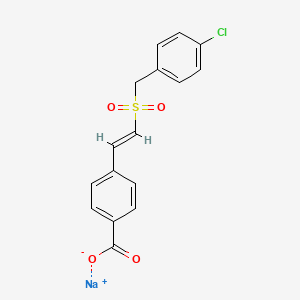
Recilisib Sodium, EX-RAD


Recilisib Sodium

Phase I

C16H12ClNaO4S
Molecular Weight: 358.771849 g/mol

Recilisib sodium.png

A protein kinase inhibitor potentially for the treatment of acute radiation syndrome.

sodium;4-[(E)-2-[(4-chlorophenyl)methylsulfonyl]ethenyl]benzoate

Onc-01210; ON-01210.Na, Ex-RAD; ON 01210.Na; ON-01210; ON-01210-Na; Recilisib

CAS No. 334969-03-8(free)

CAS 922139-31-9(Recilisib sodium)

Benzoic acid, 4-[(1E)-2-[[(4-chlorophenyl)methyl]sulfonyl]ethenyl]-, sodium salt (1:1)

Onconova Therapeutics Inc, Univ Temple INNOVATOR

Stephen C Cosenza, Lawrence Helson,Premkumar E Reddy, Ramana M V Reddy  INVENTORS

Company Onconova Therapeutics Inc.
Description Synthetic, low molecular weight radioprotectant that modulates DNA repair pathways
Molecular Target DNA
Mechanism of Action Radioprotectant
Therapeutic Modality Small molecule
Latest Stage of Development Phase I
Standard Indication Poisoning
Indication Details Prevent radiation poisoning; Provide radation protection; Treat and prevent acute radiation syndrome (ARS)
  • Originator Onconova Therapeutics
  • Class Radioprotectives; Small molecules; Sulfonamides
  • Mechanism of Action Apoptosis inhibitors; Protein kinase inhibitors
  • Orphan Drug Status Yes – Acute radiation syndrome
  • Phase I Acute radiation syndrome

Most Recent Events

  • 22 Apr 2016 Phase I development is ongoing in the US (PO & SC)
  • 20 Mar 2014 Recilisib receives Orphan Drug status for Acute radiation syndrome in USA
  • 03 Oct 2012 Phase-I clinical trials in Acute radiation syndrome in USA (PO)

Ex-Rad (or Ex-RAD), also known by the code name ON 01210.Na, or recilisib sodium (INN, USAN) is a drug developed by Onconova Therapeutics and the U.S. Department of Defense.[1][2] This newly developed compound is said to be a potent radiation protection agent.  Chemically, it is the sodium salt of 4-carboxystyryl-4-chlorobenzylsulfone.[3]

Clinical trials

The results of two Phase I clinical studies in healthy human volunteers indicate that subcutaneously injected Ex-Rad is safe and well tolerated, with “no evidence of systemic side effects”.[4] A study in mice demonstrated the efficacy of Ex-Rad by increasing the survival rate of mice exposed to typically lethal whole-body irradiation. The study tested oral and parenteral administration of Ex-Rad for both pre- and post-exposure radiomitigation.[1]

Research on Ex-Rad has involved collaboration with the Armed Forces Radiobiology Research Institute (AFRRI), the Department of Biochemistry and Molecular & Cellular Biology at Georgetown University, Long Island University‘s Arnold & Marie Schwartz College of Pharmacy, and the Department of Oncological Sciences at the Mt. Sinai School of Medicine.[1]

Mechanism of action

Onconova suggests that Ex-Rad protects cells exposed to radiation against DNA damage, and that the drug’s mechanism of action does not involve scavenging free radicals or arresting the cell cycle. Instead, they claim it employs a “novel mechanism” involving “intracellular signaling, damage sensing, and DNA repair pathways”.[4] Ex-RAD is a chlorobenzylsulfone derivative that works after free radicals have damaged DNA. Onconova CEO Ramesh Kumar believes this is a better approach than trying to scavenge free radicals. “Free radicals are very short-lived, and so the window of opportunity to give a drug is very narrow,” he says. In cell and animal models, Ex-RAD protects hematopoieticand gastrointestinal tissues from radiation injury when given either before or after exposure.[5]

While anti-radiation suits or other protective gear may be effective at reducing radiation exposure, such gear is expensive, unwieldy, and generally not available to public. Moreover, radioprotective gear will not protect normal tissue adjacent to a tumor from stray radiation exposure during radiotherapy. Pharmaceutical radioprotectants offer a cost-efficient, effective and easily available alternative to radioprotective gear. However, previous attempts at radioprotection of normal cells with pharmaceutical compositions have not been entirely successful. For example, cytokines directed at mobilizing the peripheral blood progenitor cells confer a myeloprotective effect when given prior to radiation (Neta et al., Semin. Radiat. Oncol. 6:306-320, 1996), but do not confer systemic protection. Other chemical radioprotectors administered alone or in combination with biologic response modifiers have shown minor protective effects in mice, but application of these compounds to large mammals was less successful, and it was questioned whether chemical radioprotection was of any value (Maisin, J. R., Bacq and Alexander Award Lecture. “Chemical radioprotection: past, present, and future prospects”, Int J. Radiat Biol. 73:443-50, 1998). Pharmaceutical radiation sensitizers, which are known to preferentially enhance the effects of radiation in cancerous tissues, are clearly unsuited for the general systemic protection of normal tissues from exposure to ionizing radiation.

The major biological effects of radiation exposure are the destruction of bone marrow cells, gastrointestinal (GI) damage, lung pneumonitis, and central nervous system (CNS) damage. The long-term effects of radiation exposure include an increase in cancer rates. It has been estimated that the exposure of 100 rems (roentgen equivalent man: a measurement used to quantify the amount of radiation that would produce harmful biological effects) would produce ARS symptoms. Exposure levels above 300 rems would result in the death of approximately 50% of the exposed population.

The α,β-unsaturated aryl sulfones, in particular benzyl styryl sulfones, provide significant and selective systemic protection of normal cells from radiation-induced damage in animals. When used in radiotherapy techniques, these compounds also exhibit independent toxicity to cancer cells. These α,β-unsaturated aryl sulfones, in particular benzyl styryl sulfones, are described in U.S. Pat. Nos. 6,656,973 and 6,667,346, which are particularly incorporated herein by reference in their entirety. Although these compounds are stable in solid state their aqueous formulations for parenteral administration are pH sensitive and pose challenging hurdles to overcome physical stability. The most likely causative factor may be attributed to the reactive styryl sulfone conjugated double bond, which is prone to Michael addition by nucleophiles and eventual fallout of the conjugated addition product.

U.S. Patent No. 6,656,973, describes in vitro pharmacological effects of DMSO solubilization of a benzyl styryl sulfone (e.g. ON 01210.NA) but fails to disclose a composition comprising ON 01210. NA formulation and specifically, a shelf stable formulation which is suitable for administration to humans.

PCT Application WO 2007/016201 describes pharmaceutical solution compositions for parenteral administration for reducing toxic effects of ionizing radiation in a subject, comprising an effective amount of at least one radioprotective α,β-Unsaturated aryl sulfone, and at least one component selected from the group consisting of a) a water soluble polymer in an amount between about 0.5% and about 90% w/v, b) at least one chemically modified cyclodextrin in an amount between about 20% and about 60% w/v, and c) DMA in an amount between 10% and about 50% w/v.

U.S. Patent Application 20090247624, and corresponding PCT Application WO 2008/105808, are directed to aqueous solutions, which comprise between about 20 mg/ml to about 100 mg/ml of at least one α,β-unsaturated aryl sulfone (e.g., the compound ON 01210. Na ((E)-4-Carboxystyryl-4-chlorobenzylsulfone sodium salt, a cosolvent in an amount between about 25% and about 90% w/v (e.g., about 50% PEG 400), wherein the composition is buffered and exists within the range of about pH 7.0 to about pHIO (e.g., 0.2M Tris-EDTA, pH about 8.5). The aforementioned solution formulations have exhibited a sub-optimal shelf life and lack a preferred degree of solubility and/or stability. These formulations evolved progressively as a result of addressing the most challenging aspects in the formulation and drug development field, namely, solubility and stability parameters that defined the long term viability of these formulations. There seems to be a delicate balance between pH, solubility and stability of the active moiety in aqueous milieu, wherein achieving such balance and development of a shelf stable aqueous formulation has presented a formidable challenge. Therefore, a shelf stable effective solution formulation that prevents the breakdown of the therapeutically active entity and keeps the drug in the solution at the desired pH was most desired and significant effort was directed towards this goal.

What is needed therefore, is a shelf stable effective solution formulation of radioprotective α,β-unsaturated aryl sulfones that prevents the breakdown of the therapeutically active entity and keeps the drug in the solution at the desired pH. This invention solves these and other long felt needs by providing improved solution formulation of radioprotective α,β- unsaturated aryl sulfones having improved physical and chemical stability and enhanced shelf life.

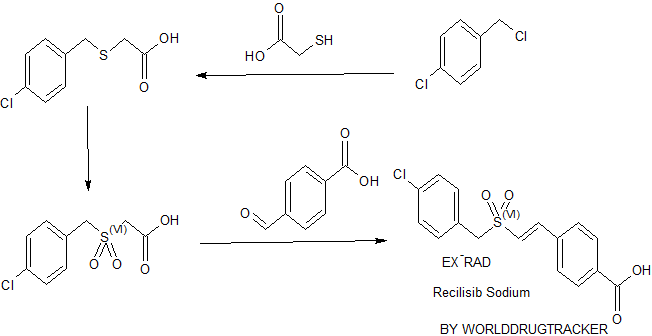
SYNTHESIS BY WORLDDRUGTRACKER

STR1

PATENT

WO 2011119863

An exemplary species of a radioprotective α,β-unsaturated aryl sulfone is ON 01210.Na. ON 01210.Na is a derivative of chlorobenzylsulfone. This compound is described in U.S. Pat. Nos. 6,656,973 and 6,667,346 as exhibiting valuable prophylactic properties which mitigate the effects of accidental and intentional exposure to life-threatening levels of irradiation. Hence, a systematic development of this compound is described with the objective of developing a shelf stable formulation.

Table 1 describes the general physical properties of ON. 1210. Na. The exemplary compound is a sodium salt of (E)-4-Carboxystyryl-4-chlorobenzylsulfone.

TABLE 1

Physical Properties of ON.1210.Na

Chemical Structure

Figure imgf000018_0001

Chemical Name (E)-4-Carboxystyryl-4-chlorobenzylsulfone,

Sodium Salt

Empirical Formula C16H12ClNa04S

Molecular Weight 358.79

Physical Nature White crystalline flakes

Melting Point 354-356° C.

Solubility Soluble in water at 8-10 mg/ml

The compound ON 01210. Na appears to form at least one polymorph. X-ray diffraction pattern, for example, of precipitated ON 01210. Na is different from that of the originally synthesized compound. Polymorphs of ON 01210.Na are intended to be within the scope of the claims appended hereto.

EXAMPLE 1

Preparation of ON 01210. Na

4-Chlorobenzyl-4-carboxystyryl sulfone (ON 01210) (49 g; 0.145 mol) was taken in a one-liter conical flask and 500 ml of distilled water was added. Sodium hydroxide solution (16 ml: 10 M stock) (0.150 mol.) was added to the conical flask. The contents of the flask were then boiled with stirring till ON 01210 was completely dissolved. The solution was then cooled to room temperature and shining crystals separated were filtered through a fluted filter paper. The crystalline material was dried under vacuum to yield (48 g) (92% yield) of pure ON 1210. Na.

EXAMPLE II

Preparation of ON 01210. Na Formulation A (Without Vitamin E TPGS)

TRIS (968.0 mg), EDTA (233.8 mg), and deionized (DI) water (24 ml) were combined in a beaker equipped with a Teflon coated stirring bar. The mixture was stirred until complete dissolution occurred, and the resulting solution was covered with aluminum foil and allowed to stir gently overnight at room temperature. The following morning, PEG 400 NF (40.0 ml) was added to the TRIS/EDTA aqueous solution with continued stirring. The vessel containing PEG 400 NF was rinsed with DI water (2 x 3.2 ml), and the rinsate added to the formulation mixture. After stirring the mixture to homogeneity (approx. 10 minutes), the pH was measured to be 9.46 using a calibrated electronic pH meter. The pH was adjusted to 8.37 (target pH = 8.40) by the careful addition of 98 pipet drops of 1.0 M HCl (aq) with stirring and allowed to fully equilibrate over a 10-15 minute period. Once the pH steadied at 8.37, ON 01210. Na (4.0 g) was added to the stirring formulation mixture. Complete dissolution required vigorous stirring and brief periodic sonication to break up ON 01210.Na clumps over a two hour period. After complete dissolution of ON 01210. Na, DI water (approx. 5 ml) was added to bring the final volume to approximately 80 milliliters. The pH of the resulting solution was determined to be 8.31, and thus 20 pipet drops of 1.0N NaOH(aq) were added to adjust the final formulation batch (defined as ON 01210.Na Formulation A) pH to 8.41-8.42. Formulation A was 0.22 micron filtered using a 100 ml Gastight Syringe equipped with a Millex®GP filter unit (Millipore Express® PES Membrane; Lot No R8KN13888).

PATENT

WO 2008105808

PATENT

WO 2007016201 

PATENT

WO 2002069892

The α,β unsaturated aryl sulfones are characterized by cis-trans isomerism resulting from the presence of one or more double bonds. The compounds are named according to the Cahn-Ingold-Prelog system, the IUPAC 1974 Recommendations, Section E: Stereochemistry, in Nomenclature of Organic Chemistry, John Wiley & Sons, Inc., New York, NY, 4th ed., 1992, p.

127-138. Stearic relations around a double bond are designated as “Z” or “E”.

(E)-α,β unsaturated aryl sulfones may be prepared by Knoevenagel condensation of aromatic aldehydes with benzylsulfonyl acetic acids or arylsulfonyl acetic acids. The procedure is described by Reddy et al, Ada. Chim. Hung. 115:269-71 (1984); Reddy et al, Sulfur Letters 13:83-90 (1991); Reddy et al, Synthesis No. 4, 322-23 (1984); and Reddy et al, Sulfur Letters 7:43-48 (1987), the entire disclosures of which are incorporated herein by reference.
According to the Scheme 1 below, Ra and Rb each represent from zero to five substituents on the depicted aromatic nucleus. For purposes of illustration, and not limitation, the aryl groups are represented as phenyl groups, that is, the synthesis is exemplified by the preparation of styryl benzylsulfones. Accordingly, the benzyl thioacetic acid B is formed by the reaction of sodium thioglycollate and a benzyl chloride A. The benzyl thioacetic acid B is then oxidized with 30% hydrogen peroxide to give a corresponding benzylsulfonyl acetic acid C. Condensation of the benzylsulfonyl acetic acid C with an aromatic aldehyde D via a Knoevenagel reaction in the presence of benzylamine and glacial acetic acid yields the desired (E)-styryl benzylsulfone E.

Scheme 1

The following is a more detailed two-part synthesis procedure for preparing (E)-styryl benzylsulfones according to the above scheme.

General Procedure 1: Synthesis (E)-Styryl Benzylsulfones
Part A. To a solution of (8g, 0.2 mol) sodium hydroxide in methanol (200 ml), thioglycollic acid (0.1 mol) is added slowly and the precipitate formed is dissolved by stirring the contents of the flask. Then an appropriately substituted benzyl chloride (0.1 mol) is added stepwise and the reaction mixture is refluxed for 2-3 hours. The cooled contents are poured onto crushed ice and neutralized with dilute hydrochloric acid (200 ml). The resulting corresponding benzylthioacetic acid (0.1 mol) is subjected to oxidation with 30% hydrogen peroxide (0.12 mol) in glacial acetic acid (125 ml) by refluxing for 1 hour. The contents are cooled and poured onto crushed ice. The separated solid is recrystalized from hot water to give the corresponding pure benzylsulfonylacetic acid.
Part B. A mixture of the benzylsulfonyl acetic acid (10 mmol), an appropriately substituted aromatic aldehyde (10 mmol), and benzylamine (0.2 ml) in glacial acetic acid (12 ml) is refluxed for 2-3 hours. The contents are cooled and treated with cold ether (50 ml). Any product precipitated out is separated by filtration. The filtrate is diluted with more ether and washed successively with a saturated solution of sodium bicarbonate (20 ml), sodium bisulfite (20 ml), dilute hydrochloric acid (20 ml) and finally with water (35 ml). Evaporation of the dried ethereal layer yields styryl benzylsulfones as a solid material.

According to an alternative to Part A, the appropriate benzylsulfonylacetic acids may be generated by substituting a thioglycollate

HSCH2COOR for thioglycollic acid, where R is an alkyl group, typically C1-C6 alkyl. This leads to the formation of the alkylbenzylthioacetate intermediate (F),

which is then converted to the corresponding benzyl thioacetic acid B by alkaline or acid hydrolysis.

(E)-styryl phenyl sulfones (formula I: n=zero; Qls Q2 = substituted or unsubstituted phenyl) are prepared according to the method of General Procedure 1, replacing the benzylsulfonyl acetic acid in Part B with the appropriate substituted or unsubstituted phenylsulfonyl acetic acid.

(Z)-Styryl benzylsulfones are prepared by the nucleophilic addition of the appropriate thiols to substituted phenylacetylene with subsequent oxidation of the resulting sulfide by hydrogen peroxide to yield the (Z)-styryl benzylsulfone. The procedure is generally described by Reddy et al., Sulfur Letters 13:83-90 (1991), the entire disclosure of which is incorporated herein as a reference.
In the first step of the (Z)-styryl benzylsulfones synthesis, the sodium salt of benzyl mercaptan or the appropriate substituted benzyl mercaptan is allowed to react with phenylacetylene or the appropriate substituted phenylacetylene forming the pure (Z)-isomer of the corresponding styryl benzylsulfide in good yield.
In the second step of the synthesis, the (Z)-styryl benzylsulfide intermediate is oxidized to the corresponding sulfone in the pure (Z)-isomeric form by treatment with hydrogen peroxide.
The following is a more detailed two-part synthesis procedure for preparing (Z)-styryl benzylsulfones:

Procedure 2: Synthesis of (Z)-Styryl Benzylsulfones
Part A. To a refluxing methanolic solution of substituted or unsubstituted sodium benzylthiolate prepared from 460 mg (0.02g atom) of (i) sodium, (ii) substituted or unsubstituted benzyl mercaptan (0.02 mol) and (iii) 80 ml of absolute methanol, is added freshly distilled substituted or unsubstituted phenylacetylene. The mixture is refluxed for 20 hours, cooled and then poured on crushed ice. The crude product is filtered, dried and recrystalized from methanol or aqueous methanol to yield a pure (Z)- styryl benzylsulfide.
Part B. An ice cold solution of the (Z)- styryl benzylsulfide (3.0g) in 30 ml of glacial acetic acid is treated with 7.5 ml of 30% hydrogen peroxide. The reaction mixture is refluxed for 1 hour and then poured on crushed ice. The separated solid is filtered, dried, and recrystalized from 2-propanol to yield the pure (Z)-styryl benzylsulfone. The purity of the compounds is ascertained by thin layer chromatography and geometrical configuration is assigned by analysis of infrared and nuclear magnetic resonance spectral data.

The bis(styryl) sulfones of formula IN are prepared according to Procedure 3:
Procedure 3
Synthesis of (E)(E)- and (E)(Z)-bis(Styryl) Sulfones
To freshly distilled phenyl acetylene (51.07 g, 0.5 mol) is added sodium thioglycollate prepared from thioglycollic acid (46 g, 0.5 mol) and sodium hydroxide (40 g, 1 mol) in methanol (250 ml). The mixture is refluxed for 24 hours and poured onto crushed ice (500 ml) after cooling. The styrylthioacetic acid, formed after neutralization with dilute hydrochloric acid (250 ml), is filtered and dried; yield 88 g (90%); m.p. 84-86°C.
The styrylthioacetic acid is then oxidized to styrylsulfonylacetic acid as follows. A mixture of styrylthioacetic acid (5 g, 25 mmol) in glacial acetic acid (35 ml) and 30% hydrogen peroxide (15 ml) is heated under reflux for 60 minutes and the mixture is poured onto crushed ice (200 ml) after cooling. The compound separated is filtered and recrystalized from hot water to give white crystalline flakes of (Z)-styrylsulfonylacetic acid; yield 2.4 g (41%); m.p. 150-51°C.
A solution of (Z)-styrylsulfonylacetic acid (2.263 g, 10 m mol) in glacial acetic acid (6 ml) is mixed with an aromatic aldehyde (10 mmol) and benzylamine (0.2 ml) and refluxed for 3 hours. The reaction mixture is cooled, treated with dry ether (50 ml), and any product separated is collected by filtration. The filtrate is diluted with more ether and washed successively with a saturated solution of sodium hydrogen carbonate (15 ml), sodium bisulfite (15 ml), dilute hydrochloric acid (20 ml) and finally with water (30 ml). Evaporation of the dried ethereal layer yields (E)(Z)-bis(styryl)sulfones.
(E),(E)-bis(styryl)sulfones are prepared following the same procedure as described above with exception that sulfonyldiacetic acid is used in place of (Z)-styrylsulfonylacetic acid, and twice the amount of aromatic aldehyde (20 mmol) is used.

The styryl sulfones of formula N, which are systematically identified as 2-(phenylsulfonyl)-l-phenyl-3-phenyl-2-propen-l-ones, may be prepared according to either Method A or Method B of Procedure 4:

Procedure 4
Synthesis of 2-(Phenylsulfonyl)-l-phenyl-3-phenyl-2-propen-l-ones
These compounds are synthesized by two methods which employ different reaction conditions, solvents and catalysts.
Method A: Phenacyl aryl sulfones are made by refluxing α-bromoacetophenones (0.05 mol) and sodium arylsulfinates (0.05 mol) in absolute ethanol (200 ml) for 6-8 hours. The product which separates on cooling is filtered and washed several times with water to remove sodium bromide. The product is then recrystalized from ethanol: phenacyl-phenyl sulfone, m.p. 90-91°C; phenacyl-p-fluorophenyl sulfone, m.p. 148-149°C; phenacyl-p-bromophenyl sulfone, m.p. 121-122°C; phenacyl-p-methoxyphenyl sulfone, m.p. 104-105°C; p-nitrophenacyl-phenyl sulfone, m.p. 136-137°C.
A solution of phenacyl aryl sulfone (0.01 mol) in acetic acid (10 ml) is mixed with an araldehyde (0.01 mol) and benzylamine (0.02 ml) and refluxed for 3 hours. The solution is cooled and dry ether (50 ml) is added. The ethereal solution is washed successively with dilute hydrochloric acid, aqueous 10% NaOH, saturated NaHSO3 solution and water. Evaporation of the dried ethereal layer gives a solid product which is purified by recrystallization.

Method B: Dry tetrahydrofuran (200 ml) is taken in a 500 ml conical flask flushed with nitrogen. To this, a solution of titanium (IN) chloride (11 ml, 0.01 mol) in absolute carbon tetrachloride is added dropwise with continuous stirring. The contents of the flask are maintained at -20°C throughout the course of the addition. A mixture of phenacyl aryl sulfone (0.01 mol) and aromatic aldehyde (0.01 mol) is added to the reaction mixture and pyridine (4 ml, 0.04 mol) in tetrahydrofuran (8 ml) is added slowly over a period of 1 hour. The contents are stirred for 10-12 hours, treated with water (50 ml) and then ether (50 ml) is added. The ethereal layer is separated and washed with 15 ml of saturated solutions of 10% sodium hydroxide, sodium bisulfite and brine. The evaporation of the dried ethereal layer yields 2-(phenylsulfonyl)-l-phenyl-3-phenyl-2 propen-l-ones.

PATENT

https://www.google.com/patents/CN104817488A?cl=en

The structure of this medicine formula (I) shown below,

Figure CN104817488AD00031

Wherein, R1 is absent or is halogen, C1-3 alkyl, alkoxy and -CF3; R2 is absent or is halogen, C1-3 alkyl, alkoxy and -cf3; structural formula (I) The method for the preparation of compounds as follows:

Figure CN104817488AD00041
WO2007016201A2 Jul 28, 2006 Feb 8, 2007 Onconova Therapeutics, Inc. FORMULATION OF RADIOPROTECTIVE α, β UNSATURATED ARYL SULFONES
WO2008105808A2 Jul 27, 2007 Sep 4, 2008 Onconova Therapeutics, Inc. FORMULATIONS OF RADIOPROTECTIVE α, β UNSATURATED ARYL SULFONES
US6656973 Nov 27, 2002 Dec 2, 2003 Temple University – Of The Commonwealth System Of Higher Education (E)-4-carboxystyrl-4-chlorobenzyl sulfone and pharmaceutical compositions thereof
US6667346 Feb 28, 2002 Dec 23, 2003 Temple University – Of The Commonwealth System Of Higher Education Method for protecting cells and tissues from ionizing radiation toxicity with α, β unsaturated aryl sulfones
US6982282 * May 17, 2002 Jan 3, 2006 Sonus Pharmaceuticals, Inc. Emulsion vehicle for poorly soluble drugs
US20090247624 Jul 27, 2007 Oct 1, 2009 Onconova Therapeutics Inc. Formulations of radioprotective alpha beta unsaturated aryl sulfones

References

  1. “Onconova Therapeutics presents new data demonstrating radioprotection by Ex-RAD at RRS annual meeting” (Press release). EurekAlert. 2010-09-27. Archived from the originalon 2011-03-22. Retrieved 2011-03-22.
  2.  Hipp, Van (2011-03-16). “Ex-Rad, the U.S. Military’s Radiation Wonder Drug”. FoxNews.com (FOX News Network). Archived from the original on 2011-03-26. Retrieved 2011-03-26.
  3.  Ghosh, Sanchita P.; Perkins, Michael W.; Hieber, Kevin; Kulkarni, Shilpa; Kao, Tzu-Cheg; Reddy, E. Premkumar; Reddy, M. V Ramana; Maniar, Manoj; Seed, Thomas; Kumar, K. Sree (2009). “Radiation Protection by a New Chemical Entity, Ex-Rad™: Efficacy and Mechanisms”. Radiation Research 171 (2): 173–9. doi:10.1667/RR1367.1. PMID 19267542.
  4.  “Ex-RAD® for Protection from Radiation Injury”. Onconova Therapeutics. 2009. Archived from the original on 2011-03-22. Retrieved 2011-03-22.
  5.  http://cen.acs.org/articles/90/i26/Drugs-Never-Used.html[full citation needed]
  6.  Kouvaris, J. R.; Kouloulias, V. E.; Vlahos, L. J. (2007). “Amifostine: The First Selective-Target and Broad-Spectrum Radioprotector”. The Oncologist 12 (6): 738–47.doi:10.1634/theoncologist.12-6-738. PMID 17602063.
  7.  http://www.news-medical.net/news/20110323/Cellerant-commences-CLT-008-Phase-III-trial-in-patients-with-leukemia.aspx
  8.  Reliene, Ramune; Pollard, Julianne M.; Sobol, Zhanna; Trouiller, Benedicte; Gatti, Richard A.; Schiestl, Robert H. (2009). “N-acetyl cysteine protects against ionizing radiation-induced DNA damage but not against cell killing in yeast and mammals”. Mutation Research/Fundamental and Molecular Mechanisms of Mutagenesis 665: 37. doi:10.1016/j.mrfmmm.2009.02.016.
  9. Mansour, Heba H.; Hafez, Hafez F.; Fahmy, Nadia M.; Hanafi, Nemat (2008). “Protective effect of N-acetylcysteine against radiation induced DNA damage and hepatic toxicity in rats”.Biochemical Pharmacology 75 (3): 773–80. doi:10.1016/j.bcp.2007.09.018. PMID 18028880.
  10.  Demirel, C; Kilçiksiz, S; Ay, OI; Gürgül, S; Ay, ME; Erdal, N (2009). “Effect of N-acetylcysteine on radiation-induced genotoxicity and cytotoxicity in rat bone marrow”. Journal of radiation research 50 (1): 43–50. doi:10.1269/jrr.08066. PMID 19218780.
  11.  Demirel, C; Kilciksiz, S; Evirgen-Ayhan, S; Gurgul, S; Erdal, N (2010). “The preventive effect of N-acetylcysteine on radiation-induced dermatitis in a rat model”. Journal of the Balkan Union of Oncology 15 (3): 577–82. PMID 20941831.
  12. Geiger, Hartmut; Pawar, Snehalata A; Kerschen, Edward J; Nattamai, Kalpana J; Hernandez, Irene; Liang, Hai Po H; Fernández, Jose Á; Cancelas, Jose A; Ryan, Marnie A; Kustikova, Olga; Schambach, Axel; Fu, Qiang; Wang, Junru; Fink, Louis M; Petersen, Karl-Uwe; Zhou, Daohong; Griffin, John H; Baum, Christopher; Weiler, Hartmut; Hauer-Jensen, Martin (2012).“Pharmacological targeting of the thrombomodulin–activated protein C pathway mitigates radiation toxicity”. Nature Medicine 18 (7): 1123–9. doi:10.1038/nm.2813. PMC 3491776.PMID 22729286.

External links

Patent ID Date Patent Title
US2015265549 2015-09-24 STABLE AQUEOUS FORMULATION OF (E)-4-CARBOXYSTYRYL-4-CHLOROBENZYL SULFONE
US2015238448 2015-08-27 FORMULATION OF RADIOPROTECTIVE ALPHA, BETA UNSATURATED ARYL SULFONES
US2013012588 2013-01-10 COMPOSITIONS AND METHODS FOR PREVENTION AND TREATEMENT OF WOUNDS
US2013012589 2013-01-10 STABLE AQUEOUS FORMULATION OF (E)-4-CARBOXYSTYRYL-4-CHLOROBENZYL SULFONE
US2011250184 2011-10-13 METHODS FOR DETERMINING EFFICACY OF A THERAPEUTIC REGIMEN AGAINST DELETERIOUS EFFECTS OF CYTOTOXIC AGENTS IN HUMAN
US2011028504 2011-02-03 Formulation of radioprotective alpha beta unsaturated aryl sulfones
US2009247624 2009-10-01 FORMULATIONS OF RADIOPROTECTIVE ALPHA BETA UNSATURATED ARYL SULFONES
Ex-Rad
Ex-rad.png
Identifiers
922139-31-9 Yes
PubChem 23668369
Properties
C16H12ClNaO4S
Molar mass 358.77 g·mol−1

//////////Onc-01210,  ON-01210.Na, 334969-03-8,  922139-31-9, Recilisib Sodium, Phase I , A protein kinase inhibitor,   treatment of acute radiation syndrome, Orphan Drug Status, Ex-RAD

C1=CC(=CC=C1CS(=O)(=O)C=CC2=CC=C(C=C2)C(=O)[O-])Cl.[Na+]

Amneal Pharma’s, 4,5-Dihydro-1H-pyrazolo[3,4-d]pyrimidine containing phenothiazines as antitubercular agents


STR1

Cas 1580464-40-9

MW458.97, C24 H19 Cl N6 S,

1H-Pyrazolo[3,4-d]pyrimidin-6-amine, 4-(4-chlorophenyl)-4,7-dihydro-3-methyl-1-(10H-phenothiazin-2-yl)-

4-(4-chlorophenyl)-3-methyl-1-(10H-phenothiazin-2-yl)-4,5-dihydro-1H-pyrazolo[3,4-d]pyrimidin-6-amine

4-(4-chlorophenyl)-3-methyl-1-(10H-Phenothiazin-2-yl)-4,5-dihydro-1H-pyrazolo[3,4-d] pyrimidin-6-amine

STR1

Yield 79%, m.p.: 186-188 ºC.

IR (KBr): 3328 (NH), 1648 (C-N), 640 (C-S-C). 1H NMR (300 MHz, CDCl3): d 2.32 (s, 3H, CH3), 4.95 (s, 1H, CH), 7.36-7.38 (dd, 2H, J=8.10 Hz), 7.84-7.87 (dd, 2H, J=7.80 Hz), 7.90-8.05 (m, 7H, Ar-H), 8.46 (s, 1H, NH), 8.56 (s, 2H, NH2), 9.11 (s, 1H, NH):

13C NMR (75 MHz, CDCl3): d 26.1, 41.2, 52.5, 59.8, 103.6, 104.2, 105.3, 114.2, 116.6, 122.7, 127.1, 127.9, 128.2, 128.6, 129.2, 132.5, 134.6, 142.4, 143.7, 155.3, 162.5. Mass (m/z): 459. Anal. (%) for C24H19ClN6S, Calcd. C, 62.81; H, 4.17; N, 18.31. Found: C, 62.75; H, 4.15; N, 18.26.

Mass spectrum of 4g

 STR1

1H NMR spectrum of 4g

STR1

Tuberculosis (TB) is a highly infectious airborne disease caused by the pathogenic bacterium Mycobacterium tuberculosis (Mtb). 1According to the latest World Health Organization (WHO) report, an estimated 8.6 million people developed TB and 1.3 million died from the disease (including 320,000 deaths among HIV-positive people) in 2012. The majority of cases worldwide in 2012 were in the South-East Asia (29%), African (27%) and western Pacific (19%) regions. India and China alone accounted for 26% and 12% of total cases, respectively.2 The standard antitubercular treatment regimen, termed DOTS (Directly Observed Therapy, Short-course), is based on the co-administration of age-old drugs like isoniazid (INH), rifampin (RMP), ethambutol (EMB), and pyrazinamide (PZA) for the first two months, followed by a prolonged treatment with INH and RMP for additional 4–7 months with no guarantee of complete sterilization from the infection. 4 and 5 Furthermore, emergence of new virulent forms of TB such as multi drug resistant (MDR-TB) and extremely drug resistant (XDR-TB), and its synergy with human immunodeficiency virus (HIV) has fuelled its epidemic nature.  These reasons make a compelling case for an urgent need for new and effective antitubercular agents with improved properties such as enhanced activity against MDR strains, reduced toxicity, rapid mycobactericidal mechanism of action and the ability to penetrate host cells and exert antimycobacterial effects in the intracellular environment.

Phenothiazines are important classes of compounds which have increasingly attracted attention, owing to their remarkable biological and pharmacological properties, such as antibacterial, antifungal, anticancer, antiviral, anti-inflammatory, antimalarial, antifilarial, trypanocidal, anticonvulsant, analgesic, immunosuppressive and multidrug resistance reversal. These activities are the results of the actions exerted by phenothiazines on biological systems via the interaction of the pharmacophoric substituent (in some cases of strict length), via the interaction multicyclic ring system (π–π interaction, intercalation in DNA) and via the lipophilic character permitting the penetration through the biological membranes to reach its site of action. Further, Phenothiazines have been shown to exhibit in vitro and in vivo activity against Mtb and multidrug-resistant Mtb. Some of the phenothiazine derived antipsychotic agents such as chlorpromazine, trifluoperazine (TPZ) and thioridazine are found to be effective inhibitors of Mtb.Phenothiazines are predicted to target the genetically validated respiratory chain component type II NADH:quinone oxidoreductase (Ndh)

Paper

Volume 24, Issue 6, 15 March 2014, Pages 1493–1495

4,5-Dihydro-1H-pyrazolo[3,4-d]pyrimidine containing phenothiazines as antitubercular agents

  • a Amneal Pharmaceuticals India Pvt Ltd, 882/1-871, Village Rajoda, Tal.: Bavla Dist.: Ahmedabad 382220, Gujarat, India
  • b Division of Medicinal Chemistry, Department of Chemistry (DST-FIST Sponsored), Mahatma Gandhi Campus, Maharaja Krishnakumarsinhji Bhavnagar University, Bhavnagar 364002, Gujarat, India
  • c Department of Chemistry, Saurashtra University, Kalawad Road, Rajkot 360005, Gujarat, India

A series of novel dihydropyrazolo[3,4-d]pyrimidine derivatives bearing a phenothiazine nucleus were synthesized in excellent yields via a modified Biginelli multicomponent reaction. The newly synthesized compounds were characterized by IR, 1H NMR, 13C NMR, Mass spectra and elemental analysis followed by antimycobacterial screening. Among all the screened compounds, compound 4g showed most pronounced activity against Mycobacterium tuberculosis (Mtb) with minimum inhibitory concentration (MIC) of 0.02 μg/mL, making it more potent than first line antitubercular drug isoniazid.

Synthetic protocol of title compounds 4a–k. Reagents and conditions: (a) NH2NH2, ...

Scheme 1.

Synthetic protocol of title compounds 4ak. Reagents and conditions: (a) NH2NH2, reflux; (b) ethyl acetoacetate, sodium ethoxide, reflux; (c) guanidine hydrochloride, aldehyde (R-CHO), P2O5, EtOH, reflux.


Vipul Kataria

Vipul Kataria

Saurashtra University

https://www.linkedin.com/in/vipul-kataria-3aa37950

Experience

Assistant professor of chemistry

V P & R P T P science college

August 2013 – Present (2 years 11 months)

please send other authors pic at amcrasto@gmail.com

Amneal Pharmaceuticals’ co-CEO Chirag Patel

Chirag Patel and Chintu Patel

Chintu Patel, owner of Amneal Pharmaceuticals,

///////Dihydropyrazolo[3,4-d]pyrimidine, Phenothiazines, Biginelli multicomponent reaction, Cytotoxicity, Antitubercular activity, 4,5-Dihydro-1H-pyrazolo[3,4-d]pyrimidine,  phenothiazines, antitubercular agents, amneal, 1580464-40-9

Clc1ccc(cc1)C2N=C(N)Nc3c2c(C)nn3c4cc5Nc6ccccc6Sc5cc4

AMG 900, An aurora kinase (ARK) inhibitor potentially for the treatment of leukemia and solid tumours


AMG-900

N-(4-((3-(2-aminopyrimidin-4-yl)pyridin-2-yl)oxy)phenyl)-4-(4-methylthiophen-2-yl)phthalazin-1-amine.

N-(4-(3-(2-Aminopyrimidin-4-yl)pyridin-2-yloxy)phenyl)-4-(4-methylthiophen-2-yl)phthalazin-1-amine

Phase I

Amgen Inc. INNOVATOR

Inventors Victor J. Cee, Holly L. Deak, Bingfan Du,Stephanie D. Geuns-Meyer, Brian L. Hodous,Hanh Nho Nguyen, Philip R. Olivieri, Vinod F. Patel, Karina Romero, Laurie Schenkel,Less «
Applicant Amgen Inc.

An aurora kinase (ARK) inhibitor potentially for the treatment of leukemia and solid tumours.

CAS No. 945595-80-2

In 2014, orphan drug designation was assigned in the U.S. for the treatment of ovarian cancer

Molecular Formula: C28H21N7OS
Molecular Weight: 503.57764 g/mo
AMG 900; AMG-900; 945595-80-2; AMG900; UNII-9R2G075611; N-(4-((3-(2-aminopyrimidin-4-yl)pyridin-2-yl)oxy)phenyl)-4-(4-methylthiophen-2-yl)phthalazin-1-amine;

AMG 900 is a small-molecule inhibitor of Aurora kinases A, B and C with potential antineoplastic activity. Aurora kinase inhibitor AMG 900 selectively binds to and inhibits the activities of Aurora kinases A, B and C, which may result in inhibition of cellular division and proliferation in tumor cells that overexpress these kinases. Aurora kinases are serine-threonine kinases that play essential roles in mitotic checkpoint control during mitosis and are overexpressed by a wide variety of cancer cell types. Check for active clinical trials or closed clinical trials using this agent

AMG 900 is a potent and highly selective pan-Aurora kinases inhibitor for Aurora A/B/C with IC50 of 5 nM/4 nM /1 nM;  >10-fold selective for Aurora kinases than p38α, Tyk2, JNK2, Met and Tie2.
IC50 Value: 5 nM(Aurora A); 4 nM(Aurora B); 1 nM(Aurora C)
Target: pan-Aurora
in vitro: AMG 900 is a novel class of ATP-competitive phthalazinamine small molecule inhibitors of aurora kinases. In HeLa cells, AMG 900 inhibits autophosphorylation of aurora-A and -B as well as phosphorylation of histone H3 on Ser, a proximal substrate of aurora-B. The predominant cellular response of tumor cells to AMG 900 treatment is aborted cell division without a prolonged mitotic arrest, which ultimately results in cell death. AMG 900 inhibits the proliferation of 26 tumor cell lines, including cell lines resistant to the antimitotic drug paclitaxel and to other aurora kinase inhibitors (AZD1152, MK-0457, and PHA-739358), at low nanomolar concentrations (about 2- 3 nM). Furthermore, AMG 900 is active in an AZD1152-resistant HCT116 variant cell line that harbors an aurora-B mutation (W221L) [1].
in vivo: Oral administration of AMG 900 blocks the phosphorylation of histone H3 in a dose-dependent manner and significantly inhibited the growth of HCT116 tumor xenografts. AMG 900 is broadly active in multiple xenograft models, including 3 multidrugresistant xenograft models, representing 5 tumor types [1]. AMG 900 exhibits a low-to-moderate clearance and a small volume of distribution. Its terminal elimination half-life ranged from 0.6 to 2.4 hours. AMG 900 is well-absorbed in fasted animals with an oral bioavailability of 31% to 107%. Food intake has an effect on rate (rats) or extent (dogs) of AMG 900 oral absorption. The clearance and volume of distribution at steady state in humans are predicted to be 27.3 mL/h/kg and 93.9 mL/kg, respectively. AMG 900 exhibits acceptable PK properties in preclinical species and is predicted to have low clearance in humans [2].

In mammalian cells, the aurora kinases (aurora-A, -B, and -C) play essential roles in regulating cell division. The expression of aurora-A and -B is elevated in a variety of human cancers and is associated with high proliferation rates and poor prognosis, making them attractive targets for anticancer therapy. AMG 900 is an orally bioavailable, potent, and highly selective pan-aurora kinase inhibitor that is active in taxane-resistant tumor cell lines. In tumor cells, AMG 900 inhibited autophosphorylation of aurora-A and -B as well as phosphorylation of histone H3 on Ser(10), a proximal substrate of aurora-B. The predominant cellular response of tumor cells to AMG 900 treatment was aborted cell division without a prolonged mitotic arrest, which ultimately resulted in cell death. AMG 900 inhibited the proliferation of 26 tumor cell lines, including cell lines resistant to the antimitotic drug paclitaxel and to other aurora kinase inhibitors (AZD1152, MK-0457, and PHA-739358), at low nanomolar concentrations. Furthermore, AMG 900 was active in an AZD1152-resistant HCT116 variant cell line that harbors an aurora-B mutation (W221L). Oral administration of AMG 900 blocked the phosphorylation of histone H3 in a dose-dependent manner and significantly inhibited the growth of HCT116 tumor xenografts. Importantly, AMG 900 was broadly active in multiple xenograft models, including 3 multidrug-resistant xenograft models, representing 5 tumor types. AMG 900 has entered clinical evaluation in adult patients with advanced cancers and has the potential to treat tumors refractory to anticancer drugs such as the taxanes.
MG 900 is an orally bioavailable, potent, and highly selective pan-aurora kinase inhibitor that is active in taxane-resistant tumor cell lines. In tumor cells, AMG 900 inhibited autophosphorylation of aurora-A and -B as well as phosphorylation of histone H3 on Ser10, a proximal substrate of aurora-B. The predominant cellular response of tumor cells to AMG 900 treatment was aborted cell division without a prolonged mitotic arrest, which ultimately resulted in cell death. AMG 900 inhibited the proliferation of 26 tumor cell lines, including cell lines resistant to the antimitotic drug paclitaxel and to other aurora kinase inhibitors (AZD1152, MK-0457, and PHA-739358), at low nanomolar concentrations. Furthermore, AMG 900 was active in an AZD1152-resistant HCT116 variant cell line that harbors an aurora-B mutation (W221L). Oral administration of AMG 900 blocked the phosphorylation of histone H3 in a dose-dependent manner and significantly inhibited the growth of HCT116 tumor xenografts. Importantly, AMG 900 was broadly active in multiple xenograft models, including 3 multidrug-resistant xenograft models, representing 5 tumor types. AMG 900 has entered clinical evaluation in adult patients with advanced cancers and has the potential to treat tumors refractory to anticancer drugs such as the taxanes. (Source: Cancer Res; 70(23); 9846–54.)

Clinical Information of AMG 900

Product Name Sponsor Only Condition Start Date End Date Phase Last Change Date
AMG 900 Amgen Inc Leukemia 31-JUL-11 31-JUL-14 Phase 1 14-SEP-13
Amgen Inc Advanced solid tumor 30-APR-09 30-JUN-13 Phase 1 10-SEP-13

AMG 900.png

PATENT

WO 2007087276

http://www.google.co.in/patents/WO2007087276A1?cl=en

PATENT

WO 2015084649

https://google.com/patents/WO2015084649A1?cl=en

The compound, N-(4-((3-(2-amino-4-pyrimidinyl)-2-pyridinyl)oxy)phenyl)- 4-(4-methyl-2-thienyl)-l-phthalazinamine, also chemically named as 4-((3-(2-amino- pyrimidin-4-yl)-pyridin-2-yl)oxy)phenyl-(4-(4-methyl-thiophen-2-yl)-phthalazin-l- yl)amine, and is referred to herein as “AMG 900” has a chemical structure of

AMG 900 is an ATP competitive small molecule Aurora kinase inhibitor that is highly potent and selective for Aurora kinases A, B and C. AMG 900 is disclosed in US patent publication no. 20070185111, which published on August 9, 2007 and issued as U.S. Patent No. 7,560,551. AMG 900 is further disclosed in US patent publication no.

20090163501, now US patent no 8,022,221. Various uses and applications of AMG 900 are described in patent publications US20120028917 and WO2013149026. AMG 900 is being clinically evaluated primarily for its safety, tolerability and pharmacokinetic (PK) profile in human phase I trials for (1) advanced solid tumors (US Clinical Trial Id No. NCT00858377), and (2) for acute leukemias (US Clinical Trial Id No. NCT1380756).

Different solid state forms of a given compound are typically investigated to determine whether or not a particular form possesses and/or exhibits desirable properties allowing that compound to be clinically and/or commercially developed. Such beneficial and advantageous properties, by way of example, include without limitation, crystallinity, improved thermodynamic stability, non-hygroscopicity, high purity, minimal to total absence of moisture and/or residual solvents, chemical stability, high yielding synthetic process and/or manufacturability and reproducibility, desirable biopharmaceutical properties including improved dissolution characteristics and increased bioavailability, absence or reduced toxicities due to reduced or limited exposure, rate of exposure or release, or related to counter ions, good bulk and formulation properties including good flow, bulk density, desirable particle size and the like, or a combination of the aforementioned characteristic attributes.

Generally when a compound, also referred to herein as drug substance (DS), has been identified as a developmental candidate, the DS is screened to identify potentially beneficial polymorphic, crystalline or solid state forms of the compound and/or a pharmaceutically acceptable salt thereof. X-ray diffraction, Raman, solid state NMR and a melting point temperature and/or a melting point temperature range have been typically used to monitor or screen and identify the different polymorphic form of the DS.

Different polymorphic forms of a given DS can have an impact on that compound’s solubility, stability and bioavailability. Also, it is important to monitor possible changes in polymorphic forms of the DS during stability studies.

AMG 900 was previously isolated and identified as a free base compound. This compound exhibited rather lack-luster pharmacokinetic (PK) and/or pharmacodynamic (PD) properties, including poor aqueous solubility, poor bioavailability, poor absorption, poor target exposure and overall, a not-so-attractive in-vivo efficacy profile. Thus, there is a need to address and solve the technical problem of identifying alternative forms of AMG 900 to achieve substantially the same effect or an improved effect, including improved PK and PD profiles, as that of AMG 900 known in the art.

Example 1

Synthesis of N-(4-((3-(2-amino-4-pyrimidinylN)-2-pyridinylN)oxyN)phenylN)-4-(4-methyl-2-thienvD-l-phthalazinamine (AMG 900)

Step 1 : 4-(2-chloropyridin-3-yl)pyrimidin-2 -amine

In an argon purged 500 mL round bottom flask placed in an isopropanol bath, was added sodium metal (3.40g, 148mmol) slowly to methanol (180mL). The mixture was stirred at room temperature (RT) for about 30 minutes. To this was added guanidine hydrochloride (12.0 mL, 182 mmol) and the mixture was stirred at RT for 30 minutes, followed by addition of (E)-l-(2-chloropyridin-3-yl)-3-(dimethylamino)prop-2-en-l-one (12.0 g, 57.0 mmol), attached air condenser, moved reaction to an oil bath, where it was heated to about 50 °C for 24 hr. Approximately half of the methanol was evaporated under reduced pressure and the solids were filtered under vacuum, then washed with saturated sodium bicarbonate (NaHCO and H^O, air dried to yield 4-(2-chloropyridin-3-yl)pyrimidin-2-amine as off white solid. MS m/z = 207 [M+l]+. Calc’d for C9H7C1N4: 206.63.

Step 2: 4-(2-(4-aminophenoxy)pyridin-3-yl)pyrimidin-2-amine

To a resealable tube was added 4-aminophenol (1.3 g, 12 mmol), cesium carbonate (7.8 g, 24 mmol), and DMSO (16 ml, 0.75 M). The mixture was heated to 100 °C for 5 minutes, and then 4-(2-chloropyridin-3-yl)pyrimidin-2 -amine (2.5 g, 12 mmol) was added, and the reaction mixture was heated to 130 °C overnight. Upon completion, as judged by LCMS, the reaction mixture was allowed to cool to RT and diluted with water. The resulting precipitate was filtered, and the solid washed with water and diethyl ether. The solid was then taken up in 9: 1 CH2Cl2:MeOH and passed through a pad of silica gel with 9:1 CH2Cl2:MeOH as eluent. The solvent was concentrated in vacuo to provide the desired product, 4-(2-(4-aminophenoxy)pyridin-3-yl)pyrimidin-2-amine. MS m/z = 280

[M+l]+. Calc’d for Ci5H13N50: 279.30.

Step 3: l-Chloro-4-(4-methylthiophen-2-yl)phthalazine

1 ,4-Dichlorophthalazine (1.40 g, 7.03 mmol), 4-methyltmophen-2-ylboronic acid (999 mg, 7.03 mmol), and PdCl2(DPPF) (721 mg, 985 μιηοΐ) were added into a sealed tube. The tube was purged with Argon. Then sodium carbonate (2.0 M in water) (7.74 ml, 15.5 mmol) and 1,4-dioxane (35.2 ml, 7.03 mmol) were added. The tube was sealed, stirred at RT for 5 min, and placed in a preheated oil bath at 110 °C. After 1 hr, LC-MS showed product and byproduct (double coupling), and starting material

dichlorophthalazme. The reaction was cooled to RT, filtered through a pad of celite with an aid of ethyl acetate (EtOAc), concentrated, and loaded onto column. The product was purified by column chromatography using Hex to remove the top spot, then 80:20 hexanes:EtOAc to collect the product. The product, 1 -chloro-4-(4-methylthiophen-2-yl)phthalazine was obtained as yellow solid. LC-MS showed that the product was contaminated with a small amount of dichlorophthalazme and biscoupling byproduct. MS m/z = 261 [M+l]+. Calcd for Ci3H9ClN2S: 260.12.

Step 4: N-(4-((3-(2-amino-4-pyrimidinyl)-2-pyridinyl)oxy)phenyl)-4-(4-methyl-2-thienyl)- 1 -phthalazinamine

To 4-(2-(4-aminophenoxy)pyridin-3-yl)pyrimidin-2 -amine and l-chloro-4-(4-methyl-2-thienyl)phthalazine was added tBuOH. The resulting mixture was heated at 100 °C in a sealed tube for 16 hours. The rection was diluted with diethyl ether and saturated sodium carbonate and vigorously shaken. The resulting solids were filtered and washed with water, diethyl ether and air dried to yield N-(4-((3-(2-amino-4-pyrimidinyl)-2-pyridinyl)oxy)phenyl)-4-(4-methyl-2-thienyl)-l -phthalazinamine as an off-white solid. MS m/z = 504 [M+H]+. Calc’d for C28 H21 N7 O S: 503.58.

Example 2

Alternative Synthesis of N-(4-((3-(2-amino-4-pyrimidinylN)-2-pyridinylN)oxyN)phenylN)-4-(4-methyl-2-thienvD-l-phthalazinamine (AMG 900)

Step 1 : 4-(2-chloropyridin-3-yl)pyrimidin-2 -amine

In an argon purged 500 mL round bottom flask placed in an isopropanol bath, was added sodium metal (3.40g, 148mmol) slowly to methanol (180mL). The mixture was stirred at room temperature (RT) for about 30 minutes. To this was added guanidine hydrochloride (12.0 mL, 182 mmol) and the mixture was stirred at RT for 30 minutes, followed by addition of (E)-l-(2-chloropyridin-3-yl)-3-(dimethylamino)prop-2-en-l-one (12.0 g, 57.0 mmol), attached air condenser, moved reaction to an oil bath, where it was heated to about 50 °C for 24 hr. Approximately half of the methanol was evaporated under reduced pressure and the solids were filtered under vacuum, then washed with saturated sodium bicarbonate (NaHCO and H^O, air dried to yield 4-(2-chloropyridin-3-yl)pyrimidin-2-amine as off white solid. MS m/z = 207 [M+l]+. Calc’d for C9H7C1N4: 206.63.

Step 2: 4-(2-(4-aminophenoxy)pyridin-3-yl)pyrimidin-2-amine

To a reaction vessel at ambient temperature was added 4-aminophenol (571 g, 5.25 mol, 1.05 equiv) followed by 4-(2-chloropyridin-3-yl)pyrimidin-2-amine (1064g, 97 wt%, 5.00 mol, 1.0 equiv) and DMSO (7110 ml, 7820 g, 7x the volume of 4-(2-chloropyridin-3-yl)pyrimidin-2 -amine). The reaction mixture was agitated and sparged with nitrogen gas for at least 10 minutes. Then a 50 weight % aqueous KOH solution (593 g, 5.25 mol, 1.05 equiv.) was added to the mixture while keeping the reaction

mixture temperature below about 40°C. The mixture was sparged with nitrogen gas for more than 5 minutes, the sparging tube was removed, and the reaction mixture was heated to 110 +/- 10 °C for at least 1.5 hrs. Upon completion, as judged by HPLC, the reaction mixture was allowed to cool to RT and diluted with 6N HC1 (42 mL, 0.25 mol, 0.05 equiv). The desired product, 4-(2-(4-aminophenoxy)pyridin-3-yl)pyrimidin-2 -amine was not isolated. Rather, it was formed in-situ and combined with the product of step 3 below, in step 4 to form the desired product.

Step 3: l-Chloro-4-(4-methylthiophen-2-yl)phthalazine

A separate reaction vessel was fitted with a reflux condenser and an addition funnel, and 4-(4-methylthiophen-2-yl)phthalazin-l(2H)-one (1,537 mg, 6.34 mol, 1.0 equivalent) was added to the reaction vessel. Acetonitrile (7540 mL, 5859 g, 5 V), was added and the reaction vessel was agitated to allow the starting material to dissolve. The vessel was then charged with phosphorus oxychloride (709 ml, 1166 g, 7.44 mol, 1.2 equivalents) and the reaction was heated to about 75 +/- 5 °C for a least 4 hrs. The reaction was cooled to about about 25 +/- 5 °C and held there for more than 24 hrs. N,N-diisopropylethylamine (3046 g, 4100 mL, 3.8 equivalents) was added to the reaction vessel and the temperature was maintained at <30°C. Pyridine (97g, 1.24 mol, 0.2 equiv) was added in a single portion followed by water (4100 g, 2.7V) over more than 30 minutes. The reaction mixture was stirred at ambient temperature ofr about 24 hrs. the mixture was filtered through a <25uM polypropylene filter and the rsulting mother liquor was diluted with 1 : 1 ACN:water (9000 mL total) and stirred for a minimum of 2 minutes. Filter off product solids as they precipitate. Collect mother liquor and washes to obtain additional product. Dry the filter cake, and additional product crops, under a constant stream of nitrogen gas for at least 14 hrs. Unlike the previous method, the present method avoids contamination of impurities, such as dichlorophthalazine and biscoupling byproduct, as seen via LC-MS. Yield: 1537 g (97.2 weight %). MS m/z = 261 [M+l]+. Calcd for Ci3H9ClN2S: 260.12.

Step 4: N-(4-((3-(2-amino-4-pyrimidinyl)-2-pyridinyl)oxy)phenyl)-4-(4-methyl-2-thienyl)- 1 -phthalazinamine

To the reaction mixture was added l-chloro-4(4-methylthiophen-2-yl)phthalazine

(1450g, 97.2 wt%, 5.40 mol, 1.08 equiv) rinding the addition port with DMSO (520 ml, 572 g, 0.5x the volume of 4-(2-chloropyridin-3-yl)pyrimidin-2-amine). The reaction mixture was again agitated and sparged with nitrogen gas for at least 10 minutes. The sparging tube was removed, and the reaction mixture was heated to 80 +/- 20 °C for at least 2 hrs. Upon completion, as judged by HPLC, the reaction mixture was allowed to cool to RT and N,N-diisopropylethylamine (776 g, 1045 mL, 6.0 mol, 1.2 equiv) was added and the mixture was kept at about 80 +/- 10°C. Filter the mixture at about 80oC into a separate reactor vessel rinsing with DMSO (1030 mL, 1133 g, 1 V). Then adjust the raction mixture temperature to about 70+/-5 °C and add 2-propanol (13200 mL, 10360 g, 12.75 V) over more than 15 minutes at about 70°C. As the reaction mistreu cools, the product begins to precipitate out of solution. Add more 2-propanol (8780 mL, 6900 g, 8.5V) to the solution slowly over more then 60 minutes at about 70°C. The reactor vessel was cooled to about 20°C over more than 60 minutes and let sit for over 2 hrs. The product was filtered through an Aurora filter with a >25uM polypropylene filter cloth. Additional crops were obtained from the mother liquors by diluting with additional 2-propanol. The filter cakes were dried under a constant stream of nitrogen gas for at least 14 hrs to provide the desired product, N-(4-((3-(2-amino-4-pyrimidinyl)-2-pyridinyl)oxy)phenyl)-4-(4-methyl-2-thienyl)-l-phthalazinamine as an off-white solid. Yield: 2831 g (88.8%); purity 99.7%. MS m/z = 504 [M+H]+. Calc’d for C28 H21 N7 O S: 503.58.

The starting material 1 used/shown in Example 2 was prepared as follows:

and starting material 3, thienyl substituted phthalazinone, shown in Example 2 was prepared as follows:

Starting material 3

Synthesis of 4-(5-methylthiophen-2-yl)phthalazin-l(2//)-one

Step 1 : 2-(Dimethylamino)isoindoline-1.3-dione

A solution of isobenzofuran-l,3-dione (5.00 g, 34 mmol) and N,N-dimethylhydrazine (2.9 ml, 37 mmol) in toluene (75 ml, 34 mmol) was added p-TsOH H20 (0.32 g, 1.7 mmol). The Dean-Stark apparatus and a condenser were attached. The mixture was refluxed. After 4 hr, LCMS showed mainly product. The reaction was cooled to rt. Toluene was removed under reduced pressure the crude was dissolved in DCM, washed with sat NaHC03, water, and brine. The organic was dried over MgS04, filtered, and concentrated. Light yellow solid was obtained. !H NMR showed mainly product, 2-(dimethylamino)isoindoline-l,3-dione. MS Calcd for C10H10N2O2: [M]+ = 190. Found: [M+H]+ = 191.

Step 2 : 2-(Dimethylamino)-3 -hydroxy-3 -(5 -methylthiophen-2 -vDisoindolin- 1 -one

A solution of 2-bromo-5-methylthiophene (0.60 mL, 5.3 mmol) in THF (11 mL) was purged with nitrogen and cooled to -78 °C. «-Butyllithium (2.2 mL, 5.5 mmol; 2.5 M in THF) was added and the mixture was stirred under nitrogen for 30 min. This solution was cannulated into a flask containing a solution of 2-(dimethylamino)isoindoline-l,3-dione (1.5 g, 7.9 mmol) in THF (16 mL) at -78 °C under nitrogen. The reaction was allowed to warm to -30 °C over an hour, at which point LCMS showed complete conversion of 2-bromo-5-methylthiophene to product. The reaction was quenched by careful addition of saturated aqueous NH4C1. The reaction mixture was diluted with dichloromethane and water, and the layers were separated. The aqueous portion was extracted with additional dichloromethane, and the combined organic layers were dried with MgS04, filtered, concentrated, and purified by silica gel chromatography eluting with 0-2% MeOH in dichloromethane to provide intermediate A, as a light yellow solid, 2-(dimethylamino)-3-hydroxy-3-(5-methylthiophen-2-yl)isoindolin-l-one (1.2 g, 80% yield). !H NMR (400 MHz, DMSO-4) δ 7.68-7.65 (m, 1H). 7.63-7.59 (m, 1H), 7.57-7.51 (m, 1H), 7.37 (d, 1H, J=8), 7.09 (s, 1H), 6.69-6.66 (m, 1H), 6.65-6.62 (m, 1H), 2.81 (s, 6H), 2.40 (s, 3H). 13C NMR (400 MHz, DMSO-de) δ 165.0, 147.3, 141.6, 139.3, 132.7, 129.49, 129.46, 125.0, 124.7, 123.0, 122.1, 88.4, 44.7, 14.9. FT-IR (thin film, cm ) 3347, 3215, 1673. MS Calcd for Ci2H7ClN2S: [M]+ = 288. Found: [M+H]+= 289.

HRMS Calcd for Ci5H16N202S: [M+H]+= 288.1005, [M+Na]+ = 311.0825. Found:

[M+H]+ = 289.1022, [M+Na]+= 311.0838. mp = 138-140 °C.

Step 3: 4-(5-Methylthiophen-2-yl)phthalazin-l(2//)-one

2-(Dimethylamino)-3 -hydroxy-3 -(5 -methylthiophen-2-yl)isoindolin- 1 -one (1.1 g, 0.40 mmol), EtOH (4.0 mL), and hydrazine (0.19 mL, 59 mmol) were added into a RBF fitted with a reflux condenser. A nitrogen balloon was attached on top of the condenser. After refluxing overnight, the reaction was cooled to room temperature. An off-white solid precipitated. After cooling to 0 °C, water was added. The solid was filtered off with an aid of water and dried under vacuum to afford a white solid, 4-(5-methylthiophen-2-yl)phthalazin-l(2//)-one (0.82 g, 85% yield).

!H NMR (400 MHz, CDC13) δ 10.57 (s, 1H), 8.50-8.39 (m, 1H), 8.14-8.04 (m, 1H), 7.83- 7.69 (m, 2H), 7.20-7.17 (m, 1H), 6.82-6.71 (m, 1H), 2.47 (s, 3H). 13C NMR (400 MHz,

CDC13) 8 159.9, 142.5, 141.1, 134.3, 133.7, 131.7, 129.4, 128.8, 128.3, 127.1, 126.6,

125.8, 15.4. FT-IR (thin film, cm“1) 2891, 1660, 1334. MS Calcd for Ci3H10N2OS: [M]+

= 242. Found: [M+H]+= 243. HRMS Calcd for Ci3H10N2OS: [M+H]+= 243.0587. Found:

[M+H]+ = 243.0581. mp = 191-194 °C.

Alternatively, starting material 3 was prepared as follows:

The above scheme depicts the process by which intermediate-scale synthesis of thiophene-phthalazinone 5 (shown above) was prepared. Treatment of 50 grams of 3-methylthiophene with z-PrMgCl at 66 °C in the presence of catalytic TMP-H resulted in 98% conversion to the reactive species lb with a >40:1 regioisomeric ratio. After cooling to 20 °C, this mixture was added dropwise to a -20 °C slurry of phthalic anhydride in THF to provide keto acid 3 in 94% assay yield. While this intermediate could be crystallized from toluene/heptane, the crude reaction mixture was taken directly in a through -process conversion to the phthalazinone 5. To that end, removal of THF, MTBE, and residual 3-methylthiophene was accomplished through a distillative solvent switch into ethanol. The resulting solution of 3 was exposed to aqueous hydrazine at 80 °C. After 18 hours, the reaction was cooled and the precipitated product was filtered directly at 20 °C. This process provided 82.7 grams of 98.6 wt % thiophene-phthalazinone 5 in a weight-adjusted 85% yield over the two steps.

LCMS Method:

Samples were run on a Agilent model- 1100 LC-MSD system with an Agilent Technologies XDB-C8 (3.5 μ) reverse phase column (4.6 x 75 mm) at 30 °C. The flow rate was constant and ranged from about 0.75 mL/min to about 1.0 mL/min.

The mobile phase used a mixture of solvent A (H2O/0.1% HO Ac) and solvent B

(AcCN/O.1 HOAc) with a 9 min time period for a gradient from 10%> to 90%> solvent B. The gradient was followed by a 0.5 min period to return to 10% solvent B and a 2.5 min 10% solvent B re-equilibration (flush) of the column.

Other methods may also be used to synthesize AMG 900. Many synthetic chemistry transformations, as well as protecting group methodologies, useful in synthesizing AMG 900, are known in the art. Useful organic chemical transformation literature includes, for example, R. Larock, Comprehensive Organic Transformations, VCH Publishers (1989); T.W. Greene and P.G.M. Wuts, Protective Groups in Organic Synthesis, 3rd edition, John Wiley and Sons (1999); L. Fieser and M. Fieser, Fieser and Fieser’s Reagents for Organic Synthesis, John Wiley and Sons (1994); A. Katritzky and

A. Pozharski, Handbook of Heterocyclic Chemistry, 2nd edition (2001); M. Bodanszky, A. Bodanszky, The Practice of Peptide Synthesis, Springer- Verlag, Berlin Heidelberg (1984); J. Seyden-Penne, Reductions by the Alumino- and Borohydrides in Organic Synthesis, 2nd edition, Wiley- VCH, (1997); and L. Paquette, editor, Encyclopedia of Reagents for Organic Synthesis, John Wiley and Sons (1995).

AMG 900 was tested for its ability to reduce or inhibit tumor progression in various cell lines (in-vitro) and multiple solid tumor types (in-vivo), some of which have previously been exposed to and developed resistance to standard-of-care antimitotic agents, including taxanes and vinca alkaloids, as well as to other chemotherapeutic agents. The following Examples and resulting data will illustrate the ability of AMG 900 to treat cancer, including cancer resistant to the presently standard-of-care therapies, including antimitotic agents, such as paclitaxel, and other drugs used in conjunction with chemotherapy, such as doxorubicin. Unless otherwise indicated, the free base form of AMG 900 was used in the Examples described hereinbelow.

The following Examples describe the efforts of identifying and characterizing various crystalline solid state forms of various salts of AMG 900. Some attempts at forming a solid state crystalline form of a given salt failed, as shown in table 1 hereinbelow. To this end, synthesizing and/or forming &isolating a crystalline solid state form of AMG 900 was not, in any way, straightforward or routine. Rather, the ability to prepare and identify a crystalline solid state form of AMG 900 depended upon the particular salt of AMG 900 and/or the crystallization conditions employed.

PAPER

Journal of Medicinal Chemistry (2015), 58(13), 5189-5207

Discovery of N-(4-(3-(2-Aminopyrimidin-4-yl)pyridin-2-yloxy)phenyl)-4-(4-methylthiophen-2-yl)phthalazin-1-amine (AMG 900), A Highly Selective, Orally Bioavailable Inhibitor of Aurora Kinases with Activity against Multidrug-Resistant Cancer Cell Lines

Departments of Medicinal Chemistry, Pharmaceutical Research and Development, §Pharmacokinetics and Drug Metabolism, Molecular Structure, and Oncology Research, Amgen Inc., 360 Binney Street, Cambridge, Massachusetts 02142, United States, and Amgen Inc., One Amgen Center Drive, Thousand Oaks, California 91320, United States
J. Med. Chem., 2015, 58 (13), pp 5189–5207
DOI: 10.1021/acs.jmedchem.5b00183
*Phone: 617-444-5041. E-mail: MeyerS@amgen.com.

ACS Editors’ Choice – This is an open access article published under an ACS AuthorChoice License, which permits copying and redistribution of the article or any adaptations for non-commercial purposes.

Abstract

Abstract Image

Efforts to improve upon the physical properties and metabolic stability of Aurora kinase inhibitor14a revealed that potency against multidrug-resistant cell lines was compromised by increased polarity. Despite its high in vitro metabolic intrinsic clearance, 23r (AMG 900) showed acceptable pharmacokinetic properties and robust pharmacodynamic activity. Projecting from in vitro data to in vivo target coverage was not practical due to disjunctions between enzyme and cell data, complex and apparently contradictory indicators of binding kinetics, and unmeasurable free fraction in plasma. In contrast, it was straightforward to relate pharmacokinetics to pharmacodynamics and efficacy by following the time above a threshold concentration. On the basis of its oral route of administration, a selectivity profile that favors Aurora-driven pharmacology and its activity against multidrug-resistant cell lines, 23r was identified as a potential best-in-class Aurora kinase inhibitor. In phase 1 dose expansion studies with G-CSF support, 23r has shown promising single agent activity.

N-(4-(3-(2-Aminopyrimidin-4-yl)pyridin-2-yloxy)phenyl)-4-(4-methylthiophen-2-yl)phthalazin-1-amine (23r)

Applying similar SNAr conditions as for 23b, reaction of 22r and 20a in 2-butanol provided the title compound (2.08 g, 49%) as an off-white solid; mp (DSC) 216 °C.
1H NMR (400 MHz, DMSO-d6) δ ppm 9.36 (s, 1 H) 8.64–8.69 (m, 1 H) 8.41–8.44 (m, 1 H) 8.36–8.40 (m, 1 H) 8.35 (d, J = 5.2 Hz, 1 H) 8.23 (dd, J = 4.8, 2.0 Hz, 1 H) 8.00–8.10 (m, 2 H) 7.91–7.97 (m, 2 H) 7.52 (d, J = 1.0 Hz, 1 H) 7.26–7.33 (m, 3 H) 7.16–7.22 (m, 2 H) 6.74 (br s, 2 H) 2.34 (br s, 3 H).
13C NMR (150 MHz, DMSO-d6) δ 163.81, 160.72, 160.67, 158.68, 151.64, 148.50, 148.36, 147.14, 139.86, 139.24, 137.72, 137.10, 132.61, 131.74, 130.24, 125.27, 124.89, 122.92, 122.83, 122.44, 121.56, 121.52, 119.11, 118.23, 109.93, 15.6
HRMS m/z [M + H]+ Calcd for C28H21N7OS: 504.1601. Found: 504.1607.
Table 1. Aurora Kinase Inhibitors with Known Structures That Have Entered Clinical Trials

ID, compd name AKa AK cell assayb (nM) most potently inhibited non-AKs (nM)c [total kinases in panel] admin route
1 (MK-0457/VX-680/tozasertib)(7) A/B MDA-MB-231 p-HH3(12) 43 FLT3 (6), PLK4 (9), ABL (13), MLCK (15), RET (28); [317](16) IV
2 (PHA-739358/danusertib)(8) A/B MDA-MB-231 p-HH3(12) 49 ABL (25), RET (31), TrkA (31), FGFR1 (47); [35](17) IV
3a(AZD1152/barasertib)d,(9) B MDA-MB-231 p-HH3(12) 16 FLT3 (8), cKIT (17), PDGFRA (38), PDGFRB (41), RET (80); [317](16) IV
4 (AT9283)(18) A/B HCT-116 DNA ploidy ∼30 JAK2 (1), JAK3 (1) Abl (T315I) (4), 9 others ≤10 nM; [230] IV
5 (SNS-314)(19) A/B HCT-116 DNA ploidy(20) 9 TrkB (5), TrkA (12), FLT4 (14), Fms (15), DDR2 (82), Axl (84); [219] IV
6 (GSK1070916)(21) B HCT-116 p-HH3(22) 20 FLT1 (42), TIE2 (59), SIK (70), FLT4 (74), FGFR (78); [328](22) IV
7 (ENMD-2076)(23) A HCT-116 p-AurA 130 FLT3 (2), RET (10), FLT4 (16), SRC (20), TrkA (24), Fms (25); [100] PO
8 (CYC116)(24) A/B A549 p-HH3 480 VEGFR2 (44), FLT3 (44), CDK2 (390); [23] PO
9 (ABT-348)(25) A/B HCT-116 p-HH3 21 VEGFR1 (1), FLT3 (1), VEGFR2 (2), CSF-1R (3), PDGFR-α (11); [128] PO
10 (AS703569/R763)(26) A/B A549 p-HH3 14 cell-based assays: VEGFR2 (11), FLT3 (27), AMPK (201); [10] PO
11 (PF-03814735)(27) A/B MDA-MB-231 p-HH3 ∼50 FLT1 (10), FAK (22), TrkA (30), 17 others ≥90% inh@100 nM; [220] PO
12 (MK-5108)(28) A HeLa S3 ↑p-HH3+ cells <1000 TrkA (2), ABL (8), FLT4 (12), TrkB (13), VEGFR2 (30); [233] PO
13a (MLN8054)(29) A HCT-116 p-AurA 34 DRAK2 (8), BLK (68), DRAK1 (190), FGR (220); [317](16) PO
13b (MLN8237/alisertib)(30) A HeLa p-AurA 7 %inh@1 μM: EphA2 (111), FGR (97), CAMK2A (95), EphA4 (94); [220] PO

a

AK = Aurora kinase family member(s) inhibited (AurA and/or AurB; AurC potency not listed).

b

Cell line; substrate or phenotype detected.

c

Kinase activities of greatest potency listed in published literature.

d

Listed enzyme and cellular potency data is for 3b, the parent of prodrug 3a.

References on AMG 900

Patent ID Date Patent Title
US2016008316 2016-01-14 USE OF DIANHYDROGALACTITOL AND ANALOGS OR DERIVATIVES THEREOF IN COMBINATION WITH PLATINUM-CONTAINING ANTINEOPLASTIC AGENTS TO TREAT NON-SMALL-CELL CARCINOMA OF THE LUNG AND BRAIN METASTASES
US2016009785 2016-01-14 NOVEL FUSION MOLECULES AND USES THEREOF
US2015266868 2015-09-24 PHARMACEUTICALLY ACTIVE COMPOUNDS
US2015079022 2015-03-19 USE OF AMG 900 FOR THE TREATMENT OF CANCER
US2015072988 2015-03-12 USE OF N-(4-((3-(2-AMINO-4-PYRIMIDINYL)-2-PYRIDINYL)OXY)PHENYL)-4-(4-METHYL-2-THIENYL)-1-PHTHALAZINAMINE IN COMBINATION WITH HISTONE DEACETYLASE INHIBITORS FOR TREATMENT OF CANCER
US8921367 2014-12-30 Use of AMG 900 for the treatment of cancer
US2014163052 2014-06-12 FUSED TRICYCLIC DUAL INHIBITORS OF CDK 4/6 AND FLT3
US2014127271 2014-05-08 BLOCK COPOLYMERS FOR STABLE MICELLES
US2014113879 2014-04-24 BLOCK COPOLYMERS FOR STABLE MICELLES
US2014114051 2014-04-24 BLOCK COPOLYMERS FOR STABLE MICELLES
Patent ID Date Patent Title
US2014114051 2014-04-24 BLOCK COPOLYMERS FOR STABLE MICELLES
US2014066430 2014-03-06 AURORA KINASE MODULATORS AND METHOD OF USE
US8623885 2014-01-07 Fused tricyclic dual inhibitors of CDK 4/6 and FLT3
US2012028917 2012-02-02 Use Of N-(4-((3-(2-Amino-4-Pyrimidinyl)-2-Pyridinyl)Oxy)Phenyl)-4-(4-Methyl-2-Thienyl)-1-Phthalazinamine In The Treatment Of Antimitotic Agent Resistant Cancer
US2011263530 2011-10-27 Aurora Kinase Modulators and Method of Use
US8022221 2011-09-20 Aurora kinase modulators and method of use
US7560551 2009-07-14 Aurora kinase modulators and method of use
WO2003055491A1 20 Dec 2002 10 Jul 2003 Astrazeneca Ab Substituted quinazoline derivatives as inhibitors of aurora kinases
WO2004000833A1 19 Jun 2003 31 Dec 2003 Vertex Pharmaceuticals Incorporated Processes for preparing substituted pyrimidines and pyrimidine derivatives as inhibitors of protein kinase
WO2004016612A2 13 Aug 2003 26 Feb 2004 Cyclacel Limited New purine derivatives
WO2004037814A1 27 Oct 2003 6 May 2004 Vertex Pharmaceuticals Incorporated Indazolinone compositions useful as kinase inhibitors
WO2004039774A2 19 May 2003 13 May 2004 Merck & Co., Inc. Mitotic kinesin inhibitors
WO2004092607A1 30 Mar 2004 28 Oct 2004 Carbone Lorraine Composants Ventilated disc brake pads
WO2005113494A2 9 May 2005 1 Dec 2005 Amgen Inc. Nitrogenated heterocyclic derivatives as protein kinase modulators and use for the treatment of angiogenesis and cancer
EP1702919A1 28 Dec 2004 20 Sep 2006 Banyu Pharmaceutical Co., Ltd. Novel 2-heteroaryl-substituted benzimidazole derivative
US6919338 21 Jun 2001 19 Jul 2005 Astrazeneca Ab Substituted quinazoline derivatives and their use as inhibitors of aurora-2 kinase
Citing Patent Filing date Publication date Applicant Title
WO2008124083A3 * 3 Apr 2008 15 Jan 2009 Amgen Inc Aurora kinase modulators and method of use
WO2009117157A1 * 19 Mar 2009 24 Sep 2009 Amgen Inc. Aurora kinase modulators and method of use
WO2010017240A2 * 4 Aug 2009 11 Feb 2010 Amgen Inc. Aurora kinase modulators and methods of use
WO2010017240A3 * 4 Aug 2009 1 Apr 2010 Amgen Inc. Aurora kinase modulators and methods of use
WO2011031842A1 9 Sep 2010 17 Mar 2011 Amgen Inc. N-4 ( – ( ( 3- ( 2 -amino-4 pyrimidinyl) -2 -pyridinyl) oxy) phenyl) -4- (4-methyl-2-thienyl) -1-phthalazinamine for use in the treatment of antimitotic agent resistant cancer
WO2012129344A1 21 Mar 2012 27 Sep 2012 Amgen Inc. Fused tricyclic dual inhibitors of cdk 4/6 and flt3
WO2015084649A1 25 Nov 2014 11 Jun 2015 Amgen Inc. Crystalline forms of n-(4-((3-(2-amino-4-pyrimidinyl) – 2-pyridinyl)oxy)phenyl)-4-(4-methyl-2-thienyl)-1 -phthalazinamine pharmaceutically acceptable salts and uses thereof
EP2818170A1 9 Sep 2010 31 Dec 2014 Amgen, Inc N-(4-((3-(2-amino-4-pyrimidinyl)-2-pyridin yl)oxy)phenyl)-4-(4-methyl-2-thienyl)-1-phthalazinamine for use in the treatment of antimitotic agent resistant cancer
EP2937349A1 21 Mar 2012 28 Oct 2015 Amgen Inc. Fused tricyclic dual inhibitors of cdk 4/6 and flt3
US7994185 4 May 2009 9 Aug 2011 Glaxo Smith Kline LLC Benzene sulfonamide thiazole and oxazole compounds
US8362241 29 Jan 2013 Amgen Inc. Inhibitors of PI3 kinase and/or mTOR
US8404694 19 Mar 2009 26 Mar 2013 Amgen Inc. Aurora kinase modulators and method of use
US8415345 4 May 2009 9 Apr 2013 Glaxo SmithKline LLC Benzene sulfonamide thiazole and oxazole compounds
US8586751 10 Jun 2010 19 Nov 2013 Bristol-Myers Squibb Company Nicotinamide compounds useful as kinase modulators
US8637500 16 Dec 2009 28 Jan 2014 Amgen Inc. Aminopyridine and carboxypyridine compounds as phosphodiesterase 10 inhibitors
US8642759 31 Jan 2013 4 Feb 2014 Glaxosmithkline Llc Benzene sulfonamide thiazole and oxazole compounds
US8772480 19 Nov 2012 8 Jul 2014 Amgen Inc. Inhibitors of PI3 kinase and/or mTOR
US9126935 7 Aug 2009 8 Sep 2015 Amgen Inc. Aurora kinase modulators and methods of use
US9233956 25 Nov 2013 12 Jan 2016 Novartis Ag Benzene sulfonamide thiazole and oxazole compounds

///////////945595-80-2, AMG 900,  aurora kinase (ARK) inhibitor,  treatment of leukemia and solid tumours, AMGEN, 2014, orphan drug designation,  U.S. for the treatment of ovarian cancer

CC1=CSC(=C1)C2=NN=C(C3=CC=CC=C32)NC4=CC=C(C=C4)OC5=C(C=CC=N5)C6=NC(=NC=C6)N

GSK 1070916 For Advanced solid tumor


GSK 1070916

NMI-900 , GSK-1070916, GSK-1070916A

4-[3-(4-N,N-Dimethylcarbamylaminophenyl)-1-ethyl-1H-pyrazol-4-yl]-2-[3-(dimethylaminomethyl)phenyl]-1H-pyrrolo[2,3-b]pyridine

N’-[4-[4-[2-[3-[(Dimethylamino)methyl]phenyl]-1H-pyrrolo[2,3-b]pyridin-4-yl]-1-ethyl-1H-pyrazol-3-yl]phenyl]-N,N-dimethylurea

CAS 942918-07-2,

MFC30H33N7O,

MW507.63

PHASE 1/II , Advanced solid tumor, Cancer Research Technology,

off-white solid.

1H NMR (400 MHz, DMSO-d6) δ ppm 12.14 (d, J = 1.8 Hz, 1H), 8.31 (s, 1H), 8.27 (s, 1 H), 8.07 (d, J = 4.8 Hz, 1H), 7.78 (d, J = 8.1 Hz, 1H), 7.77 (s, 1H), 7.43 (d, J = 8.6 Hz, 2H), 7.39 (d, J = 8.1 Hz, 1H), 7.27 (d, J = 8.6 Hz, 2H), 7.27 (dd, 1H), 6.79 (d, J = 5.1 Hz, 1H), 6.76 (d, J = 2.0 Hz, 1H), 4.27 (q, J = 7.3 Hz, 2H), 3.43 (s, 2H), 2.91 (s, 6H), 2.18 (s, 6H), 1.51 (t, J = 7.2 Hz, 3H).

MS m/z 508.4 [M + H]+. Anal. (C30H33N7O·1.0H2O) C, H, N.

GSK1070916 is a reversible and ATP-competitive inhibitor of Aurora B/C with IC50 of 3.5 nM/6.5 nM; displays >100-fold selectivity against the closely related Aurora A-TPX2 complex(IC50=490 nM).

NMI-900, an Aurora B/C kinase inhibitor, is under development at Cancer Research Technology in phase I/II clinical studies for the treatment of advanced and/or metastatic solid tumors. Other phase I clinical trials for the treatment of solid tumors had been previously completed, in a collaboration between GlaxoSmithKline and Cancer Research Technology, under the Cancer Research UK’s Clinical Development Partnerships (CDP) program.

The drug was originated by GlaxoSmithKline. The rights of the product were acquired by Cancer Research Technology from GlaxoSmithKline after the company elected not to take the program forward. In December 2015, the product was licensed by Cancer Research Technology to Nemucore Medical Innovations for the exclusive worldwide development and commercialization for the treatment of difficult-to-treat cancers.

GSK-1070916

PATENT

US 20070149561

https://www.google.com/patents/US20070149561

PAPER

Journal of Medicinal Chemistry (2010), 53 (10), 3973-4001

http://pubs.acs.org/doi/abs/10.1021/jm901870q

Discovery of GSK1070916, a Potent and Selective Inhibitor of Aurora B/C Kinase

Cancer Research, Oncology R&D
Molecular Discovery Research
GlaxoSmithKline, 1250 South Collegeville Road, Collegeville, Pennsylvania 19426
§ Tsukuba Research Laboratories, Japan
J. Med. Chem., 2010, 53 (10), pp 3973–4001
DOI: 10.1021/jm901870q
Abstract Image

The Aurora kinases play critical roles in the regulation of mitosis and are frequently overexpressed or amplified in human tumors. Selective inhibitors may provide a new therapy for the treatment of tumors with Aurora kinase amplification. Herein we describe our lead optimization efforts within a 7-azaindole-based series culminating in the identification of GSK1070916 (17k). Key to the advancement of the series was the introduction of a 2-aryl group containing a basic amine onto the azaindole leading to significantly improved cellular activity. Compound 17k is a potent and selective ATP-competitive inhibitor of Aurora B and C with Ki* values of 0.38 ± 0.29 and 1.5 ± 0.4 nM, respectively, and is >250-fold selective over Aurora A. Biochemical characterization revealed that compound 17k has an extremely slow dissociation half-life from Aurora B (>480 min), distinguishing it from clinical compounds 1 and 2. In vitro treatment of A549 human lung cancer cells with compound 17k results in a potent antiproliferative effect (EC50 = 7 nM). Intraperitoneal administration of 17k in mice bearing human tumor xenografts leads to inhibition of histone H3 phosphorylation at serine 10 in human colon cancer (Colo205) and tumor regression in human leukemia (HL-60). Compound 17k is being progressed to human clinical trials.

http://pubs.acs.org/doi/pdf/10.1021/jm901870q………..PDF FILE

STR1

PAPER

Molecules 2014, 19(12), 19935-19979; doi:10.3390/molecules191219935

http://www.mdpi.com/1420-3049/19/12/19935/htm

http://www.mdpi.com/1420-3049/19/12/19935/htm

Biological Activity of GSK-1070916

GSK1070916 is a reversible and ATP-competitive inhibitor of Aurora B/C with IC50 of 3.5 nM/6.5 nM; displays >100-fold selectivity against the closely related Aurora A-TPX2 complex(IC50=490 nM).
IC50 Value: 3.5 nM(Aurora B); 6.5 nM(Aurora C)
Target: Aurora B/C
in vitro: GSK1070916 selectively inhibits Aurora B and Aurora C with Ki of 0.38 nM and 1.5 nM over Aurora A with Ki of 490 nM. Inhibition of Aurora B and Aurora C is time-dependent, with an enzyme-inhibitor dissociation half-life of >480 min and 270 min respectively. In addition, GSK1070916 is also a competitive inhibitor with respect to ATP. Human tumor cells treated with GSK1070916 shows dose-dependent inhibition of phosphorylation on serine 10 of Histone H3, a substrate specific for Aurora B. Moreover, GSK1070916 inhibits the proliferation of tumor cells with EC50 values of <10 nM in over 100 cell lines spanning a broad range of tumor types, with a median EC50 of 8 nM. Although GSK1070916 has potent activity against proliferating cells, a dramatic shift in potency is observed in primary, nondividing, normal human vein endothelial cells. Furthermore, GSK1070916-treated cells do not arrest in mitosis but instead fails to divide and become polyploid, ultimately leading to apoptosis. In another study, it is also reported high chromosome number associated with resistance to the inhibition of Aurora B and C suggests cells with a mechanism to bypass the high ploidy checkpoint are resistant to GSK1070916.
in vivo: GSK1070916 (25, 50, or 100 mg/kg) shows dose-dependent inhibition of phosphorylation of an Aurora B–specific substrate in mice and consistent with its broad cellular activity, has antitumor effects in 10 human tumor xenograft models including breast, colon, lung, and two leukemia models.

Clinical Information of GSK-1070916

Product Name Sponsor Only Condition Start Date End Date Phase Last Change Date
GSK-1070916 Cancer Research UK Advanced solid tumor 31-MAR-10 31-MAR-13 Phase 1 17-JUN-13

References on GSK-1070916

[1]. Anderson K, et al. Biochemical characterization of GSK1070916, a potent and selective inhibitor of Aurora B and Aurora C kinases with an extremely long residence time1. Biochem J. 2009 May 13;420(2):259-65.
Abstract


[2]. Hardwicke, Mary Ann; Oleykowski, Catherine A.; Plant, Ramona; GSK1070916, a potent Aurora B/C kinase inhibitor with broad antitumor activity in tissue culture cells and human tumor xenograft models. Molecular Cancer Therapeutics (2009), 8(7), 1808-1817.

[3]. Moy C, Oleykowski CA, Plant R, Greshock J, Jing J, Bachman K, Hardwicke MA, Wooster R, Degenhardt Y.High chromosome number in hematological cancer cell lines is a negative predictor of response to the inhibition of Aurora B and C by GSK1070916.J Transl Med. 2011 Jul 15;9:110.

[4]. Adams ND, Adams JL, Burgess JL, Chaudhari AM, Copeland RA, Donatelli CA, Drewry DH, Fisher KE, Hamajima T, Hardwicke MA, Huffman WF, Koretke-Brown KK, Lai ZV, McDonald OB, Nakamura H, Newlander KA, Oleykowski CA, Parrish CA, Patrick DR, Plant R, Sarpong MA, Sasaki K, Schmidt SJ, Silva DJ, Sutton D, Tang J, Thompson CS, Tummino PJ, Wang JC, Xiang H, Yang J, Dhanak D.Discovery of GSK1070916, a potent and selective inhibitor of Aurora B/C kinase.J Med Chem. 2010 May 27;53(10):3973-4001.

[5]. Medina JR, Grant SW, Axten JM, Miller WH, Donatelli CA, Hardwicke MA, Oleykowski CA, Liao Q, Plant R, Xiang H.Discovery of a new series of Aurora inhibitors through truncation of GSK1070916.Bioorg Med Chem Lett. 2010 Apr 15;20(8):2552-5. Epub 2010 Mar 1.

http://www.ingentaconnect.com/content/ben/lddd/2014/00000012/00000001/art00003?crawler=true

/////////////GSK1070916, GSK-1070916,  942918-07-2 GSK, phase1, Advanced solid tumor, NMI-900 , GSK-1070916, GSK-1070916A

Follow New Drug Approvals on WordPress.com

Enter your email address to follow this blog and receive notifications of new posts by email.

Join 37.8K other subscribers

ORGANIC SPECTROSCOPY

Read all about Organic Spectroscopy on ORGANIC SPECTROSCOPY INTERNATIONAL 

DISCLAIMER

I , Dr A.M.Crasto is writing this blog to share the knowledge/views, after reading Scientific Journals/Articles/News Articles/Wikipedia. My views/comments are based on the results /conclusions by the authors(researchers). I do mention either the link or reference of the article(s) in my blog and hope those interested can read for details. I am briefly summarising the remarks or conclusions of the authors (researchers). If one believe that their intellectual property right /copyright is infringed by any content on this blog, please contact or leave message at below email address amcrasto@gmail.com. It will be removed ASAP