
 DRUG APPROVALS BY DR ANTHONY MELVIN CRASTO
.....FOR BLOG HOME CLICK HERE
DRUG APPROVALS BY DR ANTHONY MELVIN CRASTO
.....FOR BLOG HOME CLICK HEREFlag and hits
ORGANIC SPECTROSCOPY

SUBSCRIBE

 Subscribe in a reader
Enter your email address:
Delivered by FeedBurner
Subscribe to New Drug Approvals by Email


Recent Comments
 | shivkr2 on SPSR Excellence Award 2025 – S… |
 | Bonkasaurus on Infigratinib phosphate |
 | PALOVAROTENE | ORGAN… on Palovarotene |
| Pfizer just purchase… on Temanogrel | |
| Pfizer To Cash In On… on Temanogrel |
Canlitinib
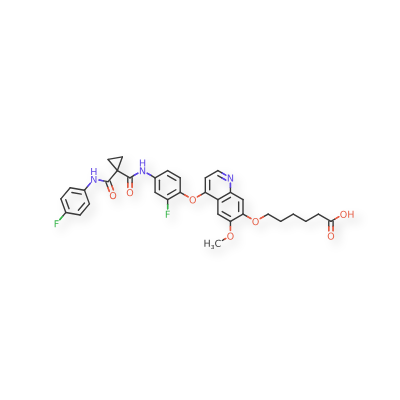


Canlitinib
Cas 2222730-78-9
| Molecular Weight | 619.61 |
|---|---|
| Formula | C33H31F2N3O7 |
6-[4-[2-fluoro-4-[[1-[(4-fluorophenyl)carbamoyl]cyclopropanecarbonyl]amino]phenoxy]-6-methoxyquinolin-7-yl]oxyhexanoic acid
CANLITINIB is a small molecule drug with a maximum clinical trial phase of II and has 1 investigational indication.
Canlitinib is a tyrosine kinase inhibitor, extracted from patent WO2018072614 (IV-2). Canlitinib has the potential for cancer study.
Kanitinib is a tyrosine kinase inhibitor targeting the oncoprotein c-Met (hepatocyte growth factor receptor; HGFR; MET) and vascular endothelial growth factor receptor 2 (VEGFR2), with potential anti-angiogenic and antineoplastic activities. Upon oral administration, kanitinib targets and binds to c-Met and VEGFR2, thereby disrupting c-Met- and VEGFR2-dependent signal transduction pathways. This may induce cell death in tumor cells overexpressing c-Met and/or VEGFR2 protein. c-Met and VEGFR2 are both overexpressed in many tumor cell types and play key roles in tumor cell proliferation, survival, invasion, metastasis, and tumor angiogenesis
SCHEME

INT

PATENT
WO2020216188
https://patentscope.wipo.int/search/en/detail.jsf?docId=WO2020216188&_cid=P20-MA3XXD-35471-1
[0064]The preparation method of compound 1 is shown in Example 9 of compound patent WO 2018/072614 A1. Specifically, the preparation method of compound 1 is as follows.
[0065]
[0066]Under stirring, NaOH (4.4 g, 110 mmol) was added dropwise to a solution of methyl 6-[[4-[2-fluoro-4-[[1-[(4-fluorophenyl)carbamoyl]cyclopropanecarbonyl]amino]phenoxy]-6-methoxy-7-quinolyl]oxy]hexanoate (IV-1, 35.0 g, 55.2 mmol, prepared according to the method described in WO2013/040801A1) in ethanol (350 mL). After the addition was complete, water (50 mL) was added. The resulting mixture was stirred at 20-25°C for 18 h, the reaction solution was diluted with water (100 mL), stirred for 20 min, and the pH was adjusted to 3-4 with 1N HCl. The reaction mixture was concentrated under reduced pressure to distill off about 300 mL of ethanol. The solid product was collected by filtration to give 28.4 g of crude product, which was purified by silica gel column chromatography (eluent: ethyl acetate:methanol = 1:1, v/v) to give 6-[[4-[2-fluoro-4-[[1-[(4-fluorophenyl)carbamoyl]cyclopropanecarbonyl]amino]phenoxy]-6-methoxy-7-quinolyl]oxy]hexanoic acid (Compound 1), 9.6 g (yield: 28.1%).
[0067]Analytical data of compound 1: molecular weight 619.61; NMR hydrogen spectrum is shown in Figure 1, and NMR hydrogen spectrum data are as follows:
[0068]
1H-NMR(δ,DMSO-d6,400MHz):12.03(s,1H,OH),10.40(s,1H,NH),10.02(s,1H,NH),8.47~8.46(d,J=4,1H,CH),7.89-7.92(d,J=12,1H,CH),7.63-7.67(d,J=16,2H,2CH),7.51-7.52(d,J=4,2H2CH),7.39-7.43(t,2H,2CH),7.13-7.17(t,2H,2CH),6.41-6.42(d,J=4,1H,CH),4.12-4.15(t,2H,CH 2),3.95(s,3H,CH 3),2.24-2.28(t,2H,CH 2),1.78-1.85(m,2H,CH 2),1.57-1.64(m,2H,CH 2),1.43-1.51(m,6H,3CH 2)。
PATENT
CN111825609
PATENT
WO2018072614
https://patentscope.wipo.int/search/en/detail.jsf?docId=WO2018072614&_cid=P20-MA3XZQ-37082-1
[0438]Preparation of 6-[[4-[2-fluoro-4-[[1-[(4-fluorophenyl)carbamoyl]cyclopropanecarbonyl]amino]phenoxy]-6-methoxy-7-quinolyl]oxy]hexanoic acid (IV-2), the reaction formula is as follows:
[0439]
[0440]Under stirring, NaOH (4.4 g, 110 mmol) was added dropwise to a solution of methyl 6-[[4-[2-fluoro-4-[[1-[(4-fluorophenyl)carbamoyl]cyclopropanecarbonyl]amino]phenoxy]-6-methoxy-7-quinolyl]oxy]hexanoate (IV-1, 35.0 g, 55.2 mmol, prepared according to the method described in WO2013/040801A1) in ethanol (350 mL). After the addition was complete, water (50 mL) was added. The resulting mixture was stirred at 20-25°C for 18 h, the reaction solution was diluted with water (100 mL), stirred for 20 min, and the pH was adjusted to 3-4 with 1N HCl. The reaction mixture was concentrated under reduced pressure to distill off about 300 mL of ethanol. The solid product was collected by filtration to give 28.4 g of crude product, which was purified by silica gel column chromatography (eluent: ethyl acetate:methanol = 1:1, v/v) to give 6-[[4-[2-fluoro-4-[[1-[(4-fluorophenyl)carbamoyl]cyclopropanecarbonyl]amino]phenoxy]-6-methoxy-7-quinolyl]oxy]hexanoic acid (IV-2), 9.6 g (yield: 28.1%). Analytical data:
1 H-NMR (400 MHz, DMSO-d
6 ): δ=8.17 (d, J=8.0 Hz, 1H), 7.81 (dd, J=2.8, 13.4 Hz, 1H) 7.62 (m, 2H), 7.51 (m, 4H), 7.39 (t, J=2.4 Hz, 2H), 6.44 (d, J=20.0 Hz, 1H), 4.13 (t, J=8.5 Hz, 2H), 3.85 (s, 3H), 2.27 (t, J=4.0 Hz, 2H), 1.83 (m, 2H), 1.68-1.46 (m, 8H). Mass spectrum (ESI) m/z: 620.2 [M+H]
+ .
PATENT
WO2013/040801
https://patentscope.wipo.int/search/en/detail.jsf?docId=WO2013040801&_cid=P20-MA3Y3E-39505-1
BRIGIMADLIN

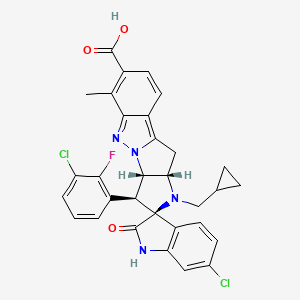
BRIGIMADLIN
Cas 2095116-40-6
WeightAverage: 591.46
Monoisotopic: 590.1287742
Chemical FormulaC31H25Cl2FN4O3
Spiro[3H-indole-3,2′(1′H)-pyrrolo[2′,3′:4,5]pyrrolo[1,2-b]indazole]-7′-carboxylic acid, 6-chloro-3′-(3-chloro-2-fluorophenyl)-1′-(cyclopropylmethyl)-1,2,3′,3′a,10′,10′a-hexahydro-6′-methyl-2-oxo-, (2′S,3′S,3′aS,10′aS)-
(2′S,3′S,3′aS,10′aS)-6-Chloro-3′-(3-chloro-2-fluorophenyl)-1′-(cyclopropylmethyl)-1,2,3′,3′a,10′,10′a-hexahydro-6′-methyl-2-oxospiro[3H-indole-3,2′(1′H)-pyrrolo[2′,3′:4,5]pyrrolo[1,2-b]indazole]-7′-carboxylic acid (
- (3S,10’S,11’S,14’S)-6-chloro-11′-(3-chloro-2-fluorophenyl)-13′-(cyclopropylmethyl)-6′-methyl-2-oxospiro[1H-indole-3,12′-8,9,13-triazatetracyclo[7.6.0.02,7.010,14]pentadeca-1,3,5,7-tetraene]-5′-carboxylic acid
- (3S,3’S,3a’S,10a’S)-6-chloro-3′-(3-chloro-2-fluorophenyl)-1′-(cyclopropylmethyl)-6′-methyl-2-oxo-1,2,3′,3a’,10′,10a’-hexahydro- 1’H-spiro[indole-3,2′-pyrrolo[2′,3′:4,5]pyrrolo[1,2-b]indazole]-7′- carboxylic acid
- (3S,3’S,3a’S,10a’S)-6-Chloro-3′-(3-chloro-2-fluorophenyl)-1′-(cyclopropylmethyl)-6′-methyl-2-oxo-1,2,3′,3a’,10′,10a’-hexahydro1’H-spiro[indole-3,2′-pyrrolo[2′,3′:4,5]pyrrolo[1,2-b]indazole]-7′-carboxylic acid
- Spiro[3H-indole-3,2′(1’H)-pyrrolo[2′,3′:4,5]pyrrolo[1,2-b]indazole]-7′-carboxylic acid, 6-chloro-3′-(3-chloro-2-fluorophenyl)-1′-(cyclopropylmethyl)-1,2,3′,3’a,10′,10’a-hexahydro-6′-methyl-2-oxo-, (2’S,3’S,3’aS,10’aS)-
Brigimadlin (BI-907828) is a small molecule MDM2–TP53 inhibitor developed for liposarcoma.[2][3][4][5][6]
Brigimadlin is an orally available inhibitor of murine double minute 2 (MDM2), with potential antineoplastic activity. Upon oral administration, brigimadlin binds to MDM2 protein and prevents its binding to the transcriptional activation domain of the tumor suppressor protein p53. By preventing MDM2-p53 interaction, the transcriptional activity of p53 is restored. This leads to p53-mediated induction of tumor cell apoptosis. Compared to currently available MDM2 inhibitors, the pharmacokinetic properties of BI 907828 allow for more optimal dosing and dose schedules that may reduce myelosuppression, an on-target, dose-limiting toxicity for this class of inhibitors.
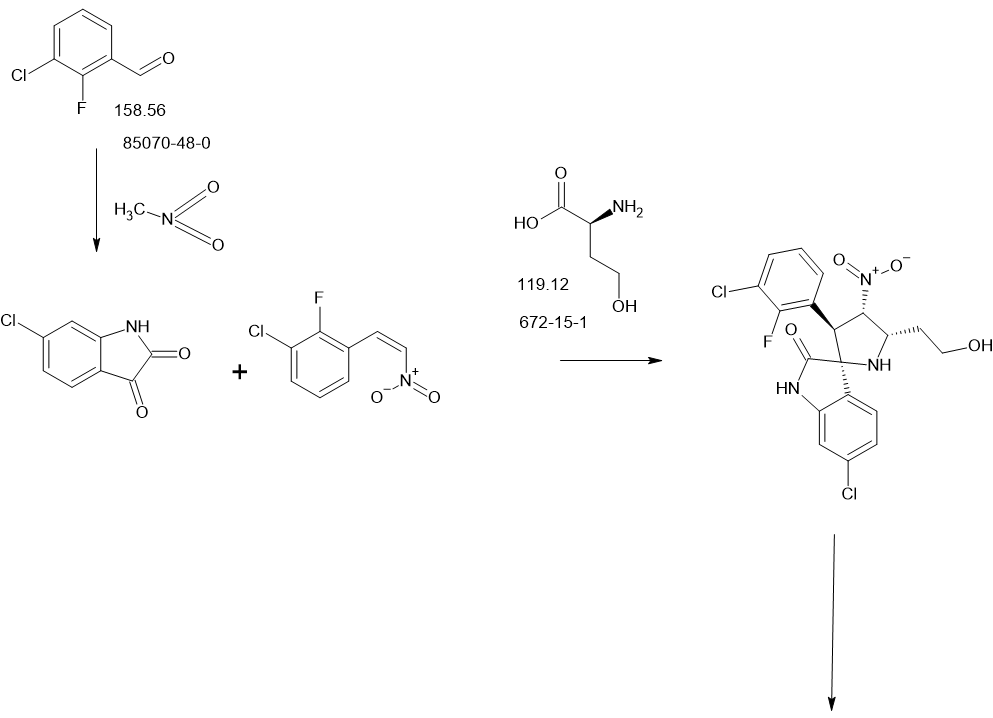
SCHEME
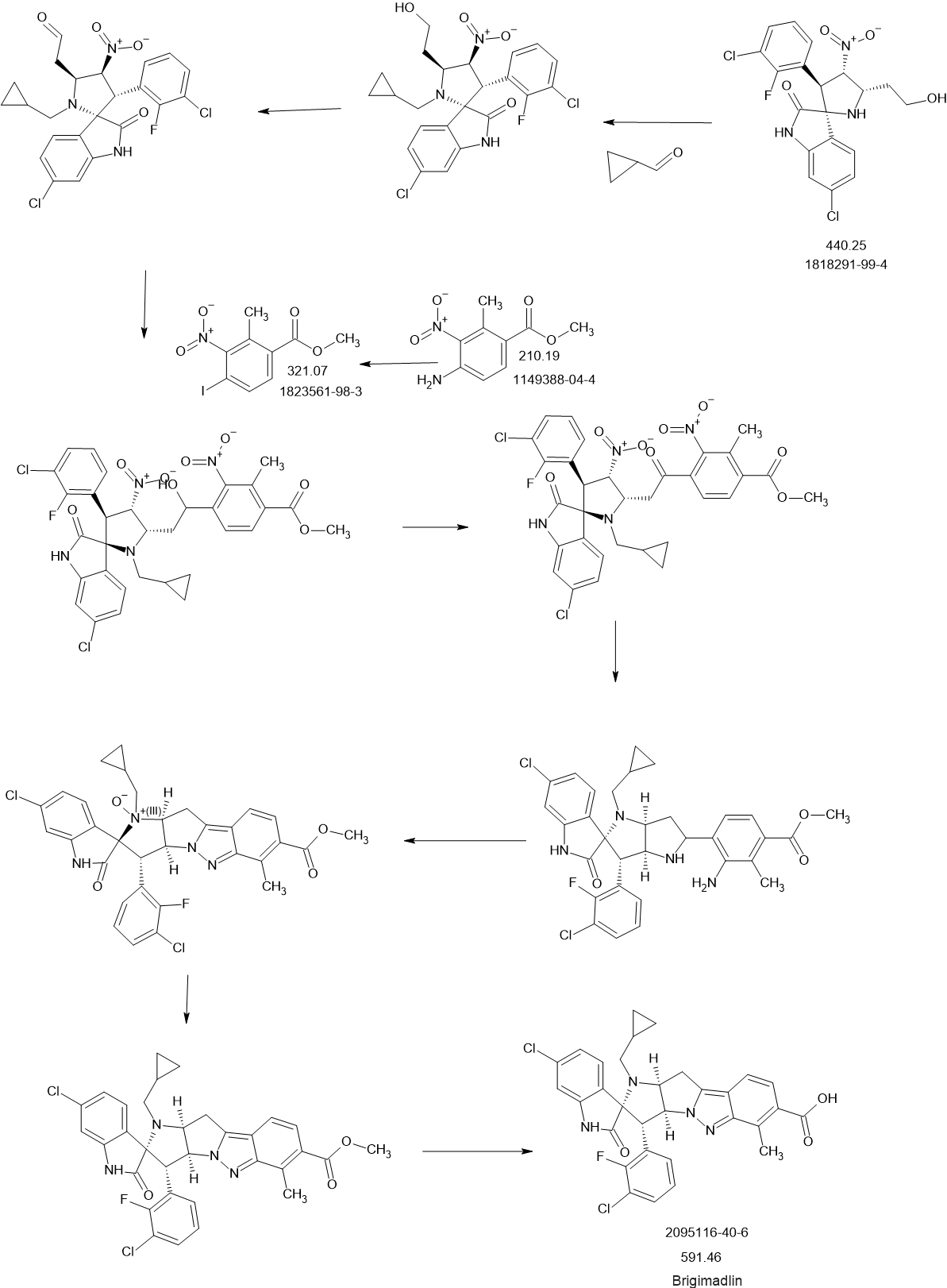
PATENT
https://patentscope.wipo.int/search/en/detail.jsf?docId=US231206177&_cid=P10-MA0ULZ-04263-1
PATENT
https://patentscope.wipo.int/search/en/detail.jsf?docId=WO2017060431&_cid=P10-MA0TY5-76812-1
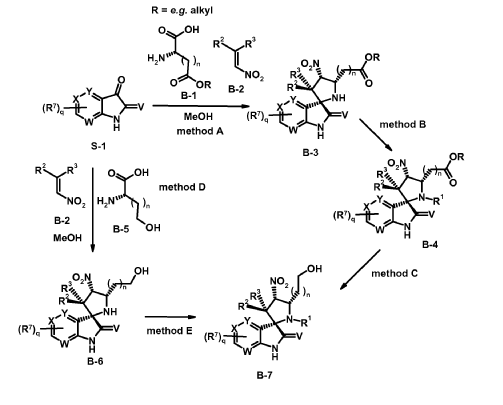
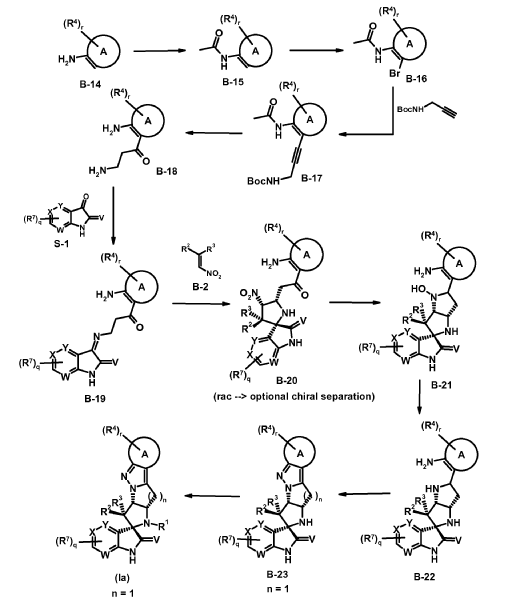
intermediates B-7
Experimental procedure for the synthesis of B-7 a (method E)
To a solution of cyclopropanecarbaldehyde (1.7 mL, 22.7 mmol) in AcOH (19.5 mL) is added intermediate B-6a (1.60 g, 3.8 mmol) and the reaction mixture is stirred for 15 min. Sodium triacetoxyborohydride (1.34 g, 6.3 mmol) is added and the reaction mixture is stirred overnight. Water is added to the reaction mixture and it is extracted with EtOAc. The combined organic layer is dried (MgSO4), filtered, concentrated in vacuo and the crude product B-7a is purified by chromatography if necessary.
Experimental procedure for the synthesis of B-3a (method A)
6-Chloroisatin S-1a (5 g, 27,0 mmol), 1-(3-chloro-2-fluoro-phenyl)-2-nitroethene B-2a (5.5 g, 27.0 mmol) and amino acid B-1a (4.4 g, 27.0 mmol) are refluxed in MeOH for 4 h. The reaction mixture is concentrated in vacuo and purified by crystallization or chromatography if necessary.
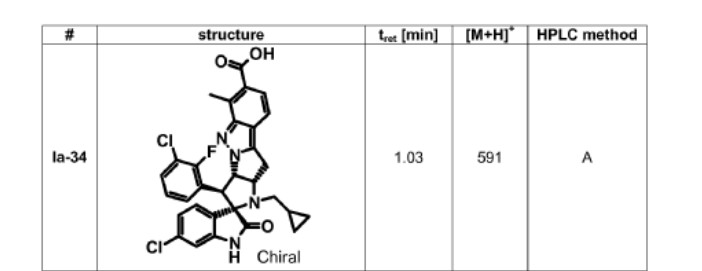
Synthesis of compounds (la) according to the invention
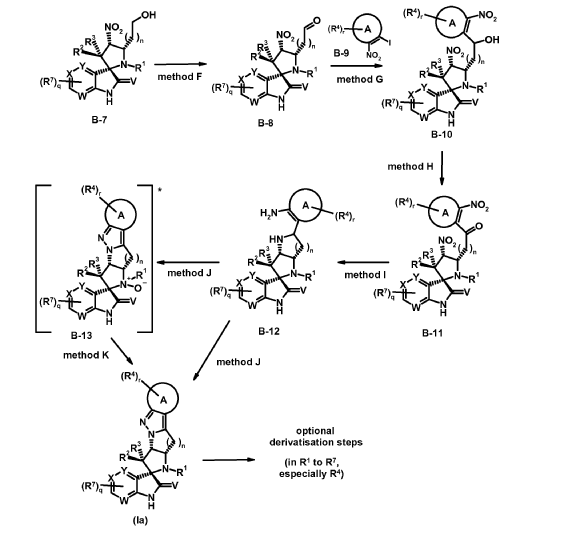
Experimental procedure for the synthesis of la-1 (method J)
To a solution of intermediate B-12a (329 mg, 0.65 mmol) in DCM (7 mL) is added a solution of Oxone® (793 mg, 1.29 mmol) in H2O (7 mL) at 0 °C dropwise. The biphasic reaction mixture is stirred vigorously for 20 min at 0 °C and for additional 2 h at rt. The reaction mixture is diluted with H2O and is extracted with DCM. The combined organic layer is dried (MgSO4), filtered, concentrated in vacuo and the crude product is purified by chromatography which gives compound la-1.
Experimental procedure for the synthesis of la-20 (method J + method K)
* The location of overoxidation/N-oxid formation is not entirely clear. B-13a as depicted seems to be probable.
To a solution of intermediate B-12j (417 mg, 0.68 mmol) in DCM (10 mL) is added a solution of Oxone® (841 mg, 1.37 mmol) in H2O (7 mL) at 0 °C dropwise. The biphasic reaction mixture is stirred vigorously for 20 min at 0 °C and for additional 6 h at rt. The reaction mixture is diluted with H2O and extracted with DCM. The combined organic layer is dried (MgSO4), filtered, concentrated in vacuo which gives a crude mixture of la-20 and an oxidized form B-13a (M+H = 621). This mixture is dissolved in MeCN (4.2 mL) and bis(pinacolato)diborone (326 mg, 1.28 mmol) is added. The reaction mixture is heated under microwave irradiation to 100 °C for 30 min. The reaction mixture is diluted with H2O and extracted with DCM. The combined organic layer is dried (MgSO4), filtered, concentrated in vacuo and the crude product is purified by chromatography which gives compound la-20.
References
^ “Brigimadlin”. pubchem.ncbi.nlm.nih.gov.
- ^ Rinnenthal, Joerg; Rudolph, Dorothea; Blake, Sophia; Gollner, Andreas; Wernitznig, Andreas; Weyer-Czernilofsky, Ulrike; Haslinger, Christian; Garin-Chesa, Pilar; Moll, Jürgen; Kraut, Norbert; McConnell, Darryl; Quant, Jens (1 July 2018). “Abstract 4865: BI 907828: A highly potent MDM2 inhibitor with low human dose estimation, designed for high-dose intermittent schedules in the clinic”. Cancer Research. 78 (13_Supplement): 4865. doi:10.1158/1538-7445.AM2018-4865. S2CID 56768874.
- ^ Rudolph, Dorothea; Reschke, Markus; Blake, Sophia; Rinnenthal, Jörg; Wernitznig, Andreas; Weyer-Czernilofsky, Ulrike; Gollner, Andreas; Haslinger, Christian; Garin-Chesa, Pilar; Quant, Jens; McConnell, Darryl B.; Norbert, Kraut; Moll, Jürgen (1 July 2018). “Abstract 4866: BI 907828: A novel, potent MDM2 inhibitor that induces antitumor immunologic memory and acts synergistically with an anti-PD-1 antibody in syngeneic mouse models of cancer”. Cancer Research. 78 (13_Supplement): 4866. doi:10.1158/1538-7445.AM2018-4866. S2CID 80770832.
- ^ Cornillie, J.; Wozniak, A.; Li, H.; Gebreyohannes, Y. K.; Wellens, J.; Hompes, D.; Debiec-Rychter, M.; Sciot, R.; Schöffski, P. (April 2020). “Anti-tumor activity of the MDM2-TP53 inhibitor BI-907828 in dedifferentiated liposarcoma patient-derived xenograft models harboring MDM2 amplification”. Clinical and Translational Oncology. 22 (4): 546–554. doi:10.1007/s12094-019-02158-z. PMID 31201607. S2CID 189862528.
- ^ Schöffski, Patrick; Lahmar, Mehdi; Lucarelli, Anthony; Maki, Robert G (March 2023). “Brightline-1: phase II/III trial of the MDM2–p53 antagonist BI 907828 versus doxorubicin in patients with advanced DDLPS”. Future Oncology. 19 (9): 621–629. doi:10.2217/fon-2022-1291. PMID 36987836. S2CID 257802972.
- ^ Schoeffski, P.; Lorusso, P.; Yamamoto, N.; Lugowska, I.; Moreno Garcia, V.; Lauer, U.; Hu, C.; Jayadeva, G.; Lahmar, M.; Gounder, M. (October 2023). “673P A phase I dose-escalation and expansion study evaluating the safety and efficacy of the MDM2–p53 antagonist brigimadlin (BI 907828) in patients (pts) with solid tumours”. Annals of Oncology. 34: S472 – S473. doi:10.1016/j.annonc.2023.09.1859. S2CID 264392338.
| Names | |
|---|---|
| IUPAC name(3S,10’S,11’S,14’S)-6-chloro-11′-(3-chloro-2-fluorophenyl)-13′-(cyclopropylmethyl)-6′-methyl-2-oxospiro[1H-indole-3,12′-8,9,13-triazatetracyclo[7.6.0.02,7.010,14]pentadeca-1,3,5,7-tetraene]-5′-carboxylic acid | |
| Identifiers | |
| CAS Number | 2095116-40-6 |
| 3D model (JSmol) | Interactive image |
| ChemSpider | 128922236 |
| DrugBank | DB18578 |
| EC Number | 826-645-5 |
| KEGG | D12842 |
| PubChem CID | 129264140 |
| UNII | 9A934ZAN94 |
| showInChI | |
| showSMILES | |
| Properties | |
| Chemical formula | C31H25Cl2FN4O3 |
| Molar mass | 591.46 g·mol−1 |
| Hazards | |
| GHS labelling:[1] | |
| Pictograms | |
| Signal word | Danger |
| Hazard statements | H300, H360Df, H372, H413 |
| Precautionary statements | P203, P260, P264, P270, P273, P280, P301+P316, P318, P319, P321, P330, P405, P501 |
| Except where otherwise noted, data are given for materials in their standard state (at 25 °C [77 °F], 100 kPa). | |
/////////////BRIGIMADLIN, BI-907828, BI 907828, 9A934ZAN94
Trospium chloride


Trospium chloride
CAS
47608-32-2
10405-02-4
WeightAverage: 392.518
Monoisotopic: 392.22202025
Chemical FormulaC25H30NO3
T4Y8ORK057
- 73954-17-3
- 8-Benziloyloxy-6,10-ethano-5-azoniaspiro(4.5)decane chloride
- 3-[(2-hydroxy-2,2-diphenylacetyl)oxy]-8lambda5-azaspiro[bicyclo[3.2.1]octane-8,1′-pyrrolidin]-8-yliumchloride
- spiro[8-azoniabicyclo[3.2.1]octane-8,1′-azolidin-1-ium]-3-yl 2-hydroxy-2,2-diphenylacetate;chloride
- SMR002533165
- spiro[8-azoniabicyclo[3.2.1]octane-8,1′-azolidin-1-ium]-3-yl 2-hydroxy-2,2-diphenylacetate;chloride
FDA 2024, Cobenfy 9/26/2024, To treat schizophrenia
Press Release
Drug Trials Snapshot
Trospium chloride is a muscarinic antagonist used to treat overactive bladder.[3] It has side effects typical of this class of drugs, namely dry mouth, stomach upset, and constipation; these side effects cause problems with people taking their medicine as directed. However it doesn’t cause central nervous system side effects like some other muscarinic antagonists.[4]
Chemically it is a quaternary ammonium cation which causes it to stay in periphery rather than crossing the blood–brain barrier.[5] It works by causing the smooth muscle in the bladder to relax.[3]
It was patented in 1966 and approved for medical use in 1974.[6] It was first approved in the US in 2004, and an extended release version was brought to market in 2007. It became generic in the EU in 2009, and the first extended-release generic was approved in the US in 2012.
SYN

Tropium chloride is one of the azoniaspironortropine derivatives and is used for the treatment of urinary bladder dysfunction due to bladder dysfunction, night urination, overactive bladder, and urinary incontinence. Useful compounds. The chemical name of the tropium chloride is (1R, 3R, 5S) -3-[(hydroxydiphenylacetyl) oxy] spiro [8-azoniabiscyclo [3,2,1] octane-8,1 ‘ -Pyrrolidinium] chloride ((1R, 3R, 5S) -3-[(Hydroxydiphenylacetyl) oxy] spiro [8-azoniabicyclo [3,2,1] octane-8,1’-pyrrolidinium] chloride) It is represented by Formula (1).

As a method for preparing the thromium chloride, US Patent No. 3,480,626 (1969) is prepared in the form of a free base of nortropine benzilate represented by the formula (2) as an intermediate, as shown in Scheme 1 below Thereafter, it is reacted with 1,4-dichlorobutane of the formula (3) to synthesize a thromium chloride, which is then recrystallized in ethanol-ether to disclose a two-step process for obtaining the thromium chloride. However, the method does not use a base, has a long reaction time, a low yield (about 46%), and instead of intramolecular cyclization, positions 1 and 4 of butane represented by the formula (4) as side reactants. There is a disadvantage in that a large amount of the compound in the form of substituted 1,4-nortropin benzylate is produced.

PATENT
https://patents.google.com/patent/KR20090076081A/en

Example 1 Preparation of Tropium Chloride
In a 1 L reactor equipped with a stirrer, 100 g of nortropin benzylate hydrochloride, 59 ml of 1,4-dichlorobutane, 89 ml of 1,8-diazabicyclo and 5 ml of 1,8-diazabicyclo [5,4,0] undec-7-ene and 500 ml of acetonitrile The reaction was carried out at 60 ° C. for 2 hours. Thin-Layer Chromatography (TLC) confirmed the completion of the reaction, when the reaction was complete, cooled to 5 ℃, stirred for 1 hour at the same temperature, the resulting crystals were filtered, dried at 60 ℃, white 92.6 g (yield: 81%) of the target compound were obtained. The 1 H-NMR (D 2 O, 400 MHz) data of the obtained compound are as follows: δ 1.34 to 1.36 (2H, d), 1.80 to 1.87 (2H, m), 1.98 (4H, s), 2.44 to 2.48 (2H , d), 3.21-3.24 (2H, t), 3.43-3.46 (2H, t), 3.56 (2H, s), 5.12-5.13 (1H, t), 7.31-7.74 (10H, m).
PATENT
https://patents.google.com/patent/CN102718760B/en


Medical uses
Trospium chloride is used for the treatment of overactive bladder with symptoms of urge incontinence and frequent urination.[3][4][2]
It should not be used with people who retain urine, who have severe digestive conditions, myasthenia gravis, narrow-angle glaucoma, or tachyarrhythmia.[3]
It should be used with caution in people who have problems with their autonomous nervous system (dysautonomia) or who have gastroesophageal reflux disease, or in whom fast heart rates are undesirable, such as people with hyperthyroidism, coronary artery disease and congestive heart failure.[3]
There are no adequate and well-controlled studies of trospium chloride in pregnant women and there are signs of harm to the fetus in animal studies. The drug was excreted somewhat in the milk of nursing mothers.[3] The drug was studied in children.[3]
Side effects
Side effects are typical of gastrointestinal effects of anticholinergic drugs, and include dry mouth, indigestion, and constipation. These side effects lead to problems with adherence, especially for older people.[4] The only CNS side effect is headache, which was very rare. Tachycardia is a rare side effect.[3]
Pharmacology
Mechanism of action
| Target | Affinity (Ki, nM) | Species |
|---|---|---|
| M1 | 3.5 | Human |
| M2 | 1.1 | Human |
| M3 | 1.0 | Human |
| M4 | 1.4 | Human |
| M5 | 6.0 | Human |
| Notes: Values are Ki, unless otherwise specified. The smaller the value, the more strongly the drug binds to the site. | ||
Trospium chloride is a muscarinic antagonist. Trospium chloride blocks the effect of acetylcholine on muscarinic receptors organs that are responsive to the compounds, including the bladder.[3] Its parasympatholytic action relaxes the smooth muscle in the bladder.[4] Receptor assays showed that trospium chloride has negligible affinity for nicotinic receptors as compared to muscarinic receptors at concentrations obtained from therapeutic doses.[3] The drug has high and similar affinity for all five of the muscarinic acetylcholine receptor subtypes, including the M1, M2, M3, M4, and M5 receptors.[9][10][11]
Pharmacokinetics
After oral administration, less than 10% of the dose is absorbed. Mean absolute bioavailability of a 20 mg dose is 9.6% (range: 4.0 to 16.1%). Peak plasma concentrations (Cmax) occur between 5 and 6 hours post-dose. Mean Cmax increases greater than dose-proportionally; a 3-fold and 4-fold increase in Cmax was observed for dose increases from 20 mg to 40 mg and from 20 mg to 60 mg, respectively. AUC exhibits dose linearity for single doses up to 60 mg. Trospium chloride exhibits diurnal variability in exposure with a decrease in Cmax and AUC of up to 59% and 33%, respectively, for evening relative to morning doses.[12]
Administration with a high fat meal resulted in reduced absorption, with AUC and Cmax values 70 to 80% lower than those obtained when trospium chloride was administered while fasting. Therefore, it is recommended that trospium chloride should be taken at least one hour prior to meals or on an empty stomach.[12]
Protein binding ranged from 50 to 85% when concentration levels of trospium chloride (0.5 to 50 ng/mL) were incubated with human serum in vitro. The 3H-trospium chloride ratio of plasma to whole blood was 1.6:1. This ratio indicates that the majority of 3H-trospium chloride is distributed in plasma. The apparent volume of distribution for a 20 mg oral dose is 395 (± 140) liters.[12]
The metabolic pathway of trospium in humans has not been fully defined. Of the 10% of the dose absorbed, metabolites account for approximately 40% of the excreted dose following oral administration. The major metabolic pathway is hypothesized as ester hydrolysis with subsequent conjugation of benzylic acid to form azoniaspironortropanol with glucuronic acid. Cytochrome P450 is not expected to contribute significantly to the elimination of trospium. Data taken from in vitro human liver microsomes investigating the inhibitory effect of trospium on seven cytochrome P450 isoenzyme substrates (CYP1A2, 2A6, 2C9, 2C19, 2D6, 2E1, and 3A4) suggest a lack of inhibition at clinically relevant concentrations.[12]
The plasma half-life for trospium chloride following oral administration is approximately 20 hours. After oral administration of an immediate-release formulation of 14C-trospium chloride, the majority of the dose (85.2%) was recovered in feces and a smaller amount (5.8% of the dose) was recovered in urine; 60% of the radioactivity excreted in urine was unchanged trospium. The mean renal clearance for trospium (29 L/hour) is 4-fold higher than average glomerular filtration rate, indicating that active tubular secretion is a major route of elimination for trospium. There may be competition for elimination with other compounds that are also renally eliminated.[12]
Chemistry
Anticholinergic drugs used to treat overactive bladder were all amines as of 2003. Quaternary ammonium cations in general are more hydrophilic than other amines and don’t cross membranes well, so they tend to be poorly absorbed from the digestive system, and to not cross the blood–brain barrier. Oxybutynin, tolterodine, darifenacin, and solifenacin are tertiary amines while trospium chloride and propantheline are quaternary amines.[5]
History
The synthesis of trospium was described by scientists from Dr. Robert Pfleger Chemische Fabrik GmbH, Heinz Bertholdt, Robert Pfleger, and Wolfram Schulz, in US. Pat. No. 3,480,626 (the US equivalent to DE119442), and its activity was first published in the literature in 1967.[13][14]
The first regulatory approval was granted in Germany in August 1999 to Madaus AG for Regurin 20 mg Tablets.[15]: 13 Madaus is considered the originator for regulatory filings worldwide.[16] The German filing was recognized throughout Europe under the Mutual Recognition Procedure.[15]: 13
Madaus licensed the US rights to trospium chloride to Interneuron in 1999 and Interneuron ran clinical trials in the US to win FDA approval.[17][18] Interneuron changed its name to Indevus in 2002[19] Indevus entered into a partnership with Odyssey Pharmaceuticals, a subsidiary of Pliva, to market the drug in April 2004,[20] and won FDA approval for the drug, which it branded as Sanctura, in May 2004.[21][22] The approval earned Indevus a milestone payment of $120M from Pliva, which had already paid Indevus $30 million at signing; the market for overactive bladder therapies was estimated to be worth $1.1 billion in 2004.[23] In 2005 Pliva exited the relationship, selling its rights to Esprit Pharma,[24] and in September 2007 Allergan acquired Esprit, and negotiated a new agreement with Indevus under which Allergan would completely take over the US manufacturing, regulatory approvals, and marketing.[25] A month before, Indevus had received FDA approval for an extended release formulation that allowed once a day dosing, Sanctura XR.[26] Indevus had developed intellectual property around the extended release formulation which it licensed to Madaus for most of the world.[25]
In 2012 the FDA approved the first generic version of the extended release formulation, granting approval to the ANDA that Watson Pharmaceuticals had filed in 2009.[27] Annual sales in the US at that time were $67M.[28] European patents had expired in 2009.[29]
As of 2016, the drug is available worldwide under many brand names and formulations, including oral, extended release, suppositories, and injections.[1]
Society and culture
Marketing rights to the drug became subject to parallel import litigation in Europe in the case of Speciality European Pharma Ltd v Doncaster Pharmaceuticals Group Ltd / Madaus GmbH (Case No. A3/2014/0205) which was resolved in March 2015. Madaus had exclusively licensed the right to use the Regurin trademark to Speciality European Pharma Ltd. In 2009, when European patents expired on the drug, Doncaster Pharmaceuticals Group, a well known parallel importer, which had been selling the drug in the UK under another label, Ceris, which was used in France, began to put stickers on their packaging with the Regurin name. Speciality and Madaus sued and initially won based on the argument that 90% of prescriptions were already generic, but Doncaster appealed and won the appeal based on the argument that it could not charge a premium with a generic label. The case has broad implications for trade in the EU.[29][30]
Research
In 2007 Indevus partnered with Alkermes to develop and test an inhaled form of trospium chloride as a treatment for COPD; it was in Phase II trials at that time.[31]
Reference
- ^ Jump up to:a b “International brands of trospium”. Drugs.com. Retrieved 13 May 2016.
- ^ Jump up to:a b FDA “Trospium chloride label” (PDF). U.S. Food and Drug Administration. January 2011.
- ^ Jump up to:a b c d e f g h i j “Regurin XL 60mg”. UK eMC. 3 July 2015.
- ^ Jump up to:a b c d Biastre K, Burnakis T (February 2009). “Trospium chloride treatment of overactive bladder”. Ann Pharmacother. 43 (2): 283–95. doi:10.1345/aph.1L160. PMID 19193592. S2CID 20102756.
- ^ Jump up to:a b Pak RW, Petrou SP, Staskin DR (December 2003). “Trospium chloride : a quaternary amine with unique pharmacologic properties”. Curr Urol Rep. 4 (6): 436–40. doi:10.1007/s11934-003-0023-1. PMID 14622495. S2CID 4512769.
- ^ Fischer J, Ganellin CR (2006). Analogue-based Drug Discovery. John Wiley & Sons. p. 446. ISBN 9783527607495.
- ^ Liu T (2020). “BindingDB BDBM50540489 Flotros::IP-631::IP631::Regurin::Regurin xl::Sanctura::Sanctura xr::Spasmo-lyt::Trospium chloride::Uraplex”. Journal of Medicinal Chemistry. 63 (11): 5763–5782. doi:10.1021/acs.jmedchem.9b02100. PMC 8007111. PMID 32374602. Retrieved 28 October 2024.
- ^ Del Bello F, Bonifazi A, Giorgioni G, Piergentili A, Sabbieti MG, Agas D, et al. (June 2020). “Novel Potent Muscarinic Receptor Antagonists: Investigation on the Nature of Lipophilic Substituents in the 5- and/or 6-Positions of the 1,4-Dioxane Nucleus”. J Med Chem. 63 (11): 5763–5782. doi:10.1021/acs.jmedchem.9b02100. PMC 8007111. PMID 32374602.
- ^ Peretto I, Petrillo P, Imbimbo BP (November 2009). “Medicinal chemistry and therapeutic potential of muscarinic M3 antagonists”. Med Res Rev. 29 (6): 867–902. doi:10.1002/med.20158. PMID 19399831.
- ^ Pak RW, Petrou SP, Staskin DR (December 2003). “Trospium chloride: a quaternary amine with unique pharmacologic properties”. Curr Urol Rep. 4 (6): 436–440. doi:10.1007/s11934-003-0023-1. PMID 14622495.
- ^ Rosa GM, Bauckneht M, Scala C, Tafi E, Leone Roberti Maggiore U, Ferrero S, et al. (November 2013). “Cardiovascular effects of antimuscarinic agents in overactive bladder”. Expert Opin Drug Saf. 12 (6): 815–827. doi:10.1517/14740338.2013.813016. PMID 23800037.
- ^ Jump up to:a b c d e Doroshyenko O, Jetter A, Odenthal KP, Fuhr U (2005). “Clinical pharmacokinetics of trospium chloride”. Clin Pharmacokinet. 44 (7): 701–20. doi:10.2165/00003088-200544070-00003. PMID 15966754. S2CID 10968270.
- ^ US 6974820 which cites US 3480626 and Bertholdt H, Pfleger R, Schulz W (1967). “[On azoniaspire-compounds. 2. Preparation of esterified azoniaspire-compounds of nortropan-3-alpha- or 3-beta-ol (1)]”. Arzneimittelforschung. 17 (6): 719–26. PMID 5632538.
- ^ DE patent 1194422, Bertholdt H, Pfleger R, Schulz W, “[Verfahren zur Herstellung von Azoniaspironortropanderivaten] (A process for preparing azonia-spirono-tropane derivatives)”, issued 10 June 1965, assigned to Dr. Robert Pfleger Chemische Fabrik GmbH
- ^ Jump up to:a b “Trospium Chloride 20mg Film-Coated Tablets, Public Assessment Report” (PDF). Medicines and Healthcare products Regulatory Agency. 7 April 2011.
- ^ “Trospium chloride”. AdisInsight. Springer Nature Switzerland AG.
- ^ Miller J (23 September 2002). “Indevus to apply for new drug status for incontinence drug”. Boston Business Journal.
- ^ Herper M (25 September 2002). “A Biotech Phoenix Could Be Rising”. Forbes.
- ^ “Indevus Pharmaceuticals, Inc., Formerly Interneuron, to Begin Trading on Nasdaq”. Indevus Press Release. 2 April 2002.
- ^ “Indevus and PLIVA Sign Co-Promotion and Licensing Agreement for SANCTURA -Trospium Chloride”. Indevus Press Release. 7 April 2004. Archived from the original on 27 August 2021. Retrieved 14 May 2016.
- ^ “Sanctura (trospium chloride)”. CenterWatch. Archived from the original on 5 August 2019. Retrieved 13 May 2016.
- ^ “Indevus Announces FDA Approval Of Sanctura”. Indevus Press Release. 28 May 2004.
- ^ Osterweil N (28 May 2004). “FDA approves Indevus’ Sanctura”. for First Word Pharma.
- ^ “Novartis, P&G enter agreement for OAB drug”. Urology Times. 21 July 2005.
- ^ Jump up to:a b “Indevus Announces Allergan as New Partner for Sanctura Brand”. Indevus Press Release. 19 September 2007.
- ^ “Indevus’ Sanctura XR approved by US FDA”. The Pharma Letter. 13 August 2007.
- ^ “ANDA 091289 approval letter” (PDF). U.S. Food and Drug Administration. 12 October 2012.
- ^ “Watson’s Generic Sanctura XR Receives FDA Approval”. Watson Press Release. 12 October 2012.
- ^ Jump up to:a b “Court takes a permissive approach to parallel importers within the EU”. Lexology. 6 March 2015.
- ^ R.P.C. (2015) 132 (7): 521-540. doi: 10.1093/rpc/rcv039
- ^ “Alkermes, Indevus testing COPD drug”. UPI. 25 April 2007.
External links
Trospium chloride at the U.S. National Library of Medicine Medical Subject Headings (MeSH)
| Clinical data | |
|---|---|
| Pronunciation | /ˈtroʊspiəm/ TROHS-pee-əm |
| Trade names | Regurin, Sanctura, others[1] |
| AHFS/Drugs.com | Monograph |
| Routes of administration | By mouth |
| Drug class | Antimuscarinic (peripherally selective) |
| ATC code | G04BD09 (WHO) |
| Legal status | |
| Legal status | US: ℞-only[2]In general: ℞ (Prescription only) |
| Pharmacokinetic data | |
| Protein binding | 50–85% |
| Elimination half-life | 20 hours |
| Identifiers | |
| showIUPAC name | |
| CAS Number | 10405-02-4 |
| PubChem CID | 107979 |
| DrugBank | DB00209 |
| ChemSpider | 10482307 |
| UNII | 1E6682427E |
| ChEBI | CHEBI:32270 |
| ChEMBL | ChEMBL1201344 |
| CompTox Dashboard (EPA) | DTXSID7023724 |
| ECHA InfoCard | 100.030.784 |
| Chemical and physical data | |
| Formula | C25H30ClNO3 |
| Molar mass | 427.97 g·mol−1 |
| 3D model (JSmol) | Interactive image |
| showSMILES | |
| showInChI | |
- Trospium [Link]
- FDA drug approval: Trospium [Link]
- FDA Approved Drug Products: Cobenfy (xanomeline tartrate/trospium chloride) capsules for oral use (September 2024) [Link]
- DailyMed Label: TROSPIUM CHLORIDE oral capsule, extended release [Link]
///////Trospium chloride, Cobenfy, APPROVALS 2024, FDA 2024, SMR002533165
Flurpiridaz F 18


Flurpiridaz F 18
WeightAverage: 367.84
Monoisotopic: 367.1328329
Chemical FormulaC18H22ClFN2O3
- 863887-89-2
- Bms 747158-02
2-tert-butyl-4-chloro-5-[[4-(2-(18F)fluoranylethoxymethyl)phenyl]methoxy]pyridazin-3-one
- 2-tert-butyl-4-chloro-5-[[4-(2-(18F)fluoranylethoxymethyl)phenyl]methoxy]pyridazin-3-one
- 2-TERT-BUTYL-4-CHLORO-5-((4-((2-(18F)FLUOROETHOXY)METHYL)PHENYL)METHOXY)PYRIDAZIN-3(2H)-ONE
- 3(2H)-PYRIDAZINONE, 4-CHLORO-2-(1,1-DIMETHYLETHYL)-5-((4-((2-(FLUORO-18F)ETHOXY)METHYL)PHENYL)METHOXY)-
- UNII-TY3V24C029
FDA APPROVED 9/27/2024, Flyrcado, A radioactive diagnostic drug to evaluate for myocardial ischemia and infarction
Flurpiridaz (18F), sold under the brand name Flyrcado, is a cyclotron-produced radioactive diagnostic agent for use with positron emission tomography (PET) myocardial perfusion imaging under rest or stress (pharmacologic or exercise).[3] Flurpiridaz (18F) It is given by intravenous injection.[3]
The most common adverse reactions include dyspnea (shortness of breath), headache, angina pectoris (severe pain in the chest), chest pain, fatigue, ST segment changes, flushing, nausea, abdominal pain, dizziness, and arrhythmia (irregular heartbeat).[3]
Flurpiridaz (18F) was approved for medical use in the United States in September 2024.[3][4][5][6]
PATENT
| Patent Number | Pediatric Extension | Approved | Expires (estimated) | |
|---|---|---|---|---|
| US9687571 | No | 2017-06-27 | 2032-11-01 |  |
| US9603951 | No | 2017-03-28 | 2031-05-02 | |
| US9161997 | No | 2015-10-20 | 2026-02-04 | |
| US8936777 | No | 2015-01-20 | 2031-06-30 | |
| US8226929 | No | 2012-07-24 | 2028-06-21 | |
| US7344702 | No | 2008-03-18 | 2026-05-26 | |
SYN
https://ejnmmipharmchem.springeropen.com/articles/10.1186/s41181-022-00182-z


Chemistry
Synthesis of precursor of [18F]Flurpiridaz (7) [2-(4-((1-tert-Butyl-5-chloro-6-oxo-1,6-dihydropyridazine-4-yloxy)methyl)benzyloxy)ethyl-4- methylbenzensulfonate] (6)
Precursor 6 was synthesized according to the literature procedures with few changes (Purohit et al. 2008; Nagel 2014) Briefly, to a mixture of mucochloric acid (1) (1.18 g, 6.98 mmol) and Na2CO3 (0.33 g, 3.11 mmol) in 15 ml of distilled water was added tert-butylhydrazine hydrochloride (0.86 g, 6.90 mmol) in ice-water bath and reaction mixture was stirred for about 4 h. White precipitate was washed by water and dried under reduced vacuum after filtration. Then, 13.2 ml of benzene and acetic acid (1.86 g, 30,95 mmol) were added and reaction was kept at 40 °C for 4 h. Organic phase was extracted with 10 ml of water and washed by 5 ml of 1.25 M NaOH(aq), 5 ml of 5 M HCl(aq) and 10 ml of water respectively. 0.83 g of DCP (2) was obtained as an orange solid. 1.0 g of DCP (2) (4,53 mmol) was dissolved in 15 ml of dry DMF, 1,4-phenylene dimethanol (3.2 g, 23.16 mmol) and Cs2CO3 (6.0 g, 18.41 mmol) were slowly added to the solution and reaction was stirred at 68 °C under nitrogen atmosphere for about 6 h and allowed to be cooled down to room temperature. Crude product was extracted with CHCl3/water several times and evaporated under vacuum. Residue was subjected to flash column chromatography (silica gel 40 g, EtOAc/Hexane 3:2) and 0.91 g of compound 3 was obtained as white solid. Then, 0.91 g of an alcoholic compound 3 was dissolved in 15 ml of freshly distilled dichloromethane and 0.14 ml of PBr3 was slowly added to the solution. The reaction was carried out at room temperature for about 2 h under nitrogen atmosphere. Crude product was extracted with 30 ml of water and dried under vacuum. White solid product 4 was successfully obtained in a quantitative yield without further purification for next step. KOtBu (0.28 g, 2.49 mmol) and 11.2 ml of ethylene glycol were stirred at room temperature under nitrogen atmosphere. Then, 0.95 g of bromide compound 4 dissolved in 8 ml of dry THF was added slowly into the reaction mixture and the reaction was stirred at 60 °C for overnight. After cooling to room temperature, THF was evaporated and residue was extracted with CHCl3/water several times. Organic phase was evaporated under vacuum and residue was submitted to flash column chromatograpy (silica gel 40 g, EtOAc/Hexane 2:1) and 0.86 g of compound 5 was obtained as colorless oil in quantitative yield. Finally, to a mixture of 0.85 g of compound 5 and tosyl chloride (690 mg, 3.62 mmol) in 6 ml of dry dichloromethane, 0.64 ml of DIPEA and 4-(dimethylamino) pyridine (445 mg, 3.64 mmol) were added and reaction was carried out at room temperature for 2.5 h under nitrogen atmosphere. Dichloromethane was evaporated and crude product was directly subjected to flash column chromatograpy (silica gel 45 g, EtOAc/Hexane 2:1). 0.9 g of pure tosylate 6 (precursor of [18F]Flurpiridaz) was obtained by recrystallisation in dichloromethane at + 4 °C. Tosylate 6 was further purified through semipreparative HPLC for an accurate spectroscopic characterization (Fig. 1). Anal. Calcd for C25H29ClN2O6S: C, 57.63; H, 5.61; Cl, 6.80; N, 5.38; S, 6.15. Found: C, 57.86; H, 5.84; Cl, 7.03; N, 5.66; S, 6.34.
1H NMR ((CDCl3, 400 MHz) δ (ppm)): 7,80 (d, J = 9.1 Hz, 2H); 7,73 (s, 1H); 7,39 (d, J = 9.1 Hz, 2H); 5,29 (s, 2H,); 4,49 (s, 2H,); 4,20–4,19 (m, 2H); 3,70–3,65 (m, 2H); 2,42 (s, 3H); 1,60 (s, 9H).
Synthesis of [18F]Flurpiridaz (7)
Preliminary studies & synthesis of [19F]Flurpiridaz (7) (Cold runs)
Materials KF, Ethanol, and Acetonitrile were obtained from Sigma Aldrich. Kryptofix K2.2.2./K2CO3 (22 mg Kryptofix K2.2.2., 7 mg K2CO3, 300 µl acetonitrile and 300 µl pure water), TBA-HCO3 (0.075 M) solution and QMA Cartridges were from ABX. Sep-Pak C18 Plus Light Cartridge was from Waters.
Methods
Firstly, consecutive cold syntheses of [19F]Flurpiridaz (7) were performed using stable isotope fluorine-19 and optimum reaction parameters were tried to be determined.
Eluent solution-I (Kryptofix K2.2.2./K2CO3)
50 mg of KF was dissolved in 2 mL of ultrapure water and directly passed through the preconditioned QMA cartridge. The QMA cartridge was rinsed with 5 mL of ultrapure water and dried with N2. [19F]F trapped on the QMA cartridge was eluted into the reaction vial with 600 µL of Kryptofix K2.2.2./K2CO3 solution. Solvents in the reaction vial were removed at 100 °C, [19F]F and Kryptofix K2.2.2./K2CO3 were dried gently. Then, 10 mg of precursor 6 dissolved in 2 mL of anhydrous acetonitrile was added to the reaction vial and the mixture was sealed and heated at 95 °C for 10 min. The reaction solution was diluted with 5 ml of ultrapure water and directly passed through a preconditioned C-18 cartridge. C-18 cartridge was rinsed with 5 mL of ultrapure water and dried with air. Finally, C-18 cartridge was eluted with 5 mL of ethanol and transferred into the final product vial. The final product was diluted with 5 mL of ultrapure water (n = 3) and analyzed by HPLC (described in HPLC analysis of precursor 6) to determine its composition.
Chromatogram analysis indicated that four different separate peaks were observed. The unreacted precursor 6 was detected around 11.55 min. The other two peaks were detected between 8 and 9 min. Another major peak around 5.5 min was detected. It was concluded that the chemical yield of product 7 was low due to the majority of side-product formations
Medical uses
Flurpiridaz (18F) is indicated for positron emission tomography myocardial perfusion imaging under rest or stress (pharmacologic or exercise) in adults with known or suspected coronary artery disease to evaluate for myocardial ischemia and infarction.[2][3]
History
Flurpiridaz F-18 is a fluorine 18-labeled agent developed by Lantheus Medical Imaging for the diagnosis of coronary artery disease.[7]
The efficacy and safety of flurpiridaz (18F) were evaluated in two prospective, multicenter, open-label clinical studies in adults with either suspected CAD (Study 1: NCT03354273) or known or suspected CAD (Study 2: NCT01347710).[3] Study 1 evaluated the sensitivity (ability to designate an imaged patient with disease as positive) and specificity (ability to designate an imaged patient without disease as negative) of flurpiridaz (18F) for the detection of significant CAD in subjects with suspected CAD who were scheduled for invasive coronary angiography (ICA).[3] Across three flurpiridaz (18F) imaging readers, estimates of sensitivity ranged from 74% to 89% and estimates of specificity ranged from 53% to 70% for CAD defined as at least 50% narrowing of an artery.[3]
Study 2 evaluated the sensitivity and specificity of flurpiridaz (18F) for the detection of significant CAD in subjects with known or suspected CAD who had ICA without intervention within 60 days prior to imaging or were scheduled for ICA.[3] Across three flurpiridaz (18F) imaging readers, estimates of sensitivity ranged from 63% to 77% and estimates of specificity ranged from 66% to 86% for CAD defined as at least 50% narrowing of an artery.[3]
Society and culture
Legal status
Flurpiridaz (18F) was approved for medical use in the United States in September 2024.[2][3]
Names
Flurpiridaz (18F) is the international nonproprietary name.[8]
References
- ^ “Flurpiridaz F 18”. AMA Finder. Retrieved 27 September 2024.
- ^ Jump up to:a b c d e “Flyrcado (flurpiridaz F 18) injection, for intravenous use” (PDF). U.S. Food and Drug Administration (FDA). Retrieved 27 September 2024.
- ^ Jump up to:a b c d e f g h i j k “FDA approves imaging drug for evaluation of myocardial ischemia”. U.S. Food and Drug Administration (FDA). 27 September 2024. Retrieved 27 September 2024.
 This article incorporates text from this source, which is in the public domain.
 - ^ “Drug Approval Package: Flyrcado Injection”. U.S. Food and Drug Administration (FDA). 25 October 2024. Retrieved 21 January 2025.
- ^ “Novel Drug Approvals for 2024”. U.S. Food and Drug Administration. 1 October 2024. Retrieved 8 November 2024.
- ^ New Drug Therapy Approvals 2024 (PDF). U.S. Food and Drug Administration (FDA) (Report). January 2025. Archived from the original on 21 January 2025. Retrieved 21 January 2025.
- ^ “Flurpiridaz F-18”. Inxight Drugs. Retrieved 27 September 2024.
- ^ World Health Organization (2011). “International nonproprietary names for pharmaceutical substances (INN): recommended INN: list 65”. WHO Drug Information. 25 (1). hdl:10665/74623.
Further reading
- Maddahi J, Agostini D, Bateman TM, Bax JJ, Beanlands RS, Berman DS, et al. (October 2023). “Flurpiridaz F-18 PET Myocardial Perfusion Imaging in Patients With Suspected Coronary Artery Disease”. Journal of the American College of Cardiology. 82 (16): 1598–1610. doi:10.1016/j.jacc.2023.08.016. PMID 37821170.
- Matsumoto N (2023). “Progress of 18F-flurpiridaz in Clinical Trials”. Annals of Nuclear Cardiology. 9 (1): 91–93. doi:10.17996/anc.23-00011. PMC 10696143. PMID 38058576.
External links
- Clinical trial number NCT03354273 for “An International Study to Evaluate Diagnostic Efficacy of Flurpiridaz (18F) Injection PET MPI in the Detection of Coronary Artery Disease (CAD)” at ClinicalTrials.gov
- Clinical trial number NCT01347710 for “A Phase 3 Multi-center Study to Assess PET Imaging of Flurpiridaz F 18 Injection in Patients With CAD” at ClinicalTrials.gov
- Maddahi J, Agostini D, Bateman TM, Bax JJ, Beanlands RSB, Berman DS, Dorbala S, Garcia EV, Feldman J, Heller GV, Knuuti JM, Martinez-Clark P, Pelletier-Galarneau M, Shepple B, Tamaki N, Tranquart F, Udelson JE: Flurpiridaz F-18 PET Myocardial Perfusion Imaging in Patients With Suspected Coronary Artery Disease. J Am Coll Cardiol. 2023 Oct 17;82(16):1598-1610. doi: 10.1016/j.jacc.2023.08.016. [Article]
- Berman DS, Maddahi J, Tamarappoo BK, Czernin J, Taillefer R, Udelson JE, Gibson CM, Devine M, Lazewatsky J, Bhat G, Washburn D: Phase II safety and clinical comparison with single-photon emission computed tomography myocardial perfusion imaging for detection of coronary artery disease: flurpiridaz F 18 positron emission tomography. J Am Coll Cardiol. 2013 Jan 29;61(4):469-477. doi: 10.1016/j.jacc.2012.11.022. Epub 2012 Dec 19. [Article]
- Maddahi J, Lazewatsky J, Udelson JE, Berman DS, Beanlands RSB, Heller GV, Bateman TM, Knuuti J, Orlandi C: Phase-III Clinical Trial of Fluorine-18 Flurpiridaz Positron Emission Tomography for Evaluation of Coronary Artery Disease. J Am Coll Cardiol. 2020 Jul 28;76(4):391-401. doi: 10.1016/j.jacc.2020.05.063. [Article]
- Patel KK, Singh A, Bateman TM: The Potential of F-18 Flurpiridaz PET/CT Myocardial Perfusion Imaging for Precision Imaging. Curr Cardiol Rep. 2022 Aug;24(8):987-994. doi: 10.1007/s11886-022-01713-5. Epub 2022 May 26. [Article]
- FDA Approved Drug Products: FLYRCADO (flurpiridaz F 18) injection, for intravenous use [Link]
/////////////Flurpiridaz F 18, Flyrcado, APPROVALS 2024, FDA 2024, Bms 747158-02, BMS 747158-02, BM-747158-02, BMS747158-02
| Clinical data | |
|---|---|
| Trade names | Flyrcado |
| Other names | NMB58, BMS-747158-02, flurpiridaz F-18, flurpiridaz F 18[1] (USAN US) |
| AHFS/Drugs.com | Flyrcado |
| License data | US DailyMed: Flurpiridaz |
| Routes of administration | Intravenous |
| ATC code | None |
| Legal status | |
| Legal status | US: ℞-only[2] |
| Identifiers | |
| showIUPAC name | |
| CAS Number | 863887-89-2 |
| PubChem CID | 11405965 |
| DrugBank | DB18773 |
| ChemSpider | 9580860 |
| UNII | TY3V24C029 |
| KEGG | D10009 |
| CompTox Dashboard (EPA) | DTXSID00235517 |
| Chemical and physical data | |
| Formula | C18H22Cl[18F]N2O3[2] |
| Molar mass | 367.8 [2] |
| 3D model (JSmol) | Interactive image |
| showSMILES | |
| showInChI | |
BOFUTRELVIR
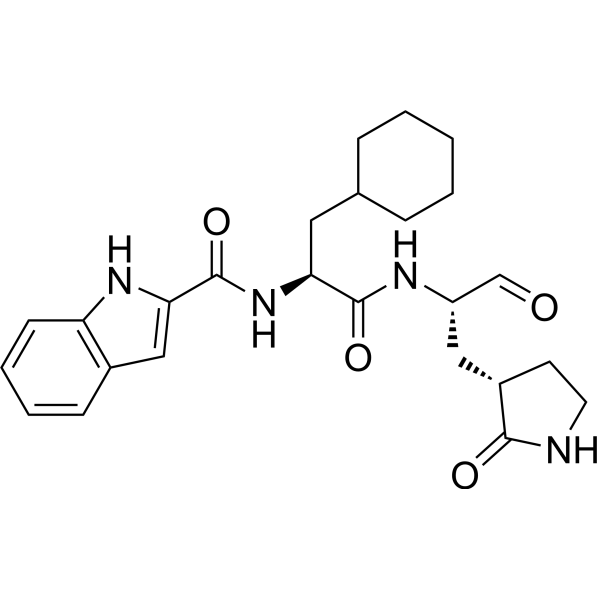
BOFUTRELVIR
Cas 2103278-86-8
| Molecular Weight | 452.55 |
|---|---|
| Formula | C25H32N4O4 |
UNII-T5UX5SKK2S; Mpro inhibitor 11A; 2103278-86-8; T5UX5SKK2S, DC-402234, DC402234, MPI-10
IUPAC/Chemical Name: N-[(2S)-3-cyclohexyl-1-oxo-1-[[(2S)-1-oxo-3-[(3S)-2-oxopyrrolidin-3-yl]propan-2-yl]amino]propan-2-yl]-1H-indole-2-carboxamide
N-[(2S)-3-cyclohexyl-1-oxo-1-[[(2S)-1-oxo-3-[(3S)-2-oxopyrrolidin-3-yl]propan-2-yl]amino]propan-2-yl]-1H-indole-2-carboxamide
Bofutrelvir has an additive antiviral effect when combined with Remdesivir
FB2001
Bofutrelvir (FB2001) is a SARS-CoV-2 main protease Mpro inhibitor with an IC50 value of 53 nM and an EC50 value of 0.53 μM. Bofutrelvir exhibits potent antiviral efficacy against several current SARS-CoV-2 variants with EC50 values of 0.26-0.42 μM. Bofutrelvir has an additive antiviral effect when combined with Remdesivir.
Bofutrelvir is a small molecule inhibitor of the severe acute respiratory syndrome coronavirus-2 (SARS-CoV-2) main protease (Mpro; 3C-like protease; 3CL protease; 3CLpro; nsp5 protease), with potential antiviral activity against SARS-CoV-2. Upon intravenous administration or inhalation into the lungs, bofutrelvir selectively targets, binds to, and inhibits the activity of SARS-CoV-2 Mpro. This inhibits the proteolytic cleavage of viral polyproteins, thereby inhibiting the formation of viral proteins including helicase, single-stranded-RNA-binding protein, RNA-dependent RNA polymerase, 20-O-ribose methyltransferase, endoribonuclease and exoribonuclease. This prevents viral transcription and replication. Bofutrelvir may have antiviral activity in the brain.
- Originator Frontier Biotechnologies
- Class Amides; Antivirals; Indoles; Pyrrolidinones; Small molecules
- Mechanism of Action Coronavirus 3C-like proteinase inhibitors
Highest Development Phases
- Phase II/III COVID 2019 infections
Most Recent Events
- 28 Apr 2024No recent reports of development identified for phase-I development in COVID-2019-infections in USA (IV, Infusion)
- 04 Jan 2023Phase-II/III clinical trials in COVID-2019 infections in China (Inhalation) (NCT05675072)
- 30 Dec 2022Frontier Biotechnologies completes a phase I trial in COVID-2019 infections in China (Inhalation) (NCT05583812)
- N-[(2S)-3-cyclohexyl-1-oxo-1-({(2S)-1-oxo-3-[(3S)-2-oxopyrrolidin-3-yl]propan-2-yl}amino)propan-2-yl]-1H-indole-2-carboxamide is a secondary carboxamide resulting from the formal condensation of the carboxy group of 1H-indole-2-carboxylic acid with the primary amino group of 3-cyclohexyl-N-{(2S)-1-oxo-3-[(3S)-2-oxopyrrolidin-3-yl]propan-2-yl}-L-alaninamide. It is an inhibitor of SARS coronavirus main proteinase and inhibits SARS-CoV-2 replication in cell culture (EC50 = 0.53 muM). It has a role as an EC 3.4.22.69 (SARS coronavirus main proteinase) inhibitor and an anticoronaviral agent. It is an indolecarboxamide, a member of pyrrolidin-2-ones, an aldehyde, a secondary carboxamide and an oligopeptide.
SCHEME
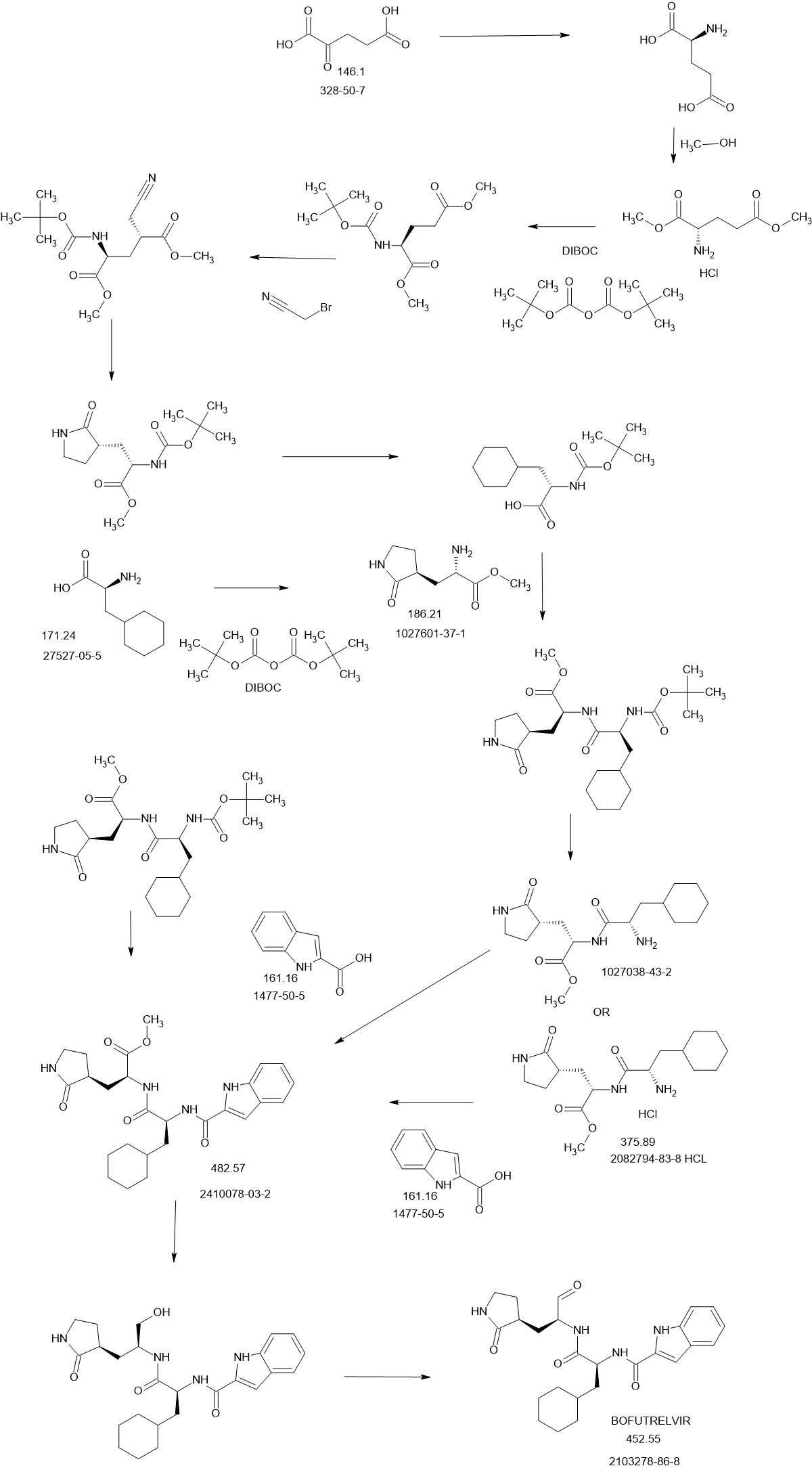
PATENTS
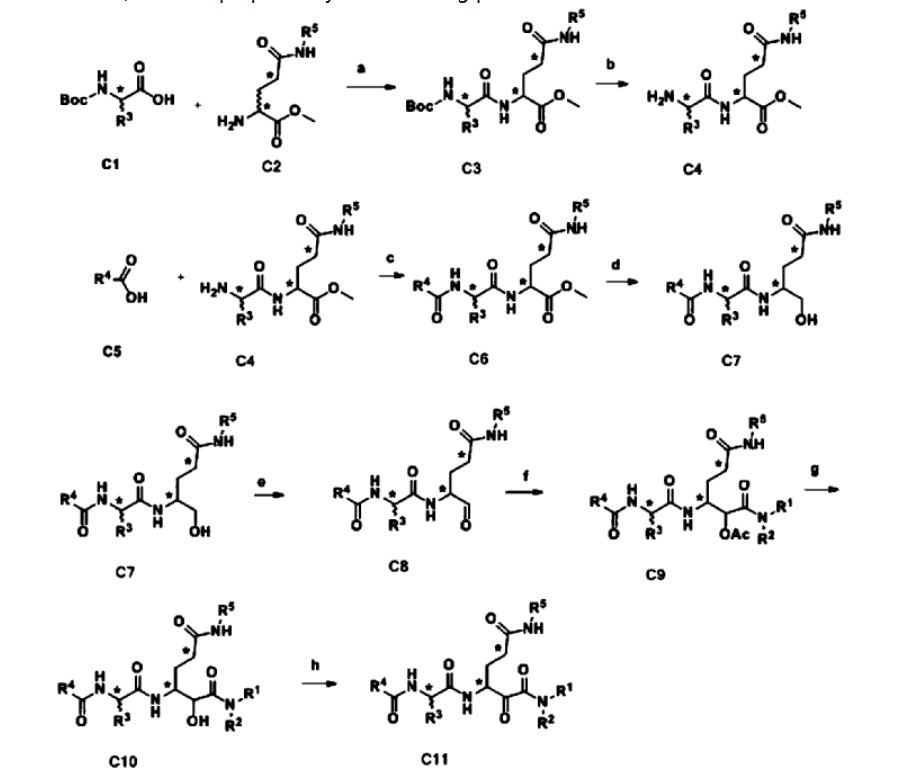
CN110818691
https://patentscope.wipo.int/search/en/detail.jsf?docId=CN289596961&_cid=P11-M9Z1Y3-09353-1
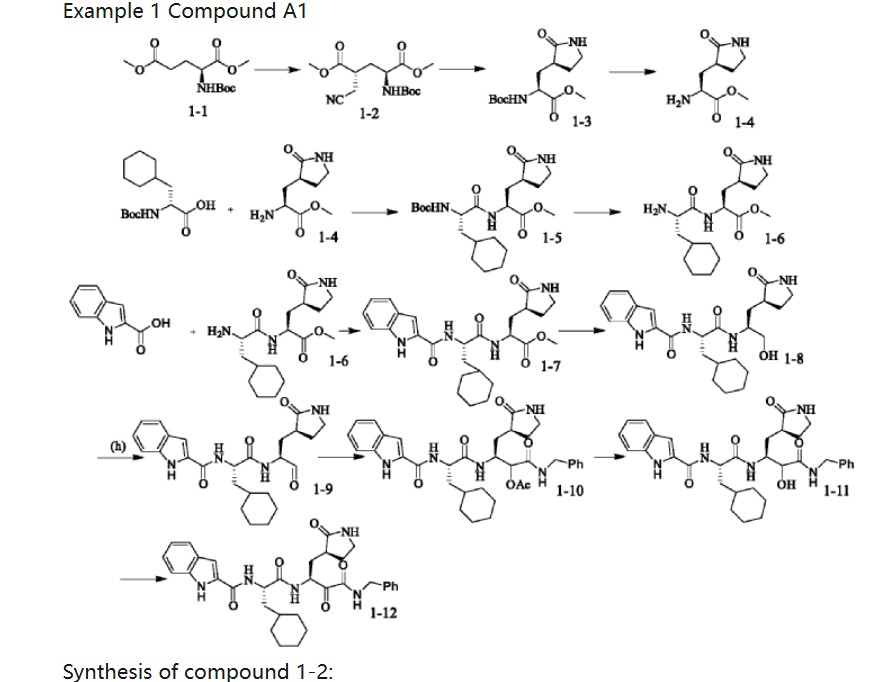
| Synthesis of compound 1-2: |
| Under argon protection, N-tert-butyloxycarbonyl-L-glutamic acid dimethyl ester (1-1) (6g, 21.8mmol) was dissolved in 60mL of anhydrous tetrahydrofuran, and a tetrahydrofuran solution of LiHMDS (1M in THF) (47mL, 47mmol) was slowly dripped at -78℃, and the temperature was kept stable at -78℃ during the dripping process, which lasted for about 1 hour. After the dripping was completed, it was stirred at -78℃ for 1 hour. Bromoacetonitrile (2.79g, 23.3mmol) was dissolved in 20ml of tetrahydrofuran, and then the solution was slowly dripped into the reaction system, and the dripping process lasted for 1 to 2 hours. The temperature was controlled at -78℃ and the reaction was continued for 3 hours. After the reaction was completed, NH4Cl solution was added to the reaction solution to quench the reaction, and the mixture was stirred for 10min and then warmed to room temperature. 40mL of saturated sodium chloride solution was poured in and stirred thoroughly, and the reaction system was seen to be stratified. The organic layer was separated, and the aqueous phase was extracted with ethyl acetate (EA). The organic layers were combined, dried over anhydrous sodium sulfate, concentrated, and subjected to column chromatography (Flash, PE:EA=1:5) to obtain 3.9 g of a light yellow oil 1-2 with a yield of 58%. |
| Synthesis of compound 1-3: |
| Dissolve 1-2 (1 g, 3.15 mmol) in 25 mL of anhydrous methanol, stir to 0°C in an ice bath, and then add cobalt dichloride hexahydrate (450 mg, 1.89 mmol). After 10 min, add sodium borohydride (715 mg, 18.9 mmol) in small portions. The reaction solution continues to react in an ice bath for 1 h and then returns to room temperature. After 15 h, quench with 5 mL of saturated NH4Cl solution and continue stirring for 10 min. After filtering out the solid, evaporate the filtrate to dryness, extract with 20 mL of water and 30×3 mL of ethyl acetate, combine the organic phases, and add anhydrous Na 2 SO 4 After drying for 1 h, the residue was concentrated under reduced pressure and separated by column chromatography [PE:EA=1:2] to obtain 460 mg of a white powdery solid with a yield of 51%. |
| Synthesis of compound 1-4: |
| Compound 1-3 (2.6 g) was dissolved in a dichloromethane solution of trifluoroacetic acid (1/1, v/v), stirred at room temperature for 1 hour, concentrated, added with 100 ml of dichloromethane, washed with saturated sodium carbonate solution, and the organic layer was dried over anhydrous sodium sulfate and concentrated to obtain an oily substance 1-4 (2.7 g) with a yield of 99%. |
| Synthesis of compound 1-5: |
| Boc-cyclohexylalanine (1.26 g, 5 mmol), EDCI (1.36 g, 6 mmol), and HOBt (0.822 g, 6 mmol) were added to 80 ml of dichloromethane solution and stirred at room temperature for 30 min. Compound 1-4 (0.896 g, 5 mmol) was then added, and 1.2 equivalents of triethylamine were added dropwise, and stirred at room temperature. After TLC monitoring (ultraviolet), dichloromethane was used for extraction after the reaction was complete, and the mixture was washed with dilute hydrochloric acid, saturated sodium bicarbonate solution, and saturated sodium chloride. The organic layers were combined and dried over anhydrous sodium sulfate, and concentrated to obtain 1.2 g of a white viscous solid with a yield of 60%. |
| Synthesis of compound 1-6: |
| Compound 1-5 (2.5 g) was dissolved in a dichloromethane solution of trifluoroacetic acid (1/1, v/v), stirred at room temperature for 1 hour, concentrated, added with 100 ml of dichloromethane, washed with saturated sodium carbonate solution, and the organic layer was dried over anhydrous sodium sulfate and concentrated to obtain an oily substance 1-6 (2.61 g) with a yield of 99%. |
| Synthesis of compound 1-7: |
| Indole 2-carboxylic acid (0.795 g, 5 mmol), EDCI (1.36 g, 6 mmol), and HOBt (0.822 g, 6 mmol) were added to 80 ml of dichloromethane solution and stirred at room temperature for 30 min. Compound 1-6 (2.2 g, 5 mmol) was then added, and 1.2 equivalents of triethylamine were added dropwise, and stirred at room temperature. After TLC monitoring (ultraviolet), dichloromethane was used for extraction after the reaction was complete, and the mixture was washed with dilute hydrochloric acid, saturated sodium bicarbonate solution, and saturated sodium chloride. The organic layers were combined and dried over anhydrous sodium sulfate, and concentrated to obtain 1.3 g of a white viscous solid with a yield of 60%. |
| Synthesis of compound 1-8: |
| Dissolve 1-7 (243 mg, 0.51 mmol) in 20 ml of methanol, slowly add sodium borohydride (107 mg, 2.9 mmol) in batches, and stir at room temperature for about 2 hours to complete the reaction. After the reaction is completed, add about 20 ml of saturated brine to quench the reaction, concentrate the methanol in the reaction system, and add dichloromethane for extraction. The organic phase is washed with saturated brine, dried over anhydrous sodium sulfate, and concentrated to obtain a white solid substance 1-8, which can be directly used in the next step. |
| Synthesis of compound 1-9: |
| Dissolve the intermediate 1-8 (129 mg, 0.29 mmol) in 20 ml of dichloromethane, add Dess-Martin oxidant (147 mg, 0.35 mmol) and solid sodium bicarbonate (29 mg, 0.35 mmol), and stir at room temperature. After the reaction is complete by TLC monitoring (ultraviolet), filter the reaction system, extract the filtrate with saturated sodium bicarbonate, and the organic layer is purified by saturated sodium salt. |
| The product was washed with water, dried over anhydrous sodium sulfate and concentrated. The product was separated and purified by flash column chromatography (CH2Cl2:MeOH=20:1) to obtain 77 mg of compound 1 as a white solid powder with a yield of 60%. |
| Synthesis of compound 1-10: |
| Compound 1-9 (129 mg, 0.29 mmol) was dissolved in dichloromethane solvent, acetic acid (19.2 mg, 0.32 mmol) and benzyl isocyanate (37.6 mg, 0.32 mmol) were added to react to obtain compound 1-10. Flash column chromatography (CH 2 Cl 2 :MeOH=20:1) to separate and purify to obtain 126 mg of white solid powder compound 1-10 with a yield of 70%. |
| Synthesis of compound 1-11: |
| Compound 1-10 (187 mg, 0.3 mmol) was dissolved in methanol solvent, LiOH (0.6 mmol) was added and stirred to obtain compound 1-11. 2 Cl 2 :MeOH=20:1) to separate and purify to obtain 148 mg of white solid powder compound 1-11 with a yield of 85%. |
| Synthesis of compound 1-12: |
| Compound 1-11 (174 mg, 0.3 mmol) was dissolved in dichloromethane solvent, Dess-Martin oxidant (152 mg, 0.36 mmol) was added, sodium bicarbonate (30 mg, 0.36 mmol) was added, and stirred to obtain a white solid powder compound 1-12 of 140 mg in total, with a yield of 80%. |
| 1 H NMR(500MHz,Chloroform)δ9.76(s,1H),7.73(s,1H),7.39(s,1H),7.32–7.26(m,2H),7.22(s,1H),7 .20–7.10(m,3H),7.01(s,1H),6.82(s,1H),6.68(s,1H),6.14(s,1H),5.57(s,1H),5.43(s,1H),4.3 8(s,1H),4.32(d,J=19.2Hz,2H),3.45(s,1H),3.35(s,1H),3.06(s,1H),2.20(dd,J=15.4,2.3Hz,4H ),2.12–2.03(m,2H),1.92(s,1H),1.77(s,1H),1.73–1.67(m,3H),1.66–1.53(m,6H),1.37(s,1H).; |
PATENT
WO2020030143
bioRxiv (2020), 1-17
- [1]. Ullrich S, Nitsche C. The SARS-CoV-2 main protease as drug target. Bioorg Med Chem Lett. 2020 Sep 1;30(17):127377. [Content Brief]
- [2]. Shang W, et al. In vitro and in vivo evaluation of the main protease inhibitor FB2001 against SARS-CoV-2. Antiviral Res. 2022 Dec;208:105450. [Content Brief]
///BOFUTRELVIR, FB2001, FB 2001, Phase 3, COVID 2019, T5UX5SKK2S, Mpro inhibitor, DC-402234, DC402234, MPI-10
Inavolisib


Inavolisib
WeightAverage: 407.378
Monoisotopic: 407.140510438
Chemical FormulaC18H19F2N5O4
- GDC-0077
- CAS 2060571-02-8
- GDC0077
- RG6114
- WHO 11204
- GDC 0077
- GDC-0077
- RG-6114
- RG6114
- RO-7113755
- RO7113755
FDA APPROVED, 10/10/2024, Itovebi, To treat locally advanced or metastatic breast cancer
Drug Trials Snapshot
(2S)-2-[[2-[(4S)-4-(difluoromethyl)-2-oxo-1,3-oxazolidin-3-yl]-5,6-dihydroimidazo[1,2-d][1,4]benzoxazepin-9-yl]amino]propanamide
- (2S)-2-((2-((4S)-4-(difluoromethyl)-2-oxo-3-oxazolidinyl)-5,6-dihydroimidazo(1,2-D)(1,4)benzoxazepin-9-yl)amino)propanamide
- propanamide, 2-((2-((4S)-4-(difluoromethyl)-2-oxo-3-oxazolidinyl)-5,6-dihydroimidazo(1,2-D)(1,4)benzoxazepin-9-yl)amino)-, (2S)-
Inavolisib, sold under the brand name Itovebi, is an anti-cancer medication used for the treatment of breast cancer.[2][3] It is an inhibitor and degrader of mutant phosphatidylinositol 3-kinase (PI3K) alpha.[4] The PI3K-mediated signalling pathway has shown to play an important role in the development of tumours as dysregulation is commonly associated with tumour growth and resistance to antineoplastic agents and radiotherapy.[5]
The most common adverse reactions include decreased neutrophils, decreased hemoglobin, increased fasting glucose, decreased platelets, decreased lymphocytes, stomatitis, diarrhea, decreased calcium, fatigue, decreased potassium, increased creatinine, increased ALT, nausea, decreased sodium, decreased magnesium, rash, decreased appetite, COVID-19 infection, and headache.[3]
Inavolisib was approved for medical use in the United States in October 2024.[3][6][7]
SYN
Hanan EJ, Braun MG, Heald RA, MacLeod C, Chan C, Clausen S, Edgar KA, Eigenbrot C, Elliott R, Endres N, Friedman LS, Gogol E, Gu XH, Thibodeau RH, Jackson PS, Kiefer JR, Knight JD, Nannini M, Narukulla R, Pace A, Pang J, Purkey HE, Salphati L, Sampath D, Schmidt S, Sideris S, Song K, Sujatha-Bhaskar S, Ultsch M, Wallweber H, Xin J, Yeap S, Young A, Zhong Y, Staben ST: Discovery of GDC-0077 (Inavolisib), a Highly Selective Inhibitor and Degrader of Mutant PI3Kalpha. J Med Chem. 2022 Dec 22;65(24):16589-16621. doi: 10.1021/acs.jmedchem.2c01422. Epub 2022 Dec 1.


PATENT
https://patentscope.wipo.int/search/en/detail.jsf?docId=US215633239&_cid=P11-M9XU5W-08686-1


Example 101 (S)-2-((2-((S)-4-(Difluoromethyl)-2-oxooxazolidin-3-yl)-5,6-dihydrobenzo[f]imidazo[1,2-d][1,4]oxazepin-9-yl)amino)propanamide 101
Step 1: 4-Bromo-2-hydroxybenzaldehyde
Step 2: 5-Bromo-2-(1H-imidazol-2-yl)phenol
Step 3: 9-Bromo-5,6-dihydrobenzo[f]imidazo[1,2-d][1,4]oxazepine
Step 4: 9-Bromo-2,3-diiodo-5,6-dihydrobenzo[f]imidazo[1,2-d][1,4]oxazepine
Step 5: 9-Bromo-2-iodo-5,6-dihydrobenzo[f]imidazo[1,2-d][1,4]oxazepine
Step 6: (R)-2,2-Dimethyl-[1,3]dioxolane-4-carbaldehyde
Step 7: (R)-4-Difluoromethyl-2,2-dimethyl-[1,3]dioxolane
Step 8: (R)-3-(tert-Butyldimethylsilanyloxy)-1,1-difluoropropan-2-ol
Step 9: ((S)-2-Azido-3,3-difluoropropoxy)-tert-butyldimethylsilane
Step 10: (S)-1-(tert-Butyldimethylsilanyloxymethyl)-2,2-difluoroethylamine
Step 12: (S)-3-(9-Bromo-5,6-dihydrobenzo[f]imidazo[1,2-d][1,4]oxazepin-2-yl)-4-(difluoromethyl)oxazolidin-2-one
Step 13: (S)-2-((2-((S)-4-(Difluoromethyl)-2-oxooxazolidin-3-yl)-5,6-dihydrobenzo[f]imidazo[1,2-d][1,4]oxazepin-9-yl)amino)propanamide
Medical uses
Inavolisib is indicated in combination with palbociclib and fulvestrant for the treatment of adults with endocrine-resistant, PIK3CA-mutated, hormone receptor (HR)-positive, human epidermal growth factor receptor 2 (HER2)-negative, locally advanced or metastatic breast cancer, as detected by an FDA-approved test, following recurrence on or after completing adjuvant endocrine therapy.[3]
Side effects
The most common adverse reactions include decreased neutrophils, decreased hemoglobin, increased fasting glucose, decreased platelets, decreased lymphocytes, stomatitis, diarrhea, decreased calcium, fatigue, decreased potassium, increased creatinine, increased ALT, nausea, decreased sodium, decreased magnesium, rash, decreased appetite, COVID-19 infection, and headache.[3]
History
Efficacy was evaluated in INAVO120 (NCT04191499), a randomized, double-blind, placebo-controlled, multicenter trial in 325 participants with endocrine-resistant, PIK3CA-mutated HR-positive, HER2-negative locally advanced or metastatic breast cancer whose disease progressed during or within twelve months of completing adjuvant endocrine therapy and who had not received prior systemic therapy for locally advanced or metastatic disease.[3] Primary endocrine resistance was defined as relapse while on the first two years of adjuvant endocrine therapy (ET) and secondary endocrine resistance was defined as relapse while on adjuvant ET after at least two years or relapse within twelve months of completing adjuvant ET.[3]
Structure, reactivity, and synthesis
Inavolisib is a synthetic, organic, small compound (the full structure can be seen here).[8] When binding to phosphatidylinositol-4,5-bisphosphate 3-kinase, catalytic subunit alpha (p110α), inavolisib’s carbonyl group can accept a hydrogen bond from the Tyr836 (conserved) in p110α. The difluoromethyl group can interact with the hydroxyl group presented on Ser774 (conserved) in p110α, which is 3.2Å nearer than of which on the equivalent residue Ser754 in p110δ. Additionally, the amide group can interact with Gln859 (non-conserved). This results in a very high selectivity regarding PI3Kα isoforms.[4][9]
Compared to similar PI3K inhibiting compounds, inavolisib has a higher thermodynamic aqueous solubility that proved advantageous in the formulation process and aiding greater consistency in predictions of absorption.[4]
Inavolisibcan be developed as a derivative of 1,3-oxazole[10] or by means of stereo-controlled N-arylation of alpha-amino acids.[11]
Metabolism and biotransformation
Inavolisib is orally administered, though there is little knowledge about its metabolism.[12]However, absorption, metabolism, and excretion data of taselisib, a molecule with a related chemical scaffold, suggest moderately slow absorption into the systemic circulation, metabolism to play a minor role in drug clearance, and biliary excretion to be the main route of excretion.[13]
Molecular mechanisms of action
Inavolisib is a selective PI3K-p110α (PIK3CA) inhibitor, which may offer antineoplastic functionality.[8] Therefore, it may serve as a new addition to combination therapy with conventional cancer treatment, such as chemotherapy. Combining inavolisib with palbociclib and fulvestrant might improve treatment of breast cancer.[14]
Next to its inhibitory enzymatic ability, it is suggested that inavolisib binds to – and activates degradation of – mutated forms of p110α. Members of the PI3K family regulate cellular processes such as cell growth and proliferation, survival, remodelling, and intracellular transport of organelles.[15] PI3K also plays an essential role for the immune system.
The class I isoform PI3K alpha (PI3Kα) is often times expressed in solid tumours through gene amplification or activated mutations.[4] Mutations in PI3Kα can often be found in cancer cells, especially HR+ breast cancer, which causes a disruption of the PI3K pathway. This leads to increased tumour growth and metastasis. One of the most common mutations can be found in PIK3CA, which plays a significant role in tumour cell proliferation.
In preclinical studies, inavolisib has shown to specifically initiate the degradation of this p110α oncogene with the help of proteasomes.[16] After binding to the mutant PI3Kα, inavolisib blocks phosphorylation of PIP2 to PIP3, thereby stopping downstream signalling.[17]
Consequently, biomarkers in the PI3K pathway are reduced, cell proliferation inhibited, and the rate of PIK3CA-mutant breast cancer apoptosis increased (in comparison to the wild type). The exact mechanism of action of inhibitors like inavolisib on mutated PI3Kα and the inhibitors’ influence on mutant structures are still unknown.[18]
Toxicity
Inavolisib is able to induce a cytotoxic response but this is directed towards tumour cells that contain the PI3K mutation, thereby inhibiting further tumour growth and leading to cell loss.[19]
Society and culture
Legal status
In October 2024, the US Food and Drug Administration (FDA) approved inavolisib for the treatment of PIK3CA-mutant breast cancer based on the results from the INAVO120 trial.[3][6][20][21] The drug application was granted priority review and breakthrough therapy designations by the FDA.[3]
Names
Inavolisib is the international nonproprietary name.[22][23]
Inavolisib is sold under the brand name Itovebi.[3]
Research
Due to inavolisib’s ability to inhibit the PI3K pathway through HER2-dependent degradation, it is undergoing clinical trials to potentially make use of it as an antineoplastic (anti-cancer) drug to treat breast cancer.[4][24][17]
References
- ^ “Register of Innovative Drugs”. Health Canada. 3 November 2006. Retrieved 17 April 2025.
- ^ Jump up to:a b “Itovebi- inavolisib tablet, film coated”. DailyMed. 11 October 2024. Retrieved 11 November 2024.
- ^ Jump up to:a b c d e f g h i j “FDA approves inavolisib with palbociclib and fulvestrant for endocrine-resistant, PIK3CA-mutated, HR-positive, HER2-negative, advanced breast cancer”. U.S. Food and Drug Administration (FDA). 10 October 2024. Retrieved 11 October 2024. This article incorporates text from this source, which is in the public domain.
- ^ Jump up to:a b c d e Hanan EJ, Braun MG, Heald RA, MacLeod C, Chan C, Clausen S, et al. (December 2022). “Discovery of GDC-0077 (Inavolisib), a Highly Selective Inhibitor and Degrader of Mutant PI3Kα”. Journal of Medicinal Chemistry. 65 (24). American Chemical Society (ACS): 16589–16621. doi:10.1021/acs.jmedchem.2c01422. PMID 36455032. S2CID 254149451.
- ^ “CID 124173720, Inavolisib”. PubChem. National Center for Biotechnology Information, U.S. National Library of Medicine. Retrieved 21 September 2023.
- ^ Jump up to:a b “Novel Drug Approvals for 2024”. U.S. Food and Drug Administration (FDA). 1 October 2024. Retrieved 29 November 2024.
- ^ New Drug Therapy Approvals 2024 (PDF). U.S. Food and Drug Administration (FDA) (Report). January 2025. Archived from the original on 21 January 2025. Retrieved 21 January 2025.
- ^ Jump up to:a b “inavolisib — Ligand page”. IUPHAR/BPS Guide to Pharmacology. Retrieved 21 September 2023.
- ^ Vanhaesebroeck B, Perry MW, Brown JR, André F, Okkenhaug K (October 2021). “PI3K inhibitors are finally coming of age”. Nature Reviews. Drug Discovery. 20 (10). Springer Science and Business Media LLC: 741–769. doi:10.1038/s41573-021-00209-1. PMC 9297732. PMID 34127844.
- ^ Chen J, Lv S, Liu J, Yu Y, Wang H, Zhang H (December 2021). “An Overview of Bioactive 1,3-Oxazole-Containing Alkaloids from Marine Organisms”. Pharmaceuticals. 14 (12). MDPI AG: 1274. doi:10.3390/ph14121274. PMC 8706051. PMID 34959674.
- ^ Han C, Kelly SM, Cravillion T, Savage SJ, Nguyen T, Gosselin F (2019). “Synthesis of PI3K inhibitor GDC-0077 via a stereocontrolled N-arylation of α-amino acids”. Tetrahedron. 75 (32). Elsevier BV: 4351–4357. doi:10.1016/j.tet.2019.04.057. ISSN 0040-4020. S2CID 150262658.
- ^ “Inavolisib: Uses, Interactions, Mechanism of Action”. DrugBank. 20 May 2019. DB15275. Retrieved 21 September 2023.
- ^ Ma S, Cho S, Sahasranaman S, Zhao W, Pang J, Ding X, et al. (April 2023). “Absorption, Metabolism, and Excretion of Taselisib (GDC-0032), a Potent β-Sparing PI3K Inhibitor in Rats, Dogs, and Humans”. Drug Metabolism and Disposition. 51 (4): 436–450. doi:10.1124/dmd.122.001096. PMID 36623882.
- ^ “A trial looking at a new drug called inavolisib for breast cancer that has spread (WO41554)”. Cancer Research UK. 22 June 2021. Retrieved 21 September 2023.
- ^ Koyasu S (April 2003). “The role of PI3K in immune cells”. Nature Immunology. 4 (4). Springer Science and Business Media LLC: 313–319. doi:10.1038/ni0403-313. PMID 12660731. S2CID 9951653.
- ^ Hong R, Edgar K, Song K, Steven S, Young A, Hamilton P, et al. (15 February 2018). “Abstract PD4-14: GDC-0077 is a selective PI3Kalpha inhibitor that demonstrates robust efficacy in PIK3CA mutant breast cancer models as a single agent and in combination with standard of care therapies”. Cancer Research. 78 (4_Supplement). American Association for Cancer Research (AACR): PD4–14–PD4–14. doi:10.1158/1538-7445.sabcs17-pd4-14. ISSN 0008-5472.
- ^ Jump up to:a b “Inavolisib (PI3K alpha inhibitor)”. Genentech. Retrieved 21 September 2023.
- ^ Menteş M, Karakuzulu BB, Uçar GB, Yandım C (August 2022). “Comparative molecular dynamics analyses on PIK3CA hotspot mutations with PI3Kα specific inhibitors and ATP”. Computational Biology and Chemistry. 99. Elsevier BV: 107726. doi:10.1016/j.compbiolchem.2022.107726. PMID 35842959. S2CID 250404770.
- ^ Song KW, Edgar KA, Hanan EJ, Hafner M, Oeh J, Merchant M, et al. (January 2022). “RTK-Dependent Inducible Degradation of Mutant PI3Kα Drives GDC-0077 (Inavolisib) Efficacy”. Cancer Discovery. 12 (1). American Association for Cancer Research (AACR): 204–219. doi:10.1158/2159-8290.cd-21-0072. PMC 9762331. PMID 34544753.
- ^ “FDA Approves Genentech’s Itovebi, a Targeted Treatment for Advanced Hormone Receptor-Positive, HER2-Negative Breast Cancer With a PIK3CA Mutation” (Press release). Genentech. 10 October 2024. Retrieved 11 October 2024 – via Business Wire.
- ^ “U.S. Food and Drug Administration Approves FoundationOne Liquid CDx as a Companion Diagnostic for Itovebi (inavolisib) to Identify Patients with Hormone Receptor-Positive, HER2-Negative Breast Cancer with a PIK3CA Mutation” (Press release). Foundation Medicine. 11 October 2024. Retrieved 11 October 2024 – via Business Wire.
- ^ World Health Organization (2020). “International nonproprietary names for pharmaceutical substances (INN): recommended INN: list 84”. WHO Drug Information. 34 (3). hdl:10665/340680.
- ^ World Health Organization (2023). “International nonproprietary names for pharmaceutical substances (INN): recommended INN: list 90”. WHO Drug Information. 37 (3). hdl:10665/373341.
- ^ Vanhaesebroeck B, Burke JE, Madsen RR (January 2022). “Precision Targeting of Mutant PI3Kα in Cancer by Selective Degradation”. Cancer Discovery. 12 (1). American Association for Cancer Research (AACR): 20–22. doi:10.1158/2159-8290.cd-21-1411. PMC 7612218. PMID 35022207.
External links
- Clinical trial number NCT04191499 for “A Study Evaluating the Efficacy and Safety of Inavolisib + Palbociclib + Fulvestrant vs Placebo + Palbociclib + Fulvestrant in Patients With PIK3CA-Mutant, Hormone Receptor-Positive, Her2-Negative, Locally Advanced or Metastatic Breast Cancer (INAVO120)” at ClinicalTrials.gov
| Clinical data | |
|---|---|
| Trade names | Itovebi |
| Other names | GDC-0077, RG6114, Ro7113755 |
| AHFS/Drugs.com | Itovebi |
| License data | US DailyMed: Inavolisib |
| Routes of administration | By mouth |
| Drug class | PI3K inhibitor |
| ATC code | None |
| Legal status | |
| Legal status | CA: ℞-only[1]US: ℞-only[2] |
| Identifiers | |
| showIUPAC name | |
| CAS Number | 2060571-02-8 |
| PubChem CID | 124173720 |
| IUPHAR/BPS | 9636 |
| DrugBank | DB15275 |
| ChemSpider | 59718498 |
| UNII | L4C1UY2NYH |
| KEGG | D11942 |
| ChEMBL | ChEMBL4650215 |
| PDB ligand | X3N (PDBe, RCSB PDB) |
| Chemical and physical data | |
| Formula | C18H19F2N5O4 |
| Molar mass | 407.378 g·mol−1 |
| 3D model (JSmol) | Interactive image |
| showSMILES | |
| showInChI | |
//////////Inavolisib, FDA 2024, APPROVALS 2024, GDC-0077, 2060571-02-8, GDC0077, RG6114, WHO 11204, GDC 0077, GDC-0077, RG-6114, RG6114, RO-7113755, RO7113755
Bocodepsin


Bocodepsin, OKI-179
CAS 1834513-65-3
S-((3E)-4-((6S,9S)-12,12-DIMETHYL-4,8,11,14-TETRAOXO-9-(PROPAN-2-YL)-7-OXA -3,10,13-TRIAZA-1(2,4)-(1,3)THIAZOLACYCLOTETRADECAPHAN-6-YL)BUT-3-EN-1-YL) (2S)-2-AMINO-3-METHYLBUTANETHIOATE
S-(4-((7S,10S)-4,4-DIMETHYL-2,5,8,12-TETRAOXO-7-(PROPAN-2-YL)-9-OXA-16-THIA- 3,6,13,18-TETRAAZABICYCLO(13.2.1)OCTADECA-15(18),17-DIEN-10-YL)BUT-3-EN-1-YL) (2S)-2-AMINO-3-METHYLBUTANETHIOATE
| Molecular Weight | 581.75 |
|---|---|
| Formula | C26H39N5O6S2 |
- L-Valine, S-L-valyl-(3S,4E)-3-hydroxy-7-mercapto-4-heptenonyl-2-(aminomethyl)-4-thiazolecarbonyl-2-methylalanyl-, (5–>2)-lactone
- S-{(3E)-4-[(6S,9S)-12,12-dimethyl-4,8,11,14-tetraoxo-9-(propan-2-yl)-7-oxa-3,10,13-triaza-1(2,4)-[1,3]thiazolacyclotetradecaphan-6-yl]but-3-en-1-yl} (2S)-2-amino-3-methylbutanethioate
- S-{4-[(7S,10S)-4,4-dimethyl-2,5,8,12-tetraoxo-7-(propan-2-yl)-9-oxa-16-thia-3,6,13,18-tetraazabicyclo[13.2.1]octadeca-15(18),17-dien-10-yl]but-3-en-1-yl} (2S)-2-amino-3-methylbutanethioate
- Originator OnKure Therapeutics
- Class Antineoplastics; Small molecules
- Mechanism of ActionHDAC1 protein inhibitors
Phase I/II Malignant melanoma; Solid tumours
- No development reportedHaematological malignancies
29 Jan 2025 OnKure Therapeutics completes the phase-I/II Nautilus trial in Malignant melanoma (Late-stage disease, Metastatic disease, Second-line therapy or greater, Combination therapy) in USA (PO) (NCT05340621),
- 11 Oct 2023Pharmacodynamics data from a preclinical studies in Solid tumours presented at the AACR-NCI-EORTC International Conference on Molecular Targets and Cancer Therapeutics 2023 (AACR-NCI-EORTC-2023 2023)
- 11 Oct 2023Initial efficacy and adverse events data from a phase Ib/II NAUTILUS trial in Melanoma presented at the International Conference on Molecular Targets and Cancer Therapeutics 2023 (AACR-NCI-EORTC-2023)
Bocodepsin (OKI-179) is an orally active and selective HDAC inhibitor, with antitumor activity. Bocodepsin can be used for suppression on solid tumor and hematologic malignancies.
SCHEME


PATENT
WO2017201278
https://patentscope.wipo.int/search/en/detail.jsf?docId=WO2017201278&_cid=P12-M9WKU5-87067-1

Examples
[00127] The following examples are provided for illustrative purposes only and are not intended to limit the scope of the invention.
[00128] Example 1: Preparation of (R)-S-((E)-4-((7S,10S)-7-isopropyl-4,4-dimethyl-2,5,8,12- tetraoxo-9-oxa-16-thia-3,6,13,18-tetraazabicyclo[13.2.1]octadeca-l(17),15(18)-dien-10- yl)but-3-en-l-yl) 2-amino-3-methylbutanethioate hydrochloride.
Step 1 : Preparation of (R)-S-((E)-4-((7S,10S)-7-isopropyl-4,4-dimethyl-2,5,8,12- tetraoxo-9-oxa-16-thia-3,6,13,18-tetraazabicyclo[13.2.1]octadeca-l(17),15(18)-dien-10- yl)but-3-en-l-yl) 2-((tert-butoxycarbonyl)amino)-3-methylbutanethioate. (7S,10S)-10-((E)- 4- chlorobut-l-en-l-yl)-7-isopropyl-4,4-dimethyl-9-oxa-16-thia-3,6,13,18- tetraazabicyclo[13.2.1]octadeca-l(17),15(18)-diene-2,5,8,12-tetraone (15 g, 0.03 mol), (R)-2- ((tert-butoxycarbonyl)amino)-3-methylbutanethioic S-acid (12.5 g, 0.06 mol), K2CO3 (11.2 g, 0.09 mol), and KI (0.89 g, 0.006 mol) were dissolved in 150mL of acetonitrile and the resulting mixture was warmed to 60-65°C and stirred under nitrogen. After 16 hours, the mixture was cooled to 20°C, 300 mL of water was added, and the resulting suspension was extracted with ethyl acetate (2X200 mL). The combined organic phases were dried with anhydrous sodium sulfate, filtered and concentrated. The residue was purified by flash column chromatography (elution with ethyl acetate/petroleum ether = 1/1 to 4/1) to give (R)- 5- ((E)-4-((7S,10S)-7-isopropyl-4,4-dimethyl-2,5,8,12-tetraoxo-9-oxa-16-thia-3,6,13,18- tetraazabicyclo[13.2.1] octadeca-l(17),15(18)-dien-10-yl)but-3-en-l-yl) 2-((tert- butoxycarbonyl)amino)-3-methylbutanethioate (17.0 g, 80% yield).
Step 2: Preparation of (R)-S-((E)-4-((7S,10S)-7-isopropyl-4,4-dimethyl-2,5,8,12- tetraoxo-9-oxa-16-thia-3,6,13,18-tetraazabicyclo[13.2.1]octadeca-l(17),15(18)-dien-10- yl)but-3-en-l-yl) 2-amino-3-methylbutanethioate hydrochloride. (R)-S-((E)-4-((7S,10S)-7- isopropyl-4,4-dimethyl-2,5,8,12-tetraoxo-9-oxa-16-thia-3,6,13,18- tetraazabicyclo[l 3.2.1] octadeca- 1 ( 17), 15 (18)-dien- 10-y l)but-3-en- 1 -y 1) 2-((tert-butoxy carbony l)amino)-3-methylbutanethioate (1.7 g, 0.025 mol) was dissolved in 150 mL of dichloromethane and trifluoroacetic acid (22.5 mL) was added at 10°C. After stirring at 10°C for 4 hours under nitrogen, the mixture was concentrated to dryness and the residue was dissolved in 100 mL of ethyl acetate and treated with 10 mL of 4M HCl/ethyl acetate solution. The mixture was then treated with petroleum ether (100 mL) and the resulting white solid was collected by filtration and dried to give (R)-S-((E)-4-((7S,10S)-7-isopropyl-4,4-dimethyl-2,5,8,12-tetraoxo-9-oxa-16-thia-3,6,13,18- tetraazabicyclo[13.2.1] octadeca-l(17),15(18)-dien-10-yl)but-3-en-l-yl) 2-amino-3-methylbutanethioate hydrochloride (0.40 g, 26% yield). Mass Spec(m/z): 582.8 (M+l).
129] Example 2: Preparation of (S)-S-((E)-4-((7S,10S)-7-isopropyl-4,4-dimethyl-2,5,8,12-tetraoxo-9-oxa-16-thia-3,6,13,18-tetraazabicyclo[13.2.1]octadeca-l(17),15(18)-dien-10-yl)but-3-en-l-yl) 2-amino-3-methylbutanethioate hydrochloride.
Step 1 : (S)-S-((E)-4-((7S,10S)-7-isopropyl-4,4-dimethyl-2,5,8,12-tetraoxo-9-oxa-16-thia-3,6,13,18-tetraazabicyclo[13.2.1]octadeca-l(17),15(18)-dien-10-yl)but-3-en-l-yl) 2-((tert-butoxy carbony l)amino)-3 -methy lbutanethioate. (7S,10S)-10-((E)-4-chlorobut- 1 -en- 1 -yl)-7-isopropyl-4,4-dimethyl-9-oxa-16-thia-3,6,13,18-tetraazabicyclo[13.2.1]octadeca-l(17),15(18)-diene-2,5,8,12-tetraone (40 g, 0.0825 mol), (S)-2-((tert-butoxycarbonyl)amino)-3-methylbutanethioic S-acid (38.5 g, 0.165 mol), K2C03 (34.1 g, 0.247 mol), and KI (2.7 g, 0.0163 mol) were dissolved in 400 mL of acetonitrile and stirred at 60-65°C under nitrogen for 20 hours. The mixture was cooled to 20°C, water (300 mL) was added and the resulting suspension was extracted with ethyl acetate (2X200 mL). The organic phases were combined, dried with anhydrous sodium sulfate, filtered and concentrated. The residue was purified by flash column chromatography (elution with ethyl acetate/petroleum ether = 1/1 to 4/1) to give (S)-S-((E)-4-((7S,10S)-7-isopropyl-4,4-dimethyl-2,5,8,12-tetraoxo-9-oxa-16-thia-3,6,13,18-tetraazabicyclo[13.2.1]octadeca-l(17),15(18)-dien-10-yl)but-3-en-l-yl) 2-((tert-butoxycarbonyl)amino)-3-methylbutanethioate (49.8 g, 89% yield).
Step 2: (S)-S-((E)-4-((7S,10S)-7-isopropyl-4,4-dimethyl-2,5,8,12-tetraoxo-9-oxa-16-thia-3,6,13,18-tetraazabicyclo[13.2.1]octadeca-l(17),15(18)-dien-10-yl)but-3-en-l-yl) 2-amino-3-methylbutanethioate hydrochloride. (S)-S-((E)-4-((7S,10S)-7-isopropyl-4,4-dimethyl-2,5,8,12-tetraoxo-9-oxa-16-thia-3,6,13,18-tetraazabicyclo[13.2.1]octadeca-1 ( 17), 15( 18)-dien- 10-y l)but-3-en- 1 -y 1) 2-((tert-butoxy carbony l)amino)-3 -methylbutanethioate (47.8 g, 0.07 mol) was dissolved in dichloromethane (400 mL) and trifluoroacetic acid (65 mL) was added dropwise at 10 to 20°C while stirring under nitrogen. After the addition, the mixture was stirred at 15 to 20°C for 3 hours at which time an additional aliquot of trifluoroacetic acid (20 mL) was added and stirring at 15 to 20°C was continued for an additional 1.5 hours. The solution was then concentrated under vacuum to near dryness and the residue dissolved in ethyl acetate (250 mL). 20 mL of 4M HCl/ethyl acetate solution was then added while stirring at a temperature between 10 to 15°C resulting in the formation of a slurry. 250 mL n-heptane was then added and the solids were filtered, rinsed with n-heptane and dried in vacuo to give (S)-S-((E)-4-((7S,10S)-7-isopropyl-4,4-dimethyl-2,5,8,12-tetraoxo-9-oxa-16-thia-3,6,13,18- tetraazabicyclo[13.2.1] octadeca-l(17),15(18)-dien-10-yl)but-3-en-l-yl) 2-amino-3 -methylbutanethioate hydrochloride as a white solid which contained some residual heptane. (49.0 g, 100% yield). Mass Spec(m/z): 582.8 (M+l)
130] Example 3: Preparation of (S)-S-((E)-4-((7S,10S)-7-isopropyl-4,4-dimethyl-2,5,8,12-tetraoxo-9-oxa-16-thia-3,6,13,18-tetraazabicyclo[13.2.1]octadeca-l(17),15(18)-dien-10-yl)but-3-en-l-yl) 2-amino-3 -methylbutanethioate benzenesulfonate.
The product of Example 2, step 1 ((S)-S-((E)-4-((7S,10S)-7-isopropyl-4,4-dimethyl-2,5,8,12-tetraoxo-9-oxa-16-thia-3,6,13,18-tetraazabicyclo[13.2.1]octadeca-l(17),15(18)-dien-10-yl)but-3-en-l-yl) 2-((tert-butoxycarbonyl)amino)-3-methylbutanethioate) (1 eq.) was dissolved in acetonitrile (10 vol) at 20-25°C and the mixture was treated with
benzenesulfonic acid (3 eq.). After stirring at room temperature for 5 hours, the solvent was removed by decanting, the residual oil was treated with THF (5vol), and the resulting mixture was stirred over night at room temperature. The resulting white solid was collected by filtration and dried in vacuo to give (S)-S-((E)-4-((7S,10S)-7-isopropyl-4,4-dimethyl-2,5,8,12-tetraoxo-9-oxa-16-thia-3,6,13,18-tetraazabicyclo[13.2.1]octadeca-l(17),15(18)-dien-10-yl)but-3-en-l-yl) 2-amino-3-methylbutanethioate benzenesulfonate (90% yield; 98% purity). 1HNMR (d6-DMSO) δ: 0.56 to 0.57 (m, 3H), 0.76 to 0.78 (m, 3H), 0.92 to 0.94 (m, 3H), 0.96 to 0.98 (m, 3H), 1.45 to 1.48 (m, 3H), 1.70 to 1.72 (m, 3H), 2.07 to 2.16 (m, 2H), 2.27 to 2.28 (m, 2H), 2.93 to 2.95 (m, 1H), 2.94 to 2.95 (m, 1H), 2.97 to 3.1 (m, 1H), 4.13 to 4.15 (m, 1H), 4.28 to 4.33 (1H), 4.92 to 5.0 (m, 1H), 5.61 to 5.64 (m, 3H), 7.29 to 7.32 (m, 3H), 7.57 to 7.60 (m, 2H), 7.88 to 7.92 (m, 1H), 8.17 (s, 1H), 8.32 (s, 3H), 8.48 to 8.50 (m, 1H).
[1]. Diamond JR, et al. Preclinical Development of the Class-I-Selective Histone Deacetylase Inhibitor OKI-179 for the Treatment of Solid Tumors. Mol Cancer Ther. 2022 Mar 1;21(3):397-406. [Content Brief]
///////////Bocodepsin, K5D067O1SW, OKI-179, Malignant melanoma, Solid tumours, OnKure Therapeutics, OKI 006
Vanzacaftor


Vanzacaftor
- CAS 2374124-49-7
- COM1POP492
- VX-121
- 617.8 g/mol, C32H39N7O4S
FDA APPROVED vanzacaftor, tezacaftor, and deutivacaftor, 12/20/2024, Alyftrek , To treat cystic fibrosis
(14S)-8-[3-(2-dispiro[2.0.24.13]heptan-7-ylethoxy)pyrazol-1-yl]-12,12-dimethyl-2,2-dioxo-2λ6-thia-3,9,11,18,23-pentazatetracyclo[17.3.1.111,14.05,10]tetracosa-1(22),5(10),6,8,19(23),20-hexaen-4-one
Vanzacaftor (VX-121) is an orally active noval corrector of Cystic fibrosis transmembrane conductance regulator (CFTR). Vanzacaftor improves processing and trafficking of CFTR protein as well as increases chloride transport in triple combined with Tezacaftor (HY-15448) and Deutivacaftor. Vanzacaftor-Tezacaftor-Deutivacaftor is safe and well tolerated, improving lung function, respiratory symptoms, and CFTR function with cystic fibrosis, which is promising for research in the field of cystic fibrosis diseases.
| Cystic fibrosis (CF) is a recessive genetic disease that affects approximately 70,000 children and adults worldwide. Despite progress in the treatment of CF, there is no cure. |
PATENTS
https://patentscope.wipo.int/search/en/detail.jsf?docId=US356967369&_cid=P12-M9W6P5-06241-1
Example 104: Preparation of (14S)-8-[3-(2-{dispiro[2.0.2.1]heptan-7-yl}ethoxy)-1H-pyrazol-1-yl]-12,12-dimethyl(20-deuterio)-2λ6-thia-3,9,11,18,23-pentaazatetracyclo[17.3.1.111,14.05,10]tetracosa-1(23),5,7,9,19,21-hexaene-2,2,4-trione (Compound 300)

Step 1: (14S)-8-[3-(2-{Dispiro[2.0.2.1]heptan-7-yl}ethoxy)-1H-pyrazol-1-yl]-12,12-dimethyl-2,2,4-trioxo-2λ6-thia-3,9,11,18,23-pentaazatetracyclo[17.3.1.111,14.05,10]tetracosa-1(23),5,7,9,19,21-hexaen-20-yl 4-methylbenzene-1-sulfonate

To a stirred solution of (14S)-8-[3-(2-{dispiro[2.0.2.1]heptan-7-yl}ethoxy)-1H-pyrazol-1-yl]-20-hydroxy-12,12-dimethyl-2λ 6-thia-3,9,11,18,23-pentaazatetracyclo[17.3.1.111,14.05,10]tetracosa-1 (23),5,7,9,19,21-hexaene-2,2,4-trione (150 mg, 0.2367 mmol) in anhydrous dichloromethane (3.000 mL) was added 4-methylbenzenesulfonyl chloride (58 mg, 0.3042 mmol), triethylamine (80 μL, 0.5740 mmol) and catalytic amount of N,N-dimethylpyridin-4-amine (10 mg, 0.08185 mmol). The reaction mixture was stirred at room temperature overnight. The reaction mixture was quenched with saturated aqueous ammonium chloride solution and extracted with ethyl acetate. The organic layer was washed with brine, dried over sodium sulfate and concentrated. The resultant brown residue was purified by silica gel column chromatography using a shallow gradient 100% hexanes to 100% ethyl acetate to afford (14S)-8-[3-(2-{dispiro[2.0.2.1]heptan-7-yl}ethoxy)-1H-pyrazol-1-yl]-12,12-dimethyl-2,2,4-trioxo-2λ 6-thia-3,9,11,18,23-pentaazatetracyclo[17.3.1.111,14.05,10]tetracosa-1(23),5,7,9,19,21-hexaen-20-yl 4-methylbenzene-1-sulfonate (120 mg, 51%) as a white solid. ESI-MS m/z calc. 787.28217, found 788.42 (M+1) +; Retention time: 1.39 min (LC Method J).
Step 2: (14S)-8-[3-(2-{Dispiro[2.0.2.1]heptan-7-yl}ethoxy)-1H-pyrazol-1-yl]-12,12-dimethyl(20-deuterio)-2λ6-thia-3,9,11,18,23-pentaazatetracyclo[17.3.1.111,14.05,10]tetracosa-1(23),5,7,9,19,21-hexaene-2,2,4-trione (Compound 300)

A solution of (14S)-8-[3-(2-{dispiro[2.0.2.1]heptan-7-yl}ethoxy)-1H-pyrazol-1-yl]-12,12-dimethyl-2,2,4-trioxo-2λ 6-thia-3,9,11,18,23-pentaazatetracyclo[17.3.1.111,14.05,10]tetracosa-1(23),5,7,9,19,21-hexaen-20-yl 4-methylbenzene-1-sulfonate (120 mg, 0.1523 mmol) in dry N,N-dimethylformamide (1 mL) was purged with nitrogen for 5 min using a balloon. Then, dichloronickel; triphenyl-phosphane (30 mg, 0.04586 mmol) and tricyclohexylphosphane (34 mg, 0.1212 mmol) were added. The resultant green solution was stirred for 5 min under nitrogen atmosphere and tetradeuterioboranuide (sodium salt) (87 mg, 2.079 mmol) was added in one portion. The resultant dark reddish brown mixture was stirred at room temperature for 1 h. Additional dichloronickel; triphenylphosphane (30 mg, 0.04586 mmol), tricyclohexylphosphane (34 mg, 0.1212 mmol) and tetradeuterioboranuide (sodium salt) (87 mg, 2.079 mmol) were added and the mixture was stirred at room temperature under nitrogen overnight. The reaction mixture was diluted with water and extracted with ethyl acetate. The organic layer was dried over magnesium sulfate, filtered and evaporated. The resultant residue was dissolved in dimethyl sulfoxide and filtered through a Whatman filter disc (puradisc 25 TF) and the filtrate was purified by reverse phase HPLC-MS using a dual gradient run from 50%-99% mobile phase B over 15.0 min (mobile phase A=water (5 mM hydrochloric acid), mobile phase B=acetonitrile) to afford (14S)-8-[3-(2-{dispiro[2.0.2.1]heptan-7-yl}ethoxy)-1H-pyrazol-1-yl]-12,12-dimethyl(20-deuterio)-2λ 6-thia-3,9,11,18,23-pentaazatetracyclo[17.3.1.111,14.05,10]tetracosa-1(23),5,7,9,19,21-hexaene-2,2,4-trione (Compound 300) (35 mg, 37%) as a white solid. 1H NMR (400 MHz, dimethyl sulfoxide-d 6) δ 12.52 (s, 1H), 8.20 (d, J=2.8 Hz, 1H), 7.81 (d, J=8.2 Hz, 1H), 7.56 (d, J=7.1 Hz, 1H), 7.04 (d, J=7.2 Hz, 1H), 6.98 (s, 1H), 6.90 (d, J=8.1 Hz, 1H), 6.08 (d, J=2.7 Hz, 1H), 4.25-4.17 (m, 2H), 3.92 (d, J=12.5 Hz, 1H), 3.17 (s, 1H), 2.94 (d, J=13.2 Hz, 1H), 2.72 (s, 1H), 2.20-2.06 (m, 1H), 1.81 (q, J=6.6 Hz, 4H), 1.60 (s, 3H), 1.56 (d, J=13.5 Hz, 2H), 1.51 (s, 3H), 1.46 (d, J=6.5 Hz, 1H), 1.36-1.26 (m, 1H), 1.23 (s, 1H), 0.87-0.76 (m, 4H), 0.70-0.59 (m, 2H), 0.50 (dd, J=8.0, 4.3 Hz, 2H). ESI-MS m/z calc. 618.2847, found 619.25 (M+1) +; Retention time: 1.28 min (LC Method J).
- US11866450, Compound 195
- US11866450, Compound 252
- US11866450, Compound 253
- US11866450, Compound 274
- US11866450, Compound 298
- US11866450, Compound 301
- [1]. Uluer AZ, et al. Safety and efficacy of vanzacaftor-tezacaftor-deutivacaftor in adults with cystic fibrosis: randomised, double-blind, controlled, phase 2 trials[J]. Lancet Respir Med. 2023 Jun;11(6):550-562. [Content Brief][2]. Kolski-Andreaco A, et al. Potentiation of BKCa channels by cystic fibrosis transmembrane conductance regulator (CFTR) correctors VX-445 and VX-121[J]. J Clin Invest. 2024 Jul 2:e176328. [Content Brief]
//////Vanzacaftor, Alyftrek , cystic fibrosis, COM1POP492, VX-121, FDA 2024, APPROVALS 2024
#Vanzacaftor, #Alyftrek , #cystic fibrosis, #COM1POP492, #VX-121, #FDA 2024, #APPROVALS 2024
Tegeprotafib


Tegeprotafib
CAS 2407610-46-0
| Molecular Weight | 326.30 |
|---|---|
| Formula | C13H11FN2O5S |
PTPN2/1-IN-1, YGY4WEM0NZ
5-(1-fluoro-3-hydroxy-7-methoxynaphthalen-2-yl)-1,1-dioxo-1,2,5-thiadiazolidin-3-one
Tegeprotafib (PTPN2/1-IN-1) (Compound 124) is an orally active PTPN1 and PTPN2 inhibitor with IC50s of 4.4 nM and 1-10 nM against PTPN2 and PTP1B, respectively.
| Cancer immunotherapy regimens targeting immune evasion mechanisms including checkpoint blockade (e.g., PD-1/PD-L1 and CTLA-4 blocking antibodies) have been shown to be effective in treating in a variety of cancers, dramatically improving outcomes in some populations refractory to conventional therapies. However, incomplete clinical responses and the development of intrinsic or acquired resistance will continue to limit the patient populations who could benefit from checkpoint blockade. |
SCHEME

PATENT
Calico Life Sciences LLC; AbbVie Inc. , WO2021127499
https://patentscope.wipo.int/search/en/detail.jsf?docId=WO2021127499&_cid=P21-M9UYU6-17583-1


Example 25: 5-(1-fluoro-3-hydroxy-7-methoxynaphthalen-2-yl)-1λ6,2,5-thiadiazolidine-1,1,3-trione (Compound 124)
Example 25A: benzyl 3-(benzyloxy)-7-methoxynaphthalene-2-carboxylate
A mixture of 3-hydroxy-7-methoxy-2-naphthoic acid (75 g, 344 mmol) and cesium carbonate (336 g, 1031 mmol) in N,N-dimethylformamide (687 mL) was rapidly stirred for 5 minutes at 23 °C. Thereafter, benzyl bromide (84 mL, 705 mmol) was added. After 90 minutes, the mixture was poured into H2O (1 L) and extracted with ethyl acetate (4 × 300 mL). The combined organic layers were washed with saturated aqueous ammonium chloride (3 × 100 mL), dried over sodium sulfate, filtered, and concentrated in vacuo to afford a brown solid. The crude solid was collected by filtration, slurried with tert-butyl methyl ether/heptanes (1:2, 3 × 100 mL), then dried in vacuo (12 mbar) at 40 °C to afford the title compound (122.5 g, 307 mmol, 89% yield) as a beige solid. MS (APCI+) m/z 399 [M+H]+.
Example 25B: 3-(benzyloxy)-7-methoxynaphthalene-2-carboxylic acid
To a suspension of the product of Example 25A (122.5 g, 307 mmol) in methanol (780 mL) was added 6 M aqueous sodium hydroxide (154 mL, 922 mmol). The heterogeneous, brown slurry was agitated with an overhead mechanical stirrer and heated to an internal temperature of 68 °C. After 15 minutes, the mixture was cooled to room temperature in an ice bath, and 6 M HCl (250 mL) was added over 5 minutes. The off-white solid was collected by filtration, washed with H2O (3 × 500 mL), and dried to constant weight in vacuo at 65 °C to afford the title compound (84.1 g, 273 mmol, 89% yield) as a white solid. MS (APCI+) m/z 309 [M+H]+.
Example 25C: 3-(benzyloxy)-7-methoxynaphthalen-2-amine
To a suspension of the product of Example 25B (84.1 g, 273 mmol), in toluene (766 mL) and tert-butanol (766 mL) was added triethylamine (40.3 mL, 289 mmol). The homogeneous black solution was heated to an internal temperature of 80 °C under nitrogen, and diphenyl phosphorazidate (62.2 mL, 289 mmol) was added dropwise over 90 minutes with the entire
reaction behind a blast shield. After 5 hours, the reaction was cooled to room temperature, diluted with H2O (1.5 L), and extracted with ethyl acetate (3 × 150 mL). The combined organic layers were washed with brine (2 × 100 mL), dried over sodium sulfate, filtered and concentrated to give 180.1 g of a dark brown solid. The solid was carried forward to hydrolysis without further purification.
To the crude intermediate was added diethylenetriamine (475 mL, 4.40 mol). The heterogeneous suspension was heated to an internal temperature of 130 °C under nitrogen, at which time a homogeneous dark orange solution formed. After 16 hours, the mixture was cooled to room temperature in an ice bath, and H2O (1.5 L) was added slowly over 3 minutes, resulting in precipitation of a yellow solid and a concomitant exotherm to an internal temperature of 62 °C. Once the heterogeneous suspension had cooled to room temperature, the crude solid was dissolved in CH2Cl2 (1.5 L), and the layers were separated. The aqueous layer was back-extracted with CH2Cl2 (3 × 150 mL), and the combined organic layers were washed with brine (3 × 100 mL), dried over sodium sulfate, filtered, and concentrated in vacuo to afford 78.8 g of an orange solid. The solid was slurried with isopropanol (50 mL), collected via filtration, re-slurried with isopropanol (1 × 50 mL), and dried in vacuo (15 mbar) at 35 °C to afford the title compound (60.12 g, 215 mmol, 79% yield over two steps) as a yellow solid. MS (APCI+) m/z 280 [M+H]+.
Example 25D: methyl {[3-(benzyloxy)-7-methoxynaphthalen-2-yl]amino}acetate
To a mixture of the product of Example 25C (59.2 g, 212 mmol) and potassium carbonate (58.6 g, 424 mmol) in dimethylformamide (363 mL) and H2O (1.91 mL, 106 mmol) was added methyl 2-bromoacetate (30.1 mL, 318 mmol). The suspension was vigorously stirred at room temperature for 5 minutes and then heated to an internal temperature of 60 °C. After 70 minutes, the suspension was cooled to room temperature and diluted with H2O (600 mL) and ethyl acetate (500 mL). The aqueous layer was extracted with ethyl acetate (2 × 300 mL), and the combined organic layers were washed with saturated aqueous ammonium chloride (3 × 60 mL), dried over sodium sulfate, filtered, and concentrated to afford 104.3 g of a pale beige solid. The solid was triturated with heptanes (200 mL). The resulting beige solid was collected via filtration, washed with additional heptanes (2 × 30 mL), and dried in vacuo (15 mbar) at 35 °C to afford the title compound (72.27 g, 206 mmol, 97% yield) as an off-white solid. MS (APCI+) m/z 352 [M+H]+.
Example 25E: methyl {[3-(benzyloxy)-1-fluoro-7-methoxynaphthalen-2-yl]amino}acetate To a mixture of the product of Example 25D (30.0 g, 85 mmol) and N-fluorobenzenesulfonimide (26.9 g, 85 mmol) was added tetrahydrofuran (THF) (854 mL), and
the resulting homogeneous yellow solution was stirred at room temperature. After 90 minutes, residual oxidant was quenched by adding a solution of sodium thiosulfate pentahydrate (10.59 g, 42.7 mmol) in water (150 mL), and the mixture was stirred at room temperature for 30 minutes. Thereafter, ethyl acetate (600 mL) was added, the aqueous layer was separated, and the organic layer was washed with a solution of sodium carbonate (18.10 g, 171 mmol) in water (30 mL), followed by water:brine (1:1, 1 × 20 mL). The organic fraction was dried over sodium sulfate, filtered, and the concentrated in vacuo to afford a bright yellow/orange solid. The solids were triturated with tert-butyl methyl ether (300 mL), collected via filtration, and the filter cake (N-(phenylsulfonyl)benzenesulfonamide) was washed with tert-butyl methyl ether (2 × 100 mL). The filtrate was concentrated to afford 34.6 g of a dark red oil that was purified by flash chromatography (750 g SiO2, heptanes to 20% ethyl acetate/heptanes) to afford the title compound (16.07 g, 43.5 mmol, 51% yield) as a yellow solid. MS (APCI+) m/z 370 [M+H]+. Example 25F: methyl {[3-(benzyloxy)-1-fluoro-7-methoxynaphthalen-2-yl](sulfamoyl)amino}acetate
To a solution of chlorosulfonyl isocyanate (5.13 mL, 59.1 mmol) in dichloromethane (83 mL) at 0 °C was added tert-butanol (5.65 mL, 59.1 mmol) slowly so that the internal temperature remained less than 10 °C. After stirring for 30 minutes at 0 °C, a preformed solution of the product of Example 25E (14.55 g, 39.4 mmol) and triethylamine (10.98 mL, 79 mmol) in dichloromethane (68.9 mL) was added slowly via addition funnel so that the internal temperature remained below 10 °C. Upon complete addition, the addition funnel was rinsed with dichloromethane (23 mL). The resulting solution was stirred for 30 minutes at 0 °C, and then the reaction mixture was quenched with H2O (20 mL). The layers were separated, and the aqueous layer was extracted with dichloromethane (2 × 30 mL). The combined organic layers were washed with brine (1 × 30 mL), dried over sodium sulfate, filtered and concentrated in vacuo to give an orange oil. The residue was dissolved in ethyl acetate (200 mL) and washed with water:brine (1:1, 2 × 50 mL) to remove residual triethylamine hydrochloride. The organic layer was dried over sodium sulfate, filtered, and concentrated in vacuo to give methyl {[3-(benzyloxy)-1-fluoro-7-methoxynaphthalen-2-yl][(tert-butoxycarbonyl)sulfamoyl]amino}acetate which was used without purification.
To a solution of methyl {[3-(benzyloxy)-1-fluoro-7-methoxynaphthalen-2-yl][(tert-butoxycarbonyl)sulfamoyl]amino}acetate in dichloromethane (98 mL) was added trifluoroacetic acid (45.5 mL, 591 mmol), and the resulting dark solution was stirred at room temperature. After 20 minutes, the reaction was quenched by slow addition of saturated aqueous sodium bicarbonate (691 mL) via an addition funnel. The layers were separated, and the aqueous layer was extracted with dichloromethane (2 × 50 mL). The combined organic layers were concentrated to give a dark red oil; upon addition of tert-butyl methyl ether (60 mL), a yellow solid precipitated that was collected via filtration, washed with tert-butyl methyl ether (2 × 30 mL) and dried in vacuo (15 mbar) at 35 °C to give the title compound (13.23 g, 29.5 mmol, 75% yield over two steps) as a light yellow solid. MS (ESI+) m/z 449 [M+H]+.
Example 25G: 5-(1-fluoro-3-hydroxy-7-methoxynaphthalen-2-yl)-1λ6,2,5-thiadiazolidine-1,1,3-trione
To a solution of the product of Example 25F (13.23 g, 29.5 mmol) in tetrahydrofuran (THF) (355 mL) at room temperature was added solid potassium tert-butoxide (3.31 g, 29.5 mmol), and the resulting solution was stirred at room temperature. After 10 minutes, the reaction was quenched with 1 M hydrochloric acid (90 mL) and diluted with ethyl acetate (400 mL). The layers were separated, and the aqueous layer was extracted with ethyl acetate (2 × 120 mL). The combined organic layers were washed with brine (3 × 50 mL), then dried over sodium sulfate, filtered and concentrated. The crude 5-[3-(benzyloxy)-1-fluoro-7-methoxynaphthalen-2-yl]-1λ6,2,5-thiadiazolidine-1,1,3-trione was used in the subsequent reaction without further purification.
A mixture of crude intermediate, 5-[3-(benzyloxy)-1-fluoro-7-methoxynaphthalen-2-yl]-1λ6,2,5-thiadiazolidine-1,1,3-trione (12.28 g, 29.5 mmol) and pentamethylbenzene (13.11 g, 88 mmol) in dichloromethane (147 mL) was cooled to an internal temperature of –76 °C under an atmosphere of dry nitrogen. Subsequently, a 1 M solution of boron trichloride (59.0 mL, 59.0 mmol) in CH2Cl2 was added dropwise over 15 minutes, so as not to raise the internal temperature past –72 °C. Over the course of the addition, the reaction turned dark brown and became homogeneous. Incomplete conversion was observed, and additional boron trichloride (2 × 5.90 mL, 2 × 5.90 mmol) was added, resulting in full conversion. The reaction was quenched at –75 °C with CH2Cl2/methanol (10:1, 140 mL) via cannula transfer under nitrogen over 15 minutes, then slowly warmed to room temperature over 20 minutes under nitrogen. The volatiles were removed in vacuo to afford a brown/tan solid, which was collected by filtration, and slurried with heptanes (5 × 40 mL) and CH2Cl2 (3 × 40 mL). The crude solid was suspended in isopropanol (75 mL), warmed until the material dissolved, then allowed to cool slowly to room temperature over 1 hour. The solid was collected by filtration, washed with heptanes (2 × 30 mL), and dried in vacuo (15 mbar) at 60 °C to afford 5.11 g of a white solid. The mother liquor was concentrated, and the process was repeated to give an additional 1.96 g of a white solid. The batches were combined to obtain the title compound (7.07 g, 21.67 mmol, 73.5% yield over two steps). 1H NMR (CD3OD) δ ppm 7.60 (dd, J = 9.1, 1.5 Hz, 1H), 7.25 (d, J = 2.6, 1H), 7.16 (dd, J = 9.1, 2.6 Hz, 1H), 7.04 (s, 1 H), 4.56 (s, 2H), 3.89 (s, 3 H); MS (ESI–) m/z 325 [M–H]–.
PATENT
WO2020186199
WO2019246513
PATENT
compound 124 [US20230019236A1]
https://patentscope.wipo.int/search/en/detail.jsf?docId=US389737555&_cid=P21-M9UYQD-14144-1
///////Tegeprotafib, PTPN2/1-IN-1, YGY4WEM0NZ
Probenecid


Probenecid
- 57-66-9
- 4-(Dipropylsulfamoyl)benzoic acid
- Probenecid acid
- Benemid
4-(dipropylsulfamoyl)benzoic acid
C13H19NO4S, 285.359
HC 5006- NSC-18786
FDA APPROVED, 10/25/2024, sulopenem etzadroxil, probenecid, Orlynvah, To treat uncomplicated urinary tract infections (uUTI)
Drug Trial Snapshot
Probenecid, also sold under the brand name Probalan, is a medication that increases uric acid excretion in the urine. It is primarily used in treating gout and hyperuricemia.
Probenecid was developed as an alternative to caronamide[1] to competitively inhibit renal excretion of some drugs, thereby increasing their plasma concentration and prolonging their effects.
Experimental Properties
| Property | Value | Source |
|---|---|---|
| melting point (°C) | 195 °C | PhysProp |
| water solubility | 27.1 mg/L | Not Available |
| logP | 3.21 | HANSCH,C ET AL. (1995) |
| pKa | 3.4 | SANGSTER (1994) |
| Patent Number | Pediatric Extension | Approved | Expires (estimated) | |
|---|---|---|---|---|
| US12109197 | No | 2024-10-08 | 2039-04-01 | |
| US11554112 | No | 2023-01-17 | 2039-04-01 | |
| US11478428 | No | 2022-10-25 | 2039-12-23 | |
| US7795243 | No | 2010-09-14 | 2029-06-03 | |

PATENT
https://patents.google.com/patent/CN103613521A/en
At present, the production technique of probenecid mainly contains two kinds:
(1) p-methyl benzenesulfonic acid-dipropyl amine method
Take p-methyl benzenesulfonic acid as raw material, through potassium bichromate or potassium permanganate oxidation, then react generation with chlorsulfonic acid generation sulfonating chlorinating to carboxyl benzene sulfonyl chloride, amidate action occurs then in organic solvent and obtain the finished product probenecid.Reaction process route is as follows:

This technique in a large number with an organic solvent, seriously polluted; Heavy metal recovery and treatment cost are high; Chlorsulfonic acid transportation, storage and use are dangerous large, and acid mist is obvious.Along with the increasing of environmental protection pressure, people increase severely day by day to the concern of environment, and this route is substantially in end-of-life state.
(2) to methyl benzenesulfonamide-Halopropane method
To methyl benzenesulfonamide, through potassium bichromate or potassium permanganate oxidation, be P―Carboxybenzenesulfonamide, under the effect of alkali, with Halopropane generation alkylated reaction, after acidifying, obtain probenecid.Reaction process route is as follows:

This process using sodium dichromate 99 or potassium permanganate oxidation are to methyl benzenesulfonamide, and yield is on the low side (lower than 50%).In addition, the waste water that contains chromium or manganese is difficult to dispose, and these have all seriously restricted further developing of this technique.
Reaction scheme of the present invention is as follows:

embodiment 1
(1) diazotization reaction
Get 68.6g para-amino benzoic acid (0.5mol), 250g water and 127.4ml hydrochloric acid (31%, 1.25mol) join in 2000ml there-necked flask, in ice-water bath, stir, be cooled to 0-5 ℃, drip sodium nitrite solution (34.5g Sodium Nitrite, 0.5mol, be dissolved in 190g water), control temperature at 10-20 ℃, it is 4 hours that time for adding is controlled, after dropping finishes, at this temperature, continue reaction 1 hour, obtain diazotization reaction liquid.
(2) sulfonating chlorinating reaction
In 5000ml there-necked flask, add 250g water, 765ml hydrochloric acid (31%, 7.5mol), in ice-water bath, stir, be cooled to-5 ℃, start to pass into liquid sulfur dioxide, control temperature at-3–1 ℃, when passing into 64g sulfurous gas (1mol), sulfurous gas absorbs complete, obtains sulfonating chlorinating reagent.
In sulfonating chlorinating reagent, add diazotization reaction liquid, adding the time control of diazotization reaction liquid is 5 hours, is warming up to gradually 5-10 ℃, continues reaction 8 hours at this temperature; Filtration obtains 121g to carboxyl benzene sulfonyl chloride.
(3) synthetic probenecid reaction
In 1000ml there-necked flask, add 350g water, 152g dipropyl amine (1.5mol), open and stir, when temperature is greater than 15 ℃, start to divide gradually 40 batches add step (2) gained to carboxyl benzene sulfonyl chloride, temperature control 40-50 ℃, adds and at this temperature, stirs 3 hours continuing after carboxyl benzene sulfonyl chloride.Drip hydrochloric acid (31%), regulate pH value to 2-3, continue to stir 1 hour.Filter, obtain 135g probenecid crude product, put in 500ml pure water, agitator treating 1 hour, heavy 122.8g after filtering, being dried, yield 86.2%(is in para-amino benzoic acid), purity 98.2%.
embodiment 2
(1) diazotization reaction
Get 68.6g para-amino benzoic acid (0.5mol), 250g water and 152.9ml hydrochloric acid (31%, 1.5mol) join in 2000ml there-necked flask, in ice-water bath, stir, be cooled to 0-5 ℃, drip sodium nitrite solution (36.0g Sodium Nitrite, 0.52mol, be dissolved in 190g water), control temperature at 0-10 ℃, it is 3 hours that time for adding is controlled, after dropping finishes, at this temperature, continue reaction 1 hour, obtain diazotization reaction liquid.
(2) sulfonating chlorinating reaction
In 5000ml there-necked flask, add 250g water, 887ml hydrochloric acid (31%, 8.7mol), in ice-water bath, stir, be cooled to-5 ℃, start to pass into liquid sulfur dioxide, control temperature at 0-5 ℃, when passing into 112g sulfurous gas (1.75mol), sulfurous gas absorbs complete, obtains sulfonating chlorinating reagent.
In sulfonating chlorinating reagent, add diazotization reaction liquid, adding the time control of diazotization reaction liquid is 4 hours, is warming up to gradually 5-15 ℃, continues reaction 5 hours at this temperature; Filtration obtains 150g to carboxyl benzene sulfonyl chloride.
(3) synthetic probenecid reaction
In 1000ml there-necked flask, add 350g water, 192g dipropyl amine (1.9mol), open and stir, when temperature is greater than 15 ℃, start to divide gradually 35 batches add step (2) gained to carboxyl benzene sulfonyl chloride, temperature control 40-50 ℃, adds and at this temperature, stirs 2 hours continuing after carboxyl benzene sulfonyl chloride.Drip hydrochloric acid (31%), regulate pH value to 2-3, continue to stir 1 hour.Filter, obtain 155.4g probenecid crude product, put in 500ml pure water, agitator treating 1 hour, heavy 129.5g after filtering, being dried, yield 90.9%(is in para-amino benzoic acid), purity 98.7%.
embodiment 3
(1) diazotization reaction
Get 68.6g para-amino benzoic acid (0.5mol), 250g water and 203.9ml hydrochloric acid (31%, 2mol) join in 2000ml there-necked flask, in ice-water bath, stir, be cooled to-10–5 ℃, drip sodium nitrite solution (38.0g Sodium Nitrite, 0.55mol, be dissolved in 190g water), control temperature at 0-10 ℃, it is 5 hours that time for adding is controlled, after dropping finishes, at this temperature, continue reaction 1 hour, obtain diazotization reaction liquid.
(2) sulfonating chlorinating reaction
In 5000ml there-necked flask, add 250g water, 968ml hydrochloric acid (31%, 9.5mol), in ice-water bath, stir, be cooled to-5 ℃, start to pass into liquid sulfur dioxide, control temperature at 5-10 ℃, when passing into 160g sulfurous gas (2.5mol), sulfurous gas absorbs complete, obtains sulfonating chlorinating reagent.
In sulfonating chlorinating reagent, add diazotization reaction liquid, adding the time control of diazotization reaction liquid is 3 hours, is warming up to gradually 10-15 ℃, continues reaction 20 hours at this temperature; Filtration obtains 146.7g to carboxyl benzene sulfonyl chloride, needn’t be dried, and directly enters next step reaction.
(3) synthetic probenecid reaction
In 1000ml there-necked flask, add 350g water, 202g dipropyl amine (2mol), open to stir, when temperature is greater than 30 ℃, start to divide gradually 30 batches add step (2) gained to carboxyl benzene sulfonyl chloride, temperature control 40-50 ℃, adds and at this temperature, stirs 4 hours continuing after carboxyl benzene sulfonyl chloride.Drip hydrochloric acid (31%), regulate pH value to 2-3, continue to stir 1 hour.Filtration obtains 151.7g probenecid crude product, puts in 500ml pure water, and agitator treating 1 hour, heavy 128.5g after filtering, being dried, yield 90.2%(is in para-amino benzoic acid), purity 98.8%.Medical uses
Probenecid is primarily used to treat gout and hyperuricemia.
Probenecid is sometimes used to increase the concentration of some antibiotics and to protect the kidneys when given with cidofovir. Specifically, a small amount of evidence supports the use of intravenous cefazolin once rather than three times a day when it is combined with probenecid.[2]
It has also found use as a masking agent,[3] potentially helping athletes using performance-enhancing substances to avoid detection by drug tests.
Adverse effects
Mild symptoms such as nausea, loss of appetite, dizziness, vomiting, headache, sore gums, or frequent urination are common with this medication. Life-threatening side effects such as thrombocytopenia, hemolytic anemia, leukemia and encephalopathy are extremely rare.[4] Theoretically probenecid can increase the risk of uric acid kidney stones.
Drug interactions
Some of the important clinical interactions of probenecid include those with captopril, indomethacin, ketoprofen, ketorolac, naproxen, cephalosporins, quinolones, penicillins, methotrexate, zidovudine, ganciclovir, lorazepam, and acyclovir. In all these interactions, the excretion of these drugs is reduced due to probenecid, which in turn can lead to increased concentrations of these.[5]
Pharmacology
Pharmacodynamics
In gout, probenecid competitively inhibits the reabsorption of uric acid through the organic anion transporter (OAT) at the proximal tubules. This leads to preferential reabsorption of probenecid back into plasma and excretion of uric acid in urine,[6] thus reducing blood uric acid levels and reducing its deposition in various tissues.
Probenecid also inhibits pannexin 1.[7] Pannexin 1 is involved in the activation of inflammasomes and subsequent release of interleukin-1β causing inflammation. Inhibition of pannexin 1 thus reduces inflammation, which is the core pathology of gout.[7]
Pharmacokinetics
In the kidneys, probenecid is filtered at the glomerulus, secreted in the proximal tubule and reabsorbed in the distal tubule. Probenicid lowers the concentration of certain drugs in urine drug screens by reducing renal excretion of these drugs.
Historically, probenecid has been used to increase the duration of action of drugs such as penicillin and other beta-lactam antibiotics. Penicillins are excreted in the urine at proximal and distal convoluted tubules through the same organic anion transporter (OAT) as seen in gout. Probenecid competes with penicillin for excretion at the OAT, which in turn increases the plasma concentration of penicillin.[8]
History
During World War II, probenecid was used to extend limited supplies of penicillin. This use exploited probenecid’s interference with drug elimination (via urinary excretion) in the kidneys and allowed lower doses of penicillin to be used.[9]
Probenecid was added to the International Olympic Committee‘s list of banned substances in January 1988, due to its use as a masking agent.[10]
References
- ^ Mason RM (June 1954). “Studies on the effect of probenecid (benemid) in gout”. Annals of the Rheumatic Diseases. 13 (2): 120–130. doi:10.1136/ard.13.2.120. PMC 1030399. PMID 13171805.
- ^ Cox VC, Zed PJ (March 2004). “Once-daily cefazolin and probenecid for skin and soft tissue infections”. The Annals of Pharmacotherapy. 38 (3): 458–463. doi:10.1345/aph.1d251. PMID 14970368. S2CID 11449580.
- ^ Morra V, Davit P, Capra P, Vincenti M, Di Stilo A, Botrè F (December 2006). “Fast gas chromatographic/mass spectrometric determination of diuretics and masking agents in human urine: Development and validation of a productive screening protocol for antidoping analysis”. Journal of Chromatography A. 1135 (2): 219–229. doi:10.1016/j.chroma.2006.09.034. hdl:2318/40201. PMID 17027009. S2CID 20282106.
- ^ Kydd AS, Seth R, Buchbinder R, Edwards CJ, Bombardier C (November 2014). “Uricosuric medications for chronic gout”. The Cochrane Database of Systematic Reviews (11): CD010457. doi:10.1002/14651858.CD010457.pub2. PMC 11262558. PMID 25392987.
- ^ Cunningham RF, Israili ZH, Dayton PG (March–April 1981). “Clinical pharmacokinetics of probenecid”. Clinical Pharmacokinetics. 6 (2): 135–151. doi:10.2165/00003088-198106020-00004. PMID 7011657. S2CID 24497865.
- ^ “Probenecid”. PubChem. U.S. National Library of Medicine. Retrieved 2022-06-12.
- ^ Jump up to:a b Silverman W, Locovei S, Dahl G (September 2008). “Probenecid, a gout remedy, inhibits pannexin 1 channels”. American Journal of Physiology. Cell Physiology. 295 (3): C761 – C767. doi:10.1152/ajpcell.00227.2008. PMC 2544448. PMID 18596212.
- ^ Ho RH (January 2010). “4.25 – Uptake Transporters”. In McQueen CA, Kim RB (eds.). Comprehensive Toxicology (Second ed.). Oxford: Elsevier. pp. 519–556. doi:10.1016/B978-0-08-046884-6.00425-5. ISBN 978-0-08-046884-6.
- ^ Butler D (November 2005). “Wartime tactic doubles power of scarce bird-flu drug”. Nature. 438 (7064): 6. Bibcode:2005Natur.438….6B. doi:10.1038/438006a. PMID 16267514.
- ^ Wilson W, Derse E, eds. (2001). Doping in Elite Sport: The Politics of Drugs in the Olympic Movement. Human Kinetics. p. 86. ISBN 0-7360-0329-0.
| Clinical data | |
|---|---|
| Trade names | Probalan |
| AHFS/Drugs.com | Monograph |
| MedlinePlus | a682395 |
| Routes of administration | By mouth |
| ATC code | M04AB01 (WHO) |
| Legal status | |
| Legal status | In general: ℞ (Prescription only) |
| Pharmacokinetic data | |
| Protein binding | 75-95% |
| Elimination half-life | 2-6 hours (dose: 0.5-1 g) |
| Excretion | kidney (77-88%) |
| Identifiers | |
| showIUPAC name | |
| CAS Number | 57-66-9 |
| PubChem CID | 4911 |
| IUPHAR/BPS | 4357 |
| DrugBank | DB01032 |
| ChemSpider | 4742 |
| UNII | PO572Z7917 |
| KEGG | D00475 |
| ChEMBL | ChEMBL897 |
| CompTox Dashboard (EPA) | DTXSID9021188 |
| ECHA InfoCard | 100.000.313 |
| Chemical and physical data | |
| Formula | C13H19NO4S |
| Molar mass | 285.36 g·mol−1 |
| 3D model (JSmol) | Interactive image |
| showSMILES | |
| showInChI | |
/////////probenecid, APPROVALS 2024, FDA 2024, Orlynvah, HC 5006, NSC-18786
#probenecid, #APPROVALS 2024, #FDA 2024, #Orlynvah, #HC 5006, #NSC-18786


 New Drug Approvals


