New Drug Approvals

Home » 2017 » April (Page 3)

Monthly Archives: April 2017

DRUG APPROVALS BY DR ANTHONY MELVIN CRASTO .....FOR BLOG HOME CLICK HERE

Blog Stats

  • 4,804,052 hits

Flag and hits

Flag Counter

Enter your email address to follow this blog and receive notifications of new posts by email.

Join 37.9K other subscribers
Follow New Drug Approvals on WordPress.com

Archives

Categories

Recent Posts

Flag Counter

ORGANIC SPECTROSCOPY

Read all about Organic Spectroscopy on ORGANIC SPECTROSCOPY INTERNATIONAL 

Enter your email address to follow this blog and receive notifications of new posts by email.

Join 37.9K other subscribers
DR ANTHONY MELVIN CRASTO Ph.D

DR ANTHONY MELVIN CRASTO Ph.D

DR ANTHONY MELVIN CRASTO, Born in Mumbai in 1964 and graduated from Mumbai University, Completed his Ph.D from ICT, 1991,Matunga, Mumbai, India, in Organic Chemistry, The thesis topic was Synthesis of Novel Pyrethroid Analogues, Currently he is working with AFRICURE PHARMA, ROW2TECH, NIPER-G, Department of Pharmaceuticals, Ministry of Chemicals and Fertilizers, Govt. of India as ADVISOR, earlier assignment was with GLENMARK LIFE SCIENCES LTD, as CONSUlTANT, Retired from GLENMARK in Jan2022 Research Centre as Principal Scientist, Process Research (bulk actives) at Mahape, Navi Mumbai, India. Total Industry exp 32 plus yrs, Prior to joining Glenmark, he has worked with major multinationals like Hoechst Marion Roussel, now Sanofi, Searle India Ltd, now RPG lifesciences, etc. He has worked with notable scientists like Dr K Nagarajan, Dr Ralph Stapel, Prof S Seshadri, etc, He did custom synthesis for major multinationals in his career like BASF, Novartis, Sanofi, etc., He has worked in Discovery, Natural products, Bulk drugs, Generics, Intermediates, Fine chemicals, Neutraceuticals, GMP, Scaleups, etc, he is now helping millions, has 9 million plus hits on Google on all Organic chemistry websites. His friends call him Open superstar worlddrugtracker. His New Drug Approvals, Green Chemistry International, All about drugs, Eurekamoments, Organic spectroscopy international, etc in organic chemistry are some most read blogs He has hands on experience in initiation and developing novel routes for drug molecules and implementation them on commercial scale over a 32 PLUS year tenure till date Feb 2023, Around 35 plus products in his career. He has good knowledge of IPM, GMP, Regulatory aspects, he has several International patents published worldwide . He has good proficiency in Technology transfer, Spectroscopy, Stereochemistry, Synthesis, Polymorphism etc., He suffered a paralytic stroke/ Acute Transverse mylitis in Dec 2007 and is 90 %Paralysed, He is bound to a wheelchair, this seems to have injected feul in him to help chemists all around the world, he is more active than before and is pushing boundaries, He has 100 million plus hits on Google, 2.5 lakh plus connections on all networking sites, 100 Lakh plus views on dozen plus blogs, 227 countries, 7 continents, He makes himself available to all, contact him on +91 9323115463, email amcrasto@gmail.com, Twitter, @amcrasto , He lives and will die for his family, 90% paralysis cannot kill his soul., Notably he has 38 lakh plus views on New Drug Approvals Blog in 227 countries......https://newdrugapprovals.wordpress.com/ , He appreciates the help he gets from one and all, Friends, Family, Glenmark, Readers, Wellwishers, Doctors, Drug authorities, His Contacts, Physiotherapist, etc He has total of 32 International and Indian awards

Verified Services

View Full Profile →

Archives

Categories

Flag Counter

Enantioselective synthesis of a cyclobutane analogue of Milnacipran


(1R,2S)-2-(Aminomethyl)-N,N-diethyl-1 phenylcyclobutanecarboxamide (19)

1 H NMR (CDCl3) δ 7.36–7.33 (m, 4H), 7.25–7.21 (m, 1H), 3.51–3.43 (qd, J = 13.8 Hz, 6.8 Hz, 1H), 3.15–2.87 (m, 7H), 2.81–2.72 (m, 2H), 2.23–2.14 (m, 1H), 2.04–1.97 (m, 1H), 1.62 (tdd, J = 10.5 Hz, 5.7 Hz, 2.6 Hz, 1H), 1.07 (t, J = 7.1 Hz, 3H), 0.35 (t, J = 7.1 Hz, 3H) ppm;

13C NMR (CDCl3) δ 172.7, 143.3, 128.8, 126.4, 125.3, 54.6, 44.4, 42.4, 41.0, 39.5, 31.1, 19.0, 12.2, 12.0 ppm;

IR (neat) 3364, 1622, 1437, 905, 728 cm−1 ;

[α] 20 D +1.5 (c 0.5, CHCl3) (lit.5 [α]D +0.84);

ESI-MS (ES+ ) 261 [M + H]+ ; HRMS m/z calcd for C16H25N2O: 261.1958, found: 261.1961;

chiral HPLC (CHIRALCEL OJ-RH 150 × 4.6 mm, H2O/MeOH 35 : 65, flow rate 1 mL min−1 , detection at 254 nm), tmajor = 8.5 min, tminor = 6.7 min, er 95 : 5. Of note, compound 19 was acetylated with acetic anhydride/NEt3 prior to HPLC analysis.

5 S. Cuisiat, A. Newman-Tancredi, O. Vitton and B. Vacher, WO patent, 112597, 2010

Enantioselective synthesis of a cyclobutane analogue of Milnacipran

Org. Chem. Front., 2017, Advance Article
DOI: 10.1039/C7QO00140A, Research Article
Dinh-Vu Nguyen, Edmond Gravel, David-Alexandre Buisson, Marc Nicolas, Eric Doris
An optically active cyclobutane analogue of Milnacipran was synthesized from phenylacetonitrile, and its cis-stereochemistry was controlled by an epimerization step.

Enantioselective synthesis of a cyclobutane analogue of Milnacipran

aService de Chimie Bioorganique et de Marquage (SCBM), CEA, Université Paris-Saclay, 91191 Gif-sur-Yvette, France

Abstract

The asymmetric synthesis of a cyclobutane analogue of the antidepressant drug Milnacipran is reported. The optically active derivative incorporates a central cyclobutane ring in lieu of the cyclopropane unit classically found in Milnacipran. The two stereogenic centres borne by the cyclobutane were sequentially installed starting from phenylacetonitrile.

Graphical abstract: Enantioselective synthesis of a cyclobutane analogue of Milnacipran
//////////Enantioselective, cyclobutane analogue  Milnacipran

The greening of peptide synthesis


The greening of peptide synthesis

Abstract

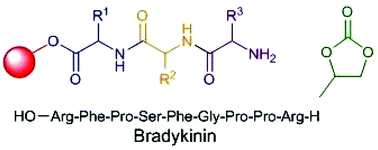
The synthesis of peptides by amide bond formation between suitably protected amino acids is a fundamental part of the drug discovery process. However, the required coupling and deprotection reactions are routinely carried out in dichloromethane and DMF, both of which have serious toxicity concerns and generate waste solvent which constitutes the vast majority of the waste generated during peptide synthesis. In this work, propylene carbonate has been shown to be a green polar aprotic solvent which can be used to replace dichloromethane and DMF in both solution- and solid-phase peptide synthesis. Solution-phase chemistry was carried out with Boc/benzyl protecting groups to the tetrapeptide stage, no epimerisation occurred during these syntheses and chemical yields for both coupling and deprotection reactions in propylene carbonate were at least comparable to those obtained in conventional solvents. Solid-phase peptide synthesis was carried out using Fmoc protected amino acids on a ChemMatrix resin and was used to prepare the biologically relevant nonapeptide bradykinin with comparable purity to a sample prepared in DMF.

Graphical abstract: The greening of peptide synthesis
Boc-Ala-Phe-OBn 5a    ref S1
Boc-Ala-OH (324 mg, 1.71 mmol) and HCl.H-Phe-OBn (500 mg, 1.71 mmol) were coupled according to the general coupling procedure. The residue was purified using flash column chromatography (35:65, EtOAc:PE) to give Boc-Ala-Phe-OBn 5a as a white crystalline solid (682 mg, 93%). RF = 0.34 (40:60, EtOAc:PE);
mp 95.6-96.3 °C;
[α]D 23 -27.7 (c 1.0 in MeOH);
IR (Neat) νmax 3347 (m), 3063 (w), 3029 (w), 2928 (m), 2852 (w), 1735 (w), 1684 (w) 1666 (w) and 1521 (s) cm-1;
1H NMR (400 MHz, CDCl3): δ = 7.36-7.31 (m, 3H, ArH), 7.29-7.24 (m, 2H, ArH), 7.26-7.21 (m, 3H, ArH), 7.04-6.97 (m, 2H, ArH), 6.72 (d J 7.7 Hz, 1H, Phe-NH), 5.16-5.10 (m, 1H, Ala-NH), 5.13 (d J 12.1 Hz, 1H, OCH2Ph), 5.07 (d J 12.1 Hz, 1H, OCH2Ph), 4.88 (dt, J 7.7, 5.9 1H, PheNCH), 4.11 (br, 1H, Ala-NCH), 3.13 (dd J 13.9, 6.1 Hz, 1H, CH2Ph), 3.08 (dd J 13.9, 6.1 Hz, 1H, CH2Ph), 1.41 (s, 9H, C(CH3)3), 1.29 (d J 6.6 Hz, 3H, CH3);
13C NMR (100 MHz, CDCl3): δ = 172.3 (C=O), 171.2 (C=O), 155.6 (NC=O), 135.7 (ArC), 135.1 (ArC), 129.5 (ArCH), 128.7 (ArCH), 128.6 (ArCH), 127.2 (ArCH), 80.2 (CMe3), 67.4 (OCH2Ph), 53.3 (Phe-NCH), 50.3 (Ala-NCH), 38.0 (CH2Ph), 28.4 (C(CH3)3), 18.5 (CH3);
MS (ESI) m/z 449 [(M+Na)+ , 100]; HRMS (ESI) m/z calculated for C24H30N2O5Na 449.2048 (M+Na)+ , found 449.2047 (0.6 ppm error).
S1 J. Nam, D. Shin, Y. Rew and D. L. Boger, J. Am. Chem. Soc., 2007, 129, 8747–8755; Q. Wang, Y. Wang and M. Kurosu, Org. Lett., 2012, 14, 3372–3375.
General procedure for peptide coupling reactions in PC To a suspension of an N-Boc-amino acid (1.0 eq.) and an amino acid or peptide benzyl ester (1.0 eq.) in PC (5 mL mmol-1), at 0 °C, was added a solution of HOBt (1.1 eq.) and i Pr2EtN (3.0 eq.) in a minimal quantity of PC. EDC (1.1 eq.) was added dropwise and the reaction mixture was allowed to stir at room temperature for 16h. The reaction mixture was then diluted using EtOAc (50 mL) and washed with 1M HClaq (3 × 25 mL), saturated Na2CO3 (3 × 25 mL) and H2O (3 × 25 mL). The organic layer was dried (MgSO4 ), filtered and concentrated in vacuo. Any residual PC was removed via short path distillation. Purification details for each peptide and characterising data are given in the supplementary information. General procedure for Boc deprotections in PC An N-Boc-peptide benzyl ester (1.0 eq.) was dissolved in a minimum amount of PC and trifluoroacetic acid (60 eq.) was added. The reaction mixture was allowed to stir for 3h. at room temperature before being concentrated in vacuo. Any residual PC was removed via short path distillation. Characterising data for each deprotected peptide are given in the supplementary information.
Procedure for Boc deprotection of dipeptide 5a using HCl in PC Boc-Ala-Phe-OBn 5a (50 mg, 0.117 mmol) was dissolved in PC (2.34 mL). MeOH (0.40 mL, 9.8 mmol) was added and the solution cooled to 0 o C. Acetyl chloride (0.67 mL, 9.36 mmol) was added dropwise and the solution allowed to stir at room temperature for 2h. Then, PC was removed by short path distillation. The residue was suspended in Et2O and stirred for 5 minutes before being filtered to give HCl.Ala-Ph-OBn as a white solid (32.4 mg, 76%).
Propylene carbonate 1 has been shown to be a green replacement for reprotoxic amide based solvents which are widely used in peptide synthesis. Both solution- and solidphase peptide synthesis can be carried out in propylene carbonate using acid and base labile amine protecting groups respectively. No significant racemisation of the activated amino acids occurs in propylene carbonate and the viability of solid-phase peptide synthesis in propylene carbonate was demonstrated by the synthesis of the nonapeptide bradykinin.
///////////

Debio-1452


Image result for Debio-1452

Debio-1452, AFN 1252

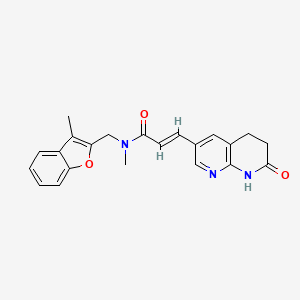
AFN-1252; UNII-T3O718IKKM; API-1252; CAS 620175-39-5; CHEMBL1652621; (E)-N-methyl-N-((3-methylbenzofuran-2-yl)methyl)-3-(7-oxo-5,6,7,8-tetrahydro-1,8-naphthyridin-3-yl)acrylamide

  • MFC22 H21 N3 O3
  • 2-Propenamide, N-methyl-N-[(3-methyl-2-benzofuranyl)methyl]-3-(5,6,7,8-tetrahydro-7-oxo-1,8-naphthyridin-3-yl)-, (2E)-
  •  MW375.42
  • Phase 2, clinical trials for the oral treatment of staphylococcal infections, including hospital and community-acquired MRSA and acute bacterial skin and skin structure infections
  • Qualified Infectious Disease Product designation

GlaxoSmithKline plc INNOVATOR

Image result

Debiopharm SA,

Image result for DEBIOPHARM

Image result for Affinium

Melioidosis, Enoyl ACP reductase Fabl inhibitor

Debio-1452, a novel class fatty acid biosynthesis (FAS) II pathway inhibitor, was studied in phase II clinical trials for the oral treatment of staphylococcal infections, including hospital and community-acquired MRSA and acute bacterial skin and skin structure infections. Debiopharm is developing oral and IV formulations of a prodrug of Debio-1452, Debio-1450.

Infections caused by or related to bacteria are a major cause of human illness worldwide. Unfortunately, the frequency of resistance to standard antibacterials has risen dramatically over the last decade, especially in relation to Staphylococcus aureus. For example, such resistant S. aureus includes MRSA, resistant to methicillin, vancomycin, linezolid and many other classes of antibiotics, or the newly discovered New Delhi metallo-beta-lactamase- 1 (NDM-1) type resistance that has shown to afford bacterial resistant to most known antibacterials, including penicillins, cephalosporins, carbapenems, quinolones and fluoroquinolones, macrolides, etc. Hence, there exists an urgent, unmet, medical need for new agents acting against bacterial targets..

In recent years, inhibitors of Fabl, a bacterial target involved in bacterial fatty acid synthesis, have been developed and many have been promising in regard to their potency and tolerability in humans, including a very promising Fabl inhibitor, (E)-N-methyl-N-((3-methylbenzofuran-2-yl)methyl)-3-(7-oxo-5,6,7,8-tetrahydro-l,8-naphthyridin-3-yl)acrylamide. This compound, however, has been found to be difficult or impracticable to formulate into acceptable oral and parenteral (e.g., intravenous or subcutaneous) formulations, and has marked insolubility, poor solution stability, and oral bioavailability. Much effort, over a decade or more, has been expended to design and synthesize an alternative compound that retains the significant inhibition of Fabl upon administration, but has improved physical and chemical characteristics that finally allow for practical oral and parenteral formulations. Up to now, no such compound has been identified that has adequate stability in the solid state, in aqueous solutions, together with excellent oral bioavailability that is necessary for oral and/or a parenteral administration, and is capable of being formulated into an oral and/or intravenous or intramuscular drug product using practical and commonly utilized methods of sterile formulation manufacture.

Debio-1452 is expected to have high potency against all drug-resistant phenotypes of staphylococci, including hospital and community-acquired MRSA.

Affinium obtained Debio-1452, also known as API-1252, through a licensing deal with GlaxoSmithKline. In 2014, Debiopharm acquired the product from Affinium.

In 2013, Qualified Infectious Disease Product designation was assigned to the compound for the treatment of acute bacterial skin and skin structure infections (ABSSSI).

Image result for Debio-1452

Image result for Debio-1452

AFN-1252.png

SYNTHESIS

Heck coupling of 6-bromo-3,4-dihydro-1,8-naphthyridin-2-one with t-butyl acrylate in the presence of Pd(OAc)2, DIEA and P(o-tol)3  in propionitrile/DMF or acetonitrile/DMF affords naphthyridinyl-acrylate,

Whose t-butyl ester group is then cleaved using TFA in CH2Cl2 to furnish, after treatment with HCl in dioxane, 3-(7-oxo-6,8-dihydro-5H-1,8-naphthyridin-3-yl)acrylic acid hydrochloride

SEE BELOW………

Finally, coupling of acid with N-methyl-N-(3-methylbenzofuran-2-ylmethyl)amine using EDC, HOBt and DIEA in DMF provides the target AFN-1252

Preparation of N-methyl-N-(3-methylbenzofuran-2-ylmethyl)amine :

Chlorination of 3-methylbenzofuran-2-carboxylic acid  with (COCl)2 and catalytic DMF, followed by condensation with CH3NH2 in CH2Cl2 yields the corresponding benzofuran-2-carboxamide,

Which is then reduced with LiAlH4 in THF to furnish N-methyl-N-(3-methylbenzofuran-2-ylmethyl)amine.

CONTD……..

Reduction of 2-aminonicotinic acid  with LiAlH4 in THF gives (2-amino-3-pyridinyl)methanol ,

which upon bromination with Br2 in AcOH yields (2-amino-5-bromo-3-pyridinyl)methanol hydrobromide.

Substitution of alcohol  with aqueous HBr at reflux provides the corresponding bromide,

which undergoes cyclocondensation with dimethyl malonate  in the presence of NaH in DMF/THF to furnish methyl 6-bromo-2-oxo-1,2,3,4-tetrahydro-1,8-naphthyridine-3-carboxylate.

Hydrolysis of ester with NaOH in refluxing MeOH, followed by decarboxylation in refluxing HCl leads to 6-bromo-3,4-dihydro-1,8-naphthyridin-2-one

PATENT

US-20170088822

Image result for Aurigene Discovery Technologies Ltd

Aurigene Discovery Technologies Ltd

Novel co-crystalline polymorphic form of a binary enoyl-acyl carrier protein reductase (FabI) and FabI inhibitor ie AFN-1252. The FabI was isolated from Burkholderia pseudomallei (Bpm). The co-crystal is useful for identifying an inhibitor of FabI, which is useful for treating BpmFabI associated disease ie melioidosis. Appears to be the first patenting to be seen from Aurigene Discovery Technologies or its parent Dr Reddy’s that focuses on BpmFabI crystal; however, see WO2015071780, claiming alkylidine substituted heterocyclyl derivatives as FabI inhibitors, useful for treating bacterial infections. Aurigene was investigating FabI inhibitors, for treating infectious diseases, including bacterial infections such as MRSA infection, but its development had been presumed to have been discontinued since December 2015; however, publication of this application would suggest otherwise.

WO2015071780

PATENTS

US 20060142265

http://www.google.co.in/patents/US20060142265

PATENT

https://patentscope.wipo.int/search/en/detail.jsf?docId=WO2013190384&recNum=1&maxRec=&office=&prevFilter=&sortOption=&queryString=&tab=PCTDescription

Patent ID Patent Title Submitted Date Granted Date
US8901105 Prodrug derivatives of (E)-N-methyl-N-((3-M ethylbenzofuran-2-yl)methyl)-3-(7-oxo-5, 6, 7, 8-tetrahydro-1, 8-naphthyridin-3-yl)acrylamide 2013-08-26 2014-12-02
US2015065415 PRODRUG DERIVATIVES OF (E)-N-METHYL-N-((3-METHYLBENZOFURAN-2-YL)METHYL)-3-(7-OXO-5, 6, 7, 8-TETRAHYDRO-1, 8-NAPHTHYRIDIN-3-YL)ACRYLAMIDE 2014-11-06 2015-03-05
Patent ID Patent Title Submitted Date Granted Date
US7049310 Fab I inhibitors 2004-07-29 2006-05-23
US7250424 Fab I inhibitors 2006-06-01 2007-07-31
US7879872 Compositions comprising multiple bioactive agents, and methods of using the same 2006-06-29 2011-02-01
US2009042927 Salts, Prodrugs and Polymorphs of Fab I Inhibitors 2009-02-12
US7741339 Fab I Inhibitors 2009-09-03 2010-06-22
US8153652 Fab I Inhibitors 2011-04-28 2012-04-10
US2012010127 Compositions Comprising Multiple Bioactive Agents, and Methods of Using the Same 2012-01-12
US2013281442 Compounds for Treatment of Bovine Mastitis 2011-06-13 2013-10-24
US2013150400 SALTS, PRODRUGS AND POLYMORPHS OF FAB I INHIBITORS 2012-08-09 2013-06-13
US2014309191 SALTS, PRODRUGS AND POLYMORPHS OF FAB I INHIBITORS 2013-11-08 2014-10-16

////////////Debio-1452, AFN 1252,AFN-1252, UNII-T3O718IKKM, API-1252, 620175-39-5, PRECLINICAL, Phase 2, Qualified Infectious Disease Product designation

CC1=C(OC2=CC=CC=C12)CN(C)C(=O)C=CC3=CC4=C(NC(=O)CC4)N=C3