New Drug Approvals

Home » 2013 (Page 8)

Yearly Archives: 2013

DRUG APPROVALS BY DR ANTHONY MELVIN CRASTO .....FOR BLOG HOME CLICK HERE

Blog Stats

  • 4,803,870 hits

Flag and hits

Flag Counter

Enter your email address to follow this blog and receive notifications of new posts by email.

Join 37.9K other subscribers
Follow New Drug Approvals on WordPress.com

Archives

Categories

Recent Posts

Flag Counter

ORGANIC SPECTROSCOPY

Read all about Organic Spectroscopy on ORGANIC SPECTROSCOPY INTERNATIONAL 

Enter your email address to follow this blog and receive notifications of new posts by email.

Join 37.9K other subscribers
DR ANTHONY MELVIN CRASTO Ph.D

DR ANTHONY MELVIN CRASTO Ph.D

DR ANTHONY MELVIN CRASTO, Born in Mumbai in 1964 and graduated from Mumbai University, Completed his Ph.D from ICT, 1991,Matunga, Mumbai, India, in Organic Chemistry, The thesis topic was Synthesis of Novel Pyrethroid Analogues, Currently he is working with AFRICURE PHARMA, ROW2TECH, NIPER-G, Department of Pharmaceuticals, Ministry of Chemicals and Fertilizers, Govt. of India as ADVISOR, earlier assignment was with GLENMARK LIFE SCIENCES LTD, as CONSUlTANT, Retired from GLENMARK in Jan2022 Research Centre as Principal Scientist, Process Research (bulk actives) at Mahape, Navi Mumbai, India. Total Industry exp 32 plus yrs, Prior to joining Glenmark, he has worked with major multinationals like Hoechst Marion Roussel, now Sanofi, Searle India Ltd, now RPG lifesciences, etc. He has worked with notable scientists like Dr K Nagarajan, Dr Ralph Stapel, Prof S Seshadri, etc, He did custom synthesis for major multinationals in his career like BASF, Novartis, Sanofi, etc., He has worked in Discovery, Natural products, Bulk drugs, Generics, Intermediates, Fine chemicals, Neutraceuticals, GMP, Scaleups, etc, he is now helping millions, has 9 million plus hits on Google on all Organic chemistry websites. His friends call him Open superstar worlddrugtracker. His New Drug Approvals, Green Chemistry International, All about drugs, Eurekamoments, Organic spectroscopy international, etc in organic chemistry are some most read blogs He has hands on experience in initiation and developing novel routes for drug molecules and implementation them on commercial scale over a 32 PLUS year tenure till date Feb 2023, Around 35 plus products in his career. He has good knowledge of IPM, GMP, Regulatory aspects, he has several International patents published worldwide . He has good proficiency in Technology transfer, Spectroscopy, Stereochemistry, Synthesis, Polymorphism etc., He suffered a paralytic stroke/ Acute Transverse mylitis in Dec 2007 and is 90 %Paralysed, He is bound to a wheelchair, this seems to have injected feul in him to help chemists all around the world, he is more active than before and is pushing boundaries, He has 100 million plus hits on Google, 2.5 lakh plus connections on all networking sites, 100 Lakh plus views on dozen plus blogs, 227 countries, 7 continents, He makes himself available to all, contact him on +91 9323115463, email amcrasto@gmail.com, Twitter, @amcrasto , He lives and will die for his family, 90% paralysis cannot kill his soul., Notably he has 38 lakh plus views on New Drug Approvals Blog in 227 countries......https://newdrugapprovals.wordpress.com/ , He appreciates the help he gets from one and all, Friends, Family, Glenmark, Readers, Wellwishers, Doctors, Drug authorities, His Contacts, Physiotherapist, etc He has total of 32 International and Indian awards

Verified Services

View Full Profile →

Archives

Categories

Flag Counter

Anakinra licensed in UK to treat CAPS in infants and adults


The Medicines and Healthcare Products Regulatory Agency (MHRA) in the UK has granted a licence to an interleukin-1 (IL-1) inhibitor Anakinra (Kineret) for the treatment of cryopyrin-associated periodic syndromes (CAPS) in adults and children as young as eight months.

Anakinra (brand name Kineret) is a drug used to treat rheumatoid arthritis.[1] It is aninterleukin-1 (IL-1) receptor antagonist.

Anakinra is an interleukin-1 (IL-1) receptor antagonist.Anakinra blocks the biologic activity of naturally occurring IL-1, including inflammation and cartilage degradation associated with rheumatoid arthritis, by competitively inhibiting the binding of IL-1 to the Interleukin-1 type receptor, which is expressed in many tissues and organs. IL-1 is produced in response to inflammatory stimuli and mediates various physiologic responses, including inflammatory and immunologic reactions. IL-1 additionally stimulates bone resorption and induces tissue damage like cartilage degradation as a result of loss ofproteoglycans. In patients with rheumatoid arthritis the natural IL-1 receptor antagonist is not found in effective concentrations in synovium and synovial fluid to counteract the elevated IL-1 concentrations in these patients.

Anakinra is not considered a ‘Disease-modifying antirheumatic drug‘ (DMARD) but rather a ‘Biological Response Modifier’ (BRM) because its able to selectively target the pathologic element of the disease.


Baxter seeks FDA approval of Rixubis in paediatric hemophilia B patients


Baxter International has filed an application to the US Food and Drug Administration (FDA) for a paediatric indication for Rixubis, Coagulation Factor IX (Recombinant), for the treatment of hemophilia B.

http://www.pharmaceutical-technology.com/news/newsbaxter-seeks-fda-approval-of-rixubis-in-pediatric-hemophilia-b-patients-4143322?WT.mc_id=DN_News

old article

Rixubis [Coagulation Factor IX (Recombinant)]

June 27, 2013 — The U.S. Food and Drug Administration yesterday approved Rixubis [Coagulation Factor IX (Recombinant)] for use in people with hemophilia B who are 16 years of age and older. Rixubis is indicated for the control and prevention of bleeding episodes, perioperative (period extending from the time of hospitalization for surgery to the time of discharge) management, and routine use to prevent or reduce the frequency of bleeding episodes (prophylaxis).

read all at

http://www.drugs.com/newdrugs/fda-approves-rixubis-first-recombinant-coagulation-factor-ix-preventing-bleeding-episodes-3830.html

US Approves Breakthrough Hepatitis C Drug, Sofosbuvir » All About Drugs


SOFOSBUVIR

DO NOT FORGET TO CLICK

US Approves Breakthrough Hepatitis C Drug, Sofosbuvir » All About Drugs

AND ALSO

DO NOT FORGET TO CLICK

SEE………………….http://orgspectroscopyint.blogspot.in/2015/02/sofosbuvir-visited.html

READ ABOUT SYNTHESIS BY CLICKING ABOVE LINK


Sofosbuvir

Sovaldi

M.Wt: 529.45

Formula: C22H29FN3O9P

Isopropyl (2S)-2-[[[(2R,3R,4R,5R)-5-(2,4-dioxopyrimidin-1-yl)-4-fluoro-3-hydroxy-4-methyl-tetrahydrofuran-2-yl]methoxy-phenoxy-phosphoryl]amino]propanoate

A prodrug of 2′-deoxy-2′-alpha-F-2′-beta-C-methyluridine 5′-monophosphate.
GS-7977, PSI-7977

  • GS 7977
  • GS-7977
  • PSI 7977
  • PSI-7977
  • Sofosbuvir
  • Sovaldi
  • UNII-WJ6CA3ZU8B

CAS Registry Number :1190307 -88-0

http://www.ama-assn.org/resources/doc/usan/sofosbuvir.pdf

Indications: Chronic hepatitis C (HCV GT1, GT2, GT3, GT4)
Mechanism: nucleoside NS5B polymerase inhibitor
approved Time: December 6, 2013
,U.S. Patent Number: 7964580,8415322,8334270,7429572;, patent validity: March 26, 2029 (U.S. Patent No.: 7,964,580 and 8,334,270), April 3, 2025 (U.S. Patent No.: 7,429,572 and 8,415,322)

US patent number 7964580, US patent number 8415322, US patent number 8334270,US patent number 7429572 Patent Expiration Date: March 26, 2029 for US patent number 7964580 and 8334270 (2028 in EU); April 3, 2025 for US patent number 7429572 and 8415322

Sales value (estimated): $ 1.9 billion (2014), 6600000000 USD (2016)

Drug Companies: Gilead Sciences, Inc. (Gilead Sciences)

WASHINGTON, Dec. 6, 2013 (AP) — Federal health officials have approved a highly anticipated hepatitis C drug from Gilead Sciences Inc. that is expected to offer a faster, more palatable cure to millions of people infected with the liver-destroying virus.

The Food and Drug Administration said Friday it approved the pill Sovaldi in combination with older drugs to treat the main forms of hepatitis C that affect U.S. patients.

Current treatments for hepatitis C can take up to a year of therapy and involve weekly injections of a drug that causes flu-like side effects. That approach only cures about three out of four patients. Sovaldi is a daily pill that in clinical trials cured roughly 90 percent of patients in just 12 weeks, when combined with the older drug cocktail.http://www.pharmalive.com/us-approves-breakthrough-hepatitis-c-drug

  • The end of October 2013 saw a nod from the FDA given to Gilead’s New Drug Application for Sofosbuvir, a much needed treatment for hepatitis C.
  • As a nucleotide analogue, Sofosbuvir is designed as a once daily treatment.
  • There are roughly 170 million cases of hepatitis C around the world.
  • A report in the Journal of the American Medical Association on August 28, 2013 revealed that the Sofosbuvir and Ribavirin combination treatment effectively cured many patients with the Hepatitis C Virus.
  • The Sofosbuvir and Ribavirin drug combination was void of interferon-based treatments, which  many patients are resistant too.
  • More than 3 million Americans have chronic Hepatitis C Virus, and 22 percent of these patients are African American.

Sofosbuvir (brand names Sovaldi and Virunon) is a drug used for hepatitis C virus (HCV) infection, with a high cure rate.[1][2] It inhibits the RNA polymerase that the hepatitis C virus uses to replicate its RNA. It was discovered at Pharmasset and developed by Gilead Sciences.[3]

Sofosbuvir is a component of the first all-oral, interferon-free regimen approved for treating chronic Hepatitis C.[4]

In 2013, the FDA approved sofosbuvir in combination with ribavirin (RBV) for oral dual therapy of HCV genotypes 2 and 3, and for triple therapy with injected pegylated interferon (pegIFN) and RBV for treatment-naive patients with HCV genotypes 1 and 4.[4] Sofosbuvir treatment regimens last 12 weeks for genotypes 1, 2 and 4, compared to 24 weeks for treatment of genotype 3. The label furhter states that sofosbuvir in combination with ribavirin may be considered for patients infected with genotype 1 who are interferon-ineligible.[5] Sofosbuvir will cost $84,000 for 12 weeks of treatment and $168,000 for the 24 weeks, which some patient advocates have criticized as unaffordable.

Interferon-free therapy for treatment of hepatitis C eliminates the substantial side-effects associated with use of interferon. Up to half of hepatitis C patients cannot tolerate the use of interferon.[6]

Sofosbuvir is a prodrug that is metabolized to the active antiviral agent 2′-deoxy-2′-α-fluoro-β-C-methyluridine-5′-triphosphate.[7] Sofosbuvir is anucleotide analog inhibitor of the hepatitis C virus (HCV) polymerase.[8] The HCV polymerase or NS5B protein is a RNA-dependent RNA polymerase critical for the viral cycle.

The New Drug Application for Sofosbuvir was submitted on April 8, 2013 and received the FDA’s Breakthrough Therapy Designation, which grants priority review status to drug candidates that may offer major treatment advantages over existing options.[9]

On 6th December 2013, the U.S. Food and Drug Administration approved sofosbuvir for the treatment of chronic hepatitis C.[10]

Sofosbuvir is being studied in combination with pegylated interferon and ribavirin, with ribavirin alone, and with other direct-acting antiviral agents.[11][12] It has shown clinical efficacy when used either with pegylated interferon/ribavirin or in interferon-free combinations. In particular, combinations of sofosbuvir with NS5A inhibitors, such as daclatasvir or GS-5885, have shown sustained virological response rates of up to 100% in people infected with HCV.[13]

Data from the ELECTRON trial showed that a dual interferon-free regimen of sofosbuvir plus ribavirin produced a 24-week post-treatment sustained virological response (SVR24) rate of 100% for previously untreated patients with HCV genotypes 2 or 3.[14][15]

Data presented at the 20th Conference on Retroviruses and Opportunistic Infections in March 2013 showed that a triple regimen of sofosbuvir, ledipasvir, and ribavirin produced a 12-week post-treatment sustained virological response (SVR12) rate of 100% for both treatment-naive patients and prior non-responders with HCV genotype 1.[16] Gilead has developed a sofosbuvir + ledipasvir coformulation that is being tested with and without ribavirin.

Sofosbuvir will cost $84,000 for 12 weeks of treatment used for genotype 1 and 2, and $168,000 for the 24 weeks used for genotype 3.[17] This represents a substantial pricing increase from previous treatments consisting of interferon and ribavirin, which cost between $15,000 and $20,000.[18] The price is also significantly higher than that of Johnson & Johnson‘s recently approved drug simeprevir (Olysio), which costs $50,000 and also treats chronic hepatitis C.[18] The high cost of the drug has resulted in a push back from insurance companies and the like, includingExpress Scripts, which has threatened to substitute lower priced competitors, even if those therapies come with a more unfriendly dosing schedule.[18] Other treatments that have recently entered the market have not matched the efficacy of sofosbuvir, however, allowing Gilead to set a higher price until additional competition enters the market.[18] Patient advocates such as Doctors Without Borders have complained about the price, which is particularly difficult for underdeveloped countries to afford.[19]
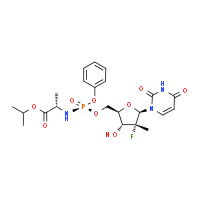
ChemSpider 2D Image | Sofosbuvir | C22H29FN3O9P

sofosbuvir

  1.  News: United States to approve potent oral drugs for hepatitis C, Sara Reardon, Nature, 30 October 2013
  2.  Sofia MJ, Bao D, Chang W, Du J, Nagarathnam D, Rachakonda S, Reddy PG, Ross BS, Wang P, Zhang HR, Bansal S, Espiritu C, Keilman M, Lam AM, Steuer HM, Niu C, Otto MJ, Furman PA (October 2010). “Discovery of a β-d-2′-deoxy-2′-α-fluoro-2′-β-C-methyluridine nucleotide prodrug (PSI-7977) for the treatment of hepatitis C virus”. J. Med. Chem. 53 (19): 7202–18.doi:10.1021/jm100863xPMID 20845908.
  3.  “PSI-7977”. Gilead Sciences.
  4. Tucker M (December 6, 2013). “FDA Approves ‘Game Changer’ Hepatitis C Drug Sofosbuvir”. Medscape.
  5.  “U.S. Food and Drug Administration Approves Gilead’s Sovaldi™ (Sofosbuvir) for the Treatment of Chronic Hepatitis C – See more at: http://www.gilead.com/news/press-releases/2013/12/us-food-and-drug-administration-approves-gileads-sovaldi-sofosbuvir-for-the-treatment-of-chronic-hepatitis-c#sthash.T9uTbSWK.dpuf”. Gilead. December 6, 2013.
  6.  “Sofosbuvir is safer than interferon for hepatitis C patients, say scientists”. News Medical. April 25, 2013.
  7.  Murakami E, Tolstykh T, Bao H, Niu C, Steuer HM, Bao D, Chang W, Espiritu C, Bansal S, Lam AM, Otto MJ, Sofia MJ, Furman PA (November 2010). “Mechanism of activation of PSI-7851 and its diastereoisomer PSI-7977”J. Biol. Chem. 285 (45): 34337–47.doi:10.1074/jbc.M110.161802PMC 2966047PMID 20801890.
  8.  Alejandro Soza (November 11, 2012). “Sofosbuvir”. Hepaton.
  9.  “FDA Advisory Committee Supports Approval of Gilead’s Sofosbuvir for Chronic Hepatitis C Infection”Drugs.com. October 25, 2013.
  10.  “FDA approves Sovaldi for chronic hepatitis C”FDA New Release. U.S. Food and Drug Administration. 2013-12-06.
  11.  Murphy T (November 21, 2011). “Gilead Sciences to buy Pharmasset for $11 billion”.Bloomberg Businessweek.
  12.  Asselah T (January 2014). “Sofosbuvir for the treatment of hepatitis C virus”. Expert Opin Pharmacother 15 (1): 121–30. doi:10.1517/14656566.2014.857656PMID 24289735.
  13.  “AASLD 2012: Sofosbuvir and daclatasvir dual regimen cures most people with HCV genotypes 1, 2, or 3”News. European Liver Patients Association. 2012-11-21.
  14.  AASLD: PSI-7977 plus Ribavirin Can Cure Hepatitis C in 12 Weeks without Interferon. Highleyman, L. HIVandHepatitis.com. 8 November 2011.
  15.  Gane EJ, Stedman CA, Hyland RH, Ding X, Svarovskaia E, Symonds WT, Hindes RG, Berrey MM (January 2013). “Nucleotide polymerase inhibitor sofosbuvir plus ribavirin for hepatitis C”.N. Engl. J. Med. 368 (1): 34–44. doi:10.1056/NEJMoa1208953PMID 23281974.
  16.  CROI 2013: Sofosbuvir + Ledipasvir + Ribavirin Combo for HCV Produces 100% Sustained Response. Highleyman, L. HIVandHepatitis.com. 4 March 2013.
  17.  Campbell T (December 11, 2013). “Gilead’s Sofosbuvir Gets New Name, Price, Headaches”. The Motley Fool.
  18.  Cohen, J. (2013). “Advocates Protest the Cost of a Hepatitis C Cure”. Science 342 (6164): 1302–1303. doi:10.1126/science.342.6164.1302PMID 24337268edit

The chemical structure

Chemical Structure of Sovaldi_Sofosbuvir_Hepatatis C-Gilead

GS-7977, (S)-isopropyl 2-(((S)-(((2R,3R,4R,5R)-5-(2,4-dioxo-3,4- dihydropyrimidin^l(2H)-yl)-4-fluoro-3-hydroxy-4-methyltetrahydrofuran-2- yl)methoxy)(phenoxy)phosphoryl)amino)propanoate, available from Gilead Sciences, Inc., is described and claimed in U.S. Patent No. 7,964,580. (See also US 2010/0016251, US 2010/0298257, US 201 1/0251 152 and US 2012/0107278.) GS-7977 has the structure:

Figure imgf000013_0001

GS-7977 can be crystalline or amorphous. Examples of preparing crystalline and amorphous forms of GS-7977 are disclosed in US 2010/0298257 (US 12/783,680) and US 201 1/0251 152 (US 13/076,552),

Chemical Synthesis of Sofosbuvir_Sovaldi_GS-7977_PSI-7977_Hepatitis C_Gilead

Commerically available isopropylidine protected D-glyceraldehyde was reacted with (carbethoxyethylidene)triphenylmethylphosphorane gave the chiral pentenoate ester YP-1. Permanganate dihydroxylation of YP-1 in acetone gave the D-isomer diol YP-2. The cyclic sulfate YP-3 was obtained by first making the cyclic sulfite with thionyl chloride and then oxidizing to cyclic sulfate with sodium hypochlorite. Fluorination of YP-3 with triethylamine-trihydrofluoride(TEA-3HF) in the presence of triethylamine, followed by the hydrolysis of sulfate ester in the presence of concentrated HCl provided diol YP-4 which was benzoylated to give ribonolactone YP-5. Reduction of YP-5 with Red-Al followed by chlorination with sulfuryl chloride in the presence of catalytic amount of tetrabutylammonium bromide yielded YP-6. The conversion of YP-6 to benzoyl protected 2′-deoxyl-2′-alpha-F-2′-Beta-C-methylcytidine (YP-7) was achieved by using O-trimethyl silyl-N4-benzoylcytosine and stannic chloride. Preparation of the uridine nucleoside YP-8 was accomplished by first heating benzoyl cytidine YP-7 in acetic acid then treating with methoanolic ammonia to provide YP-8 in 78% yield.

The phosphoramidating reagent YP-9 was obtained by first reacting phenyldichlorophosphate with L-Alanine isopropyl ester hydrochloride and then with pentafluorophenol. Isolation of single Sp diastereomer YP-9 was achieved via crystallization-induced dynamic resolution in the presence of 20% MTBE/hexane at room temperature.

The uridine nucleoside YP-8 was treated with tert-butylmagnesium chloride in dry THF, followed by pentafluorophenyl Sp diastereomer YP-9 to furnish the Isopropyl (2S)-2-[[[(2R,3R,4R,5R)-5-(2,4-dioxopyrimidin-1-yl)-4-fluoro-3-hydroxy-4-methyl-tetrahydrofuran-2-yl]methoxy-phenoxy-phosphoryl]amino]propanoate (Sovaldi, sofosbuvir, GS-7977, PSI-7977)。

…………

US 7429572

US  8415322

US 7964580

US 8334270B

WO 2006012440

WO 2011123668

US8334270

/US20080139802

……………………………………………

In US 20050009737 published Jan. 13, 2005, J. Clark discloses fluoro-nucleoside derivatives that inhibit Hepatitis C Virus (HCV) NS5B polymerase. In particular, 4-amino-1-((2R,3R,4R,5R)-3-fluoro-4-hydroxy-5-hydroxymethyl-3-methyl-tetrahydro-faran-2-yl)-1H-pyrimidin-2-one (18) was a particularly potent inhibitor of HCV polymerase as well as the polymerase of other Flaviviridae.

Figure US20080139802A1-20080612-C00002

In WO2006/012440 published Feb. 2, 2006, P. Wang et al disclose processes for the preparation of 18. Introduction of the cytosine is carried out utilizing the Vorbruggen protocol. In US 20060122146 published Jun. 8, 2006, B.-K. Chun et al. disclose and improved procedures for the preparation of the 2-methyl-2-fluoro-lactone 10. In the latter disclosure the nucleobase is glycosylated by reacting with ribofuranosyl acetate which is prepared by reduction of 10 with LiAlH(O-tert-Bu)followed by acetylaton of the intermediate lactol which was treated with an O-trimethylsilyl N4-benzoylcytosine in the presence of SnClto afford the O,O,N-tribenzoylated nucleoside.

……………………………………………………………….

http://www.google.nl/patents/US20080139802

The present process as described in SCHEME A and the following examples contain numerous improvements which have resulted in higher yields of the desired nucleoside. The asymmetric hydroxylation of 22 was discovered to be best carried out with sodium permanganate in the presence of ethylene glycol, sodium bicarbonate in acetone which afforded the diol in 60-64% on pilot plant scale. The sodium permanganate procedure avoids introduction of osmium into the process stream. Further more the stereospecific hydroxylation can be accomplished without using an expensive chiral ligand. The requisite olefin is prepared from (1S,2S)-1,2-bis-((R)-2,2-dimethyl-[1,3]dioxolan-4-yl)-ethane-1,2-diol (20) (C. R. Schmid and J. D. Bryant, Org. Syn. 1995 72:6-13) by oxidative cleavage of the diol and treating the resulting aldehyde with 2-(triphenyl-λ5-phosphanylidene)-propionic acid ethyl ester to afford 22.

Figure US20080139802A1-20080612-C00005

(i) NaIO4, NaHCO3, DCM; (ii) MeC(═PPh3)CO2Et; (iii) acetone-NaMnO(aq), ethylene glycol, NaHCO3, −10 to 0° C.; aq. NaHSO(quench); (iv) i-PrOAc, MeCN, TEA, SOCl2; (v) i-PrOAc, MeCN, NaOCl; (vi) TEA-3HF, TEA; (vii) HCl (aq)-BaCl2-aq; (viii) (PhCO)2O, DMAP, MeCN, (ix) RED-AL/TFE (1:1), DCM; (x) SO2Cl2-TBAB, DCM; (xi) 32, SnCl4-PhCl; (xii) MeOH-MeONa

EXAMPLE 3 (2S,3R)-3-[(4R)-2,2-dimethyl-[1,3]dioxolan-4-yl]-2,3-dihydroxy-2-methyl-propionic acid ethyl ester (24)

Figure US20080139802A1-20080612-C00008

A suspension of 22 (10 kg, CAS Reg. No. 81997-76-4), ethylene glycol (11.6 kg), solid NaHCO(11.8 kg) and acetone (150 L) is cooled to ca.-15° C. A solution of 36% aqueous NaMnO(19.5 kg) is charged slowly (over 4 h) to the suspension maintaining reaction temperature at or below −10° C. After stirring for 0.5 h at −10° C., an aliquot of the reaction mixture (ca. 5 mL) is quenched with 25% aqueous sodium bisulfite (ca. 15 mL). A portion of resulting slurry is filtered and submitted for GC analysis to check the progress of the reaction. When the reaction is complete, the reaction mixture is quenched by slow addition (over 40 min) of cooled (ca. 0° C.) 25% aqueous NaHSO(60 L). The temperature of the reaction mixture is allowed to reach 4° C. during the quench. CELITE® (ca. 2.5 kg) is then slurried in acetone (8 kg) and added to the dark brown reaction mixture. The resulting slurry is aged at RT to obtain light tan slurry. The slurry is filtered, and the filter cake is washed with acetone (3×39 kg). The combined filtrate is concentrated by vacuum distillation (vacuum approximately 24 inches of Hg; max pot temperature is 32° C.) to remove the acetone. The aqueous concentrate is extracted with EtOAc (3×27 kg), and the combined organic extracts were washed with water (25 L). The organic phase is then concentrated by atmospheric distillation and EtOAc is replaced with toluene. The volume of the batch is adjusted to ca. 20 L. Heptane (62 kg) is added and the batch cooled to ca. 27° C. to initiate crystallization. The batch is then cooled to −10° C. After aging overnight at −10° C., the product is filtered, washed with 10% toluene in heptane and dried at 50° C. under vacuum to afford 6.91 kg (59.5%) of 24 (CARN 81997-76-4) as a white crystalline solid.

EXAMPLE 4 (3R,4R,5R)-3-Fluoro-4-hydroxy-5-hydroxymethyl-3-methyl-dihydro-furan-2-one (10)

Figure US20080139802A1-20080612-C00009

steps 1 & 2—A dry, clean vessel was charged with 24 (6.0 kg), isopropyl acetate (28.0 kg), MeCN (3.8 kg) and TEA (5.4 kg). The mixture was cooled to 5-10° C., and thionyl chloride (3.2 kg) was added slowly while cooling the solution to maintain the temperature below 20° C. The mixture was stirred until no starting material was left (GC analysis). The reaction was typically complete within 30 min after addition is complete. To the mixture was added water (9 kg) and after stirring, the mixture was allowed to settle. The aqueous phase was discarded and the organic phase was washed with a mixture of water (8 kg) and saturated NaHCO(4 kg) solution. To the remaining organic phase containing 36 was added MeCN (2.5 kg) and solid NaHCO(3.1 kg). The resulting slurry was cooled to ca. 10° C. Bleach (NaOCl solution, 6.89 wt % aqueous solution, 52.4 kg, 2 eq.) was added slowly while cooling to maintain temperature below 25° C. The mixture was aged with stirring over 90-120 min at 20-25° C., until the reaction was complete (GC analysis). After completion of the reaction, the mixture was cooled to ca. 10° C. and then quenched with aqueous Na2SOsolution (15.1% w/w, 21 kg) while cooling to maintain temperature below 20° C. The quenched reaction mixture was filtered through a cartridge filter to remove inorganic solids. The filtrate was allowed to settle, and phases are separated and the aqueous phase is discarded. The organic layer was washed first with a mixture of water (11 kg) and saturated NaHCOsolution (4.7 kg), then with of saturated NaHCOsolution (5.1 kg). DIPEA (220 mL) was added to the organic phase and the resulting solution was filtered through CELITE® (bag filter) into a clean drum. The reactor was rinsed with isopropyl acetate (7 kg) and the rinse is transferred to the drum. The organic phase was then concentrated under vacuum (25-28 inches of Hg) while maintaining reactor jacket temperature at 45-50° C. to afford 26 as an oil (˜10 L). Additional DIPEA (280 mL) was added and the vacuum distillation was continued (jacket temperature 50-55° C.) until no more distillate was collected. (batch volume ca. 7 L).

step 3—To the concentrated oil from step 2 containing 26 was added TEA (2.34 kg) and TEA-trihydrofluoride (1.63 kg). The mixture was heated to 85° C. for 2 h. The batch was sampled to monitor the progress of the reaction by GC. After the reaction was complete conc. HCl (2.35 kg) was added to the mixture and the resulting mixture heated to ca. 90° C. (small amount of distillate collected). The reaction mixture was stirred at ca. 90° C. for 30 min and then saturated aqueous BaCl2solution (18.8 kg) was added. The resulting suspension was stirred at about 90° C. for 4 h. The resulting mixture was then azeotropically dried under a vacuum (9-10 inches of Hg) by adding slowly n-propanol (119 kg) while distilling off the azeotropic mixture (internal batch temperature ca. 85-90° C.). To the residual suspension was added toluene (33 kg) and vacuum distillation was continued to distill off residual n-propanol (and traces of water) to a minimum volume to afford 28.

step 4—To the residue from step 3 containing 28 was added MeCN (35 kg) and ca. 15 L was distilled out under atmospheric pressure. The reaction mixture was cooled to ca. 10° C. and then benzoyl chloride (8.27 kg) and DMAP (0.14 kg) are added. TEA (5.84 kg) was added slowly to the reaction mixture while cooling to maintain temperature below 40° C. The batch was aged at ca. 20° C. and the progress of the benzoylation is monitored by HPLC. After completion of the reaction, EtOAc (30 kg) was added to the mixture and the resulting suspension is stirred for about 30 min. The reaction mixture was filtered through a CELITE® pad (using a nutsche filter) to remove inorganic salts. The solid cake was washed with EtOAc (38 kg). The combined filtrate and washes were washed successively with water (38 kg), saturated NaHCOsolution (40 kg) and saturated brine (44 kg). The organic phase was polish-filtered (through a cartridge filter) and concentrated under modest vacuum to minimum volume. IPA (77 kg) was added to the concentrate and ca. 25 L of distillate was collected under modest vacuum allowing the internal batch temperature to reach ca. 75° C. at the end of the distillation. The remaining solution was then cooled to ca. 5° C. over 5 h and optionally aged overnight. The precipitate was filtered and washed with of cold (ca. 5° C.) IPA (24 kg). The product was dried under vacuum at 60-70° C. to afford 6.63 kg (70.7% theory of 10 which was 98.2% pure by HPLC.

EXAMPLE 1 Benzoic acid 3-benzoyloxy-5-(4-benzoylamino-2-oxo-2H-pyrimidin-1-yl)-4-fluoro-4-methyl-tetrahydro-furan-2-ylmethyl ester (14)

Figure US20080139802A1-20080612-C00006

Trifluoroethanol (4.08 kg) is added slowly to a cold solution (−15° C.) of RED-AL® solution (12.53 kg) and toluene (21.3 kg) while maintaining the reaction temperature at or below −10° C. After warming up to RT (ca. 20° C.), the modified RED-AL reagent mixture (30.1 kg out of the 37.6 kg prepared) is added slowly to a pre-cooled solution (−15° C.) of fluorolactone dibenzoate 10 (10 kg) in DCM (94.7 kg) while maintaining reaction temperature at or below −10° C. After reduction of the lactone (monitored by in-process HPLC), a catalytic amount of tetrabutylammonium bromide (90 g) is added to the reaction mixture. Sulfiiryl chloride (11.86 kg) is then added while maintaining reaction temperature at or below 0° C. The reaction mixture is then heated to 40° C. until formation of the chloride is complete (ca. 4 h) or warmed to RT (20-25° C.) and stirred over night (ca. 16 h). The reaction mixture is cooled to about 0° C., and water (100 L) is added cautiously while maintaining reaction temperature at or below 15° C. The reaction mixture is then stirred at RT for ca. 1 h to ensure hydrolytic decomposition of excess sulfuryl chloride and the phases are separated. The organic layer is washed with a dilute solution of citric acid (prepared by dissolving 15.5 kg of citric acid in 85 L of water) and then with dilute KOH solution (prepared by dissolving 15 kg of 50% KOH in 100 L of water). The organic phase is then concentrated and solvents are replaced with chlorobenzene (2×150 kg) via atmospheric replacement distillation. The resulting solution containing 30 is dried azeotropically.

A suspension of N-benzoyl cytosine (8.85 kg), ammonium sulfate (0.07 kg) and hexamethyldisilazane (6.6 kg) in chlorobenzene (52.4 kg) is heated to reflux (ca. 135° C.) and stirred (ca. 1 h) until the mixture becomes a clear solution. The reaction mixture is then concentrated in vacuo to obtain 32 as a syrupy liquid. The anhydrous solution of 30 in chlorobenzene (as prepared) and stannic chloride (28.2 kg) is added to this concentrate. The reaction mixture is maintained at about 70° C. until the desired coupling reaction is complete (ca. 10 h) as determined by in-process HPLC. Upon completion, the reaction mixture is cooled to RT and diluted with DCM (121 kg). This solution is added to a suspension of solid NaHCO(47 kg) and CELITE® (9.4 kg) in DCM (100.6 kg). The resulting slurry is cooled to 10-15° C., and water (8.4 kg) is added slowly to quench the reaction mixture. The resulting suspension is very slowly (caution: gas evolution) heated to reflux (ca. 45° C.) and maintained for about 30 min. The slurry is then cooled to ca. 15° C. and filtered. The filter cake is repeatedly reslurried in DCM (4×100 L) and filtered. The combined filtrate is concentrated under atmospheric pressure (the distillate collected in the process is used for reslurrying the filter cake) until the batch temperature rises to about 90° C. and then allowed to cool slowly to about −5° C. The resulting slurry is aged for at least 2 h at −5° C. The precipitated product is filtered and washed with IPA (30 kg+20 kg), and oven-dried in vacuo at about 70° C. to afford 8.8 kg (57.3%) of 1-(2-deoxy-2-fluoro-2-methyl-3-5-O-dibenzoyl-β-D-ribofuranosyl)-N-4-benzoylcytosine (14, CAS Reg No. 817204-32-3) which was 99.3% pure.

EXAMPLE 2 4-Amino-1-(3-fluoro-4-hydroxy-5-hydroxymethyl-3-methyl-tetrahydro-furan-2-yl)-1H-pyrimidin-2-one (18)

Figure US20080139802A1-20080612-C00007

A slurry of 14 (14.7 kg) in MeOH (92.6 kg) is treated with catalytic amounts of methanolic sodium methoxide (0.275 kg). The reaction mixture is heated to ca. 50° C. and aged (ca. 1 h) until the hydrolysis is complete. The reaction mixture is quenched by addition of isobutyric acid (0.115 kg). The resulting solution is concentrated under moderate vacuum and then residual solvents are replaced with IPA (80 kg). The batch is distilled to a volume of ca. 50 L. The resulting slurry is heated to ca. 80° C. and then cooled slowly to ca. 5° C. and aged (ca. 2 h). The precipitated product is isolated by filtration, washed with IPA (16.8 kg) and dried in an oven at 70° C. in vacuo to afford 6.26 kg (88.9%) of 18 which assayed at 99.43% pure.

………………………………………………………………………

https://www.google.com/patents/US8334270

EXAMPLE 4 Preparation of 2′-deoxy-2′-fluoro-2′-C-methyluridine

2′-Deoxy-2′-fluoro-2′-C-methylcytidine (1.0 g, 1 eq) (Clark, J., et al., J. Med. Chem., 2005, 48, 5504-5508) was dissolved in 10 ml of anhydrous pyridine and concentrated to dryness in vacuo. The resulting syrup was dissolved in 20 ml of anhydrous pyridine under nitrogen and cooled to 0° C. with stirring. The brown solution was treated with benzoyl chloride (1.63 g, 3 eq) dropwise over 10 min. The ice bath was removed and stirring continued for 1.5 h whereby thin-layer chromatography (TLC) showed no remaining starting material. The mixture was quenched by addition of water (0.5 ml) and concentrated to dryness. The residue was dissolved in 50 mL of dichloromethane (DCM) and washed with saturated NaHCOaqueous solution and H2O. The organic phase was dried over NaSOand filtered, concentrated to dryness to give N4,3′,5′-tribenzoyl-2′-Deoxy-2′-fluoro-2′-C-methylcytidine (2.0 g, Yield: 91%).

N4,3′,5′-tribenzoyl-2′-Deoxy-2′-fluoro-2′-C-methylcytidine (2.0 g, 1 eq) was refluxed in 80% aqueous AcOH overnight. After cooling and standing at room temperature (15° C.), most of the product precipitated and then was filtered through a sintered funnel. White precipitate was washed with water and co-evaporated with toluene to give a white solid. The filtrate was concentrated and co-evaporated with toluene to give additional product which was washed with water to give a white solid. Combining the two batches of white solid gave 1.50 g of 3′,5′-dibenzoyl-2′-Deoxy-2′-fluoro-2′-C-methyluridine (Yield: 91%).

To a solution of 3′,5′-dibenzoyl-2′-Deoxy-2′-fluoro-2′-C-methyluridine (1.5 g, 1 eq) in MeOH (10 mL) was added a solution of saturated ammonia in MeOH (20 mL). The reaction mixture was stirred at 0° C. for 30 min, and then warmed to room temperature slowly. After the reaction mixture was stirred for another 18 hours, the reaction mixture was evaporated under reduced pressure to give the residue, which was purified by column chromatography to afford pure compound 2′-deoxy-2′-fluoro-2′-C-methyluridine (500 mg, Yield: 60%).

Example numbers 13-54 and 56-66 are prepared using similar procedures described for examples 5-8. The example number, compound identification, and NMR/MS details are shown below:

entry 25
Figure US08334270-20121218-C00063
entry 251H NMR (DMSO-d6) δ 1.13-1.28 (m, 12H), 3.74-3.81 (m, 2H), 3.95-4.08 (m, 1H), 4.20-4.45 (m, 2H), 4.83-4.87 (m, 1H), 5.52-5.58 (m, 1H),5.84-6.15 (m, 3H), 7.17-7.23 (m, 3H), 7.35-7.39 (m, 2H), 7.54-7.57(m, 1H), 11.50 (s. 1H); MS, m/e 530.2 (M + 1)+

…………………………………..

Synthesis of diastereomerically pure nucleotide phosphoramidates.

Ross BS, Reddy PG, Zhang HR, Rachakonda S, Sofia MJ.

J Org Chem. 2011 Oct 21;76(20):8311-9. doi: 10.1021/jo201492m. Epub 2011 Sep 26.

The HCV NS5B nucleoside and non-nucleoside inhibitors.

Membreno FE, Lawitz EJ.

Clin Liver Dis. 2011 Aug;15(3):611-26. doi: 10.1016/j.cld.2011.05.003. Review.

Discovery of a β-d-2′-deoxy-2′-α-fluoro-2′-β-C-methyluridine nucleotide prodrug (PSI-7977) for the treatment of hepatitis C virus.

Sofia MJ, Bao D, Chang W, Du J, Nagarathnam D, Rachakonda S, Reddy PG, Ross BS, Wang P, Zhang HR, Bansal S, Espiritu C, Keilman M, Lam AM, Steuer HM, Niu C, Otto MJ, Furman PA.

J Med Chem. 2010 Oct 14;53(19):7202-18. doi: 10.1021/jm100863x.

Mechanism of activation of PSI-7851 and its diastereoisomer PSI-7977.

Murakami E, Tolstykh T, Bao H, Niu C, Steuer HM, Bao D, Chang W, Espiritu C, Bansal S, Lam AM, Otto MJ, Sofia MJ, Furman PA.

J Biol Chem. 2010 Nov 5;285(45):34337-47. doi: 10.1074/jbc.M110.161802. Epub 2010 Aug 26.

Michael J. Sofia,Donghui Bao, Wonsuk Chang, Jinfa Du, Dhanapalan Nagarathnam, Suguna Rachakonda, P. Ganapati Reddy, Bruce S. Ross, Peiyuan Wang, Hai-Ren Zhang, Shalini Bansal, Christine Espiritu, Meg Keilman, Angela M. Lam, Holly M. Micolochick Steuer, Congrong Niu, Michael J. Otto, and Phillip A. Furman; Discovery of a β-D-2-Deoxy-2-a-fluoro-2-β-C-methyluridine Nucleotide Prodrug (PSI-7977) for the Treatment of Hepatitis C Virus; J. Med. Chem. 2010, 53, 7202–7218; Pharmasset, Inc.

Bruce S. Ross, P. Ganapati Reddy , Hai-Ren Zhang , Suguna Rachakonda , and Michael J. Sofia; Synthesis of Diastereomerically Pure Nucleotide Phosphoramidates; J. Org. Chem., 2011, 76 (20), pp 8311–8319; Pharmasset, Inc.

Peiyuan Wang, Byoung-Kwon Chun, Suguna Rachakonda, Jinfa Du, Noshena Khan, Junxing Shi, Wojciech Stec, Darryl Cleary, Bruce S. Ross and Michael J. Sofia; An Efficient and Diastereoselective Synthesis of PSI-6130: A Clinically Efficacious Inhibitor of HCV NS5B Polymerase; J. Org. Chem., 2009, 74 (17), pp 6819–6824;Pharmasset, Inc.

Jeremy L. Clark, Laurent Hollecker, J. Christian Mason, Lieven J. Stuyver, Phillip M. Tharnish, Stefania Lostia, Tamara R. McBrayer, Raymond F. Schinazi, Kyoichi A. Watanabe, Michael J. Otto, Phillip A. Furman, Wojciech J. Stec, Steven E. Patterson, and Krzysztof W. Pankiewicz; Design, Synthesis, and Antiviral Activity of 2‘-Deoxy-2‘-fluoro-2‘-C-methylcytidine, a Potent Inhibitor of Hepatitis C Virus Replication; J. Med. Chem., 2005, 48 (17), pp 5504–5508; Pharmasset, Inc

SOVALDI is the brand name for sofosbuvir, a nucleotide analog inhibitor of HCV NS5B polymerase.

The IUPAC name for sofosbuvir is (S)-Isopropyl 2-((S)-(((2R,3R,4R,5R)-5-(2,4-dioxo-3,4-dihydropyrimidin-1(2H)-yl)-4-fluoro-3-hydroxy-4-methyltetrahydrofuran-2-yl)methoxy)-(phenoxy)phosphorylamino)propanoate. It has a molecular formula of C22H29FN3O9P and a molecular weight of 529.45. It has the following structural formula:

SOVALDI™ (sofosbuvir) Structural Formula Illustration

Sofosbuvir is a white to off-white crystalline solid with a solubility of ≥ 2 mg/mL across the pH range of 2-7.7 at 37 oC and is slightly soluble in water.

SOVALDI tablets are for oral administration. Each tablet contains 400 mg of sofosbuvir. The tablets include the following inactive ingredients: colloidal silicon dioxide, croscarmellose sodium, magnesium stearate, mannitol, and microcrystalline cellulose. The tablets are film-coated with a coating material containing the following inactive ingredients: polyethylene glycol, polyvinyl alcohol, talc, titanium dioxide, and yellow iron oxide.

Want to know everything on vir series

click

http://drugsynthesisint.blogspot.in/p/vir-series-hep-c-virus-22.html

AND

http://medcheminternational.blogspot.in/p/vir-series-hep-c-virus.html

updated

J. Med. Chem. 2005, 48, 5504.
WO2008045419A1
CN201180017181


(WO2015139602) Sofosbuvir New Patent

(WO2015139602) 2′-SUBSTITUTED-2,2′-DEHYDRATED URIDINE OR 2′-SUBSTITUTED-2,2′-DEHYDRATED CYTIDINE COMPOUND AND PREPARATION METHOD AND USE THEREOF
ZHANG, Rongxia
A further object of the present invention to provide a method for preparing a compound of formula I.
The present invention provides a process for preparing a compound I 2′-deoxy-2′-fluoro-2′-substituted uridine or 2′-deoxy-2′-fluoro-cytidine using the following formula or 2′-deoxy-2′-substituted 2′-2′-substituted nitrile or uridine 2′-deoxy-2′-substituted-2′-carbonitrile The method of cytidine compound,
2′-deoxy-2′-fluoro-2′-methyl-uridine (IIIa) is the preparation of anti-hepatitis C drugs Sofosbuvir key intermediate.
Sofosbuvir developed by Gilead Science Company, FDA on December 6, 2013 Sofosbuvir formally approved for the treatment of chronic hepatitis C virus (HCV) infection. Sofosbuvir is first used to treat certain types of HCV infection without the use of interferon effective and safe drugs. Clinical trials have shown, sofosbuvir can achieve very high proportion of sustained virologic response (clinical cure). More revolutionary breakthrough that, sofosbuvir without joint peginterferon α situation is still very significant effect, such as sofosbuvir ribavirin genotype 2 and genotype 3 patients with previously untreated chronic hepatitis C continued virological response rate of 100%. Sofosbuvir is a prodrug is metabolized in vivo to 2′-deoxy-2′-fluoro-2′-methyl-uridine-5′-monophosphate.
Currently reported 2′-deoxy-2′-fluoro-2′-methyl uridine synthetic methods are as follows:

In the literature (Journal of Medicinal Chemistry, 2005,48,5504) in order cytidine as a raw material, first selectively protected 3 ‘, 5′-hydroxyl group, and then oxidizing the 2′-hydroxyl to a carbonyl group, and the reaction of methyllithium get the 2’-hydroxyl compound, and then removing the protective group, use benzoyl protected 3 ‘, 5’-hydroxyl group, and then reacted with DAST fluorinated compound, followed by hydrolysis and aminolysis reaction products, such as the following Reaction Scheme. The method of route length, the need to use expensive silicon ether protecting group molecule relatively poor economy; conducting methylation time will generate a non-methyl enantiomer beta bits.

In Patent (WO2005003147, WO2006031725A2, US20040158059) using 2′-fluoro-2′-methyl – ribose derivative with N- benzoyl cytosine for docking the reaction, then after the hydrolysis, aminolysis reaction to obtain the final product, As shown in the following reaction scheme. Raw material of the process is not readily available, synthetic steps cumbersome, expensive; the reaction product obtained contained docking base for the alpha position isomers, need purification removed to form waste.
SUMMARY OF THE INVENTION
The present inventors have designed and synthesized a compound of formula I as shown, the compound may be a fluorinated or nitrile reaction of 2′-deoxy-2′-fluoro-2′-get-substituted uridine or 2 under appropriate conditions’ – 2′-deoxy-2′-fluoro-2′-deoxy-2′-substituted cytidine or nitrile uridine or 2′-substituted-2′-deoxy-2′-substituted-2′-cytidine nitrile compound; or a compound of formula I or a nitrile group by fluoro reaction, followed by deprotection reaction to give 2′-deoxy-2′-fluoro-2′-substituted uridine or 2′-deoxy-2′-fluoro–2 ‘- cytidine or 2′-substituted-2′-deoxy-2′-nitrile-substituted uridine or 2′-deoxy-2′-substituted-2′-cytidine compound nitrile group; or a compound of formula I through the opening cyclization reaction, and then through the group of fluoro or nitrile, and finally deprotection reaction to give 2′-deoxy-2′-fluoro-2′-substituted uridine or 2′-deoxy-2′-fluoro-2’-substituted Cellular glycoside or 2 ‘substituted-2′-deoxy-2′-carbonitrile 2′-deoxy-uridine or 2′-substituted-2’-cytidine compound nitrile group; or a compound of formula I through a ring-opening reaction, and then 2 ‘- hydroxyl forming a leaving group, and then after a nitrile group or a fluorinated reaction, the final deprotection reaction of 2′-deoxy-2′-fluoro-2′-substituted uridine or 2′-deoxy-2′- cytidine or 2′-fluoro-2′-substituted-2′-deoxy-2′-nitrile-substituted uridine or 2′-deoxy-2′-substituted-2’-cytidine nitrile compound.
It is therefore an object of the present invention is to provide a compound of the general formula I prepared 2′-deoxy-2′-fluoro-2′-substituted uridine or 2′-deoxy-2′-fluoro-2′-substituted cytidine or 2′-substituted-2′-deoxy-2′-carbonitrile uridine or 2′-deoxy-2′-substituted-2′-carbonitrile The method of cytidine compound.
Example 1:
The 2′-C- methyl uridine (18.4g, 0.07mol), N, N’- carbonyldiimidazole (216.2g, 0.10mol), sodium bicarbonate (8.4g, 0.10mol) was suspended N, N- two dimethylformamide (50ml), the temperature was raised to 130 ℃, reaction for 4 hours, cooled and filtered to remove inorganic salts, the filtrate was added ethyl acetate (200ml), analyze the material at room temperature, suction filtered, washed with ethyl acetate cooled to, drying to give a yellow solid (19.9g, yield: 83%).
Ia: 1 H NMR (300 MHz, CD 3 OD): [delta] 7.80 (d, 1H, J = 7.5 Hz), 6.05 (d, 1H, J = 7.5 Hz), 5.91 (s, 1H), 4.34 (d, 1H, J = 4.8Hz), 4.07 (m, 1H), 3.56 (m, 2H), 1.63 (s, 3H); ESI-MS m / z (M + 1) 241.
Example 2:
The compound of Example 1 Ia (0.24g, 1mmol)) was dissolved in 70% HF in pyridine was heated to 140 ~ 150 ℃, stirred for 3 hours, cooled and the solvent was removed under reduced pressure, the residue was added acetone, beating, and filtered to give solid (0.18g, yield: 70%).
IIIa: 1 H NMR (300 MHz, DMSO-d 6 ): [delta] 11.48 (s, 1H), 7.82 (d, 1H, J = 6.0 Hz), 6.00 (d, 1H, J = 15.6 Hz), 5.67 (m , 2H), 5.30 (s, 1H), 3.85 (m, 3H), 3.62 (s, 1H), 1.25 (d, 3H, J = 16.8Hz), ESI-MS m / z (M-1) 259.
Example 3:
Compound Ib (0.45g, 1mmol) was dissolved in a mixture of dichloromethane and pyridine, was added DAST (0.32g), stirred for 24 hours, added dichloromethane (20ml) was diluted with water (30ml × 2), dried over anhydrous dried over sodium sulfate, filtered and the solvent removed under reduced pressure to give the residue was subjected to column chromatography to give the product (0.36g, yield: 78%).
IIa: 1 H NMR (400 MHz, CDCl 3 and DMSO-d 6 ): [delta] 7.99 (d, J = 7.6 Hz, 2H), 7.90 (d, J = 7.6 Hz, 2H), 7.34 ~ 7.61 (m, 7H ), 6.10 (brs, 1H), 5.64 (brs, 1H), 5.42 (d, J = 8.0Hz, 1H), 4.53-4.68 (m, 3H), 1.40 (d, J = 22.8Hz, 3H); ESI -MS m / z (M + 1) 469.
Example 4:
The compound of Example 3 IIa (0.47g, 1mmol) dissolved in 10% methanol solution of ammonia and stirred overnight, the solvent was removed under reduced pressure, and the residue was slurried in ethyl acetate, filtered to give a white solid (0.2g, yield : 77%).
IIIa: 1 H NMR (300 MHz, DMSO-d 6 ): [delta] 11.48 (s, 1H), 7.82 (d, 1H, J = 6.0 Hz), 6.00 (d, 1H, J = 15.6 Hz), 5.67 (m , 2H), 5.30 (s, 1H), 3.85 (m, 3H), 3.62 (s, 1H), 1.25 (d, 3H, J = 16.8Hz), ESI-MS m / z (M-1) 259.
Example 5:
Compound IVa (0.57g, 1mmol) was dissolved in dichloroethane (20ml) was added trifluoromethanesulfonic acid trimethylsilyl ester (1ml), was heated for 12 hours, cooled, and the reaction solution was concentrated dryness, added two dichloromethane (100ml) was dissolved, washed successively with water (50ml) and saturated brine (50ml), dried over anhydrous sodium sulfate, filtered, and the filtrate was concentrated to dryness to give an oil which was purified by column chromatography to give a white solid (0.3g, yield : 67%).
Ib: 1 H NMR (300 MHz, CDCl 3 ): δ7.96-8.10 (m, 6H), 7.41-7.65 (m, 9H), 7.32 (d, 1H, J = 5.4 Hz), 6.09 (d, 1H, J = 5.4Hz), 5.79 (m, 2H), 4.67 (m, 1H), 4.48 (m, 2H), 1.81 (s, 3H); ESI-MS m / z (M-1) 447.
Example 6:
N The compound of Example 1 Ia (1.3g, 5.4mmol) dissolved in dry, N- dimethylformamide (10ml) was added p-toluenesulfonic acid monohydrate (1.12g, 5.9mmol) and 3,4- dihydropyran (1.28ml, 14.04mmol), The reaction was stirred for 5 hours at room temperature, water was added and the methylene chloride solution was separated, the organic layer was concentrated and purified by silica gel chromatography to give the product 1.3g.
Ic: 1 H NMR (300 MHz, CDCl 3 ): [delta] 7.29 (m, 1H), 6.08 (m, 1H), 5.61 (m, 1H), 4.33-4.72 (m, 4H), 3.37-3.90 (m, 6H), 1.43-1.82 (m, 12H), 1.25 (s, 3H); ESI-MS m / z (M + 1) 427.
Example 7:
The solvent was removed, the residue was purified compound of Example 6 Ic (0.43g, 1mmol) was dissolved in 70% HF in pyridine was heated to 100 ~ 120 ℃, stirred for 5 hours, cooled, reduced pressure was purified through silica gel column to give a solid ( 0.18g, yield: 72%).
IIIa: 1 H NMR (300 MHz, DMSO-d 6 ): [delta] 11.48 (s, 1H), 7.82 (d, 1H, J = 6.0 Hz), 6.00 (d, 1H, J = 15.6 Hz), 5.67 (m , 2H), 5.30 (s, 1H), 3.85 (m, 3H), 3.62 (s, 1H), 1.25 (d, 3H, J = 16.8Hz), ESI-MS m / z (M-1) 259.
Example 8:
The compound of Example 6 Ic (50mg, 0.122mmol) was dissolved in methanol (1ml) was added 1N sodium hydroxide solution (0.2ml), stirred at room temperature overnight, water was added and the methylene chloride solution was separated, the organic layer was concentrated after purified by column chromatography to give the product (45mg, yield: 87%).
VA: 1 H NMR (300 MHz, CDCl 3 ): [delta] 7.89 (d, 1H, J = 4.5Hz), 6.01 (s, 1H), 5.95 (d, 1H, J = 4.5Hz), 5.65 (m, 2H ), 4.73 (m, 3H), 4.59 (m, 1H), 3.52-4.30 (m, 4H), 1.56-1.80 (m, 12H), 1.32 (s, 3H); ESI-MS m / z (M + 35) 461.
Example 9:
The mixture of Example 8 Compound Va (0.43g, 1mmol) was dissolved in dichloromethane and pyridine, was added DAST (0.32g), stirred for 24 hours, added dichloromethane (20ml) was diluted with water (30ml × 2) and washed , dried over anhydrous sodium sulfate, filtered, and concentrated under reduced pressure to obtain compound IIb. Compound IIb is dissolved in methanol (10ml) was added p-toluenesulfonic acid (200mg), stirred for 6 hours at room temperature, the methanol was removed under reduced pressure, silica gel column chromatography to give the product IIIa (180mg, yield: 75%).
IIIa: 1 H NMR (300 MHz, DMSO-d 6 ): [delta] 11.48 (s, 1H), 7.82 (d, 1H, J = 6.0 Hz), 6.00 (d, 1H, J = 15.6 Hz), 5.67 (m , 2H), 5.30 (s, 1H), 3.85 (m, 3H), 3.62 (s, 1H), 1.25 (d, 3H, J = 16.8Hz), ESI-MS m / z (M-1) 259.
Example 10:
The 2′-C- methyl uridine (0.2g, 0.8mmol) was dissolved in N, N- dimethylformamide (4ml) was added N, N’- carbonyldiimidazole (0.194g, 1.2mmol) and sodium bicarbonate (55mg, 0.66mmol), was heated to 130 ℃, stirred for 4 hours, cooled and the solvent was removed under reduced pressure, and the residue was dissolved in 70% HF in pyridine was heated to 140 ~ 150 ℃, stirred for 3 hours, cooled, The solvent was removed under reduced pressure, the residue was added to acetone and filtered to obtain a solid IIIa (0.12g, yield: 60%).
Example 11:
The 2′-C- methyl uridine (0.2g, 0.8mmol) was dissolved in N, N- dimethylformamide (4ml) was added diphenyl carbonate (0.256g, 1.2mmol) and sodium bicarbonate ( 55mg, 0.66mmol), was heated to 150 ℃, stirred for 6 hours, cooled and the solvent was removed under reduced pressure, and the residue was dissolved in 70% HF in pyridine was heated to 140 ~ 150 ℃, stirred for 3 hours, cooled and the solvent was removed under reduced pressure The residue was added to acetone and filtered to obtain a solid IIIa (0.13g, yield: 65%).
Example 12:
Under nitrogen, the compound of Example 9 Example Va (4.26g, 10mmol) was dissolved in dry tetrahydrofuran (100ml) was added triethylamine (6g, 60mmol), cooled to -78 ℃, was added trifluoromethanesulfonic anhydride (4.23g , 15mmol), stirred for 1 hour, the reaction system was added saturated ammonium chloride solution, extracted three times with methylene chloride, organic phases were combined, dried over anhydrous sodium sulfate, concentrated, and the residue was subjected to silica gel column chromatography to give the product Vb ( 4g, yield: 72%). ESI-MS m / z (M-1) 557.
Compound Vb (4g) was dissolved in dry tetrahydrofuran, was added tetrabutylammonium fluoride (1.87g, 7.1mmol), warmed to reflux, cooled to room temperature after heating for 1 hour, water was added to the reaction system, and extracted with methylene chloride three times, the combined organic phase was dried over anhydrous sodium sulfate, concentrated, and the residue was subjected to silica gel column chromatography to give the product IIb (2.7g, yield: 88%). ESI-MS m / z (M-1) 427.
Compound IIb (2.7g) was dissolved in methanol (20ml) was added 3M hydrochloric acid (10ml), 50 ℃ stirred for 8 hours, and concentrated to give a solid, was added acetonitrile, beating, and filtered to give the product IIIa (1g, yield: 61%).
IIIa: 1 H NMR (300 MHz, DMSO-d 6 ): [delta] 11.48 (s, 1H), 7.82 (d, 1H, J = 6.0 Hz), 6.00 (d, 1H, J = 15.6 Hz), 5.67 (m , 2H), 5.30 (s, 1H), 3.85 (m, 3H), 3.62 (s, 1H), 1.25 (d, 3H, J = 16.8Hz), ESI-MS m / z (M-1) 259.


 UPDATE DEC2015………….

File:Sofosbuvir structure.svg

SOFOSBUVIR

NEW PATENT WO2015188782,

(WO2015188782) METHOD FOR PREPARING SOFOSBUVIR

CHIA TAI TIANQING PHARMACEUTICAL GROUP CO., LTD [CN/CN]; No. 8 Julong North Rd., Xinpu District Lianyungang, Jiangsu 222006 (CN)

Sofosbuvir synthesis routes currently used include the following two methods:


https://patentscope.wipo.int/search/en/detail.jsf?docId=WO2015188782&redirectedID=true

Preparation Example 1 sofosbuvir implementation

Step (a):

At 0 ℃, dichloro-phenyl phosphate (6.0g, 28.4mmol) in dry dichloromethane (30ml) and stirred added alanine isopropyl ester hydrochloride (4.8g, 28.4mmol), the mixture After stirring and cooling to -55 ℃, was slowly added dropwise triethylamine (6.5g, 64mmol) and dichloromethane (30ml) mixed solution, keeping the temperature during at -55 ℃, dropping was completed, stirring was continued for 60 minutes, after liters to -5 ℃ stirred for 2 hours, TLC monitored the reaction was complete. To remove triethylamine hydrochloride was filtered and the filtrate evaporated under reduced pressure to give compound 3-1 as a colorless oil (Sp / Rp = 1/1).

31 PNMR (CDCl 3 , 300 Hz, H 3 PO 4 as internal standard): δ8.25 & 7.94 (1: 1);

1 HNMR (CDCl 3 , 300 MHz): δ7.39-7.34 (m, 2H), 7.27-7.18 (m, 3H), 5.10-5.02 (m, 1H), 4.51 (br, 1H), 4.11 (m, 1H ), 1.49 (d, 3H), 1.29-1.24 (m, 6H);

13 C NMR (CDCl 3 , 300 MHz): δ172.1 (Rp), 196.3 (Sp), 129.8,129.6 (d), 125.9,120.5 (d), 69.7 (d), 50.7 (d), 21.6 (d), 20.4 (d).

Step (b):

At 5 ℃, the compound of formula 2 (5.20g, 20.0mmol) in dry THF (30ml) and stirred at t-butyl chloride (1.0M THF solution, 42ml, 42.0mmol). The reaction temperature was raised to 25 ℃, and the mixture was stirred for 30 minutes. After addition of lithium chloride (21.0mmol), was slowly added dropwise the compound 3-1 (approximately 28.4mmol) and THF (30ml) mixed solution, keeping the temperature during at 5 ℃. Bi drops, stirred for 15 hours. With aqueous 1N HCl (25ml) The reaction solution was quenched (HPLC assay Sp: Rp ratio of 4: 1). Toluene was added (100ml), temperature was raised to room temperature. The organic layer was washed with 1N HCl, water, 5% Na 2 CO 3 and washed with brine, dried over anhydrous magnesium sulfate, filtered, and the solvent was distilled off under reduced pressure to a solid, was added methylene chloride (20ml), stirred for 5 minutes plus isopropyl ether, stirring was continued for 2 hours, the precipitated solid was filtered off. The solid was dissolved by heating in dichloromethane (60ml), slowly cooled to room temperature and the precipitated crystalline solid. Repeat if necessary obtain pure crystalline sofosbuvir (2.6g, yield 25%, HPLC purity measured 98.8%).

31 PNMR (CDCl 3 , 300 Hz, H 3 PO 4 as internal standard): δ3.54ppm;

13 C NMR (CDCl 3 , 300 Hz): δ173.1 (d), 162.7 (s), 150.2 (d), 139.3 (d), 129.6 (q);

MS (M + H): 530.1.

Preparation of compounds of formula 2 shown in Example 3-2

(1) a nucleophilic reagent as NaSCN, the phase transfer catalyst is TBAB

The compound (product of Example 1, step (a)) is represented by the formula 3-1 is dissolved in dichloromethane (20ml) was added TBAB (2.8mmol), the NaSCN (35mmol) in water (2.0ml) was added dropwise It was added to the reaction solution. Dropping was completed, stirring was continued for 60 minutes, the solid was removed by filtration. The filtrate was washed with water, add MgSO 4 dried for 24 hours. Filtered, and the filtrate was evaporated under reduced pressure, to obtain a compound of formula 3-2 as (where X = SCN).

1 HNMR (CDCl 3 , 500Hz): δ7.32-7.13 (m, 3H), 7.08-7.02 (m, 2H), 5.0-4.9 (m, 1H), 3.92 (m, 1H), 1.49 (m, 3H ), 1.23-1.17 (m, 6H);

31 PNMR (CDCl 3 , 300 Hz, H 3 PO 4 internal standard): δ-18.16 / -18.26.

(2) nucleophile NaSCN, phase transfer catalyst is 18-crown-6 ether

The compound (product of Example 1, step (a)) is represented by the formula 3-1 is dissolved in ethyl acetate (20ml) was added 18-crown -6 (2.8mmol), the NaSCN (35mmol) was added to the above the reaction mixture. Dropping was completed, stirring was continued for 60 minutes, the solid was removed by filtration. The filtrate was washed with water, add MgSO 4 dried for 24 hours. Filtered, and the filtrate was evaporated under reduced pressure, to obtain a compound of formula 3-2 as (where X = SCN).

(3) nucleophile NaSCN, phase transfer catalyst is TBAB and 18-crown-6

The compound (product of Example 1, step (a)) is represented by the formula 3-1 is dissolved in dichloromethane (20ml) was added TBAB (2.8mmol) and 18-crown -6 (2.8mmol), the NaSCN (35mmol) in water (2.0ml) was added to the reaction solution. Dropping was completed, stirring was continued for 60 minutes, the solid was removed by filtration. The filtrate was washed with water, add MgSO 4 dried for 24 hours. Filtered, and the filtrate was evaporated under reduced pressure, to obtain a compound of formula 3-2 as (where X = SCN).

(4) nucleophile as NaN 3 , phase transfer catalyst is TBAB

The compound (product of Example 1, step (a)) is represented by the formula 3-1 is dissolved in dichloromethane (20ml) was added TBAB (2.8mmol), the NaN 3 (35 mmol) in water (2.0ml) solution of was added dropwise to the reaction solution. Dropping was completed, stirring was continued for 60 minutes, the solid was removed by filtration. The filtrate was washed with water, add MgSO 4 dried for 24 hours. Filtered, and the filtrate was evaporated under reduced pressure, to obtain a compound of formula 3-2 as (where X = N 3 ).

1 HNMR (CDCl 3 , 500Hz): δ7.30-7.33 (m, 2H), 7.27-7.21 (m, 3H), 5.10-5.05 (m, 1H), 4.12-4.00 (m, 1H), 1.43 (d , 3H), 1.28-1.17 (m, 6H);

31 PNMR- (CDCl 3 , 300 Hz, H 3 PO 4 internal standard): δ2.04 / 2.19.

(5) the nucleophilic reagent is KCN, the phase transfer catalyst is TBAB

The compound was dissolved in methylene chloride as in formula 3-1 (20ml), was added TBAB (2.8mmol), the KCN (35mmol) in water (2.0ml) was added dropwise to the reaction solution. Dropping was completed, stirring was continued for 60 minutes, the solid was removed by filtration. The filtrate was washed with water, add MgSO 4 dried for 24 hours. Filtered, and the filtrate was evaporated under reduced pressure to remove the solvent to give a compound as shown in Formula 3-2 (where X = CN).

1 HNMR (CDCl 3 , 300 Hz): δ7.22-7.13 (m, 3H), 7.09-7.02 (m, 2H), 5.01-4.95 (m, 1H), 4.08-3.93 (m, 1H), 1.43-1.35 (m, 3H), 1.20-1.17 (m, 6H);

31 PNMR (CDCl 3 , 300 Hz, H 3 PO 4 internal standard): δ-2.71 / -2.93.

Preparation Example 3 sofosbuvir implementation

(1) X is SCN

Under 5 ℃, the compound (5.20g, 20.0mmol) as shown in Equation 2 in dry THF (30ml) in. T-butyl chloride was added with stirring (1.0M THF solution, 42ml, 42.0mmol). The reaction temperature was raised to 25 ℃, and the mixture was stirred for 30 minutes. After addition of lithium chloride (21.0mmol), was slowly added dropwise a compound of formula 3-2 (Preparation Example 2 28.4 mmol, obtained) and THF (30ml) mixed solution, keeping the temperature during at 5 ℃. After dropping was completed, the mixture was stirred for 15 hours. With aqueous 1N HCl (25ml) The reaction solution was quenched (HPLC assay Sp: Rp ratio of 6: 1). After further addition of toluene (100ml), temperature was raised to room temperature. The organic layer was washed with 1N HCl, water, 5% Na 2 CO 3 and washed with brine, dried over anhydrous magnesium sulfate, filtered, and the solvent was distilled off under reduced pressure to a solid, was added methylene chloride (20ml), stirred for 5 minutes plus isopropyl ether, stirring was continued for 2 hours, the precipitated solid was filtered off. The solid was dissolved by heating in dichloromethane (60ml), slowly cooled to room temperature and the precipitated crystalline solid. Repeat if necessary obtain pure crystalline sofosbuvir (3.6g, yield 34%, HPLC purity measured 98.7%).

1 HNMR (CDCl 3 , 300 MHz): [delta] 8.63 (s, 1H, NH), 7.46 (d, 1H, C6-H), 7.36 (t, 2H, O-aromatic), 7.18-7.24 (m, 3H, m, P-aromatic), 6.20-6.14 (d, 1H, Cl’-H), 5.70-5.68 (d, 1H, C5-H), 5.05-4.97 (m, 1H, CH- (CH 3 ) 2 ) , 4.57-4.41 (m, 2H, C5′-H2), 4.12-4.09 (d, 1H, C3′-H), 4.06-3.79 (m, 3H, C3′-OH, C4′-H, Ala-CH -CH 3 ), 3.79 (s, 1H, Ala-NH), 1.44 (d, 3H, C2′-H3), 1.36-1.34 (d, 3H, Ala-CH 3 ), 1.25-1.23 (t, 6H, CH- (CH 3 ) 2 );

P 31 NMR (CDCl 3 , 300 Hz, H 3 PO 4 internal standard): δ3.56.

(2) X is N 3

Under 5 ℃, the compound (5.20g, 20.0mmol) as shown in Equation 2 in dry THF (30ml) in. T-butyl chloride was added with stirring (1.0M THF solution, 42ml, 42.0mmol). The reaction temperature was raised to 25 ℃, and the mixture was stirred for 30 minutes. Was added lithium chloride (21.0mmol), was slowly added dropwise after the compound of formula 3-2 obtained in Preparation Example 2 (about 28.4 mmol) and THF (30ml) mixed solution, keeping the temperature during at 5 ℃. Bi drops, stirred for 15 hours. With aqueous 1N HCl (25ml) The reaction solution was quenched (HPLC assay Sp: Rp ratio of 7: 1). After further addition of toluene (100ml), temperature was raised to room temperature. The organic layer was washed with 1N HCl, water, 5% Na 2 CO 3 and washed with brine, dried over anhydrous magnesium sulfate, filtered, and the solvent was distilled off under reduced pressure to a solid, was added methylene chloride (20ml), stirred for 5 minutes plus isopropyl ether, stirring was continued for 2 hours, the precipitated solid was filtered off. The solid was dissolved by heating in dichloromethane (60ml), slowly cooled to room temperature and the precipitated crystalline solid. Repeat if necessary obtain pure crystalline sofosbuvir (4.2g, yield 40%, HPLC purity measured 98.8%).

1 HNMR (CDCl 3 , 300 MHz): [delta] 8.63 (s, 1H, NH), 7.46 (d, 1H, C6-H), 7.36 (t, 2H, O-aromatic), 7.18-7.24 (m, 3H, m, P-aromatic), 6.20-6.14 (d, 1H, Cl’-H), 5.70-5.68 (d, 1H, C5-H), 5.05-4.97 (m, 1H, CH- (CH 3 ) 2 ) , 4.57-4.41 (m, 2H, C5′-H2), 4.12-4.09 (d, 1H, C3′-H), 4.06-3.79 (m, 3H, C3′-OH, C4′-H, Ala-CH -CH 3 ), 3.79 (s, 1H, Ala-NH), 1.44 (d, 3H, C2′-H3), 1.36-1.34 (d, 3H, Ala-CH 3 ), 1.25-1.23 (t, 6H, CH- (CH 3 ) 2 );

P 31 NMR (CDCl 3 , 300 Hz, H 3 PO 4 internal standard): δ3.56.

(3) X is CN

Under 5 ℃, the compound (5.20g, 20.0mmol) as shown in Equation 2 in dry THF (30ml) in. T-butyl chloride was added with stirring (1.0M THF solution, 42ml, 42.0mmol). The reaction temperature was raised to 25 ℃, and the mixture was stirred for 30 minutes. After addition of lithium chloride (21.0mmol), was slowly added dropwise a compound of formula 3-2 obtained in Preparation Example 2 (about 28.4 mmol) and THF (30ml) mixed solution, keeping the temperature during at 5 ℃. Bi drops, stirred for 15 hours. With aqueous 1N HCl (25ml) The reaction solution was quenched (HPLC assay Sp: Rp ratio of 6: 1). After further addition of toluene (100ml), temperature was raised to room temperature. The organic layer was washed with 1N HCl, water, 5% Na 2 CO 3 and washed with brine, dried over anhydrous magnesium sulfate, filtered, and the solvent was distilled off under reduced pressure to a solid, was added methylene chloride (20ml), stirred for 5 minutes plus isopropyl ether, stirring was continued for 2 hours, the precipitated solid was filtered off. The solid was dissolved by heating in dichloromethane (60ml), slowly cooled to room temperature and the precipitated crystalline solid. Repeat if necessary obtain pure crystalline sofosbuvir (4.02g, yield 40%, HPLC purity measured 98.8%).

1 HNMR (CDCl 3 , 300 MHz): [delta] 8.63 (s, 1H, NH), 7.46 (d, 1H, C6-H), 7.36 (t, 2H, O-aromatic), 7.18-7.24 (m, 3H, m, P-aromatic), 6.20-6.14 (d, 1H, Cl’-H), 5.70-5.68 (d, 1H, C5-H), 5.05-4.97 (m, 1H, CH- (CH 3 ) 2 ) , 4.57-4.41 (m, 2H, C5′-H2), 4.12-4.09 (d, 1H, C3′-H), 4.06-3.79 (m, 3H, C3′-OH, C4′-H, Ala-CH -CH 3 ), 3.79 (s, 1H, Ala-NH), 1.44 (d, 3H, C2′-H3), 1.36-1.34 (d, 3H, Ala-CH 3 ), 1.25-1.23 (t, 6H, CH- (CH 3 ) 2 );

P 31 NMR (CDCl 3 , 300 Hz, H 3 PO 4 internal standard): δ3.56.

File:Sofosbuvir structure.svg


//////

////////////////

amcrasto@gmail.com feder-0005.gif from 123gifs.eu

All About Drugs


All About Drugs

US HERBS –DAMIANA, reported to be an aphrodisiac, stimulant, mood elevator


Damiana

Damiana (Turnera diffusa) is reported to be an aphrodisiac, stimulant, mood elevator, and “tonic,” and has been in use in the United States since 1874. Despite a paucity of research, it has reported testosterogenic activity, which may account for its traditional use by the Mayan people of Central America for enhancing sexual function in men and women.

Turnera diffusa, known as damiana, is a shrub native to southwestern Texas in the United States,[3] Central AmericaMexicoSouth America, and the Caribbean. It belongs to the family Passifloraceae.[2]

Damiana is a relatively small shrub that produces small, aromatic flowers. It blossoms in early to late summer and is followed by fruits that taste similar to figs. The shrub is said to have a strong spice-like odor somewhat like chamomile, due to the essential oils present in the plant.[4] The leaves have traditionally been made into a tea and an incense which was used by native people of Central and South America for its relaxing effects. Spanish missionaries first recorded that the Mexican Indians drank Damiana tea mixed with sugar for use as an aphrodisiac.

Damiana has long been claimed to have a stimulating effect on libido, and its use as an aphrodisiac has continued into modern times. More recently, some corroborating scientific evidence in support of its long history of use has emerged. Several animal testing studies have shown evidence of increased sexual activity in rats of both sexes. Damiana has been shown to be particularly stimulating for sexually exhausted or impotent male rats[5][6]as well as generally increased sexual activity in rats of both sexes.[7] It has also been shown that damiana may function as an aromatase inhibitor, which has been suggested as a possible method of action for its reputed effects.[8]

Damiana might be effective as an anxiolytic.[9]

Damiana is an ingredient in a traditional Mexican liqueur, which is sometimes used in lieu of Triple Sec in margaritas. Mexican folklore claims that it was used in the “original” margarita. The damiana margarita is popular in the Los Cabos region of Mexico.[10][11]

Damiana was included in several 19th century patent medicines, such as Pemberton’s French Wine Coca. The leaves were omitted from that product’s non-alcoholic counterpart, Coca-Cola.[12]

Damiana contains damianin; tetraphyllin B; gonzalitosin I; arbutin; tricosan-2-one; p-cymeneβ-sitosterol1,8-cineoleapigenin;[9] α-pineneβ-carotene;β-pineneeucalyptoltanninsthymol;[13] and hexacosanol.[14]

As of 2006, damiana’s constituents have not been identified for their effects attributed to the whole herb.[15] Damiana’s anxiolytic properties might be due to apigenin.[14]

Legality

USA

In the state of Louisiana, Damiana is considered a “prohibited plant” along with 39 other plants by Louisiana State Act 159, effective 8 August 2005. Any combination of any of the parts, leaves, stems, stalks, seeds, materials, compounds, salts, derivatives, mixtures, preparations, or any resin extracted from any part of the plant is illegal to possess or distribute for human consumption in the state of Louisiana. This was due in part to an increase in the number of synthetic cannabis overdoses from a variety of chemically-infused plant material formulations, most of which contained Damiana as a primary ingredient.[16][17][18]

UK

A product known as “Black Mamba”, labelled as containing “100% Damiana”, has been on sale in the UK; ill effects from its use have been reported.[19] MP Graham Jones has called for the substance to be made illegal.[20] “Black Mamba” is a combination of damiana and various synthetic cannabinoid receptor agonists, including JWH-018.[21] Synthetic cannabis has caused adverse side effects in a number of users.[22] Damiana is considered safe when consumed in its natural form.[23]

During Prime Minister’s questions on Wednesday the 7th of March 2012 MP Nadhim Zahawi asked for action to be taken in relation to “Black Mamba”, the Prime Minister responded:

“We are determined to stamp out these so-called legal highs. The Home Office is aware of this particular drug. We now have the drugs early warning system which brings these things to our attention, but as he says, a decision needs swiftly to be made and I will make sure that happens.” [24]

Black Mamba is now illegal in the UK.

Turnera diffusa is the botanical name of the plant more commonly known as damiana. The Turnera genus is made up of over 10 species, which are in turn part of the Turneraceae family. The Turneraceae family itself is made up of over 100 species and 10 genera.
The plant has also been referred to as Turnera aphrodisiac or Turnera diffusa var. aphrodisiaca. These references to aphrodisiac in the name, are based on the fact that Turnera diffusa has a long history of being used as an aphrodisiac.
When taken as a tea or smoked, the leaves are said to act upon the reproductive organs of both sexes. With men it is consumed to treat impotence, and with women it is consumed to treat frigidity. The leaves have also been used as a flavoring in liqueurs, a substitute for tea, and for other medical, recreational, or spiritual purposes.
Scientific Classification Of Turnera diffusa
Kingdom: Plantae
Division: Magnoliophyta
Class: Magnoliopsida
Order: Malpighiales
Family: Turneraceae
Genus: Turnera
Species: Turnera diffusa
Turnera diffusa is thought to have originated in Central America. It can now be found growing wild in Central America, Mexico, South America, West Indies, and parts of the south-western USA. Plants require a hot climate and they can be found in their greatest concentrations in Baja California and Northern Mexico.
Turnera diffusa grows into a small perennial (lives more than two years) shrub that can reach a height of 3-6 feet tall. The leaves have an aroma similar to that of lemon. The stems are upright with small yellow flowers that produce sweet smelling fruit.
A drink made with damiana has been used in central Mexico for thousands of years as an aphrodisiac, and for centuries, the spiritual and mystical application of damiana have long been recorded in Central American folk lore.
The Mayan Indians utilized the leaves of the Turnera diffusa plant by making them into a drink and adding sugar to sweeten it. Then it was drunk for its power to enhance lovemaking. It was also consumed in some Latin American countries as a dietary supplement.
For medical purposes, in addition to being utilized as an aphrodisiac and for treating conditions related to the reproductive organs, Turnera diffusa has been used as an anti depressant, cough suppressant, diuretic, laxative, and as a tonic.
Other medical applications include being used to treat asthma, bronchitis, neurosis, and gastrointestinal problems such as dysentery. It can also relieve or reduce headaches.
In Germany, damiana is consumed mainly to relieve excess mental activity and other nervous disorders. In the UK, the application of damiana has been primarily focused on the sexual factors, but it has also been used to treat constipation, depression, and dyspepsia (disturbed digestion).
Damiana can provide antibacterial benefit when applied to the body or taken internally. Scientific testing has shown that damiana can be effective with certain weight loss treatments, and has been beneficial in reducing blood sugar.

How To Use Damiana (Turnera diffusa)
The most common way of ingesting damiana as an aphrodisiac or for medical purposes is to make it into a tea and drink it. To make damiana tea, take 2 grams of dry plant material and crush it into a powder. Add the powder to some water and heat at sub-boiling temperatures for 15-30 minutes.
When ready, separate the plant material from the water with a strainer (or something that will do the same job), then drink the water. You can increase the amount of damiana up to 3 or 4 grams when making tea, but larger doses may cause headaches and/or stomach aches.
Instead of mixing damiana with other herbs, some people prefer to take damiana (by itself) in high dosages to experience a sense of euphoria. The recreational uses of damiana have been noted in cultures that routinely soak the leaves in warm water and drink it as a tea.
For maximum psychoactive effect, rather than ingest large amounts of damiana by itself, drink some damiana tea. After drinking the tea, wait for 30-60 minutes and smoke a mixture of 1/4 gram marijuana and 1/4 gram damiana. Most people feel a stronger marijuana stone with physically energetic effects.
Marijuana users that consume the substance daily may go through withdrawl when deprived of herb. Damiana tea can ease the discomfort of marijuana withdrawl for some people. The tea is especially good before bed, it can make falling asleep easier when marijuana isn’t available.

  1.  Turnera diffusaIntegrated Taxonomic Information System. Retrieved 2011-01-29.
  2.  “Taxon: Turnera diffusa Willd.”Germplasm Resources Information Network. United States Department of Agriculture. 2009-05-11. Retrieved 2012-01-03.
  3.  Everitt, J. H.; Dale Lynn Drawe; Robert I. Lonard (2002). Trees, Shrubs, and Cacti of South Texas. Texas Tech University Press. p. 208. ISBN 978-0-89672-473-0.
  4.  Gildemeister, Eduard; Friedrich Hoffmann (1922). Edward Kremers, ed. The Volatile Oils. Volume 3 (2 ed.). Wiley. p. 183.
  5.  Arletti, R., Benelli, A., Cavazzuti, E., Scarpetta, G., & Bertolini, A. (September 1998), “Stimulating property of Turnera diffusa and Pfaffia paniculata extracts on the sexual behavior of male rats”,Psychopharmacology 143: 15–19, PMID 10227074
  6.  Estrada-Reyesb, K.R., Ortiz-Lópeza, P., Gutiérrez-Ortíza, J., & Martínez-Mota, L. (June 2009), “Turnera diffusa Wild (Turneraceae) recovers sexual behavior in sexually exhausted males”, Journal of Ethnopharmacology 123: 423–429
  7.  Kumar, S., Madaan, R., & Sharma, A. (2009), “Evaluation of Aphrodisiac Activity of Turnera aphrodisiaca”, International Journal of Pharmacognosy and Phytochemical Research 1: 1–4
  8.  Zhao, J., Dasmahapatra, A.K., Khan, S.I., & Khan, I.A. (December 2008), “Anti-aromatase activity of the constituents from damiana (Turnera diffusa)”, Journal of Ethnopharmacology 120: 387–393,doi:10.1016/j.jep.2008.09.016PMID 18948180
  9.  Kumar, Suresh (February 9, 2005). “Anti-anxiety Activity Studies on Homoeopathic Formulations of Turnera aphrodisiaca Ward”. Hindawi Publishing Corporation. doi:10.1093/ecam/neh069.PMC PMC1062162. Retrieved February 17, 2013.
  10.  Damiana Liqueur at Damiana.net
  11.  Perry, Charles (2007-06-20). “The unexpected thrill”Los Angeles Times.
  12.  Pendergrast, Mark (2000). For God, Country, and Coca Cola: The Definitive History of the Great American Soft Drink and the Company That Makes It (2 ed.). Basic Books. pp. 24–30. ISBN 978-0-46505-468-8.
  13.  Balch, Phyllis A. (2002). Prescription for Nutritional Healing: the A to Z Guide to Supplements (2 ed.). Penguin. p. 233. ISBN 978-1-58333-143-9.
  14.  “Pharmacological evaluation of Bioactive Principle of Turnera aphrodisiaca”Indian Journal of Pharmaceutical Sciences, 2008, doi:10.4103/0250-474X.49095PMC PMC3040867
  15.  “Pharmacognostic Standardization of Turnera aphrodisiaca Ward”Journal of Medicinal Food 9 (2), 2006, doi:10.1089/jmf.2006.9.254PMID 16822212
  16.  Legislature of Louisiana: Regular Session, 2010; Act No. 565; House Bill No. 173
  17.  Richards, Brandon. “Fake pot now illegal in Louisiana.” KPLCtv.com. (2010): n. page. Web. 3 Nov. 2011.
  18.  “Damiana Legal Status.” Erowid. N.p., 30 Oct 2011. Web. 3 Nov 2011.
  19.  “Legal high fears as teens taken ill”The Sun. 2011-10-21.
  20.  “Call for ban on ‘legal high’ Black Mamba backed by MP Graham Jones”The Lancashire Telegraph. 2011-12-08.
  21.  Black Mamba Spice: A Cannabinoid Cocktail
  22.  Fake Weed, Real Drug: K2 Causing Hallucinations in Teens | LiveScience
  23.  DAMIANA: Uses, Side Effects, Interactions and Warnings – WebMD
  24.  David Cameron MP, Prime Minister of the UK, House of Commons, 7th March 2012.

Rilpivirine


Rilpivirine

500287-72-9  cas no

4-{[4-({4-[(E)-2-cyanovinyl]-2,6-dimethylphenyl}amino)pyrimidin-2-yl]amino}benzonitrile

Rilpivirine (TMC278, trade name Edurant) is a pharmaceutical drug, developed byTibotec, for the treatment of HIV infection.[1][2] It is a second-generation non-nucleoside reverse transcriptase inhibitor (NNRTI) with higher potency, longer half-life and reducedside-effect profile compared with older NNRTIs, such as efavirenz.[3][4]

Rilpivirine entered phase III clinical trials in April 2008,[5][6] and was approved for use in the United States in May 2011.[7] A fixed-dose drug combining rilpivirine with emtricitabine andtenofovir, was approved by the U.S. Food and Drug Administration in August 2011 under the brand name Complera.[8]

Like etravirine, a second-generation NNRTI approved in 2008, rilpivirine is a diarylpyrimidine(DAPY). Rilpivirine in combination with emtricitabine and tenofovir has been shown to have higher rates of virologic failure than Atripla in patients with baseline HIV viral loads greater than 100,000 copies.

  1.  “TMC278 – A new NNRTI”. Tibotec. Retrieved 2010-03-07.
  2.  Stellbrink HJ (2007). “Antiviral drugs in the treatment of AIDS: what is in the pipeline ?”.Eur. J. Med. Res. 12 (9): 483–95. PMID 17933730.
  3.  Goebel F, Yakovlev A, Pozniak AL, Vinogradova E, Boogaerts G, Hoetelmans R, de Béthune MP, Peeters M, Woodfall B (2006). “Short-term antiviral activity of TMC278–a novel NNRTI–in treatment-naive HIV-1-infected subjects”AIDS 20 (13): 1721–6.doi:10.1097/01.aids.0000242818.65215.bdPMID 16931936.
  4.  Pozniak A, Morales-Ramirez J, Mohap L et al. 48-Week Primary Analysis of Trial TMC278-C204: TMC278 Demonstrates Potent and Sustained Efficacy in ART-naïve Patients. Oral abstract 144LB.
  5.  ClinicalTrials.gov A Clinical Trial in Treatment naïve HIV-1 Patients Comparing TMC278 to Efavirenz in Combination With Tenofovir + Emtricitabine
  6.  ClinicalTrials.gov A Clinical Trial in Treatment naïve HIV-Subjects Patients Comparing TMC278 to Efavirenz in Combination With 2 Nucleoside/Nucleotide Reverse Transcriptase Inhibitors
  7.  “FDA approves new HIV treatment”. FDA. Retrieved 2011-05-20.
  8.  “Approval of Complera: emtricitabine/rilpivirine/tenofovir DF fixed dose combination”. FDA. August 10, 2011.

FORMULATION

EDURANT (rilpivirine, Janssen Therapeutics) is a non-nucleoside reverse transcriptase inhibitor (NNRTI) of human immunodeficiency virus type 1 (HIV-1). EDURANT is available as a white to off-white, film-coated, round, biconvex, 6.4 mm tablet for oral administration. Each tablet contains 27.5 mg of rilpivirine hydrochloride, which is equivalent to 25 mg of rilpivirine.

The chemical name for rilpivirine hydrochloride is 4-[[4-[[4-[(E)-2-cyanoethenyl]-2,6-dimethylphenyl]amino]2-pyrimidinyl]amino]benzonitrile monohydrochloride. Its molecular formula is C22H18N6 • HCl and its molecular weight is 402.88. Rilpivirine hydrochloride has the following structural formula:

EDURANT (rilpivirine) Structural Formula Illustration

Rilpivirine hydrochloride is a white to almost white powder. Rilpivirine hydrochloride is practically insoluble in water over a wide pH range.

Each EDURANT tablet also contains the inactive ingredients croscarmellose sodium, lactose monohydrate, magnesium stearate, polysorbate 20, povidone K30 and silicified microcrystalline cellulose. The tablet coating contains hypromellose 2910 6 mPa.s, lactose monohydrate, PEG 3000, titanium dioxide and triacetin.

…………………………….

papers

Sun, et al.: J. Med. Chem., 41, 4648 (1998),

Kashiwada, et al.: Bioorg. Med. Chem. Lett., 11, 183 (2001)

Journal of Medicinal Chemistry, 2005 ,  vol. 48,  6  , pg. 2072 – 2079

………………………………………………

patents

WO201356003, WO200635067,

WO2013038425 

The following PCT Publications describe the synthesis of Rilpivirine:

WO03016306, WO2005021001, WO2006024667, WO2006024668, W02994916581, WO2009007441, WO2006125809, and WO2005123662. [0006] Crystalline Rilpivirine base Forms I and II are described in the US Patent

Publication: US2010189796. Crystalline Rilpivirine HC1, Forms A, B, C, and D, are described in the US Patent Publications: US2009/012108, and US2011/0008434. Rilpivirine fumarate and a synthesis thereof are disclosed in WO2006024667.

country……………….patent……………approved……………expiry

United States 6838464 2011-05-20 2021-02-26
United States 7067522 2011-05-20 2019-12-20
United States 7125879 2011-05-20 2014-04-14
United States 7638522 2011-05-20 2014-04-14
United States 8080551 2011-05-20 2023-04-11
United States 8101629 2011-05-20 2022-08-09
Rilpivirine and its hydrochloride salt were disclosed in U.S. patent no. 7,125,879.Process for the preparation of rilpivirine was disclosed in U.S. patent no. 7,399,856 (‘856 patent). According to the ‘856 patent, rilpivirine can be prepared by reacting the (E)-3-(4-amino-3,5-dimethylphenyI)acrylonitrile hydrochloride of formula II with 4-(4-chloropyrimidin-2-ylamino)benzonitrile of formula III-a in the presence of potassium carbonate and acetonitrile under reflux for 69 hours. The synthetic procedure is illustrated in scheme I, below:

Figure imgf000003_0001

Scheme 1 Process for the preparation of rilpivirine was disclosed in U.S. patent no.

7,705,148 (Ί48 patent). According to the Ί48 patent, rilpivirine can be prepared by reacting the 4-[[4-[[4-bromo-2,6-dimethylphenyl]amino]-2- pyrimidinyl]amino]benzonitrile with acrylonitrile in the presence of palladium acetate, Ν,Ν-diethylethanamine and tris(2-methylphenyl)phosphine in acetonitrile. According to the Ί48 patent, rilpivirine can be prepared by reacting the compound of formula IV with 4-(4-chloropyrimidin-2-ylamino)benzonitrile formula Ill-a in the presence of hydrochloric acid and n-propanol to obtain a compound of formula Vll, and then the compound was treated with acetonitrile and potassium carbonate under reflux for 69 hours. The synthetic procedure is illustrated in scheme II, below:

Figure imgf000004_0001

Rilpivirine

Scheme II

U.S. patent no. 7,563,922 disclosed a process for the preparation of (E)-3-(4- amino-3,5-dimethylphenyl)acrylonitrile hydrochloride. According to the patent, (E)-3-(4- amino-3,5-dimethylphenyl)acrylonitrile hydrochloride can be prepared by reacting the 4- iodo-2,6-dimethyl-benzenamine in Ν,Ν-dimethylacetamide with acrylonitrile in the presence of sodium acetate and toluene, and then the solid thus obtained was reacted with hydrochloric acid in 2-propanol in the presence of ethanol and diisopropyl ether.

U.S. patent no. 7,956,063 described a polymorphic Form A, Form B, Form C and Form D of rilpivirine hydrochloride.

An unpublished application, IN 1415/CHE/201 1 assigned to Hetero Research

Foundation discloses a process for the preparation of rilpivirine. According to the application, rilpivirine can be prepared by reacting the 4-(4-chloropyrimidin-2- ylamino)benzonitrile with (E)-3-(4-amino-3,5-dimethylphenyl)acrylonitrile hydrochloride in the presence of p-toluene sulfonic acid monohydrate and 1 ,4-dioxane. It has been found that the rilpivirine produced according to the prior art procedures results in low yields.


The synthesis is as follows:

………………

more info………………………..

Rilpivirine, which is chemically known as 4-{[4-({4-[(lE)-2-cyanoethenyl]-2,6- dimethylphenyl} amino) pyrimidin-2-yl]amino}benzonitrile, is a non-nucleoside reverse transcriptase inhibitor (NNRTI) and exhibits human immunodeficiency virus (HIV) replication inhibiting properties. Rilpivirine is used as its hydrochloride salt in the anti-HIV formulations.

Figure imgf000002_0001

Conventionally, various processes followed for the synthesis of Rilpivirine hydrochloride (I), generally involve preparation of the key intermediate, (E)-4-(2- cyanoemenyl)-2,6-dimethylphenylamine hydrochloride of formula (II).

Figure imgf000003_0001

(E)-4-(2-cyanoethenyl)-2,6-dimethylphenylamine hydrochloride (II)

WO 03/016306 first disclosed the synthesis of Rilpivirine involving different routes for synthesis of 4-(2-cyanoethenyl)-2,6-dimethylphenylamine. The first route involved protection of the amino group of 4-bromo-2,6-dimemylphenylarnine by converting to Ν,Ν-dimethylmethanimidamide, followed by formylation involving n- butyl lithium and dimethylformamide. The resulting formyl derivative was treated with diethyl(cyanomethyl) phosphonate to give the cyanoethenyl compound which was deprotected using zinc chloride to yield the cyanoethenylphenylamine intermediate having an undisclosed E/Z ratio. This route involved an elaborate sequence of synthesis comprising protection of amine by its conversion into imide, use of a highly moisture sensitive and pyrophoric base such as butyl lithium and a low yielding formylation reaction. All these factors made the process highly unviable on industrial scale.

The second route disclosed in WO 03/016306 employed 4-iodo-2,6- dimethylphenylamine as a starting material for synthesis of cyanoemenylphenylamine intermediate, which involved reaction of the dimethylphenylamine derivative with acrylonitrile for atleast 12 hours at 130 C in presence of sodium acetate and a heterogeneous catalyst such as palladium on carbon. Isolation of the desired compound involved solvent treatment with multiple solvents followed by evaporation. This route also does not give any details of the E/Z ratio of the unsaturated intermediate product. Although this route avoids use of phosphine ligands but lengthy reaction time and problem of availability of pure halo-phenylamine derivatives coupled with moderate yields hampers the commercial usefulness of this route.

The third route disclosed in WO 03/016306 involved reaction of 4-bromo-2,6- dimethylphenylamine with acrylamide in presence of palladium acetate, tris(2- methylphenyl)phosphine and N,N-diethylethanamine. The resulting amide was dehydrated using phosphoryl chloride to give 4-(2-cyanoethenyi)-2,6- dimethylphenylamine in a moderate yield of 67% without mentioning the E/Z ratio. Although the E/Z isomer ratio for the cyanoethenyl derivative obtained from these routes is not specifically disclosed in the patent, however, reproducibility of the abovementioned reactions were found to provide an E/Z ratio between 70/30 and 80/20. Various other methods have also been reported in the literature for introduction of the ‘ cyanoethenyl group in Rilpivirine. The Journal of Medicinal Chemistry (2005), 48, 2072-79 discloses Wittig or Wadsworth-Emmons reaction of the corresponding aldehyde with cyanomethyl triphenylphosphonium chloride to provide a product having an E/Z isomer ratio of 80/20. An alternate method of Heck reaction comprising reaction of aryl bromide with acrylonitrile in presence of tri-o- tolylphosphine and palladium acetate gave the same compound with a higher E/Z isomer ratio of 90/10. The method required further purification in view of the presence of a significant proportion of the Z isomer in the unsaturated intermediate. A similar method was disclosed in Organic Process Research and Development (2008), 12, 530-536. However, the E/Z ratio of 4-(2-cyanoethenyl)-2,6- dimethylphenylamine was found to be 80/20, which was found to improve to 98/2 (E/Z) after the compound was converted to its hydrochloride salt utilizing ethanol and isopropanol mixture.

It would be evident from the foregoing that prior art methods are associated with the following drawbacks:

a) High proportion of Z isomer, which requires elaborate purification by utilizing column chromatographic techniques, crystallization, or successive treatment with multiple solvents, which decreases the overall yield,

b) Introduction of cyanoethenyl group to the formylated benzenamine derivatives involves a moisture sensitive reagent like n-butyl lithium, which is not preferred on industrial scale. Further, the method utilizes cyanomethyl phosphonate esters and is silent about the proportion of the Z isomer and the higher percentage of impurities which requires elaborate purification and ultimately lowers the yield,

c) Prior art routes involve use of phosphine ligands which are expensive, environmentally toxic for large scale operations,

d) Prior art methods utilize phase transfer catalysts such as tetrabutyl ammonium bromide in stoichiometric amounts and the reactions are carried out at very high temperatures of upto 140-150°C.

Thus, there is a need to develop an improved, convenient and cost effective process for preparation of (E)-4-(2-cyanoethenyl)-2,6-dimethylphenylamine hydrochloride of formula (II) having Z-isomer less than 0.5%, without involving any purification and does not involve use of phosphine reagent and which subsequently provides Rilpivirine hydrochloride (I) conforming to regulatory specifications.

……………………………..

http://www.google.com/patents/EP2643294A2?cl=en

The present inventors have developed a process for stereoselective synthesis of the key Rilpivirine intermediate, (E)-4-(2-cyanoethenyl)-2,6-dimemylphenylarnine hydrochloride (II), comprising diazotization of 2,6-dimethyl-4-amino-l- carboxybenzyl phenylamine followed by treatment with alkali tetrafluoroborate to provide the tetrafluoroborate salt of the diazonium ion which is followed by reaction with acrylonitrile in presence of palladium (II) acetate and subsequent deprotection of the amino group with an acid followed by treatment with hydrochloric acid to give the desired E isomer of compound (II) having Z isomer content less than 0.5% and with a yield of 75-80%. The compound (II) was subsequently converted to Rilpivirine hydrochloride of formula (I) with Z isomer content less than 0.1%.

Figure imgf000008_0001

Figure imgf000008_0002

Figure imgf000011_0001

……………………………………

Figure

Chemical structures of selected NNRTIs


…………………………….

http://pubs.acs.org/doi/full/10.1021/jm040840e

J. Med. Chem., 2005, 48 (6), pp 1901–1909
DOI: 10.1021/jm040840e
R278474, rilpivirine is the E-isomer of 4-[[4-[[4-(2-cyanoethenyl)-2,6-dimethylphenyl]amino]-2-pyrimidinyl]amino]benzonitrile, which can be synthesized in six high-yield reaction steps.60 The end product contains minimal amounts (less than 0.5%) of the Z-isomer.
R278474 is a slightly yellow crystalline powder with molecular mass of 366.4 Da and a melting point of 242 °C. It is practically insoluble in water (20 ng/mL at pH 7.0), moderately soluble in poly(ethylene glycol) (PEG 400, 40 mg/mL), and readily soluble in dimethyl sulfoxide (>50 mg/mL). The compound is ionizable in aqueous solution (pKa = 5.6) and is very lipophilic (log P = 4.8 at pH 8.0). For comparison, the pKa value for TMC120 is 5.8 and the corresponding log P value amounts to 5.3.
Under daylight and in weak acid solution a conversion of 8% of the E-isomer of R278474 into the Z-isomer has been observed.

Purslane – The Gourmet Weed


Purslane Flower

Health benefits of Purslane

  • This wonderful green leafy vegetable is very low in calories (just 16 kcal/100g) and fats; nonetheless, it is rich in dietary fiber, vitamins, and minerals.
  • Fresh leaves contain surprisingly more omega-3 fatty acids (α-linolenic acid) than any other leafy vegetable plant. 100 grams of fresh purslane leaves provide about 350 mg of α-linolenic acid. Research studies show that consumption of foods rich in ω-3 fatty acids may reduce the risk of coronary heart disease, stroke, and help prevent the development of ADHD, autism, and other developmental differences in children.
  • It is an excellent source of Vitamin A, (1320 IU/100 g, provides 44% of RDA) one of the highest among green leafy vegetables. Vitamin A is a known powerful natural antioxidant and is essential for vision. This vitamin is also required to maintain healthy mucus membranes and skin. Consumption of natural vegetables and fruits rich in vitamin A is known to help to protect from lung and oral cavity cancers.
  • Purslane is also a rich source of vitamin C, and some B-complex vitamins like riboflavin, niacin, pyridoxine and carotenoids, as well as dietary minerals, such as iron, magnesium, calcium, potassium, and manganese.
  • Furthermore, present in purslane are two types of betalain alkaloid pigments, the reddish beta-cyaninsand the yellow beta-xanthins. Both pigment types are potent anti-oxidants and have been found to have anti-mutagenic properties in laboratory studies. [Proc. West. Pharmacol. Soc. 45: 101-103 (2002)].

Portulaca oleracea (common purslane, also known as verdolagapigweedlittle hogweed, or pursley, and moss rose) is an annual succulent in the family Portulacaceae, which may reach 40 cm in height.


Greek salad with Purslane

Approximately forty varieties currently are cultivated.[1] It has an extensive Old World distribution extending from North Africa through the Middle East and the Indian Subcontinentto Malesia and Australasia. The species status in the New World is uncertain: in general, it is considered an exotic weed, however, there is evidence that the species was in Crawford Lake deposits (Ontario) in 1430-89 AD, suggesting that it reached North America in the pre-Columbian era.[2] It is naturalised elsewhere and in some regions is considered an invasiveweed. It has smooth, reddish, mostly prostrate stems and alternate leaves clustered at stem joints and ends. The yellow flowers have five regular parts and are up to 6 mm wide. Depending upon rainfall, the flowers appear at anytime during the year. The flowers open singly at the center of the leaf cluster for only a few hours on sunny mornings. Seeds are formed in a tiny pod, which opens when the seeds are mature. Purslane has a taproot with fibrous secondary roots and is able to tolerate poor, compacted soils and drought.

A Purslane cultivar grown as a vegetable

Although purslane is considered a weed in the United States, it may be eaten as a leaf vegetable. It has a slightly sour and salty taste and is eaten throughout much of Europethe middle eastAsia, and Mexico.[1][3] The stems, leaves and flower buds are all edible. Purslane may be used fresh as a saladstir-fried, or cooked as spinach is, and because of its mucilaginous quality it also is suitable for soups and stewsAustralian Aborigines use the seeds to make seedcakesGreeks, who call it andrakla (αντράκλα) or glystrida (γλυστρίδα), fry the leaves and the stems with feta cheese, tomatooniongarlicoregano, and olive oil, add it in salads, boil it or add to casseroled chicken. In Turkey, besides being used in salads and in baked pastries, it is cooked as a vegetable similar to spinach. InAlbania it is called burdullak, and also is used as a vegetable similar to spinach, mostly simmered and served in olive oil dressing, or mixed with other ingredients as a filling for dough layers of byrek. In the south of Portugal (Alentejo), “baldroegas” are used as a soup ingredient.

Purslane contains more omega-3 fatty acids (alpha-linolenic acid in particular[4]) than any other leafy vegetable plant. Studies have found that Purslane has 0.01 mg/g ofeicosapentaenoic acid (EPA). This is an extraordinary amount of EPA for a land-based vegetable source. EPA is an Omega-3 fatty acid found mostly in fish, some algae, and flax seeds.[5] It also contains vitamins (mainly vitamin Avitamin CVitamin E (alpha-tocopherol)[6] and some vitamin B and carotenoids), as well as dietary minerals, such asmagnesiumcalciumpotassium, and iron. Also present are two types of betalain alkaloid pigments, the reddish betacyanins (visible in the coloration of the stems) and the yellow betaxanthins (noticeable in the flowers and in the slight yellowish cast of the leaves). Both of these pigment types are potent antioxidants and have been found to have antimutagenic properties in laboratory studies.[7]

100 Grams of fresh purslane leaves (about 1 cup) contain 300 to 400 mg of alpha-linolenic acid.[8] One cup of cooked leaves contains 90 mg of calcium, 561 mg of potassium, and more than 2,000 IUs of vitamin A. A half-cup of purslane leaves contains as much as 910 mg of oxalate, a compound implicated in the formation of kidney stones; however, many common vegetables, such as spinach, also can contain high concentrations of oxalates. Cooking purslane reduces overall soluble oxalate content by 27%, which is important considering its suggested nutritional benefits of being part of a healthy diet.[9]

When stressed by low availability of water, purslane, which has evolved in hot and dry environments, switches to photosynthesis usingCrassulacean acid metabolism (the CAM pathway): At night its leaves trap carbon dioxide, which is converted into malic acid (the souring principle of apples), and, in the day, the malic acid is converted into glucose. When harvested in the early morning, the leaves have ten times the malic acid content as when harvested in the late afternoon, and thus have a significantly more tangy taste.

Portulaca oleracea showing blooms

Seed pods, closed and open, revealing the seeds

Known as Ma Chi Xian (pinyin: translates as “horse tooth amaranth”) in traditional Chinese medicine, its active constituents include: noradrenaline, calcium salts, dopamine,DOPAmalic acidcitric acidglutamic acidasparagic acidnicotinic acidalanineglucosefructose, and sucrose.[10] Betacyanins isolated from Portulaca oleracea improved cognition deficits in aged mice.[11] A rare subclass of Homoisoflavonoids, from the plant, showed in vitro cytotoxic activities towards four human cancer cell lines.[12]Use is contraindicated during pregnancy and for those with cold and weak digestion.[10]Purslane is a clinically effective treatment for oral lichen planus,[13] and its leaves are used to treat insect or snake bites on the skin,[14] boils, sores, pain from bee stings, bacillary dysenterydiarrheahemorrhoids, postpartum bleeding, and intestinal bleeding.[10]

Portulaca oleracea efficiently removes bisphenol A, an endocrine-disrupting chemical, from a hydroponic solution. How this happens is unclear.[15]

Purslane, also known as Khulpha, Khursa in Hindi or Ghol in Marathi, is a water-retaining plant that can reach a height of 6″ – 12”. It’s smooth, reddish, thick leaves are wedge shaped. The leaves are alternately clustered at stem joints and are greenish on top and purplish on the underside.

The very tiny yellow flowers are around 6 mm wide and depending upon rainfall, the flowers appear at anytime during the year. Purslane has a taproot with fibrous secondary roots and is able to tolerate poor, compacted soils and drought.

It’s smooth, reddish, thick leaves are wedge shaped. The leaves are alternately clustered at stem joints and are greenish on top and purplish on the underside.

All that purslane needs to grow is part to full sun and clear ground. They are not picky about soil type or nutrition. If you decide to plant purslane seeds, simply scatter the seeds over the area that you plan on growing the purslane. Do not cover the seeds with soil. Purslane seeds need light to germinate, so they must stay on the surface of the soil. If you are using Purslane cuttings, lay them on the ground where you plan on growing purslane. Water the stems and they should take root in the soil in a few days.

PurslaneAbout a month after the seeds are planted, the first flowers will begin to appear. Once the flowers open, the seeds will begin to set within about a week to ten days. Since the Purslane is an invasive plant, it is difficult to get rid of. This is because the plant has stored enough energy for the seeds to continue to mature even after you pull the plant. Therefore, if you are trying to get rid of purslane, don’t try to compost it. If the compost pile is not hot enough to destroy the seeds, you will end up with more plants you don’t want.

Purslane is ready to harvest in about 2 months from the time the seeds are sown. Make sure to harvest it regularly and be aware that it can become invasive. Harvesting before it develops flowers will help cut down on its spreading. Generally, you can harvest two or three times before the plants are exhausted.

Purslane

The erect, tangy and succulent stems are high in Vitamin C. The leaves contain the highest concentration of Omega-3 fatty acids found in land plants. This is 5 times more than Spinach and 10 times more than any Lettuce or Mustard. It also contains Vitamin A, Vitamin C, and some Vitamin B and carotenoids as well as dietary minerals such as Magnesium, Calcium, Potassium and Iron.

100 Grams of fresh purslane leaves contain 300 to 400 mg of essential fatty acids (EFAs). One cup of cooked leaves contains 90 mg of Calcium, 561 mg of Potassium, and more than 2,000 IUs of Vitamin A.

As a companion plant, Purslane provides ground cover to create a humid microclimate for nearby plants, stabilizing ground moisture. Its deep roots bring up moisture and nutrients that those plants can use, and some, including corn, will “follow” purslane roots down through harder soil that they cannot penetrate on their own.

As a companion plant, Purslane provides ground cover to create a humid microclimate for nearby plants, stabilizing ground moisture. Its deep roots bring up moisture and nutrients that those plants can use, and some, including corn, will “follow” purslane roots down through harder soil that they cannot penetrate on their own (ecological facilitation). It is known as a beneficial weed in places that do not already grow it as a crop in its own right.

Widely used in East Mediterranean countries, archaeobotanical finds are common at manyprehistoric sites. In historic contexts, seeds have been retrieved from a protogeometric layer in Kastanas, as well as from the Samian Heraion dating to seventh century B.C. In the fourth century B.C., Theophrastus names purslane, andrákhne (ἀνδράχνη), as one of the several summer pot herbs that must be sown in April (H.P 7.12).[16] As portulaca it figures in the long list of comestibles enjoyed by the Milanese given by Bonvesin de la Riva in his “Marvels of Milan” (1288).[17]

In antiquity, its healing properties were thought so reliable that Pliny advised wearing the plant as an amulet to expel all evil (Natural History 20.120).[16]

A common plant in parts of India, purslane is known as SanhtiPunarva, or Kulfa.

  1.  Marlena Spieler (July 5, 2006). “Something Tasty? Just Look Down”The New York Times.
  2.  Byrne, R. and McAndrews, J. H. (1975). “Pre-Columbian puslane (Portulaca oleracea L.) in the New World”. Nature 253(5494): 726–727. doi:10.1038/253726a0.
  3.  Pests in Landscapes and Gardens: Common Purslane. Pest Notes University of California Agriculture and Natural Resources Publication 7461. October 2003
  4. Jump up^ David Beaulieu. “Edible Landscaping With Purslane”. About.com.
  5.  ARTEMIS P SIMOPOULOS Omega-3 Fatty Acids and Antioxidants in Edible Wild Plants. 2004. Biol Res 37: 263-277, 2004
  6.  Simopoulos AP, Norman HA, Gillaspy JE, Duke JA. Common purslane: a source of omega-3 fatty acids and antioxidants. J Am Coll Nutr. 1992;11(4):374-82.
  7.  Evaluation of the Antimutagenic Activity of Different Vegetable Extracts Using an In Vitro Screening Test
  8.  A. P. Simopoulos, H. A. Norman, J. E. Gillaspy, and J. A. Duke. Common purslane: a source of omega-3 fatty acids and antioxidants. Journal of the American College of Nutrition, Vol 11, Issue 4 374-382, Copyright © 1992
  9.  http://world-food.net/oxalate-content-of-raw-and-cooked-purslane/
  10. Tierra, C.A., N.D., Michael (1988). Planetary Herbology. Lotus Press. p. 199.
  11.  Wang CQ. Yang GQ., “Betacyanins from Portulaca oleracea L. ameliorate cognition deficits and attenuate oxidative damage induced by D-galactose in the brains of senescent mice.,Phytomedicine. 17(7):527-32, 2010 Jun.
  12.  Yan J, Sun LR, Zhou ZY, Chen YC, Zhang WM, Dai HF, Tan JW “Homoisoflavonoids from the medicinal plant Portulaca oleracea.” Phytochemistry. 2012 Aug;80:37-41
  13.  Agha-Hosseini F, Borhan-Mojabi K, Monsef-Esfahani HR, Mirzaii-Dizgah I, Etemad-Moghadam S, Karagah A (Feb 2010). “Efficacy of purslane in the treatment of oral lichen planus”.Phytother Res. 24 (2): 240–4. doi:10.1002/ptr.2919.PMID 19585472.
  14.  Bensky, Dan, et al. Chinese Herbal Medicine, Materia Medica. China: Eastland Press Inc., 2004.
  15.  Watanabe I. Harada K. Matsui T. Miyasaka H. Okuhata H. Tanaka S. Nakayama H. Kato K. Bamba T. Hirata K.”Characterization of bisphenol A metabolites produced by Portulaca oleracea cv. by liquid chromatography coupled with tandem mass spectrometry.” , Biotechnology & Biochemistry. 76(5):1015-7, 2012.
  16. Megaloudi Fragiska (2005). “Wild and Cultivated Vegetables, Herbs and Spices in Greek Antiquity”.Environmental Archaeology 10 (1): 73–82.Noted by John Dickie, Delizia! The Epic History of Italians and Their Food (New York, 2008), p. 37.
  17. Noted by John Dickie, Delizia! The Epic History of Italians and Their Food (New York, 2008), p. 37.
Purslane, raw
Nutritional value per 100 g (3.5 oz)
Energy 84 kJ (20 kcal)
Carbohydrates 3.39 g
Fat 0.36 g
Protein 2.03 g
Water 92.86 g
Vitamin A 1320 IU
Thiamine (vit. B1) 0.047 mg (4%)
Riboflavin (vit. B2) 0.112 mg (9%)
Niacin (vit. B3) 0.48 mg (3%)
Vitamin B6 0.073 mg (6%)
Folate (vit. B9) 12 μg (3%)
Vitamin C 21 mg (25%)
Vitamin E 12.2 mg (81%)
Calcium 65 mg (7%)
Iron 1.99 mg (15%)
Magnesium 68 mg (19%)
Manganese 0.303 mg (14%)
Phosphorus 44 mg (6%)
Potassium 494 mg (11%)
Zinc 0.17 mg (2%)
Link to USDA Database entry
Percentages are roughly approximated
using US recommendations for adults.
Source: USDA Nutrient Database

Preparation and serving methods

The stems and flower buds are also edible. Trim the tough stems near roots using a sharp knife. Cook under low temperature for a shorter period in order to preserve the majority of nutrients. Although antioxidant properties are significantly decreased on frying and boiling, its minerals, carotenes and flavonoids may remain intact with steam cooking.

India gift to the world

In fact, among the many names given to purslane around the world, there are some like the old Arabic baqla hamqa or the Spanish verdilacas or yerba orate that mean crazy plant. It is a reference not just to its appearance, but to the madly unrestrained way it grows, spreading rapidly in all directions at ground level in a mesh of stems, roots and leaves, which is one reason why for many gardeners purslane is one of the most annoying weeds.

Added to this is its remarkable resilience — it stores water it in its succulent stems and leaves, allowing it to tolerate hot, dry conditions, and can produce over 240,000 tiny seeds per plant, making it really hard to remove. It’s no surprise that purslane has spread remarkably widely, growing in different forms in most parts of the world and known by a wide variety of names such as portulaca or little door, from the way its seed pod opens, or the Hebrew regelah or foot, since that’s near where it grows, though the most unusual must be the term from Malawi that translates as ‘the buttocks of the chief’s wife”, an apparent reference to the fleshy rounded leaves of some forms.

Despite this wide range, most botanical studies give India as the origin for purslane, and some writers, like the American expert on wild food, Euell Gibbons, have even labelled it “India’s gift to the world.” But it is a gift that we have largely forgotten about, since few people here eat purslane these days, or even know that this weed is edible. It is rarely cultivated, but gathered from the wild and only rarely appears in places like Bhaji Gully because few know its value, other than old people or poor migrants from rural areas who have some memory of eating it.

One who did know the value of luni was Mahatma Gandhi, and while it’s a bit of a stretch to describe purslane as his favourite food, as some of its enthusiasts abroad have done, he did recommend it to several people and, in an article in his magazine Harijan, he wrote about “the nourishing properties of the innumerable leaves that are to be found hidden among the grasses that grow wild in India.” He had discovered these while living in Wardha and following a diet of uncooked food that required what he felt was an unreasonable amount of purchases from the local market. So he was delighted when an ashram resident “brought to me a leaf that was growing wild among the Ashram grasses. It was luni. I tried it, and it agreed with me.” It soon was a regular part of his diet.

Gandhi’s recommendations, of course, are no guide to taste, since he didn’t believe in enjoying food for its own sake. But luni has a pleasant lightly acid taste when raw, though with a slightly grassy, earthy undertone that does take some getting used to. It is probably never going to be one of those foods you have to try-before-you-die, but it is not bad at all to eat, either raw in a salad, or cooked. I find that the version we get here, which is rather less fleshy than purslane I’ve seen abroad, is worth stir-frying or adding to a dal, which brings out a nice, slightly peanutty taste. Another interesting way to cook it is in the Persian style, first sautéing it with onions and then cooking with eggs to make a firm omelette that has a nicely herbal taste when cut up and eaten cold.

The real reason for valuing purslane though is not taste, but health. It has always had a reputation for medicinal properties, with physicians over the centuries, from India to the Middle East to Europe, recommending it for everything from reducing fever, removing worms and soothing urinary infections. But modern science has made clear why it is of such value: apart from providing significant amounts of vitamins A, B and C. and decent amounts of protein, purslane probably contains more omega-3 fatty acids than any other commonly available vegetable source.

These fatty acids are essential for reducing cholesterol and heart diseases, but their most easily accessible source is oily fish, which makes it hard for vegetarians to get them. Some health conscious ones do force themselves to swallow fish oil capsules, or eat alsi (flax seeds) which are also a decent source of omega-3 acids. But purslane is probably a better source, and can be cooked and eaten as part of one’s meal. (The only caution is for people prone to kidney stones, since it also contains high levels of the oxalates which cause them). Luni may seem like a crazy thing to eat, but when people around the world are realising the value of this Indian plant, it is the way we are letting it become forgotten that may be what is really loony.

Loxiglumide


Loxiglumide

Loxiglumide, CR-1505
molecular formula  :C21H30Cl2N2O5
molecular weight 461.3793
CAS NO:107097-80-3

WO 1987003869

Rottapharm (Originator)

4-[(3,4-Dichlorobenzoyl)amino]-5-[(3-methoxypropyl)pentylamino]-5-oxopentanoic acid, (±)-4-(3,4-dichlorobenzamido)-N-(3-methoxypropyl)-N-pentylglutaramic acid

Cholecystokinin (CCK) belongs to the group of substances known as brain-gut peptides and function as a neuropeptide and as a gut hormone. (Noble et al., Pharmacol. Rev. 1999, 51(4):745-781; Crawley et al., Peptides 1994, 15(4):731-755). It is now evident that at least two different receptors, namely CCK1 (formerly CCKA or alimentary) and CCK2 (formerly CCKB or brain) receptors, mediate CCK biological actions. (Noble et al., Pharmacol. Rev., 1999, 51(4):745-781; Woodruff and Hughes, Ann. Rev. Pharmacol. 1991, 31:469-501). CCK1 receptors are found in peripheral tissues, including the GI tract.

CCK is secreted primarily in response to meals and plays a well-recognized role in regulating gallbladder contraction and pancreatic enzyme secretion. Over the last decade, considerable evidence has emerged to support the concept that CCK plays an equally important role in the regulation of motor and sensory functions at various levels of the human upper GI tract. Specifically, the native peptide delays gastric emptying, modulates gastric sensory function (especially in response to fat), increases the rate of meal-induced, transient lower esophageal sphincter relaxations (TLESRs) and affects small bowel and colonic transit.

The CCK1 antagonists loxiglumide and dexloxiglumide have demonstrated the ability to reverse the physiologic effects of CCK on gastric emptying and to decrease dyspeptic symptoms induced by air distension and fat infusion. By example,loxiglumide reduced both exogenous and endogenous CCK-induced delay in gastric emptying of liquids and solids in healthy subjects (Borovicka et al., Am J Physiol. 1996, 271:448-453; Schwizer et al., Gut. 1997, 41(4):500-504). Dexloxiglumide reversed the diminished tolerance to water volume that occurred from CCK release in response to duodenal lipid infusion; the effect was due to reduction of intragastric volume, primarily due to accelerated gastric emptying (Lal et al., Am J Physiol Gastrointest Liver Physiol. 2004, 287(1):72-79). When proximal gastric relaxation was produced in healthy subjects by duodenal infusion of lipid, a potent stimulus of CCK release, the relaxation was reversed by loxiglumide (Feinle et al., Gastroenterology 1996, 110(5):1379-1385). Also, loxiglumide modulated antro-pyloroduodenal dysmotility, which is postulated to play a role in generation of dyspeptic symptoms, after it was experimentally induced in healthy subjects by intraduodenal infusion of a mixed liquid meal (Katschinski et al., Eur J Clin Invest. 1996, 26(7):574-583). Loxiglumide was also able to reverse the lowering of intragastric pressure of healthy subjects after duodenal infusion of lipids induced sensations such as fullness and nausea (See Feinle et al., 1996).

In patients with nonulcer dyspepsia and delayed gastric emptying, loxiglumide was shown to accelerate gastric emptying by comparison to placebo (Chua AS, Bekkering M, et al., 1994). Loxiglumide significantly improved dyspeptic symptoms in patients with non-ulcer dyspepsia in an 8-week study (Chua et al., Ann N Y Acad. Sci. 1994, 713:298-299). In another study in patients with functional dyspepsia, aggravation of nausea, fullness, discomfort, bloating and pain was produced by duodenal infusion of lipid with or without balloon distension; dexloxiglumide significantly improved dyspepsia symptom scores compared to placebo (Feinle et al., Gut. 2001, 48(3): 347-355).

Pharmaceutical compositions comprising CCKB antagonists and a proton pump inhibitor to control gastric acid secretion in gastrointestinal disorders have been described in the literature. (See WO 04/098610, WO 04/101533, WO 04/098609, WO 03/041714, WO 01/90078, WO 01/85724, WO 01/85723, WO 01/85704, WO 01/85167, and WO 93/12817) CCK-B receptors mediate CCK biological actions in the brain and are one of several regulators of gastric acid secretion. It is the CCK1 receptors, however, that mediate the CCK biological actions in peripheral tissues including gastric emptying and esophageal sphincter effects.

In addition, combination therapy of a PPI and a second agent, e.g., loxiglumide, to improve impaired esophageal motility has been disclosed as a possible treatment to gastroesophageal reflux disease. (Tonini et al., Drugs 2004, 64(4): 347-361). International Application Nos. PCT/EP2004/050936 and PCT/EP2005/050336 also disclose pharmaceutical combinations of a proton pump inhibitor and a compound that modifies gastrointestinal motility. Both international applications disclose that dexloxiglumide may be useful for therapy of irritable bowel syndrome (IBS) or GERD and may be used to modify gastrointestinal motility.

D,l-4-(3,4-dichlorobenzoylamino)-5-(N-3-methoxypropyl-pentylamino)-5-oxopentanoic acid (CR 1505; loxiglumide) is a newly developed analog of proglumide.

N-(3,4-dichlorobenzoyl)-glutamic acid anhydride (I) is condensed with N-(3-methoxypropyl)-N-pentylamine (II) in water at 5 °C to produce Loxiglumide.

loxiglumide
 
Percent Composition: C 54.67%, H 6.55%, Cl 15.37%, N 6.07%, O 17.34%
Literature References: Cholecystokinin type-1 (CCK-1) antagonist. Prepn: F. Makovec et al., WO 8703869eidem, US 4769389(1987, 1988 both to Rotta).
Pharmacology and receptor binding: I. Setnikar et al., Arzneim.-Forsch. 37, 703 (1987). Pharmacokinetics: idem et al., ibid. 38, 716 (1988). Effect on bilio-pancreatic secretion: W. E. Schmidt et al., Digestion 46, Suppl. 2, 232 (1990). Clinical evaluation in irritable bowel syndrome: P. A. Cann et al., Ann. N.Y. Acad. Sci. 713, 449 (1994); in nonulcer dyspepsia: A. S. B. Chua et al. ibid. 451; in pancreatitis: K. Shiratori et al., Pancreas 25, e1 (2002).
Properties: Crystals from acetone, mp 113-115°. pKa ~5. Soly in water: 0.01%.
Melting point: mp 113-115°
pKa: pKa ~5
………………………………………………………………….
Derivative Type: (R)-Form
CAS Registry Number: 119817-90-2
Additional Names: Dexloxiglumide
Manufacturers’ Codes: CR-2017
Literature References: HPLC determn in plasma: R. Brodie et al., J. Chromatogr. B 784, 91 (2003). In vitro biopharmaceutical properties: S. Tolle-Sander et al., J. Pharm. Sci. 92, 1968 (2003). Clinical pharmacokinetics: C. Webber et al., Xenobiotica 33, 625 (2003). Clinical evaluation in irritable bowel syndrome: F. Cremonini et al., Am. J. Gastroenterol. 100, 652 (2005).
Properties: Soly (mg/ml): 33 (pH 3.4), 533 (pH 7.5). pKa 4.48.
pKa: pKa 4.48
Therap-Cat: Gastroprokinetic.
Keywords: CCK Antagonist; Gastroprokinetic.
…………………………………………….

FDA Advisory Committee Recommends Approval of Takeda’s Investigational Biologic Vedolizumab


Deerfield, Ill., December 9, 2013 and Osaka, Japan, December 10, 2013 — Takeda Pharmaceutical Company Limited (“Takeda”) and its wholly-owned subsidiary, Takeda Pharmaceuticals U.S.A., Inc., today announced that a joint panel of members from the Gastrointestinal Drugs and Drug Safety and Risk Management Advisory Committees of the United States (U.S.) Food and Drug Administration (FDA) voted to recommend approval of Takeda’s vedolizumab for the treatment of adults with moderately to severely active ulcerative colitis (UC) and Crohn’s disease (CD). All 21 committee members voted that based on currently available efficacy and safety data, the benefits outweigh the potential risks of vedolizumab to support approval for UC. Specifically, 13 committee members supported approval for UC patients who have failed steroids or immunosuppressants or TNF-α antagonists, while eight committee members supported approval for UC patients who have failed immunosuppressants or TNF-α antagonists (the indicated population would not include patients that failed steroids only). Twenty of the 21 committee members voted to support approval for CD. Specifically, 14 committee members supported approval for CD patients who have failed steroids or immunosuppressants or TNF-α antagonists while six supported approval for CD patients who have failed immunosuppressants or TNF-α antagonists (the indicated population would not include patients that failed steroids only).

read at

http://www.drugs.com/nda/vedolizumab_131209.html?utm_source=ddc&utm_medium=email&utm_campaign=Today%27s+news+summary+-+December+9%2C+2013


About Crohn’s disease and ulcerative colitis
Crohn’s disease (CD) and ulcerative colitis (UC) are the two most common forms of inflammatory bowel disease (IBD), which is marked by inflammation in the lining of the GI tract. CD can impact any part of the digestive tract, and common symptoms may include abdominal pain, diarrhea, rectal bleeding, weight loss, and/or fever. UC impacts the large intestine only, which includes the colon and the rectum. The most common symptoms of UC include abdominal discomfort and blood or pus in diarrhea. There is no known cause for CD or UC, although many researchers believe that the interaction of an outside agent, such as a virus or bacteria, with the body’s immune system may trigger them. No cure exists for CD or UC; the aim of IBD treatments is to induce and maintain remission, or achieve extended periods of time when patients do not experience symptoms.

About vedolizumab
Vedolizumab was developed for the treatment of CD and UC, as a gut-selective, humanized monoclonal antibody that specifically antagonizes the alpha4beta7 (α4β7) integrin, which is expressed on a subset of circulating white blood cells. These cells have been shown to play a role in mediating the inflammatory process in CD and UC. α4β7 binds with a specific adhesion molecule primarily expressed in the intestinal tract. Therefore, vedolizumab, by preventing this interaction, has a gut selective effect.

About Takeda Pharmaceutical Company Limited
Located in Osaka, Japan, Takeda is a research-based global company with its main focus on pharmaceuticals. As the largest pharmaceutical company in Japan and one of the global leaders of the industry, Takeda is committed to strive towards better health for patients worldwide through leading innovation in medicine. Additional information about Takeda is available through its corporate website, http://www.takeda.com.

Vedolizumab is a monoclonal antibody being developed by Millennium Pharmaceuticals, Inc. for the treatment of ulcerative colitis and Crohn’s disease.It binds to integrin α4β7(LPAM-1, lymphocyte Peyer’s patch adhesion molecule 1).[1][2]

The molecule was first identified by Dr. Andrew Lazarovits [1][2] as the murine MLN0002 homologue. His discovery of the mouse equivalent of this antibody—originally applied to anti-rejection strategies in kidney transplantation—was published in the journal Nature in 1996. The drug was then licensed to Millennium Pharmaceuticals of Boston for further development.

As of October 2009, vedolizumab is undergoing Phase III trials.[3] Clinical trials indicate that Vedolizumab was found safe and highly effective for inducing and maintaining clinical remission in patients with moderate to severe ulcerative colitis [3]. Dr. Brian Faegan, head researcher, reported an absence of any instances of progressive multifocal leukoencephalopathy (PML), which is a particularly important finding [4]. It looks like it will be an effective abiologic agent without some of the toxicity issues previously seen with anti-TNF drugs .

It is widely believed now that “vedolizumab can be used either as a first-line treatment or in case of anti-TNF failure” 

  1.  Statement On A Nonproprietary Name Adopted By The USAN Council – VedolizumabAmerican Medical Association.
  2.  Soler, D; Chapman, T; Yang, LL; Wyant, T; Egan, R; Fedyk, ER (2009). “The binding specificity and selective antagonism of vedolizumab, an anti-alpha4beta7 integrin therapeutic antibody in development for inflammatory bowel diseases”. The Journal of Pharmacology and Experimental Therapeutics 330 (3): 864–75. doi:10.1124/jpet.109.153973PMID 19509315.
  3. ClinicalTrials.gov NCT00790933 Study of Vedolizumab (MLN0002) in Patients With Moderate to Severe Crohn’s Disease (GEMINI II)

Share this:

RIVASTIGMINE


RIVASTIGMINE
123441-03-2 cas no
129101-54-8 CAS NO

Rivastigmine,   (sold under the trade name Exelon) is a parasympathomimetic orcholinergic agent for the treatment of mild to moderate dementia of the Alzheimer’s typeand dementia due to Parkinson’s disease. The drug can be administered orally or via atransdermal patch; the latter form reduces the prevalence of side effects, which typically include nausea and vomiting.The drug is eliminated through the urine, and appears to have relatively few drug-drug interactions.

Rivastigmine was developed by Marta Weinstock-Rosin of the Department of Pharmacology, at the Hebrew University of Jerusalem and sold to Novartis by Yissum for commercial development.(It is a semi-synthetic derivative of physostigmine) It has been available in capsule and liquid formulations since 1997. In 2006, it became the first product approved globally for the treatment of mild to moderate dementia associated withParkinson’s disease; and in 2007 the rivastigmine transdermal patch became the first patch treatment for dementia

PATENT

US 4,948,807


Patent 5,602,176
Issued: February 11, 1997
Inventor(s): Enz; Albert
Assignee(s): Sandoz Ltd.Patent expiration dates:

  • February 11, 2014


R. Amstutz, A. Enz, M. Marzi, M. Boelsterli, M. Walsinshaw
Amstutz, R.; Enz, A.; Marzi, M.; Boelsterli, J.; Walkinshaw, M. (1990). “Cyclische Phenyl-carbamate des Miotin-Typs und ihre Wirkung auf die Acetylcholinesterase”. Helvetica Chimica Acta(in German) 73 (3): 739. doi:10.1002/hlca.19900730323.
  • Rivastigmine hydrogen tartrate is chemically known as (S)-N-Ethyl-N-methyl-3- [1-(dimethylamino) ethyl]-phenyl carbamate hydrogen- (2R, 3R)-tartrate (hereinafter referred to as “rivastigmine tartrate”) and has structural Formula I.

    Figure imgb0001
  • Rivastigmine hydrogen tartrate is administered for the inhibition of reversible cholinesterase and is marketed under the brand name EXELON as capsules containing 0.5, 3, 4.5 and 6 mg rivastigmine base equivalent.
  • U.S. Patent No. 4,948,807 describes the compound N-ethyl, N-methyl-3-[1-(dimethylamino)ethyl]phenyl carbamate and its pharmacologically acceptable salts along with a pharmaceutical composition useful for treating anticholinesterase activity in humans.
  • U.S. Patent No. 5,602,176 describes (S)-N-ethyl-3-[(1-dimethylamino)ethyl]-N-methyl-phenyl carbamate in free base or acid addition salt form as useful for its anticholinesterase activity.
  • International Application Publication No. WO 2004/037771 A1 and European Patent 193926 describe a process for the preparation of (S)-3-[1-(dimethylamino)-ethyl]-phenyl-N-ethyl-N-methyl carbamate by the reaction of optically active m-hydroxyphenylethyl dimethylamine with a carbamoylhalide
  • International application No. WO 2005/058804A1 describes a process for the preparation of rivastigmine by streoselective reduction.

The synthesis of rivastigmine was reported in U.S. Pat. No. 5,602,176, GB2409453, and Yonwen, Jiang et. al. [Journal of East China Normal University (Natural Science), 2001, 1, 61-65], in which the method is disclosed as: preparing racemic rivastigmine by a series of reactions, then salifying the result with D-(+)-O, o′-bis-p-tolyl formacyl tartaric acid monohydrate (D-DTTA) to separate the racemic mixture, and recrystallizing at least three time to obtain (S)-rivastigmine with an optical purity of above 99%. The final yield is only 5.14%.

Figure US08324429-20121204-C00002

A method for resolution of a intermediate of rivastigmine is disclosed in WO200403771, in which S-(+)-camphor sulfonic acid is used to separate racemic intermediates of 3-(1-(S)—(N,N-dimethylamino) ethyl)phenol, and optically pure 3-(1-(S)—(N,N-dimethylamino) ethyl)phenol is obtained after three times recrystallization and then condensates with N-methyl-N-ethyl-amino formacyl chloride to obtain (S)-rivastigmine. The specific synthesis route is shown below:

Figure US08324429-20121204-C00003

A method for resolution of a intermediate of rivastigmine is also disclosed in WO2007014973, in which S-(+)-camphor sulfonic acid is used to separate racemic intermediates of 3-(1-(methylamino) ethyl)phenol, and the result condensates with N-methyl-N-ethyl-amino formacyl chloride to obtain N-methylethylcarbamino-3-[(S)-1-(methylamino)-ethyl]phenyl ester, and a methylation is then performed on the nitrogen atom followed by salifying with L-(+)-tartaric acid so that rivastigmine is obtained. The methylation needs a reduction system of sodium cyanoborohydride/formaldehyde, in which sodium cyanoborohydride is highly toxic, so that the method is not suitable for industrial production. The specific synthesis route is shown below:

Figure US08324429-20121204-C00004

The resolution methods mentioned above are time consuming with low yields, so that final yields are reduced and costs are increased, which are not beneficial for industrial production and the optical purity of rivastigmine cannot be guaranteed.

K. Han, C. Kim, J. Park*, M.-J. Kim*
Pohang University of Science and Technology, Korea
Chemoenzymatic Synthesis of Rivastigmine via Dynamic Kinetic Resolution as a Key Step
J. Org. Chem.  2010,  75:  3105-3108

Rivastigmine (Exelon®) is an acetylcholinesterase inhibitor that is prescribed for the treatment of mild to moderate dementia in patients with Alzheimer’s disease and Parkinson’s disease. The key step in the synthesis depicted is a dynamic kinetic resolution of the benzylic secondary alcohol B involving a lipase (Novozyme 435) coupled with a polymer-bound racemization catalyst (C).

The polymer-bound racemization catalyst C was prepared by heating a polymer-bound benzoyl chloride with [Ph4(η4-C4CO]Ru(CO)3 in toluene for one day. The catalyst can be recycled several times. The enzymatic resolution was performed on a 1 mmol scale. For an alternative chemoenzymatic synthesis of rivastigmine, see: J. Mangas-Sánchez et al. J. Org. Chem. 2009, 74, 5304.

………………………….

http://www.google.com/patents/EP1980552A2

EXAMPLES

EXAMPLE 1:

       PREPARATION OF1-(3-METHOXY PHENYL) ETHYL AMINE (FORMULA VI).

    • To a solution of 200 g of 3-hydroxyacetophenone of Formula IX in 400 ml of acetone, 244 g of potassium carbonate were charged and stirred for about 10 minutes. To the above reaction mixture 204 g of dimethyl sulphate was added for about 60 minutes followed by heating to about 45 °C and stirred for about 1 hour. After completion of the reaction, the reaction mixture was quenched by charging of 800 ml of water. Organic and aqueous layers were separated and 370 g of ammonium formate was added to the organic layer. The contents were then heated to about 180 °C and stirred for about 2 hours. The reaction mixture was then cooled to about 30° C and 600 ml of water was charged. The mixture was extracted with ethyl acetate (1×400 ml, 2×150 ml). The organic layers were combined and charged 600 ml of hydrogen chloride in isopropanol (18% w/w) followed by heating to about 75 °C and stirred for about 3 hours. The mixtures was distilled completely at about 65 °C under vacuum and again charge 100 ml ethyl acetate and distilled completely at about 65°C to afford residue.
    • 600 ml of ethyl acetate was charged to the residue and stirred for 30 minutes. Filtered the solid and was washed with 200 ml of ethyl acetate. The wet solid was then charged into 600 ml of water and pH was adjusted to about 11 by addition of 68.8 ml of 40% aqueous sodium hydroxide. The reaction mixture was extracted with ethyl acetate (1×200 ml, 2×100 ml). Organic and aqueous layers were separated and the organic layer was distilled off completely at about 65 °C under vacuum to afford 128 g of the title compound.
      HPLC purity: 99.1%

EXAMPLE 2:

       PREPARATION OF S-(-)-1-(3-METHOXY PHENYL) ETHYL AMINE MANDALATE (FORMULA V).

    • To a solution of 40 g of 1- (3-methoxyphenyl) ethyl amine of Formula VI in 1400 ml of isopropyl alcohol, 41.2 g of L-(+)-mandelic acid was added and stirred for about 15 minutes. The mixture was heated to about 75°C and stirred for about 45 minutes followed by cooling to about 37°C and stirred for about 10 minutes. The separated solid was filtered and the solid was washed 80 ml of isopropyl alcohol. The solid obtained was suck dried for 3 hours to obtain the wet compound of the diasteromeric salt of Formula V.
    • The obtained diasteromeric salt of Formula V was charged into a clean and dry round bottom flask containing 480 ml of isopropyl alcohol followed by heating to reflux. The resultant solution was stirred at reflux for about 45 minutes followed by cooling to about 37° C and stirred for about 10 minutes. Solid was separated by filtration and the solid was washed with 20 ml of isopropyl alcohol. The solid obtained was dried at about 55 °C for about 2 hours to yield 29 g of the title compound.
      Purity by chiral HPLC: 99.9%.

EXAMPLE 3:

       PREPARATION OF S-(-)-[1-(3-METHOXYPHENYL) ETHYL] DIMETHYL AMINE (FORMULA IV)

    • To a solution of 200 g of S-(-)-1-(3-methoxyphenyl)ethyl amine L (+)-Mandalate (diasteromeric salt) of Formula V in 800 ml of water, charged 148 g of formaldehyde (40%), 182.1 g of formic acid (98%) and the contents were heated to about 100 °C. The resultant mixture was stirred at about 100 °C for about 5 hours. After the completion of the reaction, the mixture was cooled to about 30° C and washed with toluene (3x1000ml). Aqueous layer pH was adjusted to 10.5 using 160 ml of 40% aqueous sodium hydroxide solution and extracted with ethyl acetate (2×500 ml). The organic layers were combined and washed with water (2×400 ml). The organic layer was distilled completely at about 60 °C under vacuum to yield 108 g of the title compound.
      Purity by HPLC: 98.15%.

EXAMPLE 4:

       PREPARATION OF S-(-)-[1-(3-HYDROXYPHENYL) ETHYL] DIMETHYL AMINE (FORMULA III)

    • 50 g of S-(-)-[1-(3-methoxyphenyl) ethyl] dimethyl amine of Formula IV and 283 g of 48% aqueous HBr solution were charged into a clean and round bottom flask followed by heating to about 110° C and stirred for about 6 hours. After completion of the reaction, the mixture was cooled to about 30°C and charged 250 ml of water and pH was adjusted to about 10.5 using 162 ml caustic lye and the reaction mixture was extracted with ethyl acetate ((1×150 ml, 2×50 ml)). The organic layer thus obtained was washed with water (2×50 ml) and treated with activated charcoal. The organic layer is filtered through celite and washed with 100 ml of ethyl acetate. The filtrate was distilled completely at below 60° C under vacuum. To the residue charged 200 ml of n-heptane at about 50°C and stirred for about 90 minutes at about 25°C. The separated solid was filtered and washed the solid with n-heptane 50 ml and suck dried. The solid obtained was dried at about 50°C for about 5 hours to yield 41.5 g of the title compound.
      Purity by HPLC: 99.07%.

EXAMPLE 5:

       PREPARATION OF (S)-N-ETHYL-N-METHYL-3-[1-DIMETHYL-AMINO)-ETHYL]-PHENYL CARBAMATE (FORMULA II).

    • 6 kg of S-(-)-[1-(3-hydroxyphenyl) ethyl] dimethyl amine of Formula III and 12 L of Methyl Isobutyl Ketone(MIBK) were charged and stirred for about 10 minutes. To this reaction solution 3.44 kg of pyridine, 1.18 kg of tetrabutylammonium bromide were charged and stirred for about 15 minutes to form clear solution. 3.97 kg of N-ethyl, N-methyl carbomyl chloride was added to the reaction mixture for about 30 minutes. Heated the contents to about 30°C and stirred for about 15 hours. After completion of the reaction 48 lit of water was charged and pH was adjusted to about 1.5 using 3.72 lit of 36% aqueous hydrochloric acid. Stirred the contents for about 30 minutes at about 25°C and aqueous layer was separated. The aqueous layers were then washed with MIBK (2×12 lit) and separate the aqueous layer. Aqueous layer pH was adjusted to 12.5 using 6 lit of 40% aqueous sodium hydroxide solution and stirred for about 15 minutes. The aqueous layer was then extracted with MIBK (2×12 lit) and separated the organic layer. Washed the organic layer with water (2×12 lit) and separated the organic layer. The obtained organic layer was distilled off completely at about 60°C to afford residue.
    • To the obtained residue 48 lit of ethyl acetate was added and pH of the reaction solution was adjusted to about 2 by adding about 6 lit of f 18% hydrochloride in isopropyl alcohol at about 5°C and stirred for about 90 minutes for solid separation. The separated solid was filtered and washed with 6 lit of ethyl acetate. The obtained wet solid was again charged into a reaction containing 30 lit of water and adjusted the pH to about 12.5 using 1.8 lit of 40% aqueous sodium hydroxide solution(caustic lye). The reaction mass was extracted with MIBK (2×12 lit) and the combined organic layer was washed with water (2×12 lit). The organic layer was distilled completely at about 60°C to afford residue.
    • To the obtained residue 48 lit of ethyl acetate was added and pH of the reaction solution was adjusted to about 2 by adding about 6 lit of f 18% hydrochloride in isopropyl alcohol at about 5°C and stirred for about 90 minutes for solid separation. The separated solid was filtered and washed with 6 lit of ethyl acetate. The obtained wet solid was again charged into a reaction containing 30 lit of water and adjusted the pH to about 12.5 using 1.8 lit of 40% aqueous sodium hydroxide solution. The reaction mass was extracted with MIBK (2×12 lit) and the combined organic layer was washed with water (2x121it). The organic layer was distilled completely at about 60°C to afford the title compound
      Purity by HPLC. 99.33%

EXAMPLE 6

    : PREPARATION OF RIVASTIGMINE TARTRATE (FORMULA I)

  • 3 kg of rivastigmine freebase of Formula II in 105 lit of acetone, 1.8 kg of L-(+)-Tartaric acid was charged and heated to about 60° C followed by stirring for about 30 minutes for complete dissolution. The resulting reaction solutions was passed through celite and wash the bed with 13.5 lit acetone to made particle free. The obtained clear solution was distilled off up to 50% of the initial volume and cooled to 30°C. 12 g of rivastigmine hydrogen tartrate was added and stirred for about 60 minutes. The reaction mixture was heated to reflux and stirred for about 60 minutes and cooled to about 30°C and stirred for about 60 minutes for solid separation. The separated solid was filtered and washed the solid with 3 lit of acetone. Solid obtained was dried at about 60° C for about 9 hours to afford 4.10 kg of the title compound.
    Purity by HPLC: 97.37%.

………………………

Achiral bis-imine in combination with CoCl2: A remarkable effect on enantioselectivity of lipase-mediated acetylation of racemic secondary alcohol
K. Arunkumar1,2, M. Appi Reddy1, T. Sravan Kumar1, B. Vijaya Kumar1, K. B. Chandrasekhar2,P. Rajender Kumar1 and Manojit Pal3
1Custom Pharmaceutical Services, Dr. Reddy’s Laboratories Limited, Bollaram Road Miyapur, Hyderabad 500 049, India
2Department of Chemistry, Jawaharlal Nehru Technological University of Anantapur, Anantapur 515002, Andhra Pradesh, India,
3Institute of Life Sciences, University of Hyderabad Campus, Gachibowli, Hyderabad 500 046, Andhra Pradesh, India
Email of corresponding author Corresponding author email
Associate Editor: S. Flitsch
Beilstein J. Org. Chem. 2010, 6, 1174–1179.
SPECTRAL DATA FOR FREE BASE DEPICTED AS (S)-8

1H NMR (CDCl3, 300 MHz) δ 1.17-1.27 (m, 3H), 1.37 (d, 3H, J = 6.4 Hz, CH3), 2.21 (s, 6H), 3.04 (s, 3H, CH3), 3.25 (q, J1 = 7.2 Hz, J2 = 6.4 Hz), 3.43 (q, 1H, J1 = 7.2 Hz, J2 = 6.8 Hz), 3.48 (q, 1H, J1 = 6.8 Hz, J2 = 7.2 Hz), 7.01 (d, 1H, J = 8.0 Hz), 7 . 1 8 ( d , 1 H , J = 8 . 0 H z ) ,7.26 (s, 1H,), 7.33 (t, 1H, J = 8.0 Hz);

13C NMR (CDCl3, 100 MHz) δ 154.4 (1C, C=O), 151.4 (CH), 129.3
(CH), 124.7 (CH), 121.2 (CH), 120.8 (2C, CH), 77.1 (1C), 66.0 (1C, CH2), 43.9 (2C, N-Me),34.6 (1C, Mecarbamoyl), 20.3 (1C, CH3), 12.4 (1C, Mecarbamoyl); M/z 251.20 (M+ H) +;

IR (cm -1, KBr) 2975, 1723 (C=O); HRMS (ESI): calcd for C14H22N2O2 (M+ H)+251.1760, found 251.1767;

[α]20D = -33.90 (C=1, CHCl3).

……………………………

http://www.google.com/patents/US8324429

US8324429

SPECTRAL DATA FOR TARTRATE

Figure US08324429-20121204-C00001

Optical rotation [α]20 D=+6.0°, C=5, ethanol; mp 122.3-124.1

1H NMR (CDCl3) δ ppm: 1.24, 1.16 (2×t, 3H), 1.67 (d, 3H), 2.65 (s, 6H), 2.96, 3.05 (2×s, 3H), 3.37, 3.45 (2×q, 2H), 4.34 (q, 1H), 4.47 (s, 2H), 7.14 (t, 1H), 7.20 (s, 1H), 7.28 (d, 1H), 7.39 (t, 1H); MS (ESI) m/z: 251.2.

…………………………….

US8324429

FREE BASE

Optical rotation [α]20 D=−32.1°, C=5, ethanol.

1H NMR (CDCl3) δ ppm: 1.22 (m, 3H), 1.35 (q, 3H), 2.20 (s, 6H), 3.02 (d, 3H), 3.25 (m, 1H), 3.44 (s, 2H), 7.05 (m, 3H), 7.27 (m, 1H); MS (ESI) m/z: 251.2 (M++1).

Figure US08324429-20121204-C00011

ANTHONY MELVIN CRASTODR ANTHONY MELVIN CRASTO Ph.D

amcrasto@gmail.com

MOBILE-+91 9323115463
GLENMARK SCIENTIST , NAVIMUMBAI, INDIA