
FLAGS AND HITS
 DRUG APPROVALS BY DR ANTHONY MELVIN CRASTO
 FACEBOOK
...................................................................Join me on twitter
FACEBOOK
...................................................................Join me on twitter
 ..................................................................Join me on google plus
 Googleplus
MYSELF



Quizartinib — a Phase 2B trial treatment for acute myeloid leukemia

quizartinib
Ambit Biosciences
Ambit Biosciences (NASDAQ:AMBI) is a biotech company that focuses on treatments that inhibit kinases, which are drivers for diseases such as cancer. Three drugs are in development, with the lead one being quizartinib — a Phase 2B trial treatment for acute myeloid leukemia.
However, AMBI’s collaboration agreement with Astellas Pharma (OTC:ALPMY) is set to expire in September, and if it is not replaced, it could mean a delay in Phase 3 trials for quizartinib. Keep in mind that AMBI generated $23.8 million in collaboration revenues last year.
Quizartinib (AC220) is a small molecule receptor tyrosine kinase inhibitor that is currently under development for the treatment of acute myeloid leukaemia. Its molecular target isFLT3, also known as CD135 which is a proto-oncogene.[1]
Flt3 mutations are among the most common mutations in acute myeloid leukaemia due tointernal tandem duplication of Flt3. The presence of this mutation is a marker of adverse outcome.
Specifically, Quizartinib selectively inhibits class III receptor tyrosine kinases, including FMS-related tyrosine kinase 3 (FLT3/STK1), colony-stimulating factor 1 receptor (CSF1R/FMS), stem cell factor receptor (SCFR/KIT), and platelet derived growth factor receptors (PDGFRs).Mutations cause constitutive action of Flt3 leading to resulting in inhibition of ligand-independent leukemic cell proliferation and apoptosis
It had good results in a phase II clinical trial for refractory AML – particularly in patients who went on to have a stem cell transplant.[2]
- Chao, Qi; Sprankle, Kelly G.; Grotzfeld, Robert M.; Lai, Andiliy G.; Carter, Todd A.; Velasco, Anne Marie; Gunawardane, Ruwanthi N.; Cramer, Merryl D.; Gardner, Michael F.; James, Joyce; Zarrinkar, Patrick P.; Patel, Hitesh K.; Bhagwat, Shripad S. (2009). “Identification of N-(5-tert-Butyl-isoxazol-3-yl)-N’-{4-[7-(2-morpholin-4-yl-ethoxy)imidazo[2,1-b][1,3]benzothiazol-2-yl]phenyl}urea Dihydrochloride (AC220), a Uniquely Potent, Selective, and Efficacious FMS-Like Tyrosine Kinase-3 (FLT3) Inhibitor”. Journal of Medicinal Chemistry 52 (23): 7808–7816.
- Drug Tames Refractory AML. ASH Dec 2012
Drug Delivery With A Bang, Nanoscience: Chain-shattering polymeric therapeutics could release medicines on demand

Process for the preparation of oseltamivir and methyl 3-epi-shikimate,Council Of Scientific & Industrial Research, INDIA
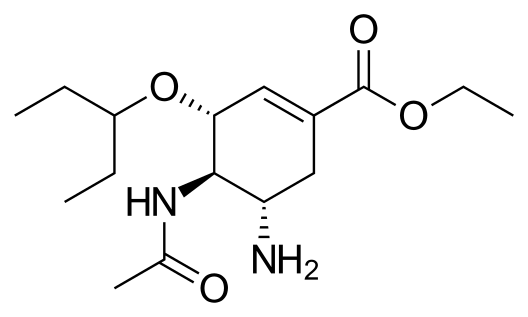
oseltamivir
Process for the preparation of oseltamivir and methyl 3-epi-shikimate, for Influenza virus infection
WO 2013061340
BY
Rawat, Varun; Dey, Soumen; Arumugam, Sudalai
The present invention discloses high yielding enantioselective process for synthesis of Oseltamivir from readily available starting material, cis-1,4-butene diol.The process features incorporation of chirality using sharpless asymmetric epoxidation(AE) and diastereoselective Barbier allylation and construction of cyclohexene carboxylic acid ester core through a ring closing metathesis (RCM) reaction. Further also disclosed herein is synthesis of (-)-methyl 3-epi-shikimate.
Early malaria diagnosis-Raman spectroscopy identifies malarial infection by looking for parasite by-products

13 May 2013
Scientists in Japan have developed a technique that could diagnose malaria just one day after infection
http://www.rsc.org/chemistryworld/2013/05/raman-spectroscopy-early-malaria-diagnosis-haem-hemozoin
Arbor Pharmaceuticals announced today that the U.S. Food and Drug Administration (FDA) has approved its New Drug Application (NDA) for Nymalize( nimodipine) oral solution

NIMODIPINE
Arbor Pharmaceuticals Announces FDA Approval of Nymalize
Prior to the approval of Nymalize, nimodipine was only available in gel capsule form. Since the product is commonly administered to patients through a nasogastric tube healthcare providers would extract the product from the gel capsule with a syringe. This has resulted in accidental administrations of nimodipine intravenously instead of via the intended enteral (oral) syringe.
In 2010, the FDA issued a “drug safety communication” to healthcare professionals titled “Nimodipine Oral Capsules: Medication Errors – IV Administration May Result in Death, Serious Harm.” In this communication they reported twenty-five intravenous nimodipine prescribing or administration errors and that four of the patients who mistakenly received nimodipine intravenously died and five had near-death events. The Institute for Safe Medication Practice reported an additional death due to improper nimodipine administration in February 2013.
Ed Schutter, President & CEO of Arbor stated, “I am pleased that Arbor’s first NDA approval has the potential to save lives by reducing the opportunity for hospital administration errors. To further ensure that we minimize the potential for administration error, each Nymalize unit dose cup will be packaged with an oral syringe. Nymalize adds to our growing portfolio of approved prescription products that can improve the lives of our patients.”
Dr. Laurence Downey, VP of Medical & Scientific Affairs added, “Approval of our first NDA is an important milestone in the evolution of Arbor Pharmaceuticals. This is the first of what we hope will be multiple NDA approvals over the next several years. I would like to thank and congratulate our team that worked on the Nymalize NDA.”
Arbor Pharmaceuticals will launch Nymalize in the next few months.
About Nymalize
Nymalize (nimodipine) oral solution is indicated for the improvement of neurological outcome by reducing the incidence and severity of ischemic deficits in adult patients with SAH from ruptured intracranial berry aneurysms regardless of their post-ictus neurological condition (i.e., Hunt and Hess Grades I-V).
Nimodipine (marketed by Bayer as Nimotop) is a dihydropyridine calcium channel blocker originally developed for the treatment of high blood pressure. It is not frequently used for this indication, but has shown good results in preventing a major complication of subarachnoid hemorrhage (a form of cerebral hemorrhage) termed vasospasm; this is now the main use of nimodipine.
(Z)-5-tetradecen-1-ol, Potential female sex attractant

(Z)-5-Tetradecen-1-ol, mw 212.37, formula C14H20O CAS 40642-42-0
Odorant receptors, present on nasal sensory neurons, perceive volatile compounds and regulate animal behavior such as reproduction. The nature of the ligands interacting with these receptors is, however, largely unknown.
Keiichi Yoshikawa and colleagues, University of Tokyo, Japan, shed new light on this issue. The researchers demonstrated that, in mice, preputial gland cells generate and secrete into the urine the unsaturated aliphatic alcohol (Z)-5-tetradecen-1-ol (pictured). This compound is regulated by the male hormone testosterone and acts as a natural agonist of the mouse odorant receptor Olfr288, affecting attractiveness to female mice. The urine of males lacking (Z)-5-tetradecen-1-ol, in fact, failed to attract females.

By identifying a novel receptor-ligand interaction in the mouse olfactory system, this study offers new insights into the complex chemistry regulating reproductive behavior.
- An unsaturated aliphatic alcohol as a natural ligand for a mouse odorant receptor,
K. Yoshikawa, H. Nakagawa, N. Mori, H. Watanabe, K. Touhara,
Nature Chem. Biol. 2013.
DOI: 10.1038/nchembio.1164 - Ohloff, G. et al. 1977. Helv. Chim. Acta. 60:1161-1174.
- http://www.cas-msds.com/40642-42-0
-
Bestmann, H.J., Brosche, T., Koschatzky, K.H., Michaelis, K., Platz, H., Vostrowsky, O., and Knauf, W. 1980. Pheromone XXX. Identifizierung eines neuartigen pheromonkomplexes aus der graseule Scotia exclamationis. Tetrahedron Lett. 21:747-750. Kelkar, S.V., Reddy, G.B., and Kulkarni, G.H. 1989. Indian J. Chem. Sect. B. 28:980-981. Ohloff, G., Vial, C., Näf, F., and Pawlak, M. 1977. Stereoselective syntheses of the isomeric 5, 10-pentadecadienals. Helv. Chim. Acta. 60:1161-1174.
DR ANTHONY MELVIN CRASTO Ph.D
ARTEMISININ AN ACE ANTIMALARIAL
Artemisinin
by ANTHONY MELVIN CRASTO Ph.D on Jan 20, 2012
- 956 views as on 12 may2013
Anthony Melvin Crasto presents Artemisinin, Glenmark scientist helping millions
amcrasto@gmail.com
http://www.slideshare.net/anthonycrasto64/anthony-melvin-crasto-presents-artemisinin-11174931
Brazilian scientists have created a synthetic protein that could one day lead to a vaccination against poisonous spider venom.

Brazilian scientists have created a synthetic protein that could one day lead to a vaccination against poisonous spider venom.
Biotie Announces Start of Clinical Study With Nepicastat (SYN117) in Cocaine Dependence

NEPICASTAT
TURKU, FINLAND–BIOTIE THERAPIES CORP. STOCK EXCHANGE RELEASE 10 May 2013 at 9.00 a.m.
Biotie announces start of clinical study with nepicastat (SYN117) in cocaine dependence
Biotie Therapies today announced the start of a Phase 2 clinical study evaluating nepicastat (SYN117) in cocaine dependence. The National Institute on Drug Abuse (NIDA) at the US National Institutes of Health is funding the conduct of the study under a Collaborative Research and Development Agreement (CRADA) signed in December 2011.
The study is a randomized, double-blind placebo-controlled 11-week trial and is expected to enroll about 180 treatment-seeking cocaine-dependent subjects. The study will be conducted at approximately 12 US clinics specializing in the treatment of drug dependence.
The trial is expected to take approximately two years to complete.
ABOUT NEPICASTAT (SYN117)
Nepicastat is an orally administered, potent and selective inhibitor of the enzyme dopamine beta-hydroxylase (DBH) which converts dopamine into norepinephrine. Like many other addictions, cocaine dependence is driven by dysregulation in the dopamine-reward system. Inhibition of DBH by nepicastat increases levels of dopamine, which may reduce craving for cocaine, and reduces the levels of norepinephrine, which may decrease the pleasurable responses to cocaine and the potential for stress-induced relapse following withdrawal. Biotie has previously conducted a placebo-controlled Phase 2a study in non-treatment seeking cocaine addicts. The study showed that nepicastat had a favourable safety profile and was well tolerated when administered with cocaine.
Nepicastat has also been evaluated as a potential treatment for post-traumatic stress disorder (PTSD). In December 2012, Biotie announced top-line data from an investigator-initiated Phase 2 study in PTSD. In this study, nepicastat was generally well tolerated but was not effective in relieving PTSD-associated symptoms when compared to placebo. Biotie is evaluating data from this study in further detail and will then decide on next steps with nepicastat in PTSD
Biotie holds full rights to nepicastat and will be able to use data from studies conducted with NIDA to support future potential regulatory submissions.
ABOUT BIOTIE
Biotie is a specialized drug development company focused on the development of drugs for neurodegenerative and psychiatric disorders (e.g. Parkinson’s disease, Alzheimer’s disease and other cognitive disorders, alcohol and drug dependence (addiction) and post-traumatic stress disorder), and inflammatory and fibrotic liver disease. The company has a strong and balanced development portfolio with several innovative small molecule and biological drug candidates at different stages of clinical development. Biotie’s products address diseases with high unmet medical need and significant market potential.
Biotie’s most advanced product, Selincro (nalmefene), licensed to H. Lundbeck A/S, has on 28 February 2013 received European marketing authorization for the reduction of alcohol consumption in adult patients with alcohol dependence who have a high level of alcohol consumption. In addition, Biotie has a strategic collaboration with UCB Pharma S.A. covering tozadenant which is transitioning into Phase 3 development for Parkinson’s disease. Biotie shares are listed on NASDAQ OMX Helsinki Ltd.
Nepicastat (INN, codenamed SYN117, RS-25560-197) is an inhibitor of dopamine beta-hydroxylase, an enzyme that catalyzes the conversion of dopamine to norepinephrine.[1]
It has been studied as a possible treatment for congestive heart failure, and appears to be well tolerated as such.[2] As of 2012, clinical trials to assess nepicastat as a treatment forpost-traumatic stress disorder (PTSD) and cocaine dependence have been completed.[3][4]
Synthesis

- Stanley WC, Li B, Bonhaus DW, et al. (August 1997). “Catecholamine modulatory effects of nepicastat (RS-25560-197), a novel, potent and selective inhibitor of dopamine-beta-hydroxylase”. Br J Pharmacol 121 (8): 1803–9. doi:10.1038/sj.bjp.0701315.PMC 1564872. PMID 9283721.
- Hegde SS, Friday KF (December 1998). “Dopamine-beta-hydroxylase inhibition: a novel sympatho-modulatory approach for the treatment of congestive heart failure”. Current pharmaceutical design 4 (6): 469–79. PMID 10197057.
- “Pharmacogenetic Clinical Trial of Nepicastat for Post Traumatic Stress Disorder (PTSD)”. ClinicalTrials.gov. U.S. National Institutes of Health. June 4, 2008. Retrieved on February 1, 2012.
- “Study of Safety and Potential Efficacy of SYN117 in Cocaine Dependent Volunteers”. ClinicalTrials.gov. U.S. National Institutes of Health. August 15, 2008. Retrieved on February 1, 2012.
DR ANTHONY MELVIN CRASTO

ORGANIC SPECTROSCOPY


 New Drug Approvals