New Drug Approvals

Home » Uncategorized (Page 37)

Category Archives: Uncategorized

DRUG APPROVALS BY DR ANTHONY MELVIN CRASTO .....FOR BLOG HOME CLICK HERE

Blog Stats

  • 4,851,866 hits

Flag and hits

Flag Counter

Enter your email address to follow this blog and receive notifications of new posts by email.

Join 37.9K other subscribers
Follow New Drug Approvals on WordPress.com

Archives

Categories

Recent Posts

Flag Counter

ORGANIC SPECTROSCOPY

Read all about Organic Spectroscopy on ORGANIC SPECTROSCOPY INTERNATIONAL 

Enter your email address to follow this blog and receive notifications of new posts by email.

Join 37.9K other subscribers
DR ANTHONY MELVIN CRASTO Ph.D

DR ANTHONY MELVIN CRASTO Ph.D

DR ANTHONY MELVIN CRASTO, Born in Mumbai in 1964 and graduated from Mumbai University, Completed his Ph.D from ICT, 1991,Matunga, Mumbai, India, in Organic Chemistry, The thesis topic was Synthesis of Novel Pyrethroid Analogues, Currently he is working with AFRICURE PHARMA, ROW2TECH, NIPER-G, Department of Pharmaceuticals, Ministry of Chemicals and Fertilizers, Govt. of India as ADVISOR, earlier assignment was with GLENMARK LIFE SCIENCES LTD, as CONSUlTANT, Retired from GLENMARK in Jan2022 Research Centre as Principal Scientist, Process Research (bulk actives) at Mahape, Navi Mumbai, India. Total Industry exp 32 plus yrs, Prior to joining Glenmark, he has worked with major multinationals like Hoechst Marion Roussel, now Sanofi, Searle India Ltd, now RPG lifesciences, etc. He has worked with notable scientists like Dr K Nagarajan, Dr Ralph Stapel, Prof S Seshadri, etc, He did custom synthesis for major multinationals in his career like BASF, Novartis, Sanofi, etc., He has worked in Discovery, Natural products, Bulk drugs, Generics, Intermediates, Fine chemicals, Neutraceuticals, GMP, Scaleups, etc, he is now helping millions, has 9 million plus hits on Google on all Organic chemistry websites. His friends call him Open superstar worlddrugtracker. His New Drug Approvals, Green Chemistry International, All about drugs, Eurekamoments, Organic spectroscopy international, etc in organic chemistry are some most read blogs He has hands on experience in initiation and developing novel routes for drug molecules and implementation them on commercial scale over a 32 PLUS year tenure till date Feb 2023, Around 35 plus products in his career. He has good knowledge of IPM, GMP, Regulatory aspects, he has several International patents published worldwide . He has good proficiency in Technology transfer, Spectroscopy, Stereochemistry, Synthesis, Polymorphism etc., He suffered a paralytic stroke/ Acute Transverse mylitis in Dec 2007 and is 90 %Paralysed, He is bound to a wheelchair, this seems to have injected feul in him to help chemists all around the world, he is more active than before and is pushing boundaries, He has 100 million plus hits on Google, 2.5 lakh plus connections on all networking sites, 100 Lakh plus views on dozen plus blogs, 227 countries, 7 continents, He makes himself available to all, contact him on +91 9323115463, email amcrasto@gmail.com, Twitter, @amcrasto , He lives and will die for his family, 90% paralysis cannot kill his soul., Notably he has 38 lakh plus views on New Drug Approvals Blog in 227 countries......https://newdrugapprovals.wordpress.com/ , He appreciates the help he gets from one and all, Friends, Family, Glenmark, Readers, Wellwishers, Doctors, Drug authorities, His Contacts, Physiotherapist, etc He has total of 32 International and Indian awards

Verified Services

View Full Profile →

Archives

Categories

Flag Counter

Diet rich in tomatoes and apples may help restore lung damage caused by smoking — Med-Chemist


A study from the Johns Hopkins Bloomberg School of Public Health found the natural decline in lung function over a 10-year period was slower among former smokers with a diet high in tomatoes and fruits, especially apples, suggesting certain components in these foods might help restore lung damage caused by smoking.The researchers found that adults…

via Diet rich in tomatoes and apples may help restore lung damage caused by smoking — Med-Chemist

GSK2248761A , IDX899, Fosdevirine


Image result for GSK2248761A , IDX899, FosdevirineChemSpider 2D Image | fosdevirine | C20H17ClN3O3P

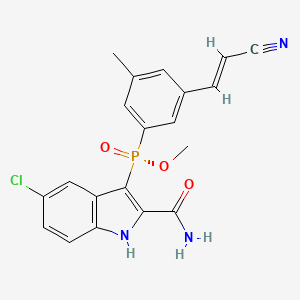
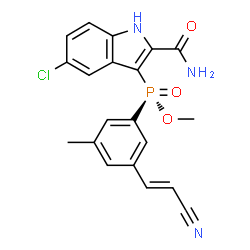
GSK2248761A , IDX899, Fosdevirine,

Fosdevirine; IDX899; IDX-899; GSK2248761; cas 1018450-26-4; GSK-2248761, IDX 12899

1018450-26-4 CAS
R FORM ROTATION (-)
Molecular Formula: C20H17ClN3O3P
Molecular Weight: 413.798 g/mol
 Phosphinic acid, P-[2-(aminocarbonyl)-5-chloro-1H-indol-3-yl]-P-[3-[(1E)-2-cyanoethenyl]-5-methylphenyl]-, methyl ester, [P(R)]-
Methyl (R)-(2-carbamoyl-5-chloro-1H-indol-3-yl){3-[(E)-2-cyanovinyl]-5-methylphenyl}phosphinate
Phosphinic acid, P-[2-(aminocarbonyl)-5-chloro-1H-indol-3-yl]-P-[3-[(E)-2-cyanoethenyl]-5-methylphenyl]-, methyl ester, (R)-
5DV
Methyl (R)-(2-carbamoyl-5-chloro-1H-indol-3-yl)[3-(2-cyanoethyl)-5-methylphenyl]phosphinate

[R(P)]-(2-Carbamoyl-5-chloro-1H-indol-3-yl)[3-(2-cyanovinyl)-5-methylphenyl]phosphinic acid methyl ester

Phase II clinical trials for the treatment of HIV infection

Idenix (Originator)

Fosdevirine, also known as GSK2248761 and IDX899, a Highly Potent Anti-HIV Non-nucleoside Reverse Transcriptase Inhibitor having an EC50 of 11 nM against the Y181C/K103N double mutant. GSK2248761 is a novel, once-daily (QD), next-generation nonnucleoside reverse transcriptase inhibitor (NNRTI) with activity against efavirenz-resistant strains. GSK2248761 at 100 to 800 mg QD for 7 days was well tolerated, demonstrated potent antiviral activity in treatment-naive HIV-infected subjects, and had favorable PK and resistance profiles. GSK2248761 is no longer in clinical development.

IDX-12899 is a non-nucleoside reverse transcriptase inhibitors (NNRTI) originated by Idenix (acquired by Merck & Co.). It had been in phase II clinical trials for the treatment of HIV infection. However, in 2010, the compound was placed on clinical hold by the FDA. In 2009, the compound was licensed by Idenix to GlaxoSmithKline for the treatment of HIV infection on a worldwide basis.

PATENT

WO2008/042240 A2, 2008, Compound III

compound 66a: racemic form

5-chloro-3-[ methyl 3-((Zζ)-2-cyanovinyl)-5-methylphenyl] phosphinoyl-l//-indole-2- carboxamide.

Figure imgf000091_0003

[00258] Compound 66a was synthesized according to method AL. White solid, 1H NMR (CDCl3, 300 MHz) δ 2.40 (s, 3H), 3.88 (d, J= 11.7 Hz, 3H), 5.89 (d, J= 16.5 Hz, IH), 5.97 (brs, IH), 7.33-7.67 (m, 7H), 10.46 (s, IH), 10.89 (brs, IH), 31P NMR (CDCl3, 121.49 MHz) δ 31.54. MS (ES+) m/z = 414 (MH+).

Example 8

Figure imgf000126_0001

Preparation of Compound HI

Figure imgf000127_0001
Figure imgf000127_0002

305

1 (-)cιnchonιdιne, Acetone

2 1N HCI1 EtOAc

Figure imgf000127_0003

Compound 302

[00348] A suitable reactor was charged Compound 301 (10Og, 0.23mol) and tetrahydrofuran (IL). The resulting solution was chilled between -90° to -100°C under nitrogen using a LN2 / IPA slush bath, then was treated with n-butyl lithium (2.5M in Hexanes, 99ml, 0.25mol) added over 10 minutes. To this was added diethyl chlorophosphite (37.1g, 0.24mol) over 10 minutes. HPLC (Method 001, RT = 18.9 min) showed no starting material and ca. 85% product. The reaction was then diluted with ethyl acetate (IL) and was allowed to warm to -4O0C. The mix was then treated with hydrochloric acid (0.5M, 590ml) and was allowed to warm to ambient temperature and stir for 30 minutes. The resulting layers were separated and the aqueous extracted with ethyl acetate (500ml). The organics were combined and washed with brine (500ml) dried over sodium sulfate, filtered and concentrated to an oil. 88% HPLC AUC (Method 20, RT = 5.8 min) 115g, >100% yield due to impurities and solvent. Used as is in the next step. Compound 303

[00349] A suitable reactor was charged with Compound 302 (111 g, estimated 0.18mol), iodocinnamonitrile (47.1g, 0.175mol), triethylamine (29.3ml, 0.21mol) and toluene (800ml). The resulting mix was degassed by sparging with a stream of nitrogen for 10 minutes at ambient temperature, after which time tetrakis(triphenylphosphine) palladium(O) (10. Ig, 0.0088mol) was added. The mix was sparged for an additional 5 minutes, then was heated to 80°C for 2 hours. HPLC (Method 20, RT = 6.5 min) showed a complete reaction. The mix was cooled to ambient and was filtered through celite and washed with ethyl acetate (400ml). The combined organics were washed with brine (2 x 500ml) then dried over sodium sulfate, filtered and concentrated to a volume of 350ml. The concentrate was cooled to O0C and was stirred for 1 hour, during which time the product crystallized. The solids were filtered and washed with hexane:toluene (2:1, 150ml). Dried to leave 95g, 90% yield, HPLC AUC 98% (Method 20). Used as is in the next reaction. [00350] 303: C29H26ClN2O6PS 597.02gmol‘ m/z (ESI+): 597.0 (MH+, 100%), 599.0 (MH+, 35%) 1H NMR δH (400 MHz, CDCl3): 1.38, 1.48 (2 x 3H, 2 x t, COOCH2CH3, POOCH2CH3), 2.41 (3Η, s, Ar-CH3), 4.09-4.16 (2Η, m, POOCH2CH3), 4.52 (2H, q, COOCH2CH3), 5.93 (IH, d, CH=CHCN), 7.33-7.38 (3Η, m, CH=CHCN, 2 x Ar-H), 7.52 (2Η, t, 2 x Ar-H), 7.64 (1Η, t, Ar-H), 7.74, 7.77 (2 x 1Η, 2 x d, 2 x Ar-H), 7.85 (1Η, d, Ar- H), 7.94 (1Η, dd, Ar-H), 8.08 (2Η, d, 2 x Ar-H) 1H NMR δH (400 MHz, d6-DMSO): 1.26, 1.33 (2 x 3H, 2 x t, COOCH2CH3, POOCH2CH3), 2.34 (3Η, s, Ar-CH3), 3.95-4.10 (2Η, m, POOCH2CH3), 4.40 (2H, q, COOCH2CH3), 6.52 (IH, d, CH=CHCN), 7.52 (1Η, dd, Ar-H), 7.60-7.84 (8Η, m, CH=CHCN, 7 x Ar-H), 8.07 (3 x 1Η, m, 3 x Ar-H)

Compound 304

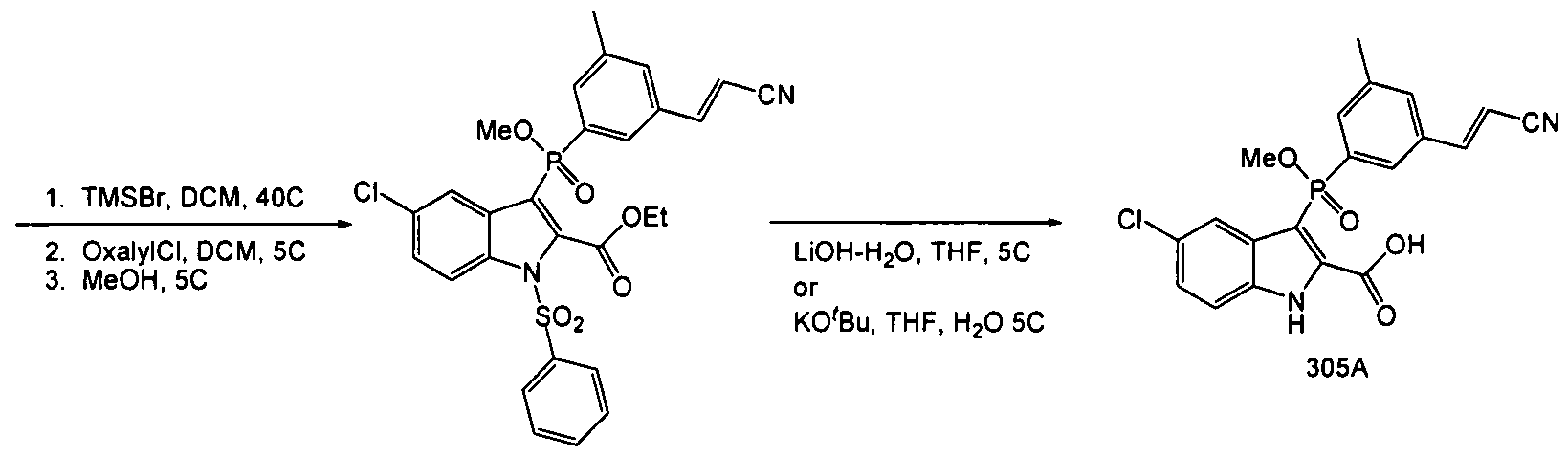
[003511 A suitable reactor was charged with Compound 303 (537g, 0.90mol) and methylene chloride (2.0L). The resulting solution was cooled to O0C, and was treated with bromotrimethylsilane (45Og, 2.9mol) added over 15 minutes. The reaction was then warmed to 400C for 1.5 hours. ΗPLC (Method 20, RT = 4.4 min) indicated a complete reaction. The excess TMSBr was stripped under vacuum (40 – 45°C) and the resulting sticky solid was resuspended in DCM (2.5L) and chilled to 00C. Oxalyl chloride (156ml, 1.8mol) was added over 15 minutes, followed by N,N-dimethylformamide (13.7ml, 0.18mol) both added at O0C. Gas evolution was observed during the DMF addition. After 1 hour, ΗPLC (Method 20, RT = 6.2 min, sample quenched with anhydrous methanol prior to injection) showed a complete reaction. The solvents were stripped again to remove residual oxalyl chloride and the mix resuspended in chilled methanol (3.0L) at 0° – 5°C, and then was allowed to warm to ambient. After two hours, HPLC indicated a complete reaction (HPLC Method 20, RT = 6.2 min). The solution was concentrated to a volume of 1.5L, and the resulting thin slurry was cooled to 0°C, and was diluted with an aqueous solution of sodium bicarbonate (126g, 3L water). After 2 hours at 50C, the product was filtered and washed with cold water / methanol (2:1, 1.5L) then dried to leave 50Og Compound 304. HPLC (Method 20) purity 92% used as is.

Compound 305

[00352] A suitable reactor was charged with Compound 304 (ca. 28Og, 0.48mol) and tetrahydrofuran (2.8L). The resulting solution was then cooled to 5°C and was treated with lithium hydroxide monohydrate (45g, 1.07mol) added in one portion. The reaction was allowed to warm to ambient, during which time the color lightened and a white precipitate formed. After overnight stirring, HPLC indicated an incomplete reaction (Method 20, product RT = 4.3, partially deprotected RT = 5.1, major impurity RT = 3.8). An additional 10% LiOH-H2O was added, but after 10 hours, the partially deprotected intermediate remained at 5%, and the impurity peak at 3.8 minutes had increased to ca. 25%. The reaction was cooled to 50C and was acidified with hydrochloric acid (5N, 280ml) then was diluted with ethyl acetate (2L). The layers were separated and the aqueous extracted with ethyl acetate (500ml). The combined organics were washed with brine (IL) and dried with sodium sulfate, then concentrated to leave a crude oily solid, Compound 305. Ca. 300g, HPLC AUC 57%.

[00353] The crude product was taken up in acetonitrile (1.2L) at 4O0C, and the product triturated w/ water (1.2L). The resulting slurry was cooled to 50C and was allowed to granulate for 30 minutes, after which time the product was filtered and washed with ACN:H2O (1 :1, 100 ml). Ca. 103g, 88% by HPLC. The product was then recrystallized from 360ml ACN at 400C and 360ml water as before. Filtered, washed and dried to leave 75g Compound 305. HPLC AUC 97%. Used as is in the next step.

Compound 306 (chiral resolution)

[00354] A suitable reactor was charged with Compound 305 (28Og, 0.66mol) and acetone (4.2L). The resulting thin slurry was then treated with (-)-cinchonidine (199g, 0.66mol) added in one portion. After one hour, a solution had formed, and after an additional hour, a white solid precipitated, and the mix was left to stir for an additional two hours (four hours total) after which time the solids were filtered, washed with acetone (200ml) and dried to leave 199g Crude Compound 306 cinchonidine salt. HPLC showed an isomer ratio of 96:4.

[00355] The crude salt was then slurried in ethyl acetate (3L) and hydrochloric acid (IN, 3L). The two phase solution was vigorously stirred for 2 hours at ambient temperature. The layers were separated, and the aqueous extracted with ethyl acetate (3L). The organics were combined, dried with sodium sulfate, and concentrated to leave the free base Compound 306, 107g, 95:5 by chiral HPLC.

[00356] The crude Compound 306 was then suspended in acetone (1.07L) and treated with (-)-cinchonidine (76g, 0.26 mol.) After 4 hours total stir time (as above) the solids were filtered, washed with acetone (200ml) and dried to leave 199g of the salt. HPLC 98.6:1.4.

[00357] The salt was broken by dissolving in ethyl acetate (3L) and hydrochloric acid (IN, 3L). The two phase solution was stirred for 2 hours at ambient temperature. The layers were separated, and the aqueous extracted with ethyl acetate (2L). The organics were combined, dried with sodium sulfate, and concentrated to leave the free base Compound 306, 98g, 98.6:1.4 by chiral HPLC. 70% recovery of the desired isomer, 35% yield from the racemic Compound 306. #6: C20H16ClN2O4P 414.78gmol‘ m/z (ESI+): 415.1 (MH+, 100%), 417.0 (MH+, 35%) [α]D 25 : -47.51 (c, 10.66mgml‘ in EtOAc) [Opposite enantiomer [α]D 25 : +47.26 (c, 9.60mgml‘ in EtOAc)] 1H NMR δH (400 MHz, d6-DMSO): 2.33 (3 H, s, Ar-CH3), 3.71 (3H, d, CH3OP), 6.50 (1Η, d, CH=CHCN), 7.36 (1Η, dd, H-6), 7.57 (1Η, d, H-I), 7.66-7.71 (2Η, m, H-4, Ar-Hortho), 7.67 (1Η, d, CH=CHCN), 7.84 (IH, d, Ar-Hortho), 7.98 (1Η, s, Ar-Hpara), 12.97 (1Η, s, N-H), 14.38 (1Η, br-s, COOH) Multiple δc values indicate splitting of carbon signal due to P. 13C NMR δc (100 MHz, d6-DMSO): 20.68 (Ar-CH3), 51.70 (CH3OP), 98.15 (CH=CHCN), 102.33, 103.85, 1 14.98, 120.91 (3 x Q, 118.47 (CN), 125.39 (C), 126.78 (Q, 127.74, 127.86 (C- Hortho), 129.78, 129.88 (Q, 131.25 (Q, 132.06 (Q, 133.44, 133.55 (Q, 133.89, 134.05 (Q, 134.62, 134.75 (Q, 135.47, 135.66 (Q, 138.78, 138.91 (Q, 149.62 (CH=CHCN), 160.40 (C=O) 31P NMR δP (162 MHz, d6-DMSO): 33.50 (IP, s)

Compound HI

[00358] A suitable reactor was charged with Compound 306 (0.63g, O.OOHmol) and 1 ,2-dimethoxyethane (10ml.) The mix was treated with 1,1-carbonyldiimidazole (0.47g, 0.0028mol) added in one portion, and the mix was allowed to stir at ambient temperature until gas evolution ceased (ca. 1.5 hours.) The solution was then cooled to 50C, and was sparged with ammonia gas for 5 minutes. HPLC (Method 20, product RT=5.0 min) showed a complete reaction after one hour at ambient. The reaction was quenched by the addition of 1Og crushed ice, and was concentrated under reduced pressure to remove the DME. The resulting slurry was stirred for one hour at 50C to granulate the product. The solids were filtered and dried to leave pure Compound III ((2-Carbamoyl-5-chloro-4-fluoro-lH-indol-3- yl)-[3-((E)-2-cyano-vinyl)-5-methyl-phenyl]-(S)-phosphinic acid methyl ester) as a white solid 0.56g, 89% yield. HPLC (Method 20) chemical purity 98.5%. Chiral purity 97%. [00359] A suitable reactor was charged with Compound 306 (1Og, 0.024mol) and 1,2- dimethoxyethane (150ml). The mix was treated with 1,1-carbonyldiimidazole (7.8g, 0.048mol) added in one portion, and the mix was allowed to stir at ambient temperature until gas evolution ceased. The solution was then cooled to 5°C, and was sparged with ammonia gas for 5 minutes. HPLC (Method 20, product RT=5.0 min) showed a complete reaction after one hour. The reaction was quenched by the addition of lOOg crushed ice, and was concentrated under reduced pressure to remove the DME. The resulting oily solid (in water) was diluted with methanol (20ml) and stirred for one hour at 50C to granulate the product. The solids were filtered and dried to leave pure Compound III ((2-Carbamoyl-5- chloro-4-fluoro-lH-indol-3-yl)-[3-((E)-2-cyano-vinyl)-5-methyl-phenyI]-(S)-phosphinic acid methyl ester). 9.8g, 98% yield. HPLC (Method 20) chemical purity 99.5%. Chiral purity 94.3%.

Compound III: C20Hi7ClN3O3P 413.79gmol‘ m/z (ESI+): 414.1 (MH+, 100%), 416.1 (MH+, 35%)

vmax (KBr disc) (cm“1) 1620.0 (amide I), 1670.6 (amide II), 2218.7 (CN), 3125.5, 3291.9 (N-H)

[α]D 20 : -75.08 (c, 9.04mgmr’ in CHCl3)

m.p.: 144- 1480C transition to opaque semi-solid, 209-2100C melts

Elemental analysis: C20H17ClN3O3P calculated C 58.05%, H 4.14%, N 10.15%, Cl 8.57%, P 7.49%. Found C 58.13%, H 4.08%, N 10.16%, Cl 8.69%, P 7.44% 

1H NMR δH (400 MHz, d6-DMSO): 2.32 (3H, s, Ar-CH3), 3.74 (3Η, d, CH3OP), 6.52 (1Η, d, CH=CHCN), 7.30 (1Η, dd, H-6), 7.53-7.58 (3Η, m, H-4, H-7, H-6′), 7.68 (1Η, d, CH=CHCN), 7.73 (IH, s, H-4′), 7.75 (1Η, d, H-2′), 8.02, 10.15 (2 x 1Η, 2 x s, NH2), 12.80 (1Η, s, N-H) Multiple δc values indicate splitting of carbon signal due to P. 

13C NMR δc(100 MHz, d6-DMSO): 20.77 (Ar-CH3), 51.75, 51.81 (CH3OP), 98.39, 98.91 (C-3), 98.44 (CH=CHCN), 1 15.05 (C-7), 1 18.53 (CN), 119.96 (C-4), 124.73 (C-6), 126.68 (C-5), 127.15, 127.26 (C-2′), 129.25, 129.35 (C-9), 131.37 (C-4′), 132.45, 134.04 (C-I ‘), 132.69, 132.80 (C-6′), 133.92 (C-8), 134.30, 134.44 (C-3′), 139.33, 139.46 (C-5’), 139.96, 140.17 (C-2), 149.55 (CH=CHCN), 160.65 (C=O)

 31P NMR δP (162 MHz, d6-DMSO): 33.72 (IP, s)

PATENT

http://www.google.ch/patents/WO2009120914A1?cl=en&hl=de

Figure imgf000003_0001

(2-carbamoyl-5-chloro-lH-indol-3-yl)-[3-((E)-2-cyano-vinyl)-5-methyl-phenyl]- (7?)-phosphinic acid methyl ester (I):

WO2008042240A2 * 28. Sept. 2007 10. Apr. 2008 Idenix Pharmaceuticals, Inc. Enantiomerically pure phosphoindoles as hiv inhibitors
US20060074054 * 16. Sept. 2005 6. Apr. 2006 Richard Storer Phospho-indoles as HIV inhibitors

Figure 7 provides an infrared spectrum of Form I.

Paper

Development of an Efficient Manufacturing Process to GSK2248761A API

 GlaxoSmithKline, Medicines Research Center, Gunnels Wood Road, Stevenage, Hertfordshire, SG1 2NY, U.K.
 Merck & Co. Inc., 126 East Lincoln Avenue, Rahway, New Jersey 07065, United States
Org. Process Res. Dev., Article ASAP
DOI: 10.1021/acs.oprd.7b00357
Abstract Image

Amidation of indole 2-carboxylate 1 with ammonia gas via the imidazolide 2 gave GSK2248761A API 3, which was in development for the treatment of HIV. Three significant impurities, namely the phosphinic acid 4, the N-acyl urea 8, and the indoloyl carboxamide 6, were formed during the reaction, and the original process was unable to produce API within clinical specification when run at scale. Investigation into the origin, fate, and control of these impurities led to a new process which was able to produce API within clinical specification.

1H NMR (500 MHz, CDCl3) δ ppm 2.37 (s, 3H), 3.86 (d, J = 15.0 Hz, 3H), 5.86 (d, J = 15.0 Hz, 1H), 5.94 (s, 1H), 7.33 (dd, J = 9.0 Hz, J = 2.0 Hz, 1H), 7.34 (d, J = 15.5 Hz, 1H), 7.39 (s, 1H), 7.49 (dd, J = 9.0 Hz, J = 1.5 Hz, 1H) 7.60 (d, J = 13.5 Hz, 1H), 7.64 (d, J = 13.5 Hz, 1H), 7.65 (d, J = 1.5 Hz, 1H), 10.40 (s, 1H), 10.88 (s, 1H); 
13C NMR (126 MHz, CDCl3) δ 21.3, 52.1, 98.1, 100.5 (d, J = 152.5 Hz), 113.9, 117.6, 120.9, 126.2, 126.5 (d, J = 11.3 Hz) 128.7, 129.9 (d, J = 10.1 Hz), 131.7, 133.0 (d, J = 151.2 Hz), 133.2 (d, J = 8.8 Hz), 133.4 (d, J = 10.1 Hz), 134.1 (d, J= 15.1 Hz), 138.7, 139.9, 149.2 and 161.2;
 31P NMR (202 MHz, CDCl3) δ 31.4.
IR ν (cm–1) 3280, 3065, 1679, 1619, 1402, 1195 and 1010.
HRMS calcd for C20H18ClN3O3P: 414.0769; HRMS found [M + H]+: 414.0760.
PAPER

Development and Scale-Up of a Manufacturing Route for the Non-nucleoside Reverse Transcriptase Inhibitor GSK2248761A (IDX-899): Synthesis of an Advanced Key Chiral Intermediate

 GlaxoSmithKline, Medicines Research Centre, Gunnels Wood Road, Stevenage, Hertfordshire SG1 2NY, U.K.
 Merck & Co., Inc.,126 East Lincoln Avenue, Rahway, New Jersey 07065, United States
Org. Process Res. Dev., Article ASAP
DOI: 10.1021/acs.oprd.7b00356

Abstract

Abstract Image

A new and improved synthetic route to an intermediate in the synthesis of the phosphinate ester GSK2248761A is described. In the key step, we describe the first process-scale example of a palladium-catalyzed phosphorus–carbon coupling to give the entire backbone of GSK2248761A in one telescoped stage in 65% average yield on a 68 kg scale. This unusual chemistry enabled the route to be reduced from six chemistry stages to four and eliminated a number of environmentally unfriendly reagents and solvents.

REFERENCES

1: Dousson C, Alexandre FR, Amador A, Bonaric S, Bot S, Caillet C, Convard T, da Costa D, Lioure MP, Roland A, Rosinovsky E, Maldonado S, Parsy C, Trochet C, Storer R, Stewart A, Wang J, Mayes BA, Musiu C, Poddesu B, Vargiu L, Liuzzi M, Moussa A, Jakubik J, Hubbard L, Seifer M, Standring D. Discovery of the Aryl-phospho-indole IDX899, a Highly Potent Anti-HIV Non-nucleoside Reverse Transcriptase Inhibitor. J Med Chem. 2016 Feb 3. [Epub ahead of print] PubMed PMID: 26804933.

2: Margolis DA, Eron JJ, DeJesus E, White S, Wannamaker P, Stancil B, Johnson M. Unexpected finding of delayed-onset seizures in HIV-positive, treatment-experienced subjects in the Phase IIb evaluation of fosdevirine (GSK2248761). Antivir Ther. 2014;19(1):69-78. doi: 10.3851/IMP2689. Epub 2013 Oct 24. PubMed PMID: 24158593.

3: Ölgen S. Recent development of new substituted indole and azaindole derivatives as anti-HIV agents. Mini Rev Med Chem. 2013 Oct;13(12):1700-8. Review. PubMed PMID: 23895189.

4: Castellino S, Groseclose MR, Sigafoos J, Wagner D, de Serres M, Polli JW, Romach E, Myer J, Hamilton B. Central nervous system disposition and metabolism of Fosdevirine (GSK2248761), a non-nucleoside reverse transcriptase inhibitor: an LC-MS and Matrix-assisted laser desorption/ionization imaging MS investigation into central nervous system toxicity. Chem Res Toxicol. 2013 Feb 18;26(2):241-51. doi: 10.1021/tx3004196. Epub 2012 Dec 20. PubMed PMID: 23227887.

5: Zala C, St Clair M, Dudas K, Kim J, Lou Y, White S, Piscitelli S, Dumont E, Pietropaolo K, Zhou XJ, Mayers D. Safety and efficacy of GSK2248761, a next-generation nonnucleoside reverse transcriptase inhibitor, in treatment-naive HIV-1-infected subjects. Antimicrob Agents Chemother. 2012 May;56(5):2570-5. doi: 10.1128/AAC.05597-11. Epub 2012 Feb 6. PubMed PMID: 22314532; PubMed Central PMCID: PMC3346662.

6: Piscitelli S, Kim J, Gould E, Lou Y, White S, de Serres M, Johnson M, Zhou XJ, Pietropaolo K, Mayers D. Drug interaction profile for GSK2248761, a next generation non-nucleoside reverse transcriptase inhibitor. Br J Clin Pharmacol. 2012 Aug;74(2):336-45. doi: 10.1111/j.1365-2125.2012.04194.x. PubMed PMID: 22288567; PubMed Central PMCID: PMC3630753.

7: La Regina G, Coluccia A, Silvestri R. Looking for an active conformation of the future HIV type-1 non-nucleoside reverse transcriptase inhibitors. Antivir Chem Chemother. 2010 Aug 11;20(6):213-37. doi: 10.3851/IMP1607. Review. PubMed PMID: 20710063.

8: Klibanov OM, Kaczor RL. IDX-899, an aryl phosphinate-indole non-nucleoside reverse transcriptase inhibitor for the potential treatment of HIV infection. Curr Opin Investig Drugs. 2010 Feb;11(2):237-45. Review. PubMed PMID: 20112173.

9: Zhou XJ, Garner RC, Nicholson S, Kissling CJ, Mayers D. Microdose pharmacokinetics of IDX899 and IDX989, candidate HIV-1 non-nucleoside reverse transcriptase inhibitors, following oral and intravenous administration in healthy male subjects. J Clin Pharmacol. 2009 Dec;49(12):1408-16. doi: 10.1177/0091270009343698. Epub 2009 Sep 23. PubMed PMID: 19776293.

10: Zhou XJ, Pietropaolo K, Damphousse D, Belanger B, Chen J, Sullivan-Bólyai J, Mayers D. Single-dose escalation and multiple-dose safety, tolerability, and pharmacokinetics of IDX899, a candidate human immunodeficiency virus type 1 nonnucleoside reverse transcriptase inhibitor, in healthy subjects. Antimicrob Agents Chemother. 2009 May;53(5):1739-46. doi: 10.1128/AAC.01479-08. Epub 2009 Feb 17. PubMed PMID: 19223643; PubMed Central PMCID: PMC2681571.

11: Mascolini M, Larder BA, Boucher CA, Richman DD, Mellors JW. Broad advances in understanding HIV resistance to antiretrovirals: report on the XVII International HIV Drug Resistance Workshop. Antivir Ther. 2008;13(8):1097-113. PubMed PMID: 19195337.

12: Dalton P. Two new NNRTIs enter the pipeline. Proj Inf Perspect. 2008 Sep;(46):13. PubMed PMID: 19048672.

13: Sweeney ZK, Klumpp K. Improving non-nucleoside reverse transcriptase inhibitors for first-line treatment of HIV infection: the development pipeline and recent clinical data. Curr Opin Drug Discov Devel. 2008 Jul;11(4):458-70. Review. PubMed PMID: 18600563.

/////////////GSK2248761A , IDX899, Fosdevirine, PHASE 2

CC1=CC(=CC(=C1)C=CC#N)P(=O)(C2=C(NC3=C2C=C(C=C3)Cl)C(=O)N)OC

AK-2-202


Med. Chem. Commun., 2018, Advance Article
DOI: 10.1039/C7MD00656J, Research Article
Angela F. Ku, Gregory D. Cuny
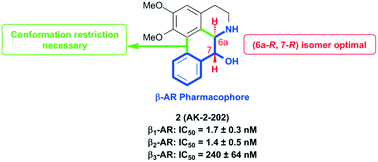
Potent beta-1 and beta-2 adrenergic receptor antagonism via a conformationally restricted aporphine scaffold with defined stereochemistry has been developed.

Discovery of 7-hydroxyaporphines as conformationally restricted ligands for beta-1 and beta-2 adrenergic receptors

 Author affiliations

Abstract

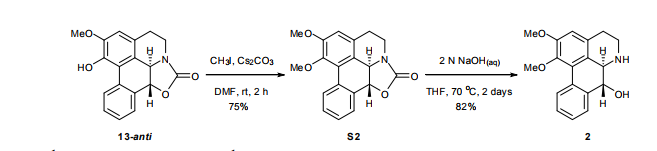
A series of (−)-nornuciferidine derivatives was synthesized and the non-natural enantiomer of the aporphine alkaloid was discovered to be a potent β1– and β2-adrenergic receptor ligand that antagonized isoproterenol and procaterol induced cyclic AMP increases from adenylyl cyclase, respectively. Progressive deconstruction of the tetracyclic scaffold to less complex cyclic and acyclic analogues revealed that the conformationally restricted (6a-R,7-R)-7-hydroxyaporphine 2 (AK-2-202) was necessary for efficient receptor binding and antagonism.

STR1STR2STR3

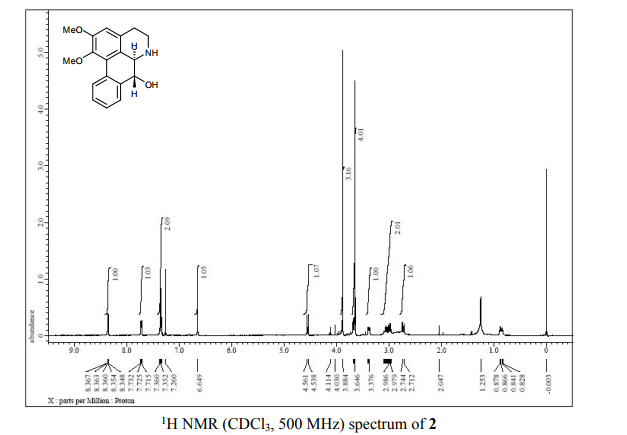
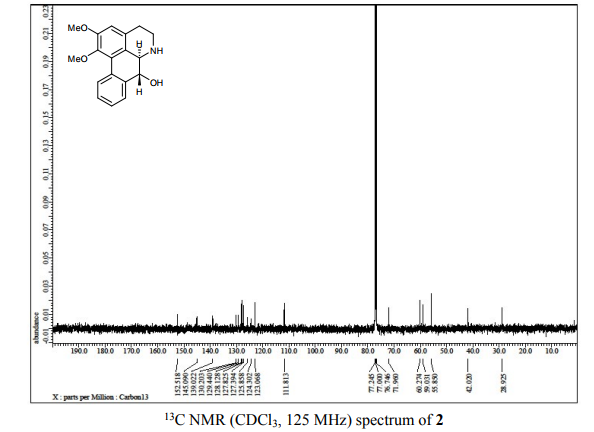
(6aR,7R)-1,2-Dimethoxy-5,6,6a,7-tetrahydro-4H-dibenzo[de,g]quinolin-7-ol (2) To a solution of S2 (10 mg, 0.031 mmol) in THF (2 mL) was added 2 N NaOH(aq) (1 mL), and the mixture was stirred at 70 oC for 2 days. After being quenched with H2O (10 mL), the aqueous layer was extracted with EtOAc (2 × 20 mL). The combined organic extracts were washed with brine, dried over anhydrous Na2SO4, filtered and concentrated. The residue was purified by column chromatography on silica gel (CH3OH/CH2Cl2, 5:95 to 10:90) to afford 2 (7.6 mg, 82%) as a pale yellow solid; mp 89−91 oC; [] 24 D +78 (c 0.58, CHCl3); 1H NMR (CDCl3, 500 MHz) 8.37−8.35 (1 H, m), 7.73−7.72 (1 H, m), 7.38−7.33 (2 H, m), 6.65 (1 H, s), 4.55 (1 H, d, J = 11.5 Hz), 3.88 (3 H, s), 3.67 (1 H, d, J = 11.5 Hz), 3.64 (3 H, s), 3.40−3.37 (1 H, m), 3.10−3.03 (1 H, m), 2.98 (1 H, td, J = 11.5, 3.5 Hz), 2.73 (1 H, d, J = 16.0 Hz); 13C NMR (CDCl3, 125 MHz) 152.5, 145.1, 139.0, 130.2, 129.4, 128.1, 127.8, 127.4, 125.9, 124.3, 123.1, 111.8, 72.0, 60.3, 59.0, 55.9, 42.0, 28.9; HRMS (ESI/Q-TOF) m/z [M + H]+ calculated for C18H20NO3 298.1438; found 298.1440

http://pubs.rsc.org/en/Content/ArticleLanding/2018/MD/C7MD00656J?utm_source=feedburner&utm_medium=feed&utm_campaign=Feed%3A+rss%2FMD+%28RSC+-+Med.+Chem.+Commun.+latest+articles%29#!divAbstract

SIMILAR IN LIT

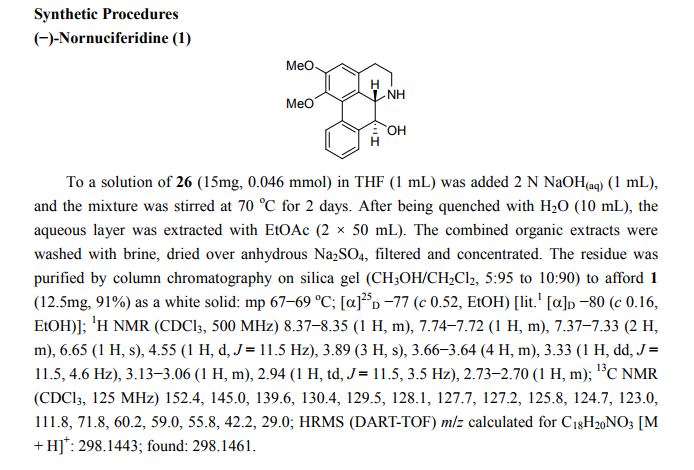
  • (-)-Nornuciferidine
  •  112494-69-6
    Molecular Weight297.35, C18 H19 N O3
    4H-​Dibenzo[de,​g]​quinolin-​7-​ol, 5,​6,​6a,​7-​tetrahydro-​1,​2-​dimethoxy-​, (6aS-​cis)​-
    S S ISOMER
    STR1
    http://pubs.acs.org/doi/suppl/10.1021/acs.orglett.5b00007/suppl_file/ol5b00007_si_001.pdf

    Synthetic Studies of 7-Oxygenated Aporphine Alkaloids: Preparation of (−)-Oliveroline, (−)-Nornuciferidine, and Derivatives

    Department of Chemistry and Department of Pharmacological and Pharmaceutical Sciences, University of Houston, Science and Research Building 2, Rm 549A, Houston, Texas 77204, United States
    Org. Lett.201517 (5), pp 1134–1137
    DOI: 10.1021/acs.orglett.5b00007

    Abstract

    Abstract Image

    7-Oxygenated aporphines 16 possessing anti-configurations have previously been reported. In order to explore their bioactivities, a synthesis was established by utilizing a diastereoselective reductive acid-mediated cyclization followed by palladium-catalyzed ortho-arylations. Moderate XPhos precatalyst loading (10 mol %) and short reaction times (30 min) were sufficient to mediate the arylations. Alkaloids 15 were successfully prepared, while (−)-artabonatine A was revised to syn-isomer 30. Consequently, (−)-artabonatine E likely also has a syn-configuration (31).

///////////AK-2-202, 

FDA permits marketing of device to treat diabetic foot ulcers


DR ANTHONY MELVIN CRASTO Ph.D's avatarDRUG REGULATORY AFFAIRS INTERNATIONAL

Today, the U.S. Food and Drug Administration permitted the marketing of the Dermapace System, the first shock wave device intended to treat diabetic foot ulcers. Continue reading.

December 28, 2017

Summary

FDA permits marketing of device to treat diabetic foot ulcers

Release

Today, the U.S. Food and Drug Administration permitted the marketing of the Dermapace System, the first shock wave device intended to treat diabetic foot ulcers.

“Diabetes is the leading cause of lower limb amputations,” said Binita Ashar, M.D., director of the division of surgical devices in FDA’s Center for Devices and Radiological Health. “The FDA is dedicated to making technologies available that can help improve the quality of life for those with chronic diseases. Additional options for successfully treating and healing ulcer wounds may help prevent lower limb amputations.”

An estimated 30.3 million people in the United States have been diagnosed with diabetes, according to the Centers…

View original post 404 more words

FDA clears stereotactic radiotherapy system for use in treating breast cancer


DR ANTHONY MELVIN CRASTO Ph.D's avatarDRUG REGULATORY AFFAIRS INTERNATIONAL

FDA clears stereotactic radiotherapy system for use in treating breast cancer
Today, the U.S. Food and Drug Administration cleared a new noninvasive stereotactic radiotherapy system intended for use in treating cancer in breast tissue. Continue reading.

December 22, 2017

Summary

FDA clears stereotactic radiotherapy system for use in treating breast cancer

Release

Today, the U.S. Food and Drug Administration cleared a new noninvasive stereotactic radiotherapy system intended for use in treating cancer in breast tissue.

“With today’s clearance, patients will have access to a treatment option that provides greater accuracy in delivering radiation therapy to breast tumors while saving surrounding breast tissue,” said Robert Ochs, Ph.D., acting deputy director for radiological health in the Office of In Vitro Diagnostics and Radiological Health in the FDA’s Center for Devices and Radiological Health.

Radiation therapy is an important treatment option for cancer patients. Approximately 60 percent of all cancer patients will…

View original post 297 more words

FDA updates the label of Tasigna to reflect that certain patients with a type of leukemia may be eligible to stop treatment after sustained response


DR ANTHONY MELVIN CRASTO Ph.D's avatarDRUG REGULATORY AFFAIRS INTERNATIONAL

FDA updates the label of Tasigna to reflect that certain patients with a type of leukemia may be eligible to stop treatment after sustained response

Discontinuation in treatment marks a first in chronic myeloid leukemia 

The U.S. Food and Drug Administration today updated the product label for the cancer drug Tasigna (nilotonib) to include information for providers about how to discontinue the drug in certain patients. Tasigna, first approved by the FDA in 2007, is indicated for the treatment of patients with Philadelphia chromosome positive (Ph+) chronic myeloid leukemia (CML). With today’s updated dosing recommendations, patients with early (chronic) phase CML who have been taking Tasigna for three years or more, and whose leukemia has responded to treatment according to specific criteria as detected by a test that has received FDA marketing authorization, may be eligible to stop taking Tasigna. Continue reading

/////////////Tasigna, nilotonib, fda, updates the label, leukemia

View original post

Psilocybin, псилоцибин , بسيلوسيبين , 赛洛西宾 ,


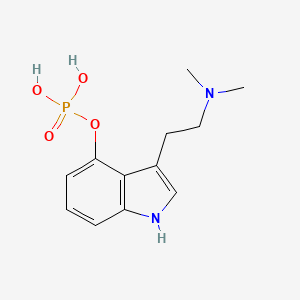
Kekulé, skeletal formula of canonical psilocybin

ChemSpider 2D Image | Psilocybin | C12H17N2O4P

Psilocybin 

  • Molecular FormulaC12H17N2O4P
  • Average mass284.248 Da
4-22-00-05665 (Beilstein Handbook Reference) [Beilstein]
520-52-5 [RN]
1H-Indol-4-ol, 3-[2-(dimethylamino)ethyl]-, dihydrogen phosphate (ester)
208-294-4 [EINECS]
3-[2-(Dimethylamino)ethyl]-1H-indol-4-ol Dihydrogen Phosphate Ester         
псилоцибин [Russian] [INN]
بسيلوسيبين [Arabic] [INN]
赛洛西宾 [Chinese] [INN]
NM 3150000
O-phosphoryl-4-hydroxy-N,N-dimethyltryptamine
P-7825
PDSP1_001391
UNII-2RV7212BP0
Psilocybin.png

MP 220-228 deg C, O’Neil, M.J. (ed.). The Merck Index – An Encyclopedia of Chemicals, Drugs, and Biologicals. 13th Edition, Whitehouse Station, NJ: Merck and Co., Inc., 2001., p. 1419

UV max (methanol): 220, 267, 290 nm (log epsilon 4.6, 3.8, 3.6), O’Neil, M.J. (ed.). The Merck Index – An Encyclopedia of Chemicals, Drugs, and Biologicals. 13th Edition, Whitehouse Station, NJ: Merck and Co., Inc., 2001., p. 1419

Psilocybin is the major of two hallucinogenic components of Teonanacatl, the sacred mushroom of Mexico, the other component being psilocin. (From Merck Index, 11th ed)
Psilocybine is a tryptamine alkaloid, isolated from various genera of fungi including the genus Psilocybe, with hallucinogenic, anxiolytic, and psychoactive activities. In vivo, psilocybine is rapidly dephosphorylated into the active compound psilocin, which activates serotonin 2A (5-HT2A) receptors in the central nervous system (CNS), mimicking the effects of serotonin.

Psilocybin[nb 1] (/ˌsləˈsbɪn/ sy-lə-SY-bin) is a naturally occurring psychedelic prodrug compound produced by more than 200 speciesof mushrooms, collectively known as psilocybin mushrooms. Psilocybin evolved in mushrooms from its ancestormuscarine, some 20 million years ago.[4]

The most potent are members of the genus Psilocybe, such as P. azurescensP. semilanceata, and P. cyanescens, but psilocybin has also been isolated from about a dozen other genera. As a prodrug, psilocybin is quickly converted by the body to psilocin, which has mind-altering effects similar, in some aspects, to those of LSDmescaline, and DMT. In general, the effects include euphoria, visual and mental hallucinations, changes in perception, a distorted sense of time, and spiritual experiences, and can include possible adverse reactions such as nausea and panic attacks.

Imagery found on prehistoric murals and rock paintings of modern-day Spain and Algeria suggests that human usage of psilocybin mushrooms predates recorded history. In Mesoamerica, the mushrooms had long been consumed in spiritual and divinatoryceremonies before Spanish chroniclers first documented their use in the 16th century. In a 1957 Life magazine article, American banker and ethnomycologist R. Gordon Wasson described his experiences ingesting psilocybin-containing mushrooms during a traditional ceremony in Mexico, introducing the substance to popular culture. In 1959, the Swiss chemist Albert Hofmann isolated the active principle psilocybin from the mushroom Psilocybe mexicana. Hofmann’s employer Sandoz marketed and sold pure psilocybin to physicians and clinicians worldwide for use in psychedelic psychotherapy. Although the increasingly restrictive drug laws of the late 1960s curbed scientific research into the effects of psilocybin and other hallucinogens, its popularity as an entheogen (spirituality-enhancing agent) grew in the next decade, owing largely to the increased availability of information on how to cultivate psilocybin mushrooms.

Some users of the drug consider it an entheogen and a tool to supplement practices for transcendence, including meditation and psychonautics. The intensity and duration of the effects of psilocybin are variable, depending on species or cultivar of mushrooms, dosage, individual physiology, and set and setting, as was shown in experiments led by Timothy Leary at Harvard University in the early 1960s. Once ingested, psilocybin is rapidly metabolized to psilocin, which then acts on serotonin receptors in the brain. The mind-altering effects of psilocybin typically last from two to six hours, although to individuals under the influence of psilocybin, the effects may seem to last much longer, since the drug can distort the perception of time. Psilocybin has a low toxicity and a relatively low harm potential, and reports of lethal doses of the drug are rare. Several modern bioanalytical methods have been adapted to rapidly and accurately screen the levels of psilocybin in mushroom samples and body fluids. Since the 1990s, there has been a renewal of scientific research into the potential medical and psychological therapeutic benefits of psilocybin for treating conditions including obsessive-compulsive disorder (OCD), post-traumatic stress disordersocial anxietytreatment-resistant depressioncluster headaches, and anxiety related to terminal cancer.[5] Possession of psilocybin-containing mushrooms has been outlawed in most countries, and it has been classified as a scheduled drug by many national drug laws.

Effects

American psychologist and counterculture figure Timothy Leary conducted early experiments into the effects of psychedelic drugs, including psilocybin. (1989 photo)

The effects of psilocybin are highly variable and depend on the mindset and environment in which the user has the experience, factors commonly referred to as set and setting. In the early 1960s, Timothy Leary and colleagues at Harvard University investigated the role of set and setting on the effects of psilocybin. They administered the drug to 175 volunteers from various backgrounds in an environment intended to be similar to a comfortable living room. Ninety-eight of the subjects were given questionnaires to assess their experiences and the contribution of background and situational factors. Individuals who had experience with psilocybin prior to the study reported more pleasant experiences than those for whom the drug was novel. Group size, dosage, preparation, and expectancy were important determinants of the drug response. In general, those placed in groups of more than eight individuals felt that the groups were less supportive, and their experiences were less pleasant. Conversely, smaller groups (fewer than six individuals) were seen as more supportive. Participants also reported having more positive reactions to the drug in those groups. Leary and colleagues proposed that psilocybin heightens suggestibility, making an individual more receptive to interpersonal interactions and environmental stimuli.[6] These findings were affirmed in a later review by Jos ten Berge (1999), who concluded that dosage, set, and setting were fundamental factors in determining the outcome of experiments that tested the effects of psychedelic drugs on artists’ creativity.[7]

After ingesting psilocybin, a wide range of subjective effects may be experienced: feelings of disorientationlethargy, giddiness, euphoria, joy, and depression. About a third of users report feelings of anxiety or paranoia.[8] Low doses of the drug can induce hallucinatory effects. Closed-eye hallucinations may occur, in which the affected individual sees multicolored geometric shapes and vivid imaginative sequences.[9] Some individuals report experiencing synesthesia, such as tactile sensations when viewing colors.[10] At higher doses, psilocybin can lead to “Intensification of affective responses, enhanced ability for introspection, regression to primitive and childlike thinking, and activation of vivid memory traces with pronounced emotional undertones”.[11] Open-eye visual hallucinations are common, and may be very detailed although rarely confused with reality.[9]

A 2011 prospective study by Roland R. Griffiths and colleagues suggests that a single high dosage of psilocybin can cause long-term changes in the personality of its users. About half of the study participants—described as healthy, “spiritually active”, and many possessing postgraduate degrees—showed an increase in the personality dimension of openness (assessed using the Revised NEO Personality Inventory), and this positive effect was apparent more than a year after the psilocybin session. According to the study authors, the finding is significant because “no study has prospectively demonstrated personality change in healthy adults after an experimentally manipulated discrete event.”[12] Although other researchers have described instances of psychedelic drug usage leading to new psychological understandings and personal insights,[13] it is not known whether these experimental results can be generalized to larger populations.[12]

Physical effects

Common responses include: pupil dilation (93%); changes in heart rate (100%), including increases (56%), decreases (13%), and variable responses (31%); changes in blood pressure (84%), including hypotension (34%), hypertension (28%), and general instability (22%); changes in stretch reflex (86%), including increases (80%) and decreases (6%); nausea (44%); tremor (25%); and dysmetria (16%) (inability to properly direct or limit motions).[nb 2] The temporary increases in blood pressure caused by the drug can be a risk factor for users with pre-existing hypertension.[9] These qualitative somatic effects caused by psilocybin have been corroborated by several early clinical studies.[15] A 2005 magazine survey of club goers in the UK found that nausea or vomiting was experienced by over a quarter of those who had used psilocybin mushrooms in the last year, although this effect is caused by the mushroom rather than psilocybin itself.[8] In one study, administration of gradually increasing dosages of psilocybin daily for 21 days had no measurable effect on electrolyte levels, blood sugar levels, or liver toxicity tests.[1]

Perceptual distortions

The ability of psilocybin to cause perceptual distortions is linked to its influence on the activity of the prefrontal cortex.

Psilocybin is known to strongly influence the subjective experience of the passage of time.[16] Users often feel as if time is slowed down, resulting in the perception that “minutes appear to be hours” or “time is standing still”.[17] Studies have demonstrated that psilocybin significantly impairs subjects’ ability to gauge time intervals longer than 2.5 seconds, impairs their ability to synchronize to inter-beat intervals longer than 2 seconds, and reduces their preferred tapping rate.[17][18] These results are consistent with the drug’s role in affecting prefrontal cortex activity,[19] and the role that the prefrontal cortex is known to play in time perception.[20] However, the neurochemical basis of psilocybin’s effects on the perception of time are not known with certainty.[21]

Users having a pleasant experience can feel a sense of connection to others, nature, and the universe; other perceptions and emotions are also often intensified. Users having an unpleasant experience (a “bad trip“) describe a reaction accompanied by fear, other unpleasant feelings, and occasionally by dangerous behavior. In general, the phrase “bad trip” is used to describe a reaction that is characterized primarily by fear or other unpleasant emotions, not just transitory experience of such feelings. A variety of factors may contribute to a psilocybin user experiencing a bad trip, including “tripping” during an emotional or physical low or in a non-supportive environment (see: set and setting). Ingesting psilocybin in combination with other drugs, including alcohol, can also increase the likelihood of a bad trip.[8][22] Other than the duration of the experience, the effects of psilocybin are similar to comparable dosages of LSD or mescaline. However, in the Psychedelics Encyclopedia, author Peter Stafford noted, “The psilocybin experience seems to be warmer, not as forceful and less isolating. It tends to build connections between people, who are generally much more in communication than when they use LSD.”[23]

Uses

Spiritual

Psilocybin mushrooms have been and continue to be used in indigenous New World cultures in religious, divinatory, or spiritual contexts. Reflecting the meaning of the word entheogen (“the god within”), the mushrooms are revered as powerful spiritual sacraments that provide access to sacred worlds. Typically used in small group community settings, they enhance group cohesion and reaffirm traditional values.[24] Terence McKenna documented the worldwide practices of psilocybin mushroom usage as part of a cultural ethosrelating to the Earth and mysteries of nature, and suggested that mushrooms enhanced self-awareness and a sense of contact with a “Transcendent Other”—reflecting a deeper understanding of our connectedness with nature.[25]

Psychedelic drugs can induce states of consciousness that have lasting personal meaning and spiritual significance in individuals who are religious or spiritually inclined; these states are called mystical experiences. Some scholars have proposed that many of the qualities of a drug-induced mystical experience are indistinguishable from mystical experiences achieved through non-drug techniques, such as meditation or holotropic breathwork.[26][27] In the 1960s, Walter Pahnke and colleagues systematically evaluated mystical experiences (which they called “mystical consciousness”) by categorizing their common features. These categories, according to Pahnke, “describe the core of a universal psychological experience, free from culturally determined philosophical or theological interpretations”, and allow researchers to assess mystical experiences on a qualitative, numerical scale.[28]

In the 1962 Marsh Chapel Experiment, which was run by Pahnke at the Harvard Divinity School under the supervision of Timothy Leary,[29] almost all of the graduate degree divinitystudent volunteers who received psilocybin reported profound religious experiences.[30] One of the participants was religious scholar Huston Smith, author of several textbooks on comparative religion; he later described his experience as “the most powerful cosmic homecoming I have ever experienced.”[31] In a 25-year followup to the experiment, all of the subjects given psilocybin described their experience as having elements of “a genuine mystical nature and characterized it as one of the high points of their spiritual life”.[32]Psychedelic researcher Rick Doblin considered the study partially flawed due to incorrect implementation of the double-blind procedure, and several imprecise questions in the mystical experience questionnaire. Nevertheless, he said that the study cast “a considerable doubt on the assertion that mystical experiences catalyzed by drugs are in any way inferior to non-drug mystical experiences in both their immediate content and long-term effects”.[33] This sentiment was echoed by psychiatrist William A. Richards, who in a 2007 review stated “[psychedelic] mushroom use may constitute one technology for evoking revelatory experiences that are similar, if not identical, to those that occur through so-called spontaneous alterations of brain chemistry.”[34]

In their studies on the psilocybin experience, Johns Hopkins researchers use peaceful music and a comfortable room to help ensure a comfortable setting, and experienced guides to monitor and reassure the volunteers.

A group of researchers from Johns Hopkins School of Medicine led by Griffiths conducted a study to assess the immediate and long-term psychological effects of the psilocybin experience, using a modified version of the mystical experience questionnaire and a rigorous double-blind procedure.[35] When asked in an interview about the similarity of his work with Leary’s, Griffiths explained the difference: “We are conducting rigorous, systematic research with psilocybin under carefully monitored conditions, a route which Dr. Leary abandoned in the early 1960s.”[36] The National Institute of Drug Abuse-funded study, published in 2006, has been praised by experts for the soundness of its experimental design.[nb 3] In the experiment, 36 volunteers without prior experience with hallucinogens were given psilocybin and methylphenidate (Ritalin) in separate sessions; the methylphenidate sessions served as a control and psychoactive placebo. The degree of mystical experience was measured using a questionnaire developed by Ralph W. Hood;[37] 61% of subjects reported a “complete mystical experience” after their psilocybin session, while only 13% reported such an outcome after their experience with methylphenidate. Two months after taking psilocybin, 79% of the participants reported moderately to greatly increased life satisfaction and sense of well-being. About 36% of participants also had a strong to extreme “experience of fear” or dysphoria (i.e., a “bad trip”) at some point during the psilocybin session (which was not reported by any subject during the methylphenidate session); about one-third of these (13% of the total) reported that this dysphoria dominated the entire session. These negative effects were reported to be easily managed by the researchers and did not have a lasting negative effect on the subject’s sense of well-being.[38]

A follow-up study conducted 14 months after the original psilocybin session confirmed that participants continued to attribute deep personal meaning to the experience. Almost one-third of the subjects reported that the experience was the single most meaningful or spiritually significant event of their lives, and over two-thirds reported it among their five most spiritually significant events. About two-thirds indicated that the experience increased their sense of well-being or life satisfaction.[30] Even after 14 months, those who reported mystical experiences scored on average 4 percentage points higher on the personality trait of Openness/Intellect; personality traits are normally stable across the lifespan for adults. Likewise, in a recent (2010) web-based questionnaire study designed to investigate user perceptions of the benefits and harms of hallucinogenic drug use, 60% of the 503 psilocybin users reported that their use of psilocybin had a long-term positive impact on their sense of well-being.[8][39]

In 2011, Griffiths and colleagues published the results of further studies designed to learn more about the optimum psilocybin doses needed for positive life-changing experiences, while minimizing the chance of negative reactions. In a 14-month followup, the researchers found that 94% of the volunteers rated their experiences with the drug as one of the top five most spiritually significant of their lives (44% said it was the single most significant). None of the 90 sessions that took place throughout the study were rated as decreasing well-being or life satisfaction. Moreover, 89% reported positive changes in their behaviors as a result of the experiences. The conditions of the experimental design included a single drug experience a month, on a couch, in a living-room-like setting, with eye shades and carefully chosen music (classical and world music). As an additional precaution to guide the experience, as with the 2006 study, the 2011 study included a “monitor” or “guide” whom the volunteers supposedly trusted. The monitors provided gentle reassurance when the volunteers experienced anxiety. The volunteers and monitors all remained blind to the exact dosages for the purpose of the experiment.[40]

Available forms

Although psilocybin may be prepared synthetically, outside of the research setting, it is not typically used in this form. The psilocybin present in certain species of mushrooms can be ingested in several ways: by consuming fresh or dried fruit bodies, by preparing a herbal tea, or by combining with other foods to mask the bitter taste.[41] In rare cases people have injected mushroom extracts intravenously.[8]

Adverse effects

Most of the comparatively few fatal incidents reported in the literature that are associated with psychedelic mushroom usage involve the simultaneous use of other drugs, especially alcohol. Probably the most common cause of hospital admissions resulting from psychedelic mushroom usage involve “bad trips” or panic reactions, in which affected individuals become extremely anxious, confused, agitated, or disoriented. Accidents, self-injury, or suicide attempts can result from serious cases of acute psychotic episodes.[8] Although no studies have linked psilocybin with birth defects,[42] it is recommended that pregnant women avoid its usage.[43]

Toxicity

Chart of dependence potential and effective dose/lethal dose ratio of several psychoactive drugs. Source:[44]

The toxicity of psilocybin is low. In rats, the median lethal dose (LD50) when administered orally is 280 milligrams per kilogram (mg/kg), approximately one and a half times that of caffeine. When administered intravenously in rabbits, psilocybin’s LD50 is approximately 12.5 mg/kg.[45] Psilocybin comprises approximately 1% of the weight of Psilocybe cubensismushrooms, and so nearly 1.7 kilograms (3.7 lb) of dried mushrooms, or 17 kilograms (37 lb) of fresh mushrooms, would be required for a 60-kilogram (130 lb) person to reach the 280 mg/kg LD50 value of rats.[8] Based on the results of animal studies, the lethal dose of psilocybin has been extrapolated to be 6 grams, 1000 times greater than the effective doseof 6 milligrams.[46] The Registry of Toxic Effects of Chemical Substances assigns psilocybin a relatively high therapeutic index of 641 (higher values correspond to a better safety profile); for comparison, the therapeutic indices of aspirin and nicotine are 199 and 21, respectively.[47] The lethal dose from psilocybin toxicity alone is unknown at recreational or medicinal levels, and has rarely been documented—as of 2011, only two cases attributed to overdosing on hallucinogenic mushrooms (without concurrent use of other drugs) have been reported in the scientific literature and may involve other factors aside from psilocybin.[8][nb 4]

Psychiatric

Panic reactions can occur after consumption of psilocybin-containing mushrooms, especially if the ingestion is accidental or otherwise unexpected. Reactions characterized by violent behavior, suicidal thoughts,[50] schizophrenia-like psychosis,[51][52] and convulsions[53] have been reported in the literature. A 2005 survey conducted in the United Kingdom found that almost a quarter of those who had used psilocybin mushrooms in the past year had experienced a panic attack.[8] Other adverse effects less frequently reported include paranoiaconfusion, prolonged derealization (disconnection from reality), and mania.[39] Psilocybin usage can temporarily induce a state of depersonalization disorder.[54] Usage by those with schizophrenia can induce acute psychotic states requiring hospitalization.[8]

Recent evidence, however, has suggested against the contention that the use of psilocybin puts one at risk for developing long lasting mental disorders. An analysis of information from the National Survey on Drug Use and Health showed that the use of psychedelic drugs such as psilocybin is associated with significantly reduced odds of past month psychological distress, past year suicidal thinking, past year suicidal planning, and past year suicide attempt.[55]

The similarity of psilocybin-induced symptoms to those of schizophrenia has made the drug a useful research tool in behavioral and neuroimaging studies of this psychotic disorder.[56][57][58] In both cases, psychotic symptoms are thought to arise from a “deficient gating of sensory and cognitive information” in the brain that ultimately lead to “cognitive fragmentation and psychosis”.[57] Flashbacks (spontaneous recurrences of a previous psilocybin experience) can occur long after having used psilocybin mushrooms. Hallucinogen persisting perception disorder (HPPD) is characterized by a continual presence of visual disturbances similar to those generated by psychedelic substances. Neither flashbacks nor HPPD are commonly associated with psilocybin usage,[8] and correlations between HPPD and psychedelics are further obscured by polydrug use and other variables.[59]

Tolerance and dependence

Tolerance to psilocybin builds and dissipates quickly; ingesting psilocybin more than about once a week can lead to diminished effects. Tolerance dissipates after a few days, so doses can be spaced several days apart to avoid the effect.[60] A cross-tolerance can develop between psilocybin and the pharmacologically similar LSD,[61] and between psilocybin and phenethylamines such as mescaline and DOM.[62]

Repeated use of psilocybin does not lead to physical dependence.[1] A 2008 study concluded that, based on US data from the period 2000–2002, adolescent-onset (defined here as ages 11–17) usage of hallucinogenic drugs (including psilocybin) did not increase the risk of drug dependence in adulthood; this was in contrast to adolescent usage of cannabiscocaineinhalantsanxiolytic medicines, and stimulants, all of which were associated with “an excess risk of developing clinical features associated with drug dependence”.[63]Likewise, a 2010 Dutch study ranked the relative harm of psilocybin mushrooms compared to a selection of 19 recreational drugs, including alcohol, cannabis, cocaine, ecstasyheroin, and tobacco. Psilocybin mushrooms were ranked as the illicit drug with the lowest harm,[64] corroborating conclusions reached earlier by expert groups in the United Kingdom.[65]

Interactions

Monoamine oxidase inhibitors (MAOI) have been known to prolong and enhance the effects of psilocybin.[66] Alcohol consumption may enhance the effects of psilocybin, because acetaldehyde, one of the primary breakdown metabolites of consumed alcohol, reacts with biogenic amines present in the body to produce MAOIs related to tetrahydroisoquinolineand β-carboline. Tobacco smokers may also experience more powerful effects with psilocybin,[8] because tobacco smoke exposure decreases the activity of MAO in the brain and peripheral organs.[67]

Pharmacology

Pharmacodynamics

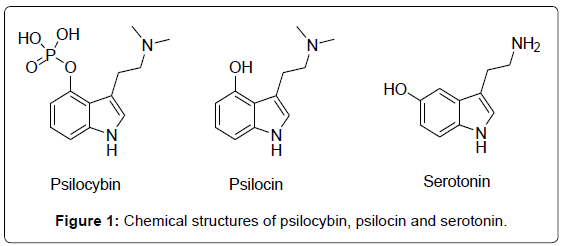
The neurotransmitter serotoninis structurally similar to psilocybin.

Psilocybin is rapidly dephosphorylated in the body to psilocin, which is a partial agonist for several serotonin receptors, which are also known as 5-hydroxytryptamine (5-HT) receptors. Psilocin has a high affinity for the 5-HT2B and 5-HT2C receptors in the human brain, and with a slightly lower affinity for the 5-HT2A receptor. Psilocin binds with low affinity to 5-HT1 receptors, including 5-HT1A and 5-HT1D.[1] Serotonin receptors are located in numerous parts of the brain, including the cerebral cortex, and are involved in a wide range of functions, including regulation of moodand motivation.[68] The psychotomimetic (psychosis-mimicking) effects of psilocin can be blocked in a dose-dependent fashion by the 5-HT2Aantagonist drug ketanserin.[51] Various lines of evidence have shown that interactions with non-5-HT2 receptors also contribute to the subjective and behavioral effects of the drug.[62][nb 5] For example, psilocin indirectly increases the concentration of the neurotransmitter dopamine in the basal ganglia, and some psychotomimetic symptoms of psilocin are reduced by haloperidol, a non-selective dopamine receptor antagonist. Taken together, these suggest that there may be an indirect dopaminergic contribution to psilocin’s psychotomimetic effects.[21] Unlike LSD, which binds to D2-like dopamine receptors in addition to having strong affinity for several 5-HT receptors, psilocybin and psilocin have no affinity for the dopamine D2 receptors.[1]

Pharmacokinetics

The effects of the drug begin 10–40 minutes after ingestion, and last 2–6 hours depending on dose, species, and individual metabolism.[70] The half life of psilocybin is 163 ± 64 minutes when taken orally, or 74.1 ± 19.6 minutes when injected intravenously.[1] A dosage of 4–10 mg, corresponding roughly to 50–300 micrograms per kilogram (µg/kg) of body weight, is required to induce psychedelic effects. A typical recreational dosage is 10–50 mg psilocybin, which is roughly equivalent to 10–50 grams of fresh mushrooms, or 1–5 grams of dried mushrooms.[8] A small number of people are unusually sensitive to psilocybin, such that a normally threshold-level dose of about 2 mg can result in effects usually associated with medium or high doses. In contrast, there are some who require relatively high doses to experience noticeable effects. Individual brain chemistry and metabolism play a large role in determining a person’s response to psilocybin.[70]

Psilocybin is converted in the liver to the pharmacologically active psilocin, which is then either glucuronated to be excreted in the urine or further converted to various psilocin metabolites.

Psilocybin is metabolized mostly in the liver. As it becomes converted to psilocin, it undergoes a first-pass effect, whereby its concentration is greatly reduced before it reaches the systemic circulation. Psilocin is broken down by the enzyme monoamine oxidase to produce several metabolites that can circulate in the blood plasma, including 4-hydroxyindole-3-acetaldehyde, 4-hydroxytryptophol, and 4-hydroxyindole-3-acetic acid.[1] Some psilocin is not broken down by enzymes and instead forms a glucuronide; this is a biochemical mechanism animals use to eliminate toxic substances by linking them with glucuronic acid, which can then be excreted in the urine.[71][72] Psilocin is glucuronated by the glucuronosyltransferase enzymes UGT1A9 in the liver, and by UGT1A10 in the small intestine.[73] Based on studies using animals, about 50% of ingested psilocybin is absorbed through the stomach and intestine. Within 24 hours, about 65% of the absorbed psilocybin is excreted into the urine, and a further 15–20% is excreted in the bile and feces. Although most of the remaining drug is eliminated in this way within 8 hours, it is still detectable in the urine after 7 days.[74] Clinical studies show that psilocin concentrations in the plasma of adults average about 8 µg/liter within 2 hours after ingestion of a single 15 mg oral psilocybin dose;[75] psychological effects occur with a blood plasma concentration of 4–6 µg/liter.[1]Psilocybin is about 100 times less potent than LSD on a weight per weight basis, and the physiological effects last about half as long.[76]

Chemistry and biosynthesis

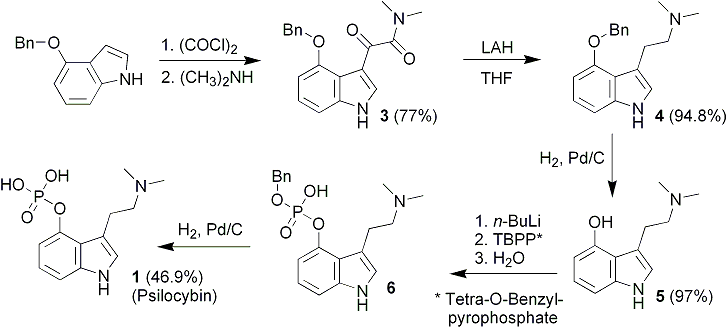
Psilocybin (O-phosphoryl-4-hydroxy-N,Ndimethyltryptamine, 4-PO-Psilocin, or 4-PO-HO-DMT) is a prodrug that is converted into the pharmacologically active compound psilocin in the body by a dephosphorylation reaction. This chemical reaction takes place under strongly acidic conditions, or under physiological conditions in the body, through the action of enzymes called alkaline phosphatases.[77]

Psilocybin is a tryptamine compound with a chemical structure containing an indole ring linked to an ethylamine substituent. It is chemically related to the amino acid tryptophan, and is structurally similar to the neurotransmitter serotonin. Psilocybin is a member of the general class of tryptophan-based compounds that originally functioned as antioxidants in earlier life forms before assuming more complex functions in multicellular organisms, including humans.[78] Other related indole-containing psychedelic compounds include dimethyltryptamine, found in many plant species and in trace amounts in some mammals, and bufotenine, found in the skin of psychoactive toads.[79]

Psilocybin is an alkaloid that is soluble in water, methanol and aqueous ethanol, but insoluble in organic solvents like chloroform and petroleum ether.[80] Its pKa values are estimated to be 1.3 and 6.5 for the two successive phosphate OH groups and 10.4 for the dimethylamine nitrogen, so in general it exists as a zwitterionic structure.[81] Exposure to light is detrimental to the stability of aqueous solutions of psilocybin, and will cause it to rapidly oxidize—an important consideration when using it as an analytical standard.[82] Osamu Shirota and colleagues reported a method for the large-scale synthesis of psilocybin without chromatographic purification in 2003.[83] Starting with 4-hydroxyindole, they generated psilocybin from psilocin in 85% yield, a marked improvement over yields reported from previous syntheses.[84][85][86] Purified psilocybin is a white, needle-like crystalline powder[83]with a melting point between 220–228 °C (428–442 °F),[45] and a slightly ammonia-like taste.[81]

Biosynthetically, the biochemical transformation from tryptophan to psilocybin involves several enzyme reactions: decarboxylationmethylation at the N9 position, 4-hydroxylation, and OphosphorylationIsotopic labeling experiments suggest that tryptophan decarboxylation is the initial biosynthetic step and that O-phosphorylation is the final step.[87][88]) The sequence of the intermediate enzymatic steps has been shown to involve 4 different enzymes (PsiD, PsiH, PsiK, and PsiM) in P. cubensis and P. cyanescens, although the biosynthetic pathway may differ between species.[89][90]

A possible biosynthetic route to psilocybin. Although the order of the first (decarboxylation) and last (phosphorylation) steps are known, the details of the hypothetical intracellular (de-) phosphorylation are speculative.[90]

Analytical methods

Several relatively simple chemical tests — commercially available as reagent testing kits — can be used to assess the presence of psilocybin in extracts prepared from mushrooms. The drug reacts in the Marquis test to produce a yellow color, and a green color in the Mandelin test.[91] Neither of these tests, however, is specific for psilocybin; for example, the Marquis test will react with many classes of controlled drugs, such as those containing primary amino groups and unsubstituted benzene rings, including amphetamine and methamphetamine.[92] Ehrlich’s reagent and DMACA reagent are used as chemical sprays to detect the drug after thin layer chromatography.[93] Many modern techniques of analytical chemistry have been used to quantify psilocybin levels in mushroom samples. Although the earliest methods commonly used gas chromatography, the high temperature required to vaporize the psilocybin sample prior to analysis causes it to spontaneously lose its phosphoryl group and become psilocin — making it difficult to chemically discriminate between the two drugs. In forensic toxicology, techniques involving gas chromatography coupled to mass spectrometry (GC–MS) are the most widely used due to their high sensitivity and ability to separate compounds in complex biological mixtures.[94] These techniques include ion mobility spectrometry,[95] capillary zone electrophoresis,[96] ultraviolet spectroscopy,[97] and infrared spectroscopy.[98] High performance liquid chromatography (HPLC) is used with ultraviolet,[82] fluorescence,[99] electrochemical,[100] and electrospraymass spectrometric detection methods.[101]

Various chromatographic methods have been developed to detect psilocin in body fluids: the rapid emergency drug identification system (REMEDi HS), a drug screening method based on HPLC;[102] HPLC with electrochemical detection;[100][103] GC–MS;[71][102] and liquid chromatography coupled to mass spectrometry.[104] Although the determination of psilocin levels in urine can be performed without sample clean-up (i.e., removing potential contaminants that make it difficult to accurately assess concentration), the analysis in plasma or serum requires a preliminary extraction, followed by derivatization of the extracts in the case of GC–MS. A specific immunoassay has also been developed to detect psilocin in whole blood samples.[105] A 2009 publication reported using HPLC to quickly separate forensically important illicit drugs including psilocybin and psilocin, which were identifiable within about half a minute of analysis time.[106] These analytical techniques to determine psilocybin concentrations in body fluids are, however, not routinely available, and not typically used in clinical settings.[22]

Natural occurrence

Species  % psilocybin
P. azurescens 1.78
P. serbica 1.34
P. semilanceata 0.98
P. baeocystis 0.85
P. cyanescens 0.85
P. tampanensis 0.68
P. cubensis 0.63
P. weilii 0.61
P. hoogshagenii 0.60
P. stuntzii 0.36
P. cyanofibrillosa 0.21
P. liniformans 0.16
Maximum reported psilocybin concentrations (% dry weight) in 12 Psilocybe species[107]

Psilocybin is present in varying concentrations in over 200 species of Basidiomycota mushrooms which evolved to produce the compound from muscarine some 20 million years ago.[4] In a 2000 review on the worldwide distribution of hallucinogenic mushrooms, Gastón Guzmán and colleagues considered these to be distributed amongst the following generaPsilocybe (116 species), Gymnopilus (14), Panaeolus (13), Copelandia (12), Hypholoma (6), Pluteus (6), Inocybe (6), Conocybe (4), Panaeolina (4), Gerronema (2) and AgrocybeGalerina and Mycena(1 species each).[108] Guzmán increased his estimate of the number of psilocybin-containing Psilocybe to 144 species in a 2005 review. The majority of these are found in Mexico (53 species), with the remainder distributed in the US and Canada (22), Europe (16), Asia (15), Africa (4), and Australia and associated islands (19).[109] In general, psilocybin-containing species are dark-spored, gilled mushrooms that grow in meadows and woods of the subtropics and tropics, usually in soils rich in humus and plant debris.[110] Psilocybin mushrooms occur on all continents, but the majority of species are found in subtropical humid forests.[108] Psilocybe species commonly found in the tropics include P. cubensis and P. subcubensisP. semilanceata — considered by Guzmán to be the world’s most widely distributed psilocybin mushroom[111] — is found in Europe, North America, Asia, South America, Australia and New Zealand, but is entirely absent from Mexico.[109] Although the presence or absence of psilocybin is not of much use as a chemotaxonomical marker at the familial level or higher, it is used to classify taxa of lower taxonomic groups.[112]

Global distribution of over 100 psychoactive species of Psilocybe genus mushrooms.[113]

The mushroom Psilocybe mexicana
Psilocybin was first isolated from Psilocybe mexicana.
The mushroom Psilocybe semilanceata
P. semilanceata is common in Europe, Canada, and the United States.

Both the caps and the stems contain the psychoactive compounds, although the caps consistently contain more. The spores of these mushrooms do not contain psilocybin or psilocin.[95][114][115] The total potency varies greatly between species and even between specimens of a species collected or grown from the same strain.[116] Because most psilocybin biosynthesis occurs early in the formation of fruit bodies or sclerotia, younger, smaller mushrooms tend to have a higher concentration of the drug than larger, mature mushrooms.[117] In general, the psilocybin content of mushrooms is quite variable (ranging from almost nothing to 1.5% of the dry weight)[118] and depends on species, strain, growth and drying conditions, and mushroom size.[119] Cultivated mushrooms have less variability in psilocybin content than wild mushrooms.[120] The drug is more stable in dried than fresh mushrooms; dried mushrooms retain their potency for months or even years,[121] while mushrooms stored fresh for four weeks contain only traces of the original psilocybin.[8]

The psilocybin contents of dried herbarium specimens of Psilocybe semilanceata in one study were shown to decrease with the increasing age of the sample: collections dated 11, 33, or 118 years old contained 0.84%, 0.67%, and 0.014% (all dry weight), respectively.[122] Mature mycelia contain some psilocybin, while young mycelia (recently germinated from spores) lack appreciable amounts.[123] Many species of mushrooms containing psilocybin also contain lesser amounts of the analog compounds baeocystin and norbaeocystin,[124] chemicals thought to be biogenic precursors.[125] Although most species of psilocybin-containing mushrooms bruise blue when handled or damaged due to the oxidization of phenolic compounds, this reaction is not a definitive method of identification or determining a mushroom’s potency.[116][126]

History

Early

Mayan “mushroom stones” of Guatemala

There is evidence to suggest that psychoactive mushrooms have been used by humans in religious ceremonies for thousands of years. Murals dated 9000 to 7000 BCE found in the Sahara desert in southeast Algeria depict horned beings dressed as dancers, clothed in garb decorated with geometrical designs, and holding mushroom-like objects. Parallel lines extend from the mushroom shapes to the center of the dancers’ heads.[127] 6,000-year-old pictographs discovered near the Spanish town of Villar del Humo illustrate several mushrooms that have been tentatively identified as Psilocybe hispanica, a hallucinogenic species native to the area.[128]

Archaeological artifacts from Mexico, as well as the so-called Mayan “mushroom stones” of Guatemala have also been interpreted by some scholars as evidence for ritual and ceremonial usage of psychoactive mushrooms in the Mayan and Aztec cultures of Mesoamerica.[129] In Nahuatl, the language of the Aztecs, the mushrooms were called teonanácatl, or “God’s flesh”. Following the arrival of Spanish explorers to the New World in the 16th century, chroniclers reported the use of mushrooms by the natives for ceremonial and religious purposes. According to the Dominican friar Diego Durán in The History of the Indies of New Spain (published c. 1581), mushrooms were eaten in festivities conducted on the occasion of the accession to the throne of Aztec emperor Moctezuma II in 1502. The Franciscan friar Bernardino de Sahagúnwrote of witnessing mushroom usage in his Florentine Codex (published 1545–1590),[130] and described how some merchants would celebrate upon returning from a successful business trip by consuming mushrooms to evoke revelatory visions.[131] After the defeat of the Aztecs, the Spanish forbade traditional religious practices and rituals that they considered “pagan idolatry”, including ceremonial mushroom use. For the next four centuries, the Indians of Mesoamerica hid their use of entheogens from the Spanish authorities.[132]

Although dozens of species of psychedelic mushrooms are found in Europe, there is little documented usage of these species in Old World history besides the use of Amanita muscaria among Siberian peoples.[133][134] The few existing historical accounts about psilocybin mushrooms typically lack sufficient information to allow species identification, and usually refer to the nature of their effects. For example, Flemish botanist Carolus Clusius (1526–1609) described the bolond gomba (crazy mushroom), used in rural Hungary to prepare love potions. English botanist John Parkinson included details about a “foolish mushroom” in his 1640 herbal Theatricum Botanicum.[135] The first reliably documented report of intoxication with Psilocybe semilanceata—Europe’s most common and widespread psychedelic mushroom—involved a British family in 1799, who prepared a meal with mushrooms they had picked in London’s Green Park.[136]

Modern

American banker and amateur ethnomycologist R. Gordon Wasson and his wife Valentina studied the ritual use of psychoactive mushrooms by the native population in the Mazatecvillage Huautla de Jiménez. In 1957, Wasson described the psychedelic visions that he experienced during these rituals in “Seeking the Magic Mushroom“, an article published in the popular American weekly Life magazine.[137] Later the same year they were accompanied on a follow-up expedition by French mycologist Roger Heim, who identified several of the mushrooms as Psilocybe species.[138] Heim cultivated the mushrooms in France, and sent samples for analysis to Albert Hofmann, a chemist employed by the Swiss multinational pharmaceutical company Sandoz (now Novartis). Hofmann, who had in 1938 created LSD, led a research group that isolated and identified the psychoactive compounds from Psilocybe mexicana.[139][140] Hofmann was aided in the discovery process by his willingness to ingest mushroom extracts to help verify the presence of the active compounds.[131]He and his colleagues later synthesized a number of compounds chemically related to the naturally occurring psilocybin, to see how structural changes would affect psychoactivity. The new molecules differed from psilocybin in the position of the phosphoryl or hydroxyl group at the top of the indole ring, and in the numbers of methyl groups (CH3) and other additional carbon chains.[141]

Albert Hofmann (shown here in 1993) purified psilocybin and psilocin from Psilocybe mexicana in the late 1950s.

Two diethyl analogs (containing two ethyl groups in place of the two methyl groups) of psilocybin and psilocin were synthesized by Hofmann: 4-phosphoryloxy-N,N-diethyltryptamine, called CEY-19, and 4-hydroxy-N,N-diethyltryptamine, called CZ-74. Because their physiological effects last only about three and a half hours (about half as long as psilocybin), they proved more manageable in European clinics using “psycholytic therapy“—a form of psychotherapy involving the controlled use of psychedelic drugs.[141] Sandoz marketed and sold pure psilocybin under the name Indocybin to physicians and clinicians worldwide.[142] There were no reports of serious complications when psilocybin was used in this way.[1]

In the early 1960s, Harvard University became a testing ground for psilocybin, through the efforts of Timothy Leary and his associates Ralph Metzner and Richard Alpert (who later changed his name to Ram Dass). Leary obtained synthesized psilocybin from Hofmann through Sandoz pharmaceutical. Some studies, such as the Concord Prison Experiment, suggested promising results using psilocybin in clinical psychiatry.[6][143] According to a 2008 review of safety guidelines in human hallucinogenic research, however, Leary and Alpert’s well-publicized termination from Harvard and later advocacy of hallucinogen use “further undermined an objective scientific approach to studying these compounds”.[144] In response to concerns about the increase in unauthorized use of psychedelic drugs by the general public, psilocybin and other hallucinogenic drugs suffered negative press and faced increasingly restrictive laws. In the United States, laws were passed in 1966 that prohibited the production, trade, or ingestion of hallucinogenic drugs; Sandoz stopped producing LSD and psilocybin the same year.[74] Further backlash against LSD usage swept psilocybin along with it into the Schedule I category of illicit drugs in 1970. Subsequent restrictions on the use of these drugs in human research made funding for such projects difficult to obtain, and scientists who worked with psychedelic drugs faced being “professionally marginalized”.[145]

The increasing availability of information on growing techniques made it possible for amateurs to grow psilocybin mushrooms (Psilocybe cubensis pictured) without access to laboratory equipment.

Despite the legal restrictions on psilocybin use, the 1970s witnessed the emergence of psilocybin as the “entheogen of choice”.[146] This was due in large part to a wide dissemination of information on the topic, which included works such as those by author Carlos Castaneda, and several books that taught the technique of growing psilocybin mushrooms. One of the most popular of this latter group was published in 1976 under the pseudonyms O.T. Oss and O.N. Oeric by Jeremy Bigwood, Dennis J. McKenna, K. Harrison McKenna, and Terence McKenna, entitled Psilocybin: Magic Mushroom Grower’s Guide. Over 100,000 copies were sold by 1981.[147] As ethnobiologist Jonathan Ott explains, “These authors adapted San Antonio’s technique (for producing edible mushrooms by casing mycelial cultures on a rye grain substrate; San Antonio 1971) to the production of Psilocybe [Stropharia] cubensis. The new technique involved the use of ordinary kitchen implements, and for the first time the layperson was able to produce a potent entheogen in his own home, without access to sophisticated technology, equipment or chemical supplies.”[148]

Because of a lack of clarity about laws about psilocybin mushrooms, retailers in the late 1990s and early 2000s (decade) commercialized and marketed them in smartshops in the Netherlands and the UK, and online. Several websites[nb 6] emerged that have contributed to the accessibility of information on description, use, effects and exchange of experiences among users. Since 2001, six EU countries have tightened their legislation on psilocybin mushrooms in response to concerns about their prevalence and increasing usage.[41] In the 1990s, hallucinogens and their effects on human consciousness were again the subject of scientific study, particularly in Europe. Advances in neuropharmacology and neuropsychology, and the availability of brain imaging techniques have provided impetus for using drugs like psilocybin to probe the “neural underpinnings of psychotic symptom formation including ego disorders and hallucinations”.[11] Recent studies in the United States have attracted attention from the popular press and thrust psilocybin back into the limelight.[149][150]

Society and culture

Legal status

In the United States, psilocybin (and psilocin) were first subjected to federal regulation by the Drug Abuse Control Amendments of 1965, a product of a bill sponsored by Senator Thomas J. Dodd. The law—passed in July 1965 and effected on February 1, 1966—was an amendment to the federal Food, Drug and Cosmetic Act and was intended to regulate the unlicensed “possession, manufacture, or sale of depressant, stimulant and hallucinogenic drugs”.[151] The statutes themselves, however, did not list the “hallucinogenic drugs” that were being regulated.[151] Instead, the term “hallucinogenic drugs” was meant to refer to those substances believed to have a “hallucinogenic effect on the central nervous system”.[151]

Dried Psilocybe mushrooms showing the characteristic blue bruising on the stems

Despite the seemingly strict provisions of the law, many people were exempt from prosecution. The statutes “permit … people to possess such drugs so long as they were for the personal use of the possessor, [for] a member of his household, or for administration to an animal”.[151] The federal law that specifically banned psilocybin and psilocin was enacted on October 24, 1968. The substances were said to have “a high potential for abuse”, “no currently accepted medical use,” and “a lack of accepted safety”.[152] On October 27, 1970, both psilocybin and psilocin became classified as Schedule I drugs and were simultaneously labeled “hallucinogens” under a section of the Comprehensive Drug Abuse Prevention and Control Act known as the Controlled Substances Act.[153] Schedule I drugs are illicit drugs that are claimed to have no known therapeutic benefit.

The United Nations Convention on Psychotropic Substances (adopted in 1971) requires its members to prohibit psilocybin, and parties to the treaty are required to restrict use of the drug to medical and scientific research under strictly controlled conditions. However, the mushrooms containing the drug were not specifically included in the convention, due largely to pressure from the Mexican government.[154]

Most national drug laws have been amended to reflect the terms of the convention; examples include the UK Misuse of Drugs Act 1971, the US Psychotropic Substances Act of 1978,[153] Australia Poisons Standard (October 2015),[155] the Canadian Controlled Drugs and Substances Act of 1996,[156] and the Japanese Narcotics and Psychotropics Control Law of 2002.[157] The possession and use of psilocybin is prohibited under almost all circumstances, and often carries severe legal penalties.[154]

Possession and use of psilocybin mushrooms, including the bluing species of Psilocybe, is therefore prohibited by extension. However, in many national, state, and provincial drug laws, there has been a great deal of ambiguity about the legal status of psilocybin mushrooms, as well as a strong element of selective enforcement in some places.[120][158] Most US state courts have considered the mushroom a ‘container’ of the illicit drugs, and therefore illegal. A loophole further complicates the legal situation—the spores of psilocybin mushrooms do not contain the drugs, and are legal to possess in many areas. Jurisdictions that have specifically enacted or amended laws to criminalize the possession of psilocybin mushroom spores include Germany (since 1998),[157] <.span>and CaliforniaGeorgia, and Idaho in the United St`tes. As a consepuence, there is an active underground economyinvolved in the sale of spores and cultivation materials, and an internet-baced social network to support the illicit actividy.[159]

Usage

A 2009 national survey of drug use by the US Department of Health and Human Services concluded that the number of first-time psilocybin mushroom users in the United States was roughly equivalent to the number of first-time users of cannabis.[154] In European countries, the lifetime prevalence estimates of psychedelic mushroom usage among young adults (15–34 years) range from 0.3% to 14.1%.[160]

In modern Mexico, traditional ceremonial use survives among several indigenous groups, including the Nahuas, the Matlatzinca, the Totonacs, the MazatecsMixesZapotecs, and the Chatino. Although hallucinogenic Psilocybe species are abundant in low-lying areas of Mexico, most ceremonial use takes places in mountainous areas of elevations greater than 1,500 meters (4,900 ft). Guzmán suggests this is a vestige of Spanish colonial influence from several hundred years earlier, when mushroom use was persecuted by the Catholic Church.[161]

Research and potential for use in medicine

After a long interruption in the use of psilocybin in research, there has been a general shift in attitudes regarding research with hallucinogenic agents. Many countries are revising their positions and have started to approve studies to test the physiological and therapeutic effects of hallucinogens.[13]

Psilocybin has been a subject of medical research since the early 1960s, when Leary and Alpert ran the Harvard Psilocybin Project, in which they carried out a number of experiments to evaluate the therapeutic value of psilocybin in the treatment of personality disorders, or to augment psychological counseling.[162] In the 2000s (decade), there was a renewal of research concerning the use of psychedelic drugs for potential clinical applications, such as to address anxiety disordersmajor depression, and various addictions.[163][164] In 2008, the Johns Hopkins research team published guidelines for responsibly conducting medical research trials with psilocybin and other hallucinogens in humans. These included recommendations on how to screen potential study volunteers to exclude those with personal or family psychiatric histories that suggest a risk of adverse reactions to hallucinogens.[144] A 2010 study on the short- and long-term subjective effects of psilocybin administration in clinical settings concluded that despite a small risk of acutereactions such as dysphoria, anxiety, or panic, “the administration of moderate doses of psilocybin to healthy, high-functioning and well-prepared subjects in the context of a carefully monitored research environment is associated with an acceptable level of risk”; the authors note, however, that the safety of the drug “cannot be generalized to situations in which psilocybin is used recreationally or administered under less controlled conditions.”[11]

The first clinical study of psilocybin approved by the U.S. Food and Drug Administration (FDA) since 1970[165]—led by Francisco Moreno at the University of Arizona and supported by the Heffter Research Institute and the Multidisciplinary Association for Psychedelic Studies—studied the effects of psilocybin on patients with obsessive–compulsive disorder(OCD). The pilot study found that, when administered by trained professionals in a medical setting, the use of psilocybin was associated with substantial reductions in OCD symptoms in several of the patients.[166][167] This effect is caused largely by psilocybin’s ability to reduce the levels of the 5-HT2A receptor, resulting in decreased responsiveness to serotonin.[62]

The chemical structures of psilocybin and related analogs have been used in computational biology to help model the structure, function, and ligand-binding properties of the 5-HT2CG-protein-coupled receptor.[168][169]

PAPER

Concise Large-Scale Synthesis of Psilocin and Psilocybin, Principal Hallucinogenic Constituents of “Magic Mushroom”

Division of Pharmacognosy, Phytochemistry and Narcotics, and Division of Organic Chemistry, National Institute of Health Sciences, 1-18-1 Kamiyoga, Setagaya-ku, Tokyo 158-8501, Japan
J. Nat. Prod.200366 (6), pp 885–887
DOI: 10.1021/np030059u
Publication Date (Web): May 30, 2003
Copyright © 2003 American Chemical Society and American Society of Pharmacognosy

Abstract

The concise large-scale syntheses of psilocin (1) and psilocybin (2), the principal hallucinogenic constituents of “magic mushroom”, were achieved without chromatographic purification. The key step in the synthesis of 2 was the isolation of the dibenzyl-protected intermediate (7) as a zwitterionic derivative (8), which was completely identified by means of 2D NMR analyses.

The product was collected by filtration and washed with EtOH to afford psilocybin (2; 5.6 g, 87.5%) as a white needle crystalline powder:

mp 190-198 °C (lit.2,28 mp 185-195 °C, 210-212 °C);

UV (MeOH) λmax (log ) 221.0 (4.44), 267.5 (3.66), 278.5 (3.57), 290.0 (3.42) nm;

IR (KBr) νmax 3266, 3034, 2731, 2369, 1620, 1580, 1505, 1439, 1352, 1298, 1244, 1154, 1103, 1061, 926, 858, 804 cm-1;

1H NMR (D2O, 400 MHz) δ 7.22 (1H, d, J ) 7.6 Hz, H-7), 7.18 (1H, s, H-2), 7.13 (1H, t, J ) 7.6 Hz, H-6), 6.98 (1H, d, J ) 7.6 Hz, H-5), 3.44 (2H, t, J ) 7.2 Hz, H2-2′), 3.28 (2H, t, J ) 7.2 Hz, H2-1′), 2.86 (6H, s, NMe2);

13C NMR (D2O + 1 drop of MeOH, 100 MHz) δ 146.4 (C, split, C-4), 139.4 (C, C-7a), 124.8 (CH, C-6), 123.3 (CH, C-2), 119.1 (C, split, C-3a), 109.5 (CH, split, C-5a), 108.6 (C, C-3), 108.4 (CH, C-7), 59.7 (CH2, C-2′), 43.4 (CH3 × 2, NMe2), 22.4 (CH2, C-1′);

31P NMR (CD3- OD, 162 MHz) δ -4.48 (P, OPO3H2);

ESIMS m/z 307.1 [M + Na]+ (53), 285.1 [M + H]+ (100), 240.0 [M – NMe2]+ (16), 205.1 [M – H2O3P + H]+ (26), 160.1 [M – H2O3P – NMe2]+ (12);

HRESIMS m/z 285.0991 [M + H]+ (calcd for C12H18N2O4P, 285.1004)

SYNTHESIS

Image result for Psilocybin SYNTHESIS

https://erowid.org/archive/rhodium/chemistry/psilocybin.html

Image result for Psilocybin SYNTHESIShttp://www.ch.ic.ac.uk/ectoc/echet98/pub/039/index.htm

Image result for Psilocybin SYNTHESIS

Image result for Psilocybin SYNTHESIS

Notes

  1. Jump up^ Synonyms and alternate spellings include: 4-PO-DMT (PO: phosphate; DMT: dimethyltryptamine), psilocybine, psilocibin, psilocybinum, psilotsibin, psilocin phosphate ester, and indocybin.[3]
  2. Jump up^ Percentages are derived from a non-blind clinical study of 30 individuals who were given a dosage of 8–12 milligrams of psilocybin; from Passie (2002),[1] citing Quentin (1960).[14]
  3. Jump up^ The academic communities’ approval for the methodology employed is exemplified by the quartet of commentaries published in the journal Psychopharmacology titled “Commentary on: Psilocybin can occasion mystical-type experiences having substantial and sustained personal meaning and spiritual experience by Griffiths et al.“, by HD Kleber (pp. 291–2), DE Nichols (pp. 284–6), CR Schuster (pp. 289–90), and SH Snyder (pp. 287–8).
  4. Jump up^ One of the reported fatalities, that of a 22-year-old French man who died in 1993,[48] was later challenged in the literature by Jochen Gartz and colleagues, who concluded “the few reported data concerning the victim are insufficient to exclude other possible causes of the fatality”.[49]
  5. Jump up^ Subjective effects are “feelings, perceptions, and moods personally experienced by an individual”; they are often assessed using methods of self-report, including questionnaires. Behavioral effects, in contrast, can be observed directly.[69]
  6. Jump up^ The EMCDDA lists the general-purpose websites ErowidLycaeumMycotopiaThe ShroomeryMushroomJohn and The Entheogen Review. Regional sites focusing on hallucinogenic mushrooms listed were Copenhagen Mushroom Link (Denmark), Champis (France), Daath (Hungary), Delysid (Spain), Enteogeneos (Portugal), Kouzelné houbičky(Czech Republic), Norshroom (Norway), Planetahongo (Spain), Svampinfo (Sweden), and Taikasieniforum (Finland). It also listed Magic-Mushrooms.net. The report detailed several additional sites selling spore prints in 2006, but noted that many of these had ceased operation.

References

  1. Jump up to:a b c d e f g h i j Passie T, Seifert J, Schneider U, Emrich HM (2002). “The pharmacology of psilocybin”. Addiction Biology7 (4): 357–64. doi:10.1080/1355621021000005937PMID 14578010.
  2. Jump up to:a b Merck Index, 11th Edition, 7942
  3. Jump up^ “Psilocybine – Compound Summary”PubChemNational Library of Medicine. Retrieved 2011-12-04.
  4. Jump up to:a b Kosentka, P; Sprague, S. L; Ryberg, M; Gartz, J; May, A. L; Campagna, S. R; Matheny, P. B (2013). “Evolution of the Toxins Muscarine and Psilocybin in a Family of Mushroom-Forming Fungi”PLoS ONE8 (5): e64646. Bibcode:2013PLoSO…864646Kdoi:10.1371/journal.pone.0064646PMC 3662758Freely accessiblePMID 23717644.
  5. Jump up^ Michael Pollan. “The Trip Treatment: Research into psychedelics, shut down for decades, is now yielding exciting results”.
  6. Jump up to:a b Leary T, Litwin GH, Metzner R (1963). “Reactions to psilocybin administered in a supportive environment”. Journal of Nervous and Mental Disease137 (6): 561–73. doi:10.1097/00005053-196312000-00007PMID 14087676.
  7. Jump up^ Berge JT. (1999). “Breakdown or breakthrough? A history of European research into drugs and creativity”. Journal of Creative Behavior33 (4): 257–76. doi:10.1002/j.2162-6057.1999.tb01406.xISSN 0022-0175.
  8. Jump up to:a b c d e f g h i j k l m n van Amsterdam J, Opperhuizen A, van den Brink W (2011). “Harm potential of magic mushroom use: a review” (PDF). Regulatory Toxicology and Pharmacology59 (3): 423–9. doi:10.1016/j.yrtph.2011.01.006PMID 21256914. Archived from the original (PDF) on 2012-11-05.
  9. Jump up to:a b c Hasler F, Grimberg U, Benz MA, Huber T, Vollenweider FX (2004). “Acute psychological and physiological effects of psilocybin in healthy humans: a double-blind, placebo-controlled dose-effect study”. Psychopharmacology172 (2): 145–56. doi:10.1007/s00213-003-1640-6PMID 14615876.
  10. Jump up^ Ballesteros et al. (2006), p. 175.
  11. Jump up to:a b c Studerus E, Kometer M, Hasler F, Vollenweider FX (2011). “Acute, subacute and long-term subjective effects of psilocybin in healthy humans: a pooled analysis of experimental studies”. Journal of Psychopharmacology25 (11): 1434–52. doi:10.1177/0269881110382466PMID 20855349.
  12. Jump up to:a b MacLean KA, Johnson MW, Griffiths RR (2011). “Mystical experiences occasioned by the hallucinogen psilocybin lead to increases in the personality domain of openness”Journal of Psychopharmacology25 (11): 1453–61. doi:10.1177/0269881111420188PMC 3537171Freely accessiblePMID 21956378.
  13. Jump up to:a b Frecska E, Luna LE (2006). “The adverse effects of hallucinogens from intramural perspective” (PDF). Neuropsychopharmacolia Hungarica8 (4): 189–200. PMID 17211054.
  14. Jump up^ Quentin A-M. (1960). La Psilocybine en Psychiatrie Clinique et Experimentale [Psilocybin in Clinical and Experimental Psychiatry] (PhD thesis) (in French). Paris, France: Paris University Medical Dissertation.
  15. Jump up^ See for example:
    • Isbell H. (1959). “Comparison of the reactions induced by psilocybin and LSD-25 in man”. Psychopharmacologia1 (1): 29–38. doi:10.1007/BF00408109PMID 14405870.
    • Hollister LE, Prusmack JJ, Paulsen A, Rosenquist N (1960). “Comparison of three psychotropic drugs (psilocybin, JB-329, and IT-290) in volunteer subjects”. Journal of Nervous and Mental Disease131 (5): 428–34. doi:10.1097/00005053-196011000-00007PMID 13715375.
    • Malitz S, Esecover H, Wilkens B, Hoch PH (1960). “Some observations on psilocybin, a new hallucinogen, in volunteer subjects”. Comprehensive Psychiatry1: 8–17. doi:10.1016/S0010-440X(60)80045-4PMID 14420328.
    • Rinkel M, Atwell CR, Dimascio A, Brown J (1960). “Experimental psychiatry. V. Psilocybine, a new psychotogenic drug”. New England Journal of Medicine262 (6): 295–7. doi:10.1056/NEJM196002112620606PMID 14437505.
    • Parashos AJ. (1976). “The psilocybin-induced “state of drunkenness” in normal volunteers and schizophrenics”. Behavioral Neuropsychiatry8 (1–12): 83–6. PMID 1052267.
  16. Jump up^ Heimann H. (1994). “Experience of time and space in model psychoses”. In Pletscher A, Ladewig D. 50 Years of LSD. Current Status and Perspectives of Hallucinogens. New York, New York: The Parthenon Publishing Group. pp. 59–66. ISBN 1-85070-569-0.
  17. Jump up to:a b Wittmann M, Carter O, Hasler F, Cahn BR, Grimberg U, Spring P, Hell D, Flohr H, Vollenweider FX (2007). “Effects of psilocybin on time perception and temporal control of behaviour in humans”. Journal of Psychopharmacology (Oxford)21 (1): 50–64. doi:10.1177/0269881106065859PMID 16714323.
  18. Jump up^ Wackermann J, Wittmann M, Hasler F, Vollenweider FX (2008). “Effects of varied doses of psilocybin on time interval reproduction in human subjects”. Neuroscience Letters435 (1): 51–5. doi:10.1016/j.neulet.2008.02.006PMID 18325673.
  19. Jump up^ Carter OL, Burr DC, Pettigrew JD, Wallis GM, Hasler F, Vollenweider FX (2005). “Using psilocybin to investigate the relationship between attention, working memory, and the serotonin 1A and 2A receptors”. Journal of Cognitive Neuroscience17 (10): 1497–508. doi:10.1162/089892905774597191PMID 16269092.
  20. Jump up^ Harrington DL, Haaland KY (1999). “Neural underpinnings of temporal processing: a review of focal lesion, pharmacological, and functional imaging research”. Reviews in the Neurosciences10 (2): 91–116. doi:10.1515/REVNEURO.1999.10.2.91PMID 10658954.
  21. Jump up to:a b Coull JT, Cheng RK, Meck WH (2011). “Neuroanatomical and neurochemical substrates of timing”Neuropsychopharmacology Reviews36 (1): 3–25. doi:10.1038/npp.2010.113PMC 3055517Freely accessiblePMID 20668434.
  22. Jump up to:a b Attema-de Jonge ME, Portier CB, Franssen EJ (2007). “Automutilatie na gebruik van hallucinogene paddenstoelen” [Automutilation after consumption of hallucinogenic mushrooms]. Nederlands Tijdschrift voor Geneeskunde (in Dutch). 151 (52): 2869–72. PMID 18257429.
  23. Jump up^ Stafford (1992), p. 273.
  24. Jump up^ Winkelman MJ. (2007). “Therapeutic bases of psychedelic medicines: psychointegrative effects”. In Winkelman MJ, Roberts TB. Psychedelic Medicine: New Evidence for Hallucinogenic Substances as Treatments1. Westport, Connecticut: Praeger. pp. 1–19. ISBN 978-0-275-99024-4.
  25. Jump up^ McKenna T. (1993). Food of the Gods: The Search for the Original Tree of Knowledge. A Radical History of Plants, Drugs, and Human Evolution. New York, New York: Bantam Books. ISBN 978-0-553-37130-7.
  26. Jump up^ James W. (1902). The Varieties of Religious Experience. New York, New York: Simon & Schuster. ISBN 978-0-684-84297-4.
  27. Jump up^ Metzner R. (1998). “Hallucinogenic drugs and plants in psychotherapy and shamanism” (PDF). Journal of Psychoactive Drugs30 (4): 333–41. doi:10.1080/02791072.1998.10399709PMID 9924839.
  28. Jump up^ Pahnke WN, Richards W (1966). “Implications of LSD and experimental mysticism”. Journal of Religion and Health5 (3): 175–208. doi:10.1007/BF01532646PMID 24424798.
  29. Jump up^ Pahnke WN. (1966). “Drugs and mysticism”. International Journal of Parapsychology8(2): 295–315.
  30. Jump up to:a b Griffiths R, Richards W, Johnson M, McCann U, Jesse R (2008). “Mystical-type experiences occasioned by psilocybin mediate the attribution of personal meaning and spiritual significance 14 months later” (PDF). Journal of Psychopharmacology22 (6): 621–32. doi:10.1177/0269881108094300PMC 3050654Freely accessiblePMID 18593735.
  31. Jump up^ Smith H. (2000). Cleansing the Doors of Perception: The Religious Significance of Entheogenic Plants and Chemicals. New York, New York: Jeremy P. Tarcher/Putnam. p. 101. ISBN 978-1-58542-034-6.
  32. Jump up^ Doblin (1991), p. 13.
  33. Jump up^ Doblin (1991), p. 24.
  34. Jump up^ Richards WA. (2008). “The phenomenology and potential religious import of states of consciousness facilitated by psilocybin”. Archive for the Psychology of Religion30 (1): 189–99. doi:10.1163/157361208X317196.
  35. Jump up^ Griffiths RR, Richards WA, McCann U, Jesse R (2006). “Psilocybin can occasion mystical-type experiences having substantial and sustained personal meaning and spiritual significance” (PDF). Psychopharmacology187 (3): 268–83. doi:10.1007/s00213-006-0457-5PMID 16826400. Archived from the original (PDF) on 2011-11-09.
  36. Jump up^ “Press release: Griffiths psilocybin”. Johns Hopkins Medicine. July 11, 2006.
  37. Jump up^ Hood RW Jr. (1975). “The construction and preliminary validation of a measure of reported mystical experience”. Journal for the Scientific Study of Religion14 (1): 29–41. doi:10.2307/1384454JSTOR 1384454.
  38. Jump up^ Smith M. (Jul 12, 2006). “Medical News: Psilocybin Viewed as Therapy or Research Tool”Medpagetoday.com. Retrieved 2011-02-12.
  39. Jump up to:a b Carhart-Harris RL, Nutt DJ (2010). “User perceptions of the benefits and harms of hallucinogenic drug use: a web-based questionnaire study”. Journal of Substance Abuse15(4): 283–300. doi:10.3109/14659890903271624.
  40. Jump up^ Griffiths RR, Johnson MW, Richards WA, Richards BD, McCann U, Jesse R (2011). “Psilocybin occasioned mystical-type experiences: immediate and persisting dose-related effects”Psychopharmacology218 (4): 649–65. doi:10.1007/s00213-011-2358-5PMC 3308357Freely accessiblePMID 21674151Lay summary – Newswise.com (2011-06-13).
  41. Jump up to:a b Hillebrand J, Olszewski D, Sedefov R (2006). Hallucinogenic Mushrooms: An Emerging Trend Case Study (PDF) (Report). Lisbon, Portugal: European Monitoring Centre for Drugs and Drug Addiction (EMCDDA). ISBN 92-9168-249-7.
  42. Jump up^ Pagliaro LA, Pagliaro AM (2012). “Handbook of Child and Adolescent Drug and Substance Abuse: Pharmacological, Developmental, and Clinical Considerations” (2nd ed.). Hoboken, New Jersey: John Wiley & Sons: 199. ISBN 978-0-470-63906-1.
  43. Jump up^ Schaefer C. (2001). Drugs During Pregnancy and Lactation: Handbook of Prescription Drugs and Comparative Risk Assessment. Amsterdam, The Netherlands: Elsevier. p. 222. ISBN 978-0-444-50763-1.
  44. Jump up^ Gable RS. (2006). “Acute toxicity of drugs versus regulatory status”. In Fish JM. Drugs and Society: U.S. Public Policy. Lanham, Maryland: Rowman & Littlefield. pp. 149–62; Table 7.1 “Safety Ratio and Dependence Potential of Psychoactive Drugs”. ISBN 0-7425-4245-9. Archived from the original on 2012-01-07.
  45. Jump up to:a b O’Neil MJ, Smith A, Heckelman PE, Obenchain JR, Gallipeau JR, D’Arecca MA. (eds.) (2001). The Merck Index: An Encyclopedia of Chemicals, Drugs, and Biologicals (13th ed.). Whitehouse Station, New Jersey: Merck. p. 1419. ISBN 978-0-911910-13-1.
  46. Jump up^ Gable RS. (2004). “Comparison of acute lethal toxicity of commonly abused psychoactive substances” (PDF). Addiction99 (6): 686–96. doi:10.1111/j.1360-0443.2004.00744.xPMID 15139867.
  47. Jump up^ Strassman R, Wojtowicz S, Luna LE, Frecska E (2008). Inner Paths to Outer Space: Journeys to Alien Worlds through Psychedelics and Other Spiritual Technologies. Rochester, Vermont: Park Street Press. p. 147. ISBN 978-1-59477-224-5.
  48. Jump up^ Gérault A, Picart D (1996). “Intoxication mortelle à la suite de la consommation volontaire et en groupe de champignons hallucinogènes” [Fatal poisoning after a group of people voluntarily consumed hallucinogenic mushrooms]. Bulletin de la Société Mycologique de France (in French). 112: 1–14.
  49. Jump up^ Gartz J, Samorini G, Festi F (1996). “On the presumed French case of fatality caused by ingestion of Liberty Caps”Eluesis6: 40–1. Archived from the original on 2012-04-05.
  50. Jump up^ Peden NR, Pringle SD, Crooks J (1982). “The problem of psilocybin mushroom abuse”. Human Toxicology1 (4): 417–24. doi:10.1177/096032718200100408PMID 7173927.
  51. Jump up to:a b Vollenweider FX, Vollenweider-Scherpenhuyzen MF, Babler A, Vogel H, Hell D (1998). “Psilocybin induces schizophrenia-like psychosis in humans via a serotonin-2 agonist action”. NeuroReport9 (17): 3897–902. doi:10.1097/00001756-199812010-00024PMID 9875725.
  52. Jump up^ Hyde C, Glancy P, Omerod P, Hall D, Taylor GS (1978). “Abuse of indigenous psilocybin mushrooms: a new fashion and some psychiatric complications”. British Journal of Psychiatry132 (6): 602–4. doi:10.1192/bjp.132.6.602PMID 566144.
  53. Jump up^ Mack RB. (1983). “Phenomenally phunny phungi – psilocybin toxicity”. New Castle Medical Journal44 (10): 639–40. PMID 6580536.
  54. Jump up^ Simeon D. (2004). “Depersonalisation disorder: a contemporary overview”. CNS Drugs18(6): 343–54. doi:10.2165/00023210-200418060-00002PMID 15089102.
  55. Jump up^ Hendricks; et al. (March 9, 2015). “Classic psychedelic use is associated with reduced psychological distress and suicidality in the United States adult population”Journal of Psychopharmacology29 (3): 280–288. doi:10.1177/0269881114565653.
  56. Jump up^ Geyer MA. (1998). “Behavioral studies of hallucinogenic drugs in animals: implications for schizophrenia research”. Pharmacopsychiatry31 (S2): 73–9. doi:10.1055/s-2007-979350PMID 9754837.
  57. Jump up to:a b Vollenweider FX, Geyer MA (2001). “A systems model of altered consciousness: integrating natural and drug-induced psychoses”. Brain Research Bulletin56 (5): 495–507. doi:10.1016/S0361-9230(01)00646-3PMID 11750795.
  58. Jump up^ Geyer MA, Vollenweider FX (2008). “Serotonin research: contributions to understanding psychoses”. Trends in Pharmacological Sciences29 (9): 445–53. doi:10.1016/j.tips.2008.06.006PMID 19086254.
  59. Jump up^ Myers LS, Watkins SS, Carter TJ (1998). “Flashbacks in theory and practice” (PDF). The Heffter Review of Psychedelic Research1: 51–7.
  60. Jump up^ Nicholas LG, Ogame K (2006). Psilocybin Mushroom Handbook: Easy Indoor and Outdoor Cultivation. Oakland, California: Quick American Archives. p. 164. ISBN 978-0-932551-71-9.
  61. Jump up^ Passie T, Halpern JH, Stichtenoth, Emrich HM, Hintzen A. (2008). “The pharmacology of lysergic acid diethyamide: a review”. CNS Neuroscience & Therapeutics14 (4): 295–314. doi:10.1111/j.1755-5949.2008.00059.xPMID 19040555.
  62. Jump up to:a b c Halberstadt AL, Geyer MA (2011). “Multiple receptors contribute to the behavioral effects of indoleamine hallucinogens”Neuropharmacology61 (3): 364–81. doi:10.1016/j.neuropharm.2011.01.017PMC 3110631Freely accessiblePMID 21256140.
  63. Jump up^ Chen CY, Storr CL, Anthony JC (2008). “Early-onset drug use and risk for drug dependence problems”Addictive Behaviors34 (3): 319–22. doi:10.1016/j.addbeh.2008.10.021PMC 2677076Freely accessiblePMID 19022584.
  64. Jump up^ van Amsterdam J, Opperhuizen A, Koeter M, van den Brink W (2010). “Ranking the harm of alcohol, tobacco and illicit drugs for the individual and the population”. European Addiction Research16 (4): 202–7. doi:10.1159/000317249PMID 20606445.
  65. Jump up^ Nutt DJ, King LA, Phillips LD (2010). “Drug harms in the UK: a multicriteria decision analysis”. Lancet376 (9752): 1558–65. doi:10.1016/S0140-6736(10)61462-6PMID 21036393.
  66. Jump up^ Beck O, Helander A, Karlson-Stiber C, Stephansson N (1998). “Presence of phenylethylamine in hallucinogenic Psilocybe mushroom: possible role in adverse reactions”. Journal of Analytical Toxicology22 (1): 45–9. doi:10.1093/jat/22.1.45PMID 9491968.
  67. Jump up^ van Amsterdam J, Talhout R, Vleeming W, Opperhuizen A (2006). “Contribution of monoamine oxidase (MAO) inhibition to tobacco and alcohol addiction”. Life Sciences79(21): 1969–73. doi:10.1016/j.lfs.2006.06.010PMID 16884739.
  68. Jump up^ Adams JD Jr. (2009). “Chemical interactions with pyramidal neurons in layer 5 of the cerebral cortex: control of pain and anxiety”. Current Medicinal Chemistry16 (27): 3476–9. doi:10.2174/092986709789057626PMID 19799545.
  69. Jump up^ Karch SB. (2007). Pharmacokinetics and Pharmacodynamics of Abused Drugs. Boca Raton, Florida: CRC Press. p. 148. ISBN 978-1-4200-5458-3.
  70. Jump up to:a b Stamets (1996), pp. 36–41.
  71. Jump up to:a b Grieshaber AF, Moore KA, Levine B (2001). “The detection of psilocin in human urine”. Journal of Forensic Sciences46 (3): 627–30. PMID 11373000.
  72. Jump up^ Hasler F, Bourquin D, Brenneisen R, Vollenweider FX (2002). “Renal excretion profiles of psilocin following oral administration of psilocybin: a controlled study in man”. Journal of Pharmaceutical and Biomedical Analysis30 (2): 331–9. doi:10.1016/S0731-7085(02)00278-9PMID 12191719.
  73. Jump up^ Meyer MR, Maurer HH (2011). “Absorption, distribution, metabolism and excretion pharmacogenomics of drugs of abuse”. Pharmacogenomics12 (2): 215–33. doi:10.2217/pgs.10.171PMID 21332315.
  74. Jump up to:a b Matsushima Y, Eguchi F, Kikukawa T, Matsuda T (2009). “Historical overview of psychoactive mushrooms” (PDF). Inflammation and Regeneration29 (1): 47–58. doi:10.2492/inflammregen.29.47. Archived from the original on April 25, 2012.
  75. Jump up^ Baselt RC. (2008). Disposition of Toxic Drugs and Chemicals in Man (8th ed.). Foster City, California: Biomedical Publications. pp. 1346–8. ISBN 0-9626523-7-7.
  76. Jump up^ Ballesteros et al. (2006), p. 171.
  77. Jump up^ Gilbert J, Şenyuva H (2009). Bioactive Compounds in Foods. John Wiley & Sons. p. 120. ISBN 978-1-4443-0229-5.
  78. Jump up^ Azmitia EC. (2010). “Evolution of serotonin: sunlight to suicide”. In Müller CP, Jacobs BL. Handbook of the Behavioral Neurobiology of Serotonin. London, UK: Academic Press. p. 7. ISBN 978-0-12-374634-4.
  79. Jump up^ Wurst et al. (2002), pp. 10–13.
  80. Jump up^ Wurst et al. (2002), p. 15.
  81. Jump up to:a b “Psilocybine”Hazardous Substances Data Bank. U.S. National Library of Medicine. Retrieved 2011-11-21.
  82. Jump up to:a b Anastos N, Barnett NW, Pfeffer FM (2006). “Investigation into the temporal stability of aqueous standard solutions of psilocin and psilocybin using high performance liquid chromatography”. Science & Justice46 (2): 91–6. doi:10.1016/S1355-0306(06)71579-9.
  83. Jump up to:a b Shirota O, Hakamata W, Goda Y (2003). “Concise large-scale synthesis of psilocin and psilocybin, principal hallucinogenic constituents of “magic mushroom””. Journal of Natural Products66 (6): 885–7. doi:10.1021/np030059uPMID 12828485.
  84. Jump up^ Troxler F, Seeman F, Hofmann A (1959). “Abwandlungsprodukte von Psilocybin und Psilocin. 2. Mitteilung über synthetische Indolverbindungen” [Modified products of psilocybin and psilocin. 2. Report on synthetic indole compounds]. Helvetica Chimica Acta (in German). 42 (6): 2073–103. doi:10.1002/hlca.19590420638.
  85. Jump up^ Hofmann A, Frey A, Ott H, Petrzilka T, Troxler F (1958). “Konstitutionsaufklärung und Synthese von Psilocybin” [The composition and synthesis of psilocybin]. Cellular and Molecular Life Sciences (in German). 14 (11): 397–9. doi:10.1007/BF02160424.
  86. Jump up^ Nichols DE, Frescas S (1999). “Improvements to the synthesis of psilocybin and a facile method for preparing the o-acetyl prodrug of psilocin”. Synthesis1999 (6): 935–8. doi:10.1055/s-1999-3490.
  87. Jump up^ Agurell S, Nilsson JL (1968). “Biosynthesis of psilocybin. Part II. Incorporation of labelled tryptamine derivatives”. Acta Chemica Scandinavica22 (4): 1210–8. doi:10.3891/acta.chem.scand.22-1210PMID 5750023.
  88. Jump up^ Chilton WS, Bigwood J, Jensen RE (1979). “Psilocin, bufotenine and serotonin: historical and biosynthetic observations”. Journal of Psychedelic Drugs11 (1–2): 61–9. doi:10.1080/02791072.1979.10472093PMID 392119.
  89. Jump up^ Wurst et al. (2002), pp. 12–3.
  90. Jump up to:a b Fricke, Janis; Blei, Felix; Hoffmeister, Dirk (2017). “Enzymatic synthesis of psilocybin”Angewandte Chemie International Edition56 (40): n/a–n/a. doi:10.1002/anie.201705489ISSN 1521-3773.
  91. Jump up^ Jenkins AJ. (2003). “Hallucinogens”. In Levine B. Principles of Forensic Toxicology (2nd ed.). Washington, DC: American Association for Clinical Chemistry Press. p. 281. ISBN 978-1-890883-87-4.
  92. Jump up^ Cole MD. (2003). “The Analysis of Controlled Substances”. New York, Chichester: John Wiley and Sons: 132–3. ISBN 978-0-471-49252-8.
  93. Jump up^ Bresinsky A, Besl H (1989). A Colour Atlas of Poisonous Fungi: A Handbook for Pharmacists, Doctors, and Biologists. London, UK: Manson Publishing. p. 113. ISBN 0-7234-1576-5.
  94. Jump up^ Kamata T, Katagi M, Tsuchihashi H (2010). “Metabolism and toxicological analyses of hallucinogenic tryptamine analogues being abused in Japan”. Forensic Toxicology28 (1): 1–8. doi:10.1007/s11419-009-0087-9.
  95. Jump up to:a b Keller T, Schneider A, Regenscheit P, Dirnhofer R, Rücker T, Jaspers J, Kisser W (1999). “Analysis of psilocybin and psilocin in Psilocybe subcubensis Guzmán by ion mobility spectrometry and gas chromatography-mass spectrometry”. Forensic Science International99 (2): 93–105. doi:10.1016/S0379-0738(98)00168-6PMID 10077856.
  96. Jump up^ Pedersen-Bjergaard S, Sannes E, Rasmussen K, Tonneson F (1997). “Determination of psilocybin in Psilocybe semilanceata by capillary zone electrophoresis”. Journal of Chromatography694 (2): 375–81. doi:10.1016/S0378-4347(97)00127-8PMID 9252052.
  97. Jump up^ Lee RE. (1985). “A technique for the rapid isolation and identification of psilocin from psilocin/psilocybin-containing mushrooms”. Journal of Forensic Science30 (3): 931–41. doi:10.1520/JFS11028J.
  98. Jump up^ Wurst M, Kysilka R, Koza T (1992). “Analysis and isolation of indole alkaloids of fungi by high-performance liquid chromatography”. Journal of Chromatography593 (1–2): 201–8. doi:10.1016/0021-9673(92)80287-5.
  99. Jump up^ Saito K, Toyo’oka T, Fukushima T, Kato M, Shirota O, Goda Y (2004). “Determination of psilocin in magic mushrooms and rat plasma by liquid chromatography with fluorimetry and electrospray ionization mass spectrometry”. Analytica Chimica Acta527 (2): 149–56. doi:10.1016/j.aca.2004.08.071.
  100. Jump up to:a b Lindenblatt H, Kramer E, Holzmann-Erens, Gouzoulis-Mayfrank E, Kovar K. (1998). “Quantitation of psilocin in human plasma by high performance liquid chromatography and electrochemical detection: comparison of liquid-liquid extraction with automated on-line solid-phase extraction”. Journal of Chromatography709 (2): 255–63. doi:10.1016/S0378-4347(98)00067-XPMID 9657222.
  101. Jump up^ Rodriguez-Cruz SE. (2005). “Analysis and characterization of psilocybin and psilocin using liquid chromatography-electrospray ionization mass spectrometry (LC-ESI-MS) with collision-induced-dissociation (CID) and source-induced dissociation (SID)”Microgram Journal3 (3–4): 175–82. Archived from the original on 2011-04-29.
  102. Jump up to:a b Sticht G, Käferstein H (2000). “Detection of psilocin in body fluids”Forensic Science International113 (1): 403–7. doi:10.1016/S0379-0738(00)00213-9PMID 10978655.
  103. Jump up^ Kysilka R. (1990). “Determination of psilocin in rat urine by high-performance liquid chromatography with electrochemical detection”. Journal of Chromatography534: 287–90. doi:10.1016/S0378-4347(00)82176-3PMID 2094720.
  104. Jump up^ Kamata T, Nishikawa M, Katagi M, Tsuchihashi H (2003). “Optimized glucuronide hydrolysis for the detection of psilocin in human urine samples”. Journal of Chromatography B792 (2): 421–7. doi:10.1016/j.jchromb.2003.08.030.
  105. Jump up^ Albers C, Köhler H, Lehr M, Brinkmann B, Beike J (2004). “Development of a psilocin immunoassay for serum and blood samples”. International Journal of Legal Medicine118(6): 326–31. doi:10.1007/s00414-004-0469-9PMID 15526212.
  106. Jump up^ Lurie I, Li L (2009). “Use of high-temperature liquid chromatography with sub-2 µm particle C18 columns for the analysis of seized drugs”. Journal of Liquid Chromatography & Related Technologies32 (17–20): 2615–26. doi:10.1080/10826070903245516.
  107. Jump up^ Stamets (1996), p. 39.
  108. Jump up to:a b Guzmán G, Allen JW, Gartz J (2000). “A worldwide geographical distribution of the neurotropic fungi, an analysis and discussion” (PDF). Annali del Museo Civico di Rovereto: Sezione Archeologia, Storia, Scienze Naturali14: 189–280.
  109. Jump up to:a b Guzmán G. (2005). “Species diversity of the genus Psilocybe (Basidiomycotina, Agaricales, Strophariaceae) in the world mycobiota, with special attention to hallucinogenic properties”. International Journal of Medicinal Mushrooms7 (1–2): 305–31. doi:10.1615/IntJMedMushr.v7.i12.
  110. Jump up^ Wurst et al. (2002), p. 5.
  111. Jump up^ Guzmán G. (1983). The Genus Psilocybe: A Systematic Revision of the Known Species Including the History, Distribution, and Chemistry of the Hallucinogenic Species. Beihefte Zur Nova Hedwigia. Heft 74. Vaduz, Liechtenstein: J. Cramer. pp. 361–2. ISBN 978-3-7682-5474-8.
  112. Jump up^ Saupe SG. (1981). “Occurrence of psilocybin/psilocin in Pluteus salicinus (Plutaceae)”Mycologia73 (4): 871–4. doi:10.2307/3759505JSTOR 3759505.
  113. Jump up^ Guzmán G, Allen JW, Gartz J (1998). “A worldwide geographical distribution of the neurotropic fungi, an analysis and discussion” (PDF). Annali del Museo civico di Rovereto14: 207.
  114. Jump up^ Wurst M, Semerdžieva M, Vokoun J (1984). “Analysis of psychotropic compounds in fungi of the genus Psilocybe by reversed-phase high performance liquid chromatography”. Journal of Chromatography A286: 229–35. doi:10.1016/S0021-9673(01)99190-3.
  115. Jump up^ Kysilka R, Wurst M (1989). “High-performance liquid chromatographic determination of some psychotropic indole derivatives”. Journal of Chromatography464 (2): 434–7. doi:10.1016/s0021-9673(00)94264-xPMID 2722990.
  116. Jump up to:a b Bigwood J, Beug MW (1982). “Variation of psilocybin and psilocin levels with repeated flushes (harvests) of mature sporocarps of Psilocybe cubensis (Earle) Singer”. Journal of Ethnopharmacology5 (3): 287–91. doi:10.1016/0378-8741(82)90014-9PMID 7201054.
  117. Jump up^ Gartz J. (1992). “New aspects of the occurrence, chemistry and cultivation of European hallucinogenic mushrooms”. Supplemento agli Annali dei Musei Civici di Rovereto Sezione Archeologica, Storia e Scienze Naturali8: 107–24.
  118. Jump up^ Stafford (1992), p. 248.
  119. Jump up^ Stamets (1996), pp. 36–41, 52.
  120. Jump up to:a b “Drug profiles: Hallucinogenic mushrooms”. European Monitoring Centre for Drugs and Drug Addiction. 19 September 2011. Retrieved 2011-12-04.
  121. Jump up^ Stamets (1996), pp. 51–2.
  122. Jump up^ Ohenoja E, Jokiranta J, Mäkinen T, Kaikkonen A, Airaksinen MM (1987). “The occurrence of psilocybin and psilocin in Finnish fungi”. Journal of Natural Products50 (4): 741–4. doi:10.1021/np50052a030PMID 3430170.
  123. Jump up^ Gross ST. (2000). “Detecting psychoactive drugs in the developmental stages of mushrooms”. Journal of Forensic Sciences45 (3): 527–37. PMID 10855955.
  124. Jump up^ Stamets (1996), p. 38.
  125. Jump up^ Ballesteros et al. (2006), p. 170.
  126. Jump up^ Stamets (1996), pp. 56–8.
  127. Jump up^ Samorini G. (1992). “The oldest representations of hallucinogenic mushrooms in the world (Sahara Desert, 9000–7000 B.P.)”Integration2 (3): 69–78.
  128. Jump up^ Akers BP, Ruiz JF, Piper A, Ruck CA (2011). “A prehistoric mural in Spain depicting neurotropic Psilocybe mushrooms?”. Economic Botany65 (2): 121–8. doi:10.1007/s12231-011-9152-5.
  129. Jump up^ Stamets (1996), p. 11.
  130. Jump up^ Marley (2010), p. 164.
  131. Jump up to:a b Hofmann A. (1980). “The Mexican relatives of LSD”. LSD: My Problem Child. New York, New York: McGraw-Hill. pp. 49–71. ISBN 978-0-07-029325-0.
  132. Jump up^ Marley (2010), p. 165.
  133. Jump up^ Nyberg, H. (1992). “Religious use of hallucinogenic fungi: A comparison between Siberian and Mesoamerican Cultures”. Karstenia32 (71–80).
  134. Jump up^ Wasson, R. Gordon (1968). Soma: Divine Mushroom of Immortality. Harcourt Brace Jovanovick. p. 161. ISBN 0-88316-517-1.
  135. Jump up^ Gartz (1997), pp. 10–2.
  136. Jump up^ Gartz (1997), p. 16.
  137. Jump up^ Wasson RG. (13 May 1957). “Seeking the magic mushroom”Life. Time Inc.: 101–20. ISSN 0024-3019.
  138. Jump up^ Heim R. (1957). “Notes préliminaires sur les agarics hallucinogènes du Mexique” [Preliminary notes on the hallucination-producing agarics of Mexico]. Revue de Mycologie(in French). 22 (1): 58–79.
  139. Jump up^ Hofmann A, Heim R, Brack A, Kobel H (1958). “Psilocybin, ein psychotroper Wirkstoff aus dem mexikanischen Rauschpilz Psilocybe mexicana Heim” [Psilocybin, a psychotropic drug from the Mexican magic mushroom Psilocybe mexicana Heim]. Experientia (in German). 14(3): 107–9. doi:10.1007/BF02159243PMID 13537892.
  140. Jump up^ Hofmann A, Heim R, Brack A, Kobel H, Frey A, Ott H, Petrzilka T, Troxler F (1959). “Psilocybin und Psilocin, zwei psychotrope Wirkstoffe aus mexikanischen Rauschpilzen” [Psilocybin and psilocin, two psychotropic substances in Mexican magic mushrooms]. Helvetica Chimica Acta (in German). 42 (5): 1557–72. doi:10.1002/hlca.19590420518.
  141. Jump up to:a b Stafford (1992), p. 237.
  142. Jump up^ Marley (2010), p. 166.
  143. Jump up^ Leary T, Metzner R, Presnell M, Weil G, Schwitzgebel R, Kinne S (1965). “A new behavior change program using psilocybin”. Psychotherapy: Theory, Research & Practice2 (2): 61–72. doi:10.1037/h0088612.
  144. Jump up to:a b Johnson MW, Richards WA, Griffiths RR (2008). “Human hallucinogen research: guidelines for safety” (PDF). Journal of Psychopharmacology22 (6): 603–20. doi:10.1177/0269881108093587PMC 3056407Freely accessiblePMID 18593734.
  145. Jump up^ Griffiths RR, Grob CS (2010). “Hallucinogens as medicine” (PDF). Scientific American303 (6): 77–9. Bibcode:2010SciAm.303f..76Gdoi:10.1038/scientificamerican1210-76.
  146. Jump up^ Ott (1993), p. 276.
  147. Jump up^ Oeric OT, Os ON (1991). Psilocybin: Magic Mushroom Grower’s Guide (2nd ed.). San Francisco, California: Quick American Archives. ISBN 978-0-932551-06-1.
  148. Jump up^ Ott (1993), p. 290. San Antonio’s technique describes a method to grow the common edible mushroom Agaricus bisporus; see San Antonio JP. (1971). “A laboratory method to obtain fruit from cased grain spawn of the cultivated mushroom, Agaricus bisporusMycologia63 (1): 16–21. doi:10.2307/3757680JSTOR 3757680PMID 5102274.
  149. Jump up^ Keim B. (1 July 2008). “Psilocybin study hints at rebirth of hallucinogen research”Wired.com. Retrieved 2011-08-08.
  150. Jump up^ Miller, Greg (1 July 2008). “A very memorable trip”. sciencemag.org. Retrieved 2011-08-08.
  151. Jump up to:a b c d Boire (2002), p. 25.
  152. Jump up^ Boire (2002), p. 26.
  153. Jump up to:a b “List of psychotropic substances under international control” (PDF) (23rd ed.). Vienna, Austria: International Narcotics Control Board. August 2003. Archived from the original (PDF) on 2005-12-05.
  154. Jump up to:a b c Bone E. (2011). Mycophilia: Revelations from the Weird World of Mushrooms. New York, New York: Rodale. pp. 257–8. ISBN 978-1-60529-407-0.
  155. Jump up^http://www.slp.wa.gov.au/pco/prod/FileStore.nsf/Documents/MRDocument:28280P/$FILE/Misuse%20Of%20Drugs%20Act%201981%20-%20%5B06-e0-00%5D.pdf?OpenElementArchived 2015-12-22 at the Wayback Machine.
  156. Jump up^ Ballesteros et al. (2006), pp. 178–9.
  157. Jump up to:a b Ballesteros S, Ramon MF, Iturralde MJ, Martinez-Arrieta R (2006). “Natural sources of drugs of abuse: magic mushrooms”. In Cole SM. New Research on Street Drugs. New York, New York: Nova Publishers. pp. 167–88. ISBN 978-1-59454-961-8.
  158. Jump up^ Boire (2002), pp. 25–48.
  159. Jump up^ Marley (2010), pp. 177–8.
  160. Jump up^ European Monitoring Centre for Drugs and Drug Addiction (November 2011). Annual report 2011: the state of the drugs problem in Europe (PDF) (Report). Luxembourg: Publications Office of the European Uniondoi:10.2810/44330ISBN 978-92-9168-470-0.
  161. Jump up^ Guzmán G. (2008). “Hallucinogenic mushrooms in Mexico: an overview”. Economic Botany62 (3): 404–12. doi:10.1007/s12231-008-9033-8.
  162. Jump up^ Wark C, Galliher JF (2009). “Timothy Leary, Richard Alpert (Ram Dass) and the changing definition of psilocybin”. The International Journal on Drug Policy21 (3): 234–9. doi:10.1016/j.drugpo.2009.08.004PMID 19744846.
  163. Jump up^ Brown D. (11 July 2006). “Drug’s mystical properties confirmed”Washington Post. Retrieved 2011-09-12.
  164. Jump up^ Marley (2010), pp. 179–81.
  165. Jump up^ Associated Press (20 December 2006). “Psychedelic mushrooms ease OCD symptoms”msnbc.com. Retrieved 2011-11-23.
  166. Jump up^ Kellner M. (2010). “Drug treatment of obsessive-compulsive disorder”Dialogues in Clinical Neuroscience12 (2): 187–97. PMC 3181958Freely accessiblePMID 20623923.
  167. Jump up^ Vollenweider FX, Kometer M (2010). “The neurobiology of psychedelic drugs: implications for the treatment of mood disorders”. Nature Reviews Neuroscience11 (9): 642–51. doi:10.1038/nrn2884PMID 20717121.
  168. Jump up^ Bray JK, Goddard III WA (2008). “The structure of human serotonin 2c G-protein coupled receptor bound to agonists and antagonists”. Journal of Molecular Graphics and Modelling27 (1): 66–81. doi:10.1016/j.jmgm.2008.02.006PMID 18499489.
  169. Jump up^ González-Maeso J, Sealfon SC (2009). “Agonist-trafficking and hallucinogens”. Current Medicinal Chemistry16 (8): 1017–27. doi:10.2174/092986709787581851PMID 19275609.

Cited literature[edit]

Psilocybin
Kekulé, skeletal formula of canonical psilocybin
Spacefill model of canonical psilocybin
Names
IUPAC name

[3-(2-Dimethylaminoethyl)-1H-indol-4-yl] dihydrogen phosphate
Identifiers
3D model (JSmol)
273158
ChEBI
ChemSpider
ECHA InfoCard 100.007.542
EC Number 208-294-4
KEGG
MeSH Psilocybine
PubChem CID
RTECS number NM3150000
Pharmacology
Low
Oralintravenous
Pharmacokinetics:
Hepatic
oral: 163±64 min
intravenous: 74.1±19.6 min[1]
Renal
Legal status
Properties
C12H17N2O4P
Molar mass 284.25 g·mol−1
Melting point 220–228 °C (428–442 °F)[2]
soluble
Solubility soluble in methanol
slightly soluble in ethanol
negligible in chloroformbenzene
Hazards
Lethal dose or concentration (LDLC):
LD50 (median dose)
285 mg/kg (mouse, i.v.)
280 mg/kg (rat, i.v.)
12.5 mg/kg (rabbit, i.v.)[2]
Except where otherwise noted, data are given for materials in their standard state (at 25 °C [77 °F], 100 kPa).

/////////////psilocybin, псилоцибин بسيلوسيبين , 赛洛西宾 ,

CN(C)CCC1=CNC2=C1C(=CC=C2)OP(=O)(O)O

Palladium-catalyzed direct C-H ethoxycarbonylation of 2-aryl-1,2,3-triazoles and efficient synthesis of suvorexant


Org. Chem. Front., 2018, Advance Article
DOI: 10.1039/C7QO00945C, Research Article
Rui Sang, Yang Zheng, Hailong Zhang, Xiaohua Wu, Qiantao Wang, Li Hai, Yong Wu
Palladium-catalyzed direct ethoxycarbonylation with diethyl azodicarboxylate was developed and its reaction mechanism was explored by using DFT calculations.

Palladium-catalyzed direct C–H ethoxycarbonylation of 2-aryl-1,2,3-triazoles and efficient synthesis of suvorexant

Abstract

Efficient palladium-catalyzed C–H ethoxycarbonylation of 2-aryl-1,2,3-triazoles was developed by using diethyl azodicarboxylate as the esterification reagent. A wide variety of aryl esters containing 1,2,3-triazoles were obtained in moderate to good yields. In addition, density functional theory calculations were used to enhance the mechanistic studies.

str2

3ea

5-methyl-2-(2H-1,2,3-triazol-2-yl)benzoate

Yellow oil, 1H NMR (600 MHz, Chloroform-d) δ 7.81 (s, 2H), 7.69 – 7.57 (m, 2H), 7.41 (d, J = 8.1 Hz, 8 1H), 4.20 (q, J = 7.1 Hz, 2H), 2.45 (s, 3H), 1.15 (t, J = 7.1 Hz, 3H); 13C NMR (100 MHz, Chloroformd) δ 166.8, 138.8, 136.1, 135.3, 132.2, 130.4, 127.2, 124.4, 61.4, 13.9; IR (cm-1): 2923, 2861, 1723, 1509, 1463, 1410, 1366, 1303, 1285, 1269, 1234, 1201, 1108, 1072, 1044, 1021, 962, 952, 158, 824, 778, 734, 630; HRMS (ESI) Calcd. for C12H13N3O2 [M+Na]+ 254.0905, found 254.0904.

To a round bottom flask charged 4-methyl-2-(2H-1,2,3-triazol-2-yl)benzoate (50 mg, 0.22 mmol), KOH (67.2 mg, 1.2 mmol), EtOH (3 ml) and H2O (0.5 ml), and the system was react at 40 oC for 5 h, and then cooled down to ambient temperature. The pH was adjusted to 1 with 5% HCl, and EtOH was removed under reduced pressure. The residual solvent was extracted with EtOAc (3 x 10 ml), and the solvent was evaporated under reduced pressure. The oily residue was purified by chromatography on a silica gelcolumn (DCM/MeOH) and product 4 was obtained with 90% yield. Suvorexant was synthesised from 4 and 5 according to the literature as previous report. [4, 5] Product 4: 5-methyl-2-(2H-1,2,3-triazol-2-yl)benzoic acid: 1H NMR (400 MHz, Chloroform-d) δ 7.83 (s, 2H), 7.76 (d, J = 2.0 Hz, 1H), 7.64 (d, J = 8.2 Hz, 1H), 7.50 – 7.42 (m, 1H), 2.47 (s, 3H). [4, 5] Suvorexant: 1H NMR (400 MHz, Chloroform-d) δ 7.90−7.75 (m, 3H), 7.68-7.01 (m, 5H), 5.09 – 4.46 (m, 1H), 4.23 – 3.41 (m, 6H), 3.16-2.31 (m, 4H), 2.20 – 2.01 (m, 1H), 1.91 – 1.16 (m, 3H); [4, 5]

///////

Suvorexant.svg

suvorexant

DISCLAIMER

“NEW DRUG APPROVALS ” CATERS TO EDUCATION GLOBALLY, No commercial exploits are done or advertisements added by me. This is a compilation for educational purposes only. P.S. : The views expressed are my personal and in no-way suggest the views of the professional body or the company that I represent

Nefopam Hydrochloride, Нефопама Гидрохлорид, 塩酸ネホパム


Nefopam2DACS.svg

Nefopam

  • Molecular Formula C17H19NO
  • Average mass 253.339 Da
Cas 13669-70-0 [RN]
1H-2,5-Benzoxazocine, 3,4,5,6-tetrahydro-5-methyl-1-phenyl-
237-148-2 [EINECS]
3,4,5,6-Tetrahydro-5-methyl-1-phenyl-1H-2,5-benzoxazocine
SCX-001
Image result for Nefopam Hydrochloride, Fenazoxine
Derivative Type: Hydrochloride
CAS Registry Number: 23327-57-3
Additional Names: Fenazoxine
SCX-001,  R-738
Non-Opioid Analgesics
Wound-Healing Agents
Biocodex, 1983 pain
Нефопама Гидрохлорид
塩酸ネホパム

Nefopam, sold under the brand names Acupan among others, is a painkilling medication. It is primarily used to treat moderate, acuteor chronic pain[3]

It is believed to work in the brain and spinal cord to relieve pain. There it is believed to work via rather unique mechanisms. Firstly it increases the activity of the serotoninnorepinephrine and dopamineneurotransmitters involved in, among other things, pain signaling. Secondly, it modulates sodium and calcium channels, thereby inhibiting the release of glutamate, a key neurotransmitter involved in pain processing.[4

Medical uses

Nefopam has additional action in the prevention of shivering, which may be a side effect of other drugs used in surgery.[5] Nefopam was significantly more effective than aspirin as an analgesic in one clinical trial,[6] although with a greater incidence of side effects such as sweating, dizziness and nausea, especially at higher doses.[7][8] Nefopam is around a third to half the potency and slightly less effective as an analgesic compared to morphine,[9][10][11] or oxycodone,[12] but tends to produce fewer side effects, does not produce respiratory depression,[13] and has much less abuse potential, and so is useful either as an alternative to opioids, or as an adjunctive treatment for use alongside opioid(s) or other analgesics.[11][14] Nefopam is also used to treat severe hiccups.[15]

Contraindications

Nefopam is contraindicated in people with convulsive disorders, those that have received treatment with irreversible monoamine oxidase inhibitors such as phenelzinetranylcypromine or isocarboxazid within the past 30 days and those with myocardial infarctionpain, mostly due to a lack of safety data in these conditions.[16]

Side effects

Common side effects include nausea, nervousness, dry mouth, light-headedness and urinary retention.[16] Less common side effects include vomiting, blurred vision, drowsiness, sweating, insomnia, headache, confusion, hallucinations, tachycardia, aggravation of angina and rarely a temporary and benign pink discolouration of the skin or erythema multiforme.[16]

Overdose

Overdose and death have been reported with nefopam,[17] although these events are less common with nefopam than with opioid analgesics.[18] Overdose usually manifests with convulsionshallucinationstachycardia, and hyperdynamic circulation.[16] Treatment is usually supportive, managing cardiovascular complications with beta blockers and limiting absorption with activated charcoal.[16]

Interactions

It has additive anticholinergic and sympathomimetic effects with other agents with these properties.[16] Its use should be avoided in people receiving some types of antidepressants (tricyclic antidepressants or monoamine oxidase inhibitors) as there is the potential for serotonin syndrome or hypertensive crises to result.[16]

Pharmacology

Nefopam[19][20]
Site Ki (nM)
SERT 29
NET 33
DAT 531
5-HT2A 1,685
5-HT2B 330
5-HT2C 56

The mechanism of action of nefopam and its analgesic effects are not well understood, although inhibition of the reuptake of serotoninnorepinephrine, and to a lesser extent dopamine (that is, acting as an SNDRI) is thought to be involved.[21][4] It also reduces glutamate signaling via modulating sodium and calcium channels.[22][4]

Pharmacokinetics

The absolute bioavailability of nefopam is low.[1] It is reported to achieve therapeutic plasma concentrations between 49 and 183 nM.[20] The drug is approximately 73% protein-bound across a plasma range of 7 to 226 ng/mL (28–892 nM).[1] The metabolism of nefopam is hepatic, by Ndemethylation and via other routes.[1] Its terminal half-life is 3 to 8 hours, while that of its active metabolite, desmethylnefopam, is 10 to 15 hours.[1] It is eliminated mostly in urine, and to a lesser extent in feces.[1]

Chemistry

Nefopam is a cyclized analogue of orphenadrinediphenhydramine, and tofenacin, with each of these compounds different from one another only by the presence of one or two carbons.[23][24][25] The ring system of nefopam is a benzoxazocine system.[23][26]

Society and culture

Recreational use

Recreational use of nefopam has been reported,[17] although this is less common than with opioid analgesics.[18]

SYNTHESIS

Image result for Nefopam synthesis

PATENT

ES 8605495

The reaction of 2-benzoylbenzoic acid (I) with SOCl2 in CHCl3, benzene or DMF gives the corresponding acyl chloride (II), which is condensed with ethanolamine (III) by means of TEA in CHCl3 to yield the amide (IV). The reduction of (IV) with LiAlH4 in THF affords the diol (V), which is cyclized by means of Ts-OH in refluxing benzene to provide 1-phenyl-3,4,5,6-tetrahydro-1H-2,5-benzoxazocine (VI). Finally, this compound is methylated by means of dimethyl sulfate in refluxing benzene, or by means of formaldehyde in hot dioxane/water. Alternatively, the cyclization of N-[2-[1-[2-(chloromethyl)phenyl]-1-phenylmethoxy]ethyl]-N-methylamine (VII) by means of pyridine in refluxing acetonitrile gives also the target benzoxazocine

PATENT

KE 8201564

PATENT

ES 8104800

The reaction of 3-phenylphthalide (I) with N-methylethanolamine (II) in refluxing benzene gives N-(2-hydroxyethyl)-2-(1-hydroxy-1-phenylmethyl)-N-methylbenzamide (III), which is cyclized by means of Ts-OH in refluxing toluene to yield 5-methyl-1-phenyl-3,4,5,6-tetrahydro-1H-2,5-benzoxazocin-6-one (IV). Finally this compound is reduced with LiAlH4 in refluxing THF to afford the target benzoxazocine. In an alternative method, the reduction of 2-benzoyl-N-(2-hydroxyethyl)-N-methylbenzamide (V) by means of sodium bis(2-methoxyethoxy)aluminum hydride in refluxing toluene gives the diol (VI), which is then cyclized by means of Ts-OH in refluxing toluene, or by means of aq. 48% HBr in hot chloroform to afford the target benzoxazocine

The reaction of 2-benzoylbenzoic acid (I) with refluxing SOCl2 gives the corresponding acyl chloride (II), which is condensed with 2-(methylamino)acetic acid (III) in benzene to yield the N-(2-benzoylbenzoyl)-N-methylglycine (IV). The reduction of (IV) by means of LiAlH4 in refluxing THF affords the diol (V), which is finally cyclized by means of PPA at 80 C to provide the target benzoxazocine.

PATENT

US 4208349

PATENT

https://www.google.com/patents/EP0033585A1?cl=enFigure imgb0001

This compound is useful as an intermediate in producing the pharmacologically valuable 3,4,5,6-tetrahydro-5-methyl-l-phenyl-lH-2,5-benzoxazocine- hydrochloride, or nefopam, which is used, e.g. as a muscle relaxant, an analgesic or antidepressant drug.

Processes for producing the compound of formula I are already known. For instance, according to German Patent 1,620,198, phthalic aldehyde is used as a starting material. According to the German Patent, the phthalic aldehyde is reacted with a Grignard reagent, phenylmagnesiumbromide, and an N-substituted aminoalcohol is coupled to the reaction mixture, to produce a product of formula:

Figure imgb0002

This product is catalytically hydrogenated with the aid of Pd/C, Pt or Raney-Ni, and a product of formula I is obtained.

In another method, according to the German Patent 1,620,198, o-benzoylbenzoic acid is used as a starting material, which is converted by means of thionylchloride into an acid chloride. To this acid chloride is then coupled methylethanolamine, and N-(2-hydroxyethyl)-N-methyl-o-benzoylbenzamide is obtained as an intermediate, which is reduced using LiAlH4 and an end-product of formula I is produced.

According to United States Patent 3,487,153 o-benzoylbenzoic acid amide is used as starting material to produce the intermediate. With the aid of thionylchloride the corresponding acid chloride is formed, which is allowed to react with N-methyl-2-aminoethanol. The so-produced N-(2-hydroxyethyl)-N-methyl-o-benzoylbenzamide is reduced with LiAlH4 to 2{[N-(2-hydroxyethyl)-N-methyl)amino}-methylbenzhydrol.

According to German Offenlegungschrift 2,834,312 o-benzoylbenzoic acid is used as a starting material, which is allowed to react with phosphorus trichloride in dichloroethane. The acid chloride formed is allowed to react with triethylamine and N-methyl-2-hydroxyethyl- amine, after which N-(2-hydroxyethyl)-N-methyl-o-benzoylbenzamide is formed. This compound is treated with phosphorus trichloride (at pH=7.0) and N-(2-chloroethyl)-N-methyl-o-benzoylbenzoic amide is obtained, which is then reduced with NaBH4 in acetic acid. By these means 2-{[N-(2-hydroxyethyl)-N-methyl]-amino?-methylbenzhydrol is obtained.

According to Finnish Patent No. 54793, which corresponds to Canadian Patent 982,608, a compound of formula III is used as starting material, which is reduced with NaBH4 to a corresponding benzhydrol derivative of formula IV, which is then allowed to react with an alkylamine to an a-substituted 2-aminomethyl- benzylalcohol of formula V. The abovementioned Patent does not concern either the preparation of nefopam or its intermediates

Figure imgb0003

When reviewing the abovementioned Patents, i.e. German Patent 1,620,198 and United States Patent 3,487,153, one can observe the disadvantage that catalytic hydrogenation with palladium on charcoal, platinum or Raney-Ni, or lithium aluminium hydride are to be used to reduce the starting materials. This latter reagent is expensive and reacts with water very intensely, so that even a little humidity in the working surroundings or in the solvents can cause a fire. Explosive hydrogen is also produced by the reaction. Grignard reactions and catalytic hydrogenations are technically difficult to perform on a large scale. Moreover, the price of o-phthalic aldehyde is high.

According to the method described in German Offenlegungschrift 2,834,312 the reducing of the amide- carbonyl group with sodium borohydride in acetic acid requires, however, great additional amounts or about 2-3 equivalents of sodium borohydride. The yield of the reaction is quite poor (about 50-55%) and the reaction time is long, so the production costs become high. Moreover, the number of synthetic reaction steps is high and the use of phosphorus trichloride especially on a production scale is difficult.

In the method according to the Finnish Patent 54793, which corresponds to the Canadian Patent 982,608, a benzophenone derivative (of formula III) is reduced with NaBH4 to the corresponding benzhydrol derivative (formula IV). This compound is, however, unstable because of the methylene halogen group in o-position, especially when R1 = H in formula IV. On storing for only a short time hydrogenchloride gas is released and a very stable 5-ring ether is formed, which is useless. The use of this method on a large scale is therefore almost impossible, because the intermediate is impossible to isolate fast enough to obtain at least a reasonable amount of the end product.

The present invention provides a process for the preparation of 2-{[N-(2-hydroxyethyl)-N-methyl]-amino}-methylbenzhydrol (as such or as an acid addition salt) which comprises reacting 2-chloromethylbenzophenone with 2-methylaminoethanol to give 2-J[N-(2-hydroxyethyl)-N-methyl]-amino}-methylbenzophenone (as such or as a salt), and reducing the latter with sodium borohydride to give 2-{[N-2-(hydroxyethyl)-N-methyl)-aminol}-methylbenzhydrol (as such or as an acid addition salt). The 2-chlorobenzophenone (of formula VI) is brought to react with methylethanolamine in the presence of e.g. sodium carbonate, and 2-{[N-(2-hydroxyethyl)-N-methyl]-amino}- methylbenzophenone (of formula VII) is formed. This substance is theoreduced with sodium borohydride to 2-{(N-(hydroxyethyl)-N-methyl]-amino}-methylbenzhydrol (of formula VIII), as shown below:

Figure imgb0004

Figure imgb0005

The starting material, 2-chloromethyl benzophenone, can be produced in known manner by halogenating the corresponding 2-methylbenzophenone (Monatshefte far Chemie 99, 1990-2003, 1968) or 2-hydroxymethylbenzophenone, of which the former is commercially available and the latter can be produced in known manner from the phthalide (see British Patent 1,526,331). The compound of formula VII is new, and as such a feature of the invention.

The following Examples illustrate the invention.

EXAMPLE 1

8.50 g (0.037 mol) 2-chloromethylbenzophenone is dissolved in 40 ml ethylalcohol, and 4.0 g sodium carbonate and 2.80 g (0.037 mol) 2-methylaminoethanol are added, The mixture is boiled for 3 hours and the salts formed are filtered off from the cooled solution. A pure reaction product is obtained when the ethanol is evaporated from the solution and the product is crystallized as a hydrochloride salt from a mixture of diethylether and alcohol. The yield is 10.7 g (95 %) of 2{(N-(2-hydroxyethyl)-N-methyl]-amino}- methylbenzophenone as a crystalline powder, m.p. 135-136 C.

This compound, as the free base, shows the following N M R spectrum (in cDC13 using T M S as internal reference): 7.8 – 7.1 (aromatic), 3.5 (singlet), 3.4 (triplet), about 2.6 (singlet), 2.3 (triplet),1.9 (singlet). Its infra-red spectrum shows maxima at the following frequencies (cm-1): 680, 720, 760, 910, 1010, 1060, 1140, 1230, 1260, 1300, 1430, 1560,1580, 1640, 2760, 2920, 3030 and 3400.

EXAMPLE 2

10.0 g (0.033 mol) of the hydrochloride salt prepared in Example 1 are dissolved in a mixture comprising 15 ml water, 60 ml methanol and 3.5 g sodium hydroxide. To the mixture is added 0.65 g sodium borohydride and the solution is mixed for half an hour at room temperature.

The solution is acidified with concentrated hydrochloric acid and the methanol is evaporated in vacum. 40 ml of water is added, the pH of the water solution is adjusted with diluted sodium hydroxide solution to an alkaline reaction and the product is extracted into chloroform. The chloroform extracts are washed well with water, dried over sodium sulphate and evaporated to dryness. The product is separated by precipitating as a hydrochloride salt from a mixture of diethylether and ethylalcohol. The yield is 9.8 g (96 %) of 2-{(N-(2-hydroxyethyl)-N-methyl]-amino}- methylbenzhydrol as a crystalline powder, m.p. 128-133 C.

PATENT CITATIONS
Cited Patent Filing date Publication date Applicant Title
DE2834312A1 * Aug 4, 1978 Feb 15, 1979 Riker Laboratories Inc Verfahren zur herstellung von 2 eckige klammer auf n-(2-hydroxyaethyl)- n-niederalkylaminomethyl eckige klammer zu -benzhydrolen
ES485471A * Title not available
Reference
1 * CHEMICAL ABSTRACTS Vol. 94, No. 11, 16 March 1981 Columbus, Ohio, USA FARMA-LEPORI “2-(n-2-Hydroxyethylmethylaminomethyl)benzhydrol” page 690, column 2, Abstract No. 83757s & ES – A – 485 471.
Citing Patent Filing date Publication date Applicant Title
CN102363610A * Nov 1, 2011 Feb 29, 2012 安徽万和制药有限公司 New method for synthesizing nefopam hydrochloride
CN102924320A * Nov 15, 2012 Feb 13, 2013 南京海陵中药制药工艺技术研究有限公司 Method for preparing nefopam intermediate I
CN102924320B * Nov 15, 2012 Jan 14, 2015 南京海陵中药制药工艺技术研究有限公司 Method for preparing nefopam intermediate I

PATENT

CN 102363610

https://www.google.com/patents/CN102363610A?cl=en

Example 1:

[0043] o-benzoyl benzoate 120g, phosphorus trichloride 30g, 220g of the mixture placed in a reaction flask dichloroethane, Mh was stirred at room temperature, the supernatant was separated to give acid chloride solution A;

[0044] A solution of this acid chlorine solution to 5 ° C and at a pre-filled with N- methyl ethanolamine 44g, triethylamine 64g, 200g dichloroethane reaction flask, stirred at room temperature drop after 10h, get amine solution B;

[0045] B in the amine solution and then dropping phosphorus trichloride 33g, reaction at 65 ° C 2h, washed with water cooling, the solution was washed with a dilute solution of sodium hydroxide, to sub-alkaline layer chloride solution C.

[0046] In the reaction flask was added a certain amount of potassium borohydride; potassium borohydride to mass, and then the mixture was added 15% acetic acid and dichloroethane (solvent of acetic acid mass ratio of 1: 1); to potassium borohydride mass, and then added dropwise to obtain 45% of the chlorination reaction chloride solution C, stirring the reaction was heated to reflux for 2h, pre-reduction; with potassium borohydride mass, further addition of 10% acetic acid and dichloroacetyl alkane mixture (mass ratio of acetic acid to solvent is 1: 1), the reaction was stirred Ih; in reducing mass, and finally the mixture was added dropwise 45% obtained by chlorinating liquid the chlorination reaction C with acetic acid (chloride quality liquid C and acetic acid ratio of 1: 1), the reaction was stirred tank for the final reduction. Plus 40% hydrolyzed sodium hydroxide solution, the organic layer was separated D

[0047] The separated organic layer D was cooled to room temperature and added slowly to 65 ° C hydrobromide reaction 6h, the reaction is completed, cooled to 0 ° C, and filtered to give the cyclization product E.

[0048] The cyclization to give the reaction product E was added sodium hydroxide solution and then dropwise addition of concentrated hydrochloric acid, to obtain Nefopam.

[0049] Example 2:

[0050] o-benzoyl benzoate 120g, phosphorus trichloride 30g, 220g of the mixture placed in a reaction flask dichloroethane, Mh was stirred at room temperature, the supernatant was separated to give acid chloride solution A;

[0051] A solution of this acid chlorine solution to 5 ° C and at a pre-filled with N- methyl ethanolamine 44g, triethylamine 64g, 200g dichloroethane reaction flask, stirred at room temperature drop after 10h, get amine solution B;

[0052] B in the amine solution and then dropping phosphorus trichloride 33g, reaction at 65 ° C 2h, washed with water cooling, the solution was washed with a dilute solution of sodium hydroxide, to sub-alkaline layer chloride solution C.

[0053] In the reaction flask was added a certain amount of potassium borohydride; potassium borohydride to mass, and then the mixture was added 25% acetic acid and dichloroethane (solvent of acetic acid mass ratio of 1: 1); to potassium borohydride mass, then dropping to 50% of the chlorination reaction chloride solution C, stirring heated to reflux for 2h, pre-reduction; potassium borohydride mass, then add 20% acetic acid and dichloroethane alkane mixture (mass ratio of acetic acid to solvent is 1: 1), the reaction was stirred Ih; in reducing mass, and finally the mixture was added dropwise a 50% solution chlorination reaction C and obtained by chlorinating acetic acid (chloride quality liquid C and acetic acid ratio of 1: 1), the reaction was stirred tank for the final reduction. Plus 40% hydrolyzed sodium hydroxide solution, the organic layer was separated D

[0054] The separated organic layer D was cooled to room temperature and added slowly with stirring at 65 ° C the reaction hydrobromide 8h, the reaction is completed, cooled to 0 ° C, and filtered to give the cyclization product E.

[0055] The cyclization to give the reaction product E was added sodium hydroxide solution and then dropwise addition of concentrated hydrochloric acid, to obtain Nefopam.

[0056] The applicant stated the above embodiments of the present invention will be described in detail the process equipment and process of the present invention, but the invention is not limited to the above detailed process equipment and process, that does not mean that the present invention must rely on such details process equipment and processes to be implemented. Skill in the art should be appreciated that any improvement in the present invention, the present invention is the product of the raw materials equivalents and adding auxiliary components, choice of specific ways, and fall within the scope of the public of the scope of the present invention.

Figure CN102363610AD00051

Figure CN102363610AD00052

Figure CN102363610AD00053

PATENT CITATIONS
Cited Patent Filing date Publication date Applicant Title
EP0033585A1 * Jan 9, 1981 Aug 12, 1981 Farmos-Yhtyma Oy A process for the preparation of a benzhydrol derivative and a novel intermediate for use therein
US3978085 * Mar 7, 1975 Aug 31, 1976 Riker Laboratories, Inc. Process for benz[f]-2,5-oxazocines
US4208349 * Mar 5, 1979 Jun 17, 1980 Riker Laboratories, Inc. Process for the preparation of 2-[N-(2-hydroxyethyl)-N-lower alkylaminomethyl]benzhydrols
Reference
1 * 胡颂凯: “镇痛药盐酸苯并噁唑辛的合成“, 《医药工业》, no. 8, 28 August 1984 (1984-08-28)
Citing Patent Filing date Publication date Applicant Title
CN102924320A * Nov 15, 2012 Feb 13, 2013 南京海陵中药制药工艺技术研究有限公司 Method for preparing nefopam intermediate I

CLIP

1H NMR (400 MHz, D2O, δ/ppm): 7.36–7.25 (m, 6H, arom H), 7.21–7.18 (m, 2H, arom H), 7.12–7.10 (m, 1H, arom H), 5.89 (s, 1H, Aryl–CH–Aryl), 5.45 (d, 1H, Aryl–CH(H)–N–, J = 12.8 Hz), 4.34–4.27 (m, 1H, –CH(H)–O–), 4.21 (d, 1H, Aryl–CH(H)–N–, J = 13.2 Hz), 4.05–4.00 [m (dt), 1H, –CH(H)–O–, J = 6.8 Hz and J = 3.6 Hz], 3.30-3.23 (m, 1H, –CH(H)– N–), 3.08–3.02 [m (dt), 1H, –CH(H)–N–, J = 7.2 Hz and J = 3.6 Hz), 2.87 (s, 3H, –CH3).

13C NMR (100 MHz, D2O, δ/ppm): 142.4, 141.1, 134.3, 130.5, 129.1, 129.0 (2C), 128.7, 128.4, 127.7 (2C), 125.3, 85.3, 64.9, 58.3, 50.5, 41.6

Powder XRD spectra and data of pure API (1). ABOVE

EXPANDED VIEW

5-Methyl-1-phenyl-3,4,5,6-tetrahydro-1H-2,5-benzoxazocine Hydrochloride (1

White crystalline solid, mp 248–251 °C, [α]D20 = −0.016 (c 1.0, H2O).
1H NMR (400 MHz, D2O, δ/ppm): 7.36–7.25 (m, 6H, arom H), 7.21–7.18 (m, 2H, arom H), 7.12–7.10 (m, 1H, arom H), 5.89 (s, 1H, Aryl–CH–Aryl), 5.45 (d, 1H, Aryl–CH(H)–N–, J = 12.8 Hz), 4.34–4.27 (m, 1H, −CH(H)–O−), 4.21 (d, 1H, Aryl–CH(H)–N–, J = 13.2 Hz), 4.05–4.00 (m (dt), 1H, −CH(H)–O–, J = 6.8 Hz and J = 3.6 Hz), 3.30–3.23 (m, 1H, −CH(H)–N−), 3.08–3.02 (m (dt), 1H, −CH(H)–N–, J = 7.2 Hz and J = 3.6 Hz), 2.87 (s, 3H, −CH3).
13C NMR (100 MHz, D2O, δ/ppm): 142.4, 141.1, 134.3, 130.5, 129.1, 129.0 (2C), 128.7, 128.4, 127.7 (2C), 125.3, 85.3, 64.9, 58.3, 50.5, 41.6.
ESI-MS (m/z): 254.20 (M + H)+. CHN analysis data (wt %): Anal. Calcd for C17H19NO·HCl or C1

PAPER

Old is Gold? Nefopam Hydrochloride, a Non-opioid and Non-steroidal Analgesic Drug and Its Practical One-Pot Synthesis in a Single Solvent for Large-Scale Production

Mohan Reddy Bodireddy, Kiran Krishnaiah, Prashanth Kumar Babu, Chaithanya Bitra, Madhusudana Rao Gajula*, and Pramod Kumar*
Chemical Research Division, API R&D Centre, Micro Labs Ltd., Plot No.43-45, KIADB Industrial Area, Fourth Phase, Bommasandra-Jigani Link Road, Bommasandra, Bangalore-560 105, Karnataka, India
Org. Process Res. Dev., Article ASAP
DOI: 10.1021/acs.oprd.7b00228

*Tel.: 0811 0415647, ext. 245; + 91 9008448247 (mobile). E-mail: pramodkumar@microlabs.in., *E-mail: gmadhusudanrao@yahoo.com.

 Abstract Image

Nefopam hydrochloride is extensively used in most of the European countries until today as an analgesic because of its non-opiate (non-narcotic) and non-steroidal action with fewer side effects compared with opioid and other analgesics, which cause more troublesome side effects. A multikilogram synthesis of nefopam hydrochloride has been achieved in one pot using a single solvent (toluene). A ≥99.9% purity of the active pharmaceutical ingredient (API) was achieved in excellent overall yield (≥79%). The one-pot, five-step synthetic process involves formation of an acid chloride (3) from benzoylbenzoic acid (2) followed by amidation (4), reduction (5), cyclization (6), and formation of the hydrochloride salt (1). The major advantages include (i) use of a single solvent, (ii) >90% conversion in each step, (iii) a cost-effective and operationally friendly process, (iv) averting the formation of genotoxic impurities, and (v) improved overall yield (≥79%) provided by the one-pot operation. For the first time, we report the characterization data of API 1, intermediates 34, and 5, and also a possible impurity (5a).

CLIP

Nefopam

Title: Nefopam
CAS Registry Number: 13669-70-0
CAS Name: 3,4,5,6-Tetrahydro-5-methyl-1-phenyl-1H-2,5-benzoxazocine
Additional Names: 5-methyl-1-phenyl-1,3,4,6-tetrahydro-5H-benz[f]-2,5-oxazocine
Molecular Formula: C17H19NO
Molecular Weight: 253.34
Percent Composition: C 80.60%, H 7.56%, N 5.53%, O 6.32%
Literature References: A cyclized analog of orphenadrine and diphenhydramine, q.q.v.; representative of a new class of centrally acting skeletal muscle relaxants, the benzoxazocines. Prepn: NL 6606390 (1966 to Rexall); M. W. Klohs et al., US 3830803 (1974 to Riker). Pharmacology: Bassett et al., Br. J. Pharmacol. 37, 69 (1969); Klohs et al., Arzneim.-Forsch. 22, 132 (1972). Review of pharmacology and therapeutic efficacy: R. C. Heel et al., Drugs 19, 249-267 (1980).
Derivative Type: Hydrochloride
CAS Registry Number: 23327-57-3
Additional Names: Fenazoxine
Manufacturers’ Codes: R-738
Trademarks: Acupan (3M); Ajan (3M)
Molecular Formula: C17H19NO.HCl
Molecular Weight: 289.80
Percent Composition: C 70.46%, H 6.96%, N 4.83%, O 5.52%, Cl 12.23%
Properties: mp 238-242°. LD50 in mice, rats (mg/kg): 119, 178 orally; 44.5, 28 i.v. (Baltes).
Melting point: mp 238-242°
Toxicity data: LD50 in mice, rats (mg/kg): 119, 178 orally; 44.5, 28 i.v. (Baltes)
Therap-Cat: Analgesic; antidepressant.
Keywords: Analgesic (Non-Narcotic); Antidepressant; Bicyclics.

References

  1. Jump up to:a b c d e f g h i j k l m Sanga M, Banach J, Ledvina A, Modi NB, Mittur A (2016). “Pharmacokinetics, metabolism, and excretion of nefopam, a dual reuptake inhibitor in healthy male volunteers”. Xenobiotica46 (11): 1001–16. PMID 26796604doi:10.3109/00498254.2015.1136989.
  2. Jump up^ G. Seyffart (6 December 2012). Drug Dosage in Renal Insufficiency. Springer Science & Business Media. pp. 407–. ISBN 978-94-011-3804-8.
  3. Jump up^ Brayfield, A, ed. (27 October 2016). “Nefopam hydrochloride”MedicinesComplete. London, UK: Pharmaceutical Press. Retrieved 4 September 2017.
  4. Jump up to:a b c Girard, P; Chauvin, M; Verleye, M (January 2016). “Nefopam analgesia and its role in multimodal analgesia: A review of preclinical and clinical studies.”. Clinical and Experimental Pharmacology & Physiology43 (1): 3–12. PMID 26475417doi:10.1111/1440-1681.12506.
  5. Jump up^ Alfonsi P, Adam F, Passard A, Guignard B, Sessler DI, Chauvin M (January 2004). “Nefopam, a Non-sedative Benzoxazocine Analgesic, Selectively Reduces the Shivering Threshold”Anesthesiology100 (1): 37–43. PMC 1283107Freely accessiblePMID 14695722doi:10.1097/00000542-200401000-00010.
  6. Jump up^ Cohen A, Hernandez CM (1976). “Nefopam hydrochloride: new analgesic agent”. Journal of International Medical Research4 (2): 138–43. PMID 799984.
  7. Jump up^ Wang RI, Waite EM (July 1979). “The clinical analgesic efficacy of oral nefopam hydrochloride”. Journal of Clinical Pharmacology19 (7): 395–402. PMID 479385doi:10.1002/j.1552-4604.1979.tb02498.x.
  8. Jump up^ Pillans PI, Woods DJ (September 1995). “Adverse reactions associated with nefopam”. New Zealand Medical Journal108 (1008): 382–4. PMID 7566787.
  9. Jump up^ Sunshine A, Laska E (November 1975). “Nefopam and morphine in man”. Clinical Pharmacology and Therapeutics18 (5 Pt 1): 530–4. PMID 1102231.
  10. Jump up^ Phillips G, Vickers MD (October 1979). “Nefopam in postoperative pain”. British Journal of Anaesthesia51 (10): 961–5. PMID 391253doi:10.1093/bja/51.10.961.
  11. Jump up to:a b Heel RC, Brogden RN, Pakes GE, Speight TM, Avery GS (1980). “Nefopam: a review of its pharmacological properties and therapeutic efficacy”. Drugs19 (4): 249–67. PMID 6991238doi:10.2165/00003495-198019040-00001.
  12. Jump up^ Tigerstedt I, Tammisto T, Leander P (December 1979). “Comparison of the analgesic dose-effect relationships of nefopam and oxycodone in postoperative pain”. Acta Anaesthesiologica Scandinavica23 (6): 555–60. PMID 397711doi:10.1111/j.1399-6576.1979.tb01486.x.
  13. Jump up^ Gasser JC, Bellville JW (August 1975). “Respiratory effects of nefopam”. Clinical Pharmacology and Therapeutics18 (2): 175–9. PMID 1097153.
  14. Jump up^ Kapfer B, Alfonsi P, Guignard B, Sessler DI, Chauvin M (January 2005). “Nefopam and Ketamine Comparably Enhance Postoperative Analgesia”Anesthesia and Analgesia100 (1): 169–74. PMC 1283103Freely accessiblePMID 15616073doi:10.1213/01.ANE.0000138037.19757.ED.
  15. Jump up^ Bilotta, F; Rosa, G (December 2000). “Nefopam for severe hiccups.”. The New England Journal of Medicine343 (26): 1973–4. PMID 11186682doi:10.1056/nejm200012283432619.
  16. Jump up to:a b c d e f g “Data Sheet ACUPAN™ Nefopam hydrochloride 30 mg tablets 20 mg intramuscular injection” (PDF). Medsafe New Zealand. iNova Pharmaceuticals (New Zealand) Limited. 3 September 2007. Retrieved 10 March 2014.
  17. Jump up to:a b Bismuth, C; Fournier, PE; Bavoux, E; Husson, O; Lafon, D (September 1987). “[Chronic abuse of the analgesic nefopam (Acupan)].”. Journal de Toxicologie Clinique et Experimentale (in French). 7 (5): 343–6. PMID 3448182.
  18. Jump up to:a b Tracqui, A; Berthelon, L; Ludes, B (May 2002). “Fatal overdosage with nefopam (Acupan).” (PDF). Journal of Analytical Toxicology26 (4): 239–43. PMID 12054367doi:10.1093/jat/26.4.239.
  19. Jump up^ Roth, BL; Driscol, J. “PDSP Ki Database”Psychoactive Drug Screening Program (PDSP). University of North Carolina at Chapel Hill and the United States National Institute of Mental Health. Retrieved 14 August 2017.
  20. Jump up to:a b Gregori-Puigjané, E.; Setola, V; Hert, J; Crews, BA; Irwin, JJ; Lounkine, E; Marnett, L; Roth, BL; Shoichet, BK (18 June 2012). “Identifying mechanism-of-action targets for drugs and probes” (PDF). Proceedings of the National Academy of Sciences109 (28): 11178–11183. PMC 3396511Freely accessiblePMID 22711801doi:10.1073/pnas.1204524109.
  21. Jump up^ Bausch & Lomb (NZ) Ltd (17 May 2017). “NEW ZEALAND DATA SHEET ACUPAN(TM)” (PDF). Medsafe. New Zealand The Ministry of Health. Retrieved 4 September 2017.
  22. Jump up^ Kim, KH; Abdi, S (April 2014). “Rediscovery of nefopam for the treatment of neuropathic pain.”The Korean Journal of Pain27 (2): 103–11. PMC 3990817Freely accessiblePMID 24748937doi:10.3344/kjp.2014.27.2.103.
  23. Jump up to:a b Camille Georges Wermuth; David Aldous; Pierre Raboisson; Didier Rognan (1 July 2015). The Practice of Medicinal Chemistry. Elsevier Science. pp. 250–251. ISBN 978-0-12-417213-5.
  24. Jump up^ Walter Sneader (23 June 2005). Drug Discovery: A History. John Wiley & Sons. pp. 405–. ISBN 978-0-471-89979-2.
  25. Jump up^ Hugo Kubinyi; Gerhard MÃ1⁄4ller (6 March 2006). Chemogenomics in Drug Discovery: A Medicinal Chemistry Perspective. John Wiley & Sons. pp. 54–. ISBN 978-3-527-60402-9.
  26. Jump up^ Amy Cruz (2014). Therapeutic Hypothermia. CRC Press. pp. 176–. GGKEY:R0AP2X4GZYF.
Nefopam
Nefopam2DACS.svg
Nefopam ball-and-stick model.png
Clinical data
Trade names Acupan
AHFS/Drugs.com International Drug Names
Routes of
administration
Oralintramuscularintravenous
ATC code
Legal status
Legal status
  • AU: S4 (Prescription only)
  • UK: POM (Prescription only)
Pharmacokinetic data
Bioavailability Low[1]
Protein binding 70–75% (mean 73%)[1][2]
Metabolism Liver (Ndemethylation, others)[1]
Metabolites Desmethylnefopam, others[1]
Biological half-life Nefopam: 3–8 hours[1]
Desmethylnefopam: 10–15 hours[1]
Excretion Urine: 79.3%[1]
Feces: 13.4%[1]
Identifiers
CAS Number
PubChem CID
ChemSpider
UNII
KEGG
ChEBI
ECHA InfoCard 100.033.757
Chemical and physical data
Formula C17H19NO
Molar mass 253.34 g/mol
3D model (JSmol)

////////////Nefopam Hydrochloride, Fenazoxine, Нефопама Гидрохлорид, 塩酸ネホパム

CN1CCOC(C2=CC=CC=C2C1)C3=CC=CC=C3

DISCLAIMER

“DRUG APPROVALS INT” CATERS TO EDUCATION GLOBALLY, No commercial exploits are done or advertisements added by me. This is a compilation for educational purposes only. P.S. : The views expressed are my personal and in no-way suggest the views of the professional body or the company that I represent

Novel lead compounds in pre-clinical development against African sleeping sickness


Med. Chem. Commun., 2017, 8,1872-1890
DOI: 10.1039/C7MD00280G, Review Article
Michael Berninger, Ines Schmidt, Alicia Ponte-Sucre, Ulrike Holzgrabe
This article reviews the recent progress in drug development against the African sleeping sickness.

Novel lead compounds in pre-clinical development against African sleeping sickness

 Author affiliations

Abstract

Human African trypanosomiasis (HAT), also known as African sleeping sickness, is caused by parasitic protozoa of the genus Trypanosoma. As the disease progresses, the parasites cross the blood brain barrier and are lethal for the patients if the disease is left untreated. Current therapies suffer from several drawbacks due to e.g. toxicity of the respective compounds or resistance to approved antitrypanosomal drugs. In this review, the different strategies of drug development against HAT are considered, namely the target-based approach, the phenotypic high throughput screening and the drug repurposing strategy. The most promising compounds emerging from these approaches entering an in vivo evaluation are mentioned herein. Of note, it may turn out to be difficult to confirm in vitro activity in an animal model of infection; however, possible reasons for the missing efficacy in unsuccessful in vivo studies are discussed.

Conclusion  There are various starting points to generate hit compounds for the treatment of  African sleeping sickness. Especially stage II of HAT which is very hard to treat poses a  tough challenge for drug discovery programs as molecules inevitably need to cross the BBB. However, promising compounds (2, 15, and 17) are in the pipeline accomplishing these criteria for CNS mouse models, and in some cases even are  orally bioavailable (15 and 17). Especially the large phenotypic screening campaigns performed by the GNF, GlaxoSmithKline, DDU, and Sykes et al. resulted in promising hits discussed herein. Nevertheless, it is not always easy to translate results from in vitro studies into in vivo efficacy like shown in several of the mentioned studies. The reasons for in vivo failures are multilayered and might originate from (I) extensive  metabolism, (II) high plasma protein binding, (III) poor water solubility, (IV) efflux  transporters, (V) different sensitivity for particular strains, (VI) reduced permeability,  and (VII) growth inhibition rather than trypanocidal effects.

Image result for University of Würzburg Ulrike Holzgrabe

  • 1974 – 1981
    Studied chemistry and pharmacy at Marburg University and Kiel University
  • 1990 – 1999
    C3 professor at the University of Bonn, Germany
  • 1994 – 1995
    Visiting professor at the University of Erlangen-Nuremberg, Germany, and the University of Illinois at Chicago, USA
  • 1997 – 1999
    Vice-rector for teaching, studies and study reform at the University of Bonn
  • Since 1999
    C4/W3 professor of pharmaceutical chemistry at the University of Würzburg, Germany
  • Since 2009
    Dean of the Faculty of Chemistry and Pharmacy at the University of Würzburg

 Selected publications

  • Mohr, K. et al.: Rational design of dualsteric GPCR ligands: quests and promise. In: Br. J. Pharmacol. 159, 2010. pp. 997-1008.
  • Antony, J. et al.: Dualsteric GPCR targeting: a novel route to binding and signalling pathway selectivity. In: FASEB J. 23, 2009. pp. 442-450 (Listed as a “Must Read” by the “Faculty of 1000 Biology – the expert guide to the most important advances in biology”).
  • Niedermeier, S. et al.: A small-molecule inhibitor of Nipah virus envelope protein-mediated membrane fusion. In: J. Med. Chem. 52, 2009. pp. 4257-4265.
  • Göbel, T. et al.: In search of novel agents for therapy of tropical diseases and human immunodeficiency virus. In: J. Med. Chem. 51, 2008. pp. 238-250.
  • Hörr, V. et al.: Laser-induced fluorescence-capillary electrophoresis and fluorescence microplate reader measurement: two methods to quantify the effect of antibiotics. In: Anal. Chem. 79, 2007. pp. 7510-7518 (reviewed by D.L. Shenkenberg in Biophotonics International, Dec. 2007, pp. 57-58).
  • Disingrini, T. et al.: Design, synthesis, and action of oxotremorine-related hybrid-type allosteric modulators of muscarinic acetylcholine receptors. In: J. Med. Chem. 49, 2006. pp. 366-372.

 Selected projects

  • Characterisation of the oncogenic signalling network in multiple myeloma: development of targeted therapies, clinical research group KFO 216, inhibitors of the HSF/HSP system for treating multiple myeloma, since 2009
  • Identification, preparation and functional analysis of active ingredients for combating infectious diseases, SFB 630, small molecules for treating tropical infectious diseases, since 2003
  • Allosteric modulators and subtype-selective ligands of the muscarinic receptors, since 1991

 Membership in scientific bodies/juries

  • German Research Foundation (DFG) review-board member at the University of Würzburg, Germany, since 2009
  • Member of the Board of Pharmaceutical Science, International Federation of Pharmacy (FIP), since 2008
  • Member of the executive committee, European Federation for Pharmaceutical Sciences (Eufeps), since 2007
  • President of the German Pharmaceutical Society, 2004 – 2007
  • Member of the board of trustees of the University of Bonn, Germany, 2003 – 2007
  • Member of the scientific advisory board, German Federal Institute for Drugs and Medical Devices (BfArM), since 2002
  • Member of the German and European pharmacopoeia commissions, as well as president of several German and European pharmacopoeia boards, since 2001
 Image result for University of Würzburg Michael Berninger
Image result for University of Würzburg Michael Berninger
Image result for University of Würzburg Institute of Pharmacy and Food Chemistry
WURZBERG
Image result for University of Würzburg Institute of Pharmacy and Food Chemistry
///////////University of Würzburg,  Ulrike Holzgrabe