
New Drug Approvals

Home » 2015 » December (Page 3)

Monthly Archives: December 2015

DRUG APPROVALS BY DR ANTHONY MELVIN CRASTO .....FOR BLOG HOME CLICK HERE

Blog Stats

  • 4,798,920 hits

Flag and hits

Flag Counter

Enter your email address to follow this blog and receive notifications of new posts by email.

Join 37.9K other subscribers
Follow New Drug Approvals on WordPress.com

Archives

Categories

Recent Posts

Flag Counter

ORGANIC SPECTROSCOPY

Read all about Organic Spectroscopy on ORGANIC SPECTROSCOPY INTERNATIONAL 

Enter your email address to follow this blog and receive notifications of new posts by email.

Join 37.9K other subscribers
DR ANTHONY MELVIN CRASTO Ph.D

DR ANTHONY MELVIN CRASTO Ph.D

DR ANTHONY MELVIN CRASTO, Born in Mumbai in 1964 and graduated from Mumbai University, Completed his Ph.D from ICT, 1991,Matunga, Mumbai, India, in Organic Chemistry, The thesis topic was Synthesis of Novel Pyrethroid Analogues, Currently he is working with AFRICURE PHARMA, ROW2TECH, NIPER-G, Department of Pharmaceuticals, Ministry of Chemicals and Fertilizers, Govt. of India as ADVISOR, earlier assignment was with GLENMARK LIFE SCIENCES LTD, as CONSUlTANT, Retired from GLENMARK in Jan2022 Research Centre as Principal Scientist, Process Research (bulk actives) at Mahape, Navi Mumbai, India. Total Industry exp 32 plus yrs, Prior to joining Glenmark, he has worked with major multinationals like Hoechst Marion Roussel, now Sanofi, Searle India Ltd, now RPG lifesciences, etc. He has worked with notable scientists like Dr K Nagarajan, Dr Ralph Stapel, Prof S Seshadri, etc, He did custom synthesis for major multinationals in his career like BASF, Novartis, Sanofi, etc., He has worked in Discovery, Natural products, Bulk drugs, Generics, Intermediates, Fine chemicals, Neutraceuticals, GMP, Scaleups, etc, he is now helping millions, has 9 million plus hits on Google on all Organic chemistry websites. His friends call him Open superstar worlddrugtracker. His New Drug Approvals, Green Chemistry International, All about drugs, Eurekamoments, Organic spectroscopy international, etc in organic chemistry are some most read blogs He has hands on experience in initiation and developing novel routes for drug molecules and implementation them on commercial scale over a 32 PLUS year tenure till date Feb 2023, Around 35 plus products in his career. He has good knowledge of IPM, GMP, Regulatory aspects, he has several International patents published worldwide . He has good proficiency in Technology transfer, Spectroscopy, Stereochemistry, Synthesis, Polymorphism etc., He suffered a paralytic stroke/ Acute Transverse mylitis in Dec 2007 and is 90 %Paralysed, He is bound to a wheelchair, this seems to have injected feul in him to help chemists all around the world, he is more active than before and is pushing boundaries, He has 100 million plus hits on Google, 2.5 lakh plus connections on all networking sites, 100 Lakh plus views on dozen plus blogs, 227 countries, 7 continents, He makes himself available to all, contact him on +91 9323115463, email amcrasto@gmail.com, Twitter, @amcrasto , He lives and will die for his family, 90% paralysis cannot kill his soul., Notably he has 38 lakh plus views on New Drug Approvals Blog in 227 countries......https://newdrugapprovals.wordpress.com/ , He appreciates the help he gets from one and all, Friends, Family, Glenmark, Readers, Wellwishers, Doctors, Drug authorities, His Contacts, Physiotherapist, etc He has total of 32 International and Indian awards

Verified Services

View Full Profile →

Archives

Categories

Flag Counter

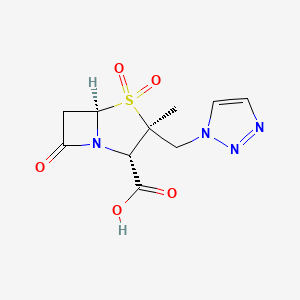
Tazobactam


Tazobactam.svgTazobactam.png


Tazobactam; Tazobactam acid; 89786-04-9; Tazobactamum; YTR-830H; CL-298741

(2S,3S,5R)-3-methyl-4,4,7-trioxo-3-(triazol-1-ylmethyl)-4$l^{6}-thia-1-azabicyclo[3.2.0]heptane-2-carboxylic acid

CAS 89785-84-2 SODIUM SALT

TAIHO Innovator

Molecular Formula: C10H12N4O5S
Molecular Weight: 300.29108 g/mol

Tazobactam is a beta Lactamase Inhibitor. The mechanism of action of tazobactam is as a beta Lactamase Inhibitor.

Tazobactam is a penicillanic acid sulfone derivative and beta-lactamase inhibitor with antibacterial activity. Tazobactam contains a beta-lactam ring and irreversibly binds to beta-lactamase at or near its active site. This protects other beta-lactam antibiotics from beta-lactamase catalysis. This drug is used in conjunction with beta-lactamase susceptible penicillins to treat infections caused by beta-lactamase producing organisms.

Tazobactam is a pharmaceutical drug that inhibits the action of bacterial β-lactamases, especially those belonging to the SHV-1 and TEM groups. It is commonly used as its sodium salt, tazobactam sodium.

Tazobactam is combined with the extended spectrum β-lactam antibiotic piperacillin in the drug piperacillin/tazobactam, one of the preferred antibiotic treatments for nosocomial pneumonia caused by Pseudomonas aeruginosa.[citation needed] Tazobactam broadens the spectrum of piperacillin by making it effective against organisms that express β-lactamase and would normally degrade piperacillin.[1]

Tazobactam is a heavily modified penicillin and a sulfone.


PAPER

doi:10.1021/jm00391a032

http://pubs.acs.org/doi/pdf/10.1021/jm00391a032

Synthesis 

PATENT

CN 104031065

http://www.google.com/patents/CN104031065A?cl=zh

[2S- (2 α, 2 β, 5 α)] -3- methyl _7_ oxo _3_ (1Η-1,2,3_ triazol-1-ylmethyl) -4- thia-1-azabicyclo – [3,2, O] – heptane-2-carboxylic acid 4,4-dioxide.

The structural formula:

Figure CN104031065AD00041

The first from 6-aminopenicillanic acid (6-APA) prepared by starting from the Hall TW et al., Its structure is to add a triazole ring on the basis of sulbactam to improve the effect of inhibiting the enzyme, which is currently lactam best clinical results β_ inhibitor, with high stability, low activity, low toxicity, inhibiting activity and other characteristics. 1992, tazobactam combination drug tazobactam / piperacillin (1: 8) for the first time in France the market, used to treat a variety of bacterial infections.

The literature related to the different synthesis Tazobactam triazole ring according to the introduction, there are two main ways of preparation methods: the azide cycloaddition synthetic triazole five-membered ring and the side chains directly added triazole ring .

Preparation Method One: the azide cycloaddition method, as shown below:

Figure CN104031065AD00051

The azide cycloaddition preparation method, which is penicillanic acid diphenylmethyl ester sulfoxide as raw material, open-loop, chloride, azide, oxidation, alkyne cycloaddition, deprotection steps to obtain cilostazol Batan, although each step is quite simple and easy for industrial production, at present most manufacturers use this route, but its route is longer, and there is the azide reaction byproducts generated a large number of six-membered ring, the total yield compared low.

Preparation Method two: direct plus side chains triazole ring

Direct plus side chains triazole ring Preparation mainly disulfide nucleophilic ring was open and IH-1,2,3- triazole occurred directly in acetic acid in the presence of mercury or mercury oxide substituted rings (US4898939) or directly with the IH-1,2,3- triazole silver salt catalyzed reaction of iodine (Synthesis, 2005,3,442-446), as shown below:

Figure CN104031065AD00052

And the use of methyl chloride in an alkaline environment and iodine catalyzed substitution to generate the target product (CN200810238479 with 1H-1,2,3- triazole; Shanghai Second Medical University, Shanghai 2009/20 (5): 388- 391), as shown below:

Figure CN104031065AD00061

Direct plus side chains triazole ring preparation method because of its short synthetic route, avoiding the risk of high temperature and pressure addition is currently a hot tazobactam drug synthesis research. Since the compound (4) the sulfur atom lone pair of electrons more of a halogen atom (Cl, Br,

I) have a role to leave, under alkaline action by 1H-1,2,3- triazole nucleophilic attack IH ions generated carbocations prone to rearrangement to form a six-membered ring by-products higher probability, if the sulfur atom is oxidized to a sulfone, a sulfur atom, provided no lone pair of electrons, although able to increase its stability, but at the same time a halogen atom (Cl, Br, I) leaving passivation effect, such that the nucleophilic replace hardly occurs while using the expensive raw mercury and silver salts of heavy metals, higher costs, greater environmental pollution, which greatly restricted the industrial scale production.

Synthetic route of the present invention are as follows:

Figure CN104031065AD00071

Example 1: Preparation of 3-methyl – [2-oxo-4- (2-benzothiazolyl dithio) -1-azetidinyl] -3-butene diphenylmethyl ester (Compound 3) Preparation of

In penicillanic acid diphenylmethyl ester sulfoxide (compound 2) as a raw material, according to the literature (Synthesis, 2005,3,442-446) preparation, to give a pale yellow crystalline solid from acetone powder at a yield of 95%.

[0019] Examples of 2: 2 β- bromomethyl -2 α- methyl – penicillanic acid diphenylmethyl ester (Compound 4) Preparation of the solid obtained in Example I (Compound 3) 26g (0.05mol) dissolved in 300mL of methylene chloride, cooled to 0 ° C

The following is added 33.5g (0.075mol) of anhydrous copper bromide, after increases in (T5 ° C the reaction was stirred 10-ΐ2 hours, TLC sample testing of raw materials point disappears, and the filter cake was rinsed with 50mL methylene burn, The filtrate was respectively 200mL water, 200mL saturated sodium bicarbonate, 200mL water washing, containing 2β- bromomethyl -2α- methyl – penicillanic acid diphenylmethyl ester (compound 4) in methylene chloride was used directly in the next step reaction.

Examples 3 [0020]: 2 β – bromomethyl -2 α – methyl – penicillanate _1 β _ oxide diphenylmethyl ester (Compound 5) Preparation of

Of Example 2 was 2 β – bromomethyl -2 α – methyl – penicillanic acid diphenylmethyl ester (Compound 4) in dichloromethane was added 30mL of methanol, cooled to -5 ° C or less, dropwise 30mL50 % hydrogen peroxide / sodium tungstate mixture for about 30 minutes after the dripping, and the temperature at (T5 ° C incubation for 4 hours, then heated to 1 (T15 ° C incubation for 4 flying hours, TLC sample testing of raw materials (Compound 4) disappear , was added 200mL 7jC, stirred for five minutes, standing layer, the liquid layer was then washed with dichloromethane material 200mL 5% aqueous sodium bicarbonate to give comprising 2β – bromomethyl -2 α – methyl – di penicillanate phenylmethyl ester -1 β – oxide (Compound 5) in methylene chloride was used directly in the next reaction.

[0021] Example 4: 2 @ – (! 1 1-1,2,3- triazole group) -20- methyl – penicillanic acid diphenylmethyl ester 1 @ – oxide (compound 6) Preparation

Of Example 3 was 2 β – bromomethyl -2 α – methyl – penicillanic acid diphenylmethyl ester -1 β – oxide (Compound 5) in dichloromethane was added 60mL methanol, 30mL water and 10.35g (0.15mol) 1H-1,2,3- triazole, cooled to below 5 ° C, was added 26g anion resin, temperature 5 ~ 10 ° C and stirred overnight (more than 24 hours), samples of raw materials by TLC (Compound 5) disappears, filtered, and the filtrate was added 200mL of water, standing layered material liquid dichloromethane layer was added anhydrous magnesium sulfate and activated carbon decolorization dehydration process, concentrated and dried under reduced pressure, the residue was added 60mL of methanol was dissolved by heating, stirring slowly cooled to (T5 ° C crystallization, precipitation continued until most of the solids after cooling to below -10 ° C for about 4 hours, filtered, and the cake was rinsed with cold methanol and vacuum dried to give a white solid (compound 6) Hg, yield 82% (Compound 3 by meter), mp: V; ESI (m / z):. 450 ,; IHNMR (CDl3) Examples 5: 2β- (1Η-1,2, 3- triazole-yl) -2α- methyl – penicillanic acid diphenylmethyl ester 1,1-dioxide (Compound 7) Preparation of

The 9g (0.02πιο1) 2β – (1H-1,2,3- triazole group) _2 α – methyl – penicillanic acid diphenylmethyl ester 1-oxide (compound 6) was dissolved in 225mL dichloro methane, adding 45mL glacial acetic acid, cooled to below 0 ° C, was added in portions

3.8g (0.024mol) of potassium permanganate. After the addition was completed in 5 ~ 10 ° C incubated overnight (more than 16 hours), sampled by HPLC completion of the reaction, insolubles were removed by filtration, the filtrate was added to 200mL water, stirred for five minutes, allowed to stand The layers were separated and then washed with 200mL saturated aqueous sodium bicarbonate, methylene chloride stock solution layer was dehydrated by adding anhydrous magnesium sulfate and decolorizing charcoal treatment, the remaining concentrated under reduced pressure to about 50mL volume, slowly with stirring to a cooled (TC hereinafter Crystallization 2 hours, filtered, rinsed with a small amount of methylene chloride, dried in vacuo to give a white solid (Compound 7) 8.85g, yield 95%, mp: 201-206 ° C; ESI (m / z): 466, .; IHNMR (CDl3) Example 6: Preparation of tazobactam he (Compound I),

The 1g (0.021mol) 2 β – (1H-1,2,3- triazole group) _2 α – methyl – penicillanate 1,1-diphenyl ester (compound 7) was dissolved in 10mL m-cresol at 50 ~ 55 ° C incubated for 2 hours, cooled to O ~ 5 ° C, was added 200mL of methyl isobutyl ketone, extracted twice with 10mL saturated sodium bicarbonate solution, the combined aqueous layers were dried 10mL ethyl acetate extract miscellaneous twice, and the aqueous layer was added active carbon filtration, and the filtrate was cooled to O ~ 5 ° C, dropping 6mol / L hydrochloric acid to precipitate a solid no longer far, filtered cake was washed with cold water and dried under vacuum to give a white solid tazobactam 5.9g, yield 92%, mp: 136-1380C; ESI (m / z): 300; IHNMR (CDl3) ο


PATENT


WO 2014037893

http://www.google.com/patents/WO2014037893A1?cl=en

improved process for the preparation of Tazobactam of formula (I).

Figure imgf000003_0001

(I)

Tazobactam is chemically known as 2a-methyl-2 -(l,2,3-triazol-l-yl)- methylpenam-3a-carboxylate- 1,1 -dioxide and has a very low antibacterial activity. On the other hand, it exhibits a beta-lactamase inhibitory activity when irreversibly bonded to beta-lactamases produced by microorganisms. For this reason, Tazobactam may be used in combination with known antibiotics prone to be inactivated by beta-lactamases to allow them to exhibit their inherent antibacterial activity against beta-lactamase producing microorganisms. Tazobactam as a product is disclosed in US Patent No. 4,562,073.

Considering the importance of Tazobactam there are several literatures available which disclose various processes for the preparation of Tazobactam, some of which are described below.

US patent No. 4,562,073 provides Tazobactam of formula (I) and its derivatives. This patent also describes a process for their preparation as shown in Scheme – 1.

Figure imgf000004_0001

(I )

Scheme – 1

wherein R is hydrogen or trialkylsilyl; R is hydrogen, trialkylsilyl or COOM wherein M is hydrogen, C1-18 alkyl, C2-7 alkoxymethyl, etc., R has the same meaning as M and R represents carboxyl protecting group.

US patents 4,891,369 and 4,933,444 disclose an approach, which involves the preparation of 2a-methyl-2 -triazol lmethylpenam derivative of formula (V)

Figure imgf000004_0002

(V)

wherein R is a carboxy protecting group, by treatment of a β-halomethyl penam derivative of formula (IV), wherein X is chlorine or bromine and R is a carboxy protecting group, with 1,2,3-triazole.

Figure imgf000004_0003

(IV) US patent No. 4,507,239 provides a process which involves the preparation of 2a-methyl-2 -azidomethylpenam derivatives of formula (VII) by treatment of compound of formula (IV) with sodium azide in aqueous aprotic solvents.

Figure imgf000005_0001

In yet another method disclosed in US patent No. 4,895,941, penam sulfoxide of formula,

Figure imgf000005_0002

(II)

wherein R represents a carboxy protecting group, is treated with 2-trimethylsilyl- 1,2,3-triazole in a sealed tube at elevated temperatures to give a mixture which upon column chromatography purification yields 2a-methyl-2 -triazolylmethyl penam derivative of formula (V).

US patent 4,518,533 provides a process for the preparation of intermediate of formula (III)

Figure imgf000005_0003

(HI) wherein the ester of penicillanic acid- 1 -oxide [compound of formula (II)] is reacted with 2-mercaptobenzothiazole in aliphatic hydrocarbon or aromatic hydrocarbon followed by isolation using column chromatographic method.

US patent 7,273,935 provides a process for the preparation of compound of formula (VIII) by reacting compound of formula (III) with cyclising agents like HCl or HBr and sodium nitrite.

Figure imgf000006_0001

(VIII)

wherein R is carboxyl protecting group and L is a leaving group like CI or Br.

US patent 6,936,711 provides a process for the preparation of protected tazobactam [compound of formula (VI)] by reacting compound of formula (VIII) with 1,2,3-triazole using a base.

In addition, US patent namely US 6,660,855, US 7,692,003, and US 7,547,777 claim process for the preparation of crystalline intermediates useful in the preparation of Tazobactam.

In general, de-protection of p-nitrobenzyl/ diphenylmethyl group in penem/penicillin core like Meropenem, Imipenem, Doripenem, Ertapenem, Faropenem, tazobactam and the like utilizes 1-10% of palladium on carbon, like commercially available 1.0%, 2.5%, 5.0%, 7.5% or 10%, which requires high pressure reactor. US patent 4,925,934 provides a de-protection method for 2a-methyl-2 – triazolylmethylpenam derivative of formula (VI) by reaction with m-cresol

Figure imgf000007_0001

(VI)

wherein R is selected from p-methoxybenzyl, diphenylmethyl (benzhydryl), 3,4,5- tirmethoxybenzyl, 2,4-dimethoxybenzyl, 3,5-dimethoxy-4-hydroxybenzyl, 2,4,6- trimethylbenzyl, ditolylmethyl, dianisylmethyl or tert-butyl. The isolated product contains higher amount of m-cresol as an impurity.

US patent 7,674,898 provides a process for the isolation of tazobactam by heating the aqueous solution containing Tazobactam before adjusting the pH. Before adjusting the pH of the aqueous solution containing tazobactam, the said solution was treated with ion-exchange resin column to purify the product. The use of ion-exchange resin and eluting the product is cumbersome on commercial scale.

Considering the importance of Tazobactam in healthcare treatment, the present inventors diligently worked to identify a robust and high yield process for the preparation of Tazobactam having cresol content below 5 ppm. A further purpose of the invention is to provide a manufacturing method that yields Tazobactam and its related intermediates with high purity and productivity.

Scheme:

Figure imgf000009_0001

Preparation of Tazobactam (I)

Into m-cresol was added benzhydryl 3-methyl-7-oxo-3-(lH-l,2,3-triazol-l- ylmethyl)-4-thia-l-azabicyclo[3.2.0]heptane-2-carboxylate 4,4-dioxide (VI) (5 g) and heated at 50-55°C till the completion of the reaction. The reaction mass was diluted with methyl isobutyl ketone. The reaction mass was extracted with sodium bicarbonate solution. The aqueous extract was acidified with hydrochloric acid to pH 3.0-4.0 and washed with methyl isobutyl ketone. Activated carbon was added, stirred and filtered. The filtrate was cooled to 0-5°C, and isopropyl alcohol (20 mL) was added followed by adjusting the pH to 1.0-2.0 using hydrochloric acid. The crystallized product was filtered, washed with water and dried.

Yield: 2.7 g

Purity: 99.9%

m-cresol content: 0.7 ppm

Example 5

Preparation of Tazobactam (I)

Into m-cresol was added benzhydryl 3-methyl-7-oxo-3-(lH-l,2,3-triazol-l- ylmethyl)-4-thia-l-azabicyclo[3.2.0]heptane-2-carboxylate 4,4-dioxide (VI) (5 g) and heated at 70-75 °C till the completion of the reaction. The reaction mass was diluted with dichloromethane. The reaction mass was extracted with potassium carbonate solution. The aqueous extract was acidified with hydrochloric acid to pH 3.0-4.0 and washed with dichloromethane. Activated carbon was added, stirred and filtered. To the filtrate, methanol (20 mL) was added followed by adjusting the pH to 1.0-2.0 using hydrochloric acid at 22-27° C. The crystallized product was filtered, washed with water and dried.

Yield : 2.6g

Purity: 99.9%

m-cresol content : 0.24 ppm

Example 6

Preparation of Tazobactam (I)

Into m-cresol was added benzhydryl 3-methyl-7-oxo-3-(lH-l,2,3-triazol-l- ylmethyl)-4-thia-l-azabicyclo[3.2.0]heptane-2-carboxylate 4,4-dioxide (VI) (5 g) and heated at 60-65 °C till the completion of the reaction. The reaction mass was diluted with dichloromethane. The reaction mass was extracted with potassium carbonate solution. The aqueous extract was acidified with hydrochloric acid to pH 3.0-4.0 and washed with dichloromethane. Activated carbon was added, stirred and filtered. To the filtrate, ethanol (20 mL) was added followed by adjusting the pH to 1.0-2.0 using hydrochloric acid at 22-27° C. The crystallized product was filtered, washed with water and dried.

Yield : 2.6g

Purity: 99.9%

m- ere sol content : 0.31

Reference example- 1

The process disclosed (example-1) in US 4,925,934 was repeated to get Tazobactam

Figure imgf000021_0001

• The above table clearly indicates that the use of water-miscible solvents helps to reduce the m-cresol content to less than 1 ppm.

• The present process obviates the use of ion-exchange resin for the purification (Refer example-1 of US 7,674,898) and provides a robust process for the industrial production of Tazobactam having less than 5ppm, preferably less than lppm. The m-cresol content in tazobactam acid is determined using HPLC with the following parameters

Colum Zorbax SB C8 (150 x 4.6mm, 3.5μ).

Mobile phase Phosphate buffer: Acetonitile

Detector UV at 200 nm

Column temperature 30°C

Flow rate 0.8 mL/min

Run time 15 min.


PATENT

CN 102020663

http://www.google.com/patents/CN102020663B?cl=en

Example 8:

 (I) in a three-necked flask were added CH2Cl2 300mL IOOOmL and 1. 5mol. [1H2SO4 lOOmL, stirring was added 81. 3g (0. 508mol) of bromine was cooled to 0 ° C after, Ilg sixteen burning trimethylammonium ammonium bromide and 35g (0. 508mol) sodium nitrite to the reaction mixture, with continuous stirring, was added portionwise 6-APA 55g (0. 254mol) and dissolved, and stirred at 0~5 ° C Ih, a solution of lmol . L-1 NaHSO3 to K1- starch paper test solution does not change color. And then allowed to stand separated, the aqueous layer was combined organic layer was extracted twice IOOmL CH2Cl2, washed successively with water, 7% aqueous NaHCO3, saturated sodium chloride aqueous solution, to give 6,6-dibromo-containing penicillanic acid in CH2Cl2 solution was used directly in the next reaction.

 (2) in IOOOmL three flask, 6,6_-dibromo penicillanic acid in CH2Cl2 solution (about 400ml), cooled to 5 ° C after the addition of benzhydrol 47g (254mmol), DCC (N, N- dicyclohexyl carbodiimide) 52. 3g (254mmol), 1. 8g of concentrated sulfuric acid was added and dissolved with stirring, at 5~10 ° C under stirring for 30min the reaction product was filtered off D⑶ DCC dehydrated to form the (N, N- two cyclohexylurea), liquor spotting, TLC [developing solvent V (cyclohexane): V (ethyl acetate) = 6: 4] to display all the raw materials after completion of the reaction on a rotary evaporator at 30~40 ° C steam dichloromethane, to give the 6,6-dibromo-penicillanic acid diphenylmethyl ester concentrate was used directly in the next reaction.

[0120] (3) obtained in the above Step 6,6-dibromo-penicillanic acid diphenylmethyl ester concentrate was added 500mL three flask, cooled with stirring to (TC, was added 0. 5g cobalt acetate Co (AC) 2 at 0~5 ° C dropping 50mL 30% H202, finished in 30min drip, drip completed at 0~5 ° C thermal reaction, TLC [developing solvent V (cyclohexane): V (ethyl acetate) = 6: 4] track to complete the reaction (about 4h). Still stratification, the organic layer was successively washed with water three times, after 7% NaHC03 was washed twice, the solvent was distilled off under reduced pressure to give 6,6-dibromo-penicillanic alkylene acid diphenylmethyl ester sulfoxide The crude product without purification, was used directly in the next reaction.

 (4) the 6,6-dibromo-penicillanic acid diphenylmethyl ester sulfoxide The crude product was dissolved in 4001 ^ tetrahydrofuran, at 101: add 150mL 10% NH4Cl solution, zinc powder was added in four portions 82. 5g (127mol), at intervals IOmin, about 50min addition was completed, plus complete response at 0~10 ° C 30min. Plus zinc filtered through Celite, standing stratified rotating concentrated organic layer recovered tetrahydrofuran. Ethyl acetate was added to dissolve the concentrated solution, washed with water, saturated aqueous sodium chloride solution, dried over anhydrous magnesium sulfate, concentrated under reduced pressure (45 ° C or less) to just precipitate a solid, 0~5 ° C curing crystallization 3h, suction and the filter cake was dried in vacuo to give white crystals of 6,6-dihydro-penicillanic acid sulfoxide, diphenylmethyl ester 70g, 72% yield [6-APA to calculate, yield = weight of dry product / (6-APA was mass X 383)], mp 145 ~147 ° C (literature value of 145 ~148 ° C).

 (5) containing 6,6-dihydro-penicillanic acid sulfoxide, diphenylmethyl ester (70g, 0. 182mol), 2- trimethylsilyl-1,2,3-triazole (25. 7g, the 0. 182mol) and toluene (500mL) autoclave purged with nitrogen, then heated to 110~120 ° C, the reaction 4.5h. After cooling, toluene was evaporated, extracted with ethyl acetate (700mL), water (250mL) washed with saturated sodium chloride solution (250mL), dried over anhydrous magnesium sulfate, the solvent was evaporated, and recrystallized from ethanol to give 2a- A yl 23- (1,2,3-triazol-1-yl) methyl penicillanate -3 a- carboxylic acid, diphenylmethyl ester (white solid) 43.48g, 55% yield [yield = dry product Weight / (() • 182X434. 4)], mp 140 ~142 ° C (literature values ​​141 ~143 ° C).

 (6) The 2a- methyl 2 P – (1,2,3`_ triazol _1_ yl) methyl penicillanate _3 a – carboxylic acid diphenylmethyl ester 43. 48g (0.1OOmoI ) was dissolved in 35mL of acetone, was added 70mL of water and 105mL of glacial acetic acid, cooled to 0~5 ° C, was added with stirring a mixture of KMnO4 (23. 7g KMnO4,16. 5g of concentrated phosphoric acid, and 520ml water), with 5mol. L- phosphate, pH was adjusted to 1 6.5, the reaction was stirred at room temperature for 3h. 30% hydrogen peroxide was added dropwise to the reaction solution colorless, filtered, and the resulting crude product was recrystallized from methanol to give 40. 6g as a white solid (2 a- methyl 2 ¢ – (1, 2,3- triazol-1-yl) methylpenicillanate _3 a – carboxylic acid diphenylmethyl ester-dioxide), 87% yield [yield = weight of dry product / (0 100X466.7).]. mp 205~207 ° C (206 ~208 literature values ​​..).

 (7) in 500ml reaction flask was added 2 a- methyl 2 ¢ – (1, 2,3- triazol-1-yl) methyl penicillanate _3 a- two carboxylic acid diphenylmethyl ester oxide 40. 6g (0. 087mol) and 200mL (2mol) between A sprinkle, stirred until solid was completely dissolved, 80 ° C the reaction was kept 4h, cooled to room temperature, was added 600mL of methyl isobutyl ketone, with IOOmL 7% carbonate solution of sodium hydroxide wash, the aqueous layer was separated, the organic layer was washed twice with 150ml, the combined aqueous layer was cooled to 0~5 ° C, with 6mol. L-1 hydrochloric acid to adjust the pH to I~1. 8, white crystals precipitated, pumping filter, 80 ° C drying, dry goods tazobactam 15. 2g, 58% yield [yield = dry goods weight / (0. 087X300. 3)] o mp 136 ~137 ° C (literature value of 136 ~ 138 ° C).

Figure CN102020663BD00061

 PATENT

http://www.google.com/patents/EP1686131A2?cl=en

  • methods of producing β-substituted methyl penam derivatives. For instance, US 4,529,592 discloses a process which involves the treatment of 2α-methyl-2β-azidomethyl penam derivatives of formula (c):

    Figure imgb0003

    wherein R is a carboxy-protecting group, with acetylene, an acetylene derivative or a vinyl derivative under high pressure in a sealed reactor and at elevated temperatures, followed by deprotection with a suitable reagent to get the β-lactamase inhibitor of formula (a).

  • The 2α-methyl-2β-azidomethyl penam derivative of formula (c) is in turn prepared from the 2α-methyl-2β-halomethyl penam derivatives of formula (d)

    Figure imgb0004

    wherein R is a carboxy-protecting group and X is chloro or bromo, by treating with sodium azide in aqueous polar aprotic solvents, followed by oxidation.

  • US 4,891,369 and US 4,933,444 disclose a different approach, which involves the preparation of 2α-methyl-2β-triazolylmethylpenam derivatives of formula (e) wherein R is a carboxy protecting group and n is 0, by the treatment of a β-halomethyl penam derivative of formula (d), wherein X is chlorine or bromine and R is a carboxy-protecting group, with 1H-1,2,3-triazole.

    Figure imgb0005

    The product obtained can be oxidized and deprotected to get the 2β-substituted methyl penam compound (a).

  • US 4,912,213 discloses a reduction method employing lead salts in catalytic amounts to prepare a 2α-methyl-2β-triazolylmethyl penam derivative of formula (e) (n=0-2) from 6-halo or 6,6-dihalo-2α-methyl-2β-triazolylmethyl penam derivatives of formula (f)

    Figure imgb0006

    where X may be Cl, Br, I; Y may be Cl, Br, I or a hydrogen atom; and R is a carboxy-protecting group.

  • In yet another method disclosed by US 4,895,941, penam sulfoxide of formula (g), wherein R represents a carboxy-protecting group, is treated with 2-trimethylsilyl-1,2,3-triazole in a sealed tube at elevated temperatures to give a mixture which requires purification by column chromatography to isolate the 2α-methyl-2β-triazolylmethyl penam derivative of formula (e) (n=0).

    Figure imgb0007
  • As an alternative to the hydrogenation, US 4,925,934 discloses a deblocking method for a 2α-methyl-2β-triazolylmethyl penam derivative of formula (h) by reaction with cresol

    Figure imgb0008

    where R is selected from p-methoxybenzyl, 3,4,5-trimethoxybenzyl, 2,4-dimethoxybenzyl, 3,5-dimethoxy-4-hydroxybenzyl, 2,4,6-trimethylbenzyl, diphenylmethyl, ditolylmethyl, dianisylmethyl or tert-butyl.

  • [0009]

    Published application US 2003/232983 discloses a complete different route of synthesis for 2α-methyl-2β-triazolylmethyl-penam derivatives starting from cepham derivates of formula (i) by substitution and rearrangement

    Figure imgb0009

    where R represents a carboxy-protecting group and L a leaving group.

  • In most of the methods involved, 2α-methyl-2β-halomethyl penam of formula (d) is used as the key intermediate. This is true with both the azide/acetylene combo and the triazole route discussed above. However, the 2α-methyl-2β-halomethyl penam of formula (d) itself is an unstable intermediate and therefore manufacturing and storage of this intermediate in large quantities is always cumbersome. This intermediate has been found to degrade on storage even at low temperatures in isolated form as well as in the solution from which it is isolated. Thus, all the operations related to preparation of the intermediate have to be done rapidly, and the isolated intermediate has to be converted to the final product immediately. As a result of these limitations, in-plant scale up always yields by-products which ultimately require purification demands.

Example 1: Preparation of Tazobactam Sodium by route A. (Fig. 1)Step 1.

      Production of 6α-Bromopenicillanic acid (BPA) (compound II)

    • 2.5 L of 1.24 molar sulphuric acid (3.125 mol) was stirred at 4°C in a 6 L flask. 218.4 g (1.0 mol) of 6-APA (99%) (compound I) following 601 g (5.05 mol) of potassium bromide and 2000 mL of ethanol were added, maintaining the temperature between 4 to 8°C. Inorganic salts were removed by filtration. The resulting cake was washed by 2 x 1.25 L of cooled dichloromethane. The aqueous phase was extracted twice using the previous washing liquor and 3 x 500 mL of cooled dichloromethane. The organic phases were combined (approx. 4.0 L) and washed with 2 x 200 mL of 30% brine at 4°C. The greenish-brown solution was concentrated to 700 mL in vacuum. The precipitate was removed by filtration and the solution was kept below 0°C and used without further purification in the next reaction step.
      Yield: 90% (by titration)
      TLC (thin layer chromatography; detection by UV and phosphomolybdic acid, eluent: acetone – methanol 2:1 v/v): Rf 0.65 (BPA), (eluent: acetone – methanol 4:1 v/v) Rf 0.35 (BPA)

Step 2

      . Production of 6α-Bromopenicillanic acid-S-oxide (BPO) (compound III)

    • 1.8 mol of BPA in 1400 mL of dichloromethane was placed in a 4 L flask. The temperature of the solution was maintained between 0 to 2°C. 2.0 mol peracetic acid in acetic acid solution (342 mL, 40 wt.-% peracetic acid) was added within 100 to 120 minutes, maintaining the temperature of the solution between 0 to 8°C. The color of the solution changed to yellowish-brown. The solution was stirred further 1 hour at 0 to 8°C. The product crystallizes. The slurry was cooled to -10 to -15°C and stirred further 30 minutes then filtered. The cake was washed with 2 x 400 mL of dichloromethane at -10°C. The product was dried at 20 – 25°C in vacuum. The crude product was kept below 0°C and used without further purification immediately (storage time 1 to 2 days) in the next reaction step.
      Yield: 314 – 331g (58,9 – 62.1 %)    Mp: 130 °C (decomp.)
      Cumulative yield of 1st and 2nd steps: 51- 52%
      TLC (detection by UV and phosphornolybdic acid, eluent: acetone – methanol 2:1 v/v)
      Rf 0.65 (BPA), Rf 0.45 (BPO)
      The yield can be improved using higher concentrated peracetic acid.

Step 3

      . Production of 6α-Bromopenicillanic acid-S-oxide p-nitrobenzyl ester (BPE) (compound IV)

    • In a 4 L flask 272.44 g (0.92 mol) of BPO was dissolved in 120 mL DMF at 25°C. 100.8 g (1,2 mol) of sodium hydrogencarbonate and 229.0 g (1.06 mol) of p-nitrobenzylbromide (PNM) were added portionwise. The slurry was cooled and stirred at 0 to 5°C for one hour. The product was filtered and washed with 2 x 800 mL of cold water. The wet product was placed in a 2 L flask and 1200 mL of methanol was added. The slurry was refluxed for one hour, cooled to -10°C and filtered. The cake was washed with 2 x 800 mL of methanol at -10°C. The product was dried at 25 – 30°C in vacuum and stored at 0°C without further purification in the next reaction step.
      Yield: 334.8 g (84.4%)    Mp: 130 °C (decomp.)
      Cumulative yield of 1st, 2nd and 3rd steps: 46%
      TLC (detection by UV, eluent: acetone – methanol 2:1 v/v) Rf 0.75 (BPE), Rf 0.65 (BPO);
      (eluent: ethyl acetate – hexane 2:1 v/v) Rf 0.50 (BPE), Rf 0.00 (BPO)

Step 4.

      Production of 2-(2-Benzothiazolyldithio)-3-bromo-α-(1-methylethylidene)-4-oxo-1-azetidincacetic acid p-nitrobenzyl ester (BBE) (compound V)

    • In a 4 L flask 140.84 g (0.826 mol) of 95% 2-mercaptobenzothiazole (MBT) and 345.0 g BPE (0.8 mol) were dissolved in 1360 mL toluene when the solution was heated to 86 – 90°C and an azeotropic mixture of toluene-water was distilled at 450 to 500 mbar. After 3 to four hours, 14 to 16 mL of water was removed using a Dean-Stark apparatus maintaining the temperature between 86 to 90°C. If unreacted BPE could be detected by TLC, a small amount of 2 to 8 g of MBT was added. The solution was refluxed until no starting material could be detected by TLC.
    • The solution was evaporated in vacuum between 60 to 70°C. The residual oil was dissolved in 1200 mL of ethyl acetate. After cooling the product crystallizes. The slurry was concentrated in vacuum below 50 °C to 800 mL and 1200 mL isopropyl ether was added to give a well-filterable crystalline slurry that was cooled below 20°C and stirred for additional 24 hours. Subsequently, the product was filtered and washed with 2 x 500 mL cooled isopropyl ether. The product was dried in vacuum between 25 – 30°C.
      Yield: 412.8 g (88.9%)    Mp.: 116-119°C
      Cumulative yield of 1st, 2nd, 3rd and 4th steps: 41%
      TLC (detection by UV, eluent: isopropyl ether – ethyl acetate 99:1 v/v) Rr 0.65 (BBE)

Step 5

      . Production of 6α-Bromo-2β-bromomethyl-2α-methylpenam-3α carboxylic acid p-nitrobenzyl ester (DBPE) (compound VI)

    • In a 4 L flask 290.24 g (0.5 L) of BBE was dissolved in 1500 mL dichloromethane. The solution was cooled to -2°C. 540 mL of 30% aqueous solution of hydrogen bromide (2.52 mol) was added, keeping the temperature below 0°C. A solution of 103.5 g (1.5 mol) sodium nitrite in 300 mL was added keeping the temperature between 0 to 3 °C. Meanwhile the colour of the organic phase turned to brown. The reaction mixture was stirred about 90 min at 0 to 5 °C until the starting material could not be detected by TLC. 80 g of sodium carbonate (0.75 mol) was added, adjusting the pH to between 6 and 7. The reaction mixture was filtered using perlite as a filter aid. The precipitate was washed with 3 x 100 mL dichloromethane. The combined organic layer was separated and concentrated to 700 mL. The solution was cooled to 20 °C and two litres of isopropyl ether were added slowly. The crystalline suspension was stirred 16 hours at 20 °C and two hours at 0 °C. It was filtered and the product was washed with 2 x 300 mL of cooled isopropyl ether. The product was dried at 20 to 25 °C in vacuum.
      Yield: 235.84 g (95.5%)    Mp.: 80 °C (decomp.)
      Purity: min. 95 %
      Cumulative yield of 1st – 5th steps: 39%
      The product is sensitive to light and decomposes on silica gel to give cepham.
      TLC (detection by UV, eluent: isopropyl ether – ethyl acetate 99:1 v/v) Rf 0.72 (DBPE),
      Rf 0.65 (BBE), Rf 0.57 (cepham)

Step 6

      . Production of 6α-Bromo-2β-azidomethyl-2α-methylpenam-3α-carboxylic acid p-nitrobenzyl ester (BTPE) (compound VII)

    • In a 2 L flask 292.3 g (342 mL, 2.664 mol) trimethylsilylchloride was dissolved in 1300 mL of toluene. 210.1 g (3.20 mol) sodium azide was added and the suspension was stirred and refluxed. The reaction was traced by GC. After 10 to 16 hours less than 0.1% of the starting material could be detected. The suspension was cooled to -5 to 0°C and was filtered (or decanted). The solution (1580 mL) contains 2.40 mol of trimethylsilylazide, which is volatile (Bp: 95°C) and a toxic compound.
    • In a 2 L flask 52.63 g (23.7 mL, 0.2 mol) tin(IV) chloride was added to a toluene solution of 2.4 mol of trimethylsilylazide between 20 – 25°C. The solution was stirred 24 hours at 20 – 25 °C while some white precipitate appeared. 197.7 g (0.4 mol) DBPE was added. The suspension was stirred 40 to 70 hours while brown gum appeared. The formation of azide was traced by TLC (eluent isopropyl ether – ethyl acetate 99:1 v/v) Rf 0.72 (DBPE), Rf 0.61 (BAPE), Rf 0.58 (cephambromide) Rf 0.40 (cephamazide).
    • Conversion of the starting material to product was less than 50% after 40 hours. Additionally, 0.2 mol of tin (IV) chloride was added, which accelerated the formation of BAPE.
    • After no starting material could be detected by TLC, the reaction mixture was quenched with 1200 mL of saturated sodium carbonate solution at 5-10°C. The insoluble material was dissolved by 400 mL ethyl acetate and added to the sodium carbonate solution. The biphasic reaction mixture was stirred 15 minutes, The pH of the lower aqueous phase was between 8 and 9. Perlite (50 g) as a filter aid was added and the suspension was filtered. The cake was washed with 2 x 200 mL of ethyl acetate.
    • The combined filtrates were poured into a 5 L separating funnel and the lower aqueous phase was removed and extracted with 2 x 200 mL ethyl acetate. The combined organic phases were washed by 200 mL saturated sodium bicarbonate solution and 200 mL brine. The solvent was removed in vacuum and the residue was suspended in 1000 mL methanol at 0 – 5 °C. The crystalline suspension was stirred 2 to 3 hours at 0 – 5 °C and filtered. The product was washed with 200 mL diisopropyl ether and dried in vacuum at 20 – 25 °C.
      Yield: 153.8 g (84.3%)
      Purity: 68 ― 70% (by HPLC: mobile phase 0.05 M KH2PO4 – acetonitrile 1:1, pH 6,
      Rf 14.33 min)
      Cumulative yield of 1st – 6th steps: 33%

Step 7

      . Production of 6α-Bromo-2β-[(1,2,3-triazol-1-yl)methyl]-2α-methylpenam-3α-carboxylic acid p-nitrobenzyl ester (BTPE) (compound VIII)

    • In a 1 L autoclave 7.6 g (50 mmol) BAPE was dissolved in 640 mL 2-butanone. The solution was cooled down to 0 – 5 °C. The autoclave was pressured three times with nitrogen gas up to six bar. The autoclave was filled with acetylene gas up to 1.5 bar pressure and approx. 36 g acetylene gas was dissolved. The autoclave was heated gradually from 0 °C up to 84 – 94 °C, keeping the pressure between 5 – 6 bar. The reaction mixture was stirred in the autoclave 14 – 20 hours at 84 to 94 °C and pressure of 5 to 6 bar. No starting material was detected by TLC (eluent hexane – ethyl acetate 1:2 v/v) Rf> 0.9 (BAPE), Rf 0.51 (BTPE), Rf 0.32 (cephamtriazole).
    • The autoclave was cooled down to -20 to -25 °C and 7.6 g BAPE in 50 mL 2-butanone solution was added. The autoclave was heated again to 84 – 94 °C and the reaction mixture was stirred 14 to 20 hours at 84 – 94 °C. The autoclave was cooled and the procedure was repeated with 7.6 g BAPE. The autoclave was cooled down to 20 – 25 °C and opened. The reaction mixture was poured into a 1 L flask and was concentrated in vacuum up to 140 mL. The solution was cooled to 0 – 5°C. The crystalline suspension was stirred for 1 hour and was filtered. The product was washed with 40 mL cool 2-butanone. The product was dried in vacuum at 25 – 30 °C.
      Yield: 13.51 g (56.0%)    Mp.: 180-182°C (decomp.)
      Purity: 98.6% (by HPLC: mobile phase 0.05 M KH2PO4 – acetonitrile 1:1, pH 6,
      Rf 8.40 min)
      Cumulative yield of 1st– 7th steps: 18%

Step 8

      . Production of p-Nitrobenzyl 6α-bromo-2α-methyl-2β-(1,2,3-triazol-1-yl)methylpenam-3α -carboxylate-1,1-dioxide (compound. IX)

    • To a solution of 4.82 g (10.00 mmol) of BTPE in a mixture of 210 ml of acetic acid and 27 ml of water, 3.79 g (23.6 mmol) of KMnO4 was added in 30 minutes at room temperature. The progress of the reaction was monitored by TLC. When the reaction was complete, the excess of KMnO4 was destroyed by 30 % H2O2 solution. The reaction mixture was poured into 930 mL of cold water, the precipitated product was filtered and washed with cold water and dried over P2O5, giving compound IX.
      Yield: 4,12 g (80 %)
      Purity: more than 95 % (HPLC)    Mp.: 122-124°C
      TLC (detection by UV, eluent: ethyl acetate – hexane 2:1 v/v) Rf 0.51 (VIII), Rf 0.23 (IX)

Step 9

      . Production of Tetrabutylammonium 2α-methyl-2β-(1,2,3-triazol-1-yl)methylpenam-3α -carboxylate-1,1-dioxide (compound Xa)

    • A stainless steel stirred autoclave with a total volume of 1 L was charged with 5.1 g (10 mmol) of compound IX, 2.5 g (30 mmol) of NaHCO3, 1.0 g of 10 % Pd on charcoal, 100 mL of water and 100 mL of ethyl acetate. The autoclave was sealed and flushed with argon, then pressured with hydrogen up to 14 bars. The hydrogenation was carried out at room temperature for 5 h. Completion of the reaction was checked by TLC. The mixture was filtered and the filter washed with water. The aqueous phase was separated, washed with ethyl acetate (2 × 10 mL) and Bu4NNaSO4 solution (prepared from 340 mg (1 mmol) of Bu4NHSO4 and 84 mg (1 mmol) of NaHCO3 in 5 mL of water) added. The aqueous solution was extracted with dichloromethane (5 x 10 ml). The combined dichloromethane phases were dried over Na2SO4 and concentrated under reduced pressure to dryness keeping the temperature of the water bath below 20 °C.
      Yield: 0.39 g (75 %)
      Purity: 95.5 % (HPLC)
      HPLC mobile phase: 0.05 M KH2PO4 buffer, pH 2.3
      Eluent A: 95 % of 0.05 M KH2PO4 buffer (pH 2.3) plus 5 % acetonitrile
      Eluent B: 40 % of 0.05 M KH2PO4 buffer (pH 2.3) plus 60 % acetonitrile
      Retention time: 11.53 min
      Column: RP-18 endcapped (5µm, 250 mm)
      TLC (detection by UV and 1 % AgNO3 in ethanolic solution, eluent: ethyl acetate – hexane 2:1 v/v) Rf 0.23 (IX); (eluent: acetone -methanol 2:1 v/v) Rf 0.48 (Xa)

Step 10.

    Production of Sodium 2α-methyl-2β-(1,2,3-triazol-1-yl)methylpenam-3α-carboxylate-1,1-dioxide (Tazobactam sodium)

  • The residue containing compound Xa (0.40 g) was eluted with water on a column of Amberlite-Na+ cation-exchange resin. The appropriate fractions were concentrated under reduced pressure and finally lyophilized, yielding Tazobactam sodium.
    Yield: 0.21 g (85 %)
    Purity: 99.5 % (HPLC)
    HPLC mobile phase: 0.05 M KH2PO4 buffer, pH 2.3
    Eluent A: 95 % of 0.05 M KH2PO4 buffer (pH 2.3) plus 5 % acetonitrile
    Eluent B: 40 % of 0.05 M KH2PO4 buffer (pH 2.3) plus 60 % acetonitrile
    Retention time: 11.53 min
    Column: RP-18 cndcapped (5µm, 250 mm)

PATENT

http://www.google.com/patents/US8476425

Tazobactam arginine can be a salt consisting of the conjugate base of (2S,3S,5R)-3-((1H-1,2,3-triazol-1-yl)methyl)-3-methyl-7-oxo-4-thia-1-azabicyclo[3.2.0]heptane-2-carboxylic acid 4,4-dioxide (tazobactam) and the conjugate acid of (S)-2-amino-5-guanidinopentanoic acid (L-arginine) in a 1:1 ratio, as represented by the structure below.

Figure US08476425-20130702-C00001

References

  1. Yang Y, Rasmussen BA, Shlaes DM (1999). “Class A beta-lactamases—enzyme-inhibitor interactions and resistance”. Pharmacol Ther. 83: 141–151. doi:10.1016/S0163-7258(99)00027-3.
CN1037514A Mar 1, 1989 Nov 29, 1989 大鹏药品工业株式会社 Process for preparing 2 alpha-methyl-2 beta-(1,2,3-triazole-1-yl) methylpenam-3 alpha-carboxylic acid derivatives
US7674898 * Jul 23, 2001 Mar 9, 2010 Otsuka Chemical Co., Ltd. Anhydrous crystal of β-lactam compound and method for preparation thereof
Reference
1 * LI YANG ET AL.: ‘Synthesis of Tazobactam, [beta- Lactamase Inhibitor‘ TRANSACTIONS OF TIANJIN UNIVERSITY vol. 8, no. 1, March 2002, pages 33 – 36


Tazobactam
Tazobactam.svg
Tazobactam ball-and-stick.png
Systematic (IUPAC) name
(2S,3S,5R)-3-Methyl-7-oxo-3-(1H-1,2,3-triazol-1-ylmethyl)-4-thia-1-azabicyclo[3.2.0]heptane-2-carboxylic acid 4,4-dioxide
Clinical data
AHFS/Drugs.com International Drug Names
Pregnancy
category
  • B
Legal status
  • (Prescription only)
Routes of
administration
Intravenous
Identifiers
CAS Number 89786-04-9 Yes
ATC code J01CG02
PubChem CID: 123630
DrugBank DB01606 Yes
ChemSpider 110216 Yes
UNII SE10G96M8W Yes
KEGG D00660 Yes
ChEBI CHEBI:9421 Yes
ChEMBL CHEMBL404 Yes
Chemical data
Formula C10H12N4O5S
Molecular mass 300.289 g/mol
Patent Submitted Granted
2-OXO-1-AZETIDINE SULFONIC ACID DERIVATIVES AS POTENT BETA-LACTAMASE INHIBITORS [EP0979229] 2000-02-16 2002-10-23
DHA-pharmaceutical agent conjugates of taxanes [US7199151] 2004-09-16 2007-04-03
Antimicrobial composition comprising a vinyyl pyrrolidinon derivative and a carbapenem antibiotic or a beta-lactamase inhibitor [EP0911030] 1999-04-28 2005-04-13
7-alkylidene-3-substituted-3-cephem-4-carboxylates as beta-lactamase inhibitors [US7488724] 2006-04-06 2009-02-10
Sustained release of antiinfectives [US7718189] 2006-04-06 2010-05-18
Conjugate of fine porous particles with polymer molecules and the utilization thereof [US2006159715] 2006-07-20
ENGINEERED BACTERIOPHAGES AS ADJUVANTS FOR ANTIMICROBIAL AGENTS AND COMPOSITIONS AND METHODS OF USE THEREOF [US2010322903] 2009-01-12 2010-12-23
Microparticles for the treatment of disease [US2010323019] 2010-08-19 2010-12-23
Packaging System [US2010326868] 2010-08-30 2010-12-30
COMBINATION ANTIBIOTIC AND ANTIBODY THERAPY FOR THE TREATMENT OF PSEUDOMONAS AERUGINOSA INFECTION [US2010272736] 2010-02-04 2010-10-28
Citing Patent Filing date Publication date Applicant Title
CN102304139A * Jul 12, 2011 Jan 4, 2012 景德镇市富祥药业有限公司 Method for preparing 2 beta-methyl penicillanate benzhydryl dioxide
CN102304139B Jul 12, 2011 Jun 4, 2014 江西富祥药业股份有限公司 Method for preparing 2 beta-methyl penicillanate benzhydryl dioxide
CN102382123A * Mar 10, 2011 Mar 21, 2012 海南美好西林生物制药有限公司 Preparation method of tazobactam sodium
CN102827189A * Sep 18, 2012 Dec 19, 2012 山东罗欣药业股份有限公司 Tazobactam sodium compound and pharmaceutical composition thereof
US8476425 Sep 27, 2012 Jul 2, 2013 Cubist Pharmaceuticals, Inc. Tazobactam arginine compositions
US8906898 May 28, 2014 Dec 9, 2014 Calixa Therapeutics, Inc. Solid forms of ceftolozane
US8968753 May 22, 2014 Mar 3, 2015 Calixa Therapeutics, Inc. Ceftolozane-tazobactam pharmaceutical compositions
US9044485 Apr 11, 2014 Jun 2, 2015 Calixa Therapeutics, Inc. Ceftolozane antibiotic compositions

SEE BACTAM SERIES…………..http://apisynthesisint.blogspot.in/p/bactam-series.html

/////////

O=S2(=O)[C@]([C@@H](N1C(=O)C[C@H]12)C(=O)O)(Cn3nncc3)C

or

CC1(C(N2C(S1(=O)=O)CC2=O)C(=O)O)CN3C=CN=N3

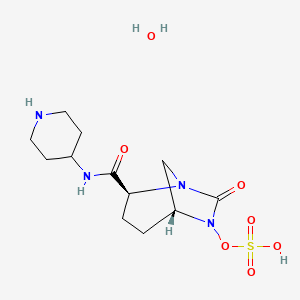
MK 7655, RELEBACTAM, a β-Lactamase inhibitor


Image result for RELEBACTAM

MK 7655, RELEBACTAM

(1R,2S,5R)-7-Oxo-N-(4-piperidinyl)-6-(sulfooxy)-1,6-diazabicyclo[3.2.1]octane-2-carboxamide

(1R,2S,5R)-7-oxo-2-((piperidin-4-yl)carbamoyl)-1,6-diazabicyclo(3.2.1)octan-6-yl hydrogen sulfate monohydrate

Sulfuric acid, mono((1R,2S,5R)-7-oxo-2-((4-piperidinylamino)carbonyl)-1,6-diazabicyclo(3.2.1)oct-6-yl) ester, hydrate (1:1)

MF C12H22N4O7S
MW 366.39068 g/mol

CAS 1174020-13-3

β-Lactamase inhibitor

MK-7655 is a beta-lactamase inhibitor in phase III clinical studies at Merck & Co for the treatment of serious bacterial infections…….See clinicaltrials.gov, trial identifier numbers NCT01505634 and NCT01506271.

In 2014, Qualified Infectious Disease Product (QIDP) and Fast Track designations were assigned by the FDA for the treatment of complicated urinary tract infections, complicated intra-abdominal infections and hospital-acquired bacterial pneumonia/ventilator-associated bacterial pneumonia.

sc1

PAPER

A concise synthesis of a beta-lactamase inhibitor
Org Lett 2011, 13(20): 5480

http://pubs.acs.org/doi/abs/10.1021/ol202195n

http://pubs.acs.org/doi/suppl/10.1021/ol202195n/suppl_file/ol202195n_si_001.pdf


Abstract Image

MK-7655 (1) is a β-lactamase inhibitor in clinical trials as a combination therapy for the treatment of bacterial infection resistant to β-lactam antibiotics. Its unusual structural challenges have inspired a rapid synthesis featuring an iridium-catalyzed N–H insertion and a series of late stage transformations designed around the reactivity of the labile bicyclo[3.2.1]urea at the core of the target.

H NMR (400 MHz, DMSO-d6): δ 8.30 (br s, 2H), 8.20 (d, J = 7.8 Hz, 1H), 4.01 (s, 1H), 3.97-3.85 (m, 1H), 3.75 (d, J = 6.5 Hz, 1H), 3.28 (dd, J = 12.9, 2.5 Hz, 2H), 3.05-2.93 (m, 4H), 2.08-1.97 (m, 1H), 1.95-1.79 (m, 3H), 1.73-1.59 (m, 4H);

13C NMR (DMSO-d6, 100 MHz) δ 169.7, 166.9, 59.8, 58.3, 46.9, 44.3, 42.9, 28.5, 28.3, 20.8, 18.9;

HRMS calculated for C12H20N4O6S (M+H): 349.1182, found: 349.1183.

[α]D 25 = -23.3 (c = 1.0, CHCl3)

sc1

sc2

PATENT

WO 2009091856

http://www.google.com/patents/WO2009091856A2?cl=en

EXAMPLE IA

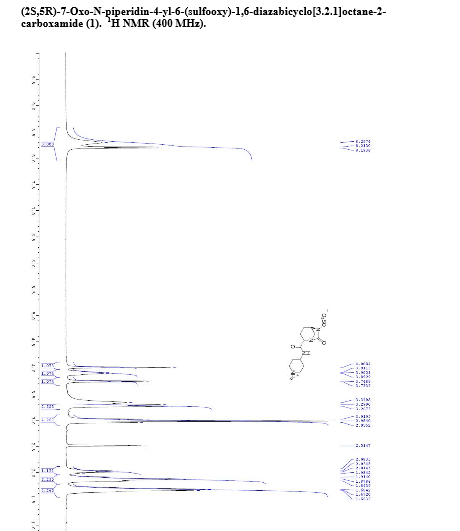
(2S ,5 R)-7-Oxo-N-piperidin-4-yl-6-(sulfooxy)- 1 ,6-diazabicyclo [3.2.1 ]octane-2-carboxamide

Figure imgf000063_0001

Step 1 : tert-butyl 4-({[(2S,5R)-6-(benzyloxy)-7-oxo-l,6-diazabicyclo[3.2.1]oct-2- yljcarbonyl } amino)piperidine- 1 -carboxylate : To a solution of (2S,5R)-6-(phenylmethoxy)-7-oxo-l,6-diazabicyclot3.2.1]octane-

2-carboxylic acid (1.484 g, 5.37 mmol) in dry dichloromethane (60 ml) was added triethylamine (1.88 ml, 13.49 mmol), 2-chloro-l-methylpyridinium iodide (1.60 g, 6.26 mmol), and 4-amino-l- BOC-piperidine (1.30 g, 6.49 mmol) sequentially at room temperature under nitrogen. The reaction was then heated to 500C for 1 hour. The reaction mixture was concentrated under vacuum and purified by silica gel chromatography on an Isco Combiflash (40 g silica gel, 40 mL/min, 254 nM, 15% to 100% EtOAc/hexane over 14 column volumes then 100% EtOAc for 4 column volumes; title compuond eluted at 65% ethyl acetate/hexane) to afford the title compound as a pale orange solid.

Step 2: tert-butyl 4-({[(2S,5R)-6-hydroxy-7-oxo-l ,6-diazabicyclo[3.2.1]oct-2- yl] carbonyl } amino)piρeridine- 1 -carboxylate:

Palladium on carbon (394 mg; 10% Pd/C) was added to a solution of the product of step 1 (1.81 g, 3.95 mmol) in methanol (50.6 mL) and the resulting mixture was stirred under hydrogen (balloon) overnight. LC/MS analysis indicated the reaction was not complete. Acetic acid (6 drops) and additional catalyst (159 mg of 10% Pd/C) were added to the reaction and the resulting mixture was stirred under hydrogen (balloon) for an additional 90 minutes. Additional catalyst (0.2085 g of 10% Pd/C) was added to the reaction and stirring under hydrogen was continued for an additional 2.5 hours at which time the reaction was judged complete by LC-MS analysis. The reaction was filtered through a celite pad and the collected solid was washed well wtih MeOH. The filtrate was concentrated under vacuum to afford the title compound as a colorless oil which was used without purification in the next step.

Step 3 : tert-butyl-4-({ [(2S,5R)-7-oxo-6-(sulfooxy)- 1 ,6-diazabicyclo[3.2.1 ]oct-2- yl] carbonyl } amino)ρiperidine- 1 -carboxylate:

To a solution of the product of step 2 (1.455 g, 3.95 mmol; theoretical yield of step 2) in dry pyridine (30 mL) was added sulfur trioxide pyridine complex (3.2 g, 20.11 mmol) at room temperature under nitrogen. The resulting thick mixture was stirred over the weekend.

The reaction was filtered and the white insoluble solids were washed well with dichloromethane. The filtrate was concentrated in vacuo. The residue was further azeotroped with toluene to remove excess pyridine to afford the title compound which was used without purification in the next step.

Step 4: (2S,5R)-7-oxo-N-piperidin-4-yl-6-(sulfooxy)-l,6-diazabicyclo[3.2.1]octane-2- carboxamide:

To a mixture of the product of step 3 (1.772 g, 3.95 mmol; theoretical yield of step 3) in dry dichloromethane (30 ml) at 00C under nitrogen was slowly added trifluoroacetic acid (6.1 ml, 79 mmol). Immediately the reaction became a solution. After 1 hour, additional trifluoroacetic acid (8 ml) was added to the reaction. The reaction was stirred at 00C until judged complete by LC-MS analysis then concentrated in vacuo. The residue was triturated with ether (3X) to remove excess TFA and organic impurities. The resulting white insoluble solid was collected via centrifugation, dried in vacuo, then purified by preparative HPLC (250X21.2 mm Phenomenex Synergi Polar-RP 80A column; 10 micron; 35 mL/min.; 210 nM; 0% to 30% methanol/water over 15 minutes; title compound eluted at 10% methanol/water). Fractions containing the title compound were combined and Iyophilized overnight to afford the title compound as a white solid. LC-MS (negative ionization mode) m/e 347 (M-H).

PAPER

Discovery of MK-7655, a beta-lactamase inhibitor for combination with Primaxin
Bioorg Med Chem Lett 2014, 24(3): 780

http://www.sciencedirect.com/science/article/pii/S0960894X13014856

Image for unlabelled figure

PATENT

WO 2014200786

http://www.google.dj/patents/WO2014200786A1?cl=en


Exemplary Scheme

– 50% isolated yield overall from 1 to 5

O via crystallization

XAMPLE 1

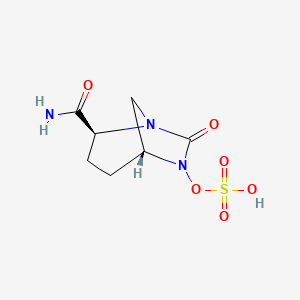
(2S,5R)-7-oxo-N-piperidin-4-yl-6-(sulfooxy)- 1 ,6-diazabicyclo[3.2.1 ]octane-2-carboxamide

Preparation of (15′,45)-5-((2-nitrophenyl)sulfonyl)-2-oxa-5-azabicyclo[2.2.2]octan-3 one (2)

To a reactor (R-1) equipped with an additional funnel, nitrogen inlet and agitator was charged (2S,5S)-5-hydroxypiperidine-2-carboxylic acid (77.3 wt%) (50.0 g, 344 mmol), and water (150 mL). Agitation was begun, the pH adjusted to 10-11 by addition of 10 N NaOH (~ 46.5 mL) and the reactor charged with acetone (50.0 mL).

In a separate reactor (R-2) equipped with an agitator and nitrogen inlet was charged 2-nitrobenzene-l-sulfonyl chloride (97%) (106.0 g, 478 mmol) and acetone (80 mL). The contents of R-2 were transferred to R-1 at 23-30 °C while the pH of the solution was maintained at 10-11 by simultaneously addition of 10 N NaOH. After 15 to 30 min, the pH was adjusted to about 6 by addition of 12 N HC1. The solution was charged with EtOAc (500 mL) and the pH adjusted to 3.0 by addition of 12 N HC1. The layers were separated and the aqueous back-extracted with EtOAc (150 mL x 2).

To a separate reactor (R-3) was charged product la in the combined organic layers, 2-nitrobenzene-l-sulfonyl chloride (73.0 g, 329 mmol), and triethylamine (130 mL). The batch in R-3 was agitated at 20-28°C for 30 min. The solution was charged with water (100 mL), the layers separated, and the aqueous back extracted with EtOAc (150 mL x 2). The combined EtOAc layer was washed with 10% NaHC03 (100 mL) and brine (100 mL). The organic phase was concentrated to 150 mL upon which a crystalline slurry was formed. The concentrated solution was agitated at 13-18°C for 2-3 hours followed by filtration of crystalline solids. The resulting wet cake was washed with EtOAc (60 mL) and then dried under vacuum oven at 25-30°C to afford 2 (65.6 g, 79% yield), m.p. 126.0-126.7 °C. 1H NMR (CDC13, 400 MHz) δ: 8.02 (m, 1 H), 7.80-7.71 (m, 2 H), 7.66 (m, 1 H), 4.88 (m, 1 H), 4.55 (dd, J= 3.8, 2.7 Hz, 1 H), 3.78 (dt, J= 11.2, 3.0 Hz, 1 H), 3.66 (dd, J = 11.2, 1.1 Hz, 1 H), 2.44 (m, 1 H), 2.11 (m, 2 H), 1.91 (m, 1 H); 13C NMR (CDC13, 100 MHz) δ: 168.4, 148.3, 134.4, 132.1, 131.0, 130.7, 124.2, 73.5, 51.4, 48.0, 25.1, 23.2

Preparation oftert-butyl 4-((25*,55)-l-((2-nitrophenyl)sulfonyl)-5-(((2- nitrophenyl)sulfony l)oxy)piperidine-2-carboxamido)piperidine- 1 -carboxylate (3)

To a reactor (R-l) was charged lactone 2 (65.5 g, 210 mmol), THF (131 mL) and tert-butyl 4-aminopiperidine-l -carboxylate (44.5 g, 222 mmol). The stirred solution was heated to reflux (typical temperature 72 °C) for ~18 hr. The reaction was cooled to 25-35 °C and then charged with THF (325 mL) and 4-dimethylaminopyridine (40.1 g, 328 mmol) followed by agitation for 30 minutes.

To a separate reactor (R-2) was charged 2-nitrobenzene-l-sulfonyl chloride (60.9 g,

275 mmol) and THF (200 mL). The contents of R-2 were added to R-l over the course of 45 to 75 minutes maintaining batch temperature of 20 to 30°C. The batch in R-l was agitated for 2 to 4 hours at a temperature of 20 to 30°C.

To a separate reactor (R-3) was charged water (600 mL) and methanol (600 mL). The contents of R-3 were charged to the main batch over the course of 45 to 75 minutes with agitation while maintaining temperature of 20 to 30°C. The batch was cooled to 5 to -5°C and then agitated at 5 to -5°C for at least 4 hours. The solids were filtered and then washed twice with methanol (130 mL x 2). The wet cake was dried in a vacuum oven at 40 to 50°C to afford 3 (144.0 g, 98% yield), m.p. 131.8-133.1 °C. 1H NMR (CDC13, 400 MHz) δ: 8.14 (m, 2 H), 7.83-7.74 (m, 6 H), 6.50 (d, J= 7.9 Hz, 1 H), 4.69 (m, 1 H), 4.43 (s, 1H), 4.11 (dd, , J= 13.7, 4.9 Hz, 1H), 3.95 (m, 2H), 3.83 (m, 1H), 3.47 (s, 1H), 3.10 (dd, J= 13.7, 11.0 Hz, 1H), 2.81 (m, 2H), 2.51 (m, 1H), 2.12 (m, 1H), 1.85-1.72 (m, 4H), 1.45 (s, 9H), 1.26 (m, 1H); 13C NMR (CDC13, 100 MHz) δ: 166.9, 154.6, 148.2, 147.6, 135.2, 134.8, 132.6, 132.5, 131.9, 131.6, 131.4, 129.7, 124.9, 124.7, 79.8, 76.5, 55.0, 47.1, 46.0, 31.8, 31.5, 28.4, 27.3, 24.4.

Preparation of N-4-nitrobenzene sulfonyl-O-benzylhydroxylamine

To a reactor (R-l) was charged O-benzylhydroxylamine hydrochloride (61.0g, 382 mmol) and pyridine (400 mL). The solution cooled to 5 to -5°C.

To a separate reactor (R-2) was charged 4-nitrobenzenesulfonyl chloride (89.0 g, 402 mmol) and pyridine (200 mL). The contents of R-2 were transferred to R-l at a rate to maintain temperature range of -5 to -5°C. The batch in R-l was agitated at 5 to -5 °C for 15 to 45 minutes then warmed to 20 to 30°C for 45 to 75 minutes. Water (250 mL) was then added at a rate to maintain 20 to 30°C and agitated 5 to 15 minutes. The solids were filtered and the wet cake washed with water (100 mL x 3). The wet cake was dried in vacuum oven at 50°C to afford N-4-nitrobenzenesulfonyl-O-benzylhydroxylamine (113.3 g, 96% yield), m.p. 128.4-130.0 °C. 1H NMR (CDCls, 400 MHz) δ: 8.36 (d, J = 8.9 Hz, 2 H), 8.11 (d, J = 8.9 Hz, 2 H), 7.36 (m, 5H), 7.11 (s, 1H), 5.02 (s, 2H); 13C NMR (CDC13, 100 MHz) δ: 151.0, 142.5, 134.9, 130.2, 129.7, 129.3, 128.9, 124.5, 80.2.

Step C. Preparation of tert-butyl 4-((2S,5R)-5-((benzyloxy)amino)piperidine -2-carboxamido)piperidine- 1 -carboxylate (4)

Boc

To a reactor (R-l) was charged tert-butyl 4-((2R,5R)-l-((2-nitrophenyl)sulfonyl)-5-(((2-nitrophenyl)sulfonyl)oxy)piperidine-2-carboxamido)piperidine-l -carboxylate (3) (110 g, 158 mmol), N-4-nitrobenzene sulfonyl-O-benzylhydroxylamine (58 g, 188 mmol), potassium carbonate (25.9 g, 187 mmol) and dimethylacetamide (440 mL). The stirred solution was heated to 60 to 70°C for 24 – 32 hours. The batch was cooled to 20 to 30°C and charged with toluene (660 mL). The batch was extracted with 1 N sodium hydroxide (3×220 mL) then washed with water (220 mL).

The toluene solution was azotropically distilled at ~50°C to about 1/3 volume. The solution was solvent-switched to MeOH at 45-55°C, adjusted to 237 mL.

The batch was cooled to 20-25°C, charged with thioglycolic acid (57.9 g, 629 mmol) at 10 °C, and then charged with K2CO3 anhydrous (172.0 g, 1225 mmol). The batch was agitated at 10-15°C for 0.5 h, warmed to 20-25°C, agitated at 20-25°C for 10-15 h, and heated at 48-53°C for 3-6 h.

The batch was charged with 10 wt% sodium chloride (1.10 L) and toluene (880 mL) at about 40°C. The layers were separated and the aq. layer back-extracted with toluene (3 x440 mL). The combined organic layer was washed with 10% NaHC03 (2 x220 mL). The batch was concentrated at 40-50°C to 165 mL, then cooled to 35-40°C. The batch was charged with seed (50 mg) and agitated for 1 h at 35-40°C. The batch was charged with heptanes (110 mL) at 35-40°C over 1 h, then slowly cooled to 15-20°C over 1 h. The batch was agitated for 3 h and the solids filtered. The wet cake was washed with toluene/heptanes (137.5 mL) then dried in vacuum oven at 30 °C for 3-8 h to affored 4. (47.3 g, 70% overall yield from 3), m.p. 117.5-118.0 °C. 1H NMR (CDC13, 500 MHz) δ: 7.37-7.29 (m, 5 H), 6.64 (d, J= 8.2 Hz, 1 H), 5.36 (brs, 1 H), 4.67 (s, 2 H), 4.00 (m, 2 H), 3.90 (m, 1 H), 3.28 (ddd, J= 11.8, 4.0, 1.7 Hz, 1 H), 3.12 (dd, J= 10.2, 3.2 Hz, 1 H), 2.95 (m, 1 H), 2.86 (m, 2 H), 2.46 (dd, J= 11.8, 9.5 Hz, 1 H), 2.10 (m, 1 H), 1.93-1.83 (m, 3 H), 1.58 (brs, 1 H), 1.45 (s, 9 H), 1.41 (m, 1 H), 1.35-1.23 (m, 3 H); 13C NMR (CDC13, 125 MHz) δ: 172.8, 154.7, 137.7, 128.4 (4 C), 127.9, 79.6, 76.9, 59.8, 57.0, 49.2, 46.1, 42.8 (br, 2 C), 32.0 (2 C), 28.4 (3 C), 28.3, 27.2.

Step D: Preparation of tert-butyl 4-((lR,2S,5R)-6-(benzyloxy)-7-oxo-l,6-diazabicyclo[3.2.1 ]octane-2-carboxamido)piperidine- 1 -carboxylate (5)

To a reactor (R-l) was charged tert-butyl 4-((2S,5R)-5-((benzyloxy)amino)piperidine-2-carboxamido)piperidine-l-carboxylate (4) (46.3 g, 107 mmol), dichloromethane (463 mL), and Hunig’s base (58.0 mL). The batch was cooled to -18°C and then charged with triphosgene in four portions (25.1 g total; 85 mmol) at <-8°C. The batch was agitated at -5 to 0°C for 0.5 h then charged with 11.4 wt% aqueous H3P04 at -5 to 0 °C (347 g, 3541 mmol). The batch was agitated at 20-25°C for 15-20 h then phase cut. The aqueous layer was back-extracted with dichloromethane (138 mL). The combined organic layer was washed with 10% NaHC03 (115 mL), then water (115 mL). The organic solution was concentrated at atmospheric pressure to ~80

mL, then charged with MTBE (347 mL) at 35-45 °C over 0.5 h, then concentrated at 35-45 °C to 231 mL two times to form a slurry.

The slurry was charged with heptanes (139 mL) at 35-45 °C over 2 h, then slowly cooled to 15-20°C over 1 h. The batch was agitated at 15-20°C for 6-8 h. Solids were filtered and the wet cake washed with MTBE/heptanes (1.4 : 1 , 185 mL) then dried under vacuum at 25-30°C for 5-10 hours to afford 5 (43.7 g, 92% yield), m.p. 161.3-161.8 °C. 1H NMR (CDC13, 500 MHz) δ: 7.45-7.32 (m, 5 H), 6.55 (d, J= 8.2 Hz, 1 H), 5.05 (d, J= 11.6 Hz, 1 H), 4.90 (d, J= 11.6 Hz, 1 H), 4.02 (m, 2 H), 3.90 (m, 2 H), 3.30 (m, 1 H), 2.99 (dt, J= 11.7, 1.1 Hz, 1 H), 2.86 (m, 2 H), 2.64 (d, J = 11.7 Hz, 1 H), 2.37 (dd, J= 14.6, 6.9 Hz, 1 H), 2.04-1.82 (m, 4 H), 1.58 (m, 1 H), 1.45 (s, 9 H), 1.30 (m, 2 H); 13C NMR (CDC13, 125 MHz) δ: 168.3, 167.5, 154.7, 135.6, 129.2 (2 C), 128.8, 128.6 (2 C), 79.7, 78.3, 60.4, 57.8, 47.5, 46.8, 42.5 (br, 2 C), 32.0, 31.7, 28.4 (3 C), 20.8, 17.2.

Step E: Preparation of tert-butyl 4-((2S,5R)-6-hydroxy-7-oxo-l,6-diazabicyclo[3.2.1|octane- 2-carboxamido) iperidine- 1 -carboxylate

tert-butyl 4-((2S,5R)-6-hydroxy-7-oxo-l,6-diazabicyclo[3.2.1]octane-2-carboxamido)piperidine-l -carboxylate (9.2 g, 20.1 mmol) was charged to a glass bottle, and the solids were dissolved in THF (150 mL). The solution was then charged to a hydrogenation reactor along with Pd/Al203 (10 wt%, 1.5 g). The reaction was purged three times with hydrogen and then set to a hydrogen pressure of 50 psi. The reaction temperature was adjusted to 25°C and the reaction was allowed to agitate for 22 hours. After the reaction was complete as determined by HPLC analysis, the solution was filtered through SOLKA-FLOC® (Interational Fiber Corporation, North Tonawanda, NY) to remove the catalyst and the filter cake was washed with THF. The filtrate and washes were then solvent switched by vacuum distillation to iPrOAc to a final volume of 40 mL. The resulting iPrOAc slurry was aged at room temperature for 1 hour. The solids were then filtered and washed with iPrOAc (20 mL) and dried under vacuum and N2 at 40°C to afford the title product (6.62 g., 17.97 mmol, 90% isolated yield). Spectral data matched the reference compound.

Preparation of (2S,5R)-7-oxo-N-piperidin-4-yl-6-(sulfooxy)- 1 ,6-diazabicyclo[3.2.1 ]octane-2-carboxamide

tert-butyl 4-((2S,5R)-6-hydroxy-7-oxo-l,6-diazabicyclo[3.2.1]octane-2-carboxamido)piperidine-l-carboxylate (20 g, 54.3 mmol), THF (200 mL), 2-picoline (10.9 mL, 309 mmol) and pyridine-S03 complex (30.2 g, 190 mmol) were charged to a flask under nitrogen. The heterogeneous mixture was allowed to stir overnight (~15 h). The reaction mixture was cooled to -10°C then DCM (200 mL) was added. 0.5 M K2HP04 (168 mL, 84 mmol) was added over 10 minutes. Bu4NHS04 (19.4 g, 57 mmol) was then added over 10 minutes. The biphasic mixture was stirred for 30 minutes, phase cut and the water layer was back extracted with 40 ml of DCM. The combined DCM solution was washed with water (120 ml), phase cut and the organic solution was solvent-switched to MeCN (320 ml) by vacuum distillation with 3 bed volumes of MeCN (total 1.0 L) and used as is in the next step. The solution of Bu4N+ OSO3 salt 7 in MeCN solution was used with an assumed yield of 100% (37.5 g, 54.3 mmol). The reaction mixture was cooled in an ice bath, and TMSI (10.26 ml, 70.7 mmol) was added via addition funnel over 30 minutes between 0°C and 5°C. The resulting mixture was agitated for 1-2 h and then quenched with H20:MeCN (1 :1, 6 ml) to afford a slurry. The slurry was warmed to room temperature and agitated for 12 h and after this time the pH of the supernatant was about 3.0. Tetrabutylammonium acetate (13.6 ml, 13.59 mmol) was slowly added over 30 min. The slurry was agitated for 1 h and pH of the supernatant was about 4.0. Solids were collected by filtration. The solid was washed with 60 mL of aqueous MeCN to afford 19.5 g of the crude product 8 in a 93% isolated yield from compound 6 .

At this stage, all byproducts (including hydro lyzation products of TMS-carbonate) and impurities were soluble in the organic phase.

The product was dissolved back into 140 ml of MeCN:H20 (1 :2) at room temperature. 1-Butanol (390 ml) as antisolvent was slowly added into the solution to afford a slurry. The slurry was agitated overnight. The white crystalline solid was filtered and washed with 3:1 IPA: water (40 ml) and dried under vacuum and nitrogen at room temperature to afford the title product in the form of a crystalline hydrate. (Yield = 16.3 g, 82%). Spectral data matched reference compound.

Preparation of (2S,5R)-7-oxo-2-(piperidin- 1 -ium-4-ylcarbamoyl)- 1 ,6-diazabicyclo[3.2.1 ]octan-6-yl sulfate (1).

tert-Butyl 4-( {[(25*,5i?)-6-hydroxy-7-oxo- 1 ,6-diazabicyclo[3.2.1 ]oct-2-yl]carbonyl}amino)piperidine-l-carboxylate 16 (0.54 g, 1.5 mmol), THF (5.4 mL), 2-picoline (0.29 mL, 2.9 mmol) and pyridine-S03 complex (0.70 g, 4.4 mmol) were charged to a vial under nitrogen. The heterogeneous mixture was allowed to stir overnight (~15 hr). The reaction mixture was cooled to -10°C then dichloromethane (5.4 mL) was added. 0.5 M K2HPO4 (4.5 mL, 2.3 mmol) was added over 10 minutes. BU4NHSO4 (0.53 g, 1.54 mmol) was then added over 10 min. The biphasic mixture was stirred for 30 min, phase cut and the water layer was back extracted with 1 ml of DCM. The combined DCM solution was washed with water (2.0 mL), phase cut and the organic solution was solvent-switched to MeCN (3.2 mL) by vacuum distillation with 3 bed volumes of MeCN. The product was used as is in the next step (water content less than 1000 ppm).

The solution of Bu4N+S04~~ salt 8 in MeCN solution was used with an assumed yield of 100% (1.0 g, 1.47 mmol). The reaction mixture was cooled in an ice bath, and Ν,Ο-bis(trimethylsilyl)trifluoroacetamide (BSTFA) (0.4 lg, 1.59 mmol) was added into the reaction and was allowed to stir for 10 min. TMSI (0.06g, 0.27 mmol) was added between 0°C and 5°C. The resulting mixture was allowed to agitate for 2 hr and then quenched with H2O (0.07g, 4.1 mmol) and acetic acid (0.08g, 1.5 mmol) to afford a slurry. The slurry was warmed to room temperature and agitated for 12 hr. Filter to collect the solid. The solid was washed with MeCN/water (94:6, 1 mL X 4) to afford the crystalline product 1 (0.38 g) in a 75% yield.

If NO-bis(trimethylsilyl)acetamide (BSA) (0.32g, 1.59 mmol) was applied, the reaction needed 24 hr to achieve full conversion.

Patent

WO2015033191

https://patentscope.wipo.int/search/en/detail.jsf?docId=WO2015033191&recNum=1&maxRec=&office=&prevFilter=&sortOption=&queryString=&tab=PCTDescription

Scheme 1.

Formula (V)

Formula (VI)

Formula (I)

Scheme – 1

Example -1

Preparation of (2S, 5R)-Sulfuric acid mono-{2-[N’-(4-aminopiperidinyl)-carbonyl]-7-oxo- l,6-diaza-bicyclo[3.2.1]oct-6-yl} ester (I).

Step-1: Preparation of (2S, 5R)-tert-butyl { (6-benzyloxy-7-oxo-l,6-diaza-bicyclo[3.2.1]oct-2-yl-carbonyl) amino} piperidine-l-carboxylate (IV):

To a 250 ml round bottom flask equipped with magnetic stirrer was charged a solution of (2S, 5R)-sodium 6-benzyloxy-7-oxo-l,6-diaza-bicyclo [3.2.1] octane-2-carboxylate (11.1 gm, 0.037 mol, prepared using a method disclosed in Indian Patent Application No 699/MUM/2013) in water (180 ml) followed by l-tert-butoxycarbonyl-4-amino-piperidine (7.8 gm, 0.039 mol), EDC hydrochloride (11 gm, 0.055 mol) and 1 -hydro ybenzotriazole (4.8 gm, 0.037 mol) at 30°C successively under stirring. The reaction mixture was stirred for 24 hours at 30°C to provide a suspension. The suspension was filtered under suction and washed with 45°C warm water (40 ml) to provide (2S, 5R)-tert-butyl { (6-benzyloxy-7-oxo-l,6-diaza-bicyclo[3.2.1]oct-2-yl-carbonyl) amino} piperidine-l-carboxylate in 12.7 gm quantity in 74% yield after drying under vacuum.

Analysis

NMR: (CDC13,) = 7.36-7.44 (m, 5H), 6.56 (d,lH), 5.06 (d,lH), 4.91 (d, 1H), 4.03 (br s, 1H), 3.88-3.97 (m, 2H), 3.29 (s, 1H), 3.00 (d, 1H), 2.86 (t, 2H), 2.64 (d, 1H), 2.37 (dd, 1H), 1.85-2.01 (m, 4H), 1.54-1.62 (m, 2H), 1.45 (s, 9H), 1.25-1.36 (m, 2H).

MS (ES+) C24H34N405 = 459.5 (M+l).

Step-2: Preparation of (2S, 5R)-tert-butyl { (6-hydroxy-7-oxo-l,6-diaza-bicyclo[3.2.1]oct-2-yl-carbonyl) amino} piperidine-l-carboxylate (V):

To a 100 ml single neck round bottom flask equipped with magnetic stirrer was charged a solution of (2S, 5R)-tert-butyl { (6-benzyloxy-7-oxo-l,6-diaza-bicyclo[3.2.1]oct-2-yl-carbonyl) amino} piperidine-l-carboxylate (9 g, 19.5 mmol) in methanol (90 ml) followed by 10% palladium on carbon (2.7 g) at 35°C. The reaction mixture was stirred under 1 atm hydrogen pressure at 35°C for 2 hours. The catalyst was removed by filtering the reaction mixture under suction over a celite bed. The celite bed was washed with dichloromethane (50 ml). The combined filtrate was evaporated under vacuum below 35°C to provide (2S, 5R)-tert-butyl {(6-hydroxy-7-oxo-l,6-diaza-bicyclo[3.2.1]oct-2-yl-carbonyl) amino} piperidine-l-carboxylate in 8.45 g quantity; it was used as such for the next reaction.

Analysis

NMR: (CDC13,) = 6.60 (d, 1H), 3.88-4.10 (m, 4H), 3.78 (s, 1H), 3.20 (d, 1H), 3.90 (t, 2H), 2.80 (d, 1H), 2.46 (dd, 1H), 2.1-2.2 (m, 1H), 2.85-2.20 (m, 4H), 1.70-1.80 (m, 1H), 2.47 (s, 9H), 1.30-1.41 (m, 3H).

MS (ES+) C17H28N405 = 369.4 (M+l).

Step-3: Preparation of Tetrabutyl ammonium salt of (2S, 5R)-tert-butyl {(6-sulfooxy-7-oxo-l,6-diaza-bicyclo[3.2.1]oct-2-yl-carbonyl) amino} piperidine-l-carboxylate (VI):

To a 100 ml single neck round bottom flask equipped with magnetic stirrer was charged a solution of (2S, 5R)-tert-butyl {(6-hydroxy-7-oxo-l,6-diaza-bicyclo [3.2.1 ]oct-2-yl-carbonyl) amino} piperidine-l-carboxylate (6.40 g, 7.6 mmol) in dichloromethane (90 ml), triethyl amine (9.3 ml), followed by pyridine – sulfur trioxide complex (5.4 g, 34.2 mmol) at 35°C under stirring. The reaction mixture was stirred for additional 4 hours at 35°C. The solvent was evaporated under vacuum below 40°C to provide a residue. The residue was stirred with 0.5N aqueous potassium dihydrogen phosphate solution (90 ml) for 1 hour. The resulting solution was extracted with dichloromethane (2 x 100 ml) to remove impurities. To the aqueous layer was added tetrabutyl ammonium hydrogen sulfate (6.9 g, 20.52 mmol) and the reaction mixture was stirred for 14 hours at 35°C. It was extracted with dichloromethane (3 x 30 ml). Combined organic layer was dried over sodium sulfate and evaporated under vacuum to provide tetrabutyl ammonium salt of (2S, 5R)-tert-butyl {(6-sulfooxy-7-oxo-l,6-diaza-bicyclo[3.2.1]oct-2-yl-carbonyl) amino} piperidine-l-carboxylate in 8.0 g quantity in 62% yield.

Analysis

NMR: (CDC13,) – 6.64 (d, 1H), 4.36 (br s, 1H), 4.05(br s, 2H), 3.90-4.00 (m, 1H), 3.87 (d, 1H), 2.28-3.34 (m, 10H), 3.80-3.95 (m, 2H), 3.74 (d, 1H), 2.42 (dd, 1H), 2.15-2.24 (m, 1H), 1.82-1.97 (m, 4H), 1.61-1.74 (m, 14 H), 1.41-1.52 (m, 10 H), 1.02 (t, 12H).

MS (ES-) C17H27N408S. N(C4H9)4 = 447.4 (M-l) as a free sulfonic acid.

Step-4: Synthesis of (2S, 5R)- Sulfuric acid mono-{ [(4-aminopiperidin-4-yl) carbonyl]-7-oxo-l,6-diaza-bicyclo[3.2.1]-oct-6-yl} ester (I):

To a 100 ml round bottom flask equipped with magnetic stirrer was charged a solution of tetrabutyl ammonium salt of (2S, 5R)-tert-butyl {(6-sulfooxy-7-oxo-l,6-diaza-bicyclo[3.2.1]oct-2-yl-carbonyl) amino} piperidine-l-carboxylate (6.0 g) in dichloromethane (15 ml). The solution was cooled to -10°C under stirring and to it was added trifluoro acetic acid (15 ml) drop wise. The reaction mixture was stirred at -10°C for 1 hour. Solvents were evaporated under vacuum below 30°C to its 1/3 volume to provide a thick residue. The thick residue was stirred twice with diethyl ether (60 ml each time) to provide a precipitation. The solid obtained was filtered at suction and suspended in acetone (90 ml). To the suspension was added 10% solution of sodium-2-ethyl-hexanoate in acetone to adjust pH between 4.5 to 5.5. The suspension was stirred for 10 minutes and filtered under suction. The wet cake was washed with acetone and dried under vacuum below 40°C to provide 3 gm crude compound. The crude compound was stirred with aqueous isopropanol (3ml water: 21 ml iospropanol) for overnight to purify further. The resulting suspension was filtered under suction and washed with aqueous isopropanol (1 ml water: 7 ml IPA mixture). Finally the cake was dried under vacuum below 40°C to provide the title compound as a off-white solid in 1.8 g quantity in 65% yield.

Analysis

H1NMR (DMSO-d6, D20 exchange) = 8.19 (d, exchanges with D20), 3.99 (s, 1H), 3.82-3.92 (m, 1H), 3.72 (d, 1H), 2.24 (br d, 3H), 2.90-3.04 (m, 5H), 1.96-2.06 (m, 1H), 1.80-1.94 (m, 3H), 1.58-1.72 (m, 4H).

MS (ES+) C12H20N4O6S = 349.2 (M+l) as a free sulfonic acid;

Purity by HPLC: 99.2%

Specific rotation: [a] D -45.25 °, (c 0.3%, water)

SEE BACTAM SERIES…………..http://apisynthesisint.blogspot.in/p/bactam-series.html

//////

C1CC(N2CC1N(C2=O)OS(=O)(=O)O)C(=O)NC3CCNCC3.O


UPDATE,,,,,,,,,,

Improved Preparation of a Key Hydroxylamine Intermediate for Relebactam: Rate Enhancement of Benzyl Ether Hydrogenolysis with DABCO

Process R&D Department, MRL, Merck & Co., Inc., Rahway, New Jersey 07065, United States
Org. Process Res. Dev., Article ASAP
DOI: 10.1021/acs.oprd.7b00381
Publication Date (Web): February 1, 2018
Copyright © 2018 American Chemical Society
Abstract Image

Previous methods to prepare a bicyclic N-hydroxyl urea intermediate in the synthesis of the potent β-lactamase inhibitor relebactam were effective, but deemed unsuitable for long-term use. Therefore, we developed an in situ protection protocol during hydrogenolysis and a robust deprotection/isolation sequence of this unstable intermediate employing a reactive crystallization. During the hydrogenation studies, we discovered a significant rate enhancement of O-benzyl ether hydrogenolysis in the presence of organic amine bases, especially DABCO. The broader utility of the application of organic bases on the hydrogenolysis of a range of O– and N-benzyl-containing substrates was demonstrated.

Figure

5 could be isolated by concentrating the filtrate and storing the solution at 5 °C overnight. 1H NMR (500 MHz, CDCl3): δ 6.58 (d, J = 7.9 Hz, 1H), 4.10–3.86 (m, 4H), 3.55 (bs, 1H), 3.14 (bd, J = 11.5 Hz, 1H), 2.86 (bt, J = 12.0 Hz, 2H), 2.76 (d, J = 11.5 Hz, 1H), 2.36 (dd, J = 15.1, 7.1 Hz, 1H), 2.12 (m, 1H), 2.00–1.82 (m, 3H), 1.66 (m, 1H), 1.44 (s, 9H), 1.31 (m, 2H), 0.25 (S, 9H). 13C NMR (125 MHz, CDCl3): δ 169.2, 168.3, 154.8, 79.8, 60.7, 60.0, 47.3, 46.9, 42.6 (br, 2C), 32.2, 31.9, 28.5 (3C), 20.5, 17.5, −0.75 (3C). (+)-ESI HRMS: calcd for C20H36N4NaO3Si (M + Na)+, 463.2347; found, 463.2348.

NXL104, Avibactam


NXL-104, Avibactam

trans-7-oxo-6-(sulphooxy)-1,6-diazabicyclo[3,2,1]octane-2-carboxamide sodium salt (e.g., NXL-104)

CAS 396731-20-7, 1192491-61-4

AVE-1330
AVE-1330A

PHASE 1 a broad-spectrum intravenous beta-lactamase inhibitor, was under development for the treatment of infections due to nosocomial drug resistant Gram-negative bacteria

SANOFI  INNOVATOR

Novexel holds exclusive worldwide development and commercialization rights from Sanofi.

NXL104; Avibactam; UNII-7352665165;

Molecular Formula: C7H11N3O6S
Molecular Weight: 265.24374 g/mol

CAS 1192500-31-4, 396731-14-9

[(2S,5R)-2-carbamoyl-7-oxo-1,6-diazabicyclo[3.2.1]octan-6-yl] hydrogen sulfate

(2S,5R)-7-oxo-6-(sulfooxy)-1,6-diazabicyclo[3.2.1]octane-2-carboxamide

trans-7-oxo-6-(sulfooxy)-1,6-diazabicyclo[3.2.1]octan-2-carboxamide

1,6-Diazabicyclo(3.2.1)octane-2-carboxamide, 7-oxo-6-(sulfooxy)-, (1R,2S,5R)-rel-

Launched-2015, Avycaz  Zavicefta, CAZ-104, CAZ-AVI
NXL-104/ceftazidime, Cephems (Cephalosporins), Fixed-Dose Combination
Avibactam is a non-β-lactam β-lactamase inhibitor that is available in combination with ceftazidime (Avycaz). This combination was approved by the FDA on February 25, 2015 for the treatment of complicated intra-abdominal infections in combination with metronidazole, and the treatment of complicated urinary tract infections, including pyelonephritis caused by antibiotic resistant-pathogens, including those caused by multi-drug resistant gram-negative bacterial pathogens. As there is limited clinical safety and efficacy data, Avycaz should be reserved for patients over 18 years old who have limited or not alternative treatment options.
Image result for AVIBACTAM

Avibactam is a non-β-lactam β-lactamase inhibitor antibiotic being developed by Actavis jointly with AstraZeneca. A new drug application for avibactam in combination with ceftazidime was approved by the FDA on February 25, 2015, for treating complicated urinary tract and complicated intra-abdominal Infections caused by antibiotic resistant-pathogens, including those caused by multi-drug resistant gram-negative bacterial pathogens.[2][3][4]

Increasing resistance to cephalosporins among Gram-(-) bacterial pathogens, especially among hospital-acquired infections, results in part from the production of beta lactamase enzymes that deactivate these antibiotics. While the co-administration of a beta lactamase inhibitor can restore antibacterial activity to the cephalorsporin, previously approved beta lactamase inhibitors such astazobactam and Clavulanic acid do not inhibit important classes of beta lactamase including Klebsiella pneumoniae carbapenemases (KPCs), metallo-beta lactamases, and AmpC. Avibactam inhibits KPCs, AmpC, and some Class D beta lactamases, but is not active aganist NDM-1.[5]

U.S. Pat. No. 7,112,592 discloses novel heterocyclic compounds and their salts, processes for making the compounds and methods of using the compounds as antibacterial agents. One such compound is sodium salt of trans-7-oxo-6-(sulphooxy)-1,6-diazabicyclo[3,2,1]octane-2-carboxamide. Application WO 02/10172 describes the production of azabicyclic compounds and salts thereof with acids and bases, and in particular, trans-7-oxo-6-sulphoxy-1,6-diazabicyclo[3.2.1]octane-2-carboxamide and its pyridinium, tetrabutylammonium and sodium salts. Application WO 03/063864 and U.S. Patent Publication No. 2005/0020572 describe the use of compounds including trans-7-oxo-6-(sulphooxy)-1,6-diazabicyclo[3,2,1]octane-2-carboxamide sodium salt, as β-lactamase inhibitors that can be administered alone or in, combination with β-lactamine antibacterial agents. These references are incorporated herein by reference, in their entirety.

str6

Figure

ChemSpider 2D Image | avibactam sodium | C7H10N3NaO6S


INGREDIENT UNII CAS Average: 287.22

C7H10N3NaO6S

Avibactam sodium 9V824P8TAI 1192491-61-4
sodium (1R,2S,5R)-2-carbamoyl-7-oxo-1,6-diazabicyclo[3.2.1]octan-6-yl sulfate
Sulfuric Acid Mono[(1R,2S,5R)-2-(aMinocarbonyl)-7-oxo-1,6-diazabicyclo[3.2.1]oct-6-yl] Ester SodiuM Salt
UNII:9V824P8TAI
UNII-C8SM6IRW7G
({[(2S,5R)-2-Carbamoyl-7-oxo-1,6-diazabicyclo[3.2.1]oct-6-yl]oxy}sulfonyl)oxydanide de sodium [French][ACD/IUPAC Name]
(1R,2S,5R)-2-carbamoyl-7-oxo-1,6-diazabicyclo[3.2.1]octane-6-yl sodium sulfate
1,6-Diazabicyclo[3.2.1]octane-2-carboxamide, 7-oxo-6-(sulfooxy)-, sodium salt, (2S,5R)- (1:1) [ACD/Index Name]


Avibactam, sodium (2S,5R)-2-carbamoyl-7-oxo-1,6-diazabicyclo[3.2.1]octan-6-yl sulfonate, containing a diazabicyclo[3.2.1]octane (DBO) heterocyclic core structure, is a novel diazabicyclooctane non-β-lactama β-lactamase inhibitor. It has a unique mechanism of inhibition among β-lactamase inhibitors, which is able to bind reversibly and covalently to β-lactamase.

As a new drug featured with bacterial resistance, avibactam has been widely used in clinic and its combination with Ceftazidime (Zavicefta) has recently been approved by the EMA and FDA for treatment of complicated intra-abdominal infectious (CIAI), complicated urinary tract infectious (CUTI), hospital acquired pneumonia (HAP), etc.

Moreover, compared with the three known β-lactamase inhibitors named clavulanic acid, sulbactam, and tazobactam, the efficiency of avibactam is stronger and its spectrum is also broader: avibactam is active against class A including Class A Klebsiella pneumoniae carbapenemase (KPCs) and ESBLs, class C, and some class D β-lactamases

Image result for AVIBACTAM

Synthesis

SYN1

Figure

Substantial effort has been devoted to the preparation of avibactam . Initially, the Aventis infection division in Romainville (France) disclosed route A for its synthesis in the early stage of drug discovery. In this process, double-chiral piperidine derivatives were used as starting material to provide avibactam via inversion of configuration, deprotection, urea-cyclization, deprotection, and sulfonation with about 9.0% total yields. Miller et al. also prepared avibactam based on route A. This route suffers from a long synthetic procedure, low yield, and heavy laborious workups. Besides, the raw materials (double-chiral piperidine derivatives) are expensive and a number of environmentally undesirable reagents and solvents are required in this route.

  • DubreuilL. J.MahieuxS.NeutC.MiossecC.PaceJ. Int. J. Antimicrob. Agents 201239 (6500– 504 DOI: 10.1016/j.ijantimicag.2012.02.013

  • (a) MangionI. K.RuckR. T.RiveraN.HuffmanM. A.ShevlinM. Org. Lett. 201113 (205480– 5483 DOI: 10.1021/ol202195n

    (b) KrishnamurthyS.VenkataprasadJ.VagvalaT. C.MoriguchiT.TsugeA. RSC Advances, 5 (64), 52154– 52160.

  • (a) Aventis Pharma SA: WO2002010172, 2002.

    (a) AszodiJ.LampilasM.FromentinC.RowlandsD. A. Aventis Pharma SAFR, 2835186 (2003) .

    (c) Novexel: WO2008142285, 2008.

    BaldwinJ. E.AdlingtonR. M.GodfreyC. R.GollinsD. W.SmithM. L.RusselA. T. Synlett 19931993 (0151– 53 DOI: 10.1055/s-1993-22345

The Wockhardt developed route B to obtain avibactam from l-glutamate acid or l-pyroglutamic acid. In this route, the skeleton of the target molecular diazabicyclo[3.2.1]octane heterocyclic core structure (DBO) was constructed through the steps of ring-opening, ring-closing, deoxygenization, and then by deprotection, sulfonation, and other steps to obtain avibactam with a total yield of about 11.0%. This method, producing small scale avibactam in a single batch, has some drawbacks limiting the large-scale synthesis: (a) a long synthetic procedure, (b) complicated purification process, and (c) the employment of excessive environmentally unfriendly reagents such as diphosgene.

(a) PatilV. J.TadiparthiR.BirajdarS.BhagwatS. P. US8969334, 2015.

(b) HeckerE. A.BaldwinA. B-lactamase inhibitor picoline salt: P, US9120796, 2015.

(c) AszodiJ.FromentinC.LampilasM.RowlandsD. A. P. US7612087, 2009.

(d) GuY. G.HeY.YinN.AlexanderD. P. WO2013149136, 2013.

(e) HwangY. S.GuJ. Q.JainA.GaradS.JacobP. S. P. US20140275001, 2014.

(f) HeckerE. A.BaldwinA. P. US20159120796, 2015.

Recently, AstraZeneca and Forest Laboratories have optimized the process: from commercially available Boc-benzylglutamate in only 5 isolated steps with an overall yield of 35.0% (without including the construction of DBO). Another route is based on the olefin metathesis reaction to construct the DBO skeleton (Route C)

XiongH.ChenB.Durand-RévilleT. F.JoubranC.AlelyunasY. W.WuD.HuynhH. ACS Med. Chem. Lett. 20145 (101143– 1147DOI: 10.1021/ml500284k

BallM.BoydA.EnsorG. J.EvansM.GoldenM.LinkeS. R.MilneD.MurphyR.TelfordA.KalyanY.LawtonG. R.Rachas.ZhouS. H. Org. Process Res. Dev. 201620 (101799– 1805 DOI: 10.1021/acs.oprd.6b00268

SYN2

Org. Process Res. Dev., Article ASAP
DOI: 10.1021/acs.oprd.7b00290
Publication Date (Web): December 7, 2017
STR1

A New Synthetic Route to Avibactam: Lipase Catalytic Resolution and the Simultaneous Debenzylation/Sulfation

 Research & Development Center, Zhejiang Medicine Co., Ltd., 59 East Huangcheng Road, Xinchang, Zhejiang 312500, P. R. China
 Shanghai Laiyi Center for Biopharmaceuticals R&D, 5B, Building 8 200 Niudun Road, Pudong District, Shanghai, 201203, P. R. China
§ Key Laboratory of Biomass Chemical Engineering of Ministry of Education, Zhejiang University, 38 Zhejiang University Road, Xihu District, Hangzhou, 310007, P. R. China
Org. Process Res. Dev., Article ASAP
DOI: 10.1021/acs.oprd.7b00290
*E-mail:xcwuyuanzhang@163.com (G.-f.W.)., *E-mail:xzchen@zju.edu.cn (X.-z.C.).
Abstract Image

An efficient synthesis of avibactam starting from commercially available ethyl-5-hydroxypicolinate was completed in 10 steps and 23.9% overall yield. The synthesis features a novel lipase-catalyzed resolution, in the preparation of (2S,5S)-5-hydroxypiperidine-2-carboxylate acid, which is a valuable precusor of the key intermediate ethyl (2S,5R)-5-((benzyloxy)amino)piperidine-2-carboxylate. An optimized one-pot debenzylation/sulfation reaction, followed by cation exchange, gave the avibactam sodium salt on a 400.0 g scale.

Preparation of Avibactam Sodium Salt (1)

white crystalline solid 1 (395.0 g, 96.2%), mp 259.1–262.4 °C (decomposition);
[α]D20 = −46.40 (c = 0.79, MeOH/H2O = 1/1);
1H NMR (500 MHz, D2O) δ 4.15 (dd, J = 5.8, 2.8 Hz, 1H), 4.01 (d, J = 7.5 Hz, 1H), 3.28 (d, J = 12.2 Hz, 1H), 3.06 (d, J = 12.2 Hz, 1H), 2.23–2.09 (m, 1H), 2.06–1.96 (m, 1H), 1.94–1.82 (m, 1H), 1.81–1.69 (m, 1H).
13C NMR (126 MHz, D2O) δ 174.72 (s), 169.53 (s), 60.43 (s), 59.93 (s), 47.33 (s), 20.03 (s), 18.31 (s). IR (cm–1): 3459, 1749, 1675, 1361, 1270, 1013, 857, 768. MS (ESI) m/z: 279.0 [M + H]+.
STR1STR2


PATENT

In some embodiments, sulphaturamide or tetrabutylammonium salt of (1R,2S,5R)-7-oxo-6-(sulphooxy)-1,6-diazabicyclo[3.2.1]octane-2-carboxamide may be prepared by chiral resolution of its racemic precursor trans-7-oxo-6-(phenylmethoxy)-1,6-diazabicyclo[3.2.1]octane-2-carboxamide, the preparation of which is described in Example 33a Stage A in Application WO 02/10172. In exemplary embodiments, injection of 20 μl of a sample of 0.4 mg/mL of trans-7-oxo-6-(sulphooxy)-1,6-diazabicyclo[3.2.1]octane-2-carboxamide, eluted on a Chiralpak ADH column (5 25 cm×4.6 mm) with heptane-ethanol-diethylamine mobile phase 650/350/0.05 vol at 1 mL/min makes it possible to separate the (1R,2S,5R) and (1S,2R,5S) enantiomers with retention times of 17.4 minutes and 10.8 minutes respectively. The sulphaturamide is then obtained by conversion according to the conditions described in Example 33a Stage B then Stage C and finally in Example 33b of Application WO 02/10172.

In other embodiments, the sulphaturamide can be prepared from the mixture of the oxalate salt of (2S)-5-benzyloxyamino-piperidine-2-carboxylic acid, benzyl ester (mixture (2S,5R)/(2S,5S) ˜50/50) described in application FR2921060.

For example, the preparation may proceed in the following stages:

Figure US08835455-20140916-C00006

EXAMPLES Example 1 Preparation and characterization of amorphous trans-7-oxo-6-(sulphooxy)-1,6-diazabicyclo[3,2,1]octane-2-carboxamide sodium salt

Amorphous trans-7-oxo-6-(sulphooxy)-1,6-diazabicyclo[3,2,1]octane-2-carboxamide can be prepared as described in U.S. Pat. No. 7,112,592. The XRD pattern was obtained by mounting samples on a sample holder of Rigaku Miniflex X-ray diffractometer with the Kβ radiation of copper (λ=1.541 Å). The samples, without grinding, were put on a glass plate and were analyzed at ambient temperature and humidity. Data were collected at 0.05° interval, 2°/minute from 3°-40° 2θ. FIG. 1shows the X-ray diffraction (XRD) pattern for amorphous trans-7-oxo-6-(sulphooxy)-1,6-diazabicyclo[3,2,1]octane-2-carboxamide sodium salt.

A solution, in a water-acetone mixture (1-1), of the sodium salt of the racemic trans-7-oxo-6-(sulphoxy)-1,6-diazabicyclo[3.2.1]octane-2-carboxamide described in Example 33c of Application WO 02/10172 is evaporated under reduced pressure, under the conditions of concentration described in said example. The salt is obtained in crystallized form. The X-ray spectra (“XRPD diffraction patterns”) of the polymorphic Forms were compared. The diffraction pattern of the racemic form obtained according to the prior art is different from each of those of the polymorphic Forms.

Example 2 Preparation and characterization of Form I of trans-7-oxo-6-(sulphooxy)-1,6-diazabicyclo[3,2,1]octane-2-carboxamide sodium salt

Method I

A solution of the 5.067 g (10 mmoles) of the tetrabutylammonium salt of trans-7-oxo-6-(sulfooxy)-1,6-diazabicyclo[3,2,1]octane-2-carboxamide in 12.5 ml of 200 proof ethanol and 12.5 ml of 190 proof ethanol was filtered through a 1.6 μm filter and added to a 100 ml jacketed-reactor equipped with magnetic stirrer. The solution was warmed to an internal temperature of 35° C. Separately, a solution of 3.3 g (20 mmoles) of sodium 2-ethylhexanoate in 25 ml 200 proof ethanol was filtered through a 1.6 μm filter. 2.5 ml of this solution was added to the reactor and the mixture was stirred for 1 h at 35° C. Crystallization occurred during this time. The remainder of the sodium 2-ethylhexanoate solution was added over 20 min. The mixture was stirred for an additional 1 h at 35° C., followed by 12 h at 25° C. The mixture was cooled to 0° C. for 2 h. The crystals were isolated by filtration and washed with 10 ml ethanol. The crystals were dried under vacuum at 35° C. for 16 h. 2.72 g of the sodium salt of trans-7-oxo-6-(sulfooxy)-1,6-diazabicyclo[3,2,1]octane-2-carboxamide (Form I) was obtained, corresponding to a yield of 95%

PATENT

http://www.google.com/patents/WO2014135930A1?cl=en

Example -1

Preparation of sodium salt of (2S, 5R)-sulfuric acid mono-{2-carboxamido-7-oxo-l,6-diaza- bicyclo Γ3.2.11 octane

Step-1: Preparation of (2S, 5R)-2-Carboxamido-6-benzyloxy-7-oxo-l,6-diaza- bicyclo [3.2.1] octane:

Method-1:

The starting compound ((2S, 5R)-sodium 6-benzyloxy-7-oxo-l,6-diaza-bicyclo [3.2.1] octane-2-carboxylate; compound of Formula (II)) was prepared according to a procedure disclosed in Indian Patent Application No. 699/MUM/2013. To a 100 ml round bottom flask equipped with magnetic stirrer was charged (2S, 5R)-sodium 6-benzyloxy-7- oxo-l,6-diaza-bicyclo [3.2.1] octane-2-carboxylate (10.0 gm, 0.033 mol), followed by freshly prepared HOBt. ammonia complex (10.0 gm, 0.066 mol), EDC hydrochloride (9.62 gm, 0.050 mol) and 1-hydroxy benzotriazole (4.51 gm, 0.033 mol). To this mixture of solids, water (30 ml) was added at about 35°C, and stirring was started. Precipitation occurred after 30 minutes. The reaction mixture was stirred for additional 20 hours at about 35°C. Dichloro methane (150 ml) was added to the suspension and the reaction mass was allowed to stir for 10 minutes. The layers were separated. Aqueous layer was washed with additional dichloro methane (50 ml). Combined organic layer was evaporated under vacuum to provide a residue (21 gm). The residue was stirred with acetone (21 ml) for 30 minutes and filtered under suction to provide (2S, 5R)-2-carboxamido-6-benzyloxy-7-oxo-l,6-diaza- bicyclo [3.2.1] octane as a white solid in 5.5 gm quantity in 60% yield after drying under vacuum at about 45 °C.

Analysis

H!NMR (DMSO-de)

7.35 -7.45 (m, 6H), 7.25 (bs, 1H), 4.89 – 4.96 (dd, 2H), 3.68 (d, 1H), 3.62 (s, 1H), 2.90 (s, 2H), 2.04 – 2.07 (m, 1H), 1.70-1.83 (m, 1H), 1.61-1.66 (m, 2H).

MS (ES+) C14H17N3O3 = 276.1 (M+l) Purity: 93.95% as determined by HPLC Specific rotation: [a]25 D – 8.51° (c 0.5%, CHC13) Method-2:

Alternatively, the above compound was prepared by using the following process. To a 50 ml round bottom flask equipped with magnetic stirrer was charged a solution of (2S, 5R)- sodium 6-benzyloxy-7-oxo-l,6-diaza-bicyclo [3.2.1] octane-2-carboxylate (1 gm, 0.003 mol) in water (15 ml) followed by EDC hydrochloride (1 gm, 0.005 mol) and 1- hydroxybenzotriazole (0.39 gm, 0.003 mol) at 35°C under stirring. The reaction mass was stirred for 1 hour to obtain a white suspension. At this point, aqueous ammonia was added (2 ml, 40% w/v), under stirring. The reaction mixture was stirred for additional 5 hours. The suspension was filtered, washed with additional water (10 ml) to provide (2S, 5R)-2- carboxamido-6-benzyloxy-7-oxo-l,6-diaza-bicyclo[3.2.1] after drying under vacuum at 45°C in 0.21 gm quantity.

Step-2: Preparation of Tetrabutyl ammonium salt of (2S, 5R)-2-carboxamido-6-sulfooxy-7- oxo-l,6-diaza-bicyclo [3.2.1] octane:

To a Parr shaker bottle, was charged (2S, 5R)-2-carboxamido-6-benzyloxy-7-oxo-l,6- diaza-bicyclo [3.2.1] octane (7.0 gm, 0.025 mol) followed by a 1:1 mixture of N,N- dimethylformamide and dichloro methane (35 ml: 35 ml). To the clear solution was added 10% palladium on carbon (1.75 gm) and hydrogen pressure was applied up to 50 psi. The suspension was shaken for 3 hours at 35°C. The catalyst was removed by filtering the reaction mixture over celite bed. The catalyst bed was washed with dichloro methane (30 ml). Combined filtrate was evaporated under vacuum at a temperature below 40°C to obtain an oily residue. The oily residue (4.72 gm) was dissolved in N,N-dimethylformamide (35 ml) and to the clear solution was added sulfur trioxide.DMF complex at 10°C under stirring in one lot. The mixture was allowed to stir at 35°C for additional 2 hours. As TLC showed complete conversion, 10% aqueous solution of tetrabutyl ammonium acetate (9.44 gm, 0.031 mol, in 30 ml water) was added under stirring and the reaction mixture was stirred for overnight and then subjected to high vacuum distillation on rotavapor by not exceeding temperature above 40°C to obtain a residue. Xylene (50 ml) was added to the residue and similarly evaporated to remove traces of DMF. The dry residue thus obtained was stirred with water (70 ml) and extracted with dichloro methane (70 ml x 2). Combined organic extract was dried over sodium sulfate and solvent was evaporated under vacuum below 40°C to obtain oily residue in 7 gm quantity as a crude product. It was stirred with methyl isobutyl ketone (21 ml) for 30 minutes at about 35°C to obtain a white solid in 5.9 gm quantity as a tetrabutyl ammonium salt of (2S, 5R)-2-carboxamido-6-sulfooxy-7-oxo-l,6-diaza-bicyclo[3.2.1]octane in pure form in 46% yield.

Analysis

NMR: (CDC13)

6.63 (s, 1H), 5.48 (s, 1H), 4.34 (br s, 1H), 3.90 (d, 1H), 3.27-3.40 (m, 9H), 2.84 (d, 1H), 2.38 (dd, 1H), 2.21-2.20 (m, 1H), 1.60-1.71 (m, 12H), 1.40-1.50 (m, 8H), 1.00 (t, 12H).

MS (ES-) C7H10N3O6S. N(C4H9)4 = 264.0 (M-l) as a free sulfonic acid.

Purity: 98.98% as determined by HPLC.

Specific rotation: [a]25 D – 30.99° (c 0.5%, MeOH)

Step-3: Synthesis of Sodium salt of (2S, 5R)-2-carboxamido-6-sulfooxy-7-oxo-l,6-diaza- bicyclo [3.2.1] octane

To a 100 ml round bottom flask equipped with magnetic stirrer was charged tetrabutyl ammonium salt of (2S, 5R)-2-carboxamido-6-sulfooxy-7-oxo-l,6-diaza-bicyclo[3.2.1]octane ( 5.5 gm, 0.0108 mol) followed by ethanol (28 ml) to provide a clear solution under stirring at about 35°C. To the reaction mixture was added a solution of sodium 2-ethyl hexanoate (3.6 gm, 0.021 mol) dissolved in ethanol (28 ml) in one lot under stirring to provide precipitation. The suspension was stirred for additional 2 hours to effect complete precipitation at about 35°C. The reaction mixture was filtered under suction and the wet cake was washed with acetone (30 ml x 2). The wet cake was dried at 40°C under vacuum to provide sodium salt of (2S, 5R)-2-carboxamido-6-sulfooxy-7-oxo-l,6-diaza-bicyclo[3.2.1]octane as a white solid in 2.6 gm quantity in 83% yield.

Analysis

H!NMR (DMSO-d6)

7.39 (s, 1H), 7.24 (s, 1H), 3.98 (s, 1H), 3.68 (d, 1H), 3.02 (d, 1H), 2.92 (d, 1H), 2.00- 2.10 (m, 1H), 2.80-2.90 (m, 1H), 1.55-1.70 (m, 2H).

MS (ES-) C7H10N3O6SNa = 264.0 (M-l) as a free sulfonic acid;

Purity: 97.98% as determined by HPLC

Specific rotation: [a]25 D – 49.37° (c 0.5%, water)

Powder X-ray diffractogram: (degrees 2 theta):


PATENT

http://www.google.com/patents/WO2015150941A1?cl=en


References

  1.  “Full Prescribing Information: AVYCAZ™ (ceftazidime-avibactam) for Injection, for intravenous use”. ©2015 Actavis. All rights reserved. Retrieved 1 June 2015.
  2.  Zhanel, GG (2013). “Ceftazidime-avibactam: a novel cephalosporin/β-lactamase inhibitor combination”. Drugs 73 (2): 159-77.doi:10.1007/s40265-013-0013-7. PMID 23371303.
  3.  “Actavis Announces FDA Acceptance of the NDA Filing for Ceftazidime-Avibactam, a Qualified Infectious Disease Product”. Actavis—a global, integrated specialty pharmaceutical company—Actavis. Actavis plc. Retrieved 1 June 2015.
  4. Ehmann, DE; Jahic, H; Ross, PL; Gu, RF; Hu, J; Durand-Réville, TF; Lahiri, S; Thresher, J; Livchak, S; Gao, N; Palmer, T; Walkup, GK; Fisher, SL (2013). “Kinetics of Avibactam Inhibition against Class A, C, and D β-Lactamases”. The Journal of biological chemistry 288 (39): 27960–71. doi:10.1074/jbc.M113.485979. PMC 3784710. PMID 23913691.
  5.  “www.accessdata.fda.gov” (PDF).

External links


ChemSpider 2D Image | Avibactam | C7H11N3O6S

Patent Submitted Granted
NOVEL CRYSTALLINE FORMS OF TRANS-7-OXO-6-(SULPHOOXY)-1,6-DIAZABICYCLO[3,2,1]OCTANE-2-CARBOXAMIDE SODIUM SALT [US2014349967] 2014-08-07 2014-11-27
PROCESS FOR PREPARING A COMPOUND USEFUL FOR PRODUCING AN OPTICALLY ACTIVE DIAZABICYCLOOCTANE COMPOUND [US2014303375] 2014-05-27 2014-10-09
QUICK METHOD FOR DETECTING ENYZMES AND MICROORANISMS [US2013089883] 2011-03-01 2013-04-11
Crystalline forms of trans-7-oxo-6-(sulphooxy)-1,6-diazabicyclo[3,2,1]octane-2-carboxamide sodium salt [US8835455] 2013-05-24 2014-09-16
WO2009091856A2 * Jan 15, 2009 Jul 23, 2009 Merck & Co Inc Beta-lactamase inhibitors
WO2012086241A1 * Jun 30, 2011 Jun 28, 2012 Meiji Seika Pharma Co., Ltd. Optically-active diazabicyclooctane derivative and method for manufacturing same
INMU06992013A Title not available
US7112592 Jul 24, 2001 Sep 26, 2006 Aventis Pharma S.A. Azabicyclic compounds, preparation thereof and use as medicines, in particular as antibacterial agents
Avibactam
Avibactam structure 2.svg
Avibactam ball-and-stick model.png
Systematic (IUPAC) name
[(2S,5R)-2-Carbamoyl-7-oxo-1,6-diazabicyclo[3.2.1]octan-6-yl] hydrogen sulfate
Clinical data
Trade names Avycaz (formulated with ceftazidime)
Legal status
Routes of
administration
intravenous
Pharmacokinetic data
Bioavailability 100% (intravenous)
Protein binding 5.7–8.2%[1]
Metabolism nil
Onset of action increases in proportion to dose
Excretion Renal (97%)
Identifiers
CAS Number 1192500-31-4
ATC code J01
PubChem CID: 9835049
ChemSpider 8010770
ChEBI CHEBI:85984 Yes
ChEMBL CHEMBL1689063
Chemical data
Formula C7H11N3O6S
Molecular mass 265.24 g/mol

SEE BACTAM SERIES…………..http://apisynthesisint.blogspot.in/p/bactam-series.html


////////

[Na+].NC(=O)[C@@H]2CC[C@@H]1CN2C(=O)N1OS([O-])(=O)=O

C1CC(N2CC1N(C2=O)OS(=O)(=O)O)C(=O)N

update…………

Avibactam, a β-lactamase inhibitor,in combination with Ceftazidime (Zavicefta) has recently been approved by EMA for treatment of complicated intra-abdominal infections (cIAI), complicated urinary tract infections (cUTI), and hospital-acquired pneumonia (HAP), including ventilator-associated pneumonia (VAP). The EMA also approved Zavicefta for the treatment of infections caused by aerobic Gram-negative organisms in adult patients who have limited treatment options.
Avibactam was originally developed by the Aventis infection division in Romainville (France), which later became Novexel. During the Phase II studies, however, commercial developments led to the project becoming a co-development between AstraZeneca and Forest Laboratories.

Development of a Manufacturing Route to Avibactam, a β-Lactamase Inhibitor

Pharmaceutical Technology and Development, AstraZeneca, Silk Road Business Park, Macclesfield SK10 2NA, United Kingdom
Chemical Development, Forest Laboratories Inc., 45 Adams Avenue, Hauppauge, New York 1178, United States
Org. Process Res. Dev., Article ASAP, http://pubs.acs.org/doi/full/10.1021/acs.oprd.6b00268
DOI: 10.1021/acs.oprd.6b00268

Abstract

Abstract Image

Process development work to provide an efficient, robust, and cost-effective manufacturing route to avibactam, a β-lactamase inhibitor is presented herewith. Aspects of this optimization work include the counterintuitive introduction of a protecting group to effect a difficult urea formation and the use of controlled feed hydrogenation conditions to facilitate an elegant one pot debenzylation and sulfation reaction. Overall, the commercial process delivers avibactam in much improved yield with significant reduction in the environmental footprint.

Preparation of Benzyl (2S,5R)-5-[(Benzyloxy)amino]piperidine-2-carboxylate Ethanedioate (1:1)

1H NMR (400 MHz, DMSO) δ: 1.52 (1H, m), 1.70 (1H, m), 1.94 (1H, d, J = 12.3 Hz), 2.22 (1H, dd, J = 13.8 Hz, J = 3.6 Hz), 2.79 (1H, t, J = 11.5 Hz), 3.27 (1H, m), 3.46 (1H, d, J = 11.5 Hz), 4.14 (1H, dd, J = 12.3 Hz, J = 3.2 Hz), 4.68 (2H, s), 5.24 (2H, s), 7.34 (10H, m). 13C NMR (100 MHz, DMSO) δH 25.4 (s), 26.1 (s), 46.5 (s), 54.0 (s), 56.4 (s), 67.3 (s), 76.4 (s), 128.5 (m), 135.7 (s), 138.5 (s), 164.7 (s), 167.5 (s). HRMS Calcd for C20H25N2O3: 341.1860; HRMS found [M+H]+: 341.1858.

Preparation of (2S,5R)-5-[(Benzyloxy)amino]piperidine-2-carboxamide

1H NMR (400 MHz, DMSO) δH 1.12 (1H, m), 1.27 (1H, m), 1.83 (2H, m), 2.22 (1H, dd, J = 10.1 Hz, J = 12.0 Hz), 2.76 (1H, m), 2.89 (1H, dd, J = 2.8 Hz, J = 10.9 Hz), 3.14 (1H, dd, J = 4.1 Hz, J = 12.0 Hz), 4.58 (2H, s), 6.46 (1H, d, J = 5.6 Hz), 6.91 (1H, s), 7.09 (1H, s), 7.32 (5H, m). 13C NMR (100 MHz, DMSO) δH 28.4 (s), 29.2 (s), 49.5 (s), 57.5 (s), 59.8 (s), 76.3 (s), 128.3 (m), 138.9 (s), 175.6 (s). HRMS Calcd for C13H20N3O2: 250.1550; HRMS found [M+H]+: 250.1551.

Preparation of (2S,5R)-6-(Benzyloxy)-7-oxo-1,6-diazabicyclo[3.2.1]octane-2-carboxamide

1H NMR (400 MHz, DMSO) δH 1.65 (2H, m), 1.83 (1H, m), 2.07 (1H, m), 2.91 (2H, s), 3.63 (1H, s), 3.69 (1H, d, J = 6.7 Hz), 4.92 (2H, dd, J = 18.1 Hz, J = 11.4 Hz), 7.38 (7H, m). 13C NMR (100 MHz, DMSO) δH 18.6 (s), 21.1 (s), 47.2 (s), 57.5 (s), 60.1 (s), 77.4 (s), 129.0 (m), 136.3 (s), 167.9 (s), 171.8 (s). HRMS Calcd for C14H18N3O3: 276.1343; HRMS found [M+H]+: 276.1336

Preparation of Tetrabutylammonium [(2S,5R)-2-Carbamoyl-7-oxo-1,6-diazabicyclo[3.2.1]octan-6-yl] Sulfate

1H NMR (400 MHz, CDCl3) δH 1.00 (12H, t, J = 7.2 Hz), 1.45 (8H, m), 1.67 (9H, m), 1.87 (1H, m), 2.16 (1H, m), 2.37 (1H, dd, J = 15.0 Hz, J = 7.0 Hz), 2.87 (1H, d, J = 11.6 Hz), 3.31 (9H, m), 3.91 (1H, d, J = 7.9 Hz), 4.33 (1H, s), 5.87 (1H, s), 6.69 (1H, s). 13C NMR (100 MHz, D2O) δH 12.8 (s), 18.1 (s), 19.1 (s), 19.9 (s), 23.1 (s), 47.2 (s), 58.1 (s), 59.8 (s), 60.3 (s), 169.4 (s), 174.7 (s). HRMS Calcd for C7H10N3O6S: 264.0296; HRMS found [M–H]–: 264.0298

AVIBACTAM

1H NMR (500 MHz, DMSO) δH 1.63 (2H, m), 1.83 (1H, m), 2.05 (1H, m), 2.90 (1H, d, J = 11.8 Hz), 3.00 (1H, d, J = 11.6 Hz), 3.67 (1H, d, J = 6.9 Hz), 3.98 (1H, s), 7.29 (1H, s), 7.44 (1H, s). 13C NMR (100 MHz, D2O) δH 18.1 (s), 19.9 (s), 47.2 (s), 59.8 (s), 60.3 (s), 169.4 (s), 174.7 (s). HRMS Calcd for C7H12N3O6S: 266.0441; HRMS found [M+H]+: 266.0441


Open Babel bond-line chemical structure with annotated hydrogens.<br>Click to toggle size.

<sup>1</sup>H NMR spectrum of C<sub>7</sub>H<sub>10</sub>N<sub>3</sub>O<sub>6</sub>S<sub></sub> in CDCL3 at 400 MHz.<br>Click to toggle size.

Shifts

Index Name Shift (ppm)
16 H6 4.573
27 H5 2.416
18 H7 1.742
19 H8 1.870
26 H4 1.949
11 H2 3.497
12 H3 4.412
14 H1 5.267

///////////


FDA approves first recombinant von Willebrand factor to treat bleeding episodes


12/08/2015 02:44
The U.S. Food and Drug Administration today approved Vonvendi, von Willebrand factor (Recombinant), for use in adults 18 years of age and older who have von Willebrand disease (VWD). Vonvendi is the first FDA-approved recombinant von Willebrand factor, and is approved for the on-demand (as needed) treatment and control of bleeding episodes in adults diagnosed with VWD.
Company Baxalta Inc.
Description Recombinant human von Willebrand factor (vWF)
Molecular Target von Willebrand factor (vWF)
Mechanism of Action
Therapeutic Modality Biologic: Protein
Latest Stage of Development Registration
Standard Indication Bleeding
Indication Details Treat and prevent bleeding episodes in von Willebrand disease (vWD) patients; Treat von Willebrand disease (vWD)
Regulatory Designation U.S. – Orphan Drug (Treat and prevent bleeding episodes in von Willebrand disease (vWD) patients);
EU – Orphan Drug (Treat and prevent bleeding episodes in von Willebrand disease (vWD) patients);
Japan – Orphan Drug (Treat and prevent bleeding episodes in von Willebrand disease (vWD) patients)

December 8, 2015

Release

The U.S. Food and Drug Administration today approved Vonvendi, von Willebrand factor (Recombinant), for use in adults 18 years of age and older who have von Willebrand disease (VWD). Vonvendi is the first FDA-approved recombinant von Willebrand factor, and is approved for the on-demand (as needed) treatment and control of bleeding episodes in adults diagnosed with VWD.

VWD is the most common inherited bleeding disorder, affecting approximately 1 percent of the U.S. population. Men and women are equally affected by VWD, which is caused by a deficiency or defect in von Willebrand factor, a protein that is critical for normal blood clotting. Patients with VWD can develop severe bleeding from the nose, gums, and intestines, as well as into muscles and joints. Women with VWD may have heavy menstrual periods lasting longer than average and may experience excessive bleeding after childbirth.

“Patients with heritable bleeding disorders should meet with their health care provider to discuss appropriate measures to reduce blood loss,” said Karen Midthun, M.D., director of the FDA’s Center for Biologics Evaluation and Research. “The approval of Vonvendi provides an additional therapeutic option for the treatment of bleeding episodes in patients with von Willebrand disease.”

The safety and efficacy of Vonvendi were evaluated in two clinical trials of 69 adult participants with VWD. These trials demonstrated that Vonvendi was safe and effective for the on-demand treatment and control of bleeding episodes from a variety of different sites in the body. No safety concerns were identified in the trials. The most common adverse reaction observed was generalized pruritus (itching).

The FDA granted Vonvendi orphan product designation for these uses. Orphan product designation is given to drugs intended to treat rare diseases in order to promote their development.

Vonvendi is manufactured by Baxalta U.S., Inc., based in Westlake Village, California.

//////////

FDA approves first drug to treat a rare enzyme disorder in pediatric and adult patients


Sebelipase alfa
CAS No. 1276027-63-4
Synageva… innovator
ALEXION
EMA AUG 28 2015
12/08/2015
Today, the U.S. Food and Drug Administration approved Kanuma (sebelipase alfa) as the first treatment for patients with a rare disease known as lysosomal acid lipase (LAL) deficiency.

December 8, 2015

Release

Today, the U.S. Food and Drug Administration approved Kanuma (sebelipase alfa) as the first treatment for patients with a rare disease known as lysosomal acid lipase (LAL) deficiency.

Patients with LAL deficiency (also known as Wolman disease and cholesteryl ester storage disease [CESD]) have no or little LAL enzyme activity. This results in a build-up of fats within the cells of various tissues that can lead to liver and cardiovascular disease and other complications. Wolman disease often presents during infancy (around 2 to 4 months of age) and is a rapidly progressive disease. Patients with Wolman disease rarely survive beyond the first year of life. CESD is a milder, later-onset form of LAL deficiency and presents in early childhood or later. Life expectancy of patients with CESD depends on the severity of the disease and associated complications. Wolman disease affects one to two infants per million births, and CESD affects 25 individuals per million births.

Today’s action involved approvals from two FDA centers. The Center for Veterinary Medicine (CVM) approved an application for a recombinant DNA (rDNA) construct in chickens that are genetically engineered (GE) to produce a recombinant form of human lysosomal acid lipase (rhLAL) protein in their egg whites. The FDA regulates GE animals under the new animal drug provisions of the Federal Food, Drug, and Cosmetic Act, because an rDNA construct introduced into an animal to change its structure or function meets the definition of a drug. The Center for Drug Evaluation and Research (CDER) approved the human therapeutic biologic (Kanuma), which is purified from those egg whites, based on its safety and efficacy in humans with LAL deficiency.

“LAL deficiency is a rare inherited genetic disorder that can lead to serious and life-threatening organ damage, especially when onset begins in infancy,” said CDER Director Janet Woodcock, M.D. “Using this technology, these patients for the first time ever have access to a treatment that may improve their lives and chances of survival.”

The new therapy, Kanuma, provides an rhLAL protein that functions in place of the missing, partially active or inactive LAL protein in the patient. Kanuma is produced by GE chickens containing an rDNA construct responsible for producing rhLAL protein in their egg whites. These egg whites are refined to extract the rhLAL protein that is eventually used to produce Kanuma and treat patients with LAL deficiency. The GE chickens are used only for producing the drug substance, and neither the chicken nor the eggs are allowed in the food supply.

Kanuma is approved for use in patients with LAL deficiency. Treatment is provided via intravenous infusion once weekly in patients with rapidly progressive LAL deficiency presenting in the first six months of life, and once every other week in all other patients.

CDER evaluated the safety and efficacy of Kanuma in an open-label, historically controlled trial in nine infants with rapidly progressive Wolman disease and in a double-blind, placebo-controlled trial in 66 pediatric and adult patients with CESD. In the trial in infants with Wolman disease, six of nine infants (67 percent) treated with Kanuma were alive at 12 months of age, whereas none of the 21 infants in the historical control group survived. In the trial in CESD patients, there was a statistically significant improvement in LDL-cholesterol levels and other disease-related parameters in those treated with Kanuma versus placebo after 20 weeks of treatment.

The most common side effects observed in patients treated with Kanuma are diarrhea, vomiting, fever, rhinitis, anemia, cough, headache, constipation, and nausea.

In its review of the GE chicken application, CVM assessed the safety of the rDNA construct, including the safety of the rDNA construct to the animals, as well as a full review of the construct and its stability in the genome of the chicken over several generations. No adverse outcomes were noted in the chickens. As required by the National Environmental Policy Act and its implementing regulations, CVM evaluated the potential environmental impacts of approval of the sponsor’s GE chickens and determined that the approval does not cause any significant impact on the environment, because the chickens are raised in highly secure indoor facilities.

“We reviewed all of the data to ensure that the hens do produce rhLAL in their egg whites, without suffering any adverse health effects from the introduced rDNA construct. The company has taken rigorous steps to ensure that neither the chickens nor the eggs will enter the food supply, and we have confirmed their containment systems by inspecting the manufacturing facilities,” said CVM Director Bernadette Dunham, D.V.M., Ph.D.

The FDA granted Kanuma orphan drug designation because it treats a rare disease affecting fewer than 200,000 patients in the United States. Orphan drug designation provides financial incentives for rare disease drug development such as clinical trial tax credits, user fee waivers, and eligibility for market exclusivity to promote rare disease drug development. Kanuma was also granted breakthrough therapy designation as it is the first and only treatment available for Wolman disease, the very severe infant form of the disease. The breakthrough therapy designation program encourages the FDA to work collaboratively with sponsors, by providing timely advice and interactive communications, to help expedite the development and review of important new drugs for serious or life-threatening conditions. The Kanuma application was also granted a priority review, which is granted to drug applications that show a significant improvement in safety or effectiveness in the treatment of a serious condition. The manufacturer of Kanuma was granted a rare pediatric disease priority review voucher –– a provision intended to encourage development of new drugs and biologics for the prevention and treatment of rare pediatric diseases.

Kanuma is produced by Alexion Pharmaceuticals Inc., based in Cheshire, Connecticut.


///////// Kanuma, sebelipase alfa, rare disease, lysosomal acid lipase (LAL) deficiency,

WCK ? trans-7-oxo-6-(sulphoxy)-1,6-diazabicvclo[3.2.1]-octane-2- carbonitrile from Wockhardt


.SCHEMBL15629118.png


WCK ?

WATCH OUT FOR THIS POST, THIS MAY BE WCK 4234

Cas 1427462-70-1, 1706523-58-1

Molecular Formula: C7H9N3O5S
Molecular Weight: 247.22846 g/mol

Sulfuric acid, mono[(1R,​2S,​5R)​-​2-​cyano-​7-​oxo-​1,​6-​diazabicyclo[3.2.1]​oct-​6-​yl] ester

[(2S,5R)-2-cyano-7-oxo-1,6-diazabicyclo[3.2.1]octan-6-yl] hydrogen sulfate

CAS 1427462-59-6, 1804915-68-1,  SODIUM SALT, (2S, 5R)-1,6-DIAZA-BICYCLO [3.2.1]OCTANE-2-CARBONITRILE-7-OXO-6-(SULFOOXY)-MONO SODIUM SALT

Wockhardt Limited

1408/MUM/2014 and 1407/MUM/2014  INDIAN PATENT, WO2013038330

trans-7-oxo-6-(sulphooxy)-l,6-diazabicyclo[3.2.1]octane-2-carbonitrile

(2S, 5R)-7-oxo-6-(sulphooxy)-l,6-diazabicyclo [3.2.1]octane-2-carbonitrile

sulphuric acid, mono[(1R,2S,5R)-2-cyano-7-oxo-l,6-diazabicyclo[3.2.1]oct-6-yl] ester

mono[(1R,2S,5R)-2-cyano-7-oxo-1,6- diazabicyclo[3.2.1]oct-6-yl] ester,

trans-7-oxo-6-(sulphoxy)-l,6-diazabicvclo[3.2.1]-octane-2- carbonitrile

Sodium salt (also known as “sodium salt of sulphuric acid, mono[(li?,25,5i?)-2-cyano-7-oxo-l,6- diazabicyclo[3.2.1]oct-6-yl] ester” or “sulphuric acid, mono[(lR,25,5R)-2-cyano-7-oxo-l,6- diazabicyclo[3.2.1]oct-6-yl] ester, sodium salt (1: 1); CAS Registry Number: 1427462-59-6”);   CAS 1804915-68-1

(2S, 5R)-1,6-DIAZA-BICYCLO [3.2.1]OCTANE-2-CARBONITRILE-7-OXO-6-(SULFOOXY)-MONO SODIUM SALT


Potassium salt (also known as “potassium salt of sulphuric acid, mono[(li?,25,5i?)-2-cyano-7-oxo- l,6-diazabicyclo[3.2.1]oct-6-yl] ester” or “sulphuric acid, mono[(lR,25,5R)-2-cyano-7-oxo-l,6- diazabicyclo[3.2.1]oct-6-yl] ester, potassium salt (1: 1); CAS Registry Number: 1427462-60-9”); CAS 1804915-69-2


And


Other salts such as “l-butanarninium, Ν,Ν,Ν-tributyl-, (lR,25,5R)-2-cyano-7-oxo-l,6- diazabicyclo[3.2.1]oct-6-yl sulphate (1: 1); CAS Registry Number: 1427462-72-3”.

PATENT

http://google.com/patents/WO2013038330A1?cl=en

Scheme 1

l( M = Na) a: Base,water, RT;b:Boc-anhydride,TEA,DIV1AP, DCIv1 , RT; c:LiOH, acetone; d: PivaloyI chloride, TEA; e. Ammonia(g); f:Trifluoroacetic anhydride,TEA,DC g: TFA, DC ; h: Triphosgene,TEA, D AP, DCM; i:H2, Pd/C; j:S03-DIVlF;

k: Tetrabutyl ammonium acetate, DCM; I: Dowex 50WX8 200 Na+ resin Scheme 2

a: Water, reflux, 24h; b:1-Hydroxybenzotriazole ammonium salt, DCC,D F; c: Boc-anhydride,TEA,D AP,DC ,RT; d:Trifluoroacetic anhydride,TEA, DCM;

e:TMSOI, NaH,DMSO,THF, -10°C 1 hr; f: O-Benzyl hydroxyl amine.HCI, EtOAc 60°C,2.5hr; g: Methane sulphonic acid, ethyl acetate,40°C; h:.KHC03, water, 55 °C;

i: sodium triacetoxy borohydride, STABH, H2S04; j: Triphosgene,TEA,DMAP,DCM;

Scheme-1 : further steps as depicted in scheme-1 Scheme 3

IX

: Water, reflux, 24h; b:1 -Hydroxybenzotriazole ammonium salt, DCC,D F;

: Boc-anhydride,TEA,D AP, DC ,rt; d:T SOI, NaH, D SO,THF, -1 0 °C 1 hr;

: O-Benzyl hydroxyl amine.HCI, EtOAc 60 °C, 2.5hr; f: Methane sulphonic acid, ethyl acetate, 40 °C g:.KHC03, water, 55 °C; g: sodium triacetoxy borohydride,

STABH, H2S04; h: Triphosgene,TEA,DMAP,DCIvl; i: Trifluoroacetic anhydride,

TEA, DCM; Scheme-1 : further steps as depicted in scheme-1

Step 1: Preparation of freebase and – Boc protection

The oxalate salt II (30g, 0.0697moles) was partitioned between water (300ml), and ethyl acetate (300ml) followed by addition of sodium bicarbonate (11.7gm, 0.139moles) under stirring. After lhr the organic layer was separated and the aqueous layer was extracted with ethyl acetate (150ml). The combined organic layer was washed with water (150ml) then brine (150ml), dried (over Na2S04) and the solvent evaporated under reduced pressure to obtain the free base Ila, 24gm.

To a cooled (5-10°C solution of the free base (24g, 0.0705moles) in DCM (240ml) were added triethylamine (19.68ml, 0.141moles), Boc anhydride (17.8ml, 0.0775moles) under stirring. After 30min. was added DMAP (0.86gm, 0.00705moles) and the resulting solution was allowed to warm to room temperature and stirred for a further 16hrs. The reaction mixture was diluted with saturated aqueous ammonium chloride solution (10ml), stirred well and the DCM layer was separated, washed with water (10ml) and finally with brine (10ml). The solvent was evaporated under reduced pressure and the residue chromatographed on a column of silica gel (60-120 mesh). Elution with mixtures of ethyl acetate: hexane 25-50% and concentration of the combined fractions gave the product as a colorless oil, 25gm(yield: 80%).

MS: 439 [M+]; MF: C26H33NO5; MW: 439.

Step 2: Hydrolysis of Benzyl ester ^S | LiOH.Acetone Bn0 HN / ^-

N’^COOBn L JL

J N COOH X

To a solution of the compound lib (25gm, 0.0567moles) in acetone (500ml), at 0 °C, was added lithium hydroxide solution (3.8 lgm, 0.0908moles in mixture of 228.6ml water and 76.2 ml acetone) drop-wise under vigorous stirring. The reaction mixture was allowed to warm to RT and stirring continued further for 5hrs. The resulting mixture was cooled to 0 °C and pH adjusted to 8 to 8.5 with 2N HC1 (~10ml). The reaction mixture was diluted with brine (75ml) and toluene (250ml) under stirring, and after 10 minutes the organic layer was separated. The aqueous layer was re-extracted with toluene (2 X 120ml). The aqueous layer was acidified to pH 3-4 by using 2N HC1 and the solution extracted with ethyl acetate (3X200ml).,The combined organic layer was washed with water (200ml), and brine (200ml), dried (over Na2S04)and the solvent evaporated under reduced pressure to obtain the product as a thick oil, 21g, (quantitative yield).

MS: 349(M+); MF: C19H27NO5; MW: 349

Step 3: Conversion of Acid to Amide

IV V

To a stirred solution of compound IV (21gm, 0.06moles) in DCM (210ml) at 0°C was added TEA (25.12ml, 0.18moles) followed by slow addition of Pivaloyl chloride (11.07ml, 0.09moles). The resulting mixture was stirred further for 1.5hrs. The reaction mixture was cooled to -40°C and dry ammonia gas was bubbled through the reaction mixture for 30 min. The reaction mixture was allowed to warm to RT and the suspended white solid was filtered off. The solvent was evaporated under reduced pressure and the residue chromatographed on a column of silica gel (60-120 mesh). Elution with a mixture of acetone: hexane system (1 :4) and concentration of the combined solvents gave the product, as thick oil, 10.2gm (yield: 49%)

MS: 348[M+] ; MF: C19H28N2O4; MW: 348.

Step 4: Conversion of Amide to Cyano

To a cooled (0°C) and stirred solution of compound VI (10.2gm, 0.0286moles) in DCM (306ml) was added Triethylamine (17.99ml, 1.289moles) and followed by the slow addition of Trifluoro acetic anhydride (12.08gm, 0.0573moles). The resulting solution was allowed to warm to RT and stirred for a further 6h. The reaction mixture was washed water (3* 100ml), Saturated ammonium chloride solution (100ml) and brine (100ml). The organic layer was dried (Na2S04) and the solvent evaporated under reduced pressure. The residue was chromatographed on a column of silica gel (60-120 mesh) using a mixture of Acetone: Hexane (1: 19). Concentration of the combined fractions gave the product, as a white solid, 9.7gm (yield – quantitative). MS: 331(M+); MF: C18H25N3O3; MW: 331

Step 5: Deprotection of Cyano

VI VII

To a chilled (-15°C) and stirred solution of compound VII (6gm,) in DCM (150ml) was added Trifluoro acetic acid (12ml) and the mixture was allowed to warm to RT. The reaction mixture was stirred for a further 4hrs. The solvent was evaporated under reduced pressure at 40± 5°C and the residue diluted with aqueous sat. sodium bicarbonate solution (60ml) and the mixture extracted with DCM (2 X 60ml). The combined extracts were washed with water (60ml), dried (over sodium sulphate) and evaporated under reduced pressure at 35± 5°C to obtain 4.2gm of compound VIII.

Step 6: Formation of bi-cyclic compound

To the cooled (0- 5°C) and stirred solution of compound VIII (4.2gm) in acetonitrile (63ml) was added triethyl amine (5.28ml) followed by a slow addition of a solution of Triphosgene (1.9gm) in Acetonitrile (16.8ml). Stirring was further continued for 30min. followed by addition of Dimethyl amino pyridine (0.178gm). The reaction mixture was allowed to warm to RT and stirred for further 16hrs. A aqueous sat. solution of sodium bicarbonate (33.6ml) was added to the reaction mixture and the resulting mixture stirred for 30min. The mixture was concentrated to l/3rd volume under reduced pressure. The residue was diluted with water (42ml) and the resulting mixture extracted with DCM (2 X 42ml). The solvent was evaporated under reduced pressure and the residue purified over a column of silica-gel (60 -120 mesh). Elution with a 1 :4 mixture of acetone: hexane and concentration of the combined fractions gave the product as white solid, 2.3g (yield: 48%).

MS: 314(M+); MF; Ci6Hi8N403; MW; 314 Step 7: Synthesis of TBA sulfate salt

To a solution of benzyl compound VIII (6 gm, 0.0233 mol) in a 1 : 1 mixture of DCM (30 ml)& DMF (30 ml), was added 1.5 gm of dry 10% Palladium charcoal and the mixture was hydrogenated under 3 kg Hydrogen pressure for 3 hour at 25-30°C.The reaction mixture was filtered through micron filter to remove catalyst and the filtrate concentrated under reduced pressure to obtain the debenzylated compound IX.

The debenzylated compound (IX) was dissolved in Ν,Ν’ -Dimethyl formamide (30 ml) under argon atmosphere and the solution cooled to 0°C. DMF: SO3 (4.26 gm, 0.0278mol) was added to the cooled solution and the stirring continued further for 30 min at 0°C. The mixture was then allowed to warm to RT and stirred for 1 hour. TLC showed complete conversion of N-Hydroxy compound to product X.

The solution containing the sulfate(X) was re-cooled to 0°C and a solution of Tetra butyl ammonium acetate (9 gm, 0.0301mol dissolved in 30ml water) was added to it. The reaction mixture was allowed to warm to 25°C and stirred for 1 hour. The volatiles were removed under reduced pressure and residue was co-evaporated with 2×50 ml Xylene to remove traces of Ν,Ν’ -Dimethyl formamide. The residue was partitioned between a 1: 1 mixture of water and dichloromethane (120ml). The aqueous layer was re-extracted with dichloromethane (30 ml). The combined organic extracts were washed with water (2x30ml), brine (30 ml). And dried over Na2S04 and the solvent evaporated under reduced pressure to obtain the crude TBA sulfate (5.2 gm). Crude compound was triturated with hexane (2×30 ml) & dried on rotavapor under 4mmHg pressure to obtain the TBA salt (XI), 5.0 g, yield-

44%.

Mass: 246 (M-H) of sulfate M.W: 488, M.F: C23H44N4O5S.

Step 8: Synthesis of Sodium salt of trans-7-oxo-6-(sulphoxy)-l,6-diazabicyclo[3.2.1]- octane-2-carbonitrile I

XI The TBA sulfate (4.4g, 0.009mol) was dissolved in 5% THF in water (2ml) and the solution was passed through column (45cm length and 2.0cm diameter) packed with Dowex 50WX8 200 Na+ resin. The column was eluted with 5% THF-water mixture (100ml). The combined fractions were evaporated under reduced pressure (4 mmHg) to obtain the product as white semi-solid, 1.5 gm, yield: 62%.

MS: 246 (M-H) of sulfate; M.W.: 269; M.F.: CyHgNaOsSNa,

XH NMR (DMSO):8 4.54 (d, 1H), 4.06 (s, 1H), 3.22 (m, 2H), 1.96 (m, 2H), 1.84 (m, 2H).


PATENT

(WO2015159167) PHARMACEUTICAL COMPOSITIONS COMPRISING ANTIBACTERIAL AGENTS

WO2015159167

http://google.com/patents/WO2015159167A1?cl=en


PATENT

(2S, 5R)-1,6-DIAZA-BICYCLO [3.2.1]OCTANE-2-CARBONITRILE-7-OXO-6-(SULFOOXY)-MONO SODIUM SALT

Patent

WO2015114595

https://www.google.co.in/patents/WO2015114595A1?cl=en

EXAMPLES

Example 1

Synthesis of (25, 5R)-l,6-diaza-bicyclo r3.2.11octane-2-carbonitrile-7-oxo-6-(sulfooxy)- mono sodium salt

Step 1; Synthesis of (25, 5R)-6-(benzyloxy)-7-oxo-l,6-diaza-bicyclo[3.2.1]octane-2-carboxamide (III):

Method 1:

To a stirred suspension of sodium (25,5i?)-6-(benzyloxy)-7-oxo-l,6-diazabicyclo[3.2.1]octane-2-carboxylate (II) (1 g, 0.00335 mol) in dichloromethane (15 ml), triethylamine hydrochloride (0.688 g, 0.00503 mol) was added in small portions at 25°C. After 30 minutes, triethylamine (0.678g, 0.0067 moles) was added, followed by addition of pivaloyl chloride (0.605 g, 0.00502 mol) at 0-5°C under stirring. After 2 hours, the reaction mass was cooled further to -20°C and aqueous ammonia (25% solution, 0.75 ml, 0.01 mol) was added slowly. The completion of the reaction was confirmed after 30 minutes by thin layer chromatography using acetone: hexane (35:65) solvents. The reaction mixture was diluted with water (10 ml) and the mixture was allowed to warm to room temperature. The dichloromethane layer was separated and the aqueous layer was re-extracted with dichloromethane (5 ml). The combined organic layer was dried (over anhydrous sodium sulfate) and the solvent was evaporated under reduced pressure. The residue was purified by re-crystallization from n-butyl chloride to obtain 0.75 g of (25, 5i?)-6-(benzyloxy)-7-oxo-l,6-diaza-bicyclo[3.2.1]octane-2-carboxamide (III) as an off-white solid in 81 % yield.

Analysis:

Mass: 276.1 (M+l) for Molecular Weight of 275.31 and Molecular Formula of C14H17N303;

1H NMR (400MHz, CDC13): 57.43-7.35 (m, 5H), 6.56 (brs, 1H), 5.58 (brs, 1H), 5.07-4.89 (dd, 2H), 3.95-.393 (d, 1H), 3.31 (s, 1H), 3.04-3.01 (d, 1H), 2.78-2.75 (d, 1H), 2.38-2.32 (m, 1H), 2.03-1.88 (m, 2H), 1.64-1.58(m, 1H);

Purity as determined by HPLC: 98.9%.

Method 2:

To a stirred suspension of sodium (25,5i?)-6-(benzyloxy)-7-oxo- l,6-diazabicyclo[3.2.1]octane-2-carboxylate (II) (5 g, 0.0167 mol) in dimethylformamide (25 ml) pivaloyl chloride (3.03 g, 0.0251 mol) was added drop wise at about 0 – 5°C. After stirring for 3 hours, the resulting mixture was cooled to -20°C and aqueous ammonia (25% solution, 3.75 ml, 0.0501 mol) was added slowly under stirring. The completion of the reaction was confirmed after 30 minutes by thin layer chromatography using acetone: hexane (35:65) solvents. The reaction mixture was diluted with water (125 ml) and dichloromethane (50 ml), and allowed to warm to room temperature. The dichloromethane layer was separated and the aqueous layer extracted with fresh dichloromethane (25 ml). The combined organic layer was dried (over anhydrous sodium sulfate) and the solvent was evaporated under reduced pressure. The residue was purified by re-crystallization using n-butyl chloride to obtain 0.7 g of (25, 5i?)-6-(benzyloxy)-7-oxo-l ,6-diaza-bicyclo[3.2.1]octane-2-carboxamide (III) as an off-white solid in 15 % yield.

Analysis:

Purity as determined by HPLC: 93.9%.

Method 3:

To a stirred suspension of sodium (25,5i?)-6-(benzyloxy)-7-oxo- l,6-diazabicyclo[3.2.1]octane-2-carboxylate (II) (5 g, 0.0167 mol) in tetrahydrofuran (50 ml), 1-methyl-2-pyrrolidinone (7.44 g, 0.0751 mol) and pivaloyl chloride (8.0 g, 0.0668 mol) was added at about 0 – 5°C. After stirring for 3 hours the resulting mixture was cooled to -20°C and aqueous ammonia (25% solution, 6.2 ml, 0.0835 mol) was added slowly under stirring. The completion of the reaction was confirmed after 30 minutes by thin layer chromatography using acetone: hexane (35:65) solvents. The reaction mixture was diluted with water (50 ml) and allowed to warm to room temperature. The tetrahydrofuran layer was separated and the aqueous layer was extracted with dichloromethane (25 ml). The combined organic layer was dried (over anhydrous sodium sulfate) and the solvent evaporated under reduced pressure. The residue was purified by re-crystallization from n-butyl chloride to obtain 2.32 g of (25, 5R)-6-(benzyloxy)-7-oxo-l,6-diaza-bicyclo[3.2.1]octane-2-carboxamide (III) in 50 % yield.

Analysis:

Purity as determined by HPLC: 91.6%.

Method 4:

To a stirred suspension of sodium (25,5i?)-6-(benzyloxy)-7-oxo-l,6-diazabicyclo[3.2.1]octane-2-carboxylate (II) (5 g, 0.0167 mol) in tetrahydrofuran (50 ml), l-methyl-2-pyrrolidine (6.39 g, 0.0751 mol) and pivaloyl chloride (8.0 g, 0.0668 mol) was added at about 0 – 5°C. After stirring for 3 hours, the resulting mixture was cooled to -20°C and aqueous ammonia (25% solution, 6.2 ml, 0.0835 mol) was added slowly under stirring. The completion of the reaction was confirmed after 30 minutes by thin layer chromatography using acetone: hexane (35:65) solvents. The reaction mixture was diluted with water (50 ml) and allowed to warm to room temperature. The tetrahydrofuran layer was separated and the aqueous layer was extracted with dichloromethane (25 ml). The combined organic layer was dried (over anhydrous sodium sulfate) and the solvent was evaporated under reduced pressure. The residue was purified by re-crystallization from n-butyl chloride, to obtain 4.35 g of (25, 5i?)-6-(benzyloxy)-7-oxo-l,6-diaza-bicyclo[3.2.1]octane-2-carboxamide (III) in 94% yield.

Analysis:

Purity as determined by HPLC: 97.6%.

Analytical data for (25, 5i?)-6-(benzyloxy)-7-oxo-l,6-diaza-bicyclo[3.2.1]octane-2-carboxamide obtained from Method 2, 3 and 4 was consistent with that obtained in Method 1.

Step 2: Synthesis of (25, 5R)-6-(benzyloxy)-7-oxo-l,6-diaza-bicyclo[3.2.1]octane-2-carbonitrile (IV):

Trifluoroacetic anhydride (48 ml, 0.340 mol) was added slowly to a solution of (25,5i?)-6-(benzyloxy)-7-oxo-l,6-diaza-bicyclo[3.2.1]octane-2-carboxamide (III) (47 g, 0.170 mol) in dichloromethane, (1430 ml) containing triethylamine (107 ml, 0.765 mol), under stirring at about -5°C. After 2 hours, the reaction mixture was diluted with water (1450 ml) and the resulting mixture was stirred for further 15 minutes. The dichloromethane layer was separated, washed with aqueous saturated sodium bicarbonate solution (470 ml), brine (470 ml), dried (over anhydrous sodium sulfate) and concentrated under reduced pressure. The residue was purified by column chromatography over silica gel (60-120 mesh) using acetone: hexane (0-15% acetone in hexane) solvents. The combined solvent fractions were concentrated under reduced pressure to obtain 32 g of (25, 5i?)-6-(benzyloxy)-7-oxo-l,6-diaza-bicyclo[3.2.1]octane-2-carbonitrile (IV) as a white solid in 74% yield.

Analysis:

Mass: 258 (M+l) for Molecular Weight of 257 and Molecular Formula of

1H NMR (400 MHz, DMSO): δ 7.42-7.36 (m, 5H), 5.06-4.88 (dd, 2H), 4.37-4.35 (d, 1H), 3.36-3.35 (m, 1H), 3.29-3.26 (d, 1H), 3.16-3.12 (m, 1H), 2.30-2.25 (m, 1H), 2.13-2.09(m, 1H), 1.90-1.83 (m, 2H);

Purity as determined by HPLC: 100%.

Step 3: Synthesis of (25, 5R)-6-hydroxy-7-oxo-l,6-diaza-bicyclo[3.2.1]octane-2-carbonitrile (V):

A solution of (25,5i?)-6-(benzyloxy)-7-oxo-l,6-diaza-bicyclo[3.2.1]octane-2-carbonitrile (IV) (32 g, 0.124 mol) in a mixture of dimethylformamide and dichloromethane (1 : 1, 160 ml: 160 ml) containing 10% palladium on carbon (4.6 g, 50% wet) was hydro genated at 50-55 psi for 2 hours at 25 °C. The resulting mixture was filtered through a celite pad and residue was washed with mixture of dimethylformamide and dichloromethane (1 : 1, 25 ml: 25 ml). The solvent from the combined filtrates was evaporated under reduced pressure to obtain 20.66 g of (25, 5i?)-6-hydroxy-7-oxo-l,6-diaza-bicyclo[3.2.1]octane-2-carbonitrile (V) as an oil. The obtained product was used as such for the next reaction without further purification.

Step 4: Synthesis of (25, 5R)-6-(sulfooxy)-7-oxo-l,6-diaza-bicyclo[3.2.1]octane-2-carbonitrile, tetrabutylammonium salt (VI):

To a solution of (25,5i?)-6-hydroxy-7-oxo-l,6-diaza-bicyclo[3.2.1]octane-2-carbonitrile (20.66 g, 0.124 mol) in dimethylformamide (160 ml), sulfur trioxide dimethylformamide complex (22.8 g, 0.149 mol) was added in one portion under stirring at about -5°C. After 60 minutes of stirring, the completion of the reaction was monitored by thin layer chromatography using mixture of chloroform and methanol (9: 1). To the resulting mixture was slowly added a solution of tetrabutylammomum acetate (48.6 g, 0.161 mol) in water (160 ml). After 1 hour of stirring, the solvent was evaporated under reduced pressure to obtain an oily residue. The oily residue was co-evaporated with xylene (2 x 200 ml), to yield a thick mass. This mass was partitioned between dichloromethane (320 ml) and water (320 ml). The organic layer was separated and the aqueous layer re-extracted with dichloromethane (160 ml). The combined organic extracts were washed with water (3 x 160 ml), dried (over anhydrous sodium sulfate) and the solvent was evaporated under reduced pressure at about 35°C. The residual oily mass was triturated with ether (3 xl60 ml), each time the ether layer was decanted and finally the residue was dried under reduced pressure, to obtain 52.5 g of (25, 5i?)-6-(sulfooxy)-7-oxo-l,6-diaza-bicyclo[3.2.1]octane-2-carbonitrile, tetrabutyl ammonium salt (VI) as an oil in 86% yield.

Analysis:

Mass: 246 (M-l) as free sulfonic acid; for Molecular Weight of 488 and Molecular Formula of C23H44N4O5S;

1H NMR (400 MHz, CDC13): δ 4.39 (brs, 1H), 4.34-4.32 (d, 1H), 3.41-3.33 (m, 2H), 3.27-3.22 (m, 8H), 2.28 (m, 2H), 1.89-1.84 (m, 2H), 1.67-1.59 (m, 8H), 1.47-1.37 (m, 8H), 1.00-0.96 (m, 12H);

Purity as determined by HPLC: 95.24%.

Step 5: Synthesis of (25, 5R)-l,6-diaza-bicyclo[3.2.1]octane-2-carbonitrile-7-oxo-6-(sulfooxy)-mono sodium salt (I):

A column loaded with activated Amber lite 200 sodium resin (1200 gm) was washed with water followed by 10% tetrahydrofuran in water. A solution of (25,5i?)-6-(sulfooxy)-7-oxo-l,6-diaza-bicyclo[3.2.1]octane-2-carbonitrile, tetrabutylammomum salt (VI) (51.5 g, 0.105 mol) in tetrahydrofuran (50 ml) was poured over the column. The column was further eluted by using 10% tetrahydrofuran in water. Tetrahydrofuran from the combined fractions was evaporated under reduced pressure and the aqueous layer extracted with ethyl acetate (5 x 250 ml). The aqueous layer was stirred with neutral charcoal (3 g) for 1 hour and then filtered through celite bed and further washed with water (100 ml). The combined filtrate was

evaporated under reduced pressure till free of moisture, to obtain 20.5 g of (25, 5i?)-l,6-diaza-bicyclo[3.2.1]octane-2-carbonitrile-7-oxo-6-(sulfooxy)-mono sodium salt in 72% yield.

Analysis:

Mass: 246 (M-1) as free sulfonic acid; for Molecular Weight of 269 and Molecular Formula of CvHgNsOsSNa;

1H NMR (400 MHz, DMSO): δ 4.56-4.54 (d, 1H), 4.08 (brs, 1H), 3.24-3.18 (m, 2H), 1.97-1.82 (m, 4H); and

Purity as determined by HPLC: 98.46%.


PATENT

WO 2015159265

http://google.com/patents/WO2015159265A1?cl=en

PATENT

WO 2015136387

https://www.google.co.in/patents/WO2015136387A1?cl=en


PATENT

WO 2015059642

http://www.google.com/patents/WO2015059642A1?cl=en


PATENT

http://www.google.com/patents/US20140296526

    Example 1
      Preparation of Sodium salt of trans-7-oxo-6-(sulphoxy)-1,6-diazabicyclo[3.2.1]-octane-2-carbonitrile IStep 1: Preparation of Freebase and -Boc Protection

    • Figure US20140296526A1-20141002-C00017
    •  The oxalate salt (II) (30 gm, 0.0697 moles) was partitioned between water (300 ml), and ethyl acetate (300 ml) followed by addition of sodium bicarbonate (11.7 gm, 0.139 moles) under stirring. After 1 hour the organic layer was separated and the aqueous layer was extracted with ethyl acetate (150 ml). The combined organic layer was washed with water (150 ml) then brine (150 ml), dried (over sodium sulphate) and the solvent evaporated under reduced pressure to obtain the free base (IIa), 24 gm.
    •  To a cooled (5-10° C. solution of the free base (24 gm, 0.0705 moles) in dichloromethane (240 ml) were added triethylamine (TEA) (19.68 ml, 0.141 moles), Boc anhydride ((Boc)2O) (17.8 ml, 0.0775 moles) under stiffing. After 30 minutes was added DMAP (0.86 gm, 0.00705 moles) and the resulting solution was allowed to warm to room temperature and stirred for a further 16 hours. The reaction mixture was diluted with saturated aqueous ammonium chloride solution (10 ml), stirred well and the dichloromethane layer was separated, washed with water (10 ml) and finally with brine (10 ml). The solvent was evaporated under reduced pressure and the residue chromatographed on a column of silica gel (60-120 mesh). Elution with mixtures of ethyl acetate:hexane 25-50% and concentration of the combined fractions gave the product as colorless oil, 25 gm (yield: 80%).
    • Analysis:
    • Mass: 439 [M+]; Molecular Formula: C26H33NO5; Molecular Weight: 439.

Step 2: Hydrolysis of Benzyl Ester

    • Figure US20140296526A1-20141002-C00018
    • To a solution of the compound (IIb) (25 gm, 0.0567 moles) in acetone (500 ml), at 0° C., was added lithium hydroxide solution (3.81 gm, 0.0908 moles in mixture of 228.6 ml water and 76.2 ml acetone) drop-wise under vigorous stiffing. The reaction mixture was allowed to warm to room temperature and stiffing continued further for 5 hours. The resulting mixture was cooled to 0° C. and pH adjusted to 8 to 8.5 with 2N HCl (about 10 ml). The reaction mixture was diluted with brine (75 ml) and toluene (250 ml) under stiffing, and after 10 minutes the organic layer was separated. The aqueous layer was re-extracted with toluene (2×120 ml). The aqueous layer was acidified to pH 3-4 by using 2N HCl and the solution extracted with ethyl acetate (3×200 ml). The combined organic layer was washed with water (200 ml), and brine (200 ml), dried (over sodium sulphate) and the solvent evaporated under reduced pressure to obtain the product (III) as a thick oil, 21 gm.
    • Analysis:
    • Mass: 349 (M+); Molecular Formula: C19H27NO5; Molecular Weight: 349.

Step 3: Conversion of Acid to Amide

    • Figure US20140296526A1-20141002-C00019
    • To a stirred solution of compound (IV) (21 gm, 0.06 moles) in dichloromethane (210 ml) at 0° C. was added (triethylamine) TEA (25.12 ml, 0.18 moles) followed by slow addition of Pivaloyl chloride (11.07 ml, 0.09 moles). The resulting mixture was stirred further for 1.5 hours. The reaction mixture was cooled to −40° C. and dry ammonia gas was bubbled through the reaction mixture for 30 minutes. The reaction mixture was allowed to warm to room temperature and the suspended white solid was filtered off. The solvent was evaporated under reduced pressure and the residue chromatographed on a column of silica gel (60-120 mesh). Elution with a mixture of acetone: hexane system (1:4) and concentration of the combined solvents gave the product (V), as thick oil, 10.2 gm (yield: 49%)
    • Analysis:
    • Mass: 348[M+]; Molecular Formula: C19H28N2O4; Molecular Weight: 348.

Step 4: Conversion of Amide to Cyano

    • Figure US20140296526A1-20141002-C00020
    • To a cooled (0° C.) and stirred solution of compound (VI) (10.2 gm, 0.0286 moles) in dichloromethane (306 ml) was added triethylamine (TEA) (17.99 ml, 1.289 moles) and followed by the slow addition of trifluoroacetic anhydride (12.08 gm, 0.0573 moles). The resulting solution was allowed to warm to room temperature and stirred for a further 6 hours. The reaction mixture was washed with water (3×100 ml), Saturated ammonium chloride solution (100 ml) and brine (100 ml). The organic layer was dried (over sodium sulphate) and the solvent evaporated under reduced pressure. The residue was chromatographed on a column of silica gel (60-120 mesh) using a mixture of Acetone:Hexane (1:19). Concentration of the combined fractions gave the product, as a white solid, 9.7 gm (yield-quantitative).
    • Analysis:
    • Mass: 331(M+); Molecular Formula: C18H25N3O3; Molecular Weight: 331

Step 5: Deprotection of Cyano

    • Figure US20140296526A1-20141002-C00021
    • To a chilled (−15° C.) and stirred solution of compound (VII) (6 gm,) in dichloromethane (150 ml) was added trifluoroacetic acid (12 ml) and the mixture was allowed to warm to room temperarture. The reaction mixture was stirred for a further 4 hours. The solvent was evaporated under reduced pressure at 40±5° C. and the residue diluted with aqueous saturated sodium bicarbonate solution (60 ml) and the mixture extracted with dichloromethane (2×60 ml). The combined extracts were washed with water (60 ml), dried (over sodium sulphate) and evaporated under reduced pressure at 35±5° C. to obtain 4.2 gm of compound (VIII).

Step 6: Formation of Bi-Cyclic Compound

    • Figure US20140296526A1-20141002-C00022
    • To the cooled (0-5° C.) and stirred solution of compound (VIII) (4.2 gm) in acetonitrile (63 ml) was added triethyl amine (5.28 ml) followed by a slow addition of a solution of Triphosgene (1.9 gm) in Acetonitrile (16.8 ml). Stirring was further continued for 30 minutes followed by addition of Dimethylaminopyridine (DMAP) (0.178 gm). The reaction mixture was allowed to warm to room temperature and stirred for further 16 hours. A aqueous saturated solution of sodium bicarbonate (33.6 ml) was added to the reaction mixture and the resulting mixture stirred for 30 minutes. The mixture was concentrated to ⅓rd volume under reduced pressure. The residue was diluted with water (42 ml) and the resulting mixture extracted with dichloromethane (2×42 ml). The solvent was evaporated under reduced pressure and the residue purified over a column of silica-gel (60-120 mesh). Elution with a 1:4 mixture of acetone: hexane and concentration of the combined fractions gave the product as white solid, 2.3 gm (yield: 48%).
    •  Analysis:
    • Mass: 314 (M+); Molecular Formula: C16H18N4O3; Molecular Weight: 314.

Step 7: Synthesis of TBA Sulfate Salt

    • Figure US20140296526A1-20141002-C00023
    • To a solution of benzyl compound (VIII) (6 gm, 0.0233 mol) in a 1:1 mixture of dichloromethane (30 ml) and dimethylformamide (30 ml), was added 1.5 gm of dry 10% Palladium charcoal and the mixture was hydrogenated under 3 kg hydrogen pressure for 3 hour at 25-30° C. The reaction mixture was filtered through micron filter to remove catalyst and the filtrate concentrated under reduced pressure to obtain the debenzylated compound IX.
    • The debenzylated compound (IX) was dissolved in N,N′-Dimethyl formamide (30 ml) under argon atmosphere and the solution cooled to 0° C. Dimethylformamide sulfur trioxide complex (DMF: SO3) (4.26 gm, 0.0278 mol) was added to the cooled solution and the stiffing continued further for 30 minutes at 0° C. The mixture was then allowed to warm to room temperature and stirred for 1 hour. Thin layer chromatography showed complete conversion of N-Hydroxy compound to product (X).
    • The solution containing the sulfate (X) was re-cooled to 0° C. and a solution of tetra butyl ammonium acetate (TBAA) (9 gm, 0.0301 mol dissolved in 30 ml water) was added to it. The reaction mixture was allowed to warm to 25° C. and stirred for 1 hour. The volatiles were removed under reduced pressure and residue was co-evaporated with 2×50 ml xylene to remove traces of N,N′-Dimethyl formamide. The residue was partitioned between a 1:1 mixture of water and dichloromethane (120 ml). The aqueous layer was re-extracted with dichloromethane (30 ml). The combined organic extracts were washed with water (2×30 ml), brine (30 ml) and dried over sodium sulphate and the solvent evaporated under reduced pressure to obtain the crude TBA sulfate compound (XI) (5.2 gm). Crude compound was triturated with hexane (2×30 ml) and dried on rotavapor under 4 mm Hg pressure to obtain the TBA salt (XI), 5.0 gm, yield-44%.
    • Analysis:
    • Mass: 246 (M−1) of sulfate; Molecular Weight: 488, Molecular Formula: C23H44N4O5S.

Step 8: Synthesis of Sodium salt of trans-7-oxo-6-(sulphoxy)-1,6-diazabicyclo[3.2.1]-octane-2-carbonitrile (I

    • Figure US20140296526A1-20141002-C00024
    • The TBA sulfate compound (XI) (4.4 gm, 0.009 mol) was dissolved in 5% tetrahydrofuran (THF) in water (2 ml) and the solution was passed through column (45 cm length and 2.0 cm diameter) packed with Dowex 50WX8 200 Na+resin. The column was eluted with 5% THF-water mixture (100 ml). The combined fractions were evaporated under reduced pressure (4 mm Hg) to obtain the product (I) as white semi-solid, 1.5 gm, yield: 62%.
    • Analysis:
    • Mass: 246 (M−1) of sulfate; Molecular Weight: 269; Molecular Formula: C7H8N3O5SNa,
    • 1H NMR (DMSO): δ 4.54 (d, 1H), 4.06 (s, 1H), 3.22 (m, 2H), 1.96 (m, 2H), 1.84 (m, 2H).

Example 2Preparation of Sodium salt of trans-7-oxo-6-(sulphooxy)-1,6-diazabicyclo[3.2.1]-octane-2-carbonitrile IStep 1: Preparation of (S)-5-oxopyrrolidine-2-carboxamide (III)

    • Figure US20140296526A1-20141002-C00025
    • To a stirred solution of L-pyroglutamic acid (II) (75 gm, 0.580 mol, commercially available) in dimethylformamide (750 ml) was added 1-hydroxy benzotriazole ammonium salt (106 gm, 0.696 mol, prepared according the literature procedure described in WO 2006100119) in one lot at 25° C. To this reaction mass, DCC was added in small portions over a period of 30 minutes at 0-5° C. The reaction mixture was allowed to warm to room temperature and stiffing continued further for 2 hours. The precipitates were removed by filtration and the filtrate concentrated under reduced pressure. The residue was treated with ethyl acetate (1000 ml) and stirred for 1 hour. The precipitate formed was filtered under suction and washed with additional ethyl acetate (2×75 ml). The combined filtrate was concentrated under reduced pressure to obtain 73 gm of (S)-5-oxopyrrolidine-2-carboxamide (III) as a white solid in 98% yield. The solid thus obtained was used without further purification in the next step.
    • Analysis:
    • Mass: 129 (M+1) for Molecular Weight: 128.13 and Molecular Formula: C5H8N2O2;
    • 1H-NMR (400 MHz, DMSO): δ7.71 (s, 1H), 7.34 (s, 1H), 7.01 (s, 1H), 3.93-3.90 (m, 1H), 2.27-2.14 (m, 1H), 2.12-2.01 (m, 2H), 1.89-1.81 (m, 1H).

Step 2: Preparation of (S)-tert-butyl 2-carbamoyl-5-oxopyrrolidine-1-carboxylate (IV)

    • Figure US20140296526A1-20141002-C00026
    • To a cooled (0° C.), stirred solution of (S)-5-oxopyrrolidine-2-carboxamide (70 gm, 0.546 mol) in dimethylformamide (700 ml), triethylamine (TEA) (164.5 gm, 1.6 mol) was added in one lot. After stiffing for 5 minutes Boc anhydride [(Boc)2O] (225 gm, 1.031 mol) was added, followed by the addition of DMAP (6.7 gm, 0.0549 mol). Stirring was continued further for 3 hours, and the completion of the reaction was monitored by thin layer chromatography. The solvent was evaporated under reduced pressure, the residue was leached with diethyl ether (350 ml) and the same procedure repeated with additional diethyl ether (600 ml). The separated solid was filtered under suction and the residue washed with fresh diethyl ether (2×35 ml). The solid was dried at 2 mm Hg, at 45° C. for 2 hour, to obtain 102 gm of (S)-tert-butyl 2-carbamoyl-5-oxopyrrolidine-1-carboxylate as white solid in 82% yield.
    • Analysis:
    • M.P.: 99-102° C.;
    • Mass m/z: 229 (M+H) for MW: 228 and M.F: C10H16N2O4;
    • 1H NMR (400 MHz, DMSO): δ 7.60 (s, 1H), 7.15 (s, 1H), 4.42-4.39 (m, 1H), 2.48-2.32 (m, 2H), 2.20-2.15 (m, 1H), 1.77-1.72 (m, 1H), 1.38 (s, 9H).

Step 3: Preparation of (S)-tert-butyl 2-cyano-5-oxopyrrolidine-1-carboxylate (V)

    • Figure US20140296526A1-20141002-C00027
    • Trifluoroacetic anhydride (178 gm, 0.845 mol) was added slowly to a stirred solution of (2S)-tert-butyl 2-carbamoyl-5-oxopyrrolidine-1-carboxylate (IV) (97 gm, 0.425 mol), containing triethylamine (TEA) (193 gm, 1.907 mol) in dichloromethane (DCM) (2900 ml) at 0° C. After 2 hours of stirring, reaction mixture was diluted with water (1450 ml) and stirred further for 10 minutes. The organic layer was separated and washed with aqueous saturated solution of sodium hydrogen carbonate solution (500 ml), followed by brine (500 ml). The organic layer was dried over anhydrous sodium sulphate, and the solvent evaporated under reduced pressure. To the residue was added diethyl ether (200 ml), stirred well and the separated solid was filtered under suction to obtain the product. The filtrate was concentrated under reduced pressure and the residue was chromatographed on a column of silica gel using mixtures of ethyl acetate and hexane. The evaporation of the combined fractions gave 64.5 gm of (S)-tert-butyl 2-cyano-5-oxopyrrolidine-1-carboxylate (V) as white solid in 72% yield.
    • Analysis:
    • Melting point: 107-109° C.;
    • 1H -NMR (400 MHz, DMSO): δ55.07-5.05 (m, 1H), 2.67-2.2.60 (m, 1H), 2.46-2.36 (m, 2H), 2.20-2.17 (m, 1H), 1.46 (s, 9H).

Step 4: Preparation of Sulfoxonium, [(5S)-5-[[(1,1-dimethylethoxy)carbonyl]amino]-2-oxo-5-cyanopentyl]dimethyl-, inner salt (VI)

    • Figure US20140296526A1-20141002-C00028
    • Dimethyl sulfoxide (DMSO) (175 ml) was slowly added to a stirred suspension of sodium hydride (NaH) (7.3 gm, 0.182 mol, 60%) and trimethylsulfoxonium iodide (TMSOI) (40.2 gm, 0.182 mol) in tetrahydrofuran (THF) (140 ml) over a period of 1 hour at 25° C. The stirring was continued further for 1 hour and the resulting suspension cooled to −10° C. This suspension was slowly added to a stirred solution of (S)-tert-butyl-2-cyano-5-oxopyrrolidine-1-carboxylate (V) (35 gm, 0.166 mol, prepared according to the procedure described in step 3) in tetrahydrofuran (105 ml) containing triethylamine (TEA) (30 ml, 0.215 mol), over a period of 30 minutes at −10° C. Stirring was continued further for 1 hour at the same temperature. Saturated aqueous ammonium chloride solution (350 ml) was added to the reaction mass (after completion of the reaction as indicated by thin layer chromatography) and the reaction mixture was allowed to warm to 25° C. The organic layer was separated and the aqueous layer re-extracted by adding ethyl acetate (350 ml). The combined organic layer was washed with aqueous saturated solution of sodium hydrogen carbonate (350 ml) and brine (350 ml). The organic layer was dried over anhydrous sodium sulphate and the solvent evaporated under reduced pressure. To the residual concentrate, diethyl ether (350 ml) was added and the mixture was stirred for 1 hour. The separated solid was filtered, and the residual solid was washed with additional diethyl ether (20 ml). The solid was dried under reduced pressure to provide 35 gm of Sulfoxonium, [(5S)-5[[(1,1-dimethylethoxy)carbonyl]amino]-2-oxo-5-cyanopentyl]dimethyl-, inner salt (VI) as a white solid, in 70% yield.
    • Analysis:
    • Melting Point: 150-153° C.;
    • Mass: 303 (M+1) for Molecular Weight: 302 and Molecular Formula: C13H22N2O4S;
    • 1H-NMR (400 MHz, CDCl3): δ 6.04 (br, 1H), 4.55 (br, 1H), 4.45 (s, 1H), 3.40-3.38 (d, 6H), 2.51-2.35 (m, 2H), 2.13-2.03 (m, 2H), 1.44 (s, 9H).

Step 5: Preparation of Carbamic acid, N-[(1S)-5-chloro-1-cyano-4-[(benzyloxy)imino]pentyl, 1,1-dimethylethyl ester (VII)

    • Figure US20140296526A1-20141002-C00029
    • To a stirred solution of Sulfoxonium, [(5S)-5-[[(1,1-dimethylethoxy)carbonyl]amino]-2-oxo-5-cyanopentyl]dimethyl-, inner salt (VI) (15 gm, 0.049 mol, prepared according to the procedure described in step 4) in ethyl acetate (EtOAc) (225 ml) was added O-benzyl hydroxylamine hydrochloride (9.5 gm, 0.059 mol) in one lot, at 25° C. The reaction mixture was heated to 60° C. for 2.5 hours. After completion (checked by thin layer chromatography), the reaction mixture was allowed to cool to 25° C. and filtered to remove the precipitates. The filtrate was washed with water (75 ml) and brine (75 ml) and dried over anhydrous sodium sulphate. The solvent was evaporated under reduced pressure to obtain 17.5 gm of Carbamic acid, N-[(1S)-5-chloro-1-cyano-4-[(benzyloxy)imino]pentyl, 1,1-dimethylethyl ester (VII) as an oil in 96% yield.
    • Analysis:
    • Mass: 366 (M+1) for Molecular Weight: 365 and Molecular Formula: C18H24ClN3O3;
    • 1H -NMR (400 MHz, CDCl3): δ 7.36-7.7.33 (m, 5H), 5.13 (s, 2H), 4.97 (br, 1H), 4.53 (br, 1H), 4.10 (s, 2H), 2.64-2.50 (m, 2H), 2.15-2.01 (m, 2H), 1.46 (s, 9H).

Step 6: Preparation of (2S)-5-[(benzyloxy)imino]-2-cyanopiperidine (IX)

    • Figure US20140296526A1-20141002-C00030
    • Methane sulphonic acid (9 ml, 0.138 mol) was slowly added to a stirred solution of carbamic acid, N-[(1S)-5-chloro-1-cyano-4-[(phenylmethoxy)imino]pentyl, 1,1-dimethylethyl ester (VII) (17 gm, 0.0465 mol, prepared according to the procedure described in step 5) in ethyl acetate (EtOAc) (130 ml), at 25° C. The resulting mixture was heated to 45° C., while monitoring the reaction with thin layer chromatography. After 45 minutes, the reaction mixture was allowed to cool to 25° C. and the resulting reaction mixture (Intermediate VIII) was slowly added to stirred aqueous suspension of potassium hydrogen carbonate (28 gm in 57 ml water). The resulting mixture was stirred and heated to 50-55° C. for 3 hours. The reaction mixture was allowed to cool to 25° C. and the organic layer was separated. The aqueous layer was re-extracted with ethyl acetate (100 ml). The combined organic layer was washed with water (75 ml) and brine (75 ml), dried over anhydrous sodium sulphate and the solvent evaporated under reduced pressure to obtain 11 gm of (2S)-5-[(benzyloxy)imino]-2-cyanopiperidine (IX) as an oil.
    • Analysis:
    • 1H-NMR (400 MHz, CDCl3): δ7.36-7.7.33 (m, 5H), 5.09 (s, 2H), 4.14-4.07 (m, 1H), 3.65-3.52 (m, 1H), 3.52-3.45 (m, 1H), 3.16-3.11 (m, 1H), 2.66-2.35 (m, 2H), 2.02-1.89 (m, 2H).

Step 7: Preparation of (2S)-5-[(benzyloxy)amino]-2-cyanopiperidine (X)

    • Figure US20140296526A1-20141002-C00031
    • Sulphuric acid (11.7 ml, 0.217 mol) was slowly added to a stirred solution of (2S)-5-[(benzyloxy)imino]-2-cyanopiperidine (IX) (10 gm, 0.0436 mol, prepared according to the procedure described in step 6) in ethyl acetate (150 ml) at −10° C. After 10 minutes of stirring, sodium triacetoxy borohydride (NaHB(OOCCH3)3) (11.7 gm, 0.0519 mol, 95% purity) was added in small portions while maintaining temperature below −5° C. After completion of the addition, stirring was further continued for 2 hour at the same temperature. The pH of the reaction mixture was adjusted to about pH 7 by using 30% aqueous potassium hydrogen carbonate solution. The mixture was allowed to warm to 25° C. and the reaction mixture was filtered under suction. The organic layer was separated and the aqueous layer extracted with fresh ethyl acetate (50 ml). The combined organic layer was washed with water (50 ml) and brine (50 ml), dried over anhydrous sodium sulphate and the solvent evaporated under reduced pressure to obtain 8.88 gm of (2S)-5-[(benzyloxy)amino]-2-cyanopiperidine (X) as an oil, in 88% yield. This was used as such for the next step without further purification.
    • Analysis:
    • Mass: 232 (M+1) for Molecular Weight: 231 and Molecular Formula: C13H17N3O.

Step 8: Preparation of (2S)-5-[(benzyloxy)amino]-2-cyanopiperidine ethanedioate (1:1) (XI)

    • Figure US20140296526A1-20141002-C00032
    • A solution of oxalic acid dihydrate (5.28 gm, 0.0418 mol) in a mixture of ethyl acetate:acetone (1:1, 28 ml:28 ml) was slowly added to a stirred solution of (2S)-5-[(benzyloxy)amino]-2-cyanopiperidine (X) (8.8 gm, 0.0380 mol, prepared according to the procedure described in step 7) in ethyl acetate (35 ml) at 25° C. After 3 hour of stirring, the separated solid was filtered under suction, washed with additional 50 ml of v/v mixture of ethyl acetate: acetone solution (1:1, 25 ml: ml) and the solid dried under reduced pressure to obtain 6.7 gm of (2S)-5-[(benzyloxy)amino]-2-cyanopiperidine ethanedioate (1:1) (XI) in 55% yield.
    • Analysis:
    • Mass: 232 (M+1) for Molecular Weight: 321 and Molecular Formula: C13H17N3O.C2H2O4;
    • 1H-NMR (400 MHz, DMSO): δ7.25 (m, 5H), 4.59 (s, 2H), 4.22 (br, 1H), 4.07-4.04 (m, 1H), 3.10-3.07 (m, 1H), 2.97-2.83 (m, 1H), 2.61-2.52 (m, 1H), 1.83-1.63 (m, 3H), 1.41-1.25 (m, 1H).

Separation of (2S,5R)-5-[(benzyloxy)amino]-2-cyanopiperidine ethanedioate from two isomeric (1:1) mixture of (2S)-5-[(benzyloxy)amino]-2-cyanopiperidine ethanedioate

    • A suspension of (2S)-5-[(benzyloxy)amino]-2-cyanopiperidine ethanedioate (1:1) (XI) (13 gm, 0.0404 moles) in methanol (260 ml) was heated under reflux, with stirring, for 3 hour. The resulted suspension was allowed to cool to 35° C. and the resulting suspension filtered under suction. The solid was washed with additional methanol (2×13 ml). The solid was dried under reduced pressure (4 mm Hg), to obtain (2S,5R)-5-[(benzyloxy) amino]-2-cyanopiperidine ethanedioate (XIA) as a white solid, 7.3 gm, yield 56%.
    • Analysis:
    • Mass m/z: 232.2 (M+H) for MW: 321 and M.F: C13H17N3O.C2H2O4.
    • 1H-NMR (400 MHz, DMSO): δ 7.37-7.24 (m, 5H), 4.57 (s, 2H), 3.92-3.91 (m, 1H), 3.06-3.02 (m, 1H), 2.92-2.88 (m, 1H), 2.56-2.51 (m, 1H), 1.96-1.91 (m, 1H), 1.76-1.55 (m, 2H), 1.44-1.38 (m, 1H).
    • Purity as determined by HPLC: (2S,5R isomer) 88.44% (RT-9.74) and (2S,5S isomer) 5.47% (RT-8.61).

Step 9: Preparation of (2S,5R)-6-(benzyloxy)-2-cyano-7-oxo-1,6-diazabicyclo[3.2.1]octane (XIII) and (2S,5S)-6-(benzyloxy)-2-cyano-7-oxo-1,6-diazabicyclo[3.2.1]octane (XIV)

    • Figure US20140296526A1-20141002-C00033
    • To a stirred suspension of (2S)-5-[(benzyloxy) amino]-2-cyanopiperidine ethanedioate (1:1) (XI) (3.7 gm, 0.0115 mol, prepared according to the procedure described in step 8) in ethyl acetate:water (1:1, 37 ml:37 ml) was added solid sodium bicarbonate (1.9 gm, 0.022 mol) at 25° C. After 30 minutes of stirring the organic layer was separated. The aqueous layer was re-extracted with ethyl acetate (20 ml). The combined organic layer was washed with water (20 ml) and brine (20 ml), dried over anhydrous sodium sulphate and concentrated under reduced pressure to obtain 3 gm of ((2S)-5-[(benzyloxy)amino]-2-cyanopiperidine (XII) as an oil. The oily product, (2S)-5-[(benzyloxy)amino]-2-cyanopiperidine (XII) (1 gm, 0.00432 mol, prepared as mentioned above), was dissolved in acetonitrile (ACN) (15 ml), cooled to 10° C., stirred and triethyl amine (1.8 ml, 0.0129 mol) was added in one portion. To this mixture was added slowly a solution of triphosgene (0.564 gm, 0.0019 mol) in acetonitrile (6 ml). After 15 minutes of stirring, DMAP (0.0527 gm, 0.000432 mol) was added and the reaction mixture allowed to warm to 25° C. After 16 hours of stirring, the thin layer chromatography (ethyl acetate:hexane (1:1)) showed the two separable mixture of isomers. A solution of saturated sodium bicarbonate (10 ml) was added to the reaction mass and stirring continued for another 30 minutes. The volatiles were removed under reduced pressure. The residual mass was partitioned between ethyl acetate (10 ml) and water (10 ml). The organic layer was separated and the aqueous layer re-extracted with ethyl acetate (10 ml). The combined organic layer was washed with water (10 ml) and brine (10 ml), dried over anhydrous sodium sulphate and the solvent evaporated under reduced pressure. The resulting mixture was dissolved in dichloromethane (15 ml) and washed with 5% potassium hydrogen sulphate solution (3×10 ml), saturated sodium hydrogen carbonate (10 ml) and water (10 ml). The organic layer was concentrated under reduced pressure, to yield 0.610 gm of crude oily product.
    • [0204]
      The oily mixture was purified by column chromatography using silica gel (60-120 mesh) by eluting with mixture of ethyl acetate and hexane. The upper spot was eluted out by using 25% ethyl acetate in hexane and the lower spot was eluted out by using 45% ethyl acetate in hexane. The combined pure fractions were concentrated under reduced pressure, to obtain the 0.130 gm of (2S,5R)-6-(benzyloxy)-2-cyano-7-oxo-1,6-diazabicyclo[3.2.1]octane (XIII) and 0.105 gm of (2S,5S)-6-(benzyloxy)-2-cyano-7-oxo-1,6-diazabicyclo[3.2.1]octane (XIV).
    • Analysis for compound of Formula (XIII):
    • Rf: 0.49;
    • Melting Point: 95-99° C.;
    • Mass: 258 (M+1) for Molecular Weight: 257 and Molecular Formula: C14H15N3O2;
    • 1H-NMR (400 MHz, CDCl3): δ 7.43-7.35 (m, 5H), 5.06-5.03 (d, 1H), 4.91-4.88 (d, 1H), 4.38-4.36 (d, 1H), 3.36-3.29 (m, 2H), 3.16-3.12 (m, 1H), 2.33-2.10 (m, 2H), 1.90-1.79 (m, 2H).
    • Analysis for compound of Formula (XIV):
    • Rf: 0.12;
    • Melting Point: 115-118° C.
    • Mass: 258 (M+1) for Molecular Weight: 257 and Molecular Formula: C14H15N3O2;
    • 1H-NMR (400 MHz, CDCl3): δ7.43-7.33 (m, 5H), 5.06-5.04 (d, 1H), 4.92-4.89 (d, 1H), 3.96-3.92 (dd, 1H), 3.32-3.23 (m, 2H), 2.76-2.73 (m, 1H), 2.29-2.18 (m, 2H), 2.05-1.99 (m, 1H), 1.71-1.63 (m, 1H).

Step 10: Preparation of (2S,5R)-6-hydroxy-7-oxo-1,6-diaza-bicyclo[3.2.1]octane-2-carbonitrile (XIIIa)

    • Figure US20140296526A1-20141002-C00034
    • A solution of (2S,5R)-6-(benzyloxy)-7-oxo-1,6-diaza-bicyclo[3.2.1]octane-2-carbonitrile (XIII) (1 gm, 0.00389 mol) in a mixture of ethyl acetate and tetrahydrofuran (THF) (4:6, 4 ml:6 ml) containing 10% palladium over carbon (0.300 gm, 50% wet) was hydrogenated at 50-55 psi, for 6 hours at 25° C. The resulting mixture was filtered through a celite pad and residue was washed with mixture of ethyl acetate and tetrahydrofuran (4:6, 4 ml:6 ml). The solvent from the combined filtrate was evaporated under reduced pressure to obtain 0.649 gm of the titled compound of Formula (XIIIa) as oil, which was used as such for the next reaction without further purification.

Preparation of (2S,5S)-6-hydroxy-7-oxo-1,6-diaza-bicyclo[3.2.1]octane-2-carbonitrile (XIVa)

    • Figure US20140296526A1-20141002-C00035
    • A solution of (2S,5S)-6-(benzyloxy)-7-oxo-1,6-diaza-bicyclo[3.2.1]octane-2-carbonitrile (XIV) (545 mg, 2.120 mol) in a mixture of ethyl acetate and tetrahydrofuran (5:5, 8 ml:8 ml) containing 10% palladium over carbon (0.109 gm, 50% wet) was hydrogenated at 50-55 psi, for 45 minutes at 25° C. The resulting mixture was filtered through a celite pad and residue was washed with mixture of dichloromethane and dimethylformamide (5:5, 10 ml:10 ml). The solvent from the combined filtrate was evaporated under reduced pressure to obtain the product as oil, which was triturated with diethyl ether (5 ml). The diethyl ether layer was decanted and the residue was dried under reduced pressure at 40° C. for 15 minutes to obtain 0.343 gm of compound of Formula (XIVa), which was used as such for the next step.

Step 11: Preparation of (2S,5R)-6-(sulfooxy)-7-oxo-1,6-diaza-bicyclo[3.2.1]octane-2-carbonitrile, tetrabutylammonium salt (XIII b)

    • Figure US20140296526A1-20141002-C00036
    • To a stirred solution of (2S,5R)-6-hydroxy-7-oxo-1,6-diaza-bicyclo[3.2.1]octane-2-carbonitrile (XIIIa) (0.649 gm, 0.00389 mol) in a mixture of dichloromethane (5 ml) and dimethylformamide (1 ml), sulfur trioxide dimethylformamide complex (1.07 gm, 0.007 mol) was added in one portion at about 10° C. After 90 minutes, the completion of the reaction was monitored by thin layer chromatography (9:1, chloroform:methanol). To the resulting reaction mass was added tetrabutylammonium hydrogen sulphate (TBAHS) in one portion (2.37 gm, 0.007 mol) under stirring. After 1 hour, water (10 ml) was added and the mixture stirred for 5 minutes. The organic layer was separated and washed with water (2×10 ml), dried (over anhydrous sodium sulphate) and the solvent evaporated under reduced pressure at 35° C. The residual oily mass was triturated with ether (2×10 ml), each time the ether layer was decanted and finally the residue was concentrated under reduced pressure, to obtain 0.6 gm of the titled compound of Formula (XIIIb) in 31% yield.
    • Analysis:
    • Mass: 246 (M−1), for Molecular Weight: 488 and Molecular Formula: C23H44N4O5S;
    • 1H NMR (400 MHz, CDCl3): δ4.43 (brs, 1H), 4.35-4.33 (d, 1H), 3.47-3.44 (m, 2H), 3.28-3.24 (m, 8H), 2.33-2.29 (m, 2H), 1.92-1.85 (m, 2H), 1.69-1.61 (m, 8H), 1.48-1.39 (m, 8H), 1.02-0.98 (m, 12H).
    • Purity as determined by HPLC: 95.57%

Preparation of (2S,5S)-6-(sulfooxy)-7-oxo-1,6-diaza-bicyclo[3.2.1]octane-2-carbonitrile, tetrabutylammonium salt (XIVb)

    • Figure US20140296526A1-20141002-C00037
    • To a stirred solution of (2S,5S)-6-hydroxy-7-oxo-1,6-diaza-bicyclo[3.2.1]octane-2-carbonitrile (XIVa) (343 mg, 2.05 mol) in dimethylformamide (3 ml) sulfur trioxide dimethylformamide complex (390 mg, 2.549 mol) was added in one portion, at 10° C. and stirring continued further. After 60 minutes, thin layer chromatography (9:1, chloroform:methanol) showed the complete conversion. To the resulting reaction mixture was added, slowly, a solution of tetrabutylammonium acetate (TBAA) (831 mg, 2.756 mol) in water (3 ml) under stirring. After 1 hour of stirring, the solvent from the reaction mixture was evaporated under reduced pressure to obtain an oily residue. The oily mass was co-evaporated with xylene (2×10 ml), to yield a thick mass which was partitioned between dichloromethane (10 ml) and water (10 ml). The organic layer was separated and the aqueous layer re-extracted with dichloromethane (10 ml). The combined organic extracts were washed with water (3×10 ml), dried (over anhydrous sodium sulphate) and the solvent evaporated under reduced pressure at 35° C. The residual oily mass was triturated with ether (2×10 ml), each time the ether layer was decanted and finally the residue was dried under reduced pressure, to obtain 634 mg of compound of Formula (XIVb) as an oil in 61% yield.
    • Analysis:
    • Mass: 246 (M−1); for Molecular Weight: 488 and Molecular Formula: C23H44N4O5S;
    • 1H NMR (400 MHz, CDCl3): δ4.38 (m, 1H), 3.98-3.93 (dd, 1H), 3.98-3.54 (m, 1H), 3.32-3.28 (m, 8H), 2.43-2.39 (m, 1H), 2.31-2.30 (m, 1H), 2.15-2.01 (m, 2H), 1.76-1.63 (m, 8H), 1.49-1.40 (m, 8H), 1.02-0.99 (m, 12H);
    • Purity as determined by HPLC: 98.22%.

Step 12: Preparation of (2S,5R)-1,6-diaza-bicyclo[3.2.1]octane-2-carbonitrile-7-oxo-6-(sulfooxy)-mono sodium salt (I)

    • Figure US20140296526A1-20141002-C00038
    • An activated Amberlite 200 sodium resin (20 gm) was loaded on a glass column and was washed with de-mineralized water (50 ml) followed by 10% tetrahydrofuran in water (50 ml). A solution of (2S,5R)-6-(sulfooxy)-7-oxo-1,6-diaza-bicyclo[3.2.1]octane-2-carbonitrile, tetrabutyl ammonium salt (XIIIb) (575 mg, 1.176 mol) in tetrahydrofuran (THF) (1.1 ml) was loaded on column. It was eluted by using 10% tetrahydrofuran in water. The pure fractions were combined and the solvents evaporated under reduced pressure to obtain 280 mg of the compound of Formula (I) in 85% yield.
    • Analysis:
    • Mass: 246 (M−1) as free sulfonic acid, for Molecular Weight: 269 and Molecular Formula:
    • C7H8N3O5SNa;
    • 1H NMR (400 MHz, DMSO): δ4.54-4.53 (d, 1H), 4.06 (brs, 1H), 3.20 (m, 2H), 1.96-1.81 (m, 4H);
    • Purity as determined by HPLC: 97.07%.

Preparation of (2S,5S)-1,6-diaza-bicyclo[3.2.1]octane-2-carbonitrile-7-oxo-6-(sulfooxy)-mono sodium salt (Ia)

  • Figure US20140296526A1-20141002-C00039
  • An activated Amberlite 200 sodium resin (20 gm) was loaded on a glass column and was washed with de-mineralized water (100 ml) followed by 10% tetrahydrofuran (THF) in water (100 ml). A solution of (2S,5S)-6-(sulfooxy)-7-oxo-1,6-diaza-bicyclo[3.2.1]octane-2-carbonitrile, tetrabutylammonium salt (XIVb) (475 mg, 0.971 mol) in tetrahydrofuran (1.5 ml) was loaded on column. It was eluted by using 10% tetrahydrofuran in water. The pure fractions were combined and the solvent evaporated under reduced pressure to obtain 242 mg of compound of Formula (Ia) as white solid, in 92% yield.
  • Analysis:
  • Mass: 246 (M−1) as free sulfonic acid, for Molecular Weight: 269 and Molecular Formula: C7H8N3O5SNa;
  • 1H NMR (400 MHz, DMSO): δ 4.53-4.50 (dd, 1H), 3.98 (brs, 1H), 3.17-3.02 (dd, 2H), 1.99-1.96 (m, 2H), 1.77-1.75 (m, 2H);
  • Purity as determined by HPLC: 99.59%.


note

Avibactam is

Avibactam.pngAvibactam structure 2.svg

1192500-31-4;  SULFURIC ACID, MONO[(1R,2S,5R)-2-(AMINOCARBONYL)-7-OXO-1,6-DIAZABICYCLO[3.2.1]OCT-6-YL] ESTER;


COMPD IS

SCHEMBL15629118.png


References

IN 2013MU03308

IN 2011MU02582

Patent Submitted Granted
Nitrogen containing compounds and their use [US8969334] 2014-05-04 2015-03-03
Nitrogen containing compounds and their use [US8969567] 2014-05-10 2015-03-03
Nitrogen containing compounds and their use [US8754102] 2012-09-11 2014-06-17
WO2013014496A1 * 4 Oct 2011 31 Jan 2013 Wockhardt Limited Pharmaceutical compositions comprising sulbactam and beta-lactamase inhibitor
WO2013038330A1 * 11 Sep 2012 21 Mar 2013 Wockhardt Limited Nitrogen containing compounds and their use
WO2013030733A1 * Aug 24, 2012 Mar 7, 2013 Wockhardt Limited 1,6- diazabicyclo [3,2,1] octan-7-one derivatives and their use in the treatment of bacterial infections
WO2013038330A1 * Sep 11, 2012 Mar 21, 2013 Wockhardt Limited Nitrogen containing compounds and their use
WO2013149121A1 * Mar 29, 2013 Oct 3, 2013 Cubist Pharmaceuticals, Inc. 1,3,4-oxadiazole and 1,3,4-thiadiazole beta-lactamase inhibitors
WO2014108872A1 * Jan 13, 2014 Jul 17, 2014 Wockhardt Limited Compositions and methods for treating bacterial infections
CA2874279A1 * May 30, 2013 Dec 5, 2013 Meiji Seika Pharma Co., Ltd. Novel .beta.-lactamase inhibitor and process for preparing the same
US20130289012 * Mar 29, 2013 Oct 31, 2013 Cubist Pharmaceuticals, Inc. 1,2,4-oxadiazole and 1,2,4-thiadiazole beta-lactamase inhibitors

////////

C1CC(N2CC1N(C2=O)OS(=O)(=O)O)C#N

or

C1C2CN(C(C1)C#N)C([C@@H]2OS(=O)(=O)O)=O

or

O=S(=O)(O)ON2C(=O)N1C[C@H]2CC[C@H]1C#N

////////

WCK ? NEW ANTIBACTERIALS FROM WOCKHARDT


WCK ?

TRANS-SULFURIC ACID MONO-{2-[5-(2-METHYLAMINO-ETHYL)-[1,3,4]-OXADIAZOL-2-YL]-7-OXO-1,6-DIAZA-BICYCLO [3.2.1]OCT-6-YL} ESTER

Trans-sulfuric acid mono- { 2-[5-(2-methylamino-ethyl)-[l,3,4]-oxadiazol-2-yl]-7-oxo-l,6-diaza-bicyclo[3.2.1]oct-6-yl} ester.

CAS 1824664-22-3

MW 347.35, C11 H17 N5 O6 S

Beta lactamase inhibitor

To treat

Bacterial infection

Several l,6-diazabicyclo[3.2.1]octan-7-one derivatives have been described as antibacterial agents in PCT International Patent Application No. PCT/IB2012/054296. A compound of Formula (I), chemically known as irans-sulfuric acid mono- {2- [5 -(2-methylamino-ethyl)-[l,3,4]-oxadiazol-2-yl]-7-oxo-l,6-diazabicyclo[3.2.1]oct-6-yl} ester has antibacterial properties and is also disclosed in PCT International Patent Application No. PCT/US2013/034562

PATENT

WO2015173663

https://patentscope.wipo.int/search/pt/detail.jsf?docId=WO2015173663&recNum=4&maxRec=58838&office=&prevFilter=%26fq%3DICF_M%3A%22C07D%22&sortOption=Pub+Date+Desc&queryString=&tab=PCTDescription


(VII) Formula (I)

Scheme 1


Example 1

Synthesis of traras-sulfuric acid mono-{2-[5-(2-methylamino-ethyl)-[l,3,4]-oxadiazol- 2-yl]-7-oxo-l,6-diazabicyclo[3.2.1]oct-6-yl} ester (I)

Step 1; Preparation of tr «s-{3-[N’-(6-benzyloxy-7-oxo-l,6-diaza-bicyclo[3.2.1] octane-2-carbonyl)-hydrazino]-3-oxo-propyl}-methyl-carbamic acid fert-butyl ester (IV):

Sodium salt of 6-benzyloxy-7-oxo-l,6-diazabicyclo[3.2.1]octane-2-carboxylic acid (III) (5.9 g, 0.02 mol; prepared using a method disclosed in Indian Patent Application No 699/MUM/2013) was dissolved in water (100 ml) to obtain a clear solution under stirring at 25°C. To the clear solution was added successively, (3-hydrazinocarbonyl-ethyl)-methyl-carbamic acid tert-buty\ ester (II) (4.5 g, 0.02 mol), EDC. HC1 (5.7 g, 1.5 mol), and HOBt (2.7 g, 0.02 mol) followed by water (20 ml) under stirring at 25°C. The reaction mixture was stirred at 30°C for 20 hours. As maximum precipitation was reached, thin layer chromatography (acetone: hexane, 35:65) showed completion of reaction. The suspension was filtered under suction and the wet cake was washed with additional water (100 ml) and dried under vacuum at 45°C to furnish 5.5 g of ir ns-{3-[N’-(6-benzyloxy-7-oxo-l,6-diaza-bicyclo[3.2.1]octane-2-carbonyl)-hydrazino]-3-oxo-propyl}-methyl-carbamic acid tert-buty\ ester (IV) as a white powder in 58% yield.

Analysis:

Mass: 476.4 (M+l); for Molecular Formula: C23H33N5O6 and Molecular Weight:

475.2;

1H NMR (CDCI3): δ 7.43-7.35 (m, 5H), 5.04 (d, 1H), 4.90 (d, 1H), 4.01 (d, 1H), 3.54 (t, 2H), 3.33 (br s, 1H), 3.14-3.07 (m, 2H), 2.85 (s, 3H), 2.53 (br s, 2H), 2.33-2.30 (m, 1H), 2.07-1.94 (m, 2H), 1.64-1.61 (m, 4H), 1.40 (s, 9H), 1.25-1.17 (m, 2H).

Step 2: Preparation of tr «s-{2-[5-(6-benzyloxy-7-oxo-l,6-diaza-bicyclo[3.2.1]oct-2-yl)-[l,3,4]oxadiazol-2-yl]-ethyl}-methyl-carbamic acid tert-butyl ester (V):

To a solution of triphenylphosphine (3.3 g, 0.0126 mol) in dichloromethane (70 ml) at was added iodine (3.2 g, 0.0126 mol) and triethyl amine (7.0 ml, 0.0525 mol) under stirring at 25°C. Separately prepared solution of ir ns-{3-[N’-(6-benzyloxy-7-oxo-1 ,6-diaza-bicyclo[3.2.1 ]octane-2-carbonyl)-hydrazino] -3-oxo-propyl)-methyl-carbamic acid tert-butyl ester (IV) (5.5 g, 0.0105 mol) dissolved in dichloromethane (30 ml) was added to above reaction mixture and the mixture was stirred at 25°C for 30 minutes. The reaction mixture was concentrated and to this ethyl acetate (100 ml) was added. The separated triphenylphosphine oxide was filtered off. The filtrate was concentrated and the residue purified by silica gel column chromatography using mixture of ethyl acetate and hexane, to afford 5 g of the titled compound.

Analysis:

Mass: 458.3 (M+l); for Molecular Formula: C23H31N5O5 and Molecular Weight:

457.53;

1H NMR (CDCI3): δ 7.44-7.35 (m, 5H), 5.04 (d, 1H), 4.93 (d, 1H), 4.70 (t, 1H), 3.62 (br s, 2H), 3.36 (s, 1H), 3.07 (t, 2H), 2.93 (br d, 1H), 2.85 (br s, 4H), 2.32-2.27 (m, 2H), 2.12 (br d, 2H), 1.95 (br s, 1H), 1.40 (s, 9H).

Step 3: Preparation of traras-{2-[5-(6-hydroxy-7-oxo-l,6-diaza-bicyclo[3.2.1]oct-2-yl)-[l,3,4]oxadiazol-2-yl]-ethyl}-methyl-carbamic acid tert-butyl ester (VI):

To a solution of trans-{2-[5-(6-benzyloxy-7-oxo-l,6-diaza-bicyclo[3.2.1]oct-2-yl)-[l,3,4]oxadiazol-2-yl]-ethyl}-methyl-carbamic acid tert-butyl ester (V) (5 g, 0.0109 mol) in methanol (50 ml) was added 10% palladium on carbon (1.5 g) at 25°C. The reaction mixture was stirred under 1 atmospheric pressure of hydrogen at 35°C for 2 hours. The catalyst was removed by filtering the reaction mixture under suction over a celite bed. The celite bed was washed with methanol (50 ml). The combined filtrate was evaporated under vacuum below 35°C to provide 3.8 g of trans- {2- [5-(6-hydroxy-7-oxo-l,6-diaza-bicyclo[3.2.1]oct-2-yl)-[l,3,4]oxadiazol-2-yl]-ethyl}-methyl-carbamic acid tert-butyl ester (VI) in 93% yield; it was used as such for the next reaction.

Step 4: Preparation of trans -tetrabutyl ammonium salt-methyl-{2-[5-(7-oxo-6-sulphooxy-l,6-diaza-bicyclo[3.2.1]oct-2-yl)-[l,3,4]oxadiazol-2-yl]-ethyl}-carbamic acid tert-butyl ester (VII):

A solution of trans-{2-[5-(6-hydroxy-7-oxo-l,6-diaza-bicyclo[3.2.1]oct-2-yl)-[1,3,4] oxadiazol-2-yl] -ethyl }-methyl-carbamic acid tert-butyl ester (VI) (3.8 g, 9.8 mmol), in dichloromethane (38 ml) was charged with triethylamine (2.6 ml, 19.7 mmol) under stirring to provide a clear solution. To this clear solution was added sulfur trioxide -pyridine complex (2.35 g, 14.8 mmol) under stirring at 30°C. The reaction mixture was stirred for 3 hours and to this 0.5 M aqueous potassium dihydrogen phosphate (38 ml) was added followed by ethyl acetate (76 ml). The biphasic mixture was stirred for 15 minutes at 30°C. Aqueous layer was separated and re-extracted with dichloromethane and ethyl acetate mixture (1:2 v/v, 76 ml twice). To the aqueous layer was added solid tetrabutyl ammonium hydrogen sulfate (3 g, 8.8 mmol) and stirring was continued for 1

hour at room temperature. The reaction mixture was extracted with dichloromethane (3 x 50 ml). Layers were separated and dichloromethane layer dried over sodium sulfate and then evaporated under vacuum at 35°C to provide 2.8 g of irans-tetrabutyl ammonium salt-methyl- {2-[5-(7-oxo-6-sulphooxy-l,6-diaza-bicyclo[3.2. l]oct-2-yl)-[l, 3, 4]oxadiazol -2-yl] -ethyl} -carbamic acid tert-buty\ ester (VII). This was purified by column chromatography to afford 2.0 g of pure product in 29% yield.

Analysis:

Mass: 446.5 (M-l) as free sulfonic acid; for Molecular Formula:

(C4H9)4 and Molecular Weight: 688.5;

1H NMR (CDC13): δ 4.67 (d, 1H), 4.36 (br s, 1H), 3.33-3.29 (m, 8H), 3.23 (d, 1H), 3.08 (t, 2H), 2.87 (s, 3H), 2.83 (s, 1H), 2.28-2.22 (m, 3H), 2.07-2.00 (m, 8H), 1.50-1.41 (m, 17H), 1.28 (s, 3H), 1.01 (t, 12 H), 1.41-1.52 (m, 10 H).

Step 5: traras-sulfuric acid mono-{2-[5-(2-methylamino-ethyl)-[l,3,4]-oxadiazol-2-yl]-7-oxo-l,6-diaza-bicyclo[3.2.1]oct-6-yl} ester:

irans-Tetrabutyl ammonium salt-methyl- {2-[5-(7-oxo-6-sulphooxy- 1 ,6-diaza-bicyclo[3.2.1]oct-2-yl)-[l,3,4]oxadiazol -2-yl] -ethyl} -carbamic acid tert-butyl ester (VII) (2.0 g, 2.9 mmol) was dissolved in dichloromethane (5 ml) and to the clear solution was slowly added trifluoroacetic acid (5 ml) at 0 to -10 °C. The reaction mixture was stirred at 0 to -10 °C for 1 hour. The solvent and excess trifluoroacetic acid was evaporated under vacuum below 40°C to approximately 1/3 of its original volume to provide pale yellow oily residue. The oily residue was stirred with diethyl ether (100 ml) for 10-15 minutes. The suspension formed was filtered under suction to provide a solid. This process was repeated twice. The solid was charged in a round bottom flask and to it was added dichloromethane (100 ml). The suspension was stirred for 15 minutes and filtered under suction to provide a solid. The obtained solid was dried under vacuum below 40°C to furnish 850 mg of trans- sulfuric acid mono-{2-[5-(2-methylamino-ethyl)-[l,3,4]-oxadiazol-2-yl]-7-oxo-l,6-diaza-bicyclo[3.2.1]oct-6-yl} ester as white solid in 85% yield.

Analysis:

Mass: 346.3 (M-1) as a free sulfonic acid; for Molecular Formula: C11H17N5O6S and Molecular Weight: 347.35;

NMR (D20): δ 4.74 (d, IH), 4.16 (br s, IH), 3.45 (t, 2H), 3.31 (t, 2H), 3.15 (d, IH), 2.91 (d, IH), 2.98 (s, 3H), 2.27-2.22 (m, IH), 2.16-2.11 (m, 2H), 1.94-1.91 (m, IH);

Purity as determined by HPLC: 95.56%.


/////////

WCK ? New molecules from Wochkardt to treat bacterial infections


(2S, 5R)-7-OXO-N-[(3S)-PYRROLIDIN-3-YLOXY]-6-(SULFOOXY)-1,6-DIAZABICYCLO [3.2.1]OCTANE-2-CARBOXAMIDE

  • (2S,5R)-7-Oxo-N-((3S)-pyrrolidin-3-yloxy)-6-(sulfooxy)-1,6-diazabicyclo[3.2.1]octane-2-carboxamide
  • C11 H18 N4 O7 S, 350.35
  • Sulfuric acid, mono[(1R,​2S,​5R)​-​7-​oxo-​2-​[[[(3S)​-​3-​pyrrolidinyloxy]​amino]​carbonyl]​-​1,​6-​diazabicyclo[3.2.1]​oct-​6-​yl] ester

CAS 1452458-72-8

KEEP WATCHING THIS POST


SODIUM SALT CAS 1629221-44-8

Sulfuric acid, mono[(1R,​2S,​5R)​-​7-​oxo-​2-​[[[(3S)​-​3-​pyrrolidinyloxy]​amino]​carbonyl]​-​1,​6-​diazabicyclo[3.2.1]​oct-​6-​yl] ester, sodium salt (1:1)

Patent

WO 2015110886

http://www.google.com/patents/WO2015110886A1?cl=en

Formula (II) Formula (III) Formula (IV)

Hydrogenolysis

Formula (I)

Scheme – 1


Formula (VII) Formula (VIII)

Hydrazine hydrate

Formula I

Scheme – 2


Example 1

Synthesis of tert-butyl (3S)-2-(aminooxy)pyrrolidine-l-carboxylate (III):

Step 1; Preparation of 3-(R)-hydroxypyrrolidine hydrochloride (VIII):

To a stirred suspension of commercially available (25, 4i?)-4-hydroxy-2-pyrrolidinecarboxylic acid (L-hydroxyproline) (VII) (100 g, 0.762 mol) in anhydrous cyclohexanol (500 ml), was added 2-cyclohexen-l-one (5 ml). The resulting mixture was heated under reflux at about 154°C for about 48 hour. The obtained clear solution was allowed to cool to room temperature and then was cooled further to 10°C. To this, about 15 % solution of hydrochloric acid in ethanol (234 ml) was added and then stirred for 30 minutes. The separated solid was filtered under suction and washed with ethyl acetate (2 x 100 ml). The solid was dried under reduced pressure to obtain 47.5 g of 3-(R)-hydroxypyrrolidine hydrochloride (VIII) in 51 % yield. The solid was used without further purification in the next step.

Analysis:

Mass: 87.8 (M+l) as free base; for Molecular weight of 123.57 and Molecular Formula of C4Hi0ClNO; and

1H NMR (400MHz, DMSO): 5 9.58 – 9.32 (brd, 2H), 5.36 (brs, 1H), 4.36 – 3.39 (brs, 1H), 3.17 (brs, 2H), 3.11-2.96 (dd, 2H), 1.90 – 1.81 (m, 2H).

Step 2: Preparation of (3R)-l-(tert-butoxycarbonyl)-3-hydroxypyrrolidine (IX):

To a stirred suspension of 3-(i?)-hydroxypyrrolidine hydrochloride (VIII) (110 g, 0.9 mol) in dichloromethane (1100 ml), triethylamine (273 g, 2.7 mol) was added at 0-5°C. After 5 minute of stirring di-feri-butyldicarbonate [(Boc)20] (245 g, 1.125 mol) was added to the reaction mixture in small portions, followed by 4-dimethylaminopyridine (10.99 g, 0.09 mol). The reaction mixture was stirred for 2 hour and then poured in to water (1100 ml). The organic layer was separated and washed with saturated ammonium chloride solution (1×1100 ml) and water (1100 ml). The organic layer was dried over anhydrous sodium sulphate and the solvent evaporated under reduced pressure. The residue was purified by silica gel (60-120 mesh) column chromatography using 1-5% mixtures of acetone: hexane as an eluent. The combined fractions were evaporated, to obtain the 118 g of (3i?)-l-(ieri-butoxycarbonyl)-3-hydroxypyrrolidine (IX), as a white solid, in 71 % yield.

Analysis:

Melting point: 55 – 58°C;

Mass: 188 (M+l); for Molecular Weight of 187.24 and Molecular Formula of C9H17N03; and

1H NMR (400MHz, CDC13): 54.428 – 4.424 (s, 1H), 3.46 – 3.43 (m, 2H), 3.37 -3.28 (m, 2H), 2.36 – 2.30 (d, 1H), 2.00 – 1.86 (m, 2H), 1.44 (s, 9H).

Step 3: Preparation of (5)-3-[(l,3-dihydro-l,3-dioxo-isoindol-2-yl)oxy]pyrrolidine-l-carbox lic acid tert- butyl ester (X):

To a stirred solution of di-isopropyl azodicarboxylate (97.17 g, 0.481 mol) in tetrahydrofuran (1200 ml), a solution triphenyl phosphine (125.9 g, 0.481 mol) in tetrahydrofuran (300 ml) was added at temperature below -10°C. The resulting reaction mixture was stirred for further 45 minute at the same condition and a solution of (3i?)-l-(ieri-butoxycarbonyl)-3-hydroxypyrrolidine (IX) (60 g, 0.3204 mol) in tetrahydrofuran (300 ml) was added over a period of 15 minute. After another 45 minute of stirring, N-hydroxy phthalimide (52.4 g, 0.3204mol) was added in one portion to the reaction mass. The reaction mixture was allowed to warm to room temperature and stirred for 16 hour.

The completion of the reaction was monitored by thin layer chromatography. After completion of reaction, the solvent was evaporated under reduced pressure. The residue thus obtained was stirred with di-isopropyl ether (600 ml). The precipitate formed was filtered under suction. The filtrate was concentrated under reduced pressure and the residual mass was purified by silica gel (60-120 mesh) column chromatography using 1-5 % mixtures of acetone: hexane as an eluent. The solvent from the combined fractions was evaporated to obtain 63 g of (5)-3-[(l,3-dihydro-l,3-dioxo-isoindol-2-yl)oxy]pyrrolidine-1-carboxylic acid tert-buty\ ester (X), as a white solid, in 59% yield.

Analysis:

Melting point: 112-115°C;

Mass: 333.2 (M+l); for Molecular Weight of 332.36 and Molecular Formula of

1H NMR (400 MHz, CDC13): 57.86-7.83 (m, 2H), 7.78-7.75 (m, 2H), 4.99 – 4.94 (d, 1H), 3.80 – 3.68 (m, 2H), 3.60 – 3.53 (m, 2H), 2.28-2.25 (m, 1H), 2.02 (m, 1H), 1.48 (s, 9H).

Step 4: Preparation of tert-butyl (35)-2-(aminooxy)pyrrolidine-l-carboxylate (III):

To a stirred suspension of the (5)-3-[(l,3-dihydro-l,3-dioxo-isoindol-2-yl) oxy]pyrrolidine-l-carboxylic acid tert-buty\ ester (X) (12.68 g, 0.0381 mol) in dichloromethane (200 ml) was added 99% hydrazine hydrate (3.81 g, 0.0762 mol) drop-wise over a period of 30 minutes, at 25°C. After 2 hour of stirring, the separated solid was filtered and washed with dichloromethane (2 x 50 ml). The filtrate and washings were combined and washed with water (2 x 65 ml) and finally with brine (1 x 65 ml). The organic layer was dried over anhydrous sodium sulphate and the solvent was evaporated under reduced pressure to obtain 7.71 g of tert-buty\ (3S)-2-(aminooxy pyrrolidine- 1-carboxylate (III) as pale yellow oil.

Analysis:

Mass: 203 (M+l); for Molecular Weight of 202.26 and Molecular Formula of C9H18N203.

Example 2

Synthesis of (25, 5R)-7-oxo-N-r(35)-pyrrolidin-3-yl-oxyl-6-(sulfooxy)-l,6-diaza bicyclor3.2. lloctane-2-carboxamide (I) :

Step 1: Preparation of fert-butyl-(35)-3-[({[25, 5R)-6-(benzyloxy)-7-oxo-l,6-diazabicylco[3.2.1]oct-2-yl]carbonyl}amino)oxy]pyrrolidine-l-carboxylate (IV):

To a clear, stirred solution of sodium (25, 5i?)-6-(benzyloxy)-7-oxo-l,6-diazabicyclo[3.2.1]octane-2-carboxylate (II) (11.38 g, 0.0382 mol) in water (114 ml), was added EDC.HC1 (18.24 g, 0.0955 mol) at 15°C, in small portions. After 10 minutes, a solution of feri-butyl-(35)-3-(aminooxy) pyrrolidine- 1-carboxylate (III, 7.72 g, 0.0382 mol), prepared as per the literature procedure: US5233053, Chemistry Letters, 893-896, (1986) and depicted in scheme 2), in dimethylformamide (24 ml) was added drop wise, to the above stirred solution, at about 10°C. The reaction mass was allowed to warm to 25°C and HOBt (5.15 g, 0.0382 mol) was added in small portions over a period of 15 minutes and the reaction mixture was stirred further at room temperature for 16 hour. After completion of the reaction (monitored by thin layer chromatography using solvent system acetone: hexane (35:65)) the resulting mixture was filtered and the residue was washed with water (120 ml). The residual white solid was suspended in fresh water (120 ml) and the mixture stirred at 50°C, for 3 hour. The resulting suspension was filtered and the residual solid dried under reduced pressure to obtain 16.1 g of tert-buty\ (35)-3-[({ [25,5i?)-6-(benzyloxy)-7-oxo-l,6-diazabicylco[3.2.1]oct-2-yl]carbonyl}amino) oxy]pyrrolidine- 1-carboxylate (IV) as off white solid in 92% yield.

Analysis:

Mass: 461.3 (M+l); for Molecular weight of 460.53 and Molecular formula of

1H NMR (400MHz, CDC13): δ 9.08-9.03 (d, 1H), 7.43-7.36 (m, 5H), 5.06-4.88 (dd, 2H), 4.63-4.57 (d, 1H), 3.97-.396 (d, 1H), 3.64-3.53 (m, 2H), 3.47-3.37 (m, 2H), 3.31 (s, 1H), 3.02-2.99 (d, 1H), 2.75-2.73 (d, 1H), 2.29(m, 2H), 2.18-2.15 (m, 1H), 2.01-1.90 (m, 3H), 1.66 (m, 1H), 1.46 (s, 9H).

Step 2: Preparation of tert-butyl-(35)-3-[({[25,5R)-6-hydroxy-7-oxo-l,6-diazabicylco

[3.2.1]oct-2-yl]carbonyl}amino)oxy]pyrrolidine-l-carboxylate (V):

ieri-Butyl-(35)-3-[({ [25,5R)-6-(benzyloxy)-7-oxo-l,6-diazabicylco[3.2.1]oct-2-yl]carbonyl}amino)oxy]pyrrolidine-l-carboxylate (IV) (10 g, 0.02171 mol) was dissolved in a mixture of dimethylformamide and dichloromethane ( 1 : 1 , 50 ml : 50 ml) to obtain a clear solution. To this solution, was added 10% palladium on carbon (2.5 g, 50% wet) catalyst. The suspension was stirred for 4 hour, at 50 psi hydrogen atmosphere, at 25°C. After completion of the reaction (monitored by thin layer chromatography), the resulting mixture was filtered through a celite pad. The residue was washed with dichloromethane (50 ml). The solvent from the combined filtrate was evaporated under reduced pressure to obtain 8.04 g of ieri-butyl(35)-3-[({ [25,5i?)-6-hydroxy-7-oxo-l,6-diazabicylco[3.2.1]oct-2-yl]carbonyl

amino)oxy]pyrrolidine-l-carboxylate (V) as oil. This was used as such for the next reaction without further purification.

Analysis:

Mass: 371.2 (M+l); for Molecular Weight of 370.4 and Molecular Formula of

Step 3: Preparation of tert-butyl-(35)-3-[({[25,5R)-6-(sulfooxy)-7-oxo-l,6-diazabicylco[3.2.1]oct-2-yl]carbonyl}amino)oxy]pyrrolidine-l-carboxylate, tetrabutyl ammonium salt (VI):

To a stirred solution of ieri-butyl(35)-3-[({ [25,5i?)-6-hydroxy-7-oxo-l,6-diazabicylco[3.2.1]oct-2-yl]carbonyl}amino)oxy]pyrrolidine-l-carboxylate (V) (8.04 g, 0.0217 mol) in dimethylformamide (50 ml), was added sulfur trioxide dimethyl formamide complex (3.98 g, 0.0260 mol) in one portion, at about 10°C. The stirring was continued further for 30 minute and then the reaction mixture was allowed to warm to room temperature. After 2 hour, a solution of tetrabutylammonium acetate (7.83 g, 0.0260 mol) in water (25.8 ml) was added to the resulting reaction mass under stirring. After additional 2 hour of stirring, the solvent from the reaction mixture was evaporated under reduced pressure to obtain an oily residue. The oily mass was co-evaporated with xylene (2 x 20 ml) to obtain thick mass. This mass was partitioned between dichloromethane (100 ml) and water (100 ml). The organic layer was separated and the aqueous layer re-extracted with dichloromethane (50 ml). The combined organic extracts were washed with water (3 x 50 ml), dried over anhydrous sodium sulphate and the solvent evaporated under reduced pressure. The residual oily mass was triturated with ether (3 x 50 ml), each time the ether layer was decanted and finally the residue was concentrated under reduced pressure to obtain 11.3 g of tert-butyl(3S)-3-[({ [2S,5R)-6-(sulfooxy)-7-oxo-l,6-diazabicylco[3.2.1]oct-2-yl]carbonyl}amino)oxy] pyrrolidine- 1-carboxylate, tetrabutylammonium salt (VI), as a white foam, in 75 % yield.

Analysis:

Mass: 449.3 (M-l, without TBA); for Molecular weight of 691.94 and Molecular formula of C32H61N5O9S; and

1H NMR (400MHz, CDC13): 59.14-9.10 (d, 1H), 4.63 (s, 1H), 4.35 (s, 1H), 3.94-3.92 (d, 1H), 3.66-3.35 (m, 5H), 3.29-3.27 (m, 8H), 2.83-2.80 (d, 1H), 2.35-2.17 (m, 3H), 1.98-1.87 (m, 2H), 1.73 (m, 1H), 1.70-1.62 (m, 8H), 1.49-1.40 (m, 17H), 1.02-0.99 (t, 12H).

Step 4: Preparation of (25,5R)-7-oxo-iV-[(35)-pyrrolidin-2-yl-oxy]-6-(sulfooxy)-l,6-diazabicyclo [3.2.1]octane-2-carboxamide (I):

To a stirred solution of ieri-butyl(35)-3-[({ [25,5i?)-6-(sulfooxy)-7-oxo-l,6-diazabicylco[3.2.1]oct-2-yl]carbonyl}amino)oxy]pyrrolidine-l-carboxylate tetrabutyl ammonium salt (VI) (11 g, 0.0158 mol) in dichloromethane (55 ml), was added trifluoroacetic acid (55 ml) drop wise at about -10 °C over a period of 1 hour. After 1 hour of stirring, the resulting mixture was poured into hexane (550 ml), stirred well for 30 minute and the separated oily layer was collected. This procedure was repeated one more time and finally the combined oily layer was added to diethyl ether (110 ml) under vigorous stirring, at about 25 °C. The ether layer was removed by decantation from the precipitated solid. This procedure was repeated twice again with diethyl ether (2 x 110 ml). The solid thus obtained was stirred with fresh dichloromethane (110 ml) for 30 minutes and filtered. The residual solid was dried at about 45 °C under reduced pressure to obtain 5.7 g of (25,5i?)-7-oxo-N-[(35)-pyrrolidin-2-yl-oxy]-6-(sulfo-oxy)- l,6-diaza bicyclo[3.2.1] octane-2-carboxamide (I), as a white amorphous solid having XRPD as shown in Figure 1.

Analysis:

Mass: 349.2 (M-l); for Molecular Weight of 350.35 and Molecular Formula of

1H NMR (400MHz, DMSO-D6): δ 11.44 (brs, 1H), 8.80 (brs, 2H), 4.64-4.63 (m, 1H), 4.00 (s, 1H), 3.78-3.77 (d, 1H), 3.38-3.23 (m, 4H), 3.03-2.93 (dd, 2H), 2.48-2.11 (m, 1H), 2.00- 1.94 (m, 2H), 1.88- 1.86 (m, 1H), 1.71-1.65 (m, 2H).

Example 3

Preparation of Crystalline Form I of (25,5R)-7-oxo-jV-r(35)-pyrrolidin-2-yl-oxyl-6-(sulfooxy)-l,6-diaza bicyclor3.2.11 octane-2-carboxamide:

The solid (5 g) obtained in Step 4 of Example 2 was dissolved in water (30 ml) with stirring. To this solution, Isopropanol (210 ml) was slowly added at 25 °C and stirred for 12 hours. The separated solid was filtered and washed with additional isopropanol ( 10 ml) and dried under reduced pressure to obtain 3.9 g of (25,5i?)-7-oxo-N-[(35)-pyrrolidin-2-yl-oxy]-6-(sulfo-oxy)-l,6-diazabicyclo[3.2.1]octane-2-carboxamide as crystalline Form I, having XRPD as shown in Figure 2, in 78 % yield.

Analysis:

Purity as determined by HPLC: 95.56 %; and

X-ray powder diffraction pattern comprising peak at (2 Theta Values): 10.57 (± 0.2), 12.01 (± 0.2), 13.61 (± 0.2), 15.47 (± 0.2), 17.86 (± 0.2), 18.34 (± 0.2), 19.09 (± 0.2), 19.81 (± 0.2), 22.69 (± 0.2), 24.79 (± 0.2), 27.22 (± 0.2) and 33.41 (± 0.2)

//////

WCK ? , WCK Series by Wockhardt for treating the bacterial infection


(2S,5R)-7-0X0-N-[(2S)-PYRROLLIDIN-2-YL-METHYLOXY]-6-(SULFOOXY)-1,6-DIAZABICYCLO[3.2.1 ]OCTANE-2-CARBOXAMIDE

(2S,5R)-7-Oxo-N-((2S)-pyrrolidin-2-ylmethyloxy)-6-(sulfooxy)-1,6-diazabicyclo[3.2.1]octane-2-carboxamide

Sulfuric acid, mono[(1R,​2S,​5R)​-​7-​oxo-​2-​[[[(2S)​-​2-​pyrrolidinylmethoxy]​amino]​carbonyl]​-​1,​6-​diazabicyclo[3.2.1]​oct-​6-​yl] ester

KEEP WATCHING THIS POST

MW 364.37, C12 H20 N4 O7 S

CAS 1452459-04-9 FREE FORM

CAS Na SALT 1572988-44-3

Sulfuric acid, mono[(1R,​2S,​5R)​-​7-​oxo-​2-​[[[(2S)​-​2-​pyrrolidinylmethoxy]​amino]​carbonyl]​-​1,​6-​diazabicyclo[3.2.1]​oct-​6-​yl] ester, sodium salt (1:1)


PATENTS, WO 2015079329, WO 2015079389 , WO 2015063714, US 20130225554

Emergence of bacterial resistance to known antibacterial agents is becoming a major challenge in treating bacterial infections. One way forward to treat bacterial infections, and especially those caused by resistant bacteria, is to develop newer antibacterial agents that can overcome the bacterial resistant. Coates et al. (Br. J. Pharmacol. 2007; 152(8), 1147-1154.) have reviewed novel approaches to developing new antibiotics. However, the development of new antibacterial agents is a challenging task. For example, Gwynn et al. (Annals of the New York Academy of Sciences, 2010, 1213: 5-19) have reviewed the challenges in discovery of antibacterial agents.

Several compounds have been described in the prior art for use in treatment of bacterial infections (for example, see Patent Application Nos. PCT/IB2012/054296, PCT/IB2012/054290, US20130225554, PCT/US2010/060923, PCT/EP2010/067647, PCT/US2010/052109, PCT/US2010/048109, PCT/GB2009/050609, PCT/EP2009/056178, PCT/US2009/041200, PCT/US2013/034562, PCT/US2013/034589, PCT/IB2013/053092 and PCT/IB2012054706). However, there remains a need for potent antibacterial agents for preventing and/or treating bacterial infections, including those caused by bacteria that are resistant to known antibacterial agents.

PATENT

WO 2015079329

https://encrypted.google.com/patents/WO2015079329A2?cl=en

Formula (I)

Scheme -1

Formula (VII) Formula (VIII)

Formula (III) Formula (X) Formula (IX)

Scheme 2


Example 1

Synthesis of fert-butyl (25)-2-r(aminooxy)methyllpyrrolidine-l-carboxylate

Step 1: Synthesis of l-(tert-butoxycarbonyl)-(25)-pyrrolidine-2-carboxylic acid (VII):

To a stirred suspension of (2S)-pyrrolidine-2-carboxylic acid (L-proline) (200 g, 1.73 mol) in 1,4-dioxan and water mixture (1: 1, 1000 ml : 1000 ml) was added a solution of sodium hydroxide (138.97 g, 3.47 mol in 740 ml water) over a period of 20 minutes at 0 °C. Bi-feri-butyl dicarbonate (415.3 ml, 1.9 mol in 400 ml 1,4-dioxan) was added to the resulting clear solution over a period of 30 minutes, at temperature of about 0-5 °C. The reaction mixture was allowed to warm to room temperature and stirred for 16 hours. After completion of the reaction (monitored by thin layer chromatography), the reaction mixture was concentrated to 40 % of the initial volume under reduced pressure at 40-50 °C. The pH of the residual mixture was adjusted to 2 – 2.5 using 30 % aqueous potassium hydrogen sulphate at 15 °C under continuous stirring. The separated solid was filtered under suction and washed with water (2×400 ml) and dried under reduced pressure (4 mm Hg), to obtain 370 g of l-(ieri-butoxycarbonyl)-(25)-pyrrolidine-2-carboxylic acid (VII) as white solid.

Analysis:

Mass: 216 (M+l), for Molecular Weight: 215.24 and Molecular Formula:

1H NMR (400 MHz, CDC13): δ 10.60 (s, 1H), 4.35-4.24 (dd, 1H), 3.54-.3.34 (M, 2H), 2.27-1.91 (unresolved, 4H), 1.47-1.41 (d, 9H);

Purity as determined by HPLC: 99.92 %.

Step 2: Synthesis of tert-iutyl-(25)-2-(hydroxymethyl)-pyrrolidine-l-carboxylate (IX):

N-Methylmorpholine (113 ml, 1.114 mol) was added to the suspension of \-{tert-butoxycarbonyl)-(25)-pyrrolidine-2-carboxylic acid (VII, 30 g, 139 mmol) in tetrahydrofuran (2000 ml) under stirring at temperature of about 0 °C. Ethyl chloroformate (106 ml, 1.114 mol) was added drop- wise to the above obtained clear solution over a period of 30 minutes. After stirring for 1 hour, the resulting suspension was filtered over celite and the residue was washed with tetrahydrofuran (2×200 ml). To the combined filtrate was added dropwise a solution of sodium borohydride (42.1 g, 1.114 mol) in 210 ml water, containing a catalytic amount of sodium hydroxide, at temperature of about -10 °C over a period of 1-2 hours under stirring. The reaction mixture was allowed to warm to room temperature and stirred further for an hour. The reaction mixture was filtered through celite bed and the filtrate concentrated under reduced pressure to yield 180 g of ieri-butyl(25)-2-(hydroxymethyl)-pyrrolidene-l-carboxylate (IX) as colorless oil.

Analysis:

Mass: 202 (M+l), for Molecular Weight: 201.2 and Molecular Formula: C10H19NO3;

1H NMR (400 MHz, CDC13): δ 3.94-.3.92 (m, 1H), 3.80 (board, 1H), 3.63-3.54 (m, 2H), 3.45-3.40 (m, 1H), 3.32-3.28 (m, 1H), 2.01-1.96 (m, 1H), 1.84-1.75 (m, 2H), 1.63 (m, 1H), 1.45 (s, 9H);

Purity as determined by HPLC: 87.7 %.

Step 3: Synthesis of fert-butyl (25)-2-[[(l,3-dihydro-l,3-dioxo-2H-isoindol-2-yl)oxy] methyl] -pyrrolidine-1 -carboxylate (X) :

Triphenylphosphine (328.4 g, 1.253 mol) in tetrahydrofuran (1260 ml) was added to solution of Diisopropyl azodicarboxylate (253.3 g, 1.253 mol) in tetrahydrofuran at temperature of -15 °C under stirring. After stirring for an hour, N-feri-butoxylcarbonyl-L-prolinol (IX) (180 g, 0.895 mol) in tetrahydrofuran (540 ml) was added to the resulting mixture over a period of 15 minutes. After stirring the mixture for 45 minutes, N-Hydroxy phthalimide (146 g, 0.895 mol) was added and the mixture was allowed to warm to room temperature and stirred further for 16 hours. The solvent was evaporated under reduced pressure and residual oil was dissolved in dichloromethane (5000 ml) and washed with an aqueous 5 % sodium hydrogen carbonate solution (2×300 ml). The organic layer was dried over anhydrous sodium sulfate and the solvent evaporated under reduced pressure to obtain viscous oil. Diisopropyl ether (720 ml) was added to the oil, the mixture was stirred well and separated solid was filtered under suction. The filtrate was concentrated under reduced pressure and the residue was further purified by chromatography over a silica gel column (60 -120 mesh) and eluted with mixtures of ethyl acetate and hexane. Upon concentration of the combined eluted fractions, 230 g of teri-butyl (25)-2-[[( l,3-dihydro- l,3-dioxo-2H-isoindol-2-yl)oxy]methyl]-pyrrolidine- l-carboxylate (X) was obtained as yellow oil.

Analysis:

Mass: 347.3 (M+l), for Molecular Weight: 346.39 and Molecular Formula:

1H NMR (400 MHz, CDCI3): δ 7.80-7.78 (m, 2H), 7.72-7.70 (m, 2H), 4.32 (brs, 1H), 4.05 (brs, 2H), 3.36-3.31 (m, 2H), 2.27-2.25 (m, 1H), 2.08(m, 1H), 1.88-1.87 (m, 2H), 1.43 (s, 9H).

Step 4: Synthesis of fert-butyl (25)-2-[(aminooxy)methyl]pyrrolidine-l-carboxylate (HI):

To a stirred solution of the compound of Formula (X) ( 100 g, 0.288 mol) in dichloromethane (2000 ml) was added 99 % hydrazine hydrate (28.9 g, 0.577 mol) drop-wise over a period of 30 minutes at temperature of about 25 °C. The stirring was continued further for a period of 3 hours. The separated solid was filtered and the solid washed with additional dichloromethane (2 x 500 ml). The combined organic layer was collected and washed with water (2 x 500 ml). The organic layer was dried over anhydrous sodium sulfate and concentrated under reduced pressure to obtain 62.4 g of tert-butyl (25)-2-[(aminooxy)methyl]pyrrolidine-l-carboxylate (III) as a colorless oil. This was used as such for the next reaction without further purification.

Analysis:

Mass: 215.1 (M- l), for Molecular Weight: 216.2 and Molecular Formula:

Example 2

Synthesis of (25,5R)-7-oxo-N-r(25)-pyrrolidin-2-yl-methyloxyl-6-(sulfooxy)-l,6- diazabicvclor3.2.11octane-2-carboxamide (I)

Step 1: Synthesis of tert-butyl (25)-2-{[({[25,5R)-6-(benzyloxy)-7-oxo-l,6-diazabicylco[3.2.1]oct-2-yl]carbonyl}amino)oxy]methyl}pyyrolidine-l-carboxylate

(IV):

Sodium(25,5i?)-6-(benzyloxy)-7-oxo-l,6-diazabicyclo[3.2.1]octane-2-carboxylate (II, 77.4 g, 0.259 mol; prepared according to the procedure disclosed in Indian patent application No. 699/MUM/2013) was dissolved in water (774 ml) to obtain a clear solution. To the clear solution was added EDC.HC1 (120.8 g, 0.632 mol) at temperature of about 15°C and after 10 minutes a solution of tert-buty\ (25)-2-[(aminooxy)methyl]pyrrolidine-l-carboxylate (III, 62.4 g, 0.288 moles prepared as per the literature procedure depicted in scheme 2) in dimethylformamide (125 ml) was added drop wise under continuous stirring at temperature of about 10 °C. The reaction mass was allowed to warm to temperature of about 25°C and then HOBt (38.96 g, 0.288 mol) was added in small portions over a period of 15 minutes and the resulting mixture was further stirred at room temperature for 16 hours. The reaction progress was monitored using thin layer chromatography using mixture of acetone and hexane (35: 65) as solvent system. The resulting suspension was filtered and the residue was washed with water (200 ml). The residual white solid was suspended in water (200 ml) and the mixture stirred with heating at temperatyre of about 50 °C for 3 hours. The resulting suspension was filtered, the residue dried at atmospheric temperature and then dried under vacuum to obtain 105 g of ierr-Butyl(25)-2- { [( { [25,5R)-6-(benzyloxy)-7-oxo- l,6-diazabicylco[3.2. l]oct-2-yl]carbonyl} amino)oxy]methyl}pyyrolidine-l-carboxylate (IV) as off white solid.

Analysis:

Mass: 475.4 (M+l), for Molecular Weight of 474.56 and Molecular Formula of

1H NMR (400 MHz, CDCI3): δ 10.16 (br s, 1H), 7.43-7.35 (m, 5H), 5.06-4.88 (dd, 2H), 4.12 (s, 1H), 3.94-.393 (d, 2H), 3.83 (unresolved s, 1H), 3.75-3.73 (m, 1H), 3.37-3.28 (dt, 2H), 3.02-2.86 (dd, 2H), 2.31-2.26 (m, 1H), 2.02-1.84 (m, 6H), 1.71-1.68 (m, 1H), 1.45 (s, 9H).

Step 2: Synthesis of tert-butyl(25)-2-{[({[25,5R)-6-hydroxy-7-oxo-l,6-diazabicylco

[3.2.1]oct-2-yl]carbonyl}amino)oxy]methyl}pyyrolidine-l-carboxylate (V):

tert-butyl(25)-2-{ [({ [25,5R)-6-(benzyloxy)-7-oxo-l,6-diazabicylco[3.2.1]oct-2-yl] carbonyl}amino)oxy]methyl}pyyrolidine-l-carboxylate (IV, 85 g, 0.179 mol) was dissolved in a mixture of dimethylformamide and dichloro methane (1: 1, 425 ml : 425 ml) to obtain a clear solution. To this solution was added 10 % Pd-C (17 g, 50 % wet) catalyst. The suspension was stirred for 4 hours under 7 psi hydrogen atmosphere at temperature of about 25 °C. The resulting mixture was filtered through celite under suction. The residue was washed with dichloromethane (170 ml). The solvent from the filtrate was evaporated under reduced pressure to furnish 68.8 g of tert-buty\(2S)-2-{ [( { [25,5i?)-6-hydroxy-7-oxo- l,6-diazabicylco[3.2. l]oct-2-yl]carbonyl} amino)oxy] methyl}pyyrolidine-l-carboxylate (V) as oil. The obtained product was used as such for the next reaction without further purification.

Analysis:

Mass: 385.4 (M+l), for Molecular Weight of 384.4 and Molecular Formula of C17H28N406.

Step 3: Synthesis of tert-butyl(25)-2-{[({[25,5R)-6-(sulfooxy)-7-oxo-l,6-diazabicylco[3.2.1]oct-2-yl]carbonyl}amino)oxy]methyl}pyyrolidine-l-carboxylate, tetra butyl ammonium salt (VI):

To solution of ieri-butyl(25)-2-{ [({ [25,5i?)-6-hydroxy7-oxo-l,6-diazabicylco [3.2.1]oct-2-yl]carbonyl}amino)oxy]methyl}pyyrolidine-l-carboxylate (V, 68.8 g, 0.178 mol) in dimethylformamide, (345 ml) was added sulfur trioxide dimethylformamide complex (30 g, 0.196 mol) under stirring at temperature of about 10 °C. The reaction mass was stirred at the same temperature for 30 minutes and then allowed to warm to room temperature. After 2 hours solution of tetra butyl ammonium acetate (59.09 g, 0.196 mol) in water (178 ml) was added to the reaction mixture under stirring. After 2 hours, the solvent from the reaction mixture was evaporated under reduced pressure to obtain an oily residue. The oily mass was co-evaporated with xylene (2×140 ml) to obtain thick mass. This mass was partitioned between dichloromethane (690 ml) and water (690 ml). The organic layer was separated and the aqueous layer re-extracted with dichloromethane (345 ml). The combined organic extracts were washed with water (3×345 ml) and dried over anhydrous sodium sulfate. The solvent was evaporated under reduced pressure and the resulting oily mass was triturated with ether (3×140 ml), each time the ether layer was decanted and finally the residue was concentrated under reduced pressure to obtain 102 g of ieri-butyl(25)-2- { [({ [25,5i?)-6-(sulfooxy)-7-oxo- l,6-diazabicylco[3.2.1]oct-2-yl]carbonyl}amino)oxy]methyl}pyyrolidine- l-carboxylate, tetrabutyl ammonium salt (VI) as fluffy material.

Analysis:

Mass: 463.4 (M- l without TBA), for Molecular Weight of 705.96 and Molecular Formula of C33H63N5O9 S;

1H NMR (400 MHz, CDCI3): δ 10.2 (s, 1H), 4.35 (s, 1H), 4.14 (s, 1H), 3.91 -3.92 (d, 2H), 3.74 (m, 1H), 3.36-3.27 (m, 10H), 2.96-2.88 (dd, 2H), 2.31-2.26 (m, 2H), 2.19-1.98 (m, 2H), 1.95-1.70 (m, 4H), 1.68- 1.62 (p, 8H), 1.49- 1.40 (m, 17H), 1.02-0.98 (t, 12H).

Step 4: (25,5R)-7-oxo-N-[(25)-pyrrolidin-2-yl-methyloxy]-6-(sulfooxy)-l,6-diaza bicyclo [3.2.1]octane-2-carboxamide (I):

feri-butyl(25)-2-{ [( { [25,5i?)-6-(sulfooxy)-7-oxo-l ,6-diazabicylco[3.2.1]oct-2-yl] carbonyl}amino)oxy]methyl}pyyrolidine- l-carboxylate, tetrabutylammonium salt (VI) (50 g, 0.0708 mol) was dissolved in dichloromethane (250 ml) and to the clear solution was slowly added trifluoroacetic acid (250 ml) at temperature of about -10 °C over a period of 1 hour under stirring. After stirring for an hour, the resulting mixture was poured into hexane (2500 ml) and the oily layer was separated. This procedure was repeated one more time and finally the separated oily layer was added to diethyl ether (500 ml) under vigorous stirring at temperature of about 25 °C. The ether layer was removed by decantation from the precipitated solid. This procedure was repeated twice again with diethyl ether (2x500ml). The solid thus obtained was stirred with fresh dichloromethane (500 ml) for 30 minutes and filtered. The residual solid was dried at temperature of about 45 °C under reduced pressure to yield 25 g of (25,5i?)-7-Oxo-N-[(25)-pyrrolidin-2-yl-methyloxy]-6-(sulfooxy)- l,6-diazabicyclo[3.2.1]octane-2-carboxamide (I) in amorphous form. The XRD of the obtained amorphous form is shown in Figure 1.

Analysis:

Mass: 363.2 (M- l), for Molecular Weight: 364.37 and Molecular Formula: C12H2oN407S;

1H NMR (400 MHz, DMSO-D6): δ 1 1.73 (s, 1H), 8.62-8.83 (d, 2H), 3.88-4.00 (m, 3H), 3.74-3.81 (m, 2H), 3.19 (t, 2H), 2.94-3.04 (dd, 2H), 1.96-2.03 (m, 2H), 1.80-1.92 (m, 3H), 1.54- 1.73 (m, 3H);

Purity as determined by HPLC: 90.30 %.

Example 3

Preparation of Crystalline Form I of (25,5R)-7-oxo-N-r(25)-pyrrolidin-2-yl- methyloxyl-6-(sulfooxy)-l,6-diaza bicvclor3.2.11octane-2-carboxamide

The amorphous solid obtained in the Step 4 of Example 2 was dissolved in water (75 ml) and to this solution isopropanol (200 ml) was slowly added at temperature of about 25 °C. The solution was further stirred for 12 hours. The separated solid thus obtained was filtered and washed with additional isopropanol (25 ml) and dried under reduced pressure to obtain 19 g of (25,5i?)-7-Oxo-N-[(25)-pyrrolidin-2-yl-methyloxy]-6-(sulfooxy)-l ,6-diazabicyclo[3.2.1]octane-2-carboxamide as crystalline Form I. The XRD of the obtained crystalline Form I is shown in Figure 2.

X-ray powder diffraction pattern comprising peak at (2 Theta Values): 8.08 (± 0.2), 1 1.45 (± 0.2), 16.26 (± 0.2), 17.89 (± 0.2), 18.15 (± 0.2), 19.66 (± 0.2), 21.15 (± 0.2), 23.55 (± 0.2), 24.23 (± 0.2), 24.94 (± 0.2), 25.66 (± 0.2) and 29.41 (± 0.2).

Typical X-ray analysis was performed as follows. Pass the test substance through sieve #100 BSS or gently grind it with a mortar and pestle. Place the test substance uniformly on a sample holder having cavity surface on one side, press the sample and cut into thin uniform film using a glass slide in such a way that the surface of the sample should be smooth and even. Record the X-ray diffractogram using the following instrument parameters:

Instrument : X-Ray Diffractometer

(PANalytical, Model X’Pert Pro

MPD)

Target source : CuK(a)

Antiscattering slit (Incident beam) : 1°

Programmable Divergent slit : 10 mm (fixed)

Anti- scattering slit (Diffracted beam) : 5.5 mm

Step width : 0.02°

Voltage : 40 kV

Current : 40 mA

Time per step : 30 seconds

Scan range : 3 to 40°

Example 4

Preparation of Pure (25,5R)-7-oxo-N-r(25)-pyrrolidin-2-yl-methyloxyl-6-(sulfooxy)- l,6-diazabicyclor3.2.11octane-2-carboxamide

(25,5i?)-7-Oxo-N-[(25)-pyrrolidin-2-yl-methyloxy]-6-(sulfooxy)- l,6-diazabicyclo [3.2.1] octane-2-carboxamide (5 g) was slowly dissolved in water (50 ml) under stirring until clear solution appears. To this clear solution 350 ml of isopropanol was added drop wise under stirring over the period of 2 hours. Formation of fine white precipitates was observed after the completion of the addition of isopropanol. The resulted fine suspension was stirred at temperature of about 25 °C for 20 hours. The formed white precipitates were filtered and vacuum dried at temperature of about 30-40 °C, under reduced pressure (2 mm Hg) to get 4.4 g of (2S,5i?)-7-oxo-N-[(2S)-pyrroMin-2-yl-methyloxy]-6-(sulfooxy)-l,6-diazabicyclo [3.2.1] octane-2-carboxamide.

The above obtained (25,5i?)-7-oxo-N-[(25)-pyrrolidin-2-yl-methyloxy]-6-(sulfooxy)-l,6-diazabicyclo[3.2.1]octane-2-carboxamide (3.4 gm) was dissolved in 34 ml of water to get clear solution. To the obtained clear solution 170 ml of isopropanol was added drop wise over a period of 1 hour. Formation of fine oily globules was observed and allowed to stand still for 15 minutes. The upper clear water and isopropanol layer was decanted from the oily mass. The clear decanted solution was allowed to stand at temperature of about 25 °C for 48 hours. Formation of crystals was observed and were collected by filtration. The collected crystals were dried at temperature of about 30-40 °C, under reduced pressure (2 mm Hg) to get 2 g of (2S,5i?)-7-oxo-N-[(2S)-pyrrolidin-2-yl-methyloxy]-6-(sulfooxy)- 1 ,6-diazabicyclo[3.2.1 ]octane-2-carboxamide which was analyzed for content of various components using HPLC and the results are described in Table 1.

The relative % content of (25,5i?)-7-oxo-N-[(25)-pyrrolidin-2-yl-methyloxy]-6-(sulfooxy)-l,6-diazabicyclo[3.2.1]octane-2-carboxamide with other substances (Table 1) was determined using HPLC (Agilent 1100 or equivalent). The HPLC column having 250 mm length and 4.6 mm ID packed with 5 μ particles of octa-decyl silane (ODS) was used. Mobile phase A used was a mixture of buffer (0.02 M potassium dihydrogen phosphate in HPLC grade water, pH adjusted to 2.5 with orthophosphoric acid and again readjusted to 7.0 with dilute ammonia), HPLC grade water and acetonitrile in a ratio of 40 : 60 : 0.2; v/v/v. Mobile phase B was mixture of buffer and acetonitrile in a ratio of 40 : 60; v/v. Mobile phase was run in gradient mode. Initially mobile phase A and B was run at 100 : 0 for 15 minutes, slowly ratio of mobile phase B was raised to 100 % in 10 minutes, held for 10 minutes at this concentration and brought back to initial condition in next 5 minutes and held for 10 minutes before next run. Flow rate of mobile phase was maintained at 1.0 ml/min. Column temperature was maintained at temperature of about 30°C. Detection was carried out using UV detector at wavelength 225 nm. Test solutions were prepared in mobile phase A. The method is capable of resolving diastereomers (Table 1, Sr. No. 1 and 2) with resolution of not less than 2.0.

WCK 5222, Wockhardt receives QIDP status for its new drug WCK 5222 from USFDA


WCK 5222

Watch this post as I get to the structure…………..

DEC2015

Wockhardt has received Qualified Infectious Disease Product (QIDP) status for its new drug WCK 5222,  a product from its breakthrough New Drug Discovery program in Anti Infectives from the US Food and Drug Administration (FDA).
This is the fourth product from the company to receive this coveted status. During last year, the company has received approval for WCK 771 & WCK 2349 and in early this year approval was received for WCK 4873. The only company globally to receive QIDP status for 4 drugs from US FDA.
Wockhardt is one of the few companies with end to end integrated capabilities for its products, starting with the manufacture of the oral and sterile API’s, the dose forms and marketing through wholly owned subsidiary in the US, enabling the company to capture maximum value.


Ten compounds generally represented by a general Formula (I) were used and are as follows:

(a) Sodium salt of ir ns-7-oxo-6-sulphooxy-l ,6-diazabicyclo[3.2.1]-octane-2-carbonitrile (Compound A);

(b) trans-sulphuric acid mono-[2-(5-carboxamido)-[l ,3,4]-oxadiazol-2-yl)-7-oxo-l,6-diazabicyclo[3.2.1]-octan-6-yl] ester (Compound B);

(c) trans-sulphuric acid mono-[2-(5-(piperidin-4-yl)-[l ,3,4]-oxadiazol-2-yl)-7-oxo-l,6-diazabicyclo[3.2.1]-octan-6-yl] ester (Compound C);

(d) trans-sulphuric acid mono-[2-(5-azetidin-3-ylmethyl-[l ,3,4]-oxadiazol-2-yl)-7-oxo-l,6-diazabicyclo[3.2.1]-octan-6-yl] ester (Compound D);

(e) (25,5i?)-7-Oxo-6-sulphooxy-2-[N’-((i?)-piperidine-3-carbonyl)-hydrazinocarbonyl] -1,6-diaza-bicyclo[3.2.1]octane (Compound E);

(f) (25, 5i?)-7-Oxo-N-[(25)-pyrrolidin-2-ylmethoxy]-6-(sulfooxy)-l,6-diaza bicyclo [3.2.1] octane-2-carboxamide (Compound F);

(g) (25,5i?)-7-Oxo-6-sulphooxy-2-[N’-((i?)-pyrrolidine-3-carbonyl)-hydrazinocarbonyl]-l ,6-diaza -bicyclo[3.2.1]octane (Compound G);

(h) (25,5i?)-7-Oxo-N-[(25)-piperidine-2-ylmethyloxy]-6-(sulfooxy)-l ,6-diazabicyclo

octane-2-carboxamide (Compound H);

(i) trans-sulphuric acid mono-[2-(5-((5)-l-amino-ethyl)-[l ,3,4]-oxadiazol-2-yl)-7-oxo-l,6-diazabicyclo[3.2.1]-octan-6-yl] ester (Compound I); and

j) trans-sulphuric acid mono-[2-(5-((5)-pyrrolidin-2-yl)-[l,3,4]-oxadiazol-2-yl)-7-oxo-l,6-diazabicyclo[3.2.1]-octan-6-yl] ester (Compound J).

////