
Home » Posts tagged 'Lyrfigtu'
Tag Archives: Lyrfigtu
 DRUG APPROVALS BY DR ANTHONY MELVIN CRASTO
.....FOR BLOG HOME CLICK HERE
DRUG APPROVALS BY DR ANTHONY MELVIN CRASTO
.....FOR BLOG HOME CLICK HEREFlag and hits
ORGANIC SPECTROSCOPY

SUBSCRIBE

 Subscribe in a reader
Enter your email address:
Delivered by FeedBurner
Subscribe to New Drug Approvals by Email


Recent Comments
 | shivkr2 on SPSR Excellence Award 2025 – S… |
 | Bonkasaurus on Infigratinib phosphate |
 | PALOVAROTENE | ORGAN… on Palovarotene |
| Pfizer just purchase… on Temanogrel | |
| Pfizer To Cash In On… on Temanogrel |
Lirafugratinib
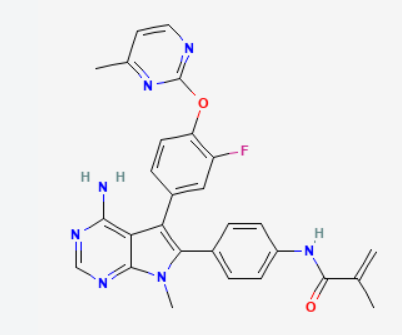
Lirafugratinib
- CAS No.:2549174-42-5
- Formula:C28H24FN7O2
- Molecular Weight:509.53
FDA 2026, APPROVALS 2026, Lyrfigtu, RLY-4008, RLY 4008, 23SEPT2026
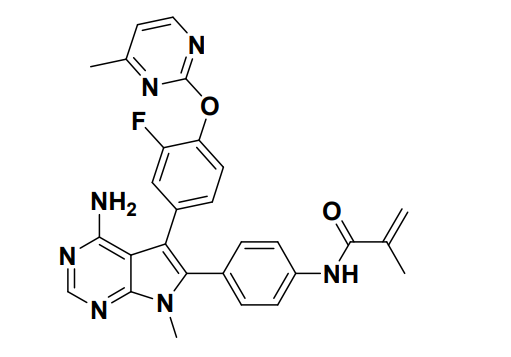
N-(4-(4-amino-5-(3-fluoro-4-((4-methylpyrimidin-2-yl)oxy)phenyl)-7-methyl-7H-pyrrolo[2,3-
d]pyrimidin-6-yl)phenyl)methacrylamide (lirafugratinib)
To adults with previously treated unresectable, locally advanced or metastatic cholangiocarcinoma harboring a fibroblast growth factor receptor 2 gene fusion or other rearrangement
Lirafugratinib (RLY-4008) is an orally active, irreversible and highly selective FGFR2 inhibitor with an IC50 of 3 nM. Lirafugratinib covalently binds to Cys491. Lirafugratinib targets FGFR2 primary alterations and resistance mutations and induces tumor regression while sparing other FGFRs.
Lirafugratinib (Lyrfigtu) received FDA approval on September 23, 2026, for adults with previously treated, unresectable or metastatic cholangiocarcinoma involving FGFR2 gene fusions or rearrangements.
Overview & Mechanism
- Drug Class: An oral, selective, and irreversible FGFR2 small-molecule inhibitor.
- Developer/Marketed By: Developed by Relay Therapeutics and commercialized globally by Elevar Therapeutics.
- How it Works: Covalently targets the FGFR2 kinase domain to inhibit tumor-driving signaling while sparing other FGFR proteins to limit off-target effects.
Efficacy
- Clinical Trial: Assessed in the phase 1/2 REFOCUS trial (NCT04526106) involving 116 previously treated, FGFR-inhibitor-naive patients.
- Key Metrics: Demonstrated an objective response rate of 46%, a median duration of response of 11.8 months, and a median progression-free survival of 11.3 months.
Dosing & Administration
- Recommended Dose: 70 mg orally once daily on a continuous basis until disease progression or unacceptable toxicity.
Safety & Warnings
- Common Adverse Events: Hand-foot syndrome, stomatitis, nail issues, and ocular/retinal toxicities.
- Special Warnings: Includes precautions for ocular toxicity, hyperphosphatemia, soft tissue mineralization, and embryo-fetal risks
PAPER
https://pmc.ncbi.nlm.nih.gov/articles/PMC10861881
SEE https://pmc.ncbi.nlm.nih.gov/articles/instance/10861881/bin/pnas.2317756121.sapp.pdf
N-(4-(4-amino-5-(3-fluoro-4-((4-methylpyrimidin-2-yl)oxy)phenyl)-7-methyl-7Hpyrrolo[2,3-d]pyrimidin-6-yl)phenyl)methacrylamide (lirafugratinib)
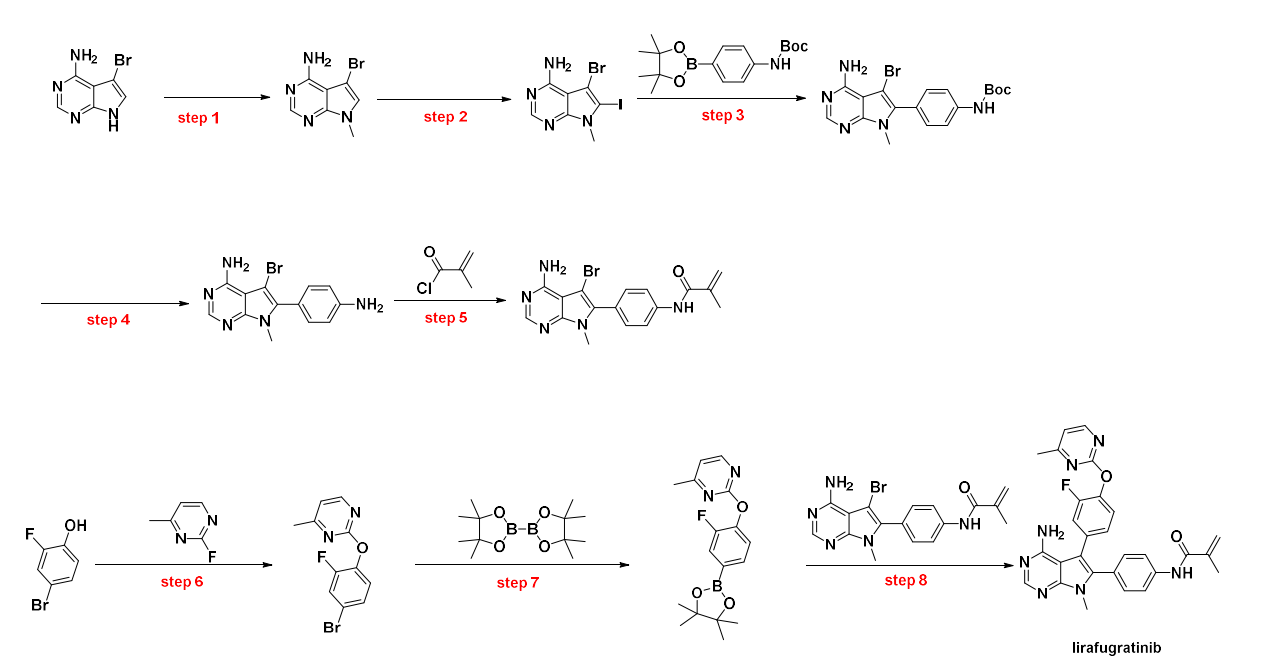
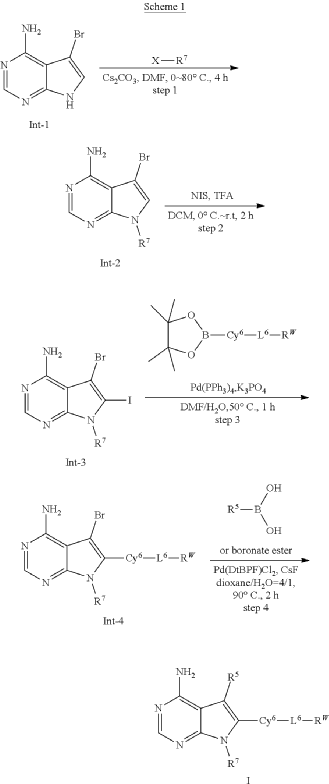
5-bromo-7-methyl-7H-pyrrolo[2,3-d]pyrimidin-4-amine
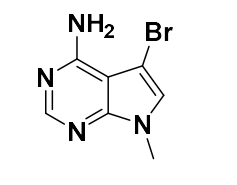
A round bottomed flask was charged with 5-bromo-7H-pyrrolo[2,3-d]pyrimidin-4-amine (10.0 g,
47.16 mmol), Cs2CO3 (22.99 g, 70.75 mmol), DMF (120 mL) and a stirbar. Iodomethane (8.03 g,
56.59 mmol) was added, and the solution was stirred for 1 h at room temperature. The reaction mixture was diluted with H2O (300 mL), and the aqueous phase was extracted with ethyl acetate
(300 mL) three times. The combined organic layers were washed with saturated brines, dried
over sodium sulfate, filtered, and concentrated in vacuo. The resulting crude material was
purified by HPLC. Concentration in vacuo resulted in 5-bromo-7-methyl-7H-pyrrolo[2,3-
d]pyrimidin-4-amine (5 g, 47.1 % ) as an off-white solid.
5-bromo-6-iodo-7-methyl-7H-pyrrolo[2,3-d]pyrimidin-4-amine
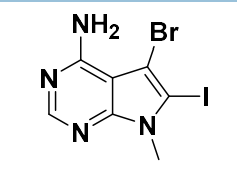
A round bottomed flask was charged with 5-bromo-7-methyl-7H-pyrrolo[2,3-d]pyrimidin-4-
amine (5 g, 22.12 mmol), DCM (50 mL) and TFA (2 mL) and a stirbar. 1-iodopyrrolidine-2,5-
dione (5.97 g, 26.54 mmol) was added, and the solution was stirred for 2 h at room temperature.
The reaction mixture was diluted with Na2SO3 solution (200 mL), and the aqueous phase was
extracted with DCM (200 mL) three times. The combined organic layers were washed with
saturated brines, dried over sodium sulfate, filtered, and concentrated in vacuo. The resulting
crude material was purified by HPLC. Concentration in vacuo resulted in 5-bromo-6-iodo-7-
methyl-7H-pyrrolo[2,3-d]pyrimidin-4-amine (4 g, 51.3 %) as a yellow solid.
tert-butyl (4-(4-amino-5-bromo-7-methyl-7H-pyrrolo[2,3-d]pyrimidin-6-yl)phenyl)carbamate
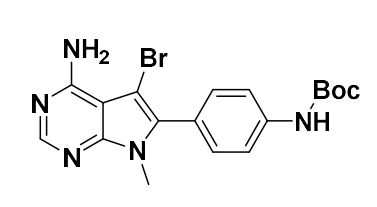
A resealable reaction vial was charged with 5-bromo-6-iodo-7-methyl-7H-pyrrolo[2,3-
d]pyrimidin-4-amine (4 g, 11.36 mmol), tert-butyl (4-(4,4,5,5-tetramethyl-1,3,2-dioxaborolan-2-
yl)phenyl)carbamate (4.35 g, 13.63 mmol), Pd(dppf)Cl2 (994.16 mg, 1.36 mmol), K3PO4 (7.22
g, 34.08 mmol), DMF (50 mL), H2O (6.25 mL) and a stir bar before being evacuated and purged
with nitrogen three times. The mixture was stirred for 2 h at 90 °C. The reaction mixture was
diluted with H2O (300 mL), and the aqueous phase was extracted with ethyl acetate (300 mL)
three times. The combined organic layers were washed with brines, dried over sodium sulfate,
filtered, and concentrated in vacuo. The resulting crude material was purified by silica gel
chromatography (eluting with MeOH/DCM = 1/40). Concentration in vacuo resulted in tert-butyl
(4-(4-amino-5-bromo-7-methyl-7H-pyrrolo[2,3-d]pyrimidin-6-yl)phenyl)carbamate (3 g, 63.4%)
as a yellow solid.
6-(4-aminophenyl)-5-bromo-7-methyl-7H-pyrrolo[2,3-d]pyrimidin-4-amine
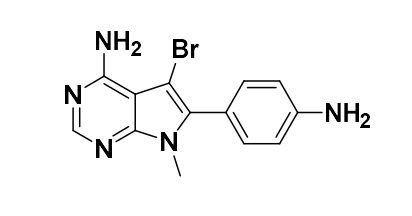
A round bottomed flask was charged with tert-butyl (4-(4-amino-5-bromo-7-methyl-7Hpyrrolo[2,3-d]pyrimidin-6-yl)phenyl)carbamate (3 g, 7.19 mmol), DCM (50 mL) and TFA (12.5mL) and a stirbar. The solution was stirred for 1 h at room temperature. The reaction mixture
was diluted with H2O (100 mL), and the aqueous phase was extracted with DCM (50 mL) three
times. The pH of aqueous phase was adjusted to 7~8, then the aqueous phase was extracted with
DCM (100 mL) three times. The combined organic layers were washed with saturated brines,
dried over sodium sulfate, filtered, and concentrated in vacuo resulted in 6-(4-aminophenyl)-5-
bromo-7-methyl-7H-pyrrolo[2,3-d]pyrimidin-4-amine (2.1 g, 92.1%) as a yellow solid.
N-(4-(4-amino-5-bromo-7-methyl-7H-pyrrolo[2,3-d]pyrimidin-6-yl)phenyl)methacrylamide
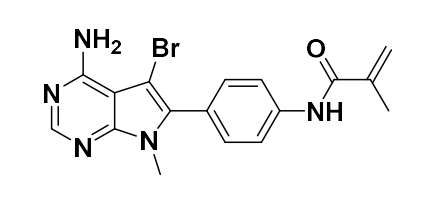
A resealable reaction vial was charged with 6-(4-aminophenyl)-5-bromo-7-methyl-7Hpyrrolo[2,3-d]pyrimidin-4-amine (2.1 g, 6.62 mmol), pyridine (785 mg, 9.93 mmol), DCM (100
mL) and a stir bar before being evacuated and purged with nitrogen three times. Methacryloyl
chloride (757.3 mg, 7.28 mmol) was added slowly at 0 oC. Then the mixture was stirred for 2 h
at room temperature. The reaction mixture was diluted with H2O (100 mL), and the aqueous
phase was extracted with DCM (100 mL) three times. The combined organic layers were washed
with brines, dried over sodium sulfate, filtered, and concentrated in vacuo. The resulting crude
material was purified by silica gel chromatography (eluting with MeOH/DCM=1/40).
Concentration in vacuo resulted in N-(4-(4-amino-5-bromo-7-methyl-7H-pyrrolo[2,3-
d]pyrimidin-6-yl)phenyl)methacrylamide (1.8 g, 70.5%) as an off-white solid.
2-(4-bromo-2-fluorophenoxy)-4-methylpyrimidine
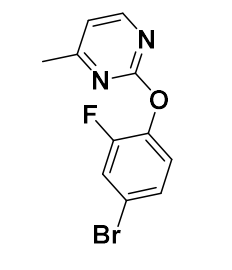
A round bottomed flask was charged with 4-bromo-2-fluorophenol (1.0 g, 5.24 mmol), 2-fluoro4-methylpyrimidine (704 mg, 6.28 mmol), Cs2CO3 (5.12 g, 15.7 mmol) and a stirbar. DMF (20
mL) was added, and the solution was stirred for 1 h at 100 oC. The reaction mixture was diluted
with H2O (100 mL), and the aqueous phase was extracted with ethyl acetate (100 mL) three
times. The combined organic layers were washed with saturated brines, dried over sodium
sulfate, filtered, and concentrated in vacuo. The resulting crude material was purified by HPLC.
Concentration in vacuo resulted in 2-(4-bromo-2-fluorophenoxy)-4-methylpyrimidine (1.48 g,
99.8 %) as an off-white amorphous solid.
2-(2-fluoro-4-(4,4,5,5-tetramethyl-1,3,2-dioxaborolan-2-yl)phenoxy)-4-methylpyrimidine
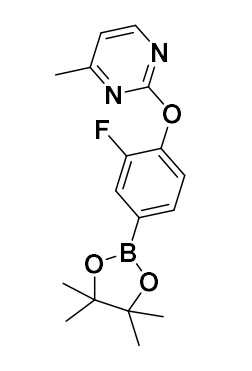
A solution/mixture of 2-(4-bromo-2-fluorophenoxy)-4-methylpyrimidine (500.00 mg, 1.77
mmol), bis(pinacolato)diboron (672.75 mg, 2.65 mmol), KOAc (520 mg, 5.3 mmol) and
Pd(dppf)Cl2 (129.4 mg, 0.177 mmol) in DMF (10 mL) was stirred for 2 h at 80 oC under nitrogen
atmosphere. The resulting mixture was diluted with water and extracted with EA. The combined
organic layers were washed with brines, dried over anhydrous Na2SO4. After filtration, the
filtrate was concentrated under reduced pressure. The residue was purified by HPLC.
Concentration in vacuo resulted in 2-(2-fluoro-4-(4,4,5,5-tetramethyl-1,3,2-dioxaborolan-2-
yl)phenoxy)-4-methylpyrimidine (430 mg, 73.7%) as a yellow solid.
2-(2-fluoro-4-(4,4,5,5-tetramethyl-1,3,2-dioxaborolan-2-yl)phenoxy)-4-methylpyrimidine
A resealable reaction vial was charged with N-(4-(4-amino-5-bromo-7-methyl-7H-pyrrolo[2,3-
d]pyrimidin-6-yl)phenyl)methacrylamide (100 mg, 0.259 mmol), 2-(2-fluoro-4-(4,4,5,5-
tetramethyl-1,3,2-dioxaborolan-2-yl)phenoxy)-4-methylpyrimidine (102.6 mg, 0.310 mmol),
Pd(DtBPF)Cl2 (16.9 mg, 0.026 mmol), CsF (118 mg, 0.776 mmol), DMF (2 mL), H2O (0.25
mL) and a stir bar before being evacuated and purged with nitrogen three times. The mixture was
stirred for 1 h at 90 °C. The reaction mixture was diluted with H2O (10 mL), and the aqueousphase was extracted with DCM (10 mL) three times. The combined organic layers were washed
with brines, dried over sodium sulfate, filtered, and concentrated in vacuo. The resulting crude
material was purified by Pre-HPLC (Column: XBridge Prep C18 OBD Column, 19*150 mm,
5μm; Mobile Phase A: Water(10 mmol/L NH4HCO3), Mobile Phase B: ACN; Flow rate: 25
mL/min; Gradient: 25% B to 50% B in 7 min, 50% B; Wave Length: 254/220 nm; RT1(min):
6.5). Concentration in vacuo resulted in N-(4-(4-amino-5-(3-fluoro-4-((4-methylpyrimidin-2-
yl)oxy)phenyl)-7-methyl-7H-pyrrolo[2,3-d]pyrimidin-6-yl)phenyl)methacrylamide ( 27.2 mg,
20.6%) as an off-white solid. LC/MS(BAS1): [M+H]+= 510.20; tR =1.405 min. 1H NMR (400
MHz, DMSO-d6) δ 9.92 (s, 1H), 8.47 (d, J = 5.0 Hz, 1H), 8.21 (s, 1H), 7.79 – 7.72 (m, 2H), 7.38
– 7.28 (m, 3H), 7.22 – 7.14 (m, 2H), 7.10 (dd, J = 8.1, 2.1 Hz, 1H), 5.98 (s, 2H), 5.80 (s, 1H),
5.54 (d, J = 1.7 Hz, 1H), 3.59 (s, 3H), 2.42 (s, 3H), 1.95 (d, J = 1.2 Hz, 3H).
PAT
WIPO Patent Publication: WO2020231990A1 (and related family filings)
https://patentscope.wipo.int/search/en/detail.jsf?docId=WO2020231990&_cid=P20-MUHRQT-01820-1
PAT
United States Patents: US11780845
PAT
US20230192709
https://patentscope.wipo.int/search/en/detail.jsf?docId=US399951539&_cid=P20-MUHRKD-96615-1
ADVERTISEMENT
ANAX LABORATORIES
WEBSITE https://www.anaxlab.com/
Discovery Solutions, Supporting the chemistry needs of clients in the Medical, Analytical and Bio Sciences
Development Solutions, Developing from Lab scale to PR&D, Kilo Scale-ups and Commercial Scales
SEE MORE………Integrated Solutions, Manufacturing Solutions, Products,
Can’t Find? Let’s Connect

Phone : +91 897704 2010 / +91 9177075735, Email : info@anaxlab.com
#MedicinalChemistry, #DrugDiscovery, #OrganicSynthesis, #ChemicalLibrary, #BuildingBlocks, #SARStudies, #ChemistryInnovation, #medchem, #Drugdevelopment, #Biotech, #Biotechnology, #AnaxLaboratories, #Pharma



AS ON FEB2026 4.574 LAKHS VIEWS ON BLOG WORLDREACH AVAILABLEFOR YOUR ADVERTISEMENT
join me on Linkedin
Anthony Melvin Crasto Ph.D – India | LinkedIn
join me on Researchgate
RESEARCHGATE

join me on Facebook
Anthony Melvin Crasto Dr. | Facebook
join me on twitter
Anthony Melvin Crasto Dr. | twitter
+919321316780 call whatsaapp
EMAIL. amcrasto@gmail.com

References
[1]. Vivek Subbiah, et al. RLY-4008, the First Highly Selective FGFR2 Inhibitor with Activity across FGFR2 Alterations and Resistance Mutations. Cancer Discov. 2023 Sep 6;13(9):2012-2031. [Content Brief]
/////////lirafugratinib, anax labs, FDA 2026, APPROVALS 2026, Lyrfigtu, RLY-4008, RLY 4008, 23SEPT2026, CANCER
#lirafugratinib, #anax labs, #FDA 2026, #APPROVALS 2026, #Lyrfigtu, #RLY-4008, #RLY 4008, #23SEPT2026, #CANCER


