
Home » Posts tagged 'Juvmo'
Tag Archives: Juvmo
 DRUG APPROVALS BY DR ANTHONY MELVIN CRASTO
.....FOR BLOG HOME CLICK HERE
DRUG APPROVALS BY DR ANTHONY MELVIN CRASTO
.....FOR BLOG HOME CLICK HEREFlag and hits
ORGANIC SPECTROSCOPY

SUBSCRIBE

 Subscribe in a reader
Enter your email address:
Delivered by FeedBurner
Subscribe to New Drug Approvals by Email


Recent Comments
 | shivkr2 on SPSR Excellence Award 2025 – S… |
 | Bonkasaurus on Infigratinib phosphate |
 | PALOVAROTENE | ORGAN… on Palovarotene |
| Pfizer just purchase… on Temanogrel | |
| Pfizer To Cash In On… on Temanogrel |
Tavapadon

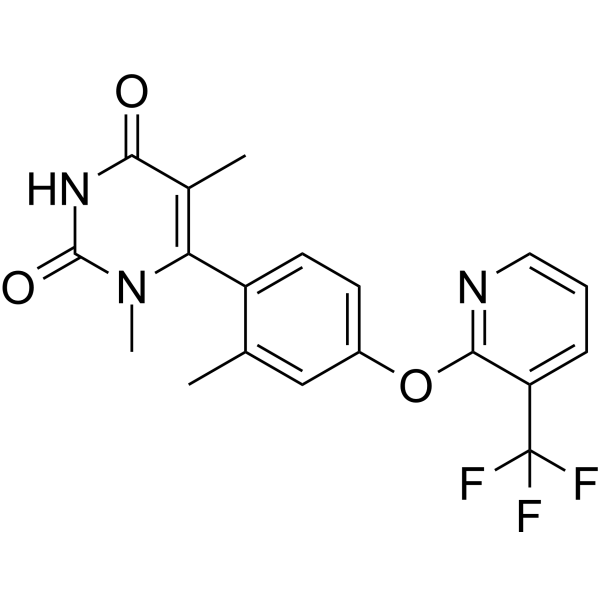
Tavapadon
- CAS No.:1643489-24-0
- Formula:C19H16F3N3O3
- Molecular Weight:391.34
9/25/2026, Juvmo, FDA 2026, APPROVALS 2026, CEREVEL, CVL 751, PF 6649751, PF-06649751,
To treat Parkinson’s disease in adults
Tavapadon (PF-06649751) is an orally active and highly selective dopamine D1/D5 receptor partial agonist. Tavapadon is effective in enabling movement and reducing disability and has the potential for Parkinson’s disease.
Tavapadon (developmental code names CVL-751, PF-06649751) is a dopamine receptor agonist which is under development for the treatment of Parkinson’s disease.[2][3][4] It is under development by Cerevel Therapeutics, which acquired tavapadon from Pfizer in 2018.[2] It is taken by mouth.[1]
Tavapadon acts as a highly selective partial agonist of the dopamine D1 receptor (Ki = 9 nM; IATooltip Intrinsic activity = 65%) and the dopamine D5 receptor (Ki = 13 nM; IA = 81%).[3][4][1] It has no significant affinity or functional activity at the D2-like receptors (D2, D3, D4) (Ki ≥ 4,870 to 6,720 nM).[1] Tavapadon also shows biased agonism for Gs-coupled signaling at the D1-like receptors.[1][3]
As of December 2024, tavapadon has completed phase 3 clinical trials for Parkinson’s disease.[2]
- OriginatorPfizer
- DeveloperCerevel Therapeutics; Pfizer
- ClassAntiparkinsonians; Small molecules
- Mechanism of ActionDopamine D1 receptor agonists; Dopamine D5 receptor agonists
- registrationParkinson’s disease
- 01 Dec 2025Cerevel Therapeutics completes a phase III TEMPO-4 trial in Parkinson Disease (In adults, In elderly in the US, Australia, Bulgaria, Canada, Czechia, France, Germany, Hungary, Israel, Italy, Poland, Serbia, Spain, and Ukraine (PO) (NCT04760769)
- 28 Nov 2025No recent reports of development identified for phase-I development in Parkinson’s-disease(In volunteers) in USA (PO, Tablet)
- 26 Sep 2025Preregistration for Parkinson’s disease (Early-stage disease, In the elderly, In adults) in USA (PO)
The industrial synthesis of tavapadon typically proceeds via a convergent sequence:
- Ether Formation: Coupling of a substituted phenol derivative (such as a 4-hydroxy-2-methylphenyl component) with a 2-halogenated-3-(trifluoromethyl)pyridine (e.g., 2-chloro-3-trifluoromethylpyridine) via nucleophilic aromatic substitution ($S_NAr$) or transition-metal-catalyzed cross-coupling to construct the biaryl ether framework.
- Pyrimidine Ring Construction / Functionalization: Assembly or modification of the 1,5-dimethylpyrimidine-2,4-dione core onto the substituted aryl backbone, often utilizing base-catalyzed cyclizations (e.g., using methylating agents and urea/amide derivatives).
- Chiral Resolution / Final Purification: Final isolation of the target enantiomer or specific crystalline form (as outlined in WO2023102087A1 and WO2023143321) to meet active pharmaceutical ingredient (API) regulatory grades.
PAT
W02014207601
Examples 7 and 8
https://patentscope.wipo.int/search/en/detail.jsf?docId=WO2014207601&_cid=P12-MUKNR1-83868-1
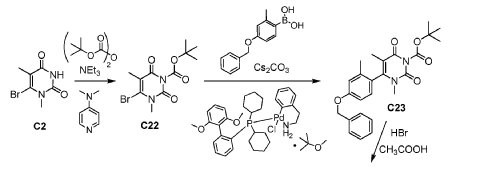
Step 1. Synthesis of tert-butyl 4-bromo-3,5-dimethyl-2,6-dioxo-3,6-dihydropyrimidine-1(2H)-carboxylate (C22).
Compound C2 (800 mg, 3.65 mmol), di-tert-butyl dicarbonate (99%, 966 mg, 4.38 mmol), triethylamine (0.62 mL, 4.4 mmol) and 4-(dimethylamino)pyridine (45 mg, 0.36 mmol) were combined in tetrahydrofuran (15 mL) and heated to 70 °C for 1 hour, then allowed to stir at room temperature for 18 hours. The reaction mixture was concentrated in vacuo, and the residue was purified via chromatography on silica gel (Gradient: 10% to 25% ethyl acetate in heptane) to provide the product as a white solid. Yield: 1.10 g, 3.45 mmol, 94%. 1H NMR (400 MHz, CDCl3) δ 3.64 (s, 3H), 2.12 (s, 3H), 1.61 (s, 9H).
Step 2. Synthesis of ten-butyl 4-[4-(benzyloxy)-2-methylphenyl]-3,5-dimethyl-2,6-dioxo-3,6-dihydropyrimidine-1(2H)-carboxylate ( C23).
A mixture of C22 (1.00 g, 3.13 mmol), [4-(benzyloxy)-2-methylphenyl]boronic acid (98%, 1.16 g, 4.68 mmol), chloro(2-dicyclohexylphosphino-2′,6′-dimethoxy-1,1′-biphenyl)[2-(2-aminoethylphenyl)]palladium(II) – tert-butyl methyl ether adduct (S-Phos precatalyst) (119 mg, 0.156 mmol), and cesium carbonate (3.06 g, 9.39 mmol) in 2-methyltetrahydrofuran (10 mL) and water (3 mL) was heated at 50 °C for 66 hours. The reaction mixture was diluted with water and ethyl acetate, and then filtered to remove suspended solids. The filtrate was extracted several times with ethyl acetate, and the combined organic layers were washed with saturated aqueous sodium chloride solution, dried over magnesium sulfate, filtered, and concentrated in vacuo. The resulting solid was suspended in a 1:3 mixture of ethyl acetate and heptane, stirred for several minutes, and filtered, providing the product as a white solid. Yield: 970 mg, 2.22 mmol, 71%. LCMS m/z 337.2 [(M-Boc)+H]+. 1H NMR (400 MHz, CDCl3) δ 7.34-7.48 (m, 5H), 6.91-7.01 (m, 3H), 5.10 (s, 2H), 3.01 (s, 3H), 2.16 (br s, 3H), 1.66 (s, 9H), 1.64 (s, 3H).
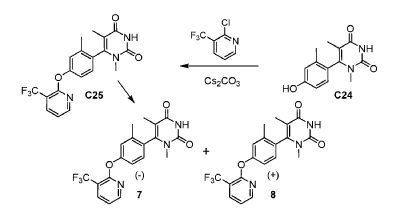
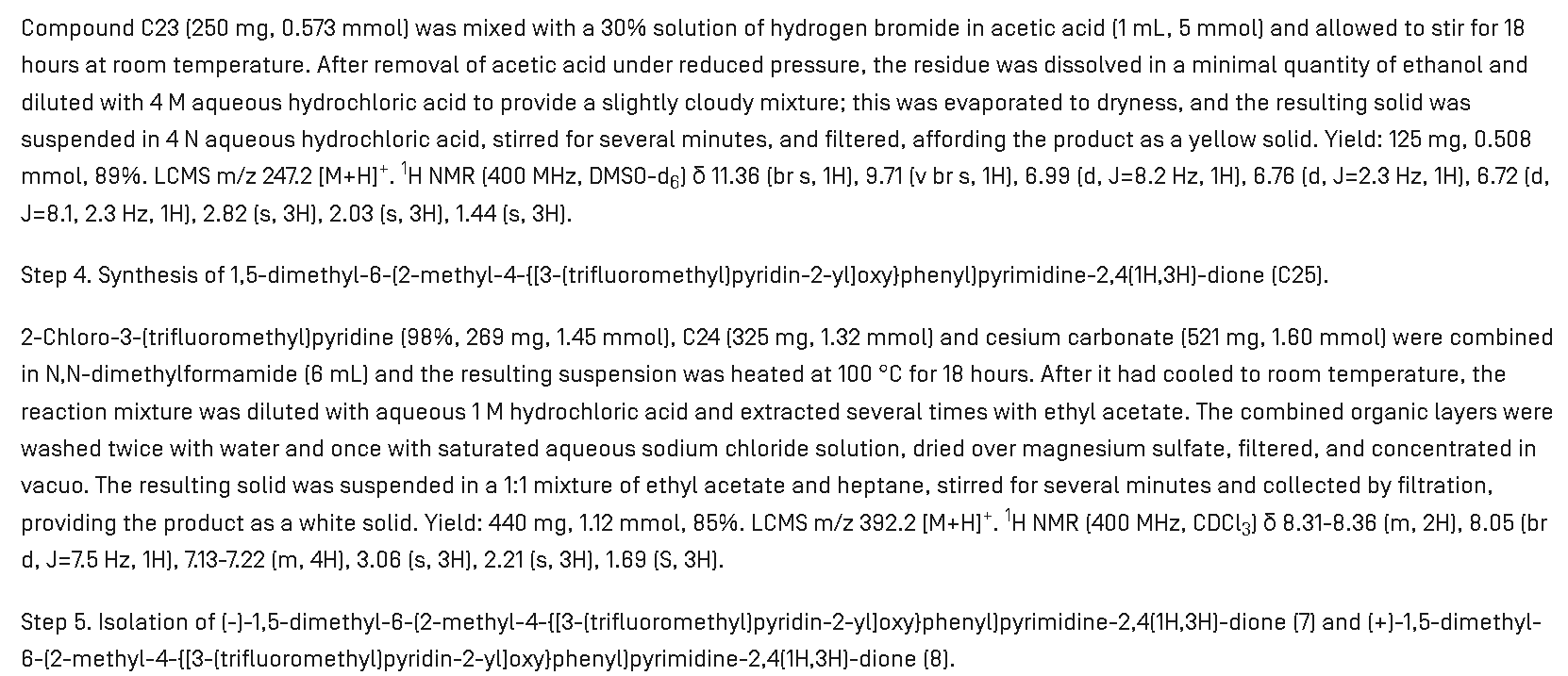
Step 3. Synthesis of 6-(4-hydroxy-2-methylphenyl)-1,5-dimethylpyrimidine-2,4(1H,3H)-dione (C24).
Racemate C25 (1.30 g, 3.32 mmol) was separated into its atropenantiomers via chiral chromatography (Column: Phenomenex Lux Cellulose-2; Gradient: heptane / ethanol). The first-eluting atropenantiomer, obtained as a tan solid that exhibited a negative (-) rotation, was designated as Example 7. Yield: 536 mg, 1.37 mmol, 41%. The second-eluting atropenantiomer, also obtained as a tan solid but with a positive (+) rotation, was designated as Example 8. Yield: 553 mg, 1.41 mmol, 42%. 7: LCMS m/z 392.2 [M+H]+. 1H NMR (400 MHz, CDCl3) δ 8.34 (ddq, J=4.9, 1.9, 0.6 Hz, 1H), 8.30 (br s, 1H), 8.05 (ddq, J=7.6, 1.9, 0.7 Hz, 1H), 7.13-7.21 (m, 4H), 3.06 (s, 3H), 2.21 (br s, 3H), 1.69 (s, 3H). 8: LCMS m/z 392.2 [M+H]+. 1H NMR (400 MHz, CDCl3) δ 8.34 (br d, J=4.9 Hz, 1H), 8.30 (br s, 1H), 8.05 (br d, J=7.5 Hz, 1H), 7.13-7.22 (m, 4H), 3.06 (s, 3H), 2.21 (br s, 3H), 1.69 (s, 3H).
PAT
WO2015162084 SIMILAR
https://patentscope.wipo.int/search/en/detail.jsf?docId=WO2015162084&_cid=P12-MUKNEL-70374-1
PAT
US9334247
PAT
WO2023102087A1
https://patentscope.wipo.int/search/en/detail.jsf?docId=WO2023102087&_cid=P12-MUKNKO-77090-1
Tavapadon, 1 , 5-dimethy I -6-(2-methy 1 -4- { [3 -(tri fluoromethyl)pyri din-2-yl]oxy}phenyl)pyrimidine-2,4(lH,3H)-dione has the following chemical structure:
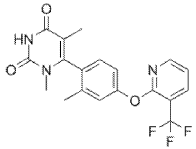
and is described in International Publication No. W02014/207601. As disclosed in International Publication No. W02014/207601, the class of compounds encompassing Tavapadon, may exist as conformational isomers due to hindered rotation about a single bond, i.e., atropisomerism. In the case of Tavapadon, the atropenantiomers or atropisomers may be designated as (-)-Tavapadon or (+)-Tavapadon, depending on the optical rotation, and can include any mixture thereof, including a racemic mixture, wherein the racemic mixture can be designated as (±)-Tavapadon. According to International Publication No.
W02014/207601, the compound Tavapadon may be obtained as a racemate (i.e., (±)-Tavapadon), which may be separated by chiral chromatography into two atropenantiomers. The atropisomer exhibiting an anticlockwise (negative) rotation on a polarimeter is denoted the (-)-atropenantiomer [i.e., (-)-Tavapadon], and the atropisomer exhibiting a clockwise (positive) rotation on a polarimeter is denoted the (+)-atropenantiomer [i.e., (+)-Tavapadon],
PAT
WO2023143321 (or corresponding US20250145588A1 / CN115974803A equivalents)
ADVERTISEMENT
ANAX LABORATORIES
WEBSITE https://www.anaxlab.com/
Discovery Solutions, Supporting the chemistry needs of clients in the Medical, Analytical and Bio Sciences
Development Solutions, Developing from Lab scale to PR&D, Kilo Scale-ups and Commercial Scales
SEE MORE………Integrated Solutions, Manufacturing Solutions, Products,
Can’t Find? Let’s Connect

Phone : +91 897704 2010 / +91 9177075735, Email : info@anaxlab.com
#MedicinalChemistry, #DrugDiscovery, #OrganicSynthesis, #ChemicalLibrary, #BuildingBlocks, #SARStudies, #ChemistryInnovation, #medchem, #Drugdevelopment, #Biotech, #Biotechnology, #AnaxLaboratories, #Pharma



AS ON FEB2026 4.574 LAKHS VIEWS ON BLOG WORLDREACH AVAILABLEFOR YOUR ADVERTISEMENT
join me on Linkedin
Anthony Melvin Crasto Ph.D – India | LinkedIn
join me on Researchgate
RESEARCHGATE

join me on Facebook
Anthony Melvin Crasto Dr. | Facebook
join me on twitter
Anthony Melvin Crasto Dr. | twitter
+919321316780 call whatsaapp
EMAIL. amcrasto@gmail.com

References
 | |
| Clinical data | |
|---|---|
| Other names | CVL-751; PF-6649751; PF-06649751 |
| Routes of administration | By mouth[1] |
| Drug class | Dopamine receptor agonist |
| Identifiers | |
| IUPAC name | |
| CAS Number | 1643489-24-0 |
| PubChem CID | 86764100 |
| ChemSpider | 48062699 |
| UNII | PT4P8MJP8L |
| KEGG | D11431 |
| ChEMBL | ChEMBL3697617 |
| CompTox Dashboard (EPA) | DTXSID301337071  |
| Chemical and physical data | |
| Formula | C19H16F3N3O3 |
| Molar mass | 391.350 g·mol−1 |
| 3D model (JSmol) | Interactive image |
| SMILES | |
| InChI | |
References
- Bezard E, Gray D, Kozak R, Leoni M, Combs C, Duvvuri S (2024). “Rationale and Development of Tavapadon, a D1/D5-Selective Partial Dopamine Agonist for the Treatment of Parkinson’s Disease”. CNS Neurol Disord Drug Targets. 23 (4): 476–487. doi:10.2174/1871527322666230331121028. PMC 10909821. PMID 36999711.
Tavapadon is a highly selective partial agonist at D1 and D5 dopamine receptors, [52] with little to no functional activity at D2, D3, or D4 receptors in vitro (unpublished data). Assays measuring the displacement of radioligand binding in cell lines expressing recombinant human dopamine receptors have shown that tavapadon has a high affinity for both D1 (Ki = 9 nM) and D5 (Ki = 13 nM) (unpublished data). Conversely, tavapadon had a low affinity at D2 (Ki ≥ 6210 nM), D3 (Ki ≥ 6720 nM), and D4 (Ki ≥ 4870 nM) (unpublished data). […] In vitro assays of functional activity have confirmed that tavapadon acts as a partial agonist by binding at D1 and D5 receptors, corresponding to 65% and 81% of dopamine’s intrinsic activity, respectively, and inducing functional receptor activation, with half-maximal effective concentration (EC50) values of 19 nM and 17 nM (unpublished data).
- “Tavapadon – Cerevel Therapeutics”. Adis Insight. Springer Nature Switzerland AG.
- Cerri S, Blandini F (December 2020). “An update on the use of non-ergot dopamine agonists for the treatment of Parkinson’s disease”. Expert Opinion on Pharmacotherapy. 21 (18): 2279–2291. doi:10.1080/14656566.2020.1805432. PMID 32804544. S2CID 221163451.
- Hall A, Provins L, Valade A (January 2019). “Novel Strategies To Activate the Dopamine D1 Receptor: Recent Advances in Orthosteric Agonism and Positive Allosteric Modulation”. Journal of Medicinal Chemistry. 62 (1): 128–140. doi:10.1021/acs.jmedchem.8b01767. PMID 30525590. S2CID 54469910.
////////tavapadon, anax labs, Juvmo, FDA 2026, APPROVALS 2026, CEREVEL, CVL 751, PF 6649751, PF-06649751,
#tavapadon, #anax labs, #Juvmo, #FDA 2026, #APPROVALS 2026, #CEREVEL, #CVL 751, #PF 6649751, #PF-06649751,


