New Drug Approvals

Home » Uncategorized (Page 34)

Category Archives: Uncategorized

DRUG APPROVALS BY DR ANTHONY MELVIN CRASTO .....FOR BLOG HOME CLICK HERE

Blog Stats

  • 4,851,776 hits

Flag and hits

Flag Counter

Enter your email address to follow this blog and receive notifications of new posts by email.

Join 37.9K other subscribers
Follow New Drug Approvals on WordPress.com

Archives

Categories

Recent Posts

Flag Counter

ORGANIC SPECTROSCOPY

Read all about Organic Spectroscopy on ORGANIC SPECTROSCOPY INTERNATIONAL 

Enter your email address to follow this blog and receive notifications of new posts by email.

Join 37.9K other subscribers
DR ANTHONY MELVIN CRASTO Ph.D

DR ANTHONY MELVIN CRASTO Ph.D

DR ANTHONY MELVIN CRASTO, Born in Mumbai in 1964 and graduated from Mumbai University, Completed his Ph.D from ICT, 1991,Matunga, Mumbai, India, in Organic Chemistry, The thesis topic was Synthesis of Novel Pyrethroid Analogues, Currently he is working with AFRICURE PHARMA, ROW2TECH, NIPER-G, Department of Pharmaceuticals, Ministry of Chemicals and Fertilizers, Govt. of India as ADVISOR, earlier assignment was with GLENMARK LIFE SCIENCES LTD, as CONSUlTANT, Retired from GLENMARK in Jan2022 Research Centre as Principal Scientist, Process Research (bulk actives) at Mahape, Navi Mumbai, India. Total Industry exp 32 plus yrs, Prior to joining Glenmark, he has worked with major multinationals like Hoechst Marion Roussel, now Sanofi, Searle India Ltd, now RPG lifesciences, etc. He has worked with notable scientists like Dr K Nagarajan, Dr Ralph Stapel, Prof S Seshadri, etc, He did custom synthesis for major multinationals in his career like BASF, Novartis, Sanofi, etc., He has worked in Discovery, Natural products, Bulk drugs, Generics, Intermediates, Fine chemicals, Neutraceuticals, GMP, Scaleups, etc, he is now helping millions, has 9 million plus hits on Google on all Organic chemistry websites. His friends call him Open superstar worlddrugtracker. His New Drug Approvals, Green Chemistry International, All about drugs, Eurekamoments, Organic spectroscopy international, etc in organic chemistry are some most read blogs He has hands on experience in initiation and developing novel routes for drug molecules and implementation them on commercial scale over a 32 PLUS year tenure till date Feb 2023, Around 35 plus products in his career. He has good knowledge of IPM, GMP, Regulatory aspects, he has several International patents published worldwide . He has good proficiency in Technology transfer, Spectroscopy, Stereochemistry, Synthesis, Polymorphism etc., He suffered a paralytic stroke/ Acute Transverse mylitis in Dec 2007 and is 90 %Paralysed, He is bound to a wheelchair, this seems to have injected feul in him to help chemists all around the world, he is more active than before and is pushing boundaries, He has 100 million plus hits on Google, 2.5 lakh plus connections on all networking sites, 100 Lakh plus views on dozen plus blogs, 227 countries, 7 continents, He makes himself available to all, contact him on +91 9323115463, email amcrasto@gmail.com, Twitter, @amcrasto , He lives and will die for his family, 90% paralysis cannot kill his soul., Notably he has 38 lakh plus views on New Drug Approvals Blog in 227 countries......https://newdrugapprovals.wordpress.com/ , He appreciates the help he gets from one and all, Friends, Family, Glenmark, Readers, Wellwishers, Doctors, Drug authorities, His Contacts, Physiotherapist, etc He has total of 32 International and Indian awards

Verified Services

View Full Profile →

Archives

Categories

Flag Counter

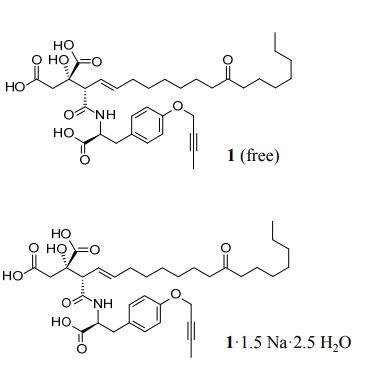
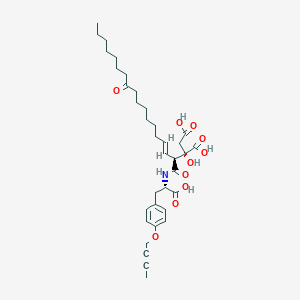
CH4630808


str1

RZHKGHCZVMTIDL-XSRFUOEWSA-N.png

CH4630808, CH-4630808, NA-808

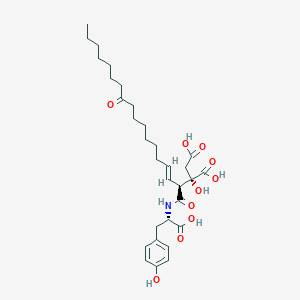
(2S)-2-[(E,2S)-1-[[(1S)-2-(4-but-2-ynoxyphenyl)-1-carboxyethyl]amino]-1,11-dioxooctadec-3-en-2-yl]-2-hydroxybutanedioic acid

Molecular Formula: C35H49NO10
Molecular Weight: 643.774 g/mol

Cas 827034-92-4  DOUBLE BOND E, SP ROT (-)

CAS 744208-75-1  E Z NOT DEFINED

  • D-erythro-Pentonic acid, 5-[[(1S)-2-[4-(2-butynyloxy)phenyl]-1-carboxyethyl]amino]-3-C-carboxy-2,4,5-trideoxy-5-C-oxo-4-[(1E)-9-oxo-1-hexadecenyl]- (9CI)
  • 5-[[(1S)-2-[4-(2-Butyn-1-yloxy)phenyl]-1-carboxyethyl]amino]-3-C-carboxy-2,4,5-trideoxy-5-C-oxo-4-[(1E)-9-oxo-1-hexadecen-1-yl]-D-erythro-pentonic acid
  • D-erythro-Pentonic acid, 5-[[(1S)-2-[4-(2-butyn-1-yloxy)phenyl]-1-carboxyethyl]amino]-3-C-carboxy-2,4,5-trideoxy-5-C-oxo-4-[(1E)-9-oxo-1-hexadecen-1-yl]-

Chugai Pharmaceutical (Originator)

str1

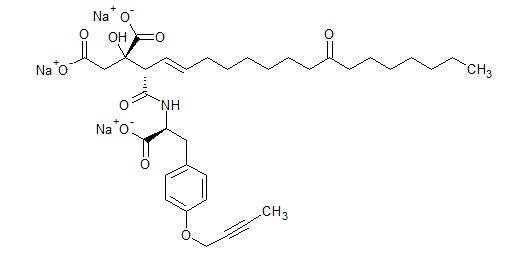
Trisodium Der ,CAS 1799542-36-1,  SP ROT (-), MW 709.7097, MF C35 H46 N O10 . 3 Na, Trisodium (2S)-2-[(2S,3E)-1-([(1S)-2-[4-(but-2-yn-1-yloxy)phenyl]-1-carboxylatoethyl]amino)-1,11-dioxooctadec-3-en-2-yl]-2-hydroxybutanedioate

SIMILAR

PAPER

https://www.sciencedirect.com/science/article/pii/S0960894X12013741

Bioorganic & Medicinal Chemistry Letters

Volume 23, Issue 1, 1 January 2013, Pages 336-339
str1

Image result for CH4630808.

Image result for CH4630808

Scheme 3. Reagents and conditions: (a) TBDPSCl, imidazole, DMF, rt; (b) n-BuLi, (CH2O)n, THF; (c) Red-Al, 0 C, then I2, THF 40 C; (d) DHP, PPTS, DCM, rt; (e) n-BuLi, (CH2O)n, THF, 78 C to 0 C; (f) TBDPSCl, imidazole, DMF, rt; (g) PPTS, EtOH. 28.6% over 7 steps; (h) L-(+)-DET, Ti(Oi-Pr)4, TBHP, DCM, 97%, >95% ee; (i) Terminal alkyne 7 in Scheme 2, Cp2ZrClH, MeMgCl, CuI, THF, 20 C, 91% yield⁄ ; (j) 2,2-dimethoxypropane, PPTS, DCM, 85% yield⁄ ; (k) TBAF, AcOH, THF, 89% yield⁄ ; (l) oxalyl chloride, DMSO, triethylamine, DCM, 78 C; (m) NaClO2, NaH2PO4, 2-methyl-2-butene, t-BuOH-H2O; (n) N,N-dimethylformamide di-tert-butyl acetal, 58% yield in 3 steps⁄ ; (o) 80% AcOH, THF, rt, 90% yield⁄ ; (p) Jones reagent, aqueous acetone, 10 C, 80% yield⁄ ; (q) the corresponding amine, HATU, Hunig base, 85% yield⁄ ; (r) TFA, anisole, DCM, 90% yield⁄ ; (s) H2-Pd/C, EtOH, 80%; (t) NaBH4, THF, MeOH, 93% yield. ⁄ yields when n = 5 and R1 = n-C7H15.

Paper

Development of a Kilogram-Scale Synthesis of a Novel Anti-HCV Agent, CH4930808

CH4630808 corrected

 Research Division, Chugai Pharmaceutical Co., Ltd., 1-135 Komakado, Gotemba, Shizuoka 412-8513, Japan
 Pharmaceutical Technology Division, Chugai Pharmaceutical Co., Ltd., 5-5-1 Ukima, Kita-ku, Tokyo 115-8543, Japan
§ Department of Chemistry for Materials, Graduate School of Engineering, Mie University, Tsu, Mie 514-8507, Japan
Org. Process Res. Dev.201822 (2), pp 236–240
DOI: 10.1021/acs.oprd.7b00383
*E-mail: haneishitys@chugai-pharm.co.jp. Tel.: +81-550-87-9102. Fax: +81-550-87-5326.

Abstract

Abstract Image

Herein, we report the kilogram-scale synthesis of CH4930808 (1) CH 4630808 CORRECTED, a novel anti-hepatitis C virus agent. While pursuing improved productivity using many through-process strategies, we conducted scrupulous impurity control. Finally, we successfully developed a practical and scalable process for the synthesis of (1·1.5Na·2.5H2O), by which we prepared 3.28 kg of the active pharmaceutical ingredient for clinical studies

https://pubs.acs.org/doi/suppl/10.1021/acs.oprd.7b00383/suppl_file/op7b00383_si_001.pdf

1H-NMR and 13C-NMR spectra of compound 5·HCl S 3– S 4

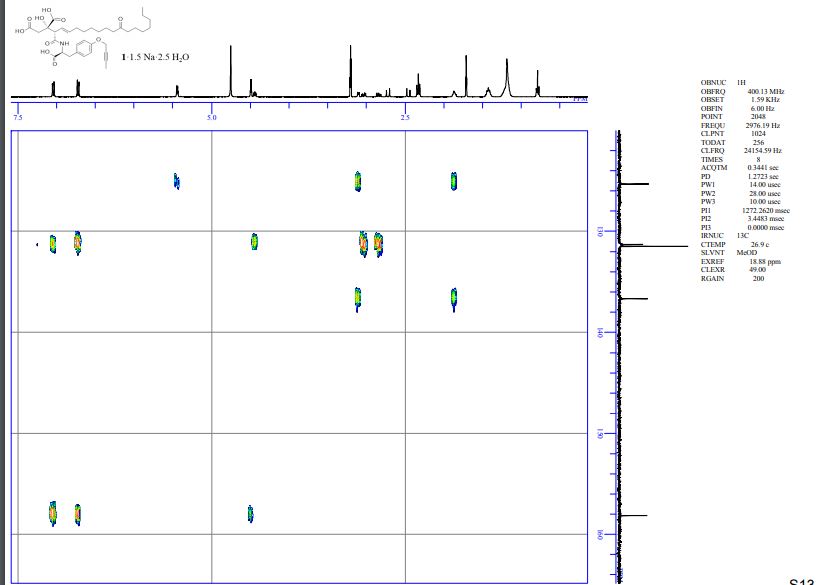
1H-NMR spectra of compound 1·1.5 Na·2.5 H2O S 5

13C-NMR spectra compound 1·1.5 Na·2.5 H2O S 6

1H-COSY spectra of compound 1·1.5 Na·2.5 H2O S 7 – S 8

DEPT spectra of compound 1·1.5 Na·2.5 H2O S 9 – S 10

HMBC spectra of compound 1·1.5 Na·2.5 H2O S 11 – S 17

MASS

PATENT

WO 2004071503

WO 2005005372

WO 2006016657

WO 2006088071

WO 2007000994

WO 2007132882

WO 2009154248

WO 2014027696

PAPER

Angewandte Chemie, International Edition (2012), 51(17), 4218-4222, S4218/1-S4218/77.

Bioorganic & Medicinal Chemistry Letters (2013), 23(1), 336-339

PAPER

Organic & Biomolecular Chemistry (2017), 15(31), 6632-6639.

http://pubs.rsc.org/en/Content/ArticleLanding/2017/OB/C7OB01608E#!divAbstract

10.1039/C7OB01608E

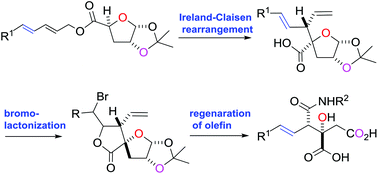
Stereoselective synthesis of the viridiofungin analogue NA808 from a chiral tetrahydrofuran-carboxylic acid

 Author affiliations

Abstract

The viridiofungin analogue NA808 was synthesized by the stereoselective Ireland–Claisen rearrangement of dienylmethyl ester, regioselective bromolactonization of β-divinylpropanoic acid and retro-bromolactonization.

Graphical abstract: Stereoselective synthesis of the viridiofungin analogue NA808 from a chiral tetrahydrofuran-carboxylic acid
http://www.rsc.org/suppdata/c7/ob/c7ob01608e/c7ob01608e1.pdf
str1 str2 str3
PATENT
https://patents.google.com/patent/WO2004071503A1/ar

The number of people infected with hepatitis C virus (HCV) is estimated at 1 to 200 million people worldwide, and over 2 million people in Japan. Approximately 50% of these patients migrate to chronic hepatitis, of which approximately 20% become liver cirrhosis, liver cancer after more than 30 years after infection. About 90% of liver cancer is said to be hepatitis C cause. In Japan, more than 20,000 patients die every year from liver cancer associated with HCV infection.

HCV was discovered in 1989 as a major causative virus of non-A non-B hepatitis after transfusion. HCV is an enveloped RNA virus whose genome

It consists of single-stranded (+) RNA and is classified as a genus Hepacivirus of Flaviviridae.

Since HCV avoids the immune mechanism of the host due to a cause which is still unclear, persistent infection is often established even when infected with an adult with developed immune mechanism, progresses to chronic hepatitis, liver cirrhosis, hepatocellular carcinoma, surgery It is also known that many patients have liver cancer recurrence due to inflammation that continues to occur in non-cancerous areas.

Therefore, establishment of an effective therapy for hepatitis C is desired, and among them, apart from coping therapy that suppresses inflammation by anti-inflammatory agents, development of a drug that reduces or eradicates HCV in the affected liver It is strongly desired.

Interferon treatment is currently known as the only effective treatment for HCV elimination. However, the number of patients with interferon effective is about one third of all patients. In particular, interferon response to HCV genotype 1 b is very low. Therefore, development of anti-HCV drugs that can replace or be used in combination with interferon is strongly desired.

In recent years, Ribavirin (1 – 3 – D – lipofuranosyl – 1 H – 1, 2, 4 – triazole – 3 – carboxamide) is commercially available as a therapeutic agent for hepatitis C by combining with interferon, Is still low, further new treatment for hepatitis C is desired. In addition, attempts have been made to eliminate viruses by enhancing the immune system of patients, such as interferon agonists, interleukin-12 agonists, etc. However, no effective drug has yet been found.

Since the HCV gene has been cloned, molecular biological analysis of the mechanism and function of viral genes, functions of proteins of each virus and the like has been accompanied by rapid development of forces, replication of virus in host cells, persistent infection, pathogenesis The mechanism such as sexuality has not been sufficiently elucidated, and at the present time, an HCV infection experiment system using reliable cultured cells has not been constructed. Conventionally, when evaluating anti-HCV drugs, alternative alternative virus method using other closely related viruses had to be used.

In recent years, however, it became possible to observe in vitro HCV replication using the nonstructural region part of HCV, so that anti-HCV drugs could be easily evaluated by the replicon assay method (Non-Patent Document 1). The mechanism of H CV RN A replication in this system is believed to be identical to the replication of the full-length HCV RNA genome infected with hepatocytes. Therefore, this system can be said to be a cell-based approach system useful for identifying compounds that inhibit the replication of HCV.

The compounds claimed in this patent are compounds that inhibit the replication of HCV found by the replicon astrocyte method. These inhibitors are considered highly likely to be therapeutic agents for HCV.

Non-Patent Document 1

B. Roman et al., Science (Science), 1999, 285, 110 – 113

Example 14

– 1 (Step 1 1)

According to the method described in the literature (J. Org. Chem. 1989, 45, 5522, BE Marron, et al)

TBDPSO.

a on

Of compound a (7.0 1 g) was synthesized, and anhydrous ethyl ether of this compound a

(700 ml) was cooled to 0 ° C. and bis (2-methoxyethoxy) aluminum hydride (414 mmol, 218 ml, 70% toluene solution) was added slowly. Five minutes after adding the reagent, the ice bath was removed and stirring was continued for 1 hour at room temperature. The reaction solution was cooled to 0 ° C and anhydrous ethyl acetate (1 9.8 ml, 203 mmol) was added slowly. After stirring at the same temperature for 10 minutes, it was cooled to 1 78 ° C., and iodine (76.1 g,

300 thigh 0 1) was added. The temperature was gradually raised to room temperature over 2 hours to complete the reaction. To the reaction solution was added aqueous sodium bisulfite solution, and ethyl acetate was added. The reaction solution was filtered with suction through celite, the organic layer was separated, and the aqueous layer was extracted again with ethyl acetate. The combined organic layers were dried over anhydrous sodium sulfate and concentrated under reduced pressure to give the crude title compound (100 g) as a light brown oily substance. The obtained crude product was directly used for the next reaction.

Physicochemical properties of compound b

Molecular weight 466

FAB-MS (positive mode, matrix m-NBA) 467 (M + H + ).

Chemical shift value of X H-NMR (in heavy chloroform) δ:

J = 6 Hz), 3.80 (2H, t, J = 6 Hz), 4.18 (2H, t, J = 5 Hz), 2.73 (2H, t, J = 6 Hz), 1.49 Hz, 5.91 (1 H, t, J = 5 Hz), 7.35 – 7.46 (6 H, m), 7.65 – 7.69 (4 H, m)

1 -2 (Step 1 – 2)

TBDPS

Dichloro port methane solution of compound b obtained in the above reaction (300 ml) was cooled to 0 ° C, dihydropyran (22. 7 ml, 248删0 plus 1). Pyridinium paratoluenesulfonic acid (260 mg, 1 mol) was added to this solution. After 1 hour sodium bicarbonate water was added to stop the reaction. The separated organic layer was washed with saturated brine, dried over anhydrous sodium sulfate, and concentrated under reduced pressure. The crude compound c (108 g) thus obtained was directly used for the next reaction.

Physicochemical properties of compound c

Molecular weight 550

FAB-MS (positive mode, matrix m-NBA) 551 (M + H + )

Chemical shift value of 1 H – NMR (in heavy mouth formium) δ:

3.46-3.58 (2H, m), 3.76 (2H, t, J = 6 Hz), 3.82 (2H, t, J = 6 Hz), 1.04 (9H, s), 1.49-1.91 J = 13, 6 Hz), 4.65 (1 H, t, J = 3 Hz), 5.91 (1 H, t (s)), 4.93 (1 H, m), 4.06 (1 H, dd, J = 13, 6 Hz) , J = 5 Hz) 7.35 – 7.43 (6 H, m), 7.65 – 7.69 (4 H, m)

1-3 (Step 1- 3)

The crude compound c (4. 73 g) was dissolved in anhydrous ethyl ether (30 ml) and cooled to 1 78 ° C. Tert-butyllithium (1 7. 2 mol, 1 0.7 ml, 1.6 N pentane solution) was added slowly. After stirring at the same temperature for 1 hour, paraformaldehyde (1 8.9 mraol, 570 mg) was added and the mixture was warmed to 0 ° C. for 30 minutes at the same temperature and stirred for 1 hour. An aqueous solution of salthyanmonium was added to stop the reaction, and the mixture was extracted with ethyl acetate. The aqueous layer was extracted with a small amount of ethyl acetate and the combined organic layer was washed with saturated brine and dried over anhydrous sodium sulfate. The crude product obtained by concentration under reduced pressure was purified by column chromatography (silica gel, hexane-ethyl acetate 9: 1 to 4: 1) to give compound d (1. 635 g) as a colorless oily substance.

Physicochemical properties of compound d

Molecular weight 454

FAB-MS (positive mode, matrix m-NBA) 455 (M + H + )

^ – NMR (chemical shift value in heavy chloroform) δ:

J = 6 Hz), 3.03 (1 H, t, J = 6 Hz), 3.47 – 3.58 (2 H, m), 3.75 – 3.92 (2 H, (3 H, m), 4.08 – 4.26 (4 H, m), 4.68 (1 H, t, 3 Hz),

5.53 (1 H, t, J = 7 Hz) 7.35 – 7.47 (6 H, m), 7.64 – 7.68 (4 H, m)

1 -4 (Step 1 – 4)

An anhydrous N, N-dimethylformamide solution (2 ml) of the compound d (34 mg, 0. 76 mmol) and imidazole (71 mg, 1.14 mmol) was cooled to 0 ° C and tert- Chlorosilane (0: 2 ml, 0. 76 mmol) was capped and stirred for 2 hours. An ammonium chloride aqueous solution was added to stop the reaction, and the mixture was extracted with hexane. The organic layer was washed with water twice, followed by saturated brine and dried over anhydrous sodium sulfate. And concentrated under reduced pressure to obtain crude compound e (554 mg) as a colorless oily substance.

Physicochemical properties of compound e

FAB-MS (positive mode, matrix m-NBA) 715 (M + Na + )

Chemical shift value of ‘1 H-NMR (in heavy mouth formium) δ:

(4H, m), 1.00 J = 7 Hz), 5.43 (1 H, t, J = 7 Hz), 7.29 – 7.48 (12 H, m), 4.00 – 4.09 (1 H, m), 4.14 , 7.57 – 7.78 (8 H, m)

1-5 (Step 1- 5)

f

Pyridinium paratoluenesulfonic acid (9 O mg, 0.36 mmol) was added to an ethanol solution (6 ml) of the compound e (1. 16 g, 1. 67 mmol), and the mixture was stirred at 60 ° C. for 3.5 hours. After cooling the solution to room temperature, a saturated aqueous sodium bicarbonate solution was added and the mixture was extracted with ethyl acetate. The organic layer was washed successively with water and saturated brine, and dried over anhydrous sodium sulfate. The mixture was concentrated under reduced pressure, and the resulting crude product was purified by column chromatography (silica gel, hexane / ethyl acetate 20: 1) to give compound f (825 mg, 81%) as a colorless oily substance.

Physicochemical properties of compound f

Molecular weight 608

FAB-MS (positive mode, matrix m-NBA) 631 (M + Na + )

^ – NMR (chemical shift value in heavy chloroform) δ:

(2H, t, J = 7 Hz), 3.75 (2H, t, J = 7 Hz), 3.90 (2H, t, J = 7 Hz), 1.01 (9H, s), 1.01 , 7.59-7.47 (12 H m), 7.57-7.75 (8 H, m), 4.14 (2 H, s), 5 47 (1 H, t, J =

1-6 (Step 1-6)

9

The round bottom flask containing the rotor was heated and dried under reduced pressure and then purged with nitrogen, and anhydrous

Dichloromethane (60 ml) was added and cooled to _20 ° C. Titanium tetraisopropoxide (2.3 3 ml, 7.8 8 mmol), L 1 (+) – Jetyl tartrate (1.6 2 ml, 9. 4 6 min. 0 1) was added successively, and after stirring for 15 minutes, compound f (4.80 g, 7. 88 mmol) in dichloromethane (30 ml), and the mixture was stirred for 15 minutes. Cool to _ 25 ° C and add tert-butyl hydroperoxide (5. 25 ml,

15. 8 mmol, 3 N dichloromethane solution) was slowly added dropwise. After completion of the dropwise addition, the mixture was stirred at 20 ° C. for 2 hours, dimethylsulfide (1.1 ml) was added, and the mixture was further stirred at the same temperature for 1 hour. A 10% aqueous solution of tartaric acid was added to the reaction solution and the mixture was stirred for 30 minutes, and then stirred at room temperature for 1 hour. The organic layer was separated, the aqueous layer was extracted with a small amount of dichloromethane and the combined organic layers were dried over anhydrous sodium sulfate. The crude product obtained was concentrated under reduced pressure, and purified by force RAM chromatography (silica gel, hexane / monoacetic acid ethyl 9: 1). Compound g (4. 78 g, 97%) was obtained as a colorless oily substance. The asymmetric yield (> 95% ee) was determined by NMR analysis of the corresponding MT PA ester.

Physicochemical properties of compound g

Molecular weight 624

F AB-MS (positive mode, matrix m-NBA) 647 (M + Na + )

– Chemical shift value of NMR (in heavy chloroform) δ:

J = 14, 7 Hz), 2.23 (1 H, dt, J = 14, 1 H), 1.02 (9 H, s), 1.03 (9 H, s), 1.72 (6H, m), 7.32-7.45 (12H, m), 7.60- 7.65 (8H, m), 6.5 Hz), 3.17 (1H, dd, J = 6, 5 Hz), 3.55-3.79

1 – 7 (Step 1 – 7)

To a solution (100 ml) of the compound α (10. 45 g, 37.2 mmol) produced in the step 2-3 of Production Example 1 described below in an anhydrous tetrahydrofuran solution (100 ml) under a nitrogen atmosphere was added biscyclopentadienylzirconium hydride chloride (10. lg, 37.2 mol) was added at room temperature and stirred for 30 minutes. The resulting solution was cooled to 1780C and methyl magnesium chloride (24.7 ml, 74 mmol, 3 N tetrahydrofuran

Furan solution), and the mixture was stirred for 5 minutes. Monovalent copper iodide (500 mg, 7.2 mM) was added to this solution and the temperature was gradually raised to _ 30 ° C. An anhydrous tetrahydrofuran solution (70 ml) of the compound g (4. 49 g) was added over 20 minutes, and after completion of the dropwise addition, the mixture was stirred at 25 ° C. overnight. The saturated ammonium chloride aqueous solution was slowly added, the reaction was stopped, and the temperature was gradually raised to room temperature. The mixture was stirred at room temperature for 10 hours and the resulting white solid was filtered off through celite. The celite was washed thoroughly with ethyl acetate and the organic layer was separated. The aqueous layer was extracted with a small amount of ethyl acetate and the combined organic layer was washed with saturated aqueous ammonium chloride solution and then dried over anhydrous sodium sulfate. Concentrated under reduced pressure and the obtained crude product was purified by column chromatography (silica gel, hexyl acetate

20: 1 to 9: 1) to give compound h (5. 96 g, 91%) as a pale yellow oily substance.

Physicochemical properties of compound h

Molecular weight 907

F AB – MS (negative mode, matrix πι – Α Β A) 906 (Μ – Η + )

Chemical shift value of 1 H-NMR (in heavy chloroform) δ:

0.88 (3H, t, 
0.99 (9H, s), 1.04 (9H, s), 1.18-1.63 (22H, m), 1.78-2.01 (4H, m), 2.44-2.57 (1H, m), 3.00 (1H, t, J = 6 Hz), 3.59-3.92 (10H, m), 4.28 (1H, s), 5.37-5.55 (2H, m), 7.29-7.65 (20H, m)

1-8 (Step 1-8)

Compound h (5.30 g, 5.84 dragon ol) was dissolved in dichloromethane (200 ml) and 2, 2-dimethoxypropane (150 ml), pyridinium paratoluenesulfonic acid (15 mg, 0.058 mmol) was added , And the mixture was stirred at room temperature overnight. The reaction was quenched by adding saturated aqueous sodium bicarbonate and extracted twice with dichloromethane. After drying over anhydrous sodium sulfate, the mixture was concentrated under reduced pressure, and the resulting crude product was purified by column chromatography (silica gel, hexane-ethyl acetate 20: 1). Compound i (4. 69 g, 86%) was obtained as a pale yellow oily substance.

Physicochemical properties of Compound i

Molecular weight 947

F AB-MS (negative mode, matrix m-NBA) 946 (M – H + )

Chemical shift value of 1 H – NMR (in heavy mouth formium) δ:

(1 H, m), 0.88 (3H, t, J = 6 Hz), 1.02 (9H, s), 1.05 (9H, s), 1.14-1.63 (28H, m), 1. 2.16 (2H, m), 7.28 – 7.47 (12H, m), 7.61 – 7.69 (1H, d, J = 10 Hz), 3.64-3.86 (6H, m 3.92 (s, 4H), 5.36-5.42 8 H, m) 1 – 9 (Step 1 – 9)

A tetrahydrofuran solution (50 ml) of the compound i (4. 39 g, 4. 64 mmol) was cooled to 0 ° C., tetrabutylammonium fluoride (10. 2 ml, 10, 2 difficulty, 1 M tetrahydrofuran solution) and Acetic acid (0. 53 ml, 9. 27 mmol) was added. The temperature was gradually raised to room temperature and stirred for 2 days. A saturated ammonium chloride aqueous solution was added and the mixture was extracted twice with dichloromethane. The combined organic layer was washed with aqueous sodium bicarbonate and dried over anhydrous sodium sulfate. The crude product was purified by column chromatography (silica gel, hexane-ethyl acetate 9: 1 to 3: 2) to obtain the compound〗 (1. 73 g, 81%) Was obtained as a pale yellow oily substance.

Physicochemical properties of compound j

Molecular weight 470

F AB-MS (positive mode, matrix m-NBA) 493 (M + Na + )

Chemical shift value of X H-NMR (in heavy chloroform) δ:

2.73 (1H, dt, J = 6, 10 Hz), 2.95 (3H, t, J = 6 Hz), 1.17-1.73 (26H, m), 1.91-2.16 (4H, m), 2.4 J = 15, 7 Hz (1 H, dt, J = 15 Hz), 3.48 (1 H, d, J = 1 Hz), 3.63-4.01 (m, 10 H), 5.15 )

1-10 (Step 1- 10)

Under an atmosphere of nitrogen, a solution of oxalyl chloride (0. 575 ml, 6. 6 mol) in anhydrous dichloromethane (17 ml) was cooled to 178 ° C. and dimethyl sulfoxide

(0. 9 36 ml, 1 3 2 minol) in dichloromethane (1 ml) was added dropwise and the mixture was stirred for 15 minutes. Dichloromethane solution (5 ml) of compound j (388 mg, 0. 824 aura) was slowly added dropwise. The mixture was stirred at the same temperature for 1 hour, then terethylamine (3 ml, 21.4fflmol) was added and the mixture was stirred for 30 minutes. The cooling bath was removed and a low-boiling compound was removed by blowing a nitrogen gas stream to the solution, followed by drying under reduced pressure. Jether ether (15 ml) was added to the residue, and insoluble matter was filtered off and concentrated. After this operation was carried out twice, the obtained residue was immediately used for the next reaction.

The crude dialdehyde was dissolved in 2-methyl-2-propanol (24 ml) and 2-methyl-2-butene (6 ml) and cooled to about 5 to 7 ° C. To this solution was added sodium chlorite (745 mg, 8. 24 mmol) and sodium dihydrogenphosphate

(745 mg, 6. 2 l mmol) in water (7. 45 ml) was slowly added dropwise. After 2 hours the mixture was cooled to 0 ° C. and aqueous sodium hydrogenphosphate solution was added to adjust PH to approximately 5. The mixture was extracted three times with dichloromethane, and the combined organic layer was washed with saturated brine and then dried over anhydrous sodium sulfate. After filtration, concentration under reduced pressure afforded a pale yellow oily residue which was immediately used for the next reaction without further purification.

The crude dicarboxylic acid was dissolved in N, N-dimethylformamide di tert-butylacetal (4. 5 ml) and stirred at 70 ° C. for 1 hour. The low boiling point compound was distilled off under reduced pressure. The residue was purified by column chromatography (silica gel, hexane / ethyl acetate 20: 1) to give compound k (340 mg, 60%) as a pale yellow oily substance.

Physicochemical properties of compound k

Molecular weight 6 10

FAB-MS (positive mode, matrix m-NBA) (M + H + ) 611, (M + Na + ) 633

^ – NMR (chemical shift value in heavy chloroform) δ:

(2H, ABq, J = 15, 18 Hz), 2.93 (1 H, q, J = 6 Hz), 1.18 J = 7 Hz), 3.82-3.88 (2H, m), 3.92 (4H, s), 5.51-5.69 (2H, m)

1- 11 (Step 1 – 1 1)

Compound k (34 mg, 0. 556 mmol) was dissolved in tetrahydrofuran (1 ml), 80% acetic acid aqueous solution (10 ml) was added, and the mixture was stirred at room temperature for 3.5 hours. The mixture was slowly added into a saturated aqueous solution of sodium bicarbonate to neutralize acetic acid and then extracted twice with ethyl acetate. Drying over anhydrous sodium sulfate, followed by filtration and concentration under reduced pressure to give compound t

(290 mg, 99%) as a pale yellow oil.

Physicochemical properties of compound f

Molecular weight 526

FAB – MS (positive mode, matrix m – NBA) (M + H + ) 527,

(M + Na + ) 549

Chemical shift value of iH-NMR (in heavy chloroform) δ:

(2H, Q 
, 2.25-2.41 (5H, m), 1.99 (1H, d, J = 7 Hz), 2.04 (1H, d (1H, t, 7 Hz), 1.18- 1.68 (36H, ra), 2.01 J = 7 Hz), 5.58 (1 H, dt, J = 16, 6 Hz), 3.62 (3H, m), 3.99 (1H, s), 5.42

1-12 (Step 1 – 12)

Acetone (45 ml) was cooled to 0 ° C. and Jyones reagent (0.48 ml, 0.9 mmol, 1.8 9 N) was added. An acetone solution (3 ml) of the compound (216 mg, 0, 41) was slowly added dropwise to this mixture. Stirring at the same temperature for 1 hour

After stirring, the reaction was stopped by adding an aqueous sodium bisulfite solution until the yellow color of the reaction disappeared and a dark green precipitate appeared. A saturated saline solution (20 ml) was added thereto, and the mixture was extracted twice with dichloromethane, and the combined organic layer was dried over anhydrous sodium sulfate. The mixture was concentrated under reduced pressure, and the residue was purified by silica gel column chromatography (dichloromethane monomethanol 50: 1 to 20: 1) to give compound m (198 mg, 89%) as a pale yellow oily substance.

Physicochemical properties of compound m

Molecular weight 541

ESI (L CZMS positive mode) (M + H + ) 542

Chemical shift value of 1 H – NMR (in heavy mouth formium) δ:

J = 8 Hz), 2.70 (1 H, t, J = 6 Hz), 1.16 – 1.67 (36 H, m), 1.99 (2 H, J = 15, 5 Hz), 2.68 (1 H, d, J = 9 Hz), 3.28 )

1 – 13 (Step 1 – 13)

A solution of the compound m (6. 4 mg, 0.12 mmol), a solution of (S) -4- (2-butynyloxy) phenylalanine t-butyl ester hydrochloride (4.6 mg, 0.114 mmol) in N, N-dimethylformamide lml) was cooled to 110 ° C and N, N-diisopropylethylamine (0 ° 5 ml, 0.026 mmol), O- (7-azobenzotriazole 1- 1, N, N, N ‘, N’ – tetramethyluronium hexafluorophosphate (7.0 mg, 0.17 mmol) was added sequentially. The temperature was raised to room temperature with stirring and stirred overnight. An aqueous ammonium chloride solution was added to terminate the reaction, and the mixture was extracted with ethyl acetate. The organic layer was washed twice with water and then with saturated brine, and then dried over anhydrous sodium sulfate. After filtration and concentration under reduced pressure, the residue was purified by thin layer silica gel thin layer chromatography (hexane / ethyl acetate 7: 3) to obtain compound n

(8. 4 mg, 88%) as a colorless solid.

Physicochemical properties of compound n

^ – NMR (chemical shift value in heavy chloroform) δ:

J = 1.9 Hz), 1.90-2.03 (2H, m), 2.29 – 2.43 (4H, t, J = 6.9 Hz), 1 .12-1.68 (45H, m), 1.85 (3H, m), 4.22 (1 H, s), 4.57 – 4.74 (3H, d, J = 16.5 Hz) J = 8.6 Hz), 7.01 (1 H, d, J = 8.6 Hz), 5.46 (1 H, dd J = 9.2, 15.2 Hz), 5.64 (1 H, dt, J = 6.6, 15.2 Hz) 7.9 Hz), 7.13 (2H, d, J – 8.6 Hz)

1-14 (Step 1 – 14)

Dichloromethane solution (3 ml) of compound n (8.4 mg) was cooled to 0 ° C and anisanol (0.01 ml) and trifluoroacetic acid (1 ml) were sequentially added. Slowly warmed to room temperature and stirred overnight. After concentrating the reaction solution under reduced pressure and azeotropically twice with benzene, the residue was purified with megabond-1-butanediol (500 mg, Parian) (dichloromethane-methanol = 20: 1) to obtain Compound 21 (5. 3 mg, 80% As a colorless solid.

Physicochemical properties of compound 21 ‘

Molecular weight 643

ESI (LC / MS positive mode) 644 (M + H +)

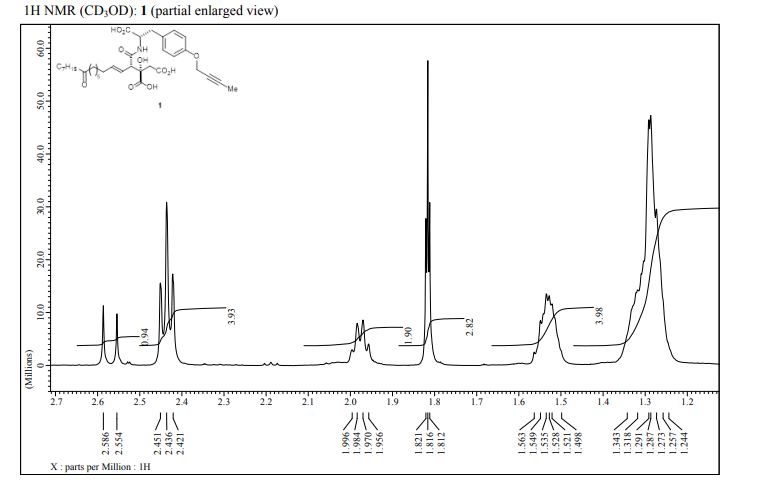
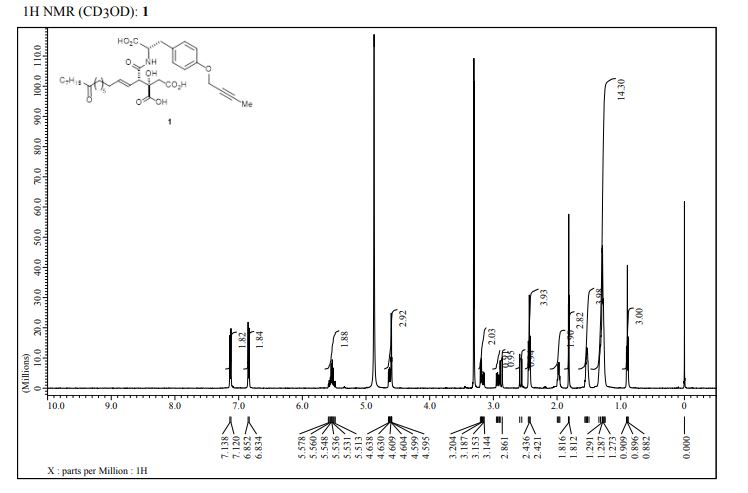
Chemical shift value of 1 H – NMR (in methanol d – 4) δ:

0.90 (3 H, t, J = 7 Hz), 1.19 – 1.38 (1 m), 1.42 – 1.60 (cm), 1.82 (3 H, t,

J = 2 Hz), 2.8 – 2.98 (2 H, m), 3.09 – 3.23 (2 H, m), 2.8 (2H, d, J = 9 Hz) 7 7.13 (2H, d, J = 9 Hz), 4.53 – 4.67 (3H, m), 5.39-5.61 (2H, m), 6.83

Patent ID

Patent Title

Submitted Date

Granted Date

US2011098477 Method Of Producing Compound Having Anti-Hcv Activity
2011-04-28
US2010152457 Intermediate compound for synthesis of viridiofungin a derivative
2010-06-17
US8030496 Intermediate compound for synthesis of viridiofungin a derivative
2010-06-17
2011-10-04
US7897783 Intermediate compound for synthesis of viridiofungin a derivative
2008-11-27
2011-03-01
Patent ID

Patent Title

Submitted Date

Granted Date

US2011160252 PHARMACEUTICAL COMPOSITIONS FOR TREATMENT OR PREVENTION OF HBV INFECTION
2011-06-30
US2010274026 Virus therapeutic drug
2010-10-28
US7776918 Remedy for viral disease
2006-09-28
2010-08-17
US7378446 Compound having anti-hcv activity and process for producing the same
2006-08-31
2008-05-27
US9266853 ORALLY AVAILABLE VIRIDIOFUNGIN DERIVATIVE POSSESSING ANTI-HCV ACTIVITY
2013-08-16
2015-07-30

References

Discovery of NA808: A novel host targeting anti-HCV agent
237th Am Chem Soc (ACS) Natl Meet (March 22-26, Salt Lake City) 2009, Abst MEDI 14

///////////////CH4630808, CH 4630808, NA 808

Viridiofungin A.png

Viridiofungin A

CCCCCCCC(=O)CCCCCCC=CC(C(=O)NC(CC1=CC=C(C=C1)O)C(=O)O)C(CC(=O)O)(C(=O)O)O

TITLE COMPD

O=C(O)[C@](O)(CC(=O)O)[C@H](\C=C\CCCCCCC(=O)CCCCCCC)C(=O)N[C@@H](Cc1ccc(OCC#CC)cc1)C(=O)O

BMS-986169


imgUNVYDSCXINFREZ-BHDDXSALSA-N.pngBDBM198728.png

BMS-986169

CAS 1801151-08-5 Related CAS : 1801151-09-6   1801151-08-5
Chemical Formula: C23H27FN2O2
Molecular Weight: 382.4794
Elemental Analysis: C, 72.23; H, 7.12; F, 4.97; N, 7.32; O, 8.37

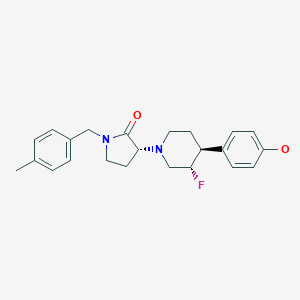
(R)-3-((3S,4S)-3-fluoro-4-(4-hydroxyphenyl)piperidin-1-yl)-1-(4-methylbenzyl)pyrrolidin-2-one

(3R)-3-[(3S,4S)-3-fluoro-4-(4-hydroxyphenyl)piperidin-1-yl]-1-[(4-methylphenyl)methyl]pyrrolidin-2-one

Preclinical

BMS-986169 is a Novel, Intravenous, Glutamate N-Methyl-d-Aspartate 2B Receptor Negative Allosteric Modulator with Potential in Major Depressive Disorder. BMS-986169 showed high binding affinity for the GluN2B subunit allosteric modulatory site (Ki = 4.03-6.3 nM) and selectively inhibited GluN2B receptor function in Xenopus oocytes expressing human N-methyl-d-aspartate receptor subtypes (IC50 = 24.1 nM). BMS-986169 weakly inhibited human ether-a-go-go-related gene channel activity (IC50 = 28.4 μM) and had negligible activity in an assay panel containing 40 additional pharmacological targets.

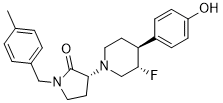
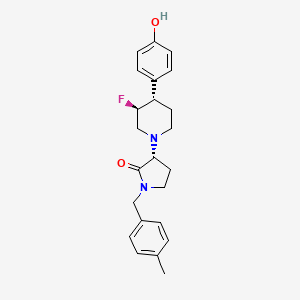
Chemical structures of BMS-986169 and the phosphate prodrug BMS-986163.

Chemical structures of BMS-986169 and the phosphate prodrug BMS-986163. 
Image result for BMS-986169


PAPER

Evolution of a Scale-Up Synthesis to a Potent GluN2B Inhibitor and Its Prodrug

 Discovery Chemistry and Molecular TechnologiesBristol-Myers Squibb Research and Development, Princeton, New Jersey 08540, United States
 Drug Product Science & Technology, Materials Science & EngineeringBristol-Myers Squibb Research and Development, Princeton, New Jersey 08540, United States
§ Department of Discovery SynthesisBiocon Bristol-Myers Squibb Research Center (BBRC), Bangalore 560099, India
Org. Process Res. Dev., Article ASAP
DOI: 10.1021/acs.oprd.8b00120
Abstract Image

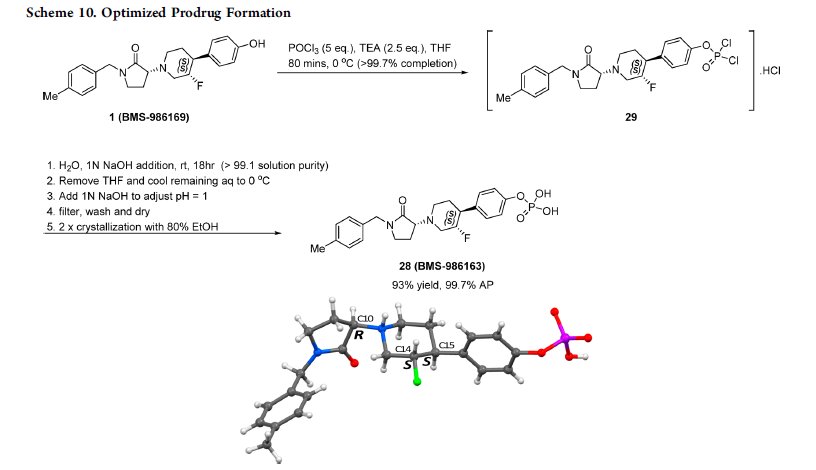
This paper describes the efficient scale-up synthesis of the potent negative allosteric glutamate N2B (GluN2B) inhibitor 1 (BMS-986169), which relies upon a stereospecific SN2 alkylation strategy and a robust process for the preparation of its phosphate prodrug 28 (BMS-986163) from parent 1 using POCl3. A deoxyfluorination reaction employing bis(2-methoxyethyl)aminosulfur trifluoride (Deoxo-Fluor) is also used to stereospecifically introduce a fluorine substituent. The optimized routes have been demonstrated to provide APIs suitable for toxicological studies in vivo.

Click to access op8b00120_si_001.pdf

PAPER

https://pubs.acs.org/doi/abs/10.1021/acsmedchemlett.8b00080

BMS-986163, a Negative Allosteric Modulator of GluN2B with Potential Utility in Major Depressive Disorder

 Bristol-Myers Squibb Research and Development5 Research Parkway, Wallingford, Connecticut 06492, United States
 Biocon Bristol-Myers Squibb Research Center, Bangalore, India
§ Bristol-Myers Squibb Research and Development3551 Lawrenceville Road, Princeton, New Jersey 08648, United States
ACS Med. Chem. Lett.20189 (5), pp 472–477
DOI: 10.1021/acsmedchemlett.8b00080
*Phone 203-677-6701. E-mail: lawrence.marcin@bms.com.


Abstract Image

There is a significant unmet medical need for more efficacious and rapidly acting antidepressants. Toward this end, negative allosteric modulators of the N-methyl-d-aspartate receptor subtype GluN2B have demonstrated encouraging therapeutic potential. We report herein the discovery and preclinical profile of a water-soluble intravenous prodrug BMS-986163 (6) and its active parent molecule BMS-986169 (5), which demonstrated high binding affinity for the GluN2B allosteric site (Ki = 4.0 nM) and selective inhibition of GluN2B receptor function (IC50 = 24 nM) in cells. The conversion of prodrug 6 to parent 5 was rapid in vitro and in vivo across preclinical species. After intravenous administration, compounds 5 and 6 have exhibited robust levels of ex vivo GluN2B target engagement in rodents and antidepressant-like activity in mice. No significant off-target activity was observed for 56, or the major circulating metabolites met-1 and met-2. The prodrug BMS-986163 (6) has demonstrated an acceptable safety and toxicology profile and was selected as a preclinical candidate for further evaluation in major depressive disorder.

Image result for BMS-986169

Image result for BMS-986169


(S)-3-((3S,4S)-3-fluoro-4-(4-hydroxyphenyl)piperidin-1-yl)-1-(4-
methylbenzyl)pyrrolidin-2-one (compound 23) and (R)-3-((3S,4S)-3-fluoro-4-(4-
hydroxyphenyl)piperidin-1-yl)-1-(4-methylbenzyl)pyrrolidin-2-one (BMS-986169, compound
5)……https://pubs.acs.org/doi/suppl/10.1021/acsmedchemlett.8b00080/suppl_file/ml8b00080_si_001.pdf

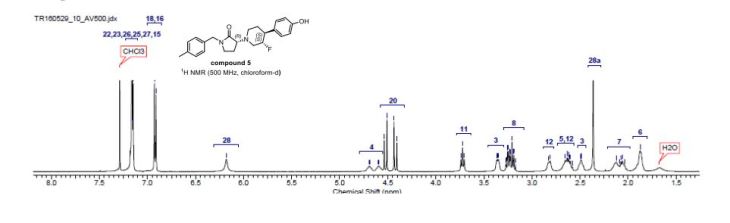
Analytical data for BMS-986169 (compound 5): LCMS (C23H27FN2O2, MW 382.2, ESAPI),
observed 383.2 m/z (M+H)+; []D20 = +6.09 (c = 1.15, MeOH); Anal. Calcd for
C23H27FN2O2 (382.21): C, 72.22; H, 7.12; N, 7.32. Found: C, 72.26; H, 7.05; N, 7.31; HRMS
(ESI) Calcd for C23H27N2O2, 383.2118. Found, 383.2129;

13C NMR (126 MHz, chloroformd)
172.4, 155.0, 137.5, 133.0, 132.8, 129.4, 128.6, 128.2, 115.6, 91.6 (d, J=173.5 Hz),
65.0, 54.5 (d, J=25.4 Hz), 48.3, 47.7 (d, J=17.3 Hz), 46.7, 43.6, 31.5, 21.1, 19.2;(500 MHz, chloroform-d) 7.23 – 7.11 (m, 5H), 6.92 (d, J=8.5 Hz, 2H), 6.18 (br. s., 1H),
4.79 – 4.55 (m, 1H), 4.57 – 4.33 (m, 2H), 3.72 (t, J=8.7 Hz, 1H), 3.46 – 3.30 (m, 1H), 3.30 –
3.09 (m, 2H), 2.82 (d, J=8.5 Hz, 1H), 2.73 – 2.56 (m, 2H), 2.49 (d, J=2.5 Hz, 1H), 2.36 (s,
3H), 2.21 – 1.98 (m, 2H), 1.87 (br. s., 2H). The corresponding 1H NMR spectrum for
compound 5 is shown below

1H NMR


PATENT

https://patents.google.com/patent/US9221796B2/und

InventorDalton KingLorin A. Thompson, IIIJianliang ShiSrinivasan ThangathirupathyJayakumar Sankara WarrierImadul IslamJohn E. Macor

Current Assignee Bristol-Myers Squibb Co

https://patents.google.com/patent/WO2015105772A1/und

N-Methyl-D-aspartate (NMDA) receptors are ion channels which are gated by the binding of glutamate, an excitatory neurotransmitter in the central nervous system. They are thought to play a key role in the development of a number of neurological diseases, including depression, neuropathic pain, Alzheimer’s disease, and Parkinson’s disease. Functional NMDA receptors are tetrameric structures primarily composed of two NRl and two NR2 subunits. The NR2 subunit is further subdivided into four individual subtypes: NR2A, NR2B, NR2C, and NR2D, which are differentially distributed throughout the brain. Antagonists or allosteric modulators of NMDA receptors, in particular NR2B subunit-containing channels, have been investigated as therapeutic agents for the treatment of major depressive disorder (G. Sanacora, 2008, Nature Rev. Drug Disc. 7: 426-437).

The NR2B receptor contains additional ligand binding sites in additon to that for glutamate. Non-selective NMDA antagonists such as Ketamine are pore blockers, interfering with the transport of Ca++ through the channel. Ketamine has demonstrated rapid and enduring antidepressant properties in human clinical trials as an i.v. drug. Additionally, efficacy was maintained with repeated, intermittent infusions of Ketamine (Zarate et al., 2006, Arch. Gen. Psychiatry 63: 856-864). This class of drugs, though, has limited therapeutic value because of its CNS side effects, including dissociative effects.

An allosteric, non-competitive binding site has also been identified in the N-terminal domain of NR2B. Agents which bind selectively at this site, such as

Traxoprodil, exhibited a sustained antidepressant response and improved side effect profile in human clinical trials as an i.v. drug (Preskorn et al., 2008, J. Clin.

PsychopharmacoL, 28: 631-637, and F. S. Menniti, et al, 1998, CNS Drug Reviews, 4, 4, 307-322). However, development of drugs from this class has been hindered by low bioavailability, poor pharmacokinetics, and lack of selectivity against other pharmacological targets including the hERG ion channel. Blockade of the hERG ion channel can lead to cardiac arrythmias, including the potentially fatal Torsades de pointe, thus selectivity against this channel is critical. Thus, in the treatment of major depressive disorder, there remains an unmet clinical need for the development of effective NR2B-selective negative allosteric modulators which have a favorable tolerability profile.

NR2B receptor antagonists have been disclosed in PCT publication WO 2009/006437.

The invention provides technical advantages, for example, the compounds are novel and are ligands for the NR2B receptor and may be useful for the treatment of various disorders of the central nervous system. Additionally, the compounds provide advantages for pharmaceutical uses, for example, with regard to one or more of their mechanism of action, binding, inhibition efficacy, target selectivity, solubility, safety profiles, or bioavailability.

Synthetic Scheme 1

The l-phenyl/benzyl-3-bromo-pyrrolidinones/piperidinones V may be reacted with (4-oxy-phenyl)cyclic amines VI in the presence of base to produce protected products VII, which may be subjected to cleavage conditions appropriate for the protecting group (PGi) to generate final products I, which may be separated into individual enantiomers/diastereomers I*, as shown in synthetic scheme 2.

Synthetic Scheme 2

I I*

Compounds la may be prepared by condensing l-phenyl/benzyl-3-bromo-pyrroli-dinones/piperidinones V with substituted 4(4-oxyphenyl)piperidines Vllla-c to generate protected intermediates IX, which may be subjected to cleavage conditions appropriate for the protecting group (PGi) to generate final products la, which may be separated into individual enantiomers/diastereomers la*, as shown in synthetic scheme 3.

Synthetic Scheme 3

The 4(4-oxyphenyl)piperidines Vllla-c may be synthesized in turn by a sequence starting with a protected tetrahydropiperidine X, which can be hydroxylated via hydroboration/oxidation to give the protected hydroxypiperidine XI, which may be either directly transformed into the protected fluoropiperidine XII by treatment with DAST or oxidized into the protected 3-oxopiperidine XIII, which may be further transformed into protected 3,3-difluoropiperidines XIV via treatment with DAST. XI, XII, and XIV may be transformed into Villa, Vlllb, and VIIIc, respectively, by employing cleaving conditions appropriate for the protecting group (PG2), as shown in synthetic scheme 3 a.

S nthetic scheme 3 a

Chiral

Cleavage Individual enantiomers/

G2P-N diastereomers

separation

conditions

OH 
Villa*

Villa

XI

Chiral

Cleavage Individual enantiomers/

HN

G2P-N diastereomers

%_\J> PQ separation

PG1 conditions

R F

F Vlllb*

Vlllb

XII

Chiral

Individual enantiomers/

G2P- diastereomers separation

Vlllc*

For tetrahydropyridines X which are not commercially available may be synthesized by coupling protected bromophenols XV with protected unsaturated

piperidineboronic acids XVI, as shown in synthetic scheme 4a.

Synthetic scheme 4a:

For tetrahydropyridines X which are not commercially available may be synthesized by adding the anion generated from protected bromophenols XV to a protected 4-piperidinone XVII to yield 4-phenyl-4-piperidinol XVIII, which may be dehydrated under acid conditions to yield the desired X, as shown in synthetic scheme 4b.

Synthetic scheme 4b:

l-Phenyl/benzyl-3-bromo-pyrroli-dinones/piperidinones V may be condensed with isolated individual enantiomers VIIIa-c*, which results in diastereomers 1- phenyl/benzyl-3-bromo-pyrroli-dinones/piperidinones IX*, which may be deprotected and separated to give final products la*, as shown in scheme 5.

Alternatively, the backbone scaffold may be synthesized by condensing 1- phenyl/benzyl-3-bromo-pyrroli-dinones/piperidinones V with hydroxypiperidines Villa to yield the protected 3-fluoropiperidines IXa, which may themselves be converted to the protected 3-fluoropiperidines IXb or oxidized to the ketones XIX, which may be converted to the 3,3-difluoropiperidines Ixc, as shown in scheme 6. The final compounds can then be isolated after the deprotection of IXa-c.

Scheme 6

Example 46, P-1 Example 46, P-2

(S)-3-((3S,4S)-3-Fluoro-4-(4-hydroxyphenyl)piperidin-l-yl)-l-(4-methylbenzyl)pyrrolidin-2-one and (R)-3-((3S,4S)-3-fluoro-4-(4-hydroxyphenyl)piperidin-l-yl)-l-(4-methylbenzyl)pyrrolidin-2-one.

Example 46, P-3 Example 46, P-4

Step A. (±)-rel-(3S,4S)- 1 -benzyl-4-(4-methoxyphenyl)piperidin-3-ol.

To a suspension of sodium tetrahydroborate (2.7 g, 72 mmol) in THF (200 mL) at 0 °C under a nitrogen atmosphere was added dropwise boron trifluoride etherate (8.8 mL, 70 mmol) and the resulting mixture was stirred for 30 minutes. Then 1-benzyl- 4-(4-methoxyphenyl)-l,2,3,6-tetrahydropyridine (10 g, 36 mmol, from S. Halazy et al WO 97/28140 (8/7/97)) dissolved in 100 mL of tetrahydrofuran was added. The mixture was allowed to warm to rt and stirred for 2 h. The reaction was then quenched by the dropwise addition of 100 mL of water. Next were added

sequentially 100 mL of ethanol, 100 mL of a 10% aqueous sodium hydroxide solution, and 30%> hydrogen peroxide (18 mL, 180 mmol) and the mixture was stirred at reflux temperature overnight. The reaction mixture was then allowed to cool, diluted with saturated aqueous ammonium chloride (200 mL), and extracted with ethyl acetate (500 mL). The organic layer was dried over Na2S04, filtered, and evaporated under reduced pressure to give (±)-rel-(3S,4S)- 1 -benzyl-4-(4-methoxyphenyl)piperidin-3-ol (8.5 g, 24.6 mmol, 69%> yield) which was used without further purification. LCMS (Method K) RT 1.99 min; m/z 298.0 (M+H+).

Step B. (±)-re -(3S,4S)-4-(4-methoxyphenyl)piperidin-3-ol.

To a solution of (±)-re/-(35′,45)-l-benzyl-4-(4-methoxyphenyl)piperidin-3-ol (9 g, 30 mmol) in methanol (150 mL) was added 10 % Pd/C (4.8 g) and the reaction mixture was stirred overnight under a hydrogen atmosphere. The catalyst was then removed by filtration through Celite and the solvent was evaporated under reduced pressure to give (±)-re/-(3S,4S)-4-(4-methoxyphenyl)piperidin-3-ol (5.1 g, 24.6 mmol, 81% yield) which was used without further purification. 1H NMR (400 MHz, DMSO-de) δ ppm 7.10 – 7.15 (m, 2 H) 6.80 – 6.86 (m, 2 H) 4.30 (d, J=5.27 Hz, 1 H) 3.37 – 3.43 (m, 1 H) 3.04 (dd, J=11.58, 4.36 Hz, 1 H) 2.86 (d, J=12.17 Hz, 1 H) 2.43 (td, J=12.09, 2.67 Hz, 1 H) 2.22 – 2.35 (m, 2 H) 1.57 – 1.63 (m, 1 H) 1.43 – 1.54 (m, 1 H).

To a solution of (±)-re/-(3S,4S)-4-(4-methoxyphenyl)piperidin-3-ol (4.5 g, 21.7 mmol) in DCM (150 mL) at -10°C under nitrogen was added a 1 M solution of boron tribromide in DCM (109 mL, 109 mmol). The reaction mixture was allowed to warm to rt, stired for 2 h, and then rechilled to 0 °C and quenched by the addition of a saturated aqueous sodium bicarbonate solution (300 mL). The aqueous layer was washed with 250 mL of DCM and then to it was added 200 mL 10% aqueous NaOH, followed by 9.5 g (43.5 mmol) of di-t-butyl dicarbonate and the resulting mixture was stirred for an additional 2 h. The mixture was then extracted with 200 mL ethyl acetate and the organic layer was separated, dried over Na2S04,filtered, and evaporated under reduced pressure to (±)-re/-(35′,45)-tert-butyl 4-(4-(tert-butoxycarbonyloxy)phenyl)-3-hydroxypiperidine-l-carboxylate (6.5 g, 12 mmol, 56 % yield) which was used without further purification. LCMS (Method K) RT 2.33 min, m/z 282 (M+H+ -2 t-butyl), 370; 1H NMR (400 MHz, DMSO-d6) δ ppm 7.27 (d, J=8.66 Hz, 2 H) 7.08 (d, J=8.66 Hz, 2 H) 4.85 (d, J=5.65 Hz, 1 H) 4.13 (d, J=8.41 Hz, 1 H) 3.97 (d, J=10.48 Hz, 1 H) 3.45 (tt, J=10.27, 5.19 Hz, 1 H) 1.67 (d, J=3.39 Hz, 1 H) 1.50 – 1.59 (m, 1 H) 1.49 (s, 11 H).

Step D. (±)-re/-(35′,45)-tert-butyl 3-hydroxy-4-(4-hydroxyphenyl)piperidine-l-carboxylate.

To a solution of (±)-re/-(35′,45)-tert-butyl 4-(4-(tert-butoxycarbonyloxy)phenyl)-3-hydroxypiperidine-l-carboxylate (6.5 g, 16.5 mmol) in 100 mL of methanol was added 11.42 g of potassium carbonate (83 mmol) and the reaction mixture was stirred at rt for 5 h. The organic solvent was removed under reduced pressure and the residue was partitioned between IN HC1 (300 mL) and ethyl acetate (300 mL). The layers were separated and the organic layer was dried over Na2S04 and evaporated under reduced pressure to give (±)-re/-(35′,45)-tert-butyl 3-hydroxy-4-(4-hydroxyphenyl)piperidine-l-carboxylate (5 g, 15 mmol, 92 % yield) which was used without further purification. LCMS (method F) RT 1.85 min, m/z 238 (M+H+ – 1-butyl), 279 (M+H+ – t-butyl+CH3CN), 1H NMR (400 MHz, DMSO-d6) δ ppm 7.01 (d, J=8.53 Hz, 2 H) 6.66 (d, J=8.53 Hz, 2 H) 4.70 (d, J=5.02 Hz, 1 H) 4.09 (br. s., 1 H) 3.94 (d, J=11.55 Hz, 1 H) 3.35 – 3.41 (m, 1 H) 2.66 – 2.77 (m, 1 H) 2.29 – 2.39 (m, 1 H) 1.63 (dd, J=13.30, 3.26 Hz, 1 H) 1.44 – 1.52 (m, 1 H) 1.42 (s, 9 H).

Step E. (3S,4S)-tert-Butyl 3 -hydroxy-4-(4-hydroxyphenyl)piperidine-l -carboxylate and (3R, -tert-butyl 3-hydroxy-4-(4-hydroxyphenyl)piperidine-l-carboxylate.

E-1 E-2

(±)-rel-(3S,4S)-tert-Butyl 3-hydroxy-4-(4-hydroxyphenyl)piperidine- 1 -carboxylate (5 g, 17 mmol, from step D) was subjected to chiral SFC separation (method C-5) to yield enantiomers E-1 (1.9 g, 6.48 mmol, 38.0 % yield) and E-2 (2.4 g, 8.18 mmol, 48.0 % yield). Data for E-1 : chiral HPLC (method A5 ) retention time 3.42 min. Data for E-2: chiral HPLC (method A5) retention time 4.2 min.

Step F. (3R,4R)-tert-Butyl 4-(4-(benzyloxy)phenyl)-3-hydroxypiperidine-l-carboxylate.

A mixture of (3R,4R)-tert-butyl 3-hydroxy-4-(4-hydroxyphenyl)piperidine-l-carboxylate (620 mg, 2.1 mmol, E-2 from step E), potassium carbonate (584 mg, 4.2 mmol), and benzyl bromide (0.25 mL, 2.1 mmol) in DMF (5 mL) was stirred at rt for 16 h. The solvent was removed by evaporation and the residue was treated with 50 mL of water. The aqueous mixture was then extracted 4 times with 50 mL of chloroform. The combined organic phases were dried over anhydous Na2S04, filtered, and evaporated to yield 750 mg of (3R,4R)-tert-butyl 4-(4-(benzyloxy)phenyl)-3-hydroxypiperidine-l -carboxylate which was used without further purification. LCMS (method F) RT 2.28 min, m/z = 310 (M+H+ – t-butyl -water), 328 (M+H+ -t-butyl).

Step G. (3i?,4i?)-4-(4-(Benzyloxy)phenyl)piperidin-3-ol hydrochloride.

A mixture of (3R,4R)-tert-butyl 4-(4-(benzyloxy)phenyl)-3-hydroxypiperidine-1-carboxylate (750 mg, 2 mmol), dioxane (4 mL) and 4.9 mL of 4 M HCI in dioxane was stirred at rt for 2h. The reaction was then evaporated to dryness to yield 550 mg of (3i?,4i?)-4-(4-(Benzyloxy)phenyl)piperidin-3-ol hydrochloride which was used without further purification. LCMS (method J) RT 0.70 min, m/z 284 (M+H+).

Step H. 3-((3i?,4i?)-4-(4-(Benzyloxy)phenyl)-3-hydroxypiperidin-l -yl)- 1 -(4-methylbenzyl)pyrrolidin-2-one .

A mixture of 3-bromo-l-(4-methylbenzyl)pyrrolidin-2-one (Intermediate 2, 220 mg, 0.82 mmol), (3i?,4i?)-4-(4-(benzyloxy)phenyl)piperidin-3-ol hydrochloride (262 mg, 0.82 mmol, from step G) and triethylamine (11 mL, 8.2 mmol) was stirred at 60 °C for lh, 80 °C for 1 h, 100 °C for 1 h and 120 °C for 1 h. The reaction mixture was then allowed to cool, diluted with 40 mL of water and extracted four times with 50 mL of chloroform. The combined organic layers were washed with 60 mL brine, dried over anhydrous sodium sulfate, filtered, and evaporated to yield 382 mg of 3-((3 ?,4i?)-4-(4-(benzyloxy)phenyl)-3-hydroxypiperidin- 1 -yl)- 1 -(4-methylbenzyl)pyrrolidin-2-one which was used without further purification. LCMS (method J) (main component of a mixture) RT 2.23 min, m/z 471 (M+H+).

Step I. 3-((3R, 4R)-4-(4-(Benzyloxy)phenyl)-3-fluoropiperidin- 1 -yl)- 1 -(4-methylbenzyl)pyrrolidin-2-one .

A solution of 3-(-4-(4-(benzyloxy)phenyl)-3-hydroxypiperidin-l-yl)-l-(4-methylbenzyl)pyrrolidin-2-one (382 mg, 0.81 mmol) in DCM (5 mL) cooled to 0 °C was treated dropwise with DAST (0.32 mL, 2.4 mmol) over 3 min. The reaction mixture was then allowed to warm to rt and was stirred for 2 h. The reaction was then quenched with 50 mL of 10% aqueous sodium bicarbonate solution and extracted 4 times with 40 mL of DCM. The combined organic layers were washed with 50 mL of brine, dried over anhydrous sodium sulfate, filtered, and concentrated under vacuum to yield 382 mg of 3-((3i?,4i?)-4-(4-(benzyloxy)phenyl)-3-fluoropiperidin-l-yl)-l-(4-methylbenzyl)pyrrolidin-2-one as a mixture of two diastereomers and rearrangement products which was used without further purification. LCMS (method J) (main component of a mixture) RT 0.9 min, m/z 473 (M+H+).

Step J. 3-((3i?,4i?)-3-Fluoro-4-(4-hydroxyphenyl)piperidin- 1 -yl)-l -(4-methylbenzyl)pyrrolidin-2-one .

A mixture of 3-((Ji?,4i?)-(4-(4-(benzyloxy)phenyl)-3-fluoropiperidin-l-yl)-l-(4-methylbenzyl)pyrrolidin-2-one (382 mg, 0.81 mmol) and methanol (4 mL) was flushed with nitrogen, followed by the addition of 172 mg of 10% Pd/C. Then the mixture was stirred at rt overnight under 25-99 psi hydrogen pressure. The reaction was then transferred to a 100 mL autoclave and stirred at 7 kg/cm2 hydrogen pressure for 4 days. The catalyst was removed by filtration through Celite and the solvent was evaporated off. The crude product was subjected to HPLC purification (method B) to yield 77.3 mg 3-((Ji?,4i?)-3-fluoro-4-(4-hydroxyphenyl)-piperidin-l-yl)-l-(4-methylbenzyl)pyrrolidin-2-one (diastereomeric pair) LCMS (method Q) RT 1.15 min, m/z 383.0 (M+H+).

Step K. (5)-3-((3i?,4i?)-3-Fluoro-4-(4-hydroxyphenyl)piperidin- 1 -yl>

methylbenzyl)pyrrolidin-2-one and (i?)-3-((3i?,4i?)-3-fluoro-4-(4-hydroxyphenyl)piperidin- 1 -yl)- 1 -(4-methylbenzyl)pyrrolidin-2-one.

The diastereomeric mixture from step J was separated by SFC method C-7 to yield homochiral Examples 46 P-l (29.3 mg) and P-2 (32.8 mg). Data for P-l (S)-3-((3R, 4R)-3 -fluoro-4-(4-hydroxyphenyl)piperidin- 1 -yl)- 1 -(4-methylbenzyl)pyrrolidin-2-one: LCMS (method F) RT 2.10 min, m/z 383.2 (M+H+), 405.2 (M+Na+); HPLC (method B) RT 8.24 min (98.8% AP); HPLC (method C) RT 6.52 min (99.1% AP); Chiral HPLC (method C-6) RT 4.1 min; 1H NMR (400 MHz, methanol-d4) δ ppm 1.76 – 1.86 (m, 2 H) 2.07 (d, J=8.53 Hz, 1 H) 2.13 – 2.21 (m, 1 H) 2.34 (s, 3 H) 2.43 (s, 0 H) 2.55 – 2.60 (m, 1 H) 2.65 – 2.70 (m, 1 H) 2.75 (br. s., 1 H) 3.20 – 3.30 (m, 2 H) 3.38 – 3.45 (m, 1 H) 3.70 (t, J=8.78 Hz, 1 H) 4.44 (t, J=79.81 Hz, 3 H) 4.63 – 4.71 (m, 1 H) 6.70 – 6.80 (m, 2 H) 7.07 – 7.15 (m, 2 H) 7.07 – 7.12 (m, 1 H) 7.13 – 7.22 (m, 4 H); 19F NMR δ ppm -184.171. Data for P-2: (R)-3-((3R,4R)-3-fluoro-4-(4-hydroxyphenyl)piperidin- 1 -yl)- 1 -(4-methylbenzyl)pyrrolidin-2-one: LCMS (method F) RT 2.10 min, m/z 383.2 (M+H+), 405.2 (M+Na+); HPLC (method B) RT 8.29 min (99.7% AP); HPLC (method C) RT 6.52 min (99.8% AP); Chiral HPLC (method C-6) RT 6.92 min; 1H NMR (400 MHz, methanol-d4) δ ppm 1.80 – 1.90 (m, 2 H) 2.07 (d, J=8.03 Hz, 1 H) 2.19 (s, 1 H) 2.34 (s, 3 H) 2.41 – 2.48 (m, 1 H) 2.66 (d, J=4.52 Hz, 2 H) 2.95 – 3.03 (m, 1 H) 3.10 – 3.18 (m, 1 H) 3.20 – 3.30 (m, 2 H) 3.68 – 3.78 (m, 1 H) 4.38 (s, 1 H) 4.51 (d, J=14.56 Hz, 2 H) 6.70 – 6.80 (m, 2 H) 7.05 – 7.13 (m, 2 H) 7.13 – 7.22 (m, 4 H); 19F NMR δ ppm -184.311.

(3S,4S)-tert-Butyl 3-fluoro-4-(4-hydroxyphenyl)piperidine-l-carboxylate.

To a solution of (3S,4S)-tert-butyl 3-hydroxy-4-(4-hydroxyphenyl)piperidine-l-carboxylate (400 mg, 1.36 mmol, the first eluting enantiomer E-l from step E) in DCM (5 mL) cooled to 0 °C was added dropwise DAST (0.54 mL, 4.1 mmol) over 10 min. The mixture was allowed to warm up to rt and was stirred for 2h. The reaction was slowly quenched with 50 mL of a 10%> aqueous sodium bicarbonate solution and extracted four times with 50 mL of DCM. The combined organic layerss were washed with 75 mL of brine, dried, and concentrated under vacuum to yield 390 mg of {3S,4S)-tert-bvXy\ 3-fluoro-4-(4-hydroxyphenyl)piperidine-l-

carboxylate which was used without further purification. LCMS (Method Q) RT 0.92 min, m z 240.1(M+H+).

Step M. 4-((3S’,4S)-3-Fluoropi ridin-4-yl)phenol hydrochloride.

A mixture of (3S,4S)-tert-butyl 3-fluoro-4-(4-hydroxyphenyl)piperidine-l-carboxylate (390 mg, 1.3 mmol) and 4M HC1 in dioxane (3.3 mL, 13.2 mmol) in dioxane (4 mL) was stirred at rt for 2 hr. It was then concentrated to dryness, washed with 10 mL of 5% DCM/diethyl ether mixture and the solid was isolated by filtration. Yield: 260 mg of 4-((J£4S)-3-fluoropiperidin-4-yl)phenol hydrochloride; LCMS

(method Q) RT 0.46 min, mz 196.1(M+H+) 1H NMR (400 MHz, DMSO-d6) δ = 9.57 (br. s., 4 H), 8.92 – 8.68 (m, 1 H), 7.14 (d, J= 8.5 Hz, 1 H), 7.06 (d, J= 8.5 Hz, 2 H), 6.82 – 6.73 (m, 2 H), 5.07 – 4.85 (m, 1 H), 3.77 – 3.36 (m, 9 H), 3.32 – 3.22 (m, 2 H), 3.13 – 2.85 (m, 5 H), 2.06 – 1.88 (m, H).

Step N. 3-((3S,4S)-3-Fluoro-4-(4-hydroxyphenyl)piperidin- 1 -yl)- 1 -(4-methylbenzyl)pyrrolidin-2-one.

A mixture of 3-bromo-l-(4-methylbenzyl)pyrrolidin-2-one (200 mg, 0.75 mmol), triethylamine (0.52 mL, 3.7 mmol) and 4-((3S,4S)-3-fluoropiperidin-4-yl)phenol hydrochloride (173 mg, 0.75 mmol) in DMF (3 mL) was heated to 120 °C in a microwave reactor for 1.5 h. The mixture was allowed to cool and was then mixed with 60 mL water and extracted 5 times with 40 mL of DCM. The combined organic extracts were washed with 80 mL of brine, dried over anhydrous sodium sulfate, filtered, and evaporated to give 265 mg of 3-((3 4S)-3-fluoro-4-(4-hydroxy-phenyl)piperidin-l-yl)-l-(4-methylbenzyl)pyrrolidin-2-one as a mixture of 2 diastereoisomers. LCMS (method P) RT 0.92 min m/z 383.4 (M+H+).

Step O. (5)-3-((3lS,45)-3-Fluoro-4-(4-hydroxyphenyl)piperidin- 1 -yl)- 1 -(4-methylbenzyl)pyrrolidin-2-one and (i?)-3-((35,,45)-3-fluoro-4-(4-hydroxyphenyl)piperidin- 1 -yl)- 1 -(4-methylbenzyl)pyrrolidin-2-one.

A portion of the diasteromer mixture from step N (130 mg) was subjected to chiral purification via SFC (method C-7) to give homochiral Examples 46 P-3 (37.7 mg) and P-4 (60.7 mg). Data for P-3 (S)-3-((3S,4S)-3-fluoro-4-(4-hydroxyphenyl)piperidin- 1 -yl)- 1 -(4-methylbenzyl)pyrrolidin-2-one: LCMS (Method F) RT = 2.10 min, m/z 383.2 (M+H+); HPLC (Method C) RT 6.54 min, (Method D) RT 8.20 min; chiral HPLC (method C-6) RT 3.42 min;1H NMR (400 MHz, methanol-d4) δ ppm 1.76 – 1.86 (m, 2 H) 2.06 (d, J=8.53 Hz, 1 H) 2.10 – 2.21 (m, 1 H) 2.34 (s, 3 H) 2.40 – 2.48 (m, 1 H) 2.53 – 2.60 (m, 1 H) 2.61 – 2.70 (m, 2 H) 2.95 -3.01 (m, 1 H) 3.01 (s, 2 H) 3.10 – 3.16 (m, 1 H) 3.18 – 3.28 (m, 2 H) 3.72 (s, 1 H) 4.35 – 4.41 (m, 1 H) 4.46 – 4.70 (m, 2 H) 6.72 – 6.80 (m, 2 H) 7.05 – 7.23 (m, 6 H). Data for P-4 (R)-3-((3S,4S)-3-fiuoro-4-(4-hydroxyphenyl)piperidin-l-yl)-l-(4-methylbenzyl)pyrrolidin-2-one: LCMS (Method F) RT 2.11 min, m/z 383.2 (M+H+);; HPLC (Method C) RT 6.50 min, (Method D) RT 8.21 min; chiral HPLC (method C-6) RT 6.31 min; 1H NMR (400 MHz, methanol-d4) δ ppm 1.81 (dd, J=7.28, 2.76 Hz, 2 H) 2.06 (d, J=9.04 Hz, 2 H) 2.33 (s, 3 H) 2.43 (s, 1 H) 2.55 (br s, 1 H) 2.66 (d, J=40.16 Hz, 2 H) 2.75 – 2.80 (m, 1 H) 2.96 – 3.10 (m, 2 H) 3.20 – 3.28 (m, 2 H) 3.41 (d, J=5.52 Hz, 1 H) 3.66 – 3.75 (m, 1 H) 4.31 – 4.41 (m, 1 H) 4.46 – 4.71 (m, 2 H) 6.76 (d, J=8.53 Hz, 2 H) 7.05 – 7.23 (m, 6 H).

PATENT

https://patentscope.wipo.int/search/en/detail.jsf?docId=US215055421&recNum=1&maxRec=&office=&prevFilter=&sortOption=&queryString=&tab=PCTDescription

Example 46 (Peak-1, Peak-2, Peak-3, Peak-4)

(S)-3-((3R,4R)-3-Fluoro-4-(4-hydroxyphenyl)piperidin-1-yl)-1-(4-methylbenzyl)pyrrolidin-2-one and (R)-3-((3R,4R)-3-fluoro-4-(4-hydroxyphenyl)piperidin-1-yl)-1-(4-methylbenzyl)pyrrolidin-2-one


(S)-3-((3S,4S)-3-Fluoro-4-(4-hydroxyphenyl)piperidin-1-yl)-1-(4-methylbenzyl)pyrrolidin-2-one and (R)-3-((3S,4S)-3-fluoro-4-(4-hydroxyphenyl)piperidin-1-yl)-1-(4-methylbenzyl)pyrrolidin-2-one


Step A. (±)-rel-(3S,4S)-1-benzyl-4-(4-methoxyphenyl)piperidin-3-ol

      To a suspension of sodium tetrahydroborate (2.7 g, 72 mmol) in THF (200 mL) at 0° C. under a nitrogen atmosphere was added dropwise boron trifluoride etherate (8.8 mL, 70 mmol) and the resulting mixture was stirred for 30 minutes. Then 1-benzyl-4-(4-methoxyphenyl)-1,2,3,6-tetrahydropyridine (10 g, 36 mmol, from S. Halazy et al WO 97/28140 (8/7/97)) dissolved in 100 mL of tetrahydrofuran was added. The mixture was allowed to warm to rt and stirred for 2 h. The reaction was then quenched by the dropwise addition of 100 mL of water. Next were added sequentially 100 mL of ethanol, 100 mL of a 10% aqueous sodium hydroxide solution, and 30% hydrogen peroxide (18 mL, 180 mmol) and the mixture was stirred at reflux temperature overnight. The reaction mixture was then allowed to cool, diluted with saturated aqueous ammonium chloride (200 mL), and extracted with ethyl acetate (500 mL). The organic layer was dried over Na2SO4, filtered, and evaporated under reduced pressure to give (±)-rel-(3S,4S)-1-benzyl-4-(4-methoxyphenyl)piperidin-3-ol (8.5 g, 24.6 mmol, 69% yield) which was used without further purification. LCMS (Method K) RT 1.99 min; m/z 298.0 (M+H+).

Step B. (±)-rel-(3S,4S)-4-(4-methoxyphenyl)piperidin-3-ol


      To a solution of (±)-rel-(3S,4S)-1-benzyl-4-(4-methoxyphenyl)piperidin-3-ol (9 g, 30 mmol) in methanol (150 mL) was added 10% Pd/C (4.8 g) and the reaction mixture was stirred overnight under a hydrogen atmosphere. The catalyst was then removed by filtration through Celite and the solvent was evaporated under reduced pressure to give (±)-rel-(3S,4S)-4-(4-methoxyphenyl)piperidin-3-ol (5.1 g, 24.6 mmol, 81% yield) which was used without further purification. 1H NMR (400 MHz, DMSO-d6) δ ppm 7.10-7.15 (m, 2H) 6.80-6.86 (m, 2H) 4.30 (d, J=5.27 Hz, 1H) 3.37-3.43 (m, 1H) 3.04 (dd, J=11.58, 4.36 Hz, 1H) 2.86 (d, J=12.17 Hz, 1H) 2.43 (td, J=12.09, 2.67 Hz, 1H) 2.22-2.35 (m, 2H) 1.57-1.63 (m, 1H) 1.43-1.54 (m, 1H).

Step C. (±)-rel-(3S,4S)-tert-butyl 4-(4-(tert-butoxycarbonyloxy)phenyl)-3-hydroxypiperidine-1-carboxylate


 (
      To a solution of (±)-rel-(3S,4S)-4-(4-methoxyphenyl)piperidin-3-ol (4.5 g, 21.7 mmol) in DCM (150 mL) at −10° C. under nitrogen was added a 1 M solution of boron tribromide in DCM (109 mL, 109 mmol). The reaction mixture was allowed to warm to rt, stirred for 2 h, and then rechilled to 0° C. and quenched by the addition of a saturated aqueous sodium bicarbonate solution (300 mL). The aqueous layer was washed with 250 mL of DCM and then to it was added 200 mL 10% aqueous NaOH, followed by 9.5 g (43.5 mmol) of di-t-butyl dicarbonate and the resulting mixture was stirred for an additional 2 h. The mixture was then extracted with 200 mL ethyl acetate and the organic layer was separated, dried over Na2SO4, filtered, and evaporated under reduced pressure to (±)-rel-(3S,4S)-tert-butyl 4-(4-(tert-butoxycarbonyloxy)phenyl)-3-hydroxypiperidine-1-carboxylate (6.5 g, 12 mmol, 56% yield) which was used without further purification. LCMS (Method K) RT 2.33 min, m/z 282 (M+H+-2 t-butyl), 370; 1H NMR (400 MHz, DMSO-d6) δ ppm 7.27 (d, J=8.66 Hz, 2H) 7.08 (d, J=8.66 Hz, 2H) 4.85 (d, J=5.65 Hz, 1H) 4.13 (d, J=8.41 Hz, 1H) 3.97 (d, J=10.48 Hz, 1H) 3.45 (tt, J=10.27, 5.19 Hz, 1H) 1.67 (d, J=3.39 Hz, 1H) 1.50-1.59 (m, 1H) 1.49 (s, 11H).

Step D. (±)-rel-(3S,4S)-tert-butyl 3-hydroxy-4-(4-hydroxyphenyl)piperidine-1-carboxylate


      To a solution of (±)-rel-(3S,4S)-tert-butyl 4-(4-(tert-butoxycarbonyloxy)phenyl)-3-hydroxypiperidine-1-carboxylate (6.5 g, 16.5 mmol) in 100 mL of methanol was added 11.42 g of potassium carbonate (83 mmol) and the reaction mixture was stirred at rt for 5 h. The organic solvent was removed under reduced pressure and the residue was partitioned between 1N HCl (300 mL) and ethyl acetate (300 mL). The layers were separated and the organic layer was dried over Na2SOand evaporated under reduced pressure to give (±)-rel-(3S,4S)-tert-butyl 3-hydroxy-4-(4-hydroxyphenyl)piperidine-1-carboxylate (5 g, 15 mmol, 92% yield) which was used without further purification. LCMS (method F) RT 1.85 min, m/z 238 (M+H+-t-butyl), 279 (M+H+-t-butyl+CH3CN), 1H NMR (400 MHz, DMSO-d6) δ ppm 7.01 (d, J=8.53 Hz, 2H) 6.66 (d, J=8.53 Hz, 2H) 4.70 (d, J=5.02 Hz, 1H) 4.09 (br. s., 1H) 3.94 (d, J=11.55 Hz, 1H) 3.35-3.41 (m, 1H) 2.66-2.77 (m, 1H) 2.29-2.39 (m, 1H) 1.63 (dd, J=13.30, 3.26 Hz, 1H) 1.44-1.52 (m, 1H) 1.42 (s, 9H).

Step E. (3S,4S)-tert-Butyl 3-hydroxy-4-(4-hydroxyphenyl)piperidine-1-carboxylate and (3R,4R)-tert-butyl 3-hydroxy-4-(4-hydroxyphenyl)piperidine-1-carboxylate


      (±)-rel-(3S,4S)-tert-Butyl 3-hydroxy-4-(4-hydroxyphenyl)piperidine-1-carboxylate (5 g, 17 mmol, from step D) was subjected to chiral SFC separation (method C-5) to yield enantiomers E-1 (1.9 g, 6.48 mmol, 38.0% yield) and E-2 (2.4 g, 8.18 mmol, 48.0% yield). Data for E-1: chiral HPLC (method A5) retention time 3.42 min. Data for E-2: chiral HPLC (method A5) retention time 4.2 min.

Step F. (3R,4R)-tert-Butyl 4-(4-(benzyloxy)phenyl)-3-hydroxypiperidine-1-carboxylate


      A mixture of (3R,4R)-tert-butyl 3-hydroxy-4-(4-hydroxyphenyl)piperidine-1-carboxylate (620 mg, 2.1 mmol, E-2 from step E), potassium carbonate (584 mg, 4.2 mmol), and benzyl bromide (0.25 mL, 2.1 mmol) in DMF (5 mL) was stirred at rt for 16 h. The solvent was removed by evaporation and the residue was treated with 50 mL of water. The aqueous mixture was then extracted 4 times with 50 mL of chloroform. The combined organic phases were dried over anhydrous Na2SO4, filtered, and evaporated to yield 750 mg of (3R,4R)-tert-butyl 4-(4-(benzyloxy)phenyl)-3-hydroxypiperidine-1-carboxylate which was used without further purification. LCMS (method F) RT 2.28 min, m/z=310 (M+H+-t-butyl -water), 328 (M+H+-t-butyl).

Step G. (3R,4R)-4-(4-(Benzyloxy)phenyl)piperidin-3-ol hydrochloride


      A mixture of (3R,4R)-tert-butyl 4-(4-(benzyloxy)phenyl)-3-hydroxypiperidine-1-carboxylate (750 mg, 2 mmol), dioxane (4 mL) and 4.9 mL of 4 M HCl in dioxane was stirred at rt for 2 h. The reaction was then evaporated to dryness to yield 550 mg of (3R,4R)-4-(4-(Benzyloxy)phenyl)piperidin-3-ol hydrochloride which was used without further purification. LCMS (method J) RT 0.70 min, m/z 284 (M+H+).

Step H. 3-((3R,4R)-4-(4-(Benzyloxy)phenyl)-3-hydroxypiperidin-1-yl)-1-(4-methylbenzyl)pyrrolidin-2-one


      A mixture of 3-bromo-1-(4-methylbenzyl)pyrrolidin-2-one (Intermediate 2, 220 mg, 0.82 mmol), (3R,4R)-4-(4-(benzyloxy)phenyl)piperidin-3-ol hydrochloride (262 mg, 0.82 mmol, from step G) and triethylamine (11 mL, 8.2 mmol) was stirred at 60° C. for 1 h, 80° C. for 1 h, 100° C. for 1 h and 120° C. for 1 h. The reaction mixture was then allowed to cool, diluted with 40 mL of water and extracted four times with 50 mL of chloroform. The combined organic layers were washed with 60 mL brine, dried over anhydrous sodium sulfate, filtered, and evaporated to yield 382 mg of 3-((3R,4R)-4-(4-(benzyloxy)phenyl)-3-hydroxypiperidin-1-yl)-1-(4-methylbenzyl)pyrrolidin-2-one which was used without further purification. LCMS (method J) (main component of a mixture) RT 2.23 min, m/z 471 (M+H+).

Step I. 3-((3R,4R)-4-(4-(Benzyloxy)phenyl)-3-fluoropiperidin-1l-yl)-1-(4-methylbenzyl)pyrrolidin-2-one


      A solution of 3-(-4-(4-(benzyloxy)phenyl)-3-hydroxypiperidin-1-yl)-1-(4-methylbenzyl)pyrrolidin-2-one (382 mg, 0.81 mmol) in DCM (5 mL) cooled to 0° C. was treated dropwise with DAST (0.32 mL, 2.4 mmol) over 3 min. The reaction mixture was then allowed to warm to rt and was stirred for 2 h. The reaction was then quenched with 50 mL of 10% aqueous sodium bicarbonate solution and extracted 4 times with 40 mL of DCM. The combined organic layers were washed with 50 mL of brine, dried over anhydrous sodium sulfate, filtered, and concentrated under vacuum to yield 382 mg of 3-((3R,4R)-4-(4-(benzyloxy)phenyl)-3-fluoropiperidin-1-yl)-1-(4-methylbenzyl)pyrrolidin-2-one as a mixture of two diastereomers and rearrangement products which was used without further purification. LCMS (method J) (main component of a mixture) RT 0.9 min, m/z 473 (M+H+).

Step J. 3-((3R,4R)-3-Fluoro-4-(4-hydroxyphenyl)piperidin-1-yl)-1-(4-methylbenzyl)pyrrolidin-2-one


      A mixture of 3-((3R,4R)-(4-(4-(benzyloxy)phenyl)-3-fluoropiperidin-1-yl)-1-(4-methylbenzyl)pyrrolidin-2-one (382 mg, 0.81 mmol) and methanol (4 mL) was flushed with nitrogen, followed by the addition of 172 mg of 10% Pd/C. Then the mixture was stirred at rt overnight under 25-99 psi hydrogen pressure. The reaction was then transferred to a 100 mL autoclave and stirred at 7 kg/cmhydrogen pressure for 4 days. The catalyst was removed by filtration through Celite and the solvent was evaporated off. The crude product was subjected to HPLC purification (method B) to yield 77.3 mg 3-((3R,4R)-3-fluoro-4-(4-hydroxyphenyl)-piperidin-1-yl)-1-(4-methylbenzyl)pyrrolidin-2-one (diastereomeric pair) LCMS (method Q) RT 1.15 min, m/z 383.0 (M+H+).

Step K. (S)-3-((3R,4R)-3-Fluoro-4-(4-hydroxyphenyl)piperidin-1-yl)-1-(4-methylbenzyl)pyrrolidin-2-one and (R)-3-((3R,4R)-3-fluoro-4-(4-hydroxyphenyl)piperidin-1-yl)-1-(4-methylbenzyl)pyrrolidin-2-one

      The diastereomeric mixture from step J was separated by SFC method C-7 to yield homochiral Examples 46 P-1 (29.3 mg) and P-2 (32.8 mg). Data for P-1 (S)-3-((3R,4R)-3-fluoro-4-(4-hydroxyphenyl)piperidin-1-yl)-1-(4-methylbenzyl)pyrrolidin-2-one: LCMS (method F) RT 2.10 min, m/z 383.2 (M+H+), 405.2 (M+Na+); HPLC (method B) RT 8.24 min (98.8% AP); HPLC (method C) RT 6.52 min (99.1% AP); Chiral HPLC (method C-6) RT 4.1 min; 1H NMR (400 MHz, methanol-d4) δ ppm 1.76-1.86 (m, 2H) 2.07 (d, J=8.53 Hz, 1H) 2.13-2.21 (m, 1H) 2.34 (s, 3H) 2.43 (s, 0H) 2.55-2.60 (m, 1H) 2.65-2.70 (m, 1H) 2.75 (br. s., 1H) 3.20-3.30 (m, 2H) 3.38-3.45 (m, 1H) 3.70 (t, J=8.78 Hz, 1H) 4.44 (t, J=79.81 Hz, 3H) 4.63-4.71 (m, 1H) 6.70-6.80 (m, 2H) 7.07-7.15 (m, 2H) 7.07-7.12 (m, 1H) 7.13-7.22 (m, 4H); 19F NMR δ ppm −184.171. Data for P-2: (R)-3-((3R,4R)-3-fluoro-4-(4-hydroxyphenyl)piperidin-1-yl)-1-(4-methylbenzyl)pyrrolidin-2-one: LCMS (method F) RT 2.10 min, m/z 383.2 (M+H+), 405.2 (M+Na+); HPLC (method B) RT 8.29 min (99.7% AP); HPLC (method C) RT 6.52 min (99.8% AP); Chiral HPLC (method C-6) RT 6.92 min; 1H NMR (400 MHz, methanol-d4) δ ppm 1.80-1.90 (m, 2H) 2.07 (d, J=8.03 Hz, 1H) 2.19 (s, 1H) 2.34 (s, 3H) 2.41-2.48 (m, 1H) 2.66 (d, J=4.52 Hz, 2H) 2.95-3.03 (m, 1H) 3.10-3.18 (m, 1H) 3.20-3.30 (m, 2H) 3.68-3.78 (m, 1H) 4.38 (s, 1H) 4.51 (d, J=14.56 Hz, 2H) 6.70-6.80 (m, 2H) 7.05-7.13 (m, 2H) 7.13-7.22 (m, 4H); 19F NMR δ ppm −184.311.

Step L. (3S,4S)-tert-Butyl 3-fluoro-4-(4-hydroxyphenyl)piperidine-1-carboxylate


      To a solution of (3S,4S)-tert-butyl 3-hydroxy-4-(4-hydroxyphenyl)piperidine-1-carboxylate (400 mg, 1.36 mmol, the first eluting enantiomer E-1 from step E) in DCM (5 mL) cooled to 0° C. was added dropwise DAST (0.54 mL, 4.1 mmol) over 10 min. The mixture was allowed to warm up to rt and was stirred for 2 h. The reaction was slowly quenched with 50 mL of a 10% aqueous sodium bicarbonate solution and extracted four times with 50 mL of DCM. The combined organic layers were washed with 75 mL of brine, dried, and concentrated under vacuum to yield 390 mg of (3S,4S)-tert-butyl 3-fluoro-4-(4-hydroxyphenyl)piperidine-1-carboxylate which was used without further purification. LCMS (Method Q) RT 0.92 min, m/z 240.1 (M+H+).

Step M. 4-((3S,4S)-3-Fluoropiperidin-4-yl)phenol hydrochloride


      A mixture of (3S,4S)-tert-butyl 3-fluoro-4-(4-hydroxyphenyl)piperidine-1-carboxylate (390 mg, 1.3 mmol) and 4M HCl in dioxane (3.3 mL, 13.2 mmol) in dioxane (4 mL) was stirred at rt for 2 hr. It was then concentrated to dryness, washed with 10 mL of 5% DCM/diethyl ether mixture and the solid was isolated by filtration. Yield: 260 mg of 4-((3S,4S)-3-fluoropiperidin-4-yl)phenol hydrochloride; LCMS (method Q) RT 0.46 min, mz 196.1 (M+H+)1H NMR (400 MHz, DMSO-d6) δ=9.57 (br. s., 4H), 8.92-8.68 (m, 1H), 7.14 (d, J=8.5 Hz, 1H), 7.06 (d, J=8.5 Hz, 2H), 6.82-6.73 (m, 2H), 5.07-4.85 (m, 1H), 3.77-3.36 (m, 9H), 3.32-3.22 (m, 2H), 3.13-2.85 (m, 5H), 2.06-1.88 (m, H).

Step N. 3-((3S,4S)-3-Fluoro-4-(4-hydroxyphenyl)piperidin-1-yl)-1-(4-methylbenzyl)pyrrolidin-2-one


      A mixture of 3-bromo-1-(4-methylbenzyl)pyrrolidin-2-one (200 mg, 0.75 mmol), triethylamine (0.52 mL, 3.7 mmol) and 4-((3S,4S)-3-fluoropiperidin-4-yl)phenol hydrochloride (173 mg, 0.75 mmol) in DMF (3 mL) was heated to 120° C. in a microwave reactor for 1.5 h. The mixture was allowed to cool and was then mixed with 60 mL water and extracted 5 times with 40 mL of DCM. The combined organic extracts were washed with 80 mL of brine, dried over anhydrous sodium sulfate, filtered, and evaporated to give 265 mg of 3-((3S,4S)-3-fluoro-4-(4-hydroxy-phenyl)piperidin-1-yl)-1-(4-methylbenzyl)pyrrolidin-2-one as a mixture of 2 diastereoisomers. LCMS (method P) RT 0.92 min m/z 383.4 (M+H+).

Step O. (S)-3-((3S,4S)-3-Fluoro-4-(4-hydroxyphenyl)piperidin-1-yl)-1-(4-methylbenzyl)pyrrolidin-2-one and (R)-3-((3S,4S)-3-fluoro-4-(4-hydroxyphenyl)piperidin-1-yl)-1-(4-methylbenzyl)pyrrolidin-2-one

      A portion of the diastereomer mixture from step N (130 mg) was subjected to chiral purification via SFC (method C-7) to give homochiral Examples 46 P-3 (37.7 mg) and P-4 (60.7 mg). Data for P-3 (S)-3-((3S,4S)-3-fluoro-4-(4-hydroxyphenyl)piperidin-1-yl)-1-(4-methylbenzyl)pyrrolidin-2-one: LCMS (Method F) RT=2.10 min, m/z 383.2 (M+H+); HPLC (Method C) RT 6.54 min, (Method D) RT 8.20 min; chiral HPLC (method C-6) RT 3.42 min; 1H NMR (400 MHz, methanol-d4) δ ppm 1.76-1.86 (m, 2H) 2.06 (d, J=8.53 Hz, 1H) 2.10-2.21 (m, 1H) 2.34 (s, 3H) 2.40-2.48 (m, 1H) 2.53-2.60 (m, 1H) 2.61-2.70 (m, 2H) 2.95-3.01 (m, 1H) 3.01 (s, 2H) 3.10-3.16 (m, 1H) 3.18-3.28 (m, 2H) 3.72 (s, 1H) 4.35-4.41 (m, 1H) 4.46-4.70 (m, 2H) 6.72-6.80 (m, 2H) 7.05-7.23 (m, 6H). Data for P-4 (R)-3-((3S,4S)-3-fluoro-4-(4-hydroxyphenyl)piperidin-1-yl)-1-(4-methylbenzyl)pyrrolidin-2-one: LCMS (Method F) RT 2.11 min, m/z 383.2 (M+H+); HPLC (Method C) RT 6.50 min, (Method D) RT 8.21 min; chiral HPLC (method C-6) RT 6.31 min; 1H NMR (400 MHz, methanol-d4) δ ppm 1.81 (dd, J=7.28, 2.76 Hz, 2H) 2.06 (d, J=9.04 Hz, 2H) 2.33 (s, 3H) 2.43 (s, 1H) 2.55 (br s, 1H) 2.66 (d, J=40.16 Hz, 2H) 2.75-2.80 (m, 1H) 2.96-3.10 (m, 2H) 3.20-3.28 (m, 2H) 3.41 (d, J=5.52 Hz, 1H) 3.66-3.75 (m, 1H) 4.31-4.41 (m, 1H) 4.46-4.71 (m, 2H) 6.76 (d, J=8.53 Hz, 2H) 7.05-7.23 (m, 6H).

ADDITIONAL INFORMATION

Intravenous administration of BMS-986169 or BMS-986163 dose-dependently increased GluN2B receptor occupancy and inhibited in vivo [3H](+)-5-methyl-10,11-dihydro-5H-dibenzo[a,d]cyclohepten-5,10-imine ([3H]MK-801) binding, confirming target engagement and effective cleavage of the prodrug. BMS-986169 reduced immobility in the mouse forced swim test, an effect similar to intravenous ketamine treatment. Decreased novelty suppressed feeding latency, and increased ex vivo hippocampal long-term potentiation was also seen 24 hours after acute BMS-986163 or BMS-986169 administration. BMS-986169 did not produce ketamine-like hyperlocomotion or abnormal behaviors in mice or cynomolgus monkeys but did produce a transient working memory impairment in monkeys that was closely related to plasma exposure. Finally, BMS-986163 produced robust changes in the quantitative electroencephalogram power band distribution, a translational measure that can be used to assess pharmacodynamic activity in healthy humans. Due to the poor aqueous solubility of BMS-986169, BMS-986163 was selected as the lead GluN2B NAM candidate for further evaluation as a novel intravenous agent for TRD.

ADDITIONAL INFORMATION

Intravenous administration of BMS-986169 or BMS-986163 dose-dependently increased GluN2B receptor occupancy and inhibited in vivo [3H](+)-5-methyl-10,11-dihydro-5H-dibenzo[a,d]cyclohepten-5,10-imine ([3H]MK-801) binding, confirming target engagement and effective cleavage of the prodrug. BMS-986169 reduced immobility in the mouse forced swim test, an effect similar to intravenous ketamine treatment. Decreased novelty suppressed feeding latency, and increased ex vivo hippocampal long-term potentiation was also seen 24 hours after acute BMS-986163 or BMS-986169 administration. BMS-986169 did not produce ketamine-like hyperlocomotion or abnormal behaviors in mice or cynomolgus monkeys but did produce a transient working memory impairment in monkeys that was closely related to plasma exposure. Finally, BMS-986163 produced robust changes in the quantitative electroencephalogram power band distribution, a translational measure that can be used to assess pharmacodynamic activity in healthy humans. Due to the poor aqueous solubility of BMS-986169, BMS-986163 was selected as the lead GluN2B NAM candidate for further evaluation as a novel intravenous agent for TRD.


REFERENCES

1: Bristow LJ, Gulia J, Weed MR, Srikumar BN, Li YW, Graef JD, Naidu PS, Sanmathi
C, Aher J, Bastia T, Paschapur M, Kalidindi N, Kumar KV, Molski T, Pieschl R,
Fernandes A, Brown JM, Sivarao DV, Newberry K, Bookbinder M, Polino J, Keavy D,
Newton A, Shields E, Simmermacher J, Kempson J, Li J, Zhang H, Mathur A, Kallem
RR, Sinha M, Ramarao M, Vikramadithyan RK, Thangathirupathy S, Warrier J, Islam
I, Bronson JJ, Olson RE, Macor JE, Albright CF, King D, Thompson LA, Marcin LR,
Sinz M. Preclinical Characterization of
(R)-3-((3S,4S)-3-fluoro-4-(4-hydroxyphenyl)piperidin-1-yl)-1-(4-methylbenzyl)pyrr
olidin-2-one (BMS-986169), a Novel, Intravenous, Glutamate N-Methyl-d-Aspartate
2B Receptor Negative Allosteric Modulator with Potential in Major Depressive
Disorder. J Pharmacol Exp Ther. 2017 Dec;363(3):377-393. doi:
10.1124/jpet.117.242784. Epub 2017 Sep 27. PubMed PMID: 28954811.

2. BMS-986163, a Negative Allosteric Modulator of GluN2B with Potential Utility in Major Depressive Disorder
Lawrence R. Marcin, Jayakumar Warrier, Srinivasan Thangathirupathy, Jianliang Shi, George N. Karageorge, Bradley C. Pearce, Alicia Ng, Hyunsoo Park, James Kempson, Jianqing Li, Huiping Zhang, Arvind Mathur, Aliphedi B. Reddy, G. Nagaraju, Gopikishan Tonukunuru, Grandhi V. R. K. M. Gupta, Manjunatha Kamble, Raju Mannoori, Srinivas Cheruku, Srinivas Jogi, Jyoti Gulia, Tanmaya Bastia, Charulatha Sanmathi, Jayant Aher, Rajareddy Kallem, Bettadapura N. Srikumar, Kumar Kuchibhotla Vijaya, Pattipati S. Naidu, Mahesh Paschapur, Narasimharaju Kalidindi, Reeba Vikramadithyan, Manjunath Ramarao, Rex Denton, Thaddeus Molski, Eric Shields, Murali Subramanian, Xiaoliang Zhuo, Michelle Nophsker, Jean Simmermacher, Michael Sinz, Charlie Albright, Linda J. Bristow, Imadul Islam, Joanne J. Bronson, Richard E. Olson, Dalton King, Lorin A. Thompson, and John E. Macor
Publication Date (Web): April 13, 2018 (Letter)
DOI: 10.1021/acsmedchemlett.8b00080

Patent ID

Patent Title

Submitted Date

Granted Date

US9221796 Selective NR2B antagonists
2015-01-05
2015-12-29

//////////////////BMS-986169, BMS-986169, BMS 986169, BMS986169

 O=C1N(CC2=CC=C(C)C=C2)CC[C@H]1N3C[C@@H](F)[C@H](C4=CC=C(O)C=C4)CC3

New ICH Guidelines: ICH Q13 on Conti Manufacturing and ICH Q14 on AQbD


DR ANTHONY MELVIN CRASTO Ph.D's avatarDRUG REGULATORY AFFAIRS INTERNATIONAL

ICH

New ICH Guidelines:

*ICH Q13* on Continuous Manufacturing &
🎛🎚

*ICH Q14* on ATP – QbD (Analytical target profile and quality by design)

New ICH Guidelines: ICH Q13 on Conti Manufacturing and ICH Q14 on AQbD

In a press release from 22 June the International Council for Harmonisation (ICH) has announced that they will prepare new topics for the future. The Assembly agreed to begin working on two new topics for ICH harmonisation:

Analytical Procedure Development and Revision of Q2(R1) Analytical Validation (Q2(R2)/Q14)
and
Continuous Manufacturing (Q13)

The long anticipated revision of ICH Q2(R1) “Guideline on Validation of Analytical Procedures: Text and Methodology” has been approved and the work plan is scheduled to commence in Q3 2018. It is intended that the new guidelines will be consistent with ICH Q8(R2), Q9, Q10, Q11 and Q12 .

The AQbD approach is very important to collect information in order…

View original post 154 more words

Rebamipide, ребамипид , ريباميبيد ,瑞巴派特 ,


ChemSpider 2D Image | Rebamipide | C19H15ClN2O4DB11656.pngRebamipide.svg

Rebamipide

  • Molecular FormulaC19H15ClN2O4
  • Average mass370.786 Da
  • Monoisotopic mass370.072021 Da

OPC-12759
OPC-12759E
OPC-759

(±)-a-(p-Chlorobenzamido)-1,2-dihydro-2-oxo-4-quinolinepropionic acid
2-(4-Chlorobenzoylamino)-3-[2(1H)-quinolinon-4-yl]propionic acid
4-Quinolinepropanoic acid, α-[(4-chlorobenzoyl)amino]-1,2-dihydro-2-oxo- [ACD/Index Name]
4-quinolinepropanoic acid, α-[(4-chlorobenzoyl)amino]-2-hydroxy-
6454
CAS 90098-04-7 [RN]
a-[(4-Chlorobenzoyl)amino]-1,2-dihydro-2-oxo-4-quinolinepropanoic acid
LR583V32ZR
UNII:LR583V32ZR
ребамипид [Russian] [INN]
ريباميبيد [Arabic] [INN]
瑞巴派特 [Chinese] [INN]
(±)-2-(4-CHLOROBENZOYLAMINO)-3-(2(1H)-QUINOLINON-4-YL)-PROPIONIC ACID
obtain the white powder from dimethylformamide-water with its hemihydrate m.p. being 288-290°C (decomposition).
(-)-Configuration: from dimethylformamide to give colorless needles, mp 305~306 °C (decomposition). [α] D20-116.7 ° (C = 1.0, dimethylformamide).
(+)-Configuration: from dimethylformamide to give colorless needles, mp 305~306 °C (decomposition). [α] D20 + 116.9 ° (C = 1.0, dimethylformamide).
Rebamipide is a quinolone derivative that was launched in 1990 by Otsuka in Japan for the oral treatment of Helicobacter pylori-induced gastric inflammation after eradication therapy and peptic ulcer
Title: Rebamipide
CAS Registry Number: 90098-04-7
CAS Name: a-[(4-Chlorobenzoyl)amino]-1,2-dihydro-2-oxo-4-quinolinepropanoic acid
Additional Names: (±)-a-(p-chlorobenzamido)-1,2-dihydro-2-oxo-4-quinolinepropionic acid; 2-(4-chlorobenzoylamino)-3-[2(1H)-quinolinon-4-yl]propionic acid; proamipide
Manufacturers’ Codes: OPC-12759
Trademarks: Mucosta (Otsuka)
Molecular Formula: C19H15ClN2O4
Molecular Weight: 370.79
Percent Composition: C 61.55%, H 4.08%, Cl 9.56%, N 7.56%, O 17.26%
Literature References: Gastric cytoprotectant. Prepn: M. Uchida et al., DE 3324034eidem, US 4578381; (1984, 1986 both to Otsuka). Synthesis and pharmacology: M. Uchida et al., Chem. Pharm. Bull. 33, 3775 (1985); of enantiomers: eidem, ibid. 35, 853 (1987). Antiulcer activity in rats: K. Yamasaki et al., Eur. J. Pharmacol. 142, 23 (1987); K. Yamasaki et al., Jpn. J. Pharmacol. 49,441 (1989). HPLC determn in plasma and urine: Y. Shioya, T. Shimizu, J. Chromatogr. 434, 283 (1988).
Properties: White powder from DMF-water, mp 288-290° (dec) as hemihydrate.
Melting point: mp 288-290° (dec) as hemihydrate
Derivative Type: (-)-Form
Properties: Colorless needles from DMF, mp 305-306° (dec). [a]D20 -116.7° (c = 1.0 in DMF).
Melting point: mp 305-306° (dec)
Optical Rotation: [a]D20 -116.7° (c = 1.0 in DMF)
Derivative Type: (+)-Form
Properties: Colorless needles from DMF, mp 305-306° (dec). [a]D20 +116.9° (c = 1.0 in DMF).
Melting point: mp 305-306° (dec)
Optical Rotation: [a]D20 +116.9° (c = 1.0 in DMF)
Therap-Cat: Antiulcerative.
Keywords: Antiulcerative; Cytoprotectant (Gastric).
Rebamipide has been investigated for the treatment of Stomach Ulcer, Keratoconjunctivitis Sicca, and Gastric Adenoma and Early Gastric Cancer.
Rebamipide is a quinolinone derivative that stimulates endogenous PGE2 generation in gastric mucosa, enhancing gastric mucosal defense in a COX-2-dependent manner.
Rebamipide has been shown to inhibit the production of reactive oxygen species and to decrease cytokine release induced by H. pylori infection.
A daily oral dose of 100 mg/kg was found to be protective against the development of pyloric channel ulcers in Mongolian gerbils infected with H. pylori.
In addition to the stomach, rebamipide can also enhance secretion of mucin covering the conjunctiva and cornea, which is important for tear film adhesion.
Rebamipide, a gastroprotective drug, was developed in Japan and was proven to be superior to cetraxate, the former most prescribed drug of the same category, in 1989 in the treatment for gastric ulcers. The initially discovered basic mechanisms of action of rebamipide included its action as a prostaglandin inducer and oxygen free-radical scavenger. In the last 5 years, several basic and clinical studies have been performed for functional dyspepsia, chronic gastritis, NSAID-induced gastrointestinal injuries, gastric ulcer following eradication therapy for Helicobacter pylori, gastric ulcer after endoscopic surgery and ulcerative colitis. In addition, several molecules have been identified as therapeutic targets of rebamipide to explain its pleiotropic pharmacological actions.

Rebamipide, an amino acid derivative of 2-(1H)-quinolinone, is used for mucosal protection, healing of gastroduodenal ulcers, and treatment of gastritis. It works by enhancing mucosal defense, scavenging free radicals, and temporarily activating genes encoding cyclooxygenase-2.

Rebamipide is used in a number of Asian countries including Japan (marketed as Mucosta), South KoreaChina[1] and India (where it is marketed under the trade name Rebagen). It is also approved in Russia under the brand name Rebagit.[2] It is not approved by the Food and Drug Administration for use in the United States.

Studies have shown that rebamipide can fight the damaging effects of NSAIDs on the GIT mucosa, and more recently, the small intestine.[citation needed] It has also been studied for the treatment of Behçet’s disease.[3] It was shown to successfully treat pouchitis in a single-N study after first-line therapies for the condition were unsuccessful.[4] Some studies have shown effectiveness in presbyacusis(age-related hearing loss).[citation needed]

It has also been shown to alleviate signs and symptoms of dry eyes in a randomised controlled trial although this is not yet widely available clinically.[5]

SYN

Rebamipide (CAS NO.: 111911-87-6), with its systematic name of 4-Quinolinepropanic acid, alpha-((4-chlorobenzoyl)amino)-1,2-dihydro-2-oxo-, (+-)-, could be produced through many synthetic methods.

Following is one of the reaction routes:

Synthesis of Rebamipide

4-(Bromomethyl)quinolin-2(1H)-one (I) could react with hot phosphorus oxychloride to produce a mixture of 4-(bromomethyl)-2-chloroquinoline (II) and 2-chloro-4-(chloromethyl)quinoline (III), and then the mixture without separation is  ondensed with 2(S)-isopropyl-3,6-dimethoxy-2,5-dihydropyrazine (IVs) in the presence of butyllithium in hexane, affording (-)-2-chloro-4-[6(S)-isopropyl-2,5-dimethoxy-3,6-dihydropyrazin-3(R)-yl methyl]quinoline (Vr). The hydrolysis of (Vr) with HCl produces 3-(2-chloroquinolin-4-yl)-(R)-alanine methyl ester (VIr), which is treated with HCl and propylene oxide to afford 3-(2-oxo-2,3-dihydroquinolin-4-yl)-(R)-alanine (VIIr). At last, this compound is acylated with 4-chlorobenzoyl chloride (VIII) by means of K2CO3in acetone, affording (R)-OPC-12759.

The synthetic route of Rebamipide
Figure 2 The synthetic route of Rebamipide.

DE 3324034; US 4578381 ABOVE

The condensation of 4-(bromomethyl)quinolin-2(1H)-one (I) with diethyl acetamidomalonate (II) by means of sodium ethoxide in refluxing ethanol gives ethyl 2-acetamido-2-(ethoxycarbonyl)-3-(2-oxo-1,2-dihydroquinolin-4yl)propionate (III), which is submitted to a decarboxylative hydrolysis with refluxing 20% HCl yielding 3-(2-oxo-1,2-dihydroquinolin-4yl)alanine (IV). Finaily this compound is acylated with 4-chlorobenzoyl chloride by means of K2CO3 in acetone water.

SYN

Chem Pharm Bull 1991,39(11),2906 ABOVE

The synthesis of (R)- and (S)-isomers of OPC-12759 has been described: These optical isomers can be obtained in three different ways: 1) The reaction of 4-(bromomethyl)quinolin-2(1H)-one (I) with hot phosphorus oxychloride gives a mixture of 4-(bromomethyl)-2-chloroquinoline (II) and 2-chloro-4-(chloromethyl)quinoline (III), which, without separation, is condensed with 2(S)-isopropyl-3,6-dimethoxy-2,5-dihydropyrazine (IVs) by means of butyllithium in hexane, yielding (-)-2-chloro-4-[6(S)-isopropyl-2,5-dimethoxy-3,6-dihydropyrazin-3(R)-yl methyl]quinoline (Vr). The hydrolysis of (Vr) with HCl affords 3-(2-chloroquinolin-4-yl)-(R)-alanine methyl ester (VIr), which is treated with HCl and propylene oxide to give 3-(2-oxo-2,3-dihydroquinolin-4-yl)-(R)-alanine (VIIr). Finally, this compound is acylated with 4-chlorobenzoyl chloride (VIII) by means of K2CO3 in acetone, affording (R)-OPC-12759.

SYN

3) The methylation of 3-(2-oxo-1,2-dihydroquinolin-4-yl)-(R,S)-alanine (IX) with SOCl2 and methanol yields the corresponding methyl ester (X), which is submitted to optical resolution with D-(-)-mandelic acid, affording adducts (XII) and (XIII). The hydrolytic treatment of (XII) and (XIII) with HCl and propylene oxide finally yields isomers (VIIr) and (VIIs), already obtained. Racemic OPC-12759 can also be resolved into its optical isomers by treatment with brucine and fractionated crystallization.

Rebamipide

    • Synonyms:Proamipide
    • ATC:A02BX
  • Use:ulcer therapeutic
  • Chemical name:α-[(4-chlorobenzoyl)amino]-1,2-dihydro-2-oxo-4-quinolinepropanoic acid
  • Formula:C19H15ClN2O4
  • MW:370.79 g/mol
  • CAS-RN:90098-04-7
  • LD50:572 mg/kg (M, i.v.);
    700 mg/kg (R, i.v.);
    >2 g/kg (dog, p.o.)

Substance Classes

Synthesis Path

Substances Referenced in Synthesis Path

CAS-RN Formula Chemical Name CAS Index Name
39098-85-6 C4H5ClO2 acetoacetyl chloride Butanoyl chloride, 3-oxo-
62-53-3 C6H7N aniline Benzenamine
4876-10-2 C10H8BrNO 4-(bromomethyl)-2(1H)-quinolinone 2(1H)-Quinolinone, 4-(bromomethyl)-
128-08-5 C4H4BrNO2 N-bromosuccinimide 2,5-Pyrrolidinedione, 1-bromo-
122-01-0 C7H4Cl2O 4-chlorobenzoyl chloride Benzoyl chloride, 4-chloro-
1068-90-2 C9H15NO5 diethyl acetamidomalonate Propanedioic acid, (acetylamino)-, diethyl ester
4900-38-3 C19H22N2O6 ethyl 2-acetamido-2-(ethoxycarbonyl)-3-(2-oxo-1,2-dihydroquinolin-4-yl)propionate Propanedioic acid, (acetylamino)[(1,2-dihydro-2-oxo-4-quinolinyl)methyl]-, diethyl ester
5162-90-3 C12H12N2O3 3-(2-oxo-1,2-dihydroquinolin-4-yl)alanine 4-Quinolinepropanoic acid, α-amino-1,2-dihydro-2-oxo-
102-01-2 C10H11NO2 3-oxo-N-phenylbutanamide Butanamide, 3-oxo-N-phenyl-

Trade Names

Country Trade Name Vendor Annotation
J Mucosta Otsuka

Formulations

  • tabl. 100 mg

References

    • Uchida, M. et al.: Chem. Pharm. Bull. (CPBTAL) 33, 3775 (1985).
    • DOS 3 324 034 (Otsuka; appl. 7.4.1983; J-prior. 7.5.1982).
    • GB 2 123 825 (Otsuka; appl. 7.5.1983; J-prior. 7.5.1982).
  • oral and parenteral formulations:

    • JP 60 019 767 (Otsuka; appl. 7.11.1983).

PAPER

Magic Bullet! Rebamipide, a Superior Anti-ulcer and Ophthalmic Drug and Its Large-Scale Synthesis in a Single Organic Solvent via Process Intensification Using Krapcho Decarboxylation

https://pubs.acs.org/doi/10.1021/acs.oprd.7b00382#

Chemical Research Division, API R&D CentreMicro Labs Ltd.Plot No.43-45, KIADB Industrial Area, fourth phase, Bommasandra-Jigani Link Road, Bommasandra, Bangalore 560 105, Karnataka, India
Org. Process Res. Dev., Article ASAP
DOI: 10.1021/acs.oprd.7b00382
Publication Date (Web): May 31, 2018
Copyright © 2018 American Chemical Society
Abstract Image

Rebamipide (1) is a superior drug compared to existing drugs for use in healing of peptic ulcers, gastrointestinal bleeding, and dyspepsia. It is also useful as an ophthalmic drug for the treatment of dry eye syndrome. Process intensification for its synthesis was achieved by (i) averting uncontrollable frothing using Krapcho decarboxylation instead of conventional acid hydrolysis, where uncontrollable frothing became chaotic, (ii) minimizing organic waste generation by using a single organic solvent, and (iii) avoiding anti-foaming agents (n-octanol, acetophenone) and acetic acid. With these trifling modifications, the overall yield of active pharmaceutical ingredient (API) was ≥83% with excellent purity (≥99.89%), and the process meets the metrics of “green” chemistry with an E-factor = 11.5. The developed hassle-free commercial process is viable for multi-kilogram synthesis of Rebamipide (1) as the key step, Krapcho decarboxylation is safe to run at 130–140 °C in DMSO, and it was proved to be effective by differential scanning calorimetry thermal screening studies. The characterization data of intermediates, process-related impurities, and API are reported. The carryover and process-related impurities were controlled efficiently. The present work can enhance the scope and worldwide adoptability of Rebamipide (1), which is currently limited to Asian countries.

https://pubs.acs.org/doi/suppl/10.1021/acs.oprd.7b00382/suppl_file/op7b00382_si_001.pdf

STR1 STR2 str3 str4 str5

Articles

  • Arakawa T, Watanabe T, Fukuda T, Yamasaki K, Kobayashi K (1995). “Rebamipide, novel prostaglandin-inducer accelerates healing and reduces relapse of acetic acid-induced rat gastric ulcer. Comparison with cimetidine”. Dig Dis Sci40 (11): 2469–72. doi:10.1007/BF02063257PMID 7587834.
  • Arakawa T, Kobayashi K, Yoshikawa T, Tarnawski A (1998). “Rebamipide: overview of its mechanisms of action and efficacy in mucosal protection and ulcer healing”. Dig Dis Sci43 (9 Suppl): 5S–13S. PMID 9753220.
  • Tarnawski AS, Chai J, Pai R, Chiou SK (2004). “Rebamipide activates genes encoding angiogenic growth factors and Cox2 and stimulates angiogenesis: a key to its ulcer healing action?”. Dig Dis Sci49 (2): 202–9. doi:10.1023/B:DDAS.0000017439.60943.5cPMID 15104358.
  • Takumida M, Anniko M (2009). “Radical scavengers for elderly patients with age-related hearing loss”. Acta Otolaryngol129 (1): 36–44. doi:10.1080/00016480802008215PMID 18607930.

References

  1. Jump up^ drugs.com
  2. Jump up^ “Russian State Register of Medicines. Registration Sertificate: Rebagit (rebamipide) Film-Coated Tablets” (in Russian). Retrieved 10 June 2017.
  3. Jump up^ Matsuda T, Ohno S, Hirohata S, Miyanaga Y, Ujihara H, Inaba G, Nakamura S, Tanaka S, Kogure M, Mizushima Y (2003). “Efficacy of rebamipide as adjunctive therapy in the treatment of recurrent oral aphthous ulcers in patients with Behcet’s disease: a randomised, double-blind, placebo-controlled study”. Drugs R D4 (1): 19–28. doi:10.2165/00126839-200304010-00002PMID 12568631.
  4. Jump up^ http://www.wjgnet.com/1007-9327/12/656.pdf Archived October 20, 2013, at the Wayback Machine.
  5. Jump up^ Kinoshita, S.; K. Oshiden; S. Awamura; H. Suzuki; N. Nakamichi (2013). “A randomized, multicenter phase 3 study comparing 2% rebamipide (OPC-12759) with 0.1% sodium hyaluronate in the treatment of dry eye”. Ophthalmology120 (6): 1158–65. doi:10.1016/j.ophtha.2012.12.022PMID 23490326.
Rebamipide
Rebamipide.svg
Clinical data
Trade names Mucosta (JP), Rebagen (KR,CNIN), Rebagit (RU)
AHFS/Drugs.com International Drug Names
Routes of
administration
Oral (tablets)
ATC code
Identifiers
CAS Number
PubChem CID
IUPHAR/BPS
DrugBank
ChemSpider
UNII
KEGG
ChEMBL
Chemical and physical data
Formula C19H15ClN2O4
Molar mass 370.786 g/mol
3D model (JSmol)

/////////Rebamipide, UNII:LR583V32ZR, ребамипид ريباميبيد ,瑞巴派特 , OPC-12759  , OPC-12759E  , OPC-759 , OPC 12759  , OPC 12759E  , OPC 759 , OTSUKA, JAPAN 1990

OC(=O)C(CC1=CC(O)=NC2=CC=CC=C12)NC(=O)C1=CC=C(Cl)C=C1

Alfuzosin, 塩酸アルフゾシン


Image result for alfuzosinChemSpider 2D Image | Alfuzosin | C19H27N5O4

Alfuzosin

  • Molecular FormulaC19H27N5O4
  • Average mass389.449 Da
N-{3-[(4-Amino-6,7-dimethoxy-2-quinazolinyl)(methyl)amino]propyl}tetrahydro-2-furancarboxamide
N-{3-[(4-amino-6,7-dimethoxyquinazolin-2-yl)(methyl)amino]propyl}tetrahydrofuran-2-carboxamide
SL 77499-10
UNII:90347YTW5F
Urion
Xatral
2-furancarboxamide, N-[3-[(4-amino-6,7-dimethoxy-2-quinazolinyl)methylamino]propyl]tetrahydro-
5357
cas 81403-80-7 [RN]
CAS: 81403-68-1  HCL SALT
90347YTW5F
塩酸アルフゾシン
Title: Alfuzosin
CAS Registry Number: 81403-80-7
CAS Name: N-[3-[(4-Amino-6,7-dimethoxy-2-quinazolinyl)methylamino]propyl]tetrahydro-2-furancarboxamide
Additional Names: N1-(4-amino-6,7-dimethoxyquinazol-2-yl)-N1-methyl-N2-(tetrahydrofuroyl-2)-propylenediamine
Manufacturers’ Codes: SL-77.499
Molecular Formula: C19H27N5O4
Molecular Weight: 389.45
Percent Composition: C 58.60%, H 6.99%, N 17.98%, O 16.43%
Literature References: a1-Adrenoceptor antagonist structurally similar to prazosin, q.v. Prepn: P. M. J. Manoury, DE 2904445idem, US 4315007 (1979, 1982 both to Synthelabo); and antihypertensive activity in rats: P. M. Manoury et al., J. Med. Chem. 29,19 (1986). Pharmacology: A. G. Ramage, Eur. J. Pharmacol. 129, 307 (1986). HPLC determn in biological fluids: P. Guinebault et al., J. Chromatogr. 353, 361 (1986). Pharmacology in humans: A. H. Deering, Br. J. Clin. Pharmacol. 25, 417 (1988). Clinical evaluation in essential hypertension: S. Leto Di Priolo et al., Eur. J. Clin. Pharmacol. 35, 25 (1988); A. K. Ghosh, S. Ghosh, Ger. Cardiovasc. Med. 1, 81 (1988). Clinical trial in benign prostatic hyperplasia (BPH): C. G. Roehrborn et al., BJU Int. 92, 257 (2003). Review of clinical experience in BPH: D. M. Weiner, F. C. Lowe, Expert Opin. Pharmacother. 4, 2057-2063 (2003).
Alfuzosin hydrochloride: sc-203812...

Alfuzosin hydrochloride (CAS 81403-68-1)

Derivative Type: Hydrochloride
CAS Registry Number: 81403-68-1
Manufacturers’ Codes: SL-77.499-10
Trademarks: Mittoval (Schering AG); Urion (Zambon); UroXatral (Sanofi-Synthelabo); Xatral (Sanofi-Synthelabo)
Molecular Formula: C19H27N5O4.HCl
Molecular Weight: 425.91
Percent Composition: C 53.58%, H 6.63%, N 16.44%, O 15.03%, Cl 8.32%
Properties: Crystals from ethanol + ether, mp 225° (Manoury, 1986), also reported earlier as mp 235° (dec) (Manoury, 1982). pKa 8.13.
Melting point: mp 225° (Manoury, 1986); mp 235° (dec) (Manoury, 1982)
pKa: pKa 8.13
Therap-Cat: Antihypertensive. In treatment of benign prostatic hypertrophy.
Keywords: Antihypertensive; Quinazoline Derivatives; Antiprostatic Hypertrophy; a-Adrenergic Blocker.

Alfuzosin (INN, provided as the hydrochloride salt) is a pharmaceutical drug of the α1 blocker class. As an antagonist of the α1adrenergic receptor, it works by relaxing the muscles in the prostate and bladder neck, making it easier to urinate. It is thus used to treat benign prostatic hyperplasia (BPH).[1]

Alfuzosin is marketed in the United States by Sanofi Aventis under the brand name Uroxatral and elsewhere under the tradenames Xat, Xatral, Prostetrol and Alfural. Alfuzosin was approved by the U.S. FDA for treatment of BPH in June 2003.

Side effects

The most common side effects are dizziness (due to postural hypotension), upper respiratory tract infectionheadachefatigue, and abdominal disturbances. Side effects include stomach pain, heartburn, and congested nose.[2] Adverse effects of alfuzosin are similar to that of tamsulosin with the exception of retrograde ejaculation.[3]

Contraindications

Alfuzosin should be used with caution in patients with severe renal insufficiency, and should not be prescribed to patients with a known history of QT prolongation who are taking medications known to prolong the QT interval.

Chemistry

Alfuzosin contains a stereocenter and is therefore chiral. There are two enantiomeric forms, (R)-alfuzosin and (S)-alfuzosin. The drug is used as a racemate, (RS)-alfuzosin, a 1: 1 mixture of the (R)- and (S)-forms.[4]

Enantiomers of alfuzosin
Strukturformel des (R)-Enantiomers
CAS number: 123739-69-5
Strukturformel des (S)-Enantiomers
CAS number.: 123739-70-8

Alfuzosin

    • ATC:G04CA01
  • Use:antihypertensive, α1-adrenoceptor antagonist, α-blocker, treatment of benign prostatic hypertrophy (BPH)
  • Chemical name:(±)-N-[3-[(4-amino-6,7-dimethoxy-2-quinazolinyl)methylamino]propyl]tetrahydro-2-furancarboxamide
  • Formula:C19H27N5O4
  • MW:389.46 g/mol
  • CAS-RN:81403-80-7

Derivatives

monohydrochloride

  • Formula:C19H27N5O4 • HCl
  • MW:425.92 g/mol
  • CAS-RN:81403-68-1

Substance Classes

Synthesis Path

Substances Referenced in Synthesis Path

CAS-RN Formula Chemical Name CAS Index Name
23680-84-4 C10H10ClN3O2 4-amino-2-chloro-6,7-dimethoxyquinazoline 4-Quinazolinamine, 2-chloro-6,7-dimethoxy-
5004-88-6 C9H12N2O3 2-amino-4,5-dimethoxybenzamide Benzamide, 2-amino-4,5-dimethoxy-
541-41-3 C3H5ClO2 chloroformic acid ethyl ester Carbonochloridic acid, ethyl ester
72104-44-0 C9H14N2O2 2-cyano-N-methyl-N-tetrahydrofuroylethylamine 2-Furancarboxamide, N-(2-cyanoethyl)tetrahydro-N-methyl-
27631-29-4 C10H8Cl2N2O2 2,4-dichloro-6,7-dimethoxyquinazoline Quinazoline, 2,4-dichloro-6,7-dimethoxy-
28888-44-0 C10H10N2O4 2,4-dihydroxy-6,7-dimethoxyquinazoline 2,4(1H,3H)-Quinazolinedione, 6,7-dimethoxy-
20357-25-9 C9H9NO5 4,5-dimethoxy-2-nitrobenzaldehyde Benzaldehyde, 4,5-dimethoxy-2-nitro-
4959-60-8 C9H10N2O5 4,5-dimethoxy-2-nitrobenzamide Benzamide, 4,5-dimethoxy-2-nitro-
28888-44-0 C10H10N2O4 6,7-dimethoxyquinazoline-2,4-dione 2,4(1H,3H)-Quinazolinedione, 6,7-dimethoxy-
541-41-3 C3H5ClO2 ethyl chloroformate Carbonochloridic acid, ethyl ester
693-05-0 C4H8N2 3-(methylamino)propanenitrile Propanenitrile, 3-(methylamino)-
81403-67-0 C9H18N2O2 N1-methyl-N2-tetrahydrofuroyltrimethylenediamine 2-Furancarboxamide, tetrahydro-N-[3-(methylamino)propyl]-
16874-33-2 C5H8O3 (±)-tetrahydrofuran-2-carboxylic acid 2-Furancarboxylic acid, tetrahydro-
167391-50-6 C8H12O5 tetrahydro-2-furancarboxylic acid anhydride with ethyl hydrogen carbonate 2-Furancarboxylic acid, tetrahydro-, anhydride with ethyl hydrogen carbonate
57-13-6 CH4N2O urea Urea
120-14-9 C9H10O3 veratraldehyde Benzaldehyde, 3,4-dimethoxy-

Trade Names

Country Trade Name Vendor Annotation
D Alfunar Apogepha
Alfusin TAD Pharma
Urion Sanofi-Aventis
Uroxatral Sanofi-Aventis
F Urion Zambon
Xatral Sanofi-Aventis
GB Xatral Sanofi-Aventis
I Mittoval Sanofi-Aventis
Xatral Sanofi-Aventis

Formulations

  • film tabl. 2.5 mg; retard tabl. 10 mg (hydrochloride)

References

    • Manoury, P.M. et al.: J. Med. Chem. (JMCMAR) 29, 19 (1986).
    • US 4 315 007 (Synthelabo; 9.2.1982; F-prior. 6.2.1978, 29.12.1978).
    • DE 2 904 445 (Synthelabo; appl. 16.8.1979; F-prior. 6.2.1978, 29.12.1978).
  • synthesis of 6,7-dimethoxyquinazoline-2,4-dione:

    • Althuis, T.H.; Hess, H.J.: J. Med. Chem. (JMCMAR) 20, 146 (1977).

SYN

Mathias Scheer, “Alfuzosin tablets and synthesis.” U.S. Patent US20060062845, issued March 23, 2006.

US20060062845

Syn,  DOI: 10.1021/jm00151a003 NB: (WO2009001369)

Image result for alfuzosin

Image result for alfuzosin

FTIR spectrum of alfuzosin hydrochloride 

CLIP


Add the following:
Alfuzosin Hydrochloride
Click to View Image

C19H27N5O4·HCl 425.91

2-Furancarboxamide, N-[3-[(4-amino-6,7-dimethoxy-2-quinazolinyl)methylamino]propyl]tetrahydro-, monohydrochloride (±).
(±)-N-[3-[(4-Amino-6,7-dimethoxy-2-quinazolinyl)methylamino]propyl]tetrahydro-2-furamide monohydrochloride [81403-68-1].
» Alfuzosin Hydrochloride contains not less than 99.0 percent and not more than 101.0 percent of C19H27N5O4·HCl, calculated on the anhydrous basis.
Packaging and storage— Preserve in tight, well-closed containers, protected from light and humidity. Store at room temperature.

Identification—

B: It meets the requirements of the test for Chloride 191.

pH 791between 4.0 and 5.5

Test solution: 20 mg per mL, in carbon dioxide-free water.

Optical rotation 7810.10 to +0.10

Test solution: 20 mg per mL, in carbon dioxide-free water.
Water, Method I 921not more than 0.5%.
Residue on ignition 281not more than 0.1%.

Related compounds—

Solution A— Dilute 5.0 mL of perchloric acid in 900 mL of water, adjust with 2 M sodium hydroxide solution to a pH of 3.5, and dilute with water to 1000 mL.
Mobile phase— Prepare a filtered and degassed mixture of Solution A, acetonitrile, and tetrahydrofuran (80:20:1). Make adjustments if necessary (see System Suitability under Chromatography 621).
System suitability solution— Dissolve an accurately weighed quantity of USP Alfuzosin System Suitability Mixture RS in Mobile phase, and dilute quantitatively with Mobile phase to obtain a solution containing about 0.4 mg per mL.
Test solution— Dissolve 40.0 mg of Alfuzosin Hydrochloride in Mobile phase, and dilute with Mobile phase to 100.0 mL.
Reference solution— Quantitatively dilute an accurately measured volume of the Test solution by a factor of 1000 with Mobile phase.

Chromatographic system (see Chromatography 621) The liquid chromatograph is equipped with a detector set at 254 nm and a 4.6-mm × 15-cm column that contains 5-µm packing L1. The flow rate is about 1.5 mL per minute. Chromatograph the System suitability solution, and record the peak responses as directed for Procedure: the peak-to-valley ratio is at least 5. [NOTE—The peak-to-valley ratio is determined as the ratio of the height above the baseline of the impurity A peak to the height above the baseline of the lowest point of the curve separating this impurity peak from the peak due to alfuzosin.]

Procedure— Separately inject equal volumes (about 10 µL) of the Reference solution and the Test solution, record the chromatograms, and measure the peak responses. Calculate the percentage of each impurity in the portion of Alfuzosin Hydrochloride taken by the formula:

100[r/ (1000 rS)]

in which 100 is the percentage conversion factor; rU is the peak response for any impurity obtained from the Test solution; 1000 is the dilution factor; and rS is the peak response for alfuzosin obtained from the Reference solution: the limits are as shown in the accompanying table. Disregard any peak with an area less than 0.05%.

Compound Relative 
Retention Time
Limit 
(%)
Alfuzosin 1.0
Impurity A1 1.2 *
Impurity D2 0.5 0.20
Any individual unspecified impurity 0.10
Total impurities 0.30
1  N-[3-[(4-Amino-6,7-dimethoxyquinazolin-2-yl)(methyl)amino]propyl]furan-2-carboxamide.
2  N-(4-Amino-6,7-dimethoxyquinazolin-2-yl)-N-methylpropane-1,3-diamine.
*  Impurity A, a component of USP Alfuzosin System Suitability Mixture RS, is not a specified impurity.
Assay— Dissolve about 300 mg of Alfuzosin Hydrochloride, accurately weighed, in a mixture of 40 mL of anhydrous acetic acid and 40 mL of acetic anhydride. Titrate with 0.1 M perchloric acid, determining the endpoint potentiometrically. Each mL of 0.1 M perchloric acid is equivalent to 42.59 mg of C19H27N5O4·HCl.USP32

Auxiliary Information— Please check for your question in the FAQs before contacting USP.

Topic/Question Contact Expert Committee
Monograph Daniel K. Bempong, Ph.D.
Senior Scientist
1-301-816-8143
(MDPS05) Monograph Development-Pulmonary and Steroids
Reference Standards Lili Wang, Technical Services Scientist
1-301-816-8129
RSTech@usp.org
USP32–NF27 Page 1449

Pharmacopeial Forum: Volume No. 34(1) Page 69

Chromatographic Column—

Chromatographic columns text is not derived from, and not part of, USP 32 or NF 27.

References

  1. Jump up^ Lepor, Herbert (2016). “Alpha-blockers for the Treatment of Benign Prostatic Hyperplasia”Urologic Clinics of North America43 (3): 311–23. doi:10.1016/j.ucl.2016.04.009PMC 2213889Freely accessiblePMID 27476124.
  2. Jump up^ “Alfuzosin”MedlinePlusUnited States National Library of Medicine. April 15, 2016.
  3. Jump up^ Hills, Robert K; Liu, Chenli; Zeng, Guohua; Kang, Ran; Wu, Wenqi; Li, Jiasheng; Chen, Kang; Wan, Show P. (2015). “Efficacy and Safety of Alfuzosin as Medical Expulsive Therapy for Ureteral Stones: A Systematic Review and Meta-Analysis”PLOS ONE10 (8): e0134589. doi:10.1371/journal.pone.0134589ISSN 1932-6203PMC 4526635Freely accessiblePMID 26244843. This article incorporates text available under the CC BY 4.0 license.
  4. Jump up^ Rote Liste Service GmbH (Hrsg.): Rote Liste 2017 – Arzneimittelverzeichnis für Deutschland (einschließlich EU-Zulassungen und bestimmter Medizinprodukte). Rote Liste Service GmbH, Frankfurt/Main, 2017, Aufl. 57, S. 159, ISBN 978-3-946057-10-9.

External links

Alfuzosin
Alfuzosin.svg
Clinical data
Pronunciation /ælˈfjuːzsɪn/ al-FEW-zoh-sin
Trade names Uroxatral, others
AHFS/Drugs.com Monograph
MedlinePlus a64002
Pregnancy
category
  • AU: B2
  • US: B (No risk in non-human studies)
Routes of
administration
By mouth (tablets)
ATC code
Legal status
Legal status
Pharmacokinetic data
Bioavailability 49%
Protein binding 82–90%
Metabolism Liver (CYP3A4-mediated)
Elimination half-life 10 hours
Excretion Feces (69%) and Urine (24%)
Identifiers
CAS Number
PubChem CID
IUPHAR/BPS
DrugBank
ChemSpider
UNII
KEGG
ChEBI
ChEMBL
ECHA InfoCard 100.108.671 Edit this at Wikidata
Chemical and physical data
Formula C19H27N5O4
Molar mass 389.46 g·mol−1
3D model (JSmol)

/////////////////塩酸アルフゾシン, Uroxatral, alfuzosin

COC1=C(OC)C=C2C(N)=NC(=NC2=C1)N(C)CCCNC(=O)C1CCCO1

Afloqualone, アフロクアロン


Afloqualone.pngChemSpider 2D Image | Afloqualone | C16H14FN3OAfloqualone.svg

Afloqualone

Molecular Formula: C16H14FN3O
Molecular Weight: 283.306 g/mol

6-amino-2-(fluoromethyl)-3-(2-methylphenyl)quinazolin-4-one

HQ 495C033541, QA-3735, UNII:CO4U2C8ORZ

4(3H)-Quinazolinone, 6-amino-2-(fluoromethyl)-3-(2-methylphenyl)- [ACD/Index Name]
4831
56287-74-2 [RN], アフロクアロン

Afloqualone; 56287-74-2; Arofuto; Aroft; Afloqualon; Afloqualone [INN:JAN]

Afloqualone (Arofuto) is a quinazolinone family GABAergic drug and is an analogue of methaqualone developed in the 1970s by a team at Tanabe Seiyaku.[1] It has sedative and muscle-relaxant effects resulting from its agonist activity at the β subtype of the GABAareceptor ,[2] and has had some clinical use, although it causes photosensitization as a side-effect that can cause skin problems such as dermatitis.[3]

PATENT

CN 106496145

PATENT

CN 106496144

https://patents.google.com/patent/CN106496144A/en

Example 1:

[0027] A-fluoro-quinolin-one process, comprising the steps of:

[0028] A. To the hydrogenation apparatus 10g 6- nitro-2- (fluoromethyl) -3- (2-methylphenyl) -4- (3H) -1,3- phthalazinone , 150ml acid content of 0.1 ~ 0.4N n-butanol solution of acetic acid, lg palladium ruthenium bimetallic catalyst, hydrogen pressure 0.02 ~ 0.4MPa, reaction temperature of 25-50 ° C, after 1 hour, filtered to give the filtrate ;

[0029] B. washed catalyst with ethanol, at normal temperature, under reduced pressure to obtain a solution ⑴;

[0030] C. was added to the filtrate and the solution ⑴ water, 0.1N sodium hydroxide solution was added, the pH adjusted to 10.2 to 11.0, and stirred at 50-60 ° C 0.5 h, cooled to room temperature and filtered to give the crude fluoro-quinolin-one;

[0031] D.-fluoro-quinolin per gram of the recrystallization solvent was added 5 ~ 15ml crude ketone, wherein the recrystallization solvent is a volume ratio of 1: 1: 0.2 in a solution of isopropanol (m), a solution of acid butyl ester (II ) and water mixture; crystallized at room temperature, filtered to give a fluorine methaqualone.

[0032] Example 2:

[0033] A-fluoro-quinolin-one process, comprising the steps of:

[0034] A. hydrogenation apparatus added to 20g 6- nitro _2_ (fluoromethyl) -3- (2_-methylphenyl) -4- (3-1,3-phthalazinone buckle, acid content of the acid-containing 240ml 0.1 ~ 0.4N ethanol solution of hydrochloric acid, lg palladium ruthenium bimetallic catalyst, hydrogen pressure 0.02 ~ 0.4MPa, reaction temperature of 25-50 ° C. after 0.5 hours the reaction was filtered to obtain filtrate;

[0035] B. washed catalyst with ethanol, at normal temperature, under reduced pressure to obtain a solution ⑴;

[0036] C. was added to the filtrate and the solution ⑴ water, 0.1N sodium hydroxide solution was added, the pH adjusted to 10.2 to 11.0, and stirred at 50-60 ° C 1 hour, cooled to room temperature and filtered to give the crude fluoro-quinolin-one;

[0037] D.-fluoro-quinolin added per gram of crude ketone was recrystallized from 5 ~ 15ml of the solvent, wherein the recrystallization solvent is a volume ratio of 1: o.2: methanol solution of i (m), an ethyl acetate solution (II ) and water mixture; crystallized at room temperature, filtered to give a fluorine methaqualone.

[0038] Example 3:

[0039] – quinolin-fluoro-one kind of process, comprising the steps of:

[0040] A. Add 5g 6- nitro apparatus _2_ hydride (fluoromethyl) -3- (2-methylphenyl) -4- (3-1,3-Perot phthalazinone, 80ml methanol containing an acid in an amount of 0.1 ~ 0.4N solution of sulfuric acid, lg palladium ruthenium bimetallic catalyst, hydrogen pressure 0.02 ~ 0.4MPa, reaction temperature of 25-50 ° C. after 1.5 hours the reaction was filtered to obtain filtrate;

[0041] B. the catalyst was washed with ethanol, normal temperature under reduced pressure to obtain a solution (the I);

[0042] C. was added to the filtrate and the solution (I) water, 0.1N sodium hydroxide solution was added, the pH adjusted to 10.2 to 11.0, and stirred at 50-60 ° C 1 hour, cooled to room temperature and filtered to give fluoro-quinolin-one Crude;

[0043] D. methaqualone fluorine per gram of crude product were added 5 ~ 15ml recrystallization solvent, wherein the recrystallization solvent is a volume ratio of 1: 0.2: 0.2 ethanol solution (m), carboxylic acid butyl ester (II) and water mixture; crystallization at room temperature, and filtered to give fluoro-quinolin-one.

PAPER

6-Amino-2-(fluoromethyl)-3-(2-methylphenyl)quinazolin-4(3H)-one
Acta Crystallographica, Section E: Structure Reports Online (2007), 63, (7), o3109

http://scripts.iucr.org/cgi-bin/paper?S1600536807026670

PAPER

Synthesis of the metabolites of afloqualone and related compounds
Chemical & pharmaceutical bulletin (1983), 31, (4), 1158-65.

Seven main metabolites (3-9) of afloqualone (1, 6-amino-2-fluoromethyl-3-(o-tolyl)-4 (3H)-quinazolinone and related 4 (3H)-quinazolinone derivatives were synthesized. The metabolites 4 and 5 containing a sulfur atom were prepared by the reaction of 6-acetamido-2-chloromethyl-3-(o-tolyl)-4 (3H)-quinazolinone (11) with NaSCH3 followed by oxidation with H2O2. Reaction of 11 and N-acetyl-L-cysteine gave the mercapturic acid-conjugated metabolite 6. Condensation of 2-fluoroacetamido-5-nitrobenzoic acid (19) and 2-amino-benzyl alcohol (20) with dicyclohexylcarbodiimide (DCC) in the presence of 1-hydroxy-benzotriazole afforded 2-fluoromethyl-3-(o-hydroxymethylphenyl)-6-nitro-4 (3H)-quinazolinone (21), which was converted to the metabolites 7 and 8. Treatment of the 2-bromomethyl-4 (3H)-quinazolinone (24) with AgBF4-H2O in dimethylsulfoxide (DMSO) gave the 2-hydroxymethyl metabolite 9. None of the main metabolites (2-9) showed significant central nervous system depressant activity

https://www.jstage.jst.go.jp/article/cpb1958/31/4/31_4_1158/_article

References

  1. Jump up^ US Patent 3966731 – 2-Fluoromethyl-3-o-tolyl-6-amino-4(3H)-quinazolinone
  2. Jump up^ Ochiai T, Ishida R. Pharmacological studies on 6-amino- 2-fluoromethyl- 3-(O-tolyl)- 4(3H)- quinazolinone (afloqualone), a new centrally acting muscle relaxant. (II) Effects on the spinal reflex potential and the rigidity. Japanese Journal of Pharmacology. 1982 Jun;32(3):427-38.
  3. Jump up^ Ishikawa T, Kamide R, Niimura M. Photoleukomelanodermatitis (Kobori) induced by afloqualone. Journal of Dermatology. 1994 Jun;21(6):430-3.
Afloqualone
Afloqualone.svg
Clinical data
AHFS/Drugs.com International Drug Names
ATC code
  • none
Legal status
Legal status
  • US: Unscheduled
Identifiers
CAS Number
PubChem CID
ChemSpider
UNII
KEGG
ChEMBL
Chemical and physical data
Formula C16H14FN3O
Molar mass 283.3
3D model (JSmol)

//////////////Afloqualone, HQ 495, アフロクアロン , C033541, QA-3735, UNII:CO4U2C8ORZ, 4831

CC1=CC=CC=C1N2C(=NC3=C(C2=O)C=C(C=C3)N)CF

Afloqualone

    • ATC:M03A
  • Use:muscle relaxant
  • Chemical name:6-amino-2-(fluoromethyl)-3-(2-methylphenyl)-4(3H)-quinazolinone
  • Formula:C16H14FN3O
  • MW:283.31 g/mol
  • CAS-RN:56287-74-2
  • LD50:397 mg/kg (M, p.o.);
    249 mg/kg (R, p.o.)

Derivatives

hydrochloride

  • Formula:C16H14FN3O • xHCl
  • MW:unspecified
  • CAS-RN:56287-75-3

Substance Classes

Synthesis Path

Substances Referenced in Synthesis Path

CAS-RN Formula Chemical Name CAS Index Name
108-24-7 C4H6O3 acetic anhydride Acetic acid, anhydride
69123-71-3 C7H5ClN2O3 2-amino-5-nitrobenzoyl chloride Benzoyl chloride, 2-amino-5-nitro-
23076-31-5 C14H13N3O3 N-(2-amino-5-nitrobenzoyl)-o-toluidine Benzamide, 2-amino-N-(2-methylphenyl)-5-nitro-
56287-72-0 C16H14FN3O4 2-[(fluoroacetyl)amino]-N-(2-methylphenyl)-5-nitrobenzamide Benzamide, 2-[(fluoroacetyl)amino]-N-(2-methylphenyl)-5-nitro-
359-06-8 C2H2ClFO fluoroacetyl chloride Acetyl chloride, fluoro-
56287-73-1 C16H12FN3O3 2-(fluoromethyl)-3-(2-methylphenyl)-6-nitro-4(3H)-quinazolinone 4(3H)-Quinazolinone, 2-(fluoromethyl)-3-(2-methylphenyl)-6-nitro-
616-79-5 C7H6N2O4 5-nitroanthranilic acid Benzoic acid, 2-amino-5-nitro-
95-53-4 C7H9N o-toluidine Benzenamine, 2-methyl-

Trade Names

Country Trade Name Vendor Annotation
J Aflomus Hishiyama
Airomate SawaiNippon Chemiphar
Arofuto Tanabe

Formulations

  • tabl. 20 mg

References

    • Tani, J. et al.: J. Med. Chem. (JMCMAR) 22, 95 (1979).
    • DOS 2 449 113 (Tanabe; appl. 15.10.1974; J-prior. 15.10.1973).
    • US 3 966 731 (Tanabe; 29.6.1976; J-prior. 15.10.1973)
Title: Afloqualone
CAS Registry Number: 56287-74-2
CAS Name: 6-Amino-2-(fluoromethyl)-3-(2-methylphenyl)-4(3H)-quinazolinone
Additional Names: 6-amino-2-fluoromethyl-3-(o-tolyl)-4(3H)-quinazolinone
Manufacturers’ Codes: HQ-495
Trademarks: Arofuto (Tanabe)
Molecular Formula: C16H14FN3O
Molecular Weight: 283.30
Percent Composition: C 67.83%, H 4.98%, F 6.71%, N 14.83%, O 5.65%
Literature References: A centrally acting muscle relaxant. Prepn: I. Inoue et al., DE 2449113eidem, US 3966731 (1975, 1976 to Tanabe); J. Tani et al., J. Med. Chem. 22, 95 (1979). Pharmacology: T. Ochiai, R. Ishida, Jpn. J. Pharmacol. 31, 491 (1981); 32,427 (1982). Metabolism: N. Otsuka et al., J. Pharmacobio-Dyn. 5, S-59 (1982); S. Furuuchi et al., Drug Metab. Dispos. 11, 371 (1983).
Properties: Pale yellow prisms from 2-propanol, mp 195-196°. LD50 in mice (mg/kg): 315.1 i.p. (Tani).
Melting point: mp 195-196°
Toxicity data: LD50 in mice (mg/kg): 315.1 i.p. (Tani)
Therap-Cat: Muscle relaxant (skeletal).
Keywords: Muscle Relaxant (Skeletal).

RG 7604,Taselisib


Taselisib skeletal.svgChemSpider 2D Image | Taselisib | C24H28N8O2  Taselisib.png

  • Molecular FormulaC24H28N8O2
  • Average mass460.531 Da

RG7604,Taselisib

GDC-0032, GDC0032;GDC 0032, RO5537381

1282512-48-4 [RN]
1H-Pyrazole-1-acetamide, 4-[5,6-dihydro-2-[3-methyl-1-(1-methylethyl)-1H-1,2,4-triazol-5-yl]imidazo[1,2-d][1,4]benzoxazepin-9-yl]-α,α-dimethyl-
UNII:L08J2O299M
10.1021/jm4003632
2-(4-(2-(1-isopropyl-3-methyl-1H-1,2,4-triazol-5-yl)-5,6-dihydrobenzo[f]imidazo[1,2-d][1,4]oxazepin-9-yl)-1H-pyrazol-1-yl)-2-methylpropanamide
2-{3-[2-(1-Isopropyl-3-methyl-1H-1,2–4-triazol-5-yl)-5,6-dihydrobenzo[f]imidazo[1,2-d][1,4]oxazepin-9-yl]-1H-pyrazol-1-yl}-2-methylpropanamide
POLYMORPHS almost A to Z, US9266903
Taselisib (GDC-0032) is an experimental cancer drug in development by Roche. Molecule is a complex heterocycle with no chiral centres, hazardous materials are used in synthesis, preparation of impurities is a challenge. Taselisib is in phase III with Roche , clinical trials for treatment of metastatic breast cancer and non-small cell lung cancer

Taselisib (GDC-0032) is an experimental cancer drug in development by Roche. It is a small molecule inhibitor targeting phosphoinositide 3-kinase subtype PIK3CA.[1]

Taselisib is in phase III with Roche , clinical trials for treatment of metastatic breast cancer and non-small cell lung cancer.[2]

Taselisib is a phosphatidylinositol 3-kinase (PI3Kalpha) inhibitor in phase III clinical studies at Roche for the treatment of postmenopausal women with histologically or cytologically confirmed locally advanced or metastatic estrogen-receptor positive (ER+) breast cancer.

Taselisib is an orally bioavailable inhibitor of the class I phosphatidylinositol 3-kinase (PI3K) alpha isoform (PIK3CA), with potential antineoplastic activity. Taselisib selectively inhibits PIK3CA and its mutant forms in the PI3K/Akt/mTOR pathway, which may result in tumor cell apoptosis and growth inhibition in PIK3CA-expressing tumor cells. By specifically targeting class I PI3K alpha, this agent may be more efficacious and less toxic than pan PI3K inhibitors. Dysregulation of the PI3K/Akt/mTOR pathway is frequently found in solid tumors and causes increased tumor cell growth, survival, and resistance to both chemotherapy and radiotherapy. PIK3CA, which encodes the p110-alpha catalytic subunit of the class I PI3K, is mutated in a variety of cancer cell types and plays a key role in cancer cell growth and invasion.

str1

PRODUCT PATENT

WO 2011036280

Inventors Nicole BlaquiereSteven DoDanette DudleyAdrian J. FolkesRobert HealdTimothy HeffronMark JonesAleksandr KolesnikovChudi NdubakuAlan G. OliveroStephen PriceSteven StabenLan WangLess «
Applicant F. Hoffmann-La Roche Ag

https://encrypted.google.com/patents/WO2011036280A1?cl=en

Discovery of 2-(3-(2-(1-Isopropyl-3-methyl-1H-1,2-4-triazol-5-yl)-5,6-dihydrobenzo(f)imidazo(1,2-d)(1,4)oxazepin-9-yl)-1H-pyrazol-1-yl)-2-methylpropanamide (GDC-0032): A -sparing phosphoinositide 3-kinase inhibitor with high unbound exposure and robust in vivo antitumor activity
J Med Chem 2013, 56(11): 4597

Condensation of 4-bromo-2-hydroxybenzaldehyde  with glyoxal  in the presence of NH3 in MeOH gives 5-bromo-2-(1H-imidazol-2-yl)phenol

Which upon annulation with 1,2-dibromoethane  in the presence of Cs2CO3 in DMF at 90 °C yields 9-bromo-5,6-dihydroimidazo[1,2-d][1,4]benzoxazepine .

Iodination of oxazepine  with NIS in DMF provides 9-bromo-2,3-diiodo-5,6-dihydroimidazo[1,2-d][1,4]benzoxazepine,

Which upon mono-deiodination by means of EtMgBr in THF at -15 °C affords 9-bromo-2-iodo-5,6-dihydroimidazo[1,2-d][1,4]benzoxazepine .

Amidation of iodide  with CO in the presence of PdCl2(PPh3)2 and HMDS in DMF at 70 °C produces the intermediate,

Which upon reaction with N,N-dimethylacetamide dimethyl acetal  in the presence of DME at 65 °C furnishes intermediate . Intramolecular cyclization of this compound with isopropylamine hydrochloride  in AcOH generates triazole derivative,

Which upon Suzuki coupling with dioxaborolane derivative in the presence of Pd(PPh3)4 and KOAc in CH3CN/H2O at 120 °C yields the target compound Taselisib.

Genentech BioOncology® logo

Taselisib has been used in trials studying the treatment and basic science of LYMPHOMA, Breast Cancer, Ovarian Cancer, Solid Neoplasm, and HER2/Neu Negative, among others.

Solubility (25°C)

In vitro DMSO 70 mg/mL warmed (151.99 mM)
Water Insoluble
Ethanol Insoluble warmed

Biological Activity

Description Taselisib (GDC 0032) is a potent, next-generation β isoform-sparing PI3K inhibitor targeting PI3Kα/δ/γ with Ki of 0.29 nM/0.12 nM/0.97nM, >10 fold selective over PI3Kβ.
Features A beta isoform-sparing PI3K inhibitor.
Targets
PI3Kδ [1]
(Cell-free assay)
PI3Kα [1]
(Cell-free assay)
PI3Kγ [1]
(Cell-free assay)
PI3Kβ [1]
(Cell-free assay)
C2β [1]
(Cell-free assay)
View More
0.12 nM(Ki) 0.29 nM(Ki) 0.97 nM(Ki) 9.1 nM(Ki) 292 nM
In vitro GDC-0032 is an orally bioavailable, potent, and selective inhibitor of Class I PI3Kα, δ, and γ isoforms, with 30 fold less inhibition of the PI3K β isoform relative to the PI3Kα isoform. Preclinical data show that GDC-0032 has increased activity against PI3Kα isoform (PIK3CA) mutant and HER2-amplified cancer cell lines. GDC-0032 inhibits MCF7-neo/HER2 cells proliferation with IC50 of 2.5 nM. [1]
Cell Data
Cell Lines Assay Type Concentration Incubation Time Formulation Activity Description PMID
human MOLM16 cells Proliferation assay 72 h Antiproliferative activity against human MOLM16 cells after 72 hrs by Cell Titer-Blue assay 22727640
In vivo GDC-0032 pharmacokinetics is approximately dose proportional and time independent with a mean t1/2 of 40 hours. The combination of GDC-0032 enhances activity of fulvestrant resulting in tumor regressions and tumor growth delay (91% tumor growth inhibition (TGI)). In addition, the combination of GDC-0032 with tamoxifen enhances the efficacy of tamoxifen in vivo (102%TGI for GDC-0032). [1]

PATENT

WO 2014140073

The invention relates to methods of making the PI3K inhibitor I (GDC-0032), named as 2-(4-(2-(l-isopropyl-3-methyl-lH-l,2,4-triazol-5-yl)-5,6-dihydrobenzo[f]imidazo[l,2- d][l,4]oxazepin-9-yl)-lH-pyrazol-l-yl)-2-methylpropanamide, having the structure:

Figure imgf000003_0001

and stereoisomers, geometric isomers, tautomers, and pharmaceutically acceptable salts thereof.

Another aspect of the invention includes novel intermediates useful for preparing GDC- 0032 and having the structures:
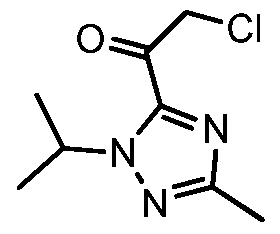
Figure imgf000003_0002
Figure imgf000004_0001
Figure imgf000005_0001

The following Schemes 1-15 illustrate the chemical reactions, processes, methodology for the synthesis of GDC-0032, Formula I, and certain intermediates and reagents. Scheme 1:

Figure imgf000010_0001
Figure imgf000010_0002

Scheme 1 shows the synthesis of intermediate isopropylhydrazine hydrochloride 4 from Boc-hydrazine 1. Condensation of 1 with acetone and magnesium sulfate gave Boc-hydrazone, tert-butyl 2-(propan-2-ylidene)hydrazinecarboxylate 2 (Example 1). Palladium-catalyzed hydrogenation of 2 in acetic acid and methanol gave Boc-isopropyl-hydrazine 3 (Example 2) which was treated in situ with hydrogen chloride gas to give 4 (Example 3).

Alternatively, the double bond of 2 can be reduced with a hydride reagent such as sodium cyanoborohydride (Example 2).

Scheme 2:

Figure imgf000010_0003

Scheme 2 shows the synthesis of l-isopropyl-3-methyl-lH-l,2,4-triazole 7 from methyl acetimidate hydrochloride 5 and isopropylhydrazine hydrochloride 4. Reaction of 5 and 4 in triethylamine and methanol followed by cyclization of condensation product, N’- isopropylacetohydrazonamide 6 (Example 4) with triethyl orthoformate (triethoxymethane) gave 7 (Example 5). Alternatively, 4 and acetamidine can be reacted to give 6.

Or, 4 can be reacted with acetonitrile and an acid to form the corresponding salt of 6. Scheme 3:

Figure imgf000011_0001

0 K2C03, H20, MTBE w

Scheme 3 shows the synthesis of intermediate, 2-chloro-N-methoxy-N-methylacetamide 10. Reaction of 2-chloroacetyl chloride 8 and Ν,Ο-dimethylhydroxylamine hydrochloride 9 in aqueous potassium carbonate and methyl, tert-butyl ether (MTBE) gave 10 (Example 6).

Scheme 4:

Figure imgf000011_0002

Scheme 4 shows the synthesis of intermediate 4-bromo-2-fluorobenzimidamide hydrochloride 12 formed by reaction of 4-bromo-2-fluorobenzonitrile 11 with lithium hexamethyldisilazide (LiHMDS) in tetrahydrofuran (Example 7). Alternatively, 11 is treated with hydrogen chloride in an alcohol, such as ethanol, to form the imidate, ethyl 4-bromo-2- fluorobenzimidate hydrochloride, followed by ammonia in an alcohol, such as ethanol, to form 12 (Example 7).

Scheme 5:

Figure imgf000012_0001

Scheme 5 shows the synthesis of 5-(2-(4-bromo-2-fluorophenyl)-lH-imidazol-4-yl)-l- isopropyl-3 -methyl- lH-l,2,4-triazole V from l-isopropyl-3-methyl-lH-l,2,4-triazole 7.

Deprotonation of 7 with n-butyllithium and acylation with 2-chloro-N-methoxy-N- methylacetamide 10 gave intermediate 2-chloro-l-(l-isopropyl-3-methyl-lH-l,2,4-triazol-5- yl)ethanone 13 (Example 8). Cyclization of 13 with 4-bromo-2-fluorobenzimidamide hydrochloride 12 and potassium hydrogen carbonate in water and THF (tetrahydrofuran) formed the imidazole V (Example 9).

Scheme 6:

Figure imgf000012_0002

Scheme 6 shows the synthesis of 9-bromo-2-(l-isopropyl-3-methyl-lH-l,2,4-triazol-5- yl)-5,6-dihydrobenzo[f]imidazo[l,2-d][l,4]oxazepine III from V. Alkylation of the imidazole nitrogen of V with a 2-hydroxyethylation reagent such as, l,3-dioxolan-2-one, gave 2-(2-(4- bromo-2-fluorophenyl)-4-( 1 -isopropyl-3-methyl- 1 H- 1 ,2,4-triazol-5 -yl)- 1 H-imidazol- 1 – yl)ethanol 14 (Example 10). Cyclization of 14 with an aqueous basic reagent, such as methyltributylammonium chloride in aqueous potassium hydroxide, gave III, which can be cystallized from ethanol and water (Example 11). Scheme 7:

Figure imgf000013_0001

IV

Scheme 7 shows the synthesis of ethyl 2-(4-bromo-lH-pyrazol-l-yl)-2-methylpropanoate IV starting from 2-bromo-2-methylpropanoic acid 15. Alkylation of pyrazole with 15 gave 2- methyl-2-(lH-pyrazol-l-yl)propanoic acid 16 (Example 12). Esterification of 16 with sulfuric acid in ethanol gave ethyl 2-methyl-2-(lH-pyrazol-l-yl)propanoate 17 (Example 13).

Regiospecific bromination of 17 with N-bromosuccinimide (NBS) gave IV (Example 14). Alternatively, 16 was treated in situ with a brominating reagent such as l,3-dibromo-5,5- dimethylhydantoin (DBDMH) to give 2-(4-bromo-lH-pyrazol-l-yl)-2-methylpropanoic acid which was esterified to give IV, where R is ethyl. Other esters can also be prepared, such as methyl, iso-propyl, or any alkyl, benzyl or aryl ester.

Scheme 8:

Figure imgf000014_0001

Scheme 8 shows an alternative synthesis of ethyl 2-(4-bromo-lH-pyrazol-l-yl)-2- methylpropanoate IV starting from ethyl 2-bromo-2-methylpropanoate 18. Alkylation of pyrazole with 18 in the presence of a base such as sodium tert-butyloxide or cesium carbonate gave a mixture of ethyl 2-methyl-2-(lH-pyrazol-l-yl)propanoate 17 and ethyl 2-methyl-3-(lH- pyrazol-l-yl)propanoate 19. Bromination of the mixture with l,3-dibromo-5,5- dimethylimidazolidine-2,4-dione (DBDMH) gave a mixture containing IV, ethyl 3-(4-bromo- lH-pyrazol-l-yl)-2-methylpropanoate 20, and 4-bromo-lH-pyrazole 21 which was treated with a strong base under anhydrous conditions, such as lithium hexamethyldisilazide in tetrahydrofuran. Acidification with hydrochloric acid gave IV.

Scheme 9:

Pd(O) catalyst

Figure imgf000015_0001

KOAc, EtOH

Figure imgf000015_0002

Scheme 9 shows the synthesis of 2-(4-(2-(l-isopropyl-3-methyl-lH-l,2,4-triazol-5-yl)- 5,6-dihydrobenzo[f]imidazo[l,2-d][l,4]oxazepin-9-yl)-lH-pyrazol-l-yl)-2-methylpropanamide, GDC-0032, 1 from ethyl 2-(4-bromo- 1 H-pyrazol- 1 -yl)-2-methylpropanoate IV (CAS Registry Number: 1040377-17-0, WO 2008/088881) and 9-bromo-2-(l-isopropyl-3-methyl-lH- 1,2,4- triazol-5-yl)-5,6-dihydrobenzo[f]imidazo[l,2-d][l,4]oxazepine III (CAS Registry Number: 1282514-63-9, US 2012/0245144, US 8242104). Other esters besides ethyl can also be used which can be hydrolyzed with aqueous base, such as methyl, iso-propyl, or any alkyl, benzyl or aryl ester. In a one-pot Miyaura Borylation /Suzuki, Buchwald system, ethyl 2-(4-bromo-lH- pyrazol-l-yl)-2-methylpropanoate IV is reacted with 4,4,4′,4′,5,5,5′,5′-octamethyl-2,2′-bi(l,3,2- dioxaborolane), CAS Reg. No. 73183-34-3, also referred to as B2Pin2, and a palladium catalyst such as XPhos (2-dicyclohexylphosphino-2′,4′,6′-triisopropylbiphenyl, CAS Reg. No. 564483- 18-7), with a salt such as potassium acetate, in a solvent such as ethanol, at about 75 °C to form the intermediate ethyl 2-methyl-2-(4-(4,4,5,5-tetramethyl-l,3,2-dioxaborolan-2-yl)-lH-pyrazol- l-yl)propanoate 22 (Example 15, CAS Registry Number: 1201657-32-0, US 8242104, US 8263633, WO 2009/150240).

Figure imgf000016_0001

XPhos ligandIntermediate 22 can be isolated or reacted in situ (one pot) with III to form 23.

A variety of low valent, Pd(II) and Pd(0) palladium catalysts can be used during the Suzuki coupling step to form 23 (Example 16) from 22 and III, including PdCl2(PPh3)2, Pd(t- Bu)3, PdCl2 dppf CH2C12, Pd(PPh3)4, Pd(OAc)/PPh3, Cl2Pd[(Pet3)]2, Pd(DIPHOS)2, Cl2Pd(Bipy), [PdCl(Ph2PCH2PPh2)]2, Cl2Pd[P(o-tol)3]2, Pd2(dba)3/P(o-tol)3, Pd2(dba)/P(furyl)3,

Cl2Pd[P(furyl)3]2, Cl2Pd(PMePh2)2, Cl2Pd[P(4-F-Ph)3]2, Cl2Pd[P(C6F6)3]2, Cl2Pd[P(2-COOH- Ph)(Ph)2]2, Cl2Pd[P(4-COOH-Ph)(Ph)2]2, and encapsulated catalysts Pd EnCat™ 30, Pd EnCat™ TPP30, and Pd(II)EnCat™ BINAP30 (US 2004/0254066).

The ester group of 23 is saponified with an aqueous basic reagent such as lithium hydroxide, to give 2-(4-(2-(l-isopropyl-3-methyl-lH-l,2,4-triazol-5-yl)-5,6- dihydrobenzo[f]imidazo[ 1 ,2-d] [ 1 ,4]oxazepin-9-yl)- IH-pyrazol- 1 -yl)-2-methylpropanoic acid II (Example 17). Intermediate 23 can be isolated or further reacted in situ with the aqueous basic reagent to form II. The carboxylic acid group of II is activated with an acyl activating reagent such as di(lH-imidazol-l-yl)methanone (carbonyl diimidazole, CDI) or Ν,Ν,Ν’,Ν’-tetramethyl- 0-(7-azabenzotriazol-l-yl)uronium hexafluorophosphate (HATU), and then reacted with an alcoholic ammonia reagent, such as ammonia dissolved in methanol, ethanol, or isopropanol, aqueous ammonium hydroxide, aqueous ammonium chloride, or ammonia dissolved in THF, to give I (Example 18).

A variety of solid adsorbent palladium scavengers can be used to remove palladium after the Suzuki coupling step to form compound I. Exemplary embodiments of palladium scavengers include FLORISIL®, SILIABOND®Thiol, and SILIABOND® Thiourea. Other palladium scavengers include silica gel, controlled-pore glass (TosoHaas), and derivatized low crosslinked polystyrene QUADRAPURE™ AEA, QUADRAPURE™ IMDAZ, QUADRAPURE™ MPA, QUADRAPURE™ TU (Reaxa Ltd., Sigma-Aldrich Chemical Co.).

Figure imgf000017_0001
Figure imgf000017_0002
Figure imgf000017_0003

Scheme 10 shows the synthesis of 9-bromo-2-(l-isopropyl-3-methyl-lH-l,2,4-triazol-5- yl)-5,6-dihydrobenzo[f]imidazo[l,2-d][l,4]oxazepine III from 4-bromo-2-fluorobenzonitrile 11. Addition of hydroxylamine to the nitrile of 11 gave 4-bromo-2-fluoro-N-hydroxybenzimidamide 24. Michael addition of 24 to ethyl propiolate gave ethyl 3-(4-bromo-2- fluorobenzimidamidooxy)acrylate 25. Heating 25 in a high-boiling solvent such as toluene, xylene, ethylbenzene, or diphenyl oxide gave cyclized imidazole, ethyl 2-(4-bromo-2- fluorophenyl)-lH-imidazole-4-carboxylate 26, along with by-product pyrimidine, 2-(4-bromo-2- fluorophenyl)pyrimidin-4-ol. Alternatively, 25 can be cyclized to 26 with catalytic Lewis acids such as Cu(I) or Cu(II) salts. Alkylation of 26 with a 2-hydroxyethylation reagent, such as 1,3- dioxolan-2-one, in a base, such as N-methylimidazole or cesium carbonate, gave ethyl 2-(4- bromo-2-fluorophenyl)-l-(2-hydroxyethyl)-lH-imidazole-4-carboxylate 27. Ring-cyclization of 27 with an aqueous basic reagent, such as potassium hydroxide, lithium hydroxide, and methyl tributylammonium hydrochloride, gave 9-bromo-5,6-dihydrobenzo[f]imidazo[l,2- d][l,4]oxazepine-2-carboxylic acid 28. Addition of acetamidine to 28 with triphenylphosphine gave 9-bromo-N-(l-iminoethyl)-5,6-dihydrobenzo[f]imidazo[l,2-d][l,4]oxazepine-2- carboxamide 29. Ring-cyclization of 29 with isopropylhydrazine hydrochloride 4 in acetic acid gave 9-bromo-2-(l-isopropyl-3-methyl-lH-l,2,4-triazol-5-yl)-5,6-dihydrobenzo[f]imidazo[l,2- d][l,4]oxazepine III.

Alternatively, 28 can be reacted with N’-isopropylacetohydrazonamide 6 to give III (Scheme 12).

Scheme 11 :

Figure imgf000018_0001

Scheme 11 shows the synthesis of 5-(2-(4-bromo-2-fluorophenyl)-lH-imidazol-4-yl)-l- isopropyl-3 -methyl- lH-l ,2,4-triazole V from 4-bromo-2-fluorobenzimidamide hydrochloride 12. 3-Chloro-2-oxopropanoic acid and 12 are reacted with base to give 2-(4-bromo-2-fluorophenyl)- lH-imidazole-4-carboxylic acid 30. Alternatively, 3-bromo-2-oxopropanoic acid can be reacted with 12 to give 30. Reaction of 30 with N’-isopropylacetohydrazonamide 6 and coupling reagent HBTU (N,N,N’,N’-tetramethyl-0-(lH-benzotriazol-l-yl)uronium hexafluorophosphate, O- (Benzotriazol-l-yl)-N,N,N’,N’-tetramethyluronium hexafluorophosphate, CAS Ref. No. 94790- 37-1) in DMF gives intermediate, 2-(4-bromo-2-fluorophenyl)-N-(l-(2- isopropylhydrazinyl)ethylidene)-lH-imidazole-4-carboxamide 31 which need not be isolated and cyclizes upon heating to give V.

Alternatively, 5-(2-(4-chloro-2-fluorophenyl)-lH-imidazol-4-yl)-l-isopropyl-3-methyl- lH-l,2,4-triazole 44, the chloro version of V, can be prepared from 4-chloro-2-fluorobenzonitrile 38 (Scheme 15) Scheme 12:
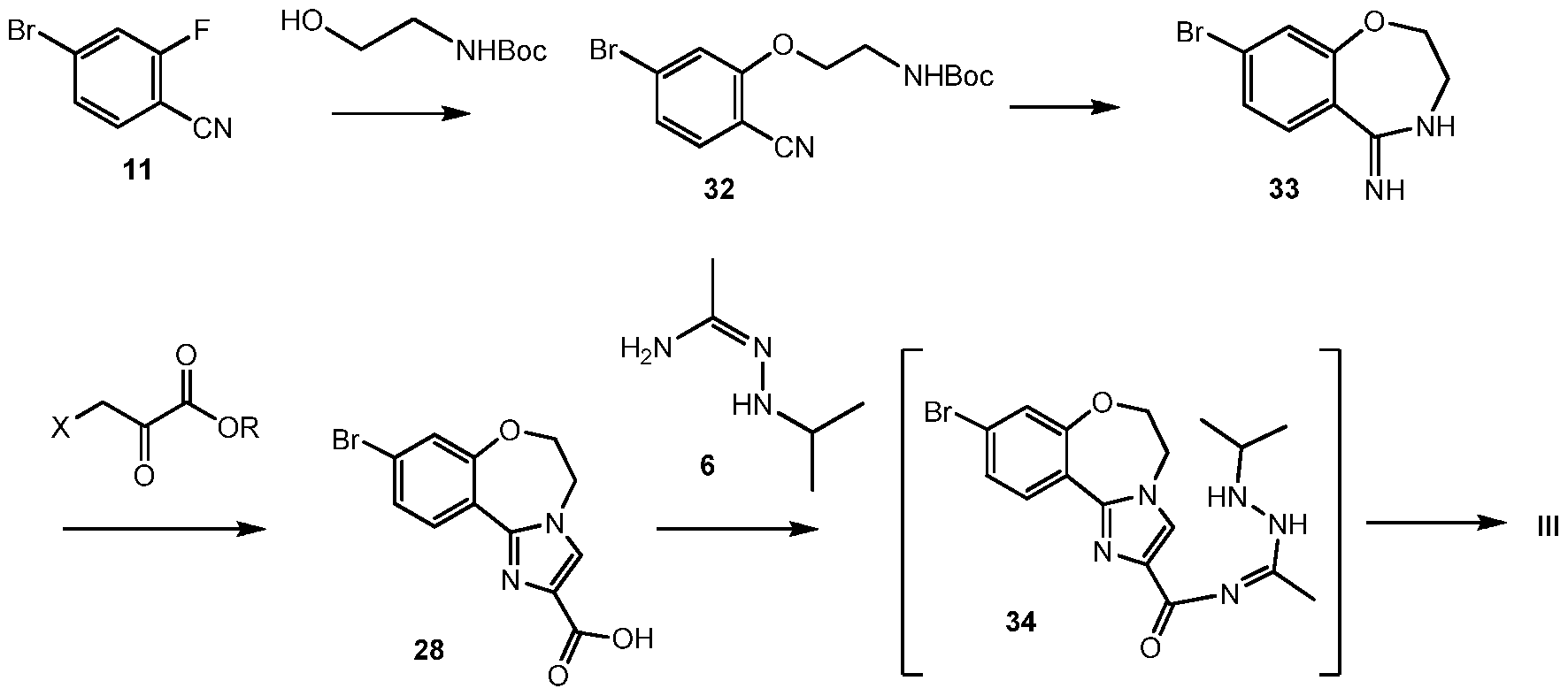
Figure imgf000019_0001

Scheme 12 shows an alternative synthesis of 9-bromo-2-(l-isopropyl-3-methyl-lH-l,2,4- triazol-5-yl)-5,6-dihydrobenzo[f]imidazo[l,2-d][l,4]oxazepine III from 4-bromo-2- fluorobenzonitrile 11. Alkylation of 11 with tert-butyl 2-hydroxyethylcarbamate gives tert-butyl 2-(5-bromo-2-cyanophenoxy)ethylcarbamate 32. Cyclization of 32 under acidic conditions, such as hydrochloric acid in ethanol, gives 8-bromo-3,4-dihydrobenzo[f][l,4]oxazepin-5(2H)-imine 33. It will be noted that 33 has an alternative tautomeric form where the double bond is inside the oxazepine ring. Formation of the imidazole ring occurs by reaction of 3-bromo-2- oxopropanoic acid (X = Br, R = OH), or other 3-halo-2-oxopropanoic acid or ester (R = alkyl), and 33 to give 9-bromo-5,6-dihydrobenzo[f]imidazo[l,2-d][l,4]oxazepine-2-carboxylic acid 28. Coupling of 28 with N’-isopropylacetohydrazonamide 6 and a coupling reagent such as HBTU, HATU or CDI in DMF gives intermediate, 9-bromo-N-(l-(2-isopropylhydrazinyl)ethylidene)- 5,6-dihydrobenzo[f]imidazo[l,2-d][l,4]oxazepine-2-carboxamide 34, which need not be isolated and forms 9-bromo-2-(l-isopropyl-3-methyl-lH-l,2,4-triazol-5-yl)-5,6- dihydrobenzo[f]imidazo[l,2-d][l,4]oxazepine III upon heating.

Alternatively, N’-isopropylacetohydrazonamide 6 is used as monohydrochloride salt, which has to be set free under the reaction conditions with an appropriate base, such as K2CO3. Scheme 13:

Figure imgf000020_0001

Scheme 13 shows an alternative synthesis of 8-bromo-3,4-dihydrobenzo[f][l,4]oxazepin- 5(2H)-imine 33 from 4-bromo-2-fluorobenzonitrile 11. Reaction of 11 with sodium methoxide in methanol gives methyl 4-bromo-2-fluorobenzimidate 35. Alkylation of 35 with 2- aminoethanol gives 4-bromo-2-fluoro-N-(2-hydroxyethyl)benzimidamide 36, followed by cyclization to 33.

Scheme 14:

Figure imgf000020_0002

37

11

Scheme 14 shows another alternative synthesis of 8-bromo-3,4- dihydrobenzo[f][l,4]oxazepin-5(2H)-imine 33 from 4-bromo-2-fluorobenzonitrile 11. Reaction of 11 with 2-aminoethanol and potassium tert-butoxide displaces fluorine to give 2-(2- aminoethoxy)-4-bromobenzonitrile hydrochloride 37. Ring closure of 37 with

trimethylaluminum gave 33. Alternatively, other trialkylaluminum reagents can be used, or magnesium alkoxide reagents such as magnesium ethoxide (magnesium bisethoxide, CAS Reg. No. 2414-98-4) to cyclize 37 to 33.

Figure imgf000021_0001
Figure imgf000021_0002

Scheme 15 shows the synthesis of 5-(2-(4-chloro-2-fluorophenyl)-lH-imidazol-4-yl)-l- isopropyl-3 -methyl- lH-l,2,4-triazole 44 from 4-chloro-2-fluorobenzonitrile 38. Addition of hydroxylamine to the nitrile of 38 gave 4-chloro-2-fluoro-N-hydroxybenzimidamide 39.

Michael addition of 39 to ethyl propiolate gave ethyl 3-(4-chloro-2- fluorobenzimidamidooxy)acrylate 40. Heating 40 in diphenyl oxide gave cyclized imidazole, ethyl 2-(4-chloro-2-fluorophenyl)-lH-imidazole-4-carboxylate 41. Saponification of the ester of 41 with aqueous sodium hydroxide in tetrahydrofuran gave 2-(4-chloro-2-fluorophenyl)-lH- imidazole-4-carboxylic acid 42. Reaction of 42 with N’-isopropylacetohydrazonamide 6 and coupling reagent HBTU in DMF gives intermediate, 2-(4-chloro-2-fluorophenyl)-N-(l-(2- isopropylhydrazinyl)ethylidene)-lH-imidazole-4-carboxamide 43 which cyclizes upon heating to give 44.

EXAMPLES

Example 1 tert-butyl 2-(propan-2-ylidene)hydrazinecarboxylate 2

To a solution of tert-butyl hydrazinecarboxylate 1 (CAS Reg. No. 870-46-2) (25.1 g, 0.190 mol) in acetone (185 mL) was added the magnesium sulfate (6 g) and 12 drops acetic acid (Wu et al (2012) Jour. Med. Chem. 55(6):2724-2736; WO 2007/056170; Zawadzki et al (2003) Polish Jour. Chem. 77(3):315-319). The mixture was heated to reflux for 2.5 h and cooled to rt and filtered. The filtrate was concentrated to give tert-butyl 2-(propan-2- ylidene)hydrazinecarboxylate 2 (CAS Reg. No. 16689-34-2) as an off-white solid (32 g, 98%) (used in the next step without further purification). LC-MS [M+H]+ = 172.9, RT = 2.11 min. 1H NMR 300 MHz (CDC13) d 7.35 (br s, 1H, NH), 2.04 (s, 3H), 1.82 (s, 3H), 1.54 (s, 9H); 13C NMR 300 MHz (CDC13) d 152.9, 149.7, 80.7, 28.1, 25.3, 15.9. Example 2 tert-butyl 2-isopropylhydrazinecarboxylate 3

tert-Butyl 2-(propan-2-ylidene)hydrazinecarboxylate 2 was reduced with palladium catalyst on carbon with hydrogen gas in acetic acid and methanol to give tert-butyl 2- isopropylhydrazinecarboxylate 3 (CAS Reg. No. 16689-35-3).

Alternatively, tert-Butyl 2-(propan-2-ylidene)hydrazinecarboxylate 2 (0.51 g, 3.0 mmol) was dissolved in 20 mL of THF, treated with NaB¾CN (0.19 g, 3.0 mmol) and a few mg of bromocresol green, followed by a solution of p-toluenesulfonic acid (0.57 g, 3.0 mmol) in 1.5 mL of THF which was added dropwise over approximately 1 h to maintain the reaction pH between 3.5-5.0. After stirring at room temperature for an additional hour, the solvent was removed by rotary evaporation, and the residue was partitioned between EtOAc (30 mL) and brine. The organic phase was extracted with sat. NaHCC>3, 20 mL and brine, evaporated to a residue and dissolved in 10 mL of ethanol. The ethanolic solution was treated with 3.6 mL of 1M NaOH solution (3.6 mmol) and left to stir at rt for 30 min. The solvent was removed by rotary evaporation and the residue was taken up into ethyl acetate and extracted with water. The organic layer was evaporated under reduced pressure and the residue was purified by column chromatography using 5 % MeOH in DCM as eluent to collect tert-butyl 2- isopropylhydrazinecarboxylate 3 (0.4 g, 77 % yield): mp = 47-49 °C; Rf = 0.44 (5 % MeOH in DCM); IH NMR 300 MHz (CDC13) d 6.03 (s, N-H, IH), 3.92 (s, N-H, IH), 3.14 (m, IH), 1.46 (s, 9H), 1.02 (d, 6H, J = 6 Hz); 13C NMR 300 MHz (CDC13) d 157.2, 80.8, 51.2, 28.7, 21.0.

Example 3 isopropylhydrazine hydrochloride 4

tert-butyl 2-isopropylhydrazinecarboxylate 3 was treated with hydrochloric acid to remove the Boc protecting group and give 4 (CAS Reg. No. 16726-41-3).

Example 4 N’-isopropylacetohydrazonamide 6

Methyl acetimidate hydrochloride 5 (CAS Reg. No. 14777-27-6), isopropylhydrazine hydrochloride 4, and triethylamine were reacted in methanol to give 6 (CAS Reg. No. 73479-06- 8).

Example 5 l-isopropyl-3 -methyl- lH-l,2,4-triazole 7

N’-isopropylacetohydrazonamide 6 was treated with triethylorthoformate in ethanol, followed by triethylamine and tetrahydrofuran to give 7 (CAS Reg. No. 1401305-30-3). Example 6 2-chloro-N-methoxy-N-methylacetamide 10

To a solution of 21.2 kg potassium carbonate K2CO3 (153.7 mol, 3.0 eq) in 30 L H20 was added, Ν,Ο-dimethylhydroxylamine 9 (CAS Reg. No. 1117-97-1) (5.0 kg, 51.3 mol, 1.0 eq) at 15-20 °C. The reaction was stirred at rt for 30min and 30 L methyl tert-butyl ether (TBME) was added. After stirred for 30min, the mixture was cooled to 5°C, and 11.6 kg of 2-Chloroacetyl chloride 8 (CAS Reg. No. 79-04-9 (102.7 mol, 2.0 eq) were added slowly. The reaction was stirred at rt overnight. Organics were separated from aqueous, and aqueous was extracted with TBME (30 L). The combined organics were washed with H20 (50 L), brine (50 L) and dried over Na2S04. Filtered and concentrated under vacuum afforded 5.1 kg of 2-chloro-N-methoxy- N-methylacetamide 10 (CAS Reg. No. 67442-07-3) as a white solid.

Example 7 4-bromo-2-fluorobenzimidamide hydrochloride 12

To 35.0 L of lithium hexamethyldisilazide LiHMDS (35.0 mol, 1.4 eq, 1.0 M in THF) under N2 was added a THF solution of 4-Bromo-2-fluorobenzonitrile 11 (CAS Reg. No. 105942- 08-3) (5.0 kg in 10 L THF) at 10 °C, the mixture was stirred at rt for 3h. Cooled to -20°C and 8.3 L of HCl-EtOH (6.6 M) were added. The mixture was stirred at -10 °C for additional lh, filtered. The wet cake was washed with EA (10 L) and H20 (6 L). Drying in vacuo yielded 5.8 kg 4- bromo-2-fluorobenzimidamide hydrochloride 12 (CAS Reg. No. 1187927-25-8) as an off-white solid.

Alternatively, to a 200-L vessel was charged 4-bromo-2-fluorobenzonitrile 11 (10 kg, 50.00 mol, 1.00 equiv) and ethanol (100 L) followed by purging 40 kg Hydrogen chloride (g) at – 10 °C with stirring (Scheme 4). The resulting solution was allowed to react for an additional 36 h at 10 °C. The reaction progress was monitored by TLC until 11 was consumed completely. The resulting mixture was concentrated under vacuum while maintaining the temperature below 60 °C. The volume was concentrated to 10-15 L before 60 L MTBE was added to precipitate the product. The precipitates were collected by filtration to afford in 12 k g of ethyl 4-bromo-2- fluorobenzimidate hydrochloride 12 as a white solid. (Yield: 85%). 1H NMR δ 7.88-7.67 (m), 4.89 (br s), 4.68 (q), 3.33 (m), 1.61 (t). MS M+l: 245.9, 248.0.

To a 200L vessel, was charged ethyl 4-bromo-2-fluorobenzimidate hydrochloride (12.5 k g, 44mol, 1.00 equiv, 99%) and ethanol (125 L) followed by purging NH3 (g) at -5 °C for 12 h. The resulting solution was stirred at 30 °C for an additional 24 h. The reaction progress was monitored by TLC until SM was consumed completely. The precipitates were filtered and the filtrate was concentrated under vacuum. The product was precipitated and collected by filtration to afford 6.1 kg (54.5%) of 4-bromo-2-fluorobenzamidine hydrochloride 12 as a white solid. 1H NMR δ 9.60 (br), 7.91-7.64 (m), 3.40 (s), 2.50 (m). MS M+l: 216.9, 219.9.

Example 8 2-chloro-l-(l-isopropyl-3-methyl-lH-l,2,4-triazol-5-yl)ethanone 13

To a 10L four necked flask was charged l-Isopropyl-3-methyl-lH-l,2,4-triazole 7 (400 g) in THF (2.5 L). The resulting solution was cooled to -40 °C and 2.5 M n-butyllithium BuLi in n- hexanes (1.41 L) was added while keeping the internal temp, below -20°C. The resulting yellow suspension was stirred at -40°C for 1 hour before being transferred. To a 20L flask was charged 2-chloro-N-methoxy-N-methylacetamide 10 (485 g) in THF (4 L). The resulting solution was cooled to -40 °C at which point a white suspension was obtained, and to this was added the solution of lithiated triazole 7 keeping the internal temp, below -20°C. At this point a yellow orange solution was obtained which was stirred at – 30°C for lhour. Propionic acid (520 mL) was added keeping the internal temp, below -20°C. The resulting off-white to yellowish suspension was warmed to -5 °C over 30 minutes. Citric acid (200 g) in water (0.8 L) was added and after stirring for 5 minutes a clear biphasic mixture was obtained. At this point stirring was stopped and the bottom aqueous layer was removed. The organic phase was washed with 20w% K3PO4 solution (1 L), 20w% K2HP04 solution (2 L), and 20w% NaCl solution (1 L). The organics was reduced to ca 4L via distillation under vacuum to afford 2-chloro-l-(l-isopropyl-3- methyl-lH-l,2,4-triazol-5-yl)ethanone 13 as a dark amber liquid which was used “as is” in the next step.

Example 9 5-(2-(4-bromo-2-fluorophenyl)- lH-imidazol-4-yl)-l -isopropyl-3-methyl- lH-l,2,4-triazole V

To a 10 L four- neck flask were charged with THF (5.6 L), 4-bromo-2- fluorobenzimidamide hydrochloride 12 (567 g), KHCO3 (567 g) and water (1.15 L). The resulting white suspension was heated to 60°C over 2 hours. At this point a hazy solution was obtained to which was added a solution of 2-Chloro-l-(l-isopropyl-3-methyl-lH-l,2,4-triazol-5- yl)ethanone 13 in THF (2 L). This solution was stirred at 60-65 °C for 24 hours. Then the aqueous bottom layer was removed. The organic layer was concentrated under vacuum. The residue was slurried in a mixture of MIBK (1.25 L) and toluene (0.7 L), and the precipitated product was filtered giving 552 g of 5-(2-(4-bromo-2-fluorophenyl)-lH-imidazol-4-yl)-l- isopropyl-3 -methyl- lH-l,2,4-triazole V (98.0% purity, 254 nm) as a brown solid Example 10 2-(2-(4-bromo-2-fluorophenyl)-4-(l-isopropyl-3-methyl-lH-l,2,4-triazol- 5-yl)- 1 H-imidazol- 1 -yl)ethanol 14

5-(2-(4-Bromo-2-fluorophenyl)-lH-imidazol-4-yl)-l-isopropyl-3-methyl-lH- 1,2,4- triazole V (2.75 kg, 7.55 mol) was added to a solution of 3-dioxolan-2-one (ethylene carbonate, 3.99 kg, 45.3 mol) inN-methylimidazole (12 L) at 50 °C. The suspension was heated at 80°C for 7 h until the reaction was judged complete by HPLC. The solution of 14 was cooled to 35 °C and used directly in the subsequent cyclization.

Example 11 9-bromo-2-(l-isopropyl-3-methyl-lH-l,2,4-triazol-5-yl)-5,6- dihydrobenzo[f]imidazo[ 1 ,2-d] [ 1 ,4]oxazepine III

To a solution of 2-(2-(4-Bromo-2-fluorophenyl)-4-(l-isopropyl-3-methyl-lH-l,2,4- triazol-5-yl)-l H-imidazol- l-yl)ethanol (7.55 mmol) 14 inN-methylimidazole(12 L) at 35 °C was added methyl tributylammonium chloride (115 g, 0.453 mol), toluene (27.5 L) and 35% potassium hydroxide solution (10.6 kg, 25 mol in 22 L of water). The biphasic solution was stirred vigorously at 65 °C for 18 h when it was judged complete by HPLC. Stirring was stopped but heating was continued and the bottom aqueous layer was removed. Added isopropyl acetate (13.8 L) and the organic phase was washed twice with water (13.8 L and 27.5 L). The solvent was removed via vacuum distillation and after 30 L had been removed, isopropanol (67.6 L) was added. Vacuum distillation was resumed until an additional 30 L of solvent had been removed. Added additional isopropanol (28.8 L) and continued vacuum distillation until the volume was reduced by 42 L. Added isopropanol (4L) and the temperature was increased to >50 °C. Added water (28 L) such that the internal temperature was maintained above 50 °C, then heated to 75 °C to obtain a clear solution. The mixture was allowed to cool slowly and the product crystallized out of solution. The resulting suspension was cooled to 0 °C, held for 1 h then filtered and the cake was washed with water (5.5 L). The cake was dried at 45 °C under a nitrogen sweep to give III as a tan solid (3.30 kg, 71.6 wt %, 80.6% yield).

Example 12 2-methyl-2-(lH-pyrazol-l-yl)propanoic acid 16

2-Bromo-2-methylpropanoic acid 15 and pyrazole were reacted in triethylamine and 2- methyltetrahydrofuran to give 16.

Example 13 ethyl 2-methyl-2-(lH-pyrazol-l-yl)propanoate 17

2-Methyl-2-(lH-pyrazol-l-yl)propanoic acid 16 was treated with sulfuric acid in ethanol to give 17. Alternatively, pyrazole (10 g, 147 mmol, 1.0 eq.) was dissolved in DMF (500 ml) at room temperature (Scheme 8). 2-Bromoisobutyrate 18 (22 ml, 147 mmol, 1.0 eq.), cesium carbonate CS2CO3 (53 g, 162 mmol, 1.1 eq) and catalytic sodium iodide Nal (2.2 g, 15 mmol, 0.1, eq) were added to the mixture that was then heated to 60 °C for 24 hr. Reaction was followed by 1H NMR and pyrazole was not detected after 24 hr. The reaction mixture was quenched with a saturated solution of NaHCC>3 (200 ml) and ethyl acetate EtOAc (150 ml) was added and organics were separated from aqueous. Organics were dried over Na2S04, filtered and concentrated under vacuum to afford an oil which was purified by flash chromatography to give 17.

Example 14 Ethyl 2-(4-bromo-lH-pyrazol-l-yl)-2-methylpropanoate IV

Method A: Ethyl 2-methyl-2-(lH-pyrazol-l-yl)propanoate 17 was reacted with N- bromosuccinimide (NBS) in 2-methyltetrahydrofuran to give IV (CAS Reg. No. 1040377-17-0).

Method B: Ethyl 2-bromo-2-methylpropanoate 18 and pyrazole were reacted with sodium tert-butoxide in dimethylformamide (DMF) to give a mixture of ethyl 2-methyl-2-(lH- pyrazol-l-yl)propanoate 17 and ethyl 2-methyl-3-(lH-pyrazol-l-yl)propanoate 19 which was treated with l,3-dibromo-5,5-dimethylimidazolidine-2,4-dione to give a mixture of IV, ethyl 3- (4-bromo-lH-pyrazol-l-yl)-2-methylpropanoate 20, and 4-bromo-lH-pyrazole 21. The mixture was treated with a catalytic amount of lithium hexamethyldisilazide in tetrahydrofuran followed by acidification with hydrochloric acid to give IV.

Example 15 ethyl 2-methyl-2-(4-(4,4,5,5-tetramethyl-l,3,2-dioxaborolan-2-yl)-lH- pyrazol-l-yl)propanoate 22

To a 50 L glass reactor was charged ethyl 2-(4-bromo-lH-pyrazol-l-yl)-2- methylpropanoate IV (1.00 kg, 3.85 mol, 1.00 equiv), potassium acetate, KOAc (0.47 kg, 4.79 mol 1.25 equiv), 4,4,4′,4′,5,5,5′,5′-octamethyl-2,2′-bi(l,3,2-dioxaborolane),

bis(pinacolato)diboron, B2Pin2 (1.22 kg, 4.79 mol, 1.25 equiv) and ethanol (10 L, 10 vol) and the mixture was stirred until a clear solution was obtained. The solution was vacuum/degassed 3x with nitrogen. To this mixture was charged XPhos ligand (0.023 kg, 0.048 mol, 1.0 mol ) and the Pd precatalyst (0.018 kg, 0.022 mol, 0.5 mol ) resulting in a homogeneous orange solution. The solution was vacuum/degassed once with nitrogen. The internal temperature of the reaction was set to 75 °C and the reaction was sampled every 30 min once the set temperature was reached and was monitored by LC (IPC method: XTerra MS Boronic). After 5 h, conversion to 22 (CAS Reg. No. 1201657-32-0) was almost complete, with 1.3% IV remaining. Example 16 ethyl 2-(4-(2-(l-isopropyl-3-methyl-lH-l,2,4-triazol-5-yl)-5,6- dihydrobenzo[f]imidazo[ 1 ,2-d] [ 1 ,4]oxazepin-9-yl)- IH-pyrazol- 1 -yl)-2-methylpropanoate 23

Ethyl 2-methyl-2-(4-(4,4,5,5-tetramethyl-l,3,2-dioxaborolan-2-yl)-lH-pyrazol-l- yl)propanoate 22 and 9-bromo-2-(l-isopropyl-3-methyl-lH-l,2,4-triazol-5-yl)-5,6- dihydrobenzo[f]imidazo[l,2-d][l,4]oxazepine III were reacted under Suzuki conditions with palladium catalyst, in isopropanol and aqueous phosphate buffer to give 23.

A 1M solution of K3PO4 (1.60 kg in 7.6 L of water, 7.54 mol, 2.00 equiv) was charged to the above reaction mixture from Example 15, followed by the addition of a solution of III in THF (1.33 kg in 5.0 L, 3.43 mol, 0.90 equiv) over 2 min. The reaction mixture was warmed to 75 °C (internal temperature) over 45 min and stirred for 13 h at 75 °C, then analyzed by HPLC (III not detected) showing the formation of 23.

Example 17 2-(4-(2-( 1 -isopropyl-3-methyl- 1 H- 1 ,2,4-triazol-5-yl)-5 ,6- dihydrobenzo[f]imidazo[ 1 ,2-d] [ 1 ,4]oxazepin-9-yl)- IH-pyrazol- 1 -yl)-2-methylpropanoic acid II

Ethyl 2-(4-(2-(l -isopropyl-3 -methyl- 1 H- 1 ,2,4-triazol-5-yl)-5 ,6- dihydrobenzo[f]imidazo[l,2-d][l,4]oxazepin-9-yl)-lH-pyrazol-l-yl)-2-methylpropanoate 23 was treated with aqueous lithium hydroxide to give II.

The ester saponification reaction was initiated with the addition of 3.5 M aqueous LiOH (0.74 kg in 5.0 L, 17.64 mol, 5 equiv) to the reaction mixture from Example 16 and allowed to warm to 75 °C. The mixture was sampled every 30 min (IPC method: XTerra MS Boronic) and the saponification was complete after 4.5 h (with less than 0.3% 23 remaining). The reaction mixture was concentrated via distillation to approximately half volume (starting vol = 37 L; final vol = 19 L) to remove EtOH and THF, resulting in tan-brown slurry. Water (5 L, 5 vol) was charged to the mixture and then distilled (starting vol = 25 L; final vol = 21 L). The temperature was set at 60 °C (jacket control) and then charged with isopropyl acetate, IP Ac (4 L, 4 vol). The biphasic mixture was stirred a minimum of 5 min and then the layers allowed to separate for a minimum of 5 min. The bottom aqueous layer was removed into a clean carboy and the organics were collected into a second carboy. The extraction process was repeated a total of four times, until the organic layer was visibly clear. The aqueous mixture was transferred back to the reactor and then cooled to 15 °C. A 6 M solution of HC1 (6.4 L, 38.40 mol, 10 equiv) was charged slowly until a final pH = 1 was obtained. The heterogeneous mixture was then filtered. The resulting solids were washed twice with 5 L (2 x 5 vol) of water. The filter was then heated to 80 °C and the vacuum set to -10 Psi (with nitrogen bleed) and the solids were dried for 24 h (KF = 2.0 % H20) to give 1.54 kg (95% corrected yield) of II as a white solid; 98% wt, 97.3 % pure.

Example 18 2-(4-(2-( 1 -isopropyl-3-methyl- 1 H- 1 ,2,4-triazol-5-yl)-5 ,6- dihydrobenzo[f]imidazo[ 1 ,2-d] [ 1 ,4]oxazepin-9-yl)- lH-pyrazol- 1 -yl)-2-methylpropanamide I (GDC-0032)

2-(4-(2-(l-Isopropyl-3-methyl-lH-l,2,4-triazol-5-yl)-5,6-dihydrobenzo[f]imidazo[l,2- d][l,4]oxazepin-9-yl)-lH-pyrazol-l-yl)-2-methylpropanoic acid II was treated with di(lH- imidazol-l-yl)methanone (carbonyldiimidazole, CDI) in tetrahydrofuran followed by methanolic ammonia to give crude I.

Solid II (1.44 kg, 3.12 mol, 1.00 equiv) was transferred into a 20 L bottle and then THF

(10 L, 7 vol) was charged. The slurry was transferred under reduced pressure into a second 50 L reactor and additional THF (5 L, 3 vol) was added for the rinse. The internal temperature of the slurry was set to 22 °C and Γ1 -carbonyldiimidazole, CDI (0.76 Kg, 5.12 mol, 1.50 equiv) was charged to the mixture and a clear solution was observed after 5 min. The reaction mixture was sampled every 30 min and analyzed by HPLC (IPC: XTerra MS Boronic method) which showed almost complete conversion to the acyl-imidazole intermediate and 1.2% remaining II after 30 min. An additional portion of CDI (0.07 kg, 0.15 mol, 0.14 equiv) was added, and the reaction mixture was stirred for 1 h and then analyzed by HPLC (IPC: XTerra MS Boronic method) which showed 0.8% remaining II.

Into a second 50-L reactor, was added NH3/MeOH (1.5 L, 10.5 mol, 3.37 equiv) and THF

(5 L, 3 vol). The acyl-imidazole intermediate was transferred to a second reactor under reduced pressure (transfer time -10 min). The internal temperature was then set to 45 °C and the volume of solvent was distilled down from 35 L to 12 L. Water (6 L, 4 vol) was then added to the mixture that was further distilled from 18 L to 11 L. Finally, another portion of water (6 L, 4 vol) was added and the solvents were distilled one last time from 17 L to 14 L, until no more THF was coming out. The reaction was then cooled down to 10 °C (internal temperature). The white slurry was filtered and the filter cake was washed with water (2 x 6 L, 2 x 4 vol). The solids were then dried at 80 °C (jacket temp) in the Aurora filter for 24 h (KF = 1.5 % H20) under vacuum to give 1.25 kg crude I, GDC-0032 (84% corrected yield, 96% wt, 97.3 % pure by HPLC) as a white solid.

A slurry of crude I (1.15 kg, 2.50 moles) in MeOH (6 L, 5 vol) was prepared and then charged to a 50 L glass reactor. Additional MeOH (24 L, 21 vol) was added to the mixture, which was then heated to 65 °C. A homogenous mixture was obtained. Si-thiol (Silicycle, Inc., 0.23 kg, 20% wt) was added to the solution via the addition port and the mixture was stirred for 3 hours. It was then filtered warm via the Aurora filter (jacket temperature = 60 °C, polish filtered and transferred directly into a second 50 L reactor with reduced pressure. The solution was then heated back to 65 °C internal temperature (IT). The homogeneous solution was cooled down to 54 °C and I seeds (12 g, 1 % wt) in MeOH (50 mL) were added with reduced pressure applied to the reactor. The mixture was then cooled down to 20 °C over 16 hours. The solids were then filtered via the Aurora filter and dried at 80 °C for 72 hours to give 921 g, 80% yield of I as a methanoate solvate (form A by XRPD,) and transferred to a pre-weighed charge-point bag.

In an isolator, the solids were slurred in IP Ac (8 L, 7 vol) and transferred to a clean 10 L reactor. The mixture was stirred for 1 h at 60 °C (IT). The solids were then filtered via the Aurora system and dried at 80 °C (jacket) for 96 h. A sample of I was removed and analyzed by GC (IP Ac = 1 %). To attempt more efficient drying, the API was transferred to two glass trays in an isolator and sealed with a drying bag before being dried in a vacuum oven set at 100 °C for 16 h. GC (IPC: Q12690V2) showed 1 % solvent was still present. The process afforded 760 g (68% corrected yield, 68% wt, 99.9 % purity by LC) of a white solid (form B by XRPD).

Crude I (340.7 g) was charged to a 2-1 . 1 1 DPI · bottle and slurried with 0.81 ,

isoamylalcohol (I A A). The slurry was transferred to a 20 L reactor and diluted with 6.7 L round- bottom flask (22 vol total). The white slurry was heated until a solution was observed (internal temperature rose to 118 °C and then cooled to 109 °C). The solution was polish filtered (0.2 μ .Μ filter). A flask was equipped with overhead stirring and the filtrate was slurried in isoamyl alcohol (344 ml ., 21 vol). The mixture was warmed to 95 °C (internal) until the solids dissolved. A slurry of charcoal (10 wt%, 0.16g) and silicycle thiol (10 wt%, 0.16g) in isoamyl alcohol (1 vol, 1 6 ml . ) was charged and the mixture was stirred at 90-95 °C for 1 h and then filtered (over Celite® pad). The clear amber colored solution was cooled to 73 °C (seeding temp range = 70 ±5 °C) and a GDC-0032 I seed (10 wt%, 0.16g) was added. The temperature of the heating mantle was turned off and the mixture was allowed to cool to room temperature overnight with stirrin (200 rpni). After 17 hr, the white solids were filtered starting with slow gravity filtration and then vacuum was applied. The solids were suction dried for 20 min with mixing until a free flowing powder was obtained. ( rude weight prior to oven drying = 16 g. The solids were oven- dried at 100 °C for 24 h and then sampled for testing. Drying continued at 100 °C for another 24 hr. I l l NMR (DMSO d6) δ 8.38 (t), 8.01 (s), 7.87 (s), 7.44, 7.46 (d), 7.36 (s), 7.18 (br s), 6.81

(br s), 5.82 (m), 3.99 (s), 2.50 (s), 2.26 (s), 1.75 (s), 1.48, 1.46 (d).

Purified 2-(4-(2-(l-isopropyl-3-methyl-lH-l,2,4-triazol-5-yl)-5,6- dihydrobenzo[f]imidazo[ 1 ,2-d] [ 1 ,4]oxazepin-9-yl)- lH-pyrazol- 1 -yl)-2-methylpropanamide I (GDC-0032) was dry granulation formulated in tablet form by the roller compaction method (He et al (2007) Jour, of Pharm. Sci., 96(5):1342-1355) with excipients including lactose, microcrystalline cellulose (AVICEL® PH 01, FMC BioPolymer, 50 μΜ particle),

croscarmellose sodium (Ac-Di-Sol®, FMC BioPolymer), and magnesium stearate.

Example 19 4-bromo-2-fluoro-N-hydroxybenzimidamide 24

To a solution of 4-Bromo-2-fluorobenzonitrile 11 (800 g, 4 mol, 1 eq), hydroxylamine hydrochloride (695 g, 10 mol, 2.5 eq) in MeOH (2 L, 2.5 vol) was added Et3N (485 g, 4.8 mol, 1.2 eq), then the mixture was stirred at 60 °C for 40 min and checked by HPLC (no nitrile remaining). Reaction was then quenched by H20 (30 L), and lots of off-white solid was separated out, and then filtered, the filter cake was washed with water (10 L x 2) and 1350 g wet 4-bromo-2-fluoro-N-hydroxybenzimidamide 24 was obtained with 96% purity.

Example 20 ethyl 3-(4-bromo-2-fluorobenzimidamidooxy)acrylate 25

To a solution of 4-Bromo-2-fluoro-N-hydroxybenzimidamide 24 (800 g, 3.43 mol, 1 eq) and Amberlyst® A21 (20 wt%, 160 g) in PhMe (12 L, 15 vol) was added ethyl propiolate (471 g, 4.8 mol, 1.4 eq) at 10 °C. The reaction was stirred at 50 °C overnight and checked by LC-MS (ca 14A% of starting material 24 was left). Reaction was then filtered and the filtrate was concentrated under vacuum, and 1015 g ethyl 3-(4-bromo-2-fluorobenzimidamidooxy)acrylate 25 was obtained as a yellow oil with 84.9% LC purity (yield: 89%).

Example 21 ethyl 2-(4-bromo-2-fluorophenyl)-lH-imidazole-4-carboxylate 26

A solution of ethyl 3-(4-bromo-2-fluorobenzimidamidooxy)acrylate 25 (300 g, 0.91 mol, 1 eq) in diphenyl oxide (900 mL, 3 vol) was stirred at 190 °C under N2 for 1 h and checked by LC-MS (no 25 remaining). Cooled the mixture to rt and TBME (600 mL, 2 vol of 25) was added, and then PE (1.8 L, 6 vol of 25) was dropwise added to separate out solids. The mixture was stirred at rt for 20 min, and filtered to give 160 g wet cake. The wet cake was washed with PE (1 L) and dried to afford 120 g ethyl 2-(4-bromo-2-fluorophenyl)-lH-imidazole-4-carboxylate 26 with 92% LC purity as brown solids. Example 22 ethyl 2-(4-bromo-2-fluorophenyl)- 1 -(2-hydroxyethyl)- 1 H-imidazole-4- carboxylate 27

Ethyl 2-(4-bromo-2-fluorophenyl)-lH-imidazole-4-carboxylate 26 and l,3-dioxolan-2- one and N-methylimidazole were reacted to give 27.

Example 23 9-bromo-5,6-dihydrobenzo[f]imidazo[l,2-d][l,4]oxazepine-2-carboxylic acid 28

Ethyl 2-(4-bromo-2-fluorophenyl)-l -(2-hydroxyethyl)- lH-imidazole-4-carboxylate 27, potassium hydroxide and methyl tributylammonium hydrochloride were reacted at 65 °C, cooled, and concentrated. The mixture was dissolved in ethanol and water to crystallize 28.

Example 24 9-bromo-N-(l-iminoethyl)-5,6-dihydrobenzo[f]imidazo[l,2- d] [ 1 ,4]oxazepine-2-carboxamide 29

9-Bromo-5,6-dihydrobenzo[f]imidazo[l,2-d][l,4]oxazepine-2-carboxylic acid 28, triphenylphosphine, and acetamidine were reacted to give 29.

Example 25 9-bromo-2-(l-isopropyl-3-methyl-lH-l,2,4-triazol-5-yl)-5,6- dihydrobenzo[f]imidazo[l,2-d][l,4]oxazepine III

9-Bromo-N-( 1 -iminoethyl)-5 ,6-dihydrobenzo[f]imidazo[ 1 ,2-d] [ 1 ,4]oxazepine-2- carboxamide 29 was reacted with isopropylhydrazine hydrochloride 4 in acetic acid to give III.

Example 26 2-(4-bromo-2-fluorophenyl)-lH-imidazole-4-carboxylic acid 30

3-Chloro-2-oxopropanoic acid and 4-bromo-2-fluorobenzimidamide hydrochloride 12 are reacted with base to give 2-(4-bromo-2-fluorophenyl)-lH-imidazole-4-carboxylic acid 30.

Alternatively, to a solution of ethyl 2-(4-bromo-2-fluorophenyl)-lH-imidazole-4- carboxylate 26 (1350 g, 4.3 mol) in THF (8.1 L, 6 vol) and H20 (4 L, 3 vol) was added NaOH (520 g, 13 mol, 3 eq), and the reaction was stirred at 65 °C for 48 h till it completed (checked by LC-MS). Adjust the mixture with 2 M HC1 to pH = 5, and product was separated out as a yellow solid, filtered to give 2.2 kg wet cake, the wet cake was washed with H20 (1.5 L), DCM (1.5 L x 3), PE (1 L), and dried to afford 970 g pure 2-(4-bromo-2-fluorophenyl)-lH-imidazole-4- carboxylic acid 30 (Scheme 10). Example 27 5-(2-(4-bromo-2-fluorophenyl)-lH-imidazol-4-yl)-l-isopropyl-3-methyl- lH-l,2,4-triazole V

Reaction of 30 with N’-isopropylacetohydrazonamide 6 and coupling reagent HBTU in DMF gives intermediate, 2-(4-bromo-2-fluorophenyl)-N-(l-(2-isopropylhydrazinyl)ethylidene)- lH-imidazole-4-carboxamide 31 which cyclizes upon heating to give V.

Example 28 tert-butyl 2-hydroxyethylcarbamate gives tert-butyl 2-(5-bromo-2- cyanophenoxy)ethylcarbamate 32

Alkylation of 4-bromo-2-fluorobenzonitrile 11 with tert-butyl 2-hydroxyethylcarbamate gives 32.

Example 29 8-bromo-3,4-dihydrobenzo[f][l,4]oxazepin-5(2H)-imine 33

Cyclization of tert-butyl 2-hydroxyethylcarbamate gives tert-butyl 2-(5-bromo-2- cyanophenoxy)ethylcarbamate 32 under acidic conditions, such as hydrochloric acid in ethanol, gives 33.

Example 30 9-bromo-5,6-dihydrobenzo[f]imidazo[l,2-d][l,4]oxazepine-2-carboxylic acid 28

Reaction of 3-bromo-2-oxopropanoic acid and 8-bromo-3,4- dihydrobenzo[f][l,4]oxazepin-5(2H)-imine 33 gives 28 (CAS Reg. No. 1282516-74-8).

Example 31 9-bromo-2-(l-isopropyl-3-methyl-lH-l,2,4-triazol-5-yl)-5,6- dihydrobenzo[f]imidazo[ 1 ,2-d] [ 1 ,4]oxazepine III

Coupling of 28 with N’-isopropylacetohydrazonamide 6 and coupling reagent HBTU in

DMF gives intermediate, 9-bromo-N-(l-(2-isopropylhydrazinyl)ethylidene)-5,6- dihydrobenzo[f]imidazo[l,2-d][l,4]oxazepine-2-carboxamide 34, which forms III upon heating.

Example 32 methyl 4-bromo-2-fluorobenzimidate 35

Reaction of 4-bromo-2-fluorobenzonitrile 11 with sodium methoxide in methanol gives 35.

Example 33 8-bromo-3,4-dihydrobenzo[f][l,4]oxazepin-5(2H)-imine 33

Alkylation of methyl 4-bromo-2-fluorobenzimidate 35 with 2-aminoethanol gives 4- bromo-2-fluoro-N-(2-hydroxyethyl)benzimidamide 36, followed by cyclization to 33 (Scheme 13). Alternatively, reaction of 11 with 2- aminoethanol and potassium tert-butoxide displaces fluorine to give 2-(2-aminoethoxy)-4-bromobenzonitrile hydrochloride 37. Ring closure of 37 with trimethylaluminum gave 33 (Scheme 14). A solution of 11 (10 g, 50 mmol) and 2- aminoethanol (3.1 mL, 50.8 mmol) in 2-methyltetrahydrofuran (80 mL) was cooled to 0 °C and a solution of 1M potassium tert-butoxide in tetrahydrofuran (55 mL, 55 mmol) was slowly added while maintaining the solution temperature below 5 °C. The reaction was stirred at 0 °C for 30 min until judged complete by HPLC at which point it was warmed to 25 °C. A solution of 0.5M HC1 in isopropanol (100 mL, 50 mmol) was added and the desired HC1 salt 3 crystallized directly from the solution. The solid was collected by filtration and dried under vacuum with a nitrogen bleed to give 2-(2-aminoethoxy)-4-bromobenzonitrile hydrochloride 37 as a white solid. (12.1 g, 87 % yield).

To a flask was charged 37 (9.00 g, 32.4 mmol) and toluene (90.0 ml). The suspension was cooled to 0 °C and was added trimethylaluminum (1.8 equiv., 58.4 mmol, 2M in toluene) drop-wise over 30 minutes. The suspension was then stirred at room temperature for 1 h and then warmed to 100 °C. After 5 h, the solution was cooled to 0 °C and quenched with aqueous NaOH (2N, 90.0 ml). The suspension was extracted with EtOAc (4 x 90 ml) and the combined extracts were dried over then filtered through Celite®. The solution was concentrated and the residue triturated with EtOAc to afford 8-bromo-3,4-dihydrobenzo[f][l,4]oxazepin-5(2H)-imine 33 (6.26 g, 26.0 mmol, 80% yield) as white crystalline solid.

Example 34 4-chloro-2-fluoro-N-hydroxybenzimidamide 39

To a solution of 4-chloro-2-fluorobenzonitrile 38 (400 g, 2.58 mol, 1.0 eq),

hydroxylamine hydrochloride (448 g, 6.45 mol, 2.5 eq) in MeOH (1 L, 2.5 vol) was added Et3N (313 g, 3.1 mol, 1.2 eq), then the mixture was stirred at 60 °C for 40 min and checked by HPLC (no nitrile remaining). Reaction was then quenched by H20 (10 L), and lots of off-white solid was separated out, and then filtered, the filter cake was washed with water (10 L x 2) and 378 g 4-chloro-2-fluoro-N-hydroxybenzimidamide 39 was obtained with 93% purity (Scheme 15).

Example 35 ethyl 3-(4-chloro-2-fluorobenzimidamidooxy)acrylate 40

To a solution of 4-chloro-2-fluoro-N-hydroxybenzimidamide 39 (378 g, 2 mol, 1.0 eq) and Amberlyst® A21 (20 wt%, 75.6 g) in toluene PhMe (5.6 L, 15 vol) was added ethyl propiolate (275 g, 2.8 mol, 1.4 eq) at 30 °C. The reaction was stirred at 30 °C overnight and checked by LC-MS. Reaction was then filtered and the filtrate was concentrated under vacuum, and 550 g ethyl 3-(4-chloro-2-fluorobenzimidamidooxy)acrylate 40 was obtained as a yellow oil with 83% LC purity (Scheme 15).

Example 36 ethyl 2-(4-chloro-2-fluorophenyl)-lH-imidazole-4-carboxylate 41

A solution of ethyl 3-(4-chloro-2-fluorobenzimidamidooxy)acrylate 40 (550 g, 1.9 mol, 1.0 eq, 83% LC purity) in diphenyl oxide (1.65 L, 3 vol) was stirred at 190 °C under N2 for 1 h and checked by LC-MS (no 40 remaining). Cooled the mixture to rt and PE (10 L) was added dropwise. The mixture was stirred at rt for 20 min, and filtered to give 400 g wet cake, after purified by chromatography on silica gel (PE / EA=1 / 5) to get 175 g pure ethyl 2-(4-chloro-2- fluorophenyl)-lH-imidazole-4-carboxylate 41 with 98% LC purity (Scheme 15).

Example 37 2-(4-chloro-2-fluorophenyl)-lH-imidazole-4-carboxylic acid 42

To a solution of ethyl 2-(4-chloro-2-fluorophenyl)-lH-imidazole-4-carboxylate 41 (175 g, 4.3 mol) in THF (1 L, 6 vol) and H20 (500 mL, 3 vol) was added NaOH (78 g, 1.95 mol, 3.0 eq), and the reaction was stirred at 65 °C for 48 h till it completed (checked by LC-MS). Adjust the mixture with 2 N HC1 to pH = 5, and product was separated out as a yellow solid, filtered to give 210 g wet cake, the wet cake was washed with H20 (300 mL), DCM (3 x 300 mL), PE (500 mL), and dried to afford 110 g pure 2-(4-chloro-2-fluorophenyl)-lH-imidazole-4-carboxylic acid 42 (CAS Reg. No. 1260649-87-3) (Scheme 15 ). I l l NMR (DMSO d6) δ: 12.8 (br s), 8.0, 7.9 (br s), 7.46, 7.4 (m).

PATENT

US 2014275523

SYNTHESIS

Taselisib_药物数据_原料药API_CCIS-CHEM化学平台科研物资一站式采购平台 …

化学试剂

参考文献:

Image result for taselisib

CLIP

http://www.ccis-chem.com/goods.php?id=194272

商品规格

Taselisib

Taselisib是罗氏集团及其下属公司Genentech和Chugai研发,目前治疗绝经后妇女雌激素受体阳性(ER +)乳腺癌和非小细胞肺癌(NSCLC)的三期临床研究均在进行中。

基本信息更新时间:2016-02-01

药品名称:
Taselisib
研发代码:
GDC-0032; RG-7604
商品名称:
作用机制:
PI3K inhibitor; Cytochrome P450 CYP3A4 Inhibitors
适应症:
乳腺癌,非小细胞肺癌
研发阶段:
临床三期 (进行中)
研发公司:
罗氏 (原研)

化学信息更新时间:2015-08-27

分子量 460.53
分子式 C24H28N8O2
CAS号 1282512-48-4 (Taselisib);
化学名称 1H-Pyrazole-1-acetamide, 4-[5,6-dihydro-2-[3-methyl-1-(1-methylethyl)-1H-1,2,4-triazol-5-yl]imidazo[1,2-d][1,4]benzoxazepin-9-yl]-a,a-dimethyl-
Fudosteine药品(游离态)参数:
MW HD HA FRB* PSA* cLogP*
460.53 2 10 5 119 2.548±1.034

化学合成路线及相关杂质更新时间:2015-12-15

参考文献:J. Med. Chem. 2013, 56, 4597−4610

参考文献:WO2014140073A1

PAPER

J Med Chem 2013, 56(11): 4597

Discovery of 2-{3-[2-(1-Isopropyl-3-methyl-1H-1,2–4-triazol-5-yl)-5,6-dihydrobenzo[f]imidazo[1,2-d][1,4]oxazepin-9-yl]-1H-pyrazol-1-yl}-2-methylpropanamide (GDC-0032): A β-Sparing Phosphoinositide 3-Kinase Inhibitor with High Unbound Exposure and Robust in Vivo Antitumor Activity

Departments of Discovery Chemistry, Drug Metabolism and Pharmacokinetics, §Translational Oncology, and Biochemical Pharmacology, Genentech, Inc., 1 DNA Way, South San Francisco, California 94080, United States
 Argenta Discovery, 8-9 Spire Green Centre, Flex Meadow, Harlow, Essex, CM19 5TR, United Kingdom
J. Med. Chem.201356 (11), pp 4597–4610
DOI: 10.1021/jm4003632
*Phone: 650-225-2923 (C.O.N.); +1-(650)-467-3214 (T.P.H.). E-mail: chudin@gene.com (C.O.N.); theffron@gene.com (T.P.H.).
Abstract Image

Dysfunctional signaling through the phosphoinositide 3-kinase (PI3K)/AKT/mTOR pathway leads to uncontrolled tumor proliferation. In the course of the discovery of novel benzoxepin PI3K inhibitors, we observed a strong dependency of in vivo antitumor activity on the free-drug exposure. By lowering the intrinsic clearance, we derived a set of imidazobenzoxazepin compounds that showed improved unbound drug exposure and effectively suppressed growth of tumors in a mouse xenograft model at low drug dose levels. One of these compounds, GDC-0032 (11l), was progressed to clinical trials and is currently under phase I evaluation as a potential treatment for human malignancies.

2-{3-[2-(1-Isopropyl-3-methyl-1H-1,2–4-triazol-5-yl)-5,6-dihydrobenzo[f]imidazo[1,2-d][1,4]oxazepin-9-yl]-1H-pyrazol-1-yl}-2-methylpropanamide (11l)

1H NMR (500 MHz, DMSO) δ 8.42 (s, 1H), 8.37 (d, J = 8.3 Hz, 1H), 8.02 (s, 1H), 7.89 (s, 1H), 7.46 (dd, J = 8.3, 1.8 Hz, 1H), 7.36 (d, J = 1.8 Hz, 1H), 7.22 (s, 1H), 6.87 (s, 1H), 5.90–5.73 (m, 1H), 4.62–4.42 (m, 4H), 2.50 (dt, J = 3.6, 1.7 Hz, 5H), 2.26 (s, 3H), 1.74 (s, 6H), 1.47 (d, J = 6.5 Hz, 6H). 13C NMR (126 MHz, DMSO) δ 173.78, 158.24, 155.88, 147.31, 143.94, 136.64, 134.60, 130.26, 129.88, 126.42, 123.62, 120.32, 119.31, 116.17, 115.26, 68.31, 64.48, 49.89, 49.70, 40.06, 39.97, 39.89, 39.80, 39.72, 39.63, 39.56, 39.47, 39.30, 39.13, 38.96, 25.47, 22.34, 13.82. HRMS (ESI+): m/z (M + H+) calcd: 461.2413, found: 461.2427. Melting point: 259 °C.
POLYMORPHS almost A to Z
GDC-0032, also known as taselisib, RG7604, or the IUPAC name: 2-(4-(2-(1-isopropyl-3-methyl-1H-1,2,4-triazol-5-yl)-5,6-dihydrobenzo[f]imidazo[1,2-d][1,4]oxazepin-9-yl)-1H-pyrazol-1-yl)-2-methylpropanamide, has potent PI3K activity (Ndubaku et al (2013) J. Med. Chem. 56(11):4597-4610; WO 2013/182668; WO 2011/036280; U.S. Pat. No. 8,242,104; U.S. Pat. No. 8,343,955) and is being studied in patients with locally advanced or metastatic solid tumors (Juric et al “GDC-0032, a beta isoform-sparing PI3K inhibitor: Results of a first-in-human phase Ia dose escalation study”, 2013 (Apr. 7) Abs LB-64 American Association for Cancer Research Annual Meeting).

the invention relates to polymorph forms of the PI3K inhibitor I (taselisib, GDC-0032, RG7604, CAS Reg. No. 1282512-48-4, Genentech, Inc.), named as 2-(4-(2-(1-isopropyl-3-methyl-1H-1,2,4-triazol-5-yl)-5,6-dihydrobenzo[f]imidazo[1,2-d][1,4]oxazepin-9-yl)-1H-pyrazol-1-yl)-2-methylpropanamide, having the structure:

Figure US09266903-20160223-C00001

and stereoisomers, geometric isomers, tautomers, and pharmaceutically acceptable salts thereof.

Publication numberPriority datePublication dateAssigneeTitle
WO2011036280A12009-09-282011-03-31F. Hoffmann-La Roche AgBenzoxazepin pi3k inhibitor compounds and methods of use
WO2014140073A12013-03-132014-09-18F. Hoffmann-La Roche AgProcess for making benzoxazepin compounds

References

Patent ID

Patent Title

Submitted Date

Granted Date

US9670228 BENZOXAZEPIN PI3K INHIBITOR COMPOUNDS AND METHODS OF USE
2016-12-05
US9546178 BENZOXAZEPIN PI3K INHIBITOR COMPOUNDS AND METHODS OF USE
2015-11-03
2016-02-25
US9303043 PROCESS FOR MAKING BENZOXAZEPIN COMPOUNDS
2014-03-12
2014-09-18
US8785626 Benzoxazepin PI3K inhibitor compounds and methods of use
2013-10-07
2014-07-22
US2016135446 CELL STABILIZATION
2014-06-13
2016-05-19
Patent ID

Patent Title

Submitted Date

Granted Date

US2016375033 METHODS OF TREATMENT WITH TASELISIB
2016-06-28
US2016045515 MUTANT SELECTIVITY AND COMBINATIONS OF A PHOSPHOINOSITIDE 3-KINASE INHIBITOR COMPOUND AND CHEMOTHERAPEUTIC AGENTS FOR THE TREATMENT OF CANCER
2015-07-06
2016-02-18
US2016117439 SUPERIOR BIOINFORMATICS PROCESS FOR IDENTIFYING AT RISK SUBJECT POPULATIONS
2015-10-26
2016-04-28
US2017096492 DOSAGE AND ADMINISTRATION OF ANTI-IGF-1R, ANTI-ErbB3 BISPECIFIC ANTIBODIES, USES THEREOF AND METHODS OF TREATMENT THEREWITH
2016-08-19
US9481690 Polymorphs of 2-(4-(2-(1-(isopropyl-3-methyl-1H-1, 2, 4, triazol-5-yl)-5, 6-dihydrobenzo[f] imidazo[1, 2-d][1, 4]oxazepin-9-yl)-1H-pyrazol-1-yl)-2-methylpropanamide, methods of production, and pharmaceutical uses thereof
2016-01-08
2016-11-01
Patent ID

Patent Title

Submitted Date

Granted Date

US9266903 POLYMORPHS OF 2-(4-(2-(1-ISOPROPYL-3-METHYL-1H-1, 2, 4-TRIAZOL-5-YL)-5, 6-DIHYDROBENZO[F]IMIDAZO[1, 2-D][1, 4]OXAZEPIN-9-YL)-1H-PYRAZOL-1-YL)-2-METHYLPROPANAMIDE, METHODS OF PRODUCTION, AND PHARMACEUTICAL USES THEREOF
2014-12-15
2015-06-18
US2016279142 COMBINATIONS OF A PHOSPHOINOSITIDE 3-KINASE INHIBITOR COMPOUND AND A CDK4/6 INHIBITOR COMPOUND FOR THE TREATMENT OF CANCER
2016-03-24
2016-09-29
US2016117443 BIOINFORMATICS PROCESS FOR IDENTIFYING AT RISK SUBJECT POPULATIONS
2015-10-26
2016-04-28
Patent ID

Patent Title

Submitted Date

Granted Date

US2016220537 COMPOSITIONS TO IMPROVE THE THERAPEUTIC BENEFIT OF BISANTRENE AND ANALOGS AND DERIVATIVES THEREOF
2014-07-25
2016-08-04
US2016113932 TREATMENT OF CANCERS USING PI3 KINASE ISOFORM MODULATORS
2014-05-30
2016-04-28
US2014113879 BLOCK COPOLYMERS FOR STABLE MICELLES
2013-09-16
2014-04-24
US2014114051 BLOCK COPOLYMERS FOR STABLE MICELLES
2013-09-16
2014-04-24
US2014127271 BLOCK COPOLYMERS FOR STABLE MICELLES
2013-09-16
2014-05-08
Patent ID

Patent Title

Submitted Date

Granted Date

US9555030 THERAPEUTIC USES OF SELECTED PYRAZOLOPYRIMIDINE COMPOUNDS WITH ANTI-MER TYROSINE KINASE ACTIVITY
2015-04-03
2015-10-15
US9555031 THERAPEUTIC USES OF SELECTED PYRROLOPYRIMIDINE COMPOUNDS WITH ANTI-MER TYROSINE KINASE ACTIVITY
2015-04-03
2015-10-15
US9649309 THERAPEUTIC USES OF SELECTED PYRIMIDINE COMPOUNDS WITH ANTI-MER TYROSINE KINASE ACTIVITY
2015-04-03
2015-10-15
US2015258080 THERAPEUTIC COMBINATIONS WITH ESTROGEN RECEPTOR MODULATORS
2015-03-12
2015-09-17
US2016166546 COMBINATORIAL METHODS TO IMPROVE THE THERAPEUTIC BENEFIT OF BISANTRENE AND ANALOGS AND DERIVATIVES THEREOF
2014-07-25
2016-06-16
Patent ID

Patent Title

Submitted Date

Granted Date

US2016346408 IRON STABILIZED MICELLES AS MAGNETIC CONTRAST AGENTS
2016-05-26
US2016264732 BLOCK COPOLYMERS FOR STABLE MICELLES
2016-03-10
2016-09-15
US2016220569 CDK4/6 Inhibitor Dosage Formulations For The Protection Of Hematopoietic Stem And Progenitor Cells During Chemotherapy
2016-02-03
2016-08-04
US2015320754 COMBINATION THERAPIES
2015-04-15
2015-11-12
US2015320755 COMBINATION THERAPIES
2015-04-15
2015-11-12
Patent ID

Patent Title

Submitted Date

Granted Date

US8242104 Benzoxazepin P13K inhibitor compounds and methods of use
2011-03-31
2012-08-14
US2017182043 Anti-Neoplastic Combinations and Dosing Regimens using CDK4/6 Inhibitor Compounds to Treat RB-Positive Tumors
2017-03-13
US2017246171 Treatment Of RB-Negative Tumors Using Topoisomerase Inhibitors In Combination With Cyclin Dependent Kinase 4/6 Inhibitors
2017-03-13
US2017136043 THERAPEUTIC USES OF SELECTED PYRROLOPYRIMIDINE COMPOUNDS WITH ANTI-MER TYROSINE KINASE ACTIVITY
2017-01-30
US2017135960 AGGREGATING MICROPARTICLES FOR MEDICAL THERAPY
2016-11-11
Patent ID

Patent Title

Submitted Date

Granted Date

US9603850 MERTK-SPECIFIC PYRAZOLOPYRIMIDINE COMPOUNDS
2015-04-03
2015-10-15
US9198918 BENZOXAZEPIN PI3K INHIBITOR COMPOUNDS AND METHODS OF USE
2014-06-05
2014-09-25
US2014377258 Treatment Of Cancers Using PI3 Kinase Isoform Modulators
2014-05-30
2014-12-25
US2015283142 TREATMENT OF CANCERS USING PI3 KINASE ISOFORM MODULATORS
2013-11-01
2015-10-08
US8586574 Benzoxazepin PI3K inhibitor compounds and methods of use
2012-11-20
2013-11-19
Patent ID

Patent Title

Submitted Date

Granted Date

US2017121421 ANTIBODY CONJUGATES COMPRISING TOLL-LIKE RECEPTOR AGONIST
2016-10-25
US9643980 Benzoxazepin oxazolidinone compounds and methods of use
2016-07-01
2017-05-09
US9650393 BENZOXAZEPIN OXAZOLIDINONE COMPOUNDS AND METHODS OF USE
2016-07-01
US2015291606 MERTK-SPECIFIC PYRROLOPYRIMIDINE COMPOUNDS
2015-04-03
2015-10-15
US2015291609 MERTK-SPECIFIC PYRIMIDINE COMPOUNDS
2015-04-03
2015-10-15
Taselisib
Taselisib skeletal.svg
Clinical data
ATC code
  • None
Identifiers
CAS Number
PubChem CID
ChemSpider
UNII
ChEMBL
Chemical and physical data
Formula C24H28N8O2
Molar mass 460.54 g·mol−1
3D model (JSmol)

Taselisib

(GDC-0032, RG7604)

BREAST
  • PHASE II,
  • III

This compound and its uses are investigational and have not been approved by the US Food and Drug Administration. Efficacy and safety have not been established. The information presented should not be construed as a recommendation for use. The relevance of findings in preclinical studies to humans is currently being evaluated.

Taselisib, a PI3K inhibitor

Taselisib, an investigational PI3K inhibitor, is currently in clinical development based on its potential selectivity for the PI3Kα isoform.1,2 Preclinical data have shown that taselisib induced growth inhibition in PI3Kα-mutant cell lines.Taselisib continues to be investigated in ongoing clinical studies.

1Taselisib is an investigational PI3K inhibitor currently being studied for its potential to selectively inhibit the PI3Kα isoform.1,2

2Taselisib is designed to bind to the ATP-binding pocket of PI3Kα to potentially prevent subsequent downstream signaling.1

3In preclinical studies, taselisib induced growth inhibition in PI3Kα-mutant xenograft mouse models.1 Taselisib continues to be investigated in ongoing clinical studies.

References

  1. Lopez S, Schwab CL, Cocco E, et al. Taselisib, a selective inhibitor of PIK3CA, is highly effective on PIK3CA-mutated and HER2/neu amplified uterine serous carcinoma in vitro and in vivo. Gynecol Oncol.2014;135:312-317. PMID: 25172762
  2. Ndubaku CO, Heffron TP, Staben ST, et al. Discovery of 2-{3-[2-(1-isopropyl-3-methyl-1H-1,2-4-triazol-5-yl)-5,6-dihydrobenzo[f]imidazo[1,2-d][1,4]oxazepin-9-yl]-1H-pyrazol-1-yl}-2-methylpropanamide (GDC-0032): a β-sparing phosphoinositide 3-kinase inhibitor with high unbound exposure and robust in vivo antitumor activity. J Med Chem. 2013;56:4597-4610. PMID: 23662903

//////////////////RG7604, Taselisib, PHASE 3,  metastatic breast cancer,  non-small cell lung cancer, RO5537381, Roche

CC1=NN(C(=N1)C2=CN3CCOC4=C(C3=N2)C=CC(=C4)C5=CN(N=C5)C(C)(C)C(=O)N)C(C)C


CLIP

Manufacture of the PI3K β-Sparing Inhibitor Taselisib. Part 2: Development of a Highly Efficient and Regioselective Late-Stage Process

 Department of Small Molecule Process ChemistryGenentech Inc.1 DNA Way, South San Francisco, California 94080, United States
 Small Molecules Technical Development PTDC-CF. Hoffmann-La Roche Ltd.Grenzacherstrasse 124, 4070 Basel, Switzerland
Org. Process Res. Dev., Article ASAP
DOI: 10.1021/acs.oprd.9b00050
*E-mail: stjean.frederic@gene.com. (F.St.-J.), *E-mail: angelaud.remy@gene.com. (R.A.)
Abstract Image

A highly efficient and regioselective manufacturing route for the phosphoinositide 3-kinase β-sparing inhibitor taselisib was developed. Highlights of the synthesis include: (1) magnesium-mediated formation of a challenging cyclic amidine; (2) regioselective imidazole construction via alkylation/condensation with bromopyruvic acid; and (3) triazole formation with 2-isopropyl acetamidrazone to generate the key bromobenzoxazepine core intermediate. Subsequent highly efficient one-pot palladium-catalyzed Miyaura borylation/Suzuki cross-coupling/saponification, followed by a 1,1′-carbonyldiimidazole-mediated coupling with ammonia, led to the pentacyclic taselisib. This new synthetic approach provides a more efficient route to taselisib with a significant decrease in process mass intensity compared to the previous early development routes to the bromobenzoxazepine core. Finally, implementation of a controlled crystallization provided the active pharmaceutical ingredient with the desired polymorphic form.

Taselisib was obtained in 90% yield (16.2 kg) as a white to off-white solid (>99.9 wt %; >99.9 A%) as Form B crystal.

mp (DSC): 257–258 °C.

HRMS (ESI-CID) m/z Calcd for [M + H]+ C24H29N8O2: 461.2408; found: 461.2409.

 1H NMR (600 MHz, DMSO-d6) δ ppm 8.41 (s, 1H), 8.37 (d, J = 8.4, 1H), 8.02 (s, 1H), 7.88 (m, 1H), 7.45 (dd, J = 8.4, 1.7 Hz, 1H), 7.36 (d, J = 1.7 Hz, 1H), 7.20 (br s, 1H), 6.84 (br s, 1 H), 5.83 (sept, J = 6.6 Hz, 1H), 4.53–4.51 (m, 2H), 4.52 (m, 2H), 2.26 (s, 3H), 1.75 (s, 6H), 1.47 (d, J = 6.7 Hz, 6H).

 13C NMR (DMSO-d6, 151 MHz) δ = 173.8, 158.3, 155.9, 147.3, 144.0, 136.6, 134.6, 130.3, 129.9, 126.4, 123.6, 120.4, 119.3, 116.2, 115.3, 68.3, 64.5, 49.9, 49.7, 25.5, 25.5, 22.3, 22.3, 13.8.

https://pubs.acs.org/doi/10.1021/acs.oprd.9b00050

https://pubs.acs.org/doi/suppl/10.1021/acs.oprd.9b00050/suppl_file/op9b00050_si_001.pdf

Ultraviolet/Visible Spectroscopy

Apparatus: Perkin Elmer, UV-6190, Lambda 25

Solvent: Acetonitrile/Water 1:1 (v/v)

str1 str2 str3

////////////////

Alatrofloxacin Mesylate


Alatrofloxacin.svg

Alatrofloxacin mesylate.png

Alatrofloxacin Mesylate

Chemical Names: Alatrofloxacin mesylate; UNII-2IXX802851; 146961-77-5; Alatrofloxacin mesylate [USAN]; 157605-25-9; 2IXX802851
Molecular Formula: C27H29F3N6O8S
Molecular Weight: 654.618 g/mol
CAS No. 146961-76-4 (Alatrofloxacin );
157605-25-9 (Alatrofloxacin Mesylate);
Chemical Name (1α, 5α, 6α)-L-alanyl-N-[3-[6-carboxy-8-(2,4-difluorophenyl)-3-fluoro-5,8-dihydro-5-oxo-1,8-naphthyridine-2-yl]-3-azabicyclo[3.1.0]hex-6-yl]-L-alaninamide, monomethanesulfonate

Research Code:CP-116517-27; CP-116517,    Trade Name:Trovan I.V.®          MOA:Quinolone antibiotic            Indication:Life- or limb-threatening infections caused by susceptible strains          Status:Withdrawn    Company:Pfizer (Originator)

Alatrofloxacin (Trovan IV) is a fluoroquinolone antibiotic developed by Pfizer, delivered as a mesylate salt.[1]

Trovafloxacin and alatrofloxacin were both withdrawn from the U.S. market in 2001

Alatrofloxacin mesylate was first approved by the U.S. Food and Drug Administration (FDA) on Dec 18, 1997. It was developed and marketed as Trovan I.V. ® by Pfizer in the US.

Alatrofloxacin mesylate is a fluoronaphthyridone related to the fluoroquinolones with in vitro activity against a wide range of gram-negative and gram-positive aerobic and anaerobic microorganisms. The bactericidal action of alatrofloxacin results from inhibition of DNA gyrase and topoisomerase IV. Trovan I.V.® is indicated for the treatment of patients initiating therapy in in-patient health care facilities (i.e., hospitals and long term nursing care facilities) with serious, life- or limb-threatening infections caused by susceptible strains of the designated microorganisms in the conditions listed below.

Trovan I.V.® is available as injection solution for intravenous use, containing 7.86 mg/ml of Alatrofloxacin mesylate. The recommended starting dose is 200 mg or 300 mg administered intravenously.

Alatrofloxacin mesylate was withdrawn from the U.S. market in 2001.

Image result for Alatrofloxacin mesylate

Alatrofloxacin mesilate

    • Synonyms:CP 116517, CP 116517-27
    • ATC:J01MA
  • Use:antibiotic, prodrug of trovafloxacin
  • Chemical name:l-Alanyl-N-[(1α,5α,6α)-3-[6-carboxy-8-(2,4-difluorophenyl)-3-fluoro-5,8-dihydro-5-oxo-1,8-naphthyridin-2-yl]-3-azabicyclo[3.1.0]hex-6-yl]-l-alaninamide monomethanesulfonate
  • Formula:C26H25F3N6O5 • CH4O3S
  • MW:654.62 g/mol
  • CAS-RN:146961-77-5

Derivatives

base

  • Formula:C26H25F3N6O5
  • MW:558.52 g/mol
  • CAS-RN:146961-76-4

Substance Classes

Synthesis Path

Substances Referenced in Synthesis Path

CAS-RN Formula Chemical Name CAS Index Name
27317-69-7 C11H20N2O5 Ntert-butoxycarbonyl-l-alanyl-l-alanine L-Alanine, N-[(1,1-dimethylethoxy)carbonyl]-L-alanyl-
186772-86-1 C33H37F3N6O7 N-[(1,1-dimethylethoxy)carbonyl]-l-alanyl-N-[(1α,5α,6α)-3-[8-(2,4-difluorophenyl)-6-(ethoxycarbonyl)-3-fluoro-5,8-dihydro-5-oxo-1,8-naphthyridin-2-yl]-3-azabicyclo[3.1.0]hex-6-yl]-l-alaninamide L-Alaninamide, N-[(1,1-dimethylethoxy)carbonyl]-L-alanyl-N-[(1α,5α,6α)-3-[8-(2,4-difluorophenyl)-6-(ethoxycarbonyl)-3-fluoro-5,8-dihydro-5-oxo-1,8-naphthyridin-2-yl]-3-azabicyclo[3.1.0]hex-6-yl]-
171176-56-0 C22H19F3N4O3 ethyl (1α,5α,6α)-7-(6-amino-3-azabicyclo[3.1.0]hex-3-yl)-1-(2,4-difluorophenyl)-6-fluoro-1,4-dihydro-4-oxo-1,8-naphthyridine-3-carboxylate 1,8-Naphthyridine-3-carboxylic acid, 7-(6-amino-3-azabicyclo[3.1.0]hex-3-yl)-1-(2,4-difluorophenyl)-6-fluoro-1,4-dihydro-4-oxo-, ethyl ester, (1α,5α,6α)-
134575-66-9 C27H27F3N4O5 ethyl (1α,5α,6α)-1-(2,4-difluorophenyl)-7-[6-[[(1,1-dimethylethoxy)carbonyl]amino]-3-azabicyclo[3.1.0]hex-3-yl]-6-fluoro-1,4-dihydro-4-oxo-1,8-naphthyridine-3-carboxylate 1,8-Naphthyridine-3-carboxylic acid, 1-(2,4-difluorophenyl)-7-[6-[[(1,1-dimethylethoxy)carbonyl]amino]-3-azabicyclo[3.1.0]hex-3-yl]-6-fluoro-1,4-dihydro-4-oxo-, ethyl ester, (1α,5α,6α)-
75-75-2 CH4O3S methanesulfonic acid Methanesulfonic acid

Trade Names

Country Trade Name Vendor Annotation
D TROVAN Pfizer wfm
F Turvel Pfizer wfm
GB Turvel Pfizer wfm
I Turvel Pfizer wfm
USA Trovan Pfizer wfm

(wfm = withdrawn from market)

Formulations

  • vial 200 mg/40 ml, 300 mg/60 ml (5 mg/ml) (as mesilate)

References

    • US 5 164 402 (Pfizer; 17.11.1992; appl. 4.2.1991; WO-prior. 16.8.1989).
    • US 5 229 396 (Pfizer; 20.7.1993; appl. 24.7.1992).
    • WO 9 700 268 (Pfizer; appl. 27.3.1996; USA-prior. 15.6.1995).
    • US 5 763 454 (Pfizer; 9.6.1998; appl. 21.5.1997; WO-prior. 6.6.1995).
  • polymorphs:

    • US 6 080 756 (Pfizer; 27.6.2000; appl. 30.1.1998; WO-prior. 5.7.1996).

References
“Center for Drug Evaluation and Research – Application Number: 020759/020760 – Chemistry Review(s)” (PDF). Food and Drug Administration. Retrieved 29 August 2014.

Alatrofloxacin
Alatrofloxacin.svg
Clinical data
AHFS/Drugs.com Micromedex Detailed Consumer Information
MedlinePlus a605016
Pregnancy
category
  • US: C (Risk not ruled out)
Routes of
administration
Intravenous
ATC code
  • none
Legal status
Legal status
  • Withdrawn
Pharmacokinetic data
Bioavailability N/A
Protein binding 76% (trovafloxacin)
Metabolism Quickly hydrolyzed to trovafloxacin
Elimination half-life 9 to 12 hours (trovafloxacin)
Excretion Fecal and renal(trovafloxacin)
Identifiers
CAS Number
ChemSpider
UNII
ChEMBL
Chemical and physical data
Formula C26H25F3N6O5
Molar mass 558.509 g/mol
3D model (JSmol)

/////////////////

Chenodeoxycholic acid, ケノデオキシコール酸


Skeletal formula of chenodeoxycholic acid

ChemSpider 2D Image | chenodeoxycholic acid | C24H40O4Chenodeoxycholic acid.png

Chenodeoxycholic acid

Chenodiol

  • Molecular FormulaC24H40O4
  • Average mass392.572
UNII-0GEI24LG0J
ケノデオキシコール酸
474-25-9 [RN]
chenodeoxycholic acid [JP15] [Wiki]
(+)-chenodeoxycholic acid
(3a,5b,7a)-3,7-dihydroxy-cholan-24-oic acid
(3α,5β,7α,8ξ,20R)-3,7-Dihydroxycholan-24-säure[German] [ACD/IUPAC Name]
(4R)-4-[(3R,5S,7R,8R,9S,10S,13R,14S,17R)-3,7-Dihydroxy-10,13-dimethylhexadecahydro-1H-cyclopenta[a]phenanthren-17-yl]pentanoic acid
0GEI24LG0J
17b-(1-Methyl-3-carboxypropyl)etiocholane-3a,7a-diol
207-481-8[EINECS]
3a,7a-dihydroxy-5b-cholan-24-oic acid
3a,7a-dihydroxy-5b-cholanic acid; anthropodesoxycholic acid; gallodesoxycholic acid; 17b-(1-methyl-3-carboxypropyl)etiocholane-3a,7a-diol; chenic acid; chenodeoxycholic acid; CDC
Chenodeoxycholate;
Chenodeoxycholic acid;
3alpha,7alpha-Dihydroxy-5beta-cholanic acid;
Chenodiol

Synthesis ReferenceHenry Francis Frost, Fritz Fabian, Christopher James Sharpe, William Arthur Jones, “Process for preparing chenodeoxycholic acid.” U.S. Patent US4022806, issued October, 1974. US4022806

First ref 

  • By Windaus, A.; Bohne, A.; Schwarzkopf, E.
  • From Z. physiol. Chem. (1924), 140, 177-85
  • By Wieland, Heinrich; Reverey, Gustav
  • From Z. physiol. Chem. (1924), 140, 186-202.  

Title: Chenodiol
CAS Registry Number: 474-25-9
CAS Name: (3a,5b,7a)-3,7-Dihydroxycholan-24-oic acid
Additional Names: 3a,7a-dihydroxy-5b-cholanic acid; anthropodesoxycholic acid; gallodesoxycholic acid; 17b-(1-methyl-3-carboxypropyl)etiocholane-3a,7a-diol; chenic acid; chenodeoxycholic acid; CDC
Trademarks: Chendol (CP Pharm.); Chenocol (Astellas); Chenofalk (Falk); Chenossil (Sanofi-Aventis); Cholanorm (Grñenthal); Fluibil (Zambon)
Molecular Formula: C24H40O4
Molecular Weight: 392.57
Percent Composition: C 73.43%, H 10.27%, O 16.30%
Literature References: A major bile acid in many vertebrates, occurring as the N-glycine and/or N-taurine conjugate. With other bile acids, forms mixed micelles with lecithin in bile which solubilize cholesterol and thus facilitates its excretion. Facilitates fat absorption in the small intestine by micellar solubilization of fatty acids and monoglycerides. Has cathartic properties since it induces fluid secretion from large intestine. Main constituent of the bile of hens, geese and other fowl; occurs in appreciable amounts in the bile of hamster, hog, guinea pig, bear and man. Epimeric with ursodiol, q.v. Isoln: Windhaus et al.,Z. Physiol. Chem.140, 177 (1924); Wieland, Reveney, ibid. 186. Configuration: Lettré, Ber.68, 766 (1935). Prepn from cholic acid: Fieser, Rajagopalan, J. Am. Chem. Soc.72, 5530 (1950); Hauser et al.,Helv. Chim. Acta43, 1595 (1960); Hofmann, Acta Chem. Scand.17, 173 (1963). Alternate prepns: Sato, Ikekawa, J. Org. Chem.24, 1367 (1959); T. Iida, F. C. Chang, ibid.46, 2786 (1981). Stereoselective total synthesis: T. Kametani et al.,J. Am. Chem. Soc.103, 2890 (1981). Asymmetric total synthesis of (+)-form:eidem,J. Org. Chem.47, 2331 (1982). Dissolution of cholesterol gallstones: Danzinger et al.,N. Engl. J. Med.286, 1 (1972); Bell et al.,LancetII, 1213 (1972). Use in long-term treatment of cerebrotendinous xanthomatosis: V. M. Berginer et al.,N. Engl. J. Med.311, 1649 (1984). Monograph on bile acids: The Bile Acids, 2 vols., P. P. Nair, D. Kritchevsky, Eds. (Plenum Press, New York, 1971, 1973). Review of pharmacology and therapeutic use of chenodeoxycholic acid: J. H. Iser, A. Sali, Drugs21, 90-119 (1981). Effect on cholesterol and bile acid metabolism: G. S. Tint et al.,Gastroenterology91, 1007 (1986).
Properties: Needles from ethyl acetate + heptane, mp 119°. [a]D20 +11.5° (dioxane). Freely sol in methanol, alc, acetone, acetic acid; more sol in ether and ethyl acetate than deoxycholic acid. Practically insol in water, petr ether, benzene. High solvent power for alkali soaps, but does not form “choleic” acid addition compds as does deoxycholic acid. Forms beautiful cryst salts of Na, K and Ba. While the acid is tasteless, the Na salt tastes slightly sweet at first, then bitter.
Melting point: mp 119°
Optical Rotation: [a]D20 +11.5° (dioxane)
Derivative Type: Diformate
Molecular Formula: C25H40O6
Molecular Weight: 436.58
Percent Composition: C 68.78%, H 9.23%, O 21.99%
Properties: Clusters of needles from alc; mp with slight effervescence at 137°, upon further heating solidifies again, and finally melts around 172°.
Melting point: mp with slight effervescence at 137°
Derivative Type: Methyl ester
Molecular Formula: C25H42O4
Molecular Weight: 406.60
Percent Composition: C 73.85%, H 10.41%, O 15.74%
Properties: Fine needles from benzene + heptane, mp 90-91°. [a]D25 +20°.
Melting point: mp 90-91°
Optical Rotation: [a]D25 +20°
Therap-Cat: Anticholelithogenic.
Keywords: Cholelitholytic Agent.
SPECIFIC ROTATION
+13.23 °   ethanol ,  589.3 nm;  21 °C, Yonemura, Sadatomo; Journal of Biochemistry 1926, Vol6, Pg287-96
+12.5 °  chloroform, 589.3 nm; 17 °C  Plattner, Pl. A.; Helvetica Chimica Acta 1944, Vol27, Pg748-57
MP
Chenodeoxycholic acid (or Chenodiol) is an epimer of ursodeoxycholic acid (DB01586). Chenodeoxycholic acid is a bile acid naturally found in the body. It works by dissolving the cholesterol that makes gallstones and inhibiting production of cholesterol in the liver and absorption in the intestines, which helps to decrease the formation of gallstones. It can also reduce the amount of other bile acids that can be harmful to liver cells when levels are elevated.

Chenodeoxycholic acid (also known as chenodesoxycholic acidchenocholic acid and 3α,7α-dihydroxy-5β-cholan-24-oic acid) is a bile acid. It occurs as a white crystalline substance insoluble in water but soluble in alcohol and acetic acid, with melting point at 165–167 °C. Salts of this carboxylic acid are called chenodeoxycholates. Chenodeoxycholic acid is one of the main bile acids produced by the liver.[1]

It was first isolated from the bile of the domestic goose, which gives it the “cheno” portion of its name (Greek: χήν = goose).[2]

Chenodeoxycholic acid and cholic acid are the two primary bile acids in humans. Some other mammals have muricholic acid or deoxycholic acid rather than chenodeoxycholic acid.[1]

Chenodeoxycholic acid is synthesized in the liver from cholesterol by a process which involves several enzymatic steps.[1] Like other bile acids, it can be conjugated in the liver with taurine or glycine, forming taurochenodeoxycholate or glycochenodeoxycholate. Conjugation results in a lower pKa. This means the conjugated bile acids are ionized at the usual pH in the intestine and will stay in the gastrointestinal tract until reaching the ileum where most will be reabsorbed. Bile acids form micelles which facilitate lipid digestion. After absorption, they are taken up by the liver and resecreted, so undergoing an enterohepatic circulation. Unabsorbed chenodeoxycholic acid can be metabolised by bacteria in the colon to form the secondary bile acid known as lithocholic acid.

Chenodeoxycholic acid is the most potent natural bile acid at stimulating the nuclear bile acid receptor, farnesoid X receptor (FXR).[3]The transcription of many genes is activated by FXR.

Indication

Chenodiol is indicated for patients with radiolucent stones in well-opacifying gallbladders, in whom selective surgery would be undertaken except for the presence of increased surgical risk due to systemic disease or age. Chenodiol will not dissolve calcified (radiopaque) or radiolucent bile pigment stones.

Associated Conditions

Pharmacodynamics

It acts by reducing levels of cholesterol in the bile, helping gallstones that are made predominantly of cholesterol to dissolve. Chenodeoxycholic acid is ineffective with stones of a high calcium or bile acid content.

Mechanism of action

Chenodiol suppresses hepatic synthesis of both cholesterol and cholic acid, gradually replacing the latter and its metabolite, deoxycholic acid in an expanded bile acid pool. These actions contribute to biliary cholesterol desaturation and gradual dissolution of radiolucent cholesterol gallstones in the presence of a gall-bladder visualized by oral cholecystography. Bile acids may also bind the the bile acid receptor (FXR) which regulates the synthesis and transport of bile acids.

EMA

On 16 December 2014, orphan designation (EU/3/14/1406) was granted by the European Commission to Sigma-Tau Pharma Ltd, United Kingdom, for chenodeoxycholic acid for the treatment of inborn errors in primary bile acid synthesis.

The sponsorship was transferred to sigma-tau Arzneimittel GmbH, Germany, in May 2015.

Chenodeoxycholic acid has been authorised in the EU as Chenodeoxycholic acid sigma-tau since 10 April 2017.

The name of the product changed to Chenodeoxycholic acid Leadiant in May 2017.

The sponsorship was transferred to Leadiant GmbH, Germany, in June 2017.

On 16 February 2017, the Committee for Orphan Medicinal Products (COMP) concluded its review of the designation EU/3/14/1406 for Chenodeoxycholic acid sigma-tau (chenodeoxycholic acid) as an orphan medicinal product for the treatment of inborn errors in primary bile acid synthesis. The COMP assessed whether, at the time of marketing authorisation, the medicinal product still met the criteria for orphan designation. The Committee looked at the seriousness and prevalence of the condition, and the existence of other methods of treatment. As other methods of treatment are authorised in the European Union (EU), the COMP also considered whether the medicine is of significant benefit to patients with inborn errors in primary bile acid synthesis. The COMP recommended that the orphan designation of the medicine be maintained1.


1 The maintenance of the orphan designation at time of marketing authorisation would, except in specific situations, give an orphan medicinal product 10 years of market exclusivity in the EU. This means that in the 10 years after its authorisation similar products with the same therapeutic indication cannot be placed on the market.

http://www.ema.europa.eu/docs/en_GB/document_library/Orphan_designation/2015/02/WC500183233.pdf

Therapeutic applications

Chenodeoxycholic acid has been used as medical therapy to dissolve gallstones.[4]

Chenodeoxycholic acid can be used in the treatment of cerebrotendineous xanthomatosis.[5]

The Australian biotechnology company Giaconda has tested a treatment for Hepatitis C infection that combines chenodeoxycholic acid with bezafibrate.[6]

As diarrhea is a complication of chenodeoxycholic acid therapy, it has also been used to treat constipation.[7][8]

In supramolecular chemistrymolecular tweezers based on a chenodeoxycholic acid scaffold is a urea receptor that can contain anionsin its binding pocket in order of affinity: H2PO4 (dihydrogen phosphate) > Cl > Br > I reflecting their basicities (tetrabutylammonium counter ion).[9]

Molecular tweezer based on chenodeoxycholic acid
PAPER
1H and 13C NMR characterization and stereochemical assignments of bile acids in aqueous media
Lipids (2005), 40, (10), 1031-1041.
https://onlinelibrary.wiley.com/doi/abs/10.1007/s11745-005-1466-1

PAPER

Improved Chemical Synthesis, X-Ray Crystallographic Analysis, and NMR Characterization of (22R)-/(22S)-Hydroxy Epimers of Bile Acids
Lipids (2014), 49, (11), 1169-1180.

Improved Chemical Synthesis, X‐Ray Crystallographic Analysis, and NMR Characterization of (22R)‐/(22S)‐Hydroxy Epimers of Bile Acids

PAPER

A Practical and Eco-friendly Synthesis of Oxo-bile Acids

By Han, Young Taek and Yun, HwayoungFrom Organic Preparations and Procedures International, 48(1), 55-61; 2016

DOI:10.1080/00304948.2016.1127101

General Procedure

An aqueous solution of 0.2 M NaBrO3 (1.5 equiv. per hydroxy group) was added dropwise to a slurry of bile acid (1 equiv.) and ceric ammonium nitrate (0.05 equiv.) in 20% aqueous acetonitrile (0.2 M) at 80°C over 20 min. The bile acid slowly dissolved in a few minutes, and then the color of the reaction mixture changed to orange. The reaction mixture was stirred at the same temperature and the progress of the reaction was monitored by TLC on silica gel (1:20 MeOH-CH2Cl2) until disappearance of the starting material and partially oxidized intermediates. It was then cooled in an ice bath and quenched with aqueous Na2S2O3 solution. Water was added slowly to the resulting white suspension until no more oxo-bile acid precipitated. The white solid was collected, washed with water until the filtrate was colorless, and then dried in vacuo at 50°C. Methyl 3,7α-Diacetoxy-12-oxo-5β-cholanoate(3),21 was obtained in 92% yield (275 mg) as a white solid from 300 mg (0.590 mmol) of 2 via the general procedure. mp. 176-178°C, lit.22 mp. 178-179°C, IR (thin film, neat): 2947 (m), 2873 (s), 1736 (w), 1706 (w), 1436 (s), 1365 (m) cm-1; 1H-NMR (400 MHz, CDCl3): δ 4.96 (m, 1H, 7-CH), 4.55 (m, 1H, 3-CH), 3.64 (s, 3H), 2.49 (t, 1H, J = 12.6 Hz), 2.41-0.80 (m, 23H), 2.01 (s, 3H), 2.00 (s, 3H), 1.01 (s, 3H, 18-CH3), 1.00 (s, 3H, 19-CH3), 0.83 (d, 3H, J = 6.6 Hz, 21-CH3); 13C-NMR (CDCl3, 100 MHz): δ 214.0 (12-C), 174.6 (24-C), 170.7 (C = O), 170.2 (C = O), 73.5 (3-C), 70.5 (7-C), 57.1 (13-C), 53.1 (14-C), 51.5 (CH3O), 46.3 (17-C), 40.5 (5-C), 37.9 (11-C), 37.8 (4-C), 37.6 (8-C), 35.54 (9-C), 35.52 (20-C), 34.9 (1-C), 34.5 (10-C), 31.3 (6-C), 31.2 (22-C), 30.4 (23-C), 27.4 (16-C), 26.5 (2-C), 23.8 (15-C), 22.1 (19-C), 21.51 (CH3CO2), 21.46 (CH3CO2), 18.6 (21-C), 11.5 (18-C); LR-MS (FABC) m/z 505 (M+H +). HR-MS (FABC): Calcd for C29H45O7 (M+H +): 505.3165. Found 505.3161.

next step

R:KOH, R:N2H4

NOTE STARTING  IS BILE ACID AS BELOW

Cholan-24-oic acid, 3,7-bis(acetyloxy)-12-oxo-, methyl ester, (3α,5β,7α)-

  • 5β-Cholan-24-oic acid, 3α,7α-dihydroxy-12-oxo-, methyl ester, diacetate (8CI)
  • 5β-Cholanic acid, 3α,7α-dihydroxy-12-oxo-, methyl ester, diacetate (6CI,7CI)
  • 3α,7α-Diacetoxy-12-oxo-5β-cholan-24-oic acid methyl ester
  • Methyl 3α,7α-diacetoxy-12-oxo-5β-cholan-24-oate
  • Methyl 3α,7α-diacetoxy-12-oxo-5β-cholanate
CAS 28535-81-1
C29 H44 O7  504.66
Cholan-24-oic acid, 3,7-bis(acetyloxy)-12-oxo-, methyl ester, (3α,5β,7α)-

PAPER

https://pubs.acs.org/doi/pdf/10.1021/jo01091a623

Journal of Organic Chemistry
Volume24
Pages1367-8
Journal
1959

DOI:10.1021/jo01091a623

Chenodeoxycholic acid (V). Five hundred mg. of the above ester IV was hydrolyzed with 80 ml. of ethanolic 5% potassium hydroxide for 4 hr. After partial concentration of the volume and addition of water, the reaction product was acidified with hydrochloric acid. The resulting precipitate was collected, dried, and crystallized from ethyl acetate. A quantitative crop (400 mg.) of prisms melting at 143- 145° were obtained. Recrystallization from the same solvent yielded a product of m.p. 145-146°, [ ]2 +10.7° (dioxane). Anal. Caled, for C24H40O4: C, 73.43; H, 10.27. Found: C, 73.49; H, 10.31.

NOTE I IS BILE ACID

Cholan-24-oic acid, 3,7-bis(acetyloxy)-12-oxo-, methyl ester, (3α,5β,7α)-

  • 5β-Cholan-24-oic acid, 3α,7α-dihydroxy-12-oxo-, methyl ester, diacetate (8CI)
  • 5β-Cholanic acid, 3α,7α-dihydroxy-12-oxo-, methyl ester, diacetate (6CI,7CI)
  • 3α,7α-Diacetoxy-12-oxo-5β-cholan-24-oic acid methyl ester
  • Methyl 3α,7α-diacetoxy-12-oxo-5β-cholan-24-oate
  • Methyl 3α,7α-diacetoxy-12-oxo-5β-cholanate
CAS 28535-81-1
C29 H44 O7  504.66
Cholan-24-oic acid, 3,7-bis(acetyloxy)-12-oxo-, methyl ester, (3α,5β,7α)-

PATENT

https://patents.google.com/patent/CN102060902A/en

chenodeoxycholic acid (3 α, 7 α – dihydroxy _5 β – cholestane-24-oic acid) Chenodeoxycholic Ac id (referred to as CDCA), clinically used to correct dissolving cholesterol calculi and bile saturation drugs, the main function is to reduce the cholesterol in the bile saturation, large doses can inhibit the synthesis of cholesterol CDCA and increasing bile gallstone patients cholesterol level in a non-saturated, thereby preventing the formation of cholesterol gallstones of cholesterol and promote stone dissolve and fall off. It also has significant anti-asthmatic, anti-inflammatory, antitussive and expectorant effects.

[0003] Synthesis of chenodeoxycholic acid or ursodeoxycholic acid (3 α, 7β_ -5β_ dihydroxy-cholestane-24-oic acid, ursodeoxycholic Acid, referred UDCA), a key intermediate. Ursodeoxycholic acid is the main active ingredient of precious Chinese medicine bear bile, used in a variety of clinical hepatobiliary disease and dyspepsia. Currently we bear bile resources are scarce, mainly used synthetic chemical ursodeoxycholic acid as a clinical treatment. Therefore, the preparation of chenodeoxycholic acid is also important for the preparation of ursodeoxycholic acid.

[0004] CDCA mainly come from poultry or livestock bile extraction. Traditional extraction process complicated operation, low yield, (pharmaceutical industry, 1987,18 (9), 416; Chinese Journal of Biochemical Pharmaceutics, 1996,17 (1), 17; Applied Technology, 1998, (4), 9; CN1850846A ) can not meet the needs of modern industry. Chemical synthesis of chenodeoxycholic acid have also been reported (Japanese Journal of Chemistry 1955,76 (3), 297 -J Org Chem 1982,47 (2): 2331; Journal of Biochemical Pharmaceutics 1987,1,6 -, Tap Chi Duoc ^ oc2004 , 44 (1), 11; CN1869043A), but lower yield widespread pollution major problem, especially in the oxidation reaction is often used to expensive, and polluting agents.Therefore, to reduce pollution, reduce environmental hazards, streamline operations, improve yield, reduce costs, important for the synthesis of chenodeoxycholic acid.

 Figure CN102060902AD00041

n particular by the following steps:

(1) Preparation of cholate: bile acid in alcohol, concentrated hydrochloric acid as catalyst, at reflux, cooling and crystallization, filtration, and washed with methanol.

[0008] (2) Preparation of 3α, 7α- diacetyl hydroxy -12α- cholate: bile acid ester was dissolved in dichloromethane and triethylamine was added with stirring acetic anhydride and the catalyst N, N- dimethyl pyridine, methylene chloride was distilled off, poured into water, filtered to give 3α, 7α- diacetyl -12 α – hydroxy cholate.

[0009] (3) 3α, 7α- diacetyl -12– Preparation oxo chenodeoxycholic acid ester: Take 3 α, 7 α – diacetyl -12 α – hydroxy cholate dissolved in ethyl acetate and methanol, bromide and tetrabutylammonium bromide as catalyst, and acetic acid was added dropwise under stirring hypochlorite, the organic solvent was distilled off and filtered, to give 12-oxo-3,7-diacetyl Chenodeoxy cholate.

[0010] (4) i2 – Preparation oxo chenodeoxycholic acid: 3,7-diacetyl-12-oxo-chenodeoxycholic acid ester added ethanol – sodium hydroxide solution, at reflux.PH adjusted with hydrochloric acid value of the reaction system acidic, ethanol was distilled off, and filtered to give 12- oxo crude chenodeoxycholic acid, fine recrystallization.

[0011] Preparation of chenodeoxycholic acid (5): 12- oxo take chenodeoxycholic acid, ethylene glycol and solid sodium hydroxide, hydrated corpus, refluxed for 2 hours, gradually warming evaporated partially hydrated corpus, continue to heat up to 150 ° C, continued to reflux, cooled to room temperature, poured into water, adjusting the PH with hydrochloric acid, the white precipitate was filtered, washed with water to give crude chenodeoxycholic acid, recrystallization

Azusa mouth

M ο not mesh

[0012] Step (1): cholic acid to alcohol weight to volume ratio of 1: 2 ~ 5, the volume ratio of concentrated hydrochloric acid to alcohol is 10 wide: 100, 5-5 hours reflux time was 0.5.

[0013] Step (2): cholate: acetic anhydride molar ratio = 1: 2 ~ 5, the reaction temperature, time; Tl2O hours; cholate was added per mole of N, N- dimethylpyridine wide 5g.

[0014] Step (; 3): The hypochlorite is sodium hypochlorite or calcium hypochlorite; bromide is sodium bromide, potassium bromide and the like.

[0015] Step (4): recrystallization from a solvent with an alcohol such: as methanol or ethanol.

[0016] Step (5): recrystallization solvent is a water-miscible organic solvents, such as: methanol, ethanol, acetonitrile, acetone and the like.

[0017] Step (cholate was used ¾ of methyl cholate, ethyl cholate, cholic acid or cholic acid propyl ester; Step (3) used as 3 [alpha], 7 α – diacetyl -12 α – hydroxy cholate as 3 α, 7 α – diacetyl -12 α – hydroxy methyl cholate, 3 α, 7α- diacetyl -12 α – hydroxy bile acid ethyl ester, 3 α, 7α- diacetyl yl -12 α – hydroxy acid or ester 3α, 7α- diacetyl -12 α – hydroxy acid ester.

[0018] The invention has the advantages: in cholic acid as raw materials, and the choice of bromide tetrabutylammonium bromide as catalyst, in a non-polluting oxidizing agent is hypochlorite, Intermediate 3 α, 7 α – Diacetyl _12_ oxo chenodeoxycholic acid ester yield of 90% or more, thereby improving the yield of the final product of chenodeoxycholic acid, 99% yield, low cost and no pollution, very convenient for industrial production. detailed description

[0019] The present invention will be better described, for example is as follows:

(1) Preparation of methyl cholate: bile acid 5. lg, 15ml of anhydrous methanol, heating the whole solution. Refluxed for 3 hours, was added 0. 4ml concentrated hydrochloric acid, the reaction was stopped after 30min, after slow cooling, and filtered to give methyl cholate 5. 05g, 95% yield. 1HNMR (CDCl3):. Δ 0. 70 (s, 3H, 18- CH3), 0.90 (s, 3H, 19- CH3), 0.98 (d, 3H, 21-CH3), 3 50 (m, 1H, 3 β -H), 3. 67 (s, 3H, OCH3), 3. 87 (s, 1H, 7 β -H), 3. 99 (s, 1H, 12 β -H).

[0020] (2) Preparation of 3α, 7α- methyl cholate diacetyl-hydroxy -12α-: bile acid methyl ester 4. 71g (Ilmmol) IOOml was placed in a flask, was added methylene chloride 30ml, triethylamine 3 . Chiu 1, stirred at room temperature, was added dropwise acetic anhydride 2. 7ml (28. 6mmo 1), followed by addition of 20mg N, N- dimethylpyridine catalyst, the reaction time of 7 hours, methylene chloride was distilled off, into the water, filtered to give a white solid. The crude product was recrystallized from methanol to give white crystals 4. 05g, yield 67.2%. 1H NMR (CDCl3) δ: 4.90 (m, 1H, 7 β -H), 4. 59 (s, 1H, 3 β -H), 4 01 (s, 1H, 12 β -H), 3 67.. (s, 3Η, OCH3), 2. 08 (s, 3Η, CH3CO), 2. 02 (s, 3Η, CH3CO), 0. 98 (s, 3Η, 21-CH3), 0. 93 (s, 3Η , 19-CH3), 0.69 (s, 3Η, 18_CH3).

[0021] (3) 3α, 7α – 12-oxo-diacetyl chenodeoxycholic acid methyl ester prepared: Take 3 α, 7 α – diacetyl -12 α- hydroxy methyl cholate 1.917 g ( 3. 79mmol) was placed in a 50ml round bottom flask, 12ml of ethyl acetate was added, 5ml methanol, stirring at room temperature, was added 0. 25g 0. Ig of potassium bromide and tetrabutylammonium bromide. Was added dropwise a solution of acetic acid and 6g of sodium hypochlorite (7%) (5.62mmol), for 10 hours. Methanol was distilled off under reduced pressure and ethyl acetate, filtered, washed with water, and dried to give crude 1.915g, 1.75g as a white solid after recrystallization from methanol, yield 91.2%. 1H bandit R (CDCl3) δ:.. 4. 99 (d, 1H, 7 β-H), 4 60 (m, 1H, 3 β-H), 3 67 (s, 3H, OCH3), 2. 07 (s, 6H, CH3CO), 1. 03 (s, 6H, I8-CH3 and 19-CH3), 0. 82 (d, 3H, 21-CH3) ο

[0022] (4) 12- oxo chenodeoxycholic acid Preparation: Take 3 α, 7 α – diacetyl _12_ oxo chenodeoxycholic acid methyl ester 1. 56g, was dissolved in 30ml 95% ethanol was added 3. 2g of sodium hydroxide, heated at reflux for 5 hours. PH adjusted with hydrochloric acid value of the reaction system, most of the ethanol was distilled off, filtered, washed with water, and dried to give a white solid 12- oxo-1 crude chenodeoxycholic acid, recrystallized from methanol ^ g 1. 25g, yield rate of 96%. Tun bandit R (CDCl3) δ:. 3.96 (d, 1H, 7 β-H), 3 47 (m, 1H, 3 β-H), 1.03 (s, 3H, 19_CH3), 0.89 (s, 3H, 18_CH3 ), 0 · 70 (d, 3 H, 21_CH3).

[0023] Preparation of chenodeoxycholic acid (5): 12- oxo take chenodeoxycholic acid 0. 9g, 15ml ethylene glycol was added solid sodium hydroxide and 1. 5g, 15ml hydrated corpus (80%) , 120 ° C reflux for 2 hours, change return device is a distillation apparatus, was gradually warmed evaporated amount hydrated corpus, continue to heat up to 150 ° C, continuing reflux for 4h, cooled to room temperature, poured into water, adjusted with HCl of PH3, white precipitated, was filtered cake was washed with water, and dried to give crude chenodeoxycholic acid 0. 92g, recrystallized from methanol to give 0. 86g, 99 (s, 1H, C00H).

Paper

https://pubs.acs.org/doi/abs/10.1021/ja01168a045

Reactions of 2-Arylcyclohexanones. IV. Michael Addition of Malonic Ester to 2-Phenyl-Δ2-cyclohexenone

J. Am. Chem. Soc.195072 (12), pp 5529–5530
DOI: 10.1021/ja01168a045
Publication Date: December 1950
PAPER
Hauser et al., Helv. Chim. Acta 43, 1595 (1960);
Paper

The Preparation of Chenodeoxycholic Acid and Its Glycine and Taurine Conjugates.Hofmann, Alan F.

Pages: 173-186.
DOI number: 10.3891/acta.chem.scand.17-0173
Download as: PDF DjVu
PAPER
Sato, Ikekawa, J. Org. Chem. 24, 1367 (1959)

Preparation of Chenodeoxycholic Acid

J. Org. Chem.195924 (9), pp 1367–1368
DOI: 10.1021/jo01091a623
Publication Date: September 1959
PAPER
J. Org. Chem. 47, 2331 (1982)

Further studies on the synthesis of thienamycin: a facile and stereoselective synthesis of a bicyclic .beta.-keto ester by 1,3-dipolar cycloaddition

J. Org. Chem.198247 (12), pp 2328–2331
DOI: 10.1021/jo00133a019
PAPER
PATENT

Chenodeoxycholic acid (3α, 7α- -5β- dihydroxy-cholestane acid) Chenodeoxycholic Acid (referred to as CDCA), a medicine for treating gallstones. 1848 first discovered in goose bile, 1924, known as the CDCA. By reducing cholesterol absorption, synthesis, the bile cholesterol decreased, thereby suppressing cholesterol gallstone formation and promote dissolution, and can reduce cholesterol saturation.

Chenodeoxycholic acid addition pharmaceutically itself, but also as the preparation of ursodeoxycholic acid (3α, 7β- -5β- dihydroxy bile acid, abbreviated UDCA) starting material. Ursodeoxycholic acid is the main active ingredient contained bile valuable medicine, in clinical treatment of various gastrointestinal diseases and bladder diseases. But the limited sources of bear bile medicine, and contrary to the principles of animal protection. So, dwindling source of natural bear bile, can not meet the medical requirements. Therefore, the preparation of chenodeoxycholic acid is also of great significance for further preparation of ursodeoxycholic acid.

CDCA bile extracted mainly from poultry or animal bile extraction methods in the past as it involves toxic chemicals (animal biological pharmacy, 1981, People’s Medical Publishing House, P259; pharmaceutical industry, 1987,18 (2): 75-76; ) or unsafe to use a large amount of organic solvent (Chinese Journal of biochemical Pharmaceutics, 1996,17 (1): 17; application technology, 1998,4: 9-10; US Patent, 3,965,131; US Patent, 4,331,607; USPatent, 4,163,017), can not be meet the requirements of modern industry, CDCA and low purity prepared costly.

PATENT

https://patents.google.com/patent/WO2007069814A1/en

Chenodeoxycholic acid is generally contained in bile of cow, swine, bear, or poultry such as chicken or goose, as well as in bile of human. Chenodeoxycholic acid is used as starting material for the preparation of ursodeoxycholic acid which is effective to alleviate biliary system diseases, hyperlipidemia, cholelithiasis, and chronic liver diseases, and a typical process for preparing ursodeoxycholic acid known in the art is as follows.

A typical process for preparing chenodeoxycholic acid comprises the steps of: esterifying cholic acid (3α,7α,12θ!-trihydroxy cholic acid) with methyl; protecting the hydroxyl group of 3α and Ia position by acetylating them with anhydrous acetic acid; oxidizing the hydroxyl group of 12α position to carbonyl group by using chromic acid, and then removing the carbonyl group by Wolff-kichner reduction reaction; hydrolyzing and deprotecting the obtained product to yield chenodeoxycholic acid. The above process requires the reaction to be maintained at a high temperature of more than 200 °C , and the supply of raw material may be interrupted by bovine spongiform encephalopathy, etc. Bile ,of poultry contains chenodeoxycholic acid, lithocholic acid, and a small amount of cholic acid. Thus, the process for separating chenodeoxycholic acid from poultry is well known in the art, but is not economically reasonable due to the supply decrease of raw material and low yield [see, Windhaus et al, I Physiol. Chem., 140, 177-185 (1924)].

US Patent No. 4,186,143 disclosed a process for purely separating and purifying chenodeoxycholic acid from chenodeoxycholic acid mixture derived from natural swine bile. This process comprises the major steps of: pre-treatment to remove 3ohydroxy-6- oxo-5/3-cholic acid by saponification of bile; esterification of bile acid; acetylation of bile acid ester; removal of intermediate product by using non-polar organic solvent; crystallization of acetylated ester of formula I; deprotection; and production of the compound of formula I by using crystallization in organic solvent. However, this patent does not describe HPLC content for acetylated ester of formula I, and the purity of the final product is very low since the specific rotatory power is [ofo25 +13.8° (c=l, CHCl3), and the melting point is 119-121 °C [STD: [α]D 25 +15.2°(c=l, CHCl3), melting point 127- 129 “C]. Also, the crystallization for purifying the final product requires a very long time (i.e., 16-48 hours), and the entire process is complex as eight (8) steps. Thus, when purifying the compound of formula I by using the above process, the yield of the final product becomes low, and the reaction time is as long as 12 days. Therefore, the process is not economically reasonable.

Step 6: Deprotection and crystallization of chenodeoxycholic acid

To 220ml of water were added 24.5g of chenodeoxycholic acid-diacetate-ester and 29.5g of sodium hydroxide, and then the solution was stirred with reflux for 4 hours. To the solution was added 370ml of water. The solution’s pH is adjusted to 2.0-3.0 by using 59ml of hydrochloric acid. Then, the solution was stirred at 35-45 °C for 1 hour, and then filtered. The filtered material was washed with 24.5ml of water and dried in vacuum at 70 °C to obtain 19.5g of pure chenodeoxycholic acid, m.p.: 160-161 °C, [α]o25 +13.0°(c=l, CHCl3).

Step 8: Production of the compound of formula I

The reaction solution was extracted by using ethyl acetate, and aqueous layer was discarded therefrom. Ethyl acetate layer in the solution was washed with 6% saline, and the solution was distilled to about 90ml. This solution was cooled, kept cool for one day after adding 90ml of hexane, and filtered. Thus filtered material was washed with 20ml of hexane, and dried in vacuum at 60 °C to produce 12.7g of chenodeoxycholic acid. m.p. 142-1450C; [α]D 25 +13.0°(c=l, CHCl3). INDUSTRIAL APPLICABILITY The present invention can purify chenodeoxycholic acid of formula I from swine bile solid in high yield and purity. Also, the present invention is suitable for industrial purification by reducing the purification time.

PATENT

https://patents.google.com/patent/CN102060902A/en

chenodeoxycholic acid (3 α, 7 α – dihydroxy _5 β – cholestane-24-oic acid) Chenodeoxycholic Ac id (referred to as CDCA), clinically used to correct dissolving cholesterol calculi and bile saturation drugs, the main function is to reduce the cholesterol in the bile saturation, large doses can inhibit the synthesis of cholesterol CDCA and increasing bile gallstone patients cholesterol level in a non-saturated, thereby preventing the formation of cholesterol gallstones of cholesterol and promote stone dissolve and fall off. It also has significant anti-asthmatic, anti-inflammatory, antitussive and expectorant effects.

[0003] Synthesis of chenodeoxycholic acid or ursodeoxycholic acid (3 α, 7β_ -5β_ dihydroxy-cholestane-24-oic acid, ursodeoxycholic Acid, referred UDCA), a key intermediate. Ursodeoxycholic acid is the main active ingredient of precious Chinese medicine bear bile, used in a variety of clinical hepatobiliary disease and dyspepsia. Currently we bear bile resources are scarce, mainly used synthetic chemical ursodeoxycholic acid as a clinical treatment. Therefore, the preparation of chenodeoxycholic acid is also important for the preparation of ursodeoxycholic acid.

[0004] CDCA mainly come from poultry or livestock bile extraction. Traditional extraction process complicated operation, low yield, (pharmaceutical industry, 1987,18 (9), 416; Chinese Journal of Biochemical Pharmaceutics, 1996,17 (1), 17; Applied Technology, 1998, (4), 9; CN1850846A ) can not meet the needs of modern industry. Chemical synthesis of chenodeoxycholic acid have also been reported (Japanese Journal of Chemistry 1955,76 (3), 297 -J Org Chem 1982,47 (2): 2331; Journal of Biochemical Pharmaceutics 1987,1,6 -, Tap Chi Duoc ^ oc2004 , 44 (1), 11; CN1869043A), but lower yield widespread pollution major problem, especially in the oxidation reaction is often used to expensive, and polluting agents.Therefore, to reduce pollution, reduce environmental hazards, streamline operations, improve yield, reduce costs, important for the synthesis of chenodeoxycholic acid.

 Preparation of chenodeoxycholic acid.

[0007]

Figure CN102060902AD00041
Preparation of chenodeoxycholic acid (5): 12- oxo take chenodeoxycholic acid 0. 9g, 15ml ethylene glycol was added solid sodium hydroxide and 1. 5g, 15ml hydrated corpus (80%) , 120 ° C reflux for 2 hours, change return device is a distillation apparatus, was gradually warmed evaporated amount hydrated corpus, continue to heat up to 150 ° C, continuing reflux for 4h, cooled to room temperature, poured into water, adjusted with HCl of PH3, white precipitated, was filtered cake was washed with water, and dried to give crude chenodeoxycholic acid 0. 92g, recrystallized from methanol to give 0. 86g, 99% yield. .. 1HnMR (CD3SOCD3) S: 0.60 (s, 3H, 18- CH3), 0 90 (s, 3H, 19_CH3), 0.95 (d, 3H, 21-CH3), 3 47 (s, IH, 3 β – H), 3. 96 (s, 1H, 7 β -H), 11. 94 (s, 1H, C00H).
PATENT

Cholic acid esters prepared by (1) Weigh 50 g of cholic acid, dissolved in 150 ml of anhydrous methanol was added 5 ml of concentrated hydrochloric acid was refluxed for 30 minutes, cooled slowly into the freezer, the available capacity methyl cholate It was 95%.

(2) hydroxy -12α- diacetyl – Preparation of methyl cholate methyl cholate weighed 50 g, was dissolved in 100 ml of pyridine was purified, dissolved completely, 100 ml of acetic anhydride was stirred at room temperature for 3 to 4 hours, poured into 500 ml of water, a white precipitate in the refrigerator, filtered the next day, diacetyl -12α- available hydroxy – methyl cholate, yield 40%.

(3) 3α, 7α–diacetoxy-12-oxo – Preparation of methyl cholanic acid prepared above was weighed 25 g of crude product, dissolved in 250 ml of acetone, filtered to remove insolubles, the stirring conditions , the Jones reagent was slowly added, at room temperature for 30 minutes, filtered, water was added to the filtrate precipitated white precipitate was filtered available 3α, 7α–diacetoxy-12-oxo – methyl-cholanic acid. The yield was 100%.

(4) 12- oxo – Preparation of chenodeoxycholic acid in ethanol 10% – sodium hydroxide solution and saponified for 1 hour at room temperature, the solution was acidified, poured into water to give 12- oxo – chenodeoxycholic acid , 100% yield.Recrystallized in absolute ethanol.

Preparation of chenodeoxycholic acid (5) was weighed 12- oxo – chenodeoxycholic acid, 20 grams, was added 300 ml of ethylene glycol and 30 g of solid sodium hydroxide and 300 ml of hydrazine hydrate (85%), 100 ℃ refluxed for 2 hours, warming gradually raised to 130. ℃, generated by hydrazine hydrate was distilled off, continue to heat up to 185 ~ 190 ℃, continued reflux for 4 hours, cooled to a lower temperature, poured into water and heat, PH adjusted with hydrochloric acid (20%) 3, a white precipitate was filtered cake was washed with water to give chenodeoxycholic acid.

(6) Purification of chenodeoxycholic acid obtained weighed amount of chenodeoxycholic acid, dissolved with a small amount of ethanol, was impregnated on a silica gel column petroleum ether, liquid flow linear velocity by column chromatography 1 ~ 5cm / control points, with petroleum ether: acetone = 2, begins to elute, detected by TLC chromatography therebetween, Junichi appearance of spots to be chenodeoxycholic acid appears to start collecting the eluate until no Chenodeoxy acid spots, distillation under reduced pressure and dried to give pure higher chenodeoxycholic acid.

PATENTS

Publication numberPriority datePublication dateAssigneeTitle
WO2007069814A1 *2005-12-122007-06-21Daewoong Pharmaceutical Co., Ltd.Purification process for chenodeoxycholic acid
WO2007078039A1 *2005-12-302007-07-12Daewoong Pharmaceutical Co., Ltd.Purification process for chenodeoxycholic acid
CN100484952C2005-12-132009-05-06山东博尔德生物科技有限公司Method for producing high-purity chenodeoxy cholic acid from poultry and livestock bile
CN102060902A *2011-01-212011-05-18郑州大学Chenodeoxycholic acid synthesis method
CN102286051A *2011-08-152011-12-21上海华震科技有限公司A method for separating chenodeoxycholic acid and ursodeoxycholic acid
CN102690856A *2012-05-302012-09-26绵阳劲柏生物科技有限责任公司Process using microbial solution to prepare free bile acid
CN102703556A *2012-05-302012-10-03绵阳劲柏生物科技有限责任公司Method for separating chenodeoxycholic acid from duck bile by using macroporous resin
CN101830956B2008-11-192012-11-21毕小升Preparation method for separating and purifying chenodeoxycholic acid in porcine bile paste or leftovers
CN102827234A *2012-08-302012-12-19苏州天绿生物制药有限公司Method for separating and purifying chenodeoxycholic acid from duck gall
CN103360454A *2013-05-062013-10-23广西大学Method for separating and purifying chenodeoxycholic acid from goose bile
US3919266A1972-09-211975-11-11Intellectual Property Dev CorpProduction of bile acids
FR2429224A1 *1978-06-191980-01-18Canada Packers LtdChenodeoxycholic acid recovery from porcine bile – useful for dissolving gall stones in vivo
JPS60181096A *1984-02-281985-09-14Tokyo Tanabe Co LtdPurification of bile acid
EP0386538A21989-03-061990-09-12ERREGIERRE INDUSTRIA CHIMICA SpaProcess for preparing high purity 3-alpha-7-beta-dihydroxycholanic acid
JPH03227998A *1990-02-021991-10-08Showa Denko KkMethod for purifying chenodeoxycholic acid
CN1528779A *2003-09-292004-09-15华东理工大学Method for preparing cheodexycholic acid
Family To Family Citations
GB1450939A *1973-12-191976-09-29Intellectual Property
US4186143A *1977-06-201980-01-29Canada Packers LimitedChenodeoxycholic acid recovery process
KR100658512B1 *2005-12-302006-12-11주식회사 대웅제약Purification process for chenodeoxycholic acid

References

  1. Jump up to:a b c Russell DW (2003). “The enzymes, regulation, and genetics of bile acid synthesis”Annu. Rev. Biochem72: 137–74. doi:10.1146/annurev.biochem.72.121801.161712PMID 12543708.
  2. Jump up^ Carey MC (December 1975). “Editorial: Cheno and urso: what the goose and the bear have in common”. N. Engl. J. Med293 (24): 1255–7. doi:10.1056/NEJM197512112932412PMID 1186807.
  3. Jump up^ Parks DJ, Blanchard SG, Bledsoe RK, et al. (May 1999). “Bile acids: natural ligands for an orphan nuclear receptor”Science284 (5418): 1365–8. doi:10.1126/science.284.5418.1365PMID 10334993.
  4. Jump up^ Thistle JL, Hofmann AF (September 1973). “Efficacy and specificity of chenodeoxycholic acid therapy for dissolving gallstones”N. Engl. J. Med289 (13): 655–9. doi:10.1056/NEJM197309272891303PMID 4580472.
  5. Jump up^ Berginer VM, Salen G, Shefer S (December 1984). “Long-term treatment of cerebrotendinous xanthomatosis with chenodeoxycholic acid”N. Engl. J. Med311 (26): 1649–52. doi:10.1056/NEJM198412273112601PMID 6504105.
  6. Jump up^ Giaconda. “Press release”. Retrieved 5 April 2014.
  7. Jump up^ Bazzoli F, Malavolti M, Petronelli A, Barbara L, Roda E (1983). “Treatment of constipation with chenodeoxycholic acid”. J. Int. Med. Res11 (2): 120–3. PMID 6852359.
  8. Jump up^ Rao AS, Wong BS, Camilleri M, et al. (November 2010). “Chenodeoxycholate in females with irritable bowel syndrome-constipation: a pharmacodynamic and pharmacogenetic analysis”Gastroenterology139 (5): 1549–58, 1558.e1. doi:10.1053/j.gastro.2010.07.052PMC 3189402Freely accessiblePMID 20691689.
  9. Jump up^ Ki Soo Kim, Hong-Seok Kim Molecular Tweezer Based on Chenodeoxycholic Acid:Synthesis, Anion Binding Properties. Bulletin of the Korean Society 1411-1413 2004 Article ArchivedSeptember 27, 2007, at the Wayback Machine.
Chenodeoxycholic acid
Skeletal formula of chenodeoxycholic acid
Ball-and-stick model of the chenodeoxycholic acid molecule
Names
IUPAC names

chenodiol
OR
3α,7α-dihydroxy-5β-cholanic acid
OR
5β-cholanic acid-3α,7α-diol
OR
(R)-((3R,5S,7R,8R,9S,10S,13R,14S,17R)-3,7-dihydroxy-10,13-dimethylhexadecahydro-1H-cyclopenta[a]phenanthren-17-yl)pentanoic acid
Identifiers
3D model (JSmol)
ChEBI
ChEMBL
ChemSpider
DrugBank
ECHA InfoCard 100.006.803
EC Number 207-481-8
KEGG
PubChem CID
UNII
Properties
C24H40O4
Molar mass 392.57 g/mol
Melting point 165 to 167 °C (329 to 333 °F; 438 to 440 K)
Pharmacology
A05AA01 (WHO)
License data
Except where otherwise noted, data are given for materials in their standard state (at 25 °C [77 °F], 100 kPa).
No verify (what is YesNo ?)
Infobox references

////////////////////Chenodeoxycholic acid,  ケノデオキシコール酸 , orphan designation

[H][C@@]1(CC[C@@]2([H])[C@]3([H])[C@H](O)C[C@]4([H])C[C@H](O)CC[C@]4(C)[C@@]3([H])CC[C@]12C)[C@H](C)CCC(O)=O

FDA and USDA announce key step to advance collaborative efforts to streamline produce safety requirements for farmers


DR ANTHONY MELVIN CRASTO Ph.D's avatarDRUG REGULATORY AFFAIRS INTERNATIONAL

Image result for FDA and USDA announce key step to advance collaborative efforts to streamline produce safety requirements for farmers
As part of the U.S. Food and Drug Administration and the U.S. Department of Agriculture’s ongoing effort to make the oversight of food safety stronger and more efficient, the FDA and the USDA today announced the alignment of the USDA Harmonized Good Agricultural Practices Audit Program (USDA H-GAP) with the requirements of the FDA Food Safety Modernization Act’s (FSMA’s) Produce Safety Rule.
The new step is part of an ongoing effort to streamline produce safety requirements for farmers. The joint announcement was made by Agriculture Secretary Sonny Perdue and FDA Commissioner Scott Gottlieb, M.D., during a visit by the Secretary to the FDA’s White Oak campus in Silver Spring, Md.

june 5, 2018

Image result for FDA and USDA announce key step to advance collaborative efforts to streamline produce safety requirements for farmers

Release

As part of the U.S. Food and Drug Administration and the U.S. Department of Agriculture’s ongoing effort…

View original post 899 more words