New Drug Approvals

Home » Peptide drugs (Page 6)

Category Archives: Peptide drugs

DRUG APPROVALS BY DR ANTHONY MELVIN CRASTO .....FOR BLOG HOME CLICK HERE

Blog Stats

  • 4,842,156 hits

Flag and hits

Flag Counter

Enter your email address to follow this blog and receive notifications of new posts by email.

Join 37.9K other subscribers
Follow New Drug Approvals on WordPress.com

Archives

Categories

Recent Posts

Flag Counter

ORGANIC SPECTROSCOPY

Read all about Organic Spectroscopy on ORGANIC SPECTROSCOPY INTERNATIONAL 

Enter your email address to follow this blog and receive notifications of new posts by email.

Join 37.9K other subscribers
DR ANTHONY MELVIN CRASTO Ph.D

DR ANTHONY MELVIN CRASTO Ph.D

DR ANTHONY MELVIN CRASTO, Born in Mumbai in 1964 and graduated from Mumbai University, Completed his Ph.D from ICT, 1991,Matunga, Mumbai, India, in Organic Chemistry, The thesis topic was Synthesis of Novel Pyrethroid Analogues, Currently he is working with AFRICURE PHARMA, ROW2TECH, NIPER-G, Department of Pharmaceuticals, Ministry of Chemicals and Fertilizers, Govt. of India as ADVISOR, earlier assignment was with GLENMARK LIFE SCIENCES LTD, as CONSUlTANT, Retired from GLENMARK in Jan2022 Research Centre as Principal Scientist, Process Research (bulk actives) at Mahape, Navi Mumbai, India. Total Industry exp 32 plus yrs, Prior to joining Glenmark, he has worked with major multinationals like Hoechst Marion Roussel, now Sanofi, Searle India Ltd, now RPG lifesciences, etc. He has worked with notable scientists like Dr K Nagarajan, Dr Ralph Stapel, Prof S Seshadri, etc, He did custom synthesis for major multinationals in his career like BASF, Novartis, Sanofi, etc., He has worked in Discovery, Natural products, Bulk drugs, Generics, Intermediates, Fine chemicals, Neutraceuticals, GMP, Scaleups, etc, he is now helping millions, has 9 million plus hits on Google on all Organic chemistry websites. His friends call him Open superstar worlddrugtracker. His New Drug Approvals, Green Chemistry International, All about drugs, Eurekamoments, Organic spectroscopy international, etc in organic chemistry are some most read blogs He has hands on experience in initiation and developing novel routes for drug molecules and implementation them on commercial scale over a 32 PLUS year tenure till date Feb 2023, Around 35 plus products in his career. He has good knowledge of IPM, GMP, Regulatory aspects, he has several International patents published worldwide . He has good proficiency in Technology transfer, Spectroscopy, Stereochemistry, Synthesis, Polymorphism etc., He suffered a paralytic stroke/ Acute Transverse mylitis in Dec 2007 and is 90 %Paralysed, He is bound to a wheelchair, this seems to have injected feul in him to help chemists all around the world, he is more active than before and is pushing boundaries, He has 100 million plus hits on Google, 2.5 lakh plus connections on all networking sites, 100 Lakh plus views on dozen plus blogs, 227 countries, 7 continents, He makes himself available to all, contact him on +91 9323115463, email amcrasto@gmail.com, Twitter, @amcrasto , He lives and will die for his family, 90% paralysis cannot kill his soul., Notably he has 38 lakh plus views on New Drug Approvals Blog in 227 countries......https://newdrugapprovals.wordpress.com/ , He appreciates the help he gets from one and all, Friends, Family, Glenmark, Readers, Wellwishers, Doctors, Drug authorities, His Contacts, Physiotherapist, etc He has total of 32 International and Indian awards

Verified Services

View Full Profile →

Archives

Categories

Flag Counter

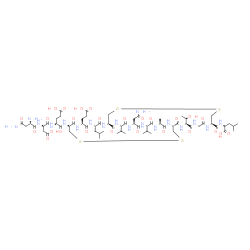
Plecanatide 普卡那肽 ليكاناتيد плеканатид


STR1

PLECANATIDE;  UNII-7IK8Z952OK;  (3-Glutamic acid(D>E))human uroguanylin (UGN); 467426-54-6;

Molecular Formula: C65H104N18O26S4
Molecular Weight: 1681.88626 g/mol

Novel Chronic Idiopathic Constipation Drug Under FDA Review

Plecanatide is a once-daily, oral, uroguanylin analog

Synergy Pharmaceuticals announced the Food and Drug Administration (FDA) has accepted for review the New Drug Application (NDA) for plecanatide for the treatment of chronic idiopathic constipation (CIC).

The NDA submission was based on data from two double-blind, placebo-controlled Phase 3 trials and one open-label long term safety study in over 3,500 patients with CIC.

RELATED: NDA Submitted for Chronic Idiopathic Constipation Drug Plecanatide

The FDA has set a Prescription Drug User Fee Act (PDUFA) target action date of January 29, 2017 to make a decision on the NDA.

Plecanatide is a once-daily, oral, uroguanylin analog currently under development for the treatment of CIC and irritable bowel syndrome with constipation (IBS-C). It is designed to replicate the function of uroguanylin, a naturally occurring GI peptide, by working locally in the upper GI tract to stimulate digestive fluid movement and support regular bowel function.

PATENT

CN 104628827

http://www.google.com/patents/CN104628827A?cl=en

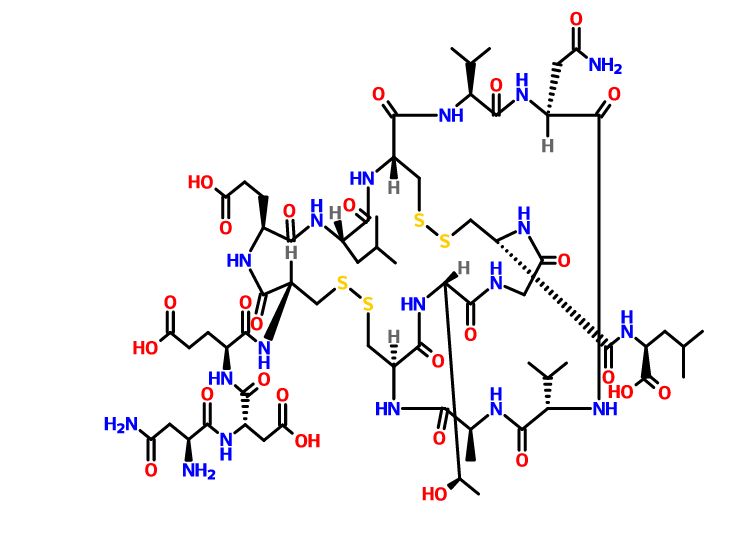
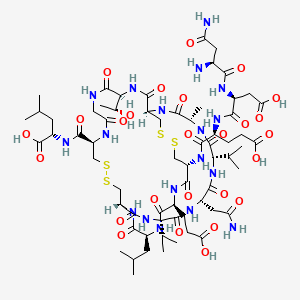
Prica exenatide Synergy Pharmaceuticals developed by the United States for the GC-C receptor in development of drugs, administered orally Limited.Currently underway include chronic idiopathic constipation (CIC) and constipation irritable bowel syndrome (IBS-C), including the phase III clinical trials. It is expected to receive US FDA clearance to market in recent years. Prica that peptides CAS: 467426-54-6 English name plecanatide, structural formula is as follows:

Figure CN104628827AD00031

Preparation Prica that peptides from Shenzhen Han Yu medicine was first reported (CN103694320A), using a solid-phase synthesis of linear peptides in solution and then the two-step method to get into the ring, respectively. Since the method to form a ring carved in solution twice, the solution of complex composition, separation and purification difficult, the method should be improved.

Example 1

 Weigh the degree of substitution of 0. 51mmol / g of Fmoc-Leu- Wang resin 10g (5. Lmmol), added to the solid phase reactor, DMF washing 3 times, the swelling 3h. The volume ratio of 1: 4 piperidine: DMF was added to the reactor the reaction, after the reaction was washed with DCM and washed twice, DMF 4 times. Weigh Fmoc-Cys (Acm) -OH 6. 34g, H0Bt 2. 07g, DIC 2. 37mL was dissolved in DMF, added to the reactor uniformly mixed, the reaction at room temperature 2h. Ninhydrin color reaction control endpoint, the resin was colorless indicates the end of the reaction, the reaction is continued if the color to colorless. After completion of the reaction, DCM was washed twice, DMF and washed 4 times.

 Repeat the above steps, in accordance with the order of the sequence, followed by deprotection, coupling Fmoc-Gly-OH, Fmoc-Thr (tBu) -OH, Fmoc-Cys- (Mmt) -OH, Fmoc-Ala-OH, Fmoc- Val-OH, Fmoc-Asn (Trt) -〇H, Fmoc-Val-OH, Fmoc-Cys (Acm) -OH, Fmoc-Leu-OH, Fmoc-Glu (OtBu) -OH, Fmoc-Cys (StBu) -OH, Fmoc-Glu (OtBu) -OH, Fmoc-Asp (OtBu) -OH, Boc-Asn (Trt) -〇H〇

 To a prepared peptide resin reactor volume percentage of 15% DMF solution of mercapto ethanol, reaction 2h; then DCM was added a solution of 20-fold amount DTNP reaction lh; was added after washing 1% TFA containing TIS 5% of DCM solution reaction 20min.

Preparation of peptide resin obtained after sufficiently washed with DMF, DMF was added 10 times the amount in the reaction solution 12 lh. Full wash sash.

After the preparation of the peptide resin was added in a volume ratio of 95/2/2/1 TFA / TIS / EDT / H lysis reagent 20 is added in an amount 20mL / g, the reaction ice bath lh, stirring was continued at room temperature 5h, then filtration.After lysis reagent suction filtrate using a rotary evaporator until no overflow TFA, precipitated reagent was added standing; Pulika centrifugation the precipitated crude peptide was peptide to give 8. 67g〇

The preparation of the crude peptide was obtained Pulika peptide using preparative HPLC system, wavelength 214nm, C18 reversed-phase column packing for the separation, the mobile phase of water and acetonitrile were used, with a gradient elution method to collect the target polypeptide The absorption peak. Using rotary evaporation at 30 ° C to remove most of the acetonitrile, were freeze-dried to obtain a purified Prica exenatide refined products.

Example 2

Weigh the degree of substitution of 0. 2mmol / g of Fmoc-Leu- Wang resin 10g (2mmol), added to the solid phase reactor. DMF washing 3 times, the swelling 3h. The volume ratio of 1: 4 piperidine: DMF was added to the reactor the reaction, after the reaction was washed with DCM and washed twice, DMF 4 times. Weigh Fmoc-Cys (Acm) -OH1. 24g, HOBtO. 406g, DIC 0 • 465mL dissolved in DMF solution, after mixing into the reactor at room temperature the reaction 2h.Ninhydrin color reaction control endpoint, the resin was colorless indicates the end of the reaction, the reaction is continued if the color to colorless. After completion of the reaction, DCM was washed twice, DMF and washed 4 times.

Repeat the above steps, in accordance with the order of the sequence, followed by deprotection, coupling Fmoc-Gly-OH, Fmoc-Thr (tBu) -OH, Fmoc-Cys- (Mmt) -OH, Fmoc-Ala-OH, Fmoc- Val-OH, Fmoc-Asn (Trt) -〇H, Fmoc-Val-OH, Fmoc-Cys (Acm) -OH, Fmoc-Leu-OH, Fmoc-Glu (OtBu) -OH, Fmoc-Cys (StBu) -OH, Fmoc-Glu (OtBu) -OH, Fmoc-Asp (OtBu) -OH, Boc-Asn (Trt) -〇H〇

[0053] To illustrate the preparation of the present embodiment obtained peptide resin reactor volume percent of a DMF solution of 30% mercaptoethanol, reaction 4h; then 5-fold amount DTNP in DCM reaction lh; was added after washing 1% TFA containing TIS 5% in DCM reaction 20min.

 Preparation of peptide resin obtained after sufficiently washed with DMF, 20 times the amount of DMF was added in the reaction solution 12 lh. Full wash sash.

Peptide Resin [0055] Preparation was added volume ratio of 82. 5/5/5/5/2. 5 TFA / thioanisole / H20 / phenol / EDT cleavage reagents, added in an amount 10mL / g, the reaction ice bath 0 After. 5h, stirring was continued at room temperature for lh, then suction filtered. After lysis reagent suction filtrate to the non-use of force blowing TFA overflow, adding precipitation reagent standing; centrifugation precipitated Prica exenatide crude peptide to give 1. 52g.

 The preparation of the crude peptide was obtained Pulika peptide using preparative HPLC system, wavelength 214nm, C18 reversed-phase column packing for the separation, the mobile phase of water and acetonitrile were used, with a gradient elution method to collect the target polypeptide The absorption peak. Using rotary evaporation at 30 ° C to remove most of the acetonitrile, were freeze-dried to obtain a purified Prica exenatide refined products.

 Example 3

 Weigh the degree of substitution of 0. 6mmol / g of Fmoc-Leu- Wang resin 10g (6mmol), added to the solid phase reactor, DMF washing 3 times, the swelling 3h. The volume ratio of 1: 4 piperidine: DMF was added to the reactor the reaction, after the reaction was washed with DCM and washed twice, DMF 4 times. Weigh Fmoc-Cys (Acm) -OH 7. 46g, H0Bt2. 44g, DIC 2. 79mL was dissolved in DMF, added to the reactor uniformly mixed, the reaction at room temperature 2h.Ninhydrin color reaction control endpoint, the resin was colorless indicates the end of the reaction, the reaction is continued if the color to colorless. After completion of the reaction, DCM was washed twice, DMF and washed 4 times.

 Repeat the above steps, in accordance with the order of the sequence, followed by deprotection, coupling Fmoc-Gly-OH, Fmoc-Thr (tBu) -OH, Fmoc-Cys- (Mmt) -OH, Fmoc-Ala-OH, Fmoc- Val-OH, Fmoc-Asn (Trt) -〇H, Fmoc-Val-OH, Fmoc-Cys (Acm) -OH, Fmoc-Leu-OH, Fmoc-Glu (OtBu) -OH, Fmoc-Cys (StBu) -OH, Fmoc-Glu (OtBu) -OH, Fmoc-Asp (OtBu) -OH, Boc-Asn (Trt) -〇H〇

 To the prepared peptide resin reactor volume percentage of 25% DMF solution of mercapto ethanol, reaction 3h; then 10-fold amount DTNP in DCM reaction lh; was added 1% TFA washed containing TIS5% DCM solution Reaction 20min〇

 Preparation of peptide resin obtained after sufficiently washed with DMF, 15 times the amount of DMF was added in the reaction solution 12 lh. Full wash sash.

 Preparation of the peptide resin was added in a volume ratio of 90/5/3/2 TFA / thioanisole / anisole / EDT cleavage reagents, added in an amount 20mL / g, the ice bath was reacted 0.lh, stirring was continued at room temperature The reaction 10h, then filtration. After lysis reagent suction filtrate using a rotary evaporator until no overflow TFA, precipitated reagent was added standing; Pulika centrifugation the precipitated crude peptide was peptide to give 8. 46g.

 The preparation of the crude peptide was obtained Pulika peptide using preparative HPLC system, wavelength 214nm, C18 reversed-phase column packing for the separation, the mobile phase of water and acetonitrile were used, with a gradient elution method to collect the target polypeptide The absorption peak. Using rotary evaporation at 30 ° C to remove most of the acetonitrile, were freeze-dried to obtain a purified Prica exenatide refined products.

Although the above has been described with general, specific embodiments and test, the present invention has been described in detail, but on the basis of the present invention, it may make some changes or improvements, which the skilled artisan It is obvious. Thus, the present invention without departing from the spirit on the basis of these modifications or improvements made, belong to the scope of the invention as claimed.

PATENT

CN 104211777

http://www.google.com/patents/CN104211777A?cl=en

The pickup exenatide (Plecanatide) is a synthetic analogue of guanylin urine (urine guanylin is a natriuretic hormone, can regulate gastrointestinal transport of ions and liquid), pickup exenatide enter After in vivo and guanylate gastrointestinal tract endothelial cells cyclase C binding and activation, activation of the cystic fibrosis transmembrane conductance regulator (CFTR), to promote chloride and water into the intestine, thereby promoting bowel motility, improve constipation symptoms.

Synergy company announced its pick in the research of new drugs that peptide (code: SP304) on October 6, 2010 the treatment of gastrointestinal disorders II a clinical experimental results. The study, conducted in patients with chronic constipation showed that the drugs can improve bowel function in patients, promote intestinal motility and reduce abdominal discomfort shape. In the experiment, there was no diarrhea and other adverse reactions, at the doses tested did not detect the pickup system that peptides are absorbed. The drug is expected for the treatment of chronic constipation (CC), constipation-predominant irritable bowel syndrome (IBS-C) and other gastrointestinal disorders. CC and IBS-C is a common gastrointestinal disease that can cause serious impact on the work and the quality of life of patients. Synergy will continue to conduct clinical trials of other pickups that peptide.

The structure of the peptide pickup that is:

H-Asn-Asp-Asp-Cys-Glu-Leu-Cys-Val-Asn-Val-Ala-Cys-Thr-Gly-C ys-Leu-〇H (4-12 disulfide, 7- 15)

Example 30:

 H-Asn-Asp-Asp-Cys-Glu-Leu-Cys-Val-Asn-Val-Ala-Cys-Thr-Gly-C ys-Leu-〇H (4-12 disulfide, 7- 15) Preparation of

 embodiments will be prepared by the method of Example 18 H-Asn (Trt) -Asp (OtBu) -Asp (OtBu) -Cys (mmt) -Glu (Ot Bu) -Leu-Cys (StBu) -Val-Asn ( Trt) -Val-Ala-Cys (mmt) -Thr (tBu) -Gly-Cys (StBu) -Leu-CT C resin (IOOmmol, 472. 88g) disposed cracking reactor to 10ml / g resin ratio Add lysis reagent (TFA: EDT: water = 95: 2 5:.. 2 5 (V / V)), stirred at room temperature 2h. The reaction was filtered with sand core funnel, and then added a small amount of TFA The resin was washed in the funnel, collecting the filtrate, the combined filtrate was concentrated. Frozen in dry diethyl ether was added (100ml / g peptide purpose tree months) and the solution was precipitated, centrifuged to remove the precipitate was washed with diethyl ether after dry ether three times, and dried in vacuo to give a white solid powder was approximately 180g, i.e., H-Asn-Asp-Asp -Cys-Glu-Leu-Cys (StBu) -Val-Asn-Val-Ala-Cys-Thr-Gly-Cy s (StBu) -Leu-OH. The solid was dissolved with water to lmg / ml solution. Was added an aqueous solution of 1% by volume of H2O2, the reaction was stirred at room temperature 30min, to prepare H-Asn-Asp-Asp-Cys-Glu-Leu-Cys (StBu) -Val-Asn-Val-Ala-Cys-Thr-Gl y-Cys (StBu) -Leu-OH (disulfide 4-12) was treated with a rotary evaporator after drying the compound containing 500ml 20% β- mercaptoethanol and 0. IM N- methylmorpholine were dissolved in water, followed by stirring After 12h the reaction, the reaction solution was diluted with water to 3mg / ml was about 60L, dissolved in ethanol was added with IL 300mmol I2 solution, the reaction was stirred at room temperature 2h. Adding an appropriate amount Vc remove excess I2, until the color of the reaction solution was transparent, i.e., to give H-Asn-Asp-Asp-Cys-Glu-Leu-Cys-Val-As n-Val-Ala-Cys-Thr-Gly-Cys-L eu_0H (disulfide bonds 4-12, 7-15).

PATENT

WO 2014197720

CN 103694320

WO 2012118972

WO 2012037380

WO 2011069038

US 20100152118

WO 2010065751

///Plecanatide,  普卡那肽 ,  ليكاناتيد , плеканатид, 467426-54-6, Chronic Idiopathic Constipation, NDA, SP 304, SYNERGY, PEPTIDE,

C[C@H]1C(=O)N[C@H]2CSSC[C@@H](C(=O)N[C@H](C(=O)N[C@H](C(=O)N[C@@H](CSSC[C@H](NC(=O)CNC(=O)[C@@H](NC2=O)[C@@H](C)O)C(=O)N[C@@H](CC(C)C)C(=O)O)C(=O)N[C@H](C(=O)N[C@H](C(=O)N[C@H](C(=O)N1)C(C)C)CC(=O)N)C(C)C)CC(C)C)CCC(=O)O)NC(=O)[C@H](CCC(=O)O)NC(=O)[C@H](CC(=O)O)NC(=O)[C@H](CC(=O)N)N

OR

O=C(N[C@@H](CC(=O)O)C(=O)N[C@@H](CCC(O)=O)C(=O)N[C@H]1CSSC[C@@H]2NC(=O)[C@H](C)NC(=O)[C@@H](NC(=O)[C@H](CC(N)=O)NC(=O)[C@@H](NC(=O)[C@@H](NC(=O)[C@@H](NC(=O)[C@H](CCC(=O)O)NC1=O)CC(C)C)CSSC[C@H](NC(=O)CNC(=O)[C@@H](NC2=O)[C@@H](C)O)C(=O)N[C@@H](CC(C)C)C(=O)O)C(C)C)C(C)C)[C@@H](N)CC(N)=O

updated

Plecanatide (brand name Trulance), is a drug approved by the FDA for the treatment of chronic idiopathic constipation (CIC)[1] and irritable bowel syndrome with constipation. Plecanatide is an agonist of guanylate cyclase-C. Plecanatide increases intestinal transit and fluid through a buildup of cGMP.[2][3]

Medical uses

As of January 2017, plecanatide is approved in the United States for the treatment of chronic idiopathic constipation in adults.[1] The presence of this condition is determined using the Rome III diagnostic criteria for chronic constipation which requires that the patient meet stool frequency, stool consistency, incomplete evacuation, and straining requirements in addition to not being a likely candidate for irritable bowel syndrome.[4] The symptoms should also have been present for at least three of the last six months to establish the chronic nature of the condition before treatment with plecanatide is indicated.[4]

Plecanatide has been shown to be safe and effective. It has shown to be at least equally as effective as its main competitor, linaclotide (brand name Linzess), but has been shown to have a lower rate of diarrhea as an adverse drug reaction.[5]

Contraindications

Plecanatide has not been shown to be safe or effective in persons 6 years to 18 years of age.[6] Use of plecanatide by persons under the age of 6 poses a serious dehydration risk and studies have demonstrated plecanatide can cause death in juvenile mice due to this dehydrating effect.[6]

Use of plecanatide is also contraindicated in persons who are suspected of having a mechanical gastrointestinal obstruction.[6]

Pharmacology

Structure and function

Plecanatide is a 16 amino acid peptide with the amino acid sequence:

H-Asn1-Asp2-Glu3-Cys4-Glu5-Leu6-Cys7-Val8-Asn9-Val10-Ala11-Cys12-Thr13-Gly14-Cys15-Leu16-OH

Is nearly structurally identical to human uroguanylin, apart from the substitution of Asp3 with Glu3.[7] Disulfide bonds exist between Cys4 and Cys12, as well as Cys7 and Cys15.[8]

Plecanatide has two important motifs. The first being the acidic residues Asp2 and Glu3 which modulate the affinity for its receptor in response to environmental pH.[6][7][9] Simulations predict the optimal activity of Plecanatide to occur at pH 5, making it suitable for targeting cells within the proximal intestine, which has a pH of between 5 and 6.[6] The second is the ACTGC motif (residues Ala11 to Cys15) which is the region responsible for its binding to the receptor, guanylate cyclase-C.[10]

Mechanism of action

Plecanatide works as a laxative by drawing water in to the gastrointestinal tract thereby softening stool and encouraging its natural passage.

Similar to its endogenous counterpart, plecanatide activates guanylate cyclase-C on endothelial cells within the gastrointestinal tract.[7] The activation of guanylate cyclase-C catalyses the production of the second messenger guanosine 3’,5’-cyclic monophosphate (cGMP) which leads to the protein kinase A (PKA) and protein kinase G II (PKGII)-mediated phosphorylation of the cystic fibrosis transmembrane conductance regulator (CFTR) protein.[11][12] CFTR is an anion channel and upon activation it will secrete negatively charged ions, particularly chloride (Cl) and bicarbonate (HCO3) in to the GI tract lumen.[13][14] This disruption to the electrochemical gradient is in part rectified by the passive secretion of positively charged sodium ions in to the lumen and water follows by osmosis.[13]

Plecanatide is also known to have an anti-nociceptive effect in animal models, however the exact mechanism of action is not yet fully elucidated.[6] It has been suggested that this may be in part to the anti-inflammatory action of guanylate cyclase-C by its inhibition of pro-inflammatory cytokines, or through the inhibition of associated sensory neurons.[15]

Pharmacokinetics and metabolism

As plecanatide acts on receptors present on the apical side of endothelial cells lining the gastrointestinal tract it is able to impart its effect without ever entering circulation.[7] As with most orally ingested peptides, plecanatide is degraded by intestinal enzymes, and so very little of the active drug enters systemic circulation.[6] Minimal amounts of the drug are expected to be transported in to the body, and concentrations of plecanatide and its metabolites are undetectable in plasma following the recommended dosage of 3 mg.[6][7] It has also been shown that dosages up to 48.6 mg produced no detectable concentration of plecanatide in human plasma at any time point after ingestion.[7]

Commercialization

Plecanatide, branded as Trulance, is manufactured by Synergy Pharmaceuticals.[16]

PATENT

WO-2020250102

Novel Chronic Idiopathic Constipation Drug Under FDA Review

Plecanatide is a once-daily, oral, uroguanylin analog

Synergy Pharmaceuticals announced the Food and Drug Administration (FDA) has accepted for review the New Drug Application (NDA) for plecanatide for the treatment of chronic idiopathic constipation (CIC).

The NDA submission was based on data from two double-blind, placebo-controlled Phase 3 trials and one open-label long term safety study in over 3,500 patients with CIC.

RELATED: NDA Submitted for Chronic Idiopathic Constipation Drug Plecanatide

The FDA has set a Prescription Drug User Fee Act (PDUFA) target action date of January 29, 2017 to make a decision on the NDA.

Plecanatide is a once-daily, oral, uroguanylin analog currently under development for the treatment of CIC and irritable bowel syndrome with constipation (IBS-C). It is designed to replicate the function of uroguanylin, a naturally occurring GI peptide, by working locally in the upper GI tract to stimulate digestive fluid movement and support regular bowel function.

PATENT

CN 104628827

http://www.google.com/patents/CN104628827A?cl=en

Prica exenatide Synergy Pharmaceuticals developed by the United States for the GC-C receptor in development of drugs, administered orally Limited.Currently underway include chronic idiopathic constipation (CIC) and constipation irritable bowel syndrome (IBS-C), including the phase III clinical trials. It is expected to receive US FDA clearance to market in recent years. Prica that peptides CAS: 467426-54-6 English name plecanatide, structural formula is as follows:

Figure CN104628827AD00031

Preparation Prica that peptides from Shenzhen Han Yu medicine was first reported (CN103694320A), using a solid-phase synthesis of linear peptides in solution and then the two-step method to get into the ring, respectively. Since the method to form a ring carved in solution twice, the solution of complex composition, separation and purification difficult, the method should be improved.

Example 1

 Weigh the degree of substitution of 0. 51mmol / g of Fmoc-Leu- Wang resin 10g (5. Lmmol), added to the solid phase reactor, DMF washing 3 times, the swelling 3h. The volume ratio of 1: 4 piperidine: DMF was added to the reactor the reaction, after the reaction was washed with DCM and washed twice, DMF 4 times. Weigh Fmoc-Cys (Acm) -OH 6. 34g, H0Bt 2. 07g, DIC 2. 37mL was dissolved in DMF, added to the reactor uniformly mixed, the reaction at room temperature 2h. Ninhydrin color reaction control endpoint, the resin was colorless indicates the end of the reaction, the reaction is continued if the color to colorless. After completion of the reaction, DCM was washed twice, DMF and washed 4 times.

 Repeat the above steps, in accordance with the order of the sequence, followed by deprotection, coupling Fmoc-Gly-OH, Fmoc-Thr (tBu) -OH, Fmoc-Cys- (Mmt) -OH, Fmoc-Ala-OH, Fmoc- Val-OH, Fmoc-Asn (Trt) -〇H, Fmoc-Val-OH, Fmoc-Cys (Acm) -OH, Fmoc-Leu-OH, Fmoc-Glu (OtBu) -OH, Fmoc-Cys (StBu) -OH, Fmoc-Glu (OtBu) -OH, Fmoc-Asp (OtBu) -OH, Boc-Asn (Trt) -〇H〇

 To a prepared peptide resin reactor volume percentage of 15% DMF solution of mercapto ethanol, reaction 2h; then DCM was added a solution of 20-fold amount DTNP reaction lh; was added after washing 1% TFA containing TIS 5% of DCM solution reaction 20min.

Preparation of peptide resin obtained after sufficiently washed with DMF, DMF was added 10 times the amount in the reaction solution 12 lh. Full wash sash.

After the preparation of the peptide resin was added in a volume ratio of 95/2/2/1 TFA / TIS / EDT / H lysis reagent 20 is added in an amount 20mL / g, the reaction ice bath lh, stirring was continued at room temperature 5h, then filtration.After lysis reagent suction filtrate using a rotary evaporator until no overflow TFA, precipitated reagent was added standing; Pulika centrifugation the precipitated crude peptide was peptide to give 8. 67g〇

The preparation of the crude peptide was obtained Pulika peptide using preparative HPLC system, wavelength 214nm, C18 reversed-phase column packing for the separation, the mobile phase of water and acetonitrile were used, with a gradient elution method to collect the target polypeptide The absorption peak. Using rotary evaporation at 30 ° C to remove most of the acetonitrile, were freeze-dried to obtain a purified Prica exenatide refined products.

Example 2

Weigh the degree of substitution of 0. 2mmol / g of Fmoc-Leu- Wang resin 10g (2mmol), added to the solid phase reactor. DMF washing 3 times, the swelling 3h. The volume ratio of 1: 4 piperidine: DMF was added to the reactor the reaction, after the reaction was washed with DCM and washed twice, DMF 4 times. Weigh Fmoc-Cys (Acm) -OH1. 24g, HOBtO. 406g, DIC 0 • 465mL dissolved in DMF solution, after mixing into the reactor at room temperature the reaction 2h.Ninhydrin color reaction control endpoint, the resin was colorless indicates the end of the reaction, the reaction is continued if the color to colorless. After completion of the reaction, DCM was washed twice, DMF and washed 4 times.

Repeat the above steps, in accordance with the order of the sequence, followed by deprotection, coupling Fmoc-Gly-OH, Fmoc-Thr (tBu) -OH, Fmoc-Cys- (Mmt) -OH, Fmoc-Ala-OH, Fmoc- Val-OH, Fmoc-Asn (Trt) -〇H, Fmoc-Val-OH, Fmoc-Cys (Acm) -OH, Fmoc-Leu-OH, Fmoc-Glu (OtBu) -OH, Fmoc-Cys (StBu) -OH, Fmoc-Glu (OtBu) -OH, Fmoc-Asp (OtBu) -OH, Boc-Asn (Trt) -〇H〇

[0053] To illustrate the preparation of the present embodiment obtained peptide resin reactor volume percent of a DMF solution of 30% mercaptoethanol, reaction 4h; then 5-fold amount DTNP in DCM reaction lh; was added after washing 1% TFA containing TIS 5% in DCM reaction 20min.

 Preparation of peptide resin obtained after sufficiently washed with DMF, 20 times the amount of DMF was added in the reaction solution 12 lh. Full wash sash.

Peptide Resin [0055] Preparation was added volume ratio of 82. 5/5/5/5/2. 5 TFA / thioanisole / H20 / phenol / EDT cleavage reagents, added in an amount 10mL / g, the reaction ice bath 0 After. 5h, stirring was continued at room temperature for lh, then suction filtered. After lysis reagent suction filtrate to the non-use of force blowing TFA overflow, adding precipitation reagent standing; centrifugation precipitated Prica exenatide crude peptide to give 1. 52g.

 The preparation of the crude peptide was obtained Pulika peptide using preparative HPLC system, wavelength 214nm, C18 reversed-phase column packing for the separation, the mobile phase of water and acetonitrile were used, with a gradient elution method to collect the target polypeptide The absorption peak. Using rotary evaporation at 30 ° C to remove most of the acetonitrile, were freeze-dried to obtain a purified Prica exenatide refined products.

 Example 3

 Weigh the degree of substitution of 0. 6mmol / g of Fmoc-Leu- Wang resin 10g (6mmol), added to the solid phase reactor, DMF washing 3 times, the swelling 3h. The volume ratio of 1: 4 piperidine: DMF was added to the reactor the reaction, after the reaction was washed with DCM and washed twice, DMF 4 times. Weigh Fmoc-Cys (Acm) -OH 7. 46g, H0Bt2. 44g, DIC 2. 79mL was dissolved in DMF, added to the reactor uniformly mixed, the reaction at room temperature 2h.Ninhydrin color reaction control endpoint, the resin was colorless indicates the end of the reaction, the reaction is continued if the color to colorless. After completion of the reaction, DCM was washed twice, DMF and washed 4 times.

 Repeat the above steps, in accordance with the order of the sequence, followed by deprotection, coupling Fmoc-Gly-OH, Fmoc-Thr (tBu) -OH, Fmoc-Cys- (Mmt) -OH, Fmoc-Ala-OH, Fmoc- Val-OH, Fmoc-Asn (Trt) -〇H, Fmoc-Val-OH, Fmoc-Cys (Acm) -OH, Fmoc-Leu-OH, Fmoc-Glu (OtBu) -OH, Fmoc-Cys (StBu) -OH, Fmoc-Glu (OtBu) -OH, Fmoc-Asp (OtBu) -OH, Boc-Asn (Trt) -〇H〇

 To the prepared peptide resin reactor volume percentage of 25% DMF solution of mercapto ethanol, reaction 3h; then 10-fold amount DTNP in DCM reaction lh; was added 1% TFA washed containing TIS5% DCM solution Reaction 20min〇

 Preparation of peptide resin obtained after sufficiently washed with DMF, 15 times the amount of DMF was added in the reaction solution 12 lh. Full wash sash.

 Preparation of the peptide resin was added in a volume ratio of 90/5/3/2 TFA / thioanisole / anisole / EDT cleavage reagents, added in an amount 20mL / g, the ice bath was reacted 0.lh, stirring was continued at room temperature The reaction 10h, then filtration. After lysis reagent suction filtrate using a rotary evaporator until no overflow TFA, precipitated reagent was added standing; Pulika centrifugation the precipitated crude peptide was peptide to give 8. 46g.

 The preparation of the crude peptide was obtained Pulika peptide using preparative HPLC system, wavelength 214nm, C18 reversed-phase column packing for the separation, the mobile phase of water and acetonitrile were used, with a gradient elution method to collect the target polypeptide The absorption peak. Using rotary evaporation at 30 ° C to remove most of the acetonitrile, were freeze-dried to obtain a purified Prica exenatide refined products.

Although the above has been described with general, specific embodiments and test, the present invention has been described in detail, but on the basis of the present invention, it may make some changes or improvements, which the skilled artisan It is obvious. Thus, the present invention without departing from the spirit on the basis of these modifications or improvements made, belong to the scope of the invention as claimed.

PATENT

CN 104211777

http://www.google.com/patents/CN104211777A?cl=en

The pickup exenatide (Plecanatide) is a synthetic analogue of guanylin urine (urine guanylin is a natriuretic hormone, can regulate gastrointestinal transport of ions and liquid), pickup exenatide enter After in vivo and guanylate gastrointestinal tract endothelial cells cyclase C binding and activation, activation of the cystic fibrosis transmembrane conductance regulator (CFTR), to promote chloride and water into the intestine, thereby promoting bowel motility, improve constipation symptoms.

Synergy company announced its pick in the research of new drugs that peptide (code: SP304) on October 6, 2010 the treatment of gastrointestinal disorders II a clinical experimental results. The study, conducted in patients with chronic constipation showed that the drugs can improve bowel function in patients, promote intestinal motility and reduce abdominal discomfort shape. In the experiment, there was no diarrhea and other adverse reactions, at the doses tested did not detect the pickup system that peptides are absorbed. The drug is expected for the treatment of chronic constipation (CC), constipation-predominant irritable bowel syndrome (IBS-C) and other gastrointestinal disorders. CC and IBS-C is a common gastrointestinal disease that can cause serious impact on the work and the quality of life of patients. Synergy will continue to conduct clinical trials of other pickups that peptide.

The structure of the peptide pickup that is:

H-Asn-Asp-Asp-Cys-Glu-Leu-Cys-Val-Asn-Val-Ala-Cys-Thr-Gly-C ys-Leu-〇H (4-12 disulfide, 7- 15)

Example 30:

 H-Asn-Asp-Asp-Cys-Glu-Leu-Cys-Val-Asn-Val-Ala-Cys-Thr-Gly-C ys-Leu-〇H (4-12 disulfide, 7- 15) Preparation of

 embodiments will be prepared by the method of Example 18 H-Asn (Trt) -Asp (OtBu) -Asp (OtBu) -Cys (mmt) -Glu (Ot Bu) -Leu-Cys (StBu) -Val-Asn ( Trt) -Val-Ala-Cys (mmt) -Thr (tBu) -Gly-Cys (StBu) -Leu-CT C resin (IOOmmol, 472. 88g) disposed cracking reactor to 10ml / g resin ratio Add lysis reagent (TFA: EDT: water = 95: 2 5:.. 2 5 (V / V)), stirred at room temperature 2h. The reaction was filtered with sand core funnel, and then added a small amount of TFA The resin was washed in the funnel, collecting the filtrate, the combined filtrate was concentrated. Frozen in dry diethyl ether was added (100ml / g peptide purpose tree months) and the solution was precipitated, centrifuged to remove the precipitate was washed with diethyl ether after dry ether three times, and dried in vacuo to give a white solid powder was approximately 180g, i.e., H-Asn-Asp-Asp -Cys-Glu-Leu-Cys (StBu) -Val-Asn-Val-Ala-Cys-Thr-Gly-Cy s (StBu) -Leu-OH. The solid was dissolved with water to lmg / ml solution. Was added an aqueous solution of 1% by volume of H2O2, the reaction was stirred at room temperature 30min, to prepare H-Asn-Asp-Asp-Cys-Glu-Leu-Cys (StBu) -Val-Asn-Val-Ala-Cys-Thr-Gl y-Cys (StBu) -Leu-OH (disulfide 4-12) was treated with a rotary evaporator after drying the compound containing 500ml 20% β- mercaptoethanol and 0. IM N- methylmorpholine were dissolved in water, followed by stirring After 12h the reaction, the reaction solution was diluted with water to 3mg / ml was about 60L, dissolved in ethanol was added with IL 300mmol I2 solution, the reaction was stirred at room temperature 2h. Adding an appropriate amount Vc remove excess I2, until the color of the reaction solution was transparent, i.e., to give H-Asn-Asp-Asp-Cys-Glu-Leu-Cys-Val-As n-Val-Ala-Cys-Thr-Gly-Cys-L eu_0H (disulfide bonds 4-12, 7-15).

PATENT

WO 2014197720

CN 103694320

WO 2012118972

WO 2012037380

WO 2011069038

US 20100152118

WO 2010065751

///Plecanatide,  普卡那肽 ,  ليكاناتيد , плеканатид, 467426-54-6, Chronic Idiopathic Constipation, NDA, SP 304, SYNERGY, PEPTIDE,

C[C@H]1C(=O)N[C@H]2CSSC[C@@H](C(=O)N[C@H](C(=O)N[C@H](C(=O)N[C@@H](CSSC[C@H](NC(=O)CNC(=O)[C@@H](NC2=O)[C@@H](C)O)C(=O)N[C@@H](CC(C)C)C(=O)O)C(=O)N[C@H](C(=O)N[C@H](C(=O)N[C@H](C(=O)N1)C(C)C)CC(=O)N)C(C)C)CC(C)C)CCC(=O)O)NC(=O)[C@H](CCC(=O)O)NC(=O)[C@H](CC(=O)O)NC(=O)[C@H](CC(=O)N)N

OR

O=C(N[C@@H](CC(=O)O)C(=O)N[C@@H](CCC(O)=O)C(=O)N[C@H]1CSSC[C@@H]2NC(=O)[C@H](C)NC(=O)[C@@H](NC(=O)[C@H](CC(N)=O)NC(=O)[C@@H](NC(=O)[C@@H](NC(=O)[C@@H](NC(=O)[C@H](CCC(=O)O)NC1=O)CC(C)C)CSSC[C@H](NC(=O)CNC(=O)[C@@H](NC2=O)[C@@H](C)O)C(=O)N[C@@H](CC(C)C)C(=O)O)C(C)C)C(C)C)[C@@H](N)CC(N)=O

References

  1. Jump up to:a b “FDA approves Trulance for Chronic Idiopathic Constipation”FDA.gov. U.S. Food and Drug Administration. Retrieved 20 January 2017.
  2. ^ “TRULANCE package insert” (PDF)Trulance website. Synergy Pharmaceuticals Inc. 420 Lexington Avenue, Suite 2012 New York, New York 10170. Retrieved 20 January 2017.
  3. ^ Thomas RH, Luthin DR (June 2015). “Current and emerging treatments for irritable bowel syndrome with constipation and chronic idiopathic constipation: focus on prosecretory agents”. Pharmacotherapy35 (6): 613–30. doi:10.1002/phar.1594PMID 26016701.
  4. Jump up to:a b Rome III : the functional gastrointestinal disorders. Drossman, Douglas A. (3rd ed.). McLean, Va.: Degnon Associates. 2006. ISBN 9780965683753OCLC 79476570.
  5. ^ “Trulance – FDA prescribing information, side effects and uses”Drugs.com. Retrieved 2017-10-27.
  6. Jump up to:a b c d e f g h Al-Salama ZT, Syed YY (April 2017). “Plecanatide: First Global Approval”. Drugs77 (5): 593–598. doi:10.1007/s40265-017-0718-0PMID 28255961.
  7. Jump up to:a b c d e f Shailubhai K, Comiskey S, Foss JA, Feng R, Barrow L, Comer GM, Jacob GS (September 2013). “Plecanatide, an oral guanylate cyclase C agonist acting locally in the gastrointestinal tract, is safe and well-tolerated in single doses”. Digestive Diseases and Sciences58 (9): 2580–6. doi:10.1007/s10620-013-2684-zPMID 23625291.
  8. ^ Chang WL, Masih S, Thadi A, Patwa V, Joshi A, Cooper HS, et al. (February 2017). “+/Min-FCCC mice”World Journal of Gastrointestinal Pharmacology and Therapeutics8(1): 47–59. doi:10.4292/wjgpt.v8.i1.47PMC 5292606PMID 28217374.
  9. ^ Hamra FK, Eber SL, Chin DT, Currie MG, Forte LR (March 1997). “Regulation of intestinal uroguanylin/guanylin receptor-mediated responses by mucosal acidity”Proceedings of the National Academy of Sciences of the United States of America94 (6): 2705–10. Bibcode:1997PNAS…94.2705Hdoi:10.1073/pnas.94.6.2705PMC 20153PMID 9122260.
  10. ^ Forte LR (November 2004). “Uroguanylin and guanylin peptides: pharmacology and experimental therapeutics”. Pharmacology & Therapeutics104 (2): 137–62. doi:10.1016/j.pharmthera.2004.08.007PMID 15518884.
  11. ^ Hamra FK, Forte LR, Eber SL, Pidhorodeckyj NV, Krause WJ, Freeman RH, et al. (November 1993). “Uroguanylin: structure and activity of a second endogenous peptide that stimulates intestinal guanylate cyclase”Proceedings of the National Academy of Sciences of the United States of America90 (22): 10464–8. Bibcode:1993PNAS…9010464Hdoi:10.1073/pnas.90.22.10464PMC 47797PMID 7902563.
  12. ^ Bijvelds MJ, Loos M, Bronsveld I, Hellemans A, Bongartz JP, Ver Donck L, et al. (December 2015). “Inhibition of Heat-Stable Toxin-Induced Intestinal Salt and Water Secretion by a Novel Class of Guanylyl Cyclase C Inhibitors”The Journal of Infectious Diseases212 (11): 1806–15. doi:10.1093/infdis/jiv300PMID 25999056.
  13. Jump up to:a b Gadsby DC, Vergani P, Csanády L (March 2006). “The ABC protein turned chloride channel whose failure causes cystic fibrosis”Nature440 (7083): 477–83. Bibcode:2006Natur.440..477Gdoi:10.1038/nature04712PMC 2720541PMID 16554808.
  14. ^ Park HW, Nam JH, Kim JY, Namkung W, Yoon JS, Lee JS, et al. (August 2010). “Dynamic regulation of CFTR bicarbonate permeability by [Cl-]i and its role in pancreatic bicarbonate secretion”. Gastroenterology139 (2): 620–31. doi:10.1053/j.gastro.2010.04.004PMID 20398666.
  15. ^ Eutamene H, Bradesi S, Larauche M, Theodorou V, Beaufrand C, Ohning G, et al. (March 2010). “Guanylate cyclase C-mediated antinociceptive effects of linaclotide in rodent models of visceral pain”. Neurogastroenterology and Motility22 (3): 312–e84. doi:10.1111/j.1365-2982.2009.01385.xPMID 19706070.
  16. ^ “Plecanatide – brand name list from Drugs.com”Drugs.com.
Plecanatide
Plecanatide sequence.svg
Clinical data
Trade names Trulance
Other names SP-304
License data
Routes of
administration
By mouth
ATC code
Legal status
Legal status
Identifiers
CAS Number
PubChem CID
IUPHAR/BPS
DrugBank
ChemSpider
UNII
KEGG
ChEMBL
CompTox Dashboard (EPA)
Chemical and physical data
Formula C65H104N18O26S4
Molar mass 1681.89 g·mol−1
3D model (JSmol)

////////////PLECATANIDE, плеканатид بليكاناتيد 普卡那肽 7IK8Z952OK, Guanilib

Asvasiran sodium (ALN-RSV01)


RNA, (C-U-U-G-A-C-U-U-U-G-C-U-A-A-G-A-G-C-C-DT-DT), COMPLEX WITH RNA (G-G-C-U-C-U-U-A-G-C-A-A-A-G-U-C-A-A-G-DT-DT)

Duplex of guanylyl-(3′->5′)-guanylyl-(3′->5′)-cytidylyl-(3′->5′)-uridylyl-(3′->5′)-cytidylyl-(3′->5′)-uridylyl-(3′->5′)-uridylyl-(3′->5′)-adenylyl-(3′->5′)-guanylyl-(3′->5′)-cytidylyl-(3′->5′)-adenylyl-(3′->5′)-adenylyl-(3′->5′)-adenylyl-(3′->5′)-guanylyl-(3′->5′)-uridylyl-(3′->5′)-cytidylyl-(3′->5′)-adenylyl-(3′->5′)-adenylyl-(3′->5′)-guanylyl-(3′->5′)-thymidylyl-(3′->5′)-thymidine and thymidylyl-(5′->3′)-thymidylyl-(5′->3′)-cytidylyl-(5′->3′)-cytidylyl-(5′->3′)-guanylyl-(5′->3′)-adenylyl-(5′->3′)-guanylyl-(5′->3′)-adenylyl-(5′->3′)-adenylyl-(5′->3′)-uridylyl-(5′->3′)-cytidylyl-(5′->3′)-guanylyl-(5′->3′)-uridylyl-(5′->3′)-uridylyl-(5′->3′)-uridylyl-(5′->3′)-cytidylyl-(5′->3′)-adenylyl-(5′->3′)-guanylyl-(5′->3′)-uridylyl-(5′->3′)-uridylyl-(5′->3′)-cytidine

Asvasiran sodium (ALN-RSV01),

C401H500N150O290P40,

CAS 1386946-83-3, 870094-26-1

Alnylam Pharmaceuticals

  • Originator Alnylam Pharmaceuticals
  • Class Antivirals; Small interfering RNA
  • Mechanism of Action Nucleocapsid protein modulators; RNA interference

Treatment of Human Respiratory Syncytial Virus (RSV) Infection

Nucleocapsid protein modulators, RNA interference

  • 05 Nov 2014 Alnylam receives patent allowance for RNAi technology in USA
  • 20 Feb 2014 Suspended – Phase-II for Respiratory syncytial virus infections in USA (Intranasal) (Alnylam Form 10-K filed in February 2014)
  • 20 Feb 2014 Suspended – Phase-I for Respiratory syncytial virus infections in Europe (Intranasal) (Alnylam Form 10-K filed in February 2014)


Aerosolised ALN-RSV01 – Alnylam; ALN RSV01; Intranasal ALN-RSV01 – Alnylam

Alnylam, under license from the University of South Alabama, and with Asian licensee Kyowa Hakko Kirin (formerly Kyowa Hakko Kogyo), is developing a nasally administered formulation of asvasiran sodium (ALN-RSV01), an siRNA that targets the respiratory syncytial virus (RSV) N gene and inhibits viral replication, for the potential treatment or prevention of RSV infection.

.In June 2007, a phase II trial was initiated; in January 2008, top-line data were reported . In March 2013, development was ongoing . In August 2008, Kyowa planned to file the drug for marketing approval in 2014. In March 2013, Alnylam was planning on seeking to outlicense the program to continue to advance the program in other regions .

Alnylam is also developing second-generation agents.

Ex-Asian licensee, Cubist Pharmaceuticals, in collaboration with Alnylam, was previously developing the program for the potential treatment or prevention of RSV infection . However, in February 2013, the deal was terminated . Alnylam was also developing an inhaled formulation of asvasiran sodium; however, in February 2014, the drug was no longer listed on the company’s development pipeline.

WO-2006074346
WO-2009076679
WO-2006062596
WO-2010048590

WO 2016022464

WO 2015173701

WO 2015026792

WO 2014209983

WO 2014031784

US 20130273037

Nucleic Acids Research (2012), 40(21), 10585-10595

WO 2011163518

Drugs of the Future (2009), 34(10), 781-783

Current Opinion in Infectious Diseases (2008), 21(6), 639-643

Antiviral Research (2008), 77(3), 225-231

John Maraganore, president and chief executive officer of Alnylam Pharmaceuticals,

Delivering Value with Integrated Communications led by Cynthia Clayton, Vice President, Investor Relations and Corporate Communications at Alnylam Pharmaceuticals

From the left, Alnylam COO Barry Greene, Adrian Dede, Lauren Virnoche, CEO

Dr. Rachel Meyers, Senior Vice President, Research at Alnylam Pharmaceuticals

Dr. Dinah Sah, Vice President of Research and the head of the Alnylam HD team

//////Asvasiran sodium, ALN-RSV01, PHASE 2, Alnylam

SOME OTHER CHEMISTRY

Figure 6: GalNAc–siRNA conjugates.

From Delivery materials for siRNA therapeutics

Nature Materials12,967–977(2013)doi:10.1038/nmat3765
23 October 2013

http://www.nature.com/nmat/journal/v12/n11/fig_tab/nmat3765_F6.html

\

http://www.google.com/patents/EP2836595A2?cl=en

AUNP-12 from Aurigene Discovery Technologies Limited


AUNP-12

AUR-012; Aurigene-012; NP-12, Aurigene; PD-1 inhibitor peptide (cancer), Aurigene; PD-1 inhibitor peptide (cancer), Aurigene/ Pierre Fabre; W-014A


Company Aurigene Discovery Technologies Ltd.
Description A programmed cell death 1 (PDCD1; PD-1; CD279) peptide antagonist
Molecular Target Programmed cell death 1 (PD-1) (PDCD1) (CD279)
Mechanism of Action Programmed cell death 1 (PD-1) antagonist
Therapeutic Modality Peptide
Latest Stage of Development Preclinical
Standard Indication Cancer (unspecified)
Indication Details Treat cancer
Regulatory Designation
Partner Laboratoires Pierre Fabre S.A.

Aurigene Discovery Technologies Limited

INNOVATOR


  • Programmed Cell Death 1 or PD-1 (also referred to as PDCD1) is a 50 to 55 kD type I membrane glycoprotein (Shinohara T et al, Genomics, 1994, Vol. 23, No. 3, pp. 704-706). PD-1 is a receptor of the CD28 superfamily that negatively regulates T cell antigen receptor signalling by interacting with the specific ligands and is suggested to play a role in the maintenance of self tolerance.
  • PD-1 peptide relates to almost every aspect of immune responses including autoimmunity, tumour immunity, infectious immunity, transplantation immunity, allergy and immunological privilege.
  • The PD-1 protein’s structure comprise of—

      • an extracellular IgV domain followed by
      • a transmembrane region and
      • an intracellular tail
  • The intracellular tail contains two phosphorylation sites located in an immunoreceptor tyrosine-based inhibitory motif and an immunoreceptor tyrosine-based switch motif, which suggests that PD-1 negatively regulates TCR signals. Also, PD-1 is expressed on the surface of activated T cells, B cells, and macrophages, (Y. Agata et al., Int Immunol 8, 765, May 1996) suggesting that compared to CTLA-4 ((Cytotoxic T-Lymphocyte Antigen 4, also known as CD152 (Cluster of differentiation 152) is a protein that also plays an important regulatory role in the immune system), PD-1 more broadly negatively regulates immune responses.
  • PD-1 has two ligands, PD-L1 (Programmed Death Ligand for PDCD1L1 or B7-H1) (Freeman G J et al, Journal of Experimental Medicine, 2000, Vol. 19, No. 7, pp. 1027-1034) and PD-L2 (Programmed Death Ligand 2 or PDCD1L2 or B7-DC) (Latchman Y et al, Nature Immunology, 2001, Vol. 2, No. 3, pp. 261-267), which are members of the B7 family. PD-L1 is known to be expressed not only in immune cells, but also in certain kinds of tumour cell lines (such as monocytic leukaemia-derived cell lines, mast cell tumour-derived cell lines, hematoma-derived cell lines, neuroblastoma-derived cell lines, and various mammary tumour-derived cell lines) and in cancer cells derived from diverse human cancer tissues (Latchman Y et al, Nature Immunology, 2001, Vol. 2, No. 3, pp. 261-267) and on almost all murine tumour cell lines, including PA1 myeloma, P815 mastocytoma, and B16 melanoma upon treatment with IFN-γ (Y. Iwai et al., Proc Natl Acad Sci USA 99, 12293, Sep. 17, 2002 and C. Blank et al., Cancer Res 64, 1140, February, 2004). Similarly PD-L2 expression is more restricted and is expressed mainly by dendritic cells and a few tumour cell lines. PD-L2 expression has been verified in Hodgkin’s lymphoma cell lines and others. There is a hypothesis that some of the cancer or tumour cells take advantage from interaction between PD-1 and PD-L1 or PD-L2, for suppressing or intercepting T-cell immune responses to their own (Iwai Y et al, Proceedings of the National Academy of Science of the United States of America, 2002, Vol. 99, No. 19, pp. 12293-12297).
  • Tumour cells and virus (including HCV and HIV) infected cells are known to express the ligand for PD-1 (to create Immunosuppression) in order to escape immune surveillance by host T cells. It has been reported that the PD-1 gene is one of genes responsible for autoimmune diseases like systemic lupus erythematosis (Prokunina et al, Nature Genetics, 2002, Vol. 32, No. 4, 666-669). It has also been indicated that PD-1 serves as a regulatory factor for the onset of autoimmune diseases, particularly for peripheral self-tolerance, on the ground that PD-1-deficient mice develop lupus autoimmune diseases, such as glomerulonephritis and arthritis (Nishimura H et al, International Immunology, 1998, Vol. 10, No. 10, pp. 1563-1572; Nishimura H et al, Immunity, 1999, Vol. 11, No. 2, pp. 141-151), and dilated cardiomyopathy-like disease (Nishimura H et al, Science, 2001, Vol. 291, No. 5502, pp. 319-332).
  • Hence, in one approach, blocking the interaction of PD-1 with its ligand (PD-L1, PD-L2 or both) may provide an effective way for specific tumour and viral immunotherapy.
  • Wood et al in U.S. Pat. No. 6,808,710 discloses method for down modulating an immune response comprising contacting an immune cell expressing PD-1 with an antibody that binds to PD-1, in multivalent form, such that a negative signal is transduced via PD-1 to thereby down modulate the immune response. Such an antibody may be a cross-linked antibody to PD-1 or an immobilized antibody to PD-1.
  • Freeman et al in U.S. Pat. No. 6,936,704 and its divisional patent U.S. Pat. No. 7,038,013 discloses isolated nucleic acids molecules, designated B7-4 nucleic acid molecules, which encode novel B7-4 polypeptides, isolated B7-4 proteins, fusion proteins, antigenic peptides and anti-B7-4 antibodies, which co-stimulates T cell proliferation in vitro when the polypeptide is present on a first surface and an antigen or a polyclonal activator that transmits an activating signal via the T-cell receptor is present on a second, different surface.
  • There are some reports regarding substances inhibiting immunosuppressive activity of PD-1, or interaction between PD-1 and PD-L1 or PD-L2, as well as the uses thereof. A PD-1 inhibitory antibody or the concept of a PD-1 inhibitory peptide is reported in WO 01/14557, WO 2004/004771, and WO 2004/056875. On the other hand, a PD-L1 inhibitory antibody or a PD-L1 inhibitory peptide is reported in WO 02/079499, WO 03/042402, WO 2002/086083, and WO 2001/039722. A PD-L2 inhibitory antibody or a PD-L2 inhibitory peptide is reported in WO 03/042402 and WO 02/00730.
  • WO2007005874 describes isolated human monoclonal antibodies that specifically bind to PD-L1 with high affinity. The disclosure provides methods for treating various diseases including cancer using anti-PD-L1 antibodies.
  • US2009/0305950 describes multimers, particularly tetramers of an extracellular domain of PD-1 or PD-L1. The application describes therapeutic peptides.
  • Further, the specification mentions that peptides can be used therapeutically to treat disease, e.g., by altering co-stimulation in a patient. An isolated B7-4 or PD-1 protein, or a portion or fragment thereof (or a nucleic acid molecule encoding such a polypeptide), can be used as an immunogen to generate antibodies that bind B7-4 or PD-1 using standard techniques for polyclonal and monoclonal antibody preparation. A full-length B7-4 or PD-1 protein can be used, or alternatively, the invention provides antigenic peptide fragments of B7-4 or PD-1 for use as immunogens. The antigenic peptide of B7-4 or PD-1 comprises at least 8 amino acid residues and encompasses an epitope of B7-4 or PD-1 such that an antibody raised against the peptide forms a specific immune complex with B7-4 or PD-1. Preferably, the antigenic peptide comprises at least 10 amino acid residues, more preferably at least 15 amino acid residues, even more preferably at least amino acid residues, and most preferably at least 30 amino acid residues.
  • Freeman et al in U.S. Pat. No. 7,432,059 appears to disclose and claim methods of identifying compounds that up modulate T cell activation in the presence of a PD-1-mediated signal. Diagnostic and treatment methods utilizing compositions of the invention are also provided in the patent.
  • Further, Freeman et al in U.S. Pat. No. 7,709,214 appears to cover methods for up regulating an immune response with agents that inhibit the interactions between PD-L2 and PD-1.
  • Despite existence of many disclosures as discussed above, however, a significant unmet medical need still exists due to the lack of effective peptides or modified peptides as therapeutic agents as alternatives in the therapeutic area. It is known that synthetic peptides offer certain advantages over antibodies such as ease of production with newer technologies, better purity and lack of contamination by cellular materials, low immunogenicity, improved potency and specificity. Peptides may be more stable and offer better storage properties than antibodies. Moreover, often peptides possess better tissue penetration in comparison with antibodies, which could result in better efficacy. Peptides can also offer definite advantages over small molecule therapeutics counterparts such as lesser degree of toxicity and lower probability of drug-drug interaction.
  • The present invention therefore may provide the solution for this unmet medical need by offering novel synthetic peptide and its derivatives which are based on the PD1 ectodomain.


09338-scitech1-NovartisAcxd
Aurigene team: (from left) Brahma Reddy V, Thomas Antony, Murali Ramachandra, Venkateshwar Rao G, Wesley Roy Balasubramanian, Kishore Narayanan, Samiulla DS, Aravind AB, and Shekar Chelur


Patent

http://www.google.com/patents/US20110318373

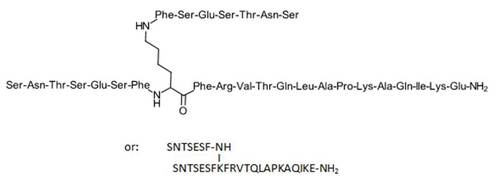
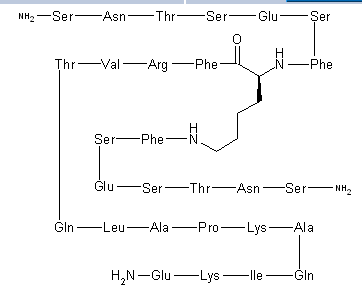
8. SNTSESFK(SNTSESF)FRVTQLAPKAQIKE-NH2 (SEQ ID NO: 49)


Example 2 Synthesis of

Synthesis of Linear Fragment—Fmoc-FRVTQLAPKAQIKE

  • Desiccated CLEAR-Amide resin ((100-200 mesh) 0.4 mmol/g, 0.5 g) was distributed in 2 polyethylene vessels equipped with a polypropylene filter. The linear peptide synthesis on solid phase were carried out automatically, using Symphony parallel synthesizer (PTI) using the synthesis programs mentioned in the table below. Swelling, C-terminal amino acid [Fmoc-Glu(OtBu)-OH] attachment and capping of the peptidyl resin was carried out as per the protocol in Table I. Subsequent amino acid coupling was carried out as mentioned in Table II. The amino acids used in the synthesis were Fmoc Phe-OH, Fmoc-Arg(Pbf)-OH, Fmoc-Val-OH, Fmoc-Thr(OtBu)-OH, Fmoc-Gln(Trt)-OH, Fmoc-Lys(Boc)-OH, Fmoc-Leu-OH, Fmoc-Ala-OH, Fmoc-Pro-OH, Fmoc-Ile-OH. After the completion of Fmoc-Phe-OH coupling the resin was taken out form peptide synthesiser and manual coupling was carried out as follows
  • Fmoc-Phe-OH peptidyl resin from automated synthesiser was pooled in to a glass vessel with frit. The Fmoc group of the peptidyl resin was deprotected by treating it twice with 20% (v/v) piperidine/DMF solution for 5 and 15 min (10 m L). The resin was washed with DMF (6×15 m L), DCM (6×15 m L) and DMF (6×15 m L). Kaiser test on peptide resin aliquot upon completion of Fmoc-deprotection was positive. Fmoc-Lys (Fmoc)-OH (0.48 g; 4 equiv. 0.8 m mol) in dry DMF was added to the deprotected resin and coupling was initiated with DIC (0.15 m L; 5 equiv, 1 m mol) and HOBT (0.08 g; 5 equiv, 0.6 m mol) in DMF. The concentration of each reactant in the reaction mixture was approximately 0.4 M. The mixture was rotated on a rotor at room temperature for 3 h. Resin was filtered and washed with DMF (6×15 mL), DCM (6×15 mL) and DMF (6×15 mL). Kaiser test on peptide resin aliquot upon completion of coupling was negative. The Fmoc group on the peptidyl resin is deprotected by treating it twice with 20% (v/v) piperidine/DMF solution for 5 and 15 min (15 mL). The resin was washed with DMF (6×15 mL), DCM (6×15 mL) and DMF (6×15 mL). Kaiser test on peptide resin aliquot upon completion of Fmoc-deprotection was positive. After the deprotection of Fmoc group on Fmoc-Lys(Fmoc)-attached peptidyl resin the peptide chain growth was carried out from both the free amino terminus suing 8 equivalent excess of amino acid (1.6 m mol, 8 equivalent excess of HOBt (0.22 g, 1.6 m mol) and 10 equivalent excess of DIC (0.32 m L, 2 m mol) relative to resin loading. The coupling was carried out at room temperature for 3 h. The amino acids coupled to the peptidyl resin were; Fmoc-Phe-OH (0.62 g; 8 equiv, 1.6 m mol), Fmoc-Ser (OtBu)-OH (0.62 g; 8 equiv, 1.6 m mol), Fmoc-Glu (OtBu)-OH (0.68 g; 8 equiv, 1.6 m mol), Fmoc-Ser (OtBu)-OH (0.62 g; 8 equiv, 1.6 m mol), Fmoc-Thr (OtBu)-OH (0.64 g; 8 equiv, 1.6 m mol), Fmoc-Asn (Trt)-OH (0.95 g; 8 equiv, 1.6 m mol) and N-terminus amino acids as Boc-Ser (OtBu)-OH (0.41 g; 8 equiv, 1.6 m mol) The peptidyl resin was cleaved as mentioned in procedure for cleavage using cleavage cocktail A to yield (565 mg), 70% yield. The crude material was purified by preparative HPLC on Zorbax Eclipse XDB-C18 column (9.4 mm×250 mm, 5 μm) with buffer A: 0.1% TFA/Water, buffer B: Acetonitrile. The peptide was eluted by gradient elution 0-5 min=5-10% buffer B, 10-20 min=29% buffer B with a flow rate of 7 mL/min. HPLC: (method 1): RT-12 min (96%); LCMS Calculated Mass: 3261.62, Observed Mass: 1631.6 [M/2+H]+; 1088 [M/3+H]+); 816.2[M/4+H]+;

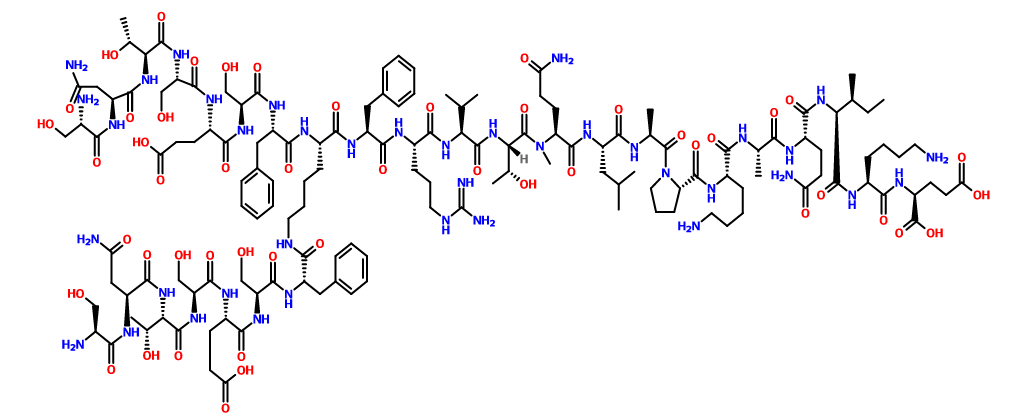
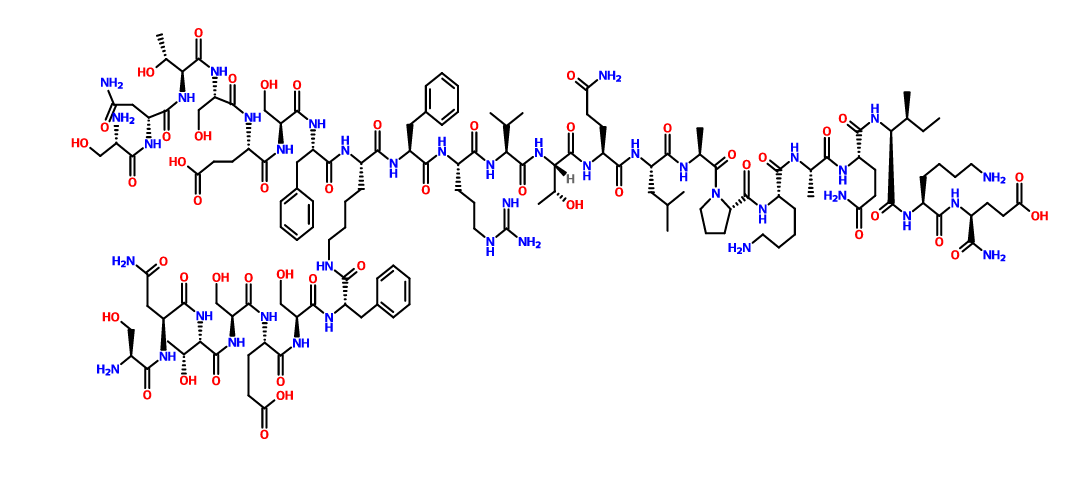
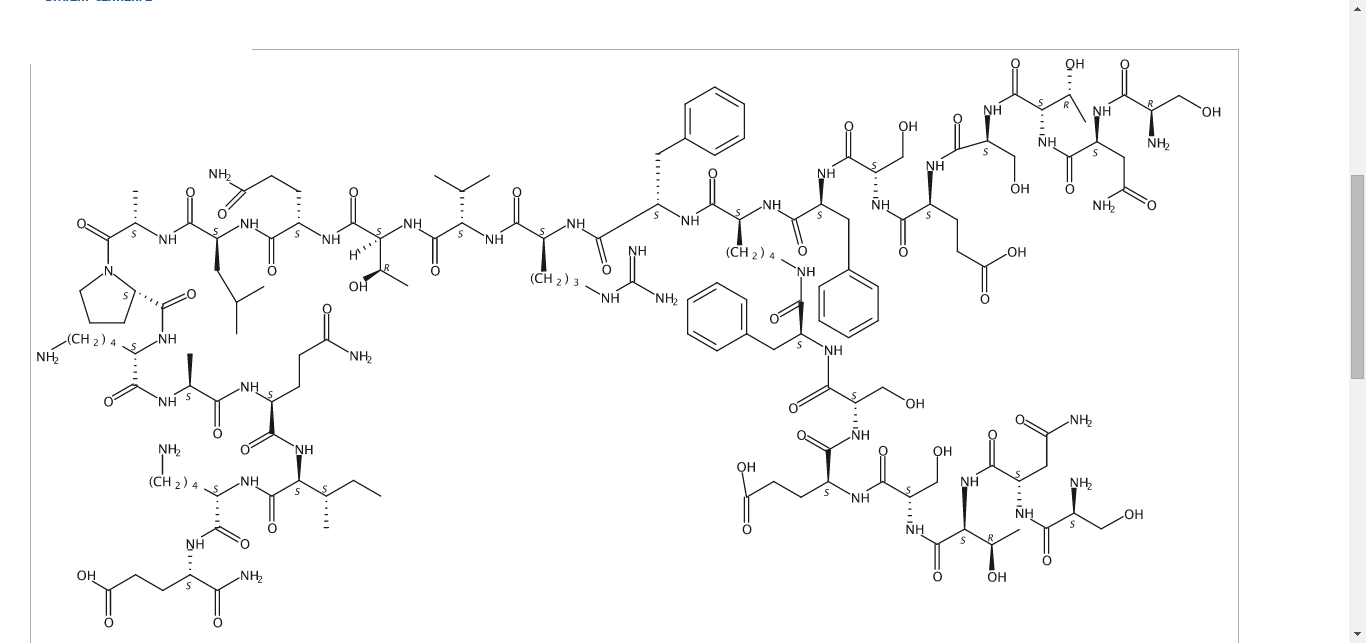
STRUCTURE , READER DISCRETION IS NEEDED


aunf12

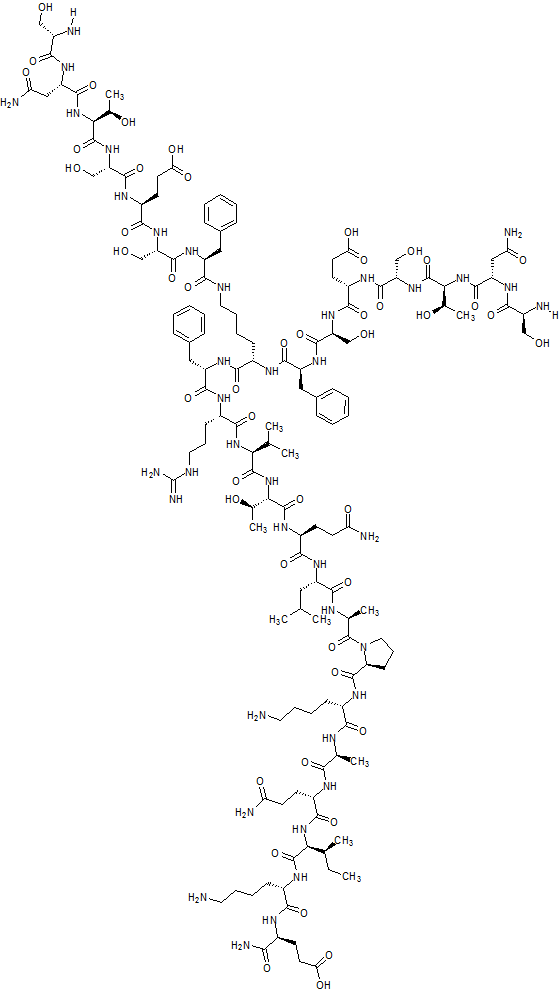
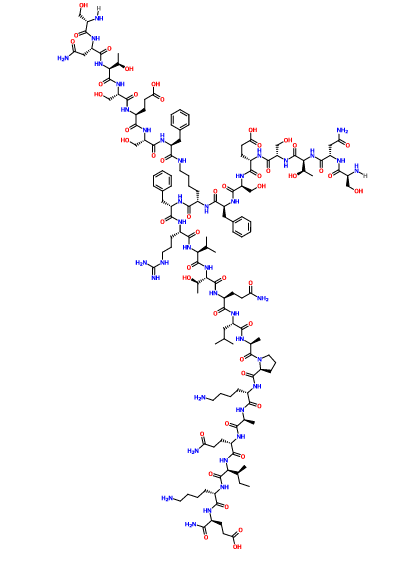
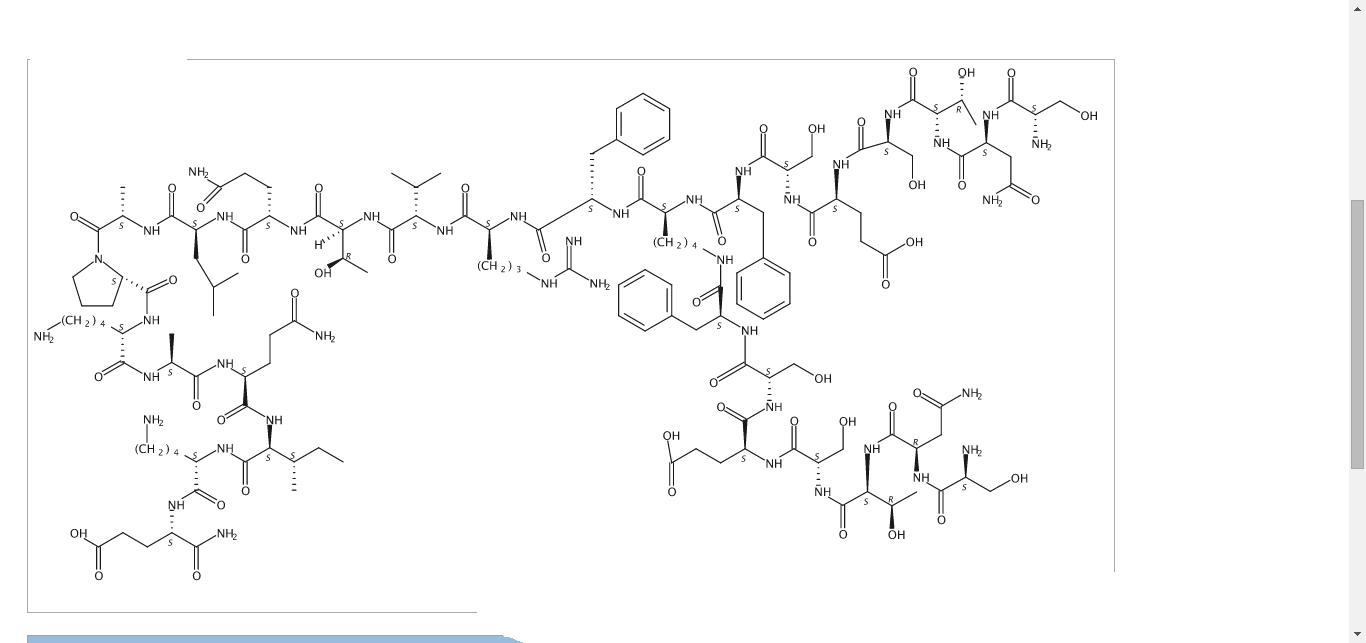
N2,N6-Bis(L-seryl-L-asparaginyl-L-threonyl-L-seryl-L-alpha-glutamyl-L-seryl-L-phenylalanyl)-L-lysyl-L-phenylalanyl-L-arginyl-L-valyl-L-threonyl-L-glutaminyl-L-leucyl-L-alanyl-L-prolyl-L-lysyl-L-alanyl-L-glutaminyl-L-isoleucyl-L-lysyl-L-alpha-glutamine

C142 H226 N40 O48, 3261.553

 CAS 1353563-85-5,
L-​α-​Glutamine, N2,​N6– ​bis(L-​seryl-​L-​asparaginyl-​L-​threonyl-​L-​seryl-​L-​α-​glutamyl-​L- ​seryl-​L-​phenylalanyl)​-​L-​lysyl-​L-​phenylalanyl-​L-​arginyl-​L-​ valyl-​L-​threonyl-​L-​glutaminyl-​L-​leucyl-​L-​alanyl-​L-​prolyl-​L-​ lysyl-​L-​alanyl-​L-​glutaminyl-​L-​isoleucyl-​L-​lysyl-

aunf12

aunf12

SEE ALSO

CAS 1353564-61-0,
L-​α-​Glutamine, N2,​N6– ​bis(D-​seryl-​L-​asparaginyl-​L-​threonyl-​L-​seryl-​L-​α-​glutamyl-​L- ​seryl-​L-​phenylalanyl)​-​L-​lysyl-​L-​phenylalanyl-​L-​arginyl-​L-​ valyl-​L-​threonyl-​L-​glutaminyl-​L-​leucyl-​L-​alanyl-​L-​prolyl-​L-​ lysyl-​L-​alanyl-​L-​glutaminyl-​L-​isoleucyl-​L-​lysyl-
 CAS 1353563-91-3
D-​α-​Glutamine, N2,​N6– ​bis(D-​seryl-​D-​asparaginyl-​D-​threonyl-​D-​seryl-​D-​α-​glutamyl-​D- ​seryl-​D-​phenylalanyl)​-​D-​lysyl-​D-​phenylalanyl-​D-​arginyl-​D-​ valyl-​D-​threonyl-​D-​glutaminyl-​D-​leucyl-​D-​alanyl-​D-​prolyl-​D-​ lysyl-​D-​alanyl-​D-​glutaminyl-​D-​isoleucyl-​D-​lysyl-

US 2015087581

Compound 8 (SEQ ID NO: 49) SNTSESFK(SNTSESF)FRVTQLAPKAQIKE-NH2Image loading...

Example 2Synthesis of Sequence Shown in SEQ ID NO: 49

Image loading...

Synthesis of Linear Fragment—Fmoc-FRVTQLAPKAQIKE

Desiccated CLEAR-Amide resin ((100-200 mesh) 0.4 mmol/g, 0.5 g) was distributed in 2 polyethylene vessels equipped with a polypropylene filter. The linear peptide synthesis on solid phase were carried out automatically, using Symphony parallel synthesizer (PTI) using the synthesis programs mentioned in the table below. Swelling, C-terminal amino acid [Fmoc-Glu(OtBu)-OH] attachment and capping of the peptidyl resin was carried out as per the protocol in Table I. Subsequent amino acid coupling was carried out as mentioned in Table II. The amino acids used in the synthesis were Fmoc Phe-OH, Fmoc-Arg(Pbf)-OH, Fmoc-Val-OH, Fmoc-Thr(OtBu)-OH, Fmoc-Gln(Trt)-OH, Fmoc-Lys(Boc)-OH, Fmoc-Leu-OH, Fmoc-Ala-OH, Fmoc-Pro-OH, Fmoc-Ile-OH. After the completion of Fmoc-Phe-OH coupling the resin was taken out form peptide synthesiser and manual coupling was carried out as follows.

Fmoc-Phe-OH peptidyl resin from automated synthesiser was pooled in to a glass vessel with frit. The Fmoc group of the peptidyl resin was deprotected by treating it twice with 20% (v/v) piperidine/DMF solution for 5 and 15 min (10 mL). The resin was washed with DMF (6×15 mL), DCM (6×15 mL) and DMF (6×15 mL). Kaiser test on peptide resin aliquot upon completion of Fmoc-deprotection was positive.

Fmoc-Lys (Fmoc)-OH (0.48 g; 4 equiv. 0.8 mmol) in dry DMF was added to the deprotected resin and coupling was initiated with DIC (0.15 mL; 5 equiv, 1 mmol) and HOBT (0.08 g; 5 equiv, 0.6 mmol) in DMF. The concentration of each reactant in the reaction mixture was approximately 0.4 M. The mixture was rotated on a rotor at room temperature for 3 h. Resin was filtered and washed with DMF (6×15 mL), DCM (6×15 mL) and DMF (6×15 mL). Kaiser test on peptide resin aliquot upon completion of coupling was negative. The Fmoc group on the peptidyl resin is deprotected by treating it twice with 20% (v/v) piperidine/DMF solution for 5 and 15 min (15 mL). The resin was washed with DMF (6×15 mL), DCM (6×15 mL) and DMF (6×15 mL). Kaiser test on peptide resin aliquot upon completion of Fmoc-deprotection was positive.

After the deprotection of Fmoc group on Fmoc-Lys(Fmoc)-attached peptidyl resin the peptide chain growth was carried out from both the free amino terminus suing 8 equivalent excess of amino acid (1.6 mmol, 8 equivalent excess of HOBt (0.22 g, 1.6 mmol) and 10 equivalent excess of DIC (0.32 mL, 2 mmol) relative to resin loading. The coupling was carried out at room temperature for 3 h. The amino acids coupled to the peptidyl resin were; Fmoc-Phe-OH (0.62 g; 8 equiv, 1.6 mmol), Fmoc-Ser (OtBu)-OH (0.62 g; 8 equiv, 1.6 mmol), Fmoc-Glu (OtBu)-OH (0.68 g; 8 equiv, 1.6 mmol), Fmoc-Ser (OtBu)-OH (0.62 g; 8 equiv, 1.6 mmol), Fmoc-Thr (OtBu)-OH (0.64 g; 8 equiv, 1.6 mmol), Fmoc-Asn (Trt)-OH (0.95 g; 8 equiv, 1.6 m mol) and N-terminus amino acids as Boc-Ser (OtBu)-OH (0.41 g; 8 equiv, 1.6 mmol) The peptidyl resin was cleaved as mentioned in procedure for cleavage using cleavage cocktail A to yield (565 mg), 70% yield. The crude material was purified by preparative HPLC on Zorbax Eclipse XDB-C18 column (9.4 mm×250 mm, 5 μm) with buffer A: 0.1% TFA/Water, buffer B:Acetonitrile. The peptide was eluted by gradient elution 0-5 min=5-10% buffer B, 10-20 min=29% buffer B with a flow rate of 7 mL/min. HPLC: (method 1): RT—12 min (96%); LCMS Calculated Mass: 3261.62, Observed Mass: 1631.6 [M/2+H]+; 1088 [M/3+H]+;); 816.2[M/4+H]+.

SMILES

O=C(N[C@@H](CCCCNC(=O)[C@H](Cc1ccccc1)NC(=O)[C@H](CO)NC(=O)[C@H](CCC(=O)O)NC(=O)[C@H](CO)NC(=O)[C@@H](NC(=O)[C@H](CC(N)=O)NC(=O)[C@H](CO)N)[C@@H](C)O)C(=O)N[C@@H](Cc2ccccc2)C(=O)N[C@@H](CCCNC(=N)N)C(=O)N[C@@H](C(C)C)C(=O)N[C@@H]([C@@H](C)O)C(=O)N[C@@H](CCC(N)=O)C(=O)N[C@@H](CC(C)C)C(=O)N[C@@H](C)C(=O)N3CCC[C@H]3C(=O)N[C@@H](CCCCN)C(=O)N[C@@H](C)C(=O)N[C@@H](CCC(N)=O)C(=O)N[C@@H]([C@@H](C)CC)C(=O)N[C@@H](CCCCN)C(=O)N[C@@H](CCC(=O)O)C(N)=O)[C@H](Cc4ccccc4)NC(=O)[C@H](CO)NC(=O)[C@H](CCC(=O)O)NC(=O)[C@H](CO)NC(=O)[C@@H](NC(=O)[C@H](CC(N)=O)NC(=O)[C@H](CO)N)[C@@H](C)O

NEXT………..

CAS 1353564-65-4
C142 H226 N40 O48
L-​α-​Glutamine, L-​seryl-​L-​asparaginyl-​L-​threonyl-​L-​seryl-​L-​α-​glutamyl-​L-​seryl-​L-​phenylalanyl-​N6– ​(L-​seryl-​D-​asparaginyl-​L-​threonyl-​L-​seryl-​L-​α-​glutamyl-​L-​ seryl-​L-​phenylalanyl)​-​L-​lysyl-​L-​phenylalanyl-​L-​arginyl-​L-​ valyl-​L-​threonyl-​L-​glutaminyl-​L-​leucyl-​L-​alanyl-​L-​prolyl-​L-​ lysyl-​L-​alanyl-​L-​glutaminyl-​L-​isoleucyl-​L-​lysyl-
Molecular Weight, 3261.55

aunf12

NEXT……….

CAS 1353564-31-4, C142 H226 N40 O48
L-​α-​Glutamine, L-​seryl-​L-​asparaginyl-​L-​threonyl-​L-​seryl-​L-​α-​glutamyl-​L-​seryl-​L-​phenylalanyl-​N6– ​(D-​seryl-​D-​asparaginyl-​D-​threonyl-​D-​seryl-​D-​α-​glutamyl-​D-​ seryl-​D-​phenylalanyl)​-​L-​lysyl-​L-​phenylalanyl-​L-​arginyl-​L-​ valyl-​L-​threonyl-​L-​glutaminyl-​L-​leucyl-​L-​alanyl-​L-​prolyl-​L-​ lysyl-​L-​alanyl-​L-​glutaminyl-​L-​isoleucyl-​L-​lysyl-
USE ALL YOUR DISCRETION……………


Clips

Aurigene and Pierre Fabre Pharmaceuticals Announce a Licensing Agreement for a New Cancer Therapeutic in Immuno-oncology: AUNP12, an Immune Checkpoint Modulator Targeting the PD-1 Pathway

Pierre Fabre are thus reinforcing their oncology portfolio which already enjoys a combination of chemotherapies, monoclonal antibodies and immuno-conjugates assets at various development phases

Feb 13, 2014, 03:14 ET from Aurigene and Pierre Fabre Pharmaceuticals

CASTRES, France and BANGALORE, India, February 13, 2014 /PRNewswire/ —

Pierre Fabre, the third largest French pharmaceutical company, and Aurigene, a leading biotech company based in India, today announced that the two companies have entered into a collaborative license, development and commercialization agreement granting Pierre Fabre global Worldwide rights (excluding India) to a new immune checkpoint modulator, AUNP-12.

AUNP-12 offers a breakthrough mechanism of action in the PD-1 pathway compared to other molecules currently in development in the highly promising immune therapy cancer space. AUNP-12 is the only peptide therapeutic in this pathway and could offer more effective and safer combination opportunities with emerging and established treatment regimens.  AUNP-12 will be in development for numerous cancer indications.

Under the terms of this agreement, Aurigene will receive an upfront payment from Pierre Fabre. Aurigene will also receive additional milestone payments based upon the continued development, regulatory progresses and commercialization of AUNP-12.

“We are pleased that Pierre Fabre see the PD-1 program as a strategic asset in their portfolio. Overall, the deal structure, in line with the financial terms that have been seen in this space, demonstrate the importance that Pierre Fabre attach to the program,” said CSN Murthy, CEO, Aurigene.

“The plans that Pierre Fabre have detailed for the development of this differentiated asset highlight the long-term opportunities for this novel cancer therapeutic,” added Murali Ramachandra, Sr VP, Research, Aurigene.

“This agreement, in the field of oncology, is fully consistent with our vision to build Pierre Fabre’s future in prescription drugs, from a combination of cutting-edge internal R&D capabilities and license partnerships with innovative biotech companies like Aurigene,” stated Bertrand Parmentier, CEO, Pierre Fabre.

“With this deal, Pierre-Fabre Pharmaceuticals are reinforcing their portfolio of oncology assets and capitalizing on their proven capabilities in developing biological compounds such as monoclonal antibodies and immuno-conjugates. We have been impressed by the science at Aurigene and encouraged by the differentiated profile reported for AUNP-12,” added Frédéric Duchesne, President, Pierre Fabre Pharmaceuticals.

About immuno-oncology

Immuno-oncology is an emerging field in cancer therapy, where the body’s own immune system is harnessed to fight against cancer. This approach of targeting cancer through immune response has had a breakthrough when robust and sustained responses were obtained only upon blocking the immune checkpoint targets (such as PD-1 and CTLA4). Recent successes in clinical trials performed with such therapies suggest that immunotherapy should be considered alongside surgery, chemotherapy, radiotherapy and targeted therapy as the fifth cornerstone of cancer treatment.

PD-1 (Programmed cell Death 1) is a receptor that negatively regulates T-cell activation by interacting with specific ligands PD-L1 and PD-L2. Tumor cells express these ligands and thereby escape from the action of T-cells.

About AUNP-12

AUNP-12  is a branched 29-amino acid peptide sequence engineered from the PD-L1/ L2 binding domain of PD-1 It blocks the PD-1/PD-L1, PD-1/PD-L2 and PD-L1/CD80 pathways. AUNP-12 is highly effective in antagonizing PD-1 signaling, with desirable in vivo exposure upon subcutaneous dosing. It inhibits tumor growth and metastasis in preclinical models of cancer and is well tolerated with no overt toxicity at any of the tested doses.

About Aurigene

Aurigene is a biotech focused on development of innovative small molecule and peptide therapeutics for Oncology and Inflammation; key focus areas for Aurigene are Immuno-oncology, Epigenetics and the Th17 pathway. Aurigene’s PD-1 program is the first of several peptide-based immune checkpoint programs that are at different stages of Discovery.

Aurigene has partnered with several big pharma and mid-pharma companies in the US and Europe, and has delivered multiple clinical compounds through these partnerships. With over 500 scientists, Aurigene has collaborated with 6 of the top 10 pharma companies.

Aurigene’s pre-clinical pipeline includes (1) Selective and pan-BET Bromodomain inhibitors (2) RoR gamma reverse agonists (3) EZH2 inhibitors (4) NAMPT inhibitors and (5) Several immune check point peptide inhibitor programs.

For more information:  http://aurigene.com/

About Pierre Fabre:

Pierre Fabre is a privately-owned health care company created in 1961 by Mr Pierre Fabre. It is the second largest French independent pharmaceutical group with 2013 sales amounting to about €2 billion (yet to be audited) across 140 countries. The company is structured around two divisions: Pharmaceuticals (Prescription drugs, OTC, Oral care) and Dermo-cosmetics. Prescription drugs are organized around four main franchises: oncology, dermatology, women’s health and neuropsychiatry. Pierre Fabre employs some 10 000 people worldwide, including 1 300 in R&D. The company allocates about 20% of its pharmaceuticals sales to R&D and relies on more than 25 years of experience in the discovery, development and global commercialization of innovative drugs in oncology. Pierre Fabre has a long commitment to oncology and immunology with major R&D centers in France: the Pierre Fabre immunology Centre (CIPF) in Saint Julien en Genevois and the Pierre Fabre Research Institute (IRPF) located on the Toulouse-Oncopole campus  which has been officially recognized as a National Center of Excellence for cancer research since 2012.


REFERENCES

http://www.differding.com/data/AUNP_12_A_novel_peptide_therapeutic_targeting_PD_1_immune_checkpoint_pathway_for_cancer_immunotherapy.pdf

http://slideplayer.com/slide/5760496/

P. Sasikumar, R. Shrimali, S. Adurthi, R. Ramachandra, L. Satyam, A. Dhudashiya, D. Samiulla, K. B. Sunilkumar and M. Ramachandra, “A novel peptide therapeutic targeting PD1 immune checkpoint with equipotent antagonism of both ligands and a potential for better management of immune-related adverse events,” Journal for ImmunoTherapy of Cancer, vol. 1, no. Suppl 1,  O24, 2013.

P. G. N. Sasikumar, M. Ramachandra, S. K. Vadlamani, K. R. Vemula, L. K. Satyam, K. Subbarao, K. R. Shrimali and S. Kandepudu (Aurigene Discovery Technologies Ltd, Bangalore, India), “Immunosuppression modulating compounds”, US Patent application US 2011/0318373, 29 Dec 2011.

P. G. Sasikumar, L. K. Satyam, R. K. Shrimali, K. Subbarao, R. Ramachandra, S. Vadlamani, A. Reddy, A. Kumar, A. Srinivas, S. Reddy, S. Gopinath, D. S. Samiulla and M. Ramachandra, “Demonstration of anti-tumor efficacy in multiple preclinical cancer models using a novel peptide inhibitor (Aurigene-012) of the PD1 signaling pathway,” Cancer Research, vol. 72, no. 8 Suppl. 1, Abstract 2850, 2012.

P. G. N. Sasikumar, M. Ramachandra, S. K. Vadlamani, K. R. Shrimali and K. Subbarao, “Therapeutic compounds for immunomodulation” (Aurigene Discovery Technologies Ltd, Bangalore, India), PCT Patent Application WO 2012/168944, 13 Dec 2012.

P. G. N. Sasikumar and M. Ramachandra, “Immunomodulating cyclic compounds from the BC loop of human PD1” (Aurigene Discovery Technologies Ltd, Bangalore, India), PCT Patent Application WO/2013/144704, 3 Oct 2013.

P. G. N. Sasikumar, M. Ramachandra and S. S. S. Naremaddepalli, “Peptidomimetic compounds as immunomodulators” (Aurigene Discovery Technologies Ltd, Bangalore, India), US Patent Application US 2013/0237580, 12 Sep 2013.

A. H. Sharpe, M. J. Butte and S. Oyama (Harvard College), “Modulators of immunoinhibitory receptor PD-1, and methods of use thereof”, PCT Patent Application WO/2011/082400, 7 Jul 2011.

M. Cordingley, “Battle of PD-1 blockade is on”, February 7, 2014 : http://discoveryview.ca/battle-of-pd-1-blockade-is-on/ [Accessed 25 February 2014].

Mr. CSN Murthy

Chief Executive Officer, Aurigene Discovery Technologies Ltd.

Mr. CSN Murthy began his career with ICICI Ventures, India’s first Venture Capital fund. He was subsequently a management consultant to the Pharma and Chemical sectors. Later, he worked in the Business Development and General Management functions in Pharmaceutical companies, including as the Chief Operating Officer of Gland Pharma Ltd. CSN holds a Bachelors degree in Chemical Engineering from the Indian Institute of Technology (IIT), Madras and an MBA from the Indian Institute of Management (IIM), Bangalore.


Dr.Thomas Antony

Associate Research Director, Aurigene Discovery Technologies Ltd.

Dr.Thomas Antony did his Ph.D in Biophysical Chemistry from University of Delhi and had his postdoctoral training at Jawaharlal Nehru University- Delhi, The University of Medicine and Dentistry of New Jersey- USA, and Max Planck Institute for Biophysical Chemistry- Germany. He is the recipient of many research fellowships, including Max Planck Fellowship and Humboldt Research Fellowship.  He has more than 20 years of research experience. Dr.Thomas has published 24 research papers and he is the co-author of three international patents. His core area of expertise is in assay development and screening. At Aurigene, Dr.Thomas leads the Biochemistry and Structural Biology Divisions.  He was the coordinator of Aurigene-University of Malaya collaboration programs.


Dr. Kavitha Nellore

Associate Research Director, Aurigene Discovery Technologies Ltd.

Dr. Kavitha Nellore obtained her PhD in Bioengineering from Pennsylvania State University, USA.  During this time, she was a fellow of the Huck’s Institute of Life Sciences specializing in Biomolecular Transport Dynamics. She has been at Aurigene for more than a decade, and is currently leading a group of cell biologists at both Bangalore and Kuala Lumpur. At Aurigene, she leads multiple drug discovery programs in the therapeutic areas of inflammation, oncology and immuno-oncology. She plays a key role in target selection as well as validation efforts to add to Aurigene’s pipeline. Kavitha also played a key role in coordinating the Aurigene-University of Malaya collaboration.


/////////AUNP-12,  Aurigene,  Pierre Fabre Pharmaceuticals, Licensing Agreement,  New Cancer Therapeutic,  Immuno-oncology, AUNP 12, Immune Checkpoint Modulator Targeting the PD-1 Pathway, PEPTIDES


FEW MORE COMPDS FROM PATENT

C142 H225 N39 O49

L-​Glutamic acid, N2,​N6-​bis(L-​seryl-​L-​asparaginyl-​L-​threonyl-​L-​seryl-​L-​α-​glutamyl-​L-​seryl-​L-​phenylalanyl)​-​L-​lysyl-​L-​phenylalanyl-​L-​arginyl-​L-​valyl-​L-​threonyl-​L-​glutaminyl-​L-​leucyl-​L-​alanyl-​L-​prolyl-​L-​lysyl-​L-​alanyl-​L-​glutaminyl-​L-​isoleucyl-​L-​lysyl-

3262.54, Sequence Length: 29, 22, 7

multichain; modified (modifications unspecified)

SNTSESFK FRVTQ LAPKAQIKE,  1353564-66-5

SNTSESF

C142 H225 N39 O49

L-​Glutamic acid, N2,​N6-​bis(L-​seryl-​L-​asparaginyl-​L-​threonyl-​L-​seryl-​L-​α-​glutamyl-​L-​seryl-​L-​phenylalanyl)​-​L-​lysyl-​L-​phenylalanyl-​L-​arginyl-​L-​valyl-​L-​threonyl-​L-​glutaminyl-​L-​leucyl-​L-​alanyl-​L-​prolyl-​L-​lysyl-​L-​alanyl-​L-​glutaminyl-​L-​isoleucyl-​L-​lysyl-

3262.54

NEXT……………………

SNTSESFK FRVTQ LAPKAQI KE

SNTSESF

CAS  1353564-64-3

C142 H226 N40 O48

L-​α-​Glutamine, L-​seryl-​D-​asparaginyl-​L-​threonyl-​L-​seryl-​L-​α-​glutamyl-​L-​seryl-​L-​phenylalanyl-​N6-​(L-​seryl-​L-​asparaginyl-​L-​threonyl-​L-​seryl-​L-​α-​glutamyl-​L-​seryl-​L-​phenylalanyl)​-​L-​lysyl-​L-​phenylalanyl-​L-​arginyl-​L-​valyl-​L-​threonyl-​L-​glutaminyl-​L-​leucyl-​L-​alanyl-​L-​prolyl-​L-​lysyl-​L-​alanyl-​L-​glutaminyl-​L-​isoleucyl-​L-​lysyl-

MW 3261.55, Sequence Length: 29, 22, 7

multichain; modified

smiles

O=C(N[C@@H](CCCCNC(=O)[C@H](Cc1ccccc1)NC(=O)[C@H](CO)NC(=O)[C@H](CCC(=O)O)NC(=O)[C@H](CO)NC(=O)[C@@H](NC(=O)[C@H](CC(N)=O)NC(=O)[C@@H](N)CO)[C@@H](C)O)C(=O)N[C@@H](Cc2ccccc2)C(=O)N[C@@H](CCCNC(=N)N)C(=O)N[C@@H](C(C)C)C(=O)N[C@@H]([C@@H](C)O)C(=O)N[C@@H](CCC(N)=O)C(=O)N[C@@H](CC(C)C)C(=O)N[C@@H](C)C(=O)N3CCC[C@H]3C(=O)N[C@@H](CCCCN)C(=O)N[C@@H](C)C(=O)N[C@@H](CCC(N)=O)C(=O)N[C@@H]([C@@H](C)CC)C(=O)N[C@@H](CCCCN)C(=O)N[C@@H](CCC(=O)O)C(N)=O)[C@H](Cc4ccccc4)NC(=O)[C@H](CO)NC(=O)[C@H](CCC(=O)O)NC(=O)[C@H](CO)NC(=O)[C@@H](NC(=O)[C@@H](CC(N)=O)NC(=O)[C@@H](N)CO)[C@@H](C)O
NEXT……………..

CAS  1353564-60-9

C142 H226 N40 O48

L-​α-​Glutamine, D-​seryl-​L-​asparaginyl-​L-​threonyl-​L-​seryl-​L-​α-​glutamyl-​L-​seryl-​L-​phenylalanyl-​N6-​(L-​seryl-​L-​asparaginyl-​L-​threonyl-​L-​seryl-​L-​α-​glutamyl-​L-​seryl-​L-​phenylalanyl)​-​L-​lysyl-​L-​phenylalanyl-​L-​arginyl-​L-​valyl-​L-​threonyl-​L-​glutaminyl-​L-​leucyl-​L-​alanyl-​L-​prolyl-​L-​lysyl-​L-​alanyl-​L-​glutaminyl-​L-​isoleucyl-​L-​lysyl-

3261.55

Sequence Length: 29, 22, 7multichain; modified

SNTSESFKFR VTQLAPKAQI KE

NRXT…………………….

. CAS  1353564-61-0

C142 H226 N40 O48

L-​α-​Glutamine, N2,​N6-​bis(D-​seryl-​L-​asparaginyl-​L-​threonyl-​L-​seryl-​L-​α-​glutamyl-​L-​seryl-​L-​phenylalanyl)​-​L-​lysyl-​L-​phenylalanyl-​L-​arginyl-​L-​valyl-​L-​threonyl-​L-​glutaminyl-​L-​leucyl-​L-​alanyl-​L-​prolyl-​L-​lysyl-​L-​alanyl-​L-​glutaminyl-​L-​isoleucyl-​L-​lysyl-

3261.55

Sequence Length: 29, 22, 7multichain; modified

SNTSESFK FRVTQ LAPKAQI KE
SNTSESF

/////////////

Tripeptide Glycyl-L-Prolyl-L-Glutamate (Gly-Pro-Glu or GPE)


Gly-Pro-Glu

Synonym: GPE, Glycyl-prolyl-glutamic acid, (1-3)IGF-1

Pfizer (Originator)
Neuren Pharmaceuticals (Originator)

Glypromate; glycine-proline-glutamate (neuroprotectant), Neuren

  • CAS Number 32302-76-4
  • Empirical Formula C12H19N3O6
  • Molecular Weight 301.30
  • Psychiatric Disorders (Not Specified)
    Neurologic Drugs (Miscellaneous)
    Cognition Disorders, Treatment of
    Antiepileptic Drugs
    Antidepressants Biochem/physiol Actions

Gly-Pro-Glu is a neuroprotective compound and the N-terminal tripeptide of IGF-1. Gly-Pro-Glu is neuroprotective after central administration in animal models of neurodegenerative processes, such as Huntington’s, Parkinson’s, Alzheimer’s diseases, and varies acute brain injury animal models. The neuroprotective activity is not related to its affinity to glutamate receptor. Findings indicate that GPE mimics insulin-like growth factor I effects on the somatostatin system through a mechanism independent of β-amyloid clearance that involves modulation of calcium and glycogen synthase kinase 3β signaling.

GPE is a naturally occurring peptide fragment which had been in phase III clinical trials at Neuren Pharmaceuticals for use as prophylactic neuroprotection for patients undergoing coronary artery bypass graft (CABG) and valvuloplasty surgery. Although clinical evaluation in Australia continues, phase III trials evaluating the compound in the U.S. were discontinued based on negative results. The compound is found in normal brain tissue and, when injected intravenously, has been shown to act by multiple pathways to protect brain tissue from injury. The drug was originally developed by Pfizer, but rights were transferred to Neuren pursuant to a proprietary agreement between the companies.

When amino acids join together (forming short groups called polypeptides, or much longer chains called proteins) the amine group of one amino acid joins with the carboxyl group of the next, making a peptide bond. These bonds don’t ionise at different pHs, but can be hydrolised — broken — reforming the amino acids. GPE is formed from the amino acids glycine, proline and glutamic acid:

This tripeptide has 3 pH-sensitive groups, each with its own pKa. What the university chemists needed to do was work out what form GPE is in when it is active in the brain, what parts of the molecule are critical to its effectiveness, and how to ‘tweak’ the molecule (by changing the side chains) so that it will remain in the brain for longer than the naturally-occurring substance.   They also needed to make sure the final compound passes through the blood-brain barrier (that prevents most substances in the blood from entering and affecting the brain). If possible, they also wanted a compound that could be taken in pill form without being broken down in the stomach. It was also essential that the compound was safe for people to take!

Neuren Pharmaceuticals

After initial work on GPE at the university, the research was passed to a spin-off research group called Neuren Pharmaceuticals Ltd, which takes compounds discovered by the University of Auckland and develops them into medicines. Neuren developed GPE intoGlypromate® and are working with researchers in the US (including the US Military, who have a keen interest in a medicine that will reduce brain damage after head injuries) to test the compound on patients. There is considerable interest in Glypromate® world-wide, because at present there is nothing that reduces cell death after brain injuries. The chances of winning a race are pretty high when you’re the only competitor!Glypromate® is being tested on heart-bypass patients because up to 70% of bypass patients are affected mentally after their surgery. It’s thought that tiny clots form after the heart is restarted, and that these travel to the brain and cause mini-strokes. Unlike naturally-occurring strokes, or the brain damage caused by accident or war, the bypass surgery is planned, so before and after tests can be done on the patients to see exactly what effect the treatment has. Early results look very promising.

Glypromate is just one of the compounds Neuren is working on. Others may develop into treatments for Multiple Sclerosis, Parkinson’s Disease or Alzheimer’s Disease as well as various kinds of cancer. The company’s links with overseas research groups mean that compounds developed in New Zealand are able to be tested in the US and gain the FDA approval which will allow them to be used in most countries in the world.

The tripeptide Glycyl-L-Prolyl-L-Glutamate (Gly-Pro-Glu or GPE) is a naturally occurring peptide, which is proteolytically cleaved from insulin-like growth factor-1 (IGF-1). IGF-1 is a potent neurotrophic factor produced endogenously in damaged regions of the brain. It has been postulated that some of the neuroprotective actions of IGF-1 are mediated by GPE although the precise mechanism of action remains unclear. GPE has a different mode of action to IGF-1 as GPE does not bind to the IGF-1 receptor. Rather, GPE has been shown to bind with low affinity to the N-methyl-D-aspartate (NMDA) receptor and also elicit a biological response via other mechanisms. GPE facilitates the release of dopamine through interaction with the NMDA receptor but GPE stimulated acetylcholine release is via an unknown, non-NMDA pathway.

It has been demonstrated that GPE can act as a neuronal rescue agent following brain injury or disease, including hypoxic-ischemic brain injury, NMDA challenge, chemical toxins and in animal models of Parkinson’s and Alzheimer’s disease. Analogs of GPE are thus of interest in the development of novel pharmaceutical agents for the treatment of central nervous system (CNS) injuries and neurodegenerative disorders among others.

CURRENT STATUS

Neuren Pharmaceuticals was developing Glypromate (glycine-proline glutamate), a naturally occurring small-molecule neuroprotectant derived from IGF-1 which inhibits caspase III dependent apoptosis, for the potential treatment of neurodegenerative diseases by iv infusion. By June 2008, a phase III trial had begun . However, in December 2008, the company discontinued further development of the drug after it failed to show an observable effect [972907]. In November 2005, the company was seeking to outlicense the drug [771417].

Neuren is also investigating the Glypromate analog, NNZ-2566 for similar indications.

In August 2006, Neuren expected Glypromate to be eligible for Orphan Drug status for neurodegenerative diseases and planned to apply for Fast Track status for the drug.

SYDNEY, Australia, Sept. 4 /PRNewswire-FirstCall/ — Neuren Pharmaceuticals today announced that physicians from Madigan Army Medical Center (Madigan) in Tacoma, Washington, will conduct an investigator- initiated Phase 2 trial to determine the safety and efficacy of Glypromate(R) in reducing brain injury caused by out of hospital cardiac arrest. The trial will start in mid-2007 and will be managed by The Henry M. Jackson Foundation for the Advancement of Military Medicine (Jackson Foundation) in consultation with the clinical investigators at Madigan.

The proposed study will be an investigator-initiated study which means that the Investigational New Drug (IND) application will be submitted to the FDA by the Army investigators rather than by Neuren. Neuren will provide the drug product as well as access to preclinical, clinical and regulatory documents related to Glypromate(R). The Company’s only financial commitment will be compensation to the Jackson Foundation for administrative costs incurred in coordinating the study. Neuren will retain all commercial rights to Glypromate(R) in these indications.

Cardiac arrest involves the sudden, complete cessation of heart function and circulation leading rapidly to neurological and other organ system damage. Among patients who survive, the consequences of neurological damage resulting from lack of blood flow and oxygen to the brain represent the primary adverse outcomes. This occurs in up to 80% of survivors and causes cognitive impairment such as occurs in patients undergoing major cardiac surgery, the focus for Neuren’s upcoming Phase 3 study with Glypromate(R). However recovery without residual neurological damage after cardiac arrest is rare.

There are no drugs approved to reduce the neurological damage caused by cardiac arrest. Neuren believes that Glypromate(R) for this indication will be eligible for Orphan Drug designation. Orphan Drug designation provides for a period of market exclusivity following approval as well as possible access to US government grants. In addition, because of the serious nature of neurological impairment resulting from cardiac arrest and the lack of available drug therapy, Neuren intends to apply for Fast Track designation which provides for accelerated clinical development and review.

While the Army’s investigator-initiated trial will focus on out of hospital cardiac arrest, if this trial is successful, Neuren, the Jackson Foundation and the Army investigators are considering additional trials of Glypromate(R) to reduce brain damage resulting from related conditions including in-hospital cardiac arrest and treatment of patients with ventricular fibrillation, the heart rhythm disturbance associated with more than 75% of cardiac arrests.

Under the agreement, the Jackson Foundation will provide support to the Army investigators in clinical trial preparations, protocol development, obtaining human subjects clearance, coordination of patient enrolment, data management and analysis, and preparation of study reports.

Mr David Clarke, CEO of Neuren said: “This is a very important development for Neuren in that it reflects a growing appreciation of the potential for Glypromate(R) to reduce neurological damage. It also, of course, reinforces the value and strength of Neuren’s relationship with the US Army physicians and scientists. Cardiac arrest is a devastating clinical event and one for which a drug to reduce the neurological consequences is clearly needed. The addition of this trial will now give Neuren a very strong and cost effective portfolio of clinical trials in 2007 — a Phase 3 and a Phase 2 for Glypromate(R) and the two Phase 2 trials with NNZ-2566.”

Approximately 300,000 deaths result from cardiac arrest in the US each year, making cardiac arrest one of the leading causes of death. According to the American Heart Association, each year approximately 160,000 people in the US experience sudden cardiac arrest outside of a hospital or in a hospital emergency department.

Neuren estimates that the number of patients in the US that could be treated for out of hospital cardiac arrest and related indications is approximately 400,000 which could represent a potential market of US$800 million.

About Madigan Army Medical Center

Madigan Army Medical Center, located in Tacoma, Washington, is one of the major US Army medical centers, providing clinical care to over 120,000 active, reserve and retired military personnel and dependents. The hospital has a medical staff of more than 1,000 with 200 physicians and nurses in training. Madigan’s Department of Clinical Investigations, which is dedicated to writing, performing, and regulating clinical research, is conducting approximately 200 clinical trials across a wide spectrum of indications from Phase I to IV.

About the Jackson Foundation

The Jackson Foundation is a private, not-for-profit organisation that supports the US military in conducting medical research and clinical trials and has established relationships with more than 160 military medical organisations worldwide. It was founded in 1983, in part, to foster cooperative relationships between the military medical community and the private sector, including pharmaceutical sponsors. The Jackson Foundation manages Phase I – IV clinical trials utilizing an established network of military medical centers across the United States.

About Glypromate(R)

Glypromate(R) is a peptide fragment of IGF-1 and is being developed by Neuren as a potential therapeutic candidate for diseases caused by some forms of chronic or acute brain injury. Glypromate(R) has been shown to act by multiple pathways to protect brain tissue from injury. Neuren has successfully completed a Phase I safety study and a Phase IIa safety and pharmacokinetics study and plans to initiate a Phase III study in late 2006.

About Neuren Pharmaceuticals

Neuren Pharmaceuticals is a biotechnology company developing novel therapeutics in the fields of brain injury and diseases and metabolic disorders. The Neuren portfolio consists of six product families, targeting markets with large unmet needs and limited competition. Neuren has three lead candidates, Glypromate(R) andNNZ-2566, presently in the clinic in development to treat a range of acute neurological conditions, and NNZ-2591, in preclinical development for Parkinson’s and other chronic conditions. Neuren has commercial and development partnerships with the US ArmyWalter Reed Army Institute of Research, Metabolic Pharmaceuticals,UCLA Medical Center and the National Trauma Research Institute in Melbourne.

For more information, please visit Neuren’s website at http://www.neurenpharma.com

Company David Clarke CEO of Neuren T: 1800 259 181 (Australia) T: +64 9 3 367 7167 ext 82308 (New Zealand) M: +64 21 988 052 Media and investor relations Rebecca Piercy Buchan Consulting T: +61 9827 2800 M: +61 422 916 422

CONTACT: David Clarke, CEO of Neuren, 1-800-259-181(Australia), or
+64-9-3-367-7167 ext 82308 (New Zealand), or +64-21-988-052 (mobile); or
Media and investor relations – Rebecca Piercy of Buchan Consulting,
+61-9827-2800, +61-422-916-422 (mobile)

Web site: http://www.neurenpharma.com/

REFERENCES

1 EP 0366638

2 WO 2005042000

3 WO 2008153929

4 WO 2009033805

5 WO 2009033806

Synthesis off isotopically labelled glycyl-L-prolyl-L-glutamic acid (Glypromate(R)) and derivatives
J Label Compd Radiopharm 2006, 49(6): 571

An efficient fmoc solid-phase synthesis of an amphiphile of the neuroprotective agent glycyl-prolyl-glutamic acid
Synlett (Stuttgart) 2014, 25(15): 2221

Intracellular pathways activated by Insulin-like growth factor 1 and its derivates
40th Annu Meet Soc Neurosci (November 13-17, San Diego) 2010, Abst 167.13

EP2667715A1 * Jan 27, 2012 Dec 4, 2013 Neuren Pharmaceuticals Limited Treatment of autism spectrum disorderes using glycyl-l-2-methylprolyl-l-glutamic acid
EP2667715A4 * Jan 27, 2012 Jul 23, 2014 Neuren Pharmaceuticals Ltd Treatment of autism spectrum disorderes using glycyl-l-2-methylprolyl-l-glutamic acid
US8940732 Jan 15, 2010 Jan 27, 2015 Massachusetts Institute Of Technology Diagnosis of autism spectrum disorders and its treatment with an antagonist or inhibitor of the 5-HT2c receptor signaling pathway
US9212204 Jan 26, 2015 Dec 15, 2015 Neuren Pharmaceuticals Limited
WO2005042000A1 * 22 Oct 2004 12 May 2005 David Charles Batchelor Neuroprotective effects of gly-pro-glu following intravenous infusion
WO2005097161A2 * 30 Mar 2005 20 Oct 2005 Peter D Gluckman Gpe and g-2mepe, caffeine and alkanol for treatment of cns injury
WO2006127702A2 * 23 May 2006 30 Nov 2006 Neuren Pharmaceuticals Ltd Analogs of glycyl-prolyl-glutamate
EP0366638A2 * 24 Oct 1989 2 May 1990 KabiGen AB Neuromodulatory peptide
US20020151522 * 13 Mar 2002 17 Oct 2002 Tajrena Alexi Regulation of weight
Reference
1 * ALONSO DE DIEGO, SERGIO A. ET AL: “New Gly-Pro-Glu (GPE) analogues: Expedite solid-phase synthesis and biological activity” BIOORGANIC & MEDICINAL CHEMISTRY LETTERS, vol. 16, no. 5, 2006, – 1392 page 1396, XP002527092
2 * SARA V R ET AL: “IDENTIFICATION OF GLY-PRO-GLU (GPE), THE AMINOTERMINAL TRIPEPTIDE OF INSULIN-LIKE GROWTH FACTOR 1 WHICH IS TRUNCATED IN BRAIN, AS A NOVEL NEUROACTIVE PEPTIDE” BIOCHEMICAL AND BIOPHYSICAL RESEARCH COMMUNICATIONS, ACADEMIC PRESS INC. ORLANDO, FL, US, vol. 165, no. 2, 15 December 1989 (1989-12-15), pages 766-771, XP000992688 ISSN: 0006-291X

//////Gly-Pro-Glu, GPE, Glycyl-prolyl-glutamic acid,  32302-76-4, Tripeptide,  Glycyl-L-Prolyl-L-Glutamate, Glypromate®, (1-3)IGF-1 , PHASE 3, Glypromate,  glycine-proline-glutamate, neuroprotectant, Neuren

Neuren’s NNZ-2566 shows clinical benefit in Rett syndrome trial

FRAXA Research Foundation Logo

Promising results in Phase 2 clinical trial

by Michael Tranfaglia, MD
FRAXA Medical Director

nnz-2566This isn’t a Fragile X trial, but the Neuren compound, NNZ-2566, that is in trials now for Fragile X has shown significant positive effects in a Phase 2 trial for Rett syndrome.

The results of the trial are interesting, in that improvement was seen a Rett syndrome-specific rating scale compared to placebo, and there was also improvement noted on the CGI-I (Clinical Global Impression of Improvement) and Caregiver Top 3 Concerns. However, there was no effect seen on ABC scores (Aberrant Behavior Checklist) compared to placebo. Many in the Fragile X field have noted the inadequacies of the ABC; indeed, it was never designed or intended to be an outcome measure for clinical trials. In this case, a Rett-specific rating scale called the Motor-Behavior Assessment (MBA) showed a statistically significant and clinically meaningful treatment effect at the highest dose of the Neuren compound compared to placebo.

This is great news for those of us in the Fragile X community for several reasons:

  • It shows that this compound really does something—it seems to have useful properties in actual patients, and that’s not trivial.
  • It demonstrates that disease-specific symptoms can improve significantly on the drug, and that improvement can be measured in a relatively short clinical trial.
  • It shows that a drug can have beneficial effects on core features of a genetically based developmental disorder, even if the more general rating scales (like the ABC) show no change.


This last point is strongly reminiscent of the experience of many families and clinicians in recent Fragile X clinical trials, where the drugs showed no advantage compared to placebo based on rating scales, but genuine improvement was noted in many subjects, with significant deterioration upon discontinuation of the drugs. Thus the calls for improved rating scales which can “capture” these core, disease-specific therapeutic effects. The NeurenFragile X trial is using some Fragile X-specific outcome measures which will hopefully lead to similar positive results.

The fact that this result is good news for Neuren also means that the company should remain financially viable for longer, so that they can continue the development of this compound for a number of indications—more “shots on goal”.

Of course, the usual caveats apply: this was a small study, and these results need to be replicated in a larger Phase 3 trial. Still, there’s a realistic possibility that we may see a similar result in Fragile X!

Dr Reddy’s Laboratories Ltd, New patent, WO 2016005960, Liraglutide


!e™A!a™Trp™leu™Va!~-Arg~~GIy-~Arg~~Gly~~OH

Formula (I)

LIRAGLUTIDE


Dr Reddy’s Laboratories Ltd, New patent, WO 2016005960,  Liraglutide

Process for preparation of liraglutide

Kola, Lavanya; Ramasamy, Karthik; Thakur, Rajiv Vishnukant; Katkam, Srinivas; Komaravolu, Yagna Kiran Kumar; Nandivada, Giri Babu; Gandavadi, Sunil Kumar; Nariyam Munaswamy, Sekhar; Movva, Kishore Kumar

Improved process for preparing liraglutide, by solid phase synthesis, useful for treating type 2 diabetes.

It having been developed and launched by Novo Nordisk, under license from Scios and Massachusetts General Hospital.

Liraglutide, marketed under the brand name Victoza, is a long-acting glucagon like peptide agonist developed by Novo Nordisk for the treatment of type 2 diabetes.

Liraglutide is an injectable drug that reduces the level of sugar (glucose) in the blood. It is used for treating type 2 diabetes and is similar to exenatide (Byetta). Liraglutide belongs to a class of drugs called incretin mimetics because these drugs mimic the effects of incretins. Incretins, such as human-glucagon-like peptide-1 (GLP-1 ), are hormones that are produced and released into the blood by the intestine in response to food. GLP-1 increases the secretion of insulin from the pancreas, slows absorption of glucose from the gut, and reduces the action of glucagon. (Glucagon is a hormone that increases glucose production by the liver.)

All three of these actions reduce levels of glucose in the blood. In addition, GLP-1 reduces appetite. Liraglutide is a synthetic (man-made) hormone that resembles and acts like GLP-1 . In studies, Liraglutide treated patients achieved lower blood glucose levels and experienced weight loss.

Liraglutide, an analog of human GLP-1 acts as a GLP-1 receptor agonist. The peptide precursor of Liraglutide, produced by a process that includes expression of recombinant DNA in Saccharomyces cerevisiae, has been engineered to be 97% homologous to native human GLP-1 by substituting arginine for lysine at position 34. Liraglutide is made by attaching a C-16 fatty acid (palmitic acid) with a glutamic acid spacer on the remaining lysine residue at position 26 of the peptide precursor.

The molecular formula of Liraglutide is Ci72H265N4305i and the molecular weight is 3751 .2 Daltons. It is represented by the structure of formula (I)

!e™A!a™Trp™leu™Va!~-Arg~~GIy-~Arg~~Gly~~OH

Formula (I)

U.S. Patent No. 7572884 discloses a process for preparing Liraglutide by recombinant technology followed by acylation and removal of N-terminal extension.

U.S. Patent No. 7273921 and 6451974 discloses a process for acylation of Arg-34GLP-1 (7-37) to obtain Liraglutide.

U.S. Patent No. 8445433 discloses a solid phase synthesis of Liraglutide using a fragment approach.

International Application publication No. WO2013037266A1 discloses solid phase synthesis of Liraglutide, characterized in that comprises A) the presence of the activator system, solid phase carrier and by resin Fmoc protection N end obtained by coupling of glycine (Fmoc-Gly-OH) Fmoc-Gly-resin; B) by solid phase synthesis, prepared in accordance with the sequentially advantage Liraglutide principal chain N end of the coupling with Fmoc protected amino acid side chain protection and, wherein the lysine using Fmoc-Lys (Alloc)-OH; C) Alloc getting rid of the lysine side chain protecting group; D) by solid phase synthesis, the lysine side chain coupling Palmitoyl-Glu-OtBu; E) cracking, get rid of protecting group and resin to obtain crude Liraglutide ; F) purification, freeze-dried, to obtain Liraglutide.

Even though, the above mentioned prior art discloses diverse processes for the preparation of Liraglutide, they are often not amenable on commercial scale because of expensive amino acid derivatives such as pseudo prolines used in those processes.

Hence, there remains a need to provide simple, cost effective, scalable and robust processes for the preparation of Liraglutide involving commercially viable amino acid derivatives and reagents.

EXAMPLE 1 :

Stage I Preparation of Wang resin-Gly-Arg(pbf)-Gly-Arg(pbf)-Val-Leu-Trp(Boc)-Ala-lleu-Phe-Glu(Otbu)-Lys-{Glu(OH)-NH(palmitoyl)}-Ala-Ala-Gln(trt)-Gly-OH-Glu(Otbu)-Leu-Tyr(Otbu)-Ser(Otbu)-Ser(Otbu)-Val-Asp(Otbu)-Ser(Otbu)-Thr(Otbu)-Phe-Thr(Otbu)-Gly-Glu(Otbu)-Ala-Boc-His(trt)-OH.

Wang resin (50gm) is swelled in DCM (500ml) for 1 hr in a sintered flask. DCM was filtered using Vacuum. Fmoc-Glycine (44.6 gm, 150 mmol) was dissolved in dichloromethane (250 ml). 1 -(2-mesitylene sulfonyl)-3-nitro-1 H-1 ,2,4 triazole (44.4 gm, 150 mmol) and 1 -methyl imidazole (9 ml, 1 12 mmol) was then added. The reaction mixture was added to wang resin and stirred for 3hrs at about 25° C. The resin was washed with DCM and a second lot of Fmoc-Glycine (27 gm, 90 mmol) was dissolved in dichloromethane (250 ml). 1 -(2-mesitylene sulfonyl)-3-nitro-1 H-1 ,2,4 triazole (26.6 gm, 90 mmol) and 1 -methyl imidazole (5.3 ml, 90 mmol) was then added and stirred for 3hrs. The resin was washed with DCM and a sample of resin beads were checked for UV analysis. The capping was carried out using acetic anhydride (15 ml) DCM (120 ml) and pyridine (120 ml). The resin was washed with dichloromethane and DMF. The Fmoc protecting group was removed by treatment with 20% piperidine in DMF. The

resin was washed repeatedly with DMF. The next amino acid Fmoc-Arg(pbf)-OH (52 gm, 80 mmol) dissolved in 250 ml DMF was then added. The coupling was carried out by addition of HOBt (10.8gm, 80 mmol) and DIC (6.2ml, 80 mmol) in DMF. The completion of the coupling was confirmed by a ninhydrin test. After washing the resin, the Fmoc protecting group was removed with 20% piperidine in DMF. These steps were repeated each time with the respective amino acid according to the peptide sequence. After coupling 12th amino acid Fmoc-Lys (Alloc)-OH, deprotection of alloc group is carried out with palladium tetrakis and phenyl silane in DCM. The resin was washed repeatedly with DMF. The next amino acid H-Glu(OH)-NH(palmitoyl)-Otbu (9.9 gm, 0.023 moles) dissolved in 250 ml DMF was then added. The coupling was carried out by addition of HOBt (10.8gm, 80 mmol) and DIC (6.2ml, 80 mmol) in DMF. The completion of the coupling was confirmed by a ninhydrin test. After washing the resin, the Fmoc protecting group of Lys was removed with 20% piperidine in DMF. The next amino acid Fmoc-Ala-OH (52 gm, 80 mmol) dissolved in 250 ml DMF was then added. The coupling was carried out by addition of HOBt (10.8gm, 80 mmol) and DIC (6.2ml, 80 mmol) in DMF. The completion of the coupling was confirmed by a ninhydrin test. After washing the resin, the Fmoc protecting group was removed with 20% piperidine in DMF. These steps were repeated each time with the respective amino acid according to the peptide sequence. The resin was washed repeatedly with DMF, Methanol and MTBE and dried under vacuum.

Stage II: Cleavage of Liraglutide from resin along with global deprotection

45gms of resin obtained in stage I was treated with cleavage cocktail mixture of TFA (462.5ml), TIPS (12.5ml), Water (12.5ml), and Phenol (12.5 ml), stirred at 0°C for 30 min. and at 25°C for 3hrs at 200RPM. Then the reaction mixture was filtered, repeatedly wash the resin with TFA and the filtrate was concentrated on Rotary evaporator at 30°C. Pour the concentrated solution to MTBE (2L) at 4°C slowly and stir for 1 hr. The precipitate obtained is filtered and dried in a vacuum tray drier to afford 18 gm of Liraglutide crude with a purity of 27.5%.

Stage III: Purification of crude Liraglutide using RP HPLC.

The crude Liraglutide (4 gm) of purity around 27.5% is dissolved in 10 mM Tris buffer (120ml) of pH: 8.00 and 0.5 N NaOH is further added drop wise to the solution for making the crude solid completely dissolved. The solution is further passed through 0.2 micron filter. The Reverse phase C 18 – 150 Angstrom media (C18 silica media – 10 micron particle size) is equilibrated with 10mM Tris buffer of pH: 8.0 The crude solution is loaded onto the column and the gradient elution is performed as per the below tabular column against the mobile phase B (Acetonitrile).

Table 1 : Gradient program for pre purification

The desired fractions are collected in the gradient range of and the fractions (F1 , F2, F3, F4 and F5) whose purity > 80% are pooled. The pooled fractions are then subjected to further purification.

The Pooled fractions having purity >80% are then subjected to C18 RPHPLC silica media (5 micron particle size) for further purification. The pooled fractions – Feed is diluted with purified water in the ratio of 1 :2 (one part of pooled fraction to two parts of purified water) as a part of sample preparation before loading into the column. The media C18 is first equilibrated with 0.1 % TFA for 3 column volumes (1 CV = bed volume of media). After equilibration, the sample is loaded onto the column and the gradient

elution is performed as per the below tabular column against the mobile phase B (Acetonitrile).

Table 2: Gradient program for second purification

The desired fractions are collected in the gradient range of and the fraction whose purity > 96% are pooled together and lyophilized to afford 220mg of Liraglutide trifluoro acetate salt. The pooled fractions and their purity by HPLC are listed in the below table.

The pooled fractions with the purity of average 97% are subjected further to de solvation to remove the Acetonitrile content by Rota vapor. The final solution was filtered through 0.2 micron filter and lyophilized to get Liraglutide API.

EXAMPLE 2:

Stage I Preparation of Tentagel SPHB resin-Gly-Arg(pbf)-Gly-Arg(pbf)-Val-Leu-Trp(Boc)-Ala-lleu-Phe-Glu(Otbu)-Lys-{Glu(OH)-NH(palmitoyl)}-Ala-Ala-Gln(trt)-Gly-OH-Glu(Otbu)-Leu-Tyr(Otbu)-Ser(Otbu)-Ser(Otbu)-Val-Asp(Otbu)-Ser(Otbu)-Thr(Otbu)-Phe-Thr(Otbu)-Gly-Glu(Otbu)-Ala-Boc-His(trt)-OH using Fragment approach.

Fragments used are as follows

1 . Fmoc-Arg(pbf)-Gly-OH.

2. Fmoc-Leu-Ala-Arg(pbf)-OH.

3. Fmoc-lle-Ala-Trp(boc)-OH.

4. Fmoc-Glu(Otbu)-Phe-OH.

5. Fmoc-Glu(Otbu)-Phe-OH.

6. Fmoc-Lys-Glu-Palmitic acid.

7. Fmoc-Gly-Gln(trt)-Ala-Ala-OH.

8. Fmoc-Tyr(Otbu)-Leu-Glu(Otbu)-OH.

9. Fmoc-Val-Ser(Otbu)-Ser(Otbu)-OH.

10. Fmoc-Phe-Thr(Otbu)-Ser(Otbu)-Asp(Otbu)-OH

1 1 . Fmoc-Gly-Thr(Otbu)-OH.

12. Boc-His(Trt)-Ala-Glu(Otbu)-OH.

Tentagel SPHB resin (30gm) is swelled in DCM (300ml) for 1 hr in a sintered flask. DCM was filtered using Vacuum. Fmoc-Glycine (13.8 gm, 46.8 moles) was dissolved in dichloromethane (150 ml). 1 -(2-mesitylene sulfonyl)-3-nitro-1 H-1 ,2,4 triazole (13.8 gm, 46.8 moles) and 1 -methyl imidazole (2.4 ml, 29.25 moles) was then added. The resulting solution was added to tentagel resin and stirred for 2hrs at about 25° C. The resin was washed with DCM and a second lot of Fmoc-Glycine (13.8 gm, 46.8 moles) was dissolved in dichloromethane (150 ml). 1 -(2-mesitylene sulfonyl)-3-nitro-I H-1 ,2,4 triazole (13.8 gm, 46.8 moles) and 1 -methyl imidazole (2.4 ml, 29.25 moles) was then added and stirred for 2hrs. The resin was washed with DCM and a sample of resin beads were checked for UV analysis. The Fmoc protecting group was removed by treatment with 20% piperidine in DMF. The resin was washed repeatedly

with DMF. The next amino acid fragment 1 Fmoc-Gly-Arg(pbf)-OH (8.25 gm, 1 1 .7 moles) dissolved in 150 ml DMF was then added. The coupling was carried out by addition of HOBt (2.1 gm, 1 1 .7 moles) and DIC (2.5ml, 1 1 .7 moles) in DMF for 2hrs. The completion of the coupling was confirmed by a ninhydrin test. After washing the resin, the Fmoc protecting group was removed with 20% piperidine in DMF. These steps were repeated each time with the respective amino acid fragments according to the peptide sequence. The resin was washed repeatedly with DMF, Methanol and MTBE and dried under vacuum.

Stage II: Cleavage of Liraglutide from resin along with global deprotection

58gms of resin obtained from stage I was treated with cleavage cocktail mixture of TFA (555ml), TIPS (15ml), Water (15ml), and Phenol (15 ml) and stirred at 0°C for 30 min. at 25°C for 3hrs at 200RPM. Then filter the reaction mixture, repeatedly wash the resin with TFA and concentrate on Rotary evaporator at 30°C. Pour the concentrated solution to MTBE at 4°C slowly and stirred for 1 hr. The precipitate obtained was filtered and dried in a vacuum tray drier to afford 23.12 gm of crude Liraglutide with a purity of 36.89%.

Stage III: Purification of crude Liraglutide using RP HPLC.

The crude Liraglutide (4 gm) of purity around 27.5% is dissolved in 10 mM Tris buffer (120ml) of pH: 8.00 and 0.5 N NaOH is further added drop wise to the solution for making the crude solid completely dissolved. The solution is further passed through 0.2 micron filter. The Reverse phase C 18 – 150 Angstrom media (Irregular C18 silica media – 10 micron particle size) is equilibrated with 10mM Tris buffer of pH: 8.0 The crude solution is loaded onto the column and the gradient elution is performed as per the below tabular column against the mobile phase B (Acetonitrile).

Table 1 : Gradient program for pre purification

60 40 30

55 45 30

52 48 30

51 49 60

The desired fractions are collected in the gradient range of and the fractions (F1 , F2, F3, F4 and F5) whose purity > 80% are pooled. The pooled fractions then subjected to further purification.

The Pooled fractions having purity >80% are then subjected to C18 RPHPLC silica media (5 micron particle size) for further purification. The pooled fractions – Feed is diluted with purified water in the ratio of 1 :2 (one part of pooled fraction to two parts of purified water) as a part of sample preparation before loading into the column. The media C18 is first equilibrated with 0.1 % TFA for 3 column volumes (1 CV = bed volume of media). After equilibration, the sample is loaded onto the column and the gradient elution is performed as per the below tabular column against the mobile phase B (Acetonitrile).

Table 2: Gradient program for second purification

The desired fractions are collected in the gradient range and the fraction whose purity > 96% are pooled together and Lyophilized to afford 865 mg of Liraglutide trifluoro acetate salt. The pooled fractions and their purity by HPLC are listed in the below table.

The pooled fractions with the purity of average 97% are subjected further to de solvation to remove the Acetonitrile content by Rota vapor. The final solution was filtered through 0.2 micron filter and lyophilized to get Liraglutide API.

G.V. Prasad, chairman, Dr Reddy’s Laboratories.

REFERENCE

IN2014CH3453 INDIAN PATENT

WO 2016005960, CLICK FOR PATENT

//////

Etelcalcetide, AMG 416, KAI-4169, velcalcetide


H-L-Cys-OH

S— S

Ac-D-Cys-D-Ala-D-Arg-D-Arg-D-Arg-D-Ala-D-Arg-NH2

WP_000398

AMG 416 IS  (Ac-D-Cys(L-Cys-OH)-D-Ala-D-Arg-D-Arg-D-Arg-D-Ala-D-Arg-NH2)

Etelcalcetide (AMG 416, KAI-4169, velcalcetide)

The main chain has 7 amino acids, all in the D-configuration. The side-chain cysteine residue is in the L-configuration. The molecular formula of AMG 416 (free base) is C38H73N21O10S2, and has a calculated average molecular mass of 1048.3 Da.

D-Argininamide, N-acetyl-D-cysteinyl-D-alanyl-D-arginyl-D-arginyl-D-arginyl-D-alanyl-, disulfide with L-cysteine, hydrochloride (1:?)

N-Acetyl-D-cysteinyl-D-alanyl-D-arginyl-D-arginyl-D-arginyl-D-alanyl-D-argininamide disulfide with L-cysteine hydrochloride

http://www.amgenpipeline.com/pipeline/

WO 2011/014707. , the compound may be represented as follows:

H-L-Cys-OH

S— S

Ac-D-Cys-D-Ala-D-Arg-D-Arg-D-Arg-D-Ala-D-Arg-NH2

The main chain has 7 amino acids, all in the D-configuration and the side-chain cysteine residue is in the L-configuration. The amino terminal is acetylated and the carboxyl-terminal is amidated. This compound (“AMG-416”) has utility for the treatment of secondary hyperparathyroidism (SHPT) in hemodialysis patients. A liquid formulation comprising AMG-416 may be administered to a subject intravenously. The hydrochloride salt of AMG-416 may be represented as follows:

H-L-Cys-OH

S— S

Ac-D-Cys-D-Ala-D-Arg-D-Arg-D-Arg-D-Ala-D-Arg-NH2 · x(HCl)

Therapeutic peptides pose a number of challenges with respect to their formulation. Peptides in general, and particularly those that contain a disulfide bond, typically have only moderate or poor stability in aqueous solution. Peptides are prone to amide bond hydrolysis at both high and low pH.

Disulfide bonds can be unstable even under quite mild conditions (close to neutral pH). In addition, disulfide containing peptides that are not cyclic are particularly prone to dimer formation. Accordingly, therapeutic peptides are often provided in lyophilized form, as a dry powder or cake, for later reconstitution.

A lyophilized formulation of a therapeutic peptide has the advantage of providing stability for long periods of time, but is less convenient to use as it requires the addition of one or more diluents and there is the potential risk for errors due to the use of an improper type or amount of diluent, as well as risk of contamination. In addition, the lyophilization process is time consuming and costly.

H-L-Cys-OH

S— S

Ac-D-Cys-D-Ala-D-Arg-D-Arg-D-Arg-D-Ala-D-Arg-NH2

Generic Name:Etelcalcetide
Synonym:KAI-4169
CAS Number:1262780-97-1
N-acetyl-D-cysteinyl-S-(L-cysteine disulfide)-D-alanyl-D-arginyl-D-arginyl-D-arginyl-D-alanyl-D-argininamide
Mechanism of Action:Activates calcium sensing receptor on parathyroid glands reducing PTH synthesis and secretion
Indication: secondary hyperparathyroidism associated with chronic kidney disease
Development Stage: Phase III
Developer:KAI Pharmaceuticals/Amgen Inc.

H-L-Cys-OH

S— S

Ac-D-Cys-D-Ala-D-Arg-D-Arg-D-Arg-D-Ala-D-Arg-NH2 · x(HCl)

1334237-71-6.png

HYDROCHLORIDE

Generic Name:Etelcalcetide Hydrochloride
AMG 416, KAI-4169, previously also known as velcalcetide hydrochloride
CAS :1334237-71-6
Chemical Name:N-acetyl-D-cysteinyl-D-alanyl-D-arginyl-D-arginyl-D-arginyl-D-alanyl-D-argininamide disulfide with L-cysteine hydrochloride
Mechanism of Action:Activates calcium sensing receptor on parathyroid glands reducing PTH synthesis and secretion
Indication: secondary hyperparathyroidism associated with chronic kidney disease
Development Stage: Phase III
Developer:KAI Pharmaceuticals/Amgen Inc.

Method for preparing etelcalcetide and its salts, particularly hydrochloride. See WO2014210489, for a prior filing claiming stable liquid formulation of etelcalcetide. Amgen, following its acquisition of KAI Pharmaceuticals, and Japanese licensee Ono Pharmaceuticals are developing etelcalcetide, a long-acting iv isozyme-selective peptide-based protein kinase C epsilon inhibitor and agonist of the calcium-sensing receptor, for treating secondary hyperparathyroidism (SHPT) in patients with end-stage renal disease receiving dialysis.

In August 2015, an NDA was submitted seeking approval of the drug for SHPT in patients with chronic kidney disease (CKD) on hemodialysis (HD) in the US.

In September 2015, Amgen filed an MAA under the centralized procedure in the EU for the approval of etelcalcetide for treating SHPT in patients with CKD on HD therapy.

KAI is also investigating a transdermal patch formulation of the drug for treating primary HPT.

Secondary hyperparathyroidism in patients with chronic kidney disease receiving dialysis
AMG 416 is a peptide agonist of the human cell surface calcium-sensing receptor (CaSR). It is being investigated as a treatment for secondary hyperparathyroidism in patients with chronic kidney disease receiving dialysis.
Etelcalcetide is a novel calcimimetic agent that suppresses the secretion of parathyroid hormone and is in clinical development for the treatment of SHPT in patients with CKD on hemodialysis. Etelcalcetide is administered intravenously three times per week at the end of each dialysis session. It acts by binding to and activating the calcium-sensing receptor on the parathyroid gland, thereby causing decreases in parathyroid hormone (PTH). Sustained elevations in PTH are known to be associated with significant clinical consequences for patients with CKD.
The submission includes data from three Phase 3 studies, all of which met the primary endpoints, including two pooled placebo-controlled trials in more than 1,000 patients and a head-to-head study evaluating etelcalcetide compared with cinacalcet.
About Secondary HyperparathyroidismSHPT is a common and serious condition that is often progressive among patients with CKD, and it affects many of the approximately two million people throughout the world who are receiving dialysis, including 450,000 people in the U.S. The disorder develops early in the course of CKD and usually manifests as increased levels of PTH as a result of increased production from the parathyroid glands (four small glands in the neck). Patients with end stage renal disease who require maintenance dialysis often have substantial elevations of PTH that are commonly associated with abnormal calcium and phosphorus levels and an increased risk of significant clinical consequences.
About Etelcalcetide (AMG 416)Etelcalcetide is a novel calcimimetic agent in clinical development for the treatment of SHPT in CKD patients on hemodialysis that is administered intravenously at the end of the dialysis session. Etelcalcetide binds to and activates the calcium-sensing receptor on the parathyroid gland, thereby decreasing PTH levels.
About Sensipar® (cinacalcet)Sensipar® (cinacalcet) is the first oral calcimimetic agent approved by the FDA for the treatment of SHPT in adult patients with CKD on dialysis. Sensipar is not indicated for use in adult patients with CKD who are not on dialysis because of an increased risk of hypocalcemia. The therapy is also approved in the U.S. for treatment of hypercalcemia in adult patients with parathyroid carcinoma and hypercalcemia in adult patients with primary HPT for whom parathyroidectomy would be indicated on the basis of serum calcium levels, but who are unable to undergo parathyroidectomy. Sensipar binds to the calcium-sensing receptor, resulting in a drop in PTH levels by inhibiting PTH synthesis and secretion. In addition, the reductions in PTH lower serum calcium and phosphorus levels.
Milestones
  • 25 Aug 2015 Preregistration for Secondary hyperparathyroidism in USA (IV)
  • 29 May 2015 Pooled analysis efficacy and adverse events data from two phase III trials in secondary hyperparathyroidism released by Amgen
  • 21 Apr 2015 Amgen plans to submit Biological License Application to USFDA and Marketing Authorisation Application to EMA for Secondary hyperparathyroidism

PATENT

WO2011014707

http://www.google.com/patents/WO2011014707A2?cl=en


PATENT

WO 2015154031

https://patentscope.wipo.int/search/en/detail.jsf?docId=WO2015154031&recNum=1&maxRec=&office=&prevFilter=&sortOption=&queryString=&tab=PCTDescription

The hydrochloride salt of AMG 416 has the chemical structure:

H-L-Cys-OH

I

s— s

I

Ac-D-Cys-D-Ala-D-Arg-D-Arg-D-Arg-D-Ala-D-Arg-NH2 · x(HCl)

(SEQ ID NO:l)

The main chain has 7 amino acids, all in the D-configuration. The side-chain cysteine residue is in the L-configuration. The molecular formula of AMG 416 (free base) is C38H73N21O10S2, and has a calculated average molecular mass of 1048.3 Da.

AMG 416 and a method for its preparation are described in International Pat. Publication No. WO 2011/014707, which is incorporated herein by reference for any purpose. As described in International Pat. Publication No. WO 2011/014707, AMG 416 may be assembled by solid-phase synthesis from the corresponding Fmoc-protected D-amino acids. After cleavage from the resin, the material may be treated with Boc-L-Cys(NPyS)-OH to form the disulfide bond. The Boc group may then be removed with trifluoroacetate (TFA) and the resulting product purified by reverse-phase high pressure liquid chromatography (HPLC) and isolated as the TFA salt form by lyophilization. The TFA salt can be converted to a pharmaceutically acceptable salt by carrying out a subsequent salt exchange procedure. Such procedures are well known in the art and include, e.g., an ion exchange technique, optionally followed by purification of the resultant product (for example by reverse phase liquid chromatography or reverse osmosis).

There is a need for an efficient method of producing AMG 416, or a pharmaceutically acceptable salt thereof (e.g., AMG 416 HC1), and particularly one appropriate for commercial scale manufacturing.

In a first aspect, provided is a method for preparing AMG 416, the method comprising: providing a resin-bound peptide having a structure selected from the group consisting of Fmoc-D-Cys(Trt)-D-Ala-D- Arg(Pbf)-D-Arg(Pbf)-D-Arg(Pbf)-D-Ala-D-Arg(Pbf)-[Resin] (SEQ ID NO:2) and Ac-D-Cys(Trt)-D-Ala-D- Arg(Pbf)-D-Arg(Pbf)-D-Arg(Pbf)-D-Ala-D-Arg(Pbf)-[Resin] (SEQ ID NO:3); cleaving the peptide from the solid support; and activating the side chain of the D-Cys residue of the cleaved peptide.

In a second aspect, provided is a method for preparing AMG 416, the method comprising: providing a peptide having a structure of Ac-D-Cys(SPy)-D-Ala-D-Arg-D-Arg-D-Arg-D-Ala-D-Arg-NH2 (SEQ ID NO:4); and contacting the peptide with L-Cys to produce a conjugated product.

In yet a third aspect provided is a method for preparing AMG 416, the method comprising: providing a resin-bound peptide having a structure selected from the group consisting of Fmoc-D-Cys(Trt)-D-Ala-D-Arg(Pbf)-D-Arg(Pbf)-D-Arg(Pbf)-D-Ala-D-Arg(Pbf)-[Resin] (SEQ ID NO:2) and Ac-D-Cys(Trt)-D-Ala-D-Arg(Pbf)-D-Arg(Pbf)-D-Arg(Pbf)-D-Ala-D-Arg(Pbf)-[Resin] (SEQ ID NO:3); cleaving the peptide from the solid support, i.e., to provide an unsupported peptide, and activating the side chain of the D-Cys residue of the unsupported peptide to generate an AMG 416 SPy intermediate (where SPy is 2-pyridinesulfenyl or S-Pyr), dissolving the AMG 416 SPy intermediate in an aqueous 0.1% TFA (trifluoroacetic acid solution), and purifying the AMG 416 SPy derivative by HPLC.

The term “AMG 416”, also known as etelcalcetide, formerly known as velcalcetide or KAI-4169, refers to a compound having the chemical name: N-acetyl-D-cysteinyl-D-alanyl-D-arginyl-D-arginyl-D-arginyl-D-alanyl-D-arginamide disulfide with L-cysteine, which has the following structural formula:

H-L-Cys-OH

I

s— s

I

Ac-D-Cys-D-Ala-D-Arg-D-Arg-D-Arg-D-Ala-D-Arg-NH2

Reference to AMG 416, or to any compound or AMG 416 fragment, intermediate, or precursor as described herein, is intended to encompass neutral, uncharged forms thereof, as well as pharmaceutically acceptable salts, hydrates and solvates thereof.

The terms “AMG 416 hydrochloride” and “AMG 416 HC1” are interchangeable and refer to a hydrochloride salt form of AMG 416 having the following structural formula:

H-L-Cys-OH

I

s— s

I

Ac-D-Cys-D-Ala-D-Arg-D-Arg-D-Arg-D-Ala-D-Arg-NH2 · xHCl

BRIEF DESCRIPTION OF THE DRAWINGS

 FIG. 1 shows the chemical structure of AMG 416 (Ac-D-Cys(L-Cys-OH)-D-Ala-D-Arg-D-Arg-D-Arg-D-Ala-D-Arg-NH2) (SEQ ID NO: l).

WP_000398


 FIG. 2 shows the chemical structure of Rink Amide AM resin and Ac-D-Cys(Trt)- D-Ala-D-Arg(Pbf)-D-Arg(Pbf)-D-Arg(Pbf)-D-Ala-D-Arg(Pbf)-Resin (SEQ ID NO:3).

FIG. 3 shows a reaction scheme in which the SPy intermediate product (Ac-D-Cys(SPy)-D-Ala-D-Arg-D-Arg-D-Arg-D-Ala-D-Arg-NH2) (SEQ ID NO:4) is formed from the peptidyl-resin (Ac-D-Cys(Trt)-D-Ala-D-Arg(Pbf)-D-Arg(Pbf)-D-Arg(Pbf)-D-Ala-D-Arg(Pbf)-NH-Resin) (SEQ ID NO:3).

FIG. 4 shows a reaction scheme in which a TFA salt of AMG 416 is formed from the SPy intermediate (AA1_7(SPy)).

FIG. 5 shows a reaction scheme in which the HC1 salt of AMG 416 is formed from the TFA salt of AMG 416.

FIG. 6 shows a reaction scheme in which Boc-D-Arg(Pbf)-OH is formed from Boc-D-Arg-OH.

FIG. 7 shows a reaction scheme in which D-Arg(Pbf)-OH is formed from Boc-D-Arg(Pbf)-OH.

EXAMPLE 5

Purification of the SPy Intermediate and Production of AMG 416 HC1

An alternative method for preparation of AMG 416 HC1 salt is described here. As described in Example 2 above, the SPy intermediate product was dried at 20°C under full vacuum after cleavage from the resin, precipitation and filtration. The precipitate was then dissolved in a 0.1% TFA aqueous solution and loaded onto a C-18 column for HPLC purification. The column was run at <60 bar and the solution temperature was 15-25 °C throughout. The eluents were 0.1% TFA in acetonitrile and 0.1% TFA in water. The fractions were stored at 5°C, they were sampled and then fractions were pooled. The combined pools from two runs were diluted and a concentration/purification run was performed using the same HPLC column to decrease the total volume and remove additional impurities. The fractions were stored at 5°C.

The fractions containing the AMG 416 SPy intermediate were subjected to azeotropic distillation to change the solvent from the 0.1% TFA to a 15% water in IPA solution, charging with IPA as needed. To the resultant AMG 416 SPy intermediate in IPA solution was then added L-Cysteine 1.15 eq and the reaction was allowed to proceed at room temperature for conjugation to occur and to form the AMG 416 TFA salt as described above in Example 4. The AMG 416 TFA solution was added to a solution of 12M aqueous HC1, 0.27 L/kg and IPA 49.4 L/kg over 3 hours via subsurface addition, resulting in direct precipitation of the AMG 416 4.5 HC1 salt. The batch was aged for 3 hours and sampled for analysis.

The material was filtered and slurry washed with 96 wt% IPA, 10 L/kg. The cake was then re-slurried for 4 hours in 10 L/kg of 96% wt% IPA. The material was filtered and further slurry washed with 96% IPA, 10 L/kg and then IPA 10 L/kg. The material was dried under full vacuum at 25°C. The dry cake was dissolved in water 8 L/kg and the batch was concentrated via distillation to remove residual IPA and achieve the desired concentration. The solution temperature was kept below 25 °C throughout the distillation.


PATENT

WO2014210489

SEE

https://patentscope.wipo.int/search/en/detail.jsf;jsessionid=2A32CFD9CE075079399E9DD298899C9D.wapp2nC?docId=WO2014210489&recNum=1&maxRec=&office=&prevFilter=&sortOption=&queryString=&tab=PCTDescription

EXAMPLE 1

Solubility of AMG 416 in Succinate Buffered Saline

In this study, the solubility of AMG 416 in succinate buffered-saline was investigated. AMG 416 HC1 (103 mg powder, 80 mg peptide) was dissolved in 200 iL of sodium succinate buffered saline (25 mM succinate, 0.9% saline, pH 4.5). After briefly vortexing, a clear solution was obtained with a nominal concentration of 400 mg/mL. Because expansion of the solution volume was not determined, the solubility of AMG 416 can be conservatively stated as at least 200 mg/mL. Although the maximal solubility was not determined in this experiment, AMG 416 is soluble in pH 4.5 succinate buffered saline to concentrations of at least 200 mg/mL.

REFERENCES

  1. “Amgen Submits New Drug Application For Novel Intravenous Calcimimetic Etelcalcetide (AMG 416)”
  2. “Velcalcetide (AMG 416), a novel peptide agonist of the calcium-sensing receptor, reduces serum parathyroid hormone and FGF23 levels in healthy male subjects
  3. “Evidence for Chronic Kidney Disease-Mineral and Bone Disorder Associated With Metabolic Pathway Changes”

KAI-4169, a novel calcium sensing receptor agonist, decreases serum iPTH, FGF-23 and improves serum bone markers in a phase 2 study in hemodialysis subjects with chronic kidney disease-mineral and bone disorder
49th Congr Eur Renal Assoc – Eur Dialysis Transpl Assoc (May 24-27, Paris) 2012, Abst SAO054

KAI-4169, a novel peptide agonist of the calcium sensing receptor, attenuates PTH and soft tissue calcification and restores parathyroid gland VDR levels in uremic rats
49th Congr Eur Renal Assoc – Eur Dialysis Transpl Assoc (May 24-27, Paris) 2012, Abst SAO014
Long term safety and efficacy of velcalcetide (AMG 416), a calcium-sensing receptor (CaSR) agonist, for the treatment of secondary hyperparathyroidism (SHPT) in hemodialysis (HD) patients
Kidney Week (November 5-10, Atlanta, GA) 2013, Abst SA-PO575
Preclinical PK and PD relationship for KAI-4169, a novel calcimimetic
93rd Annu Meet Endo Soc (June 4-7, Boston) 2011, Abst P1-198
KAI-4169, a novel calcimimetic for the treatment of secondary hyperparathyroidism
93rd Annu Meet Endo Soc (June 4-7, Boston) 2011, Abst P2-98
Characterization of KAI-4169, a novel peptide for the treatment of chronic kidney disease – Mineral and bone disorder, in a phase I study in healthy males
44th Annu Meet Am Soc Nephrol (ASN) (November 8-13, Philadelphia) 2011, Abst FR-PO1238
WO2011014707A2 Jul 29, 2010 Feb 3, 2011 Kai Pharmaceuticals, Inc. Therapeutic agents for reducing parathyroid hormone levels


//////////////Etelcalcetide,  AMG 416, KAI-4169, velcalcetide, peptide drugs