
Home » Posts tagged 'hypogonadism'
Tag Archives: hypogonadism
 DRUG APPROVALS BY DR ANTHONY MELVIN CRASTO
.....FOR BLOG HOME CLICK HERE
DRUG APPROVALS BY DR ANTHONY MELVIN CRASTO
.....FOR BLOG HOME CLICK HEREFlag and hits
ORGANIC SPECTROSCOPY

SUBSCRIBE

 Subscribe in a reader
Enter your email address:
Delivered by FeedBurner
Subscribe to New Drug Approvals by Email


Recent Comments
 | shivkr2 on SPSR Excellence Award 2025 – S… |
 | Bonkasaurus on Infigratinib phosphate |
 | PALOVAROTENE | ORGAN… on Palovarotene |
| Pfizer just purchase… on Temanogrel | |
| Pfizer To Cash In On… on Temanogrel |
энкломифен Enclomiphene citrate إينكلوميفان

Enclomiphene citrate
NDA FILED Hypogonadism, Repros Therapeutics
An estrogen receptor (ER) antagonist potentially for treatment of hypogonadotropic hypogonadism.

ICI-46476; RMI-16289
CAS No.15690-57-0(free)
7599-79-3(Enclomiphene citrate)
| Molecular Weight | 598.08 |
| Formula | C26H28ClNO▪C6H8O7 |
Ethanamine, 2-[4-[(1E)-2-chloro-1,2-diphenylethenyl]phenoxy]-N,N-diethyl-, 2-hydroxy-1,2,3-propanetricarboxylate (1:1)
- Ethanamine, 2-[4-(2-chloro-1,2-diphenylethenyl)phenoxy]-N,N-diethyl-, (E)-, 2-hydroxy-1,2,3-propanetricarboxylate (1:1)
- Triethylamine, 2-[p-(2-chloro-1,2-diphenylvinyl)phenoxy]-, citrate (1:1), (E)-
- (E)-Clomiphene citrate
- Androxal
- Clomiphene B citrate
- Enclomid
- Enclomiphene citrate
- trans-Clomiphene citrate

Clomifene is a mixture of two geometric isomers, enclomifene (E-clomifene) and zuclomifene (Z-clomifene). These two isomers have been found to contribute to the mixed estrogenic and anti-estrogenic properties of clomifene.
|
Enclomifene
|
Zuclomifene
|


EXAMPLE 1
Preparation of trans-clomiphene citrate from
1- {4- [2-(Oiethylamino)ethoxy| phenylj-1 ,2-diphenylethanol
Dehydration
[0023] l-{4-[2-(Diethylamino)ethoxy]phenyl}-l,2-diphenylethanol (6) dissolved in ethanol containing an excess of hydrogen chloride was refluxed 3 hours at 50 °C. The solvent and excess hydrogen chloride were removed under vacuum and the residue was dissolved in dichloromethane. 2-{4-[(Z)-l,2-diphenylvinyl]phenoxy}-N,N- diethylethanaminium hydrogen chloride (7) was obtained.
Chlorination
The hydrochloride salt (7) solution obtained above was treated with 1.05 equivalents of N-chlorosuccinimide and stirred at room temperature for about 20 hours. Completion of the reaction was confirmed by HPLC. The hydrochloride salt was converted to the free base by addition of saturated aqueous bicarbonate solution. The mixture was stirred at room temperature for 30 minutes after which the phases were separated and the organic phase was evaporated in vacuo. 2-{4-[2-chloro-l,2- diphenylvinyl]phenoxy}-N,N-diethylethanamine (clomiphene -1.8:1 E:Z mixture) (8) was obtained.
Separation of clomiphene isomers
Clomiphene (8) obtained above is dissolved in methanol and racemic binaphthyl- phosphoric acid (BPA) is added under stirring. When the precipitate begins separating from the solution, stirring is stopped and the mixture is allowed to settle at room temperature for 2 hours. The precipitate is filtered, washed with methanol and ether and dried. Trans-clomiphene-BPA salt (3) is obtained.
The enclomiphene-BPA salt (3) obtained above is extracted with ethyl acetate and NH3 solution. To the organic solution washed with water and dried, citric acid dissolved in ethanol is added. The solution is allowed to settle for about one hour at room temperature; the precipitate is then filtered and dried under vacuum. The obtained precipitate, trans-clomiphene citrate (1) is dissolved in 2-butanone for storage.
EXAMPLE 2
Synthesis of Clomiphene Using a Single Solvent
Step 1 – Dehydration of l-i4-r2-(Diethylamino)ethoxy1phenyl|-l,2- diphenylefhanol to form 2-{4-[(Z)-l,2-diphenylvinyllphenoxy}-N,N-diethylethanaminium hydrogen sulfate (7) [0030] The synthesis route described in Example 1 utilized HC1 for the dehydration step and utilized ethanol at 50 °C as the solvent. Sulfuric acid was investigated as an alternative to HC1 for the dehydration step (as described in Example 1) in part due to the more favorable corrosion profile of sulfuric acid. Dichloromethane (methylene chloride) was investigated as an alternative solvent for the dehydration step as this would render removal of the ethanol solvent prior to the chlorination step unnecessary.
A 100 mL 3-neck round bottom flask, fitted with a temperature probe and a stir bar, was charged with l- {4-[2-(Diethylamino)ethoxy]phenyl}-l,2-diphenylethanol (6) (6.60 g, 16.9 mmol) and 66 mL (lxlO3 mmol) of methylene chloride to give a yellow solution which was cooled in an ice bath to 0 °C. Concentrated sulfuric acid (H2S04, 0.96 mL, 18.1 mmol) was added at a rate such that the internal temperature did not exceed 5 °C. Upon completion of the addition, the mixture was allowed to stir one hour at ambient temperature. Completion of the reaction was confirmed by high performance liquid chromatography (HPLC). The reaction resulted in 7.96 grams of 2- (4-[(Z)- 1 ,2- diphenylvinyl]phenoxy}-N,N-diethylethanaminium hydrogen sulfate (7), a yield of 100%. Thus, sulfuric acid was demonstrated to be a suitable acid for the dehydration step.
[0042] Using these HPLC conditions, starting material has a retention time of 3.30 min and product has a retention time of 4.05 min.
It was determined that removal of water produced by the dehydration reaction was important before performing the chlorination step. When ethanol is used as the solvent for this reaction, as in Example 1, the water is removed azeotropically upon removal of the ethanol. Several methods of drying the dichloromethane solution were attempted. Drying with MgS04 had a deleterious effect on the subsequent chlorination step, rendering the chlorination process very messy with a number of new impurities observed following HPLC analysis which were determined to be the corresponding chlorohydrins. On the other hand, a wash with brine was sufficient to remove enough water and had no deleterious effect on the chlorination step. Accordingly, the solution was stirred vigorously with brine (66 ml) for 30 minutes and then the phases were separated prior to chlorination step.
Step 2- Synthesis of 2-|4-r2-chloro-L2-diphenylvinyl1phenoxyl-N,N- diethylethanamine 8
The solution of 2-{4-[(Z)-l,2-diphenylvinyl]phenoxy}-N,N-diethylethanaminium hydrogen sulfate (7.94 grams) in methylene chloride obtained in step 1 is stirred at room temperature and treated with N-chlorosuccinimide (2.37 g, 17.7 mmol, 1.05 equivalents) in a single portion and left to stir at room temperature for 12 hours. The yellow solution became orange and then went back to yellow. After 12 hours, a sample was removed, concentrated and assayed by HPLC to confirm the extent of reaction. HPLC analysis revealed that the reaction had proceeded but not to completion. Accordingly, an additional 0.09 equivalents of N-chlorosuccinimide (203 mg, 1.52 mmol) was added and the solution stirred at room temperature for an additional 4 hours. The reaction was again assayed by HPLC which revealed that the reaction was near completion. Accordingly, an additional 0.09 equivalents of N-chlorosuccinimide (203 mg, 1.52 mmol) was added and the solution stirred for an additional 12 hours at room temperature. The reaction was again assayed by HPLC and an additional 0.058 equivalents of N-chlorosuccinimide (131 mg, 0.98 mmol) was added and the solution stirred for an additional 4 hours. HPLC indicated that the reaction was complete at that point. The reaction was carefully quenched by slow addition of 66 mL (600 mmol) of saturated aqueous sodium bicarbonate solution and the quenched mixture was stirred for 30 minutes at room temperature – the reaction mixture pH should be about 8-9 after addition of saturated aqueous sodium bicarbonate solution. The reaction yielded 6.86 grams of 2-{4-[2-chloro-l,2-diphenylvinyl]phenoxy}-N,N- diethylethanamine (8). The phases were separated and the organic phase was evaporated in vacuo. The resulting light brown oil was transferred to a tared amber bottle using a small volume of dichloromethane.
[0055] Using these HPLC conditions, the retention time of product is 15 minutes.
Chromatographic Separation of Clomiphene Isomers
Clomiphene (mixture of isomers) in free base form obtained by steps 1 and 2 is loaded onto a chromatographic column (e.g. batch high pressure chromatography or moving bed chromatography) using the same solvent as used in steps 1 and 2 (here DCM) in order to separate the cis- and trans-clomiphene isomers. Trans-clomiphene is preferably eluted using a solvent suitable for recrystallization.
Journal of Chromatography (1984), 298, (1), 172-4.

US2914562https://www.google.co.in/patents/US2914562PATENTUS2914529
http://www.google.co.in/patents/US2914529
PAPER
J. Med. Chem.1967, 10, 84–86.

DOI: 10.1039/C5CC01968K
| CN103351304A * | Jul 1, 2013 | Oct 16, 2013 | 暨明医药科技(苏州)有限公司 | Synthesis method of clomiphene |
| US2914563 * | Aug 6, 1957 | Nov 24, 1959 | Wm S Merrell Co | Therapeutic composition |
| US3848030 * | Mar 10, 1972 | Nov 12, 1974 | Richardson Merrell Spa | Optical isomers of binaphthyl-phosphoric acids |
| US5681863 * | Dec 5, 1994 | Oct 28, 1997 | Merrell Pharmaceuticals Inc. | Non-metabolizable clomiphene analogs for treatment of tamoxifen-resistant tumors |
| Reference | ||
|---|---|---|
| 1 | * | RAO ET AL.: “Synthesis of carbon-14 labeled clomiphene.“, JOUMAL OF LABELLED COMPOUNDS AND RADIOPHARMACEUTICALS, vol. 22, no. 3, 1985, pages 245 – 255, XP055180053, Retrieved from the Internet <URL:http://onlinelibrary. wiley .com/doi/10.1002/jlcr.2580220306/abstract> [retrieved on 20150504] |
//////////энкломифен, Enclomiphene citrate, إينكلوميفان , ICI-46476, RMI-16289, nda filed, Hypogonadism, Repros Therapeutics
Fispemifene for hypogonadism
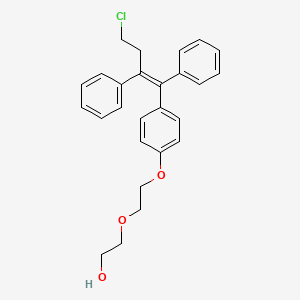
Fispemifene, HM 101
Fispemifene; UNII-3VZ2833V08;
cas 341524-89-8
| Molecular Formula: | C26H27ClO3 |
|---|---|
| Molecular Weight: | 422.94378 g/mol |
2-[2-[4-[(Z)-4-chloro-1,2-diphenylbut-1-enyl]phenoxy]ethoxy]ethanol
Treatment of Hypogonadism
Androgen Decline in the Aging Male (Andropause) in phase 2
Fispemifene is the Z-isomer of the compound of formula (I)

WO 01/36360 describes a group of SERMs, which are tissue-specific estrogens and which can be used in women in the treatment of climacteric symptoms, osteoporosis, Alzheimer’s disease and/or cardiovascular diseases without the carcinogenic risk. Certain compounds can be given to men to protect them against osteoporosis, cardiovascular diseases and Alzheimer’s disease without estrogenic adverse events (gynecomastia, decreased libido etc.). Of the compounds described in said patent publication, the compound (Z)-2-{2-[4-(4-chloro-1,2-diphenylbut-1-enyl)phenoxy]ethoxy}ethanol (also known under the generic name fispemifene) has shown a very interesting hormonal profile suggesting that it will be especially valuable for treating disorders in men. WO 2004/108645 and WO 2006/024689 suggest the use of fispemifene for treatment or prevention of age-related symptoms in men, such as lower urinary tract symptoms and diseases or disorders related to androgen deficiency in men.
Quatrx had been conducting phase II clinical development for the treatment of androgen decline in the aging male. Unlike testosterone replacement therapies that are typically topical or injection therapies, fispemifene is an oral treatment and is not a formulation of testosterone. Fispemifene utilizes the body’s normal feedback mechanism to increase testosterone levels. Originally developed at Hormos, QuatRx gained rights to the drug candidate following a merger of the companies pursuant to which Hormos became a wholly-owned subsidiary of QuatRx.
Known methods for the syntheses of compounds like ospemifene and fispemifene include rather many steps. WO 02/090305 describes a method for the preparation of fispemifene, where, in a first step, a triphenylbutane compound with a dihydroxysubstituted butane chain is obtained. This compound is in a second step converted to a triphenylbutene where the chain is 4-chlorosubstituted. Then the desired Z-isomer is crystallized. Finally, the protecting group is removed to release the ethanol-ethoxy chain of the molecule.
Fispemifene is a selective estrogen receptor modulator (SERM) studied in phase II clinical trials at Forendo Pharma for the treatment low testosterone in men. The compound is also in phase II clinical studies at Apricus for the treatment of men with secondary hypogonadism.
In 2013, Forendo Pharma acquired the drug from Hormos Medical for the treatment of male low testosterone.
In 2014, Apricus Biosciences acquired U.S. rights for development and commercialization
PATENT
https://www.google.com/patents/US7504530
EXAMPLE 2 2-{2-[4-(4-Chloro-1,2-diphenyl-but-1-enyl)-phenoxy]-ethoxy}-ethanol (Compound I)
{2-[4-(4-Chloro-1,2-diphenyl-but-1-enyl)-phenoxy]-ethoxy}-acetic acid ethyl ester was dissolved in tetrahydrofuran at room temperature under nitrogen atmosphere. Lithium aluminium hydride was added to the solution in small portions until the reduction reaction was complete. The reaction was quenched with saturated aqueous ammonium chloride solution. The product was extracted into toluene, which was dried and evaporated in vacuo. The residue was purified with flash chromatography with toluene/triethyl amine (9.5:0.5) as eluent. Yield 68%.
1H NMR (200 MHz, CDCl3):
2.92 (t, 2H, ═CH 2CH2Cl),
3.42 (t, 2H, ═CH2 CH2 Cl),
3.59-3.64 (m, 2H, OCH2CH2O CH2CH 2OH),
3.69-3.80 (m, 4H, OCH2 CH 2OCH 2 CH2OH),
3.97-4.02 (m, 2H, OCH2CH2OCH2CH2OH),
6.57 (d, 2H, aromatic proton ortho to oxygen),
6.78 (d, 2H, aromatic proton meta to oxygen),
7.1-7.43 (m, 10H, aromatic protons).
………….
PATENT
WO 2001036360
https://www.google.com/patents/WO2001036360A1?cl=en
……………
PATENT
WO 2002090305
http://www.google.co.in/patents/WO2002090305A1?cl=en
EXAMPLE
a) [2-(2-chloroethoxy)ethoxymethyl]benzene
is prepared from benzyl bromide and 2-(2-chloroethoxy)ethanol by the method described in literature (Bessodes, 1996).
b) {4-[2-(2-Benzyloxyethoxy)ethoxy]phenyl}phenylmethanone

The mixture of 4-hydroxybenzophenone (16.7 g, 84.7 mmol) and 48 % aqueous sodium hydroxide solution (170 ml) is heated to 80 °C. Tetrabutylammonium bromide (TBABr) (1.6 g, 5.1 mmol) is added and the mixture is heated to 90 °C. [2-(2-Chloroethoxy)ethoxymethyl]benzene (18. g, 84.7 mmol) is added to the mixture during 15 min and the stirring is continued for additional 3.5 h at 115-120 °C. Then the mixture is cooled to 70 °C and 170 ml of water and 170 ml of toluene are added to the reaction mixture and stirring is continued for 5 min. The layers are separated and the aqueous phase is extracted twice with 50 ml of toluene. The organic phases are combined and washed with water, dried with sodium sulphate and evaporated to dryness. Yield 31.2 g.
Another method to prepare {4-[2-(2-benzyloxyethoxy)ethoxy]phenyl}phenyl- methanone is the reaction of 2-(2-benzyloxyethoxy)ethyl mesylate with 4- hydroxybenzophenone in PTC-conditions.
Η NMR (CDCI3): 3.64-3.69 (m, 2H), 3.74-3.79 (m, 2H), 3.90 (dist.t, 2H), 4.22 (dist.t, 2H), 4.58 (s, 2H), 6.98 (d, 2H), 7.28-7.62 (m, 8H), 7.75 (td, 2H), 7.81 (d, 2H).
c) 1- {4-[2-(2-Benzyloxyethoxy)ethoxy]phenyl} – 1 ,2-diphenyl -butane- 1 ,4-diol
 R = BENZYL
Lithium aluminum hydride (1.08 g, 28.6 mmol) is added into dry tetrahydrofuran (60 ml) under nitrogen atmosphere. Cinnamaldehyde (6.65 g, 50 mmol) in dry tetrahydrofuran (16 ml) is added at 24-28 °C. The reaction mixture is stirred at ambient temperature for 1 h. {4-[2-(2- Benzyloxyethoxy)ethoxy]phenyl}-phenyl-methanone (14.0 g, 37 mmol) in dry tetrahydrofuran (16 ml) is added at 50-55 °C. The reaction mixture is stirred at 60 °C for 3 h. Most of tetrahydrofuran is evaporated. Toluene (70 ml) and 2 M aqueous hydrogen chloride (50 ml) are added. The mixture is stirred for 5 min and the aqueous layer is separated and extracted with toluene (30 ml). The toluene layers are combined and washed with 2M HC1 and water, dried and evaporated. The product is crystallized from isopropanol as a mixture of stereoisomers (8.8 g, 50 %).
Η NMR (CDCI3 ): 1.75-2.10 (m, 2H), 3.20-4.16 (m, 1 OH), 4.52 and 4.55 (2s, together 2H), 6.61 and 6.88 (2d, together 2H), 6.95-7.39 (m, 15H), 7.49 and 7.57 (2d, together 2H).
d) Z- 1 – {4-[2-(2-Benzyloxyethoxy)ethoxy]phenyl} -4-chloro- 1 ,2-diphenyl-but- 1-ene
 R = BENZYL
1 – {4- [2-(2-Benzyloxy-ethoxy)ethoxy]phenyl} – 1 ,2-diphenyl -butane- 1 ,4-diol (10.0 g, 19.5 mmol) is dissolved in toluene (50 ml). Triethylamine (2.17 g, 21.4 mmol) is added to the solution and the mixture is cooled to -10 °C. Thionyl chloride (6.9 g, 58.5 mmol) is added to the mixture at -10 – ±0 °C. The mixture is stirred for 1 hour at 0-5 °C, warmed up to 70 °C and stirred at this temperature for 4 hours. Solvent is evaporated, the residue is dissolved to toluene, washed three times with 1M HC1 solution and twice with water. The Z-isomer of the product is crystallized from isopropanol-ethyl acetate. Yield 3.0 g. The filtrate is purified by flash chromatography to give E-isomer.
Z-isomer: Η NMR (CDCI3): 2.91 (t, 2H), 3.41 (t, 2H), 3.55-3.85 (m, 6H), 3.99 (dist.t, 2H), 4.54 (s, 2H), 6.40 (s, 1H), 6.56 (d, 2H), 6.77 (d, 2H), 7.10- 7.50 (m, 15H)
E-isomer: 1H NMR (CDCI3): 2.97 (t, 2H), 3.43 (t, 2H), 3.65-3.82 (m, 4H), 3.88 (dist.t, 2H), 4.15 (dist.t, 2H), 4.58 (s, 2H), 6.86 -7.45 (m, 19H)
FINAL STEP
e) 2- {2-[4-(4-Chloro- 1 ,2-diphenyl-but- 1 -enyl)phenoxy]ethoxy } ethanol:
Z- 1 – {4-[2-(2-Benzyloxy-ethoxy)ethoxy]phenyl} -4-chloro- 1 ,2-diphenyl -but- 1-ene (3.8 g, 7.4 mmol) is dissolved in ethyl acetate under nitrogen atmosphere , Zn powder (0.12 g, 1.85 mmol) and acetyl chloride (1.27 g, 16.3 mmol) are added and the mixture is stirred at 50 °C for 3 h (Bhar, 1995). The reaction mixture is cooled to room temperature, water (10 ml) is added and stirring is continued for additional 10 min. The aqueous layer is separated and the organic phase is washed with 1 M aqueous hydrogen chloride solution and with water. Ethyl acetate is evaporated and the residue is dissolved in methanol (16 ml) and water (4 ml). The acetate ester of the product is hydrolysed by making the mixture alkaline with sodium hydroxide (1 g) and stirring the mixture at room temperature for 1 h. Methanol is evaporated, water is added and the residue is extracted in ethyl acetate and washed with 1 M hydrogen chloride solution and with water. Ethyl acetate is evaporated and the residue is dissolved in toluene (25 ml), silica gel (0.25 g) is added and mixture is stirred for 15 min. Toluene is filtered and evaporated to dryness. The residue is crystallised from heptane-ethyl acetate (2:1). The yield is 71 %.
Z-isomer: 1H NMR (CDCI3): 2.92 (t, 2H), 3.41 (t, 2H), 3.58-3.63 (m, 2H), 3.69-3.80 (m, 4H), 3.96-4.01 (m, 2H), 6.56 (d, 2H), 6.78 (d, 2H), 7.10-7.40 (m, 10H).
 Z ISOMER IE FISPEMIFENE
E-2- {2- [4-(4-Chloro- 1 ,2-diphenyl-but- 1 -enyl)phenoxy]ethoxy} ethanol is prepared analogously starting from E-l-{4-[2-(2-benzyloxy- ethoxy)ethoxy]phenyl} -4-chloro- 1,2-diphenyl-but-l-ene. The product is purified by flash chromatography with toluene-methanol (10:0.5) as eluent.
E-isomer: 1H NMR (CDCI3): 2.97 (t, 2H), 3.43 (t, 2H), 3.65-3.79 (m, 4H), 3.85-3.90 (m, 2H), 4.13-4.17 (m, 2H), 6.85-7.25 (m, 2H).
Debenzylation of 1 – {4-[2-(2-benzyloxy-ethoxy)ethoxy]phenyl} -4-chloro- 1 ,2- diphenyl-but- 1-ene is also carried out by hydrogenation with Pd on carbon as a catalyst in ethyl acetate-ethanol solution at room temperature.
………….
PATENT
http://www.google.com/patents/US5491173

| Patent | Submitted | Granted |
|---|---|---|
| Method for the preparation of 2-{2-[4-(4-chloro-1,2-diphenylbut-1-enyl)phenoxy]ethoxy}ethanol and its isomers [US6891070] | 2004-06-17 | 2005-05-10 |
| Formulations of fispemifene [US2007104743] | 2007-05-10 | |
| METHODS FOR THE PREPARATION OF FISPEMIFENE FROM OSPEMIFENE [US7504530] | 2008-09-04 | 2009-03-17 |
| METHOD FOR THE PREPARATION OF THERAPEUTICALLY VALUABLE TRIPHENYLBUTENE DERIVATIVES [US2011015448] | 2011-01-20 | |
| METHOD FOR THE PREPARATION OF THERAPEUTICALLY VALUABLE TRIPHENYLBUTENE DERIVATIVES [US7812197] | 2008-08-28 | 2010-10-12 |
| WO2001036360A1 | 1 Nov 2000 | 25 May 2001 | Pirkko Haerkoenen | Triphenylalkene derivatives and their use as selective estrogen receptor modulators |
| EP0095875A2 | 20 May 1983 | 7 Dec 1983 | Farmos Group Ltd. | Novel tri-phenyl alkane and alkene derivatives and their preparation and use |
| Citing Patent | Filing date | Publication date | Applicant | Title |
|---|---|---|---|---|
| WO2008099059A1 * | 13 Feb 2008 | 21 Aug 2008 | Hormos Medical Ltd | Method for the preparation of therapeutically valuable triphenylbutene derivatives |
| WO2008099060A2 * | 13 Feb 2008 | 21 Aug 2008 | Hormos Medical Ltd | Methods for the preparation of fispemifene from ospemifene |
| CN101636372B | 13 Feb 2008 | 27 Mar 2013 | 霍尔莫斯医疗有限公司 | Method for the preparation of therapeutically valuable triphenylbutene derivatives |
| EP1636159A1 * | 5 May 2004 | 22 Mar 2006 | Hormos Medical Ltd. | Method for the treatment or prevention of lower urinary tract symptoms |
| EP2518039A1 | 13 Feb 2008 | 31 Oct 2012 | Hormos Medical Ltd. | Method for the preparation of therapeutically valuable triphenylbutene derivatives |
| EP2821385A2 | 13 Feb 2008 | 7 Jan 2015 | Hormos Medical Ltd. | Method for the preparation of therapeutically valuable triphenylbutene derivatives |
| US7504530 | 13 Feb 2008 | 17 Mar 2009 | Hormos Medical Ltd. | Methods for the preparation of fispemifene from ospemifene |
| US7812197 | 13 Feb 2008 | 12 Oct 2010 | Hormos Medical Ltd. | Method for the preparation of therapeutically valuable triphenylbutene derivatives |
| US8293947 | 16 Sep 2010 | 23 Oct 2012 | Hormos Medical Ltd. | Method for the preparation of therapeutically valuable triphenylbutene derivatives |
| US8962693 | 19 Aug 2013 | 24 Feb 2015 | Hormos Medical Ltd. | Method for the treatment or prevention of lower urinary tract symptoms |
| WO2002090305A1 | Mar 21, 2002 | Nov 14, 2002 | Hormos Medical Corp | A new method for the preparation of 2-{2-[4-(4-chloro-1,2-diphenylbut-1-enyl)phenoxy]ethoxy}ethanol and its isomers |
| WO2004108645A1 | May 5, 2004 | Dec 16, 2004 | Hormos Medical Corp | Method for the treatment or prevention of lower urinary tract symptoms |
| WO2006024689A1 * | Jul 20, 2005 | Mar 9, 2006 | Taru Blom | Use of a selective estrogen receptor modulator for the manufacture of a pharmaceutical preparation for use in a method for the treatment or prevention of androgen deficiency |
| WO2007099410A2 * | Nov 9, 2006 | Sep 7, 2007 | Hormos Medical Ltd | Formulations of fispemifene |
| WO2014060640A1 | Oct 17, 2013 | Apr 24, 2014 | Fermion Oy | A process for the preparation of ospemifene |
| CN100526277C | May 5, 2004 | Aug 12, 2009 | 霍尔莫斯医疗有限公司 | Method for the treatment or prevention of lower urinary tract symptoms |
| CN102532073A * | Dec 30, 2011 | Jul 4, 2012 | 北京赛林泰医药技术有限公司 | Ethylene derivative serving as selective estrogen receptor modulators (SERMs) |
| EP1786408A1 * | Jul 20, 2005 | May 23, 2007 | Hormos Medical Ltd. | Use of a selective estrogen receptor modulator for the manufacture of a pharmaceutical preparation for use in a method for the treatment or prevention of androgen deficiency |
| EP1951250A2 * | Nov 22, 2006 | Aug 6, 2008 | SmithKline Beecham Corporation | Chemical compounds |
| EP2258360A2 | May 5, 2004 | Dec 8, 2010 | Hormos Medical Ltd. | Method for the treatment or prevention of lower urinary tract symptoms |
| EP2518039A1 | Feb 13, 2008 | Oct 31, 2012 | Hormos Medical Ltd. | Method for the preparation of therapeutically valuable triphenylbutene derivatives |
| EP2821385A2 | Feb 13, 2008 | Jan 7, 2015 | Hormos Medical Ltd. | Method for the preparation of therapeutically valuable triphenylbutene derivatives |
| US6891070 | Mar 21, 2002 | May 10, 2005 | Hormos Medical Corporation | Method for the preparation of 2-{2-[4-(4-chloro-1,2-diphenylbut-1-enyl)phenoxy]ethoxy}ethanol and its isomers |
| US7504530 | Feb 13, 2008 | Mar 17, 2009 | Hormos Medical Ltd. | Methods for the preparation of fispemifene from ospemifene |
| US7560589 | Jul 27, 2004 | Jul 14, 2009 | Smithkline Beecham Corporation | Cycloalkylidene compounds as modulators of estrogen receptor |
| US7569601 | May 14, 2007 | Aug 4, 2009 | Smithkline Beecham Corporation | Cycloalkylidene compounds as modulators of estrogen receptor |
| US7799828 | Jun 8, 2009 | Sep 21, 2010 | Glaxosmithkline Llc | Cycloalkylidene compounds as modulators of estrogen receptor |
| US7812197 | Feb 13, 2008 | Oct 12, 2010 | Hormos Medical Ltd. | Method for the preparation of therapeutically valuable triphenylbutene derivatives |
| US7825107 | May 22, 2007 | Nov 2, 2010 | Hormos Medical Ltd. | Method of treating men suffering from chronic nonbacterial prostatitis with SERM compounds or aromatase inhibitors |
| US8293947 | Sep 16, 2010 | Oct 23, 2012 | Hormos Medical Ltd. | Method for the preparation of therapeutically valuable triphenylbutene derivatives |
| US8299112 | Sep 15, 2011 | Oct 30, 2012 | Aragon Pharmaceuticals, Inc. | Estrogen receptor modulators and uses thereof |
| US8455534 | Sep 13, 2012 | Jun 4, 2013 | Aragon Pharmaceuticals, Inc. | Estrogen receptor modulators and uses thereof |
| US8962693 | Aug 19, 2013 | Feb 24, 2015 | Hormos Medical Ltd. | Method for the treatment or prevention of lower urinary tract symptoms |
| WO1996007402A1 * | Sep 6, 1995 | Mar 14, 1996 | Michael Degregorio | Triphenylethylenes for the prevention and treatment of osteoporosis |
| WO1996035417A1 * | May 10, 1996 | Nov 14, 1996 | Cancer Res Campaign Tech | Combinations of anti-oestrogen compounds and pkc modulators and their use in cancer therapy |
| WO1997032574A1 * | Mar 4, 1997 | Sep 12, 1997 | Degregorio Michael | Serum cholesterol lowering agent |
| WO1999042427A1 * | Feb 19, 1999 | Aug 26, 1999 | Kalapudas Arja | E-2-[4-(4-chloro-1,2-diphenyl-but-1-enyl)phenoxy]ethanol and pharmaceutical compositions thereof |
| WO1999063974A2 * | Jun 10, 1999 | Dec 16, 1999 | Endorecherche Inc | Selective estrogen receptor modulator in combination with denydroepiandrosterone (dhea) or analogues |
| EP0095875A2 * | May 20, 1983 | Dec 7, 1983 | Farmos Group Ltd. | Novel tri-phenyl alkane and alkene derivatives and their preparation and use |
सुकून उतना ही देना प्रभू, जितने से जिंदगी चल जाये। औकात बस इतनी देना, कि औरों का भला हो जाये।
DRUG APPROVALS BY DR ANTHONY MELVIN CRASTO …..FOR BLOG HOME CLICK HERE

Join me on Facebook 

 Googleplus
 amcrasto@gmail.com
 LIONEL MY SON
जिंदगी चल जाये।
औकात बस इतनी देना,
कि औरों का भला हो जाये।
///////


 New Drug Approvals