
Home » Posts tagged 'flormotridazum (18F)'
Tag Archives: flormotridazum (18F)
 DRUG APPROVALS BY DR ANTHONY MELVIN CRASTO
.....FOR BLOG HOME CLICK HERE
DRUG APPROVALS BY DR ANTHONY MELVIN CRASTO
.....FOR BLOG HOME CLICK HEREFlag and hits
ORGANIC SPECTROSCOPY

SUBSCRIBE

 Subscribe in a reader
Enter your email address:
Delivered by FeedBurner
Subscribe to New Drug Approvals by Email


Recent Comments
 | shivkr2 on SPSR Excellence Award 2025 – S… |
 | Bonkasaurus on Infigratinib phosphate |
 | PALOVAROTENE | ORGAN… on Palovarotene |
| Pfizer just purchase… on Temanogrel | |
| Pfizer To Cash In On… on Temanogrel |
Flormotridazum (18F)
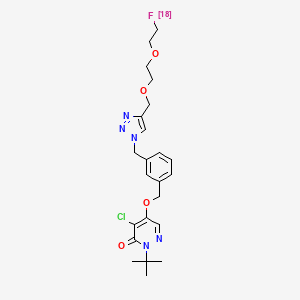
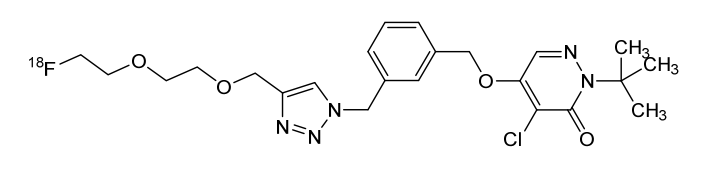
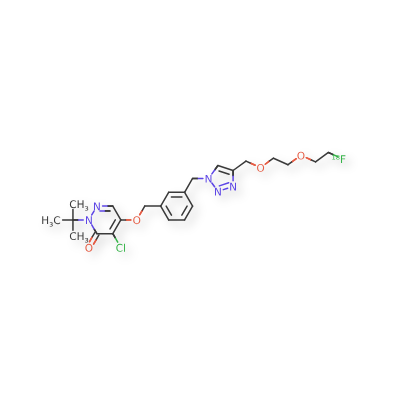
Flormotridazum (18F)
CAS 2798832-03-6
MF C23H29Cl18FN5O4 MW492.961
2-tert-butyl-4-chloro-5-[(3-{[4-({2-[2-(18F)fluoroethoxy]ethoxy}methyl)-1H-1,2,3-triazol-1-yl]methyl}phenyl)methoxy]pyridazin-3(2H)-one
| 3(2H)-Pyridazinone, 4-chloro-2-(1,1-dimethylethyl)-5-[[3-[[4-[[2-[2-(fluoro-18F)ethoxy]ethoxy]methyl]-1H-1,2,3-triazol-1-yl]methyl]phenyl]methoxy]- |
2-tert-butyl-4-chloro-5-[(3-{[4-({2-[2-(18F)fluoroethoxy]ethoxy}methyl)-1H-1,2,3-triazol-1-yl]methyl}phenyl)methoxy]pyridazin-3(2H)-one
imaging agent, 7AR6ZH8YUU
Flormotridaz (18F) (also referred to by its International Nonproprietary Name, flormotridazum) is an advanced radiopharmaceutical compound utilized in nuclear medicine. It is specifically engineered as a radioactive diagnostic tracer containing the fluorine-18 positron-emitting isotope.
Core Characteristics & Chemical Profile
- Substance Classification: Radioactive Diagnostic Agent / Small Molecule.
- Mechanism Basis: It shares core structural similarities and structural lineage with pyridazinone-based mitochondrial complex 1 (MC-1) inhibitors, heavily linking its functionality to target-specific tissues with high metabolic or mitochondrial activity.
Mechanism and Clinical Application
Like related fluorine-18 labeled pyridazinone analogues, this agent is designed for Positron Emission Tomography (PET) imaging workflows. [1]
- Administration: The agent is administered intravenously as a sterile unit dose before scanning.
- Cellular Targeting: It binds selectively to specific intracellular molecular targets (such as mitochondrial pathways) within highly active tissues.
- PET Imaging: As the Fluorine-18 radioisotope decays, it emits positrons. These positrons encounter electrons to produce gamma rays, which the PET scanner captures to map high-resolution, three-dimensional metabolic layouts of internal organ systems.
Contextual Comparison
In clinical nuclear medicine, molecular tracers tagged with Fluorine-18 offer significant clinical benefits over older Single-Photon Emission Computed Tomography (SPECT) agents. Their 110-minute half-life allows them to be manufactured at centralized cyclotron facilities and distributed directly to regional medical centres as ready-to-use unit doses, eliminating the need for an on-site cyclotron
Flormotridaz (\(^{18}\text{F}\)):
- CN112807276B: “Preparation method and application of a pyridazinone myocardial perfusion PET radiopharmaceutical” (Covers the definitive radiosynthesis scheme).
- CN115947775A: “Method for preparing compound (I), compound (I), and uses thereof”.
- WO2024008073A1 / CN114832118B: “Compound I liquid composition, preparation method and use thereof” (Covers final formulation stabilization utilizing vitamin C and gentisic acid)
PAT
https://patents.google.com/patent/WO2024008073A1/zh
Compound I, chemically named 2-tert-butyl-4-chloro-5-((3-((4-((2-(2-fluoro[ 18F ]ethoxy)ethoxy)methyl)-1H-1,2,3-triazol-1-yl)methyl)benzyl)oxy)pyridazine-3(2H)-one. Chemical structural formula:Molecular formula : C₂₃H₂₉Cl₁₈FN₅O₄
Molecular weight: 492.97The mechanism of action of compound I as a myocardial perfusion PET imaging agent: Once compound I enters cardiomyocytes, it can rapidly interact with respiratory chain complex I (MC-I) in mitochondria and remain in the myocardium for a long time. Preliminary animal studies showed that it has high cardiac uptake and low hepatic uptake 15 minutes after injection, and maintains a good heart-liver ratio 60 minutes after injection, showing good potential for myocardial perfusion imaging.In this application, Compound I liquid composition or Compound I is used as a myocardial perfusion PET imaging agent.Precursor of Compound I: Chemical name is methyl 2-(2-((1-(3-(((1-(tert-butyl)-5-chloro-6-oxo-1,6-dihydropyridazin-4-yl)oxy)methyl)benzyl)-1H-1,2,3-triazol-4-yl)methoxy)ethoxy)ethyl-4-methylbenzenesulfonate, chemical structural formula is:Molecular formula : C30H36ClN5O7S
Molecular weight: 646.16Amino polyethers (K222 ) are tribridged crown ether molecules with cavitary structures, and are typical nitrogen-containing cavitary ethers, belonging to the category of cavitary ethers. Due to their unique coordination properties, nitrogen-containing cavitary ethers can effectively and selectively complex transition metal and heavy metal cations, forming more stable complexes. Furthermore, they possess both lipophilic and hydrophilic properties, thus showing promising research potential.In existing technologies, the classic synthetic method for amino polyether (K
222 ) is the highly diluted method proposed by Lehn et al., which is a typical non-template ion synthesis method. The specific steps involve dissolving the starting materials 1,8-diamino-3,6-dioxane and 1,8-diacyl chloride-3,6-dioxane in a large amount of benzene solvent and heating the reaction for 8 hours. Then, a reduction reaction with lithium aluminum hydride is performed for 24 hours, followed by column chromatography separation and recrystallization to obtain amino polyether (K
222 ). This method requires a large amount of solvent, such as benzene, has a long synthetic route, is complex, has a low yield, and is not economically efficient. Besides the highly diluted method, another classic synthetic method for amino polyether (K222 ) is proposed by Kulstad and Malmsten, which uses Na 2CO 3
as a template to obtain a sodium iodide complex of amino polyether (K 222 ) in acetonitrile , and then decomplexes it using a resin to obtain amino polyether (K 222 ). The specific steps are as follows: 1,2-bis(2-iodoethoxy)ethane and benzylamine are refluxed in acetonitrile solution for 3 days. An intermediate is then obtained through post-processing. This intermediate is recrystallized from acetone and filtered to obtain a NaI complex. This complex is then decomplexed under acidic conditions using cation exchange resins and anion exchange resins to prepare amino polyether (K222 ) . This method uses simple equipment, requires little solvent, and has relatively mild reaction conditions. However, the applicant has found that the decomplexing method using ion exchange resins fails to proceed when the sodium ion content decreases to a certain level, resulting in a low yield.
PAT
https://patents.google.com/patent/CN114773179B/en
ADVERTISEMENT
ANAX LABORATORIES
WEBSITE https://www.anaxlab.com/
Discovery Solutions, Supporting the chemistry needs of clients in the Medical, Analytical and Bio Sciences
Development Solutions, Developing from Lab scale to PR&D, Kilo Scale-ups and Commercial Scales
SEE MORE………Integrated Solutions, Manufacturing Solutions, Products,
Can’t Find? Let’s Connect

Phone : +91 897704 2010 / +91 9177075735, Email : info@anaxlab.com
#MedicinalChemistry, #DrugDiscovery, #OrganicSynthesis, #ChemicalLibrary, #BuildingBlocks, #SARStudies, #ChemistryInnovation, #medchem, #Drugdevelopment, #Biotech, #Biotechnology, #AnaxLaboratories, #Pharma



AS ON FEB2026 4.574 LAKHS VIEWS ON BLOG WORLDREACH AVAILABLEFOR YOUR ADVERTISEMENT

join me on Linkedin
Anthony Melvin Crasto Ph.D – India | LinkedIn
join me on Researchgate
RESEARCHGATE

join me on Facebook
Anthony Melvin Crasto Dr. | Facebook
join me on twitter
Anthony Melvin Crasto Dr. | twitter
+919321316780 call whatsaapp
EMAIL. amcrasto@gmail.com

References
//////////flormotridazum (18F), anax labs, imaging agent, 7AR6ZH8YUU


 New Drug Approvals
