New Drug Approvals

Home » Uncategorized (Page 97)

Category Archives: Uncategorized

DRUG APPROVALS BY DR ANTHONY MELVIN CRASTO .....FOR BLOG HOME CLICK HERE

Blog Stats

  • 4,893,473 hits

Flag and hits

Flag Counter

Enter your email address to follow this blog and receive notifications of new posts by email.

Join 37.8K other subscribers
Follow New Drug Approvals on WordPress.com

Archives

Categories

Recent Posts

Flag Counter

ORGANIC SPECTROSCOPY

Read all about Organic Spectroscopy on ORGANIC SPECTROSCOPY INTERNATIONAL 

Enter your email address to follow this blog and receive notifications of new posts by email.

Join 37.8K other subscribers
DR ANTHONY MELVIN CRASTO Ph.D

DR ANTHONY MELVIN CRASTO Ph.D

DR ANTHONY MELVIN CRASTO, Born in Mumbai in 1964 and graduated from Mumbai University, Completed his Ph.D from ICT, 1991,Matunga, Mumbai, India, in Organic Chemistry, The thesis topic was Synthesis of Novel Pyrethroid Analogues, Currently he is working with AFRICURE PHARMA, ROW2TECH, NIPER-G, Department of Pharmaceuticals, Ministry of Chemicals and Fertilizers, Govt. of India as ADVISOR, earlier assignment was with GLENMARK LIFE SCIENCES LTD, as CONSUlTANT, Retired from GLENMARK in Jan2022 Research Centre as Principal Scientist, Process Research (bulk actives) at Mahape, Navi Mumbai, India. Total Industry exp 32 plus yrs, Prior to joining Glenmark, he has worked with major multinationals like Hoechst Marion Roussel, now Sanofi, Searle India Ltd, now RPG lifesciences, etc. He has worked with notable scientists like Dr K Nagarajan, Dr Ralph Stapel, Prof S Seshadri, etc, He did custom synthesis for major multinationals in his career like BASF, Novartis, Sanofi, etc., He has worked in Discovery, Natural products, Bulk drugs, Generics, Intermediates, Fine chemicals, Neutraceuticals, GMP, Scaleups, etc, he is now helping millions, has 9 million plus hits on Google on all Organic chemistry websites. His friends call him Open superstar worlddrugtracker. His New Drug Approvals, Green Chemistry International, All about drugs, Eurekamoments, Organic spectroscopy international, etc in organic chemistry are some most read blogs He has hands on experience in initiation and developing novel routes for drug molecules and implementation them on commercial scale over a 32 PLUS year tenure till date Feb 2023, Around 35 plus products in his career. He has good knowledge of IPM, GMP, Regulatory aspects, he has several International patents published worldwide . He has good proficiency in Technology transfer, Spectroscopy, Stereochemistry, Synthesis, Polymorphism etc., He suffered a paralytic stroke/ Acute Transverse mylitis in Dec 2007 and is 90 %Paralysed, He is bound to a wheelchair, this seems to have injected feul in him to help chemists all around the world, he is more active than before and is pushing boundaries, He has 100 million plus hits on Google, 2.5 lakh plus connections on all networking sites, 100 Lakh plus views on dozen plus blogs, 227 countries, 7 continents, He makes himself available to all, contact him on +91 9323115463, email amcrasto@gmail.com, Twitter, @amcrasto , He lives and will die for his family, 90% paralysis cannot kill his soul., Notably he has 38 lakh plus views on New Drug Approvals Blog in 227 countries......https://newdrugapprovals.wordpress.com/ , He appreciates the help he gets from one and all, Friends, Family, Glenmark, Readers, Wellwishers, Doctors, Drug authorities, His Contacts, Physiotherapist, etc He has total of 32 International and Indian awards

Verified Services

View Full Profile →

Archives

Categories

Flag Counter

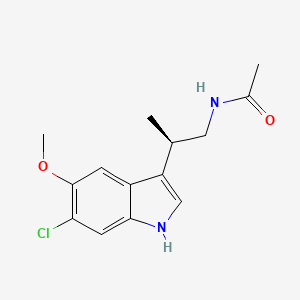
LY-156735 (TIK-301, PD-6735)….for the treatment of sleep latency in patients with primary insomnia


TIK-301 structure

N-[(2R)-2-(6-chloro-5-methoxy-1H-indol-3-yl)propyl]acetamide

cas  118702-11-7

LY-156735 (TIK-301, PD-6735) is a melatonin MT1 and MT2 agonist which is under development for the treatment of insomnia and other sleep disorders.[1]

Beta-methyl-6-chloromelatonin (PD-6735) is a melatonin MT1 and MT2 agonist which had been in phase II trials at Phase 2 Discovery for the treatment of sleep latency in patients with primary insomnia, however, no recent development has been reported.

The melatonin agonist exhibits high selectivity and provides a novel mode of action different from that of benzodiazepine receptor ligands currently on the market.

Furthermore, the drug candidate is believed to be non-addicting, therefore, offering an advantage over marketed sleep medications. Originally discovered by Lilly, PD-6735 was licensed to Phase 2 Discovery in 2002 for further development.

Orphan drug designation has been assigned in the U.S. for the treatment of circadian rhythm sleep disorders in blind people with no light perception and for the treatment of neuroleptic-induced tardive dyskinesia in schizophrenia patients.

In 2007, the product candidate was licensed to Tikvah Therapeutics by Phase 2 Discovery for worldwide development and commercialization for the treatment of sleep disorder, depression and circadian rhythm disorder.

UNII-3ZX95B1ZWK.png

beta -alkylmelatonins as ovulation inhibitors [US4997845]1991-03-05

BETA-ALKYLMELATONINS [EP0281242]1988-09-07 GRANT1992-08-12

The condensation of 6-chloro-5-methoxy-1H-indole (I) with Meldrum’s acid (II) and acetaldehyde (III) catalyzed by L-proline in acetonitrile gives the adduct (IV), which is treated with Cu and ethanol in refluxing pyridine to yield 3-(6-chloro-5-methoxy-1H-indol-3-yl)butyric acid ethyl ester (V). The reaction of (V) with hydrazine at 140 C affords the hydrazide (VI), which is treated with NaNO2 and Ac-OH to provide the corresponding azide that, without isolation, is thermolyzed and rearranged in toluene at 80?C to give 7-chloro-6-methoxy-4-methyl-1,2,3,4-tetrahydro-9H-pyrido[3,4-b]indol-1-one (VII). The cleavage of the lactam ring of (VII) with KOH in refluxing ethanol/water yields 3-(2-amino-1-methylethyl)-6-chloro-5-methoxy-1H-indole-2-carboxylic acid (VIII). The decarboxylation of (VIII) by means of refluxing aq. 3M HCl affords 3-(2-amino-1-methylethyl)-6-chloro-5-methoxy-1H-indole (IX), which is finally acylated with acetic anhydride and pyridine in toluene to provide the target 6-chloromelatonin as a racemic compound.

EP 0281242;……….http://www.google.com/patents/EP0281242B1?cl=en

Example 3

    Preparation of β-Methyl-6-chloromelatonin

  • Following the procedure of Example 1, a solution of 10.0 g (0.055 mole) of 5-methoxy-6-chloroindole, 3.1 ml (2.44 g, 0.055 mole) of acetaldehyde, and 7.94 g (0.055 mole) of Meldrum’s acid in 90 ml of acetonitrile was stirred for 48 hours. The solvent was removed under vacuum, and the adduct thus prepared was recrystallized by dissolving in warm toluene and immediately cooling. The adduct was obtained as slightly pink crystals; m.p. = 145°C; yield = 16.5 g (85%). The elemental analysis of the product showed a slightly elevated percentage of carbon. However, the NMR spectrum indicated that the product was pure and had the indicated structure.
    Analysis calc. for C₁₇H₁₈NO₅Cl

    Theory:
    C, 58.04; H, 5.16; N, 3.98; Cl, 10.08
    Found :
    C, 59.34; H, 5.15; N, 3.84; Cl, 9.69
  • The solvolysis and decarboxylation of the adduct (11.0 g; 31.3 mmoles) using ethanol, pyridine, and copper dust was carried out by the procedure of Example 1. The yield of 3-(5-methoxy-6-chloro-1H-indol-3-yl)pentanoic acid ethyl ester, a pale yellow oil, after chromatography over silica gel using 10% EtOAc/90% toluene was 8.68 g (94%).
    Analysis calc. for C₁₅H₁₈NO₃Cl

    Theory:
    C, 60.91; H, 6.13; N, 4.74; Cl, 11.99
    Found :
    C, 60.67; H, 5.86; N, 4.93; Cl, 11.73
  • A mixture of 8.68 g (29.3 mmoles) of the above ethyl ester and 6 ml of hydrazine hydrate was heated at 140°C under nitrogen in a flask fitted with an air cooled condensor. After 6½ hours, the excess hydrazine hydrate was removed under vacuum. The 2-methyl-2-(5-methoxy-6-chloro-3-indolyl)-propionhydrazide thus prepared was recrystallized from ethyl acetate; Yield = 7.13 g (86%); m.p. = 154-155°C.
    Analysis calc. for C₁₃H₁₆N₃O₂Cl

    Theory:
    C, 55.42; H, 5.72; N, 14.91; Cl, 12.58
    Found :
    C, 55.14; H, 5.51; N, 14.49; Cl, 12.78
  • The above hydrazide (7.13 g, 25 mmoles) was converted to the corresponding acyl azide, the azide thermolyzed and rearranged at 80° in toluene, and the rearranged product cyclized with HCl according to the procedure of Example 1. The yield of crude, light tan, lactam, 1-oxo-4-methyl-6-methoxy-7-chloro-1,2,3,4-tetrahydro-9H-pyrido[3,4-b]indole, product, (m.p. = 249-252°C) was 4.77 g (72%).
    Analysis calc. for C₁₃H₁₃N₂O₂Cl

    Theory:
    C, 58.99; H, 4.95; N, 10.58
    Found :
    C, 59.45; H, 4.77; N, 10.72
  • The crude lactam (4.77 g, 18 mmoles) was hydrolyzed with aqueous ethanolic KOH as described in Example 1. The yield of crude amino acid, 2-carboxy-3-(1-amino-2-propyl)-5-methoxy-6-chloroindole, was 3.98 g (78%). The crude product (3.0 g; 10.6 mmoles) was decarboxylated, using the procedure of Example 1, by refluxing in 100 ml of 3M HCl overnight. The acidic solution was decolorized with activated carbon and was then basified with 5M NaOH. The amine was extracted into diethyl ether. After drying the ether extract over Na₂SO₄, the diethyl ether was removed in vacuo leaving as a residue the crystallized tryptamine, 3-(1-amino-2-propyl)-5-methoxy-6-chloroindole; m.p. 133-4°C. The yield, after recrystallization from toluene/hexane, was 1.62 g (64%).
    Analysis calc. for C₁₂H₁₅N₂OCl

    Theory:
    C, 60.38; H, 6.33; N, 11.74; Cl, 14.85
    Found :
    C, 60.11; H, 6.05; N, 11.93; Cl, 15.06
  • A solution of 1.51 g (6.3 mmoles) of the above tryptamine in 10 ml of toluene and 2.5 ml of pyridine was treated with 1.5 ml of acetic anhydride. After allowing the reaction mixture to stand for three hours at room temperature, the volatile materials were removed under vacuum. The residue was dissolved in ethyl acetate, and washed with aqueous NaHCO₃, and brine. The ethyl acetate solution was dried over Na₂SO₄, and the solvent removed by evaporation. The residual oil was crystallized from toluene/hexane yielding 6-chloro-β-methylmelatonin, (m.p. = 133-5°C; 1.09 g, 61%).
    Analysis calc. for C₁₄H₁₇N₂O₂Cl

    Theory:
    C, 59.89; H, 6.10; N, 9.98; Cl, 12.63
    Found :
    C, 60.03; H, 6.22; N, 9.75; Cl, 12.92

…………………………………………….

PATENT

http://www.google.com/patents/EP0281242B1?cl=en

The intermediate diazonium salt (XIII) has been obtained as follows: the hydrogenation of 3-chloro-4-methoxynitrobenzene (XI) with H2 over Pt/Al2O3 in toluene gives the corresponding aniline (XII), which is diazotized with NaNO2/HCl and treated with sodium tetrafluoroborate to yield the target diazonium salt intermediate (XIII). The reduction of pulegone (I) with H2 over Pd/C gives the menthol (II), which is oxidized with CrO3/H2SO4 to yield 3(R),7-dimethyl-6-oxooctanoic acid (IV), which can also be obtained by direct oxidation of (l)-menthol (III) under the same conditions.

The oxidation of (IV) with trifluoroperacetic acid (trifluoroacetic anhydride/H2O2) in dichloromethane yields the 3(R)-methylhexanedioic acid isopropyl monoester (V), which is treated with NaOEt in ethanol to obtain the corresponding ethyl monoester (VI). The reaction of (VI) with diethyl carbonate, EtONa, and “Adogen 464” (a phase transfer catalyst) in ethanol affords 5,5-bis(ethoxycarbonyl)-3(S)-methylpentanoic acid (VII), which is treated with oxalyl chloride to provide the expected acyl chloride (VIII). The reaction of (VIII) with sodium azide and benzyl alcohol gives the intermediate azide that rearranges to the benzyl carbamate (IX).

The reductive cyclization of (IX) with H2 over Pd/C in ethanol yields 5(R)-methyl-2-oxopiperidine-3-carboxylic acid ethyl ester (X), which is condensed with the intermediate diazonium salt (XIII) to afford the hydrazono derivative (XIV). The cyclization of (XIV) in hot formic acid provides 7-chloro-6-methoxy-4(R)-methyl-1,2,3,4-tetrahydro-9H-pyrido[3,4-b]indol-1-one (XV), which is treated with KOH In refluxing ethanol/water to cleave the lactam ring, yielding 3-(2-amino-1(R)-methylethyl)-6-chloro-5-methoxy-1H-indole-2-carboxylic acid (XVI). The decarboxylation of (XVI) by means of refluxing 3M HCl affords 3-(2-amino-1(R)-methylethyl)-6-chloro-5-methoxy-1H-indole (XVII), which is finally acylated with Ac2O and pyridine in toluene to provide the target 6-chloromelatonin as a pure enantiomer.

Example 7

    Preparation of S-(-)-β-methyl-6-chloromelatonin and R-(+)-β-methyl-6-chloromelatonin

  • A solution of 4.0 g (21 mmoles) of 3-chloro-4-methoxynitrobenzene in 200 ml of toluene was hydrogenated over 0.4 g of 5% platinum on alumina. The catalyst was removed by filtration and the solvent evaporated from the filtrate. The crude 3-chloroanisidine prepared was placed in solution in diethyl ether and treated with ethereal HCl to produce the hydrochloride salt, which was collected and dried; weight = 2.48 g (61% yield).
  • A mixture of 2.40 g (12.4 mmoles) of 3-chloroanisidine hydrochloride in 7 ml of 4M HCl was treated, at 0°C, with 0.86 g (12.5 mmoles) of sodium nitrite in 5 ml of water. After stirring at 0°C for an hour the solution was filtered and the filtrate added slowly to an ice cold solution of 2.6 g (24 mmoles) of sodium fluoroborate in 8 ml of water. After stirring at 0°C for an hour the salt was collected and washed successively with, cold 5% sodium fluoroborate solution, cold methanol, and ether. The dried 3-chloro-4-methoxybenzene diazonium fluoroborate thus prepared weighed 2.2 g (69% yield).
  • A mixture of 2.03 g (11.0 mmole) of (R)-(-)-3-ethoxycarbonyl-5-methyl-2-piperidone and 30 ml of 0.75M NaOH was stirred at room temperature (24°C) overnight. The solution was cooled to 0°C and the pH lowered to 3.5 with 3M hydrochloric acid. The diazonium salt (2.8 g, 10.9 mmoles) was added in small portions and the reaction mixture cooled to about 0°C overnight. The product, R-(-)-3-(3-chloro-4-methoxy)phenylhydrazono-5-methyl-2-piperidone, was collected, washed with water, and dried; weight = 2.30 g (75% yield); m.p. = 205°C. A small sample was further purified by chromatography over a short silica gel column using ethyl acetate as the eluant. [α]²⁵ = -58° (c = 10, MeOH).
    Analysis calc. for C₁₃H₁₆N₃O₂Cl

    Theory:
    C, 55.42; H, 5.72; N, 14.91; Cl, 12.58
    Found :
    C, 55.79; H, 5.78: N, 14.72; Cl, 12.69
  • A mixture of 2.20 g (7.8 moles) of the R-(-) hydrazone and 20 ml of 90% formic acid was heated at 85° for three hours then slowly diluted with an equal volume of water. The mixture was allowed to cool and then chilled overnight. The dark precipitate was collected, washed with water, then recrystallized from acetone/water, yielding 1.20 g (60% yield) of S-(-)-1-oxo-4-methyl-6-methoxy-7-chloro-1,2,3,4-tetrahydro-9H-pyrido[3,4-b]indole; m.p. = 248°C. [α]²⁵ = -12.2° (c = 10, MeOH).
    Analysis calc. for C₁₃H₁₃N₂O₂Cl

    Theory:
    C, 58.99; H, 4.95; N, 10.58; Cl, 13.39
    Found :
    C, 59.16; H, 4.88; N, 10.80; Cl, 13.15
  • The conversion of (S)-(-)-lactam to (S)-(-)-6-chloro-β-methylmelatonin was carried out as described previously in Example 3. The product, S-(-)-β-methyl-6-chloromelatonin, was spectroscopically identical to the racemate, but gave an optical rotation of [α]²⁵ = -13.2° (c = 10, MeOH).
  • (R)-(+)-6-chloro-β-methylmelatonin was synthesized from (S)-(+)-3-ethoxycarbonyl-5-methyl-2-piperidone in the same manner as described above. The stereoisomer was identical to the (S)-(-) material except for the sign of rotation.
LY-156,735
LY-156735.png
Systematic (IUPAC) name
N-[(2R)-(6-Chloro-5-methoxy-1H-indol-3-yl)propyl]acetamide
Clinical data
Legal status
?
Identifiers
CAS number 118702-11-7 Yes
ATC code ?
PubChem CID 219018
ChemSpider 189853 
Chemical data
Formula C14H17ClN2O2 
Molecular mass 280.757

References

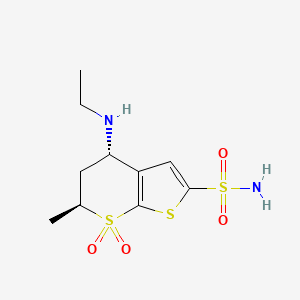
Dorzolamide Hydrochloride


Dorzolamide Structural Formulae.png

Dorzolamide-3D-balls.png

Trusopt, 120279-96-1, 1cil, Trusopt (TN), Dorzolamide (DZA), Dorzolamide (INN), MK507
Molecular Formula:C10H16N2O4S3
Molecular Weight:324.44004 g/mol
(4S,6S)-4-(ethylamino)-6-methyl-7,7-dioxo-5,6-dihydro-4H-thieno[2,3-b]thiopyran-2-sulfonamide
(4S,6S)-4-(ethylamino)-5,6-dihydro-6-methyl-4H- thieno[2,3-/?]thiopyran-2-sulfonamide 7,7-dioxide
(4S-trans)-4-(ETHYLAMINO)-5,6-dihydro-6-methyl-4H-thieno(2,3-b)thiopyran-2-sulfonamide-7,7-dioxide
Antiglaucoma Agents, OCULAR MEDICATIONS, Ophthalmic Drugs, Carbonic Anhydrase Inhibitors
HS Code: 2935009090
120279-96-1

130693-82-2..HCL

Laszlo Kovacs, Csaba Szabo, Erika Molnarne, Adrienne Kovacsne-Mezei, Claude Singer, Judith Aronhime, “Method of making dorzolamide hydrochloride.” U.S. Patent US20060155132, issued July 13, 2006.
 Dorzolamide is a carbonic anhydrase (CA) inhibitor. It is used in ophthalmic solutions (Trusopt) to lower intraocular pressure (IOP) in open-angle glaucoma and ocular hypertension.

Dorzolamide (trade name Trusopt) is a carbonic anhydrase inhibitor. It is an anti-glaucoma agent, and acts by decreasing the production of aqueous humour.[1] It is optically applied in the form of a 2% eye drops.[2]

History

This drug, developed by Merck, was the first drug in human therapy (market introduction 1995) which resulted from structure-baseddrug design. It was developed to circumvent the systemic side effects of acetazolamide which has to be taken orally.[2]

Uses

Dorzolamide hydrochloride is used to lower increased intraocular pressure in open-angle glaucoma and ocular hypertension.

Pharmacodynamics

It lowers IOP by about 20%.[2]

Side effects

Ocular stinging, burning, itching and bitter taste.[2] it causes shallowing of the anterior chamber and leads to transient Myopia.

dorzolamide.png

Title: Dorzolamide
CAS Registry Number: 120279-96-1
CAS Name: (4S,6S)-4-(Ethylamino)-5,6-dihydro-6-methyl-4H-thieno[2,3-b]thiopyran-2-sulfonamide 7,7-dioxide
Molecular Formula: C10H16N2O4S3
Molecular Weight: 324.44
Percent Composition: C 37.02%, H 4.97%, N 8.63%, O 19.73%, S 29.65%
Derivative Type: Hydrochloride
CAS Registry Number: 130693-82-2
Manufacturers’ Codes: MK-507
Trademarks: Trusopt (Merck & Co.)
Molecular Formula: C10H16N2O4S3.HCl
Molecular Weight: 360.90
Percent Composition: C 33.28%, H 4.75%, N 7.76%, O 17.73%, S 26.65%, Cl 9.82%
Properties: mp 283-285°. [a]D24 -8.34° (c = 1 in methanol). Sol in water.
Melting point: mp 283-285°
Optical Rotation: [a]D24 -8.34° (c = 1 in methanol)

Dorzolamide Hydrochloride and its derivatives is known. U.S. Pat. No. 5,688,968 describes preparation of Dorzolamide HCl starting from chiral 5,6-dihydro-4-(S)-hydroxy-6-(S)-methyl-4H-thiopyran-7,7-dioxide, as depicted in scheme 1:

Figure US20060142595A1-20060629-C00003

The process described in BP 0 296 879 (equivalent of U.S. Pat. No. 4,797,413) is of particular relevance. EP 0 296 879 describes the synthesis of Dorzolamide Hydrochloride starting from thiophene-2-thiol as depicted in scheme 2 and 3

Figure US20060142595A1-20060629-C00004
Figure US20060142595A1-20060629-C00005
Figure US20060142595A1-20060629-C00006

The process described in EP 0,296,879 (scheme 2) has the following disadvantages: (a) The starting material Thiophene-2-thiol is unstable and undergoes oxidation to form disulfide, leading to lower yield of viii; (b) the yield of sulfonamide (xii) from sulphonic acid (x) is very poor (35%) and requires use of 18-crown-6 ether, which is expensive; (c) oxidation of alcohol (xiii) to sulfone is carried out using oxone which is expensive and hazardous; and separation of cis/trans isomer is done by column chromatography which is industrially inconvenient.

Systematic (IUPAC) name
(4S,6S)-2-ethylamino-4-methyl-5,5-dioxo-
6,7-dithiabicyclo[4.3.0]nona-8,10-diene-8-sulfonamide
Clinical data
Trade names Trusopt
AHFS/Drugs.com monograph
MedlinePlus a602022
Legal status
Routes Topical (eye drops)
Pharmacokinetic data
Protein binding ~33%
Half-life 4 months
Identifiers
CAS number 130693-82-2  120279-96-1
ATC code S01EC03
PubChem CID 5284549
DrugBank DB00869
ChemSpider 4447604 Yes
UNII 9JDX055TW1 Yes
KEGG D07871 
ChEBI CHEBI:4702 Yes
ChEMBL CHEMBL218490 Yes
Chemical data
Formula C10H16N2O4S3 
Molecular mass 324.443 g/mol

TRUSOPT® (dorzolamide hydrochloride ophthalmic solution) is a carbonic anhydrase inhibitor formulated for topical ophthalmic use.

Dorzolamide hydrochloride is described chemically as: (4S-trans)-4-(ethylamino)-5,6-dihydro-6­methyl-4H-thieno[2,3-b]thiopyran-2-sulfonamide 7,7-dioxide monohydrochloride. Dorzolamide hydrochloride is optically active. The specific rotation is

TRUSOPT® (dorzolamide hydrochloride)The specific rotation - Illustration

Its empirical formula is C10H16N2O4S3•HCl and its structural formula is:

TRUSOPT® (dorzolamide hydrochloride) Structural Formula Illustration

Dorzolamide hydrochloride has a molecular weight of 360.9 and a melting point of about 264°C. It is a white to off-white, crystalline powder, which is soluble in water and slightly soluble in methanol and ethanol.

TRUSOPT Sterile Ophthalmic Solution is supplied as a sterile, isotonic, buffered, slightly viscous, aqueous solution of dorzolamide hydrochloride. The pH of the solution is approximately 5.6, and the osmolarity is 260-330 mOsM. Each mL of TRUSOPT 2% contains 20 mg dorzolamide (22.3 mg of dorzolamide hydrochloride). Inactive ingredients are hydroxyethyl cellulose, mannitol, sodium citrate dihydrate, sodium hydroxide (to adjust pH) and water for injection. Benzalkonium chloride 0.0075% is added as a preservative.

 …………………………………………

The dorzolamide hydrochloride product is prepared from the aminated intermediate of Formula IV by the following scheme.

Figure imgf000021_0002
Figure imgf000021_0003

[00056] Preparation of dorzolamide hydrochloride product from the animated intermediate of Formula IV

[00057] Fuming sulfuric acid (20%, 5 1) is cooled to -7°±2°C and the aminated intermediate of Formula IV (2.5 Kg) is added to it in portions during stirring. The temperature of the reaction mixture is increased to 20°+5°C during addition of the aminated intermediate of Formula IV. The reaction mixture is stirred for 22 hours at 20°±5°C. Thionyl chloride (20 1) is added to the stirred reaction mixture at 20±5°C. The reaction mixture is heated to 60°-65°C and stirred for 24 hours at this temperature. The mixture is cooled back to 40°±2°C and the excess amount of thionyl chloride is evaporated at this temperature under vacuum. (The volume of the residue: ~9 1.) The residue is cooled to -5°+2°C.

[00058] Ethyl acetate (75 1) is cooled to -10°±5°C and the residue is added to it at this temperature. The temperature of the diluted solution: 10°-25°C. Aqueous ammonia (25%, 75 1) is cooled to -10°±5°C and the residue is added to it at this temperature during effective stirring, while maintaining the temperature below 300C. The final pH: ~11. The slurry is cooled to 0°+2°C and stirred for 14 hours at this temperature. The formed ammonium sulfate is filtered and the cake is washed with ethyl acetate (2x 20 1 and 10 1). Ethyl acetate is evaporated from the filtrate at 38°±2°C under vacuum. The residue is heated to 38°±2°C, washed with toluene (3×37.5 1) at this temperature. Water (25 1) is added to the aqueous phase, cooled to 20°-25°C and extracted with ethyl acetate (3x 75 1, 37.5 1, and 37.5 1). The collected ethyl acetate phase is concentrated to ~ 100 1 at 38°±2°C under vacuum. The residue is cooled to 20°-25°C and hydrogen chloride in ethanol (5%, 10.8 1) is added to it during stirring. The formed slurry is stirred for 1 hour at 20°-25°C then cooled to 0°-4°C and stirred for 5 hours at this temperature. The slurry is filtered, the precipitated HCl salt is washed with ethyl acetate (2×20 1) and dried at 55°-60°C under vacuum for 4-8 hours to give Dorzolamide hydrochloride salt (~2 Kg).

[00059] Crude Dorzolamide hydrochloride salt (9 Kg) is solved in water (225 1) at 20°-25°C and the pH is set to 8.0-8.5 by addition of 25% of aqueous ammonia (2 1). The formed slurry is extracted with ethyl acetate (5×72 1). The collected ethyl acetate phase is concentrated to 180 1 by vacuum distillation. The residue is cooled to 20°-25°C, ethyl acetate (45 1) and hydrogen chloride in ethanol (5%, 22.5 1) are added to it during stirring (pH:~1.0). The formed slurry is stirred for 1 hour at 20°-25°C then cooled to 0°-4°C and stirred for 5 hours at this temperature. The slurry is filtered, the precipitated HCl salt is washed with ethyl acetate (2×30 1), and dried at 55°-60°C under vacuum for 4-8 hours to give purified Dorzolamide hydrochloride salt (~8.2Kg).

[00060] Purified Dorzolamide hydrochloride salt (8 Kg) dissolved in water

(24 1) at 95°-105°C and treated with active carbon (80 g). After filtration, the water solution is cooled gradually to 0°-4°C and stirred for 3-5 hours at this temperature. The slurry is filtered, the precipitated HCl salt is washed with cooled water (2×5 1) and dried at 55°-60°C under vacuum for 4-8 hours to give crystallized DRZ HCl salt (~6.6 Kg).

………………………………………………..

http://www.google.com/patents/US20060142595

The invention provides a process for preparing 5,6-dihydro-4-(S)-(ethylamino)-6-(S)methyl-4H-thieno[2,3b]thiopyran-2-sulphonamide-7,7-dioxide hydrochloride of formula (I), comprising of nine steps, as depicted in scheme 4 below:

Figure US20060142595A1-20060629-C00016
Figure US20060142595A1-20060629-C00017
Example 8Preparation of Trans 5,6 dihydro-4H-4-ethylamino-6-methylthieno[2,3-b]thiopyran-2-sulfonamide-7,7 dioxide (X)A solution of product from example 7 (39.5 gm, 0.132 mole) in ethyl acetate (426 ml) was cooled to 0 to 5° C. and ethanolic HCl (20 ml) was added and stirred for 3 hrs at 0 to 5° C. The product was precipitated out, filtered and washed with chilled ethyl acetate. The cake was sucked to remove as much ethyl acetate as possible, and dried to get compound (21 gm) The product was suspended into ethyl acetate (210 ml), refluxed for 1 hr, then cooled to 10° C. The product was filtered and washed with chilled ethyl acetate. The cake was sucked to remove as much ethyl acetate as possible, and dried to hydrochloride salt of title compound (18 gm). The salt was then treated with saturated solution of sodium bicarbonate and mixture extracted with ethyl acetate. The organic extract were dried, filtered and concentrated to dryness to yield title compound (X) (15 gm, 37.98%).

Example 9Preparation of 5,6 dihydro-4H-4-(S)-ethylamino-6-(S)-methylthieno[2,3-b]thiopyran-2-sulfonamide-7,7 dioxide Hydrochloride (I)

A mixture of compound from example 8 (15 gm0.0462 mole) and di-p-toluyl-D-tartaric acid monohydrate (4.55 gm, 0.01125 mole) in n-propanol (1600 ml) was heated to boiling and hot solution filtered through a filter-aid pad with a layer of charcoal. The filtrate was concentrated by boiling to a volume of about (400 ml) and then allowed to crystallize. After standing overnight the crystals were filtered off and material recrystallized twice more from n-propanol (400 ml) to yield a 2:1 salt of free base to acid. Combined mother liquors from this recrystallization were saved for stage B. The salt was then treated with a saturated solution of sodium bicarbonate and mid extracted with ethyl acetate. The organic extract were dried, filtered and concentrated to dryness to yield (3.2 gm) of freebase. The hydrochloride salt was prepared from 5,6 N HCl ethanol and crystallized from methanol-isopropanol to yield (2.83 gm) of (+) isomer, SOR 8.23 (C 0.9 methanol) M.P. 283-285° C. The combine mother liquor was treated with saturated solution of sodium bicarbonate and mixture extracted with ethyl acetate. The organic exacts were dried, filtered and concentrated to dryness. The residue was treated with di-p-toluyl-L-tartaric acid monohydrate (4.55 gm, 0.01125 mole) in n-propanol (1600 ml) and the isomer separated by the process described previously to give title compound (I) (3.75 gm, 22.48%) SOR=−8.34 (C 1, Methaol) M.P. 283 to 285° C.,

………………………………………..

http://www.google.com/patents/WO2008135770A2?cl=en

Dorzolamide is chemically termed as (4S,6S)-4-(ethylamino)-5,6-dihydro-6-methyl-4H- thieno[2,3-/?]thiopyran-2-sulfonamide 7,7-dioxide hydrochloride. Dorzolamide hydrochloride is represented by following structural Formula I:

HN CH,

Figure imgf000003_0001

Formula I

Dorzolamide hydrochloride is known to be a carbonic anhydrase inhibitor useful in the treatment of ocular hypertension.

A process for the preparation of dorzolamide and its derivatives was first described in EP 0296879. The process of particular relevance is depicted in scheme 1. Scheme 1

Figure imgf000004_0001

(viϋ) (ix) Trans and Cis (x)

Figure imgf000004_0002

Trans (xi) Trans(+) (xii) ( I )

The process disclosed in scheme 1 has following disadvantages.

(a) The reduction of the ketone of sulfonamide (vi) using absolute ethanol is carried out at reflux and then stirred at room temperature for several hours to complete the reaction. This longer duration of reaction produces many impurities.

(b) Oxidation of alcohol (vii) to sulfone (viii) is carried out using oxone. The oxone has many disadvantages such as it is irritating to the eyes, skin, nose and throat. It should be used with adequate ventilation and exposure to its dust should be minimized. Traces of heavy metal salts catalyze the decomposition of oxone. It is practically insoluble in all organic solvents hence a phase transfer catalyst is required.

(c) Activation of the 4-hydroxy group of the sulfoaminated hydroxysulfone (viii) and nucleophilic substitution by desired ethylamine, results in all diastereomeric products (x) i.e. trans and cis isomers, which must be separated by column chromatography and resolved, further using resolving agent. As a result, product loss is greater when the desired product is the more active enantiomer.

An alternate route for the preparation of dorzolamide hydrochloride by the Ritter reaction is disclosed in EP0296879 and consists of the treatment of a aliphatic hydroxyl with a nitrile and a strong acid to form an amide. The process disclosed is as depicted in Scheme 2.

Scheme 2

Figure imgf000005_0001

(viii) (ix-a ) Trans and Cis (x)

Figure imgf000005_0002

Trans(+) (xii)

Trans (+/-) (xi) ( I )

The reaction involves conversion of hydroxysulfones (viii) to the corresponding acetoamidosulfones (ix-a) with retention of configuration followed by reduction of the amido group, chromatographic separation and resolution to obtain the desired trans isomer (I).

The prior art teaches the use of an excess quantity of sulfuric acid to carry out the Ritter reaction and hence a large quantity of ice is required for quenching the reaction mass. When the reaction mass in concentrated sulfuric acid comes into contact with ice, a large amount of localized heat is generated causing decomposition of material. Since a huge amount of water is required for quenching the reaction mass, the amount of ethyl acetate required for extraction is also substantially large. The work-up using water is not advisable nor applicable industrially.

United States Patent 5688968 describes an alternative route of preparation of dorzolamide hydrochloride starting from chiral 5,6-dihydro-4-(S)-hydroxy-6-(S)-methyl-4H-thiopyran-7,7- dioxide, as depicted in Scheme 3:

Scheme 3

Figure imgf000006_0001

(xiv) (XV)

(xiii)

Figure imgf000006_0002

(xvi) (xvii ) Trans:Cis:: 95: 5 (xviii)

HN CH,

Figure imgf000006_0003
Figure imgf000006_0004

(xix) ( I )

The process described in Scheme 3 has the following disadvantages: (a) Use of expensive chiral hydroxysulfone starting material. The process for the preparation of the chiral hydroxysulfone starting material is disclosed in U.S. Patents Nos. 5,157,129, 5,474,919 and 5,760,249. In these processes, the chiral hydroxysulfone is obtained by the asymmetric enzymatic reduction of the corresponding ketosulfone, or by cyclization of the chiral thienyl thiobutyric acid, obtained, in turn, from a chiral hydroxyester or lactone, and the subsequent stereospecific reduction of the resulting ketone, (b) The process according to this patent uses maleic acid to separate the undesired cis- isomer from dorzolamide. However this maleate salt formation to remove the cis isomer is only suitable when the ratio of trans/cis is greater than 95:5. That means, the maleate salt formation of dorzolamide does not the remove cis isomer exclusively when the cis isomer content is more than 5%. It sometimes requires repeated purification to achieve the desired chiral purity.

Another alternate route for the preparation of dorzolamide hydrochloride is disclosed in United States patent no.7109353 which involves the use of sodium perborate as an oxidant, as depicted in Scheme 4.

Scheme 4

chlorinating agent, cyclinization

Figure imgf000008_0002
Figure imgf000008_0001
Figure imgf000008_0003

Vl IV

Figure imgf000008_0004

VIl VlIl IX

The process disclosed in Scheme 4 has following disadvantages (a) Conversion of (i) to (ii) requires the mixture to be refluxed for 18-20 hrs which is time consuming and may cause impurity in the product.

(b) As the process uses the Ritter reaction to convert (vi) to (vii), a large amount of water is required to quench the hot mass of reaction which is not practical in an industrial set-up. (c) Sodium perborate is used as an oxidizing agent to convert (v) to (vi), which has got bleaching properties, and the handling of it may be injurious when done so for a prolonged period.

Yet another process for the preparation of dorzolamide is disclosed in United States publication no. 20060155132 which involves protecting the chiral 5,6-dihydro-4-(R)- hydroxy-6-(S)-methyl-4H-thieno-[2,3-b]thiopyran-7,7-dioxide as depicted in Scheme 5.

Scheme 5

protected amination benzyl sulphonyl chloride

Figure imgf000009_0002
Figure imgf000009_0001
Figure imgf000009_0003

The process disclosed in Scheme 5 has the following disadvantages, (a) The conversion process of compound (II) to (III) requires a very low temperature which ranges from -30° to 00C. (b) The amination process requires 16- 20 hrs, which is time consuming and may cause impurity in the product. All these disadvantages of the prior art are overcome by the process in accordance with the present invention.

Scheme 8

Figure imgf000018_0001

Example 4

Preparation of 5,6-Dihydro-4H-4-ethylamino-6-methylthieno[2,3-b]thiopyran-2- sulfonamide-7,7-dioxide

A suspension of 5,6-dihydro-4H-4-acetylamino-6-methylthieno[2,3-b]thiopyran-2- sulfonamide-7,7-dioxide (83.25 gms, 0.24 moles) in THF (832 ml) was cooled to 00C and sodium borohydride (49.11 gms, 1.29 moles) was added in lots maintaining temperature below 5°C. Reaction mass was stirred for 15 minutes at 5°C and boron trifluoride diethyl- etherate (249.75 ml, 287.2 gms, 2.02 moles) was added below 5°C. The reaction mass was stirred for 5 hours at 0°C to 5°C. Temperature of the reaction mass was raised to 25°C to 300C and stirred for 18 hours. The reaction mass was quenched in 1M sulphuric acid solution (1082 ml) below 5°C, temperature raised to 25°C to 30°C and stirred for 1 hour. The solvent was distilled under reduced pressure at 800C. The reaction mass was cooled to 100C and p H adjusted to 7 – 8 using 50% sodium hydroxide solution. Material was extracted in 1665 ml ethyl acetate once and 832 ml twice. The combined organic layers were washed with saturated sodium chloride solution, dried over sodium sulphate, charcoalised, filtered on hyflo, distilled to get title compound (77.42 gms). HPLC: 80:20::Trans:Cis

Example 7

Preparation of 5,6-Dihydro-4H-4-ethylamino-6-methylthieno[2,3-b]thiopyran-2- sulfonamide-7,7-dioxide hydrochloride

(a) Dorzolamide di-p-toluyl-L-tartrate salt as prepared in example 6 (44.26 gms, 0.085 moles) was taken in ethyl acetate (557.0 ml), basified with saturated sodium bicarbonate solution. Reaction mass was stirred for 15 minutes at 25°C to 3O0C and aqueous layer was extracted with ethyl acetate (278 ml X 2). The organic layers were combined, washed with brine solution, dried over sodium sulphate, and charcoalized. To the clear solution, IPA + HCL (16.35 ml, 0.089 moles) was added, stirred for 30 minutes and ethyl acetate was removed by distillation at atmospheric pressure at 85°C to about 280 ml volume, cooled to 25-3O0C, stirred for 12 hours at same temperature and filtered to get 26.0 gms of dorzolamide hydrochloride. Trans (-) dorzolamide hydrochloride > 99.5% Trans (+) dorzolamide hydrochloride < 0.5% Cis Isomer <0.1%

(b) Dorzolamide hydrochloride was obtained in a similar manner in quantitative yield from the salt of example 6(b).

(c) Dorzolamide hydrochloride was obtained in a similar manner in quantitative yield from the salt of example 6(c).

Example 8

Preparation of 5,6-Dihydro-4H-4-ethylamino-6-methylthieno[2,3-b]thiopyran-2- sulfonamide -7,7-dioxide hydrochloride without isolation of base

Dorzolamide di-p-toluyl-L-tartrate (50 gms, 0.096 moles) prepared as per example 6, was charged in a round bottom flask along with isopropanol (1000 ml). The reaction mass was heated to 800C and charged with IPA-HCI (20 ml) dropwise to pH 3 to 4. The reaction mass was heated to reflux for 5-10 minutes. The clear solution obtained was concentrated to 100 ml. The reaction mass was charged with 300 ml ethyl acetate, cooled to 25°C, stirred for 12 to 14 hours at same temperature. The resulting dorzolamide hydrochloride was isolated by filtration and washed with ethyl acetate (50 ml), dried under vacuum at 60- 65 0C for 5-6 hours. Yield- 30 gms.

Trans (-) dorzolamide hydrochloride > 99.5% Trans (+) dorzolamide hydrochloride < 0.5% Cis Isomer <0.1%

…………………………………………………………..

http://www.google.com/patents/EP0453288A1

Figure imgb0003

………………………………………

http://www.google.com/patents/US20060155132

Dorzolamide hydrochloride, known chemically as 5,6-dihydro-4-(S)-ethylamino-6-(S)-methyl-4H-thieno-[2,3-b]thiopyran-2-sulfonamide-7,7-dioxyde hydrochloride, is a topically effective carbonic anhydrase inhibitor useful in the treatment of ocular hypertension.

Dorzolamide hydrochloride has the structure of Formula I:

Figure US20060155132A1-20060713-C00002

U.S. Pat. Nos. 4,677,155 and 4,797,413 disclose Dorzolamide. In the prior art synthesis of dorzolamide, a chiral hydroxysulfone is used as a starting material. The chiral hydroxysulfone starting material can be obtained using the processes disclosed in U.S. Pat. Nos. 5,157,129, 5,474,919, and 5,760,249. In the disclosed processes, the chiral hydroxysulfone is obtained by the asymmetric enzymatic reduction of the corresponding ketosulfone, or by cyclization of the chiral thienyl thiobutyric acid, obtained, in turn, from a chiral hydroxyester or lactone, and the subsequent stereospecific reduction of the resulting ketone.

Processes for the preparation of dorzolamide hydrochloride are described in U.S. Pat. Nos. 4,797,413, 5,157,129, and 5,688,968 and in U.S. patent application Publication Ser. No. 2003/0220509. The disclosed processes involve conversion of a hydroxysulfone to the corresponding acetamidosulfone by a Ritter reaction with retention of configuration, followed by introduction of a sulfonamido group, and the subsequent reduction of the amido group to an amine, providing the desired product.

The process disclosed in U.S. Pat. No. 4,797,413 includes activation of the 4-hydoxy group of the sulfonaminated hydroxysulfone with tosyl chloride and the introduction of the desired alkylamino group by nucleophilic substitution, resulting in all diastereomeric products, which must be separated and resolved. As a result, at least 75 percent of the product is lost when the desired product is the more active enantiomer.

Figure US20060155132A1-20060713-C00033

EXAMPLE 2

Preparation of 5,6-dihydro-4-(S)-ethylamino-6-(S)-methyl-4H-thieno-[2,3-b]thiopyran 7,7-dioxide hydrochloride salt (Formula IV)

Tetrahydrofuran (50 l) and triethyl amine (4.8 l) are added to 4-(R)-hydroxy-5,6-dihydro-6-(S)-methyl-4H-thieno[2,3b]thiopyran-7,7-dioxide (5 Kg) and stirred under a nitrogen atmosphere at room temperature. The solution is cooled to −10° C. Benzylsulfonyl chloride (5.4 Kg) solved in THF (15 l) is added to the DRZ-19 THF solution in portions while maintaining the temperature below 0° C. The feeding funnel is washed with THF (2 l). The reaction mixture is stirred at 0° C. for 2-4 hours. The formed TEA HCl is filtered and the cake is washed with THF (2×10 l) Ethylamine in THF (30%, 63.7 l) is added to the filtrate and the reaction mixture is stirred at 20°-25° C. for 16 hours. Ethylamine gas prepared by heating of 70% EtNH2water solution (50 l) is absorbed in cooled THF (30 l). Water (20 l) is added to the reaction mixture and THF is evaporated from the filtrate at 40°±5° C. under vacuum. The residue is cooled to 20°-25° C., ethyl acetate (60 l) is added to it and stirred vigorously. After phase separation, the organic phase is washed with water (20 l). The ethyl acetate phase is heated to 40°±2° C. and hydrochloric acid (4M, ˜8-10 l) is added to it during stirring to set pH 2.0-2.5. The formed slurry is cooled to −8°±2° C. and stirred for 3 hours at this temperature. The slurry is filtered, the precipitated HCl salt is washed with ethyl acetate (30 l) and dried at 55°-60° C. under vacuum for 4-8 hours to give the desired salt (˜5 Kg).

Preparation of dorzolamide hydrochloride product from the aminated intermediate of Formula IV

Fuming sulfuric acid (20%, 5 l) is cooled to −7°±2° C. and the aminated intermediate of Formula IV (2.5 Kg) is added to it in portions during stirring. The temperature of the reaction mixture is increased to 20°±5° C. during addition of the aminated intermediate of Formula IV. The reaction mixture is stirred for 22 hours at 20°±5° C. Thionyl chloride (20 l) is added to the stirred reaction mixture at 20°±5° C. The reaction mixture is heated to 60°-65° C. and stirred for 24 hours at this temperature. The mixture is cooled back to 40°±2° C. and the excess amount of thionyl chloride is evaporated at this temperature under vacuum. (The volume of the residue: ˜9 l.) The residue is cooled to −5°±2° C.

Ethyl acetate (75 l) is cooled to −10°±5° C. and the residue is added to it at this temperature. The temperature of the diluted solution: 10°-25° C. Aqueous ammonia (25%, 75 l) is cooled to −10°±5° C. and the residue is added to it at this temperature during effective stirring, while maintaining the temperature below 30° C. The final pH: ˜11. The slurry is cooled to 0°±2° C. and stirred for 14 hours at this temperature. The formed ammonium sulfate is filtered and the cake is washed with ethyl acetate (2×20 l and 10 l ). Ethyl acetate is evaporated from the filtrate at 38°±2° C. under vacuum. The residue is heated to 38°±2° C., washed with toluene (3×37.5 l) at this temperature. Water (25 l) is added to the aqueous phase, cooled to 20°-25° C. and extracted with ethyl acetate (3×75 l, 37.5 l, and 37.5 l). The collected ethyl acetate phase is concentrated to ˜100 l at 38°±2° C. under vacuum. The residue is cooled to 20°-25° C. and hydrogen chloride in ethanol (5%, 10.8 l) is added to it during stirring. The formed slurry is stirred for 1 hour at 20°-25° C. then cooled to 0°-4° C. and stirred for 5 hours at this temperature. The slurry is filtered, the precipitated HCl salt is washed with ethyl acetate (2×20 l) and dried at 55°-60° C. under vacuum for 4-8 hours to give Dorzolamide hydrochloride salt (˜2 Kg).

Crude Dorzolamide hydrochloride salt (9 Kg) is solved in water (225 l) at 20°-25° C. and the pH is set to 8.0-8.5 by addition of 25% of aqueous ammonia (2 l). The formed slurry is extracted with ethyl acetate (5×72 l). The collected ethyl acetate phase is concentrated to 180 l by vacuum distillation. The residue is cooled to 20°-25° C., ethyl acetate (45 l) and hydrogen chloride in ethanol (5%, 22.5 l) are added to it during stirring (pH:˜1.0). The formed slurry is stirred for 1 hour at 20°-25° C. then cooled to 0°-4° C. and stirred for 5 hours at this temperature. The slurry is filtered, the precipitated HCl salt is washed with ethyl acetate (2×30 l), and dried at 55°-60° C. under vacuum for 4-8 hours to give purified Dorzolamide hydrochloride salt (˜8.2 Kg).

Purified Dorzolamide hydrochloride salt (8 Kg) dissolved in water (24 l) at 95°-105° C. and treated with active carbon (80 g). After filtration, the water solution is cooled gradually to 0°-4° C. and stirred for 3-5 hours at this temperature. The slurry is filtered, the precipitated HCl salt is washed with cooled water (2×5 l) and dried at 55°-60° C. under vacuum for 4-8 hours to give crystallized DRZ HCl salt (˜6.6 Kg).

…………………………………………………………

Reaction of (I) with acetic anhydride-sulfuric acid in methylene chloride provided the sulfonic acid in 98% yield. Conversion to the sulfonyl chloride with phosphorous pentachloride in methylene chloride followed by treatment with aqueous ammonia gave the sulfonamide (II). Reduction of the carbonyl function with sodium borohydride and oxidation of the thiopyran sulfur with Oxone(R) yielded (IV). The 4-hydroxy substituent was converted to the acetylamino functionality under Ritter conditions. Reduction of (V) with borane-dimethylsulfide complex yielded (VI) as a mixture of diasteriomers. Chromatography on silica gel gave the trans-racemate, which was resolved into its individual enantiomers through the di-p-toluoyl-L-tartaric acid salt. The absolute configuration of the S,S-enantiomer, MK-507, was established by single crystal X-ray analysis.

……………………………………………………….

http://bonanzasite.com/synthesis-of-dorzolamide-hydrochloride

………………………..


//////////A new synthesis of MK-0507 has been described: The condensation of 3(R)-(tosyloxy)butyric acid methyl ester (I) with lithium 2-thienylmercaptide (II) in formamide-THF gives 3(S)-(2-thienylthio)butyric acid methyl ester (III), which is hydrolyzed with aqueous HCl to the corresponding free acid (IV). The intramolecular Friedel-Crafts’cyclization of (IV) with trifluoroacetic anhydride yields 6(S)-methyl-5,6-dihydro-4H-thieno[2,3-b]thiopyran-4-one (V), which is reduced with LiAlH4 in toluene to afford 4(R)-hydroxy-6(S)-methyl-5,6-dihydro-4H-thieno[2,3-b]thiopyran (VI). Epimerization of (VI) with sulfuric acid gives the alcohol (VII) in a cis:trans ratio of 24:76%. Oxidation of (VII) with H2O2 and sodium tungstate yields the 7,7-dioxide (VIII; cis-trans mixture), which is acetylated with acetic anhydride to the acetate (IX). The reaction of (IX) with acetonitrile and sulfuric acid affords N-[6(S)-methyl-5,6-dihydro-4H-thieno[2,3-b]thiopyran-4-yl]acetamide 7,7-dioxide (X; cis-trans mixture), which is sulfonated with chlorosulfonic acid and then treated with SOCl2 to give 4-acetamide-6(S)-methyl-5,6-dihydro-4H-thieno[2,3-b]thiopyran-2-sulfonyl chloride 7,7-dioxide (XI; cis-trans mixture). The reaction of (XI) with concentrated aqueous NH4OH in THF yields the corresponding sulfonamide (XII), which by reduction with BH3-dimethylsulfide in THF affords 4-(ethylamino)-6(S)-methyl-5,6-dihydro-4H-thieno[2,3-b]thiopyran-2-sulfonamide 7,7-dioxide (XIII; cis-trans mixture). Finally, this mixture is treated with maleic acid in acetone and the resulting maleates are submitted to fractionated crystallization, giving the maleate of the (4S,6S)-isomer, which is treated first with NaHCO3 and then with HCl to give MK-0507; [alpha](25)589 -17.1 C (c 1, H2O).

H-NMR spectral analysis
DORZOLAMIDE HCL NMR spectra analysis, Chemical CAS NO. 130693-82-2 NMR spectral analysis, DORZOLAMIDE HCL H-NMR spectrum
CAS NO. 130693-82-2, DORZOLAMIDE HCL H-NMR spectral analysis
C-NMR spectral analysis
DORZOLAMIDE HCL NMR spectra analysis, Chemical CAS NO. 130693-82-2 NMR spectral analysis, DORZOLAMIDE HCL C-NMR spectrum
CAS NO. 130693-82-2, DORZOLAMIDE HCL C-NMR spectral analysis

References

  1.  Dorzolamide at Drugs.com. Revised: 12/2011
  2. KD Tripari MD. Essentials of Medical Pharmacology (5 ed.). Jaypee Brothers Medical Publishers(P) Ltd. p. 88. ISBN 81-8061-187-6.

Further reading

Reference:

CIPLA LIMITED; CURTIS, Philip, Anthony Patent: WO2008/135770 A2, 2008 ; Location in patent: Page/Page column 21-22 ;

RAGACTIVES, S.L. Patent: US2003/220509 A1, 2003 ; Location in patent: Page/Page column 12 ;

WO2011/101704 A1, ;

Literature References:

Carbonic anhydrase inhibitor. Prepn: J. J. Baldwin et al., EP 296879; eidem, US 4797413 (1988, 1989 both to Merck & Co.). Mechanism of action study: R.-F. Wang et al., Arch. Ophthalmol. 109, 1297 (1991).

HPLC determn in plasma and urine: B. K. Matuszewski, M. L. Constanzer, Chirality 4, 515 (1992).

Clinical evaluations in glaucoma and ocular hypertension: E. A. Lippa et al., Ophthalmology 98, 308 (1991); E. A. Lippa et al., Arch. Ophthalmol. 110, 495 (1992).

Reference
1 * KAMEI K. ET AL.: ‘Chemical structure, physico-chemical properties and stability of dorzolamide hydrochloride‘ IYAKUHIN KENKYU vol. 25, no. 6, 1994, pages 438 – 452, XP008040715
2 * QUINT M.-P. ET AL.: ‘Dorsolamide hydrochloride‘ ANALYTICAL PROFILES OF DRUG SUBSTANCES AND EXCIPIENTS vol. 26, 1999, pages 283 – 316, XP008040718
EP2128161A1 * May 30, 2008 Dec 2, 2009 Ragactives, S.L. Process for obtaining 4-hydroxy-6-methyl-5,6-dihydro-4H-thieno[2,3-b]thiopyran-7,7-dioxide and its enantiomers, and applications thereof
WO2008135770A2 * May 7, 2008 Nov 13, 2008 Cipla Ltd Process for preparing dorzolam ide
WO2009144263A2 * May 28, 2009 Dec 3, 2009 Ragactives, S.L.U. PROCESS FOR OBTAINING 4-HYDROXY-6-METHYL-5, 6-DIHYDRO-4H-THIENO [2,3-b] THIOPYRAN-7, 7-DIOXIDE AND ITS ENANTIOMERS, AND APPLICATIONS THEREOF
WO2014005943A1 * Jun 28, 2013 Jan 9, 2014 Zach System S.P.A. Process for preparing enantiomerically enriched oxamides
US8263787 May 7, 2008 Sep 11, 2012 Cipla Limited Process for preparing dorzolamide
WO1994021645A1 * Mar 16, 1994 Sep 29, 1994 Thomas J Blacklock ENANTIOSELECTIVE SYNTHESIS OF 5,6-DIHYDRO-(S)-4-(ETHYLAMINO)-(S)-6-METHYL-4H-THIENO[2,3-b]THIOPYRAN-2-SULFONAMIDE 7,7-DIOXIDE AND RELATED COMPOUNDS
EP0296879A1 * Jun 23, 1988 Dec 28, 1988 Merck &amp; Co., Inc. Substituted aromatic sulfonamides as antiglaucoma agents
US5474919 * Sep 13, 1994 Dec 12, 1995 Merck & Co., Inc. Bioconversion process for the synthesis of transhydroxy sulfone by Rhodotorula rubra or Rhodotorula piliminae
US5760249 * Aug 28, 1996 Jun 2, 1998 Merck & Co., Inc. Synthesis of hydroxysulfone and related compounds
US20060142595 * Dec 28, 2004 Jun 29, 2006 Council Of Scientific & Industrial Research Starting by reacting a 2-halothiophene with a Grignard reagent in a solvent in situ with sulfur, triethylamine hydrochloride, crotonic acid and a base; product is chlorinated, cyclized, chlorosulfonated and aminated, reduced, oxidized, amidated, hydrogenated, neutralized, recrystallized and resolved
US5157129 Apr 18, 1990 Oct 20, 1992 Merck & Co., Inc. Enantiospecific synthesis of s-(+)-5,6-dihydro-4-(r-amino)-4h-thieno(2,3-b)thiopyran-2-sulfonamide-7,7-dioxide
US5474919 Sep 13, 1994 Dec 12, 1995 Merck & Co., Inc. Bioconversion process for the synthesis of transhydroxy sulfone by Rhodotorula rubra or Rhodotorula piliminae
US5688968 Jan 6, 1995 Nov 18, 1997 Merck & Co., Inc. Enantioselective synthesis of 5,6-dihydro-(S)-4-(ethylamino)-(S)-6-methyl-4H-thieno 2,3-B!thiopyran-2-sulfonamide 7,7-dioxide
US5760249 Aug 28, 1996 Jun 2, 1998 Merck & Co., Inc. Synthesis of hydroxysulfone and related compounds
US7109353 Dec 28, 2004 Sep 19, 2006 Council Of Scientific And Industrial Research Process for preparing 5,6-dihydro-4-(S)-(ethylamino)-6-(S) methyl-4H-thieno[2,3b]thiopyran-2-sulphonamide-7,7-dioxide HCl
US20060155132 Jan 6, 2006 Jul 13, 2006 Kovacs Laszlo Z Method of making dorzolamide hydrochloride
EP0296879A1 Jun 23, 1988 Dec 28, 1988 Merck &amp; Co., Inc. Substituted aromatic sulfonamides as antiglaucoma agents
WO1994021645A1 Mar 16, 1994 Sep 29, 1994 Thomas J Blacklock ENANTIOSELECTIVE SYNTHESIS OF 5,6-DIHYDRO-(S)-4-(ETHYLAMINO)-(S)-6-METHYL-4H-THIENO[2,3-b]THIOPYRAN-2-SULFONAMIDE 7,7-DIOXIDE AND RELATED COMPOUNDS
WO2008135770A2 May 7, 2008 Nov 13, 2008 Cipla Ltd Process for preparing dorzolam ide

http://www.pharmacopeia.cn/v29240/usp29nf24s0_m28035.html

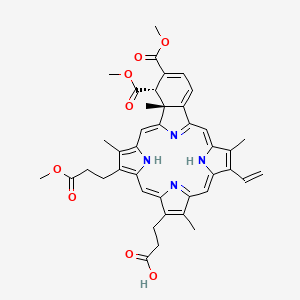
Verteporfin


Visudyne, Verteporfin, Verteporfina, Verteporfine, Verteporfinum, Visudine, BPD verteporfin
Molecular Formula: C41H42N4O8
Molecular Weight: 718.79418 g/mol
129497-78-5
Benzoporphyrin derivative monoacid ring A
BPD-MA
CL-315555/CL-315585
CL-318952
CV-001
18-ethenyl-4,4a-dihydro-3,4-bis(methoxycarbonyl)-4a,8,14,19-tetramethyl-23H,25H-benzo(b)porphine-9,13-dipropanoic acid monomethyl ester
US5798349; 5770619; 5756541; 5707608 (from FDA Orange Book)
For the treatment of patients with predominantly classic subfoveal choroidal neovascularization due to age-related macular degeneration, pathologic myopia or presumed ocular histoplasmosis syndrome. Verteporfin can also be used to destroy tumors.

Verteporfin (trade name Visudyne), a benzoporphyrin derivative, is a medication used as a photosensitizer for photodynamic therapy to eliminate the abnormal blood vessels in the eye associated with conditions such as the wet form of macular degeneration. Verteporfin accumulates in these abnormal blood vessels and, when stimulated by nonthermal red light with awavelength of 693 nm in the presence of oxygen, produces highly reactive short-lived singlet oxygen and other reactive oxygen radicals, resulting in local damage to the endothelium and blockage of the vessels.[1][2]

Verteporfin is also used off-label for the treatment of central serous retinopathy.[3]


Verteporfin, otherwise known as benzoporphyrin derivative (trade name Visudyne®), is a medication used as a photosensitizer for photodynamic therapy to eliminate the abnormal blood vessels in the eye associated with conditions such as the wet form of macular degeneration. Verteporfin accumulates in these abnormal blood vessels and, when stimulated by nonthermal red light with a wavelength of 693 nm in the presence of oxygen, produces highly reactive short-lived singlet oxygen and other reactive oxygen radicals, resulting in local damage to the endothelium and blockage of the vessels.

Administration

Verteporfin is given intravenously, 15 minutes before laser treatment.[1]


VISUDYNE® (verteporfin) for Injection is a light activated drug used inphotodynamic therapy. The finished drug product is a lyophilized dark green cake. Verteporfin is a 1:1 mixture of two regioisomers (I and II), represented by the following structures:

VISUDYNE®
  (verteporfin) Structural Formula Illustration

The chemical names for the verteporfin regioisomers are:

9-methyl (I) and 13-methyl (II) trans-(±)-18-ethenyl-4,4a-dihydro-3,4-bis(methoxycarbonyl)-4a,8,14,19-tetramethyl-23H, 25H-benzo[b]porphine-9,13-dipropanoate

The molecular formula is C41H42N4O8 with a molecular weight of approximately 718.8. Each mL of reconstituted VISUDYNE contains:

ACTIVE: Verteporfin, 2 mg
INACTIVES: Lactose, egg phosphatidylglycerol, dimyristoyl phosphatidylcholine, ascorbyl palmitate and butylated hydroxytoluene


Contraindications

Porphyria.[1]

Side effects

Most common side effects are blurred vision, headache, and local effects at the injection site. Also, photosensitivity; it is advised to avoid exposure to sunlight and unscreened lighting until 48 hours after the injection of verteporfin.[1]

Interactions

None known. Verteporfin has no influence on the liver enzyme CYP3A4, which metabolises many pharmaceutical drugs.[1]

Visudyne.png


…………………..

http://www.google.com/patents/WO2011017809A1?cl=en

Verteporfin (CAS # 129497-78-5) is a benzoporphyrin derivative which has been used clinically for photodynamic therapy of age related macular degeneration (23).

Verteporfin is photoactivated for photodynamic therapy to eliminate the abnormal blood vessels in the eye associated with conditions such as the wet form of macular

degeneration. Verteporfin accumulates in these abnormal blood vessels and, when stimulated by nonthermal red light with a wavelength of 693 ran in the presence of oxygen, the photoactivated verteporfin produces highly reactive short-lived singlet oxygen and other reactive oxygen radicals, resulting in local damage to the endothelium and blockage of the vessels. Benzoporphoryrins, are described for example, in US patents 5,095,030, 5,214,036, and 6,008,241.


Verteporfin (CAS # 129497-78-5) as used herein may include the two regioisomers as shown below:

Figure imgf000016_0001

and the 2 entantiomers of each of the two regioisomers as shown below:

Figure imgf000016_0002
Figure imgf000016_0003

The verteporfin as disclosed herein contains at least one chiral center and thus may exist in various stereoisomeric forms. If desired, such stereoisomers, including enantiomers, may be separated using techniques standard in the art (for example, chiral columns). However, racemic mixtures or mixtures containing more than one diastereomer may also be used and are contenplated herein. However, the compounds tested herein were in either of the trans entantiomers shown above. The compounds shown in Formulas IA, IB, Tables 1, 2 and Figure 10, are representative of the individual optical isomers, enantiomers or diastereomers as the case may be, as well as mixtures of these individual chiral isomers.

Visudyne™, as used herein, is the liposomal formulation of verteporfin used in humans for photodynamic therapy. Visudyne™ is given intravenously, usually within 15 minutes prior to laser treatment to eliminate the abnormal blood vessels in the eye in the treatment of wet macular degeneration. The verteporfin compound accumulates in these abnormal blood vessels and, when stimulated by a nonthermal red light laser with a wavelength of 693 nm in the presence of oxygen, produces highly reactive short-lived singlet oxygen and other reactive oxygen radicals, resulting in local damage to the endothelium and blockage of the vessels. Patients given Visudyne™ experience photosensitivity and are advised to avoid exposure to sunlight and unscreened lighting for at least 48 hours after the injection of verteporfin.

In contrast to the current use of verteporfin in photodynamic therapy, subjects administered the BPDs described herein, in accordance with the methods and uses described herein, do not require photoactivation of the BPD via nonthermal red light laser with a wavelength of 693 nm or otherwise. The activity of the BPDs to inhibit early stage autophagy is independent of the activity associated with photoactivation and would likely be hindered by photoactivation. Accordingly, a person of skill in the art would appreciate that the precautions associated with photosensitivity should also apply to the present methods and uses (i.e. avoid exposure to sunlight and unscreened lighting for at least 48 hours after the injection of of the BPD).

References

  1.  Verteporfin monograph
  2.  Scott, L. J.; Goa, K. L. (2000). “Verteporfin”. Drugs & aging 16 (2): 139–146; discussion 146–8. doi:10.2165/00002512-200016020-00005. PMID 10755329. edit
  3.  Adelman, R.; Adelman, R. A. (2013). “Profile of verteporfin and its potential for the treatment of central serous chorioretinopathy”.Clinical Ophthalmology 7: 1867–1875. doi:10.2147/OPTH.S32177. PMC 3788817. PMID 24092965. edit

External links


Patent Submitted Granted
Photodynamic therapy for the treatment of hair loss [US7090691] 2004-01-22 2006-08-15
PHOTOTHERAPY METHODS AND DEVICES COMPRISING EMISSIVE ARYL-HETEROARYL COMPOUNDS [US2012015998] 2012-01-19
PHOTOTHERAPY DEVICES AND METHODS COMPRISING SUBSTITUTED CARBAZOLE COMPOUNDS [US2012016449] 2012-01-19
PHOTODYNAMIC THERAPY FOR THE TREATMENT OF HAIR LOSS [US2008056996] 2008-03-06
FACTOR VII CONJUGATES FOR SELECTIVELY TREATING NEOVASCULARIZATION DISORDERS [US2008206227] 2008-08-28
Factor VII conjugates for selectively treating neovascularization disorders [US2006052286] 2006-03-09
Methods of treating neuralgic pain [US2004220167] 2004-11-04


Systematic (IUPAC) name
3-[(23S,24R)-14-ethenyl-5-(3-methoxy-3-oxopropyl)-22,23-bis(methoxycarbonyl)-4,10,15,24-tetramethyl-25,26,27,28-tetraazahexacyclo[16.6.1.13,6.18,11.113,16.019,24]octacosa-1,3,5,7,9,11(27),12,14,16,18(25),19,21-dodecaen-9-yl]propanoic acid
Clinical data
Trade names Visudyne
AHFS/Drugs.com monograph
MedlinePlus a607060
Pregnancy cat.
Legal status
Routes Intravenous
Identifiers
CAS number 129497-78-5 Yes
ATC code S01LA01
PubChem CID 5362420
DrugBank DB00460
ChemSpider 21106402 Yes
UNII 0X9PA28K43 Yes
KEGG D01162 Yes
ChEBI CHEBI:60775 Yes
ChEMBL CHEMBL2218885 
Chemical data
Formula C41H42N4O8 
Molecular mass 718.794 g/mol

CARIPRAZINE for major depressive disorder


CARIPRAZINE

CAS 839712-12-8 (free base)

CAS 1083076-69-0…HYDROCLORIDE SALT

trans-N-[4-[2-[4-(2,3-Dichlorophenyl)piperazin-1-yl]ethyl]cyclohexyl]-N’,N’-dimethylurea

Trans-1-{4-[2-[4-(2,3-dichlorophenyl)-piperazin-1-yl]-ethyl]-cyclohexyl}-3,3- dimethyl-urea

trans-4-{2-[4-(2,3-dichlorophenyl)-piperazin-1-yl]-ethyl}-N,N-dimethylcarbamoyl-cyclohexylamine

trans-1{4-[2-[4-(2,3-dichlorophenyl)-piperazin-1-yl]-ethyl]-cyclohexyl}-3,3-dimethyl-urea,

3-(trans-4-(2-(4-(2,3-Dichlorophenyl)piperazin-1-yl)ethyl)cyclohexyl)-1,1-dimethylurea

IN PHASE 3 FOR MAJOR DEPRESSION

Cariprazine (RGH-188) is an antipsychotic drug under development by Gedeon Richter. It acts as a D2 and D3 receptor partial agonist, with high selectivity towards the D3 receptor.[1] Positive Phase III study results were published for schizophrenia and maniaearly 2012, while Phase II studies in bipolar disorder I, and for bipolar depression are in progress.[2] Action on the dopaminergic systems makes it also potentially useful as an add-on therapy in major depressive disorder [3]

Forest Laboratories obtained a license on development (from the Richter – Hungary) and exclusive commercial rights in the US in 2004.

R&D center in Budapest


NEWS………….DUBLIN and BUDAPEST, Hungary, Jan. 6, 2015 /PRNewswire/ — Actavis plcand Gedeon Richter Plc. today announced that the U.S. Food and Drug Administration (FDA) has acknowledged receipt of Actavis’ New Drug Application (NDA) resubmission for its atypical antipsychotic cariprazine, a potent dopamine D3/D2 receptor partial agonist with preferential binding to D3 receptors. The Prescription Drug User Fee Act (PDUFA) date is expected to be in the second quarter of 2015…….

….http://www.marketwatch.com/story/actavis-and-gedeon-richter-announce-fda-receipt-of-nda-resubmission-for-cariprazine-2015-01-06

Production building of the company in Budapest

Medical uses

Cariprazine is currently in clinical trials for schizophrenia and bipolar disorder. It has also been investigated as a potential adjunct in treatment-resistant major depressive disorder.[4]

Illustrated Pill Packaging

Side effects

The most prevalent side effects for cariprazine include akathisia, insomnia, and weight gain. Cariprazine does not appear to impact metabolic variables or prolactin levles, and unlike many other antipsychotics, does not increase the electrocardiogram (ECG) QT interval. In short term clinical trials extrapyramidal effects, sedation, akathisia, nausea, dizziness, vomiting, anxiety, and constipation were observed. One review characterized the frequency of these events as “not greatly different from that seen in patient treated with placebo”[5] but a second called the incidence of movement-related disorders “rather high”[6][7] .

Pharmacodynamics

Cariprazine acts as an antipsychotic that is effective against the positive and negative symptoms of schizophrenia.[8] Unlike many antipsychotics that are D2 and 5-HT2A receptor antagonists, cariprazine is a D2 and D3 partial agonist. It also has a higher affinity for D3 receptors. The D2 and D3 receptors are important targets for the treatment of schizophrenia, because the overstimulation of dopamine receptors has been implicated as a possible cause of schizophrenia.[9] Cariprazine acts to inhibit overstimulated dopamine receptors (acting as an antagonist) and stimulate the same receptors when the endogenous dopamine levels are low. Cariprazine’s high selectivity towards D3 receptors could prove to reduce side effects associated with the other antipsychotic drugs, because D3receptors are mainly located in the ventral striatum and would not incur the same motor side effects (extrapyramidal symptoms) as drugs that act on dorsal striatum dopamine receptors.[8] Cariprazine also acts on 5-HT1A receptors, though the affinity is considerably lower than the affinity to dopamine receptors (seen in monkey and rat brain studies).[8][10] In the same studies, cariprazine has been noted to produce pro-cognitive effects, the mechanisms of which are currently under investigation. An example of pro-cognitive effects occurred in pre-clinical trials with rats: rats with cariprazine performed better in a scopolamine-induced learning impairment paradigm in a water labyrinth test. This may be due to the selective antagonist nature of D3 receptors, though further studies need to be conducted.[8] This result could be very useful for schizophrenia, as one of the symptoms includes cognitive deficits.

Cariprazine has partial agonist as well as antagonist properties depending on the endogenous dopamine levels. When endogenous dopamine levels are high (as is hypothesized in schizophrenic patients), cariprazine acts as an antagonist by blocking dopamine receptors. When endogenous dopamine levels are low, cariprazine acts more as an agonist, increasing dopamine receptor activity.[11] In monkey studies, the administration of increasing does of cariprazine resulted in a dose-dependent and saturable reduction of specific binding. At the highest dose (300 μg/kg), the D2/D3 receptors were 94 % occupied, while at the lowest dose (1 μg/kg), receptors were 5 % occupied.[10]

Receptor Ki (nM)[4] Pharmacodynamic action[4]
5-HT1A 3 Partial agonism
5-HT2A 19 Inverse agonism/antagonism
5-HT2B 0.58 Inverse agonism/Antagonism
5-HT2C 134 Inverse agonism/Antagonism
5-HT7 111 Antagonism
D2S 0.69 Partial agonism
D2L 0.49 Partial agonism
D3 0.085 Partial agonism
H1 23 Inverse agonism/antagonism

Pharmacokinetics

Cariprazine has high oral bioavailability and can cross the blood brain barrier easily in humans because it is lipophilic.[2] In rats, the oral bioavailability was 52 % (with a dose of 1 mg/kg).[7]

………………………

PATENT

http://www.google.com/patents/EP1663996A1?cl=en

Trans-1-{4-[2-[4-(2,3-dichlorophenyl)-piperazin-1-yl]-ethyl]-cyclohexyl}-3,3- dimethyl-urea (compound 1 )

Example 1 1-(2,3-dichlorophenyl)-[1,4]diazepine (starting material)

2.25 g (10 mmol) 1-bromo-2,3-dichloro-benzene was dissolved in dry toluene (50 ml), 2.3 (11 mmol) of [1 ,4]diazepine-1 -carboxylic acid tert-butylester was added followed by 0.2 g BINAP (2,2-bis(diphenylρhosphino)-1 ,1′-binaphtyl), 85 mg tris(dibenzylideneacetone)dipalladium(0) and 1.2 g (12mmol) sodium-tert-butoxyde. The reaction mixture was refluxed for eight hours and filtered. The organic layer was washed with water, dried and evaporated in vacuo. The residue was purified by chromatography and deprotected at 10 °C using 20 ml ethylacetate saturated with gaseous hydrochloric acid, the precipitate was filtered giving 2.1 g (yield: 75 %) hydrochloride salt of the title compound, melting at 182-3 °C. Example 2 Trans-N-{4-[2-[4-(2,3-dichloro-phenyl)-hexahydro-[1 ,4]diazepin-1-yl]-ethyl]- cyclohexyl}-carbamic acid tert-butylester (intermediate) 0.7 g (2.5 mmol) of 1 -(2,3-dichlorophenyl)-[1 ,4]diazepine hydrochloride and

0.6 g (2.5 mmol) of frat?s-2-{1 -[4-(N-tert-butyloxycarbonyl)amino]cyclohexyl}- acetaldehyde were dissolved in dichloroethane (35 ml), 0.35 ml (2.5 mmol) triethylamine was added, then 0.79 g (3.7 mmol) sodium triacetoxyborohydride was added portionswise and the reaction mixture was stirred for 20 hours at ambient temperature, then 20 % potassium carbonate solution in water (20 ml) was added. The organic layer was separated, dried and evaporated to dryness in vacuo. The precipitate was recrystallized from acetonitrile to give the title compound 1 .0 g (yield: 85.8 %), m.p.: 95-8 °C. Example 3

Trans-4-[2-[4-(2,3-dichloro-phenyl)-hexahydro-[1 ,4]diazepin-1-yl]-ethyl]- cyclohexylamine (intermediate)

0.93 g (2.1 mmol) frarjs-N-{4-[2-[4-(2,3-dichloro-phenyl)-hexahydro- [1 ,4]diazepin-1 -yl]-ethyl]-cyclohexyl}-carbamic acid tert-butylester was deprotected at

10 °C using 15 ml ethylacetate saturated with gaseous hydrochloric acid, after 4 hours the precipitate was filtered giving 0.91 g (yield: 98 %) dihydrochloride salt of the title compound, melting at 260-6 °C. Method A

Trans-1-{4-[2-[4-(2,3-dichlorophenyl)-piperazin-1-yi]-ethyl]-cyclohexyl}-3,3- dimethyl-urea (compound 1 ) 1 .39g (3 mmol) trans-4-{2-[4-(2,3-dichlorophenyl)-ρiperazin-1 -yl]-ethyl}- cyclohexyl-amine trihydrochloride was suspended in dichloromethane (100 ml), triethylamine (2.1 ml, 15 mmol) was added followed by 0.30 ml (3.3 mmol) N,N- dimethylcarbamoylchloride. The reaction mixture was stirred for 48 hours at room temperature, filtered. The filtrate was washed with water (2 x 20 ml), dried and evaporated in vacuo. Recrystallizing from methanol gave the title compound (0.83 g, 65 %), melting at 212-4 °C.

Method B

7rans-1-{4-[2-[4-(2,3-dichlorophenyl)-piperazin-1-yl]-ethyl]-cyclohexyl}-3-ethyl- urea (compound 2) 0.56g (1.2 mmol) trans-4-{2-[4-(2,3-dichlorophenyl)-piperazin-1-yl]-ethyl}- cyclohexyl-amine was dissolved in dry dichloromethane (20 ml), ethylisocyanate (0.1 ml, 1.3 mmol) was added and the reaction mixture was stirred at room temperature for 4 hours. The solvent was removed in vacuo. The residue was stirred with water, the precipitate was filtered, giving the title compound (0.33 g, 65 %). Melting point:

235-8 °C.

Method C rrans-1-{4-[2-[4-(2,3-dichlorophenyl)-piperazin-1-yl]-ethyl]-cyclohexyl}-3,3- dimethyl-urea (compound 1 )

0.56g (1.2 mmol) trans-4-{2-[4-(2,3-dichlorophenyl)-piperazin-1-yl]-ethyl}- cyclohexyl-amine trihydrochloride was suspended in dry dichloromethane (50 ml), triethylamine 0.77 ml, 6 mmol) was added and 0.13g (0.44 mmol) triphosgene dissolved in dichloromethane was dropped in. After one hour stirring at room temperature dimetilamine hydrochloride (0.49 g, 6 mmol) followed by triethylamine (0.84 ml, 6 mmol) was added and the stirring was continued for 20 hours. The mixture was filtered, the filtrate washed with water, dried and evaporated in vacuo. Recrystallizing the product from methanol gave the title compound (0.27 g, 52 %). Melting point: 212-4 °C.

……………………

PATENT

http://www.google.com/patents/US20090023750

U.S. Patent Publication No. 2006/0229297 discloses (thio)-carbamoyl-cyclohexane derivatives that are D3 and D2 dopamine receptor subtype preferring ligands, having the formula (I):

Figure US20090023750A1-20090122-C00001

(I)

wherein R1, R2, X, and n are as defined therein. One particular compound disclosed therein is trans-1{4-[2-[4-(2,3-dichlorophenyl)-piperazin-1-yl]-ethyl]-cyclohexyl}-3,3-dimethyl-urea, which is also known as trans-4-{2-[4-(2,3-dichlorophenyl)-piperazin-1-yl]-ethyl}-N,N-dimethylcarbamoyl-cyclohexylamine, the structural formula for which is shown below:

Figure US20090023750A1-20090122-C00002

Compounds of formula (I) act as a dopamine receptor antagonists, particularly D3/D2 receptor antagonists, and are useful in the treatment and prevention of pathological conditions which require modulation of dopamine receptors.

In some cases, an appropriate salt of an active may improve certain properties suitable for pharmaceutical compounds (i.e., stability, handling properties, ease of large scale synthesis, etc.). However, selection of a suitable salt for a particular active agent is not always straightforward, since the properties of salts of different compounds formed with the same salt forming agent may differ greatly. Moreover, formation of particular salts of a compound possessing more than one basic centre may be difficult to achieve in high yield due to formation of multiple products.

…………………..

see

WO 2011073705

http://www.google.com/patents/WO2011073705A1?cl=en

We have surprisingly found that by reacting trans 4-{2-[4-(2,3-dichlorophenyl)- piperazine-l-yl]-ethyl}-cyclohexylamine of formula (III)

Figure imgf000004_0001

with a carbonic acid derivative of general formula (VI)R-O-CO-Z (VI)

then reacting the compound of general formula (IV) obtained

Figure imgf000005_0001


with an amine derivative of general formula (V)

get the compounds of general formula (I)

Figure imgf000006_0001


EXAMPLES

The invention is illustrated by the following non-limiting examples.

Example 1

Trans N-(4-{2-[4-(2,3-dichlorophenyl)-piperazine-l-yl]-ethyl}-cyclohexyl)-carbamic acid methylester 6.45 g (0.015 mol) of dihydrochloride of compound of formula (III) was added to a mixture of 125 ml dichloromethane and 12.25 ml triethylamine and the thick suspension obtained was stirred at a temperature between 20-25°C for one hour. The so obtained suspension was added to a solution of 2.3 ml (0.03 mol) methyl chloroformate in 25 ml of dichloromethane at a temperature between 5-10°C. The reaction mixture obtained was stirred at a temperature between 20-25°C for 3 hours then extracted with 3×150 ml (150 g) of distilled water. The organic phase was evaporated in vacuum and the residue was recrystallized from methanol. In this manner 4.5 g of the title product was obtained.

Yield: 72 %.

Melting point: 143-147 °C

Example 2

Trans N-(4-{2-[4-(2,3-dichlorophenyl)-piperazine-l-yl]-ethyl}-cyclohexyl)-carbamic acid isopropylester

6.45 g (0.015 mol) of dihydrochloride of compound of formula (III) was added to a mixture of 125 ml dichloromethane and 12.25 ml of triethylamine and the thick suspension obtained was stirred at a temperature between 20-25°C-on for one hour. The suspension was added to a solution of 3.7 g (0.03 mol) of isopropyl chloroformate in 30 ml of toluene at a temperature between 5-10°C. The reaction mixture was stirred at a temperature between 20-25°C for 3 hours and then extracted with 3×150 ml (150 g) of distilled water. The organic phase was evaporated in vacuum and the residue obtained was recrystallized from isopropanole.

In this manner 4,4 g of title compound was obtained. Yield: 67 %.

Melting point: 128-131°C

Example 3

Trans 4-{2-[4-(2,3-dichlorophenyl)-piperazine-l-yl]-ethyl}-N,N-dimethylcarbamoyl- cyclohexylamine

6.45 g (0.015 mol) of dihydrochloride of compound of formula (III) was added to a mixture of 125 ml of dichloromethane and 12.25 ml of triethylamine and the thick suspension obtained was stirred at a temperature between 20-25°C for one hour. The suspension was added to a solution of 4.9 g of bis(trichloromethyl)carbonate in 50 ml of dichloromethane at a temperature between -5-(-10)°C for one hour. The reaction mixture obtained was added to a solution of 13 g dimethylamine in 100 ml isopropyl alcohol (IP A) (40 ml, 0.12 mol) cooled at a temperature between 0-(-10)°C during which the temperature of the reaction mixture was kept under 0°C. After stirring at a temperature between 0-(-5)°C for 30 minutes to the reaction mixture 100 ml of distilled water was added under stirring. Then the pH of the aqueous phase was adjusted to 7-8 by adding concentrated hydrochloric acid and volume of the reaction mixture was concentrated to 130 ml under vacuum. To the reaction mixture obtained additional 70 ml of distilled water was added and the mixture was concentrated to 170 ml under vacuum. The suspension was stirred at 20-25°C for one hour and the product obtained was isolated by filtration.

In this manner 6.6 g of title compound was obtained.

Yield: 95 %

Melting point: 208-211 °C Example 4

Trans 4-{2-[4-(2,3-dichlorophenyl)-piperazine-l-yl]-ethyI}-N,N-dimethylcarbamoyl- cyclohexylamine 4.4 g (0.011 mol) of trans N-(4-{2-[4-(2,3-dichlorophenyl)-piperazine-l-yl]-ethyl}- cyclohexyl)-carbamic acid methylester was dissolved in 120 ml of dichloromethane. The solution obtained was added to a solution of 13 g dimethylamine in 100 ml isopropyl alcohol (IP A) (100 ml, 0.3 mol) cooled at a temperature between 0-(-10)°C during which the temperature of the reaction mixture was kept under 0°C. After stirring at a temperature between 0-(-5)°C for 30 minutes to the reaction mixture 100 ml of distilled water was added under stirring. Then the pH of the aqueous phase was adjusted to 7-8 by adding concentrated hydrochloric acid and volume of the reaction mixture was concentrated to 100 ml under vacuum. To the reaction mixture obtained additional 70 ml of distilled water was added and the mixture was concentrated to 120 ml under vacuum. The suspension was stirred at 20-25°C for one hour and the product obtained was isolated by filtration.

In this manner 4.3 g of title compound was obtained.

Yield: 95 %

Melting point: 208-211 °C

Example 5

Trans 4-{2-[4-(2,3-dichlorophenyl)-piperazine-l-yl]-ethyl}-N,N-dimethylcarbamoyl- cyclohexylamine hydrochloride 6.45 g (0.015 mol) dihydrochloride of formula (III) was added to a mixture of 125 ml of dichloromethane and 12.25 ml of triethylamine and the thick suspension obtained was stirred at a temperature between 20-25°C for one hour. The suspension was added to the solution of 4.9 g of bis(trichloromethyl)carbonate in 50 ml of dichloromethane at a temperature between -5-(-10)°C for one hour. The reaction mixture obtained was added to a solution of 13 g dimethylamine in 100 ml isopropyl alcohol (IP A) (40 ml, 0.12 mol) cooled at a temperature between 0-(-10)°C during which the temperature of the reaction mixture was kept under 0°C. After stirring at a temperature between 0-(-5)°C for 30 minutes 100 ml of distilled water was added to the reaction mixture under stirring. Then the pH of the aqueous phase is adjusted to 2-3 by adding concentrated hydrochloric acid and the reaction mixture was concentrated to 130 ml, additional 70 ml of distilled water was added and the mixture was concentrated to 170 ml. The suspension was stirred at 20-25°C for one hour and the product obtained was isolated by filtration.

In this manner 6.7 g of title compound was obtained.

Yield: 96 %

Melting point: 221-224 °C

Example 6

Trans 4-{2-[4-(2,3-dichlorophenyl)-piperazine-l-yl]-ethyl}-N,N-dimethylcarbamoil- cyclohexylamine hydrochloride 6.72 g (0.015 mol) dihydrochloride monohydrate of compound of formula (III) was added to a mixture of 125 ml of dichloromethane and 12.25 ml of triethylamine and the thick suspension obtained was stirred at a temperature between 20-25 °C for one hour. The suspension was added to the solution of 4.9 g of bis(trichloromethyl)carbonate in 50 ml of dichloromethane at a temperature between -5-(-10)°C for one hour. The reaction mixture obtained was added to a solution of 13 g dimethylamine in 100 ml isopropyl alcohol (IP A) (40 ml, 0,12 mol) cooled at a temperature between 0-(-10)°C during which the temperature of the reaction mixture was kept under 0°C. After stirring at a temperature between 0-(-5)°C for 30 minutes to the reaction mixture 100 ml of distilled water was added and the pH of the aqueous phase was adjusted to 2-3 by adding concentrated hydrochloric acid. The reaction mixture was concentrated to 130 ml under vacuum then additional 70 ml of water was added and the mixture was concentrated to 170 ml. The suspension was stirred at a temperature between 20-25°C for one hour and the product obtained was isolated by filtration.

In this manner 6.7 g of title compound was obtained.

Yield: 96 %.

Melting point: 221-224 °C

………………………………………

SEE

http://www.google.com/patents/WO2014031162A1?cl=en

……………………………….

PAPER

Bioorganic & Medicinal Chemistry Letters
Volume 22, Issue 10,  (15 May 2012)

  • Discovery of cariprazine (RGH-188): A novel antipsychotic acting on dopamine D3/D2 receptors

  • Pages 3437-3440
  • Éva Ágai-Csongor, György Domány, Katalin Nógrádi, János Galambos, István Vágó, György Miklós Keserű, István Greiner, István Laszlovszky, Anikó Gere, Éva Schmidt, Béla Kiss, Mónika Vastag, Károly Tihanyi, Katalin Sághy, Judit Laszy, István Gyertyán, Mária Zájer-Balázs, Larisza Gémesi, Margit Kapás, Zsolt Szombathelyi
  • Cariprazine, a potential atypical antipsychotic agent has been identified during the optimization of novel series of 4-aryl-piperazine derivatives. The recently available top line results from pivotal clinical trials demonstrated the safety and efficacy of cariprazine in bipolar mania and schizophrenia indications.

    image

………………………………………….

Journal of Medicinal Chemistry, 2013 ,  vol. 56,  22  pg. 9199 – 9221

http://pubs.acs.org/doi/abs/10.1021/jm401318w

Abstract Image

Biased agonism offers an opportunity for the medicinal chemist to discover pathway-selective ligands for GPCRs. A number of studies have suggested that biased agonism at the dopamine D2 receptor (D2R) may be advantageous for the treatment of neuropsychiatric disorders, including schizophrenia. As such, it is of great importance to gain insight into the SAR of biased agonism at this receptor. We have generated SAR based on a novel D2R partial agonist, tert-butyl (trans-4-(2-(3,4-dihydroisoquinolin-2(1H)-yl)ethyl)cyclohexyl)carbamate (4). This ligand shares structural similarity to cariprazine (2), a drug awaiting FDA approval for the treatment of schizophrenia, yet displays a distinct bias toward two different signaling end points. We synthesized a number of derivatives of 4 with subtle structural modifications, including incorporation of cariprazine fragments. By combining pharmacological profiling with analytical methodology to identify and to quantify bias, we have demonstrated that efficacy and biased agonism can be finely tuned by minor structural modifications to the head group containing the tertiary amine, a tail group that extends away from this moiety, and the orientation and length of a spacer region between these two moieties.

3-(trans-4-(2-(4-(2,3-Dichlorophenyl)piperazin-1-yl)ethyl)cyclohexyl)-1,1-dimethylurea (2).(ref…………Ágai-Csongor, É.; Domány, G.; Nógrádi, K.; Galambos, J.; Vágó, I.; Keserű, G. M.; Greiner, I.; Laszlovszky, I.; Gere, A.; Schmidt, É.; Kiss, B.; Vastag, M.; Tihanyi, K.; Sághy,K.; Laszy, J.; Gyertyán, I.; Zájer-Balázs, M.; Gémesi, L.; Kapás, M.; Szombathelyi,Z.Discovery of cariprazine (RGH-188): A novel antipsychotic acting on dopamine D3/D2receptors Bioorg. Med. Chem. Lett. 2012, 22, 34373440)

Using 50 (40 mg, 112 μmol) as the amine, following general procedure F the product was eluted (CHCl3/CH3OH, 20:1 to 10:1) to give the title compound as a white solid (27 mg, 56%).
mp: 208–209 °C.
1H NMR
δ 7.18–7.10 (m, 2H), 6.99–6.92 (m, 1H), 4.12 (d, J = 7.5 Hz, 1H), 3.64–3.49 (m, 1H), 3.07 (br s, 4H), 2.88 (s, 6H), 2.63 (br s, 4H), 2.50–2.39 (m, 2H), 2.07–1.94 (m, 2H), 1.82–1.72 (m, 2H), 1.52–1.37 (m, 2H), 1.31–1.18 (m, 1H), 1.18–0.99 (m, 4H).
13C NMR
δ 157.8 (C), 151.3 (C), 134.0 (C), 127.5 (C), 127.4 (CH), 124.5 (CH), 118.6 (CH), 56.7 (CH2), 53.4 (CH2), 51.3 (CH2), 49.8 (CH), 36.1 (CH3), 35.7 (CH), 34.0 (CH2), 33.9 (CH2), 32.1 (CH2).
HPLCtR = 8.60 min, >99% purity.
HRMS (m/z): [MH]+ calcd for C21H32Cl2N4O, 427.2026; found, 427.2022.
Intermediate 50
trans-4-(2-(4-(2,3-Dichlorophenyl)piperazin-1-yl)ethyl)cyclohexanamine (50).
Figure imgf000004_0001
Starting with 32, following general procedure D gave the title compound as a pale-yellow wax (99%). 1H NMR δ 7.19–7.09 (m, 2H), 6.99–6.92 (m, 1H), 3.07 (br s, 4H), 2.74–2.55 (m, 5H), 2.48–2.36 (m, 2H), 1.92–1.81 (m, 2H), 1.81–1.72 (m, 2H), 1.50–1.32 (m, 4H), 1.30–1.16 (m, 1H), 1.15–0.92 (m, 4H). 13C NMR δ 151.5 (C), 134.2 (C), 127.6 (C), 127.6 (CH), 124.6 (CH), 118.7 (CH), 56.9 (CH2), 53.6 (CH2), 51.5 (CH2), 50.9 (CH), 36.9 (CH2), 35.7 (CH), 34.2 (CH2), 32.3 (CH2).
INTERMEDIATE 32
Figure
tert-Butyl (trans-4-(2-(4-(2,3-Dichlorophenyl)piperazin-1-yl)ethyl)cyclohexyl)carbamate (32).(Bioorg. Med. Chem. Lett. 2012, 22, 34373440)
Using 16 (200 mg, 829 μmol) as the aldehyde and 28 (230 mg, 995 μmol) as the amine, following general procedure C. Purification by flash column chromatography (petroleum spirits/EtOAc, 5:1) gave the title compound as a white wax (262 mg, 69%). mp: 143–145 °C. 1H NMR δ 7.17–7.10 (m, 2H), 6.99–6.92 (m, 1H), 4.37 (br s, 1H), 3.37 (br s, 1H), 3.07 (br s, 4H), 2.62 (br s, 4H), 2.48–2.38 (m, 2H), 2.04–1.92 (m, 2H), 1.82–1.73 (m, 2H), 1.49–1.37 (m, 11H), 1.30–1.17 (m, 1H), 1.15–0.97 (m, 4H). 13C NMR δ 155.3 (C), 151.5 (C), 134.2 (C), 127.64 (C), 127.56 (CH), 124.7 (CH), 118.7 (CH), 79.2 (C), 56.7 (CH2), 53.5 (CH2), 51.5 (CH2), 50.0 (CH), 35.6 (CH), 34.0 (CH2), 33.6 (CH2), 32.1 (CH2), 28.6 (CH3). HPLC tR = 9.62 min, >99% purity. HRMS (m/z): [MH]+ calcd for C23H35Cl2N3O2, 456.2179; found, 456.2195.
INTERMEDIATE 16
tert-Butyl (trans-4-(2-Oxoethyl)cyclohexyl)carbamate (16).(J. Med. Chem. 2000, 43, 18781885)
TERT-BUTYL (CIS-4-(2-OXOETHYL)CYCLOHEXYL)CARBAMATE
Using 12 (1.25 g, 4.38 mmol) as the starting material, following general procedure B the material was purified by column chromatography (petroleum spirits/EtOAc, gradient 6:1 to 4:1), giving the title compound as a white wax (944 mg, 89%, lit.(15) 53%). 1H NMR δ 9.75 (t, J = 2.0 Hz, 1H), 4.47 (br s, 1H), 3.37 (br s, 1H), 2.32 (dd, J = 6.6, 2.0 Hz, 2H), 2.04–1.97 (m, 2H), 1.89–1.75 (m, 3H), 1.45 (s, 9H), 1.21–1.03 (m, 4H). 13C NMR δ 202.2 (CH), 155.3 (C), 79.2 (C), 50.7 (CH2), 49.5 (CH), 33.2 (CH2), 31.8 (CH2), 31.7 (CH), 28.5 (CH3).
INTERMEDIATE 12
Ethyl 2-(trans-4-((tert-Butoxycarbonyl)amino)cyclohexyl)acetate (12).(Patent WO 2007/093540 A1,)
ChemSpider 2D Image | Ethyl [trans-4-({[(2-methyl-2-propanyl)oxy]carbonyl}amino)cyclohexyl]acetate | C15H27NO4Ethyl [trans-4-({[(2-methyl-2-propanyl)oxy]carbonyl}amino)cyclohexyl]acetate
Using 8 (682 mg, 3.07 mmol) as the starting material, following general procedure A gave the product as white needles (746 mg, 94%). Determination of diastereomeric purity (>95% trans) was achieved by 1H NMR analysis. The trans stereoisomer (12) exhibited a characteristic resonance at δ 2.18 ppm, whereas the cis stereoisomer (15) exhibited the equivalent resonance at δ 2.24 ppm. 1H NMR δ 4.52 (br s, 1H), 4.12 (q, J = 7.1 Hz, 2H), 3.37 (br s, 1H), 2.18 (d, J = 6.9 Hz, 2H), 2.04–1.95 (m, 2H), 1.84–1.66 (m, 3H), 1.43 (s, 9H), 1.25 (t, J = 7.1 Hz, 3H), 1.20–1.01 (m, 4H). 13C NMR δ 172.8 (C), 155.2 (C), 78.9 (C), 60.1 (CH2), 49.4 (CH), 41.4 (CH2), 33.4 (CH), 33.1 (CH2), 31.5 (CH2), 28.4 (CH3), 14.2 (CH3).
INTERMEDIATE 8
ChemSpider 2D Image | Ethyl (trans-4-aminocyclohexyl)acetate hydrochloride (1:1) | C10H20ClNO2Ethyl (trans-4-aminocyclohexyl)acetate hydrochloride (1:1)
Ethyl 2-(Trans-4-aminocyclohexyl)acetate Hydrochloride (8).(Patent WO 2010/070368 A1, )

Following an adapted literature procedure,(38) 10% Pd/C (881 mg, 828 μmol) was carefully added to an orange suspension of 5 (5.00 g, 27.6 mmol) in H2O (150 mL). The reaction mixture was hydrogenated on a Parr shaker at 60 psi at rt for 3 days until the uptake of hydrogen was complete and no starting materials remained by TLC (CHCl3/CH3OH, 1:1). The mixture was filtered through a Celite pad and washed with water (30 mL), and the filtrate evaporated to dryness in vacuo to reveal a white solid. The material was taken up in absolute EtOH (70 mL) to which concentrated HCl (10 mL) was addedm and the mixture was heated at reflux for 2 h. TLC confirmed ethyl ester formation, and the solvents were concentrated in vacuo. The material was basified with a 1 M NaOH solution to pH 14, and a white precipitate emerged. The product was then extracted from the mixture with EtOAc (3 × 30 mL), and the combined organic extracts were washed with brine and then dried over anhydrous Na2SO4. The product was then converted to the HCl salt by the addition of 1 M HCl in Et2O (27.6 mL, 27.6 mmol), and the solvents were concentrated to half volume in vacuo. The solution was then cooled to 0 °C, resulting in fractional crystallization of the trans stereoisomer as a white solid, which was then collected by filtration and washed with cold CH3CN (1.34 g, 22%). mp: 164–166 °C (lit.(J. Med. Chem. 1998, 41, 76077)
162–163 °C).
1H NMR (MeOD) δ 4.11 (q, 2H, J = 7.1 Hz), 3.05 (tt, 1H, J = 11.8, 3.9 Hz), 2.24 (d, 2H,J = 7.0 Hz), 2.11–2.00 (m, 2H), 1.93–1.83 (m, 2H), 1.83–1.68 (m, 1H), 1.43 (qd, 2H, J = 12.8, 3.6 Hz), 1.24 (t, 3H, J = 7.1 Hz), 1.14 (qd, 2H, J = 13.3, 3.3 Hz). 13C NMR (CD3OD) δ 174.2 (C), 61.4 (CH2), 51.2 (CH), 41.8 (CH2), 34.7 (CH), 31.50 (CH2), 31.47 (CH2), 14.6 (CH3).
………………………..
METABOLITES

the metabolite of the present invention is selected from:

Figure US08765765-20140701-C00006
EXAMPLESThe metabolites of the present invention were synthetized according to the following procedures:Example 1Trans-1-{4-[2-[4-(2,3-dichlorophenyl)-1-oxo-piperazin-1-yl]-ethyl]-cyclohexyl}-3,3-dimethyl-urea (compound D)

Figure US08765765-20140701-C00007

0.8 g (1.6 mmol) trans-1-{4-[2-[4-(2,3-dichlorophenyl)-piperazin-1-yl]-ethyl]-cyclohexyl}-3,3-dimethyl-urea was dissolved in dichloromethane (60 ml). A solution of 0.54 g (2.4 mmol) 3-chloro-perbenzoic acid in dichloromethane (10 ml) was dropped in and the reaction mixture stirred for 24 hours at room temperature. The reaction was monitored by TLC. The solution was washed twice with saturated NaHCO3 solution, the organic layer dried and evaporated in vacuo. Flash chromatography gave 0.45 g (63.3%) of the title compound melting at 175-8° C.

Example 2Trans-1-{4-[2-[4-(2,3-dichloro-4-hydroxy-phenyl)-piperazin-1-yl]-ethyl]-cyclohexyl}-3,3-dimethyl-urea (compound C)

Figure US08765765-20140701-C00008

0.92 g (2 mmol) trans-4-{2-[4-(2,3-dichloro-4-methoxy-phenyl)-piperazin-1-yl]-ethyl}-cyclohexyl-amine dihydrochloride was suspended in dichloromethane (60 ml), triethylamine (1.26 ml, 9 mmol) was added followed by 0.21 ml (2.3 mmol) N,N-dimethylcarbamoylchloride. The reaction mixture was stirred for 48 hours at room temperature. The solution was washed with water (2×10 ml), dried and evaporated in vacuo. Purification with flash chromatography gave 0.66 g trans-1-{4-[2-[4-(2,3-dichloro-4-methoxy-phenyl)-piperazin-1-yl]-ethyl]-cyclohexyl}-3,3-dimethyl-urea, melting at 196-8° C. This product was dissolved in dichloromethane (60 ml), then 6.4 ml (6.4 mmol) borontribromid solution (1M in CH2Cl2) was dropped in at 5° C. and the mixture stirred at room temperature for 24 hours. The reaction was monitored by TLC. 4 ml methanol was added, followed by 25 ml saturated NaHCO3 solution. After separation the organic layer was dried and evaporated in vacuo. Purification with flash chromatography gave 0.4 g of the title compound, melting at 278-80° C.

Example 3Trans-1-{4-[2-[4-(2,3-dichloro-4-hydroxy-phenyl)-piperazin-1-yl]-ethyl]-cyclohexyl}-3-methyl-urea (compound B)

Figure US08765765-20140701-C00009

1.38 g (3 mmol) trans-4-{2-[4-(2,3-dichloro-4-methoxy-phenyl)-piperazin-1-yl]-ethyl}-cyclohexyl-amine dihydrochloride was suspended in dry dichloromethane (100 ml), triethylamine (1.72 ml, 12.4 mmol) was added and 0.34 g (1.14 mmol) triphosgene dissolved in dichloromethane was dropped in. After one hour stirring at room temperature methylamine (33% solution in ethanol) was added and the stirring was continued for 20 hours. The mixture was evaporated. 20 ml water was added, the precipitate filtered, washed with water, dried. Recrystallizing the product from methanol gave trans-1-{4-[2-[4-(2,3-dichloro-4-methoxy-phenyl)-piperazin-1-yl]-ethyl]-cyclohexyl}-3-methyl-urea (0.86 g, 65%) melting above 250° C. This product was dissolved in dichloromethane (60 ml), then 10 ml (10 mmol) borontribromid solution (1M in CH2Cl2) was dropped in at 5° C. and the mixture stirred at room temperature for 24 hours. The reaction was monitored by TLC. 4 ml methanol was added and the mixture evaporated. 35 ml saturated NaHCO3 solution was added. The precipitate was filtered, washed with water and dried, recrystallized from methanol giving 0.34 g of title compound, melting at 237-41° C.

Example 4Trans-1-{4-[2-[4-(2,3-dichloro-4-hydroxy-phenyl)-piperazin-1-yl]-ethyl]-cyclohexyl}-urea (compound A)

Figure US08765765-20140701-C00010

1.38 g (3 mmol) trans-4-{2-[4-(2,3-dichloro-4-methoxy-phenyl)-piperazin-1-yl]-ethyl}-cyclohexyl-amine dihydrochloride was suspended in dry dichloromethane (100 ml), triethylamine 1.72 ml, 12.4 mmol) was added and 0.34 g (1.14 mmol) triphosgene dissolved in dichloromethane was dropped in. After one hour stirring at room temperature ammonia (20% solution in methanol) was added and the stirring was continued for 20 hours. The mixture was evaporated. 20 ml water was added, the precipitate filtered, washed with water, dried. Recrystallizing the product from methanol gave 0.86 g trans-1-{4-[2-[4-(2,3-dichloro-4-methoxy-phenyl)-piperazin-1-yl]-ethyl]-cyclohexyl}-urea melting above 250° C. This product was dissolved in dichloromethane (60 ml), then 10 ml (10 mmol) borontribromid solution (1M in CH2Cl2) was dropped in at 5° C. and the mixture stirred at room temperature for 24 hours. The reaction was monitored by TLC. 4 ml methanol was added and the mixture evaporated. 35 ml saturated NaHCO3 solution was added. The precipitate was filtered, washed with water and dried, recrystallized from methanol giving 0.37 g of title compound, melting at 195-8° C.

WO2005012266A1 * May 21, 2004 Feb 10, 2005 Richter Gedeon Vegyeszet (thio) carbamoyl-cyclohexane derivatives as d3/d2 receptor antagonists
WO2008142461A1 * May 15, 2008 Nov 27, 2008 Richter Gedeon Nyrt Metabolites of (thio)carbamoyl-cyclohexane derivatives
WO2010070370A1 * Dec 18, 2009 Jun 24, 2010 Richter Gedeon Nyrt. Process for the preparation of piperazine compounds and hydrochloride salts thereof
WO2010070371A1 * Dec 18, 2009 Jun 24, 2010 Richter Gedeon Nyrt. Process for the preparation of piperazine derivatives
HU0302451A2 Title not available

References

  1.  Kiss B; Horváth A; Némethy Z; Schmidt E; Laszlovszky I; Bugovics G; Fazekas K; Hornok K; Orosz S; Gyertyán I; Agai-Csongor E; Domány G; Tihanyi K; Adham N; Szombathelyi Z (2010). “Cariprazine (RGH-188), a dopamine D(3) receptor-preferring, D(3)/D(2) dopamine receptor antagonist-partial agonist antipsychotic candidate: in vitro and neurochemical profile”. The Journal of Pharmacology and Experimental Therapeutics 333 (1): 328–340. doi:10.1124/jpet.109.160432. PMID 20093397.
  2. Gründer G (2010). “Cariprazine, an orally active D2/D3 receptor antagonist, for the potential treatment of schizophrenia, bipolar mania and depression”. Current Opinion in Investigational Drugs 11 (7): 823–832. PMID 20571978.
  3. Clinical trial : Safety and Efficacy of Caripazine As Adjunctive Therapy In Major Depressive Disorder
  4.  Citrome, L (February 2013). “Cariprazine: chemistry, pharmacodynamics, pharmacokinetics, and metabolism, clinical efficacy, safety, and tolerability”. Expert Opinion on Drug Metabolism and Toxicology 9 (2): 193–206. doi:10.1517/17425255.2013.759211. PMID 23320989.
  5.  Citrome L (February 2013). “Cariprazine in schizophrenia: clinical efficacy, tolerability, and place in therapy”. Adv Ther 30 (2): 114–26. doi:10.1007/s12325-013-0006-7. PMID 23361833.
  6.  Veselinović T, Paulzen M, Gründer G (November 2013). “Cariprazine, a new, orally active dopamine D2/3 receptor partial agonist for the treatment of schizophrenia, bipolar mania and depression”. Expert Rev Neurother 13 (11): 1141–59. doi:10.1586/14737175.2013.853448. PMID 24175719.
  7. Newman-Tancredi, A.; Kleven, MS. (Aug 2011). “Comparative pharmacology of antipsychotics possessing combined dopamine D2 and serotonin 5-HT1A receptor properties”.Psychopharmacology (Berlin) 216 (4): 451–73. doi:10.1007/s00213-011-2247-y. PMID 21394633.
  8.  Gyertyán, I.; Kiss, B.; Sághy, K.; Laszy, J.; Szabó, G.; Szabados, T.; Gémesi, LI.; Pásztor, G. et al. (Nov 2011). “Cariprazine (RGH-188), a potent D3/D2 dopamine receptor partial agonist, binds to dopamine D3 receptors in vivo and shows antipsychotic-like and procognitive effects in rodents”. Neurochemistry International 59 (6): 925–35.doi:10.1016/j.neuint.2011.07.002. PMID 21767587.
  9.  Seeman, P.; Kapur, S. (Jul 2000). “Schizophrenia: more dopamine, more D2 receptors”. Proceedings of the National Academy of the Sciences of the United States of America 97 (14): 7673–5. PMC 33999. PMID 10884398.
  10.  Seneca, N.; Finnema, SJ.; Laszlovszky, I.; Kiss, B.; Horváth, A.; Pásztor, G.; Kapás, M.; Gyertyán, I. et al. (Dec 2011). “Occupancy of dopamine D₂ and D₃ and serotonin 5-HT₁A receptors by the novel antipsychotic drug candidate, cariprazine (RGH-188), in monkey brain measured using positron emission tomography”. Psychopharmacology (Berlin) 218 (3): 579–87.doi:10.1007/s00213-011-2343-z. PMC 3210913. PMID 21625907.
  11.  Citrome, L (February 2013). “Cariprazine in Schizophrenia: Clinical Efficacy, Tolerability, and Place in Therapy”. Advances in Therapy 30 (2): 114–126. doi:10.1007/s12325-013-0006-7.PMID 23361833.
  12. Domany, G.
    Discovery of novel dopamine D3/D2 ligands for the treatment of schizophrenia
    234th ACS Natl Meet (August 19-23, Boston) 2007, Abst MEDI 383
WO1996007331A1 * Sep 8, 1995 Mar 14, 1996 Helena Halttunen Composition comprising co-crystals, method for its manufacture, and its use
US20090023750 * May 9, 2008 Jan 22, 2009 Richter Gedeon Nyrt. Novel salts of piperazine compounds as d3/d2 antagonists
US20090030007 * May 9, 2008 Jan 29, 2009 Forest Laboratories Holdings Limited crystalline form of trans-1 {4-[2-[4-(2,3-dichlorophenyl)-piperazin-1-yl]-ethyl]-cyclohexyl}-3,3-dimethyl-urea hydrochloride (Form III) Cariprazine {RGH-188); Dysfunction of the dopaminergic neurotransmitter system is involved in the pathology of several neuropsychiatric and neurodegenerative disorders
US20090054455 * Feb 2, 2007 Feb 26, 2009 Dr. Reddy’s Laboratories Ltd. Aripiprazole co-crystals
US20100137335 * May 15, 2008 Jun 3, 2010 Eva Againe Csongor Metabolites of (thio) carbamoyl-cyclohexane derivatives

Richter Gedeon Gyógyszergyár


The Chemistry of Love


zoecournia's avatarLife is Chemistry

I was sitting in the lobby of my accountant’s office, flipping absentmindedly through a magazine when she walked in. I’ve never had a visceral reaction as when I saw her walk through that door. There was just something about her; I felt head over heels… My heart started racing and I had butterflies in my stomach…

This is the amazing time when you are truly love-struck. With an irresistible cocktail of chemicals, our brain entices us to fall in love. But is it really us or is it yet another nature’s trick to keep our species alive?

Scientists agree that there are three stages and processes in love:

Stage 1 – Attraction: Dopamine and Adrenaline

When you fall in love, your brain starts sending signals before you can even blink. Your heart races and palms sweat: adrenaline is getting released from neurons. Then, when you are close to your…

View original post 636 more words

Epelsiban being developed by GlaxoSmithKline for the treatment of premature ejaculation in men.


Epelsiban.svg

Epelsiban

557296
GSK-557296
GSK-557296-B

(3R,6R)-3-(2,3-Dihydro-1H-inden-2-yl)-1-[(1R)-1-(2,6-dimethyl-3-pyridinyl)-2-(4-morpholinyl)-2-oxoethyl]-6-[(1S)-1-methylpropyl]-2,5-piperazinedione

(3R,6R)-6-[(2S)-butan-2-yl]-3-(2,3-dihydro-1H-inden-2-yl)-1-[(1R)-1-(2,6-dimethylpyridin-3-yl)-2-morpholin-4-yl-2-oxoethyl]piperazine-2,5-dione

(3R, 6R)-3-(2,3-dihydro-1 H-inden-2-yl)-1-[(1R)- 1-(2,6-dimethyl-3-pyridinyl)-2-(4-morpholinyl)-2-oxoethyl]-6-[(1 S)-1-methylpropyl]-2,5- piperazinedione

Glaxo Group Limited  INNOVATOR

Epelsiban (GSK-557,296-B)[1][2] is an oral drug which acts as a selective, sub-nanomolar (Ki=0.13 nM) oxytocin receptor antagonist with >31000-fold selectivity over the related vasopressin receptors and is being developed by GlaxoSmithKline for the treatment of premature ejaculation in men.[3][4]

EPELSIBAN BESYLATE.png

benzenesulfonic acid;(3R,6R)-6-[(2S)-butan-2-yl]-3-(2,3-dihydro-1H-inden-2-yl)-1-[(1R)-1-(2,6-dimethylpyridin-3-yl)-2-morpholin-4-yl-2-oxoethyl]piperazine-2,5-dione,CAS 1159097-48-9

UNII-H629P9T4UN, GSK557296B, Epelsiban besylate (USAN), Epelsiban besylate [USAN], 1159097-48-9, H629P9T4UN

GSK-557296 is being developed in early clinical studies at GlaxoSmithKline for enhancement of embryo and or blastocyst implantation in women undergoing IVF treatment. The product has been in phase II clinical development for the treatment of premature ejaculation.

Preterm labor is a major clinical problem leading to death and disability in newborns and accounts for 10% of all births and causes 70% of all infant mortality and morbidity.

Oxytocin (OT) is a potent stimulant of uterine contractions and is responsible for the initiation of labor via the interaction with the OT receptors in the mammalian uterus. OT antagonists have been shown to inhibit uterine contractions and delay preterm delivery. So there is increasing interest in OT antagonists because of their potential application in the prevention of preterm labor. Although several tocolytics have already been approved in clinical practice, they have harmful maternal or fetal side effects.

The first clinically tested OT antagonist atosiban has a much more tolerable side effect profile and has recently been approved for use in Europe. However, atosiban is a peptide and a mixed OT/vasopressin V1a receptor antagonist that has to be given by iv infusion and is not suitable for long-term maintenance treatment, as it is not orally bioavailable.

Hence there has been considerable interest in overcoming the shortcomings of the peptide OT antagonists by identifying orally active nonpeptide OT antagonists with a higher degree of selectivity toward the vasopressin receptors (V1a, V1b, V2) with good oral bioavailability. Although several templates have been investigated as potential selective OT antagonists, few have achieved the required selectivity for the OT receptor vs the vasopressin receptors combined with the bioavailability and physical chemical properties required for an efficacious oral drug.

Therefore our objective was to design a potent, orally active OT antagonist with high levels of selectivity over the vasopressin receptor with good oral bioavailability in humans that would delay labor safely by greater than seven days and with improved infant outcome, as shown by a reduced combined morbidity score.

Patent Submitted Granted
Compounds [US7919492] 2010-12-02 2011-04-05
Piperazinediones as Oxytocin Receptor Antagonists [US7550462] 2007-11-01 2009-06-23
Compounds [US8202864] 2011-06-23 2012-06-19
Novel compounds [US2009247541] 2009-10-01

………………………………………

PATENT

https://www.google.com/patents/US7919492


Example 3

Method A

(3R,6R)-3-(2,3-dihydro-1H-inden-2-yl)-1-[(1R)-1-(2,6-dimethyl-3-pyridinyl)-2-(4-morpholinyl)-2-oxoethyl]-6-[(1S)-1-methylpropyl]-2,5-piperazinedione

as a white lyophilisate (88 mg, 23%) after freeze-drying from 1,4-dioxane

HPLC Rt=2.70 minutes (gradient 2); m/z [M+H]+=519

1H NMR (CDCl3) δ 7.49 (d, 1H), 7.27-7.15 (m, 4H), 7.10 (d, 1H), 6.68 (s, 1H), 6.40 (d, 1H), 4.10 (dd, 1H), 4.01 (d, 1H), 3.74-3.52 (m, 5H), 3.28-3.07 (m, 5H), 2.97-2.84 (m, 2H), 2.79-2.71 (m, 1H), 2.62 (s, 3H), 2.59 (s, 3H), 1.65-1.53 (m, 1H), 0.98-0.80 (m, 2H), 0.70 (t, 3H), 0.45 (d, 3H).

Example 3

Method B

(3R,6R)-3-(2,3-Dihydro-1H-inden-2-yl)-1-[(1R)-1-(2,6-dimethyl-3-pyridinyl)-2-(4-morpholinyl)-2-oxoethyl]-6-[(1S)-1-methylpropyl]-2,5-piperazinedione

A suspension of {(3R,6R)-3-(2,3-dihydro-1H-inden-2-yl)-6-[(1S)-1-methylpropyl]-2,5-dioxo-1-piperazinyl}(2,6-dimethyl-3-pyridinyl)acetic acid hydrochloride (5.0 g, 10.3 mmol) (intermediate 5) in dry dichloromethane (50 ml) was treated with 1,1-carbonyldiimidazole (2.6 g, 16 mmol) and the reaction mixture was stirred under nitrogen for 18 hours. Morpholine (4.8 ml, 55 mmol) was added and the resultant solution was left to stand under nitrogen for 18 hours. The solvent was removed in vacuo and the residue was separated between ethyl acetate and water. The organic phase was washed with brine and dried over anhydrous magnesium sulphate. The solvent was removed in vacuo and the residue was dissolved in dichloromethane. This was applied to a basic alumina cartridge (240 g) and eluted using a gradient of 0-7.5% methanol in diethyl ether (9CV), 7.5-10% methanol in diethyl ether (1CV) and 10% methanol in diethyl ether (1CV). The required fractions were combined and evaporated in vacuo to give (3R,6R)-3-(2,3-dihydro-1H-inden-2-yl)-1-[(1R)-1-(2,6-dimethyl-3-pyridinyl)-2-(4-morpholinyl)-2-oxoethyl]-6-[(1S)-1-methylpropyl]-2,5-piperazinedione as a white solid (2.4 g, 45%).

HPLC Rt=2.72 minutes (gradient 2); m/z [M+H]+=519


………………………………………

WO 2011051814

 http://www.google.com/patents/WO2011051814A1?cl=en

This invention relates to novel crystalline forms of (3R, 6R)-3-(2,3-dihydro-1 H- inden-2-yl)-1 -[(1 R)-1 -(2,6-dimethyl-3-pyridinyl)-2-(4-morpholinyl)-2-oxoethyl]-6-[(1 S)-1 – methylpropyl]-2,5-piperazinedione benzenesulfonate salt, processes for their preparation, pharmaceutical compositions containing them and to their use in medicine. The benzenesulfonate salt of Compound A is represented by the following structure:

Figure imgf000004_0001

In one aspect, the present invention provides a crystalline form of {3R, 6R)-3- (2,3-dihydro-1 H-inden-2-yl)-1 -[(1 -(2,6-dimethyl-3-pyridinyl)-2-(4-morpholinyl)-2- oxoethyl]-6-[(1 S)-1 -methylpropyl]-2,5-piperazinedione benzenesulfonate, wherein said crystalline form provides an X-ray powder diffraction pattern substantially in accordance with Figure 1 .

In another aspect, the invention encompasses a crystalline form of (3R, 6R)-3- (2,3-dihydro-1 H-inden-2-yl)-1 -[(1 -(2,6-dimethyl-3-pyridinyl)-2-(4-morpholinyl)-2- oxoethyl]-6-[(1 S)-1 -methylpropyl]-2,5-piperazinedione benzenesulfonate, wherein said crystalline form is characterized by an X-ray powder diffraction pattern comprising the peaks:

Figure imgf000004_0002

In an additional aspect, the invention includes a crystalline form of {3R, 6R)-3- (2,3-dihydro-1 H-inden-2-yl)-1 -[(1 R)-1 -(2,6-dimethyl-3-pyridinyl)-2-(4-morpholinyl)-2- oxoethyl]-6-[(1 S)-1 -methylpropyl]-2,5-piperazinedione benzenesulfonate hydrate, wherein said compound is characterized by an X-ray powder diffraction pattern substantially in accordance with Figure 2.

In certain aspects, the invention encompasses a crystalline form of (3R, 6R)-3- (2,3-dihydro-1 H-inden-2-yl)-1 -[(1 R)-1 -(2,6-dimethyl-3-pyridinyl)-2-(4-morpholinyl)-2- oxoethyl]-6-[(1 S)-1 -methylpropyl]-2,5-piperazinedione benzenesulfonate hydrate, wherein said compound is characterized by an X-ray powder diffraction pattern substantially in accordance with Figure 2 In one aspect, the invention also provides a crystalline form of {3R, 6R)-3-(2,3- dihydro-1 H-inden-2-yl)-1-[(1 R)-1-(2,6-dimethyl-3-pyridinyl)-2-(4-morpholinyl)-2-oxoethyl]- 6-[(1 S)-1 -methylpropyl]-2,5-piperazinedione benzenesulfonate hydrate, wherein said crystalline form is characterized by an X-ray powder diffraction pattern comprising the peaks:

Figure imgf000005_0001

Experimental

Process Scheme

Figure imgf000012_0001

Stage 4

Acetone / Water Recrystallisation

Compound A-form I Ste8e 5 Besylate salt

MW 676.83 Acetone / Water

Recrystallisation MW 676.83 Process description for isolation of Compound A-Form 1

Stage 0

methyl d-alloisoleucinate hydrochloride (Compound 2) was charged to ethyl acetate. A solution of potassium carbonate in water was then added. The mixture was then stirred vigorously at room temperature for 1 hour. The two layers were separated and the aqueous layer further extracted with ethyl acetate. The organic layers were combined and washed with brine. The organic layers were then concentrated in vacuo and filtered to yield methyl D-alloisoleucinate (Compound 3) as a pale yellow oil.

Stage 1

2,6-dimethyl-3-pyridinecarbaldehyde (Compound 4) in methanol at ambient temperature was treated with D-alloisoleucinate (Compound 3) in methanol followed by 2,2,2- trifluoroethanol and the reaction mixture was warmed to 40°C. When formation of the intermediate imine (methyl A/-[(2,6-dimethyl-3-pyridinyl)methylidene]-D-alloisoleucine) was complete Compound 5 was added followed by 1-isocyano-2- [(phenylmethyl)oxy]benzene (Compound 6) and the reaction mixture was stirred at 40°C until formation of Compound 7 was deemed complete.

Stage 2

Palladium on carbon catalyst was treated with a solution of Compound 7 in methanol and 2,2,2-trifluoroethanol and diluted with acetic acid. The vessel was purged with nitrogen and the reaction mixture warmed to 50°C and hydrogenated at 4.0-4.5 barg. When the reaction was deemed complete it was cooled to ambient temperature and the catalyst removed by filtration and washed through with methanol. The organic solution of 2- {(3R,6R)-3-(2,3-dihydro-1 H-inden-2-yl)-6-[(1 S)-1 -methylpropyl]-2,5-dioxo-1-piperazinyl}- 2-(2,6-dimethyl-3-pyridinyl)-/\/-(2-hydroxyphenyl)acetamide (Compound 8) was concentrated at reduced pressure and then diluted with /so-propyl acetate and concentrated at reduced pressure.

The residue was diluted with /so-propyl acetate and washed with aqueous ammonia. The aqueous phase was separated and extracted into another portion of /so-propyl acetate. The combined organic phases were washed with water, concentrated by distillation at reduced pressure, diluted with /so-propyl acetate and concentrated by distillation at reduced pressure, to leave a concentrated solution of 2-{(3R,6R)-3-(2,3-dihydro-1 H-inden-2-yl)-6-[(1 S)-1 -methylpropyl]-2,5-dioxo-1 – piperazinyl}-2-(2,6-dimethyl-3-pyridinyl)-/\/-(2-hydroxyphenyl)acetamide (Compound 8). The product was finally dissolved in 1 ,4-dioxane for the next stage and stored into drums.

Stage 3 Solution of 2-{(3R,6R)-3-(2,3-dihydro-1 H-inden-2-yl)-6-[(1 S)-1 -methylpropyl]-2,5-dioxo-1 – piperazinyl}-2-(2,6-dimethyl-3-pyridinyl)-/\/-(2-hydroxyphenyl)acetamide (Compound 8) in 1 ,4-dioxane was treated with 1 ,1 ‘-carbonyl diimidazole at ambient temperature to form a solution containing (3R,6R)-3-(2,3-dihydro-1 H-inden-2-yl)-1 -[1-(2,6-dimethyl-3-pyridinyl)- 2-oxo-2-(2-oxo-1 ,3-benzoxazol-3(2H)-yl)ethyl]-6-[(1 S)-1 -methylpropyl]-2,5- piperazinedione (Compound 9).

In a separate vessel morpholine in 1 ,4-dioxane was heated to 80-85°C. The solution containing (3R,6R)-3-(2,3-dihydro-1 H-inden-2-yl)-1-[1 – (2,6-dimethyl-3-pyridinyl)-2-oxo-2-(2-oxo-1 ,3-benzoxazol-3(2H)-yl)ethyl]-6-[(1 S)-1- methylpropyl]-2,5-piperazinedione (Compound 9) was slowly added to the morpholine in 1 ,4-dioxane. The reaction mixture was stirred for one hour at 80-85°C and cooled before concentration by distillation at reduced pressure.

The concentrated solution of Compound A was diluted with /so-propyl acetate and washed with aqueous sodium hydroxide followed by water. The /so-propyl acetate solution of COMPOUND A was then concentrated by distillation at reduced pressure and cooled to ambient temperature. The concentrated solution of Compound A was then diluted with acetone and treated with benzenesulfonic acid and seed crystals were added and the reaction mixture stirred until crystallisation occurred. The slurry of Compound A besylate was heated to 50°C, a temperature cycle was performed, and finally the slurry was cooled to -10°C and isolated by filtration. The filter cake was washed with cold acetone (-10°C) to give Compound A besylate (intermediate grade) as a wet cake.

Yield: 44% from Compound 5

39% from Compound 5

Stage 4

Compound A besylate (intermediate grade wet cake, Compound A besylate ) was suspended in acetone (17.4 vol including acetone content of wet cake) and heated to 55- 60°C. Water (0.66 vol) was added until dissolution was observed. The reaction mixture was then filtered into another vessel and the lines washed through with acetone (3.2 vol). The temperature of the reaction mixture was adjusted to 45-50°C before the addition of seed crystals (0.00025wt). When crystallisation was complete the reaction mixture was cooled to 20-25°C and stirred at 20-25°C for 30mins.

The reaction mixture was heated to 45-50°C and stirred at 45-50°C for 30mins. The reaction mixture was cooled to 20-25°C and stirred at 20-25°C for 30mins. The reaction mixture was heated to 45-50°C and stirred at 45-50°C for 30mins. The reaction mixture was cooled to -3-2°C over 4.5 h and stirred for at least 1 h before the product was isolated by filtration. The wet cake was washed with acetone at 0°C (3 x 3.1 vol) and blown dry before being unloaded. COMPOUND A besylate was dried at 50°C under vacuum for 3 days. Compound A besylate was then milled. Yield: 66% Stage 5

Compound A besylate (OBU-D-02) was suspended in acetone (8 vol) and water (1 .1 vol) and heated to 48-52°C until dissolution was observed. The reaction mixture was then filtered into another vessel and the lines washed through with acetone (2 vol). The reaction mixture was cooled to 20-25°C before the addition of Form 1 seed crystals (0.0025wt). When crystallisation was complete the reaction mixture was cooled to 0-5°C over 1 h and stirred at 0-5°C for 30mins. The reaction mixture was heated to 20-25°C and stirred at 20-25°C for 30mins. The reaction mixture was cooled to 0-5°C over 1 h and stirred at 0-5°C for 30mins.

The reaction mixture was heated to 20-25°C and stirred at 20-25°C for 30mins. The reaction mixture was cooled to -12— 8°C over 3.5 h and stirred for 15 h before the product was isolated by filtration. The wet cake was washed with acetone at -10°C (2 x 3 vol) and blown dry before being unloaded. Compound A besylate was dried at ambient temperature under vacuum for 6 days with a wet nitrogen bleed to afford Form 1 . Compound A besylate was then milled. Yield: 67%

Recrystallisation of Compound A besylate anhydrate (Form 2)

Figure imgf000015_0001

Besylate salt ………………………………………………………………Besylate salt

C30H38 4O4■ C6H603S C30H38 4O4

MW 676.83 MW 676.83

COMPOUND A besylate is charged to the vessel and treated with methyl ethyl ketone (MEK) (8vol) and water (0.35vol) and the solution heated until dissolution is observed (ca. 55-60°C). The solution is then filtered and recharged to the vessel. Pressure is then reduced to 650mbar and the reaction mixture heated further to distil out solvent. MEK is added at the same rate as solvent is removed by distillation keeping the reaction mixture volume constant. After 4 volumes of MEK have been added the reaction mixture is treated with Form 2 seed crystals (2%wt) and the distillation continued in the same manner until another 7 volumes of MEK has been added. The vacuum is then released to an atmospheric pressure of nitrogen and the temperature of the reaction mixture adjusted to 65°C. The reaction mixture is then filtered and washed with pre heated MEK (2vol at 65°C). The purified COMPOUND A besylate anhydrate is then sucked dry and dried further in a vacuum oven at 65°C at l OOmbar with a nitrogen bleed. Yield 89%

NMR data is the same for Forms 1 and 2.

1 H NMR (500MHz, DMSO-d6) 5ppm 0.71-0.80(m, 6H) 0.87-0.98(m, 1 H) 1 .31 (br. S, 1 H) 1.69(br. S, 1 H) 2.68(s, 3H) 2.69(s, 3H) 2.72-2.79(m, 1 H) 2.80-2.87(m, 1 H) 2.88-3.01 (m, 3H) 3.18-3.25(m, 1 H) 3.27-3.33(m, 1 H) 3.38-3.46(m, 1 H) 3.47-3.52(m, 1 H)3.53-3.57(m, 1 H) 3.60-3.71 (m, 3H) 3.83(dd, J=9.46,3.15 Hz, 1 H) 3.89 (br. S, 1 H)6.10(br. S, 1 H) 7.1 1 – 7.14(m, 2H) 7.19-7.23(m, 2H) 7.30-7.35(m, 3H)7.59-7.63(m, 2H) 7.67(d, J=7.25Hz, 1 H) 8.12(br. S, 1 H) 8.50(d, J=3.78Hz, 1 H)


Compounds of the present invention can be tested according to the description of International Publication No. WO2006000399 (US2007254888A1 ).


………………………………………..

PAPER

J. Med. Chem., 2012, 55 (2), pp 783–796
DOI: 10.1021/jm201287w

http://pubs.acs.org/doi/abs/10.1021/jm201287w

Abstract Image

A six-stage stereoselective synthesis of indanyl-7-(3′-pyridyl)-(3R,6R,7R)-2,5-diketopiperazines oxytocin antagonists from indene is described. SAR studies involving mono- and disubstitution in the 3′-pyridyl ring and variation of the 3-isobutyl group gave potent compounds (pKi > 9.0) with good aqueous solubility. Evaluation of the pharmacokinetic profile in the rat, dog, and cynomolgus monkey of those derivatives with low cynomolgus monkey and human intrinsic clearance gave 2′,6′-dimethyl-3′-pyridyl Rsec-butyl morpholine amide Epelsiban (69), a highly potent oxytocin antagonist (pKi = 9.9) with >31000-fold selectivity over all three human vasopressin receptors hV1aR, hV2R, and hV1bR, with no significant P450 inhibition. Epelsiban has low levels of intrinsic clearance against the microsomes of four species, good bioavailability (55%) and comparable potency to atosiban in the rat, but is 100-fold more potent than the latter in vitro and was negative in the genotoxicity screens with a satisfactory oral safety profile in female rats.

(3R,6R)-3-(2,3-Dihydro-1H-inden-2-yl)-1-[(1R)-1-(2,6-dimethyl-3-pyridinyl)-2-(4-morpholinyl)-2-oxoethyl]-6-[(1S)-1-methylpropyl]-2,5-piperazinedione (69 EPELSIBAN)

A ………………………. gave colorless needles (75%)
mp 140 °C.
1H NMR (CDCl3) δ 7.49 (d, J =7.8 Hz, 1H, pyridyl-4H),
7.26–7.15 (m, 4H, indanyl-arylH),
7.10 (d, J =8.1 Hz, 1H, pyridyl-5H),
6.68 (s, 1H, NCHpyridyl),
6.49 (d, J = 2.8 Hz, 1H, lactam-NH),
4.10 (dd, J = 10.1 Hz, 4.0 Hz, 1H, NCHindanyl),
4.01 (d, J = 4.5 Hz, NCHsec-butyl),
3.75–2.71 (m, 13H, 8× morpholinyl-H, indanyl-3H, –1H, –2H),
2.62 and 2.58 (2s, 6H, pyridyl-2Me,-6Me),
1.64–1.52 (m, 1H, CHHMe),
0.98–0.79 (m, 2H, CHHMe, CHMeCH2),
0.70 (t, J = 7.1 Hz, 3H, CH2Me),
0.45 (d, J = 6.8 Hz, 3H, CHMe).
LCMS m/z 519 (MH+) single component, gradient 2 (tR 2.70 min).
HRMS calcd for C30H38N4O4(MH+) 519.29658, found 519.29667.
HPLC: 100% (tR 10.388 min).
EPELSIBAN BESYLATE SALT
To a ……………………………….give the besylate (3.214 g, 92.6%) as white crystals of 69B
mp 179–183 °C.
1H NMR (CD3OD) δ 8.30 (d, 1H, J = 8.1 Hz, pyridyl-4H),
7.84–7.80 (m, 2H, PhSO3ortho-H),
7.78 (d, J = 8.3 Hz, 1H, pyridyl-5H),
7.45–7.38 (m, 3H, PhSO3meta-H, para-H),
7.23–7.09 (m, 4H, indanyl-arylH),
6.08 (broad s, 1H, NCHpyridyl),
4.00 (d, J =4.6 Hz, 1H, NCHsec-butyl),
3.92 (d, J = 9.9 Hz, 1H, NCHindanyl),
3.78–3.39 and 3.14–2.80 (m, 13H, 8× morpholinyl-H, indanyl-3H, –1H, –2H)),
2.79 and 2.78 (2s, 6H, pyridyl-2Me, -6Me),
1.85–1.74 (m, 1H, CHHMe),
1.59–1.48 (m, 1H, CHHMe),
1.15–1.01 (m, 1H, CHMeCH2),
0.92 (d, J =6.3 Hz, 3H, CHMe),
0.85 (t, J = 7.3 Hz, 3H, CH2Me).
LCMS m/z 519 MH+ single components, tR2.72 min;
circular dichroism (CH3CN) λmax 225.4 nm, dE −15.70, E15086; λmax 276 nm, dE 3.82, E5172.
HRMS calcd for C30H38N4O4 (MH+) 519.2971, found 519.2972.
Anal. (C30H38N4O4·C6H6O3S·3.0H2O) C, H, N, S.

References

  1. Borthwick AD, Liddle J, Davies DE, Exall AM, Hamlett C, Hickey DM, Mason AM, Smith IE, Nerozzi F, Peace S, Pollard D, Sollis SL, Allen MJ, Woollard PM, Pullen MA, Westfall TD, Stanislaus DJ (January 2012). “Pyridyl-2,5-diketopiperazines as potent, selective, and orally bioavailable oxytocin antagonists: synthesis, pharmacokinetics, and in vivo potency”. Journal of Medicinal Chemistry 55 (2): 783–96. doi:10.1021/jm201287w. PMID 205501.


Epelsiban
Epelsiban.svg
Systematic (IUPAC) name
(3R,6R)-3-(2,3-dihydro-1H-inden-2-yl)-1-[(1R)-1-(2,6-dimethylpyridin-3-yl)-2-(morpholin-4-yl)-2-oxoethyl]-6-[(1S)-1-methylpropyl]piperazine-2,5-dione
Clinical data
Legal status
  • Non-regulated
Identifiers
CAS number 872599-83-2
1159097-48-9 (besylate)
ATC code None
PubChem CID 11634973
ChemSpider 9809717
KEGG D10117 Yes
Chemical data
Formula C30H38N4O4 
Molecular mass 518.6 g/mol
Cited Patent Filing date Publication date Applicant Title
WO2003053443A1 Dec 20, 2002 Jul 3, 2003 Glaxo Group Ltd Substituted diketopiperazines as oxytocin antagonists
WO2006000399A1 Jun 21, 2005 Jan 5, 2006 Glaxo Group Ltd Novel compounds
EP2005006760W Title not available
US6914160 Jul 31, 2003 Jul 5, 2005 Pfizer Inc Oxytocin inhibitors
US20070254888 Jun 21, 2005 Nov 1, 2007 Glaxo Group Limited Piperazinediones as Oxytocin Receptor Antagonists
US8202864 * Feb 25, 2011 Jun 19, 2012 Glaxo Group Limited Compounds
US8716286 Oct 28, 2010 May 6, 2014 Glaxo Group Limited Crystalline forms of (3R, 6R)-3-(2,3-dihydro-1H-inden-2-yl)-1-[(1R)-1-(2,6-dimethyl-3-pyridinyl)-2-(4-morpholinyl)-2-oxoethyl]-6-[(1S)-1-methylpropyl]-2,5-piperazinedione
US8742099 May 20, 2013 Jun 3, 2014 Glaxo Group Limited Compounds
US8815856 Mar 18, 2014 Aug 26, 2014 Glaxo Group Limited Crystalline forms of (3R, 6R)-3-(2,3-dihydro-1H-inden-2-yl)-1-[(1R)-1-(2,6-dimethyl-3-pyridinyl)-2-(4-morpholinyl)-2-oxoethyl]-6-[(1S)-1-methylpropyl]-2,5-piperazinedione
US20120202811 * Apr 19, 2012 Aug 9, 2012 Glaxo Group Limited Novel compounds

2014 in review……Dr ANTHONY’S “NEW DRUG APROVALS” BLOG


The WordPress.com stats helper monkeys prepared a 2014 annual report for this blog.

Here’s an excerpt:

The Louvre Museum has 8.5 million visitors per year. This blog was viewed about 350,000 times in 2014. If it were an exhibit at the Louvre Museum, it would take about 15 days for that many people to see it.

Click here to see the complete report.

/////////////////////

Fanetizole


Fanetizole structure.png

Fanetizole

Fanetizole shows immunoregulating activity.
RN: 79069-95-7


Fanetizole mesylate [USAN]

CP-48,810-27
Fanetizole mesylate
UNII-D3OG7B0G4M

Synthesis

Thioureas serve as a convenient starting material for 2-aminothiazoles.

Fanetizole synthesis.

Reaction of β-phenethylamine with ammonium isothiocyanate gives the corresponding thiourea. Treatment of that product with phenacyl bromide thus affords the thiazole product.[1]

  1. Lombardino, J. G.; 1981, U.S. Patent 4,307,106

Fanetizole.png

Systematic (IUPAC) name
4-Phenyl-N-(2-phenylethyl)-1,3-thiazol-2-amine
Clinical data
Legal status
?
Pharmacokinetic data
Protein binding %
Identifiers
CAS number 79069-94-6
ATC code ?
PubChem CID 54339
ChemSpider 49083
UNII BH48F620JA Yes
Chemical data
Formula C17H16N2S 
Mol. mass 280.39 g/mol

………………………………………….

Journal of the Chinese Chemical Society, 2009, 56, 455-458

http://proj3.sinica.edu.tw/~chem/servxx6/files/paper_10990_1246593848.pdf

Fanetizole (3j)
mp 114-115 C (Lit.,30 116-117 C). IR (KBr) :3192, 2957, 1562, 1481, 1445, 1332, 698 cm-1;

1H NMR(CDCl3) : 2.81 (t, J = 7.4 Hz, 2H), 3.42 (dd, J = 6.8, 10.8
Hz, 2H), 6.32 (s, 1H), 6.64 (s, 1H), 7.08 (d, J = 6.8 Hz, 2H),
7.15-7.28 (m, 4H), 7.34-7.37 (m, 2H), 7.77-7.80 (m, 2H).

30=. Potewar, T. M.; Ingale, S. A.; Srinivasan, K. V. Tetrahedron
2008, 64, 5019-5022.

…………………………………………

A remarkably high-speed solution-phase combinatorial synthesis of 2-substituted-amino-4-aryl thiazoles in polar solvents in the absence of a catalyst under ambient conditions and study of their antimicrobial activities
ISRN Organic Chemistry (2011), 434613, 6 pp. Publisher: (Hindawi Publishing Corp., )

http://www.hindawi.com/journals/isrn/2011/434613/


……………………………………………

Fanetizole
Ley et al  had previously developed a tube-in-tube reactor based on a semipermeable polymer membrane to  enable the transfer of gases into liquid flow streams. and here, we demonstrate the scalability and throughput of this reactor when used with ammonia gas. This was made possible by a the inclusion of a titration method to assess parameters including the liquid and gas configuration, reactor temperatures, flow rates, and solvent polarity. These data were then employed in a scaling-up process affording alkyl thioureas which were ultimately used in a telescoped procedure for the preparation of anti-inflammatory agent fanetizole on a multigram scale.

op-2013-00152r_0013

Researchers at Cambridge have shown how it is possible to calibrate a ‘tube-in-tube’ reactor containing ammonia gas using a simple in-line colourimetric titration technique.

This information was then used to deliver an ammonia solution of stoichiometrically to effect the telescoped 2 stage synthesis of the anti-inflammatory agent Fanetizole.

The automated continuous flow synthesiser was able to produce drug substance at a rate of approximately 10 g per hour, isolating the product by direct precipitation from the outflow reaction stream.

Fanetizole: Scaling-up of continuous flow processes with gases using a tube-in-tube reactor: in-line titrations and fanetizole synthesis with ammonia J. Pastre, D.L. Browne, M. O’Brien and S.V. Ley, Org. Proc. Res. Dev201317, 1183-1191.

http://pubs.acs.org/doi/full/10.1021/op400152r

N-Phenethyl-4-phenylthiazol-2-amine: fanetizole (4):
IR (cm–1, thin film): 1602, 1585, 1424, 1332, 773, 743, 697;
1H NMR (400 MHz, CDCl3): δ 7.85 (d, J = 7.3 Hz, 2H), 7.49–7.13 (m, 8H), 6.72 (s, 1H), 6.00 (br s, 1H), 3.55 (m, 2H), 2.94 (t, J = 7.1 Hz, 2H);
13C NMR (100 MHz, CDCl3): δ 169.5 (C0), 151.5 (C0), 138.5 (C0), 134.9, 128.7 (CH), 128.6 (CH), 128.5 (CH), 127.6 (CH), 126.5 (CH), 126.0 (CH), 100.6 (CH), 47.2 (CH2), 35.4 (CH2);
HRMS (ESI+) m/z: Calcd for C17H17N2S [M + H+] 281.1107, found 281.1100.

………………………..

A Hantzsch synthesis of 2-aminothiazoles performed in a heated microreactor system

*Corresponding authors
aGlaxoSmithKline Pharmaceuticals, New Frontiers Science Park (North), Essex, Harlow, UK
E-mail: Eduardo_2_Garcia-Egido@gsk.com;
Fax: +44 (0)1279 622500 ;
Tel: +44 (0)1279 627993
Lab Chip, 2002,2, 31-33

DOI: 10.1039/B109360F…….http://pubs.rsc.org/en/content/articlelanding/2002/lc/b109360f/unauth#!divAbstract

..This paper presents the first example known to the authors of a heated organic reaction performed on a glass microreactor under electro-osmotic flow control. The experiments consisted of the preparation of a series of 2-aminothiazoles by means of a Hantzsch reaction of ring-substituted 2-bromoacetophenones and 1-substituted-2-thioureas carried out in microchannels, with the aim of investigating the generic utility of the reactor in carrying out analogue reactions. The reactions were performed on T-design microchips etched into a thin borosilicate glass plate and sealed over with a thick borosilicate top plate containing reservoirs. The mobility of the reagents and products was achieved using electro-osmotic flow (EOF), with the driving voltages being generated by a computer-controlled power supply. During the experiments the T-shaped chip was heated at 70 °C using a Peltier heater, aligned with the channels and the heat generated by this device was applied to the lower plate. The degree of conversion was quantified by LC-MS using UV detection by comparison with standard calibration curves for starting materials and final products. In all cases, conversions were found to be similar or greater than those found for equivalent macro scale batch syntheses, thus illustrating the potential of this heated microreactor system to generate a series of compounds which contain biologically active molecules.

………………………………

Bioorganic and Medicinal Chemistry Letters, 1996 ,  vol. 6,   12  pg. 1409 – 1414

http://www.sciencedirect.com/science/article/pii/0960894X96002417

Full-size image (1 K)


………………………………………

ref

Heterocycles, 2010 ,  vol. 81,   12  pg. 2849 – 2854

Journal of the Chinese Chemical Society, 2009 ,  vol. 56,  3  pg. 455 – 458

Bioorganic and Medicinal Chemistry Letters, 1996 ,  vol. 6,   12  pg. 1409 – 1414

Pfizer Patent: DD144055DE2922523 , 1979 ;Chem.Abstr.,  vol. 92,  111001

Organic Process Research and Development, 2013 ,  vol. 17,   9  pg. 1183 – 1191

Tetrahedron, 2007 ,  vol. 63,   45  pg. 11066 – 11069

Tetrahedron, 2008 ,  vol. 64,  22  pg. 5019 – 5022

Meclinertant (SR48692)


SR-48692 structure.png

2-[[1-(7-chloroquinolin-4-yl)-5-(2,6-dimethoxyphenyl)pyrazole-3-carbonyl]amino]adamantane-2-carboxylic acid

Meclinertant (SR-48692) is a drug which acts as a selective, non-peptide antagonist at the neurotensin receptor NTS1, and was the first non-peptide antagonist developed for this receptor.[1][2] It is used in scientific research to explore the interaction between neurotensin and other neurotransmitters in the brain,[3][4][5][6][7][8] and produces anxiolytic, anti-addictive and memory-impairing effects in animal studies.[9][10][11][12]

PatentSubmittedGranted1-(7-chloroquinolin-4-yl)pyrazole-3-carboxamide N-oxide derivatives, method of preparing them, and their pharmaceutical compositions [US5561234]1996-10-01

Substituted 1-naphthyl-3-pyrazolecarboxamides which are active on neurotensin [US5585497]1996-12-17

3-amidopyrazole derivatives, process for preparing these and pharmaceutical composites containing them [US5420141]1995-05-30

Substituted 1-naphthyl-3-pyrazolecarboxamides which are active on neurotensin, their preparation and pharmaceutical compositions containing them [US5523455]1996-06-04

3-amidopyrazole derivatives, process for preparing these and pharmaceutical compositions containing them [US5607958]1997-03-04

3-amidopyrazole derivatives, process for preparing these and pharmaceutical compositions containing them [US5616592]1997-04-01

3-amidopyrazole derivatives, process for preparing these and pharmaceutical compositions containing them [US5635526]1997-06-03

Substituted 1-phenyl-3-pyrazolecarboxamides active on neurotensin receptors, their preparation and pharmaceutical compositions containing them [US5965579]1999-10-12

Meclinertant.png

Systematic (IUPAC) name
2-([1-(7-Chloro-4-quinolinyl)-5-(2,6-dimethoxyphenyl)-1H-pyrazole-3-carbonyl]amino)admantane-2-carboxylic acid
Clinical data
Legal status
?
Identifiers
CAS number 146362-70-1 Yes
ATC code ?
PubChem CID 119192
IUPHAR ligand 1582
UNII 5JBP4SI96H Yes
Chemical data
Formula C32H31ClN4O5 
Mol. mass 587.064

 A Machine-Assisted Flow Synthesis of SR48692: A Probe for the Investigation of Neurotensin Receptor-1 (pages 7917–7930)

Dr. Claudio Battilocchio, Benjamin J. Deadman, Dr. Nikzad Nikbin, Dr. Matthew O. Kitching, Prof. Ian R. Baxendale and Prof. Steven V. Ley

Article first published online: 16 APR 2013 | DOI: 10.1002/chem.201300696

Flow and pharmaceuticals? An investigation into whether machine-assisted technologies can be of true help in the multistep synthesis of a potent neurotensin receptor-1 probe, Meclinertant (SR48692; see structure), is reported.

Meclinertant (SR 48692)
We developed an improved synthesis of the neurotensin antagonist biological probe SR 48692. The preparation includes an number of  chemical conversions and strategies  involving the use of flow chemistry platforms which helped overcome some of the limiting synthetic transformations in the original chemical route .

Print

Meclinertant (SR 48692): The synthesis of neurotensin antagonist SR 48692 for prostate cancer research I.R. Baxendale, S. Cheung, M.O. Kitching, S.V. Ley, J.W. Shearman Bio. Org. Med. Chem. 2013, 21, 4378-4387.

A synthesis of the neurotensin 1 receptor probe Merclinertant (SR48692) has been reported using a range of continuous flow through synthesis, in-line reaction monioring and purification techniques. This strategy has been contrasted with a more conventional batch synthesis approach.

Notably the safe use of phosgene gas (generated in situ), the superheating of solvents to accelerate reaction rates, the processing of a reagent suspension under continuous flow-through conditions and the application of semi-permeable membrane technology to facilitate work-up and purification were all techniques that could be beneficially applied in the synthetic scheme.

…………………….

Abstract:

An improved synthesis of the molecule SR 48692 is presented and its use as a neurotensin antagonist biological probe for use in cancer research is described. The preparation includes an number of enhanced chemical conversions and strategies to overcome some of the limiting synthetic transformations in the original chemical route.
The Synthesis of Neurotensin Antagonist SR 48692 for Prostate Cancer Research.Bioorg. Med. Chem. 201321, 4378-4387.
Link: 10.1016/j.bmc.2013.04.075Baxendale, I. R.; Cheung, S.; Kitching, M. O.; Ley, S. V. Shearman, J. W.
Graphical Abstract
/////////////////////////////

Meclinertant, Reminertant, SR-48692
The condensation of 2′,6′-dimethoxyacetophenone (I) with diethyl oxalate (II) by means of sodium methoxide in refluxing methanol gives the dioxobutyrate (III), which is cyclized with 7-chloroquinoline-4-hydrazine (IV) in refluxing acetic acid yielding the pyrazole derivative (V). The hydrolysis of the ester group of (V) with KOH in refluxing methanol/water affords the corresponding carboxylic acid (VI), which is finally treated with SOCl2 in refluxing toluene and condensed with 2-aminoadamantane-2-carboxylic acid.

EP 0477049; FR 2665898; JP 1992244065; US 5420141; US 5607958; US 5616592; US 5635526; US 5744491; US 5744493

…………………………….

  1.  Gully D, Canton M, Boigegrain R, Jeanjean F, Molimard JC, Poncelet M, Gueudet C, Heaulme M, Leyris R, Brouard A (January 1993).“Biochemical and pharmacological profile of a potent and selective nonpeptide antagonist of the neurotensin receptor”Proceedings of the National Academy of Sciences of the United States of America 90 (1): 65–9. doi:10.1073/pnas.90.1.65PMC 45600PMID 8380498.
  2.  Gully D, Jeanjean F, Poncelet M, Steinberg R, Soubrié P, Le Fur G, Maffrand JP (1995). “Neuropharmacological profile of non-peptide neurotensin antagonists”. Fundamental & Clinical Pharmacology 9 (6): 513–21. doi:10.1111/j.1472-8206.1995.tb00528.x.PMID 8808171.
  3.  Rostene W, Azzi M, Boudin H, Lepee I, Souaze F, Mendez-Ubach M, Betancur C, Gully D (April 1997). “Use of nonpeptide antagonists to explore the physiological roles of neurotensin. Focus on brain neurotensin/dopamine interactions”. Annals of the New York Academy of Sciences 814: 125–41. doi:10.1111/j.1749-6632.1997.tb46151.xPMID 9160965.
  4. Jump up^ Jolas T, Aghajanian GK (August 1997). “Neurotensin and the serotonergic system”. Progress in Neurobiology 52 (6): 455–68.doi:10.1016/S0301-0082(97)00025-7PMID 9316156.
  5. Jump up^ Dobner PR, Deutch AY, Fadel J (June 2003). “Neurotensin: dual roles in psychostimulant and antipsychotic drug responses”. Life Sciences73 (6): 801–11. doi:10.1016/S0024-3205(03)00411-9PMID 12801600.
  6. Jump up^ Chen L, Yung KK, Yung WH (September 2006). “Neurotensin selectively facilitates glutamatergic transmission in globus pallidus”.Neuroscience 141 (4): 1871–8. doi:10.1016/j.neuroscience.2006.05.049PMID 16814931.
  7.  Petkova-Kirova P, Rakovska A, Della Corte L, Zaekova G, Radomirov R, Mayer A (September 2008). “Neurotensin modulation of acetylcholine, GABA, and aspartate release from rat prefrontal cortex studied in vivo with microdialysis”. Brain Research Bulletin 77 (2–3): 129–35. doi:10.1016/j.brainresbull.2008.04.003PMID 18721670.
  8.  Petkova-Kirova P, Rakovska A, Zaekova G, Ballini C, Corte LD, Radomirov R, Vágvölgyi A (December 2008). “Stimulation by neurotensin of dopamine and 5-hydroxytryptamine (5-HT) release from rat prefrontal cortex: possible role of NTR1 receptors in neuropsychiatric disorders”.Neurochemistry International 53 (6–8): 355–61. doi:10.1016/j.neuint.2008.08.010PMID 18835308.
  9.  Griebel G, Moindrot N, Aliaga C, Simiand J, Soubrié P (December 2001). “Characterization of the profile of neurokinin-2 and neurotensin receptor antagonists in the mouse defense test battery”. Neuroscience and Biobehavioral Reviews 25 (7–8): 619–26. doi:10.1016/S0149-7634(01)00045-8PMID 11801287.
  10.  Tirado-Santiago G, Lázaro-Muñoz G, Rodríguez-González V, Maldonado-Vlaar CS (October 2006). “Microinfusions of neurotensin antagonist SR 48692 within the nucleus accumbens core impair spatial learning in rats”. Behavioral Neuroscience 120 (5): 1093–102. doi:10.1037/0735-7044.120.5.1093PMID 17014260.
  11.  Felszeghy K, Espinosa JM, Scarna H, Bérod A, Rostène W, Pélaprat D (December 2007). “Neurotensin receptor antagonist administered during cocaine withdrawal decreases locomotor sensitization and conditioned place preference”Neuropsychopharmacology 32 (12): 2601–10. doi:10.1038/sj.npp.1301382PMC 2992550PMID 17356568.
  12. Lévesque K, Lamarche C, Rompré PP (October 2008). “Evidence for a role of endogenous neurotensin in the development of sensitization to the locomotor stimulant effect of morphine”.European Journal of Pharmacology 594 (1–3): 132–8. doi:10.1016/j.ejphar.2008.07.048PMID 18706409.

PDE4 Inhibitor, SB-207499, Cilomilast……….REVISTED


Cilomilast.png

Cilomilast (Ariflo, SB-207,499)

cas 153259-65-5

cis-{-4-cyano-4-[3- (trans-3-hydroxycyclopentyloxy)-4-methoxyphenyl]cyclohexane-l -carboxylic acid}

cis-4-Cyano-4-[3-(cyclopentyloxy)-4-(methoxyphenyl)]-r-1-cyclohexanecarboxylic acid

C20-H25-N-O4, 343.4205

GSK….INNOVATOR


  • Ariflo
  • Cilomilast
  • SB 207499
  • SB207499
  • UNII-8ATB1C1R6X


A selective phosphodiesterase-4 inhibitor for treatment of patients with chronic obstructive pulmonary disease.

CLINICAL   https://clinicaltrials.gov/search/intervention=Cilomilast

Cilomilast (Ariflo, SB-207,499) is a drug which was developed for the treatment of respiratory disorders such as asthma and Chronic Obstructive Pulmonary Disease (COPD). It is orally active and acts as a selective Phosphodiesterase-4 inhibitor.[1]

SB-207499 is a potent second-generation inhibitor of PDE4 (phosphodiesterase-4) with decreased side effects versus those of the well-known first-generation inhibitor, (R)-rolipram. SB-207499 is in clinical development both for asthma and chronic obstructive pulmonary disease (COPD)……..J. Med. Chem. 1998, 41, 821

Cilomilast (Ariflo™, SB 207499) is an orally active, second-generation phosphodiesterase (PDE) 4 inhibitor that is being developed by GlaxoSmithkline for the treatment of chronic obstructive pulmonary disease (COPD). The results of Phase I and Phase II studies have demonstrated that cilomilast significantly improves lung function and quality of life to a clinically meaningful extent, which has led to a comprehensive Phase III programme of research evaluating efficacy, safety and mechanism of action. However, the results of those Phase III studies are unremarkable and disappointing, raising doubt over the future of cilomilast as a novel therapy for COPD. This review summarizes data obtained from the Phase III clinical development programme, highlights some of the potential concerns both specific to cilomilast and to PDE4 inhibitors in general and assesses the likelihood that cilomilast will reach the market.

Cilomilast is GlaxoSmithKline’s selective phosphodiesterase type 4 (PDE4) inhibitor. The drug candidate had been preregistered in the U.S. for the maintenance of lung function in patients with chronic obstructive pulmonary disease (COPD) who are poorly responsive to albuterol. GlaxoSmithKline received an approval letter from the FDA in October 2003, however, in 2007, the company discontinued development of the compound. In 2008, the product was licensed to Alcon by GlaxoSmithKline for the treatment of eye disorders.

Chemical structure for Cilomilast

Phosphodiesterase (PDE) inhibitors, such as theophylline, have been used to treat Chronic Obstructive Pulmonary Disease (COPD) for centuries; however, the clinical benefits of these agents have never been shown to out-weigh the risks of their numerous adverse effects. Four clinical trials were identified evaluating the efficacy of cilomilast, the usual randomized, double-blind, and placebo-controlled protocols were used. It showed reasonable efficacy for treating COPD, but side effects were problematic and it is unclear whether cilomalast will be marketed, or merely used in the development of newer drugs.[2][3]

Cilomilast is a second-generation PDE4 inhibitor with antiinflammatory effects that target bronchoconstriction, mucus hypersecretion, and airway remodeling associated with COPD.

Cilomilast.png

4-cyano-4-(3-cyclopentyloxy-4-methoxyphenyl)cyclohexane-1-carboxylic acid
Clinical data
Legal status
?
Identifiers
CAS number 153259-65-5 
ATC code None
PubChem CID 151170
ChemSpider 18826005 
UNII 8ATB1C1R6X 
Chemical data
Formula C20H25NO4 
Mol. mass 343.417 g/mol

Synthesis

Cilomilast synth.png


Christensen, Siegfried B.; Guider, Aimee; Forster, Cornelia J.; Gleason, John G.; Bender, Paul E.; Karpinski, Joseph M.; Dewolf,, Walter E.; Barnette, Mary S. et al. (1998). “1,4-Cyclohexanecarboxylates: Potent and Selective Inhibitors of Phosophodiesterase 4 for the Treatment of Asthma”. Journal of Medicinal Chemistry 41 (6): 821–35. doi:10.1021/jm970090r. PMID 9526558.

The reaction of 3-cyclopentyloxy-4-methoxybenzaldehyde (I) with LiBr, trimethylsilyl chloride (TMS-Cl) and 1,1,3,3-tetramethyldisiloxane in acetonitrile gives the corresponding benzyl bromide (II), which by reaction with NaCN in DMF affords 2-(3-cyclopentyloxy-4-methoxyphenyl)acetonitrile (III).

The condensation of (III) with methyl acrylate (IV) by means of Triton B in refluxing acetonitrile yields the 4-cyanopimelate (V), which is cyclized by means of NaH in refluxing DME, giving the 2-oxocyclohexanecarboxylic ester (VI). The decarboxylation of (VI) by means of NaCl in DMSO/water at 150 C yields the cyclohexanone (VII), which is condensed with 2-(trimethylsilyl)-1,3-dithiane (VIII) by means of BuLi in THF, affording the cyclohexylidene-dithiane (IX).

The methanolysis of (IX) catalyzed by HgCl2 and HClO4 in refluxing methanol gives a mixture of the cis- and trans-4-cyano-4-(3-cyclopentyloxy-4-methoxyphenyl)cyclohexanecarboxylic acid methyl ester which is submitted to flash chromatography to obtain the cis-isomer (XII). Finally, this compound is hydrolyzed with KOH in methanol/THF/water.


Figure

Org. Proc. Res. Dev., 2003, 7 (1), pp 101–108
DOI: 10.1021/op025584z
Abstract Image

The synthesis of SB-207499 is described. Investigation and development of new strategies for the homologation of ketone, 4-cyano-4-[3-(cyclopentyloxy)-4-(methoxyphenyl)]-cyclohexan-1-one 2 are described which produce SB-207499. Our ultimate route of synthesis to SB-207499 is robust and operationally simple and produces the final drug substance in good yield and purity.

cis-4-Cyano-4-[3-(cyclopentyloxy)-4-(methoxyphenyl)]-r-1-cyclohexanecarboxylic acid (1a):

mp 148−150 °C; IR (KBr pellet) cm1 3300−2400, 2231, 1707, 1694;

1H (400 MHz, CDCl3) δ 11.75 (1Η, br s), 7.02 (1H, d, J = 2.3 Hz), 6.98 (1H, dd, J = 2.3, 8.4 Hz), 6.87 (1H, d, J = 8.4 Hz), 4.82 (1H, m), 3.86 (3H, s), 2.43 (1H, tt, J = 3.7, 12.2 Hz), 2.29 (2H, br d, J = 15.6 Hz), 2.25 (2H, br d, J = 16.4 Hz), 2.05 (2H, m), 1.94 (4H, m), 1.86 (2H, m), 1.82 (2H, m), 1.64 (2H, m); 13C (100 MHz, CDCl3) δ 180.5, 149.8, 147.8, 132.8, 122.2, 117.3, 112.9, 111.9, 80.7, 56.1, 43.0, 41.7, 36.4, 32.8, 25.9, 24.0.

………………………………………..

http://www.google.com/patents/WO1995024381A1?cl=en

cis-{-4-cyano-4-[3- (trans-3-hydroxycyclopentyloxy)-4-methoxyphenyl]cyclohexane-l -carboxylic acid} or the corresponding compounds as defined by Formula I. The preparation of any remaining compounds of the Formula (I) not described therein may be prepared by the analogous processes disclosed herein which comprise:

Example 1

Preparation of cis-r4-cvano-4-(3-cyclopentyloxy-4-methoxyphenyl)cvclohexane- 1 – carboxylic acid]

1 fa (3-Cyclopentyloxy-4-methoxyphenv acetonitrile

To a solution of 3-cyclopentyloxy-4-methoxybenzaldehyde (20 g, 90.8 mmol) in acetonitrile (100 mL) was added lithium bromide (15 g, 173 mmol) followed by the dropwise addition of trimethylsilylchloride (17.4 mL, 137 mmol). After 15 min, the reaction mixture was cooled to 0° C, 1,1,3,3-tetramethyldisiloxane (26.7 mL, 151 mmol) was added dropwise and the resulting mixture was allowed to warm to room temperature. After stirring for 3 h, the mixture was separated into two layers. The lower layer was removed, diluted with methylene chloride and filtered through Celite®. The filtrate was concentrated under reduced pressure, dissolved in methylene chloride and refiltered. The solvent was removed in vacuo to provide a light tan oil. To a solution of this crude a- bromo-3-cyclopentyloxy-4-methoxy toluene in dimethylformamide (160 mL) under an argon atmosphere was added sodium cyanide (10.1 g, 206 mmol) and the resulting mixture was stirred at room temperature for 18 h, then poured into cold water (600 mL) and extracted three times with ether. The organic extract was washed three times with water, once with brine and was dried (K2CO3). The solvent was removed in vacuo and the residue was purified by flash chromatography (silica gel, 10% ethyl acetate/hexanes) to provide an off-white solid ( m.p. 32-34g C); an additional quantity of slightly impure material also was isolated. Kb Dimethyl 4-cvano-4-(‘3-cvclopentyloxy-4-methoxyphenv pimelate

To a solution of (3-cyclopentyloxy-4-methoxyphenyl)acetonitrile (7 g, 30.3 mmol) in acetonitrile (200 mL) under an argon atmosphere was added a 40% solution of Triton-B in methanol (1.4 mL, 3.03 mmol) and the mixture was heated to reflux. Methyl acrylate (27 mL, 303 mmol) was added carefully, the reaction mixture was maintained at reflux for 5 h and then cooled. The mixture was diluted with ether, was washed once with IN hydrochloric acid and once with brine, was dried (MgSO4) and the solvent was removed in vacuo. The solid residue was triturated with 5% ethanol/hexane to provide a white solid (m.p. 81-82° C); an additional quantity was also obtained from the filtrate. Anal. (C22H29NO6) calcd: C 65.49, H 7.25, N 3.47. found: C 65.47, H 7.11, N 3.49. 1. c) 2-Caf bomethoxy-4-cvano-4-(3-cyclopentyloxy-4-methoxyphen vDcvclohexan- 1 -one To a suspension of sodium methoxide (350 mL, 1.55 mol, 25% w/w in methanol) in toluene (2.45 L) heated to 80° C under a nitrogen atmosphere was added a solution of dimethyl 4-cyano-4-(3-cyclopentyloxy-4-methoxyphenyl)pimelate (350.0 g, 0.87 mol) in toluene (1.05 L) over 10 min. The reaction was heated to 85° C by distilling away 250 mL of solvent and was vigorously stirred under nitrogen for 2 hours. The reaction was cooled to 50° C and was quenched with 3N (aq) HC1 (700 mL, 2.1 mol). The organic layer was isolated, was washed once with deionized water (700 mL) and once with brine (700 mL). The organic layer was concentrated via low vacuum distillation to afford crude 2- carbomethoxy-4-cyano-4-(3-cyclopentyloxy-4-methoxyphenyl)cyclohexane- 1 -one in toluene. This was dissolved in 4.2 L of dimethyl sulfoxide and used in the next step. 1 (d) 4-Cvano-4-f3-cyclopentyloxy-4-methoxyphenyl cvclohexan- 1-one

To a suspension of sodium chloride (315 g, 5.39 mol) and deionized water ( 315 mL) was added the dimethyl sulfoxide (4.2 L) solution of 2-carbomethoxy-4-cyano-4-(3- cyclopentyloxy-4-methoxyphenyl)cyclohexane-l-one ( 323 g, 0.87 mol) and the resulting suspension was heated to 155° C for 1.75 h. The reaction was cooled to 40° C, was quenched into 8 L of iced water (22 C) and was extracted with ethyl acetate (3.5 L). The aqueous layer was isolated and re-extracted with 2.5 L of ethyl acetate. The combined organic extract (6 L) was washed two times with deionized water (2 x 1 L) and once with brine (1 L). The organic layer was isolated and concentrated in vacuo to afford a residue. This residue was dissolved in refluxing isopropanol (500 mL), was cooled to 0° C and held at this temperature for 1 hour. The crystals were isolated by filtration, were washed with 250 mL of isopropanol (0° C), and were dried in a vacuum oven (45° C at 20 inches) to produce 4-cyano-4-(3-cyclopentyloxy-4-methoxyphenyl)cyclohexan-l -one . m.p. 111-112° C; Anal. (C19H23NO ) calcd: C 72.82, H 7.40, N 4.47; found: C 72.72, H 7.39, N 4.48. 1 (e) 2-r4-Cyano-4-G-cyclopentyloxy-4-methoxyphenyl)cvclohexylidenel- 1.3-dithiane To a solution of 2-trimethylsilyl-l,3-dithiane (9.25 mL, 48.7 mmol) in dry tetrahydrofuran (80 mL) at 0° C under an argon atmosphere was added rapidly n- butyllithium (2.5M in hexanes, 19.2 mL, 48 mmol). After 10 min, the mixture was cooled to -78° C and a solution of 4-cyano-4-(3-cyclopentyloxy-4-methoxyphenyl)cyclohexan-l- one (7.53 g, 23 mmol) in tetrahydrofuran (40 mL) was added. After 10 min, aqueous sodium chloride was added, the mixture was allowed to warm to room temperature and was diluted with water. This mixture was combined with the product of three substantially similar reactions conducted on ketone (3.04, 6.01 and 6.1 g, 48.3 mmol total), the combined mixture was extracted three times with methylene chloride, the extract was dried (MgSO4) and evaporated. Purification by flash chromatography (silica gel, 10% ethyl acetate/hexanes) provided a white solid, m.p. 115-116° C. \(f) cis-r4-Cyano-4-(3-cyclopentyloxy-4-methoxyphenyl)cyclohexane- 1 -carboxylic acidl

To a suspension of 2-[4-cyano-4-(3-cyclopentyloxy-4-methoxyphenyl)cyclo- hexylidene]-l,3-dithiane ( 140.0 g, 0.34 mol) in acetonitrile (500 mL) and deioinized water (140 mL) under nitrogen was added trifluoroacetic acid (136 g, 1.19 mol). The suspension was heated to 652 C for 1.25 h followed by the addition of 20% sodium hydroxide (420 g, 2.1 mol). The solution was heated at 70 to 75° C for an additional 1.25 h, was cooled to 45° C, deionized water (420 mL)was added followed by 3N (aq) HC1 (392 mL, 1.18 mol). The suspension was cooled to 5° C and held for 1 h. The suspension was filtered, was washed with cold (5e C) deionized water ( 200 mL), and was dried in a vacuum oven (40°C at 20 inches) to obtain crude cis-[4-cyano-4-(3-cyclopentyloxy-4- methoxyphenyl)cyclohexane-l -carboxylic acid]. This material was assayed at 98.5% and was found to a 98.8:1.2 mixture of cis-to-trans isomers, which was contaminated with 0.1% of residual 1,3-propanedithiol. This material was purified via an oxidative workup as follows.

To a hot solution (65° C) of crude cis-[4-cyano-4-(3-cyclopentyloxy-4- methoxyphenyl)cyclohexane-l -carboxylic acid] (85 g, 0.247 mol) in acetonitrile (425 mL) was added 1M sodium hydroxide ( 425 mL, 0.425 mol). To the solution (60° C) was added 4.25 g of calcium hypochlorite and the suspension was vigorously stirred for 2 h. The reaction was concentrated by distilling out 320 mL of solvent, followed by the addition of ethyl acetate ( 425 mL). The reaction was again concentrated by distilling out 445 mL of solvent, was cooled to 55° C followed by the addition of ethyl acetate (1.0 L) and 6N (aq.) HC1 (100 mL). The organic layer was isolated, was washed three times with deionized water (3 x 300 mL), was filtered and was concentrated by distilling out 530 mL of solvent. To the solution was added ethyl acetate (635 mL) with continued distillation to remove 750 mL of solvent. The solution was cooled to 65° C followed by the addition of hexane ( 340 mL). The suspension was cooled to 5° C, held at this temperature for 1 hour, was filtered and was washed with cold (5° C) 10% ethyl acetate/ hexane ( 200 mL). The solid was collected and was dried in a vacuum oven (40° C at 20 inches) to obtain cis- [4- cyano-4- (3-cyclopentyloxy-4-methoxyphenyl)cyclohexane- 1 -carboxylic acid] . This material was found to contain no trans isomer. Anal.(C2θH25-Nθ4) calcd: C 69.95, H 7.34, N 4.08; found: C 69.90, H 7.35, N 4.02. Example 2

Preparation of cis-f 4-cvano-4-r3-(trans-3-hydroxycyclopentyloxy)-4-methoxyphenyll- cyclohexane-1 -carboxylic acid)

2(a’) cis-F4-Cyano-4-(3-hvdroxy-4-methoxyphenvDcyclohexane- 1 -carboxylic acid]

To a solution of boron tribromide in dichlorormethane (0.1M, 335 mL, 33.5 mmol) under an argon atmosphere at -78° C was slowly added a solution of cis-[4-cyano-4-(3- cyclopentyloxy-4-methoxyphenyl)cyclohexane-l -carboxylic acid] (4.03 g, 11.7 mmol) in dichloromethane (180 mL). The mixture was stirred for 5 min, 15% sodium methoxide in methanol was added to pH 8-9 and the reaction was warmed to RT. Water (lOOmL) was added and the mixture was acidified with 3N aqueous hydrochloric acid to pH 1-2. The organic layer was separated, was dried (MgSO4/Na2SO4), was filtered and was evaporated. The residue was twice dissolved in chloroform and the solution was evaporated to yield a white solid. -1H NMR(400 MHz, CDCI3) δ 7.01 (d, J=2.4 Hz, 1H), 6.96 (d of d, J=2.4, 8.5 Hz, 1H), 3.89 (s, 3H), 2.31 (m, 1H), 2.21 (br t, J=13.6 Hz, 4H), 1.98 (m,2H), 1.77 (m, 2H); mp 190-193° C. Kb) Methyl cis- r-4-cvano-4-(3-hvdroxy-4-methoxyphenyl‘)cvclohexane-l-carboxylatel -Toluenesulfonic acid monohydrate (0.015 g, 0.08 mmol) was added to a solution of the compound of Example 2(a) (0.70 g, 2.54 mmol) in dry methanol (20 mL) under an argon atmosphere and the reaction was stirred for 6 h at 45-509 C. The reaction was cooled to RT and was stirred for an additional 16 h. The solution was evaporated and the residue was purified by flash chromatography (silica gel, 50% hexane/ethyl acetate) to yield the tide compound as a white solid. -1H NMR(400 MHz, CDC13) δ 7.01 (m, 2H), 6.85 (d, J=9.1 Hz, IH), 3.90 (s, 3H), 3.72 (s, 3H), 2.35 (t of t, J=3.6, 12.2 Hz, IH), 2.14-2.25 (m, 4H), 2.00 (app q, J=13.4 Hz, IH), 1.99 (app q, J=13.4 Hz, IH), 1.77 (app t, J=13.4 Hz, IH), 1.76 (app t, J=13.4 Hz, IH); mp 106-107° C.

2(c) Methyl cis- f -4-cvano-4-r3-(trans-3-hydroxycvclopentyloxy )-4-methoxyphenyl – cvclohexane- 1 -carboxylate 1

The compound of Example 2(b) (0.69 g, 2.37 mmol) was dissolved in tetrahydrofuran (20 mL) under an argon atmosphere and was treated with triphenylphosphine (1.24 g, 4.74 mmol) and cis-l,3-cyclopentanediol (0.49 g, 4.74 mmol). Diethyl azodicarboxylate (0.83 g, 4.74 mmol) was added and the mixture was stirred at RT for 16 h. The solution was evaporated, the residue was diluted with ether and the white solid was removed by filtration. The filtrate was concentrated and the residue was purified by flash chromatography (silica gel, 50% hexane/ethyl acetate) to yield a mixture of the title compound and triphenylphosphine oxide. The mixture was diluted with ether and the white solid triphenylphosphine oxide was removed by filtration. Evaporation of the filtrate yielded the title compound as a sticky, colorless semi-solid. 1H NMR(400 MHz, CDCI3) δ 7.07 (d, J=2.4 Hz, IH), 7.02 (d of d, J=2.4, 8.8 Hz, IH), 6.87 (d, J=8.8 Hz, IH), 4.99 (m, IH), 4.37 (m, IH), 3.85 (s, 3H), 3.74 (s, 3H), 3.16 (d, J=9.1 Hz, IH), 2.39 (m, IH), 1.88-2.25 (m, 12H), 1.80 (br t, J=13.5 Hz, 2H).

2(d) cis-f-4-cyano-4-r3-(trans-3-hydroxycyclopentyloxy )-4- methoxyphenyllcyclohexane-1 -carboxylic acid )

The compound of Example 2(c) (0.10 g, 0.27 mmol) was dissolved in 5:5:2 tetrahydrofuran methanol/water (5 mL), sodium hydroxide (0.035 g, 0.88 mmol) was added and the mixture was stirred at RT for 3 h. The solvent was evaporated, the residue was partitioned between 5% aqueous NaOH and dichloromethane and the layers were separated. The aqueous layer was acidified to pH 3 with 3N aqueous hydrochloric acid and was extracted three times with 5% methanol in chloroform. The organic extracts were combined, were dried (MgSO4), filtered and evaporated. The residue was purified by flash chromatography (silica gel, 90:10:1 chloroform/methanol water) to yield a solid which was slurried in ether, was collected by filtration and was dried in vacuo to afford the title compound. MS(d/NH3) m e 377 [M + NH ]+; 1H NMR(400 MHz, CDCI3) δ 7.08 (br s, IH), 7.03 (br d, J=8.5Hz, IH), 6.88 (d, J=8.5 Hz, IH), 4.98 (m, IH), 4.38 (m, IH), 3.84 (s, IH), 2.41 (m, IH), 1.77-2.29 (m, 16H); Anal. (C2oH25NO5-»0.9 H2O) calcd: C, 63.95; H,7.19; N,3.73. found: C, 64.06; H, 6.88; N, 3.77; mp 161-163° C.

Example 3 Preparation of cis- f 4-cvano-4-r3-(cis-3-hvdroxycvclopentyloxy)-4-methoxyphenyll- cyclohexane-1 -carboxylic acid) 3(a) Methyl cis-(-4-cvano-4-r3-(cis-3-formyloxycvclopentyloxy)-4-methoxyphenyll- cvclohexane- 1 -carboxylate ) The compound of Example 2(c) (0.68 g, 1.83 mmol) was dissolved in tetrahyrofuran (20 mL) under an argon atmosphere and was treated with triphenylphosphine ( 0.96 g, 3.66 mmol) and formic acid (0.17 g, 3.66 mmol). Diethyl azodicarboxylate (0.64 g, 3.66 mmol) was added and d e mixture was stirred at RT for 16 h. The solution was evaporated, ether was added and the white solid was removed by filtration. The filtrate was concentrated and die residue was purified by flash chromatography (silica gel, 65% hexane/ethyl acetate) to yield the title compound as a clear colorless oil. **-H NMR(400 MHz, CDC13) δ 8.02 (s,lH), 7.0 (d of d, J=2.4, 8.2 Hz, IH), 6.99 (d, J=2.4 Hz, 1 H), 6.87 (d, J=8.2 Hz, IH), 5.48 (m, IH), 4.95 (m, IH), 3.84 (s, 3H), 3.72 (s, 3H), 2.31-2.40 (m, 2H), 2.13-2.28 (m, 7H), 1.96-2.06 (m, 3H), 1.74-1.87 (m, 3H).

3(h) cis- ( -4-cvano-4-r3-(cis-3-hvdroxvcvclθDentvloxy)-4-methoχyphenyllcvclohexane- 1 -carboxylic acid)

The compound of Example 3(a) (0.52 g, 1.31 mmol) was dissolved in 5:5:2 tetrahydrofuran/methanol/water (20mL), sodium hydroxide (0.32 g, 8.0 mmol) was added and die mixture was stirred at RT for 2.5 h. The solvent was evaporated and the aqueous residue was acidified to pH 1-2 with 3N aqueous hydrochloric acid. The white solid product was collected, was washed with water and was dried in vacuo to afford the title compound as a white solid. MS(CI/NH3) m/e 377 [M + NH3]+;

IH NMR(250 MHz, CDCI3) δ 6.98 (m, 2H), 6.86 (d, J=8.2 Hz, IH), 4.97 (m, IH), 4.59 (m, IH), 3.85 (s, 3H), 1.64-2.47 (m, 17H);

mp 143-145° C.


References

  1. http://www.medscape.com/viewarticle/549357
  2. Torphy TJ, Barnette MS, Underwood DC, Griswold DE, Christensen SB, Murdoch RD, Nieman RB, Compton CH. Ariflo (SB 207499), a second generation phosphodiesterase 4 inhibitor for the treatment of asthma and COPD: from concept to clinic. Pulmonary Pharmacology and Therapeutics. 1999;12(2):131-5. PMID 10373396
  3. Ochiai H, Ohtani T, Ishida A, Kusumi K, Kato M, Kohno H, Kishikawa K, Obata T, Nakai H, Toda M. Highly potent PDE4 inhibitors with therapeutic potential. Bioorganic and Medicinal Chemistry Letters. 2004 Jan 5;14(1):207-10. PMID 14684329


WO1993019747A1 * Mar 5, 1993 Oct 14, 1993 Siegfried B Christensen Iv Compounds useful for treating allergic and inflammatory diseases
WO1993019748A1 * Mar 5, 1993 Oct 14, 1993 Paul Elliot Bender Compounds useful for treating inflammatory diseases and for inhibiting production of tumor necrosis factor
WO1993019750A1 * Mar 12, 1993 Oct 14, 1993 Paul Elliot Bender Compounds useful for treating allergic or inflammatory diseases
US4795757 * Nov 20, 1986 Jan 3, 1989 Rorer Pharmaceutical Corporation Bisarylamines
US5096906 * Dec 5, 1990 Mar 17, 1992 University Of Virginia Alumni Patents Foundation Method of inhibiting the activity of leukocyte derived cytokines
WO1993019720A2 * Mar 12, 1993 Oct 14, 1993 Paul Elliot Bender Compounds