New Drug Approvals

Home » Uncategorized (Page 47)

Category Archives: Uncategorized

DRUG APPROVALS BY DR ANTHONY MELVIN CRASTO .....FOR BLOG HOME CLICK HERE

Blog Stats

  • 4,852,127 hits

Flag and hits

Flag Counter

Enter your email address to follow this blog and receive notifications of new posts by email.

Join 37.9K other subscribers
Follow New Drug Approvals on WordPress.com

Archives

Categories

Recent Posts

Flag Counter

ORGANIC SPECTROSCOPY

Read all about Organic Spectroscopy on ORGANIC SPECTROSCOPY INTERNATIONAL 

Enter your email address to follow this blog and receive notifications of new posts by email.

Join 37.9K other subscribers
DR ANTHONY MELVIN CRASTO Ph.D

DR ANTHONY MELVIN CRASTO Ph.D

DR ANTHONY MELVIN CRASTO, Born in Mumbai in 1964 and graduated from Mumbai University, Completed his Ph.D from ICT, 1991,Matunga, Mumbai, India, in Organic Chemistry, The thesis topic was Synthesis of Novel Pyrethroid Analogues, Currently he is working with AFRICURE PHARMA, ROW2TECH, NIPER-G, Department of Pharmaceuticals, Ministry of Chemicals and Fertilizers, Govt. of India as ADVISOR, earlier assignment was with GLENMARK LIFE SCIENCES LTD, as CONSUlTANT, Retired from GLENMARK in Jan2022 Research Centre as Principal Scientist, Process Research (bulk actives) at Mahape, Navi Mumbai, India. Total Industry exp 32 plus yrs, Prior to joining Glenmark, he has worked with major multinationals like Hoechst Marion Roussel, now Sanofi, Searle India Ltd, now RPG lifesciences, etc. He has worked with notable scientists like Dr K Nagarajan, Dr Ralph Stapel, Prof S Seshadri, etc, He did custom synthesis for major multinationals in his career like BASF, Novartis, Sanofi, etc., He has worked in Discovery, Natural products, Bulk drugs, Generics, Intermediates, Fine chemicals, Neutraceuticals, GMP, Scaleups, etc, he is now helping millions, has 9 million plus hits on Google on all Organic chemistry websites. His friends call him Open superstar worlddrugtracker. His New Drug Approvals, Green Chemistry International, All about drugs, Eurekamoments, Organic spectroscopy international, etc in organic chemistry are some most read blogs He has hands on experience in initiation and developing novel routes for drug molecules and implementation them on commercial scale over a 32 PLUS year tenure till date Feb 2023, Around 35 plus products in his career. He has good knowledge of IPM, GMP, Regulatory aspects, he has several International patents published worldwide . He has good proficiency in Technology transfer, Spectroscopy, Stereochemistry, Synthesis, Polymorphism etc., He suffered a paralytic stroke/ Acute Transverse mylitis in Dec 2007 and is 90 %Paralysed, He is bound to a wheelchair, this seems to have injected feul in him to help chemists all around the world, he is more active than before and is pushing boundaries, He has 100 million plus hits on Google, 2.5 lakh plus connections on all networking sites, 100 Lakh plus views on dozen plus blogs, 227 countries, 7 continents, He makes himself available to all, contact him on +91 9323115463, email amcrasto@gmail.com, Twitter, @amcrasto , He lives and will die for his family, 90% paralysis cannot kill his soul., Notably he has 38 lakh plus views on New Drug Approvals Blog in 227 countries......https://newdrugapprovals.wordpress.com/ , He appreciates the help he gets from one and all, Friends, Family, Glenmark, Readers, Wellwishers, Doctors, Drug authorities, His Contacts, Physiotherapist, etc He has total of 32 International and Indian awards

Verified Services

View Full Profile →

Archives

Categories

Flag Counter

Brigatinib, Бригатиниб, بريغاتينيب , 布格替尼 ,


ChemSpider 2D Image | Brigatinib | C29H39ClN7O2PImage result for BrigatinibFigure imgf000127_0001

Brigatinib, AP26113
Molecular Formula: C29H39ClN7O2P
Molecular Weight: 584.102 g/mol
CAS 1197953-54-0
2,4-Pyrimidinediamine, 5-chloro-N4-[2-(dimethylphosphinyl)phenyl]-N2-[2-methoxy-4-[4-(4-methyl-1-piperazinyl)-1-piperidinyl]phenyl]-
Бригатиниб[Russian][INN]
بريغاتينيب[Arabic][INN]
布格替尼[Chinese][INN]
5-chloro-N4-[2-(dimethylphosphinyl)phenyl]-N2-[2-methoxy-4-[4-(4-methyl-1-piperazinyl)-1-piperidinyl]phenyl]-2,4-pyrimidinediamine
AP-26113
MFCD29472221
UNII:HYW8DB273J
In 2016, orphan drug designation was assigned to the compound in the U.S. for the treatment of ALK, ROS1 or EGFR-positive non-small cell lung cancer (NSCLC).
fda 2017 approved

BRIGATINIB

Figure imgf000127_0001

TAKEDA

Image result for BRIGATINIBImage result for BRIGATINIB

Alunbrig FDA

4/28/2017

To treat patients with anaplastic lymphoma kinase (ALK)-positive metastatic non-small cell lung cancer (NSCLC) who have progressed on or are intolerant to crizotinib
Drug Trials Snapshot

L

Inventors Yihan Wang, Wei-Sheng Huang, Shuangying Liu, William C. Shakespeare, R. Mathew Thomas, Jiwei Qi, Feng Li, Xiaotian Zhu, Anna Kohlmann, David C. Dalgarno, Jan Antoinette C. Romero, Dong Zou
Applicant Ariad Pharmaceuticals, Inc.

Image result for Yihan Wang ARIAD

Yihan Wang

Dr. Wang founded Shenzhen TargetRx, Inc., in Aug 2014 and is now the  President/CEO. He  was the Associate Director of Chemistry at ARIAD  Pharmaceuticals, Inc., until April 2013.  Yihan Wang received his B.Sc. in  chemistry from University of Science and Technology of  China, and Ph.D.  in chemistry from New York University. Yihan’s research has focused    primarily on medicinal chemistry in the area of signal transduction drug  discovery,  integrating structure-based drug design, combinatorial  chemistry, and both biological and  pharmacological assays to identify  small-molecule clinical candidates. His career at ARIAD  includes innovative research in therapeutic areas involving bone diseases and cancer, and has  been a key contributor to the discovery of several clinical drugs, including Ponatinib (iClusigTM) (approved by the FDA for resistant CML in Dec 2012), Brigatinib (AP26113, Phase II for NSCLC), Ridoforolimus (Phase III for Sarcoma and multiple Phase II), and several pre-clinical compounds. Yihan is the primary author of approximately 90 peer-reviewed publications, patents, and invited meeting talks. Yihan is the editor of “Chemical Biology and Drug Design” and a reviewer for many professional journals.

Yihan is one of the co-founders of Chinese-American BioMedical Association (CABA) and currently on the Board of Directors.

EXAMPLE 19:

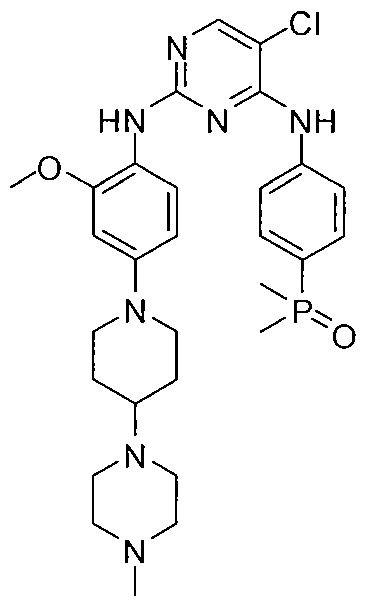
5-chloro-Λ’4-[4-(dimethylphosphoryl)phenyl]-Λr2-{2-methoxy-4-[4-(4-methylpiperazin-l- yl)piperidin-l-yI]phenyl}pyrimidine-2,4-diamine:

Figure imgf000127_0001

2,5-dichloro-N-[4-(dimethylphosphoryl)plienyl]pyrimiclin-4-amine: To a solution of 2,4,5- trichloropyrimindine (0.15ml, 1.31 mmol) in 1 mL of DMF was added 4- (dimethylphosphoryl)aniline (0.22 Ig, 1.31 mmol) and potassium carbonate (0.217g, 1.57mmol). The mixture was heated at 110 0C for 4h. It was basified with saturated sodium bicarbonate solution. The suspension was filtered and washed with ethyl acetate to give the final product (0.15g, 36% yield). MS/ES+: m/z=316.

l-[l-(3-methoxy-4-nitrophenyl)piperidin-4-yl]-4-methylpiperazine: To a solution of 5- fluoro-2-nitroanisooIe (0.5g, 2.92 mmol) in 3 mL of DMF was added l-methyl-4- (piperidin)piperazine (0.536g, 2.92 mmol) and potassium carbonate (0.808, 5.84 mmol). The mixture was heated at 120 0C for 18h. The mixture was basified with saturated sodium bicarbonate solution and extracted with ethyl acetate. The organic layer was purified by chromatography to give final product as yellow solid (0.95g, 95% yield). MS/ES+: m/z=334.

2-methoxy-4-[4-(4-methylpiperazin-l-yl)piperidin-l-yl]aniline: The a solution of 1 -[I -(3- methoxy-4-nitrophenyl)piperidin-4-yl]-4-methylpiperazine (0.3g, 0.90 mmol) in 10 mL of ethanol purged with argon was added 10% Palladium on carbon (0.06Og). The hydrogenation was finished under 30psi after 4h. The mixture was passed through Celite to a flask containing HCl in ethanol. Concentration of the filtrate gave the final product (0.15g, 88% yield). MS/ES+: m/z=334.

S-chloro-JSP-ft-ζdimethylphosphorytyphenyll-rf-ft-methoxy^-ft-ø-methylpiperazin-l- yl)piperidin-l-yl]phenyl}pyrimidine-2,4-diamine: To the compound 2,5-dichloro-N-[4-

(dimethylphosphoryl)phenyl]pyrimidin-4-amine (0.005g, O.lόmmol) in ImL of 2-methoxyethanol was added 2-methoxy-4-[4-(4-methylpiperazin-l-yl)piperidin-l-yl]aniline (0.7 Ig, 0.16 mmol). The mixture was stirred at 1100C for 18h. The mixture was basified with saturated sodium bicarbonate solution and extracted with limited amount of ethyl acetate. The aqueous layer was purified by chromatography to give the final product (0.015g, 20% yield). MS/ES+: m/z=583.

Image result for Brigatinib
SYNTHESIS
WILL BE ADDED WATCH OUT………….
CONTD………..

SOME COLOUR

 
Dual ALK EGFR Inhibitor AP26113 is an orally available inhibitor of receptor tyrosine kinases anaplastic lymphoma kinase (ALK) and the epidermal growth factor receptor (EGFR) with potential antineoplastic activity. Brigatinib binds to and inhibits ALK kinase and ALK fusion proteins as well as EGFR and mutant forms. This leads to the inhibition of ALK kinase and EGFR kinase, disrupts their signaling pathways and eventually inhibits tumor cell growth in susceptible tumor cells. In addition, AP26113 appears to overcome mutation-based resistance. ALK belongs to the insulin receptor superfamily and plays an important role in nervous system development; ALK dysregulation and gene rearrangements are associated with a series of tumors. EGFR is overexpressed in a variety of cancer cell types.
Figure
Structures of select ALK inhibitors.

Brigatinib (previously known as AP26113) is an investigational small-molecule targeted cancer therapy being developed by ARIAD Pharmaceuticals, Inc.[1] Brigatinib has exhibited activity as a potent dual inhibitor of anaplastic lymphoma kinase (ALK) and epidermal growth factor receptor (EGFR).

ARIAD has begun a Phase 1/2 clinical trial of brigatinib based on cancer patients’ molecular diagnoses in September 2011.

ALK was first identified as a chromosomal rearrangement in anaplastic large cell lymphoma (ALCL). Genetic studies indicate that abnormal expression of ALK is a key driver of certain types of non-small cell lung cancer (NSCLC) and neuroblastomas, as well as ALCL. Since ALK is generally not expressed in normal adult tissues, it represents a highly promising molecular target for cancer therapy.

Epidermal growth factor receptor (EGFR) is another validated target in NSCLC. Additionally, the T790M “gatekeeper” mutation is linked in approximately 50 percent of patients who grow resistant to first-generation EGFR inhibitors.[2] While second-generation EGFR inhibitors are in development, clinical efficacy has been limited due to toxicity thought to be associated with inhibiting the native (endogenous or unmutated) EGFR. A therapy designed to target EGFR, the T790M mutation but avoiding inhibition of native EGFR is another promising molecular target for cancer therapy.

Pre-clinical results

In 2010, ARIAD announced results of preclinical studies on brigatinib showing potent inhibition of the target protein and of mutant forms that are resistant to the first-generation ALK inhibitor, which currently is in clinical trials in patients with cancer. ARIAD scientists presented these data at the annual meeting of the American Association for Cancer Research (AACR) in Washington, D.C. in April.[3]

In 2011, ARIAD announced preclinical studies showing that brigatinib potently inhibited activated EGFR or its T790M mutant, both in cell culture and in mouse tumor models following once daily oral dosing. Importantly, the effective oral doses in these preclinical models were similar to those previously shown to be effective in resistant ALK models. When tested against the native form of EGFR, brigatinib lacked activity, indicating a favorable selectivity for activated EGFR. These data were presented at the International Association for the Study of Lung Cancer (IASLC) 14th World Conference on Lung Cancer.[4]

Brigatinib

Phase 3 ALTA 1L trial of brigatinib

In April 2015, ARIAD announced the initiation of a randomized, first-line Phase 3 clinical trial of brigatinib in adult patients with ALK-positive locally advanced or metastatic non-small cell lung cancer (NSCLC) who have not previously been treated with an ALK inhibitor. The ALTA 1L (ALK in Lung Cancer Trial of BrigAtinib in 1st Line) trial is designed to assess the efficacy of brigatinib in comparison to crizotinib based on evaluation of the primary endpoint of progression free survival (PFS).  Read Full Press Release

Phase 2 ALTA trial of brigatinib (AP26113)

In March 2014, ARIAD announced the initiation of its global Phase 2 ALTA (ALK in Lung Cancer Trial of brigatinib (AP26113) in patients with locally advanced or metastatic NSCLC who test positive for the ALK oncogene and were previously treated with crizotinib. This trial has reached full enrollment of approximately 220 patients and explores two different dose levels. Read Full Press Release

Phase 1/2 study of oral ALK inhibitor brigatinib (AP26113)

The international Phase 1/2 clinical trial of brigatinib (AP26113) is being conducted in patients with advanced malignancies, including anaplastic lymphoma kinase positive (ALK+) non-small cell lung cancer (NSCLC). Patient enrollment in the trial is complete, with the last patient enrolled in July 2014. The primary endpoint in the Phase 2 portion of the trial is overall response rate. In April 2016, ARIAD announced updated clinical data from the trial. Read Full Press Release

Expanded Access Study of brigatinib

The purpose of this Expanded Access Program (EAP) is to provide brigatinib for those patients with locally advanced and/or metastatic patients with ALK+ NSCLC on an expanded access basis due to their inability to meet eligibility criteria for on-going recruiting trials, inability to participate in other clinical trials (e.g., poor performance status, lack of geographic proximity), or because other medical interventions are not considered appropriate or acceptable.

About Brigatinib

Brigatinib (AP26113) is an investigational, targeted cancer medicine discovered internally at ARIAD Pharmaceuticals, Inc. It is in development for the treatment of patients with anaplastic lymphoma kinase positive (ALK+) non-small cell cancer (NSCLC) whose disease is resistant to crizotinib. Brigatinib is currently being evaluated in the global Phase 2 ALTA (ALK in Lung Cancer Trial of AP26113) trial that is anticipated to form the basis for its initial regulatory review. ARIAD has also initiated the Phase 3 ALTA 1L trial to assess the efficacy of brigatinib in comparison to crizotinib. In June 2016, an Expanded Access Study of brigatinib will begin. More information on brigatinib clinical trials, including the expanded access program (EAP) for ALK+ NSCLC can be found here.

Brigatinib was granted orphan drug designation by the U.S. Food and Drug Administration (FDA) in May 2016 for the treatment of certain subtypes of non-small cell lung cancer (NSCLC). The designation is for anaplastic lymphoma kinase-positive (ALK+), c-ros 1 oncogene positive (ROS1+), or epidermal growth factor receptor positive (EGFR+) non-small cell lung cancer (NSCLC). Brigatinib received breakthrough therapy designation from the FDA in October 2014 for the treatment of patients with ALK+ NSCLC whose disease is resistant to crizotinib. Both designations were based on results from an ongoing Phase 1/2 trial that showed anti-tumor activity of brigatinib in patients with ALK+ NSCLC, including patients with active brain metastases.

We are on track to file for approval of brigatinib in the U.S. in the third quarter of 2016.

Brigatinib.png

PATENT

WO 2016065028

https://google.com/patents/WO2016065028A1?cl=ru

Brigatinib has the chemical formula C29H39QN7G2P which, corresponds to a formula weight of 584.09 g/moL Its chemical structure is shown below:

Brigatinib is a multi-targeted tyrosine-kinase inhibitor useful for the treatment of non-small cell lung cancer (NSCLC) and other diseases, it is a potent inhibitor of ALK (anaplastic lymphoma kinase} and is in clinical development for the treatment of adult patients with ALK-driven NSCLC. Crizotinib (XALKOR!®) is an FDA approved drug for first-line treatment of ALK-positive NSCLC. “Despite initial responses to crizotinib, the majority of patients have a relapse within 12 months, owing to the development of resistance.” Shaw et al., New Eng. J. Med. 370:1 189-97 2014. Thus, a growing population of cancer patients are in need of new and effective therapies for ALK-positive cancers.

Brigatinib is also potentially useful for treating other diseases or conditions in which ALK or other protein kinases inhibited by brigatinib are implicated. Such kinases and their associated disorders or conditions are disclosed in WO 2009/143389, both of which are hereby incorporated herein by reference for all purposes.

FIG. 1 is a synthetic scheme for brigatinib,

FIG. 6 is an 1H-Niv1R spectrum obtained for a sample of brigatinib dissolved in CD3OD. Normalised intensity is shown on the vertical axis and chemical shift (ppm) is shown on the horizontal axis.

FIG. 7 is a 13C-NMR spectrum obtained for a sample of brigatinib dissolved in CDCi3. Normalized intensity is shown on the vertical axis and chemical shift (ppm) is shown on the horizontal axis.

FIG. 8 is a mass spectral fragmentation pattern of a sample of brigatinib Form A. Relative abundance is shown on the vertical axis and atomic weight (m/z) is shown on the horizontal axis.

Table 2 summarizes the relevant chemical shift data of Form A obtained from

the Ή, and 13C-N R experiments. The number of signals and their relative intensity (integrals) confinri the number of protons and carbons in the structure of Form A of brigatinib. The 31P-NMR chemical shift for the single phosphorous atom in brigatinib was 43.6 ppm. These 1H and 13C-NMR chemical shift data are reported according to the atom numbering scheme shown immediately below:

1H-N R Assignments – 13C~N R Assignments

Table 2: 1H and 3C Chemical Shift Data (in ppm) of Form A of Brigatinib

[00118] With reference to Figure 8, mass spectral experiments of Form A were carried out using an Agilsent eiectrospray time of fisght mass spectrometer (Model 6210} operating in positive son mode using flow injection sampie introduction. Samples of Form A were dissolved in methanol/water and were analyzed and the mass observed was m/ 584.263 ( +f-T) with the calculated exact mass being 584.2684 ( +H+). The observed moiecuiar mass is consistent with the elemental composition calculated from the molecular formula of brigatinib.

PAPER

Discovery of Brigatinib (AP26113), a Phosphine Oxide-Containing, Potent, Orally Active Inhibitor of Anaplastic Lymphoma Kinase

Abstract

Abstract Image

In the treatment of echinoderm microtubule-associated protein-like 4 (EML4)-anaplastic lymphoma kinase positive (ALK+) non-small-cell lung cancer (NSCLC), secondary mutations within the ALK kinase domain have emerged as a major resistance mechanism to both first- and second-generation ALK inhibitors. This report describes the design and synthesis of a series of 2,4-diarylaminopyrimidine-based potent and selective ALK inhibitors culminating in identification of the investigational clinical candidate brigatinib. A unique structural feature of brigatinib is a phosphine oxide, an overlooked but novel hydrogen-bond acceptor that drives potency and selectivity in addition to favorable ADME properties. Brigatinib displayed low nanomolar IC50s against native ALK and all tested clinically relevant ALK mutants in both enzyme-based biochemical and cell-based viability assays and demonstrated efficacy in multiple ALK+ xenografts in mice, including Karpas-299 (anaplastic large-cell lymphomas [ALCL]) and H3122 (NSCLC). Brigatinib represents the most clinically advanced phosphine oxide-containing drug candidate to date and is currently being evaluated in a global phase 2 registration trial.

(2-((5-Chloro-2-((2-methoxy-4-(4-(4-methylpiperazin-1-yl)piperidin-1-yl)phenyl)amino)-pyrimidin-4-yl)amino)phenyl)dimethylphosphine Oxide (11q)

Mp 215 °C.
1H NMR (400 MHz, CD3OD) δ 8.33 (dd, J = 4.52, 8.03 Hz, 1H), 8.02 (s, 1H), 7.66 (d, J = 8.78 Hz, 1H), 7.59 (ddd, J = 1.51, 7.78, 14.05 Hz, 1H), 7.47–7.54 (m, 1H), 7.25 (ddt, J = 1.00, 2.26, 7.53 Hz, 1H), 6.65 (d, J = 2.51 Hz, 1H), 6.45 (dd, J = 2.51, 8.78 Hz, 1H), 3.84 (s, 3H), 3.69 (d, J = 12.30 Hz, 2H), 2.62–2.86 (m, 6H), 2.43–2.62 (m, 4H), 2.33–2.42 (m, 1H), 2.29 (s, 3H), 1.97–2.08 (m, 2H), 1.83 (d, J = 13.30 Hz, 6H), 1.66 (dq, J = 3.89, 12.09 Hz, 2H).
13C NMR (151 MHz, CDCl3) δ 18.57 (d, J = 71.53 Hz), 28.28 (s), 46.02 (s), 49.01 (s), 50.52 (s), 55.46 (s), 55.65 (s), 61.79 (s), 101.07 (s), 106.01 (s), 108.41 (s), 120.25 (d, J = 95.73 Hz), 120.68 (s), 122.09 (s), 122.41 (d, J = 12.10 Hz), 123.13 (br d, J = 6.60 Hz), 129.48 (d, J = 11.00 Hz), 132.36 (s), 143.91 (d, J = 2.20 Hz), 147.59 (s), 149.38 (s), 154.97 (s), 155.91 (s), 157.82 (s).
31P NMR (162 MHz, CDCl3) δ 43.55.
MS/ES+: m/z = 584.3 [M + H]+.
Anal. Calcd for C29H39ClN7O2P: C, 59.63; H, 6.73; Cl, 6.07; N, 16.79; O, 5.48; P, 5.30. Found: C, 59.26; H, 6.52; Cl, 6.58; N, 16.80.
PATENT
WO 2016089208

str1

New Patent, Suzhou MiracPharma Technology Co Ltd, Brigatinib, WO 2017016410

WO-2017016410

Preparation method for antitumor drug AP26113

Suzhou MiracPharma Technology Co Ltd

SUZHOU MIRACPHARMA TECHNOLOGY CO., LTD [CN/CN]; Room 1305, Building 1,Lianfeng Commercial Plaza, Industrial District Suzhou, Jiangsu 215000 (CN)
XU, Xuenong; (CN)

Improved process for preparing brigatinib, useful for treating cancer eg non-small cell lung cancer (NSCLC). The present filing represents the first PCT patenting to be seen from Suzhou MiracPharma that focuses on brigatinib;  In February 2017, brigatinib was reported to be in pre-registration phase.

Disclosed is a preparation method for an antitumor drug AP26113 (I). The method comprises the following preparation steps: cyclizing N-[2-methoxyl-4-[4-(dimethyl amino)piperid-1-yl]aniline]guanidine and N,N-dimethylamino acrylate, condensing N-[2-methoxyl-4-[4-(dimethyl amino)piperid-1-yl]aniline]guanidine and 4-(dimethyl phosphitylate)aniline, and chlorinating N-[2-methoxyl-4-[4-(dimethyl amino)piperid-1-yl]aniline]guanidine by means of a chlorinating agent, sequentially, so as to prepare AP26113 (I). The preparation method adopts easily-obtained raw materials, causes few side reactions, and is economical, environmentally-friendly, and suitable for industrial production.

front page image

AP26113 is an experimental drug developed by Ariad Pharmaceuticals to target small molecule tyrosine kinase inhibitors for the treatment of anaplastic lymphoma kinase-positive (ALK) metastases resistant to crizotinib Non-small cell lung cancer (NSCLC) patients. The drug was approved by the US Food and Drug Administration in August 2014 for breakthrough drug treatment. The current clinical data show that AP26113 on ALK-positive non-small cell lung cancer patients, including patients with brain metastases, have a sustained anti-tumor activity. And the inhibitory activity against ALK is about 10 times that of zolotriptan, which can inhibit all 9 kinds of identified mutations of kotatinib resistant ALK.
The chemical name of AP26113 is 5-chloro-N- [4- [4- (dimethylamino) -1-piperidinyl] -2-methoxyphenyl] -N4- [2- Phosphono) phenyl] -2,4-pyrimidinediamine (I) having the structural formula:
Methods for the preparation of AP26113 have been reported. AP26113 and its starting materials A and B are prepared by PCT Patent WO2009143389 of Ariad and U.S. Patent No. 20130225527, US20130225528 and US20140066406 of Ariad. The target compound AP26113 is prepared by substituting 2,4,5-trichloropyrimidine with the pyrimidine ring of starting materials A and B in turn.
Although the synthetic procedure is simple, the nucleophilic activity of the three chlorine atoms on 2,4,5-trichloropyrimidine is limited. When the same or similar aniline group is faced, its position Selectivity will inevitably produce interference, resulting in unnecessary side effects, thus affecting the quality of the product. At the same time, the reaction process for the use of precious metal palladium reagent also increased the cost of production is not conducive to the realization of its industrialization.
Therefore, how to use modern synthesis technology, the use of readily available raw materials, design and development of simple and quick, economical and environmentally friendly and easy to industrialization of the new synthesis route, especially customer service location on the pyrimidine ring side effects of selectivity, for the drug Economic and technological development is of great significance
The synthesis step comprises the following steps: N- [2-methoxy-4- [4- (dimethylamino) piperidin-1-yl] aniline] guanidine (II) and N, N-dimethylaminoacrylates Amino-4 (1H) -pyrimidinone (III) in the presence of a base such as N, N-dimethylformamide, N, N-dimethylformamide, (III) was reacted with 4- (dimethyl (dimethylamino) -1-piperidinyl) -2-methoxyphenyl] (A) is condensed under the action of a condensing agent and a base accelerator to obtain N2- [4- [4- (dimethylamino) -1-piperidinyl] -2-methoxybenzene (IV); the N2- [4- [4- (dimethylamino) -l- (4-fluorophenyl) (IV) with a chlorinating agent in the presence of a base such as sodium hydride, sodium hydride, sodium hydride, potassium hydride, AP26113 (I).
Example 1:
A solution of 2-methoxy-4- [4- (dimethylamino) piperidin-1-yl] aniline (24.9 g, 0.1 mol) and 250 mL of methanol was added to the reaction flask and the temperature was lowered to 0C (15 mL, 0.15 mol) and a 50% solution of cyanamide (10 mL, 0.15 mol) were added successively. The reaction was stirred for 12 to 14 hours and the reaction was complete by TLC. After cooling to 0-5 ° C, 250 mL of methyl tert-butyl ether was added to the reaction mixture. A solid precipitated and was filtered, washed successively with water and cold acetonitrile, and dried to give N- [2-methoxy- 16.3 g, yield 56.0%, FAB-MS m / z: 292 [M + H] + . [4- (Dimethylamino) piperidin-1-yl] aniline] guanidine (II)
Example 2:
A solution of N- [2-methoxy-4- [4- (dimethylamino) piperidin-1-yl] aniline] guanidine (II) (2.9 g, 10 mmol), N, Methyl methacrylate (1.8 g, 13.7 mmol) and toluene (50 mL). The mixture was heated to reflux and stirred for 24-26 hours. The reaction was complete by TLC. After cooling to room temperature, a solid precipitated. The filter cake was washed with cold methanol and dried in vacuo to give an off-white solid of N2- [4- [4- (dimethylamino) -1-piperidinyl] -2-methoxyphenyl] 1H) -pyrimidinone (III), yield 77.3%, FAB-MS m / z: 344 [M + H] + .
Example 3:
A solution of N- [2-methoxy-4- [4- (dimethylamino) piperidin-1-yl] aniline] guanidine (II) (2.9 g, 10 mmol), N, (2.0 g, 14.0 mmol) and N, N-dimethylformamide (30 mL) was added and the temperature was raised to 115-125 ° C. The reaction was stirred for 22-24 hours and the reaction was complete by TLC. The mixture was concentrated under reduced pressure, and 50 mL of ethanol was added to the resulting residue. The mixture was cooled to room temperature while stirring to precipitate a solid. The filter cake was washed with cold ethanol and dried in vacuo to give an off-white solid of N2- [4- [4- (dimethylamino) -1-piperidinyl] -2-methoxyphenyl] 1H) -pyrimidinone (III) in 79.6% yield, FAB-MS m / z: 344 [M + H] + .
Example 4:
A mixture of N2- [4- [4- (dimethylamino) -1-piperidinyl] -2-methoxyphenyl] amino-4 (1H) -pyrimidinone III) (3.43 g, 10 mmol), benzotriazol-1-yloxytris (dimethylamino) phosphonium hexafluorophosphate (6.63 g, 15 mmol) and acetonitrile 100 mL. Diazabicyclo [5.4.0] -undec-7-ene (DBU) (2.28 g, 15 mmol) was added dropwise at room temperature for 12 hours. The temperature was raised to 60 ° C and the reaction was continued for 12 hours. The solvent was evaporated under reduced pressure, 100 mL of ethyl acetate was dissolved, and the mixture was washed with 20 mL of 2M sodium hydroxide and 20 mL of water. The organic layer was dried over anhydrous sodium sulfate, and 50 mL of tetrahydrofuran-dissolved 4- (dimethylphosphoranylidene) A) (2.2 g, 13 mmol) and sodium hydride (0.31 g, 13 mmol) was added and the temperature was raised to 50-55 ° C. The reaction was stirred for 6-8 hours and monitored by TLC. The reaction was quenched with saturated brine, the organic phase was separated, dried and the solvent was distilled off under reduced pressure. The crude product was recrystallized from ethanol to give an off-white solid of N2- [4- [4- (dimethylamino) -1-piperidine Yl] -2-methoxyphenyl] -N4- [2- (dimethylphosphono) phenyl] -2,4-pyrimidinediamine (IV) in a yield of 83.2%. FAB-MS m / z: 495 [M + H] + .
Example 5:
A mixture of N2- [4- [4- (dimethylamino) -1-piperidinyl] -2-methoxyphenyl] amino-4 (1H) -pyrimidinone (Dimethylamino) phosphonium hexafluorophosphate (BOP) (6.63 g, 15 mmol), 4- (dimethylsulfamoyl) phosphonium hexafluorophosphate Phosphoryl) aniline (A) (2.2 g, 13 mmol) and N, N-dimethylformamide. Diazabicyclo [5.4.0] undec-7-ene (DBU) (2.28 g, 15 mmol) was added dropwise and reacted at room temperature for 12 hours. The temperature was raised to 60 ° C and the reaction was continued for 12 hours. The solvent was distilled off under reduced pressure, 100 mL of ethyl acetate was added to dissolve, and the mixture was washed with 2 M sodium hydroxide 20 mL. The organic phase was separated, dried and concentrated under reduced pressure. The residue was recrystallized from ethanol to give an off-white solid of N2- [4- [4- (dimethylamino) -1-piperidinyl] -2-methoxyphenyl] -N4- [2- Phenylidene] -2,4-pyrimidinediamine (IV) was obtained in a yield of 48.6%. FAB-MS m / z: 495 [M + H] + .
Example 6:
A solution of N2- [4- [4- (dimethylamino) -1-piperidinyl] -2-methoxyphenyl] -N4- [2- (dimethylphosphono) Phenyl] -2,4-pyrimidinediamine (IV) (4.9 g, 10 mmol) and 100 mL of acetonitrile were added and stirred at room temperature. N-Chlorosuccinimide (1.6 g, 12 mmol) was added in three portions, The reaction was allowed to proceed at room temperature for 4-6 hours, and the reaction was terminated by TLC. The reaction solution was poured into 50 mL of water to quench the reaction. Dichloromethane, and the combined organic layers were washed successively with saturated sodium bicarbonate solution, saturated brine and water. Dried over anhydrous sodium sulfate and concentrated. The resulting crude oil was recrystallized from ethyl acetate / n-hexane to give 3.5 g of a white solid AP26113 (I) in 66.3% yield, FAB-MS m / z: 529 [M + the H] + , 1 the H NMR (CDCl 3 ) 1.67 (m, 2H), 1.81 (S, 3H), 1.85 (S, 3H), 1.93 (m, 2H), 1.96 (m, 2H), 2.10 (m, 2H), 3.86 (s, 3H), 6.50 (m, 1H), 6.57 (m, 1H), 7.12 (m, 1H) ), 7.31 (m, 1H), 7.50 (m, 1H), 8.13 (m, 2H), 8.64 (m, 1H).

////////////New Patent, Suzhou MiracPharma Technology Co Ltd, Brigatinib, WO 2017016410

References

1 to 6 of 6
Patent ID Patent Title Submitted Date Granted Date
US2015225436 PHOSPHOROUS DERIVATIVES AS KINASE INHIBITORS 2015-04-20 2015-08-13
US2014066406 Phosphorus Derivatives as Kinase Inhibitors 2013-03-15 2014-03-06
US2014024620 Methods for Inhibiting Cell Proliferation in EGFR-Driven Cancers 2011-10-14 2014-01-23
US2013225527 Phosphorus Derivatives as Kinase Inhibitors 2013-03-15 2013-08-29
US2013225528 Phosphorus Derivatives as Kinase Inhibitors 2013-03-15 2013-08-29
US2012202776 PHOSPHORUS DERIVATIVES AS KINASE INHIBITORS 2009-05-21 2012-08-09
Brigatinib
Brigatinib.svg
Names
IUPAC name

(2-((5-Chloro-2-((2-methoxy-4-(4-(4-methylpiperazin-1-yl)piperidin-1-yl)phenyl)amino)pyrimidin-4-yl)amino)phenyl)dimethylphosphine oxide
Other names

AP26113
Identifiers
1197953-54-0
3D model (Jmol) Interactive image
ChemSpider 34982928
PubChem 68165256
Properties
C29H39ClN7O2P
Molar mass 584.10 g·mol−1
Except where otherwise noted, data are given for materials in their standard state (at 25 °C [77 °F], 100 kPa).
//////////Бригатиниб, بريغاتينيب  , 布格替尼 , Brigatinib,  AP26113, PHASE 2, ORPHAN DRUG, 1197953-54-0
CN1CCN(CC1)C2CCN(CC2)C3=CC(=C(C=C3)NC4=NC=C(C(=N4)NC5=CC=CC=C5P(=O)(C)C)Cl)OC

EMA publishes Q&A on Health Based Exposure Limits – Does the 1/1000 dose criterion come again into play in Cleaning Validation?


DR ANTHONY MELVIN CRASTO Ph.D's avatarDRUG REGULATORY AFFAIRS INTERNATIONAL

STR1

In 2014 the European Medicines Agency (EMA) issued the Guideline on setting health based exposure limits for use in risk identification in the manufacture of different medicinal products in shared facilities. This publication triggered a discussion about the Permitted Daily Exposure (PDE) values in the Pharmaceutical and even in the API Industry, especially regarding crosscontamination and cleaning validation. Now a draft of a Q&A paper from the EMA provides some concretisation.

Image result for Cleaning Validationhttp://www.gmp-compliance.org/enews_05736_EMA-publishes-Q-A-on-Health-Based-Exposure-Limits—Does-the-1-1000-dose-criterion-come-again-into-play-in-Cleaning-Validation_15560,15661,15963,Z-VM_n.html

In 2014 the European Medicines Agency (EMA) issued the Guideline on setting health based exposure limits for use in risk identification in the manufacture of different medicinal products in shared facilities. As mentioned in the publication itself, this document triggered a discussion about the Permitted Daily Exposure (PDE) values in the Pharmaceutical and even in the API Industry, especially regarding crosscontamination and cleaning validation. Now, the draft of a question & answer paper from the European Medicines Agency provides some…

View original post 336 more words

Thailand Drug regulatory Update, Take a peep


DR ANTHONY MELVIN CRASTO Ph.D's avatarDRUG REGULATORY AFFAIRS INTERNATIONAL

STR1

http://www.fda.moph.go.th/eng/index.stm

[PDF]Regulatory Requirement for the Approval of generic Drug in Thailand …

Apr 13, 2014 – Thailand has its own drug registration format and also follows. ASEAN CTD. … Transparency in the regulatory authorities of member countries.

THAILAND PHARMACEUTICAL REGISTRATION AND APPROVAL

The Thai FDA (TFDA), one of several agencies under the Ministry of Public Health (MPH), is the regulatory body administering drugs in Thailand. The Drug Control Division of the TFDA is responsible for registration, licensing, surveillance, inspection and adverse event monitoring for all pharmaceuticals and pharmaceutical companies in Thailand. Foreign pharma companies dominate the Thai drug market. Due in part to trade negotiations, regional harmonization and positive economic trends, the pharmaceutical market in Thailand is predicted to double by 2022.There are several versions of the Drug Act currently in effect, and the Thai government is working on a revised version with updated regulations. Under the current…

View original post 553 more words

FDA publishes Final Guideline on GMP for Combination Products


DR ANTHONY MELVIN CRASTO Ph.D's avatarDRUG REGULATORY AFFAIRS INTERNATIONAL

Image result for CGMP for Combination Products.

In the beginning of 2015 the FDA has published a draft guideline about GMP for Combination Products. Now the final version has been published. What are the differences between the draft and the final version of the FDA Guideline for Combination Products?

http://www.gmp-compliance.org/enews_05738_FDA-publishes-Final-Guideline-on-GMP-for-Combination-Products_15649,16021,15963,Z-VM_n.html

In the beginning of 2015 the FDA has published a draft guideline about GMP for Combination Products. Now the final version has been published. What are the differences between the draft and the final version? In the following you will find an overview:

The final guideline has expanded to now 59 pages (draft: 46 pages). And also the number of footnotes increased from 85 (draft) to 147 (final).

In the table of content there are one new subchapter (II B  Quality and Current Good Manufacturing Practice) and one new chapter (VII Glossary). Subchapter III C was expanded to definitions and terminology. In the following the table of content is listed:

I. Introduction

View original post 770 more words

Amtolmetin guacil, амтолметин гуацил , أمتولمتين غواسيل , 呱氨托美丁


Amtolmetin guacil.png

Amtolmetin guacil,

ST-679, MED-15, Eufans

CAS 87344-06-7
UNII: 323A00CRO9, 

Molecular Formula, C24-H24-N2-O5, Molecular Weight, 420.463,

2-Methoxyphenyl 1-methyl-5-p-methylbenzoylpyrrole-2-acetoamidoacetate

Glycine, N-((5-benzoyl-1-methyl-1H-pyrrol-2-yl)acetyl)-, 2-methoxyphenyl ester

Trade names: Amtoril®, Artricol®, Artromed®

US 4578481, US 6288241,

MEDOSAN RICERCA S.R.L. [IT/IT]; Via Cancelliera, 12 I-00040 Cecchina RM (IT) (For All Designated States Except US).
SIGMA-TAU INDUSTRIE FARMACEUTICHE RIUNITE S.P.A. [IT/IT]; Viale Shakespeare, 47 I-00144 Roma (IT)

Launched – 1993 ITALY, SIGMA TAU, Non-Opioid Analgesics FOR Treatment of Osteoarthritis, Treatment of Rheumatoid Arthritis,

  • Originator sigma-tau SpA
  • Class Amino acids; Antipyretics; Nonsteroidal anti-inflammatories; Pyrroles; Small molecules
  • Mechanism of Action Cyclooxygenase inhibitors
    • Marketed Inflammation

    Most Recent Events

    • 01 Jun 1999 A meta-analysis has been added to the adverse events section
    • 22 Jul 1995 Launched for Inflammation in Italy (PO)

Amtolmetin guacil is a NSAID which is a prodrug of tolmetin sodium.

Amtolmetin guacil  is a nonacidic prodrug of tolmetin that has similar nonsteroidal antiinflammatory drug (NSAID) properties to those of Tolmetin with additional gastroprotective advantages. The term “nonsteroidal” is used to distinguish these drugs from steroids that have similar eicosanoid-depressing and antiinflammatory actions. Moreover, it possesses a more potent and long-lasting antiinflammatory activity than tolmetin  and is marketed for the treatment of rheumatoid arthritis, osteoarthritis, and juvenile rheumatoid arthritis.

Background

Tolmetin sodium is an effective NSAID approved and marketed for the treatment of rheumatoid arthritis, osteoarthritis and juvenile rheumatoid arthritis. In humans, tolmetin sodium is absorbed rapidly with peak plasma levels observed 30 min after p.o. administration, but it is also eliminated rapidly with a mean plasma elimination t½ of approximately 1 hr. The preparation of slow release formulations or chemical modification of NSAIDs to form prodrugs has been suggested as a method to reduce the gastrotoxicity of these agents.

Amtolmetin guacil is a non-acidic prodrug of tolmetin, having similar NSAID properties like tolmetin with additional analgesic, antipyretic, and gastro protective properties. Amtolmetin is formed by amidation of tolmetin by glycine

Pharmacology

  • Almost is absorbed on oral administration. It is concentrated maximum in internal the gastric wall, and highest concentration reached in 2 hours after administration.
  • Amtolmetin guacil hydrolysed in to following metabolites Tolmetin, MED5 and Guiacol.
  • Elimination will complete in 24 hours. Happens mostly with urine in shape of gluconides products (77%), faecal (7.5%).
  • It is advised to take the drug on empty stomach.
  • Permanent anti-inflammatory action is continued up to 72 hours, with single administration.

Mechanism of action

Amtolmetin guacil stimulates capsaicin receptors present on gastro intestinal walls, because of presence of vanillic moiety and also releases NO which is gastro protective. It also inhibits prostaglandin synthesis and cyclooxygenase (COX).

Figure

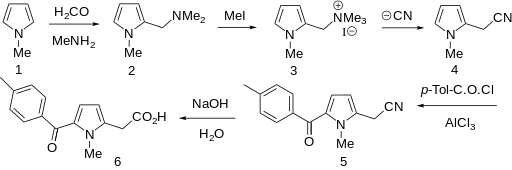
Structure of amtolmetin 1 and tolmetin 2.

26171-23-3 TOLMETIN FREE FORM

http://shodhganga.inflibnet.ac.in/bitstream/10603/2173/11/11_chapter%204.pdf

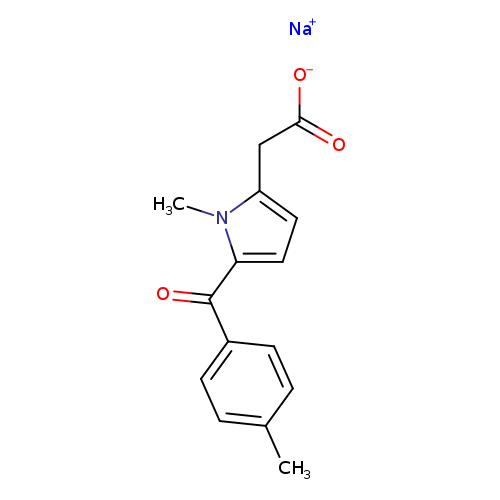
Tolmetin sodium

64490-92-2
Thumb
  • Average Mass: 279.2663

Image result for tolmetin

26171-23-3 TOLMETIN FREE FORM

1-methyl-5-p-tolylpyrrole-2-acetic acid

Image result for tolmetin

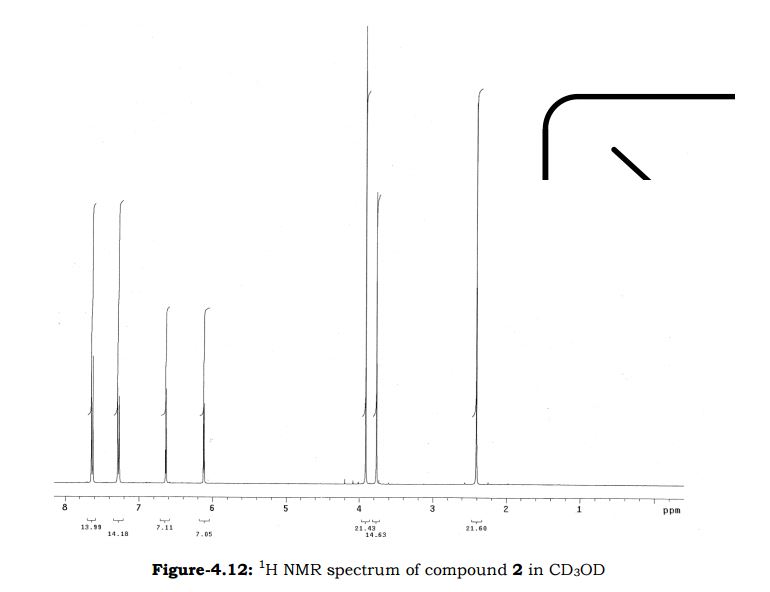
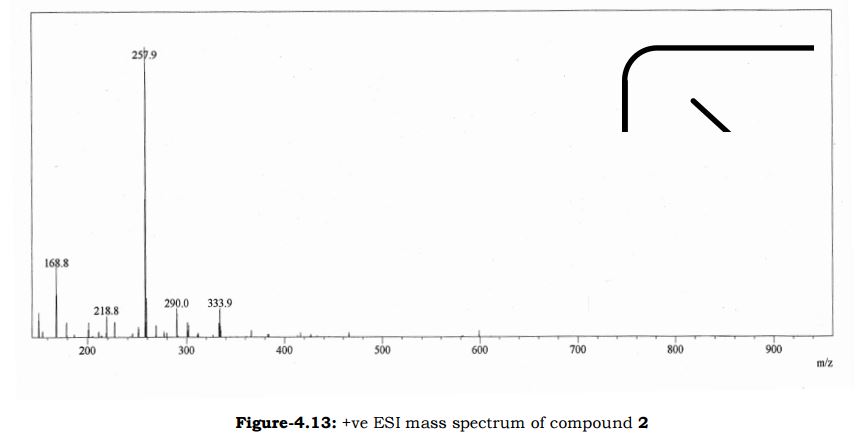
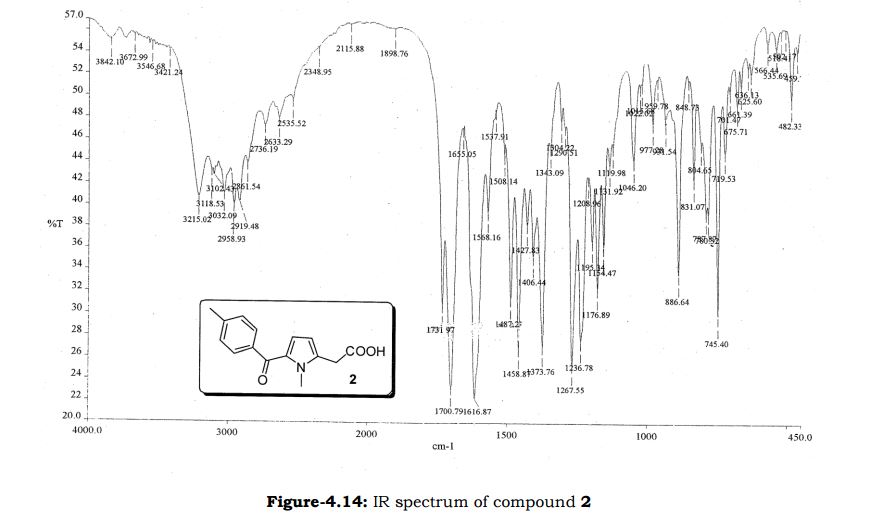
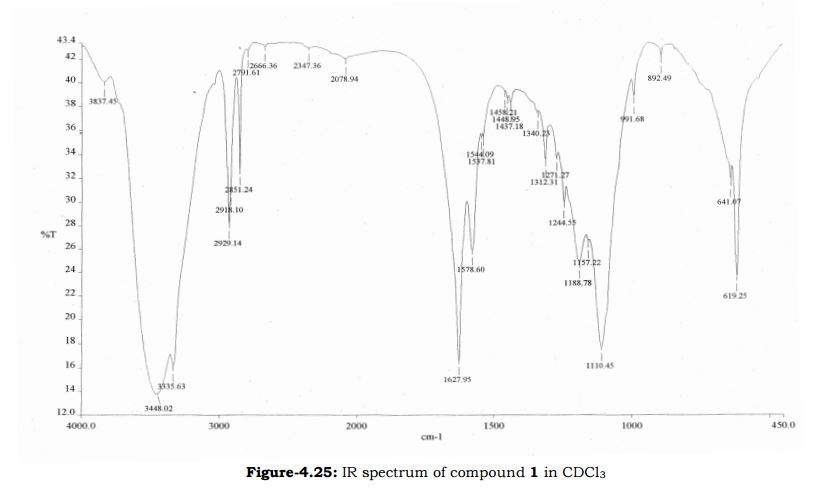
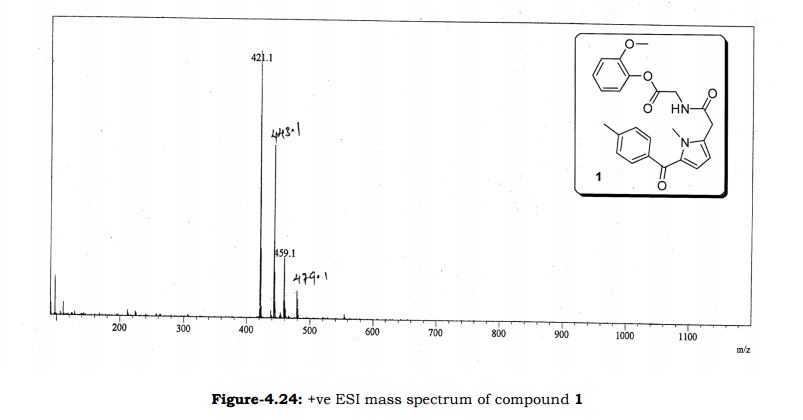
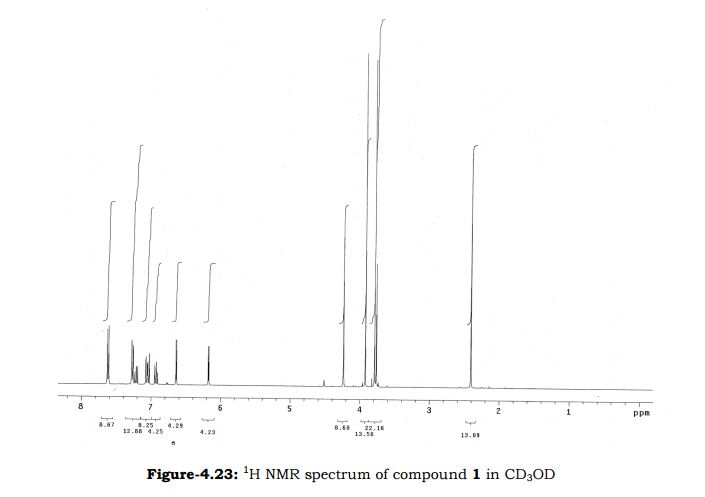
Melting point 155-158 °C, IR (KBr, cm-1): 3205 (OH), 2958 (Aliphatic C-H), 1731 (Acid, C=O), 1700 (C=O), 1616 (C=C), 1267 (C-O); 1H NMR (CD3OD, 400 MHz): δ 7.63 ( d, J = 7.8 Hz, 2H), 7.27 (d, J = 7.8 Hz, 2H), 6.63 (d, J = 3.9 Hz, 1H), 6.11 (d, J = 4.3 Hz, 1H), 3.91 (s, 3H), 3.76 (s, 2H), 2.40 (s, 3H); MS (ESI): m/z calcd for C15H15NO3 (M + H): 258.11; found: (M + H) 257.9. (Fig. 4.12 – 4.14)

str1

str1 str2

Image result for tolmetin

INNTERMEDIATE

str1

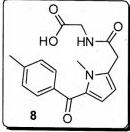
1-methyl-5-p-toluoyl-2-acetamidoacetic acid

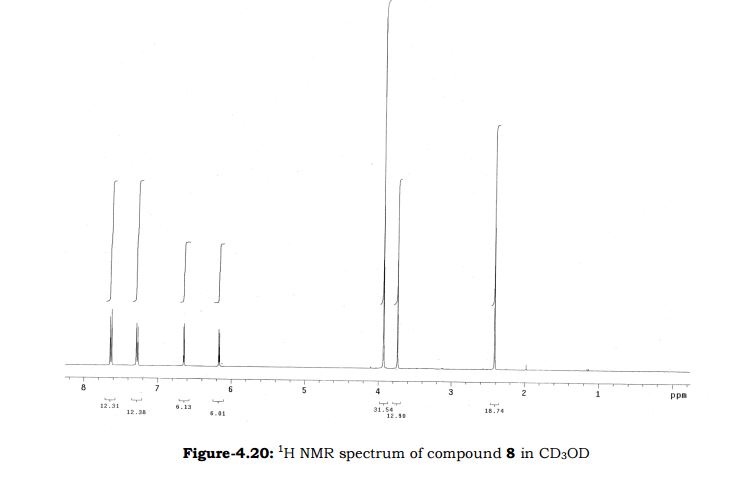
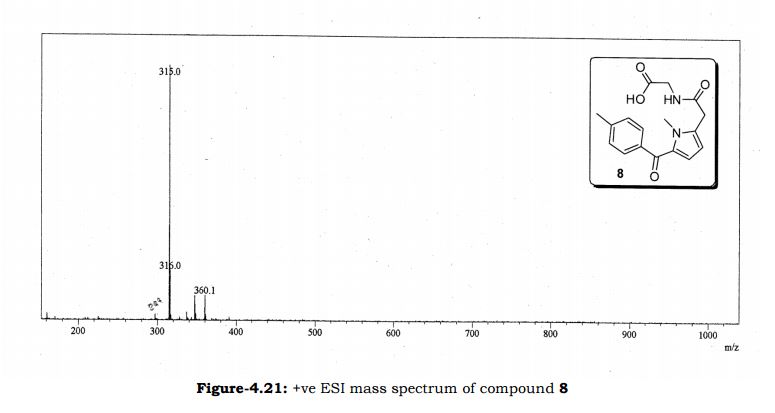
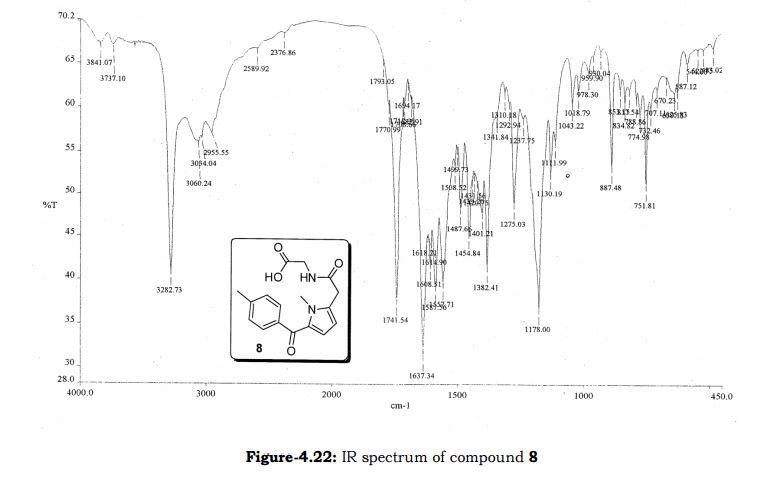
Melting point: 200-202° C. IR (KBr, cm-1): 3282 (NH), 3060 (OH), 1741 (Acid, C=O), 1637 (Amide, C=O), 1608 (C=C), 1178 (C-N); 1H NMR (CD3OD, 400 MHz): δ 7.64 ( dd, J =6.3 Hz, 1.9 Hz, 2H), 7.28 (d, J = 7.8 Hz, 2H), 6.65 (d, J = 3.9 Hz, 1H), 6.17 (d, J = 3.9 Hz, 1H), 3.92 (s, 3H), 3.73 (s, 2H), 3.30 (t, J =1.4 Hz, 2H), 2.41(s, 3H); MS (ESI): m/z calcd for C17H18N2O4 (M + H): 315.13; found: (M + H) 315. (Fig. 4.20 – 4.22)

str1 str2 str3

SYNTHESIS

str1

STUDENTS SOME COLOUR………………

str1

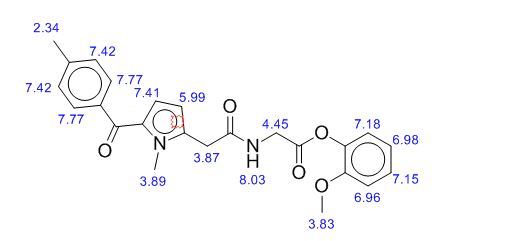
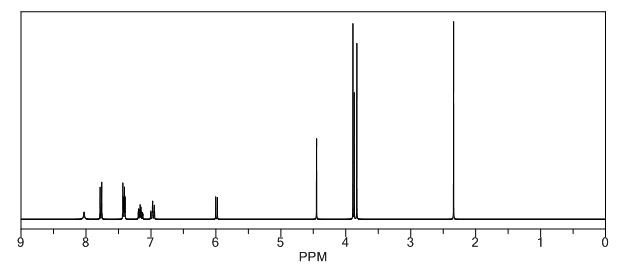
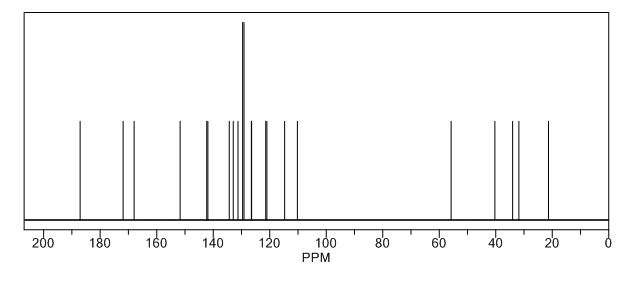
1H  and 13 C NMR PREDICT

str1 str2 str3 str4

str1 str2 str3

SYNTHESIS

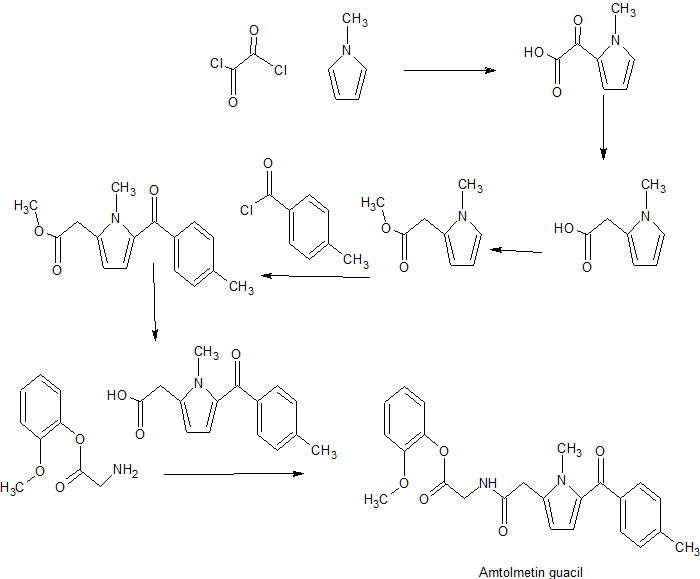
Amtolmetin guacil (CAS NO.: 87344-06-7), with its systematic name of N-((1-Methyl-5-p-toluoylpyrrol-2-yl)acetyl)glycine o-methoxyphenyl ester, could be produced through many synthetic methods.

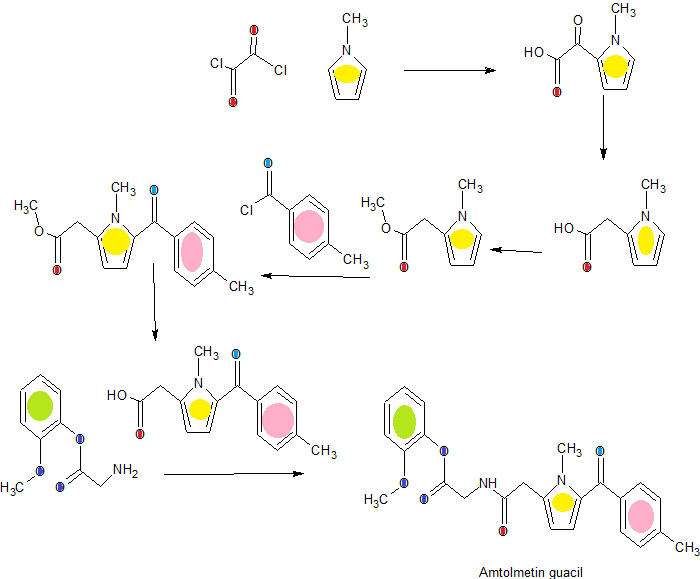
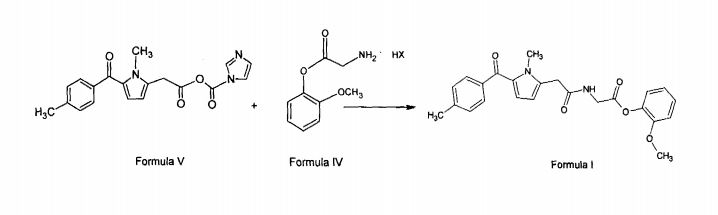
Following is one of the synthesis routes: 1-Methyl-5-(4-methylbenzoyl)pyrrole-2-acetic acid (I) is condensed with glycine ethyl ester (II) in the presence of carbonyldiimidazole (CDI) and triethylamine in THF to afford the corresponding acetamidoacetate (III), which is hydrolyzed with NaOH in THF-water yielding 2-[2-[1-methyl-5-(4-methylbenzoyl)pyrrol-2-yl]acetamido]acetic acid (IV). Finally, this compound is esterified with 2-methoxyphenol (guayacol) (V) by means of CDI in hot THF.

Image result for Amtolmetin

PATENT

https://www.google.com/patents/WO1999033797A1?cl=tr

The present invention relates to a new crystalline form of 1- methyl-5-p-toluoylpyrrole-2-acetamidoacetic acid guaiacyl ester, a process for its preparation and to pharmaceutical compositions endowed with antiinflammatory, analgesic and antipyretic activity containing same.

The ester of 1-methyl-5-p-toluoylpyrrole-2-acetamidoacetic acid (hereinafter referred to as MED 15, form 1) is a known compound.

In fact, US Patent 4,882,349 discloses a class of N-mono- substituted and N,N-disubstituted amides of l-methyl-5-p- toluoylpyrrole-2-acetic acid (known as Tolmetin) endowed of anti- inflammatory, analgesic, antipyretic, antisecretive and antitussive properties.

US Patent 4,578,481 claims a specific compound, endowed with valuable pharmacological activity, encompassed in the above- mentioned class, precisely 1-methyl-5-p-toluoylpyrrole-2-acetamido- acetic acid guaiacyl ester (which is MED 15, form 1), and a process for its preparation.

The process disclosed in US 4,578,481 presents some drawbacks, since it is not easily applicable on industrial scale and gives low yields.

According to the above-mentioned process, Tolmetin was reacted with N,N’-carbonyldiimidazole in tetrahydrofuran (THF), and aminoacetic acid ethyl ester hydrochloride was added to the reaction mixture.

Following a complex series of washings in order to remove the unreacted starting compounds, and crystallisation from benzene/ cyclohexane, 1-methyl-5-p-toluoylpyrrole-2-acetamidoace-tic acid ethyl ester was obtained. This compound was subsequently transformed into the corresponding acid.

The acid was reacted with N,N’-carbonyldiimidazole obtaining the corresponding imidazolide, to which a solution of guaiacol in

THF was added.

From the reaction mixture, following several washings, neutralisation and crystallisation from benzene/ cyclohexane MED 15 form 1 was obtained.

The main physico-chemical characteristics of MED 15 form 1 are shown in table 1, left column.

The above mentioned process comprises the following steps:

(a) hydrolysing TOLMETIN 1 methyl ester with an alkaline hydroxide in a basic environment, obtaining TOLMETIN 2 alkaline salt;

(b) condensing 2 with isobutylchloroformate 3 obtaining the mixed anhydride 4;

(c) reacting 4 with glycine 5 obtaining 1-methyl-5-p-toluoylpyrrol-2- acetoamidacetic acid 6;

(d) condensing 6 with isobutylchloroformate 3 obtaining the mixed anhydride 7; and

(e) reacting the mixed anhydride 7 with guaiacol 8 obtaining 9 , MED 15, form 2.

The following non-limiting example illustrates the preparation of MED 15, form 2, according to the process of the present invention.

Preparation of 1-methyl-p-toluoylpirrol-2-acetoammidoacetic acid.

A mixture of 500 mL of toluene, 100 g of Tolmetin ethyl ester and 10 g of Terre deco in 1L flask, was heated to 70° C and maintained at this temperature for 20-30 min, under stirring. The mixture was then filtered on pre-heated buckner, and the solid phase washed with 50 mL of heated toluene. The discoloured toluene solution was transferred in a 2 L flask, 15 g of sodium hydroxide (97%) dissolved in 100 mL of water were added thereto.

The solution was heated at reflux temperature and refluxed for 1 hour. 22 mL of isobutyl alcohol were added to the solution which was heated at reflux temperature; water (about 120 mL) was removed completely with Marcusson’s apparatus arriving up to 104-105°C inner temperature.

To a suspension of Tolmetin sodium, cooled under nitrogen atmosphere to -5°C ± 2°C, 0.2 mL of N-methyl Morpholine were added. Maintaining the temperature at 0°C ± 3°C, 53 mL of isobutyl chloroformate were added dropwise in 5-10 min. After about 1 hour the suspension became fluid. Following 3 hours of reaction at 0°C + 3°C, over the glycine solution previously prepared, the mixed anhydride solution was added dropwise. The glycine solution was prepared in a flask containing 230 mL of demineralised water, 47 g of potassium hydrate (90%), cooling the solution to 20°C ± 2, adding 60 g of glycine, and again cooling to 10°C ± 2°C.

To the glycine solution, the mixed anhydride was added dropwise under stirring, in 5-10 min., maintaining the temperature at 20°C ± 2°C.

At the end of the addition, temperature was left to rise to room temperature, 1 hour later the reaction was complete. To the mixture 325 mL of demineralised water were added, the mixture was brought to pH 6.0 +2 using diluted (16%) hydrochloric acid (about 100 mL).

The temperature of the solution was brought to 73°C ±2°C and the pH adjusted to pH 5.0 ±0.2.

The separation of the two phases was made at hot temperature: the toluene phase was set aside for recovering acid-Tolmetin if any, the water phase was maintained at 73°C ±2°C and brought to pH 4.0 ±0.2 using diluted hydrochloric acid.

At the beginning of the precipitation the solution was slowly brought to pH 3.0 ±0.2 using diluted (16%) hydrochloric acid (100 mL).

The mixture was cooled to 15°C ±3°C and after 30 min. filtered. The solid cake was washed with 2×100 mL of demineralised water, the product was dried at 60°C under vacuum till constant weight. 100 g of 1-methyl-p-toluoylpirrol-2-acetoammidoacetic acid were obtained.

Preparation of MED 15, form 2

To a 2 L flask containing 730 mL of toluene, 100 g of dried compound of the above step were dissolved. To this solution 18.8 g of potassium hydrate (tit. 90%) in 65 mL of water were added.

The solution was dried maintaining the internal temperature at 95-100°C, and cooled to 55-60 °C. A solution of potassium hydrogen carbonate was then added and the resulting mixture was dried maintaining the internal temperature at 105°C ±2°C.

The mixture was cooled under nitrogen atmosphere to 5°C

±2°C, 24 mL of isobutyl alcohol and 0.3 mL of N-methyl morpholine were added thereto.

Maintaining the temperature at 10°C ±3°C, 47 mL of isobutyl-chloroformate were added dropwise in 5-10 minutes. The mixture was left to react for two hours at 10°C ±3°C obtaining an anhydride solution, which was added to a guaiacol solution previously prepared.

The guaiacol solution was prepared by loading in a 2L-flask 295 mL of water, 25 g of potassium hydrate (90%), and 0.3 g of sodium metabisulfite.

At the end of the loading the temperature was brought to 35-40°C.

The anhydride was added dropwise in 5- 10 min and the temperature was left to rise to room temperature.

The suspension was kept under stirring for 1 hour and brought to pH 6.0 ±0.5 with diluted hydrochloric acid. The suspension was heated to 70°C ± 5°C and maintained at pH 3-4 with diluted hydrochloric acid.

The phases were separated while hot. The aqueous phase was discharged, and to the organic phase, 250 mL of water were added.

Maintaining the temperature at 70 ±5°C the solution was brought to pH 8.0 ±0.5 with diluted sodium hydrate, the phases were separated while hot and the acqueous phase was discharged.

The organic phase was washed with 250 mL of water. At 70 ± 5°C the phases were separated. The toluene phase was then cleared with dicalite, filtered and left to crystallise.

The mixture was slowly cooled to 30°C – 35°C, the temperature was then brought to 10 ± 3°C and after 1 hour filtered, washed with toluene (2×100 mL).

The product was brought to dryness at 60°C under vacuum, thus giving 100 g of compound MED 15, form 2.

Theoretical yield: 133.7 g; Yield %: 74.8%.

PATENT

https://www.google.com/patents/WO2000032188A2?cl=un

PATENT

CN-100390144 

PATENT

CN 1827597

Example 1: Steps:

Equipped with a trap, 2000ml four-neck reaction flask with a mechanical stirrer and a thermometer, 加入托 US buna 100.0g (0.358mol) and 500ml of toluene, turned stirred and heated under reflux with toluene with water, drying the solution, when When the internal temperature reaches 95-100 ℃, the solution was cooled to 55-60 ℃, dissolved in 30ml of water was added portionwise 11.5g of potassium bicarbonate was added, and refluxed to remove water, until the internal temperature reaches 105 ± 2 ℃. The mixture was cooled to ice-water bath 5 ± 2 ℃, to which was added 24ml of isobutyl alcohol and 0.3ml N- methylmorpholine. The temperature was maintained at 10 ± 3 ℃, with a pressure-equalizing dropping funnel was added dropwise isobutylchloroformate 45.5ml (0.400mol), 10min addition was complete, so the mixture was 10 ± 3 ℃ 2hr reaction solution to obtain an acid anhydride, it has been prepared dropwise glycine guaiacol ester solution, 5-10min the addition was complete. Glycine guaiacol ester solution was prepared by adding 295ml of water in a 2000ml flask, 27g of potassium hydroxide (82%) and 0.3g of sodium metabisulfite, stirring to dissolve, the temperature was controlled at 10 ± 3 ℃, to which was added 82.7g (0.38mol) glycine guaiacol ester hydrochloride and prepared. Dropwise addition, the temperature was raised to room temperature, the reaction 2hr, diluted with 16% hydrochloric acid to adjust the mixture to pH 6.0 ± 0.5. The suspension was heated to 70 ± 5 ℃, and then 16% diluted hydrochloric acid to adjust the pH to 3.5 to 4.5, while hot liquid separation, discarding the aqueous phase, the organic phase was added to 250ml of water, maintaining the temperature at 70 ± 5 ℃ with dilute (2N) sodium hydroxide solution to adjust the solution to pH 8.0 ± 0.5, and then hot liquid separation, aqueous phase was discarded. With 2 × 250ml The organic phase was washed with water, the phases were separated at 70 ± 5 ℃, then clean the toluene organic phase through celite, cooled to room temperature, allowed to set freezer cooling crystallization, filtration, filter cake washed with 2 × 50ml of cold washed with toluene, and dried in vacuo at 60 ℃ to constant weight to give 1- methyl-5-p-toluoylpyrrole-2-acetamido acid guaiacol ester crude 135.5 g, yield 90%. The crude product was recrystallized from acetone to give 1-methyl-5-acyl-2-acetyl-p-toluene amino acid ester of guaiacol boutique 127.9 g, yield 94.4%, mp128.7 ~ 131.9 ℃. Elemental analysis: C, 68.53%; H, 5.76%; N, 6.65%. IR spectrum (KBr tablet method): 3318,3142,2963,1778,1652,1626,1605,1500,1480,1456,13731255 and 1153cm-1.

Example 2: Procedure: equipped with a water separator, 2000ml four-neck reaction flask with a mechanical stirrer and a thermometer, 加入托 US buna 100.0g (0.358mol) and 500ml of toluene, turned stirred and heated under reflux with toluene with water , drying the solution, when the internal temperature reaches 95-100 ℃, the solution was cooled to 55-60 ℃, dissolved in 30ml of water was added portionwise 11.5g of potassium bicarbonate was added, and refluxed to remove water, until the internal temperature reaches 105 ± 2 ℃. The mixture was cooled to ice-water bath 5 ± 2 ℃, to which was added 24ml of isobutyl alcohol and 0.3ml N- methylmorpholine. The temperature was maintained at 10 ± 3 ℃, with a pressure-equalizing dropping funnel dropwise isopropyl 46.5ml (0.41mol), 10-15min addition was complete, the mixture was allowed at 10 ± 3 ℃ reaction 2hr derived anhydride solution, it would have been prepared dropwise to glycine guaiacol ester solution, 5-10min the addition was complete. Glycine guaiacol ester solution was prepared by adding 295ml of water in a 2000ml flask, 27g of potassium hydroxide (82%) and 0.3g of sodium metabisulfite, stirring to dissolve, the temperature was controlled at 10 ± 3 ℃, to which was added 82.7g (0.38mol) glycine guaiacol ester hydrochloride and prepared. Dropwise addition, the temperature was raised to room temperature, the reaction 2hr, diluted with 16% hydrochloric acid to adjust the mixture to pH 6.0 ± 0.5. The suspension was heated to 70 ± 5 ℃, and then 16% diluted hydrochloric acid to adjust the pH to 3.5 to 4.5, while hot liquid separation, discarding the aqueous phase, the organic phase was added to 250ml of water, maintaining the temperature at 70 ± 5 ℃ with dilute (2N) sodium hydroxide solution to adjust the solution to pH 8.0 ± 0.5, and then hot liquid separation, aqueous phase was discarded. With 2 × 250ml The organic phase was washed with water, the phases were separated at 70 ± 5 ℃, then clean the toluene organic phase through celite, cooled to room temperature, allowed to set freezer cooling crystallization, filtration, filter cake washed with 2 × 50ml of cold washed with toluene, and dried in vacuo at 60 ℃ to constant weight to give 1- methyl-5-p-toluoylpyrrole-2-acetamido acid guaiacol ester crude 138.5 g, yield 92%. The crude product was recrystallized from acetone to give 1-methyl-2-acyl-5-toluene acetaminophen acid ester guaiacol boutique 128.8 grams.

Example 3: equipped trap, 2000ml four-neck reaction flask with a mechanical stirrer and a thermometer, 加入托 US buna 100.0g (0.358mol) and 500ml of toluene, turned stirred and heated under reflux with toluene with water, dried solution, when the internal temperature reaches 95-100 ℃, the solution was cooled to 55-60 ℃, dissolved in 30ml of water was added portionwise 10-12.5g potassium bicarbonate solution, refluxing was continued for removal of water, until the internal temperature reaches 105 ± 2 ℃. The mixture was cooled to ice-water bath 5 ± 2 ℃, added thereto 20-30ml of isobutyl alcohol 0.2-0.5mlN- methylmorpholine. The temperature was maintained at 10 ± 3 ℃, with a pressure-equalizing dropping funnel was added dropwise isobutylchloroformate 40.5-48.5ml, 10-15min addition was complete, so the mixture was 10 ± 3 ℃ 2hr reaction solution to obtain an acid anhydride, it has been prepared dropwise glycine guaiacol ester solution, 5-10min the addition was complete. Glycine guaiacol ester solution was prepared by adding 295ml of water in a 2000ml flask, 25-30g of potassium hydroxide (82%) or 15-17 grams of sodium hydroxide and sodium metabisulfite 0.2-0.5g or insurance powder, stirring to dissolve the temperature is controlled at 10 ± 3 ℃, to which is added 80-84g glycine guaiacol ester hydrochloride and prepared. Dropwise addition, the temperature was raised to room temperature, the reaction 2hr, the mixture was adjusted with dilute hydrochloric acid to pH 6.0 ± 0.5. The suspension was heated to 70 ± 5 ℃, with dilute hydrochloric acid to adjust the pH to 3.5 to 4.5, while hot liquid separation, discarding the aqueous phase, the organic phase was added to 250-280ml of water, maintaining the temperature at 70 ± 5 ℃ , adjusted with dilute sodium hydroxide solution and the solution to pH 8.0 ± 0.5, and then hot liquid separation, aqueous phase was discarded. With 2 × 250ml The organic phase was washed with water, the phases were separated at 70 ± 5 ℃, then clean the toluene organic phase through celite, cooled to room temperature, allowed to set freezer cooling crystallization, filtration, filter cake washed with 2 × 50ml of cold washed with toluene, and dried in vacuo at 60 ℃ to constant weight to give 1- methyl-5-p-toluoylpyrrole-2-acetamido acid guaiacol ester crude 130-139 grams. The crude product was recrystallized from acetone to give 1-methyl-5-acyl-2-acetyl-p-toluene amino acid ester boutique guaiacol 120-129 grams.

PATENT

Indian Pat. Appl. (2010), IN 2008MU01617

str1

DETAILED DESCRIPTION OF THE INVENTION
The present invention provides safe, environment friendly, economically viable and commercially feasible processes for the production of Amtolmetin guacil. There are two methods for the preparation of Amtolmetin guacil. The processes for the production of Amtolmetin guacil (I) comprise:
Method-1:
Step-A:- Treating 2-methoxy phenol of Formula VI with 2-(benzyloxycarbonylamino) acetic acid of Formula VII in the presence of an organic base and a condensing agent in chlorinated solvent to yield 2-methoxyphenyl-2- (benzyloxycarbonylamino) acetate of Formula V.
Step-B:- Acid addition salt of 2-methoxyphenyl -2-aminoacetate of Formula II may be prepared by treating 2-methoxyphenyl-2- (benzyloxycarbonylamino) acetate of Formula V with an acid and followed by crystallization in aprotic solvent.
7

Step-C):- l-methyl-5-p-toluoylpyrrole-2-acetic acid of Formula III is reacted with a condensing agent to form-activated moiety, which is reacted with acid addition salt of 2-methoxyphenyl -2-aminoacetate of Formula II in chlorinated solvent to produce Arntolmetin guacil of formula (I).
In a preferred embodiment of present invention, condensing agent used in step-A is selected from group consisting of dicyclohexylcarbodiimide, N, N’-carbonyl diimidazole, hydroxy benzotriazole. The most preferred condensing agent is Dicyclohexyl carbodiimide for the reaction.
The solvent used in present invention is selected from the group consisting of but not limited to toluene, methylene chloride, chloroform, water miscible ethers such as tetrahydrofuran, 1,4-dioxane, the most preferred solvent for the reaction methylene dichloride.
In another embodiment of the present invention, the reaction is performed in the presence of an organic base. The organic base is selected from the group consisting of trimethylamine, triethylamine, N-methyl morpholine, N-methylpyrrolidinone, 4-dimethyl Aminopyridine; the most preferred base is 4-dimethyl Aminopyridine.
In a preferred embodiment of present invention, the non-polar solvent used in step-B is selected from group consisting of ethers, hexanes, aromatic hydrocarbons and esters.
In another preferred embodiment of present invention, the most suitable solvents are esters.
In another preferred embodiment of present invention, condensing agent used in step-C is selected from group consisting of dicyclohexylcarbodiimide, N, N’-carbonyl diimidazole, hydroxy benzotriazole. The most preferred condensing agent is N, N’-carbonyl diimidazole for the conversion of the reaction.
8

The solvent used in present invention is selected from the group consisting of but not limited to toluene, methylene chloride, chloroform, water miscible ethers such as tetrahydrofuran, 1,4-dioxane, the most preferred solvent for the reaction methylene dichloride.
In yet another embodiment of the present invention, the reaction is performed at a temperature in the range of -20°C to 50°C. Most preferred temperature range for the reaction is (-) 10°C to 0°C.
Method-2:
Treating 2-(2-(I-methyl-5- (4-methylbenzoyl)-lH-pyrrol-2-yl) acetamido) acetic acid with 2-methoxy phenol in presence of condensing reagent and an organic base to obtain Amtolmetin guacil.
In a preferred embodiment of present invention, the condensing agent used is selected from group consisting of dicyclohexyicarbodiimide, hydroxy benzotriazole or a mixture thereof. The most preferred condensing agent is Dicvclohexyl carbodiimide for the aforementioned reaction.
The solvent used in present invention is selected from the group consisting of but not limited to toluene, methylene chloride, chloroform, water miscible ethers such as tetrahydrofuran. 1,4-dioxane, the most preferred solvent for the reaction is methylene dichloride.
In another embodiment of the present invention, the reaction is performed in the presence of an organic base. The organic base is selected from the group consisting of triethylamine, triethylamine, N-methyl morpholine, N-methylpyrrolidinone, 4-dimethyl Aminopyridine; the most preferred base is 4-dimethyl Aminopyridine.
9

In yet another embodiment of the present invention, the reaction is performed at a temperature in the range of -20°C to 50°C. Most preferred temperature range for the reaction is (-) 10°C to 0°C.
In another embodiment of present invention, crude amtolmetin guacil is directly purified using polar and non-polar solvent or a mixture thereof. The most preferred solvents are Isopropanol and toluene.
The following non-limiting examples illustrate specific embodiments of the present invention. They are, however, not intended to be limiting the scope of present invention in anyway.
Preparation of Amtolmetin guacil: Example-1;
Charged MDC (600 ml) and N-benzyloxycarbonyl glycine (100 gm) in a 2L-4NRBF under N2 atmosphere. Reaction mass was cooled down to -5°C. Added N, N’-dicyclohexylcarbodiimide solution (108.5 gm in 300 ml MDC) at-5°C to 0°C. Maintained temperature of reaction for 10 minutes at -5°C to 0°C. Added guaiacol solution (59.36 gm in 180 ml MDC) at -5°C to 0°C followed by addition of N, N-dimethyl aminopyridine (1 gm) at -5°C to 0°C. Monitored the reaction over TLC till the completion of reaction, while maintaining reaction at 0°C. Filtered the undissolved Dicyclohexyl urea and washed the solids with methylene dichloride (125 ml X 2). Collected filtrate and washing. Washed methylene dichloride with water (1000 ml X 2), lN-NaOH (500 ml X 2) and 1% HC1 solution (500 ml X 2), water (500 ml X 2) respectively. Organic methylene dichloride layer was dried over anhydrous sodium sulphate. Filtered sodium sulphate and collected methylene dichloride filtrate. Distilled out methylene dichloride under vacuum below 40°C to get oil. HPLC purity :> 90%
10

Added 33% HBr in acetic acid solution (262,5 gm) into reaction vessel at 25-30°C. Monitored the reaction over TLC till the completion of reaction, while maintaining the reaction at 25-30°C. Added ethyl acetate (1200 ml) slowly at 25-30°C after completion of reaction. Stirred the resultant slurry for 2.5 hours at 25-30°C for complete crystallization. Filtered the solids and washed it with ethyl acetate (200 ml). Dried solids at 50-55°C. Dry weight: 102 gm. HPLC Purity: >98%
Example-2:
Charged MDC (1400 ml) and N, N’-carbonyl di imidazole (69.34 gm) into a 3L-4NRBF under N2 atmosphere. Cooled it down to -15°C. Charged Tolmetin acid (100 gm) slowly into reaction vessel at -10° ± 5°C. Monitored the progress of reaction of over HPLC. After completion of reaction, charged slowly 2-methoxyphenyl-2- (benzyloxy carbonylamino) acetate hydrobromide salt (112.05 gm) at -10° ± 5°C.Monitored the reaction over HPLC. After completion of reaction, washed the organic layer with water (300 ml), 1% NaOH solution (100 ml) and water (300 ml X 2) respectively at 3-8°C. Treated organic layer with activated carbon (2.5 gm) and filtered over hyflow bed. Washed hyflow bed with methylene dichlonde (100 ml X 2). Distilled out methylene dichloride below 40°C under vacuum and stripped off traces with toluene (100 ml X 2) at 50-55°C. Charged toluene (600 ml) and Isopropanol (50ml). Heated the mass to 63-68°C. Stirred the clear solution at 63-68°C for 1 hour. Cooled it down slowly to 30°C followed by further cooling to 5°C. Stirred the resultant slurry for 3 hours at 0-5°C. Filtered solids and washed with toluene (100 ml X 2). Dried solids at 55-60°C under vacuum. Dry Weight: 130 gm. HPLC Purity: >99%
Example-3:
Charged MDC (333 liter) and 2-(2-(l-methyl-5- (4-methylbenzoyl)-lH-pyrrol-2-yl) acetamido) acetic acid (55.5 Kg) in reactor under N2 atmosphere at 25-30°C. Cool down reaction mass to -15 to -12°C. Added a freshly prepared solution of N, N’-dicyclohexyl
11

carbodiimide (47.39 Kg in 166.5 liter) slowly at -10° ± 5°C within 1 hour. Rinsed the addition funnel with MDC (55.5 liter) and added it to the reaction at -10° ± 5°C. Added guaiacol solution (24.14 Kg in 99.9 liter MDC) to the reaction mass at -10° ± 5°C within 1 hour. Rinsed the addition funnel with MDC (11.1 liter) and added to the reaction -10° ± 5°C. Charged N, N’-dimethyl aminopyridine (0.555 Kg) at -15°C. Maintained temperature of reaction mass at -10° ± 5°C for 3 hours. Monitored the reaction over TLC, After the completion of reaction, filtered the dicyclohexyl urea and washed the solids with MDC (55.5L X 2). Collected MDC filtrate and wash it with water (166.5 L X 2). Collected MDC layer and treated it with activated carbon (2.77 Kg) and filtered through sparkler. Washed the sparkler with MDC (111 L). Distilled out MDC below 40°C under vacuum and stripped off traces with toluene (55.5 L X 2) at 50-55°C. Charge toluene (333L) and Isopropanol (27.75 L). Heated reaction mass to 63-68°C to get a clear solution. Stirred the clear solution at 63-68°C for 1 hour. Cooled it down slowly to 30°C followed by further cooling to 20oC. Stirred the resultant slurry for 2 hours at 17-20°C. Filtered the solids and washed with toluene (55.5 L X 3). Dried the solids at 55-60°C under vacuum. Dry Weight: 48 Kg. HPLC Purity:>99%

PAPER

Synthesis and Process Optimization of Amtolmetin: An Antiinflammatory Agent

Center of Excellence, Integrated Product Development, Innovation Plaza, Dr. Reddy’s Laboratories Ltd., Bachupalli, Qutubullapur, R. R. Dist. 500 072 Andhra Pradesh, India, and Center for Environment, Institute of Science and Technology, Jawaharlal Nehru Technological University, Kukatpally, Hyderabad 500 072, India
Org. Process Res. Dev., 2010, 14 (2), pp 362–368
DOI: 10.1021/op900284w,

http://pubs.acs.org/doi/full/10.1021/op900284w

†DRL-IPD Communication number: IPDO IPM – 00202
, * Corresponding author. Telephone: +91 40 44346430. Fax: +91 40 44346164. E-mail:rakeshwarb@drreddys.com.,
‡Dr. Reddy’s Laboratories Ltd.
, §Jawaharlal Nehru Technological University.

Abstract

Abstract Image

Efforts toward the synthesis and process optimization of amtolmetin guacil 1 are described. High-yielding electrophilic substitution followed by Wolf−Kishner reduction are the key features in the novel synthesis of tolmetin 2 which is an advanced intermediate of 1.

Amtolmetin guacil
Amtolmetin guacil.png
Clinical data
ATC code none
Identifiers
Synonyms ST-679
CAS Number 87344-06-7 
PubChem (CID) 65655
ChemSpider 59091 Yes
UNII 323A00CRO9 
KEGG D07453 Yes
ChEMBL CHEMBL1766570 
ECHA InfoCard 100.207.038
Chemical and physical data
Formula C24H24N2O5
Molar mass 420.458 g/mol
3D model (Jmol) Interactive image
Amtolmetin Guacil
CAS Registry Number: 87344-06-7
CAS Name: N-[[1-Methyl-5-(4-methylbenzoyl)-1H-pyrrol-2-yl]acetyl]glycine 2-methoxyphenyl ester
Additional Names: N-[(1-methyl-5-p-toluoylpyrrol-2-yl)acetyl]glycine o-methoxyphenyl ester; 1-methyl-5-p-toluoylpyrrole-2-acetamidoacetic acid guaicil ester
Manufacturers’ Codes: ST-679; MED-15
Trademarks: Eufans (Sigma-Tau)
Molecular Formula: C24H24N2O5
Molecular Weight: 420.46
Percent Composition: C 68.56%, H 5.75%, N 6.66%, O 19.03%
Literature References: Ester prodrug of tolmetin, q.v. Prepn: A. Baglioni, BE 896018; idem, US 4578481 (1983, 1986 both to Sigma-Tau). Pharmacology: E. Arrigoni-Martelli, Drugs Exp. Clin. Res. 16, 63 (1990); A. Caruso et al., ibid. 18, 481 (1992). HPLC determn in plasma: A. Mancinelli et al., J. Chromatogr. 553, 81 (1991). Series of articles on pharmacokinetics and clinical trials:Clin. Ter. 142 (1 pt 2) 3-59 (1993).
Properties: Crystals from cyclohexane-benzene, mp 117-120°. Sol in common organic solvents. LD50 in male mice, rats (mg/kg): 1370, 1100 i.p.; >1500, 1450 orally (Baglioni).
Melting point: mp 117-120°
Toxicity data: LD50 in male mice, rats (mg/kg): 1370, 1100 i.p.; >1500, 1450 orally (Baglioni)
Therap-Cat: Analgesic; anti-inflammatory.
Keywords: Analgesic (Non-Narcotic); Anti-inflammatory (Nonsteroidal); Arylacetic Acid Derivatives.

“ALL FOR DRUGS” CATERS TO EDUCATION GLOBALLY, No commercial exploits are done or advertisements added by me. This article is a compilation for educational purposes only.

P.S. : The views expressed are my personal and in no-way suggest the views of the professional body or the company that I represent

/////////Amtolmetin guacil, ST-679, MED-15, Eufans,  87344-06-7, Amtoril®, Artricol®, Artromed®, амтолметин гуацил أمتولمتين غواسيل , 呱氨托美丁

n1(c(ccc1CC(NCC(=O)Oc1c(cccc1)OC)=O)C(=O)c1ccc(cc1)C)C

Towards automation of chemical process route selection based on data mining


DR ANTHONY MELVIN CRASTO Ph.D's avatarORGANIC CHEMISTRY SELECT

Graphical abstract: Towards automation of chemical process route selection based on data mining

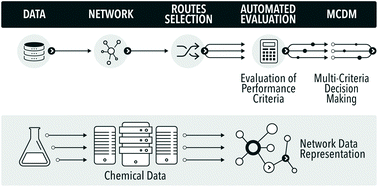
A methodology for chemical routes development and evaluation on the basis of data-mining is presented. A section of the Reaxys database was converted into a network, which was used to plan hypothetical synthesis routes to convert a bio-waste feedstock, limonene, to a bulk intermediate, benzoic acid. The route evaluation considered process conditions and used multiple indicators, including exergy, E-factor, solvent score, reaction reliability and route redox efficiency, in a multi-criteria environmental sustainability evaluation. The proposed methodology is the first route evaluation based on data mining, explicitly using reaction conditions, and is amenable to full automation.

In the field of process and synthetic chemistry ‘clean synthesis’ has become one of the standard criteria for good, commercially viable synthesis routes. As a result synthetic and process chemists must be equipped with adequate methodologies for quantification of ‘cleanness’ or ‘greenness’ of alternative routes at the early phases of the development cycle. These…

View original post 1,252 more words

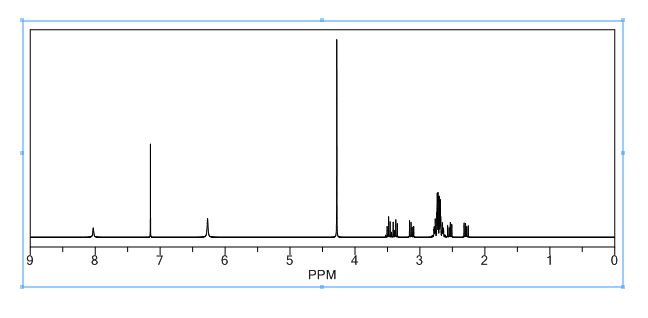
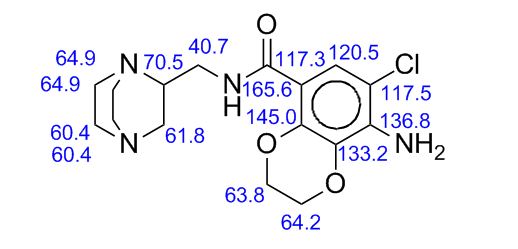
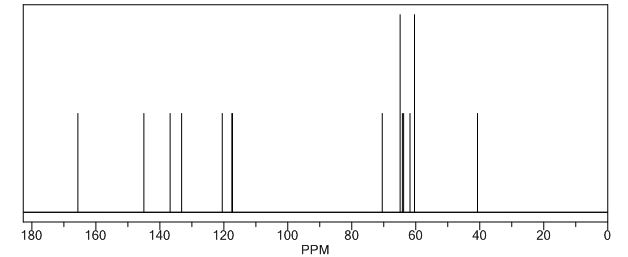
SL65.0102-10


str1

str1SCHEMBL7433792.png

CAS 186348-69-6

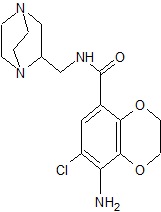
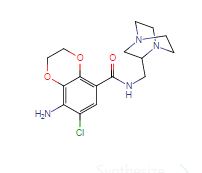
1,4-Benzodioxin-5-carboxamide, 8-amino-7-chloro-N-(1,4-diazabicyclo[2.2.2]oct-2-ylmethyl)-2,3-dihydro-, (-)-

MW, 352.82, C16 H21 Cl N4 O3
US5663173 (A)  –  N-[(1,4-diazabicyclo[2.2.2] oct-2-yl)methyl] benzamide derivatives, their preparations and their application in therapeutics

str1

SL65.0102-10

(-)-1,4-benzodioxin-5-carboxamide-8-amino-7-chloro-N-(1,4-diazabicyclo[2.2.2]oct-2- ylmethyl)-2,3-dihydro-, hydrochloride

1,4-Benzodioxin-5-carboxamide, 8-amino-7-chloro-N-(1,4-diazabicyclo[2.2.2]oct-2-ylmethyl)-2,3-dihydro-, hydrochloride (1:2), (-)-
1,4-Benzodioxin-5-carboxamide, 8-amino-7-chloro-N-(1,4-diazabicyclo[2.2.2]oct-2-ylmethyl)-2,3-dihydro-, dihydrochloride, (-)-
Dihydrochloride (-) – 8-Amino-7-chloro- N – [(1,4-diazabicyclo [2.2.2] oct-2-yl) methyl] -2,3-dihydro-1,4-benzodioxin-5 -carboxamide.

CAS 186348-31-2, C16 H21 Cl N4 O3 . 2 Cl H

Melting point: 220 ° C. (decomposition). EP0748807
[α] = -16.9 ° (c = 1, H 2 O).

[α]D = -17.9 (C = 0.75, DMSO, t = 23°C) at 589 nm. DOI: 10.1021/acs.oprd.6b00262

5-HT3 and 5-HT4 inhibitor that was potentially useful for the treatment of neurological disorders.

Innovators-sanofi

Image result for Sanofi-Aventis

Hoechst Marion Roussel (Sanofi) my organisation 1993-1997 Process development at Mulund, Mumbai, India.

HOECHST | EUREKAMOMENTS IN ORGANIC CHEMISTRY by DR ANTHONY MELVIN CRASTO Ph.D

CENTRE IS DR RALPH STAPEL, HEAD PROCESS DEVELOPMENT, SANOFI

The 5-HT4 receptor is a G-protein coupled receptor (GPCR) which belongs to the serotonin receptor family. The role of the 5-HT4 receptor in the modulation of many diseases is well described in the literature.(1)

During the last decades, an impressive body of evidence suggested that selective stimulation of neuronal 5-HT4 receptor subtypes could be beneficial in the symptomatic treatment of memory disorders, including many antidepressants, antipsychotics, anorectics, antiemetics, gastroprokinetic agents, antimigraine agents, hallucinogens, and antactogens.(2)

Within effort to discover treatments of memory dysfunction, SL65.0102-10, a selective 5-HT4 partial agonist (Ki 6.6 μM), was discovered as promising agent for the treatment of cognition impairment. Serotonin receptors are the target of a variety of pharmaceutical drugs; SL65.0102-10  emerged as a promising 5-HT3 and 5-HT4 inhibitor that was potentially useful for the treatment of neurological disorders.(3)

Samir Jegham

Samir Jegham

Lead Generation Senior Advisor for Asia Pacific Research Hub at Sanofi

“DRUG APPROVALS INT” CATERS TO EDUCATION GLOBALLY, No commercial exploits are done or advertisements added by me. This article is a compilation for educational purposes only.

P.S. : The views expressed are my personal and in no-way suggest the views of the professional body or the company that I represent

SYNTHESIS

SL65.0102-10

str1

CONTD…………..

str1

Synthesis

str1

PATENT

(EP0748807) Derivatives of N- (1,4-diazabicyclo (2.2.2) -oct-2-yl) methyl benzamide, their preparation and their therapeutic use

https://patentscope.wipo.int/search/en/detail.jsf?docId=EP12807129&recNum=1&maxRec=&office=&prevFilter=&sortOption=&queryString=&tab=PCTDescription

Example 5 (Compound No. 9)

Ethyl (-) – 8-Amino-7-chloro- N – [(1,4-diazabicyclo [2.2.2] oct-2-yl) methyl] -2,3-dihydro-1,4 Benzodioxin-5-carboxamide.

5.1. (+) – (2,2-dimethyl-1,3-dioxolan-4-yl) methyl methanesulfonate.

The procedure described in Example 4.1, but from (+) – 2,2-dimethyl-1,3-dioxolane-4-methanol.

5.2. (-) – 2 – [(2,2-Dimethyl-1,3-dioxolan-4-yl) methyl] -1 H -isoindole-1,3 (2 H ) -dione.

The procedure described in Example 4.2, from methane sulfonate (+) – (2,2-dimethyl-1,3-dioxolan-4-yl) methyl.
Melting point: 81.2-81.3 ° C.
[α]= -34.9 ° (c = 1, CH 2 Cl 2 ).

5.3. (-) – 2- (2,3-dihydroxypropyl) -1 H -isoindole-1,3 (2 H ) -dione.

The procedure described in Example 4.3, from (-) – 2 – [(2,2-dimethyl-1,3-dioxolan-4-yl) methyl] -1 H -isoindole-1, 3 (2 H ) -dione.
Melting point: 122.8-122.9 ° C.
[α]= -48.8 ° (c = 1, CH 3 OH).

5.4. (-) – 2 – [(2-Phenyl-1,3-dioxolan-4-yl) methyl] -1 H -isoindole-1,3 (2 H ) -dione.

The procedure described in Example 4.4, from (-) – 2- (2,3-dihydroxypropyl) -1 H -isoindole-1,3 (2 H ) -dione.
Melting point: 84 ° C.
[α]= -59 ° (c = 1, CH 2 Cl 2 ).

5.5. Benzoate (-) – 2-bromomethyl-1- (1,3-dihydro-1,3-dioxo-2 H -isoindol-2-yl) ethyl.

The procedure described in Example 4.5, from (-) – 2 – [(2-phenyl-1,3-dioxolan-4-yl) methyl] -1 H -isoindole-1,3 ( 2 H ) -dione.
Melting point: 118.4-118.6 ° C.
[α]= -58.2 ° (c = 1, CH 2 Cl 2 ).

5.6. (+) – 2- (oxiranylmethyl) -1 H -isoindole-1,3 (2 H ) -dione. Fusion point :

The procedure described in Example 4.6, from benzoate (-) – 2-bromomethyl-1- (1,3-dihydro-1,3-dioxo-2 H -isoindol-2-yl) ethyl.
Melting point: 100.4-100.5 ° C.
[α]= + 45.5 ° (c = 1, CHCl 3 ).

5.7. Dihydrochloride (-) – 8-Amino-7-chloro- N – [(1,4-diazabicyclo [2.2.2] oct-2-yl) methyl] -2,3-dihydro-1,4-benzodioxin-5 -carboxamide.

The procedure described in Example 4.7, from (+) – 2- (oxiranylmethyl) -1 H -isoindole-1,3 (2 H ) -dione.
Melting point: 220 ° C. (decomposition).
[α] = -16.9 ° (c = 1, H 2 O).

Paper

Abstract Image

The process development and improvements for route selection, adapted to large scale for the pilot-scale preparation of SL65.0102-10, an N-diazabicyclo[2.2.2]-octylmethyl benzamide, a 5-HT3and 5-HT4 receptor active ligand for the treatment of neurological disorders such as cognition impairment, are described in this article. Notable steps and enhancements are compared to the original route, including the improvement of a chiral epoxide synthesis by shortening the number of chemical steps, the deprotection of a quaternary ammonium salt, and the redesign of the final amidification coupling to avoid chromatography.

Sanofi

Philippe Lienard

CMC Discovery Coordinator

Pilot Scale Process Development of SL65.0102-10, an N-Diazabicyclo[2.2.2]-octylmethyl Benzamide

Sanofi-Aventis, Recherche & Développement, 13 Quai Jules Guesde, 94400 Vitry-sur-Seine, France
Org. Process Res. Dev., Article ASAP

(-)-1,4-benzodioxin-5-carboxamide-8-amino-7-chloro-N-(1,4-diazabicyclo[2.2.2]oct-2- ylmethyl)-2,3-dihydro-, hydrochloride (1:2), SL65.0102-10 (1).

……………….. to provide compound 1 (10.3 kg, 76.7%). Compound 1 could be recrystallized in acetone/water (12/2 volumes).

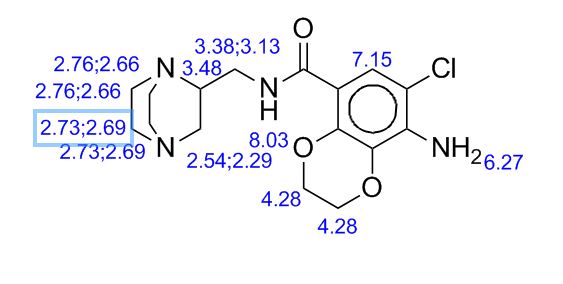
1H-NMR (DMSO-d6, 500 MHz), δ ppm: 3.38 (dd, 1H, J = 12.0 , 6.0 Hz), 3.60-3.45 (m, 7H), 3.65 (t, 1H, J =10.0 Hz), 3.72 (dt, 1H, J =6.0 , 14.0 Hz), 3.83 (m, 2H), 4.01 (m, 1H), 4.33 (m, 2H), 4.39 (m, 2H), 7.37 (s, 1H), 8.35 (t, 1H, J =6.0 Hz). Only 19 protons are observed on 1H spectrum instead of 21 expected. The two amino protons of the molecule are not visible because of chemical exchange with residual water of DMSO-d6 solvent.

13C NMR (DMSO-d6, 125 MHz): δ 38.4, 39.0, 42.8, 43.4, 45.4, 46.5, 54.4, 64.1, 65.1, 109.3, 110.0, 123.2, 130.5, 138.1, 141.8, 165.0.

HRMS: exact mass (by Xevo QToF), MH+ found: 353.1374 (MH+ calculated: 353.1380, difference: -1.7 ppm).

[α]D = -17.9 (C = 0.75, DMSO, t = 23°C) at 589 nm.

Elementary analysis: found C 43.0660%, H 5.5150%, N 12.4792%, calculated C 43.31%, H 5.68%, N 12.63%

str1

1H AND 13C NMR PREDICT

str1 str2 str3 str4

References

  1. (a) Hoyer, D.; Clarke, D. E.; Fozard, J. R.; Hartig, P. R.; Martin, G. R.; Mylecharane, E. J.; Saxena, P. R.;Humphrey, P. P. Pharmacol. Rev. 1994, 46 ( 2) 157203

    (b) Frazer, A.; Hensler, J. G.Chapter 13: Serotonin Receptors. In Siegel, G. J.; Agranoff, B. W.; Albers, R. W.; Fisher, S. K.; Uhler, M. D., Eds.; Basic Neurochemistry: Molecular, Cellular, and Medical Aspects; Lippincott-Raven, Philadelphia,1999; pp 263292.

  2. 2.

    Frick, W.; Glombik, H.; Kramer, W.; Heuer, H.; Brummerhop, H.; Plettenburg, O. Novel fluoroglycoside heterocyclic derivatives, pharmaceutical products containing said compounds and the use thereof.

    (a) WO2004/052903, 2004.

    (b) WO2004/052902, 2004.

  3. 3.

    Jegham, S.; Koenig, J. J.; Lochead, A.; Nedelec, A.; Guminski, Y.N-[(1,4-diazabicyclo[2.2.2]oct-2-yl)methyl] benzamide derivatives, their preparations and their application in therapeutics.

    (a) FR 2756563 06/13/1995 9506951, 1995.

    (b) US 5663173, 1997; Washington, DC: U.S. Patent and Trademark Office.

“DRUG APPROVALS INT” CATERS TO EDUCATION GLOBALLY, No commercial exploits are done or advertisements added by me. This article is a compilation for educational purposes only.

P.S. : The views expressed are my personal and in no-way suggest the views of the professional body or the company that I represent

////////SL65.0102-10, SANOFI, 5-HT3 , 5-HT4 inhibitor,   neurological disorders

O=C(NCC2CN1CCN2CC1)c4cc(Cl)c(N)c3OCCOc34

Calcifediol, カルシフェジオール


Skeletal formula of calcifediol

Calcifediol

カルシフェジオール

Ro 8-8892
U 32070E
(3b,5Z,7E)-9,10-Secocholesta-5,7,10(19)-triene-3,25-diol
(3S,5Z,7E,20R)-9,10-Secocholesta-5,7,10-trien-3,25-diol [German] [ACD/IUPAC Name]
(3S,5Z,7E,20R)-9,10-Secocholesta-5,7,10-triene-3,25-diol [ACD/IUPAC Name]
(3S,5Z,7E,20R)-9,10-Sécocholesta-5,7,10-triène-3,25-diol [French] [ACD/IUPAC Name]
19356-17-3 [RN]
1H-indene-1-pentanol, octahydro-4-[(2Z)-2-[(5S)-5-hydroxy-2-methylenecyclohexylidene]ethylidene]-a,a,e,7a-tetramethyl-, (eR,1R,3aS,4E,7aR)-
25(OH)D3
25-(OH)Vitamin D3
25-hydroxy Vitamin D3
25-HYDROXYCHOLECALCIFEROL-D6
25-hydroxycholecalciferolmonohydrate
25-hydroxyvitamin D
3-{2-[1-(5-Hydroxy-1,5-dimethyl-hexyl)-7a-methyl-octahydro-inden-4-ylidene]-ethylidene}-4-methylene-cyclohexanol
4-[(2Z)-2-[(5S)-5-hydroxy-2-methylenecyclohexylidene]ethylidene]octahydro-?,?,?,7a-tetramethyl-(?R,1R,3aS,4E,7aR)-1H-indene-1-pentanol
Molecular form.: C₂₇H₄₄O₂
Appearance: White to Off-White Solid
Melting Point: 75-93ºC
Mol. Weight: 400.64

Calcifediol (INN), also known as calcidiol, 25-hydroxycholecalciferol, or 25-hydroxyvitamin D (abbreviated 25(OH)D),[1] is a prehormone that is produced in the liver by hydroxylation of vitamin D3 (cholecalciferol) by the enzyme cholecalciferol 25-hydroxylase which was isolated by Michael F. Holick. Physicians worldwide measure this metabolite to determine a patient’s vitamin D status.[2] At a typical daily intake of vitamin D3, its full conversion to calcifediol takes approximately 7 days.[3]

Calcifediol is then converted in the kidneys (by the enzyme 25(OH)D-1α-hydroxylase) into calcitriol (1,25-(OH)2D3), a secosteroid hormone that is the active form of vitamin D. It can also be converted into 24-hydroxycalcidiol in the kidneys via 24-hydroxylation.[4][5]

Calcifediol.png

Blood test

In medicine, a 25-hydroxy vitamin D (calcifediol) blood test is used to determine how much vitamin D is in the body.[6] The blood concentration of calcifediol is considered the best indicator of vitamin D status.[7]

This test can be used to diagnose vitamin D deficiency, and it is indicated in patients with high risk for vitamin D deficiency and when the results of the test would be used as supporting evidence for beginning aggressive therapies.[8] Patients with osteoporosis, chronic kidney disease, malabsorption, obesity, and some other infections may be high risk and thus have greater indication for this test.[8] Although vitamin D deficiency is common in some populations including those living at higher latitudes or with limited sun exposure, the 25(OH)D test is not indicated for entire populations.[8] Physicians may advise low risk patients to take over-the-counter vitamin D in place of having screening.[8]

It is the most sensitive measure,[9] though experts have called for improved standardization and reproducibility across different laboratories.[7] According to MedlinePlus, the normal range of calcifediol is 30.0 to 74.0 ng/mL.[6] The normal range varies widely depending on several factors, including age and geographic location. A broad reference range of 20–150 nmol/L (8-60 ng/ml) has also been suggested,[10] while other studies have defined levels below 80 nmol/L (32 ng/ml) as indicative of vitamin D deficiency.[11]

US labs generally report 25(OH)D levels as ng/mL. Other countries often use nmol/L. Multiply ng/mL by 2.5 to convert to nmol/L.

Clinical significance

Increasing calcifediol levels are associated with increasing fractional absorption of calcium from the gut up to levels of 80 nmol/L (32 ng/mL).[citation needed]Urinary calcium excretion balances intestinal calcium absorption and does not increase with calcifediol levels up to ~400 nmol/L (160 ng/mL).[12]

A study by Cedric F. Garland and Frank C. Garland of the University of California, San Diego analyzed the blood from 25,000 volunteers from Washington County, Maryland, finding that those with the highest levels of calcifediol had a risk of colon cancer that was one-fifth of typical rates.[13] However, randomized controlled trials failed to find a significant correlation between vitamin D supplementation and the risk of colon cancer.[14]

A 2012 registry study of the population of Copenhagen, Denmark, found a correlation between both low and high serum levels and increased mortality, with a level of 50–60 nmol/L being associated with the lowest mortality. The study did not show causation.[15][16]

Nmr

http://onlinelibrary.wiley.com/doi/10.1002/cctc.201402795/epdf?r3_referer=wol&tracking_action=preview_click&show_checkout=1&purchase_referrer=onlinelibrary.wiley.com&purchase_site_license=LICENSE_DENIED

Regioselective Hydroxylation in the Production of 25-Hydroxyvitamin D by Coprinopsis cinerea Peroxygenase
ChemCatChem (2015), 7, (2), 283-290

1H NMR 500 MHz, CDCl3: δ= 0.55 (3 H, s, 18-H), 0.94 (1H, d, J= 6.5 Hz, 21-H), 1.06 (1H, m, 22-H), 1.22 (3 H, s, 26-H), 1.22 (3 H, s, 27-H), 1.23 (1H, m, 23-H), 1.27 (1H, m, 16-H), 1.28 (1H, m, 14-H), 1.29 (1H, m, 12-H), 1.37 (1H, m, 22-H), 1.38 (1H, m, 20-H), 1.39 (1H, m, 24-H), 1.42 (1H, m, 23-H), 1.44 (1H, m, 24-H), 1.47 (2 H, m, 11-H), 1.53 (1H, m, 15-H), 1.66 (1H, m, 15-H), 1.67 (1H, m, 2-H), 1.67 (1H, m, 9-H), 1.87 (1H, m, 16-H), 1.92 (1H, m, 2-H), 1.98 (1H, m, 17-H), 2.06 (1H, m, 12-H), 2.17 (1H, m, 1-H), 2.40 (1H, m, 1-H), 2.57 (1H, dd, J= 3.7, 13.1Hz, 4-H), 2.82 (1H, m, 9-H), 3.95 (1H, bm, 3-H), 4.82 (1H, m, 19-H), 5.05 (1H, m, 19-H), 6.03 (1H, d, J=11.2 Hz, 7-H), 6.23 ppm (1H, d, J= 11.2 Hz, 6-H).

13 C NMR 500 MHz, CDCl3: δ = 12.2 (C-18), 19.0 (C-21), 21.0 (C-23), 22.4 (C-11), 23.7 (C-15), 27.8 (C-16), 29.2 (C-9), 29.4 (C-27), 29.5 (C-26), 32.1 (C-1), 35.3 (C-2), 36.3 (C-20), 36.6 (C-22), 40.7 (C-12), 44.6 (C-24), 46.0 (C-13), 46.1 (C-4), 56.5 (C-17), 56.7 (C-14), 69.4 (C-3), 71.3 (C-25), 112.6 (C-19), 117.7 (C-7), 122.2 (C-6), 135.2 (C-5), 142.4 (C-8), 145.3 ppm (C-10).

PAPER

From Organic & Biomolecular Chemistry, 10(27), 5205-5211; 2012

http://pubs.rsc.org/en/content/articlelanding/2012/ob/c2ob25511a#!divAbstract

An efficient, two-stage, continuous-flow synthesis of 1α,25-(OH)2-vitamin D3 (activated vitamin D3) and its analogues was achieved. The developed method afforded the desired products in satisfactory yields using a high-intensity and economical light source, i.e., a high-pressure mercury lamp. In addition, our method required neither intermediate purification nor high-dilution conditions.

Graphical abstract: Continuous-flow synthesis of activated vitamin D3 and its analogues

1H NMR(400 MHz, CDCl3): δ 8.13 (m, 2H), 7.68 (m, 2H), 6.64 (d, J = 8.3 Hz, 1H), 6.25 (d, J = 8.3 Hz, 1H), 5.19 (m, 2H), 3.93 (dd, J = 12.7, 8.2, 1H), 3.88 (dd, J = 14.6, 4.9 Hz, 1H), 3.58 (m, 1H), 1.02 (s, 3H), 1.02 (d, J = 6.8 Hz, 3H), 0.90 (d, J = 6.8 Hz, 3H), 0.86 (s, 9H), 0.80-0.84 (m, 9H), 0.09 (s, 3H), 0.00 (s, 3H)

13C NMR  (100 MHz, CDCl3): δ 161.8, 159.6, 138.5, 135.3, 132.6, 132.5, 132.1, 130.6, 130.2, 128.7, 127.0, 126.5, 77.2, 68.5, 67.4, 67.1, 56.5, 50.6, 49.0, 44.2, 42.7, 40.4, 39.9, 39.3, 35.6, 34.7, 33.0, 30.5, 28.2, 25.9, 24.5, 21.9, 20.8, 19.9, 19.7, 18.5, 18.0, 17.4, 13.3, -4.4, -4.9

IR (neat): 2957, 2872, 1653, 1603, 1462, 1311, 1093, 837, 762 cm-1

str1

Interactive pathway map

Click on genes, proteins and metabolites below to link to respective articles. [§ 1]

[[File:

VitaminDSynthesis_WP1531

Go to article Go to article Go to article Go to article go to article Go to article Go to article Go to article go to article go to article go to article go to article Go to article Go to article go to article Go to article go to article go to article go to article Go to article go to article

VitaminDSynthesis_WP1531

Go to article Go to article Go to article Go to article go to article Go to article Go to article Go to article go to article go to article go to article go to article Go to article Go to article go to article Go to article go to article go to article go to article Go to article go to article

|{{{bSize}}}px|alt=Vitamin D Synthesis Pathway]

Vitamin D Synthesis Pathway edit

  1. Jump up^ The interactive pathway map can be edited at WikiPathways: “VitaminDSynthesis_WP1531”.

References

  1. Jump up^ “Nomenclature of Vitamin D. Recommendations 1981. IUPAC-IUB Joint Commission on Biochemical Nomenclature (JCBN)” reproduced at the Queen Mary, University of London website. Retrieved 21 March 2010.
  2. Jump up^ Holick, MF; Deluca, HF; Avioli, LV (1972). “Isolation and identification of 25-hydroxycholecalciferol from human plasma”. Archives of Internal Medicine. 129 (1): 56–61. doi:10.1001/archinte.1972.00320010060005. PMID 4332591.
  3. Jump up^ Am J Clin Nutr 2008;87:1738–42 PMID 18541563
  4. Jump up^ Bender, David A.; Mayes, Peter A (2006). “Micronutrients: Vitamins & Minerals”. In Victor W. Rodwell; Murray, Robert F.; Harper, Harold W.; Granner, Darryl K.; Mayes, Peter A. Harper’s Illustrated Biochemistry. New York: Lange/McGraw-Hill. pp. 492–3. ISBN 0-07-146197-3. Retrieved December 10, 2008 through Google Book Search.
  5. Jump up^ Institute of Medicine (1997). “Vitamin D”. Dietary Reference Intakes for Calcium, Phosphorus, Magnesium, Vitamin D, and Fluoride. Washington, D.C: National Academy Press. p. 254. ISBN 0-309-06403-1.
  6. ^ Jump up to:a b “25-hydroxy vitamin D test: Medline Plus”. Retrieved 21 March 2010.
  7. ^ Jump up to:a b Heaney, Robert P (Dec 2004). “Functional indices of vitamin D status and ramifications of vitamin D deficiency”. American Journal of Clinical Nutrition. 80 (6): 1706S–9S. PMID 15585791.
  8. ^ Jump up to:a b c d American Society for Clinical Pathology, “Five Things Physicians and Patients Should Question”, Choosing Wisely: an initiative of the ABIM Foundation, American Society for Clinical Pathology, retrieved August 1, 2013, which cites
      • Sattar, N.; Welsh, P.; Panarelli, M.; Forouhi, N. G. (2012). “Increasing requests for vitamin D measurement: Costly, confusing, and without credibility”. The Lancet. 379 (9811): 95–96. doi:10.1016/S0140-6736(11)61816-3. PMID 22243814.
      • Bilinski, K. L.; Boyages, S. C. (2012). “The rising cost of vitamin D testing in Australia: Time to establish guidelines for testing”. The Medical Journal of Australia. 197 (2): 90. doi:10.5694/mja12.10561. PMID 22794049.
      • Lu, Chuanyi M. (May 2012). “Pathology consultation on vitamin D testing: Clinical indications for 25(OH) vitamin D measurement [Letter to the editor]”. American Journal Clinical Pathology. American Society for Clinical Pathology (137): 831–832., which cites
        • Arya, S. C.; Agarwal, N. (2012). “Pathology Consultation on Vitamin D Testing: Clinical Indications for 25(OH) Vitamin D Measurement”. American Journal of Clinical Pathology. 137 (5): 832. doi:10.1309/AJCP2GP0GHKQRCOE. PMID 22523224.
      • Holick, M. F.; Binkley, N. C.; Bischoff-Ferrari, H. A.; Gordon, C. M.; Hanley, D. A.; Heaney, R. P.; Murad, M. H.; Weaver, C. M. (2011). “Evaluation, Treatment, and Prevention of Vitamin D Deficiency: An Endocrine Society Clinical Practice Guideline”. Journal of Clinical Endocrinology & Metabolism. 96 (7): 1911–1930. doi:10.1210/jc.2011-0385. PMID 21646368.
  9. Jump up^ Institute of Medicine (1997), p. 259
  10. Jump up^ Bender, David A. (2003). “Vitamin D”. Nutritional biochemistry of the vitamins. Cambridge: Cambridge University Press. ISBN 0-521-80388-8. Retrieved December 10, 2008 through Google Book Search.
  11. Jump up^ Hollis BW (February 2005). “Circulating 25-hydroxyvitamin D levels indicative of vitamin D sufficiency: implications for establishing a new effective dietary intake recommendation for vitamin D”. J Nutr. 135 (2): 317–22. PMID 15671234.
  12. Jump up^ Kimball; et al. (2004). “Safety of vitamin D3 in adults with multiple sclerosis”. J Clin Endocrinol Metab. 86 (3): 645–51. PMID 17823429.
  13. Jump up^ Maugh II, Thomas H. “Frank C. Garland dies at 60; epidemiologist helped show importance of vitamin D: Garland and his brother Cedric were the first to demonstrate that vitamin D deficiencies play a role in cancer and other diseases.”, Los Angeles Times, August 31, 2010. Accessed September 4, 2010.
  14. Jump up^ Wactawski-Wende, J; Kotchen, JM, Women’s Health Initiative Investigators (Mar 9, 2006). “Calcium plus vitamin D supplementation and the risk of colorectal cancer.”. N Engl J Med. 354 (7): 684–96. doi:10.1056/NEJMoa055222. PMID 16481636. Retrieved December 28, 2013.
  15. Jump up^ “Too much vitamin D can be as unhealthy as too little” (Press release). University of Copenhagen. May 29, 2012. Retrieved 2015-05-27.
  16. Jump up^ Durup, D.; Jørgensen, H. L.; Christensen, J.; Schwarz, P.; Heegaard, A. M.; Lind, B. (May 9, 2012). “A Reverse J-Shaped Association of All-Cause Mortality with Serum 25-Hydroxyvitamin D in General Practice: The CopD Study”. The Journal of Clinical Endocrinology & Metabolism. Endocrine Society. 97 (8): 2644–2652. doi:10.1210/jc.2012-1176. Retrieved 2015-05-27.
Calcifediol
Skeletal formula of calcifediol
Ball-and-stick model of the calcifediol molecule
Names
IUPAC names

(6R)-6-[(1R,3aR,4E,7aR)-4-[(2Z)-2-[(5S)-5-
Hydroxy-2-methylidene-cyclohexylidene]
ethylidene]-7a-methyl-2,3,3a,5,6,7-hexahydro-
1H-inden-1-yl]-2-methyl-heptan-2-ol
Other names

25-Hydroxyvitamin D3
25-Hydroxycholecalciferol
Calcidiol
Identifiers
19356-17-3 Yes
3D model (Jmol) Interactive image
ChEBI CHEBI:17933 
ChEMBL ChEMBL1222 Yes
ChemSpider 4446820 
DrugBank DB00146 Yes
ECHA InfoCard 100.039.067
6921
MeSH Calcifediol
PubChem 5283731
UNII T0WXW8F54E Yes
Properties
C27H44O2
Molar mass 400.64 g/mol
Pharmacology
A11CC06 (WHO)
Except where otherwise noted, data are given for materials in their standard state (at 25 °C [77 °F], 100 kPa).


Title: Calcifediol
CAS Registry Number: 19356-17-3
CAS Name: (3b,5Z,7E)-9,10-Secocholesta-5,7,10(19)-triene-3,25-diol
Additional Names: 25-hydroxyvitamin D3; 25-hydroxycholecalciferol; 25-HCC
Manufacturers’ Codes: U-32070E
Trademarks: Dedrogyl (DESMA); Didrogyl (Bruno); Hidroferol (FAES)
Molecular Formula: C27H44O2
Molecular Weight: 400.64
Percent Composition: C 80.94%, H 11.07%, O 7.99%
Literature References: The principal circulating form of vitamin D3, formed in the liver by hydroxylation at C-25: Ponchon, DeLuca, J. Clin. Invest. 48, 1273 (1969). It is the intermediate in the formation of 1a,25-dihydroxycholecalciferol, q.v., the biologically active form of vitamin D3 in the intestine. Identification in rat as an active metabolite of vitamin D3: Lund, DeLuca, J. Lipid Res. 7, 739 (1966); Morii et al., Arch. Biochem. Biophys. 120, 513 (1967). Evaluation of biological activity in comparison with vitamin D3: Blunt et al., Proc. Natl. Acad. Sci. USA 61, 717 (1968); ibid. 1503. Isoln from porcine plasma and establishment of structure: Blunt et al., Biochemistry 7, 3317 (1968). Synthesis: Blunt, DeLuca, ibid. 8, 671 (1969). Review of isoln, identification and synthesis: DeLuca, Am. J. Clin. Nutr. 22, 412 (1969). Review of bioassays: J. G. Haddad Jr., Basic Clin. Nutr. 2, 579-597 (1980).
Properties: uv max (ethanol): 265 nm (e 18000) (Blunt, DeLuca).
Absorption maximum: uv max (ethanol): 265 nm (e 18000) (Blunt, DeLuca)
Therap-Cat: Calcium regulator.
Keywords: Calcium Regulator.

/////////Calcifediol, カルシフェジオール

CC(CCCC(C)(C)O)C1CCC2C1(CCCC2=CC=C3CC(CCC3=C)O)C

GMP’s for Early Stage Development of new Drug substances and products


DR ANTHONY MELVIN CRASTO Ph.D's avatarDRUG REGULATORY AFFAIRS INTERNATIONAL

Image result for GMPs for Early Stage Development

GMP’s for Early Stage Development of New Drug substances and products


The question of how Good Manufacturing Practice (GMP) guidelines should be applied during early stages of development continues to be discussed across the industry and is now the subject of a new initiative by the International Consortium on Innovation and Quality in Pharmaceutical Development (IQ Consortium)—an association of pharmaceutical and biotechnology companies aiming to advance innovation and quality in the development of pharmaceuticals. They have assembled a multidisciplinary team (GMPs in Early Development Working Group) to explore and define common industry approaches and to come up with suggestions for a harmonized approach. Their initial thoughts and conclusions are summarized in Pharm. Technol. 2012, 36 (6), 5458.
Image result for International Consortium on Innovation and Quality in Pharmaceutical Development (IQ Consortium)
From an industry perspective, it is common to consider the “early” phase of development as covering phases 1 and 2a clinical studies. During this phase, there is a high…

View original post 1,741 more words

CENTANAFADINE


Centanafadine.svg

Centanafadine; UNII-D2A6T4UH9C; EB-1020 free base; D2A6T4UH9C; 924012-43-1

CTN SR; EB-1020; EB-1020 SR

WO 2007016155

Molecular Formula: C15H15N
Molecular Weight: 209.292 g/mol
  • Phase II Attention-deficit hyperactivity disorder
  • No development reported Major depressive disorder; Neuropathic pain

Most Recent Events

  • 20 Dec 2016 Neurovance plans a phase III trial for Attention-deficit hyperactivity disorder
  • 27 Jul 2016 Efficacy data from a phase IIb trial in Attention-deficit hyperactivity disorder released by Neurovance
  • 16 Jul 2016 No recent reports of development identified for phase-I development in Attention-deficit-hyperactivity-disorder in Canada (PO)
  • Originator Euthymics Bioscience
  • Developer Euthymics Bioscience; Neurovance
  • Class Azabicyclo compounds; Cyclohexanes; Naphthalenes; Small molecules
  • Mechanism of Action Adrenergic uptake inhibitors; Dopamine uptake inhibitors; Serotonin uptake inhibitors

Image result for Neurovance

Image result for Euthymics Bioscience

2D chemical structure of 923981-14-0

cas 923981-14-0 hydrochloride

Molecular Formula: C15H16ClN
Molecular Weight: 245.75 g/mol


(1R,5S)-1-(naphthalen-2-yl)-3-azabicyclo(3.1.0)hexane hydrochloride

Centanafadine (INN) (former developmental code name EB-1020) is a serotonin-norepinephrine-dopamine reuptake inhibitor (SNDRI) under development by Neurovance in collaboration with Euthymics Bioscience as a treatment for attention deficit hyperactivity disorder (ADHD) that inhibits the reuptake of norepinephrine, dopamine and serotonin with a ratio of 1:6:14, respectively.[1][2][3] As of August 2015, it is in phase II clinical trials.[1]

Also claimed is their use for treating attention deficit hyperactivity disorder (ADHD), fragile-X associated disorder, autism spectrum disorder and depression. See WO2015089111, claiming method for treating fragile X-associated disorders, assigned to Neurovance, naming Piskorski, Bymaster and Mckinney. Neurovance, an affiliate of Euthymics Bioscience, is developing centanafadine, a sustained release formulation and a non-stimulant triple reuptake inhibitor, for treating ADHD and is also investigating the drug for treating neuropathic pain.

In June 2015, the drug was reported to be in phase 2 clinical and preclinical development for treating ADHD and neuropathic pain, respectively. Inventors are affiliated with Neurovance.

Attention-deficit hyperactivity disorder (ADHD) is a central nervous system

(CNS) disorder characterized by developmentally inappropriate inattention, hyperactivity, and impulsivity (Buitelaar et al., 2010; Spencer et al., 2007). ADHD is one of the most common developmental disorders in children with 5-10% prevalence (Scahill et al., 2000; Polanczyk et al., 2007). While ADHD was once regarded as only a childhood disorder, it can continue through adolescence and into adulthood. An estimated 2.9-4.4% of the adult population has continuing ADHD (Kessler et al., 2006; Faraone and Biederman, 2005). Major symptoms in adults include inattention, disorganization, lack of concentration and to some extent impulsivity, which result in difficulty functioning, low educational attainment, under achievement in vocational and educational pursuits, and poor social and family relations (Biederman et al, 2006; Barkely et al., 2006).

The exact causes of ADHD are not known, but a dysfunction of the prefrontal cortex and its associated circuitries has been posited as a key deficit in ADHD (Arnsten, 2009). Consistent with this notion is the finding that abnormal catecholaminergic function plays a key role, particularly in prefrontal cortical regions (Arnsten 2009). The

catecholamines norepinephrine (NE) and dopamine (DA) are highly involved in several domains of cognition including working memory, attention, and executive function. Accordingly, these monoamine neurotransmitters are believed to work in concert in modulating cognitive processes.

Pharmacotherapy is a primary form of treatment utilized to reduce the symptoms of ADHD. Stimulants such as methylphenidate and amphetamines are commonly used for ADHD. The major mechanism of action of the stimulants is inhibition of DA and NE transporters. The stimulants are effective against the core symptoms of ADHD and have a response rate of about 70% (Spencer et al. , 2005). However, major concerns about stimulants include risk of abuse, dependency, and diversion as well as potential neurotoxic effects of amphetamines (Berman et al., 2009). The abuse potential of stimulants is particularly problematic in adults because substance abuse is a common co-morbidity with adult ADHD (Levin and Kleber, 1995; Ohlmeier, 2008).

Another major drug used to treat ADHD is atomoxetine, which is a selective norepinephrine reuptake inhibitor. Major advantages of atomoxetine compared to the stimulants is lack of abuse potential, once-daily dosage, and superior treatment of comorbidities such as anxiety and depression. However, atomoxetine has lower efficacy and takes 2-4 weeks for onset of action (Spencer et al., 1998; Newcorn et al., 2008).

Accordingly, there remains a need for effective pharmaceuticals which may be used in the treatment of ADHD and other conditions affected by monoamine neurotransmitters.

str1

PATENT

WO 2007016155

https://www.google.ch/patents/WO2007016155A2?hl=de&cl=en

Reaction Scheme 1 below generally sets forth an exemplary process for preparing l-aryl-3-azabicyclo[3.1.0] hexane analogs from the corresponding 2-bromo-2- arylacetate or 2-chloro-2-arylacetate. The bromo or chloro acetate react with acrylonitrile to provide the methyl 2-cyano-l-arylcyclopropanecarboxylate, which is then reduced to the amino alcohol by reducing agents such as lithium aluminum hydride (LAH) or sodium aluminum hydride (SAH) or NaBH4 with ZnCl2. Cyclization of the amino alcohol with SOCl2 or POCl3 will provide the l-aryl-3-azabicyclo[3.1.0]hexane. The cyclization of substituted 4-aminobutan-l -ol by SOCl2 or POCl3 into the pyrrolidine ring system was reported by Armarego et al, J. Chem. Soc. [Section C: Organic] 19:3222-9, (1971), and in Szalecki et al., patent publication PL 120095 B2, CAN 99:158251. Oxalyl chloride, phosphorous tribromide, triphenylphosphorous dibromide and oxalyl bromide may be used for the same purpose. The methyl 2-bromo-2 -arylacetate or methyl 2- chloro-2-arylacetate may be synthesized from subsituted benzoylaldehyde or methyl-2- arylacetate as shown in Reaction Scheme IA.

Reaction Scheme 1

Figure imgf000052_0001

Reduction

Figure imgf000052_0002

Reagents: (a) NaOMe; (b) LiAIH4; (c) SOCI2; (d) POCI3; (e) NaOH or NH3 H2O

Reaction Scheme IA

Figure imgf000052_0003
Figure imgf000052_0004

Reagents: (a) CHCI3, NaOH; (b) SOCI2; (c) MeOH; (d) NaBrO3, NaHSO3 [00138] Reaction Scheme 2 below illustrates another exemplary process for transforming methyl 2-cyano-l-arylcyclopropanecarboxylate to a desired compound or intermediate of the invention. Hydrolysis of the cyano ester provides the potassium salt which can then be converted into the cyano acid. Reduction and cyclization of the 2- cyano-1-arylcyclopropanecarboxylic acid with LAH or LiAlH(OMe)3according to the procedure outlined in Tetrahedron 45:3683 (1989), will generate l-aryl-3- azabicyclo[3.1.0]hexane. In addition, the cyano- 1-arylcyclopropanecarboxylic acid can be hydrogenated and cyclized into an amide, which is then reduced to l-aryl-3- azabicyclo[3.1.0]hexane.

Reaction Scheme 2

Figure imgf000053_0001

Hydrolysis

Figure imgf000053_0002

Reagents: (a) NaOMe; (b) KOH; (c) HCI; (d) LiAIH(OMe)3, or LAH, or SAH, then HCI; (e) H2/Pd or H2/Ni

[00139] Reaction Scheme 3 below discloses an alternative exemplary process for converting the methyl 2-cyano-l-arylcyclopropanecarboxylate to a desired compound or intermediate of the invention. The methyl 2-cyano-l-arylcyclopropanecarboxylate is reduced and cyclized into l-aryl-3-aza-bicyclo[3.1.0]hexan-2~one, which is then reduced to l-aryl-3-azabicyclo[3.1.0]hexane [Marazzo, A. et al., Arkivoc 5:156-169, (2004)].

Reaction Scheme 3

Figure imgf000054_0001

Reagents: (a) H2/Pd or H2/Ni; (b) B2H6 or BH3 or LAH, then HCI [00140] Reaction Scheme 4 below provides another exemplary process to prepare l-aryl-3-azabicyclo[3.1.0] hexane analogs. Reaction of 2-arylacetonitrile with (+)- epichlorohydrin gives approximately a 65% yield of 2-(hydroxyrnethyl)-l- arylcyclopropanecarbonitrile (85% cis) with the trans isomer as one of the by-products [Cabadio et al., Fr. Bollettino Chimico Farmaceutico 117:331-42 (1978); Mouzin et al., Synthesis 4:304-305 (1978)]. The methyl 2-cyano-l-arylcyclopropanecarboxylate can then be reduced into the amino alcohol by a reducing agent such as LAH, SAH or NaBH4 with ZnCl2 or by catalytic hydrogenation. Cyclization of the amino alcohol with SOCl2 or POCl3 provides the l-aryl-3-azabicyclo[3.1.0]hexane. The cyclization of substituted 4-aminobutan-l-ol by SOCl2 or POCl3 into the pyrrolidine ring system has been reported previously [Armarego et al., J. Chem. Soc. [Section C: Organic] 19:3222-9 (1971); patent publication PL 120095 B2, CAN 99:158251).

ϋv siυjiijJsoLJa

Reaction Scheme 4

Ar CN

ion

Figure imgf000055_0001

Reagents: (a) NaHMDS; (b) LAH or catalytic hydrogenation; (c) SOCl2; (d) POCI3; (e) NaOH

Figure imgf000055_0002

[00141] Reaction Scheme 5 provides an exemplary process for synthesizing the

(IR, 5S)-(+)-l-aryl-3-azabicyclo[3.1.0]hexanes. Using (S)-(+)-epichlorohydrin as a starting material in the same process described in Scheme 4 will ensure a final product with 1-R chirality [Cabadio, S. et al, Fr. Bollettino Chimico Farmaceutico 117:331-42 (1978)].

Reaction Scheme 5

ion

Figure imgf000056_0001

^Ar

H’..

Reagents: (a) NaHMDS; (b) LAH or catalytic hydroge nation; (c) SOCI2; (d) POCl3; (e) NaOH j_j

[00142] Reaction Scheme 6 provides an exemplary process to prepare the (1 S,5R)-

(-)-l-aryl-3-azabicyclo[3.1.0]hexanes. Using (R)-(-)-epichlorohydrin as a starting material in the same process described in Scheme 4 will ensure a final product with 1-S chirality [Cabadio, S. et al, Fr. Bollettino Chimico Farmaceutico 117:331-42 (1978)].

Reaction Scheme 6

Ar CN

Figure imgf000056_0003

c or d, Cyclization

Figure imgf000056_0002

Reagents: (a) NaHMDS; (b) LAH or catalytic hydrogenation; (C) SOCI2; (d) POCI3; (e) NaOH

Figure imgf000056_0004

[00143] Reaction Scheme 7 provides an alternative exemplary process for transforming the 2-(hydroxymethyl)-l-arylcyclopropanecarbonitrile to a desired compound or intermediate of the invention via an oxidation and cyclization reaction. Utilizing chiral starting materials (+)-epichlorohydrin or (-)-epichlorohydrin will lead to the corresponding (+)- or (-)-enantiomers and corresponding chiral analogs through the same reaction sequences.

Reaction Scheme 7

O Cyclopropanantion Oxidation

Ar CN

CK Ar Ar a HO HO

CN

65% yield, 88% cis O

Hydrogenation

C Cyclization

Figure imgf000057_0001

Reagents: (a) NaNH2; (b) KMnO4; (c) H2/Ni or Pt; (d) B2H6 Or BH3 Or LAH, then HCI

Figure imgf000057_0002

[00144] Reaction Scheme 8 provides an exemplary process for transforming the epichlorohydrin to a desired compound or intermediate of the invention via a replacement and cyclization reaction. The reaction of methyl 2-arylacetate with epichlorohydrin gives methyl 2-(hydroxymethyl)~l~arylcyclopropanecarboxylate with the desired cis isomer as the major product. The alcohol is converted into an OR3 group such as -O-mesylate, -O- tosylate, -O-nosylate, -O-brosylate, -O-trifluoromethanesulfonate. Then OR3 is replaced by a primary amine NH2R4, where R4 is a nitrogen protection group such as a 3,4- dimethoxy-benzyl group or other known protection group. Nitrogen protecting groups are well known to those skilled in the art, see for example, “Nitrogen Protecting Groups in Organic Synthesis”, John Wiley and Sons, New York, N.Y., 1981, Chapter 7; “Nitrogen Protecting Groups in Organic Chemistry”, Plenum Press, New York, N.Y., 1973, Chapter 2; T. W. Green and P. G. M. Wuts in “Protective Groups in Organic Chemistry”, 3rd edition, John Wiley & Sons, Inc. New York, N. Y., 1999. When the nitrogen protecting group is no longer needed, it may be removed by methods well known in the art. This replacement reaction is followed by a cyclization reaction which provides the amide, which is then reduced into an amine by a reducing agent such as LAH. Finally the protection group is removed to yield the l-aryl-3- azabicyclo[3.1.0]hexane analogs. Utilizing chiral (S)-(+)-epichlorohydrin as a starting material leads to the (lR,5S)-(+)-l-aryl-3-azabicyclo[3.1.0]hexane analogs with the same reaction sequence. Similarly, the (R)-(-)-epichlorohydrin will lead to the (lS,5R)-(-)-l- aryl-3-azabicyclo[3.1.0]hexane analogs.

Reaction Scheme 8

O Cyclop ro pa nantion

Ar CO2Me + C|v Ar Ar

HO R3O

CO2Me CO2Me

Replacement Cyclization

Figure imgf000058_0001

Reagents: (a) NaNH2; (b) MsCI; (c) R4NH2; (d) LAH or SAH or BH3; (e) HCI

Figure imgf000058_0002

[00145] Reaction Scheme 9 provides an exemplary process for transforming the diol to a desired compound or intermediate of the invention. Reduction of the diester provides the diol which is then converted into an OR3 group such as -O-mesylate, -O- tosylate, -O-nosylate, -O-brosylate, -O-trifluoromethanesulfonate. Then OR3 is replaced by a primary amine NH2R6, where R6 is a nitrogen protection group such as a 3,4- dimethoxy-benzyl group or other protection groups known in the art (e.g., allyl amine, tert-butyl amine). When the nitrogen protecting group is no longer needed, it may be removed by methods known to those skilled in the art.

Reaction Scheme 9

Figure imgf000059_0001

X=CI or Br

Figure imgf000059_0002

Deprotection ft* Replacement Cyclization

Reagents: (a) NaOMe; (b) NaBH4; (c)MsCI; (d) NH3, then HCI; (e) R6NH2; (f) H2/Pd or acid deprotection, then HCI

[00146] Reaction Scheme 10 provides an exemplary process for resolving the racemic l-aryl-3-aza-bicyclo[3.1.0]hexane to enantiomers. The resolution of amines through tartaric salts is generally known to those skilled in the art. For example, using O,O-Dibenzoyl-2R,3R-Tartaric Acid (made by acylating L(+)-tartaric acid with benzoyl chloride) in dichloroethane/methanol/water, racemic methamphetamine can be resolved in 80-95% yield, with an optical purity of 85-98% [Synthetic Communications 29:4315- 4319 (1999)]. Reaction Scheme 10

Figure imgf000060_0001

Racemate (1 R, 5S)-enantiomer

Figure imgf000060_0002

Racemate (1 S, 5R)-enantiomer

Reagents: (a) L-(-)-DBTA; (b) NaOH, then HCI in IPA; (c) D-(+)-DBTA

[00147] Reaction Scheme 11 provides an exemplary process for the preparation of

3-alkyl-l-aryl-3-azabicyclo[3.1.0]hexane analogs. These alkylation or reductive animation reaction reagents and conditons are generally well known to those skilled in the art.

Reaction Scheme 11

Figure imgf000060_0003

R= Me, Et, Propyl, i-propyl, cyclopropyl, i-butyl, etc.

[00148] Enantiomers of compounds within the present invention can be prepared as shown in Reaction Scheme 12 by separation through a chiral chromatography. Reaction Scheme 12

Figure imgf000061_0001

[00149] Alternatively, enantiomers of the compounds of the present invention can be prepared as shown in Reaction Scheme 13 using alkylation reaction conditions exemplified in scheme 11.

Reaction Scheme 13

Figure imgf000061_0002
Figure imgf000061_0003

[00150] Reaction Scheme 14 provides an exemplary process for preparing some N- methyl l-aryl-3-aza-bicyclo[3.1.0]hexane analogs. The common intermediate N-methyl bromomaleide is synthesized in one batch followed by Suzuki couplings with the various substituted aryl boronic acids. Cyclopropanations are then carried out to produce the imides, which are then reduced by borane to provide the desired compounds.

Reaction Scheme 14

Figure imgf000062_0001
Figure imgf000062_0002

Reagents and conditions: (a) MeNH2, THF, 10 0C, 1.5 hr; (b) NaOAc, Ac2O1 60 0C, 2 hr; (c) PdCI2C dppf), CsF, dioxane, 40 0C, 1-6 hr; (d) Me3SOCI, NaH, THF, 50-65 0C, 2-6 hr; (e) 1M BH3/THF, O 0C; 60 0C 2 hr (f) HCI, Et2O

[00151] Reaction Scheme 15 provides an additional methodology for producing 1- aryl-3-azabicyclo[3.1.0] hexanes.

Reaction Scheme 15

Figure imgf000062_0003
Figure imgf000062_0004

[00152] Reaction Scheme 16 provides an additional methodology for producing 1- aryl-3-azabicyclo[3.1.0] hexanes. Reaction scheme 16

Figure imgf000063_0001
Figure imgf000063_0002

[00153] Reaction Scheme 17 provides an additional methodology for producing 1- aryl-3-azabicyclo[3.1.0] hexanes.

Reaction Scheme 17

Figure imgf000063_0003

[00154] Reaction Scheme 18 provides an additional methodology for producing 1- aryl-3-azabicyclo[3.1.0] hexanes. Utilizing chiral starting materials (+)-epichlorohydrin or (-)-epichlorohydrin will lead to the corresponding chiral analogs through the same reaction sequences. Reaction Scheme 18

Figure imgf000064_0001
Figure imgf000064_0002

[00155] Reaction Scheme 19 provides an additional methodology for producing 1- aryl-3-azabicyclo[3.1.0] hexanes.

Reaction Scheme 19

Figure imgf000065_0001

R= propyl , butyl, etc.

[00156] Reaction Scheme 20 provides an additional methodology for producing 1- aryl-3-azabicyclo[3.1.0] hexanes.

Reaction Scheme 20

H

Figure imgf000065_0002

Ac2O NaOAc, reflux

Figure imgf000065_0003

R= ferf-butyl, etc.

[00157] Reaction Scheme 21 provides an additional methodology for producing 3- and/or 4-subsitituted l-aryl-3-azabicyclo[3.1.0] hexanes. Reaction Scheme 21

Figure imgf000066_0001

(BoC)2O DCM

Figure imgf000066_0002

R= methyl, etc. -Ar v Ar R1 = methyl, etc. R- N H HCI

R HCI

[00158] Reaction Scheme 22 provides an additional methodology for producing 3- and/or 4-subsitituted l-aryl-3-azabicyclo[3.1.0] hexanes.

Reaction Scheme 22

Figure imgf000067_0001

(BoC)2O DCM

1. 2.

Figure imgf000067_0002

R= Ri

Figure imgf000067_0003

[00159] Reaction Scheme 23 provides an additional methodology for producing 3- and/or 2-subsitituted 1 -aryl-3-azabicyclo[3.1.0] hexanes.

Reaction Scheme 23

Figure imgf000068_0001

KBH4

R = Me, etc. MeOH R1 = Me, etc.

Figure imgf000068_0002

HCI HCI Ether Ether

Figure imgf000068_0003

[00160] Reaction Scheme 24 provides an additional methodology for producing 2- and/or 3 -substituted l-aryl-3-azabicyclo[3.1.0] hexanes.

Reaction Scheme 24

I) TMSCI; PhMe

Et3N; NaBH3CN 2) R2Li EtOH

Figure imgf000069_0001
Figure imgf000069_0002
Figure imgf000069_0003
Figure imgf000069_0004
Figure imgf000069_0005

[00161] Reaction Scheme 25 provides an additional generic methodology for producing 1 -aryl-3 -azabicyclo[3.1.0] hexanes .

Reaction Scheme 25

Ar

Cyolopropanation Ar Reduction Ar Cyciization / \

Ar CN + Cl HO. HO

CN

H2N

or Protection

Figure imgf000069_0006

[00162] Reaction Scheme 26 provides another generic methodology for producing l-aryl-3-azabicyclo[3.1.0] hexanes.

Reaction Scheme 26

0

Figure imgf000070_0001

Reduction Deprotection/ dealkylation

Figure imgf000070_0003
Figure imgf000070_0002

C. Synthesis of various naphthyl and phenyl 3-azabicyclo[3.1.01hexane Hydrochlorides

(1) Synthesis of lS,5R-(-Vl-(l-naphthylV3-azabicyclol3.1.01hexane Hydrochloride as Representative Procedure for (l)-(6).

Figure imgf000163_0001

[00340] To a stirring solution of ( 1 R,2S)-(2-Aminomethyl-2-( 1 – naphthyl)cyclopropyl)-methanol prepared according to Example XIVB(I) above (3.2 g, 0.014 moles) in 35 niL of dichloroethane (DCE), at room temperature under nitrogen, was added 1.2 niL (0.017 moles, 1.2 eq) of SOCl2 slowly via syringe while keeping the temperature below 50 0C. (Note: The reaction exotherms from 22 0C to 45 0C) The resulting mixture was stirred for 3.5 h at room temperature after which time, TLC analysis (SiO2 plate, CH2Cl2/MeOH/NH4OH (10:1:0.1)) showed no starting material remaining. The mixture was quenched with 40 mL of water and the layers were separated. The organic layer was washed with H2O (2 x 5O mL). The aqueous layers were combined, made basic with ION NaOH to pH = 10 (pH paper) and extracted with 2 x 100 mL of CH2Cl2. The combined organics were dried over Na2SO4, filtered and concentrated to an oil. The oil was dissolved in MeOH (20 mL), treated with 15 mL of 2M HCl/Et2O and concentrated in vacuo to a suspension. The slurry was diluted with 25 mL of Et2O, filtered and washed with 35 mL of Et2O. The solid product was dried overnight (-29 mmHg, 5O0C) to give 1 g (29%) of pure product as a white solid. 1H NMR (400 MHz, CDCl3) δ 1.22 (t, J=7.37 Hz, 1 H), 1.58 (dd, J=6.00, 4.73 Hz, 1 H), 2.03 – 2.10 (m, 1 H), 3.25 – 3.27 (m, 1 H), 3.42 (d, J=I 1.52 Hz, 1 H), 3.64 (d, J=I 1.62 Hz, 1 H), 3.74 – 3.85 (m, 2 H), 7.32 – 7.39 (m, 1 H), 7.40 – 7.48 (m, 2 H), 7.48 – 7.55 (m, 1 H), 7.75 (d, J=8.20 Hz, 1 H), 7.79 – 7.85 (m, 1 H), 8.04 (d, J=8.30 Hz, 1 H), 13C NMR (101 MHz, CDCl3) δ 14.54, 22.43, 30.89, 48.01, 51.89, 123.92, 125.60, 126.24, 126.93, 129.04, 129.17, 133.55, 134.04, LC/MS (m/z M+1) 210.0, [α]D (c=l, MeOH), = -54.4.

(2) lR,5S-(+)-l-g-naphthyl)-3-azabicvclof3,1.01hexane Hydrochloride

Figure imgf000164_0001

[00341] Yield = 29%; 1H NMR (400 MHz, METHANOL-^) δ 1.24 – 1.32 (m, 1

H), 1.32 – 1.37 (m, 1 H), 2.23 – 2.31 (m, 1 H), 3.47 (d, J=11.71 Hz, 1 H), 3.66 (d, J=11.71 Hz, 1 H), 3.85 (d, J=11.62 Hz, 1 H), 3.93 (dd, J=11.67, 3.95 Hz, 1 H), 7.46 (dd, J=8.25, 7.08 Hz, 1 H), 7.50 – 7.57 (m, 1 H), 7.57 – 7.65 (m, 2 H), 7.86 (d, J=8.30 Hz, 1 H), 7.89 – 7.95 (m, 1 H), 8.17 (d, J=8.49 Hz, 1 H), 13C NMR (101 MHz, METHANOL-^) δ 22.36, 30.65, 30.65, 48.09, 51.99, 123.78, 125.47, 125.89, 126.50, 128.65, 128.88, 133.87, 134.28, LC/MS (m/z M+1 210.0), [α]D (c=l, MeOH), = + 55.6.

(4) lR.5S-(+)-l-(2-naphthylV3-azabicvclo[3.1.01hexane Hydrochloride

Figure imgf000165_0001

[00343] Yield = 30%; 1H NMR (400 MHz, DMSO-J6) δ 1.14 – 1.23 (m, 1 H), 1.44

– 1.50 (m, 1 H), 2.17 – 2.26 (m, 1 H), 3.36 – 3.43 (m, 1 H), 3.47 – 3.61 (m, 2 H), 3.75 (d, J-11.23 Hz, 1 H), 7.36 (dd, J=8.59, 1.85 Hz, 1 H), 7.42 – 7.53 (m, 2 H), 7.80 (d, J=1.56 Hz, 1 H), 7.82 – 7.90 (m, 3 H), 9.76 (br. s., 1 H), 13C NMR (101 MHz, DMSO-J6) δ 16.41, 24.11, 31.36, 47.50, 49.97, 125.43, 125.76, 126.41, 127.04, 128.07, 128.15, 128.74, 132.39, 133.55, 137.62, ), LC/MS (m/z M+1 210.1 , [α]D (c=l, MeOH), = + 66.0.

PATENT

WO 2008013856

https://www.google.com/patents/WO2008013856A2?cl=en

The compound (-^-(S^-dichlorophenylJ-S-azabicyclotS.l.Olhexane and its pharmaceutically acceptable salts have been previously described as agents for treating or preventing a disorder alleviated by inhibiting dopamine reuptake, such as depression (See, US Patent Nos. 6,569,887 and 6,716,868). However, available methods for synthesizing (-)-l-(334-dichlorophenyl)-3-azabicyclo[3.1.0]hexanes and other l-aryl-3-azabicyclo[3.1.0]hexanes are presently limited.

US Patent No. 4,231,935 (Example 37) describes the synthesis of racemic (±)- l-(3,4-dichlorophenyl)-3-azabicyclo[3.1.0]hexane hydrochloride according to the following scheme.

Figure imgf000002_0001
Figure imgf000002_0002

US Patent Nos. 6,569,887 and 6,716,868 describe the preparation of (-)-l-(3,4- dichlorophenyl)-3-azabicyclo[3.1.0]hexane by resolution of racemic (±)-l-(3,4- dichlorophenyl)-3-azabicyclo[3.1.0]hexane hydrochloride using a chiral polysaccharide stationary phase. The foregoing methods provide limited tools for producing (-)-l-(3,4- dichlorophenyl)-3-azabicyclo[3.1.0] hexane and other 1-aryl— 3- azabicyclo[3.1.0]hexanes, underscoring a need for additional methods and compositions to produce the compounds.

Example VI Preparation of ClR. 5S)-l-naphthalen-2-yl-3-azabicyclof3.1.0|hexane hydrochloride

using Reaction Schemes 1 & 12

A. Synthesis of (IR. 2SV2-Hvdroxymethyl-2-naphthyl- cvclopropancarbonitrile

Figure imgf000045_0001

To a stirring solution of 2-naphthylacetonitrile (50.0 g, 0.299 moles) and (S)-

(+)-epichlorohydrin (36.0 g, 0389 moles) in anhydrous THF (300 mL) at -15 to -20 0C under nitrogen, was added sodium bis (trimethylsilyl)amide (2M in THF, 300 mL, 0.600 moles) slowly via addition funnel while keeping the temperature between -15 0C and —20 °C. After completion of the addition, the mixture was stirred for 3 hours at -15 0C to -20 °C. The reaction mixture was quenched by slow addition of 2M HCl (520 mL) allowing the temperature to rise to 15 0C as the neutralization proceeded. The layers were allowed to settle and the layers were separated. The aqueous layer was extracted once with ethyl acetate (30OmL). The organic portion was washed with brine (4000 mL) dried over sodium sulfate, filtered and concentrated under reduced pressure to provide an orange oil which was used without further purification. B. Synthesis of ((1S, 2R)-2-AminomethvI-2-naphthylen-2-yl cycIopropyD- methanol

Figure imgf000046_0001

To a solution of nitrile in THF (300 mL) was slowly added borane dimethylsulfide (10 M, 60 mL, 0.60 moles) via addition funnel. The reaction temperature was maintained below 60 0C during the addition. After completion of the addition, the reaction was held at 60 0C until the starting nitrile was completely consumed (approximately 2.5 hours). The mixture was cooled below 15 0C and 2M HCl (200 mL) was slowly added maintaining a temperature below 20 0C. The reaction mixture was then heated to 500C for one hour. After the heating period, the reaction was cooled below 300C and isopropyl acetate (200 mL) and water (250 mL) were added. The phases were separated and the organic phase was discarded. Ammonium hydroxide (75 mL) was added and the mixture cooled to 25 0C with stirring. The aqueous phase was extracted with isopropyl acetate (2x 250 mL). The combined organic phases were washed with 5% dibasic sodium phosphate (200 mL) and saturated NaCl (200 mL), dried over sodium sulfate and concentrated. The viscous yellow oil was dissolved in isopropyl acetate (500 mL) and heated to 55 0C with stirring. p-Toluene sulfonic acid monohydrate(54.25 g, 0.285 mole) was added over 5 minutes. A white solid formed as the acid was added. The reaction mixture was slowly cooled to room temperature, filtered and washed with isopropyl acetate. Yielded – 53.7 g white solid 45% (tosylate salt)

C. Synthesis of (IR. 5SM-naphthaIen-2-vI-3-azabicvclo[3.1.01hexane hydrochloride

Figure imgf000047_0001

To a stirring slurry of ((lS,2R)-2-aminomethyl-2-naphthylen-2-yl cyclopropyl)-methanol tosylate (53.7g, 0.134 mole) in isopropyl acetate (350 mL), at room temperature under nitrogen, was added thionyl chloride (11.8 mL, 0.161 moles) slowly via addition funnel while keeping the temperature below 35 0C. The resulting mixture was stirred for 1 hour, after which time, no starting material remained. The mixture was neutralized with the slow addition of 5 N NaOH (160 mL) keeping the temperature below 30 0C. The phases were separated and the aqueous phase was extracted with isopropyl acetate (200 mL). The combined organic extracts were washed with saturated sodium chloride (150 mL), dried over sodium sulfate, filtered and concentrated to 300 mL. The hydrochloride was made directly from this solution by slowly adding HCl in 2-propanol (5-6N, 26 mL). The mixture was stirred for 15 minutes and filtered and washed with isopropyl acetate. The wet cake was slurried in 2-propanol (400 mL) and heated to reflux with stirring under nitrogen for 2 hours. The resulting slurry was allowed to cool and stir at room temperature overnight. The resulting slurry was filtered and washed with 2-propanol. The solid was dried in a vacuum oven at 400C. Yield – 21.1 g, 64.2% 1H NMR (400 MHz, DMSCW6) d ppm 1.23 (t) 1.40 (t) 2.21 – 2.28 (m) 3.40 – 3.47 (m) 3.50 – 3.66 (m) 3.74 – 3.82 (m) 7.39 (dd) 7.44 – 7.55 (m) 7.82 (s) 7.84 – 7.92 (m) 9.33 (br. s.) 9.69 (br. s.). LC/MS (m/z M+1 210)

PATENT

WO 2013019271

https://google.com/patents/WO2013019271A1?cl=en

Example I

Preparation of (lR,5S)-(+)-l-(naphthalen-2-yl)-3-azabicyclo[3.1.0]hexane

[00108] (lR,5S)-(+)-l-(naphthalen-2-yl)-3-azabicyclo[3.1.0]hexane may be prepared as follows:

Step 1: Synthesis of [(lS.2R)-2-(aminomethyl)-2-(2-naphthyl)cvclopropyl]methan-l-oK p- toluenesulfonic acid salt [00109] 500g (2.99 mol, 1.0 eq) of 2-naphthylacetonitrile was charged to a 12 L 3- neck round bottom flask equipped with overhead stirrer, addition funnel, thermocouple, nitrogen inlet, cooling bath and drying tube. 3.0 L of tetrahydrofuran was added and stirred at room temperature to dissolve all solids. 360 g (3.89 mol, 1.30 eq) (S)-(+)-epichlorohydrin was added and then the solution was cooled to an internal temperature of – 25 °C. 3.0 L of a 2 molar solution of sodium bis(trimethylsilyl)amide in tetrahydrofuran (6.00 mol, 2.0 eq) was added to the reaction mixture via addition funnel at a rate such that the internal temperature of the reaction mixture is maintained at less than -15 °C. After completion of the addition, the mixture was stirred at between -20 °C and -14 °C for 2 hours 15 minutes. Borane- dimethylsulfide complex (750 mL of a 10.0 molar solution, 7.5 mol, 2.5 eq) was then slowly added to the reaction mixture at a rate such that the internal temperature was maintained at less than -5 °C. Upon completion of the borane-dimethylsulfide addition the reaction mixture was heated to an internal temperature of 60 °C and stirred overnight at this temperature. Additional borane-dimethylsulfide complex (75 mL, 0.75 mol, 0.25 eq) was then added and the reaction mixture stirred at 60 °C for 1 hour 45 minutes. The reaction mixture was cooled to room temperature and then quenched by slow addition into pre-cooled (3 °C) 2 molar aqueous hydrochloric acid (5.76 L, 11.5 mol, 3.8 eq) at a rate such that the temperature of the quench solution was maintained at less than 22 °C. The two phase mixture was then heated at an internal temperature of 50 °C for 1 hour followed by cooling to RT. Isopropyl acetate (2.0 L) and water (2.5 L) were added, the mixture agitated, and then the layers were allowed to settle. The upper organic layer was discarded. Aqueous ammonia (750 mL) was added to the aqueous layer which was then extracted with isopropylacetate (2.5 L). The aqueous layer was extracted with isopropylacetate (2.5 L) a second time. The organic extracts were combined and then sequentially washed with a 5% solution of sodium dibasic phosphate in water (2.0 L) followed by saturated brine (2.0 L). The organic layer was then concentrated to a total volume of 5.0 L and then heated to 50 °C. para-Toluene sulfonic acid monohydrate (541 g, 2.84 mol) was then added in portions. During the addition white solids precipitated and a mild exotherm was observed. Upon completion of the addition the mixture was allowed to cool to RT and the solids collected by filtration. The filtercake was washed twice with isopropylacetate, 1.0 L each wash. The filtercake was then dried to a constant weight to give 664.3 g (55% yield) of the desired product as a white solid. Step 2: Synthesis of (5S.lRVl-(2-naphthylV3-azabicvclor3.1.01hexane HC1 salt

[00110] The amine-tosylate salt from step 1 (2037.9 g, 5.10 mol) was suspended in isopropylacetate ( 13.2 L) to give a white slurry in a 50 L 3 -neck RB equipped with an overhead stirrer, thermocouple, addition funnel, nitrogen inlet and drying tube.

Thionylchloride (445 mL, 6.12 mol, 1.20 eq) was then added via addition funnel over one hour 5 minutes. The maximum internal temperature was 24 °C. After stirring for 4 hours 15 minutes 5 molar aqueous sodium hydroxide (6.1 L, 30.5 mol, 5.98 eq) was added via addition funnel at a rate such that the maximum internal temperature was 30 °C. The mixture was then stirred for one hour 15 minutes after which the layers were allowed to settle and the layers were separated. The organic layer was washed with 1 molar aqueous sodium hydroxide (2.1 L). The aqueous layers were then combined and back extracted with isopropyl acetate (7.6 L). The organic layers were combined and washed with saturated aqueous brine (4.1 L). The organic layer was then dried over magnesium sulfate, filtered to remove solids, and then concentrated to a total volume of 4.2 L in vacuo. Hydrogen chloride in isopropyl alcohol (5.7 N, 0.90 L, 5.13 mol, 1 eq) was then added over 50 minutes using an external water/ice bath to keep the internal temperature less than 30 °C. After stirring for 45 minutes the solids were collected by filtration and the filtercake washed two times with isopropyl acetate, 2.3 L each wash. The filtercake was then partially dried and then taken forward to step 3 as a wetcake.

Step 3: Crude (5S.lRVl-(2-naphthyl -3-azabicvclof3.1.01hexane HC1 salt hot slurry in isopropyl alcohol

[00111] The wetcakes from two separate runs of step 2 (total of 4646.6 g starting amine tosylate salt) were combined and suspended in isopropyl alcohol (34.6 L) in a 50 L 3- neck round bottom flask equipped with overhead stirrer, heating mantel, thermocouple, reflux condenser, nitrogen inlet, and drying tube. The slurry was then heated to reflux, stirred for three hours at reflux, and then allowed to cool to room temperature. The solids were collected by filtration and the filtercake washed twice with isopropyl alcohol, 6.9 L each wash. The filtercake was then dried to a constant weight to give 2009.2 g of (5S,1R)-1- (2-naphthyl)-3-azabicyclo[3.1.0]hexane HCl salt (70 % yield from 4646.6 g of amine tosylate salt).

Step 4: Recrvstallization of (5S.lRVl-(2-naDhthvn-3-a2abicvclor3.1.01hexane HCl salt from ethanol to upgrade the enantiomeric excess

[00112] The (5S,lR)-l-(2-naphthyl)-3-azabicyclo[3.1.0]hexane HCl salt from step 3 (2009.2 g, 8.18 mol) was charged to a 50 L 3-neck round bottom flask equipped with an overhead stirrer, heating mantel, reflux condenser, nitrogen inlet, thermocouple, and drying tube. Ethanol (21.5 L of special industrial) was then added and the mixture heated to reflux to dissolve all solids. After dissolution of solids heating was discontinued and the mixture was allowed to cool to room temperature during which time solids reformed. The solids were then collected by filtration and the filtercake washed with ethanol (4.3 L). The filtercake was then dried to a constant weight to give 1434.6 g (71 % yield ) of recrystallized (5S,lR)-l-(2-naphthyl)-3-azabicyclo[3.1.0]hexane HCl salt. Chiral HPLC assay showed an enantiomeric excess of > 99.5 %.

Step 5: Rework to improve color profile

[00113] (5S,lR)-l-(2-naphthyl)-3-azabicyclo[3.1.0]hexane HCl (1405.6 g, 5.72 mol) was charged to a 22 L 3-neck round bottom flask equipped with overhead stirrer, heating mantel, thermocouple, nitrogen inlet and drying tube. Water (14.0 L) was added and the mixture heated to 34 °C to dissolve all solids. The solution was then transferred to a large separatory funnel and teti^ydrofuran (2.8 L) followed by isopropyl acetate (2.8 L) was added. The two phase mixture was agitated and the layers were then allowed to settle. The upper organic layer was discarded. Aqueous ammonia (1.14 L) was then added and the aqueous layer extracted with isopropylacetate (14.0 L). The organic layer was dried over magnesium sulfate, filtered, and concentrated in vacuo to give an off-white solid. The solid was dissolved in isopropyl alcohol (14.0L) and transferred to a 22 L 3-neck round bottom flask equipped with overhead stirrer, thermocouple, addition funnel, nitrogen inlet and drying tube. Hydrogen chloride in isopropyl alcohol (5.7 N, 175 mL, 1.0 mol) was then added over 10 minutes. Near the end of this addition the formation of solids was evident. The slurry was stirred for 30 minutes then additional hydrogen chloride in isopropanol (840 mL, 4.45 mol) was added over 65 minutes keeping the internal temperature less than 25 °C. The solids were collected by filtration and the filtercake washed twice with isopropyl alcohol, 2.8 L each wash. The filtercake was then dried to a constant weight to give 1277.1 g (91% yield) of the product as an off-white solid.

PATENTS

WO-2016205762

(lR,5S)-l-(naphthalen-2-yl)-3-azabicyclo[3.1.0]hexane, also known as (+)-l- (naphthalen-2-yl)-3-azabicyclo[3.1.0]hexane, is a compound useful as an unbalanced triple reuptake inhibitor (TRI), most potent towards norepinephrine reuptake (NE), one-sixth as potent towards dopamine reuptake (DA), and one-fourteenth as much towards serotonin reuptake (5- HT). This compound and its utility are disclosed in more detail in U.S. Patent Publication No. 2007/0082940, the contents of which are hereby incorporated by reference in their entirety

Cited Patent Filing date Publication date Applicant Title
US20050096395 * Feb 12, 2003 May 5, 2005 Rao Srinivas G. Methods of treating attention deficit/hyperactivity disorder (adhd)
US20070082940 * Jul 25, 2006 Apr 12, 2007 Phil Skolnick Novel 1-aryl-3-azabicyclo[3.1.0]hexanes: preparation and use to treat neuropsychiatric disorders
Reference
1 * See also references of EP2819516A4
Citing Patent Filing date Publication date Applicant Title
WO2015089111A1 * Dec 9, 2014 Jun 18, 2015 Neurovance, Inc. Novel methods
WO2015102826A1 * Dec 9, 2014 Jul 9, 2015 Neurovance, Inc. Novel compositions
US9133159 * Apr 3, 2013 Sep 15, 2015 Neurovance, Inc. 1-heteroaryl-3-azabicyclo[3.1.0]hexanes, methods for their preparation and their use as medicaments
US9205074 Sep 23, 2014 Dec 8, 2015 Neurovance, Inc. 1-aryl-3-azabicyclo[3.1.0]hexanes: preparation and use to treat neuropsychiatric disorders
US20160303076 * Dec 9, 2014 Oct 20, 2016 Neurovance, Inc. Novel methods

References

External links

Centanafadine
Centanafadine.svg
Legal status
Legal status
  • Investigational New Drug
Identifiers
CAS Number 924012-43-1
PubChem (CID) 16095349
ChemSpider 17253639
Chemical and physical data
Formula C15H15N
Molar mass 209.28 g/mol
3D model (Jmol) Interactive image


P.S. : The views expressed are my personal and in no-way suggest the views of the professional body or the company that I represent.

///////CENTANAFADINE, PHASE 2, UNII-D2A6T4UH9C, EB-1020, D2A6T4UH9C, 924012-43-1, CTN SR, EB-1020, EB-1020 SR,

C1C2C1(CNC2)C3=CC4=CC=CC=C4C=C3

Happy New Year's Eve from Google!