New Drug Approvals

Home » PROCESS (Page 3)

Category Archives: PROCESS

DRUG APPROVALS BY DR ANTHONY MELVIN CRASTO .....FOR BLOG HOME CLICK HERE

Blog Stats

  • 4,816,169 hits

Flag and hits

Flag Counter

Enter your email address to follow this blog and receive notifications of new posts by email.

Join 37.9K other subscribers
Follow New Drug Approvals on WordPress.com

Archives

Categories

Recent Posts

Flag Counter

ORGANIC SPECTROSCOPY

Read all about Organic Spectroscopy on ORGANIC SPECTROSCOPY INTERNATIONAL 

Enter your email address to follow this blog and receive notifications of new posts by email.

Join 37.9K other subscribers
DR ANTHONY MELVIN CRASTO Ph.D

DR ANTHONY MELVIN CRASTO Ph.D

DR ANTHONY MELVIN CRASTO, Born in Mumbai in 1964 and graduated from Mumbai University, Completed his Ph.D from ICT, 1991,Matunga, Mumbai, India, in Organic Chemistry, The thesis topic was Synthesis of Novel Pyrethroid Analogues, Currently he is working with AFRICURE PHARMA, ROW2TECH, NIPER-G, Department of Pharmaceuticals, Ministry of Chemicals and Fertilizers, Govt. of India as ADVISOR, earlier assignment was with GLENMARK LIFE SCIENCES LTD, as CONSUlTANT, Retired from GLENMARK in Jan2022 Research Centre as Principal Scientist, Process Research (bulk actives) at Mahape, Navi Mumbai, India. Total Industry exp 32 plus yrs, Prior to joining Glenmark, he has worked with major multinationals like Hoechst Marion Roussel, now Sanofi, Searle India Ltd, now RPG lifesciences, etc. He has worked with notable scientists like Dr K Nagarajan, Dr Ralph Stapel, Prof S Seshadri, etc, He did custom synthesis for major multinationals in his career like BASF, Novartis, Sanofi, etc., He has worked in Discovery, Natural products, Bulk drugs, Generics, Intermediates, Fine chemicals, Neutraceuticals, GMP, Scaleups, etc, he is now helping millions, has 9 million plus hits on Google on all Organic chemistry websites. His friends call him Open superstar worlddrugtracker. His New Drug Approvals, Green Chemistry International, All about drugs, Eurekamoments, Organic spectroscopy international, etc in organic chemistry are some most read blogs He has hands on experience in initiation and developing novel routes for drug molecules and implementation them on commercial scale over a 32 PLUS year tenure till date Feb 2023, Around 35 plus products in his career. He has good knowledge of IPM, GMP, Regulatory aspects, he has several International patents published worldwide . He has good proficiency in Technology transfer, Spectroscopy, Stereochemistry, Synthesis, Polymorphism etc., He suffered a paralytic stroke/ Acute Transverse mylitis in Dec 2007 and is 90 %Paralysed, He is bound to a wheelchair, this seems to have injected feul in him to help chemists all around the world, he is more active than before and is pushing boundaries, He has 100 million plus hits on Google, 2.5 lakh plus connections on all networking sites, 100 Lakh plus views on dozen plus blogs, 227 countries, 7 continents, He makes himself available to all, contact him on +91 9323115463, email amcrasto@gmail.com, Twitter, @amcrasto , He lives and will die for his family, 90% paralysis cannot kill his soul., Notably he has 38 lakh plus views on New Drug Approvals Blog in 227 countries......https://newdrugapprovals.wordpress.com/ , He appreciates the help he gets from one and all, Friends, Family, Glenmark, Readers, Wellwishers, Doctors, Drug authorities, His Contacts, Physiotherapist, etc He has total of 32 International and Indian awards

Verified Services

View Full Profile →

Archives

Categories

Flag Counter

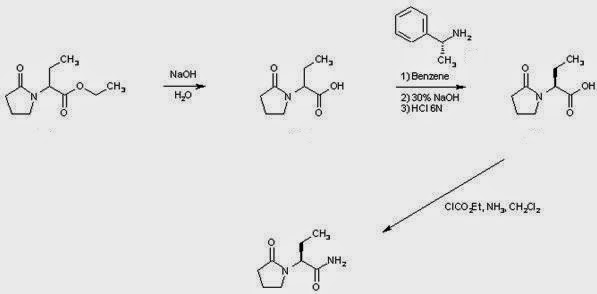
Levetiracetam industrial process


Levetiracetam industrial process

2 pyrolidinone
Inline image 2
ethyl 2 bromo butyrate
Inline image 1
 (R)-(+)-alpha-methyl-benzylamine
Inline image 3
ethyl chloro formate
US4943639.
cut paste
note………….racemic (±)-alpha-ethyl-2-oxo-1-pyrrolidineacetic acid is obt by rxn of 2 pyrolidinone with ethyl 2 bromo acetate
+/-)-(R,S)-alpha-ethyl-2-oxo-1-pyrrolidineacetic acid methyl ester. CAS# 33978-83-5

EXAMPLE 1 (a) Preparation of the (R)-alpha-methyl-benzylamine salt of (S)-alpha-ethyl-2-oxo-1-pyrrolidineacetic acid

8.7 kg (50.8 moles) of racemic (±)-alpha-ethyl-2-oxo-1-pyrrolidineacetic acid are suspended in 21.5 liters of anhydrous benzene in a 50 liter reactor. To this suspension is added gradually a solution containing 3.08 kg (25.45 moles) of (R)-(+)-alpha-methyl-benzylamine and 2.575 kg (25.49 moles) of triethylamine in 2.4 liters of anhydrous benzene. This mixture is then heated to reflux temperature until complete dissolution It is then cooled and allowed to crystallize for a few hours. 5.73 kg of the (R)-alpha-methyl-benzylamine salt of (S)-alpha-ethyl-2-oxo-1-pyrrolidineacetic acid are thus obtained.
Melting point: 148°-151° C. Yield: 77.1%.
This salt may be purified by heating under reflux in 48.3 liters of benzene for 4 hours. The mixture is cooled and filtered to obtain 5.040 kg of the desired salt. Melting point: 152°-153.5° C. Yield: 67.85%.

(b) Preparation of (S)-alpha-ethyl-2-oxo-1-pyrrolidineacetic acid

5.04 kg of the salt obtained in (a) above are dissolved in 9 liters of water. 710 g of a 30% sodium hydroxide solution are added slowly so that the pH of the solution reaches 12.6 and the temperature does not exceed 25° C. The solution is stirred for a further 20 minutes and the alpha-methylbenzylamine liberated is extracted repeatedly with a total volume of 18 liters of benzene.
The aqueous phase is then acidified to a pH of 1.1 by adding 3.2 liters of 6N hydrochloric acid. The precipitate formed is filtered off, washed with water and dried.
The filtrate is extracted repeatedly with a total volume of 50 liters of dichloromethane. The organic phase is dried over sodium sulfate and filtered and evaporated to dryness under reduced pressure.
The residue obtained after the evaporation and the precipitate isolate previously, are dissolved together in 14 liters of hot dichloromethane. The dichloromethane is distilled and replaced at the distillation rate, by 14 liters of toluene from which the product crystallizes.
The mixture is cooled to ambient temperature and the crystals are filtered off to obtain 2.78 kg of (S)-alpha-ethyl-2-oxo-1-pyrrolidineacetic acid.
Melting point: 125.9° C. [alpha]D20 =-26.4° (c=1, acetone). Yield: 94.5%.
(c) Preparation of (S)-alpha-ethyl-2-oxo-1-pyrrolidineacetamide
34.2 g (0.2 mole) of (S)-alpha-ethyl-2-oxo-1-pyrrolidineacetic acid are suspended in 225 ml of dichloromethane cooled to -30° C. 24.3 g (0.24 mole) of triethylamine are added dropwise over 15 minutes. The reaction mixture is then cooled to -40° C. and 24.3 g (0.224 mole) of ethyl chloroformate are added over 12 minutes. Thereafter, a stream of ammonia is passed through the mixture for 41/2 hours. The reaction mixture is then allowed to return to ambient temperature and the ammonium salts formed are removed by filtration and washed with dichloromethane. The solvent is distilled off under reduced pressure. The solid residue thus obtained is dispersed in 55 ml toluene and the dispersion is stirred for 30 minutes and then filtered. The product is recrystallized from 280 ml of ethyl acetate in the presence of 9 g of 0,4 nm molecular sieve in powder form.
24.6 g of (S)-alpha-ethyl-2-oxo-1-pyrrolidineacetamide are obtained.
Melting point: 115°-118° C. [alpha]D25 =-89.7° (c=1, acetone). Yield: 72.3%.
Analysis for C8 H14 N2 O2 in % calculated: C 56.45. H 8.29. N 16.46. found: 56.71. 8.22. 16.48.
The racemic (±)-alpha-ethyl-2-oxo-1-pyrrolidineacetic acid used in this synthesis has been prepared in the manner described below.
A solution containing 788 g (19.7 moles) of sodium hydroxide in 4.35 liters of water is introduced over 2 hours into a 20 liter flask containing 3.65 kg (18.34 moles) of ethyl (±)-alpha-ethyl-2-oxo-1-pyrrolidineacetate at a temperature not exceeding 60° C. When this addition is complete, the temperature of the mixture is raised to 80° C. and the alcohol formed is distilled off until the temperature of the reaction mixture reaches 100° C.
The reaction mixture is then cooled to 0° C. and 1.66 liter (19.8 moles) of 12N hydrochloric acid is added over two and a half hours. The precipitate formed is filtered off, washed with 2 liters of toluene and recrystallized from isopropyl alcohol. 2.447 kg of racemic (±)-alpha-ethyl-2-oxo-1-pyrrolidineacetic acid, melting at 155°-156° C., are thus obtained. Yield: 78%.
Analysis for C8 H13 NO3, in % calculated: C 56.12. H 7.65. N 8.18. found: 55.82. 8.10. 7.97.

EXAMPLE 2 (a) Preparation of ethyl (S)-4-[[1-(aminocarbonyl)propyl]amino]butyrate

143.6 ml (1.035 mole) of triethylamine are added to a suspension of 47.75 g (0.345 mole) of (S)-2-amino-butanamide hydrochloride ([alpha]D25 : +26.1°; c=1, methanol) in 400 ml of toluene. The mixture is heated to 80° and 67.2 g (0.345 mole) of ethyl 4-bromobutyrate are introduced dropwise.
The reaction mixture is maintained at 80° C. for 10 hours and then filtered hot to remove the triethylamine salts. The filtrate is then evaporated under reduced pressure and 59 g of an oily residue consisting essentially of the monoalkylation product but containing also a small amount of dialkylated derivative are obtained.
The product obtained in the crude state has been used as such, without additional purification, in the preparation of (S)-alpha-ethyl-2-oxo-1-pyrrolidineacetamide by cyclization.

(b) Preparation of (S)-alpha-ethyl-2-oxo-1-pyrrolidineacetamide

54 g of the crude product obtained in a) above are dissolved in 125 ml of toluene in the presence of 2 g of 2-hydroxypyridine. The mixture is heated at 110° C. for 12 hours.
The insoluble matter is filtered off hot and the filtrate is then evaporated under reduced pressure.
The residue is purified by chromatography on a column of 1.1 kg of silica (column diameter: 5 cm; eluent: a mixture of ethyl acetate, methanok and concentrated ammonia solution in a proportion by volume of 85:12:3).
The product isolated is recrystallized from 50 ml of ethyl acetate to obtain 17.5 g of (S)-alpha-ethyl-2-oxo-1-pyrrolidineacetamide.
Melting point: 117° C. [alpha]D25 : -90.0° (c=1, acetone). Yield: 41%.

EXAMPLE 3 (a) Preparation of (S)-N-[1(aminocarbonyl)propyl]-4-chlorobutanamide

345.6 g (2.5 moles) of ground potassium carbonate are mixed with 138.5 g (1 mole) of (S)-2-amino-butanamide hydrochloride in 2.5 liters of acetonitrile. The reaction mixture is cooled to 0° C. and a solution of 129.2 g (1.2 mole) of 4-chlorobutyryl chloride in 500 ml of acetonitrile is introduced dropwise. After the addition, the reaction mixture is allowed to return to ambient temperature; the insoluble matter is filtered off and the filtrate evaporated under reduced pressure. The crude residue obtained is stirred in 1.2 liter of anhydrous ether for 30 minutes at a temperature between 5° and 10° C. The precipitate is filtered off, washed twice with 225 ml of ether and dried in vacuo to obtain 162.7 g of (S)-N-[1-(aminocarbonyl)propy]-4-chlorobutanamide.
Melting point: 118°-123° C. [alpha]D25 : -18° (c=1, methanol). Yield: 78.7%.
The crude product thus obtained is very suitable for the cyclization stage which follows. It can however be purified by stirring for one hour in anhydrous ethyl acetate.
Melting point: 120°-122° C. [alpha]D25 : -22.2° (c=1, methanol).

(b) Preparation of (S)-alpha-ethyl-2-oxo-1-pyrrolidineacetamide

6.2 g (0.03 mole) of (S)-N-[1(aminocarbonyl)propyl]-4-chlorobutamine and 0.484 g (0.0015 mole) of tetrabutylammonium bromide are mixed in 45 ml of dichloromethane at 0° C. under a nitrogen atmosphere. 2.02 g (0.036 mole) of potassium hydroxide powder are added over 30 minutes, at such a rate that the temperature of the reaction mixture does not exceed +2° C. The mixture is then stirred for one hour, after which a further 0.1 g (0.0018 mole) of ground potassium hydroxide is added and stirring continued for 30 minutes at 0° C. The mixture is allowed to return to ambient temperature. The insoluble matter is filtered off and the filtrate is concentrated under reduced pressure. The residue obtained is recrystallized from 40 ml of ethyl acetate in the presence of 1.9 g of 0,4 nm molecular sieve. The latter is removed by hot filtration to give 3.10 g of (S)-alphaethyl-2-oxo-1-pyrrolidineacetamide.
Melting point: 116.7° C. [alpha]D25 : -90.1° (c=1, acetone). Yield: 60.7%.

EXAMPLE 4 Preparation of (S)-alpha-ethyl-2-oxo-1-pyrrolidineacetamide……levetiracetam

This example illustrates a variant of the process of Example 3, in which the intermediate 4-chlorobutanamide obtained in situ is not isolated. 84 g of anhydrous sodium sulfate are added to a suspension of 69.25 g (0.5 mole) of (S)-2-amino-butanamide hydrochloride in 600 ml of dichloromethane at ambient temperature. The mixture is cooled to 0° C. and 115 g of ground potassium hydroxide are added, followed by 8.1 g (0.025 mole) of tetrabutylammonium bromide dissolved in 100 ml of dichloromethane. A solution of 77.5 g of 4-chlorobutyryl chloride in 100 ml of dichlorometha is added dropwise at 0° C., wih vigorous stirring. After 5 hours’ reaction, a further 29 g of ground potassium hydroxide are added. Two hours later, the reaction mixture is filtered over Hyflo-cel and the filtrate evaporated under reduced pressure. The residue (93.5 g) is dispersed in 130 ml of hot toluene for 45 minutes. The resultant mixture is filtered and the filtrate evaporated under reduced pressure. The residue (71.3 g) is dissolved hot in 380 ml of ethyl acetate to which 23 g of 0,4 nm molecular sieve in powder form are added. This mixture is heated to reflux temperature and filtered hot. After cooling the filtrate, the desired product crystallizes to give 63 g of (S)-alpha-ethyl-2-oxo-1-pyrrolidineacetamide.
Melting point: 117° C. [alpha]D25 : -91.3° (c=1, acetone). Yield: 74.1%.

FROM MY OLD POST

(±)-(R,S)-alpha-ethyl-2- oxo-l-pyrrolidineacet-N-(+)-(R)-(l-phenylethyl)-amide a key levetiracetam intermediate

(±)-(R,S)-alpha-ethyl-2- oxo-l-pyrrolidineacet-N-(+)-(R)-(l-phenylethyl)-amide

methyl (±)-(R,S)-alpha-ethyl-2-oxo-l -pyrrolidine acetate with (+)-(R)-(l-phenylethyl)- amine in toluene in the presence of a base such as sodium hydride or methoxide; crystallization- induced dynamic resolution of the resultant (±)-(R,S)-alpha-ethyl-2- oxo-l-pyrrolidineacet-N-(+)-(R)-(l-phenylethyl)-amide

(R)-(+)-1-Phenylethylamine

33978-83-5
1-​Pyrrolidineacetic acid, α-​ethyl-​2-​oxo-​, methyl ester

Ebd414139

1004767-60-5
1-​Pyrrolidineacetamide​, α-​ethyl-​2-​oxo-​N-​[(1R)​-​1-​phenylethyl]​-
(±)-(R.S)-alpha-ethyl-2-oxo-l-pyrrolidineacet-N-(+)-(R)-(l-phenylethyl)-amide

Example 1

(±)-(R,S)-alpha-ethyl-2-oxo-l-pyrrolidineacet-N-(+)-(R)-(l-phenylethyl)-amide.

In a 100 ml reactor equipped with mechanical stirring, thermometer and bubble condenser, 13.4 g of (±)-(R,S)-alpha-ethyl-2-oxo-l-pyrrolidineacetic acid methyl ester (71.6 mmol), 8.8 g of (+)-(R)-(l-phenylethyl)-amine (72.5 mmol) and 45 ml of tetrahydrofuran were charged. 3.4 g of NaH (60% dispersion in mineral oil, 85.6 mmol) was added in small portions under nitrogen atmosphere. Reaction mixture was maintained at room temperature for about 2 h. Then, it was heated up to 350C and kept under stirring overnight. Reaction was controlled by TLC (Rf = 0.5, AcOEt/silica gel).

At reaction completed, one night at 35°C temperature, reaction mixture was cooled to room temperature and 30 ml of water was slowly charged. It was transferred into a separatory funnel and was diluted with 30 ml of water and 80 ml of dichloromethane. Phases were separated and the aqueous one was washed with 50 ml of dichloromethane. Collected organic phases were washed with an aqueous acid solution, dried on Na2SO4, filtered and concentrated under vacuum. 19.5 g of an oil residue was obtained which slowly solidified. Solid was suspended in 20 ml of a hexane/dichloromethane 9/1 v/v mixture. It was then filtered, washed with 10 ml of the same solvent mixture and dried at 400C to give 12.1 g of the title compound (44.1 mmol, 61.6% yield) as dry solid.
1H NMR (400.13 MHz, CDCl3, 25 0C): δ (ppm, TMS)
7.35-7.19 (1OH, m),
6.49 (2H, br s),
5.09-5.00 (2H, m),
4.41 (IH, dd, J = 8.3, 7.4 Hz),
4.36 (IH, dd, J = 8.6, 7.1 Hz),
3.49 (IH, ddd, J = 9.8, 7.7, 6.6 Hz),
3.41 (IH, ddd, J = 9.8, 7.7, 6.2 Hz),
3.30 (IH, ddd, J = 9.6, 8.3, 5.5 Hz),
3.13 (IH, ddd, 9.7, 8.5, 6.1 Hz), 2.47-2.38 (2H, m), 2.41 (IH, ddd, J = 17.0, 9.6, 6.3 Hz), 2.26 (IH, ddd, 17.0, 9.5, 6.6 Hz), 2.10-1.98 (2H, m), 2.01-1.89 (IH, m), 1.99-1.88 (IH, m), 1.98-1.85 (IH, m), 1.88-1.78 (IH, m), 1.75- 1.62 (IH, m), 1.72-1.59 (IH, m), 1.45 (3H, d, J = 7.1 Hz), 1.44 (3H, d, J = 7.1 Hz), 0.90 (3H, t, J = 7.4 Hz), 0.86 (3H, t, J = 7.4 Hz).  

13C NMR (100.62 MHz, CDCl3, 25 0C): δ (ppm, TMS)
176.05 (CO), 176.00 (CO), 169.08 (CO),
168.81 (CO), 143.59 (Cquat),
143.02 (Cquat), 128.66 (2 x CH), 128.55 (2 x CH),
127.33 (CH), 127.19 (CH), 126.05 (2 x CH),
125.80 (2 x CH), 56.98 (CH), 56.61 (CH),
48.90 (CH), 48.84 (CH), 44.08 (CH2),
43.71 (CH2), 31.19 (CH2), 31.07 (CH2), 22.08 (CH3),
22.04 (CH3), 21.21 (CH2), 20.68 (CH2),
18.28 (CH2), 18.08 (CH2), 10.50 (CH3), 10.45 (CH3).

Example 2 (±)-(R.S)-alpha-ethyl-2-oxo-l-pyrrolidineacet-N-(+)-(R)-(l-phenylethyl)-amide (alternative 1).

In a 500 ml reactor equipped with mechanical stirring, thermometer and condenser, 24.2 g of (+)-(R)-(l-phenylethyl)-amine (199.51 mmol) and 40 ml of toluene were charged. By keeping the reaction mixture at 00C temperature under nitrogen atmosphere, 9.5 g of NaH (60% mineral oil suspension, 237.50 mmol) was added in small portions. At the same temperature, 190.0 g of a toluene solution of (±)-(R,S)- alpha-ethyl-2-oxo-l-pyrrolidineacetic acid methyl ester (19.28% equal to 36.63 g, 197.77 mmol) was charged. Reaction mixture was then heated up to 35°C and maintained in that condition till complete disappearing of methyl ester reagent (about 14 h; checked by HPLC).

At reaction completed, reaction mixture was cooled and when room temperature was reached, 100 ml of water was slowly charged. Aqueous phases were separated and extracted with toluene (2 x 75 ml). Collected organic phases were treated with acid water till neuter pH. Solvent was evaporated and residue was suspended in about 100 ml of heptane for about 30 minutes. Product was isolated by filtration and dried in oven at 400C temperature under vacuum overnight to give 45.2 g of the title compound (164.54 mmol, 83.2% yield, d.e. 0.0%) as white dusty solid.

Example 3

(±)-(R,S)-alpha-ethyl-2-oxo-l-pyrrolidineacet-N-(+)-(R)-(l-phenylethyl)-amide (alternative 2).
In a 500 ml reactor equipped with mechanical stirring, thermometer and Dean-Stark distiller, 24.2 g of (+)-(R)-(l-phenylethyl)-amine (199.51 mmol) and 40 ml of toluene were charged. By keeping the reaction mixture at 00C temperature, 42.7 g of sodium methoxide (30% solution in methanol, 237.14 mmol) was added under nitrogen atmosphere. At the same temperature, 190.0 g of a toluene solution of (±)- (R,S)-alpha-ethyl-2-oxo-l-pyrrolidineacetic acid methyl ester (19.28% equal to 36.63 g, 197.77 mmol) was charged. Reaction mixture was then heated up to 65- 700C and maintained in that condition till complete disappearing of methyl ester reagent (about 4 h; checked by HPLC). After a work-up carried out according to the procedure described in example 2, 40.2 g of the title compound (146.53 mmol, 74.1% yield, d.e. 0.0%) as white dusty solid was obtained.

P.S. : The views expressed are my personal and in no-way suggest the views of the professional body or the company that I represent.

P.S. : The views expressed are my personal and in no-way suggest the views of the professional body or the company that I represent.

P.S. : The views expressed are my personal and in no-way suggest the views of the professional body or the company that I represent.

COCK WILL TEACH YOU NMR

COCK SAYS MOM CAN TEACH YOU NMR

DRUG APPROVALS BY DR ANTHONY MELVIN CRASTO …..FOR BLOG HOME CLICK HERE
Join me on Linkedin

View Anthony Melvin Crasto Ph.D's profile on LinkedIn

Join me on Facebook FACEBOOK
Join me on twitterFollow amcrasto on Twitter
Join me on google plus Googleplus

 amcrasto@gmail.com

updated

US 7902380, Levetiracetam

Levetiracetam.svgUS 7902380,  Levetiracetamhttp://www.google.im/patents/US7902380

preparation of both the (S)— and (R)-enantiomers of alpha-ethyl-2-oxo-1-pyrrolidineacetamide of formula 1 from (RS)-alpha-ethyl-2-oxo-1-pyrrolidineacetic acid of formula 2.
Figure US07902380-20110308-C00005
The following is an exemplary scheme of the process:
Figure US07902380-20110308-C00006

Suitable resolving agents include optically pure bases such as alpha-methylbenzylamine and dehydroabietylamine, of which alpha-methylbenzylamine is preferred. (S)-2 can be prepared by forming the salt with (R)-alpha-methylbenzylamine and the (R)-2 can be prepared by forming the salt with (S)-alpha-methylbenzylamine.
NOTE……R)-alpha-methylbenzylamine  is desired agent to get levetiracetam

The optical resolution of 2 may be carried out by, for example, the formation of a salt of (S)-2 with the optically active base (R)-alpha-methylbenzylamine or dehydroabietylamine (S. H. Wilen et al. Tetrahedron, 33, (1997), 2725-2736). Likewise, the (R)-2 can be prepared by forming the salt with (S)-alpha-methylbenzylamine. The racemic (RS)-2 used as starting material can be prepared by the known procedure described in GB 1309692.
Surprisingly we have found that the undesired (R) or (S)-alpha-ethyl-2-oxo-1-pyrrolidineacetic acid or their mixture can be epimerized by treating it with an acid anhydride, preferably acetic anhydride, propionic anhydride and butyric anhydride, to furnish a mixture of (R) and (S)-alpha-ethyl-2-oxo-1-pyrrolidineacetic acid in excellent yield. The recovered (RS)-alpha-ethyl-2-oxo-1-pyrrolidineacetic acid can be optically resolved by the same procedure above. In this way, we are able to obtain almost complete conversion of the (RS)-alpha-ethyl-2-oxo-1-pyrrolidineacetic acid to the desired (R) or (S)-alpha-ethyl-2-oxo-1-pyrrolidineacetic acid.

Figure US07902380-20110308-C00007

Figure US07902380-20110308-C00008

The process is depicted below:
Figure US07902380-20110308-C00009

EXAMPLE 1
Preparation of (S)-alpha-ethyl-2-oxo-1-pyrrolidineacetamide from (S)-alpha-ethyl-2-oxo-1-pyrrolidineacetic acid

A suspension of (s)-alpha-ethyl-2-oxo-1-pyrrolidineacetic acid (45 g, 0.26 mol) in methylene chloride (225 ml) was cooled to 0° C. and triethylamine (53 g, 0.53 mol) and methanesulfonyl chloride (39 g, 0.34 mol) were added dropwise. The mixture was stirred at 0° C. for 30 min., then a stream of ammonia was purged in the solution for 2 hours. The insoluble solids were filtered and the filtrate was concentrated. The product was crystallized from methyl isobutyl ketone to give 36 g (80%) of (S)-alpha-ethyl-2-oxo-1-pyrrolidineacetamide.

EXAMPLE 2
Preparation of (R)-alpha-ethyl-2-oxo-1-pyrrolidineacetamide from (R)-alpha-ethyl-2-oxo-1-pyrrolidineacetic acid

A suspension of (R)-alpha-ethyl-2-oxo-1-pyrrolidineacetic acid (35 g, 0.20 mol) in methylene chloride (225 ml) was cooled to 0° C. and triethylamine (41 g, 0.40 mol) and methanesulfonyl chloride (29 g, 0.26 mol) were added dropwise. The mixture was stirred at 0° C. for 30 min., then a stream of ammonia was purged in the solution at 0° C. for 2 hours. The insoluble solids were filtered and the filtrate was concentrated. The product was recrystallized from methyl isobutyl ketone to give 27.5 g (78%) of (R)-alpha-ethyl-2-oxo-1-pyrrolidineacetamide.

EXAMPLE 3
Preparation of (S)-alpha-Ethyl-2-oxo-1-pyrrolidineacetic acid (R)-alpha-methylbenzylamine salt

A solution of (R)-alpha-methylbenzylamine (106 g) and triethylamine (89 g) in toluene (100 ml) was added to a suspension of (RS)-alpha-ethyl-2-oxo-1-pyrrolidineacetic acid (300 g, 1.75 mol) in toluene (1 L). The mixture was heated until complete dissolution, cooled to room temperature and stirred for 3 hours. The solids were filtered and rinsed with toluene (300 ml) to give 250 g of (s)-alpha-ethyl-2-oxo-1-pyrrolidineacetic acid (R)-alpha-methylbenzylamine salt. The solids were crystallized from toluene and 205 g (yield 41%) of (S)-alpha-ethyl-2-oxo-1-pyrrolidineacetic acid (R)-alpha-methylbenzylamine salt was obtained. The isolated solid was treated with hydrochloric acid solution and the enantiomerically pure (S)-alpha-ethyl-2-oxo-1-pyrrolidineacetic acid could be isolated in 90% yield.
Levetiracetam.svg

EXAMPLE 4
Recovery and Epimerization of (R)-alpha-ethyl-2-oxo-1-pyrrolidineacetic acid from the Mother Liquor

The combined mother liquors from above were concentrated to half volume and water (200 ml) and 50% sodium hydroxide (52 g) were added sequentially and the mixture was stirred at 20° C. for 30 min. and then was separated. The aqueous layer was washed with toluene (150 ml), acidified with 32% hydrochloric acid until pH=2-3. The resulting suspension was cooled to 0-5° C. and stirred for 2 h. The solids were collected by filtration, and were rinsed with cold water. The damp solids were dried under vacuum oven at 40-50° C. for 4 h to give 160 g of (R)-enriched ethyl-2-oxo-1-pyrrolidineacetic acid. To the above solids, toluene (640 ml) and acetic anhydride (145 g) were added and the mixture was heated to reflux for 10 h. The solution was cooled to 20° C. and stirred for another 2 h. The solids were collected by filtration and rinsed with toluene (150 ml) to give (RS)-alpha-ethyl-2-oxo-1-pyrrolidineacetic acid (152 g).

DRUG APPROVALS BY DR ANTHONY MELVIN CRASTO …..FOR BLOG HOME CLICK HERE

Join me on Linkedin

View Anthony Melvin Crasto Ph.D's profile on LinkedIn

Join me on Facebook FACEBOOK

Join me on twitterFollow amcrasto on Twitter

Join me on google plus Googleplus

 amcrasto@gmail.com

vietnam


Map of vietnam country.


dalat city

hanoi


Levetiracetam Green process construction


Dr. Rakeshwar Bandichhorl Director API – R&D,

Dr Reddys

Displaying image.png

LEVETIRACETAM GREEN PROCESS

Displaying image.png

Displaying image.png

Inline image 3

Inline image 4

Inline image 5

Inline image 6
Displaying image.png

Inline image 8

Displaying image.png

Displaying image.png

Displaying image.png

Inline image 13

 An alternate synthesis of levetiracetam
Ravikumar Mylavarapu a , Ramasamy Vijaya Anand a , Golla China Mala Kondaiah a , Lekkala
Amarnath Reddy a , Gade Srinivas Reddy a , Arnab Roy a , Apurba Bhattacharya a , Kagga
Mukkanti b & Rakeshwar Bandichhor a
a Innovation Plaza, IPDO, R&D , Dr. Reddy’s Laboratories Ltd. , Survey Nos. 42, 45,46 & 54,
Bachupally, Qutubullapur, 500073, R.R. Dist, Andhra Pradesh, India
b Center for Environmental Science, Institute of Science and Technology , J.N.T. University ,
Kukatpally, Hyderabad, 500 072, Andhra Pradesh, India
Email: rakeshwarb@drreddys.com
Green Chemistry Letters and Reviews
Vol. 3, No. 3, September 2010, 225230
Ravikumar Mylavarapu , Ramasamy Vijaya Anand , Golla China Mala Kondaiah , Lekkala Amarnath Reddy ,
Gade Srinivas Reddy , Arnab Roy , Apurba Bhattacharya , Kagga Mukkanti & Rakeshwar Bandichhor (2010)
An alternate
synthesis of levetiracetam, Green Chemistry Letters and Reviews, 3:3, 225-230, DOI: 10.1080/17518251003716568
To link to this article: http://dx.doi.org/10.1080/17518251003716568
You might enjoy reading:

– See more at: http://organicsynthesisinternational.blogspot.in/#sthash.ruewyXXk.dpuf

Dr Rakeshwar Bandichhor

Rakeshwar Bandichhor
Associate Director, API, R&D
Dr. Reddy’s Laboratories
India
Dr. Reddys Laboratories
 
BiographyRakeshwar Bandichhor holds a doctorate in Chemistry from University of Lucknow/University of Regensburg, Germany and worked as Postdoctoral Fellow at University of Regensburg, Germany, University of Pennsylvania and Texas A&M University. Dr. Rakeshwar has more than 150 papers including patents and book chapters published/accepted in various International Journals and contributed to more than 60 academic national and international conferences. He has won the various awards in his career
Dr. Rakeshwar has more than 80 papers including patents and book chapters published/accepted in various International Journals. Notably, in the area of Organic Chemistry, Dr. Rakeshwar has coauthored a chapter in the book entitled “Green Chemistry in Pharmaceutical industry”.
He has won the various awards in his career e.g. Chairman Excellence Award in the category of individual functional excellence, Best Cost Leadership Award  for the development of Lopinavir, Ritonavir & their components and Anveshan Award at Dr. Reddy’s. As a part of organizational building efforts, he also supervises master’s & Ph.D. students in their dissertations. He has been invited in several conferences e.g. IIT-Mumbai, IGCW-2009, BIT-Ranchi, BITS Pilani, 9th Heterocyclic Conference, University of Florida, JNTU-Hyderabad, ISCB-2011, Apollo Hospitals Educational & Research Foundation, Hyderabad etc. to deliver  lectures. He is also currently acting as an Associate  Editor of GERF Bulletin of Bioscience.
Recently, he has become a member National Advisory Board of Indian Society of Chemists and Biologists.

Publications

Role of Generic Pharmaceutical Industry in Healthcare
Rakeshwar Bandichhor
Editorial: Chem Sci J 2014, 5:e101
doi: 10.4172/2150-3494.10000e101
Research Perspective in Academia and Generic Pharmaceutical Industry
Rakeshwar Bandichhor
Editorial: Organic Chem Current Res 2012, 1:e104
doi: 10.4172/2161- 0401.1000e104

Innovation Plaza, IPDO, R&D , Dr. Reddy’s Laboratories Ltd.

.


MAHABALIPURAM, INDIA

Mahabalipuram – Wikipedia, the free encyclopedia

en.wikipedia.org/wiki/Mahabalipuram

Mahabalipuram, also known as Mamallapuram is a town in Kancheepuram district in the Indian state of Tamil Nadu. It is around 60 km south from the city of …Shore Temple – ‎Seven Pagodas – ‎Pancha Rathas – ‎

Map of mahabalipuram.

.

Krishna’s Butter Ball in Mahabalipuram, India. The surface below the rock is …


http://www.weather-forecast.com/locations/Mamallapuram


Come to Mahabalipuram (also known as Mammallapuram), an enchanting beach that is located on the east coast of India.
Moonraikers Restaurant, Mamallapuram
 

Hotel Mamalla Bhavan – Mahabalipuram Chennai – Food, drink and entertainment

.

A carving at the Varaha Temple, Mahabalipuram

/////////////

Route Design in the 21st Century: The ICSYNTH Software Tool as an Idea Generator for Synthesis Prediction


Figure


The new computer-aided synthesis design tool ICSYNTH has been evaluated by comparing its performance in predicting new ideas for route design to that of historical brainstorm results on a series of commercial pharmaceutical targets, as well as literature data. Examples of its output as an idea generator are described, and the conclusion is that it adds appreciable value to the performance of the professional drug research and development chemist team.

Chemical Development, AstraZeneca R&D, Silk Road Business Park, Macclesfield, SK10 2NA Cheshire, U.K.
Chemnotia AB, Forskargatan 20 J, 151 36 Södertälje,Sweden
§ InfoChem GmbH, Landsberger Straße 408/V, D-81241 München, Germany
Org. Process Res. Dev., Article ASAP
DOI: 10.1021/op500373e
Publication Date (Web): January 22, 2015
Copyright © 2015 American Chemical Society
*(H.-J.F.) E-mail: Hans-Jurgen.Federsel@astrazeneca.com., *(M.G.H.) E-mail: mghutchings@infochem.de.
Currently, ICSYNTH has assumed a place as a unique predictive tool for route design in Chemical Development in AZ. While it is finding valuable commercial application in our own and others’ hands, it remains a work in progress.
ICsynthInfoChem’s powerful synthesis planning tool now in Version 2.0. Read more …

InfoChem will be represented at the forthcoming ACS Meeting in San Diego. You will find Dr. Josef Eiblmaier, Dr. Valentina Eigner Pitto, and Dr. Peter Loew …
ICSYNTH
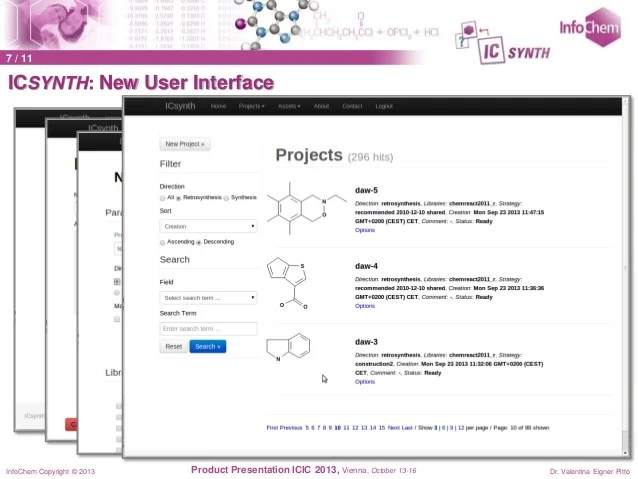
InfoChem’s ICSYNTH is a powerful computer aided synthesis design tool that enables chemists to generate synthetic pathways for a target molecule. The benefit is that ICSYNTH can facilitate innovation by stimulating ideas for alternative or novel synthetic routes that otherwise may not be considered. This may lead to improved route design, for example shorter pathways or more economical reaction modifications.

After inputting the target, users can select different synthetic strategies depending on requirements. ICSYNTH then automatically generates a multistep interactive synthesis tree – each node on the tree representing a precursor. The advantages are that the suggested reactions are based on, and linked to, published reactions (or their analogs) and the precursor availability is automatically checked in commercial catalogs. Users can modify the synthesis tree or select precursors for further analysis.

At the heart of ICSYNTH is an algorithmic chemical knowledge base of transform libraries that are automatically generated from reaction databases. The number of transform libraries is only limited by the availability of validated reaction databases.
In addition to retro synthesis design, ICSYNTH has a forward reaction prediction module that offers reactivity mapping for the target molecule. Version 2.0 of ICSYNTH was launched in April 2014. The completely re-designed user interface (based on JavaScript) and major improvements in the algorithm responsible of the precursor search are the main enhancements of Version 2.0. In addition the forward reaction prediction algorithm has been optimized. Click here to see a complete version history.

INFOCHEM GESELLSCHAFT FÜR CHEMISCHE INFORMATION MBH

Landsberger Straße 408/V
D-81241 München
Germany

Phone: +49 (0)89 58 30 02
Fax: +49 (0)89 580 38 39
Email: info@infochem.de


Historische Bilder der Landsberger Straße – An der Trambahnhaltestelle Holzapfelstraße endet – Münchner Straßen – München – Süddeutsche.de


Logistics of process R&D: transforming laboratory methods to manufacturing scale


The manufacture of a | omeprazole (racemic product; top), and esomeprazole (the (S)-enantiomer; bottom), including b | a flow chart of the process for the …

Nature Reviews Drug Discovery 2, 654-664 (August 2003) | doi:10.1038/nrd1154

Logistics of process R&D: transforming laboratory methods to manufacturing scale

Hans-Jürgen Federsel

In the past, process R&D — which is responsible for producing candidate drugs in the required quantity and of the requisite quality — has had a low profile, and many people outside the field remain unaware of the challenges involved. However, in recent years, the increasing pressure to achieve shorter times to market, the demand for considerable quantities of candidate drugs early in development, and the higher structural complexity — and therefore greater cost — of the target compounds, have increased awareness of the importance of process R&D. Here, I discuss the role of process R&D, using a range of real-life examples, with the aim of facilitating integration with other parts of the drug discovery pipeline.

Process R&D, AstraZeneca, SE-151 85 Södertälje, Sweden. Hans-Jurgen.Federsel@astrazeneca.com

Ensuring Process Stability with Reactor Temperature Control Systems


Temperature control plays an important role in industrial processes, pilot plants, and chemical and pharmaceutical laboratories. When controlling reactors, both exothermic and endothermic reactions must be offset with high speed and reliability. Therefore, different conditions and effects must be taken into account when specifying an optimum and highly dynamic temperature control system.

Temperature Control of Reactors

Most temperature control systems are used with chemical reactors made of either steel or glass. The former is more rugged and long-lasting, while the latter enables chemists to observe processes inside the reactor.

However, in the case of glass reactors, extensive precautions have to be followed for safe usage. Reactors usually include an inner vessel to hold the samples, which need temperature control. This inner vessel is enclosed by a jacket containing heat-transfer liquid. This reactor jacket is linked to the temperature control system.

In order to control the reactor’s temperature, the temperature control system pumps the heat-transfer liquid through the reactor’s jacket. Rapid temperature change inside the reactor is balanced by instant cool-down or heat-up, and the liquid is either cooled or heated inside the temperature control system. Figure 1 shows a schematic of a simple temperature control system.

Figure 1. Functional view of reactor temperature control

Process Stability

Both materials and reactor design can affect the temperature control of highly dynamic reactor systems. However, the heat transferred by a glass-walled vessel will be different than that transferred by a steel-walled vessel. In addition, both wall thickness and surface area can also affect accuracy. Therefore, proper mixing of the initial materials inside the reactor is important to obtain good uniformity, which in turn will guarantee optimal heat exchange.

For each type of reactor, maximum pressure values have been provided as per the specifications established by reactor manufacturers and in the Pressure Equipment Directive 97/23/EG. Regardless of any temperature control application, these limit values may not be surpassed during operation under any situations. Prior to starting a temperature control application, the applicable limits must be programmed within the temperature control unit.

Another important criterion in reactors is the maximum permissible temperature difference, which is referred to as Delta-T limit. It defines the highest difference between the temperature of the contents of the reactor and the actual thermal fluid temperature.

When compared to steel reactors, glass reactors are more susceptible to thermal stress. For that matter, any temperature control system should enable users to program reactor-specific values for the Delta-T limit per time unit. Within the temperature control equipment itself, three components considerably affect the stability of the process and these include heat exchanger, pump, and control electronics.

Heat Exchanger

It is important to ensure that a temperature control system has sufficient heating and cooling capacity, as this can significantly affect the speed to reach the preferred temperatures. In order to determine the preferred heating and cooling capacities, users must consider the essential differences in temperature, the volume of the samples, the preferred heat-up and cool-down times, and the specific heat capacity of the temperature control medium.

Highly dynamic temperature control solutions are commercially available in the market with water or air cooling. Air-cooled systems do not utilize water and may be deployed where there is sufficient air flow.

The heat thus removed from the reactor is eventually transferred to ambient air. Water-cooled systems need to be joined to a cooling water supply, but they operate more quietly and do not add surplus heat in small labs. These units could be completely enclosed by the application, if required.

Pump

The integrated pump of the temperature control unit equipment must be sufficiently strong to obtain the preferred flow rates at stable pressure. To ensure that pressure limit values mentioned above are not exceeded, the pump should provide the preferred pressure quickly and with maximum control.

Operating conditions and pressure specifications of the reactor must always be taken into account, and regulation of pump capacity must be done by presetting a limit value. Sophisticated temperature control solutions include pumps that balance the variations of the viscosity of the heat transfer liquid to make sure that energy efficiency is maintained continuously.

This is because viscosity influences flow and hence the heat transfer. An additional advantage provided by magnetically coupled pumps is that they guarantee a hydraulically-sealed thermal circuit. Also, self-lubricated pumps are beneficial as they require only minimum maintenance.

The closed loop circuit prevents contact between the ambient air and the heat transfer liquid. This not only prevents permeation of oxidation and moisture, bit also prevents oil vapors from entering into the work environment.

Additionally, an internal expansion vessel must permanently absorb temperature-induced volume variations inside the heat exchanger. Individual cooling of the expansion vessel will help in ensuring that the temperature control unit does not overheat and ultimately ensures operator safety.

A temperature control equipment should operate consistently even at high ambient temperatures. In majority of cases, the real work environment will diverge from the ideal temperature of 20°C. During hot summer months, temperature control solutions are exposed to adverse conditions. In laboratories, ambient temperatures are usually higher because of energy saving measures. These instances demonstrate the benefits of temperature control solutions that work consistently at temperatures as high as 35°C.

Control Electronics

Temperature control equipment includes advanced control electronics that monitor and control the process inside the reactor and also the internal processes of the system. When a control variable changes, the system is capable of readjusting the variable to the setpoint sans overshooting.

Accurate control electronics are needed to maintain the stability of a temperature control application. One option to assess control electronics is to look at the effort needed to set parameters. In a temperature control unit, users can enter a setpoint. Control electronics must be self-optimizing throughout the temperature control process to ensure optimum results.

Conclusion

To sum up, the process safety and stability during reactor temperature control relies on the effectiveness of heat transfer, the type of reactor, and the efficiency of the components within the temperature control unit. Therefore, different conditions and effects must be considered when specifying a highly dynamic temperature control system.

Automation of Process Control within the Pharmaceutical Industry


Valve Systems for Pharmaceutical Applications logo

Automation of Process Control within the Pharmaceutical Industry

While most pharmaceutical businesses have adopted process automation in one format or another, the technology has evolved considerably over the past few years, leading to improvements in design, efficiency and reliability.

One of the major drivers for businesses to increase levels of automation is legislation, but the need to compete in the market place and reduce production costs has also played a significant part.

Within the pharmaceutical industry, the key to finding the best automation solution is a thorough analysis of each individual part of the plant or installation.

By carrying out an in-depth analysis of the application, it can be determined if a centralized control system using non-intelligent nodes, will deliver the required performance, or if the sheer size of the system means that the control has to be decentralised using a fieldbus system working with field controls, intelligent valves and actuators.

Download to find out more.

Available Downloads

  • Automation of Process Control within the Pharmaceutical Industry 
    Download

http://www.pharmaceutical-technology.com/downloads/whitepapers/process_automation/automation_process_control-pharma/?WT.mc_id=WN_WP

Tagged Phosphine Reagents to Assist Reaction Work-up by Phase-Switched Scavenging Using a Modular Flow Reactor Process


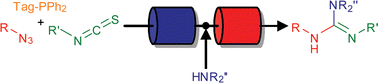
The use of three orthogonally tagged phosphine reagents to assist chemical work-up via phase-switch scavenging in conjunction with a modular flow reactor is described. These techniques (acidic, basic and Click chemistry) are used to prepare various amides and tri-substitutedguanidines from in situ generated iminophosphoranes.

Graphical abstract: Tagged phosphine reagents to assist reaction work-up by phase-switched scavenging using a modular flow reactor


Tagged Phosphine Reagents to Assist Reaction Work-up by Phase-Switched Scavenging Using a Modular Flow Reactor Process 

C.D. Smith, I.R. Baxendale, G.K. Tranmer, M. Baumann, S.C. Smith, R.A. Lewthwaite and S.V. Ley, Org. Biomol. Chem., 2007, 5, 1562-1568.

http://pubs.rsc.org/en/content/articlelanding/2007/ob/b703033a/unauth#!divAbstract

Welcome Scientific update to Pune, India 2-3 and 4-5 Dec 2014 for celebrating Process chemistry


WEBSITE http://www.scientificupdate.co.uk/

SCIENTIFIC UPDATE HAS A REPUTATION FOR ITS HIGH QUALITY EVENTS, BOTH FOR THE SCIENTIFIC CONTENT AND ALSO FOR THE EFFICIENCY OF ITS ORGANISATION. KEEP YOUR SKILLS UP TO DATE AND INVEST IN YOUR CONTINUING PERSONAL PROFESSIONAL DEVELOPMENT.

http://makeinindia.com/

TRAINING COURSE   2-3 DEC 2014

Process Development for Low Cost Manufacturing

When:02.12.2014 – 03.12.2014

Tutors:

Where: National Chemical Laboratory – Pune, India

Brochure:View Brochure

Register http://scientificupdate.co.uk/training/scheduled-training-courses.html


DESCRIPTION

Chemical process research and development is recognised as a key function during the commercialisation of a new product particularly in the generic and contract manufacturing arms of the chemical, agrochemical and pharmaceutical industries.

The synthesis and individual processes must be economic, safe and must generate product that meets the necessary quality requirements.

This 2-day course presented by highly experienced process chemists will concentrate on the development and optimisation of efficient processes to target molecules with an emphasis on raw material cost, solvent choice, yield improvement, process efficiency and work up, and waste minimisation.

Process robustness testing and reaction optimisation via stastical methods will also be covered.

A discussion of patent issues and areas where engineering and technology can help reduce operating costs.

The use of engineering and technology solutions to reduce costs will be discussed and throughout the course the emphasis will be on minimising costs and maximising returns.


Conference 4-5 DEC 2014

TITLE . Organic Process Research & Development – India

Subtitle:The 32nd International Conference and Exhibition

When:04.12.2014 – 05.12.2014

Where:National Chemical Laboratory – Pune, India

Brochure:View Brochure

Register..http://scientificupdate.co.uk/conferences/conferences-and-workshops.html

Organic Process Research & Development - India

for

  • Process Research & Development Chemists
  • Chemical Engineers in Industry
  • Heads of Departments & Team Leaders

Benefits

  • Invest in yourself: keeping up to date on current developments and future trends could mean greater job security.
  • Learn from a wide range of industrial case studies given by hand-picked industrial speakers.
  • Take home relevant ideas and information that are directly applicable to your own work with the full proceedings and a CD of the talks.
  • Save time. Our intensive, commercial-free programme means less time away from work.
  • Meet and network with the key people in the industry in a relaxed and informal atmosphere.

Do you want to improve efficiency and innovation in your synthetic route design, development and optimisation?

The efficient conversion of a chemical process into a process for manufacture on tonnage scale has always been of importance in the chemical and pharmaceutical industries. However, in the current economic and regulatory climate, it has become increasingly vital and challenging to do so efficiently. Indeed, it has never been so important to keep up to date with the latest developments in this dynamic field.

At this Organic Process Research & Development Conference, you will hear detailed presentations and case studies from top international chemists. The hand-picked programme of speakers has been put together specifically for an industrial audience. They will discuss the latest issues relating to synthetic route design, development and optimisation in the pharmaceutical, fine chemical and allied fields.  Unlike other conferences, practically all our speakers are experts from industry, which means the ideas and information you take home will be directly applicable to your own work.

The smaller numbers at our conferences create a more intimate atmosphere. You will enjoy plenty of opportunities to meet and network with speakers and fellow attendees during the reception, sit-down lunches and extended coffee breaks in a relaxed and informal environment. Together, you can explore the different strategies and tactics evolving to meet today’s challenges.

This is held in Pune, close proximity to Mumbai city, very convenient to stay and travel to either in Pune or Mumbai. I feel this should be an opportunity to be grabbed before the conference is full and having no room

Hurry up rush

References

https://newdrugapprovals.org/scientificupdate-uk-on-a-roll/

http://scientificupdate.co.uk/conferences/conferences-and-workshops.html

http://en.wikipedia.org/wiki/Pune

PROFILES

Will Watson

Will Watson

Dr Will Watson gained his PhD in Organic Chemistry from the University of Leeds in 1980. He joined the BP Research Centre at Sunbury-on-Thames and spent five and a half years working as a research chemist on a variety of topics including catalytic dewaxing, residue upgrading, synthesis of novel oxygenates for use as gasoline supplements, surfactants for use as gasoline detergent additives and non-linear optical compounds.

In 1986 he joined Lancaster Synthesis and during the next 7 years he was responsible for laboratory scale production and process research and development to support Lancaster’s catalogue, semi-bulk and custom synthesis businesses.

In 1993 he was appointed to the position of Technical Director, responsible for all Production (Laboratory and Pilot Plant scale), Process Research and Development, Engineering and Quality Control. He helped set up and run the Lancaster Laboratories near Chennai, India and had technical responsibility for the former PCR laboratories at Gainesville, Florida.

He joined Scientific Update as Technical Director in May 2000. He has revised and rewritten the ‘Chemical Development and Scale Up in the Fine Chemical & Pharmaceutical Industries’ course and gives this course regularly around the world. He has been instrumental in setting up and developing new courses such as ‘Interfacing Chemistry with Patents’ and ‘Making and Using Fluoroorganic Molecules’.

He is also involved in an advisory capacity in setting up conferences and in the running of the events. He is active in the consultancy side of the business and sits on the Scientific Advisory Boards of various companies.

………………………………………………………………………………………………….

John Knight

John Knight

Dr John Knight gained a first class honours degree in chemistry at the University of Southampton, UK. John remained at Southampton to study for his PhD in synthetic methodology utilizing radical cyclisation and dipolar cyloaddition chemistry.

After gaining his PhD, John moved to Columbia University, New York, USA where he worked as a NATO Postdoctoral Fellow with Professor Gilbert Stork. John returned to the UK in 1987 joining Glaxo Group Research (now GSK) as a medicinal chemist, where he remained for 4 years before moving to the process research and development department at Glaxo, where he remained for a further 3½ years.

During his time at Glaxo, John worked on a number of projects and gained considerable plant experience (pilot and manufacturing). In 1994 John moved to Oxford Asymmetry (later changing its name to Evotec and most recently to Aptuit) when it had just 25 staff. John’s major role when first at Oxford Asymmetry was to work with a consultant project manager to design, build and commission a small pilot plant, whilst in parallel developing the chemistry PRD effort at Oxford Asymmetry.

The plant was fully operational within 18 months, operating to a 24h/7d shift pattern. John continued to run the pilot plant for a further 3 years, during which time he had considerable input into the design of a second plant, which was completed and commissioned in 2000. After an 18-month period at a small pharmaceutical company, John returned to Oxford in 2000 (by now called Evotec) to head the PRD department. John remained in this position for 6.5 years, during which time he assisted in its expansion, established a team to perform polymorph and salt screening studies and established and maintained high standards of development expertise across the department.

John has managed the chemical development and transfer of numerous NCE’s into the plant for clients and been involved in process validations. He joined Scientific Update in January 2008 as Scientific Director.

Pune images

From top: Fergusson College, Mahatma Gandhi Road (left), Shaniwarwada (right), the HSBC Global Technology India Headquarters, and the National War Memorial Southern Command
From top:1 Fergusson College, 2 Mahatma Gandhi RoadShaniwarwada 3 the HSBC Global Technology India Headquarters, and the 4National War Memorial Southern Command


NCL PUNE

The National Chemical Laboratory is located in the state of Maharashtra in India. Maharashtra state is the largest contributor to India’s GDP. The National Chemical Laboratory is located in Pune city, and is the cultural capital of Maharashtra. Pune city is second only to Mumbai (the business capital of India) in size and industrial strength. Pune points of interest include: The tourist places in Pune include: Lal Deval Synagogue, Bund Garden, Osho Ashram, Shindyanchi Chhatri and Pataleshwar Cave Temple.

http://makeinindia.com/

MAKE IN INDIA

http://makeinindia.com/

http://makeinindia.com/sector/pharmaceuticals/

Read all about Organic Spectroscopy on ORGANIC SPECTROSCOPY INTERNATIONAL 


KEYWORDS

JOHN KNIGHT, WILL WATSON,  SCIENTIFIC UPDATE, PROCESS, COURSE, CONFERENCE, INDIA, PUNE, PROCESS DEVELOPMENT, LOW COST,  MANUFACTURING, SCALEUP

Organic Process Research and Development – India, The 32nd International Conference and Exhibition, NCL, Pune, India, 4-5 Dec 2014


WEBSITE http://www.scientificupdate.co.uk/

SCIENTIFIC UPDATE HAS A REPUTATION FOR ITS HIGH QUALITY EVENTS, BOTH FOR THE SCIENTIFIC CONTENT AND ALSO FOR THE EFFICIENCY OF ITS ORGANISATION. KEEP YOUR SKILLS UP TO DATE AND INVEST IN YOUR CONTINUING PERSONAL PROFESSIONAL DEVELOPMENT.

http://makeinindia.com/

TITLE . Organic Process Research & Development – India

Subtitle:The 32nd International Conference and Exhibition

When:04.12.2014 – 05.12.2014

Where:National Chemical LaboratoryPune, India

Brochure:View Brochure

Register..http://scientificupdate.co.uk/conferences/conferences-and-workshops.html

Organic Process Research & Development - India

for

  • Process Research & Development Chemists
  • Chemical Engineers in Industry
  • Heads of Departments & Team Leaders

Benefits

  • Invest in yourself: keeping up to date on current developments and future trends could mean greater job security.
  • Learn from a wide range of industrial case studies given by hand-picked industrial speakers.
  • Take home relevant ideas and information that are directly applicable to your own work with the full proceedings and a CD of the talks.
  • Save time. Our intensive, commercial-free programme means less time away from work.
  • Meet and network with the key people in the industry in a relaxed and informal atmosphere.

Do you want to improve efficiency and innovation in your synthetic route design, development and optimisation?

The efficient conversion of a chemical process into a process for manufacture on tonnage scale has always been of importance in the chemical and pharmaceutical industries. However, in the current economic and regulatory climate, it has become increasingly vital and challenging to do so efficiently. Indeed, it has never been so important to keep up to date with the latest developments in this dynamic field.

At this Organic Process Research & Development Conference, you will hear detailed presentations and case studies from top international chemists. The hand-picked programme of speakers has been put together specifically for an industrial audience. They will discuss the latest issues relating to synthetic route design, development and optimisation in the pharmaceutical, fine chemical and allied fields.  Unlike other conferences, practically all our speakers are experts from industry, which means the ideas and information you take home will be directly applicable to your own work.

The smaller numbers at our conferences create a more intimate atmosphere. You will enjoy plenty of opportunities to meet and network with speakers and fellow attendees during the reception, sit-down lunches and extended coffee breaks in a relaxed and informal environment. Together, you can explore the different strategies and tactics evolving to meet today’s challenges.

This is held in Pune, close proximity to Mumbai city, very convenient to stay and travel to either in Pune or Mumbai. I feel this should be an opportunity to be grabbed before the conference is full and having no room

Hurry up rush

References

https://newdrugapprovals.org/scientificupdate-uk-on-a-roll/

http://scientificupdate.co.uk/conferences/conferences-and-workshops.html

http://en.wikipedia.org/wiki/Pune

PROFILES

Will Watson

Will Watson

Dr Will Watson gained his PhD in Organic Chemistry from the University of Leeds in 1980. He joined the BP Research Centre at Sunbury-on-Thames and spent five and a half years working as a research chemist on a variety of topics including catalytic dewaxing, residue upgrading, synthesis of novel oxygenates for use as gasoline supplements, surfactants for use as gasoline detergent additives and non-linear optical compounds.

In 1986 he joined Lancaster Synthesis and during the next 7 years he was responsible for laboratory scale production and process research and development to support Lancaster’s catalogue, semi-bulk and custom synthesis businesses.

In 1993 he was appointed to the position of Technical Director, responsible for all Production (Laboratory and Pilot Plant scale), Process Research and Development, Engineering and Quality Control. He helped set up and run the Lancaster Laboratories near Chennai, India and had technical responsibility for the former PCR laboratories at Gainesville, Florida.

He joined Scientific Update as Technical Director in May 2000. He has revised and rewritten the ‘Chemical Development and Scale Up in the Fine Chemical & Pharmaceutical Industries’ course and gives this course regularly around the world. He has been instrumental in setting up and developing new courses such as ‘Interfacing Chemistry with Patents’ and ‘Making and Using Fluoroorganic Molecules’.

He is also involved in an advisory capacity in setting up conferences and in the running of the events. He is active in the consultancy side of the business and sits on the Scientific Advisory Boards of various companies.

………………………………………………………………………………………………….

John Knight

John Knight

Dr John Knight gained a first class honours degree in chemistry at the University of Southampton, UK. John remained at Southampton to study for his PhD in synthetic methodology utilizing radical cyclisation and dipolar cyloaddition chemistry.

After gaining his PhD, John moved to Columbia University, New York, USA where he worked as a NATO Postdoctoral Fellow with Professor Gilbert Stork. John returned to the UK in 1987 joining Glaxo Group Research (now GSK) as a medicinal chemist, where he remained for 4 years before moving to the process research and development department at Glaxo, where he remained for a further 3½ years.

During his time at Glaxo, John worked on a number of projects and gained considerable plant experience (pilot and manufacturing). In 1994 John moved to Oxford Asymmetry (later changing its name to Evotec and most recently to Aptuit) when it had just 25 staff. John’s major role when first at Oxford Asymmetry was to work with a consultant project manager to design, build and commission a small pilot plant, whilst in parallel developing the chemistry PRD effort at Oxford Asymmetry.

The plant was fully operational within 18 months, operating to a 24h/7d shift pattern. John continued to run the pilot plant for a further 3 years, during which time he had considerable input into the design of a second plant, which was completed and commissioned in 2000. After an 18-month period at a small pharmaceutical company, John returned to Oxford in 2000 (by now called Evotec) to head the PRD department. John remained in this position for 6.5 years, during which time he assisted in its expansion, established a team to perform polymorph and salt screening studies and established and maintained high standards of development expertise across the department.

John has managed the chemical development and transfer of numerous NCE’s into the plant for clients and been involved in process validations. He joined Scientific Update in January 2008 as Scientific Director.

Pune images

From top: Fergusson College, Mahatma Gandhi Road (left), Shaniwarwada (right), the HSBC Global Technology India Headquarters, and the National War Memorial Southern Command
From top:1 Fergusson College, 2 Mahatma Gandhi Road, Shaniwarwada 3 the HSBC Global Technology India Headquarters, and the 4National War Memorial Southern Command

NCL PUNE

http://makeinindia.com/

MAKE IN INDIA

http://makeinindia.com/

http://makeinindia.com/sector/pharmaceuticals/

Read all about Organic Spectroscopy on ORGANIC SPECTROSCOPY INTERNATIONAL 

amcrasto@gmail.com feder-0005.gif from 123gifs.eu

Vapourtec…..Continuous Flow-Processing of Organometallic Reagents Using an Advanced Peristaltic Pumping System and the Telescoped Flow Synthesis of (E/Z)-Tamoxifen


www.vapourtec.co.ukA VAPOURTEC POST

http://www.vapourtec.co.uk/products/eseriessystem/pumping/organometallic

Philip R D Murray 1
Duncan L Browne 1
Julio C Pastre 1,2
Chris Butters 3
Duncan Guthrie 3
Steven V Ley 1

1 Department of Chemistry, University of Cambridge, UK
2 Instituto de Quí­mica, University of Campinas, Brazil
3 Vapourtec Ltd, UK

http://www.vapourtec.co.uk/products/eseriessystem/pumping/organometallic

A new enabling-technology for the pumping of organometallic reagents such as n-butyllithium, Grignard reagents and DIBAL-H is reported, which utilizes a newly developed chemically-resistant peristaltic pumping system. Several representative examples of its use in common transformations using these reagents, including metal-halogen exchange, addition, addition-elimination, conjugate addition and partial reduction are reported, along with examples of telescoping of the anionic reaction products. This platform allows for truly continuous pumping of these highly reactive substances and examples are demonstrated over periods of several hours, to generate multi-gram quantities of products. This work culminates in an approach to the telescoped synthesis of (E/Z)-Tamoxifen using continuous-flow organometallic reagent mediated transformations………..http://www.vapourtec.co.uk/products/eseriessystem/pumping/organometallic.