New Drug Approvals

Home » 2016 (Page 47)

Yearly Archives: 2016

DRUG APPROVALS BY DR ANTHONY MELVIN CRASTO .....FOR BLOG HOME CLICK HERE

Blog Stats

  • 4,802,558 hits

Flag and hits

Flag Counter

Enter your email address to follow this blog and receive notifications of new posts by email.

Join 37.9K other subscribers
Follow New Drug Approvals on WordPress.com

Archives

Categories

Recent Posts

Flag Counter

ORGANIC SPECTROSCOPY

Read all about Organic Spectroscopy on ORGANIC SPECTROSCOPY INTERNATIONAL 

Enter your email address to follow this blog and receive notifications of new posts by email.

Join 37.9K other subscribers
DR ANTHONY MELVIN CRASTO Ph.D

DR ANTHONY MELVIN CRASTO Ph.D

DR ANTHONY MELVIN CRASTO, Born in Mumbai in 1964 and graduated from Mumbai University, Completed his Ph.D from ICT, 1991,Matunga, Mumbai, India, in Organic Chemistry, The thesis topic was Synthesis of Novel Pyrethroid Analogues, Currently he is working with AFRICURE PHARMA, ROW2TECH, NIPER-G, Department of Pharmaceuticals, Ministry of Chemicals and Fertilizers, Govt. of India as ADVISOR, earlier assignment was with GLENMARK LIFE SCIENCES LTD, as CONSUlTANT, Retired from GLENMARK in Jan2022 Research Centre as Principal Scientist, Process Research (bulk actives) at Mahape, Navi Mumbai, India. Total Industry exp 32 plus yrs, Prior to joining Glenmark, he has worked with major multinationals like Hoechst Marion Roussel, now Sanofi, Searle India Ltd, now RPG lifesciences, etc. He has worked with notable scientists like Dr K Nagarajan, Dr Ralph Stapel, Prof S Seshadri, etc, He did custom synthesis for major multinationals in his career like BASF, Novartis, Sanofi, etc., He has worked in Discovery, Natural products, Bulk drugs, Generics, Intermediates, Fine chemicals, Neutraceuticals, GMP, Scaleups, etc, he is now helping millions, has 9 million plus hits on Google on all Organic chemistry websites. His friends call him Open superstar worlddrugtracker. His New Drug Approvals, Green Chemistry International, All about drugs, Eurekamoments, Organic spectroscopy international, etc in organic chemistry are some most read blogs He has hands on experience in initiation and developing novel routes for drug molecules and implementation them on commercial scale over a 32 PLUS year tenure till date Feb 2023, Around 35 plus products in his career. He has good knowledge of IPM, GMP, Regulatory aspects, he has several International patents published worldwide . He has good proficiency in Technology transfer, Spectroscopy, Stereochemistry, Synthesis, Polymorphism etc., He suffered a paralytic stroke/ Acute Transverse mylitis in Dec 2007 and is 90 %Paralysed, He is bound to a wheelchair, this seems to have injected feul in him to help chemists all around the world, he is more active than before and is pushing boundaries, He has 100 million plus hits on Google, 2.5 lakh plus connections on all networking sites, 100 Lakh plus views on dozen plus blogs, 227 countries, 7 continents, He makes himself available to all, contact him on +91 9323115463, email amcrasto@gmail.com, Twitter, @amcrasto , He lives and will die for his family, 90% paralysis cannot kill his soul., Notably he has 38 lakh plus views on New Drug Approvals Blog in 227 countries......https://newdrugapprovals.wordpress.com/ , He appreciates the help he gets from one and all, Friends, Family, Glenmark, Readers, Wellwishers, Doctors, Drug authorities, His Contacts, Physiotherapist, etc He has total of 32 International and Indian awards

Verified Services

View Full Profile →

Archives

Categories

Flag Counter

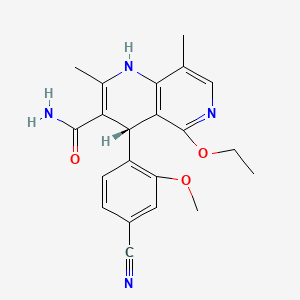
Finerenone, BAY 94-8862


Finerenone

Finerenone; UNII-DE2O63YV8R; BAY 94-8862; DE2O63YV8R; 1050477-31-0

update FDA approved, 7/9/2021, Kerendia, To reduce the risk of kidney and heart complications in chronic kidney disease associated with type 2 diabetes

C21H22N4O3
MW 378.42438 g/mol

(4s)-4-(4-cyano-2-methoxyphenyl)-5-ethoxy-2,8-dimethyl-1,4-dihydro-1-6-naphthyridine-3-carbox-amide

Bayer Corp

Bayer Healthcare Ag,

Mineralocorticoid receptor antagonist

phase III in January 2016, for treating diabetic kidney disease and chronic heart failure in patients with worsening chronic cardiac insufficiency

Used as mineralocorticoid receptor antagonist for treating heart failure and diabetic nephropathy.

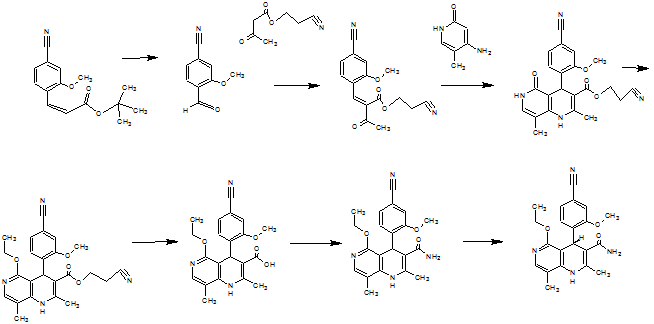
SYNTHESIS

str1

Finerenone (INN, USAN) (developmental code name BAY-94-8862) is a non-steroidal antimineralocorticoid that is in phase IIIclinical trials for the treatment of chronic heart failure as of October 2015. It has less relative affinity to other steroid hormone receptors than currently available antimineralocorticoids such as eplerenone and spironolactone, which should result in fewer adverse effects like gynaecomastia, impotence, and low sex drive.[1][2]

Pharmacology

Finerenone blocks mineralocorticoid receptors, which makes it a potassium-sparing diuretic.

This table compares inhibitory (blocking) concentrations (IC50, unit: nM) of three antimineralocorticoids. Mineralocorticoid receptor inhibition is responsible for the desired action of the drugs, whereas inhibition of the other receptors potentially leads to side effects. Lower values mean stronger inhibition.[1]

Spironolactone Eplerenone Finerenone
Mineralocorticoid receptor 24 990 18
Glucocorticoid receptor 2400 22,000 >10,000
Androgen receptor 77 21,200 >10,000
Progesterone receptor 740 31,200 >10,000

The above-listed drugs have insignificant affinity for the estrogen receptor.

Chemistry

Unlike currently marketed antimineralocorticoids, finerenone is not a steroid but a dihydropyridine derivative.

Research

The drug is also being investigated in early trials for the treatment of diabetic nephropathy.[3]

 PAPER

Discovery of BAY 94-8862: A Nonsteroidal Antagonist of the Mineralocorticoid Receptor for the Treatment of Cardiorenal Diseases

  1. Dr. Lars Bärfacker1,*,
  2. Dr. Alexander Kuhl1,
  3. Prof. Dr. Alexander Hillisch1,
  4. Dr. Rolf Grosser1,
  5. Dr. Santiago Figueroa-Pérez1,
  6. Dr. Heike Heckroth1,
  7. Adam Nitsche1,
  8. Dr. Jens-Kerim Ergüden1,
  9. Dr. Heike Gielen-Haertwig1,
  10. Dr. Karl-Heinz Schlemmer2,
  11. Prof. Dr. Joachim Mittendorf1,
  12. Dr. Holger Paulsen1,
  13. Dr. Johannes Platzek3 and
  14. Dr. Peter Kolkhof4

Article first published online: 12 JUL 2012

DOI: 10.1002/cmdc.201200081

ChemMedChem

ChemMedChem

Volume 7, Issue 8, pages 1385–1403, August 2012

Abstract

Aldosterone is a hormone that exerts manifold deleterious effects on the kidneys, blood vessels, and heart which can lead to pathophysiological consequences. Inhibition of the mineralocorticoid receptor (MR) is a proven therapeutic concept for the management of associated diseases. Use of the currently marketed MR antagonists spironolactone and eplerenone is restricted, however, due to a lack of selectivity in spironolactone and the lower potency and efficacy of eplerenone. Several pharmaceutical companies have implemented programs to identify drugs that overcome the known liabilities of steroidal MR antagonists. Herein we disclose an extended SAR exploration starting from cyano-1,4-dihydropyridines that were identified by high-throughput screening. Our efforts led to the identification of a dihydronaphthyridine, BAY 94-8862, which is a potent, selective, and orally available nonsteroidal MR antagonist currently under investigation in a clinical phase II trial.

str1

str1

PATENT

WO2008104306,

http://www.google.co.in/patents/WO2008104306A2?cl=en

Bayer Healthcare Ag,

Lars Baerfacker, BELOW

Peter Kolkhof, BELOW

Karl-Heinz Schlemmer, Rolf Grosser, Adam Nitsche,Martina Klein, Klaus Muenter, Barbara Albrecht-Kuepper, Elke Hartmann,

EXAMPLES

Example 1

4- (4-Cyano-2-methoxyphenyl) -5-ethoxy-2-methyl-l, 4-dihydro-l, 6-naphthyridine-3-carboxamide

Figure imgf000066_0001

100 mg (ca. 0:24 mmol) of the compound from Example 23A are initially charged in 3 ml DMF. Is 2.94 mg Then (0.024 mmol) of 4-N, N-dimethylaminopyridine and 340 ul of ammonia (28 wt .-% – solution in water, 2:41 mmol) and 3 h at 100 0 C temperature. After cooling, the crude product is purified directly by preparative HPLC (eluent: acetonitrile / water with 0.1% formic acid, gradient 20:80 → 95: 5). There are 32 mg (37% d. Th.) The title connection receive.

LC-MS (Method 3): R, = 1:57 min; MS (EIPOS): m / z = 365 [M + H] +

1 H-NMR (300 MHz, DMSOd6): δ = 1:07 (t, 3H), 2.13 (s, 3H), 3.83 (s, 3H), 4:04 (m, 2H), 5:36 (s, IH), 6:42 (d, IH), 6.66 (br. s, 2H), 7.18 (d, IH), 7.29 (dd, IH), 7:38 (d, IH), 7.67 (d, IH), 8.80 (s, IH).

Example 2

4- (4-Cyano-2-methoxyphenyl) -5-ethoxy-2,7-dimethyl-l, 4-dihydro-l, 6-naphthyridine-3-carboxamide

Figure imgf000067_0001

640 mg (1.69 mmol) of the compound from Example 27A are initially charged in 30 ml of ethyl acetate, 342 mg (2.11 mmol) l, r-carbonyldiimidazole and then stirred overnight at room temperature. A TLC check (silica gel; mobile phase: cyclohexane / ethyl acetate 1: 1 or dichloromethane / methanol 9: 1) shows complete conversion. The volatile components are removed on a rotary evaporator and the residue taken up in 20 ml DMF. Subsequently, 2.36 ml of ammonia (28 wt .-% – solution in water, 16.87 mmol) was added and the reaction mixture for 8 hours at 50 0 C temperature. The solvent is distilled off under reduced pressure and the residue purified by preparative HPLC (eluent: acetonitrile / water with 0.1% formic acid, gradient 20:80 -> 95: 5). This gives 368 mg (58% d. Th.) Of the title compound.

LC-MS (method 7): R t = 1.91 min; MS (EIPOS): m / z = 379 [M + H] +

1 H-NMR (300 MHz, DMSO-d 6): δ = 1:05 (t, 3H), 2.13 (s, 3H), 2.19 (s, 3H), 3.84 (s, 3H), 4:02 (q, 2H) , 5:32 (s, IH), 6.25 (s, IH), 6.62 (br. s, 2H), 7.16 (d, IH), 7.28 (dd, IH), 7:37 (d, IH), 8.71 (s, IH ).

Example 3

e ‘f 4- (4-Cyano-2-methoxyphenyl) -5-ethoxy-2,7-dimethyl-l, 4-dihydro-l, 6-naphthyridine-3-carbox- amide [(-) – enantiomer and (+) – enantiomer \

Figure imgf000068_0001

The racemate of Example 2 can be separated on a preparative scale by chiral HPLC into its enantiomers [column: Chiralpak IA, 250 mm x 20 mm; Eluent: methyl tert-butyl ether / methanol 85: 15 (v / v); Flow: 15 ml / min; Temperature: 30 0 C; UV detection: 220 Dm].

(-) – Enantiomer:

HPLC: R, = 5.28 min, ee> 98% [column: Chiralpak IA, 250 mm x 4.6 mm; Eluent: methyl tert-butyl ether / methanol 80:20 (v / v); Flow: 1 ml / min; Temperature: 25 0 C; UV detection: 220 nm];

specific optical rotation (chloroform, nm 589, 19.8 ° C, c = 0.50500 g / 100 ml): -239.3 °.

A single crystal X-ray structural analysis revealed a ^ -configuration at C * for this enantiomer – atom.

(+) – Enantiomer:

HPLC: R = 4:50 min, ee> 99% [column: Chiralpak IA, 250 mm x 4.6 mm; Eluent: methyl tert-butyl ether / methanol 80:20 (v / v); Flow: 1 ml / min; Temperature: 25 ° C; UV detection: 220 nm];

specific optical rotation (chloroform, nm 589, 20 0 C, c = 0.51000 g / 100 ml): + 222.7 °.

Example 4

4- (4-Cyano-2-methoxyphenyl) -5-ethoxy-2,8-dimethyl-l, 4-dihydro-l, 6-naphthyridine-3-carboxamide

Figure imgf000069_0001

1:46 g (3.84 mmol) of the compound from Example 3oA are introduced into 50 ml of ethyl acetate, 777 mg (4.79 mmol) l, r-carbonyldiimidazole and then stirred overnight at room temperature. A TLC check (silica gel; eluent: ethyl acetate) shows complete conversion. The volatile components are removed on a rotary evaporator and the residue taken up in 20 ml DMF.Then 10.74 ml of ammonia (28 wt% solution in water, 76.8 mmol) was added and the reaction mixture heated for 30 minutes at 100 0 C. The solvent is distilled off under reduced pressure and the residue purified by preparative HPLC (eluent: acetonitrile / water with 0.1% formic acid, gradient 20:80 -> 95: 5). After concentrating the product fractions, the residue in 40 ml of dichloromethane / methanol (1: 1 v / v) and treated with 100 ml of ethyl acetate. The solvent is concentrated to a volume of about 20 ml, whereupon the product crystallized. The precipitate is filtered off and washed with a little diethyl ether.After drying at 40 0 C in a vacuum oven obtained 1:40 g (96%. Th.) The title connection.

LC-MS (Method 3): R, = 1.64 min; MS (EIPOS): m / z = 379 [M + H] +

1 H-NMR (300 MHz, DMSOd6): δ = 1:05 (t, 3H), 2.12 (s, 3H), 2.18 (s, 3H), 3.82 (s, 3H), 3.99-4.07 (m, 2H) , 5:37 (s, IH), 6.60-6.84 (m, 2H), 7.14 (d, IH), 7.28 (dd, IH), 7:37 (d, IH), 7:55 (s, IH), 7.69 (s, IH ).

Example 5

e “M- (4-Cyano-2-methoxyphenyl) -5-ethoxy-2,8-dimethyl-l, 4-dihydro-l, 6-naphthyridine-3-carbox- amide [(-) – enantiomer and (+ ) enantiomer]

Figure imgf000070_0001

The racemate of Example 4 can be separated on a preparative scale by chiral HPLC into its enantiomers [column: 680 mm x 40 mm; Silica gel phase based on the chiral selector poly (N-methacryloyl-D-leucine dicyclopropylmethylamide; eluent: ethyl acetate; temperature: 24 ° C; flow: 80 ml / min; UV detection: 260 nm].

(-) – Enantiomer:

HPLC: R = 2:48 min, ee = 99.6% [column: 250 mm x 4.6 mm; Silica gel phase based on the chiral selector poly (N-methacryloyl-D-leucine dicyclopropylmethylamide; eluent: ethyl acetate; temperature: 24 ° C; flow: 2 ml / min; UV detection: 260 nm];

specific optical rotation (chloroform, nm 589, 19.7 ° C, c = 0.38600 g / 100 ml): -148.8 °.

A single crystal X-ray structure analysis showed this enantiomer S configuration at C * – atom.

(+) – Enantiomer:

HPLC: R = 4:04 min, ee = 99.3% [column: 250 mm x 4.6 mm; Silica gel phase based on the chiral selector poly (N-methacryloyl-D-leucine dicyclopropylmethylamide; eluent: ethyl acetate; temperature: 24 ° C; flow: 2 ml / min; UV detection: 260 nm];

specific optical rotation (chloroform, nm 589, 19.8 ° C, c = 0.36300 g / 100 ml): + 153.0 °.

PATENT

WO 2016016287

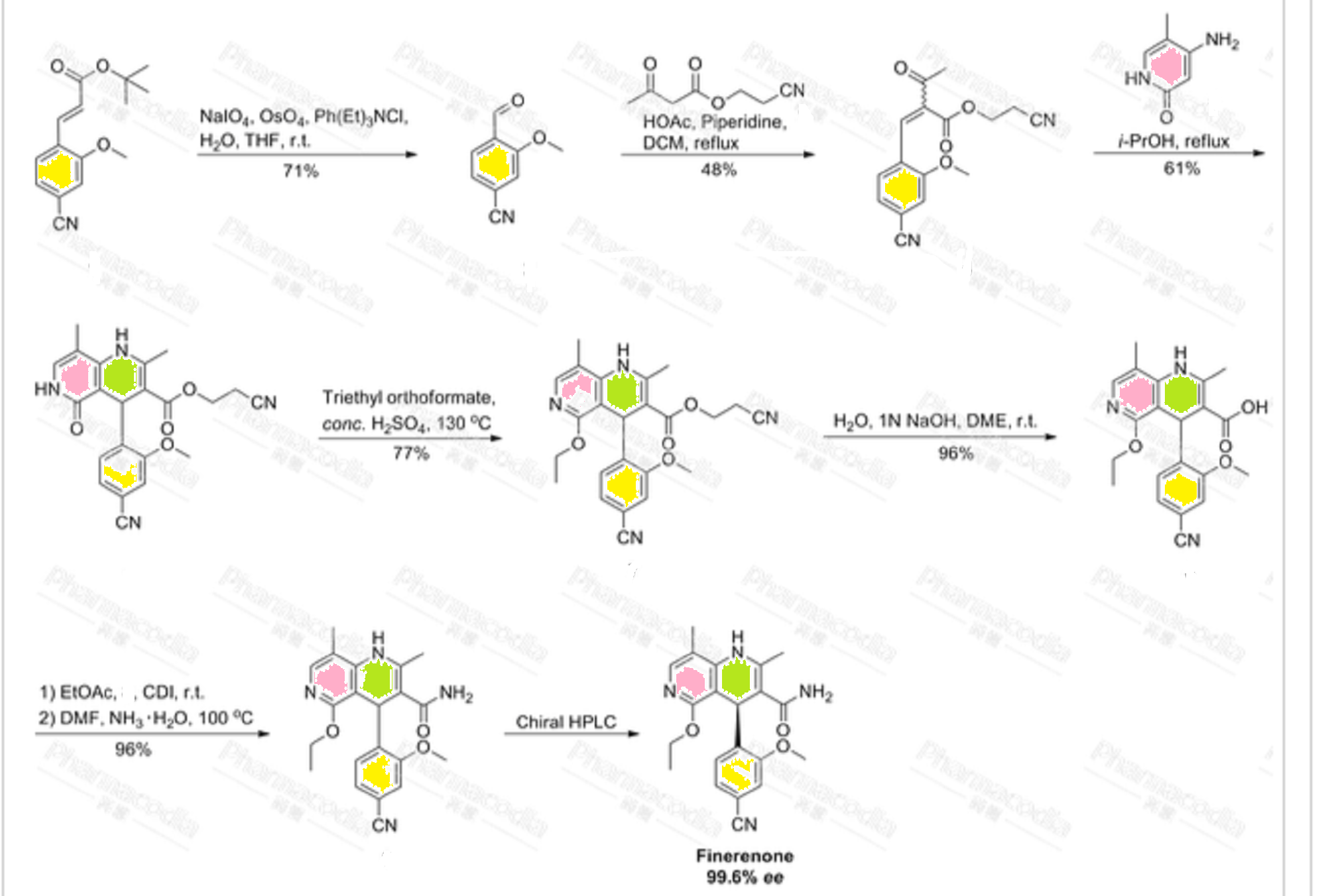
The present invention relates to a novel and improved process for preparing 4- (4-Cyano-2-methoxyphenyl) -5-ethoxy-2,8-dimethyl-1, 4-dihydro- 1, 6-naphthyridine-3-carbox- amide of formula (I)

as well as the preparation and use of crystalline modification I of (4S) – 4- (4-Cyano-2-methoxyphenyl) -5-ethoxy-2,8-dimethyl-1, 4-dihydro- 1, 6-naphthyridine-3- carbox-amide of formula (I).

The compound of formula (I) acts as a non-steroidal mineralocorticoid receptor antagonist and can be used as agents for the prophylaxis and / or treatment of cardiovascular and renal diseases such as heart failure and diabetic nephropathy.

The compound of formula (I) and their preparation process are described in WO 2008/104306 and ChemMedChem 2012 7, described in 1385, in both publications a detailed discussion of research synthesis is disclosed. A disadvantage of the synthesis described there is the fact that this synthesis is not suitable for another large-scale process, since many steps in very high dilution, at very high reagent surpluses and thus run on a relatively low overall yield. Furthermore, many chromatographic cleanings are necessary, which are usually very expensive and require a high consumption of solvents, are costly and which should therefore be avoided if possible.Some stages can not be realized due to safety and procedural difficulties.

There is therefore a need for an industrially viable synthesis, reproducible in high overall yield, low production costs and high purity provides the compound of formula (I) and complies with all regulatory requirements in order to supply the clinical trials on drug and for subsequent regulatory submission to be used.

With the present invention a very efficient synthesis has been found, which allows to meet the above requirements.

In the publication ChemMedChem 2012 7, in which the research synthesis of the compound of formula (I) disclosed in 1385, the compound of formula (I), starting from vanillin prepared in 10 steps with an overall yield of 3.76% of theory , The compound of formula (I) was obtained by evaporation of the chromatography fractions as an amorphous solid, a defined process Kristalhsations- the stage for polymorphism-setting has not been described.

The following Scheme 1 shows the known process for preparing the compound of formula (I).

(II) (HI) (IV)

(V) (VI)

(XIII) (I)

Scheme 1: synthesis research of the compound of formula (I)

There are used 3 chromatographic purifications, and a chiral chromatography step to separate the enantiomers of the racemate of formula (XIII). The steps run partially in very high dilution and using very large amounts of reagent.

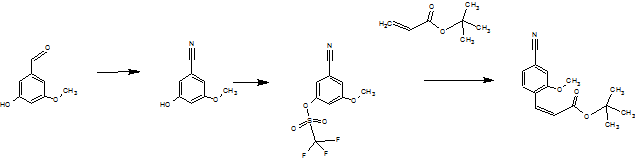
Thus, in particular the sequence of the preparation of the nitrile aldehyde intermediate (VI), which occupies a central role in the synthesis of atom not economically acceptable.

Furthermore, not to apply this process to an industrial scale, since [=> (IV) (III)] and excesses of acrylic acid tert-butyl ester are used for a very expensive reagents such as trifluoromethanesulfonic anhydride. When upscaling the Heck reaction (IV) => (V) formed in the boiler, a plastic similar residue resulting from the polymerization of acrylic acid tert.butyl ester used in excess. This is not acceptable in the technical implementation, there is a risk that there may be a Rührerbruch and it would lead to strong to remove residues in the agitators.

The subsequent cleavage of the double bond with sodium and the highly toxic osmium tetroxide is to be avoided since there is a delay of reaction and thereby caused to a strongly exothermic and connected with that comes a runaway under the test conditions described.

Scheme 2 illustrates the new process of the invention that the compound of formula (I) in 9 levels in 27.7% d. Th. Total yield without a chromatographic

Purification of intermediates supplies.

Scheme 2: According to the Invention for preparing the compound of formula (I).

Examples

example 1

Methyl 4-bromo-2-methoxybenzoate (XV)

3.06 kg (22.12 mol) potassium carbonate are placed in 1 acetone 3.6 and heated to reflux. To this suspension is metered in 1.2 kg of 4-bromo-2-hydroxybenzoic acid (5.53 mol) suspended in 7.8 1 of acetone and rinsed with 0.6 1 acetone. The mixture is heated for one hour under reflux (vigorous evolution of gas!). is boiled for 2.65 kg (21.01 mol) Dimethylsufat over 4 hours then metered. 2.5 hours then is stirred under reflux. The solvent is distilled off to a large extent (up to the stirrability) and returns to 12 1 toluene, then the remaining acetone is distilled off at 110 ° C. There are about 3 1 distillate distilled, these are supplemented by the addition of a further 3 1 toluene to approach. Allow to cool to 20 ° C and are 10.8 1 water were added and agitated vigorously. The organic phase is separated and the aqueous phase extracted again with 6.1 1 of toluene. The combined organic phases are washed with 3 1 of saturated sodium chloride solution, and the toluene phase is concentrated to about 4 first A quantitative analysis by evaporating a subset results converted a yield 1.306 kg (96.4% of theory). The solution is used directly in the next stage.

HPLC method A: RT about 11.9 min.

MS (EIPOS): m / z = 245 [M + H] +

H NMR (400 MHz, CD 2 C1 2 ): δ = 3.84 (s, 3H), 3.90 (s, 3H), 7:12 to 7:20 (m, 2H), 7.62 (d, 1H).

example 2

4-bromo-2-methoxybenzaldehyde (XVI)

It puts 1.936 kg (6.22 mol) 65% Red- Al solution in toluene with 1.25 1 of toluene at -5 ° C before. To this solution was dosed 0.66 kg (6.59 mol) of 1-methylpiperazine and rinsed with 150 ml of toluene, the temperature keeps you here from -7 to -5 ° C.. It is allowed for 30 minutes at 0 ° C. for. This solution is then dosed to a solution of 1.261 kg (5.147 mol) of methyl 4-bromo-2-methoxybenzoate (XV), dissolved in 4 1 of toluene, the temperature is maintained at – 8-0 ° C. Rinse twice with 0.7 1 of toluene and stirred for 1.5 hours at 0 ° C to. For working up, dosed to a 0 ° C cold aqueous sulfuric acid (12.5 1 water + 1.4 kg of conc. Sulfuric acid). The temperature should rise to a maximum of 10 ° C (slow dosage). The pH is, if necessary, by addition of further sulfuric acid to a pH of the first The organic phase is separated and extracted the aqueous phase with 7.6 1 of toluene. The combined organic phases are washed with 5.1 1 of water and then substantially concentrated and the residue taken up with 10 1 DMF. The mixture is concentrated again to about 5 1 volume. A quantitative analysis by evaporating a subset results converted a yield 1.041 kg (94.1% of theory). The solution is used directly in the next stage.

HPLC method A: RT approximately 12.1 min.

MS (EIPOS): m / z = 162 [M + H] +

X H-NMR (CDCl, 400MHz): δ = 3.93 (3H, s), 7.17 (2H, m), 7.68 (1H, d), 10:40 (1H, s)

example 3

4-formyl-3-methoxybenzonitrile (VI)

719 g (3.34 mol) of 4-bromo-2-methoxybenzaldehyde (XVI) as a solution in 4.5 1 of DMF with 313 g (0.74 mol) of potassium hexacyanoferrate (K4 [Fe (CN) 6]) and 354 g submitted (3.34 mol) of sodium carbonate and a further 1.2 1 of DMF and 3.8 g (0.017 mol) of palladium acetate. It is stirred for 3 hours at 120 ° C. Allow to cool to 20 ° C and are 5.7 1 water to approach. It is extracted with 17 1 ethyl acetate, and the aqueous phase is washed again with 17 1 of ethyl acetate to. The organic phases are combined and substantially concentrated with 5 1 of isopropanol was added and concentrated to about 2 1st The mixture is heated to boiling and dripping 2 1 of water.Allow to cool to 50 ° C and are again added 2 1 water. It is cooled to 3 ° C and stirred for one hour at this temperature. The product is filtered and washed with water (2 times 1.2 1) washed. It is dried at 40 ° C under vacuum.

Yield: 469 g (87% of theory.) Of a beige solid.

HPLC method A: RT about 8.3 min.

MS (EIPOS): m / z = 162 [M + H] +

1H-NMR (300 MHz, DMSO-d6): δ = 3.98 (s, 3H), 7:53 (d, 1H), 7.80 (s, 1H), 7.81 (d, 1H), 10:37 (s, 1H).

example 4

2-cyanoethyl 4- (4-cyano-2-methoxyphenyl) -2,8-dimethyl-5-oxo-l, 4,5,6-tett ^

din-3-carboxylate (X)

option A

1.035 kg (6.422 mol) of 4-formyl-3-methoxybenzonitrile (VI), 1.246 kg (8.028 mol) of 2-Cyanefhyl 3-oxobutanoate, 54.6 g (0.642 mol) of piperidine and 38.5 g (0.642 mol) of glacial acetic acid are heated under reflux on a water in 10 1 dichloromethane 6.5 hours. Allow to cool to room temperature and the organic phase was washed 2 times with 5 1 water. Subsequently, the dichloromethane phase is concentrated under atmospheric pressure and the still stirrable residue with 15.47 kg of 2-butanol and 0.717 kg (5.78 mol) of 4-amino-5-methylpyridone added. The residual dichloromethane is distilled off until an internal temperature of 98 ° C is reached. Then, 20 hours, heated under reflux. It is cooled to 0 ° C, can be 4 hours at this temperature is stirred and filtered off the product. It is dried at 40 ° C under vacuum to the carrier gas.

Yield: 2.049 kg (87.6% of theory based on 4-amino-5-methylpyridone, since this component is used in deficiency) of a slightly yellowish colored solid.

HPLC method A: RT about 9.7 min.

MS (EIPOS): m / z = 405 [M + H] +

Ή-NMR (300 MHz, DMSO-d 6 ): δ = 2:03 (s, 3H), 2:35 (s, 3H), 2.80 (m, 2H), 3.74 (s, 3H), 4:04 (m, 1H), 4.11 (m, 1H), 5.20 (s, 1H), 6.95 (s, 1H), 7.23 (dd, 1H), 7:28 to 7:33 (m, 2H), 8.18 (s, 1H), 10.76 (s, 1H) ,

variant B

1.344 kg (8.34 mol) of 4-formyl-3-methoxy-benzonitrile (VI), 71 g (0.834 mol) piperidine and 50.1 g (0.834 mol) of glacial acetic acid are introduced into 6 1 of isopropanol at 30 ° C within 3 hours, a solution of 1.747 kg (11.26 mol) of 2-cyanoethyl 3-oxobutanoate metered in 670 ml of isopropanol. Stirring an hour after at 30 ° C. It is cooled to 0-3 ° C and stirred at 0.5 hours. the product is filtered off and washed 2 times with 450 ml of cold isopropanol to. For yield determination is under vacuum at 50 ° C. (2.413 kg, 97% of theory..); but it is usually due to the high yield continued to work directly with the isopropanol-moist product. For this, the product is taken up with 29 1 of isopropanol and 1.277 kg (7.92

mol) of 4-amino-5-methylpyridone added, followed by 24 internal temperature under about 1.4 bar overpressure in the closed vessel is heated at 100 ° C h. It is cooled by a ramp within 5 h at 0 ° C. stirred for 3 hours at 0 ° C. It is filtered off and washed with 2.1 1 of cold isopropanol. It is dried under vacuum at 60 ° C.

Yield: 2.819 kg (88% of theory based on 4-amino-5-methylpyridone, since this component is used in deficiency) of a slightly yellowish colored solid.

HPLC method A: RT about 9.7 min.

MS (EIPOS): m / z = 405 [M + H] +

Ή-NMR (300 MHz, DMSO-d 6 ): δ = 2:03 (s, 3H), 2:35 (s, 3H), 2.80 (m, 2H), 3.74 (s, 3H), 4:04 (m, 1H), 4.11 (m, 1H), 5.20 (s, 1H), 6.95 (s, 1H), 7.23 (dd, 1H), 7:28 to 7:33 (m, 2H), 8.18 (s, 1H), 10.76 (s, 1H) ,

example 5

2- cyanoethyl-4- (4-cyano-2-methoxyphenyl) -5-ethoxy-2,8-dimethyl-l, 4-dihydro-l, 6-naphthyridine-3-carboxylate (XI)

2.142 kg (5.3 mol) of 2-cyanoethyl 4- (4-cyano-2-methoxyphenyl) -2,8-dimefhyl-5-oxo-l, 4,5,6-tetrahydro-l, 6-naphthyridin-3 carboxylate (X) and 4.70 kg (29 mol) of triethyl orthoacetate are dissolved in 12.15 1 of dimethylacetamide and 157.5 grams of concentrated sulfuric acid was added. The mixture is heated for 1.5 hours at 115 ° C and then cooled to 50 ° C. At 50 ° C are added dropwise to 30 minutes 12.15 1 water. After complete addition the Titelbelbindung (XI) is treated with 10 g seeded and further added dropwise to 12.15 1 of water over 30 minutes at 50 ° C. It is cooled to 0 ° C (ramp, 2 hours) and stirred for 2 hours at 0 ° C to. The product is filtered, washed 2 times each with 7.7 1 of water and dried in vacuo at 50 ° C.

Yield: 2114.2 g (92.2% of theory) of a slightly yellowish colored solid.

HPLC Method B: RT 10,2 min.

MS (EIPOS): m / z = 433 [M + H] +

X H-NMR (300 MHz, DMSO-d 6 ): δ = 1.11 (t, 3H), 2.16 (s, 3H), 2:42 (s, 3H), 2.78 (m, 2H), 3.77 (s, 3H) , 4:01 to 4:13 (m, 4H), 5:37 (s, 1H), 7.25 (d, 1H), 7:28 to 7:33 (m, 2H), 7.60 (s, 1H), 8:35 (s, 1H).

Alternatively, the reaction in NMP (l-methyl-2-pyrrolidone) may be carried out

2- cyanoethyl-4- (4-cyano-2-methoxyphenyl) -5-ethoxy-2,8-dimethyl-l, 4-dihydro-l, 6-naphthyridine-3-carboxylate (XI)

2.142 kg (5.3 mol) of 2-cyanoethyl 4- (4-cyano-2-methoxyphenyl) -2,8-dimethyl-5-oxo-l, 4,5,6-tetrahydro-l, 6-naphthyridin-3 carboxylate (X) and 2.35 kg (14.5 mol) of triethyl orthoacetate are in 3.21 kg NMP (l-methyl-2-pyrrolidone) and dissolved 157.5 g of concentrated sulfuric acid was added. The mixture is heated for 1.5 hours at 115 ° C and then cooled to 50 ° C. At 50 ° C are added dropwise to 30 minutes 2.2 1 water. After complete addition the Titelbelbindung (XI) is treated with 10 g seeded and dropped further 4.4 1 of water over 30 minutes at 50 ° C. It is cooled to 0 ° C (ramp, 2 hours) and stirred for 2 hours at 0 ° C to. The product is filtered off, washed 2 times each with 4 1 of water and dried under vacuum at 50 ° C.

Yield: 2180.7 g (95.1% of theory) of a slightly yellowish colored solid.

HPLC Method B: RT 10,2 min.

example 6

4- (4-cyano-2-methoxyphenyl) -5-ethoxy-2,8-dimethyl-1, 4-dihydro- 1, 6-naphthyridine-3-carboxylic acid IXM

2.00 kg (4.624 mol) of 2-cyanoethyl 4- (4-cyano-2-methoxyphenyl) -5-ethoxy-2,8-dimethyl-l, 4-dihydro-l, 6-naphthyridine-3-carboxylate (XI ) are dissolved in a mixture of 12 1 THF and 6 1 of water and cooled to 0 ° C. To this solution, a sodium hydroxide solution is added in drops within 15 minutes at 0 ° C (prepared from 0.82 kg 45% aqueous. NaOH (9.248 mol) and 4.23 1 of water and stirred for 1.5 hours at 0 ° C to . The mixture is extracted 2 times with each 4.8 1 methyl tert-butyl and once with 4.8 1 of ethyl acetate. The aqueous solution is at 0 ° C with dilute hydrochloric acid (prepared from 0.371 kg 37% HCl and 1.51 1 water ) adjusted to pH 7. the mixture is allowed to warm to 20 ° C and adding an aqueous solution of 2.05 kg of ammonium chloride in 5.54 1 water. the mixture is stirred 1 hour at 20 ° C, the product filtered and 2 times with each each 1.5 1 water and washed once with 4 1 acetonitrile. It is dried at 40 ° C under vacuum to the carrier gas.

Yield: 1736.9 g (99% of theory..) Of an almost colorless powder (very slight yellow tinge).

HPLC Method C: RT: about 6.8 min.

MS (EIPOS): m / z = 380 [M + H]

X H-NMR (300 MHz, DMSO-d 6 ): δ = 1.14 (t, 3H), 2.14 (s, 3H), 2:37 (s, 3H), 3.73 (s, 3H), 4:04 (m, 2H) , 5:33 (s, 1H), 7.26 (m, 2H), 7:32 (s, 1H), 7:57 (s, 1H), 8.16 (s, 1H), 11:43 (br. s, 1H).

Alternative workup with toluene for extraction:

4- (4-cyano-2-methoxyphenyl) -5-ethoxy-2,8-dimethyl-l, 4-dihydro-l, 6-naphthyridine-3-carboxylic-isäure (XII)

2.00 kg (4.624 mol) of 2-cyanoethyl 4- (4-cyano-2-methoxyphenyl) -5-ethoxy-2,8-dimethyl-l, 4-dihydro-l, 6-naphthyridine-3-carboxylate (XI ) are dissolved in a mixture of 12 1 THF and 6 1 of water and cooled to 0 ° C. To this solution, a sodium hydroxide solution is added in drops within 15 minutes at 0 ° C (prepared from 0.82 kg 45% aqueous. NaOH (9.248 mol) and 4.23 1 of water and stirred for 1.5 hours at 0 ° C to . Add 5 L of toluene and 381.3 g Natiumacetat added and stirred vigorously. Allow to settle the phases and the organic phase is separated. the aqueous phase is adjusted with 10% hydrochloric acid to pH 6.9 (at about pH 9.5 is inoculated with 10 g of the title compound of). After completion of the precipitation of the product for one hour at 0 ° C is stirred and then filtered and washed twice with 4 1 of water and twice with 153 ml of toluene. the mixture is dried at 40 ° C under vacuum to carrier gas (nitrogen, 200 mbar. yield:.. 1719.5 g (98% of theory) of an almost colorless powder (very slight yellow tinge).

HPLC Method C: RT: about 6.8 min).

example 7

4- (4-cyano-2-methoxyphenyl) -5-ethoxy-2,8-dimethyl-1, 4-dihydro- 1, 6-naphthyridine-3-carboxamide

1.60 kg (4.22 mol) of 4- (4-Cyano-2-methoxyphenyl) -5-ethoxy-2,8-dimethyl-l, 4-dihydro-l, 6-naphthyridine-3-carboxylic-isäure ( XII) and 958 g (5.91 mol) of 1,1-carbodiimidazole be presented in 8 1 of THF and at 20 ° C 51 g (0.417 mol) of DMAP was added. Stirring for one hour at 20 ° C (gas evolution!) And then heated 2.5 hours 50 ° C. are added to this solution 2.973 kg (18.42 mol) of hexamethyldisilazane and boil for 22 hours under reflux. Man admits further 1.8 1 THF and cooled to 5 ° C. A mixture is prepared from 1.17 1 of THF and 835 g of water is metered in over 3 hours, so that the temperature is between 5 and 20 ° C remains. Then boiled for one hour under reflux, then cooled via a ramp (3 hours) at 0 ° C. and stirred for one hour at this temperature. The product is filtered off and washed 2 times with 2.4 1 THF and twice with 3.2 1 water. It is dried under vacuum at 70 ° C under a carrier gas.

Yield: 1.501 kg (. 94% of theory) of an almost colorless powder (very slight yellow tinge).

HPLC Method B: RT about 6.7 min.

MS (EIPOS): m / z = 379 [M + H]

Ή-NMR (300 MHz, DMSO-d 6 ): δ = 1:05 (t, 3H), 2.12 (s, 3H), 2.18 (s, 3H), 3.82 (s, 3H), 3.99-4.07 (m, 2H ), 5:37 (s, 1H), 6.60-6.84 (m, 2H), 7.14 (d, 1H), 7.28 (dd, 1H), 7:37 (d, 1H), 7:55 (s, 1H), 7.69 (s, 1H).

example 8

(4S) – 4- (4-Cyano-2-methoxyphenyl) -5-ethoxy

carbox-amide (I) as a solution in acetonitrile / Methariol 40:60

Enantiomeric separation on a SMB unit

As a feed solution a solution corresponding to a concentration is used consisting of 50 g racemic 4- (4-cyano-2-methoxyphenyl) -5-ethoxy-2,8-dimethyl-l, 4-dihydro-l, 6-naphthyridin-3 -carbox-amide (XIII) dissolved in 1 liter of a mixture of methanol / acetonitrile 60:40.

There is a SMB unit on a stationary phase: 20 chromatographed μιη Chiralpak AS-V. The pressure is 30 bar, as the eluent a mixture of methanol / acetonitrile 60:40 is used.

9.00 kg of 4- (4-Cyano-2-methoxyphenyl) -5-ethoxy-2,8-dimethyl-l, 4-dihydro-l, 6-naphthyridine-3-carbox-amide (XII) are dissolved in 180 1 a mixture dissolved consisting of methanol / acetonitrile 60:40 and chromatographed by SMB. After concentrating the product-containing fractions, 69.68 liters of a 6.2% solution (corresponding to 4.32 kg (4S) – 4- (4-Cyano-2-methoxyphenyl) -5-ethoxy-2,8-dimethyl- 1, 4-dihydro- 1, 6-naphthyridine-3-carbox-amide (I) as a solution in acetonitrile / methanol 40:60).

Yield: 4.32 kg (48% of theory.) Dissolved in 69.68 liters of acetonitrile / methanol 40:60 as a colorless fraction.

Enantiomeric purity:> 98.5% ee (HPLC, method D)

A sample is concentrated in vacuum to give: MS (EIPOS): m / z = 379 [M + H] +

Ή-NMR (300 MHz, DMSO-d 6 ): δ = 1:05 (t, 3H), 2.12 (s, 3H), 2.18 (s, 3H), 3.82 (s, 3H), 3.99-4.07 (m, 2H ), 5:37 (s, 1H), 6.60-6.84 (m, 2H), 7.14 (d, 1H), 7.28 (dd, 1H), 7:37 (d, 1H), 7:55 (s, 1H), 7.69 (s, 1H).

example 9

(4S) – 4- (4-Cyano-2-methoxyphenyl) -5-ethoxy-2,8-dimethyl-l, 4-dihydro-l, 6-naphthyridine-3-carbox-amide (I)

Crystallization and Polymorphism setting

64.52 liters of a 6.2% solution of Example 8 in a mixture Acetonitiril / methanol 40:60 (equal 4.00 kg of compound 1) (1.2 .mu.m) via a filter cartridge and then concentrated at 250 mbar applicable so that the solution is still stirrable. It added 48 1 of ethanol denatured with toluene and distilled again at 250 mbar to stirrability from (Umdestillation on ethanol). They gave an additional 48 1 of ethanol denatured with toluene and then distilled at atmospheric pressure to a total volume of about 14 1 from (jacket temperature 98 ° C). The mixture was cooled via a ramp (4 hours) to 0 ° C, stirred for 2 hours at 0 ° C and filtered by the product from. It was washed twice with 4 1 of cold ethanol and then dried in vacuo at 50 ° C.

Yield: 3.64 kg (91% of theory.) Of a colorless, crystalline powder

Enantiomeric purity: “99% ee (HPLC method D); Retention times / RRT: (4S) – 4- (4-Cyano-2-methoxyphenyl) -5-ethoxy-2,8-dimethyl-l, 4-dihydro-l, 6-naphthyridine-3-carbox-amide (1) ca. 11 min. RRT: 1.00; (4R) – 4- (4-Cyano-2-methoxyphenyl) -5-ethoxy-2,8-dimethyl-l, 4-dihydro-l, 6-naphthyridine-3-carbox-amide (I) is about 9 min ,RRT: 0.82

Purity:> 99.8% (HPLC method B) RT: about 6.7 min.

Content: 99.9% (against an external standard)

specific rotation (chloroform, 589 nm, 19.7 ° C, c = 0.38600 g / 100 ml): – 148.8 °.

MS (EIPOS): m / z = 379 [M + H] +

Ή-NMR (300 MHz, DMSO-d 6 ): δ = 1:05 (t, 3H), 2.12 (s, 3H), 2.18 (s, 3H), 3.82 (s, 3H), 3.99-4.07 (m, 2H ), 5:37 (s, 1H), 6.60-6.84 (m, 2H), 7.14 (d, 1H), 7.28 (dd, 1H), 7:37 (d, 1H), 7:55 (s, 1H), 7.69 (s, 1H).

Melting point: 252 ° C (compound of formula (I) in crystalline form of modification I)

Physico-chemical characterization of compound of formula (I) in crystalline form of modification I

Compound of formula (I) melts in crystalline form of modification I at 252 ° C, ΔΗ = 95 -113 Jg 1 (heating rate 20 K min 1 , Figure 1).

A depression of the melting point was observed as a function of the heating rate.

The melting point decreases at a lower heating rate (eg 2 K min “1 ) because decomposition occurs. There were no other phase transitions. A mass loss of about 0.1% was observed up to a temperature of 175 ° C.

References

  1.  Schubert-Zsilavecz, M, Wurglics, M, Neue Arzneimittel Herbst 2015 (German)
  2.  Pitt, B; Anker, S. D.; Böhm, M; Gheorghiade, M; Køber, L; Krum, H; Maggioni, A. P.; Ponikowski, P; Voors, A. A.; Zannad, F; Nowack, C; Kim, S. Y.; Pieper, A; Kimmeskamp-Kirschbaum, N; Filippatos, G (2015). “Rationale and design of MinerAlocorticoid Receptor antagonist Tolerability Study-Heart Failure (ARTS-HF): A randomized study of finerenone vs. Eplerenone in patients who have worsening chronic heart failure with diabetes and/or chronic kidney disease”. European Journal of Heart Failure 17 (2): 224–32.doi:10.1002/ejhf.218. PMID 25678098.
  3.  Bakris, G. L.; Agarwal, R; Chan, J. C.; Cooper, M. E.; Gansevoort, R. T.; Haller, H; Remuzzi, G; Rossing, P; Schmieder, R. E.; Nowack, C; Kolkhof, P; Joseph, A; Pieper, A; Kimmeskamp-Kirschbaum, N; Ruilope, L. M.; Mineralocorticoid Receptor Antagonist Tolerability Study–Diabetic Nephropathy (ARTS-DN) Study Group (2015). “Effect of Finerenone on Albuminuria in Patients with Diabetic Nephropathy: A Randomized Clinical Trial”. JAMA 314 (9): 884–94. doi:10.1001/jama.2015.10081. PMID 26325557.
Finerenone.svg
Systematic (IUPAC) name
(4S)-4-(4-Cyano-2-methoxyphenyl)-5-ethoxy-2,8-dimethyl-1,4-dihydro-1,6-naphthyridine-3-carboxamide
Clinical data
Legal status
  • Investigational
Routes of
administration
Oral
Identifiers
CAS Number 1050477-31-0
ATC code None
PubChem CID 60150535
ChemSpider 28669387
UNII DE2O63YV8R
KEGG D10633
ChEMBL CHEMBL2181927
Synonyms BAY 94-8862
Chemical data
Formula C21H22N4O3
Molar mass 378.42 g/mol

SEE………http://apisynthesisint.blogspot.in/2016/02/finerenone-bay-94-8862.html

////Finerenone , BAYER, PHASE 3, BAY 94-8862

CCOC1=NC=C(C2=C1C(C(=C(N2)C)C(=O)N)C3=C(C=C(C=C3)C#N)OC)C

Talazoparib, BMN 673


Talazoparib.svg

Talazoparib, BMN-673, MDV-3800

(2S,3S)-methyl-7-fluoro-2-(4-fluorophenyl)-3-(1-methyl-1H-1,2,4-triazol-5-yl)-4-oxo-1,2,3,4-tetrahydroquinoline-5-carboxylate

(8S,9R)-5-fluoro-8-(4-fluorophenyl)-9-(1-methyl-1H-1,2,4-triazol-5-yl)-8,9-dihydro-2H-pyrido[4,3,2-de]phthalazin-3(7H)-one

(8S,9R)-5-Fluoro-8-(4-fluorophenyl)-9-(1-methyl-1H-1,2,4-triazol-5-yl)-2,7,8,9-tetrahydro-3H-pyrido[4,3,2-de]phthalazin-3-one

CAS 1207456-01-6
Chemical Formula: C19H14F2N6O
Exact Mass: 380.11972

BMN673, BMN673, BMN-673, LT673, LT 673, LT-673,  Talazoparib

BioMarin Pharmaceutical Inc

phase 3

Poly ADP ribose polymerase 2 inhibitor; Poly ADP ribose polymerase 1 inhibitor

cancer

(85,9R)-5-fluoro-8-(4-fluorophenyl)-9-(l-methyl-lH-l,2,4-triazol-5-yl)-8,9-dihydro-2H-pyrido[4,3,2-de]phthalazin-3(7H)-one toluenesulfonate salt

CAS 1373431-65-2(Talazoparib Tosylate)

1H NMR DMSOD6

str1

13C NMR DMSOD6

str1

HMBC NMR

str1

HSQC NMR

str1

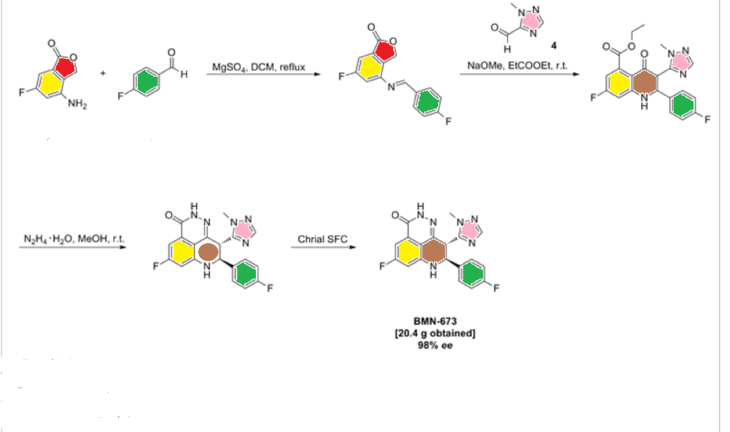
Talazoparib (BMN-673) is an investigational drug that acts as a PARP inhibitor. It is in clinical trials for various cancers.
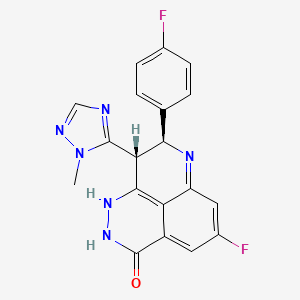
Talazoparib.png

Medivation, under license from BioMarin Pharmaceuticals, following its acquisition of LEAD Therapeutics, is developing a PARP-1/2 inhibitor, talazoparib, for treating cancer, particularly BRCA-mutated breast cancer. In February 2016, talazoparib was reported to be in phase 3 clinical development

Talazoparib, also known as BMN-673, is an orally bioavailable inhibitor of the nuclear enzyme poly(ADP-ribose) polymerase (PARP) with potential antineoplastic activity (PARP1 IC50 = 0.57 nmol/L). BMN-673 selectively binds to PARP and prevents PARP-mediated DNA repair of single strand DNA breaks via the base-excision repair pathway. This enhances the accumulation of DNA strand breaks, promotes genomic instability and eventually leads to apoptosis. PARP catalyzes post-translational ADP-ribosylation of nuclear proteins that signal and recruit other proteins to repair damaged DNA and is activated by single-strand DNA breaks. BMN-673 has been proven to be highly active in mouse models of human cancer and also appears to be more selectively cytotoxic with a longer half-life and better bioavailability as compared to other compounds in development. Check for active clinical trials or closed clinical trials using this agent.

Talazoparib is C19H14F2N6O.

Talazoparib tosylate is C26H22F2N6O4S.[1]

Approvals and indications

None yet.

Mechanism of action

Main article: PARP inhibitor

Clinical trials

After trials for advanced hematological malignancies and for advanced or recurrent solid tumors.[2] it is now in phase 3 for metastatic germline BRCA mutated breast cancer.[3] Trial estimated to complete in June 2016.[4]

As of January 2016 it in 14 active clinical trials.[5]

WO2010017055,  WO2015069851, WO 2012054698, WO 2011130661, WO 2013028495, US 2014323725, WO 2011097602

PAPER


Discovery and Characterization of (8S,9R)-5-Fluoro-8-(4-fluorophenyl)-9-(1-methyl-1H-1,2,4-triazol-5-yl)-2,7,8,9-tetrahydro-3H-pyrido[4,3,2-de]phthalazin-3-one (BMN 673, Talazoparib), a Novel, Highly Potent, and Orally Efficacious Poly(ADP-ribose) Polymerase-1/2 Inhibitor, as an Anticancer Agent

BioMarin Pharmaceutical Inc., 105 Digital Drive, Novato, California 94949, United States
J. Med. Chem., 2016, 59 (1), pp 335–357
DOI: 10.1021/acs.jmedchem.5b01498
Publication Date (Web): December 10, 2015
Copyright © 2015 American Chemical Society
*Phone: 1-415-506-3319. E-mail: bwang@bmrn.com.

Abstract

Abstract Image

We discovered and developed a novel series of tetrahydropyridophthlazinones as poly(ADP-ribose) polymerase (PARP) 1 and 2 inhibitors. Lead optimization led to the identification of (8S,9R)-47 (talazoparib; BMN 673; (8S,9R)-5-fluoro-8-(4-fluorophenyl)-9-(1-methyl-1H-1,2,4-triazol-5-yl)-2,7,8,9-tetrahydro-3H-pyrido[4,3,2-de]phthalazin-3-one). The novel stereospecific dual chiral-center-embedded structure of this compound has enabled extensive and unique binding interactions with PARP1/2 proteins. (8S,9R)-47 demonstrates excellent potency, inhibiting PARP1 and PARP2 enzyme activity with Ki = 1.2 and 0.87 nM, respectively. It inhibits PARP-mediated PARylation in a whole-cell assay with an EC50 of 2.51 nM and prevents proliferation of cancer cells carrying mutant BRCA1/2, with EC50 = 0.3 nM (MX-1) and 5 nM (Capan-1), respectively. (8S,9R)-47 is orally available, displaying favorable pharmacokinetic (PK) properties and remarkable antitumor efficacy in the BRCA1 mutant MX-1 breast cancer xenograft model following oral administration as a single-agent or in combination with chemotherapy agents such as temozolomide and cisplatin. (8S,9R)-47 has completed phase 1 clinical trial and is currently being studied in phase 2 and 3 clinical trials for the treatment of locally advanced and/or metastatic breast cancer with germline BRCA1/2 deleterious mutations.

http://pubs.acs.org/doi/abs/10.1021/acs.jmedchem.5b01498

http://pubs.acs.org/doi/suppl/10.1021/acs.jmedchem.5b01498/suppl_file/jm5b01498_si_001.pdf

Preparation of (8S,9R)-5-Fluoro-8-(4-fluorophenyl)-9-(1-methyl-1H-1,2,4-triazol-5-yl)-2,7,8,9-tetrahydro-3H-pyrido[4,3,2-de]phthalazin-3-one Tosylate Salt ((8S,9R)-47 Tosylate Salt)

A suspension of (8S,9R)-47 (BMN 673) (400 mg, 1.05 mmol) in a mixture of acetone (27 mL) and THF (13 mL) was heated to reflux until the suspension became clear. TsOH (220 mg, 1.16 mmol) was then added to the solution. White solids started to precipitate out from the solution shortly after the addition of TsOH. After stirring at 25 °C for 30 min, the mixture was filtered to collect the white crystal solids, which were washed with a mixture of acetone (10 mL) and 1,4-dioxane (4 mL) and then dried under vacuum at 45 °C for 3 days. This afforded the product as a white crystalline solid (540 mg, yield 93%). 1H NMR (400 MHz, DMSO-d6) δ (ppm) 2.29 (s, 3H), 3.67 (s, 3H), 4.97–5.06 (m, 2H), 6.91–6.94 (dd, J1 = 2.0 Hz, J2 = 10.8 Hz, 1H), 7.06–7.19 (m, 5H), 7.19–7.51 (m, 4H), 7.74 (s, 1H), 7.87 (s, 1H), 10.32 (brs, 1H), 12.36 (s, 1H). LC-MS (ESI)m/z: 381 (M + H)+. Anal. Calcd for C19H14F2N6O·toluene sulfonic acid: C, 56.52; H, 4.01; N, 15.21. Found: C, 56.49; H, 3.94; N, 15.39.

(8S,9R)-5-Fluoro-8-(4-fluorophenyl)-9-(1-methyl-1H-1,2,4-triazol-5-yl)-2,7,8,9-tetrahydro-3H-pyrido[4,3,2-de]phthalazin-3-one (8S,9R)-47 or BMN 673 and (8R,9S)-5-Fluoro-8-(4-fluorophenyl)-9-(1-methyl-1H-1,2,4-triazol-5-yl)-2,7,8,9-tetrahydro-3H-pyrido[4,3,2-de]phthalazin-3-one (8R,9S)-47

Compound 47 was dissolved in DMF, and chiral resolution was performed using supercritical-fluid chromatography (SFC) with a CHIRALPAK IA chiral column and methanol (20% with 0.1% DEA) and CO2 (80%) as the eluents. Yield 90%. For (8S,9R)-47 (BMN 673): retention time 8.8 min and ee 99.3%. For (8R,9S)-47: retention time 10.2 min and ee 99.2%.
Alternatively, compound (8S,9R)-47 could also be made using (2S,3R)-60a as a starting material and employing the same procedure described for the conversion of 60a to 47.
The optical rotation for both (8S,9R)-47 and (8R,9S)-47 was measured using a RUDOLPH (AUTOPOL V) automatic polarimeter at a concentration of 6.67 mg/mL in MeOH/MeCN/DMF = 0.5:0.5:1 at 20 °C. The specific rotation for (8S,9R)-47 was +92.2°, whereas it was −93.4° for (8R,9S)-47.

PATENT

WO-2016019125

WO2016019125

The compound (85,9R)-5-fluoro-8-(4-fluorophenyl)-9-(l-methyl-lH-l,2,4-triazol-5-yl)-8,9-dihydro-2H-pyrido[4,3,2-de]phthalazin-3(7H)-one toluenesulfonate salt (Compound (A))

Compound (A)

is an inhibitor of poly(ADP-ribose)polymerase (PARP). Methods of making it are described in WO2010017055, WO2011097602, and WO2012054698. However, the disclosed synthetic routes require chiral chromatography of one of the synthetic intermediates in the route to make Compound (A), methyl 7-fluoro-2-(4-fluorophenyl)-3-(l -methyl- lH-1, 2,4-triazol-5-yl)-4-oxo- 1 ,2,3,4-tetrahydroquinoline-5-carboxylate (Intermediate (A)),

Intermediate (A)

to yield the chirally pure (2S,35)-methyl 7-fluoro-2-(4-fluorophenyl)-3-(l-methyl-lH- 1,2,4-triazol-5-yl)-4-oxo-l,2,3,4-tetrahydroquinoline-5-carboxylate (Compound (1))

Compound (1).

Using conventional chiral chromatography is often solvent and time intensive.

Use of more efficient chromatography methods, such as simulated moving bed (SMB) chromatography still requires the use of expensive chiral chromatography resins, and is not practical on a large scale to purify pharmaceutical compounds. Also, maintaining

Compound (1) in solution for an extended time period during chromatography can lead to epimerization at the 9-position and cleavage of the methyl ester group in Compound (1). Replacing the chromatography step with crystallization step(s) to purify Compound (1) is desirable and overcomes these issues. Therefore, it is desirable to find an alternative to the use of chiral chromatography separations to obtain enantiomeric Compound (1).

Scheme 1 below describes use of Ac49 as a coformer acid for the preparation of Compound (la) and for the chiral resolution of Compound (1).

Scheme 1

Compound (1 )

Example 2 – Preparation of Compound (1) Using Scheme 1

Step la

Intermediate (A) (5 g, 12.5 mmol) was dissolved in 9: 1 v/v MIBK/ethanol (70 mL, 14 vol.) at 50 °C with stirring and dissolution was observed in less than about 5 minutes. [(lS)-en<io]-(+)-3-bromo-10-camphor sulfonic acid monohydrate (4.1 g, 12.5 mmol) was added and dissolution was observed in about 10-20 minutes. Seeding was then performed with Compound (la) (95% e.e., 5 mg, 0.1% w.) and the system was allowed to equilibrate for about 1 hour at 50 °C, was cooled to about 20 °C at 0.15 °C/min, and then equilibrated at 20 °C for 2 hours. The solid phase was isolated by filtration, washed with ethanol, and dried at about 50 °C and 3 mbar for about 2 to 3 hours to yield Compound (la) as a 0.6 molar equiv. EtOH solvate and 0.6 molar equiv. hydrate (93.4% e.e.).

Step lb

Compound (la) was then suspended in MIBK/ethanol 95/5% by volume (38 mL, 10 vol.) at 50 °C with stirring. After about 2 hours at 50 °C, the suspension was cooled to about 5 °C for 10 to 15 hours. The solid phase was recovered by filtration and dried at about 50 °C and 3 mbar for about 3 hours. Compound (la) (97.4% e.e.) was recovered. Step 2

000138] Compound (1) was released by suspending Compound (la) (3.9 g, 5.5 mmoi), without performing the optional reslurrying in Step 1, in 20 mL of water at room temperature and treating with 5M sodium hydroxide in water (1.3 mL, 1.2 mol). The mixture was kept at room temperature for about 15 hours and the solid was isolated by filtration and dried at 50 °C and 3 mbar for about 3 hours. Compound (1) was recovered (94.4% e.e.).

Example 3 – Large Scale Preparation of Compound (1) Using Scheme 1

The procedure of Example 1 was followed using 3.3 kg of Intermediate (A) and the respective solvent ratios to provide 95.7% e.e. in Step la; 99.2% e.e. in Step lb; and 99.2% e.e. in Step 2.

Example 4 – Alternative Preparation of Compound (1) Using Scheme 1

Step la

Intermediate (A) (751 mg, 1.86 mmol)) was dissolved in 9: 1 v/v

MIBK/ethanol (7.5 mL, 10 vol.) at 50 °C with stirring. [(15)-eni o]-(+)-3-bromo-10-camphor sulfonic acid monohydrate (620 mg, 1.88 mmol, 1 equiv.) was added. Formation of a precipitate was observed at about 1 hour at 50 °C. The system was then cooled to about 5 °C at 0.1 °C/min, and then equilibrated at 5 °C for about 60 hours. The solid phase was isolated by filtration and dried at about 50 °C and 3 mbar for about 2 hours to yield

Compound (la)(92% e.e.). See Figures 1-4 for XRPD (Figure 1), chiral HPLC (Figure 2), Ή NMR (Figure 3), and TGA/DSC analyses (Figure 4). The XRPD pattern from the material in Example 3 is similar to that in Example 1 with some slight shifts in the positions of specific diffraction peaks (highlighted by black arrows in Figure l). The ‘H NIVIR was consistent with a mono-salt of Compound (la) containing 0.5 molar equivalent of EtOH and 0.6% by weight residual MIBK. The TGA analysis showed a stepwise mass loss of 3.5% between 25 and 90 °C (potentially representing loss of the 0.5 molar equivalent of EtOH) and a gradual mass loss of 1.2% between 90 and 160 °C (potentially representing the loss of adsorbed water). The DSC analysis had a broad endotherm between 25 and 90 °C

representing desolvation and an endotherm at 135 °C representing melt/degradation.

Step lb

Compound (la) (100.3 mg, 0.141 mmol) was re-suspended in 95:5 v/v MIBK EtOH (1 mL, 10 vol.) at 50 °C and stirred for 1 hour before cooling to 5 °C at

0.1 °C/min. The solid (99.4% e.e.) was recovered by filtration after 1 night at 5 °C. Shifts in the XRPD diffraction peaks were no longer detected (Figure 5; compare Figure 1). Figure 6 shows the chiral HPLC for Compound (la).

Step 2

Compound (la) (100.2 mg, 0.141 mmol) from Step la was suspended in water (2 mL, 20 vol.) at 50 °C and 5 M NaOH in water (34 μL·, 1.2 molar equiv) was added. The resulting suspension was kept at 50 °C for one night, cooled to room temperature

(uncontrolled cooling) and filtered to yield Compound (1) (92% e.e.). The chiral purity was not impacted by this step and no [(15)-enJo]-(+)-3-bromo-10-camphor sulfonic acid was detected by NMR. Figure 7 compares the XRPD of Compound (1) in Step 2 with

Intermediate (A), the starting material of Step 1. Figure 8 shows the NMR of Compound (1) in Step 2 with Intermediate (A), the starting material of Step 1.

Example 5 – Alternative Preparation of Compound (1) Using Scheme 1 Step la

000144] Intermediate (A) (1 equiv.) was added with stirring to a solution of MIBK (12-13 vol), ethanol (1-1.5 vol), and water (0.05-0.10 vol) and the reaction was heated within 15 minutes to an internal temperature of about 48 °C to about 52 °C . [(lS)-endo]-(+)-3-bromo- 10-camphor sulfonic acid (1 equiv) was added and the reaction was stirred for about 5-10 mins at an internal temperature of about 48 °C to about 52 °C until dissolution occurred. Seed crystals of Compound (la) were added and the reaction was allowed to proceed for 1 hour at an internal temperature of about 48 °C to about 52 °C. The reaction was cooled at a rate of 0.15 °C /min to about 19-21 °C. The suspension was stirred for 2 hours at an internal temperature of about 19 °C to 21 °C and then was collected by filtration and washed twice with ethanol. The product was characterized by 1H NMR and 13C NMR (Figures 13a and 13b), IR Spectrum (Figure 14), DSC (Figure 15), and chiral HPLC (Figure 16).

Step 2a

To Compound (la) (1 equiv.) was added acetone (1.1 vol), IPA (0.55 vol), and methanol (0.55 vol) and the reaction was heated to an internal temperature of about 38 °C to 42 °C. Aqueous ammonia (25%) (1.3 equiv) was added and the reaction was stirred for about 10 minutes. The pH of the reaction was confirmed and the next step performed if > 7. Water was added (0.55 vol), the reaction was cooled to an internal temperature of about 35 °C, seed crystals of Compound (1) were added, and the reaction was stirred for about 10 mins. Water was added (3.3 vol) dropwise within about 30 minutes, the suspension was cooled within 30 minutes to an internal temperature of about 0 °C to 5 °C, and the reaction was stirred for 15 minutes. The solid was collected by filtration and washed three times with water.

Step 2b

To the product of Step 2a) was added acetone (4 vol), ΓΡΑ (1 vol), and methanol (1 vol) and the reaction was heated to an internal temperature of about 38 °C to 42 °C resulting in a clear solution. Water (2 vol) and seed crystals of Compound (1) were added and the system was stirred for about 15 minutes at an internal temperature of about 35 °C. Water (342 mL) was added dropwise in about 30 minutes. The suspension was then cooled in 30 min to an internal temperature of about 0 °C to 5 °C and was stirred for an additional 15 minutes. The solid was collected by filtration, washed twice with water, and chiral purity was determined. If > 99% e.e., then the solid was dried at an internal temperature of about 60 °C under reduced pressure to yield Compound (1). The product was characterized by Ή NMR (Figure 19), 13C NMR (Figure 20), IR (Figure 21), DSC (Figure 22), chiral HPLC (Figure 23).

Scheme 2 below describes use of Acl 10 as a coformer acid for the preparation of Compound (lb) and the chiral resolution of Compound (1).

Intermediate (A)

Compound (1 b)

Intermediate (A)

Compound (1 b)

Compound (1 )

Example 6 – Preparation of Compound (1) Using Scheme 2

Step la

Intermediate (A) (102 mg, 0.256 mmol) was dissolved in MIBK (1 mL, 10 vol.) at 65 °C with stirring. (lS)-phenylethanesulfonic acid, prepared using procedures known to one of skill in the art, in MIBK (3.8 M, 80 μί, 1 molar equiv.) was added and a suspension was observed after 30 minutes at 65 °C. The system was kept at 65 °C for another 30 minutes before cooling to 5 °C at 0.1 C/min. After one night at 5 °C, the solid was filtered, dried at 50 °C, 3 mbar pressure for about 2 hours to yield Compound (lb). See Figures 9-12 for XRPD (Figure 9), chiral HPLC (Figure 10), Ή NMR (Figure 11), and TGA/DSC analyses (Figures 12a and 12b). The XRPD diffraction pattern of the solid obtained in Example 5 differed from the XRPD pattern obtained with the solid from in the salt screen of Example 1 and was consistent with the production of different solids in Examples 1 and 5. The Ή NMR was consistent with the mono-salt with a 0.3% by weight residue of dioxane. In Figure 12a, the thermal behavior was consistent with a non-solvated form exhibiting a melt/degradation at 201 °C. Figure 12b compares the melt pattern of Compound (lb) in Example 5 with Compound (lb) in Example 1.

Steps lb and 2 can be carried out using procedures similar to those used in Examples 2-5.

Example 7 – Polymorphism of Compound (la)

Compound (1) (92% e.e., 10 mg, mmol) was placed in 1.5 mL vials and the solvents (1 mL or less) of Table 3 were added at 50 °C until dissolution was achieved. [(1S)-eni o]-(+)-3-bromo-10-camphorsulfonic acid was added as a solid at 50 °C. The samples were kept at 50 °C for about 1 hour prior to being cooled to room temperature overnight

(uncontrolled cooling rate). Clear solutions were successively cooled to 4 °C, -20 °C and evaporated at room temperature. Any gum obtained after evaporation was re-suspended in diethyl ether. The solid phases generated were characterized by XRPD and if relevant, by Ή NMR and TGA/DSC.

Table 3. Compound (la) Polymorphism Conditions

C.S. means clear solution and Susp. means suspension. “A” means the XRPD diffraction pattern was new but similar to that for Ac49 in

Example 1. “B” means the XRPD diffraction pattern was the same as that for Ac49 in Example 1. “M.E.” means molar equiv.

Page 38 of 64

NAI- 1500460480V I

Each of the seven solvents in which solvates were observed (heterosolvates not included) were mixed with MIBK (90% vol). Solutions of Intermediate (A) were prepared in the solvent mixtures (10 vol) at 50 C and [(15)-en<io]-(+)-3-bromo-10-camphor sulfonic acid (1 molar equivalent) was added. The resulting clear solutions were cooled to 5 °C at 0.2 C/min. Surprisingly, no crystallization was reported in any sample. Seeding was performed with a few crystals of each solvate at about 25 °C. The solid phases were analyzed by XRPD and the liquid phases were analyzed by chiral HPLC. See Table 4 for a summary of the results (where “Dias 2” is the (2R, 3R) diastereomer of Compound (la)) .

Table 4. Compound (la) Solvate Analysis

As seen in Table 4 above, the ethanol/MIBK system yielded 93% pure Compound (la) which demonstrates that Compound (la) does crystallize in a very pure form as an ethanolate solvate.

Other objects, features and advantages of the compounds, methods and compositions described herein will become apparent from the following description. It should be understood, however, that the description and the specific examples, while indicating specific embodiments, are given by way of illustration only, since various changes and modifications within the spirit and scope of the present description will become apparent from this detailed description.

All publications including patents, patent applications and published patent applications cited herein are hereby incorporated by reference for all purposes.

PATENT

US 2011196153

http://www.google.co.ve/patents/US20110237581


STR1.jpg

Patent

US 2011237581

PATENTSTR1.jpg

PATENT

http://www.google.com/patents/WO2015069851A1?cl=en

SYNTHETIC EXAMPLES

Example 1

\ ,

(1 a) (2) (3) (la) (5)

To a flask was added N-methyl-l,2,4-triazole (la)(249.3 g, 3.0 mol, 1 equiv.),

2-methyl-THF (1020 mL, about 1 :4 m/v), and DMF (2)(230.2 g, 3.15 mol, 1.05 equiv.), in any order. The solution was cooled to an internal temperature of about -5 to 0 °C. To the flask was added LiHMDS (3) as a 20% solution in 2-methyl-THF (3012 g, 3.6 mol, 1.2 equiv.) dropwise within about 60 minutes. During the addition of the LiHMDS (3), the desired Compound (la) was precipitated as the 2-methyl-THF solvate, and the flask was cooled to about -30 °C. The reaction was stirred for about 30 minutes at an internal temperature of about -5 to 0 °C.

The precipitated crystals were removed from the reaction mixture by filtration and washed with 2-methyl-THF. The product, Compound (la) as the 2-methyl-THF solvate, was dried under vacuum at an internal temperature of about 60 °C (about 72.5% as measured by NMR) to yield Compound (la).

Example 2

As shown in Example 2, the Compounds of Formula I are useful in the synthesis of more complex compounds. See General Scheme 1 for a description of how the first step can be accomplished. Compounds of Formula I can be reacted with compound (6) to yield Compounds of Formula II. In Example 2, Compound (la) can be reacted with

Compound (6) to yield Compound (7). The remaining steps are accomplished using procedures known to one of ordinary skill in the art, for example, as disclosed in

WO2010017055 and WO2011097602 to yield Compound (12).


PATENT

US 2014323725/http://www.google.com/patents/WO2011097602A1

5-fluoro-8-(4-fluorophenyl)-9-(l-methyl-lH-l,2,4-triazol-5-yl)-8,9- dihydro-2H-pyrido[4,3,2-Je]phthalazin-3(7H)-one, as shown in formula (1), and its enantiomer compounds, as shown in formulas (la) and (lb):

Example 1

(Z)-6-Fluoro-3-(( 1 -methyl- IH- 1 ,2,4-triazol-5 -yl)methylene)-4-nitroisobenzofuran- 1 (3H)-one (3)

[0053] To a 80 L jacketed glass reactor equipped with a chiller, mechanical stirrer, thermocouple, and nitrogen inlet/outlet, at 15 – 25 °C, anhydrous 2-methyl-tetrahydrofuran (22.7 kg), 6-fluoro-4- nitroisobenzofuran-l(3H)-one (2) (2.4 kg, 12.2 mol, 1.00 eq.), and 2-methyl-2H-l,2,4-triazole-3- carbaldehyde (49.6 – 52.6 % concentration in dichloromethane by GC, 3.59 – 3.38 kg, 16.0 mol, 1.31 eq.) were charged consecutively. Triethylamine (1.50 kg, 14.8 mol, 1.21 eq.) was then charged into the above reaction mixture. The reaction mixture was stirred for another 10 minutes. Acetic anhydride (9.09 – 9.10 kg, 89.0 – 89.1 mol, 7.30 eq.) was charged into the above reaction mixture at room temperature for 20 – 30 minutes. The reaction mixture was heated from ambient to reflux temperatures (85 – 95 °C) for 80 – 90 minutes, and the mixture was refluxed for another 70 – 90 minutes. The reaction mixture was monitored by HPLC, indicating compound (2) was reduced to < 5 %. The resulting slurry was cooled down to 5 – 15 °C for 150 – 250 minutes. The slurry was aged at 5 – 15 °C for another 80 – 90 minutes. The slurry was filtered, and the wet cake was washed with ethyl acetate (2L x 3). The wet cake was dried under vacuum at 40 – 50 °C for 8 hours to give 2.65 – 2.76 kg of (Z)-6-fluoro-3-((l -methyl-lH-l ,2,4-triazol-3- yl)methylene)-4-nitroisobenzofuran-l(3H)-one (3) as a yellow solid (2.66 kg, yield: 75.3 %, purity: 98.6 – 98.8 % by HPLC). LC-MS (ESI) m/z: 291 (M+l)+. Ή-ΝΜΡ (400 MHz, DMSO-d6) δ (ppm): 3.94 (s, 3H), 7.15 (s, 1H), 8.10 (s, 1H), 8.40-8.42 (dd, Jx = 6.4 Hz, J2 = 2.4 Hz, 1H), 8.58-8.61 (dd, Jx = 8.8 Hz, J2 = 2.4 Hz, 1H).

Example 2

Methyl 5- enzoate (4)

Example 2A

[0054] (¾-6-Fluoro-3-((l-methyl-lH-l,2,4-taazol-3-yl)m (3) (177 g, 0.6 mol, 1.0 eq.), and HC1 (2 N in methanol, 3 L, 6 mol, 10 eq.) were charged into a 5 L 3-neck flask equipped with mechanical stirrer, thermometer, and nitrogen inlet/outlet. The reaction mixture was stirred at room temperature for 25 hours. The reaction mixture was monitored by HPLC, indicating 0.8 % compound (3) remained. The reaction mixture was concentrated under vacuum at 40 °C to dryness, and methyl 5-fluoro-2-(2-(l -methyl- lH-l,2,4-triazole-3-yl)acetyl)-3-nitrobenzoate hydrochloride (4) was obtained as a yellow solid (201 g, yield: 93.4 %). It was used for the next step without further purification. LC-MS (ESI) m/z: 323 (M+l)+ ¾-NMR (400 MHz, DMSO-J6) δ (ppm): 3.89 (s, 3H), 3.92 (s, 3H), 4.60 (s, 2H), 7.85 (s, 1H), 8.25-8.28 (dd, Jx = 8.4 Hz, J2 = 2.8 Hz, 2H), 8.52-8.54 (dd, Jx = 8.4 Hz, J2 = 2.8 Hz, 2H).

Example 2B

An alternative workup procedure to that illustrated in Example 2A follows. Instead of evaporating the reaction mixture to dryness, it was condensed to 2 volumes, followed by solvent exchange with 12 volumes of THF, and then 12 volumes of heptane. The slurry mixture was concentrated to 2 volumes and filtered to give the product. As such, 1.8 kilograms of (Z)-6-fluoro-3-((l-methyl-lH-l,2,4-triazol-3- yl)methylene)-4-nitroisobenzofuran-l(3H)-one (3) gave 2.15 kilograms (yield 96.4 %) of the product methyl 5-fluoro-2-(2-(l -methyl- lH-l,2,4-triazole-3-yl)acetyl)-3-nitrobenzoate hydrochloride (4).

Example 3

Methyl 7-fluoro-2-(4-fluorophenyl)-3-(l-methyl-lH-l,2,4-triazol-5-yl)-4-oxo-l,2,3,4- tetrahydroquinoline-5 -carboxylate (5)

Example 3A

To a suspension of methyl 5-fluoro-2-(2-(l-methyl-lH-l,2,4-triazol-5-yl)acetyl)-3-nitrobenzoate (4) (5 g, 15.5 mmol, leq.) and 4-fluorobenzaldehyde (3.6 g, 29 mmol, 1.87 eq.) in a mixture of solvents tetrahydrofuran (30 mL) and MeOH (5 mL) was added titanium(III) chloride (20 % w/w solution in 2N Hydrochloric acid) (80 mL, 6 eq.) dropwise with stirring at room temperature. The reaction mixture was allowed to stir at 30~50°C for 2 hours. The mixture was then diluted with water (160 mL), and the resulting solution was extracted with ethyl acetate (100 mL x 4). The combined organic layers were washed with saturated NaHC03 (50 mL x 3) and aqueous NaHS03 (100 mL x 3), dried by Na2S04, and concentrated to dryness. This afforded a crude solid, which was washed with petroleum ether (120 mL) to obtain the title compound as a yellow solid (5.9 g, yield: 95 %, purity: 97 %). LC-MS (ESI) m/z: 399 (M+l)+. ^-NMR (400 MHz, CDCla) δ (ppm): 3.58 (s, 3H), 3.87 (s, 3H), 4.16-4.19 (d, J2=13.2 Hz, 1H), 4.88 (s, 1H), 5.37-5.40 (d, J2=13.2 Hz, 1H), 6.47-6.53 (m, 2H) , 6.97-7.01 (m, 2H), 7.37-7.41 (m, 2H), 7.80 (s, 1H).

Example 3B

An alternative workup procedure to that illustrated in Example 3A follows. After the completion of the reaction, the mixture was extracted with isopropyl acetate (20 volumes x 4) without water dilution. The product was isolated by solvent exchange of isopropyl acetate with heptanes followed by re-slurry with MTBE and filtration. As such, 3 kilograms of methyl 5-fluoro-2-(2-(l-methyl-lH-l,2,4-triazol-5- yl)acetyl)-3-nitrobenzoate (4) afforded 2.822 kilograms of the title compound (5) (yield 81 %).

Example 3C

To a stirred solution of methyl 5-fluoro-2-(2-(l-methyl-lH-l,2,4-triazol-5-yl)acetyl)-3- nitrobenzoate (4) (580 mg, 2 mmol) and 4-fluorobenzaldehyde (488 mg, 4 mmol) in methanol (0.75 mL) and tetrahydrofuran (4.5 mL) was added concentrated HC1 solution (w/w 37 %, 6 mL), then reductive powdered Fe (672 mg, 12 mmol) was added slowly to the reaction system. After the addition was complete, the resulting mixture was heated to 60 °C and kept at this temperature for 3 hours. After the disappearance of the starting material (4) as monitored by LC-MS, the reaction mixture was partitioned between ethyl acetate (30 mL) and water (30 mL) and the aqueous phase was extracted with ethyl acetate (20 mL x 3). The combined organic phase was dried with Na2S04, concentrated in vacuo and purified by column chromatography (ethyl acetate: petroleum ether = 1 : 1) to give the title compound (5) as a pale yellow solid (300 mg, yield 40 %). LC-MS (ESI) m/z: 399 (M+l)+. LH-NMR (400 MHz, CDC13) δ (ppm): 3.58 (s, 3H), 3.87 (s, 3H), 4.17 (d, 1H), 4.87 (s, 1H), 5.38 (d, 1H), 6.50 (dd, 2H), 6.99 (dd, 2H), 7.38 (dd, 2H), 7.80 (s, 1H).

Example 3D

To a stirred solution of methyl 5-fluoro-2-(2-(l-methyl-lH-l,2,4-triazol-5-yl)acetyl)-3- nitrobenzoate (4) (580 mg, 2 mmol) and 4-fluorobenzaldehyde (488 mg, 4 mmol) in methanol (0.75 mL) and tetrahydrofuran (4.5 mL) was added SnCl2 (2.28 g, 12 mmol) and concentrated HC1 (w/w 37 %, 6 mL), the resulting mixture was reacted at 45 °C for 3 hours, until LC-MS indicating the disappearance of the starting material (4) and about 50 % formation of the product. The mixture was then partitioned between ethyl acetate (30 mL) and water (30 mL) and the aqueous phase was extracted with ethyl acetate (20 mL x 3). The combined organic phase was dried with Na2S04, concentrated in vacuo and purified by column chromatography (ethyl acetate: petroleum ether = 1 : 1) to give the title compound (5) as a pale yellow solid (10 mg, yield 1.3 %). LC-MS (ESI) m/z: 399 (M+l)+. LH-NMR (400 MHz, CDC13) δ (ppm): 3.58 (s, 3H), 3.87 (s, 3H), 4.17 (d, 1H), 4.87 (s, 1H), 5.38 (d, 1H), 6.50 (dd, 2H), 6.99 (dd, 2H), 7.38 (dd, 2H), 7.80 (s, 1H).

Example 3E

A solution of methyl 5-fluoro-2-(2-(l-methyl-lH-l,2,4-triazol-5-yl)acetyl)-3-nitrobenzoate (4) (580 mg, 2 mmol) and 4-fluorobenzaldehyde (488 mg, 4 mmol) in methanol (20 mL) and acetic acid (1 mL) was stirred at room temperature for 24 hours under hydrogen (1 barr) in the presence of a catalytic amount of 10 % Pd/C (212 mg, 0.2 mmol). After the reaction was complete, the catalyst was removed by filtration through a pad of Celite, the solvent was removed in vacuo, and the residue was purified by column chromatography (ethyl acetate: petroleum ether = 1 : 1) to give the title compound (5) as a pale yellow solid (63 mg, yield 8 %). LC-MS (ESI) m/z: 399 (M+l)+ . 1HNMR (400 MHz, DMSO-d6) δ (ppm): 3.56 (s, 3H), 3.86 (s, 3H), 7.02 (dd, 2H), 7.21 (dd, 2H), 7.90 (s, 1H), 8.08 (s, 1H), 8.26 (dd, 1H), 8.56 (dd, 1H).

Example 4

5-Fluoro-8-(4-fluorophenyl)-9-(l-methyl-lH-l,2,4-triazol-5-yl)-8,9-dihydro-2H-pyrido[4,3,2-

 Methyl 7-fluoro-2-(4-fluorophenyl)-3-(l -methyl-lH-l ,2,4-triazol-5-yl)-4-oxo-l,2,3,4- tetrahydroquinoline-5-carboxylate (5) (150 g, 0.38 mol, 1.0 eq.) and methanol (1.7 L) were charged into a 3 L 3-neck flask equipped with a mechanical stirrer, thermometer, and nitrogen inlet/outlet. The resulted suspension was stirred at room temperature for 15 minutes. Hydrazine hydrate (85 % of purity, 78.1 g, 1.33 mol, 3.5 eq.) was charged dropwise into the above reaction mixture within 30 minutes at ambient temperature. The reaction mixture was stirred at room temperature overnight. The reaction was monitored by HPLC, showing about 2 % of compound (5) left. The obtained slurry was filtered. The wet cake was suspended in methanol (2 L) and stirred at room temperature for 3 hours. The above slurry was filtered, and the wet cake was washed with methanol (0.5 L). The wet cake was then dried in vacuum at 45 – 55 °C for 12 hours. This afforded the title compound as a pale yellow solid (112 g, yield: 78.1 %, purity: 95.98 % by HPLC). LC-MS (ESI) m/z: 381 (M+l)+. ^-NMR (400 MHz, DMSO-J6) δ (ppm): 3.66 (s, 3H), 4.97-5.04 (m, 2H), 6.91-6.94 (dd, Jx = 2.4, J2 = 11.2 Hz, 1H), 7.06-7.09 (dd, Jx = 2.4, J2 = 8.8 Hz, 1H), 7.14-7.18 (m, 3H), 7.47-7.51 (m, 2H), 7.72 (s, 1H), 7.80 (s, 1H), 12.35 (s, 1H).

Example 5

5 -Amino-7-flu in- 1 (2H)-one

To a solution of 6-fluoro-3-((l-methyl-lH-l,2,4-triazol-3-yl)methylene)-4-nitroiso-benzofuran- l(3H)-one (3) (4.0 g, 135 mmol) in THF (100 mL) was added hydrazine monohydrate (85 %) (6 mL) at room temperature under nitrogen atmosphere. The mixture was stirred for 2 hours, then acetic acid (6 mL) was added and the mixture was heated to and kept at 60 °C for 18 hours. The resulting mixture was diluted with water (100 mL) and extracted with ethyl acetate (100 mL x 3). The organic layer was dried over anhydrous Na2S04 and evaporated to dryness to afford the title compound as a yellow solid (1.6 g, yield 42 %). LC-MS (ESI) m/z: 275(M+1)+.

Example 6

(£’)-7-fluoro-5-(4-fluorobenzylideneamino)-4-((l -methyl- IH- 1 ,2,4-triazol-5-yl)methyl)phthalazin- 1 (2H)- one

(7)

To a suspended of 5-amino-7-fluoro-4-((l-methyl-lH-l,2,4-triazol-3-yl)methyl) phthalazin- l(2H)-one (7) (1.6 g, 5.8 mmol) in acetonitrile (50 mL) was added 4-fluorobenzaldehyde (2.2 g, 17.5 mmol). The mixture was stirred under reflux under nitrogen for 48 hours. The precipitate was filtered and washed with a mixture of solvents (ethyl acetate/hexane, 1 :1, 10 mL). After drying in vacuum, it afforded the title compound as a yellow solid (1.2 g, yield 52 %). LC-MS (ESI) m/z: 381(M+1)+.

Example 7

5-Fluoro-8 4-fluorophenyl)-9 l-methyl H-l,2,4-triazol-5-yl)-8,9-dihydro-2H^yrido[4,3,2-

(8) (1 )

To a suspension of (£’)-7-fluoro-5-(4-fluorobenzylideneamino)-4-((l-methyl-lH-l,2,4-triazol-5- yl)methyl)phthalazin-l(2H)-one (8) (2.0 g, 5.3 mmol) in THF (80 mL) was added cesium carbonate (3.4 g, 10.6 mmol). The reaction mixture was stirred at 55 °C for 4 hours and cooled down to room temperature. The mixture was diluted with water (50 ml) and extracted with ethyl acetate (50 mL x 3). The combined organic layers were dried over anhydrous Na2S04 and evaporated to dryness to afford the title compound as a white solid (1.6 g, yield 80 %). LC-MS (ESI) m/z: 381(M+1)+. ^-NMR (400 MHz, DMSO- ) δ (ppm): 3.66 (s, 3H), 4.97-5.04 (m, 2H), 6.91-6.94 (dd, Jx = 2.4, J2 = 11.2 Hz, 1H), 7.06-7.09 (dd, Ji = 2.4, J2 = 8.8 Hz, 1H), 7.14-7.18 (m, 3H), 7.47-7.51 (m, 2H), 7.72 (s, 1H), 7.80 (s, 1H), 12.35 (s, 1H).

Example 8

(£)-Methyl 5-fluoro-2-(3-(4-fluorophenyl)-2-(l-methyl-lH-l,2,4-triazol-5-yl)acryloyl)-3-nitrobenzoate

(9)

To a stirred solution of methyl 5-fluoro-2-(2-(l-methyl-lH-l,2,4-triazol-5-yl)acetyl)-3- nitrobenzoate (4) (580mg, 2 mmol) and 4-fluorobenzaldehyde (488 mg, 4 mmol) in dimethylsulfoxide (2 mL) was added L-proline (230 mg, 2 mmol). The resulting mixture was kept with stirring at 45 °C for 48 hours. The reaction system was then partitioned between ethyl acetate (50 mL) and water (30 mL), and the organic phase was washed with water (20 mL x 3), dried with Na2S04, concentrated in vacuo, and purified by column chromatography (ethyl acetate: petroleum ether = 1 :3) to give the title compound (9) as a pale yellow foam (340 mg, yield 40 %). LC-MS (ESI) m/z: 429 (M+l)+. ^-NMR (400 MHz, DMSO-dg); δ (ppm): 3.56 (s, 3H), 3.86 (s, 3H), 7.02 (dd, 2H), 7.21 (dd, 2H), 7.90 (s, IH), 8.08 (s, IH), 8.26 (dd, IH), 8.56 (dd, IH).

Example 9

Methyl 7-fluoro-2-(4-fluorophenyl)- 1 -hydroxy-3-( 1 -methyl- IH- 1 ,2,4-triazol-5-yl)-4-oxo- 1 ,2,3,4- tetrahydroquinoline-5 -carboxylate (10)

To a solution of (£)-Methyl 5-fluoro-2-(3-(4-fluorophenyl)-2-(l-methyl-lH-l,2,4-triazol-5- yl)acryloyl)-3-nitrobenzoate (9) (200 mg, 0.467 mmol) in methanol (20 mL) was added 10 % Pd/C (24 mg). After the addition, the mixture was stirred under H2 (1 atm) at room temperature for 0.5 h. The reaction system was then filtered and evaporated under reduced pressure. The residue was purified by chromatography (ethyl acetate: petroleum ether = 1 :1) to give the title compound (10) (110 mg, yield 57 %) as an off-white foam. LC-MS (ESI) m/z: 415 (M+H)+. ¾-NMR (400 MHz, DMSO-d6) δ (ppm): 3.53 (s, 3H), 3.73 (s, 3H), 5.08 (d, 2H), 5.27 (d, 2H), 6.95 (dd, IH), 7.08 (dd, 2H), 7.15 (dd, IH), 7.42 (dd, 2H), 7.77 (s, IH), 9.92 (s, IH). Example 10

Methyl 7-fluoro-2-(4-fluorophenyl)-3-(l-methyl-lH-l,2,4-triazol-5-yl)-4-oxo-l,2,3,4-

(10) (5)

To a stirred solution of methyl 7-fluoro-2-(4-fluorophenyl)-l-hydroxy-3-(l-methyl-lH-l,2,4- triazol-5-yl)-4-oxo-l, 2,3, 4-tetrahydroquinoline-5 -carboxylate (10) (41.4 mg, 0.1 mmol) in methanol (5 mL) was added concentrated HCl solution (w/w 37 %, 1 mL) and reductive powdered Fe (56 mg, 1 mmol). The reaction mixture was refluxed for 3 hours. After the disappearance of compound (10) as monitored by LC-MS, the reaction system was partitioned between ethyl acetate (20 mL) and water (20 mL) and then the aqueous phase was extracted with ethyl acetate (10 mL x 3). The combined organic phase was dried with Na2S04, concentrated in vacuo and purified by column chromatography (ethyl acetate: petroleum ether = 1 :1) to give the title compound (5) as a pale yellow solid (12 mg, yield 30 %). LC-MS (ESI) m/z: 399 (M+l)+. ¾-NMR (400 MHz, CDC13) δ (ppm): 3.58 (s, 3H), 3.87 (s, 3H), 4.17 (d, 1H), 4.87 (s, 1H), 5.38 (d, 1H), 6.50 (dd, 2H), 6.99 (dd, 2H), 7.38 (dd, 2H), 7.80 (s, 1H).

Example 11

Methyl 7-fluoro-2-(4-fluorophenyl)-3-(l-methyl-lH-l,2,4-triazol-5-yl)-4-oxo-l,2,3,4-

To a solution of (£)-Methyl 5-fluoro-2-(3-(4-fluorophenyl)-2-(l-methyl-lH-l,2,4-triazol-5- yl)acryloyl)-3-nitrobenzoate (9) (214 mg, 0.5 mmol) in methanol (5 mL) was added concentrated HCl solution (w/w 37 %, 1 mL), then reductive Fe powder (140 mg, 2.5 mmol) was added slowly to the reaction system. After the addition was complete the resulting mixture was refluxed for 24 hours. The reaction mixture was then filtered, concentrated, neutralized with saturated NaHC03 (20 mL), and extracted with ethyl acetate (10 mL x 3). The residue was purified by chromatography (ethyl acetate: petroleum ether = 1 : 1) to give the title compound (5) (30 mg, yield 15 %) as an off-white foam. LC-MS (ESI) m/z: 399 (M+H)+. ^-NMR (400 MHz, DMSO-d6) δ (ppm): 3.56 (s, 3H), 3.86 (s, 3H), 7.02 (dd, 2H), 7.21 (dd, 2H), 7.90 (s, 1H), 8.08 (s, 1H), 8.26 (dd, 1H), 8.56 (dd, 1H).

Example 12

(8R,9S)-5-fluoro-8-(4-fluorophenyl)-9-(l-me

Je]phthalazin-3(7H)-one (la) and (8S,9R)-5-fluoro-8-(4-fluorophenyl)-9-(l-methyl-lH-l,2,4-triazol-5-

(1) (la) (lb)

A chiral resolution of 5-fluoro-8-(4-fluorophenyl)-9-(l-methyl-lH-l,2,4-triazol-5-yl)-8,9- dihydro-2H-pyrido[4,3,2-Je]phthalazin-3(7H)-one (1) (52.5 g) was carried out on a super-fluid chromatography (SFC) unit using a CHIRALPAK IA column and C02/methanol/diethylamine

(80/30/0.1) as a mobile phase. This afforded two enantiomers with retention times of 7.9 minute (23.6 g, recovery 90 %, > 98 % ee) and 9.5 minute (20.4 g, recovery 78 %, > 98 % ee) as analyzed with a CHIRALPAK IA 0.46 cm x 15 cm column and C02/methanol/diethylamine (80/30/0.1) as a mobile phase at a flow rate of 2 g/minute.

Example 13

(2R,3R)-methyl 7-fluoro-2-(4-fluorophenyl)-3-(l-methyl-lH-l,2,4-triazol-5-yl)-4-oxo-l,2,3,4- tetrahydroquinoline-5-carboxylate (6a) and (2S,3S)-methyl 7-fluoro-2-(4-fluorophenyl)-3-(l-methyl-lH-

(5) (6a) (6b)

Example 13A

The chiral resolution of compound (5) was carried out on a SFC unit with a CHIRALPAK®IC 3 cm (I.D.) x 25 cm, 5 μηι column, using C02/MeOH (80/20) as a mobile phase at a flow rate of 65 g/ minute while maintaining the column temperature at 35 °C and with a detection UV wavelength of 254 nm. As such, a racemate of compound (5) (5 g) in methanol solution was resolved, which resulted in two enantiomers with a retention times of 2.35 minute (2.2 g, 88 % recovery, >98 % ee) and 4.25 minute (2.3 g, 92 % recovery, >98 % ee), respectively when analyzed using CHIRALPAK®IC 0.46 cm x 15 cm column and CO2/MeOH(80/20) as a mobile phase at a flow rate of 2 mL/ minute.

Example 13B

The chiral resolution of compound (5) was carried out on a SFC unit with a CHIRALPAK®IC 5cm (I.D.) x 25 cm, 5 μηι column, using C02/MeOH (75/25) as a mobile phase at a flow rate of 200 mL/ minute while maintaining the column temperature at 40 °C and with a detection UV wavelength of 255 nm. As such, a racemate of compound (5) (1.25 kg) in methanol solution was resolved, which resulted in two enantiomers in about 83 % yield and 97.4 % purity.

Example 13C

Alternatively, the separation can also be achieved on a Simulated Moving Bed (SMB) unit with a CHIRALPAK®IC column and acetonitrile as a mobile phase. The retention times for the two enantiomers are 3.3 and 4.1 minutes, respectively. In certain embodiments, the productivity can be greater than 6 kg Feed/day/kg CSP.

Example 14

(8R,9S)-5-fluoro-8 4-fluorophenyl)-9<l-me

Je]phthalazin-3(7H)-one (la) and (8S,9R)-5-fluoro-8-(4-fluorophenyl)-9-(l-methyl-lH-l,2,4-triazol-5- (lb)

Example 14A

To a solution of (2R,3R)-methyl 7-fluoro-2-(4-fluorophenyl)-3-(l-methyl-lH-l,2,4-triazol-5-yl)- 4-oxo-l,2,3,4-tetrahydroquinoline-5-carboxylate (6a) or (2S,3S)-methyl 7-fluoro-2-(4-fluorophenyl)-3-(l- methyl-lH-l,2,4-triazol-5-yl)-4-oxo-l,2,3,4-tetrahydroquinoline-5-carboxylate (6b) (400 mg, 1.0 mmol) in ethanol (8.0 mL) was added hydrazine monohydrate (85 %, 2.0 mL), and the solution stirred at room temperature for 2 hours. The resulting solution was then concentrated to a volume of 2 mL and filtered, and the resultant cake washed with ethanol (1 mL). After drying in vacuum at 50°C, this afforded the title compound as a white solid (209 mg, yield 55 %). LC-MS (ESI) m/z: 381(M+1)+. ^-NMR (400 MHz, DMSO-dg): δ (ppm): 3.681 (s, 3H), 4.99-5.06 (m, 2H), 6.92-6.96 (m, 1H), 7.08-7.11 (m, 1H), 7.16-7.21 (t, J= 8.8 Hz, 2H), 7.49-7.53 (m, 2H), 7.75 (s, 1H), 7.83 (s, 1H), 12.35 (s, 1H).

Example 14B

To a solution of (2R,3R)-methyl 7-fluoro-2-(4-fluorophenyl)-3-(l-methyl-lH-l,2,4-triazol-5-yl)- 4-oxo-l,2,3,4-tetrahydroquinoline-5-carboxylate (6a) or (2S,3S)-methyl 7-fluoro-2-(4-fluorophenyl)-3-(l- methyl-lH-l,2,4-triazol-5-yl)-4-oxo-l,2,3,4-tetrahydroquinoline-5-carboxylate (6b) (446 g) in acetonitrile (10 volume) was added hydrazine monohydrate (2.9 eq.), and the solution stirred at room temperature for 2 hours. The resulting solution was then concentrated to a volume of 2 mL and filtered. The crude product was re-slurried with water (3~5 volumes) at 15-16 °C. After drying in vacuum at 50 °C, this affords the title compound as a white solid (329 g, yield 77%, 99.93% purity). LC-MS (ESI) m/z:

381(M+1)+; ¾-NMR (400 MHz, DMSO-d6) δ (ppm): 3.681 (s, 3H), 4.99-5.06 (m, 2H), 6.92-6.96 (m, 1H), 7.08-7.11 (m, 1H), 7.16-7.21 (t, J= 8.8 Hz, 2H), 7.49-7.53 (m, 2H), 7.75 (s, 1H), 7.83 (s, 1H), 12.35 (s, 1H).

Talazoparib (BMN-673) is an orally available poly ADP ribose polymerase (PARP) inhibitor currently in development by Pfizer for the treatment of advanced breast cancer patients with germline BRCA mutations.[1] Talazoparib is similar to the first in class PARP inhibitor, olaparib.[2][3] However, talazoparib is thought to be more potent than olaparib.[3]

Mechanism of action

Talazoparib acts as an inhibitor of poly ADP ribose polymerase(PARP) which aids in single strand DNA repair. Cells that have BRCA1/2mutations are susceptible to the cytotoxic effects of PARP inhibitors because of an accumulation of DNA damage.[1] Talazoparib is theorized to have a higher potency than olaparib due to the additional mechanism of action called PARP trapping. PARP trapping is the mechanism of action where the PARP molecule is trapped on the DNA, which interferes with the cells ability to replicate. Talazoparib is found to be ~100 fold more efficient in PARP trapping than olaparib.[4] However, this increased potency may not translate directly to clinical effectiveness as many other factors must be considered.[3][4]

Commercialization

Talazoparib was originally developed by BioMarin Pharmaceutical Inc. However, Medivation Inc. acquired all worldwide rights to talazoparib in August 2015 to expand their global oncology franchise.[5] Medivation acquired talazoparib for $410 million with additional payments of up to $160 million in royalties and milestones. Under this agreement, Medivation assumed all financial responsibilities for the continued development, regulatory, and commercialization of talazoparib.[5][6]

Clinical trials

As of January 2016, talazoparib is in 14 active clinical trials [7] including a new arm of I-SPY 2.[8] These trials cover a variety of cancers types and combination therapies. The most notable clinical trials are the ABRAZO and EMBRACA studies.

ABRAZO

ABRAZO is a phase II study for the safety and efficacy of treatment of BRCA breast cancer patients with Talazoparib monotherapy. This study is for patients who have failed at least two prior chemotherapy treatments for metastatic breast cancer or been previously treated with a platinum regimen.[6][9][10] The original target enrollment for the study was 70 patients but Biomarin expanded the trial to 140 patients.[9][10] The estimated completion date is December 2016.[10]

EMBRACA

EMBRACA is a phase III study for the treatment of BRCA breast cancer patients with Talazoparib.[11][12][13] This trial is an open-label, randomized, parallel, 2-arm, multi-center comparison of talazaporib against physician’s preference for the treatment of patients with locally advanced or metastatic breast cancer. Patients must also have received prior chemotherapy regimens for metastatic breast cancer.[12][13] Patients participating in this study are randomly selected for either talazoparib or physician’s choice of chemotherapy at a 2:1 ratio to talazoparib.[6] The target enrollment for the study was 430 patients [12][13] and the estimated completion date is June 2017.[13]

References

  1. Jump up to:a b Medivation Inc. “Talazoparib”.
  2. Jump up^ FDA (19 December 2014). “FDA approves Lynparza to treat advanced ovarian cancer”FDA News Release.
  3. Jump up to:a b c Jessica Brown, Stan Kaye, Timothy Yap (29 March 2016). “PARP inhibitors: the race is on”British Journal of Cancer114: 713–5. doi:10.1038/bjc.2016.67PMC 4984871Freely accessiblePMID 27022824.
  4. Jump up to:a b Yuqiao Shen, Mika Aoyagi-Scharber, Bing Wang (June 2015). “Trapping Poly(ADP-Ribose) Polymerase”Journal of Pharmacology and Experimental Therapeutics.
  5. Jump up to:a b Biomarin (24 August 2015). “Medivation to Expand Global Oncology Franchise With the Acquisition of All Worldwide Rights to Talazoparib (BMN 673), a Potent PARP Inhibitor, From BioMarin”.
  6. Jump up to:a b c Silus Inman (25 August 2015). “Medivation Acquires BioMarin’s PARP Inhibitor Talazoparib”.
  7. Jump up^ BMN 673 trials registered
  8. Jump up^ I-SPY 2 TRIAL: Neoadjuvant and Personalized Adaptive Novel Agents to Treat Breast Cancer (I-SPY 2)
  9. Jump up to:a b “BioMarin Provides Program Update for Talazoparib in Metastatic Breast Cancer”. 20 July 2015.
  10. Jump up to:a b c “A Phase 2, 2-Stage, 2-Cohort Study of Talazoparib (BMN 673), in Locally Advanced and/or Metastatic Breast Cancer Patients With BRCA Mutation (ABRAZO Study)”ClinicalTrials.gov.
  11. Jump up^ “EMBRACA CLINICAL STUDY IS NOW ENROLLING”.
  12. Jump up to:a b c “A Study Evaluating Talazoparib (BMN 673), a PARP Inhibitor, in Advanced and/or Metastatic Breast Cancer Patients With BRCA Mutation (EMBRACA Study)”ClinicalTrials.gov.
  13. Jump up to:a b c d “BioMarin Initiates Phase 3 BMN 673 Trial for Metastatic gBRCA Breast Cancer”Benzinga.

External links

nmr……http://www.medkoo.com/uploads/product/Talazoparib__BMN-673_/qc/BMN673-QC-BBC20130523-Web.pdf

Patent                       Submitted                        Granted

PROCESSES OF SYNTHESIZING DIHYDROPYRIDOPHTHALAZINONE DERIVATIVES [US2014323725]2014-06-022014-10-30

CRYSTALLINE (8S,9R)-5-FLUORO-8-(4-FLUOROPHENYL)-9-(1-METHYL-1H-1,2,4-TRIAZOL-5-YL)-8,9-DIHYDRO-2H-PYRIDO[4,3,2-DE]PHTHALAZIN-3(7H)-ONE TOSYLATE SALT [US2014228369]2014-04-142014-08-14

Crystalline (8S,9R)-5-fluoro-8-(4-fluorophenyl)-9-(1-methyl-1H-1,2,4-triazol-5-yl)-8,9-dihydro-2H-pyrido[4,3,2-de]phthalazin-3(7H)-one tosylate salt [US8735392]2011-10-202014-05-27

DIHYDROPYRIDOPHTHALAZINONE INHIBITORS OF POLY(ADP-RIBOSE)POLYMERASE (PARP) [US8012976]2010-02-112011-09-06

DIHYDROPYRIDOPHTHALAZINONE INHIBITORS OF POLY(ADP-RIBOSE)POLYMERASE (PARP) FOR USE IN TREATMENT OF DISEASES ASSOCIATED WITH A PTEN DEFICIENCY [US2014066429]2013-08-212014-03-06

METHODS AND COMPOSITIONS FOR TREATMENT OF CANCER AND AUTOIMMUNE DISEASE [US2013184342]2013-03-132013-07-18

WO2012054698A1 Oct 20, 2011 Apr 26, 2012 Biomarin Pharmaceutical Inc. Crystalline (8s,9r)-5-fluoro-8-(4-fluorophenyl)-9-(1-methyl-1h-1,2,4-triazol-5-yl)-8,9-dihydro-2h-pyrido[4,3,2-de]phthalazin-3(7h)-one tosylate salt
WO2015069851A1 Nov 6, 2014 May 14, 2015 Biomarin Pharmaceutical Inc. Triazole intermediates useful in the synthesis of protected n-alkyltriazolecarbaldehydes
US8420650 Mar 31, 2011 Apr 16, 2013 Biomarin Pharmaceutical Inc. Dihydropyridophthalazinone inhibitors of poly(ADP-ribose)polymerase (PARP)
US8541403 Feb 3, 2011 Sep 24, 2013 Biomarin Pharmaceutical Inc. Dihydropyridophthalazinone inhibitors of poly(ADP-ribose)polymerase (PARP) for use in treatment of diseases associated with a PTEN deficiency
US8735392 Oct 20, 2011 May 27, 2014 Biomarin Pharmaceutical Inc. Crystalline (8S,9R)-5-fluoro-8-(4-fluorophenyl)-9-(1-methyl-1H-1,2,4-triazol-5-yl)-8,9-dihydro-2H-pyrido[4,3,2-de]phthalazin-3(7H)-one tosylate salt
US8765945 Feb 8, 2011 Jul 1, 2014 Biomarin Pharmaceutical Inc. Processes of synthesizing dihydropyridophthalazinone derivatives
US8999987 Mar 6, 2013 Apr 7, 2015 Biomarin Pharmaceutical Inc. Dihydropyridophthalazinone inhibitors of poly(ADP-ribose)polymerase (PARP)
US9018201 Aug 21, 2013 Apr 28, 2015 Biomarin Pharmaceuticial Inc. Dihydropyridophthalazinone inhibitors of poly(ADP-ribose)polymerase (PARP) for use in treatment of diseases associated with a PTEN deficiency

SEE………..http://orgspectroscopyint.blogspot.in/2016/02/talazoparib.html

http://apisynthesisint.blogspot.in/2016/02/talazoparib.html


Talazoparib
Talazoparib.svg
Systematic (IUPAC) name
(8S,9R)-5-Fluoro-8-(4-fluorophenyl)-9-(1-methyl-1H-1,2,4-triazol-5-yl)-2,7,8,9-tetrahydro-3H-pyrido[4,3,2-de]phthalazin-3-one
Clinical data
Legal status
  • Investigational
Chemical data
Formula C19H14F2N6O
Molar mass 380.35 g/mol


Talazoparib
Talazoparib.svg
Legal status
Legal status
  • Investigational
Identifiers
ChemSpider
UNII
KEGG
ChEMBL
Chemical and physical data
Formula C19H14F2N6O
Molar mass 380.35 g/mol
3D model (JSmol)

/////////////BMN 673, talazoparib, phase 3, BMN673, BMN673, BMN-673, LT673, LT 673, LT-673, Poly ADP ribose polymerase 2 inhibitor, Poly ADP ribose polymerase 1 inhibitor, cancer, MDV-3800 , MDV 3800

Cn1c(ncn1)[C@H]2c3c4c(cc(cc4N[C@@H]2c5ccc(cc5)F)F)c(=O)[nH]n3

O=C1NN=C2C3=C1C=C(F)C=C3N[C@H](C4=CC=C(F)C=C4)[C@H]2C5=NC=NN5C

WO 2016018024, DAPAGLIFLOZIN, HANMI FINE CHEMICAL CO., LTD, NEW PATENT


Dapagliflozin structure.svg


(S) – propylene glycol and water, 1: 1 crystalline complex


PATENT

WO2016018024, CRYSTALLINE COMPOSITE COMPRISING DAPAGLIFLOZIN AND METHOD FOR PREPARING SAME

HANMI FINE CHEMICAL CO., LTD. [KR/KR]; 59, Gyeongje-ro, Siheung-si, Gyeonggi-do 429-848 (KR)

KIM, Ki Lim; (KR).
PARK, Chulhyun; (KR).
LEE, Jaeheon; (KR).
CHANG, Young-kil; (KR)

The present invention relates to a crystalline composite comprising dapagliflozin and a method for preparing the same. More specifically, the present invention provides a novel crystalline composite comprising dapagliflozin, which is an SGLT2 inhibitor, and a preparing method capable of economically preparing the novel crystalline composite at high purity.

long period of time, there is a problem with secretion of insulin in diabetes is a problem with the function of insulin, or the two compounds problems of the disease that is to say maintaining a high blood sugar. Insulin helps the one that sends glucose into cells in order to replace the nutrients such as glucose that is in a hormone secreted by the beta cells of the pancreas blood into energy. However, if there is insufficient action of insulin, glucose accumulates in the blood does not enter the cell and cause the muscles and blood sugar, sugar in the urine is out. When these two long-standing high blood sugar will cause a number of microvascular complications. Not cut due to such complications, such as may result in blindness.


Worldwide diabetes has become one of the major causes of death in adults, an increasing number of diabetes patients may sharply with the increase of obesity population.


In diabetic patients SGLT2 (Sodium-Glucose linked transporter 2) selective inhibition of significant gastrointestinal side effects without increasing the emissions of glucose in the urine, thereby improving insulin sensitivity and delay the onset of diabetes complications by the normalization of plasma glucose can be there.


Bristol-to US Patent No. 6,515,117 of Myers Squibb Company of formula It discloses a binary) to dapa glyphs.


[Formula 1]


While preparing the material of Formula 1 in the above patent, the desired compound was obtained as an oil form, here was added to the chloroform under vacuum to reprocess getting the desired compound as a solid in a viscous that contains ethyl acetate. Compounds of the formula I obtained by the above method of production must be carried out the purification using a column, etc. because it can not remove the impurities of the desired compound, which is not suitable as an industrial method.
In addition, Bristol-to the US Patent 7,919,598 of Myers Squibb Company No. discloses a compound of formula 2.


[Formula 2]
Compounds of Formula 2 are the compounds of formula 1, (S) – propylene glycol and water, 1: 1 crystalline complex: 1. The compound of Formula 2 can be conveniently used in medicine to use by crystallizing the compound of formula 1 with low crystallinity and are also useful in the purification of the compounds of formula (I).


However, the compound of formula 2 is (S), the price is very expensive – and the use of propylene glycol, which results in increasing the production cost. This is very disadvantageous In the eyes of people with diabetes need to take the long-term.


In addition, European Patent No. 2597090 of Sandoz is disclosed of the formula monohydrate. Of the formula monohydrate is then stirred as a compound of the sugar alcohol and the formula of the glycol, glycerol, arabitol, xylitol, etc. in water obtained the seed (seed), by using this discloses a method for preparing the monohydrate in water, and have.


However, the European patent is described that the hydrate should be obtained stirred for three days at low temperature in order to obtain after obtaining the actual seed crystals, although not yield is mentioned is expected to be very low. For this reason, because of the situation in the research and development of novel crystalline complexes THE dapa glyphs are continually required.


Best Mode for Carrying out the Invention

Hereinafter, the present invention will be described in detail.
Crystalline complex according to the invention is for lowering the production cost by obtaining a product of high purity without the need for further purification, it has the structure of formula (3).
[Formula 3]

The crystalline complex is in the X- ray diffraction pattern of 9.7, 17.3, 20.0, 20.4, and may comprise a characteristic peak at a 2θ of 21.4 ± 0.2 °, preferably 9.7, 11.1, 13.7, 17.3, 18.7, 20.0, 20.4, 21.4, 27.5, 33.9, 36.2, 40.4 and 43.9 ± 0.2 °, and can include a peak at 2θ of teukjeongjik, it may be most preferably having a powder X-ray diffraction pattern is shown in Fig.
It was confirmed that the heat-absorption peak appears at about 163 ℃, to refer to the thermal analysis by; (DSC differential scanning calorimetr) The crystalline complex is differential scanning calorimetry of FIG.
The crystalline complex is the measured moisture content in accordance with the Karl-Fischer method can be 2-5%, preferably be 2.1 ~ 3.5%.
In addition, the present invention includes a mixture of 1), mannitol and the solvent to prepare a mannitol solution; 2) preparing an alcohol solution by mixing the alcohol with the glyph dapa gin; 3) mixing the mannitol solution and the alcohol solution, heating to 50 ~ 100 ℃; And 4) cooling the heated solution to 0 ~ 15 ℃ provides a method for preparing the crystalline complex comprising the steps of obtaining a composite having a crystalline structure of Formula 3.
It describes a method for producing crystalline complex according to the present invention;
Step 1: Mannitol solution prepared
Step 1 of the manufacturing method according to the present invention is a step in which a mixture of mannitol and a solvent to prepare a mannitol solution.
The mannitol is suitable for the manufacture of a therapeutic agent for diabetes to be taking a long period of time as a material that is widely used like medicine, food, with high stability and low price. Furthermore, mannitol is used in reducing the edema by osmotic action, and thus the material to promote diuresis. This is mannitol is determined to be helpful to the action Qin dapa glyphs used as SGLT-2 inhibitors.
The mannitol is typically so long that can be purchased and / or synthesis is not particularly limited, preferably the D- mannitol, L- and D · mannitol may include one or more of the group consisting of L- mannitol , and it can be most preferably D- Magny-tolyl.
The solvent as long as it can dissolve the mannitol is not particularly limited, and may preferably be water.
The Mani mixing ratio of the toll and the solvent. If the amount that can be dissolve the mannitol, the solvent is not particularly restricted, the preferably mannitol and solvent 1: 8-20 weight ratio or 1: 1 may be mixed with 10 to 15 weight .
Step 2: Preparation of an alcohol solution
Step 2 of the manufacturing method according to the invention by mixing the alcohol with Jean dapa glyph is a step for preparing the alcoholic solution.
In the glyph binary dapa may be prepared by the method described in commercially available, and arc carried US Patent 6,515,117 example G.
The alcohol is long as it can dissolve the THE dapa glyph is not particularly limited, preferably the C 1 ~ C 4 alcohol may comprise at least one of (a lower alcohol), and most preferably ethanol .
The dapa If the mixing ratio of the pictures and alcohol as a glyph is content that can be dissolved in THE dapa glyph to alcohol is not particularly limited, preferably the gin alcohol dapa glyphs 1: 3-8 or 1: a volume ratio of 6-7 It may be mixed.
Step 3: heat-up phase
Step 3 of the manufacturing method according to the present invention is a step in which the mani mixing and heating the solution and the alcohol solution toll.
The step is a process for producing a crystalline complex containing THE dapa glyphs included in mannitol as an alcohol solution that is included in the mannitol solution, the mixing ratio of the mixed solution and the alcohol solution is mannitol and the pro pageul a binary 1: 0.5-2 or 1: it is preferable to mix in 1.0 to 1.5 molar ratio.
The heating may preferably be carried out at 50 ~ 100 70 ~ 90 ℃ or ℃.
Step 4: obtained crystalline complexes
Step 4 according to the present invention is by cooling the heated solution to obtain a crystalline complex having the structure of Formula 3.
The cooling is preferably at 0 ~ 15 ℃ ℃ or 3 ℃ ~ 12 ℃.
Further, according to the embodiment of the present invention, in order to improve the speed of determining the crystalline complex to be obtained, the cooling after seeding may further include a (seeding) and further comprising cooling. The further cooling can preferably be carried out at 0 ~ 15 ℃ ℃ or 3 ℃ ~ 12 ℃ for 5 to 24 hours, or 7 ~ 15 hours.
The production method of the present invention as described above, dapa glyphs to binary and mannitol for the crystalline complex has the advantage that can be produced in more than 99.0% pure without further purification, including, of high purity at a low manufacturing cost crystalline It has the advantage of producing the composite.

Mode for the Invention

Hereinafter the present invention will be described in more detail by examples. However, these examples are for the purpose of illustrating the invention by way of example, but the scope of the present invention is limited to these Examples.
Example 1. Preparation of the crystalline complex
The D- mannitol 0.98g (5.4mmol) was dissolved in purified water to prepare a mannitol 12㎖. On the other hand, amorphous THE dapa glyphs (purity:> 94%, U.S. Patent No. 6,515,117 prepared by the method described in of Example G) was dissolved in 2g (4.9mmol) in ethanol to give the alcohol 13 ㎖ solution. After the mannitol solution at room temperature to give the mixed solution is added to the alcohol solution. The mixed solution was heated under reflux for 3 hours so that the 80 ℃. After the cooling the solution obtained through the reflux slowly to 10 ℃ for 2 hours and then added to camp in the dapa glyph to 4 wt% solution total weight compared to the seeding (seeding) for 12 hours at 200 rpm at 4 ℃ cooling and stirring was added. After Buchner funnel (Buchner funnel) and filtered with a filter paper 55 ㎜ and dried for 8 hours under nitrogen and 20 ℃ to obtain a crystalline complex 1.3g (45%).
Experimental Example 1. Structural analysis
Nuclear magnetic resonance spectrum (NMR) (400MHz FT-NMR Spectrometer (Varian, 400-MR)) of a crystalline complex obtained in Example 1 by using 1 yielded a H NMR spectrum, and the results, and in Fig. 1 It exhibited.
1 H NMR (400㎒, DMSO-d 6 ): δ 7.37-7.35 (d, 1H), 7.32-7.31 (d, 1H), 7.24-7.21 (dd, 1H), 7.10-7.08 (d, 2H), 6.83-6.81 (d, 2H), 4.97-4.95 (dd, 2H), 4.84-4.83 (d, 1H), 4.48-4.44 (t, 1H), 4.42-4.40 (d, 1H), 4.34-4.31 (t , 1H), 4.14-4.12 (d, 1H), 4.02-3.92 (m, 5H), 3.71-3.67 (m, 1H), 3.67-3.58 (m, 1H), 3.56-3.52 (t, 1H), 3.46 -3.35 (m, 3H), 3.28-3.07 (m, 4H), 1.31-1.27 (t, 3H)
The first through the results of 1 H NMR, and also, to the structure of a crystalline complex obtained in Example 1, it was confirmed that the formula (4).
[Formula 4]

Experimental Example 2. OK crystalline crystalline complexes
By performing an X-ray diffraction analysis and differential scanning calorimetry, it was confirmed that crystal form of the crystalline complex obtained in Example 1. More specifically, Diffraction Extensible Resource Descriptor (Brucker, USA) for use with X-ray diffraction (XRD) to perform, and differential scanning calorimetry (Differential scanning calorimeter; METTLER TOLEDO, Swiss) for use by differential scanning calorimetry (DSC) It was performed. Results of X-ray diffraction analysis results in Figure 1, the differential scanning calorimetry are shown in Fig.
Results of X-ray diffraction analysis, the crystalline complex according to an embodiment of the present invention exhibited a characteristic peak at 9.7, 11.1, 13.7, 17.3, 18.7, 20.0, 20.4, 21.4, 27.5, 33.9, 36.2, 40.4 and 2θ of 43.9 ° .
Experimental Example 3. HPLC analysis
To a crystalline complex obtained in Example 1 under the conditions of Table 1 and Table 2 it was carried out to HPLC (high performance liquid chromatography) analysis.

TABLE 1

column Ascentis Express RP-Amide 4.6mm × 150mm (diameter × height), 2.7㎛ (Aldrich)
The mobile phase A: Formic acid 1mL/1000mL in H 2 OB: Formic acid 1mL/1000mL in Acetonitrile (ACN)
Test Solution Acetonitrile Test specimen 5mg / 10mL in 50% (ACN)
Column temperature 25 ℃
Wavelength detector UV, 220nm
Dose 3 ㎕
Flow rate 0.7 mL / min
Operating hours 40 min

Table 2

Gradient systems
Time (min) Mobile phase A (%) Mobile phase B (%)
0 75 25
0-25 35 65
25-26 30 70
26-29 30 70
29-35 75 25
35-40 75 25
As described above, the results of the HPLC analysis, the crystalline complex of Example 1, it was confirmed that the purity of 99% or more. In addition, the crystalline complex of Example 1, it was confirmed that the water content measured by Karl-Fischer method of 2.9%.

Claims

To a crystalline complex comprising a dapa THE glyph having the structure of formula 3: [Formula 3]

According to claim 1, wherein said crystalline complex is in the X- ray diffraction pattern of 9.7, 11.1, 13.7, 17.3, 18.7, 20.0, 20.4, 21.4, 27.5, 33.9, 36.2, 40.4, and the characteristic peaks at 2θ of 43.9 ± 0.2 ° containing crystalline complexes.

According to claim 1, wherein said crystalline complex is the measured moisture content in accordance with the Karl-Fischer method which is characterized in that 2 to 5%, the crystalline complex.
1) preparing a mannitol solution by mixing mannitol (mannitol) and the solvent 2) a mixture of binary (dapagliflozin) and alcohol in dapa glyph for preparing an alcohol solution; 3) wherein the mannitol solution and the alcohol mixing the solution and heated to 50 ~ 100 ℃; And 4) the production method to cool the heated solution to 0 ~ 15 ℃ comprising the step of obtaining a polycrystalline composite having a structure of formula (3), a crystalline complex: [Formula 3]
[Claim 5]
According to claim 4, wherein the solvent is the production of water, the crystalline complex.
According to claim 4, wherein the alcohol is a C 1 ~ C 4, a method of producing a crystalline complex comprising at least one kind of alcohol.
According to claim 6, wherein the alcohol is ethanol, the method of the crystalline complex prepared.

According to claim 4, wherein the mixing ratio by the spirit and mannitol dapa glyph is 1: 0.5 to 2 mole ratio, the method of producing a crystalline complex.


FIGURES

Figure 1 illustrates a X- ray diffraction spectrum of the crystalline complex in accordance with an embodiment of the present invention.
2 is a result of the differential scanning calorimetry of the crystalline complexes (DSC) in accordance with an embodiment of the present invention.
3 is of the crystalline complex in accordance with an embodiment of the present invention 1 shows the H-NMR measurement results.
[Figure 1]

[Figure 2]

[Figure 3]


CEO, YOUNG KIL CHANG

/////////WO 2016018024, DAPAGLIFLOZIN, HANMI FINE CHEMICAL CO., LTD, New patent

WO 2016015596, Omarigliptin, Sunshine Lake Pharma Co Ltd, New patent


(WO2016015596) PROCESS FOR PREPARING 2, 3-DISUBSTITUTED-5-OXOPYRAN COMPOUND

SUNSHINE LAKE PHARMA CO., LTD. [CN/CN]; Northern Industrial Area, Songshan Lake Dongguan, Guangdong 523000 (CN)

SUN, Guodong; (CN).
LIU, Yongjun; (CN).
WEI, Mingjie; (CN).
LAI, Cailang; (CN).
LI, Dasheng; (CN).
ZHANG, Shouhua; (CN).
WANG, Zhongqing; (CN)

A 2, 3-disubstituted 5-oxopyran compound of formula (04) :
in which Ar is phenyl optionally substituted with R4, R4 is F, Cl, C1-C6 alkyl unsubstituted or substituted with fluorine, or C1-C6 alkoxy unsubstituted or substituted with fluorine; each of R1 and R2 is independently hydrogen, or an amino-protecting group; is useful in the synthesis of Omarigliptin or other compounds, is an important intermediate.
US Patent No. 7902376 and PCT Publication WO2007097931 disclose methods to prepare compounds of formula (04) , but both of the methods disclosed are complex to operate and need a special catalyst. So it is necess ary to explore an easy process.


Example 1:
tert-butyl ( (2R, 3S) -2- (2, 5-difluorophenyl) -5- (iodomethylene) tetrahydrofuran-3-yl) carbamate

To a mixture of methanol (42 mL) and tert-butyl ( (1R, 2S) -1- (2, 5-difluorophenyl) -1-hydroxypent-4-yn -2-yl) carbamate (7.0 g) cooled to-5℃ was added a solution of KOH (3.2 g) in methanol (28 mL) dropwise. After dropwise addition, the resulting mixture was stirred for 30 minutes, then iodine (5.7 g) was added to the mixture. The reaction mixture was stirred at 0 ℃ for 10 minutes, followed by 25 ℃ for 6 hours, and then quenched with water (140 mL) . Then the mixture was stirred at 25 ℃ for 2 hours. The precipitate was collected by filtration and washed sequentially with methanol/water (40 mL, v: v=1: 1) . The resulting solid was dried at 45 ℃ in vacuo to give the title compound as awhite solid (8.8 g, purity: 95.0%)

The compound was characterized by the following spectroscopic data: LC-MS (ESI, pos. ion) m/z : 460.2, [M+Na] +;
1H NMR (600 MHz, CDCl3) δ (ppm) : 7.09-6.90 (m, 3H) , 5.46 (s, 1H) , 4.92 (d, 1H) , 4.86 (d, 1H) , 4.36 (s, 1H) , 2.95 (ddd, 1H) , 2.62 (dd, 1H) , 1.43 (s, 9H) .
Example 2:
tert-butyl ( (2R, 3S) -5- (bromomethylene) -2- (2, 5-difluorophenyl) tetrahydrofuran- 3-yl) carbamate
To a mixture of methanol (150 mL) and sodium methoxide (13.0 g) cooled to -10 ℃ was added a solution of tert-butyl ( (1R, 2S) -1- (2, 5-difluorophenyl) -1-hydroxypent-4-yn-2-yl) carbamate (31.1 g) in methanol (200 mL) dropwise. After dropwise addition, N-bromosuccinimide (21.5 g) was added to the resulting mixture. The mixture was stirred at 0 ℃ for 10 minutes, followed by 25 ℃ for 6 hours, and then quenched with water (350 mL) and stirred for 30 minutes. The mixture was concentrated in vacuo until the precipitate appeared. After stirring at 25 ℃ for 30 minutes, the precipitate was collected by filtration and washed sequentially with methanol (80 mL) and water (80 mL) . The resulting solid was dried at 45 ℃ in vacuo to give the title compound as a white solid (35.4 g, purity: 92.8%) .
The compound was characterized by the following spectroscopic data: LC-MS (ESI, pos. ion) m/z: 414.0, [M+Na] +
1H NMR (600 MHz, CDCl3) δ (ppm) : 7.11 -6.87 (m, 3H) , 5.53-5.30 (m, 1H) , 5.13-5.06 (m, 1H) , 4.33 (s, 1H) , 2.95-2.86 (m, 1H) , 2.62-2.56 (m, 1H) , 1.43 (s, 9H) .
Example 3:
tert-butyl ( (2R, 3S) -5- (bromomethylene) -2- (2, 5-difluorophenyl) tetrahydrofuran-3-yl) carbamate


To a mixture of water (42 mL) , methanol (100 mL) and KOH (15.0 g) cooled to -10 ℃ was added a solution of tert-butyl ( (1R, 2S) -1- (2, 5-difluorophenyl) -1-hydroxypent-4-yn-2-yl) carbamate (41.6 g) in methanol (550 mL) dropwise. After dropwise addition, dibromohydantoin (23.1 g) was added to the resulting mixture. The reaction mixture was stirred at 0 ℃ for 30 minutes, followed with a temperature from 20 ℃ to 25 ℃ for 8 hours, and then quenched with water (650 mL) and stirred for 1.5 hours. The precipitate was collected by filtration and washed sequentially with methanol/water (400 mL, v: v=1: 1) . The resulting solid was dried at 50 ℃ in vacuo to give the title compound as a white solid (46.5 g) .
The compound was characterized by the following spectroscopic data: LC-MS (ESI, pos. ion) m/z: 414.0, [M+Na] +.
Example 4:
tert-butyl ( (1R, 2S) -1- (2, 5-difluorophenyl) -1-hydroxy-5-iodo-4-oxopentan-2-yl) carbamate


A solution of sodium hydrogen sulfate monohydrate (2.2 g) and tert-butyl ( (2R, 3S) -2- (2, 5-difluorophenyl) -5- (iodomethylene) tetrahydrofuran-3-yl) carbamate (7.2 g) in THF/water (35 mL/7 mL) was stirred at a temperature from 28 ℃ to 33 ℃ for 12 hours. Then the organic phase of the reaction mixture was separated and concentrated in vacuo at 40 ℃ to remove THF. Isopropyl acetate (35 mL) and water (28 mL) was added to the residue and the resulting mixture was stirred for 10 minutes. The seperated organic phase was concentrated in vacuo to give the title compound as brown oil (8.6 g) , which could be used for the next step without purification.
The compound was characterized by the following spectroscopic data: LC-MS (ESI, pos. ion) m/z: 477.8, [M+Na] +, 381.8, [M-BuO] + .
Example 5:
tert-butyl ( (1R, 2S) -5-bromo-1- (2, 5-difluorophenyl) -1-hydroxy-4-oxopentan-2-yl) carbamate
A solution of sodium hydrogen sulfate monohydrate (6.9 g) and tert-butyl ( (2R, 3S) -5- (bromomethylene) -2- (2, 5-difluorophenyl) tetrahydrofuran-3-yl) carbamate (39.0 g) in THF/water (200 mL/40 mL) was stirred at 60 ℃ for 10 hours to complete the reaction. Then the organic phase of the reaction mixture was separated and concentrated in vacuo to remove THF. The residue was diluted with isopropyl acetate (200 mL) and water (120 mL) , and stirred to dissolve. The organic phase was seperated and concentrated in vacuo to give the title compound as brown oil (43.5 g) , which was used for the next step without purification.
The compound was characterized by the following spectroscopic data: LC-MS (ESI, pos. ion) m/z: 336.1, [M-BuO] +.
Example 6:
tert-butyl ( (2R, 3S) -2- (2, 5-difluorophenyl) -5-oxotetrahydro-2H-pyran-3-yl) carbamate
To the brown oil (8.6 g) obtained from Example 4 were added THF (40 mL) and K2CO3 (2.6 g) . The reaction was stirred at 30 ℃ for 16 hours. Then the mixture was concentrated in vacuo to remove THF and the resulting residue was diluted with a mixture of ethyl acetate (40 mL) and water (20 mL) . The separated organic phase was concentrated in vacuo and the resulting residue was diluted with ethyl acetate (2.5 mL) , heated to 40 ℃ and stirred to dissolve. Then the mixture was cooled to 20 ℃ and n-heptane (7.5 mL) was added. After sitrring for 4 hours at 20 ℃, the precipitate was collected by filtration to give the title compound as a white solid (4.0 g) .
The compound was characterized by the following spectroscopic data: LC-MS (ESI, pos. ion) m/z: 350.0, [M+Na] +, 368.0, [M+K] +
1H NMR (600 MHz, CDCl3) δ (ppm) : 7.24 (m, 1H) , 7.04 (m, 2H) , 4.85 (s, 1H) , 4.68 (s, 1H) , 4.31 (dd, 1H) , 4.16-4.11 (m, 1H) , 4.11-4.04 (m, 1H) , 3.10-3.02 (m, 1H) , 2.75 (s, 1H) , 1.64 (s, 1H) , 1.37-1.25 (s, 9H) .
Example 7:
tert-butyl ( (2R, 3S) -2- (2, 5-difluorophenyl) -5-oxotetrahydro-2H-pyran-3-yl) carbamate
To the brown oil (43.5 g) obtained from Example 5 were added THF (500 mL) and K2CO3 (15.2 g) . The reaction was stirred at 35 ℃ for 16 hours. Then the organic phase was separated and concentrated in vacuo at 40 ℃ to remove THF and the resulting residue was diluted with a mixture of ethyl acetate (500 mL) and water (100 mL) . Then the separated organic phase was concentrated in vacuo and the resulting residue was diluted with ethyl acetate (13 mL) , heated to 40 ℃ and stirred to dissolve. Then the mixture was cooled to 20 ℃ and n-heptane (39 mL) was added. After sitrring for 4 hours at 20 ℃, the precipitate was collected by filtration to give the title compound as a white solid (23.9 g) .
The compound was characterized by the following spectroscopic data: LC-MS (ESI, pos. ion) m/z: 350.0.


//////////WO 2016015596, Omarigliptin,  Sunshine Lake Pharma Co Ltd, NEW PATENT

WOCKHARDT, WO 2016016766, ISAVUCONAZONIUM SULPHATE, NEW PATENT


(WO2016016766) A PROCESS FOR THE PREPARATION OF ISAVUCONAZONIUM OR ITS SALT THEREOF

WOCKHARDT LIMITED [IN/IN]; D-4, MIDC Area, Chikalthana, Aurangabad 431006 (IN)

KHUNT, Rupesh Chhaganbhai; (IN).
RAFEEQ, Mohammad; (IN).
MERWADE, Arvind Yekanathsa; (IN).
DEO, Keshav; (IN)

The present invention relates to a process for the preparation of stable Isavuconazonium or its salt thereof. In particular of the present invention relates to process for the preparing of isavuconazonium sulfate, Isavuconazonium iodide hydrochloride and Boc-protected isavuconazonium iodide has purity more than 90%. The process is directed to preparation of solid amorphous form of isavuconazonium sulfate, isavuconazonium iodide hydrochloride and Boc-protected isavuconazonium iodide. The present invention process of Isavuconazonium or its salt thereof is industrially feasible, simple and cost effective to manufacture of isavuconazonium sulfate with the higher purity and better yield.

Habil Khorakiwala, chairman of Indian generic drugmaker Wockhardt

Isavuconazonium sulfate is chemically known l-[[N-methyl-N-3-[(methylamino) acetoxymethyl]pyridin-2-yl] carbamoyloxy]ethyl-l-[(2R,3R)-2-(2,5-difluorophenyl)-2-hydroxy-3-[4-(4-cyanophenyl)thiazol-2-yl]butyl]-lH-[l,2,4]-triazo-4-ium Sulfate and is structurally represented by formula (I):

Formula I

Isavuconazonium sulfate (BAL8557) is indicated for the treatment of antifungal infection. Isavuconazonium sulfate is a prodrug of Isavuconazole (BAL4815), which is chemically known 4-{2-[(lR,2R)-(2,5-Difluorophenyl)-2-hydroxy-l-methyl-3-(lH-l ,2,4-triazol-l-yl)propyl]-l ,3-thiazol-4-yl}benzonitrile compound of Formula II

Formula II

US Ppatent No. 6,812,238 (referred to herein as ‘238); 7,189,858 (referred to herein as ‘858); 7,459,561 (referred to herein as ‘561) describe Isavuconazonium and its process for the preparation thereof.

The US Pat. ‘238 patent describes the process of preparation of Isavuconazonium chloride hydrochloride.

The US Pat. ‘238 described the process for the Isavuconazonium chloride hydrochloride, involves the condensation of Isavuconazole and [N-methyl-N-3((tert-butoxycarbonyl methylamino) acetoxymethyl) pyridine-2-yl]carbamic acid 1 -chloro-ethyl ester. The prior art reported process require almost 15-16 hours, whereas the present invention process requires only 8-10 hours. Inter alia prior art reported process requires too many step to prepare isavuconazonium sulfate, whereas the present invention process requires fewer steps.

Moreover, the US Pat. ‘238 describes the process for the preparation Isavuconazonium hydrochloride, which may be used as the key intermediate for the synthesis of isavuconazonium sulfate, compound of formula I. There are several drawbacks in the said process, which includes the use of anionic resin to prepare Isavuconazonium chloride hydrochloride, consequently it requires multiple time lyophilization, which makes the said prior art process industrially, not feasible.

The inventors of the present invention surprisingly found that Isavuconazonium or a pharmaceutically acceptable salt thereof in yield and purity could be prepared by using substantially pure intermediates in suitable solvent.

Thus, an object of the present invention is to provide simple, cost effective and industrially feasible processes for manufacture of isavuconazonium sulfate. Inventors of the present invention surprisingly found that isavuconazonium sulfate prepared from isavuconazonium iodide hydrochloride, provides enhanced yield as well as purity.


The process of the present invention is depicted in the following scheme:

Formula I

Formula-IA

The present invention is further illustrated by the following example, which does not limit the scope of the invention. Certain modifications and equivalents will be apparent to those skilled in the art and are intended to be included within the scope of the present application.

Examples

Example-1: Synthesis of l-[[N-methyl-N-3-[(t-butoxycarbonylmethylamino) acetoxymethyl]pyridin-2-yl]carbamoyloxy]ethyl-l-[(2R,3R)-2-(2,5-difluorophenyl)-2-hydroxy-3 – [4-(4-cyanophenyl)thiazol-2-yl]butyl] – 1 H-[ 1 ,2,4] -triazo-4-ium iodide

Isavuconazole (20 g) and [N-methyl-N-3((tert-butoxycarbonylmethylamino)acetoxy methyl)pyridine-2-yl]carbamic acid 1 -chloro-ethyl ester (24.7 g) were dissolved in acetonitrile (200ml). The reaction mixture was stirred to add potassium iodide (9.9 g). The reaction mixture was stirred at 47-50°C for 10-13 hour. The reaction mixture was cooled to room temperature. The reaction mass was filtered through celite bed and washed acetonitrile. Residue was concentrated under reduced pressure to give the crude solid product (47.7 g). The crude product was purified by column chromatography to get its pure iodide form (36.5 g).

Yield: 84.5 %

HPLC Purity: 87%

Mass: m/z 817.4 (M- 1)+

Example-2: Synthesis of l-[[N-methyl-N-3-[(methylamino)acetoxymethyl]pyridin-2-yl] carbamoyloxy]ethyl-l-[(2R,3R)-2-(2,5-difluorophenyl)-2-hydroxy-3-[4-(4-cyanophenyl) thiazol-2-yl]butyl]-lH-[l ,2,4]-triazo-4-ium iodide hydrochloride

l-[[N-methyl-N-3-[(t-butoxycarbonylmethylamino)acetoxymethyl]pyridin-2-yl] carbamoyloxy]ethyl-l-[(2R,3R)-2-(2,5-difluorophenyl)-2-hydroxy-3-[4-(4-cyanophenyl) thiazol-2-yl]butyl]-lH-[l ,2,4]-triazo-4-ium iodide (36.5 g) was dissolved in ethyl acetate (600 ml). The reaction mixture was cooled to -5 to 0 °C. The ethyl acetate hydrochloride (150 ml) solution was added to reaction mixture. The reaction mixture was stirred for 4-5 hours at room temperature. The reaction mixture was filtered and obtained solid residue washed with ethyl acetate. The solid dried under vacuum at room temperature for 20-24 hrs to give 32.0 gm solid.

Yield: 93 %

HPLC Purity: 86%

Mass: m/z 717.3 (M-HC1- 1)

Example-3: Preparation of Strong anion exchange resin (Sulfate).

Indion GS-300 was treated with aqueous sulfate anion solution and then washed with DM water. It is directly used for sulfate salt.

Example-4: Synthesis of l-[[N-methyl-N-3-[(methylamino)acetoxymethyl]pyridin-2-yl] carbamoyloxy]ethyl-l-[(2R,3R)-2-(2,5-difluorophenyl)-2-hydroxy-3-[4-(4-cyanophenyl) thiazol-2-yl]butyl]-lH-[l ,2,4]-triazo-4-ium Sulfate

Dissolved 10.0 g l-[[N-methyl-N-3-[(methylamino)acetoxymethyl]pyridin-2-yl] carbamoyloxy]ethyl-l-[(2R,3R)-2-(2,5-difluorophenyl)-2-hydroxy-3-[4-(4-cyanophenyl) thiazol-2-yl]butyl]-lH-[l ,2,4]-triazo-4-ium iodide hydrochloride in 200 ml deminerahzed water and 30 ml methanol. The solution was cooled to about 0 to 5°C. The strong anion exchange resin (sulfate) was added to the cooled solution. The reaction mixture was stirred to about 60-80 minutes. The reaction was filtered and washed with 50ml of demineralized water and methylene chloride. The aqueous layer was lyophilized to obtain

(8.0 g) white solid.

Yield: 93 %

HPLC Purity: > 90%

Mass: m/z 717.4 (M- HS04) +


////////WOCKHARDT, WO 2016016766, ISAVUCONAZONIUM SULPHATE, NEW PATENT

LUPIN, SOFOSBUVIR, NEW PATENT, WO 2016016865


Sofosbuvir structure.svg


(WO2016016865) A PROCESS FOR THE PREPARATION OF NUCLEOSIDE PHOSPHORAMIDATE

LUPIN LIMITED [IN/IN]; 159 CST Road, Kalina, Santacruz (East), State of Maharashtra, Mumbai 400 098 (IN)

ROY, Bhairab, Nath; (IN).
SINGH, Girij, Pal; (IN).
SHRIVASTAVA, Dhananjai; (IN).
MEHARE, Kishor, Gulabrao; (IN).
MALIK, Vineet; (IN).
DEOKAR, Sharad, Chandrabhan; (IN).
DANGE, Abhijeet, Avinash; (IN)

The present invention pertains to process for preparing nucleoside phosphoramidates and their intermediates. Phosphoramidates are inhibitors of RNA-dependent RNA viral replication and are useful as inhibitors of HCV NS5B polymerase, as inhibitors of HCV replication and for treatment of hepatitis C infection in mammals. One of the recently approved phosphoramidate by USFDA is Sofosbuvir [1190307-88-0]. Sofosbuvir is a component of the first all-oral, interferon-free regimen approved for treating chronic hepatitis C. The present invention provides novel intermediate, its process for preparation and use for the preparation of Sofosbuvir. The present invention also gives one pot process for preparation of Sofosbuvir.

Hepatitis C virus (HCV) infection is a major health problem that leads to chronic liver disease, such as cirrhosis and hepatocellular carcinoma, in a substantial number of infected individuals. There are limited treatment options for individuals infected with hepatitis C virus. The current approved therapeutic option is the use of immunotherapy with recombinant interferon- [alpha] alone or in combination with the nucleoside analog ribavirin.

US 7964580 (‘580) is directed towards novel nucleoside phosphoramidate prodrug for the treatment of hepatitis C virus infection.

US’580 patent claims Sofosbuvir and rocess for preparation of Sofosbuvir of Formula 1.

Formula 1

Process for preparation of Sofosbuvir as per US ‘580 patent involve reaction of compound of Formula 4″ with a nucleoside 5’

Compound 4″ nucleoside 5′

Wherein X’ is a leaving group, such as CI, Br, I, tosylate, mesylate, trifluoroacetate, trifluroslfonate, pentafluorophenoxide, p-nitro-phenoxide.

Objects of the invention

The object of the present invention is to provide a novel intermediate of Formula 2

Formula 2

wherein X’ is a leaving group selected from 1-hydroxybenzotriazole, 5-(Difluoromethoxy)-lH-benzimidazole-2-thiol, 2-Mercapto-5-methoxybenzimidazole, cyanuric acid, 2-oxazolidinone, 2-Hydroxy Pyridine. The above leaving group can be optionally substituted with n-alkyl, branched alkyl, substituted alkyl; cycloalkyl; halogen; nitro; or aryl, which includes, but not limited to, phenyl or naphthyl, where phenyl or naphthyl are further optionally substituted with at least one of Ci-C6 alkyl, C2-C6 alkenyl, C2-C6 alkynyl, Ci-C6 alkoxy, F, CI, Br, I, nitro, cyano, Ci-C6 haloalkyl, -N(Rr)2, Ci-C6 acylamino, -NHS02Ci-C6 alkyl, -S02N(Rr)2, COR1″, and -S02Ci-C6 alkyl; (Rr is independently hydrogen or alkyl, which includes, but is not limited to, Ci-C2o alkyl, Ci-Cio alkyl, or Ci-C6 alkyl, R1” is -OR1 or -N(Rr)2).

Another object of the present invention is to provide a process to prepare the intermediate of Formula 2.

Another object of the present invention is use of the intermediate of Formula 2 in the preparation of Sofosbuvir of Formula 1.

Formula 1

Example 1:

Process for the preparation of S-oxazolidinone derivative of Formula 2

Step-1 Preparation of phosphorochloridate solution:

Dichloromethane (DCM 400ml) was charged in round bottom flask flushed with nitrogen. Phenyl phosphodichloridate (18.30ml) was added in one portion in the flask. The flask was cooled to -60°-70°C with a dry ice-acetone bath. Solution of L-alanine isopropyl ester hydrochloride (20.6gm)) in DCM (50ml) was added to the reaction flask. To this was added a solution of triethylamine (11.20ml) in MDC (100 ml) was added over a course of 60 minutes, while maintaining internal temperature below -70 °C throughout the addition. After completion of reaction, temperature of reaction mass was raised to room temperature.

100ml THF was charged in another round bottom flask flushed with nitrogen followed by the addition of S-4-phenyloxazolidnone (lOgm). Triethyl-amine (11.2ml) & LiCl (2.85gm) were added to the above flask. The reaction mass was stirred for 15-30 min at room temperature and was cooled to 0-5 °C. Phosphorochloridate solution from step-1 was added drop- wise to the reaction flask in 15-45 min maintaining reaction temperature at 0-5 °C. The reaction mass was stirred for 30-60min at 0°-5°C. The reaction progress was monitored on thin layer chromatography. After completion of the reaction, the reaction temperature was raised to room temperature. Agitation was resumed for an additional 30min. The reaction mass was filtered and concentrated under reduced pressure. To this was added diisopropyl ether (400ml) and aqueous saturated ammonium chloride solution and reaction mass was stirred for 10-15 minutes. Organic layer was separated and was washed with water (100ml) & dried over sodium sulfate and concentrated under vacuum. Cyclohexane (50ml) was charged to the obtained oily mass and reaction mass was stirred till solid precipitated out. Solid was filtered and washed with cyclohexane and dried under vacuum (8.80gm MP 56.5°-56.6°C). The obtained product was characterized by mass, NMR & IR. 1H NMR (DMSO-d6) δ 1.142 -1.18

(m, 9H), 3.85-3.92 (m, 1H), 4.72-4.89(m, 2H), 5.31-5.32(d, 1H), 6.25-6.3 (m, 1H), 6.95-7.31 (m, 10H); MS, m/e 433 (M+l) +

Example 2: Process for the preparation of 2-hydroxy pyridine derivatives of formula 2:

Anhydrous dichloromethane (DCM) 700ml was charged in round bottom flask flushed with nitrogen. The flask was cooled to -60° to -70°C in a dry ice acetone bath. Phenyl phosphodichloridate (76.04 gm) was added in one portion in the flask at -65°C. Solution of L-alanine isopropyl ester hydrochloride (60.56 gm) in DCM (50 ml) was added to the reaction mass. Solution of triethylamine (72.44gm) in DCM (50ml) was added to the reaction mass over a course of 60 minutes, while maintaining internal temperature below -70°C throughout the addition. The resulting white slurry was agitated for additional 60 minutes. Then the temperature of reaction mass was raised to room temperature. Reaction mass was stirred for 60 min & TLC was checked. Reaction mass was filtered and rinsed with anhydrous dichloromethane (2 XI 00 mL). The filtrate was concentrate under vacuum to 20 V and reaction mass was filtered, washed with DCM (15ml). The filtrate was transferred to RBF. The reaction mass was cooled to 0°-10°C. A solution of 2-hydroxy-3-nitro-5- (trifluoromethyl) pyridine (15.gm) in DCM (100ml) & triethyl amine (21.89gm) was added to the reaction mass. Temperature of reaction mass was raised to 20-30°C. Reaction mass was stirred overnight. Reaction was monitored using TLC. After completion, the reaction mass was filtered and washed with DCM (30ml). Filtrate was washed with water (150 ml x 2). Organic layer was concentrated under vacuum and degased. Diisopropyl ether (200ml) was charged to reaction mass and reaction mass was stirred for 15 minutes , filtered and washed with methyl ter-butyl ether (MTBE 30ml). Filtrate was concentrated under vacuum and dried. (8.68gm, MP-125.5°-131.5°C). Obtained compound was characterized by Mass, NMR & IR. 1H NMR (DMSO-d6) δ 1.07 -1.27 (m, 9H), 4.04-4. l l(m, 1H), 4.73-4.79(m, 1H), 6.76-7.43 (m, 5H), 9.00-9.02 (d, 2H); MS, m/e 478 (M+l) +; FTIR, 1203, 1409, 1580, 1732, 3217.

Other 2-hydroxy pyridine derivatives of Formula 2 were prepared by following the process disclosed in example 2-

2-Hydroxy-5-fluoropyridine derivative of Formula 2;-1H NMR (DMSO-d6) δ 1.09 -1.23 (m, 9H), 3.02-3.06 (m, lH), 3.85-4.01 (m,lH), 4.79-4.87(m, 1H), 6.4-6.52 (m,lH), 7.10-7.89 (m,6H); MS, m/e 383 (M+l) +,

2-Hydroxy-5-nitropyridine derivative of Formula 2:- 1H NMR (DMSO-d6) δ 1.06 -1.22 (m, 9H),4.0-4.02 (m,lH), 4.7-4.8(m,lH), 6.5-6.6 (m,lH),7.12-7.42 (m,6H),8.66-8.68 (d, lH),9.07-9.13(d,lH); MS, m/e 410 (M+l) +

2-Hydroxy-3, 5-dinitropyridine derivative of Formula 2:- 1H NMR (DMSO-d6) δ 1.11 -1.24 (m, 9H), 3.04-3.09(m,lH), 4.8-4.86(m,lH), 7.09-7.39 (m,5H),8.97-9.06 (d,2H)

Example 3: Process for the preparation of Sofosbuvir by coupling of isopropyl(((3-nitro-5-(trifluromethyl)pyridin-2-yl)oxy)phenoxy)phosphoryl-L-alaninate with 1-((2R,3R,4R,5R)-3-fluoro-4-hydroxy-5-(hydroxymethyl)-3-methyltetrahydrofuran-2-yl)pyrimidine-2,4(lH,3H)-dione :

To a solution of l-((2R,3R,4R,5R)-3-fluoro-4-hydroxy-5-(hydroxymethyl)-3-methyltetrahydrofuran-2-yl)pyrimidine-2,4(lH,3H)-dione (0.2gm) in THF (4 ml), tert- butylmagnesium chloride (0.80ml, 1.7 M solution in THF) was added dropwise at room temperature and reaction mass was stirred for 30 minutes. A solution of pyridine derivative from example 2 (0.36gm) in THF (4ml) was added dropwise to the reaction mass at room temperature. Completion of reaction was monitored using TLC. After completion of reaction, reaction mass was quenched by using saturated ammonium chloride solution (10ml). Reaction mass was extracted with ethyl acetate (50ml). Organic layer was separated, dried over magnesium sulfate and concentrated under vacuum. The resulting residue was purified by column chromatography on silica gel & obtained solid product was characterized. MS, m/e 530.2 (M+l) +.

/////////LUPIN, SOFOSBUVIR, NEW PATENT, WO 2016016865

Canagliflozin , New patent, WO 2016016774, SUN PHARMACEUTICAL INDUSTRIES LIMITED


250px


WO2016016774, CRYSTALLINE FORMS OF CANAGLIFLOZIN

SUN PHARMACEUTICAL INDUSTRIES LIMITED [IN/IN]; Sun House, Plot No. 201 B/1 Western Express Highway Goregaon (E) Mumbai, Maharashtra 400 063 (IN)

SANTRA, Ramkinkar; (IN).
NAGDA, Devendra, Prakash; (IN).
THAIMATTAM, Ram; (IN).
ARYAN, Satish, Kumar; (IN).
SINGH, Tarun, Kumar; (IN).
PRASAD, Mohan; (IN).
GANGULY, Somenath; (IN).
WADHWA, Deepika; (IN)

The present invention relates to crystalline forms of canagliflozin, processes for their preparation, and their use for the treatment of type 2 diabetes mellitus. A crystalline Form R1of canagliflozin emihydrate. The crystalline Form R1 of canagliflozin hemihydrate of claim 1, characterized by an X-ray powder diffraction peaks having d-spacing values at about 3.1, 3.7, 4.6, and 8.9 A

The present invention relates to crystalline forms of canagliflozin, processes for their preparation, and their use for the treatment of type 2 diabetes mellitus.

Canagliflozin hemihydrate, chemically designated as (l<S)-l,5-anhydro-l-[3-[[5-(4-fluorophenyl)-2-thienyl]methyl]-4-methylphenyl]-D-glucitol hemihydrate, is indicated as an adjunct to diet and exercise to improve glycemic control in adults with type 2 diabetes mellitus. Its chemical structure is represented by Formula I.

Formula I

U.S. Patent Nos. 7,943,582 and 8,513,202 disclose crystalline forms of canagliflozin hemihydrate.

PCT Publication No. WO 2009/035969 discloses a crystalline form of

canagliflozin, designated as I-S.

PCT Publication No. WO 2013/064909 discloses crystalline complexes of canagliflozin with L-proline, D-proline, and L-phenylalanine, and the processes for their preparation.

PCT Publication No. WO 2014/180872 discloses crystalline non-stoichiometric hydrates of canagliflozin (HxA and HxB), and the process for their preparation.

PCT Publication No. WO 2015/071761 discloses crystalline Forms B, C, and D of canagliflozin.

Chinese Publication Nos. CN 103980262, CN 103936726, CN 103936725, CN 103980261, CN 103641822, CN 104230907, CN 104447722, CN 104447721, and CN 104130246 disclose different crystalline polymorphs of canagliflozin.

In the pharmaceutical industry, there is a constant need to identify critical physicochemical parameters of a drug substance such as novel salts, polymorphic forms, and co-crystals, that affect the drug’s performance, solubility, and stability, and which may play a key role in determining the drug’s market acceptance and success.

The discovery of new forms of a drug substance may improve desirable processing properties of the drug, such as ease of handling, storage stability, and ease of purification. Accordingly, the present invention provides novel crystalline forms of canagliflozin having enhanced stability over known crystalline forms of canagliflozin.


EXAMPLES

Example 1 : Preparation of a crystalline Form Rl of canagliflozin hemihydrate

Amorphous canagliflozin (5 g) was suspended in an aqueous solution of sodium formate (80 mL of a solution prepared by dissolving 137.7 g of sodium formate in 180 mL of de-ionized water). The suspension was stirred at room temperature for 20 hours to obtain a reaction mixture. De-ionized water (100 mL) was added to the reaction mixture, and then the reaction mixture was stirred for 1.5 hours. De-ionized water (50 mL) was added to the reaction mixture, and then the reaction mixture was stirred for 30 minutes. The reaction mixture was filtered, then washed with de-ionized water (300 mL), and then dried under vacuum for 12 hours to obtain a solid. The solid was further dried under vacuum at 60°C for 6 hours.

Yield: 4.71 g

Example 2: Preparation of a crystalline Form R2 of canagliflozin monohydrate

Amorphous canagliflozin (5 g) was suspended in an aqueous solution of sodium formate (80 mL of a solution prepared by dissolving 137.7 g of sodium formate in 180 mL of de-ionized water). The suspension was stirred at room temperature for 20 hours to obtain a reaction mixture. De-ionized water (100 mL) was added to the reaction mixture, and then the reaction mixture was stirred for 1.5 hours. De-ionized water (50 mL) was added to the reaction mixture, and then the reaction mixture was stirred for 30 minutes. The reaction mixture was filtered, then washed with de-ionized water (300 mL), and then dried under vacuum for 12 hours at room temperature.

Yield: 4.71 g

Example 3 : Preparation of a crystalline Form R2 of canagliflozin monohydrate

Canagliflozin hemihydrate (0.15 g; Form Rl obtained as per Example 1) was suspended in de-ionized water (3 mL). The suspension was stirred at room temperature for 24 hours. The reaction mixture was filtered, then dried at room temperature under vacuum for 5 hours.

Yield: 0.143 g

Example 4: Preparation of a crystalline Form R3 of canagliflozin hydrate

Amorphous canagliflozin (100 g) was suspended in an aqueous solution of sodium formate (1224 g of sodium formate in 1600 mL of de-ionized water). The suspension was stirred at room temperature for 20 hours to obtain a reaction mixture. De-ionized water

(2000 mL) was added to the reaction mixture, and then the reaction mixture was stirred for one hour. De-ionized water (1000 mL) was added to the reaction mixture, and then the reaction mixture was stirred for another one hour. The reaction mixture was filtered, then washed with de-ionized water (6000 mL), and then dried under vacuum for 30 minutes to obtain a solid. The solid was then dried under vacuum at 30°C to 35°C until a water content of 8% to 16% was attained.

Yield: 100 g

Sun Pharma's Dilip Shanghvi has become the stuff of legends

From top left: Abhay Gandhi (CEO-India Business-Sun Pharma), Kal Sundaram (CEO-TARO). Middle row (L-R): Israel Makov (chairman, Sun Pharma), Dilip Shanghvi (Founder and MD, Sun Pharma) Uday Baldota (CFO, Sun Pharma). Bottom: Kirti Ganorkar (Senior VP, Business development, Sun Pharma)


./////////////Canagliflozin , New patent, WO 2016016774, SUN PHARMACEUTICAL INDUSTRIES LIMITED

Patiromer


Patiromer skeletal.svg

Patiromer

1260643-52-4 FREE FORM

CAS 1208912-84-8

(C10 H10 . C8 H14 . C3 H3 F O2 . 1/2 Ca)x

2-​Propenoic acid, 2-​fluoro-​, calcium salt (2:1)​, polymer with diethenylbenzene and 1,​7-​octadiene

RLY5016

RELYPSA INNOVATOR

Patiromer is a powder for suspension in water for oral administration, approved in the U.S. as Veltassa in October, 2015. Patiromer is supplied as patiromer sorbitex calcium which consists of the active moiety, patiromer, a non-absorbed potassium-binding polymer, and a calcium-sorbitol counterion. Each gram of patiromer is equivalent to a nominal amount of 2 grams of patiromer sorbitex calcium. The chemical name for patiromer sorbitex calcium is cross-linked polymer of calcium 2-fluoroprop-2-enoate with diethenylbenzene and octa-1,7-diene, combination with D-glucitol. Patiromer sorbitex calcium is an amorphous, free-flowing powder that is composed of individual spherical beads.

Veltassa is a powder for suspension in water for oral administration. The active ingredient is patiromer sorbitex calcium which consists of the active moiety, patiromer, a non-absorbed potassium-binding polymer, and a calcium-sorbitol counterion.

Each gram of patiromer is equivalent to a nominal amount of 2 grams of patiromer sorbitex calcium. The chemical name for patiromer sorbitex calcium is cross-linked polymer of calcium 2-fluoroprop-2-enoate with diethenylbenzene and octa-1,7-diene, combination with D-glucitol.

Mechanism of Action

Veltassa is a non-absorbed, cation exchange polymer that contains a calcium-sorbitol counterion. Veltassa increases fecal potassium excretion through binding of potassium in the lumen of the gastrointestinal tract. Binding of potassium reduces the concentration of free potassium in the gastrointestinal lumen, resulting in a reduction of serum potassium levels.

patiromer1

Treatment of Hyperkalemia

Hyperkalemia is usually asymptomatic but occasionally can lead to life-threatening cardiac arrhythmias and increased all-cause and in-hospital mortality, particularly in patients with CKD and associated cardiovascular diseases (Jain et al., 2012; McMahon et al., 2012; Khanagavi et al., 2014). However, there is limited evidence from randomized clinical trials regarding the most effective therapy for acute management of hyperkalemia (Khanagavi et al., 2014) and a Cochrane analysis of emergency interventions for hyperkalemia found that none of the studies reported mortality or cardiac arrhythmias, but reports focused on PK (Mahoney et al., 2005). Thus, recommendations are based on opinions and vary with institutional practice guidelines (Elliot et al., 2010; Khanagavi et al., 2014). Management of hyperkalemia includes reducing potassium intake, discontinuing potassium supplements, treatment of precipitating risk factors, and careful review of prescribed drugs affecting potassium homeostasis. Treatment of life-threatening hyperkalemia includes nebulized or inhaled beta-agonists (albuterol, salbutamol) or intravenous (IV) insulin-and-glucose, which stimulate intracellular potassium uptake, their combination being more effective than either alone. When arrhythmias are present, IV calcium might stabilize the cardiac resting membrane potential. Sodium bicarbonate may be indicated in patients with severe metabolic acidosis. Potassium can be effectively eliminated by hemodialysis or increasing its renal (loop diuretics) and gastrointestinal (GI) excretion with sodium polystyrene sulfonate, an ion-exchange resin that exchanges sodium for potassium in the colon. However, this resin produces serious GI adverse events (ischemic colitis, bleeding, perforation, or necrosis). Therefore, there is an unmet need of safer and more effective drugs producing a rapid and sustained PK reduction in patients with hyperkalemia.

In this article we review two new polymer-based, non-systemic oral agents, patiromer calcium (RLY5016) and zirconium silicate (ZS-9), under clinical development designed to induce potassium loss via the GI tract, particularly the colon, and reduce PK in patients with hyperkalemia.

1. Patiromer calcium

This metal-free cross-linked fluoroacrylate polymer (structure not available) exchanges cations through the gastrointestinal (GI) tract. It preferentially binds soluble potassium in the colon, increases its fecal excretion and reduces PK under hyperkalemic conditions.

The development program of patiromer includes several clinical trials. An open-label, single-arm study evaluated a titration regimen for patiromer in 60 HF patients with CKD treated with ACEIs, ARBs, or beta blockers (clinicaltrials.gov identifier: NCT01130597). Another open-label, randomized, dose ranging trial determined the optimal starting dose and safety of patiromer in 300 hypertensive patients with diabetic nephropathy treated with ACEIs and/or ARBs, with or without spironolactone (NCT01371747). The primary outcomes were the change in PK from baseline to the end of the study. Unfortunately, the results of these trials were not published.

In a double-blind, placebo-controlled trial (PEARL-HF, NCT00868439), 105 patients with a baseline PK of 4.7 mmol/L and HF (NYHA class II-III) treated with spironolactone in addition to standard therapy were randomized to patiromer (15 g) or placebo BID for 4 weeks (Pitt et al., 2011). Spironolactone, initiated at 25 mg/day, was increased to 50 mg/day on day 15 if PK was ≤5.1 mmol/L. Patients were eligible for the trial if they had either CKD (eGFR <60 ml/min) or a history of hyperkalemia leading to discontinuation of RAASIs or beta-blockers. Compared with placebo, patiromer decreased the PK (-0.22 mmol/L, while PK increased in the placebo group +0.23 mmol/L, P<0.001), and the incidence of hyperkalemia (7% vs. 25%, P=0.015) and increased the number of patients up-titrated to spironolactone 50 mg/day (91% vs. 74%, P=0.019). A similar reduction in PK and hyperkalemia was observed in patients with an eGFR <60 ml/min. Patiromer produced more GI adverse events (flatulence, diarrhea, constipation, vomiting: 21% vs 6%), hypokalemia (<4.0 mmol/L: 47% vs 10%, P<0.001) and hypomagnesaemia (<1.8 mg/dL: 24% vs. 2.1%), but similar adverse events leading to study discontinuation compared to placebo. Unfortunately, recruited patients had normokalemia and basal eGFR in the treatment group was 84 ml/min. Thus, this study did not answer whether patiromer is effective in reducing PK in patients with CKD and/or HF who develop hyperkalemia on RAASIs.

A two-part phase 3 study evaluated the efficacy and safety of patiromer in the treatment of hyperkalemia (NCT01810939). In a single-blind phase (part A) 243 patients with hyperkalemia and CKD (102 with HF) on RAASIs were treated with patiromer BID for 4 weeks: 4.2 g in patients with mild hyperkalemia (5.1-<5.5 mmol/L, n=92) and 8.4 g in patients with moderate-to-severe hyperkalemia (5.5-<6.5 mmol/L, n=151). Part B was a placebo-controlled, randomized, withdrawal phase designed to confirm the maintained efficacy of patiromer and the recurrent hyperkalemia following that drug’s withdrawal. Patients (n=107) who completed phase A with a normal PK were randomized to continue on patiromer (27 with HF) or placebo (22 with HF) besides RAASIs for 8 weeks. The primary endpoint was the difference in mean PK between the patiromer and placebo groups from baseline to the end of the study or when the patient first had a PK <3.8 or ≥5.5 mmol/L. In part A patiromer produced a rapid reduction in PK that persisted throughout the study in patients with and without HF (-1.06 and -0.98 mmol/L, respectively; both P<0.001 vs. placebo); three-fourths of patients in both groups had normal PK (3.8-<5.1 mmol/L) at 4 weeks. In part B patiromer reduced PK (-0.64 mmol/L) in patients with or without HF (P<0.001). As compared with placebo, fewer patients, with or without HF, presented recurrent hyperkalemia in the patiromer group or required RAASI discontinuation regardless of HF status (Pitt, 2014). Patiromer was well-tolerated, with a safety profile similar to placebo even in HF patients. The most common adverse events were nausea, diarrhea, and hypokalemia.

INDICATIONS AND USAGE

Veltassa is a potassium binder indicated for the treatment of hyperkalemia.

Veltassa should not be used as an emergency treatment for lifethreatening hyperkalemia because of its delayed onset of action.

Patiromer (USAN, trade name Veltassa) is a drug used for the treatment of hyperkalemia (elevated blood potassium levels), a condition that may lead to palpitations and arrhythmia (irregular heartbeat). It works by binding potassium in the gut.[1][2]

Medical uses

Patiromer is used for the treatment of hyperkalemia, but not as an emergency treatment for life-threatening hyperkalemia, because it acts relatively slowly.[2] Such a condition needs other kinds of treatment, for example calcium infusions, insulin plus glucose infusions, salbutamol inhalation, and hemodialysis.[3]

Typical reasons for hyperkalemia are renal insufficiency and application of drugs that inhibit the renin–angiotensin–aldosterone system (RAAS) – e.g. ACE inhibitors, angiotensin II receptor antagonists, or potassium-sparing diuretics – or that interfere with renal function in general, such as nonsteroidal anti-inflammatory drugs (NSAIDs).[4][5]

Adverse effects

Patiromer was generally well tolerated in studies. Side effects that occurred in more than 2% of patients included in clinical trials were mainly gastro-intestinal problems such as constipation, diarrhea, nausea, and flatulence, and also hypomagnesemia (low levels of magnesium in the blood) in 5% of patients, because patiromer binds magnesium in the gut as well.[2][6]

Interactions

No interaction studies have been done in humans. Patiromer binds to many substances besides potassium, including numerous orally administered drugs (about half of those tested in vitro). This could reduce their availability and thus effectiveness,[2] wherefore patiromer has received a boxed warning by the US Food and Drug Administration (FDA), telling patients to wait for at least six hours between taking patiromer and any other oral drugs.[7]

Pharmacology

Mechanism of action

Patiromer works by binding free potassium ions in the gastrointestinal tract and releasing calcium ions for exchange, thus lowering the amount of potassium available for absorption into the bloodstream and increasing the amount that is excreted via the feces. The net effect is a reduction of potassium levels in the blood serum.[2][4]

Lowering of potassium levels is detectable 7 hours after administration. Levels continue to decrease for at least 48 hours if treatment is continued, and remain stable for 24 hours after administration of the last dose. After this, potassium levels start to rise again over a period of at least four days.[2]

Pharmacokinetics

Patiromer is not absorbed from the gut, is not metabolized, and is excreted in unchanged form with the feces.[2]

Physical and chemical properties

The substance is a cross-linked polymer of 2-fluoroacrylic acid (91% in terms of amount of substance) with divinylbenzenes (8%) and 1,7-octadiene (1%). It is used in form of its calcium salt (ratio 2:1) and with sorbitol (one molecule per two calcium ions or four fluoroacrylic acid units), a combination called patiromer sorbitex calcium.[8]

Patiromer sorbitex calcium is an off-white to light brown, amorphous, free-flowing powder. It is insoluble in water, 0.1 M hydrochloric acid, heptane, and methanol.[2][8]

Hyperkalemia Is a Clinical Challenge

Hyperkalemia may result from increased potassium intake, impaired distribution between the intracellular and extracellular spaces, and/or conditions that reduce potassium excretion, including CKD, hypertension, diabetes mellitus, or chronic heart failure (HF) (Jain et al., 2012). Additionally, drugs and nutritional/herbal supplements (Table 1) can produce hyperkalemia in up to 88% of hospitalized patients by impairing normal potassium regulation (Hollander-Rodríguez and Calvert, 2006; Khanagavi et al., 2014).

Although the prevalence of hyperkalemia in the general population is unknown, it is present in 1-10% of hospitalized patients depending on how hyperkalemia is defined (McMahon et al., 2012; Gennari, 2002). Hyperkalemia is a common problem in patients with conditions that reduce potassium excretion, especially when treated with beta-adrenergic blockers that inhibit Na+,K+-ATPase activity or RAAS inhibitors (RAASIs) [angiotensin-converting-enzyme inhibitors (ACEIs), angiotensin receptor blockers (ARBs), mineralocorticoid receptor antagonists or renin inhibitors] that decrease aldosterone excretion (Jain et al., 2012; Weir and Rolfe, 2010). The incidence of hyperkalemia with RAASIs in monotherapy is low (≤2%) in patients without predisposing factors, but increases with dual RAASIs (5%) and in patients with risk factors such as CKD, HF, and/or diabetes (5-10%) (Weir and Rolfe, 2010). Thus, hyperkalemia is a key limitation to fully titrate RAASIs in these patients who are most likely to benefit from treatment. Thus, we need new drugs to control hyperkalemia in these patients while maintaining the use of RAASIs.

History

Studies

In a Phase III multicenter clinical trial including 237 patients with hyperkalemia under RAAS inhibitor treatment, 76% of participants reached normal serum potassium levels within four weeks. After subsequent randomization of 107 responders into a group receiving continued patiromer treatment and a placebo group, re-occurrence of hyperkalemia was 15% versus 60%, respectively.[9]

Approval

The US FDA approved patiromer in October 2015.[7] The drug is not approved in Europe as of January 2016.

PATENT

WO 2010132662

PATENT

WO 2010022383

CLIP

https://www.oatext.com/polymer-and-heterocyclic-compounds-their-utility-and-application-as-drug.php

The Structure of some commercially available polymer sequestrant drugs, were as follows:

Were sorbitol, which is frequently dosed with SPS as a laxative the risk of swelling of above drugs Leeds to some improvements to the above drudge polymers to increase of its capacity and reducing its swelling property sevelamer is changed into cross liked N,N, N,N-tetrakis (3-aminopropyl) butane-1,4-diamin (Schemes 6, 7) as illustrated below support the safety profile in clinical studies of up to 52 weeks it is approved for treatment of hyperphosphatemia by FDA in 1998.

Scheme 6. Showing the  network formation of patiromer amine residue

Scheme 7. Synthetic steps of Patiromer

Patiromer is a non-absorbed, potassium-sequestering polymer which is a crosslinked form of poly (fluoroacrylic acid).The fluorine substituent lowers the pKa of the acid group in patiromer compared to acrylic acid such that a higher proportion of acid groups are available for ion binding.

Suspension polymerization during patiromer manufacture allows for the generation of monodisperse uniform polymer particles, with spherical shape, controlled size distribution, and low swelling. The bead particles have a median diameter of around 100 µm. Patiromer was approved by the FDA for the treatment of hyperkalemia in 2015 based on clinical studies showing effective potassium lowering and acceptable safety profile in clinical studies of up to 52 weeks duration.

PATENT

https://patents.google.com/patent/WO2017109658A1/en

The present invention relates to a new process for the synthesis of Patiromer, an active ingredient recently approved for the treatment of hyperkalemia in adults, also known as hyperpotassemia.
By the term hyperkalemia or hyperpotassemia, an excess of potassium in the organism blood is meant.
Potassium is an important intracellular cation and it is the main determinant of the membrane resting potential. The potassium intracellular concentration is 150 mmol/L, while potassium plasmatic concentration is 3.5-5 mmol/L. Therefore hyperkalemia is defined as the group of electrolyte disorders which lead potassium plasmatic concentration to a value higher than 5 mmol/L.
Hyperkalemia can arise in case of kidney dysfunction which, due to their compromised functionality, are no longer able to remove potassium from the organism.
An additional cause of hyperkalemia is the release of excessive amounts of potassium by the organism cells.
Anyway, the presence of a kidney disease remains the most common cause of hyperkalemia, since kidneys help to control the potassium body balance. In case of dysfunction, kidneys are unable to filter the excess amount of potassium in the blood or to remove it from the organism.
Aldosterone secretion is crucial since said hormone promotes potassium excretion into the filtrate, therefore diseases that reduce the secretion of this hormone, such as Addison’s disease, can cause the onset of hyperkalemia.
The assumption of some drugs can also render much more difficult or unfavourable potassium excretion from kidneys. Moreover, some drugs or nutritional supplements can increase the potassium amount in the organism. In particular, a potassium excess within the diet can contribute to increase its levels into the blood, especially in case of kidney functionality problems.
The following drugs and nutritional supplements have been related to hyperkalemia: antibiotics, among which penicillin G and trimethoprim, azole antifungals, used for treating vaginal yeast infections and other fungal infections, drugs for the treatment of arterial pressure named angiotensin-converting-enzyme inhibitors (ACE- inhibitors), drugs for the treatment of arterial pressure known as beta-blockers, herbal supplements, heparin, non-steroidal anti-inflammatory drugs, (NSAID), potassium supplements and potassium-sparing diuretics, among which triamterene, amiloride (Midamor) and spironolactone (Aldactone).
In addition, several health problems or diseases interfere with potassium transit outside of body cells.
In fact, sometimes, cells release too much potassium, and this may be caused either by the destruction of red blood cells (haemolysis), the breakdown of skeletal muscle cells (rhabdomyolysis), burns, traumas or other tissues injuries, or by uncontrolled diabetes.
The presence of an excessive amount of potassium into the blood can affect cardiac muscle functionality.
Hyperkalemia, as a disease, can be difficult to diagnose, since symptoms can be mild and may be due to many different health problems.
Symptoms of hyperkalemia can include: abnormal heart rhythm (arrhythmia), which can also be extremely dangerous, slow heart rate or weakness.
Heart rhythm changes or cardiac arrhythmia can be potentially life-threatening, since they can lead to the outbreak of an emergency condition known as ventricular fibrillation, wherein the lower chambers of the heart quiver rapidly rather than pump blood properly.
Moreover if hyperkalemia is not pharmacologically treated an extremely high amount of potassium into the blood may cause heart failure and, therefore, death.
Patiromer is a cation exchange polymer, which acts by binding unabsorbed potassium from intestinal mucosa. Said polymer promotes the decrease in potassium absorption and its excretion through the feces.
Patiromer is indicated in the treatment of patients with both acute and chronic kidney failure, when kidneys are unable to maintain potassium blood levels within normal values range and also in cardiac decompensation hyperpotassemia, caused by drugs that inhibit the renin-angiotensin-aldosterone system (ACE-inhibitors, angiotensin inhibitors or sartans, potassium sparing diuretics). Patiromer is a compound of formula (I)
Figure imgf000004_0001

wherein m is the number of 2-fluoro-2-propanoate groups and

m is equal to 0.91
n and p are the number of crosslinking groups
n + p is equal to 0.09 and
* is an extended polymeric network
disclosed in WO2010/022380, WO2010/022381 , WO2010/022383 and marketed as Patiromer sorbitex calcium under the brand name Veltassa®.
Few patent documents describe the synthesis of Patiromer.
WO 2010/022380, WO 2010/022381 , WO 2010/022383 disclose a process for the synthesis of Patiromer by polymerization reaction among methyl-2-fluoroacrylate, 1 ,7-octadiene and divinylbenzene, as crosslinking agents, using lauroyi peroxide as radical initiator and an aqueous layer consisting of polyvinyl alcohol, phosphates, sodium chloride, sodium nitrite and water as a stabilizer of the polymerization mixture; it is followed by the removal of the alkyl group and by the formation of the carboxylate salt obtained by hydrolysis of the product, by treatment with an aqueous solution of calcium hydroxide, or by hydrolysis with sodium hydroxide at a temperature of 95°C and subsequent salt exchange by washing with an aqueous solution of calcium chloride.
WO 2005/097081 discloses a process for the synthesis of polyfluoroacrylates comprising the polymerization reaction between methyl-2-fluoroacrylate and divinylbenzene as crosslinking agent, using lauroyi peroxide and azo-bis- isobutylnitrile as radical initiators and polyvinyl alcohol as a stabilizer.
WO 2010/132662 discloses a polymerization process carried out among methyl-2- fluoroacrylate, 1 ,7-octadiene and divinylbenzene, as crosslinking agents, in the presence of a radical initiator, lauroyi peroxide and an aqueous layer consisting of polyvinyl alcohol, water and sodium chloride. The hydrolysis reaction follows, carried out by reaction with sodium hydroxide and subsequent reaction with calcium chloride to give Patiromer of formula (I).
We have now found a process for the synthesis of Patiromer of formula (I) comprising a polymerization reaction using a water soluble radical initiator together with a dispersing agent inert to radical polymerizations.
Surprisingly we have found that the use of a water soluble radical initiator together with an inert dispersing agent and the reaction conditions of the process of the present invention allow to obtain a polymer, such as Patiromer of formula (I), with a large surface area, much easier processability, purification and grinding. Moreover, the process of the present invention provides for a hydrolysis reaction of the polymerization product which occurs at a temperature significantly lower than those reported in the art, thus decreasing the risk of polymer degradation.
Therefore, object of the present invention is a process for the synthesis of Patiromer of formula (I)
Figure imgf000005_0001
wherein m is the number of 2-fluoro-2-propanoate groups and
m is equal to 0.91
n and p are the number of crosslinking groups
n + p is equal to 0.09 and
* is an extended polymeric network
comprising:
the polymerization reaction among methyl-2-fluoroacrylate of formula (VI), 1 ,7- octadiene of formula (V) and divinylbenzene of formula (IV),
Figure imgf000005_0002
(VI) (V) (IV) to obtain a compound of formula (III)
Figure imgf000006_0001

wherein m, n, p and * are as defined above, characterized in that the polymerization reaction to obtain the compound of formula (III) is carried out in the presence of a water-soluble radical initiator and of an inert dispersing agent.

In the process object of the present invention, the water-soluble radical initiator can be a nitrogen compound, preferably 2,2′-azobis[2-(2-imidazolin-2-yl)propane] dihydrochloride (VA-044), 2,2′-azobis[2-(2-imidazolin-2-yl)propane] disulfate dihydrate (VA-046B), 2,2′-azobis(2-methylpropionamidine) dihydrochloride (V-50), 2,2′-azobis[N-(2-carboxyethyl)-2-methylpropionamidine] hydrate (VA-057), more preferably 2,2′-azobis[2-(2-imidazolin-2-yl)propane] dihydrochloride (VA-044).
EXAMPLE 1. Synthesis of methyl-2-fluoroacrylate polymer with divinylbenzene and 1 ,7-octadiene.
Methyl-2-fluoroacrylate (75.24 g, 0.723 mol), 1 ,7-octadiene (4.18 g, 37.93 mmol), divinylbenzene (4.18 g, 32.10 mmol) and polysorbate 20 (TWEEN® 20, 0.60 mL) were loaded into a reaction flask and the reaction mixture was left under mechanical stirring for five minutes. Demineralised water (490 mL) and a solution composed of 2,2′-azobis[2-(2-imidazolin-2-yl)propane] dihydrochloride (VA044, 1.67 g, 5.16 mmol) and demineralised water (10 mL) were then added, the temperature was brought to about 65°C and the reaction mixture was maintained under these conditions for about four hours. Finally, the reaction was brought to 95°C for 2 hours. When the reaction was completed, the temperature was brought to room temperature, the resultant product was filtered, washed with demineralised water (2 x 150 mL) and acetone (2 x 200 mL). The product was dried in vacuum oven at a temperature of 30°C to give 73.50 g of methyl-2-fluoroacrylate polymer with divinylbenzene and 1 ,7-octadiene.
13C-NMR of methyl-2-fluoroacrylate polymer with divinylbenzene and 1 ,7-octadiene: reported in Figure 1.
EXAMPLE 2. Synthesis of lithium salt of the methyl-2-fluoroacrylate polymer with divinylbenzene and 1 ,7-octadiene.
Methyl-2-fluoroacrylate polymer with divinylbenzene and 1 ,7-octadiene (30 g), isopropyl alcohol (150 mL) and a solution of demineralised water (150 mL) and lithium hydroxide (17.62 g, 0.74 mol) were loaded into a reaction flask. The temperature was brought to about 40°C and the reaction mixture was maintained under these conditions for about thirty-six hours. When the reaction was completed, the resultant product was filtered and washed with demineralised water (4 x 100 mL), acetone (4 x 100 mL) and dried into vacuum oven at a temperature of 30°C to give 29.80 g of lithium salt of the methyl-2-fluoroacrylate polymer with divinylbenzene and 1 ,7-octadiene.
13C-NMR of lithium salt of methyl-2-fluoroacrylate polymer with divinylbenzene and 1 ,7-octadiene: reported in Figure 2.
Lithium content: 6.2%.
EXAMPLE 3. Synthesis of Patiromer.
Lithium salt of methyl-2-fluoroacrylate polymer with divinylbenzene and 1 ,7- octadiene (29.80 g), as obtained in example 2, demineralised water (150 mL), and a solution of demineralised water (150 mL) and calcium chloride (70 g, 0.63 mol) were loaded into a reaction flask and the reaction mixture was left at room temperature for about four hours. When the reaction was completed, the product was filtered, washed with demineralised water (2 x 50 mL), acetone (1 x 50 mL) and dried in vacuum oven at a temperature of 30°C, to give 27.90 g of Patiromer.
13C-NMR of Patiromer: reported in Figure 3.
Calcium content: 16.1 %.

References

  • 1 Henneman, A; Guirguis, E; Grace, Y; Patel, D; Shah, B (2016). “Emerging therapies for the management of chronic hyperkalemia in the ambulatory care setting”. American Journal of Health-System Pharmacy 73 (2): 33–44. doi:10.2146/ajhp150457. PMID 26721532.
  • 2FDA Professional Drug Information for Veltassa.
  • 3Vanden Hoek TL, Morrison LJ, Shuster M, Donnino M, Sinz E, Lavonas EJ, Jeejeebhoy FM, Gabrielli A; Morrison; Shuster; Donnino; Sinz; Lavonas; Jeejeebhoy; Gabrielli (2010-11-02). “Part 12: cardiac arrest in special situations: 2010 American Heart Association Guidelines for Cardiopulmonary Resuscitation and Emergency Cardiovascular Care”. Circulation 122 (18 Suppl 3): S829–61. doi:10.1161/CIRCULATIONAHA.110.971069. PMID 20956228.
  • 4Esteras, R.; Perez-Gomez, M. V.; Rodriguez-Osorio, L.; Ortiz, A.; Fernandez-Fernandez, B. (2015). “Combination use of medicines from two classes of renin-angiotensin system blocking agents: Risk of hyperkalemia, hypotension, and impaired renal function”. Therapeutic Advances in Drug Safety 6 (4): 166. doi:10.1177/2042098615589905. PMID 26301070.
  • 5Rastegar, A; Soleimani, M (2001). “Hypokalaemia and hyperkalaemia”. Postgraduate Medical Journal 77 (914): 759–64. doi:10.1136/pmj.77.914.759. PMC 1742191. PMID 11723313.
  • 6Tamargo, J; Caballero, R; Delpón, E (2014). “New drugs for the treatment of hyperkalemia in patients treated with renin-angiotensin-aldosterone system inhibitors — hype or hope?”. Discovery medicine 18 (100): 249–54. PMID 25425465.
  • 7″FDA approves new drug to treat hyperkalemia”. FDA. 21 October 2015.
  • 8RxList: Veltassa.
  • 9Weir, Matthew R.; Bakris, George L.; Bushinsky, David A.; Mayo, Martha R.; Garza, Dahlia; Stasiv, Yuri; Wittes, Janet; Christ-Schmidt, Heidi; Berman, Lance; Pitt, Bertram (2015). “Patiromer in Patients with Kidney Disease and Hyperkalemia Receiving RAAS Inhibitors”. New England Journal of Medicine 372 (3): 211. doi:10.1056/NEJMoa1410853. PMID 25415805.
Patiromer skeletal.svg
Systematic (IUPAC) name
2-Fluoropropenoic acid, cross-linked polymer with diethenylbenzene and 1,7-octadiene
Clinical data
Trade names Veltassa
AHFS/Drugs.com entry
Legal status
Routes of
administration
Oral suspension
Pharmacokinetic data
Bioavailability Not absorbed
Metabolism None
Onset of action 7 hrs
Duration of action 24 hrs
Excretion Feces
Identifiers
CAS Number 1260643-52-4
1208912-84-8 (calcium salt)
ATC code None
PubChem SID 135626866
DrugBank DB09263
UNII 1FQ2RY5YHH
KEGG D10148
ChEMBL CHEMBL2107875
Synonyms RLY5016
Chemical data
Formula [(C3H3FO2)182·(C10H10)8·(C8H14)10]n

[Ca91(C3H2FO2)182·(C10H10)8·(C8H14)10]n (calcium salt)

////

Mr. Glenn Saldanha Chairman & and Managing Director, Glenmark Pharmaceuticals Limited, conferred ‘India Pharma Leader Award’ by the Government of India


glen1

Mr. Glenn Saldanha Chairman & and Managing Director, Glenmark Pharmaceuticals Limited, conferred ‘India Pharma Leader Award’ by the Government of India

Indian Ministry for Chemicals and Fertilizers on Thursday conferred 1st India Pharma awards to 12 Indian drug companies under various categories to motivate Indian Pharma and medical devices industries.

As per reports, Union Minister for Chemicals and Fertilizers Ananth Kumar conferred 1st India Pharma awards in Bengaluru on Thursday evening.

Speaking on the occasion, Ananth Kumar said that the Pharma Industry in the country is growing at a higher rate than GDP and needs to be complimented for this.
“Indian government would like domestic Pharma industry to be global leaders,” he said, adding that the government and the Pharma entrepreneurs will work together as team Pharma India, with the aim of serving millions of ailing people. He also assured full support to the industry.

The awards constituted by Department of Pharmaceuticals were given to outstanding Pharma Industries to motivate Indian Pharma and medical devices industries. The winner of the awards are:

CATEGORY OF AWARD NAME OF THE COMPANY
OVERALL INDIA PHARMA EXCELLENCE AWARD CADILA HEALTHCARE LIMITED

INDIA PHARMA LEADER AWARD GLENN SALDANA, CHAIRMAN & MANAGING DIRECTOR, GLENMARK PHARMACEUTICALS LIMITED

INDIA PHARMA COMPANY OF THE YEAR AWARD LUPIN LIMITED

INDIA PHARMA BULK DRUG COMPANY OF THE YEAR AWARD SMS PHARMACEUTICALS LTD

INDIA PHARMA INNOVATION OF THE YEAR AWARD CADILA HEATHCARE LIMITED

INDIA PHARMA RESEARCH AND DEVELOPMENT ACHIEVEMENT AWARD SUN PHARMACEUTICALS INDUSTRIES LTD

INDIA PHARMA CORPORATE SOCIAL RESPONSIBILITY PROGRAMME OF THE YEAR AWARD ABBOTT INDIA LIMTED

INDIA PHARMA MEDICAL DEVICES COMPANY OF THE YEAR AWARD HARSORIA HEALTHCARE PVT LTD

INDIA PHARMA EXPORT COMPANY OF THE YEAR AWARD CAMUS PHARMA PVT LTD

INDIA PHARMA BULK DRUG EXPORT COMPANY OF THE YEAR SMS PHARMACEUTICALS LTD

INDIA PHARMA MEDICAL DEVICES EXPORT COMPANY OF THE YEAR AWARD SCOPE MEDICAL DEVICES PVT LTD

SPECIAL AWARD: PHARMA PSU COMPANY OF THE YEAR AWARD KARNATAKA ANTIBIOTICS AND PHARMACEUTICALS LIMITED, A PSU UNDER DEPARTMENT OF PHARMACEUTICALS

CLIP

India Pharma Awards given by Minister of Chemicals and …

pib.nic.in/newsite/PrintRelease.aspx?relid=134291

Jan 8, 2016 – OVERALL INDIA PHARMA EXCELLENCE AWARD. CADILA HEALTHCARE LIMITED. INDIA PHARMA LEADER AWARD. SHRI GLENN …

Press Information Bureau
Government of India
Ministry of Chemicals and Fertilizers
08-January-2016 12:49 IST

India Pharma Awards given by Minister of Chemicals and Fertilizers

The Union Minister for Chemicals and Fertilizers, Shri Ananth Kumar gave away the 1st India Pharma awards in Bengaluru on Thursday evening. The awards constituted by Department of Pharmaceuticals were given to outstanding Pharma Industries to motivate Indian Pharma and medical devices industries. The winner of the awards are:

CATEGORY OF AWARD NAME OF THE COMPANY
OVERALL INDIA PHARMA EXCELLENCE AWARD CADILA HEALTHCARE LIMITED
INDIA PHARMA LEADER AWARD SHRI GLENN SALDANA, CHAIRMAN & MANAGING DIRECTOR, GLENMARK PHARMACEUTICALS LIMITED
INDIA PHARMA COMPANY OF THE YEAR AWARD LUPIN LIMITED
INDIA PHARMA BULK DRUG COMPANY OF THE YEAR AWARD SMS PHARMACEUTICALS LTD
INDIA PHARMA INNOVATION OF THE YEAR AWARD CADILA HEATHCARE LIMITED
INDIA PHARMA RESEARCH AND DEVELOPMENT ACHIEVEMENT AWARD SUN PHARMACEUTICALS INDUSTRIES LTD
INDIA PHARMA CORPORATE SOCIAL RESPONSIBILITY PROGRAMME OF THE YEAR AWARD ABBOTT INDIA LIMTED
INDIA PHARMA MEDICAL DEVICES COMPANY OF THE YEAR AWARD HARSORIA HEALTHCARE PVT LTD
INDIA PHARMA EXPORT COMPANY OF THE YEAR AWARD CAMUS PHARMA PVT LTD
INDIA PHARMA BULK DRUG EXPORT COMPANY OF THE YEAR SMS PHARMACEUTICALS LTD
INDIA PHARMA MEDICAL DEVICES EXPORT COMPANY OF THE YEAR AWARD SCOPE MEDICAL DEVICES PVT LTD
SPECIAL AWARD: PHARMA PSU COMPANY OF THE YEAR AWARD KARNATAKA ANTIBIOTICS AND PHARMACEUTICALS LIMITED, A PSU UNDER DEPARTMENT OF PHARMACEUTICALS

Speaking on the occasion the Shri Ananth Kumar said that the Pharma Industry in the country is growing at a higher rate than GDP and needs to be complimented for this.  He said that the government would like domestic Pharma industry to be global leaders. He said that the government and the Pharma entrepreneurs will work together as team Pharma India, with the aim of serving millions of ailing people.  Shri Ananth Kumar assured full support to the industry.

str1

str1

References

Click to access First%20India%20Pharma%20Awards%202015.pdf

http://pib.nic.in/newsite/PrintRelease.aspx?relid=134291

http://www.glenmarkpharma.com/common/pdf/Glenn_Saldanha-Profile.pdf

Click to access First%20India%20Pharma%20Awards%202015%20%20Final.pdf

Click to access First%20India%20Pharma%20Awards%202015.pdf

////

WO 2016012938, New patent, LINACLOTIDE, DR. REDDY’S LABORATORIES LIMITED,


Linaclotide structure.svg

WO2016012938,  IMPROVED PROCESS FOR PREPARATION OF AMORPHOUS LINACLOTIDE

DR. REDDY’S LABORATORIES LIMITED [IN/IN]; 8-2-337, Road No 3, Banjara Hills, Telangana, INDIA Hyderabad 500034 (IN)

KALITA, Dipak; (IN).
NIVRUTTI, Ramrao Jogdand; (IN).
BALAKUMARAN, Kesavan; (IN).
DESHMUKH, Shivshankar; (IN).
VUTUKURU, Naga Chandra Sekhar; (IN).
KASINA, Vara Prasad; (IN).
NALAMOTHU, Sivannarayana; (IN).
VILVA, Mohan Sundaram; (IN).
KHAN, Rashid Abdul Rehman; (IN).
TIRUMALAREDDY, Ramreddy; (IN).
MUSTOORI, Sairam; (IN)

The present application relates to an improved process for the formation of disulfide bonds in linaclotide. The present application also relates to an improved process for the purification of linaclotide.

The present application relates to an improved process for the preparation of amorphous linaclotide. Specifically, the present application relates to an improved process for the formation of disulfide bonds in linaclotide. The present application further relates to a purification process for the preparation of amorphous linaclotide.

INTRODUCTION

Linaclotide is a 14-residue peptide which is an agonist of the guanylate cyclase type-C receptor. Linaclotide may be used for the treatment of chronic constipation and irritable bowel syndrome. Structurally, linaclotide has three disulfide bonds and they are present between Cys1-Cys6, Cys2-Cys-10 and Cys5-Cys13. The structure of linaclotide is shown below:

1 2 3 4 5 6 7 8- 9 10 11 12 13 14

Benitez et al. Peptide Science, 2010, Vol. 96, No. 1 , 69-80 discloses a process for the preparation of linaclotide. The process involves the use of 2-chlorotrityl (CTC) resin and 9-fluorenylmethoxycarbonyl (Fmoc) chemistry. The Cys residues are protected by Trt (trityl) group. The amino acids are coupled to one another using 3 equivalents of 1 -[bis(dimethylamino)methylene]-6-chloro-1 H-benzotriazolium hexafluorophosphate 3-oxide (HCTU) as coupling agent and 6 equivalents of diisoprpylethylamine (DIEA) as base in dimethylformamide (DMF). The Fmoc group is removed using piperidine-DMF (1 :4). The Cys residues are incorporated using 3 equivalents of Ν,Ν’-diisopropylcarbodiimide (DIPCDI) as coupling agent and 3 equivalents of 1 -hydroxybenzotriazole (HOBt) as an activating agent. After the elongation of the peptide chain, the peptide was cleaved from the solid support (CTC resin) by first treating with 1 % trifluoroacetic acid (TFA) and then with a mixture of TFA, triisoprpylsilane (TIS) and water in the ratio of 95:2.5:2.5. The disulfide bonds are prepared by subjecting the linear peptide to air oxidation in sodium dihydrogen phosphate (100 mM) and guanidine hydrochloride buffer (2 mM).

US2010/261877A1 discloses a process for purification of linaclotide. The process involves first purification of crude peptide by reverse-phase chromatographic purification followed by concentrating the purified pools and dissolving the purified linaclotide in aqueous-isopropanol or aqueous-ethanol and spray-drying the solution to afford pure Linaclotide.

The synthesis of a peptide containing disulfide bridges is difficult for two main reasons; one is potential risk of racemization during the formation of linear chain and the other is mis-folding of the disulfide bridges. Hence, there is a need in the art to a cost-effective process for the preparation of pure linaclotide.

EXAMPLES

Example 1 : Preparation of Crude Linaclotide using polyvinyl polymer bound complex of sulfur trioxide-pyridine

The linear chain of peptide of formula (I) (0.1 g) and polyvinyl polymer bound complex of sulfur trioxide-pyridine (0.062 g) was charged in water (100 mL). The pH of the reaction mass was adjusted to 8.5 to 9 by addition of ammonium hydroxide. The reaction mass was stirred at 25 °C for 15 hours and trifluoroacetic acid (2 mL) was added to the reaction mass to adjust the pH up to 2-2.5. The reaction mass was stirred for 3 hours at the same temperature to afford crude linaclotide.

HPLC Purity: 59.92%

Example 2: Preparation of Crude Linaclotide using DMSO in water

The pH of water (100 ml_) was adjusted to 9.1 by the addition of aqueous ammonia. DMSO (1 ml_) and linear chain of peptide of formula (I) (100 mg) were charged. The reaction mass was stirred for 17 hours at 25 °C and acidified with trifluoroacetic acid to pH 1 .9 and stirred for 8 hours at the same temperature to afford crude linaclotide.

HPLC Purity: 57%

Example 3: Preparation of Crude Linaclotide using DMSO in water

The pH of water (1500 ml_) was adjusted to 9 by the addition of aqueous ammonia. DMSO (15 ml_) and linear chain of peptide of formula (I) (15 g) were charged. The reaction mass was stirred for 17 hours at 25 °C and acidified with acetic acid to pH 1 .9 and stirred for 8 hours at the same temperature to obtain crude linaclotide.

HPLC Purity: 46.02%

Example 4: Preparation of Crude Linaclotide in water

To a mixture of water (1900 mL) and ammonium sulfate (26.4 g), ammonium hydroxide was added drop wise to adjust the pH up to 8.5. Linear chain of peptide of formula (I) (26.4 g) was added and the reaction mass was stirred for 8 hours at 25 °C. Trifluoroacetic acid (20 mL) was added drop wise and the reaction mixture was stirred for 15 hours at 25 °C to afford crude linaclotide.

HPLC Purity: 63.38%

Example 5: Preparation of Crude Linaclotide using a complex of pyridine-sulfur trioxide

Linear chain of peptide of formula (I) (0.2 g) was added to water (250 mL) and the pH of the reaction mass was adjusted to 8.91 by the drop wise addition of aqueous ammonia. A complex of pyridine-sulfur trioxide (0.124 g) was added to the reaction mass and stirred for 16 hours at 25 °C. Another lot of complex of pyridine-sulfur trioxide (0.124 g) was added to the reaction mass and stirred for 5 hours at 25 °C to afford crude linaclotide.

Example 6: Preparation of Crude Linaclotide using guanidine hydrochloride

To a solution of sodium bicarbonate (0.89 g) in water (100 mL), cysteine (0.363 g), cysteine (0.072 g) and guanidine hydrochloride (9.50 g) were charged. Acetonitrile (15 mL) and linear chain of peptide of formula (I) (0.1 g) was added to the reaction mass.

The reaction mass was stirred for 3 hours at 25 °C and trifluoroacetic acid (2 mL) was added. The reaction mass was stirred for 18 hours at the same temperature. Another lot of trifluoroacetic acid (2 mL) was added to the reaction mass and stirred for 18 hours at the same temperature to afford crude linaclotide.

Example 7: Preparation of Crude Linaclotide using Clear-OX™

Pre-conditioned Clear-Ox™ (0.5 g) was added to a solution of ammonium sulfate (1 .32 g) in water (100 mL) of pH 8.5, adjusted by addition of ammonium hydroxide. The linear chain of peptide of formula (I) (0.1 g) was added to the reaction mass and stirred for 3 hours at 25 °C. Another lot of Pre-conditioned Clear-Ox™ (0.5 g) was added to the reaction mass and stirred for 1 .30 hours. Trifluoroacetic acid (2 mL) was added to the reaction mass and stirred for 16 hours at the same temperature to afford crude linaclotide.

HPLC Purity: 67.5%

Example 8: Preparation of Crude Linaclotide using reduced Glutathione

To a mixture of ammonium sulphate (5.28 g) in water (400 mL) and isopropyl alcohol (400 mL), reduced glutathione (0.248 g) was added and the pH was adjusted to 8.5 by using aqueous ammonia. The linear chain of peptide of formula (I) (0.81 g) was added to the reaction mixture and stirred at ambient temperature for 17 hours. Isopropyl alcohol was evaporated under vacuum to afford crude linaclotide.

HPLC Purity: 69.56%%

Example 9: Preparation of Crude Linaclotide using DMSO and air bubbling

To a mixture of water (95 mL) and ammonium sulfate (1 .32 g), ammonium hydroxide was added drop wise to adjust the pH up to 8.5. Linear chain of peptide of formula (I) (0.1 g) and DMSO (5 mL) was added and the reaction mass was stirred for 20 hours at 25 °C with continuous air bubbling. Trifluoroacetic acid (2 mL) was added to the reaction mass and stirred for 19 hours with continuous air bubbling at the same temperature to afford the title product.

HPLC Purity: 59.1 1 %

Example 10: Preparation of Crude Linaclotide using solid supported TEMPO

To a mixture of water (100 mL) and silica bound TEMPO (0.01 g), linear chain of peptide of formula (I) (0.1 g) and sodium hypochlorite solution (1 mL) were added and the reaction mass was stirred 18 hours at 25 °C. Another lot of sodium hypochlorite solution (0.5 mL) was added to the reaction mass and stirred for further 7 hours at the same temperature to afford title product.

HPLC Purity: 42.70%………………see more in patent


Linaclotide
Linaclotide structure.svg
Systematic (IUPAC) name
L-Cysteinyl-L-cysteinyl-L-glutamyl-L-tyrosyl-L-cysteinyl-L-cysteinyl-L-asparaginyl-L-prolyl-L-alanyl-L-cysteinyl-L-threonylglycyl-L-cysteinyl-L-tyrosine cyclo(1-6),(2-10),(5-13)-tris(disulfide)
Clinical data
Trade names Linzess
Licence data US FDA:link
Pregnancy
category
  • US: C (Risk not ruled out)
Legal status
Routes of
administration
Oral
Identifiers
CAS Number 851199-59-2 Yes
ATC code A06AX04
PubChem CID 16158208
IUPHAR/BPS 5017
ChemSpider 17314504 
UNII N0TXR0XR5X Yes
KEGG D09355 Yes
Chemical data
Formula C59H79N15O21S6
Molar mass 1526.74 g/mol

///////WO 2016012938, DR. REDDY’S LABORATORIES LIMITED , Telangana, INDIA , Hyderabad, LINACLOTIDE, new patent

smiles         O=C(O)[C@@H](NC(=O)[C@H]4NC(=O)CNC(=O)[C@@H](NC(=O)[C@H]2NC(=O)[C@@H](NC(=O)[C@H]5N(C(=O)[C@@H](NC(=O)[C@H]1NC(=O)[C@@H](NC(=O)[C@@H](NC(=O)[C@@H](NC(=O)[C@@H](NC(=O)[C@@H](N)CSSC1)CSSC2)CCC(=O)O)Cc3ccc(O)cc3)CSSC4)CC(=O)N)CCC5)C)[C@H](O)C)Cc6ccc(O)cc6