
Home » Posts tagged 'GENERIC DRUG' (Page 16)
Tag Archives: GENERIC DRUG
 DRUG APPROVALS BY DR ANTHONY MELVIN CRASTO
.....FOR BLOG HOME CLICK HERE
DRUG APPROVALS BY DR ANTHONY MELVIN CRASTO
.....FOR BLOG HOME CLICK HEREFlag and hits
ORGANIC SPECTROSCOPY

SUBSCRIBE

 Subscribe in a reader
Enter your email address:
Delivered by FeedBurner
Subscribe to New Drug Approvals by Email


Recent Comments
 | shivkr2 on SPSR Excellence Award 2025 – S… |
 | Bonkasaurus on Infigratinib phosphate |
 | PALOVAROTENE | ORGAN… on Palovarotene |
| Pfizer just purchase… on Temanogrel | |
| Pfizer To Cash In On… on Temanogrel |
QUINAPRIL

QUINAPRIL HYDROCHLORIDE
Quinapril (marketed under the brand name Accupril by Pfizer) is an angiotensin-converting enzyme inhibitor (ACE inhibitor) used in the treatment of hypertension andcongestive heart failure.
Quinapril inhibits angiotensin converting enzyme, an enzyme which catalyses the formation of angiotensin II from its precursor, angiotensin I. Angiotensin II is a powerfulvasoconstrictor and increases blood pressure through a variety of mechanisms. Due to reduced angiotensin production, plasma concentrations of aldosterone are also reduced, resulting in increased excretion of sodium in the urine and increased concentrations ofpotassium in the blood.
-
 The condensation of alanine tert-butyl ester (I) with ethyl 2-bromo-4-phenylbutanoate (II) by means of triethylamine in hot DMF gives ethyl 2-[[1-(tert-butoxycarbonyl)ethyl]amino]-4-phenylbutanoate (III), which is partially hydrolyzed with trifluoroacetic acid yielding ethyl 2-[[1-carboxyethyl]amino]-4-phenylbutanoate (IV). The condensation of (IV) with tert-butyl-1,2,3,4-tetrahydroisoquinoline-3-carboxylate (VIII) [prepared from the corresponding acid (VI) and isobutylene (B) by means of H2SO4] as before gives tert-butyl-2-[2-[[1-(ethoxycarbonyl)-3-phenylpropyl]amino]-1-oxopropyl]-1,2,3,4-tetrahydroisoquinoline-3-carboxylate (IX), which is finally hydrolyzed partially by treatment with trifluoroacetic acid.
 Hoefle, M.L.; Klutchko, S. (Pfizer Inc.); Substituted acyl derivatives of 1,2,3,4-tetrahydroisoquinoline-3-carboxylic acids. DD 201787; EP 0049605; EP 0096157; US 4344949


BENAZEPRIL SYNTHESIS

CAS NO AS HCl SALT
| 86541-75-5 |

The reaction of 3-bromo-1-phenylpropane (I) with KCN gives 4-phenylbutyronitrile (II), which is hydrolyzed to the corresponding butyric acid (III). The cyclization of (III) with polyphosphoric acid affords 1-tetralone (IV), which is brominated to 2-bromo-1-tetralone (V) and treated with hydroxylamine to give the oxime (VI). The Beckman rearrangement of (VI) yields 3-bromo-2,3,4,5-tetrahydro-1H-(1)benzazepin-2-one (VII), which is treated with sodium azide to afford the azide derivative (VIII). The N-alkylation of (VIII) with ethyl bromoacetate (IX) by means of KOH and tetrabutylammonium bromide in THF gives the N-alkylated azide (X), which is reduced by catalytic hydrogenation to the corresponding amine (XI). The hydrolysis of the ester group of (XI) with NaOH yields the free acetic acid derivative (XII), which is finally reductocondensed with ethyl 2-oxo-4-phenylbutyrate (XIII) by means of sodium cyanoborohydride
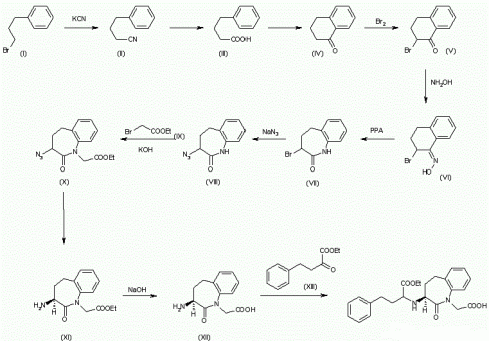
WO 2003092698 A1


Pilot Plant PAT Approach for the Diastereoselective Diimide Reduction of Artemisinic Acid

Pilot Plant PAT Approach for the Diastereoselective Diimide Reduction of Artemisinic Acid
In this study, an attractive route for the diastereoselective synthesis of dihydroartemisinic acid (DHAA) starting from artemisinic acid (AA) is presented. Diimide was used as a reducing agent, which was generated by two different methods: (1) by the reaction of hydrazine monohydrate and hydrogen peroxide and (2) by the reaction of hydrazine monohydrate and oxygen. Both methods were found to be suitable for the diimide reduction of AA showing full conversion and a high diastereoselectivity. Due to advantages in the crystallization step of DHAA, the second option for generation of diimide was chosen for the pilot plant scale-up. The reaction and the crystallization process development as well as the batch production in the pilot plant were monitored and controlled using dispersive Raman spectroscopy as PAT tool. Three DHAA batches in kilogram scale were successfully produced by the reaction of artemisininic acid, hydrazine monohydrate, and a gas mixture of nitrogen and oxygen (containing 5% v/v oxygen) in 2-propanol at 40 °C. Excellent yields of >90% (including the crystallization, isolation, and drying step) as well as high diastereoselectivities (≥97:3) of the products were achieved by the elaborated pilot plant manufacturing processes.
Pharmaceutical Industry In Global Market: Issues To Be Handled For Better Growth
In the global market, the position of the pharmaceutical industry is not parallel as compared to other information and technology based industries.
Among the Leading industries, the pharmaceutical industry lacks behind in the growth rate as far as innovative research, capital investment and
government regulations are concern. Most of the countries simply depends on bulk production of the generic drugs and not focused on core research. In
comparison with the growth rate of the electronic and IT industry stands first where as the pharmaceutical comes at the 9th position.
read all at
HPV Vaccine Halves Infection Rate in Teen Girls
A vaccine against a cervical cancer virus has cut infections in teen girls by half, according to a study released.
read all at
A vaccine against a cervical cancer virus has cut infections in teen girls by half, according to a study released. The study confirms research done before the HPV vaccine came on the market in 2006. But this is the first evidence of how well it works now that it is in general use.

ALMIRALL-Product development pipeline

| Preclin. | Phase I | Phase II | Phase III | Registr. | Registration application | |||
|---|---|---|---|---|---|---|---|---|
    |
||||||||
| LAS190792 |  |
MABA |  |
>2014 | ||||
| Aclidinium bromide | |
Antimuscarinic |  |
Approved by the FDA & EMA | ||||
| AB + Formoterol (LAS40464) | |
Antimuscarinic + LABA |  |
Undisclosed | ||||
| Abediterol (LAS100977) + ICS | |
OD LABA + ICS |  |
>2014 | ||||
| LAS186323 | |
DHODH inhibitor |  |
Undisclosed | ||||
| Sativex® | |
CB agonist |  |
Undisclosed | ||||
| LAS189913 | |
S1P1 |  |
Undisclosed | ||||
| LAS41002 | |
Topical anti-inflamatory |  |
Registration application in EU | ||||
| LAS41004 | |
Combination |  |
2014 | ||||
| LAS41008 | |
Psoriaris |  |
Undisclosed | ||||
| Linaclotide | |
Guanylate cyclase type-C agonist |  |
Approved by the EMA | ||||
AB: Aclidinium Bromide | ICS: Inhaled Corticoesteroid | RA: Reumatoid Artritis | MS: Multiple Sclerosis
IBS-C: Irritable Bowel Syndrome with associated Constipation
http://www.almirall.com/webcorp2/cda/ImD_03_02.jsp?langSuscripcion=3
Let’s Set a Global Drug Quality Benchmark by Kiran M Shaw, Biocon

With Indian-made generics accounting for a US market share of over 25 per cent, it is not surprising that it is gaining significant mindshare of the Food and Drug Administration ( FDA). The spate of quality issues with leading Indian pharmaceutical companies in the past couple of years however should not be viewed in isolation. Big Pharma in the West, too, has been facing increasing flak from the FDA and other regulators over good manufacturing practice ( GMP) violations. High profile names like J& J, Genzyme (Sanofi), GSK, Sandoz, Watson, Teva and many others have encountered their share of quality problems and have been served with ‘warning letters’ from FDA
http://kiranmazumdarshaw.blogspot.in/2013/06/lets-set-global-drug-quality-benchmark.html
READ ALL AT THE LINK ABOVE
Adamas claims success with new and improved Parkinson’s drug

amantadine
Adamas claims success with new and improved Parkinson’s drug
Amantadine (trade name Symmetrel, by Endo Pharmaceuticals) is a drug that has US Food and Drug Administration approval for use both as an antiviral and an antiparkinsonian drug. It is the organic compound 1-adamantylamine or 1-aminoadamantane, meaning it consists of an adamantane backbone that has an amino group substituted at one of the four methyne positions. Rimantadine is a closely related derivative of adamantane with similar biological properties.
Apart from medical uses, this compound is useful as a building block, allowing the insertion of an adamantyl group.
According to the US Centers for Disease Control and Prevention, 100% of seasonal H3N2 and 2009 pandemic flu samples tested have shown resistance to adamantanes, and amantadine is no longer recommended for treatment of influenza in the United States. Additionally, its effectiveness as an antiparkinsonian drug is undetermined, with a 2003 Cochrane Review concluding that there was insufficient evidence in support or against its efficacy and safety.
Synthesis
Amantadine may be prepared by reacting adamantane with bromine or nitric acid to give the bromide or nitroester at position one. Reaction of either compound with acetonitrile affords the acetamide, which is hydrolyzed to give 1-adamantylamine:


 New Drug Approvals