
Home » Posts tagged 'KT-253'
Tag Archives: KT-253
 DRUG APPROVALS BY DR ANTHONY MELVIN CRASTO
.....FOR BLOG HOME CLICK HERE
DRUG APPROVALS BY DR ANTHONY MELVIN CRASTO
.....FOR BLOG HOME CLICK HEREFlag and hits
ORGANIC SPECTROSCOPY

SUBSCRIBE

 Subscribe in a reader
Enter your email address:
Delivered by FeedBurner
Subscribe to New Drug Approvals by Email


Recent Comments
 | shivkr2 on SPSR Excellence Award 2025 – S… |
 | Bonkasaurus on Infigratinib phosphate |
 | PALOVAROTENE | ORGAN… on Palovarotene |
| Pfizer just purchase… on Temanogrel | |
| Pfizer To Cash In On… on Temanogrel |
Seldegamadlin
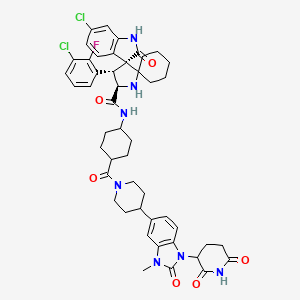
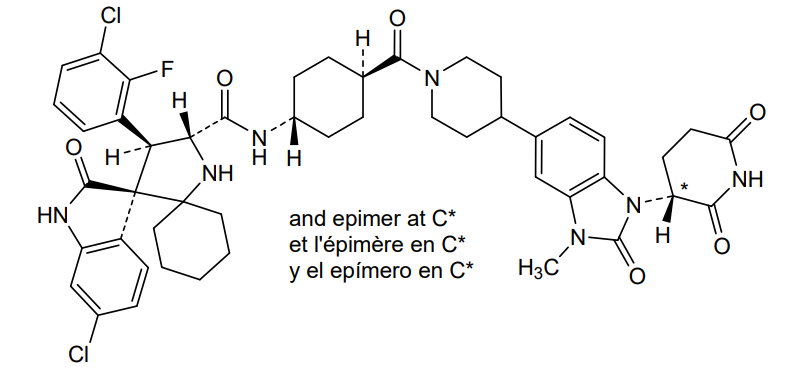
Seldegamadlin
CAS 2713618-08-5
MFC48H52Cl2FN7O6 MW912.9 g/mol
- (3’R,4’S,5’R)-6”-chloro-4′-(3-chloro-2-fluorophenyl)-N-((1r,4R)-4-(4-(1-(2,6-dioxopiperidin-3-yl)-3-methyl-2-oxo-2,3-dihydro-1H-benzo[d]imidazol-5-yl)piperidine-1-carbonyl)cyclohexyl)-2”-oxodispiro[cyclohexane-1,2′-pyrrolidine-3′,3”-indoline]-5′-carboxamide
- (3’R,4’S,5’R)-6″-chloro-4′-(3-chloro-2-fluorophenyl)-N-((1r,4R)-4-(4-(1-(2,6-dioxopiperidin-3-yl)-3-methyl-2-oxo-2,3-dihydro-1H-benzo[d]imidazol-5-yl)piperidine-1-carbonyl)cyclohexyl)-2”-oxodispiro[cyclohexane-1,2′-pyrrolidine-3′,3″-indoline]-5′-carboxamide
(3’R,4’S,5’R)-6”-chloro-4′-(3-chloro-2-fluorophenyl)-N-[trans-4-(4-{1-[(3RS)-2,6-dioxopiperidin-3-yl]-3-methyl-2-oxo-2,3-dihydro-1H-1,3-benzimidazol-5-yl}piperidine-1-carbonyl)cyclohexyl]-2”-oxo-1”,2”-dihydrodispiro[cyclohexane-1,2′-pyrrolidine-3′,3”-indole]-5′-carboxamide
E3 ubiquitin-protein ligase Mdm2 (Hdm2) degrader, antineoplastic, KT 253, KT-253, VNP2BV6KGL
Seldegamadlin (also known as KT-253) is an advanced experimental oncology drug designed as a first-in-class, highly potent MDM2 PROTAC degrader and p53 stabilizer. It utilizes targeted protein degradation (TPD) technology to selectively eliminate the MDM2 oncoprotein, which restores the normal function of the critical tumor suppressor protein, p53.
How it Works
- Targeted Protein Degradation: It acts as a heterobifunctional PROTAC (proteolysis-targeting chimera). It features one end that binds tightly to MDM2 and another end that recruits the cereblon (CRBN) E3 ubiquitin ligase.
- p53 Stabilization: By tethering them together, it forces the cell’s natural disposal machinery to ubiquitinate and rapidly destroy MDM2. Because MDM2 normally suppresses and destroys p53, deleting MDM2 leads to an immediate up-regulation and stabilization of active p53.
- Apoptosis Activation: The sudden resurgence of active p53 fires up downstream targets like p21, forcing wild-type p53 cancer cells to halt their cell cycle (at the G2/M phase) and trigger rapid programmed cell death (apoptosis).
Primary Areas of Research
Seldegamadlin is actively being evaluated and researched for therapeutic efficacy against specific wild-type p53 malignancies:
- Hematologic Tumours: Including Acute Myeloid Leukemia (AML) and Acute Lymphoblastic Leukemia (ALL).
- Solid Tumours: Such as Diffuse Large B-cell Lymphoma (DLBCL) and other forms retaining functional p53 signaling pathways
PAT
WO2023049790
https://patentscope.wipo.int/search/en/detail.jsf?docId=WO2023049790&_cid=P11-MTWC17-46822-1
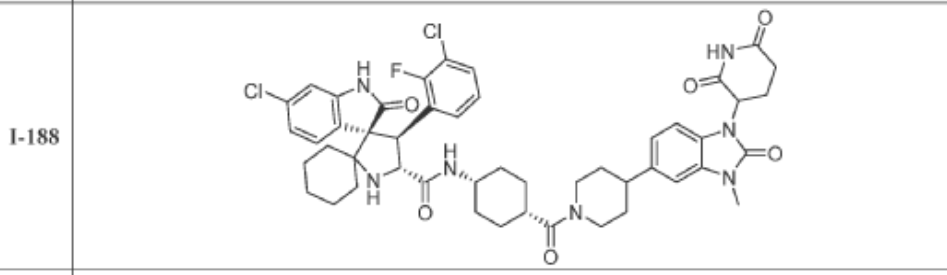

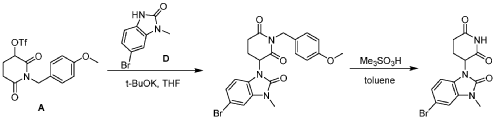

[001997] 3-[5-[1-(4-aminocyclohexanecarbonyl)-4-piperidyl]-3-methyl-2-oxo-benzimidazol-1-
yl]piperidine-2,6-dione (Intermediate WP)
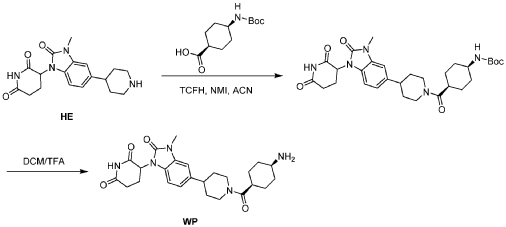
[001998] Step 1 – Tert-butyl N-[4-[4-[1-(2,6-dioxo-3-piperidyl)-3-methyl-2-oxo-benzimidazol-5-yl]piperidine-1-carbonyl]cyclohexyl]carbamate. A mixture of 3-[3-methyl-2-oxo-5-(4-piperidyl)benzimidazol-1-yl]piperidine-2,6-dione (200 mg, 584 umol, Intermediate HE), (1s,4s)-4-((tert-butoxycarbonyl)amino)cyclohexane-1-carboxylic acid (142 mg, 584 umol, CAS# 53292-90-3), 1-methylimidazole (1.53 g, 18.6 mmol) , and TCFH (409 mg, 1.46 mmol) in ACN (1 mL) was stirred at 25 °C for 1 min. On completion, the reaction mixture was concentrated to give a residue. The crude product was purified by reversed-phase HPLC (0.1% FA condition) to give the title compound (120 mg, 36% yield) as a white solid.1H NMR (400 MHz, DMSO-d6) δ 11.08 (s, 1H), 7.11 (s, 1H), 7.02 (d, J = 8.0 Hz, 1H), 6.92 (d, J = 8.0 Hz, 1H), 5.34 (dd, J = 5.6, 12.8 Hz, 1H), 4.62 – 4.54 (m, 1H), 4.10 – 3.98 (m, 1H), 3.49 ( s, 1H), 3.33 – 3.31 (m, 4H), 3.18 – 3.05 (m, 1H), 2.96 – 2.85 (m, 1H), 2.83 – 2.74 (m, 1H), 2.71 -2.62 (m, 3H), 2.05 – 1.94 (m, 1H), 1.86 – 1.67 (m, 6H), 1.61 – 1.40 (m, 7H), 1.39 (s, 9H).
[001999] Step 2 – 3-[5-[1-(4-aminocyclohexanecarbonyl)-4-piperidyl]-3-methyl-2-oxo-benzimidazol -1-yl]piperidine-2,6-dione. To a solution of tert-butyl N-[4-[4-[1-(2,6-dioxo-3-piperidyl)-3-methyl-2-oxo-benzimidazol-5-yl] piperidine-1-carbonyl]cyclohexyl]carbamate (60.0 mg, 105 umol) in DCM (1 mL) was added TFA (1.54 g, 13.5 mmol). The mixture was then stirred at 25 °C for 2 mins. On completion, the mixture was concentrated in vacuo to give the title compound (50.0 mg, 80% yield, TFA) as brown oil. LC-MS (ESI+) m/z 468.1 (M+H)+.
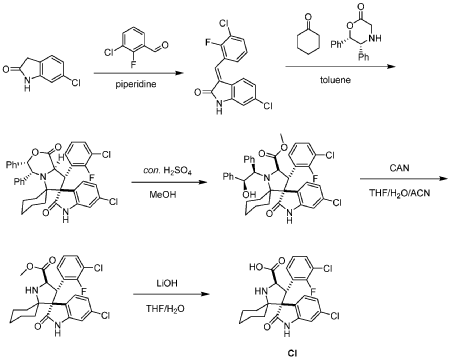
[00812] (3’R,4’S,5’R)-6”-chloro-4′-(3-chloro-2-fluorophenyl)-2”-oxodispiro[cyclohexane-1,2′-pyrrolidine-3′,3”-indoline]-5′-carboxylic acid (Intermediate CI)
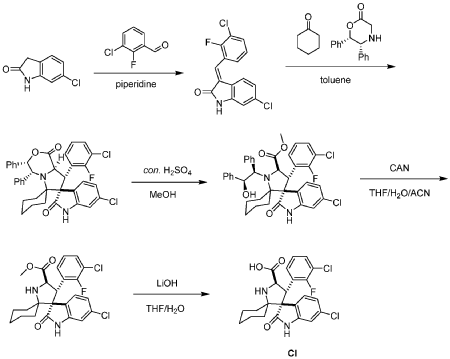
[00813] Step 1 – (3E)-6-chloro-3-[(3-chloro-2-fluoro-phenyl)methylene]indolin-2-one. A 500 mL 3-necked round bottom flask was charged with 6-chloroindolin-2-one (89.6 g, 535 mmol, CAS# 56341-37-8), 3-chloro-2-fluoro-benzaldehyde (84.8 g, 535 mmol, CAS# 85070-48-0), MeOH (1700 mL) and piperidine (9.11 g, 107 mmol). The mixture was stirred at 65 °C for 5 h, then at 25 °C for 12 h. On completion, the reaction mixture was filtered and the filter cake was dried under reduced pressure to give title product (160 g, 94% yield).1H NMR (400 MHz, DMSO-d6) δ = 10.87 (s, 1H), 7.82 – 7.63 (m, 2H), 7.56 (s, 1H), 7.39 (t, J = 8.0 Hz, 1H), 7.18 (d, J = 8.0 Hz, 1H), 7.03 – 6.77 (m, 2H).
[00814] Step 2 – (E)-6-chloro-3-(3-chloro-2-fluorobenzylidene)indolin-2-one. (3E)-6-chloro-3-[(3-chloro-2-fluoro-phenyl)methylene]indolin-2-one (50 g, 162 mmol), (5R,6S)-5,6-diphenylmorpholin-2-one (49.3 g, 194 mmol, CAS# 282735-66-4), and cyclohexanone (31.8 g, 324 mmol, 33.6 mL) were dissolved in THF (75 mL) and toluene (750 mL) and 140 ºC for 12 hours. On completion, the reaction mixture was concentrated in vacuo to give a residue. The residue was purified by column chromatography (SiO2, petroleum ether/ethyl acetate=8/1 to 5/1) to give the title compound (160 g 97% purity).1H NMR (400 MHz, DMSO-d6) δ = 10.79 (s, 1H), 7.95 ( t, J = 6.8 Hz, 1H), 7.45 – 7.37 (m, 1H), 7.33 – 7.20 (m, 4H), 7.18 – 7.09 (m, 4H), 7.07 – 6.98 (m, 2H), 6.86 – 6.75 (m, 3H), 6.66 (dd, J = 2.0, 8.4 Hz, 1H), 6.35 (d, J = 8.4 Hz, 1H), 5.44 (d, J = 11.2 Hz, 1H), 4.90 (d, J = 2.8 Hz, 1H), 4.58 (d, J = 11.2 Hz, 1H), 2.39 (d, J = 12.8 Hz, 1H), 2.24 – 2.09 (m, 1H), 1.42 – 1.18 (m, 4H), 1.10 – 0.78 (m, 1H).
[00815] Step 3 – (3’S,4’R,7’R,8’S,8a’R)-6”-chloro-8′-(3-chloro-2-fluorophenyl)-3′,4′-diphenyl-3′,4′,8′,8a’-tetrahydro-1’H-dispiro[cyclohexane-1,6′-pyrrolo[2,1-c][1,4]oxazine-7′,3”-indoline]-1′,2”-dione. H2SO4 (9.07 g, 92.5 mmol, 4.93 mL) was added to a solution of intermediate (E)-6-chloro-3-(3-chloro-2-fluorobenzylidene)indolin-2-one (9.0 g, 14.03 mmol) dissolved in MeOH (70 mL) and the resulting solution was heated to 50 °C for 5 hours. On completion, the reaction mixture was cooled to 0 °C and slowly neutralized with a solution of saturated sodium bicarbonate. The aqueous solution was extracted with ethyl acetate, and the organic layer was dried over sodium sulfate, filtered, concentrated to give the residue. The residue was purified by reverse phase flash [ACN/(0.1% FA in water), 0% to 90% ] to give title compound (7.0 g 84.2% purity).1H NMR (400 MHz, DMSO-d6) δ = 7.74 – 7.68 (m, 1H), 7.57 (s, 1H), 7.51 (d, J = 8.4 Hz, 1H), 7.41 (d, J = 7.2 Hz, 4H), 7.25 (d, J = 7.6 Hz, 6H), 7.19 – 7.11 (m, 6H), 7.10 – 6.98 (m, 4H), 6.94 – 6.88 (m, 1H), 6.65 – 6.58 (m, 1H), 5.39 – 5.27 (m, 1H), 4.89 – 4.75 (m, 1H), 4.42 -4.29 (m, 2H), 4.04 (q, J = 6.8 Hz, 1H), 3.63 – 3.53 (m, 2H), 3.40 (s, 3H), 2.22 – 2.12 (m, 1H), 2.05 – 1.94 (m, 3H), 1.40 – 1.32 (m, 2H), 1.28 – 1.13 (m, 3H).
[00816] Step 4 – Methyl (3’R,4’S,5’R)-6”-chloro-4′-(3-chloro-2-fluorophenyl)-1′-((1R,2S)-2-hydroxy-1,2-diphenylethyl)-2”-oxodispiro[cyclohexane-1,2′-pyrrolidine-3′,3”-indoline]-5′-carboxylate. The resulting intermediate (3’S,4’R,7’R,8’S,8a’R)-6”-chloro-8′-(3-chloro-2-fluorophenyl)-3′,4′-diphenyl-3′,4′,8′,8a’-tetrahydro-1’H-dispiro[cyclohexane-1,6′-pyrrolo[2,1-c][1,4]oxazine-7′,3”-indoline]-1′,2”-dione (7.0 g, 10.3 mmol) was dissolved in ACN (78 mL), then CAN (11.3 g, 20.7 mmol) was added, followed by the addition of H2O (78 mL). The reaction was stirred at 25 °C for 30 min. On completion, the reaction mixture was quenched by adding the mixture to a cold saturated aqueous NaHCO3 solution (50 mL). The aqueous layer was extracted with ethyl acetate (20 mL x 3). The organic layer was separated, dried over anhydrous Na2SO4, filtered and concentrated under reduced pressure to give the residue. The residue was purified by column chromatography (SiO2, petroleum ether/ethyl acetate=50/1 to 5/1) to give title compound (1.58 g, 31% purity). LC-MS (ESI+) m/z 477.2 (M+H)+.
[00817] Step 5 – (3’R,4’S,5’R)-6”-chloro-4′-(3-chloro-2-fluorophenyl)-2”-oxodispiro[cyclohexane-1,2′-pyrrolidine-3′,3”-indoline]-5′-carboxylic acid. Methyl (3’R,4’S,5’R)-6”-chloro-4′-(3-chloro-2-fluorophenyl)-1′-((1R,2S)-2-hydroxy-1,2-diphenylethyl)-2”-oxodispiro[cyclohexane-1,2′-pyrrolidine-3′,3”-indoline]-5′-carboxylate (2.00 g, 4.19 mmol) was dissolved in THF (14 mL) and LiOH.H2O (527 mg, 12.5 mmol) was added followed by water (14 mL) and MeOH (2 mL) and the reaction was stirred at 25 °C for 15 min. On completion, water (20 mL) was added and the reaction was slowly neutralized with 2M HCl and the suspension was stirred for 15 min. The resulting precipitate was filtered, washed with water to give title compound (1.50 g, 70% yield).1H NMR (400 MHz, DMSO-d6) δ = 10.75 – 10.57 (m, 1H), 10.55 (s, 1H), 7.61 – 7.54 (m, 1H), 7.50 – 7.44 (m, 1H), 7.41 – 7.34 (m, 1H), 7.18 – 7.12 (m, 1H),
7.08 – 7.02 (m, 1H), 6.72 – 6.66 (m, 1H), 4.72 – 4.65 (m, 1H), 4.54 – 4.47 (m, 1H), 3.18 – 3.15 (m, 1H), 2.22 – 2.13 (m, 1H), 1.83 – 1.70 (m, 2H), 1.64 – 1.52 (m, 3H), 1.51 – 1.43 (m, 2H), 1.42 – 1.34 (m, 1H), 1.04 – 0.92 (m, 1H), 0.89 – 0.77 (m, 1H). LC-MS (ESI+) m/z 463.2 (M+H)+.
ADVERTISEMENT
ANAX LABORATORIES
WEBSITE https://www.anaxlab.com/
Discovery Solutions, Supporting the chemistry needs of clients in the Medical, Analytical and Bio Sciences
Development Solutions, Developing from Lab scale to PR&D, Kilo Scale-ups and Commercial Scales
SEE MORE………Integrated Solutions, Manufacturing Solutions, Products,
Can’t Find? Let’s Connect

Phone : +91 897704 2010 / +91 9177075735, Email : info@anaxlab.com
#MedicinalChemistry, #DrugDiscovery, #OrganicSynthesis, #ChemicalLibrary, #BuildingBlocks, #SARStudies, #ChemistryInnovation, #medchem, #Drugdevelopment, #Biotech, #Biotechnology, #AnaxLaboratories, #Pharma



AS ON FEB2026 4.574 LAKHS VIEWS ON BLOG WORLDREACH AVAILABLEFOR YOUR ADVERTISEMENT

join me on Linkedin
Anthony Melvin Crasto Ph.D – India | LinkedIn
join me on Researchgate
RESEARCHGATE

join me on Facebook
Anthony Melvin Crasto Dr. | Facebook
join me on twitter
Anthony Melvin Crasto Dr. | twitter
+919321316780 call whatsaapp
EMAIL. amcrasto@gmail.com

References
- Mdm2 degraders and uses thereofPublication Number:WO-2023049790-A2Priority Date:2021-09-22
- Mdm2 degraders and uses thereofPublication Number:US-2024025878-A1Priority Date:2020-03-19
- Mdm2 degraders and uses thereofPublication Number:WO-2021188948-A1Priority Date:2020-03-19
- Methods of treating cancerPublication Number:WO-2023114933-A1Priority Date:2021-12-15
- Methods of treating cancerPublication Number:US-2023233546-A1Priority Date:2021-12-15
- Methods of treating cancerPublication Number:CN-118574613-APriority Date:2021-12-15
- Methods of treating cancerPublication Number:EP-4447959-A1Priority Date:2021-12-15
- Mdm2 degraders and uses thereofPublication Number:EP-4405359-A2Priority Date:2021-09-22
- Mdm2 degraders and uses thereofPublication Number:WO-2025096262-A1Priority Date:2023-11-01
- Mdm2 degraders and uses thereofPublication Number:WO-2024197219-A1Priority Date:2023-03-22
- Mdm2 degraders and uses thereofPublication Number:WO-2024197216-A2Priority Date:2023-03-22
- Mdm2 degraders and uses thereofPublication Number:US-2025352535-A1Priority Date:2022-06-06
- Mdm2 degraders and uses thereofPublication Number:WO-2023239697-A1Priority Date:2022-06-06
///////////////////seldegamadlin, anax labs, E3 ubiquitin-protein ligase Mdm2 (Hdm2) degrader, antineoplastic, KT 253, KT-253, VNP2BV6KGL
#seldegamadlin, #anax labs, #E3 ubiquitin-protein ligase Mdm2 (Hdm2) degrader, #antineoplastic, #KT 253, #KT-253, #VNP2BV6KGL


 New Drug Approvals
