
Home » Posts tagged '2ROQ545LAG'
Tag Archives: 2ROQ545LAG
 DRUG APPROVALS BY DR ANTHONY MELVIN CRASTO
.....FOR BLOG HOME CLICK HERE
Flag and hits
ORGANIC SPECTROSCOPY

SUBSCRIBE

 Subscribe in a reader
Enter your email address:
Delivered by FeedBurner
Subscribe to New Drug Approvals by Email


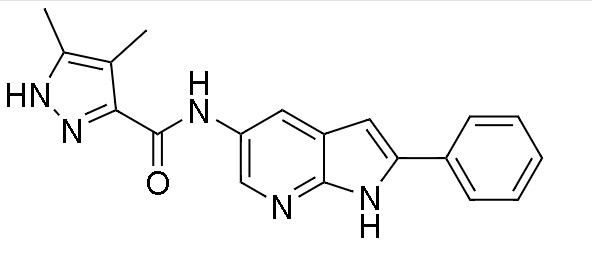
Bezuclastinib
Bezuclastinib
Cas 1616385-51-3
MF C19H17N5O MW331.4 g/mol
4,5-dimethyl-N-(2-phenyl-1H-pyrrolo[2,3-b]pyridin-5-yl)-1H-pyrazole-3-carboxamide
1H-Pyrazole-3-carboxamide, 4,5-dimethyl-N-(2-phenyl-1H-pyrrolo[2,3-b]pyridin-5-yl)-
- 3,4-dimethyl-N-(2-phenyl-1H-pyrrolo[2,3-b]pyridin-5-yl)-1H-pyrazole-5-carboxamide
- 4,5-dimethyl-N-(2-phenyl-1H-pyrrolo(2,3-b)pyridin-5-yl)-1H-pyrazole-3-carboxamide
Ekitna, approvals 2026, fda 2026, CGT 9486, PLX-9486, PLX 9486, 2ROQ545LAG
To treat advanced gastrointestinal stromal tumors, in combination with sunitinib, in adults who have received prior treatment with imatinib
Bezuclastinib, sold under the brand name Ekitna, is an anti-cancer medication used for the treatment of gastrointestinal stromal tumors.[1] It is a kinase inhibitor.[1] It acts as an inhibitor of tyrosine-protein kinase KIT.[1] It is taken by mouth.[1]
The most common adverse reactions include diarrhea, increased liver transaminases, hypertension, dysgeusia, nausea, hair color changes, fatigue, abdominal pain, vomiting, decreased appetite, stomatitis, gastroesophageal reflux disease, rash, dyspepsia, and pyrexia.[2]
Bezuclastinib was approved for medical use in the United States in November 2026.[2]
Medical uses
Bezuclastinib is indicated in combination with sunitinib for the treatment of adults with advanced gastrointestinal stromal tumors who have received prior treatment with imatinib.[1]
Adverse effects
The US prescribing information includes a boxed warning for hepatotoxicity and warnings and precautions for embryo-fetal toxicity.[2]
The most common adverse reactions include diarrhea, increased liver transaminases, hypertension, dysgeusia, nausea, hair color changes, fatigue, abdominal pain, vomiting, decreased appetite, stomatitis, gastroesophageal reflux disease, rash, dyspepsia, and pyrexia.[2] The most common grade 3 or 4 laboratory abnormalities include alanine aminotransferase increased, leukocytes decreased, neutrophils decreased, lymphocytes decreased, and hemoglobin decreased.[2]
History
Efficacy was evaluated in the PEAK study (NCT05208047), an open-label, randomized, international, multi-center trial in 413 participants with histologically confirmed, locally advanced, unresectable, or metastatic gastrointestinal stromal tumors with disease progression on or intolerance to imatinib.[2] Participants were randomized to receive bezuclastinib in combination with sunitinib (both once daily) or sunitinib once daily alone until disease progression.[2]
Society and culture
Legal status
Bezuclastinib was approved for medical use in the United States in November 2026.[3] The US Food and Drug Administration granted the application for bezuclastinib priority review, breakthrough therapy, and orphan drug designations.[2]
Names
Bezuclastinib is the international nonproprietary name.[4]
Bezuclastinib is sold under the brand name Ekitna.[1]
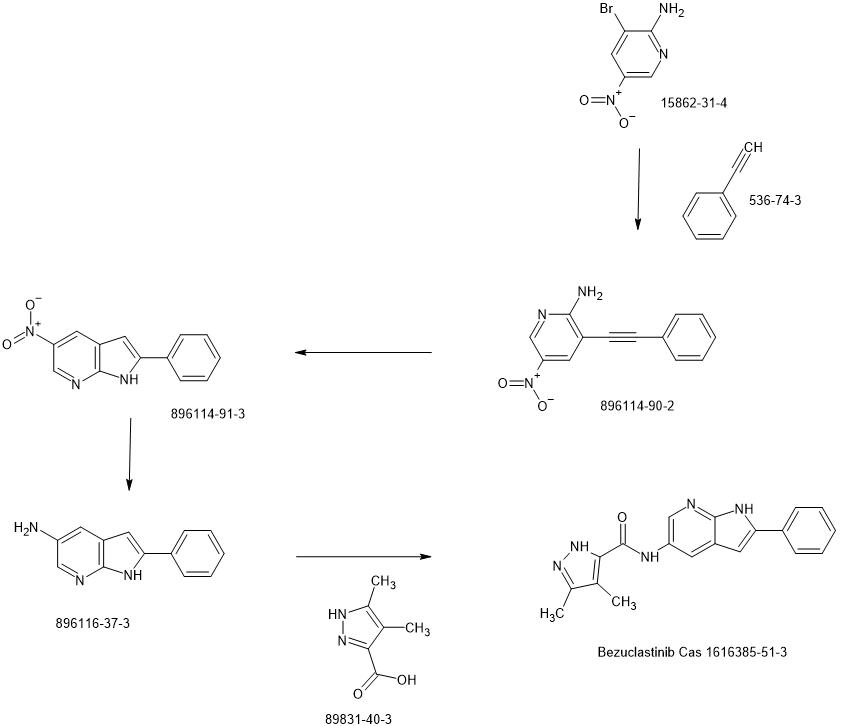
SYN
WO2014/100620
SYN
US20170349572 – Compounds and methods for kinase modulation, and indications therefor
https://patentscope.wipo.int/search/en/detail.jsf?docId=US206641574&_cid=P21-MWWYPY-09075-1
Example 2
Preparation of 3,4-dimethyl-N-(2-phenyl-1H-pyrrolo[2,3-b]pyridin-5-yl)-1H-pyrazole-5-carboxamide (P-2007)
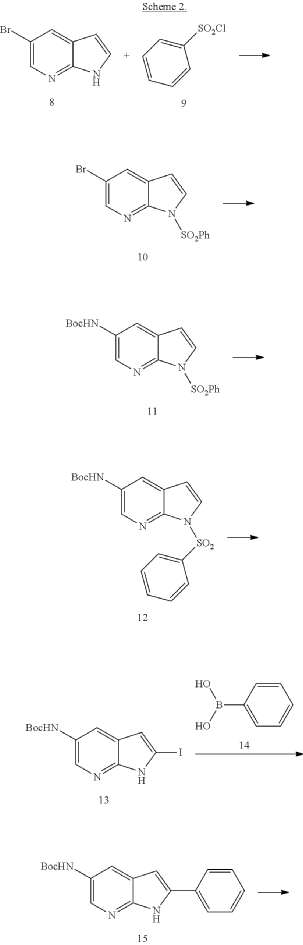
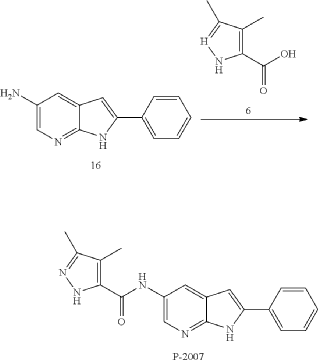
| Step 1—Synthesis of 5-bromo-1-(phenylsulfonyl)-1H-pyrrolo[2,3-b]pyridine (10): A solution of 5-bromo-1H-pyrrolo[2,3-b]pyridine 8 (196 g, 994 mmol) in anhydrous tetrahydrofuran (2 L) was cooled to 0° C. and treated with sodium hydride (60% in mineral oil, 49.3 g 1233 mmol) over 30 minutes. After two hours, benzenesulfonyl chloride 9 (153 mL, 1193 mmol) was added dropwise and the reaction was stirred at room temperature overnight. The reaction was quenched with brine (1 L). The layers were separated and the aqueous phase was extracted with ethyl acetate (2×500 mL). The organic layers were combined, dried with sodium sulfate, filtered and concentrated under reduced pressure. The product was triturated with methyl tert-butyl ether to give compound 10 as a tan solid (319 g, 95%). The data from the 1H NMR spectrum were consistent with the structure of the compound. |
PAT
US20160326168 – Solid forms of a compound modulating kinases
https://patentscope.wipo.int/search/en/detail.jsf?docId=US179309412&_cid=P21-MWWYM8-05805-1
PAT
Compounds and methods for kinase modulation, and indications thereforPublication Number:KR-20150096769-APriority Date:2012-12-21
- Compounds and methods for kinase modulation and indications for their usePublication Number:RU-2666146-C2Priority Date:2012-12-21Grant Date:2018-09-06
- Compounds and methods for kinase modulation, and indications thereforPublication Number:US-9676748-B2Priority Date:2012-12-21Grant Date:2017-06-13
- Compounds and methods for kinase modulation, and indications thereofPublication Number:ES-2664985-T3Priority Date:2012-12-21Grant Date:2018-04-24
- Compounds and methods for kinase modulation, and indications thereforPublication Number:EP-2935248-A2Priority Date:2012-12-21
- Compounds and methods for kinase modulation, and indications thereforPublication Number:US-2014213554-A1Priority Date:2012-12-21
- Compounds and methods for kinase modulation and indications thereofPublication Number:CN-105308036-APriority Date:2012-12-21
- Compounds and methods for kinase modulation, and indications thereforPublication Number:TW-201429957-APriority Date:2012-12-21
- Compounds and methods for kinase modulation, and indications thereforPublication Number:US-2017349572-A1Priority Date:2012-12-21
- Compounds and methods for kinase modulation, and indications thereforPublication Number:WO-2014100620-A2Priority Date:2012-12-21
- Compounds and methods for kinase modulation, and indications thereforPublication Number:EP-2935248-B1Priority Date:2012-12-21Grant Date:2018-02-28
ADVERTISEMENT
ANAX LABORATORIES
WEBSITE https://www.anaxlab.com/
Discovery Solutions, Supporting the chemistry needs of clients in the Medical, Analytical and Bio Sciences
Development Solutions, Developing from Lab scale to PR&D, Kilo Scale-ups and Commercial Scales
SEE MORE………Integrated Solutions, Manufacturing Solutions, Products,
Can’t Find? Let’s Connect

Phone : +91 897704 2010 / +91 9177075735, Email : info@anaxlab.com
#MedicinalChemistry, #DrugDiscovery, #OrganicSynthesis, #ChemicalLibrary, #BuildingBlocks, #SARStudies, #ChemistryInnovation, #medchem, #Drugdevelopment, #Biotech, #Biotechnology, #AnaxLaboratories, #Pharma


AS ON OCT2025 4.511 LAKHS VIEWS ON BLOG WORLDREACH AVAILABLEFOR YOUR ADVERTISEMENT

join me on Linkedin
Anthony Melvin Crasto Ph.D – India | LinkedIn
join me on Researchgate
RESEARCHGATE

join me on Facebook
Anthony Melvin Crasto Dr. | Facebook
join me on twitter
Anthony Melvin Crasto Dr. | twitter
+919321316780 call whatsaapp
EMAIL. amcrasto@gmail.com

……
References
- “Ekitna (bezuclastinib) tablets, for oral use” (PDF).
- “FDA approves bezuclastinib in combination with sunitinib for advanced gastrointestinal stromal tumors”. U.S. Food and Drug Administration (FDA). 24 November 2026. Retrieved 25 November 2026.
 This article incorporates text from this source, which is in the public domain.
- “Novel Drug Approvals for 2026”. FDA. 24 November 2026. Retrieved 25 November 2026.
- World Health Organization (2022). “International nonproprietary names for pharmaceutical substances (INN): recommended INN: list 88”. WHO Drug Information. 36 (3). hdl:10665/363551.
Further reading
- Farmer I, Radia DH (August 2024). “Systemic Mastocytosis: State of the Art”. Current Hematologic Malignancy Reports. 19 (5): 197–207. doi:10.1007/s11899-024-00737-8. PMID 39187708.
- Wagner AJ, Severson PL, Shields AF, Patnaik A, Chugh R, Tinoco G, et al. (September 2021). “Association of Combination of Conformation-Specific KIT Inhibitors With Clinical Benefit in Patients With Refractory Gastrointestinal Stromal Tumors: A Phase 1b/2a Nonrandomized Clinical Trial”. JAMA Oncology. 7 (9): 1343–1350. doi:10.1001/jamaoncol.2021.2086. PMC 8267845. PMID 34236401.
- New treatments for systemic mastocytosis in 2025Publication Name:Current opinion in allergy and clinical immunologyPublication Date:2025-06-05PMID:40471046DOI:10.1097/aci.0000000000001079
- Systemic Mastocytosis: State of the ArtPublication Name:Current Hematologic Malignancy ReportsPublication Date:2024-08-27PMID:39187708DOI:10.1007/s11899-024-00737-8
- Association of Combination of Conformation-Specific KIT Inhibitors With Clinical Benefit in Patients With Refractory Gastrointestinal Stromal Tumors: A Phase 1b/2a Nonrandomized Clinical TrialPublication Name:JAMA OncologyPublication Date:2021-09-01PMCID:PMC8267845PMID:34236401DOI:10.1001/jamaoncol.2021.2086
- PLX9486 shows anti-tumor efficacy in patient-derived, tyrosine kinase inhibitor-resistant KIT-mutant xenograft models of gastrointestinal stromal tumorsPublication Name:Clinical and Experimental MedicinePublication Date:2018-12-06PMID:30523507DOI:10.1007/s10238-018-0541-2
External links
- “Bezuclastinib ( Code – C121647 )”. EVS Explore.
- Clinical trial number NCT05208047 for “(Peak) A Phase 3 Randomized Trial of Bezuclastinib (CGT9486)+Sunitinib vs. Sunitinib in Participants With Gastrointestinal Stromal Tumors” at ClinicalTrials.gov
 | |
| Clinical data | |
|---|---|
| Trade names | Ekitna |
| Other names | CGT-9486, CGT9486, PLX-9486 |
| AHFS/Drugs.com | Ekitna |
| License data | US DailyMed: Bezuclastinib |
| Routes of administration | By mouth |
| Drug class | Antineoplastic |
| ATC code | None |
| Legal status | |
| Legal status | US: ℞-only[1] |
| Identifiers | |
| IUPAC name | |
| CAS Number | 1616385-51-3 |
| PubChem CID | 75593308 |
| IUPHAR/BPS | 11868 |
| DrugBank | DB18041 |
| ChemSpider | 115007996 |
| UNII | 2ROQ545LAG |
| KEGG | D12600 |
| ChEMBL | ChEMBL5095229 |
| PDB ligand | WEJ (PDBe, RCSB PDB) |
| Chemical and physical data | |
| Formula | C19H17N5O |
| Molar mass | 331.379 g·mol−1 |
| 3D model (JSmol) | Interactive image |
| SMILES | |
| InChI | |
/////////Bezuclastinib, anax labs, Ekitna, approvals 2026, fda 2026, CGT 9486, PLX-9486, PLX 9486, 2ROQ545LAG, CANCER
#Bezuclastinib, #anax labs, #Ekitna, #approvals 2026, #fda 2026, #CGT 9486, #PLX-9486, #PLX 9486, #2ROQ545LAG, CANCER


