New Drug Approvals

Home » Uncategorized (Page 75)

Category Archives: Uncategorized

DRUG APPROVALS BY DR ANTHONY MELVIN CRASTO .....FOR BLOG HOME CLICK HERE

Blog Stats

  • 5,034,568 hits

Flag and hits

Flag Counter

Enter your email address to follow this blog and receive notifications of new posts by email.

Join 37.8K other subscribers
Follow New Drug Approvals on WordPress.com

Archives

Categories

Recent Posts

Flag Counter

ORGANIC SPECTROSCOPY

Read all about Organic Spectroscopy on ORGANIC SPECTROSCOPY INTERNATIONAL 

Enter your email address to follow this blog and receive notifications of new posts by email.

Join 37.8K other subscribers
DR ANTHONY MELVIN CRASTO Ph.D

DR ANTHONY MELVIN CRASTO Ph.D

DR ANTHONY MELVIN CRASTO, Born in Mumbai in 1964 and graduated from Mumbai University, Completed his Ph.D from ICT, 1991,Matunga, Mumbai, India, in Organic Chemistry, The thesis topic was Synthesis of Novel Pyrethroid Analogues, Currently he is working with AFRICURE PHARMA, ROW2TECH, NIPER-G, Department of Pharmaceuticals, Ministry of Chemicals and Fertilizers, Govt. of India as ADVISOR, earlier assignment was with GLENMARK LIFE SCIENCES LTD, as CONSUlTANT, Retired from GLENMARK in Jan2022 Research Centre as Principal Scientist, Process Research (bulk actives) at Mahape, Navi Mumbai, India. Total Industry exp 32 plus yrs, Prior to joining Glenmark, he has worked with major multinationals like Hoechst Marion Roussel, now Sanofi, Searle India Ltd, now RPG lifesciences, etc. He has worked with notable scientists like Dr K Nagarajan, Dr Ralph Stapel, Prof S Seshadri, etc, He did custom synthesis for major multinationals in his career like BASF, Novartis, Sanofi, etc., He has worked in Discovery, Natural products, Bulk drugs, Generics, Intermediates, Fine chemicals, Neutraceuticals, GMP, Scaleups, etc, he is now helping millions, has 9 million plus hits on Google on all Organic chemistry websites. His friends call him Open superstar worlddrugtracker. His New Drug Approvals, Green Chemistry International, All about drugs, Eurekamoments, Organic spectroscopy international, etc in organic chemistry are some most read blogs He has hands on experience in initiation and developing novel routes for drug molecules and implementation them on commercial scale over a 32 PLUS year tenure till date Feb 2023, Around 35 plus products in his career. He has good knowledge of IPM, GMP, Regulatory aspects, he has several International patents published worldwide . He has good proficiency in Technology transfer, Spectroscopy, Stereochemistry, Synthesis, Polymorphism etc., He suffered a paralytic stroke/ Acute Transverse mylitis in Dec 2007 and is 90 %Paralysed, He is bound to a wheelchair, this seems to have injected feul in him to help chemists all around the world, he is more active than before and is pushing boundaries, He has 100 million plus hits on Google, 2.5 lakh plus connections on all networking sites, 100 Lakh plus views on dozen plus blogs, 227 countries, 7 continents, He makes himself available to all, contact him on +91 9323115463, email amcrasto@gmail.com, Twitter, @amcrasto , He lives and will die for his family, 90% paralysis cannot kill his soul., Notably he has 38 lakh plus views on New Drug Approvals Blog in 227 countries......https://newdrugapprovals.wordpress.com/ , He appreciates the help he gets from one and all, Friends, Family, Glenmark, Readers, Wellwishers, Doctors, Drug authorities, His Contacts, Physiotherapist, etc He has total of 32 International and Indian awards

Verified Services

View Full Profile →

Archives

Categories

Flag Counter

7th Annual Clinical Trials Summit 2016, 24th May 2016, The Lalit Hotel, Mumbai, India

7th Annual Clinical Trials Summit 2016


                    “A critical guide for
successfully conducting clinical trials”
24th May 2016, The Lalit Hotel, Mumbai, India
Greetings from Virtue
Insight,
 
I am happy to invite you
and your colleagues to be a sponsor/ delegate for our upcoming “7th
Annual Clinical Trials Summit 2016” The conference will Be held on 14th
May 2016, The Lalit Hotel, Mumbai, India. 
CONFIRMED SPEAKERS  FROM :- Takeda Pharmaceuticals (UK), Clinical Research &
Development, Cadila, Sanofi Aventis, Johnson & Johnson, GNH India, Clintech
India, Boehringer Ingelheim, Reliance Life Sciences, Abbott, Glenmark
Pharmaceuticals, Sanofi, Nishith Desai Associates, Novartis, Tata Consultancy
Services, Janssen India (Pharmaceutical companies of Johnson & Johnson),
SIRO Clinpharm, and few more.. 
CONFERENCE BOOKING DETAILS:-
·
Standard
Price:- 1 or 2 Delegates – (INR 7,000 + Tax (14.5%) per delegate)
·
Group
Discounts – 3 or 4 Delegates – (INR 6,500 + Tax (14.5%) per delegate) 
·
Group
Discounts – 5 and above Delegates – (INR 5,500 + Tax (14.5%) per delegate)
·
Conference
Sponsor & Exhibition Stall – Should you wish to Sponsor, or purchase a
Exhibition Stall (Booth) or a paid Speaker Slot, you can simply email your
interest and queries to TEL:
+ 91
9171350244

or
deepak@virtueinsight.co.in, deepakrajvirtueinsight@gmail.com  
Thank you for your time and
consideration. I look forward to hearing from you.  
PS: – Please refer your
friends or colleagues by forwarding this email to anyone you think may benefit
from it.  
 
Best Regards,
Deepak Raj
Delegate and Sponsorship Sales
Virtue Insight
Gsm
–   + 91
9171350244
Tel –      + 91 44 65515693
Skype –  edeepakraj143
clinical
trials”
“A critical guide for successfully conducting clinical trials”

APIs from Legitimate and Reliable Sources

DR ANTHONY MELVIN CRASTO Ph.D's avatarDRUG REGULATORY AFFAIRS INTERNATIONAL

APIs from Legitimate and Reliable Sources

1. Introduction

Counterfeit and sub-standard APIs are increasingly present. Not only are they a fact of non-compliance but also they form a serious and increasing risk for patient safety. Various initiatives have been taken such as the founding of the FDA Counterfeit Drug Task Force, the European Commission’s current “Public consultation in preparation of a legal proposal to combat counterfeit medicines for human use” and the WHO Program “IMPACT” (International Medical Products Anti-Counterfeiting Taskforce).

API =Active pharmaceutical ingredient (synonym: drug substance)

Counterfeit API =Active pharmaceutical ingredient for which source and/or quality are falsely represented on the label, on the certificate of analysis or otherwise

Rogue API =API that is counterfeit or severely, deliberately non-compliant.

This writeup focuses on the interaction between the API manufacturer and the medicinal product manufacturer and provides possible measures that may be taken by both partners in order to ensure only…

View original post 2,586 more words

USP publishes draft of a new general chapter for plastic components used in manufacturing

DR ANTHONY MELVIN CRASTO Ph.D's avatarDRUG REGULATORY AFFAIRS INTERNATIONAL

In the Pharmacopoeial Forum (PF)  42(3) (May-June 2016) the USP General Chapters – Packaging and Distribution Expert Committee proposes a new general chapter  <661.3> Plastic Components and Systems Used in Pharmaceutical Manufacturing and a revised version of general chapter <1661> Evaluation of Plastic Packaging and Manufacturing Systems and Their Materials of construction with Respect to Their User Safety Impact. Read more about USPs Proposal on Plastic Components and Systems Used in Pharmaceutical Manufacturing.

<1661> Evaluation of Plastic Packaging and Manufacturing Systems and Their Materials of construction with Respect to Their User Safety Impact. Read more about USPs Proposal on Plastic Components and Systems Used in Pharmaceutical Manufacturing.

see

http://www.gmp-compliance.org/enews_05341_USP-publishes-draft-of-a-new-general-chapter–661.3–for-plastic-components-used-in-manufacturing_15303,15493,Z-PKM_n.html

In the Pharmacopoeial Forum (PF)  42(3) (May-June 2016) the USP General Chapters – Packaging and Distribution Expert Committee proposes a new chapter to address the qualification of plastic components used in the manufacture of APIs (pharmaceutical and…

View original post 754 more words

EMA’s new Draft Guideline on the Sterilisation of Medicinal Products, APIs, Excipients and Primary Containers

DR ANTHONY MELVIN CRASTO Ph.D's avatarDRUG REGULATORY AFFAIRS INTERNATIONAL

For medicinal products administrated in sterile form, the process to reduce the microbial level is a critical manufacturing step with regard to quality. The EMA has recently published the draft of a guideline on that topic which contains a range of clarifications. Read more about the coming requirements on sterilisation of medicinal products, APIs, excipients and final containers

see

http://www.gmp-compliance.org/enews_05350_EMA-s-new-Draft-Guideline-on-the-Sterilisation-of-Medicinal-Products–APIs–Excipients-and-Primary-Containers_15435,S-WKS_n.html

As referred to in the European Pharmacopoeia, the procedure for terminal sterilisation of a medicinal product, an API, or an excipient is generally the method of choice. Yet, this might be difficult in many cases for product stability reasons. That’s why other microbial reduction processes can be used like sterilising filtration or aseptic processing. So far, there has been some uncertainty about these methods and their acceptance in a marketing authorisation procedure or a variation application, and about which data have to be submitted.

EMA’s new draft guideline entitled “Guideline…

View original post 781 more words

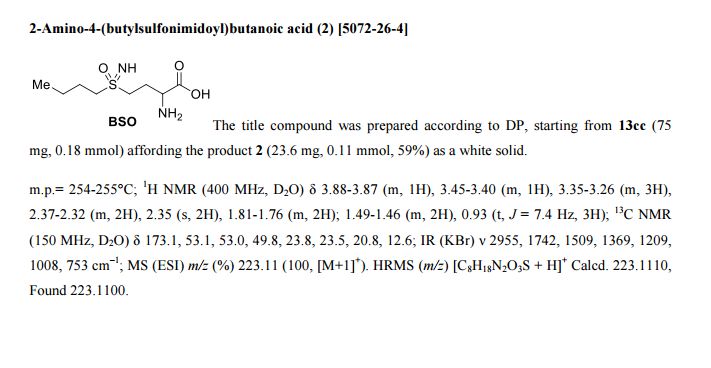
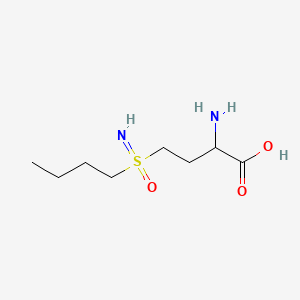
Buthionine Sulphoximine

Skeletal formula of buthionine sulfoximine

Buthionine Sulphoximine

NDA Filed in china

A gamma-glutamylcysteine synthetase inhibitor potentially for the treatment of solid tumors.

 NSC-326231; BSO

CAS No. 5072-26-4

BUTHIONINE SULFOXIMINE; DL-Buthionine-[S,R]-sulfoximine; 5072-26-4; Buthionine sulfoxamine; Buthionine-S,R-sulfoximine; Buthione sulfoximine;

Molecular Formula: C8H18N2O3S
Molecular Weight: 222.30512 g/mol

Buthionine sulfoximine (BSO) is a sulfoximine which reduces levels of glutathione and is being investigated as an adjunct withchemotherapy in the treatment of cancer.[1] The compound inhibits gamma-glutamylcysteine synthetase, the enzyme required in the first step of glutathione synthesis. Buthionine sulfoximine may also be used to increase the sensitivity of parasites to oxidativeantiparasitic drugs.[2]

Buthionine sulphoximine is an oncolytic agent in early clinical development at the National Cancer Institute (NCI) for the treatment of neuroblastoma in pediatric patients in combination with melphalan and bone marrow or peripheral stem cell transplantation.

DATA

STR1

STR1

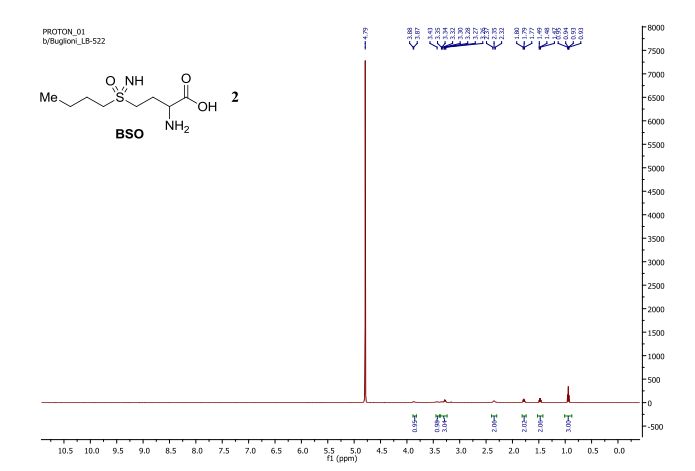
1H NMR

STR1

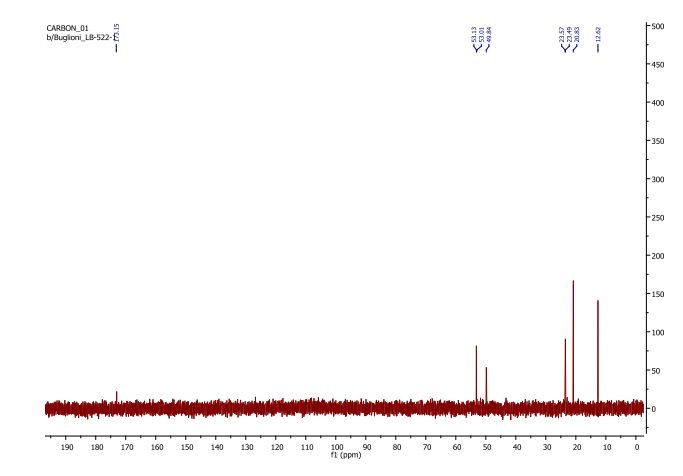
13C NMR

Synthesis

Methionine and buthionine sulfoximines: Syntheses under mild and safe imidation/oxidation conditions
Advanced Synthesis&Catalysis (2014), 356, (10), 2209-2213

Abstract

Thumbnail image of graphical abstract

Methionine and buthionine sulfoximines (MSO and BSO) are non-natural amino acids known to inhibit the biosynthesis of glutathione (GSH). The current syntheses of these biologically active molecules involve harsh reaction conditions and the use of hazardous reagents for the sulfur imidation. Here, improved syntheses of MSO and BSO are presented including safe and mild one-pot imidation/oxidation sequences and single-step deprotections of three different functionalities.

Methionine and Buthionine Sulfoximines: Syntheses under Mild and Safe Imidation/Oxidation Conditions

  1. Laura Buglioni,
  2. Vincent Bizet and
  3. Carsten Bolm*

DOI: 10.1002/adsc.201400354

http://onlinelibrary.wiley.com/doi/10.1002/adsc.201400354/abstract

References

  1.  Defty, CL; Marsden, JR (2012). “Melphalan in regional chemotherapy for locally recurrent metastatic melanoma.”. Current topics in medicinal chemistry 12 (1): 53–60. PMID 22196271.
  2.  “Definition of buthionine sulfoximine – National Cancer Institute Drug Dictionary”.

BUTHIONINE SULFOXIMINE.png

Buthionine sulfoximine
Skeletal formula of buthionine sulfoximine
Ball-and-stick model of buthionine sulfoximine as a zwitterion
Names
IUPAC name

2-amino-4-(butylsulfonimidoyl)butanoic acid
Other names

BSO
Identifiers
5072-26-4 
ChEBI CHEBI:28714 Yes
ChemSpider 19896 Yes
Jmol 3D model Interactive image
MeSH Buthionine+sulfoximine
PubChem 21157
Properties
C8H18N2O3S
Molar mass 222.305 g/mol
Density 1.29 g/mL
Melting point 215 °C (419 °F; 488 K)
Boiling point 382.3 °C (720.1 °F; 655.5 K)
Except where otherwise noted, data are given for materials in their standard state (at 25 °C [77 °F], 100 kPa).

////NSC-326231,  BSO, 5072-26-4, Butionine sulfoximine, Neuroblastoma

CCCCS(=N)(=O)CCC(C(=O)O)N

Processes for Constructing Homogeneous Antibody Drug Conjugates

Abstract Image

Antibody drug conjugates (ADCs) are synthesized by conjugating a cytotoxic drug or “payload” to a monoclonal antibody. The payloads are conjugated using amino or sulfhydryl specific linkers that react with lysines or cysteines on the antibody surface. A typical antibody contains over 60 lysines and up to 12 cysteines as potential conjugation sites. The desired DAR (drugs/antibody ratio) depends on a number of different factors and ranges from two to eight drugs/antibody. The discrepancy between the number of potential conjugation sites and the desired DAR, combined with use of conventional conjugation methods that are not site-specific, results in heterogeneous ADCs that vary in both DAR and conjugation sites. Heterogeneous ADCs contain significant fractions with suboptimal DARs that are known to possess undesired pharmacological properties. As a result, new methods for synthesizing homogeneous ADCs have been developed in order to increase their potential as therapeutic agents. This article will review recently reported processes for preparing ADCs with improved homogeneity. The advantages and potential limitations of each process are discussed, with emphasis on efficiency, quality, and in vivo efficacy relative to similar heterogeneous ADCs.

Table 1. Examples of Heterogeneous ADCs Currently in Clinical Trials for Cancer Indicationsa
ADC Sponsor Indications Status Payload Linked to Target
Adcetris Seattle Genetics HL and ALCL approved MMAE cysteine CD30
Kadcyla Genentech/Roche breast cancer approved DM1 lysine Her2
inotuzumab ozogamicin Pfizer NHL and ALL Phase III calicheamicin lysine CD22
lorvotuzumab mertansine Immunogen SCLC Phase II DM1 lysine CD56
glembatumumab vedotin Celldex BC, melanoma Phase II MMAE cysteine GPNMB
PSMA-ADC Progenics prostate Phase II MMAE cysteine FOLH1
SAR-3419 Sanofi DLBCL, ALL Phase II DM4 lysine CD19
ABT-414 Abbvie glioblastoma Phase II MMAE cysteine EGFR
BT-062 Biotest mult. myeloma Phase II DM4 lysine CD138
HLL1-Dox Immunomedics CLL, MM, NHL Phase II doxorubicin cysteine CD74
Immu-130 Immunomedics CRC Phase II SN-38 cysteine CEACAM5
Immu-132 Immunomedics solid tumors Phase II SN-38 cysteine EGP1
SYD985 Synthon breast cancer Phase II duocarmycin cysteine Her2
SAR-3419 Sanofi DLBCL, ALL Phase II DM4 lysine CD19
IMGN853 ImmunoGen solid tumors Phase I DM4 lysine FOLR1
IMGN529 ImmunoGen BCL,CLL, NHL Phase I DM1 lysine CD37
ASG-22M6E Astellas solid tumors Phase I MMAE cysteine nectin-4
AGS-16M8F Astellas RCC Phase I MMAF cysteine AGS16
AMG 172 Amgen RCC Phase I DM1 lysine CD27L
AMG 595 Amgen glioblastoma Phase I DM1 lysine EGFR8
BAY94-9343 Bayer solid tumors Phase I DM4 lysine mesothelin

Processes for Constructing Homogeneous Antibody Drug Conjugates

Igenica Biotherapeutics, 863A Mitten Road, Suite 100B, Burlingame, California 94010, United States
Org. Process Res. Dev., Article ASAP
DOI: 10.1021/acs.oprd.6b00067
Publication Date (Web): April 14, 2016
Copyright © 2016 American Chemical Society
*Igenica Biotherapeutics 863A Mitten Road, Suite 100B Burlingame, CA 94010, USA. E-mail: dyjackson@comcast.net. Cell: 650-339-3948.
ACS Editors’ Choice – This is an open access article published under an ACS AuthorChoice License, which permits copying and redistribution of the article or any adaptations for non-commercial purposes.

//////Processes, Constructing,  Homogeneous,  Antibody Drug Conjugates

EMA publishes finalised Process Validation Guideline for Biotech Products

DR ANTHONY MELVIN CRASTO Ph.D's avatarDRUG REGULATORY AFFAIRS INTERNATIONAL

Approximately two years ago the EMA published a draft guideline on process validation for the manufacture of biotech products. Now the final guideline has been published under the title “Guideline on process validation for the manufacture of biotechnology-derived active substances and data to be provided in the regulatory submission“.

READ

http://www.gmp-compliance.org/enews_05342_EMA-publishes-finalised-Process-Validation-Guideline-for-Biotech-Prodcts_15435,15373,15298,15250,Z-VM_n.html

Approximately two years ago the EMA published a draft guideline on process validation for the manufacture of biotech products. Now the final guideline has been published under the title “Guideline on process validation for the manufacture of biotechnology-derived active substances and data to be provided in the regulatory submission”.

The scope of the guideline is to provide guidance on the data to be included in a regulatory submission to demonstrate that the active substance manufacturing process is in a validated state. The guideline focuses on recombinant proteins and polypeptides, their derivates, and products of which they are components (e.g…

View original post 300 more words

Quality Documentation of API mix in the Marketing Authorisation Procedure

DR ANTHONY MELVIN CRASTO Ph.D's avatarDRUG REGULATORY AFFAIRS INTERNATIONAL

For different reasons, the manufacture of APIs may sometimes require adding excipients. In the context of an authorisation procedure, this practice reveals to be problematic. Read more here about the data required for the quality documentation of a API mix in an ASMF or a CEP.

http://www.gmp-compliance.org/enews_05334_Quality-Documentation-of-API-mix-in-the-Marketing-Authorisation-Procedure_15339,15332,S-WKS_n.html

The manufacture of APIs sometimes requires adding of one or several excipients like for example an antioxidant or an inert matrix for stabilisation purposes. Occasionally, corresponding mixtures can be manufactured to optimize workability for further processing or filling (e.g. improvement of flowability). Yet, within a marketing authorisation procedure, such an API mix can possibly be accepted differently than the pure API.

To clarify the questions around this topic, EMA’s QWP has published a document entitled “Quality Working Party questions and answers on API mix“. Please find hereinafter a summary of the questions addressed in the document:

What is an API mix?

View original post 476 more words

Boldenone Undecylenate

Boldenone Undecylenate

cas 13103-34-9,

C30 H44 O3,   452.67
Androsta-1,4-dien-3-one, 17-[(1-oxo-10-undecenyl)oxy]-, (17β)-
  • Androsta-1,4-dien-3-one, 17β-hydroxy-, 10-undecenoate (7CI,8CI)
  • (17β)-17-[(1-Oxo-10-undecenyl)oxy]androsta-1,4-dien-3-one
  • 10-Undecenoic acid, ester with 17β-hydroxyandrosta-1,4-dien-3-one (8CI)
  • Ba 29038
  • Ba 9038
  • Boldefarm
  • Boldenone 10-undecenoate
  • Boldenone undecylenate
  • Equipoise
  • Parenabol
  • Vebonol

Boldenone undec-10-enoate; 17b-[(1-Oxo-10-undecenyl)oxy]-androsta-1,4-dien-3-one; 17b-Hydroxyandrosta-1,4-dien-3-one 10-undecenoate

CAS # 13103-34-9, Boldenone undecylenate, Boldenone undec-10-enoate, 17b-[(1-Oxo-10-undecenyl)oxy]-androsta-1,4-dien-3-one, 17b-Hydroxyandrosta-1,4-dien-3-one 10-undecenoate

PATENT

http://www.google.com/patents/CN104327143A?cl=en

Boldenone (17β- hydroxy-1,4-dien-3-one male steroid, CAS: 846-48-0) The structural formula is:

Figure CN104327143AD00031

Boldenone (Boldenone) is a derivative of testosterone, with a strong ability to support enhanced blood vessels, increase muscle, highlighting the blood vessels, increase appetite and other clinical role.

 Domestic remain alcohol fermentation Preparation of 4- androstenedione (4AD) and 1,4-androstenedione (ADD), the company is numerous, very adequate supply of raw materials. Cheap and easily available 4AD and ADD steroid hormone drugs as key intermediates wide range of applications. Boldenone is an existing technology to the two aforementioned materials are prepared, in particular: (1) from 4-androstenedione as starting material Boldenone, synthetic route is as follows: C

Figure CN104327143AD00032

After the above process route of the first reduction step of the reduction reaction of a 4- substrate androstenedione is added in one solvent dissolved in methanol, and then control the temperature dropping reducing a solution of potassium borohydride reduction reaction. According to this operation and the order of addition, the reduction reaction selectivity, impurities, must be introduced in the subsequent selective oxidation processes to ensure product quality; dehydrogenation process uses a chemical method dehydrogenation need to use more expensive as the dehydrogenation reagent DDQ using bio-dehydrogenation there is a long process cycle, easy contamination and other defects. There is a whole process line production process, long period, poor selectivity, multi-product, active manganese dioxide need freshly prepared, high production costs low.

(2) 1,4 androstenedione as a starting material Boldenone. Since ADD structure contains 3-one and two-keto-17-one, although I, 4- diene in the presence of the male left, increasing the structural stability of the three keto group, but still can not avoid the reduction reaction due 3 position ketone group is reduced to generate a 3-hydroxy-products. In order to avoid the reduction process due to 3-hydroxy-keto group is reduced to generate impurities, Chinese patent CN103030677A use of three-one ether of protection and then be prepared to restore technical solutions, synthetic route is as follows:

Figure CN104327143AD00041

Said routing reduction step, a reduction reaction substrate ether solvent such as methanol was added at once dissolved and then put into a reducing agent, sodium borohydride, thanks in advance 3 ether ketone way of protection, in reducing Reaction to avoid the formation of by-products. Compared with the traditional 4-androstenedione route, eliminating the above process dehydrogenation reaction step, but there are still many steps, long period, higher production costs and other issues.

[0005] In recent years, adding different metal ions in the reduction reaction in order to improve the selectivity of the reduction reaction gradually attracted people’s attention. By participating in a metal borohydride multi carbonyl precursor compound remaining reduction reaction was added CeCl3 · 6H20, CoCl2 · 6H20, CdCl2 · (5/2) H20, CuCl, Cufc the like, to selectively reducing a compound of the structure in different positions keto, thereby obtaining reduced product having a different regioselectivity and stereoselectivity. In order to achieve the 1, 4_ androstenedione preparation Boldenone selective reduction objectives, technical personnel respectively potassium borohydride, sodium borohydride, boron and zinc borohydride as a reducing agent in the reduction reaction were added to the different After the metal ion, in accordance with a first reduction reaction substrate 1, 4_ androstenedione is added in one solvent dissolved, adding metal ions, the reducing agent added in the order reduction reaction. According to the above operation and the addition order, no matter how varying the process parameters have not been able to better achieve the selective reduction of 17-keto purposes.

[0006] Preparation Boldenone prior art process route, the reduction reactions using first reduction reaction substrate added in one solvent to dissolve, then add the reducing agent addition sequence and addition manner. Multi-keto-reduction reaction of the compound according to this method, there is a poor selectivity, multi-product of the state. In order to get qualified products often require the introduction of the first steps were selective oxidation or reduction reaction is not required to protect the keto group in the preparation process route, and then turn reduction, deprotection steps. Preparation prior Boldenone increased reaction step, extend the production cycle, improve the generation costs.

Synthetic route of the present invention are as follows:

Figure CN104327143AD00042
Example always 350ml of methanol was added and the reaction vial IOOml water, cooled with stirring to -10 ° C, 4. 5g of sodium borohydride was added. Then added to -KTC~_5 ° C graded crushed through a 20 mesh processed 50gl, 4- androstenedione, androstenedione added 1,4_ time of 20 minutes ~ 30 minutes. Canada finished continue to -KTC~_5 ° C the reaction was stirred 0.5 hours. The reaction mixture was added a pre-cooled to square ° C~5 ° C water, continuing to 0 ° C~5 ° C was stirred for 0.5 hours, suction filtered, and dried to give 49. 7g of crude product. The crude product is then mixed with methanol and ethyl acetate solvent crystallization to give 47. 6g Boldenone, HPLC purity of 98.6%.

References

Analytical Chemistry (Washington, DC, United States) (2011), 83(4), 1243-1251.

///////Boldenone Undecylenate

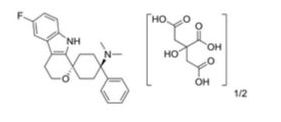
Cebranopadol hemicitrate, セブラノパドール

Cebranopadol structure.png

STR1

Cebranopadol hemicitrate, GRT-6005

Phase III 

Grünenthal GmbH  innovator

SYNTHESIS COMING WATCH OUT……….GlitterGlitterGlitterGlitter

A mu-opioid agonist for treatment of neuropathic pain and pain due to osteoarthritis.

CAS No.863513-92-2(Cebranopadol Hemicitrate)

CAS 863513-91-1(FREE FORM)

Spiro[cyclohexane-1,1′(3’H)-pyrano[3,4-b]indol]-4-amine, 6′-fluoro-4′,9′-dihydro-N,N-dimethyl-4-phenyl-, trans

MF C24 H27 F N2 O, MW, 378.48
Spiro[cyclohexane-1,1′(3′H)-pyrano[3,4-b]indol]-4-amine, 6′-fluoro-4′,9′-dihydro-N,N-dimethyl-4-phenyl-, (1α,4β)-

Cebranopadol (GRT-6005) is a novel opioid analgesic of the benzenoid class which is currently under development internationally by Grünenthal, a German pharmaceutical company, and its partner Depomed, a pharmaceutical company in the United States, for the treatment of a variety of different acute and chronic pain states.[1][2][3] As of November 2014, it is in phase III clinical trials. Cebranopadol is unique in its mechanism of action as an opioid, binding to and activating all four of the opioid receptors; it acts as afull agonist of the nociceptin receptor (Ki = 0.9 nM; EC50 = 13.0; IA = 89%), μ-opioid receptor (Ki = 0.7 nM; EC50 = 1.2; IA = 104%), and δ-opioid receptor (Ki = 18 nM; EC50 = 110; IA = 105%), and as a partial agonist of the κ-opioid receptor (Ki = 2.6 nM; EC50 = 17; IA = 67%).[1] The ED50 values of 0.5-5.6 µg/kg when introduced IV & 25.1 µg/kg after oral administration.[4]

Cebranopadol shows highly potent and effective antinociceptive and antihypertensive effects in a variety of different animal modelsof pain.[1] Notably, it has also been found to be more potent in models of chronic neuropathic pain than acute nociceptive paincompared to selective μ-opioid receptor agonists.[1] Relative to morphine, tolerance to the analgesic effects of cebranopadol has been found to be delayed (26 days versus 11 days for complete tolerance).[1] In addition, unlike morphine, cebranopadol has not been found to affect motor coordination or reduce respiration in animals at doses in or over the dosage range for analgesia.[1] As such, it may have improved and prolonged efficaciousness and greater tolerability in comparison to currently available opioid analgesics.[1]

As an agonist of the κ-opioid receptor, cebranopadol may have the capacity to produce psychotomimetic effects and other adverse reactions at sufficiently high doses, a property which could potentially limit its practical clinical dosage range.[5]

Cebranopadol (trans-6′-fluoro-4′,9′-dihydro-N,N-dimethyl-4-phenyl-spiro[cyclohexane-1,1′(3′H)-pyrano[3,4-b]indol]-4-amine) is a novel analgesic nociceptin/orphanin FQ peptide (NOP) and opioid receptor agonist [Ki (nM)/EC50(nM)/relative efficacy (%): human NOP receptor 0.9/13.0/89; human mu-opioid peptide (MOP) receptor 0.7/1.2/104; human kappa-opioid peptide receptor 2.6/17/67; human delta-opioid peptide receptor 18/110/105]. Cebranopadol exhibits highly potent and efficacious antinociceptive and antihypersensitive effects in several rat models of acute and chronic pain (tail-flick, rheumatoid arthritis, bone cancer, spinal nerve ligation, diabetic neuropathy) with ED50 values of 0.5−5.6 µg/kg after intravenous and 25.1 µg/kg after oral administration. In comparison with selective MOP receptor agonists, cebranopadol was more potent in models of chronic neuropathic than acute nociceptive pain. Cebranopadol’s duration of action is long (up to 7 hours after intravenous 12 µg/kg; >9 hours after oral 55 µg/kg in the rat tail-flick test). The antihypersensitive activity of cebranopadol in the spinal nerve ligation model was partially reversed by pretreatment with the selective NOP receptor antagonist J-113397[1-[(3R,4R)-1-cyclooctylmethyl-3-hydroxymethyl-4-piperidyl]-3-ethyl-1,3-dihydro-2H-benzimidazol-2-one] or the opioid receptor antagonist naloxone, indicating that both NOP and opioid receptor agonism are involved in this activity. Development of analgesic tolerance in the chronic constriction injury model was clearly delayed compared with that from an equianalgesic dose of morphine (complete tolerance on day 26 versus day 11, respectively). Unlike morphine, cebranopadol did not disrupt motor coordination and respiration at doses within and exceeding the analgesic dose range. Cebranopadol, by its combination of agonism at NOP and opioid receptors, affords highly potent and efficacious analgesia in various pain models with a favorable side effect profile.

Almost 20 years ago, a new member of the opioid receptor family and its endogenous agonist were described (Meunier et al., 1995; Reinscheid et al., 1995). Because of its partial homology to the opioid receptors [mu-opioid peptide (MOP) receptor, delta-opioid peptide (DOP) receptor, kappa-opioid peptide (KOP) receptor] and its insensitivity to the prototypical opioid agonist and antagonist ligands morphine and naloxone, this receptor was initially termed opioid receptor-like receptor, ORL1. Subsequently, it was renamed the nociceptin/orphanin FQ peptide (NOP) receptor after its endogenous ligand nociceptin, and it is now considered to be a non-opioid member of the opioid receptor family (Cox et al., 2009). At a cellular level, the actions of the NOP receptor are broadly similar to those of the opioid receptors (Chiou et al., 2007; Lambert, 2008). Although NOP receptors are clearly expressed at all levels of the pain pathways, it is thought that NOP and MOP receptors are not colocalized in the same neurons and may, thus, have independent actions in at least partly distinct neuronal networks (Monteillet-Agius et al., 1998).

The role of the NOP receptor in pain and analgesia has remained unclear for some time owing to inconsistent findings in early reports using nociceptin to activate the receptor. Being a peptide, nociceptin was administered locally into the central nervous system (CNS) where it produced both pronociceptive and antinociceptive effects when administered supraspinally (Meunier et al., 1995; Calo and Guerrini, 2013). Remarkably, when administered into the spinal cord of rodents and nonhuman primates, nociceptin consistently produced antinociceptive effects (Ko et al., 2009; Sukhtankar and Ko, 2013). Subsequent studies of systemic administration of nonpeptide NOP receptor agonists revealed that such compounds were effective analgesics in animal pain models. Although evidence for antinociceptive and antihyperalgesic effects in rodents is limited and inconsistent (Jenck et al., 2000; Reiss et al., 2008), Ko et al. (2009) demonstrated impressive antinociceptive and antiallodynic potency and efficacy using the NOP receptor agonist Ro64-6198 in Rhesus monkeys. Potency and efficacy were comparable with those of alfentanil but with a complete absence of alfentanil-associated side effects such as itching/scratching and respiratory depression and no evidence of reinforcing effects (Ko et al., 2009; Podlesnik et al., 2011).

Currently, strong MOP receptor agonists are the most effective drugs for the treatment of moderate to severe acute and chronic pain. However, although these drugs provide potent analgesia, they also carry the risk of severe side effects such as respiratory depression, nausea, vomiting, and constipation, and their use may lead to physical dependence and tolerance (Zöllner and Stein, 2007). In addition, opioids are considered to have limited efficacy in treating chronic nociceptive and neuopathic pain owing to a reduction in the already low therapeutic index (Rosenblum et al., 2008; Labianca et al., 2012). For these reasons, there is an unmet medical need for potent and well-tolerated analgesics for the treatment of moderate to severe chronic nociceptive and neuropathic pain.

As NOP and opioid receptor agonists modulate pain and nociception via distinct yet related targets, combining both mechanisms may constitute an interesting and novel approach for the development of innovative analgesics. Notably, a supra-additive interaction between intrathecal morphine and intrathecal nociceptin has been described in rodents (Courteix et al., 2004), as well as an enhancement of the antinociceptive effect of systemic morphine by systemic administration of Ro64-6198 (Reiss et al., 2008). Furthermore, a synergistic effect of concurrent NOP and MOP receptor activation without significant side effects has been demonstrated in nonhuman primates after systemic administration (Cremeans et al., 2012). At the same time, activation of NOP receptors has been proposed to counteract supraspinal opioid activity; in animal studies, NOP receptor agonists do not generate typical opioid-like side effects and may even ameliorate opioid-related side effects when administered concurrently with an opioid agonist (Ko et al., 2009; Rutten et al., 2010; Toll, 2013). Thus, a combination of NOP and opioid receptor activation may be particularly suited to provide potent analgesia with reduced opioid-like side effects.

To explore the potential benefits of NOP and opioid receptor coactivation, novel compounds acting as agonists on both NOP and opioid receptors have been designed (Molinari et al., 2013; Zaveri et al., 2013). This article describes the preclinical pharmacology of cebranopadol, a potent NOP and opioid receptor agonist derived from a novel chemical series of spiro[cyclohexane-dihydropyrano[3,4-b]indol]-amines (S. Schunk, K. Linz, C. Hinze, S. Frormann, S. Oberbörsch, B. Sundermann, S. Zemolka, W. Englberger, T. Germann, T. Christoph, B.Y. Kögel, W. Schröder, S. Harlfinger, D. Saunders, A. Kless, H. Schick, and H. Sonnenschein, submitted manuscript) that was developed by Grünenthal (Aachen, Germany) and is currently in clinical development for the treatment of severe chronic pain……..http://jpet.aspetjournals.org/content/349/3/535.full

WO 2013170968

WO 2013170966

WO 2013170971

WO 2013170972

WO 2013170970

WO 2013170969

WO 2013170967

WO 2004043967

US 20130150590

PAPER

ACS Medicinal Chemistry Letters (2014), 5(8), 857-862.

Discovery of a Potent Analgesic NOP and Opioid Receptor Agonist: Cebranopadol

Departments of Medicinal Chemistry, Preclinical Drug Safety, §Molecular Pharmacology, Pain Pharmacology,Pharmacokinetics, and #Discovery Informatics, Global Drug Discovery, Grünenthal Innovation, Grünenthal GmbH, D-52099 Aachen, Germany
ASCA GmbH Angewandte Synthesechemie Adlershof, Magnusstr. 11, 12489 Berlin, Germany
ACS Med. Chem. Lett., 2014, 5 (8), pp 857–862
DOI: 10.1021/ml500117c
Publication Date (Web): June 24, 2014
Copyright © 2014 American Chemical Society

Abstract

Abstract Image

In a previous communication, our efforts leading from 1 to the identification of spiro[cyclohexane-dihydropyrano[3,4-b]indole]-amine 2a as analgesic NOP and opioid receptor agonist were disclosed and their favorable in vitro and in vivo pharmacological properties revealed. We herein report our efforts to further optimize lead 2a, toward trans-6′-fluoro-4′,9′-dihydro-N,N-dimethyl-4-phenyl-spiro[cyclohexane-1,1′(3′H)-pyrano[3,4-b]indol]-4-amine (cebranopadol, 3a), which is currently in clinical development for the treatment of severe chronic nociceptive and neuropathic pain.

http://pubs.acs.org/doi/abs/10.1021/ml500117c?source=chemport&journalCode=amclct

STR1

STR1

MP 258-282 DEG CENT

STR1

Group photo jubilee celebration

October the family Grünenthal GmbH celebrated its longtime employee in Aachen-Eilendorf. Proud 680 years of service …

PATENT

http://www.google.com/patents/US7547707

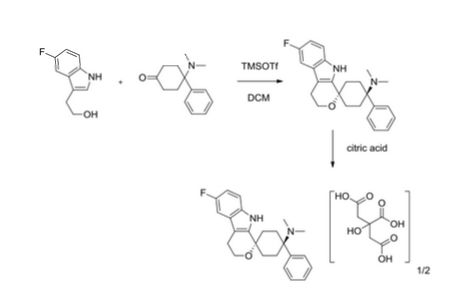
Example 24 1,1-(3-Dimethylamino-3-phenylpentamethylene)-6-fluoro-1,3,4,9-tetrahydropyrano[3,4-b]indole hemicitrate, More Non-polar diastereoisomer

4-Dimethylamino-4-phenylcyclohexanone (651 mg, 3 mmoles) and 2-(5-fluoro-1H-indol-3-yl)-ethanol (“5-fluorotryptophol”, 537 mg, 3 mmoles) were initially introduced into abs. MC (20 ml) under argon. Trifluoromethanesulfonic acid trimethylsilyl ester (0.6 ml, 3.1 mmoles) was then added very rapidly. The mixture was stirred at RT for 20 h. For working up, 1 M NaOH (30 ml) was added to the reaction mixture and the mixture was stirred for 30 min. The organic phase was separated, and the aqueous phase which remained was extracted with MC (3×60 ml). The combined organic phases were washed with water (2×30 ml) and dried over sodium sulfate. Methanol (30 ml) was added to the solid residue obtained after the solvent had been distilled off, and the mixture was heated, and stirred for 15 hours. The solid contained in the suspension was filtered off with suction and dried. 955 mg of the more non-polar diastereoisomer of 1,1-(3-dimethylamino-3-phenylpentamethylene)-6-fluoro-1,3,4,9-tetrahydropyrano[3,4-b]indole were obtained (m.p. 284-292° C.). 850 mg of this were dissolved in hot ethanol (900 ml), and a similarly hot solution of citric acid (1 g, 5.2 mmoles) in ethanol (20 ml) was added. After approx. 15 minutes, crystals precipitated out at the boiling point. After cooling to approx. 5° C., the mixture was left to stand for 2 h. The solid formed was filtered off with suction. 640 mg of the hemicitrate were obtained as a white solid (m.p. 258-282° C.).

Example 25 1,1-(3-Dimethylamino-3-phenylpentamethylene)-6-fluoro-1,3,4,9-tetrahydropyrano[3,4-b]indole hemicitrate, More Polar diastereoisomer

4-Dimethylamino-4-phenylcyclohexanone (217 mg, 1 mmole) and 2-(5-fluoro-1H-indol-3-yl)-ethanol (“5-fluorotryptophol”, 179 mg, 1 mmole) were dissolved in conc. acetic acid (4 ml). Phosphoric acid (1 ml, 85 wt. %) was slowly added dropwise to this mixture. The mixture was stirred at RT for 16 h. For working up, the mixture was diluted with water (20 ml), brought to pH 11 with 5 M NaOH and extracted with MC (3×20 ml). The combined organic phases were dried with sodium sulfate and evaporated. The residue (364 mg of white solid) was suspended in hot ethanol (20 ml), and a similarly hot solution of citric acid (185 mg, 0.96 mmole) in ethanol (5 ml) was added. The residue thereby dissolved completely and no longer precipitated out even on cooling to approx. 5° C. Ethanol was removed on a rotary evaporator and the hemicitrate of the more polar diastereoisomer of 1,1-(3-dimethylamino-3-phenylpentamethylene)-6-fluoro-1,3,4,9-tetrahydropyrano[3,4-b]indole was obtained in this way in a yield of 548 mg as a white solid (m.p. 148-155° C.).

24
Figure US07547707-20090616-C00031
hemicitrate more non-polar diastereomer
25
Figure US07547707-20090616-C00032
hemicitrate more polar diastereomer
PATENT
WO 2013113690

(1 r,4r)-6′-fluoro-N,N- dimethyl-4-phenyl-4′,9′-dihydro-3’H-spiro[cyclohexane-1 ,1 ‘-pyrano[3,4-b]indol]-4-amine (free base), has the following structural formula (I):

http://www.google.com/patents/WO2013113690A1?cl=en

Figure imgf000007_0001
PATENT
Figure imgf000033_0001
see A4
PATENT

One particular drug that is of great interest for use in treating cancer pain (and other acute, visceral, neuropathic and chronic pain pain disorders) is (1r,4r)-6′-fluoro-N,N-dimethyl-4-phenyl-4′,9′-dihydro-3′H-spiro[cyclohexane-1,1′-pyrano[3,4b]indol]-4-amine. This drug is depicted below as the compound of formula (I).

Figure US20130231381A1-20130905-C00001

The solid forms of (1r,4r)-6′-fluoro-N,N-dimethyl-4-phenyl-4′,9′-dihydro-3′H-spiro[cyclohexane-1,1′-pyrano[3,4b]indol]-4-amine that are known so far are not satisfactory in every respect and there is a demand for advantageous solid forms

A) Synthesis of Crystalline Form A100 mg (1r,4r)-6′-fluoro-N,N-dimethyl-4-phenyl-4′,9′-dihydro-3′H-spiro[cyclohexane-1,1′-pyrano[3,4,b]indol]-4-amine [crystalline form D according to D)] was suspended in 0.5 mL TBME. The suspension was stirred at RT for six days. The resulting solid was filtered out and dried in air. A crystalline solid of crystalline form A was obtained and characterized by FT Raman, TG-FTIR and PXRD.
……………………
Abstract Image

In a previous communication, our efforts leading from 1 to the identification of spiro[cyclohexane-dihydropyrano[3,4-b]indole]-amine 2a as analgesic NOP and opioid receptor agonist were disclosed and their favorable in vitro and in vivo pharmacological properties revealed. We herein report our efforts to further optimize lead 2a, toward trans-6′-fluoro-4′,9′-dihydro-N,N-dimethyl-4-phenyl-spiro[cyclohexane-1,1′(3′H)-pyrano[3,4-b]indol]-4-amine (cebranopadol, 3a), which is currently in clinical development for the treatment of severe chronic nociceptive and neuropathic pain.

Discovery of a Potent Analgesic NOP and Opioid Receptor Agonist: Cebranopadol

http://pubs.acs.org/doi/full/10.1021/ml500117c

ACS Med. Chem. Lett., Article ASAP
DOI: 10.1021/ml500117c
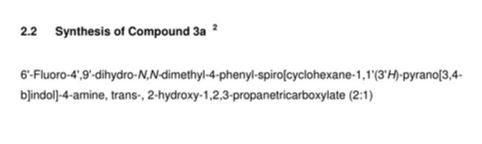
6′-Fluoro-4′,9′-dihydro-N,N-dimethyl-4-phenyl-spiro[cyclohexane-1,1′(3’H)-pyrano[3,4-
b]indol]-4-amine, trans-, 2-hydroxy-1,2,3-propanetricarboxylate (2:1)
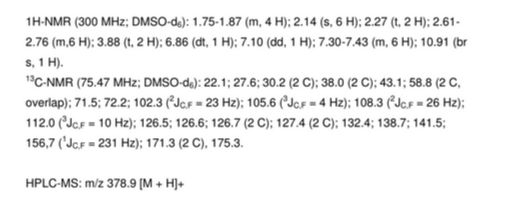
hemicitrate were obtained as a white solid (mp 258-282 °C).1H-NMR (300 MHz; DMSO-d6): 1.75-1.87 (m, 4 H); 2.14 (s, 6 H); 2.27 (t, 2 H); 2.61-
2.76 (m,6 H); 3.88 (t, 2 H); 6.86 (dt, 1 H); 7.10 (dd, 1 H); 7.30-7.43 (m, 6 H); 10.91 (br
s, 1 H).
13C-NMR (75.47 MHz; DMSO-d6): 22.1; 27.6; 30.2 (2 C); 38.0 (2 C); 43.1; 58.8 (2 C,
overlap); 71.5; 72.2; 102.3 (2JC,F = 23 Hz); 105.6 (3JC,F = 4 Hz); 108.3 (2JC,F = 26 Hz);
112.0 (3JC,F = 10 Hz); 126.5; 126.6; 126.7 (2 C); 127.4 (2 C); 132.4; 138.7; 141.5;
156,7 (1JC,F = 231 Hz); 171.3 (2 C), 175.3.HPLC-MS: m/z 378.9 [M + H]+
PATENTS
US20120034297 * Aug 4, 2011 Feb 9, 2012 Gruenenthal Gmbh Pharmaceutical dosage forms comprising 6′-fluoro-(N-methyl- or N,N-dimethyl-)-4-phenyl-4′,9′-dihydro-3’H-spiro[cyclohexane-1,1′-pyrano[3,4,b]indol]-4-amine
US20130012563 * Jul 6, 2012 Jan 10, 2013 Gruenenthal Gmbh Crystalline (1r,4r)-6′-fluoro-n,n-dimethyl-4-phenyl-4′,9′-dihydro-3’h-spiro[cyclohexane-1,1′-pyrano[3,4,b]indol]-4-amine
WO2004043967A1 Nov 5, 2003 May 27, 2004 Otto Aulenbacher Spirocyclic cyclohexane derivatives
WO2008040481A1 Sep 26, 2007 Apr 10, 2008 Gruenenthal Gmbh MIXED ORL 1/μ AGONISTS FOR TREATING PAIN

References

  1.  Linz K, Christoph T, Tzschentke TM; et al. (June 2014). “Cebranopadol: a novel potent analgesic nociceptin/orphanin FQ peptide and opioid receptor agonist”. J. Pharmacol. Exp. Ther. 349 (3): 535–48. doi:10.1124/jpet.114.213694.PMID 24713140.
  2.  Schunk S, Linz K, Hinze C; et al. (August 2014). “Discovery of a Potent Analgesic NOP and Opioid Receptor Agonist: Cebranopadol”. ACS Med Chem Lett 5 (8): 857–62.doi:10.1021/ml500117c. PMID 25147603.
  3.  Lambert DG, Bird MF, Rowbotham DJ (September 2014). “Cebranopadol: a first in-class example of a nociceptin/orphanin FQ receptor and opioid receptor agonist”. Br J Anaesth114: 364–6. doi:10.1093/bja/aeu332. PMID 25248647.
  4.  Cebranopadol: a novel potent analgesic nociceptin/orphanin FQ peptide and opioid receptor agonist. Journal of Pharmacol Exp Ther. 2014 Jun;349(3):535-48. doi: 10.1124/jpet.114.213694
  5.  Pfeiffer A, Brantl V, Herz A, Emrich HM (August 1986). “Psychotomimesis mediated by kappa opiate receptors”. Science 233 (4765): 774–6. doi:10.1126/science.3016896.PMID 3016896.
  6. Expert Opinion on Investigational Drugs (2015), 24(6), 837-844
  7. Journal of Pharmacology and Experimental Therapeutics (2014), 349(3), 535-548,
  8. External links

Cebranopadol
Cebranopadol structure.png
Systematic (IUPAC) name
(1r,4r)-6’-fluoro-N,N-dimethyl-4-phenyl-4’,9’-dihydro-3’H-spiro[cyclohexane-1,1’-pyrano[3,4-b]indol]-4-amine
Pharmacokinetic data
Biological half-life ~4.5 hours
Identifiers
CAS Number 863513-91-1
ATC code None
PubChem CID 11848225
ChemSpider 29398942
Chemical data
Formula C24H27FN2O
Molar mass 378.482 g/mol

////Cebranopadol hemicitrate, GRT-6005, Cebranopadol, セブラノパドール

CN([C@]1(CC[C@]2(OCCc3c2[nH]c4c3cc(cc4)F)CC1)c5ccccc5)C