
Home » Uncategorized (Page 202)
Category Archives: Uncategorized
 DRUG APPROVALS BY DR ANTHONY MELVIN CRASTO
.....FOR BLOG HOME CLICK HERE
DRUG APPROVALS BY DR ANTHONY MELVIN CRASTO
.....FOR BLOG HOME CLICK HEREFlag and hits
ORGANIC SPECTROSCOPY

SUBSCRIBE

 Subscribe in a reader
Enter your email address:
Delivered by FeedBurner
Subscribe to New Drug Approvals by Email


Recent Comments
 | shivkr2 on SPSR Excellence Award 2025 – S… |
 | Bonkasaurus on Infigratinib phosphate |
 | PALOVAROTENE | ORGAN… on Palovarotene |
| Pfizer just purchase… on Temanogrel | |
| Pfizer To Cash In On… on Temanogrel |
Date rape drug sensor


The first fluorescent sensor for known date rape drug gamma-butyrolactone (GBL) has been developed in Singapore. It emits orange fluorescence in alcoholic drinks containing GBL when irradiated with a green laser.
Gamma-butyrolactone (GBL) is a readily available industrial solvent that is often used as a date rape drug. There are several detection kits that can show if a drink has been spiked with drugs like gamma-hydroxybutyric acid (GHB) and ketamine but there are no commercially available sensors to detect GBL.
http://www.rsc.org/chemistryworld/2013/06/date-rape-drug-sensor-gamma-butyrolactone

read also
Fernando Patolsky and Michael Ioffe of Tel Aviv University developed a sensor that, when dipped into a drink, will instantly detect the presence of a drug such as GHB, ketamine, or Rohypnol.
more info on other drug

Predatory drugs or date rape drugs are responsible for the creation of the most dangerous and pathologic environment that exists around drug use and drug abuse. Predatory drugs are a general class of drug that are primarily used to “render the victim incapable of resisting sexual advances”. (U.S. DEA)
This statement does not imply that the drug makes a person desire sexual activity, but quite the opposite. Predatory drugs leave the victim helpless, possibly unconscious, but certainly without any memory of a crime being committed against him/her. It can not be emphasized enough that giving someone a predatory drug is not only morally reprehensible it is also a serious criminal act. Illicit use of date rape drugs involve some of the most pathologic criminals who are involved with our justice system.
Misspellings: Ketamene, Ketimane, Rohipnol, Rophinol
What is Date Rape Drug Addiction?
So called date rape drugs are also found at rave parties, clubs, college parties, and even in high school social environments. They are potent drugs that can cause serious health problems, developmental problems, overdose and death. To further complicate the effects of these drugs, many are produced in illegal labs. Illicit production of drugs means there is no quality control standards. The lack of quality control standards can greatly diminish the purity of the drugs and leaves the user vulnerable to harsh chemicals and possibly overdose. Most of the chemicals found in date rape drugs are not intended for human consumption.
The number of drugs that are considered predatory drugs is increasing. To date, the most commonly used are:
- GHB – GBH’s chemical name is gama hydroxybutyrate and is currently a
DEA
schedule 1 drug that has central nervous system depressant effects.
- GBL/1 – GBL is a pro-drug of GHB and produces the same effects.
- 4-BD – The chemical name of 4-BD is 1,4-Butanediol and is used industrially as a solvent. When taken recreationally, it produces the same effects as GHB.
- Ketamine – Ketamine, or special K, as it is known on the streets, is a type of anesthetic known as a dissociative anesthetic and is approved for human and veterinarian use. When taken recreationally, it produces euphoria and hallucinations.
- Rohypnol – The generic name of Rohypnol is flunitrazepam and it is marketed as a potent hypnotic, sedative, and it produces amnesia. It is in the class of drugs known as benzodiazepines.
Some of these drugs are made from industrial strength floor cleansers, lye, and Dranno and can cause brain damage.
Signs and Symptoms Date Rape Drugs Addiction
The regular use of drugs such as GHB/GBL used to lower inhibitions can create significant side effects. The most common side effects produced by the recreational use of date rape drugs are:
- Psychosis and severe agitation requiring self-protection procedures and sedation
- Mild tachycardia (increased heart rate) and hypertension
- Neurologic effects, including prolonged delirium
- Hallucinations
- Diaphoresis (profuse sweating), nausea, and vomiting
- Overdose, coma, and death
Because of the memory loss associated with these drugs, the user can be prone to use again and again without memory of severe side effects. Once used regularly, date rate drugs could also lead to serious withdrawal symptoms. These withdrawal symptoms will require medical attention and medication.
Beyond the physical dependence an emotional dependence can quickly develop. Once regular use begins an addict can experience personality changes which may result in aggressive behavior, a disregard for authority, a disregard for personal safety, risky sexual behavior, a loss of boundaries, financial difficulties, problems at school or work, a change in friends, and the loss of interest in normal activities.
No one plans on becoming an addict but the power of drugs on the brain’s functioning, accompanied by the alterations in the neuroreceptors, drives the addiction process. It is not about choice or desire once the body’s systems have been affected. Date rape drugs or predatory drugs are extraordinarily powerful both in their addictive qualities and the serious, negative, health consequences that accompany regular use.
TOSEDOSTAT CLINICAL TRIALS
Tosedostat
Benzeneacetic acid, α-[[(2R)-2-[(1S)-1-hydroxy-2-(hydroxyamino)-2-oxoethyl]-4-methyl-1-oxopentyl]amino]-, cyclopentyl ester, (αS)-
Cyclopentyl (2S)-({(2R)-2-[(1S)-1-hydroxy-2-(hydroxyamino)-2-oxoethyl]-4-methylpentanoyl}amino)(phenyl)acetate
[238750-77-1]
Cell Therapeutics, Inc. (CTI) (NASDAQ and MTA: CTIC) today issued the following statement regarding the notification of the U.S. Food and Drug Administration (the “FDA”) partial clinical hold on tosedostat (IND 075503), the Company’s aminopeptidase inhibitor under development for the treatment of blood-related cancers, that is being studied in an investigator-sponsored trial and not by CTI. CTI’s primary development programs are the ongoing Phase 3 trial of pacritinib, the Company’s JAK2/FLT3 inhibitor being evaluated for patients with myelofibrosis, and the post-approval commitment study of PIXUVRI®(pixantrone).
http://www.heraldonline.com/2013/06/25/4972677/cti-issues-statement-regarding.html
Dulaglutide Shows Superiority in Phase 3 Trials

DULAGLUTIDE
STRUCTURAL FORMULA
Monomer
HGEGTFTSDV SSYLEEQAAK EFIAWLVKGG GGGGGSGGGG SGGGGSAESK 50
YGPPCPPCPA PEAAGGPSVF LFPPKPKDTL MISRTPEVTC VVVDVSQEDP 100
EVQFNWYVDG VEVHNAKTKP REEQFNSTYR VVSVLTVLHQ DWLNGKEYKC 150
KVSNKGLPSS IEKTISKAKG QPREPQVYTL PPSQEEMTKN QVSLTCLVKG 200
FYPSDIAVEW ESNGQPENNY KTTPPVLDSD GSFFLYSRLT VDKSRWQEGN 250
VFSCSVMHEA LHNHYTQKSL SLSLG 275
Disulfide bridges location
55-55′ 58-58′ 90-150 90′-150′ 196-254 196′-254′
http://www.ama-assn.org/resources/doc/usan/dulaglutide.pdf
7-37-Glucagon-like peptide I [8-glycine,22-glutamic acid,36-glycine] (synthetic
human) fusion protein with peptide (synthetic 16-amino acid linker) fusion protein with
immunoglobulin G4 (synthetic human Fc fragment), dimer
Eli Lilly and Co. announced detailed safety and efficacy results from three Phase 3 AWARD trials for dulaglutide, an investigational, long-acting glucagon-like peptide 1 (GLP-1) receptor agonist being studied as a once-weekly treatment for type 2 diabetes
QUINAPRIL

QUINAPRIL HYDROCHLORIDE
Quinapril (marketed under the brand name Accupril by Pfizer) is an angiotensin-converting enzyme inhibitor (ACE inhibitor) used in the treatment of hypertension andcongestive heart failure.
Quinapril inhibits angiotensin converting enzyme, an enzyme which catalyses the formation of angiotensin II from its precursor, angiotensin I. Angiotensin II is a powerfulvasoconstrictor and increases blood pressure through a variety of mechanisms. Due to reduced angiotensin production, plasma concentrations of aldosterone are also reduced, resulting in increased excretion of sodium in the urine and increased concentrations ofpotassium in the blood.
-
 The condensation of alanine tert-butyl ester (I) with ethyl 2-bromo-4-phenylbutanoate (II) by means of triethylamine in hot DMF gives ethyl 2-[[1-(tert-butoxycarbonyl)ethyl]amino]-4-phenylbutanoate (III), which is partially hydrolyzed with trifluoroacetic acid yielding ethyl 2-[[1-carboxyethyl]amino]-4-phenylbutanoate (IV). The condensation of (IV) with tert-butyl-1,2,3,4-tetrahydroisoquinoline-3-carboxylate (VIII) [prepared from the corresponding acid (VI) and isobutylene (B) by means of H2SO4] as before gives tert-butyl-2-[2-[[1-(ethoxycarbonyl)-3-phenylpropyl]amino]-1-oxopropyl]-1,2,3,4-tetrahydroisoquinoline-3-carboxylate (IX), which is finally hydrolyzed partially by treatment with trifluoroacetic acid.
 Hoefle, M.L.; Klutchko, S. (Pfizer Inc.); Substituted acyl derivatives of 1,2,3,4-tetrahydroisoquinoline-3-carboxylic acids. DD 201787; EP 0049605; EP 0096157; US 4344949


Novartis First-Generation Lung Cancer Drug Tweaked To Reduce Potential Side Effects

BENAZEPRIL SYNTHESIS

CAS NO AS HCl SALT
| 86541-75-5 |

The reaction of 3-bromo-1-phenylpropane (I) with KCN gives 4-phenylbutyronitrile (II), which is hydrolyzed to the corresponding butyric acid (III). The cyclization of (III) with polyphosphoric acid affords 1-tetralone (IV), which is brominated to 2-bromo-1-tetralone (V) and treated with hydroxylamine to give the oxime (VI). The Beckman rearrangement of (VI) yields 3-bromo-2,3,4,5-tetrahydro-1H-(1)benzazepin-2-one (VII), which is treated with sodium azide to afford the azide derivative (VIII). The N-alkylation of (VIII) with ethyl bromoacetate (IX) by means of KOH and tetrabutylammonium bromide in THF gives the N-alkylated azide (X), which is reduced by catalytic hydrogenation to the corresponding amine (XI). The hydrolysis of the ester group of (XI) with NaOH yields the free acetic acid derivative (XII), which is finally reductocondensed with ethyl 2-oxo-4-phenylbutyrate (XIII) by means of sodium cyanoborohydride
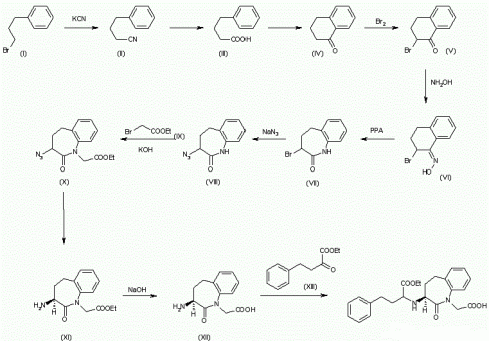
WO 2003092698 A1


PLASTIC SURGERY-Breast Lift Surgery-mastopexy

Breast lift, or mastopexy, surgery raises and firms the breasts by removing excess skin and tightening the surrounding tissue to reshape and support the new breast contour.
Breast lift procedure steps
What happens during breast lift surgery? Your mastopexy surgery can be achieved through a variety of incision patterns and techniques. The appropriate technique for you will be determined based on:
- Breast size and shape
- The size and position of your areolas
- The degree of breast sagging
- Skin quality and elasticity as well as the amount of extra skin
Step 1 – Anesthesia
Medications are administered for your comfort during breast lift surgery. The choices include intravenous sedation and general anesthesia. Your doctor will recommend the best choice for you.
Step 2 – The incision
There are three common incision patterns:
Around the areola, . note-pics deleted
Around the areola and vertically down from the areola to the breast crease
Around the areola, vertically down from the breast crease and horizontally along the breast crease
Step 3 – Reshaping your breasts
After your doctor makes the incisions:
- The underlying breast tissue is lifted and reshaped to improve breast contour and firmness.
- The nipple and areola are repositioned to a natural, more youthful height.
- If necessary, enlarged areolas are reduced by excising skin at the perimeter.
- Excess breast skin is removed to compensate for a loss of elasticity.
Step 4 – Closing the incisions
After your breasts are reshaped and excess skin is removed, the remaining skin is tightened as the incisions are closed.
Some incision lines resulting from breast lifts are concealed in the natural breast contours; however, others are visible on the breast surface. Incision lines are permanent, but in most cases will fade and significantly improve over time.
Sutures are layered deep within the breast tissue to create and support the newly shaped breasts. Sutures, skin adhesives and/or surgical tape may be used to close the skin.
Step 5 – See the results
The results of your breast lift surgery are immediately visible. Over time, post-surgical swelling will resolve and incision lines will fade.
Satisfaction with your new image should continue to grow as you recover and realize the fulfillment of your goal for breasts which have been restored to a more youthful and uplifted position.
Pfizer, GSK form productivity pact with Singapore’s A*Star

Pfizer, GlaxoSmithKline and engineering giant Siemens have signed on as founding members of a new consortium set up by Singapore’s Agency for Science, Technology and Research (A*Star) to address challenges such as costs, regulatory compliance and processes to bring drugs from trials to markets.
READ ALL AT

The Agency for Science, Technology and Research (Abbreviation: A*STAR; Chinese: 新加坡科技研究局) is a statutory board under the Ministry of Trade and Industry of Singapore. The Agency was established in 1991 to foster scientific research and talent for a knowledge-based Singapore.
Established in 1991 as the former National Science and Technology Board (NSTB), A*STAR was established with the primary mission to raise the level of science and technology in Singapore.[1]
Leadership
The current chairman of A*STAR is Mr. Lim Chuan Poh. He was formerly the Permanent Secretary (Education) and the Chief of Defence Force. Mr Lim took over the reins of A*STAR from Mr. Philip Yeo, who later became Chairman of SPRING Singapore, on 1 April 2007.[2]
The scientific leadership includes Tan Chorh Chuan, George Radda, Sydney Brenner, David Lane, Charles Zukoski and used to include Prof Low Teck Seng. Prof Low Teck Seng left A*Star on 19 July 2012 to join the National Research Foundation of the Prime Minister’s Office.
A*STAR Entities
The agency is made up of:
- The Biomedical Research Council (BMRC) – Oversees public sector research activities in the biomedical sciences
- The Science and Engineering Research Council (SERC) – Oversees public sector research activities in the physical sciences & engineering
- The A*STAR Joint Council (A*JC) – Promotes and supports interdisciplinary collaborations between biomedical sciences, and physical sciences & engineering
- The A*STAR Graduate Academy (A*GA) – Administers science scholarships and other manpower development programs
- Exploit Technologies Pte Ltd (ETPL) – Manages the intellectual property created by research institutes in Singapore, and facilitates technology transfer to industry
- The Corporate Group – Supports the rest of the organisation with finance, human resources, legal and other services
The agency oversees 14 biomedical sciences, and physical sciences and engineering research institutes, and six consortia & centre, which are located in Biopolis and Fusionopolis, as well as their immediate vicinity.
A*STAR supports Singapore’s key economic clusters by providing intellectual, human and industrial capital to its partners in industry. It also supports extramural research in the universities, hospitals, research centres, and with other local and international partners.
Research Institutes & Units
Biomedical Research Council
The Biomedical Research Council (BMRC) oversees 7 research institutes and several other research units that focus on both basic as well as translational and clinical research to support the key industry clusters in Biomedical Sciences, pharmaceuticals, medical technology, biotechnology and healthcare services.
Having established a strong foundation in basic biomedical research capabilities, there is now an added focus on translating new knowledge and technologies created at the “benches” into new clinical applications for diagnosis and treatment that can one day be delivered at the “bedsides” of our hospitals and disease centres.
The research institutes and units under BMRC are:
- Bioinformatics Institute (BII)
- Bioprocessing Technology Institute (BTI)
- Experimental Therapeutics Centre (ETC)
- Genome Institute of Singapore (GIS)
- Institute of Bioengineering and Nanotechnology (IBN)
- Institute of Medical Biology (IMB)
- Institute of Molecular and Cell Biology (IMCB)
- Neuroscience Research Partnership (NRP)
- Singapore Bioimaging Consortium (SBIC)
- Singapore Immunology Network (SIgN)
- Singapore Institute for Clinical Sciences (SICS)
- Singapore Stem Cell Consortium (SSCC)
- A*STAR-NUS Clinical Imaging Research Centre (CIRC)
The BMRC Research Institutes focus on building up core biomedical capabilities in the areas of bioprocessing; chemical synthesis; genomics and proteomics; molecular and cell biology; bioengineering and nanotechnology and computational biology. In addition, the Institute of Medical Biology (IMB) and Singapore Institute for Clinical Sciences (SICS) focus on translational and clinical research.
Science and Engineering Council
A*STAR’s Science and Engineering Research Council (SERC) promotes public sector research and development in the physical sciences & engineering.
SERC manages seven research institutes and several state-of-the art centres and facilities with core competencies in a wide range of fields including communications, data storage, materials, chemicals, computational sciences, microelectronics, advanced manufacturing and metrology to tackle global technological challenges and create future industries from its headquarters at Fusionopolis, Singapore’s iconic hub for science and technology research.
The research institutes and units under SERC are:
- Data Storage Institute (DSI)
- Institute of Chemical Engineering and Sciences (ICES)
- Institute of High Performance Computing (IHPC)
- Institute of Infocomm Research (I2R)
- Institute of Materials Research and Engineering (IMRE)
- Institute of Microelectronics (IME)
- Singapore Institute of Manufacturing Technology (SIMTech)
- National Metrology Centre (NMC)
The seamless integration of the research institutes is key to addressing industry needs, which may span multiple disciplines. To this end, SERC’s broad range of capabilities are in a unique position to develop new technologies in areas such as automotives, aerospace, energy, electronic healthcare and medical technology, nanotechnology, photonics, sensors and sensor networks.
In July 2012, it was announced that A*STAR collaborates with Chinese language internet search provider Baidu to open a joint laboratory, called the Baidu-I2R Research Centre (BIRC), which aims to develop language processing technologies.[3]
Scholarships
Each year, the Agency gives out a number of scholarships and awards to young and aspiring scientists. These awards are meant to help Singapore achieve its goal of becoming a research hub by nurturing home-grown PhDs to serve both in the public sector and in industry. In 2008, a total of 101 scholarships were awarded to Bachelor of Science and PhD students who were to embark on their studies in overseas universities.[4] The administration of these awards are governed by the A*Star Graduate Academy, some of which are listed below:
- National Science Scholarship (BS)
- National Science Scholarship (PhD)
- A*Star Graduate Scholarship
- Singapore International Graduate Award (SINGA)
- Singapore International Pre-Graduate Award (SIPGA)
- A*Star Pre-Graduate Award
- A*Star International Fellowship
References
www.a-star.edu.sg
- “Agency for Science, Technology and Research (A*STAR)”. Ministry of Trade and Industry. Retrieved 30 March 2011.
- Chang Ai-Lien, “S’pore’s science salesman turns sights on SMEs”, The Straits Times, 21 October 2006
- “Baidu, A*STAR open joint laboratory”. Channel News Asia. Retrieved 26 July 2012.
- More Than 300 Young People Receive A*STAR Scholarships And Awards At A*STAR Scholarship Award Ceremony 2008, 25 July 08


 New Drug Approvals