New Drug Approvals

Home » Phase3 drugs (Page 13)

Category Archives: Phase3 drugs

DRUG APPROVALS BY DR ANTHONY MELVIN CRASTO .....FOR BLOG HOME CLICK HERE

Blog Stats

  • 4,830,983 hits

Flag and hits

Flag Counter

Enter your email address to follow this blog and receive notifications of new posts by email.

Join 37.9K other subscribers
Follow New Drug Approvals on WordPress.com

Archives

Categories

Recent Posts

Flag Counter

ORGANIC SPECTROSCOPY

Read all about Organic Spectroscopy on ORGANIC SPECTROSCOPY INTERNATIONAL 

Enter your email address to follow this blog and receive notifications of new posts by email.

Join 37.9K other subscribers
DR ANTHONY MELVIN CRASTO Ph.D

DR ANTHONY MELVIN CRASTO Ph.D

DR ANTHONY MELVIN CRASTO, Born in Mumbai in 1964 and graduated from Mumbai University, Completed his Ph.D from ICT, 1991,Matunga, Mumbai, India, in Organic Chemistry, The thesis topic was Synthesis of Novel Pyrethroid Analogues, Currently he is working with AFRICURE PHARMA, ROW2TECH, NIPER-G, Department of Pharmaceuticals, Ministry of Chemicals and Fertilizers, Govt. of India as ADVISOR, earlier assignment was with GLENMARK LIFE SCIENCES LTD, as CONSUlTANT, Retired from GLENMARK in Jan2022 Research Centre as Principal Scientist, Process Research (bulk actives) at Mahape, Navi Mumbai, India. Total Industry exp 32 plus yrs, Prior to joining Glenmark, he has worked with major multinationals like Hoechst Marion Roussel, now Sanofi, Searle India Ltd, now RPG lifesciences, etc. He has worked with notable scientists like Dr K Nagarajan, Dr Ralph Stapel, Prof S Seshadri, etc, He did custom synthesis for major multinationals in his career like BASF, Novartis, Sanofi, etc., He has worked in Discovery, Natural products, Bulk drugs, Generics, Intermediates, Fine chemicals, Neutraceuticals, GMP, Scaleups, etc, he is now helping millions, has 9 million plus hits on Google on all Organic chemistry websites. His friends call him Open superstar worlddrugtracker. His New Drug Approvals, Green Chemistry International, All about drugs, Eurekamoments, Organic spectroscopy international, etc in organic chemistry are some most read blogs He has hands on experience in initiation and developing novel routes for drug molecules and implementation them on commercial scale over a 32 PLUS year tenure till date Feb 2023, Around 35 plus products in his career. He has good knowledge of IPM, GMP, Regulatory aspects, he has several International patents published worldwide . He has good proficiency in Technology transfer, Spectroscopy, Stereochemistry, Synthesis, Polymorphism etc., He suffered a paralytic stroke/ Acute Transverse mylitis in Dec 2007 and is 90 %Paralysed, He is bound to a wheelchair, this seems to have injected feul in him to help chemists all around the world, he is more active than before and is pushing boundaries, He has 100 million plus hits on Google, 2.5 lakh plus connections on all networking sites, 100 Lakh plus views on dozen plus blogs, 227 countries, 7 continents, He makes himself available to all, contact him on +91 9323115463, email amcrasto@gmail.com, Twitter, @amcrasto , He lives and will die for his family, 90% paralysis cannot kill his soul., Notably he has 38 lakh plus views on New Drug Approvals Blog in 227 countries......https://newdrugapprovals.wordpress.com/ , He appreciates the help he gets from one and all, Friends, Family, Glenmark, Readers, Wellwishers, Doctors, Drug authorities, His Contacts, Physiotherapist, etc He has total of 32 International and Indian awards

Verified Services

View Full Profile →

Archives

Categories

Flag Counter

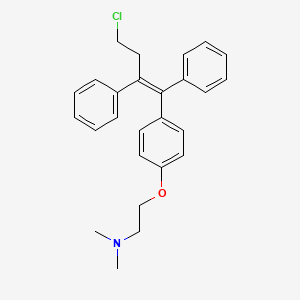
Toremifene


Toremifene.svg

Toremifene

2-[4-[(Z)-4-chloro-1,2-diphenylbut-1-enyl]phenoxy]-N,N-dimethylethanamine

(Z)-2-[4-(4-Chloro-1,2-diphenyl-1-butenyl)phenoxy]-N,N-dimethylethanamine
(Z)-4-Chloro-1,2-diphenyl-1-[4-[2-(N,N-dimethylamino)ethoxy]phenyl]-1-butene
(Z)-Toremifene
2-({4-[(1Z)-4-chloro-1,2-diphenylbut-1-en-1-yl]phenyl}oxy)-N,N-dimethylethanamine
4-chloro-1,2-diphenyl-1-[4-[2-(N ,N-dimethylamino)ethoxy]phenyl]-1-butene

Toremifene; Acapodene; Farestone; Z-Toremifene; Toremifeno; Toremifenum

Molecular Formula: C26H28ClNO
Molecular Weight: 405.95962 g/mol

cas 89778-26-7


Launched – 1988.Orion (FI), greast cancer

  1. Citrate, Toremifene, GTx-006
    NK-622

  2. Fareston
  3. FC 1157a
  4. FC-1157a
  5. FC1157a
  6. Toremifene
  7. Toremifene Citrate
  8. Toremifene Citrate (1:1)
  9. Toremifene, (E)-Isomer
    • C26H28ClNO · C6H8O7
    • Molecular Weight 598.08Toremifene citrate salt ≥98% (HPLC)Toremifene Citrate

Toremifene is a first generation selective estrogen receptor modulator (SERM). Like TAMOXIFEN, it is an estrogen agonist for bone tissue and cholesterol metabolism but is antagonistic on mammary and uterine tissue.

The company GTx is conducting phase III clinical trials for the prevention of prostate cancer in men who have been diagnosed with high grade prostatic intraepithelial neoplasia (PIN).

Toremifene citrate is an oral selective estrogen receptor modulator (SERM) which helps oppose the actions of estrogen in the body. Licensed in the United States under the brand name Fareston, toremifene citrate is FDA-approved for use in advanced (metastatic)breast cancer. It is also being evaluated for prevention of prostate cancer under the brand name Acapodene.[1]

ChemSpider 2D Image | Toremifene | C26H28ClNO

In 2007 the pharmaceutical company GTx, Inc was conducting two different phase 3 clinical trials; First, a pivotal Phase clinical trial for the treatment of serious side effects of androgen deprivation therapy (ADT) (especially vertebral/spine fractures and hot flashes, lipid profile, and gynecomastia) for advanced prostate cancer, and second, a pivotal Phase III clinical trial for the prevention of prostate cancer in high risk men with high grade prostatic intraepithelial neoplasia, or PIN. Results of these trials are expected by first quarter of 2008[2]

An NDA for the first application (relief of prostate cancer ADT side effects) was submitted in Feb 2009,[3] and in Oct 2009 the FDA said they would need more clinical data, e.g. another phase III trial.[4]

Originally developed at Orion, toremifene was subsequently licensed to Nippon Kayaku in Japan and to Asta Medica (now, part of Meda) in Germany.

toremifene.png

Synthesis

 ……….

PATENT

http://www.google.com/patents/CN104230723A?cl=en

Toremifene (Toremifene), chemical name (Z) -4- chloro-1,2-diphenyl–1- [4- (2- (N, N- dimethylamino) ethoxy yl) phenyl] -1-butene, having the structure I.Toremifene to tamoxifen (Tamoxifen) analogues with anti-estrogenic activity, can be used in the treatment of hormone-dependent breast cancer, and its E-isomer has the presence of estrogenic activity, E isomers toremifene may counteract anti-estrogenic activity, and therefore isomeric purity is essential toremifene.Toremifene was developed in 1983 by the Finnish Famos company, listed in 1996 by the Orion company in the EU, the trade name Fareston, 2002 to enter the country, the trade name of toremifene.


Figure CN104230723AD00051

RJ Toivola et al., European Patent EP95875, disclosed in U.S. Patent US4696949A synthetic route toremifene, that following a synthetic route, the synthetic route to phenol as a raw material, by acylation, rearrangement, alkyl group and an addition reaction to give 1,2-diphenyl -1- [4- [2- (N, N- dimethylamino) ethoxyphenyl]] – 1,4-diol (Compound 5) as the key intermediate, further HCl in ethanol or hydrochloric acid elimination reaction occurs, then get toremifene thionyl chloride reaction. The main problem with this approach is that the elimination reaction of the compound 5 in ethanol occurs when hydrochloric acid or concentrated hydrochloric acid, the resulting triaryl alcohol butyrate (Compound 6) having a Z / E configuration, both the ratio of 1: 2 ~ 2: 1, stereo selectivity is not high, and there are 5% of the cyclization by-product; on the Z / E configuration Miyoshi butyric fractional crystallization of alcohol, you can get pure Z-type Miyoshi butyric alcohol , but the yield is only 41%; then, Z-type Miyoshi butyric alcohol chlorination reaction occurs in the action of thionyl chloride, the purified product toremifene.


Figure CN104230723AD00061

 U.S. Patent US5491173A also reported another synthetic route toremifene namely the following two synthetic routes. The route to the aryl ketone (Compound 7) with a phenyl Grignard reagent addition reaction of ketone carbonyl groups to give triaryl-butanediol (compound 5), which is the elimination of toremifene and chlorinated reaction products happen again.


Figure CN104230723AD00062

 Chinese Patent Publication No. CN1125716A application reported an efficient synthesis of Z-type Miyoshi butyric alcohol (compound 6) method, US4696949A compared with the US patent, the method mild conditions, reduce the acid concentration and reaction temperature, reaction time, triarylphosphine butanediol (Compound 5) in concentrated hydrochloric acid or concentrated hydrochloric isopropanol or ethanol effect of concentrated hydrochloric acid, can be 60-78% selectivity and 95% yield of type 2 Miyoshi butyric alcohol But after Publication No. 0 02,126,969 attached eight patent applications after the inventor repeated experiments show that the technique disclosed in the patent application programs can not achieve their claimed technical effect.

 Publication No. CN102126969A of Chinese patent applications through the intermediate Miyoshi butyric alcohol occurs at a catalytic converter configuration of concentrated hydrochloric acid, while taking advantage of differences in solubility, so E- type Miyoshi butyric alcohol continuously into Z-type Miyoshi butyric alcohol (compound 6) precipitates, thereby undermining the balance, so that one of the E-type Miyoshi butyric alcohol continuously into Z-type Miyoshi butyric alcohol (compound 6) to give the Z-Miyoshi butyric alcohol ( Compound 6) and then get toremifene thionyl chloride after chlorination. Although to some extent, improve the yield, but increased operating procedure, is not conducive to industrial production.

Currently, the key intermediate is patent protected, and z-type Miyoshi butyric alcohol (compound 6) stereoselective low yield and isolated intermediates, to solve this problem, to overcome technical barriers to foreign pharmaceutical companies, urgent need to find a simple process, low cost, easy to separate and viable for large-scale production of synthetic routes.

To achieve the above object, according to one aspect of the present invention, there is provided a method of synthesizing toremifene, synthetic method comprising: a step S1, so that a compound having the structural formula II with a compound B having the structural formula III C occurs Mike Murray to give compound D having the structural formula IV; step S2, the Compound D and Compound E or Compound E of the hydrochloride salt of the formula V having a phenolic hydroxyl group on the occurrence of a selective alkylation reaction, to give a compound having the structural formula VI F; step S3, the compound F is reacted with thionyl chloride to give toremifene, wherein,

 Formula II is:

Figure CN104230723AD00071

Structural formula III as follows:

Figure CN104230723AD00072

Formula IV is

Figure CN104230723AD00073

Of formula V is C1CH2CH2N (CH 3) 2; formula VI is

Figure CN104230723AD00074

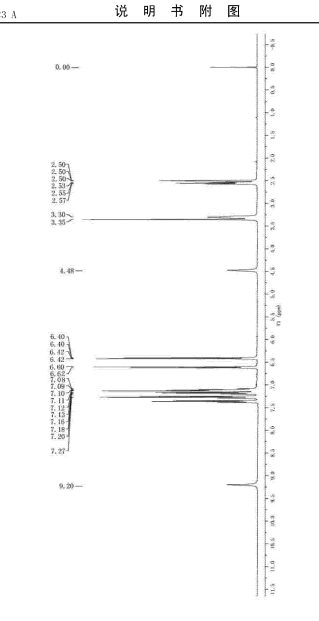
FIG. 1 illustrates the present invention obtained in Example 1 H NMR spectrum of compound D of implementation;

TORE 1

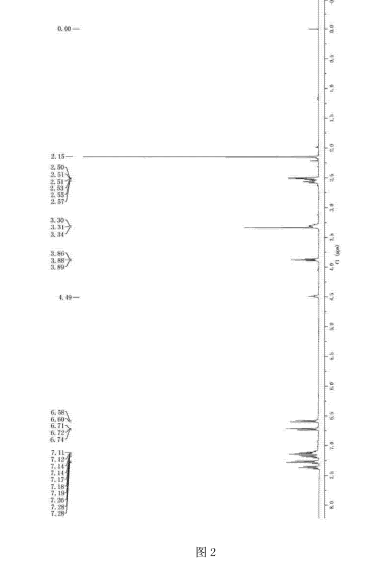
FIG. 2 shows the 1 H NMR spectrum of the present invention, the compound obtained in Example F;

TORE 2

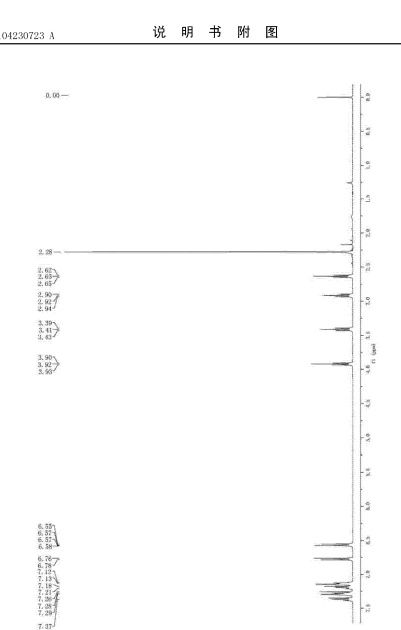
FIG. 3 shows the present invention is a proton nuclear magnetic resonance spectrum of toremifene obtained in Example.

TORE 3

Figure 1, which shows a spectrum of results for Che bandit? (400 cm take, 01 ^ 0) 3 = 9.20 (! 8,1 1), 7.37 (^ = 7.4 to take, 2 1!), 7.30- 7. 23 (m, 3H), 1.22- 7. 15 (m, 2H), 7. 15 – 7. 06 ( m, 3H), 6. 61 (dd, J = 9. 0, 2. 2Hz, 2H), 6. 49 -. 6. 32 (m, 2H), 4 48 (s, 1H), 3 30 (. m, 2H), 2 55 (t, J = 7. 5Hz, 2H);. F proton nuclear magnetic resonance spectrum of the compound attached to the

Figure 2, showing spectrum results Che NMR (400MHz, DMSO) δ = 7. 36 (d, J = 7. 3Hz, 2H), 7. 31 – 7. 25 (m, 3H), 7. 21 – 7. 10 (m, 5H), 6. 75 – 6. 69 (m , 2H), 6. 59 (d, J = 8. 8Hz, 2H), 4. 49 (s, 1H), 3. 88 (t, J = 5. 8Hz, 2H), 3. 31 (d, J = 4. 3Hz, 2H), 2. 57 (t, J = 7.5Hz, 2H), 2.52 (t, J = 4.6Hz, 2H), 2 15 (s, 6H);.

Tommy remifentanil NMR hydrogen spectrum in Figure 3 attached, showing spectrum results Che NMR (400MHz, CDC13) δ = 7. 41 -. 7. 33 (m, 2H), 7 29 (dt, J = 7. 1, 2. 9Hz, 3H), 7. 20 (dd, J = 10. 0, 4. 3Hz, 2H), 7. 13 (dd, J = 7. 1, 4. 3Hz, 3H), 6.87- 6. 72 (m, 2H), 6. 57 (dd, J = 6. 8, 4. 8Hz, 2H), 3. 92 (t, J = 5. 8Hz, 2H), 3. 41 (t, J = 7. 5Hz, 2H), 2. 92 (t, J = 7. 5Hz, 2H), 2. 63 (t, J = 5. 8Hz, 2H), 2. 28 (s, 6H).

The synthetic routes above synthetic method are as follows:


Figure CN104230723AD00094

Synthesis of toremifene:

To a 2L reaction flask 1. 1L of toluene, 110g (0. 28mol) obtained in the above step Z configuration compound F, mixed to obtain a sixth system, the cooling system to the sixth mixed 0~5 ° C , was slowly added dropwise 99. 93g (0. 84mol) thionyl chloride addition was complete the formation of the seventh mixed system, the mixed system was slowly warmed to a seventh ll〇 ° C, for 1 hour to obtain a third product system, stop The third product heating and cooling system to 15~25 ° C, the third product system slowly poured into 1L of water, adding NaOH solution to a pH 9~10 and get the second system, the second in and a system for liquid separation, and the resulting aqueous phase to obtain a second solution was extracted with 1L toluene extraction, the organic phase of the second extraction solution and liquid separation were combined and concentrated to give crude toremifene, the crude product was mass ratio of 1 : mixed solvent of ethyl acetate and acetone 1 crystals to give 103. 7g toremifene products.

Synthesis of toremifene:

[0062] To a 5L reaction flask 3. 3L of toluene, 110g (0. 28mol) obtained in the above step Z configuration compound F, mixed to obtain a sixth system, the cooling system to the sixth mixed 0~5 ° C , was slowly added dropwise 33. 31g (0. 28mol) thionyl chloride addition was complete the formation of the seventh mixed system, the mixed system was slowly warmed to a seventh ll〇 ° C, after the reaction for 6 hours to obtain a third product system, stop The third product heating and cooling system to 15~25 ° C, the third product system slowly poured into 1L of water, potassium carbonate solution to a pH 9~10 and get the second system, the second and system for liquid separation, and the resulting aqueous phase to obtain a second solution was extracted with 1L ethyl acetate, the organic phase after the second extraction solution and liquid separation were combined and concentrated to give crude toremifene, the crude product was quality ratio was crystallized from acetone to give 92. 2g toremifene products.

Purity of toremifene following method:

[0107] to take the product, add the mobile phase dissolved and diluted into 1ml of 1. Omg solution containing, according to HPLC octadecylsilane bonded silica as a filler to square 1% trifluoroacetic acetic acid aqueous solution (A) and acetonitrile (B) as the mobile phase gradient elution (T = Omin 10% B; T = lOmin 95% B; T = 12min 100% B; T = 15min 10% B), detection wavelength 210nm; area normalization method to calculate the Z configuration purity compound F, where F Z configuration compound retention time of 6. 76min. The purity of the above calculation or Z configuration detection obtained compound D, compound D Z configuration and E configuration of the weight ratio, toremifene yield and purity are reported in Table 1 below.

……………..

PATENT

http://www.google.com/patents/US5491173

c) 4-chloro-1,2-diphenyl-1-[4-[2-(N ,N-dimethylamino)ethoxy]phenyl]-1-butene (Z and E)

(Z)-isomer: The reaction is performed under dry conditions. 42.4 g of (Z)-1,2-diphenyl-1-[4-[2-(N,N-dimethylamino )ethoxy]phenyl]-1-buten-4-ol are dissolved in 250 ml of chloroform. Then 23.8 g of thionyl chloride areadded dropwise. The mixture is refluxed 3 h. The solvent is evaporated, after which the product is recrystallized from ethyl acetate. The yield ofthe hydrochloride salt is 36.7 g (83%), m.p. 194°-6° C. The base can be liberated from the Salt with 1M sodium carbonate solution, after which the base is extracted in toluene. The toluene solution is dried and the solvent is evaporated. The free base has m.p. 108°-10° C. (from acetone).

1 H-NMR-spectrum (CDCl3): δ 2.27 (6H, s), 2.63 (2H, t), 2.91 (2H, t), 3.41 (2H, t), 3.92 (2H, t), 6.54 (2H, d), 6.79 (2H. d), 7.15(5H, s), 7.31 (5H, s). MS: m/z 405/407 (M+, 7/3), 72 (20), 58 (100).

The citric acid salt can be prepared as follows: 40.6 g of the (Z)-isomer as a free base are dissolved in 175 ml of warm acetone and 24.3 g of citric acid are dissolved in 100 ml of warm acetone. The solutions are combined and the mixture is allowed to cool. The citrate, m.p. 160°-162° C., is collected by filtration.

(E)-isomer: The compound is prepared from (E)-1,2-diphenyl-1-[4-[2-(N ,N-dimethylamino)ethoxy]phenyl]-1-buten-4-ol in the same manner as the corresponding (Z)-isomer. The hydrochloride salt is crystallized from toluene. The yield is 35.8 g (81%) of a product having m.p. 183°-5° C. The base can be liberated from the salt in the same manner as the corresponding (Z)-isomer. It has m.p. 69°-71° C. (from hexane).

1 H-NMR-spectrum (CDCl3): b 2.34 (6H, s), 2.74 (2H, t), 2.97 (2H,t), 3.43 (2H, t), 4.08 (2H, t), 6.80-7.30 (14H, m).

MS: m/z 405/407 (M+, 7/3) 72 (19) 58 (100)


EXAMPLE 4

4-chloro-1,2-diphenyl-1-[4-[2-(N ,N-diethylamino)ethoxy]phenyl ]-1-butene (Z and E)

43.3 g of 1,2-diphenyl-1-[4-[2-(N,N-diethylamino)ethoxy]phenyl]butane-1,4-diol (pureenantiomer pairs or their mixture: m.p. of (RR,SS)-pair is 107°-9° C.)is suspended in 250 ml of toluene, after which 25ml toluene is distilled off to dry the solution. The mixture is cooled to 0° C. with stirring. While stirring and keeping the temperature at 0° C. or a little below, 47.6 g of thionyl chloride of good qualityare added. The mixture is stirred for 1 h at 0° C. and the temperature is then allowed to rise to 22° C. The mixture is stirred at 80° C. until the reaction is completed (about 3 h). After that, water is added to decompose the excess of thionyl chloride followed by 20% sodium hydroxide solution to liberate the product from itshydrochloride salt. The aqueous layer is discarded and the toluene layer iswashed with water. Then the solvent is evaporated to leave a mixture of (Z)- and (E)isomers (Z:E 7:3) as an oil in quantitative yield.

(Z)-isomer: The (Z)-isomer is isolated from the isomer mixture above as thehydrochloride salt because of the low melting point of the free base. The m.p. of the hydrochloride salt is 178°-80° C. The (Z)-isomermay be freed from its salt by any normal method.

1 H-NMR-spectrum (CDCl3): δ 1.01 (6H, t), 2.57 (4H, q), 2.77 (2H, t), 2.91 t), 3.41 (2H, t), 3.90 t), 6.53 (2H, d), 6.78 (2H, d), 7.15 (5H, s), 7.31 (5H, s). (E)-isomer:

1 H-NMR-spectrum (CDCl3): δ 1.07 (6H, t), 2.66 (4H, q), 2.89 (2H, t), 2.97 (2H, t), 3.42 (2H, t), 4.07 (2H, t), 6.90-7.20 (10H, m).

……………….

SEE

http://www.google.co.ug/patents/EP0095875B1?cl=en

………….

http://www.intechopen.com/books/topics-on-drug-metabolism/electrochemical-methods-for-the-in-vitro-assessment-of-drug-metabolism

References

  1.  Price N, Sartor O, Hutson T, Mariani S. Role of 5a-reductase inhibitors and selective estrogen receptor modulators as potential chemopreventive agents for prostate cancer. Clin Prostate Cancer 2005;3:211-4. PMID 15882476
  2.  “GTx’s Phase III Clinical Development of ACAPODENE on Course Following Planned Safety Review” (Press release). GTx Inc. 2007-07-12. Retrieved 2006-07-14.
  3.  “GTx Announces Toremifene 80 mg NDA Accepted for Review by FDA” (Press release).
  4.  “GTx and Ipsen End Prostate Cancer Collaboration due to Costs of FDA-Requested Phase III Study”. 2 Mar 2011
Toremifene
Toremifene.svg
Systematic (IUPAC) name
2-{4-[(1Z)-4-chloro-1,2-diphenyl-but-1-en-1-yl]phenoxy}-N,N-dimethylethanamine
Clinical data
AHFS/Drugs.com monograph
MedlinePlus a608003
Pharmacokinetic data
Protein binding more than 99.5%
Biological half-life 5 days
Identifiers
CAS Registry Number 89778-26-7 Yes
ATC code L02BA02
PubChem CID: 3005573
IUPHAR/BPS 4325
DrugBank DB00539 Yes
ChemSpider 2275722 Yes
UNII 7NFE54O27T Yes
KEGG D08620 Yes
ChEBI CHEBI:9635 Yes
ChEMBL CHEMBL1655 Yes
Chemical data
Formula C26H28ClNO
Molecular mass 405.959 g/mol
Patent Submitted Granted
Triphenylalkene derivatives and their use as selective estrogen receptor modulators [US6576645] 2003-06-10
Combination therapy for the treatment of estrogen-sensitive disease [US2002119502] 2002-08-29
Triphenylalkene derivatives and their use as selective estrogen receptor modulators [US6875775] 2003-12-04 2005-04-05
Combination therapy for the treatment of estrogen-sensitive disease [US2005176691] 2005-08-11
Anti-IGFR1 antibody therapeutic combinations [US8017735] 2005-06-23 2011-09-13
Combination therapy for the treatment of estrogen-sensitive disease [US2005228053] 2005-10-13
Combination therapy for the treatment of estrogen-sensitive drugs [US2005232862] 2005-10-20
Toremifene crystallization method [US7368607] 2007-04-26 2008-05-06
Platinum therapeutic combinations [US2006205810] 2006-09-14
Methods and compositions for treating or preventing cancer [US2006233810] 2006-10-19

///////

Fispemifene for hypogonadism


Fispemifene.png


Fispemifene, HM 101

Fispemifene; UNII-3VZ2833V08;

cas 341524-89-8

Molecular Formula: C26H27ClO3
Molecular Weight: 422.94378 g/mol

2-[2-[4-[(Z)-4-chloro-1,2-diphenylbut-1-enyl]phenoxy]ethoxy]ethanol

Treatment of Hypogonadism

Androgen Decline in the Aging Male (Andropause) in phase 2

Fispemifene is the Z-isomer of the compound of formula (I)


Figure US07504530-20090317-C00004

WO 01/36360 describes a group of SERMs, which are tissue-specific estrogens and which can be used in women in the treatment of climacteric symptoms, osteoporosis, Alzheimer’s disease and/or cardiovascular diseases without the carcinogenic risk. Certain compounds can be given to men to protect them against osteoporosis, cardiovascular diseases and Alzheimer’s disease without estrogenic adverse events (gynecomastia, decreased libido etc.). Of the compounds described in said patent publication, the compound (Z)-2-{2-[4-(4-chloro-1,2-diphenylbut-1-enyl)phenoxy]ethoxy}ethanol (also known under the generic name fispemifene) has shown a very interesting hormonal profile suggesting that it will be especially valuable for treating disorders in men. WO 2004/108645 and WO 2006/024689 suggest the use of fispemifene for treatment or prevention of age-related symptoms in men, such as lower urinary tract symptoms and diseases or disorders related to androgen deficiency in men.

Quatrx had been conducting phase II clinical development for the treatment of androgen decline in the aging male. Unlike testosterone replacement therapies that are typically topical or injection therapies, fispemifene is an oral treatment and is not a formulation of testosterone. Fispemifene utilizes the body’s normal feedback mechanism to increase testosterone levels. Originally developed at Hormos, QuatRx gained rights to the drug candidate following a merger of the companies pursuant to which Hormos became a wholly-owned subsidiary of QuatRx.

Known methods for the syntheses of compounds like ospemifene and fispemifene include rather many steps. WO 02/090305 describes a method for the preparation of fispemifene, where, in a first step, a triphenylbutane compound with a dihydroxysubstituted butane chain is obtained. This compound is in a second step converted to a triphenylbutene where the chain is 4-chlorosubstituted. Then the desired Z-isomer is crystallized. Finally, the protecting group is removed to release the ethanol-ethoxy chain of the molecule.

Fispemifene is a selective estrogen receptor modulator (SERM) studied in phase II clinical trials at Forendo Pharma for the treatment low testosterone in men. The compound is also in phase II clinical studies at Apricus for the treatment of men with secondary hypogonadism.

In 2013, Forendo Pharma acquired the drug from Hormos Medical for the treatment of male low testosterone.

In 2014, Apricus Biosciences acquired U.S. rights for development and commercialization

PATENT

https://www.google.com/patents/US7504530

EXAMPLE 2 2-{2-[4-(4-Chloro-1,2-diphenyl-but-1-enyl)-phenoxy]-ethoxy}-ethanol (Compound I)

{2-[4-(4-Chloro-1,2-diphenyl-but-1-enyl)-phenoxy]-ethoxy}-acetic acid ethyl ester was dissolved in tetrahydrofuran at room temperature under nitrogen atmosphere. Lithium aluminium hydride was added to the solution in small portions until the reduction reaction was complete. The reaction was quenched with saturated aqueous ammonium chloride solution. The product was extracted into toluene, which was dried and evaporated in vacuo. The residue was purified with flash chromatography with toluene/triethyl amine (9.5:0.5) as eluent. Yield 68%.

1H NMR (200 MHz, CDCl3):

2.92 (t, 2H, ═CH 2CH2Cl),

3.42 (t, 2H, ═CH2 CH2 Cl),

3.59-3.64 (m, 2H, OCH2CH2O CH2CH 2OH),

3.69-3.80 (m, 4H, OCH2 CH 2OCH CH2OH),

3.97-4.02 (m, 2H, OCH2CH2OCH2CH2OH),

6.57 (d, 2H, aromatic proton ortho to oxygen),

6.78 (d, 2H, aromatic proton meta to oxygen),

7.1-7.43 (m, 10H, aromatic protons).

………….

PATENT

WO 2001036360

https://www.google.com/patents/WO2001036360A1?cl=en

……………

PATENT

WO 2002090305

 http://www.google.co.in/patents/WO2002090305A1?cl=en

EXAMPLE

a) [2-(2-chloroethoxy)ethoxymethyl]benzene

is prepared from benzyl bromide and 2-(2-chloroethoxy)ethanol by the method described in literature (Bessodes, 1996).

b) {4-[2-(2-Benzyloxyethoxy)ethoxy]phenyl}phenylmethanone

The mixture of 4-hydroxybenzophenone (16.7 g, 84.7 mmol) and 48 % aqueous sodium hydroxide solution (170 ml) is heated to 80 °C. Tetrabutylammonium bromide (TBABr) (1.6 g, 5.1 mmol) is added and the mixture is heated to 90 °C. [2-(2-Chloroethoxy)ethoxymethyl]benzene (18. g, 84.7 mmol) is added to the mixture during 15 min and the stirring is continued for additional 3.5 h at 115-120 °C. Then the mixture is cooled to 70 °C and 170 ml of water and 170 ml of toluene are added to the reaction mixture and stirring is continued for 5 min. The layers are separated and the aqueous phase is extracted twice with 50 ml of toluene. The organic phases are combined and washed with water, dried with sodium sulphate and evaporated to dryness. Yield 31.2 g.

Another method to prepare {4-[2-(2-benzyloxyethoxy)ethoxy]phenyl}phenyl- methanone is the reaction of 2-(2-benzyloxyethoxy)ethyl mesylate with 4- hydroxybenzophenone in PTC-conditions.

Η NMR (CDCI3): 3.64-3.69 (m, 2H), 3.74-3.79 (m, 2H), 3.90 (dist.t, 2H), 4.22 (dist.t, 2H), 4.58 (s, 2H), 6.98 (d, 2H), 7.28-7.62 (m, 8H), 7.75 (td, 2H), 7.81 (d, 2H).


c) 1- {4-[2-(2-Benzyloxyethoxy)ethoxy]phenyl} – 1 ,2-diphenyl -butane- 1 ,4-diol

Figure imgf000013_0002R = BENZYL

Lithium aluminum hydride (1.08 g, 28.6 mmol) is added into dry tetrahydrofuran (60 ml) under nitrogen atmosphere. Cinnamaldehyde (6.65 g, 50 mmol) in dry tetrahydrofuran (16 ml) is added at 24-28 °C. The reaction mixture is stirred at ambient temperature for 1 h. {4-[2-(2- Benzyloxyethoxy)ethoxy]phenyl}-phenyl-methanone (14.0 g, 37 mmol) in dry tetrahydrofuran (16 ml) is added at 50-55 °C. The reaction mixture is stirred at 60 °C for 3 h. Most of tetrahydrofuran is evaporated. Toluene (70 ml) and 2 M aqueous hydrogen chloride (50 ml) are added. The mixture is stirred for 5 min and the aqueous layer is separated and extracted with toluene (30 ml). The toluene layers are combined and washed with 2M HC1 and water, dried and evaporated. The product is crystallized from isopropanol as a mixture of stereoisomers (8.8 g, 50 %).

Η NMR (CDCI3 ): 1.75-2.10 (m, 2H), 3.20-4.16 (m, 1 OH), 4.52 and 4.55 (2s, together 2H), 6.61 and 6.88 (2d, together 2H), 6.95-7.39 (m, 15H), 7.49 and 7.57 (2d, together 2H).


d) Z- 1 – {4-[2-(2-Benzyloxyethoxy)ethoxy]phenyl} -4-chloro- 1 ,2-diphenyl-but- 1-ene

Figure imgf000013_0003R = BENZYL

1 – {4- [2-(2-Benzyloxy-ethoxy)ethoxy]phenyl} – 1 ,2-diphenyl -butane- 1 ,4-diol (10.0 g, 19.5 mmol) is dissolved in toluene (50 ml). Triethylamine (2.17 g, 21.4 mmol) is added to the solution and the mixture is cooled to -10 °C. Thionyl chloride (6.9 g, 58.5 mmol) is added to the mixture at -10 – ±0 °C. The mixture is stirred for 1 hour at 0-5 °C, warmed up to 70 °C and stirred at this temperature for 4 hours. Solvent is evaporated, the residue is dissolved to toluene, washed three times with 1M HC1 solution and twice with water. The Z-isomer of the product is crystallized from isopropanol-ethyl acetate. Yield 3.0 g. The filtrate is purified by flash chromatography to give E-isomer.

Z-isomer: Η NMR (CDCI3): 2.91 (t, 2H), 3.41 (t, 2H), 3.55-3.85 (m, 6H), 3.99 (dist.t, 2H), 4.54 (s, 2H), 6.40 (s, 1H), 6.56 (d, 2H), 6.77 (d, 2H), 7.10- 7.50 (m, 15H)

E-isomer: 1H NMR (CDCI3): 2.97 (t, 2H), 3.43 (t, 2H), 3.65-3.82 (m, 4H), 3.88 (dist.t, 2H), 4.15 (dist.t, 2H), 4.58 (s, 2H), 6.86 -7.45 (m, 19H)

FINAL STEP

e) 2- {2-[4-(4-Chloro- 1 ,2-diphenyl-but- 1 -enyl)phenoxy]ethoxy } ethanol:

Z- 1 – {4-[2-(2-Benzyloxy-ethoxy)ethoxy]phenyl} -4-chloro- 1 ,2-diphenyl -but- 1-ene (3.8 g, 7.4 mmol) is dissolved in ethyl acetate under nitrogen atmosphere , Zn powder (0.12 g, 1.85 mmol) and acetyl chloride (1.27 g, 16.3 mmol) are added and the mixture is stirred at 50 °C for 3 h (Bhar, 1995). The reaction mixture is cooled to room temperature, water (10 ml) is added and stirring is continued for additional 10 min. The aqueous layer is separated and the organic phase is washed with 1 M aqueous hydrogen chloride solution and with water. Ethyl acetate is evaporated and the residue is dissolved in methanol (16 ml) and water (4 ml). The acetate ester of the product is hydrolysed by making the mixture alkaline with sodium hydroxide (1 g) and stirring the mixture at room temperature for 1 h. Methanol is evaporated, water is added and the residue is extracted in ethyl acetate and washed with 1 M hydrogen chloride solution and with water. Ethyl acetate is evaporated and the residue is dissolved in toluene (25 ml), silica gel (0.25 g) is added and mixture is stirred for 15 min. Toluene is filtered and evaporated to dryness. The residue is crystallised from heptane-ethyl acetate (2:1). The yield is 71 %.

Z-isomer: 1H NMR (CDCI3): 2.92 (t, 2H), 3.41 (t, 2H), 3.58-3.63 (m, 2H), 3.69-3.80 (m, 4H), 3.96-4.01 (m, 2H), 6.56 (d, 2H), 6.78 (d, 2H), 7.10-7.40 (m, 10H).

Figure imgf000003_0001Z ISOMER IE FISPEMIFENE

E-2- {2- [4-(4-Chloro- 1 ,2-diphenyl-but- 1 -enyl)phenoxy]ethoxy} ethanol is prepared analogously starting from E-l-{4-[2-(2-benzyloxy- ethoxy)ethoxy]phenyl} -4-chloro- 1,2-diphenyl-but-l-ene. The product is purified by flash chromatography with toluene-methanol (10:0.5) as eluent.

E-isomer: 1H NMR (CDCI3): 2.97 (t, 2H), 3.43 (t, 2H), 3.65-3.79 (m, 4H), 3.85-3.90 (m, 2H), 4.13-4.17 (m, 2H), 6.85-7.25 (m, 2H).

Debenzylation of 1 – {4-[2-(2-benzyloxy-ethoxy)ethoxy]phenyl} -4-chloro- 1 ,2- diphenyl-but- 1-ene is also carried out by hydrogenation with Pd on carbon as a catalyst in ethyl acetate-ethanol solution at room temperature.

………….

PATENT

http://www.google.com/patents/US5491173


Patent Submitted Granted
Method for the preparation of 2-{2-[4-(4-chloro-1,2-diphenylbut-1-enyl)phenoxy]ethoxy}ethanol and its isomers [US6891070] 2004-06-17 2005-05-10
Formulations of fispemifene [US2007104743] 2007-05-10
METHODS FOR THE PREPARATION OF FISPEMIFENE FROM OSPEMIFENE [US7504530] 2008-09-04 2009-03-17
METHOD FOR THE PREPARATION OF THERAPEUTICALLY VALUABLE TRIPHENYLBUTENE DERIVATIVES [US2011015448] 2011-01-20
METHOD FOR THE PREPARATION OF THERAPEUTICALLY VALUABLE TRIPHENYLBUTENE DERIVATIVES [US7812197] 2008-08-28 2010-10-12
WO2001036360A1 1 Nov 2000 25 May 2001 Pirkko Haerkoenen Triphenylalkene derivatives and their use as selective estrogen receptor modulators
EP0095875A2 20 May 1983 7 Dec 1983 Farmos Group Ltd. Novel tri-phenyl alkane and alkene derivatives and their preparation and use
Citing Patent Filing date Publication date Applicant Title
WO2008099059A1 * 13 Feb 2008 21 Aug 2008 Hormos Medical Ltd Method for the preparation of therapeutically valuable triphenylbutene derivatives
WO2008099060A2 * 13 Feb 2008 21 Aug 2008 Hormos Medical Ltd Methods for the preparation of fispemifene from ospemifene
CN101636372B 13 Feb 2008 27 Mar 2013 霍尔莫斯医疗有限公司 Method for the preparation of therapeutically valuable triphenylbutene derivatives
EP1636159A1 * 5 May 2004 22 Mar 2006 Hormos Medical Ltd. Method for the treatment or prevention of lower urinary tract symptoms
EP2518039A1 13 Feb 2008 31 Oct 2012 Hormos Medical Ltd. Method for the preparation of therapeutically valuable triphenylbutene derivatives
EP2821385A2 13 Feb 2008 7 Jan 2015 Hormos Medical Ltd. Method for the preparation of therapeutically valuable triphenylbutene derivatives
US7504530 13 Feb 2008 17 Mar 2009 Hormos Medical Ltd. Methods for the preparation of fispemifene from ospemifene
US7812197 13 Feb 2008 12 Oct 2010 Hormos Medical Ltd. Method for the preparation of therapeutically valuable triphenylbutene derivatives
US8293947 16 Sep 2010 23 Oct 2012 Hormos Medical Ltd. Method for the preparation of therapeutically valuable triphenylbutene derivatives
US8962693 19 Aug 2013 24 Feb 2015 Hormos Medical Ltd. Method for the treatment or prevention of lower urinary tract symptoms


WO2002090305A1 Mar 21, 2002 Nov 14, 2002 Hormos Medical Corp A new method for the preparation of 2-{2-[4-(4-chloro-1,2-diphenylbut-1-enyl)phenoxy]ethoxy}ethanol and its isomers
WO2004108645A1 May 5, 2004 Dec 16, 2004 Hormos Medical Corp Method for the treatment or prevention of lower urinary tract symptoms
WO2006024689A1 * Jul 20, 2005 Mar 9, 2006 Taru Blom Use of a selective estrogen receptor modulator for the manufacture of a pharmaceutical preparation for use in a method for the treatment or prevention of androgen deficiency
WO2007099410A2 * Nov 9, 2006 Sep 7, 2007 Hormos Medical Ltd Formulations of fispemifene
WO2014060640A1 Oct 17, 2013 Apr 24, 2014 Fermion Oy A process for the preparation of ospemifene
CN100526277C May 5, 2004 Aug 12, 2009 霍尔莫斯医疗有限公司 Method for the treatment or prevention of lower urinary tract symptoms
CN102532073A * Dec 30, 2011 Jul 4, 2012 北京赛林泰医药技术有限公司 Ethylene derivative serving as selective estrogen receptor modulators (SERMs)
EP1786408A1 * Jul 20, 2005 May 23, 2007 Hormos Medical Ltd. Use of a selective estrogen receptor modulator for the manufacture of a pharmaceutical preparation for use in a method for the treatment or prevention of androgen deficiency
EP1951250A2 * Nov 22, 2006 Aug 6, 2008 SmithKline Beecham Corporation Chemical compounds
EP2258360A2 May 5, 2004 Dec 8, 2010 Hormos Medical Ltd. Method for the treatment or prevention of lower urinary tract symptoms
EP2518039A1 Feb 13, 2008 Oct 31, 2012 Hormos Medical Ltd. Method for the preparation of therapeutically valuable triphenylbutene derivatives
EP2821385A2 Feb 13, 2008 Jan 7, 2015 Hormos Medical Ltd. Method for the preparation of therapeutically valuable triphenylbutene derivatives
US6891070 Mar 21, 2002 May 10, 2005 Hormos Medical Corporation Method for the preparation of 2-{2-[4-(4-chloro-1,2-diphenylbut-1-enyl)phenoxy]ethoxy}ethanol and its isomers
US7504530 Feb 13, 2008 Mar 17, 2009 Hormos Medical Ltd. Methods for the preparation of fispemifene from ospemifene
US7560589 Jul 27, 2004 Jul 14, 2009 Smithkline Beecham Corporation Cycloalkylidene compounds as modulators of estrogen receptor
US7569601 May 14, 2007 Aug 4, 2009 Smithkline Beecham Corporation Cycloalkylidene compounds as modulators of estrogen receptor
US7799828 Jun 8, 2009 Sep 21, 2010 Glaxosmithkline Llc Cycloalkylidene compounds as modulators of estrogen receptor
US7812197 Feb 13, 2008 Oct 12, 2010 Hormos Medical Ltd. Method for the preparation of therapeutically valuable triphenylbutene derivatives
US7825107 May 22, 2007 Nov 2, 2010 Hormos Medical Ltd. Method of treating men suffering from chronic nonbacterial prostatitis with SERM compounds or aromatase inhibitors
US8293947 Sep 16, 2010 Oct 23, 2012 Hormos Medical Ltd. Method for the preparation of therapeutically valuable triphenylbutene derivatives
US8299112 Sep 15, 2011 Oct 30, 2012 Aragon Pharmaceuticals, Inc. Estrogen receptor modulators and uses thereof
US8455534 Sep 13, 2012 Jun 4, 2013 Aragon Pharmaceuticals, Inc. Estrogen receptor modulators and uses thereof
US8962693 Aug 19, 2013 Feb 24, 2015 Hormos Medical Ltd. Method for the treatment or prevention of lower urinary tract symptoms


WO1996007402A1 * Sep 6, 1995 Mar 14, 1996 Michael Degregorio Triphenylethylenes for the prevention and treatment of osteoporosis
WO1996035417A1 * May 10, 1996 Nov 14, 1996 Cancer Res Campaign Tech Combinations of anti-oestrogen compounds and pkc modulators and their use in cancer therapy
WO1997032574A1 * Mar 4, 1997 Sep 12, 1997 Degregorio Michael Serum cholesterol lowering agent
WO1999042427A1 * Feb 19, 1999 Aug 26, 1999 Kalapudas Arja E-2-[4-(4-chloro-1,2-diphenyl-but-1-enyl)phenoxy]ethanol and pharmaceutical compositions thereof
WO1999063974A2 * Jun 10, 1999 Dec 16, 1999 Endorecherche Inc Selective estrogen receptor modulator in combination with denydroepiandrosterone (dhea) or analogues
EP0095875A2 * May 20, 1983 Dec 7, 1983 Farmos Group Ltd. Novel tri-phenyl alkane and alkene derivatives and their preparation and use


सुकून उतना ही देना प्रभू, जितने से जिंदगी चल जाये। औकात बस इतनी देना, कि औरों का भला हो जाये।

DRUG APPROVALS BY DR ANTHONY MELVIN CRASTO …..FOR BLOG HOME CLICK HERE

Join me on Linkedin

View Anthony Melvin Crasto Ph.D's profile on LinkedIn

Join me on Facebook FACEBOOK

Join me on twitterFollow amcrasto on Twitter
Join me on google plus Googleplus

 amcrasto@gmail.com

09b37-misc2b027LIONEL MY SON
He was only in first standard in school when I was hit by a deadly one in a million spine stroke called acute transverse mylitis, it made me 90% paralysed and bound to a wheel chair, Now I keep him as my source of inspiration and helping millions, thanks to millions of my readers who keep me going and help me to keep my son happy
सुकून उतना ही देना प्रभू, जितने से
जिंदगी चल जाये।
औकात बस इतनी देना,
कि औरों का भला हो जाये।


///////

GEMIGLIPTIN


Structure of gemigliptin (LC15-0444).svg

GEMIGLIPTIN

1-[2(S)-Amino-4-[2,4-bis(trifluoromethyl)-5,6,7,8-tetrahydropyrido[3,4-d]pyrimidin-7-yl]-4-oxobutyl]-5,5-difluoropiperidin-2-one

PHASE 3, DPP-IV inhibitor, Lg Life Sciences Ltd.

CAS 911637-19-9

Mol. Formula:   C18H19F8N5O2

Mol. Weight:489.36

Gemigliptin (rINN), previously identified as LC15-0444, is an oral anti-hyperglycemic agent (anti-diabetic drug) of the new dipeptidyl peptidase-4 (DPP-4) inhibitor class of drugs.[1] It is well known that glucose lowering effects of DPP-4 inhibitors are mainly mediated by GLP-1 and gastric inhibitory polypeptide (GIP) incretin hormones which are inactivated by DPP-4.

Gemigliptin was initially developed solely by LG Life Sciences. In 2010, Double-Crane Pharmaceutical Co. (DCPC) joined with LGLS to co-develop the final compound and collaborate on the marketing of the drug in China. LGLS also announced on Nov., 2010 that NOBEL Ilac has been granted rights to develop and commercialize gemigliptin in Turkey.

Gemigliptin, a dipeptidyl peptidase IV (CD26; DPP-IV; DP-IV) inhibitor, is currently undergoing phase III clinical trials at LG Life Sciences as an oral treatment for type II diabetes. The company is also testing the compound in phase II/III clinical studies for the treatment of patients with cisplatin-induced acute kidney injury.

DPP IV inhibitors have glucose-lowering effects mediated by GLP-1 incretin hormone which is inactivated by DPP IV. In 2010, gemigliptin was licensed to Beijing Double-Crane Pharmaceutical by LG Life Sciences for distribution and supply in China for the treatment of type 2 diabetes.

New Drug Application (NDA) for gemigliptin in the treatment of type 2 diabetes was submitted to the Korea Food & Drug Administration (KFDA) in July 2011. Then on June 27, 2012, the KFDA has approved the manufacture and distribution of LG Life Sciences’ diabetes treatment, Zemiglo, the main substance of which is gemigliptin. Clinical trials for evaluating the safety and efficacy of gemigliptin in combination with metformin have been completed.

…………

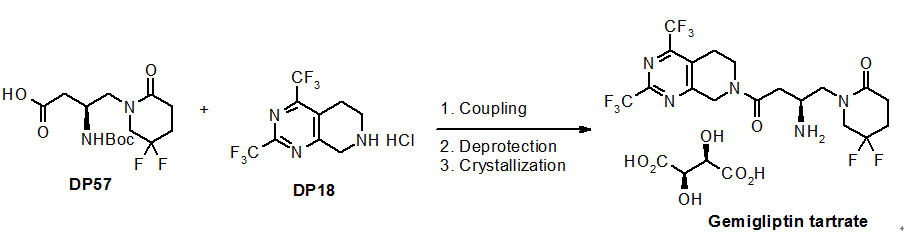
Efficient synthesis of gemigliptin, a potent and selective DPP-4 inhibitor for the treatment of type 2 diabetes mellitus, has been developed. Gemigliptin were prepared from two key API starting materials, DP18 and DP57, in 75~80% yield and >99% purity over three steps under the GMP control: coupling, deprotection of N-Boc group, and final crystallization with L-tartaric acid. All steps were conducted in the same solvent system and the intermediates were isolated by simple filtration without distillation of solvent. The established process was validated obviously through the three consecutive batches for a commercial production.

………..IN CASE IMAGES NOT VISIBLE …….SEE THIS AT ………http://www.allfordrugs.com/2015/07/06/gemigliptin/

GO TO MY OTHER SITE FOR SYNTHESIS

(3S)-3-amino-4-(5,5-difluoro-2-oxopiperidino)-1-[2,4-di(trifluoromethyl)-5,6,7,8-tetrahydropyrido[3,4-d]pyrimidin-7-yl]butan-1-one
Clinical data
Routes of
administration
Oral
Pharmacokinetic data
Bioavailability 94% (rat), 73% (dog), 26% (monkey)
Biological half-life 3.6 h (rat), 5.2 h (dog), 5.4 h (monkey)
Identifiers
CAS Registry Number 911637-19-9 
ATC code A10BH06
PubChem CID: 11953153
ChemSpider 10127461 Yes
UNII 5DHU18M5D6 
Synonyms LC15-0444
Chemical data
Formula C18H19F8N5O2
Molecular mass 489.36 g/mol

……………….

History

The NDA for gemigliptin was submitted to KFDA in July, 2011 and it was approved on June 27, 2012. By the end of 2012, gemigliptin will be marketed in Korea as Zemiglo which is the fifth new DPP-4 inhibitor diabetes treatment in the world.

Mechanism of action

DPP-4 is a serine protease located on the cell surfaces throughout the body. In plasma, DPP-4 enzyme rapidly inactivates incretins including GLP-1 and GIP which are produced in the intestine depending on the blood glucose level and contribute to the physiological regulation of glucose homeostatis. Active GLP-1 and GIP increase the production and release of insulin by pancreatinc beta cells. GLP-1 also reduces the scretion of glucacon by pancreatic alpha cells, thereby resulting in a decreased hepatic glucose production. However these incretins are rapidly cleaved by DPP-4 and their effects last only for a few minutes. DPP-4 inhibitors block the cleavage of the gliptins and thus lead to an increasee insulin level and a reduced glucagon level in a glucose-dependent way. This results in a decrease of fasting and postprandial glycemia, as well as HbA1c levels.[2]

Preclinical studies

Gemigliptin is a competitive, reversible DPP-4 inhibitor (IC50 = 16 nM) with excellent selectivity over other critical human proteases such as DPP-2, DPP-8DPP-9elastase,trypsinurokinase and cathepsin G. Gemigliptin was rapidly absorbed after single oral dosing and the compound was eliminated with a half-life of 3.6 h, 5.2 h, and 5.4 h in the rat, dog, and monkey, respectively.

The bioavailability of gemigliptin in the rat, dog, and monkey was species-dependent with the values of 94%, 73%, and 26%, respectively. Following the oral administration of gemigliptin in the rat, dog and monkey, about 80% inhibition of plasma DPP-4 activity were observed at the plasma levels of 18 nM, 14 nM and 4 nM, respectively.

In the diet-induced obese (DIO) mice, gemigliptin reduced glucose excursion during OGTT in a dose dependent manner with the minimum effective dose of 0.3 mg/kg and enhanced glucose-stimulated plasma GLP-1 increase in a dose dependent manner reaching the maximum effect at the dose of 1 mg/kg.

Following 4 week oral repeat dosing in the DIO mice, gemigliptin reduced significantly HbA1c with the minimum effective dose of 3 mg/kg. In the beagle dog, gemigliptin significantly enhanced active GLP-1, decreased glucagon, and reduced glucose excursion during OGTT following a single dosing.

Studies on animals suggest its positive effect on hepatic and renal fibrosis .[3][4] Data on human patients are still inconclusive .[5]

Clinical studies

The dose-range finding phase 2 study was performed and 145 patients (91men and 54 women) with type 2 diabetes mellitus were enrolled. All three doses (50,100 and 200 mg groups) of gemigliptin significantly reduced the HbA1c from baseline compared to the placebo group without a significant difference between the doses.

Subjects with a higher baseline HbA1c (≥8.5%) had a greater reduction in HbA1c. Insulin secretory function, as assessed using homeostasis model assessment-beta cell, C-peptide and the insulinogenic index, improved significantly with gemigliptin treatment. Insulin sensitivity, as assessed using homeostasis model assessment-insulin resistance, also improved significantly after 12 weeks of treatment.

The 50 and 200 mg groups had significantly reduced total cholesterol and low-density lipoprotein cholesterol levels at 12 weeks compared to the placebo group.

The incidences of adverse events were similar in all study subjects. Gemigliptin monotherapy (50 mg for 12 weeks) improved the HbA1cFPG level, oral glucose tolerance testresults, β-cell function and insulin sensitivity measures, and was well tolerated in subjects with type 2 diabetes.

Results of Phase 3 clinical trials which have been finished recently will be updated near future.

…………..

WO 2006104356

 http://www.google.co.in/patents/WO2006104356A1?cl=en

EXAMPLE 83: Synthesis of l-(f2SV2-amino-4-r2.4-bisftrifluoromethylV5.8-dihvdropyridor3.4-d]pyrimidin-7f6H)

-yl1-4-oxobutyll-5.5-difluoropiperidin-2-one [1960]

Figure imgf000147_0001

[1961] 21 mg of the title compound was obtained in a yield of 56% at the same manner as in EXAMPLE 1, except that 42 mg (0.071 mmol) of t-butyl

{(lS)-3-[2,4-bis(trifluoromethyl)-5,8-dihydropyrido[3,4-d]pyrimidin-7(6H)-yl]-l-[(5,5

-difluoro-2-oxpiperidin-l-yl)methyl]-3-oxpropyl}carbamate obtained in

PREPARATION 143 was used. [1962] 1K NMR (CD3OD) δ 5.05-4.92 (2H, m), 3.98-3.91 (2H, m), 3.85-3.79 (2H, m),

3.70-3.59 (2H, m), 3.54-3.48 (IH, m), 3.36-3.33 (2H, m), 3.24 (IH, bra), 3.14 (IH, bra), 2.83-2.76 (IH, m), 2.72-2.53 (3H, m), 2.43-2.34 (2H, m) [1963] Mass (m/e) 490 (M+l)

[1964]

[1965] PREPARATION 144: Synthesis of t-butyl

(riSV3-r2.4-bisrtrifluoromethylV5.8-dihvdropyridor3.4-d]pyrimidin-7r6HVyl]-l-(rr2 S)-2-methyl-5-oxomorpholin-4-yl1methyl 1 -3-oxpropyl 1 carbamate

[1966] 14 mg of the title compound was obtained in a yield of 17% at the same manner as in PREPARATION 45, except that 43.7 mg (0.138 mmol) of (3S)-3-[(t-butoxycarbonyl)amino]-4-[2(S)-2-methyl-5-oxomoφholin-4-yl]-butanoic acid obtained in PREPARATION 55 and 42.5 mg (0.138 mmol) of 2,4-bis(trifluoromethyl)-5,6,7,8-tetrahydropyrido[3,4-d]pyrimidine hydrochloric acid salt (product of PREPARATION 127) were used.

[1967] 1K NMR (CDCl3) δ 5.85-5.83 (IH, m), 5.09-4.92 (IH, m), 4.95-4.78 (IH, m),

4.23-4.08 (3H, m), 4.04-3.76 (3H, m), 3.73-3.66 (IH, m), 3.46-3.38 (IH, m), 3.36-3.21 (2H, m), 3.18-3.10 (2H, m), 2.96-2.81 (IH, m), 2.61-2.50 (IH, m), 1.43-1.41 (9H, m), 1.28-1.24 (3H, m)

[1968] Mass (m/e) 470 (M+l-Boc)

…………..

WO 2012030106

https://www.google.com/patents/WO2012030106A2?cl=en

Reaction Scheme 1

Figure PCTKR2011006260-appb-I000001

PREPARATION 1: Synthesis of diethyl 2,2-difluoropentanedioate

Figure PCTKR2011006260-appb-I000014

To a solution of ethyl bromodifluoroacetate (33.2 g) in tetrahydrofuran (94.0 g) was added ethyl acrylate (8.2 g) and copper powder (10.9 g). After heating to 50℃, TMEDA (9.5 g) was added dropwise and the reaction mixture was then stirred for 3 hours at the same temperature. Upon disappearance of ethyl acrylate as the starting material, to the reaction solution was added methyl t-butyl ether (MTBE, 73.7 g) followed by addition of 10% aqueous ammonium chloride solution (49.8 g) dropwise, and the mixture was then stirred for 30 minutes. The remaining copper residue was removed by filtration through a celite, and methyl t-butyl ether (MTBE, 66.3 g) was added to separate the layers. The separated organic layer was washed successively with 10% aqueous NH4Cl solution (66.3 g) and 3 N aqueous hydrochloric acid solution (99.6 g) in order and then distilled under reduced pressure to obtain 55.0 g of the desired title compound.

1H NMR (400 MHz, CDCl3) δ 1.26 (t, J=7.2 Hz, 3H), 1.37 (t, J=7.2 Hz, 3H), 2.37-2.49 (m, 2H), 2.55 (t, J=7.2 Hz, 2H), 4.16 (q, J=7.2 Hz, 2H), 4.29 (q, J=7.2 Hz, 2H).

PREPARATION 2: Synthesis of ethyl 4,4-difluoro-5-hydroxypentanoate

Figure PCTKR2011006260-appb-I000015

14.8 g of the compound obtained from the above Preparation 1 was diluted with ethanol (20.4 g) and tetrahydrofuran (69.1 g) and then cooled to 0℃. To this solution was slowly added sodium borohydride (NaBH4, 3.5 g) stepwise while keeping the internal temperature below 30℃. After confirming completion of the reaction by 1H NMR, the reaction solution was cooled to the temperature of 10℃ and 10% aqueous ammonium chloride solution (77.7 g) was slowly added. The remaining boron compound was filtered through celite, and the filtrate was distilled under reduced pressure to remove tetrahydrofuran. Then, ethyl acetate (105.2 g) was added to separate the layers, and the organic layer was distilled under reduced pressure to obtain 10.8 g of the title compound.

1H NMR (400 MHz, CDCl3) δ 1.23 (t, J=7.2 Hz, 3H), 2.15-2.29 (m, 2H), 2.49 (t, J=7.2 Hz, 2H), 3.69 (t, J=12.0 Hz, 2H), 4.12 (q, J=4.0 Hz, 2H).

EXAMPLE 1: Synthesis of ethyl 4,4-difluoro-5-{[(trifluoromethyl)sulfonyl]oxy}- pentanoate

Figure PCTKR2011006260-appb-I000016

To the solution of 10.8 g of the compound, as obtained from the above Preparation 2, dissolved in dichloromethane (100.2 g) was added pyridine (7.0 g), and then the mixture was cooled to -5.0℃. After completion of cooling, trifluoromethane sulfonic acid anhydride (20.1 g) was slowly added dropwise while keeping the reaction temperature below 6.3℃. After stirring the reaction solution for 30 minutes, 1.5 N hydrochloric acid solution was added dropwise at 0℃ to separate the layers. The aqueous layer as separated was back-extracted twice with dichloromethane (33.4 g), and the extracts were combined with the organic layer separated from the above and then distilled under reduced pressure to obtain 19.7 g of the title compound as a yellow oil.

1H NMR (500 MHz, CDCl3) δ 1.27 (t, J=7.2 Hz, 3H), 2.29-2.39 (m, 2H), 2.59 (t, J=7.6 Hz, 2H), 4.18 (q, J=7.2 Hz, 2H), 4.55 (t, J=11.6 Hz, 2H).

EXAMPLE 2-1: Synthesis of ethyl 4,4-difluoro-5-{[(nonafluorobutyl)sulfonyl]- oxy}pentanoate

Figure PCTKR2011006260-appb-I000017

To the solution of 100.0 g of the compound, as obtained from the above Preparation 2, dissolved in dichloromethane (300.0 ml) was added pyridine (65.7 g), and the mixture was then cooled to -10.0℃. After completion of cooling, nonafluorobutanesulfonic anhydride (477.4 g) was slowly added dropwise. After stirring the reaction solution for 3 hours, 1.0 N hydrochloric acid solution (300.0 ml) was added dropwise to separate the layers. The aqueous layer as separated was back extracted once with dichloromethane (500.0 ml), and the extracts were combined with the organic layer separated from the above and then distilled under reduced pressure to obtain 177.5 g of the title compound.

1H NMR (500 MHz, CDCl3) δ 1.26 (t, 3H, J=7.3 Hz), 2.30-2.36 (m, 2H), 2.58 (t, 2H, J=7.4 Hz), 4.16 (q, 2H, J=7.3 Hz), 4.57 (t, 2H, J=11 Hz).

EXAMPLE 2-2: Synthesis of ethyl 4,4-difluoro-5-{[(nonafluorobutyl)sulfonyl]- oxy}pentanoate

To the solution of 500.0 g of the compound, as obtained from the above Preparation 2, dissolved in dichloromethane (1000.0 ml) was added triethylamine (389.0 g), and the mixture was then cooled to 0℃. After completion of cooling, perfluorobutanesulfonyl chloride (948.80 g) was slowly added dropwise. The reaction solution was stirred for 3 hours at room temperature, distilled under reduced pressure, dissolved in methyl t-butyl ether (MTBE, 3000.0 ml) and then washed three times with water. The organic layer thus obtained was dehydrated with magnesium sulfate, filtered through a celite and then distilled under reduced pressure to obtain 960.0 g of the title compound.

EXAMPLE 3: Synthesis of methyl (2S)-2-[(tert-butoxycarbonyl)amino]-4-oxo- pentanoate

Figure PCTKR2011006260-appb-I000018

To 25.0 g of the starting material, (3S)-3-[(t-butoxycarbonyl)amino]-4-oxo- pentanoic acid, was added t-butanol (96.9 g) followed by the addition of Boc2O (25.4 g) and dimethylaminopyridine (DMAP, 62.0 g, 0.5 mol%) at room temperature, and the reaction mixture was then stirred for 23 hours at 40℃. Upon completion of the reaction, ethylene dichloride (62.3 g) in t-butanol was added, and the mixture was then distilled under reduced pressure to obtain 30.7 g of the title compound.

1H NMR (400 MHz, CDCl3) δ 1.45 (s, 9H), 1.47 (s, 9H), 2.71 (dd, J=4.8, 16.4 Hz, 1H), 2.88 (dd, J=4.4, 16.4 Hz, 1H), 3.75 (s, 3H), 4.53 (m, 1H), 5.44 (br d, J=8.0 Hz, 1H).

EXAMPLE 4: Synthesis of tert-butyl (3S)-3-[(tert-butoxycarbonyl)amino]-4-hydroxy- butanoate

Figure PCTKR2011006260-appb-I000019

30.7 g of the compound obtained from the above Example 3 was dissolved in ethanol (112.3 g) and, after lowering the internal temperature to 10.5℃ sodium borohydride (NaBH4, 5.7 g) was slowly added dropwise. This reaction solution was stirred while maintaining the temperature below 22℃. After confirming completion of the reaction by 1H NMR and TLC, to the reaction solution was slowly added 3.0 N hydrochloric acid solution (30.7 g) dropwise at the internal temperature of 10℃ followed by addition of diluted 0.2% hydrochloric acid solution (100.0 g). The reaction solution was adjusted to pH 3~4 with addition of 9.0% aqueous hydrochloric acid solution, and then back-extracted twice with ethyl acetate (100.0 g) and toluene (44.0 g). The organic layer thus obtained was distilled under reduced pressure to obtain 25.1 g of the title compound.

1H NMR (500 MHz, CDCl3) δ 1.44 (s, 9H), 1.45 (s, 9H), 2.48-2.57 (m, 2H), 3.69 (d, J=4.9 Hz, 1H), 3.97 (m, 1H), 5.22 (bs, 1H).

EXAMPLE 5: tert-butyl (3S)-[(tert-butoxycarbonyl)amino]-4-[(methylsulfonyl)oxy]- butanoate

Figure PCTKR2011006260-appb-I000020

To 25.1 g of the compound obtained from the above Example 4 was added dichloromethane (133.0 g) and triethylamine (148.0 g), and the mixture was then cooled to 0℃. To this reaction solution was slowly added methanesulfonyl chloride (11.8 g) diluted with dichloromethane (39.9 g) dropwise for 50 minutes while maintaining the internal temperature below 12℃. After completion of the reaction, the reaction solution was washed with 0.5 N aqueous hydrochloric acid solution (120.0 g) and water (100.4 g), and then distilled under reduced pressure to obtain 31.5 g of the title compound.

1H NMR (500 MHz, CDCl3) δ 1.44 (s, 9H), 1.46 (s, 9H), 2.62 (d, J=6.0 Hz, 2H), 3.04 (s, 3H), 4.21 (m, 1H), 4.30 (d, J=5.2 Hz, 2H), 5.16 (br d, J=7.2 Hz, 1H).

EXAMPLE 6: Synthesis of tert-butyl (3S)-4-azido-3-[(tert-butoxycarbonyl)amino]- butanoate

Figure PCTKR2011006260-appb-I000021

Sodium azide (NaN3, 11.6 g) was diluted with dimethylacetamide (DMAc, 260.0 g). After elevating the internal temperature to 80℃, a solution of 31.5 g of the compound, as obtained from the above Example 5, diluted with dimethylacetamide (DMAc, 45.0 g) was added thereto. The reaction proceeded at 80℃ for 2 hours. To the reaction solution were added toluene (251.0 g) and water (320.0 g) to separate the layers. The organic layer thus obtained was distilled under reduced pressure to obtain 24.0 g of the title compound.

1H NMR (500 MHz, CDCl3) δ 1.47 (s, 9H), 1.49 (s, 9H), 2.49 (d, J=6.0 Hz, 2H), 3.44-3.55 (m, 2H), 4.09 (br s, 1H), 5.14 (br s, 1H).

EXAMPLE 7: Synthesis of tert-butyl (3S)-4-amino-3-[(tert-butoxycarbonyl)amino]- butanoate

Figure PCTKR2011006260-appb-I000022

To 21.0 g of the compound obtained from the above Example 6 was added tetrahydrofuran (93.3 g) followed by the addition of triphenylphosphine (PPh3, 21.0 g) at 40℃, the mixture was stirred for 2 hours at the same temperature, and water (3.8 g) was then added thereto. The reaction solution was distilled under reduced pressure, and the resulting triphenylphosphine oxide solid was diluted with toluene (26.0 g) and n-hexane (41.0 g), and then filtered off. The filtrate was adjusted to pH 2~3 with 1.0 N aqueous hydrochloric acid solution (110.0 g) and then subjected to separation of the layers. To remove any residual triphenylphosphine oxide solid, the aqueous layer obtained above was washed with dichloromethane (100.0 g) and then adjusted to pH 8~9 with 28% aqueous ammonia solution (7.6 g). The aqueous solution thus obtained was extracted with dichloromethane (100.0 g) and distilled under reduced pressure to obtain 8.5 g of the title compound as a white solid.

1H NMR (500 MHz, CDCl3) δ 1.44 (s, 9H), 1.45 (s, 9H), 2.45 (d, J=6.1 Hz, 2H), 2.77 (d, J=5.5 Hz, 2H), 3.87 (br s, 1H), 5.22 (br s, 1H).

EXAMPLE 8: Synthesis of N,N-dibenzyl-L-N(Boc)-aspartamide 4-tert-butyl ester

Figure PCTKR2011006260-appb-I000023

N-Boc-L-aspartic acid 4-t-butyl ester (29.0 g, 0.10 mol) was added to THF (200 ml). After cooling to temperature below -5℃, to the reaction solution was added isobutylchloroformate (13.0 ml, 0.10 mol) followed by addition of N-methyl morpholine (12.0 ml, 0.10 mol) dropwise, and the reaction mixture was stirred for over 30 minutes. To the reaction mixture was added dropwise dibenzylamine (21.1 ml, 0.11 mol), and the mixture was then stirred for over 3 hours and monitored for the reaction progress by TLC (EtOAc: Hexane=1:4). Upon completion of the reaction, the reaction solution was stirred with addition of ethyl acetate (300.0 mL) and 1 N hydrochloric acid to separate the layers, and distilled under reduced pressure to precipitate a solid. The solid was filtered and washed with ethyl acetate (100 ml), and then the washings were concentrated by distillation again under reduced pressure. The residue was then subjected to silica gel column to obtain the purified desired product (41.7 g, 0.89 mol).

1H NMR (400 MHz, CDCl3) δ: 7.32 (m, 5H), 7.20 (m, 5H), 5.39 (d, J=7.2 Hz, 1H), 5.30 (m, 1H), 4.87-4.77 (m, 2H), 4.48-4.39 (m, 2H), 2.72 (dd, J=15.8 Hz, J=8.0 Hz, 1H), 2.56 (dd, J=15.8 Hz, J=6.4 Hz, 1H), 1.43 (s, 9H), 1.37 (s, 9H).

Mass (ESI, m/z): 491 (M+Na), 469 (M+H), 413 (M-55).

EXAMPLE 9: Synthesis of N, N-diallyl-L-N(Boc)-aspartamide 4-tert-butyl ester

Figure PCTKR2011006260-appb-I000024

L-N(Boc)-aspartic acid 4-t-butyl ester (5.00 g, 17.3 mol) was added to THF (50 ml). After cooling to temperature below -5℃, to the reaction solution was added isobutylchloroformate (2.26 ml, 17.3 mol) followed by addition of N-methyl morpholine (1.90 ml, 17.3 mol) dropwise, and the reaction mixture was stirred for over 30 minutes. To the reaction mixture was added dropwise diallylamine (2.35 ml, 19.0 mol), and the mixture was then stirred for over 3 hours and monitored for the reaction progress by TLC (EtOAc: Hexane=1:4). Upon completion of the reaction, the reaction solution was stirred with addition of ethyl acetate (60 ml) and 1 N hydrochloric acid and, after separating the layers, concentrated by distillation under reduced pressure. The residue was then subjected to silica gel column to obtain the purified desired product (6.0 g, 16.3 mol).

1H NMR (400 MHz, CDCl3) δ: 5.78 (m, 2H), 5.30 (m, 1H), 5.23-5.11 (m, 1H), 5.30 (m, 1H), 4.93 (m, 1H), 4.11-3.84 (m, 4H), 2.68 (dd, J=15.8 Hz, J=8.0 Hz, 1H), 2.51 (dd, J=15.8 Hz, J=8.0 Hz, 1H), 1.44 (s, 9H), 1.42 (s, 9H).

Mass (ESI, m/z): 391 (M+Na), 369 (M+H), 313 (M-55).

EXAMPLE 10: Synthesis of N,N-dibenzyl-4-amino-3(S)-N(Boc)-aminobutanoic acid 4-tert-butyl ester

Figure PCTKR2011006260-appb-I000025

10.0 g of the compound obtained from the above Example 8, Ru3(CO)12 (136 mg, 1mol%), and diphenylsilane (19.7 ml, 106.7 mmol) were added to tetrahydrofuran (50 ml), and the reaction solution was stirred under reflux for over 40 hours. The reaction solution was extracted with ethyl acetate (200 ml) and concentrated by distillation under reduced pressure. The residue was then subjected to silica gel column to obtain the purified desired product (4.7 g, 10.5 mmol).

1H NMR (400 MHz, CDCl3) δ: 7.31-7.20 (m, 10H), 5.12 (bs, 1H), 3.90 (bs, 1H), 3.63 (d, J=12.0 Hz, 2H), 3.48 (d, J=12.0 Hz, 2H), 3.24 (m, 1H), 3.16 (bs, 1H), 2.42 (m, 2H), 1.81 (m, 1H), 1.59 (m, 9H), 1.46 (s, 9H), 1.06 (s, 9H).

Mass (ESI, m/z): 455 (M+H), 441 (M-13).

EXAMPLE 11: Synthesis of tert-butyl (3S)-4-amino-3-[(tert-butoxycarbonyl)amino]- 4-oxobutanoate

Figure PCTKR2011006260-appb-I000026

360.0 g of the starting material, N-Boc-Asp(O-t-Bu)OH, together with Boc2O (353.0 g) and ammonium bicarbonate (NH4HCO3, 123.9 g) was added to dimethylformamide (1174.6 g), and pyridine (61.0 g) was added dropwise thereto at room temperature, and the reaction mixture was then stirred for about 3 hours. Upon completion of the reaction, water (1440 ml) and toluene (1800 ml) were added to the reaction solution and stirred for 30 minutes to separate the layers. The organic layer thus obtained was distilled under reduced pressure to remove t-butanol and toluene to obtain the title compound, which was directly used in the next reaction.

EXAMPLE 12: Synthesis of (S)-tert-butyl 3-(tert-butoxycarbonylamino)-3-cyanopropanoate

Figure PCTKR2011006260-appb-I000027

To the compound obtained from Example 11 was added dimethylformamide (1019.5 g) followed by addition of cyanuric chloride (112.0 g) dropwise for 1.5 hours at temperature below 25℃. The reaction solution was stirred for one hour at room temperature, and then 0.1 N aqueous sodium hydroxide solution (1850.0 g) and toluene (1860 ml) were added thereto to separate the layers. The organic layer thus obtained was washed once again with water (700 ml) and then distilled under reduced pressure to obtain 318.3 g of the title compound.

1H NMR (500 MHz, CDCl3) δ: 1.44 (s, 9H), 1.45 (s, 9H), 2.45 (d, J=6.1 Hz, 2H), 2.77 (d, J=5.5 Hz, 2H), 3.87 (br s, 1H), 5.22 (br s, 1H).

EXAMPLE 13: Synthesis of tert-butyl (3S)-4-amino-3-[(tert-butoxycarbonyl)amino]- butanoate

Figure PCTKR2011006260-appb-I000028

To 212.1 g of the compound obtained from the above Example 12 was added acetic acid (4000 ml) followed by addition of 20 wt% Pd(OH)2 (1.1 g) at 40℃. The mixture was stirred for 8 hours while keeping the internal temperature below 45℃ and 3 atmospheric pressure of hydrogen. Upon completion of the reaction, the reaction solution was distilled under reduced pressure to remove acetic acid, diluted with toluene (640 L) and then filtered through a celite. To the filtrate was added 0.25 N aqueous hydrochloric acid solution (1060 ml) to separate the layers. The aqueous layer thus obtained was basified with aqueous ammonia solution (543.1 g) and then extracted with methyl t-butyl ether (MTBE, 1000 ml). The organic layer thus obtained was distilled under reduced pressure to obtain 185.0 g of the title compound.

EXAMPLE 14: Synthesis of 3-t-butoxycarbonylamino-4-(5,5-difluoro-2-oxo- piperidin-1-yl)-butyric acid t-butyl ester

Figure PCTKR2011006260-appb-I000029

Triethylamine (13.2 g) was added to 16.0 g of the compound obtained from the above Example 1 or 2-1 or 2-2, and 14.1 g of the compound obtained from the above Example 7 or 13, and the mixture was then stirred for 21 hours at 40℃. Then, dichloromethane (154.8 g) and acetic acid (18.3 g) were added, and the mixture was stirred for 5 hours at room temperature. To the resulting reaction solution was added 0.5 N aqueous hydrochloric acid solution (116.8 g) and then, the mixture was stirred for 30 minutes to separate the layers. The organic layer thus obtained was distilled under reduced pressure to obtain 23.6 g of the title compound.

1H NMR (500 MHz, CDCl3) δ: 1.42 (s, 9H), 1.46 (s, 9H), 2.27 (m, 2H), 2.40-2.64 (m, 4H), 3.20 (dd, J=4.3, 13.5 Hz, 1H), 3.56-3.70 (m, 2H), 3.76-3.91 (m, 2H), 4.16 (m, 1H), 5.20 (d, J=8.6 Hz, 1H).

EXAMPLE 15: Synthesis of 3-t-butoxycarbonylamino-4-(5,5-difluoro-2-oxo- piperidin-1-yl)-butyric acid

Figure PCTKR2011006260-appb-I000030

23.6 g of the compound obtained from the above Example 14 was added to dichloromethane (20.0 g) followed by addition of H3PO4 (30.0 g), and the mixture was stirred for 16 hours at room temperature. After confirming the detachment of all of t-butyl group and t-butyloxycarbonyl group, the reaction solution was adjusted to pH 7.0~8.0 with 10 N aqueous hydrogen peroxide, and Boc2O (16.0 g) was added thereto. After completion of the addition, 10 N aqueous hydrogen peroxide was used to maintain the pH of the reaction solution at 8.0~9.0. After stirring for 3 hours, the resulting sodium phosphate was filtered off, and the filtrate was then adjusted to pH 2.0~3.0 with 3.0 N aqueous hydrochloric acid solution. The resulting solid was filtered and dried under nitrogen to obtain 14.5 g of the title compound.

1H NMR (500 MHz, CDCl3) δ: 1.32 (s, 9H), 2.20-2.43 (m, 6H), 3.26-3.31 (m, 2H), 3.61 (m, 1H), 3.81 (m, 1H), 4.02 (m, 1H), 6.73 (d, J=8.6 Hz, 1H), 12.16 (s, 1H).

For the title compound resulting from the above, its enantiomeric isomers―i.e. S-form and R-form―were measured by HPLC (high-performance liquid chromatography), and an excess of the enantiomeric isomers (S vs. R form) (enantiomeric excess; ee) was then calculated as being ee > 99%. On the other hand, in case of the Comparative Example prepared according to the prior method based on WO 06/104356, as described below, the excess (ee) of enantiomeric isomers (S vs. R form) was 80%. From this, it can be identified that the compound of formula (2) having an optically high purity could be obtained according to the method of the present invention.

COMPARATIVE EXAMPLE 1: Synthesis of 3-t-butoxycarbonylamino-4-(5,5- difluoro-2-oxo-piperidin-1-yl)-butyric acid t-butyl ester

COMPARATIVE EXAMPLE 1-1: Synthesis of methyl 5-amino-4,4-difluoro- pentanoate HCl

Figure PCTKR2011006260-appb-I000031

To 10.0 g of the compound obtained from Example 1 was added 40 ml of anhydrous ammonia solution (7 M solution in methanol), and the mixture was stirred for 3 hours. The reaction solution was distilled and 30 ml of hydrochloric acid solution saturated with methanol was added dropwise thereto. The reaction mixture was stirred at room temperature and then distilled to obtain 7.2 g of the title compound as a white solid.

1H NMR (500 MHz, CD3OD) δ: 2.35 (m, 2H), 2.59 (t, J=7.6 Hz, 2H), 3.49 (t, J=15.3 Hz, 2H), 3.68 (s, 3H).

COMPARATIVE EXAMPLE 1-2: Synthesis of 3-t-butoxycarbonylamino-4-(5,5- difluoro-2-oxo-piperidin-1-yl)-butyric acid t-butyl ester

To the solution of the compound (1.93 g), as obtained from the above Example 4, dissolved in dichloromethane (20.0 g) and H2O (4.0 g) were added NaBr (0.8 g) and TEMPO (11 mg, 1 mol%). To this reaction solution was slowly added a solution of 5% NaOCl (11.5 g) and NaHCO3 (1.7 g) dissolved in H2O (12.0 g) dropwise for about 2 hours while maintaining the temperature below 5℃. Upon completion of dropwise addition, the reaction solution was stirred for 30 minutes to separate the layers. To the organic layer thus obtained was added the compound (1.6 g) obtained from the above Comparative Example 1-1. After stirring for 15 minutes at room temperature, NaBH(OAc)3 (2.23 g) was added to the reaction solution. After stirring for about 19 hours, 10% aqueous NaHCO3 solution (20.0 g) and 0.5 N aqueous hydrochloric acid solution (20.0 g) were added dropwise to the reaction solution to separate the layers. The organic layer thus obtained was dehydrated under anhydrous MgSO4 to obtain 2.0 g (yield 73%) of the same title compound as Example 14, as a yellow solid. For the title compound resulting from the above, its enantiomeric isomers―i.e., S-form and R-form―were measured by HPLC (high-performance liquid chromatography), and an excess (ee) of the enantiomeric isomers (S vs. R form) was then calculated as being ee = 80%.

WO2006104356A1 Mar 30, 2006 Oct 5, 2006 Seong Cheol Bu Dipeptidyl peptidase-iv inhibiting compounds, methods of preparing the same, and pharmaceutical compositions containing the same as an active agent
EP0279435A2 * Feb 18, 1988 Aug 24, 1988 BASF Aktiengesellschaft Process for the reduction of mono- and dicarboxylic acids
US5556982 * Jul 12, 1993 Sep 17, 1996 Neorx Corporation Metal radionuclide labeled proteins for diagnosis and therapy
US20080039517 * Aug 7, 2007 Feb 14, 2008 Washburn David G Pyrrolidinone anilines as progesterone receptor modulators

Footnotes

  1. Lim KS, Kim JR, Choi YJ, Shin KH, Kim KP, Hong JH, Cho JY, Shin HS, Yu KS, Shin SG, Kwon OH, Hwang DM, Kim JA, Jang IJ (October 2008). “Pharmacokinetics, pharmacodynamics, and tolerability of the dipeptidyl peptidase IV inhibitor LC15-0444 in healthy Korean men: a dose-block-randomized, double-blind, placebo-controlled, ascending single-dose, Phase I study”. Clin Ther 30 (10): 1817–30. doi:10.1016/j.clinthera.2008.10.013PMID 19014837.
  2.  Ábel T. “A New Therapy of Type 2 Diabetes: DPP-4 Inhibitors”. In Rigobelo EC. Hypoglycemia – Causes and Occurrences. Croatia: InTech. pp. 3–52. doi:10.5772/23604ISBN 978-953-307-657-7.
  3.  Kaji K (Mar 2014). “Dipeptidyl peptidase-4 inhibitor attenuates hepatic fibrosis via suppression of activated hepatic stellate cell in rats.”J Gastroenterol.. 49 (3): 481–91.doi:10.1007/s00535-013-0783-4PMID 23475323.
  4.  Min HS (Jun 2014). “Dipeptidyl peptidase IV inhibitor protects against renal interstitial fibrosis in a mouse model of ureteral obstruction.”Lab Invest. 94 (5): 598–607.doi:10.1038/labinvest.2014.50PMID 24687121.
  5.  Gouni-Berthold I (2014). “The role of oral antidiabetic agents and incretin mimetics in type 2 diabetic patients with non-alcoholic Fatty liver disease.”Curr Pharm Des. 20 (5): 3705–15.PMID 24040873.

Further reading

 Kim SE, Yi S, Shin KH, Kim TE, Kim MJ, Kim YH, Yoon SH, Cho JY, Shin SG, Jang IJ, Yu KS (January 2012). “Evaluation of the pharmacokinetic interaction between the dipeptidyl peptidase IV inhibitor LC15-0444and pioglitazone in healthy volunteers”Int J Clin Pharmacol Ther. 50 (1): 17–23. doi:10.5414/cp201568PMID 22192641.

External links

DAVID G. WASHBURN ET AL.: ‘Discovery or orally active, pyrrolidinone-based progesterone receptor partial agonist‘ BIOORGANIC & MEDICINAL CHEMISTRY LETTERS vol. 19, no. 16, 2009, pages 4664 – 4667, XP026419052
2 * MONICA LOPEZ-GARCIA ET AL.: ‘Synthesis of (R)-3,4- diaminobutanoic acid by desymmetrization of dimethyl 3-(benzylamino)-glutarate through enzymatic ammonolysis‘ JOURNAL OF ORGANIC CHEMISTRY vol. 68, no. 2, 2003, pages 648 – 651, XP055105976


09b37-misc2b027LIONEL MY SON

He was only in first standard in school when I was hit by a deadly one in a million spine stroke called acute transverse mylitis, it made me 90% paralysed and bound to a wheel chair, Now I keep him as my source of inspiration and helping millions, thanks to millions of my readers who keep me going and help me to keep my son happy

EVOGLIPTIN


ChemSpider 2D Image | Evogliptin | C19H26F3N3O3

EVOGLIPTIN
CAS: 1222102-29-5 FREE

HCL……1246960-27-9

tartare.. 1222102 -51-3

Dong-A Pharmaceutical. Co., Ltd동아제약 주식회사
2-Piperazinone, 4-((3R)-3-amino-1-oxo-4-(2,4,5-trifluorophenyl)butyl)-3-((1,1-dimethylethoxy)methyl)-, (3R)-
R)-4-((R)-3-Amino-4-(2,4,5-trifluorophenyl)-butanoyl)-3-(t-butoxymethyl)-piperazin-2-one

4-[3(R)-Amino-4-(2,4,5-trifluorophenyl)butyryl]-3(R)-(tert-butoxymethyl)piperazin-2-one hydrochloride

DA-1229

see…http://www.allfordrugs.com/2015/07/03/evogliptin/

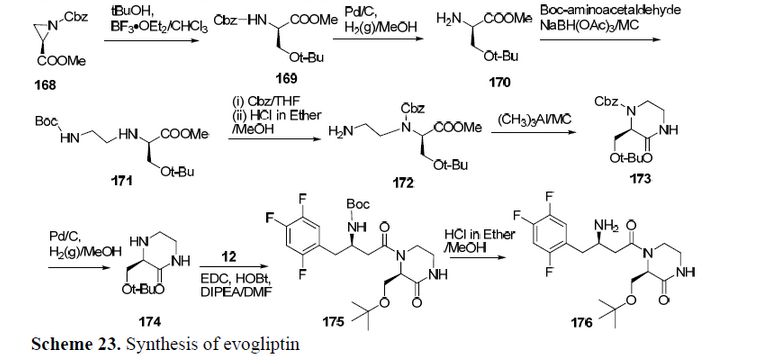
DA-1229 is a dipeptidyl peptidase IV (CD26) inhibitor currently being developed in phase III clinical studies at Dong-A for the treatment of type 2 diabetes.

In 2014, Eurofarma aquired rights for product development and commercialization in Brazil.

Evogliptin Tartrate

All About Drugs (1)

All About Drugs (2)

If above image is not clear then see at…….http://www.allfordrugs.com/2015/07/03/evogliptin/

86…………H. J. Kim, W. Y. Kwak, J. P. Min, J. Y. Lee, T. H. Yoon, H. D. Kim, C. Y. Shin, M. K.
Kim, S. H. Choi, H. S. Kim, E. K. Yang, Y. H. Cheong, Y. N. Chae, K. J. Park, J. M.
Jang, S. J. Choi, M. H. Son, S. H. Kim, M. Yoo and B. J. Lee, Bioorg. Med. Chem. Lett.,
2011, 21 (12), 3809-3812.
[87] …………K. S. Lim, J. Y. Cho, B. H. Kim, J. R. Kim, H. S. Kim, D. K. Kim, S. H. Kim, H. J. Yim,
S. H. Lee, S. G. Shin, I. J. Jang and K. S. Yu, Br. J. Clin. Pharmacol., 2009, 68 (6), 883-
890.

  • Originator Dong-A Pharmaceutical
  • Developer Dong-A ST
  • Class Amides; Antihyperglycaemics; Fluorobenzenes; Piperazines; Small molecules
  • Mechanism of Action CD26 antigen inhibitors
  • Orphan Drug Status No
  • On Fast track No
  • New Molecular Entity Yes
  • Available For Licensing Yes – Type 2 diabetes mellitus

Highest Development Phases

  • Phase III Type 2 diabetes mellitus

Most Recent Events

  • 01 Sep 2014 Phase-I clinical trials in Type-2 diabetes mellitus (In volunteers) in United Kingdom (PO)
  • 31 Jul 2014 Phase-III clinical trials in Type-2 diabetes mellitus in South Korea (PO)
  • 31 Jul 2014 Dong-A ST initiates enrolment in a phase I trial in patients with renal impairment in South Korea (NCT02214693)

Evogliptin Tartrate

…………………………………..

WO 2010114291

http://www.google.co.in/patents/WO2010114291A2?cl=en

Formula 1

Figure PCTKR2010001947-appb-C000001

Korea Patent Publication No. 2008-0094604 the call to the scheme, as indicated by A Ⅰ) of formula (II) beta-compound of formula 3 is already substituted heterocyclic compound having 1-hydroxy-benzotriazole group (HOBT) 1-ethyl-3- (3-dimethylaminopropyl) carbodiimide (EDC) and reacting with a tertiary amine to prepare a compound of formula (4) connected by peptide bonds; Ⅱ) beta comprises the step of reacting under acidic conditions a compound of the formula (4) – a method of manufacturing the heterocyclic compounds of the formula I having an amino group is disclosed.

– Scheme A]

Figure PCTKR2010001947-appb-I000001

(Wherein, PG is a protecting group.)

In this case, the beta of the formula (2) of Scheme A – a compound having an amino group is prepared in addition to the DPP-IV inhibitor International Publication represented by Formula 1 WO03 / 000181, WO03 / 004498, WO03 / 082817, WO04 / 007468, WO04 / 032836, WO05 / 011581, WO06 / 097175, WO07 / 077508, WO07 / 063928, WO08 / 028662 WO08 / it may be used for the production of different DPP-IV inhibitors according 087,560 and can be prepared in a number of ways.

To, the compound of Formula 2 is an example as shown in Scheme J. Med.Chem. 2005; 141, and Synthesis 1997; it can be produced by the known method described in 873.

Figure PCTKR2010001947-appb-I000002

Specifically, (2S) – (+) – 2,5- dihydro-3,6-dimethoxy-2-isopropyl-pyrazine 2,4,5-trifluoro-react with benzyl bromide and acid treatment, and then the amine an ester compound obtained by the protection reaction. Ester compounds are hydrolyzed to re-3- (2,4,5-trifluoro-phenyl) -2-amino-propionic acid tert such as isobutyl chloroformate, triethylamine or diisopropylethylamine to give the amine, and then using diazomethane to form a diazo ketone, and then may be prepared by reaction with silver benzoate. However, the reaction can be performed at low temperature (-78 ℃) or high alpha-amino acid to purchase and use, and may have a risk of problems such as the need to use large diazomethane.

To a different process for preparing a compound of Formula 2 as shown in scheme Tetrahedron: Asymmetry 2006; It is known in 2622; 205 or similarly Bioorganic & Medicinal Chemistry Letters 2007.

Figure PCTKR2010001947-appb-I000003

That is, a 1,1′-carbonyl-2,4,5 which the phenyl trifluoroacetic acid activated using the following imidazole mono-methyl words potassium carbonate is reacted with the beta-keto ester compound is prepared. This produced an enamine ester using ammonium acetate and ammonium solution, the ester compound chloro (1,5-cyclooctadiene) rhodium (I) dimer using a chiral ferrocenyl ligands I the reaction of the high-pressure hydrogen with a chiral primary amine with a beta-amino ester compound after production and can lead to hydrolysis to prepare a compound of formula (2). However, use of expensive metal catalyst has a problem that must be performed in high pressure hydrogenation.

The method for preparing a compound of Formula 2 is disclosed in International Publication No. WO 04/87650.

Figure PCTKR2010001947-appb-I000004

Specifically, 2,4,5-fluorophenyl reagent is oxalyl chloride, the acid activated acid with 2,2-dimethyl-1,3-dioxane-4,6-dione, and after the reaction of methanol and the resulting material at reflux to prepare a corresponding compound. With a selective reducing reagents which enantiomers (S) -BINAP-RuCl 2 and hydrogen through a reaction (S) – producing a compound having coordinated to each other, it again after the decomposition, and the singer O- benzyl hydroxyl amine and the coupling reaction and the intermediate is prepared. To do this, the resulting intermediate tree azodicarboxylate and diisopropyl azodicarboxylate presence ring condensation reaction, treated with an aqueous solution of lithium hydroxide to (R) – while having the formula (II) coordinated to the amine group protected with a benzyl-O- the compound can be produced. However, the method has a problem as a whole to be prepared by the reaction yield to be low and a long processing time to perform the reaction.

Thus, the conventional known method for producing a compound of the general formula (2) has the disadvantage of using expensive reagents, or not suitable for commercial mass-production method by a long synthesis time yield is also low.

In addition, the compound represented by General Formula (3), as described in Korea Patent Publication No. 2008-0094604 call, can be prepared by way of reaction schemes.

Figure PCTKR2010001947-appb-I000005

Specifically, the starting material D- serine methyl ester is substituted by a hydroxy group when reflux again substituted by trityl chloride as methoxy groups converted to the aziridine compound.

[Scheme 3]

Figure PCTKR2010001947-appb-I000008

<Example 3> (R)-4-[(R)-3-아미노-4-(2,4,5-트리플루오로페닐)부타노일]-3-(t-부톡시메틸)피페라진-2-온(화학식 1) Preparation of the hydrochloride

Step 1: t- butyl (R)-4-[(R)-2-(t-부톡시메틸)-3-옥소피페라진-1-일]-4-옥소 – 1-(2,4,5-트리플루오로페닐)부탄-2-일카르바메이트(화학식 Preparation of 4)

2 L flask, prepared in Example 1 (R) -3-t- butoxycarbonyl-4- (2,4,5-trifluoro-phenyl) butanoate acid (Formula 2) 10.0 g of toluene was dissolved in 450 mL of bis (2,2′-benzothiazolyl) disulfide 13.0 g, was cooled and then 10.2 g triphenylphosphine was added to the reaction solution at 0 ℃. While stirring the reaction mixture was added to a solution of 0.8 mL of triethylamine in 20 mL of toluene was stirred at room temperature for 5 hours. The reaction mixture was cooled to 0 ℃ and prepared in Example 2 (R) -3- (t- butoxymethyl) piperazin-2-one (Formula 3) was dissolved in 5.6 g of toluene and 40 mL pyridine a 2.4 mL was added slowly. After 30 minutes the reaction mixture was heated to room temperature and stirred for 1 hour. Saturated sheet to be the aqueous acid solution to a pH of 2.5 and then diluted with ethyl acetate 400 mL. Washed twice with brine and the organic layer was dehydrated with magnesium sulfate and concentrated. The residue was purified by column chromatography to give the title compound 838 mg.

1 H NMR (400 MHz, CDCl 3) δ 7.03 (m, 1H), 6.88 (m, 1H), 5.97 (m, 1H), 5.48 (m, 1H), 4.16 ~ 4.07 (m, 1H), 4.02 ~ 3.91 (m, 1H), 3.74 (m, 2H) 3.37 (m, 2H), 3.24 (m, 1H), 2.92 (m, 2H), 2.80 (m, 1H), 2.59 (m, 2H), 1.34 ( d, 9H), 1.13 (s, 9H)

Step 2: (R) -4 – [(R) -3- amino-4- (2,4,5-trifluoro-phenyl) butane five days] -3- (t- butoxymethyl) piperazin-2- on the production of (I) hydrochloride

Prepared in Step 1 t- butyl (R)-4-[(R)-2-(t-부톡시메틸)-3-옥소피페라진-1-일]-4-옥소-1-(2,4,5-트리플루오로페닐)부탄-2-일카르바메이트 97 mg was dissolved in methanol was added 3 mL 2N- hydrochloric acid / diethyl ether 2 mL was stirred at room temperature for 3 hours. The reaction mixture was concentrated and dried under reduced pressure to give 64 mg of the title compound as a foaming solid.

1 H NMR (400 MHz, CD 3 OD) δ 7.37 (m, 1H), 7.23 (m, 1H), 4.80 (m, 1H), 4.59 ~ 4.40 (m, 1H), 3.93 (m, 1H), 3.90 ~ 3.83 (m, 2H), 3.70 (m, 1H), 3.38 (m, 2H), 3.27 (m, 1H), 3.07 (m, 2H), 2.89 ~ 2.66 (m, 2H), 1.18 (s, 3H ), 1.11 (s, 6H)

Mass (M + 1): 402

<Example 4> (R)-4-[(R)-3-아미노-4-(2,4,5-트리플루오로페닐)부타노일]-3-(t-부톡시메틸)피페라진-2-온(화학식 1) tartaric acid salts

Step 1: (R) -4 – [(R) -3- amino-4- (2,4,5-trifluoro-phenyl) butane five days] -3- (t- butoxymethyl) piperazin-2- Preparation of one (I)

Example 3 to give a compound of formula I in hydrochloride 60 mg 5% sodium hydrogen carbonate in dichloromethane was added to 10 mL of an aqueous solution / 2-propanol (4/1 (v / v)) was added to the mixed solution and extracted two times 10 mL The organic layer was dried under reduced pressure to give 55 mg of the title compound as a solid.

1 H NMR (400 MHz, CD 3 OD) δ 7.27 (m, 1H), 7.14 (m, 1H), 4.56 ~ 4.39 (m, 1H), 3.96 ~ 3.81 (m, 3H), 3.70 (m, 1H) , 3.46 (m, 1H), 3.43 ~ 3.32 (m, 1H), 2.83 ~ 2.65 (m, 3H), 2.58 ~ 2.40 (m, 2H), 1.16 (s, 3H), 1.11 (s, 6H)

Mass (M + 1): 402

Step 2: (R) -4 – [(R) -3- amino-4- (2,4,5-trifluorophenyl) butanoyl] -3- (t- butoxymethyl) piperazin-2- one (I) tartaric acid salt [

Was dissolved 55 mg of the compound of step 1 in 0.56 mL of acetone, L- tartrate 26 mg ethanol / water (9/1 (v / v)) was added slowly to a solution of 0.35 mL was stirred for 30 minutes. Here was added 0.56 mL of 2-propanol was stirred for 10 minutes and re-filtered to give 77 mg of the title compound as a solid.

1 H NMR (400 MHz, CD 3 OD) δ 7.38 (m, 1H), 7.22 (m, 1H), 4.80 (m, 1H), 4.59 ~ 4.40 (m, 1H), 4.40 (s, 2H), 3.93 (m, 1H), 3.90 ~ 3.83 (m, 2H), 3.70 (m, 1H), 3.38 (m, 2H), 3.27 (m, 1H), 3.07 (m, 2H), 2.89 ~ 2.66 (m, 2H ), 1.15 (s, 3H), 1.11 (s, 6H)

Mass (M + 1): 402

………………………………

WO 2010114292

http://www.google.com/patents/WO2010114292A2?cl=en

…………………………………

Discovery of DA-1229: a potent, long acting dipeptidyl peptidase-4 inhibitor for the treatment of type 2 diabetes
Bioorg Med Chem Lett 2011, 21(12): 3809

http://www.sciencedirect.com/science/article/pii/S0960894X11004859

Full-size image (3 K)

A series of β-amino amide containing substituted piperazine-2-one derivatives was synthesized and evaluated as inhibitors of dipeptidyl pepdidase-4 (DPP-4) for the treatment of type 2 diabetes. As results of intensive SAR study of the series, (R)-4-[(R)-3-amino-4-(2,4,5-trifluorophenyl)-butanoyl]-3-(t-butoxymethyl)-piperazin-2-one (DA-1229) displayed potent DPP-4 inhibition pattern in several animal models, was selected for clinical development.

About evogliptin tartrate tablets
Evogliptin tartrate tablets is a dipeptidyl peptidase IV inhibitor, in tablet form. Evogliptin tartrate
tablets is expected to be approved for the treatment of type 2 diabetes mellitus. The Group holds
an exclusive intellectual property licence from Dong-A Pharmaceutical Co. Ltd. to develop
and commercialise evogliptin tartrate tablets in China, including the exclusive right to develop
evogliptin tartrate tablets for manufacturing and sale in the Group’s name. The new drug certificate
to be issued by the CFDA will be approved and registered under the Group’s name.
Evogliptin is a patented new molecular entity in the United States and other international markets.
Evogliptin tartrate tablets is being concurrently developed by Dong-A Pharmaceutical Co. Ltd.
for the Korean market. Based on information released from a multi-centre, phase II, randomised,
double-blind, placebo-controlled, therapeutic exploratory clinical trial conducted in Korea by
Dong-A Pharmaceutical Co. Ltd. to investigate the efficacy and safety of evogliptin, evogliptin
was proven to be effective in significantly lowering blood glucose levels in patients with type
2 diabetes. Data also show that the body weights of patients remain stable over the treatment
period. In addition, evogliptin was proven to be safe and well tolerated with no severe adverse
drug reactions observed during those phase II clinical trials. The Company believes evogliptin
tartrate tablets will help reduce the burden of patients with moderate-to-severe renal impairment
as pharmacokinetic study in animal model and healthy human volunteers showed low renal
elimination.
2
According to the statistics of IMS Health Incorporated, the market size of products for the
treatment of diabetes in China in 2013 was approximately RMB7.8 billion, and grew at a
compound annual growth rate of 23.4% from 2011 to 2013.

 http://www.luye.cn/en/uploads//2014-07/21/_1405936452_zr21xh.pdf

Dong-A ST
SEOUL, SOUTH KOREA
14 April 2015 – 5:45pm
Oh Seung-mock

Dong-A ST has licensed its new diabetes drug Evogliptin to 17 Latin American countries including Mexico, Venezuela, Argentina, Chile, Colombia, Ecuador, Peru, the Dominican Republic, and Uruguay, Jung Jae-wook, Dong-A ST’s PR manager, told Business Korea.

Dong-A ST and Eurofarma, a Brazilian pharmaceutical company, concluded the licensing contract at Dong-A ST’s headquarters on April 13 in Seoul.

Eurofarma will be responsible for Evogliptin’s product development and sales in the 17 Latin American countries, Dong-A ST said. Dong-A ST will receive royalties from Eurofarma, and export the raw material of the medicine.

Dong-A ST has been developing Evogliptin with the support of the Ministry of Health & Welfare of South Korea as an innovative new medicine research project since May 2008. Evogliptin is a DPP-4 remedy based on the inhibition mechanism which is “excellent” at reducing blood sugar, whilst “less likely” to cause weight increases and hypoglycemia, the company said.

Park Chan-il, president of Dong-A ST, said that Dong-A ST will pursue further out-licensing “over the globe,” through continuous investment in research and development.

Maurizio Billi, Eurofarma’s president, wished to expand both companies’ partnership in the innovative new remedy development sector, according to Dong-A ST.

Last July, Dong-A ST and Eurofarma concluded a contract out-licensing Evogliptin to Brazil itself, the company said.

– See more at: http://www.businesskorea.co.kr/article/10115/southern-strategy-dong-st-licenses-new-diabetes-drug-evogliptin-17-latin-american#sthash.liqwFTWU.dpuf

//////////

see gliptins at…..http://drugsynthesisint.blogspot.in/p/gliptin-series.html

Dong-A Pharm. Co., Ltd, Yongin-si, Gyeonggi-do, Republic of Korea.

MASITINIB


Masitinib

Masitinib; 790299-79-5; Masivet; AB1010; AB-1010;

CLASS:Immunomodulator
TARGET:KIT (a stem cell factor, also called c-KIT) receptor as well as select other tyrosine kinases
STATUS FOR MS:Phase III
COMMERCIAL:Under development by AB Science..Ab Science
4-((4-Methylpiperazin-1-yl)methyl)-N-(4-methyl-3-((4-(pyridin-3-yl)-1,3-thiazol-2-yl)amino)phenyl)benzamide
AB 1010
UNII-M59NC4E26P

4-((4-Methylpiperazin-1-yl)methyl)-N-(4-methyl-3-((4-(pyridin-3-yl)-1,3-thiazol-2-yl)amino)phenyl)benzamide

Regulatory and Commercial Status

STATUS FOR MS:Phase III
HIGHEST STATUS ACHIEVED (FOR ANY CONDITION):
Marketing Authorization Application for the treatment of pancreatic cancer has been filed with the European Medicines Agency (16 October 2012)
Marketing Authorization Application for the conditional approval in the treatment of pancreatic cancer has been accepted by the European Medicines Agency (30 October 2012)

Masitinib.png

Masitinib is a tyrosine-kinase inhibitor used in the treatment of mast cell tumors in animals, specifically dogs.[1][2] Since its introduction in November 2008 it has been distributed under the commercial name Masivet. It has been available in Europe since the second part of 2009. In the USA it is distributed under the name Kinavet and has been available for veterinaries since 2011.

Masitinib is being studied for several human conditions including cancers. It is used in Europe to fight orphan diseases.[3]

Mechanism of action

Masitinib inhibits the receptor tyrosine kinase c-Kit which is displayed by various types of tumour.[2] It also inhibits the platelet derived growth factor receptor (PDGFR) and fibroblast growth factor receptor (FGFR).

……………………..

http://www.google.com/patents/US7423055

Compound Synthesis

General: All chemicals used were commercial reagent grade products. Dimethylformamide (DMF), methanol (MeOH) were of anhydrous commercial grade and were used without further purification. Dichloromethane and tetrahydrofuran (THF) were freshly distilled under a stream of argon before use. The progress of the reactions was monitored by thin layer chromatography using precoated silica gel 60F 254, Fluka TLC plates, which were visualized under UV light. Multiplicities in 1H NMR spectra are indicated as singlet (s), broad singlet (br s), doublet (d), triplet (t), quadruplet (q), and multiplet (m) and the NMR spectrum were realized on a 300 MHz Bruker spectrometer.

3-Bromoacetyl-pyridine, HBr Salt

Dibromine (17.2 g, 108 mmol) was added dropwise to a cold (0° C.) solution of 3-acetyl-pyridine (12 g, 99 mmol) in acetic acid containing 33% of HBr (165 mL) under vigourous stirring. The vigorously stirred mixture was warmed to 40° C. for 2 h and then to 75° C. After 2 h at 75° C., the mixture was cooled and diluted with ether (400 mL) to precipitate the product, which was recovered by filtration and washed with ether and acetone to give white crystals (100%). This material may be recrystallised from methanol and ether.

IR (neat): 3108, 2047, 2982, 2559, 1709, 1603, 1221, 1035, 798 cm−1−1H NMR (DMSO-d6) δ=5.09 (s, 2H, CH2Br); 7.88 (m, 1H, pyridyl-H); 8.63 (m, 1H, pyridyl-H); 8.96 (m, 1H, pyridyl-H); 9.29 (m, 1H, pyridyl-H).

Methyl-[4-(1-N-methyl-piperazino)-methyl]-benzoate

To methyl-4-formyl benzoate (4.92 g, 30 mmol) and N-methyl-piperazine (3.6 mL, 32 mmol) in acetonitrile (100 mL) was added dropwise 2.5 mL of trifluoroacetic acid. The reaction mixture was stirred at room temperature for 1 h. After slow addition of sodium cyanoborohydride (2 g, 32 mmol), the solution was left stirring overnight at room temperature. Water (10 mL) was then added to the mixture, which was further acidified with 1N HCl to pH=6-7. The acetonitrile was removed under reduced pressure and the residual aqueous solution was extracted with diethyl ether (4×30 mL). These extracts were discarded. The aqueous phase was then basified (pH>12) by addition of 2.5N aqueous sodium hydroxyde solution. The crude product was extracted with ethyl acetate (4×30 mL). The combined organic layers were dried over MgSO4 and concentrated under reduced pressure to afford a slightly yellow oil which became colorless after purification by Kugelrohr distillation (190° C.) in 68% yield.

IR(neat): 3322, 2944, 2802, 1721, 1612, 1457, 1281, 1122, 1012—1H NMR(CDCl3) δ=2.27 (s, 3H, NCH3); 2.44 (m, 8H, 2×NCH2CH2N); 3.53 (s, 2H, ArCH2N); 3.88 (s, 3H, OCH3); 7.40 (d, 2H, J=8.3 Hz, 2×ArH); 7.91 (d, 2H, J=8.3 Hz, 2×ArH)—3C NMR (CDCl3) δ=45.8 (NCH3); 51.8 (OCH3); 52.9 (2×CH2N); 54.9 (2×CH2N); 62.4 (ArCH2N); 128.7 (2×ArC); 129.3 (2×ArC); 143.7 (ArC); 166.7 (ArCO2CH3)-MS CI (m/z) (%) 249 (M+1, 100%).

2-Methyl-5-tert-butoxycarbonylamino-aniline

A solution of di-tert-butyldicarbonate (70 g, 320 mmol) in methanol (200 mL) was added over 2 h to a cold (−10° C.) solution of 2,4-diaminotoluene (30 g, 245 mmol) and triethylamine (30 mL) in methanol (15 mL). The reaction was followed by thin layer chromatography (hexane/ethyl acetate, 3:1) and stopped after 4 h by adding 50 mL of water. The mixture was concentrated in vacuo and the residue was dissolved in 500 mL of ethyl acetate. This organic phase was washed with water (1×150 mL) and brine (2×150 mL), dried over MgSO4, and concentrated under reduced pressure. The resulting light brown solid was washed with small amounts of diethyl ether to give off-white crystals of 2-methyl-5-tert-butoxycarbonylamino-aniline in 67% yield.

IR (neat): 3359; 3246; 2970; 1719; 1609; 1557; 1173; 1050 cm−11H NMR (CDCl3): δ=1.50 (s, 9H, tBu); 2.10 (s, 3H, ArCH3); 3.61 (br s, 2H, NH2); 6.36 (br s, 1H, NH); 6.51 (dd, 1H, J=7.9 Hz, 2.3 Hz, ArH); 6.92 (d, 1H, J=7.9 Hz, ArH); 6.95 (s, 1H, ArH)—13C NMR (CDCl3) δ=16.6 (ArCH3); 28.3 (C(CH3)3); 80.0 (C(CH3)3); 105.2 (ArC); 108.6 (ArC); 116.9 (ArC); 130.4 (ArC—CH3); 137.2 (ArC—NH); 145.0 (ArC—NH2); 152.8 (COOtBu) MS ESI (m/z) (%): 223 (M+1), 167 (55, 100%).

N-(2-methyl-5-tert-butoxycarbonylamino)phenyl-thiourea

Benzoyl chloride (5.64 g, 80 mmol) was added dropwise to a well-stirred solution of ammonium thiocyanate (3.54 g, 88 mmol) in acetone (50 mL). The mixture was refluxed for 15 min, then, the hydrobromide salt of 2-methyl-5-tert-butoxycarbonylamino-aniline (8.4 g, 80 mmol) was added slowly portionswise. After 1 h, the reaction mixture was poured into ice-water (350 mL) and the bright yellow precipitate was isolated by filtration. This crude solid was then refluxed for 45 min in 70 mL of 2.5 N sodium hydroxide solution. The mixture was cooled down and basified with ammonium hydroxide. The precipitate of crude thiourea was recovered by filtration and dissolved in 150 mL of ethyl acetate. The organic phase was washed with brine, dried over Na2SO4, and concentrated under reduced pressure. The residue was purified by column chromatography (hexane/ethyl acetate, 1:1) to afford 63% of N-(2-methyl-5-tert-butoxycarbonylamino)phenyl-thiourea as a white solid.

IR (neat): 3437, 3292, 3175, 2983, 1724, 1616, 1522, 1161, 1053 cm−1— 1H NMR (DMSO-d6) δ=1.46 (s, 9H, tBu); 2.10 (s, 3H, ArCH3); 3.60 (br s, 2H, NH2); 7.10 (d, 1H, J=8.29 Hz, ArH); 7.25 (d, 1H, J=2.23 Hz, ArH); 7.28 (d, 1H, J=2.63 Hz, ArH); 9.20 (s, 1H, ArNH); 9.31 (s, 1H, ArNH)—13C NMR (DMSO-d6) δ=25.1 (ArCH3); 28.1 (C(CH3)3); 78.9 (C(CH3)3); 16.6 (ArC); 117.5 (ArC); 128.0 (ArC); 130.4 (ArC—CH3); 136.5 (ArC—NH); 137.9 (ArC—NH); 152.7 (COOtBu); 181.4 (C═S)—MS CI(m/z): 282 (M+1, 100%); 248 (33); 226 (55); 182 (99); 148 (133); 93 (188).

2-(2-methyl-5-tert-butoxycarbonylamino)phenyl-4-(3-pyridyl)-thiazole

A mixture of 3-bromoacetyl-pyridine, HBr salt (0.81 g, 2.85 mmol), N-(2-methyl-5-tert-butoxycarbonylamino)phenyl-thiourea (0.8 g, 2.85 mmol) and KHCO3 (˜0.4 g) in ethanol (40 mL) was heated at 75° C. for 20 h. The mixture was cooled, filtered (removal of KHCO3) and evaporated under reduced pressure. The residue was dissolved in CHCl3 (40 mL) and washed with saturated aqueous sodium hydrogen carbonate solution and with water. The organic layer was dried over Na2SO4 and concentrated. Colum chromatographic purification of the residue (hexane/ethyl acetate, 1:1) gave the desired thiazole in 70% yield as an orange solid

IR(neat): 3380, 2985, 2942, 1748, 1447, 1374, 1239, 1047, 938—1H NMR (CDCl3) δ=1.53 (s, 9H, tBu); 2.28 (s, 3H, ArCH3); 6.65 (s, 1H, thiazole-H); 6.89 (s, 1H); 6.99 (dd, 1H, J=8.3 Hz, 2.3 Hz); 7.12 (d, 2H, J=8.3 Hz); 7.35 (dd, 1H, J=2.6 Hz, 4.9 Hz); 8.03 (s, 1H); 8.19 (dt, 1H, J=1.9 Hz, 7.9 Hz); 8.54 (br s, 1H, NH); 9.09 (s, 1H, NH)—13C NMR (CDCl3) δ=18.02 (ArCH3); 29.2 (C(CH3)3); 81.3 (C(CH3)3); 104.2 (thiazole-C); 111.6; 115.2; 123.9; 124.3; 131.4; 132.1; 134.4; 139.5; 148.2; 149.1; 149.3; 153.6; 167.3 (C═O)—MS Cl (m/z) (%): 383 (M+1, 100%); 339 (43); 327 (55); 309 (73); 283 (99); 71 (311).

2-(2-methyl-5-amino)phenyl-4-(3-pyridyl)-thiazole

2-(2-methyl-5-tert-butoxycarbonylamino)phenyl-4-(3-pyridyl)-thiazole (0.40 g, 1.2 mmol) was dissolved in 10 mL of 20% TFA/CH2Cl2. The solution was stirred at rool temperature for 2 h, then it was evaporated under reduced pressure. The residue was dissolved in ethyl acetate. The organic layer was washed with aqueous 1N sodium hydroxide solution, dried over MgSO4, and concentrated to afford 2-(2-methyl-5-amino)phenyl-4-(3-pyridyl)-thiazole as a yellow-orange solid in 95% yield. This crude product was used directly in the next step.

A 2M solution of trimethyl aluminium in toluene (2.75 mL) was added dropwise to a cold (0° C.) solution of 2-(2-methyl-5-amino)phenyl-4-(3-pyridyl)-thiazole (0.42 g, 1.5 mmol) in anhydrous dichloromethane (10 mL) under argon atmosphere. The mixture was warmed to room temperature and stirred at room temperature for 30 min. A solution of methyl-4-(1-N-methyl-piperazino)-methyl benzoate (0.45 g, 1.8 mmol) in anhydrous dichloromethane (1 mL) and added slowly, and the resulting mixture was heated at reflux for 5 h. The mixture was cooled to 0° C. and quenched by dropwise addition of a 4N aqueous sodium hydroxide solution (3 mL). The mixture was extracted with dichloromethane (3×20 mL). The combined organic layers were washed with brine (3×20 mL) and dried over anhydrous MgSO4. (2-(2-methyl-5-amino)phenyl-4-(3-pyridyl)-thiazole) is obtained in 72% after purification by column chromatography (dichloromethane/methanol, 3:1)

IR (neat): 3318, 2926, 1647, 1610, 1535, 1492, 1282, 1207, 1160, 1011, 843—

1H NMR (CDCl3) δ=2.31 (br s, 6H, ArCH3+NCH3); 2.50 (br s, 8H, 2×NCH2CH2N); 3.56 (s, 2H, ArCH2N); 6.89 (s, 1H, thiazoleH); 7.21-7.38 (m, 4H); 7.45 (m, 2H); 7.85 (d, 2H, J=8.3 Hz); 8.03 (s, 1H); 8.13 (s, 1H); 8.27 (s, 1H); 8.52 (br s, 1H); 9.09 (s, 1H, NH)—

13C NMR (CDCl3) δ 17.8 (ArCH3); 46.2 (NCH3); 53.3 (NCH2); 55.3 (NCH2); 62.8 (ArCH2N); 99.9 (thiazole-C); 112.5; 123.9; 125.2; 127.5; 129.6; 131.6; 133.7; 134.0; 137.6; 139.3; 142.9; 148.8; 149.1; 166.2 (C═O); 166.7 (thiazoleC-NH)—

MS CI (m/z) (%): 499 (M+H, 100%); 455 (43); 430 (68); 401 (97); 374 (124); 309 (189); 283 (215); 235 (263); 121 (377); 99 (399).

………………………


http://www.google.com/patents/WO2012136732A1?cl=en

In a preferred embodiment of the above-depicted treatment, the active ingredient masitinib is administered in the form of masitinib mesilate; which is the orally bioavailable mesylate salt of masitinib – CAS 1048007-93-7 (MsOH); C28H30N6OS.CH3SO3H; MW 594.76:

Figure imgf000031_0001


http://www.google.com/patents/WO2004014903A1?cl=en

Figure imgf000021_0001

003 : 4-(4-Methyl-piperazin-l-ylmethyl)-N-[3-(4-pyridin-3-yl-thiazol-2-ylamino)- phenyl] -benzamide

4-(4-Methyl-piperazin-l-yl)-N-[4-methyl-3-(4-pyridin-3-yl-thiazol-2-ylmethyl)- phenyl] -benzamide

Figure imgf000053_0001

beige brown powder mp : 128-130°C

1H RMN (DMSO-d6) δ = 2.15 (s, 3H) ; 2.18 (s, 3H) ; 2.35-2.41 (m, 4H) ; 3.18-3.3.24 (m, 4H) ; 6.94 (d, J = 8.9 Hz, 2H) ; 7.09 (d, J = 8.4 Hz, IH) ; 7.28-7.38 (m, 3H) ; 7.81 (d, J = 8.9 Hz, 2H) ; 8.20-8.25 (m, IH) ; 8.40 (dd, J = 1.6 Hz, J = 4.7 , IH) ; 8.48 (d, J = 1.9 Hz, IH) ; 9.07 (d, J = 1.5 Hz, IH) ; 9.35 (s, IH) ; 9.84 (s, IH)

……………

http://www.google.com/patents/WO2008098949A2?cl=en

EXAMPLE 4 N- [4-Methyl-3 -(4-pyridin-3 -yl-thiazol-2-ylamino)-phenyl] -benzamide derivatives

Method A In a reactor and under low nitrogen pressure, add 4-Methyl-N3-(4-pyridin-3-yl-thiazol- 2-yl)-benzene-l,3-diamine (95 g, 336.45 mmol), dichloromethane (2 L). To this suspension cooled to temperature of 5°C was added dropwise 2M/n-hexane solution of trimethylaluminium (588 mL). The reaction mixture was brought progressively to 15°C, and maintained for 2 h under stirring. 4-(4-Methyl-piperazin-l-ylmethyl)-benzoic acid methyl ester (100 g, 402.71 mmol) in dichloromethane (200 mL) was added for 10 minutes. After 1 h stirring at room temperature, the reaction mixture was heated to reflux for 20 h and cooled to room temperature. This solution was transferred dropwise via a cannula to a reactor containing 2N NaOH (2.1 L) cooled to 5°C. After stirring for 3 h at room temperature, the precipitate was filtered through Celite. The solution was extracted with dichloromethane and the organic layer was washed with water and saturated sodium chloride solution, dried over MgSO4 and concentrated under vacuum. The brown solid obtained was recrystallized from /-Pr2O to give 130.7 g (78%) of a beige powder.

Method B Preparation of the acid chloride

To a mixture of 4-(4-Methyl-piperazin-l-ylmethyl)-benzoic acid dihydrochloride (1.0 eq), dichloromethane (7 vol) and triethylamine (2.15 eq), thionyl chloride (1.2 eq) was added at 18-28°C . The reaction mixture was stirred at 28-32°C for 1 hour. Coupling of acid chloride with amino thiazole To a chilled (0-50C) suspension of 4-Methyl-N3-(4-pyridin-3-yl-thiazol-2-yl)-benzene- 1,3-diamine (0.8 eq) and thiethylamine (2.2 eq) in dichloromethane (3 vol), the acid chloride solution (prepared above) was maintaining the temperature below 5°C. The reaction mixture was warmed to 25-300C and stirred at the same temperature for 1O h. Methanol (2 vol) and water (5 vol) were added to the reaction mixture and stirred. After separating the layers, methanol (2 vol), dihloromethane (5 vol) and sodium hydroxide solution (aqueous, 10%, till pH was 9.5-10.0) were added to the aqueous layer and stirred for 10 minutes. The layers were separated. The organic layer was a washed with water and saturated sodium chloride solution. The organic layer was concentrated and ethanol (2 vol) was added and stirred. The mixture was concentrated. Ethanol was added to the residue and stirred. The product was filtered and dried at 50-550C in a vaccum tray drier. Yield = 65-75%.

Method C

To a solution of 4-methyl-N3-(4-pyridin-3-yl-thiazol-2-yl)-benzene-l,3-diamine (1.0 eq) in DMF (20 vol) were added successively triethylamine (5 eq), 2-chloro-l- methylpyridinium iodide (2 eq) and 4-(4-methyl-piperazin-l-ylmethyl)-benzoic acid (2 eq). The reaction mixture was stirred for 7 h at room temperature. Then, the mixture was diluted in diethyl ether and washed with water and saturated aqueous NaHCO3, dried over Na2SO4 and concentrated. The crude product was purified by column chromatography using an elution of 100% EtOAc to give a yellow solid.

Yield = 51%.

1H NMR (CDCl3) : δ = 9.09 (IH, s, NH); 8.52 (IH, br s); 8.27 (IH, s); 8.13 (IH, s);

8.03 (IH, s); 7.85 (2H, d, J= 8.3Hz); 7.45 (2H, m); 7.21-7.38 (4H, m); 6.89 (IH, s);

3.56 (2H, s); 2.50 (8H, br s); 2.31 (6H, br s).

MS (CI) m/z = 499 (M+H)+.

An additional aspect of the present invention relates to a particular polymorph of the methanesulfonic acid salt of N-[4-Methyl-3-(4-pyridin-3-yl-thiazol-2-ylamino)-phenyl]- benzamide of formula (IX).

Figure imgf000023_0001

(VI)

Hereinafter is described the polymorph form of (IX) which has the most advantageous properties concerning processability, storage and formulation. For example, this form remains, dry at 80% relative humidity and thermodynamically stable at temperatures below 2000C.

The polymorph of this form is characterized by an X-ray diffraction pattern illustrated in FIG.I, comprising characteristic peaks approximately 7.269, 9.120, 11.038, 13.704, 14.481, 15.483, 15.870, 16.718, 17.087, 17.473, 18.224, 19.248, 19.441, 19.940, 20.441, 21.469, 21.750, 22.111, 23.319, 23.763, 24.120, 24.681, 25.754, 26.777, 28.975, 29.609, 30.073 degrees θ, and is also characterized by differential scanning calorimetry (DSC) illustrated in FIG.II, which exhibit a single maximum value at approximately 237.49 ± 0.3 0C. X-ray diffraction pattern is measured using a Bruker AXS (D8 advance). Differential scanning calorimetry (DSC) is measured using a Perking Elmer Precisely (Diamond DSC).

This polymorph form can be obtained by treatement of 4-(4-Methyl-piperazin-l- ylmethyl)-N-[4-methyl-3-(4-pyridin-3-yl-thiazol-2-ylamino)-phenyl]-benzamide with 1.0 to 1.2 equivalent of methanesulfonic acid, at a suitable temperature, preferably between 20-800C.

The reaction is performed in a suitable solvent especially polar solvent such as methanol or ethanol, or ketone such as acetone, or ether such as diethylether or dioxane, or a mixture therof. This invention is explained in example given below which is provided by way of illustration only and therefore should not be construed to limit the scope of the invention. Preparation of the above-mentioned polymorph form of 4-(4-Methyl-piperazin-l- ylmethyl)-N- [4-methyl-3 -(4-pyridin-3 -yl-thiazol-2-ylamino)-phenyl] -benzamide methanesulfonate .

4-(4-Methyl-piperazin- 1 -ylmethyl)-N- [4-methyl-3 -(4-pyridin-3 -yl-thiazol-2-ylamino) phenyl] -benzamide (1.0 eq) was dissolved in ethanol (4.5 vol) at 65-700C. Methanesulfonic acid (1.0 eq) was added slowly at the same temperature. The mixture was cooled to 25-300C and maintained for 6 h. The product was filtered and dried in a vacuum tray drier at 55-600C. Yield = 85-90%. Starting melting point Smp = 236°C.


NMR PREDICT

CAS NO. 1048007-93-7, methanesulfonic acid,4-[(4-methylpiperazin-1-yl)methyl]-N-[4-methyl-3-[(4-pyridin-3-yl-1,3-thiazol-2-yl)amino]phenyl]benzamide H-NMR spectral analysis

methanesulfonic acid,4-[(4-methylpiperazin-1-yl)methyl]-N-[4-methyl-3-[(4-pyridin-3-yl-1,3-thiazol-2-yl)amino]phenyl]benzamide NMR spectra analysis, Chemical CAS NO. 1048007-93-7 NMR spectral analysis, methanesulfonic acid,4-[(4-methylpiperazin-1-yl)methyl]-N-[4-methyl-3-[(4-pyridin-3-yl-1,3-thiazol-2-yl)amino]phenyl]benzamide H-NMR spectrum

methanesulfonic acid,4-[(4-methylpiperazin-1-yl)methyl]-N-[4-methyl-3-[(4-pyridin-3-yl-1,3-thiazol-2-yl)amino]phenyl]benzamide NMR spectra analysis, Chemical CAS NO. 1048007-93-7 NMR spectral analysis, methanesulfonic acid,4-[(4-methylpiperazin-1-yl)methyl]-N-[4-methyl-3-[(4-pyridin-3-yl-1,3-thiazol-2-yl)amino]phenyl]benzamide C-NMR spectrum

CAS NO. 1048007-93-7, methanesulfonic acid,

4-[(4-methylpiperazin-1-yl)methyl]-N-[4-methyl-3-[(4-pyridin-3-yl-1,3-thiazol-2-yl)amino]phenyl]benzamide C-NMR spectral analysisPREDICT

References

  1. Hahn, K.A.; Oglivie, G.; Rusk, T.; Devauchelle, P.; Leblanc, A.; Legendre, A.; Powers, B.; Leventhal, P.S.; Kinet, J.-P.; Palmerini, F.; Dubreuil, P.; Moussy, A.; Hermine, O. (2008). “Masitinib is Safe and Effective for the Treatment of Canine Mast Cell Tumors”. Journal of Veterinary Internal Medicine 22 (6): 1301–1309. doi:10.1111/j.1939-1676.2008.0190.x. ISSN 0891-6640.
  2. Information about Masivet at the European pharmacy agency website
  3. Orphan designation for Masitinib at the European pharmacy agency website
WO2004014903A1 Jul 31, 2003 Feb 19, 2004 Ab Science 2-(3-aminoaryl)amino-4-aryl-thiazoles and their use as c-kit inhibitors
WO2008098949A2 Feb 13, 2008 Aug 21, 2008 Ab Science Process for the synthesis of 2-aminothiazole compounds as kinase inhibitors
EP1525200B1 Jul 31, 2003 Oct 10, 2007 AB Science 2-(3-aminoaryl)amino-4-aryl-thiazoles and their use as c-kit inhibitors
US7423055 Aug 1, 2003 Sep 9, 2008 Ab Science 2-(3-Aminoaryl)amino-4-aryl-thiazoles for the treatment of diseases
US20080207572 * Jul 13, 2006 Aug 28, 2008 Ab Science Use of Dual C-Kit/Fgfr3 Inhibitors for Treating Multiple Myeloma
Masitinib.svg
Systematic (IUPAC) name
4-[(4-Methylpiperazin-1-yl)methyl]-N-(4-methyl-3-{[4-(pyridin-3-yl)-1,3-thiazol-2-yl]amino}phenyl)benzamide
Clinical data
Trade names Masivet, Kinavet
AHFS/Drugs.com International Drug Names
Identifiers
790299-79-5
L01XE22
PubChem CID 10074640
ChemSpider 8250179
ChEMBL CHEMBL1908391
Chemical data
Formula C28H30N6OS
498.64 g/mol
Patent Submitted Granted
2-(3-Aminoaryl)amino-4-aryl-thiazoles for the treatment of diseases [US7423055] 2004-06-10 2008-09-09
2-(3-aminoaryl)amino-4-aryl-thiazoles and their use as c-kit inhibitors [US2005239852] 2005-10-27
Use of C-Kit Inhibitors for Treating Fibrosis [US2007225293] 2007-09-27
Use of Mast Cells Inhibitors for Treating Patients Exposed to Chemical or Biological Weapons [US2007249628] 2007-10-25
Use of c-kit inhibitors for treating type II diabetes [US2007032521] 2007-02-08
Use of tyrosine kinase inhibitors for treating cerebral ischemia [US2007191267] 2007-08-16
Use of C-Kit Inhibitors for Treating Plasmodium Related Diseases [US2008004279] 2008-01-03
Tailored Treatment Suitable for Different Forms of Mastocytosis [US2008025916] 2008-01-31
2-(3-AMINOARYL) AMINO-4-ARYL-THIAZOLES AND THEIR USE AS C-KIT INHIBITORS [US2008255141] 2008-10-16
Use Of C-Kit Inhibitors For Treating Inflammatory Muscle Disorders Including Myositis And Muscular Dystrophy [US2008146585] 2008-06-19
Patent Submitted Granted
Aminothiazole compounds as kinase inhibitors and methods of using the same [US8940894] 2013-05-10 2015-01-27
Aminothiazole compounds as kinase inhibitors and methods of using the same [US8492545] 2012-03-08 2013-07-23
Patent Submitted Granted
Use of Dual C-Kit/Fgfr3 Inhibitors for Treating Multiple Myeloma [US2008207572] 2008-08-28
PROCESS FOR THE SYNTHESIS OF 2-AMINOTHIAZOLE COMPOUNDS AS KINASE INHIBITORS [US8153792] 2010-05-13 2012-04-10
COMBINATION TREATMENT OF SOLID CANCERS WITH ANTIMETABOLITES AND TYROSINE KINASE INHIBITORS [US8227470] 2010-04-15 2012-07-24
Anti-IGF antibodies [US8580254] 2008-06-19 2013-11-12
COMBINATIONS FOR THE TREATMENT OF B-CELL PROLIFERATIVE DISORDERS [US2009047243] 2008-07-17 2009-02-19
TREATMENTS OF B-CELL PROLIFERATIVE DISORDERS [US2009053168] 2008-07-17 2009-02-26
Anti-IGF antibodies [US8318159] 2009-12-11 2012-11-27
SURFACE TOPOGRAPHIES FOR NON-TOXIC BIOADHESION CONTROL [US2010226943] 2009-08-31 2010-09-09
EGFR/NEDD9/TGF-BETA INTERACTOME AND METHODS OF USE THEREOF FOR THE IDENTIFICATION OF AGENTS HAVING EFFICACY IN THE TREATMENT OF HYPERPROLIFERATIVE DISORDERS [US2010239656] 2010-05-10 2010-09-23
ANTI CD37 ANTIBODIES [US2010189722] 2008-08-08 2010-07-29
United States National Library of Medicine

Note: Compound name must be entered under “Substance Identification” and then “Names and Synonyms” selected to view synonyms.

Kocic I, Kowianski P, Rusiecka I, Lietzau G, Mansfield C, Moussy A, Hermine O, Dubreuil P
Naunyn Schmiedebergs Arch Pharmacol. 2014 Oct 26. Epub 2014 Oct 26. PMID: 25344204.Abstract
AB SCIENCE HEADQUARTER
3, Avenue George V
75008 PARIS – FRANCE
Tel. : +33 (0)1 47 20 00 14
Fax. : +33 (0)1 47 20 24 11

P.S. : The views expressed are my personal and in no-way suggest the views of the professional body or the company that I represent.

P.S. : The views expressed are my personal and in no-way suggest the views of the professional body or the company that I represent.

P.S. : The views expressed are my personal and in no-way suggest the views of the professional body or the company that I represent.

TAJIKISTAN

Tajikistan – Wikipedia, the free encyclopedia

en.wikipedia.org/wiki/Tajikistan

The territory that now constitutes Tajikistan was previously home to several ancient cultures, including the city of Sarazm of the Neolithic and the Bronze Age, …

Map of tajikistan country.
The nature of Tajikistan. Nurek
Tajikistan. Pamiro-Alay.Zeravshan mountain range. Guzn village. Local people
Dushanbe, Tajikistan
Women carry water canisters near Gargara village, 110km south of Tajikistan’s capital, Dushanbe
Ancient Buddhist ruins, Ajina Teppa, Tajikistan
///////////

S-flurbiprofen (TT-063)


(S)-flurbiprofen.png

Cas 51543-39-6,

MW 244.26,

MF C15 H13 F O2
[1,​1′-​Biphenyl]​-​4-​acetic acid, 2-​fluoro-​α-​methyl-​, (αS)​-
  • [1,1′-Biphenyl]-4-acetic acid, 2-fluoro-α-methyl-, (S)-
  • (+)-(S)-Flurbiprofen
  • (+)-Flurbiprofen
  • (2S)-2-(2-Fluoro-1,1′-biphenyl-4-yl)propanoic acid
  • (2S)-2-(2-Fluoro-4-biphenyl)propanoic acid
  • (S)-Flurbiprofen
  • Dexflurbiprofen
  • Esflurbiprofen
  • S-(+)-Flurbiprofen
  • d-Flurbiprofen

On October 20, 2014, Taisho filed for manufacturing and marketing approval for TT-063 from the Ministry of Health, Labour and Welfare as a new drug candidate that will follow the Type 2 diabetes treatment Lusefi®, which was launched in May 2014. TT-063 is a patch formulation that has been co-developed by Taisho and TOKUHON Corporation with the aim of obtaining an indication for osteoarthritis. In Phase 3 clinical trials comparing TT-063 with therapeutic drugs already on the market, TT-063 has been found to be more effective than the control drugs in patients with osteoarthritis of the knee joint (January 16, 2014 announcement ).

Furthermore, Taisho is also preparing to file for approval from the Ministry of Health, Labour and Welfare for CT-064, an oral formulation of the osteoporosis treatment agent Bonviva launched in August 2013. Taisho has confirmed the effectiveness of CT-064 for osteoporosis patients through Phase 3 clinical trials (September 22, 2014 announcement).


In the central nervous system field, TS-091 transitioned from Phase 1 to Phase 2 in Japan in May 2014. Clinical trials of TS-091 have commenced to confirm the effectiveness of this drug in patients with central disorders of hypersomnolence. In addition, Phase 1 clinical trials of TS-091 have commenced overseas. TS-111 and TS-121 are undergoing Phase 1 clinical trials overseas with the aim of obtaining an indication for depression.
Faced with intensifying competition in new drug discovery, we will jointly implement R&D activities with research institutions outside the Taisho Group, and with companies in Japan and overseas, as we work to enhance our drug development pipeline (lineup of drugs in development). Our goal is to discover many more new drugs, primarily in our priority fields.

Company Taisho Pharmaceutical Holdings Co. Ltd.
Description Topical anti-inflammatory analgesic patch containing S-flurbiprofen
Therapeutic Modality Small molecule
Latest Stage of Development Phase III
Standard Indication Osteoarthritis
Indication Details Treat osteoarthritis (OA) and scapulohumeral periarthritis
Regulatory Designation

Full-size image (93 K)

Scheme 2.

Reagents and conditions: (a) THF, EDC, Et3N; (b) TFA; (c) 0.5 equiv 2,5-dimethoxybenzoquinone, EtOH, 50–80 °C for 3–5 h; (d) 1 equiv naphthoquinone, MeOH, rt, overnight.

http://www.sciencedirect.com/science/article/pii/S0960894X13011773

……………………………………………

http://www.google.com/patents/EP2307335A1?cl=en

2-(6-methoxynaphthalen-2-yl) propanoic acid By way of illustration, chemically, flurbiprofen is 2-(2-fluoro-4-biphenylyl) propionic acid and is described in US Patent No. 3,755,427. NSAIDs, such as flurbiprofen, are usually supplied as a racemate. However, recently there has been renewed interest in the separate enantiomers of flurbiprofen, i.e. S-flurbiprofen and R-flurbiprofen.

Figure imgf000004_0001

R-Flurbιprofen

Figure imgf000004_0002

S-Flurtιprofen

Flurbiprofen is a potent inhibitor of cyclooxygenase (both COX-I and COX-2) in humans and it is understood that the inhibitory effect lies predominantly in the S- enantiomer.

Flurbiprofen is generally produced in the form of a racemic compound. It is known that from the racemic compound, flurbiprofen having a high optical purity can be produced by an optical resolution method using, for example, an optically active amine compound, such as α-phenylethylamine, as an optical resolution agent, as is described in US Patent No. 5,599,969. In addition, whether dealing with racemic, S- or R- 2-aryl propionic acid, there is also a need to make the synthetic process as efficient as possible.

Example 2 – Ibuprofen

Example 2.1 Resolution procedure

Racemic ibuprofen (530g) is dissolved in toluene (1335ml) and methanol (900ml).

The mixture is heated to dissolve the solid. S-1-Phenylethylamine (247g) is dissolved in toluene (200ml) and the solution is added with stirring at 600C over about 3 hours while the temperature is maintained at about 65-700C. The mixture is cooled gradually to 0 to 50C to induce crystallisation and stirred at this temperature for 1 hour. The crystals are filtered off, washed with toluene (600ml) and dried in a Vacuum oven at 550C to form crude S-ibuprofen / S-1-phenylethylamine salt (635g).

Crude S-ibuprofen / S-1-phenylethylamine salt (635g) is stirred with toluene (1930ml) and methanol (800ml) and the mixture is heated to 6O0C to dissolve the solid. The solution is cooled gradually to 0 to 5°C to induce crystallisation. The crystals are filtered off and dried in a vacuum oven at 55°C to form pure S-ibuprofen / S-I- phenylethylamine salt (510g). This recrystallisation of the S-ibuprofen / S-I- phenylethylamine salt may be repeated if necessary to upgrade the enantiomeric purity if required.

Pure S-ibuprofen / S-1-phenylethylamine salt (485g) is mixed with toluene (1700ml) with stirring. Water (300ml) and concentrated hydrochloric acid (17Og) are added and

÷ibe mixture is stirred at 600C. The lower aqueous layer is separated off and the upper organic layer is retained. The hydrochloric acid wash is repeated, then the toluene solution is washed with water. Water (370ml) and 47% sodium hydroxide

Figure imgf000023_0001

(118g) are added and the solution is heated to 600C and allowed to settle. The lower aqueous layer is separated and the upper toluene layer is washed with water. The aqueous phases are combined and heptane (420ml) is added. Hydrochloric acid

(130g) is added and the mixture is heated to 600C, stirred and settled. The organic layer is separated off and washed with water. The solution is cooled to -100C to induce crystallisation and the crystals are separated off by filtration, washed with heptane and dried under vacuum to yield (S)-ibuprofen (28Og) at an enantiomeric purity of over 99%.

Example 2.2 Racemisation procedure

Toluene/methanol mother liquors from the filtration of crude S-ibuprofen / S-I- phenylethylamine salt in the resolution procedure (2400ml, containing an estimated 130g of ibuprofen) is charged into a 3 L 3 necked round bottomed flask and methanol and toluene are distilled out at atmospheric pressure (volume removed approximately 1400 ml). The batch is then cooled to around 60°C and washed twice with hydrochloric acid (20 ml concentrated hydrochloric acid in 200 ml of water), and then twice with water (200 ml). Toluene is charged (80 ml) followed by methanol (200 ml) and caustic soda solution (45Og of 28% w/w solution, 5 molar equivalents). The mixture is heated to reflux for about 6 hours. Solvent is then removed at atmospheric pressure until the vapour temperature reaches approximately 85°C. The mixture is cooled to around 60°C and concentrated hydrochloric acid is charged at about 60 to 70°C until the pH of the mixture is 1 or less. The layers are allowed to separate and the bottom aqueous layer removed. The organic layer is washed with water (200 ml) and then azeotroped to dryness using a Dean and Stark trap. A solution of racemic ibuprofen in toluene remains.

…………………………………………

PATENT

 http://www.google.com/patents/CN104478703A?cl=en

Preparation of R – (+) _ flurbiprofen:

 The racemic flurbiprofen as a starting material, to obtain an intermediate product of formula I as shown and then the ester prepared as shown in Formula II with 5-isosorbide monobenzyl ether, ester hydrolysis after obtained R – (+) – flurbiprofen;

Figure CN104478703AD00061

wherein, in formula I, X is Cl or Br;

(2) by the R – (+) _ flurbiprofen obtained (RS) – flurbiprofen:

 The R _ (+) _ flurbiprofen 200mg, potassium hydroxide 150mg, 0. 5mL water into IOmL reaction flask and heated to 120 ° C and held for 2h, then water was added 15mL, cooled to room temperature, the resulting stirring the mixed solution with 10% hydrochloric acid to pH = 0. 5, extracted with ethyl acetate, combined several layers, washed with water until neutral, the organic solvent is recovered, the resulting residue was added at 60~90 ° C under an appropriate amount of petroleum ether by recrystallization, obtained (RS) – flurbiprofen 100mg, 50% yield.

 (3) Preparation of (S) -⑴- flurbiprofen:

 In 25mL single-necked flask, followed by adding (RS) – flurbiprofen 123mg, Portugal TOA 29. 8mg, isopropanol lmL, the mixture was stirred at reflux until clear, half the amount of the solvent evaporated under reduced pressure except , set the refrigerator overnight. The precipitate was collected by suction filtration as white crystals, after washing a small amount of isopropanol, which was dissolved in water, washed with 10% aqueous sodium hydroxide (10% NaOH mean mass fraction) adjusted pH = 13, the sheet-like precipitate was filtered off Portuguese octylamine white crystals. The resulting filtrate was added dropwise with stirring 10% hydrochloric acid to pH = 1, extracted with ethyl acetate, the organic layer was washed with water to recover the solvent, the resulting residue was purified by an appropriate amount of petroleum ether and recrystallized at 60~90 ° C. The product was collected by filtration, and dried in vacuo to give a white (S) – (+) _ flurbiprofen needle crystal 45. 3mg, 65% yield, mp 102~103 ° C, [α] = + 44 ° (C = 1, methanol), ee value of 92.6% (ee value measurement method: (S) – (+) – flurbiprofen after chiral amine derivatization reagents, by HPLC analysis).

wherein in step (3) is a byproduct eleven R _ (+) _ flurbiprofen, its follow step (1) of racemic reused.

 Step (1) of the specific operation is as follows:

 (la) 1:. Synthesis of 2,6-sorbitol dehydration -D- -5- benzyl ether: 4: 3

 250ml volumetric flask isosorbide 18. 25g (125mmol), lithium hydroxide monohydrate 5. 25g (125mmol) and 60ml of dimethyl sulfoxide (DMSO), heated to 90 ° C, stirred for 30min, constant pressure equalizing dropping funnel was added dropwise benzyl chloride 14. 4ml (125mmol), 90 ° C the reaction 19-20h, reaction mixture was adjusted to pH 1 with 2M hydrochloric acid, extracted with ethyl acetate (50ml * 3), the organic layers combined, washed with water ( 30ml * 2), dried over anhydrous sodium sulfate overnight, filtered and concentrated residue Cheng baby gel column chromatography (petroleum ether: ethyl acetate = 5: 1) to give a cream solid, that is 1: 4: 3: 2,6 Dehydration -D- sorbitol -5- benzyl ether 24. 5g, m.p. 59 ~61 ° C.

 (Ib) · 2- (2- fluoro-4-biphenylyl) propionyl chloride Synthesis

 50ml vial before racemic flurbiprofen was added 2. 44g (IOmmol), anhydrous toluene 20ml, freshly distilled thionyl chloride was added dropwise 0. 8ml (Ilmmol), N, N- dimethylformamide amide (DMF) 2 dropwise, stirred at room temperature 2h, the solvent was distilled off under reduced pressure to give a pale yellow gum, i.e., 2- (2-fluoro-4-biphenylyl) propionyl chloride, it was used directly in the reaction without isolation.

 (lc). R-2- (2- fluoro-4-biphenylyl) propionic acid 5- isosorbide monobenzyl ether ester synthesis

 The (Ib) resulting acid chloride was dissolved in 20ml of dry toluene was added dropwise at room temperature, dimethyl amine 3. 5ml, solid precipitation, stirred for about Ih, ice salt bath, a bath temperature of minus 10-15Ό, stirred at this temperature IOmin so, and then the constant pressure dropping funnel (Ia) 5 isosorbide monobenzyl ether (2. 83g, 12mmol) in toluene, keeping the reaction temperature, stirring 8h. The ice bath was removed and the reaction mixture under reduced pressure to remove the solvent, the residue was extracted with ethyl acetate. The extract was washed with water, dried over anhydrous sodium sulfate overnight, ethyl acetate was removed under reduced pressure, the residue was a white gel, recrystallized from petroleum ether to give a white solid that R-2- (2- fluoro-4-biphenylyl) propionic acid 5- isosorbide monobenzyl ether ester 3. 65g (7. 88mmol), in order to put the racemic flurbiprofen yield based on 78.8%.

(ld) R – Synthesis of flurbiprofen – (+)

 Under ice bath (Ic) obtained R-2- (2- fluoro-4-biphenylyl) propionic acid monobenzyl ether isosorbide 5- ester 2. 3Ig (5mmol) was dissolved in 20ml of acetone / water (1/1) was added Iml hydrochloric acid to adjust pH to 3, stirred for 3-4h, the reaction solution was extracted with ethyl acetate (20ml * 2), sash organic layer was washed with ice (10ml * 2), dried over anhydrous sodium sulfate overnight , filtration, and the filtrate was concentrated, the residue was recrystallized from ether to give white crystals, i.e. L-flurbiprofen 1.02g (4 18mmol.), yield 83.5%, optical purity 93% (HPLC method); input-racemic flurbiprofen dollars, the total yield of 78.8% * 83.5% = 65.8%.

 Step (1) reaction of the formula:

Figure CN104478703AD00071
FLURBIPROFEN RACEMIC
3-Fluoro-4-phenyl-α-methylphenylacetic acid 1
M.p. 110-113°C (lit.3d 111-113.5°C).
1 H NMR (CDCl3, δ ppm) 7.51-7.55 (m, 2H), 7.49-7.37 (m, 4H), 7.21-7.16 (m, 2H), 3.85-3.78 (q, 1H, J = 7.1 Hz, CH), 1.60-1.57 (d, 3H, J = 7.1 Hz, CH3);
13C NMR (CDCl3 δ ppm) 180.4 (COOH), 161.3 & 158.0 (3-Ar-C), 140.9 & 140.8, 135.4, 130.9 & 130.8 (5-Ar-C), 128.9, 128.4, 128.2 & 128.0 (4-Ar-C), 127.7 (4′-Ar-C), 123.7 & 123.7 (6-Ar-C), 115.5 & 115.2 (2-Ar-C), 44.8 (CH), 18.0 (CH3).
 (d) Sagami Chemical Research Center. Jpn. Kokai Tokkyo Koho JP 8216840, 1982 (Chem. Abstr. 1982, 97: 5996s).
Flurbiprofen
 RACEMIC
Flurbiprofen
CAS : 5104-49-4
: 2-Fluoro-a-methyl[1,1¢-biphenyl]-4-acetic acid
Additional Names: 2-(2-fluoro-4-biphenylyl)propionic acid; 3-fluoro-4-phenylhydratropic acid
Manufacturers’ Codes: BTS-18322; U-27182
Trademarks: Adfeed (Lead Chem.); Ansaid (Pfizer); Antadys (Thžamex); Cebutid (Boots); Froben (Boots); Flurofen (Boots); Ocufen (Allergan); Stayban (Boots); Zepolas (Mikasa)
Molecular Formula: C15H13FO2
Molecular Weight: 244.26
Percent Composition: C 73.76%, H 5.36%, F 7.78%, O 13.10%
Literature References: Prepn: FR M5737; Adams et al., US 3755427 (1968, 1973 both to Boots Co., Ltd.). Pharmacology: Chalmers et al., Ann. Rheum. Dis. 31, 319 (1972); ibid. 32, 58 (1973); Glenn et al., Agents Actions 3, 210 (1973); Nishizawa et al.,Thromb. Res. 3, 577 (1973). HPLC determn in urine and plasma: J. M. Hutzler et al., J. Chromatogr. B 749, 119 (2000). Symposium on pharmacokinetics and clinical efficacy in pain management: Am. J. Med. 80, Suppl. 3A, 1-157 (1986).
Properties: Crystals from petr ether, mp 110-111°. Slightly sol in water (pH 7.0); readily sol in most polar solvents.
Melting point: mp 110-111°
Therap-Cat: Anti-inflammatory; analgesic.
 racemic

Flurbiprofen NMR spectra analysis, Chemical CAS NO. 5104-49-4 NMR spectral analysis, Flurbiprofen C-NMR spectrum

Flurbiprofen NMR spectra analysis, Chemical CAS NO. 5104-49-4 NMR spectral analysis, Flurbiprofen H-NMR spectrum

 s form
 (S)-Flurbiprofen NMR spectra analysis, Chemical CAS NO. 51543-39-6 NMR spectral analysis, (S)-Flurbiprofen H-NMR spectrum
 (S)-Flurbiprofen NMR spectra analysis, Chemical CAS NO. 51543-39-6 NMR spectral analysis, (S)-Flurbiprofen C-NMR spectrum
Patent Submitted Granted
Methods to accelerate the isolation of novel cell strains from pluripotent stem cells and cells obtained thereby [US2008070303] 2006-11-21 2008-03-20
Herpes Virus-Based Compositions and Methods of Use in the Prenatal and Perinatal Periods [US2008226601] 2006-06-05 2008-09-18
METHOD OF REDUCING ABETA42 AND TREATING DISEASES [US2008021085] 2007-06-21 2008-01-24
METHODS TO ACCELERATE THE ISOLATION OF NOVEL CELL STRAINS FROM PLURIPOTENT STEM CELLS AND CELLS OBTAINED THEREBY [US2010184033] 2009-07-16 2010-07-22
Pyridyl Amide T-Type Calcium Channel Antagonists [US2011112064] 2011-05-12
PROCESS FOR THE MANUFACTURE OF RACEMIC 2-ARYL-PROPIONIC ACID [US2011172460]
Patent Submitted Granted
Nitroxyderivatives having antinflammatory, analgesic and antithrombotic activity [US6613784] 2003-09-02
Global method for mapping property spaces [US6675136] 2004-01-06
Method of reducing Abeta42 and treating diseases [US2006004086] 2006-01-05
11-Beta-hydroxysteroid dehydrogenase 1 inhibitors useful for the treatment of diabetes, obesity and dyslipidemia [US7179802] 2004-06-03 2007-02-20
11-BETA-HYDROXYSTEROID DEHYDROGENASE 1 INHIBITORS USEFUL FOR THE TREATMENT OF DIABETES, OBESITY AND DYSLIPIDEMIA [US6730690] 2004-03-11 2004-05-04
Process for producing optically active flurbiprofen [US7214820] 2006-06-22 2007-05-08
Pyridyl Amide T-Type Calcium Channel Antagonists [US7875636] 2009-11-05 2011-01-25
METHOD FOR PRODUCING OPTICALLY ACTIVE ESTER AND METHOD FOR PRODUCING OPTICALLY ACTIVE CARBOXYLIC ACID [US8115008] 2010-09-16 2012-02-14
DRUG SUBSTANCE PREPARATIONS, PHARMACEUTICAL COMPOSITIONS AND DOSAGE FORMS [US2010087538] 2010-04-08
(R)-2-(3-Benzoylphenyl)propionic acid salts and pharmaceutical preparations containing them [EP0935961] 1999-08-18 2008-04-02

P.S. : The views expressed are my personal and in no-way suggest the views of the professional body or the company that I represent.

P.S. : The views expressed are my personal and in no-way suggest the views of the professional body or the company that I represent.

P.S. : The views expressed are my personal and in no-way suggest the views of the professional body or the company that I represent.

Taisho Pharmaceutical Co., Ltd. (大正製薬株式会社 Taishō Seiyaku Kabushiki-gaisha?) (TYO: 4535) is a Japanese pharmaceutical company based in Tokyo.

.

////////////

TIRUPATI, INDIA
Map of tirupati town.
Tirupati
తిరుపతి
City
Clockwise from top: Tirumala Venkateswara Temple, Tirumala ghat road, City skyline and Chandragiri fort

Clockwise from top: Tirumala Venkateswara Temple, Tirumala ghat road, City skyline and Chandragiri fort

Tirupati is located in Andhra Pradesh

Tirupati
Tirupati

Location in Andhra Pradesh, India

Coordinates: 13.65°N 79.42°ECoordinates: 13.65°N 79.42°E
Country India
State Andhra Pradesh
Region Rayalaseema
District Chittoor
Government
 • Member of Parliament Varaprasad Rao Velagapalli
Area
 • City 24 km2 (9 sq mi)
Elevation 161 m (528 ft)
Population (2011)[1]
 • City 287,035
 • Density 12,000/km2 (31,000/sq mi)
 • Metro[2] 459,985
Languages
 • Official Telugu
Time zone IST (UTC+5:30)
PIN 517501
Telephone code +91–877
Vehicle registration AP 03
Website Tirupati Mucnicipal Corporation

.

.
Kapila Theertham in Tirupati


Food Service During Tirumala Tirupati Devastanam’s ‘Srinivasa Kalyanam Utsavam’ at MARG Swarnabhoomi


Evofosfamide


TH-302.svg

Evofosfamide, HAP-302 , TH-302

Evofosfamide
TH-302.svg
Names
IUPAC name

(1-Methyl-2-nitro-1H-imidazol-5-yl)methyl N,N’-bis(2-bromoethyl)phosphorodiamidate
Other names

TH-302; HAP-302
Identifiers
918633-87-1 Yes
ChemSpider 10157061 Yes
Jmol-3D images Image
PubChem 11984561
Properties
C9H16Br2N5O4P
Molar mass 449.04 g·mol−1
6 to 7 g/l


TH-302 is a nitroimidazole-linked prodrug of a brominated derivative of an isophosphoramide mustard previously used in cancer drugs

evofosfamide (first disclosed in WO2007002931), useful for treating cancer.

Threshold Pharmaceuticals and licensee Merck Serono are codeveloping evofosfamide, the lead in a series of topoisomerase II-inhibiting hypoxia-activated prodrugs and a 2-nitroimidazole-triggered bromo analog of ifosfamide, for treating cancer, primarily soft tissue sarcoma and pancreatic cancer (phase 3 clinical, as of April 2015).

In November 2014, the FDA granted Fast Track designation to the drug for the treatment of previously untreated patients with metastatic or locally advanced unresectable soft tissue sarcoma.


Evofosfamide (INN,[1] USAN;[2] formerly known as TH-302) is an investigational hypoxia-activated prodrug that is in clinical development for cancer treatment. The prodrug is activated only at very low levels of oxygen (hypoxia). Such levels are common in human solid tumors, a phenomenon known as tumor hypoxia.[3]

Evofosfamide is being evaluated in clinical trials for the treatment of multiple tumor types as a monotherapy and in combination with chemotherapeutic agents and other targeted cancer drugs
Discovered at Threshold, TH-302 is a hypoxia-activated prodrug (HAP) designed to exploit low oxygen levels in hypoxic tumor regions. Therapeutics that specifically target resistant hypoxic zones could provide significant additional antitumor activity and clinical benefit over current chemotherapeutic and radiation therapies.

Evofosfamide (TH-302) was developed by Threshold Pharmaceuticals Inc. (Threshold).[4] The company is located in South San Francisco, CA, USA.

In 2012, Threshold signed a global license and co-development agreement for evofosfamide with Merck KGaA, Darmstadt, Germany, which includes an option for Threshold to co-commercialize eofosfamide in the United States. Threshold is responsible for the development of evofosfamide in the soft tissue sarcoma indication in the United States. In all other cancer indications, Threshold and Merck KGaA are developing evofosfamide together.[5] From 2012 to 2013, Merck KGaA paid 110 million US$ for upfront payment and milestone payments to Threshold. Additionally, Merck KGaA covers 70% of all evofosfamide development expenses.[6]
Discovered at Threshold, TH-302 is a hypoxia-activated prodrug (HAP) designed to exploit low oxygen levels in hypoxic tumor regions. Therapeutics that specifically target resistant hypoxic zones could provide significant additional antitumor activity and clinical benefit over current chemotherapeutic and radiation therapies.

History

Date Event
Jun 2005 Threshold files evofosfamide (TH-302) patent applications in the U.S.[49]
Jun 2006 Threshold files a evofosfamide (TH-302) patent application in the EU and in Japan[50]
Sep 2011 Threshold starts a Phase 3 trial (TH-CR-406) of evofosfamide in combination with doxorubicin in patients with soft tissue sarcoma
Feb 2012 Threshold signs an agreement with Merck KGaA to co-develop evofosfamide
Apr 2012 A Phase 2b trial (TH-CR-404) of evofosfamide in combination with gemcitabine in patients with pancreatic cancer meets primary endpoint

SEE

WO2007002931

http://www.google.com/patents/WO2007002931A2?cl=en

Example 8

Synthesis of Compounds 25, 26 [0380] To a solution of 2-bromoethylammmonium bromide (19.4 g) in DCM (90 mL) at – 1O0C was added a solution OfPOCl3 (2.3 mL) in DCM (4 mL) followed by addition of a solution of TEA (14.1 mL) in DCM (25 mL). The reaction mixture was filtered, the filtrate concentrated to ca. 30% of the original volume and filtered. The residue was washed with DCM (3×25 mL) and the combined DCM portions concentrated to yield a solid to which a mixture of THF (6 mL) and water (8 mL) was added. THF was removed in a rotary evaporator, the resulting solution chilled overnight in a fridge. The precipitate obtained was filtered, washed with water (10 mL) and ether (30 mL), and dryed in vacuo to yield 2.1 g of:

Isophosphoramide mustard

can be synthesized employing the method provided in Example 8, substituting 2- bromoethylammmonium bromide with 2-chloroethylammmonium chloride. Synthesis of Isophosphoramide mustard has been described (see for example Wiessler et al., supra).

The phosphoramidate alkylator toxin:

was transformed into compounds 24 and 25, employing the method provided in Example 6 and the appropriate Trigger-OH.

Example 25

Synthesis of l-N-methyl-2-nitroimidazole-5-carboxylis acid

A suspension of the nitro ester (39.2 g, 196.9 rnmol) in IN NaOH (600 mL) and water (200 mL) was stirred at rt for about 20 h to give a clear light brown solution. The pH of the reaction mixture was adjusted to about 1 by addition of cone. HCl and the reaction mixture extracted with EA (5 x 150 mL). The combined ethyl acetate layers were dried over MgS O4 and concentrated to yield l-N-methyl-2-nitroimidazole-5-carboxylis acid (“nitro acid”) as a light brown solid (32.2 g, 95%). Example 26

Synthesis of l-N-methyl-2-nitroimidazole-5-carboxylis acid

A mixture of the nitro acid (30.82 g, 180.23 mmol) and triethylamine (140 niL, 285 mmol) in anhydrous THF (360 mL) was stirred while the reaction mixture was cooled in a dry ice-acetonitrile bath (temperature < -20 0C). Isobutyl chloroformate (37.8 mL, 288 mmol) was added drop wise to this cooled reaction mixture during a period of 10 min and stirred for 1 h followed by the addition of sodium borohydride (36 g, 947 mmol) and dropwise addition of water during a period of 1 h while maintaining a temperature around or less than O0C. The reaction mixture was warmed up to O0C. The solid was filtered off and washed with THF. The combined THF portions were evaporated to yield l-N-methyl-2- nitroimidazole-5-methanol as an orange solid (25 g) which was recrystallized from ethyl acetate.

……………………………………….

WO-2015051921

EXAMPLE 1

1

N-Formylsarcosine ethyl ester 1 (1 ,85 kg) was dissolved in toluene (3,9 kg) and ethyl formate (3,28 kg) and cooled to 10 °C. A 20 wt-% solution of potassium tert-butoxide (1 ,84 kg) in tetrahydrofuran (7,4 kg) was added and stirring was continued for 3h. The reaction mixture was extracted 2x with a solution of sodium chloride in water (10 wt-%) and the combined water extracts were washed lx with toluene.

Aqueous hydrogen chloride (25% wt-%; 5,62 kg) was added to the aqueous solution, followed by ethylene glycol (2,36 kg). The reaction mixture was heated to 55-60 °C for lh before only the organic solvent residues were distilled off under vacuum.

Aqueous Cyanamide (50 wt-%, 2,16 kg) was then added at 20 °C, followed by sodium acetate (3,04 kg). The resulting reaction mixture was heated to 85-90 °C for 2h and cooled to 0-5 °C before a pH of ~ 8-9 was adjusted via addition of aqueous sodium hydroxide (32% wt-%; 4,1 kg). Compound 3 (1,66 kg; 75%) was isolated after filtration and washing with water.

Ή-NMR (400 MHz, d6-DMSO): δ= 1,24 (3H, t, J= 7,1 Hz); 3,53 (3H, s); 4,16 (2H, q, J= 7,0 Hz) ; 6,15 (s, 2 H); 7,28 (s, 1H).

HPLC (Rt = 7,7 min): 97,9% (a/a).

REFERENCES


1

Threshold Pharmaceuticals Form 8-K from 3 Nov 2014


DHAKA BANGLADESH


.

Steamers and ferries in Sadarghat Port

Kawran Bazar

.

Dry fish sellers at the Karwan Dry Fish Market (Bazar), Dhaka, Bangladesh.

Masitinib


Masitinib

Masitinib; 790299-79-5; Masivet; AB1010; AB-1010;

CLASS:Immunomodulator
TARGET:KIT (a stem cell factor, also called c-KIT) receptor as well as select other tyrosine kinases
STATUS FOR MS:Phase III
COMMERCIAL:Under development by AB Science..Ab Science
4-((4-Methylpiperazin-1-yl)methyl)-N-(4-methyl-3-((4-(pyridin-3-yl)-1,3-thiazol-2-yl)amino)phenyl)benzamide
AB 1010
UNII-M59NC4E26P

4-((4-Methylpiperazin-1-yl)methyl)-N-(4-methyl-3-((4-(pyridin-3-yl)-1,3-thiazol-2-yl)amino)phenyl)benzamide

Regulatory and Commercial Status

STATUS FOR MS:Phase III
HIGHEST STATUS ACHIEVED (FOR ANY CONDITION):
Marketing Authorization Application for the treatment of pancreatic cancer has been filed with the European Medicines Agency (16 October 2012)
Marketing Authorization Application for the conditional approval in the treatment of pancreatic cancer has been accepted by the European Medicines Agency (30 October 2012)

Masitinib.png

Masitinib is a tyrosine-kinase inhibitor used in the treatment of mast cell tumors in animals, specifically dogs.[1][2] Since its introduction in November 2008 it has been distributed under the commercial name Masivet. It has been available in Europe since the second part of 2009. In the USA it is distributed under the name Kinavet and has been available for veterinaries since 2011.

Masitinib is being studied for several human conditions including cancers. It is used in Europe to fight orphan diseases.[3]

Mechanism of action

Masitinib inhibits the receptor tyrosine kinase c-Kit which is displayed by various types of tumour.[2] It also inhibits the platelet derived growth factor receptor (PDGFR) and fibroblast growth factor receptor (FGFR).


http://www.google.com/patents/WO2012136732A1?cl=en

In a preferred embodiment of the above-depicted treatment, the active ingredient masitinib is administered in the form of masitinib mesilate; which is the orally bioavailable mesylate salt of masitinib – CAS 1048007-93-7 (MsOH); C28H30N6OS.CH3SO3H; MW 594.76:

Figure imgf000031_0001


http://www.google.com/patents/WO2004014903A1?cl=en

Figure imgf000021_0001

003 : 4-(4-Methyl-piperazin-l-ylmethyl)-N-[3-(4-pyridin-3-yl-thiazol-2-ylamino)- phenyl] -benzamide

4-(4-Methyl-piperazin-l-yl)-N-[4-methyl-3-(4-pyridin-3-yl-thiazol-2-ylmethyl)- phenyl] -benzamide

Figure imgf000053_0001

beige brown powder mp : 128-130°C

1H RMN (DMSO-d6) δ = 2.15 (s, 3H) ; 2.18 (s, 3H) ; 2.35-2.41 (m, 4H) ; 3.18-3.3.24 (m, 4H) ; 6.94 (d, J = 8.9 Hz, 2H) ; 7.09 (d, J = 8.4 Hz, IH) ; 7.28-7.38 (m, 3H) ; 7.81 (d, J = 8.9 Hz, 2H) ; 8.20-8.25 (m, IH) ; 8.40 (dd, J = 1.6 Hz, J = 4.7 , IH) ; 8.48 (d, J = 1.9 Hz, IH) ; 9.07 (d, J = 1.5 Hz, IH) ; 9.35 (s, IH) ; 9.84 (s, IH)

……………

http://www.google.com/patents/WO2008098949A2?cl=en

EXAMPLE 4 N- [4-Methyl-3 -(4-pyridin-3 -yl-thiazol-2-ylamino)-phenyl] -benzamide derivatives

Method A In a reactor and under low nitrogen pressure, add 4-Methyl-N3-(4-pyridin-3-yl-thiazol- 2-yl)-benzene-l,3-diamine (95 g, 336.45 mmol), dichloromethane (2 L). To this suspension cooled to temperature of 5°C was added dropwise 2M/n-hexane solution of trimethylaluminium (588 mL). The reaction mixture was brought progressively to 15°C, and maintained for 2 h under stirring. 4-(4-Methyl-piperazin-l-ylmethyl)-benzoic acid methyl ester (100 g, 402.71 mmol) in dichloromethane (200 mL) was added for 10 minutes. After 1 h stirring at room temperature, the reaction mixture was heated to reflux for 20 h and cooled to room temperature. This solution was transferred dropwise via a cannula to a reactor containing 2N NaOH (2.1 L) cooled to 5°C. After stirring for 3 h at room temperature, the precipitate was filtered through Celite. The solution was extracted with dichloromethane and the organic layer was washed with water and saturated sodium chloride solution, dried over MgSO4 and concentrated under vacuum. The brown solid obtained was recrystallized from /-Pr2O to give 130.7 g (78%) of a beige powder.

Method B Preparation of the acid chloride

To a mixture of 4-(4-Methyl-piperazin-l-ylmethyl)-benzoic acid dihydrochloride (1.0 eq), dichloromethane (7 vol) and triethylamine (2.15 eq), thionyl chloride (1.2 eq) was added at 18-28°C . The reaction mixture was stirred at 28-32°C for 1 hour. Coupling of acid chloride with amino thiazole To a chilled (0-50C) suspension of 4-Methyl-N3-(4-pyridin-3-yl-thiazol-2-yl)-benzene- 1,3-diamine (0.8 eq) and thiethylamine (2.2 eq) in dichloromethane (3 vol), the acid chloride solution (prepared above) was maintaining the temperature below 5°C. The reaction mixture was warmed to 25-300C and stirred at the same temperature for 1O h. Methanol (2 vol) and water (5 vol) were added to the reaction mixture and stirred. After separating the layers, methanol (2 vol), dihloromethane (5 vol) and sodium hydroxide solution (aqueous, 10%, till pH was 9.5-10.0) were added to the aqueous layer and stirred for 10 minutes. The layers were separated. The organic layer was a washed with water and saturated sodium chloride solution. The organic layer was concentrated and ethanol (2 vol) was added and stirred. The mixture was concentrated. Ethanol was added to the residue and stirred. The product was filtered and dried at 50-550C in a vaccum tray drier. Yield = 65-75%.

Method C

To a solution of 4-methyl-N3-(4-pyridin-3-yl-thiazol-2-yl)-benzene-l,3-diamine (1.0 eq) in DMF (20 vol) were added successively triethylamine (5 eq), 2-chloro-l- methylpyridinium iodide (2 eq) and 4-(4-methyl-piperazin-l-ylmethyl)-benzoic acid (2 eq). The reaction mixture was stirred for 7 h at room temperature. Then, the mixture was diluted in diethyl ether and washed with water and saturated aqueous NaHCO3, dried over Na2SO4 and concentrated. The crude product was purified by column chromatography using an elution of 100% EtOAc to give a yellow solid.

Yield = 51%.

1H NMR (CDCl3) : δ = 9.09 (IH, s, NH); 8.52 (IH, br s); 8.27 (IH, s); 8.13 (IH, s);

8.03 (IH, s); 7.85 (2H, d, J= 8.3Hz); 7.45 (2H, m); 7.21-7.38 (4H, m); 6.89 (IH, s);

3.56 (2H, s); 2.50 (8H, br s); 2.31 (6H, br s).

MS (CI) m/z = 499 (M+H)+.

An additional aspect of the present invention relates to a particular polymorph of the methanesulfonic acid salt of N-[4-Methyl-3-(4-pyridin-3-yl-thiazol-2-ylamino)-phenyl]- benzamide of formula (IX).

Figure imgf000023_0001

(VI)

Hereinafter is described the polymorph form of (IX) which has the most advantageous properties concerning processability, storage and formulation. For example, this form remains, dry at 80% relative humidity and thermodynamically stable at temperatures below 2000C.

The polymorph of this form is characterized by an X-ray diffraction pattern illustrated in FIG.I, comprising characteristic peaks approximately 7.269, 9.120, 11.038, 13.704, 14.481, 15.483, 15.870, 16.718, 17.087, 17.473, 18.224, 19.248, 19.441, 19.940, 20.441, 21.469, 21.750, 22.111, 23.319, 23.763, 24.120, 24.681, 25.754, 26.777, 28.975, 29.609, 30.073 degrees θ, and is also characterized by differential scanning calorimetry (DSC) illustrated in FIG.II, which exhibit a single maximum value at approximately 237.49 ± 0.3 0C. X-ray diffraction pattern is measured using a Bruker AXS (D8 advance). Differential scanning calorimetry (DSC) is measured using a Perking Elmer Precisely (Diamond DSC).

This polymorph form can be obtained by treatement of 4-(4-Methyl-piperazin-l- ylmethyl)-N-[4-methyl-3-(4-pyridin-3-yl-thiazol-2-ylamino)-phenyl]-benzamide with 1.0 to 1.2 equivalent of methanesulfonic acid, at a suitable temperature, preferably between 20-800C.

The reaction is performed in a suitable solvent especially polar solvent such as methanol or ethanol, or ketone such as acetone, or ether such as diethylether or dioxane, or a mixture therof. This invention is explained in example given below which is provided by way of illustration only and therefore should not be construed to limit the scope of the invention. Preparation of the above-mentioned polymorph form of 4-(4-Methyl-piperazin-l- ylmethyl)-N- [4-methyl-3 -(4-pyridin-3 -yl-thiazol-2-ylamino)-phenyl] -benzamide methanesulfonate .

4-(4-Methyl-piperazin- 1 -ylmethyl)-N- [4-methyl-3 -(4-pyridin-3 -yl-thiazol-2-ylamino) phenyl] -benzamide (1.0 eq) was dissolved in ethanol (4.5 vol) at 65-700C. Methanesulfonic acid (1.0 eq) was added slowly at the same temperature. The mixture was cooled to 25-300C and maintained for 6 h. The product was filtered and dried in a vacuum tray drier at 55-600C. Yield = 85-90%. Starting melting point Smp = 236°C.

References

  1. Hahn, K.A.; Oglivie, G.; Rusk, T.; Devauchelle, P.; Leblanc, A.; Legendre, A.; Powers, B.; Leventhal, P.S.; Kinet, J.-P.; Palmerini, F.; Dubreuil, P.; Moussy, A.; Hermine, O. (2008). “Masitinib is Safe and Effective for the Treatment of Canine Mast Cell Tumors”. Journal of Veterinary Internal Medicine 22 (6): 1301–1309. doi:10.1111/j.1939-1676.2008.0190.x. ISSN 0891-6640.
  2.  Information about Masivet at the European pharmacy agency website
  3.  Orphan designation for Masitinib at the European pharmacy agency website
WO2004014903A1 Jul 31, 2003 Feb 19, 2004 Ab Science 2-(3-aminoaryl)amino-4-aryl-thiazoles and their use as c-kit inhibitors
WO2008098949A2 Feb 13, 2008 Aug 21, 2008 Ab Science Process for the synthesis of 2-aminothiazole compounds as kinase inhibitors
EP1525200B1 Jul 31, 2003 Oct 10, 2007 AB Science 2-(3-aminoaryl)amino-4-aryl-thiazoles and their use as c-kit inhibitors
US7423055 Aug 1, 2003 Sep 9, 2008 Ab Science 2-(3-Aminoaryl)amino-4-aryl-thiazoles for the treatment of diseases
US20080207572 * Jul 13, 2006 Aug 28, 2008 Ab Science Use of Dual C-Kit/Fgfr3 Inhibitors for Treating Multiple Myeloma
Masitinib.svg
Systematic (IUPAC) name
4-[(4-Methylpiperazin-1-yl)methyl]-N-(4-methyl-3-{[4-(pyridin-3-yl)-1,3-thiazol-2-yl]amino}phenyl)benzamide
Clinical data
Trade names Masivet, Kinavet
AHFS/Drugs.com International Drug Names
Identifiers
790299-79-5
L01XE22
PubChem CID 10074640
ChemSpider 8250179
ChEMBL CHEMBL1908391
Chemical data
Formula C28H30N6OS
498.64 g/mol
Patent Submitted Granted
2-(3-Aminoaryl)amino-4-aryl-thiazoles for the treatment of diseases [US7423055] 2004-06-10 2008-09-09
2-(3-aminoaryl)amino-4-aryl-thiazoles and their use as c-kit inhibitors [US2005239852] 2005-10-27
Use of C-Kit Inhibitors for Treating Fibrosis [US2007225293] 2007-09-27
Use of Mast Cells Inhibitors for Treating Patients Exposed to Chemical or Biological Weapons [US2007249628] 2007-10-25
Use of c-kit inhibitors for treating type II diabetes [US2007032521] 2007-02-08
Use of tyrosine kinase inhibitors for treating cerebral ischemia [US2007191267] 2007-08-16
Use of C-Kit Inhibitors for Treating Plasmodium Related Diseases [US2008004279] 2008-01-03
Tailored Treatment Suitable for Different Forms of Mastocytosis [US2008025916] 2008-01-31
2-(3-AMINOARYL) AMINO-4-ARYL-THIAZOLES AND THEIR USE AS C-KIT INHIBITORS [US2008255141] 2008-10-16
Use Of C-Kit Inhibitors For Treating Inflammatory Muscle Disorders Including Myositis And Muscular Dystrophy [US2008146585] 2008-06-19
Patent Submitted Granted
Aminothiazole compounds as kinase inhibitors and methods of using the same [US8940894] 2013-05-10 2015-01-27
Aminothiazole compounds as kinase inhibitors and methods of using the same [US8492545] 2012-03-08 2013-07-23
Patent Submitted Granted
Use of Dual C-Kit/Fgfr3 Inhibitors for Treating Multiple Myeloma [US2008207572] 2008-08-28
PROCESS FOR THE SYNTHESIS OF 2-AMINOTHIAZOLE COMPOUNDS AS KINASE INHIBITORS [US8153792] 2010-05-13 2012-04-10
COMBINATION TREATMENT OF SOLID CANCERS WITH ANTIMETABOLITES AND TYROSINE KINASE INHIBITORS [US8227470] 2010-04-15 2012-07-24
Anti-IGF antibodies [US8580254] 2008-06-19 2013-11-12
COMBINATIONS FOR THE TREATMENT OF B-CELL PROLIFERATIVE DISORDERS [US2009047243] 2008-07-17 2009-02-19
TREATMENTS OF B-CELL PROLIFERATIVE DISORDERS [US2009053168] 2008-07-17 2009-02-26
Anti-IGF antibodies [US8318159] 2009-12-11 2012-11-27
SURFACE TOPOGRAPHIES FOR NON-TOXIC BIOADHESION CONTROL [US2010226943] 2009-08-31 2010-09-09
EGFR/NEDD9/TGF-BETA INTERACTOME AND METHODS OF USE THEREOF FOR THE IDENTIFICATION OF AGENTS HAVING EFFICACY IN THE TREATMENT OF HYPERPROLIFERATIVE DISORDERS [US2010239656] 2010-05-10 2010-09-23
ANTI CD37 ANTIBODIES [US2010189722] 2008-08-08 2010-07-29
United States National Library of Medicine

Note: Compound name must be entered under “Substance Identification” and then “Names and Synonyms” selected to view synonyms.

Kocic I, Kowianski P, Rusiecka I, Lietzau G, Mansfield C, Moussy A, Hermine O, Dubreuil P
Naunyn Schmiedebergs Arch Pharmacol. 2014 Oct 26. Epub 2014 Oct 26. PMID: 25344204.Abstract
 AB SCIENCE HEADQUARTER
3, Avenue George V
75008 PARIS – FRANCE
Tel. : +33 (0)1 47 20 00 14
Fax. : +33 (0)1 47 20 24 11

P.S. : The views expressed are my personal and in no-way suggest the views of the professional body or the company that I represent.

P.S. : The views expressed are my personal and in no-way suggest the views of the professional body or the company that I represent.

P.S. : The views expressed are my personal and in no-way suggest the views of the professional body or the company that I represent.

Brexpiprazole ブレクスピプラゾール


Brexpiprazole structure.svg

Brexpiprazole

ブレクスピプラゾール

OPC-34712, UNII-2J3YBM1K8C, OPC34712,
CAS 913611-97-9,
Molecular Formula:C25H27N3O2S
Molecular Weight:433.56578 g/mol
7-[4-[4-(1-benzothiophen-4-yl)piperazin-1-yl]butoxy]-1H-quinolin-2-one
7-[4-[4-(1-Benzothiophen-4-yl)piperazin-1-yl]butoxy]quinolin-2(1H)-one
2(1H)​-​Quinolinone, 7-​[4-​(4-​benzo[b]​thien-​4-​yl-​1-​piperazinyl)​butoxy]​-
7- [ 4- ( 4-benzo[b]thiophen-4- yl-piperazin-l-yl)butoxy] -lH-quinolin-2-one
7-[4-(4-benzo[b]thiophen-4-yl-piperazin-1-yl)butoxy]-1H-quinolin-2-one
Otsuka Pharma Co Ltd,

OTSUKA ……………INNOVATOR

NDA is considered filed as of September 9, 2014 (60 days after submission). The PDUFA date is July 11, 2015.

 UPDATE JULY 2015 ON STATUS OF APPROVAL

Approval Status:

Approved July 2015

Specific Treatments:

depression and schizophrenia

Therapeutic Areas

Brexpiprazole (/brɛksˈpɪprəzl/ breks-pip-rə-zohl; also called OPC-34712) is a novel D2 dopamine partial agonist investigational product currently in clinical trials for the treatment of depression, schizophrenia, and attention deficit hyperactivity disorder(ADHD).[1]Although it failed Stage 2 trials for ADHD, it has been designed to provide improved efficacy and tolerability (e.g., lessakathisia, restlessness and/or insomnia) over established adjunctive treatments for major depressive disorder (MDD).[2]

OPC-34712 is an antidepressant and antipsychotic drug candidate awaiting approval in the U.S. for the treatment of schizophrenia and also as adjunctive treatment of major depressive disorder (MDD). The product is in phase III clinical trials for the treatment of agitation associated with Alzheimer’s disease. Phase III clinical trials are also underway for the treatment of post-traumatic stress disorder (PTSD).

brexpiprazole (pre-registration, as of April 2015), which is being developed by Otsuka and Lundbeck, useful for treating schizophrenia, agitation associated with Alzheimer’s disease, major depressive disorder and attention deficit hyperactivity disorder. Family members of the product case, WO2006112464, hold protection in EU states until 2026 and its US equivalent, US7888362, has US154 extension, expiring in 2027. Suzhou Vigonvita Life Sciences appears to be new to patenting and is the first collaborative filing from the three assignees.

Phase II clinical trials are also ongoing for use as adjunctive therapy in adults with attention deficit hyperactivity disorder (ADHD). The compound is being developed by Otsuka Pharmaceutical. In 2011, a codevelopment and commercialization agreement was signed by Lundbeck and Otsuka Pharmaceutical in Latin and North America, Australia and Europe for the treatment of psychiatric disorders.

The drug is being developed by Otsuka, and is considered to be a successor[3] of its top-selling antipsychotic agent aripiprazole(brand names: Abilify, Aripiprex). Otsuka’s US patent on aripiprazole expired on October 20, 2014;[4] however, due to a pediatric extension, a generic will not become available until at least April 20, 2015.[5]

Brexpiprazole (1) , a serotonin–dopamine activity modulator, is an investigational new drug currently in phase-III clinical trials for the treatment of depression, schizophrenia, and attention deficit hyperactivity disorder.(1A) Brexpiprazole is also considered to be a possible successor to the top-selling antipsychotic agent aripiprazole.(2A)

  1. 1A……….Phase II and Phase III Drugs in U.S. Development for Depression, Anxiety, Sleep Disorders, Psychosis & ADHD, 2011. http://www.neurotransmitter.net/newdrugs.html(accessed Jan 27, 2015).

  2. 2A…………FDA accepts new schizophrenia drug filing, 2014.http://www.pharmafile.com/news/194878/fda-accepts-new-schizophrenia-drug-filing(accessed Jan 27, 2015).
    BREXPIPRAZOLE.png
    Brexpiprazole

    In the clinical program, brexpiprazole demonstrated improvement in symptoms in both schizophrenia and as adjunctive therapy in major depressive disorder (MDD)

    July 2015 is the anticipated completion timing of the FDA’s review (based on PDUFA timeline)Otsuka Pharmaceutical Co., Ltd. (Otsuka) and H. Lundbeck A/S (Lundbeck) today announced that the U.S. Food and Drug Administration (FDA) has determined that the New Drug Application (NDA) for brexpiprazole for monotherapy in adult patients with schizophrenia and for adjunctive treatment of major depressive disorder (MDD) in adult patients is sufficiently complete to allow for a substantive review, and the NDA is considered filed as of September 9, 2014 (60 days after submission). The PDUFA date is July 11, 2015.The NDA is supported by seven completed placebo-controlled clinical phase II or III studies in the proposed indications – three studies in schizophrenia and four studies with brexpiprazole as adjunctive therapy in MDD. The dossier included data from more than 6,000 participants of whom more than 5,000 received brexpiprazole.

    Brexpiprazole in adult patients with schizophreniaOne clinical phase II and two clinical phase III placebo-controlled studies have been completed using brexpiprazole in adult patients suffering from schizophrenia. Across the three studies more than 1,700 patients have been randomized.In the first pivotal phase III study randomizing approximately 625 patients, brexpiprazole 2mg/day and 4 mg/day both demonstrated greater improvement of symptoms relative to placebo as measured by change from baseline in the Positive and Negative Syndrome Scale (PANSS) Total Score at week 6 (p<0.05). Results of the key secondary endpoint supported primary results.In the second pivotal phase III study randomizing approximately 650 patients, brexpiprazole 4 mg/day again demonstrated greater improvement of symptoms relative to placebo (p<0.05) in change from baseline in the PANSS Total Score at Week 6. Brexpiprazole 2 mg/day showed numerical improvement (p>0.05) over placebo at Week 6.The results from the clinical phase II studyi were presented at the 24th Annual US Psychiatric and Mental Health Congress in November 2011. The study showed a clinically meaningful improvement from baseline measured by PANSS total score at week 6, although it did not achieve statistical separation from placeboii.In the placebo-controlled phase II and III studies, the rates of discontinuation due to adverse events were 8.1% for patients receiving brexpiprazole compared to 12.7% of patients receiving placebo; the only adverse event that occurred in more than 5% of brexpiprazole patients and more frequently than placebo was akathisia (5.8% vs. 4.5%).
    Brexpiprazole as adjunctive therapy in major depressive disorder (MDD) Four studies have been included in the dossier using brexpiprazole as adjunctive therapy for adult patients suffering from MDD who had demonstrated a consistent, inadequate response to at least two regimens of prior antidepressant treatment. Patients with MDD and an inadequate response to one to three antidepressants were enrolled and received antidepressants for 8 weeks, single blinded, in the two phase III studies. Patients with an inadequate response during this prospective phase were provided antidepressant therapy and randomized adjunctive treatment with either brexpiprazole or placebo for 6 weeks. The primary efficacy endpoint was the change in MADRS (Montgomery–Åsberg Depression Rating Scale) Total Score from baseline at week 6. MADRS is a commonly used scale to assess the range of symptoms in patients with MDD. Across the four studies, more than 3,900 patients entered the prospective phase and more than 1,800 patients were included in the randomized phase of the studies.The first pivotal phase III results were presented in a poster session at the 22nd European Psychiatry Association Congress (EPA) in March 2014. This two-arm phase III study randomized approximately 380 patients and demonstrated an improvement of symptoms with an antidepressant plus 2 mg brexpiprazole that was greater than an antidepressant plus placebo (p<0.001)The second pivotal phase III study was a three-arm study in which approximately 675 patients were randomized to treatment with an antidepressant plus either placebo, 1 mg brexpiprazole or 3 mg brexpiprazole.v Patients in both brexpiprazole treatment groups showed greater improvement in symptoms as measured by the MADRS compared to placebo (1 mg p>0.05, 3 mg p<0.05). Results of the second pivotal phase III study in MDD have not yet been published.

    The first clinical phase IIvi study randomized approximately 425 patients in four arms and was presented at the 164th Annual Meeting of the American Psychiatric Association in May 2011. Patients exhibited greater improvements than adjunctive placebo in MADRS Total score with the 1.5 (±0.5) mg/day dose of brexpiprazole after six weeks of treatment (p

    About brexpiprazole (OPC-34712)Brexpiprazole is a novel investigational psychotropic compound discovered by Otsuka and under co-development with Lundbeck. Brexpiprazole is a serotonin-dopamine activity modulator (SDAM) that acts as a partial agonist at 5-HT1A and dopamine D2 receptors at similar potency, and an antagonist at 5-HT2A and noradrenaline alpha1B/2C receptors.

Partnership with Lundbeck

In November 2011, Otsuka and Lundbeck have announced a global alliance.[6] Lundbeck has given Otsuka an upfront payment of $200 million, and the deal includes development, regulatory and sales payments, for a potential total of $1.8 billion. Specifically for OPC-34712, Lundbeck will obtain 50% of net sales in Europe and Canada and 45% of net sales in the US from Otsuka.

The partnership has been presented by Otsuka to its investors as a good fit for several reasons:[7]

  • Geographic strategy: Otsuka in Japan, Asia, US; Lundbeck in Europe, South America and emerging markets
  • Research strategy: Otsuka has knowledge in antipsychotics, Lundbeck in anti-depressant and anxiolytic.
  • CNS strategy: Otsuka has a robust portfolio in next-generation CNS drugs, while Lundbeck covers a wide range of CNS conditions from Alzheimer’s to schizophrenia.
  • Similar corporate culture

Clinical trials

OPC-34712 is currently in clinical trials for adjunctive treatment of MDD, adjunctive treatment of adult ADHD and schizophrenia.[8]

Major depression

Phase II

The Phase 2 multicenter, double-blind, placebo-controlled study randomized 429 adult MDD patients who exhibited an inadequate response to one to three ADTs in the current episode. The study was designed to assess the efficacy and safety of OPC-34712 as an adjunctive treatment to standard ADT. The ADTs included in the study were desvenlafaxine, escitalopram, fluoxetine, paroxetine, sertraline, and venlafaxine.[9]

Phase III

A new Phase III study is currently in the recruiting stage: “Study of the Safety and Efficacy of Two Fixed Doses of OPC-34712 as Adjunctive Therapy in the Treatment of Adults With Major Depressive Disorder (the Polaris Trial)”.[10] Its goal is “to compare the effect of OPC-34712 to the effect of placebo (an inactive substance) as add on treatment to an assigned FDA approved antidepressant treatment (ADT) in patients with Major Depressive Disorder who demonstrate an incomplete response to a prospective trial of the same assigned FDA approved ADT”. Estimated enrollment is 1250 volunteers.

Brexpiprazole, code: OPC-34712) is Otsuka Pharmaceutical Co., Ltd. developed a new generation of anti-psychotic drug candidates, and its role in multiple receptors, dopamine D2 receptor partial agonist (improving positive and negative symptoms, cognitive impairment and depressive symptoms), 5-HT2A receptor antagonist (improving negative symptoms, cognitive dysfunction, symptoms of depression, insomnia), α1 adrenoceptor antagonists (improving positive symptoms of schizophrenia), 5 – serotonin uptake / reuptake inhibitors (improve depressive symptoms); at the same time, but also a 5-HT1A partial agonist (anxiolytic and antidepressant activity) and 5-HT7 antagonist (temperature, circadian rhythms, learning and memory, sleep) . Currently, in the United States and Europe as adjuvant treatment of severe depression (MDD) Phase III clinical trial; III clinical trial for the treatment of schizophrenia in the United States, Europe and Japan, meanwhile, is still the United States Phase II adult ADHD Clinical Trials.

Adult ADHD

Phase II

  • Study of the Safety and Efficacy of OPC-34712 as a Complementary Therapy in the Treatment of Adult Attention Deficit/Hyperactivity Disorder (STEP-A)[11] The company did not move the product to Phase III, and it is presumed this drug failed Phase II trials for the disorder.

Schizophrenia

Phase I

  • Trial to Evaluate the Effects of OPC-34712 on QT/QTc in Subjects With Schizophrenia or Schizoaffective Disorder[12]

Phase II

  • A Dose-finding Trial of OPC-34712 in Patients With Schizophrenia[13]

Phase III

  • Efficacy Study of OPC-34712 in Adults With Acute Schizophrenia (BEACON)[14]
  • Safety and Tolerability Study of Oral OPC-34712 as Maintenance Treatment in Adults With Schizophrenia (ZENITH)[15]
  • Study of the Effectiveness of Three Different Doses of OPC-34712 in the Treatment of Adults With Acute Schizophrenia (VECTOR)[16]
  • A Long-term Trial of OPC-34712 in Patients With Schizophrenia[17]

Conferences

  • Phase II results were presented at the American Psychiatric Association’s 2011 annual meeting in May 2011.[18]
  • The drug has been presented at the 2nd Congress of Asian College of Neuropsychopharmacology[19] in September 2011.
  • At the US Psychiatric and Mental Health Congress in November 2011 in Vegas, Robert McQuade presented the Phase II Trial results for Schizophrenia[20]

 Pharmacology

Brexpiprazole acts as a partial agonist of the 5-HT1A, D2, and D3 receptors, and as an antagonist of the 5-HT2A, 5-HT2B, 5-HT7, α1A, α1B, α1D, and α2C-adrenergic, and H1receptors.[22] It has negligible affinity for the mACh receptors.[22]

Patents

  • U.S. Patent 8,071,600
  • WIPO PCT/JP2006/317704
  • Canadian patent: 2620688[24]
  • WO 2013162046
  • WO 2013161830
  •  WO 2013162048
  • WO 2013015456
  • JP 2008115172
  • WO 2006112464
  • WO2015054976 NEW
Patent Submitted Granted
PIPERAZINE-SUBSTITUTED BENZOTHIOPHENES FOR TREATMENT OF MENTAL DISORDERS [US2011152286] 2011-06-23
Piperazine-substituted benzothiophenes for treatment of mental disorders [US7888362] 2010-07-15 2011-02-15
Otsuka Pharmaceutical Co., Ltd. are disclosed in PCT Application WO2006112464A1 in the preparation route see Scheme 1, the difficulty of the route is the first reaction generates byproducts easily separated by column chromatography is not easy to obtain high-purity intermediates, thus affecting the final product Bray prazosin purity and yield.Scheme 1:

Subsequently, Otsuka Pharmaceutical Co., Ltd. are disclosed in PCT Application WO2013015456A1 in the alternative method of preparing the reaction of this step, see Scheme 2, the route the reagents are more expensive, high-cost, environmentally unfriendly and not suitable for industrial production.

Reaction Scheme 2:

Due to the above production process there is a high cost, and difficult to separate impurities and other shortcomings, it is necessary to find an economical, practical, environmental protection, new routes to improve process stability, reduce costs, improve product quality.

Synthesis

WO 2013015456

IN THIS BELOW PIC WE SEE

click on pics below to view

Synthesis of A

1 BROMO 4 CHLORO BUTANE WAS REACTED WITH 7 HYDROXY 1H QUINOLINE -2-ONE TO GIVE A

7 ( 4 CHLORO BUTOXY)-1H -QUINOLINE-2-ONE, WHICH WILL BE USED FOR COUPLING AT LAST STAGE
1 BROMO 4 CHLORO BUTANE

WP_000310

IN THE BELOW PIC  2,6-Dichlorobenzaldehyde AND RHODANINE WERE REACTED TO GIVE 2,6-dichlorobenzylidenerhodanine.

2,6-Dichlorobenzaldehyde

RHODANINE

NEXT WAS
2,6-dichlorobenzylidenerhodanine, GAVE (Z)-3-(2,6-dichlorophenyl)-2-mercapto-2-propenoic acid.

1H-NMR (DMSO-d6) d
ppm; 7.23-7.67 (4H, m), 3.5-5.7 (1H, br.), 11.7-14.5 (1H, br.).

Next was prepration of K salt

(Z)-3-(2,6-dichlorophenyl-2-mercapto-2-propenoic acid and  potassium hydroxide gave ((Z)-3-(2,6-dichlorophenyl-2-mercapto-2-propenoic acid potassium salt).

Next stage

((Z)-3-(2,6-dichlorophenyl-2-mercapto-2-propenoic acid potassium
salt) GAVE  2-carboxy-4-chlorobenzo[b]thiophene.
Yield: 48.8 g. 1H-NMR (DMSO-d6) d ppm; 7.53 (1H, t, J = 7.7 Hz), 7.58 (1H, dd, J = 7.7, 1.3
Hz), 8.03 (1H, d, J = 0.5 Hz), 8.07 (1H, d, J = 7.6 Hz).

NEXT IS DECARBOXYLATION

A mixture of 2-carboxy-4-chlorobenzo[b]thiophene, 1,3-dimethyl-2-imidazolidinone, and 1,8-
diazabicyclo[5.4.0]-undec-7-ene GAVE  compound. 4-chlorobenzo[b]thiophene.  1H-NMR (DMSO-d6) d ppm; 7.38 (1H, t, J = 8.4
Hz), 7.51 (1H, dd, J = 5.5, 0.8 Hz), 7.48 (1H, dd, J = 7.7, 0.9 Hz), 7.94 (1H, dd, J = 5.5, 0.4
Hz), 8.02 (1H, dt, J = 8.0, 0.9 Hz).

WP_000309

BETTER REPRESENTATION OF ABOVE PIC

CLIPS FROM PATENT

Synthesis of 2,6-dichlorobenzylidenerhodanine

2,6-Dichlorobenzaldehyde (77.0 g) , rhodanine (58.6 g) , and acetic acid (539 ml) were suspended with stirring at room temperature. Anhydrous sodium acetate (116 g) was added to the suspension, and the resulting mixture was heated under reflux for 3 hours. The reaction mixture was cooled to 45°C, and ice water (700 ml) was added. After the mixture was stirred for 0.2 hours, the precipitated crystals were collected by filtration, washed with water, and then dried to obtain 2,6- dichlorobenzylidenerhodanine. Even in non-dried form, this product could be subjected to the subsequent step.

Yield: 125.4 g^- MR (CDC13) 6ppm;7.30-7.44 (3H, m) , 7.70 (1H. s), 9.6 (1H, br.).

Reference Example 3

• Synthesis of (Z)-3-(2,6-dichlorophenyl)-2-mercapto-2-propenoic acid

A suspension of 2,6- dichlorobenzylidenerhodanine (160.4 g) and water (800 ml) was stirred at room temperature, and sodium hydroxide (83.0 g) was added over a period of 1 hour. The resulting mixture was heated with stirring for another 0.5 hours. The reaction mixture was cooled with ice (10°C), and concentrated hydrochloric acid (192 ml) was added. After the mixture was stirred while cooling with ice for 0.5 hours, the precipitated crystals were collected by filtration. The crystals obtained by filtration were washed with water and then dried to obtain an equivalent amount of (Z)-3-(2,6-dichlorophenyl)-2-mercapto-2- propenoic acid.

Yield: 138.9 g l-NMR (DMSO-de) δρρπΐ;7.23-7.67 (4H, m) , 3.5-5.7 (1H, br.), 11.7-14.5 (1H, br.).

Reference Example 4

• Synthesis of 2-carboxy-4-chlorobenzo[b] thiophene

A suspension of (Z)-3-(2,6-dichlorophenyl-2-mercapto-2- propenoic acid (72.4 g) and water (362 ml) was stirred at room temperature. Further, potassium hydroxide (40.8 g) was added, and the mixture was heated under reflux for 4 hours . After the mixture was allowed to cool, the mixture was stirred for 1 hour while cooling with ice. The precipitated crystals ((Z)-3-(2,6- dichlorophenyl-2-mercapto-2-propenoic acid potassium salt) were collected by filtration and washed with cold water. After the crystals were suspended in water, 35% concentrated hydrochloric acid (32 ml) was added (pH = 1), and the mixture was stirred at room temperature for 1 hour. The precipitated crystals were collected by filtration and dried to obtain 2-carboxy-4- chlorobenzo[b] thiophene.

Yield of 48.8 g ^- MRiDMSO-de) 6ppm; 7.53 (1H, t, J = 7.7 Hz), 7.58 (1H, dd, J = 7.7, 1.3 Hz), 8.03 (1H, d, J = 0.5 Hz), 8.07 (1H, d, J = 7.6 Hz).

Reference Example 5

• Synthesis of K salt  4-chlorobenzo[b] thiophen-2-carboxylate

Reference Example 6

· Synthesis of 2-carboxy-4-chlorobenzo[b]thiophene

Sodium 4-chlorobenzo[b] thiophen-2-carboxylate (2.40 g) was dissolved in water (33 ml) at 60°C. Concentrated hydrochloric acid (1.3 ml) was added to the solution at the same temperature, and the resulting mixture was stirred. The precipitated crystals were collected by filtration, washed with water, and then dried to obtain 2-carboxy-4-chlorobenzo[b] thiophene.

Yield: 1.61 g ^- MR (DMS0-d6);7.53 (1H, t, J = 7.7 Hz), 7.58 (1H, dd, J = 7.7, 1.3 Hz), 8.03 (1H, d, J = 0.5 Hz), 8.07 (1H, d, J = 7.6 Hz).

e

d

Elaborate description

IN THIS BELOW PIC WE SEE

Synthesis of 4-(1-piperazinyl)benzo[b]thiophene

4-Chlorobenzo[b]thiophene and xylene , Subsequently, piperazine, sodium tert-butoxide, palladium acetate (II), and 2-dicyclohexylphosphino-2′,6′-di-iso-propoxy-1,1′-biphenyl (RuPhos) …… producing 4-(1-piperazinyl)benzo[b]thiophene.

NEXT IS PREPARATION OF HYDROCHLORIDE

4-(1-piperazinyl)benzo[b]thiophene hydrochloride. 1H-NMR (DMSO-d6) d ppm;
3.30 (4H, br.s), 3.61 (4H, br.s), 6.97 (1H, d, J = 7.8 Hz), 7.32 (1H, br. dd, J = 8.4, 7.8 Hz),
7.53 (1H, d, J = 5.6 Hz), 7.70 (1H, d, J = 8.4 Hz), 7.76 (1H, d, J = 5.6 Hz), 9.37 (1H, br.s).

NEXT  IS REACTION WITH A TO GIVE BREXPIPRAZOLE

1-benzo[b]thiophen-4-yl-piperazine hydrochloride, potassium carbonate
and DMF  and  7-(4-chlorobutoxy)-1H-quinolin-2-one A  FROM PIC 1 and potassium iodide  GAVE BREXPIPRAZOLE, ie 7-[4-(4-benzo[b]thiophen-4-yl-piperazin-1-yl)butoxy]-1H-quinolin-2-one.

1H-NMR (DMSO-d6) d ppm; 1.6-1.75 (2H, m), 1.75-1.9 (2H, m), 2.44
(2H, t, J = 7.0 Hz), 2.55-2.70 (4H, m), 3.00-3.15 (4H, m), 4.06 (2H, t, J = 6.3 Hz), 6.30 (1H,
d, J = 9.5 Hz), 6.75-6.85 (2H, m), 6.88 (1H, d, J = 7.5 Hz), 7.27 (1H, dd, J = 8 Hz, 8 Hz),
7.40 (1H, d, J = 5.5 Hz), 7.55 (1H, d, J = 9.5 Hz), 7.61 (1H, d, J = 8 Hz), 7.69 (1H, d, J = 5.5
Hz), 7.80 (1H, d, J = 9.5 Hz), 11.58 (1H, bs).

WP_000308

BETTER REPRESENTATION OF  PIC

Example 2

• Synthesis of 4- (l-piperazinyl)benzo[b]thiophene hydrochloride

4-Chlorobenzo[b] thiophene (5.00 g), piperazine (5.11 g) , palladium acetate (II) (2.7 mg), tri-tert-butylphosphonium

tetraphenylborate (6.2 mg), sodium tert-butoxide (8.548 g), and xylene (70 ml) were stirred at 120 to 130°C for 5 hours. After the reaction mixture was cooled to room temperature, water was added thereto, and the layers were separated. The xylene layer was washed with water, and then with saline. After addition of activated carbon, the mixture was stirred at room temperature for 30 minutes. After filtration of the mixture, concentrated

hydrochloric acid was added to the filtrate, and the resulting mixture was stirred at room temperature for 30 minutes. The precipitated crystals were collected by filtration and dried to obtain 4- ( l-piperazinyl)benzo[b] thiophene hydrochloride.

Yield: 6.94 g !H-NMRiDMSO-de) 6ppm; 3.30 (4H, br.s), 3.61 (4H, br.s), 6.97 (1H, d, J= 7.8 Hz), 7.32 (1H, br.dd, J= 8.4. 7.8 Hz), 7.53 (1H, d, J= 5.6 Hz), 7.70 (1H, d, J= 8.4 Hz), 7.76 (1H, d, J= 5.6 Hz), 9.37 (1H, br.s).

Example 3

• Synthesis of 4- ( 1-piperazinyl)benzo[b] thiophene hydrochloride

4-Chlorobenzo[b] thiophene (10.0 g) and xylene (100 ml) were placed in a reaction vessel. The reaction vessel was

evacuated and then purged with argon. Subsequently, piperazine (15.3 g) , sodium tert-butoxide (17.1 g) , palladium acetate (II) (13.0 mg) , and 2-dicyclohexylphosphino-2′,6′-di-iso-propoxy-1,1′- biphenyl (RuPhos) (69.0 mg) were added. After evacuation and purging with argon, the mixture was refluxed for 2 hours. After the reaction mixture was cooled to about 80°C, water (50 ml) and silica #600H (0.65 g) were added. The mixture was stirred at approximately 60°C for about 10 minutes, and then filtered. After the filtrate was separated into layers, the xylene layer was washed with water. Subsequently, the xylene layer was placed into the reaction vessel again. After addition of water (200 ml) and concentrated hydrochloric acid (8.0 ml) , the mixture was heated with stirring for dissolution. The layers were separated at 75°C or more. After the aqueous layer was collected, toluene (150 ml) and 25% aqueous sodium hydroxide solution (16 ml) were added, and the mixture was stirred. The layers were separated, and the organic layer was collected. The organic layer was washed with water and concentrated with an evaporator. Methanol (150 ml) was added to the concentrated oil to dissolve the oil, thus producing a methanol solution. 2-Propanol (150 ml) and concentrated

hydrochloric acid (7 ml) were placed into another reaction vessel, and the methanol solution was added dropwise over a period of 15 minutes or more. After completion of the dropwise addition, the mixture was cooled and stirred at 10°C or less for about 30 minutes, and then filtered (washed with a mixture of 5 ml of methanol and 5 ml of 2-propanol) . The crystals were collected, and then dried to obtain 4-(l-piperazinyl)benzo[b]thiophene hydrochloride.

Yield: 11.61 g

^-NMRfDMSO-de) oppm;

3.25-3.40 (8H, br.s), 6.96 (1H, d, J = 7.5 Hz), 7.32 (1H, dd, J = 8.0, 7.5 Hz), 7.52 (1H, d, J = 5.5 Hz ) . 7.70 (1H, d, J = 8.0 Hz), 7.75 (1H, d, J = 5.5 Hz), 9.35 (1H, br.s).

Reference Example 9

· Synthesis of 7- ( 4-chlorobutoxy) -lH-quinolin-2-one

After 7-hydroxy-lH-quinolin-2-one (10 g) and DMF (50 ml) were heated to approximately 30°C, an aqueous potassium carbonate solution (potassium carbonate: 8.6 g, water: 10 ml) was added. After the mixture was stirred at 30 to 40°C for about 15 minutes, l-bromo-4-chlorobutane (14.3 ml) was added and stirred at approximately 40°C for 5 hours. Water (100 ml) was added dropwise over a period of 30 minutes or more while the

temperature was maintained at 30°C or more. After the mixture was stirred at approximately 30°C for 30 minutes, stirring was continued at 10°C or less for 1 hour, after which the precipitated crystals were collected by filtration. After methanol (100 ml) was added to the precipitated crystals, the mixture was stirred under reflux to ensure dissolution. This solution was cooled and stirred at 30 to 40°C for 30 minutes and then at 5°C or less for about 1 hour, after which the precipitated crystals were

collected by filtration. The crystals were dried at 60°C to obtain 7- (4-chlorobutoxy) -lH-quinolin-2-one as white powder.

Yield: 12.3 g

^I-NMR (300 MHz; CDC13) oppm; 1.95-2.05 (4H, m) , 3.64 (2H, t, J = 6.0Hz), 4.10 (2H, t. J = 5.5 Hz), 6.56 (1H, d, J = 9.5 Hz), 6.80 (1H. dd, J = 9.0 Hz, 2.5 Hz), 6.84 (1H, d, J = 2.5 Hz), 7.45 (1H, d, J = 9.0 Hz), 7.73 (1H, d, J = 9.5 Hz), 12.45 (1H, brs).

Example 4

· Synthesis of 7- [4- (4-benzo[b]thiophen-4-yl-piperazin-l- yl)butoxy] -lH-quinolin-2-one

After 1-benzo[b] thiophen-4-yl-piperazine hydrochloride (10.6 g), potassium carbonate (5.8 g) , and DMF (50 ml) were stirred at 30 to 40°C for about 30 minutes, 7-(4-chlorobutoxy) -1H- quinolin-2-one (10.0 g) and potassium iodide (6.9 g) were added. The mixture was stirred at 90 to 100°C for 2 hours. While the temperature of the mixture was maintained at 60°C or more, water (150 ml) was added dropwise over a period of 10 minutes or more.

After the mixture was cooled to 10°C or less, the precipitated crystals were collected by filtration, and washed with water and then with ethanol.

After ethanol (325 ml) and acetic acid (25 ml) were added to the precipitated crystals, the mixture was stirred under reflux for dissolution. Concentrated hydrochloric acid (3.6 ml) was added at around 70°C, and the mixture was cooled. After confirming the precipitation of crystals, the mixture was heated again and stirred under reflux for 1 hour. After the mixture was cooled to 10°C or less, the precipitated crystals were collected by filtration and washed with ethanol.

After ethanol (191 ml) and water (127 ml) were added to the precipitated crystals, the mixture was stirred under reflux for dissolution. After activated carbon (0.89 g) was added, the mixture was stirred under reflux for 30 minutes and then hot filtered. After activated carbon was removed, the mixture was heated again for dissolution. After 25% aqueous sodium hydroxide solution (5.8 ml) was added at approximately 70°C, the mixture was stirred under reflux for 30 minutes, after which water (64 ml) was added at approximately 70°C. After the mixture was stirred at 40°C for 30 minutes, the precipitated crystals were collected by filtration at 40°C or less, then washed with water, and dried to obtain 7- [4-(4-benzo[b]thiophen-4-yl-piperazin-l-yl)butoxy] -1H- quinolin-2-one as white crystals.

Yield: 14.30 g ^-NMRfDMSO-de) 6ppm; 1.6-1.75 (2H, m) . 1.75-1.9 (2H, m) , 2.44 (2H, t, J = 7.0 Hz),2.55-2.70 (4H, m) , 3.00-3.15 (4H, m) , 4.06 (2H, t, J = 6.3 Hz), 6.30 (1H, d, J = 9.5 Hz), 6.75-6.85 (2H, m) , 6.88 (1H, d, J = 7.5 Hz), 7.27 (1H, dd, J = 8 Hz, 8 Hz), 7.40 (1H, d, J = 5.5 Hz), 7.55 (1H, d, J = 9.5 Hz), 7.61 (1H, d, J = 8 Hz), 7.69 (1H, d, J = 5.5 Hz), 7.80 (1H, d, J = 9.5 Hz), 11.58 (1H, bs) .

c

  logo

SEE  http://www.molbase.com/en/index.html

IH NMR PREDICT

7-[4-[4-(1-benzothiophen-4-yl)piperazin-1-yl]butoxy]-1H-quinolin-2-one NMR spectra analysis, Chemical CAS NO. 913611-97-9 NMR spectral analysis, 7-[4-[4-(1-benzothiophen-4-yl)piperazin-1-yl]butoxy]-1H-quinolin-2-one H-NMR spectrum

  logo

13 C NMR PREDICT

7-[4-[4-(1-benzothiophen-4-yl)piperazin-1-yl]butoxy]-1H-quinolin-2-one NMR spectra analysis, Chemical CAS NO. 913611-97-9 NMR spectral analysis, 7-[4-[4-(1-benzothiophen-4-yl)piperazin-1-yl]butoxy]-1H-quinolin-2-one C-NMR spectrum

Patent

Reaction Scheme 3:

https://patentscope.wipo.int/search/en/detail.jsf;jsessionid=D842B4D68D66F641E505E9690CF876D0.wapp2nB?docId=WO2015054976&recNum=1&maxRec=&office=&prevFilter=&sortOption=&queryString=&tab=FullText


Wherein, X is halogen, such as fluorine, chlorine, bromine, iodine; R and R 1 as defined above in the definition of the compounds of formula I the same;
Scheme 4:

Wherein, X is fluorine, chlorine, bromine or iodine; R 1 as defined above, with a compound of formula I as defined for the same;
Reaction Scheme 5:
Wherein, X is fluorine, chlorine, bromine or iodine; R 1 is the same as defined in the compounds shown above, and R are as defined for formula I. The present invention also provides processes for preparing key intermediates Bray prazosin/  Brexpiprazole or a salt thereof, the method as shown in Scheme 6:
Scheme 6:
Example 26
7- [4- (benzothiazol-4-yl-1-piperazinyl) butoxy] -3,4-dihydro -2 (1H) – quinolinone
Preparation of

The product (400mg, 0.83mmol) of Example 25 will be implemented, silver carbonate (46mg, 0.16mmol) was dissolved in DMSO (5mL) and the acetic acid was heated to 120 ℃ overnight. Cooling, water was added, extracted with ethyl acetate, ethyl acetate layer was washed with saturated sodium bicarbonate and brine each wash again, dried over anhydrous sodium sulfate, and silica gel column chromatography, to give a solid (80mg, yield 22%).
1 HNMR (400 MHz, DMSO-d 6 ): δ10.00 (s, 1H), 7.69 (d, 1H), 7.61 (d, 1H), 7.40 (d, 1H), 7.27 (t, 1H), 7.04 ( d, 1H), 6.89 (d, 1H), 6.50 (dd, 1H), 6.45 (d, 1H), 3.93 (t, 2H), 3.06 (br, 4H), 2.78 (t, 2H), 2.60 (br , 4H), 2.41 (t, 4H), 1.74 (t, 2H), 1.60 (t, 2H) ESI: [M + 1] + = 436.3.

Example 27
7- [4- (2-carboxy-benzothiophen-4-yl-1-piperazinyl) butoxy] -2 (1H) – quinolinone
Preparation of

A mixture of 2-chloro-6- (4- (4 – ((2-oxo-1,2-dihydro-quinolin-7-yl) oxy) butyl) piperazin-1-yl) benzaldehyde (80mg , 0.18mmol) was dissolved in DMF (5mL) was added sodium hydroxide (29mg, 0.73mmol) and thioglycolic acid (0.025mL, 0.36mmol), 120 ℃ stirred for 16 hours. Cooling, water was added, adjusted with 1N HCl aqueous solution is about pH = 5, extracted with ethyl acetate, the ethyl acetate layer was washed with saturated brine, dried over anhydrous sodium sulfate, and silica gel column chromatography, to give a solid (40mg, yield 46 %).
ESI: [M + 1] + = 478.0.

Piperazine hydrochloride – (2-carboxy-benzothiophen-4-yl)
Example 28 1-

The product of Example 17 (100mg, 0.25mmol) was dissolved in acetic acid (3mL) and concentrated hydrochloric acid (0.5 mL) in, 100 ℃ stirred for 10 hours. The reaction solution was poured into ice water, stirred for 10min after filtration, to obtain the target substance (38mg, 50% yield).

1 HNMR (400 MHz, DMSO-d 6 ): [delta] 9.46 (bs, 2H), 8.04 (s, 1H), 7.69 (d, 1H), 7.43 (t, 1H), 7.00 (d, 1H), 3.30 ( bs, 8H) ESI: [M + 1] + = 262.9.
Preparation of tert-butyl piperazine-1 – Example 224- (2-carboxy-benzothiophen-4-yl)

Under nitrogen, to N, at room temperature was added N- dimethylformamide (5mL) within the reference product (200g, 0.62mmol) of Example 1, thioglycolic acid (114mg, 1.23mmol), sodium methoxide (133mg, 2.45mmol ), and the mixture was stirred at 105 ℃ 18 hours. Cooling, water was added, extracted with ethyl acetate, separated and the aqueous phase was adjusted pH = 5 or so, the precipitated solid was filtered and dried to obtain the target substance (130mg, 58% yield).
1 HNMR (400 MHz, DMSO-d 6 ): [delta] 7.98 (s, 1H), 7.64 (d, 1H), 7.42 (t, 1H), 6.95 (d, 1H), 3.53 (bs, 4H), 3.035 ( bs, 4H) ESI: [M-1] = 361.1.
Preparation of piperazine-1-carboxylic acid tert-butyl ester – (2-carboxy-benzothiophen-4-yl) Example 234-

Under nitrogen, to N, at room temperature was added N- dimethylformamide (5mL) within the reference product (200g, 0.62mmol) of Example 1, thioglycolic acid (114mg, 1.23mmol), sodium hydroxide (99mg, 2.45 mmol), the mixture was stirred at 105 ℃ 18 hours. Cooling, water was added, extracted with ethyl acetate, separated and the aqueous phase was adjusted pH = 5 or so, the precipitated solid was filtered and dried to obtain the target substance (180mg, yield 81%).
1 HNMR (400 MHz, DMSO-d 6 ): [delta] 7.98 (s, 1H), 7.64 (d, 1H), 7.42 (t, 1H), 6.95 (d, 1H), 3.53 (bs, 4H), 3.035 ( bs, 4H) ESI: [M-1] = 361.1.

Example 24 7- [4- (2-ethoxycarbonyl-4-phenyl and thienyl-1-piperazinyl) butoxy] -2 (1H) – quinolinone Preparation of

A mixture of 2-chloro-6- (4- (4 – ((2-oxo-1,2-dihydro-quinolin-7-yl) oxy) butyl) piperazin-1-yl) benzaldehyde (80mg , 0.18mmol) was dissolved in DMF (5mL) was added DIPEA (94mg, 0.73mmol) and ethyl mercaptoacetate (0.024mL, 0.22mmol), 110 ℃ stirred for 16 hours. Cooling, water was added, extracted with ethyl acetate, the ethyl acetate layer was washed with saturated brine, dried over anhydrous sodium sulfate, and silica gel column chromatography, to give a solid (40mg, 46% yield).
Preparation of piperazine-1-carboxylic acid tert-butyl ester – Example 184- (2-ethoxycarbonyl phenyl and thien-4-yl)

Under nitrogen, was added at room temperature to DMF (5mL) within the reference product (200mg, 0.62mmol) of Example 1, ethyl mercaptoacetate (0.081ml, 0.74mmol), DIPEA (342mg, 2.48mmol), the mixture was at 105 ℃ stirred for 18 hours, 1N HCl aqueous solution was added adjust pH = 7, and extracted with methyl tert-butyl ether, the ether layer was washed three times with saturated brine, dried over anhydrous sodium sulfate, the drying agent was filtered off, and concentrated by column chromatography to obtain the target (170mg, yield 71%).
1 HNMR (400 MHz, CDCl 3 ): [delta] 8.40 (s, 1H), 7.58 (d, 1H), 7.37 (t, 1H), 6.95 (d, 1H), 4.44 (q, 2H), 3.64 (m, 4H), 3.15 (m, 4H) ESI: [M + 1] + = 391.1.

Preparation of piperazine-1-carboxylic acid tert-butyl ester – Example 194- (2-ethoxycarbonyl phenyl and thien-4-yl)

Under nitrogen at room temperature was added the product of Reference Example 1 to ethanol (5mL) inside (200mg, 0.62mmol), ethyl mercaptoacetate (0.081ml, 0.74mmol), sodium hydroxide (100mg, 2.48mmol), the mixture 85 ℃ stirred for 6 hours, and concentrated by column chromatography to obtain the target substance (70mg, 30% yield).
1 HNMR (400 MHz, CDCl 3 ): [delta] 8.40 (s, 1H), 7.58 (d, 1H), 7.37 (t, 1H), 6.95 (d, 1H), 4.44 (q, 2H), 3.64 (m, 4H), 3.15 (m, 4H) ESI: [M + 1] + = 391.1.

Piperazine hydrochloride – (2-carboxy-benzothiophen-4-yl) Example 201-

The product of Example 2 (200mg, 0.55mmol), was dissolved in THF (5mL) was added concentrated hydrochloric acid (0.5mL), 50 ℃ heated 6h.Cooling, methyl tert-butyl ether (5mL), filtered to give the target (130mg, yield 79%).
1 HNMR (400 MHz, DMSO-d 6 ): [delta] 9.46 (bs, 2H), 8.04 (s, 1H), 7.69 (d, 1H), 7.43 (t, 1H), 7.00 (d, 1H), 3.30 ( bs, 8H) ESI: [M + 1] + = 262.9.

Piperazine hydrochloride – (benzothiophen-4-yl) Example 211-

The product of Example 20 (130mg, 0.43mmol) was added to diphenyl ether (3mL) in, 260 ℃ heating 0.5h. Cooling, filtration object (60mg, 55% yield).
1 HNMR (400 MHz, DMSO-d 6 ): [delta] 9.46 (bs, 2H), 7.75 (d, 1H), 7.69 (d, 1H), 7.53 (t, 1H), 7.31 (t, 1H), 6.97 ( t, 1H), 3.30 (bs, 8H) ESI: [M + 1] + = 219.2.

PAPER

Org. Process Res. Dev., Article ASAP
DOI: 10.1021/acs.oprd.5b00027
Figure

Figure 1. Brexpiprazole (1) and intermediate 18.

Abstract Image

2-Chloro-6-fluorobenzaldehyde was converted to 4-(1-piperazinyl)benzo[b]thiophene dihydrochloride (18), an intermediate in the synthesis of brexpiprazole, via a five-step sequence in 54% overall yield. This procedure requires no expensive catalyst and avoids the side products produced in the coupling step in the reported process. Several kilograms of compound 18 were prepared using this economical and scalable process.

1-(Benzo[b]thiophen-4-yl)piperazine Dihydrochloride (18)

Compound 10 (1.5 kg, 4.71 mol) was dissolved in ………………..DELETED…………………, and then dried to give compound 18 (1.17 kg, 85% yield). HPLC for compound 18 (tR = 6.3 min, identical to authentic sample) 99.8% purity; HPLC method B.
18:
1H NMR (400 MHz, DMSO-d6) δ 11.86 (s, 1H), 9.65 (s, 2H), 7.75 (d, J = 5.5 Hz, 1H), 7.69 (d, J = 8.1 Hz, 1H), 7.53 (d, J = 5.5 Hz, 1H), 7.30 (t, J = 7.9 Hz, 1H), 6.96 (d, J = 7.6 Hz, 1H), 3.30 (s, 8H).
13C NMR (100 MHz, DMSO-d6): δ 146.92, 140.62, 133.40, 126.50, 125.06, 121.91, 117.73, 112.56, 48.52, 43.00.
MS (ESI, eV): m/z = 219.1 [M + H]+.

 ………..

PATENT

http://www.google.com/patents/US20140187782

A 4-(1-piperazinyl)benzo[b]thiophene compound represented by Formula (1):

Figure US20140187782A1-20140703-C00002

is useful for various medicines such as antipsychotic drugs. Moreover, a 4-(1-piperazinyl)benzo[b]thiophene compound represented by Formula (4):

Figure US20140187782A1-20140703-C00003

wherein R1 is a hydrogen atom or a protecting group, is useful as an intermediate for synthesizing the compound represented by Formula (1).

Reference Example 30 and Example 1 of PTL 1 specifically disclose a method for producing a benzo[b]thiophene compound (the reaction scheme shown below). In Reference Example 30, 4-(1-piperazinyl)benzo[b]thiophene is produced by heating under reflux a mixture comprising 14.4 g of 4-bromobenzo[b]thiophene, 29.8 g of anhydrous piperazine, 9.3 g of sodium tert-butoxide, 0.65 g of (R)-(+)-2,2′-bis(diphenylphosphino)-1,1′-binaphthyl (BINAP), 0.63 g of tris(dibenzylideneacetone)dipalladium (0), and 250 ml of toluene (step X).

Figure US20140187782A1-20140703-C00004

However, the reaction of the step X produces a relatively large amount of by-products that can hardly be separated, and the purity of the compound (4a) is thus inevitably reduced. Moreover, although column purification is performed to increase the purity of the compound (4a), it is very difficult to completely remove by-products, even by column chromatography purification. For this reason, there is a demand for the development of a novel method for producing the compound (4a) with high yield and high purity.

Furthermore, by-products contained in the compound (4a) inevitably reduce the purity of the compound (1) in the subsequent step Y. Since the method described in PTL 1 requires purification by column chromatography to obtain the target compound (1) with high purity, the method is not suitable for the industrial process of mass production. In addition, according to the method, incorporation of by-products that can hardly be separated is inevitable, and high-purity products usable as active pharmaceutical ingredients cannot be produced without purification by column chromatography.

CITATION LISTPatent Literature

  • PTL 1: Japanese Unexamined Patent Publication No. 2006-316052 Non Patent Literature
  • NPL 1: Tetrahedron Lett., 2004, 45, 9645

Figure US20140187782A1-20140703-C00020

Figure US20140187782A1-20140703-C00021

Figure US20140187782A1-20140703-C00022

Example 4

Synthesis of 7-[4-(4-benzo[b]thiophen-4-yl-piperazin-1-yl)butoxy]-1H-quinolin-2-one

After 1-benzo[b]thiophen-4-yl-piperazine hydrochloride (10.6 g), potassium carbonate (5.8 g), and DMF (50 ml) were stirred at 30 to 40° C. for about 30 minutes, 7-(4-chlorobutoxy)-1H-quinolin-2-one (10.0 g) and potassium iodide (6.9 g) were added. The mixture was stirred at 90 to 100° C. for 2 hours. While the temperature of the mixture was maintained at 60° C. or more, water (150 ml) was added dropwise over a period of 10 minutes or more. After the mixture was cooled to 10° C. or less, the precipitated crystals were collected by filtration, and washed with water and then with ethanol.

After ethanol (325 ml) and acetic acid (25 ml) were added to the precipitated crystals, the mixture was stirred under reflux for dissolution. Concentrated hydrochloric acid (3.6 ml) was added at around 70° C., and the mixture was cooled. After confirming the precipitation of crystals, the mixture was heated again and stirred under reflux for 1 hour. After the mixture was cooled to 10° C. or less, the precipitated crystals were collected by filtration and washed with ethanol.

After ethanol (191 ml) and water (127 ml) were added to the precipitated crystals, the mixture was stirred under reflux for dissolution. After activated carbon (0.89 g) was added, the mixture was stirred under reflux for 30 minutes and then hot filtered. After activated carbon was removed, the mixture was heated again for dissolution. After 25% aqueous sodium hydroxide solution (5.8 ml) was added at approximately 70° C., the mixture was stirred under reflux for 30 minutes, after which water (64 ml) was added at approximately 70° C. After the mixture was stirred at 40° C. for 30 minutes, the precipitated crystals were collected by filtration at 40° C. or less, then washed with water, and dried to obtain 7-[4-(4-benzo[b]thiophen-4-yl-piperazin-1-yl)butoxy]-1H-quinolin-2-one as white crystals.

Yield: 14.30 g

1H-NMR (DMSO-d6) δ ppm;

1.6-1.75 (2H, m), 1.75-1.9 (2H, m), 2.44 (2H, t, J=7.0 Hz), 2.55-2.70 (4H, m), 3.00-3.15 (4H, m), 4.06 (2H, t, J=6.3 Hz), 6.30 (1H, d, J=9.5 Hz), 6.75-6.85 (2H, m), 6.88 (1H, d, J=7.5 Hz), 7.27 (1H, dd, J=8 Hz, 8 Hz), 7.40 (1H, d, J=5.5 Hz), 7.55 (1H, d, J=9.5 Hz), 7.61 (1H, d, J=8 Hz), 7.69 (1H, d, J=5.5 Hz), 7.80 (1H, d, J=9.5 Hz), 11.58 (1H, bs).

………………………

PATENT

http://www.google.com/patents/WO2006112464A1?cl=en

Example 1

Preparation of 7- [4- (4-benzo [b] thiophen-4-yl- piperazin-1-yl) butoxy] -lH-quinolin-2-one

A mixture of 9.0 g of 7- ( 4-chlorobutoxy) -IH- quinolin-2-one, 10 g of 1-benzo [b] thiophene-4-yl- piperazine hydrochloride, 14 g of potassium carbonate, 6 g of sodium iodide and 90 ml of dimethylformamide was stirred for 2 hours at 😯0C. Water was added to the reaction solution and precipitated crystals were separated by filtration. The crystals were dissolved in a mixed solvent of dichloromethane and methanol, dried over magnesium sulfate, and the solvent was evaporated under reduced pressure. The residue was purified by silica gel column chromatography (dichloromethane .-methanol = 100:3). Recrystallized from ethanol, 13.6 g of 7- [4- (4-benzo [b] thiophen-4-yl- piperazin-1-yl) butoxy] -lH-quinolin-2-one in the form of a white powder was obtained.

Melting point 183.5-184.50C

1H-NMR ( DMSO-dg) δppm:

1.6-1.75 (2H, m) , 1.75-1.9(2H, m) , 2.44(2H, t, J=7Hz) , 2.5-2.8(4H, m) , 2.9-3.2(4H, m) , 4.06(2H, t, J=6.5Hz), 6.3O(1H, d, J=9.5Hz), 6.75-6.85 (2H, m) , 6.88(1H, d, J=7.5Hz), 7.27 (IH, dd, J=8Hz, 8Hz), 7.40 (IH, d, J=5.5Hz), 7.55 (IH, d, J=9.5Hz), 7.61(1H, d, J=8Hz) , 7.69(1H, d, J=5.5Hz), 7.8O(1H, d, J=9.5Hz), 11.59(1H, bs) .

……………….

PATENT

Figure imgf000006_0001 7- [ 4- ( 4-benzo[b]thiophen-4- yl-piperazin-l-yl)butoxy] -lH-quinolin-2-one

The dihydrate of the benzothiophene compound represented by Formula (I) or of a salt thereof according to the present invention can be produced from an anhydride of the benzothiophene compound or of a salt thereof.

The benzothiophene compound (in the form of an

anhydride) of Formula (I), from which the dihydrate of the present invention is produced, is a known compound, and can be obtained by the production method disclosed in Example 1 of

JP2006-316052A or according to Reference Examples 1 and 2

Fig. 1 shows the ^-NMR spectrum of the dihydrate of the benzothiophene compound represented by Formula (I) prepared in Example 1.

Fig. 2 shows the X-ray powder diffraction pattern of the dihydrate of the benzothiophene compound represented by

Formula (I) prepared in Example 1.

Fig. 3 shows the infrared absorption spectrum of the dihydrate of the benzothiophene compound represented by Formula (I) prepared in Example 1.

Fig. 4 shows the Raman spectrum of the dihydrate of the benzothiophene compound represented by Formula (I) prepared in Example 1.

Fig. 5 shows the XH- MR spectrum of the benzothiophene compound represented by Formula (I) prepared in Example 2.

Reference Example 1: Synthesis of 7-(4-chlorobutoxy)-lH-quinolin- 2-one Methanol (149 L) , 7-hydroxy-lH-quinolin-2-one (14.87 kg), and potassium hydroxide (6.21 kg) were mixed and stirred. After dissolution, l-bromo-4-chlorobutane (47.46 kg) was further added thereto and the resulting mixture was stirred under reflux for seven hours. Thereafter, the mixture was stirred at 10° C for one hour. The precipitated crystal was centrifuged and washed with methanol (15 L). The wet crystal was collected and placed in a tank. Water (149 L) was added thereto, followed by stirring at room temperature. After centrifugation, the resulting solid was washed with water (30 L). The wet crystal was collected and placed in a tank. After adding methanol (74 L), the mixture was stirred under reflux for one hour, cooled to 10° C, and then stirred. The precipitated crystal was centrifuged and washed with methanol (15 L). The separated crystal was dried at 60° C to obtain 7- (4-chlorobutoxy) -lH-quinolin-2-one (15.07 kg).

Reference Example 2: Synthesis of 7- [ 4- ( 4-benzo[b] thiophen-4-yl- piperazin-l-yl)butoxy] -lH-quinolin-2-one

Water (20 L), potassium carbonate (1.84 kg), 1- benzo[b] thiophen-4-yl-piperazine hydrochloride (3.12 kg), and ethanol (8 L) were mixed and stirred at 50° C. 7- ( 4-Chlorobutoxy) – lH-quinolin-2-one (2.80 kg) obtained in Reference Example 1 was added to the mixture and stirred under reflux for nine hours.

After concentrating the solvent (8 L) under ordinary pressure, the mixture was stirred at 90° C for one hour and then cooled to 9° C . The precipitated crystal was centrifuged and then

sequentially washed with water (8 L) and ethanol (6 L). The separated crystal was dried at 60° C to obtain a crude product. The crude product (4.82 kg) and ethanol (96 L) were mixed in a reaction vessel, and acetic acid (4.8 L) was introduced into the reaction vessel. The mixture was stirred under reflux for one hour to dissolve the crude product. After introducing

hydrochloric acid (1.29 kg), the mixture was cooled to 10° C. The mixture was heated again, refluxed for one hour, and cooled to 7° C. The precipitated crystal was centrifuged and washed with ethanol (4.8 L). The separated crystal was dried at 60° C to obtain 7- [4- (4-benzo[b] thiophen-4-yl-piperazin-l-yl)butoxy] -1H- quinolin-2-one hydrochloride (5.09 kg). The resulting 7- [4- (4- benzo[b]thiophen-4-yl-piperazin-1-yl)butoxy] -lH-quinolin-2-one hydrochloride (5.00 kg), ethanol (45 L), and water (30 L) were mixed in a reaction vessel. The mixture was stirred under reflux to dissolve the 7-[4-(4-benzo[b]thiophen-4-yl-piperazin-l- yl)butoxy] -lH-quinolin-2-one hydrochloride. Activated carbon (500 g) and water (5 L) were added thereto, and an activated carbon treatment was conducted under reflux for 30 minutes. After performing hot filtration, a solution containing sodium hydroxide (511 g) dissolved in water (1.5 L) was flowed into the reaction vessel while stirring the filtrate under reflux. After stirring under reflux for 30 minutes, water (10 L) was introduced thereto and the mixture was cooled to approximately 40° C. The

precipitated crystal was centrifuged and washed with water (125 L). The separated crystal was dried at 80° C to obtain 7- [4- (4- benzo[b]thiophen-4-yl-piperazin-1-yl)butoxy] – lH-quinolin-2-one (3.76 kg).

Example 1: Preparation of 7- [ 4- ( 4-benzo[b]thiophen-4-yl- piperazin-l-yl)butoxy] -lH-quinolin-2-one dihydrate

The 7- [4- (4-benzo[b] thiophen-4-yl-piperazin-1- yl)butoxy] -lH-quinolin-2-one (3.2 kg) obtained in Reference

Example 2, ethanol (64 L) , water (74 L) , and acetic acid (1.77 kg) were mixed in a reaction vessel to prepare an acidic liquid mixture. The mixture was stirred under reflux to dissolve the 7- [ 4- ( 4-benzo[b] thiophen-4-yl-piperazin-1-yl)butoxy] -1H-quinolin-2- one (reflux temperature: 84° C). After cooling to -5°C, the solution obtained above was introduced, over a period of 30 minutes, into a solution containing 25% sodium hydroxide (5.9 kg) and water (54 L) that was cooled to 0°C, to prepare a liquid mixture with pHlO. After being stirred at 5° C or below for one hour, the mixture was heated to 20 to 30° C and further stirred for-seven hours . The precipitated crystal was filtered and washing with water (320 L) was performed, until alkali in the solid component disappeared (i.e.. until the pH value of the filtrate became 7 ) . The solid component was then air-dried until its weight became constant to obtain a white solid 7-[4-(4- benzofb] thiophen-4-yl-piperazin-l-yl)butoxy] -lH-quinolin-2-one dihydrate (unground, 3.21 kg).

Fig. 1 shows the XH-NMR spectrum (D SO-d6, TMS) of the dihydrate prepared by the aforesaid method. As shown in Fig. 1, in the ^- MR spectrum (DMSO-d6, TMS) , peaks were observed at 1.64 ppm (tt, J = 7.4 Hz, J = 7.4 Hz, 2H) , 1.80 ppm (tt, J = 7.0 Hz, J = 7.0 Hz, 2H), 2.44 ppm (t, J = 7.5 Hz, 2H) , 2.62 ppm (br, 4H) , 3.06 ppm (br, 4H) , 3.32 ppm (s, 4H + H20) , 4.06 ppm (t, J = 6.5 Hz, 2H), 6.29 ppm (d, J = 9.5 Hz, 1H), 6.80 ppm (d, J = 2.5 Hz, 1H) , 6.80 ppm (dd, J = 2.5 Hz, J = 9.0 Hz, 1H) , 6.88 ppm (d, J = 7.5 Hz, 1H), 7.27 ppm (dd, J = 7.8 Hz, J = 7.8 Hz, 1H) , 7.40 ppm (dd, J = 0.5 Hz, J = 5.5 Hz, 1H), 7.55 ppm (d, J = 9.0 Hz, 1H) , 7.61 ppm (d, J = 8.0 Hz, 1H) , 7.69 ppm (d, J = 5.5 Hz, 1H) , 7.80 ppm (d, J = 9.5 Hz, 1H), and 11.57 ppm (s, 1H) .

The X-ray powder diffraction spectrum of the dihydrate prepared by the aforesaid method was measured using an X-ray diffractometer (D8 ADVANCE, available from Bruker AXS). Fig. 2 shows the X-ray powder diffraction spectrum. As shown in Fig. 2, in the X-ray powder diffraction spectrum, diffraction peaks were observed at 2Θ = 8.1° , 8.9° , 15.1° , 15.6° , and 24.4° . Other than those mentioned above, the diffraction peaks were also observed at 2Θ = 11.6°.. 12.2°, 14.0°, 16.3°, 18.1°, 18.4°, 18.9°, 19.5°, 20.5°, 21.5°, 22.6°, 23.3°, 25.0°, 26.1°, 26.4°, 27.1°. 28.1°, 28.5°, 28.9°, 29.8°, 30.4°, 30.7°, 31.6°, 32.9°, 33.9°, 34.4°, 35.2°, 36.0°, 36.7°, 37.4° , and 38.3°.

The IR (KBr) spectrum of the dihydrate prepared by the aforesaid method was measured. Fig. 3 shows the IR (KBr) spectrum. As shown in Fig. 3, in the IR (KBr) spectrum, absorption bands were observed in the vicinity of wavenumbers 3509 cm“1, 2934 cm“1, 2812 cm“1, 1651 cm“1, 1626 cm“1, 1447 cm“1, 1223 cm“1 and 839 cm“1.

The Raman spectrum of the dihydrate prepared by the aforesaid method was measured. Fig. 4 shows the Raman spectrum. As shown in Fig. 4, in the Raman spectrum, absorption bands were observed in the vicinity of wavenumbers 1497 cm“1, 1376 cm“1, 1323 cm“1, 1311 cm“1, 1287 cm“1, 1223 cm“1, and 781 cm“1.

Other than those mentioned above, absorption was also observed in the vicinity of wavenumbers 1656 cm“1, 1613 cm“1, 1563 cm“1, 1512 cm“1, 1468 cm“1, 1446 cm“1, 1241 cm“1, 1203 cm“1, 1145 cm“1, 1096 cm“1, 1070 cm“1, 971 cm“1, and 822 cm“1.

The water content of the dihydrate prepared by the aforesaid method was measured using a moisture meter (CA-100, available from Mitsubishi Chemical Analytech Co., Ltd.) by the Karl Fischer method. As a result, the dihydrate had a water content of 7.79% by weight.

Example 2; Preparation of finely ground dihydrate

Dihydrate crystal (2.73 kg) obtained in Example 1 was ground using a jet mill. Here, the air pressure was set at 5 kgf/cm2, and the rotational speed of the feeder was set at 20 rpm. As a result, finely ground 7-[4-(4-benzo[b]thiophen-4-yl- piperazin-1-yl)butoxy] -1H-quinoli -2-one dihydrate (2.61 kg,

95.6%) was obtained.

The dihydrate (finely ground product) thus obtained had a mean particle diameter of 5.5 um. The mean particle diameter was measured using a Microtrack HRA, manufactured by Nikkiso Co., Ltd.

Fig. 5 shows the ^-NMR spectrum (DMSO-d6, TMS) of the dihydrate prepared by the above method. As shown in Fig. 5, in the ^- MR spectrum (DMSO-d6, TMS), peaks were observed at 1.64 ppm (tt, J = 7.3 Hz, J = 7.3 Hz, 2H), 1.80 ppm (tt, J = 6.9 Hz, J = 6.9 Hz, 2H), 2.44 ppm (t, J = 7.3 Hz, 2H) , 2.62 ppm (br, 4H) , 3.06 ppm (br, 4H) , 3.32 ppm (s, 4H + H20) , 4.06 ppm (t, J = 6.5 Hz, 2H), 6.29 ppm (d, J = 9.5 Hz, 1H) , 6.80 ppm (d, J = 2.5 Hz , 1H) , 6.80 ppm (dd, J = 2.3 Hz, J = 9.3 Hz, 1H) , 6.88 ppm (d, J = 7.5 Hz, 1H), 7.27 ppm (dd, J = 8.0 Hz, J = 8.0 Hz, 1H) , 7.40 ppm (d, J = 5.5 Hz, 1H), 7.55 ppm (d, J = 9.5 Hz , 1H) , 7.61 ppm (d, J = 8.0 Hz, 1H), 7.69 ppm (d, J = 5.5 Hz, 1H) , 7.80 ppm (d, J = 9.5

Hz, 1H), and 11.57 ppm (s, 1H) .

The X-ray powder diffraction spectrum of the dihydrate prepared by the aforesaid method was measured in the same manner as in Example 1. Fig. 6 shows the X-ray powder diffraction spectrum. As shown in Fig. 6, in the X-ray powder diffraction spectrum, diffraction peaks were observed at 2Θ = 8.2° , 8.9° ,

15.2° , 15.7° and 24.4° .

Other than those mentioned above, the diffraction peaks were also observed at 2Θ = 6.8°, 12.2°, 14.0°, 14.5″, 17.4°,

18.1°, 18.5°, 19.0°, 19.2°, 19.6°, 20.3°, 20.6°, 21.5°, 22.7°,

23.4°, 25.0°, 26.1°, 27.1°, 28.6°, 29.0°, 30.4°, 34.0°, 34.5°,

35.3° , and 36.7° .

The IR (KBr) spectrum of the dihydrate prepared by the aforesaid method was measured in the same manner as in Example 1.

Fig. 7 shows the IR (KBr) spectrum. As shown in Fig. 7, in the IR

(KBr) spectrum, absorption bands were observed in the vicinity of wavenumbers 3507 cm“1, 2936 cm“1, 2812 cm“1, 1651 cm“1, 1626 cm“1,

1447 cm“1, 1223 cm“1 and 839 cm“1.

The Raman spectrum of the dihydrate prepared by the aforesaid method was measured. Fig. 8 shows the Raman spectrum.

As shown in Fig. 8, in the Raman spectrum, absorption bands were observed in the vicinity of wavenumbers 1496 cm‘1, 1376 cm“1, 1323 cm‘1, 1311 cm“1, 1286 cm“1, 1223 cm“1, and 781cm“1.

Other than those mentioned above, absorption was also observed in the vicinity of wavenumbers 1656 cm“1, 1614 cm“1, 1563 cm“1, 1512 cm“1, 1467 cm“1, 1446 cm“1, 1241 cm“1, 1203 cm“1, 1145 cm“1,

1095 cm“1, 1069 cm“1, 971 cm“1, and 822 cm“1.

The water content of the dihydrate prepared by the aforesaid method was measured using a moisture meter (CA-100, available from Mitsubishi Chemical Analytech Co., Ltd.) by the

Karl Fischer method. As a result, the dihydrate had a water content of 6.74% by weight . Example 3 : Preparation of 7- [ 4- ( 4-benzo[b] thiophen-4-yl- piperazin-l-yl)butoxy] -lH-quinolin-2-one dihydrate

7- [ 4- ( 4-Benzo[ ] thiophen-4-yl-piperazin-1-yl)butoxy] – lH-quinolin-2-one (5.0 kg), ethanol (100 L), water (115 L), and DL-lactic acid (2.29 kg) were mixed to prepare an acidic liquid mixture. The liquid mixture was stirred under reflux to dissolve the 7- [4- (4-benzo[b] thiophen-4-yl-piperazin-l-yl)butoxy] -1H- quinolin-2-one (reflux temperature: 82° C). After cooling to -5°C, the solution obtained above was introduced, over a period of about 15 minutes, into a solution containing sodium hydroxide (1.48 kg) and water (135 L) that was cooled to 1°C, to prepare a liquid mixture with pHll. After being stirred at approximately 2 to 5° C for three hours, the mixture was heated to 45° C and

further stirred at 45 to 50° C for two hours. The precipitated crystal was filtered and washing with water (200 L) was performed until alkali in the solid component disappeared (i.e., until the pH value of the filtrate became 7). The solid component was further washed with a liquid mixture of ethanol (15 L) and water (20 L). The solid component was then dried at room temperature until its weight became constant to obtain a white solid 7- [4- (4- benzo[b] thiophen-4-yl-piperazin-1-yl)butoxy] -1H-quinolin-2-one dihydrate (unground, 5.11 kg).

The dihydrate thus obtained was the same as that obtained in Example 1.

The Raman spectrum of the dihydrate prepared by the aforesaid method was measured. Fig. 9 shows the Raman spectrum. As shown in Fig. 9, in the Raman spectrum, absorption bands were observed in the vicinity of wavenumbers 1497 cm“1, 1376 cm“1, 1323 cm“1, 1311 cm“1, 1287 cm“1, 1223 cm“1, and 782 cm“1.

Other than those mentioned above, absorption was also observed in the vicinity of wavenumbers 1656 cm“1, 1614 cm“1, 1563 cm“1, 1512 cm“1, 1468 cm“1, 1446 cm“1, 1241 cm“1, 1203 cm“1, 1145 cm“1, 1126 cm“1, 1096 cm“1, 1070 cm“1, 972 cm“1, and 822 cm“1.

…………………….

PATENT

http://www.google.com/patents/WO2006112464A1?cl=en

…………………..

PATENT

http://www.google.com/patents/US20110152286

References

  1.  “Phase II and Phase III Drugs in U.S. Development for Depression, Anxiety, Sleep Disorders, Psychosis, & ADHD”. Retrieved 9 February 2012.
  2.  “Otsuka Pharmaceutical Development & Commercialization, Inc.”. Bloomberg Businessweek. Retrieved 10 February 2012.
  3.  “Otsuka HD places top priority on development of OPC-34712.”. Chemical Business Newsbase. January 3, 2011. Retrieved 10 February 2012.
  4. Patent 5006528, Oshiro, Yasuo; Seiji Sato & Nobuyuki Kurahashi, “Carbostyril derivatives”, published October 20, 1989
  5. “Patent and Exclusivity Search Results”. Electronic Orange Book. US Food and Drug Administration. Retrieved 8 December 2008.
  6.  “Lundbeck and Otsuka Pharmaceutical sign historic agreement to deliver innovative medicines targeting psychiatric disorders worldwide”. Lundbeck. Retrieved 10 February2012.
  7.  “Otsuka Holdings Financial Results Presentation Q2 FY2011”. Retrieved 10 February2012.
  8.  “OPC-34712 search results”. Retrieved 10 February 2012.
  9.  “Study of the Safety and Efficacy of OPC-34712 as Adjunctive Therapy in the Treatment of Patients With Major”. Retrieved 15 February 2012.
  10.  “Study of the Safety and Efficacy of Two Fixed Doses of OPC-34712 as Adjunctive Therapy in the Treatment of Adults With Major Depressive Disorder (the Polaris Trial)”. Retrieved 10 February 2012.
  11. ^ Jump up to:a b “Study of the Safety and Efficacy of OPC-34712 as a Complementary Therapy in the Treatment of Adult Attention Deficit/Hyperactivity Disorder (STEP-A)”. Retrieved10 February 2012.
  12.  “Trial to Evaluate the Effects of OPC-34712 on QT/QTc in Subjects With Schizophrenia or Schizoaffective Disorder”. Retrieved 10 February 2012.
  13.  “A Dose-finding Trial of OPC-34712 in Patients With Schizophrenia”. Retrieved10 February 2012.
  14.  “Efficacy Study of OPC-34712 in Adults With Acute Schizophrenia (BEACON)”. Retrieved 10 February 2012.
  15. Jump up^ “Safety and Tolerability Study of Oral OPC-34712 as Maintenance Treatment in Adults With Schizophrenia (ZENITH)”. Retrieved 10 February 2012.
  16.  “Study of the Effectiveness of Three Different Doses of OPC-34712 in the Treatment of Adults With Acute Schizophrenia (VECTOR)”. Retrieved 10 February 2012.
  17.  “A Long-term Trial of OPC-34712 in Patients With Schizophrenia”. Retrieved10 February 2012.
  18.  “Otsuka Pharmaceutical Co., Ltd. Announces Results from a Phase 2 Study of Investigational Product OPC-34712 as Adjunctive Therapy in Adults with Major Depressive Disorder”. Retrieved 16 February 2012.
  19.  “Preclinical Pharmacology of Brexpiprazole (Opc-34712): A Novel Compound with Dopamine D2 Receptor Partial Agonist Activity”. Retrieved 16 February 2012.
  20.  “2011 U.S. Psych Congress Poster Session Abstracts”. Retrieved 16 February 2012.
  21.  “Otsuka Pharmaceutical reports OPC-34712 Phase 2 trial results in major depressive disorder”. News-Medical.Net. Retrieved 10 February 2012.
  22.  Maeda K, Sugino H, Akazawa H et al. (September 2014). “Brexpiprazole I: in vitro and in vivo characterization of a novel serotonin-dopamine activity modulator”. J. Pharmacol. Exp. Ther. 350 (3): 589–604. doi:10.1124/jpet.114.213793.PMID 24947465.
  23. “Trial to Evaluate the Effects of OPC-34712 on QT/QTc in Subjects With Schizophrenia or Schizoaffective Disorder”. Retrieved 10 February 2012.
  24.  “Canadian Patents Database 2620688”. Retrieved 16 February 2012.
  25. http://zliming2004.blog.163.com/blog/static/6456372120149963644472/

 ………

JP2006316052A Title not available
US20110152286 * Dec 16, 2010 Jun 23, 2011 Otsuka Pharmaceutical Co., Ltd. Piperazine-substituted benzothiophenes for treatment of mental disorders
 UPDATED
SUZHOU VIGONVITA LIFE SCIENCES CO., LTD. [CN/CN]; 398, Ruoshui Road, Suzhou Industrial Park Suzhou, Jiangsu 215123 (CN).
TOPHARMAN SHANGHAI CO., LTD. [CN/CN]; 1088, Chuansha Road, Pudong Shanghai 201209 (CN).
SHANGHAI INSTITUTE OF MATERIA MEDICA, CHINESE ACADEMY OF SCIENCES [CN/CN]; 555, Zuchongzhi Road, Zhangjiang, Pudong Shanghai 201203 (CN)
(EN)The present invention relates to methods of preparing brexpiprazole, analogs thereof, key intermediates and salts thereof. Specifically, the present invention relates to new methods of preparing brexpiprazole, analogs thereof, key intermediates and salts thereof, and to the key intermediates and salts thereof used in the methods. The methods involve mild reaction conditions, stable intermediates, easy operations, and widely available reagents, thereby allowing for reduced synthesis costs, a shortened production cycle, high yield, and high product quality. The methods are suited for use in large-scale production.
Bray prazosin (Brexpiprazole, code: OPC-34712) is Otsuka Pharmaceutical Co., Ltd. developed a new generation of anti-psychotic drug candidates that act on more than one receptor, dopamine D2 receptor partial agonist (improving positive and negative symptoms, cognitive impairment and depressive symptoms), 5-HT2A receptor antagonist (improving negative symptoms, cognitive dysfunction, symptoms of depression, insomnia), α1 adrenoceptor antagonists (improving positive symptoms of schizophrenia), 5 – serotonin uptake / reuptake inhibitors (symptoms of depression); at the same time, but also a 5-HT1A partial agonist (anxiolytic and antidepressant activity) and 5-HT7 antagonist (temperature, circadian rhythms, learning and memory, sleep) . Currently, in the United States and Europe as an adjunctive treatment of severe depression (MDD) Phase III clinical trials; III clinical trials the treatment of schizophrenia in the United States, Europe and Japan, meanwhile, is still the United States II Adult ADHD clinical trials.
Otsuka Pharmaceutical Co., Ltd. are disclosed in PCT Application WO2006112464A1 in the preparation route Bray prazosin, see Scheme 1, the difficulty of the route is the first step in the reaction by-products easily separated by column chromatography is not easy to obtain high-purity intermediates, thus affecting the final product Bray prazosin purity and yield.
Scheme 1:
Subsequently, Otsuka Pharmaceutical Co., Ltd. are disclosed in PCT Application WO2013015456A1 in the alternative method of preparing the reaction of this step, see Scheme 2, along the route of the reagents are more expensive, high-cost, environmentally unfriendly and not suitable for industrial production.
Reaction Scheme 2:
Due to the above production process there is a high cost, and difficult to separate impurities and other shortcomings, it is necessary to find an economical, practical, environmental protection, new routes to improve process stability, reduce costs, improve product quality.
DISCLOSURE
In response to these deficiencies, an object of the present invention is to provide a new, simple operation, high yield, low cost, environmentally friendly and suitable for industrial mass production Bray prazosin and the like, key intermediates and preparing a salt thereof.
Another object of the present invention is to provide novel compounds and salts thereof of the manufacturing process.
To achieve the above objects, the present invention provides compounds of formula I, the structure is as follows:
Wherein, R is C1 ~ C6 straight or branched chain alkyl, benzyl; preferably, R is C1 ~ C4 straight or branched chain alkyl group; most preferably, R is methyl, ethyl, t-butyl group;
R 1 is acyl amino-protecting groups (e.g. formyl ( ), an acetyl group, a propionyl group, a benzoyl group, haloacetyl group, phthaloyl) or class alkoxycarbonyl amino-protecting group (e.g. t-butoxycarbonyl , benzyloxycarbonyl, 9-fluorenyl methoxy carbonyl); said haloacetyl group is a fluorinated acetyl, bromoacetyl, chloroacetyl or iodoacetyl group; preferably, R 1 is formyl, acetyl and tert-butoxycarbonyl groups;
The present invention also provides a method for preparing a compound of formula I, the compound of formula II with a thioglycolate as shown in the reaction, the compound, the method shown in Formula I as shown in Scheme 3,
Reaction Scheme 3:
Wherein, X is halogen, such as fluorine, chlorine, bromine, iodine; R and R 1 are as defined above, the compound of formula I as defined the same;
The above reaction in the presence of a base, in particular, is an inorganic base (e.g. sodium hydroxide, potassium hydroxide, strontium hydroxide, lithium hydroxide, barium hydroxide, calcium hydroxide, cesium hydroxide, sodium hydrogen carbonate, potassium bicarbonate, potassium carbonate, sodium carbonate, strontium carbonate, cesium carbonate, sodium sulfide, sodium hydroxide, etc.) or an organic base (e.g. sodium alkoxide, potassium alkoxide, butyl lithium, 1,8-diazabicyclo [5,4 0] undecene -7 (DBU), pyridine, quinoline, 4-dimethylaminopyridine (DMAP) or an organic amine, etc.) performed in the presence of, wherein the sodium alkoxide may be sodium methoxide, sodium ethoxide, propoxy sodium alkoxide, sodium isopropoxide, n-butoxide, sodium tert-butoxide and the like; may be the potassium alkoxide, potassium methoxide, potassium ethoxide, potassium-propanol, potassium isopropoxide, n-butoxide, potassium tert-butoxide , the organic amine may be triethylamine, diethylamine, n-butylamine, tripropylamine, diisopropylamine, diisopropylethylamine, etc., preferably, the base may be an inorganic alkali sodium hydroxide, potassium hydroxide, lithium hydroxide, sodium hydrogencarbonate, potassium hydrogencarbonate, potassium carbonate, sodium carbonate, strontium carbonate, sodium sulfide, sodium hydroxide, or organic bases as sodium methoxide, sodium ethoxide, tert-butoxide potassium, triethylamine, diethylamine, diisopropylamine or diisopropylethylamine;
The above reaction is carried out in a suitable solvent, the solvent is water, C 1 ~ C 5 lower alcohol (such as methanol, ethanol, n-propanol, isopropanol, n-butanol, isobutanol, tert-butanol, n-amyl alcohol, amyl alcohol, ethylene glycol, propylene glycol, glycerol), N, N- dimethylformamide (DMF), dimethyl sulfoxide (DMSO), tetrahydrofuran (THF), acetonitrile, dioxane, N- methylpyrrolidone, methylene chloride, chloroform, ethylene glycol dimethyl ether, diethylene glycol dimethyl ether or ethylene glycol monomethyl ether, and the like, one or more, preferably, the solvent is water , methanol, ethanol, N, N- dimethylformamide (DMF), dimethylsulfoxide (DMSO), tetrahydrofuran (THF), acetonitrile, dioxane or ethylene glycol dimethyl ether or a species; the reaction time from 1 hour to 24 hours, preferably 2 hours to 12 hours. The reaction temperature is 0 ℃ ~ 150 ℃, preferably room temperature ~ 100 ℃.
To achieve the above object, the present invention also provides a compound of formula III, is structured as follows:
Wherein, R 1 is acyl amino protecting groups (e.g. formyl, acetyl, propionyl, benzoyl, halo acetyl, phthaloyl) or class alkoxycarbonyl amino-protecting group (e.g. t-butoxycarbonyl , benzyloxycarbonyl, 9-fluorenyl methoxycarbonyl), said haloacetyl group is a fluorinated acetyl, bromoacetyl, chloroacetyl or iodoacetyl;
Preferably, R 1 is formyl, acetyl or t-butoxycarbonyl;
The present invention also provides a method of preparing compounds of Formula III are shown, thioglycolic acid compound and reacting compound of formula III as shown in the method shown by the formula II as shown in Scheme 4,
Scheme 4:
Wherein, X is fluorine, chlorine, bromine or iodine; R 1 as defined above, with a compound of formula I as defined the same;
Bray prazosin (Brexpiprazole, code: OPC-34712) is Otsuka Pharmaceutical Co., Ltd. developed a new generation of anti-psychotic drug candidates that act on more than one receptor, dopamine D2 receptor partial agonist (improving positive and negative symptoms, cognitive impairment and depressive symptoms), 5-HT2A receptor antagonist (improving negative symptoms, cognitive dysfunction, symptoms of depression, insomnia), α1 adrenoceptor antagonists (improving positive symptoms of schizophrenia), 5 – serotonin uptake / reuptake inhibitors (symptoms of depression); at the same time, but also a 5-HT1A partial agonist (anxiolytic and antidepressant activity) and 5-HT7 antagonist (temperature, circadian rhythms, learning and memory, sleep) . Currently, in the United States and Europe as an adjunctive treatment of severe depression (MDD) Phase III clinical trials; III clinical trials the treatment of schizophrenia in the United States, Europe and Japan, meanwhile, is still the United States II Adult ADHD clinical trials.
Scheme 5:


Wherein, X is fluorine, chlorine, bromine or iodine; R 1 are the same as defined in the compounds illustrated and R are as defined above for formula I. The present invention also provides processes for preparing key intermediates Bray prazosin or a salt thereof, the method as shown in Scheme 6:
Scheme 6:
14- (3-chloro-2-carboxaldehyde-phenyl-1 -) – Reference Example Synthesis of piperazine-1-carboxylic acid tert-butyl ester
A mixture of 2-chloro-6-fluorobenzaldehyde (500mg, 3.15mmol), piperazine-1-carboxylate (646mg, 3.47mmol) was dissolved in N, N- dimethylformamide (5mL), and nitrogen at, at room temperature was added potassium carbonate (2.18g, 15.77mmol), the mixture was stirred for 4 hours at 80 ℃, cooled and filtered, water (20mL), ethyl acetate (3 × 5mL) was extracted, dried over anhydrous sodium sulfate, filtered The desiccant was concentrated to give a solid, after with petroleum ether (50mL) beating 1h, filtered to give a pale yellow solid (750mg, 75% yield).
1 HNMR (400 MHz, CDCl 3 ): δ10.37 (s, 1H), 7.40 (t, 1H), 7.01 (d, 1H), 6.99 (d, 1H), 3.20 (m, 4H), 3.00 (s, 4H), 1.47 (s, 9H) ESI: [M + 1] + = 325.8.
Reference Example 21- carboxylic acid (3-chloro-2-carboxaldehyde-phenyl-1 -) – -4- piperazine


A mixture of 2-chloro-6-fluorobenzaldehyde (500mg, 3.15mmol), 1- formyl piperazine (396mg, 3.47mmol) was dissolved in DMF (5mL), and under nitrogen at room temperature was added potassium carbonate (2.18g, 15.77mmol). The mixture was stirred for 4 hours at 80 ℃, cooled water (20mL), ethyl acetate (3 × 5mL) was extracted, dried over anhydrous sodium sulfate, and concentrated to give a solid with petroleum ether (50mL) After beating 1h, filtered to give a pale yellow solid (588mg, yield 70%).
1 HNMR (400 MHz, CDCl 3 ): [delta] 10.45 (s, 1H), 8.13 (s, 1H), 7.44 (t, 1H), 7.18 (d, 1H), 7.02 (d, 1H), 3.80 (s, 2H), 36.4 (s, 2H), 3.10 (m, 4H) ESI: [M + 1] + = 253.1.
Acetyl-31- (3-chloro-2-carboxaldehyde-phenyl-1 -) – 4- Reference piperazine
A mixture of 2-chloro-6-fluorobenzaldehyde (500mg, 3.15mmol), 1- acetyl-piperazine (444mg, 3.47mmol) was dissolved in DMF (5mL), and under nitrogen at room temperature was added potassium carbonate (2.18g, 15.77 mmol), the mixture was stirred at 80 ℃ 4 hours, cooled and filtered, water (20mL), ethyl acetate (3 × 5mL) was extracted, dried over anhydrous sodium sulfate, and concentrated to give a solid, after with petroleum ether (50mL) beating 1h, filtered to give a pale yellow solid (588mg, yield 70%).
1 HNMR (400 MHz, CDCl 3 ): [delta] 10.44 (s, 1H), 7.44 (t, 1H), 7.17 (d, 1H), 7.03 (d, 1H), 3.79 (bs, 4H), 3.10 (m, 4H), 2.18 (s, 3H) ESI: [M + 1] + = 267.1.
Piperazine-1-carboxylic acid tert-butyl ester – 14- (2-ethoxycarbonyl phenyl and thien-4-yl) Example
Under nitrogen, to N, was added the product (1.0g, 3.08mmol) of Reference Example 1 N- dimethylformamide (5mL) at room temperature within, ethyl thioglycolate (388mg, 3.20mmol), potassium carbonate (1.38 g, 10mmol), the mixture was stirred for 4 hours at 80 ℃, cooled and filtered, water (20mL), ethyl acetate (3x5mL) was extracted, dried over anhydrous sodium sulfate, the drying agent filtered, and concentrated to give a solid with petroleum ether (50mL ) after beating 1h, filtered to give a pale yellow solid (900mg, 75% yield).
1 HNMR (400 MHz, CDCl 3 ): [delta] 8.40 (s, 1H), 7.58 (d, 1H), 7.37 (t, 1H), 6.95 (d, 1H), 4.44 (q, 2H), 3.64 (m, 4H), 3.15 (m, 4H) ESI: [M + 1] + = 391.1.
Example 24- (2-carboxy-benzothiophen-4-yl) – piperazine-1-carboxylate Synthesis of
Of the product (1.0g, 2.5mmol) in Example 1 was dissolved into 1,4-dioxane (5mL), was added 4N aqueous sodium hydroxide solution (1.8mL, 7.2mmol), the mixture was stirred for 3h at 80 ℃, cooled to room temperature, water (5mL) and ethyl acetate (10mL), separated and the aqueous phase with 1N HCl at 0 ℃ pH was adjusted to about 4.0, the resulting solid was filtered, dried to give a pale yellow solid.
1 HNMR (400 MHz, DMSO-d 6 ): [delta] 7.98 (s, 1H), 7.64 (d, 1H), 7.42 (t, 1H), 6.95 (d, 1H), 3.53 (bs, 4H), 3.035 ( bs, 4H) ESI: [M-1] = 361.1.
34- (benzothiophen-4-yl) Example – Synthesis of piperazine-1-carboxylic acid tert-butyl ester
The product of Example 2 (20g, 54mmol) will be implemented, cuprous oxide (1g, 7mmol) was dissolved in quinoline (50mL) inside, heated to 140 ℃ overnight. After cooling and filtration, the filtrate was added water, extracted with ethyl acetate, the organic phase was washed with 1N HCl to slightly acidic, saturated aqueous sodium bicarbonate solution, purified by silica gel column chromatography, the concentrated solid slurried with petroleum ether to give an off-white solid (13g, yield 70%).
1 HNMR (400 MHz, CDCl 3 ): [delta] 7.57 (d, 1H), 7.41 (s, 2H), 7.27 (t, 1H), 6.88 (d, 1H), 3.66 (m, 4H), 3.01 (m, 4H), 1.50 (s, 9H) ESI: [M + 1] + = 319.1.
44- (benzothiophene-4-yl) Example – Synthesis of piperazine-1-carboxylic acid tert-butyl ester
The product of Example 2 (500mg, 1.35mmol) will be implemented, silver carbonate (40mg, 0.135mmol) and acetic acid (8mg) was dissolved in dimethylsulfoxide (5mL) inside, heated to 120 ℃, the reaction overnight, cooled and filtered, and the filtrate Water was added, extracted with ethyl acetate, and concentrated by column chromatography to obtain the target substance.
1 HNMR (400 MHz, CDCl 3 ): [delta] 7.57 (d, 1H), 7.41 (s, 2H), 7.27 (t, 1H), 6.88 (d, 1H), 3.66 (m, 4H), 3.01 (m, 4H), 1.50 (s, 9H) ESI: [M + 1] + = 319.1.
Piperazine hydrochloride – 51- (benzothiophen-4-yl) Example
At room temperature, the product of Example 3 will be implemented (2g, 6.2mmol) was dissolved in dioxane (6mL) was added 4N HCl / dioxane (6mL), stirred 3h, concentrated to dryness, the residue was beating ethyl acetate, filtered to obtain the target substance (1.3g, 95% yield).
1 HNMR (400 MHz, DMSO-d 6 ): [delta] 9.46 (bs, 2H), 7.75 (d, 1H), 7.69 (d, 1H), 7.53 (t, 1H), 7.31 (t, 1H), 6.97 ( t, 1H), 3.30 (bs, 8H) ESI: [M + 1] + = 219.2.
Example 61- formyl-4- (2-ethoxycarbonyl phenyl and thien-4-yl) – piperazine Synthesis
In N 2 protected, at room temperature was added the product of Reference Example 2 to DMF (5mL) inside (1.0g, 3.7mmol), ethyl thioglycolate (410mg, 3.80mmol), potassium carbonate (1.38g, 10mmol), the mixture 80 ℃ stirred for 4 hours. Cooling water was added (20mL), ethyl acetate (3 × 5mL) was extracted, dried over anhydrous sodium sulfate, and concentrated to give a solid with petroleum ether (50mL) After beating 1h, filtered to give a pale yellow solid (1.0 g, yield 83%).
1 HNMR (400 MHz, CDCl3): [delta] 8.15 (d, 2H), 7.59 (d, 1H), 7.41 (t, 1H), 6.94 (d, 1H), 4.44 (q, 2H), 3.85 (t, 2H ), 3.68 (t, 2H), 3.21-3.15 (m, 4H), 1.44 (t, 3H) ESI: [M + 1] + = 319.1.

Example 71- formyl-4- (2-carboxy-benzothiophen-4-yl) – piperazine

The product (1.0g, 3.1mmol) of Example 6 was dissolved in methanol (5mL) and water (2mL) the addition of lithium hydroxide (420mg, 10mmol), the mixture was stirred at room temperature for 5h, was added water (5mL) and acetic acid ethyl ester (10mL), extracted, the aqueous phase was collected, the pH was adjusted to about 4.0 at 0 ℃ with 1N HCl solution, the precipitated solid was filtered and dried to give a pale yellow solid (510mg, 56% yield).
ESI: [M-1] = 289.1.
Example 81- formyl (benzothiophen-4-yl) -4 – piperazine
The product (1.0g, 3.4mmol) Example 7 will be implemented, cuprous oxide (50mg) was dissolved in quinoline (5mL) inside, heated to 140 ℃ overnight. After cooling and filtration, water was added, extracted with ethyl acetate, the organic phase was washed with aqueous 1N HCl to slightly acidic, then with saturated aqueous sodium bicarbonate solution, and concentrated by silica gel column chromatography, the resulting solid was slurried with petroleum ether to give white solid (520mg, 62% yield).
1 HNMR (400 MHz, CDCl 3 ): [delta] 8.15 (s, 1H), 7.62 (d, 1H), 7.42 (m, 2H), 7.31 (t, 1H), 6.04 (d, 1H), 3.82 (t, 2H), 3.63 (t, 2H), 3.19-3.12 (m, 4H) ESI: [M + 1] + = 247.1.
Example 91- (benzothiophen-4-yl) – piperazine hydrochloride
A mixture of the product of Example 8 (500mg) was dissolved in dioxane (2mL) was added 4N HCl / dioxane (3mL), stirred 3h, concentrated to dryness, slurried with ethyl acetate, filtered to give the target (470mg, yield 90%).
1 HNMR (400 MHz, DMSO-d 6 ): [delta] 9.46 (bs, 2H), 7.75 (d, 1H), 7.69 (d, 1H), 7.53 (t, 1H), 7.31 (t, 1H), 6.97 ( t, 1H), 3.30 (bs, 8H) ESI: [M + 1] + = 219.2.
Example 10 1-Acetyl-4- (2-ethoxycarbonyl phenyl and thien-4-yl) – piperazine Synthesis
Under the protection of N2, at room temperature was added the product of Reference Example 3 (1.0g, 3.74mmol) to DMF (5mL) inside, ethyl thioglycolate (388mg, 3.20mmol), potassium carbonate (1.38g, 10mmol), the mixture was 80 ℃ stirred for 4 hours, cooled water was added (20mL), ethyl acetate (3 × 5mL) was extracted, dried over anhydrous sodium sulfate, and concentrated to give a solid with petroleum ether (50mL) beating 1h, filtered to give a pale yellow solid (863mg, yield 70%).
1 HNMR (400 MHz, CDCl 3 ): [delta] 8.17 (s, 1H), 7.60 (d, 1H), 7.42 (t, 1H), 7.01 (d, 1H), 4.44 (q, 2H), 3.94 (br, 2H), 3.80 (br, 2H), 3.21 (br, 4H), 2.19 (s, 3H), 1.44 (t, 3H) ESI: [M + 1] + = 333.3.
Example 11 1-Acetyl-(2-carboxy-benzothiophen-4-yl) -4 – piperazine
The product (1.0g, 3.0mmol) from Example 10 was dissolved in methanol (5mL) and water (2mL) the addition of lithium hydroxide (300mg, 7.2mmol), the mixture was stirred at rt for 3h, water was added (5mL) and ethyl acetate ester (10mL), separated and the aqueous phase was collected, the pH adjusted with aqueous 1N HCl at 0 ℃ to about 4.0, and the precipitated solid was filtered, dried to give a pale yellow solid (820mg, yield 90%).
ESI: [M-1] = 303.1.
Example 12 1-Acetyl-4- (benzothiazol-4-yl) – piperazine
The product of Example 11 (1.0g, 3.2mmol), cuprous oxide (50mg) was dissolved in quinoline (5mL) inside, heated to 140 ℃ overnight. After cooling and filtration, water was added, extracted with ethyl acetate, washed with 1N HCl solution was added to a weak acid, a saturated aqueous solution of sodium bicarbonate, silica gel column chromatography, and concentrated to give a solid slurried with petroleum ether to give a white solid (600mg , yield 70%).
1 HNMR (400 MHz, DMSO-d 6 ): [delta] 7.95 (s, 1H), 7.65 (d, 1H), 7.41 (t, 1H) 6.95 (d, 1H), 3.69 (q, 4H), 3.10 (t , 2H), 3.02 (t, 2H), 2.06 (s, 3H) ESI: [M + 1] + = 261.1.
EXAMPLE 131- (benzothiophen-4-yl) – piperazine hydrochloride
A mixture of the product of Example 12 (1g, 3.8mmol) was dissolved in dioxane (6mL) was added 4N HCl / dioxane (6mL), stirred 3h, concentrated dry, with ethyl beating, filtered to give the product (870mg, yield 90%).
1 HNMR (400 MHz, DMSO-d 6 ): [delta] 9.46 (bs, 2H), 7.75 (d, 1H), 7.69 (d, 1H), 7.53 (t, 1H), 7.31 (t, 1H), 6.97 ( t, 1H), 3.30 (bs, 8H) ESI: [M + 1] + = 219.2.
141- (benzothiophen-4-yl) Example – piperazine

The product of (500mg, 1.38mmol) of Example 2 was dissolved in quinoline (3mL) the addition of cuprous oxide (20mg), the reaction temperature was raised to 140 ℃ After 2h, the reaction continues to heat up to 240 ℃ 3h, cooled to room temperature, filtered , water was added, extracted with ethyl acetate, washed with saturated aqueous sodium bicarbonate, silica gel column chromatography, and concentrated to give the desired product. 1 HNMR (300 MHz, DMSO-d 6 ): [delta] 8.74 (bs, 1H), 7.75 (d, 1H), 7.69 (d, 1H), 7.51 (d, 1H), 7.31 (t, 1H), 6.95 ( d, 1H), 3.24 (m, 8H) ESI: [M + 1] + = 219.2.

Example 15 7- [4- (2-carboxy-4-yl-benzothiophene-1-piperazinyl) butoxy] -3,4-dihydro -2 (1H) – quinolinone Preparation of

7- [4- (2-ethoxycarbonyl-4-phenyl and thienyl-1-piperazinyl) butoxy] -3,4-dihydro -2 (1H) – quinolinone (300mg, 0.59 mmol) was dissolved in methanol (3mL) and water (1mL) was added lithium hydroxide (76mg, 1.8mmol), stirred at rt for 3h, ethyl acetate was added, the aqueous phase was adjusted with 1N dilute hydrochloric acid to about pH 4.0, using bis dichloromethane: methanol (10: 1) extraction, concentration did a white solid (210mg, 46% yield).

1 HNMR (400 MHz, DMSO-d 6 ): [delta] 10.01 (s, 1H), 7.88 (s, 1H), 7.61 (d, 1H), 7.38 (t, 1H), 7.03 (q, 1H), 6.93 ( d, 1H), 6.48 (m, 2H), 3.92 (m, 4H), 3.35 (s, 4H), 2.84 (s, 4H), 2.77 (s, 2H), 2.62 (s, 2H), 1.72 (m , 4H), ESI: [M-1] = 478.3.

EXAMPLE 167- [4- (benzothiazol-4-yl-1-piperazinyl) butoxy] -3,4-dihydro -2 (1H) – quinolinone Preparation of

The product (500mg, 1.04mmol) of Example 15 will be implemented, cuprous oxide (50mg) was dissolved in quinoline (5mL) inside, heated to 140 ℃ overnight. After cooling and filtration, water was added, extracted with ethyl acetate, washed with 1N HCl solution was added until pH = 4.0, dichloromethane: methanol (10: 1) extracted, dried over anhydrous sodium sulfate, and silica gel column chromatography to give a solid (320mg , yield 70%).

1 HNMR (400 MHz, DMSO-d 6 ): δ10.00 (s, 1H), 7.69 (d, 1H), 7.61 (d, 1H), 7.40 (d, 1H), 7.27 (t, 1H), 7.04 ( d, 1H), 6.89 (d, 1H), 6.50 (dd, 1H), 6.45 (d, 1H), 3.93 (t, 2H), 3.06 (br, 4H), 2.78 (t, 2H), 2.60 (br , 4H), 2.41 (t, 4H), 1.74 (t, 2H), 1.60 (t, 2H) ESI: [M + 1]+ = 436.3.

Preparation of piperazine-1-carboxylic acid tert-butyl ester – Example 17 4- (2-ethoxycarbonyl phenyl and thien-4-yl)

Under nitrogen at room temperature was added to ethanol (5mL) within the reference product (200mg, 0.62mmol) of Example 1, ethyl mercaptoacetate (0.081ml, 0.74mmol), potassium carbonate (342mg, 2.48mmol), the mixture was 85 ℃ stirred for 18 hours, concentrated, and column chromatography to obtain the target substance (100mg, 42% yield).
1 HNMR (400 MHz, CDCl 3 ): [delta] 8.40 (s, 1H), 7.58 (d, 1H), 7.37 (t, 1H), 6.95 (d, 1H), 4.44 (q, 2H), 3.64 (m, 4H), 3.15 (m, 4H) ESI: [M + 1] + = 391.1.
Preparation of piperazine-1-carboxylic acid tert-butyl ester – Example 18 4- (2-ethoxycarbonyl phenyl and thien-4-yl)
Under nitrogen, was added at room temperature to DMF (5mL) within the reference product (200mg, 0.62mmol) of Example 1, ethyl mercaptoacetate (0.081ml, 0.74mmol), DIPEA (342mg, 2.48mmol), the mixture was at 105 ℃ stirred for 18 hours, 1N HCl solution was added adjust the pH = 7, and extracted with methyl tert-butyl ether, the ether layer was then washed three times with saturated brine, dried over anhydrous sodium sulfate, the drying agent filtered, and concentrated by column chromatography to obtain the target (170mg, yield 71%).
1 HNMR (400 MHz, CDCl 3 ): [delta] 8.40 (s, 1H), 7.58 (d, 1H), 7.37 (t, 1H), 6.95 (d, 1H), 4.44 (q, 2H), 3.64 (m, 4H), 3.15 (m, 4H) ESI: [M + 1] + = 391.1.
Preparation of piperazine-1-carboxylic acid tert-butyl ester – Example 19 4- (2-ethoxycarbonyl phenyl and thien-4-yl)

Under nitrogen at room temperature was added the product of Reference Example 1 to ethanol (5mL) inside (200mg, 0.62mmol), ethyl mercaptoacetate (0.081ml, 0.74mmol), sodium hydroxide (100mg, 2.48mmol), the mixture 85 ℃ stirred for 6 hours, concentrated to column chromatography to obtain the target substance (70mg, 30% yield).

1 HNMR (400 MHz, CDCl 3 ): [delta] 8.40 (s, 1H), 7.58 (d, 1H), 7.37 (t, 1H), 6.95 (d, 1H), 4.44 (q, 2H), 3.64 (m, 4H), 3.15 (m, 4H) ESI: [M + 1] + = 391.1.
Piperazine hydrochloride – (2-carboxy-benzothiophen-4-yl) Example 201-
The product of Example 2 (200mg, 0.55mmol), was dissolved in THF (5mL), concentrated hydrochloric acid (0.5mL), 50 ℃ heated 6h. Cooling, methyl tert-butyl ether (5mL), filtered to give the target (130mg, yield 79%).
1 HNMR (400 MHz, DMSO-d 6 ): [delta] 9.46 (bs, 2H), 8.04 (s, 1H), 7.69 (d, 1H), 7.43 (t, 1H), 7.00 (d, 1H), 3.30 ( bs, 8H) ESI: [M + 1] + = 262.9.
Piperazine hydrochloride – (benzothiophene-4-yl) Example 211-
The product of Example 20 (130mg, 0.43mmol) was added to diphenyl ether (3mL) in, 260 ℃ heating 0.5h. Cooled and filtered to give the object (60mg, 55% yield).
1 HNMR (400 MHz, DMSO-d 6 ): [delta] 9.46 (bs, 2H), 7.75 (d, 1H), 7.69 (d, 1H), 7.53 (t, 1H), 7.31 (t, 1H), 6.97 ( t, 1H), 3.30 (bs, 8H) ESI: [M + 1] + = 219.2.
Preparation of tert-butyl piperazine-1 – Example 224- (2-carboxy-benzothiophen-4-yl)
Under nitrogen, to N, at room temperature was added N- dimethylformamide (5mL) within the reference product (200g, 0.62mmol) of Example 1, thioglycolic acid (114mg, 1.23mmol), sodium methoxide (133mg, 2.45mmol ), and the mixture was stirred at 105 ℃ 18 hours. Cooling, water was added, extracted with ethyl acetate, separated and the aqueous phase was adjusted pH = 5 or so, the precipitated solid was filtered and dried to obtain the target substance (130mg, 58% yield).
1 HNMR (400 MHz, DMSO-d 6 ): [delta] 7.98 (s, 1H), 7.64 (d, 1H), 7.42 (t, 1H), 6.95 (d, 1H), 3.53 (bs, 4H), 3.035 ( bs, 4H) ESI: [M-1] = 361.1.
Preparation of piperazine-1-carboxylic acid tert-butyl ester – (2-carboxy-benzothiophen-4-yl) Example 234-
Under nitrogen, to N, at room temperature was added N- dimethylformamide (5mL) within the reference product (200g, 0.62mmol) of Example 1, thioglycolic acid (114mg, 1.23mmol), sodium hydroxide (99mg, 2.45 mmol), the mixture was stirred at 105 ℃ 18 hours. Cooling, water was added, extracted with ethyl acetate, separated and the aqueous phase was adjusted pH = 5 or so, the precipitated solid was filtered and dried to obtain the target substance (180mg, yield 81%).
1 HNMR (400 MHz, DMSO-d 6 ): [delta] 7.98 (s, 1H), 7.64 (d, 1H), 7.42 (t, 1H), 6.95 (d, 1H), 3.53 (bs, 4H), 3.035 ( bs, 4H) ESI: [M-1] = 361.1.
Example 24 7- [4- (2-ethoxycarbonyl-4-phenyl and thienyl-1-piperazinyl) butoxy] -2 (1H) – quinolinone Preparation of
2-chloro-6- (4- (4 – ((2-oxo-1,2-dihydro-quinolin-7-yl) oxy) butyl) piperazin-1-yl) benzaldehyde (80mg , 0.18mmol) was dissolved in DMF (5mL) was added DIPEA (94mg, 0.73mmol) and ethyl mercaptoacetate (0.024mL, 0.22mmol), 110 ℃ stirred for 16 hours.Cooling, water was added, extracted with ethyl acetate, the ethyl acetate layer was washed with saturated brine, dried over anhydrous sodium sulfate, and silica gel column chromatography to give a solid (40mg, 46% yield).
1 HNMR (400 MHz, DMSO-d 6 ): δ11.69 (s, 1H), 11.24 (s, 1H), 8.09 (s, 1H), 7.81 (d, 1H), 7.74 (d, 1H), 7.57 ( d, 1H), 7.48 (t, 1H), 7.04 (d, 1H), 6.82 (m, 2H), 6.30 (d, 1H), 4.32 (m, 4H), 4.06 (t, 2H), 3.67-3.16 (m, 8H), 1.96 (m, 2H), 1.84 (m, 2H), 1.32 (t, 3H) ESI: [M + 1] + = 506.4.
Example 25 7- [4- (2-carboxy-4-yl-benzothiophene-1-piperazinyl) butoxy] -3,4-dihydro -2 (1H) – quinolinone Preparation of
7- [4- (2-ethoxycarbonyl-4-phenyl and thienyl-1-piperazinyl) butoxy] -3,4-dihydro -2 (1H) – quinolinone (100mg, 0.19 mmol) was dissolved in acetic acid (3mL) and concentrated hydrochloric acid (0.5mL), 100 ℃ stirred for 10 hours. The reaction mixture was poured into ice water, stirred for 10min after filtration, to obtain the target substance (40mg, 43% yield).
1 HNMR (400 MHz, DMSO-d 6 ): [delta] 10.01 (s, 1H), 7.88 (s, 1H), 7.61 (d, 1H), 7.38 (t, 1H), 7.03 (q, 1H), 6.93 ( d, 1H), 6.48 (m, 2H), 3.92 (m, 4H), 3.35 (s, 4H), 2.84 (s, 4H), 2.77 (s, 2H), 2.62 (s, 2H), 1.72 (m , 4H), ESI: [M-1] = 478.3.
Example 26 7- [4- (benzothiazol-4-yl-1-piperazinyl) butoxy] -3,4-dihydro -2 (1H) – quinolinone Preparation of
The product (400mg, 0.83mmol) of Example 25 will be implemented, silver carbonate (46mg, 0.16mmol) was dissolved in DMSO (5mL) and the acetic acid was heated to 120 ℃ overnight. Cooling, water was added, extracted with ethyl acetate, the ethyl acetate layer was washed with saturated aqueous sodium bicarbonate and brine again each wash, dried over anhydrous sodium sulfate, and silica gel column chromatography to give a solid (80mg, yield 22%).
1 HNMR (400 MHz, DMSO-d 6 ): δ10.00 (s, 1H), 7.69 (d, 1H), 7.61 (d, 1H), 7.40 (d, 1H), 7.27 (t, 1H), 7.04 ( d, 1H), 6.89 (d, 1H), 6.50 (dd, 1H), 6.45 (d, 1H), 3.93 (t, 2H), 3.06 (br, 4H), 2.78 (t, 2H), 2.60 (br , 4H), 2.41 (t, 4H), 1.74 (t, 2H), 1.60 (t, 2H) ESI: [M + 1]+ = 436.3.
Example 27 7- [4- (2-carboxy-4-yl-benzothiophene-1-piperazinyl) butoxy] -2 (1H) – quinolinone Preparation of
2-chloro-6- (4- (4 – ((2-oxo-1,2-dihydro-quinolin-7-yl) oxy) butyl) piperazin-1-yl) benzaldehyde (80mg , 0.18mmol) was dissolved in DMF (5mL) was added sodium hydroxide (29mg, 0.73mmol) and thioglycolic acid (0.025mL, 0.36mmol), 120 ℃ stirred for 16 hours. Cooling, water was added, adjusted with 1N HCl aqueous solution is about pH = 5, extracted with ethyl acetate, the ethyl acetate layer was washed with saturated brine, dried over anhydrous sodium sulfate, and silica gel column chromatography to give a solid (40mg, yield 46 %).

ESI: [M + 1] + = 478.0.

Piperazine hydrochloride – (2-carboxy-benzothiophen-4-yl) Example 28 1-
The product of Example 17 (100mg, 0.25mmol) was dissolved in acetic acid (3mL) and concentrated hydrochloric acid (0.5 mL) in, 100 ℃ stirred for 10 hours. The reaction mixture was poured into ice water, stirred for 10min after suction filtration to give the object (38mg, 50% yield).
1 HNMR (400 MHz, DMSO-d 6 ): [delta] 9.46 (bs, 2H), 8.04 (s, 1H), 7.69 (d, 1H), 7.43 (t, 1H), 7.00 (d, 1H), 3.30 ( bs, 8H) ESI: [M + 1] + = 262.9.
uUpdate july 2015

On July 10, the U.S. Food and Drug Administration approved Rexulti (brexpiprazole) tablets to treat adults with schizophrenia and as an add-on treatment to an antidepressant medication to treat adults with major depressive disorder (MDD).

Schizophrenia is a chronic, severe, and disabling brain disorder affecting about one percent of Americans. Typically, symptoms are first seen in adults younger than 30 years of age and include hearing voices; believing other people are reading their minds or controlling their thoughts; and being suspicious or withdrawn.

MDD, commonly referred to as depression, is also a severe and disabling brain disorder characterized by mood changes and other symptoms that interfere with a person’s ability to work, sleep, study, eat, and enjoy once-pleasurable activities. Episodes of depression often recur throughout a person’s lifetime, although some may experience a single occurrence. Other signs and symptoms of MDD include loss of interest in usual activities; significant change in weight or appetite; insomnia or excessive sleeping (hypersomnia); restlessness/pacing (psychomotor agitation); increased fatigue; feelings of guilt or worthlessness; slowed thinking or impaired concentration; and suicide attempts or thoughts of suicide. Not all people with MDD experience the same symptoms.

“Schizophrenia and major depressive disorder can be disabling and can greatly disrupt day-to-day activities,” said Mitchell Mathis, M.D., director of the Division of Psychiatry Products in the FDA’s Center for Drug Evaluation and Research. “Medications affect everyone differently so it is important to have a variety of treatment options available for patients with mental illnesses.”

The effectiveness of Rexulti in treating schizophrenia was evaluated in 1,310 participants in two 6-week clinical trials. Rexulti was shown to reduce the occurrence of symptoms of schizophrenia compared to placebo (inactive tablet).

The effectiveness of Rexulti as an add-on treatment for MDD was evaluated in two 6-week trials that compared Rexulti plus an antidepressant to placebo plus an antidepressant in 1,046 participants for whom an antidepressant alone did not adequately treat their symptoms. The participants taking Rexulti reported fewer symptoms of depression than those taking the placebo.

Rexulti and other drugs used to treat schizophrenia have a Boxed Warning alerting health care professionals about an increased risk of death associated with the off-label use of these drugs to treat behavioral problems in older people with dementia-related psychosis. No drug in this class is approved to treat patients with dementia-related psychosis.

The Boxed Warning also alerts health care professionals and patients to an increased risk of suicidal thinking and behavior in children, adolescents, and young adults taking antidepressants. Patients should be monitored for worsening and emergence of suicidal thoughts and behaviors. Rexulti must be dispensed with a patient Medication Guide that describes important information about the drug’s uses and risks.

The most common side effects reported by participants taking Rexulti in clinical trials included weight gain and an inner sense of restlessness, such as feeling the need to move.

Rexulti is manufactured by Tokyo-based Otsuka Pharmaceutical Company Ltd.


update………….

4-Chlorobenzo[b]thiophene a key intermediate in brexpiprazole synthesis

Abstract Image
We established an improved synthetic route to 4-chlorobenzo[b]thiophene, a key intermediate in brexpiprazole synthesis, via a practical decarboxylation process in three steps. Thermal analysis demonstrated that the coexistence of the decarboxylated product with DBU should be avoided and that removal of the product outside the reactor was vital. Our process yields the target compound by distillation under reduced pressure and is safe, highly batch efficient, cost-effective, and high yielding. Furthermore, manufacturing on a pilot scale was also accomplished through our approach.

Figure

4-Chlorobenzo[b]thiophene-2-carboxylic Acid (4)

 4 as a white solid
mp 260 °C.
1H NMR (300 MHz, DMSO-d6) δ 7.54 (d, 1H, J = 11.6, 7.7 Hz), 7.56 (dd, 1H, J = 17.8, 7.7 Hz), 8.03 (d, 1H, J = 0.7 Hz), 8.07 (td, 1H, J = 7.6, 0.9 Hz), 13.19 (brs, 1H).

13C NMR (75 MHz, DMSO-d6) δ 122.21, 125.01, 126.84, 127.99, 128.96, 136.50, 136.57, 142.55, 163.10.

Elemental analysis calcd for C: 50.83%, H: 2.37%, found C: 50.84%, H: 2.21%.

2,3,4,6,7,8,9,10-Octahydropyrimido[1,2-a]azepin-1-ium 4-Chlorobenzo[b]thiophene-2-carboxylate 5

5 as a white solid
Mp 182.5 °C.
1H NMR (300 MHz, CDCl3) δ 1.66 (m, 6H), 1.80–1.75 (m, 2H), 2.98–2.94 (m, 2H), 3.45–3.39 (m, 4H), 3.55–3.51 (m, 2H), 7.31–7.20 (m, 2H), 7.69 (dd, 1H, J = 3.9, 0.6 Hz), 7.97 (s, 1H), 13.19 (brs, 1H).

13C NMR (75 MHz, CDCl3) δ 19.51, 24.03, 26.70, 28.88, 31.99, 38.01, 48.36, 53.94, 121.04, 123.00, 125.17, 126.61, 128.98, 138.21, 142.43, 146.85, 165.91, 167.20.

Elemental analysis calcd for C: 59.25%, H: 5.80%, N: 7.68%, found C: 59.10%, H: 5.44%, N: 7.53%.

4-Chlorobenzo[b]thiophene (2)

1H NMR (300 MHz, CDCl3) δ 7.26 (t, 1H, J = 7.8 Hz), 7.36 (dd, 1H, J = 7.8, 0.9 Hz), 7.50 (d, 1H, J = 5.7 Hz), 7.52 (d, 1H, J = 5.7 Hz), 7.76 (d, 1H, J = 7.8 Hz).

13C NMR (75 MHz, CDCl3) δ 121.12, 122.40, 125.02, 127.43, 128.93, 138.06, 141.07.

Elemental analysis calcd for C: 56.98%, H: 2.99%, found C: 56.76%, H: 2.94%.

SEE

http://pubs.acs.org/doi/abs/10.1021/acs.oprd.5b00340

http://pubs.acs.org/doi/suppl/10.1021/acs.oprd.5b00340/suppl_file/op5b00340_si_001.pdf

Safe and Efficient Decarboxylation Process: A Practical Synthetic Route to 4-Chlorobenzo[b]thiophene

Bulk Pharmaceutical Chemicals Department, Second Tokushima Factory, Production Headquarters, Otsuka Pharmaceutical Co., Ltd., 224-18, Hiraishi Ebisuno, Kawauchi-cho, Tokushima 771-0182, Japan
Org. Process Res. Dev., Article ASAP
DOI: 10.1021/acs.oprd.5b00340

 

Retosiban, GSK221149A


Retosiban structure.svg

Retosiban, GSK221149A

820957-38-8

MW 494.5827, MF C27 H34 N4 O5

Oxytocin antagonist

Threatened pre-term labour

PHASE 3 GSK

UNII-GIE06H28OX, GSK 221149A,  820957-38-8,

(3R,6R)-6-((S)-sec-butyl)-3-(2,3-dihydro-1H-inden-2-yl)-1-((R)-1-(2-methyloxazol-4-yl)-2-morpholino-2-oxoethyl)piperazine-2,5-dione

3(R)-(2,3-Dihydro-1H-inden-2-yl)-1-[1(R)-(2-methyloxazol-4-yl)-2-(4-morpholinyl)-2-oxoethyl]-6(R)-[1(S)-methylpropyl]piperazine-2,5-dione

(3R.6R)-3-(2,3-dihvdro-1 H-inden-2-v0-1 -\( R)-1 -(2-methyl-1 ,3-oxazol-4- yl)-2-(4-morpholinyl)-2-oxoethyll-6-r(1S -1-methylpropyn-2.5- piperazinedione

2,​5-​Piperazinedione, 3-​(2,​3-​dihydro-​1H-​inden-​2-​yl)​-​1-​[(1R)​-​1-​(2-​methyl-​4-​oxazolyl)​-​2-​(4-​morpholinyl)​-​2-​oxoethyl]​-​6-​[(1S)​-​1-​methylpropyl]​-​, (3R,​6R)​-

Morpholine, 4-[(2R)-[(3R,6R)-3-(2,3-dihydro-1H-inden-2-yl)-6-[(1S)-1-methylpropyl]-2,5-dioxo-1-piperazinyl](2-methyl-4-oxazolyl)acetyl]-

Retosiban (GSK-221,149-A)[1][2] is an oral drug which acts as a selective, sub-nanomolar (Ki = 0.65 nM) oxytocin receptor antagonist with >1400-fold selectivity[3] over the related vasopressin receptors and is being developed by GlaxoSmithKline for the treatment of preterm labour.[4][5]

Retosibanis an oxytocin (OT) antagonist in phase III clinical trials at GlaxoSmithKline for the prevention of preterm labor. OT antagonism is widely known to inhibit spontaneous uterine contractions.

Retosiban is a diketopiperazine nonpeptide compound with high potency and selectivity for the OT receptor over vasopressin receptors.

This  candidate has been shown to block oxytocin-induced uterine contractions when administered intravenously and to exhibit oral activity

Preterm labor is a major clinical problem leading to death and disability in newborns and accounts for 10% of all births and causes 70% of all infant mortality and morbidity.(Goldenberg, R. L.; Rouse, D.Prevention of premature birth N. Engl. J. Med. 1998, 339, 313)
Oxytocin (OT) is a potent stimulant of uterine contractions and is responsible for the initiation of labor via the interaction with the OT receptors in the mammalian uterus. OT antagonists have been shown to inhibit uterine contractions and delay preterm delivery. So there is increasing interest in OT antagonists because of their potential application in the prevention of preterm labor.
Although several tocolytics have already been approved in clinical practice, they have harmful maternal or fetal side effects.(Enkin, M.; Kierse, M.; Neilson, J.; Preterm Labour: A Guide to Effective Care in Pregnancy and Childbirth, 3rd ed.; Oxford University Press: Oxford, UK, 2000; pp 211225. )
The first clinically tested OT antagonist atosiban has a much more tolerable side effect profile and has recently been approved for use in Europe.
Atosiban SW.svgATOSIBAN

However, atosiban is a peptide and a mixed OT/vasopressin V1a receptor antagonist that has to be given by iv infusion and is not suitable for long-term maintenance treatment, as it is not orally bioavailable.((a) Bossmar, T.Treatment of preterm labor with the oxytocin and vasopressin antagonist atosiban J. Perinat. Med. 1998, 26, 458– 465

See also,(b) Coomarasamy, A.; Knox, E. M.; Gee, H.; Khan, K. S.Oxytocin antagonists for tocolysis in preterm labour—a systematic review Med. Sci. Monit. 2002, 8, RA268RA273)

Hence there has been considerable interest in overcoming the shortcomings of the peptide OT antagonists by identifying orally active nonpeptide OT antagonists with a higher degree of selectivity toward the vasopressin receptors (V1a, V1b, V2) with good oral bioavailability. Although several templates have been investigated as potential selective OT antagonists, few have achieved the required selectivity for the OT receptor vs the vasopressin receptors combined with the bioavailability and physical chemical properties required for an efficacious oral drug.(Borthwick, A. D.Oral Oxytocin Antagonists J. Med. Chem. 2010, 53, 65256538)
Therefore  the objective was to design a potent, orally active OT antagonist with high levels of selectivity over the vasopressin receptor with good oral bioavailability in humans that would delay labor safely by greater than seven days and with improved infant outcome, as shown by a reduced combined morbidity score.
The most potent of these was the 2,4-difluorophenyl dimethylamide 1, which has good in vitro (pKi = 9.2) and in vivo (IC50 = 227 nM) potency and is 20-fold more potent than atosiban in vitro. Compound 1 also has good pharmacokinetics with bioavailability >50% in both the rat and the dog.
Moreover, it is >500-fold selective over all three human vasopressin receptors (hV1aR, hV2R, and hV1bR) and has an acceptable P450 profile. In addition, it has a satisfactory safety profile in the genotoxicity screens and in the four day oral toxicity test in rats.

RETOSIBAN 106

However, 1 had poor aqueous solubility and high intrinsic clearance in human and cynomolgus monkey liver microsomes, so a compound was required that retained high antagonist potency and excellent pharmacokinetics in animal species seen with 1 but was more soluble and with improved human intrinsic clearance to decrease the risk of low bioavailability in humans.
first approach was to replace the 7-aryl ring with a five-membered heterocycle, which led to the oxazole Retosiban (106) a clinical candidate.(Borthwick, A. D.; Liddle, J.The design of orally bioavailable 2,5 diketopiperazine oxytocin antagonists: from concept to clinical candidate for premature labour Med. Res. Rev. 2011, 31, 576604)
As a backup to 106, an alternative replacement of the 7-aryl ring with a six-membered heterocycle was considered and in this report we describe how we investigated the modification of the 7-aryl ring to the 7(3′-pyridyl) ring and optimized substitution in this ring as well as modifying the isobutyl group to obtain good potency, lower intrinsic clearance in human microsomes, and good pharmacokinetics in animal species.
Barusiban.pngBARUSIBAN


L-368,899 structure.pngL-368899

L-371,257 structure.pngL-371257

PAPER

Pyridyl-2,5-diketopiperazines as potent, selective, and orally bioavailable oxytocin antagonists: Synthesis, pharmacokinetics, and in vivo potency
J Med Chem 2012, 55(2): 783

http://pubs.acs.org/doi/abs/10.1021/jm201287w

 PAPER

The discovery of GSK221149A: A potent and selective oxytocin antagonist
Bioorg Med Chem Lett 2008, 18(1): 90

http://www.sciencedirect.com/science/article/pii/S0960894X07013170

Full-size image (4 K)

Full-size image (30 K)

Scheme

Reagents and conditions: (a) triethylamine, MeOH; (b) H2, Pd/C, ethanol/acetic acid; (c) carbonyl diimidazole, CH2Cl2 3 h then acetone/2 N HCl; (d) benzotriazol-1-yloxytripyrrolidinophosphonium hexafluorophosphate, dichloromethane 1 h then morpholine.

GSK221149A and other tertiary amides were prepared in four steps via the Ugi reaction as outlined in Scheme . A 2:1 mixture of diastereoisomers 24 was formed with the desirable (R)-diastereoisomer being the minor product. Hydrogenation of crude 24 furnished the cyclised phenol 25, again enriched with the undesirable (S)-diastereoisomer.

Activation of the mixture 25 with carbonyl diimidazole followed by the addition of 2 N HCl promoted epimerisation at the exocyclic position and yielded the acids 26 with the required (R)-diastereoisomer as the major product.

Acid activation with benzotriazol-1-yloxytripyrrolidinophosphonium hexafluorophosphate followed by the addition of morpholine and subsequent column chromatography yielded homo-chiral GSK221149A.


PATENT

WO 2005000840

http://www.google.co.in/patents/EP1641787A1?cl=en

Example 3

(3R.6R)-3-(2,3-dihvdro-1 H-inden-2-v0-1 -\( R)-1 -(2-methyl-1 ,3-oxazol-4- yl)-2-(4-morpholinyl)-2-oxoethyll-6-r(1S -1-methylpropyn-2.5- piperazinedione ( 2R)-[(benzyloxycarbonyl)amino](2,3-dihydro-1 H-inden-2-yl)ethanoic acid (35.84g, 0.110mol) in a 500mL round bottomed flask was treated with 2,2,2-trifluoroethanol (165mL) followed by methanol (55ml) and triethylamine (11.13g, 15.33mL, 0.110mmol) the slurry was stirred for 3.5hrs until dissolution was observed. The solution was then added to (D)- allo Isoleucine methyl ester hydrochloride (20g, .110mol) in a separate flask. The slurry was stirred until dissolution was observed. 2-methyl-4- formyloxazole (12.24g, 0.110mmol) was then added followed by 2- benzyloxyphenylisocynanide (23.04g, 0.110mmol). The dark brown reaction mixture was then stirred at 20-25°C for 24hrs. The solution was then concentrated to a volume of ca. 130mL by distillation at reduced pressure.

The solution was the diluted with dichloromethane (200mL) and washed with water (2 x 200mL). The organic phase was then diluted with N-methyl pyrrolidinone (460mL) was and the dichloromethane removed by stirring at 40°C under vacuum for 2hrs. Acetic acid 46mL) was then added followed by palladium on carbon catalyst (69. Og of 10% Pd wt, 57% water, Johnson Matthey type 87L) and the mixture hydrogenated under balloon pressure of hydrogen with rapid stirring for 2hrs. The reaction mixture was then filtered, washed through with ethyl acetate (960mL) and washed with 3%w/v aq sodium chloride solution (960mL). The biphasic mixture was filtered and the organic phase separated and washed with 3%w/v aq sodium chloride solution (2 x 960mL). The organic solution was then diluted with ethyl acetate (200mL) and concentrated by distillation at atmospheric pressure by distilling out 385mL of solvent. The concentrated solution at 20-25°C was treated with 1 ,1′-carbonyldiimidazoIe (21.46g, 0.132mol) and stirred at 20-25°C for 1 hr then treated with water (290mL) and stirred rapidly at 20-25°C for 24hr. The mixture was allowed to settle and the ethyl acetate layer separated and discarded. The aqueous phase was washed with ethyl acetate (290mL) and the mixture allowed to settle and the aqueous phase was separated and acidified to pH 1-2 by the addition of concentrated hydrochloric acid (18mL).

The aqueous phase was then extracted into ethyl acetate (290mL and then 145mL). The combined ethyl acetate solution was then concentrated by distillation at atmospheric pressure to a volume of ca. 93mL. This solution was then diluted with tetrahydrofuran (62mL) and treated with triethylamine (11.02g, 15.20mL, 0.109mol) and cooled to -78°C. The solution was then treated with trimethylacetyl chloride (4.81 g, 4.92mL, 39.90mmol) and stirred at – 78°C for 7hr. The reaction mixture was then treated with a solution of morpholine (15.82g, 15.83mL, 0.181 mol) in tetrahydrofuran (23mL) and stirred at -78°C for 1hr 20mins before being allowed to warm to 20-25°C. The solution was then diluted with ethyl acetate (76mL) and washed with saturated aqueous sodium bicarbonate solution (2 x 153mL) followed by water (153mL). The organic solution was then diluted with ethyl acetate (54mL) and distilled down to a volume of 69mL at atmospheric pressure. The solution was then cooled to 20-25°C at which point crystallisation of the title compound occurred. The slurry of was then cooled further to 0°C before the title compound was isolated by filtration and sucked dry. Yield 8.92g.

 SYN WILL BE UPDATED.. ……………KEEP WATCHING
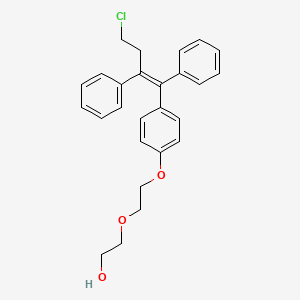
References

  • 1  Liddle J, Allen MJ, Borthwick AD, Brooks DP, Davies DE, Edwards RM, Exall AM, Hamlett C, Irving WR, Mason, AM, McCafferty GP, Nerozzi F, Peace S, Philp J, Pollard D, Pullen MA, Shabbir SS, Sollis SL, Westfall TD, Woollard PM, Wu C, Hickey DM (January 2008). “The discovery of GSK221149A: A potent and selective oxytocin antagonist”. Bioorganic & Medicinal Chemistry Letters 18 (1): 90–94. doi:10.1016/j.bmcl.2007.11.008. PMID 18032036.
  • 2
  • Borthwick, A. D.; Liddle, J. (January 2013). “Retosiban and Epelsiban: Potent and Selective Orally available Oxytocin Antagonists”. In Domling, A. Methods and Principles in Medicinal Chemistry: Protein-Protein Interactions in Drug Discovery. Weinheim: Wiley-VCH. pp. 225–256. ISBN 978-3-527-33107-9.
  • 3
  • McCafferty GP, Pullen MA, Wu C, Edwards RM, Allen M.J, Woollard PM, Borthwick AD, Liddle J, Hickey DM, Brooks DP, Westfall TD (March 2007). “Use of a novel and highly selective oxytocin receptor antagonist to characterize uterine contractions in the rat”. American Journal of Physiology – Regulatory, Integrative and Comparative Physiology 293: R299–R305. doi:10.1152/ajpregu.00057.2007. PMID 17395790.
  • 4
  • USAN Council (2007). “Statement on a Nonproprietary Name Adopted by the USAN Council” (PDF).
  • 5  Borthwick AD, Liddle J (July 2011). “The Design of Orally Bioavailable 2,5-Diketopiperazine Oxytocin Antagonists: From Concept to Clinical Candidate for Premature Labour”. Medicinal Research Reviews 31 (4): 576–604. doi:10.1002/med.20193. PMID 20027670.

…………..

OTHER INFO

http://pubs.acs.org/doi/abs/10.1021/jm201287w

Abstract Image

A six-stage stereoselective synthesis of indanyl-7-(3′-pyridyl)-(3R,6R,7R)-2,5-diketopiperazines oxytocin antagonists from indene is described. SAR studies involving mono- and disubstitution in the 3′-pyridyl ring and variation of the 3-isobutyl group gave potent compounds (pKi > 9.0) with good aqueous solubility. Evaluation of the pharmacokinetic profile in the rat, dog, and cynomolgus monkey of those derivatives with low cynomolgus monkey and human intrinsic clearance gave 2′,6′-dimethyl-3′-pyridyl Rsec-butyl morpholine amide Epelsiban (69), a highly potent oxytocin antagonist (pKi = 9.9) with >31000-fold selectivity over all three human vasopressin receptors hV1aR, hV2R, and hV1bR, with no significant P450 inhibition. Epelsiban has low levels of intrinsic clearance against the microsomes of four species, good bioavailability (55%) and comparable potency to atosiban in the rat, but is 100-fold more potent than the latter in vitro and was negative in the genotoxicity screens with a satisfactory oral safety profile in female rats.

EPELSIBAN

(3R,6R)-3-(2,3-Dihydro-1H-inden-2-yl)-1-[(1R)-1-(2,6-dimethyl-3-pyridinyl)-2-(4-morpholinyl)-2-oxoethyl]-6-[(1S)-1-methylpropyl]-2,5-piperazinedione (69)

69 as a white solid (2.4 g, 45%). Recystallisation from ethyl acetate/hexane (1:3) gave colorless needles (75%) mp 140 °C. 1H NMR (CDCl3) δ 7.49 (d, J = 7.8 Hz, 1H, pyridyl-4H), 7.26–7.15 (m, 4H, indanyl-arylH), 7.10 (d, J =8.1 Hz, 1H, pyridyl-5H), 6.68 (s, 1H, NCHpyridyl), 6.49 (d, J = 2.8 Hz, 1H, lactam-NH), 4.10 (dd, J = 10.1 Hz, 4.0 Hz, 1H, NCHindanyl), 4.01 (d, J = 4.5 Hz, NCHsec-butyl), 3.75–2.71 (m, 13H, 8× morpholinyl-H, indanyl-3H, –1H, –2H), 2.62 and 2.58 (2s, 6H, pyridyl-2Me,-6Me), 1.64–1.52 (m, 1H, CHHMe), 0.98–0.79 (m, 2H, CHHMe, CHMeCH2), 0.70 (t, J = 7.1 Hz, 3H, CH2Me), 0.45 (d, J = 6.8 Hz, 3H, CHMe). LCMS m/z 519 (MH+) single component, gradient 2 (tR 2.70 min). HRMS calcd for C30H38N4O4 (MH+) 519.29658, found 519.29667. HPLC: 100% (tR 10.388 min).
To a warm solution of 69 (2.66 g, 5.1 mmol) in acetone (40 mL) was added a solution of benzene sulfonic acid (0.81 g, 5.1 mmol) in acetone (40 mL), and the resulting solution was heated to boiling and allowed to cool to room temperature during 48 h. The resulting crystals were filtered off, air-dried on the filter pad to give the besylate (3.214 g, 92.6%) as white crystals of 69B mp 179–183 °C. 1H NMR (CD3OD) δ 8.30 (d, 1H, J = 8.1 Hz, pyridyl-4H), 7.84–7.80 (m, 2H, PhSO3ortho-H), 7.78 (d, J = 8.3 Hz, 1H, pyridyl-5H), 7.45–7.38 (m, 3H, PhSO3meta-H, para-H), 7.23–7.09 (m, 4H, indanyl-arylH), 6.08 (broad s, 1H, NCHpyridyl), 4.00 (d, J = 4.6 Hz, 1H, NCHsec-butyl), 3.92 (d, J = 9.9 Hz, 1H, NCHindanyl), 3.78–3.39 and 3.14–2.80 (m, 13H, 8× morpholinyl-H, indanyl-3H, –1H, –2H)), 2.79 and 2.78 (2s, 6H, pyridyl-2Me, -6Me), 1.85–1.74 (m, 1H, CHHMe), 1.59–1.48 (m, 1H, CHHMe), 1.15–1.01 (m, 1H, CHMeCH2), 0.92 (d, J = 6.3 Hz, 3H, CHMe), 0.85 (t, J = 7.3 Hz, 3H, CH2Me). LCMS m/z 519 MH+ single components, tR 2.72 min; circular dichroism (CH3CN) λmax 225.4 nm, dE −15.70, E15086; λmax 276 nm, dE 3.82, E5172. HRMS calcd for C30H38N4O4 (MH+) 519.2971, found 519.2972. Anal. (C30H38N4O4·C6H6O3S·3.0H2O) C, H, N, S.

…………..

Updates

Inline image 1

Inline image 2
Inline image 3

ANTHONY MELVIN CRASTO

THANKS AND REGARD’S
DR ANTHONY MELVIN CRASTO Ph.D

amcrasto@gmail.com

MOBILE-+91 9323115463
GLENMARK SCIENTIST ,  INDIA
web link
Retosiban
Retosiban structure.svg
Systematic (IUPAC) name
(3R,6R)-6-[(2S)-butan-2-yl]-3-(2,3-dihydro-1H-inden-2-yl)-1-[(1R)-1-(2-methyl-1,3-oxazol-4-yl)-2-(morpholin-4-yl)-2-oxoethyl]piperazine-2,5-dione
Clinical data
Legal status
  • Non-regulated
Identifiers
CAS number 820957-38-8
ATC code None
PubChem CID 96025669
ChemSpider 23323798
UNII GIE06H28OX
KEGG D08986
Synonyms GSK-221,149-A
Chemical data
Formula C27H34N4O5 
Molecular mass 494.58 g/mol