New Drug Approvals

Home » Articles posted by DR ANTHONY MELVIN CRASTO Ph.D (Page 277)

Author Archives: DR ANTHONY MELVIN CRASTO Ph.D

DRUG APPROVALS BY DR ANTHONY MELVIN CRASTO .....FOR BLOG HOME CLICK HERE

Blog Stats

  • 4,816,421 hits

Flag and hits

Flag Counter

Enter your email address to follow this blog and receive notifications of new posts by email.

Join 37.9K other subscribers
Follow New Drug Approvals on WordPress.com

Archives

Categories

Recent Posts

Flag Counter

ORGANIC SPECTROSCOPY

Read all about Organic Spectroscopy on ORGANIC SPECTROSCOPY INTERNATIONAL 

Enter your email address to follow this blog and receive notifications of new posts by email.

Join 37.9K other subscribers
DR ANTHONY MELVIN CRASTO Ph.D

DR ANTHONY MELVIN CRASTO Ph.D

DR ANTHONY MELVIN CRASTO, Born in Mumbai in 1964 and graduated from Mumbai University, Completed his Ph.D from ICT, 1991,Matunga, Mumbai, India, in Organic Chemistry, The thesis topic was Synthesis of Novel Pyrethroid Analogues, Currently he is working with AFRICURE PHARMA, ROW2TECH, NIPER-G, Department of Pharmaceuticals, Ministry of Chemicals and Fertilizers, Govt. of India as ADVISOR, earlier assignment was with GLENMARK LIFE SCIENCES LTD, as CONSUlTANT, Retired from GLENMARK in Jan2022 Research Centre as Principal Scientist, Process Research (bulk actives) at Mahape, Navi Mumbai, India. Total Industry exp 32 plus yrs, Prior to joining Glenmark, he has worked with major multinationals like Hoechst Marion Roussel, now Sanofi, Searle India Ltd, now RPG lifesciences, etc. He has worked with notable scientists like Dr K Nagarajan, Dr Ralph Stapel, Prof S Seshadri, etc, He did custom synthesis for major multinationals in his career like BASF, Novartis, Sanofi, etc., He has worked in Discovery, Natural products, Bulk drugs, Generics, Intermediates, Fine chemicals, Neutraceuticals, GMP, Scaleups, etc, he is now helping millions, has 9 million plus hits on Google on all Organic chemistry websites. His friends call him Open superstar worlddrugtracker. His New Drug Approvals, Green Chemistry International, All about drugs, Eurekamoments, Organic spectroscopy international, etc in organic chemistry are some most read blogs He has hands on experience in initiation and developing novel routes for drug molecules and implementation them on commercial scale over a 32 PLUS year tenure till date Feb 2023, Around 35 plus products in his career. He has good knowledge of IPM, GMP, Regulatory aspects, he has several International patents published worldwide . He has good proficiency in Technology transfer, Spectroscopy, Stereochemistry, Synthesis, Polymorphism etc., He suffered a paralytic stroke/ Acute Transverse mylitis in Dec 2007 and is 90 %Paralysed, He is bound to a wheelchair, this seems to have injected feul in him to help chemists all around the world, he is more active than before and is pushing boundaries, He has 100 million plus hits on Google, 2.5 lakh plus connections on all networking sites, 100 Lakh plus views on dozen plus blogs, 227 countries, 7 continents, He makes himself available to all, contact him on +91 9323115463, email amcrasto@gmail.com, Twitter, @amcrasto , He lives and will die for his family, 90% paralysis cannot kill his soul., Notably he has 38 lakh plus views on New Drug Approvals Blog in 227 countries......https://newdrugapprovals.wordpress.com/ , He appreciates the help he gets from one and all, Friends, Family, Glenmark, Readers, Wellwishers, Doctors, Drug authorities, His Contacts, Physiotherapist, etc He has total of 32 International and Indian awards

Verified Services

View Full Profile →

Archives

Categories

Flag Counter

FORMACION INTENSIVA EN MASAJE AYURVÉDICO. HUELVA 4 AL 8 DE AGOSTO 2014


Astellas’ Dificlir (fidaxomicin) could save NHS thousands of pounds


Fidaxomicin2DCSD.svg

Fidaxomicin

873857-62-6 

3-(((6-Deoxy-4-O-(3,5-dichloro-2-ethyl-4,6-dihydroxybenzoyl)-2-O-methyl-β-D-mannopyranosyl)oxy)-methyl)-12(R)-[(6-deoxy-5-C-methyl-4-O-(2-methyl-1-oxopropyl)-β-D-lyxo-hexopyranosyl)oxy]-11(S)-ethyl-8(S)-hydroxy-18(S)-(1(R)-hydroxyethyl)-9,13,15-trimethyloxacyclooctadeca-3,5,9,13,15-pentaene-2-one

C52H74Cl2O18   Molecular Weight: 1058.03916 

US FDA:link         Launched – 2011   Clostridium difficile-associated diarrhea

OPT-80  
PAR-101

Astellas' Dificlir could save NHS thousands of pounds

Using Astellas’ Dificlir (fidaxomicin) as a first-line treatment for clostridium difficile infection (CDI) is not only clinically effective but could also save the National Health Service thousands of pounds compared to the standard of care, according to data from a late-stage study

Read more at: http://www.pharmatimes.com/Article/14-05-14/Astellas_Dificlir_could_save_NHS_thousands_of_pounds.aspx#ixzz31qrtFXlT


Fidaxomicin (trade names DificidDificlir, and previously OPT-80 and PAR-101) is the first in a new class of narrow spectrummacrocyclic antibiotic drugs.[2] It is a fermentation product obtained from the actinomycete Dactylosporangium aurantiacum subspecies hamdenesis.[3][4] Fidaxomicin is non-systemic, meaning it is minimally absorbed into the bloodstream, it is bactericidal, and it has demonstrated selective eradication of pathogenic Clostridium difficile with minimal disruption to the multiple species ofbacteria that make up the normal, healthy intestinal flora. The maintenance of normal physiological conditions in the colon can reduce the probability of Clostridium difficile infection recurrence.[5] [6]

It is marketed by Cubist Pharmaceuticals after acquisition of its the originating company Optimer Pharmaceuticals. The target use is for treatment of Clostridium difficile infection. Fidaxomicin is available in a 200 mg tablet that is administered every 12 hours for a recommended duration of 10 days. Total duration of therapy should be determined by the patient’s clinical status. It is currently one of the most expensive antibiotics approved for use. A 20 tab pack costs upwards of £1350.[7]

Fidaxomicin works by inhibiting the bacterial enzyme RNA polymerase, resulting in the death of Clostridium difficile.[8] It is active against Gram positive bacteria especially clostridia. The minimal inhibitory concentration (MIC) range for C. difficile (ATCC 700057) is 0.03–0.25 μg/mL.[3]

Approvals and indications

For the treatment of CDAD (Clostridium difficile-Associated diarrhea), the drug won an FDA advisory panel’s unanimous approval on April 5, 2011.[14] and full FDA approval on May 27, 2011.[15]

Fidaxomicin is an antibiotic approved and launched in 2011 in the U.S. for the treatment of Clostridium difficile-associated diarrhea (CDAD) in adults 18 years of age and older. In September 2011, the product received a positive opinion in the E.U. and final approval was assigned in December 2011. First E.U. launch took place in the U.K. in June 2012. Optimer Pharmaceuticals is conducting phase III clinical trials for the prevention of Clostridium difficile-associated diarrhea in patients undergoing hematopoietic stem cell transplant. Preclinical studies are ongoing for potential use in the prevention of methicillin-resistant Staphylococcus (MRS) infection. Early clinical studies had been under way for the prevention and treatment of vancomycin-resistant enterococcal (VRE) infection; however, no recent development has been reported for this indication.

The compound is a novel macrocyclic antibiotic that is produced by fermentation. Its narrow-spectrum activity is highly selective for C. difficile, thus preserving gut microbial ecology, an important consideration for the treatment of CDAD.

In May 2005, Par Pharmaceutical and Optimer entered into a joint development and collaboration agreement for fidaxomicin. However, rights to the compound were returned to Optimer in 2007. The compound was granted fast track status by the FDA in 2003. In 2010, orphan drug designation was assigned to fidaxomicin in the U.S. by Optimer Pharmaceuticals for the treatment of pediatric Clostridium difficile infection (CDI). In 2011, the compound was licensed by Optimer Pharmaceuticals to Astellas Pharma in Europe and certain countries in the Middle East, Africa, the Commonwealth of Independent States (CIS) and Japan for the treatment of CDAD. In 2011, fidaxomicin was licensed to Cubist by Optimer Pharmaceuticals for comarketing in the U.S. for the treatment of CDAD. In July 2012, the product was licensed by Optimer Pharmaceuticals to Specialised Therapeutics Australia in AU and NZ for the treatment of Clostridium difficile-associated infection. OBI Pharma holds exclusive commercial rights in Taiwan, where the compound was approved for the treatment of CDAD in September 2012, and in December 2012, the product was licensed to AstraZeneca in South America with commercialization rights also for the treatment of CDAD. 

Clinical trials

Good results were reported in 2009 from a North American phase III trial comparing it with oral vancomycin for the treatment ofClostridium difficile infection (CDI)[9][10] The study met its primary endpoint of clinical cure, showing that fidaxomicin was non-inferior to oral vancomycin (92.1% vs. 89.8%). In addition, the study met its secondary endpoint of recurrence: 13.3% of the subjects had a recurrence with fidaxomicin vs. 24.0% with oral vancomycin. The study also met its exploratory endpoint of global cure (77.7% for fidaxomicin vs. 67.1% for vancomycin).[11] Clinical cure was defined as patients requiring no further CDI therapy two days after completion of study medication. Global cure was defined as patients who were cured at the end of therapy and did not have a recurrence in the next 4 weeks.[12]

Fidaxomicin was shown to be as good as the current standard-of-care, vancomycin, for treating CDI in a Phase III trial published in February 2011.[13] The authors also reported significantly fewer recurrences of infection, a frequent problem with C. difficile, and similar drug side effects.

References

  1.  “DIFICID®” (PDF). TGA eBusiness Services. Specialised Therapeutics Australia Pty Ltd. 23 April 2013. Retrieved 31 March 2014.
  2.  Revill, P.; Serradell, N.; Bolós, J. (2006). “Tiacumicin B”. Drugs of the Future 31 (6): 494. doi:10.1358/dof.2006.031.06.1000709.
  3.  “Dificid, Full Prescribing Information”. Optimer Pharmaceuticals. 2013.
  4.  “Fidaxomicin”. Drugs in R&D 10: 37. 2012. doi:10.2165/11537730-000000000-00000.
  5.  Louie, T. J.; Emery, J.; Krulicki, W.; Byrne, B.; Mah, M. (2008). “OPT-80 Eliminates Clostridium difficile and is Sparing of Bacteroides Species during Treatment of C. Difficile Infection”Antimicrobial Agents and Chemotherapy 53 (1): 261–3. doi:10.1128/AAC.01443-07.PMC 2612159PMID 18955523.
  6.  Johnson, Stuart (2009). “Recurrent Clostridium difficile infection: A review of risk factors, treatments, and outcomes”. Journal of Infection58 (6): 403–10. doi:10.1016/j.jinf.2009.03.010PMID 19394704.
  7. http://www.medicinescomplete.com/mc/bnf/current/PHP18388-dificlir.htm#PHP18388-dificlir
  8.  Srivastava, Aashish; Talaue, Meliza; Liu, Shuang; Degen, David; Ebright, Richard Y; Sineva, Elena; Chakraborty, Anirban; Druzhinin, Sergey Y; Chatterjee, Sujoy; Mukhopadhyay, Jayanta; Ebright, Yon W; Zozula, Alex; Shen, Juan; Sengupta, Sonali; Niedfeldt, Rui Rong; Xin, Cai; Kaneko, Takushi; Irschik, Herbert; Jansen, Rolf; Donadio, Stefano; Connell, Nancy; Ebright, Richard H (2011). “New target for inhibition of bacterial RNA polymerase: ‘switch region'”Current Opinion in Microbiology 14 (5): 532–43.doi:10.1016/j.mib.2011.07.030PMC 3196380PMID 21862392.
  9.  “Optimer’s North American phase 3 Fidaxomicin study results presented at the 49th ICAAC” (Press release). Optimer Pharmaceuticals. September 16, 2009. Retrieved May 7, 2013.
  10.  “Optimer Pharmaceuticals Presents Results From Fidaxomicin Phase 3 Study for the Treatment” (Press release). Optimer Pharmaceuticals. May 17, 2009. Retrieved May 7, 2013.
  11.  Golan Y, Mullane KM, Miller MA (September 12–15, 2009). “Low recurrence rate among patients with C. difficile infection treated with fidaxomicin”. 49th interscience conference on antimicrobial agents and chemotherapy. San Francisco.
  12.  Gorbach S, Weiss K, Sears P, et al (September 12–15, 2009). “Safety of fidaxomicin versus vancomycin in treatment of Clostridium difficile infection”. 49th interscience conference on antimicrobial agents and chemotherapy. San Francisco.
  13.  Louie, Thomas J.; Miller, Mark A.; Mullane, Kathleen M.; Weiss, Karl; Lentnek, Arnold; Golan, Yoav; Gorbach, Sherwood; Sears, Pamela; Shue, Youe-Kong; Opt-80-003 Clinical Study, Group (2011). “Fidaxomicin versus Vancomycin forClostridium difficileInfection”. New England Journal of Medicine 364 (5): 422–31. doi:10.1056/NEJMoa0910812PMID 21288078.
  14.  Peterson, Molly (Apr 5, 2011). “Optimer Wins FDA Panel’s Backing for Antibiotic Fidaxomicin”. Bloomberg.
  15.  Nordqvist, Christian (27 May 2011). “Dificid (fidaxomicin) Approved For Clostridium Difficile-Associated Diarrhea”Medical News Today.


http://www.pharmatimes.com/Article/14-05-14/Astellas_Dificlir_could_save_NHS_thousands_of_pounds.aspx

India business robust in terms of growth: Glenmark….videos


SOME LINKS ON VIDEOS

CLICK TO VIEW

India business robust in terms of growth: Glenmark on Q1 

profit.ndtv.com/…/news/video-india-business-robust…

Aug 2, 2013

NDTV Profit News Video Clip on India business robust in terms of growth: … chairman and managing director …

Capromorelin in phase 2……Ghrelin Receptor Agonist


Capromorelin skeletal.svg

Capromorelin

N-[(2R)-1-[(3aR)-2-methyl-3-oxo-3a-(phenylmethyl)-6,7-dihydro-4H-pyrazolo[4,3-c]pyridin-5-yl]-1-oxo-3-(phenylmethoxy)propan-2-yl]-2-amino-2-methylpropanamide

2-Amino-N-[2-[3a(R)-benzyl-2-methyl-3-oxo-3,3a,4,5,6,7-hexahydro-2H-pyrazolo[4,3-c]pyridin-5-yl]-1(R)-(benzyloxymethyl)-2-oxoethyl]isobutyramide

CP-424391-18, (3ar)-3a-benzyl-2-methyl-5-(2-methylalanyl-o-benzyl-d-seryl)-3-oxo-3,3a,4,5,6,7-hexahydro-2h-pyrazolo[4,3-c]pyridine

Gastro-esophageal reflux disease (GERD)

193273-66-4 free form
193270-49-4 (monoHCl)
193273-67-5 (monomesylate)
193273-69-7 (L-tartrate(1:1))

505.6086

C28 H35 N5 O4

CP-424391
RQ-00000005
CP-424391-18 (tartrate)

Pfizer (Originator)
RaQualia

Phase II

Capromorelin (CP-424,391) is an investigational medication developed by the Pfizer drug company.[2] [3] It functions as a growth hormone secretagogue and ghrelin mimetic which causes the body to secrete human growth hormone in a way usually seen at puberty and in young adulthood. Initial studies have shown the drug to directly raise insulin growth factor 1 (IGF-1) and growth hormone levels.[4]

The drug is being considered for its therapeutic value in aging adults because elderly people have much lower levels of growth hormone and less lean muscle mass, which can result in weakness and frailty.[5]

In a one-year treatment trial (starting 1999) with 395 seniors between 65 and 84 years old, patients who received the drug gained an average of 3 lb (1.4 kg) in lean body mass in the first six months and also were better able to walk in a straight line in a test of balance, strength and coordination. After 12 months, patients receiving capromorelin also had an improved ability to climb stairs, however the results were not good enough to continue the trial for the 2nd planned year.[6]

Capromorelin, however, has not been approved by major regulatory bodies such as the World Health Organization, the European Medicines Agency or the United States FDA. In the U.S. at least, approval is not expected to be forthcoming any time soon, because the FDA does not consider aging a disease, and so requires extraordinary evidence of benefit and non-toxicity to approve a drug for use as an anti-aging agent.[7]

Ghrelin is a peptide that promotes a growth hormone secreted by the stomach and exhibits a variety of physiological effects, including the promotion of appetite, gastrointestinal tract motility and stomach acid secretion, as well as improved heart function. Capromorelin (RQ-00000005) is a ghrelin receptor agonist and, because it has been shown to increase body weight without increasing body fat and to improve motility and appetite in the elderly, it has the potential for many uses, including frailty and GERD.

…………………………………………………………………

WO 1997024369

 https://www.google.com/patents/WO1997024369A1?cl=en

…………………………..

EP 0869968; JP 1999501945; WO 9724369

The intermediate dipeptide (VI) was prepared by two similar ways. Treatment of N-Boc-O-benzyl-D-serine (I) with MeI and K2CO3 produced the methyl ester (II). Subsequent deprotection of the Boc group of (II) with trifluoroacetic acid gave aminoester (III), which was coupled with N-Boc-alpha-methylalanine (IV) using EDC and HOBt yielding (V). Hydrolysis of the resulting dipeptide ester (V) then provided intermediate (VI). In an alternative procedure, N-Boc-alpha-methyl alanine (IV) was activated as the N-hydroxysuccinimidyl ester (VII), which was condensed with O-benzyl-D-serine (VIII) to produce dipeptide (VI).

Methyl 4-oxopiperidine-3-carboxylate (IX) was protected as the tert-butyl carbamate (X) with Boc2O. This was alkylated with benzyl bromide in the presence of NaH to provide the racemic benzyl derivative (XI). Subsequent cyclization of (XI) with methylhydrazine produced the pyrazolopyridine (XII), which was deprotected with trifluoroacetic acid. The resulting amine (XIII) was then coupled with dipeptide (VI) using EDC and HOBt to afford the diastereomeric amides (XIV). After chromatographic isolation of the (R,R)-diastereoisomer, acid deprotection of the Boc group furnished the title compound.


References

  1. Khojasteh-Bakht SC, O’donnell JP, Fouda HG, Potchoiba MJ. Metabolism, pharmacokinetics, tissue distribution, and excretion of [14C]CP-424391 in rats. Drug Metabolism and Disposition. 2005 Jan;33(1):190-9. PMID 15486077
  2. Carpino PA, Lefker BA, Toler SM, Pan LC, Hadcock JR, Murray MC, Cook ER, DiBrino JN, DeNinno SL, Chidsey-Frink KL, Hada WA, Inthavongsay J, Lewis SK, Mangano FM, Mullins MA, Nickerson DF, Ng O, Pirie CM, Ragan JA, Rose CR, Tess DA, Wright AS, Yu L, Zawistoski MP, Pettersen JC, DaSilva-Jardine PA, Wilson TC, Thompson DD. Discovery and biological characterization of capromorelin analogues with extended half-lives. Bioorganic and Medicinal Chemistry Letters. 2002 Nov 18;12(22):3279-82. PMID 12392732
  3. Carpino PA, Lefker BA, Toler SM, Pan LC, Hadcock JR, Cook ER, DiBrino JN, Campeta AM, DeNinno SL, Chidsey-Frink KL, Hada WA, Inthavongsay J, Mangano FM, Mullins MA, Nickerson DF, Ng O, Pirie CM, Ragan JA, Rose CR, Tess DA, Wright AS, Yu L, Zawistoski MP, DaSilva-Jardine PA, Wilson TC, Thompson DD. Pyrazolinone-piperidine dipeptide growth hormone secretagogues (GHSs). Discovery of capromorelin. Bioorganic and Medicinal Chemistry. 2003 Feb 20;11(4):581-90. PMID 12538023
  4. Pan LC, Carpino PA, Lefker BA, Ragan JA, Toler SM, Pettersen JC, Nettleton DO, Ng O, Pirie CM, Chidsey-Frink K, Lu B, Nickerson DF, Tess DA, Mullins MA, MacLean DB, DaSilva-Jardine PA, Thompson DD. Preclinical pharmacology of CP-424,391, an orally active pyrazolinone-piperidine growth hormone secretagogue. Endocrine. 2001 Feb;14(1):121-32. PMID 11322494
  5. Thompson DD. Aging and sarcopenia. Journal of Musculoskeletal and Neuronal Interactions. 2007 Oct-Dec;7(4):344-5. PMID 18094505
  6. Heidi K. White, Charles D. Petrie, William Landschulz, David MacLean, Ann Taylor, Kenneth Lyles, Jeanne Y. Wei, Andrew R. Hoffman, Roberto Salvatori, Mark P. Ettinger, Miriam C. Morey, Marc R. Blackman, George R. Merriam for the Capromorelin Study Group. Effects of an Oral Growth Hormone Secretagogue in Older Adults. Journal of Clinical Endocrinology & Metabolism. April 2009, Vol. 94, No. 4 1198-1206. doi:10.1210/jc.2008-0632. PMID 19174493
  7. Hersch EC, Merriam GR. Growth hormone (GH)-releasing hormone and GH secretagogues in normal aging: Fountain of Youth or Pool of Tantalus? Clinical Interventions in Aging. 2008;3(1):121-9. PMID 18488883

Researchers

Carpino, P.A.; Lefker, B.A.; Toler, S.M.; et al.
Design, synthesis and biological evaluation of a novel series of pyrazolidone-piperidine growth hormone secretagogues
216th ACS Natl Meet (August 23-27, Boston) 1998, Abst MEDI 276

12-31-1998
TREATMENT OF INSULIN RESISTANCE WITH GROWTH HORMONE SECRETAGOGUES


3-16-2005
Treatment of insulin resistance
2-2-2005
Neuroprotective drug
1-7-2004
Process for preparing growth hormone secretagogues
4-2-2003
Process for preparing growth hormone secretagogues
9-11-2002
Treatment of insulin resistance with growth hormone secretagogues
9-27-2000
Heterocyclic compounds
8-30-2000
Growth hormone secretagogues
8-23-2000
Heterocyclic compounds
12-24-1999
THERAPEUTIC COMBINATIONS OF (SELECTIVE) ESTROGEN RECEPTOR MODULATORS (SERM) AND GROWTH HORMONE SECRETAGOGUES (GHS) FOR TREATING MUSCULOSKELETAL FRAILTY
4-23-1999
PROSTAGLANDIN AGONISTS AND THEIR USE TO TREAT BONE DISORDERS
10-19-2011
Method of Stimulating the Motility of the Gastrointestinal System Using Growth Hormone Secretagogues
12-5-2008
Methods of treating emesis using growth hormone secretagogues
10-24-2008
Growth-Hormone Secretagogues
8-29-2008
Method of treating cell proliferative disorders using growth hormone secretagogues
2-29-2008
Treatment For Alzheimer’s Disease And Related Conditions
8-17-2007
Method of stimulating the motility of the gastrointestinal system using growth hormone secretagogues
5-3-2007
GROWTH-HORMONE SECRETAGOGUES
8-18-2006
Combination of gh secret agogues and pde4 inhibitors for the treatment of alzheimers disease
11-25-2005
Method of reducing C-reactive protein using growth hormone secretagogues
3-25-2005
Pharmaceutical compositions and methods comprising combinations of 2-alkylidene-19-nor-vitamin D derivatives and a growth hormone secretagogue

MY PROFILE ON LINKEDIN


Anthony Melvin Crasto Ph.D

DR ANTHONY

CONNECT WITH ME FOR UPDATES AND CONTACT

in.linkedin.com/in/amcrasto/

ALL THAT U HAVE TO DO IS CLICK AND THEN  CONNECT ON LINKEDIN


Taltirelin Талтирелин for Treatment of Neurodegenerative Diseases,


Talitirelin.png


Taltirelin Талтирелин

N-{[(4S)-1-methyl-2,6-dioxohexahydropyrimidin-4-yl]carbonyl}-L-histidyl-L-prolinamide

(S)-1-Methyl-4,5-dihydroorotyl-L-histidyl-L-prolinamide
(S)-N-(1-Methyl-2,6-dioxohexahydropyrimidin-4-ylcarbonyl)-L-histidyl-L-prolinamide

launched 2000 by Mitsubishi Tanabe Pharma


 Tanabe Seiyaku Co., Ltd.

103300-74-9
201677-75-0

Taltirelin tetrahydrate, Taltirelin hydrate, 201677-75-0, TA 0910
Molecular Formula: C17H31N7O9   Molecular Weight: 477.46954

Taltirelin (marketed under the tradename Ceredist) is a thyrotropin-releasing hormone (TRH) analog, which mimics the physiological actions of TRH, but with a much longer half-life and duration of effects,[1] and little development of tolerance following prolonged dosing.[2] It has nootropic,[3] neuroprotective[4] and analgesic effects.[5]

Taltirelin is primarily being researched for the treatment of spinocerebellar ataxia; limited research has also been carried out with regard to other neurodegenerative disorders, e.g., spinal muscular atrophy.[6][7][8]

Taltirelin is a thyrotropin-releasing hormone (TRH) analog that was first commercialized by Tanabe Seiyaku (now Mitsubishi Tanabe Pharma) in Japan in 2000 for the oral treatment of ataxia due to spinocerebellar degeneration.

In 2008, the company filed a regulatory application seeking approval of taltirelin orally disintegrating tablets for the treatment of spinocerebellar degeneration, and in 2009 the approval was received for this formulation.

TRH is a tripeptide hormone that stimulates the release of thyroid-stimulating hormone and prolactin by the anterior pituitary. TRH is produced by the hypothalamus and travels across the median eminence to the pituitary via the hypophyseal portal system.

Taltirelin (TAL) is a thyrotropin-releasing hormone (TRH) analog that is approved for use in humans in Japan. In this study, we characterized TAL binding to and signaling by the human TRH receptor (TRH-R) in a model cell system. We found that TAL exhibited lower binding affinities than TRH and lower signaling potency via the inositol-1,4,5-trisphosphate/calcium pathway than TRH. However, TAL exhibited higher intrinsic efficacy than TRH in stimulating inositol-1,4,5-trisphosphate second messenger generation. This is the first study that elucidates the pharmacology of TAL at TRH-R and shows that TAL is a superagonist at TRH-R

……………………………

Synthesis and central nervous system actions of thyrotropin-releasing hormone analogues containing a dihydroorotic acid moiety
J Med Chem 1990, 33(8): 2130\

http://pubs.acs.org/doi/abs/10.1021/jm00170a013

………………

http://www.google.com/patents/US4665056

EXAMPLE 2

(1) 1.56 g of 1-methyl-L-4,5-dihydroorotic acid and 1.15 g of N-hydroxysuccinimide are dissolved in 30 ml of dimethylformamide, and 2.06 g of dicyclohexylcarbodiimide are added thereto at 0° C. The mixture is stirred at room temperature for 2 hours. The solution thus obtained is hereinafter referred to as “Solution A”. On the other hand, 3.43 g of benzyl L-histidyl-L-prolinate.2HCl are dissolved in dimethylformamide, and 1.67 g of triethylamine are added thereto. The mixture is stirred at 0° C. for 20 minutes, and insoluble materials are filtered off. The filtrate is added to “Solution A”, and the mixture is stirred at 0° C. for 4 hours and then at 10° C. for one day. Insoluble materials are filtered off, and the filtrate is concentrated under reduced pressure at 40° C. to remove dimethylformamide. The residue is dissolved in water, and insoluble materials are filtered off. The filtrate is adjusted to pH 8 with sodium bicarbonate and then passed through a column packed with CHP-20P resin. The column is washed with 500 ml of water, 500 ml of 20% methanol and 300 ml of 50% methanol, successively. Then, the desired product is eluted with 70% methanol. The fractions which are positive to the Pauly’s reaction are collected from the eluate and concentrated under reduced pressure, whereby 3.65 g of benzyl (1-methyl-L-4,5-dihydroorotyl)-L-histidyl-L-prolinate are obtained as an oil.

IRνmax chloroform (cm-1) 3300, 1725, 1680.

650 mg of the product obtained above are dissolved in 1 N-HCl and then lyophilized to give 690 mg of benzyl (1-methyl-L-4,5-dihydroorotyl)-L-histidyl-L-prolinate.HCl.H2 O as powder.

[α]D 22 : -39.8° (C=0.5, H2 O).

IRνmax nujol (cm-1): 1720, 1640-1680.

NMR (DMSO-d6, δ): 1.7-2.4 (m, 4H), 2.90 (s, 3H), 2.4-3.9 (m, 6H), 3.9-4.2 (m, 1H), 4.3-4.5 (m, 1H), 4.6-5.0 (m, 1H), 5.09 (s, 2H), 7.2-7.5 (m, 5H), 8.96 (s, 1H).

Mass (m/e): 496 (M+).

(2) 700 mg of benzyl (1-methyl-L-4,5-dihydroorotyl)-L-histidyl-L-prolinate are dissolved in 20 ml of methanol, and 20 mg of palladium-black are added thereto. The mixture is stirred at room temperature for 3 hours in hydrogen gas. 20 ml of water are added to the reaction mixture, and the catalyst is filtered off. The filtrate is evaporated to remove solvent. The residue is crystallized with methanol, whereby 290 mg of (1-methyl-L-4,5-dihydroorotyl)-L-histidyl-L-proline.5/4 H2 O are obtained.

M.p.: 233°-236° C. (decomp.).

[α]D 20 : -17.2° (C=0.5, H2 O).

IRνmax nujol (cm-1): 1715, 1680, 1630.

NMR (D2 O, δ): 1.7-2.4 (m, 4H), 2.6-3.9 (m, 6H), 3.03 (s, 3H), 4.0-4.45 (m, 2H), 4.95 (t, 1H), 7.27 (s, 1H), 8.57 (s, 1H).

(3) A mixture of 4.29 g of (1-methyl-L-4,5-dihydroorotyl)-L-histidyl-L-proline, 1.15 g of N-hydroxysuccinimide, 2.26 g of dicyclohexylcarbodiimide and 30 ml of dimethylformamide is stirred at 0° C. for 40 minutes and at room temperature for 80 minutes. 30 ml of 15% ammonia-methanol are then added to the mixture at 0° C., and the mixture is stirred at 0° C. for 30 minutes and at room temperature for one hour. Insoluble materials are filtered off, and the filtrate is evaporated to remove dimethylformamide. The residue is dissolved in 20 ml of water, and insoluble materials are again filtered off. The filtrate is adjusted to pH 8 with sodium bicarbonate and then passed through a column packed with CHP-20P resin. After the column is washed with 2 liters of water, the desired product is eluted with 10% methanol. The fractions which are positive to the Pauly’s reaction are collected and concentrated under reduced pressure. The residue is dissolved in 10 ml of water, and allowed to stand in a refrigerator. Crystalline precipitates are collected by filtration, washed with water, and then dried at 25° C. for one day, whereby 3.3 g of (1-methyl-L-4,5-dihydroorotyl)-L-histidyl-L-prolinamide.7/2 H2 O are obtained.

M.p.: 72°-75° C.

[α]D 25 : -13.6° (C=1, H2 O).

IRνmax nujol (cm-1): 3400, 3250, 1710, 1660, 1610, 1540.

References

  1. Fukuchi, I.; Asahi, T.; Kawashima, K.; Kawashima, Y.; Yamamura, M.; Matsuoka, Y.; Kinoshita, K. (1998). “Effects of taltirelin hydrate (TA-0910), a novel thyrotropin-releasing hormone analog, on in vivo dopamine release and turnover in rat brain”. Arzneimittel-Forschung 48 (4): 353–359. PMID 9608876.
  2. Asai, H.; Asahi, T.; Yamamura, M.; Yamauchi-Kohno, R.; Saito, A. (2005). “Lack of behavioral tolerance by repeated treatment with taltirelin hydrate, a thyrotropin-releasing hormone analog, in rats”. Pharmacology Biochemistry and Behavior 82 (4): 646–651. doi:10.1016/j.pbb.2005.11.004. PMID 16368129.
  3. Yamamura, M.; Suzuki, M.; Matsumoto, K. (1997). “Synthesis and pharmacological action of TRH analog peptide (Taltirelin)”. Nihon yakurigaku zasshi. Folia pharmacologica Japonica. 110 Suppl 1: 33P–38P. PMID 9503402.
  4. Urayama, A.; Yamada, S.; Kimura, R.; Zhang, J.; Watanabe, Y. (2002). “Neuroprotective effect and brain receptor binding of taltirelin, a novel thyrotropin-releasing hormone (TRH) analogue, in transient forebrain ischemia of C57BL/6J mice”. Life Sciences 72 (4–5): 601–607. doi:10.1016/S0024-3205(02)02268-3. PMID 12467901.
  5. Tanabe, M.; Tokuda, Y.; Takasu, K.; Ono, K.; Honda, M.; Ono, H. (2009). “The synthetic TRH analogue taltirelin exerts modality-specific antinociceptive effects via distinct descending monoaminergic systems”. British Journal of Pharmacology 150 (4): 403–414. doi:10.1038/sj.bjp.0707125. PMC 2189720. PMID 17220907.
  6. Takeuchi, Y.; Miyanomae, Y.; Komatsu, H.; Oomizono, Y.; Nishimura, A.; Okano, S.; Nishiki, T.; Sawada, T. (1994). “Efficacy of Thyrotropin-Releasing Hormone in the Treatment of Spinal Muscular Atrophy”. Journal of Child Neurology 9 (3): 287–289. doi:10.1177/088307389400900313. PMID 7930408.
  7. Tzeng, A. C.; Cheng, J.; Fryczynski, H.; Niranjan, V.; Stitik, T.; Sial, A.; Takeuchi, Y.; Foye, P.; Deprince, M.; Bach, J. R. (2000). “A study of thyrotropin-releasing hormone for the treatment of spinal muscular atrophy: A preliminary report”. American journal of physical medicine & rehabilitation / Association of Academic Physiatrists 79 (5): 435–440. doi:10.1097/00002060-200009000-00005. PMID 10994885.
  8. Kato, Z.; Okuda, M.; Okumura, Y.; Arai, T.; Teramoto, T.; Nishimura, M.; Kaneko, H.; Kondo, N. (2009). “Oral Administration of the Thyrotropin-Releasing Hormone (TRH) Analogue, Taltireline Hydrate, in Spinal Muscular Atrophy”. Journal of Child Neurology 24 (8): 1010–1012. doi:10.1177/0883073809333535. PMID 19666885.
    • EP 168 042 (Tanabe Seiyaku; appl. 10.7.1985; GB-prior. 10.7.1984).
    • JP 62 234 029 (Tanabe Seiyaku; J-prior. 27.12.1985).
    • Suzuki, M. et al.: J. Med. Chem. (JMCMAR) 33 (8), 2130-2137 (1990).

External links

Lilly’s diabetes drug peglispro outshines world’s most popular insulin


 Lilly's diabetes drug outshines world's most popular insulin
insulin peglispro
SYNONYMS macrogol 20000 pegylated insulin lispro: [28B-(6-N-{[ω-methoxypoly(oxyethylene)]carbonyl}-L-lysine), 29B-L-proline]human insulin
CAS 1200440-65-8
insulin peglispro
antidiabetic;


Lilly’s diabetes drug outshines world’s most popular insulin

World News | May 13, 2014

Late-stage clinical data has shown Lilly’s experimental diabetes drug Peglispro to be better at reducing blood sugar in patients with type II diabetes than Sanofi’s Lantus – the world’s most prescribed insulin.

The US drugmaker says it expects to file for approval of its basal insulin (BIL) by the first quarter of next year, after three Phase III studies showed it induced “a statistically superior reduction in HbA1c” compared with Lantus.


………….

New breast cancer stem cell findings explain how cancer spreads


Aviatior's avatar

image

Breast cancer stem cells exist in two different states and each state plays a role in how cancer spreads, according to an international collaboration of researchers. Their finding sheds new light on the process that makes cancer a deadly disease.

http://medicalxpress.com/news/2014-01-breast-cancer-stem-cell.html

View original post

GSK2606414 is an orally available, potent, and selective PERK inhibitor


GSK2606414 structure

GSK2606414

1-(5-(4-amino-7-methyl-7H-pyrrolo[2,3-d]pyrimidin-5-yl)indolin-1-yl)-2-(3-(trifluoromethyl)phenyl)ethanone

1-[5-(4-Amino-7-methyl-7H-pyrrolo[2,3-d]pyrimidin-5-yl)indolin-1-yl]-2-(3-trifluoromethylphenyl)ethanone

CAS: 1337531-36-8

 Formula: C24H20F3N5O
Exact Mass: 451.16199

Glaxosmithkline Llc  innovator

CS-1428, QC-9698, GSK 2606414, KB-145925, GSK2606414|1337531-36-8|GSK-2606414

  nmr       ………http://www.medkoo.com/Product-Data/GSK2606414/GSK2606414-QC-APC40116Web.pdf

GSK2606414  is an orally available, potent, and selective PERK inhibitor. GSK2606414 inhibits PERK activation in cells and inhibits the growth of a human tumor xenograft in mice. Protein kinase R (PKR)-like endoplasmic reticulum kinase (PERK) is activated in response to a variety of endoplasmic reticulum stresses implicated in numerous disease states. Evidence that PERK is implicated in tumorigenesis and cancer cell survival stimulated our search for small molecule inhibitors. (12/13/2013).

GSK2606414 structure.png

In vitro protocol:

J Med Chem. 2012 Aug 23;55(16):7193-207

In vivo protocol:

J Med Chem. 2012 Aug 23;55(16):7193-207

……………..

The chemical structures of GSK2606414  and GSK2656157 are very similar. The following graphic is a side-by-side comparison.

GSK2606414-GSK2656157 structure


GSK2606414 is a drug which is the first selective inhibitor discovered for the enzyme protein kinase R (PKR)-like endoplasmic reticulum kinase (PERK), which is involved in various processes relating to cancer and neurodegenerative disorders. GSK2606414 was found to be a potent and selective inhibitor of PERK, with good oral bioavailability and blood-brain barrier penetration.[1] PERK mediates the unfolded protein response pathway which is involved in the initiation of protein synthesis, and this pathway has been implicated in the neurotoxicity of various diseases including prion and Alzheimer’s diseases. Treatment with GSK2606414 was found to be neuroprotective in mice against damage caused by prions, and prevented the development of cognitive deficits and other clinical manifestations of prion disease. Extension of lifespan in treated mice was, however, not recorded. However, side effects such as weight loss and elevated blood glucose levels were also observed, likely due to unwanted inhibition of PERK in the pancreas gland, where it is involved in regulating insulin production.[2]

WO 2011119663

http://www.google.com/patents/WO2011119663A1?cl=en

Example 35

5-{1 -[(3-fluorophenyl)acetyl]-2,3-dihydro-1 H-indol-5-yl}-7-methyl-7H-pyrrolo[2,3- d]pyrimidin-4-amine

Figure imgf000116_0001

In a 20 mL vial with cap, to the solution of 5-(2,3-dihydro-1 H-indol-5-yl)-7-methyl-7H- pyrrolo[2,3-d]pyrimidin-4-amine2HCI (70.6 mg, 0.209 mmol), (3-fluorophenyl)acetic acid (32.2 mg, 0.209 mmol), HATU (79 mg, 0.209 mmol) in DMF (2 mL) was added Hunig’s base (0.146 mL, 0.836 mmol). The mixture was stirred at rt for over night. LCMS showed reaction was completed. The reaction was poured into water, white solid formed. The solid was filtered and dried to afford a white solid as the product. 1H NMR (400 MHz, DMSO- cfe) δ ppm 3.23 (t, J=8.46 Hz, 2 H), 3.73 (s, 3 H), 3.92 (s, 2 H), 4.19 – 4.26 (m, 2 H), 7.08 – 7.1 1 (m, 1 H), 7.12 – 7.17 (m, 2 H), 7.23 (d, J=8.34 Hz, 1 H), 7.25 (s, 1 H), 7.31 (s, 1 H), 7.36 (s, 1 H), 7.39 (d, J=6.82 Hz, 1 H), 8.10 – 8.17 (m, 2 H).

References

  1. Axten, J. M.; Medina, J. S. R.; Feng, Y.; Shu, A.; Romeril, S. P.; Grant, S. W.; Li, W. H. H.; Heerding, D. A.; Minthorn, E.; Mencken, T.; Atkins, C.; Liu, Q.; Rabindran, S.; Kumar, R.; Hong, X.; Goetz, A.; Stanley, T.; Taylor, J. D.; Sigethy, S. D.; Tomberlin, G. H.; Hassell, A. M.; Kahler, K. M.; Shewchuk, L. M.; Gampe, R. T. (2012). “Discovery of 7-Methyl-5-(1-{\3-(trifluoromethyl)phenyl]acetyl}-2,3-dihydro-1H-indol-5-yl)-7H-pyrrolo\2,3-d]pyrimidin-4-amine (GSK2606414), a Potent and Selective First-in-Class Inhibitor of Protein Kinase R (PKR)-like Endoplasmic Reticulum Kinase (PERK)”. Journal of Medicinal Chemistry 55 (16): 7193–7207. doi:10.1021/jm300713s.PMID 22827572. edit
  2.  Moreno, J. A.; Halliday, M.; Molloy, C.; Radford, H.; Verity, N.; Axten, J. M.; Ortori, C. A.; Willis, A. E.; Fischer, P. M.; Barrett, D. A.; Mallucci, G. R. (2013). “Oral Treatment Targeting the Unfolded Protein Response Prevents Neurodegeneration and Clinical Disease in Prion-Infected Mice”. Science Translational Medicine 5 (206): 206ra138. doi:10.1126/scitranslmed.3006767. edit

1: Axten JM, Medina JR, Feng Y, Shu A, Romeril SP, Grant SW, Li WH, Heerding DA,  Minthorn E, Mencken T, Atkins C, Liu Q, Rabindran S, Kumar R, Hong X, Goetz A, Stanley T, Taylor JD, Sigethy SD, Tomberlin GH, Hassell AM, Kahler KM, Shewchuk LM, Gampe RT. Discovery of 7-methyl-5-(1-{[3-(trifluoromethyl)phenyl]acetyl}-2,3-dihydro-1H-indol-5-yl)-7H-pyrrolo[2,3-d]pyrimidin-4-amine (GSK2606414), a potent and selective first-in-class inhibitor of protein kinase R (PKR)-like endoplasmic reticulum kinase (PERK). J Med Chem. 2012 Aug 23;55(16):7193-207. doi: 10.1021/jm300713s. Epub 2012 Aug 8. PubMed PMID: 22827572

.

Saracatinib, AZD0530 in phase 3 for Ovary Cancer,


Saracatinib
NCGC00241099, cas 379231-04-6

893428-71-2 (trihydrate)

N-(5-Chloro-1,3-benzodioxol-4-yl)-7-[2-(4-methyl-1-piperazinyl)ethoxy]-5-[(tetrahydro-2H-pyran-4-yl)oxy]-4-quinazolinamine

N-(5-Chloro-1,3-benzodioxol-4-yl)-7-[2-(4-methylpiperazin-1-yl)ethoxy]-5-(tetrahydropyran-4-yloxy)quinazolin-4-amine

4-(6-chloro-2,3-methylenedioxyanilino)-7-[2-(4-methyIpiperazin-l-yI)ethoxy]- 5-tetrahydropyran-4-yloxyquinazoline

4-(6-chloro-2,3-methylenedioxyanilino)- 7-[2-(4-methylpiperazin-l -yl)ethoxy]-5-tetrahydropyran-4-yloxyquinazoline

AZD0530

C27H32ClN5O5

542.03

AstraZeneca Pharmaceuticals LP

Astrazeneca Ab, Astrazeneca Uk Ltd,

Saracatinib (AZD0530) is a highly selective, orally available, dual-specific Src/Abl kinase inhibitor with IC50 of 2.7 and 30 nM for c-Src and Abl kinase, respectively.Saracatinib (AZD0530) demonstrated potent antimigratory and antiinvasive effects in vitro, and inhibited metastasis in a murine model of bladder cancer. Antiproliferative activity of AZD0530 in vitro varied between cell lines (IC50=0.2 ~10 mM).

c-Src, Bcr–Abl, Yes1, Lck.target

AZD0530 is orally available 5-, 7-substituted anilinoquinazoline with anti-invasive and anti-tumor activities. AZD0530 is a dual-specific inhibitor of Src and Abl, protein tyrosine kinases that are overexpressed in chronic myeloid leukemia cells. This agent binds to and inhibits these tyrosine kinases and their effects on cell motility, cell migration, adhesion, invasion, proliferation, differentiation, and survival. Specifically, AZD0530 inhibits Src kinase-mediated osteoclast bone resorption.

AZD-0530 is a highly selective, dual-specific small molecule Src/Abl kinase inhibitor currently in phase II/III clinical trials at AstraZeneca for the treatment of ovarian cancer. Phase II clinical trials are also under way at the company for the treatment of solid tumors and hematological neoplasms. The Mayo Clinic is developing AZD-0530 in phase II clinical studies for the treatment of metastatic pancreas cancer.

Additional phase II trials are under way at the National Cancer Institute (NCI) for the treatment of colorectal cancer, prostate cancer, breast cancer, lung cancer, stomach cancer, soft tissue sarcoma, stage II or IV melanoma and thymic malignancies. A phase II trial for pancreatic cancer has been suspended. Src and Abl kinase are highly expressed in various human tumor types. No recent development has been reported for research into the treatment of head and neck cancer.

Phase II study of Saracatinib (AZD0530) for for the treatment of patients with hormone receptor-negative metastatic breast cancer : Nine patients were treated on study. After a median of 2 cycles (range 1-3), no patient had achieved CR, PR, or SD >6 months. The median time to treatment failure was 82 days (12-109 days).The majority (89%) of patients discontinued saracatinib because of disease progression. One patient acquired potentially treatment-related grade 4 hypoxia with interstitial infiltrates and was removed from the study. Common adverse events included fatigue, elevated liver enzymes, nausea, hyponatremia, dyspnea, cough, and adrenal insufficiency. CONCLUSIONS:  These efficacy results were not sufficiently promising to justify continued accrual to this study. Based on this series, saracatinib does not appear to have significant single-agent activity for the treatment of patients with ER(-)/PR(-) MBC. (source: Clin Breast Cancer. 2011 Oct;11(5):306-11.)

Phase II study of  Saracatinib (AZD0530) in patients with metastatic or locally advanced gastric or gastro esophageal junction (GEJ) adenocarcinoma:  Saracatinib has insufficient activity as a single agent in patients with advanced gastric adenocarcinoma to warrant further investigation. Further development in gastric cancer would require rational drug combinations or identification of a tumor phenotype sensitive to Src inhibition. (source: Invest New Drugs. 2011 Mar 12. [Epub ahead of print]).


Phase II study of saracatinib (AZD0530) for patients with recurrent or metastatic head and neck squamous cell carcinoma (HNSCC). Nine patients were enrolled. All patients had received prior radiotherapy and six patients had received prior chemotherapy for recurrent or metastatic disease. The most common adverse event was fatigue. Eight patients had progression of disease by response evaluation criteria in solid tumors (RECIST) within the first eight-week cycle and one patient was removed from the study after 11 days due to clinical decline with stable disease according to the RECIST criteria. Median overall survival was six months. The study was closed early due to lack of efficacy according to the early stopping rule. CONCLUSION: Single-agent saracatinib does not merit further study in recurrent or metastatic HNSCC. (source: Anticancer Res. 2011 Jan;31(1):249-53.)

893428-72-3 Saracatinib difumarate

893428-73-4 also

Saracatinib (AZD0530) is a Src inhibitor for c-Src with IC50 of 2.7 nM.

…………………………….

WO 2001094341

http://www.google.com/patents/WO2001094341A9?cl=en

………………….

WO 2006064217

http://www.google.fm/patents/EP1871769A2?cl=en

4-(6-chloro-2,3-methylenedioxyanilino)- 7-[2-(4-methylpiperazin-l -yl)ethoxy]-5-tetrahydropyran-4-yloxyquinazoline which compound is disclosed as Compound No. 73 within the Table in Example 14 of International Patent Application WO 01/94341. That compound is described herein by way of the Formula I

and as AZD0530, the code number by which the compound is known.

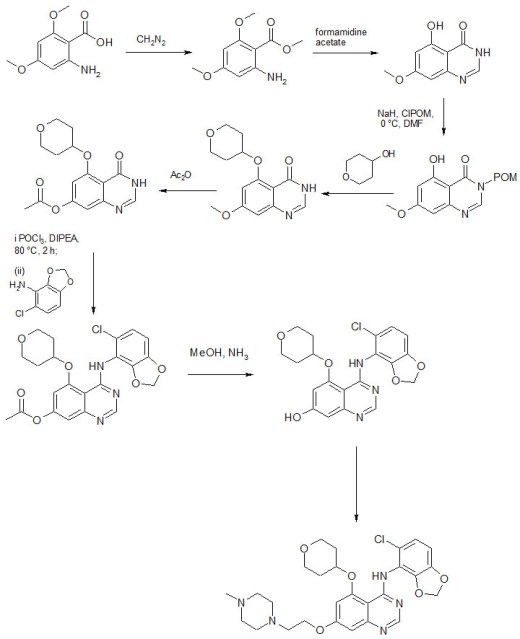
AZD0530 is an inhibitor of the Src family of non-receptor tyrosine kinase enzymes and, thereby, is a selective inhibitor of the motility of tumour cells and a selective inhibitor of the dissemination and invasiveness of mammalian cancer cells leading to inhibition of metastatic tumour growth. In particular, the compound AZD0530 is an inhibitor of c-Src non-receptor tyrosine kinase and should be of value as an anti-invasive agent for use in the containment and/or treatment of solid tumour disease in the human or animal body. The route for preparing the compound of the Formula I that is disclosed in International Patent Application WO 01/94341 involves the reaction of the compound 4-(6-chloro-2,3-methylenedioxyanilino)-7-hydroxy-5-tetrahydropyran-4-yloxyquinazoline with an alkylating agent to form the 2-(4-methylpiperazin-l-yl)ethoxy side-chain at the 7-position. The product of the reaction is disclosed in WO 01/94341 in the form of a dihydrochloride salt and in the form of a free base.

Example 14 4-(6-chloro-2,3-methylenedioxyaniIino)-7-[2-(4-methyIpiperazin-l-yI)ethoxy]- 5-tetrahydropyran-4-yloxyquinazoline (route 4)

Under an atmosphere of nitrogen gas, l-(2-hydroxyethyl)-4-methylpiperazine (13.93 g) was added to a stirred mixture of 4-(6-chloro-2,3-methylenedioxyanilino)-7-fluoro- 5-tetrahydropyran-4-yloxyquinazoline (12.9 g), sodium te/t-pentoxide (9.87 g) and 1 ,2-diethoxyethane (37.5 ml). Water (1.34 g) and 1,2-diethoxyethane (25 ml) were added and the resultant reaction mixture was stirred and heated to 86°C for 18 hours. The reaction mixture was cooled to 5O0C and, under vacuum distillation at approximately 60 millibar pressure, approximately 50 ml of reaction solvent was distilled off. The reaction mixture was neutralised to pH 7.0 to 7.6 by the addition of a mixture of concentrated aqueous hydrochloric acid (36%, 10 ml) and water (84 ml) at a rate that kept the temperature of the reaction mixture at a maximum of 6O0C. With the temperature of the reaction mixture being kept at 6O0C, the reaction mixture was extracted with ethyl acetate (225 ml). The organic solution was washed with water (50 ml). Water (25 ml) was added and, with the temperature being kept at 6O0C, the mixture was stirred for 10 minutes, then allowed to stand for 30 minutes and the aqueous layer was separated. The organic layer was concentrated to a volume of about 100 ml by distillation of solvent at about 9O0C under atmospheric pressure. The residual mixture was cooled during 1 hour to 450C and held at that temperature for 2 hours to allow crystallisation of product. The mixture was warmed briefly to 550C and then cooled during 4 hours to 180C and held at that temperature for 1 hour. The crystalline precipitate was isolated by filtration and washed in turn with water (17 ml) and with tø’t-butyl methyl ether (17 ml). There was thus obtained 4-(6-chloro-2,3-πiethylenedioxyanilino)-7-[2-(4-methylpiperazin-l-yl)ethoxy]- 5-tetrahydropyran-4-yloxyquinazoline as a trihydrate (11 g; 88% purity by HPLC using Method B, retention time 7.3 minutes); NMR Spectrum: (CDCl3) 1.65 (br s, 3H), 1.9-2.05 (m, 2H), 2.2-2.3 (m, 2H), 2.31 (s, 3H), 2.4-2.8 (m, 8H), 2.9 (m, 2H), 3.6-3.7 (m, 2H), 3.95-4.05 (m, 2H), 4.2-4.25 (m, 2H), 4.8 (m,lH), 6.05 (s, 2H), 6.55 (s, IH), 6.75 (d, IH), 6.85 (s, IH), 7.0 (d, IH), 8.55 (s, IH), 9.25 (s, IH).

A portion (10 g) of the material so obtained was placed on a filter and dried at ambient temperature in a stream of dry nitrogen gas. The resultant material was dissolved at 6O0C in dry isopropanol (140 ml) whilst maintaining a dry nitrogen atmosphere. The solution was allowed to cool to ambient temperature and to stand under a dry nitrogen atmosphere for 2 days. The resultant crystalline solid was isolated by filtration under a dry nitrogen atmosphere. The material (8 g) so obtained was a crystalline anhydrous form of 4-(6-chloro-2,3-methylenedioxyanilino)-7-[2-(4-methylpiperazin-l -yl)ethoxy]- 5-tetrahydropyran-4-yloxyquinazoline, m.p. 142 to 1440C.

Example 15

4-(6-chloro-2,3-methylenedioxyanilino)-7-[2-(4-methylpiperazin-l-yl)ethoxy]- 5-tetrahydropyran-4-yloxyquinazoline difumarate salt

A mixture of 4-(6-chloro-2,3-methylenedioxyanilino)-7-[2-(4-methylpiperazin- l-yl)ethoxy]-5-tetrahydropyran-4-yloxyquinazoline trihydrate (27.1 g), isopropanol (200 ml) and water (10 ml) was heated to 75°C. A mixture of fumaric acid (12.8 g), isopropanol (200 ml) and water (40 ml) was heated to 😯0C. A portion (80 ml) of the warmed solution of the quinazoline compound was added to the fumaric acid solution whilst the temperature was maintained at 750C. The resultant mixture was stirred at 750C for 75 minutes. The remainder of the quinazoline compound solution was added during 1 hour whilst the temperature was maintained at 750C. Isopropanol (50 ml) was added and the resultant mixture was stirred at 750C for 7 hours. The mixture was cooled slowly over at least 25 minutes to 5O0C and was stirred at that temperature for 6 hours. The mixture was cooled slowly over at least 20 minutes to 2O0C and was stirred at that temperature for 18.5 hours. The crystalline solid was isolated by filtration, washed twice with a 10:1 mixture of isopropanol and water (50 ml and 100 ml respectively) and dried in vacuo at 450C to constant weight. There was thus obtained 4-(6-chloro- 2,3-methylenedioxyanilino)-7-[2-(4-methylρiperazin-l-yl)ethoxy]-5-tetrahydropyran- 4-yloxyquinazoline difumarate salt (37.0 g); m.p. 233-2370C; NMR Spectrum: (DMSOd6) 1.76-1.88 (m, 2H), 2.1-2.17 (m, 2H)5 2.33 (s, 3H), 2.6 (br s, 8H), 2.78 (t, 2H), 3.51-3.6 (m, 2H)3 3.83-3.9 (m, 2H), 4.24 (t, 2H)5 4.98-5.07 (m, IH), 6.07 (s, 2H)3 6.6 (s, 4H)5 6.83 (d5 IH)3 6.84 (d, IH)5 6.91 (d3 IH)5 7.05 (d, IH)3 8.33 (s, IH)3 9.18 (s, IH).

Example 16

4-(6-chloro-2,3-methyIenedioxyaniIino)-7-[2-(4-methyIpiperazin-l-yl)ethoxy]- 5-tetrahydropyran-4-yIoxyquinazolme difumarate salt

A mixture of 4-(6-chloro-2,3-methylenedioxyanilino)-7-[2-(4-methylpiperazin- l-yl)ethoxy]-5-tetrahydropyran-4-yloxyquinazoline trihydrate (27.1 g), isopropanol (210 ml) and water (30 ml) was heated to 4O0C and the mixture was filtered. The filter was washed with isopropanol (20 ml) and the washings were added to the warm filtrate. The resultant solution was warmed to 75°C.

A mixture of fumaric acid (12.8 g), isopropanol (200 ml) and water (20 ml) was heated to 700C and the resultant mixture was filtered. A portion (110 ml) of the fumaric acid solution was added to the warmed solution of 4-(6-chloro-2,3-methylenedioxyanilino)- 7-[2-(4-methylpiperazin- 1 -yl)ethoxy]-5-tetrahydropyran-4-yloxyquinazoline whilst the temperature was maintained at 75°C. Seed crystals of 4-(6-chloro-

253-methylenedioxyanilino)-7-[2-(4-methylpiperazin-l-yl)ethoxy]-5-tetrahydropyran- 4-yloxyquinazoline difumarate salt (0.02 g) were added and the resultant mixture was stirred at 750C for 1 hour. The remainder of the fumaric acid solution was added during 1 hour whilst the temperature was maintained at 750C and the resultant mixture was stirred at 750C for 14 hours.

The mixture was cooled slowly over at least 2 hours to 200C and was stirred at that temperature for 1 hour. The crystalline solid was isolated by filtration, washed twice with a 10:1 mixture of isopropanol and water (50 ml and 100 ml respectively) and dried in vacuo at 450C to constant weight. There was thus obtained 4-(6-chloro-253-methylenedioxyanilino)- 7-[2-(4-methylpiperazin-l-yl)ethoxy]-5-tetrahydropyran-4-yloxyquinazoline difumarate salt (35.8 g); m.p. 234-237°C; NMR Spectrum: (DMSOd6) 1.76-1.88 (m, 2H)5 2.1-2.17 (m5 2H)5 2.33 (s5 3H)5 2.6 (br s, 8H), 2.78 (t, 2H), 3.51-3.6 (m, 2H), 3.83-3.9 (m, 2H), 4.24 (t, 2H)5 4.98-5.07 (m, IH), 6.07 (s, 2H)5 6.6 (s, 4H), 6.83 (d, IH)5 6.84 (d, IH)5 6.91 (d, IH)5 7.05 (d, IH)5 8.33 (s5 IH)5 9.18 (s5 IH).

Example 17 4-(6-chloro-2,3-methylenedioxyanilino)-7-[2-(4-methyIpiperazin-l-yI)ethoxy]- 5-tetrahydropyran-4-yloxyquinazoline sesquifumarate salt

A mixture of 4-(6-chloro-253-methylenedioxyanilino)-7-[2-(4-methylpiperazin- l-yl)ethoxy]-5-tetrahydropyran-4-yloxyquinazoline difurnarate (0.15 g) and water (20 ml) was warmed using a heat gun to obtain a solution. The sample was allowed to evaporate slowly at ambient temperature to a volume of about 3 ml under a flow of air for 24 hours whereupon a precipitate had started to form. The mixture was placed in a refridgerator at 4°C for 2 days. The resultant precipitate was isolated by filtration and washed with water. There was thus obtained 4-(6-chloro-253-methylenedioxyanilino)-7-[2-(4-methylpiperazin-l-yl)ethoxy]- 5-tetrahydropyran-4-yloxyquinazoline as a sesquifumarate tetrahydrate salt (0.084 g) which was characterised using XRPD5 DSC5 TGA5 FTIR and solution NMR techniques.

………………..

A simplified process for the manufacture of AZD0530, a potent SRC kinase inhibitor
Org Process Res Dev 2011, 15(3): 688

http://pubs.acs.org/doi/abs/10.1021/op100161y

Abstract Image

Process research and development of a synthetic route towards a novel SRC kinase inhibitor is described. The Medicinal Chemistry route was very long and suffered from extensive use of chlorinated solvents and chromatography. A number of steps in the Medicinal Chemistry route were also unattractive for large-scale use for a variety of reasons. The route was modified to produce a shorter synthetic scheme that started from more readily available materials. By using the modified route, the title compound was manufactured on kilogram scale without recourse to chromatography and in significantly fewer steps. The scaled synthesis required two Mitsunobu couplings, which were developed and scaled successfully. An interesting hydrazine impurity was identified in the second Mitsunobu coupling; a mechanism for its formation is proposed, and a method for its control is described. The formation and control of some other interesting impurities are also described.

N-(5-Chloro-1,3-benzodioxol-4-yl)-7-[2-(4-methylpiperazin-1-yl)ethoxy]-5-(tetrahydro-2H-pyran-4-yloxy)quinazolin-4-amine Difumarate (AZD0530 Difumarate)

To a slurry of 30 (2.139 kg at 92% w/w, 4.73 mol) and DTAD (2.771 kg, 12.03 mol) in THF (31 L) at ambient temperature in a 100 L vessel was added a solution of triphenylphosphine (3.057 kg, 11.66 mol) in THF (8 L) over 15 min. A THF (2 L) line wash was applied, and the mixture was stirred for 10 min. The reaction mixture was cooled to 15 °C, and a filtered (to remove undissolved particulates) solution of 31 (1.050 L, 1.049 kg, 7.27 mol) in THF …DELETED…………………………….The mixture was filtered and the cake washed with IPA (7 L as a slurry wash and 7 L as a displacement wash) before drying to constant weight under reduced pressure at 50 °C to give AZD0530 difumarate (3.546 kg at 89% w/w, 4.08 mol, 86% yield).

Final Purification of N-(5-Chloro-1,3-benzodioxol-4-yl)-7-[2-(4-methylpiperazin-1-yl)ethoxy]-5-(tetrahydro-2H-pyran-4-yloxy)quinazolin-4-amine Difumarate (AZD0530 Difumarate)

AZD0530 difumarate (4.234 kg at 89% w/w, 4.87 mol) was refluxed in a mixture of IPA (10.L) and water (10.L, Fresenius). A solution was not obtained, so further IPA (450 mL) and water (450 mL, Fresenius) were added, and the mixture was refluxed. The resulting solution was cooled to 68 °C and screened over 3.5 min through a 20 μm in-line filter into a vessel preheated to 65 °C. IPA(20.4 L) at 65 °C was added via the first vessel and in-line filter, and the resulting solution was stirred at 65 °C for 2 h. Crystallisation was evident after 20 min. The mixture was allowed to self-cool to ambient temperature overnight before filtering and washing the cake with a mixture (prescreened through a 20 μm membrane) of water (640 mL) and IPA (5.76 L). The cake was washed with IPA (6.4 L, prescreened) and MTBE (6.4 L, prescreened) and dried to constant weight under reduced pressure at 50 °C to give AZD0530 difumarate (2.865 kg, at 95.2% w/w, 3.52 mol, 72% yield). Spectroscopic analysis was in agreement with the reported data…………Ford, J. G.; McCabe, J. F.; O’Kearney-McMullan, A.; O’Keefe, P.; Pointon, S. M.; Powell, L.; Purdie, M.; Withnall, J. WO/2006/064217, 2006.

……………………….

SEE…………N-(5-Chloro-1,3-benzodioxol-4-yl)-7-[2-(4-methylpiperazin-1-yl)ethoxy]-5-(tetrahydro-2H-pyran-4-yloxy)quinazolin-4-amine, a novel, highly selective, orally available, dual-specific c-Src/Abl kinase inhibitor
J Med Chem 2006, 49(22): 6465
…………..

1: Hannon RA, Finkelman RD, Clack G, Iacona RB, Rimmer M, Gossiel F, Baselga J, Eastell R. Effects of Src kinase inhibition by saracatinib (AZD0530) on bone turnover in advanced malignancy in a Phase I study. Bone. 2012 Jan 8. [Epub ahead of print] PubMed PMID: 22245630.

2: Gucalp A, Sparano JA, Caravelli J, Santamauro J, Patil S, Abbruzzi A, Pellegrino C, Bromberg J, Dang C, Theodoulou M, Massague J, Norton L, Hudis C, Traina TA. Phase II trial of saracatinib (AZD0530), an oral SRC-inhibitor for the treatment of patients with hormone receptor-negative metastatic breast cancer. Clin Breast Cancer. 2011 Oct;11(5):306-11. Epub 2011 May 3. PubMed PMID: 21729667; PubMed Central PMCID: PMC3222913.

3: Mackay HJ, Au HJ, McWhirter E, Alcindor T, Jarvi A, Macalpine K, Wang L, Wright JJ, Oza AM. A phase II trial of the Src kinase inhibitor saracatinib (AZD0530) in patients with metastatic or locally advanced gastric or gastro esophageal junction (GEJ) adenocarcinoma: a trial of the PMH phase II consortium. Invest New Drugs. 2011 Mar 12. [Epub ahead of print] PubMed PMID: 21400081.

4: Fury MG, Baxi S, Shen R, Kelly KW, Lipson BL, Carlson D, Stambuk H, Haque S, Pfister DG. Phase II study of saracatinib (AZD0530) for patients with recurrent or metastatic head and neck squamous cell carcinoma (HNSCC). Anticancer Res. 2011 Jan;31(1):249-53. PubMed PMID: 21273606.

5: Renouf DJ, Moore MJ, Hedley D, Gill S, Jonker D, Chen E, Walde D, Goel R, Southwood B, Gauthier I, Walsh W, McIntosh L, Seymour L. A phase I/II study of the Src inhibitor saracatinib (AZD0530) in combination with gemcitabine in advanced pancreatic cancer. Invest New Drugs. 2010 Dec 18. [Epub ahead of print] PubMed PMID: 21170669.

6: Dalton RN, Chetty R, Stuart M, Iacona RB, Swaisland A. Effects of the Src inhibitor saracatinib (AZD0530) on renal function in healthy subjects. Anticancer Res. 2010 Jul;30(7):2935-42. PubMed PMID: 20683035.

7: Arcaroli JJ, Touban BM, Tan AC, Varella-Garcia M, Powell RW, Eckhardt SG, Elvin P, Gao D, Messersmith WA. Gene array and fluorescence in situ hybridization biomarkers of activity of saracatinib (AZD0530), a Src inhibitor, in a preclinical model of colorectal cancer. Clin Cancer Res. 2010 Aug 15;16(16):4165-77. Epub 2010 Aug 3. PubMed PMID: 20682712.

8: Morrow CJ, Ghattas M, Smith C, Bönisch H, Bryce RA, Hickinson DM, Green TP, Dive C. Src family kinase inhibitor Saracatinib (AZD0530) impairs oxaliplatin uptake in colorectal cancer cells and blocks organic cation transporters. Cancer Res. 2010 Jul 15;70(14):5931-41. Epub 2010 Jun 15. PubMed PMID: 20551056; PubMed Central PMCID: PMC2906706.

9: Hannon RA, Clack G, Rimmer M, Swaisland A, Lockton JA, Finkelman RD, Eastell R. Effects of the Src kinase inhibitor saracatinib (AZD0530) on bone turnover in healthy men: a randomized, double-blind, placebo-controlled, multiple-ascending-dose phase I trial. J Bone Miner Res. 2010 Mar;25(3):463-71. PubMed PMID: 19775203.

10: Rajeshkumar NV, Tan AC, De Oliveira E, Womack C, Wombwell H, Morgan S, Warren MV, Walker J, Green TP, Jimeno A, Messersmith WA, Hidalgo M. Antitumor effects and biomarkers of activity of AZD0530, a Src inhibitor, in pancreatic cancer. Clin Cancer Res. 2009 Jun 15;15(12):4138-46. Epub 2009 Jun 9. PubMed PMID: 19509160.

11: Chen Y, Guggisberg N, Jorda M, Gonzalez-Angulo A, Hennessy B, Mills GB, Tan CK, Slingerland JM. Combined Src and aromatase inhibition impairs human breast cancer growth in vivo and bypass pathways are activated in AZD0530-resistant tumors. Clin Cancer Res. 2009 May 15;15(10):3396-405. PubMed PMID: 19451593.

12: Lara PN Jr, Longmate J, Evans CP, Quinn DI, Twardowski P, Chatta G, Posadas E, Stadler W, Gandara DR. A phase II trial of the Src-kinase inhibitor AZD0530 in patients with advanced castration-resistant prostate cancer: a California Cancer Consortium study. Anticancer Drugs. 2009 Mar;20(3):179-84. PubMed PMID: 19396016; PubMed Central PMCID: PMC3225398.

13: Green TP, Fennell M, Whittaker R, Curwen J, Jacobs V, Allen J, Logie A, Hargreaves J, Hickinson DM, Wilkinson RW, Elvin P, Boyer B, Carragher N, Plé PA, Bermingham A, Holdgate GA, Ward WH, Hennequin LF, Davies BR, Costello GF. Preclinical anticancer activity of the potent, oral Src inhibitor AZD0530. Mol Oncol. 2009 Jun;3(3):248-61. Epub 2009 Feb 7. PubMed PMID: 19393585.

14: de Vries TJ, Mullender MG, van Duin MA, Semeins CM, James N, Green TP, Everts V, Klein-Nulend J. The Src inhibitor AZD0530 reversibly inhibits the formation and activity of human osteoclasts. Mol Cancer Res. 2009 Apr;7(4):476-88. PubMed PMID: 19372577.

15: Schweppe RE, Kerege AA, French JD, Sharma V, Grzywa RL, Haugen BR. Inhibition of Src with AZD0530 reveals the Src-Focal Adhesion kinase complex as a novel therapeutic target in papillary and anaplastic thyroid cancer. J Clin Endocrinol Metab. 2009 Jun;94(6):2199-203. Epub 2009 Mar 17. PubMed PMID: 19293266; PubMed Central PMCID: PMC2690419.

16: Purnell PR, Mack PC, Tepper CG, Evans CP, Green TP, Gumerlock PH, Lara PN, Gandara DR, Kung HJ, Gautschi O. The Src inhibitor AZD0530 blocks invasion and may act as a radiosensitizer in lung cancer cells. J Thorac Oncol. 2009 Apr;4(4):448-54. PubMed PMID: 19240653; PubMed Central PMCID: PMC2716757.

17: Gwanmesia PM, Romanski A, Schwarz K, Bacic B, Ruthardt M, Ottmann OG. The effect of the dual Src/Abl kinase inhibitor AZD0530 on Philadelphia positive leukaemia cell lines. BMC Cancer. 2009 Feb 13;9:53. PubMed PMID: 19216789; PubMed Central PMCID: PMC2654659.

18: Chang YM, Bai L, Liu S, Yang JC, Kung HJ, Evans CP. Src family kinase oncogenic potential and pathways in prostate cancer as revealed by AZD0530. Oncogene. 2008 Oct 23;27(49):6365-75. Epub 2008 Aug 4. PubMed PMID: 18679417.

Src inhibition with saracatinib reverses fulvestrant resistance in ER-positive ovarian cancer models in vitro and in vivo.
Simpkins et al. Clin Cancer Res. 2012 Aug 15. PMID: 22896656.

Saracatinib (AZD0530) is a potent modulator of ABCB1-mediated multidrug resistance in vitro and in vivo.
Liu et al. Int J Cancer. 2012 May 24. PMID: 22623106.

Common PIK3CA mutants and a novel 3′ UTR mutation are associated with increased sensitivity to saracatinib.
Arcaroli et al. Clin Cancer Res. 2012 May 1;18(9):2704-14. PMID: 22553375.

Phase I study of saracatinib (AZD0530) in combination with paclitaxel and/or carboplatin in patients with solid tumours.
Kaye et al. Br J Cancer. 2012 May 22;106(11):1728-34. PMID: 22531637.