BMS-986118
BMS compd for treatment for type 2 diabetes( GPR40 agonists with a dual mechanism of action, promoting both glucose-dependent insulin and incretin secretion)
Cas 1610562-74-7
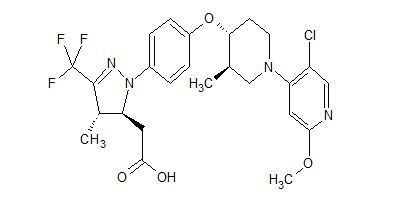
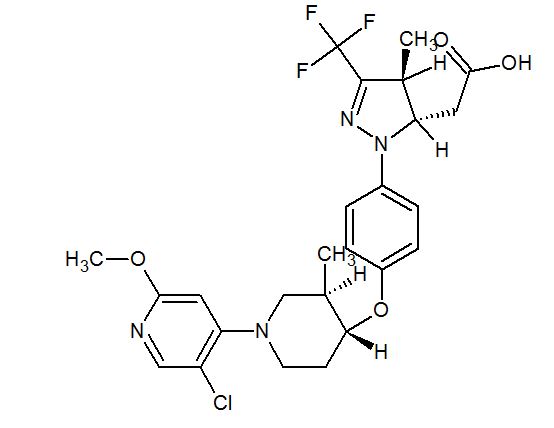
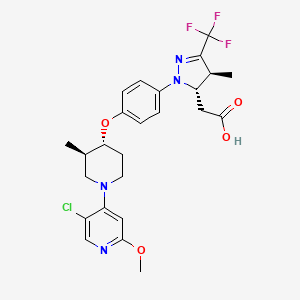
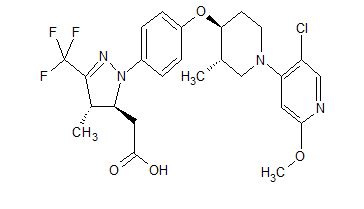
2-((4S,5S)-1-(4-(((3R,4R)-1-(5-Chloro-2-methoxypyridin-4-yl)-3-methylpiperidin-4-yl)oxy)phenyl)-4-methyl-3-(trifluoromethyl)-4,5-dihydro-1H-pyrazol-5-yl)acetic acid
(-)-[(4S,5S)-1-(4-[[(3R,4R)-1-(5-Chloro-2-methoxypyridin-4-yl)-3-methylpiperidin-4-yl]oxy]phenyl)-4-methyl-3-(trifluoromethyl)-4,5-dihydro-1H-pyrazol-5-yl]acetic acid
- (4S,5S)-1-[4-[[(3R,4R)-1-(5-Chloro-2-methoxy-4-pyridinyl)-3-methyl-4-piperidinyl]oxy]phenyl]-4,5-dihydro-4-methyl-3-(trifluoromethyl)-1H-pyrazole-5-acetic acid
- 2-[(4S,5S)-1-[4-[[1-(5-Chloro-2-methoxypyridin-4-yl)-3-methylpiperidin-4-yl]oxy]phenyl]-4-methyl-3-(trifluoromethyl)-4,5-dihydro-1H-pyrazol-5-yl]acetic acid isomer 2
BMS-986118 is a GPR40 full agonist. GPR40 is a G-protein-coupled receptor expressed primarily in pancreatic islets and intestinal L-cells that has been a target of significant recent therapeutic interest for type II diabetes. Activation of GPR40 by partial agonists elicits insulin secretion only in the presence of elevated blood glucose levels, minimizing the risk of hypoglycemia



NOTE CAS OF , 1H-Pyrazole-5-acetic acid, 1-[4-[[(3S,4S)-1-(5-chloro-2-methoxy-4-pyridinyl)-3-methyl-4-piperidinyl]oxy]phenyl]-4,5-dihydro-4-methyl-3-(trifluoromethyl)-, (4S,5S)- IS 1610562-73-6


SYNTHESIS
WO 2014078610

PAPER
https://pubs.acs.org/doi/10.1021/acs.jmedchem.7b00982
Discovery of Potent and Orally Bioavailable Dihydropyrazole GPR40 Agonists
Jun Shi*  , Zhengxiang Gu, Elizabeth Anne Jurica , Ximao Wu, Lauren E. Haque, Kristin N. Williams, Andres S. Hernandez, Zhenqiu Hong, Qi Gao, Marta Dabros, Akin H. Davulcu, Arvind Mathur, Richard A. Rampulla, Arun Kumar Gupta, Ramya Jayaram, Atsu Apedo, Douglas B. Moore, Heng Liu, Lori K. Kunselman, Edward J. Brady, Jason J. Wilkes, Bradley A. Zinker, Hong Cai, Yue-Zhong Shu, Qin Sun, Elizabeth A. Dierks, Kimberly A. Foster, Carrie Xu, Tao Wang, Reshma Panemangalore, Mary Ellen Cvijic, Chunshan Xie, Gary G. Cao, Min Zhou, John Krupinski, Jean M. Whaley, Jeffrey A. Robl, William R. Ewing, and Bruce Alan Ellsworth
Research and Development, Bristol-Myers Squibb Co., P.O. Box 4000, Princeton, New Jersey 08540-4000, United States
J. Med. Chem., 2018, 61 (3), pp 681–694
DOI: 10.1021/acs.jmedchem.7b00982
Abstract
G protein-coupled receptor 40 (GPR40) has become an attractive target for the treatment of diabetes since it was shown clinically to promote glucose-stimulated insulin secretion. Herein, we report our efforts to develop highly selective and potent GPR40 agonists with a dual mechanism of action, promoting both glucose-dependent insulin and incretin secretion. Employing strategies to increase polarity and the ratio of sp3/sp2 character of the chemotype, we identified BMS-986118 (compound 4), which showed potent and selective GPR40 agonist activity in vitro. In vivo, compound 4 demonstrated insulinotropic efficacy and GLP-1 secretory effects resulting in improved glucose control in acute animal models.
Compound 4
2-((4S,5S)-1-(4-(((3R,4R)-1-(5-Chloro-2-methoxypyridin-4-yl)-3-methylpiperidin-4-yl)oxy)phenyl)-4-methyl-3-(trifluoromethyl)-4,5-dihydro-1H-pyrazol-5-yl)acetic acid (4)
To a stirred solution of methyl 2-((4S,5S)-1-(4-(((3R,4R)-1-(5-chloro-2-methoxypyridin-4-yl)-3-methylpiperidin-4-yl)oxy)phenyl)-4-methyl-3-(trifluoromethyl)-4,5-dihydro-1H-pyrazol-5-yl)acetate (5.5 g, 9.9 mmol) in THF (90 mL) and water (9 mL) at room temperature was added 2 N LiOH solution (12 mL, 24 mmol). The reaction mixture was stirred at room temperature for 16 h, and 1 N HCl (25 mL, 25 mmol) was added at 0 °C to pH = 4–5. The solvent was evaporated, and the residue was extracted three times with EtOAc. The organic extracts were dried over Na2SO4; the solution was filtered and concentrated. The residue was recrystallized from isopropanol to give 4(neutral form) as white solid (4.3 g, 7.7 mmol, 78% yield).
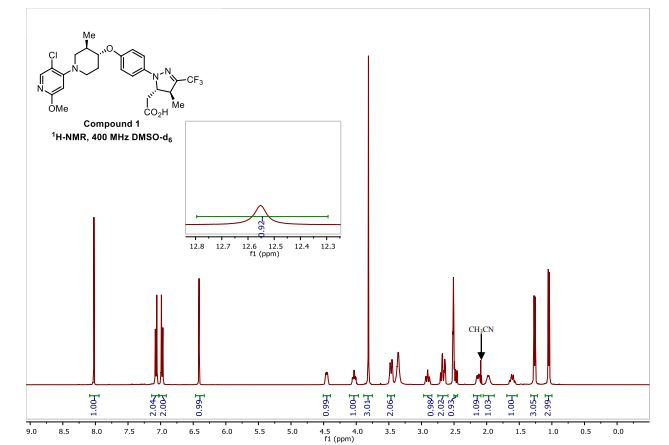
1H NMR (500 MHz, DMSO-d6) δ ppm 12.52 (br s, 1H), 8.01 (s, 1H), 7.05 (d, J = 9.1 Hz, 2H), 6.96 (d, J = 9.1 Hz, 2H), 6.40 (s, 1H), 4.49–4.33 (m, 1H), 4.02 (td, J = 8.8, 4.1 Hz, 1H), 3.80 (s, 3H), 3.56–3.39 (m, 2H), 3.37–3.29 (m, 1H), 2.94–2.85 (m, 1H), 2.72–2.66 (m, 1H), 2.64 (dd, J = 16.1, 2.9 Hz, 1H), 2.49–2.41 (m, 1H), 2.22–2.05 (m, 1H), 2.01–1.86 (m, 1H), 1.68–1.50 (m, 1H), 1.25 (d, J = 7.2 Hz, 3H), 1.03 (d, J = 6.9 Hz, 3H).
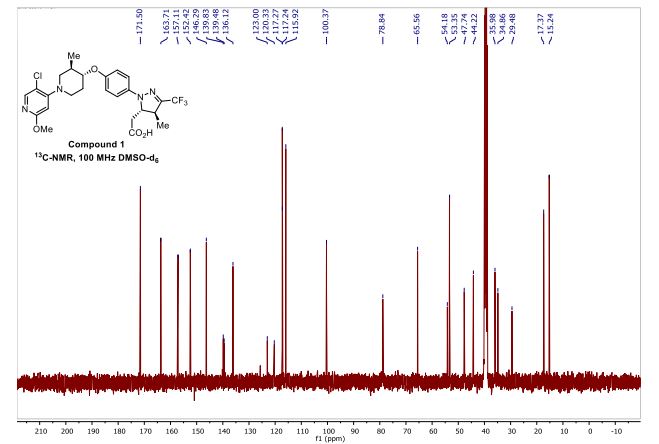
13C NMR (126 MHz, DMSO-d6) δ 171.5, 163.7, 157.1, 152.5, 146.3, 139.7 (q, J = 34.7 Hz), 136.2, 121.7 (q, J = 269.3 Hz), 117.3, 117.2, 116.0, 100.4, 78.9, 65.6, 54.2, 53.4, 47.8, 44.2, 36.0, 34.9, 29.5, 17.4, 15.3. 19F NMR (471 MHz, DMSO-d6) δ −61.94 (s, 3F).
Optical rotation: [α]D(20)−11.44 (c 2.01, MeOH).
HRMS (ESI/HESI) m/z: [M + H]+ Calcd for C25H29ClF3N4O4 541.1824; Found 541.1813. HPLC (Orthogonal method, 30% Solvent B start): RT = 11.9 min, HI: 97%. m/zobs 541.0 [M + H]+.
Melting point = 185.5 °C.
PAPER
Palladium-Catalyzed C–O Coupling of a Sterically Hindered Secondary Alcohol with an Aryl Bromide and Significant Purity Upgrade in the API Step
Chemical and Synthetic Development, Bristol-Myers Squibb Company, One Squibb Drive, New Brunswick, New Jersey08903, United States
Org. Process Res. Dev., Article ASAP
DOI: 10.1021/acs.oprd.8b00022
Abstract
The final two steps used to prepare greater than 1 kg of a compound evaluated as a treatment for type 2 diabetes are reported. The application of a palladium-catalyzed C–O coupling presented significant challenges due to the nature of the reactants, impurities produced, and noncrystalline coupling intermediate. Process development was able to address these limitations and enable production of kilogram quantities of the active pharmaceutical ingredient (API) in greater efficiency than a Mitsunobu reaction for formation of the key bond. The development of a sequence that telescopes the coupling with the subsequent ester hydrolysis to yield the API and the workup and final product crystallization necessary to produce high-quality drug substance without the need of column chromatography are discussed.

Bruce Ellsworth, Director, Head of Fibrosis Discovery Chemistry at Bristol-Myers Squibb

Rick Ewing, Head, External Partnerships, Discovery Chemistry and Molecular Technologies at Bristol-Myers Squibb


PATENT
WO 2014078610
Patent
REF
1: Li Z, Qiu Q, Geng X, Yang J, Huang W, Qian H. Free fatty acid receptor
agonists for the treatment of type 2 diabetes: drugs in preclinical to phase II
clinical development. Expert Opin Investig Drugs. 2016 Aug;25(8):871-90. doi:
10.1080/13543784.2016.1189530. PubMed PMID: 27171154.
2
| MEDI |
John Macor |
Sunday, August 10, 2014 |
| Oral Session |
| General Oral Session – PM Session |
|
| Organizers: |
John Macor |
| Presiders: |
John Macor |
| Duration: |
1:30 pm – 5:15 pm |
| 1:55 pm |
31 |
Discovery of BMS-986118, a dual MOA GPR40 agonist that produces glucose-dependent insulin and GLP-1 secretion
Bruce A Ellsworth, Jun Shi, Elizabeth A Jurica, Laura L Nielsen, Ximao Wu, Andres H Hernandez, Zhenghua Wang, Zhengxiang Gu, Kristin N Williams, Bin Chen, Emily C Cherney, Xiang-Yang Ye, Ying Wang, Min Zhou, Gary Cao, Chunshan Xie, Jason J Wilkes, Heng Liu, Lori K Kunselman, Arun Kumar Gupta, Ramya Jayarama, Thangeswaran Ramar, J. Prasada Rao, Bradley A Zinker, Qin Sun, Elizabeth A Dierks, Kimberly A Foster, Tao Wang, Mary Ellen Cvijic, Jean M Whaley, Jeffrey A Robl, William R Ewing. |
///////////BMS-986118, Preclinical, BMS, Bruce A. Ellsworth, Jun Shi, William R. Ewing, Elizabeth A. Jurica, Andres S. Hernandez, Ximao Wu, DIABETES,
COc1cc(c(Cl)cn1)N4CCC(Oc2ccc(cc2)N3N=C([C@@H](C)C3CC(=O)O)C(F)(F)F)[C@H](C)C4
COc1cc(c(Cl)cn1)N4CC[C@@H](Oc2ccc(cc2)N3N=C([C@H](C)[C@@H]3CC(=O)O)C(F)(F)F)[C@@H](C)C4
COc1cc(c(Cl)cn1)N4CC[C@@H](Oc2ccc(cc2)N3N=C([C@@H](C)[C@@H]3CC(=O)O)C(F)(F)F)[C@H](C)C4

 DRUG APPROVALS BY DR ANTHONY MELVIN CRASTO
.....
DRUG APPROVALS BY DR ANTHONY MELVIN CRASTO
.....






 New Drug Approvals