
Home » Posts tagged 'manufacturing' (Page 12)
Tag Archives: manufacturing
 DRUG APPROVALS BY DR ANTHONY MELVIN CRASTO
.....FOR BLOG HOME CLICK HERE
DRUG APPROVALS BY DR ANTHONY MELVIN CRASTO
.....FOR BLOG HOME CLICK HEREFlag and hits
ORGANIC SPECTROSCOPY

SUBSCRIBE

 Subscribe in a reader
Enter your email address:
Delivered by FeedBurner
Subscribe to New Drug Approvals by Email


Recent Comments
 | shivkr2 on SPSR Excellence Award 2025 – S… |
 | Bonkasaurus on Infigratinib phosphate |
 | PALOVAROTENE | ORGAN… on Palovarotene |
| Pfizer just purchase… on Temanogrel | |
| Pfizer To Cash In On… on Temanogrel |
TOSEDOSTAT CLINICAL TRIALS
Tosedostat
Benzeneacetic acid, α-[[(2R)-2-[(1S)-1-hydroxy-2-(hydroxyamino)-2-oxoethyl]-4-methyl-1-oxopentyl]amino]-, cyclopentyl ester, (αS)-
Cyclopentyl (2S)-({(2R)-2-[(1S)-1-hydroxy-2-(hydroxyamino)-2-oxoethyl]-4-methylpentanoyl}amino)(phenyl)acetate
[238750-77-1]
Cell Therapeutics, Inc. (CTI) (NASDAQ and MTA: CTIC) today issued the following statement regarding the notification of the U.S. Food and Drug Administration (the “FDA”) partial clinical hold on tosedostat (IND 075503), the Company’s aminopeptidase inhibitor under development for the treatment of blood-related cancers, that is being studied in an investigator-sponsored trial and not by CTI. CTI’s primary development programs are the ongoing Phase 3 trial of pacritinib, the Company’s JAK2/FLT3 inhibitor being evaluated for patients with myelofibrosis, and the post-approval commitment study of PIXUVRI®(pixantrone).
http://www.heraldonline.com/2013/06/25/4972677/cti-issues-statement-regarding.html
EU OKs Nuedexta for PBA
Avanir Pharmaceuticals, Inc. today announced that the European Commission has approved NUEDEXTA® (dextromethorphan hydrobromide/quinidine sulfate) in the European Union for the treatment of pseudobulbar affect (PBA), irrespective of underlying neurologic disease or injury.
http://www.pharmalive.com/avanir-pharmaceuticals-announces-european-approval-of-nuedexta
NUEDEXTA is an oral formulation of dextromethorphan hydrobromide USP and quinidine sulfate USP in a fixed dose combination.
Dextromethorphan hydrobromide is the pharmacologically active ingredient of NUEDEXTA that acts on the central nervous system (CNS). The chemical name is dextromethorphan hydrobromide: morphinan, 3-methoxy-17-methyl-, (9α, 13α, 14α)- hydrobromide monohydrate. Dextromethorphan hydrobromide has the empirical formula C18H25NO•HBr•H2O with a molecular weight of 370.33. The structural formula is:

Quinidine sulfate is a specific inhibitor of CYP2D6-dependent oxidative metabolism used in NUEDEXTA to increase the systemic bioavailability of dextromethorphan. The chemical name is quinidine sulfate: cinchonan-9-ol, 6’-methoxy- (9S) sulfate (2:1), (salt), dihydrate. Quinidine sulfate dihydrate has the empirical formula of (C20H24N2O2)2•H2SO4•2H2O with a molecular weight of 782.96. The structural formula is:

The combination product, NUEDEXTA, is a white to off-white powder. NUEDEXTA is available for oral use as NUEDEXTA which contains 20 mg dextromethorphan hydrobromide and 10 mg quinidine sulfate. The active ingredients are dextromethorphan hydrobromide monohydrate USP and quinidine sulfate dihydrate USP.Inactive ingredients in the capsule are croscarmellose sodium NF, microcrystalline cellulose NF, colloidal silicon dioxide NF, lactose monohydrate NF, and magnesium stearate NF.
Sanofi’s new insulin U300 superior to Lantus: study

Sanofi’s investigational diabetes drug U300, cas no 160337-95-1, insuline glargine, new formulation is better at controlling dangerous low blood sugar events at night than its blockbuster Lantus, according to data from a phase III clinical programme.

insulin glargine
Lantus, developed in the 1990s, is currently Sanofi’s top-selling product, generating $6.6bn last year. But the drug is expected to lose its patent in 2015.
http://www.medscape.com/viewarticle/805067 says no cancer risk
http://clinicaltrials.gov/ct2/show/NCT01689142 reports clinical trials
To compare the efficacy of a new formulation of insulin glargine and Lantus in terms of change of HbA1c from baseline to endpoint (scheduled at month 6 [week 26]) in patients with type 2 diabetes mellitus.
Secondary Objectives:
- To compare a new formulation of insulin glargine and Lantus in terms of change in fasting plasma glucose, pre-injection plasma glucose, 8-point self-measured plasma glucose profile.
- To compare a new formulation of insulin glargine and Lantus in terms of occurrence of hypoglycemia
Insulin glargine is produced by recombinant DNA technology using a non-pathogenic laboratory strain of Escherichia coli (K12) as the production organism. It is an analogue of human insulin made by replacing the asparagine residue at position A21 of the A-chain with glycine and adding two arginines to the C-terminus (positions B31 and 32) of the B-chain. The resulting protein is soluble at pH 4 and forms microprecipitates at physiological pH 7.4. Small amounts of insulin glargine are slowly released from microprecipitates giving the drug a long duration of action (up to 24 hours) and no pronounced peak concentration.

GRAVIOLA TREE “10000 TIMES STRONGER KILLER OF CANCER THAN CHEMO” – FACTS ANALYSIS

“10000 times stronger killer of Cancer than Chemo”.. do share it.. can save many lives, fill up hopes and build confidence in the patients…
The Sour Sop or the fruit from the graviola tree is a miraculous natural cancer cell killer 10,000 times stronger than Chemo. Why are we not aware of this?
read all at
http://www.hoaxorfact.com/Health/graviola-tree-10000-times-stronger-killer-of-cancer-than-chemo.html
Dulaglutide Shows Superiority in Phase 3 Trials

DULAGLUTIDE
STRUCTURAL FORMULA
Monomer
HGEGTFTSDV SSYLEEQAAK EFIAWLVKGG GGGGGSGGGG SGGGGSAESK 50
YGPPCPPCPA PEAAGGPSVF LFPPKPKDTL MISRTPEVTC VVVDVSQEDP 100
EVQFNWYVDG VEVHNAKTKP REEQFNSTYR VVSVLTVLHQ DWLNGKEYKC 150
KVSNKGLPSS IEKTISKAKG QPREPQVYTL PPSQEEMTKN QVSLTCLVKG 200
FYPSDIAVEW ESNGQPENNY KTTPPVLDSD GSFFLYSRLT VDKSRWQEGN 250
VFSCSVMHEA LHNHYTQKSL SLSLG 275
Disulfide bridges location
55-55′ 58-58′ 90-150 90′-150′ 196-254 196′-254′
http://www.ama-assn.org/resources/doc/usan/dulaglutide.pdf
7-37-Glucagon-like peptide I [8-glycine,22-glutamic acid,36-glycine] (synthetic
human) fusion protein with peptide (synthetic 16-amino acid linker) fusion protein with
immunoglobulin G4 (synthetic human Fc fragment), dimer
Eli Lilly and Co. announced detailed safety and efficacy results from three Phase 3 AWARD trials for dulaglutide, an investigational, long-acting glucagon-like peptide 1 (GLP-1) receptor agonist being studied as a once-weekly treatment for type 2 diabetes
Astellas’ Xtandi approved in EU for prostate cancer

enzalutamide
XTANDI
Regulators in European have given the green light to Astellas Pharma and Medivation’s oral prostate cancer drug Xtandi.
Specifically, the European Commission has approved Xtandi (enzalutamide) capsules for the treatment of men with metastatic castration-resistant prostate cancer whose disease has progressed on or after docetaxel therapy. The thumbs-up comes a couple of months after the European Medicines Agency’s Committee for Human Medicinal Productsissued a positive recommendation on the treatment….. READ ALL AT
http://www.pharmatimes.com/Article/13-06-24/Astellas_Xtandi_approved_in_EU_for_prostate_cancer.aspx
Enzalutamide (marketed as Xtandi and formerly known as MDV3100) is an androgen receptor antagonist drug developed by the pharmaceutical company Medivation for the treatment of metastatic castration-resistant prostate cancer. Medivation has reported up to an 89% decrease in prostate specific antigen serum levels after a month of taking the medicine. Early preclinical studies also suggest that enzalutamide inhibits breast cancer cell growth. In August of 2012, the U.S. Food and Drug Administrationapproved enzalutamide for the treatment of castration-resistant prostate cancer.
Enzalutamide was discovered by Charles Sawyers who is now at Memorial Sloan–Kettering Cancer Center and Michael Jung at UCLA.

A model of the interaction between the prostate cancer drug enzalutamide and the androgen receptor
QUINAPRIL

QUINAPRIL HYDROCHLORIDE
Quinapril (marketed under the brand name Accupril by Pfizer) is an angiotensin-converting enzyme inhibitor (ACE inhibitor) used in the treatment of hypertension andcongestive heart failure.
Quinapril inhibits angiotensin converting enzyme, an enzyme which catalyses the formation of angiotensin II from its precursor, angiotensin I. Angiotensin II is a powerfulvasoconstrictor and increases blood pressure through a variety of mechanisms. Due to reduced angiotensin production, plasma concentrations of aldosterone are also reduced, resulting in increased excretion of sodium in the urine and increased concentrations ofpotassium in the blood.
-
 The condensation of alanine tert-butyl ester (I) with ethyl 2-bromo-4-phenylbutanoate (II) by means of triethylamine in hot DMF gives ethyl 2-[[1-(tert-butoxycarbonyl)ethyl]amino]-4-phenylbutanoate (III), which is partially hydrolyzed with trifluoroacetic acid yielding ethyl 2-[[1-carboxyethyl]amino]-4-phenylbutanoate (IV). The condensation of (IV) with tert-butyl-1,2,3,4-tetrahydroisoquinoline-3-carboxylate (VIII) [prepared from the corresponding acid (VI) and isobutylene (B) by means of H2SO4] as before gives tert-butyl-2-[2-[[1-(ethoxycarbonyl)-3-phenylpropyl]amino]-1-oxopropyl]-1,2,3,4-tetrahydroisoquinoline-3-carboxylate (IX), which is finally hydrolyzed partially by treatment with trifluoroacetic acid.
 Hoefle, M.L.; Klutchko, S. (Pfizer Inc.); Substituted acyl derivatives of 1,2,3,4-tetrahydroisoquinoline-3-carboxylic acids. DD 201787; EP 0049605; EP 0096157; US 4344949


Sponge molecules isolated and synthesized for drug trials

By scouring the oceans for disease-fighting molecules, researchers have identified two new anticancer compounds. Isolated from a sea sponge, the compounds represent a new class of the natural products called polyketides, many of which have biological activity. Because it’s not possible to extract sufficient amounts of the molecules from the sponges, the researchers also devised chemical syntheses that allowed them to make enough material to initiate clinical trials on one of the substances,
Cancer Fighters From The Sea
Natural Products: Sponge molecules isolated and synthesized for drug trials.
read all at
BENAZEPRIL SYNTHESIS

CAS NO AS HCl SALT
| 86541-75-5 |

The reaction of 3-bromo-1-phenylpropane (I) with KCN gives 4-phenylbutyronitrile (II), which is hydrolyzed to the corresponding butyric acid (III). The cyclization of (III) with polyphosphoric acid affords 1-tetralone (IV), which is brominated to 2-bromo-1-tetralone (V) and treated with hydroxylamine to give the oxime (VI). The Beckman rearrangement of (VI) yields 3-bromo-2,3,4,5-tetrahydro-1H-(1)benzazepin-2-one (VII), which is treated with sodium azide to afford the azide derivative (VIII). The N-alkylation of (VIII) with ethyl bromoacetate (IX) by means of KOH and tetrabutylammonium bromide in THF gives the N-alkylated azide (X), which is reduced by catalytic hydrogenation to the corresponding amine (XI). The hydrolysis of the ester group of (XI) with NaOH yields the free acetic acid derivative (XII), which is finally reductocondensed with ethyl 2-oxo-4-phenylbutyrate (XIII) by means of sodium cyanoborohydride
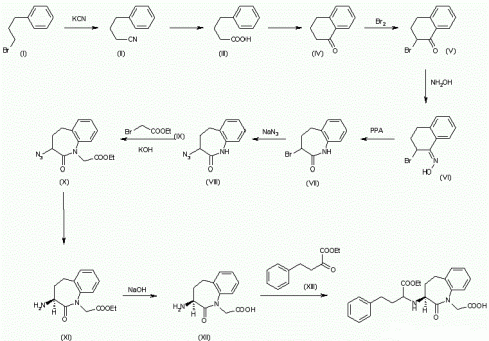
WO 2003092698 A1


 New Drug Approvals