
Home » Posts tagged 'lomonitinib'
Tag Archives: lomonitinib
 DRUG APPROVALS BY DR ANTHONY MELVIN CRASTO
.....FOR BLOG HOME CLICK HERE
DRUG APPROVALS BY DR ANTHONY MELVIN CRASTO
.....FOR BLOG HOME CLICK HEREFlag and hits
ORGANIC SPECTROSCOPY

SUBSCRIBE

 Subscribe in a reader
Enter your email address:
Delivered by FeedBurner
Subscribe to New Drug Approvals by Email


Recent Comments
 | shivkr2 on SPSR Excellence Award 2025 – S… |
 | Bonkasaurus on Infigratinib phosphate |
 | PALOVAROTENE | ORGAN… on Palovarotene |
| Pfizer just purchase… on Temanogrel | |
| Pfizer To Cash In On… on Temanogrel |
Lomonitinib
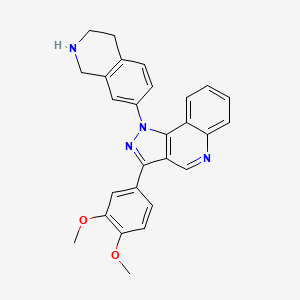
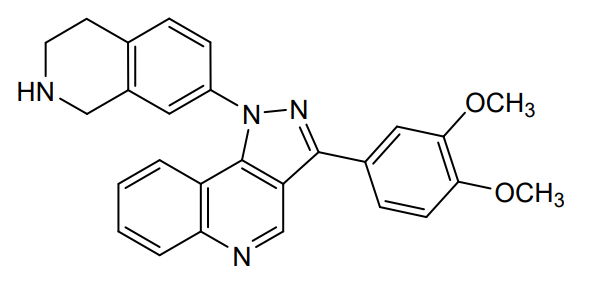
Lomonitinib
CAS 2923221-56-9
MF C27H24N4O2 MW436.5 g/mol
3-(3,4-dimethoxyphenyl)-1-(1,2,3,4-tetrahydroisoquinolin-7-yl)pyrazolo[4,5-c]quinoline
- 3-(3,4-dimethoxyphenyl)-1-(1,2,3,4-tetrahydroisoquinolin-7-yl)pyrazolo[4,3-c]quinoline
- 1H-Pyrazolo[4,3-c]quinoline, 3-(3,4-dimethoxyphenyl)-1-(1,2,3,4-tetrahydro-7-isoquinolinyl)-
- 3-(3,4-dimethoxyphenyl)-1-(1,2,3,4-tetrahydroisoquinolin-7-yl)-1H-pyrazolo[4,3-c]quinoline
- 7-[3-(3,4-dimethoxyphenyl)-1H- pyrazolo[4,3-c]quinolin-1-yl]-1,2,3,4- tetrahydroisoquinoline
- 7-[3-(3,4-Dimethoxyphenyl)-1H-pyrazolo[4,3-c]quinolin-1-yl]-1,2,3,4-tetrahydroisoquinoline
3-(3,4-dimethoxyphenyl)-1-(1,2,3,4-tetrahydroisoquinolin-7-yl)-1H-pyrazolo[4,3-c]quinoline
tyrosine kinase inhibitor, antineoplastic, ZE46-0134, Eilean Therapeutics, U4DPU7W7QU
Lomonitinib (also known as ZE46-0134) is a highly potent, selective, orally bioavailable pan-FLT3 and IRAK4 small molecule inhibitor being developed for the treatment of Acute Myeloid Leukemia (AML). Developed by Eilean Therapeutics in collaboration with Expert Systems, it uniquely targets both primary mutations and the major drug-resistance pathways that cause other AML therapies to fail.
Mechanism of Action
Lomonitinib utilizes a dual-targeting framework to bypass conventional drug resistance:
- Pan-FLT3 Inhibition: It binds to and blocks FMS-like tyrosine kinase 3 (FLT3) mutations. This includes the challenging FLT3-ITD-F691L “gatekeeper” mutation, which typically confers resistance to all currently approved standard FLT3 inhibitors like gilteritinib.
- IRAK4 Inhibition: It simultaneously targets interleukin-1 receptor-associated kinase 4 (IRAK4). IRAK4 activation acts as a key “escape pathway” that cancer cells use to survive and build adaptive resistance to standalone FLT3 therapy.
Key Clinical Advantages
According to preclinical models and clinical data presented at the American Society of Hematology (ASH), lomonitinib offers unique benefits:
- Superior Efficacy: In vivo models demonstrate stronger anti-tumor activity and deeper responses in gatekeeper mutation-dependent disease compared to gilteritinib.
- Favorable Loading Strategy: Because of its wide therapeutic index and low toxicity, clinicians can administer a high loading dose on Day 1 followed by a smaller maintenance dose. This achieves effective therapeutic drug levels by Day 4, a rapid target engagement not possible with older long-half-life FLT3 inhibitors.
- Low Drug Interactions: Clinical profiles show minimal pharmacokinetic interference from proton pump inhibitors (PPIs) or CYP3A4 inhibitors like itraconazole.
Development Status
Lomonitinib is currently classified as an investigational new drug:
- Clinical Trials: It is undergoing open-label, dose-escalation Phase 1/1b trials in both Australia and the United States (such as trial NCT06366789) evaluating adults with FLT3-mutated relapsed or refractory AML.
- Partnerships: The drug is being studied in the US in collaboration with The Leukemia & Lymphoma Society as part of their Beat AML master clinical trial portfolio
Lomonitinib is an orally bioavailable inhibitor of FMS-like tyrosine kinase 3 (FLT3; CD135; STK1; FLK2) mutations and interleukin-1 receptor-associated kinase 4 (IRAK4), with potential antineoplastic activity. Upon oral administration, lomonitinib targets, binds to and inhibits the activity of FLT3 mutations, including the FLT3-ITD-F691L gatekeeper mutation, while sparing the wild-type form of FLT3. This inhibits the proliferation of FLT3 mutant-expressing cancer cells. In addition, lomonitinib targets, binds to, and inhibits the kinase activity of IRAK4. This inhibits IRAK4-mediated signaling and may reduce adaptive resistance to FLT3 inhibition as toll-like receptor (TLR) activation plays an important role in resistance to FLT3 inhibition. FLT3, a class III receptor tyrosine kinase (RTK), is overexpressed or mutated in most B-lineage neoplasms and in acute myeloid leukemias. IRAK4, a serine/threonine-protein kinase, plays a key role in both the TLR and IL-1R signaling pathways.
- Dose Escalation and Expansion Study to Evaluate the Safety, PK, PD and Efficacy of ZE46-0134 in Adults With FLT3 Mutated or Spliceosome Mutated Relapsed or Refractory Acute Myeloid LeukemiaCTID: NCT06366789Phase: Phase 1Status: RecruitingDate: 2025-12-31
- Study of Biomarker-Based Treatment of Acute Myeloid LeukemiaCTID: NCT03013998Phase: Phase 1/Phase 2Status: RecruitingDate: 2025-12-17
- Study of Single and Multiple Ascending Doses of ZE46-0134 in Healthy VolunteersCTID: NCT06399315Phase: Phase 1Status: CompletedDate: 2025-12-09
SYN
PAT
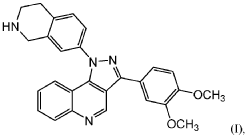
SYN
https://patentscope.wipo.int/search/en/detail.jsf?docId=US445571045&_cid=P12-MQUBPX-10324-1
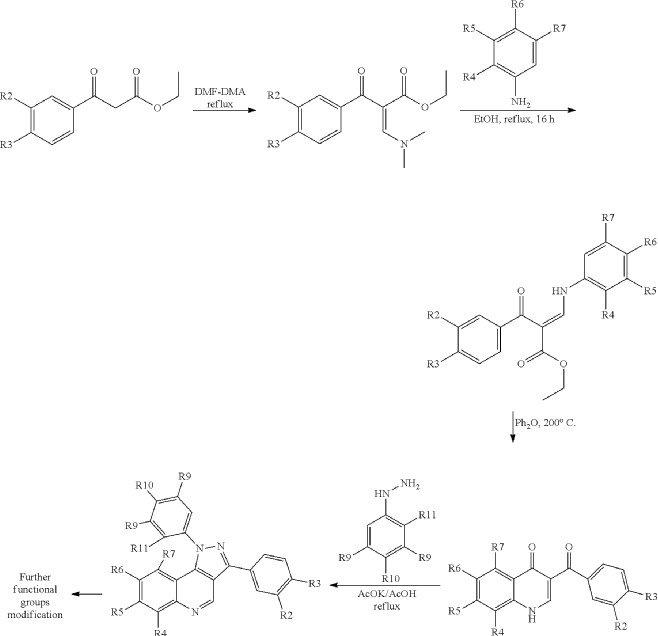

Example 34: 3-(3,4-dimethoxyphenyl)-1-(1,2,3,4-tetrahydroisoquinolin-7-yl)-1H-pyrazolo[4,3-c]quinoline dihydrochloride (1.31)
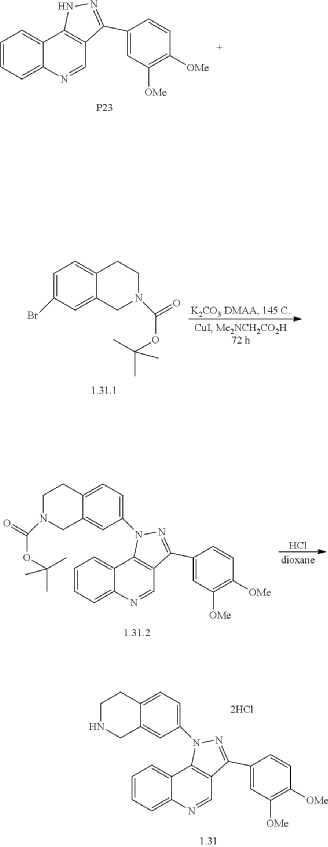
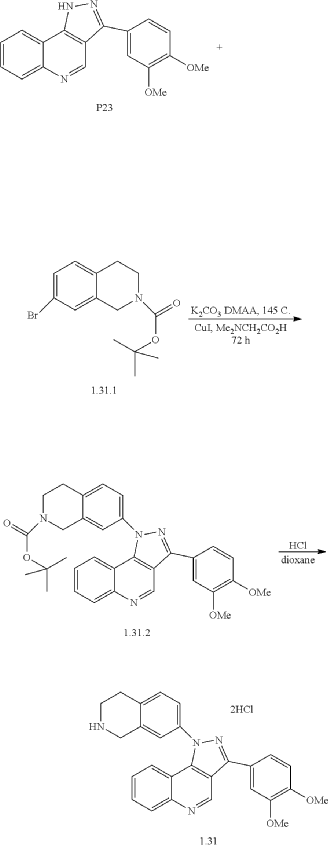
| A mixture of 3-(3,4-dimethoxyphenyl)-1H-pyrazolo[4,3-c]quinoline (P23) (153 mg, 0.5 mmol), tert-butyl 7-bromo-3,4-dihydroisoquinoline-2(1H)-carboxylate (1.31.1) (172 mg, 0.55 mmol), K 2CO 3 (83 mg, 0.6 mmol), CuI (10 mg, 0.05 mmol), N,N-dimethylglycine (11 mg, 0.1 mmol), and DMAA (2 mL) was stirred under Ar at 145° C. for 72 h, cooled to ambient temperature, diluted with CHCl 3, washed with 1% aq. solution of Na 2EDTA, and concentrated under reduced pressure. The residue was subjected to HPLC to afford 87 mg (33%) of tert-Butyl 7-(3-(3,4-dimethoxyphenyl)-1H-pyrazolo[4,3-c]quinolin-1-yl)-3,4-dihydroisoquinoline-2(1H)-carboxylate (1.31.2). 1H NMR (400 MHz, DMSO-d 6): δ 9.57 (s, 1H), 8.19 (d, J=8.4 Hz, 1H), 7.77 (m, 1H), 7.69 (dd, J 1=8.0 Hz, J 2=1.6 Hz, 1H), 7.63 (s, 1H), 7.57 (m, 3H), 7.51 (m, 2H), 7.17 (d, J=8.4 Hz, 1H), 4.63 (s, 2H), 3.88 (s, 3H), 3.86 (s, 3H), 3.68 (m, 2H), 2.98 (m, 2H), 1.45 (s, 9H). LCMS (ESI) m/z 538 [MH] +. |
ADVERTISEMENT
ANAX LABORATORIES
WEBSITE https://www.anaxlab.com/
Discovery Solutions, Supporting the chemistry needs of clients in the Medical, Analytical and Bio Sciences
Development Solutions, Developing from Lab scale to PR&D, Kilo Scale-ups and Commercial Scales
SEE MORE………Integrated Solutions, Manufacturing Solutions, Products,
Can’t Find? Let’s Connect

Phone : +91 897704 2010 / +91 9177075735, Email : info@anaxlab.com
#MedicinalChemistry, #DrugDiscovery, #OrganicSynthesis, #ChemicalLibrary, #BuildingBlocks, #SARStudies, #ChemistryInnovation, #medchem, #Drugdevelopment, #Biotech, #Biotechnology, #AnaxLaboratories, #Pharma


AS ON FEB2026 4.574 LAKHS VIEWS ON BLOG WORLDREACH AVAILABLEFOR YOUR ADVERTISEMENT

join me on Linkedin
Anthony Melvin Crasto Ph.D – India | LinkedIn
join me on Researchgate
RESEARCHGATE

join me on Facebook
Anthony Melvin Crasto Dr. | Facebook
join me on twitter
Anthony Melvin Crasto Dr. | twitter
+919321316780 call whatsaapp
EMAIL. amcrasto@gmail.com

References
- Substituted 1H-pyrazolo [4,3-c ] quinolines, methods of preparation and uses thereofPublication Number: CN-118076605-APriority Date: 2021-10-15
- SUBSTITUTED 1H-PYRAZOLO [4,3-c] QUINOLINES, METHODS OF PREPARATION, AND USE THEREOFPublication Number: US-2025011319-A1Priority Date: 2021-10-15
////////lomonitinib, anax labs, tyrosine kinase inhibitor, antineoplastic, ZE46-0134, Eilean Therapeutics, U4DPU7W7QU
#lomonitinib, #anax labs, #tyrosine kinase inhibitor, #antineoplastic, #ZE46-0134, #Eilean Therapeutics, #U4DPU7W7QU


