
Home » Posts tagged 'Characterization'
Tag Archives: Characterization
 DRUG APPROVALS BY DR ANTHONY MELVIN CRASTO
.....FOR BLOG HOME CLICK HERE
DRUG APPROVALS BY DR ANTHONY MELVIN CRASTO
.....FOR BLOG HOME CLICK HEREFlag and hits
ORGANIC SPECTROSCOPY

SUBSCRIBE

 Subscribe in a reader
Enter your email address:
Delivered by FeedBurner
Subscribe to New Drug Approvals by Email


Recent Comments
 | shivkr2 on SPSR Excellence Award 2025 – S… |
 | Bonkasaurus on Infigratinib phosphate |
 | PALOVAROTENE | ORGAN… on Palovarotene |
| Pfizer just purchase… on Temanogrel | |
| Pfizer To Cash In On… on Temanogrel |
Cocrystals of telmisartan: characterization, structure elucidation, in vivo and toxicity studies
Cocrystals of telmisartan: characterization, structure elucidation, in vivo and toxicity studies
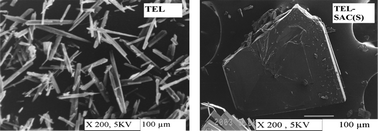
DOI: 10.1039/C4CE00797B, Paper
Tel: +91 9316015096
Tel: +91 9779932606
![[1 with combining macron]](https://i0.wp.com/www.rsc.org/images/entities/char_0031_0304.gif) space groups, respectively. The improved solubility of telmisartan–saccharin (TEL–SAC) (nine-fold) and telmisartan–glutaric acid (two-fold) cocrystals in comparison with the free drug has been demonstrated in solubility experiments in phosphate buffer, pH 7.5. The TEL–SAC cocrystal remained stable in the aqueous medium for 6 hours as confirmed by PXRD. The AUC0–24 of TEL–SAC and TEL–GA was found to be 2-fold and 1.4-fold increased in terms of bioavailability than pure TEL, respectively. The in vivo antihypertensive activity of TEL–SAC in DOCA salt-induced hypertensive rats showed two-fold improved efficacy, while acute toxicity studies revealed no signs of toxicity in rats even at doses of 2000 mg kg−1 of body weight (BW). The new solid phase of telmisartan with saccharin represents a promising and viable opportunity for the manufacture of a drug product with improved therapeutic outcomes.
space groups, respectively. The improved solubility of telmisartan–saccharin (TEL–SAC) (nine-fold) and telmisartan–glutaric acid (two-fold) cocrystals in comparison with the free drug has been demonstrated in solubility experiments in phosphate buffer, pH 7.5. The TEL–SAC cocrystal remained stable in the aqueous medium for 6 hours as confirmed by PXRD. The AUC0–24 of TEL–SAC and TEL–GA was found to be 2-fold and 1.4-fold increased in terms of bioavailability than pure TEL, respectively. The in vivo antihypertensive activity of TEL–SAC in DOCA salt-induced hypertensive rats showed two-fold improved efficacy, while acute toxicity studies revealed no signs of toxicity in rats even at doses of 2000 mg kg−1 of body weight (BW). The new solid phase of telmisartan with saccharin represents a promising and viable opportunity for the manufacture of a drug product with improved therapeutic outcomes.Characterization of the “hygroscopic” properties of active pharmaceutical ingredients
Characterization of the “hygroscopic” properties of active pharmaceutical ingredients.
Source
SSCI, Inc., West Lafayette, IN, USA. ann.newman@aptuit.com
http://www.ncbi.nlm.nih.gov/pubmed/17630643
Abstract
The amount of water vapor taken up by an active pharmaceutical ingredient (API) as a function of relative humidity is routinely evaluated to characterize and monitor its “hygroscopicity” throughout the drug development process. In this minireview we address the necessity of going beyond the measurement of water vapor sorption isotherms to establish the various mechanisms by which solids interact with water and the important role played by the crystalline or amorphous form of the solid. Practical approaches for choosing experimental conditions under which water vapor sorption should be measured, including the pre-treatment of samples and the time allowed to reach an equilibrium state are presented. With the assistance of a flowchart, we provide a basis for the systematic examination of samples to establish the likely mechanisms of sorption and the indicators pointing toward future problems with physical and chemical instabilities. Finally, we present strategies for managing materials that might be susceptible to the detrimental effects of water vapor sorption.
(Copyright) 2008 Wiley-Liss, Inc.


 New Drug Approvals