
Home » Posts tagged 'cannabinoid CB1 receptor signalling inhibitor'
Tag Archives: cannabinoid CB1 receptor signalling inhibitor
 DRUG APPROVALS BY DR ANTHONY MELVIN CRASTO
.....FOR BLOG HOME CLICK HERE
DRUG APPROVALS BY DR ANTHONY MELVIN CRASTO
.....FOR BLOG HOME CLICK HEREFlag and hits
ORGANIC SPECTROSCOPY

SUBSCRIBE

 Subscribe in a reader
Enter your email address:
Delivered by FeedBurner
Subscribe to New Drug Approvals by Email


Recent Comments
 | shivkr2 on SPSR Excellence Award 2025 – S… |
 | Bonkasaurus on Infigratinib phosphate |
 | PALOVAROTENE | ORGAN… on Palovarotene |
| Pfizer just purchase… on Temanogrel | |
| Pfizer To Cash In On… on Temanogrel |
Rezosicone


Rezosicone
CAS 1414777-24-4
MF C29H40O2 MW420.63
3β-(benzyloxy)-17-methylpregn-5-en-20-one
cannabinoid CB1 receptor signalling inhibitor, S79V5L677D
1-[(3S,8R,9S,10R,13S,14S,17S)-10,13,17-trimethyl-3-phenylmethoxy-1,2,3,4,7,8,9,11,12,14,15,16-dodecahydrocyclopenta[a]phenanthren-17-yl]ethanone
1-((3S,8R,9S,10R,13S,14S,17S)-3-(benzyloxy)-10,13,17-trimethyl-2,3,4,7,8,9,10,11,12,13,14,15,16,17-tetradecahydro-1H-cyclopenta[a]phenanthren-17-yl)ethan-1-one
Pregn-5-en-20-one, 17-methyl-3-(phenylmethoxy)-, (3β)-
3β-(benzyloxy)-17-methylpregn-5-en-20-one
Rezosicone is a potent and selective cannabinoid CB1 receptor signaling inhibitor (or antagonist) primarily used in biochemical and pharmacology research
Biological Mechanism
Rezosicone selectively binds to and inhibits the CB1 receptor. CB1 receptors are heavily concentrated in the central nervous system and play a key role in regulating appetite, pain sensation, mood, and memory. Compounds in this class are frequently studied in research related to metabolic disorders, obesity, and addiction
Pat
https://patentscope.wipo.int/search/en/detail.jsf?docId=EP339768848&_cid=P12-MT571S-81533-1


Synthesis of the 3β-(benzyloxy)-17α-methyl-pregn-5-en-20-one

[0104] MgO (100 mg; 2.42 mmol; 2 eq.) and 2-benzyloxy-1-methylpyridinium Inflate (850 mg; 2.42 mmol; 2.0 eq.) were added to a solution of 17a-methyl-pregnenolone (400 mg; 1.21 mmol; 1 eq.) in trifluorotoluene (10 ml). The reaction medium was stirred for one night at 85°C, then filtered on celite and evaporated under reduced pressure. The residue was purified by chromatography on silica gel (eluent: cyclohexane/AcOEt 95/5) then by crystallisation in acetone to give the 3β-(benzyloxy)-17α-methyl-pregn-5-en-20-one (0.28 g; 36%) as a white solid.
ADVERTISEMENT
ANAX LABORATORIES
WEBSITE https://www.anaxlab.com/
Discovery Solutions, Supporting the chemistry needs of clients in the Medical, Analytical and Bio Sciences
Development Solutions, Developing from Lab scale to PR&D, Kilo Scale-ups and Commercial Scales
SEE MORE………Integrated Solutions, Manufacturing Solutions, Products,
Can’t Find? Let’s Connect

Phone : +91 897704 2010 / +91 9177075735, Email : info@anaxlab.com
#MedicinalChemistry, #DrugDiscovery, #OrganicSynthesis, #ChemicalLibrary, #BuildingBlocks, #SARStudies, #ChemistryInnovation, #medchem, #Drugdevelopment, #Biotech, #Biotechnology, #AnaxLaboratories, #Pharma


AS ON FEB2026 4.574 LAKHS VIEWS ON BLOG WORLDREACH AVAILABLEFOR YOUR ADVERTISEMENT
join me on Linkedin
Anthony Melvin Crasto Ph.D – India | LinkedIn
join me on Researchgate
RESEARCHGATE

join me on Facebook
Anthony Melvin Crasto Dr. | Facebook
join me on twitter
Anthony Melvin Crasto Dr. | twitter
+919321316780 call whatsaapp
EMAIL. amcrasto@gmail.com

References
- 3beta-(benzyloxy)-17alpha-methyl-pregn-5-en-20-one for use in the treatment of cognitive disordersPublication Number:US-2022017562-A1Priority Date:2018-12-18
- 3beta-(BENZYLOXY)-17alpha-METHYL-PREGN-5-EN-20-ONE FOR USE IN THE TREATMENT OF COGNITIVE DISORDERSPublication Number:HR-P20241376-T1Priority Date:2018-12-18
- 3-beta-(benzyloxy)-17-alpha-methyl-pregn-5-en-20-one for use in the treatment of cognitive disordersPublication Number:HU-E068626-T2Priority Date:2018-12-18
- 3-(BENZYLIOX)-17-METHYLPREGN-5-EN-20-ONE FOR USE IN THE TREATMENT OF COGNITIVE DISORDERSPublication Number:FI-3897655-T3Priority Date:2018-12-18Grant Date:2024-09-17
- 3BETA-(BENZYLOXY)-17ALPHA-METHYL-PREGN-5-EN-20-ONE FOR USE IN THE TREATMENT OF COGNITIVE DISORDERSPublication Number:MA-54518-B1Priority Date:2018-12-18
- 3BETA-(BENZYLOXY)-17ALPHA-METHYLPREGN-5-EN-20-ONE FOR USE IN THE TREATMENT OF COGNITIVE DISORDERSPublication Number:SM-T202400425-T1Priority Date:2018-12-18
- 3beta-(benzyloxy)-17alpha-methyl-pregn-5-en-20-one for use in the treatment of cognitive disordersPublication Number:ZA-202103284-BPriority Date:2018-12-18
- 3Beta-(benzyloxy)-17alpha-methyl-pregn-5-en-20-one for use in the treatment of cognitive disordersPublication Number:ES-2987823-T3Priority Date:2018-12-18Grant Date:2024-11-18
- 3beta-(benzyloxy)-17alpha-methyl-pregn-5-en-20-one for use in the treatment of cognitive disordersPublication Number:DK-3897655-T3Priority Date:2018-12-18Grant Date:2024-09-23
- 3beta-(BENZYLOXY)-17alpha-METHYL-PREGN-5-EN-20-ONE FOR USE IN THE TREATMENT OF COGNITIVE DISORDERSPublication Number:EP-3897655-A1Priority Date:2018-12-18
- 3BETA-(BENZYLOXY)-17ALFA-METHYL-PREGN-5-EN-20-ONE FOR USE IN TREATMENT OF COGNITIVE DISORDERSPublication Number:PL-3897655-T3Priority Date:2018-12-18
- 3beta-(Benzyloxy)-17α-methyl-pregn-5-en-20-one for use in the treatment of cognitive disordersPublication Number:MD-3897655-T2Priority Date:2018-12-18
- 3BETA-(BENZYLOXY)-17ALPHA-METHYL-PREGN-5-EN-20-ONE FOR USE IN THE TREATMENT OF COGNITIVE DISORDERSPublication Number:PT-3897655-TPriority Date:2018-12-18
- 3BETA-(BENZYLOXY)-17ALPHA-METHYL-PREGN-5-EN-20-ONE FOR USE IN THE TREATMENT OF COGNITIVE DISORDERSPublication Number:RS-66013-B1Priority Date:2018-12-18
- 3beta-(benzyloxy)-17alpha-methyl-pregn-5-en-20-one for use in the treatment of cognitive disordersPublication Number:EP-3897655-B1Priority Date:2018-12-18Grant Date:2024-07-17
- 3β-(BENZYLOXY)-17α-METHYL-PREGN-5-EN-20-ONE FOR USE IN THE TREATMENT OF COGNITIVE DISORDERSPublication Number:WO-2020127468-A1Priority Date:2018-12-18
- 3β-(Benzyloxy)-17α-methyl-pregnant-5-en-20-one for the treatment of cognitive impairmentPublication Number:CN-113260366-BPriority Date:2018-12-18Grant Date:2024-03-08
- 3BETA-(BENZYLOXY)-17ALPHA-METHYL-PREGN-5-EN-20-ONE FOR USE IN THE TREATMENT OF COGNITIVE DISORDERSPublication Number:LT-3897655-TPriority Date:2018-12-18
- 3béta-(benzyloxy)-17alpha-methyl-pregn-5-en-20-one for use in the treatment of cognitive disordersPublication Number:EP-3669876-A1Priority Date:2018-12-18
///////rezosicone, anax labs, cannabinoid CB1 receptor signalling inhibitor, S79V5L677D
#rezosicone, #anax labs, #cannabinoid CB1 receptor signalling inhibitor, #S79V5L677D
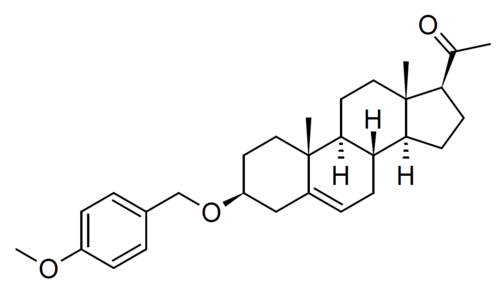
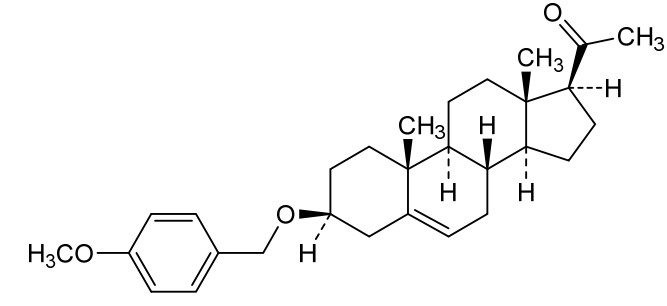
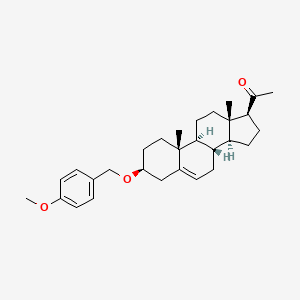
Lixosicone
Lixosicone
CAS 1610878-71-1
MF C29H40O3 MW 436.6 g/mol
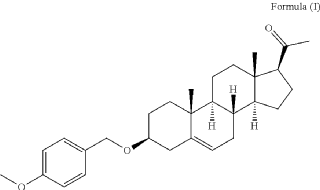
1-[(3S,8S,9S,10R,13S,14S,17S)-3-[(4-methoxyphenyl)methoxy]-10,13-dimethyl-2,3,4,7,8,9,11,12,14,15,16,17-dodecahydro-1H-cyclopenta[a]phenanthren-17-yl]ethanone
- 3beta-[(4-methoxyphenyl)methoxy]pregn-5-en-20-one
- (3beta)-3-[(4-Methoxyphenyl)methoxy]pregn-5-en-20-one
- Pregn-5-en-20-one, 3-[(4-methoxyphenyl)methoxy]-, (3beta)-
- 1-[(3S,8S,9S,10R,13S,14S,17S)-3-[(4-methoxyphenyl)methoxy]-10,13-dimethyl-2,3,4,7,8,9,11,12,14,15,16,17-dodecahydro-1H-cyclopenta[a]phenanthren-17-yl]ethanone
- 3?-(4-Methoxybenzyloxy)pregn-5-en-20-one; 1-((3S,8S,9S,10R,13S,14S,17S)-3-((4-Methoxybenzyl)oxy)-10,13-dimethyl-2,3,4,7,8,9,10,11,12,13,14,15,16,17-tetradecahydro-1H-cyclopenta[a]phenanthren-17-yl)ethan-1-one
3β-[(4-methoxyphenyl)methoxy]pregn-5-en-20-one
cannabinoid CB1 receptor signalling inhibitor, AEF0117, AEF 0117, 9LG9CT78SV
AEF0117 is a small molecule drug. AEF0117 is under investigation in clinical trial NCT05554926 (Study of [4-14C] AEF0117 Following a Single Oral Dose in Healthy Male Subjects).
Lixosicone (AEF0117, 3β-(4-methoxybenzyloxy)pregn-5-en-20-one) is a compound derived from pregnenolone by Aelis Farma, which acts as a biased negative allosteric modulator of the cannabinoid CB1 receptor, representing a new class of compounds referred to as CB1-selective signalling-specific inhibitors (CB1-SSi). It binds to an allosteric site on the CB1 receptor and modifies the downstream signalling produced as a result of CB1 activation, preventing CB1 mediated changes to mitogen-activated protein kinase (MAPK) phosphorylation but without affecting the signalling mediated by cyclic AMP. Unlike pregnenolone, AEF0117 is specific for the CB1-SSi activity and lacks the neurosteroid action typical of many structurally related compounds.[1]
In Phase II human clinical trials in patients diagnosed with cannabis use disorder, AEF0117 was found to partly but not completely block the effects of THC, and reduced cannabis self-administration but without producing an acute withdrawal syndrome and with relatively mild side effects. It is hoped that compounds of this type may be useful either as medications for the treatment of cannabinoid dependence, or could be used alongside medicinal cannabis to reduce unwanted side effects while retaining therapeutic efficacy.[2]
As of March 2026, lixosicone is in phase 2 clinical trials for treatment of substance-related disorders.[3] It is being developed by Aelis Farma.[3]
Clinical Development
The compound has shown promising results in clinical settings:
- Phase 2a results: In clinical trials evaluated by the National Institute on Drug Abuse, lixosicone significantly reduced the positive subjective effects (“the high”) of cannabis by 19% at lower doses and up to 38% at higher doses compared to a placebo.
- Reduced consumption: Testing demonstrated that the drug successfully reduced cannabis self-administration.
- Safety profile: Across early-stage evaluations, the drug was found to be safe, well-tolerated, and did not precipitate adverse behavioral withdrawal symptoms
SYN
PAT
https://patentscope.wipo.int/search/en/detail.jsf?docId=CN309682512&_cid=P10-MQRGHV-67541-1
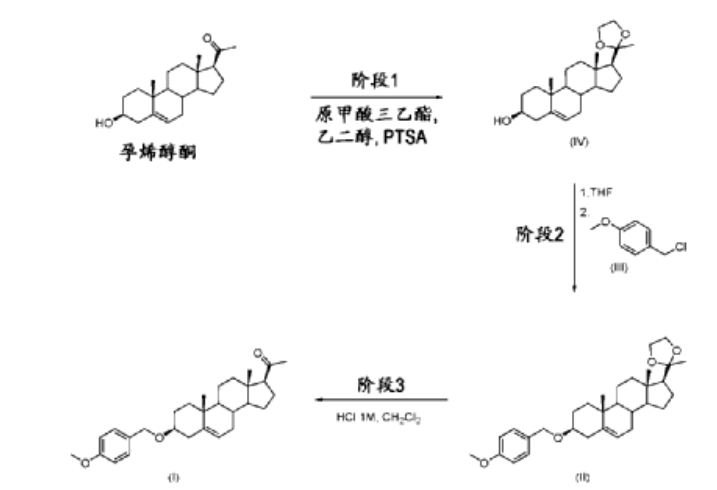
| Stage 1: Compound of formula (IV): (3S,8S,9S,10R,13S,14S,17S)-10,13-dimethyl-17-(2-methyl) (-1,3-dioxane-2-yl)-2,3,4,7,8,9,10,11,12,13,14,15,16,17-tetradecano-1H-cyclopentadiene Preparation of [a]phenanthrene-3-ol |
| Phase 1 was carried out in batches. Ethylene glycol (11.676 kg), pregnenolone (6.992 kg), and p-toluenesulfonic acid (0.840 kg, 4.42 mol, 0.2 equivalents) were charged into the reactor. The reaction mixture was stirred at 15°C–25°C for 25 minutes. Triethyl orthoformate (20.939 kg) was added in three portions, and the mixture was stirred at 15°C–25°C for at least 1 hour. Once complete, the reaction mixture was collected and slowly poured into a sodium bicarbonate solution (2.943 kg in 35.5 L of water) at 0°C–10°C. At the end of the addition, the reaction mixture was stirred at 0°C–10°C for 1 hour, then filtered and washed with water (12 L). The filtrate was also washed with 2-propanol (12 L) and dried under vacuum under a nitrogen stream. The dried solids were collected and charged into the reactor with 2-propanol (35 L). The slurry was heated under reflux for 2 hours. The reaction mixture was cooled to room temperature and stirred at room temperature for 12 hours. The reaction mixture was then cooled to between 0°C and 10°C and stirred for 2 hours. The solid was filtered and washed with 2-propanol (12 l), and then dried under vacuum under a nitrogen stream. Compound (IV) (8.031 kg) was obtained in a yield of 100.8% (uncorrected yield). |
| Phase 2: Compound of formula (II): 2-(3S,8S,9S,10R,13S,14S,17S)-3-((4-methoxybenzyl)oxy (10,13-dimethyl-2,3,4,7,8,9,10,11,12,13,14,15,16,17-tetradecano-1-H-cyclopentadien[a]) Preparation of phenanthrene-17-yl)-2-methyl-1,3-dioxolane |
| Compound (IV) (3.460 kg) and tetrahydrofuran (THF) (69 l) were charged into a reactor. The reaction mixture was stirred at 20°C–25°C for 80 minutes. The reaction mixture was filtered, and the solution of compound (IV) in THF was charged into the reactor. t-BuOK (2.835 kg) was added in portions to the THF solution of compound (IV) at 20°C–25°C. At the end of the addition, p-methoxybenzyl chloride (2.832 kg) and THF (4 l) of formula (III) were added to the reaction mixture via a feeding funnel. The reaction mixture was heated at 38°C–42°C. TBAI (1.555 kg) was added in portions to the reaction mixture at 38°C–42°C. The reaction mixture was heated at 55°C–60°C for 16 hours and 30 minutes. |
| Once complete, the reaction mixture is concentrated under vacuum to distill off 34-36 l of THF. The reaction mixture is then cooled to room temperature. Water (52 l) is added to the reactor, which is then cooled to 0-10 °C. The reaction mixture is carefully poured onto the water while maintaining the temperature at 0-10 °C. At the end of the addition, the reaction mixture is stirred at 0-10 °C for 1 hour and 50 minutes. The reaction mixture is filtered and washed with water (13 l). The filtrate is washed with acetonitrile (13.5 l), and the solids are dried under vacuum for 4 days under a nitrogen stream. |
| The solid was collected and acetonitrile (13 L) was added to the reactor. The mixture was heated under reflux for 4 hours. An additional acetonitrile (11 L) was added to the reactor and heated under reflux until a clear solution was obtained. The reaction mixture was cooled to room temperature and stirred at room temperature for 14 hours. The reaction mixture was cooled to 0 °C–10 °C and stirred at 0 °C–10 °C for 45 minutes, then filtered. Acetonitrile (10.5 L) was added to the reactor, cooled to 0 °C–10 °C, and then added to the filter to wash the filtrate. The solid was dried under vacuum under a nitrogen stream for 21 hours. Compound (II) (2.449 kg) was obtained in a yield of 59.2%. |
| • Stage 3: Preparation of compound (I): 3pMBP |
| Compound (II) (2.448 kg) and dichloromethane (10 L) were charged into a reactor. The solution was stirred for 20 minutes. 1 M hydrochloric acid (4.9 L) was added to the solution at 15 °C–25 °C. The reaction mixture was stirred until complete at 15 °C–25 °C. Dichloromethane (8 L) was added (to completely dissolve any precipitate) and phase separation was allowed. The organic layer was washed twice with water (5 L). The organic layer was collected and 2-propanol (24.5 L) was charged into a reactor at 15 °C–25 °C. The reaction mixture was concentrated under vacuum at a temperature below 40 °C. After completion, the reaction mixture was heated to reflux. 2-propanol (40 L) was added until a clear solution was observed. The reaction mixture was cooled to room temperature and stirred at room temperature for 12 hours. The reaction mixture was cooled to 0 °C–10 °C and stirred at 0 °C–-10 °C for 1 hour. The solid was filtered and washed with 2-propanol (5 l), then dried under vacuum with a nitrogen flow rate while the filter was heated at 35 °C–45 °C for 20 hours. Compound (I) was obtained in 85.8% yield (1.907 kg). |
PAT
https://patentscope.wipo.int/search/en/detail.jsf?docId=WO2019162328&_cid=P10-MQRGHV-67541-1
PAT
- 3β-(4-Methoxybenzyloxy)pregnant-5-en-20-one for the treatment of cannabinoid-related disordersPublication Number: CN-111757740-BPriority Date: 2018-02-20Grant Date: 2023-12-15
- 3beta-(4-methoxybenzyloxy)paragan-5-en-20-one for use in the treatment of cannabinoid-related disordersPublication Number: IL-276697-B2Priority Date: 2018-02-20
- 3-BETA-(4-METHOXYBENZYLOXY)PREGN-5-EN-20-ONE FOR USE IN THE TREATMENT OF CANNABINOID-RELATED DISORDERSPublication Number: PT-3755339-TPriority Date: 2018-02-20
- 3beta-(4-methoxybenzyloxy)pregn-5-en-20-one for use in the treatment of Cannabinoids-Related DisordersPublication Number: US-2023226076-A1Priority Date: 2018-02-20
- 3beta-(4-methoxybenzyloxy)pregn-5-en-20-one for use in the treatment of cannabinoids-related disordersPublication Number: EP-3755339-A1Priority Date: 2018-02-20
- 3beta-(4-methoxybenzyloxy)pregn-5-en-20-one for use in the treatment of Cannabinoids-Related DisordersPublication Number: US-2021030768-A1Priority Date: 2018-02-20
- 3-beta-(4-methoxybenzyloxy)pregn-5-en-20-one for use in the treatment of cannabinoids-related disordersPublication Number: EP-3755339-B1Priority Date: 2018-02-20Grant Date: 2024-01-03
- 3BETA-(4-METHOXYBENZYLOXY)PREGN-5-EN-20-ONE FOR USE IN THE TREATMENT OF CANNABINOIDS RELATED DISORDERSPublication Number: MA-51891-B1Priority Date: 2018-02-20
- 3Beta-(4-Methoxybenzyloxy)pregn-5-en-20-one for use in the treatment of cannabinoid-related disordersPublication Number: MD-3755339-T2Priority Date: 2018-02-20
- 3-BETA-(4-METHOXYBENZYLLOXY)PREGN-5-EN-20-ONE FOR USE IN THE TREATMENT OF CANNABINOID-RELATED DISORDERSPublication Number: HR-P20240276-T1Priority Date: 2018-02-20
- 3beta-(4-methoxybenzyloxy)pregn-5-en-20-one for use in the treatment of cannabinoids-related disordersPublication Number: WO-2019162328-A1Priority Date: 2018-02-20
- 3BETA-(4-METHOXYBENCYLOXY)PREGN-5-EN-20-ONE FOR USE IN THE TREATMENT OF CANNABINOID-RELATED DISORDERS.Publication Number: MX-2020008687-APriority Date: 2018-02-20
- 3β-(4-methoxybenzyloxy)pregn-5-en-20-one for use in the treatment of cannabinoids-related disordersPublication Number: US-11484537-B2Priority Date: 2018-02-20Grant Date: 2022-11-01
- 3beta-(4-methoxybenzyloxy)pregn-5-en-20-one for use in the treatment of cannabinoids-related disordersPublication Number: AU-2019223049-A1Priority Date: 2018-02-20
- 3beta-(4-methoxybenzyloxy)pregn-5-en-20-one for use in the treatment of cannabinoids-related disordersPublication Number: CA-3090975-A1Priority Date: 2018-02-20
ADVERTISEMENT
ANAX LABORATORIES
WEBSITE https://www.anaxlab.com/
Discovery Solutions, Supporting the chemistry needs of clients in the Medical, Analytical and Bio Sciences
Development Solutions, Developing from Lab scale to PR&D, Kilo Scale-ups and Commercial Scales
SEE MORE………Integrated Solutions, Manufacturing Solutions, Products,
Can’t Find? Let’s Connect
Phone : +91 897704 2010 / +91 9177075735, Email : info@anaxlab.com
#MedicinalChemistry, #DrugDiscovery, #OrganicSynthesis, #ChemicalLibrary, #BuildingBlocks, #SARStudies, #ChemistryInnovation, #medchem, #Drugdevelopment, #Biotech, #Biotechnology, #AnaxLaboratories, #Pharma
AS ON FEB2026 4.574 LAKHS VIEWS ON BLOG WORLDREACH AVAILABLEFOR YOUR ADVERTISEMENT
join me on Linkedin
Anthony Melvin Crasto Ph.D – India | LinkedIn
join me on Researchgate
RESEARCHGATE
join me on Facebook
Anthony Melvin Crasto Dr. | Facebook
join me on twitter
Anthony Melvin Crasto Dr. | twitter
+919321316780 call whatsaapp
EMAIL. amcrasto@gmail.com
References
“AEF 0117”. AdisInsight. 13 March 2026. Retrieved 17 April 2026.
US 11484537, Piazza PV, Fabre S, Metna M, Monlezun S, Busquet-Garcia A, Cota D, Marsicano G, Revest JM, Vallée M, “3β-(4-methoxybenzyloxy)pregn-5-en-20-one for use in the treatment of cannabinoids-related disorders.”, issued 1 November 2022, assigned to Universite de Bordeaux.
Haney M, Vallée M, Fabre S, Collins Reed S, Zanese M, Campistron G, et al. (June 2023). “Signaling-specific inhibition of the CB1 receptor for cannabis use disorder: phase 1 and phase 2a randomized trials”. Nature Medicine. 29 (6): 1487–1499. doi:10.1038/s41591-023-02381-w. PMC 10287566. PMID 37291212.
 | |
| Clinical data | |
|---|---|
| Other names | AEF0117; AEF-0117; 3β-(4-Methoxybenzyloxy)pregn-5-en-20-one |
| Drug class | Cannabinoid CB1 receptor negative allosteric modulator |
| Identifiers | |
| IUPAC name | |
| CAS Number | 1610878-71-1  |
| PubChem CID | 139433957 |
| ChemSpider | 129421614 |
| Chemical and physical data | |
| Formula | C29H40O3 |
| Molar mass | 436.636 g·mol−1 |
| 3D model (JSmol) | Interactive image |
| SMILES | |
| InChI | |
//////////lixosicone, anax labs, cannabinoid CB1 receptor signalling inhibitor, AEF0117, AEF 0117, 9LG9CT78SV
#lixosicone, #anax labs, #cannabinoid CB1 receptor signalling inhibitor, #AEF0117, #AEF 0117, #9LG9CT78SV


