
New Drug Approvals
Follow New Drug Approvals on WordPress.com

FLAGS AND HITS

Flag Counter
DRUG APPROVALS BY DR ANTHONY MELVIN CRASTO

Archives

Categories

Join me on Linkedin

View Anthony Melvin Crasto Ph.D's profile on LinkedIn

Join me on Researchgate

Anthony Melvin Crasto Dr.

  Join me on Facebook FACEBOOK   ...................................................................Join me on twitter Follow amcrasto on Twitter     ..................................................................Join me on google plus Googleplus

MYSELF

DR ANTHONY MELVIN CRASTO Ph.D ( ICT, Mumbai) , INDIA 36Yrs Exp. in the feld of Organic Chemistry,Working for AFRICURE PHARMA as ADVISOR earlier with GLENMARK PHARMA at Navi Mumbai, INDIA. Serving chemists around the world. Helping them with websites on Chemistry.Million hits on google, NO ADVERTISEMENTS , ACADEMIC , NON COMMERCIAL SITE, world acclamation from industry, academia, drug authorities for websites, blogs and educational contribution, ........amcrasto@gmail.com..........+91 9323115463, Skype amcrasto64 View Anthony Melvin Crasto Ph.D's profile on LinkedIn Anthony Melvin Crasto Dr.

Enter your email address to follow this blog and receive notifications of new posts by email.

Join 37.9K other subscribers
DR ANTHONY MELVIN CRASTO Ph.D

DR ANTHONY MELVIN CRASTO Ph.D

DR ANTHONY MELVIN CRASTO, Born in Mumbai in 1964 and graduated from Mumbai University, Completed his Ph.D from ICT, 1991,Matunga, Mumbai, India, in Organic Chemistry, The thesis topic was Synthesis of Novel Pyrethroid Analogues, Currently he is working with AFRICURE PHARMA, ROW2TECH, NIPER-G, Department of Pharmaceuticals, Ministry of Chemicals and Fertilizers, Govt. of India as ADVISOR, earlier assignment was with GLENMARK LIFE SCIENCES LTD, as CONSUlTANT, Retired from GLENMARK in Jan2022 Research Centre as Principal Scientist, Process Research (bulk actives) at Mahape, Navi Mumbai, India. Total Industry exp 32 plus yrs, Prior to joining Glenmark, he has worked with major multinationals like Hoechst Marion Roussel, now Sanofi, Searle India Ltd, now RPG lifesciences, etc. He has worked with notable scientists like Dr K Nagarajan, Dr Ralph Stapel, Prof S Seshadri, etc, He did custom synthesis for major multinationals in his career like BASF, Novartis, Sanofi, etc., He has worked in Discovery, Natural products, Bulk drugs, Generics, Intermediates, Fine chemicals, Neutraceuticals, GMP, Scaleups, etc, he is now helping millions, has 9 million plus hits on Google on all Organic chemistry websites. His friends call him Open superstar worlddrugtracker. His New Drug Approvals, Green Chemistry International, All about drugs, Eurekamoments, Organic spectroscopy international, etc in organic chemistry are some most read blogs He has hands on experience in initiation and developing novel routes for drug molecules and implementation them on commercial scale over a 32 PLUS year tenure till date Feb 2023, Around 35 plus products in his career. He has good knowledge of IPM, GMP, Regulatory aspects, he has several International patents published worldwide . He has good proficiency in Technology transfer, Spectroscopy, Stereochemistry, Synthesis, Polymorphism etc., He suffered a paralytic stroke/ Acute Transverse mylitis in Dec 2007 and is 90 %Paralysed, He is bound to a wheelchair, this seems to have injected feul in him to help chemists all around the world, he is more active than before and is pushing boundaries, He has 100 million plus hits on Google, 2.5 lakh plus connections on all networking sites, 100 Lakh plus views on dozen plus blogs, 227 countries, 7 continents, He makes himself available to all, contact him on +91 9323115463, email amcrasto@gmail.com, Twitter, @amcrasto , He lives and will die for his family, 90% paralysis cannot kill his soul., Notably he has 38 lakh plus views on New Drug Approvals Blog in 227 countries......https://newdrugapprovals.wordpress.com/ , He appreciates the help he gets from one and all, Friends, Family, Glenmark, Readers, Wellwishers, Doctors, Drug authorities, His Contacts, Physiotherapist, etc He has total of 32 International and Indian awards

Verified Services

View Full Profile →

Recent Posts

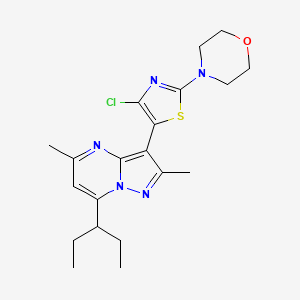
TILDACERFONT


Tildacerfont.png

img

TILDACERFONT

Synonyms:

Tildacerfont

1014983-00-6

3-(4-Chloro-2-morpholin-4-yl-thiazol-5-yl)-7-(1-ethyl-propyl)-2,5-dimethyl-pyrazolo[1,5-a]pyrimidine

7-(1-ethyl-propyl)-3-(4-chloro-2-morpholin-4-yl-thiazol-5-yl)-2,5-dimethyl-pyrazolo[1,5-a]pyrimidine

MW/ MF 420 g/mol/ C20H26ClN5OS
  • Originator Spruce Biosciences
  • Class2 ring heterocyclic compounds; Morpholines; Pyrazoles; Pyrimidines; Small molecules; Thiazoles
  • Mechanism of Action Corticotropin receptor antagonists
  • Orphan Drug Status Yes – Congenital adrenal hyperplasia
  • New Molecular Entity Yes
  • Phase II Congenital adrenal hyperplasia
  • 09 Jul 2020 Spruce Biosciences initiates a phase II trial in Congenital adrenal hyperplasia in USA (PO) (NCT04457336)
  • 24 Sep 2019 Spruce Biosciences completes a phase II trial in Congenital adrenal hyperplasia in USA (NCT03687242)
  • 19 Sep 2019 Updated safety and efficacy data from a phase II trial in Congenital adrenal hyperplasia release by Spruce Biosciences

Deuterated pyrazolo[1,5-a]pyrimidine derivatives, particularly tildacerfont (SPR-001), useful as CRF antagonists for treating congenital adrenal hyperplasia.  Spruce Bioscience is developing tildacerfont under license from Lilly as an oral capsule formulation for the treatment of congenital adrenal hyperplasia; in July 2017, a phase II trial for CAH was initiated.

Corticotropin releasing factor (CRF) is a 41 amino acid peptide that is the primary physiological regulator of proopiomelanocortin (POMC) derived peptide secretion from the anterior pituitary gland. In addition to its endocrine role at the pituitary gland, immunohistochemical localization of CRF has demonstrated that the hormone has a broad extrahypothalamic distribution in the central nervous system and produces a wide spectrum of autonomic, electrophysiological and behavioral effects consistent with a neurotransmitter or neuromodulator role in the brain. There is also evidence that CRF plays a significant role in integrating the response in the immune system to physiological, psychological, and immunological stressors.

PATENT

Product case, WO2008036579 ,

https://patentscope.wipo.int/search/en/detail.jsf?docId=WO2008036579

Example 16
3-(4-Chloro-2-morpholin-4-yl-thiazol-5-yl)-7-(l-ethyl-propyl)-2,5-dimethyl- pyrazolo [ 1 ,5 -α]pyrimidine

Under a nitrogen atmosphere dissolve 3-(4-bromo-2-morpholin-4-yl-thiazol-5-yl)-7-(l-ethyl-propyl)-2,5-dimethyl-pyrazolo[l,5-α]pyrimidine (116 mg, 0.25 mmol) in THF (1.5 mL) and chill to -78 0C. Add n-butyl lithium (0.1 mL. 2.5 M in hexane, 0.25 mmol) and stir at -78 0C for 30 min. Add N-chlorosuccinimide (33.4 mg, 0.25 mmol) and stir for another 30 min, slowly warming to room temperature. After stirring overnight, quench the reaction by adding a solution of saturated ammonia chloride and extract with ethyl acetate. Wash the organic layer with brine, dry over sodium sulfate, filter, and concentrate to a residue. Purify the crude material by flash chromatography, eluting with hexanes:dichloromethane: ethyl acetate (5:5:2) to provide the title compound (54 mg). MS (APCI) m/z (35Cl) 420.6 (M+l)+1H NMR (400 MHz, CDCl3): 6.44 (s, IH), 3.79 (t, 4H, J=4.8 Hz), 3.63-3.56 (m, IH), 3.47 (t, 4H, J=4.8 Hz), 2.55 (s, 3H), 2.45 (s, 3H), 1.88-1.75 (m, 4H), 0.87 (t, 6H, J=7.5 Hz).
Alternate Preparation from Preparation 6:
Combine 7-(l-ethyl-propyl)-3-iodo-2,5-dimethyl-pyrazolo[l,5-α]pyrimidine, (9 g,

26.2 mmol) and 4-chloro-2-morpholino-thiazole (7.5 g, 36.7 mmol) in
dimethylformamide (90 mL) previously degassed with nitrogen. Add cesium carbonate (17.8 g, 55 mmol), copper iodide (250 mg, 1.31 mmol), triphenylphosphine (550 mg, 2.09 mmol) and palladium acetate (117 mg, 0.52 mmol). Heat the mixture to 125 0C for 16 h and then cool to 22 0C. Add water (900 mL) and extract with methyl-?-butyl ether (3 x 200 mL). Combine the organic portions and evaporate the solvent. Purify by silica gel chromatography eluting with hexanes/ethyl acetate (4/1) to afford the title compound (6.4 g, 62%). ES/MS m/z (35Cl) 420 (M+l)+.

Example 16a
3-(4-Chloro-2-morpholin-4-yl-thiazol-5-yl)-7-(l-ethyl-propyl)-2,5-dimethyl- pyrazolo[l,5-α]pyrimidine, hydrochloride
Dissolve 3-(4-chloro-2-morpholin-4-yl-thiazol-5-yl)-7-(l-ethyl-propyl)-2,5-dimethyl-pyrazolo[l,5-α]pyrimidine (1.40 g, 3.33 mmol) in acetone (10 mL) at 50 0C and cool to room temperature. Add hydrogen chloride (2 M in diethyl ether, 2.0 mL, 4.0 mmol) and stir well in a sonicator. Concentrate the solution a little and add a minimal amount of diethyl ether to crystallize the HCl salt. Cool the mixture in a refrigerator overnight. Add additional hydrogen chloride (2 M in diethyl ether, 2.0 mL, 4.0 mmol) and cool in a refrigerator. Filter the crystalline material and dry to obtain the title compound (1.15 g, 75%). ES/MS m/z (35Cl) 420 (M+l)+1H NMR(CDCO): 9.18 (br, IH), 6.86 (s, IH), 3.72 ( m, 4H), 3.49(m, IH), 3.39 (m, 4H), 2.48 (s, 3H), 2.38(s, 3H), 1.79 (m, 4H), 0.79 (m, 6H).

PATENT

US-20200255436

https://patentscope.wipo.int/search/en/detail.jsf?docId=US301567348&tab=PCTDESCRIPTION&_cid=P22-KE0UZI-30504-1

PATENT

WO2019210266

https://patentscope.wipo.int/search/en/detail.jsf?docId=WO2019210266

claiming the use of CRF-1 antagonists (eg tildacerfont).

PATENT

WO 2010039678

https://patentscope.wipo.int/search/en/detail.jsf?docId=WO2010039678

EXAMPLES

Example 1 : 7-(l-ethyl-propyl)-3-(2,4-dichloro-thiazol-5-yl)-2,5-dimethyl-pyrazolori ,5-alpyrimidine nthroline 

Charge 7-(l-ethyl-propyl)-3-iodo-2,5-dimethyl-pyrazolo[l,5-a]pyrimidine (1.03 g, 3.00 mmoles), K3PO4 (1.95 g, 9.00 mmoles), 2,4-dichlorothiazole (0.58 g, 3.75 mmoles), 1,10 phenanthroline (0.05 g, 0.30 mmoles) and anhydrous DMAC (5 mL) to a round bottom flask equipped with a magnetic stir bar, thermal couple and N2 inlet. Degas the yellow heterogeneous reaction mixture with N2 (gas) for 30 min. and then add CuI (0.06 g, 0.30 mmoles) in one portion followed by additional 30 min. degassing with N2 (gas). Stir the reaction mixture at 120 0C for about 6 hr. Cool the reaction mixture to room temperature overnight, add toluene (10 mL) and stir for 1 hr. Purify the mixture through silica gel eluting with toluene (10ml). Extract with 1 M HCl (10 mL), water (10 mL), brine (10 mL) and concentrate under reduced pressure to give a yellow solid. Recrystallize the solid from methanol (5ml) to yield the title compound as a yellow crystalline solid. (0.78 g, 70% yield, >99% pure by LC) MS(ES) = 369 (M+ 1). 1H NMR (CDCl3)= 6.5 (IH, s); 3.6 (IH, m); 2.6 (3H, s); 2.5 (3H, s); 1.9 (4H, m); 0.9 (6H, t).

Example 2: 7-(l-ethyl-propyl)-3-(4-chloro-2-morpholin-4-yl-thiazol-5-yl)-2,5-dimethyl-pyrazolol! ,5-aipyrimidine

Charge 7-(l-ethyl-propyl)-3-(2,4-dichloro-thiazol-5-yl)-2,5-dimethyl-pyrazolo[l,5-a]pyrimidine (0.37 g, 1.00 mmoles), K2CO3 (0.28 g, 2.00 mmoles) and anhydrous morpholine (3 mL) to a round bottom flask equipped with a magnetic stir bar and N2 inlet. Stir the yellow mixture at 100 0C for about 4 hr., during which time the reaction becomes homogeneous. Cool the reaction mixture to room temperature, add H2O (10 mL) and stir the heterogeneous reaction mixture overnight at room temperature. Collected the yellow solid by filtration, wash with H2O and allowed to air dry overnight to give the crude title compound (391mg). Recrystallize from isopropyl alcohol (3 mL) to yield the title compound as a light yellow crystalline solid (380 mg, 90.6% yield, >99% by LC). MS(ES) = 420 (M+l). 1H NMR (CDCl3)= 6.45 (IH, s); 3.81 (m, 4H); 3.62 (IH, m); 3.50 (m, 4H); 2.6 (3H, s); 2.45 (3 H, s); 1.85 (4H, m); 0.9 (6H, t).

Example 3 :

The reactions of Example 1 are run with various other catalysts, ligands, bases and solvents, which are found to have the following effects on yield of 7-(l-ethyl-propyl)-3-(2,4-dichloro-thiazol-5-yl)-2,5-dimethyl-pyrazolo[l,5-a]pyrimidine. (See Tables 1 – 4).

Table 1 : Evaluation of different li ands

(Reactions are carried out in parallel reactors with 1.2 mmol 2,4-dichlorothiazole, 1 mmol 7-(l-ethyl-propyl)-3-iodo-2,5-dimethyl-pyrazolo[l,5-a]pyrimidine, 0.5 mmol CuI, 0.5 mmol ligand and 2.1 mmol Cs2CO3 in 4 mL DMAC. The reactions are degassed under N2 for 30 min. and then heated at between 80 and

1000C overnight under N2. Percent product is measured as the percent of total area under the HPLC curve for the product peak. Longer reaction times are shown in parenthesis) Table 2: Evaluation of various solvents


(Reactions are carried out in parallel reactors with 1.2 mmol 2,4-dichlorothiazole 1 mmol 7-(l-ethyl-propyl)-3-iodo-2,5-dimethyl-pyrazolo[l,5-a]pyrimidine, 0.25 mmol CuI, 0.25 mmol 1,10-phenanthroline and 2.1 mmol Cs2CO3 in 3 mL specified solvent. The reactions are degassed under N2 for 30 minutes and then heated at 1000C overnight under N2. Percent product is measured as the percent of total area under the HPLC curve for the product peak.)

Table 3 : Evaluation of different copper sources

(Reactions are carried out in in parallel reactors with 1 mmol 2,4-dichlorothiazole 1 mmol 7-(l-ethyl-propyl)-3-iodo-2,5-dimethyl-pyrazolo[l,5-a]pyrimidine, 0.05 mmol CuX, 0.01 mmol 1,10-phenanthroline and 3 equivalents K3PO4 in 3 mL DMAC. The reactions are degassed under N2 for 30 minutes and then heated at 1000C overnight under N2. Percent product is measured as the percent of total area under the HPLC curve for the product peak.)

Table 4: Evaluation of various inorganic bases

(Reactions are carried out in in parallel reactors with 1 mmol 2,4-dichlorothiazole 1 mmol 7-(l-ethyl-propyl)-3-iodo-2,5-dimethyl-pyrazolo[l,5-a]pyrimidine, 0.1 mmol CuI, 0.1 mmol 1,10-phenanthroline and 2.1 mmol base and degassed for 30 minutes prior to the addition of 3 mL DMAC. The reactions are degassed under N2 for 10 minutes and then heated at 1000C overnight under N2. Percent product is measured as the percent of total area under the HPLC curve for the product peak.)

Example 4. Use of morpholine both as a reactant and base in 2-MeTHF as solvent.

solvent

7-(l-ethyl-propyl)-3-(2,4-dichloro-thiazol-5-yl)-2,5-dimethyl-pyrazolo[l,5-ajpyrimidine (15.2 g, 41.16 mmoles) is charged into a 250 mL 3-necked round bottomed flask, followed by addition of 2-MeTHF (61 mL, 4.0 volumes), the yellowish brown slurry is stirred at about 20 0C for 5 min. Then morpholine (19 g, 218.18 mmoles) is added over 2-5 minutes. Contents are heated to reflux and maintained at reflux for 12 hr. The slurry is cooled to 25 0C, followed by addition of 2-MeTHF (53 mL, 3.5 volumes) and water ( 38 mL 2.5 volumes). The reaction mixture is warmed to 40 0C, where upon a homogenous solution with two distinct layers formed. The layers are separated, the organic layer is filtered and concentrated to ~3 volumes at atmospheric pressure. Four volumes 2-propanol (61 mL) are added. The solution is concentrated to ~3 volumes followed by addition of 4 volumes 2-propanol (61 mL), re-concentrated to ~3 volumes, followed by addition of another 6 volumes 2-propanol (91 mL), and refluxed for 15 min. The clear solution is gradually cooled to 75 0C, seeded with 0.45 g 7-(l-ethyl-propyl)-3-(4-chloro-2-morpholin-4-yl-thiazol-5-yl)-2,5-dimethyl-pyrazolo[l,5-a]pyrimidine slurried in 2 mL 2-propanol, rinsed with an additional 2 mL 2-propanol and transferred to a crystallization flask. The slurry is cooled to between 0-5 0C, maintained for 1 hr, filtered and the product rinsed with 2-propanol (30 mL, 2 volumes). The solid is dried at 60 0C in a vacuum oven to afford 16.92 g 7-(l-ethyl-propyl)-3-(4-chloro-2-morpholin-4-yl-thiazol-5-yl)-2,5-dimethyl-pyrazolo[l,5-a]pyrimidine. Purity of product by HPLC assay is 100.00 %. XRPD and DSC data of product is consistant with reference sample. MS(ES) = 420 (M+ 1).

Example 5. Use of morpholine as both reactant and base in 2-propanol as solvent.

7-(l-ethyl-propyl)-3-(2,4-dichloro-thiazol-5-yl)-2,5-dimethyl-pyrazolo[l,5-ajpyrimidine (11.64 mmoles) is charged into a 100 mL 3 -necked round bottomed flask followed by addition of 2-propanol ( 16 mL, 3.72 volumes). The yellowish brown slurry is stirred at about 20 0C for 5 min. Then morpholine (3.3 g, 37.84 mmoles) is added over 2-5 minutes. Contents are refluxed for 6 hr. The slurry is cooled to 25 0C. 2-Propanol ( 32 mL, 7.44 volumes) and water ( 8.6 mL, 2.0 volumes) are added and the mixture warmed to 70-75 0C, filtered and concentrated to ~ 9 volumes at atmospheric pressure. The clear solution is gradually cooled to 55 0C, seeded with 0.06 g of crystalline 7-(l-ethyl-propyl)-3-(4-chloro-2-morpholin-4-yl-thiazol-5-yl)-2,5-dimethyl-pyrazolo[l,5-a]pyrimidine slurried in 0.5 mL 2-propanol, rinsed with additional 0.5 mL 2-propanol and added to crystallization flask. The slurry is cooled to 0-5 0C, maintained for 1 hr., filtered and the product rinsed with 2-propanol ( 9 mL, 2.1 volumes). Suctioned dried under vacuum at 60 0C to afford 4.6 g of dry 7-(l-ethyl-propyl)-3-(4-chloro-2-morpholin-4-yl-thiazol-5-yl)-2,5-dimethyl-pyrazolo[l,5-a]pyrimidine (88.8 % yield, purity by HPLC assay is 99.88 % ). MS(ES) = 420 (M+ 1).

Example 6: 7-(l-ethyl-propyl)-3-(2,4-dichloro-thiazol-5-yl)-2,5-dimethyl-pyrazolori ,5-alpyrimidine

7-(l-ethyl-propyl)-3-iodo-2,5-dimethyl-pyrazolo[l,5-a]pyrimidine (10 g, 29.17 mmoles), 2, 4-dichlorothiazole (5.2 g , 33.76 mmoles), cesium carbonate(19.9g, 61.07 mmoles) and 1,10-phenanthroline (1 g, 5.5 mmoles) are charged into a 250 mL 3-necked round bottomed flask, followed by 2-MeTHF (36 mL, 3.6 volumes). The reaction mixture is degassed with nitrogen and then evacuated. Cuprous chloride (0.57 g, 5.7 mmoles), DMAC (10 mL, 1 volume) and 2-MeTHF (4 mL, 0.4 volumes) are added in succession. The reaction mixture is degassed with nitrogen and then evacuated. The contents are refluxed for 20 hr. The reaction mixture is cooled to -70 0C and 2-MeTHF (100 mL, 10 volumes) is added. The contents are filtered at ~70 0C and the residual cake is washed with 2-MeTHF (80 mL, 8 volumes) at about 65-72°C. The filtrate is transferred into a separatory funnel and extracted with water. The organic layer is separated and washed with dilute HCl. The resulting organic layer is treated with Darco G60, filtered hot (600C). The filtrate is concentrated at atmospheric pressure to -2.8 volumes. 25 mL 2-propanol is added, followed by re-concentration to -2.8 volumes. An additional 25 mL 2-propanol is added, followed again by re-concentration to -2.8 volumes. Finally, 48 mL 2-propanol is added. The contents are cooled to -7 0C, maintained at -7 0C for 1 hr., filtered and rinsed with 20 mL chilled 2-propanol. Product is suction dried and then vacuum dried at 60 0C to afford 9.41 g 7-(l-ethyl-propyl)-3-(2,4-dichloro-thiazol-5-yl)-2,5-dimethyl-pyrazolo[l,5-a]pyrimidine (purity of product by HPLC assay is 95.88 %). MS(ES) = 369 (M+ 1).

Example 7. Synthesis of 7-(l-ethyl-propyl)-3-(2, 4-dichloro-thiazol-5-yl)-2,5-dimethyl-pyrazolori,5-a1pyrimidine using 1,4-Dioxane solvent and CuCl catalyst

Add dioxane (9.06X), Cs2CO3 (2.00X), 7-(l-ethyl-propyl)-3-iodo-2,5-dimethyl-pyrazolo[l,5-a]pyrimidine (1.0 equivalent), 2,4-dichlorothiazole (0.54 equivalent) to a reactor under N2. Purge the reactor with N2 three times, degas with N2 for 0.5-1 hr., and then add 1,10-phenanthroline (0.3 eq) and CuCl (0.3eq) under N2 , degassing with N2 for 0.5-1 hr. Heat the reactor to 1000C -1100C under N2 . Stir the mixture for 22-24 hr. at 100 0C -1100C. Cool to 10~20°C and add water (10V) and CH3OH (5V), stir the mixture for 1-1.5 hr. at 10~20°C. Filter the suspension, resuspend the wet cake in water, stirr for 1-1.5 hr. at 10~20°C, and filter the suspension again. Charge the wet cake to n-heptane (16V) and EtOAc (2V) under N2. Heat the reactor to 40 °C~500C under N2.

Active carbon (0. IX) is added at 40 °C~500C. The reactor is heated to 55°C~650C under N2 and stirred at 55 °C~650C for 1-1.5 hr. The suspension is filtered at 40~55°C through diatomite (0.4 X). The cake is washed with n-heptane (2.5V). The filtrate is transferred to another reactor. EtOAc (10V) is added and the the organic layer washed with 2 N HCl (10V) three times, followed by washing two times with water (10X, 10V). The organic layer is concentrated to 3-4V below 500C. The mixture is heated to 80-90 0C. The mixture is stirred at this temperature for 40-60 min. The mixture is cooled to 0~5°C, stirred for 1-1.5 hr. at 0~5°C and filtered. The cake is washed with n-heptane (IV) and vacuum dried at 45-500C for 8-10 hr. The crude product is dissolved in 2-propanol (7.5V) under N2, and re-crystallized with 2-propanol. The cake is dried in a vacuum oven at 45°C~50°C for 10-12 hr. (55-80% yield). 1H NMR56.537 (s, IH) 3.591-3.659 (m, IH, J=6.8Hz), 2.593 (s, 3H), 2.512 (s, 3H), 1.793-1.921(m, 4H), 0.885-0.903 (m, 6H).

REFERENCES

1: Zorrilla EP, Logrip ML, Koob GF. Corticotropin releasing factor: a key role in the neurobiology of addiction. Front Neuroendocrinol. 2014 Apr;35(2):234-44. doi: 10.1016/j.yfrne.2014.01.001. Epub 2014 Jan 20. Review. PubMed PMID: 24456850; PubMed Central PMCID: PMC4213066.

/////////////tildacerfont, SPR 001, Orphan Drug Status, Congenital adrenal hyperplasia, SPRUCE BIOSCIENCES, PHASE 2

CCC(CC)C1=CC(=NC2=C(C(=NN12)C)C3=C(N=C(S3)N4CCOCC4)Cl)C

SULCARDINE SULPHATE


Sulcardine.svg

ChemSpider 2D Image | HBI-3000 | C24H33N3O4S

sulcardine, HBI-3000

B 87823

  • Molecular FormulaC24H33N3O4S
  • Average mass459.602 Da

N-[[4-hydroxy-3,5-bis(pyrrolidin-1-ylmethyl)phenyl]methyl]-4-methoxybenzenesulfonamide

Benzenesulfonamide, N-[[4-hydroxy-3,5-bis(1-pyrrolidinylmethyl)phenyl]methyl]-4-methoxy-
N-[4-Hydroxy-3,5-bis(1-pyrrolidinylmethyl)benzyl]-4-methoxybenzenesulfonamide
343935-60-4 [RN]

heart arrhythmia

Sulcardine sulfate,343935-61-5 (Sulcardine sulfate)

CAS No. : 343935-61-5 (Sulcardine sulfate)

Synonyms: B-87823; HBI-3000; B87823; HBI3000; B 87823; HBI 3000;N-(4-hydroxy-3,5-bis(pyrrolidin-1-ylmethyl)benzyl)-4-methoxybenzenesulfonamide sulfate
Molecular Formula: C24H35N3O8S2
Molecular Weight: 557.67
  • Originator Jiangsu Furui Pharmaceuticals; Shanghai Institute of Materia Medica
  • Developer HUYA Bioscience International; Jiangsu Furui Pharmaceuticals
  • Class Antiarrhythmics; Small molecules
  • Mechanism of ActionIon channel antagonists
  • Phase I Atrial fibrillation
  • No development reported Arrhythmias
  • 13 Mar 2020 Chemical structure information added
  • 28 Feb 2020 No recent reports of development identified for preclinical development in Arrhythmias in USA (IV)
  • 16 Dec 2019 Adverse events data from a phase I trial in Atrial fibrillation (In volunteers) presented at the American Heart Association Scientific Sessions 2019 (AHA-2019)

HUYA Bioscience , under license from Shanghai Institute of Materia Medica (SIMM), is developing sulcardine (HBI-3000, oral, i.v, heart arrhythmia), a myocardial ion channel inhibitory compound, for the treatment of arrhythmia; In September 2016, the drug was still in phase II development, as of August 2020, the company website states that a phase II trial was pending in China.

HBI-3000 (sulcardine sulfate) is an experimental drug candidate that is currently in phase II of human clinical trials as an antiarrhythmic agent.[1][needs update] Clinical investigation will test the safety and efficacy of HBI-3000 as a treatment for both atrial and ventricular arrhythmias.[2]

The molecular problem

Anti-arrhythmic medication is taken to treat irregular beating of the heart. This irregular beating results from a deregulation of the initiation or propagation of the electrical stimulus of the heart. The most common chronic arrhythmia is atrial fibrillation.[3] There is an increased incidence of atrial fibrillation in the elderly and some examples of complications include heart failure exacerbation, hypotension and thrombembolic events.[3]

Most anti-arrhythmic medications exert their effects by decreasing the permeability of potassium ion channels (IKr) in heart cells. These potassium channel blockers delay ventricular repolarization and prolong action potential duration (APD; the prolongation of the electrical stimulus within heart cells). These changes can lower heart rate, eliminate atrial fibrillation, and ultimately sudden cardiac death.[4][5]

Mechanism of action in ventricular myocytes

Ventricular myocytes are heart muscle cells found in the lower chambers of the heart. Heart rate is dependent on the movement of an electrical stimulus through the individual heart cells. This is mediated by the opening of ion channels on cell surfaces. HBI-3000 exerts its effects on the heart by inhibiting multiple ion channels (INa-F, INa-L, ICa-L and IKr), but predominantly the INa-L ion channel . By decreasing the ion permeability of these channels, HBI-3000 slightly prolongs APD (due to IKr); however, unlike pure IKr channel blockers, it is self-limited (due to the decreased permeability of INa-L and ICa-L). This is similar to the medications ranolazine and amiodarone.[5] HBI-3000 suppresses early afterdepolarizations (EADs; a change in the normal net flow of ions during repolarization), does not produce any electrical abnormalities, and displays minimally pronounced prolongation of APD during a slow heart rate (i.e. stimulated at a slower frequency). Pronounced prolongation of APD during a slow heart rate can lead to proarrythmias. Overall, HBI-3000 seems to have a low proarrhythmic risk. The effect of HBI-3000 on contractility and cardiac conduction requires further investigation.[5]

Studies

Animal model

In a canine model, the intravenous injection of HBI-3000 demonstrated to be an effective anti-arrhythmic and anti-fribrillatory agent.[6]

Cellular isolation

The administration of HBI-3000 to isolated heart muscle cells demonstrated the potential to improve arrhythmias while having low proarrhythmic risk.[5]

Human studies

Jiangsu Furui Pharmaceuticals Co., Ltd is currently recruiting participants in their study.[1][

PAPER

 Acta Pharmacologica Sinica 2012

Discovery of N-(3,5-bis(1-pyrrolidylmethyl)-4-hydroxybenzyl)-4-methoxybenzenesulfamide (sulcardine) as a novel anti-arrhythmic agent

D. BaiWei-zhou Chen+6 authors Y. Wang

http://www.simm.cas.cn/wyp/wyp_lw/201804/W020180420480084769998.pdf

N-[3,5-bis(1-pyrrolidylmethyl)-4-hydroxybenzyl]-4-methoxybenzenesulfamide (sulcardine, 6f) and the sulfate (sulcardine sulfate) (1) To a suspension of 4-hydroxybenzylamine (133 g, 1.08 mol) in DMF (500 mL) was added dropwise 4-methoxybenzensul-fonyl chloride (206 g, 1.00 mol) in DMF (320 mL) over a period of 30 min at 0–10 °C with stirring, followed by the addition of triethylamine (158 mL, 1.12 mol) over 30 min at the same temperature. The stirring was continued for an additional 1.5 h at room temperature. The reaction mixture was poured into ice-water (5 L). After stirring for 10 min, the suspension was allowed to stand for 2 h. The solid was filtered, washed with water (300 mL×3), and dried in a desiccator over anhydrous calcium chloride, yielding N-(4-hydroxybenzyl)-4-methoxybenzenesulfamide (11) (248 g, 85%) as a white solid, mp 160–162 °C. The authentic sample was obtained by recrystallization from ethyl acetate, mp 161–162 °C. 1 H NMR (CD3OD) δ 3.70 (s, 3H), 3.76 (s, 2H), 6.48 (d, J=8.4 Hz, 2H), 6.82(d, J=8.4 Hz, 2H), 6.86 (d, J=8.7 Hz, 2H), 7.56 (d, J=8.7 Hz, 2H). EIMS (m/z): 293 (M+ ), 254, 195, 185, 171, 155, 149, 122 (100), 107, 99, 77, 65. Anal. (C14H15NO4S) C, H, N.

(2) A mixture of 11 (230 g, 0.78 mmol), pyrrolidine (200 mL, 2.44 mol) and 36% aqueous formaldehyde (250 mL, 3.30 mol) in ethanol (800 mL) was stirred under reflux for 8 h. The reaction mixture was concentrated under vacuum to dryness. The resulting oil residue was dissolved in chloroform (350 mL), and the solution was washed with water (300 mL×3). Under stirring, the organic layer was mixed with water (300 mL), and then concentrated hydrochloric acid (approximately 165 mL) was added portionwise at 0-10 °C to adjust the pH of the aqueous phase to ~2. The aqueous phase was washed with chloroform (200 mL) and then mixed with additional chloroform (300 mL). Under stirring, the two-phase mixture was treated portionwise with 25%–28% aqueous ammonia (~300 mL) to adjust the pH of the aqueous phase to 9–10. The organic layer was separated, and the aqueous layer was further extracted with chloroform (200 mL×2). The combined organic layer was dried over anhydrous sodium sulfate and concentrated under vacuum to dryness. The oily residue was treated with acetone (45 mL) and isopropyl ether (290 mL), and the mixture was heated under reflux until the suspension became a solution. The solution was cooled to room temperature, seeded with an authentic sample, and allowed to stand at 0°C overnight. The solid was filtered and dried under vacuum, yielding product 6f (290 g, 81%) as a yellowish solid, mp 96–98 °C. The authentic sample was obtained by preparative TLC or column chromatography (silica gel; CHCl3:MeOH:25% NH4OH=92:7:1). The compound could be recrystallized from ethanol-water, mp 101–102 °C. 1 H NMR (CDCl3) δ 1.77–1.86 (m, 8H), 2.53–2.63 (m, 8H), 3.68 (s, 4H), 3.86 (s, 3H), 3.97 (s, 2H), 6.86 (s, 2H), 6.95 (d, J=8.7 Hz, 2H), 7.78 (d, J=8.6 Hz 2H). EIMS (m/z): 459 (M+ ), 390, 388, 202, 171, 148, 107, 84, 70 (100). Anal. (C24H33N3O4S) C, H, N.

(3) Under stirring, the Mannich base 6f (150.5 g, 0.327 mol) was mixed with 2 mol/L H2SO4 (172 mL, 0.344 mol), and the mixture was heated at 80 °C until the solid dissolved. The solution was cooled to room temperature, seeded with an authentic sample, and the sulfate of 6f was formed as crystals. To the stirred mixture was added anhydrous ethanol (520 mL), and the mixture was allowed to stand at 0°C for 24 h. The solid was filtered, washed with ethanol, and recrystallized with 80% ethanol (250 mL). The sulfate was dried over concentrated sulfuric acid in a desiccator, giving the sulfate of 6f (143 g, 71%) as a trihydrate, mp 125–140°C. 1 H NMR (D2O) δ 2.00–2.13 (m, 4H), 2.14–2.25 (m, 4H), 3.12–3.22 (m, 4H), 3.45– 3.55 (m, 4H), 3.90 (s, 3H), 4.20 (s, 2H), 4.33 (s, 4H), 7.06 (d, J=8.7 Hz, 2H), 7.28 (s, 2H), 7.66 (d, J=8.9 Hz, 2H). 13C NMR (D2O) δ 24.7, 47.6, 55.7, 56.1, 58.1, 116.6, 122.5, 131.3, 132.3, 133.3, 136.0, 155.8, 164.8. EIMS (m/z): 459, 390, 388, 202, 171, 148, 107, 84, 70 (100). Anal. (C24H33N3O4S∙H2SO4∙3H2O) C, H, N, S.

PATENT

Preparation of sulcardine sulfate salt has been reported in U.S. Patent No. 6,605,635.

https://patents.google.com/patent/US6605635

Synthesis and antiarrhythmic activities of changrolin (1) have been reported (Liangquan Li, et al., Scientia Sinica, 1979, 7, 723; Weizhou Chen, et al., Acta Pharmaceutica Sinica, 1979, 14, 710). Thereafter, investigations of the chemical structural modifications and the physiological activities have successively been carried out by domestic and foreign scientists (Cunji Sun, et al., Acta Pharmaceutica Sinica, 1981, 16, 564; 1986, 21, 692; Mulan Lin, et al., ibid., 1982, 17, 212; D. M. Stout, et al. J. Med. Chem., 1983, 26, 808; 1984, 27, 1347; 1985, 28, 295; 1989, 32, 1910; R. J. Chorvat, et al., ibid., 1993, 36, 2494).

Figure US06605635-20030812-C00001

Changrolin is an effective antiarrhythmic agent. Ventricular premature beats disappear 2-3 days after oral administration of changrolin to patients suffering from arrhythmia; I.v. injection or instillaton may result in significant reduction or even disappearence of ventricular premature beats and ventricular tachycardia. However, oral administration of changrolin for a period of over one month may cause a reversible pigmentation on the skin of patients, which gradually retrogresses after ceasing the administration. This pigmentation is associated to the subcutaneous oxidation of certain structural moieties in changrolin molecule or to its instability in solution.

EXAMPLE 1N-[3,5-bis(1-Piperidinomethyl)-4-hydroxy]phenyl-1-naphthalenesulfonamide (B-87836)

(1) To a solution of 4-aminophenol (4.5 g) in dioxane (20 ml) was added dropwise a solution of 1-naphthalenesulfonyl chloride (4.4 g) in dioxane (20 ml). The mixture was further stirred at room temperatue for 4.5 hours and poured into water. The precipitate was collected by filtration, recrystallized from ethanol and decolored with activated carbon to give N-(ρ-hydroxyphenyl)-1-naphthalenesulfonamide (4.2 g), mp 195-196° C.

(2) A mixture of N-(ρ-hydroxyphenyl)-1-naphthalenesulfonamide (2.0 g), 37% aqueous formaldehyde (4.5 g) and piperidine (5.6 g) in ethanol (100 ml) was heated to reflux for 50 hours. The ethanol was removed by evaporation in vacuo and chloroform was added to the residue. The organic layer was washed with water then dried over anhydrous Na2SO4. Then the chloroform was removed in vacuo and the residue was triturated in water to give a solid, which was then recrystallized from ethanol to give the titled product (1.4 g), mp 197-198° C.

1HNMR(CDCl3): 1.30-1.50(m, 12H), 2.10-2.21(m, 8H), 3.28(s, 4H), 6.45(s, 2H), 7.24-8.04(m, 6H), 8.56(m, 1H). Elemental analysis (C28H35N3O3S ): Calcd. (%): C, 68.12; H, 7.15; N, 8.51. Found (%): C, 67.96; H, 7.16; N, 8.56.

PATENT

WO-2020159959

https://patentscope.wipo.int/search/en/detail.jsf?docId=WO2020159959&tab=PCTDESCRIPTION&_cid=P11-KDSBL9-99100-1

Novel crystalline forms of acid salts of sulcardine useful for treating arrhythmia and atrial fibrillation.

4-Methoxy-N-(3,5-bis-(l-pyrrolidinylmethyl)-4-hydroxybenzyl)benzene sulfonamide (or N-(4-hydroxy-3,5-bis(pyrrolidin-l-ylmethyl)benzyl)-4-methoxybenzenesulfonamide), also known as sulcardine, and its salts, such as sulcardine sulfate, constitute a group of compounds with potent anti -arrhythmic activity. Sulcardine is a multi-ion channel blocker that specifically inhibits iNa-Peak, iNa-Late, Ica,L, and Ixrwith similar in vitro potencies (and Ito and IKUT to a lesser degree) in human atrial cardiomyocytes and represents what may be the sole example of a substituted sulfonamide class of anti-arrhythmic. Sulcardine salts can be used as an intravenous injectable or as oral doses for the treatment of arrhythmias, including supraventricular tachyarrhythmia, premature ventricular contractions, ventricular tachycardia, ventricular fibrillation, and atrial fibrillation. See, e.g ., U.S. Patent Nos. 8,541,464 and 8,637,566. Preparation of sulcardine sulfate salt has been reported in U.S. Patent No. 6,605,635.

[0004] In addition, the evidence to date suggests that one advantage of sulcardine and its salts is that they lack significant pro-arrhythmic activity, as demonstrated in rigorous preclinical safety models, including a post-MI sudden-death conscious canine model and the validated rabbit ventricular wedge model. Additionally, it has been shown that they do not significantly increase defibrillation threshold, nor increase defibrillation failure risk in a post-MI canine model as was seen with flecainide. On the basis of these data, sulcardine and salts, with their very low apparent pro-arrhythmic potential, could potentially be used to treat acute and recurrent atrial fibrillation in the presence of organic heart disease, prolonged QR syndrome, and ventricular arrhythmias, including premature ventricular contractions (PVCs), ventricular tachycardia (VT), and ventricular fibrillation (VF), in either acute- or chronic-administration settings owing to their ability to be formulated into intravenous and oral dosing formulations.

Sulcardine has a chemical name of 4-methoxy-N-(3,5-bis-(l-pyrrolidinylmethyl)- 4-hydroxybenzyl)benzene sulfonamide (or N-(4-hydroxy-3,5-bis(pyrrolidin-l-ylmethyl)benzyl)-4-methoxybenzenesulfonamide), and has the following structure:

[0062] Sulcardine sulfate has the following structure:

[0063] Sulcardine sulfate can exist in a hydrated form. One such form is a trihydrate.

HPLC analysis was performed on a Dionex Ultimate 3000 instrument with the following parameters:

Column: Phenomenex Luna C18, 150×4.6mm, 5pm

Column Temperature: 30°C

Mobile Phase A: 0.2% Phosphoric Acid

Mobile Phase B: Methanol

Diluent: 50:50 MeOH:H20

Runtime: 12 minutes

Flow Rate: l.OmL/min

Injection Volume: 5pL

Detection: 237 nm

Gradient:

EXAMPLE 2 – PREPARATION OF FREE BASE AND SCREENING

[00348] Sulcardine sulfate trihydrate was dissolved in ethyl acetate (16 vol.) and saturated sodium bicarbonate solution (16 vol.). The biphasic solution was transferred to a separating funnel and the layers separated. The organic layer was dried over sodium sulfate and then the solvent was removed by rotary evaporation and the resulting oil dried under vacuum at ambient temperature for ca. 3 hr. FIG. 4 is an XRPD pattern of the resulted amorphous sulcardine free base. In all cases, the initial screening work detailed below was performed on 10 mg of sulcardine free base. All XRPD diffractograms were compared with sulcardine sulfate trihydrate, sulcardine free base and relevant counterions and found to be distinct.

Patent

WO2020123824

claiming treatment of atrial fibrillation (AF) by intravenously administering sulcardine sulfate .

PATENT

US6605635

References

  1. Jump up to:a b Jiangsu Furui Pharmaceuticals (November 5, 2010). “Efficacy and safety of sulcardine sulfate tablets in patients with premature ventricular contractions”ClinicalTrials.gov. U.S. National Library of Medicine. Retrieved 2019-12-20.
  2. ^ “HUYA Bioscience Int’l announces clinical trial milestones in China for promising new anti-arrhythmic compound; Data supports desirable safety profile” (Press release). San Francisco, California: HUYA Bioscience International. Retrieved 2019-12-20.
  3. Jump up to:a b Mashal, Abdallah; Katz, Amos; Shvartzman, Pesach (2011). “Atrial fibrillation: A primary care cross-sectional study”Israel Medical Association Journal13 (11): 666–671. PMID 22279699.
  4. ^ Farkas, András; Leprán, István; Papp, Julius Gy. (1998). “Comparison of the antiarrhythmic and the proarrhythmic effect of almokalant in anaesthetised rabbits”. European Journal of Pharmacology346 (2–3): 245–253. doi:10.1016/S0014-2999(98)00067-3PMID 9652366.
  5. Jump up to:a b c d Guo, Donglin; Liu, Que; Liu, Tengxian; Elliott, Gary; Gingras, Mireille; Kowey, Peter R.; Yan, Gan-Xin (2011). “Electrophysiological properties of HBI-3000: A new antiarrhythmic agent with multiple-channel blocking properties in human ventricular myocytes”. Journal of Cardiovascular Pharmacology57 (1): 79–85. doi:10.1097/FJC.0b013e3181ffe8b3PMID 20980921.
  6. ^ Lee, Julia Y.; Gingras, Mireille; Lucchesi, Benedict R. (2010). “HBI-3000 prevents sudden cardiac death in a conscious canine model”. Heart Rhythm7 (11): 1712. doi:10.1016/j.hrthm.2010.09.028.
HBI-3000
Sulcardine.svg
Names
IUPAC name

N-({4-Hydroxy-3,5-bis[(pyrrolidin-1-yl)methyl]phenyl}methyl)-4-methoxybenzene-1-sulfonamide
Identifiers
3D model (JSmol)
ChemSpider
PubChem CID
UNII
Properties
C24H33N3O4S
Molar mass 459.61 g·mol−1
Except where otherwise noted, data are given for materials in their standard state (at 25 °C [77 °F], 100 kPa).
Infobox references

////////////////sulcardine sulfate, phase 2, china, HBI 3000, atrial fibrillation, B 87823,

COC1=CC=C(C=C1)S(=O)(=O)NCC2=CC(=C(C(=C2)CN3CCCC3)O)CN4CCCC4

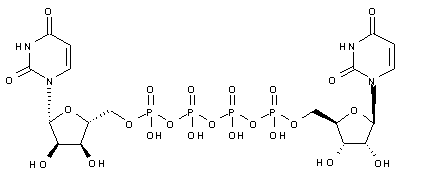
Diquafosol


ChemSpider 2D Image | Diquafosol | C18H26N4O23P4

Diquafosol

  • Molecular FormulaC18H26N4O23P4
  • Average mass790.307 Da
{Oxybis[(hydroxyphosphoryl)oxy]}bis[hydrogéno(phosphonate)] de bis{[(2R,3S,4R,5R)-5-(2,4-dioxo-3,4-dihydro-1(2H)-pyrimidinyl)-3,4-dihydroxytétrahydro-2-furanyl]méthyle}
59985-21-6 [RN]
7828VC80FJ
8326
Bis{[(2R,3S,4R,5R)-5-(2,4-dioxo-3,4-dihydro-1(2H)-pyrimidinyl)-3,4-dihydroxytetrahydro-2-furanyl]methyl} {oxybis[(hydroxyphosphoryl)oxy]}bis[hydrogen (phosphonate)]
ChemSpider 2D Image | Diquafosol tetrasodium | C18H22N4Na4O23P4
Diquafosol Tetrasodium | CAS#:211427-08-6 | Chemsrc

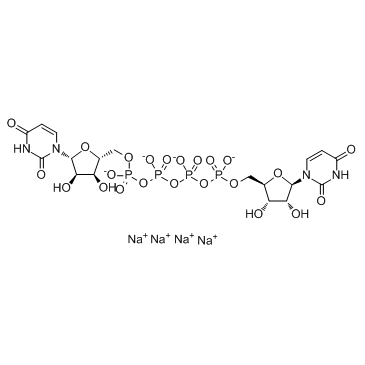
Diquafosol tetrasodium

  • Molecular FormulaC18H22N4Na4O23P4
  • Average mass878.234 Da
1) uridine, 5′-(pentahydrogen tetraphosphate), P”’->5′-ester with uridine, tetrasodium salt
211427-08-6[RN]
Diquafosol tetrasodium[USAN]
uridine(5′)tetraphospho(5′)uridine tetrasodium salt
Diquafosol tetrasodium (USAN)
INS365
P1,P4-Diuridine 5′-tetraphosphate tetrasodium salt
Prolacria
U2P4
UNII:X8T9SBH9LL
INS-365; DE-089; KPY-998
Title: Diquafosol
CAS Registry Number: 59985-21-6
CAS Name: Uridine 5¢-(pentahydrogen tetraphosphate) P¢¢¢®5¢-ester with uridine
Additional Names:P1,P4-diuridine 5¢-tetraphosphate; UP4U
Molecular Formula: C18H26N4O23P4
Molecular Weight: 790.31
Percent Composition: C 27.36%, H 3.32%, N 7.09%, O 46.56%, P 15.68%
Literature References: Uridine nucleotide analog. P2Y2 purinoceptor agonist; stimulates mucin secretion from goblet cells. Prepn: M. J. Stutts, III et al.,WO9640059 (1996 to Univ. North Carolina at Chapel Hill); and receptor activity: W. Pendergast et al.,Bioorg. Med. Chem. Lett.11, 157 (2001). Ocular pharmacology: T. Fujihara et al.,J. Ocul. Pharmacol. Ther.18, 363 (2002). Review of development and therapeutic potential: J. Fischbarg, Curr. Opin. Invest. Drugs4, 1377-1383 (2003); K. K. Nichols et al.,Expert Opin. Invest. Drugs13, 47-54 (2004). Clinical trial in dry eye disease: J. Tauber et al., Cornea23, 784 (2004).
Derivative Type: Tetrasodium salt
CAS Registry Number: 211427-08-6
Manufacturers’ Codes: INS-365
Molecular Formula: C18H22N4Na4O23P4
Molecular Weight: 878.23
Percent Composition: C 24.62%, H 2.52%, N 6.38%, Na 10.47%, O 41.90%, P 14.11%
Therap-Cat: In treatment of dry eye disease.
Keywords: Purinoceptor P2Y Agonist.
Company:
Santen (Originator)
Sales:
$80 Million (Y2015); 
$71.7 Million (Y2014);
$79.3 Million (Y2013);
$67.1 Million (Y2012);
$36 Million (Y2011);
ATC Code:
S01
Approved Countries or Area 2010-04-16, JAPAN

Diquafosol tetrasodium was approved by Pharmaceuticals Medical Devices Agency of Japan (PMDA) on April 16, 2010. It was developed and marketed as Diquas® by Santen Pharmaceutical Corporation in Japan.

Diquafosol tetrasodium is a P2Y2 purinoceptor receptor agonist. It is indicated for improve dry eye symptoms by promoting secretion of mucin and water, thereby bringing the tear film closer to a normal state. No serious ocular or systemic adverse drug reactions were found during the clinical trials. Dry eye begins with symptoms of ocular discomfort such as burning, stinging or a foreign body sensation.

Diquas® is available as solution for ophthalmic use, containing 3% of Diquafosol tetrasodium. The recommended dose is 1 drop at a time, 6 times a day.

Index:

Diquafosol (tradename Diquas) is a pharmaceutical drug for the treatment of dry eye disease. It was approved for use in Japan in 2010.[1] It is formulated as a 3% ophthalmic solution of the tetrasodium salt.

Its mechanism of action involves agonism of the P2Y2 purinogenic receptor.[2]

SYN

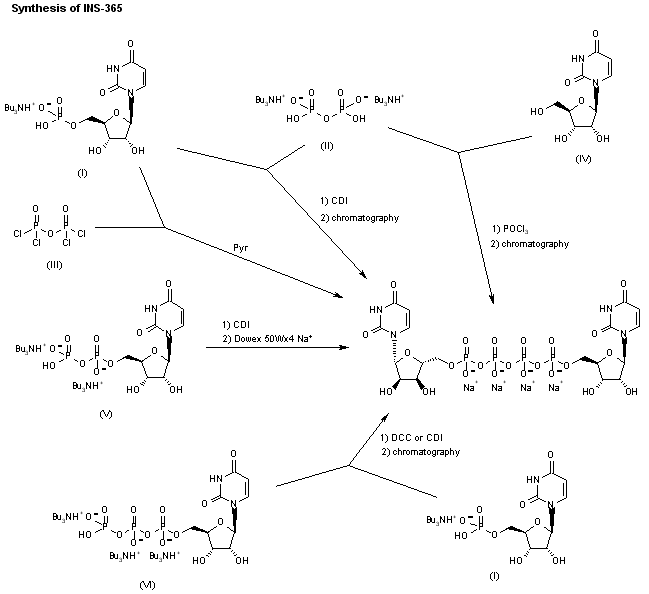
INS-365 can also been obtained by the following ways: 4) Dimerization of uridine-5′-monophosphate tributyl-ammonium salt (I) with bis(tributylammonium) pyrophosphate (II) by means of CDI, followed by purification by semipreparative ion璭xchange chromatography. 5) Dimerization of uridine-5′-monophosphate tributyl-ammonium salt (I) with pyrophosphoryl chloride (III) in pyridine, followed by chromatographic purification as before. 6) Condensation of uridine (IV) with POCl3 and bis(tributylammonium) pyrophosphate (II) by means of tributylamine in trimethyl phosphate, followed by chromatographic purification as before. 7) Dimerization of uridine-5′-diphosphate tributylammonium salt (V) by means of CDI in DMF, followed by purification over Dowex 50Wx4 Na+. 8) Condensation of uridine-5′-triphosphate tributylammonium salt (VI) with uridine-5′-monophosphate tributyl-ammonium salt (I) by means of DCC in DMF, followed by chromatographic purification as before. 9) Reaction of uridine-5′-monophosphate tributylammonium salt (I) with CDI in DMF, followed by condensation with uridine-5′-triphosphate (VI) and chromatographic purification as before.

CLIP

Route 1

Reference:1. WO9905155A2.

Route 2

Reference:1. WO1999005155.

2. Bioorg. Med. Chem. Lett. 200111, 157-160.

Route 3

Reference:1. WO1999005155.

Route 4

Reference:1. WO2014103704.

SYN

Practical and Efficient Approach to the Preparation of Diquafosol Tetrasodium

    • Pengfei Xu
Cite this: Org. Process Res. Dev. 2020, XXXX, XXX, XXX-XXX
Publication Date:June 30, 2020
Abstract Image
https://doi.org/10.1021/acs.oprd.0c00209

https://pubs.acs.org/doi/suppl/10.1021/acs.oprd.0c00209/suppl_file/op0c00209_si_001.pdf

https://pubs.acs.org/doi/10.1021/acs.oprd.0c00209

A scalable and practical route to synthesize the P2Y2 receptor agonist diquafosol tetrasodium has been described. Diquafosol tetrasodium was obtained via a four-step process starting from commercially available 5′-uridylic acid disodium salt. The whole procedure gives the target product in a 45% overall yield with high purity (>99%). Key steps in this process including isolation of impurities and the target product by using anion-exchange resin are discussed in detail. The optimized process has been successfully demonstrated on a large scale to support the development of diquafosol tetrasodium in China.

References

  1. ^ “Santen and Inspire Announce Approval of DIQUAS for Dry Eye Treatment in Japan”. April 16, 2010.
  2. ^ Pendergast, W; Yerxa, BR; Douglass Jg, 3rd; Shaver, SR; Dougherty, RW; Redick, CC; Sims, IF; Rideout, JL (2001). “Synthesis and P2Y receptor activity of a series of uridine dinucleoside 5′-polyphosphates”. Bioorganic & Medicinal Chemistry Letters11 (2): 157–60. doi:10.1016/S0960-894X(00)00612-0PMID 11206448.
Diquafosol
Diquafosol.svg
Names
IUPAC name

[[[[(2R,3S,4R,5R)-5-(2,4-Dioxopyrimidin-1-yl)-3,4-dihydroxy-tetrahydrofuran-2-yl]methoxy-hydroxy-phosphoryl]oxy-hydroxy-phosphoryl]oxy-hydroxy-phosphoryl] [(2R,3S,4R,5R)-5-(2,4-dioxopyrimidin-1-yl)-3,4-dihydroxy-tetrahydrofuran-2-yl]methyl hydrogen phosphate
Other names

P1,P4-Bis(5′-uridyl) tetraphosphate; INS-365; Diquafosol tetrasodium
Identifiers
3D model (JSmol)
ChEMBL
ChemSpider
PubChem CID
UNII
Properties
C18H26N4O23P4
Molar mass 790.306 g·mol−1
Except where otherwise noted, data are given for materials in their standard state (at 25 °C [77 °F], 100 kPa).
Infobox references

///////////// INS 365, Diquafosol, INS-365,  DE 089,  KPY 998, JAPAN 16

59985-21-6 (Diquafosol );
211427-08-6 (Diquafosol Tetrasodium);

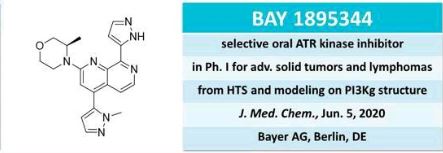
BAY 1895344


BAY-1895344 Structure

BAY 1895344

1876467-74-1 (free base)
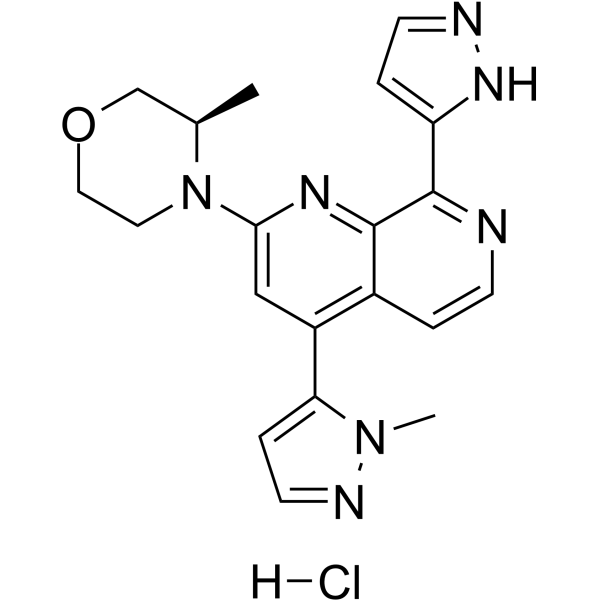
(R)-3-methyl-4-(4-(1-methyl-1H-pyrazol-5-yl)-8-(1H-pyrazol-3-yl)-1,7-naphthyridin-2-yl)morpholine, monohydrochloride

BAY-1895344 hydrochloride Chemical Structure

BAY-1895344

Molecular Weight

411.89

Formula

C₂₀H₂₂ClN₇O

BAY-1895344 (hydrochloride)

1876467-74-1

1876467-74-1(free base)

s8666CCG-268786CS-7574HY-101566A

BAY-1895344 hydrochloride is a potent, orally available and selective ATR inhibitor, with IC50 of 7 nM. Anti-tumor activity.

bay

NMR https://file.selleckchem.com/downloads/nmr/S866603-BAY-1895344-hnmr-selleck.pdf


Biological Activity

In vitro, BAY 1895344 was shown to be a very potent and highly selective ATR inhibitor (IC50 = 7 nM), which potently inhibits proliferation of a broad spectrum of human tumor cell lines (median IC50 = 78 nM). In cellular mechanistic assays BAY 1895344 potently inhibited hydroxyurea-induced H2AX phosphorylation (IC50 = 36 nM). Moreover, BAY 1895344 revealed significantly improved aqueous solubility, bioavailability across species and no activity in the hERG patch-clamp assay. BAY 1895344 also demonstrated very promising efficacy in monotherapy in DNA damage deficient tumor models as well as combination treatment with DNA damage inducing therapies.

Conversion of different model animals based on BSA (Value based on data from FDA Draft Guidelines)
Species Mouse Rat Rabbit Guinea pig Hamster Dog
Weight (kg) 0.02 0.15 1.8 0.4 0.08 10
Body Surface Area (m2) 0.007 0.025 0.15 0.05 0.02 0.5
Km factor 3 6 12 8 5 20
Animal A (mg/kg) = Animal B (mg/kg) multiplied by Animal B Km
Animal A Km

For example, to modify the dose of resveratrol used for a mouse (22.4 mg/kg) to a dose based on the BSA for a rat, multiply 22.4 mg/kg by the Km factor for a mouse and then divide by the Km factor for a rat. This calculation results in a rat equivalent dose for resveratrol of 11.2 mg/kg.

Chemical Information
Molecular Weight 375.43
Formula C20H21N7O
CAS Number 1876467-74-1
Purity 98.69%
Solubility 10 mM in DMSO
Storage at -20°C
PAPER
Damage Incorporated: Discovery of the Potent, Highly Selective, Orally Available ATR Inhibitor BAY 1895344 with Favorable Pharmacokinetic Properties and Promising Efficacy in Monotherapy and in Combination Treatments in Preclinical Tumor Models
Journal of Medicinal Chemistry  20206313, 7293-7325 (Article)

Publication Date (Web):June 5, 2020DOI: 10.1021/acs.jmedchem.0c00369

2-[(3R)-3-Methylmorpholin-4-yl]-4-(1-methyl-1Hpyrazol-5-yl)-8-(1H-pyrazol-5-yl)-1,7-naphthyridine (BAY 1895344). Sulfonate 67 (500 mg, 0.95 mmol), 1- methyl-5-(4,4,5,5-tetramethyl-1,3,2-dioxaborolan-2-yl)- 1H-pyrazole (68) (415 mg, 1.90 mmol), 2 M aq K2CO3 solution (1.4 mL), and Pd(PPh3)2Cl2 (67 mg, 0.094 mmol) were solubilized in DME (60 mL). The reaction mixture was stirred for 20 min at 130 °C under microwave irradiation. After cooling to rt, the mixture was filtered through a silicon filter and concentrated under reduced pressure. The crude material was purified by flash column chromatography (silica gel, hexane/EtOAc gradient 0–100%, followed by EtOAc/EtOH 9:1). The desired fractions were concentrated under reduced pressure and solubilized in concd H2SO4 (5 mL). The mixture was stirred for 3 h at rt. The mixture was then poured into ice and basified using solid NaHCO3. The suspension was filtered and the solid was stirred with EtOH at 40 °C, filtered, and dried under reduced pressure to give BAY 1895344 (280 mg, 0.75 mmol, 78%). LC-MS [Method 2]: Rt = 0.99 min. MS (ESI+): m/z = 376.1 [M+H]+ . 1H NMR (400 MHz, DMSO-d6): δ = 13.44 (br s, 1H, pyrazole-NH), 8.35 (d, J = 5.32 Hz, 1H, naphthyridine), 7.56–7.68 (m, 3H, pyrazole, naphthyridine), 7.42 (br s, 1H, pyrazole), 7.27 (d, J = 5.58 Hz, 1H, naphthyridine), 6.59 (d, J = 2.03 Hz, 1H, pyrazole), 4.60–4.69 (m, 1H, morpholine), 4.23 (br d, J = 11.66 Hz, 1H, morpholine), 4.00–4.09 (m, 1H, morpholine), 3.78–3.85 (m, 1H, morpholine), 3.75 (m, 4H, methyl, morpholine), 3.69–3.74 (m, 1H, morpholine), 3.57 (m, 1H, morpholine), 1.30 (d, J = 6.59 Hz, 3H, methyl). 13C NMR (125 MHz, DMSO-d6): δ = 156.5, 145.2, 140.0, 139.6, 139.5, 138.2, 137.4, 137.4, 125.7, 117.1, 115.5, 108.2, 107.7, 70.3, 66.1, 47.3, 39.7, 37.2, 13.3. ESI-HRMS: m/z [M+H]+ calcd for C20H22N7O: 376.1886, found: 376.1879. [α]D –80.8 ± 1.04 (1.0000 g/ 100 mL CHCl3).
References

Identification of potent, highly selective and orally available ATR inhibitor BAY 1895344 with favorable PK properties and promising efficacy in monotherapy and combination in preclinical tumor models
Ulrich T, et al. AACR. 2017 July;77(13 Suppl):Abstract nr 983.

ATR inhibitor BAY 1895344 shows potent anti-tumor efficacy in monotherapy and strong combination potential with the targeted alpha therapy Radium-223 dichloride in preclinical tumor models
Antje Margret Wengner, et al. AACR 2017 July;77(13 Suppl):Abstract nr 836.

////////////s8666CCG-268786CS-7574HY-101566ABAY-1895344BAY 1895344

CC1COCCN1C2=NC3=C(C=CN=C3C4=CC=NN4)C(=C2)C5=CC=NN5C

MK 5204


mk-5204

MK 5204

mk-5204

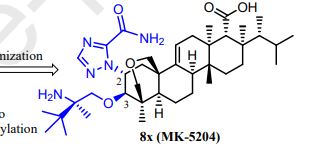
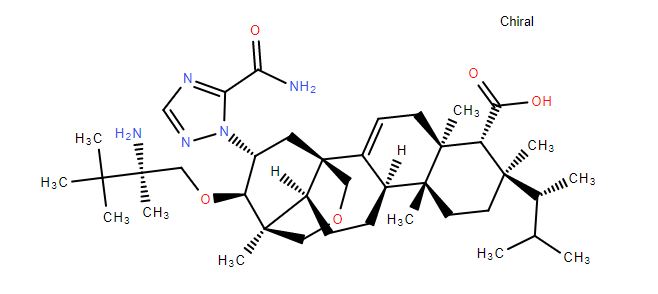
(1R,5S,6R,7R,10R,11R,14R,15S,20R,21R)-21-[(2R)-2-Amino-2,3,3-trimethylbutoxy]-20-(5-carbamoyl-1,2,4-triazol-1-yl)-5,7,10,15-tetramethyl-7-[(2R)-3-methylbutan-2-yl]-17-oxapentacyclo[13.3.3.01,14.02,11.05,10]henicos-2-ene-6-carboxylic acid.png

mk-5204

CAS No: 1207751-75-4
Product Code: BM178545

 (1R,5S,6R,7R,10R,11R,14R,15S,20R,21R)-21-[(2R)-2-amino-2,3,3-trimethylbutoxy]-20-(5-carbamoyl-1,2,4-triazol-1-yl)-5,7,10,15-tetramethyl-7-[(2R)-3-methylbutan-2-yl]-17-oxapentacyclo[13.3.3.01,14.02,11.05,10]henicos-2-ene-6-carboxylic acid

MW: 696g/mol

MW 695.97

C40 H65 N5 O5

PAPER

https://www.sciencedirect.com/science/article/abs/pii/S0960894X20304686

Abstract

Our previously reported efforts to produce an orally active β-1,3-glucan synthesis inhibitor through the semi-synthetic modification of enfumafungin focused on replacing the C2 acetoxy moiety with an aminotetrazole and the C3 glycoside with a N,N-dimethylaminoether moiety. This work details further optimization of the C2 heterocyclic substituent, which identified 3-carboxamide-1,2,4-triazole as a replacement for the aminotetrazole with comparable antifungal activity. Alkylation of either the carboxamidetriazole at C2 or the aminoether at C3 failed to significantly improve oral efficacy. However, replacement of the isopropyl alpha amino substituent with a t-butyl, improved oral exposure while maintaining antifungal activity. These two structural modifications produced MK-5204, which demonstrated broad spectrum activity against Candida species and robust oral efficacy in a murine model of disseminated Candidiasis without the N-dealkylation liability observed for the previous lead.

MK-5204: An orally active β-1,3-glucan synthesis inhibitor ...

MK-5204: An orally active β-1,3-glucan synthesis inhibitor ...

patent

https://patentscope.wipo.int/search/en/detail.jsf?docId=US43243783&tab=PCTDESCRIPTION&_cid=P22-KD34BU-17225-1

Patent ID Title Submitted Date Granted Date
US8188085 Antifungal agents 2010-05-06 2012-05-29
ungal infection is a major healthcare problem, and the incidence of hospital-acquired fungal diseases continues to rise. Severe systemic fungal infection in hospitals (such as candidiasis, aspergillosis, histoplasmosis, blastomycosis and coccidioidomycosis) is commonly seen in neutropaenic patients following chemotherapy and in other oncology patients with immune suppression, in patients who are immune-compromised due to Acquired Immune Deficiency Syndrome (AIDS) caused by HIV infection, and in patients in intensive care. Systemic fungal infections cause ˜25% of infection-related deaths in leukaemics. Infections due to Candida species are the fourth most important cause of nosocomial bloodstream infection. Serious fungal infections may cause 5-10% of deaths in patients undergoing lung, pancreas or liver transplantation. Treatment failures are still very common with all systemic mycoses. Secondary resistance also arises. Thus, there remains an increasing need for effective new therapy against mycotic infections.
      Enfumafungin is a hemiacetal triterpene glycoside that is produced in fermentations of a Hormonema spp. associated with living leaves of Juniperus communis (U.S. Pat. No. 5,756,472; Pelaez et al., Systematic and Applied Microbiology, 23:333-343, 2000; Schwartz et al., JACS, 122:4882-4886, 2000; Schwartz, R. E., Expert Opinion on Therapeutic Patents, 11(11):1761-1772, 2001). Enfumafungin is one of the several triterpene glycosides that have in vitro antifungal activities. The mode of the antifungal action of enfumafungin and other antifungal triterpenoid glycosides was determined to be the inhibition of fungal cell wall glucan synthesis by their specific action on (1,3)-β-D-glucan synthase (Onishi et al., Antimicrobial Agents and Chemotherapy, 44:368-377, 2000; Pelaez et al., Systematic and Applied Microbiology, 23:333-343, 2000). 1,3-β-D-Glucan synthase remains an attractive target for antifungal drug action because it is present in many pathogenic fungi which affords broad antifungal spectrum and there is no mammalian counterpart and as such, compounds inhibiting 1,3-β-D-Glucan synthase have little or no mechanism-based toxicity.

SIMILAR BUT NOT SAME

METHOXY EXAMPLE

Example 8

(1S,4aR,6aS,7R,8R,10aR,10bR,12aR,14R,15R)-15-[[(2R)-2-amino-2,3-dimethylbutyl]oxy]-8-[(1R)-1,2-dimethylpropyl]-14-[3-(methoxycarbonyl)-1H-1,2,4-triazol-1-yl]-1,6,6a,7,8,9,10,10a,10b,11,12,12a-dodecahydro-1,6a,8,10a-tetramethyl-4H-1,4a-propano-2H-phenanthro[1,2-c]pyran-7-carboxylic acid (EXAMPLE 8A) and (1S,4aR,6aS,7R,8R,10aR,10bR,12aR,14R,15R)-15-[[(2R)-2-amino-2,3-dimethylbutyl]oxy]-8-[(1R)-1,2-dimethylpropyl]-14-[5-(methoxycarbonyl)-1H-1,2,4-triazol-1-yl]-1,6,6a,7,8,9,10,10a,10b,11,12,12a-dodecahydro-1,6a,8,10a-tetramethyl-4H-1,4a-propano-2H-phenanthro[1,2-c]pyran-7-carboxylic acid (EXAMPLE 8B)

      Methyl 1,2,4-triazole-3-carboxylate (27.1 mg, 0.213 mmol) and BF 3OEt (54 μl, 0.426 mmol) were added to a stirred solution of Intermediate 6 (25.9 mg, 0.043 mmol) in 1,2-dichloroethane (0.43 ml). The reaction mixture was a light yellow suspension that was heated at 50° C. for 7.5 hr and then stirred at room temperature for 64 hr. The solvent was evaporated and the resulting residue was placed under high vacuum. The residue was dissolved in methanol and separated using a single HPLC run on a 19×150 mm Sunfire Prep C18 OBD 10 μm column by eluting with acetonitrile/water+0.1% TFA. The HPLC fractions of the faster eluting regioisomer were combined, the solvent was evaporated under reduced pressure, and the residue was lyophilized from ethanol and benzene to give EXAMPLE 8A (8.9 mg, 10.97 μmol) as a white solid. The HPLC fractions of the slower eluting regioisomer were combined, the solvent was evaporated under reduced pressure, and the residue was lyophilized from ethanol and benzene to give EXAMPLE 8B (1.5 mg, 1.85 μmol) as a white solid.

Example 8A

       1H NMR (CD 3OD, 600 MHz, ppm) δ 0.76 (s, 3H, Me), 0.76 (d, 3H, Me), 0.79 (d, 3H, Me), 0.83 (d, 3H, Me), 0.85 (d, 3H, Me), 0.88 (s, 3H, Me), 0.88 (s, 3H, Me), 0.89 (d, 3H, Me), 1.16 (s, 3H, Me), 1.20 (s, 3H, Me), 1.22-1.35 (m), 1.39-1.44 (m), 1.47-1.65 (m), 1.78-2.02 (m), 2.10-2.22 (m), 2.46 (dd, 1H, H13), 2.66 (d, 1H), 2.83 (s, 1H, H7), 3.48 (d, 1H), 3.50 (d, 1H), 3.53 (dd, 1H), 3.60 (d, 1H), 3.77 (d, 1H), 3.92 (d, 1H), 3.95 (s, 3H, COOMe), 5.48 (dd, 1H, H5), 5.61-5.68 (m, 1H, H14), 8.77 (broad s, 1H, triazole).
      Mass Spectrum: (ESI) m/z=697.42 (M+H).

Example 8B

       1H NMR (CD 3OD, 600 MHz, ppm) δ 0.76 (s, 3H, Me), 0.76 (d, 3H, Me), 0.79 (s, 3H, Me), 0.79 (d, 3H, Me), 0.82 (d, 3H, Me), 0.85 (d, 3H, Me), 0.88 (s, 3H, Me), 0.89 (d, 3H, Me), 1.13 (s, 3H, Me), 1.20 (s, 3H, Me), 1.22-1.36 (m), 1.39-1.44 (m), 1.47-1.55 (m), 1.59-1.65 (m), 1.72-1.96 (m), 2.10-2.22 (m), 2.46 (dd, 1H, H13), 2.78 (d, 1H), 2.84 (s, 1H, H7), 3.48 (d, 1H), 3.50 (d, 1H), 3.55 (dd, 1H), 3.62 (d, 1H), 3.93 (d, 1H), 3.98 (d, 1H), 3.99 (s, 3H, COOMe), 5.47 (dd, 1H, H5), 6.53-6.59 (m, 1H, H14), 8.14 (s, 1H, triazole).
      Mass Spectrum: (ESI) m/z=697.42 (M+H).
 

/////////////MK 5204, BM178545

NC(=O)c6ncnn6[C@@H]1C[C@]45COC[C@@](C)([C@H]1OC[C@](C)(N)C(C)(C)C)[C@@H]5CC[C@H]3C4=CC[C@@]2(C)[C@H](C(=O)O)[C@](C)(CC[C@@]23C)[C@H](C)C(C)C

CC(C)C(C)C1(CCC2(C3CCC4C5(COCC4(C3=CCC2(C1C(=O)O)C)CC(C5OCC(C)(C(C)(C)C)N)N6C(=NC=N6)C(=O)N)C)C)C

SELGANTOLIMOD


2D chemical structure of 2004677-13-6

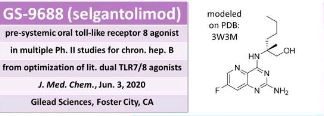
SELGANTOLIMOD

GS 9688

RN: 2004677-13-6
UNII: RM4GJT3SMQ

Molecular Formula, C14-H20-F-N5-O,

Molecular Weight, 293.344

1-Hexanol, 2-((2-amino-7-fluoropyrido(3,2-d)pyrimidin-4-yl)amino)-2-methyl-, (2R)-

(2R)-2-((2-Amino-7-fluoropyrido(3,2-d)pyrimidin-4-yl)amino)-2-methylhexan-1-ol

gs

Discovery of GS9688 (Selgantolimod) as a Potent and Selective Oral Toll-Like Receptor 8 Agonist for the Treatment of Chronic Hepatitis B
Journal of Medicinal Chemistry, Articles ASAP (Drug Annotation)

Publication Date (Web):May 14, 2020DOI: 10.1021/acs.jmedchem.0c00100

PATENTS
Patent ID Title Submitted Date Granted Date
US2019192504 Therapeutic heterocyclic compounds 2018-08-20
US2017281627 TOLL LIKE RECEPTOR MODULATOR COMPOUNDS 2017-04-25
US2017071944 MODULATORS OF TOLL-LIKE RECEPTORS FOR THE TREATMENT OF HIV 2016-09-13
US9670205 TOLL LIKE RECEPTOR MODULATOR COMPOUNDS 2016-03-02

Patent

https://patentscope.wipo.int/search/en/detail.jsf?docId=US178076456&tab=PCTDESCRIPTION&_cid=P21-KD1F9D-27923-1

EXAMPLE 63

      Synthesis of methyl 2-amino-2-methylhexanoate (63A. To a mixture of (2R)-2-amino-2-methylhexanoic acid hydrochloride (50 mg, 0.28 mmol) and (2S)-2-amino-2-methylhexanoic acid hydrochloride (50 mg, 0.28 mmol) in MeOH (5.0 mL) was added (trimethylsilyl) diazomethane in hexanes (2 M, 0.41 mL, 0.83 mmol) dropwise. After 6 h, the reaction was quenched with AcOH (100 μL). The mixture was concentrated in vacuo to provide 63A that was used without further isolation. LCMS (m/z): 159.91 [M+H] +; t R=0.57 min. on LC/MS Method A.
      Synthesis of methyl 2-((2-((2,4-dimethoxybenzyl)amino)-7-fluoropyrido[3,2-d]pyrimidin-4-yl)amino)-2-methylhexanoate (63B). To a solution of 84E (120 mg, 0.55 mmol) in THF (5 mL) was added 63A (88 mg, 0.55 mmol) and N,N-diisopropylethylamine (0.3 mL, 1.7 mmol). After stirring at 80° C. for 18 h, the reaction was cooled to rt, diluted with EtOAc (50 mL), washed with water (50 mL) and brine (50 mL), dried over Na 2SO 4, then filtered and concentrated in vacuo. The crude residue was then diluted with THF (10 mL) and 2,4-dimethoxybenzylamine (0.4 mL, 2.6 mmol) and N,N-diisopropylethylamine (0.3 mL, 1.7 mmol) were added. After stirring at 100° C. for 18 h, the reaction was cooled to rt, diluted with EtOAc (50 mL), washed with water and brine, dried over Na 2SO 4, then filtered and concentrated in vacuo. The residue was subjected to silica gel chromatography eluting with hexanes-EtOAc to provide 63B. 1H NMR (400 MHz, Chloroform-d) δ 8.14 (d, J=2.5 Hz, 1H), 7.36 (s, 1H), 7.28-7.24 (m, 2H), 6.46 (d, J=2.3 Hz, 1H), 6.41 (dd, J=8.3, 2.4 Hz, 1H), 4.54 (dd, J=6.2, 2.7 Hz, 2H), 3.84 (s, 3H), 3.78 (s, 3H), 3.69 (s, 3H), 2.27-2.16 (m, 1H), 2.02 (s, 1H), 1.71 (s, 3H), 1.34-1.23 (m, 5H), 0.88 (t, J=6.9 Hz, 3H). 19F NMR (376 MHz, Chloroform-d) δ −121.51 (d, J=422.9 Hz). LCMS (m/z): 472.21 [M+H] +; t R=0.91 min. on LC/MS Method A.
      Synthesis of 2-((2-((2,4-dimethoxybenzyl)amino)-7-fluoropyrido[3,2-d]pyrimidin-4-yl)amino)-2-methylhexan-1-ol (63C). To a solution of 63B (104 mg, 0.22 mmol) in THF (5 mL) was added lithium aluminum hydride in Et 2O (2M, 0.30 mL, 0.60 mmol). After 5 h the reaction was quenched with H 2O (1 mL) and 2M NaOH (aq), and then filtered. The mother liquor was then diluted with EtOAc (30 mL), washed with sat. Rochelle’s salt solution (25 mL), H 2O (25 mL), and brine (25 mL), dried over Na 2SO 4, then filtered and concentrated in vacuo. The residue was subjected to silica gel chromatography eluting with hexanes-EtOAc to provide 63C. 1H NMR (400 MHz, Chloroform-d) δ 8.12 (d, J=2.5 Hz, 1H), 7.32 (s, 1H), 7.28 (s, 1H), 6.46 (d, J=2.4 Hz, 1H), 6.42 (dd, J=8.2, 2.4 Hz, 1H), 4.57-4.52 (m, 2H), 3.84 (s, 3H), 3.79 (s, 4H), 3.75 (s, 2H), 1.92 (d, J=14.1 Hz, 1H), 1.74 (t, J=12.6 Hz, 1H), 1.40-1.37 (m, 3H), 1.32 (td, J=13.4, 12.4, 6.3 Hz, 4H), 0.91 (t, J=7.0 Hz, 3H). 19F NMR (377 MHz, Chloroform-d) δ −121.34. LCMS (m/z): 444.20 [M+H] +; t R=0.94 min. on LC/MS Method A
      Synthesis of 2-((2-amino-7-fluoropyrido[3,2-d]pyrimidin-4-yl)amino)-2-methylhexan-1-ol (63). To 63C (22 mg, 0.05 mmol) was added TFA (3 mL). After 30 minutes, the reaction mixture was diluted with MeOH (5 mL). After stirring for 18 h, the mixture was filtered and concentrated in vacuo. Co-evaporation with MeOH (×3) provided 63 as a TFA salt. 1H NMR (400 MHz, MeOH-d 4) δ 8.53 (d, J=2.4 Hz, 1H), 8.20 (s, 1H), 7.65 (dd, J=8.8, 2.4 Hz, 1H), 3.95 (s, 1H), 3.70 (d, J=11.2 Hz, 1H), 2.09 (ddd, J=13.9, 10.9, 5.3 Hz, 1H), 1.96-1.86 (m, 1H), 1.53 (s, 3H), 1.42-1.28 (m, 6H), 0.95-0.87 (m, 3H). 19F NMR (377 MHz, MeOH-d 4) δ −77.47, −118.23 (d, J=8.6 Hz). LCMS (m/z): 294.12 [M+H] +; t R=0.68 min. on LC/MS Method A.

EXAMPLE 64

      Synthesis of (S)-2-amino-2-methylhexan-1-ol (64A). To (2S)-2-amino-2-methylhexanoic acid hydrochloride (250 mg, 1.4 mmol, supplied by Astatech) in THF (5 mL) was added borane-tetrahydrofuran complex solution in THF (1M, 5.5 mL) dropwise over 5 minutes. After 24 h, the reaction was quenched with MeOH (1 mL) and concentrated in vacuo. The residue was taken up in DCM (10 mL), filtered, and concentrated in vacuo to provide crude 64A. LCMS (m/z): 131.92 [M+H] +; t R=0.57 min. on LC/MS Method A.
      Synthesis of (S)-2-((2-amino-7-fluoropyrido[3,2-d]pyrimidin-4-yl)amino)-2-methylhexan-1-ol (64). To a solution of 43B (140 mg, 78 mmol) and 64A (125 mg, 0.95 mmol) in NMP (7.5 mL), was added DBU (0.35 mL, 2.4 mmol) followed by BOP (419 mg, 0.95 mmol). After 16 h, the reaction mixture was subjected to prep HPLC (Gemini 10u C18 110A, AXIA; 10% aq. acetonitrile—50% aq. acetonitrile with 0.1% TFA, over 20 min. gradient) to provide, after removal of volatiles in vacuo, 64 as a TFA salt. 1H NMR (400 MHz, MeOH-d 4) δ 8.55 (d, J=2.4 Hz, 1H), 8.22 (s, 1H), 7.64 (dd, J=8.7, 2.5 Hz, 1H), 3.97 (d, J=11.2 Hz, 1H), 3.71 (d, J=11.2 Hz, 1H), 2.09 (ddd, J=13.9, 10.8, 5.2 Hz, 1H), 1.92 (ddd, J=13.6, 10.9, 5.4 Hz, 1H), 1.54 (s, 4H), 1.40-1.31 (m, 5H), 1.00-0.85 (m, 3H). 19F NMR (377 MHz, MeOH-d 4) δ −77.62, −118.22 (d, J=8.7 Hz). LCMS (m/z) 294.09 [M+H] +; t R=0.79 min. on LC/MS Method A.

EXAMPLE 65

      Synthesis of (R)-N-(2-((2-amino-7-chloropyrido[3,2-d]pyrimidin-4-yl)amino)-2-methylhexyl)acetamide (65A). To a solution of 19B (112 mg, 0.48 mmol) in THF (5 mL) was added 61E (100 mg, 0.48 mmol) and N,N-diisopropylethylamine (0.25 mL, 1.4 mmol). After stirring at 80° C. for 18 h, 2,4-dimethoxybenzylamine (0.75 mL, 5.0 mmol) was added and the mixture was heated to 100° C. After 18 h, the reaction was cooled to rt, diluted with EtOAc (50 mL), washed with water (50 mL) and brine (50 mL), dried over Na 2SO 4, then filtered and concentrated in vacuo. The residue was subjected to silica gel chromatography eluting with hexanes-EtOAc to provide 65A LCMS (m/z): 509.30[M+H] +; t R=0.89 min. on LC/MS Method A.
      Synthesis of (R)-N-(2-((2-amino-7-chloropyrido[3,2-d]pyrimidin-4-yl)amino)-2-methylhexyl)acetamide (65). To 65A (21 mg, 0.04 mmol) was added TFA (3 mL). After 30 minutes, the mixture was concentrated in vacuo and the residue co-evaporated with MeOH (10 mL×3). The resulting residue was suspended in MeOH (10 mL), filtered, and concentrated in vacuo to provide 65 as a TFA salt. 1H NMR (400 MHz, MeOH-d 4) δ 8.59 (d, J=2.1 Hz, 1H), 8.58 (s, 1H), 7.91 (d, J=2.1 Hz, 1H), 3.93 (d, J=14.0 Hz, 1H), 3.52 (d, J=14.0 Hz, 1H), 2.22-2.10 (m, 1H), 1.96 (s, 3H), 1.95-1.87 (m, 1H), 1.54 (s, 3H), 1.34 (dd, J=7.5, 3.9 Hz, 5H), 0.94-0.89 (m, 3H). 19F NMR (377 MHz, MeOH-d 4) δ −77.91. LCMS (m/z): 351.29 [M+H] +; t R=0.69 min. on LC/MS Method A.


/////////////GS 9688, SELGANTOLIMOD

CCCC[C@@](C)(CO)Nc1nc(N)nc2cc(F)cnc12

Desidustat


Desidustat.svg

Ranjit Desai

Inventor of Oxemia (Desidustat), a breakthrough PHD inhibitor approved for Chronic Kidney Diseases (CKD) / Accomplished pharma executive / 4 INDs in 4 years, ZYDUS LIFESCIENCES

DESIDUSTAT

Formal Name
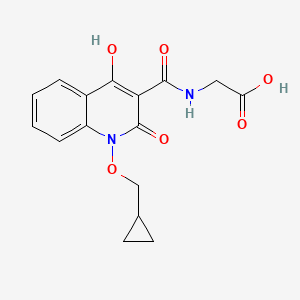
N-[[1-(cyclopropylmethoxy)-1,2-dihydro-4-hydroxy-2-oxo-3-quinolinyl]carbonyl]-glycine
CAS Number 1616690-16-4
Molecular Formula   C16H16N2O6
Formula Weight 332.3
FormulationA crystalline solid
λmax233, 291, 335

2-(1-(cyclopropylmethoxy)-4-hydroxy-2-oxo-1,2-dihydroquinoline-3-carboxamido)acetic acid

desidustat

Glycine, N-((1-(cyclopropylmethoxy)-1,2-dihydro-4-hydroxy-2-oxo-3-quinolinyl)carbonyl)-

N-(1-(Cyclopropylmethoxy)-4-hydroxy-2-oxo-1,2-dihydroquinoline-3-carbonyl)glycine

ZYAN1 compound

BCP29692

EX-A2999

ZB1514

CS-8034

HY-103227

A16921

(1-(cyclopropylmethoxy)-4-hydroxy-2-oxo-1,2-dihydroquinoline-3-carbonyl) glycine in 98% yield, as a solid. MS (ESI-MS): m/z 333.05 (M+H) +1H NMR (DMSO-d 6): 0.44-0.38 (m, 2H), 0.62-0.53 (m, 2H), 1.34-1.24 (m, 1H), 4.06-4.04 (d, 2H), 4.14-4.13 (d, 2H), 7.43-7.39 (t, 1H), 7.72-7.70 (d, 1H), 7.89-7.85 (m, 1H), 8.11-8.09 (dd, 1H), 10.27-10.24 (t, 1H), 12.97 (bs, 1H), 16.99 (s, 1H). HPLC Purity: 99.85%

Desidustat | C16H16N2O6 - PubChem

Oxemia (Desidustat) has received approval from the Drug Controller General of India. This was an incredible team effort by Zydans across the organization and I am so proud of what we have accomplished. Oxemia is a breakthrough treatment for Anemia associated with Chronic Kidney Disease in Patients either on Dialysis or Not on Dialysis, and will help improve quality of life for CKD patients. Team #zydus , on to our next effort!

Desidustat (INN, also known as ZYAN1) is a drug for the treatment of anemia of chronic kidney disease. This drug with the brand name Oxemia is discovered and developed by Zydus Life Sciences.[1] The subject expert committee of CDSCO has recommended the grant of permission for manufacturing and marketing of Desidustat 25 mg and 50 mg tablets in India,based on some conditions related to package insert, phase 4 protocols, prescription details, and GCP.[2] Clinical trials on desidustat have been done in India and Australia.[3] In a Phase 2, randomized, double-blind, 6-week, placebo-controlled, dose-ranging, safety and efficacy study, a mean hemoglobin increase of 1.57, 2.22, and 2.92 g/dL in desidustat 100, 150, and 200 mg arms, respectively, was observed.[4] The Phase 3 clinical trials were conducted at additional lower doses as of 2019.[5] Desidustat is developed for the treatment of anemia as an oral tablet, where currently injections of erythropoietin and its analogues are drugs of choice. Desidustat is a HIF prolyl-hydroxylase inhibitor. In preclinical studies, effects of desidustat was assessed in normal and nephrectomized rats, and in chemotherapy-induced anemia. Desidustat demonstrated hematinic potential by combined effects on endogenous erythropoietin release and efficient iron utilization.[6][7] Desidustat can also be useful in treatment of anemia of inflammation since it causes efficient erythropoiesis and hepcidin downregulation.[8] In January 2020, Zydus entered into licensing agreement with China Medical System (CMS) Holdings for development and commercialization of desidustat in Greater China. Under the license agreement, CMS will pay Zydus an initial upfront payment, regulatory milestones, sales milestones and royalties on net sales of the product. CMS will be responsible for development, registration and commercialization of desidustat in Greater China.[9] It has been observed that desidustat protects against acute and chronic kidney injury by reducing inflammatory cytokines like IL-6 and oxidative stress [10] A clinical trial to evaluate the efficacy and safety of desidustat tablet for the management of Covid-19 patients is ongoing in Mexico, wherein desidustat has shown to prevent acute respiratory distress syndrome (ARDS) by inhibiting IL-6.[11] Zydus has also received approval from the US FDA to initiate clinical trials of desidustat in chemotherapy Induced anemia (CIA).[12]. Desidustat has met the primary endpoints in the phase 3 clinical trials and Zydus had filed the New Drug Application (NDA) to DCGI in November, 2021.[13]\

CLIP

https://www.businesstoday.in/industry/pharma/story/zydus-receives-dcgi-approval-for-new-drug-oxemia-what-you-need-to-know-324966-2022-03-07

Zydus receives DCGI approval for new drug Oxemia; what you need to know

The new drug is an oral, small molecule hypoxia-inducible factor-prolyl hydroxylase (HIF-PH) inhibitor, Zydus said in a statement.

Gujarat-based pharma company Zydus Lifesciences on Monday received the Drugs Controller General of India (DCGI) approval for its new drug application for a first-of-its-kind oral treatment for anemia associated with Chronic Kidney Disease (CKD) – Oxemia (Desidustat).

The new drug is an oral, small molecule hypoxia-inducible factor-prolyl hydroxylase (HIF-PH) inhibitor, the drug firm said in a statement.

Desidustat showed good safety profile, improved iron mobilization and LDL-C reduction in CKD patients in DREAM-D and DREAM-ND Phase III clinical trials, conducted in approximately 1,200 subjects. Desidustat provides CKD patients with an oral convenient therapeutic option for the treatment of anemia. The pharma major did not, however, declare the cost per dose if the drug is available in the market.

“After more than a decade of research and development into the science of HIF-PH inhibitors, results have demonstrated that Oxemia addresses this unmet need and additionally reduces hepcidin, inflammation and enables better iron mobilization. This advancement offers ease of convenience for the patient and will also reduce the disease burden by providing treatment at an affordable cost, thereby improving the quality of life for patients suffering from Chronic Kidney Disease,” Chairman of Zydus Lifesciences Pankaj Patel said.

Chronic Kidney Disease (CKD) is a progressive medical condition characterised by a gradual loss of kidney function and is accompanied by comorbidities like anemia, cardiovascular diseases (hypertension, heart failure and stroke), diabetes mellitus, eventually leading to kidney failure.

PATENT

US277539705

https://patentscope.wipo.int/search/en/detail.jsf;jsessionid=C922CC7937C0B6D7F987FE395E8B6F34.wapp2nB?docId=US277539705&_cid=P21-KCEB8C-83913-1

      Patent applications WO 2004041818, US 20040167123, US 2004162285, US 20040097492 and US 20040087577 describes the utility of N-arylated hydroxylamines of formula (IV), which are intermediates useful for the synthesis of certain quinolone derivatives (VI) as inhibitors of hepatitis C (HCV) polymerase useful for the treatment of HCV infection. In these references, the compound of formula (IV) was prepared using Scheme 1 which involves partial reduction of nitro group and subsequent O-alkylation using sodium hydride as a base.

 (MOL) (CDX)

      The patent application WO 2014102818 describes the use of certain quinolone based compound of formula (I) as prolyl hydroxylase inhibitors for the treatment of anemia. Compound of formula (I) was prepared according to scheme 2 which involved partial reduction of nitro group and subsequent O-alkylation using cesium carbonate as a base.

 (MOL) (CDX)

      The drawback of process disclosed in WO 2014102818 (Scheme 2) is that it teaches usage of many hazardous reagents and process requires column chromatographic purification using highly flammable solvent at one of the stage and purification at multi steps during synthesis, which is not feasible for bulk production.
Scheme 3:

 (MOL) (CDX)

 Scheme 4.

 (MOL) (CDX)

      The process for the preparation of compound of formula (I-a) comprises the following steps:

Step 1′a Process for Preparation of ethyl 2-iodobenzoate (XI-a)

      In a 5 L fixed glass assembly, Ethanol (1.25 L) charged at room temperature. 2-iodobenzoic acid (250 g, 1.00 mol) was added in one lot at room temperature. Sulphuric acid (197.7 g, 2.01 mol) was added carefully in to reaction mixture at 20 to 35° C. The reaction mixture was heated to 80 to 85° C. Reaction mixture was stirred for 20 hours at 80 to 85° C. After completion of reaction distilled out ethanol at below 60° C. The reaction mixture was cooled down to room temperature. Water (2.5 L) was then added carefully at 20 to 35° C. The reaction mixture was then charged with Ethyl acetate (1.25 L). After complete addition of ethyl acetate, reaction mixture turned to clear solution. At room temperature it was stirred for 5 to 10 minutes and separated aqueous layer. Aqueous layer then again extracted with ethyl acetate (1.25 L) and separated aqueous layer. Combined organic layer then washed with twice 10% sodium bicarbonate solution (2×1.25 L) and twice process water (2×1.25L) and separated aqueous layer. Organic layer then washed with 30% brine solution (2.5 L) and separated aqueous layer. Concentrated ethyl acetate in vacuo to get ethyl 2-iodobenzoate in 95% yield, as an oil, which was used in next the reaction, without any further purification. MS (ESI-MS): m/z 248.75 (M+H). 1H NMR (CDCl 3): 1.41-1.37 (t, 3H), 4.41-4.35 (q, 2H), 7.71-7.09 (m, 1H), 7.39-7.35 (m, 1H), 7.94-7.39 (m, 1H), 7.96-7.96 (d, 1H). HPLC Purity: 99.27%

Step-2 Process for the Preparation of ethyl 2-((tert-butoxycarbonyl)(cyclopropylmethoxy)aminolbenzoate (XII-a)

      In a 5 L fixed glass assembly, toluene (1.5 L) was charged at room temperature. Copper (I) iodide (15.3 g, 0.08 mol) was added in one lot at room temperature. Glycine (39.1 g, 0.520 mol) was added in one lot at room temperature. Reaction mixture was stirred for 20 minutes at room temperature. Ethyl 2-iodobenzoate (221.2 g, 0.801 mol) was added in one lot at room temperature. Tert-butyl (cyclopropylmethoxy)carbamate (150 g, 0.801 mol) was added in one lot at room temperature. Reaction mixture was stirred for 20 minutes at room temperature. Potassium carbonate (885.8 g, 6.408 mol) and ethanol (0.9 L) were added at 25° C. to 35° C. Reaction mixture was stirred for 30 minutes. The reaction mixture was refluxed at 78 to 85° C. for 24 hours. Reaction mixture was cooled to room temperature and stirred for 30 minutes. The reaction mixture was then charged with ethyl acetate (1.5 L). After complete addition of ethyl acetate, reaction mixture turned to thick slurry. At room temperature it was stirred for 30 minutes and the solid inorganic material was filtered off through hyflow supercel bed. Inorganic solid impurity was washed with ethyl acetate (1.5 L), combined ethyl acetate layer was washed with twice water (2×1.5 L) and separated aqueous layer. Organic layer washed with 30% sodium chloride solution (1.5 L) and separated aqueous layer. Ethyl acetate was concentrated in vacuo to get ethyl 2-((tert-butoxycarbonyl)(cyclopropylmethoxy)amino)benzoate in 89% yield, as an oil, which was used in next the reaction, without any further purification. MS (ESI-MS): m/z 357.93 (M+Na). 1H NMR (CDCl 3): 0.26-0.23 (m, 2H), 0.52-0.48 (m, 2H), 1.10-1.08 (m, 1H), 1.38-1.35 (t, 3H), 1.51 (s, 9H), 3.78-3.76 (d, J=7.6 Hz, 2H), 4.35-4.30 (q, J=6.8 Hz, 2H), 7.29-7.25 (m, 1H), 7.49-7.47 (m, 2H), 7.78-7.77 (d, 1H). HPLC Purity: 88.07%

Step 3 Process for the Preparation of ethyl 2-((cyclopropylmethoxy)amino)benzoate (XIII-a)

      In a 10 L fixed glass assembly, dichloromethane (2.4 L) was charged at room temperature. Ethyl 2-((tert-butoxycarbonyl)(cyclopropylmethoxy)amino)benzoate (200 g, 0.596 mol) was charged and cooled externally with ice-salt at 0 to 10° C. Methanolic HCl (688.3 g, 3.458 mol, 18.34% w/w) solution was added slowly drop wise, over a period of 15 minutes, while maintaining internal temperature below 10° C. Reaction mixture was warmed to 20 to 30° C., and stirred at 20 to 30° C. for 3 hours. The reaction mixture was quenched with addition of water (3.442 L). Upon completion of water addition, the reaction mixture turn out to light yellow coloured solution. At room temperature it was stirred for another 15 minutes and separated aqueous layer. Aqueous layer was again extracted with Dichloromethane (0.8 L). Combined dichloromethane layer then washed with 20% sodium chloride solution (1.0 L) and separated aqueous layer. Concentrated dichloromethane vacuo to get Ethyl 2-((cyclopropylmethoxy)amino)benzoate in 92% yield, as an oil. MS (ESI-MS): m/z 235.65 (M+H) +1H NMR (CDCl 3): 0.35-0.31 (m, 2H), 0.80-0.59 (m, 2H), 0.91-0.85 (m, 1H), 1.44-1.38 (t, 3H), 3.76-3.74 (d, 2H), 4.36-4.30 (q, 2H), 6.85-6.81 (t, 1H), 7.36-7.33 (d, 1H), 7.92-7.43 (m, 1H), 7.94-7.93 (d, 1H), 9.83 (s, 1H). HPLC Purity: 87.62%

Step 4 Process for the Preparation of ethyl 24N-(cyclopropylinethoxy)-3-ethoxy-3-oxopropanamido)benzoate (XIV-a)

      In a 2 L fixed glass assembly, Acetonitrile (0.6 L) was charged at room temperature. Ethyl 2-((cyclopropylmethoxy)amino)benzoate (120 g, 0.510 mol) was charged at room temperature. Ethyl hydrogen malonate (74.1 g, 0.561 mol) was charged at room temperature. Pyridine (161.4 g, 2.04 mol) was added carefully in to reaction mass at room temperature and cooled externally with ice-salt at 0 to 10° C. Phosphorous oxychloride (86.0 g, 0.561 mol) was added slowly drop wise, over a period of 2 hours, while maintaining internal temperature below 10° C. Reaction mixture was stirred at 0 to 10° C. for 45 minutes. The reaction mixture was quenched with addition of water (1.0 L). Upon completion of water addition, the reaction mixture turns out to dark red coloured solution. Dichloromethane (0.672 L) was charged at room temperature and it was stirred for another 15 minutes and separated aqueous layer. Aqueous layer was again extracted with dichloromethane (0.672 L). Combined dichloromethane layer then washed with water (0.400 L) and 6% sodium chloride solution (0.400 L) and separated aqueous layer. Mixture of acetonitrile and dichloromethane was concentrated in vacuo to get Ethyl 2-(N-(cyclopropylmethoxy)-3-ethoxy-3-oxopropanamido)benzoate in 95% yield, as an oil. MS (ESI-MS): m/z 350.14 (M+H) l1H NMR (DMSO-d 6): 0.3-0.2 (m, 2H), 0.6-0.4 (m, 2H), 1.10-1.04 (m, 1H), 1.19-1.15 (t, 3H), 1.29-1.25 (t, 3H), 3.72-3.70 (d, 2H), 3.68 (s, 2H), 4.17-4.12 (q, 2H), 4.25-4.19 (q, 2H), 7.44-7.42 (d, 1H), 7.50-7.46 (t, 1H), 7.68-7.64 (m, 1H), 7.76-7.74 (d, 1H). HPLC Purity: 86.74%

Step 5: Process for the Preparation of ethyl 1-(cyclopropylmethoxy)-4-hydroxy-2-oxo-1,2 dihydroquinolline-3-carboxylate (XY-a)

      In a 10 L fixed glass assembly under Nitrogen atmosphere, Methanol (0.736 L) was charged at room temperature. Ethyl 2-(N-(cyclopropylmethoxy)-3-ethoxy-3-oxopropanamido)benzoate (160 g, 0.457 mol) was charged at room temperature. Sodium methoxide powder (34.6 g, 0.641 mol) was added portion wise, over a period of 30 minutes, while maintaining internal temperature 10 to 20° C. Reaction mixture was stirred at 10 to 20° C. for 30 minutes. The reaction mixture was quenched with addition of ˜1N aqueous hydrochloric acid solution (0.64 L) to bring pH 2, over a period of 20 minutes, while maintaining an internal temperature 10 to 30° C. Upon completion of aqueous hydrochloric acid solution addition, the reaction mixture turned to light yellow coloured slurry. Diluted the reaction mass with water (3.02 L) and it was stirred for another 1 hour. Solid material was filtered off and washed twice with water (2×0.24 L). Dried the compound in fan dryer at temperature 50 to 55° C. for 6 hours to get crude ethyl 1-(cyclopropylmetboxy)-4-hydroxy-2-oxo-1,2-dihydroquinoline-3-carboxylate as a solid.

Purification

      In a 10 L fixed glass assembly, DMF (0.48 L) was charged at room temperature. Crude ethyl 1-(cyclopropylmethoxy)-4-hydroxy-2-oxo-1,2-dihydroquinoline-3-carboxylate (120 g) was charged at room temperature. Upon completion of addition of crude compound, clear reaction mass observed. Reaction mixture stirred for 30 minutes at room temperature. Precipitate the product by addition of water (4.8 L), over a period of 30 minutes, while maintaining an internal temperature 25 to 45° C. Upon completion of addition of water, the reaction mixture turned to light yellow colored slurry. Reaction mixture was stirred at 25 to 45° C. for 30 minutes. Solid material was filtered off and washed with water (0.169 L). Dried the product in fan dryer at temperature 50 to 55° C. for 6 hours to get pure ethyl 1-(cyclopropylmethoxy)-4-hydroxy-2-oxo-1,2-dihydroquinoline-3-carboxylate in 81% yield, as a solid. MS (ESI-MS): m/z 303.90 (M+H) +1H NMR (DMSO-d 6): 0.37-0.35 (m, 2H), 0.59-0.55 (m, 2H), 1.25-1.20 (m, 1H), 1.32-1.29 (t, 3H), 3.97-3.95 (d, 2H), 4.36-4.31 (q, 2H), 7.35-7.31 (in, 1H), 7.62-7.60 (dd, 1H), 7.81-7.77 (m, 1H), 8.06-7.04 (dd, 1H). HPLC Purity: 95.52%

Step 6 Process for the Preparation of ethyl (1-(cyclopropylmethoxy)-4-hydroxy-2-oxo-1,2-dihydroquinoline-3-carbonyl)glycinate (XVI-a)

      In a 5 L fixed glass assembly, tetrahydrofuran (0.5 L) was charged at room temperature. Ethyl 1-(cyclopropylmethoxy)-4-hydroxy-2-oxo-1,2-dihydroquinoline-3-carboxylate (100 g, 0.329 mol) was charged at room temperature. Glycine ethyl ester HCl (50.7 g, 0.362 mol) was charged at room temperature. N,N-Diisopropylethyl amine (64 g, 0.494 mol) was added carefully in to reaction mass at room temperature and heated the reaction mass at 65 to 70° C. Reaction mixture was stirred at 65 to 70° C. for 18 hours. The reaction mixture was quenched with addition of water (2.5 L).
      Upon completion of water addition, the reaction mixture turns out to off white to yellow coloured slurry. Concentrated tetrahydrofuran below 55° C. in vacuo and reaction mixture was stirred at 25 to 35° C. for 1 hour. Solid material was filtered off and washed with water (3×0.20 L). Dried the compound in fan dryer at temperature 55 to 60° C. for 8 hours to get crude ethyl (1-(cyclopropylmethoxy)-4-hydroxy-2-oxo-1,2-dihydroquinoline-3-carbonyl)glycinate as a solid.

Purification

      In a 2 L fixed glass assembly, Methanol (1.15 L) was charged at room temperature. Crude ethyl (1-(cyclopropylmethoxy)-4-hydroxy-2-oxo-1,2-dihydroquinoline-3-carbonyl)glycinate (100 g) was charged at room temperature. The reaction mass was heated to 65 to 70° C. Reaction mass was stirred for 1 h at 65 to 70° C. Removed heating and cool the reaction mass to 25 to 35° C. Reaction mass stirred for 1 h at 25 to 35° C. Solid material was filtered off and washed with methanol (0.105 L). The product was dried under fan dryer at temperature 55 to 60° C. for 8 hours to get pure ethyl 1-(cyclopropylmethoxy)-4-hydroxy-2-oxo-1,2-dihydroquinoline-3-carboxylate in 80% yield, as a solid. MS (ESI-MS): m/z 360.85 (M+H) +1H NMR (DMSO-d 6): 0.39 (m, 2H), 0.60-0.54 (m, 2H), 1.23-1.19 (t, 3H), 1.31-1.26 (m, 1H), 4.04-4.02 (d, 2H), 4.18-4.12 (q, 2H), 4.20-4.18 (d, 2H), 7.40-7.36 (m, 1H), 7.70-7.68 (d, 1H), 7.87-7.83 (m, 1H), 8.08-8.05 (dd, 1H), 10.27-10.24 (t, 1H). HPLC Purity: 99.84%

Step 7: Process for the Preparation of (1-(cyclopropylmethoxy)-4-hydroxy-2-oxo-1,2-dihydroquinoline-3-carbonyl)glycine (I-a)

      In a 5 L fixed glass assembly, methanol (0.525 L) was charged at room temperature. Ethyl 1-(cyclopropylmethoxy)-4-hydroxy-2-oxo-1,2-dihydroquinoline-3-carboxylate (75 g, 0.208 mol) was charged at room temperature. Water (0.30 L) was charged at room temperature. Sodium hydroxide solution (20.8 g, 0.520 mol) in water (0.225 L) was added carefully at 30 to 40° C. Upon completion of addition of sodium hydroxide solution, the reaction mass turned to clear solution. Reaction mixture stirred for 30 minutes at 30 to 40° C. Diluted the reaction by addition of water (2.1 L). Precipitate the solid by addition of hydrochloric acid solution (75 mL) in water (75 mL). Upon completion of addition of hydrochloric acid solution, the reaction mass turned to off white colored thick slurry. Reaction mixture was stirred for 1 h at room temperature. Solid material was filtered off and washed with water (4×0.375 L). The compound was dried under fan dryer at temperature 25 to 35° C. for 6 hours and then dried for 4 hours at 50 to 60° C. to get (1-(cyclopropylmethoxy)-4-hydroxy-2-oxo-1,2-dihydroquinoline-3-carbonyl) glycine in 98% yield, as a solid. MS (ESI-MS): m/z 333.05 (M+H) +1H NMR (DMSO-d 6): 0.44-0.38 (m, 2H), 0.62-0.53 (m, 2H), 1.34-1.24 (m, 1H), 4.06-4.04 (d, 2H), 4.14-4.13 (d, 2H), 7.43-7.39 (t, 1H), 7.72-7.70 (d, 1H), 7.89-7.85 (m, 1H), 8.11-8.09 (dd, 1H), 10.27-10.24 (t, 1H), 12.97 (bs, 1H), 16.99 (s, 1H). HPLC Purity: 99.85%

Polymorphic Data (XRPD):

References[edit]

  1. ^ “Zydus receives DCGI approval for new drug Oxemia; what you need to know”.
  2. ^ CDSCO, SEC Committee. “SEC meeting to examine IND proposals, dated 29.12.2021”CDSCO website Govt of India. CDSCO. Retrieved 19 January 2022.
  3. ^ Kansagra KA, Parmar D, Jani RH, Srinivas NR, Lickliter J, Patel HV, et al. (January 2018). “Phase I Clinical Study of ZYAN1, A Novel Prolyl-Hydroxylase (PHD) Inhibitor to Evaluate the Safety, Tolerability, and Pharmacokinetics Following Oral Administration in Healthy Volunteers”Clinical Pharmacokinetics57 (1): 87–102. doi:10.1007/s40262-017-0551-3PMC 5766731PMID 28508936.
  4. ^ Parmar DV, Kansagra KA, Patel JC, Joshi SN, Sharma NS, Shelat AD, Patel NB, Nakrani VB, Shaikh FA, Patel HV; on behalf of the ZYAN1 Trial Investigators. Outcomes of Desidustat Treatment in People with Anemia and Chronic Kidney Disease: A Phase 2 Study. Am J Nephrol. 2019 May 21;49(6):470-478. doi: 10.1159/000500232.
  5. ^ “Zydus Cadila announces phase III clinical trials of Desidustat”. 17 April 2019. Retrieved 20 April 2019 – via The Hindu BusinessLine.
  6. ^ Jain MR, Joharapurkar AA, Pandya V, Patel V, Joshi J, Kshirsagar S, et al. (February 2016). “Pharmacological Characterization of ZYAN1, a Novel Prolyl Hydroxylase Inhibitor for the Treatment of Anemia”. Drug Research66 (2): 107–12. doi:10.1055/s-0035-1554630PMID 26367279.
  7. ^ Joharapurkar AA, Pandya VB, Patel VJ, Desai RC, Jain MR (August 2018). “Prolyl Hydroxylase Inhibitors: A Breakthrough in the Therapy of Anemia Associated with Chronic Diseases”. Journal of Medicinal Chemistry61 (16): 6964–6982. doi:10.1021/acs.jmedchem.7b01686PMID 29712435.
  8. ^ Jain M, Joharapurkar A, Patel V, Kshirsagar S, Sutariya B, Patel M, et al. (January 2019). “Pharmacological inhibition of prolyl hydroxylase protects against inflammation-induced anemia via efficient erythropoiesis and hepcidin downregulation”. European Journal of Pharmacology843: 113–120. doi:10.1016/j.ejphar.2018.11.023PMID 30458168S2CID 53943666.
  9. ^ Market, Capital (20 January 2020). “Zydus enters into licensing agreement with China Medical System Holdings”Business Standard India. Retrieved 20 January 2020 – via Business Standard.
  10. ^ Joharapurkar, Amit; Patel, Vishal; Kshirsagar, Samadhan; Patel, Maulik; Savsani, Hardikkumar; Jain, Mukul (22 January 2021). “Prolyl hydroxylase inhibitor desidustat protects against acute and chronic kidney injury by reducing inflammatory cytokines and oxidative stress”Drug Development Research82 (6): 852–860. doi:10.1002/ddr.21792PMID 33480036S2CID 231680317.
  11. ^ “Zydus’ trials of Desidustat shows positive results for Covid-19 management”The Hindu Business Line. The Hindu. Retrieved 25 January 2021.
  12. ^ “Zydus receives approval from USFDA to initiate clinical trials of Desidustat in cancer patients receiving chemotherapy”PipelineReview.com. La Merie Publishing. Retrieved 22 January 2021.
  13. ^ “Stock Share Price | Get Quote | BSE”.


Publication Dates
20160
20170
20180
1.WO/2020/086736RGMC-SELECTIVE INHIBITORS AND USE THEREOF
WO – 30.04.2020
Int.Class A61P 7/06Appl.No PCT/US2019/057687Applicant SCHOLAR ROCK, INC.Inventor NICHOLLS, Samantha
Selective inhibitors of repulsive guidance molecule C (RGMc), are described. Related methods, including methods for making, as well as therapeutic use of these inhibitors in the treatment of disorders, such as anemia, are also provided.
2.WO/2020/058882METHODS OF PRODUCING VENOUS ANGIOBLASTS AND SINUSOIDAL ENDOTHELIAL CELL-LIKE CELLS AND COMPOSITIONS THEREOF
WO – 26.03.2020
Int.Class C12N 5/071Appl.No PCT/IB2019/057882Applicant UNIVERSITY HEALTH NETWORKInventor KELLER, Gordon
Disclosed herein are methods of producing a population of venous angioblast cells from stem cells using a venous angioblast inducing media and optionally isolating a CD34+ population from the cell population comprising the venous angioblast cells, for example using a CD34 affinity reagent, CD31 affinity reagent and/or CD144 affinity reagent, optionally with or without a CD73 affinity reagent as well as methods of further differentiating the venous angioblasts in vitro to produce SEC-LCs and/or in vivo to produce SECs. Uses of the cells and compositions comprising the cells are also described.
3.110876806APPLICATION OF HIF2ALPHA AGONIST AND ACER2 AGONIST IN PREPARATION OF MEDICINE FOR TREATING ATHEROSCLEROSIS
CN – 13.03.2020
Int.Class A61K 45/00Appl.No 201911014253.3Applicant PEKING UNIVERSITYInventor JIANG CHANGTAO
The invention discloses application of an HIF2alpha agonist and an ACER2 agonist in preparation of a medicine for treating and/or preventing atherosclerosis. Wherein the HIF2alpha agonist can be an adipose cell HIF2alpha agonist, and the ACER2 agonist can be a visceral fat ACER2 enzyme activator. The invention also discloses an application of Roxadustat in preparing a medicine for treating and/orpreventing atherosclerosis. The HIF2alpha agonist, the ACER2 agonist and the Roxadustat can be used for inhibiting or alleviating the occurrence and development of atherosclerosis.
4.20190359574PROCESS FOR THE PREPARATION OF QUINOLONE BASED COMPOUNDS
US – 28.11.2019
Int.Class C07D 215/58Appl.No 16421671Applicant CADILA HEALTHCARE LIMITEDInventor Ranjit C. Desai

The present invention relates to an improved process for the preparation of quinolone based compounds of general formula (I) using intermediate compound of general formula (XII). Invention also provides an improved process for the preparation of compound of formula (I-a) using intermediate compound of formula (XII-a) and some novel impurities generated during process. Compounds prepared using this process can be used to treat anemia.

5.WO/2019/169172SYSTEM AND METHOD FOR TREATING MEIBOMIAN GLAND DYSFUNCTION
WO – 06.09.2019
Int.Class A61F 9/00Appl.No PCT/US2019/020113Applicant THE SCHEPENS EYE RESEARCH INSTITUTEInventor SULLIVAN, David, A.
Systems and methods of treating meibomian and sebaceous gland dysfunction. The methods include reducing oxygen concentration in the environment of one or more dysfunctional meibomian and sebaceous glands, thereby restoring a hypoxic status of one or more dysfunctional meibomian and sebaceous glands. The reducing of the oxygen concentration is accomplished by restricting blood flow to the one or more dysfunctional meibomian and sebaceous glands and the environment of one or more dysfunctional meibomian sebaceous glands. The restricting of the blood flow is accomplished by contracting or closing one or more blood vessels around the one or more dysfunctional meibomian or sebaceous glands. The methods also include giving local or systemic drugs that lead to the generation of hypoxia-inducible factors in one or more dysfunctional meibomian and sebaceous glands.
6.201591195ХИНОЛОНОВЫЕ ПРОИЗВОДНЫЕ
EA – 30.10.2015
Int.Class C07D 215/58Appl.No 201591195Applicant КАДИЛА ХЕЛЗКЭР ЛИМИТЕДInventor Десаи Ранджит К.

Настоящее изобретение относится к новым соединениям общей формулы (I), фармацевтическим композициям, содержащим указанные соединения, применению этих соединений для лечения состояний, опосредованных пролилгидроксилазой HIF, и к способу лечения анемии, включающему введение заявленных соединений

7.2935221QUINOLONE DERIVATIVES
EP – 28.10.2015
Int.Class C07D 215/58Appl.No 13828997Applicant CADILA HEALTHCARE LTDInventor DESAI RANJIT C
The present invention relates to novel compounds of the general formula (I), their tautomeric forms, their stereoisomers, their pharmaceutically acceptable salts, pharmaceutical compositions containing them, methods for their preparation, use of these compounds in medicine and the intermediates involved in their preparation. [Formula should be inserted here].
8.20150299193QUINOLONE DERIVATIVES
US – 22.10.2015
Int.Class C07D 215/58Appl.No 14652024Applicant Cadila Healthcare LimitedInventor Ranjit C. Desai

The present invention relates to novel compounds of the general formula (I), their tautomeric forms, their stereoisomers, their pharmaceutically acceptable salts, pharmaceutical compositions containing them, methods for their preparation, use of these compounds in medicine and the intermediates involved in their preparation.

embedded image

9.WO/2014/102818NOVEL QUINOLONE DERIVATIVES
WO – 03.07.2014
Int.Class C07D 215/58Appl.No PCT/IN2013/000796Applicant CADILA HEALTHCARE LIMITEDInventor DESAI, Ranjit, C.
The present invention relates to novel compounds of the general formula (I), their tautomeric forms, their stereoisomers, their pharmaceutically acceptable salts, pharmaceutical compositions containing them, methods for their preparation, use of these compounds in medicine and the intermediates involved in their preparation. [Formula should be inserted here].


Desidustat
Desidustat.svg
Clinical data
Other names ZYAN1
Identifiers
CAS Number
UNII
Chemical and physical data
Formula C16H16N2O6
Molar mass 332.312 g·mol−1
3D model (JSmol)

Date

CTID Title Phase Status Date
NCT04215120 Desidustat in the Treatment of Anemia in CKD on Dialysis Patients Phase 3 Recruiting 2020-01-02
NCT04012957 Desidustat in the Treatment of Anemia in CKD Phase 3 Recruiting 2019-12-24

////////// DESIDUSTAT, ZYDUS CADILA, COVID 19, CORONA VIRUS, PHASE 3, ZYAN 1,  OXEMIA, APPROVALS 2022, INDIA 2022

breakingnewspharma hashtag on Twitter

GST-HG-121


GST-HG-121

mw 431.4

C23 H29 N07

Fujian Cosunter Pharmaceutical Co Ltd

Preclinical for the treatment of hepatitis B virus infection

This compound was originally claimed in WO2018214875 , and may provide the structure of GST-HG-121 , an HBsAg inhibitor which is being investigated by Fujian Cosunter for the treatment of hepatitis B virus infection; in June 2019, an IND application was planned in the US and clinical trials of the combination therapies were expected in 2020. Fujian Cosunter is also investigating GST-HG-131 , another HBsAg secretion inhibitor, although this appears to be being developed only as a part of drug combination.

WO2017013046A1

PATENT

WO2018214875

https://patentscope.wipo.int/search/en/detail.jsf?docId=WO2018214875&_cid=P21-KB0QYA-12917-1

Example 6


Step A: Maintaining at 0 degrees Celsius, lithium aluminum hydride (80.00 g, 2.11 mol, 2.77 equiv) was added to a solution of 6-1 (100.00 g, 762.36 mmol, 1.00 equiv) in tetrahydrofuran (400.00 mL). The solution was stirred at 10 degrees Celsius for 10 hours. Then, 80.00 ml of water was added to the reaction solution with stirring, and 240.00 ml of 15% aqueous sodium hydroxide solution was added, and then 80.00 ml of water was added. The resulting suspension was stirred at 10 degrees Celsius for 20 minutes, and filtered to obtain a colorless clear liquid. Concentrate under reduced pressure to obtain compound 6-2.


1 H NMR (400 MHz, deuterated chloroform) δ = 3.72 (dd, J = 3.9, 10.2 Hz, 1H), 3.21 (t, J = 10.2 Hz, 1H), 2.51 (dd, J = 3.9, 10.2 Hz, 1H ), 0.91(s, 9H)


Step B: Dissolve 6-2 (50.00 g, 426.66 mmol) and triethylamine (59.39 mL, 426.66 mmol) in dichloromethane (500.00 mL), di-tert-butyl dicarbonate (92.19 g, 422.40 mmol) Mol) was dissolved in dichloromethane (100.00 ml) and added dropwise to the previous reaction solution at 0 degrees Celsius. The reaction solution was then stirred at 25 degrees Celsius for 12 hours. The reaction solution was washed with saturated brine (600.00 mL), dried over anhydrous sodium sulfate, the organic phase was concentrated under reduced pressure and spin-dried, and then recrystallized with methyl tert-butyl ether/petroleum ether (50.00/100.00) to obtain compound 6-3 .
1 H NMR (400 MHz, deuterated chloroform) δ 4.64 (br s, 1H), 3.80-3.92 (m, 1H), 3.51 (br d, J = 7.09 Hz, 2H), 2.17 (br s, 1H), 1.48 (s, 9H), 0.96 (s, 9H).


Step C: Dissolve thionyl chloride (100.98 ml, 1.39 mmol) in acetonitrile (707.50 ml), 6-3 (121.00 g, 556.82 mmol) in acetonitrile (282.90 ml), and drop at minus 40 degrees Celsius After adding to the last reaction solution, pyridine (224.72 mL, 2.78 mol) was added to the reaction solution in one portion. The ice bath was removed, and the reaction solution was stirred at 5-10 degrees Celsius for 1 hour. After spin-drying the solvent under reduced pressure, ethyl acetate (800.00 ml) was added, and a solid precipitated, which was filtered, and the filtrate was concentrated under reduced pressure. Step 2: The obtained oil and water and ruthenium trichloride (12.55 g, 55.68 mmol) were dissolved in acetonitrile (153.80 ml), and sodium periodate (142.92 g, 668.19 mmol) was suspended in water (153.80 ml ), slowly add to the above reaction solution, and the final reaction mixture is stirred at 5-10 degrees Celsius for 0.15 hours. The reaction mixture was filtered to obtain a filtrate, which was extracted with ethyl acetate (800.00 mL×2). The organic phase was washed with saturated brine (800.00 mL), dried over anhydrous sodium sulfate, filtered, and concentrated under reduced pressure to dryness. Column purification (silica, petroleum ether/ethyl acetate = 50/1 to 20/1) gave compound 6-4.


1 H NMR (400 MHz, deuterated chloroform) δ 4.49-4.55 (m, 1H), 4.40-4.44 (m, 1H), 4.10 (d, J = 6.15 Hz, 1H), 1.49 (s, 9H), 0.94 (s,9H).

[0230]
Step D: Dissolve 6-5 (100.00 g, 657.26 mmol) in acetonitrile (1300.00 mL), add potassium carbonate (227.10 g, 1.64 mol) and 1-bromo-3-methoxypropane (110.63 g, 722.99 Millimoles). The reaction solution was stirred at 85 degrees Celsius for 6 hours. The reaction solution was extracted with ethyl acetate 600.00 ml (200.00 ml×3), dried over anhydrous sodium sulfate, then filtered, and concentrated under reduced pressure to obtain compound 6-6.

[0231]
1 H NMR (400 MHz, deuterated chloroform) δ 9.76-9.94 (m, 1H), 7.42-7.48 (m, 2H), 6.98 (d, J=8.03 Hz, 1H), 4.18 (t, J=6.53 Hz , 2H), 3.95 (s, 3H), 3.57 (t, J = 6.09 Hz, 2H), 3.33-3.39 (m, 3H), 2.13 (quin, J = 6.34 Hz, 2H).

[0232]
Step E: Dissolve 6-6 (70.00 g, 312.15 mmol) in methylene chloride, add m-chloroperoxybenzoic acid (94.27 g, 437.01 mmol), and the reaction was stirred at 50 degrees Celsius for 2 hours. After cooling the reaction solution, it was filtered, the filtrate was extracted with dichloromethane, the organic phase was washed with saturated sodium bicarbonate solution 2000.00 ml (400.00 ml × 5), dried over anhydrous sodium sulfate, and concentrated under reduced pressure. A brown oil was obtained. After dissolving with as little methanol as possible, a solution of 2 mol per liter of potassium hydroxide (350.00 ml) was slowly added (exothermic). The dark colored reaction solution was stirred at room temperature for 20 minutes, and the reaction solution was adjusted to pH 5 with 37% hydrochloric acid. It was extracted with ethyl acetate 400.00 ml (200.00 ml×2), and the organic phase was washed with saturated brine 200.00 ml (100.00 ml×2), dried over anhydrous sodium sulfate, and concentrated under reduced pressure to obtain compound 6-7.


1 H NMR (400 MHz, deuterated chloroform) δ 6.75 (d, J = 8.53 Hz, 1H), 6.49 (d, J = 2.89 Hz, 1H), 6.36 (dd, J = 2.82, 8.60 Hz, 1H), 4.07 (t, J = 6.40 Hz, 2H), 3.82 (s, 3H), 3.60 (t, J = 6.15 Hz, 2H), 3.38 (s, 3H), 2.06-2.14 (m, 2H).


Step F: Dissolve 6-7 (33.00 g, 155.48 mmol) in tetrahydrofuran (330.00 mL), add paraformaldehyde (42.02 g, 466.45 mmol), magnesium chloride (29.61 g, 310.97 mmol), triethylamine (47.20 g, 466.45 mmol, 64.92 mL). The reaction solution was stirred at 80 degrees Celsius for 8 hours. After the reaction was completed, it was quenched with 2 molar hydrochloric acid solution (200.00 ml) at 25°C, then extracted with ethyl acetate 600.00 ml (200.00 ml×3), and the organic phase was washed with saturated brine 400.00 ml (200.00 ml×2). Dry over anhydrous sodium sulfate, filter and concentrate under reduced pressure to obtain a residue. The residue was washed with ethanol (30.00 ml) and filtered to obtain a filter cake. Thus, compound 6-8 is obtained.


1 H NMR (400 MHz, deuterated chloroform) δ 11.29 (s, 1H), 9.55-9.67 (m, 1H), 6.83 (s, 1H), 6.42 (s, 1H), 4.10 (t, J=6.48 Hz , 2H), 3.79 (s, 3H), 3.49 (t, J = 6.05 Hz, 2H), 3.28 (s, 3H), 2.06 (quin, J = 6.27 Hz, 2H)


Step G: Dissolve 6-8 (8.70 g, 36.21 mmol) in N,N-dimethylformamide (80.00 mL), add potassium carbonate (10.01 g, 72.42 mmol) and 6-4 (11.13 g) , 39.83 mmol), the reaction solution was stirred at 50 degrees Celsius for 2 hours. The reaction solution was quenched with 1.00 mol/L aqueous hydrochloric acid solution (200.00 mL), and extracted with ethyl acetate (150.00 mL×2). The combined organic phase was washed with water (150.00 mL×3), dried over anhydrous sodium sulfate, filtered and concentrated under reduced pressure to obtain compound 6-9.
1 H NMR (400 MHz, deuterated chloroform) δ 10.31 (s, 1H), 7.34 (s, 1H), 6.57 (s, 1H), 4.18-4.26 (m, 3H), 4.07 (dd, J=5.33, 9.60Hz, 1H), 3.88(s, 4H), 3.60(t, J=5.96Hz, 2H), 3.39(s, 3H), 2.17(quin, J=6.21Hz, 2H), 1.47(s, 9H) , 1.06 (s, 9H).


Step H: Dissolve 6-9 (15.80 g, 35.95 mmol) in dichloromethane (150.00 mL) and add trifluoroacetic acid (43.91 mL, 593.12 mmol). The reaction solution was stirred at 10 degrees Celsius for 3 hours. The reaction solution was concentrated under reduced pressure and spin-dried, sodium bicarbonate aqueous solution (100.00 mL) was added, and dichloromethane (100.00 mL) was extracted. The organic phase was dried over anhydrous sodium sulfate, filtered and concentrated under reduced pressure to obtain compound 6-10.
1 H NMR (400 MHz, deuterated chloroform) δ 8.40 (s, 1H), 6.80 (s, 1H), 6.51 (s, 1H), 4.30 (br d, J = 12.35 Hz, 1H), 4.04-4.11 ( m, 3H), 3.79 (s, 3H), 3.49 (t, J = 5.99 Hz, 2H), 3.36 (br d, J = 2.93 Hz, 1H), 3.28 (s, 3H), 2.06 (quin, J = 6.24Hz, 2H), 1.02(s, 9H).


Step I: Dissolve 6-10 (5.00 g, 15.56 mmol) in toluene (20.00 mL) and add 6-11 (8.04 g, 31.11 mmol). The reaction solution was stirred at 120 degrees Celsius for 12 hours under nitrogen protection. The reaction solution was quenched with water (100.00 mL), extracted with ethyl acetate (100.00 mL×2), the combined organic phases were washed with water (80.00 mL×2), dried over anhydrous sodium sulfate, filtered and concentrated under reduced pressure. The residue was purified by reverse phase column. Then purified by high-performance liquid chromatography (column: Phenomenex luna C18 250*50 mm*10 microns; mobile phase: [water (0.225% formic acid)-acetonitrile]; elution gradient: 35%-70%, 25 minutes) Compound 6-12 is obtained.


1 H NMR (400 MHz, deuterated chloroform) δ 7.95 (s, 1H), 6.59 (s, 1H), 6.40 (s, 1H), 5.15-5.23 (m, 1H), 4.35-4.41 (m, 2H) , 4.08-4.19 (m, 2H), 3.94-4.00 (m, 2H), 3.72 (s, 3H), 3.61-3.67 (m, 1H), 3.46 (dt, J=1.96, 5.99Hz, 2H), 3.27 (s, 3H), 3.01-3.08 (m, 1H), 2.85-2.94 (m, 1H), 1.97-2.01 (m, 2H), 1.18-1.22 (m, 3H), 1.04 (s, 9H).


Step J: Dissolve 6-12 (875.00 mg, 1.90 mmol) in toluene (20.00 mL) and ethylene glycol dimethyl ether (20.00 mL), and add tetrachlorobenzoquinone (1.40 g, 5.69 mmol). The reaction solution was stirred at 120 degrees Celsius for 12 hours. The reaction solution was cooled to room temperature, and a saturated aqueous sodium carbonate solution (50.00 ml) and ethyl acetate (60.00 ml) were added. The mixed solution was stirred at 10-15 degrees Celsius for 20 minutes, and the liquid was separated to obtain an organic phase. Add 2.00 mol/L aqueous hydrochloric acid solution (60.00 mL) to the organic phase, stir at 10-15 degrees Celsius for 20 minutes, and separate the liquid. Wash the organic phase with 2 mol/L aqueous hydrochloric acid solution (60.00 mL×2), separate the liquid, and separate the water phase A 2 mol/L aqueous sodium hydroxide solution (200.00 ml) and dichloromethane (200.00 ml) were added. The layers were separated, and the organic phase was dried over anhydrous sodium sulfate, filtered and concentrated under reduced pressure to obtain compound 6-13.

[0243]
1 H NMR (400 MHz, deuterated chloroform) δ 7.98-8.78 (m, 1H), 6.86 (s, 1H), 6.43-6.73 (m, 2H), 4.41-4.48 (m, 1H), 4.28-4.38 ( m, 2H), 4.03-4.11 (m, 2H), 3.93 (br s, 1H), 3.80 (s, 3H), 3.47-3.52 (m, 3H), 3.29 (s, 3H), 2.06 (quin, J = 6.24 Hz, 2H), 1.33 (t, J = 7.15 Hz, 2H), 0.70-1.25 (m, 10H).

[0244]
Step K: Dissolve 6-13 (600.00 mg, 1.31 mmol) in methanol (6.00 mL), and add 4.00 mol/L aqueous sodium hydroxide solution (2.00 mL, 6.39 equiv). The reaction solution was stirred at 15 degrees Celsius for 0.25 hours. The reaction solution was adjusted to pH=3-4 with a 1.00 mol/L hydrochloric acid aqueous solution, and then extracted with dichloromethane (50.00 mL×3). The organic phases were combined, washed with saturated brine (50.00 mL), and dried over anhydrous sodium sulfate. , Filtered and concentrated under reduced pressure to obtain Example 6.

[0245]
ee value (enantiomeric excess): 100%.

[0246]
SFC (Supercritical Fluid Chromatography) method: Column: Chiralcel OD-3 100 mm x 4.6 mm ID, 3 μm mobile phase: methanol (0.05% diethylamine) in carbon dioxide from 5% to 40% Flow rate: 3 ml per minute Wavelength: 220 nm.

[0247]
1 H NMR (400 MHz, deuterated chloroform) δ 15.72 (br s, 1H), 8.32-8.93 (m, 1H), 6.60-6.93 (m, 2H), 6.51 (br s, 1H), 4.38-4.63 ( m, 2H), 4.11 (br dd, J = 4.52, 12.23 Hz, 3H), 3.79-3.87 (m, 3H), 3.46-3.54 (m, 2H), 3.29 (s, 3H), 2.07 (quin, J = 6.24 Hz, 2H), 0.77-1.21 (m, 9H).

PATENT

WO-2020103924

https://patentscope.wipo.int/search/en/detail.jsf?docId=WO2020103924&tab=FULLTEXT&_cid=P21-KB0QP8-09832-1

Novel crystalline forms of 11-oxo-7,11-dihydro-6H-benzo[f]pyrido[1,2-d][1,4]azepine, a hepatitis B surface antigen and HBV replication inhibitor, useful for treating HBV infection.

Hepatitis B virus, or hepatitis B for short, is a disease caused by Hepatitis B Virus (HBV) infection of the body. Hepatitis B virus is a hepatotropic virus, which mainly exists in liver cells and damages liver cells, causing inflammation, necrosis, and fibrosis of liver cells. There are two types of viral hepatitis, acute and chronic. Acute hepatitis B in most adults can heal itself through its own immune mechanism. But chronic hepatitis B (CHB) has become a great challenge for global health care, and it is also the main cause of chronic liver disease, cirrhosis and liver cancer (HCC). It is estimated that 2 billion people worldwide are infected with chronic hepatitis B virus, and more than 350 million people have developed into hepatitis B. Nearly 600,000 people die each year from complications of chronic hepatitis B. my country is a high incidence area of ​​hepatitis B. There are many patients with accumulated hepatitis B, and the harm is serious. According to data, there are about 93 million people with hepatitis B virus infection in China, and about 20 million of them are diagnosed with chronic hepatitis B, of which 10%-20% can evolve into cirrhosis and 1%-5% can develop into Liver cancer.


The key to the functional cure of hepatitis B is to remove HBsAg (hepatitis B virus surface antigen) and produce surface antibodies. HBsAg quantification is a very important biological indicator. In patients with chronic infection, few HBsAg reductions and seroconversion can be observed, which is the end point of current treatment.


The surface antigen protein of hepatitis B virus (HBV) plays a very important role in the process of HBV invading liver cells, and is of great significance for the prevention and treatment of HBV infection. Surface antigen proteins include large (L), medium (M) and small (S) surface antigen proteins, sharing a common C-terminal S region. They are expressed from an open reading frame, and their different lengths are determined by the three AUG start codons in the reading frame. These three surface antigen proteins include pre-S1/pre-S2/S, pre-S2/S and S domains. The HBV surface antigen protein is integrated into the endoplasmic reticulum (ER) membrane and is initiated by the N-terminal signal sequence. They not only constitute the basic structure of the virion, but also form spherical and filamentous subviral particles (SVPs, HBsAg), aggregated in the ER, host ER and pre-Golgi apparatus, SVP contains most S surface antigen proteins. The L protein is crucial in the interaction between viral morphogenesis and nucleocapsid, but it is not necessary for the formation of SVP. Due to their lack of nucleocapsid, the SVPs are non-infectious. SVPs are greatly involved in disease progression, especially the immune response to hepatitis B virus. In the blood of infected persons, the amount of SVPs is at least 10,000 times the number of viruses, trapping the immune system and weakening the body’s immune response to hepatitis B virus. HBsAg can also inhibit human innate immunity, can inhibit the production of cytokines induced by polysaccharide (LPS) and IL-2, inhibit the DC function of dendritic cells, and LPS interfere with ERK-1/2 and c-Jun N-terminal interfering kinase-1 2 Inducing activity in monocytes. It is worth noting that the disease progression of cirrhosis and hepatocellular carcinoma is also largely related to the persistent secretion of HBsAg. These findings indicate that HBsAg plays an important role in the development of chronic hepatitis.


The currently approved anti-HBV drugs are mainly immunomodulators (interferon-α and pegylated interferon-α-2α) and antiviral drugs (lamivudine, adefovir dipivoxil, entecavir, and Bifudine, Tenofovir, Kravudine, etc.). Among them, antiviral drugs belong to the class of nucleotide drugs, and their mechanism of action is to inhibit the synthesis of HBV DNA, and cannot directly reduce the level of HBsAg. As with prolonged treatment, nucleotide drugs show HBsAg clearance rate similar to natural observations.


Existing therapies in the clinic are not effective in reducing HBsAg. Therefore, the development of small molecule oral inhibitors that can effectively reduce HBsAg is urgently needed in clinical medicine.


Roche has developed a surface antigen inhibitor called RG7834 for the treatment of hepatitis B, and reported the drug efficacy of the compound in the model of woodchuck anti-hepatitis B: when using RG7834 as a single drug, it can reduce the surface of 2.57 Logs Antigen, reduced HBV-DNA by 1.7 Logs. The compound has good activity, but in the process of molecular synthesis, the isomers need to be resolved, which reduces the yield and increases the cost.


WO2017013046A1 discloses a series of 2-oxo-7,8-dihydro-6H-pyrido[2,1,a][2]benzodiazepine-3-for the treatment or prevention of hepatitis B virus infection Carboxylic acid derivatives. The IC 50 of Example 3, the highest activity of this series of fused ring compounds , is 419 nM, and there is much room for improvement in activity. The chiral centers contained in this series of compounds are difficult to synthesize asymmetrically. Generally, the 7-membered carbocyclic ring has poor water solubility and is prone to oxidative metabolism.
Example 1 Preparation of compound of formula (I)


[0060]


Step A: Maintaining at 0 degrees Celsius, to a solution of compound 1 (100.00 g, 762.36 mmol, 1.00 equiv) in tetrahydrofuran (400.00 mL) was added lithium aluminum hydride (80.00 g, 2.11 mol, 2.77 equiv). The solution was stirred at 10 degrees Celsius for 10 hours. Then, 80.00 ml of water was added to the reaction solution with stirring, and 240.00 ml of 15% aqueous sodium hydroxide solution was added, and then 80.00 ml of water was added. The resulting suspension was stirred at 10 degrees Celsius for 20 minutes, and filtered to obtain a colorless clear liquid. Concentrate under reduced pressure to obtain compound 2.
Step B: Dissolve compound 2 (50.00 g, 426.66 mmol) and triethylamine (59.39 mL, 426.66 mmol) in dichloromethane (500.00 mL), di-tert-butyl dicarbonate (92.19 g, 422.40 mmol) ) Was dissolved in dichloromethane (100.00 ml) and added dropwise to the previous reaction solution at 0 degrees Celsius. The reaction solution was then stirred at 25 degrees Celsius for 12 hours. The reaction solution was washed with saturated brine (600.00 ml), dried over anhydrous sodium sulfate, the organic phase was concentrated under reduced pressure and spin-dried, and then recrystallized from methyl tert-butyl ether/petroleum ether (50.00/100.00) to obtain compound 3.
Step C: Dissolve thionyl chloride (100.98 ml, 1.39 mmol) in acetonitrile (707.50 ml), compound 3 (121.00 g, 556.82 mmol) in acetonitrile (282.90 ml), and add dropwise at minus 40 degrees Celsius To the last reaction solution, after the dropwise addition, pyridine (224.72 mL, 2.78 mol) was added to the reaction solution in one portion. The ice bath was removed, and the reaction solution was stirred at 5-10 degrees Celsius for 1 hour. After spin-drying the solvent under reduced pressure, ethyl acetate (800.00 ml) was added, and a solid precipitated, which was filtered, and the filtrate was concentrated under reduced pressure. Step 2: The obtained oil and water and ruthenium trichloride (12.55 g, 55.68 mmol) were dissolved in acetonitrile (153.80 ml), and sodium periodate (142.92 g, 668.19 mmol) was suspended in water (153.80 ml ), slowly add to the above reaction solution, and the final reaction mixture is stirred at 5-10 degrees Celsius for 0.15 hours. The reaction mixture was filtered to obtain a filtrate, which was extracted with ethyl acetate (800.00 mL×2). The organic phase was washed with saturated brine (800.00 mL), dried over anhydrous sodium sulfate, filtered, and concentrated under reduced pressure to dryness. Column purification (silica, petroleum ether/ethyl acetate = 50/1 to 20/1) gave compound 4.
Step D: Dissolve compound 5 (100.00 g, 657.26 mmol) in acetonitrile (1300.00 mL), add potassium carbonate (227.10 g, 1.64 mol) and 1-bromo-3-methoxypropane (110.63 g, 722.99 mmol) Mole). The reaction solution was stirred at 85 degrees Celsius for 6 hours. The reaction solution was extracted with ethyl acetate 600.00 ml (200.00 ml×3), dried over anhydrous sodium sulfate, then filtered, and concentrated under reduced pressure to obtain compound 6.


Step E: Compound 6 (70.00 g, 312.15 mmol) was dissolved in methylene chloride, m-chloroperoxybenzoic acid (94.27 g, 437.01 mmol) was added, and the reaction was stirred at 50 degrees Celsius for 2 hours. After cooling the reaction solution, it was filtered, the filtrate was extracted with dichloromethane, the organic phase was washed with saturated sodium bicarbonate solution 2000.00 ml (400.00 ml × 5), dried over anhydrous sodium sulfate, and concentrated under reduced pressure. A brown oil was obtained. After dissolving with as little methanol as possible, a solution of 2 mol per liter of potassium hydroxide (350.00 ml) was slowly added (exothermic). The dark colored reaction solution was stirred at room temperature for 20 minutes, and the reaction solution was adjusted to pH 5 with 37% hydrochloric acid. It was extracted with ethyl acetate 400.00 ml (200.00 ml×2), the organic phase was washed with saturated brine 200.00 ml (100.00 ml×2), dried over anhydrous sodium sulfate, and concentrated under reduced pressure to obtain compound 7.

[0066]
Step F: Compound 7 (33.00 g, 155.48 mmol) was dissolved in tetrahydrofuran (330.00 mL), paraformaldehyde (42.02 g, 466.45 mmol), magnesium chloride (29.61 g, 310.97 mmol), triethylamine ( 47.20 g, 466.45 mmol, 64.92 mL). The reaction solution was stirred at 80 degrees Celsius for 8 hours. After the reaction was completed, it was quenched with 2 molar hydrochloric acid solution (200.00 ml) at 25°C, then extracted with ethyl acetate 600.00 ml (200.00 ml×3), and the organic phase was washed with saturated brine 400.00 ml (200.00 ml×2). Dry over anhydrous sodium sulfate, filter and concentrate under reduced pressure to obtain a residue. The residue was washed with ethanol (30.00 ml) and filtered to obtain a filter cake. Thus, compound 8 is obtained.


Step G: Dissolve compound 8 (8.70 g, 36.21 mmol) in N,N-dimethylformamide (80.00 mL), add potassium carbonate (10.01 g, 72.42 mmol) and compound 4 (11.13 g, 39.83 Mmol), the reaction solution was stirred at 50 degrees Celsius for 2 hours. The reaction solution was quenched with 1.00 mol/L aqueous hydrochloric acid solution (200.00 mL), and extracted with ethyl acetate (150.00 mL×2). The combined organic phase was washed with water (150.00 mL×3), dried over anhydrous sodium sulfate, filtered and concentrated under reduced pressure to obtain compound 9.

Step H: Compound 9 (15.80 g, 35.95 mmol) was dissolved in dichloromethane (150.00 mL), and trifluoroacetic acid (43.91 mL, 593.12 mmol) was added. The reaction solution was stirred at 10 degrees Celsius for 3 hours. The reaction solution was concentrated under reduced pressure and spin-dried, sodium bicarbonate aqueous solution (100.00 mL) was added, and dichloromethane (100.00 mL) was extracted. The organic phase was dried over anhydrous sodium sulfate, filtered and concentrated under reduced pressure to obtain compound 10.

Step I: Compound 10 (5.00 g, 15.56 mmol) was dissolved in toluene (20.00 mL), and compound 11 (8.04 g, 31.11 mmol) was added. The reaction solution was stirred at 120°C for 12 hours under nitrogen protection. The reaction solution was quenched with water (100.00 mL), extracted with ethyl acetate (100.00 mL×2), the combined organic phases were washed with water (80.00 mL×2), dried over anhydrous sodium sulfate, filtered and concentrated under reduced pressure. The residue was purified by reverse phase column. Purified by high-performance liquid chromatography (column: Phenomenex luna C18 250×50 mm×10 μm; mobile phase: [water (0.225% formic acid)-acetonitrile]; elution gradient: 35%-70%, 25 minutes) Compound 12 is obtained.

Step J: Compound 12 (875.00 mg, 1.90 mmol) was dissolved in toluene (20.00 mL) and ethylene glycol dimethyl ether (20.00 mL), and tetrachlorobenzoquinone (1.40 g, 5.69 mmol) was added. The reaction solution was stirred at 120 degrees Celsius for 12 hours. The reaction solution was cooled to room temperature, and a saturated aqueous sodium carbonate solution (50.00 ml) and ethyl acetate (60.00 ml) were added. The mixed solution was stirred at 10-15 degrees Celsius for 20 minutes, and the liquid was separated to obtain an organic phase. Add 2.00 mol/L aqueous hydrochloric acid solution (60.00 mL) to the organic phase, stir at 10-15 degrees Celsius for 20 minutes, and separate the liquid. Wash the organic phase with 2 mol/L aqueous hydrochloric acid solution (60.00 mL×2), separate the liquid, and separate the water phase A 2 mol/L aqueous sodium hydroxide solution (200.00 ml) and dichloromethane (200.00 ml) were added. The layers were separated, and the organic phase was dried over anhydrous sodium sulfate, filtered and concentrated under reduced pressure to obtain compound 13.

Step K: Compound 13 (600.00 mg, 1.31 mmol) was dissolved in methanol (6.00 mL), and 4.00 mol/L aqueous sodium hydroxide solution (2.00 mL, 6.39 equiv) was added. The reaction solution was stirred at 15 degrees Celsius for 0.25 hours. The reaction solution was adjusted to pH=3-4 with a 1.00 mol/L hydrochloric acid aqueous solution, and then extracted with dichloromethane (50.00 mL×3). The organic phases were combined, washed with saturated brine (50.00 mL), and dried over anhydrous sodium sulfate , Filtered and concentrated under reduced pressure to obtain the compound of formula (I). ee value (enantiomeric excess): 100%.

SFC (supercritical fluid chromatography) method:
Column: Chiralcel OD-3 100 mm x 4.6 mm size, 3 microns.
Mobile phase: methanol (0.05% diethylamine) in carbon dioxide, from 5% to 40%.
Flow rate: 3 ml per minute.
Wavelength: 220 nm.

////////////GST-HG-121, Fujian Cosunter,  Preclinical ,  hepatitis B,  virus infection

O=C(O)C1=CN2C(=CC1=O)c3cc(OC)c(OCCCOC)cc3OC[C@H]2C(C)(C)C

O=C(O)C1=CN2C(=CC1=O)c3cc(OC)c(OCCCOC)cc3OC[C@H]2C(C)(C)C

NARONAPRIDE


Thumb

Naronapride | C27H41ClN4O5 - PubChem

Naronapride | ATI-7505 | CAS#860174-12-5 | 860169-57-9 | 5-HT(4 ...

NARONAPRIDE

860174-12-5

Average: 537.1

C27H41ClN4O5

ATI 7505 / ATI-7505

(3R)-1-azabicyclo[2.2.2]octan-3-yl 6-[(3S,4R)-4-(4-amino-5-chloro-2-methoxybenzamido)-3-methoxypiperidin-1-yl]hexanoate

INGREDIENT UNII CAS
Naronapride dihydrochloride 898PE2W8US 860169-57-9

 860174-12-5 (free base)   860169-57-9 (HCl)

Naronapride (free base), also known as ATI-7505, is a highly selective, high-affinity 5-HT(4) receptor agonist for gastrointestinal motility disorders. ATI-7505 accelerates overall colonic transit and tends to accelerate GE and AC emptying and loosen stool consistency.


Investigated for use/treatment in gastroesophageal reflux disease (GERD) and gastroparesis.

Renexxion , presumed to have been spun-out from Armetheon , under license from ARYx Therapeutics is developing naronapride (ATI-7505; phase 2 clinical in February 2020), an analog of the gastroprokinetic 5-HT 4 agonist cisapride identified using ARYx’s RetroMetabolic platform technology (ARM), for the oral treatment of upper GI disorders. In September 2018, this was still the case . PATENT

WO2005068461

NEW PATENT

WO-2020096911

https://patentscope.wipo.int/search/en/detail.jsf?docId=WO2020096911&tab=PCTDESCRIPTION&_cid=P21-KANOVN-53661-1

Process for preparing trihydrate salt of naronapride  hydrochloride as 5-HT 4 receptor agonist useful for treating gastrointestinal disorders such as dyspepsia, gastroparesis, constipation, post-operative ileus. Appears to be the first filing from the assignee and the inventors on this compound,

In some aspects, provided herein is a method of making a trihydrate form of (3S, 4R, 3’R)-6-[4-(4-amino-5-chloro-2-methoxy-benzoylamino)-3-methoxy-piperidin-l-yl]-hexanoic acid l-azabicyclo[2.2.2]oct-3’-yl ester di-hydrochloride salt, which has the following formula:

Example 5: NMR Characterization of the Trihydrate

[0282] ^-Nuclear Magnetic Resonance Spectroscopy (‘H-NMR) : Approximately 6 mg of the trihydrate was dissolved in in 1 g of deuterated solvent (dimethylsulfoxide (DMSO)-C45 99.9% d, with 0.05% v/v tetramethyl silane (TMS)). A Varian Gemini 300 MHz FT-NMR spectrometer was used to obtain the ¾-NMK spectrum. A list of the peaks is provided in Table 1 below. A representative ‘H-NMR spectrum is provided in FIG. 6.

Table 1. ‘H-NMR peak list for trihydrate

[0283] 13 C-Nuclear Magnetic Resonance Spectroscopy ( 13C-NMR ): Approximately 46 mg of the trihydrate was dissolved in 1 mL of deuterated solvent (deuterium oxide, Aldrich, 99.9% D, TPAS 0.75%). The 13C-NMR spectrum was obtained using a Varian Gemini 300 MHz FT-NMR spectrometer. A list of the peaks is provided in Table 2 below. A representative 13C-NMR spectrum is provided in FIG. 7.

Table 2. 13C-NMR peak list for trihydrate


PATENT

US10570127 claiming composition (eg tablet) comprising a trihydrate form of naronapride.

patent

ARYX THERAPEUTICS, WO2005/68461, A1, (2005)

Methods

titanium tetraethoxide; toluene;

Reactants can be synthesized in 1 step.
ARYX THERAPEUTICS, WO2005/68461, A1, (2005) The ester (1 part by weight) and (R)-3-Quinuclidinol (about 1.12 part by weight) were suspended in toluene before slowly adding titanium (IV) ethoxide (about 0.5 part by weight) to the stirred suspens ion. The mixture was heated to about 91 °C under a stream of nitrogen, and partial vacuum was applie d to the flask through a distillation apparatus in order to azeotropically remove the ethanol. Addit ional toluene was added as needed to maintain a minimum solvent volume in the flask. The reaction was considered complete after about 33 hours. The mixture was cooled to about room temperature and ext racted five times with water. The organic layer was concentrated under reduced pressure and the resulting residue was redissolved in EtOH/iPrOH (about 1: 1 v/v) and then filtered through a 0.45 micron membrane filter to remove any particulates. Concentrated hydrochloric acid was added slowly to the stirred filtrate to precipitate out the desired product as the dihydrochloride salt. The resulting s uspension was stirred for several hours at room temperature and collected under vacuum filtration and rinsed with EtOH/tPrOH (1: 1; v/v) to provide 0.53 part by weight of the crude product salt. Crude dihydrochloride salt was resuspended in ethanol and heated to reflux before cooling to room temperature over about 1 hour. The product was collected under vacuum filtration and rinsed with ethanol an d then air-dried. The solids were resuspended in ethanol and warmed to about 55 °C to give a clear s olution before adding warm isopropanol and the product was allowed to precipitate by slow cooling to room temperature. The resulting suspension was stirred for several hours before vacuum filtering and rinsing with, e. g., isopropanol. The product was vacuum dried, initially at room temperature for several hours and then at about 55 °C until a constant weight was achieved.

Patent

Methods

dmap; 1-ethyl-(3-(3-dimethylamino)propyl)-carbodiimide hydrochloride; DMFA;

Reactants can be synthesized in 2 steps.
ARYX THERAPEUTICS, WO2007/28073, A2, (2007) Production of Compound IV and Compound VI[0394] A mixture of (+)-Comrhoound II (1 eq.), (R)-(-)-3-quinuclidinol HCl salt (1 eq.), EDAC (1 eq.) and DMAP (1 eq.) in DMF is heated at around 5OC overnight . After cooling and diluting with water, the mixture is purified by chromatography or by crystallization to provide Compound IV. Similarly, using (S)-(+)-quinuclidinol, Compound VI is obtained

REFERENCES

1: Jiang C, Xu Q, Wen X, Sun H. Current developments in pharmacological therapeutics for chronic constipation. Acta Pharm Sin B. 2015 Jul;5(4):300-9. doi: 10.1016/j.apsb.2015.05.006. Epub 2015 Jun 6. Review. PubMed PMID: 26579459; PubMed Central PMCID: PMC4629408.

2: Buchwald P, Bodor N. Recent advances in the design and development of soft drugs. Pharmazie. 2014 Jun;69(6):403-13. Review. PubMed PMID: 24974571.

3: Mozaffari S, Didari T, Nikfar S, Abdollahi M. Phase II drugs under clinical investigation for the treatment of chronic constipation. Expert Opin Investig Drugs. 2014 Nov;23(11):1485-97. doi: 10.1517/13543784.2014.932770. Epub 2014 Jun 24. Review. PubMed PMID: 24960333.

4: Shin A, Camilleri M, Kolar G, Erwin P, West CP, Murad MH. Systematic review with meta-analysis: highly selective 5-HT4 agonists (prucalopride, velusetrag or naronapride) in chronic constipation. Aliment Pharmacol Ther. 2014 Feb;39(3):239-53. doi: 10.1111/apt.12571. Epub 2013 Dec 5. Review. PubMed PMID: 24308797.

5: Stevens JE, Jones KL, Rayner CK, Horowitz M. Pathophysiology and pharmacotherapy of gastroparesis: current and future perspectives. Expert Opin Pharmacother. 2013 Jun;14(9):1171-86. doi: 10.1517/14656566.2013.795948. Epub 2013 May 11. Review. PubMed PMID: 23663133.

6: Tack J, Camilleri M, Chang L, Chey WD, Galligan JJ, Lacy BE, Müller-Lissner S, Quigley EM, Schuurkes J, De Maeyer JH, Stanghellini V. Systematic review: cardiovascular safety profile of 5-HT(4) agonists developed for gastrointestinal disorders. Aliment Pharmacol Ther. 2012 Apr;35(7):745-67. doi: 10.1111/j.1365-2036.2012.05011.x. Epub 2012 Feb 22. Review. PubMed PMID: 22356640; PubMed Central PMCID: PMC3491670.

7: Hoffman JM, Tyler K, MacEachern SJ, Balemba OB, Johnson AC, Brooks EM, Zhao H, Swain GM, Moses PL, Galligan JJ, Sharkey KA, Greenwood-Van Meerveld B, Mawe GM. Activation of colonic mucosal 5-HT(4) receptors accelerates propulsive motility and inhibits visceral hypersensitivity. Gastroenterology. 2012 Apr;142(4):844-854.e4. doi: 10.1053/j.gastro.2011.12.041. Epub 2012 Jan 4. PubMed PMID: 22226658; PubMed Central PMCID: PMC3477545.

8: Bowersox SS, Lightning LK, Rao S, Palme M, Ellis D, Coleman R, Davies AM, Kumaraswamy P, Druzgala P. Metabolism and pharmacokinetics of naronapride (ATI-7505), a serotonin 5-HT(4) receptor agonist for gastrointestinal motility disorders. Drug Metab Dispos. 2011 Jul;39(7):1170-80. doi: 10.1124/dmd.110.037564. Epub 2011 Mar 29. PubMed PMID: 21447732.

9: Tack J. Current and future therapies for chronic constipation. Best Pract Res Clin Gastroenterol. 2011 Feb;25(1):151-8. doi: 10.1016/j.bpg.2011.01.005. Review. PubMed PMID: 21382586.

10: Manabe N, Wong BS, Camilleri M. New-generation 5-HT4 receptor agonists: potential for treatment of gastrointestinal motility disorders. Expert Opin Investig Drugs. 2010 Jun;19(6):765-75. doi: 10.1517/13543784.2010.482927. Review. PubMed PMID: 20408739.

11: Sanger GJ. Translating 5-HT receptor pharmacology. Neurogastroenterol Motil. 2009 Dec;21(12):1235-8. doi: 10.1111/j.1365-2982.2009.01425.x. Review. PubMed PMID: 19906028.

12: Vakil N. New pharmacological agents for the treatment of gastroesophageal reflux disease. Rev Gastroenterol Disord. 2008 Spring;8(2):117-22. Review. PubMed PMID: 18641594.

13: Bayés M, Rabasseda X, Prous JR. Gateways to clinical trials. Methods Find Exp Clin Pharmacol. 2007 Jun;29(5):359-73. PubMed PMID: 17805439.

14: Camilleri M, Vazquez-Roque MI, Burton D, Ford T, McKinzie S, Zinsmeister AR, Druzgala P. Pharmacodynamic effects of a novel prokinetic 5-HT receptor agonist, ATI-7505, in humans. Neurogastroenterol Motil. 2007 Jan;19(1):30-8. PubMed PMID: 17187586.

////////////NARONAPRIDE, ATI 7505, ATI 7505,PHASE 2

CO[C@H]1CN(CCCCCC(=O)O[C@H]2CN3CCC2CC3)CC[C@H]1NC(=O)C1=C(OC)C=C(N)C(Cl)=C1

VOCLOSPORIN


Voclosporin.svg

ChemSpider 2D Image | Voclosporin | C63H111N11O12

Voclosporin | C63H111N11O12 - PubChem

Structure of VOCLOSPORIN

Voclosporin

  • Molecular FormulaC63H111N11O12
  • Average mass1214.622 Da

VOCLOSPORIN

(3S,6S,9S,12R,15S,18S,21S,24S,30S,33S)-30-Ethyl-33-[(1R,2R,4E)-1-hydroxy-2-methyl-4,6-heptadien-1-yl]-6,9,18,24-tetraisobutyl-3,21-diisopropyl-1,4,7,10,12,15,19,25,28-nonamethyl-1,4,7,10,13,16,19,22,2 5,28,31-undecaazacyclotritriacontane-2,5,8,11,14,17,20,23,26,29,32-undecone
1,4,7,10,13,16,19,22,25,28,31-Undecaazacyclotritriacontane-2,5,8,11,14,17,20,23,26,29,32-undecone, 30-ethyl-33-[(1R,2R,4E)-1-hydroxy-2-methyl-4,6-heptadien-1-yl]-1,4,7,10,12,15,19,25,28-nonamethyl-3,2 1-bis(1-methylethyl)-6,9,18,24-tetrakis(2-methylpropyl)-, (3S,6S,9S,12R,15S,18S,21S,24S,30S,33S)-
2PN063X6B1
515814-01-4 [RN]
8889
SA247, ISAtx 247, ISAtx-247, ISAtx247, Luveniq, LX211,
The Greedy Vulture Accumulate under $3.50

Aurinia Pharmaceuticals  (following its merger with  Isotechnika ), in collaboration with licensee  Paladin Labs  (a subsidiary of Endo International plc ),  3SBio ,and  ILJIN , is developing a capsule formulation of the immunosuppressant calcineurin inhibitor peptide voclosporin for the treatment of psoriasis, the prevention of organ rejection after transplantation, autoimmune disease including systemic lupus erythematosus and lupus nephritis, and nephrotic syndrome including focal segmental glomerulosclerosis;

Voclosporin is an experimental immunosuppressant drug being developed by Aurinia Pharmaceuticals. It is being studied as a potential treatment for lupus nephritis (LN) and uveitis.[1] It is an analog of ciclosporin that has enhanced action against calcineurin and greater metabolic stability.[2] Voclosporin was discovered by Robert T. Foster and his team at Isotechnika in the mid 1990s.[3] Isotechnika was founded in 1993 and merged with Aurinia Pharmaceuticals in 2013.

Initially, voclosporin was a mixture of equal proporations of cis and trans geometric isomers of amino acid-1 modified cyclosporin. Later, in collaboration with Roche in Basel, Switzerland, voclosporin’s manufacturing was changed to yield the predominantly trans isomer which possesses most of the beneficial effect of the drug (immunosuppression) in the treatment of organ transplantation and autoimmune diseases.

Patent

WO-2020082061

https://patentscope.wipo.int/search/en/detail.jsf?docId=WO2020082061&_cid=P12-K9MDK8-59382-1

Novel crystalline forms of voclosporin  which is a structural analog of cyclosporine A as calcineurin signal-transduction pathway inhibitor useful for treating lupus nephritis.

Voclosporin is a structural analog of cyclosporine A, with an additional single carbon extension that has a double-bond on one side chain. Voclosporin has the chemical name (3S,6S,9S,l2R,l5S,l8S,2lS,24S,30S,33S)-30-Ethyl-33-[(lR,2R,4E)-l-hydroxy-2-methyl-4,6-heptadien-l-yl]-6,9,l8,24-tetraisobutyl-3,2l-diisopropyl-l,4,7,l0,l2,l5,l9,25,28-nonamethyl-l,4,7,l0,l3,l6,l9,22,25,28,3 l-undecaazacyclotritriacontane-2,5,8,l l,l4,l7,20,23,26,29,32-undecone and the following chemical structure:

Voclosporin is reported to be a semisynthetic structural analogue of cyclosporine that exerts its immunosuppressant effects by inhibition of the calcineurin signal-transduction pathway and is in Phase 3 Clinical Development for Lupus Nephritis.

[0003] Voclosporin and process for preparation thereof are known from International Patent Application No. WO 1999/18120.

[0004] Certain mixtures of cis and trans-isomers of cyclosporin A analogs referred to as

ISATX247 in different ratios are known from U.S. Patent No. 6,998,385, U.S. Patent No. 7,332,472 and U.S. Patent No. 9,765,119.

[0005] Polymorphism, the occurrence of different crystal forms, is a property of some molecules and molecular complexes. A single compound, like Voclosporin, may give rise to a variety of polymorphs having distinct crystal structures and physical properties like melting point, thermal behaviors (e.g. measured by thermogravimetric analysis – “TGA”, or differential scanning calorimetry – “DSC”), powder X-ray diffraction (PXRD) pattern, infrared absorption fingerprint, Raman absorption fingerprint, and solid state (13C-) NMR spectrum. One or more of these techniques may be used to distinguish different polymorphic forms of a compound.

[0006] Different salts and solid state forms (including solvated forms) of an active

pharmaceutical ingredient may possess different properties. Such variations in the properties of different salts and solid state forms and solvates may provide a basis for improving formulation, for example, by facilitating better processing or handling characteristics, improving the dissolution profile, or improving stability (polymorph as well as chemical stability) and shelf-life. These variations in the properties of different salts and solid state forms may also provide improvements to the final dosage form, for instance, if they serve to improve bioavailability. Different salts and solid state forms and solvates of an active pharmaceutical ingredient may also give rise to a variety of polymorphs or crystalline forms, which may in turn provide additional opportunities to use variations in the properties and characteristics of a solid active pharmaceutical ingredient for providing an improved product.

[0007] Discovering new salts, solid state forms and solvates of a pharmaceutical product can provide materials having desirable processing properties, such as ease of handling, ease of processing, storage stability, and ease of purification or as desirable intermediate crystal forms that facilitate conversion to other salts or polymorphic forms. New salts, polymorphic forms and solvates of a pharmaceutically useful compound can also provide an opportunity to improve the performance characteristics of a pharmaceutical product (dissolution profile, bioavailability, etc.). It enlarges the repertoire of materials that a formulation scientist has available for formulation optimization, for example by providing a product with different properties, e.g., a different crystal habit, higher crystallinity or polymorphic stability which may offer better processing or handling characteristics, improved dissolution profile, or improved shelf-life.

[0008] For at least these reasons, there is a need for solid state forms (including solvated forms) of Voclosporin and salts thereof.

HPLC method:

Method description

Column: Zorbax SB C18, 1.8 pm, 100×2.1 mm

Mobile phase: A: 38 ACN : 7 TBME : 55 voda : 0.02 H3P04 (V/V/V/V)

B: 70 ACN : 7 TBME : 23 voda : 0.02 H P04 (V/V/V/V)

Flow rate: 0.5 mL/min

Gradient

Analysis time: 26 minutes + 3 minutes equilibration

Injection volume: 3.0 pL

Column temperature: 90 °C

Diluent: Ethanol

Detection: UV, 210 nm

EXAMPLES

[0095] The starting material Voclosporin crude may be obtained according to ET.S. Patent No. 6,998,385 ETnless otherwise indicated, the purity is determined by HPLC (area percent). The crude product contained according to HPLC analysis 42.6 % trans-Voclosporin (further only Voclosporin), 40.2 % cis-Voclosporin and 2.9 % Cyclosporin A. The crude Voclosporin was purified by column chromatography on silica gel using a mixture of toluene and acetone 82 : 18 (v/v) as mobile phase. The fractions were monitored by HPLC. The appropriate fractions were joined and evaporated, obtaining purified Voclosporin as a white foam. According to HPLC analysis it contained 85.7 % Voclosporin, 3.6 % cis-Voclosporin and 2.6 % Cyclosporin A (further only purified Voclosporin).

[0096] The Voclosporin crude (containing about 42.6 % of Voclosporin) was used for further optimization of the chromatographic separation of cis-Voclosporin and Voclosporin and the effort resulted in improved process for chromatographic separation which includes purification by column chromatography on silica gel using a mixture of toluene and methylisobutylketone 38 : 62 as mobile phase. The fractions were monitored by HPLC. The appropriate fractions were joined and evaporated to a dry residue, weighing 31.0 grams. This residue was not analyzed. The material was dissolved in 25 ml of acetone and then 50 ml of water was added and the solution was let to crystallize for 2 hours in the refrigerator. Then the crystalline product was separated by filtration and dried in vacuum dryer (40 °C, 50 mbar, 12 hours), obtaining 29.6 g of dry product containing 90.6 % of Voclosporin, 0.4 % cis-Voclosporin and 3.7 % Cyclosporin A (further mentioned as final Voclosporin).

Example 1: Preparation of Voclosporin Form A

4.1 grams of Purified Voclosporin was dissolved in acetone and the solution was evaporated to 8.0 grams and the concentrate was diluted by 6 ml of water. The solution was let to crystallize in refrigerator at about 2 °C for 12 hours. The crystalline product was filtered off, washed by a mixture of acetone and water 1 : 1 (v/v) and dried on open air obtaining 2.6 grams of crystalline product Form A. Voclosporin form A was confirmed by PXRD as presented in Figure 1.

Example 2: Preparation of Voclosporin Form B

[0097] 1.0 gram of Purified Voclosporin was dissolved in a mixture of 1.5 ml acetone and 3.0 ml n-hexane. The solution was let to crystallize in refrigerator at about 2 °C for 12 hours. The crystalline product was filtered off, washed by a mixture of acetone and hexane 1 : 2 (v/v) and dried on open air obtaining 0.5 grams of crystalline product Form B. Voclosporin form B was confirmed by PXRD as presented in Figure 2.

Example 3: Preparation of Amorphous Voclosporin

[0098] 2.0 grams of Purified Voclosporin was dissolved in 40 ml of hot cyclohexane and the solution was stirred for 12 hours at room temperature. Then the crystalline product was filtered off and washed with 5 ml of cyclohexane and dried on open air, obtaining 1.3 grams of amorphous powder. Amorphous Voclosporin was confirmed by PXRD as presented in Figure 3

Example 4: Preparation of Voclosporin Form C

[0099] Final Voclosporin (2 grams) was dissolved in acetonitrile (20 ml) at 50 °C, water (6 ml) was added with stirring, and the clear solution was allowed to crystallize 5 days at 20 °C. Colorless needle crystals were directly mounted to the goniometer head in order to define the crystal structure. Voclosporin form C was confirmed by X-ray crystal structure determination.

References

  1. ^ “Luveniq Approval Status”Luveniq (voclosporin) is a next-generation calcineurin inhibitor intended for the treatment of noninfectious uveitis involving the intermediate or posterior segments of the eye.
  2. ^ “What is voclosporin?”. Isotechnika. Retrieved October 19, 2012.
  3. ^ U.S. Patent 6,605,593

External links


Voclosporin
Voclosporin.svg
Names
IUPAC name

(3S,6S,9S,12R,15S,18S,21S,24S,30S,33S)-30-Ethyl-33-[(1R,2R,4E)-1-hydroxy-2-methyl-4,6-heptadien-1-yl]-6,9,18,24-tetraisobutyl-3,21-diisopropyl-1,4,7,10,12,15,19,25,28-nonamethyl-1,4,7,10,13,16,19,22,25,28,31-undecaazacyclotritriacontane-2,5,8,11,14,17,20,23,26,29,32-undecone
Other names

VCS, ISA247, Luveniq
Identifiers
3D model (JSmol)
ChemSpider
PubChem CID
Properties
C63H111N11O12
Molar mass 1214.646 g·mol−1
Except where otherwise noted, data are given for materials in their standard state (at 25 °C [77 °F], 100 kPa).


Synthesis

methanol; potassium carbonate;

Reactants can be synthesized in 7 steps.
Synthesis, vol. 44, 1, (2012), p. 63 – 68

Yield:60%
SYN 2

sulfuric acid; tetrahydrofuran;

ISOTECHNIKA INC., WO2004/89960, A2, (2004) 20 ml of THF were added and the reaction mixture was cooled to 0 °C. 2.7 ML (48.69 mmol, 3 equiv. ) of concentrated sulfuric acid were added. The temperature was raised to RT. After completion of the reaction (ca 1 hour), 100 ml of water were added. The organic phase was separated and washed 2 times with 50 ml water. The water phases were re-extracted sequentially with 50 ml dichloromethane. The c ombined organic phases were dried over NA2SO4, filtered and concentrated under reduced pressure at 3 0°C. The resulting white foam was re-dissolved in 250 ml MTBE and after a few minutes, the crystalli zation started. After stirring 15 min. at RT and 2 hours at 0-2 C, THE SUSPENSION WAS FILTERED. THE crystals were washed with 50 ml cold MTBE (-20 °C) and dried at 40-50 °C under reduced pressure to p rovide 19.2 g of (E) -acetyl-ISA247 as white powder in >98percent isomeric purity (400MHZ LH NMR). (E)-ACETYL-ISA247 can be RECRYSTALLIZED by dissolving the solid in dichloromethane at room temperatur e and exchanging the solvent to MTBE (by adding MTBE, concentrating the solution to half its volume under reduced pressure at 40°C and repeating these operation 2 to three times). The solution is cool ed to room temperature and the crystallization then starts within a few minutes. The suspension is s tirred at room temperature for 2h and 30min at 0°C. The crystals of (E) -acetyl-ISA247 are isolated after filtration, washing with MTBE and drying under reduced pressure at 40°C.iii) Peterson eliminat ion The CRUDE-TRIMETHYLSILYALCOHOL diastereomers mixture (11 g, maximum 4.056 mmol) was dissolved in 25 ml THF. 0.679 ml (12.16 mmol, 3 equiv.) concentrated sulfuric were added dropwise maintaining th e temperature between 20 °C and 25 °C. After 2 hours at RT, 50 ml half saturated aqueous NaCl soluti on were added. The resulting mixture was extracted twice with 50 ML MTBE. The organic phases were washed with 50ML of a half saturated aqueous NACL solution, combined, dried over NA2SO4 and concentrat ed under reduce pressure at 40°C. The resulting crude E-acetyl-ISA247 was re-dissolved in 20 ml dich loromethane and concentrated under reduced pressure. The crude product was dissolved in 60 ml MTBE. The crystallization started within 10 min. The suspension was stirred for an additional 15 min. at R T and 2 hours AT-10 °C. The crystals were isolated by filtration, washed with 20 ml cold MTBE (-20 ° C) and dried under reduced pressure to provide 3. 6 G of (E)-ACETYL-ISA247 in ca 98percent isomeric purity by NMR.iii) Peterson elimination After overnight reaction, the organic layer was separated an d the water phase was discarded. 50 ML THF were added to the organic phase. The solution was concent rated under reduced pressure at 30 °C to half its volume. 100 ML THP were added and the solution was concentrated to 80 ML. The volume was adjusted to 100 ml with THF and the solution was cooled to 0- 2 °C. 1. 812 ML (32. 46 MMOL, 2 equiv.) concentrated sulfuric acid were added dropwise over 5 min., maintaining the temperature below 5 °C. After addition, the reaction cooling bath was removed and th e temperature was raised to RT. After 4 hours reaction, 40 ML water were added followed by 20 ml MTB E. The aqueous layer was separated and discarded. The organic phase was washed with 40 ml NAHCO3 Q, 20 ML saturated NACLAQ, 40 ml saturated NaClaq, dried over Na2SO4, filtered and concentrated at 40 ° C under reduced pressure. The crude E-acetyl-ISA247 was RE-DISSOLVED in 200 ml MTBE and crystallizat ion started within a few minutes. After 15 min. at RT and 2.5 hours at 0 °C, the suspension was filt ered, the crystals were washed with 50 ML MTBE and dried at 50 °C under reduced pressure to give 18. 45 g of (E) -acetyl-ISA247 as a white powder (>98percent isomeric purity by NMR).iii) Peterson elim ination 5 ml THF were added to the organic phase and the solution was cooled to 0- 2 °C. 181 UL (3.2 46, 2 equiv. ) concentrated sulfuric acid were added. The reaction mixture was warmed up to RT. Afte r stirring overnight, 20 ml water were added. The aqueous layer was separated and discarded. The organic phase was washed with 20 ml of 5percent aqueous NAHCO3 solution, dried over MGS04, filtered and concentrated under reduced pressure at 40 °C to give 2 g of (E) -acetyl-ISA247 as a white foam in > 98percent double bond isomeric purity (by NMR).ii) Peterson elimination The crude product was dissol ved in 11.15 ML THF and 268 P1 concentrated sulfuric acid were added. The reaction mixture was heate d at 33 °C for 1.5 hour and then cooled to RT. 22 ml water were added and the reaction mixture was e xtracted with 22 ml MTBE. The aqueous phase was RE-EXTRACTED with 11 ml MTBE. The organic layer were washed with 11 ml water, combined, dried over NA2SO4, filtered and concentrated at 40 °C under redu ced pressure to give 1.89 g of crude (E) -acetyl-ISA247 as a beige powder. The crude product was re-dissolved in 20 ml MTBE at RT. The crystallization started within a few minutes. The suspension was stirred 30 min. at RT, 45 min. at-10 °C and was filtered. The solid was washed with cold MTBE and dr ied at 40 °C under reduced pressure to give 1.02 g of (E)-acetylISA247 as a white powder in ca 98per cent double bond isomeric purity (NMR). ii) Peterson elimination The crude product was dissolved in 8 ML THF at RT. The solution was cooled to 0-5 °C and 200 UL of concentrated sulfuric acid were adde d dropwise. The temperature was raised to RT and the reaction mixture was stirred 10 hours. 40 ml MTBE and 15 ml of water were added. The water phase was separated and discarded. The organic phase was washed 15 ml of a 5percent aqueous NAHCO3 solution, 15 ml of a half saturated aqueous NACL solution, dried over NA2SO4, filtered and concentrated under reduced pressure to give 1. 8 g of crude E-acet yl- ISA247. The crude diene was dissolved in 20 ml dichloromethane. 20 ML MTBE were added, and the s olution was concentrated at 40 °C under reduced pressure to half its volume. The last two operations was repeated three times to in order to exchange the solvent from dichloromethane to MTBE. The solution was cooled to RT and the crystallization started within a few minutes. The suspension was stirr ed 2 hours at RT and 30 min. at 0 °C. The suspension was filtered. The solid was washed with 15 ml M TBE and dried under reduced pressure at 40 °C to give 1.1 g OF E-ACETYL-ISA247 in >95percent double bond isomeric purity (NMR), as a white powder.ii) Peterson elimination The crude product was dissolv ed in 10 ml THF at RT. The solution was cooled to 0-5 °C and 200 UL of concentrated sulfuric acid we re added dropwise. The temperature was raised to RT and the reaction mixture was stirred overnight. 40 ml MTBE and 15 ML of water were added. The water phase was separated and discarded. The organic p hase was washed with 15 ml water, 15 ml of a 5percent aqueous NAHCO3 solution, 15 ml of a half saturated aqueous NaCl solution, filtered and concentrated under reduced pressure to give 1.8 g of crude E-ACETYL-ISA247. The crude diene was redissolved in 35 ml of MTBE. The crystallization started withi n a few minutes. The suspension was stirred 2 hours at RT and 30 min. at 0 °C. The suspension was fi ltered. The solid was washed with 15 ml MTBE and dried under reduced pressure at 40 °C to gi ve 1 g of E-acetyl-ISA247 in >95percent double bond isomeric purity (NMR), as a white powder.

REFERENCES

1: Mok CC. Calcineurin inhibitors in systemic lupus erythematosus. Best Pract Res Clin Rheumatol. 2017 Jun;31(3):429-438. doi: 10.1016/j.berh.2017.09.010. Epub 2017 Oct 11. Review. PubMed PMID: 29224682.

2: Dang W, Yin Y, Wang Y, Wang W, Su J, Sprengers D, van der Laan LJW, Felczak K, Pankiewicz KW, Chang KO, Koopmans MPG, Metselaar HJ, Peppelenbosch MP, Pan Q. Inhibition of Calcineurin or IMP Dehydrogenase Exerts Moderate to Potent Antiviral Activity against Norovirus Replication. Antimicrob Agents Chemother. 2017 Oct 24;61(11). pii: e01095-17. doi: 10.1128/AAC.01095-17. Print 2017 Nov. PubMed PMID: 28807916; PubMed Central PMCID: PMC5655111.

3: Wong TC, Lo CM, Fung JY. Emerging drugs for prevention of T-cell mediated rejection in liver and kidney transplantation. Expert Opin Emerg Drugs. 2017 Jun;22(2):123-136. doi: 10.1080/14728214.2017.1330884. Epub 2017 May 22. Review. PubMed PMID: 28503959.

4: Chow C, Simpson MJ, Luger TA, Chubb H, Ellis CN. Comparison of three methods for measuring psoriasis severity in clinical studies (Part 1 of 2): change during therapy in Psoriasis Area and Severity Index, Static Physician’s Global Assessment and Lattice System Physician’s Global Assessment. J Eur Acad Dermatol Venereol. 2015 Jul;29(7):1406-14. doi: 10.1111/jdv.13132. Epub 2015 Apr 27. PubMed PMID: 25917315.

5: Simpson MJ, Chow C, Morgenstern H, Luger TA, Ellis CN. Comparison of three methods for measuring psoriasis severity in clinical studies (Part 2 of 2): use of quality of life to assess construct validity of the Lattice System Physician’s Global Assessment, Psoriasis Area and Severity Index and Static Physician’s Global Assessment. J Eur Acad Dermatol Venereol. 2015 Jul;29(7):1415-20. doi: 10.1111/jdv.12861. Epub 2015 Apr 27. PubMed PMID: 25917214.

6: Maya JR, Sadiq MA, Zapata LJ, Hanout M, Sarwar S, Rajagopalan N, Guinn KE, Sepah YJ, Nguyen QD. Emerging therapies for noninfectious uveitis: what may be coming to the clinics. J Ophthalmol. 2014;2014:310329. doi: 10.1155/2014/310329. Epub 2014 Apr 24. Review. PubMed PMID: 24868451; PubMed Central PMCID: PMC4020293.

7: Hardinger KL, Brennan DC. Novel immunosuppressive agents in kidney transplantation. World J Transplant. 2013 Dec 24;3(4):68-77. doi: 10.5500/wjt.v3.i4.68. Review. PubMed PMID: 24392311; PubMed Central PMCID: PMC3879526.

8: Ling SY, Huizinga RB, Mayo PR, Larouche R, Freitag DG, Aspeslet LJ, Foster RT. Cytochrome P450 3A and P-glycoprotein drug-drug interactions with voclosporin. Br J Clin Pharmacol. 2014 Jun;77(6):1039-50. doi: 10.1111/bcp.12309. PubMed PMID: 24330024; PubMed Central PMCID: PMC4093929.

9: Mayo PR, Ling SY, Huizinga RB, Freitag DG, Aspeslet LJ, Foster RT. Population PKPD of voclosporin in renal allograft patients. J Clin Pharmacol. 2014 May;54(5):537-45. doi: 10.1002/jcph.237. Epub 2013 Nov 30. PubMed PMID: 24243422.

10: Gubskaya AV, Khan IJ, Valenzuela LM, Lisnyak YV, Kohn J. Investigating the Release of a Hydrophobic Peptide from Matrices of Biodegradable Polymers: An Integrated Method Approach. Polymer (Guildf). 2013 Jul 8;54(15):3806-3820. PubMed PMID: 24039300; PubMed Central PMCID: PMC3770487.

11: Ling SY, Huizinga RB, Mayo PR, Freitag DG, Aspeslet LJ, Foster RT. Pharmacokinetics of voclosporin in renal impairment and hepatic impairment. J Clin Pharmacol. 2013 Dec;53(12):1303-12. doi: 10.1002/jcph.166. Epub 2013 Oct 8. PubMed PMID: 23996158.

12: Mayo PR, Huizinga RB, Ling SY, Freitag DG, Aspeslet LJ, Foster RT. Voclosporin food effect and single oral ascending dose pharmacokinetic and pharmacodynamic studies in healthy human subjects. J Clin Pharmacol. 2013 Aug;53(8):819-26. doi: 10.1002/jcph.114. Epub 2013 Jun 4. PubMed PMID: 23736966.

13: Schultz C. Voclosporin as a treatment for noninfectious uveitis. Ophthalmol Eye Dis. 2013 May 5;5:5-10. doi: 10.4137/OED.S7995. Print 2013. PubMed PMID: 23700374; PubMed Central PMCID: PMC3653814.

14: Gomes Bittencourt M, Sepah YJ, Do DV, Agbedia O, Akhtar A, Liu H, Akhlaq A, Annam R, Ibrahim M, Nguyen QD. New treatment options for noninfectious uveitis. Dev Ophthalmol. 2012;51:134-61. doi: 10.1159/000336338. Epub 2012 Apr 17. Review. PubMed PMID: 22517211.

15: Khan IJ, Murthy NS, Kohn J. Hydration-induced phase separation in amphiphilic polymer matrices and its influence on voclosporin release. J Funct Biomater. 2012 Oct 30;3(4):745-59. doi: 10.3390/jfb3040745. PubMed PMID: 24955746; PubMed Central PMCID: PMC4030927.

16: Roesel M, Tappeiner C, Heiligenhaus A, Heinz C. Oral voclosporin: novel calcineurin inhibitor for treatment of noninfectious uveitis. Clin Ophthalmol. 2011;5:1309-13. doi: 10.2147/OPTH.S11125. Epub 2011 Sep 13. PubMed PMID: 21966207; PubMed Central PMCID: PMC3180504.

17: Busque S, Cantarovich M, Mulgaonkar S, Gaston R, Gaber AO, Mayo PR, Ling S, Huizinga RB, Meier-Kriesche HU; PROMISE Investigators. The PROMISE study: a phase 2b multicenter study of voclosporin (ISA247) versus tacrolimus in de novo kidney transplantation. Am J Transplant. 2011 Dec;11(12):2675-84. doi: 10.1111/j.1600-6143.2011.03763.x. Epub 2011 Sep 22. PubMed PMID: 21943027.

18: Kuglstatter A, Mueller F, Kusznir E, Gsell B, Stihle M, Thoma R, Benz J, Aspeslet L, Freitag D, Hennig M. Structural basis for the cyclophilin A binding affinity and immunosuppressive potency of E-ISA247 (voclosporin). Acta Crystallogr D Biol Crystallogr. 2011 Feb;67(Pt 2):119-23. doi: 10.1107/S0907444910051905. Epub 2011 Jan 15. PubMed PMID: 21245533; PubMed Central PMCID: PMC3045272.

19: Kunynetz R, Carey W, Thomas R, Toth D, Trafford T, Vender R. Quality of life in plaque psoriasis patients treated with voclosporin: a Canadian phase III, randomized, multicenter, double-blind, placebo-controlled study. Eur J Dermatol. 2011 Jan-Feb;21(1):89-94. doi: 10.1684/ejd.2010.1185. PubMed PMID: 21227890.

20: Deuter CM. [Systemic voclosporin for uveitis treatment]. Ophthalmologe. 2010 Jul;107(7):672-5. doi: 10.1007/s00347-010-2217-5. German. PubMed PMID: 20571806.

//////////VOCLOSPORIN, Voclosporin, ISA247, ISAtx 247, ISAtx-247, ISAtx247, Luveniq, LX211,

CC[C@@H]1NC([C@@H](N(C([C@@H](N(C([C@@H](N(C([C@@H](N(C([C@H](NC([C@@H](NC([C@@H](N(C([C@H](C(C)C)NC([C@@H](N(C(CN(C1=O)C)=O)C)CC(C)C)=O)=O)C)CC(C)C)=O)C)=O)C)=O)C)CC(C)C)=O)C)CC(C)C)=O)C)C(C)C)=O)C)[C@@H]([C@@H](C/C=C/C=C)C)O)=O

Follow New Drug Approvals on WordPress.com

Enter your email address to follow this blog and receive notifications of new posts by email.

Join 37.9K other subscribers

ORGANIC SPECTROSCOPY

Read all about Organic Spectroscopy on ORGANIC SPECTROSCOPY INTERNATIONAL 

DISCLAIMER

I , Dr A.M.Crasto is writing this blog to share the knowledge/views, after reading Scientific Journals/Articles/News Articles/Wikipedia. My views/comments are based on the results /conclusions by the authors(researchers). I do mention either the link or reference of the article(s) in my blog and hope those interested can read for details. I am briefly summarising the remarks or conclusions of the authors (researchers). If one believe that their intellectual property right /copyright is infringed by any content on this blog, please contact or leave message at below email address amcrasto@gmail.com. It will be removed ASAP